
TD10. Selecting Circulators. Technical Documents. Taco Radiant Made Easy Application Guide STEP 1: ESTABLISH THE TARGET FLOW RATE FOR THE SYSTEM
|
|
|
- Augusta Stokes
- 9 years ago
- Views:
Transcription
1 EFFECTIVE:August, Taco Radiant Made Easy Application Guide Selecting Circulators Technical Documents TD SUPERSEDES: New This article shows you how to select a Taco circulator that lets the hydronic system you re designing perform as expected. The process requires that you first define the flow performance of the piping system. After this, you will match the system s performance requirements with a circulator that can supply them. It s much like defining the performance requirements of a car and then selecting an engine capable of delivering that performance. STEP : ESTABLISH THE TARGET FLOW RATE FOR THE SYSTEM The word target means the flow rate you expect under design load conditions. This flow rate depends on both the rate of heat transfer needed and the temperature drop of the piping system as it delivers this heat transfer. Keep in mind that the actual flow rate at which the system operates may not be exactly equal to the target flow. It should however be relatively close (within plus or minus percent of the target flow rate). For systems using water, the target flow rate can be calculated using the following formula. Formula : f = Q x ( T) Where: f = flow rate (gpm) Q = rate of heat transfer (Btu/hr) T = temperature drop of circuit (supply temperature return temperature) (ºF) If the fluid is a 3% glycol solution, change the in the formula to 79. If the fluid is a % glycol solution, change the to. Example : A hydronic distribution system is being designed to deliver, Btu/hr under design load conditions.the system fluid is water, and the expected temperature drop at design load is ºF.What flow rate is required? Answer: Putting the numbers into Formula yields: Q, f = = = gpm x ( T) x () Although it s customary to design hydronic circuits with target temperature drops of ºF under design load conditions, there is nothing magical about the number. Many systems can be designed to operate with higher temperature drops. The greater the circuit temperature drop, the lower the flow rate needed for a given rate of heat transport. Lowered flow rates often lead to reduced tube sizes and smaller circulators. STEP : SELECT THE TUBE SIZE Once the target flow rate has been established, the tube size can be selected based on flow velocity limitations. Select a tube size that keeps the flow velocity in the tube in the range of two to four feet/second.the lower end of this range provides sufficient velocity to entrain air bubbles and carry them along until the flow passes through an air separator. Flow velocities lower than two feet/second may not entrain larger air bubbles, especially in downward flow through a vertical pipe.the upper end of the velocity range keeps flow noise at acceptable levels for tubing passing through, above, or below occupied space. Table can be used to select sizes of type M copper tubing as well as PEX and PEX-AL-PEX tubing based on these limiting velocities. Example : Assume the target flow rate of gpm from example, and that copper tubing is used for the circuit.what is the proper tube size based on keeping the flow velocity between two and four feet per second? Taco Product Catalogs: -. Series Cartridge Circulators -3 Series High Capacity Circulators Supporting Technical Documents: TD9 Understanding Pump Curves

2 Answer: Look at the copper tube sizes in Table. Find a size (or sizes) for which the target flow rate of gpm falls within the values in the second and third column. In this case, a -inch copper tube meets this condition and so does a.-inch copper tube. Either tube size is thus a possibility for the system based on the conditions stated. The.- inch tube would generate less head loss than the -inch tube. This might mean that a smaller less expensive circulator could be used. On the other hand, the.-inch tubing will increase initial cost. To make an informed decision as to which tube size is best the designer can follow the remainder of this procedure assuming -inch tube, repeat the procedure assuming.-inch tubing, and then compare results.this is the only way to know if the larger tubing would allow a smaller circulator to be used. Based on the outcome the designer can then factor in cost estimates and make a final selection. STEP 3: FIND THE EQUIVALENT LENGTH OF THE PIPING CIRCUIT The total equivalent length of the piping circuit is the length of all straight tube segments plus the equivalent lengths of other components such as fittings and valves. Table lists the equivalent lengths of some common fittings and valves based on their tube size.to get the total equivalent length of the circuit add the equivalent lengths of all fittings and valves to the total length of straight tubing. Example 3: A piping circuit consists of feet of -inch type M copper tubing as well as, 9º copper elbows, three side port tees, and four ball valves.what is the total equivalent length of the circuit? Answer: The equivalent length of the -inch fittings and valves is found in Table : 9º elbows equivalent length for each elbow =. feet Side port tees equivalent length for each tee =. feet Ball valves equivalent length for each ball valve =. feet The total equivalent length of the circuit is therefore: (x.) + (3x.) + (x.) + = 3. or about 39 feet. TUBING SIZE/TYPE TABLE MINIMUM FLOW RATE (gpm) MAXIMUM FLOW RATE (gpm) 3 " copper.. " copper " copper 3.. " copper..9." copper..3." copper..9 " copper " copper 3.. 3" copper " PEX..3 " PEX..3 " PEX " PEX.3. " PEX " PEX..." PEX 7.. " PEX " PEX-AL-PEX.. " PEX-AL-PEX.. " PEX-AL-PEX.. 3 " PEX-AL-PEX 3.. " PEX-AL-PEX.. () BASED ON FT/SEC () BASED ON FT/SEC TABLE Copper Tube Sizes / Equivalent Length of Pipe * Fitting or Valve " 3 " " " " " " 3" 9-degree elbow degree elbow Std. Tee (thru flow) Std. Tee (branch flow) Taco Venturi Tee N/A N/A N/A N/A N/A Gate Valve Ball Valve Swing Check Taco Flow-Chek N/A N/A N/A Angle Valve Globe Valve Butterfly Valve N/A N/A N/A N/A N/A Taco 7 Series Valve N/A N/A N/A N/A Taco ESP Zone Valve N/A N/A N/A N/A N/A * Calculated from data in Crane Co. Technical Paper or testing. TD

3 STEP : ESTABLISH THE HEAD LOSS OF THE PIPING SYSTEM AT THE TARGET FLOW RATE In a system with multiple zones, the head loss needs to be calculated for each parallel loop. The loop with the highest head loss will be used in figuring the total equivalent length in Example. The formula for estimating the head loss for piping circuits constructed of smooth tubing such as copper, PEX, or PEX- AL-PEX is: H L = k x c x L x (f.7 ) Where: H L = the head of the piping system (feet of head) k = a number based on tubing type/size (found in Table 3) c = correction factor for fluid type and temperature (found in Table ) L = total equivalent length of piping circuit (feet) (from Step 3) f.7 = flow rate through piping (gpm) raised to.7 power (selected values found in Table ) Example : Find the head loss of the piping system having a total equivalent length of 39 feet of -inch type M copper and operating with water at an average temperature of ºF and at the target flow rate of gpm. Answer: The k value for -inch copper tubing (from Table 3) is k=..the value of the correction factor (from Table ) is..the value of the flow rate to the.7 power (from Table ) is.3.the total equivalent length is L=39 feet (from Step 3). Multiplying these values together yields: H L = k x c x L x (f.7 ) =. x. x 39 x.3 =.3 feet The target operating condition of our piping system is now defined as gpm with a corresponding head loss of.3 feet.this flow / head loss condition is called the target operating point for this system. TUBING SIZE/TYPE TABLE 3 VALUE OF k (WATER IN SYSTEM) TABLE AVERAGE FLUID TEMPERATURE F F F Water c =.9 c =. c =.933 3% Propylene Glycol c =.33 c =.7 c =. % Propylene Glycol c =. c =.39 c =. 3 " copper. " copper.9 3 " copper.9 " copper.." copper.3." copper. " copper.397." copper. 3" copper. 3 " PEX. " PEX.37 " PEX. 3 " PEX.73 " PEX.3." PEX.79." PEX.3 " PEX. 3 " PEX-AL-PEX. " PEX-AL-PEX.39 " PEX-AL-PEX.9 3 " PEX-AL-PEX.3 " PEX-AL-PEX. FLOW RATE (gpm) TABLE FLOW RATE RAISED TO.7 POWER TD 3

4 STEP : SELECT A SUITABLE TACO CIRCULATOR Plot the target operating point just established on a graph showing the pump curves of several candidate circulators as shown in Figure. Look for a circulator with a pump curve passing through, or relatively close to, the target operating point. For our example system, a Taco meets this criteria. So does a Taco. Because the curve for the is slightly above the target operating point the flow rate in the system will be slightly higher than the target value. This is not necessarily a problem. It means that a slight safety factor would be present to cover for slightly greater installed piping lengths, or other unforeseen conditions that might increase system head loss. Think of it as analogous to selecting a boiler that has slightly more heat output than the design heating load of the building in which it will be used. FLOW - M 3 H The pump curve for the circulator passes just under Figure the target operating point. If this circulator were selected the flow rate in the system would be slightly less than the target flow rate. If the drop in flow was limited to no more than five percent the difference in the system s thermal performance would be negligible, and thus the smaller circulator might still be a suitable selection. However, it is generally considered poor practice to select a circulator that yields flow rates less than the calculated target flow rate for the system. Another option the designer could investigate before making the final circulator selection is using. copper tubing rather than -inch tubing. Recall that the.-inch tubing was a possibility based on flow velocities from Step. If.-inch was used, the revised head loss is found by returning to Step and using the appropriate k-value for.-inch tubing: H L = k x c x L x (f.7 ) =.3 x. x 39 x.3 =.3 feet Notice that head loss has decreased significantly based on the use of.-inch rather than -inch tubing.the system s target operating point is now gpm with an associated head loss of.3 feet.this is shown on the graph in Figure. TOTAL HEAD - FEET FLOW - GPM target operating point TOTAL HEAD - METERS The new target operating point falls beneath the pump curves for several more circulators including the Taco or Taco 7. These smaller circulators are less expensive and use less electrical energy than the larger Taco and Taco models. It s very likely that either of the smaller circulators ( or 7) used in combination with the.-inch tubing size would lower the overall life cycle cost of the piping system. Hence, the designer has several possible circulator choices, all of which could satisfy the target flow rate requirement of gpm. The final decision often depends on weighing the cost differences along with personal preferences. As is often the case, no one circulator must be used to achieve acceptable system performance. The situation is analogous to the fact that an automobile can be equipped with several different engine options and still yield acceptable performance. TOTAL HEAD - FEET FLOW - M 3 H FLOW - GPM Figure original target operating point new target operating point TOTAL HEAD - METERS TD

5 SOME FINAL POINTS In addition to selecting a circulator that produces a flow equal to or slightly above the target value, other factors should be considered:. To achieve reasonable wire-to-water efficiency the target operating point should fall within the middle third of the flow rate range covered by pump curve for the selected circulator. It s not good practice to select a circulator where the target operating point falls near the outer ends of the pump curve, even if the pump curve is still above the target operating point. Doing so would force the circulator to operate at relatively low efficiencies that increase system operating cost.. In systems using zone valves (or manifold valve actuators) select a circulator with a relatively flat pump curve.this minimizes changes in differential pressure as the zone valves open and close. (See TD, When Zone Valves Close, for additional information.) 3. In systems having a high flow rate and low head loss requirements consider using two smaller circulators in parallel rather than a single larger circulator. The effective pump curve for two identical circulators in parallel is found by doubling the flow rate at every value of head. In effect the pump curve of a single circulator is stretched out to twice its length along the horizontal axis as shown in Figure 3. If two or more circulators are used in parallel, be sure to include a check valve downstream of each circulator to prevent reverse flow should one circulator be inoperable.. Be very careful when selecting circulators with steep pump curves for use in high temperature systems. The potential for vaporous cavitation within the circulator is higher in such situations. Avoiding cavitation will require higher static pressures. This article has outlined the steps that hydronic system designers can follow to select an appropriate circulator for a given piping system. In many cases, two or more circulator options can each yield acceptable performance based on tradeoffs in system piping. A good selection addresses the total owning and operating cost of the system (circulator and piping) over its design life rather than just first cost. Excessive oversizing of circulators increases initial as well as life cycle costs and should be avoided.the wide range of hydronic circulators available from Taco allows conscientious designers to properly match the circulator to the task.. When selecting components for a system, it is worth noting the effect that their imparted resistance has on pump performance. It may be one thing to see the final number that is calculated as part of establishing the head loss of the piping system, but how does that number actually 3 effect the flow rate in the system? This becomes very clear when comparing a system where a conventional weighted flow check is installed versus a pump with an integral flow 9 check (-IFC), as illustrated in Figure. -F Shown is the circulator, but this example holds true for any model.when a common Taco Model 9, 3 " Flo-Chek is installed along with the pump the imparted resistance shifts the pump curve down and to the left as illustrated. The hydraulics of the Circulators with Integral Flow Checks (-IFC) has been specifically engineered to minimize the total impact of the built-in flow check, hence the smaller pump curve shift. Just the difference of using a -IFC versus a standard can be seen in the flow output of the circulator at a given head loss Example : If you had a system with feet of head loss, you would expect to get gpm of flow in the system. Say you forgot to add in a flow check to prevent gravity flow. If you were to add a 9, 3 " Flo-Chek, all of a sudden you would have a flow rate of gpm through the same system. If you decided to install a -IFC instead of the in-line flow check, the flow would be just over 7 GPM.The selection of components, correct figuring of total system head loss, and matching the target operating point with the appropriate circulator can have a major impact on the performance of a system. head added / loss (feet) Head (ft) 7 3 "effective" pump curve for two circulators in parallel pump curve for single circulator Figure 3 -F w/taco 9 Flo-Chek 3 7 Flow (gpm) Figure system head loss curve -F IFC 9 3 TD

6 Radiant Made Easy TACO, INC., Cranston Street, Cranston, RI 9 Telephone: () 9- FAX: () 9-3. TACO (Canada), Ltd., Ordan Drive, Mississauga, Ontario LT B3. Telephone: 9/-9. FAX: 9/-93. Visit our web site at: Printed in USA Copyright TACO, Inc. TD

BULLETIN NO. TEH-908. Bell & Gossett R T. Hydronic System Design with the Bell & Gossett System Syzer / ON GPM FLOW
 2000 BULLETIN NO. TEH-8 Bell & Gossett Hydronic System Design with the Bell & Gossett System Syzer 2 T 3 4 AT R T DIF URE TEMPERA 5 6 2M 7 8 9 10 3M 1 1M 800 600 0 400 GPM/T / ON GPM FLOW P PIPING FRICTION
presents Hydraulic Separation Beyond Primary / Secondary Piping
 presents Hydraulic Separation Beyond Primary / Secondary Piping This Webinar is exclusively sponsored and the property of Caleffi Hydronic Solutions. All rights reserved. October 2007 Modern compact boilers
In-Line Air Separators
 Air Elimination & Control In-Line Air Separators The AC models of air separators deliver all the quality and performance you expect from Taco products. They are built to last with shell, heads and ANSI
Domestic Hot Water Recirculation Systems Application, Selection & Installation Guide
 Water Circulation Pumps & Circulators Domestic Hot Water Recirculation Systems Application, Selection & Installation Guide Taco Catalog # 100-41 Supersedes: 08/07/15 Effective Date: 09/01/15 Printed in
WATER MEASUREMENT USING TWO INCH (50 mm) DRAIN TESTS
 GAP.14.1.2.2 A Publication of Global Asset Protection Services LLC WATER MEASUREMENT USING TWO INCH (50 mm) DRAIN TESTS INTRODUCTION A hydrant or other large-volume flow test is necessary for proper water
Centrifugal Fans and Pumps are sized to meet the maximum
 Fans and Pumps are sized to meet the maximum flow rate required by the system. System conditions frequently require reducing the flow rate. Throttling and bypass devices dampers and valves are installed
SIZING OF WATER PIPING SYSTEM
 SIZING OF WATER PIPING SYSTEM SECTION E101 GENERAL E101.1 Scope. E101.1.1 This appendix outlines two procedures for sizing a water piping system (see Sections E103.3 and E201.1). The design procedures
SIZING AND CAPACITIES OF GAS PIPING
 APPENDIX A (IFGS) SIZING AND CAPACITIES OF GAS PIPING (This appendix is informative and is not part of the code.) A.1 General. To determine the size of piping used in a gas piping system, the following
Applying Pressure Independent Control Valves in H.V.A.C. Systems. A Presentation to: Orange Empire ASHRAE Santa Ana Nov. 17, 2009
 Applying Pressure Independent Control Valves in H.V.A.C. Systems A Presentation to: Orange Empire ASHRAE Santa Ana Nov. 17, 2009 1 Introduction I know, as building design consultants, so much of your effort
VAL-MATIC VALVE AND MANUFACTURING CORP. 905 RIVERSIDE DRIVE, ELMHURST, IL 60126 TEL. (630) 941-7600 FAX.
 Cavitation in Valves VAL-MATIC VALVE AND MANUFACTURING CORP. 905 RIVERSIDE DRIVE, ELMHURST, IL 60126 TEL. (630) 941-7600 FAX. (630) 941-8042 www.valmatic.com CAVITATION IN VALVES INTRODUCTION Cavitation
Equivalents & Conversion Factors 406 Capacity Formulas for Steam Loads 407 Formulas for Control Valve Sizing 408-409
 Engineering Data Table of Contents Page No. I II Formulas, Conversions & Guidelines Equivalents & Conversion Factors 406 Capacity Formulas for Steam Loads 407 Formulas for Control Sizing 408-409 Steam
Pipe Sizes For Water Distribution System Design
 Appendix D Pipe Sizes For Water Distribution System Design D-. This appendix contains information to help determine pipe sizes when designing a water distribution system. Use Table D- and Tables D- through
Pressure drop in pipes...
 Pressure drop in pipes... PRESSURE DROP CALCULATIONS Pressure drop or head loss, occurs in all piping systems because of elevation changes, turbulence caused by abrupt changes in direction, and friction
APPENDIX A RECOMMENDED RULES FOR SIZING THE WATER SUPPLY SYSTEM
 APPENDIX A RECOMMENDED RULES FOR SIZING THE WATER SUPPLY SYSTEM Because of the variable conditions encountered, it is impractical to lay down definite detailed rules of procedure for determining the sizes
FI Frame-Mounted End Suction Pumps
 Water Circulation Pumps & Circulators FI Frame-Mounted End Suction Pumps FI Series Pumps provide the ultimate in reliability and ease of installation for heating, air conditioning, pressure boosting, cooling
Theory, Application, and Sizing of Air Valves
 Theory, Application, and Sizing of Air Valves VAL-MATIC VALVE AND MANUFACTURING CORP. 905 RIVERSIDE DRIVE, ELMHURST, IL 60126 TEL. (630) 941-7600 FAX. (630) 941-8042 www.valmatic.com 1 THEORY, APPLICATION,
SIZING AND CAPACITIES OF GAS PIPING (Not Adopted by the State of Oregon)
 (IFGS) SIZING AND CAPACITIES OF GAS PIPING (Not Adopted by the State of Oregon) (This appendix is informative and is not part of the code. This appendix is an excerpt from the 2006 International Fuel Gas
SIZING AND CAPACITIES OF GAS PIPING
 CALIFORNIA RESIDENTIAL CODE MATRIX ADOPTION TABLE APPENDIX A SIZING AND CAPACITIES OF GAS PIPING (Matrix Adoption Tables are non-regulatory, intended only as an aid to the user. See Chapter 1 for state
Module 9: Basics of Pumps and Hydraulics Instructor Guide
 Module 9: Basics of Pumps and Hydraulics Instructor Guide Activities for Unit 1 Basic Hydraulics Activity 1.1: Convert 45 psi to feet of head. 45 psis x 1 ft. = 103.8 ft 0.433 psi Activity 1.2: Determine
138.255 Section 4 Page 2. Flow in Pipes
 Flow in Pipes 138.255 Section 4 Page 2 Flow in Pipes 1.0 INTRODUCTION In this module we are focusing on the fundamental principles of headloss and we learn how to use headloss charts to estimate the headloss
PEERLESS PUMP COMPANY SYSTEM ANALYSIS FOR PUMPING EQUIPMENT SELECTION
 PEERLESS PUMP COMPANY SYSTEM ANALYSIS FOR PUMPING EQUIPMENT SELECTION Peerless Pump Company 005 Dr. Martin Luther King Jr. Street P.O. Box 706 Indianapolis, Indiana 4607-706 Phone: (317) 95-9661 Fax: (317)
Domestic Hot Water Systems and Plumbing Products
 Domestic Hot Systems and Plumbing Products Taco Catalog #100-117 Effective Date: 09/02/15 Supersedes: 06/22/15 Printed in USA Domestic Hot Recirculation Taco Domestic Hot Plumbing Products Since 1920 Taco
BERMAD Waterworks. Pressure Relief/Sustaining Valve. 700 Series. Model 730. Features and Benefits. Major Additional Features
 Pressure Relief/Sustaining Valve Prioritizing pressure zones Ensuring controlled pipeline fill-up Preventing pipeline emptying Pump overload & cavitation protection Safeguarding pump minimum flow Excessive
1 DESCRIPTION OF THE APPLIANCE
 1 DESCRIPTION OF THE APPLIANCE 1.1 INTRODUCTION The cast iron SF boilers are a valid solution for the present energetic problems, since they can run with solid fuels: wood and coal. These series of boilers
Water Fired Chiller/Chiller-Heater. WFC-S Series: 10, 20 and 30 RT Cooling
 Water Fired Chiller/Chiller-Heater WFC-S Series: 1, 2 and 3 RT Cooling W E A R E F R I E N D L Y T O T H E E A R T H Water Fired SINGLE-EFFECT Chiller or Chiller-Heater Absorption Principle Cooling Cycle
Centauri. Condensing Fire Tube Water Boiler 399 to 1000 MBH
 Centauri Condensing Fire Tube Water Boiler 399 to 1000 MBH Pre-mix surface burner with up to a 7-to-1 turndown NOx levels as low a 5 ppm at full rate Operates on 4" gas pressure shown with optional gauges
FRICTION, WORK, AND THE INCLINED PLANE
 FRICTION, WORK, AND THE INCLINED PLANE Objective: To measure the coefficient of static and inetic friction between a bloc and an inclined plane and to examine the relationship between the plane s angle
Calculating System Flow Requirements
 Calculating System Flow Requirements To select a pump, we need to know the flow rate (the amount of fluid to be pumped) and the system resistance or head. In the U.S., flow rates are given in gallons per
A Selection Guide for DTL Series Heat Exchangers
 A Selection Guide for DTL Series Heat Exchangers This is your guide to sizing and selecting DTL series heat exchangers. We recommend that you read this page completely before continuing to the step-by-step
FILLING AND PURGING THE SYSTEM
 FILLING INSTRUCTIONS FOR WATER HEATER OR CONDENSING BOILER (City Water) Safety tip: Before beginning, turn off power to boiler and circulator. FILLING AND PURGING Step 1: Close Return Manifold Isolation
Pacific Pump and Power
 Pacific Pump and Power 91-503 Nukuawa Street Kapolei, Hawaii 96707 Phone: (808) 672-8198 or (800) 975-5112 Fax: (866) 424-0953 Email: [email protected] Web: www.pacificpumpandpower.com Pumps
Design and Implementation of Geothermal Systems for Heating and Air Conditioning
 , 23-25 October, 2013, San Francisco, USA Design and Implementation of Geothermal Systems for Heating and Air Conditioning M. Fathizadeh, Daniel Seim Abstract--Geothermal is the Earth s thermal energy.
CENTRIFUGAL PUMP OVERVIEW Presented by Matt Prosoli Of Pumps Plus Inc.
 CENTRIFUGAL PUMP OVERVIEW Presented by Matt Prosoli Of Pumps Plus Inc. 1 Centrifugal Pump- Definition Centrifugal Pump can be defined as a mechanical device used to transfer liquid of various types. As
HYDRAULIC ANALYSIS OF PIPE LINED WITH MADISON S 100% SOLIDS STRUCTURAL POLYURETHANE COATINGS
 HYDRAULIC ANALYSIS OF PIPE LINED WITH MADISON S 100% SOLIDS STRUCTURAL POLYURETHANE COATINGS Shiwei William Guan, Ph.D. Vice President, R&D and International Business Madison Chemical Industries Inc. 490
Mini-HYDRO TM Installation Manual
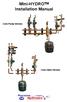 Mini-HYDRO TM Installation Manual Zone Pump Version Zone Valve Version NOTICE: READ THESE INSTRUCTIONS CAREFULLY. FAILURE TO FOLLOW INSTRUCTIONS VOIDS WARRANTY. Introduction: The Mini-HYDRO (patent pending)
HS-901(A) BASIC STEAM HEATING SYSTEMS
 HS-901(A) BASIC HEATING SYSTEMS One-Pipe Two-Pipe Basic Steam Heating Systems One-pipe steam heating system EQUALIZER SAFETY FACTOR STATIC HEAD PRESSURE DROP 2" HEATING UNIT 15" DRIP CONNECTION In a one-pipe,
Water Volume Calculation in Hydronic Heating & Cooling Systems
 Water Volume Calculation in Hydronic Heating & Cooling Systems Preface There are several methods which can be used to calculate the volume of water in a hydronic heating or cooling systems. However, these
Cast Iron Radiator Heating Capacity Guide
 Columbia Heating Products Company 1409 Rome Rd Baltimore, Maryland 21227 410-242-5300 Toll Free 800-645-7845 www.columbiaheating.com Use this handy guide to determine how much heat existing "old style"
Frequently Asked Questions
 Frequently Asked Questions System and Valve Basics: 1. Q: What is good cooling coil performance? A: The temperature range is controlled within +/- 0.5 F (0.28 C) off the cooling coil at set point or below.
AKRON EDUCTORS TROUBLESHOOTING GUIDE OPERATION & THEORY OF EDUCTORS GENERAL OPERATING AND MAINTENANCE INSTRUCTIONS
 AKRON EDUCTORS TROUBLESHOOTING GUIDE OPERATION & THEORY OF EDUCTORS GENERAL OPERATING AND MAINTENANCE INSTRUCTIONS Products Include: 60 gpm eductors Style 3060, 3061, 3062 & 3070 95 gpm eductors Style
Chapter 27: Taxation. 27.1: Introduction. 27.2: The Two Prices with a Tax. 27.2: The Pre-Tax Position
 Chapter 27: Taxation 27.1: Introduction We consider the effect of taxation on some good on the market for that good. We ask the questions: who pays the tax? what effect does it have on the equilibrium
Selection Of Centrifugal Pumping Equipment 1
 Circular 1048 Selection Of Centrifugal Pumping Equipment 1 Dorota Z. Haman, Fedro S. Zazueta, Forrest T. Izuno 2 INTRODUCTION The pump is an essential component of an irrigation system. Proper selection
Section Vb2: Butterfly Valves
 Valve and Actuator Manual 977 Valve Basics and Sizing Information Section Engineering Data Book Vb2 Issue Date 0496 Section Vb2: Butterfly Valves Introduction Page 3 Advantages of Butterfly Valves 3 Disadvantages
Chapter 8: Flow in Pipes
 Objectives 1. Have a deeper understanding of laminar and turbulent flow in pipes and the analysis of fully developed flow 2. Calculate the major and minor losses associated with pipe flow in piping networks
C. starting positive displacement pumps with the discharge valve closed.
 KNOWLEDGE: K1.04 [3.4/3.6] P78 The possibility of water hammer in a liquid system is minimized by... A. maintaining temperature above the saturation temperature. B. starting centrifugal pumps with the
Acceleration Introduction: Objectives: Methods:
 Acceleration Introduction: Acceleration is defined as the rate of change of velocity with respect to time, thus the concepts of velocity also apply to acceleration. In the velocity-time graph, acceleration
A BRIEF INTRODUCTION TO CENTRIFUGAL PUMPS
 A BRIEF INTRODUCTION TO CENTRIFUGAL PUMPS figure below is a cross section of a centrifugal pump and shows the two basic parts. Joe Evans, Ph.D IMPELLER This publication is based upon an introductory, half
Pre-Fab Easy Installation For Models: 006-CT-USK, 008-CT-USK Installation and Operating Instructions for Existing Homes with Standard Piping
 Instruction Sheet 102-140 Pre-Fab Easy Installation For Models: 006-CT-USK, 008-CT-USK Installation and Operating Instructions for Existing Homes with Standard Piping Plant I.D. 001-1024 EFFECTIVE: November
Data sheet Radiator Thermostats type RA 2000 Valve bodies type RA-FN and RA-G
 Data sheet Radiator Thermostats type RA 2000 Valve bodies type RA-FN and RA-G EN 215-1 HD 1215-2 Application RA 2910 built-in sensor RA 2920 tamperproof RA 5062 remote sensor temperature adjuster RA-FN
Air Eliminators and Combination Air Eliminators Strainers
 Description Air Eliminators and Combination Air Eliminator Strainers are designed to provide separation, elimination and prevention of air in piping systems for a variety of installations and conditions.
HOT WATER SYSTEMS CONTENTS
 HOT WATER SYSTEMS CONTENTS MECHANICAL CONSIDERATIONS.............................................. 3 Code Considerations..................................................... 3 Boiler Selection Considerations..............................................
BERMAD Waterworks. Quick Active Check Valve. 700 Series. Model 740Q. Features and Benefits. Major Additional Features
 Booster Pump Control Valve Quick Active Check Valve Isolates system from the effects of pump starts and stops for: Solitary single speed pumps Battery of single speed pumps (add & switch) Battery of variable
Mixing Valves. ARGUS Application Note: Mixing Valves
 Mixing Valves Most radiant hot water heating systems in greenhouses use mixing valves to control the temperature of heating pipes. Both 3-way and 4- way valves are commonly used. Mixing valves provide
Vapor Chambers. Figure 1: Example of vapor chamber. Benefits of Using Vapor Chambers
 Vapor Chambers A vapor chamber is a high-end thermal management device that can evenly dissipate heat from a small source to a large platform of area (see Figure 1). It has a similar construction and mechanism
Energy and Flow Measurement for Hydronic Systems
 Energy and Flow Measurement for Hydronic Systems Presented By: George Szyszko Applications Consultant MCR for ONICON Incorporated Why Measure Thermal Energy? To control something, you must first measure
Harness Your Energy NOW AVAILABLE! the new. ASW-58A-22/30 Solar Thermal Collector
 NOW AVAILABLE! the new ASW-58A-22/30 Solar Thermal Collector The ASW-58A-22/30 series of collectors are available in 22 and 30 tube units. Other sizes are available upon request. Each unit comes complete.
Condensing Boiler Efficiency
 Condensing Boiler Efficiency Date: July 17, 2012 PRES E NT ED BY DO N L E O NA RDI LE O N A RD I I NC. HV AC T RAI N I N G & C ON SU LT IN G Concepts 1 The current state of evolution in boiler design 2
ME 305 Fluid Mechanics I. Part 8 Viscous Flow in Pipes and Ducts
 ME 305 Fluid Mechanics I Part 8 Viscous Flow in Pipes and Ducts These presentations are prepared by Dr. Cüneyt Sert Mechanical Engineering Department Middle East Technical University Ankara, Turkey [email protected]
5.2. Vaporizers - Types and Usage
 5.2. Vaporizers - Types and Usage 5.2.1. General Vaporizers are constructed in numerous designs and operated in many modes. Depending upon the service application the design, construction, inspection,
Surge Pressure in Plumbing Pipe Materials
 Surge Pressure in Plumbing Pipe Materials Prepared for Plastics Pipe Institute, Inc. 15 Decker Court, Suite 825 Irving, Texas 7562 Prepared by NAHB Research Center 4 Prince George s Blvd. Upper Marlboro,
Experiment 3 Pipe Friction
 EML 316L Experiment 3 Pipe Friction Laboratory Manual Mechanical and Materials Engineering Department College of Engineering FLORIDA INTERNATIONAL UNIVERSITY Nomenclature Symbol Description Unit A cross-sectional
Elasticity. I. What is Elasticity?
 Elasticity I. What is Elasticity? The purpose of this section is to develop some general rules about elasticity, which may them be applied to the four different specific types of elasticity discussed in
SECTION 22000. Hot Water Heaters (Hot Water Recirculation Systems and Point-of-Use Water Heaters)
 SECTION 22000 Hot Water Heaters (Hot Water Recirculation Systems and Point-of-Use Water Heaters) PART I - GENERAL A. Description This section includes requirements for materials for installation of Hot
NEBB STANDARDS SECTION-8 AIR SYSTEM TAB PROCEDURES
 NEBB STANDARDS SECTION-8 AIR SYSTEM TAB PROCEDURES 8.1 INTRODUCTION Testing, adjusting, and balancing of HVAC systems can best be accomplished by following a series of systematic procedures. The NEBB TAB
WC flushing cistern single or dual flush 0.13 0.05 2 to fill in 2 minutes WC trough cistern 0.15 per WC 0.10 2 Wash basin tap size 1 2
 HAC_C0.qxd 7/4/08 9: Page 74 Chapter Pipe sizing Pipes and fittings should be sized so that the flow rates for individual draw-offs are equal to the design flow rates shown in table.. During simultaneous
PREPIPED LIQUID FUEL MANIFOLDS PLPM
 PREPIPED LIQUID FUEL MANIFOLDS PLPM INSTRUCTIONS WARNING These instructions are intended for use only by experienced, qualified combustion start-up personnel. Adjustment of this equipment and its components,
Method to Determine PERFORMANCE OF INDIRECT-FIRED WATER HEATERS March 2003 Edition
 Supplement to TESTING STANDARD Method to Determine PERFORMANCE OF INDIRECT-FIRED WATER HEATERS March 2003 Edition [NOTE: This supplement incorporates testing and calculations to determine heat source friction
Fluid Dynamics Basics
 Fluid Dynamics Basics Bernoulli s Equation A very important equation in fluid dynamics is the Bernoulli equation. This equation has four variables: velocity ( ), elevation ( ), pressure ( ), and density
Flow Measurement Options for Pipeline and Open Channel Flow
 Flow Measurement Options for Pipeline and Open Channel Flow October 2013 Presented by Molly Skorpik - 2013 Montana Association of Dam and Canal Systems Conference Irrigation Training and Research Center
MATLAB AS A PROTOTYPING TOOL FOR HYDRONIC NETWORKS BALANCING
 MATLAB AS A PROTOTYPING TOOL FOR HYDRONIC NETWORKS BALANCING J. Pekař, P. Trnka, V. Havlena* Abstract The objective of this note is to describe the prototyping stage of development of a system that is
Exhaust Calculation Booklet
 Exhaust Calculation Booklet American Dryer Corporation 88 Currant Road Fall River MA 02720-4781 Telephone: (508) 678-9000 / Fax: (508) 678-9447 e-mail: [email protected] ADC Part No. 450450 Exhaust
COIL INPUT SCREENS. ITEM NUMBER: Always use a 1 through? In this field you might also use a dash and place quantity of coils here.
 COIL INPUT SCREENS Example of a Water Coil Input Screen: (*please see the appendix for an example of an Evaporator, Steam or Condenser Coil input screen) PHYSICAL DATA ITEM NUMBER: Always use a 1 through?
An Assessment of Radiator Performance
 An Assessment of Radiator Performance By William Adams September 9, 2005 Table of contents 1. Test Equipment and Procedures...2 2. Radiator Descriptions...3 3. Performance Testing...4 a. Group 1: Single
HEAVY OIL FLOW MEASUREMENT CHALLENGES
 HEAVY OIL FLOW MEASUREMENT CHALLENGES 1 INTRODUCTION The vast majority of the world s remaining oil reserves are categorised as heavy / unconventional oils (high viscosity). Due to diminishing conventional
Chapter 2 Practical Approach in Design of HVAC Systems Utilizing Geothermal Energy
 Chapter 2 Practical Approach in Design of HVAC Systems Utilizing Geothermal Energy M. Fathizadeh and D. Seims Abstract Geothermal is the Earth s thermal energy. In recent years geothermal energy has been
Chapter 6 Work and Energy
 Chapter 6 WORK AND ENERGY PREVIEW Work is the scalar product of the force acting on an object and the displacement through which it acts. When work is done on or by a system, the energy of that system
Experiment # 3: Pipe Flow
 ME 05 Mechanical Engineering Lab Page ME 05 Mechanical Engineering Laboratory Spring Quarter 00 Experiment # 3: Pipe Flow Objectives: a) Calibrate a pressure transducer and two different flowmeters (paddlewheel
VC Series Zone Valves BALANCED 2-WAY AND 3-WAY HYDRONIC VALVES
 VC Series Zone Valves BALANCED 2-WAY AND 3-WAY HYDRONIC VALVES PRODUCT DATA Design VC Series zone valves consist of: 2-way or 3-way valve housing available with various connection ends Spindle and cartridge
Guidelines for operation of minimum flow control valves
 Guidelines for operation of minimum flow control valves Holter Regelarmaturen GmbH & Co KG Helleforthstr. 58-60 D-33758 Schloß Holte-Stukenbrock 05/2005 List of contents I. Minimum flow control valves...
ENERGY TRANSFER SYSTEMS AND THEIR DYNAMIC ANALYSIS
 ENERGY TRANSFER SYSTEMS AND THEIR DYNAMIC ANALYSIS Many mechanical energy systems are devoted to transfer of energy between two points: the source or prime mover (input) and the load (output). For chemical
FORCE ON A CURRENT IN A MAGNETIC FIELD
 7/16 Force current 1/8 FORCE ON A CURRENT IN A MAGNETIC FIELD PURPOSE: To study the force exerted on an electric current by a magnetic field. BACKGROUND: When an electric charge moves with a velocity v
Industrial Steam System Process Control Schemes
 Industrial Steam System Process Control Schemes This paper was developed to provide a basic understanding of the different process control schemes used in a typical steam system. This is however a fundamental
Why and How we Use Capacity Control
 Why and How we Use Capacity Control On refrigeration and air conditioning applications where the load may vary over a wide range, due to lighting, occupancy, product loading, ambient weather variations,
R-Value and Thermal Conductivity of PEX and PE-RT TR-48/2014
 R-Value and of PEX and PE-RT TR-48/2014 Foreword R-VALUE AND THERMAL CONDUCTIVITY OF PEX AND PE-RT TR-48/2014 This technical report was developed and published with the technical help and financial support
Minor losses include head losses through/past hydrants, couplers, valves,
 Lecture 10 Minor Losses & Pressure Requirements I. Minor Losses Minor (or fitting, or local ) hydraulic losses along pipes can often be estimated as a function of the velocity head of the water within
measurement, but almost any pipe elbow can be calibrated Elbow meters are not as potentially accurate as venturi,
 Lecture 14 Flow Measurement in Pipes I. Elbow Meters An elbow in a pipe can be used as a flow measuring device much in the same way as a venturi or orifice plate The head differential across the elbow
Understanding Shaft Alignment: Thermal Growth. Published in Maintenance Technology 1/2003
 Understanding Shaft Alignment: Thermal Growth Published in Maintenance Technology 1/2003 Part two of a four-part series that will cover alignment fundamentals and thermal growth, and highlight the importance
Practice Problems on Pumps. Answer(s): Q 2 = 1850 gpm H 2 = 41.7 ft W = 24.1 hp. C. Wassgren, Purdue University Page 1 of 16 Last Updated: 2010 Oct 29
 _02 A centrifugal with a 12 in. diameter impeller requires a power input of 60 hp when the flowrate is 3200 gpm against a 60 ft head. The impeller is changed to one with a 10 in. diameter. Determine the
BASIC ELECTRONICS AC CIRCUIT ANALYSIS. December 2011
 AM 5-202 BASIC ELECTRONICS AC CIRCUIT ANALYSIS December 2011 DISTRIBUTION RESTRICTION: Approved for Pubic Release. Distribution is unlimited. DEPARTMENT OF THE ARMY MILITARY AUXILIARY RADIO SYSTEM FORT
2-Port Self-acting Temperature Control Valve Selection for Heating and Cooling Applications
 Page 1 of 12 TI-S21-07 CH Issue 1 Cert. No. LRQ 0963008 ISO 9001 2-Port Self-acting Temperature Control Valve Selection How to select a system Valve selection: 1. Is the application for heating or cooling?
PRESSURE REDUCING CONTROL VALVE
 Schematics Throttles to reduce high upstream pressure to constant lower downstream pressure Low Flow By-Pass controls at low flows 4 PRESSURE REDUCING CONTROL VALVE with LOW FLOW BY-PASS FEATURE Main Line
Modulex. Gas Fired Boiler Systems PIPING GUIDE GF-115-P. Modular, Condensing, Hot Water Boilers Models: 303, 454, 606, 757, 909, 1060. Instruction No.
 Instruction No. AERCO INTERNATIONAL, Inc., Northvale, New Jersey, 07647 USA PIPING GUIDE GF-115-P Modulex Gas Fired Boiler Systems Modular, Condensing, Hot Water Boilers Models: 303, 454, 606, 757, 909,
Mustang Series PRESSURE REDUCING CONTROL VALVE WITH PRESSURE SUSTAINING FEATURE. M115-2 (Globe) M1115-2 (Angle) Schematic. Standard Components
 Schematic Throttles to reduce high upstream pressure to constant lower downstream pressure Throttles to maintain minimum upstream pressure PRESSURE REDUCING CONTROL VALVE WITH PRESSURE SUSTAINING FEATURE
check valve slam A methodology for predicting
 BY JOHN V. BALLUN A methodology for predicting check valve slam USING A METHODOLOGY DEVELOPED BY EXTENSIVE TESTING, DESIGNERS CAN MATCH THE DYNAMICS OF A PUMPING SYSTEM WITH THE NONSLAMMING CHARACTERISTICS
ENERGY RETROFIT PROGRAM
 ENERGY RETROFIT PROGRAM An innovative but simple retrofit for existing hot water and chilled water piping systems that will help you save money. REDUCE FLOW BY 50% REDUCE PUMP HEAD BY 75% REDUCE PUMP POWER
Solving Quadratic Equations
 9.3 Solving Quadratic Equations by Using the Quadratic Formula 9.3 OBJECTIVES 1. Solve a quadratic equation by using the quadratic formula 2. Determine the nature of the solutions of a quadratic equation