
Math 96--Calculator and Exponent Key and Root Key--page 1
|
|
|
- Camilla Blankenship
- 9 years ago
- Views:
Transcription
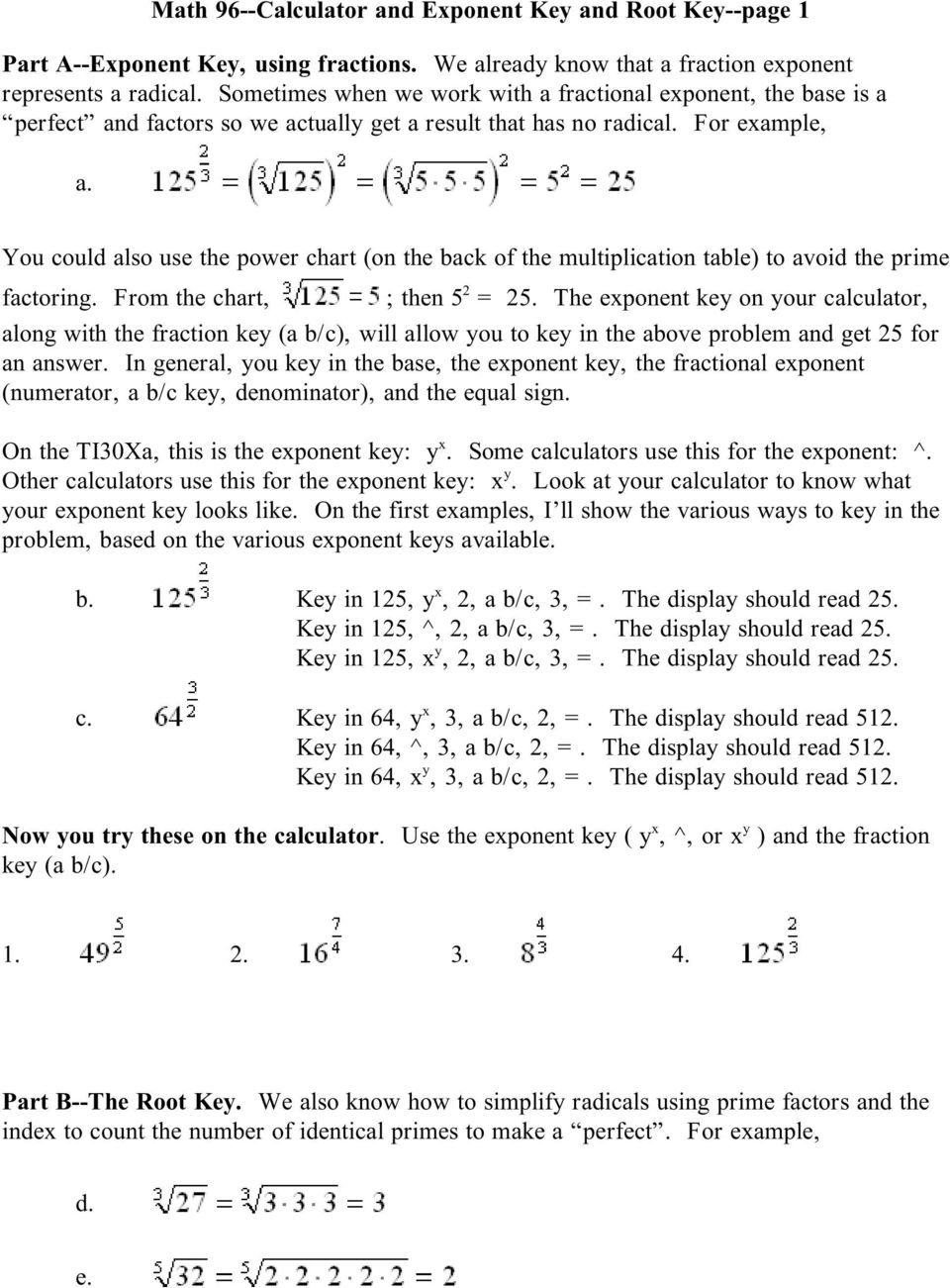
1 Math 96--Calculator a Eponent Ke a Root Ke--page 1 Part A--Eponent Ke, using fractions. We alread know that a fraction eponent represents a radical. Sometimes when we work with a fractional eponent, the base is a perfect a factors so we actuall get a result that has no radical. For eample, a. You could also use the power chart (on the back of the multiplication table) to avoid the prime factoring. From the chart, 2 ; then 5 = 25. The eponent ke on our calculator, along with the fraction ke (a b/c), will allow ou to ke in the above problem a get 25 for an answer. In general, ou ke in the base, the eponent ke, the fractional eponent (numerator, a b/c ke, denominator), a the equal sign. On the TI30Xa, this is the eponent ke:. Some calculators use this for the eponent: ^. Other calculators use this for the eponent ke:. Look at our calculator to know what our eponent ke looks like. On the first eamples, I ll show the various was to ke in the problem, based on the various eponent kes available. b. Ke in 125,, 2, a b/c, 3, =. The displa should read 25. Ke in 125, ^, 2, a b/c, 3, =. The displa should read 25. Ke in 125,, 2, a b/c, 3, =. The displa should read 25. c. Ke in 64,, 3, a b/c, 2, =. The displa should read 512. Ke in 64, ^, 3, a b/c, 2, =. The displa should read 512. Ke in 64,, 3, a b/c, 2, =. The displa should read 512. Now ou tr these on the calculator. Use the eponent ke (, ^, or ) a the fraction ke (a b/c) Part B--The Root Ke. We also know how to simplif radicals using prime factors a the ie to count the number of identical primes to make a perfect. For eample, d. e.
2 Math 96--Calculator a Eponent Ke a Root Ke--page 2 You could also use our power chart (on the back of our multiplication table). Could we do this on the calculator? Yes! We could use the root ke. On the TI30Xa calculator, the root ke is in ellow above the eponent ke. The root ke looks like this:. On some calculators, the root ke looks like this: a is located above the ke. On the TI30Xa, here is how to use the root ke. Ke in the radica, the root ke (so ou have to press the ellow 2 button a to get to the root ke ), the ie, =. For eample, would be keed in like this: radica 32, 2 to use, ie 5, =, 2. On other calculators, here is how to use the root ke. Ke in the ie, the root ke (so ou have to press the shift ke a to get to the root ke ), the radica, =. For eample, would be keed in like this: ie 5, 2 to use, radica 32, =, 2. Pla with our calculator until ou know the kestrokes! Practice with the following eamples. f. Ke in 27, root ke, ie 3, =. The displa should read 3. Ke in 3, root ke, radica 27, =. The displa should read 3. g. Ke in 125, root ke, ie 3, =. The displa should read 5. Ke in 3, root ke, radica 125, =. The displa should read 5. h. Ke in 256, root ke, ie 4, =. The displa should read 4. Ke in 4, root ke, radica 256, =. The displa should read 4. i. Ke in 625, root ke, ie 4, =. The displa should read 5. Ke in 4, root ke, radica 625, =. The displa should read 5. Now ou tr these using the root ke on our calculator

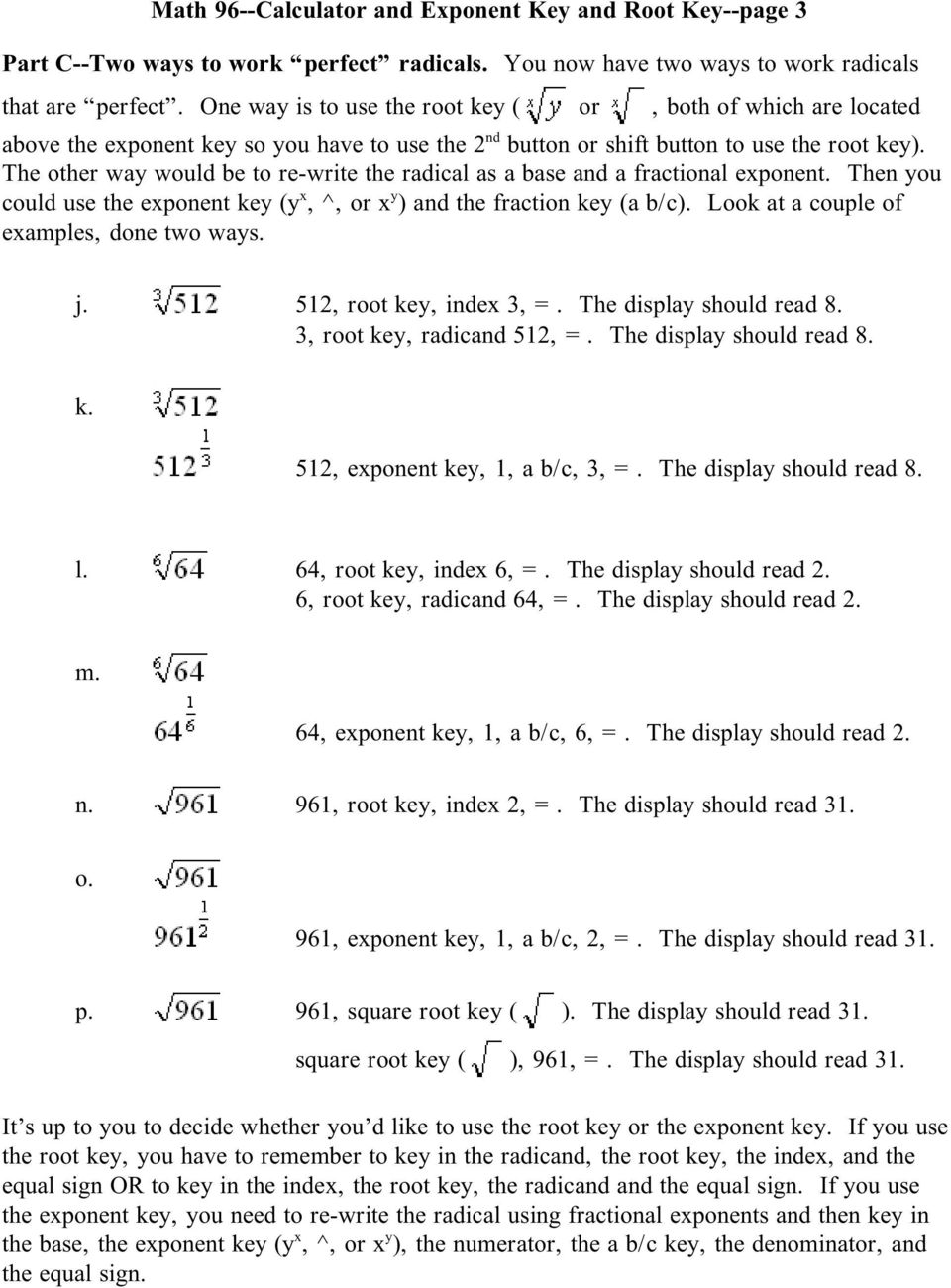
3 Math 96--Calculator a Eponent Ke a Root Ke--page 3 Part C--Two was to work perfect radicals. You now have two was to work radicals that are perfect. One wa is to use the root ke ( or, both of which are located above the eponent ke so ou have to use the 2 button or shift button to use the root ke). The other wa would be to re-write the radical as a base a a fractional eponent. Then ou could use the eponent ke (, ^, or ) a the fraction ke (a b/c). Look at a couple of eamples, done two was. j. 512, root ke, ie 3, =. The displa should read 8. 3, root ke, radica 512, =. The displa should read 8. k. 512, eponent ke, 1, a b/c, 3, =. The displa should read 8. l. 64, root ke, ie 6, =. The displa should read 2. 6, root ke, radica 64, =. The displa should read 2. m. 64, eponent ke, 1, a b/c, 6, =. The displa should read 2. n. 961, root ke, ie 2, =. The displa should read 31. o. 961, eponent ke, 1, a b/c, 2, =. The displa should read 31. p. 961, square root ke ( ). The displa should read 31. square root ke ( ), 961, =. The displa should read 31. It s up to ou to decide whether ou d like to use the root ke or the eponent ke. If ou use the root ke, ou have to remember to ke in the radica, the root ke, the ie, a the equal sign OR to ke in the ie, the root ke, the radica a the equal sign. If ou use the eponent ke, ou need to re-write the radical using fractional eponents a then ke in the base, the eponent ke (, ^, or ), the numerator, the a b/c ke, the denominator, a the equal sign.
4 Math 96--Calculator a Eponent Ke a Root Ke--page 4 Now ou work these. Decide whether ou want to use the root ke or the eponent ke Part D--Etra Ideas. When ou get a problem like this: manuall:, we would work it like this q. r. On the calculator, we would ke in 9, (or ^ or ), 5, a b/c, 2, + to ke (or some calculators use the negative sign first a then 5, a b/c, 2), =. Look at the displa; ou get a decimal: Let s convert that to a fraction b using the fraction-to-decimal ke (F D). Fi that ke! Usuall, it s above some other ke so is accessed b using the 2 ke or the Shift ke. Now look at the displa. It should show the fraction. s. The problem with using the calculator for these problems is the TI30Xa calculator won t convert all decimals to fractions. Once the denominator of a fraction is above 999, this calculator won t convert. So, if we were working the problem, we would work manuall like this: t. If ou tr this on the calculator, ou would ke in 36, eponent ke, the negative eponent, =. Look at the displa; ou get a decimal: When ou tr to convert from a decimal to a fraction with the 2 ke a F D, nothing happens. That s because the denominator is too big! Most instructors won t accept the decimal because it isn t accurate enough. So...it is important to be able to do these manuall. The answer most instructors want is.

5 Math 96--Calculator a Eponent Ke a Root Ke--page 5 Now ou tr these. Write our answer in fraction form. The first would work with a calculator, but the seco will not so work it manuall Answer Ke or 12.

To Be or Not To Be a Linear Equation: That Is the Question
 To Be or Not To Be a Linear Equation: That Is the Question Linear Equation in Two Variables A linear equation in two variables is an equation that can be written in the form A + B C where A and B are not
Calculator Worksheet--page 1
 Calculator Worksheet--page 1 Name On this worksheet, I will be referencing keys that are on the TI30Xa. If you re using a different calculator, similar keys should be there; you just need to fi them! Positive/Negative
Exponents, Radicals, and Scientific Notation
 General Exponent Rules: Exponents, Radicals, and Scientific Notation x m x n = x m+n Example 1: x 5 x = x 5+ = x 7 (x m ) n = x mn Example : (x 5 ) = x 5 = x 10 (x m y n ) p = x mp y np Example : (x) =
Simplification Problems to Prepare for Calculus
 Simplification Problems to Prepare for Calculus In calculus, you will encounter some long epressions that will require strong factoring skills. This section is designed to help you develop those skills.
SIMPLIFYING SQUARE ROOTS EXAMPLES
 SIMPLIFYING SQUARE ROOTS EXAMPLES 1. Definition of a simplified form for a square root The square root of a positive integer is in simplest form if the radicand has no perfect square factor other than
Exponential and Logarithmic Functions
 Chapter 6 Eponential and Logarithmic Functions Section summaries Section 6.1 Composite Functions Some functions are constructed in several steps, where each of the individual steps is a function. For eample,
LESSON EIII.E EXPONENTS AND LOGARITHMS
 LESSON EIII.E EXPONENTS AND LOGARITHMS LESSON EIII.E EXPONENTS AND LOGARITHMS OVERVIEW Here s what ou ll learn in this lesson: Eponential Functions a. Graphing eponential functions b. Applications of eponential
Zero and Negative Exponents and Scientific Notation. a a n a m n. Now, suppose that we allow m to equal n. We then have. a am m a 0 (1) a m
 0. E a m p l e 666SECTION 0. OBJECTIVES. Define the zero eponent. Simplif epressions with negative eponents. Write a number in scientific notation. Solve an application of scientific notation We must have
Simplifying Exponential Expressions
 Simplifying Eponential Epressions Eponential Notation Base Eponent Base raised to an eponent Eample: What is the base and eponent of the following epression? 7 is the base 7 is the eponent Goal To write
PREPARATION FOR MATH TESTING at CityLab Academy
 PREPARATION FOR MATH TESTING at CityLab Academy compiled by Gloria Vachino, M.S. Refresh your math skills with a MATH REVIEW and find out if you are ready for the math entrance test by taking a PRE-TEST
1.6 The Order of Operations
 1.6 The Order of Operations Contents: Operations Grouping Symbols The Order of Operations Exponents and Negative Numbers Negative Square Roots Square Root of a Negative Number Order of Operations and Negative
Irrational Numbers. A. Rational Numbers 1. Before we discuss irrational numbers, it would probably be a good idea to define rational numbers.
 Irrational Numbers A. Rational Numbers 1. Before we discuss irrational numbers, it would probably be a good idea to define rational numbers. Definition: Rational Number A rational number is a number that
Slope-Intercept Form and Point-Slope Form
 Slope-Intercept Form and Point-Slope Form In this section we will be discussing Slope-Intercept Form and the Point-Slope Form of a line. We will also discuss how to graph using the Slope-Intercept Form.
Answers to Basic Algebra Review
 Answers to Basic Algebra Review 1. -1.1 Follow the sign rules when adding and subtracting: If the numbers have the same sign, add them together and keep the sign. If the numbers have different signs, subtract
Simplifying Square-Root Radicals Containing Perfect Square Factors
 DETAILED SOLUTIONS AND CONCEPTS - OPERATIONS ON IRRATIONAL NUMBERS Prepared by Ingrid Stewart, Ph.D., College of Southern Nevada Please Send Questions and Comments to [email protected]. Thank you!
Solution Guide Chapter 14 Mixing Fractions, Decimals, and Percents Together
 Solution Guide Chapter 4 Mixing Fractions, Decimals, and Percents Together Doing the Math from p. 80 2. 0.72 9 =? 0.08 To change it to decimal, we can tip it over and divide: 9 0.72 To make 0.72 into a
SIMPLIFYING SQUARE ROOTS
 40 (8-8) Chapter 8 Powers and Roots 8. SIMPLIFYING SQUARE ROOTS In this section Using the Product Rule Rationalizing the Denominator Simplified Form of a Square Root In Section 8. you learned to simplify
ax 2 by 2 cxy dx ey f 0 The Distance Formula The distance d between two points (x 1, y 1 ) and (x 2, y 2 ) is given by d (x 2 x 1 )
 SECTION 1. The Circle 1. OBJECTIVES The second conic section we look at is the circle. The circle can be described b using the standard form for a conic section, 1. Identif the graph of an equation as
The Distance Formula and the Circle
 10.2 The Distance Formula and the Circle 10.2 OBJECTIVES 1. Given a center and radius, find the equation of a circle 2. Given an equation for a circle, find the center and radius 3. Given an equation,
Rational Expressions - Complex Fractions
 7. Rational Epressions - Comple Fractions Objective: Simplify comple fractions by multiplying each term by the least common denominator. Comple fractions have fractions in either the numerator, or denominator,
Radicals - Multiply and Divide Radicals
 8. Radicals - Multiply and Divide Radicals Objective: Multiply and divide radicals using the product and quotient rules of radicals. Multiplying radicals is very simple if the index on all the radicals
MATH 108 REVIEW TOPIC 10 Quadratic Equations. B. Solving Quadratics by Completing the Square
 Math 108 T10-Review Topic 10 Page 1 MATH 108 REVIEW TOPIC 10 Quadratic Equations I. Finding Roots of a Quadratic Equation A. Factoring B. Quadratic Formula C. Taking Roots II. III. Guidelines for Finding
Pearson s Correlation Coefficient
 Pearson s Correlation Coefficient In this lesson, we will find a quantitative measure to describe the strength of a linear relationship (instead of using the terms strong or weak). A quantitative measure
Chapter 3 Section 6 Lesson Polynomials
 Chapter Section 6 Lesson Polynomials Introduction This lesson introduces polynomials and like terms. As we learned earlier, a monomial is a constant, a variable, or the product of constants and variables.
A positive exponent means repeated multiplication. A negative exponent means the opposite of repeated multiplication, which is repeated
 Eponents Dealing with positive and negative eponents and simplifying epressions dealing with them is simply a matter of remembering what the definition of an eponent is. division. A positive eponent means
Order of Operations More Essential Practice
 Order of Operations More Essential Practice We will be simplifying expressions using the order of operations in this section. Automatic Skill: Order of operations needs to become an automatic skill. Failure
Mathematical goals. Starting points. Materials required. Time needed
 Level A7 of challenge: C A7 Interpreting functions, graphs and tables tables Mathematical goals Starting points Materials required Time needed To enable learners to understand: the relationship between
Exponents. Exponents tell us how many times to multiply a base number by itself.
 Exponents Exponents tell us how many times to multiply a base number by itself. Exponential form: 5 4 exponent base number Expanded form: 5 5 5 5 25 5 5 125 5 625 To use a calculator: put in the base number,
Radicals - Multiply and Divide Radicals
 8. Radicals - Multiply and Divide Radicals Objective: Multiply and divide radicals using the product and quotient rules of radicals. Multiplying radicals is very simple if the index on all the radicals
Algebra. Exponents. Absolute Value. Simplify each of the following as much as possible. 2x y x + y y. xxx 3. x x x xx x. 1. Evaluate 5 and 123
 Algebra Eponents Simplify each of the following as much as possible. 1 4 9 4 y + y y. 1 5. 1 5 4. y + y 4 5 6 5. + 1 4 9 10 1 7 9 0 Absolute Value Evaluate 5 and 1. Eliminate the absolute value bars from
5.1 Radical Notation and Rational Exponents
 Section 5.1 Radical Notation and Rational Exponents 1 5.1 Radical Notation and Rational Exponents We now review how exponents can be used to describe not only powers (such as 5 2 and 2 3 ), but also roots
CHAPTER 7: FACTORING POLYNOMIALS
 CHAPTER 7: FACTORING POLYNOMIALS FACTOR (noun) An of two or more quantities which form a product when multiplied together. 1 can be rewritten as 3*, where 3 and are FACTORS of 1. FACTOR (verb) - To factor
SOLVING QUADRATIC EQUATIONS - COMPARE THE FACTORING ac METHOD AND THE NEW DIAGONAL SUM METHOD By Nghi H. Nguyen
 SOLVING QUADRATIC EQUATIONS - COMPARE THE FACTORING ac METHOD AND THE NEW DIAGONAL SUM METHOD By Nghi H. Nguyen A. GENERALITIES. When a given quadratic equation can be factored, there are 2 best methods
Core Maths C3. Revision Notes
 Core Maths C Revision Notes October 0 Core Maths C Algebraic fractions... Cancelling common factors... Multipling and dividing fractions... Adding and subtracting fractions... Equations... 4 Functions...
SAT Math Hard Practice Quiz. 5. How many integers between 10 and 500 begin and end in 3?
 SAT Math Hard Practice Quiz Numbers and Operations 5. How many integers between 10 and 500 begin and end in 3? 1. A bag contains tomatoes that are either green or red. The ratio of green tomatoes to red
Introduce Decimals with an Art Project Criteria Charts, Rubrics, Standards By Susan Ferdman
 Introduce Decimals with an Art Project Criteria Charts, Rubrics, Standards By Susan Ferdman hundredths tenths ones tens Decimal Art An Introduction to Decimals Directions: Part 1: Coloring Have children
The Method of Partial Fractions Math 121 Calculus II Spring 2015
 Rational functions. as The Method of Partial Fractions Math 11 Calculus II Spring 015 Recall that a rational function is a quotient of two polynomials such f(x) g(x) = 3x5 + x 3 + 16x x 60. The method
The GMAT Guru. Prime Factorization: Theory and Practice
 . Prime Factorization: Theory and Practice The following is an ecerpt from The GMAT Guru Guide, available eclusively to clients of The GMAT Guru. If you would like more information about GMAT Guru services,
SOLVING QUADRATIC EQUATIONS BY THE DIAGONAL SUM METHOD
 SOLVING QUADRATIC EQUATIONS BY THE DIAGONAL SUM METHOD A quadratic equation in one variable has as standard form: ax^2 + bx + c = 0. Solving it means finding the values of x that make the equation true.
Find the Relationship: An Exercise in Graphing Analysis
 Find the Relationship: An Eercise in Graphing Analsis Computer 5 In several laborator investigations ou do this ear, a primar purpose will be to find the mathematical relationship between two variables.
0.8 Rational Expressions and Equations
 96 Prerequisites 0.8 Rational Expressions and Equations We now turn our attention to rational expressions - that is, algebraic fractions - and equations which contain them. The reader is encouraged to
Florida Math 0028. Correlation of the ALEKS course Florida Math 0028 to the Florida Mathematics Competencies - Upper
 Florida Math 0028 Correlation of the ALEKS course Florida Math 0028 to the Florida Mathematics Competencies - Upper Exponents & Polynomials MDECU1: Applies the order of operations to evaluate algebraic
Solutions of Linear Equations in One Variable
 2. Solutions of Linear Equations in One Variable 2. OBJECTIVES. Identify a linear equation 2. Combine like terms to solve an equation We begin this chapter by considering one of the most important tools
9.3 OPERATIONS WITH RADICALS
 9. Operations with Radicals (9 1) 87 9. OPERATIONS WITH RADICALS In this section Adding and Subtracting Radicals Multiplying Radicals Conjugates In this section we will use the ideas of Section 9.1 in
x x y y Then, my slope is =. Notice, if we use the slope formula, we ll get the same thing: m =
 Slope and Lines The slope of a line is a ratio that measures the incline of the line. As a result, the smaller the incline, the closer the slope is to zero and the steeper the incline, the farther the
THE POWER RULES. Raising an Exponential Expression to a Power
 8 (5-) Chapter 5 Eponents and Polnomials 5. THE POWER RULES In this section Raising an Eponential Epression to a Power Raising a Product to a Power Raising a Quotient to a Power Variable Eponents Summar
Substitute 4 for x in the function, Simplify.
 Page 1 of 19 Review of Eponential and Logarithmic Functions An eponential function is a function in the form of f ( ) = for a fied ase, where > 0 and 1. is called the ase of the eponential function. The
This is a square root. The number under the radical is 9. (An asterisk * means multiply.)
 Page of Review of Radical Expressions and Equations Skills involving radicals can be divided into the following groups: Evaluate square roots or higher order roots. Simplify radical expressions. Rationalize
Chapter 7 - Roots, Radicals, and Complex Numbers
 Math 233 - Spring 2009 Chapter 7 - Roots, Radicals, and Complex Numbers 7.1 Roots and Radicals 7.1.1 Notation and Terminology In the expression x the is called the radical sign. The expression under the
INVESTIGATIONS AND FUNCTIONS 1.1.1 1.1.4. Example 1
 Chapter 1 INVESTIGATIONS AND FUNCTIONS 1.1.1 1.1.4 This opening section introduces the students to man of the big ideas of Algebra 2, as well as different was of thinking and various problem solving strategies.
Pre Calculus Math 40S: Explained!
 Pre Calculus Math 0S: Eplained! www.math0s.com 0 Logarithms Lesson PART I: Eponential Functions Eponential functions: These are functions where the variable is an eponent. The first tpe of eponential graph
Square Roots and Other Radicals
 Radicals - Definition Radicals, or roots, are the opposite operation of applying exponents. A power can be undone with a radical and a radical can be undone with a power. For example, if you square 2,
Shake, Rattle and Roll
 00 College Board. All rights reserved. 00 College Board. All rights reserved. SUGGESTED LEARNING STRATEGIES: Shared Reading, Marking the Tet, Visualization, Interactive Word Wall Roller coasters are scar
10.1. Solving Quadratic Equations. Investigation: Rocket Science CONDENSED
 CONDENSED L E S S O N 10.1 Solving Quadratic Equations In this lesson you will look at quadratic functions that model projectile motion use tables and graphs to approimate solutions to quadratic equations
SECTION P.5 Factoring Polynomials
 BLITMCPB.QXP.0599_48-74 /0/0 0:4 AM Page 48 48 Chapter P Prerequisites: Fundamental Concepts of Algebra Technology Eercises Critical Thinking Eercises 98. The common cold is caused by a rhinovirus. The
Radicals - Rationalize Denominators
 8. Radicals - Rationalize Denominators Objective: Rationalize the denominators of radical expressions. It is considered bad practice to have a radical in the denominator of a fraction. When this happens
8-6 Radical Expressions and Rational Exponents. Warm Up Lesson Presentation Lesson Quiz
 8-6 Radical Expressions and Rational Exponents Warm Up Lesson Presentation Lesson Quiz Holt Algebra ALgebra2 2 Warm Up Simplify each expression. 1. 7 3 7 2 16,807 2. 11 8 11 6 121 3. (3 2 ) 3 729 4. 5.
POLYNOMIAL FUNCTIONS
 POLYNOMIAL FUNCTIONS Polynomial Division.. 314 The Rational Zero Test.....317 Descarte s Rule of Signs... 319 The Remainder Theorem.....31 Finding all Zeros of a Polynomial Function.......33 Writing a
Multiplication and Division Properties of Radicals. b 1. 2. a Division property of radicals. 1 n ab 1ab2 1 n a 1 n b 1 n 1 n a 1 n b
 488 Chapter 7 Radicals and Complex Numbers Objectives 1. Multiplication and Division Properties of Radicals 2. Simplifying Radicals by Using the Multiplication Property of Radicals 3. Simplifying Radicals
SECTION 2.2. Distance and Midpoint Formulas; Circles
 SECTION. Objectives. Find the distance between two points.. Find the midpoint of a line segment.. Write the standard form of a circle s equation.. Give the center and radius of a circle whose equation
Algebra and Geometry Review (61 topics, no due date)
 Course Name: Math 112 Credit Exam LA Tech University Course Code: ALEKS Course: Trigonometry Instructor: Course Dates: Course Content: 159 topics Algebra and Geometry Review (61 topics, no due date) Properties
SUNY ECC. ACCUPLACER Preparation Workshop. Algebra Skills
 SUNY ECC ACCUPLACER Preparation Workshop Algebra Skills Gail A. Butler Ph.D. Evaluating Algebraic Epressions Substitute the value (#) in place of the letter (variable). Follow order of operations!!! E)
Math 0980 Chapter Objectives. Chapter 1: Introduction to Algebra: The Integers.
 Math 0980 Chapter Objectives Chapter 1: Introduction to Algebra: The Integers. 1. Identify the place value of a digit. 2. Write a number in words or digits. 3. Write positive and negative numbers used
Indices and Surds. The Laws on Indices. 1. Multiplication: Mgr. ubomíra Tomková
 Indices and Surds The term indices refers to the power to which a number is raised. Thus x is a number with an index of. People prefer the phrase "x to the power of ". Term surds is not often used, instead
Higher Education Math Placement
 Higher Education Math Placement Placement Assessment Problem Types 1. Whole Numbers, Fractions, and Decimals 1.1 Operations with Whole Numbers Addition with carry Subtraction with borrowing Multiplication
1.2 Linear Equations and Rational Equations
 Linear Equations and Rational Equations Section Notes Page In this section, you will learn how to solve various linear and rational equations A linear equation will have an variable raised to a power of
Higher. Polynomials and Quadratics 64
 hsn.uk.net Higher Mathematics UNIT OUTCOME 1 Polnomials and Quadratics Contents Polnomials and Quadratics 64 1 Quadratics 64 The Discriminant 66 3 Completing the Square 67 4 Sketching Parabolas 70 5 Determining
Stanford Math Circle: Sunday, May 9, 2010 Square-Triangular Numbers, Pell s Equation, and Continued Fractions
 Stanford Math Circle: Sunday, May 9, 00 Square-Triangular Numbers, Pell s Equation, and Continued Fractions Recall that triangular numbers are numbers of the form T m = numbers that can be arranged in
Supplemental Worksheet Problems To Accompany: The Pre-Algebra Tutor: Volume 1 Section 1 Real Numbers
 Supplemental Worksheet Problems To Accompany: The Pre-Algebra Tutor: Volume 1 Please watch Section 1 of this DVD before working these problems. The DVD is located at: http://www.mathtutordvd.com/products/item66.cfm
Preliminary Mathematics
 Preliminary Mathematics The purpose of this document is to provide you with a refresher over some topics that will be essential for what we do in this class. We will begin with fractions, decimals, and
A Quick Algebra Review
 1. Simplifying Epressions. Solving Equations 3. Problem Solving 4. Inequalities 5. Absolute Values 6. Linear Equations 7. Systems of Equations 8. Laws of Eponents 9. Quadratics 10. Rationals 11. Radicals
MATH 10034 Fundamental Mathematics IV
 MATH 0034 Fundamental Mathematics IV http://www.math.kent.edu/ebooks/0034/funmath4.pdf Department of Mathematical Sciences Kent State University January 2, 2009 ii Contents To the Instructor v Polynomials.
Summary Of Mental Maths Targets EYFS Yr 6. Year 3. Count from 0 in multiples of 4 & 8, 50 & 100. Count back in 100s, 10s, 1s eg.
 Autumn 1 Say the number names in order to 10. Read and write from 1 to 20 in numerals and words. Count in steps of 2, 3, and 5 from 0, and in tens from any number, forward and backward. Count from 0 in
Graphing Linear Equations
 6.3 Graphing Linear Equations 6.3 OBJECTIVES 1. Graph a linear equation b plotting points 2. Graph a linear equation b the intercept method 3. Graph a linear equation b solving the equation for We are
COLLEGE ALGEBRA. Paul Dawkins
 COLLEGE ALGEBRA Paul Dawkins Table of Contents Preface... iii Outline... iv Preliminaries... Introduction... Integer Exponents... Rational Exponents... 9 Real Exponents...5 Radicals...6 Polynomials...5
Copy in your notebook: Add an example of each term with the symbols used in algebra 2 if there are any.
 Algebra 2 - Chapter Prerequisites Vocabulary Copy in your notebook: Add an example of each term with the symbols used in algebra 2 if there are any. P1 p. 1 1. counting(natural) numbers - {1,2,3,4,...}
Calculator Practice: Computation with Fractions
 Calculator Practice: Computation with Fractions Objectives To provide practice adding fractions with unlike denominators and using a calculator to solve fraction problems. www.everydaymathonline.com epresentations
More Equations and Inequalities
 Section. Sets of Numbers and Interval Notation 9 More Equations and Inequalities 9 9. Compound Inequalities 9. Polnomial and Rational Inequalities 9. Absolute Value Equations 9. Absolute Value Inequalities
Math Circle Beginners Group October 18, 2015
 Math Circle Beginners Group October 18, 2015 Warm-up problem 1. Let n be a (positive) integer. Prove that if n 2 is odd, then n is also odd. (Hint: Use a proof by contradiction.) Suppose that n 2 is odd
PERT Computerized Placement Test
 PERT Computerized Placement Test REVIEW BOOKLET FOR MATHEMATICS Valencia College Orlando, Florida Prepared by Valencia College Math Department Revised April 0 of 0 // : AM Contents of this PERT Review
Review of Intermediate Algebra Content
 Review of Intermediate Algebra Content Table of Contents Page Factoring GCF and Trinomials of the Form + b + c... Factoring Trinomials of the Form a + b + c... Factoring Perfect Square Trinomials... 6
6.3. section. Building Up the Denominator. To convert the fraction 2 3 factor 21 as 21 3 7. Because 2 3
 0 (6-18) Chapter 6 Rational Epressions GETTING MORE INVOLVED 7. Discussion. Evaluate each epression. a) One-half of 1 b) One-third of c) One-half of d) One-half of 1 a) b) c) d) 8 7. Eploration. Let R
A Year-long Pathway to Complete MATH 1111: College Algebra
 A Year-long Pathway to Complete MATH 1111: College Algebra A year-long path to complete MATH 1111 will consist of 1-2 Learning Support (LS) classes and MATH 1111. The first semester will consist of the
ARE YOU A RADICAL OR JUST A SQUARE ROOT? EXAMPLES
 ARE YOU A RADICAL OR JUST A SQUARE ROOT? EXAMPLES 1. Squaring a number means using that number as a factor two times. 8 8(8) 64 (-8) (-8)(-8) 64 Make sure students realize that x means (x ), not (-x).
3.3 Addition and Subtraction of Rational Numbers
 3.3 Addition and Subtraction of Rational Numbers In this section we consider addition and subtraction of both fractions and decimals. We start with addition and subtraction of fractions with the same denominator.
Section 5.0A Factoring Part 1
 Section 5.0A Factoring Part 1 I. Work Together A. Multiply the following binomials into trinomials. (Write the final result in descending order, i.e., a + b + c ). ( 7)( + 5) ( + 7)( + ) ( + 7)( + 5) (
Adding and Subtracting Fractions. 1. The denominator of a fraction names the fraction. It tells you how many equal parts something is divided into.
 Tallahassee Community College Adding and Subtracting Fractions Important Ideas:. The denominator of a fraction names the fraction. It tells you how many equal parts something is divided into.. The numerator
Black Problems - Prime Factorization, Greatest Common Factor and Simplifying Fractions
 Black Problems Prime Factorization, Greatest Common Factor and Simplifying Fractions A natural number n, such that n >, can t be written as the sum of two more consecutive odd numbers if and only if n
Quadratics - Build Quadratics From Roots
 9.5 Quadratics - Build Quadratics From Roots Objective: Find a quadratic equation that has given roots using reverse factoring and reverse completing the square. Up to this point we have found the solutions
Exponents. Learning Objectives 4-1
 Eponents -1 to - Learning Objectives -1 The product rule for eponents The quotient rule for eponents The power rule for eponents Power rules for products and quotient We can simplify by combining the like
Common Math Errors Written by Paul Dawkins
 Common Math Errors Written by Paul Dawkins Originally the intended audience for this was my Calculus I students as pretty much every error listed here shows up in that class with alarming frequency. After
3.1. RATIONAL EXPRESSIONS
 3.1. RATIONAL EXPRESSIONS RATIONAL NUMBERS In previous courses you have learned how to operate (do addition, subtraction, multiplication, and division) on rational numbers (fractions). Rational numbers
Multiplying Fractions
 . Multiplying Fractions. OBJECTIVES 1. Multiply two fractions. Multiply two mixed numbers. Simplify before multiplying fractions 4. Estimate products by rounding Multiplication is the easiest of the four
LINEAR INEQUALITIES. less than, < 2x + 5 x 3 less than or equal to, greater than, > 3x 2 x 6 greater than or equal to,
 LINEAR INEQUALITIES When we use the equal sign in an equation we are stating that both sides of the equation are equal to each other. In an inequality, we are stating that both sides of the equation are
MATHCOUNTS TOOLBOX Facts, Formulas and Tricks
 MATHCOUNTS TOOLBOX Facts, Formulas and Tricks MATHCOUNTS Coaching Kit 40 I. PRIME NUMBERS from 1 through 100 (1 is not prime!) 2 3 5 7 11 13 17 19 23 29 31 37 41 43 47 53 59 61 67 71 73 79 83 89 97 II.
Algebra 1 If you are okay with that placement then you have no further action to take Algebra 1 Portion of the Math Placement Test
 Dear Parents, Based on the results of the High School Placement Test (HSPT), your child should forecast to take Algebra 1 this fall. If you are okay with that placement then you have no further action
Welcome to Math 19500 Video Lessons. Stanley Ocken. Department of Mathematics The City College of New York Fall 2013
 Welcome to Math 19500 Video Lessons Prof. Department of Mathematics The City College of New York Fall 2013 An important feature of the following Beamer slide presentations is that you, the reader, move
Quadratic Equations and Functions
 Quadratic Equations and Functions. Square Root Propert and Completing the Square. Quadratic Formula. Equations in Quadratic Form. Graphs of Quadratic Functions. Verte of a Parabola and Applications In
Use order of operations to simplify. Show all steps in the space provided below each problem. INTEGER OPERATIONS
 ORDER OF OPERATIONS In the following order: 1) Work inside the grouping smbols such as parenthesis and brackets. ) Evaluate the powers. 3) Do the multiplication and/or division in order from left to right.
EAP/GWL Rev. 1/2011 Page 1 of 5. Factoring a polynomial is the process of writing it as the product of two or more polynomial factors.
 EAP/GWL Rev. 1/2011 Page 1 of 5 Factoring a polynomial is the process of writing it as the product of two or more polynomial factors. Example: Set the factors of a polynomial equation (as opposed to an