
OPERATING LIMITATIONS
|
|
|
- Tyrone Jenkins
- 9 years ago
- Views:
Transcription
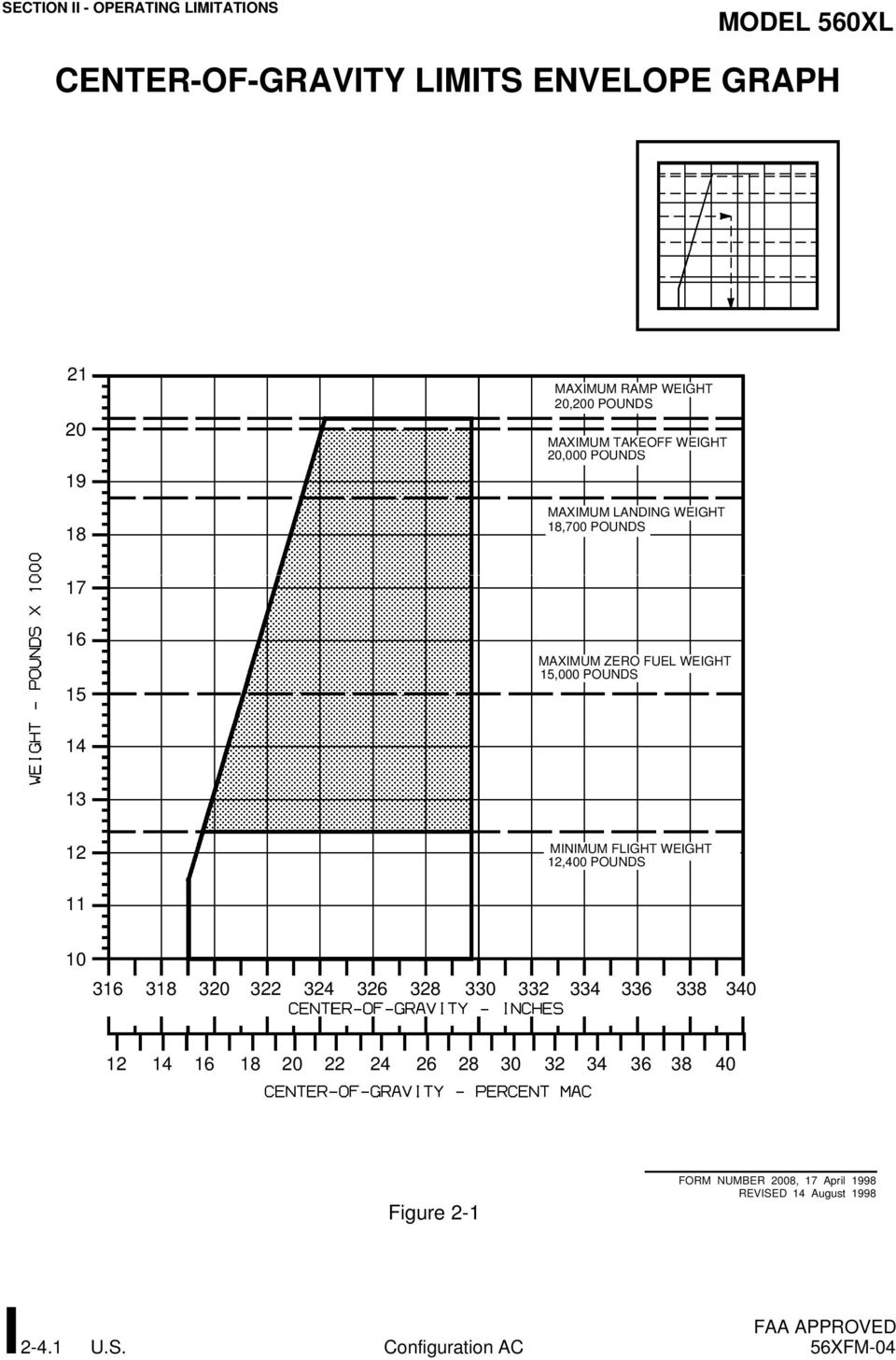
1 OPERATING LIMITATIONS CERTIFICATION STATUS NOTICE CERTIFICATION AND OPERATIONAL LIMITATIONS ARE CONDITIONS OF THE TYPE AND AIRWORTHINESS CERTIFICATES AND MUST BE COMPLIED WITH AT ALL TIMES AS REQUIRED BY LAW. This airplane is certified in accordance with FAR 25. WEIGHT LIMITATIONS Maximum Design Ramp Weight ,200 Pounds Maximum Design Takeoff Weight ,000 Pounds Maximum Design Landing Weight ,700 Pounds Maximum Design Zero Fuel Weight ,000 Pounds Minimum Flight Weight ,400 Pounds Maximum Tailcone Baggage Weight Pounds Takeoff weight is limited by the most restrictive of the following requirements: Maximum Certified Takeoff Weight ,000 Pounds Maximum Takeoff Weight Permitted by Climb Requirements Refer to Procedures for Use of Takeoff Performance Tables in Section IV Takeoff Field Length Refer to Procedures for Use of Takeoff Performance Tables in Section IV Landing weight is limited by the most restrictive of the following requirements: Maximum Certified Landing Weight ,700 Pounds Maximum Landing Weight Permitted by Climb Requirements or Brake Energy Limit Refer to Procedures for Use of Approach and Landing Performance Tables in Section IV Landing Distance Refer to Procedures for Use of Approach and Landing Performance Tables in Section IV CENTER-OF-GRAVITY LIMITS Center-of-Gravity Moment Envelope Refer to Figure 2-1 WEIGHT AND BALANCE DATA The airplane must be operated in accordance with the approved loading schedule. Refer to Weight and Balance Data Sheet and Model 560XL Weight and Balance Manual. 56XFM-01 Configuration AA U.S. 2-3
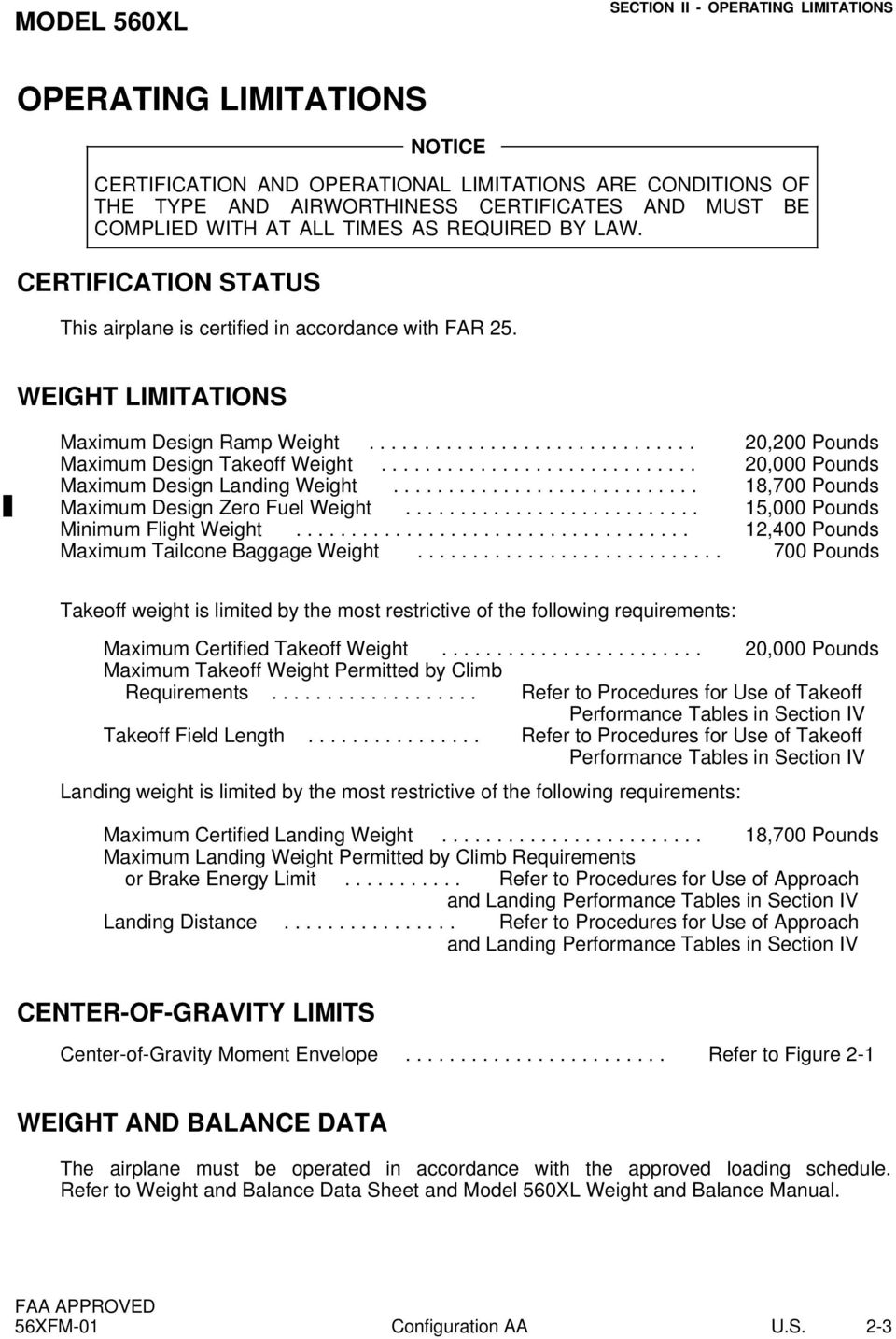
2 MODEL 560XL CENTER-OF-GRAVITY LIMITS ENVELOPE GRAPH FORM NUMBER 2008A, 17 November 1999 Figure 2-1 I2-4 U.S. Configuration AB 56XFM-04
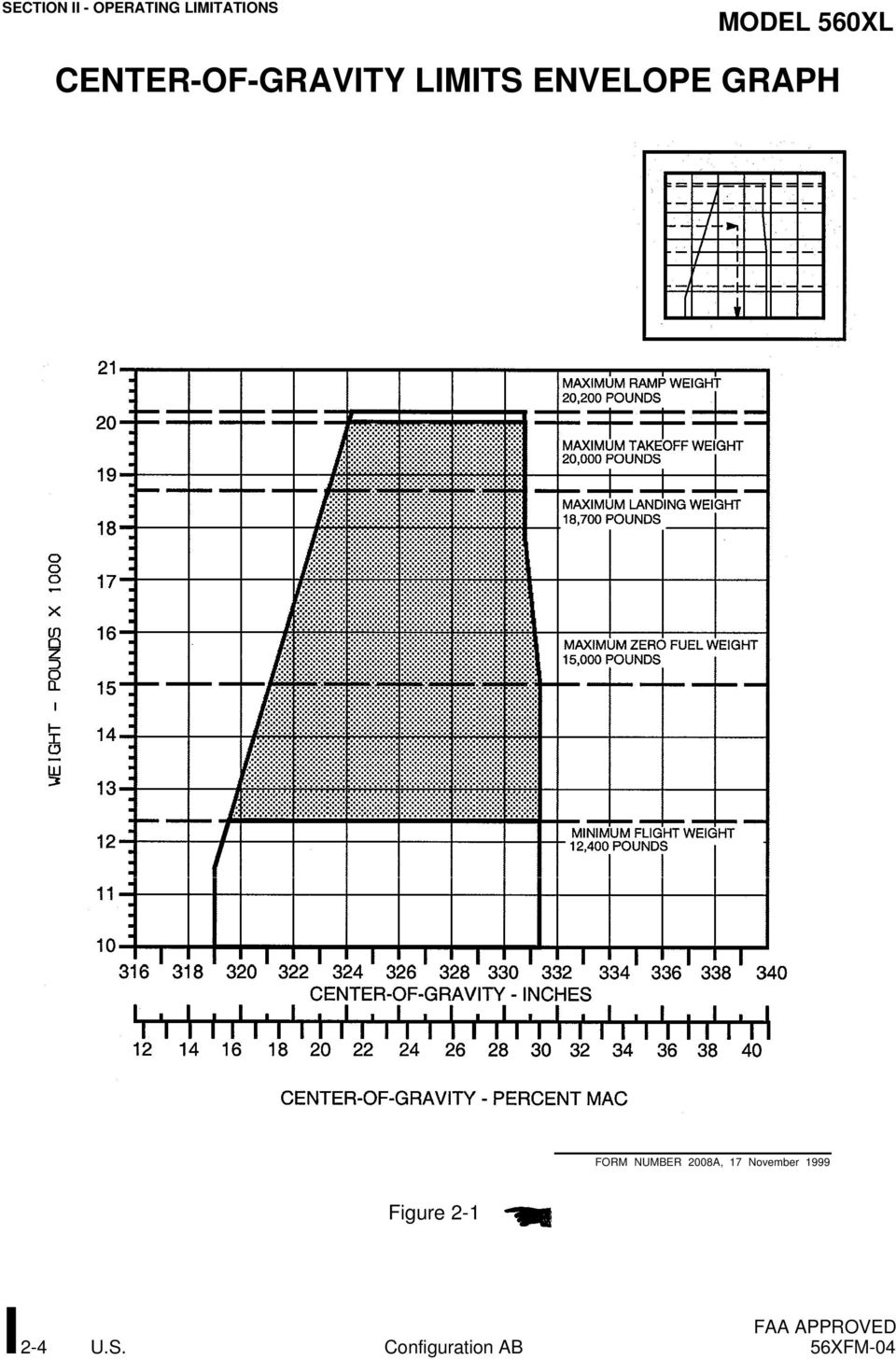
3 OPERATING LIMITATIONS CERTIFICATION STATUS NOTICE CERTIFICATION AND OPERATIONAL LIMITATIONS ARE CONDITIONS OF THE TYPE AND AIRWORTHINESS CERTIFICATES AND MUST BE COMPLIED WITH AT ALL TIMES AS REQUIRED BY LAW. This airplane is certified in accordance with FAR 25. WEIGHT LIMITATIONS Maximum Design Ramp Weight ,200 Pounds Maximum Design Takeoff Weight ,000 Pounds Maximum Design Landing Weight ,700 Pounds Maximum Design Zero Fuel Weight ,000 Pounds Minimum Flight Weight ,400 Pounds Maximum Tailcone Baggage Weight Pounds Takeoff weight is limited by the most restrictive of the following requirements: Maximum Certified Takeoff Weight ,000 Pounds Maximum Takeoff Weight Permitted by Climb Requirements Refer to Procedures for Use of Takeoff Performance Tables in Section IV Takeoff Field Length Refer to Procedures for Use of Takeoff Performance Tables in Section IV Landing weight is limited by the most restrictive of the following requirements: Maximum Certified Landing Weight ,700 Pounds Maximum Landing Weight Permitted by Climb Requirements or Brake Energy Limit Refer to Procedures for Use of Approach and Landing Performance Tables in Section IV Landing Distance Refer to Procedures for Use of Approach and Landing Performance Tables in Section IV CENTER-OF-GRAVITY LIMITS Center-of-Gravity Moment Envelope Refer to Figure 2-1 WEIGHT AND BALANCE DATA The airplane must be operated in accordance with the approved loading schedule. Refer to Weight and Balance Data Sheet and Model 560XL Weight and Balance Manual. 56XFM-01 Configuration AA U.S. 2-3
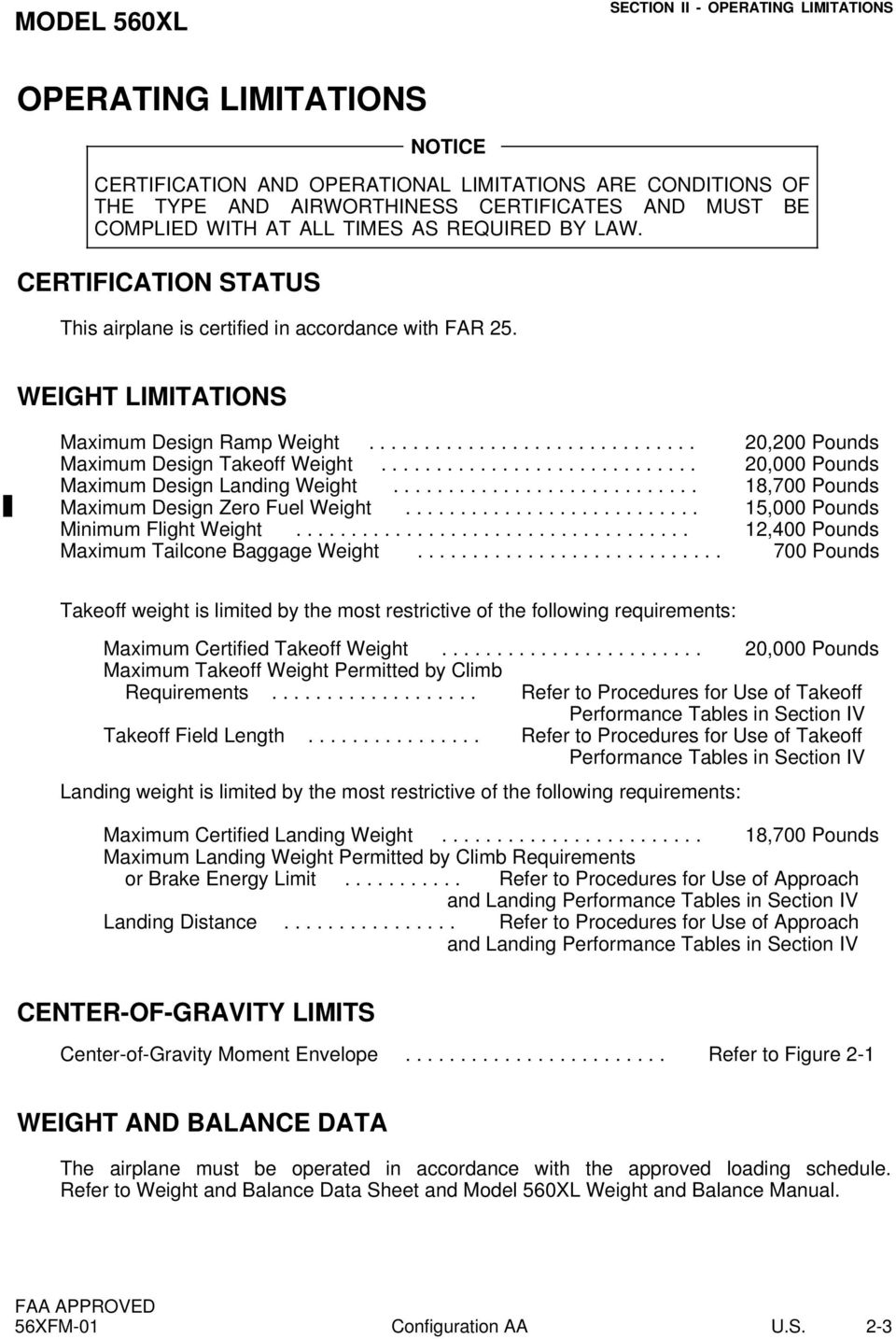
4 MODEL 560XL Figure 2-1 CENTER-OF-GRAVITY LIMITS ENVELOPE GRAPH 20,200 POUNDS MAXIMUM RAMP WEIGHT 20,000 POUNDS MAXIMUM TAKEOFF WEIGHT MAXIMUM LANDING WEIGHT 18,700 POUNDS MAXIMUM ZERO FUEL WEIGHT 15,000 POUNDS MINIMUM FLIGHT WEIGHT 12,400 POUNDS FORM NUMBER 2008, 17 April 1998 REVISED 14 August 1998 I2-4.1 U.S. Configuration AC 56XFM-04
5 POWERPLANT LIMITATIONS Engine Type Pratt and Whitney Canada Inc. PW545A Turbofan Engine Operating Limits Refer to Figure 2-2 Inter-Turbine Temperature Limits Refer to Figure 2-3 Engine Overspeed Limits Refer to Figure 2-4 Takeoff/Go Around Thrust Setting (TO Detent) Refer to Figure 4-8 Maximum Continuous Thrust Setting (CLB Detent) Refer to Figure 4-9 Minimum ambient temperature for ground engine starting is 30 C. ENGINE OPERATING LIMITS OPERATING CONDITION OPERATING LIMITS THRUST SETTING TIME LIMIT (MINUTES) MAX OBSERVED ITT C N 2 N 1 OIL PRESSURE ( 1) PSI OIL TEMP C % % TAKE-OFF 5 ( 4) MAXIMUM CONTINUOUS CONTINUOUS GROUND IDLE FLIGHT IDLE CONTINUOUS TRANSIENT 120 SECONDS >> >> >> TO 135 * Refer to Figure 2-4. ** Refer to Figure 2-3. S 1. Oil Pressure Normal oil pressure is 45 to 140 PSI at N 2 speeds above 60%. Oil pressure below 45 PSI is undesirable and should be tolerated only for the completion of the flight, preferably at reduced power setting. Oil pressure at takeoff and maximum thrust setting may exceed 140 PSI (not to exceed 250 PSI) for up to 120 seconds. 2. Ground Idle is available in EEC mode only. 3. Flight idle is available in EEC or Manual modes TO TO TO TO N/A 47 (MIN) ( 2) 51.5 (MIN) ( 3) 4. Take-off ratings that are nominally limited to 5 minutes duration may be used for up to 10 minutes for One Engine Inoperative operations without adverse effects upon engine airworthiness. >> >> 45 (MIN) -40 TO STARTING N/A 720** >> >> >> -40 MIN TRANSIENT 20 SECONDS 760** 103* 102* TO 135 Figure XFM-07 Configuration AA U.S. 2-5

6 MODEL 560XL INTER-TURBINE TEMPERATURE LIMITS Inter-Turbine Temperatures shown make no allowance for correction factors or instrument errors but allow for some typical instrument lag. B C AREA A - NO ACTION REQUIRED AREA B (1) DETERMINE CAUSE AND CORRECT (2) INSPECT HOT SECTION USING BORESCOPE IN ACCORDANCE WITH PRATT & WHITNEY INSTRUCTIONS AREA C - PERFORM INSPECTION/REPAIRS IN ACCORDANCE WITH PRATT & WHITNEY INSTRUCTIONS. A C AREA A - NO ACTION REQUIRED A B AREA B (1) DETERMINE CAUSE AND CORRECT (2) INSPECT HOT SECTION USING BORESCOPE IN ACCORDANCE WITH PRATT & WHITNEY INSTRUCTIONS AREA C - PERFORM INSPECTION/REPAIRS IN ACCORDANCE WITH PRATT & WHITNEY INSTRUCTIONS. Figure U.S. Configuration AA 56XFM-07

7 ENGINE OVERSPEED LIMITS AREA A AREA B AREA C - NO ACTION REQUIRED - RECORD IN ENGINE LOG BOOK - PERFORM INSPECTION/REPAIRS IN ACCORDANCE WITH PRATT & WHITNEY INSTRUCTIONS N 1 and N 2 Overspeed Limits ENGINE FAN INSPECTION Figure 2-4 To assure accurate fan speed thrust indication, inspect the fan for damage prior to each flight in accordance with the exterior inspection in the Normal Procedures Section of the manual. ELECTRONIC ENGINE COMPUTER Dispatch with either, or both, engines operating in manual mode is prohibited, except when conducted in accordance with limitations and procedures contained in Supplement 9, Dispatch with Electronic Engine Computer(s) Inoperative. BATTERY AND STARTER CYCLE LIMITATIONS Starter Limitation Three engine starts per 30 minutes. Three cycles of operation with a 90-second rest period between cycles is permitted. Battery Limitation Three engine starts per hour. Refer to notes 2 and 3. (Continued Next Page) 56XFM-07 Configuration AA U.S. 2-7

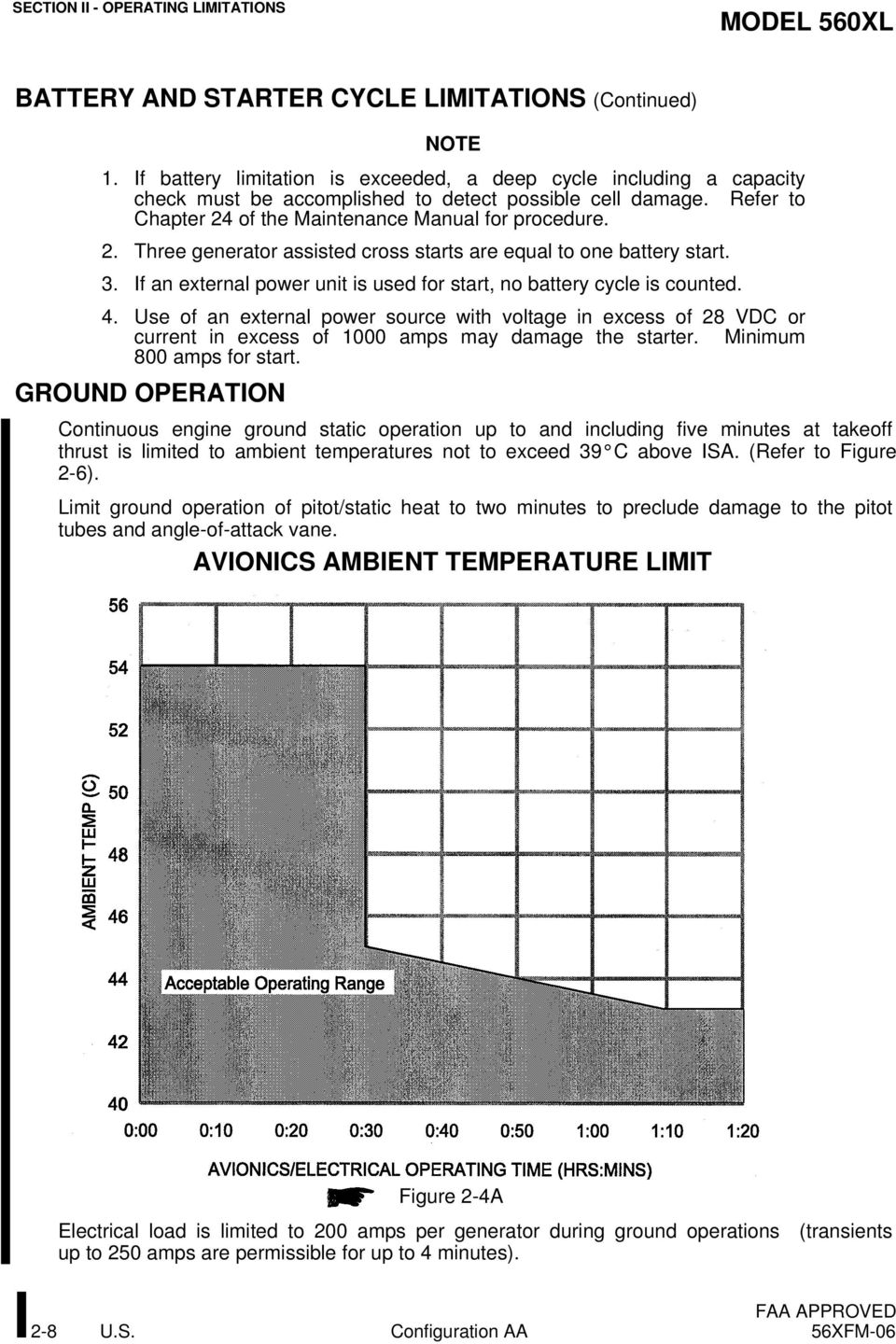
8 MODEL 560XL BATTERY AND STARTER CYCLE LIMITATIONS (Continued) 1. If battery limitation is exceeded, a deep cycle including a capacity check must be accomplished to detect possible cell damage. Refer to Chapter 24 of the Maintenance Manual for procedure. 2. Three generator assisted cross starts are equal to one battery start. 3. If an external power unit is used for start, no battery cycle is counted. 4. Use of an external power source with voltage in excess of 28 VDC or current in excess of 1000 amps may damage the starter. Minimum 800 amps for start. GROUND OPERATION Continuous engine ground static operation up to and including five minutes at takeoff thrust is limited to ambient temperatures not to exceed 39 C above ISA. (Refer to Figure 2-6). Limit ground operation of pitot/static heat to two minutes to preclude damage to the pitot tubes and angle-of-attack vane. AVIONICS AMBIENT TEMPERATURE LIMIT Figure 2-4A Electrical load is limited to 200 amps per generator during ground operations (transients up to 250 amps are permissible for up to 4 minutes). I2-8 U.S. Configuration AA 56XFM-06
9 HYDRAULIC FLUID Use Skydrol 500A, B, B-4, C, or LD-4; or Hyjet, Hyjet W, III, IV, IVA or IVA Plus only. APPROVED OILS The following oils are approved for use: MOBIL JET OIL II EXXON TURBO OIL 2380 AEROSHELL TURBINE OIL 500 MOBIL JET OIL 254 * ROYCO TURBINE OIL 500 AEROSHELL TURBINE OIL 560* CASTROL 5000 Oils denoted with an asterisk are THIRD GENERATION lubricants. CAUTION WHEN CHANGING FROM AN EXISTING LUBRICANT FORMULATION TO A THIRD GENERATION LUBRICANT FORMULATION (AEROSHELL TURBINE OIL 560 OR MOBIL JET 254), THE ENGINE MANUFACTURER STRONGLY RECOMMENDS THAT SUCH A CHANGE SHOULD ONLY BE MADE WHEN AN ENGINE IS NEW OR FRESHLY OVERHAULED. FOR ADDITIONAL INFORMATION ON USE OF THIRD GENERATION OILS, REFER TO ENGINE MANUFACTURER S PERTINENT OIL SERVICE BULLETINS. Should it be necessary to replenish oil consumption losses when oil of the same brand (as tank contents) is unavailable, then the following requirements apply: For contingency purposes, oil replenishment using any other approved oil brand listed is acceptable provided: 1. The total quantity of added oil does not exceed two U.S. quarts in any 400-hour period. 2. If it is required to add more than two U.S. quarts of dissimilar oil brands, drain and flush complete oil system and refill with an approved oil in accordance with Engine Maintenance Manual instructions. Should oils of nonapproved brands or of different viscosities become intermixed, drain and flush complete oil system and refill with an approved oil in accordance with Engine Maintenance Manual instructions. SINGLE POINT REFUELING LIMITATION Single point refueling operations must be accomplished per the procedures contained on the placard installed on the single point refueling access door. Refueling pressure range is 10 to 55 PSI, maximum defueling pressure is -10 PSI. I56XFM-06 Configuration AA U.S. 2-9

10 MODEL 560XL FUEL LIMITATIONS FUEL BOOST Pumps - ON; when low fuel lights illuminate or at 400 pounds or less indicated fuel. The following fuels are approved for use in accordance with Figure 2-5. COMMERCIAL KEROSENE JET A, JET A-1, JET B, JET 3, JP-4, JP-5 and JP-8 per CPW 204 specification. EGME and DIEGME fuel additives are approved for use, but are not required. Refer to Normal Procedures, Anti-Ice Additives for blending instructions. FUEL LIMITATIONS JET A, JET A-1, JET 3, JP-5 & JP-8 JET B & JP-4 MINIMUM FUEL TEMPERATURE 40 C 45 C MAXIMUM FUEL TEMPERATURE +57 C ** MAXIMUM ALTITUDE 45,000 FEET ** MAXIMUM ASYMMETRIC FUEL DIFFERENTIAL FOR NORMAL OPERATIONS 400 POUNDS 400 POUNDS EMERGENCY ASYMMETRIC FUEL DIFFERENTIAL * 800 POUNDS 800 POUNDS * MAXIMUM LATERAL FUEL IMBALANCE IS 400 POUNDS. A LATERAL FUEL IMBALANCE OF 800 POUNDS HAS BEEN DEMONSTRATED FOR EMERGENCY RETURN. ** REFER TO FIGURE 2-5A Figure 2-5 UNUSABLE FUEL Fuel remaining in the fuel tanks when the fuel quantity indicator reads zero is not usable in flight U.S. Configuration AA 56XFM-07
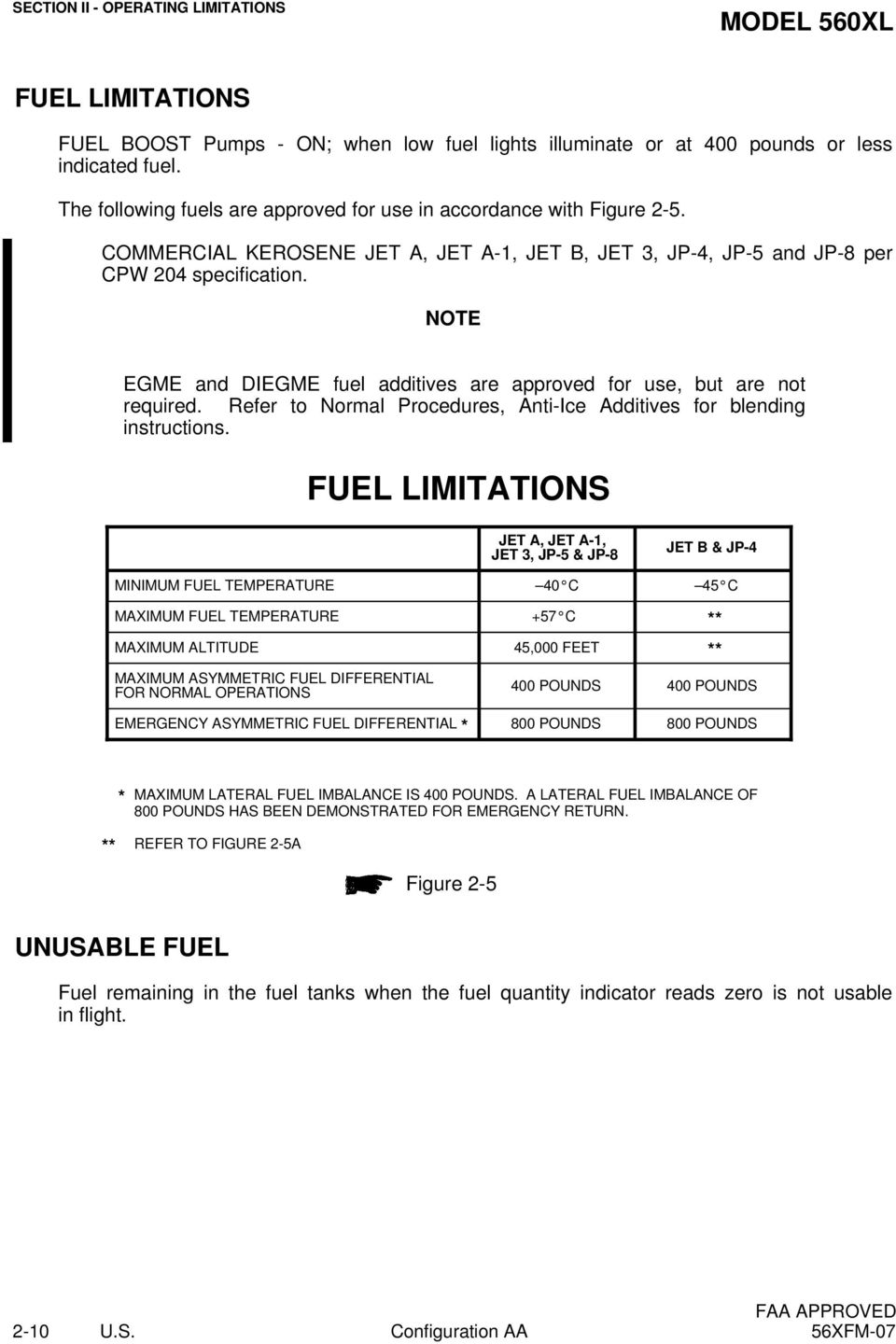
11 JET B/JP-4 FUEL OPERATING LIMITATIONS SPEED LIMITATIONS Figure 2-5A Maximum Operating Limit Speeds M MO (Above 26,515 Feet) Mach (Indicated) V MO (Between 8000 and 26,515 Feet) KIAS V MO (Below 8000 Feet) KIAS The maximum operating limit speeds may not be deliberately exceeded in any phase of flight (climb, cruise or descent) unless a higher speed is authorized for flight test or pilot training. Maximum Maneuvering Speeds - V A Refer to Figure 2-7 Full application of rudder and aileron controls as well as maneuvers that involve angles-of-attack near the stall should be confined to speeds below maximum maneuvering speed. (Continued Next Page) I56XFM-02 Configuration AA U.S. 2-11
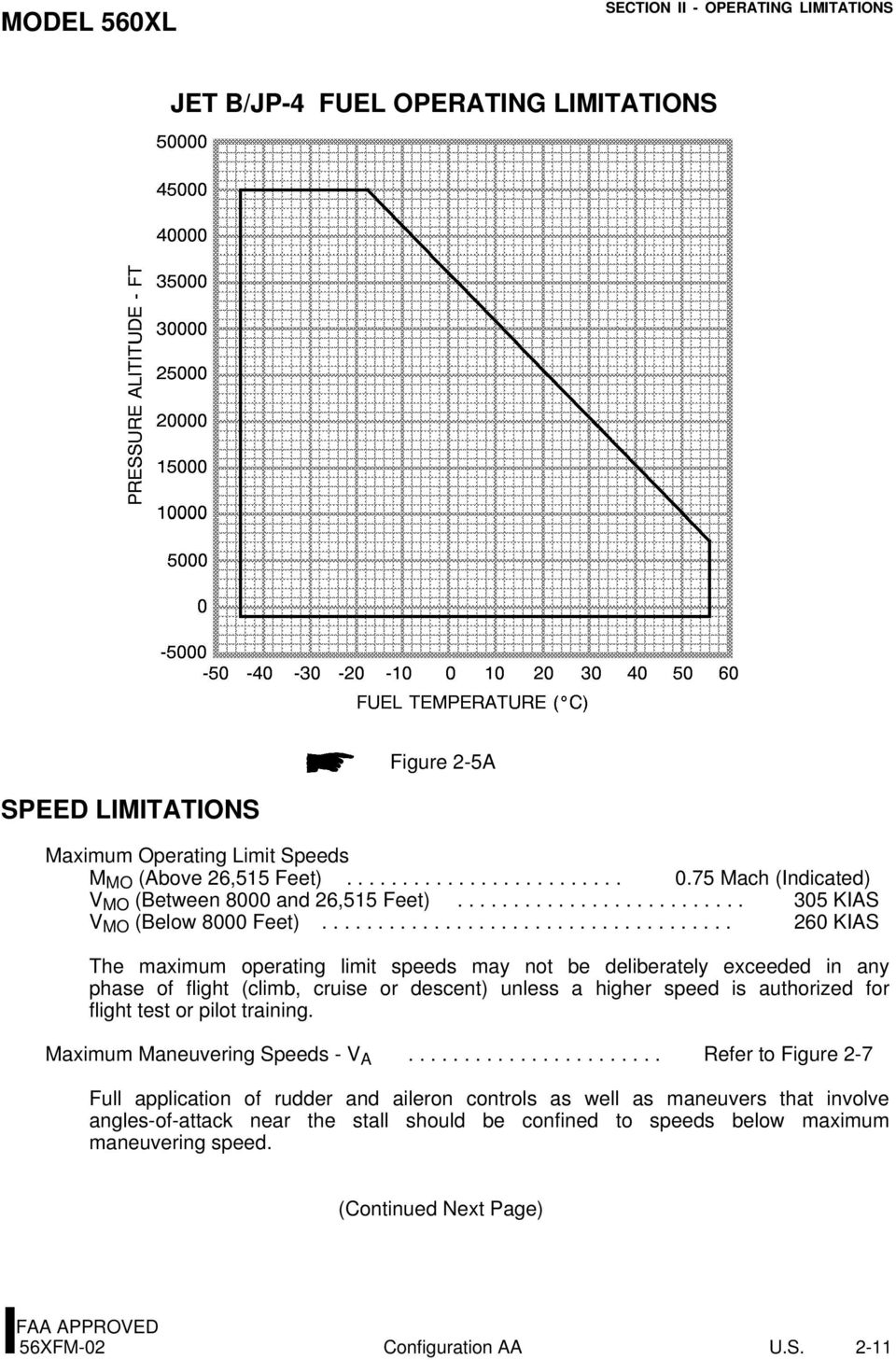
12 MODEL 560XL SPEED LIMITATIONS (Continued) Maximum Flap Extended Speed - V FE Full Flaps - LAND Position (35 ) KIAS Partial Flaps - T.O. (7 ) and T.O. & APPR Position (15 ) KIAS Maximum Landing Gear Extended Speed - V LE KIAS Maximum Landing Gear Operating Speed - V LO (Extending) KIAS - V LO (Retracting) KIAS Maximum Speed Brake Operation Speed - V SB No Limit Minimum Control Speeds (V MCA and V MCG ) Refer to Section IV, Performance General Autopilot Operation KIAS or 0.75 MACH TAKEOFF AND LANDING OPERATIONAL LIMITS Maximum Altitude Limit ,000 Feet Maximum Tailwind Components Knots Maximum Ambient Temperature ISA +39 C (Refer to Figure 2-6) Minimum Ambient Temperature C The autopilot and yaw damper must be OFF for takeoff and landing. Michelin part number nose tire and OM13701 main tire are the only tires approved. The nose tire must be inflated to 130±5 PSI with the weight on the wheels. Maximum Tire Ground Speed Knots The lavatory doors must be latched open for takeoff and landing. Engine Sync must be off for takeoff and landing. Takeoff and landings are limited to paved runway surfaces. Takeoff from a wet runway, when using thrust reversers for performance credit, is limited to a minimum runway width of 75 feet. Antiskid must be operational for takeoff and landing. Rudder bias and the rudder bias heater must be operational for takeoff, and a satisfactory preflight test must be performed in accordance with Section III, Normal Procedures. PERFORMANCE CONFIGURATION The airplane configuration must be as presented under Standard Performance Conditions, Section IV, Performance. ENROUTE OPERATIONAL LIMITS Minimum airspeed for sustained flight in icing (except approach and landing) KIAS Maximum Operating Altitude ,000 Feet Maximum Operating Altitude With 1-3 Vortex Generators Missing ,000 Feet Maximum Ambient Temperature Refer to Figure 2-6 Minimum Ambient Temperature Refer to Figure 2-6 Generator Load Amperes in Flight OPERATIONS AUTHORIZED This airplane is approved for day and night, VFR, IFR flight and flight into known icing conditions. This airplane is not approved for ditching under FAR U.S. Configuration AB 56XFM-07
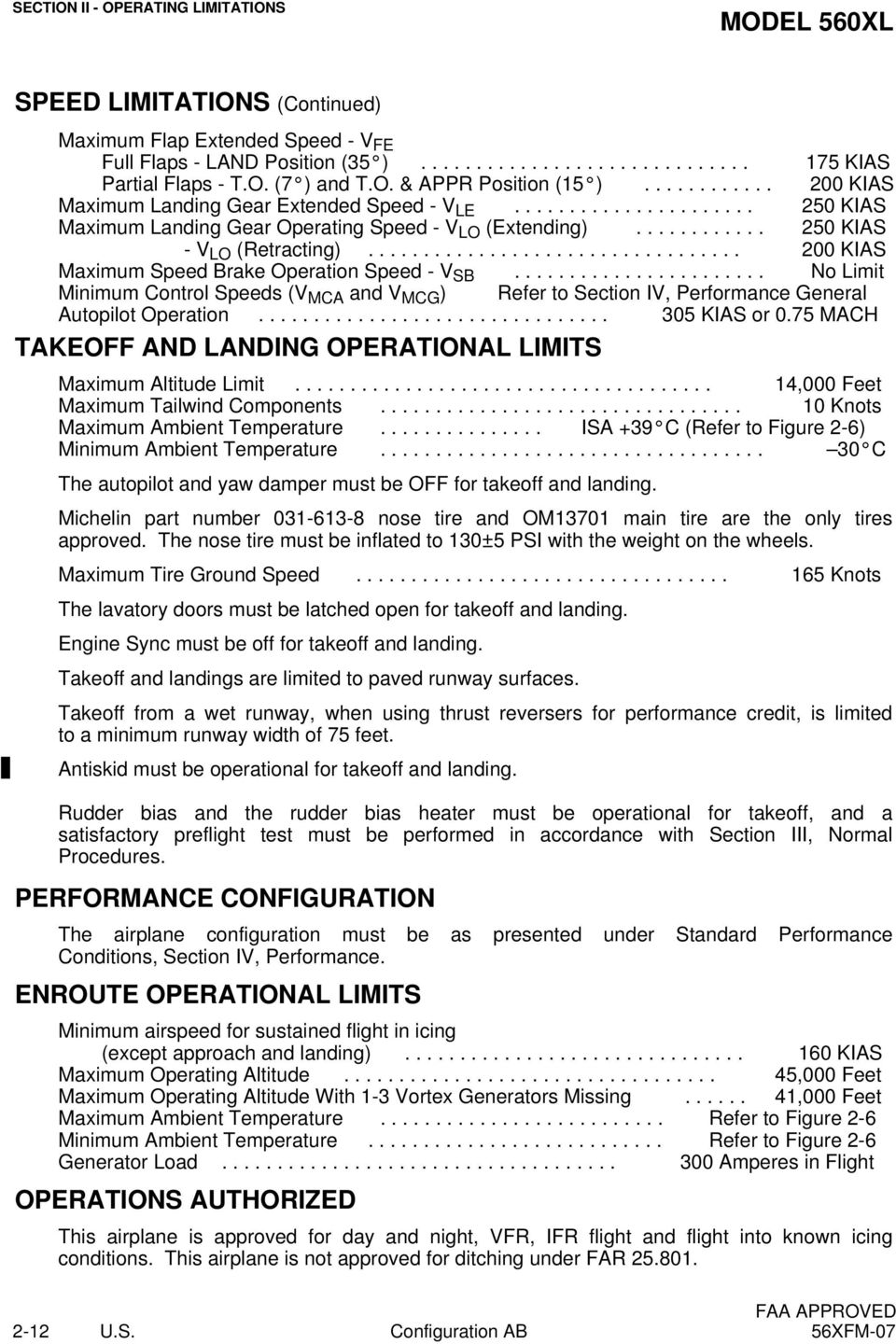
13 JET B/JP-4 FUEL OPERATING LIMITATIONS SPEED LIMITATIONS Figure 2-5A Maximum Operating Limit Speeds M MO (Above 26,515 Feet) Mach (Indicated) V MO (Between 8000 and 26,515 Feet) KIAS V MO (Below 8000 Feet) KIAS The maximum operating limit speeds may not be deliberately exceeded in any phase of flight (climb, cruise or descent) unless a higher speed is authorized for flight test or pilot training. Maximum Maneuvering Speeds - V A Refer to Figure 2-7 Full application of rudder and aileron controls as well as maneuvers that involve angles-of-attack near the stall should be confined to speeds below maximum maneuvering speed. (Continued Next Page) I56XFM-02 Configuration AA U.S. 2-11

14 MODEL 560XL SPEED LIMITATIONS (Continued) Maximum Flap Extended Speed - V FE Full Flaps - LAND Position (35 ) KIAS Partial Flaps - T.O. (7 ) and T.O. & APPR Position (15 ) KIAS Maximum Landing Gear Extended Speed - V LE KIAS Maximum Landing Gear Operating Speed - V LO (Extending) KIAS - V LO (Retracting) KIAS Maximum Speed Brake Operation Speed - V SB No Limit Minimum Control Speeds (V MCA and V MCG ) Refer to Section IV, Performance General Autopilot Operation KIAS or 0.75 MACH TAKEOFF AND LANDING OPERATIONAL LIMITS Maximum Altitude Limit ,000 Feet Maximum Tailwind Components Knots Maximum Ambient Temperature ISA +39 C (Refer to Figure 2-6) Minimum Ambient Temperature C The autopilot and yaw damper must be OFF for takeoff and landing. Michelin part number nose tire and OM13701 main tire are the only tires approved. The nose tire must be inflated to 130±5 PSI with the weight on the wheels. Maximum Tire Ground Speed Knots The lavatory doors must be latched open for takeoff and landing. Engine Sync must be off for takeoff and landing. Takeoff and landings are limited to paved runway surfaces. Takeoff from a wet runway, when using thrust reversers for performance credit, is limited to a minimum runway width of 75 feet. Antiskid must be operational for takeoff and landing. PERFORMANCE CONFIGURATION The airplane configuration must be as presented under Standard Performance Conditions, Section IV, Performance. ENROUTE OPERATIONAL LIMITS Minimum airspeed for sustained flight in icing (except approach and landing) KIAS Maximum Operating Altitude ,000 Feet Maximum Operating Altitude With 1-3 Vortex Generators Missing ,000 Feet Maximum Ambient Temperature Refer to Figure 2-6 Minimum Ambient Temperature Refer to Figure 2-6 Generator Load Amperes in Flight OPERATIONS AUTHORIZED This airplane is approved for day and night, VFR, IFR flight and flight into known icing conditions. This airplane is not approved for ditching under FAR U.S. Configuration AC 56XFM-07
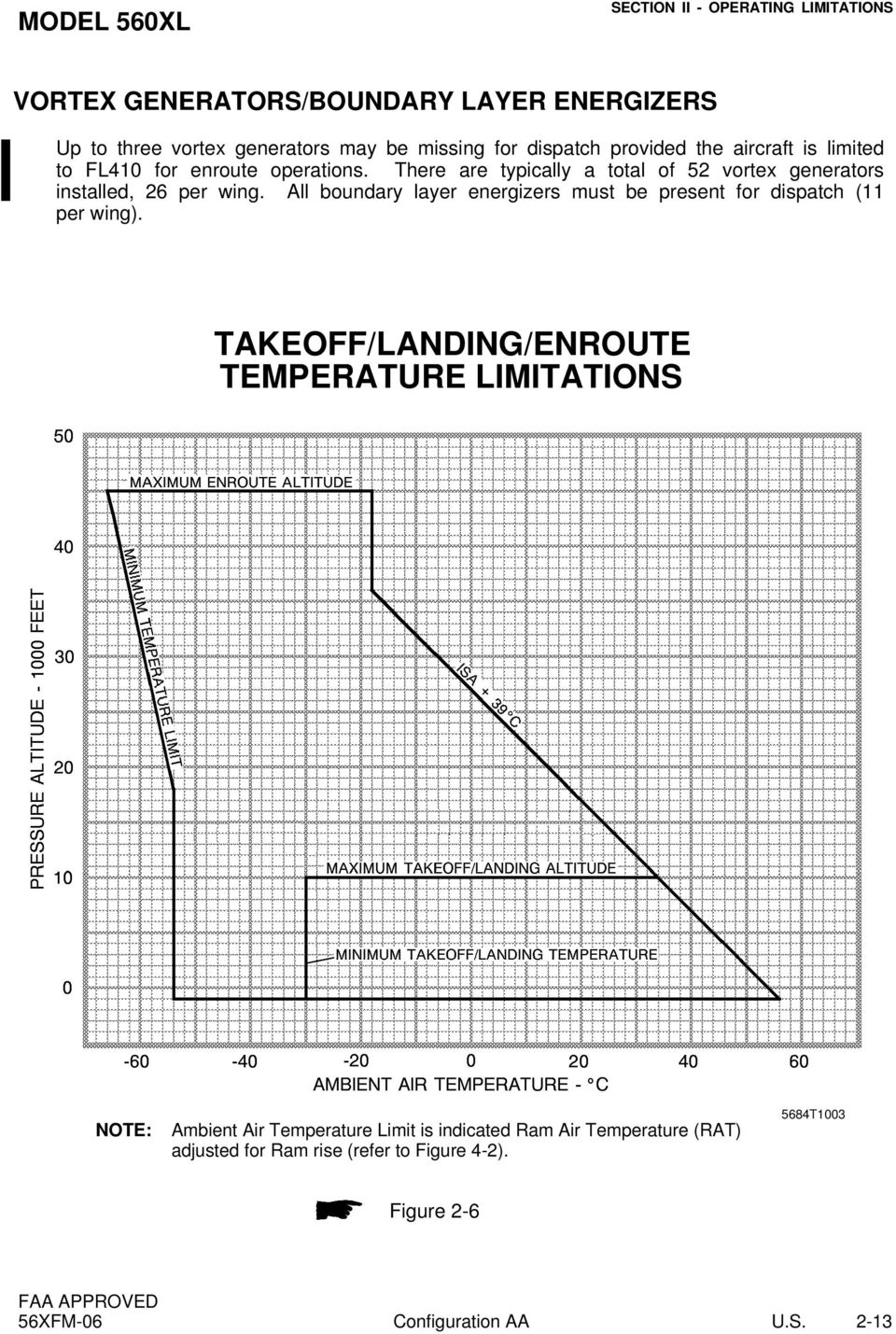
15 VORTEX GENERATORS/BOUNDARY LAYER ENERGIZERS Up to three vortex generators may be missing for dispatch provided the aircraft is limited to FL410 for enroute operations. There are typically a total of 52 vortex generators installed, 26 per wing. All boundary layer energizers must be present for dispatch (11 per wing). TAKEOFF/LANDING/ENROUTE TEMPERATURE LIMITATIONS : Ambient Air Temperature Limit is indicated Ram Air Temperature (RAT) adjusted for Ram rise (refer to Figure 4-2). 5684T1003 Figure XFM-06 Configuration AA U.S. 2-13
16 MODEL 560XL MAXIMUM MANEUVERING SPEEDS EXAMPLE: PRESSURE ALTITUDE - 37,000 FEET WEIGHT - 13,500 POUNDS MAXIMUM MANEUVERING SPEED KNOTS Figure T U.S. Configuration AA 56XFM-00

17 MINIMUM CREW Minimum Flight Crew for All Operations Pilot and 1 Copilot LOAD FACTOR In Flight Flaps UP Position (0 ) to +3.0G at 20,000 Pounds Flaps T.O., T.O. & APPR to LAND Position (7 To 35 ) to +2.0G at 20,000 Pounds These accelerations limit the angle-of-bank in turns and limit the severity of pull-up maneuvers. Landing to +2.0G at 18,700 Pounds These accelerations limit the airplane to landing sink rate of 600 feet-perminute. CABIN PRESSURIZATION LIMITATIONS Normal Cabin Pressurization Limitations to 9.3 PSI, +0.1 or 0.1 PSI Differential Pressure Relief Valve PSI, +0.1 or 0.1 PSI Differential Pressure Gauge Redline PSI, +0.0 or 0.1 PSI Differential MANEUVERS No acrobatic maneuvers, including spins, are approved. No intentional stalls permitted above 25,000 feet. PASSENGER COMPARTMENT For all takeoff and landings, seats must be fully upright and outboard, and passenger seat belts and shoulder harnesses must be fastened. Maximum number of passenger seats is twelve. The lavatory door must be latched open for taxi, takeoff, and landing. ANGLE-OF-ATTACK/STICK SHAKER SYSTEM The angle-of-attack system may be used as a reference system but does not replace the airspeed display in the PFD as a primary instrument. The angle-of-attack system can be used as a reference for approach speed (1.3 V S1 ) at all airplane weights and center-of-gravity locations at zero, takeoff/approach and landing flap positions. 1.3 V S1 is indicated by approximately.6 on the AOA gage and by the top of the white tape on the pilot s and copilot s airspeed indicators. The angle-of-attack and stall warning system must be operable and a satisfactory preflight test must be performed in accordance with Section III, Normal Procedures. 56XFM-03 Configuration AA U.S. 2-15

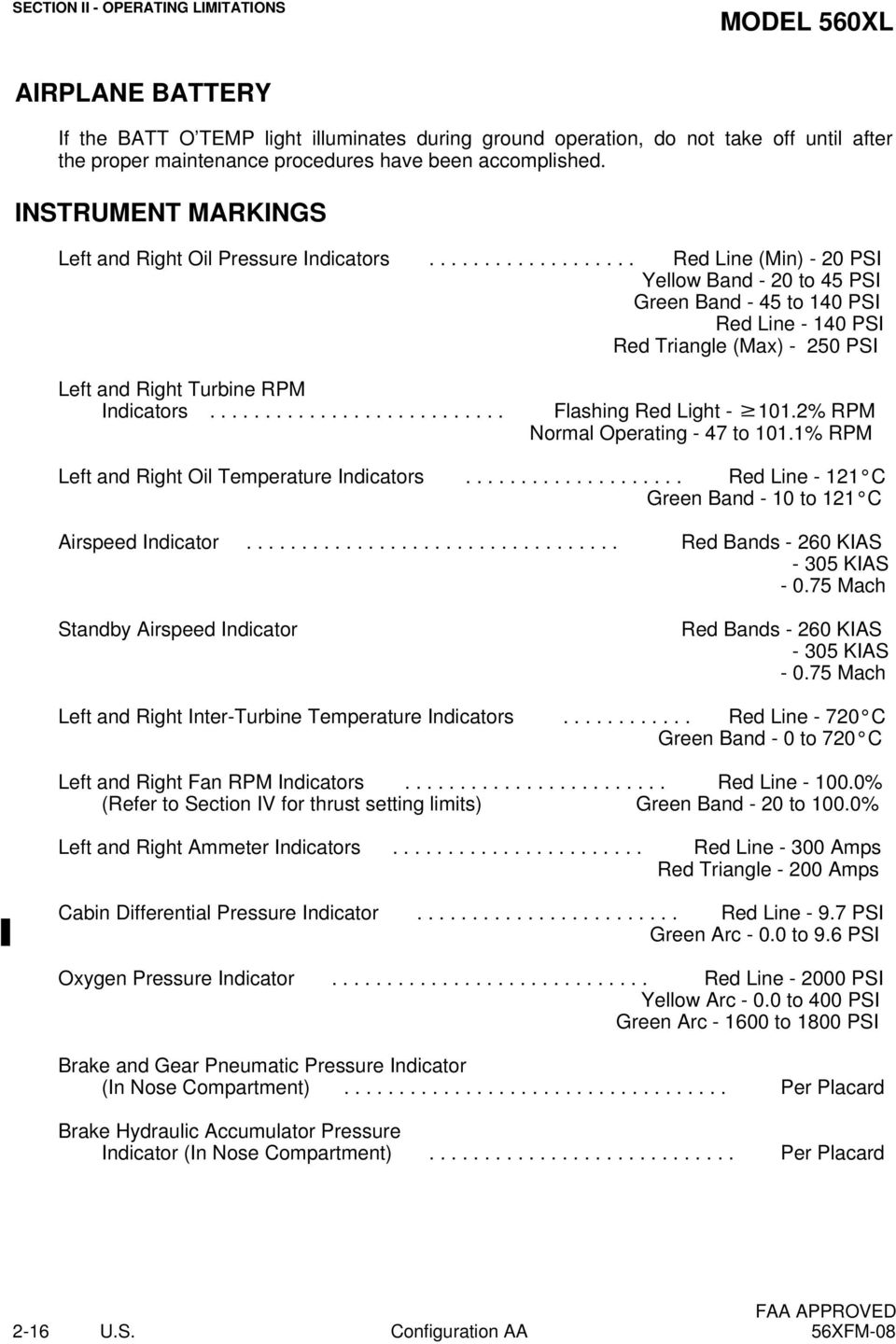
18 MODEL 560XL AIRPLANE BATTERY If the BATT O TEMP light illuminates during ground operation, do not take off until after the proper maintenance procedures have been accomplished. INSTRUMENT MARKINGS Left and Right Oil Pressure Indicators Red Line (Min) - 20 PSI Yellow Band - 20 to 45 PSI Green Band - 45 to 140 PSI Red Line PSI Red Triangle (Max) PSI Left and Right Turbine RPM Indicators Flashing Red Light - f101.2% RPM Normal Operating - 47 to 101.1% RPM Left and Right Oil Temperature Indicators Red Line C Green Band - 10 to 121 C Airspeed Indicator Red Bands KIAS KIAS Mach Standby Airspeed Indicator Red Bands KIAS KIAS Mach Left and Right Inter-Turbine Temperature Indicators Red Line C Green Band - 0 to 720 C Left and Right Fan RPM Indicators Red Line % (Refer to Section IV for thrust setting limits) Green Band - 20 to 100.0% Left and Right Ammeter Indicators Red Line Amps Red Triangle Amps Cabin Differential Pressure Indicator Red Line PSI Green Arc to 9.6 PSI Oxygen Pressure Indicator Red Line PSI Yellow Arc to 400 PSI Green Arc to 1800 PSI Brake and Gear Pneumatic Pressure Indicator (In Nose Compartment) Per Placard Brake Hydraulic Accumulator Pressure Indicator (In Nose Compartment) Per Placard 2-16 U.S. Configuration AA 56XFM-08
19 AUTOPILOT 1. One pilot must remain in his seat with the seat belt fastened during all autopilot operations. 2. Autopilot operation is prohibited if any comparison monitor annunciator illuminates inflight. 3. Minimum use height: 1000 Feet AGL - Enroute 300 Feet AGL - Non-precision Approach 180 Feet AGL - Category I ILS Approach HONEYWELL PRIMUS-1000 FLIGHT GUIDANCE SYSTEM 1. The Pilot s Manual for the Honeywell P-1000 Integrated Avionics System for the Cessna Citation Excel airplanes equipped with IC-600, part number A , revision 0, or later applicable revision, must be immediately available to the flight crew. For airplanes equipped with IC-615, part number A , revision 0, or later applicable revision, must be immediately available to the flight crew. 2. Category II approaches are not approved. 3. EFIS ground operation with the pilot s RADOME FAN FAIL annunciator light illuminated is limited to 30 minutes or until either IC-1 HOT or IC-2 HOT annunciator light illuminates, whichever occurs first. 4. Dispatch is prohibited if either the IC-1 HOT or IC-2 HOT annunciator light is illuminated. 5. Dispatch in instrument meteorological conditions is prohibited with the RADOME FAN annunciator light illuminated. Dispatch in visual meteorological conditions is allowed with the RADOME FAN annunciator illuminated, provided the DISPLAY GUIDANCE COMPUTER COOLING FAN FAILURE abnormal procedures are followed. 6. Dispatch is prohibited following a flight where either a IC-1 HOT or IC-2 HOT annunciator light was illuminated, until the condition is identified and corrected. 7. The pilot s and copilot s PFD s must be installed and operational in the normal (nonreversionary) mode for takeoff. 8. The P-1000 system must be verified to be operational by a satisfactory preflight test as contained in Section III, Normal Procedures. 9. Reversion of both PFD s to the MFD is prohibited. 10. VOR approaches without a valid DME signal are prohibited with autopilot coupled or with flight director only. Enroute VOR navigation without a valid co-located DME signal may result in significantly degraded course tracking when utilizing the flight director or autopilot. The flight crew should monitor the CDI for excessive deviation and select HDG mode as required to manually track the desired course. STANDBY FLIGHT DISPLAY 1. A satisfactory preflight test must be accomplished on the STBY PWR system in accordance with Section III, Normal Procedures. 2. The standby flight display (including ATT, ALT and ASI) and HSI must be functioning prior to takeoff. 3. Use of the approach mode (APR) on the standby flight display is prohibited. I56XFM-08 Configuration AH U.S. 2-17

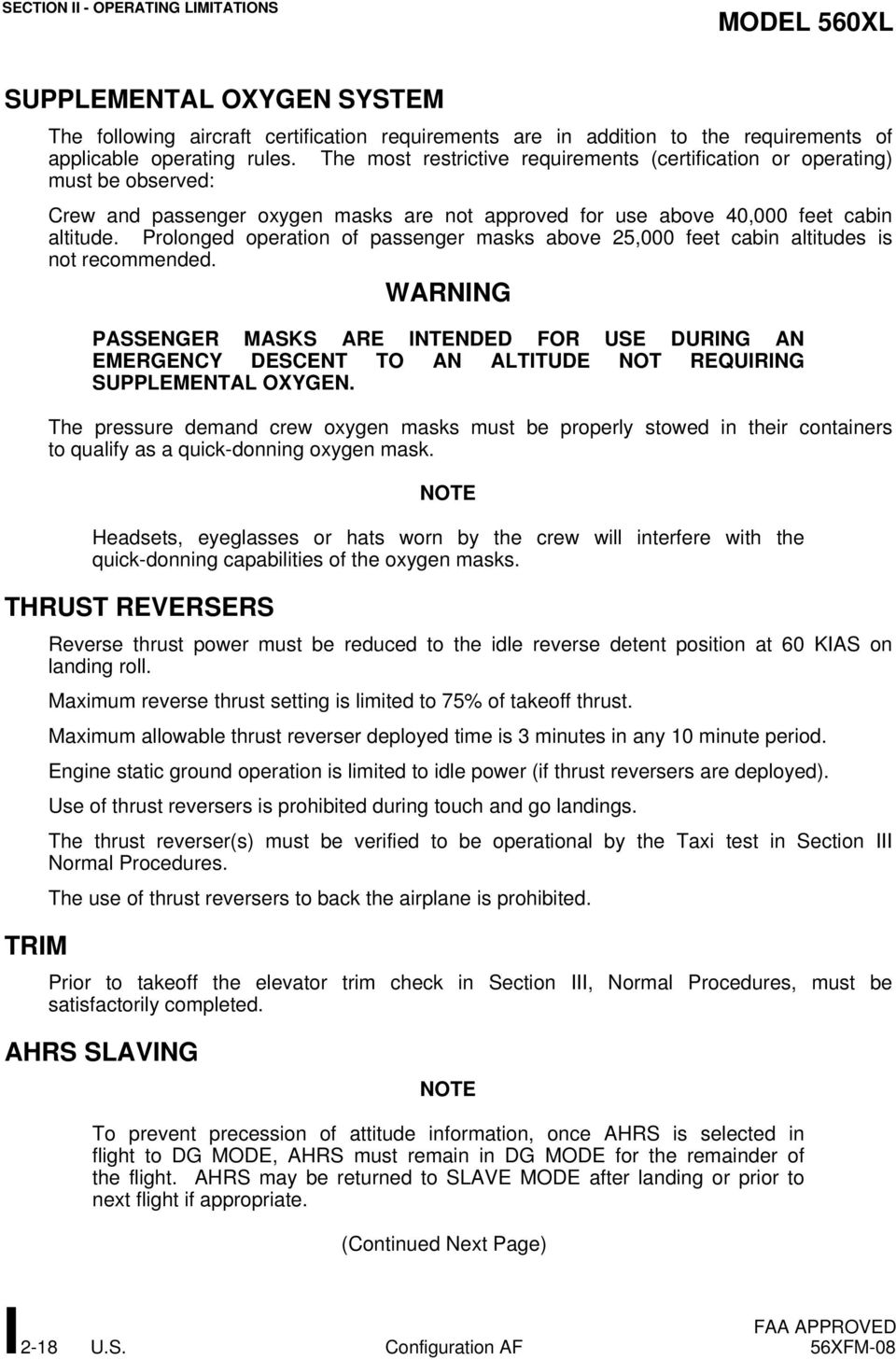
20 MODEL 560XL SUPPLEMENTAL OXYGEN SYSTEM The following aircraft certification requirements are in addition to the requirements of applicable operating rules. The most restrictive requirements (certification or operating) must be observed: Crew and passenger oxygen masks are not approved for use above 40,000 feet cabin altitude. Prolonged operation of passenger masks above 25,000 feet cabin altitudes is not recommended. WARNING PASSENGER MASKS ARE INTENDED FOR USE DURING AN EMERGENCY DESCENT TO AN ALTITUDE NOT REQUIRING SUPPLEMENTAL OXYGEN. The pressure demand crew oxygen masks must be properly stowed in their containers to qualify as a quick-donning oxygen mask. Headsets, eyeglasses or hats worn by the crew will interfere with the quick-donning capabilities of the oxygen masks. THRUST REVERSERS TRIM Reverse thrust power must be reduced to the idle reverse detent position at 60 KIAS on landing roll. Maximum reverse thrust setting is limited to 75% of takeoff thrust. Maximum allowable thrust reverser deployed time is 3 minutes in any 10 minute period. Engine static ground operation is limited to idle power (if thrust reversers are deployed). Use of thrust reversers is prohibited during touch and go landings. The thrust reverser(s) must be verified to be operational by the Taxi test in Section III Normal Procedures. The use of thrust reversers to back the airplane is prohibited. Prior to takeoff the elevator trim check in Section III, Normal Procedures, must be satisfactorily completed. AHRS SLAVING To prevent precession of attitude information, once AHRS is selected in flight to DG MODE, AHRS must remain in DG MODE for the remainder of the flight. AHRS may be returned to SLAVE MODE after landing or prior to next flight if appropriate. (Continued Next Page) I2-18 U.S. Configuration AF 56XFM-08
21 AUTOPILOT 1. One pilot must remain in his seat with the seat belt fastened during all autopilot operations. 2. Autopilot operation is prohibited if any comparison monitor annunciator illuminates inflight. 3. Minimum use height: 1000 Feet AGL - Enroute 300 Feet AGL - Non-precision Approach 180 Feet AGL - Category I ILS Approach HONEYWELL PRIMUS-1000 FLIGHT GUIDANCE SYSTEM 1. The Pilot s Manual for the Honeywell P-1000 Integrated Avionics System for the Cessna Citation Excel airplanes equipped with IC-600, part number A , revision 0, or later applicable revision, must be immediately available to the flight crew. For airplanes equipped with IC-615, part number A , revision 0, or later applicable revision, must be immediately available to the flight crew. 2. Category II approaches are not approved. 3. EFIS ground operation with the pilot s RADOME FAN FAIL annunciator light illuminated is limited to 30 minutes or until either IC-1 HOT or IC-2 HOT annunciator light illuminates, whichever occurs first. 4. Dispatch is prohibited if either the IC-1 HOT or IC-2 HOT annunciator light is illuminated. 5. Dispatch in instrument meteorological conditions is prohibited with the RADOME FAN annunciator light illuminated. Dispatch in visual meteorological conditions is allowed with the RADOME FAN annunciator illuminated, provided the DISPLAY GUIDANCE COMPUTER COOLING FAN FAILURE abnormal procedures are followed. 6. Dispatch is prohibited following a flight where either a IC-1 HOT or IC-2 HOT annunciator light was illuminated, until the condition is identified and corrected. 7. The pilot s and copilot s PFD s must be installed and operational in the normal (nonreversionary) mode for takeoff. 8. The P-1000 system must be verified to be operational by a satisfactory preflight test as contained in Section III, Normal Procedures. 9. Reversion of both PFD s to the MFD is prohibited. 10. VOR approaches without a valid DME signal are prohibited with autopilot coupled or with flight director only. Enroute VOR navigation without a valid co-located DME signal may result in significantly degraded course tracking when utilizing the flight director or autopilot. The flight crew should monitor the CDI for excessive deviation and select HDG mode as required to manually track the desired course. STANDBY FLIGHT DISPLAY 1. A satisfactory preflight test must be accomplished on the STBY PWR system in accordance with Section III, Normal Procedures. 2. The standby flight display (including ATT, ALT and ASI) and HSI must be functioning prior to takeoff. I56XFM-08 Configuration AI U.S
22 MODEL 560XL SUPPLEMENTAL OXYGEN SYSTEM The following aircraft certification requirements are in addition to the requirements of applicable operating rules. The most restrictive requirements (certification or operating) must be observed: Crew and passenger oxygen masks are not approved for use above 40,000 feet cabin altitude. Prolonged operation of passenger masks above 25,000 feet cabin altitudes is not recommended. WARNING PASSENGER MASKS ARE INTENDED FOR USE DURING AN EMERGENCY DESCENT TO AN ALTITUDE NOT REQUIRING SUPPLEMENTAL OXYGEN. The pressure demand crew oxygen masks must be properly stowed in their containers to qualify as a quick-donning oxygen mask. Headsets, eyeglasses or hats worn by the crew will interfere with the quick-donning capabilities of the oxygen masks. THRUST REVERSERS TRIM Reverse thrust power must be reduced to the idle reverse detent position at 60 KIAS on landing roll. Maximum reverse thrust setting is limited to 75% of takeoff thrust. Maximum allowable thrust reverser deployed time is 3 minutes in any 10 minute period. Engine static ground operation is limited to idle power (if thrust reversers are deployed). Use of thrust reversers is prohibited during touch and go landings. The thrust reverser(s) must be verified to be operational by the Taxi test in Section III Normal Procedures. The use of thrust reversers to back the airplane is prohibited. Prior to takeoff the elevator trim check in Section III, Normal Procedures, must be satisfactorily completed. AHRS SLAVING To prevent precession of attitude information, once AHRS is selected in flight to DG MODE, AHRS must remain in DG MODE for the remainder of the flight. AHRS may be returned to SLAVE MODE after landing or prior to next flight if appropriate. (Continued Next Page) I2-18 U.S. Configuration AF 56XFM-08
23 AUTOPILOT 1. One pilot must remain in his seat with the seat belt fastened during all autopilot operations. 2. Autopilot operation is prohibited if any comparison monitor annunciator illuminates inflight. 3. Minimum use height: 1000 Feet AGL - Enroute 300 Feet AGL - Non-precision Approach 180 Feet AGL - Category I ILS Approach HONEYWELL PRIMUS-1000 FLIGHT GUIDANCE SYSTEM 1. The Pilot s Manual for the Honeywell P-1000 Integrated Avionics System for the Cessna Citation Excel airplanes equipped with IC-600, part number A , revision 0, or later applicable revision, must be immediately available to the flight crew. For airplanes equipped with IC-615, part number A , revision 0, or later applicable revision, must be immediately available to the flight crew. 2. Category II approaches are not approved. 3. EFIS ground operation with the pilot s RADOME FAN FAIL annunciator light illuminated is limited to 30 minutes or until either IC-1 HOT or IC-2 HOT annunciator light illuminates, whichever occurs first. 4. Dispatch is prohibited if either the IC-1 HOT or IC-2 HOT annunciator light is illuminated. 5. Dispatch in instrument meteorological conditions is prohibited with the RADOME FAN annunciator light illuminated. Dispatch in visual meteorological conditions is allowed with the RADOME FAN annunciator illuminated, provided the DISPLAY GUIDANCE COMPUTER COOLING FAN FAILURE abnormal procedures are followed. 6. Dispatch is prohibited following a flight where either a IC-1 HOT or IC-2 HOT annunciator light was illuminated, until the condition is identified and corrected. 7. The pilot s and copilot s PFD s must be installed and operational in the normal (nonreversionary) mode for takeoff. 8. The P-1000 system must be verified to be operational by a satisfactory preflight test as contained in Section III, Normal Procedures. 9. Reversion of both PFD s to the MFD is prohibited. 10. VOR approaches without a valid DME signal are prohibited with autopilot coupled or with flight director only. Enroute VOR navigation without a valid co-located DME signal may result in significantly degraded course tracking when utilizing the flight director or autopilot. The flight crew should monitor the CDI for excessive deviation and select HDG mode as required to manually track the desired course. STANDBY FLIGHT DISPLAY 1. A satisfactory preflight test must be accomplished on the STBY PWR system in accordance with Section III, Normal Procedures. 2. The standby flight display (including ATT, ALT and ASI) and HSI must be functioning prior to takeoff. 3. Use of the approach mode (APR) on the standby flight display is prohibited. I56XFM-08 Configuration AH U.S. 2-17
24 MODEL 560XL SUPPLEMENTAL OXYGEN SYSTEM The following aircraft certification requirements are in addition to the requirements of applicable operating rules. The most restrictive requirements (certification or operating) must be observed: Crew and passenger oxygen masks are not approved for use above 40,000 feet cabin altitude. Prolonged operation of passenger masks above 25,000 feet cabin altitudes is not recommended. WARNING PASSENGER MASKS ARE INTENDED FOR USE DURING AN EMERGENCY DESCENT TO AN ALTITUDE NOT REQUIRING SUPPLEMENTAL OXYGEN. The pressure demand crew oxygen masks must be properly stowed in their containers to qualify as a quick-donning oxygen mask. Headsets, eyeglasses or hats worn by the crew will interfere with the quick-donning capabilities of the oxygen masks. THRUST REVERSERS TRIM Reverse thrust power must be reduced to the idle reverse detent position at 60 KIAS on landing roll. Maximum reverse thrust setting is limited to 75% of takeoff thrust. Maximum allowable thrust reverser deployed time is 3 minutes in any 10 minute period. Engine static ground operation is limited to idle power (if thrust reversers are deployed). Use of thrust reversers is prohibited during touch and go landings. The thrust reverser(s) must be verified to be operational by the Taxi test in Section III Normal Procedures. The use of thrust reversers to back the airplane is prohibited. Prior to takeoff the elevator trim check in Section III, Normal Procedures, must be satisfactorily completed. I U.S. Configuration AG 56XFM-08
25 AUTOPILOT 1. One pilot must remain in his seat with the seat belt fastened during all autopilot operations. 2. Autopilot operation is prohibited if any comparison monitor annunciator illuminates inflight. 3. Minimum use height: 1000 Feet AGL - Enroute 300 Feet AGL - Non-precision Approach 180 Feet AGL - Category I ILS Approach HONEYWELL PRIMUS-1000 FLIGHT GUIDANCE SYSTEM 1. The Pilot s Manual for the Honeywell P-1000 Integrated Avionics System for the Cessna Citation Excel airplanes equipped with IC-600, part number A , revision 0, or later applicable revision, must be immediately available to the flight crew. For airplanes equipped with IC-615, part number A , revision 0, or later applicable revision, must be immediately available to the flight crew. 2. Category II approaches are not approved. 3. EFIS ground operation with the pilot s RADOME FAN FAIL annunciator light illuminated is limited to 30 minutes or until either IC-1 HOT or IC-2 HOT annunciator light illuminates, whichever occurs first. 4. Dispatch is prohibited if either the IC-1 HOT or IC-2 HOT annunciator light is illuminated. 5. Dispatch in instrument meteorological conditions is prohibited with the RADOME FAN annunciator light illuminated. Dispatch in visual meteorological conditions is allowed with the RADOME FAN annunciator illuminated, provided the DISPLAY GUIDANCE COMPUTER COOLING FAN FAILURE abnormal procedures are followed. 6. Dispatch is prohibited following a flight where either a IC-1 HOT or IC-2 HOT annunciator light was illuminated, until the condition is identified and corrected. 7. The pilot s and copilot s PFD s must be installed and operational in the normal (nonreversionary) mode for takeoff. 8. The P-1000 system must be verified to be operational by a satisfactory preflight test as contained in Section III, Normal Procedures. 9. Reversion of both PFD s to the MFD is prohibited. 10. VOR approaches without a valid DME signal are prohibited with autopilot coupled or with flight director only. Enroute VOR navigation without a valid co-located DME signal may result in significantly degraded course tracking when utilizing the flight director or autopilot. The flight crew should monitor the CDI for excessive deviation and select HDG mode as required to manually track the desired course. STANDBY FLIGHT DISPLAY 1. A satisfactory preflight test must be accomplished on the STBY PWR system in accordance with Section III, Normal Procedures. 2. The standby flight display (including ATT, ALT and ASI) and HSI must be functioning prior to takeoff. I56XFM-08 Configuration AI U.S
26 MODEL 560XL SUPPLEMENTAL OXYGEN SYSTEM The following aircraft certification requirements are in addition to the requirements of applicable operating rules. The most restrictive requirements (certification or operating) must be observed: Crew and passenger oxygen masks are not approved for use above 40,000 feet cabin altitude. Prolonged operation of passenger masks above 25,000 feet cabin altitudes is not recommended. WARNING PASSENGER MASKS ARE INTENDED FOR USE DURING AN EMERGENCY DESCENT TO AN ALTITUDE NOT REQUIRING SUPPLEMENTAL OXYGEN. The pressure demand crew oxygen masks must be properly stowed in their containers to qualify as a quick-donning oxygen mask. Headsets, eyeglasses or hats worn by the crew will interfere with the quick-donning capabilities of the oxygen masks. THRUST REVERSERS TRIM Reverse thrust power must be reduced to the idle reverse detent position at 60 KIAS on landing roll. Maximum reverse thrust setting is limited to 75% of takeoff thrust. Maximum allowable thrust reverser deployed time is 3 minutes in any 10 minute period. Engine static ground operation is limited to idle power (if thrust reversers are deployed). Use of thrust reversers is prohibited during touch and go landings. The thrust reverser(s) must be verified to be operational by the Taxi test in Section III Normal Procedures. The use of thrust reversers to back the airplane is prohibited. Prior to takeoff the elevator trim check in Section III, Normal Procedures, must be satisfactorily completed. I U.S. Configuration AG 56XFM-08
27 AHRS SLAVING (Continued) Figure 2-8 I56XFM-07 Configuration AF U.S. 2-19/2-20
Compiled by Matt Zagoren
 The information provided in this document is to be used during simulated flight only and is not intended to be used in real life. Attention VA's - you may post this file on your site for download. Please
Multi Engine Oral Exam Questions
 Multi Engine Oral Exam Questions 1. What are the requirements for a multi-engine rating? 2. What is the max rated horse power at sea level? At 12,000 msl? 3. What is the rated engine speed? 4. What is
King Air C90A. Speeds (KIAS)
 King Air C90A Speeds (KIAS) V MCA 90 V SSE 97 V X 101 V Y 111 V XSE 100 V YSE 107 V A 169 V REF 100 V MO 208 V FE 178 35% 137 100% V LE 156 129 Retraction only Other 95 Balked landing climb 125 Glide 161
BOMBARDIER CRJ700. Bombardier CRJ700 Aircraft Reference
 Bombardier CRJ700 Aircraft Reference V 1 Takeoff Decision Speed, dry runway 50,000 lbs, (flaps 8) 144 KIAS 50,000 lbs, (flaps 20) 134 KIAS V R Rotation Speed, dry runway 50,000 lbs, (flaps 8) 144 KIAS
SINGLE ENGINE TURBO-PROP AEROPLANE ENDORSEMENT
 SINGLE ENGINE TURBO-PROP AEROPLANE ENDORSEMENT ENGINEERING, DATA AND PERFORMANCE QUESTIONNAIRE FOR (Aeroplane make & model) Version 1-31 August 1996 Name: Endorser: (Signature/Name) Satisfactorily Completed
MULTI-ENGINE TURBO-PROP AEROPLANE ENDORSEMENT
 MULTI-ENGINE TURBO-PROP AEROPLANE ENDORSEMENT ENGINEERING, DATA AND PERFORMANCE QUESTIONNAIRE FOR (Aeroplane make & model) Version 1 -August 1996 Name: ARN. Endorser: ARN: (Signature/Name) 1 The endorsement
Super King Air 200. Speeds (KIAS)
 Super King Air 200 Speeds (KIAS) V MCA 86 V SSE 104 V X 100 V Y 125 V XSE 115 V YSE 121 V A 181 V REF 103 132 with no flap V MO 260 270 for old models M MO 0,52 0,48 for old models V FE 200 40% 146 100%
MULTI-ENGINE TURBO-PROP AEROLANE ENDORSEMENT
 CAAP 5.23-1(1): Multi-engine Aeroplane Operations and Training 133 Appendix E to CAAP 5.23-1(1) MULTI-ENGINE TURBO-PROP AEROLANE ENDORSEMENT ENGINEERING, DATA AND PERFORMANCE QUESTIONNAIRE FOR (Aeroplane
S-Tec System Thirty Autopilot
 Cirrus Design Section 9 Pilot s Operating Handbook and FAA Approved Airplane Flight Manual Supplement for S-Tec System Thirty Autopilot When the S-Tec System Thirty Autopilot is installed in the Cirrus
General Characteristics
 This is the third of a series of Atlantic Sun Airways CAT C pilot procedures and checklists for our fleet. Use them with good judgment. Note, the start procedures may vary from FS9 Panel to Panel. However
MULTI-ENGINE PISTON AEROPLANE ENDORSEMENT
 MULTI-ENGINE PISTON AEROPLANE ENDORSEMENT ENGINEERING, DATA AND PERFORMANCE QUESTIONNAIRE FOR---------------------------------------------------------------------------------------------------------- (Aeroplane
This is the third of a series of Atlantic Sun Airways CAT B pilot procedures and checklists for our fleet. Use them with good judgment.
 This is the third of a series of Atlantic Sun Airways CAT B pilot procedures and checklists for our fleet. Use them with good judgment. Dimensions: Span 107 ft 10 in Length 147 ft 10 in Height 29ft 7 in
06 HYDRAULICS, FLIGHT CONTROLS, LANDING GEAR, BRAKES
 Course overview N E X T G E N E R A T I O N Airplane General Air Systems Warning Systems, Communications, Ice & Rain Protection Electrical Engines, APU, Fuel System Hydraulics, Flight Controls, Landing
FLIGHT CONTROLS 1. GENERAL 2. MAIN COMPONENTS AND SUBSYSTEMS ROLL CONTROL. Smartcockpit.com BOEING 737 SYSTEMS REVIEW Page 1
 Smartcockpit.com BOEING 737 SYSTEMS REVIEW Page 1 FLIGHT CONTROLS 1. GENERAL The primary flight controls, ailerons, elevators and rudders, are hydraulically powered. Hydraulic power is provided from hydraulic
This is the fourth of a series of Atlantic Sun Airways CAT B pilot procedures and checklists for our fleet. Use them with good judgment.
 This is the fourth of a series of Atlantic Sun Airways CAT B pilot procedures and checklists for our fleet. Use them with good judgment. Dimensions: Wing Span: 112 ft 7 in Length: 129 ft 6 in Height: 41
FLYBLOCKTIME PA-28-140/160 Aircraft Type Checkout and Currency Quiz. NOTE: There may be one or more correct answers to each question.
 FLYBLOCKTIME PA-28-140/160 Aircraft Type Checkout and Currency Quiz Pilot s Name Date NOTE: There may be one or more correct answers to each question. 1 ) The engine in a PA-28-140/160 is a A. Continental
AIRCRAFT GENERAL www.theaviatornetwork.com GTM 1.1 2005 1-30-05 CONTENTS
 www.theaviatornetwork.com GTM 1.1 CONTENTS INTRODUCTION... 1.2 GENERAL AIRPLANE... 1.2 Fuselage... 1.2 Wing... 1.2 Tail... 1.2 PROPELLER TIP CLEARANCE... 1.2 LANDING GEAR STRUT EXTENSION (NORMAL)... 1.2
TYPE CERTIFICATE DATA SHEET Nº EA-2011T03 Type Certificate Holder: COSTRUZIONI AERONAUTICHE TECNAM S.r.l. Via Tasso, 478 80127 - Napoli Italy
 TYPE CERTIFICATE DATA SHEET Nº EA-2011T03 Type Certificate Holder: COSTRUZIONI AERONAUTICHE TECNAM S.r.l. Via Tasso, 478 80127 - Napoli Italy EA-2011T03-02 Sheet 01 TECNAM P2006T 04 May 2012 This data
Cessna Grand Caravan Pilot s Technical Examination
 Cessna Grand Caravan Pilot s Technical Examination Version 1.0 2003-05-13 Candidate Name Licence class Private/Commercial/ATP Examiner Licence number Name Licence number Capacity Centre Date 200 -- --
MULTI-ENGINE PISTON AEROPLANE ENDORSEMENT ENGINEERING, DATA AND PERFORMANCE QUESTIONNAIRE
 CAAP 5.23-1(1): Multi-engine Aeroplane Operations and Training 117 APPENDIX D TO CAAP 5.23-1(1) MULTI-ENGINE PISTON AEROPLANE ENDORSEMENT ENGINEERING, DATA AND PERFORMANCE QUESTIONNAIRE FOR (Aeroplane
SINGLE ENGINE PISTON AEROPLANE ENDORSEMENT
 SINGLE ENGINE PISTON AEROPLANE ENDORSEMENT ENGINEERING, DATA AND PERFORMANCE QUESTIONNAIRE FOR (Aeroplane make and model) Version 1 August 1996 Name: Endorsed by: (Signature/Name) ARN: ARN Satisfactorily
VFR Day Emergencies - C172R
 Pilot Level: References: Note: VFR Day Emergencies - C172R Student Pilot. FAA-H-8083-3A, Chapter 16, Federal Aviation Regulations, Cessna 172R PIM, Aeronautical Information Manual, King Schools (DVDs):
Multi-Engine Training And The PTS
 Multi-Engine Training And The PTS GHAFI John Sollinger/Larry Hendrickson October 28, 2000 Overview FAR differences between original and add-on Multi-Engine PTS Training methods Common training scenarios
CIRRUS AIRPLANE MAINTENANCE MANUAL
 UNSCHEDULED MAINTENANCE CHECKS 1. DESCRIPTION The following describes those maintenance checks and inspections on the aircraft which are dictated by special or unusual conditions which are not related
This section includes performance data on the King Air B200. Information consists of:
 King Air B200 POH Pilot's Operating Handbook: This section includes performance data on the King Air B200. Information consists of: 1. Critical Airspeeds 2. Operating NOTAMS 3. Fuel Loading Formula Checklists:
Cessna Citation 500/501 Pilot s Technical Examination
 Cessna Citation 500/501 Pilot s Technical Examination Version 0.2 2003-09-28 Candidate Examiner Name Licence class Licence number Name Licence number Capacity Private/Commercial/ATP Centre Date 200 --
Cessna 172SP & NAV III Maneuvers Checklist
 Cessna 172SP & NAV III Maneuvers Checklist Introduction Power Settings This document is intended to introduce to you the standard method of performing maneuvers in Sunair Aviation s Cessna 172SP and NAV
MODULE 11B. PISTON AEROPLANE AERODYNAMICS, STRUCTURES AND SYSTEMS
 MODULE 11B. PISTON AEROPLANE AERODYNAMICS, STRUCTURES AND SYSTEMS Note: The scope of this Module should reflect the technology of aeroplanes pertinent to the A2 and B1.2 subcategory. 11.1 Theory of Flight
LANDING GEAR & BRAKES www.theaviatornetwork.com GTM 14.1 2005 1-30-05 CONTENTS INTRODUCTION... 14.2
 www.theaviatornetwork.com GTM 14.1 CONTENTS INTRODUCTION... 14.2 GENERAL... 14.2 MAIN LANDING GEAR... 14.2 Landing Gear Latch Lever and Handle... 14.2 Landing Gear Pressure Gauge... 14.2 Landing Gear Warning
European Aviation Safety Agency
 TCDS No.: EASA.IM.A.348 Gulfstream G280 Page 1 of 14 European Aviation Safety Agency EASA TYPE-CERTIFICATE DATA SHEET No. EASA.IM.A.348 for Gulfstream G280 Type Certificate Holder: GULFSTREAM AEROSPACE
B777. Automatic Flight DO NOT USE FOR FLIGHT
 B777 Automatic Flight DO NOT USE FOR FLIGHT 4.10 Automatic Flight-Controls and Indicators Mode Control Panel (MCP) A/T ARM L R IAS MACH HDG TRK V/S FPA ALTITUDE A/P F/D ON OFF CLB CON IAS LNAV VNAV AUTO
MEMO AIRBUS A319/A320/A321. SOP / Flow Pattern
 MEMO AIRBUS A319/A320/A321 SOP / Flow Pattern F/O side only ( or ) A320 Flow Pattern SOP Visual Pattern Engine Out Memory Items Emergency procedures Laurent ALAPHILIPPE Page 1/18 Année 2011 Summary Memo
Lancair Legacy Annual Condition Inspection Checklist
 Lancair Legacy Annual Condition Inspection Checklist Performed by: Completion Date: Complete Maintenance/Inspection Item Comments Pre-Inspection Research AD and Service bulletins Inspect entire airframe
Revision Number Revision Date Insertion Date/Initials 1 st Ed. Feb 01, 00 2 nd Ed. Jun 24, 02 3rd Ed. Feb 15, 07
 List of Effective Pages * Asterisk indicates pages changed, added, or deleted by current revision. Retain this record in front of handbook. Upon receipt of a Record of Revisions revision, insert changes
Oral Preparation Questions
 Oral Preparation Questions The oral section of the practical test is the time when you need to demonstrate your understanding of the various tasks listed in the practical test standards and the factors
AIR - PNEUMATIC, AIR CONDITIONING, PRESSURIZATION
 AIR - PNEUMATIC, AIR CONDITIONING, PRESSURIZATION PNEUMATIC SYSTEM The Pneumatic System is normally supplied by the Engine's compressor sections. The Pneumatic System may also be supplied by APU bleed
ELECTRICAL. Primary electrical power is provided by two engine driven generators which supply three-phase, 115 volt 400 cycle alternating current.
 Smartcockpit.com BOEING 737 SYSTEMS REVIEW Page 1 ELECTRICAL 1. GENERAL Primary electrical power is provided by two engine driven generators which supply three-phase, 115 volt 400 cycle alternating current.
CESSNA 172 CHECKLIST TAXI PRE-EXTERNAL CHECKS. 1. Lights - As required 2. Brakes - CHECK 3. Rolling Instruments Check - L/R
 CESSNA 172 CHECKLIST PRE-EXTERNAL CHECKS TAXI 1. Wing & Engine covers - REMOVED 2. Control lock - REMOVED 3. Trim Check - Full Movement 4. Master - BATTERY ONLY - On 5. Flaps - Down to 20 Degrees 6. Lights
B777. Landing Gear DO NOT USE FOR FLIGHT
 B777 Landing Gear DO NOT USE FOR FLIGHT Introduction The airplane has two main landing gear and a single nose gear. The nose gear is a conventional steerable two wheel unit. Each main gear has six wheels
Type Acceptance Report
 TAR 10/21B/23 CESSNA 501 CITATION Aircraft Certification Unit TABLE OF CONTENTS EXECUTIVE SUMMARY 1 1. INTRODUCTION 1 2. ICAO TYPE CERTIFICATE DETAILS 1 3. TYPE ACCEPTANCE DETAILS 2 4. NZCAR 21.43 DATA
European Aviation Safety Agency
 TCDS EASA.A.151 AIRBUS A350 Page 1/14 European Aviation Safety Agency EASA TYPE-CERTIFICATE DATA SHEET No. EASA.A.151 AIRBUS A350 Type Certificate Holder: AIRBUS S.A.S. 1 Rond-point Maurice Bellonte 31707
Municipal Airport 1410 Arizona Place S.W. Orange City, IA 51041-7453. www.angelaircraft.com [email protected] 712.737.3344
 Municipal Airport 1410 Arizona Place S.W. Orange City, IA 51041-7453 www.angelaircraft.com [email protected] 712.737.3344 PERFORMANCE SPECIFICATIONS POWERPLANT PROPELLER Lycoming IO-540 300 HP @2700
For Information Only-Not approved for cockpit use.
 For Information Only-Not approved for cockpit use. List of Effective Pages *The asterisk indicates pages changed, added, or deleted by current change. Record of Revisions REVISION REVISION NUMBER DATE
CUB CRAFTERS, INC. CC11-160 PILOT S OPERATING HANDBOOK AND FLIGHT TRAINING SUPPLEMENT
 CUB CRAFTERS CUB CRAFTERS, INC. PILOT S OPERATING HANDBOOK AND FLIGHT TRAINING SUPPLEMENT Airplane Serial Number: Airplane Registration Number: This airplane is approved as a special light-sport category
PILOT OPERATING HANDBOOK FOR ROCKWELL TURBO COMMANDER 690B
 PILOT OPERATING HANDBOOK FOR ROCKWELL TURBO COMMANDER This manual was compiled for unique and exclusive use with Rockwell Turbo Commander from ENEAIONES SIMULATIONS GROUP. The information herein contained
B 737 NG El ectrical
 B737 NG Electrical Introduction Aircraft equipped with Single Battery Primary electrical power is provided by two engine integrated drive generators (IDGs) which supply three-phase, 115 volt, 400 cycle
Global Positioning System Steering (GPSS) Converter Pilot s Operating Handbook
 Global Positioning System Steering (GPSS) Converter Pilot s Operating Handbook List of Effective Pages * Asterisk indicates pages changed, added, or deleted by revision. Retain this record in front of
09 FLIGHT MANAGEMENT, NAVIGATION
 Course overview N E X T G E N E R A T I O N Airplane General Air Systems Warning Systems, Communications, Ice & Rain Protection Electrical Engines, APU, Fuel System Hydraulics, Flight Controls, Landing
BE76 Beechcraft Duchess Maneuvers Checklist
 BE76 Beechcraft Duchess Maneuvers Checklist Introduction Power Settings This document is intended to introduce to you the standard method of performing maneuvers in Sunair Aviation s Beechcraft Duchess
European Aviation Safety Agency
 TCDS No.: R.010 MBBBK117 Page 1 of 53 European Aviation Safety Agency EASA TYPECERTIFICATE DATA SHEET No. R.010 for MBBBK117 Type Certificate Holder AIRBUS HELICOPTERS DEUTSCHLAND GmbH Industriestrasse
TYPE-CERTIFICATE DATA SHEET
 TYPE-CERTIFICATE DATA SHEET EASA TC E.036 for Trent 1000 series engines Certificate Holder Rolls-Royce plc PO Box 31 Derby DE24 8BJ United Kingdom For Models: Trent 1000-A Trent 1000-A2 Trent 1000-AE Trent
Cessna Citation CE500 Series Training Course
 2014 Front Range Executive Flight Training Cessna Citation CE500 Series Training Course SINGLE PILOT TRAINING PROGRAM Front Range Executive Flight Training Document Version 1.3 Original Release 4/1/2010
2014 NIFA CRM Contestant Briefing Guide San Diego, California
 2014 NIFA CRM Contestant Briefing Guide San Diego, California Region 2 SAFECON 2014 November 12 15 This document supports the 2014 NIFA Collegiate Cockpit Resource Management Simulation and is not for
TRANSITION TRAINING MASTER SYLLABUS
 TRANSITION TRAINING MASTER SYLLABUS GAMA PUBLICATION NO. 5 Version 2.0 General Aviation Manufacturers Association MASTER SYLLABUS To be used in developing AIRCRAFT SPECIFIC TRANSITION TRAINING GUIDES For
S TEC. List of Effective Pages. Record of Revisions
 List of Effective Pages * Asterisk indicates pages changed, added, or deleted by current revision. Retain this record in front of handbook. Upon receipt of a Record of Revisions revision, insert changes
DEPARTMENT OF TRANSPORTATION FEDERAL AVIATION ADMINISTRATION
 DEPARTMENT OF TRANSPORTATION FEDERAL AVIATION ADMINISTRATION 3A12 Revision 77 CESSNA 172 172I 172A 172K 172B 172L 172C 172M 172D 172N 172E 172P 172F (USAF T-41A) 172Q 172G 172R 172H (USAF T-41A) 172S June
ENGINE FIRE / SEVERE DAMAGE / SEPARATION ON TAKEOFF
 ENGINE FIRE / SEVERE DAMAGE / SEPARATION ON TAKEOFF According to RYANAIR Procedures PF PM REMARKS Control the aircraft (FULL T/O thrust can be manually selected) Announce «ENGINE FAILURE» or «ENGINE FIRE»
FLIGHT ENGINEER RECIPROCATING ENGINE TURBOPROPELLER TURBOJET
 U.S. Department of Transportation Federal Aviation Administration with Changes 1, 2, and 3 FLIGHT ENGINEER Practical Test Standard for RECIPROCATING ENGINE TURBOPROPELLER and TURBOJET POWERED AIRCRAFT
AIR CONDITIONING & PRESSURIZATION
 Smartcockpit.com BOEING 737 SYSTEMS REVIEW Page 1 AIR CONDITIONING & PRESSURIZATION 1. GENERAL Conditioned air comes from either the aircraft air-conditioning system or a preconditioned ground source.
Aircraft (CS-25, CS-22, CS-23, CS-VLA, CS-LSA) ALENIA AERMACCHI
 EASA.A.586 Description: Language: TCDS: Product type: Manufacturer/TC Holder: A.586 Alenia English EASA.A.586 Aircraft (CS-25, CS-22, CS-23, CS-VLA, CS-LSA) ALENIA AERMACCHI European Aviation Safety Agency:
A Few Notes on Preparing for a Delta Interview
 A Few Notes on Preparing for a Delta Interview In our ongoing efforts to assist pilots with questions we receive commonly, the following information is offered to you free of charge to assist you in your
European Aviation Safety Agency
 European Aviation Safety Agency ED Decision 2003/2/RM Final 17/10/2003 The Executive Director DECISION NO. 2003/2/RM OF THE EXECUTIVE DIRECTOR OF THE AGENCY of 17 October 2003 on certification specifications,
NOTICE. Dec 2/96 CESSNA AIRCRAFT COMPANY ORIGINAL ISSUE - 2 DECEMBER 1996
 NOTICE AT THE TIME OF ISSUANCE, THIS INFORMATION MANUAL WAS AN EXACT DUPLICATE OF THE OFFICIAL PILOT'S OPERATING HANDBOOK AND FAA APPROVED AIRPLANE FLIGHT MANUAL AND IS TO BE USED FOR GENERAL PURPOSES
Bombardier Challenger 605 - Air Conditioning & Pressurization
 GENERAL The air conditioning system provides temperature-regulated, conditioned air to the cockpit and passenger cabin using two air conditioning units (ACU s), commonly referred to as packs. An electric
European Aviation Safety Agency
 TCDS No.: IM.R.133 Restricted Page 1 of 12 European Aviation Safety Agency EASA TYPE-CERTIFICATE DATA SHEET No. IM.R.133 for Kamov Ka-32A11BC Type Certificate Holder Kamov Company Moscow Russian Federation
European Aviation Safety Agency EASA TYPE CERTIFICATE DATA SHEET EASA.A.062 MF50, MF900, F900EX
 TCDS EASA.A.062 Page 1/46 European Aviation Safety Agency EASA TYPE CERTIFICATE DATA SHEET EASA.A.062 MF50, MF900, F900EX Manufacturer: DASSAULT AVIATION 9 Rond Point Marcel Dassault 75008 PARIS For models:
FACTUAL REPORT AVIATION
 Aircraft Registration Number: N8098T Occurrence Date: Occurrence Type: 03/07/005 Accident Most Critical Injury: Minor Investigated By: NTSB Location/Time Nearest City/Place Shreveport Zip Code Local Time
NOTICE THE PILOT S OPERATING HANDBOOK MUST BE CARRIED IN THE AIRPLANE AND AVAILABLE TO THE PILOT AT ALL TIMES. MODEL 182T NAV III GFC 700 AFCS
 CESSNA INTRODUCTION NOTICE AT THE TIME OF ISSUANCE, THIS INFORMATION MANUAL WAS AN EXACT DUPLICATE OF THE OFFICIAL PILOT S OPERATING HANDBOOK AND FAA APPROVED AIRPLANE FLIGHT MANUAL AND IS TO BE USED FOR
European Aviation Safety Agency: Ottoplatz 1, D-50679 Cologne, Germany - easa.europa.eu
 EASA.A.412 Description: Language: TCDS: Product type: Manufacturer/TC Holder: A.412 Tecnam P92 English EASA.A.412 Aircraft (CS-25, CS-22, CS-23, CS-VLA, CS-LSA) TECNAM Costruzioni Aeronautiche European
Inoperative Equipment
 Inoperative Equipment Reference Sources Advisory Circular AC91-67 Minimum Equipment Requirements for General Aviation Operations under FAR Part 91 ( Definitions section at minimum) Title 14 Code of Federal
FLIGHT TRAINING (AEROPLANE) BASED ON JAR FCL - PPL(A) FLIGHT INSTRUCTION Syllabus
 FLIGHT TRAINING (AEROPLANE) BASED ON JAR FCL - PPL(A) FLIGHT INSTRUCTION Syllabus for MARSPOLAR, DUBAI UAE Exercise 1 Familiarisation with the aeroplane characteristics of the aeroplane cockpit layout
Mathematically Modeling Aircraft Fuel Consumption
 Mathematically Modeling Aircraft Fuel Consumption by Kevin Pyatt, Department of Education Jacqueline Coomes, Department of Mathematics Eastern Washington University, Cheney, WA CoCal Airlines April 9,
File Number MDRA C20 MANUAL of PROCEDURES for INSPECTION of COMPOSITE AMATEUR-BUILT AIRCRAFT, INSPECTION AND TECHNICAL INFORMATION RECORD
 File Number MDRA C20 MANUAL of PROCEDURES for INSPECTION of COMPOSITE AMATEUR-BUILT AIRCRAFT, INSPECTION AND TECHNICAL INFORMATION RECORD GENERAL Section 1.4 FINAL INSPECTION 1. Have all re-inspection
VFR Regulations Summary
 Gold Seal Online Ground School www.onlinegroundschool.com VFR Regulations Summary Pilot in Command The pilot in command is directly responsible for and the final authority as to the operation of the aircraft.
European Aviation Safety Agency
 TCDS No.: EASA.IM.A.169 Gulfstream GVI Page 1 of 15 European Aviation Safety Agency EASA TYPE-CERTIFICATE DATA SHEET No. EASA.IM.A.169 for Gulfstream GVI Type Certificate Holder: Gulfstream Aerospace Corporation
CIVIL AVIATION AUTHORITY OF THE CZECH REPUBLIC
 CIVIL AVIATION AUTHORITY OF THE CZECH REPUBLIC 62 001 - L 200 D Revision 3 Aircraft Industries, a.s. L 200 D 05.09.2005 TYPE CERTIFICATE DATA SHEET No. 62 001 - L 200 D This data sheet which is a part
DEPARTMENT OF TRANSPORTATION FEDERAL AVIATION ADMINISTRATION
 DEPARTMENT OF TRANSPORTATION FEDERAL AVIATION ADMINISTRATION A20WE BOEING Revision 49 747-100 Series 747-200B Series 747-200F Series 747-200C Series 747SR Series 747SP Series 747-100B Series 747-300 Series
APPENDIX 3-B Airplane Upset Recovery Briefing. Briefing. Figure 3-B.1
 APPENDIX 3-B Airplane Upset Recovery Briefing Industry Solutions for Large Swept-Wing Turbofan Airplanes Typically Seating More Than 100 Passengers Briefing Figure 3-B.1 Revision 1_August 2004 Airplane
VARIABLE STABILITY FLIGHT OPERATIONS MANUAL
 SPACE INSTITUTE VARIABLE STABILITY FLIGHT OPERATIONS MANUAL Prepared by the Aviation Systems and Flight Research Department September 2004 Index 1.1 General Description...1 1.2 Variable Stability System...5
400 Main Street East Hartford, CT 06118
 TCDS NUMBER E00087EN Revision 2 U. S. DEPARTMENT OF TRANSPORTATION FEDERAL AVIATION ADMINISTRATION TYPE CERTIFICATE DATA SHEET E00087EN International Aero Engines, LLC MODELS: PW1133G-JM, PW1133GA-JM,
European Aviation Safety Agency
 European Aviation Safety Agency EASA TYPE CERTIFICATE DATA SHEET Number : IM.E.026 Issue : 04 Date : 04 April 2014 Type : Engine Alliance LLC GP7200 series engines Models: GP7270 GP7272 GP7277 List of
ESTADOS UNIDOS MEXICANOS (MEXICO) -- SPECIAL REQUIREMENTS. (Revised October 5, 2007)
 ESTADOS UNIDOS MEXICANOS (MEXICO) -- SPECIAL REQUIREMENTS 1. GENERAL. (Revised October 5, 2007) 1.1 Any aircraft to be eligible for issue of a certificate of airworthiness and registration issued by the
AIRCRAFT PERFORMANCE Pressure Altitude And Density Altitude
 Performance- Page 67 AIRCRAFT PERFORMANCE Pressure Altitude And Density Altitude Pressure altitude is indicated altitude corrected for nonstandard pressure. It is determined by setting 29.92 in the altimeter
Cherokee Archer II Pilot s Operating Handbook
 Cherokee Archer II Pilot s Operating Handbook Cherokee Archer II PA-28-181 Handbook Part No. 761 624 New Piper Aircraft And The Notre Dame Pilot Initiative Partners in Aviation Education Not to be used
Courses MODEL CH-47. Course Length: 1 Week Maximum Student Load: 15 AIRCRAFT FAMILIARIZATION H7-U-00. Domestic: $12,600 International: $21,000
 Courses MODEL CH-47 AIRCRAFT FAMILIARIZATION H7-U-00 Course Length: 1 Week Maximum Student Load: 15 Domestic: $12,600 International: $21,000 IN-PLANT COST: $7,600 Upon successful completion, the student
This file contains the full script of the corresponding video, published on YouTube. November 2014: http://youtu.be/wbu6x0hsnby
 This file contains the full script of the corresponding video, published on YouTube. November 2014: http://youtu.be/wbu6x0hsnby Background papers and links to formal FAA and EASA Aviation Regulations and
SPECIFICATIONS & PRICE LIST 2016
 SPECIFICATIONS & PRICE LIST 2016 Photo Airborne Films POWERPLANT Type: P&W Canada PT6A-66D turboprop Thermodynamic power 1825 hp. Nominal power 850 shp. Usable fuel capacity 291 US gal. 1,100 liters The
Page 1 of 12. Tecnam P2002 EASAA. Via Tasso, 478 80127 Napoli ITALIA P20022
 TCDS A.006 Tecnam P2002 Page 1 of 12 European Aviation Safety Agency EASAA TYPE-CERTIFICATE DATA SHEET EASA.A..006 P20022 Type Certificate Holder: Costruzioni Aeronautiche TECNAM S.r.l. Via Tasso, 478
Section 9. Pitot Static System. 1 of 6
 1 of 6 ITOT STATIC SYSTEM General The pitot static systems operate the Air Speed Indicator, Vertical Speed Indicator and the Altitude Indicator for each pilot. In addition, fitted into the Co-pilot's system,
PRELIMINARY INVENTORY K0567 (KA1706, KA2285) DAN REX CORNWELL (1930- ) PAPERS [TWA]
![PRELIMINARY INVENTORY K0567 (KA1706, KA2285) DAN REX CORNWELL (1930- ) PAPERS [TWA]](/thumbs/33/15981195.jpg "PRELIMINARY INVENTORY K0567 (KA1706, KA2285) DAN REX CORNWELL (1930- ) PAPERS [TWA]") PRELIMINARY INVENTORY K0567 (KA1706, KA2285) DAN REX CORNWELL (1930- ) PAPERS [TWA] This collection is available at The State Historical Society of Missouri Research Center- Kansas City. If you would like
PRELIMINARY INVENTORY K0567 (KA1706, KA2285) DAN REX CORNWELL (1930- ) PAPERS [TWA] This collection is available at The State Historical Society of Missouri Research Center- Kansas City. If you would like
2013 Airborne Aviation Pty Ltd www.airborne-aviation.com.au
 Aircraft Information Booklet Cessna 182T VH-SDN Last revised: 11 November 2013 2013 Airborne Aviation Pty Ltd www.airborne-aviation.com.au THIS PAGE INTENTIONALLY LEFT BLANK Contents Aircraft Overview
The SeaRey - An Introduction
 The SeaRey - An Introduction Welcome to the beautiful Progressive Aerodyne SeaRey. The SeaRey is a very special aircraft. Created by a small team of engineers the SeaRey is perhaps the ultimate kit built
Flight Safety Foundation. Approach-and-landing Accident Reduction. Tool Kit. FSF ALAR Briefing Note 4.2 Energy Management
 Flight Safety Foundation Approach-and-landing Accident Reduction Tool Kit FSF ALAR Briefing Note 4.2 Energy Management The flight crew s inability to assess or to manage the aircraft s energy condition
SD3-60 AIRCRAFT MAINTENANCE MANUAL AND MOORING - GENERAL
 AMM 10-00-00 1.0.0.0PARKING AND MOORING - GENERAL 1. General Information on parking and mooring the aircraft in normal conditions is given in the following sections: - Parking (Refer to 10-11-00, pb201.)
Flight Safety Foundation. Approach-and-landing Accident Reduction. Tool Kit. FSF ALAR Briefing Note 8.3 Landing Distances
 Flight Safety Foundation Approach-and-landing Accident Reduction Tool Kit FSF ALAR Briefing Note 8.3 Landing Distances When discussing landing distance, two categories must be considered: Actual landing
SPORT PILOT TRAINING SYLLABUS
 Checked out from the Members Only Library Page 1 of 13 Society of Aviation and Flight Educators www.safepilots.0rg SPORT PILOT TRAINING SYLLABUS LESSON ONE: INTRODUCTORY FLIGHT TIME: 1 hour Ground Instruction;
Light Sport West Standard Flight Training Procedures for N110GX (Remos GX, 100 H.P.)
 Light Sport West Standard Flight Training Procedures for N110GX (Remos GX, 100 H.P.) Welcome to Light Sport West! Thank you for giving us the opportunity to provide all of your flight training needs. Our