
Introduction A message from John Rutherford - Chief Executive, Seafish
|
|
|
- Maryann Robertson
- 10 years ago
- Views:
Transcription
1 The Seafood Guide
2 Introduction A message from John Rutherford - Chief Executive, Seafish Seafood is one of this country s most popular products, contributing 5.4 billion to the retail and foodservice sector in the UK. Over 70% of the seafood we consume in the UK is sourced from overseas. For example, 95% of the cod we eat comes from outside the North Sea. We have produced this seafood guide to help you chefs, caterers and retailers promote and understand the wonderful array of fish and shellfish available to you. We hope that you find it useful and that it inspires you to include more mouthwatering fish and shellfish dishes on your menus and shelves. How Seafish can help you Seafish, the authority on seafood, is a nondepartmental public body, primarily funded by a levy on the first sale of all seafood products in the UK, including imports. We work with all sectors of the seafood industry to help provide a sustainable and profitable future. Our work goes from improving the way we catch seafood to ensuring that it reaches your customer s plate with the highest quality locked in. We provide training, research and advice to everyone in the seafood business, from fishermen to processors and importers, fish and chip shops and top restaurants. We also work on a range of promotional activities to encourage people to eat seafood. To find out more about what we do, please visit our website which contains over 400 delicious seafood recipes and much, much more. Environmental responsibility Environmental responsibility is a key area for the seafood industry in the 21st century. Seafish is committed to supporting a responsible and efficient industry that balances consumer demand with the conservation of stocks for the future. Fishermen in the UK lead the world in responsible practice and have been working with conservation organisations and statutory agencies for some years to ensure a sustainable future for our seas (for more information see page 50). To lessen the demand on more traditional types of seafood, Seafish actively encourages consumers to be more adventurous and try a wider range of seafood - an approach that is supported by responsible marine campaigners. There are around 21,000 types of fish and shellfish in the world so go on, give your customers something a little bit different. 2

3 Contents We have designed each section to answer the most frequently asked questions. What s available? And when? Can you tell me more about..? How should I store it? Page Species & Availability 4-7 Over 100 species and their availability 8-9 Sourcing The best of the world s catch 12 Seafood: the best natural source of Omega-3 Detailed Species Information 13 Index Flatfish Round-fish / Coldwater Round-fish / Warmwater Game Fish Shellfish 37 Cephalopods Salmon and Trout 40 Freshwater Fish 41 Smoked and Preserved Fish 42 Sea Vegetables Where was it caught? How can it be prepared? What size fish do I need for 10 x g portions? 43 Handling and Storage 44 Quality 45 Cuts and Portions 46 ields 47 Learn Something New What s the best way to cook it? 48 Menus and Marketing 49 Cooking Guide 50 Environmental Responsibility How much fish & seafood should I have on my menu? 3

4 Species and availability Here is a guide to the availability and price of over 100 species. What s available? And when? Commercial name Other commercial names (those in brackets are common names but not legal in the UK) Latin name or family Form Alternatives Commercially farmed Rough price guide Details on page... J F Availability guide M A M Jn Jy A S O N D Anchovies Barracuda All species of the family Engraulidae All species of Sphyraena Round, Warmwater, Oil-rich, Small Round, Warmwater Sardines, Herrings Kingfish Preserved fillets available year-round Barramundi (Giant Sea Perch) Lates calcarifer Round, Warmwater Large Wild Sea Bass 26 Bonito (Tuna) All species of Sarda, Auxis, Euthynnus (except Euthynnus (Katswonus) pelamis) Round, Warmwater, Oil-rich Tuna, Mackerel, Kingfish 31 Q Q Q Bream (freshwater) Abramis brama Round, Freshwater Carp, Zander 40 Q Q Q Q Q Bream (sea) Gilthead Bream, Royal Bream, Black Bream, Black Banded Bream, Red Sea Bream, Ray s Bream, Porgy All species of Sparidae (ex. Boops boops) Round, Warmwater Snappers, Emperor, Sea Bass 27 Q Q Q Brill Carp Grass Carp, Mirror Carp Scophthalmus rhombus All species of Cyprinidae Flat, Coldwater Round, Freshwater Turbot Perch, Pike Q Q Q Q Q Q Q Catfish (freshwater) All species of the families Clariidae, Siluridae & Bagridae Round, Freshwater 40 Catfish (sea) Wolffish, Rockfish All species of Anarhichas Round, Coldwater Any Cod-like species 22 Clams Razor Clams, Venus Clams, Hard Shell, Amande, Praire All species of Enis & Solen, Mercenaria mercenaria, Venus verrucosa Molluscs (bivalve) Cockles, Mussels 36 Clams - Palourdes Cockles Carpet Shell Clams Venerupis decussata All species of Cerastoderma Molluscs (bivalve) Molluscs (bivalve) Other Clams Clams Q Q Q Q Q Cod All species of Gadus Round, Coldwater Haddock, any Cod-like species 19 Q Q Q Q Coley Saithe, Coalfish Pollachius virens Round, Coldwater, Cod-like Any Cod-like species 20 Conger Conger Eel All species of Conger Round, Coldwater 22 Crabs Brown Crabs All species of the order Brachyura & the family Lithodidae Crustacean 34 Q Q Q Q Q Q Q Q Crawfish Spiny Lobster, Rock Lobster All species of Panulirus, Palinurus & Jasus Crustacean Lobster 34 Crayfish (Ecrevisse) All species of the family Astacidae, Parastacidae, Austroastacidae, Cambaridae Crustacean Langoustines, King Prawns 34 Preserved tail meat available year-round Croakers Drum, Jewfish All species of Sciaenidae Round, Warmwater Snappers 26 Cuttlefish Dab Dover Sole Drum Croakers All species of Sepia, Rossia macrosoma Limanda limanda Solea solea All species of Sciaenidae This information is provided as a guide only. Prices and availability fluctuate daily. Cephalopods Flat, Coldwater Flat, Coldwater Round, Warmwater Squid Plaice, Flounder Lemon Sole Snappers price price price Q Q Q Q Q Q Q Q Q Q Q Q Q Q Q Good availability Varying availability Poor availability Time of best quality Species without any Q s are of consisitent quality all year 4

5 Commercial name Other commercial names (those in brackets are common names but not legal in the UK) Latin name or family Form Alternatives Commercially farmed Rough price guide Details on page... J F Availability guide M A M Jn Jy A S O N D Emperor Longnose, Spangled, ellowtail, Snubnose Emperors All species of Lethrinus Round, Warmwater Breams & Snappers 28 Escolar Snake Mackerel All species of family Gempylidae Round, Warmwater, Game, Oil-rich Kingfish 31 Flounder Gilthead Bream Dorade, Royal Bream Platichthys flesus Sparus aurata Flat, Coldwater Round, Warmwater Plaice, Dab Other Sea Breams, Sea Bass Goatfish Upeneichthys vlamingii Round, Warmwater Red Mullet 29 Grey Mullet All species of Mugil, Liza & Chelon Round, Coldwater Sea Breams 22 Gurnards Red, Grey & Tub Gurnard Species of the family Triglidae & Peristedion cataphractum Round, Coldwater Any Cod-like species 22 Q Q Q Q Q Haddock Melanogrammus aeglefinus Round, Coldwater, Cod-like Any Cod-like species 19 Q Q Q Q Q Q Hake Cape Hake, Capensis Hake All species of Merluccius Round, Coldwater, Cod-like Any Cod-like species 20 Halibut Herring All species of Hippoglossus Clupea harengus Flat, Coldwater Round, Coldwater, Oil-rich Turbot, Brill Mackerel Hoki Macruronus novaezelandiae Round, Coldwater, Cod-like Any Cod-like species 20 Fresh is difficult but frozen fillets are available Icefish Toothfish (Antarctic Sea Bass, Chilean Sea Bass) Dissostichus mawsoni, Dissostichus eleginoides Round, Coldwater Salmon, Sea Bass, Cod 22 Jack Trevally, Horse Mackerel, Scad, Pompano, ellowtail Kingfish All species of Caranx, Hemicaranx, Seriola, Trachurus & Decapterus Round, Warmwater, Game Kingfish, Bonito 31 Jobfish Job Jaune, Goldband Jobfish, (King Snapper) All species of Aphareus, Aprion & Pristipomoides Round, Warmwater Snappers 28 John Dory King Prawns St Peter s Fish Most common varieties are Black Tiger, Indian White & Banana King Prawns Zeus faber All species of the families Penaeidae & Palaemonidae Round, Coldwater, Unique Crustacean Langoustines, Crayfish Vast selection of frozen available all year Kingfish King Mackerel Scomberomorus cavalla Round, Warmwater, Game, Oil-rich Bonito, Mackerel, Jack 31 Kingklip Genypterus capensis Round, Coldwater Hake, Ling - Langoustines Scampi, Dublin Bay Prawns, Norway Lobsters Nephrops norvegicus Crustacean King Prawns 34 Q Q Q Q Q Lemon Sole Microstomus kitt Flat, Coldwater Dover Sole, Plaice, Witch 16 Q Q Q Q Ling All species of Molva Round, Coldwater, Cod-like Any Cod-like species 20 Lobster All species of Homarus Crustacean Slipper Lobsters, Crawfish 33 Slipper Lobster Moreton Bay Bugs All species of the family Scyllaridae Crustacean Lobster 34 Mackerel Mahi Mahi Marlin Meagre Megrim Monkfish Moonfish Mussels Dolphin Fish Most common varieties are White, Black & Blue Marlin Drum, Croaker (Sail-Fluke, Whiff) Anglerfish Opah Scombrus scombrus Coryphaena hippurus All species of Makaira Argyrosomus regius All species of Lepidorhombus Lophius species All species of Lampris All species of the family Mytilidae Round, Coldwater, Oil-rich Round, Warmwater, Game Round, Warmwater, Game Round, Warmwater Flat, Coldwater Unique, Coldwater Round, Warmwater, Unique Molluscs (bivalve) Herrings Kingfish Sailfish Sea Bass, Grey Mullet Witch, Plaice, Lemon Sole Langoustines (for flavour) Pomfret Clams Q Q Q Q Q Q Q Q Q Q Q Q Q continued 5
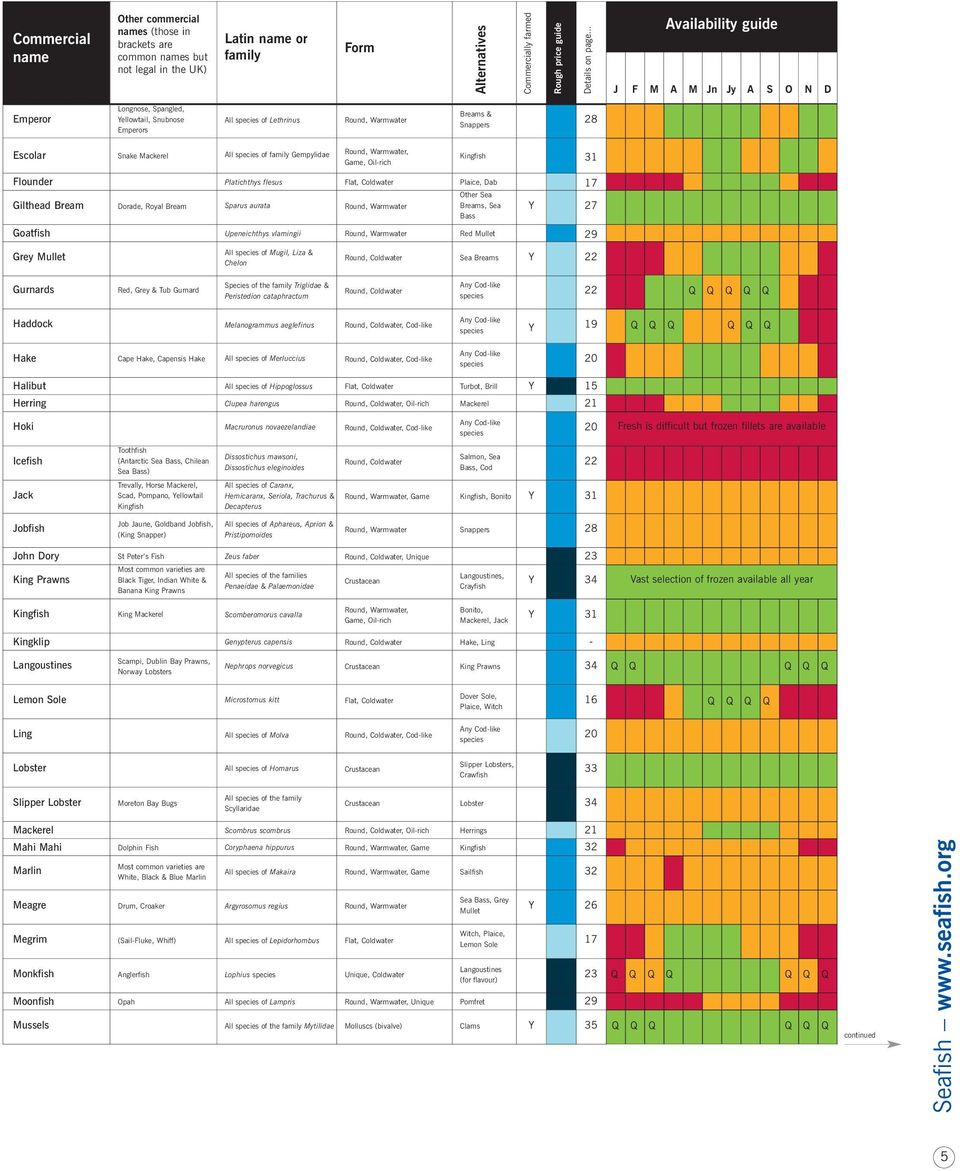
6 Commercial name Other commercial names (those in brackets are common names but not legal in the UK) Latin name or family Form Alternatives Commercially farmed Rough price guide Details on page... J F Availability guide M A M Jn Jy A S O N D Octopus Oysters (Native) All species of Octopus All species of Ostrea Cephalopods Molluscs (bivalve) Squid, Cuttlefish Pacific Oysters Closed season Oysters (Pacific) Pacific / Rock Oysters, Portuguese Oysters All species of Crassostrea Molluscs (bivalve) Native Oysters 36 Perch Perca fluviatilis Round, Freshwater Carp, Zander, Pike 40 Pike Plaice Esox lucius Pleuronectes platessa Round, Freshwater Flat, Coldwater Zander, Perch Lemon Sole, Flounder, Dab, Megrim Q Q Q Pollack Pollock Pollachius pollachius Round, Coldwater, Cod-like Any Cod-like species 20 Pomfret Butterfish All species of Brama, Stromateus & Pampus Round, Warmwater, Unique Moonfish 29 Prawn - Coldwater Pandalus borealis Crustacea, Coldwater 34 Prawn - Warmwater Giant Tiger Prawn, Jumbo Tiger Shrimp or Brown Tiger Prawn Pandalus monodon Crustacea, Coldwater 34 Red Mullet All species of Mullus Round, Warmwater Goatfish, Snappers 29 Red Snapper Sablefish (Black Cod) All species of Lutjanus Anoplopoma fimbria Round, Warmwater Round, Coldwater Other Snappers Cod is closest Only sold frozen Sailfish All species of Istiophorus Round, Warmwater, Game Marlin 32 Salmon (farmed) Atlantic Salmon Salmo salar Round, Cold/Freshwater, Oil-rich Sea Trout, Pacific Salmon 38 Salmon (wild) Atlantic Salmon Salmo salar Round, Cold/Freshwater, Oil-rich Sea Trout, Pacific Salmon 38 Salmon, Pacific Cherry Salmon Oncorhynchus masou masou Round, Cold/Freshwater, Oil-rich Sea Trout, Pacific Salmon 38 Salmon, Keta Chum Salmon Oncorhynchus keta Round, Cold/Freshwater, Oil-rich Sea Trout, Pacific Salmon 38 Salmon, Silver Coho or Red Salmon Oncorhynchus kisutch Round, Cold/Freshwater, Oil-rich Sea Trout, Pacific Salmon 38 Salmon, Pink Oncorhynchus gorbuscha Round, Cold/Freshwater, Oil-rich Sea Trout, Pacific Salmon 38 Salmon, Red Sockeye Salmon Oncorhynchus nerka Round, Cold/Freshwater, Oil-rich Sea Trout, Pacific Salmon 38 Salmon, King Spring, Chinook or Pacific Salmon Oncorhynchus tshawytscha Round, Cold/Freshwater, Oil-rich Sea Trout, Pacific Salmon 38 Sardines Pilchards - which are adult Sardines Sardina pilchardus Round, Coldwater, Oil-rich, Small Herrings 21 Q Q Q Q Q Q Q Scabbard Fish Sabre Fish, Silver Sabre, Black Sabre (Ribbon Fish, Espada, Cutlass Fish) Lepidopus caudatus (silver), Aphanopus carbo (black) Round, Coldwater, Unique 24 Scallops King / Queen / Atlantic / Common All species of family Pectinidae Molluscs (bivalve) 36 Q Q This information is provided as a guide only. Prices and availability fluctuate daily. price price price Q Good availability Varying availability Poor availability Best quality Species without any Q s are of consisitent quality all year 6

7 Commercial name Other commercial names (those in brackets are common names but not legal in the UK) Latin name or family Form Alternatives Commercially farmed Rough price guide Details on page... J F Availability guide M A M Jn Jy A S O N D Sea Bass (farmed) Dicentrarchchus labrax Round, Warmwater Gilthead Bream 26 Q Q Q Q Q Q Q Q Sea Bass (wild) Dicentrarchchus labrax Round, Warmwater Barramundi 26 Striped American Sea Bass Rockfish Morone saxatilis Round, Freshwater Sea Bass, Gilthead Bream 40 Sea Bream Gilthead Bream, Royal Bream, Black Bream, Black Banded Bream, Red Sea Bream, Ray s Bream, Porgy All species of family Sparidae (ex. Boops boops) Round, Warmwater Snappers, Emperor, Sea Bass 27 Sea Trout Salmon Trout Salmo trutta Round, Cold/Freshwater, Oil-rich Brown Trout, Salmon 39 Snappers Red, Emperor, Ruby, Pink, King, Moses, Crimson, Flag, Mangrove, Silk, ellowtail & Five Line Snapper All species of family Lutjanidae Round, Warmwater Emperors, Sea Breams 28 Sprats Sprattus sprattus Round, Coldwater, Oil-rich, Small Anchovies, Whitebait, Sardines 21 Q Q Q Q Squid (Calamari) All species of Loligo, Illex, Ommastrephes Cephalopods Cuttlefish, Octopus 37 Q Q Q Q Q Q Tilapia - Orange, Red & Black Orange & Black Tilapia All species of Tilapia & Oreochromis Round, Freshwater Sea Breams 40 Trevally Jack, Horse Mackerel, Scad, Pompano, ellowtail Kingfish All species of Caranx, Hemicaranx, Seriola, Trachurus & Decapterus Round, Warmwater, Game Kingfish, Bonito 31 Trout - Brown Salmo trutta Round, Freshwater, Oil-rich Sea Trout, Rainbow Trout, Salmon 39 Trout - Rainbow Oncorhynchus mykiss Round, Freshwater, Oil-rich Sea Trout, Brown Trout, Salmon 39 Tuna ellowfin, Skipjack Thunnus albacares, Euthynnus pelamix Round, Warmwater, Game, Oil-rich Marlin, Bonito 30 Turbot Psetta maxima Flat, Coldwater Brill 15 Wahoo Acanthocybium solandri Round, Warmwater, Game, Oil-rich Kingfish, Bonito 31 Whelks All species of Buccinum Molluscs (univalve) Winkles 36 Q Q Q Q Q Whitebait Sprattus sprattus/clupea harengus Round, Coldwater, Oil-rich, Small Sprats 21 Q Q Q Q Whiting Merlangius merlangus Round, Coldwater, Cod-like Any Cod-like species 20 Q Q Q Q Q Q Q Q Winkles All species of Littorina Molluscs (univalve) Whelks 36 Q Q Q Q Witch Torbay Sole Glyptocephalus cynoglossus Flat, Coldwater Lemon Sole, Plaice, Megrim 17 Wrasse Ballan Wrasse, Cuckoo Wrasse All species of family Labridae Round, Warmwater Snappers 29 Zander Pike-perch Stizostedion lucioperca Round, Freshwater Perch, Pike 40 7

8 Sourcing With 21,000 species of fish and shellfish in the world and around 100 delicious varieties available in the UK, there really is an ocean of choice. This diversity means that more and more people are becoming adventurous in their tastes. ou can respond to this demand by providing your customers with some of the lesser known species such as ling and pollack, as well as traditional species like cod and haddock. Many of the species available in the UK come from a wide variety of sources, with 70% being imported from all over the world. Imports The UK is becoming increasingly reliant on imports. In 2007 the UK imported 672,000 tonnes of seafood worth 1.76 billion. (Note: this figure does not include freshwater fish, fishmeal or fish oils.) Large processing firms tend to import the majority of their supplies. Imports have traditionally been dominated by shellfish but more recently whitefish have also become very important. Sources of import include: Shellfish India, Bangladesh, Indonesia, Denmark, Canada Whitefish Faroe, Iceland, Russia, Norway The UK fishing industry In 2007, UK fishing vessels landed around 366,000 tonnes of seafood, worth over 368 million. At that time, the industry employed 12,729 fishermen, working on 6,763 vessels. Source: For the latest statistics on the UK fishing industry visit the Marine and Fisheries Agency website. All UK fishermen have to operate under strict management regimes. Many of the stocks around the country s coastline are currently very healthy; for example, stocks of herring and shellfish such as langoustine. However, many of the most abundant species are exported and there is scope to increase UK consumption of them. In recent years, new alliances have been built between government, fishermen, statutory bodies, conservationists and scientists to work towards a sustainable future for the seas around the UK. As these new partnerships develop, there is scope for buyers to change their specifications, building in commitments to better conservation practices by fishermen. The Head of Environmental Responsibility at Seafish is helping the seafood industry build on this. For details of the latest Seafish projects in this area visit 8

9 Aquaculture A wide range of fish and shellfish are produced by the aquaculture industry worldwide. Familiar examples include salmon, trout, warmwater prawns, sea bass, sea bream, turbot, tilapia, oysters, scallops and mussels. Other species being farmed in increasing quantities include cod and halibut. Both of these species are starting to be farmed on a commercial scale here in the UK. The different aquaculture terms are: Farmed eggs bred in captivity and grown through to harvest. Sea reared young stocks are caught in the wild and then grown on to harvest, eg mussels. Sea ranching Juveniles are bred in captivity and then released into the wild. A small percentage (2-5%) are subsequently caught when they mature, eg lobsters. Fish and shellfish farms in the UK and Europe have to be registered and the fish and shellfish are inspected for health, hygiene and welfare regularly. Individual farms and their associations are working to raise standards and maintain a healthy environment. Processing In 2008 there were 479 processing factories in the UK, employing 14,660 full time equivalent employees. A suppliers database listing UK merchants, wholesalers and processors is available at It contains details of the lines they sell and the various product-forms they handle. Seafood processing is classed as either: Primary (cutting, filleting, peeling, washing, chilling, packaging, heading and gutting) or Secondary (brining, smoking, cooking, freezing, canning, deboning, breading, battering, vacuum & controlled packaging and the production of ready meals). Seafish operates Processor and Wholesaler Quality Award schemes which recognise high standards in seafood production and distribution. For more information see Current initiatives include: Developing and promoting codes of practice to ensure cultivation sites and stocks are well managed. Addressing issues relating to the supply of fishmeal and fishoil in aquaculture feeds. Sourcing feeds from sustainably managed and accredited fisheries is becoming a priority. Investigating better use of feed on site through the development of improved feeding systems. 9

10 Enjoy the best of the world s catch These maps provide an indication of the most common source for various species. Halibut Turbot Brill Plaice Witch Dab Lemon Sole Dover Sole Sea Trout Trout Salmon Kinlochbervie Stornoway Lochinver Mallaig Wick Fraserburgh Aberdeen Peterhead Cod Haddock Coley Whiting Hake Ling Pollack Monkfish Mackerel Herring Conger Eel North Shields Fleetwood Leeds Hull Grimsby John Dory Red Mullet Grey Mullet Sea Bass Shark Tuna Gurnard Squid London estoft Lobster Crab Langoustines Mussels Scallops Oysters Penzance Newlyn Brixham Plymouth Dartmouth Location of Seafood Training Academy Partners. See inside back cover for full list. Note: Most of the species on this map are landed in most UK ports. 10

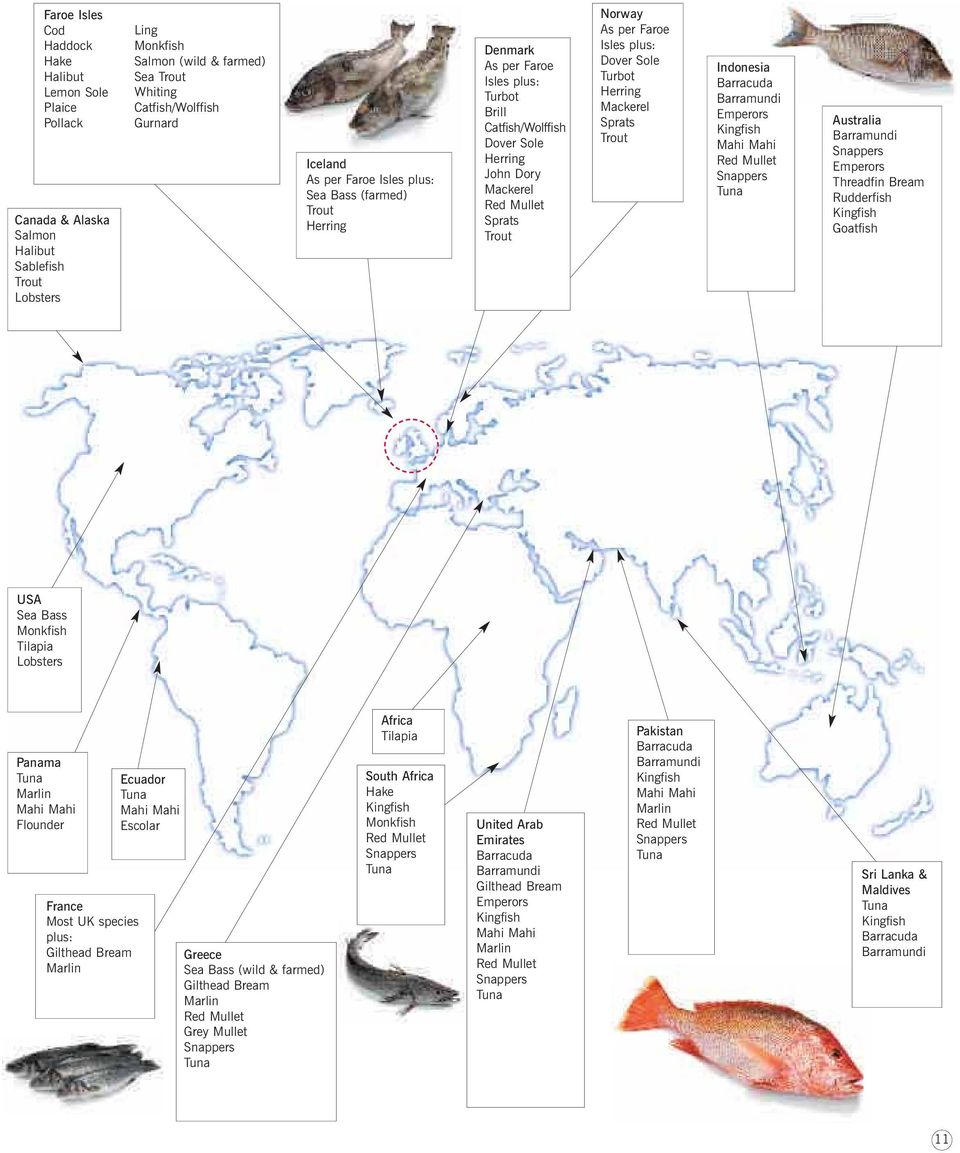
11 Faroe Isles Cod Haddock Hake Halibut Lemon Sole Plaice Pollack Canada & Alaska Salmon Halibut Sablefish Trout Lobsters Ling Monkfish Salmon (wild & farmed) Sea Trout Whiting Catfish/Wolffish Gurnard Iceland As per Faroe Isles plus: Sea Bass (farmed) Trout Herring Denmark As per Faroe Isles plus: Turbot Brill Catfish/Wolffish Dover Sole Herring John Dory Mackerel Red Mullet Sprats Trout Norway As per Faroe Isles plus: Dover Sole Turbot Herring Mackerel Sprats Trout Indonesia Barracuda Barramundi Emperors Kingfish Mahi Mahi Red Mullet Snappers Tuna Australia Barramundi Snappers Emperors Threadfin Bream Rudderfish Kingfish Goatfish USA Sea Bass Monkfish Tilapia Lobsters Panama Tuna Marlin Mahi Mahi Flounder France Most UK species plus: Gilthead Bream Marlin Ecuador Tuna Mahi Mahi Escolar Greece Sea Bass (wild & farmed) Gilthead Bream Marlin Red Mullet Grey Mullet Snappers Tuna Africa Tilapia South Africa Hake Kingfish Monkfish Red Mullet Snappers Tuna United Arab Emirates Barracuda Barramundi Gilthead Bream Emperors Kingfish Mahi Mahi Marlin Red Mullet Snappers Tuna Pakistan Barracuda Barramundi Kingfish Mahi Mahi Marlin Red Mullet Snappers Tuna Sri Lanka & Maldives Tuna Kingfish Barracuda Barramundi 11
12 Seafood: the best natural source of Omega-3 It is widely recognised that oil-rich fish, high in long-chain, Omega-3, polyunsaturated fatty acids, is good for you. Data collated by Seafish, has revealed that a greater range of fish and shellfish contain high concentrations of Omega-3 oils than previously realised. The collated data comes from six studies into the Omega-3 content of seafood by major international organizations such as the United States Department of Agriculture and the German Nutritional Advice Network. While the research revealed that herring, mackerel, sardines and salmon remain at the top of the list as being richest in Omega-3, species such as brown crab, oysters, Atlantic pollack, hake and brown shrimps emerged as useful sources. Seafood is now widely recognised as the best, natural source of Omega-3 oils, the long-chain fatty acids which are beneficial for heart health. Further studies have revealed it is also necessary for brain development, joint function and healthy skin in fact, for every cell in our bodies. The FSA recommended intake of Omega-3 is 3,000 milligrams weekly (about 450mg per day). From the table, you can see how easy this is to attain. Since most people already get around a third of this amount from other sources, just adding one portion of herring or mackerel hits the target easily. Combining some of the other sources, for example one portion of brown crab, together with a portion of mussels, comes to roughly the same figure. In addition to the benefits of Omega-3, seafood is an excellent source of protein and provides a wide range of vitamins and minerals which have important functions in the body. Because of all these benefits, the Food Standards Agency recommends that we should all be eating at least two portions a week (one portion should be omega-rich. A portion is equivalent to approximately 140g and in addition, the FSA go on to make further recommendations relating specifically to oil-rich fish: The results reveal that species which have not traditionally been thought of as oil-rich have emerged as valuable sources, and this is particularly good news for those who are not keen on stronger tasting fish. They are also significant because they show that consumers concerned about the sustainability or provenance of a particular species have far more options than previously thought if they want to protect their hearts from damage and improve their overall health. Two portions of oil-rich fish per week Girls and women who might have a baby one day Women who are pregnant or breastfeeding Four portions of oil-rich fish per week Other women Men and boys 12

13 Species information The following 28 pages contain details on 100 different species! There are also Instant Guides to the most popular 22 species, providing all the essential information at a glance. Can you tell me more about..? Flatfish pages 14 to 17 Round-fish / Coldwater pages 18 to 24 Round-fish / Warmwater pages 25 to 29 Game Fish pages 30 to 32 Shellfish pages 33 to 36 Cephalopods page 37 Salmon, Trout and Freshwater pages 38 to 40 Smoked Fish and Sea Vegetables pages 41 to 42 Anchovies 21 Arctic Char 39 Barracuda 26 Barramundi 26 Bonito 31 Bream 40 Brill 15 Brook Char 39 Brown Trout 39 Carp 40 Catfish 22, 40 Clams 36 Cockles 36 Cod 19 Coley 20 Conger (Eel) 22 Crabs 34 Crawfish 34 Crayfish 34 Croakers 26 Cuttlefish 37 Dab 17 Dover Sole 16 Drums 26 Emperors 28 Escolar 31 Flounder 17 Gilthead Bream 27 Goatfish 29 Golden Trout 39 Gravadlax 41 Grey Mullet 22 Gurnards 22 Haddock 19 Hake 20 Halibut 15 Herrings 21 Hoki 20 Icefish 22 Jacks 31 Jobfish 28 John Dory 23 King Prawns 34 Kingfish 31 Langoustines 34 Lemon Sole 16 Ling 20 Lobsters 33 Mackerel 21 Mahi Mahi 32 Marlin 32 Meagre 26 Megrim 17 Monkfish 23 Moonfish 29 Mussels 35 Octopus 37 Oysters 36 Perch 40 Pickled Fish 41 Pike 40 Pilchards 21 Plaice 17 Pollack 20 Pomfret 29 Prawns 34 Rainbow Trout 39 Red Mullet 29 Red Snapper 28 Sablefish 24 Sailfish 32 Salmon 38 Salted Fish 41 Samphire 42 Sardines 21 Scabbard Fish 24 Scallops 36 Sea Bass 26 Sea Breams 27 Sea Trout 39 Seaweeds 42 Slipper Lobsters 34 Smoked Fish 41 Snappers 28 Sprats 21 Squid 37 Striped American Sea Bass 40 Tilapia 40 Trevallies 31 Trout 39 Tuna 30 Turbot 15 Wahoo 31 Whelks 36 Whitebait 21 Whiting 20 Winkles 36 Witch 17 Wrasse 29 Zander 40 Key to symbols used Good source of omega-3 For more information on omega-3 see page

14 Dover Sole 2. Dab 3. Plaice 4. Lemon Sole 5. Halibut (Chick) 6. Megrim 7. Brill 8 Turbot 9. Filleting Halibut Flatfish We are truly blessed in the UK to be surrounded by a superb array of flatfish. All flatfish are born round, then as they grow, the eyes move to either the left or right side of the fish so they can see all around when lying on the sea bed. Left-eye fish are called sinistral (Turbot, Brill and Megrim) and right-eye fish are called dextral (all others). They all have dark skin on the eye side and white on the blind side except Greenland Halibut which is dark on both sides. Fillets from flatfish do not possess any pin bones. The larger species (Halibut, Turbot and Brill) can also provide excellent boneless suprêmes from fish over 3kg. 14

15 Halibut The largest of the flatfish. Halibut have been known to grow as large as 300kg and 4m long in deeper waters. This is a highly esteemed and very tasty fish, with creamywhite, firm meaty flesh. It has a compressed oval body with a large mouth. The dark, eye side is a greenishdark brown and the blind side is pure white. Smaller fish (1 to 3kg) are known as baby or chick halibut, and tend to be found in shallower waters. The better quality fish are usually caught by line, so the catch is limited, making them more expensive. The larger fish range in size from 3kg to 70kg. As well as being found in the Pacific, North Atlantic and the North Sea, Halibut is now also being successfully farmed, ensuring this exquisite, nutritious species is available year-round. Not to be confused with Mock, Black or Greenland Halibut, all names for an inferior species (Reinhardtius hippoglossoides), it is easily identified, dark brown on both sides and with a slightly gelatinous texture. Instant guide to... Flesh flavour Mild Strong Sweet Earthy Price guide Turbot Availability (details on p.4-7) All year round. Wild season runs from April to Feb, farmed all year. Flesh texture Soft Firm Meaty Small Flakes Large Flakes Best portions (details on p.43-45) Whole Fillets Suprêmes Steaks Pavés Alternatives Brill, Halibut Oil content Sauces/flavours Creamy Sharp Strong/spicy Delicate Best cooking methods Pan Fry Griddle Grill Deep Fry Bake Poach Steam Boil Microwave Halibut (Chick) The best way to cook Halibut is to poach it either in a good fish stock or white wine, with cooking liquors then used as a base for some superb sauces (delicate flavours work best). Suprêmes are also good pan-fried but be careful not to over-cook and dry them out. Turbot Like Halibut, Turbot is a highly prized species and often regarded as the best of the flatfish with great flavour and firm, white flesh. It has an almost round shaped body, studded with bony tubercles on its dark side. Colour varies from light to dark brown, spotted with green or black and a white blind side. Turbot ranges in size from 400g to 10kg. Turbot Instant guide to... Halibut The texture is similar to Halibut, but it has a slightly more pronounced fishy taste, so requires very little to enhance the flavour. It s also a chef s dream, as it retains plenty of moisture during cooking, preventing it from drying out ideal for functions. Turbot are now also being successfully farmed giving good availability, and are distinguished by their lighter skin. Flesh flavour Flesh texture Mild Soft Strong Sweet Earthy Firm Meaty Small Flakes Large Flakes Price guide Best portions (details on p.43-45) Whole Fillets Suprêmes Availability (details on p.4-7) Steaks All year round. Wild season runs from May Pavés to March, farmed all year. Alternatives Turbot, Brill Oil content Sauces/flavours Creamy Sharp Strong/spicy Delicate Best cooking methods Pan Fry Griddle Grill Deep Fry Bake Poach Steam Boil Microwave Brill Brill is similar to Turbot, yet remains a very underrated fish, despite being generally less expensive. It has an almost oval body, a grey-brown dark side with light and dark freckles (but no tubercles), and ranges from 400g to 4kg. As with Turbot, the skin colour changes according to where it is caught lighter colours are found on sandy seabeds, with darker, richer colours found on muddier beds. Admittedly, Turbot s flesh has larger flakes, but Brill has a sweeter taste, which benefits from a bit more enhancement try a sauvignon blanc reduction sauce, garnished with a spoonful of Avruga and chopped chives. With both Turbot and Brill, the smaller fish (under 500g) are best appreciated on the bone, black-skinned and simply pan-fried with a herb butter or simple sauce, while larger fish (3kg+) yield great suprêmes, steaks and pavés which can be pan-fried, grilled, poached or baked. 15

16 Dover Sole King of the soles. This superb fish inspired many classic dishes such as Poached Sole Bonne Femme, Sole Veronique and Sole a la Meunière. With dark brown skin and a longer and narrower shaped body than other flatfish, Dover Sole has a crisp white flesh, firm to touch, with an almost sweet taste. They range in size from 340g to 1.3kg. As it s often too firm to cook immediately after being caught, it is usually best after one or two days when the texture and flavour is enhanced. Fish of g are perfect for serving whole a la meunière skinned both sides, dusted in seasoned flour and pan-fried. A 680g fish will provide two portion-size fillets. Small Dover Sole are sometimes known as Tongues (up to 280g) and Slips ( g). Instant guide to... Dover Sole Flesh flavour Flesh texture Oil content Sauces/flavours Mild Strong Soft Firm Creamy Sharp Strong/spicy Dover Sole Sweet Earthy Meaty Small Flakes Large Flakes Delicate Best cooking methods Price guide Availability (details on p.4-7) All year round. More difficult in Jan-Feb and July-Aug. Best portions (details on p.43-45) Whole Fillets Suprêmes Steaks Pavés Alternatives Lemon Sole Pan Fry Griddle Grill Deep Fry Bake Poach Steam Boil Microwave Lemon Sole Lemons have an oval body; more rounded than a Dover, with a lighter, yellowy-brown dark side. Ranging in size from 230g to 1kg, Lemon Sole have a sweet delicate flesh, ideal for any sole recipes and work especially well with creamy white wine sauces. As well as being a great fish cooked on the bone, fillets are always popular, and are great for rolling around a filling (delice), then steaming or baking. While found in the Eastern Atlantic and North Sea, Lemon Sole from the South Coast are generally considered the best, and often command a higher price. A popular fish on Christmas menus. Instant guide to... Lemon Sole Lemon Sole Flesh flavour Mild Strong Sweet Earthy Price guide Availability (details on p.4-7) All year round. Season runs from May to March. Avoid Xmas - high demand and difficult availability forces price up. Flesh texture Soft Firm Meaty Small Flakes Large Flakes Best portions (details on p.43-45) Whole Fillets Suprêmes Steaks Pavés Oil content Alternatives Plaice, Dover Sole, Megrim, Sauces/flavours Creamy Sharp Strong/spicy Delicate Best cooking methods Pan Fry Griddle Grill Deep Fry Bake Poach Steam Boil Microwave 16

17 Instant guide to... Plaice Flesh flavour Flesh texture Oil content Sauces/flavours Plaice Mild Strong Sweet Earthy Soft Firm Meaty Small Flakes Large Flakes Creamy Sharp Strong/spicy Delicate Best cooking methods Price guide Availability (details on p.4-7) All year round. Season runs from May to Feb. Avoid Feb to April as its in roe (thin and watery flesh), Best portions (details on p.43-45) Alternatives Lemon Sole, Megrim, Witch, Flounder, Dab Plaice Unlike Dover Sole, Plaice is best eaten as fresh as possible, as the flavour quickly fades. Ranging from 230g to 2kg, whole fish is easily identified by its distinctive orange spots, which also give an indication of the freshness (the brighter the spots, the fresher the Plaice). It is as pronounced a flavour as Lemon Sole, but it takes sauces and other flavours very well, and is great for battering. Cook on the bone (with the black skin removed) to get the best from the flavour, or use fillets with a sauce or filling. Best avoided when in roe (around February to April), as the flesh is thin and watery. Whole Fillets Suprêmes Steaks Pavés Pan Fry Griddle Grill Deep Fry Bake Poach Steam Boil Microwave Megrim Megrim, also known as Whiff, is more loved by the Spanish than in the UK. It has an oval body similar to Lemon Sole with a sandy-brown dark side but is from the same family as Turbot and Brill. Megrim Witch Witch, also known as Torbay Sole, has a similar appearance to Dover Sole, and is from the same family as Lemon Sole and Plaice. Both Megrim and Witch are generally fished off the southwest coast and down the Atlantic coast of Europe and range in size from 225g to 900g. They can be a good buy when at their freshest, are best cooked on the bone and require careful cooking to avoid drying out. Flounder & Dab Also known as Fluke, Flounder has brownishgreen skin with faint red spots on the dark side, and is a bright white on the blind side. They are a similar shape to Halibut (though that s where the similarities end!), and range in size from 350g - 900g. Dabs tend to be smaller, and are rarely caught bigger than 680g. At their best, both dab and flounder are similar in flavour and texture to Plaice, and can be a good buy. Dab 17

18 Round-fish / Coldwater Cod is rightly regarded as one of the world s great coldwater fishes, but there are plenty more similar species worth investigating too, along with other great coldwater fish such as Monkfish, John Dory and some underrated species such as Gurnards, Grey Mullet and Mackerel Cod Fillet 2. Cod 3. Haddock 4. John Dory

19 Instant guide to... Cod Cod A superb whitefish, to which chefs are coming back to with renewed enthusiasm. It has a long, tapered body with a mixture of sandy-browns, greyish-greens and darker speckles. Whole Cod range from 500g to over 6kg with the smaller fish (500g to 1.8kg) sometimes known as Codling. While fillets from smaller fish are most commonly used, it s at its best when loins or suprêmes are cut from larger 4-6kg fish, giving a meatier portion with large, succulent flakes of pure white Cod. As for cooking, its very versatile and takes most flavours, but requires care as it is easily over-cooked. Flesh flavour Mild Strong Sweet Earthy Price guide Flesh texture Soft Firm Meaty Small Flakes Large Flakes Availability (details on p.4-7) All year round. Season runs from June to Feb. Best quality from July to Oct. Can be difficult in Nov & Dec. Best portions (details on p.43-45) Whole Fillets Suprêmes Steaks Pavés Oil content Alternatives Haddock and other Cod-like species Sauces/flavours Creamy Sharp Strong/spicy Delicate Best cooking methods Pan Fry Griddle Grill Deep Fry Bake Poach Steam Boil Microwave Cod Loin Haddock A member of the Cod family, haddock is not usually available beyond 3.5kg, so is not good for steaks or suprêmes. The flesh is not as white as Cod, and is not as flaky, but has a slightly sweeter taste, which is why Haddock is the best whitefish for smoking (see page 41). Haddock is probably more loved North of the border - order fish and chips in Scotland and it s battered skinless Haddock you ll get not the skin on Cod you get South of the border. Cook and use the same recipes as for Cod. Instant guide to... Flesh flavour Mild Strong Sweet Earthy Price guide Haddock Availability (details on p.4-7) All year round. Season runs from May to Feb, however its best from Feb to Sept. Can be difficult in Nov & Dec. Flesh texture Soft Firm Meaty Small Flakes Large Flakes Best portions (details on p.43-45) Whole Fillets Suprêmes Steaks Pavés Oil content Alternatives Cod and other Cod-like species Sauces/flavours Creamy Sharp Strong/spicy Delicate Best cooking methods Pan Fry Griddle Grill Deep Fry Bake Poach Steam Boil Microwave 19

20 Other members of the Cod family... Coley An alternative to Cod and Haddock, also known as Saithe. A long tapered body, with a slight blue tint, coley range from 500g to 6kg but are usually only available as fillets. Coley can be a good buy, but needs to be as fresh as possible. The flesh is often a dull off-white colour but lightens during cooking and it has a fine flavour. Hake Surprisingly not more popular in the UK a large proportion of the UK catch goes to the Spanish, Portuguese and Italians who love it. Ranging from 1 to 5kg, Hake has a long, round, slender body and is mainly grey and silver in colour. Its shape makes it great for cutting into steaks or loin suprêmes. The flesh is quite soft, but firms up on cooking, has a good flavour, and is well worth trying. For a light, modern alternative to battered Cod, try deepfrying Hake fillets dipped in a light tempura batter. Ling Ling has a long slender body with a bronze tint, greenish-brown marks, and a white belly. It can grow up to 1.5 metres long, but is usually only available as fillets. It is also often salted and dried. It has firm textured flesh and a good flavour, which takes strong flavours well. Also look out for Tusk, a relative of Ling with similar characteristics. Pollack Closely related to Coley, and the two are often confused. Whole fish range from 500g to 3kg. Pollack is a good tasting fish, and is popular in France where much of our catch goes. Whiting A smaller fish from the Cod family, with a silvery-grey body and rounded belly, and rarely found over 2kg. This is often an overlooked fish but, like Coley, Whiting fillets are a good buy when very fresh, but can be easily overcooked. Hoki A deep-sea fish not found around the UK, but in waters around New Zealand, South Africa and off the Chilean coast at depths of up to 5,000 metres. Hard to get fresh, but frozen is available. Unlike these other Cod-like species, Hoki is not a member of the Cod family. However, it yields bright white fillets, which make a good alternative to other whitefish (see also Catfish page 22). 1. Whiting 2. Pollack 3. Ling 4. Hake 5. Coley

21 Mackerel A superb fish, great value, readily available and yet, amazingly underrated. Ranging in size from g, Mackerel has a bullet shaped body with silvery-blue skin with dark wavy stripes. One of the richest sources of Omega-3 (see page 12), Mackerel has greyish flesh with a rich flavour, which is best grilled or baked. Any sauce should be sharp to complement its rich flavour try gooseberry, sorrel, rhubarb, cranberry, redcurrant or mustard avoid anything creamy or buttery. Marinating in citrus juices is also good. Mackerel is highly rated in Japanese cuisine, where whole fish are marinated in soy before grilling or griddling definitely worth trying. As with most oil-rich fish, it is good for smoking, and makes a great paté. While Herring provides the best alternative, Mackerel is closely related to Tuna, Bonito, Kingfish and Wahoo (see pages 30-31). Instant guide to... Flesh flavour Mild Strong Sweet Earthy Price guide Availability (details on p.4-7) All year round. At its best in summer. Mackerel Flesh texture Soft Firm Meaty Small Flakes Large Flakes Best portions (details on p.43-45) Whole Fillets Suprêmes Steaks Pavés Oil content Sauces/flavours Creamy Sharp Strong/spicy Delicate Best cooking methods Pan Fry Griddle Grill Deep Fry Bake Poach Steam Boil Microwave Alternatives Herrings The Herring family... Herrings A smooth, slender body, with silvery skin with hints of green and blue. They range in size from g and are best grilled or baked whole, but there is a traditional Scottish recipe where they are rolled in Oatmeal and fried in bacon fat. As with all oilrich fish, they benefit from a sharp sauce. Herrings are most popular in their various smoked and cured forms, and as Avruga a great alternative to Caviar (see page 42). Sardines / Pilchards They are both the same species, which has the Latin name Sardinus pilchardus. The smaller fish are known as Sardines and the larger, older fish are Pilchards. They range in size from 80g-150g, and are ideal for grilling whole and served as a starter or for barbecuing. Fished off the South Coast, the French Coast and the Mediterranean, they tend to prefer warmer waters. Currently most of the UK catch goes to France. Anchovies and Sprats Long, thin fish, usually around 10-15cm long. Mainly sold filleted and preserved in oil, as they are small and fragile and therefore difficult to transport whole. Sprats are fished seasonally around the UK coast. Whitebait Not actually a species in its own right, but the fry of other small species like Herrings and Sprats. They can be found in estuaries, shallow coastal waters, the North Sea and East Atlantic. Fresh Whitebait are hard to get, but frozen are always available. There is only one way to cook them - whole (don t gut or head them), dusted in seasoned flour, deep fried in oil and served with loads of lemon and parsley. Devilled Whitebait has cayenne pepper added to the flour. Herring Mackerel Whitebait 21
22 Catfish Also known as Wolf Fish, Catfish are found all around the North Atlantic, and have a torpedo shaped body which is usually only available already filleted probably a good thing, as the whole fish is not particularly attractive, and the skin is tough. A good buy, the flesh is firm and can be cooked like any Cod-like species. Catfish Icefish This fish (Dissostichus eleginoides) has an identity crisis! It s also known around the world as Patagonian Toothfish, Antarctic Sea Bass and Chilean Sea Bass, but it should only be marketed in the UK as Icefish or Toothfish. It s a rich tasting fish, like an oilier Bass or Cod, and is found in deep waters of the South Atlantic. Conger Unlike the European Eel (page 39), the Conger is never found in freshwater, preferring temperate waters around the Mediterranean and North Atlantic. While not as highly regarded, Conger can be prepared and cooked in the same ways, but gets bonier towards the tail and it ranges in size typically from 2-7kg. One of the best fish in terms of maintaining its freshness. Grey Mullet No relation to Red Mullet, Grey Mullet range from 450g to 3kg and have a similar appearance to Sea Bass but with larger scales. Fish caught out in the open sea can be great, but further inshore they can taste muddy, as they are bottom feeders. To remove this muddiness, soak whole scaled and gutted fish for 30 minutes in 2 tbsp vinegar and 1 tbsp salt per litre. Ideal for cooking with strong flavours, and any Sea Bass recipe will work. Conger Grey Mullet 22 Gurnards The most common variations are Red, Grey and ellow / Tub Gurnards, but they are very similar in shape and taste, it s just the skin colours that change. They are found around the UK and the Mediterranean from 350g to 2.5kg, and are always a good buy. Commonly used for stocks, soups and bouillabaisse, Gurnard is not a big seller despite being rated by several well-known chefs. Although it is bony, Gurnard has a good flavour, firm textured flesh, takes strong flavours and pan-fries or grills well. Gurnard
23 Instant guide to... Monkfish Flesh flavour Mild Strong Sweet Earthy Flesh texture Soft Firm Meaty Small Flakes Large Flakes Oil content Sauces/flavours Creamy Sharp Strong/spicy Delicate Best cooking methods John Dory Often named St. Peter s fish (St. Pierre in France, Janitore in Spain), as he is alleged to be the origin of the distinctive dark thumbprint (or spot) on its side as a thank you for some help with his tax! The English name John Dory arrived from the French jaune doré meaning golden yellow a good description for this unusual looking fish, which varies in size from smaller g fish up to 2kg. Because of the large head (like Monkfish, this accounts for half its weight), John Dory is best filleted, but beware the low yield (around 35%) and some sharp nasty spines, which require extra care when filleting. The flesh is creamywhite, with a dense texture similar to Dover Sole, which holds up well during cooking. Ideal panfried or grilled, John Dory works well with Mediterranean flavours, salsas, and peppery sauces. It may be an expensive fish with a low yield but it s worth it! Instant guide to... Flesh flavour Mild Strong Sweet Earthy John Dory Flesh texture Soft Firm Meaty Small Flakes Large Flakes Price guide Best portions (details on p.43-45) Whole Fillets Suprêmes Availability (details on p.4-7) Steaks All year round. Pavés Oil content John Dory Sauces/flavours Creamy Sharp Strong/spicy Delicate Best cooking methods Pan Fry Griddle Grill Deep Fry Bake Poach Steam Boil Microwave Price guide Availability (details on p.4-7) All year round. Best quality from Oct to May. Monkfish Best portions (details on p.43-45) Whole Fillets Suprêmes Steaks Pavés Pan Fry Griddle Grill Deep Fry Bake Poach Steam Boil Microwave Alternatives None (Langoustine meat comes closest) Monkfish An ugly fish, which has a huge head, accounting for half the fish s weight. However, there is inner beauty! Usually only the tails are sold, and range from 350g to 4kg. Once skinned, trimmed and the membrane removed, the tails yield some fantastic meat, with a firm, meaty texture and a taste similar to langoustine / scampi. In the 1970s Monkfish was only fished commercially as a cheap scampi substitute! Great for searing and then roasting, Monkfish will take on strong flavours and herbs well. Particularly good coated with chopped rosemary and olive oil, wrapped in Parma ham and baked. The liver is also highly prized, and is a delicacy in Japan where it determines the price of the fish. Similar species known as Stargazers are found in warmer waters around Australia and New Zealand but are a bony fish, not cartilaginous like the European Monkfish. Alternatives None 23
24 Sablefish Often known (incorrectly) as Black Cod, and popular in Japanese cuisine, this premium species is commonly fished in Alaska and is usually around 5kg. With its large, moist, flakes of delicious white flesh, this is a truly superb eating fish, but Sablefish is rarely available fresh, and even the frozen is sadly out of most price ranges. Best pan-fried or baked, and featured in a classic recipe, where it is marinated in sweet miso for 2 to 3 days before being pan-fried and finished in the oven. Scabbard Fish A long, thin fierce looking deep-sea fish found as far down as 1,000 metres in both cold and warm waters around the Atlantic, Mediterranean and Pacific. There are two main species of Scabbard black and silver and it is sometimes known as Sabre Fish (and incorrectly as Ribbon Fish or Cutlass Fish). Much is caught off the island of Madeira using long lines dyed black, where they and the Portuguese know and love it as Espada. Usually around 1 to 2kg, Scabbard has soft, delicately flavoured white meat. It is usually skinned then filleted or steaked and baked, grilled or pan-fried. Silver Scabbard Fish 24
25 Round-fish / Warmwater This section focuses on warmwater and reef fish, often referred to as exotics. Predominantly found in warm, tropical waters around the world, exotics are flown into the UK daily even fish from Australia can be in the UK within 36 hours of being caught. Some species included here, such as Sea Bass, Sea Breams and Red Mullet, are also found in more temperate waters, and can be found around the southerly coasts of the UK in spring and summer
26 Barracuda A long, thin fish known by the French as Brochet De Mer (Sea Pike) due to its appearance, but the sweet tasting, flaky flesh is something else! They range in size from 2 to 8kg,and are a large, mean looking predatory fish. However, the shape means from the 3kg+ fish you get some large, even shaped, long fillets great for suprême portions. Barracuda can take strong flavours like Thai and Indian well. Best pan-fried, grilled or baked, but be careful not to overcook, as it dries out easily. Barramundi Similar to a large wild Sea Bass, and also known as Giant Sea Perch, though Barramundi has darker markings, and heavier scales. It s a highly prized fish, especially in Australia, where wild fish range from 2 to 8kg commercially, but can grow up to 55kg. Barramundi is now also beginning to be farmed successfully, which will bring smaller, portion-sized fish onto the market. It has moist flesh with large flakes, and a sweet taste which, like Sea Bass, can stand on its own, as well as suiting most flavours and recipes. Cook using any method, though it s not good for poaching. Popular in Australian fusion cuisine, where East meets West. Barramundi Barracuda Suprêmes Croakers / Drums All species from the family Sciaenidae should be marketed under any of these three names. Also known as Mulloway in Australia, these species tend to resemble Perch or Sea Bass, and some make a croaking or drum sound hence the names. They range in size from 500g to 5kg and can be cooked as per Sea Bass and Sea Bream. There is a species called Meagre, which is also part of the Sciaenidae family. It resembles Sea Bass, and is now being farmed in France one to look out for. Instant guide to... Flesh flavour Mild Strong Sweet Earthy Price guide Sea Bass Availability (details on p.4-7) All year round. Farmed all year, wild season runs from Aug to March (high price). Flesh texture Soft Firm Meaty Small Flakes Large Flakes Best portions (details on p.43-45) Whole Fillets Suprêmes Steaks Pavés Oil content Alternatives Gilthead Bream, Barramundi Sauces/flavours Creamy Sharp Strong/spicy Delicate Best cooking methods Pan Fry Griddle Grill Deep Fry Bake Poach Steam Boil Microwave Sea Bass In the wild they are found from the Mediterranean to Norway in spring and summer, grow up to 7kg, and are a prize catch, especially when line-caught. Now, thanks to farming in the Mediterranean, this highly rated fish is not only considerably more affordable, but available in plentiful supply all year round. The only difference is that farmed Bass have a slightly higher fat content. Fish from 300g-600g are ideal for simply gutting, scaling, stuffing with herbs and baking or grilling. Skin-on fillets (two per person from a g fish, or one from a 800g+ fish) are great for grilling or pan-frying. Large wild fish over 3kg also yield good suprêmes. Sea Bass has a delightful flavour which stands on its own, but also works with stronger flavours, and is particularly popular in Thai cuisine. There is also a variation of the European Sea Bass called Striped American Bass, which is a farmed freshwater fish, but without the typical earthy freshwater taste Sea Bass (farmed) 2. Striped American Bass 3. Sea Bass (wild)
27 1. Black Sea Bream 2. Threadfin Bream 3. Gilthead Bream 4. Pink Bream Sea Breams There is a wide range of Sea Breams out there, some do find their way up the Gulf Stream to the south coast, but the majority are fished in the Mediterranean and in the Atlantic off the coast of Africa. Varieties include Black, Black Banded, Red, Pink, White, ellowfin, Theadfin, Gilthead and Ray s Bream, along with Pagre, Porgy and Dentex, but do not confuse with freshwater Breams. Sizes range from 300g to 1kg, though they tend to average at around 450g making Sea Bream a great fish for serving whole. The larger 800g+ fish provide some good size fillets. Can be grilled, baked, steamed, poached or pan-fried. At it s best with lighter, subtler flavours, and with any Mediterranean flavours. Sea Bream are also farmed 4. in the Mediterranean. 1. Instant guide to... Gilthead Bream Gilthead Bream The most popular and highly regarded of the Sea Breams is the Gilthead Bream (also known as Royal Bream). According to Greek mythology, Gilthead Bream was considered sacred to Aphrodite the goddess of love, beauty and sexual rapture! A superb looking fish with bright silvery skin with hints of pink and gold, Gilt Heads are successfully farmed in the Mediterranean, giving yearround availability in consistent sizes from 300g to 1kg. The larger fish can be filleted, and its shape is also ideal for butterfly fillets, which are great for filling with a pesto. Using dill or fennel will enhance the flavour. With its pinkish opaque flesh, the popularity of Gilthead Bream continues to grow as a slightly sweeter tasting alternative to Sea Bass, and can be cooked the same way as Bass and other Breams. Flesh flavour Mild Strong Sweet Earthy Price guide Flesh texture Soft Firm Meaty Small Flakes Large Flakes Availability (details on p.4-7) All year round. Farmed all year. Wild Black Sea Breams are in season from July to Dec. Best portions (details on p.43-45) Whole Fillets Suprêmes Steaks Pavés Oil content Alternatives Sea Bass, Sea Breams, Emperors Sauces/flavours Creamy Sharp Strong/spicy Delicate Best cooking methods Pan Fry Griddle Grill Deep Fry Bake Poach Steam Boil Microwave Gilthead Bream 27
28 Emperors Like Sea Breams, there are many different Emperors. They look a lot like Snappers, and are closely related, the difference being Emperors are species from the family Lethrinidae and Snappers are from the family Lutjanidae. Just to further confuse, there is a fish called Emperor Snapper although it is a member of the Lutjanidae family. Ranging from 300g to 1kg, varieties of Emperor include Longnose, Snubnose, Spangled (also known as Capitaine or Blue Emperor), and ellowtail. When it comes to the flesh and cooking, while Emperor doesn t have quite as strong a flavour as Snappers, it can be cooked in the same way. Emperor Snappers There are a great many varieties of Snapper, including Five Line, ellowtail, Silk, Crimson, Flag, Moses, Mangrove Jack, Emperor and Goldband, but the undisputed heavyweight champion is the Red Snapper (Lutjanus sanguine). All Snappers are available in sizes from 500g to 1kg, which provide portion size whole fish, and fillets, but Red Snapper can grow up to 11kg providing fantastic suprêmes from fish over 3kg. Be aware of Malabar Snapper very similar to Red Snapper, but requires careful cooking to avoid drying out. The flesh is similar in most Snappers pale pink, flaky, with a distinctive sweet taste and is usually served with its attractive skin on, which can be eaten but don t forget to de-scale. Snappers can be grilled, pan-fried, baked, roasted, barbecued (whole fish only), and will take as much flavour as you can throw at it. Loads of chilli, garlic, lime, coriander, it even works with curry flavours. Instant guide to... Flesh flavour Mild Strong Sweet Earthy Red Snapper Flesh texture Soft Firm Meaty Small Flakes Large Flakes Oil content Red Snapper Fillets Sauces/flavours Creamy Sharp Strong/spicy Delicate Best cooking methods Red Snapper Price guide Availability (details on p.4-7) All year round. Best portions (details on p.43-45) Whole Fillets Suprêmes Steaks Pavés Pan Fry Griddle Grill Deep Fry Bake Poach Steam Boil Microwave Alternatives Other Snappers, Emperors Jobfish Jobfish are all species of Aphareus, Aprion and Pristipomoides. Varieties include Goldband Jobfish and Job Jaune. They are generally thinner than a Snapper, but the flesh and taste is similar, and can be cooked in the same way. They range from 500g to 1.5kg. 28
29 Wrasse A distant relative of Parrot Fish, the two are similar and can be confused. Despite around 500 species, Wrasse are much more difficult to find, and don t always have as much flavour, particularly when caught in more temperate waters the Cuckoo Wrasse is found up as far as the UK and even Norway. Ranges in size from 500g to 16kg and in various colours dark blues and greens, red and gold that change as they grow. Cook as per Snappers or Sea Breams. Goatfish Red Mullet A great looking fish, with a mix of orange, red and pink coloured skin. Not a large fish, ranging in size from 200g to 1kg, but has a big flavour, which comes from its diet of crustaceans. Larger fish can be filleted, but best to look for g fish they simply need scaling carefully (the skin is delicate), gills removing, then grilling or baking whole. The flesh is a wonderful pale pink, and very delicate, but takes strong flavours, and works especially well with fennel or tapenade. Goatfish (pictured above) is a very similar species from the same family, and is flown in regularly from Australia. Instant guide to... Flesh flavour Mild Strong Sweet Earthy Price guide Red Mullet Flesh texture Soft Firm Meaty Small Flakes Large Flakes Availability (details on p.4-7) All year round. Best in summer. UK season runs from May to Nov. Goatfish all year from Australia. Best portions (details on p.43-45) Whole Fillets Suprêmes Steaks Pavés Oil content Alternatives Goatfish, Red Snapper Sauces/flavours Creamy Sharp Strong/spicy Delicate Best cooking methods Pan Fry Griddle Grill Deep Fry Bake Poach Steam Boil Microwave Moonfish Also known as Opah, Moonfish is a stunning looking fish round, with a thin body like Pomfret, with striking blue and pink skin with red fins. It can grow up to 100kg, living at depths of metre in most warm waters, and can swim up as far as the UK in summer. Under its striking blue and pink skin, it has firm, salmon-like flesh, which i s very highly rated. Best filleted and pan-fried. Not easy to obtain, but don t confuse Moonfish with Sunfish (Mola mola) which has a stubby, flipper-like tail, dark brown leathery skin, and should be avoided. Moonfish Pomfret An unusual looking fish, thin and round-shaped with black or silver skin. They are often found in the Indian Ocean, and are usually available around 500g. Pomfret is one of the most prized fish in Indian cuisine, and fillets are often scored and coated in strong curry pastes Pomfret using flavours such as coriander and cumin seeds, tamarind, turmeric, cinnamon and chilli before frying, baking or steaming. 29
30 Game fish These are some of the world s great species large and powerful, and fantastic to observe in the wild. Imported into the UK daily from warmer waters around the world, these species rarely swim near UK shores. For the chef they provide large loins of boneless meat, which can be cut into skinless and boneless portions. Increasingly popular on menus, where consumers like the meatiness and the lack of any bones. Tuna Every menu should have fresh Tuna! With its firm, rich red meat, you could almost describe this as the cow of the sea and like steak, is best seared on the outside, rare in the centre. While available year round, Tuna can be harder to source in the summer, when the fish follow the monsoon season around the Pacific. It can be flash grilled, griddled or pan-fried but avoid baking as it will dry out. Tuna has a great flavour which stands on its own or try any Mediterranean flavours, spices, chillies, Oriental flavours just avoid creamy sauces as it s an oilrich fish. Tuna should be kept below 4 O C up until cooking to avoid histamines developing. The most common grades of Tuna are listed here in order of quality, starting with the best: ellowfin (Thunnus albacares) A browner, less rich colour, and very tasty. The most commonly available in the UK. Skipjack (Euthynnus pelamis) Rarely sold fresh, used for canning. Tuna Loin Instant guide to... Tuna Flesh flavour Mild Strong Sweet Earthy Price guide Availability (details on p.4-7) All year round. Can be harder in the summer due to the monsoon season in the Pacific. Flesh texture Soft Firm Meaty Small Flakes Large Flakes Best portions (details on p.43-45) Whole Fillets Suprêmes Steaks Pavés Alternatives Marlin Oil content Sauces/flavours Creamy Sharp Strong/spicy Delicate Best cooking methods Pan Fry Griddle Grill Deep Fry Bake Poach Steam Boil Microwave 30
31 Bonito Looks and tastes about halfway between Mackerel and Tuna. Bonito ranges in size from 1 to 5kg has quite a strong taste, but the texture is coarser than Tuna. Dried Bonito flakes are used to make Dashi the Japanese cooking stock. Wahoo What a great name! Another member of the Mackerel family, and probably closest to Kingfish, but it has a taste and texture similar to chicken. Not often available fresh but, as with Mahi Mahi, a great fish to look out for. Other game fish... Trevallies / Jacks The commercial names Trevally or Jack cover a wide range of species with various local names, including Horse Mackerel, Crevalle Jack, Scad, Pompano and confusingly ellowtail Kingfish! It s hardly surprisingly they are often confused with Kingfish. The Australian ellowtail Kingfish (Seriola lalandi) is now being successfully farmed, giving a consistent supply of 4 to 8kg fish, though legally it should be marketed in the UK as either Jack or Trevally. Citrus marinades help retain the moisture during cooking, and they go very well with Thai and Cajun flavours. Wahoo Kingfish Also known as King Mackerel, a true Kingfish is the species Scomberomorus cavalla. Various other fish such as King Carangue, ellowtail Kingfish and Pompano are sometimes mistaken for Kingfish but, although related, are a Jack or Trevally. Once identified though, Kingfish is a great fish! It has rich, oily, firm flesh, and like Mackerel, works better with sharp flavours. Escolar From the family of Snake Mackerels, Escolar are long and slender, with dark browny-grey skin and can grow up to 130cm. While not commonly available fresh, they freeze very well, partly due to their high oil content. The flavour is quite rich and oily, so best served with accompanying flavours such as lime and coriander, but nothing creamy. Looks great when griddled or barbecued as the waxy-oils produce fantastic grill marks. Kingfish Escolar food safety update Escolar can contain high levels of a compound similar to castor oil which can have a similar effect on your digestive system. To reduce the risk of these problems simply follow these steps. Keep it fresh, chilled and eat within two days. As it is an oil-rich fish it can spoil faster than typical whitefish. Defrosted frozen fish should be consumed the same day. Portion sizes should be smaller than for other fish, recommended portion size is less than 160g. In particular Lepidocybium flavobrunneum and the closely related species of Oil Fish Ruvettus pretiosus may only be placed on the market wrapped or in packaging and must be appropriately labeled to provide information on preparation and cooking methods. 31
32 Marlin A very large fish, and can grow as large as 300kg, though at this size the meat isn t as good quality. Loins up to 3kg are ideal. There are different varieties of Marlin Black, Blue and White, though they are all fairly similar. Sailfish A very similar fish to Marlin, but has a sail on its back which folds out when swimming at speed up to 60 miles per hour! Similar to Marlin in taste and texture, but is not as readily available. Marlin Suprême Mahi Mahi Also called Dorado or Dolphin Fish in parts of the world (though is no relation to Dolphin). Thankfully, the Hawaiian name Mahi Mahi (meaning strong strong ) is its commercial name in the UK. Mainly found around the Seychelles, the Caribbean and the South Pacific/South American coast, this is a fantastic fish in looks, speed (50mph) and most importantly, in taste. As a comparison, it is closest in taste to Jacks / Trevallies and Kingfish, but Mahi Mahi are quite a unique species, with a more flaky texture and a sweeter flavour. The flavour stands on its own, or use fruity or spicy flavours and salsas with it - this fish loves chillies! Not always easy to source fresh, but frozen is always available and it freezes well. Mahi Mahi Fillets 32
33 Shellfish Crustaceans and Molluscs Crustaceans Lobsters ou can t beat the wow factor when serving a whole cooked lobster to the customer s table. Native Lobsters are from coastal waters around the UK and are often considered the best, but are usually all sold locally or exported. Canadian and American Lobsters are caught off the East Coast of Canada and down as far as Maine, and provide a readily available year-round alternative. Live Lobster There is much debate as to the most humane method for cooking live Lobsters. The Royal Society For The Prevention of Cruelty To Animals (RSPCA) recommend you first place them in a freezer for two hours, which renders them unconscious. Then before boiling, drive a sharp pointed knife through the cross on the head (death is instantaneous). This prevents the meat becoming tougher. ou can then plunge them into heavily salted (40g per litre) boiling water and simmer for 15 minutes for 500g adding 2 minutes per additional 100g. Alternatively you can halve the Lobster and grill, or remove the claws and body meat and steam or stir-fry. Instant guide to... Lobsters Cooked Lobsters Crawfish Meat flavour Mild Strong Sweet Earthy Price guide Availability (details on p.4-7) All year round. Season runs from April to Nov. Flesh texture Soft Firm Meaty Small Flakes Large Flakes Best portions Whole Halved Peices Oil content Alternatives Crawfish, Crayfish Sauces/flavours Creamy Sharp Strong/spicy Delicate Best cooking methods Pan Fry Griddle Grill Deep Fry Bake Poach Steam Boil Microwave 33
34 Slipper Lobsters (Moreton Bay Bugs) Unusual looking and bearing little resemblance to what we recognise as a Lobster, Slipper Lobsters or Bugs as they are known in Australia don t have claws so all the meat is in the tail. Despite their higher price per kilo when whole, when you compare the yield with a traditional Lobster, Slippers can be better value, though not as readily available and normally sold frozen. Crayfish This freshwater crustacean looks like a small Lobster averaging 10cm / 55g. The tail meat is succulent with a Prawn-like texture and a lovely sweet taste. European wild Crayfish are almost extinct and not recommended, but other species are successfully farmed around the world. Whole Crayfish are available frozen though harder to get fresh, and can be cooked like a Lobster. Fresh tail meat preserved in brine is readily available and is ideal for salads, pasta and any prawn dishes. Not to be confused with Crawfish. Crawfish A seawater species sometimes called Spiny or Rock Lobster and regularly confused with Crayfish, Crawfish can grow larger than Lobsters. They have a Lobster s shape but no large claws, and only the tail meat is eaten. Found in most European waters, but most UK catch is exported to the continent. Very popular in Australia, use as per Lobsters. Langoustines As nice as a basket of scampi and chips can be on occasion, it is not the best use of this superb species. Also known as Dublin Bay Prawns, Nephrops and Norwegian Lobster, Langoustines vaguely resemble a large King Prawn, but are actually a closer relation of the Lobster, growing up to 250g. They are great roasted in the oven and served whole with lemon and mayonnaise or split in half, coated in butter and herbs and grilled. The tail meat has a sweet taste and a prawn-like texture. 2. Instant guide to... Meat flavour Mild Strong Sweet Earthy Price guide Brown Crab Flesh texture Soft Firm Meaty Small Flakes Large Flakes Availability (details on p.4-7) All year round. Season is April to Sept as is best availability. Best portions Whole Peices Oil content Sauces/flavours Creamy Sharp Strong/spicy Delicate Pan Fry Griddle Grill Deep Fry Bake Poach Steam Boil Microwave Alternatives Spider Crab, Blue Crab, Blue Swimming Crab Brown Crabs Cocks (males) contain more white meat than Hens (females) and are preferred by chefs. To identify them, Cocks have larger claws and their tail flap is narrower and more pointed. Cocks range in size from 1 to 2kg, with an approximate 35% yield, and more white meat than brown. There are other Crabs to look out for such as the Spider Crab, Snow Crab and Blue Crab, which all have similar tasting meat. Also available is the Blue Swimming Crab, found around the Pacific Rim. Whole frozen Blue Swimmers are imported, but the main demand is for the 454g tubs containing large lumps of succulent meat, which is pasteurised and chilled, giving it a 6 month shelf life. It is superb for crab cakes, chowders, salads and pasta. Before cooking live Crabs, the RSPCA recommend you first place them in a freezer for two hours, which renders them unconscious. Another method is to insert a pointed rod (kebab skewer) just above the mouth and push to the back of the shell. ou can then plunge them into heavily salted (40g per litre) boiling water and simmer for 15 minutes for 500g, adding 2 minutes per additional 100g. Then remove and allow to cool. Alternatively the claws and body meat can be removed and steamed or stir-fried. Best cooking methods 1. Brown Crab 2. Spider Crab 3. Crayfish 4. Langoustines 5. Lobster Prawns & King Prawns A large proportion of the fresh Prawns you will find in the marketplace are actually defrosted frozen Prawns from small, succulent cooked and peeled North Atlantic Prawns to giant, meaty U10 (under 10 prawns per kg / each 100g+) raw whole Black Tiger Prawns. Freezing at source locks in the freshness, and provides better choice, availability, convenience, quality and value. 4. King Prawns 34
35 Clams - Hardshell 2. Oysters (Pacific) 3. Samphire (see page 42) 4. Clams - Venus 5. Clams - Palourdes 6. Clams - Praire 7. Whelks 8. Mussels 9. Clams - Amande 10. Winkles Molluscs Bivalves are shellfish with two shells joined by a hinge, examples include Oysters and Mussels. Other shellfish such as the gastropods (members of the snail family) have only one shell, examples include Limpets and Whelks. Instant guide to... Meat flavour Mild Strong Sweet Earthy Price guide Mussels Flesh texture Soft Firm Meaty Small Flakes Large Flakes Availability (details on p.4-7) All year round. Rope grown Oct to July Dredged Aug to May Best portions Whole Oil content Alternatives Frozen Mussels, Clams Sauces/flavours Creamy Sharp Strong/spicy Delicate Best cooking methods Pan Fry Griddle Grill Deep Fry Bake Poach Steam Boil Microwave Mussels Rope-grown Mussels are cultivated on suspended ropes, which ensures they don t touch the seabed and pick up grit and barnacles. Their bluish-black shells are thinner as they are grown in sheltered waters so the shells don t need to endure stormy seas. The meat content is higher as they are not exposed at low tides and so constantly feed. Rope grown Mussels are available year round although not at their best in the summer months. Dredged Mussels can be much cheaper, but need more cleaning to remove the sand and grit. Dredging runs from August through to May. The myth of only eating Mussels when there is an R in the month is incorrect. Mussels spawn in spring, and are not at their best as their meat content is lower, but there is no risk in eating. Mussels make a fine starter, lunch or main course. Ensure the Mussels are clean and free of barnacles; remove any beard (also known as byssus thread, and is what attached the Mussel to the rope or rock it grew on), and simply steam in the serving sauce or over a bed of seaweed. Discard any that do not open. There are classic recipes such as moules marinières and moules provençale, and you can t imagine paella without them. Frozen Mussels are good quality, and include New Zealand Greenlip Mussels, which have a different taste and are much bigger, making them great for topping and grilling. 35
36 36 Instant guide to... Meat flavour Mild Strong Sweet Earthy Price guide Scallops Availability (details on p.4-7) All year round. Season runs from Sept to Mar, but best from Mar to Nov. Flesh texture Soft Firm Meaty Small Flakes Large Flakes Meat Alternatives Frozen Scallops Oil content Sauces/flavours Creamy Sharp Strong/spicy Delicate Best cooking methods Pan Fry Griddle Grill Deep Fry Bake Poach Steam Boil Microwave Scallops The attractive fan-shaped shells contain translucent offwhite meat wrapped with a bright orange roe or coral, which has a different taste and texture. The membrane, grey-brown frill and black thread of intestine are all discarded. King Scallops have approximately 15cm wide shells (one rounded, one flat) and you get 18 to 35 pieces of meat per kg. Queen Scallops have approximately 7cm wide shells (both rounded), and you get 40 to 120 pieces of meat per kg. They can be sold either in the shell or as shelled meat with or without the roe. The easiest way of catching Scallops is through dredging, but we also have a market for premium quality diver-caught Scallops. Because the meat acts like a sponge, there is a long history of soaking Scallops to increase the weight. A superb starter with or without shells, Scallop meat has a sweet, delicate flavour, and requires very little cooking the simpler the better. Best either steamed, pan-fried or grilled. King Scallops Oysters There are three main varieties available in the UK Native, Pacific (or Rock Oysters), and Portuguese. The Native Oyster (available from September to April) is considered the best, but takes twice as long to grow, making it more expensive. Pacific are available year round. All Oysters should feel heavy for their size and be kept with the round cupped part of the shell facing downwards to retain the moisture. Despite their modern image as a luxury food, Oysters used to be a cheap working class food, and used in a traditional British Beef and Oyster pie. Now commonly served raw with lemon and pepper, though stronger salsa type toppings are also used. Oysters can also be steamed open like Mussels, topped then grilled or baked, or the meat can be removed, coated in tempura batter and deep-fried. Clams Razor Clams There are several varieties of Clam; all are round and stone-like except the Razor Clam, so called because it resembles a cut-throat razor. Amande, Hardshell, Venus and Razor Clams are the most common varieties. Palourdes (or Carpet Shell) are considered the finest Clams and command a much higher price. Once washed and scrubbed, they are used in some classic dishes such as Linguine alle Vongole and New England Clam Chowder. They can also be served raw like Oysters. Cockles The main fisheries for Cockles include the Thames Estuary, Morecombe Bay and Burry Inlet. They are very similar to Clams and can be cooked in the same ways. Often associated with trips to the seaside, where Cockles are sold in small pots by local vendors. Whelks & Winkles Both are univalves with ribbed spiral shells and a similar appearance to a snail. They can grow up to 12cm. The meat is juicy with a strong flavour, and a chewy texture. Whelk meat is often sold cooked, but if raw, soak for several hours in salty water, before steaming for 5 minutes. Serve with lemon juice, salt and pepper or with the traditional malt vinegar and a winkle picker. Winkles are a similar shape to Whelks, but rarely grow beyond 3cm and have much darker coloured shells. Cook in the same way. 1. Native Oysters 2. Pacific Oysters Native Oysters Oyster shucking Hold the Oyster cupped side down in a cloth with the hinge towards you. Wriggle the blade of a short, strong, blunt knife between the two shells and twist to open slightly. Run the blade along the inside of the upper shell to sever the upper shell from the meat and discard the shell. Then run the blade under the meat to free it from the cupped shell.
37 Cephalopods These are technically Molluscs, but in both appearance and cooking method they are completely different. Cleaning and preparing Cephalopods can be time consuming and is very messy, so you may want your supplier to do it. Squid The best loved cephalopod; Squid has a firm texture, and a strong flavour. Also known as Calamari, Squid range in size from 100g to 1kg. Cleaning and preparing Squid: Pull the body from the tentacles. Cut the head from the tentacles just below the eyes and discard (though you may want to save the ink sack* if you can find it invariably they will have shot it on capture). Squeeze out the beak from the centre of the tentacles. Remove the quill from inside the body (looks like a piece of transparent plastic), wash it out and then wash off the membrane on the outside. Then cut the fins from the body, which like the tentacles, can be kept and used. Once cleaned and prepared, the body (or tube) can be good for stuffing and steaming or baking, small whole Squid can be grilled, pan-fried or griddled and large Squid can be opened out flat, scored and cut into pieces with the tentacles for stir-frying. Squid *Squid ink is widely used in making pasta and risotto, and gives it a rich black colour and a delicious fishy taste. It freezes well, and can even be sold separately, so you don t need to buy Squid to get it! Instant guide to... Squid Cuttlefish Cuttlefish Very similar to squid, but can be tougher, and not as readily available as most UK landings are sold to France and Spain. Usually range from g. Contains the hard white bone often seen in bird cages! Octopus It can be difficult to cook, as it can easily become tough and rubbery. Much of the Octopus in the market place is ready prepared and frozen, and this is no bad thing as it helps to tenderise it. There are many schools of thought on how best to cook it. Most chefs thoroughly beat it first (the Greeks used to do this on the rocks!), and it is then cooked either very slowly or very quickly but never in-between. Flesh flavour Mild Strong Sweet Earthy Price guide Flesh texture Soft Firm Meaty Small Flakes Large Flakes Availability (details on p.4-7) All year round. Season runs from May to Oct, but the best availability and quality is from Oct to Mar. Best portions Whole Pieces Oil content Alternatives Cuttlefish, Octopus Octopus Sauces/flavours Creamy Sharp Strong/spicy Delicate Best cooking methods Pan Fry Griddle Grill Deep Fry Bake Poach Steam Boil Microwave 37
38 Salmon and Trout Salmon (Atlantic) Incredible to think that this was once a luxury fish only available to the wealthy. As wild Salmon stocks decrease, the development of farmed Salmon has not so much bridged the gap, more like blown it wide open, making it very affordable and our biggest selling species by a long, long way! Available from February through to August, they are firmer, have more flavour, and in short supply which is all reflected in the price. Wild fish have been caught as large as 45kg, but are usually up to around 15kg. Farmed fish range from 2kg to 8kg. Certified organic farmed Salmon is also available on request wild caught fish are not classed as organic! The most popular portion is the suprême with or without the skin, though steaks are also widely used and are good value. Salmon can be cooked in most ways, with a vast array of flavours and recipes. It is also very good eaten cold with a flavoured mayonnaise, making it a good choice for summer functions. Salmon (Pacific) There are six species of Pacific Salmon (see page 6). Wild Pacific Salmon is caught between May and September and its flesh has a darker colour than its Atlantic counterpart and is slightly less oily, but can be cooked in the same ways. Not easy to get fresh, but it freezes very well, providing wild Salmon at a very keen price. The guide to... Cephalopods 4. Instant guide to... Flesh flavour Mild Strong Sweet Earthy Price guide 3. Flesh texture Soft Firm Meaty Small Flakes Large Flakes Availability (details on p.4-7) All year round. Farmed all year, wild season from April to Sept (high price). 1. Salmon (Atlantic) 2. Sea Trout 3. Brown Trout 4. Rainbow Trout 5. Golden Trout Salmon (Atlantic, farmed) Best portions (details on p.43-45) Whole Fillets Suprêmes Steaks Pavés Oil content Sauces/flavours Creamy Sharp Strong/spicy Delicate Best cooking methods Pan Fry Griddle Grill Deep Fry Bake Poach Steam Boil Microwave Alternatives Sea Trout, Rainbow Trout, Pacific Salmon
39 Instant guide to... Flesh flavour Mild Strong Sweet Earthy Price guide Availability (details on p.4-7) All year round. Farmed all year, wild season from May to Nov. Rainbow Trout Flesh texture Soft Firm Meaty Small Flakes Large Flakes Best portions (details on p.43-45) Whole Fillets Suprêmes Steaks Pavés Oil content Alternatives Sea Trout, Salmon Sauces/flavours Creamy Sharp Strong/spicy Delicate Pan Fry Griddle Grill Deep Fry Bake Poach Steam Boil Microwave Rainbow Trout Originally found in the lakes and streams draining from the Pacific slope, from Alaska to northern Baja Mexico, as well as the pacific coastal stream of Asia. Rainbow Trout have been successfully farmed for many years, is great value and always popular on spring and summer menus. The name comes from its shimmering colours ranging from olive to bluish-greens, with a pinkish-red band along the length. Ranging in size from 230g to 1kg Trout have a more subtle flavour than Salmon with smaller flakes. As well as portion sized whole fish and fillets, try canoed fish or butterfly-cut fillets, which can be filled and give great presentation. Trout fillets are also ideal for hot smoking. There are many classic Trout dishes, but there is an increasing trend to use stronger, spicier flavours. Best cooking methods Sea Trout This much sought-after fish is wild, and often known as Ocean Trout or Salmon Trout as it has a very similar appearance to Salmon, with a taste and texture midway between the two. Although it is classed as the same species as Brown Trout, Sea Trout migrates to the sea, which the Brown Trout doesn t. The season runs from 1 March to 31 August, though it is now being farmed which will widen the availability. Ranges in size up to 5kg, and can be cooked as with Salmon or Trout. Brook Char Belonging to the Char group of fish, Brook Char are distinguished from most Trout and Salmon by a lack of any black spots on their body. Farmed in Wiltshire from April to September. Arctic Char There are freshwater Char found around northern Europe (especially famous in the Lake District around Lake Windermere), and migratory Char in Arctic waters around Canada and Alaska. Portion sized Arctic Char is successfully farmed all year round. Smoked Rainbow Trout Fillets Brown Trout Also known as river Trout or lake Trout, freshwater Brown Trout has brownish-yellow skin with numerous black and rusty red spots on its upper sides. Not to be confused with the wild Sea Trout, portion size Brown Trout have a delicate, sweet flavour. Organic Brown Trout are available as they are particularly suited to organic farming. Golden Trout Only two fisheries in the UK farm these Trout, which originate in the high altitudes of the northern Rocky Mountains of the United States, where the Americans call them the fish from heaven. With its distinctive yellowish-gold skin, it looks more attractive than its rainbow cousins. A good eating, portion sized fish, with a rich red flesh and firmer texture than other Trout. 39
40 Freshwater fish Pike A long, slender, predatory fish, which often grows beyond 5kg, but is usually available from 1.5kg to 2.5kg. Pike has soft flesh with a delicate flavour, which can be cooked like Trout, but is very bony so it s best to serve it filleted. Striped American Sea Bass Farmed in the freshwaters of the Mississippi, this is very similar to our native Sea Bass (see page 29). 1. Black Tilapia 2. Bream 3. Grass Carp 4. Perch 5. Pike 6. Orange Tilapia 7. Rainbow Trout 8. Mirror Carp 9. Zander Bream Similar, though not as good as a Sea Bream, freshwater Bream have a very mild taste, so require strong flavours to get the best from them. Carp Originating from China, this prized angling fish can grow to 3kg+ though its commercial availability comes from farming where they grow from 450g to 1.5kg. There are various species including Mirror, Grass and Leather Carp, all of which have tough scales. Wild fish will be muddy, but farmed fish less so. Can take strong flavours, and portion-sized fish can be cooked like Sea Bass. Catfish There are both sea and freshwater Catfish. The freshwater species are farmed in much of the world including North and South America, Europe and Africa. They have a firm texture and mild taste, which requires strong flavours. Perch It s of the better eating freshwater fish, but mainly viewed as an anglers fish and more popular on the continent. Perch has firm white flesh with a good flavour, and can be cooked like Trout. Tilapia A native of the Nile but now farmed worldwide, Tilapia is very popular in America and widely used in Asian cuisine. The most common varieties in the UK are the Orange (pictured), Red and Black Tilapia, available whole from portion size g fish up to 2kg. All Tilapias have firm white flesh, with a mild taste that requires either marinating or an accompanying sauce both strong and light flavours work, as will any Plaice recipe. Zander From the Perch family and sometimes called Pike-Perch. Ranges from 450g to 4.5kg, but not often found in UK, preferring the warmer European waters. Zander is also farmed in Europe making it readily available. Generally regarded to have better flavour than most freshwater fish Sea Bass (wild) 2. Striped American Bass 3. Sea Bass (farmed) 1. 40
41 Smoked and preserved fish Smoked fish Originally devised as a method of preserving fish, smoking also adds a different dimension to the taste and texture. There are two basic methods of smoking fish: Cold smoking The most commonly used technique; smoke gently infuses the fish without cooking it, eg smoked Salmon. Hot smoking Uses smoke hot enough to cook the fish, eg Kippers, Bloaters and Mackerel. The most popular species for smoking is Salmon. One of the advantages farmed Salmon has over wild is its higher and more consistent oil content, which makes it ideal for smoking. Whole skin-on salmon fillets are cured with salt and sugar for 14 hours, then washed and rested for 24 hours before being smoked for 9-10 hours over a cold smoke from a hard wood (usually oak and beech). They are then allowed to cool before being prepared to the required specification. However, the most important part of this process is not the smoking, but the curing. This is where the smoker has to ensure there is exactly the right amount of salt in the finished product and they all have their secret recipes! Smoked Salmon is clearly something every chef has a strong opinion on. As well as Salmon, other oil-rich fish are well suited to the process such as Trout, Mackerel and Herrings (Kippers). Halibut, Tuna, Marlin, Sturgeon, Scallops, Mussels, Oysters and Prawns also work well as do Eel fillets, though they are extremely rich. Although not oil-rich, Haddock takes the smoking process especially well, and cold smoked fillets provide the basis of any great kedgeree or fish pie. The bright yellow colour often associated with Smoked Haddock is a dye, historically used to compensate for a reduced smoking time, which lowered the cost. While dye is still used, there is increased demand for natural Smoked Haddock, which has a subtle, beige colour. Finnan Haddock originated in the Scottish fishing village of Findon, where whole fish were headed, gutted and split open leaving the backbone and tail intact, then soaked in brine before cold smoking over peat. Arbroath Smokies are small whole Haddock, gutted and headed, which are dry salted and hot smoked. Cod is also smoked, but is not as popular as the sweeter flavoured Haddock. Gravadlax Also referred to as Gravlax and Gravad lax, this is a Scandinavian speciality, and always on a smorgesbord buffet. A whole fillet of Salmon is covered with a mix of fresh dill, sugar, salt and peppercorns, tightly wrapped in clingfilm, and weighted down. It is then refrigerated for 2 days turning 3-4 times, before being thinly sliced and served traditionally with a mustard sauce. Thicker slices can also be pan-fried, and the recipe also works with Mackerel. Pickling and Marinading Various cures such as vinegar, white wine, Madeira and sour cream can be used to preserve fish, and is very popular in Scandinavian countries. Herrings are most commonly used, the best-known recipe being Rollmops rolled Herring fillets in white wine vinegar with onions. Salting Fillets of Cod (or any Cod-like species) can be placed on a bed of salt and covered generously with more salt, and left for several weeks. This draws out the moisture, stopping bacteria forming. To use salted fish requires it to be soaked in clean water for around 24 hours, with several changes of water. Salted Cod is very popular in Spain and Portugal (the Portuguese pride themselves on having a different recipe for every day of the year!) where it is known as Bacalao and Bacalhau respectively. Also used in the famous French dish Brandade de Moreau, where it is flaked into mashed potatoes. Gravaldax 41
42 Sea Vegetables Sea Vegetables Samphire Found along coastlines of the UK and northern France near estuaries and rocky pools as well as marshland, Samphire has small green branches with tips like a small salty asparagus, and is indeed often known as sea asparagus. Blanching or steaming removes some of the salty flavour. Fresh is best between May and September, after which it can be too woody. It is also pickled, which is available year round. Seaweed Seaweed is among the richest sources of vitamins on earth and retains a concentration of minerals, fibres and proteins. It is especially suited to accompany fish or shellfish and is very easy to use. Simply rinse 2/3 times in fresh, cold water and then soak for 5 minutes. There are about five and a half thousand species of Seaweed but here are the more popular types of edible Seaweed most suited to cooking, classified in 3 colour categories Brown, Red and Green. Brown (becomes green after cooking) Kombu Also known as Neptune s Belt or Kelp, Kombu is delicious in soups and its wide strands make it ideal for making papillotes and wrapping whole fish with to bring out some extra flavour. Wakame Has an almost oyster flavour, suited to soups and salads and is the best-suited seaweed for serving as a vegetable dish. Used in Japanese miso soup. Sea Spaghetti This long, almost flat, spaghetti-like seaweed is also known as sea thong. Pan-fried for a few minutes with garlic, salt and pepper, Sea Spaghetti makes a great accompaniment to a portion of fish and is great with Scallops. Use like a green bean, they are ideal for mixing into pasta and salads. Red Dulse Carrageen Nori Green Sea Lettuce Has a slightly crunchy, nutty taste and is very popular in Ireland, where it is called Dillisk. It can be served raw with a normal salad, added to a stir-fry, or used to enhance the flavours of a fish pie. Often called Irish Moss, Carrageen is very common around the European and American coastline. The colour is rich, dark red but, once dried in the open air, it bleaches to a creamy colour. Carrageen is well know for its gelling qualities, and is often used in place of gelatine in sorbets, ice cream, chocolate, cheese and instant soups. Also known as laver or purple laver, Nori belongs to the red seaweed family, but becomes black or green when dry. Dried and pressed, Nori is widely used by the Japanese in sushi, and of course it s also the used for the famous Welsh and Barnstaple laver bread. The most popular seaweed, sometimes known as green laver, it has a taste almost like sorrel, and is delicious in a salad or soup. Like Kombu, the wide leaf shape is good for wrapping round a portion of fish and gently steaming. ou can deep-fry it too for some real crispy seaweed. Sea Lettuce 42
43 Handling & Storage Seafood should always be well iced in transit no matter how short the journey. Recent changes in legislation have also meant that seafood on the auction market must be kept at a chilled temperature. During processing, the temperature of the seafood can rise significantly when it is removed from chilled storage awaiting processing. These waiting times should be kept to a minimum, and any processing water should be iced or chilled. At the supermarket, it is essential that seafood arriving is rapidly transferred from the reception/loading bay to the chill store. Seafood in store should be date-coded and used in strict rotation. Shellfish should not be allowed to dry out or be subject to draughts as such conditions will shorten their shelflife. Recent research has shown that physical shock can be harmful to live molluscs. Therefore, bags of mussels and oysters should never be dropped as this will lead to a more rapid die-off rate. Product that has thawed should be rejected and packaging should be checked for damage, as exposed seafood will readily become freezer-burnt. Product should be dated on receipt and used in rotation. The condition of the store itself should be periodically checked in particular the door seals and chiller units. Correct storage of products to allow good air circulation is essential. Temperature control is vital in slowing down the spoilage processes. The warmer the fish is the more quickly the bacteria and enzymes act to produce unpleasant smells and bitter tastes. The following table indicates just how fast fish can go off. Shelf-life of whitefish from date of capture - typical guide values Frozen seafood may be transported at temperatures as high as -15 C but must be stored at or below -18 C. Incoming frozen produce should be transferred to the cold store immediately. Partial thawing damages product texture and appearance leading to a poor eating experience. 0 o C 10 days +5 o C 3 days +16 o C 1 day 0 C is the temperature of melting ice, +5 C is a little colder than the average household fridge and +16 C is around the same temperature as a warm spring or autumn day. Use of ice in conjunction with refrigeration enables fish to last longer. The ice cools the fish more rapidly than mechanical refrigeration alone and, in melting, the ice keeps the fish moist whilst washing away bacteria. 43
44 Quality Maintenance of fish and shellfish quality Seafood is a very perishable product. Spoilage occurs as soon as the fish or shellfish dies and is mainly caused by the action of enzymes and bacteria. Enzymes are present in the flesh of living fish and help to convert the food the fish eats into tissue and energy. When the fish dies these enzymes carry on working and break down the flesh itself. Bacteria multiply rapidly on dead fish and can cause many of the off odours we associate with poor quality fish. Oil-rich fish, such as Herring or Mackerel, also spoil when their fat is attacked by oxygen in the air causing the product to go rancid. Nothing can prevent these natural processes taking place, but they can be slowed down. Fish Quality Indicators Indicators of fish quality are the best tools a fish retailer has in judging the delivery that has been received. By applying these you can ensure that the customer buys the quality expected from a reputable fish retailer. Repeat custom depends on the quality of the product. Frozen Fish Where frozen fish is packaged, the packaging should be undamaged. There should be no evidence of freezer burn. There should be no evidence of the fish having partially thawed and then re-frozen. The thawed fish should be firm and not ragged or gaping. Some, but not excessive glazing, helps to prevent freezer burn. Eating Qualities At the time of sale, fish must possess the flavours characteristic of the species. Sour, bitter or rancid flavours are not acceptable. When frozen fish or previously frozen fish is being sold it should have the following traits: Be free of objectionable cold storage odours and flavours. Have a firm but not tough texture. Have a juicy and tasty mouth feel. Fillets of wet fish (may have been previously frozen): The flesh should be translucent. The flesh should be firm and not ragged or gaping. The flesh should not retain an indentation when pressed lightly with a finger. There should be no smell of ammonia or sour odours. There should be no bruising, blood clots or parasites. There should be no areas of discolouration. 44
45 Instant guide to... Cuts and portions Whole fish size definitions Small up to 300g Portion Size g 600g-3kg Large 3kg+ Portion Type of fish required Examples of species Whole fish pan-ready Any portion size round or flatfish Sea Bass, Sea Breams, Trout, Snappers, Emperors, Red Mullet, Mackerel, Dover Sole, Plaice, Lemon Sole Fillets Any round-fish or flatfish except large game fish (loins) Almost all of them! Salmon, Trout & any freshwater fish, any flatfish, any round fish coldwater or warmwater. Butterfly fillets Small to portion size round-fish Sardines, Herrings, Trout, Sea Bass, Mackerel, Red Mullet Quarter-cut fillets Small to medium size flatfish Plaice, Lemon Sole, Turbot, Brill, Chick Halibut Canoe fillets Portion sized round-fish Trout, Sea Bass, Sea Breams Pocketed fish Portion size flatfish Plaice, Lemon Sole, Megrim, Witch, Dab, Flounder Steaks (Darnes) Large round-fish Salmon, Cod, Hake, Monkfish Steaks (Tronçons) Large flatfish Halibut, Turbot, Brill Loins Large round-fish and large game fish Cod, Hake, Tuna, Marlin, Mahi Mahi Suprêmes Escalopes Pavés Large round-fish and flatfish fillets, and loins of large game fish. Fillets from large fish Large flatfish Salmon, Cod, Halibut, Turbot, Snappers, Barracuda, Barramundi, Tuna, Marlin, Mahi Mahi, Kingfish Salmon, Halibut Halibut, Turbot, Brill 45
46 ields Skin-on unless stated (for skinless portions the yield will reduce by approximately 10%). What size of fish do I need for 10 x g portions? Size of whole Ave yield ield per Portions Fish Whole fish Cut Preparation required fish required per fish (g) fish (%) per fish req. Barracuda Suprêmes Scaled, filleted, boned & portioned 3kg 1.1kg 37% 6 2 Barramundi Suprêmes Scaled, filleted, boned & portioned 3-4kg 1.365kg 39% Brill Suprêmes Filleted, trimmed & portioned 3-4kg 1.225kg 35% 6 2 Brill Fillets Filleted 750g 375g 50% 2 5 Brill Pavés Headed, trimmed & portioned 2-3kg 1.5kg 60% 8 2 Cod Fillets Filleted 750g 375g 50% 2 5 Cod Suprêmes Filleted, boned & portioned 4-6kg 1.5kg 30% 8 2 Cod Steaks Headed, trimmed & portioned 3-4kg 1.75kg 50% 8 2 Coley Fillets Filleted 680g 340g 50% 2 5 Dover Sole Fillets Filleted 680g 340g 50% 2 5 Gilthead Bream Fillets Scaled, filleted & boned 850g 375g 44% 2 5 Grey Mullet Fillets Scaled & filleted 900g 360g 40% 2 5 Haddock Fillets Filleted 750g 375g 50% 2 5 Hake Steaks Headed, trimmed and portioned 2-3kg 1.25kg 50% 7 2 Hake Suprêmes Scaled, filleted, boned & portioned 2-3kg 750g 30% 4 3 Halibut Suprêmes Filleted, trimmed & portioned 5-7kg 2.22kg 37% 12 1 Halibut Steaks Headed, trimmed & portioned 3-4kg 2.31kg 66% 12 1 Halibut Pavés Headed, trimmed & portioned 5-7kg 3.96kg 66% 20 1 John Dory Fillets Filleted and trimmed 1kg 375g 35% 2 5 Lemon Sole Fillets Filleted 650g 375g 57% 2 5 Mackerel Fillets Filleted 650g 375g 50% 2 5 Mackerel Butterfly Fillets Filleted g 185g 50% 1 10 Monkfish Fillets (skinless) Headed, skinned & filleted 1.8kg 375g 21% 2 5 Monkfish Steaks (skinless) Headed, skinned & portioned 4-5kg 1.1kg 24% 6 2 Plaice Fillets Filleted 750g 375g 50% 2 5 Plaice Pocketed Pocket filleted g 185g 50% 1 1 Red Mullet Fillets Scaled, filleted & boned 950g 380g 40% 2 5 Salmon Suprêmes Scaled, filleted & portioned 3-4kg 2.03kg 58% 10 1 Salmon Steaks Headed, trimmed & portioned 3-4kg 2.275kg 65% 12 1 Sea Bass Fillets Scaled, filleted & boned 850g 375g 44% 2 5 Snapper Suprêmes Scaled, filleted, boned & portioned 2.5-3kg 770g 28% 4 3 Snapper Fillets Scaled, filleted & boned 950g 375g 40% 2 5 Squid Whole Clean & trimmed 300g 180g 60% 1 10 Tilapia Fillets Scaled, filleted & boned 950g 380g 40% 2 5 Trout Fillets Filleted, skinned, trimmed & boned 950g 380g 40% 2 5 Trout Canoe Filleted Canoe filleted g 205g 65% 1 1 Turbot Fillets Filleted 750g 375g 50% 2 5 Turbot Suprêmes Filleted, trimmed & portioned 3-4kg 1.2kg 34% 6 2 Turbot Pavés Headed, trimmed and portioned 3-4kg 2.1kg 60% 11 1 Whiting Fillets Filleted & boned 950g 380g 40% 2 5 Witch Fillets Filleted, skinned & trimmed 1-1.3kg 375g 35% 2 5 Size of loin ield per ield per Portions Loins Large loins Cut (all skinless) Preparation required required loin (g) loin (%) per loin req. Mahi Mahi Suprêmes Trimmed & portioned 2-2.5kg 10 x g 85% 10 1 Marlin Suprêmes Trimmed & portioned 2-2.5kg 10 x g 85% 10 1 Tuna Suprêmes Trimmed & portioned 2-2.5kg 10 x g 85% 10 1 Shellfish Portion sizes Lobster Use a g whole lobster per person (half a 600g for a starter). The yield is approximately 35%. Crab Use g of whole crab (300g for a starter). The yield is approximately 35%. Scallops (King) Serve 3-5 per serving. Mussels Serve 500g per person ( g for a generous starter). Oysters 6 are usually served for a luxurious starter (not often served as a main course). 46 These are generally available sizes which are ideal for the cut required. However, fish aren t always available in the perfect size, so please be prepared to make allowances. The yields are the optimum yield when fish is at its best. When fish are full of roe the yields will be less.
47 Learn something new today! If the Seafood Guide has wetted your appetite and you want to learn something new about seafood then the following resources, sources and courses may be just what you need. Resources Fish Identification, Basic Seafood Preparation and Food Safety all available on a single DVD. Open Learning (OL) Modules on food safety, maintenance of quality, fish smoking, fishmongering, fish filleting and others available at a modest cost. For the more advanced student and those who are passionate about seafood, there is Seafood and Eat It, a seafood masterclass in six parts. Probably the most comprehensive seafood collection on DVD, the pack contains six DVDs on: - Indentifying seafood - Basic preparation - A Masterclass in preparing round-fish - A Masterclass in preparing flatfish - A Masterclass in shellfish and oil-rich fish - Seafood quality assessment Information on all of the above is available from [email protected] or telephone Sources There are a number of useful sources of information on seafood as well as organisations that you can contact. The online presence of the Seafood Training Academy has Galleries on seafood, frying skills, quality assessment, seafood science, and careers, as well as a Library and information on training courses and the Partners within the Academy. The National Skills Academy for Food Manufacturing is an employer led organisation dedicated to providing the training the food and drink industry needs to develop the skills of employees and drive the competitiveness of the sector. Their website contains a host of useful food industry related information. The Seafish website contains links to both their Business to Business (B2B) site and also to the Seafood Information Network (SIN). Well worth a look. Courses If you are interested in seafood cooking courses, food hygiene courses or want to learn how to fillet, batter and fry fish, then such courses are available. The range of courses available is growing each year, as are the trainers able to provide these courses. For an up to date view of what is available please contact an appropriate Seafood Training Academy Partner, your regional training association or [email protected] Basic cooking of fish course (OCN accredited): Customer Service Skills (OL) Fish Frying Skills (1-day) Bivalve Purification Management Fish Frying Skills (OL) Seafood Quality Assessment (Introduction) Seafood Quality Assessment (Advanced) Seafood Identification & Product Awareness Food Safety Levels 1 to 3 Health & Safety Level 1 and 2 Introduction to HACCP Bivalve Purification Operations Fish Frying Skills (3-day) Bivalve Purification Training Filleting and cooking for schools Bivalve Purification Inspections Seafood Smoking (Advanced) Fish Filleting - Introduction to Fishmongering Courses for restaurant chefs on fish filleting and cooking. 47
48 How much fish & shellfish should I have on my menu? Menus and marketing A great chef is the key to any successful operation. However, there is a need for some simple marketing skills to maximise the talent and creativity coming from the kitchen. Marketing is not complicated! It s simply knowing and understanding your customers needs, and giving them what they want. Here are some recent findings. Menu slots Our recent survey showed that the average menu has approximately 35% of fish and seafood dishes on the starter and main courses. However, this is rising, and many chefs are moving closer to 50% in keeping with modern eating trends. This is consistent from pubs to contract caterers to fine-dining restaurants. Specials boards The daily specials board or list is becoming ever more popular, and is perfect for fresh fish. Even though the availability of fresh fish is increasingly consistent, the specials board gives you the flexibility to utilise the best and freshest catch each day, without the restrictions of a printed menu. People are eating out more than ever, and specials add more variety, offer something different for your regular customers and give a greater perception of freshness. Specials also provide chefs an opportunity to experiment and fine tune future menu slots. Health Modern eating trends are healthier and lighter than ever. People are demanding lower fat and less salt. The great advantage of seafood is it fits the bill in most people s ideas of healthy eating, while still remaining a luxury food item. As more and more people decide to move away from saturated fatty foods, sales of seafood will continue to rise. Omega-3 We are all aware of the need to keep our cholesterol levels down. Omega-3 is a combination of two essential fatty acids, which cannot be made in the body, but are essential in the diet. Omega-3 decreases the chance of blood vessels clogging with cholesterols, and also help make blood less sticky so it then flows easier round the body, helping to reduce the risk of a heart attack. The only food source of these nutrients is through fish oils. Whitefish such as Cod and Plaice do contain them, but it s the oilrich species such as Mackerel, Herring, Salmon and Tuna, that contain the highest levels. As well as featuring in the battle against cancer and diabetes, these oils also play a part in brain development food for thought! Country of origin Professor Michael Baker of Strathclyde University has assessed and written dozens of papers on what makes up a customer s final decision when choosing to buy something. There is now irrefutable evidence that the origin of a product can be the final influence when customers are asking themselves shall I have this or that. When a product is linked to a country (or county) the customer will make a perceived connection that can enhance the product and help tip the balance in favour of choosing this rather than that. In addition, a recent survey revealed that 73% of consumers would prefer to know the origin of the meat they are served when eating out. The need for menu transparency is clearly growing and is supported by many leading chefs, including Gordon Ramsay. The survey may have concerned meat, but consumers must surely have the same desire for transparency with all produce. Below are examples of two ways of describing the same dish. Which one is more appealing? Seared Scallops in a crisp White Wine and Shallot Sauce or Seared Cornish Scallops in a crisp Chablis and French Shallot Sauce The word Cornish has a tremendous resonance and an immediate association with the sea pounding waves, rugged coastline and fishermen. Battered Cod or Fresh Icelandic deep water Cod lightly floured and dipped in homemade Batter served with Wedges of Tunisian Lemons Pan-fried Fillet of Sea Bass with Sun Dried Tomatoes or Boneless Fillet of Farmed Greek Sea Bass pan-fried in Olive Oil with Italian Sun Dried Tomatoes, Rock Salt and crushed Pink Peppercorns 48
49 Cooking Guide What s the best way to cook it? As a rule of thumb when pan-frying, griddling, grilling, barbecuing, baking or roasting, allow 4-5 minutes per side for a portion of fish 2cm thick and 8-10 minutes per side for 3cm thick. Add an extra 2-3 minutes per side if the fish is on the bone. Pan frying Good for whole pan-ready fish, any fillets, portions and also Scallops. Griddling Great for suprême portions, where you can sear the outside giving attractive bar-marks, and leave the centre more moist and succulent. Perfect for Tuna, where you want it rare in the centre. Good for whole King Prawns too, but no good for thin, flaky fillets. Grilling Better suited to whole fish and flaky fillets. Great for oil-rich fish such as Mackerel and Herring, and for halved Lobsters. Barbecuing Suprêmes of meaty game fish are perfect for marinating in citrus, salt, pepper and olive oil then barbecuing. Whole portion sized fish such as Snappers and Sea Bass are also great, as are whole King Prawns and Langoustines. Deep frying Great for fillets, goujons, very small round fish (Whitebait) and Langoustine tails (Scampi). Fish is either coated in flour, egg and breadcrumbs, or dipped in a batter and then fried in hot oil (180 C) until golden. Lighter tempura batters are becoming more popular. Poaching Whole fish and portions can be poached in a variety of liquids. Lightly salted water, fish stock, wine and olive oil are good, and Smoked Haddock is especially fine when poached in milk. Once cooked, the liquors can be used as the base of a sauce. Mi Cuit A variation on poaching / deep frying is a technique known as Mi Cuit, where portions of oil-rich fish (ideally Salmon or Sea Trout) are lightly salted, then immersed and slowly semi-cooked in a flavoured olive oil or duck fat at a constant 48 C. A 60g portion needs 11 minutes, at which point it will have a unique colour and texture. The oil must be discarded after cooking, making it a costly method but the result is unique. Baking and roasting Fish is easily overcooked, so you must be careful when using the oven. Whole fish and pavés are best for roasting, particularly oilrich species. Here are four different methods of baking fish: Wrapping in foil Fillets, portions and whole fish can be wrapped in foil with a little liquid to create the steam, which cooks the fish. En papillote Same principal as wrapping in foil with enough liquid to create steam, but using greaseproof paper to create individual portion sized parcels which are served to the table, adding a little theatre as the parcels are opened and steam bursts out. Baking in salt Whole fish can be placed on a tray with a thick layer of sea salt, with further sea salt coating the fish. This is sprayed with water, and creates a thick crust when cooked (a 500g fish requires 25 minutes at 200 C). Once cooked, break the crust and gently pull away from the fish without damaging the skin. The fish is then filleted and served. This brings out the flavour and is ideal with Sea Bass and Sea Breams. En croûte Fillets or portions wrapped in puff pastry, usually with a sauce or filling. Can be individual or multiportion like a Koulibiac the traditional Russian Salmon Wellington made with rice, hard-boiled eggs and mushrooms. Steaming The healthiest way to cook fish, and widely used in Thai cuisine. Simply place portions or whole fish in a steamer over 2-3cm of boiling water. Whole fish can be stuffed with herbs and is also good with aromatic flavours added around the fish. Scallops are good for steaming this way. Another method is to fill the base of a large pan with seaweed, add enough water or wine to create steam (but not cover the fish), place portions or whole fish on top, cover with a lid and steam over a medium to high heat. Mussels and other molluscs are also best steamed in the same way but without the seaweed. Fish can also be steamed in a microwave, but the portions must be of even thickness. Boiling Lobsters and Crabs can be boiled, but this method is not recommended for fish. Sauces, stocks and accompaniments There are a wide range of classic accompaniments associated with fish and seafood cookery Hollandaise, Bearnaise, Tartare, Parsley and Marie Rose Sauce to name but a few. Recipes To download hundreds of seafood recipes visit Want to learn to cook seafood? Most Seafood Training Academy Partners are able to offer cooking courses to the public. For more information go to 49
50 Environmental responsibility We are committed to supporting a responsible and efficient industry that balances consumer demand with the conservation of stocks for the future. Our research programme is helping fishermen to earn a living while steadily reducing the impact on the marine environment. We have brought together fishermen, environmentalists and others from across all sectors of the seafood industry in our Common Language Group. We have also created the Responsible Fishing Scheme (RFS) to recognise fishermen who catch responsibly. The scheme now boasts over 40% of the UK registered over 10 meter vessels by landed weight among its ranks. The UK fleet is one of the most forward-looking in Europe when it comes to environmental responsibility, with more UK fisheries accredited by the MSC than any other nation on earth. Seafish works closely with fishermen to use the latest gear technology to reduce discards and protect the environment. For more information visit Marine Stewardship Council (MSC) The MSC is an independent, global, non-profit organisation whose role is to recognise, via a certification programme, well-managed fisheries and to harness consumer preference for seafood products bearing the MSC label of approval. M&J Seafood and Brakes are working with the MSC to offer you MSC approved products such as South West Handline Mackerel, New Zealand Hoki and Alaska Salmon. Credits The Seafood Guide is the culmination of many year s work and has been produced with the help of some of the country s leading experts. Seafish would like to thank the following: Professor Michael Baker David Mulcahy James Bristow Mike Berthet Matt Cheeseman Neil Poxon Mark Ormiston Strathclyde University Chairman, The Craft Guild of Chefs Marketing Manager, M&J Seafood Fresh Fish Purchasing Director, M&J Seafood Fresh Fish Purchasing Manager, M&J Seafood Fresh Fish Training Manager, M&J Seafood Senior Fresh Fish Buyer, M&J Seafood If you feel we have missed something important, please do not hesitate to us at [email protected] March 2009 Seafish. No part of this document may be reproduced in any form without the written permission of Seafish. 50
51 The Seafood Training Academy The Seafood Training Academy is a partnership between the key seafood training providers in the UK. Its remit is to promote learning in the seafood industry and, through its membership of the National Skills Academy network for food manufacturing, to act as the champion of the seafood network. The partners within the Seafood Training Academy include: Billingsgate Seafood Training School, London Grimsby Institute of Further and er Education, Grimsby National Federation of Fish Friers Training School, Leeds Seafish, UK-wide Seafood Training Centre North East, North Shields Seafood North West Training Centre, Blackpool Industry membership of the Academy includes oung s Seafood and The Seafood Company, part of the Foodvest Group. The Seafood Training Academy has a range of seafood-specific training programmes developed and delivered by the partners and other approved providers. In addition it provides a wealth of free information via its website Seafish Training & Accreditation Whilst improving safety at sea is a key priority, Seafish also supports training in the onshore sectors of the seafood industry, including the processing, retailing and foodservice sectors. Seafish s work in training and accreditation encompasses the development of new seafood-specific training programmes and learning materials. It also provides grant support for trainees towards the cost of their training. Training programmes and learning materials cover a wide range of subjects including food safety and health & safety courses, many of which lead to nationally recognised qualifications. Some courses are available in a variety of languages and formats (including DVDs covering food safety, health & safety, fish filleting and fish frying skills). Seafish also runs a series of accreditation schemes, quality schemes and promotional activities to recognise excellence and best practice across the UK seafood industry. These include the Responsible Fishing Scheme (RFS) and the Fish Friers Quality Award. For processors and wholesalers, Seafish provides support to businesses seeking BRC (British Retail Consortium) or SALSA (Safe And Local Supplier Approval) certification. Seafish is a committed partner in the Seafood Training Academy. For more information or advice and guidance on training and accreditation, [email protected], visit the website or phone For further information visit the website or contact a Seafood Training Academy Partner. Learn something new today! Students attending an Introduction to Fish Quality Assessment training course at Seafish.
52 The training and accreditation team at Seafish works with the entire seafood industry to focus on improving quality, safety, sustainability and efficiency in the industry through training and standards based accreditation schemes. The Seafood Training Academy is recognised by the National Skills Academy for Food Manufacturing as the Champion for the Seafood Network. Training & Accreditation Seafish Humber Seafood Institute Origin Way Europarc Grimsby DN37 9TZ t: f: e: Seafish 18 Logie Mill, Logie Green Road, Edinburgh EH7 4HS t: f: e: w: SIN: March 2009
IMPORTS AND EXPORTS OF FISHERY PRODUCTS ANNUAL SUMMARY, 2012
 CURRENT FISHERY STATISTICS NO. 2012-2 IMPORTS AND EXPORTS OF FISHERY PRODUCTS ANNUAL SUMMARY, 2012 Effective in 2012 substantial changes were made to the fishery product sections of the Harmonized Tariff
FISH & SEAFOOD * FISH (*Frozen) Specifications Kg Pc Anchioves fresh whole / fillets. Catfish. Cod fresh
 When ordering fish is very important to indicate how the fish is required: scaled, evicerated, portion of the fillet in grams, skin on, skin off, size of the whole fish in grams or kgs, etc etc. FISH (*Frozen)
Fresh, Frozen & Chilled Seafood
 Fresh, Frozen & Chilled Seafood Highland Fish is a local seafood provider working closely with suppliers across the North of Scotland. Our aim is to provide a local service enabling our customer base to
Farmed Or Wild? Both Types Of Salmon Taste Good And Are Good For You
 marketplace Farmed Or Wild? Both Types Of Salmon Taste Good And Are Good For You Pamela D. Tom University of California Davis Sea Grant Extension Program Food Science and Technology Department 1 Shields
Seafood Report By Jennifer MacKay and Stefan Friedman-Gerlicz Department of Research AmCham Chile August 2008
 Seafood Report By Jennifer MacKay and Stefan Friedman-Gerlicz Department of Research AmCham Chile August 2008 U.S. Global Seafood Imports In 2007, the U.S.A. imported a total of US$10.6 billion (US$10,660,426,824)
Markets and Street Trading. Top Tips
 Markets and Street Trading Top Tips Food Safety (General Food Hygiene) Regulations 1995 Which food businesses are covered by the regulations? These regulations apply to all types of food business from
Food Sources of Omega-3 Fats
 Food Sources of Omega-3 Fats Information about Omega-3 Fats Omega-3 fats have many functions in our body and are important for good health. There are three kinds of omega-3 fats: o ALA (alpha-linolenic
Delaware Fresh Seafood -caught locally, -sold locally.
 Delaware Fresh Seafood -caught locally, -sold locally. Experience freshness in the first state! Fish and visitors smell in three days. --Ben Franklin When it comes to seafood, freshness counts. Unfortunately,
4. What does the word Skrei mean? The word Skrei comes from the Norse word skrida which means to wander or walk.
 Skrei Q & A 1. What is Skrei? 2 2. What is quality-labeled Skrei? 2 3. What is involved in acquiring the quality standard for Skrei? 2 4. What does the word Skrei mean? 2 5. How does Skrei differ from
!!!!!!! Herring with beetroot gnocchi
 Herring with beetroot gnocchi 1 large red onion 2 tomatoes about 200g each 1 aubergine, around 300g 2 garlic cloves, finely chopped 4 tbsp olive oil 4 large herring, scaled and filleted 300ml fresh home-made
Marketing of cultured cod
 Marketing of cultured cod Nordisk Forum for Torskeoppdrett Bergen February 2003 Kristján Hjaltason Icelandic Services A part of Icelandic Group Overview The supply of wild and cultured fish The influence
Take Away & Delivery Menu
 313-317 King Street, Hammersmith, W6 9NH T: 020 8748 6887 T: 020 8748 4390 www.saigon-saigon.co.uk Delivery available everyday, from 6.30pm - 9.30pm for all orders above 20 We deliver within a 3 mile radius
Global Supply, Demand and Markets for Lobster. Updates on Current Lobster Market
 Global Supply, Demand and Markets for Lobster Updates on Current Lobster Market John Sackton Seafood.com 1 Lobster Academy St. Andrews, NB Sept 23, 2010 World Lobster Species Homarus (Europe) Homarus (N.
Gourmet røgeopskrifter med elletræ briketter
 Bradley's Famous Hot Smoked Salmon Temperatures used in this recipe are for approx. 20 lbs of fish. The more fish in the smoker, the longer the unit will take to heat. Cure (white sugar & salt approx.
Welsh Federation of Sea Anglers. Welsh Record Sea Fish Committee. Club and PM. Information Pack
 Welsh Federation of Sea Anglers Welsh Record Sea Fish Committee Club and PM Information Pack 2011 Contents Claims procedure Assessment of Tope & Smoothound Details of Girth & Linear measurement WFSA Current
CBI Trade Statistics: Fish and Seafood
 CBI Trade Statistics: Fish and Seafood Introduction Seafood consumption and production in Europe is relatively stable. The largest seafood consumers live in France, Spain and Italy: the Southern part of
COUNTRY REPORT ON FISHERIES AND AQUACULTURE
 COUNTRY REPORT ON FISHERIES AND AQUACULTURE Hayri DENİZ National Coordinator Ministry of Food Agriculture and Livestock FAO and EUROFISH Regional Workshop on WTO and Fisheries: An update on WTO and Market
seafood Grilled Salmon with Peanut Sauce The sweet and mildly spicy flavors of peanut sauce nicely balance the stronger flavor of salmon.
 seafood Baked Peanut Fish Fillets This is a great alternative to fried fish. Grilled Salmon with Peanut Sauce The sweet and mildly spicy flavors of peanut sauce nicely balance the stronger flavor of salmon.
Salad with Creole Roquefort Dressing
 Salad with Creole Roquefort Dressing Romaine Lettuce 4 Whole Leaves Medium Tomatoes 2 Crumbled Roquefort 1/4 Cup Anchovy Fillets 4 Egg 1 White Wine Vinegar 1/4 cup Dijon Mustard Olive Oil 3/4 Cup Sugar
Breaded/Battered Fish in the UK Retail Market
 Breaded/Battered Fish in the UK Retail Market Where: London When: May 2012 Conducted by: Cathriona Mc Carthy Stores Visited 1. Lidl: Falcon Lane, Battersea, London, SW11 2PE 2. Asda: 204 Lavender Hill,
South Atlantic. - East Florida - Georgia - North Carolina - South Carolina
 South Atlantic - East Florida - Georgia - North Carolina - South Carolina Regional Summary South Atlantic Management Context The South Atlantic Region is comprised of North Carolina, South Carolina, Georgia
New 03/10/31 CHAPTER 2, SUBJECT 3 REGISTERED ESTABLISHMENTS - COST RECOVERY
 2 3 1 CHAPTER 2, SUBJECT 3 REGISTERED ESTABLISHMENTS - COST RECOVERY 1. SCOPE This subject outlines the policies and procedures governing the payment of registration fees and fees for the inspection of
A Family Guide to Eating Fish
 A Family Guide to Eating Fish Safe eating guidelines for fi sh from Minnesota lakes and rivers, and for fi sh bought in restaurants and stores. Fish are an excellent low-fat food. Eat a variety of fi sh
It is important to know that some types of fats, like saturated and trans fat, can raise blood cholesterol levels.
 Healthy Eating You are what you eat! So before you even shop for food, it is important to become a well informed, smart food consumer and have a basic understanding of what a heart healthy diet looks like.
Marketing Seafood to Restaurants in the North Central Region
 North Central Regional Aquaculture Center In cooperation with USDA Marketing Seafood to Restaurants in the North Central Region by J. Rosscup Riepe Department of Agricultural Economics, Purdue University
All of the meals are cooked with fresh vegetables / No MSG ABN: 58 823 123 808
 All of the meals are cooked with fresh vegetables / No MSG ABN: 58 823 123 808 Level of Hot Mild, Medium, Hot, Extra Hot All prices include GST Prices subject to change without prior notice No MSG added
Aquaculture and fisheries 2003
 Norway Minifacts The Norwegian Ministry of Fisheries Visiting Address: Grubbegata 1 Postal Address: P.O.Box 8118 Dep., NO-32 Oslo Telephone: +47 22 24 9 9 Fax: +47 22 24 95 85 E-mail: [email protected]
Westwood Retirement Resort II 09/21/2014-09/27/2014. Westwood Retirement Resort II Sunday, September 21, 2014. Spice Cake
 Sunday, September 21, 2014 Five-Bean Soup Cranberry Wine Salad % Baked Sole Almondine Fillet of sole baked with onion, garlic, lemon and slivered almonds. Beef Tips Tender beef tips simmered in a mushroom
National Oceanic and Atmospheric Administration Conrad C. Lautenbacher, Jr., Vice Admiral, U.S. Navy (Ret.), Under Secretary
 National Marine Fisheries Service Office of Science and Technology Fisheries Statistics Division David Van Voorhees, Chief Elizabeth S. Pritchard, Editor Silver Spring, Maryland July 27 Current Fishery
Gourmet røgeopskrifter med ahorntræ briketter
 Foss Family Hams This is an old Canadian Prairie recipe for smoking ham and bacon. 50 kg (100 lb) Ham or Bacon 4 kg (8 lb) Salt 1.5 kg (3 lb) Sugar 60 ml (2 oz) Saltpetre 16 l (4 gal) of hot water, approximately
Piri-Piri Restaurant Christmas Menu
 Christmas Menu 2-Course 15.95/3-Course 18.95 SUNDAY-THURSDAY OFFER: INCLUDES A FREE BOTTLE OF HOUSE WINE BETWEEN TWO PEOPLE THROUGHOUT DECEMBER Carrot & Coriander Soup Piri-Piri Chicken Wings Deep Fried
Santhiya Pizza. Peanut Sauce, Marinated Chicken, Prawn, Pineapple, Mozzarella Cheese
 Santhiya Pizza Pizza Santhiya Delight 380 260 Peanut Sauce, Marinated Chicken, Prawn, Pineapple, Mozzarella Cheese Pizza Seafood Market 420 290 Tomato Sauce, Seafood and Mozzarella Cheese Pizza Hawaiian
Introducing SEA LIFE centre Children s Activity Packs
 Introducing SEA LIFE centre Children s Activity Packs Great news, you re visiting a SEA LIFE centre and we ll do everything possible to make sure you have a wonderful day out. Whether you are a Scout,
English. Advice about food for you who are pregnant
 English Advice about food for you who are pregnant During pregnancy many women start to think about their eating habits. Perhaps you do, too. Previously you have only needed to think about yourself. Now
NULEAN SCRUMPTIOUS FOOD RECIPES
 NULEAN SCRUMPTIOUS FOOD RECIPES Here are some addition ideas for meals while doing the NuLean Cleanse. A key to choosing foods for this program is to go back to basics. Buy items with the least amount
Dinner. Small Spring Mix Salad 6 Small Caesar Salad 6. Add Shrimp 6 or Salmon 8 Scallops 9 Steak or Chicken 3.00
 Dinner Appetizers New Orleans Scallops..pan seared served with guacamole, salsa and some special sauces..18 Fresh Spinach Ravioli..four ravioli stuffed with fresh spinach and ricotta served in a san marnzano
MENU A-10 WELCOME GLASS OF CAVA AND APPETIZER ******* PARMESAN, BACON AND SPINACH SALAD AND MUSTARD VINAIGRETTE *******
 MENU A-10 PARMESAN, BACON AND SPINACH SALAD AND MUSTARD VINAIGRETTE FRESH TUNA LAYERED WITH A SWEET TOMATO SAUCE LEMON PARFAIT WITH RASPBERRY COULIS WHITE WINE: GRAN SOLBEIRA (RIBEIRO) ROSE WINE: EMERGENTE
Bellevue Road, Wandsworth Common
 Deliveries and Collections At Bellevue Road, Wandsworth Common For over 30 years we have set the standard for Chinese food in London - our family business has strived to build a reputation for exceptional
INSTITUTE OF AQUACULTURE, UNIVERSITY OF STIRLING AND IFFO, THE MARINE INGREDIENTS ORGANISATION JULY 2016
 PROJECT TO MODEL THE USE OF FISHERIES BY-PRODUCTS IN THE PRODUCTION OF MARINE INGREDIENTS, WITH SPECIAL REFERENCE TO THE OMEGA 3 FATTY ACIDS EPA AND DHA INSTITUTE OF AQUACULTURE, UNIVERSITY OF STIRLING
Bringing food products into the UK. Don t break the law Check the rules before you travel
 Bringing food products into the UK Don t break the law Check the rules before you travel There are very strict controls on what food products you can bring into the European Union (EU). This is because
L AROMA CHRISTMAS MENU SET MENU 15.95 (AVAILABLE LUNCH TIME ONLY)
 SET MENU 15.95 (AVAILABLE LUNCH TIME ONLY) STARTER COCKTAIL DI GAMBERETTI Traditional Prawn Cocktail Sauce BRUSCHETTA (V) Toasted Bread with chopped Tomatoes, Olive Oil, Basil CAPRESE (V) Tomatoes, fresh
Sansefestival 2014 Opskrifter fra Midtjylland & Limfjorden
 IN DENMARK 2014 Sansefestival 2014 Opskrifter fra Midtjylland & Limfjorden DEN EUROPÆISKE UNION Den Europæiske Fond for Regionaludvikling Vi investerer i din fremtid VisitDenmark MIDTJYLLAND & LIMFJORDEN
Level 2 NVQ Diploma in Professional Cookery (QCF) 600/5146/2. Optional Units
 Level 2 NVQ Diploma in Professional Cookery (QCF) 600/5146/2 Optional Units Contents Qualification Structure... 3 Optional Unit Structures... 5 H/601/5328 Prepare fish for basic dishes... 6 M/601/5333
Recommended Daily Fat Intake
 Recommended Daily Fat Intake Total calories per day Saturated fat in grams Total fat in grams 1,600 18 or less 53 2,000 1 20 or less 65 2,200 24 or less 73 2,500 1 25 or less 80 2,800 31 or less 93 Read
Inside Mexico Seafood Trade
 International Markets Bureau MARKET INDICATOR REPORT MARCH 2010 Inside Mexico Seafood Trade Inside Mexico Seafood Trade TRADE SUMMARY Mexico is a large market and an important trading partner of the Canadian
S O U P / M I N E S T R E A N T I P A S T I
 S O U P / M I N E S T R E V E G E T A B L E M I N E S T R O N I S O U P R 6 5 A blend of seasonal chunky vegetables, onions, celery, carrots, cauliflower, broccoli, butternut, potatoes, mushrooms and peas
EMBARK ON A JOURNEY OF CULINARY DISCOVERY AND UNCOVER THE SECRETS OF THE WORLD S MOST POPULAR CUISINES.
 CULINARY SCHOOL EMBARK ON A JOURNEY OF CULINARY DISCOVERY AND UNCOVER THE SECRETS OF THE WORLD S MOST POPULAR CUISINES. Explore the creative depths of your selected cuisine style as you prepare exquisite
Welcome! We give you vegetarian frankfurter sausages, sliced, tofu and fried products.
 Welcome! We give you vegetarian frankfurter sausages, sliced, tofu and fried products. All our products are vegan and have always been known for their reliable quality and exceptional taste. All Polsoja
RÉVEILLON 2016. Hotel Apartamento Paraíso de Albufeira
 RÉVEILLON 2016 PROGRAM 8 pm Cocktail Shows 9 pm Buffet Dinner Table wines, juices, mineral water, coffee and after dinner drinks Shows Midnight Sparkling wine service with raisins Open bar 02 am Supper
PROTEIN. What is protein?
 PROTEIN What is protein? Protein is the basic building block for the human body. It is made up of amino acids and helps build muscles, blood, hair, skin, nails and internal organs. Next to water, protein
FROZEN LION: A BUSINESS CASE A Fresh/Chilled and Frozen Cost Comparison in a Typical British Pub
 FROZEN LION: A BUSINESS CASE A Fresh/Chilled and Frozen Cost Comparison in a Typical British Pub March 213 REPORT FOR THE BRITISH FROZEN FOOD FEDERATION Produced by the UNIVERSITY OF SALFORD This research
Bread. Learning objective: Understand how to work with fresh yeast to make bread
 Bread Learning objective: Understand how to work with fresh yeast to make bread Ingredients: 350g... plain flour ½ tsp salt ½ tsp sugar 15g fresh yeast 1... tablet 15g... 200mls... water large mixing bowl,
Market Summary of South Australian Seafood
 Market Summary of South Australian Seafood February 29 The following report details South Australia s key seafood markets and the competitive position of South Australian products in those markets. Consumer
Canada s Food Guide Jeopardy
 Canada s Food Guide Jeopardy Drafted: July 2008 Revised: December 2012 Eating Well with Canada s Food Guide Veg & Fruit Grain Products Milk & Alternatives Meat & Alternatives Physical Activity Miscellaneous
Marine Stewardship Council. MSC Seafood Sampling Procedure For use at Consumer-Facing Organisation (CFO) audits
 Marine Stewardship Council MSC Seafood Sampling Procedure For use at Consumer-Facing Organisation (CFO) audits Version 1.0, 20 th February 2015 About the Marine Stewardship Council Vision Our vision is
Shrimp and Turbot From a Marketing Perspective
 Sirena Group Sirena Group Canada / Iqaluit / 22 April / 2010 Shrimp and Turbot From a Marketing Perspective By Mark Quinlan, General Manager of Sirena Canada Inc. SUMMARY Introduction to Sirena Shrimp
 September 2010 U.S. Seafood Market Report with recently released data for 2009 by NMFS Íslandsbanki Seafood Research Your Seafood Financial Partner Foreword Dear Reader, For over a century, Íslandsbanki
Assurity Life Insurance CATERING MENU
 Assurity Life Insurance CATERING MENU BREAKFAST Café Continental - $6.50 per guest House Baked Miniature Scones, Pastries, Muffins, and Bagels Sliced Seasonal Fresh Fruit and Berries Orange, Grapefruit,
HISTORY AND GUIDELINES FOR USING CEDARS PLANKS
 HISTORY AND GUIDELINES FOR USING CEDARS PLANKS History of Cedar Planking It was the spiritual traditions of the Native Americans along the Pacific Coast with their early uses of cooking with wood that
Will the cholesterol in my diet raise my blood cholesterol?
 Healthy eating for your heart What does heart healthy eating mean to me? Heart healthy eating is an important part of a healthy lifestyle. Heart healthy eating, along with regular physical activity and
Useful Websites for more information. www.eatwell.gov.uk. www.lovefoodhatewaste.com. www.nutrition.org.uk. www.bda.uk.com
 Useful Websites for more information www.eatwell.gov.uk www.lovefoodhatewaste.com www.nutrition.org.uk www.bda.uk.com Community Development Dietitians 2010 This Leaflet has been awarded: Commendation from
SMOKED EEL MOUSSE. Makes 30 quenelles EEL STOCK
 SMOKED EEL SMOKED EEL 700 ml eel stock 14 g gelatine 1 g lemon zest EEL STOCK 1500 ml fish stock 100 g shallots 150 g fennel 100 g leeks, white 200 ml white wine 250 g smoked eel skin and bones 1. Remove
2014-2015 Culinary Arts STAR Events Menu Options. Menu I
 2014-2015 Culinary Arts STAR Events Menu Options Menu I Waldorf Salad Shaker Style Turkey Cutlets Potatoes Parmentier Sautéed Green Beans Menu II Sautéed Breast of Chicken with Mustard Cream Sauce Fresh
Easy Iron-rich Meals for Babies and Toddlers
 Easy Iron-rich Meals for Babies and Toddlers Recipes suitable from 6 months Young babies and toddlers need plenty of iron in their diets to ensure healthy mental and physical development. In fact, babies
Inspiration Café with Polarbröd
 Inspiration Café with Wrap with chicken polar roll Rolls, slices, wraps the possibilities are endless. Available in different sizes. ROLL IT, CUT IT, FOLD IT, WRAP IT. is a family-owned company with a
MEAL PLANNING FOR MECHANICAL SOFT DIET
 MEAL PLANNING FOR MECHANICAL SOFT DIET Definition of Terms Calories Protein Blenderized Pureed Units of energy. A nutrient used by your body for growth and repair. The best sources are milk, meats, fish,
Luncheon Buffet Menu
 Luncheon Buffet Menu Salads Please select three Quinoa Tabouleh Salad Fingerling Potato Salad, Citrus Herb Dressing Cesar Salad Romaine Hearts, Shaved Grana Padana, Garlic Croutons Monty Chop Salad Romine
MEN'S FITNESS FAT TO FIT CHALLENGE - 1800 CALORIE MEAL PLAN WEEK 2
 Day 1 1 egg + 3 egg whites scrambled 125 1.1 17.1 5.1 1/2 whole wheat english muffin, toasted 67 13.3 2.9 0.7 1 medium orange 61.6 15.4 1.2 0.2 TOTAL 253.6 29.8 21.2 6 2 Tbs dried cherries 48.8 12.8 0
You can eat healthy on any budget
 You can eat healthy on any budget Is eating healthy food going to cost me more money? Eating healthy meals and snacks does not have to cost you more money. In fact, eating healthy can even save you money.
Bringing you the best of the Far East
 Bringing you the best of the Far East Sampans restaurant brings you the very best Pan-Asian cuisine with a collection of dishes to suit all tastes. We also have a great selection of desserts and teas that
Greenpeace s sustainable seafood campaign: Achievements with European supermarkets by June 2008
 Greenpeace s sustainable seafood campaign: Achievements with European supermarkets by June 2008 Background Since 2005, Greenpeace has campaigned for European supermarkets to sell only sustainable seafood.
Appendix A Food Sources of Vitamins and Minerals
 Appendix A Food Sources of Vitamins and Minerals Appendix A 229 Appendix A Food Sources of Vitamins and Minerals Vitamin A (Retinol) Food Amount IU* Liver 3 oz 45,400 Crab 2 cup,680 Egg medium 590 Fats
The Royal Inn Menu. Where ever possible ingredients are locally sourced and G.M. free.
 The Royal Inn Menu Please be aware that our dishes are cooked fresh to order so at busy times there might be a slight delay. Where ever possible ingredients are locally sourced and G.M. free. If you have
Dinner Menu - Allergy Guide
 Seafood Dinner Menu - Allergy Guide Table Bread Keg Mints Starters & Soup Escargot Mushroom Neptune Shrimp Cocktail Beef Carpaccio Baked Shrimp Scallops & Bacon Calamari Tuna Tartare Baked Brie Cheese
Your Cholesterol Lowering Guide
 1 Your Cholesterol Lowering Guide Cholesterol plays a vital role in the day-to-day functioning of your body. However, too much cholesterol in the blood can affect your heart health. The good news is that
Making Healthy Food Choices. Section 2: Module 5
 Making Healthy Food Choices Section 2: Module 5 1 Nutrition For Health What is healthy Tips on planning meals Making a shopping list/ Bulk orders Using WIC foods Cook and freeze What foods to choose How
SHOP SMART, STORE SAFE
 SHOP SMART, STORE SAFE Introduction This lesson gives an older adult audience an opportunity to focus on making the most of their food budgets by sharing strategies for healthy shopping on a budget and
Dietetics. Advice on. Healthy Eating for Lowering Cholesterol
 Dietetics Advice on Healthy Eating for Lowering Cholesterol 41 What is blood cholesterol? A waxy, fat-like substance in the blood Made by the liver and also comes from food Important for building and maintenance
Essential Khmer Spices. Cooking Class Courses
 Cooking Class Essential Khmer Spices Cooking Class Courses In Khmer Niam Bay is the word for eating but the real meaning is Eating Rice. Showing how the rice is so important in Cambodia. Almost every meal
Superior Quality and Shelf Life
 Fresh hgreek ksea Bream and ds Sea Bass Superior Quality and Shelf Life SELONDA Fresh Greek Sea Bream and Sea Bass Superior Quality and Shelf Life It makes us extremely proud to frequently receive from
SNACKS served from 11.00am until 7.00pm (last orders)
 SNACKS served from 11.00am until 7.00pm (last orders) A Selection of Mediterranean Dips 11.50 consisting of black olive & caper tapenade, chick pea hummus & sundried tomato pesto, served with olive oil
To fully appreciate the depth and breadth of our unique offering, we would encourage you to share dishes with your fellow diners.
 Quilon prides itself on offering the very best in south west coastal Indian. Here you will find an exquisite range of contemporary and healthy dishes that are created with flair, style and a deep respect
Fillings and toppings for Sandwiches
 Fillings and toppings for Sandwiches Fillings for Sandwiches Curried egg Lean ham & egg Beef with wasabi mayonnaise Turkey, cranberry & avocado Ham, cheese & relish Tuna mayonnaise & chives Fillings for
Uno s Trattoria Pizzeria
 Uno s Trattoria Pizzeria Menu 74 Princes Avenue, Hull, HU5 3QJ 01482 348 282 Starters Garlic Bread 4.25 Garlic Bread with Tomato 4.50 Garlic Bread with Cheese 4.75 Garlic Bread with Tomato and Pesto 4.75
Fish In - Fish Out (FIFO) Ratios explained
 Fish In - Fish Out () Ratios explained By Andrew Jackson One of the long continued debates in aquaculture is the use of fishmeal and fish oil in feeds and the amount of wild fish it takes to produce farmed
Fishy Adaptations. Adapted from: Fashion a Fish in Project Wild Aquatic Education Activity Guide. The Council for Environmental Education, 1992
 Fishy Adaptations Adapted from: Fashion a Fish in Project Wild Aquatic Education Activity Guide. The Council for Environmental Education, 1992 Physical Structure Grade Level: Basic Duration: 45 minutes
Welcome to the Dog & Duck
 Welcome to the Dog & Duck Food Availability Mon 18.00 20.30 Tues Sat 12.00 14.30 18.00 20.30 (Fridays & Saturdays until 21.30) Sun 12.00 17.00 Light Snacks Baguettes 4.95 A freshly baked white or granary
Importing Quality Exporting Integrity
 Importing Quality Exporting Integrity At Eastern Fish we guard our reputation for integrity and trust as determinedly as we guard the quality of the shrimp, scallops, crab and lobster we deliver to you.
STAGE 1: THE RAPID START PLAN: 14 DAYS OF SAMPLE MENUS
 54 \ T HE U LTIMATE W EIGHT S OLUTION F OOD G UIDE STAGE 1: THE RAPID START PLAN: 14 DAYS OF SAMPLE MENUS The Rapid Start menus supply an average of 1,100 to 1,200 calories a day, with approximately 30
Vegetables. Deep Fried Onion Rings
 Vegetables Deep Fried Onion Rings 4 large white onions cold milk 2/3 cup yellow cornmeal 2/3 cup all-purpose flour, sift before measuring 1/4 teaspoon salt 1/8 teaspoon pepper 2 tablespoons melted shortening