
University of Miskolc
|
|
|
- Mavis Bridges
- 10 years ago
- Views:
Transcription
1 University of Miskolc The Faculty of Mechanical Engineering and Information Science The role of the maximum operator in the theory of measurability and some applications PhD Thesis by Nutefe Kwami Agbeko The József Hatvany Doctoral School for Information Science, Engineering and Technology Head of the PhD School Prof. Dr. Tibor Tóth Doctor of the Hungarian Academy of Sciences Supervisor Gabriella Vadászné Bognár dr. habil CSc in Math. Miskolc, 2009

2 The role of the maximum operator in the theory of measurability and some applications A Thesis Presented to The Faculty of Mechanical Engineering and Information Science The József Hatvany Doctoral School for Information Science, Engineering and Technology at the University of Miskolc by Nutefe Kwami Agbeko In Partial Fulfillment of the Requirements for the Degree Doctor of Philosophy Department of Applied Mathematics University of Miskolc in 2009

3 PREFACE The present thesis aims to conduct some studies of the maximum (supremum) operator on: i.) σ-algebras, i.e. to define on σ-algebras functions which map the union into the maximum under certain restrictions opening the door to the characterization of mapping bijectively σ-algebras onto power sets, ii.) the set of measurable functions with various characterizations The material is presented essentially in seven chapters almost all of which begin with an introductory part. In the first some historical backgrounds are presented. Chapters II V deal essentially with results in connection with optimal measure which is a function, continuous from above and suitably normalized, mapping any given σ-algebra into the interval such that every finite union is mapped into a maximum. We point out that the choice of the term optimal measure is deliberate, since taking the maximum also encounters the meaning given in the Oxford Dictionary to the world optimal. Chapter V I treats some maximal inequalities regarding random variables. In the last chapter we present some applications. iii

4 ACKNOWLEDGEMENTS I would like to thank all my family members back home, especially my mother, for their constant moral supports. My heartfelt thanks also go to Professor Miklós Laczkovich for his training without which the optimal measure theory could not have reached the present stage. I would also like to express my gratitude to Dr. Attila Házy for his assistance in the computing section as well as to Gabriella Vadászné Bognár dr. habil for her fruitful advice and work as my advisor. Special thanks are expressed to Professors Jenő Szigeti and Miklós Rontó for their valuable advice and encouragements. iv

5 TABLE OF CONTENTS PREFACE iii ACKNOWLEDGEMENTS iv LIST OF TABLES vii LIST OF FIGURES vii I HISTORICAL BACKGROUNDS About the convergence of function sequences Outer measure Construction of outer measures Completion of measures Lebesgue measures Notion of abstract measure and probability theories Maxitive or possibility measures and integration operators II OPTIMAL MEASURES AND THE STRUCTURE THEOREM Introduction The structure of optimal measures III CHARACTERIZATION OF SOME PROPERTIES OF MEASURABLE SETS Introduction Mapping bijectively σ-algebras onto power sets IV SOME BASIC RESULTS OF OPTIMAL MEASURES RELATED TO MEASURABLE FUNCTIONS Introduction Optimal average The Radon-Nikodym s type theorem The Fubini s type theorem v

6 V CONVERGENCE THEOREMS RELATED TO MEASURABLE FUNC- TIONS Introduction Convergence with respect to individual optimal measures Characterization of various types of convergence for measurable functions Characterization of various types of boundedness Banach spaces induced by optimal measures VI SOME MAXIMAL INEQUALITIES RELATED WITH PROBABIL- ITY MEASURE Introduction Moment inequalities for the maximum cumulative sums Maximal inequalities for non-negative submartingales related with concave Young-functions The closure of A under addition and composition operations The fixed points of a class of concave Young-functions Is set A dense in Y conc? VII SOME COMPUTATIONAL ASPECTS Algorithmic determination of optimal measure from data A Maple codes solution of Problem Algorithm for finding the degree of contraction and the positive fixed point A Maple program for computing the degrees of contraction and the positive fixed point LIST OF INDEPENDENT REFERENCES REFERENCES vi

7 LIST OF FIGURES 1 The joint plot of Φ 1 (x) and the line y = x The joint plot of Φ 2 (x) and the line y = x Plot of c 1 x y Plot of the distance Φ 1 (x) Φ 1 (y) The plot of the above two configurations Plot of ϕ 1 (c 1 ) and plot of the ratio Φ 1(x) Φ 1 (y) x y vii

8 CHAPTER I HISTORICAL BACKGROUNDS Notations. * N denotes the set of positive integers. * R denotes the set of real numbers. * R + denotes the set of non-negative real numbers. * χ (B) stands for the characteristic function of the set B. * B designates the cardinality of the set B. * and (respectively, and ) stand for the maximum (respectively the minimum) operator. * P := P < P will denote the set of all optimal measures defined on measurable space (, F), with both and F being infinite sets, where P < (resp. P ) denotes the set of all optimal measures whose generating systems are finite (resp. countably infinite). * For every A F, we write A for the complement of A. * A B means set A is a proper subset of set B. * A B means set A is a subset of set B. * The power set of set A will be denoted by P (A) or 2 A. 1.1 About the convergence of function sequences Augustin Louis Cauchy in 1821 published a faulty proof of the false statement that the pointwise limit of a sequence of continuous functions is always continuous. Joseph Fourier and Niels Henrik Abel found counter examples in the context of Fourier series. Dirichlet then analyzed Cauchy s proof and found the mistake: the notion of pointwise convergence had to be replaced by uniform convergence. The concept of uniform convergence was probably first used by Christoph Gudermann. Later his pupil Karl Weierstrass coined the term gleichmäßig konvergent (German: uniform convergence) which he used in his 1841 paper Zur Theorie der Potenzreihen, published in Independently a similar concept was used by Philipp Ludwig von Seidel and George Gabriel Stokes but without having any major impact on further development. G. H. Hardy compares the three definitions in his paper Sir George Stokes and the concept of uniform convergence and remarks: Weierstrass s discovery was the earliest, and he alone fully realized its far-reaching importance as one of the fundamental ideas of analysis. For more materials about these facts we refer to [63] or convergence. Ever since many other types of convergence have been brought to light. We can list some few of them: discrete and equal convergence introduced by Á. Császár and M. Laczkovich in 1975 (cf. [27, 28, 29]), topologically speaking the weak and strong convergence, the latest being at the origin of the so-called Banach spaces, which are very broad and interesting classes of functions, indeed. 1

9 1.2 Outer measure The question Can we assign to a subset B of R a measure of its length? had been of great importance. The answer to this problem lies in measure theory, a subject that was pioneered by Lebesgue, Borel and others at the beginning of the 20th century and which proved to have an immense impact on modern analysis and probability theory, as well as on many other areas of mathematics. Definition An outer measure is an extended real-valued set function µ having the following properties: i.) The domain of definition of µ consists of all the subsets of a set X. ii.) µ is non-negative. iii.) µ is countably subadditive, i.e. µ ( n=1 A n) n=1 µ (A n ) whenever (A n ) is a sequence of subsets of X. iv.) µ is monotone. v.) µ ( ) = 0. Definition Given an outer measure µ, we say that a set E is µ -measurable if µ (A) = µ (A E) + µ (AE) for any subset A X. The (vague) motivation for Definition is that the sets we want to single out as µ -measurable should be such that µ will be additive on them. Theorem Let µ be an outer measure and denote by A the class of all µ -measurable sets of a set X. Then i.) X A. ii.) B A whenever B A (where B denotes the complement of set B). iii.) (B n ) A, then n=1 B n A. Moreover, if µ denotes the restriction of µ to A, then iv.) µ ( ) = 0, µ (B) 0 whenever B A, v.) µ ( n=1 B n) = n=1 µ (B n) for every sequence (B n ) A whose members are pairwise disjoint, in this case µ is commonly reported to be σ-additive. Every collection A of sets meeting properties (i) (iii) is called σ-algebra and every set function µ satisfying properties (iv) and (v) is referred to as measure. 2

10 1.3 Construction of outer measures Let K be a class of subsets of a set X. We call K a sequential covering class (of X) if: i.) K. ii.) For every set A there is a sequence (B n ) K such that A n=1 B n. For example the bounded open intervals on the real line form a sequential covering class of R. Let λ be an extended real-valued, non-negative set function, with domain K, such that λ ( ) = 0. For each subset A of X let { µ (A) = inf λ (B n ) : (B n ) K, A } n=1 B n (1) n=1 Theorem For any sequential covering class K and for any non-negative, extended real-valued set function λ with domain K and λ ( ) = 0, the set function µ defined by (1) is an outer measure. 1.4 Completion of measures A measure µ with domain A is said to be complete if for any two sets N, E the following holds: If N E, E A and µ (E) = 0, then N A. Note that the measure constructed in Theorem is complete. Theorem Let µ be a measure on a σ-algebra A and let A denote the class of all sets of the form E N, where E A and N is any subset of a set of A of measure zero. Then A is a σ-algebra and the set function µ defined by µ (E N) = µ (E) is a complete measure on A. 1.5 Lebesgue measures Denote by R n the Euclidean space of n dimensions. The points of R n are written in the form x = (x 1,..., x n ). By an open interval we shall mean a set of the form I a, b := {x = (x 1,..., x n ) : a i < x i < b i for i = 1,..., n} where a = (a 1,..., a n ) and b = (b 1,..., b n ) R n. The set K of all open intervals forms a sequential covering class of R n. Let λ be given by λ ( ) = 0 and λ (I a, b ) = n j=1 (b j a j ), if a b. The outer measure determined by the pair K, λ (in accordance with Theorem 1.3.1) is called the Lebesgue outer measure. The complete measure determined by this outer measure (in accordance with Theorem 1.2.1) is called the Lebesgue measure. The measurable sets are called the Lebesgue-measurable sets. If the axiom of choice is agreed upon, then the following important result is a valid argument. 3

11 Theorem (cf. P. R. Halmos, [37]) There exists a set on the real line that is not Lebesgue-measurable. 1.6 Notion of abstract measure and probability theories Definition A collection F of subsets of a set is called σ-algebra if: i.) A F whenever A F. ii.) n=1 A n F whenever (A n ) F. The pair (, F) is then referred to as a measurable space and every member of F is called a measurable set. The triple (, F, µ) is called a measure space if (, F) is a measurable space and the function µ : F [0, ) is a measure, in the sense that µ meets the following two properties: 1.) µ ( ) = 0. 2.) µ ( n=1 A n) = n=1 µ (A n) whenever (A n ) F is a sequence of pairwise disjoint measurable sets. By a measurable function defined on the measurable space (, F), we mean a function f : R for which (f < b) F for all b R. Two measurable functions f and g are said to be equal almost everywhere if µ (f g) = 0. This is manifestly an equivalence relation, and we remind that if f is a measurable function, then it is let to coincide with the induced equivalence class. We note that various types of convergence (for instance the pointwise) of sequences of measurable functions are widely treated in the literature. The basic notion of modern probability theory, pioneered by the Russian Mathematician A. N. Kolmogorov, is an adaptation, in a sense, of measure theory. This idea proved to be very genius, since many other probabilistic theories, such as the theory of stochastic processes, martingale theory, mathematical statistics and so on have been brought to light. Though probability theory is derived from analysis there are specific notions that cannot be treated by means of analysis: the notion of independence, conditional probability and conditional expectation, which is guaranteed by the Radon-Nikodym theorem. One of the areas of interest of the present candidate is martingale theory. What exactly martingale is? Before reminding this definition let us first refresh our mind over the conditional expectation (cf. [53]). Definition Let X be a random variable with finite expectation on a probability space (, F, P ) and S F a sub-σ-algebra. The conditional expectation of X given S, is a random variable to be denoted by E (X S), such that E (X S) is an S-measurable function and E (χ A E (X S)) = E (Xχ A ) for every A S. 4

12 Definition Let (, F, P ) be a probability space and (F n ) F an increasing sequence of σ-algebras. The pair (X n, F n ), n N, is referred to as a submartingale if for every n N the following conditions hold simultaneously: a.) EX n <, b.) X n is F n -measurable, c.) E (X n+1 F n ) X n with probability one. Whenever the inequality in (c) is reversed we then speak of supermartingale. If (X n, F n ), n N, is both a submartingale and a supermartingale, then we speak of martingale (cf. [52]). J. L. Doob is actually the initiator of martingale theory. Perhaps, we should remind one of the most fundamental results he obtained, called Doob s maximal inequality (cf. [52]): Theorem (Doob s inequality) Let (X n, F n ), n N, be a non-negative submartingale. Then for every number x > 0, we have where X n := n k=1 X k. xp (X n x) EX n χ (X n x), 1.7 Maxitive or possibility measures and integration operators In another imitation of measure and Lebesgue integral, the so-called maxitive measure and a corresponding integral were introduced by N. Shilkret (cf. [62]). This led to the birth of the theory of fuzzy set. Definition Let R be a σ-ring of subsets of an arbitrary set. An extended nonnegative real valued function m on R is called a maxitive measure if m ( ) = 0 and ( ) m E i = sup m (E i ) i I i I for any collection of pairwise disjoint sets {E i : i I} R, where I denotes an arbitrary countable index set. The functional f := sup b 0 bm (f b) was defined to replace the Lebesgue integral, accordingly. In [67, 64, 55] the notions of fuzzy sets as well as pseudo-additive and fuzzy measures were initiated as follows. 5

13 Definition Let (, F) be measurable space. A set function µ : F [0, 1] is said to be a fuzzy measure if and only if the conditions here below hold: (F1) The identity µ ( ) = 0 holds. (F2) Whenever A, B F and A B, then µ (A) µ (B). (F3) Whenever (A n ) F and A n A, then µ (A n ) µ (A). (F4) Whenever (A n ) F and B n B, then µ (B n ) µ (B). A fuzzy integral of a measurable function h : [0, 1] is defined by (S) hdµ := sup x [0, 1] min {x, µ ({ω : h (ω) > x})} and is often called the Sugeno integral. We need to notice that fuzzy measure is a generalization of both probability and optimal measures, because they meet the above four axioms. At times fuzzy measure is defined by the collection of the following axioms: Definition Let (, F) be measurable space. A set function µ : F [0, 1] is said to be a fuzzy measure if and only if the conditions here below are met simultaneously: (S1) The identity µ ( ) = 0 holds. (S2) If A, B F and A B = µ (A) µ (B). (S3) If A, B F and A B =, then µ (A B) = max {µ (A), µ (B)}. (S4) If (A n ) F and A n A, then µ (A n ) µ (A). In fact, we should note that this form of fuzzy measure inspired the candidate in laying down the theory of optimal measure. 6
![A fuzzy integral of a measurable function h : [0, 1] is defined by (S) hdµ := sup x [0, 1] min {x, µ ({ω : h (ω) > x})} and is often called the Sugeno integral.](/docs-images/54/10055031/images/page_13.jpg "We need to notice that fuzzy measure is a generalization of both probability and optimal measures, because they meet the above four axioms.")
14 CHAPTER II OPTIMAL MEASURES AND THE STRUCTURE THEOREM 2.1 Introduction This section can be seen at the beginning of the work [5]. Definition A set function p : F [0, 1] will be called optimal measure if it satisfies the following three axioms: Axiom 1. p () = 1 and p ( ) = 0. Axiom 2. p (B E) = p (B) p (E) for all measurable sets B and E. Axiom( 3. p is continuous from above, i.e. whenever (E n ) F is a decreasing sequence, ) then p E n = lim n p (E n ) = p (E n ). n=1 n=1 The triple (, F, p) will be referred to as an optimal measure space. For all measurable sets B and C with B C, the identity holds, and especially for all B F, p (CB) = p (C) p (B) + min {p (CB), p (B)} (2) p ( B ) = 1 p (B) + min { p (B), p ( B )}. In fact, it is obvious (via Axiom 2.1) that, p (B) + p (CB) = max {p (CB), p (B)} + min {p (CB), p (B)} = p (C) + min {p (CB), p (B)}. Lemma Let (B n ) F be any sequence tending increasingly to a measurable set B, and p an optimal measure. Then lim n p (B n ) = p (B). Proof. The lemma will be proved if we show that for some n 0 N, the identity p (B) = p (B n ) holds true whenever n n 0. Assume that for every n N, p (B) p (B n ), which is equivalent to p (B n ) < p (B), for all n N. This inequality, however, implies that p (B) = p (BB n ) for each n N. But since sequence (BB n ) tends decreasingly to, we must have that p (B) = 0, a contradiction which proves the lemma. It is clear that every optimal measure p is monotonic and σ-subadditive. We would like to mention that the following example is essentially due to M. Laczkovich. 7

15 Example Let (, F) be a measurable space, (ω n ) be a fixed sequence, and (α n ) [0, 1] a given sequence tending decreasingly to zero. The function p : F [0, 1], defined by p (B) = max {α n : ω n B} (3) is an optimal measure. Moreover, if = [0, 1] and F is a σ-algebra of [0, 1] containing the Borel sets, then every optimal measure defined on F can be obtained as in (3). Proof of the moreover part. We first prove that if B F and p (B) = c > 0, then there is an x B which satisfies p ({x}) = c. To do this let us show that there exists a nested sequence of intervals I 0 I 1 I 2... such that I n = 2 n and p (B I n ) = c, for every n N {0}. In fact, let I 0 = [0, 1]. If I n has been defined then let I n = E H, where E and H are non-overlapping intervals with E = H = 2 n 1. Obviously, we may choose I n+1 = E or H. By the continuity from above we have p ( n=1 (B I n)) = c > 0. In particular, B ( n=1 I n). This implies that B ( n=1 I n) = {x} and p ({x}) = c. Fix c > 0. Then the set {x : p ({x}) c} is finite. Assume in the contrary that there is an infinite sequence (x k ) [0, 1] such that p ({x k }) c, k N. Thus denoting B k = {x k, x k+1,...}, it is clear that k=1 B k = ; but this contradicts the fact that p (B k ) c. Consequently, the set E n = {x : p ({x}) n 1 } is finite for all n N. Hence there is a sequence (x n ) [0, 1] such that p ({x n }) 0 (as n ) and every point x [0, 1] with p ({x}) 0 is contained in (x n ). Therefore, for all B F, p (B) = max {α n : x n B} which is just the above optimal measure. Example Let (, F) be a measurable space. Clearly, if a function p 0 : F {0, 1} is a σ-additive measure, then p 0 (B C) = p 0 (B) + p 0 (C) = max {p 0 (B), p 0 (C)} for all B and C F. Hence p 0 is an optimal measure. One can easily show that p 0 is the only set function which is at the same time a σ-additive and optimal measure. Remark The collection M = {B F : p (B) < p ()} is a σ-ideal, whenever p is an optimal measure. 2.2 The structure of optimal measures To begin with, we note that the present section is entirely composed on the basis of paper [6]. By a p-atom we mean a measurable set H, p (H) > 0 such that whenever B F and B H, then p (B) = p (H) or p (B) = 0. Definition (Agbeko, [6]) A p-atom H is decomposable if there exists a subatom B H such that p (B) = p (H) = p (HB). If no such subatom exists, we shall say that H is indecomposable. Lemma (Agbeko, [6]) Any atom H can be expressed as the union of finitely many disjoint indecomposable subatoms of the same optimal measure as H. 8
![Moreover, if = [0, 1] and F is a σ-algebra of [0, 1] containing the Borel sets, then every optimal measure defined on F can be obtained as in (3). Proof of the moreover part.](/docs-images/54/10055031/images/page_15.jpg "We first prove that if B F and p (B) = c > 0, then there is an x B which satisfies p ({x}) = c. To do this let us show that there exists a nested sequence of intervals I 0 I 1 I 2.")
16 Proof. We say that a measurable set E is good if it an be expressed as the union of finitely many disjoint indecomposable subatoms. Let H be an atom and suppose that H is not good. Then H is decomposable. Set H = B 1 C 1, where B 1 and C 1 are disjoint measurable sets with p (B 1 ) = p (C 1 ) = p (H). Since H is not good, at least one of the two measurable sets B 1 and C 1 is not good; suppose, e.g. that B 1 is not good. Then B 1 is decomposable. Write B 1 = B 2 C 2, where B 2 and C 2 are disjoint measurable sets with p (B 2 ) = p (C 2 ) = p (H). Continuing this process for every n N we obtain two measurable sets B n and C n such that the C n s are pairwise disjoint with p (C n ) = p (H). This, however, is impossible since E n = k=n C k tends decreasingly to the empty set and hence, by Axiom 2.1, p (E n ) p ( ) as n, which contradicts that p (E n ) p (C n ) = p (H) > 0, n N. An immediate consequent of Lemma is as follows. Remark Let H be any indecomposable p-atom and E any measurable set, with p (E) > 0. Then, either p (H) = p (HE) and p (H E) = 0, or p (H) = p (H E) and p (HE) = 0. The Structure Theorem 1 (Agbeko, [6]) Let (, F, p) be an optimal measure space. Then there exists a collection H (p) = {H n : n J} of disjoint indecomposable p-atoms, where J is some countable (i.e. finite or countably infinite) index set, such that for every measurable set B F with p (B) > 0 we have p (B) = max {p (B H n ) : n J}. (4) Moreover, if J is countably infinite, then the only limit point of the set {p (H n ) : n J} is 0. (Before we tackle the proof, let us state the following results.) Lemma Let E F be with p (E) > 0, and B k F, B k E (k J), where J is any countable index set. Then p ( k J B k) < p (E) (5) if and only if for all k J. p (B k ) < p (E) (6) Proof. The lemma is obvious if the index set J is finite. Without loss of generality we may assume that J = N. Suppose that (6) holds for all k N. Put C k = k j=1 B j, k N. It is evident that (C k ) F, is an increasing sequence and the inequality p (C k ) < p (E) (7) holds for all k N. Assume that p (E) = p ( ( k=1 C k). Then via (7) we obtain that ) p (E) = p (E k ), where E k := C k, k N. This, however, is impossible, since j=1 C j the sequence (E k ) F tends decreasingly to the empty set and thus, by Axioms 2.1 and 2.1, p (E k ) 0, as k. Hence inequality (5) holds. To end the proof, we just note that the converse is obvious. 9

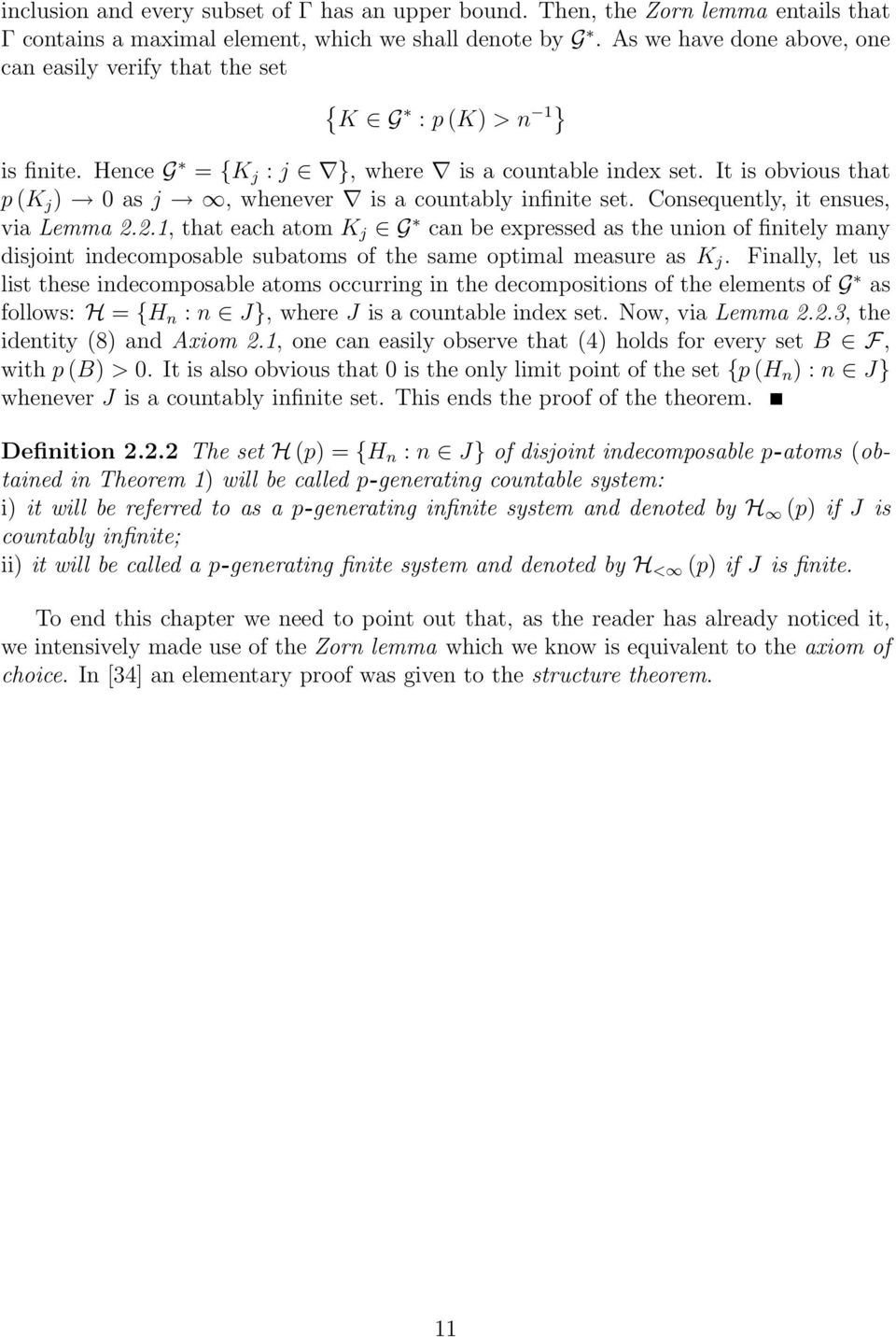
17 Lemma For every sequence (B n ) F and every optimal measure p we have ( ) p B n = max {p (B n ) : n N}. n=1 The proof is omitted since it immediate from Lemma Lemma Every measurable set E F with p (E) > 0 contains an atom H E such that p (E) = p (H). Proof. If E is an atom, there is nothing to be proved. We may assume that E is not an atom. Let the set U F be given: i. if B U, then B E and 0 < p (B) < p (E), ii. if B, C U and B C, then B C =. Clearly, the collection of all such U, denoted by C, is partially ordered by the set inclusion. It is also obvious that every subset of C has an upper bound. Therefore, by the Zorn lemma, it follows that C contains a maximal element, which we shall denote by U. For any fixed constant δ (0, 1), let us show that the set {B U : p (B) > δ} is finite. In fact, suppose that the contrary holds. Then there exists a sequence (B n ) U which satisfies the inequality p (B n ) > δ for each index n N. But since the sequence E n = B j, n N, tends decreasingly to the empty set, we must have j=n that p (E n ) 0, as n. This, however, contradicts the inequality p (E n ) = max {p (B j ) : j = n, n + 1,...} > δ, n N. Hence U = {B k : k } with p (B k ) < p (E) for all k, where is a countable index set. By Lemma 2.2.2, it follows that p ( k B k) < p (E). Thus it is obvious that H = E k B k is an atom with p (H) = p (E). This completes the proof of the lemma. Lemma Let H = {H n : n J} be as above. Then for every measurable set B F with p (B) > 0, the identity(6.4) holds. p ( B n J (B H n) ) = 0 (8) Proof. Assume that the left side of (8) were positive. Then set B n J (B H n) would contain an atom K such that K K n = for every K n G. This, however, would contradict the maximality of G, which ends the proof. We are now in the position to prove the Structure Theorem. Proof of the Structure Theorem. Let G be a set of pairwise disjoint atoms. It is clear that the collection of all such G, denoted by Γ, is partially ordered by the set 10

18 inclusion and every subset of Γ has an upper bound. Then, the Zorn lemma entails that Γ contains a maximal element, which we shall denote by G. As we have done above, one can easily verify that the set { K G : p (K) > n 1} is finite. Hence G = {K j : j }, where is a countable index set. It is obvious that p (K j ) 0 as j, whenever is a countably infinite set. Consequently, it ensues, via Lemma 2.2.1, that each atom K j G can be expressed as the union of finitely many disjoint indecomposable subatoms of the same optimal measure as K j. Finally, let us list these indecomposable atoms occurring in the decompositions of the elements of G as follows: H = {H n : n J}, where J is a countable index set. Now, via Lemma 2.2.3, the identity (8) and Axiom 2.1, one can easily observe that (4) holds for every set B F, with p (B) > 0. It is also obvious that 0 is the only limit point of the set {p (H n ) : n J} whenever J is a countably infinite set. This ends the proof of the theorem. Definition The set H (p) = {H n : n J} of disjoint indecomposable p-atoms (obtained in Theorem 1) will be called p-generating countable system: i) it will be referred to as a p-generating infinite system and denoted by H (p) if J is countably infinite; ii) it will be called a p-generating finite system and denoted by H < (p) if J is finite. To end this chapter we need to point out that, as the reader has already noticed it, we intensively made use of the Zorn lemma which we know is equivalent to the axiom of choice. In [34] an elementary proof was given to the structure theorem. 11
19 CHAPTER III CHARACTERIZATION OF SOME PROPERTIES OF MEASURABLE SETS 3.1 Introduction Some new information about σ-algebras is investigated, consisting of mapping bijectively σ-algebras onto power sets. Such σ-algebras, in fact, form a rather broad class. A special grouping of the optimal measures is used in our investigation. We constructively provide a bijective mapping that will do. In the proof we first characterize the usual set operations, the set inclusion relation as well as some asymptotic behaviors of sequences of measurable sets. Without loss of generality we shall restrict ourselves to infinite σ-algebras, since the opposite case can be easily done. 3.2 Mapping bijectively σ-algebras onto power sets We note that this entire section is drafted from article [8]. Definition (Agbeko, [8]) We say that an optimal measure p P is of orderone if there is a unique indecomposable p -atom H such that p (H) = 1. (Any such atom will be referred to as an order-one-atom and the set of all order-one optimal measures will be denoted by P 1.) Example Fix a sequence (ω n ) and define p 0 P by { } 1 p 0 (B) = max n : ω n B. Then p 0 P 1. Proof. In fact, via the Structure Theorem, there is an indecomposable p 0-atom H such that p 0 (H) = 1. This is possible if and only if ω 1 H. We note that there is no other indecomposable p 0-atom H with H H = such that p 0 (H ) = 1, otherwise necessarily it would ensue that ω 1 H, which is absurd. Therefore, we can conclude that p 0 P 1. Further notations If H is the order-one-atom of some p P {, 1 we write p = q P } 1 : q (H) = 1. We then refer to the elements of the class p as representing members of the class, and call H the unitary atom of the class. We further denote by P 1 the set of all p classes. 12
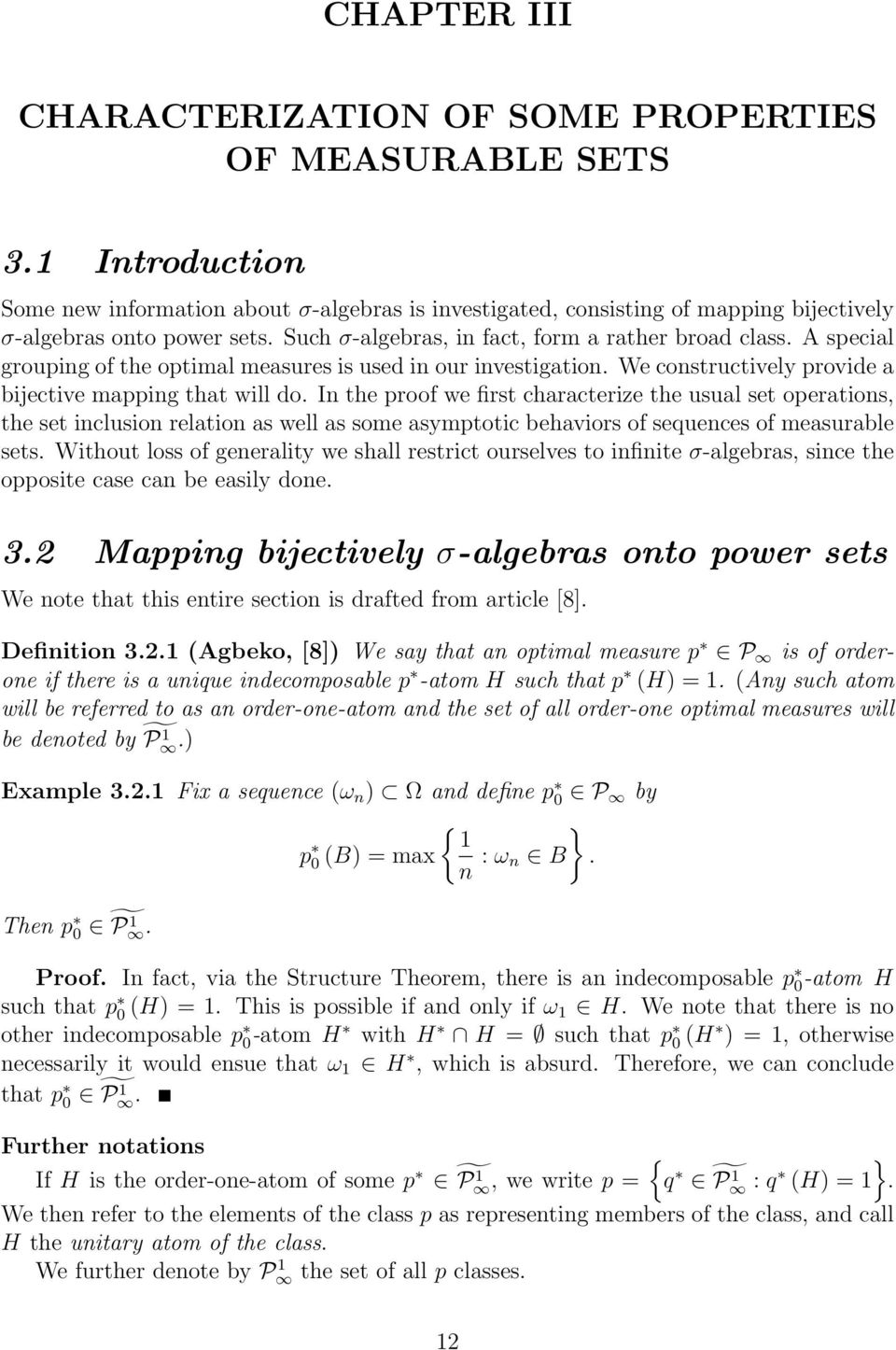
20 If A is a nonempty measurable set and p P, 1 the identity p (A) = 1 (resp. the inequality p (A) < 1) will simply mean that p (A) = 1 (resp. p (A) < 1) for any representing member p p. We shall also write p (A) = 0 to mean that p (A) = 0 whenever p p. Write for the set of all unitary atoms on the measurable space (, F). Lemma Let A, B F and p P 1 be arbitrary. In order that p (A B) = 1 it is necessary and sufficient that p (A) = 1 and p (B) = 1. Proof. As the necessity is obvious, we only need show the sufficiency. In fact, assume that p (A) = 1 and p (B) = 1. Let H be the unitary atom of class p, and let p denote an arbitrary but fixed representing member in the class. Thus H is an order-one-atom for p. Then p (H) = 1. Clearly, p (A H) = 1 and p (B H) = 1. Hence p ( A H B ) = 0. It is enough to prove that both identities p ( A H B ) = 0 and p ( A H B ) = 0 are valid. In the contrary, assume that at least one of these identities fails to hold: p ( A H B ) = 0, say. Then p ( A H B ) = 1. Now, since p (H B) = 1, it ensues that either p (A H B) = 1 or p ( A H B ) = 1. Then combining each of these last identities with p ( A H B ) = 1, we have that p ( A H B ) = 1 and p (A H B) = 1, or p ( A H B ) = 1 and p ( A H B ) = 1. This violates that H is an order-one-atom (because the sets A H B, A H B and A H B are pairwise disjoint). Remark Let p P 1 be arbitrary. Then the identity p ( ) = 0 holds (cf. Axiom 2.1). Remark Let A F and p P 1 be arbitrary. Then the identities p (A) = 1 and p ( A ) = 1 cannot hold simultaneously, i.e. for no representing member p of class p the identities p (A) = 1 and p ( A ) = 1 hold at the same time. In fact, assume the contrary. Then Lemma would imply that which is absurd, indeed. 1 = p (A) = p ( A ) = p ( A A ) = p ( ) = 0 Definition (Agbeko, [8]) For any A F let the set (A) be described by 1. (A) P If p (A), then p (A) = 1. Remark Let A F. Then (A) = if and only if A =. Remark If H is the unitary atom of a class p P 1, then (H) = {p}. Let A F and denote by A the set of all unitary atoms H such that p (A) = 1, where (H) = {p}. It is clear that A A = and A A =. From this observation the following lemma is straightforward. 13

21 Lemma For every set A F, we have that ( A ) = (A). Proposition Let A, B F be arbitrary. Then 1. () = P (A B) = (A) (B). 3. (A B) = (A) (B). Proof. Part 1 is an easy task. Let us show Part 2. In fact, let p (A B). Then p (A B) = 1. Hence Lemma implies that p (A) = 1 and p (B) = 1, so that p (A) and p (B), i.e. p (A) (B). Consequently, (A B) (A) (B). To show the reverse inclusion, pick an arbitrary p (A) (B). Then p (A) = 1 and p (B) = 1. Via Lemma 3.2.1, we have that p (A B) = 1, i.e. p (A B). So (A) (B) (A B). To end the proof, let us show the third part. In fact, let A and B F be arbitrary. Then making use of the second part of this proposition it ensues that ( A B ) = ( A ) ( B ). By applying Lemma and the De Morgan identities, we obtain that This was to be proven. (A B) = (A B) = ( A B ) = ( A ) ( B ) = ( A ) ( B ) = (A) (B) = (A) (B). Lemma Let A and B F be arbitrary nonempty sets. In order that A B, it is necessary and sufficient that (A) (B). Proof. As the necessity is trivial we need only show the sufficiency. In fact, assume that AB is not an empty set. Then because of Remark 3.2.3, (AB) is neither empty. Fix some p (AB), i.e. p (AB) = 1. This implies that p (B) < 1. Otherwise we would obtain via Lemma that 1 = p ((AB) B) = p ( ) = 0, which is absurd. Then p (A) = 1 and p (B) < 1, i.e. p (A) (B). So the set (A) (B) is not empty. Lemma Let A and B F be arbitrary nonempty sets. Then for the equality A B = to hold it is necessary and sufficient that (A) (B) =. (The proof follows from Proposition 3.2.1/2 and Remark ) Lemma Let A and B F be arbitrary nonempty sets. In order that A = B it is necessary and sufficient that (A) = (B). Proof. As the necessity is trivial we need only show the sufficiency. In fact, assume that A and B F are such that (A) = (B), i.e. (A) (B) and (B) (A). By applying twice Lemma it ensues that A B and B A. Therefore, A = B. 14
22 Lemma Let A and B F be any nonempty sets. Then (AB) = (A) (B). Proof. The conjunction of Proposition 3.2.1/2 and Lemma entails that (AB) = ( A B ) = (A) ( B ) ( ) = (A) (B) = (A) (B), which completes the proof. Proposition Let (A n ) F and A F be arbitrary. Then (A n ) converges decreasingly to A if, and only if ( (A n )) converges decreasingly to (A). Proof. Assume that (A n ) converges decreasingly to A. Then by applying repeatedly Lemma we have for every n N that We need to prove that (A) = (A) n=1 (A n ) and n=1 (A) (A n+1 ) (A n ). n=1 (A n ). To do this it will be enough to show that (A n ) (A). In fact, we note that the first inclusion is trivial. To prove the second inclusion let us pick some p n=1 (A n ). Then p (A n ) for all n N. Hence p (A n ) = 1 for all n N. If we fix any representing member p in class p we then obtain via Axiom 2.1 that ( ) p (A) = p A n = min {p (A n ) : n N} = 1, n=1 implying that p (A) = 1, i.e. p (A). Consequently, n=1 (A n ) (A). Conversely, assume that sequence ( (A n )) converges decreasingly to (A). Then for every n N we obtain that (A) (A n+1 ) (A n ) so that A A n+1 A n, n N (by Lemma 3.2.3). Hence A A n. To show the reverse inclusion let us assume that ( set n=1 ) A n A is not empty. Then via Remark and Axiom 2.1 there can be found n=1 some p P 1 such that (( ) ) ( ) 1 = p A n A = p A n A = min { p ( A n A ) : n N }, n=1 n=1 for every representing member p of class p, since (A n ) is a decreasing sequence. Consequently, 1 = p ( A n A ) for all n N. Hence Lemma yields that p ( A ) = 1 and p (A n ) = 1 for all n N. But then p (A n ) for all n N and hence p n=1 (A n ) = (A). Nevertheless, this is absurd since p ( A ) = (A). We can thus conclude on the validity of the proposition. 15
23 Proposition Let (A n ) F and A F be arbitrary. Then (A n ) converges increasingly to A if and only if ( (A n )) converges increasingly to (A). Proof. Assume that (A n ) converges increasingly to A. Then by applying repeatedly Lemma we have for every n N that We need to prove that (A) = (A) n=1 (A n ) and n=1 (A n ) (A n+1 ) (A). n=1 (A n ). To do this it will be enough to show that (A n ) (A). In fact, we note that the second inclusion is trivial. To prove the first one let us pick an arbitrary class p (A) and fix any representing member p of the class p. Following the proof of Lemma 0.1 (cf. ( [5], page ) 134), there can be found a positive integer n 0 such that 1 = p (A) = p A k = p (A n ), whenever n n 0. Hence p (A) (A n ) n=n 0 n=n 0 (A n ) n=1 (A n ), i.e. (A n ). Conversely, ( assume ) that sequence ( (A n )) converges increasingly to (A). Then sequence (A n ) converges decreasingly to (A). Consequently, Lemma entails that sequence ( ( A n )) converges decreasingly to ( A ). Taking into account Proposition 3.2.2, sequence ( A n ) must converge decreasingly to A. In turn this implies that (An ) converges increasingly to A. Therefore, we can conclude on the validity of the argument. Theorem (Agbeko, [8]) Let (A n ) F and A F be arbitrary. In order that (A n ) converge to A it is necessary and sufficient that ( (A n )) converge to (A). n=1 Proof. For every counting number n N write E n = k=n A k and B n = k=1 k=n A k. It is clear that sequence (B n ) converges decreasingly to lim supa n and sequence (E n ) converges n increasingly to lim inf A n. Consequently, by applying Propositions and to these n sequences we can conclude on the validity of the theorem. Definition (Agbeko, [8]) A mapping : F P (P ) 1 is said to be powering if it is defined by: { if A = (A) = {p P 1 : p (A) = 1} if A The following result can easily be derived from Lemma and Remark Proposition If : F P (P 1 ) is a powering mapping, then it is an injection. 16
24 Definition If Γ P 1 is a nonempty set, then the collection C of all the unitary atoms of the classes p Γ will be called unitary-atomic (or governing-atomic) collection of Γ. The Postulate of Powering. If Γ P (P 1 ) { } and C denotes the governing-atomic collection of Γ, then C is measurable and ( C) Γ. Theorem (Agbeko, [8]) The powering mapping : F P (P 1 ) is surjective if and only if the postulate of powering is valid. Proof. Assume that the postulate of powering is valid. Let Γ P (P ) 1 be arbitrarily fixed. We note that if Γ =, then there is nothing to be proven. Suppose that Γ is a nonempty subset of P, 1 and denote by C its corresponding governing-atomic collection. Then C is measurable and ( C) Γ (by the postulate). Let us show that Γ ( C). In fact, pick any class p Γ and p any representing member of p, with H the unitary atom of p. Since H C, it ensues from Lemma that (H) ( C). But, via Remark we have that {p} = (H) and thus p ( C), i.e. Γ ( C). Therefore, Γ = ( C). To prove the converse of the biconditional, let us assume that the powering mapping is a surjection. We note consequently that is a bijection, since it is also an injection (by Proposition ). Let Γ P (P ) 1 { } be arbitrary and write C for the corresponding unitary-atomic collection. Obviously, we have that Γ = { (H) : H C} is a subset of P. 1 Then via the bijective property it ensues that 1 (Γ) F. Clearly, (H) Γ for every H C. By Lemma together with the bijective property, we obtain that H = 1 ( (H)) 1 (Γ) whenever H C. Consequently, the inclusion C 1 (Γ) follows. Now, let us show that if ω 1 (Γ), then there is some H C such that ω H. Assume in the contrary that there can be found some ω 1 1 (Γ) such that ω 1 / H for all H C. We can thus define an optimal measure q : F [0, 1] so that { = 1 if q ω1 B (B) < 1 if ω 1 / B, see Example ( ) Then there is a unique indecomposable q -atom (to be denoted by H) such that q H = 1. Obviously, ω 1 H and q ( 1 (Γ)) = 1. We further note that { (H) : H C} = Γ = ( 1 (Γ) ) = { p P 1 : p ( 1 (Γ) ) = 1 }. From this fact and the identity q (( 1 (Γ)) = 1, there ) must exist some class p 0 P 1 with p 0 ( 1 (Γ)) = 1, such that q H H0 1 (Γ) = 1, where H 0 C is the unitary atom of class p 0. Nevertheless, this is possible only if ω 1 H 0, which is absurd, since earlier we have supposed that ω 1 / H for all H C. Therefore, if ω 1 (Γ), then there is some H C such that ω H. It ensues that ω C for all ω 1 (Γ), as H C 17
25 whenever H C. Thus 1 (Γ) C. Therefore, C = 1 (Γ), which leads to the postulate. Theorem entails that an infinite σ-algebra is equinumerous with a power set if and only if Postulate 3.2 is valid. This suggests that every infinite σ-algebra is either equinumerous with an infinite power set or with a non-power set. 18
26 CHAPTER IV SOME BASIC RESULTS OF OPTIMAL MEASURES RELATED TO MEASURABLE FUNCTIONS 4.1 Introduction In comparison with the mathematical expectation, we shall define a non-linear functional (first for non-negative measurable simple functions and secondly for non-negative measurable functions) which can provide us with many well-known results in measure theory. Their proofs are carried out similarly. 4.2 Optimal average In the whole section we shall be dealing with an arbitrary but fixed optimal measure space (, F, p). Let n s = b i χ (B i ) i=1 be an arbitrary non-negative measurable simple function, where {B i : i = 1,..., n} F is a partition of. Then the so-called optimal average of s is defined by Definition The quantity sdp := n b i p (B i ) will be called optimal average of s, and for E F n sχ (E) dp := b i p (E B i ) B as the optimal average of s on E, where χ (E) is the indicator function of the measurable set E. These quantities will be sometimes denoted respectively by I (s) and I E (s). It is well-known that in general a measurable simple function has many decompositions. The question thus arises whether or not the optimal average depends on the decomposition of the simple function. The following result gives a satisfactory answer to this question. i=1 i=1 19
27 Theorem Let n b i χ (B i ) i=1 and m c k χ (C k ) be two decompositions of a measurable simple function s 0, where {B i : i = 1,..., n} and {C k : k = 1,..., m} F are partitions of. Then max {b i p (B i ) : i = 1,..., n} = max {c k p (C k ) : k = 1,..., m}. Proof. Since B i = m (B i C k ) and C k = n (B i C k ), Axiom 2.1 of optimal measure implies that k=1 k=1 p (B i ) = max {p (B i C k ) : k = 1,..., m} and p (C k ) = max {p (B i C k ) : i = 1,..., n} Thus max {c k p (C k ) : k = 1,..., m} = max {max {c k p (B i C k ) : i = 1,..., n} : k = 1,..., m} and max {b i p (B i ) : i = 1,..., n} = max {max {b i p (B i C k ) : k = 1,..., m} : i = 1,..., n}. Clearly, if B i C k, then b i = c k, or if B i C k =, then p (B i C k ) = 0. Thus, by the associativity and the commutativity, we obtain This completes the proof. max {b i p (B i ) : i = 1,..., n} = max {c k p (C k ) : k = 1,..., m}. Theorem Let s and s denote two non-negative measurable simple functions, b [0, ] and B F be arbitrary. Then we have: 1. I (b1) = b. 2. I (χ (B)) = p (B). 3. I (bs) = bi (s). 4. I B (s) = 0 if p (B) = I (s) = I B (s) if p ( B ) = I (s) I (s) if s s on. 7. I (s + s) I (s) + I (s). 8. I B (s) = lim n I Bn (s) whenever (B n ) F tends increasingly to B. 9. I (s s) = max {I (s), I (s)}. i=1 20
28 The proof is omitted because it is based on computation only. Proposition Let f 0 be any bounded measurable function. Then sup s f sdp = inf s f sdp, where s and s denote non-negative measurable simple functions. Proof. Let f be a measurable function such that 0 f b on, where b is some constant. Let E k = (kbn 1 f (k + 1) bn 1 ), k = 1,..., n. Clearly, {E k : k = 1,..., n} F is a partition of. Define the following measurable simple functions: s n = bn 1 n kχ (E k ), s n = bn 1 k=0 n (k + 1) χ (E k ). k=0 Obviously, s n f s n. Then we can easily observe that and Hence sup s f inf s f sdp sdp s n dp = n 1 b max {kp (E k ) : k = 0,..., n} s n dp = n 1 b max {(k + 1) p (E k ) : k = 0,..., n}. 0 inf s f sdp sup s f sdp bn 1. The result follows by letting n in this last inequality. Definition (Agbeko, [5]) The optimal average of a measurable function f is defined by f dp = sup sdp, where the supremum is taken over all measurable simple functions s 0 for which s f. The optimal average of f on any given measurable set E is defined by E f dp = χ (E) f dp. For convenience reasons at times we shall write A f for the optimal average of the measurable function f. Proposition (Agbeko, [5]) Let f 0 and g 0 be any measurable simple functions, b R + and B F be arbitrary. Then 1. A (b1) = b. 2. A (χ (B)) = p (B). 3. A (bf) = baf. 21
29 4. A (fχ (B)) = 0 if p (B) = Af Ag if f g. 6. A (f + g) Af + Ag. 7. A (fχ (B)) = Af if p ( B ) = A (max {f, g}) = max {Af, Ag}. The almost everywhere notion in measure theory also makes sense in optimal measure theory. Definition Let p be an optimal measure. A property is said to hold almost everywhere if the set of elements where it fails to hold is a set of optimal measure zero. As an immediate consequent of the atomic structural behavior of optimal measures we can formulate the following. Remark (Agbeko, [6]) If a function f : R is measurable, then it is constant almost everywhere on every indecomposable atom. Proposition (Agbeko, [6]) Let p P and f be any measurable function. Then f dp = sup f dp : n J, H n where H (p) = {H n : n J} is a p-generating countable system. Moreover if A f <, then almost all ω H n, n J. f dp = sup {c n p (H n ) : n J}, where c n = f (ω) for Proposition (Optimal Markov inequality) Let f 0 be any measurable function. Then for every number x > 0 we have xp (f x) Af. Proposition Let f 0 be any measurable function and b > 0 be any number. 1. If Af <, then f < almost everywhere. 2. Af = 0 if and only if f = 0 almost everywhere. 3. If Af <, then f < almost everywhere If Af < and fdp b for all E F with p (E) > 0, then f b almost p(e) E everywhere 22
30 1 5. If Af < and p(e) everywhere. E fdp b for all E F with p (E) > 0, then f b almost Proposition Let f 0 be any bounded measurable function. Then for every ε > 0 there is some δ > 0 such that B fdp < ε whenever B F, p (B) < δ. Proof. By assumption 0 f b for some number b > 0. Then Proposition entails, for the choice 0 < δ < εb 1, that B fdp bp (B) < δb < ε. In the example below we shall show that Proposition does not hold for unbounded measurable functions. Example Consider the measurable space (N, F), where F is the power set of N. 1 Define the set function p : F [0, 1] by p (B) =. It is not difficult to see that min B p is an optimal measure. Consider the following measurable function f (ω) = ω, ω N. Clearly, Af 1. Let s = n j=1 b j χ (B j ) be a measurable simple function with 0 s f. Denote ω j = min B j for j = 1,..., n. Then p (B j ) = 1 ω j and b j ω j for all j = 1,..., n. Thus I (s) 1, and hence Af 1. Consequently, Af = 1. On the one hand, there is no δ > 0 such that p (E) < δ implies that and p ({ω}) 0 as ω. E fdp < 1. Indeed, 4.3 The Radon-Nikodym s type theorem fdp = 1 for every ω N, {ω} Definition (Agbeko, [6]) By a quasi-optimal measure we a set function q : F R + satisfying Axioms , with the hypothesis q () = 1 in Axiom 2.1 being replaced by the hypothesis 0 < q () <. Proposition If f 0 is a bounded measurable function, then the set function q f : F R +, q f (E) = fdp, is a quasi-optimal measure. E Definition We shall say that a quasi-optimal measure q is absolutely continuous relative to p (abbreviated q p) if q (B) = 0 whenever p (B) = 0, B F. Proposition Let q be a quasi-optimal measure. Then q p if and only if for every ε > 0 there is some δ > 0 such that q (B) < ε whenever p (B) < δ, B F. The proof of Proposition is similarly done as in the case of measure theory. 23
31 Lemma Let q be a quasi-optimal measure and H (p) be a p-generating system. If q p, then H (q) = {H H (p) : q (H) > 0} is a q-generating system. Proof. Let H be an indecomposable p-atom. Suppose that there exists a measurable set E H with q (E) = q (HE) = q (H) > 0. Since q p, it must ensue that p (E) > 0 and p (HE) > 0, contradicting the fact that H is an indecomposable p-atom. Hence we can conclude that every indecomposable p-atom is also H be an indecomposable q-atom whenever q (H) > 0 and observe that H (q) = {H H (p) : q (H) > 0} = {H k H (p) : k J }, where J J is an index set. Let B be any measurable set with q (B) > 0. Then, via Lemma and the absolute continuity property it follows that ( q B ) (B H k ) = 0. k J Thus q (B) = max {q (B H k ) : k J }. If J is a countably infinite set, then Proposition yields that q (H k ) becomes arbitrarily small along with p (H k ) as k. This ends the proof. Remark Let p, q P, H (p) = {H n : n J} be a p-generating countable system and f any measurable function. Suppose that q p and q (H) p (H) for every H H (p). Then f dq f dp, provided that f dp <. This remark is immediate from Lemma and Proposition Theorem (Optimal Radon-Nikodym) Let q be a quasi-optimal measure such that q p. Then there exists a unique measurable function f 0 such that for every measurable set B F, q (B) = This measurable function, explicitly given in (9), will be called Optimal Radon- Nikodym derivative and denoted by dq dp. Proof. Let H (p) = {H n : n J} be a p-generating countable system. Define the following non-negative measurable function { } q (Hn ) f = max p (H n ) χ (H n) : n J. (9) B fdp. 24
32 Fix an index n J and let B F, p (B) > 0. Then Remark and the absolute continuity property imply that { q (H n ) 0 if p (B p (H n ) p (B H Hn ) = 0 n) = q (B H n ), otherwise. Hence, by a simple calculation, one can observe that fdp = max {q (B H n ) : n J}. B Consequently, Lemma yields { max {q (B Hn ) : q (H fdp = n ) > 0, n J} if q (B) > 0 0, otherwise, B and thus (9) holds. Let us show that the decomposition (9) is unique. In fact, there exist two measurable functions f 0 and g 0 satisfying(9). Then for each set B F, we have: fdp = gdp. B B Put E 1 = (f < g) and E 2 = (g < f). Obviously, E 1 and E 2 F. If the inequality p (E 1 ) > 0 should hold, it would follow that gdp = fdp < gdp, E 1 E 1 E 1 which is impossible. This contradiction yields p (E 1 ) = 0. We can similarly show that p (E 2 ) = 0. These last two equalities imply that p (f g) = 0, i.e. the decomposition (9) is unique. The theorem is thus proved. Let E F be arbitrarily fixed with p (E) > 0. Consider the set function p : F [0, 1], defined by p p (B E) (B) = p (E). Clearly, p is an optimal measure and p p. It is evident that dp dp = χ (E) p (E) p almost everywhere (by the optimal Radon-Nikodym theorem). Definition The above set function p (B) will be called conditional optimal measure of B given E, and will be denoted by p (B E). 25
33 Definition Let f be any measurable function with A f < and E F, with p (E) > 0. The conditional optimal average of f given E is defined by A p ( f E) := E f dp. Lemma Let f be any measurable function with A f < and E F, with p (E) > 0. Then A p ( f E) := 1 f dp. p (E) 4.4 The Fubini s type theorem Let ( i, F i, p i ), i = 1, 2, be two optimal measure spaces and let us denote the smallest σ-algebra containing F 1 F 2 by S := σ (F 1 F 2 ). For each ω i i (i = 1, 2), we define ω 1 cross-section and ω 2 cross-section by E ω1 = {ω 2 : (ω 1, ω) E} and E ω 2 = {ω 1 : (ω, ω 2 ) E}, where E S. Definition Let f be any measurable function defined on ( 1 2, S). For each ω 1 1 and ω 2 2, the functions 1. f ω1 : 2 R {, } defined by f ω1 (ω 2 ) = f (ω 1, ω 2 ), respectively 2. f ω2 : 1 R {, } defined by f ω2 (ω 1 ) = f (ω 1, ω 2 ), will be called ω 1 -section, respectively ω 2 -section of function f. Theorem For every E S, define the functions m E : 1 [0, ] by m E (ω 1 ) = p 2 (E ω1 ) and m E : 2 [0, ] by m E (ω 2 ) = p 1 (E ω 2 ). Then 1. m E is F 1 -measurable. 2. m E is F 2 -measurable. 3. m E dp 1 = m E dp Furthermore, define the function p 1 p 2 : S [0, 1] by p 1 p 2 (E) = E 1 m E dp 1 = Then p 1 p 2 is an optimal measure such that for all B F 1 and D F 2. 2 m E dp 2. p 1 p 2 (B D) = p 1 (B) p 2 (D), 26
34 Proof. Let S denote the collection of all E S for which properties of the theorem hold. It is enough to prove that S is a σ-algebra containing S. The proof is as in the classical case (cf. [37]) except the following claim: For all E 1 and E 2 S, E = E 1 E 2 S. In fact, by definition and Axiom 2.1 we can easily observe that and Thus m E dp 1 = max 1 = 2 m E dp 2. m E (ω 1 ) = max {m E1 (ω 1 ), m E2 (ω 1 )} m E (ω 2 ) = max { m E 1 (ω 2 ), m E 2 (ω 2 ) }. 1 m E1 dp 1, m E2 dp 1 = max 1 2 m E1 dp 2, m E2 dp 2 2 Hence E = E 1 E 2 S, since obviously m E (resp. m E ) is -F 1 (resp. -F 2 ) measurable, ending the proof. Theorem (Optimal Fubini) Let ( 1, F 1, p 1 ) and ( 2, F 2, p 2 ) be two optimal measure spaces and let f : 1 2 R {, } be any measurable function such that 1 2 f dp <. Then, 1. The ω 1 -section f ω1 : 2 [0, ] is such that 2 f ω1 dp 2 < almost everywhere on 1. The function ϕ : 1 [0, ], defined by ϕ (ω 1 ) = such that 1 ϕdp 1 <. 2. The ω 2 -section f ω2 : 1 [0, ] is such that 1 f ω2 dp 1 < almost everywhere on 2. The function ψ : 2 [0, ], defined by ψ (ω 2 ) = such that 3. Furthermore, 2 ψdp 2 <. 1 2 f d (p 1 p 2 ) = 1 f dp 2 dp 1 = 2 2 f ω1 dp 2, is 2 1 f ω2 dp 1, is f dp 1 dp 2 1 We shall not prove the optimal Fubini theorem. Instead, we simply note that the proof follows from Theorem using the same techniques as in the proof of the original Fubini theorem, cf. [37]. 27
35 CHAPTER V CONVERGENCE THEOREMS RELATED TO MEASURABLE FUNCTIONS 5.1 Introduction Definition Let X be an arbitrary nonempty set. We say that a sequence of realvalued functions (h n ) converges to a real-valued function h: i. discretely if for every x X there exists a positive integer n 0 (x) such that h n (x) = h (x), whenever n > n 0 (x); ii. equally if there is a sequence (b n ) of positive numbers tending to 0 and for every x X there can be found an index n 0 (x) such that h n (x) h (x) < b n whenever n > n 0 (x). (For more about these notions, cf. [27]-[29].) In this section we shall characterize the discrete, equally, pointwise and uniformly convergence theorems. We can say that the notions of the pointwise and uniformly convergence is ancient. 5.2 Convergence with respect to individual optimal measures In the present section we shall be dealing with an arbitrarily fixed optimal measure space (, F, p), unless otherwise stated. The following three results are the counterparts of the monotone convergence theorem, the Fatou lemma and the dominated convergence theorem in measure theory. Theorem (Optimal monotone convergence) lim n 1. If (f n ) is an increasing sequence of non-negative measurable functions, then ( ) f n dp = lim f n dp. n lim n 2. If (g n ) is a decreasing sequence of non-negative measurable functions with g 1 b for some b (0, ), then ( ) g n dp = lim g n dp. n 28
36 We shall here below give an example showing the reason why the optimal monotone convergence theorem fails to hold for all decreasing sequences of measurable functions. Example Let (N, F, p) be the optimal measure space we considered in Example Define the following measurable function { 0 if ω < n g n (ω) = ω if ω n. Obviously, (g n ) tends decreasingly to zero as n. Let us show that Ag n = 1 for all n N. Obviously, Ag n np ({n}) = 1. On the other hand, let 0 s g n where k s = b j χ (B j ). Denote ω j = min B j for j = 1,..., k. Then p (B j ) = 1 and b j ω j j=1 ω j for all j = 1,..., k. Hence inequality b j p (B j ) 1 holds for each index j = 1,..., k. Consequently, I (s) 1, 0 s g n. Thus Ag n 1 whenever n N. Lemma (Optimal Fatou) If (f n ) and (h n ) are sequences of non-negative measurable functions, then for every optimal measure p, we have that ( ) 1. lim inf f n dp lim inf f n dp; n n ( ) 2. lim sup h n dp lim suph n dp, whenever (h n ) is a uniformly bounded sequence. n n Proof. To prove the first part, we point out by definition that lim inf n f n = max {min {f k : k n} : n N}. Let fn = min {f k : k n}, n N, and f = lim inf f n. Clearly, (fn) is an increasing n sequence. The optimal monotone convergence theorem implies that ( ) A lim inf f n lim inf Af n. n n To end the proof we note that the second part can be similarly verified. Theorem Let (f n ) be a uniformly bounded sequence of non-negative measurable functions. Then A (lim n f n ) = Af, where lim n f n = f almost everywhere. Proof. The optimal Fatou lemma via the assumption implies that ( ) ( ) A lim inf f n lim inf Af n lim supaf n A lim supf n. n n n n By assumption f = lim inf f n = lim supf n almost everywhere. Consequently, n n Af lim inf n Af n A ( ) lim supf n Af n meaning that lim n Af n = Af. This was to be proven. 29
37 Lemma Let ω be fixed. Then for every measurable function f, we have that z f (p ω ) = f (ω). Proof. Let 0 s = k b i χ (B i ) be a measurable simple function. Then it is obvious i=1 that z s (p ω ) = s (ω). Let (s n ) be a sequence of non-negative measurable simple functions tending increasingly to f. Then by Theorem it ensues that which was to be proved. z f (p ω ) = lim z s n (p ω ) = lim s n (ω) = f (ω) n n 5.3 Characterization of various types of convergence for measurable functions We say that a nonempty measurable set E is closely related to some sequence (ω n ) if {, if E = E {ω n : n N} = E, if E <, that is, if E is infinite, then infinitely many members of the sequence belong to E, otherwise all of its elements are members of the sequence. Definition Let E be closely related to a sequence (ω n ), and let (α n ) [0, 1] be any fixed sequence tending decreasingly to 0. The optimal measure p E : F [0, 1], defined by p E (B) = max {α n : ω n B}, will be called 1st-type E-dependent optimal measure. Theorem (Agbeko, [7]) Let f and f n (n N) be any measurable functions. Then (f n ) tends to f uniformly if and only if (z n ) tends to 0 uniformly on P, where z n (p) = f n f dp with n N, p P. Proof. Sufficiency. Suppose that (z n ) tends to 0 uniformly. To prove the sufficiency it is enough to show that for every number b > 0, there can be found some n 0 (b) N such that ( f f n b) = whenever n n 0 (b) + 1. In fact, let us assume that the contrary holds. Then for some b 0 > 0 and all n 0 N, there is an integer m > n 0 such that ( f f m b 0 ). Define when n 0 = 1. If n k has been selected, define n 1 = min {m > n 1 : ( f f m b 0 ) } n k+1 = min {m > n k : ( f f m b 0 ) } when n 0 = n k. It is clear that sequence (n k ) tends increasingly to infinity alongside with k, so that ( f f nk b 0 ), k N. Then by assumption some n m {n k : k N } 30
38 exists such that z nk (p) < b 0, for all k m and p P. Now let E m = B nk, (where ( B nk = ( f ) ( f nk b 0 ), k N). Write H nm = B nm and for k m + 1, set k k 1 H nk = B nj B nj ). Clearly, H = {H nk : k m} is a sequence of pairwise j=m j=m disjoint measurable sets with E m = k=m k=m H nk. Fix a sequence (ω k ) so that ω k H nk whenever k m. Next, let p{ 0 P be } a 1st-type E m -dependent optimal measure defined by p 0 (B) = n m max : ω k B. It is obvious that H is a p 0 -generating 1 n k system. Hence we have on one hand that z nm (p 0 ) < b 0. Nevertheless on the other hand we also obtain that z nm (p 0 ) H n m f nm f dp 0 b 0, since p 0 (H nm ) = 1. As these last two inequalities contradict each other, the sufficiency is thus proved. Necessity. Assume that f n f uniformly, as n. Then for every b (0, ), there is some n 0 (b) N such that ( f n f < b 2) = whenever n > n0 (b). Consequently, for every p P, it ensues that z n (p) b 2 < b, n > n 0 (b). This completes the proof of the theorem. Lemma Let f and f n (n N) be any measurable functions. If (f n ) tends to f pointwise (equally or discretely), then lim supb n =, where B n = ( f n f = ), n N. n Proof. It is enough to prove the lemma for the pointwise convergence, since the proof of the remaining cases is similarly done. Assume that E := lim supb n. Let us n pick an arbitrary ω E. Then it is clair that lim sup f n (ω) f (ω) = and hence n f j (ω) f (ω) = for every k N. But since (f n ) tends to f pointwise we must n=k j=n have that for every constant b > 0 there is a positive integer m 0 = m 0 (b, ω) such that f n (ω) f (ω) < b whenever n > m 0. Hence b f j (ω) f (ω) =, which is absurd, completing the proof. n=m 0 j=n Theorem (Agbeko, [7]) Let (f n ) be any sequence of measurable functions. Then (f n ) tends to a measurable function f pointwise if and only if (z n ) tends to 0 pointwise on P <, where for every n N, z n is defined on P < by z n (p) = f n f dp. Proof. Sufficiency. Assume that for all b > 0 and p P < there is a positive integer n 0 = n 0 (b, p) such that z n (p) < b whenever n > n 0. Then since for every fixed ω the ω-concentrated measure p ω depends solely upon ω, index n 0 (b, p ω ) also depends on ω. Hence via Lemma we have for all n n 0 (b, ω) = n 0 (b, p ω ) that f n (ω) f (ω) = z n (p ω ) < b. Necessity. Suppose that for all a > 0 and ω, there can be found some positive integer 31
39 m 0 = m 0 (a, ω) such that f n (ω) f (ω) < a, whenever n m 0. Assume further that there is some b > 0 and some p P < such that for every n N, there exists some m n with the property that z n (p) b. Let H 1,..., H k be a p-generating system. Via Lemma 5.3.1, there is some n 0 N, big enough so that f n f is finite on whenever n n 0. Then for every n n 0, a measurable set A (i) n exists with A (i) n ( H i and p such ( that f n ) f is constant on H i A (i) n, i ( = 1,..., k (because ) of Remark 4.2.1). Clearly, p = 0, so that the identity p H i = p (H i ) holds. Hence f n f A (i) j j=n 0 is constant on H i A (i) j j=n 0 A (i) j j=n 0 A (i) n whenever i {1,..., k} and n n 0. Fix ω i H i ) = 0 A (i) j, j=n 0 i {1,..., k}. Then by assumption there must be some positive integer k (i) 0 = k 0 (b, ω i ) such that f n (ω i ) f (ω i ) < b, n > k (i) 0. Thus for all n k 0 (where k 0 = k i=1 k (i) 0 ), we have that k f n (ω i ) f (ω i ) < b. Now write k = max (k 0, n 0 ). Then some integer m > k i=1 exists such that z m (p) b. Therefore, via Proposition and Remark 4.2.1, we obtain that k k k b z m (p) = c i p (H i ) c i = f m (ω i ) f (ω i ) < b i=1 where for i {1,..., k}, c i i=1 i=1 = f m (ω) f (ω) if ω H i absurd, a contradiction which ends the proof of the theorem. A (i) j j=n 0. However, this is Theorem (Agbeko, [7]) A sequence of measurable functions (f n ) converges to some measurable function f equally if and only if (z n ) converges to 0 equally on P <, where for every n N, z n is defined on P < by z n (p) = f n f dp. Proof. Necessity. Suppose that there exists a sequence (b n ) (0, ) tending to 0 and for every ω there can be found a positive integer n 0 (ω) such that f n (ω) f (ω) < b n for all n n 0 (ω). It is enough to show that the equal convergence of (z n ) holds true for this sequence (b n ). In fact, assume that for this sequence (b n ), there is some p P < such that for all j N an integer m = m (p) > j can be found with the property that z m (p) b m. Let H 1,..., H k be a p-generating system. Via Lemma 5.3.1, there is some n 0 N, big enough so that f n f is finite on whenever ( n) n 0. Then for every n n 0, a measurable set A n (i) exists with A (i) n H i and p A (i) n = 0 such that f n f is ( ) constant on H i A (i) n, i = 1,..., k. But as p A (i) j = 0, we can easily observe that j=n ( ) 0 p H i = p (H i ), i {1,..., k}. Hence f n f is constant on H i for all A (i) j j=n 0 i {1,..., k} and n n 0. Fix ω i H i A (i) j j=n 0 A (i) j j=n 0, i {1,..., k}. Then by assumption 32
40 there must be some positive integer k (i) 0 = k 0 (ω i ) such that f n (ω i ) f (ω i ) < b n, n > k (i) 0. Thus for all n k 0 (where k 0 = k k k (i) 0 ), we have that f n (ω i ) f (ω i ) < b n. i=1 Consequently, we have on one hand that z m (p) b m. But on the other hand, Proposition yields that z m (p) = k c i p (H i ) i=1 (where for i {1,..., k}, c i k c i = i=1 i=1 k f m (ω i ) f (ω i ) < b m i=1 = f m (ω) f (ω) if ω H i A (i) j j=n 0 ), meaning that b m < b m, which is however absurd. This contradiction concludes the proof of the necessity. Sufficiency. Assume that there is a sequence (b n ) of positive numbers tending to 0 and for every p P < there exists a positive integer n 0 (p) such that z n (p) < b n whenever n > n 0 (p). Then for each fixed ω, Lemma entails that f n (ω) f (ω) = z n (p ω ) < b n whenever n > n 0 (p ω ) = n 0 (ω). The sufficiency is thus proved, which completes the proof of the theorem. Theorem (Agbeko, [7]) A sequence of measurable functions (f n ) converges to some measurable function f discretely if and only if (z n ) converges to 0 discretely on P <, where for every n N, z n is defined on P < by z n (p) = f n f dp. The proof for Theorem is omitted because it can be carried out mutatis mutandis as done in Theorems and Definition A sequence of measurable functions (f n ) is said to converge in optimal measure to some measurable function f if lim n p ( f n f ε) = 0 for every constant ε > 0. Theorem (Agbeko, [5]) Let (f n ) be a sequence of measurable functions (f n ) which converges in optimal measure to some measurable function f. Then there exists a subsequence (f nk ) which converges to f almost everywhere. 5.4 Characterization of various types of boundedness Remark If (x n ) is a sequence of real numbers such that lim sup x n <, then for n each of its subsequences (x nk ) we have that lim sup x nk <. k Notice. For every fixed measurable function f, the mapping z f : P [0, ], defined by z f (p) = f dp, is a function. Lemma Let ω be fixed. Then for every measurable function f, we have that z f (p ω ) = f (ω). 33
41 Proof. Let 0 s = k b i χ (B i ) be a measurable simple function. Then it is obvious i=1 that z s (p ω ) = s (ω). Let (s n ) be a sequence of non-negative measurable simple functions tending increasingly to f. Then by Theorem B it ensues that which was to be proved. z f (p ω ) = lim z s n (p ω ) = lim s n (ω) = f (ω) n n Theorem (Agbeko, [7]) Let f be any measurable function the following assertions are equivalent. 1. f is bounded. 2. lim f dp = 0 for all p P. x ( f x) 3. There exists a constant b > 0 such that f dp b for all p P. The proof will be carried out in two steps. In Proposition we shall show the equivalence and then the equivalence in Proposition Proposition A measurable function f is bounded if and only if for all p P. lim x ( f x) f dp = 0 Proof. Suppose that f is bounded, and write b > 0 for its bound. Then for every p P, we have that f dp b p ( f x) 0, as x. ( f x) Conversely, assume that lim f dp = 0 for all p P, but for every n N we k ( f k) have that ( f n 1). It obviously ensues that ( f n 1) ( f n) = H n for infinitely many n N. Suppose without loss of generality that H n, n N. Further let (ω n ) be such that ω n H n for all n N. Define p P by p (B) = max { 1 : ω n n B }. Clearly, (H n ) is a generating system for p. Then by assumption it follows that lim k f dp = 0. Now note that ( f k) = H i for all k N. ( f k) i=k+1 Hence Proposition entails that f dp = sup f dp. It is not difficult to ( f k) i k+1 H i check that f dp 1 1 H i i, i k +1. Consequently, it results that f dp 1 ( f k) 1 (k N), leading to 0 = lim f dp 1, which is absurd. This contradiction k + 1 k ( f k) concludes on the validity of the sufficiency, ending the proof. 34
42 Proposition Let f be a finite measurable function. Then f is unbounded if and only if for every constant c > 0, there exists some p c P such that z f (p c ) = c. (10) Proof. Necessity. Assume that f is unbounded measurable function. For every n N, write E n = (c (n 1) f < c n), where c > 0 is an arbitrarily fixed constant. Clearly, the members of the sequence (E n ) are pairwise disjoint and = n=1 E n. Fix a sequence (ω{ n ) in the } following way: ω n E n, n N. Define p c P by 1 p c (B) = max n : ω n B. It is obvious that sequence (E n ) is a p c -generating system such that z f (p c ) = sup n 1 f dp c < c (for all n N), it ensues that c = sup E n n 1 E n f dp c, because of Proposition But as ( 1 1 n ) c f dp c = z f (p c ). E n Sufficiency. Suppose that for every constant c > 0, identity (10) holds with a suitable p P. Assume that f is bounded (and denote by b its bound). Now let c > b be any fixed constant with a corresponding p c P satisfy (10). Then we trivially obtain that z f (p c ) b. Hence we must have that c b, which is in contradiction with the choice of c. This absurdity allows us to conclude on the validity of the proposition. Lemma Let p P and (B n ) be a sequence of measurable sets tending increasingly to a measurable set B. Then there exists some n 0 N such that p (B) = p (B n ) whenever n n 0. The proof given to Lemma 0.1, [5], is also valid for Lemma 5.4.2, so we shall omit it. We shall next give a set of measurable functions, including the uniformly bounded ones, which we shall proceed to characterize latter on. Definition We say that a sequence of measurable functions (f n ) is uniformly bounded starting from an index if there can be found a real number b > 0 and some positive integer n 0 such that (f n > b) = for all integers n > n 0. (We shall simply say that (f n ) is i-uniformly bounded.) The following two results are just the extensions of Theorem and Lemma We shall omit their proofs as they can be similarly carried out. Lemma Let (g n ) be a decreasing sequence of non-negative measurable functions and lim g n = g such that (g m b) = for some m 1 and some constant b > 0. Then n for all p P lim n g n dp = gdp. 35
43 Lemma Let (f n ) be an i-uniformly bounded sequence of non-negative measurable functions. Then for every p P ( ) lim sup f n dp lim supf n dp. n n Theorem (Agbeko, [7]) Let (f n ) be an arbitrary sequence of measurable functions. Then 1. Sequence (f n ) is i-uniformly bounded, if and only if the following two assertions hold simultaneously: 2. z f (p) c for some constant c > 0 and all p P ; 3. lim supz n (p) z f (p), for all p P (where f = lim sup n n with n N, p P ). f n and z n (p) = f n dp Proof. Necessity. We just note that the implication is obvious and on the other hand the implication is no more than Lemma Sufficiency. Assume that assertions 2. and 3. hold simultaneously. Let us suppose further that assertion 1. is false, i.e. for every real number b > 0 and any positive integer n 0 there is some integer m > n 0 such that ( f m > b). Then we can choose by recurrence a sequence (n k ) of positive integers as follows. Write n 1 = 1 and n 2 = min {m > n 1 : ( f m > n 1 ) }. If n k has been defined, then write n k+1 = min {m > n k : ( f m > k n k ) }. Clearly, the sequence (n k ) tends increasingly to infinity and for all positive integers k N, ( ) fnk+1 > k nk. Now set E = B nk, where B nk = ( fnk+1 > k nk ), k N. Write H1 = B n1, and H k = ( k=1 ) k B nj j=1 ( k 1 j=1 B nj ), k > 2. It is obvious that (H k ) is a sequence of pairwise disjoint measurable sets with E = H k. Let p P be a 1st-type E-dependent optimal measure defined by p (B) = k=1 max { 1 : ω k k B }, where (ω k ) is a fixed sequence so that ω k H k (k N). It is clear that H (p) = ({H k : k N} ) is a p-generating system. Then via assertions 2. and 3. we have that c lim sup f n fnk+1 dp for n dp lim sup n f n dp and hence b > lim sup k some b > 0 (this is true because of Remark 5.4.1). Consequently, as p (H k ) = 1 for every k k N, we must have b > lim sup k f nk+1 dp = lim sup k lim supk n k p (H k ) =, k E f nk+1 dp lim sup k which is absurd. This contradiction justifies the validity of the argument. H k f nk+1 dp 36
44 5.5 Banach spaces induced by optimal measures Throughout this section we shall be dealing with an arbitrary but fixed optimal measure space (, F, p). Let f : R {, } be any measurable function. We shall say that f belongs to: 1. A if p ( f b) = 1 for some constant b (0, ). 2. A α if f α dp <, α [1, ). For any α [1, ], the space A α (p) endowed with the norm α, defined by inf {b (0, ) : p ( f b) = 1}, if f A (p), α = f A α = α f α dp, if f A α (p), α [1, ) As in the case of L p -spaces in measure theory, it can be similarly seen that α is a semi-norm. Lemma A fg f A α g A whenever f A 1 and g A. 2. Let α and β (1, ) be such that α 1 + β 1. Then A fg f A α g A β (called the optimal Hölder inequality), whenever f A α and g A β. 3. f + g A α f A α + g A α (called the optimal Minkowski inequality) whenever f A α and g A α, with α [1, ]. Definition Let (f n ) A α, α [1, ], be any sequence of measurable functions. 1. We say that (f n ) is a Cauchy sequence in A α if for every number ε (0, 1) there is some index n 0 := n 0 (ε) such that f n f m A α < ε, whenever n, m n We say that (f n ) converges to a measurable function f in A α -norm if for every number ε (0, 1) there is some index n 0 := n 0 (ε) such that f n f A α 0 as n. Remark For every number α (1, ), we have A A α A 1. Theorem (Agbeko, [5]) For each number α [1, ], A α is a Banach space (i.e. every Cauchy sequence in A α converges to a measurable function in A α -norm). 37
45 CHAPTER VI SOME MAXIMAL INEQUALITIES RELATED WITH PROBABILITY MEASURE 6.1 Introduction Some notations. * := the set of all non-negative increasing function. * 2 := the set of all convex Young functions that satisfy the growth condition. * Y conc := the set of all concave Young functions. * := the set of all convex functions. In the whole chapter we shall be dealing with an arbitrary probability space (, F, P ). Let Φ be a convex Young function, i.e. Φ (x) = x 0 ϕ (t) dt, x R +, where ϕ : (0, ) (0, ) is a right-continuous and increasing function such that ϕ (0) 0 and ϕ ( ) =. We say that Φ satisfies the growth condition if Φ (2x) cφ (x) for all x R +, (11) where c is a positive constant. For more about convex Young function, see [40]. It is also interesting to remind some facts about the so-called the conjugate Young functions, which can be defined as follows: For t (0, ) put γ (t) := sup {x > 0 : ϕ (x) < t} and let γ (0) = 0. It can be easily checked that γ satisfies all the conditions imposed on ϕ and we trivially have γ (ϕ (x)) x γ (ϕ (x) + 0), whenever x (0, ). The convex Young function Γ (x) := x 0 γ (t) dt, x [0, ), is said to be conjugate to Φ and the pair (Φ, Γ) is referred to as mutually conjugate convex Young functions. The pair (Φ, Γ) of mutually conjugate convex Young functions satisfies the following Young inequality xy Φ (x) + Γ (y) for all x, y [0, ), and the equality holds if and only if y [ϕ (x), ϕ (x + 0)] or x [γ (y), γ (y + 0)]. 38
46 xγ (x) The quantity q := lim sup x is called the power of Γ, where Γ is a convex Γ (x) Young function. Mogyoródi J. and Móri T. F. in [46] obtained the following nice result: Let (Φ, Γ) be a pair of mutually conjugate convex Young functions. In order that the power q of Γ be finite it is necessary and sufficient that the condition β := lim sup x 1 ϕ (x) x 1 ϕ (t) dt < (12) t should hold true. A function Ψ : R + R + is called a concave Young function if for all x 0 it is defined by Ψ (x) = x 0 ψ (t) dt, where Ψ (0) = 0 and ψ : (0, ) (0, ) is a decreasing right-continuous such that ψ is integrable on every finite interval (0, x). All along we assume that Ψ ( ) =. For more about concave Young-functions see [49], say). We note that if Ψ is a concave Young-function, then the following assertions are immediate: 1. bψ is also a concave Young function for all positive constant b; 2. Ψ (x) x is a decreasing function on the interval (0, ). 3. For all x R + and every constant c (1, ) we have Ψ (cx) cψ (x). (13) 6.2 Moment inequalities for the maximum cumulative sums Let X 1,..., X n be arbitrary random variables. Denote S j := j n X k (S 0 = 0), M n := S k, S i, j := k=1 k=1 j X k if 1 i j n. k=i The aim of this section is to extend Billingsley s (cf. [19])l Longnecker and Serfling s (cf. [42]), Móricz (cf. [50]) and Serfling s (cf. [61]) results to convex and concave Young functions, respectively. In doing so we obtain new bounds in the inequalities involved which are easier to be handled and got an improvement for the maximizing constant in [42], Theorem Theorem (Agbeko, [4]) Let X 1,..., X n be arbitrary random variables. Part A. 39
47 i. If Φ 2 and G such that EΦ ( S i, j ) G (g (i, j)), (14) for all 1 i j n, where g is a positive function satisfying either whenever 1 k n, or for all 1 i j n, then where c satisfies (11). g (i, j) + g (j + 1, k) g (i, k) (15) g (i, j) g (1, n) j i + 1 n ii. If Φ 2 and G such that (14) holds, then where c satisfies (11). (16) EΦ (M n ) 3cG (g (1, n)), (17) EΦ (M n ) c {G (0) + 2G (g (1, n))}, (18) Part B. If Φ Y conc and G such that (14) holds, then EΦ (M n ) 5G (g (1, n)). (19) Following the approach of [42] Theorem can be easily derived from two lemmas below. Lemma Let the non-negative function g (i, j) satisfy either (15) or (16). Then there exist non-negative constants u 1,..., u n such that n g (1, n) = u k (20) and whenever 1 i j n, For the proof, see [42]. g (i, j) k=1 j u k. (21) Lemma Let X 1,..., X n be arbitrary random variables, Φ and G be any functions. Part A. i.) If Φ 2 and G such that ( j ) EΦ ( S i, j ) G u k, (22) for all 1 i j n, then where c satisfies (11). k=i k=i ( n ) EΦ (M n ) 3cG u k, (23) k=1 40
48 ii. If Φ 2 and G are such that (22) holds, then { ( n )} EΦ (M n ) c G (0) + 2G u k, (24) where c satisfies (11). k=1 Part B. If Φ Y conc and G are such that (22) holds, then ( n ) EΦ (M n ) 5G u k. (25) Proof. The proof is similar to that of Lemma 2 in [42]. In fact, the lemma is obvious for the case n = 1. Make the induction hypothesis that the lemma has been established for all counting numbers n satisfying 1 n N. Let us show that the lemma is also valid for n = N. To this end put u = u u N and define the integer m := min {k : u } 2 u u k. Then k=1 u u m 1 u 2, u m u N u 2. (26) Define L 1 := M m 1 = m 1 k=0 S k and L 2 := N k=m S k S m. We obviously have that on the one hand S n L 1 for 1 n m 1, and S n S m +L 2 for m n N on the other. Part A/(i). It is obvious that Φ (M N ) Φ (L 1 ) + Φ (L 2 + S m ). Inequality (11) implies that Φ (M N ) Φ (L 1 ) + c [Φ (L 2 ) + Φ ( S m )]. Thus, EΦ (M N ) (1 c) {EΦ (L 1 ) + EΦ (L 2 ) + EΦ ( S m )}. (27) By (22) and (26), the induction hypothesis and the monotonicity of G, we obtain that Similarly, applying twice inequality (11) we observe that EΦ (M N ) 3 (1 c) G (u). (28) Φ (M N ) Φ (L 1 + L 2 + S m ) c {Φ (L 1 ) + Φ (L 2 + S m )} (29) ( c c 2) {Φ (L 1 ) + Φ (L 2 ) + Φ ( S m )}. Thus, recalling (22), (26), the induction hypothesis and the monotonicity of function G, we have that EΦ (M N ) 3 ( c c 2) G (u). (30) 41
49 Combining (28) and (30) yields EΦ (M N ) 3 [(1 c) (c c 2 )] G (u). Hence EΦ (M N ) 3cG (u), where c satisfies inequality (11). This completes the proof of Part A/(i). The proof of Part A/(ii) is similar to that of Part A/(i). Applying inequalities (22) and (26) in (27) and (29), the induction hypothesis and the convexity of function G yields (24). Part B. It is obvious by (13) that Φ (M N ) Φ (L 1 ) + Φ (L 2 + S m ) Φ (L 1 ) + Φ (2 (L 2 S m )) Φ (L 1 ) + 2Φ (L 2 S m ). But since EΦ (L 2 S m ) = Φ (L 2 ) dp + Φ ( S m ) dp EΦ (L 2 ) + EΦ ( S m ) (L 2 S m ) (L 2 < S m ) it follows that EΦ (M N ) EΦ (L 1 ) + 2 {EΦ (L 2 ) + EΦ ( S m )}. Once again applying (22) and (26), the induction hypothesis and the monotonicity of function G in (30), we obtain the desired result in (25). We can thus conclude on the validity of the lemma. Corollary Assume that the conditions of Theorem hold. Then for all positive numbers x, P (M n x) K G (g (1, n)), Φ (x) where 3c if Φ 2, G K := 2c if Φ 2, G, G (0) = 0 5 if Φ Y conc, G. Corollary Assume that the conditions of Lemma hold. ( n ) γ i. If Φ (x) = x ν, ν 1, and G (x) = x γ, γ > 0, then EMn ν 2 ν+1 u k. ( n ) γ ii. If Φ (x) = x ν, 0 < ν 1, and G (x) = x γ, γ > 0, then EMn ν 5 u k. k=1 We shall here below show an application for Theorem Let (S n, F n ), n N, be a non-negative martingale in L 2. Then for every counting number n N, the inequality EM 2 n 8ES 2 n (31) holds, where M m = m k=1 S k. k=1 42
50 We point out that inequality (31) is due to Garcia [35]. We shall try to derive it from Theorem in the following way. Let (0, d 1, d 2,...) be the difference sequence of the submartingale (S n, F n ), i.e. for every n N, d n = S n S n 1 and S n = d d n. For every 1 i < j n, define S i, j := d i d j. It is easily seen that for 1 i < j n, S i, j = S j S i 1 and ES i 1 S j = E (S i 1 E (S j F i 1 )) ES 2 i 1. Hence ES 2 i, j ES 2 j ES 2 i 1. It can easily be checked that the function g, defined by g (i, j) := ES 2 j ES 2 i 1, satisfies the property that g (i, j) + g (j + 1, k) = g (i, k). Thus with the choice of Φ (x) = x 2, Part A/(ii) of Theorem implies inequality (31). To end the application we note that a sharper form of inequality (31) is given by J. L. Doob, where the constant factor equals only Maximal inequalities for non-negative submartingales related with concave Young-functions Definition (Agbeko, [2, 3]) We say that for the concave Young function Φ the maximal inequality is valid with some positive constant K Φ (depending only on Φ) if for an arbitrary non-negative submartingale (X n, F n ), n N, the inequality holds for all n N, with X n = n EΦ (X n) K Φ (1 + EX n ) (32) k=1 X k. Theorem (Agbeko, cf. [3]) Let Φ be any concave Young function. In order that Φ satisfy the above maximal inequality, it is necessary and sufficient that A Φ := Moreover, if A Φ <, then K Φ = max (Φ (1), A Φ ). 1 ϕ (t) dt <. (33) t Before we tackle the proof there is the need to mention the motivation behind this theorem and its corresponding definition. Actually in [46], J. Mogyoródi and T. F. Móri proposed the following definition: For the convex Young function Φ the Mogyoródi-Móri maximal inequality is said to be valid if there are some constants a, b > 0 depending only on Φ such that for arbitrary non-negative submartingale (X n, F n ), n N, we have E (Φ (X n)) a + E (Φ (bx n )), n N. Then they went on to provide the set of all convex Young functions enjoying this property. We recall their quite remarkable result as follows: Let (Φ, Γ) be a pair of conjugate Young functions. In order that Φ satisfy the Mogyoródi-Móri maximal inequality it is necessary and sufficient that the power q of Γ (cf. 12) be finite. 43
51 To obtain similar definition and theorem like theirs for concave Young functions imperative adjustments were necessary as expressed in Definition and Theorem Now we can prove the theorem left half way, in the same manner Mogyoródi and Móri demonstrated theirs, we must note. Proof of Theorem To prove the sufficiency consider the maximal inequality of Doob xp (X n x) EX n χ (X n x), x > 0, to be integrated on [1, ) with respect to the measure generated by the nondecreasing function x ϕ (t) dt. 1 t By the Fubini theorem it follows that since E X n 1 1 ϕ (x) dx EX n X n 1 X n ϕ (t) dt A Φ. t ϕ (t) dt A Φ EX n, t Consequently, EΦ (Xn) Φ (1)+A Φ EX n. By choosing K Φ = max {A Φ, Φ (1)} we obtain (32). To prove the necessity suppose that the maximal inequality holds for φ with some constant K Φ > 0. Let (x n ) be an arbitrary sequence of real numbers such that x 1 = 1, x n < x n+1 < 2x n, lim n x n = and A Φ := 1 ϕ (t) xn dt = lim t n 1 ϕ (t) dt. (34) t Consider the probability space ( N, 2 N, P ) with 2 N is the power set of N. The probability measure is defined on ( N, 2 N) as follows: P ({n}) = 1 x n 1 x n+1, n N. Define for every n N, the random variable X n (ω) = x n χ (ω n), ω N, and let F n := σ ({1},..., {n 1}... {n, n + 1,...}) be the minimal σ-algebra generated by the measurable partition noted in the brackets. It can be easily shown that (X n, F n ), n N, is a non-negative martingale, and { Xn xω if ω < n = x n if ω n. In virtue of the maximal inequality we have ( n 1 1 Φ (x k ) 1 ) x k x k+1 k= Φ (x n) x n 2K Φ, (35)
52 since here EX n = 1. The sum of the left hand side of inequality (34) can be estimated as follows: ( n 1 1 Φ (x k ) 1 ) = n 1 x k+1 1 Φ (x k ) k=1 x k x k+1 k=1 x k t dt 1 x n Φ (t) dt = t 2 = 1 { Φ (1) Φ (x x n) n } ϕ (t) + dt 2 x n t in virtue of the integration by parts. Consequently, (35) implies x n 1 ϕ (t) dt + Φ (x n) 4K Φ Φ (1). t x n Passing to the limit, we observe by (34) that ϕ (t) dt 4K Φ Φ (1) α <, t 1 Φ (x) where 0 α = lim x. Therefore, we can conclude that the argument is valid one. x We shall formulate here without proof the following two results which can be found in [2]. But first let Φ be any concave Young function and denote ξ (x) := Φ (x) xϕ (x). (36) Theorem (cf. [2]) Let Φ be any concave Young function and ξ (x) be defined as in (36). Then for any non-negative supermartingale (X n, F n ), n N, we have 1. the inequality (1 b) EΦ (X n) a Eξ (X n) is valid for some constants a 0 and 0 < b < 1, if and only if 2. if inequality (37) holds true, then lim sup x xϕ (x) Φ (x) EΦ (X n) K Φ (1 + EΦ (X 1 )) for some constant K Φ > 0 depending only on Φ. 1 < 1; (37) Theorem (cf. [2]) Let Φ be any concave Young function and ξ (x) be defined as in (36). Then for any non-negative submartingale (X n, F n ), n N, 1. the inequality (1 b) EΦ (X n) a Eξ (X n) is valid for some constants a 0 and 0 < b < 1, if and only if lim sup x xϕ (x) Φ (x) < 1; (38) 45
53 2. we have Eξ (X n) C Φ (1 + EX n ) for some positive constant C Φ depending only on Φ; 3. if inequality (38) holds true, then EΦ (X n) C Φ (1 + EX n ) for some positive constant C Φ depending only on Φ. We say that a concave Young-function Φ satisfies the density-level property if A Φ ( ) <. The quantity A Φ ( ) will be referred to as density-level and the function A Φ : [1, ) [0, ), defined by x ϕ (t) A Φ (x) = dt, t will be called density-level function. For instance the concave Young-functions Φ 1 (x) = x and Φ 2 (x) = ln (x + 1), defined for x [0, ), have finite density-levels. The concave Young-function Φ 3 (x) = 2x+1 e x is of infinite density-level. In fact, if we let ϕ 3 (x) stand for the derivative of function Φ 3 (x), then 1 ϕ 3 (t) 2 A Φ3 ( ) = dt dt =. 1 t 1 t Theorem B suggests that the set of concave Young-functions that satisfy the densitylevel property is a rather broad class. Define function A Φ : (0, ) (0, ] by A Φ (b) = b ϕ (x) x dx, where Φ Y conc. It is not difficult to see that A Φ 1 (b) < and A Φ 3 (b) =, for any number b (0, ), where functions Φ 1 (x) = x and Φ 3 (x) = 2x + 1 e x are defined for x [0, ). Remark The function x 1 Φ (x) is decreasing on the interval (0, ) and 0 lim x Φ (x) x <. A will denote the set of all functions Φ Y conc that satisfy the density-level property. We note that A is a proper subset of Y conc, since the concave Young-function Φ 3 : [0, ) [0, ), defined above by Φ 3 (x) = 2x + 1 e x, was shown to be of infinite density-level. In the next two sections we study, among others, the closure of A under the composition operation. In a sense, Theorems and show that the concave Young-functions with the density-level property behave like left and right ideal with respect to the composition operation. We also realized that not every function Φ Y conc admits a positive 46
54 fixed point. The investigation in this direction leads us to isolate a class of functions in Y conc enjoying this property. The notion of degree of contraction is introduced. We show that every concave Young-function is square integrable with respect to a specific given Lebesgue measure, and we prove that the natural distance defined by the L 2 -norm satisfies the metric axioms in Y conc. We then demonstrate that the subset A proves to be a dense set in Y conc. 6.4 The closure of A under addition and composition operations Remark For every number s (0, ) we have that sϕ (s) < Φ (s). In fact, fix arbitrarily two numbers s (0, ) and b (0, s). Then by applying twice the fact that ϕ decreases on (0, ), we have that Φ (s) = s 0 ϕ (t) dt = b 0 ϕ (t) dt + s > bϕ (s) + (s b) ϕ (s) = sϕ (s). b ϕ (t) dt bϕ (b) + (s b) ϕ (s) > This proved the remark. The following remark is an immediate consequence of Theorem B. Remark Let Φ Y conc. If Φ A, then Φ (x) K Φ (1 + x) for all x (0, ), where K Φ = max (Φ (1), A Φ ( )). Remark The composition of two concave Young-functions is also a concave Youngfunction. The following two lemmas are trivial. Lemma For any number b (0, ) and function Φ Y conc, we have that bφ A if and only if Φ A. Moreover, A bφ (x) = ba Φ (x), x [1, ). Lemma Let functions Φ 1 and Φ 2 Y conc be arbitrary. Then Φ 1 and Φ 2 A if and only if Φ 1 + Φ 2 A. Furthermore, A Φ1 +Φ 2 (x) = A Φ1 (x) + A Φ2 (x), x [1, ). Theorem (Agbeko, [9]) Let functions Φ 1 and Φ 2 Y conc be arbitrary. If Φ 2 A, then Φ 1 Φ 2 A. Proof. Write ϕ i for the derivative of Φ i (i {1, 2}). Compute the density-level of the composition Φ 1 Φ 2. ϕ 2 (x) ϕ 1 (Φ 2 (x)) A Φ1 Φ 2 ( ) = dx 1 x ϕ 2 (x) ϕ 1 (Φ 2 (1)) x dx = ϕ 1 (Φ 2 (1)) A Φ2 ( ) <, via the monotonicity of function ϕ
55 Remark Let Φ Y conc. Then for Φ to belong to A it is necessary that lim t ϕ (t) = 0. Proof. Assume that Φ A but lim t ϕ (t) = l 0 > 0. Pick an arbitrarily fixed number t (1, ). Then > A Φ ( ) t 1 ϕ (x) x dx ϕ (t) log (t) > l 0 log (t). Passing to the limit, it will follow that = A Φ ( ) <, which is absurd. This completes the proof. The following remark suggests that if Φ Y conc, then either A Φ (b) = for all b (0, ), or A Φ (b) < for all b (0, ). Remark Let Φ Y conc. Then A Φ (b) < for every constant b (0, ) {1} if and only if A Φ ( ) <. Proof. A simple computation shows that A Φ (b) = which yields the result. b ϕ (x) x dx = A Φ ( ) + A Φ ( ) 1 b b 1 ϕ(x) dx if b < 1 x ϕ(x) dx if b > 1 x Theorem (Agbeko, [9]) Let functions Φ 1 and Φ 2 Y conc be arbitrary. If Φ 1 A, then Φ 1 Φ 2 A. Proof. We first show that A Φ1 ( ) = ϕ 2 (t) ϕ 1 (Φ 2 (t)) dt, 2 (1) Φ 2 (t) Φ 1 where Φ 1 2 is the inverse function of Φ 2 (whose existence is guaranteed by the continuity of Φ 2 ). In fact, by definition we have that A Φ1 ( ) = 1 ϕ 1 (x) x dx. Now, setting x = Φ 2 (t) we observe that dx = ϕ 2 (t) dt and thus A Φ1 ( ) = ϕ 2 (t) ϕ 1 (Φ 2 (t)) dt. 2 (1) Φ 2 (t) Φ 1 48
56 Next, compute the density-level of the composition Φ 1 Φ 2. Remark implies that A Φ1 Φ 2 ( ) = = c 1 1 ϕ 2 (t) ϕ 1 (Φ 2 (t)) dt t Φ 2 (t) ϕ 2 (t) ϕ 1 (Φ 2 (t)) dt t Φ 2 (t) ϕ 2 (t) ϕ 1 (Φ 2 (t)) dt = ca Φ1 ( ), 2 (1) Φ 2 (t) Φ 1 where c = 1 (the second equality holds because of the claim shown above), which Φ 1 2 (1) was to be proven. Corollary Let Φ Y conc and α (0, 1) be arbitrary. Then Φ α A, where the function Φ α : [0, ) [0, ) is defined by Φ α (x) = Φ α (x) = (Φ (x)) α. Proposition Let x, y (0, ) and Y conc (with ) be arbitrary. Then sup Φ (x) sup Φ (y) sup Φ (x) Φ (y), Φ Φ Φ provided that sup Φ Φ (t) < for all t (0, ). Proof. We first note that Φ (x) Φ (x) Φ (y) + Φ (y) and Φ (y) Φ (x) Φ (y) + Φ (x). Taking the supremum we can easily observe that and Combining these inequalities we have that sup Φ (x) sup Φ (x) Φ (y) + sup Φ (y) Φ Φ Φ sup Φ (y) sup Φ (x) Φ (y) + sup Φ (x). Φ Φ Φ sup Φ (x) Φ (y) sup Φ (x) sup Φ (y) sup Φ (x) Φ (y), Φ Φ Φ Φ which yields the result. We know that kφ Y conc for any fixed Φ Y conc and all k 1. Then { 0 if x = 0 sup Φ (x) sup kφ (x) = Φ Y conc if x (0, ), k 1 meaning that there is no real function g (x) such that Φ (x) g (x) for all Φ Y conc and x [0, ). Nevertheless, this is possible for their suitably normalized forms, as shown in the following lemma. 49
57 Lemma The function S : [0, ) [0, ), defined by enjoys the following properties: 1. S (0) = 0 and S (1) = 1. S (x) = sup (Φ (1)) 1 Φ (x), Φ Y conc 2. S is a non-decreasing function such that (Φ (1)) 1 Φ (x) S (x) for all Φ Y conc and x [0, ). 3. The identity sup Φ Yconc (1 + Φ (1)) 1 = 1 holds. 4. For every number x [0, ), the chain of inequalities x S (x) x + 1 holds true. 5. We have that lim x S (x) x = 1 and lim x S (x) =. Proof. The first part is obvious. We show that S (x) is a non-decreasing function. In fact, pick arbitrarily two numbers x 1 and x 2 [0, ) with x 1 < x 2. By the monotonicity we have that Φ (x 1 ) < Φ (x 2 ). If we normalize this inequality suitably and then take the supremum on both sides over all Φ Y conc we can then observe that S (x 1 ) S (x 2 ). Thus S is a non-decreasing function. To show the identity in the third part we begin by establishing the inequality (1 + Φ (1)) 1 1, which holds for every Φ Y conc. Then sup Φ Yconc (1 + Φ (1)) 1 1. We also know that k 1 Φ Y conc for any fixed integer k 1. Hence (1 + k 1 Φ (1)) 1 sup Φ Yconc (1 + Φ (1)) 1. Passing to the limit we observe that lim k (1 + k 1 Φ (1)) 1 = 1. Consequently sup Φ Yconc (1 + Φ (1)) 1 = 1. The fourth part will be proved if we show that S (x) x + 1 and S (x) x for all x [0, ). In fact, take arbitrarily a function Φ Y conc. Clearly the equation of the tangent line of Φ at the point (1, Φ (1)) is given by y = ϕ (1) (x 1) + Φ (1), x [0, ). Via the concavity of Φ, it is obvious that Φ (x) ϕ (1) (x 1) + Φ (1), x [0, ). Hence by Remark we have: Φ (x) ϕ (1) x + Φ (1) < Φ (1) (x + 1), x [0, ). This implies that S (x) < x + 1, for all x [0, ). Finally fix arbitrarily a function Φ Y conc. Then the function, defined on [0, ) by x + Φ (x) (for any fixed Φ Y conc ), also belongs to Y conc. Hence S (x) x + Φ (x) 1 + Φ (1) x, x [0, ). 1 + Φ (1) Now taking the supremum over Φ Y conc, the third part leads to the desired inequality S (x) x. To complete the proof we just point out that the fifth part grows obvious because of the fourth part. 6.5 The fixed points of a class of concave Youngfunctions In mathematical analysis, there are various fixed-point theorems. Fixed points are also known as equilibria or stationary points. We shall remind only three of these theorems. 50
58 The Kakutani fixed point theorem is a fixed-point theorem for set-valued functions. It provides sufficient conditions for a set-valued function defined on a convex, compact subset of an Euclidean space R n to have a fixed point, i.e. a point which is mapped to a set containing the point itself. The Kakutani s fixed point theorem developed in 1941 [38] was famously used by John Nash [51] in his description of Nash equilibrium, which has been worth him the Nobel Price in Economics. It has subsequently found widespread applications in game theory besides the economics application. The Kakutani fixed point theorem is actually a generalization of Brouwer fixed point theorem [20]. It states that every continuous function from the closed unit ball D n to itself has at least one fixed point (where n is any positive integer, the closed unit ball is the set of all points in Euclidean R n which are at distance at most 1 from the origin, and a fixed point of a function f : D n D n is a point x in D n such that f (x) = x). The Brouwer fixed point theorem is a fundamental result in topology which proves the existence of fixed points for continuous functions defined on compact, convex subsets of Euclidean spaces. Perhaps it is worth mentioning some two elegant illustrations of the Brouwer fixed point theorem. (See is at.html) 1. One morning, exactly at sunrise, a Buddhist monk began to climb a tall mountain. The narrow path, no more than a foot or two wide, spiraled around the mountain to a glittering temple at the summit. The monk ascended the path at varying rates of speed, stopping many times along the way to rest and to eat the dried fruit he carried with him. He reached the temple shortly before sunset. After several days of fasting and meditation he began his journey back along the same path, starting at sunrise and again walking at variable speeds with many pauses along the way. His average speed descending was, of course, greater than his average climbing speed. Prove that there is a spot along the path that the monk will occupy on both trips at precisely the same time of day. Here is an intuitive proof of the monk problem. Imagine that there are two monks, one going down and one going up, each beginning on the same day at sunrise. At some point in the day the hiker s must meet! However, we must note that the Brouwer s fixed point theorem guarantees a rigorous existence of such spot. 2. Take two sheets of graph paper of equal size with coordinate systems on them, lay one flat on the table and crumple up (without ripping or tearing) the other one and place it any fashion on top of the first so that the crumpled paper does not reach outside the flat one. There will then be at least one point of the crumpled sheet that lies exactly on top of its corresponding point (i.e. the point with the same coordinates) of the flat sheet. This is a consequence of the n = 2 case of Brouwer s theorem applied to the continuous map that assigns to the coordinates of every point of the crumpled sheet the coordinates of the point of the flat sheet immediately beneath it. 51
59 In dynamic models, stationary equilibrium is typically described as a solution of the equation x = f (x), where f is a mapping which determines the current state as a function of the previous state, or as a function of the expected future state. In many cases x is a finite dimensional vector, and in general positive solutions (i.e. fixed points of f) are rather sought for. We note that this type of problem have been investigated for decades, and in many occasions for concave functions. The third well-known fixed point theorem, though more restrictive than the Brouwer s one, guarantees the existence of a unique fixed point. We remind the following definition: Definition A function T from a metric space (M, ρ) to itself is called a contraction if there is an α which satisfies 0 α < 1 so that ρ (T (x), T (y)) αρ (x, y) for all x, y M. Contraction Mapping Principle. ([57]) Let T be a contraction on a complete metric space (M, ρ). Then there is a unique point x M (called fixed point) such that T (x) = x. Furthermore, if x 0 is any point in M and we define x n+1 = T (x n ), then lim n x n = x. I should like to mention the nice work of my colleague J. Mészáros (cf. [43]) in which he connected various forms of contraction principles. We shall seek for all those positive numbers which can be a fixed point for any given concave Young function. Theorem Let Φ Y conc and c be any positive number. In order that the equality Φ (c ) = c hold, it is necessary and sufficient that the range of the function Φ [c, ) : [c, ) [0, ), defined by Φ [c, ) (x) = Φ (x), should equal the interval [c, ). Proof. Suppose that Φ [c, ) (c ) = Φ (c ) = c. Obviously Φ is a bijection on [0, ). Hence it follows that Φ [c, ) is an injection on [c, ). Since Φ [c, ) is continuous on [c, ) and tends increasingly to, we have that the range of function Φ [c, ) equals [Φ (c ), ) = [c, ), by assumption. Conversely, assume that the range of Φ [c, ) equals interval [c, ), but in the contrary there is some number y (c, ) such that Φ (y) = Φ [c, ) (y) = c. By the assumption it is obvious that function Φ [c, ) is surjective on [c, ). Moreover, Φ [c, ) maps bijectively the interval [c, ) onto itself because it is also an injection. The monotonicity of Φ yields that Φ (c ) = Φ [c, ) (c ) < Φ (y) = c. However, by the bijective property of Φ [c, ), we have that Φ (c ) c. Consequently the inequality c < c will follow. This, however, is absurd. Therefore, we can conclude on the validity of the argument. Proposition (Agbeko, [9]) Let Φ Y conc be arbitrary and fix any number s (0, ). Then Φ (x) Φ (y) ϕ (s) x y for all numbers x, y [s, ). 52
60 Proof. Pick numbers x, y [s, ) arbitrarily. Via the monotonicity of Φ it follows that Φ (x) Φ (y) = max (Φ (x), Φ (y)) min (Φ (x), Φ (y)) Hence the monotonicity of ϕ yields that Φ (x) Φ (y) = max(x, y) min(x, y) = Φ (max (x, y)) Φ (min (x, y)). ϕ (t) dt ϕ (s) (max (x, y) min (x, y)) = ϕ (s) x y. This was to be proved. Next, we characterize the existence of positive fixed points of concave Young-functions according to some behavior of their derivatives. Theorem (Agbeko, [11]) Let Φ Y conc be arbitrary. In order that there be a constant s > 0 for which ϕ (s) < 1, it is necessary and sufficient that Φ admit a positive fixed point, i.e. Φ (x) = x for some number x > 0. Proof. To prove the sufficiency assume that there is a number s > 0 such that ϕ (s) < 1. Then by recalling Proposition one can easily observe that Φ is a contraction in the interval (s, ). Consequently, the Contraction Principle (cf. [57]) yields Φ (x) = x for some x s. Next, let us show the necessity. Assume that there exists some x 0 > 0 for which Φ (x 0 ) = x 0, but in the contrary ϕ (t) 1 for all t > 0. Then it is easy to check that Φ (x) x for all x > 0. Since Φ is a strictly concave and increasing function, the graph of Φ must lie below that of the line y = x on the interval (x 0, ). This fact, however, contradicts that Φ (x) x for all x > 0. Therefore, we can conclude on the validity of the argument. Proposition Let Φ Y conc be arbitrary. If x 0 (0, ) is such that Φ (x 0 ) = x 0, then ϕ (x 0 ) < 1. Proof. It is not difficult to see that Φ (t) tϕ (t) whenever t (0, ). Assume the existence of some x 0 (0, ) for which Φ (x 0 ) = x 0. Then as noted above x 0 = Φ (x 0 ) x 0 ϕ (x 0 ), and hence ϕ (x 0 ) 1. Now, suppose that ϕ (x 0 ) = 1. Since ϕ is a decreasing function on (0, ), there must be some ε (0, 1) such that ϕ (x 0 + ε) < 1, making Φ be a contraction on (x 0 + ε, ), via Proposition But then it would mean that there must be some x (x 0 + ε, ) with Φ (x ) = x. Necessarily, it would ensue that Φ is not a concave function on the interval (x 0, x ], a contradiction, indeed. Therefore, ϕ (x 0 ) < 1. This was to be proven. Definition A number s > 0 is called the degree of contraction of a function Φ Y conc if ϕ (s) = 1. 53
61 We note in this case that ϕ (s + δ) < 1 for any positive number δ, which makes Φ a contraction for some suitable δ. The degree of contraction can provide a starting point for any iteration for finding the positive fixed points of concave Young-functions. In this viewpoint the degree of contraction can be useful, as a matter of fact. Example The degree of contraction of Φ (x) = 4 ( x ), x [0, ), equals 3. Example For any fixed number p (0, 1), the degree of contraction of the function Φ p (x) = x p, x [0, ) is equal to p 1/(1 p). Example The function Φ (x) = log (x + 1), x [0, ), has no degree of contraction. Example The degree of contraction of equals 1. function Φ (x) = 2 log (x + 1) exists and Example The concave Young function Φ defined by Φ (x) = x 2 + x does not meet condition (3). Yet its degree of contraction exists and equals Is set A dense in Y conc? We shall answer this question in the affirmative. Theorem (Agbeko, [9]) For any concave Young-function Φ, there exists a sequence (Φ n ) A such that (Φ n ) converges pointwise to Φ, i.e. lim n Φ n (x) = Φ (x) whenever x [0, ). Proof. Fix arbitrarily an index n 1 and define Φ n (x) = Φ n/(n+1) (x), x [0, ). Obviously (Φ n ) Y conc because of Remark So, on the one hand, Corollary yields that (Φ n ) A. On the other hand we can easily see in the limit that lim Φ n (x) = lim Φ n/(n+1) (x) = Φ (x) n n for every x [0, ). Therefore, we conclude on the validity of the theorem. Lemma Let Φ Y conc. Then there are constants C Φ > 0 and B Φ 0 such that A Φ ( ) B Φ 0 Φ (t) (t + 1) 2 dt C Φ + A Φ ( ). 54
62 Proof. An integration by parts leads [ ] Φ (t) Φ (t) (t + 1) 2 dt = + t Φ (t) where 0 B Φ := lim t t + 1 hand, ϕ (t) 1 t + 1 dt = ϕ (t) t + 1 dt = Φ (t) <, as t + 1 < Φ (t) t ϕ (t) t + 1 dt + 1 ϕ (t) t + 1 dt ϕ (t) t + 1 dt B Φ, (39) for all t (0, ). On the one ϕ (t) t + 1 dt + A Φ ( ). (40) On the other hand, by the monotonicity of function ϕ (t) and by the change of variables, we have that 0 ϕ (t) t + 1 dt 0 ϕ (t + 1) t + 1 dt = Consequently, if we combine (39) (41), one can observe that A Φ ( ) B Φ 0 Φ (t) (t + 1) 2 dt ϕ (x) x dx = A Φ ( ). (41) ϕ (t) t + 1 dt + B Φ + A Φ ( ). This leads to the desired result. Φ(t) Lemma suggests that the quantity dt and the density-level A (t+1) 2 Φ ( ) are 0 equivalent, in the sense that they are both either finite or infinite. This gives rise to the following essential result. Lemma Let Φ Y conc be arbitrary. Then Proof. Clearly, 0 (Φ (x)) 2 0 (x + 1) 4 dx = Integration by parts yields that 1 (Φ (x)) 2 dx = Φ (1) x (Φ (x)) 2 4 dx <. (x + 1) (Φ (x)) 2 (x + 1) 4 dx + (Φ (x)) 2 (x + 1) 4 dx (Φ (x)) 2 (x + 1) 4 dx (Φ (x)) 2 dx. x 4 ϕ (x) Φ (x) dx Φ (1) + x 3 3 2ϕ (1) Φ (1), 3 because ϕ (x) and Φ (x) are decreasing functions. x Now endow the half line [0, ) with a σ-algebra M containing the Borel sets. Define a Lebesgue measure µ : M [0, ) by µ ([0, x)) = 1 ( ) (x + 1) 3 for all x [0, ). 55
63 Let L 2 := L 2 ([0, ), M, µ) be the collection of all (measurable) square integrable functions. We know (see [60], Remark 11.37, page 326) that the pair (L 2, d) is not a metric space unless we identify functions which differ only on a set of measure zero, where the mapping d : L 2 L 2 [0, ) is defined by d (f, g) = (f g) 2 dµ = [0, ) 0 (f (x) g (x)) 2 (x + 1) 4 dx. By Lemma 6.6.2, we observe that Y conc L 2. Unfortunately we note that this does not guarantee that the pair (Y conc, d) is a metric space, for the reason mentioned above. Nevertheless, we shall prepare the ground for showing that (Y conc, d) is actually a metric space. Whenever Φ Y conc write G Φ for the graph of Φ on [0, ), i.e. and write G a b Φ G Φ = {(x, Φ (x)) : x [0, )} for the graph of Φ on the interval [a, b), i.e. G a b Φ where a < b are any non-negative numbers. = {(x, Φ (x)) : x (a, b)}, Lemma Let Φ and Ψ Y conc be arbitrary with distinct graphs. Then {x (0, ) : Φ (x) = Ψ (x)} 1, where B stands for the cardinality of B whenever B is a set. Write and Proof. Suppose in the contrary that {x (0, ) : Φ (x) = Ψ (x)} 2. x 1 = inf {x (0, ) : Φ (x) = Ψ (x)} x 2 = inf {x (0, ) {x 1 } : Φ (x) = Ψ (x)}. It is clear that 0 < x 1 < x 2 and Φ (x i ) = Ψ (x i ), i {1, 2}. We point out that the two graphs are continuous. We show that the graph of one of the functions Φ and Ψ lies above the graph of the other on the interval (0, x 1 ). In fact, without loss of generality we may assume in the contrary that G 0 x 1 Φ lies both above and below G 0 x 1 Ψ. Then necessarily the two graphs must cross each other in the interior of interval (0, x 1 ), i.e. there is some x 0 (0, x 1 ) such that Φ (x 0 ) = Ψ (x 0 ). This, however is in contradiction with the minimality of x 1. Hence we can assume that G 0 x 1 Φ lies above G 0 x 1 Ψ. By the continuity and the fact that Φ (x 1 ) = Ψ (x 1 ) we note that G Φ crosses G Ψ at point (x 1, Φ (x 1 )). Nevertheless, since both Φ and Ψ are unbounded increasing functions and Φ (x 2 ) = Ψ (x 2 ), the graph G Φ must cross the graph G Ψ at point (x 2, Φ (x 2 )). This means that Φ must be convex on the interval (x 1, x 2 ), which is absurd since these functions are concave. 56
64 Corollary Let Φ and Ψ Y conc be arbitrary. Then among the following three assertions exactly one fulfills: 1. {x [0, ) : Φ (x) = Ψ (x)} = [0, ). 2. {x (0, ) : Φ (x) Ψ (x)} = (0, ). 3. There is a unique number x (0, ) with Φ (x ) = Ψ (x ) such that {x (0, ) {x } : Φ (x) Ψ (x)} = (0, ) {x }. Lemma Let Φ and Ψ Y conc be arbitrary. Then in order that Φ (x) = Ψ (x) for all x [0, ) it is necessary and sufficient that (Φ Ψ) 2 dµ = 0. [0, ) Proof. We first note that the sufficiency is obvious. To show the necessity let us assume that (Φ Ψ) 2 dµ = 0. [0, ) Then on the one hand µ ({x [0, ) : Φ (x) = Ψ (x)}) = µ ([0, )) = 1 so that necessarily 3 {x [0, ) : Φ (x) = Ψ (x)} =. On the other hand µ ({x (0, ) : Φ (x) Ψ (x)}) = 0. Note that both the sets {x [0, ) : Φ (x) = Ψ (x)} and {x (0, ) : Φ (x) Ψ (x)} cannot be non-empty at the same time (because of Corollary 6.6.1). Consequently, {x (0, ) : Φ (x) Ψ (x)} = and, therefore, {x [0, ) : Φ (x) = Ψ (x)} = [0, ). We are now in the position to state the result hereby. Proposition The mapping d : Y conc Y conc [0, ), defined by d (Φ, Ψ) = (Φ Ψ) 2 (Φ (x) Ψ (x)) 2 dµ = [0, ) 0 (x + 1) 4 dx, satisfies the metric axioms, i.e. for any three functions Φ 1, Φ 2 and Φ 3 Y conc 1. d (Φ 1, Φ 2 ) 0 and d (Φ 1, Φ 2 ) = 0 if and only if Φ 1 = Φ d (Φ 1, Φ 2 ) = d (Φ 2, Φ 1 ). 3. d (Φ 1, Φ 2 ) d (Φ 1, Φ 3 ) + d (Φ 3, Φ 2 ). 57
65 The pair (Y conc, d) is a metric space and hence by referring to Theorem C the pair (A, d) is also a metric space. Theorem Let Φ Y conc and write Φ n = Φ n/(n+1), n 1. Then Φ 2 ndµ = Φ 2 dµ. lim n [0, ) [0, ) Proof. For every index n 1, define Φ n := (Φ n (1)) 1 Φ n. Clearly, (Φ n ) Y conc (see Corollary 6.4.1) and hence (Φ n) A because of Lemma Via Theorem it follows that sequence (Φ n ) converges to Φ pointwise, which in turn entails that sequence (Φ n) converges to (Φ (1)) 1 Φ pointwise. Write the function Z (x) := x + 1, x [0, ). We obtain (by Lemma 6.4.3) that sup Φ n (x) S (x) Z (x), x [0, ). n 1 Now, on the one hand a simple computation shows that Z L 2. On the other hand we can deduce from Lemma that (Φ n ) L 2 and thus (Φ n) L 2. Therefore, the Dominated Convergence Theorem guarantees that lim n [0, ) Φ 2 n dµ = (Φ (1)) 2 Now we remark that for every index n 1, Φ 2 ndµ = (Φ (1)) 2 [0, ) Passing to the limit we can conclude that Φ 2 ndµ = This was to be proven. lim n [0, ) [0, ) [0, ) Theorem The subset A is a dense set in Y conc. [0, ) Φ 2 dµ. Φ 2 n dµ. Φ 2 dµ. Proof. Let Φ Y conc be arbitrary. For every index n 1, define Φ n := (Φ n (1)) 1 Φ n, where Φ n = Φ n/(n+1). We need to prove that lim d (Φ, Φ n) = lim (Φ Φ n ) n n [0, 2 dµ = 0. ) In fact, fix arbitrarily an index n 1. Then (Φ Φ n ) 2 dµ = Φ 2 ndµ + [0, ) [0, ) [0, ) Φ 2 dµ 2 ΦΦ n dµ. (42) [0, ) 58
66 Then Lemma 6.4.3/4 entails that (Φ (1)) (2n+1)/(n+1) ΦΦ n Z (2n+1)/(n+1) Z 2, ( ) 2n + 1 since function Z (x) 1 for all x [0, ) and sequence tends increasingly to n On the other hand lim (Φ n (1)) (2n+1)/(n+1) Φ (x) Φ n (x) = (Φ (1)) 2 Φ 2 (x) for all x [0, ). Then by means of The Dominated Convergence Theorem it follows that lim ΦΦ n dµ = lim (Φ (1)) (2n+1)/(n+1) (Φ (1)) n [0, ) n [0, 2n+1 2n+1 n+1 Φ n+1 dµ (43) ) = Φ 2 dµ. Finally we note that [0, ) lim Φ 2 ndµ = Φ 2 dµ, (44) n [0, ) [0, ) by Theorem Therefore, combining the results (42) (44), we get lim n d (Φ, Φ n ) = 0. We can thus conclude on the validity of the theorem. 59
67 CHAPTER VII SOME COMPUTATIONAL ASPECTS Optimal measure theory can be applied in many fields such as genetic algorithms, neural network, computer algebra, artificial intelligence and it can be used to substitute the Sugeno integral. 7.1 Algorithmic determination of optimal measure from data In fuzzy sets theory the crux was how to determine the values of the fuzzy measure in a given real problem. To achieve that goal the Sugeno integral was used alongside the so-called genetic algorithm to solve it (see [66]), say. The Sugeno integral with respect to a given fuzzy measure µ is regarded as a multi-input single-output system. The input is the integrand, i.e. the vector (f (ω 1 ),..., f (ω n )), while the output is the value of its Sugeno integral E := (S) fdµ = sup {α µ (F α ) : α [0, 1]}, where f is a measurable function defined on a finite measurable space (, F) and F α := {ω : f (ω) α}. By repeatedly observing the system (f (ω 1 ),..., f (ω n )) results the following f 11 (ω 1 ) f 12 (ω 2 )... f 1k (ω n ) E 1 f 21 (ω 1 ) f 22 (ω 2 )... f 2k (ω n ) E f k1 (ω 1 ) f k2 (ω 2 )... f kk (ω n ) E k and we look for an approximate fuzzy measure µ with E i = (S) f i dµ, (i = 1,..., k), such that the expression 1 e := k k i=1 ( E i (S) ) 2 f i dµ is minimized. For more about the genetic algorithm see [41], for example. An analogical crucial question also arises to know how to determine the range of the optimal measure in a real problem. We shall first formulate some useful problems. Problem 1 Let (, F) be the measurable space with = {1,..., n} and F = 2, i.e. F is the power set of. Write B 1 := {1},..., B n := {n} and let f be a random variable assuming the theoretical values in [0, ). Observe k times this measurable function with 60
68 results f 1,..., f k, i.e. where Q i = 1 n B 1 B 2... B n f 1 (1) f 1 (2)... f 1 (n) Q 1 f 2 (1) f 2 (2)... f 2 (n) Q f k (1) f k (2)... f k (n) Q k n f ij with f ij := f i (j), j = 1,..., n, and i = 1,..., k. The question j=1 is to know which one of these sample averages can best approximate the theoretical mathematical expectation. To solve Problem 1 we propose to look for an approximation of the theoretical optimal measure p for which f i dp Q i, (i = 1,..., k), such that the expression k err := 2 k Q i f i dp i=1 ε2 i = i=1 is minimized. Write p for the optimal measure p for which the least square is minimal. Now, it is not difficult to see that k i=1 Q i f i dp < err. Let i 0 be the index where the maximum is attained, i.e. Q i 0 f i0 dp = k i=1 Q i f i dp. Then we can conclude that with respect to the optimal measure p the i 0 th sample provides us with the best possible sample average. As we know statistical spaces are not restricted in general to the real line nor to the real vector spaces. For this reason we need to formulate the following problem. We shall then indicate how to reduce Problem 2 to Problem 1. Problem 2 Let (X, S) be measurable space with S being an arbitrary σ-algebra. Fix a partition D 1,..., D n of X and consider a random variable h : X [0, ), assuming theoretical values. Observe k times this measurable function with the following results: D 1 D 2... D n h 11 h h 1n Q 1 h 21 h h 2n Q h k1 h k2... h kn Q k 61
69 where h ij is the observed value of h in the ith trial on event D j, i = 1,..., k; j = 1,..., n, and Q i = 1 n h ij, i = 1,..., k. n j=1 The question is to know which one of these sample averages can best approximate the theoretical mathematical expectation of h. To solve Problem 2, first write S 0 := σ (D 1,..., D n ). We note that S 0 is a finite σ-algebra and the random variable h is also S 0 -measurable. Clearly, S 0 and 2 are equinumerous, where = {1,..., n}. Then Problem 2 can be reduced to Problem 1 if we define f ij := h ij, i = 1,..., k; j = 1,..., n. 62
70 An algorithm to solve the first problem Step 0. Input: n positive integer = {1,..., n} k n matrix F = [f(i, j)] n, k i, j=1 n-dimensional vector Q error bound ε B j = {j}, j = 1...n X = the power set of. Generate the set σ of all permutations of {1,..., n}. Step 1. Step 2. Generate a decreasing sequence α(j) (0, 1], with α(1) = 1. For any permutation {n 1,..., n n } σ Put p (B j ) = α(n j ), for j = 1,..., n Compute the optimal average: A(i) = max{f(i, j) p (B j ) : j = 1...n}, for i = 1..k ( n ) 2 Compute the corresponding error: err = j=1 (Q(i) A(i)) Step 3. Step 4. If err < ε for some permutation do Find the index i 0 such that Q(i 0 ) A(i 0 ) = max{ Q(i) A(i) : i = 1...k} Determine p (B) = max {α(n j ) : j B}, for each B X Else GOTO Step 1 The outputs 1.) Best sample: f (i 0, 1),..., f (i 0, n) 2.) The approximated optimal measure: 2 p (B) {} 0 B 1 p (B 1 ).. B i p (B i ).. 63
71 7.2 A Maple codes solution of Problem 1 > with(combinat): with(stats): with(vectorcalculus): st:=time(): jobbminta:= proc(k,n,epsz) local i,j,vel,per,lepes,err1; global Omega,A,B,X,S,F,alpha,Q,err,p,mertek,i_0,halmazmertek; Omega:={}; halmazmertek:=array(1..2^n,1..2); for i from 1 to n do Omega:=Omega union {i}; od; S := subsets(omega): i:=1; while not S[finished] do X[i]:=S[nextvalue](); i:=i+1: od; F:=array(1..k,1..n); for i from 1 to k do for j from 1 to n do F[i,j]:=abs(stats[random, normald](1)); od: od; print( Az F mátrix: ); print(f); for j from 1 to n do B[j]:=j; od; Q:=array[1..k];#vector[k]; for i from 1 to k do Q[i]:=0; for j from 1 to n do Q[i]:=Q[i]+F[i,j]/n; od; od; print( Az F mátrix sorainak átlaga, azaz a Q vektor: ); print(q); err1:= ; while (err1>epsz) do alpha:=[1,op(sort(randomtools[generate](list(float(range=0..1), n-1)), > ))]; lepes:=1; err1:= ; print( Az alpha értéke: ); print(alpha); while (err1>epsz and lepes<=n!) do per:=permute(n)[lepes]; for j from 1 to n do p[j]:=alpha[per[j]]; od; for i from 1 to k do for j from 1 to n do if j=1 then A[i]:=F[i,j]*p[j]; 64
72 else if A[i]<F[i,j]*p[j] then A[i]:=F[i,j]*p[j]; fi; fi; od; od; err:=0; for i from 1 to k do err:=(q[i]-a[i])^2; od; err:=sqrt(err); lepes:=lepes+1; if err1>err then err1:=err; fi; od; print( Ehhez az alpha-hoz tartozó hiba: );print(err1); od; print( A permutáció, amely az optimális értéket adta: ); print(per); i_0:=1; for i from 2 to k do if abs(q[i]-a[i])>abs(q[i_0]-a[i_0]) then i_0:=i; fi; od; print( Az i_0 értéke: );print(i_0); for i from 1 to 2^n do mertek:=0; for j from 1 to n do if j in X[i] then mertek:=max(mertek,p[j]); fi; od; halmazmertek[i,1]:=x[i]; halmazmertek[i,2]:= mertek; od; print( A halmazokra kapott mértékek: );print(halmazmertek); print( A futási ido: ); time()-st; end; > jobbminta(3,4,0.02); Az F mátrix: Az F mátrix sorainak átlaga, azaz a Q vektor: TABLE ([1 = , 2 = , 3 = ]) Az alpha értéke: [1, , , ] Ehhez az alpha-hoz tartozó hiba: A permutció, amely az optimális értéket adta: 65
73 [2, 3, 1, 4] Az i 0 értéke: 2 A halmazokra kapott mértékek: {} 0 {1} {2} {3} 1 {4} {1, 2} {1, 3} 1 {1, 4} {2, 3} 1 {2, 4} {3, 4} 1 {1, 2, 3} 1 {1, 2, 4} {1, 3, 4} 1 {2, 3, 4} 1 {1, 2, 3, 4} 1 A futási idő:
74 7.3 Algorithm for finding the degree of contraction and the positive fixed point Let be given a concave Young function Φ and a positive number cc in the neighborhood of 0. Step 1. Input Φ (x), cc Step 2. Compute the derivative ϕ (x) of Φ (x). Step 3. Starting from cc find an approximation root for equation ϕ (x) 1 = 0 and put the result into c. Step 4. If c = 0 then STOP. else GOTO Step 5. Step 5. Starting from c apply the FixedPoint algorithm, i.e. x 0 := c; x k+1 := Φ (x k ) ; k = k A Maple program for computing the degrees of contraction and the positive fixed point > restart; > t:=array(1..3,1..4): t[1,1]:= k : t[1,2]:= c : t[1,3]:= ido : t[1,4]:= fixpont : Input section > for k from 2 to 3 do Phi[k-1]:=x-> (k^(k+1)*x)^(1/(k+2))+(k-1)*(log(x+k)-log(k)); od: The computation of the derivatives > for k from 2 to 3 do phi[k-1] :=diff(phi[k-1](x),x); psi[k-1] :=D(Phi[k-1]); od: The computation of the h(x):=phi(x)-1 and the function indexes > for k from 2 to 3 do h[k-1] :=phi[k-1]-1; t[k,1]:=k-1; od: The degree of contraction can be obtained as a possible approximated root of function h(x):=phi(x)-1. To do this the bisection method (intervallum-felező eljárás, in Hungarian) is rather preferable to Newton and other methods, say. Because differentiating twice the above two functions can be fatal in terms of time period. The subroutine for these approximations is as follows: > bisect :=proc(fun,x0,x1,max,delta) local k1,halff,p0,p1,p2,a,b; k1 := 0: a:=x0;b:=x1: #while er>delta do halff:=(a+b)/2: p0 := evalf(subs(x=a,fun)): p1 := evalf(subs(x=b,fun)): p2 := evalf(subs(x=halff,fun)): 67
75 for k1 from 1 to max do if (evalf(p0*p2)<0) then b:=halff: else a:=halff: end if: halff:= (a+b)/2: p0 :=evalf(subs(x=a,fun)): p1 := evalf(subs(x=b,fun)): p2 := evalf(subs(x=halff,fun)): end do: RETURN(halff): end proc: > for k from 2 to 3 do w[k-1]:=plot({phi[k-1](x)},x=0..30,color=black): PP[k-1]:=evalf(subs(x=20+1.5,Phi[k-1](x))): od: wx:=plot(x,x=0..30,color=red): > with(plots): for k from 2 to 3 do u[k-1]:=textplot([20,pp[k-1], Phi(x) ],align={below,right}): od: ux:=textplot([20,20, y =x ],align={below,right}): for k from 2 to 3 do display({wx,w[k-1],ux,u[k-1]}; od; Figure 1: The joint plot of Φ 1 (x) and the line y = x. > > for k from 2 to 3 do st:= time(): c[k]:=bisect(h[k-1], ,20,40); 68
76 Figure 2: The joint plot of Φ 2 (x) and the line y = x. ido[k]:=time() - st; t[k,2]:=c[k]; t[k,3]:=ido[k]; od: Algorithm to compute the approximation of the fixed point. > fixedpoint := proc(x0,max,k,t) local k1,p0,p1; k1 := 0; p0 :=evalf(x0); printf(" P%g = %g n",k1,p0); p1 := p0; for k1 from 1 to max do p0 := evalf(p1); p1 := g(p0); printf(" P%g = %g n",k1,p1); end do; print( g(x) =,g(x)); printf(" P = %g n",p1); printf("g(p) = %g n",g(p1)); t[k,4]:=evalf(p1); RETURN(p1); end: Starting with x0 = c we compute the approximation of the fixed point, where phi(c) = 1 > for k from 2 to 3 do g:= unapply(phi[k-1](x),x): fixedpoint(c[k],10,k,t): od: 69
77 Φ 1 (x) = (8x) 1/4 + ln (x + 2) ln 2 Φ 2 (x) = (81x) 1/5 + ln (x + 3) 2 ln 9 P0 = P0 = P1 = P1 = P2 = P2 = P3 = P3 = P4 = P4 = P5 = P5 = P6 = P6 = P7 = P7 = P8 = P8 = P9 = P9 = P10 = P10 = > In the following table the colunms contains respectively the indexes, the solution of phi(c)=1, the time needed to obtain c as well as the fixed point of the functions > print(t); 4 c ido fixpont > Comparison of the distance between the images of two points with a constant multiple of their distance > for k from 2 to 3 do #cc:=0.06: #print(k-1); plot3d(psi[k-1](c[k])*abs(x-y), x = c[k].. 50, y = c[k]..50,axes=boxed): plot3d(abs(phi[k-1](x)-phi[k-1](y)),x = c[k].. 50, y = c[k].. 50,axes=BOXED): plot3d([abs(phi[k-1](x)-phi[k-1](y)), psi[k-1](c[k])*abs(x-y)], x= c[k].. 50, y = c[k].. 50,axes=BOXED): od; > Comparison of the differential rate with the appropriate value of the derivative > for k from 2 to 3 do plot3d(psi[k-1](c[k]), x = c[k].. 50, y = c[k].. 50,axes=BOXED): plot3d(abs((phi[k-1](x)-phi[k-1](y))/(x-y)), x = c[k].. 50, y =c[k].. 50,axes=BOXED): plot3d([abs((phi[k-1](x)-phi[k-1](y))/(x-y)), psi[k-1](c[k])], x =c[k].. 50, y = c[k].. 50,axes=BOXED): od; 70
78 y x 10 0 Figure 3: Plot of c 1 x y Figure 4: Plot of the distance Φ 1 (x) Φ 1 (y). 71
79 %!! Figure 5: The plot of the above two configurations.! " # $ Figure 6: Plot of ϕ 1 (c 1 ) and plot of the ratio Φ 1(x) Φ 1 (y) x y. 72
80 List of Independent References [1] I. Fazekas, A note on optimal measures, Publ. Math. Debrecen 51 / 3-4 (1997), (Paper referred to: Publ. Math. Debrecen 46 / 1-2 (1995), 79-87) [2] I. Fazekas, A note on optimal measures, Publ. Math. Debrecen 51 / 3-4 (1997), (Paper referred to: Acta Math. Hung. 63 (1-2) (1994), 1 15.) [3] Tasos C. Christofides, Maximal inequalities for N-demimartingales, Archives Ineq. Applic. 1(2003), (Paper referred to: Ann. Univ. Sci. Budapest, Sect. Math. 29 (1986), 9-17) [4] B.L.S. Prakasa Rao, On some maximal inequalities for demisubmartingales and N-demisuper martingales, J. Inequal. Pure and Appl. Math. 8(2006), Issue 4, Art.112, pp. 17 [ONLINE: (Paper referred to: Ann. Univ. Sci. Budapest, Sect. Math. 29 (1986), 9-17) [5] Yu Miao and Guangyu Yang, A note on the upper bounds for the dispersion, J. Inequal. Pure and Appl. Math. 8(2007), Issue 3, Art.83, 17 pp. 6. [ONLINE: (Paper referred to: Inequal. Pure and Appl. Math. 7(5) (2006), Art.186. [ONLINE: 73
81 REFERENCES [1] N. K. Agbeko, Some reverse maximal inequalities for supermartingales, Ann. Univ. Sci. Budapest, Sect. Comput. 6 (1985), [2] N. K. Agbeko, Concave function inequalities for sub- (super-) martingales, Ann. Univ. Sci. Budapest, Sect. Math. 29 (1986), [3] N. K. Agbeko, Necessary and sufficient condition for the maximal inequality of concave Young-functions, Ann. Univ. Sci. Budapest, Sect. Math. 32 (1989), [4] N. K. Agbeko, On an inequality of Longnecker and Serfling, Analysis Math. 17 (1991), 3 9. [5] N. K. Agbeko, On optimal averages, Acta Math. Hung. 63 (1-2) (1994), [6] N. K. Agbeko, On the structure of optimal measures and some of its applications, Publ. Math. Debrecen 46/1-2 (1995), [7] N. K. Agbeko, How to characterize some properties of measurable functions, Math. Notes, Miskolc 1/2 (2000), [8] N. K. Agbeko, Mapping bijctively σ-algebras onto power sets, Math. Notes, Miskolc 2/2 (2001), [9] N. K. Agbeko, Studies on concave Young-functions, Miskolc Math. Notes 6/1 (2005), [10] N. K. Agbeko, Some p.d.f.-free upper bound for the dispersion σ (X) and the quantity σ 2 (X) + (x EX) 2, J. Inequal. Pure and Appl. Math. 7(5) (2006), Art.186. [ONLINE: [11] N. K. Agbeko, The class of concave Young-functions possessing a positive fixed point, Miskolc Math. Notes 9 (2008), No. 1, pp
82 [12] T. Ando and I. Ameniya, Almost everywhere convergence of prediction sequences in, Z. Wahrs. vrw. Geb. 4 (1965), [13] R. Ash, Real analysis and probability theory, Acad. Press, New York, London (1972). [14] D. G. Austin, A sample function property of martingales, Ann. Math. Stat. 37 (1966), [15] L. Baez - Duarte, An a.e. divergent martingale that converges in Probability, J. Math. Anal. Appl. 36 (1971), [16] N. S. Barnett, P. Cerone, S. S. Dragomir and J. Roumeliotis, Some inequalities for the dispersion of a random variable whose pdf is defined on a finite interval, J. Inequal. Pure and Appl. Math., 2(1)(2001), Art. 1. [ONLINE: [17] H. Bauer, Probability Theory and elemnts of measure theory, Acad. Press, London, New York, Toronto, Sidney, San Francisko, [18] P. J. Bickel, A Hajek-Rényi extension of Lévy s inequality and some applications, Acta Math. Acad. Sci. Hung. 21 (1970), [19] P. Billingsley, Covergence of probability measures, Wiley, New York, 1968.D. [20] L. E. J. Brouwer, Über Abbildungen von Mannigfaltigkeiten, Math. Ann., 71(1912), [21] L. Burkholder, Maximal inequalities as necessary conditions for a.e. convergence, Z. Wahrs. verw. Geb. 3 (1964), [22] D. L. Burkholder, Distribution function inequalities for martingales, Ann. Prob., 1(1973). [23] D. L. Burkholder, B. J. Davis and R. F. Gundy, Integral inequalities for convex functions of operators on martingales, Sixth Bereley Symposium. [24] Y. S. Chow, A martingale convergence of Wald s type, Illinois J. Math. 9(1965), [25] Y. S. Chow and H. Teicher, Probability Theory. Independence. Interchangeability. Martingales., Springer-Verlag, [26] Tasos C. Christofides, Maximal inequalities for N-demimartingales, Archives Ineq. Applic. 1(2003), [27] Á. Császár and M. Laczkovich, Discrete and equal convergence, Studia Sci. Math. Hung. 10(1975), [28] Á. Császár and M. Laczkovich, Some remarks on discrete Baire classes, Acta Math. Acad. Sci. Hung. 33 (1-2)(1979),
83 [29] Á. Császár and M. Laczkovich, Discrete and equal Baire classes, Acta Math. Hung. 55(1-2) (1990), [30] M. Csörgő, On the strong law of large numbers and the central limit theorem for martingales, Trans, A.M.S. 131(1968), Addendum: Trans, A.M.S. 136 (1969), [31] B. Davis, On the integrability of the martingale square function, Israel J. of Math. (8)2(1970), [32] J. L. Doob, Stochastic process, Wiley, [33] D. Dubois, Théorie des possibilités, Masson, Paris, ISBN: [34] I. Fazekas, A note on optimal measures, Publ. Math. Debrecen 51/3-4 (1997), [35] M. A. Garsia, On a convex function inequality for martingales, Ann. Prob. 1(1973), [36] R. F. Gundy, On the class L log L martingales and singular integrals, Studia Math. 23(1969), [37] Halmos P. R., Measure theory, D. van Nostrand Co. Inc. 4 th ed., [38] Shizuo Kakutani, A generalization of Brouwer s fixed point theorem, Duke Mathematical Journal 8(3)(1941), [39] J. Kennan, Uniqueness of positive fixed points for increasing concave functions on R n : An elementary result, Review of Econmic Dynamics 4(2001), [ONLINE: ] [40] M. A. Krasnosel ski and B. Ya Rutickii, Convex functions and Orlicz-spaces. (Transl. from Russian by Boron L. F.) Noordhoff, Groningen, [41] C. C. Lin and A. P. Chen, Fuzzy discrimnimant analysis with outlier detection by genetic algorithm, Computer & Operation Reaserch 31 (2004), [42] M. Longnecker and R. J. Serflying, General moment and probability inequalities for the maximum partial sum, Acta Math. Acad. Sci. Hung. 30 (1977), [43] J. Mészáros, A compairison of various definitons of contractive type mappings, Bull. Cal. Math. Soc. 84(1992), [44] Yu Miao, Guangyu Yang, A note on the upper bounds for the dispersion, J. Inequal. Pure and. Appl. Math., 8(3)(2007), Art. 83 [ONLINE: [45] J. Mogyoródi, On the decomposition of Doob of non-negative submartingales, Ann. Univ. Sci. Budapest, Sectio Math. 24 (1981),
84 [46] J. Mogyoródi and T. F. Móri, Necessary and sufficient condition for the maximal inequality of convex Young functions, Acta Sci. Math. Szeged 45 (1983), [47] J. Mogyoródi, Maximal inequalities, convexity inequality and their duality I, Analysis Math 7 (1981), [48] J. Mogyoródi, Maximal inequalities, convexity inequality and their duality II, Analysis Math 7 (1981), [49] J. Mogyoródi, On a concave Young function inequality for martingales, Annales Univ. Sci. Budapest, Sectio Math. 24 (1981), [50] F. Móricz, Moment inequalities and the strong laws of large numbers, Z. Wahrs. verw. Geb. 35 (1976), [51] J. F. Nash, Jr., Equilibrium Points in N-Person Games, Proc. Nat. Acad. Sci. U.S.A. 36(1950) [52] J. Neveu, Martingales à temps discret, Masson et Cie, [53] J. Neveu, Bases mathématiques du calcul des probabilités, 2ème édit., Masson, Paris, New York, Barcelone, Milan, [54] B.L.S. PRAKASA RAO, On some maximal inequalities fo demisubmartingales and N-demisupermartingales, J. Inequal. Pure and. Appl. Math., 8(4)(2007), Art. 112 [ONLINE: [55] M. Puri and D. Ralescu, A possibility measure is not a fuzzy measure, Fuzzy Sets and Systems, 7(1982), [56] D. Ralescu and G. Adams, The fuzzy integral, J. Math. Anal. Appl. 75(1980) [57] M. C. Reed, Fundamental Ideas of Analysis, John Wiley and Sons Inc., New York... Singapore, [58] R. T. Rockaffellar, Conjugates and Legendre tranforms of convex functions, Canad. J. Math. 19 (1967), [59] R. T. Rockaffellar, Duality theorems for convex functions, Bull. Amer. Math. Soc. 70 (1964), [60] W. Rudin, Principles of mathematical analysis, 3rd ed., McGraw-Hill Book Company, Auckland, [61] J. Serfling, Moment inequality for the maximum cumulative sum, Ann. Math. Statist. 41 (1970), [62] N. Shilkret, Maxitive measure and integration, Indag. Math. 33(1971),
85 [63] Henrik Kragh Sorensen, Exceptions and counterexamples: Understanding Abel s comment on Cauchy Theorem, Historica Mathematica 32(2005), [64] M. Sugeno and T. Murofushi, Pseudo-additive measures and integrals, J. Math. Anal. Appl. 122(1987), no. 1, [65] A. Tarski, A lattice-theoretical Fixpoint Theorem and its applications, Pacific Journal of Mathematics 5(1955), [66] Z. Wang, K.-S. Leung and J. Wang, Determining nonnegative monotone set functions based on Sugeno s integral: an application of genetic algorithms, Fuzzy Sets and Systems, 112(2000), [67] L. A. Zadeh, Fuzzy sets as a basis for a theory of possibility, Fuzzy Sets and Systems, 1(1971),
MA651 Topology. Lecture 6. Separation Axioms.
 MA651 Topology. Lecture 6. Separation Axioms. This text is based on the following books: Fundamental concepts of topology by Peter O Neil Elements of Mathematics: General Topology by Nicolas Bourbaki Counterexamples
Basic Concepts of Point Set Topology Notes for OU course Math 4853 Spring 2011
 Basic Concepts of Point Set Topology Notes for OU course Math 4853 Spring 2011 A. Miller 1. Introduction. The definitions of metric space and topological space were developed in the early 1900 s, largely
Undergraduate Notes in Mathematics. Arkansas Tech University Department of Mathematics
 Undergraduate Notes in Mathematics Arkansas Tech University Department of Mathematics An Introductory Single Variable Real Analysis: A Learning Approach through Problem Solving Marcel B. Finan c All Rights
Mathematics for Econometrics, Fourth Edition
 Mathematics for Econometrics, Fourth Edition Phoebus J. Dhrymes 1 July 2012 1 c Phoebus J. Dhrymes, 2012. Preliminary material; not to be cited or disseminated without the author s permission. 2 Contents
How To Find Out How To Calculate A Premeasure On A Set Of Two-Dimensional Algebra
 54 CHAPTER 5 Product Measures Given two measure spaces, we may construct a natural measure on their Cartesian product; the prototype is the construction of Lebesgue measure on R 2 as the product of Lebesgue
1 if 1 x 0 1 if 0 x 1
 Chapter 3 Continuity In this chapter we begin by defining the fundamental notion of continuity for real valued functions of a single real variable. When trying to decide whether a given function is or
BANACH AND HILBERT SPACE REVIEW
 BANACH AND HILBET SPACE EVIEW CHISTOPHE HEIL These notes will briefly review some basic concepts related to the theory of Banach and Hilbert spaces. We are not trying to give a complete development, but
MASSACHUSETTS INSTITUTE OF TECHNOLOGY 6.436J/15.085J Fall 2008 Lecture 5 9/17/2008 RANDOM VARIABLES
 MASSACHUSETTS INSTITUTE OF TECHNOLOGY 6.436J/15.085J Fall 2008 Lecture 5 9/17/2008 RANDOM VARIABLES Contents 1. Random variables and measurable functions 2. Cumulative distribution functions 3. Discrete
SOLUTIONS TO ASSIGNMENT 1 MATH 576
 SOLUTIONS TO ASSIGNMENT 1 MATH 576 SOLUTIONS BY OLIVIER MARTIN 13 #5. Let T be the topology generated by A on X. We want to show T = J B J where B is the set of all topologies J on X with A J. This amounts
CHAPTER II THE LIMIT OF A SEQUENCE OF NUMBERS DEFINITION OF THE NUMBER e.
 CHAPTER II THE LIMIT OF A SEQUENCE OF NUMBERS DEFINITION OF THE NUMBER e. This chapter contains the beginnings of the most important, and probably the most subtle, notion in mathematical analysis, i.e.,
An example of a computable
 An example of a computable absolutely normal number Verónica Becher Santiago Figueira Abstract The first example of an absolutely normal number was given by Sierpinski in 96, twenty years before the concept
The Henstock-Kurzweil-Stieltjes type integral for real functions on a fractal subset of the real line
 The Henstock-Kurzweil-Stieltjes type integral for real functions on a fractal subset of the real line D. Bongiorno, G. Corrao Dipartimento di Ingegneria lettrica, lettronica e delle Telecomunicazioni,
No: 10 04. Bilkent University. Monotonic Extension. Farhad Husseinov. Discussion Papers. Department of Economics
 No: 10 04 Bilkent University Monotonic Extension Farhad Husseinov Discussion Papers Department of Economics The Discussion Papers of the Department of Economics are intended to make the initial results
Gambling Systems and Multiplication-Invariant Measures
 Gambling Systems and Multiplication-Invariant Measures by Jeffrey S. Rosenthal* and Peter O. Schwartz** (May 28, 997.. Introduction. This short paper describes a surprising connection between two previously
Mathematics for Computer Science/Software Engineering. Notes for the course MSM1F3 Dr. R. A. Wilson
 Mathematics for Computer Science/Software Engineering Notes for the course MSM1F3 Dr. R. A. Wilson October 1996 Chapter 1 Logic Lecture no. 1. We introduce the concept of a proposition, which is a statement
E3: PROBABILITY AND STATISTICS lecture notes
 E3: PROBABILITY AND STATISTICS lecture notes 2 Contents 1 PROBABILITY THEORY 7 1.1 Experiments and random events............................ 7 1.2 Certain event. Impossible event............................
INTRODUCTORY SET THEORY
 M.Sc. program in mathematics INTRODUCTORY SET THEORY Katalin Károlyi Department of Applied Analysis, Eötvös Loránd University H-1088 Budapest, Múzeum krt. 6-8. CONTENTS 1. SETS Set, equal sets, subset,
Mathematical Methods of Engineering Analysis
 Mathematical Methods of Engineering Analysis Erhan Çinlar Robert J. Vanderbei February 2, 2000 Contents Sets and Functions 1 1 Sets................................... 1 Subsets.............................
Elements of probability theory
 2 Elements of probability theory Probability theory provides mathematical models for random phenomena, that is, phenomena which under repeated observations yield di erent outcomes that cannot be predicted
WHAT ARE MATHEMATICAL PROOFS AND WHY THEY ARE IMPORTANT?
 WHAT ARE MATHEMATICAL PROOFS AND WHY THEY ARE IMPORTANT? introduction Many students seem to have trouble with the notion of a mathematical proof. People that come to a course like Math 216, who certainly
FUNCTIONAL ANALYSIS LECTURE NOTES: QUOTIENT SPACES
 FUNCTIONAL ANALYSIS LECTURE NOTES: QUOTIENT SPACES CHRISTOPHER HEIL 1. Cosets and the Quotient Space Any vector space is an abelian group under the operation of vector addition. So, if you are have studied
Extension of measure
 1 Extension of measure Sayan Mukherjee Dynkin s π λ theorem We will soon need to define probability measures on infinite and possible uncountable sets, like the power set of the naturals. This is hard.
MEASURE AND INTEGRATION. Dietmar A. Salamon ETH Zürich
 MEASURE AND INTEGRATION Dietmar A. Salamon ETH Zürich 12 May 2016 ii Preface This book is based on notes for the lecture course Measure and Integration held at ETH Zürich in the spring semester 2014. Prerequisites
n k=1 k=0 1/k! = e. Example 6.4. The series 1/k 2 converges in R. Indeed, if s n = n then k=1 1/k, then s 2n s n = 1 n + 1 +...
 6 Series We call a normed space (X, ) a Banach space provided that every Cauchy sequence (x n ) in X converges. For example, R with the norm = is an example of Banach space. Now let (x n ) be a sequence
Metric Spaces. Chapter 1
 Chapter 1 Metric Spaces Many of the arguments you have seen in several variable calculus are almost identical to the corresponding arguments in one variable calculus, especially arguments concerning convergence
1. Prove that the empty set is a subset of every set.
 1. Prove that the empty set is a subset of every set. Basic Topology Written by Men-Gen Tsai email: [email protected] Proof: For any element x of the empty set, x is also an element of every set since
Numerical Analysis Lecture Notes
 Numerical Analysis Lecture Notes Peter J. Olver 5. Inner Products and Norms The norm of a vector is a measure of its size. Besides the familiar Euclidean norm based on the dot product, there are a number
INDISTINGUISHABILITY OF ABSOLUTELY CONTINUOUS AND SINGULAR DISTRIBUTIONS
 INDISTINGUISHABILITY OF ABSOLUTELY CONTINUOUS AND SINGULAR DISTRIBUTIONS STEVEN P. LALLEY AND ANDREW NOBEL Abstract. It is shown that there are no consistent decision rules for the hypothesis testing problem
Metric Spaces Joseph Muscat 2003 (Last revised May 2009)
 1 Distance J Muscat 1 Metric Spaces Joseph Muscat 2003 (Last revised May 2009) (A revised and expanded version of these notes are now published by Springer.) 1 Distance A metric space can be thought of
Chapter ML:IV. IV. Statistical Learning. Probability Basics Bayes Classification Maximum a-posteriori Hypotheses
 Chapter ML:IV IV. Statistical Learning Probability Basics Bayes Classification Maximum a-posteriori Hypotheses ML:IV-1 Statistical Learning STEIN 2005-2015 Area Overview Mathematics Statistics...... Stochastics
INCIDENCE-BETWEENNESS GEOMETRY
 INCIDENCE-BETWEENNESS GEOMETRY MATH 410, CSUSM. SPRING 2008. PROFESSOR AITKEN This document covers the geometry that can be developed with just the axioms related to incidence and betweenness. The full
Separation Properties for Locally Convex Cones
 Journal of Convex Analysis Volume 9 (2002), No. 1, 301 307 Separation Properties for Locally Convex Cones Walter Roth Department of Mathematics, Universiti Brunei Darussalam, Gadong BE1410, Brunei Darussalam
arxiv:1112.0829v1 [math.pr] 5 Dec 2011
![arxiv:1112.0829v1 [math.pr] 5 Dec 2011](/thumbs/39/18839218.jpg "arxiv:1112.0829v1 [math.pr] 5 Dec 2011") How Not to Win a Million Dollars: A Counterexample to a Conjecture of L. Breiman Thomas P. Hayes arxiv:1112.0829v1 [math.pr] 5 Dec 2011 Abstract Consider a gambling game in which we are allowed to repeatedly
How Not to Win a Million Dollars: A Counterexample to a Conjecture of L. Breiman Thomas P. Hayes arxiv:1112.0829v1 [math.pr] 5 Dec 2011 Abstract Consider a gambling game in which we are allowed to repeatedly
THE BANACH CONTRACTION PRINCIPLE. Contents
 THE BANACH CONTRACTION PRINCIPLE ALEX PONIECKI Abstract. This paper will study contractions of metric spaces. To do this, we will mainly use tools from topology. We will give some examples of contractions,
9 More on differentiation
 Tel Aviv University, 2013 Measure and category 75 9 More on differentiation 9a Finite Taylor expansion............... 75 9b Continuous and nowhere differentiable..... 78 9c Differentiable and nowhere monotone......
GROUPS ACTING ON A SET
 GROUPS ACTING ON A SET MATH 435 SPRING 2012 NOTES FROM FEBRUARY 27TH, 2012 1. Left group actions Definition 1.1. Suppose that G is a group and S is a set. A left (group) action of G on S is a rule for
CHAPTER 1 BASIC TOPOLOGY
 CHAPTER 1 BASIC TOPOLOGY Topology, sometimes referred to as the mathematics of continuity, or rubber sheet geometry, or the theory of abstract topological spaces, is all of these, but, above all, it is
3. Mathematical Induction
 3. MATHEMATICAL INDUCTION 83 3. Mathematical Induction 3.1. First Principle of Mathematical Induction. Let P (n) be a predicate with domain of discourse (over) the natural numbers N = {0, 1,,...}. If (1)
The sample space for a pair of die rolls is the set. The sample space for a random number between 0 and 1 is the interval [0, 1].
![The sample space for a pair of die rolls is the set. The sample space for a random number between 0 and 1 is the interval [0, 1].](/thumbs/40/21161256.jpg "The sample space for a pair of die rolls is the set. The sample space for a random number between 0 and 1 is the interval [0, 1].") Probability Theory Probability Spaces and Events Consider a random experiment with several possible outcomes. For example, we might roll a pair of dice, flip a coin three times, or choose a random real
Probability Theory Probability Spaces and Events Consider a random experiment with several possible outcomes. For example, we might roll a pair of dice, flip a coin three times, or choose a random real
About the inverse football pool problem for 9 games 1
 Seventh International Workshop on Optimal Codes and Related Topics September 6-1, 013, Albena, Bulgaria pp. 15-133 About the inverse football pool problem for 9 games 1 Emil Kolev Tsonka Baicheva Institute
Probability Theory. Florian Herzog. A random variable is neither random nor variable. Gian-Carlo Rota, M.I.T..
 Probability Theory A random variable is neither random nor variable. Gian-Carlo Rota, M.I.T.. Florian Herzog 2013 Probability space Probability space A probability space W is a unique triple W = {Ω, F,
Mathematics Course 111: Algebra I Part IV: Vector Spaces
 Mathematics Course 111: Algebra I Part IV: Vector Spaces D. R. Wilkins Academic Year 1996-7 9 Vector Spaces A vector space over some field K is an algebraic structure consisting of a set V on which are
ON FIBER DIAMETERS OF CONTINUOUS MAPS
 ON FIBER DIAMETERS OF CONTINUOUS MAPS PETER S. LANDWEBER, EMANUEL A. LAZAR, AND NEEL PATEL Abstract. We present a surprisingly short proof that for any continuous map f : R n R m, if n > m, then there
Adaptive Online Gradient Descent
 Adaptive Online Gradient Descent Peter L Bartlett Division of Computer Science Department of Statistics UC Berkeley Berkeley, CA 94709 bartlett@csberkeleyedu Elad Hazan IBM Almaden Research Center 650
1 Norms and Vector Spaces
 008.10.07.01 1 Norms and Vector Spaces Suppose we have a complex vector space V. A norm is a function f : V R which satisfies (i) f(x) 0 for all x V (ii) f(x + y) f(x) + f(y) for all x,y V (iii) f(λx)
How To Know If A Domain Is Unique In An Octempo (Euclidean) Or Not (Ecl)
 Subsets of Euclidean domains possessing a unique division algorithm Andrew D. Lewis 2009/03/16 Abstract Subsets of a Euclidean domain are characterised with the following objectives: (1) ensuring uniqueness
MATHEMATICAL METHODS OF STATISTICS
 MATHEMATICAL METHODS OF STATISTICS By HARALD CRAMER TROFESSOK IN THE UNIVERSITY OF STOCKHOLM Princeton PRINCETON UNIVERSITY PRESS 1946 TABLE OF CONTENTS. First Part. MATHEMATICAL INTRODUCTION. CHAPTERS
On Integer Additive Set-Indexers of Graphs
 On Integer Additive Set-Indexers of Graphs arxiv:1312.7672v4 [math.co] 2 Mar 2014 N K Sudev and K A Germina Abstract A set-indexer of a graph G is an injective set-valued function f : V (G) 2 X such that
MOP 2007 Black Group Integer Polynomials Yufei Zhao. Integer Polynomials. June 29, 2007 Yufei Zhao [email protected]
 Integer Polynomials June 9, 007 Yufei Zhao [email protected] We will use Z[x] to denote the ring of polynomials with integer coefficients. We begin by summarizing some of the common approaches used in dealing
You know from calculus that functions play a fundamental role in mathematics.
 CHPTER 12 Functions You know from calculus that functions play a fundamental role in mathematics. You likely view a function as a kind of formula that describes a relationship between two (or more) quantities.
Geometrical Characterization of RN-operators between Locally Convex Vector Spaces
 Geometrical Characterization of RN-operators between Locally Convex Vector Spaces OLEG REINOV St. Petersburg State University Dept. of Mathematics and Mechanics Universitetskii pr. 28, 198504 St, Petersburg
God created the integers and the rest is the work of man. (Leopold Kronecker, in an after-dinner speech at a conference, Berlin, 1886)
 Chapter 2 Numbers God created the integers and the rest is the work of man. (Leopold Kronecker, in an after-dinner speech at a conference, Berlin, 1886) God created the integers and the rest is the work
SEQUENCES OF MAXIMAL DEGREE VERTICES IN GRAPHS. Nickolay Khadzhiivanov, Nedyalko Nenov
 Serdica Math. J. 30 (2004), 95 102 SEQUENCES OF MAXIMAL DEGREE VERTICES IN GRAPHS Nickolay Khadzhiivanov, Nedyalko Nenov Communicated by V. Drensky Abstract. Let Γ(M) where M V (G) be the set of all vertices
GENERIC COMPUTABILITY, TURING DEGREES, AND ASYMPTOTIC DENSITY
 GENERIC COMPUTABILITY, TURING DEGREES, AND ASYMPTOTIC DENSITY CARL G. JOCKUSCH, JR. AND PAUL E. SCHUPP Abstract. Generic decidability has been extensively studied in group theory, and we now study it in
ON COMPLETELY CONTINUOUS INTEGRATION OPERATORS OF A VECTOR MEASURE. 1. Introduction
 ON COMPLETELY CONTINUOUS INTEGRATION OPERATORS OF A VECTOR MEASURE J.M. CALABUIG, J. RODRÍGUEZ, AND E.A. SÁNCHEZ-PÉREZ Abstract. Let m be a vector measure taking values in a Banach space X. We prove that
Follow links for Class Use and other Permissions. For more information send email to: [email protected]
 COPYRIGHT NOTICE: Ariel Rubinstein: Lecture Notes in Microeconomic Theory is published by Princeton University Press and copyrighted, c 2006, by Princeton University Press. All rights reserved. No part
1. (First passage/hitting times/gambler s ruin problem:) Suppose that X has a discrete state space and let i be a fixed state. Let
 Copyright c 2009 by Karl Sigman 1 Stopping Times 1.1 Stopping Times: Definition Given a stochastic process X = {X n : n 0}, a random time τ is a discrete random variable on the same probability space as
Notes on metric spaces
 Notes on metric spaces 1 Introduction The purpose of these notes is to quickly review some of the basic concepts from Real Analysis, Metric Spaces and some related results that will be used in this course.
Lecture 13: Martingales
 Lecture 13: Martingales 1. Definition of a Martingale 1.1 Filtrations 1.2 Definition of a martingale and its basic properties 1.3 Sums of independent random variables and related models 1.4 Products of
Convex analysis and profit/cost/support functions
 CALIFORNIA INSTITUTE OF TECHNOLOGY Division of the Humanities and Social Sciences Convex analysis and profit/cost/support functions KC Border October 2004 Revised January 2009 Let A be a subset of R m
Stationary random graphs on Z with prescribed iid degrees and finite mean connections
 Stationary random graphs on Z with prescribed iid degrees and finite mean connections Maria Deijfen Johan Jonasson February 2006 Abstract Let F be a probability distribution with support on the non-negative
FIBRATION SEQUENCES AND PULLBACK SQUARES. Contents. 2. Connectivity and fiber sequences. 3
 FIRTION SEQUENES ND PULLK SQURES RY MLKIEWIH bstract. We lay out some foundational facts about fibration sequences and pullback squares of topological spaces. We pay careful attention to connectivity ranges
DEGREES OF ORDERS ON TORSION-FREE ABELIAN GROUPS
 DEGREES OF ORDERS ON TORSION-FREE ABELIAN GROUPS ASHER M. KACH, KAREN LANGE, AND REED SOLOMON Abstract. We construct two computable presentations of computable torsion-free abelian groups, one of isomorphism
Mathematics Review for MS Finance Students
 Mathematics Review for MS Finance Students Anthony M. Marino Department of Finance and Business Economics Marshall School of Business Lecture 1: Introductory Material Sets The Real Number System Functions,
CHAPTER 7 GENERAL PROOF SYSTEMS
 CHAPTER 7 GENERAL PROOF SYSTEMS 1 Introduction Proof systems are built to prove statements. They can be thought as an inference machine with special statements, called provable statements, or sometimes
F. ABTAHI and M. ZARRIN. (Communicated by J. Goldstein)
 Journal of Algerian Mathematical Society Vol. 1, pp. 1 6 1 CONCERNING THE l p -CONJECTURE FOR DISCRETE SEMIGROUPS F. ABTAHI and M. ZARRIN (Communicated by J. Goldstein) Abstract. For 2 < p
Introduction to Topology
 Introduction to Topology Tomoo Matsumura November 30, 2010 Contents 1 Topological spaces 3 1.1 Basis of a Topology......................................... 3 1.2 Comparing Topologies.......................................
The Banach-Tarski Paradox
 University of Oslo MAT2 Project The Banach-Tarski Paradox Author: Fredrik Meyer Supervisor: Nadia S. Larsen Abstract In its weak form, the Banach-Tarski paradox states that for any ball in R, it is possible
SOLUTIONS TO EXERCISES FOR. MATHEMATICS 205A Part 3. Spaces with special properties
 SOLUTIONS TO EXERCISES FOR MATHEMATICS 205A Part 3 Fall 2008 III. Spaces with special properties III.1 : Compact spaces I Problems from Munkres, 26, pp. 170 172 3. Show that a finite union of compact subspaces
The degree, size and chromatic index of a uniform hypergraph
 The degree, size and chromatic index of a uniform hypergraph Noga Alon Jeong Han Kim Abstract Let H be a k-uniform hypergraph in which no two edges share more than t common vertices, and let D denote the
This chapter is all about cardinality of sets. At first this looks like a
 CHAPTER Cardinality of Sets This chapter is all about cardinality of sets At first this looks like a very simple concept To find the cardinality of a set, just count its elements If A = { a, b, c, d },
THE CENTRAL LIMIT THEOREM TORONTO
 THE CENTRAL LIMIT THEOREM DANIEL RÜDT UNIVERSITY OF TORONTO MARCH, 2010 Contents 1 Introduction 1 2 Mathematical Background 3 3 The Central Limit Theorem 4 4 Examples 4 4.1 Roulette......................................
INTEGRAL OPERATORS ON THE PRODUCT OF C(K) SPACES
 INTEGRAL OPERATORS ON THE PRODUCT OF C(K) SPACES FERNANDO BOMBAL AND IGNACIO VILLANUEVA Abstract. We study and characterize the integral multilinear operators on a product of C(K) spaces in terms of the
Elementary Number Theory and Methods of Proof. CSE 215, Foundations of Computer Science Stony Brook University http://www.cs.stonybrook.
 Elementary Number Theory and Methods of Proof CSE 215, Foundations of Computer Science Stony Brook University http://www.cs.stonybrook.edu/~cse215 1 Number theory Properties: 2 Properties of integers (whole
FIRST YEAR CALCULUS. Chapter 7 CONTINUITY. It is a parabola, and we can draw this parabola without lifting our pencil from the paper.
 FIRST YEAR CALCULUS WWLCHENW L c WWWL W L Chen, 1982, 2008. 2006. This chapter originates from material used by the author at Imperial College, University of London, between 1981 and 1990. It It is is
Dedekind s forgotten axiom and why we should teach it (and why we shouldn t teach mathematical induction in our calculus classes)
 Dedekind s forgotten axiom and why we should teach it (and why we shouldn t teach mathematical induction in our calculus classes) by Jim Propp (UMass Lowell) March 14, 2010 1 / 29 Completeness Three common
Linear Risk Management and Optimal Selection of a Limited Number
 How to build a probability-free casino Adam Chalcraft CCR La Jolla [email protected] Chris Freiling Cal State San Bernardino [email protected] Randall Dougherty CCR La Jolla [email protected] Jason
24. The Branch and Bound Method
 24. The Branch and Bound Method It has serious practical consequences if it is known that a combinatorial problem is NP-complete. Then one can conclude according to the present state of science that no
NOTES ON CATEGORIES AND FUNCTORS
 NOTES ON CATEGORIES AND FUNCTORS These notes collect basic definitions and facts about categories and functors that have been mentioned in the Homological Algebra course. For further reading about category
U.C. Berkeley CS276: Cryptography Handout 0.1 Luca Trevisan January, 2009. Notes on Algebra
 U.C. Berkeley CS276: Cryptography Handout 0.1 Luca Trevisan January, 2009 Notes on Algebra These notes contain as little theory as possible, and most results are stated without proof. Any introductory
1 Sets and Set Notation.
 LINEAR ALGEBRA MATH 27.6 SPRING 23 (COHEN) LECTURE NOTES Sets and Set Notation. Definition (Naive Definition of a Set). A set is any collection of objects, called the elements of that set. We will most
TOPOLOGY: THE JOURNEY INTO SEPARATION AXIOMS
 TOPOLOGY: THE JOURNEY INTO SEPARATION AXIOMS VIPUL NAIK Abstract. In this journey, we are going to explore the so called separation axioms in greater detail. We shall try to understand how these axioms
o-minimality and Uniformity in n 1 Graphs
 o-minimality and Uniformity in n 1 Graphs Reid Dale July 10, 2013 Contents 1 Introduction 2 2 Languages and Structures 2 3 Definability and Tame Geometry 4 4 Applications to n 1 Graphs 6 5 Further Directions
and s n (x) f(x) for all x and s.t. s n is measurable if f is. REAL ANALYSIS Measures. A (positive) measure on a measurable space
 RAL ANALYSIS A survey of MA 641-643, UAB 1999-2000 M. Griesemer Throughout these notes m denotes Lebesgue measure. 1. Abstract Integration σ-algebras. A σ-algebra in X is a non-empty collection of subsets
Lecture Notes on Measure Theory and Functional Analysis
 Lecture Notes on Measure Theory and Functional Analysis P. Cannarsa & T. D Aprile Dipartimento di Matematica Università di Roma Tor Vergata [email protected] [email protected] aa 2006/07 Contents
So let us begin our quest to find the holy grail of real analysis.
 1 Section 5.2 The Complete Ordered Field: Purpose of Section We present an axiomatic description of the real numbers as a complete ordered field. The axioms which describe the arithmetic of the real numbers
6.2 Permutations continued
 6.2 Permutations continued Theorem A permutation on a finite set A is either a cycle or can be expressed as a product (composition of disjoint cycles. Proof is by (strong induction on the number, r, of
I. GROUPS: BASIC DEFINITIONS AND EXAMPLES
 I GROUPS: BASIC DEFINITIONS AND EXAMPLES Definition 1: An operation on a set G is a function : G G G Definition 2: A group is a set G which is equipped with an operation and a special element e G, called
3. INNER PRODUCT SPACES
 . INNER PRODUCT SPACES.. Definition So far we have studied abstract vector spaces. These are a generalisation of the geometric spaces R and R. But these have more structure than just that of a vector space.
Stochastic Inventory Control
 Chapter 3 Stochastic Inventory Control 1 In this chapter, we consider in much greater details certain dynamic inventory control problems of the type already encountered in section 1.3. In addition to the
IRREDUCIBLE OPERATOR SEMIGROUPS SUCH THAT AB AND BA ARE PROPORTIONAL. 1. Introduction
 IRREDUCIBLE OPERATOR SEMIGROUPS SUCH THAT AB AND BA ARE PROPORTIONAL R. DRNOVŠEK, T. KOŠIR Dedicated to Prof. Heydar Radjavi on the occasion of his seventieth birthday. Abstract. Let S be an irreducible
The Ideal Class Group
 Chapter 5 The Ideal Class Group We will use Minkowski theory, which belongs to the general area of geometry of numbers, to gain insight into the ideal class group of a number field. We have already mentioned
x < y iff x < y, or x and y are incomparable and x χ(x,y) < y χ(x,y).
 12. Large cardinals The study, or use, of large cardinals is one of the most active areas of research in set theory currently. There are many provably different kinds of large cardinals whose descriptions
Duality of linear conic problems
 Duality of linear conic problems Alexander Shapiro and Arkadi Nemirovski Abstract It is well known that the optimal values of a linear programming problem and its dual are equal to each other if at least
THE TURING DEGREES AND THEIR LACK OF LINEAR ORDER
 THE TURING DEGREES AND THEIR LACK OF LINEAR ORDER JASPER DEANTONIO Abstract. This paper is a study of the Turing Degrees, which are levels of incomputability naturally arising from sets of natural numbers.
CONTRIBUTIONS TO ZERO SUM PROBLEMS
 CONTRIBUTIONS TO ZERO SUM PROBLEMS S. D. ADHIKARI, Y. G. CHEN, J. B. FRIEDLANDER, S. V. KONYAGIN AND F. PAPPALARDI Abstract. A prototype of zero sum theorems, the well known theorem of Erdős, Ginzburg