
Title page. SIP Firmware Release 1.1 for IP Phone 1120E. User Guide
|
|
|
- Alan Morton
- 10 years ago
- Views:
Transcription
1 Title page SIP Firmware Release 1.1 for IP Phone 1120E User Guide

2

3 Revision history Revision history July 2007 Standard This document is up issued to support SIP Firmware for IP Phone 1120E Maintenance Release 1.1. January 2007 Standard

4 Revision history 4

5 Contents Contents About the Nortel IP Phone 1120E Basic features Telephone controls Telephone display Cleaning the IP Phone 1120E LCD display screen Context-sensitive soft keys Idle state Context-sensitive soft keys In-call Context-sensitive soft keys Navigation keys Using a USB Mouse Available IP Phone 1120E call features Security features Connecting the components Before you begin Connecting the components of the phone Entering text Entering text using the telephone dialpad # Ends Dialing Setting the dialpad to alphanumeric dialing Entering text using the USB keyboard Accessing the IP Phone 1120E Logging in Setting the domain Selecting a language Entering your user login and password Setting the duration of the login
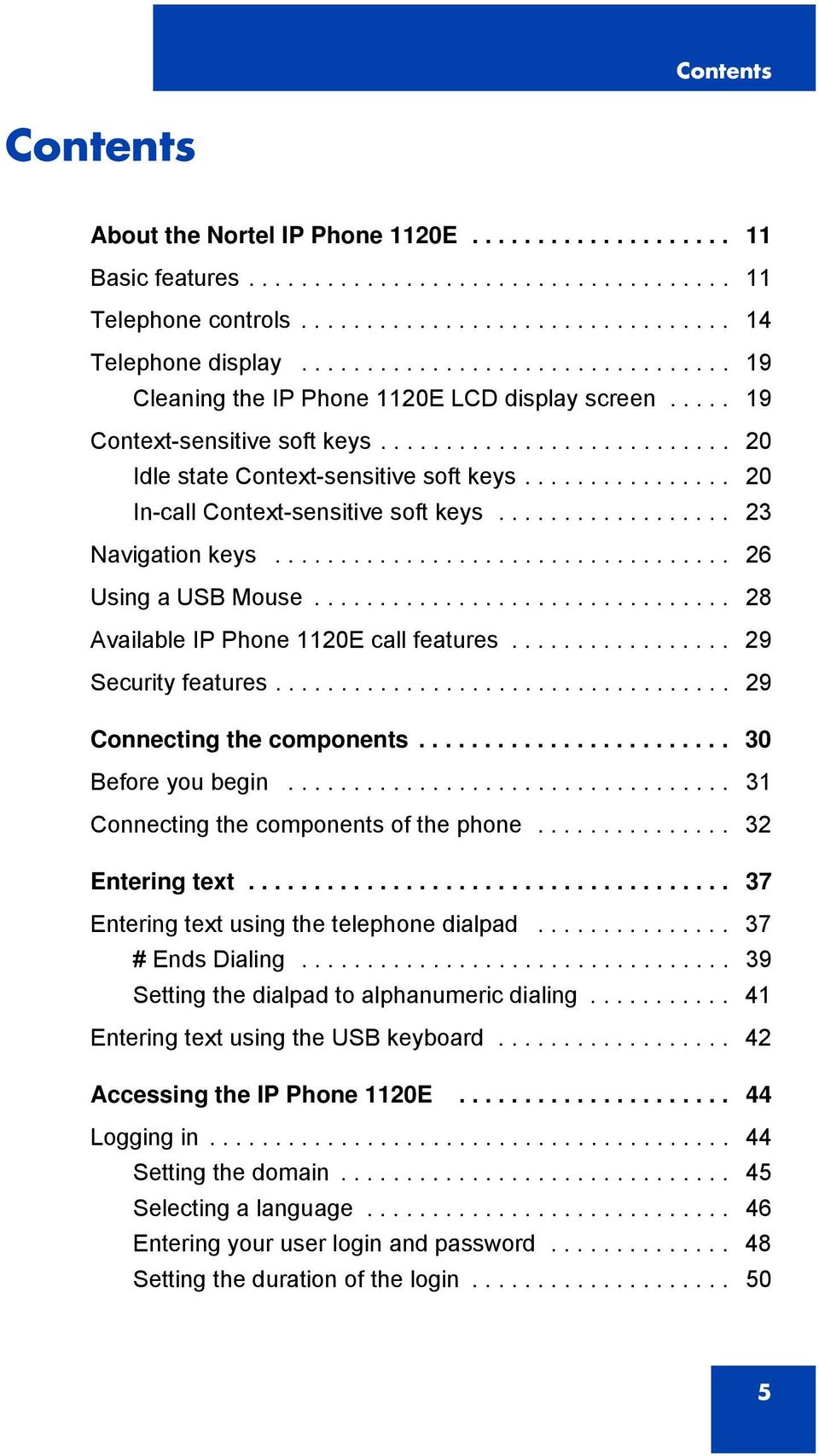
6 Contents Timed logout Timed logout while phone is idle Timed logout while on a call Selecting a location Your User Profile Creating a user profile Overwriting your personal Address Book Confirmation login screen Logging out from the IP Phone 1120E Configuring the IP Phone 1120E Adjusting the display screen contrast Creating the idle screen text display Setting-up the Backlight Screensaver Selecting a ring pattern Adjusting the volume Adjusting the ring volume Adjusting the volume of the Handset, Headset, and Handsfree mode Selecting a language Selecting a date format Selecting a time zone Selecting a time format Making a call Making a call using off-hook dialing Making a call using on-hook dialing Using handsfree calling Using Call Subjects Managing Call Subjects Adding a Call Subject Deleting a Call Subject Editing a Call Subject
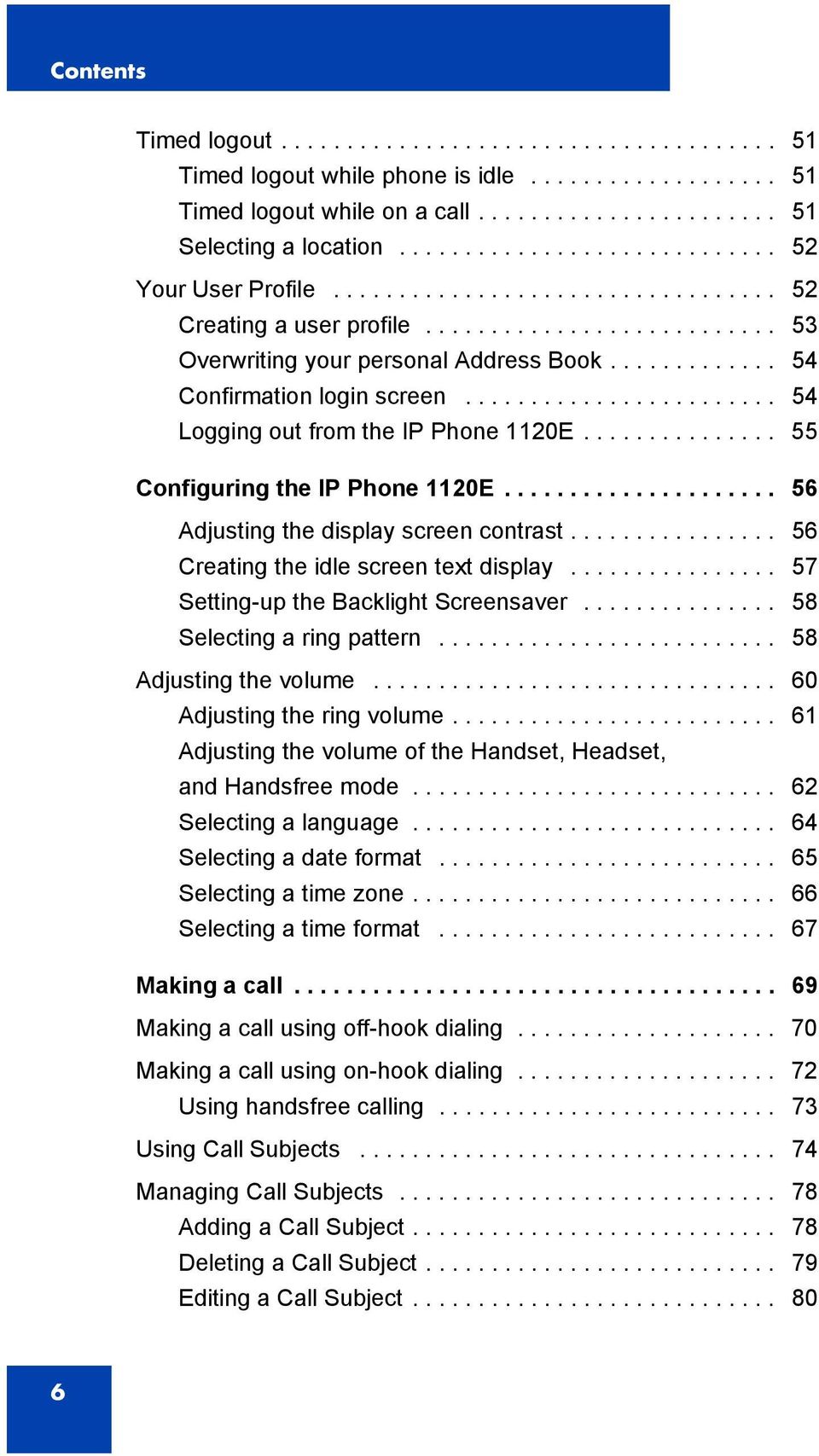
7 Contents Receiving a call Caller identification Answering an incoming call Redirecting an incoming call Declining an incoming call Managing Call Decline Reasons Ignoring an incoming call The Address Book Viewing the Address Book Initiating a call from the Address Book Adding a contact to your Address Book Editing a contact in your Address Book Copying information to the Address Book Searching for a contact in the Address Book Using the Search feature in the Address Book Using the Search feature Using Local Search Using Global Search Call Inbox Accessing the Call Inbox Managing calls in the Call Inbox while not on a call Viewing the details of a call in the Call Inbox Managing missed calls Initiating a call from the Call Inbox Deleting calls in your Call Inbox Accessing the calls in your Call Inbox during a call Call Outbox Accessing the Call Outbox Initiating a call from the Call Outbox

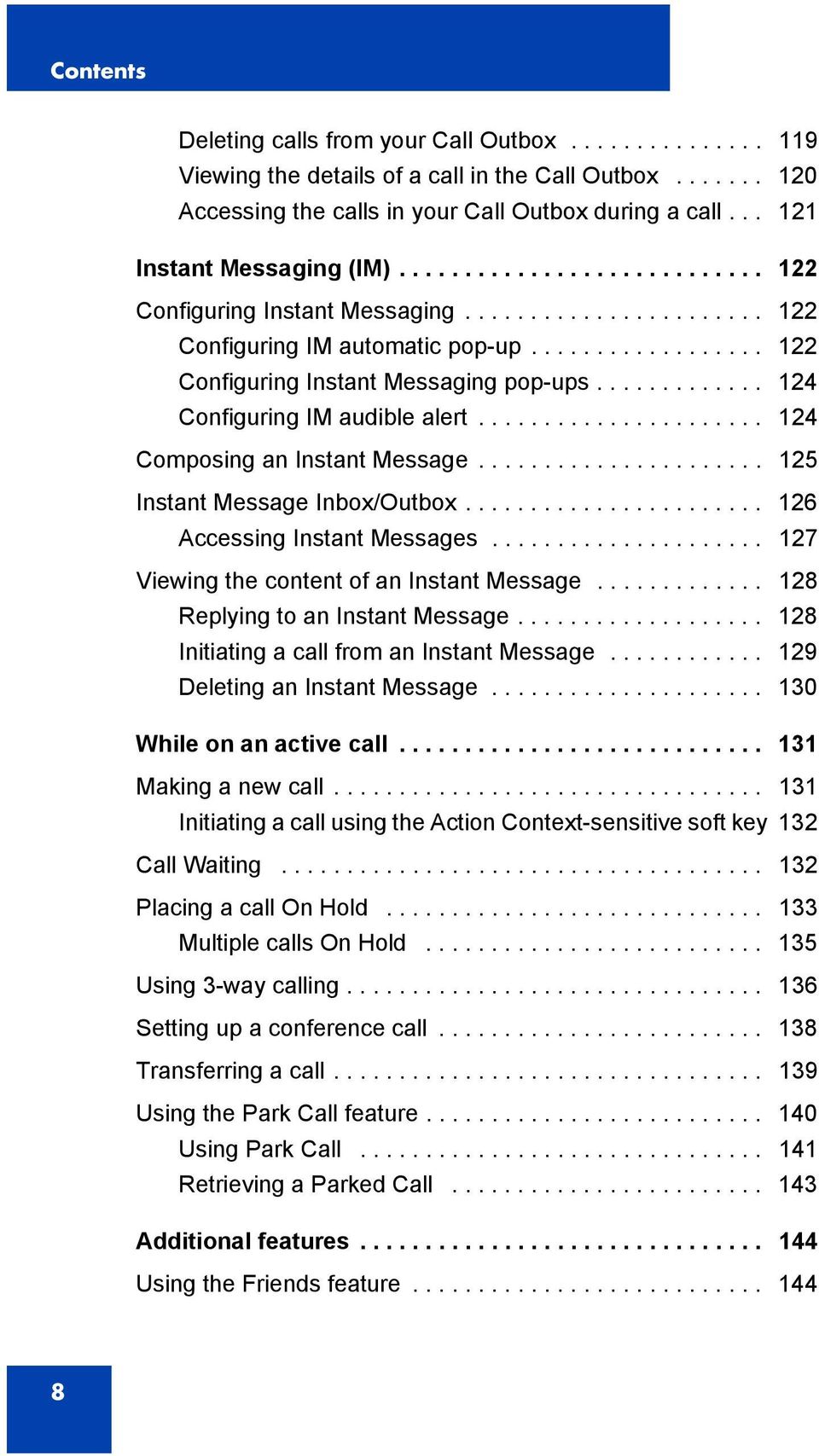
8 Contents Deleting calls from your Call Outbox Viewing the details of a call in the Call Outbox Accessing the calls in your Call Outbox during a call Instant Messaging (IM) Configuring Instant Messaging Configuring IM automatic pop-up Configuring Instant Messaging pop-ups Configuring IM audible alert Composing an Instant Message Instant Message Inbox/Outbox Accessing Instant Messages Viewing the content of an Instant Message Replying to an Instant Message Initiating a call from an Instant Message Deleting an Instant Message While on an active call Making a new call Initiating a call using the Action Context-sensitive soft key 132 Call Waiting Placing a call On Hold Multiple calls On Hold Using 3-way calling Setting up a conference call Transferring a call Using the Park Call feature Using Park Call Retrieving a Parked Call Additional features Using the Friends feature
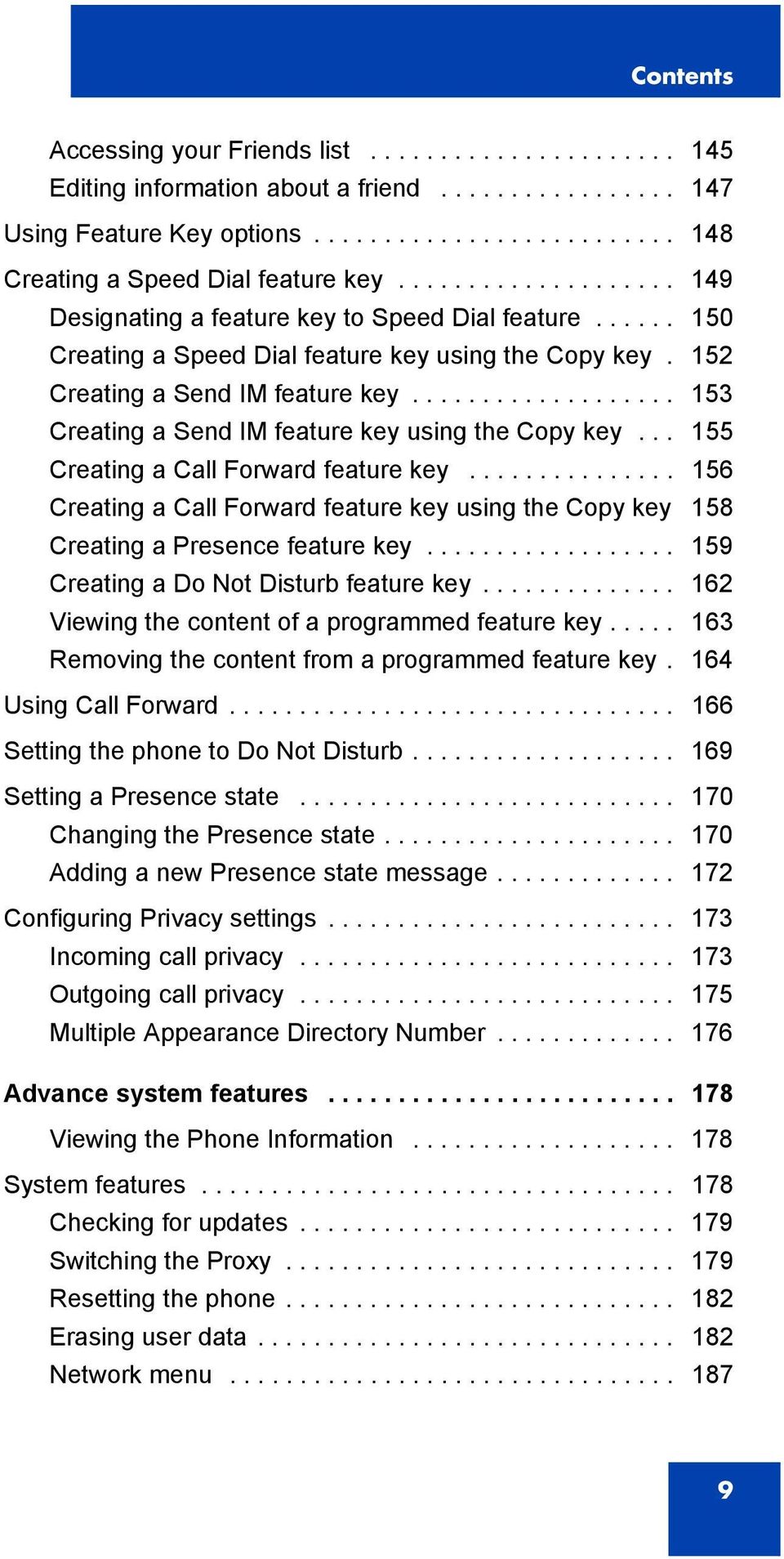
9 Contents Accessing your Friends list Editing information about a friend Using Feature Key options Creating a Speed Dial feature key Designating a feature key to Speed Dial feature Creating a Speed Dial feature key using the Copy key. 152 Creating a Send IM feature key Creating a Send IM feature key using the Copy key Creating a Call Forward feature key Creating a Call Forward feature key using the Copy key 158 Creating a Presence feature key Creating a Do Not Disturb feature key Viewing the content of a programmed feature key Removing the content from a programmed feature key. 164 Using Call Forward Setting the phone to Do Not Disturb Setting a Presence state Changing the Presence state Adding a new Presence state message Configuring Privacy settings Incoming call privacy Outgoing call privacy Multiple Appearance Directory Number Advance system features Viewing the Phone Information System features Checking for updates Switching the Proxy Resetting the phone Erasing user data Network menu
10 Contents Visual indicators Display screen icons Visual Alerter/Message Waiting Indicators Terms you should know Regulatory and safety information Other DenAn regulatory notice for Japan Index

11 About the Nortel IP Phone 1120E About the Nortel IP Phone 1120E Your IP Phone 1120E brings voice and data to the desktop by connecting directly to a Local Area Network (LAN) through an Ethernet connection. The SIP IP Phone 1120E communicates using Session Initiated Protocol (SIP) after the firmware (FW) is upgraded to a SIP-enabled version. Figure 1: IP Phone 1120E Feature Status Indicator User-defined feature keys Visual Alerter/Message Waiting Indicator Handset Speaker Copy Services Quit High resolution display screen Context-sensitive soft keys Inbox Outbox Directory Volume control Mute Handsfree Goodbye Expand Headset Hold Enter Dialpad Navigation Cluster Basic features Your IP Phone 1120E supports the following features: four user-defined feature keys with labels and indicators Note: The IP Phone 1120E designates Key 1 as Feature Key 1 and reserves it as the line key for the phone. 11

12 About the Nortel IP Phone 1120E four Context-sensitive soft keys graphical, high-resolution LCD display, backlit, with adjustable contrast high-quality speaker phone volume control keys for adjusting ringer, speaker, handset, and headset volume six specialized feature keys: Quit Directory Inbox Outbox Services Copy six call-processing fixed keys: Mute Handsfree Goodbye Instant Message Log Headset Hold gigabit Ethernet ports built-in gigabit Ethernet switch for shared PC access headset jack with an On/Off key USB port to support a keyboard or mouse Note: Powered downstream 1.1-compliant USB hubs are supported, including USB 2.0 hubs, if they offer USB 1.1 backwards compliancy. automatic DHCP network configuration hearing aid compatibility 12
13 About the Nortel IP Phone 1120E Note: In this guide, user-defined feature key labels appear beside the keys, and Context-sensitive soft key labels appear directly above the keys. Figure 2 shows user-defined feature keys and Contextsensitive soft keys. Figure 2: User-defined feature keys and Context-sensitive soft keys User-defined feature keys Context-sensitive soft keys 13

14 About the Nortel IP Phone 1120E Telephone controls Note: Your IP Phone 1120E may have fixed keys with icons or with labels. This document presents both versions of the fixed key. Use the Volume control buttons to adjust the volume of the ringer, handset, headset, speaker, and the Handsfree feature. Press the top button to increase the volume, and press the bottom button to decrease the volume. Press the Mute key to listen to the call without transmitting. Press the Mute key again to return to two-way conversation. The Mute key applies to handsfree, handset, and headset microphones. Note: When you enable mute, a red LED on the Mute key remains lit. Press the Handsfree key to activate the built-in speaker and microphone of the IP Phone 1120E. Note: The Handsfree LED indicator, on the Handsfree key, lights to indicate when handsfree is active. Use the Navigation Key Cluster to scroll through menus and lists that appear on the LCD display screen or for text entry. The outer part of this key cluster rocks for up, down, left, and right movements. (See Navigation keys on page 26.) 14
15 About the Nortel IP Phone 1120E Use the Enter key, at the center of the Navigation Key Cluster, to select menu items or to confirm changes. Note: The Enter key duplicates the function of the Context-sensitive soft keys Select, and Set. Use the Dialpad to enter numbers and text. Press the Hold key to put an active call on hold. Press the Hold fixed key to return to a call on hold. You can have several calls in a hold state. Press the Expand key to access the Instant Messaging Log. Press the Headset key to answer a call using the headset or to switch a call from the handset or handsfree to the headset. Note: The Headset LED indicator, on the Headset key, lights to indicate that the headset is in use. Press the Goodbye/Release key to terminate an active call. For multiple calls the Goodbye/Release key ends the highlighted call. Use the Goodbye/Release to close menu navigation or cancel user tasks. 15

16 About the Nortel IP Phone 1120E When you receive a voice message, the red Visual Alerter/Message Waiting Indicator lights. Also, when the ringer sounds, this indicator flashes. When you receive an instant message (IM), the blue Visual Alerter/Feature Status Indicator lights. Press the Copy key to copy contact information from one source such as the Address Book to a destination such as a feature key. Press the Services key to access the following features: 1. Search 2. Do Not Disturb 3. Call Forward 4. Presence 5. Retrieve Parked Call (Not available for all call servers.) 6. System Note: The Servcs Context-sensitive soft key accesses the same menu. Press the Services key twice quickly to access the Network menu. 16
17 About the Nortel IP Phone 1120E Press the Quit key to cancel a current onscreen operation, or exit the menu. Note: Pressing the Quit key does not affect the status of active calls. Press the Outbox key to view a record of all outgoing calls. Note: This key does not function as a shift key. Press the Inbox key to access your call inbox. The call inbox stores all incoming calls to an active phone. Note: This key does not function to send Instant Messages. Press the Directory key to access the Address Book and the Friends list. Note: You can access the Address Book while on a call and start a new call with a highlighted contact. Context-sensitive soft keys are below the display area. The LCD label above each key changes based on the active feature. 17

18 About the Nortel IP Phone 1120E The keys on either side of the LCD display area are User-defined Feature Keys, with labels on the LCD. The system administrator may reserve some keys for specific functionality during tasks and advanced setup screens. You can define these keys for specific functions such as Call Forward. Note: The IP Phone 1120E reserves the lower right key as the default user s line key. 18

19 About the Nortel IP Phone 1120E Telephone display Your IP Phone 1120E has three display areas: The upper display area provides line and feature key status. The middle display area contains single-line information for items such as caller number, caller name, menu items, feature prompt strings, user-entered digits, date and time information, and telephone information. The lower display area provides feature Context-sensitive soft key label information. Figure 3: IP Phone 1120E LCD screen Upper display area User-defined feature key labels Middle display area Date/Time display Call party information Menu information Directories information Lower Display Area Context-sensitive key labels Cleaning the IP Phone 1120E LCD display screen To clean the LCD display screen, gently wipe with a soft, dry cloth. CAUTION Do not use any liquids or powders on the IP Phone. Using anything other than a soft, dry cloth can contaminate IP Phone components and cause premature failure. 19

20 About the Nortel IP Phone 1120E Context-sensitive soft keys Your IP Phone 1120E has four Context-sensitive soft keys beneath the LCD screen. The Context-sensitive soft keys access different features and menus depending on the state of the phone and the menu you access. Idle state Context-sensitive soft keys When your phone is an in the idle state you can access the following menu items from the Context-sensitive soft keys: Figure 4: Idle state Context-sensitive soft keys Table 1: Context-sensitive soft keys for screen in the idle state View Press the View Context-sensitive soft key to access the following menu items: 1. Friends - a list of friends 2. Address Book - personal directory 3. Inbox - a list of received phone calls 4. Outbox - a list of dialed phone calls 5. Phone Information - information about the hardware and software of the IP Phone 1120E 20

21 About the Nortel IP Phone 1120E Servcs Press the Servcs Context-sensitive soft key to access the following features: 1. Search - use to search in the local directory (personal Address Book) and the global directory (network Address Book) for names and phone numbers. 2. Do Not Disturb - use to block all incoming calls. 3. Call Forward - use to forward an incoming call to an alternate destination. 4. Presence - use to set your own presence state to display to other users. 5. Retrieve Parked Call - use to retrieve a parked call from the server. (Not available for all call servers.) 6. System - for the advanced user to access uncommon tasks with the exception of the login and logout tasks. The following items are accessed: Login Logout Check for Updates Switch Proxy Reset Phone Erase User Data Msgs Press the Msgs Context-sensitive soft key to access the following feature: 1. Voice Mail - use to call voice mail number. 2. Instant Messaging - use to access the Instant Messaging Inbox/Outbox. 21
22 About the Nortel IP Phone 1120E Prefs Press the Prefs Context-sensitive soft key to access the following menu items: 1. Display - use to adjust the display settings of the LCD screen. 2. Audio - use to adjust tones, volume settings. 3. Feature Options - use to configure the following: Feature Keys Call Decline Reasons Call Ignore Action Call Subjects Call Fwd Notification 4. Message Options - use to change Voice Mail settings and IM settings. 5. Language - use to change the interface language 6. Misc Options - use to access the following options: Alpha Dialing Search Method Incoming Privacy Outgoing Privacy # Ends Dialing Change Location Time 22
23 About the Nortel IP Phone 1120E 7. Network - use to access: Server Settings Device Settings Diagnostics Lock In-call Context-sensitive soft keys When you are in an In-call session the following menu items are accessible from the Context-sensitive soft keys: Figure 5: In-call Context-sensitive soft keys 23
24 About the Nortel IP Phone 1120E Table 2: Context-sensitive soft keys during an in-call session Action Press the Action Context-sensitive soft key to access the following menu items: 1. New Call/Conference - use to place the current call on hold and to initiate a new call or to begin a conference call 2. Release Call - use to hang-up an active call 3. Transfer Call - use to transfer an active call to another phone number or SIP address 4. Park Call - use to park an active call to the server (Not available for all call servers.) Servcs Press the Servcs key to access the following features: 1. Search 2. Do Not Disturb 3. Call Forward 4. Presence 5. Retrieve Parked Call (Not available for all call servers.) 6. System 24
25 About the Nortel IP Phone 1120E Audio Press the Audio Context-sensitive soft key to access the following feature: 1. Change Audio Settings - use to adjust audio quality between three settings: Low Medium High Note: You change audio settings to improve audio quality based on the available band width. If you are limited to a low internet band width, you can improve the audio quality you change the audio setting to low. 2. Monitor Audio Quality - use to view details about the audio quality of an active call. 25
26 About the Nortel IP Phone 1120E Navigation keys There are a few important keys you should become familiar with to easily navigate within the many menus of the IP Phone 1120E. Table 3 shows important navigation keys and describes the function of each. Note: Menu items are listed and ordered by number. You can press the number on the dialpad corresponding to each menu item to activate that menu item, instead of using the navigation key to move up and down the menu list to highlight the item and then pressing the Select Context-sensitive soft key. Table 3: Navigation Keys. Navigation Key Cluster Press the Left/Right part of the Navigation Key Cluster to: Scroll long lines of text when you view menu lists or the contents of a list such as the Address Book entries or items in the Call Inbox and scroll long lines of text when you view an IM. Note: The IP Phone 1120E automatically scrolls long lines of text from right to left. When your Search Method is set to Index Search (See, Searching for a contact in the Address Book on page 101), you can increase the speed of the scrolling by repeatedly pressing the right navigation key or decrease the scrolling speed by repeatedly pressing the left navigation key. Change the slide adjustment from left to right when you adjust such things as contrast or volume. 26
27 About the Nortel IP Phone 1120E Navigation Key Cluster Press the left side of the Navigation Key Cluster to erase a character (backspace) when you enter and edit text. Press the right side of the Navigation Key Cluster to create a space when you enter and edit text Press the up/down part of the Navigation Key Cluster to: Move the highlight up and down from one item to another item in a list such as Address Book entries or items in your Call Inbox. Scroll lists and message contents when you view IMs. Move the cursor from line to line when entering and editing text or data. Note: When you want to scroll through a list of many items, you can hold the up or down key of the Navigation Key Cluster to automatically move up or down the list of items. Use the Enter key, at the center of the Navigation Key Cluster, to select menu items or a highlighted item on a list. Note: The Enter key duplicates the function of the Context-sensitive soft keys Select, and Set. 27
28 About the Nortel IP Phone 1120E Press the Quit key to cancel a current onscreen operation or exit a menu. Note 1: Pressing the Quit key does not affect the status of an active call while navigating a menu. Note 2: You can press the Goodbye key to exit a menu, but if you press the Goodbye key during an active call, the call terminates. You can navigate to an item in a menu by pressing the corresponding number on the dialpad and then activate the item or continue navigating the list of items. Using a USB Mouse The IP Phone 1120E is equipped with a USB port, to which you can connect a USB mouse. You can use the USB mouse to activate contextsensitive soft keys items and activate menu items. You left click on a context-sensitive soft key label of the LCD screen to activate that item. When a menu is open double-click on the menu item to activate that menu item or left-click on the item to highlight it. For example, you can left click on the View context-sensitive soft key label to open that menu. Next to view the Inbox double-click on the word Inbox in the menu list. You can double-click on a name in the Inbox list to initiate a call or left-click the item to highlight the name and continue to interact with the menu item. To access the Network menu right-click anywhere on the LCD screen of your IP Phone 1120E. 28
29 About the Nortel IP Phone 1120E Available IP Phone 1120E call features The IP Phone 1120E is designed to be supported by a number of different call servers. The specific call server the IP Phone 1120E is connected to determines whether certain features are available to your phone. Call features must be assigned to your telephone and supported by call server software. Note 1: Not all feature are available. To determine which features are available or to activate features contact your system administrator or service provider. Note 2: Not all service providers support the entry of a SIP address to initiate a call, for example, [email protected]. Some service providers require that you enter a Directory Number (DN) to initiate a call, for example, Contact your system administrator to determine whether your call server supports SIP address dialing. Security features To use the IP Phone 1120E you must have a login and password assigned to your phone. This security ensures that when you log out no calls can be made from the phone. Also, when you are logged out of the phone, features such as Address Book, Instant Message logs, and Call Outbox are not accessible. Your login and password protect access to your user profile. To access your user profile you must enter your password. 29
30 Connecting the components Connecting the components Figure 6 shows connections on the IP Phone 1120E. Figure 6: IP Phone 1120E connections Accessory Expansion Module port PC Ethernet port LAN Ethernet port Tilt Lever Link lamp USB Connector AC Adapter jack Headset jack Handset jack WARNING *Ensure that the protective rubber cap on the Expansion Module port is in place when the port is not in use. Connecting anything other than the proper Expansion Module connector to this port can cause damage to the phone. 30
31 Connecting the components Before you begin CAUTION Damage to Equipment Do not plug your IP Phone 1120E into a regular telephone jack. This results in severe damage to the IP Phone. Consult your system administrator to ensure that you plug your telephone into a 10/100/1000 BaseT Ethernet jack. CAUTION Your IP Phone 1120E is designed for use in an indoor environment only. 31
32 Connecting the components Connecting the components of the phone WARNING Your IP Phone 1120E is shipped with the base locked in position. To avoid damaging your phone, press the wall-mount lever, located just under the Handsfree key as indicated in Figure 7 on page 32, to release the base and pull it away from the phone. Figure 7: Wall-mount lever Wall-mount lever 1. Remove the stand cover. Pull upward on the center catch as indicated in Figure 8, and remove the stand cover. The cable routing tracks are now accessible. 32
33 Connecting the components Figure 8: Remove the stand cover Tilt Lever Button Center Catch Handset cord exit 2. Connect the AC power adapter (optional). Connect the adapter to the AC adapter jack in the bottom of the phone. Form a small bend in the cable, and then thread the adapter cord through the channels in the stand. Warning: Use your IP Phone 1120E with the approved Nortel AC Adapter (model #N ) for this model of phone only. Note 1: Your IP Phone 1120E supports both AC power and Power over Ethernet options, including IEEE 802.3af standard power. To use local AC power, the optional AC adapter can be ordered separately. To use Power over Ethernet, where power is delivered over the CAT-5 cable, the LAN must support Power over Ethernet, and an AC adapter is not required. Note 2: You must use CAT-5e (or later) cables if you want to use gigabit Ethernet. 33
34 Connecting the components 3. Install the handset. Connect the end of the handset cable with the short straight section into the handset. Connect the end of the handset cable with the long straight section to the back of the phone, using the RJ-9 handset jack marked with the symbol +. Form a small bend in the cable, and then thread the handset cord through the channels in the stand so that it exits behind the handset on the right side, in the Handset cord exit in the stand base marked with the symbol +, as shown in Figure Install the headset (optional). If you are installing a headset, plug the connector into the RJ-9 headset jack marked with the symbol ) on the back of the phone, and thread the headset cord along with the handset cord through the channels in the stand, so that the headset cord exits the channel marked with the symbol ). 5. Install the Ethernet cable. Connect one end of the supplied Ethernet cable to the back of your phone using the RJ-45 connector marked with the symbol %, and thread the network cable through the channel marked with the symbol %. 6. Install the Ethernet cable connecting the PC to the phone (optional). If you are connecting your PC Ethernet through the phone, connect one end of the PC Ethernet cable to your phone using the RJ-45 connector marked with the symbol (, and thread it through the channel marked with the symbol (. Connect the other end to the LAN connector on the back of your PC. 7. Install additional cables. If applicable, plug in optional USB devices. Connect the Ethernet cable to the LAN Ethernet connection. If you are using an AC power adapter, plug the adapter into an AC outlet. 34
35 Connecting the components Figure 9: Cable routing tracks and mounting holes Method A Method B 8. Wall-mount your phone (optional). Your IP Phone 1120E can be mounted either by: (method A) using the mounting holes on the bottom of the phone stand, or (method B) using a traditional-style wall-mount box with RJ-45 connector and 15-cm (6-inch) RJ-45 cord (not provided). Complete steps 1-7, as needed, before you wall-mount your phone: Method A: Press the wall-mount lever, and pull the phone away from the stand, as shown in Figure 10. Using the stand cover (the part you removed in step 1), mark the wall-mount holes by pressing the bottom of the stand cover firmly against the wall in the location where you wish to install the phone. Four small pins on the bottom of the stand cover make marks on the wall. Use the marks as a guideline for installing the wall-mount screws (not provided). Install the screws so that they protrude 3 mm (1/8 inch) from the wall, and then install the phone stand mounting holes over the screw heads as indicated in Figure 9 (Method A). You may need to remove the phone from the wall to adjust the lower screws. When the lower screws are snug, 35
36 Connecting the components install the phone on the mounting screws, and then tighten the top screws. Figure 10: Rotate the phone into the wall mount position. Tilt lever Wall-mount lever Method B: Attach the 15-cm (6-inch) CAT5e cable, position the stand over the mounting rivets, and slide the phone down the wall so that the rivets fit into the slots on the stand, indicated in Figure 9 on page 35 (Method B). 9. Replace the stand cover. Ensure that all cables are neatly routed and press the stand cover into place until you hear a click. 10. Put the phone in the wall-mount position (optional). If you wallmounted your phone, put it in the wall-mount position by holding the Tilt Lever and pressing the phone towards the base until the phone is parallel with the base. Release the Tilt Lever and continue to push the phone towards the base until you hear an audible click. Ensure the phone is securely locked in position. 36
37 Entering text Entering text You can enter and edit text on your IP Phone 1120E using the following methods: Entering text using the telephone dialpad on page 37 Entering text using the USB keyboard on page 42 You make a call by dialing a telephone number (Directory Number) or by dialing a person s alphanumeric SIP address (for example, [email protected]). Note: Some service providers only support using a Directory Number (DN) such as to initiate a call to another phone. Please contact your system administrator or service provider to determine if alphanumeric dialing is supported. Alphanumeric dialing refers to the spelling of names or words by dialing alphabetic characters co-located with the numbers on the numeric dialpad of your IP Phone 1120E. You use Alphanumeric entry when entering Instant Messages (IMs), SIP addresses, and entries to such things as your Address Book and Feature Key labels. Entering text using the telephone dialpad When you can use the dialpad to enter text, the abc/123 Contextsensitive soft key becomes available for applications that offer text input. The abc/123 Context-sensitive soft key toggles between alphabetic and numeric input. When the Context-sensitive soft key label is abc you can enter alphabetic text and when the Context-sensitive soft key label is 123 you can enter numbers. 37
38 Entering text Figure 11: Context-sensitive soft key abc/123 For example, if you want to enter the letter a, press the abc/123 Context-sensitive soft key to switch to alphabetic input and press the number 2 key once. If you want to enter the upper case letter C, press the number 2 key six times. You can cycle through the letters (and the actual number) by repeatedly pressing the number button. Names or words, which have two adjacent letters, that require the same button, such as in the word "press", are entered by entering the first character, briefly pausing, and entering the next letter. You press the dialpad key 6 for the p pause a moment and press it again twice to cycle to the letter r. When entering alphanumeric information, the 1 key on the dialpad represents the characters in Table 4. To enter a special character, press the dialpad number 1 to cycle through the characters until you reach the one you need. For example to enter a question mark (? ), press the number 1 key eight times. Table 4: Alphanumeric characters for Dialpad key 1 Name at. period - dash _ underscore 38
39 Entering text Table 4: Alphanumeric characters for Dialpad key 1 Character & Name ampersand apostrophe ^ carat? question mark! exclamation point ( left parentheses ) right parentheses, comma \ backslash / forward slash : colon ; semi-colon ~ tilde = equal + plus 1 numeral 1 Note: No letters are associated with the 0 key. # Ends Dialing You can enable the IP Phone 1120E to use the Octothorpe (#) symbol to immediately dial the entered address or phone number. 39
40 Entering text To enable the # Ends Dialing feature, press the Prefs Context-sensitive soft key and select Misc Options highlight # Ends Dialing and press the Change Context-sensitive soft key. To enable the # Ends Dialing feature: Choose one of the following: On or Back Press the On Context-sensitive soft key to turn on # Ends Dialing. Press the Back Context-sensitive soft key to keep existing configurations and return to the Preferences menu. To turn off # Ends Dialing, press the Prefs Context-sensitive soft key, select Misc Options, highlight # Ends Dialing and press the Change Context-sensitive soft key. To turn off # Ends Dialing: Off or Back Press the Off Context-sensitive soft key to turn off # Ends Dialing. or Press the Back Context-sensitive soft key to keep existing configurations and return to the Preferences menu. 40
41 Entering text Setting the dialpad to alphanumeric dialing You can set the dialpad of the IP Phone 1120E to alphanumeric as the default. This eliminates the need to press the abc/123 Context-sensitive soft key when entering text. The abc/123 Context-sensitive soft key can still toggle between alphabetic and numeric input, but alphabetic is the default. To set the dialpad to alphanumeric as the default, press the Prefs Context-sensitive soft key, select Misc Options, highlight Alpha Dialing and press the Change Context-sensitive soft key. To set alpha dialing: Choose one of the following: On or Back Press the On Context-sensitive soft key to turn on alphanumeric dialing. Press the Back Context-sensitive soft key to keep existing configurations and return to the Preferences menu. To turn off alpha dialing and set numeric as the default, press the Prefs Context-sensitive soft key, select Misc Options, highlight Alpha Dialing and press the Change Context-sensitive soft key. To turn off alpha dialing: Off or Back To return the IP Phone 1120E to numeric dialing as the default, press the Off Contextsensitive soft key. or Press the Back Context-sensitive soft key to keep existing configurations and return to the Preferences menu. 41
42 Entering text Entering text using the USB keyboard You can use a USB keyboard when connected to the USB port of your IP Phone 1120E, to enter text and numbers, access some features, and duplicate specific functions. For number entry in telephone applications (for example, when dialing), you can use the keyboard to enter digits (0 9), as well as * and #. You use the alpha keys when entering text, for example entering the text of an Instant Message. Table 5 shows the USB Keyboard function keys and their associated IP Phone 1120E fixed keys. Table 5: USB keyboard functions USB Keyboard Key Esc f1 f2 f3 f4 f5 f6 f7 f8 f9 f10 f11 f12 IP Phone 1120E Fixed Key Quit Services Expand Inbox Outbox Address Book Copy Volume Down Volume Up Mute Hold Headset Handsfree 42
43 Entering text Table 5: USB keyboard functions USB Keyboard Key Break Backspace Arrow left Arrow Right Arrow Up Arrow Down Enter IP Phone 1120E Fixed Key Goodbye (Release) Left arrow of Navigation Cluster Left arrow of Navigation Cluster Right arrow of Navigation Cluster Up arrow of Navigation Cluster Down arrow of Navigation Cluster Enter 43
44 Accessing the IP Phone 1120E Accessing the IP Phone 1120E Logging in Figure 12 shows the LCD User Login screen when you start up the phone or log out. Figure 12: User Login Screen When you log in to your IP Phone 1120E after the initial login you are required to confirm your login, enter your password, and select the duration of this session. However, the first time you use your IP Phone 1120E, you may need to complete some of the following: Setting the domain on page 45 Selecting a language on page 46 Entering your user login and password on page 48 Setting the duration of the login on page 50 Selecting a location on page 52 Your User Profile on page 52 Overwriting your personal Address Book on page 54 44
45 Accessing the IP Phone 1120E Note: The system automatically logs you back in after a power outage or firmware upgrade. This feature is a network wide configuration that the system administrator sets up. Setting the domain During the login process, if you need to change the domain or confirm the domain you log into is correct, press the Domain Context-sensitive soft key from the login screen. The current domain appears on the IP Phone 1120E LCD screen. You can edit the domain that is listed or press the Domains Context-sensitive soft key to access a list of available domains to which you can choose to connect. Note: You should check with your system administrator before editing or changing domains. To change the domain: 1. Choose one of the following: Press the Domains Contextsensitive soft key to change the current domain. Press the Done Context-sensitive soft key to keep existing configurations and return to the User Login screen. Domains or Done Edit Note: You can edit the domain to which the IP Phone 1120E connects. Contact your system administrator before editing the domain. 2. Press the Up/Down navigation key to highlight the new domain you want to use. 45
46 Accessing the IP Phone 1120E Select Back 3. Choose one of the following: Press the Select Context-sensitive soft key to change the domain to the highlighted domain from the list. The phone returns to the Current Domain display screen and the new domain appears. Press the Back Context-sensitive soft key to keep existing configurations and return to the Display menu. Done 4. Press the Done Context-sensitive soft key to confirm the new domain and return to the User Login screen. Selecting a language Your IP Phone 1120E has the capacity to operate using other languages, such as French. The phone may be provisioned with up to five languages by the system administrator. If the phone is provisioned with other languages, you can choose an available language during the login process by pressing the Lang Context-sensitive soft key from the User Login screen. To change the language: Change Back 1. Choose one of the following: Press the Change Context-sensitive soft key to change the current language. Press the Back Context-sensitive soft key to keep existing language and return to the User Login screen. 46
47 Accessing the IP Phone 1120E 2. Press the Up/Down navigation key to highlight the new language you want to use. Select Back 3. Choose one of the following: Press the Select Context-sensitive soft key to change the language to the highlighted language from the list. The phone returns to the User Login screen and uses the selected language. Press the Back Context-sensitive soft key to keep the existing language and return to the User Login screen. 47
48 Accessing the IP Phone 1120E Entering your user login and password You need to log in to your IP phone when you first install and system boot your IP phone and anytime you log out or reboot your phone. Note 1: If this is the first time to log in to the IP Phone 1120E, the system prompts you for a location. (See Selecting a location on page 52.) Note 2: If this is not the first time to log in to IP Phone 1120E, the previous user s login name appears after the ID prompt. To Log in to the IP Phone 1120E abc 1. Press the abc/123 Context-sensitive soft key to toggle between alphabetic or numeric input. 2. Use the dialpad to enter your user ID login at the prompt. Note: Use the left navigation key to backspace and remove a previous users ID. Login 3. Press the Login Context-sensitive soft key. A new screen appears and prompts you for your password. 48
49 Accessing the IP Phone 1120E 4. Use the dialpad to enter your password. Note 1: When you enter your password, the last character entered appears. However, all previous characters are hidden. Note 2: When you enter your password and you use the navigation key to backspace, you erase all the characters and must completely re-enter your password again. Next Cancel 5. Press the Next Context-sensitive soft key. Note: You can cancel the login process by pressing one of the following keys: The Cancel Context-sensitive soft key The Goodbye fixed key The Quit fixed keys 49
50 Accessing the IP Phone 1120E Setting the duration of the login When you enter your login and password the Duration screen appears. You enter the maximum length of time of this session. The default duration is Permanent and you remain logged into the phone until you log out. To set the login duration: Next Timed Cancel 1. Choose one of the following: Press the Next Context-sensitive soft key to set login duration to permanent. A login confirmation screen appears. Press the Timed Context-sensitive soft key to open a screen to set a maximum time to remain logged in. Press the Cancel Context-sensitive soft key to return to the previous login screen. Period If you press the Timed Context-sensitive soft key, you then must set the duration of the login. To toggle the login duration entries between hours or days press the Period Contextsensitive soft key. Next 2. Do one of the following: Use the dialpad to enter the number of hours or days you want to remain logged in and press the Next Context-sensitive soft key 50
51 Accessing the IP Phone 1120E Back Cancel Press the Back Context-sensitive soft key to return to the permanent login screen. Press the Cancel Context-sensitive soft key to return to the first login screen. Timed logout When you set a login time other than permanent, the IP Phone 1120E prompts you when the login time expires. Timed logout while phone is idle When the login time expires and the phone is idle (not on a call), you can do one of the following at the prompt: Press the Yes Context-sensitive soft key to logout immediately. Press the No Context-sensitive soft key to switch to permanent login. Press the Quit or Release/Goodbye key to logout immediately. If you do not respond, the prompt times out in 45 seconds and the phone logs out. If you answer a call during the logout prompt, the login switches to permanent login. Timed logout while on a call When the login time expires while on a call, you can do one of the following at the prompt: Press the Yes Context-sensitive soft key to log out immediately. Press the No Context-sensitive soft key to switch to permanent login. Press the Quit key to dismiss the log out prompt and switch to permanent login. 51
52 Accessing the IP Phone 1120E Press the Release/Goodbye key to dismiss the logout prompt and switch to permanent login. Note: If you press the Release/Goodbye key to dismiss the logout using this method, you also terminate the call. If you do not respond, the prompt times out in 45 seconds and the phone switches to permanent login. Selecting a location When you first login to the IP Phone 1120E, the system prompts you for a location. The location you select is saved in your User Profile. Depending on your service provider, the Enhanced Emergency Service uses the location you select or the Directory Number (DN) on the call server, when handling emergency calls. The call server s configuration determines how emergency service calls are handled by your IP Phone. Note: During an emergency call you cannot log out from the phone or release or disconnect the call. The IP Phone remains connected to the emergency service until disconnected by the emergency service operator. Note 3: If the login time expires during an emergency call, no prompt appears and the phone automatically switches to permanent login. ATTENTION * When you set your user profile, for the first time, you must confirm that the selected location is correct. You can view your location by accessing the phone information screen. (See page 178.) Your User Profile Your User Profile contains your specific settings and data. You are prompted to create a User Profile the first time you log in to your IP Phone 1120E. If you delete your User Profile the phone reboots and 52
53 Accessing the IP Phone 1120E you must log in and create a new User Profile. When you log in to your phone, your specific settings and data are automatically available for you. The information stored in your user profile includes: Independent volume adjustments for handset, headset, and handsfree Alerting Volume adjustment Idle Screen display text Display Contrast and Backlight Screen Saver settings Voic settings (Number and Mailbox ID) User location (from server-provided list) Time, Date, and Zone format settings Call Subjects Call Decline reasons Instant Messaging settings and Instant Message Inbox/Outbox Default dialing (Alpha/Numeric) Call Ignore action (local /network) Search method (Name, First character, Index) User Presence selection Dialing pattern default (alpha/numeric) Address Book entries Call Inbox and Call Outbox entries Programmable keys configuration # Ends dialing configuration Creating a user profile To create your User Profile during login, press the New Context-sensitive soft key when the Profile screen appears. The IP Phone 1120E automatically creates your User Profile and saves all settings and preferences to your user login. The next time you log in to the same phone, it automatically configures the phone to your User Profile. 53
54 Accessing the IP Phone 1120E Overwriting your personal Address Book When an address book exists on a server, such as an address book for a specific company, you can update your personal Address Book with an address book from the call server. The system administrator configures the system to enable this feature. If a new address book is available on the call server, the IP Phone 1120E prompts you to download the latest address book. Confirmation login screen When you complete the login process, login information appears. Press the OK Context-sensitive soft key to complete the login process. If the login is unsuccessful, the login error reason Failed to login user, Authentication required appears. Press the OK Context-sensitive soft key to return to the first login screen. Note: The most common cause for login failure is incorrect entry of your password. Figure 13: Login confirmation screen 54
55 Accessing the IP Phone 1120E Logging out from the IP Phone 1120E To logoff from the IP Phone 1120E, either press the Servcs Contextsensitive soft key or the Services fixed key, select System, and select Logout from the menu. To Log out from the IP Phone 1120E: abc 1. Press the abc/123 Context-sensitive soft key to toggle between alphabetic or numeric input. 2. Use the dialpad to enter your password at the prompt. Logout or Back Press the Logout Context-sensitive soft key to complete the logout process. The phone returns to the User Login screen. or Press the Back Context-sensitive soft key to remain logged on and return to the Services menu. 55
56 Configuring the IP Phone 1120E Configuring the IP Phone 1120E You may want to adjust a few settings of the IP Phone 1120E to conform to the environment where you use the phone. These settings are saved to your User Profile. This section describes some of the setting that you can customize on your IP Phone 1120E. Adjusting the display screen contrast on page 56 Creating the idle screen text display on page 57 Selecting a ring pattern on page 58 Adjusting the ring volume on page 61 Adjusting the volume of the Handset, Headset, and Handsfree mode on page 62 Selecting a language on page 64 Selecting a date format on page 65 Selecting a time zone on page 66 Selecting a time format on page 67 Adjusting the display screen contrast To adjust the LCD screen contrast, press the Prefs Context-sensitive soft key, select Display, and select Contrast. To adjust the display screen contrast: 1. Press the Left/Right navigation key to increase or decrease the display contrast level. 56
57 Configuring the IP Phone 1120E 2. Choose one of the following: Set or Back Press the Set Context-sensitive soft key to save the changes and return to the Display menu. Press the Back Context-sensitive soft key to keep existing configurations and return to the Display menu. Creating the idle screen text display To create text to display on the screen while the phone is idle, press the Prefs Context-sensitive soft key, select Display, and select Idle Screen Text Display from the menu. To create the idle screen display text: abc 1. Press the abc/123 Context-sensitive soft key to toggle between alphabetic or numeric input. 2. Use the dialpad to enter display text you want to appear on the idle screen display of the IP Phone 1120E. 3. Choose one of the following: Save or Back Press the Save Context-sensitive soft key to save the idle screen text display. Press the Back Context-sensitive soft key to keep existing screen display text and return to the Display menu. 57
58 Configuring the IP Phone 1120E Setting-up the Backlight Screensaver To set the amount of time the LCD screen remains backlit, press the Prefs Context-sensitive soft key, select Display, and select Backlight Screensaver from the menu. To set-up the Backlight Screensaver: 1. Press the Up/Down navigation key to scroll through and highlight the length of time you want the idle screen to remain backlit. 2. Choose one of the following: Press the Select Context-sensitive soft key to set the length of time for the phone to remain backlit and return to the Display menu. Press the Back Context-sensitive soft key to keep existing configurations and return to the Display menu. Select or Back Selecting a ring pattern To select the ring pattern for an incoming call, press the Prefs Contextsensitive soft key select Audio, select Tones, and select Ring Pattern from the menu. To select a ring pattern: 1. Press the Up/Down navigation key to scroll through and highlight the different ring patterns displayed on the LCD screen. 58
59 Configuring the IP Phone 1120E Select Test Back 2. Choose one of the following: Press the Select Context-sensitive soft key to set the ring pattern and return to the Tones menu. Press the Test Context-sensitive soft key to briefly play the selected ring pattern. Press the Back Context-sensitive soft key to keep existing configurations and return to the previous menu. 59
60 Configuring the IP Phone 1120E Adjusting the volume You can adjust the volume of the IP Phone 1120E for the following: Ring Volume Handset Volume Headset Volume Handsfree Volume A sliding scale appears on the LCD screen display when you adjust the volume. (See Figure 14) Figure 14: Adjusting the volume 60
61 Configuring the IP Phone 1120E Adjusting the ring volume To adjust the ringing volume for an incoming call, press the Prefs Context-sensitive soft key select Audio, select Tones, and select Alerting Volume. To adjust an alerting volume: 1. To adjust the ringing volume of an incoming call, press the Left/Right navigation key or use the Volume fixed keys to increase or decrease the volume. 2. Choose one of the following: Set or Back Press the Set Context-sensitive soft key to set the selected volume and return to the Tones menu. Press the Back Context-sensitive soft key to keep existing configurations and return to the Tones menu. 61
62 Configuring the IP Phone 1120E Adjusting the volume of the Handset, Headset, and Handsfree mode You can adjust the volume for the handset, headset, and the handsfree speaker of the IP Phone 1120E. To adjust the volume of the handset, press the Prefs Context-sensitive soft key, select Audio, select Voice, and select Handset To adjust the handset volume: 1. To adjust the handset volume use one of the following methods: Press the Left/Right navigation key to increase or decrease the volume of the handset. Press the Volume + fixed key to increase handset volume or the Volume - fixed key to decrease the handset volume. Note: To adjust the volume during a call, use only the Volume + and Volume - fixed keys. 2. Choose one of the following: Press the Set Context-sensitive soft key to set the selected volume and return to the Voice menu. Press the Back Context-sensitive soft key to keep existing configurations and return to the Voice menu. Set or Back 62
63 Configuring the IP Phone 1120E To adjust the volume of the headset, press the Prefs Context-sensitive soft key, select Audio, select Voice, and select Headset To adjust the headset volume: 1. To adjust the headset volume use one of the following methods: Press the Left/Right navigation key to increase or decrease the volume of the handset. Press the Volume + fixed key to increase handset volume or the Volume - to decrease the handset volume. Note: To adjust the volume during a call, use only the Volume + and Volume - fixed keys. 2. Choose one of the following: Press the Set Context-sensitive soft key to set the selected volume and return to the Voice menu. Press the Back Context-sensitive soft key to keep existing configurations and return to the Voice menu. Set or Back 63
64 Configuring the IP Phone 1120E To adjust the volume for handsfree mode, press the Prefs Contextsensitive soft key, select Audio, select Voice, and select Handsfree. To adjust the handsfree mode volume: 1. To adjust the volume for handfree mode use one of the following methods: Press the Left/Right navigation key to increase or decrease the volume. Press the Volume + fixed key to increase volume or the Volume - to decrease the volume. Note: To adjust the volume during a call, use only the Volume + and Volume - fixed keys. 2. Choose one of the following: Press the Set Context-sensitive soft key to set the selected volume and return to the Voice menu. Press the Back Context-sensitive soft key to keep existing configurations and return to the Voice menu. Set or Back Selecting a language The display is available in multiple languages. A maximum of five languages are accessible through the phone. The system administrator determines which languages are available for your phone. To choose a language, press the Prefs Context-sensitive soft key, select Language. The current language displays. To change the language press the Change Context-sensitive soft key. 64
65 Configuring the IP Phone 1120E To select a language: 1. Press the Up/Down navigation key to scroll and highlight the desired language (for example, German [Deutsche]). 2. Choose one of the following: Select or Back Press the Select Context-sensitive soft key to save the desired language and return to the previous screen. Press the Back Context-sensitive soft key to keep existing configurations and return to the Configure menu. Selecting a date format To select a date format, press the Prefs Context-sensitive soft key and select Misc Options, select Time, and press the Change Contextsensitive soft key. To select a date format: 1. Press the Up/Down navigation key to highlight Date Format in the menu. Change 2. Press the Change Context-sensitive soft key to change the Date Format. 65
66 Configuring the IP Phone 1120E 3. Press the Up/Down navigation key to scroll and highlight either a month/day (MM/DD) or a day/month (DD/MM) format. 4. Choose one of the following: Select or Back Press the Select Context-sensitive soft key to save the format and return to the Time Format menu. Press the Back Context-sensitive soft key to keep existing configurations and return to the Time Format menu. Selecting a time zone To select a time zone for the IP Phone 1120E, press the Prefs Contextsensitive soft key, select Misc Options, select Time, and press the Change Context-sensitive soft key. To select a time zone: 1. Press the Up/Down navigation key to highlight Timezone in the menu. Change 2. Press the Change Context-sensitive soft key to change the Date Format. 66
67 Configuring the IP Phone 1120E 3. Press the Up/Down navigation key to scroll through and highlight the time zones. Note: Time zones are listed based on GMT format. For example: GMT -11:00 Samoa GMT -10:00 Hawaii 4. Choose one of the following: Select or Back Press the Select Context-sensitive soft key to save the time zone selection and return to the Time Format menu. Press the Back Context-sensitive soft key to keep existing configurations and return to the Time Format menu. Selecting a time format To select a time format for the phone to display, press the Prefs Contextsensitive soft key, select Misc Options, select Time, and press the Change Context-sensitive soft key. To select a time format: 1. Press the Up/Down navigation key to highlight Time Format in the menu. Change 2. Press the Change Context-sensitive soft key change the Date Format. 67
68 Configuring the IP Phone 1120E 3. Press the Up/Down navigation key to scroll and highlight a time format: 12-hour 24-hour French 4. Choose one of the following: Select or Back Press the Select Context-sensitive soft key to save the time format and return to the Time Format menu. Press the Back Context-sensitive soft key to keep existing configurations and return to the Time Format menu. 68
69 Making a call Making a call This section describes methods of making a call. You can make a call from your IP Phone 1120E using any of the following: Making a call using off-hook dialing on page 70 Making a call using on-hook dialing on page 72 You can also initiate a call while using one of the following features: Address Book (page 91) Call Inbox (page 107) Call Outbox (page 116) IM Inbox/Outbox (page 129) Local Search (page 103) Global Search (page 105) Note: When an outgoing call fails to connect to the destination, one of the following messages appears: Declined, Temporarily unavailable Declined, Cannot find user Declined, User has declined call Declined, <user supplied reason> (for example, In a meeting. ) 69
70 Making a call Making a call using off-hook dialing Off-hook dialing Chad 1. Make a call using one of the following off-hook dialing methods: Pressing the Line feature key Lifting the handset Pressing the Headset fixed key Pressing the Handsfree fixed key The phone produces a dial tone. 2. Enter the phone number or SIP address by: Using the dialpad abc Note: The abc/123 Context-sensitive soft key toggles between alphabetic and numeric input. 70
71 Making a call Redial VMail Press the Redial Context-sensitive soft key to dial the last dialed number. Note: The Redial Context-sensitive soft key only appears if a number or address was previously entered. Press the VMail Context-sensitive soft key to dial the voice mail server Note: The phone must be configured with Voice Mail. Otherwise, the VMail Context-sensitive soft key does not appear. Send 3. Press the Send Context-sensitive soft key to immediately initiate the call. Note: The IP Phone 1120E automatically initiates a call shortly after you enter the SIP address or phone number. Alex You can program a feature key to use as a shortcut to dial a number or a SIP address. (See Creating a Speed Dial feature key on page 149.) Press the Speed dial feature key that you have programmed with a commonly used or important phone number or SIP address. 71
72 Making a call Making a call using on-hook dialing You can make a call by using on-hook dialing. You enter the SIP address or phone number before going off-hook. Note: When using this method you cannot toggle between alphabetic or numeric input, so this method may not work. Use these steps to make a call by dialing before initiating the call: On-hook dialing: 1. Dial the number or SIP address. Chad 2. Continue the call by: Pressing the line feature key Lifting the handset Pressing the Headset fixed key Pressing the Handsfree fixed key 3. To terminate the call, choose one of the following: Replace the handset into the cradle. Press the Goodbye key. 72
73 Making a call Using handsfree calling While on an active call, you can switch between handset and handsfree mode. To discontinue a handsfree call: Press the Goodbye key To mute a handsfree call: 1. Press the Mute key. The LED indicator lights. 2. Press the Mute key again to return to a two-way handsfree conversation. To switch from handsfree to handset mode: Lift the handset. To switch from handset mode to handsfree mode: 1. Press the Handsfree key. The LED indicator lights with a solid red light. 2. Replace the handset. 73
74 Making a call To use a headset: 1. Connect the headset to the headset jack or the handset jack. 2. Press the Headset key. The LED indicator lights. Note: To release a Call, press the phone Goodbye key or press the button on the wireless headset, if equipped. To switch from handsfree to headset: 1. Press the Headset key. The LED indicator lights. Using Call Subjects You have the option of sending a Call Subject when you initiate a call to a contact. You use this feature to indicate to the contact the reason for the call. The contact s phone displays a message, such as Weekly report call or Daily status when the contact receives the call. You can select a subject from a list you have created (See Managing Call Subjects on page 78) or create a new subject. Anytime you initiate a call using off-hook dialing, the Subject Contextsensitive soft key appears as an option to use. You select a Call Subject from a list or create a new Call Subject to send. 74
75 Making a call To enter call subject from a list: Subject 1. Press the Subject Context-sensitive soft key to send a Call Subject with the call you are making. A list of Call Subjects appears on the LCD screen. Select New 2. Press the Up/Down navigation key to highlight the Call Subject you want to use and press the Select Contextsensitive soft key. The phone sends the Call Subject to the contact you are calling. or Press the New Context-sensitive soft key to create a new Call Subject that is not on the list. abc 3. Press the abc/123 Context-sensitive soft key to toggle between alphabetic and numeric characters. 4. Use the dialpad to enter the Call Subject. 75
76 Making a call Next Back 5. Press the Next Context-sensitive soft key to continue. or Press the Back Context-sensitive soft key to return to the previous menu. Note: When you select a subject from this list it appears on the screen before you send the call. If you want to change that subject press the Subject Contextsensitive soft key to return to the Call Subject menu. You now have the option to select None from the list if you decide to send no Call Subject. 76
77 Making a call To create a new call subject while initiating a call: Subject 1. Press the Subject Context-sensitive soft key to send a Call Subject with the call you are making. New 2. Press the New Context-sensitive soft key to create a new Call Subject. abc 3. Press the abc/123 Context-sensitive soft key to toggle between alphabetic and numeric characters. Save Back 4. Use the dialpad to enter the new Call Subject for the contact. 5. Press the Save Context-sensitive soft key to save the new Call Subject and use it with the call. or Press the Back Context-sensitive soft key to return to the previous menu without sending the new Call Subject. Note: The IP Phone 1120E saves the new Call Subject to the list of Call Subjects for later use. 77
78 Making a call Managing Call Subjects You can create a list of Call Subjects to have ready to use when you initiate a phone call. The number of Call Subjects that are stored on the IP Phone 1120E depends on how the phone was initially configured. You can modify, delete, and add Call Subjects while the phone is in the idle state. Adding a Call Subject To add a Call Subject while the phone is idle, press the Prefs Contextsensitive soft key, select Feature Options, and select Call Subject from the menu. To add a Call Subject: Add 1. Press the Add Context-sensitive soft key to create new Call Subject. Note: If the Call Subject list is full, then the option to add an new Call Subject is not available. In this situation, you need to delete a Call Subject before adding the new Call Subject. abc 2. Press the abc/123 Context-sensitive soft key to toggle between alphabetic and numeric characters. 3. Use the dialpad to enter the new Call Subject. 78
79 Making a call 4. Choose one of the following: Save or Back Press the Save Context-sensitive soft key to add the new Call Subject or press the Back Context-sensitive soft key to return to the previous menu without adding a new Call Subject. Deleting a Call Subject To delete a Call Subject with the phone in the idle state, press the Prefs Context-sensitive soft key, select Feature Options, and select Call Subject from the menu. To delete a Call Subject: 1. Press the Up/Down navigation key to scroll through and highlight the Call Subject to delete. Delete 2. Press the Delete Context-sensitive soft key to delete the selected Call Subject. A confirmation screen appears with the question, Delete call subject? 3. Choose one of the following: Ok or Back Press the Ok Context-sensitive soft key to confirm the deletion of the Call Subject or press the Back Context-sensitive soft key to not delete the Call Subject and return to the previous menu. 79
80 Making a call Editing a Call Subject To Edit a Call Subject with the phone in the idle state, press the Prefs Context-sensitive soft key, select Feature Options, and select Call Subject from the menu. To edit a Call Subject: 1. Press the Up/Down navigation key to scroll through and highlight the Call Subject to edit. Edit 2. Press the Edit Context-sensitive soft key to edit the selected Call Subject. abc 3. Press the abc/123 Context-sensitive soft key to toggle between alphabetic and numeric characters. 4. Use the dialpad to edit the Call Subject. 5. Choose one of the following: Save or Back Press the Save Context-sensitive soft key to confirm the changes or press the Back Context-sensitive soft key to return to the previous menu without editing the Call Subject. 80
81 Receiving a call Receiving a call When you receive a call, you are typically notified by the alerting ring and the incoming caller s identification appears on the LCD screen. The incoming call forces the screen to exit active menu activities and takes precedence over a pop-up Instant Message (IM). Caller identification When you receive an incoming SIP call, the Caller ID information appears on the LCD screen. When you receive a call from a contact that is entered in the IP Phone 1120E Address Book, the caller s information appears as it is in the Address Book. You can restrict the information displayed for incoming calls or calls you make. (See Configuring Privacy settings on page 173.) When you have an incoming call you can do one of the following: Answering an incoming call on page 82 Redirecting an incoming call on page 83 Declining an incoming call on page 85 Ignoring an incoming call on page 90 Figure 15: Incoming Call Screen 81
82 Receiving a call Answering an incoming call To answer an incoming call: Answer To answer an incoming call use any of the following methods: Press the Answer Context-sensitive soft key which activates a Handsfree call. Lift the handset Press the Headset fixed key Press the Handsfree fixed key 82
83 Receiving a call Redirecting an incoming call When you receive a call, you can choose to redirect the call directly to another destination without answering the call. To redirect a call, press the Redrct Context-sensitive soft key. To enter a SIP address or phone number where you want the call redirected use one of the following methods: Enter the SIP address or phone number using the dialpad. Select a contact from the Address Book, Call Inbox, or Call Outbox. To redirect an incoming call: Redrct 1. Press the Redrct Context-sensitive soft key to redirect an incoming call. The LCD screen prompts you to enter an address to where you want the call directed. 2. Use the Dialpad to enter a phone number or SIP address. Redrct 3. To redirect the call to the address you enter press the Redrct Context-sensitive soft key. Clear Press the Clear Context-sensitive soft key to clear the entry. Back Press the Back Context-sensitive soft key to return to the Incoming Call Screen without redirecting the call. 83
84 Receiving a call To redirect a call using the Address Book, Call Inbox, or Call Outbox: Redrct 1. Press the Redrct Context-sensitive soft key to redirect an incoming call. 2. To select a SIP address to redirect the call to, do one of the following: Press the Directory fixed key, to choose a SIP address from the Address Book. Press the Msg/Inbox fixed key, to choose a SIP address from the Call Inbox. Press the Shift/Outbox fixed key, to choose a SIP address from the Call Outbox. 3. Press the Up/Down navigation key to highlight a contact s SIP address. Select or Back 4. Press the Select Context-sensitive soft key to select the highlighted SIP address. or Press the Back Context-sensitive soft key to return to the previous screen. Redrct 5. Press the Redrct Context-sensitive soft key to redirect the incoming call to the address selected. 84
85 Receiving a call Declining an incoming call You can decline an incoming call by pressing the Decline Contextsensitive soft key. You can decline a call with or without giving a reason. You can create custom decline reasons and have the option of selecting one. If you do not choose a custom decline reason, the phone sends the default message: User has declined call. The treatment that an incoming call receives when Call Decline is invoked depends upon the call server. In a SIP environment the caller receives a call declined message and the caller no longer hears ring back. In a non SIP environment the caller may continuously hear ring back. The call does not get redirected to voice mail. To decline an incoming call: Decline 1. Press the Decline Context-sensitive soft key to decline an incoming call. New 2. Press the Up/Down navigation key to highlight a Decline Call Reason. or Press the New Context-sensitive soft key to create a new decline reason to send. (See To create a New Decline Reason during an incoming call: on page 86.) Note: Highlight None to use the default system message, User has declined call. 85
86 Receiving a call Send Back 3. Do one of the following: Press the Send Context-sensitive soft key to send the selected decline reason to the caller. Press the Back Context-sensitive soft key to abort the call decline and return to the incoming call screen. To create a New Decline Reason during an incoming call: Decline 1. Press the Decline Context-sensitive soft key to decline an incoming call. New 2. Press the New Context-sensitive soft key to create a new custom decline reason. abc 3. Press the abc/123 Context-sensitive soft key to toggle between alphabetic and numeric characters. 4. Use the Dialpad to enter new call decline reason. 86
87 Receiving a call Send Back 5. Press the Send Context-sensitive soft key to send the new custom decline reason to the caller. Note: The phone adds the new reason to the list of Call Decline Reasons for future use. or Press the Back Context-sensitive soft key to return to the initial Decline Call screen. Managing Call Decline Reasons You can create Call Decline Reasons that you can access when you want to decline an incoming call. To create a Call Decline Reason press the Prefs Context-sensitive soft key, select Feature Options, and choose Call Decline Reasons from the menu. You can edit and delete Call Decline Reasons from the list of Call Decline Reasons you create. To create an Call Decline Reason: Add 1. Press the Add Context-sensitive soft key to add a new Call Decline Reason to the list of available Call Decline Reasons. 87
88 Receiving a call Save Back 2. Use the dialpad to enter the new Call Decline Reason for the contact. 3. Press the Save Context-sensitive soft key to save the new Call Decline Reason. or Press the Back Context-sensitive soft key to return to the previous menu without saving the new Call Decline Reason. Note: The IP Phone 1120E saves the new Call Decline Reason to the list of Call Decline Reasons for later use. To delete a Call Decline Reason: 1. Press the Up/Down navigation key to scroll through and highlight the Call Decline Reason to delete. Delete 2. Press the Delete Context-sensitive soft key to delete the selected Call Decline Reason. A confirmation screen appears with the question, Delete Decline Reason? 3. Choose one of the following: Ok or Back Press the Ok Context-sensitive soft key to confirm the deletion of the Call Decline Reason or press the Back Context-sensitive soft key to not delete the Call Decline Reason and return to the previous menu. 88
89 Receiving a call To edit a Call Decline Reason: 1. Press the Up/Down navigation key to scroll through and highlight the Call Decline Reason to edit. Edit 2. Press the Edit Context-sensitive soft key to edit the selected Call Decline Reason. abc 3. Press the abc/123 Context-sensitive soft key to toggle between alphabetic and numeric characters. 4. Use the dialpad to edit the Call Decline Reason. 5. Choose one of the following: Save or Back Press the Save Context-sensitive soft key to confirm the changes or press the Back Context-sensitive soft key to return to the previous menu without editing the Call Decline Reason. 89
90 Receiving a call Ignoring an incoming call You can terminate an incoming call alert without answering the call or sending a Decline Call reason by pressing the Ignore Context-sensitive soft key or by pressing the Goodbye fixed key. The caller continues to hear the ringing tone but is unaware that you are ignoring the call. If voice mail is configured then the calling party will be redirected to voice mail. You can set the Call Ignore feature to either Local or Network. When Call Ignore is set to Local only that IP Phone is affected and will stop ringing when you press the Ignore Context-sensitive soft key. When Call Ignore is set to Network and you press the Ignore Context-sensitive soft key the phone will stop ringing, and a message will be sent to the network indicating that you are busy at all SIP IP Phones you are logged into, and the server should stop trying to contact you. To set the Ignore feature to Local or Network press the Prefs Contextsensitive soft key, select Feature Options, and select Call Ignore Action from the menu. Press the Change Context-sensitive key to change the Call Ignore setting to either Call Ignore: Local or Call Ignore: Network. When you are on active call and you receive an incoming call, do not press the Goodbye fixed key to ignore an incoming call. Pressing the Goodbye fixed key causes the current call to disconnect. Press the Ignore Context-sensitive soft key to ignore the incoming call. To ignore an incoming call: Ignore To terminate an incoming call alert and ignore the incoming call do one of the following: Press the Ignore Context-sensitive soft key to terminate the an incoming call. or Press the Goodbye fixed key, when not on an active call. 90
91 The Address Book The Address Book The Address Book is a personal directory of contacts from which you can make a phone call or send an IM. You can access the Address Book while on a call and start a new call from the highlighted contact. You can use the Address Book to do the following: Viewing the Address Book on page 91 Initiating a call from the Address Book on page 92 Adding a contact to your Address Book on page 93 Copying information to the Address Book on page 99 Searching for a contact in the Address Book on page 101 Viewing the Address Book To access the Address Book press the Directory fixed key or press the View Context-sensitive soft key and select Address Book from the menu. Figure 16: The Address Book 91
92 The Address Book To view information about a contact use the navigation button to highlight a name and press the View Context-sensitive soft key. The contact s name, SIP address, and whether the contact is designated as Friend appears. When you view the details of a contact, you can: Send an IM (See Composing an Instant Message on page 125), Edit the contact information, (See Editing a contact in your Address Book on page 95) Figure 17: Contact Details Initiating a call from the Address Book You can initiate a call directly from your IP Phone 1120E Address Book. Note: If your service provider requires that a Directory Number (DN) be used to initiate a call, the Address Book entry must have the DN in order to initiate a call. You begin by going off-hook using one of the methods described in the section Making a call using off-hook dialing on page 70. If needed, you can add a Call Subject. (See Using Call Subjects on page 74). 92
93 The Address Book You can also access the Address Book while in an active call and initiate a new call. The IP Phone 1120E automatically places the active call on hold when you initiate a new call. To select a contact from the Address Book to call, press the Directory fixed key. To initiate a call to a contact stored in the Address Book: 1. Press the Up/Down navigation key to highlight a contact on the list. Select 2. Press the Select Context-sensitive soft key to make a call to the contact. 3. Choose one of the following: Press the Select Context-sensitive soft key to make a call to the contact or press the Back Context-sensitive soft key to return to the off-hook screen. Select or Back Adding a contact to your Address Book To add a new contact to the Address Book, press the Directory fixed key or press the View Context-sensitive soft key, select Address Book from the menu, and press the New Context-sensitive soft key. 93
94 The Address Book To add a contact to your Address Book: abc 1. Press the abc/123 Context-sensitive soft key to toggle between alphabetic and numeric characters. Next 2. Use the dialpad to enter a name for the new contact and press the Next Contextsensitive soft key to continue or press the Back Context-sensitive soft key to return to the previous menu. Back Next 3. Use the dialpad to enter a phone number or SIP address for the new contact and press the Next Context-sensitive soft key to continue or press the Back Context-sensitive soft key to return to the previous menu. Back 94
95 The Address Book Yes No Back 4. Do one of the following to complete the entry: Press the Yes Context-sensitive soft key to designate the contact as a friend and return to the address menu screen. Press the No Context-sensitive soft key if you do not want a contact designated as a friend, and return to the address menu screen. Press the Back Context-sensitive soft key to return to the previous menu. Ok 5. Press the Ok Context-sensitive soft key to complete the entry and return to the Address Book menu. Editing a contact in your Address Book To edit a contact in the Address Book either press the Directory fixed key or press the View Context-sensitive soft key and select Address Book from the menu. To edit a contact in your Address Book: View 1. Press the Up/Down navigation key to highlight the contact you want to edit and press the View Context-sensitive soft key. 95
96 The Address Book Edit 2. Press the Edit Context-sensitive soft key to Edit the contact s information. abc 3. Press the abc/123 Context-sensitive soft key to toggle between alphabetic and numeric characters. Next Back 4. Use the dialpad to enter the new name for the contact and press the Next Context-sensitive soft key to continue or press the Back Context-sensitive soft key to return to the previous menu. Note: If you only need to change the SIP address or phone number for the contact, press the Next Contextsensitive soft key without making changes to the name. Next 5. Use the dialpad to enter a new phone number or new SIP address for the contact and press the Next Contextsensitive soft key to continue or press the Back Context-sensitive soft key to return to the previous menu. Back 96
97 The Address Book Yes No Back 6. Do one of the following to complete the entry: Press the Yes Context-sensitive soft key to designate the contact as a friend and return to the address menu screen. Press the No Context-sensitive soft key if you do not want a contact designated as a friend, and return to the address menu screen. Press the Back Context-sensitive soft key to return to the previous menu. Ok 7. Press the Ok Context-sensitive soft key to complete the entry and return to the previous menu. To delete a contact from your Address Book: View 1. Press the Up/Down navigation key to highlight the contact you want to delete and press the View Context-sensitive soft key. Edit 2. Press the Edit Context-sensitive soft key to access the contact s information. 97
98 The Address Book Delete Ok Back 3. Press the Delete Context-sensitive soft key to completely delete the contact from the Address Book. 4. Press the Ok Context-sensitive soft key to confirm or press the Back Contextsensitive soft key to return to the previous menu. Ok 5. Press the Ok Context-sensitive soft key to complete procedure and return to the Address Book. 98
99 The Address Book Copying information to the Address Book To copy information from the Call Inbox or the Call Outbox screen to the Address Book use the Copy fixed key. Note: If you press the Copy fixed key while in idle mode the message, No content selected for copying appears on the screen. This message does not appear when an IM popup appears. To copy a contact to the Address Book: 1. Press the Up/Down navigation key to highlight the contact in the Call Inbox or Call Outbox that you want to add to your Address Book and press the Copy fixed key. A new screen appears offering the following destinations for the contact information: 1. Address Book 2. Speed Dial Button 3. Send IM Button 4. Call Forward Button 2. Press the Up/Down navigation key to highlight the Address Book and press the Select Context-sensitive soft key. Select abc 3. Press the abc/123 Context-sensitive soft key to toggle between alphabetic and numeric characters. 99
100 The Address Book Next Back 4. Use the dialpad to enter a name for the new entry and press the Next Contextsensitive soft key to continue or press the Back Context-sensitive soft key to return to the previous menu. Note: If you do not need to change the name for the contact, press the Next Context-sensitive soft key. Ok Back 5. Use the dialpad to enter a new phone number or new SIP address for the contact and press the Next Contextsensitive soft key to continue or press the Back Context-sensitive soft key to return to the previous menu. Note: If you do not need to change the SIP address or phone number for the contact, press the Next Contextsensitive soft key. 100
101 The Address Book Yes No Back 6. Do one of the following to complete the entry: Press the Yes Context-sensitive soft key to designate the contact as a friend and return to the address menu screen. Press the No Context-sensitive soft key if you do not want a contact designated as a friend, and return to the address menu screen. Press the Back Context-sensitive soft key to return to the previous menu. Ok 7. Press the Ok Context-sensitive soft key to complete the entry and return to the previous menu. Searching for a contact in the Address Book When you access the IP Phone 1120E Address Book you can perform a search for a contact using one of the following methods: Index Search (Performs a search based on the index number you enter) 1st Character Search (Performs a search based on the first character you enter) Name Search (Performs a search based on the name you enter) To set the method the IP Phone 1120E uses to perform a search, press the Prefs Context-sensitive soft key, select Misc Options, highlight Search Method from the menu, and press the Change Context-sensitive soft key. 101
102 The Address Book To change the search method: 1. Press the Up/Down navigation key to highlight the Search Method you want to use as the default when you search for a contact. 1. Index Search 2. 1st Character Search 3. Name Search Select 2. Press the Select Context-sensitive soft key to select a search method and return to the previous menu. Using the Search feature in the Address Book To search for a contact while accessing your personal Address Book, use the dialpad to enter the search information. For example: Index Search - To search for a contact using the Index Search method enter the index number. When entering an index number larger that 9 you must enter the next digit quickly to move to that item on the list. For example, if the address you need is item 28 on the list you must enter the digit 8 quickly after entering the digit 2. 1st Character Search - To search for a contact whose name begins with the letter d, using the dialpad, press the d (3) key on the dialpad. The first entry in the Address Book that begins with the letter d appears. Name Search - To search for a specific name in your personal Address Book, enter the name using the dialpad. 102
103 The Address Book Using the Search feature You can search for a contact that is in your IP Phone 1120E Address Book (Local Search) or for a contact in a directory that is stored on the call server (Global Search). You can save a contact s name and SIP address found on the call server to your personal Address Book stored in your IP Phone 1120E. Using Local Search To search for a contact stored in your Address Book, either press the Services fixed key or press the Servcs Context-sensitive soft key, select Search, and select Local Search from the menu. To search for a contact in your Address Book: Select 1. Press the Up/Down navigation key and then press the Select Context-sensitive soft key to choose a search criteria from the following: 1. User Name 2. Name 3. Phone Number abc 2. Press the abc/123 Context-sensitive soft key to toggle between alphabetic and numeric characters. 3. Use the dialpad to enter the search information for the contact. 103
104 The Address Book Search Back 4. Press the Search Context-sensitive soft key. or 5. Press the Back Context-sensitive soft key to return to the previous menu. Note: When the search is unsuccessful, the following message appears: No entries found for <search criteria> Call When a search result is successful you can do one of the following: Press the Up/Down navigation key to highlight a contact, from the search result and press the Call Context-sensitive soft key to initiate a call. Search Exit Press the Search Context-sensitive soft key to start a new search. Press the Exit Context-sensitive soft key to return to the idle screen. Search Exit When a search result is not successful you can do one of the following: Press the Search Context-sensitive soft key to return to the search menu and begin a new search. Press the Exit Context-sensitive soft key to return to the idle screen. 104
105 The Address Book Using Global Search To use the Global Search feature either press the Services fixed key or press the Servcs Context-sensitive soft key, select Search, and select Local Search from the menu. To perform a Global Search for a contact : Select 1. Press the Up/Down navigation key and then press the Select Context-sensitive soft key to choose a search criteria from the following: 1. User Name 2. Name 3. First Name 4. Last Name 5. Phone Number abc 2. Press the abc/123 Context-sensitive soft key to toggle between alphabetic and numeric characters. 3. Use the dialpad to enter the search information for the contact. Ok Back 4. Press the Ok Context-sensitive soft key. or Press the Back Context-sensitive soft key to return to the previous menu. When the search is unsuccessful, the following message appears: No entries found for<search criteria> 105
106 The Address Book Call Save Search Back When a search result is successful you can do one of the following: Press the Up/Down navigation key to highlight a contact from the search result, and press the Call Context-sensitive soft key to initiate a call. Press the Save Context-sensitive soft key to save the caller information to the Address Book. A confirmation screen appears. You can edit the name you save in the Address book. Press the Save Context-sensitive soft key to accept the entry. Press the Yes Contextsensitive soft key or the No Contextsensitive soft key to designate the new entry as a friend or not. The phone saves the entry to the Address Book and returns you to the Inbox screen. Press the Search Context-sensitive soft key to start a new search. Press the Back Context-sensitive soft key to return to the previous screen. New Back When a search result is not successful you can do one of the following: Press the New Context-sensitive soft key to return to the search menu and begin a new search. Press the Back Context-sensitive soft key to return to the previous screen. 106
107 Call Inbox Call Inbox While your IP Phone 1120E is active, all incoming calls are saved in your Call Inbox. You can view the following details about each call: Call status (Missed or Answered) Name of the caller SIP address Time of the call Number of consecutive calls each caller made to you Call Subject (if the caller sent a Call Subject) You can filter your Call Inbox to display all incoming calls or missed calls. You can access your Call Inbox while the phone is idle or while you are on a call. Figure 18: Call Inbox while phone is idle 107
108 Call Inbox Accessing the Call Inbox You can access the Call Inbox and initiate a call when the phone is: Idle (See Initiating a call from the Call Inbox on page 112.) Active (See Accessing the calls in your Call Inbox during a call on page 115.) To access the Call Inbox, press the Msg/Inbox fixed key or press the View Context-sensitive soft key and select Inbox from the menu. While in the Call Inbox, you can choose to view only missed calls by pressing the Missed Context-sensitive soft key. Managing calls in the Call Inbox while not on a call To manage calls in the Call Inbox while not on a call: 1. Press the Up/Down navigation key to highlight a call from the list of calls in your Call Inbox. Note: You can initiate a call to the highlighted caller. (See To initiate a call from the Call Inbox: on page 112) View Missed 2. Do one of the following: To view the details of a highlighted call, press the View Contextsensitive soft key. (See Viewing the details of a call in the Call Inbox on page 110.) Press the Missed Context-sensitive soft key to view the missed calls. (See Managing missed calls on page 111.) 108
109 Call Inbox Delete Exit Press the Delete Context-sensitive soft key to delete the highlighted call or all calls in your Call Inbox. (See Deleting calls in your Call Inbox on page 114.) Press the Exit Context-sensitive soft key to exit the Call Inbox. 109
110 Call Inbox Viewing the details of a call in the Call Inbox To view details of a call in the Call Inbox: Save Prev When you view the details of a call in the Call Inbox you can do the following: Initiate a call to the caller displayed on the screen. (See To initiate a call from the Call Inbox: on page 112) Press the Save Context-sensitive soft key to save the caller information to the Address Book. A confirmation screen appears. You can edit the name before you save it in the Address book. Press the Save Context-sensitive soft key to accept the entry. Press the Yes Contextsensitive soft key or the No Contextsensitive soft key to designate the new entry as a friend or not. The IP Phone 1120E saves the entry to the Address book and returns you to the Inbox screen. Press the Prev Context-sensitive soft key to move to the previous caller on the Call Inbox list and return to the Inbox. Next Back Press the Next Context-sensitive soft key to move to the next caller on the Call Inbox list and return to the Inbox. Press the Back Context-sensitive soft key to return to the Inbox. 110
111 Call Inbox Managing missed calls When you do not answer incoming calls, the number of new calls you have appears on the IP Phone 1120E LCD screen. For example, if you miss three calls the following message appears: 3 new calls. To view the new (missed) calls, press the View Context-sensitive soft key, select Inbox from the menu, and press the Missed Context-sensitive soft key. Note: When you view a missed call in your Call Inbox, the new call message no longer appears on the LCD screen. The new calls are stored as missed calls. To view missed calls: 1. Press the Up/Down navigation key to highlight a call from the list of missed calls. View 2. Do one of the following: To view the details of the missed call, press the View Context-sensitive soft key. Note: You manage the missed call the same as any call that is in your Call Inbox. (See Viewing the details of a call in the Call Inbox on page 110 and Initiating a call from the Call Inbox on page 112. All To view all the calls in the Call Inbox, press the All Context-sensitive soft key. Delete To delete the highlighted missed call or all missed calls, press the Delete Context-sensitive soft key. (See Deleting calls in your Call Inbox on page 114.) 111
112 Call Inbox Note: The IP Phone 1120E deletes only the missed calls from the Call Inbox. Exit To exit the Inbox and return to the idle phone screen, press the Exit Context-sensitive soft key. Initiating a call from the Call Inbox To initiate a call from the Call Inbox, press the Msg/Inbox fixed key or press the View Context-sensitive soft key and select Inbox from the menu. Note 1: If your service provider requires that a Directory Number (DN) be used to initiate a call, the Call Inbox entry must have the DN in order to initiate a call. Note 2: While you are on a call you can initiate a new call from the Call Inbox. (See To access the calls in your Call Inbox during a call: on page 115.) To initiate a call from the Call Inbox: 1. Press the Up/Down navigation key to highlight a call from the list of calls in your Call Inbox. View To view details of the call, press the View Context-sensitive soft key. 112
113 Call Inbox 2. You can initiate a highlighted call in the Call Inbox list or from the details screen of a caller, by doing one of the following: Lift the handset. Press the Headset fixed key. Press the Handsfree fixed key. 113
114 Call Inbox Deleting calls in your Call Inbox When you delete calls from the Call Inbox both missed calls and answered calls are deleted. When you view the missed calls and select delete, only the missed calls are deleted. To delete calls from your Call Inbox: 1. Press the Up/Down navigation key to highlight a call from the list of calls in your Call Inbox. Delete 2. Press the Delete Context-sensitive soft key. Yes AllUsr All 3. Select one of the following Contextsensitive soft keys: Press the Yes Context-sensitive soft key to delete the highlighted call. Press the AllUsr Context-sensitive soft key to delete all the calls from the selected caller. No Press the All Context-sensitive soft key to clear all calls from the Call Inbox. Press the No Context-sensitive soft key to return to the Inbox. 114
115 Call Inbox Accessing the calls in your Call Inbox during a call To access the calls in your Call Inbox during a call: 1. Press the Up/Down navigation key to highlight a call from the list of calls in your Call Inbox. Select Back 2. Do one of the following: Press the Select Context-sensitive soft key to initiate a call to the highlighted caller. Note: This places the current call on hold, if it is not already on hold. Press the Back Context-sensitive soft key to return to the in-call screen. 115
116 Call Outbox Call Outbox The Call Outbox keeps a record of all out going calls made from your phone. You can add the contact details of the calls in your outbox to your Address Book. You can access the following details about the out going calls. Name Address Time of the call Number of Calls Call Subject (when used for a call) Figure 19: Call Outbox while phone is idle 116
117 Call Outbox Accessing the Call Outbox You can access the Call Outbox and initiate a call when the phone is: Idle (See Initiating a call from the Call Outbox on page 118.) Active (See Accessing the calls in your Call Outbox during a call on page 121.) Managing calls in the Call Outbox while not on a call To access the Call Outbox, press the Outbox fixed key or press the View Context-sensitive soft key and select Outbox from the menu. To manage calls in the Call Outbox while not on a call: 1. Press the Up/Down navigation key to highlight a call from the list of calls in your Call Outbox. View Delete 2. Do one of the following: Press the View Context-sensitive soft key to view all the details of the highlighted call. (See To view details of a call in the Call Outbox: on page 120) Press the Delete Context-sensitive soft key to delete the highlighted call. (See To delete calls from your Call Outbox: on page 119) Exit Press the Exit Context-sensitive soft key to return to the idle screen. 117
118 Call Outbox Initiating a call from the Call Outbox To initiate a call from the Call Outbox, press the Outbox fixed key or press the View Context-sensitive soft key and select Outbox from the menu. Note: If your service provider requires that a Directory Number (DN) be used to initiate a call, the Call Outbox entry must have a DN in order to initiate a call. To initiate a call from the Call Outbox: 1. Press the Up/Down navigation key to highlight a call from the list of calls in your Call Outbox. View To view details of the call, press the View Context-sensitive soft key. 2. You can initiate call from the highlighted call of the Call Outbox list or from the details of a caller screen, by doing one of the following: Lift the handset. Press the Headset fixed key. Press the Handsfree fixed key. 118
119 Call Outbox Deleting calls from your Call Outbox To delete calls from your Call Outbox: 1. Press the Up/Down navigation key to highlight a call from the list of calls in your Call Outbox. Delete 2. Press the Delete Context-sensitive soft key. Yes 3. Select one of the following Contextsensitive soft keys: Press the Yes Context-sensitive soft key to delete the highlighted call. AllUsr All No Press the AllUsr Context-sensitive soft key to delete all the calls from the selected caller. Press the All Context-sensitive soft key to clear all calls from the Call Outbox. Press the No Context-sensitive soft key to return to the Outbox. 119
120 Call Outbox Viewing the details of a call in the Call Outbox To view details of a call in the Call Outbox: Save Prev Next Back When you view the details of a call in the Call Outbox you can do one of the following: Initiate a call to the caller displayed on the screen. (See To initiate a call from the Call Outbox: on page 118) Press the Save Context-sensitive soft key to save the caller information to the Address Book. A confirmation screen appears. You can edit the name before you save it in the Address Book. Press the Save Context-sensitive soft key to accept the entry. Press the Yes Contextsensitive soft key or the No Contextsensitive soft key to designate the new entry as a friend or not. The IP Phone 1120E saves the entry to the Address Book and returns you to the Outbox screen. Press the Prev Context-sensitive soft key to move to the previous caller on the Call Outbox list and return to the Outbox. Press the Next Context-sensitive soft key to move to the next caller on the Call Outbox list and return to the Outbox. Press the Back Context-sensitive soft key to return to the Outbox. 120
121 Call Outbox Accessing the calls in your Call Outbox during a call To access the calls in your Call Outbox during a call, press the Call Outbox key. To access the calls in your Call Outbox during a call: 1. Press the Up/Down navigation key to highlight a call from the list of calls in your Call Outbox. Select Back 2. Do one of the following: Press the Select Context-sensitive soft key to initiate a call to the highlighted caller. Note: This places the current call on hold, if it is not already on hold. Press the Back Context-sensitive soft key to return to the in call screen. 121
122 Instant Messaging (IM) Instant Messaging (IM) You can use your IP Phone 1120E to send and receive an Instant Message (IM). You can access and respond to an IM while on a call. The blue LED (Feature Status Indicator) at the top left of the phone lights with an accompanying beep when a new IM arrives. Configuring Instant Messaging You can configure your phone settings to manage an incoming IM in a specific way: Enable or disable automatic pop-up of a new IM Enable or disable an audible alert on a new IM Configuring IM automatic pop-up You can configure the IP Phone 1120E to automatically display a new IM an incoming new IM as a pop-up. The IM pops up when the phone is idle or while on a call. You can disable the IM pop-up feature. Note: An IM pop-up does not occur if you are navigating the IM screens or navigating the menu structure in general. When this exception occurs the IM goes directly to the IM Inbox and the blue LED activates. 122
123 Instant Messaging (IM) Figure 20: Instant Message pop-up When an IM pop-up appears you can do the following: Press the View Context-sensitive soft key to view the complete details of the IM. Press the Prev Context-sensitive soft key to skip to a previous IM (if applicable). Press the Next Context-sensitive soft key to skip to the next IM (if applicable). Press the Exit Context-sensitive soft key, the Goodbye fixed key, or Quit fixed key to exit the IM Popup screen and return to the idle screen when not on a call or to the In Call screen if the pop-up occurred during a call. 123
124 Instant Messaging (IM) Configuring Instant Messaging pop-ups To configure the IM automatic pop-up feature, press the Prefs Contextsensitive soft key, select Message Options, select IM Settings, select IM Display: On/Off from the menu, and press the Change Context-sensitive soft key. To enable or disable automatic pop-up of a new IM: On Back 1. Do one of the following: Press the On/Off Context-sensitive soft key to toggle between enabling IM pop-ups or disabling IM pop-ups. Press the Back Context-sensitive soft key to return to the previous menu. Configuring IM audible alert You can configure the IP Phone 1120E to audibly alert you when a new IM arrives. The IP Phone 1120E audibly alerts you when the phone is idle or while on a call. You can also choose to disable audible alert of the IM feature. To configure IM audible alert, press the Prefs Context-sensitive soft key, select Message Options, select IM Settings, select IM Alert: On/Off from the menu, and press the Change Context-sensitive soft key. 124
125 Instant Messaging (IM) To enable or disable the audible alerts of a new IM: On Back 1. Do one of the following: Press the On/Off Context-sensitive soft key to toggle between enabling IM audible alerts or disabling IM audible alerts. Press the Back Context-sensitive soft key to return to the previous menu. Composing an Instant Message When you compose an IM, enter the address of the recipient and then enter the message. When you reply to an Instant Message, the phone automatically enters the address. (See To reply to an Instant Message: on page 128.) You can also send an IM directly from the Address Book. (See Viewing the Address Book on page 91.) To compose and send an new IM, press the Msgs Context-sensitive soft key, select Instant Messaging, and press the New IM Context-sensitive soft key. You can also access the list of IMs by pressing the Expand fixed key. To compose an IM from the Address book, select an address and press the Send IM Context-sensitive soft key. To compose an Instant Message: abc 1. Press the abc/123 Context-sensitive soft key to toggle between numeric and alphabetic input. 125
126 Instant Messaging (IM) 2. Use the dialpad to enter the address of the contact. Next Back 3. Press the Next Context-sensitive soft key to continue. or Press the Back Context-sensitive soft key to return to the previous menu. 4. Use the dialpad to enter the content of the message Send Back 5. Press the Send Context-sensitive soft key to send the IM to the contact. or Press the Back Context-sensitive soft key to return to the previous menu without sending the new IM. Instant Message Inbox/Outbox The IM Inbox contains a list of all incoming and outgoing Instant Messages. You can filter the IM list to track a series of correspondence to a contact. The lit blue LED indicates the arrival of a new IM. An icon indicates the status of the IMs in your Instant Message Inbox/Outbox as follows: Unread - Read - Replied to - Sent - No icon 126
127 Instant Messaging (IM) Accessing Instant Messages To access and view the contents of the IM Inbox/Outbox, either press the Msgs Context-sensitive soft key and select Instant Messaging from the menu or press the Expand fixed key. To view the contents of the Instant Message Inbox/Outbox: User 1. Press the Up/Down navigation key to highlight an IM from the list of Instant Messages in your IM Inbox/Outbox. Note: When you want to view only IMs from a specific contact, press the User Context-sensitive soft key to filter all IMs based on an lm that you have highlighted. The LCD screen shows the list of all IMs from that contact. View New IM Back 2. Do one of the following: Press the View Context-sensitive soft key to view the details of the sender, followed by the message content. (See Viewing the content of an Instant Message on page 128.) Press the New IM Context-sensitive soft key to compose a New IM. (See Composing an Instant Message on page 125.) Press the Back Context-sensitive soft key to return to the idle screen. 127
128 Instant Messaging (IM) Viewing the content of an Instant Message When you view the content of an Instant Message you can do the following: Reply to the Instant Message - page 128 Initiate a Call to the contact - page 129 Delete the IM - page 130 Replying to an Instant Message To reply to an Instant Message: Reply 1. Press the Reply Context-sensitive soft key to send an IM in response to the IM you are viewing. abc 2. Press the abc/123 Context-sensitive soft key to toggle between numeric and alphabetic input. Send Cancel 3. Enter the message you want to send as a reply. 4. Press the Send Context-sensitive soft key to send the IM when it is complete. or Press the Cancel Context-sensitive soft key to return to the previous menu and not send the IM. 128
129 Instant Messaging (IM) Initiating a call from an Instant Message To initiate a call from the IM Inbox, press the Expand fixed key or press the Msgs Context-sensitive soft key and select Instant Messaging from the menu. Note: You cannot initiate a call from an Instant Message, if your service provider requires that a Directory Number (DN) be used to initiate a call. To initiate a Call from an Instant Message: 1. Press the Up/Down navigation key to highlight an IM from the list of Instant Messages. View 2. Press the View Context-sensitive soft key to access the IM. Call 3. To initiate a call to the contact who sent you an IM, press the Call Contextsensitive soft key. The IP Phone 1120E goes off-hook and initiates the call. 129
130 Instant Messaging (IM) Deleting an Instant Message To delete a single IM, all the IMs from one contact, or all the IMs in your IM Inbox, press the Msgs Context-sensitive soft key, select Instant Messaging from the menu, select an IM and press the View Contextsensitive soft key. You can also access the list of IMs by pressing the Expand fixed key. To delete Instant Messages: Delete 1. Press the Delete Context-sensitive soft key. Yes AllUsr All No 2. Select one of the following Contextsensitive soft keys: Press the Yes Context-sensitive soft key to delete the IM. Press the AllUsr Context-sensitive soft key to delete all the IMs from the selected contact. Press the All Context-sensitive soft key to clear all IMs from the IM Inbox/Outbox. Press the No Context-sensitive soft key to return to the previous screen. 130
131 While on an active call While on an active call You can use the following features during an active call: Making a new call on page 131 Placing a call On Hold on page 133 Using 3-way calling on page 136 Transferring a call on page 139 Using Park Call on page 141 You use the Action Context-sensitive soft key to perform the following actions with an active call: 1. New Call - use this action to begin a new call while other calls are on hold. 2. Release Call - use this action to release (hang-up) the selected call. 3. Transfer Call - use this action to transfer the call to another phone number or SIP address. 4. Park Call - use this action to park a call on the server or to a specific user. The call can be accessed from any phone and it keeps your phone line clear. (Not available for all service providers.) Making a new call You can initiate a new call during a current call. If you do not place the current call on hold first, the IP Phone 1120E automatically places the current call on hold when you initiate a new call. You can initiate a new call using any of the following methods: Initiating a call using the Action Context-sensitive soft key on page 132 Initiating a call from the Address Book on page 92 Initiating a call from the Call Inbox on page 112 Initiating a call from the Call Outbox on page
132 While on an active call Initiating a call using the Action Context-sensitive soft key Using the Action Context-sensitive soft key to initiate a call: Action 1. Press the Action Context-sensitive soft key while on a call to access the Action menu. 1. Press the Up/Down navigation key to highlight New Call from the menu. Select Back 2. Do one of the following: Press the Select Context-sensitive soft key to initiate a new call. Note: This places the current call on hold, if it is not already on hold, and you continue to initiate the call as normal. Press the Back Context-sensitive soft key to return to the in-call screen. Call Waiting While you are on an active call and you receive an incoming call. You are notified of an incoming call by a message on the LCD screen and a notifying beep. Answering the new call places the active call on hold you can also redirect the new call, decline the new call, or ignore the new call. (See, Receiving a call on page 81.) 132
133 While on an active call Placing a call On Hold Use the Hold feature when you are talking to one contact and want to perform another action, such as answer a new incoming call, transfer a call, or initiate a new call. You can have a number of calls on hold at the same time. To place a call on hold: Press the Hold fixed key. The LCD on hold icon flashes beside the line on hold. Figure 21: Call On Hold 133
134 While on an active call To retrieve a call on hold: chad To retrieve a call on hold do one of the following: Press the Line feature key beside the flashing LCD indicator Press the Hold fixed key to retrieve a call on hold. 134
135 While on an active call Multiple calls On Hold When you have more than one call on hold, use the navigation key to highlight a call on the LCD screen. You can perform an action with that call by using the Action Context-sensitive soft key. When you highlight a call that is not active, you can retrieve the call from hold and make it active.you can also or join the call with the active call to create a 3-way calling session. (See Using 3-way calling on page 136.) Use the Switch Context-sensitive soft key to change a call on hold to the primary call. If the primary call is active the system automatically puts that call on hold and makes the previous call on hold an active call. (See Figure 22.) Figure 22: Secondary (Inactive) call highlighted To access a call on hold when multiple calls are on hold: 1. Press the Up/Down navigation key to highlight a call on hold. 135
136 While on an active call Chad 2. To retrieve the highlighted call on hold do one of the following: Press the Line feature key beside the flashing LCD indicator Press the Hold fixed key to retrieve a call on hold. To make a call on hold the active call 1. Press the Up/Down navigation key to highlight a call on hold. Switch 2. Press the Switch Context-sensitive soft key to make the highlighted call on hold the active call. This removes the call from on hold and automatically places the previous call on hold. Using 3-way calling When you have more than one call and you want to join those calls into one call, you can use either 3-way calling or create a conference call. Note: Your system administrator or service provider must enable 3- way calling and conference calls for your IP Phone 1120E. Please contact your service provider or system administrator to determine if this feature is available. The 3-way Call feature joins two calls on your phone into one 3-way call. You and the other two callers can speak together. When you join more 136
137 While on an active call than two calls into one call you must use the conference call feature. Your IP Phone 1120E manages the 3-way call and the server manages a conference call. (See Setting up a conference call on page 138) To activate the 3-way Call feature, press the Join Context-sensitive soft key, with either call and select 3-way Call from the menu. (See Figure 22 on page 135.) The phone joins the two calls and creates a new call that appears on the LCD screen as [3-way Call]. (See Figure 23 on page 137.) Figure 23: 3-way Call Note 1: If you receive a new call during a 3-way call, you can answer the new call as usual. The IP Phone 1120E automatically puts the 3-way call on hold. If you join the new caller to a 3-way call in progress the IP Phone 1120E automatically initiates a conference call with the server. Note 2: If the host of a 3-way call presses the hold button, all callers in the 3-way call are put on hold. Note 3: If the host of a 3-way call presses the Goodbye fixed key or selects Release Call from the Action menu, all calls in the 3-way call are terminated. 137
138 While on an active call Setting up a conference call When you want to invite three or more callers to a call, you can set up a conference call using the IP Phone 1120E. The call server handles conference calls. You can join incoming calls to the conference call or you can join calls that you initiate. Note: Your system administrator or service provider must enable 3- way calling and conference calls for your IP Phone 1120E. Please contact your service provider or system administrator to determine if this feature is available. To set up a conference call while on an active call with more than one other caller, highlight one of the calls, press the Join Context-sensitive soft key and select Conference from the menu. The calls are joined together as a conference call on the call server. When you receive a new call while on a conference call, you can answer, ignore, decline, or forward the call as you would any call. You can also initiate a new call while on a conference call as normal and return to the conference call after you complete the call. The conference call continues while you are on the other call. Note: If you press the Goodbye key or select Release from the Action menu while on the conference call you leave the conference call. The conference call continues with the other callers. To join a call to an existing conference call: 1. Press the Up/Down navigation key to highlight the call you want to join to the conference. Join 2. Press the Join Context-sensitive soft key to join the highlighted call to the conference. 138
139 While on an active call Transferring a call To transfer a call, press the Action Context-sensitive soft key and select Transfer from the menu. Note: When more than one call is on hold the call you want to transfer must be the active call. (See To make a call on hold the active call on page 136) To transfer a call to another phone: Action 1. Press the Action Context-sensitive soft key and select Transfer from the menu. abc 2. Press the abc/123 Context-sensitive soft key to toggle between numeric and alphabetic input. Select 3. Enter the phone number or SIP address to which you are transferring the call. or Select a contact from the Address Book, Call Inbox, or Call Outbox by pressing the corresponding fixed key. Highlight a contact from the list and press the Select Context-sensitive soft key. 139
140 While on an active call Transfr Clear Back 4. Press the Transfr Context-sensitive soft key to connect the calling party. To erase the address you enter, press the Clear Context-sensitive soft key. To return to the previous screen, press the Back Context-sensitive soft key. Yes No Back The IP Phone 1120E prompts you with the following question, Consult with party? 5. Select one of the following Contextsensitive soft keys: Press the Yes Context-sensitive soft key to consult with the contact you are transferring the call to before competing the transfer. Press the No Context-sensitive soft key to transfer the call without consulting the contact to whom you want to transfer the call. Press the Back Context-sensitive soft key to return to the previous screen. Using the Park Call feature You can use the Park Call feature to temporarily park a call to the call server or to a specific user. You or another user can retrieve the parked call from another phone. Using Park Call does not tie up a line since it is held on the call server. 140
141 While on an active call Note 1: The Park Call feature is not available for all call servers. Contact your system administrator or service provider to determine if this feature is available to you. Note 2: When you park a call to the server, the server returns a retrieval code. You must enter the code to retrieve the call from park. Using Park Call During an active call, press the Action Context-sensitive soft key and select Park Call from the menu. The IP Phone 1120E prompts you with, Press Park for server or User to park to a user. To park a call to the server Park Press the Park Context-sensitive soft key to park the call to the server. The server returns a retrieval code that you must enter to retrieve the parked call. To park a call to a specific user User 1. Press the User Context-sensitive soft key to park the call to a User. abc 2. Press the abc/123 Context-sensitive soft key to toggle between alphabetic and numeric characters. 3. Use the Dialpad to enter the user s name to whom you are parking the call. 141
142 While on an active call Park Clear Back You can do one of the following: Press the Park Context-sensitive soft key to park the call to the user and return to the previous menu. Press the Clear Context-sensitive soft key to erase the input field. Press the Back Context-sensitive soft key to return to the previous screen. 142
143 While on an active call Retrieving a Parked Call You must have the retrieval code to retrieve a parked call from the server. You can retrieve a parked call while the phone is in the idle state or while on a call. To retrieve a parked call from the server, press the Servcs Contextsensitive soft key and select Retrieve Parked Call from the menu. To retrieve a parked call from the server 1. Use the Dialpad to enter the retrieval code of the parked call. Retrve Clear Back You can do one of the following: Press the Retrve Context-sensitive soft key to retrieve the parked call. Press the Clear Context-sensitive soft key to erase the input field. Press the Back Context-sensitive soft key to return to the previous screen. 143
144 Additional features Additional features You can use the following features: Using the Friends feature on page 144 Using Feature Key options on page 148 Using Call Forward on page 166 Setting the phone to Do Not Disturb on page 169 Setting a Presence state on page 170 Configuring Privacy settings on page 173 Using the Friends feature You can designate a contact you have frequent interaction with as a friend. Access your friends list in the Address Book to: Check the presence status of a friend Initiate a call to a friend Send an IM to a friend Edit the information about a friend Figure 24: Presence Status of a Friend 144
145 Additional features Accessing your Friends list To access your Friends list, press the Directory fixed key and press the Friends Context-sensitive soft key or press the View Context-sensitive soft key, and select Friends from the menu. You can also access your Friends list by pressing the Friends Context-sensitive soft key while viewing the Address Book. To check the online status of a friend on your list: Status All Edit Exit Do one of the following: Press the Status Context-sensitive soft key to view the status of the friend. You can see the current presence status of the friend. Press the All Context-sensitive soft key to view the contents of the Address book including contacts designated as friends and regular contacts. Press the Edit Context-sensitive soft key to make changes to the information entered for a friend or to delete the contact from the friends list. Press the Exit Context-sensitive soft key to return to the idle screen. 145
146 Additional features To initiate a call to a friend on the Friends list: Status Call 1. Press the Status Context-sensitive soft key to view the information about the friend. 2. Press the Call Context-sensitive soft key to initiate a call to the friend. The IP Phone 1120E uses the SIP address or phone number from your personal Address Book to make the call. To send an IM to a friend on the Friends list: Status SendIM abc 1. Press the Status Context-sensitive soft key to view the information about the friend. 2. Press the SendIM Context-sensitive soft key to send an IM to the friend. The IP Phone 1120E uses the SIP address for the contact from your personal Address Book. 3. Press the abc/123 Context-sensitive soft key to toggle between numeric and alphabetic input. 146
147 Additional features 4. Use the dialpad to enter the text of the message. Send Back 5. Press the Send Context-sensitive soft key to send the IM. or Press the Back Context-sensitive soft key to return to the previous menu. Editing information about a friend To edit information about a contact designated as a friend, press the Directory fixed key. Press the Friends Context-sensitive soft key or press the View Context-sensitive soft key. Select Friends from the menu. You can also access your Friends list by pressing the Friends Contextsensitive soft key while viewing the Address Book. To edit your Friends list: Edit 1. Press the Up/Down navigation key to highlight the friend you want to edit and press the Edit Context-sensitive soft key. abc 2. Press the abc/123 Context-sensitive soft key to toggle between alphabetic and numeric characters. 147
148 Additional features 3. Use the dialpad to enter the new name for the contact. Ok Back Delete 4. Press the Ok Context-sensitive soft key to continue. or Press the Back Context-sensitive soft key to return to the previous menu. Note: To remove a contact from the Friends list press the Delete Contextsensitive soft key. This completely removes the contact from your personal Address Book. 5. Use the dialpad to enter the new address for the contact. Ok Back 6. Press the Ok Context-sensitive soft key to complete the process. or Press the Back Context-sensitive soft key to return to the previous menu. Using Feature Key options Use the Feature Key option to configure the feature keys on IP Phone 1120E. You can designate a feature key to act as a short cut for any of the following features: Speed Dial 148
149 Additional features Call Forward Do Not Disturb Send IM Presence State Note: The IP Phone 1120E designates the feature key on the bottom right of the six feature keys as Feature Key 1 and reserves it as the line key for the phone. Figure 25: Feature Keys Feature Key Feature Key 1 (Reserved) Creating a Speed Dial feature key You can designate a Feature key with a phone number or SIP address and then use that feature key to speed dial a contact. There are two methods of assigning a feature key to use for speed dialing: Assigning a feature key from the Preferences menu Assigning a feature key using the Copy fixed key. 149
150 Additional features Designating a feature key to Speed Dial feature To configure a Feature Key to Speed Dial, press the Prefs Contextsensitive soft key, select Feature Options, and select Feature Keys from the menu. To designate a feature key to speed dial: 1. To select a feature key to use to speed dial a contact do either of the following: Press the Up/Down navigation key to highlight the feature key to use for speed dialing and press the Set Context-sensitive soft key. or Press the Feature key that you want to set up for speed dialing and press the Set Context-sensitive soft key. 2. Press the Up/Down navigation key to highlight Speed Dial from the menu list of shortcuts. Select Back 3. Press the Select Context-sensitive soft key to select Speed Dial or Press the Back Context-sensitive soft key to return to the previous step. abc 4. Press the abc/123 Context-sensitive soft key to toggle between alphabetic and numeric characters. 150
151 Additional features 5. Use the Dialpad to enter a name or label for the feature key. Ok Back 6. Press the Ok Context-sensitive soft key to confirm the entry and move to the next step. or Press the Back Context-sensitive soft key to return to the previous step. 7. Use the Dialpad to enter a phone number or SIP address. Ok Cancel 8. Press the Ok Context-sensitive soft key to confirm the entry and move to the next step. or Press the Cancel Context-sensitive soft key to return to the previous step. 9. Use the Dialpad to enter a Call Subject associated with the Speed Dial contact. You can leave this blank if you do not want to include a Call Subject. 151
152 Additional features Ok Cancel 10. Press the Ok Context-sensitive soft key to confirm the entry and move to the next step. or Press the Cancel Context-sensitive soft key to return to the previous step. Creating a Speed Dial feature key using the Copy key To create a Speed Dial feature key, press the Copy fixed key when you are viewing any of following: A highlighted entry in an Address Book list A highlighted entry of your Call Inbox or Call Outbox A highlighted entry of your IM Log To designate a Speed Dial Key using the Copy key: 1. Press the Up/Down navigation key to highlight Speed Dial Key from the menu. Select Cancel 2. Press the Select Context-sensitive soft key. or Press the Cancel Context-sensitive soft key to return to the previous step. 3. Follow the procedure To designate a feature key to speed dial: on page
153 Additional features Creating a Send IM feature key You can designate a Feature key with the SIP address of a contact and then use that feature key to initiate an IM to that contact. There are two methods of assigning a feature key to use to initiate an IM: Assigning a feature key from the Preferences menu Assigning a feature key using the Copy fixed key. To configure a Feature Key to initiate an IM to a contact, press the Prefs Context-sensitive soft key, select Feature Options, and select Feature Keys from the menu. To create a Send IM feature key: 1. To select a feature key to use to speed dial a contact do one of the following: Press the Up/Down navigation key to highlight the feature key to use to initiate an IM and press the Set Context-sensitive soft key. Press the Feature key that you want to set up as a Send IM feature key and press the Set Context-sensitive soft key. 2. Press the Up/Down navigation key to highlight Send IM from the menu list of shortcuts. 153
154 Additional features Select Back 3. Press the Select Context-sensitive soft key to select Send IM. or Press the Back Context-sensitive soft key to return to the previous step. abc 4. Press the abc/123 Context-sensitive soft key to toggle between alphabetic and numeric characters. 5. Use the Dialpad to enter a label for the feature key. Next Back 6. Press the Next Context-sensitive soft key to confirm the entry and move to the next step. or Press the Back Context-sensitive soft key to return to the previous step. 7. Use the Dialpad to enter a SIP address. 154
155 Additional features Finish Cancel 8. Press the Finish Context-sensitive soft key to confirm the entry as the Send IM feature key. or Press the Cancel Context-sensitive soft key to return to the previous step. Creating a Send IM feature key using the Copy key To create a Send IM feature key, press the Copy fixed key when you are viewing any of following: A highlighted entry in an Address Book list A highlighted entry of your Call Inbox or Call Outbox A highlighted entry of your IM Log To designate a Send IM Key using the Copy key: 1. Press the Up/Down navigation key to highlight Send IM Key from the menu. Select Cancel 2. Press the Select Context-sensitive soft key. or Press the Cancel Context-sensitive soft key to return to the previous step. 3. Follow the procedure To create a Send IM feature key: on page
156 Additional features Creating a Call Forward feature key To have your incoming calls forwarded, designate a Feature key with a telephone number or SIP address. Then, you press the designated feature key to forward the calls to the appropriate telephone number or SIP address. Note: You can also set up Call Forwarding using the Servcs Contextsensitive soft key, but this does not set a feature key as a short cut for call forwarding. (See Using Call Forward on page 166.) There are two methods of assigning a feature key to use to activate the Call Forward feature: Assigning a feature key from the Preferences menu Assigning a feature key using the Copy fixed key. To configure a Feature Key to use as a Call Forward short cut, press the Prefs Context-sensitive soft key, select Feature Options, and select Feature Keys from the menu. To create a Call Forward feature key: 1. To select a feature key to use as a Call Forward shortcut do one of the following: Press the Up/Down navigation key to highlight the feature key to use as a call forwarding shortcut and press the Set Context-sensitive soft key. Press the Feature key that you want to set up as a Call Forwarding shortcut. 2. Press the Up/Down navigation key to highlight Call Forward from the menu list of shortcuts. 156
157 Additional features Select Back 3. Press the Select Context-sensitive soft key to select Call Forward. or Press the Back Context-sensitive soft key to return to the previous step. abc 4. Press the abc/123 Context-sensitive soft key to toggle between alphabetic and numeric characters. 5. Use the Dialpad to enter a label for the feature key. Next Back 6. Press the Next Context-sensitive soft key to confirm the entry and move to the next step. or Press the Back Context-sensitive soft key to return to the previous step. 7. Use the Dialpad to enter a SIP address. 157
158 Additional features Finish Clear Back 8. Press the Finish Context-sensitive soft key to confirm the entry and complete the procedure. Press the Clear Context-sensitive soft key to erase the entry. Press the Back Context-sensitive soft key to return to the previous menu. Creating a Call Forward feature key using the Copy key To create a Call Forward feature key, press the Copy fixed key when you are viewing any of following: A highlighted entry in an Address Book list A highlighted entry of your Call Inbox or Call Outbox A highlighted entry of your IM Log To create a Call Forward Key using the copy key: 1. Press the Up/Down navigation key to highlight Call Forward Key from the menu. Select Cancel 2. Press the Select Context-sensitive soft key. or Press the Cancel Context-sensitive soft key to return to the previous step. 3. Follow the procedure To create a Call Forward feature key: on page
159 Additional features Creating a Presence feature key You can designate a Feature key with a Presence status and then use that feature key as a shortcut to alert other users to your online status. To configure a Feature Key with a Presence status, press the Prefs Context-sensitive soft key, select Feature Options, and select Feature Keys from the menu. To create a Presence feature key: 1. To select a feature key to set up with a Presence status do one of the following: Press the Up/Down navigation key to highlight the feature key to use for presence status and press the Set Context-sensitive soft key. Press the Feature key that you want to use for presence status and press the Set Context-sensitive soft key. 2. Press the Up/Down navigation key to highlight Presence from the menu list of shortcuts. Select Back 3. Press the Select Context-sensitive soft key to select Presence. or Press the Back Context-sensitive soft key to return to the previous step. 159
160 Additional features 4. Press the Up/Down navigation key to highlight either: 1. Connected 2. Unavailable Select Back 5. Press the Select Context-sensitive soft key to select Presence. or Press the Back Context-sensitive soft key to return to the previous step. 160
161 Additional features You can choose a more detailed message for other users to see. Select None if you wish to give no other information. 6. If you chose Connected in step 4, press the Up/Down navigation key to highlight one of the following details: 1. None 2. Away 3. Out to Lunch 4. Be Right Back If you chose Unavailable in step 4, press the Up/Down navigation key to highlight one of the following details: 1. None 2. Busy 3. On vacation 4. Offline Note: You can create your own Presence messages to display and they become available when you program a feature key as a shortcut. (See Adding a new Presence state message on page 172.) Finish Back 7. Press the Finish Context-sensitive soft key to select the Presence detail and finish the procedure. or Press the Back Context-sensitive soft key to return to the previous step. 161
162 Additional features Creating a Do Not Disturb feature key You can designate a Feature key to set your phone to Do Not Disturb and then use that feature key as a shortcut to set your phone to Do Not Disturb. To configure a Feature Key to use to set your phone to Do Not Disturb, press the Prefs Context-sensitive soft key, select Feature Options, and select Feature Keys from the menu. To create a Do Not Disturb feature key: 1. To select a feature key to use to speed dial a contact do one of the following: Press the Up/Down navigation key to highlight the feature key to use to set your phone to Do Not Disturb and press the Set Context-sensitive soft key. Press the Feature key that you want to use as a shortcut to set your phone to Do Not Disturb and press the Set Context-sensitive soft key. 2. Press the Up/Down navigation key to highlight Do Not Disturb from the menu list of shortcuts. Select Back 3. Press the Next Context-sensitive soft key to select Do Not Disturb. or Press the Back Context-sensitive soft key to return to the previous step. 162
163 Additional features abc 4. Press the abc/123 Context-sensitive soft key to toggle between alphabetic and numeric characters. 5. Use the Dialpad to enter a label for the feature key. Finish Back 6. Press the Finish Context-sensitive soft key designating the feature key as a Do Not Disturb shortcut and finish the procedure. or Press the Back Context-sensitive soft key to return to the previous step. Viewing the content of a programmed feature key To view the content of a programmed Feature Key, press the Prefs Context-sensitive soft key, select Feature Options, and select Feature Keys from the menu. To view the content from a programmed feature key: 1. To select a feature key to view, do one of the following: Press the Up/Down navigation key to highlight the feature key and press the Info Context-sensitive soft key. Press the Feature key to select it and press the Info Context-sensitive soft key. 163
164 Additional features Ok 2. Press the Ok Context-sensitive soft key, to finish viewing the contents of the Feature key. Removing the content from a programmed feature key To remove the content from a programmed Feature Key, press the Prefs Context-sensitive soft key, select Feature Options, and select Feature Keys from the menu. To remove the content from a programmed feature key: 1. To select a feature key to remove the content do one of the following: Press the Up/Down navigation key to highlight the feature key and press the Set Context-sensitive soft key. or Press the Feature key from which you want to remove the content. Remove Back 2. Press the Remove Context-sensitive soft key to remove the content of the programmed Feature key. or Press the Back Context-sensitive soft key to return to the previous menu. 164
165 Additional features Ok Back Ok 3. Press the Ok Context-sensitive soft key to remove the content of the programmed Feature key. or Press the Back Context-sensitive soft key to return to the previous menu. 4. Press the Ok Context-sensitive soft key to confirm the removal of the content from the selected Feature key. You can now reprogram the Feature key. 165
166 Additional features Using Call Forward Use the Call Forward feature to direct incoming calls to an alternate destination. You can continue to make calls from the phone, but all incoming calls are redirected to the new destination. When you forward a call to another IP Phone, the IP Phone receiving the call displays the name and SIP address, if present, of the caller, the name and SIP address, if present, of the original called party, and any subject message included with the call. This ensures that the user who receives the forwarded call knows that the call is forwarded from you, who the call is from, and any subject message that is included. Note: Not all service providers display forwarded calls as described above. Contact your system administrator or service provider for more information concerning Call Forward. Figure 26: Incoming call display from a forwarded call When the address or subject line is long you can scroll using the left and right navigation keys. 166
167 Additional features Table 6 on page 167 describes the Privacy Setting and what the IP Phone displays for a forwarded call.. Table 6: Privacy setting and IP phone display for Call Forward Privacy setting None All Address Name IP Phone Display From: Robert ([email protected]) To: Alice ([email protected]) Subject: Calling to discuss budget. From: Anonymous To: Alice ([email protected]) Subject: Calling to discuss budget. From: Robert To: Alice ([email protected]) Subject: Calling to discuss budget. From: [email protected] To: Alice ([email protected]) Subject: Calling to discuss budget. When you have your calls forwarded to another user or phone you have the option to have the IP Phone 1120E remind you that incoming calls will be forwarded. This notification will be an audible signal you hear when you go off hook and a change to the ring pattern when a call is incoming. To activate this notification press the Prefs Context-sensitive soft key, select Feature Options, and select Call Fwd Notification from the menu. Press the On Context-sensitive soft key to activate Call Forward Notification. If the Call Forward Notification is activated you press the Off Context-sensitive soft key to deactivate the feature. Note: If the IP Phone 1120E is ringing or is in Do Not Disturb mode, you cannot forward the call. To forward a call to an alternate destination press the Servcs Contextsensitive soft key and select Call Forward from the menu. 167
168 Additional features To forward your calls or change the number where calls are forwarded: 1. Enter the phone number or SIP address where you want to forward your calls. Forward Clear Back 2. Choose one of the following: Press the Forward Contextsensitive soft key to accept the number and return to the Services Menu. Press the Clear Context-sensitive soft key to clear the input line. Press the Back Context-sensitive soft key to cancel the input and return to the Services menu. To deactivate Call Forward: Disable Back 1. Choose one of the following: Press the Disable Context-sensitive soft key to deactivate call forward and return to the Services Menu. Press the Back Context-sensitive soft key to cancel deactivating the Call Forward and return to the Services menu. 168
169 Additional features Setting the phone to Do Not Disturb Use Do Not Disturb to automatically block all incoming calls. When you activate this feature, the calling party receives a busy signal. To set the phone to Do Not Disturb, press either the Servcs Contextsensitive soft key or the Services fixed key, and select Do Not Disturb from the menu. To enable Do Not Disturb: Enable Back 2. Press the Enable Context-sensitive soft key to set the phone to Do Not Disturb. or Press the Back Context-sensitive soft key to return to the previous menu. Ok 3. Press the Ok Context-sensitive soft key to return to the Services menu. To disable Do Not Disturb: Disable Back Ok 4. Press the Disable Context-sensitive soft key to release the phone from Do Not Disturb. or Press the Back Context-sensitive soft key to return to the previous menu. 5. Press the Ok Context-sensitive soft key to return to the Services menu. 169
170 Additional features Setting a Presence state You set a presence state to enable other users to see information about your availability. You can select from a list of pre-made messages or create a new message to display for your presence state. Changing the Presence state To change your Presence state, press the Servcs Context-sensitive soft key, and select Presence from the menu. To change the Presence state: Change Back 1. Choose one of the following: Press the Change Context-sensitive soft key to change your current presence state. Press the Back Context-sensitive soft key to return to the services menu. 2. Press the Up/Down navigation key to highlight either: 1. Connected 2. Unavailable Select Back 3. Press the Select Context-sensitive soft key to continue to the next screen. or Press the Back Context-sensitive soft key to return to the previous step. 170
171 Additional features You can choose a more detailed message for other users to see. Select None if you wish to give no other information. 4. If you chose Connected in step 2, press the Up/Down navigation key to highlight one of the following details: 1. None 2. Away 3. Out to Lunch 4. Be Right Back If you chose Unavailable in step 2, press the Up/Down navigation key to highlight one of the following details: 1. None 2. Busy 3. On vacation 4. Offline Note: You can create your own Presence messages to display and they become available when you program a feature key as a shortcut. 171
172 Additional features Select Add Back 5. Do one of the following: Press the Select Context-sensitive soft key to select the Presence detail and move to the confirmation screen. Press the Add Context-sensitive soft key to enter a custom note. (See Adding a new Presence state message on page 172.) Press the Back Context-sensitive soft key to return to the previous step. OK 6. Press the OK Context-sensitive soft key to confirm the Presence state selection. Adding a new Presence state message To add a new Presence state message, press the Servcs Contextsensitive soft key, select Presence, press the Change Context-sensitive soft key. Select either Connected or Unavailable from the menu, and press the Add Context-sensitive soft key. To add a new Presence state message: abc 1. Press the abc/123 Context-sensitive soft key to toggle between alphabetic and numeric characters. 172
173 Additional features 2. Use the Dialpad to enter a new Presence state message. Ok Back 3. Press the OK Context-sensitive soft key to confirm the entry and complete the procedure. or Press the Back Context-sensitive soft key to return to the previous step. Configuring Privacy settings You may want to restrict caller information coming to the phone or caller information leaving the phone. You can restrict either the name, SIP address or both from appearing on the screen. Incoming call privacy To restrict the information for incoming calls to your phone, press the Prefs Context-sensitive soft key, select Misc Options, and Incoming Privacy from the menu. To configure Incoming Call Privacy: 1. Press the Up/Down navigation key to highlight one of the following: 1. None (no restriction) 2. Name (restricts only the name) 3. Address (restricts only the address) 4. All (restricts name and number) 173
174 Additional features Change Back 2. Choose one of the following: Press the Change Context-sensitive soft key to change the Incoming Privacy restriction to the highlighted restriction. Press the Back Context-sensitive soft key to return to the previous menu without implementing any changes. 174
175 Additional features Outgoing call privacy To restrict the information for outgoing calls from your phone, press the Prefs Context-sensitive soft key, select Misc Options, and Outgoing Privacy from the menu. To configure Outgoing Call Privacy: 1. Press the Up/Down navigation key to highlight one of the following: 1. None (no restriction) 2. Name (restricts only the name) 3. Address (restricts only the address) 4. All (restricts name and number) Change Back 2. Choose one of the following: Press the Change Context-sensitive soft key to change the Outgoing Privacy restriction to the highlighted restriction. Press the Back Context-sensitive soft key to return to the previous menu without implementing any changes. 175
176 Additional features Multiple Appearance Directory Number Multiple Appearance Directory Number (MADN), also known as Bridge Line Appearance, and using Single Call Appearance (SCA) allows multiple phones to appear as a single line to the caller. Any of the IP Phones with the MADN feature active can initiate or answer a call, but only one call can be active at a time. However, other clients that are part of the same MADN line can join the active call by going off hook. The MADN feature allows a user to prevent others from joining the call by making the call private. In order to make the call private a special code (Vertical Service Code) must be dialed so that the call server knows that the call is private. In order to dial a Vertical Service Code on an IP Phone 1120E the user must first initiate a new call by pressing the Action Context-sensitive soft key and select New Call/Conference and then dial the Vertical Service Code which is provided by your system administrator or service provider. Note: The MADN feature is only available when you connect to a call server that supports the MADN feature. Your system administrator manages the MADN feature and enables the MADN feature on your IP Phone 1120E if required. When multiple phones are configured with a MADN SCA feature, they share one single Directory Number (DN) that is available to the user. An incoming call to this DN or to any SIP address of the users of the MADN SCA group, causes all the phones to ring. Also, a call initiated from any phone of the MADN SCA group can be joined by other users within the group. Any user that joins a call with the MADN SCA feature can put the call on hold and prevent other users within the MADN SCA group from joining. 176
177 Additional features Figure 27: MADN SCA shared line not active Figure 28: MADN SCA shared line active 177
178 Advance system features Advance system features Viewing the Phone Information You can view the Phone Information by pressing the View Contextsensitive soft key and selecting Phone Information from the menu. The following information appears: Name (User s name) Domain (connected-to Domain) Presence (Current Presence status) FeatActv (Active Feature) ReDial (Last SIP address or phone number entered) Load (Current load version) Firmware (Current firmware version) MAC IP (connected-to IP address) Location (Location entered for your phone) Note: You can not make any changes to the setting from this menu. To view information about the USB port press the USB Context-sensitive soft key when you access the Phone Information screen. System features There are a some system features you may want to access. Some of these features require you to enter your user password. You may need to consult with the system administrator or service provider before you can access some of the features. To access the System menu, press the Servcs Context-sensitive soft key and select System. The following menu displays: 178
179 Advance system features 1. Login - Only used when your call server or service provider supports multiple user logins. 2. Logout - Use to log out from the phone. (See Logging out from the IP Phone 1120E on page 55.) 3. Check for Updates - Use to check for the latest firmware update for the phone. (See Checking for updates on page 179.) 4. Switch Proxy - Use to switch Domains. (See Switching the Proxy on page 179.) 5. Reset Phone - Use to perform a reset of the phone. (See Resetting the phone on page 182.) 6. Erase User Data - Use to erase the stored data and settings of the IP Phone 1120E. (See Erasing user data on page 182.) Checking for updates To check for the latest firmware update for your IP Phone 1120E, press the Services fixed key or the Servcs Context-sensitive soft key, select System, and select Check For Updates from the menu. To check for an update: Yes No Press the Yes Context-sensitive soft key check for the latest firmware update for your IP Phone 1120E. or Press the No Context-sensitive soft key to return to the previous menu without checking for an update. Note: While the IP Phone 1120E checks for an update the phone activates Do Not Disturb (DND). Switching the Proxy When you switch proxy, you are changing the Domain to which the IP Phone 1120E connects. To switch the proxy, press the Services fixed 179
180 Advance system features key or the Servcs Context-sensitive soft key, select System, and select Switch Proxy from the menu. To switch proxy: abc 1. Press the abc/123 Context-sensitive soft key to toggle between alphabetic or numeric input. 2. Use the dialpad to enter your password. Ok Back 3. Press the Ok Context-sensitive soft key. or Press the Back Context-sensitive soft key to return to the previous menu. Yes No The phone prompts you with Switch to alternate proxy server? 4. Press the Yes Context-sensitive soft key to proceed. or Press the No Context-sensitive soft key to return to the System menu. Domain The IP Phone 1120E logs you out from the current domain and returns you to the User Login screen. 5. Press the Domain Context-sensitive soft key. 180
181 Advance system features 6. Choose one of the following: Domains or Done Press the Domains Contextsensitive soft key to change the current domain. Press the Done Context-sensitive soft key to keep existing configurations and return to the User Login screen. 7. Press the Up/Down navigation key to highlight the new domain you want to use. Select Back Done 8. Choose one of the following: Press the Select Context-sensitive soft key to change the domain to the highlighted domain from the list. The phone returns to the Current Domain display screen and the new domain appears. Press the Back Context-sensitive soft key to keep existing configurations and return to the Display menu. 9. Press the Done Context-sensitive soft key to confirm the new Domain and return to the User Login screen. 10. Log in as you usually do 181
182 Advance system features Resetting the phone You use this feature to reset the phone without unplugging the power cable. To reset the IP Phone 1120E, press the Services fixed key or the Servcs Context-sensitive soft key, select System, and select Reset Phone from the menu. To reset the IP Phone 1120E: abc 1. Press the abc/123 Context-sensitive soft key to toggle between alphabetic or numeric input. 2. Use the dialpad to enter your password. Ok Back 3. Press the Ok Context-sensitive soft key. or Press the Back Context-sensitive soft key to return to the previous menu. Yes No The phone prompts you with Reset Phone? 4. Press the Yes Context-sensitive soft key to proceed. or Press the No Context-sensitive soft key to return to the System menu. Erasing user data The IP Phone 1120E stores user files that you may eventually want to delete. These user data files are created or downloaded. These include: 182
183 Advance system features 1. Profiles - User profile settings 2. Sounds - Downloaded tones or audio alerts 3. Languages - Downloaded language files 4. System file - IP Phone s system configuration file (Deleting this file returns the phone to the factory default configuration settings. You may need to delete some or all of these files. This is often necessary when the phone re-deploys to a different user. To delete User Data files, press the Services fixed key or the Servcs Context-sensitive soft key, select System, and select Erase User Data from the menu. You need to enter your login password to access the File Manager menu. To delete user data files: abc 1. Press the abc/123 Context-sensitive soft key to toggle between alphabetic or numeric input. 2. Use the dialpad to enter your password. Ok Back 3. Press the Ok Context-sensitive soft key. or Press the Back Context-sensitive soft key to return to the previous menu. 183
184 Advance system features 4. Press the Up/Down navigation key to highlight one of the following: 1. Profiles 2. Sounds 3. Languages 4. System file 5. All files Next Back 5. Choose one of the following: Press the Next Context-sensitive soft key. or Press the Back Context-sensitive soft key to return to the previous menu. To delete a user profile: 1. Press the Up/Down navigation key to highlight the user profile you want to delete. 184
185 Advance system features Delete Back 2. Choose one of the following: Press the Delete Context-sensitive soft key to delete the highlighted user profile from the list. or Press the Back Context-sensitive soft key to return to the previous menu. 3. Log out or restart the phone to complete the process. To delete a sound file: 1. Press the Up/Down navigation key to highlight the sound file you want to delete. Delete Back 2. Choose one of the following: Press the Delete Context-sensitive soft key to delete the highlighted user profile from the list. or Press the Back Context-sensitive soft key to return to the previous menu. 185
186 Advance system features To delete a language file: 1. Press the Up/Down navigation key to highlight the language file you want to delete. Delete Back 2. Choose one of the following: Press the Delete Context-sensitive soft key to delete the highlighted language file from the list. or Press the Back Context-sensitive soft key to return to the previous menu. To delete the system file: Next Back To delete the system file without deleting the user profile. 1. Press the Next Context-sensitive soft key to delete the system file. or Press the Back Context-sensitive soft key to return to the previous menu. 2. Log out or restart the phone to complete the process. 186
187 Advance system features To delete all files: Next Back 1. Press the Next Context-sensitive soft key to delete the system file and user profiles. or Press the Back Context-sensitive soft key to return to the previous menu. 2. Log out or restart the phone to complete the process. Network menu Primarily, the system administrator accesses the network menu and uses an administration password to access the items. If you need to access any of the network menu items consult with the system administrator and refer to the SIP Firmware Release 1.1 for 1120E Administration (NN ). To access the Network menu, press the Services fixed key twice quickly or press the Prefs Context-sensitive soft key and select Network from the menu. The following items are available: Server Settings - Used to select and edit domains Device Settings - Used to configure the network settings Diagnostics - Used to run a trace route or send a ping to diagnose the network connection Lock Menu - Used so access to the Network Menu requires an administration password 187
188 Visual indicators Visual indicators The IP Phone 1120E uses visual indicators or cues to indicate incoming calls and messages. The display icons on the telephone also indicate the current call state, the status of Inbox calls, the status of Instant Messages (IMs), and the Presence state of contacts designated as Friend. Display screen icons Table 6 lists the display icons the IP Phone 1120E may display. Table 7: Display Screen Icons Component Call States On Hook Icon Incoming/Outgoing Call (Phone ringing) On the Phone On Hold Do Not Disturb Call Forward Send IM Instant Messaging New, Unread Read Replied to Inbox 188
189 Visual indicators Incoming Call Answered Incoming Call, Missed, New Incoming Call, Missed, Reviewed Presence Connected Connected Inactive Unavailable Busy, or Offline Active Available On the Phone Unknown 189
190 Visual indicators Visual Alerter/Message Waiting Indicators The red LED light at the top right of the phone lights to indicate incoming calls or when a caller leaves you voice mail. The blue LED light at the top left of the phone lights to indicate when you receive a new IM or when there are unread IMs in your Instant Message Inbox. Table 8: Visual Alerter/Message Waiting Indicators Red LED Visual Indicator Voice Mail left by caller Incoming Call (Phone ringing) Blue LED Visual Indicator New IM received New IM received when other unread IMs are in the Inbox The IM pop-up appears and a new IM received. LED Status Steady red light until reviewed Fast blinking red light LED Status Steady blue light until reviewed Double flash and returns to steady blue light. Steady blue light until reviewed or you press the Exit Context-sensitive soft key. 190
191 Terms you should know Terms you should know 3-way Call The 3-way Call feature joins two calls on your phone into one 3- way call. You and the other two callers can speak together. Alphanumeric Dialing Alphanumeric dialing refers to the spelling of names or words by entering alphabetic characters co-located with the numbers on the numeric dialpad of your IP Phone 1120E. Call Decline A feature that you can use to decline a call with the option to send a reason for declining the call. Call Forward A feature that you can use to transfer incoming calls to a predefined phone number or SIP address. Call Server The equipment operated by your service provider that manages the calls to and from your phone. Call Subject A feature that you can use to send a message to the person you are contacting as they receive the call from you. A Call Subject appears on the display screen, if the receiving telephone has a display screen and is capable of displaying Call Subjects. Category 5 (Cat5) Cable and associated connecting hardware capable of transmitting at speeds up to 100 MHz, used by 10BaseT, 100BaseT4, 100BaseTX. 191
192 Terms you should know Category 5e (Cat5e) Most Cat5 cable manufactured after 1996 also supports 1000BaseT (GigE) installations, and is designated Cat 5e. Cat5e cable normally has four pairs of copper wire. Category 6 (Cat6) Cable and associated connecting hardware capable of transmitting at speeds up to 200 MHz. Designed specifically to support 1000BaseT (GigE), it is also compatible with 10BaseT, 100BaseT4, and 100BaseTX installations. The cable normally has four pairs of copper wire. Copy Key A fixed key used to copy entries to your Address Book, Speed Dial Key, Send IM Key, and Call Forward key. Date/Time display The IP Phone 1120E shows the current date and time when the telephone is in an idle state. Directory Number (DN) A telephone number you enter to initiate a call. For example, (555) Domain The Internet Protocol address the IP Phone connects to when you login. Do Not Disturb A feature you activate to block all incoming calls. Enter key The center key of the Navigation Cluster key used to select menu items and to confirm changes. The Enter key duplicates the function of the Context-sensitive soft keys Select, and Set. 192
193 Terms you should know Feature Status Indicator An LCD or an LED that indicates a data message, contact, or feature status by a flash, wink, steady on, or off. Fixed key The hard-labeled keys of the IP phone that have a specific function. Goodbye key A fixed key used to end an active call or exit an active menu. Handsfree key A fixed key used to activate Handsfree. Hold key A fixed key used to place an active call on hold. IM (Instant Message) You use IMs to send a text message to a specific user. The user must be logged in to receive the IM. Indicator An LCD or an LED that indicates the status of a feature by the flash, blink, steady on, or off. Message/Inbox A fixed key on your IP Phone 1120E that connects to your Call Inbox. Multiple Appearance Directory Number (MADN) When multiple phones are configured with a MADN Single Call Appearance (SCA) they appear as a single Directory Number (DN). 193
194 Terms you should know Mute A fixed key used to listen to a call without transmitting. Navigation keys Keys used to scroll through menus and lists appearing on the LCD display screen. Off-Hook The term off-hook is applied whether (a) the end user lifts up the handset, (b) the end user presses a line key, (c) the call is automatically answered at the telephone, or (d) a line is automatically selected for an outgoing call. Parked Call An active call you park on the server or to another user that can be retrieved from another phone. Presence A feature that you use to set a presence state to be displayed to other users. Quit key A fixed key you use to exit an active menu Ringback/ring tone A sound indicating that a call you have made is ringing at its destination. Shift/Outbox A fixed key you use to connect to your Call Outbox. Session Initiation Protocol (SIP) Session Initiation Protocol is an telephony signaling protocol for initiating interactive communication sessions between users. 194
195 Terms you should know SIP Address An IP address that is assigned to a user, such as [email protected] that is used to send IMs and initiate calls. Context-sensitive soft keys A set of programmed keys. These four keys are directly beneath the display area. You use these keys to access and select menu items. Speed Dial A user-defined feature key that you press to dial a preprogrammed SIP address or phone number. User interface Screen displays that interact with the end-user as a result of an action or event. User Profile Your User Profile contains your specific settings and data. Your User Profile is saved and available when you login to the IP Phone 1120E. Visual Alerter/Message Waiting indicator An LCD or an LED that flashes to indicate that a message is waiting or when the ringer is on. 195
196 Terms you should know 196
197 Regulatory and safety information Regulatory and safety information This equipment has been tested and found to comply with the limits for a Class B digital device, pursuant to part 15 of the FCC Rules. These limits are designed to provide reasonable protection against harmful interference in a residential installation. This equipment generates, uses and can radiate radio frequency energy and, if not installed and used in accordance with the instructions, may cause harmful interference to radio communications. However, there is no guarantee that interference will not occur in a particular installation. If this equipment does cause harmful interference to radio or television reception, which can be determined by turning the equipment off and on, the user is encouraged to try to correct the interference by one or more of the following measures: Reorient or relocate the receiving antenna. Increase the separation between the equipment and receiver. Connect the equipment into an outlet on a circuit different from that to which the receiver is connected. Consult the dealer or an experienced radio/ TV technician for help. Note: The user should not make changes or modifications not expressly approved by Nortel Networks. Any such changes could void the user s authority to operate the equipment This Class B digital apparatus complies with Canadian ICES-003. Cet appareil numérique de la classe B est conforme à la norme NMB-003 du Canada. Warnings: This is a Class B product. In a domestic environment this product can cause radio interference in which case the user must take adequate measures. Operation is subject to the following two conditions: (1) this device may not cause interference, and (2) this device must accept any interference, including interference that may cause undesired operation of the device." Privacy of communications may not be ensured when using this IP Phone. 197
198 Regulatory and safety information This equipment complies with FCC radiation exposure limits set forth for an uncontrolled environment. This equipment should be installed and operated with a minimum distance of 20cm between the radiator and your body (excluding the handset). This transmitter must not be collocated or operated in conjunction with any other antenna or transmitter. To prevent radio interference to the licensed service, this device must be operated indoors only and should be kept away from windows to provide maximum shielding. この 装 置 は 情 報 処 理 装 置 等 電 波 障 害 自 主 規 制 協 議 会 (VCCI)の 基 準 に 基 づくクラス B 情 報 技 術 装 置 です この 装 置 は 家 庭 環 境 で 使 用 することを 目 的 としていますが この 装 置 がラジオやテレビジョン 受 信 機 に 近 接 して 使 用 されると 受 信 障 害 を 引 き 起 こすこと があります 取 扱 説 明 書 に 従 って 正 しい 取 り 扱 いをして 下 さい Table 9 lists EMC compliance for various jurisdictions. Table 9: EMC compliance (Part 1 of 2) Jurisdiction Standard United States FCC CFR 47 Part 15 Description Class B Emissions: FCC Rules for Radio Frequency Devices (see Notes 1 and 2) Canada ICES-003 Class B Emissions: Interference- Causing Equipment Standard: Digital Apparatus Australia/ New Zealand AS/NZS 3548 CISPR 22 Class B Emissions: Information technology equipment - Radio disturbance 198
199 Regulatory and safety information Table 9: EMC compliance (Part 2 of 2) Jurisdiction Standard European Community EN Class B Emissions: Information technology equipment - Radio disturbance EN Information technology equipment - Immunity characteristics Limits and methods of measurement EN Limits for harmonic current emissions (equipment input current <= 16 A per phase) EN Limitation of voltage fluctuations and flicker in low-voltage supply systems for equipment with rated current <= 16 A Japan VCCI Regulations for voluntary control measures. Table 10 lists Safety compliance for various jurisdictions. Table 10: Safety compliance Jurisdiction Standard Description United States UL Safety of Information Technology Equipment Canada CSA Safety of Information Technology Equipment European Community Australia/New Zealand EN AS/NZS :2003 Description ITE equipment - Safety - Part 1: General requirements Safety of Information Technology Equipment 199
200 Regulatory and safety information Other US/Canada: Hearing Aid Compatibility (HAC) as per FCC Part 68 This equipment complies with the CE Marking requirements. EU Countries: This device complies with the essential requirements and other relevant provisions of Directive 1999/5/EC. A copy of the Declaration may be obtained from community/enviroment/life_cycle/delcarations.html or Nortel Networks GmbH address: Ingolstaedter Strasse 14-18, Munich Germany Australia: AS/ACIF S004: Voice Frequency Performance Requirements for Customer Equipment DenAn regulatory notice for Japan 200
201 Index Index Symbols # Ends Dialing 39 Numerics 3-way calling 136 A abc/123 key 37 Action key 24, 132 Active Call features 131 Address Book 54, 91 Advance system features 178 Alphanumeric dialing 41 Answering a call 82 Audio key 25 B Backlight Screensaver 58 C Call Forward 166 Call Forward feature key 156 Call Inbox 107 Call Outbox 116 Call Subjects 74 Caller identification 81 Conference calls 138 Configuring the phone 56 Connecting the components 30 Context-sensitive soft keys 17, 20 Copy key 16, 99, 152, 155, 158 D Date format 65 Declining a call 85 Directory key 17 Display screen contrast 56 Display screen icons 188 Do Not Disturb 169 Do Not Disturb feature key 162 Domain 45 E Enter key 15, 27 Entering Text 37 Erasing user data 182 Expand key 15 F Feature key options 148 Feature keys 18 Feature Status Indicator 122 Friends feature 144 Friends list 145 G Global Search 105 Goodbye key 15, 28 H Handsfree (Speaker) key 14 Handsfree calling 73 Headset key
202 Index Hold key 15, 133 I Ignoring a call 90 Inbox key 17 Incoming call privacy 173 Instant Message composing 125 Instant Message Inbox/Outbox 126 L Language display 64 Language selection 46 Local Search 103 Logging in 44 Logging out 55 Login duration 50 M Making a call 69 Missed Calls 111 Msgs (Messages) key 21 Multiple Appearance Directory Number (MADN) 176 Mute key 14 N Navigation key 14, 26 Network Menu 187 O Off-hook dialing 70 On hold 133 On-hook dialing 72 Outbox key 17 Outgoing call privacy 175 P Park Call 140 Park Call retrieval 143 Prefs (Preferences) key 22 Presence 170 Presence feature key 159 Privacy settings 173 Proxy (Domain) 179 Q Quit key 17, 28 R Redirecting a call 83 Regulatory information 197 Release key 15 Resetting the phone 182 Ring patterns 58 S Search function 103 Security features 29 Send IM feature key 153 Servcs (Services) key 21, 24 Services key 16 SIP (Session Initiated Protocol) 11 Speed Dial feature key 149 Switch key 135 T Telephone display 19 Terms
203 Index Time format 67 Time zone 66 Transferring a call 139 Transfr (Transfer) key 140 U Updates 179 USB keyboard 42 USB Mouse 28 User profile 52 V View key 20 Visual Alerter 16, 190 Visual indicators 188 Volume adjustment 60 Volume control
204 Index 204
205
206 SIP Firmware Release 1.1 for IP Phone 1120E User Guide Copyright 2007 Nortel Networks. All rights reserved. The information in this document is subject to change without notice. The statements, configurations, technical data, and recommendations in this document are believed to be accurate and reliable, but are presented without express or implied warranty. Users must take full responsibility for their applications of any products specified in this document. The information in this document is proprietary to Nortel Networks. Nortel, Nortel (Logo), the Globemark, SL-1, Meridian 1, and Succession are trademarks of Nortel Networks. Publication Number: NN Document Release: Standard Date: 17 July 2007 Produced in Canada To provide feedback or report a problem in this document, go to
Avaya 1120E IP Deskphone with SIP Software Install Guide
 Welcome Welcome Avaya 1120E IP Deskphone with SIP Software Install Guide Welcome Contents Welcome Welcome... 4 Basic features... 4 Avaya 1120E IP Deskphone controls... 6 Avaya 1120E IP Deskphone display...
Title page. IP Phone 1140E. User Guide. Business Communications Manager
 Title page Business Communications Manager IP Phone 1140E User Guide Revision history Revision history November 2005 Preliminary 0.22. This document is up-issued to support Nortel Business Communications
IP Phone 1140E User Guide. BCM Business Communications Manager
 IP Phone 1140E User Guide BCM Business Communications Manager Document Status: Standard Document Version: 03.02 Document Number: NN40050-105 Date: November 2006 Copyright Nortel Networks Limited 2006,
Title page. IP Phone 1120E. User Guide. Nortel Communication Server 1000
 Title page Nortel Communication Server 1000 IP Phone 1120E User Guide Revision history Revision history May 2007 Standard 01.01. This document is up-issued to support CS 1000 Release 5.0.This document
Nortel IP Phone 1140E User Guide
 Nortel IP Phone 1140E User Guide NN10300-023 Document status: Standard Document version: 0103 Document date: 13 April 2007 All Rights Reserved The information in this document is sourced in Canada, the
SIP Software for IP Phone 1140E Quick Reference
 For a complete user guide, refer to SIP Software Release 3.0 for IP Phone 1140E User Guide (NN43113-101). IP Phone 1140E Fixed Keys The IP Phone 1140E is available with either icon fixed keys or English
Title page. IP Phone 1140E. User Guide. Nortel Communication Server 1000
 Title page Nortel Communication Server 1000 IP Phone 1140E User Guide Revision history Revision history May 2007 Standard 01.01. This document is up-issued to support CS 1000 Release 5.0. This document
Carrier VoIP Nortel IP Phone 2004 User Guide (CICM) Release: CICM 10.1 Document Revision: 09.01. www.nortel.com NN10300-009
 Nortel IP Phone 2004 User Guide (CICM) Release: CICM 10.1 Document Revision: 09.01 www.nortel.com NN10300-009. Release: CICM 10.1 Publication: NN10300-009 Document status: Standard Document release date:
Nortel IP Phone 1120E User Guide (CICM)
 Nortel IP Phone 1120E User Guide (CICM) NN10300-022 Document status: Standard Document version: 0201 Document date: 15 June 2007 All Rights Reserved Sourced in Canada, the United States of America, and
Title page. IP Phone 1140E. Call Center User Guide. Nortel Communication Server 1000
 Title page Nortel Communication Server 1000 IP Phone 1140E Call Center User Guide Revision history Revision history May 2007 Standard 01.01. This document is up-issued to support CS 1000 Release 5.0.
Avaya 1120E IP Deskphone with SIP Software User Guide
 Avaya 1120E IP Deskphone with SIP Software User Guide SIP Software Release 4.3 Document Status: Standard Document Version: 08.03 Part Code: NN43112-101 Date: March 2012 2012 Avaya Inc. All Rights Reserved.
Title page. IP Phone 1150E. User Guide. Nortel Communication Server 1000
 Title page Nortel Communication Server 1000 IP Phone 1150E User Guide Revision history Revision history May 2007 October 2006 Standard 01.02. This document is up-issued to support Nortel Communication
Title page. IP Phone 2004. Call Center User Guide. Nortel Communication Server 1000
 Title page Nortel Communication Server 1000 IP Phone 2004 Call Center User Guide Revision history Revision history May 2007 Standard 01.01. This document is issued to support Communication Server 1000
Title page. IP Phone 1140E. Call Center User Guide. Nortel Communication Server 1000
 Title page Nortel Communication Server 1000 IP Phone 1140E Call Center User Guide Revision history Revision history June 2010 May 2009 April 2008 May 2007 Standard 04.01. This document is up-issued to
Title page. IP Phone 2002. User Guide. Nortel Networks Communication Server 1000
 Title page Nortel Networks Communication Server 1000 IP Phone 2002 User Guide Revision history Revision history September 2004 Standard 3.00. This document is up-issued to support Nortel Networks Communication
Polycom SoundPoint IP 650
 Polycom SoundPoint IP 650 User Guide For training/documentation, please visit us @ http://customertraining.verizonbusiness.com or call 1 800 662 1049 2009 Verizon. All Rights Reserved. The Verizon and
Telephone Training. This Course Covers: An overview of the 1140E phone. Answering calls on the 1140E. Placing calls on the 1140E
 Saint Louis University Nortel IP Phone 1140E Telephone Training This Course Covers: An overview of the 1140E phone Answering calls on the 1140E Placing calls on the 1140E Call Pilot from Nortel Voicemail
Polycom SoundPoint IP 550
 Polycom SoundPoint IP 550 User Guide For training/documentation, please visit us @ http://customertraining.verizonbusiness.com or call 1 800 662 1049 2009 Verizon. All Rights Reserved. The Verizon and
Office of Telecommunications. Using Your Temple University Voice Over IP Phone
 Office of Telecommunications Using Your Temple University Voice Over IP Phone Version 2.0 January 2015 Table of Contents Page Aastra 6737i Telephone... 5 Feature Overview... 5 Key Descriptions... 7 Aastra
Title page. IP Phone 2007. User Guide. Nortel Communication Server 1000
 Title page Nortel Communication Server 1000 IP Phone 2007 User Guide Revision history Revision history February 2006 Preliminary 2.03. This document is up-issued to support Nortel Communications Server
Title page. IP Phone 2002. User Guide. Nortel Communication Server 1000
 Title page Nortel Communication Server 1000 IP Phone 2002 User Guide Revision history Revision history March 2006 Preliminary 5.09. This document is up-issued to support Nortel Communication Server 1000
Title page. IP Phone 2004. User Guide. Nortel Communication Server 1000
 Title page Nortel Communication Server 1000 IP Phone 2004 User Guide Revision history Revision history August 2005 Standard 6.00. This document is up-issued to support Nortel Communication Server 1000
Title page. IP Phone 2004. User Guide. Nortel Communication Server 1000
 Title page Nortel Communication Server 1000 IP Phone 2004 User Guide Revision history Revision history July 2006 Standard 8.00. This document is up-issued to support Nortel Communication Server 1000 Release
Carrier VoIP Nortel IP Phone 1150E User Guide (CICM) Release: CICM 10.1 MR2 Document Revision: 04.01. www.nortel.com NN10300-025
 Nortel IP Phone 1150E User Guide (CICM) Release: CICM 10.1 MR2 Document Revision: 04.01 www.nortel.com NN10300-025. Release: CICM 10.1 MR2 Publication: NN10300-025 Document status: Standard Document release
Avaya 1120E IP Deskphone with SIP Software User Guide
 Avaya 1120E IP Deskphone with SIP Software User Guide Avaya IP Office 8.1 Feature Pack 1 Document Status: Standard Document Version: 02.07 Document Number: AV40050-104 Date: November 2012 2011-2012 Avaya
How To Use A 9608 Phone On A Cell Phone On Sim Sims 2 (Satellite) On A Sims 3 (Cell Phone) On An Iphone Or Ipad Or Ipa 2 (Cellphone) On Sims 4
 AVAYA 9608 SIP DESKPHONE INSTRUCTIONS MESSAGE WAITING INDICATOR YOUR PHONE 9608 PHONE INSTRUCTIONS If there are messages in your Avaya Voice Mailbox, the light on the top right corner of your telephone
OfficeSuite Mitel IP Phone User Reference Guide Release 4.1
 OfficeSuite Mitel IP Phone User Reference Guide Release 4.1 2004-2009 Broadview Networks & Natural Convergence Inc. All rights reserved. Table of Contents TABLE OF CONTENTS...I INTRODUCTION...4 WHAT'S
User Guide for Cisco Unified IP Phones 7961G and 7941G
 User Guide for Cisco Unified IP Phones 7961G and 7941G Common Phone Tasks Softkey Definitions View online help on the phone Press. Place a call Redial a number Switch to the handset during a call Switch
Setting Up the Cisco Unified IP Phone
 CHAPTER 3 This chapter includes the following topics, which help you install the Cisco Unified IP Phone on an IP telephony network: Before You Begin, page 3-1 Understanding the Cisco Unified IP Phone 7962G
Centrex IP Client Manager Series 2.4 Etherset Installation Guide and User Manual
 NN10027-113 Centrex IP Client Manager Series 2.4 Centrex IP Client Manager Version 1.8 August 2002 ii Version 1.8 August 2002 iii Centrex IP Client Manager Series 2.4 Etherset Installation Guide and User
TABLE: The 2420 Telephone Components
 2420 Telephone TABLE: The 2420 Telephone Components 1. Display, Call Appearance and Feature buttons: Call Appearance Keys allow the user to handle multiple calls and the display shows call information.
IP Office 9508 Telephone Quick Guide
 9508 Telephone Quick Guide Your 9508 Telephone The supports the 9408 and 9508 telephones. The phone supports 24 programmable call appearance/feature buttons. The labels for these are displayed in the main
Ipiphony Phone System. User Manual. 1 P a g e
 Ipiphony Phone System User Manual 1 P a g e About this Guide This guide explains how to use the basic features of your new Aastra phones. Not all features listed are available by default. Contact your
Features of Your Cisco Unified IP Phone
 Cisco Unified IP Phone 8961, page 1 Cisco Unified IP Phone 9951, page 9 Cisco Unified IP Phone 9971, page 18 General Phone Information, page 27 Cisco Unified IP Phone 8961 The following sections describe
Cisco Unified IP Phone 6945 User Guide for Cisco Unified Communications Manager Express Version 8.8 (SCCP)
 Cisco Unified IP Phone 6945 User Guide for Cisco Unified Communications Manager Express Version 8.8 (SCCP) First Published: July 22, 2011 Last Modified: July 22, 2011 Americas Headquarters Cisco Systems,
silhouette Cloud-Based Phone System Mitel IP Phone User Reference Guide Release 5.0 Final
 silhouette Cloud-Based Phone System Mitel IP Phone User Reference Guide Release 5.0 Final Contents Introduction...1 Setting your language...1 Setting your language for the web interface...1 Setting your
3102 Business Telephone Guide for 3Com Asterisk. Part Number 900-0469-01 Rev AB Published January 2008 http://www.3com.com/
 3102 Business Telephone Guide for 3Com Asterisk Part Number 900-0469-01 Rev AB Published January 2008 http://www.3com.com/ 3Com Corporation 350 Campus Drive Marlborough, MA 01752-3064 Copyright 2007-2008,
IP Phone 1100 User Guide. IP Phone 1110 Business Communications Manager
 IP Phone 1100 User Guide IP Phone 1110 Business Communications Manager Document Status: Standard Document Version: 01.01 Document Number: NN40050-117 Date: August 2007 Copyright Nortel Networks 2007, All
How To Use A Mitel 5340 Ip Phone
 silhouette Mitel IP Phone User Reference Guide Release 4.0 Final Contents Introduction...1 Setting your language...1 Setting your language for the web interface...1 Setting your language for the phone
OfficeSuite Cloud-Based Phone System Mitel IP Phone User Reference Guide Release 5.0 Final
 OfficeSuite Cloud-Based Phone System Mitel IP Phone User Reference Guide Release 5.0 Final Note: The information contained in this document is the property of Broadview Networks Inc. and is disclosed to
Polycom SoundPoint IP 600 SIP 1.5
 Polycom SoundPoint IP 600 SIP 1.5 Quick Reference Guide Written by: Customer Training and Documentation (CTD) http://customertraining.verizonbusiness.com Introduction........................................
Cisco IP Phone Models 7941 and 7945 Quick Reference Guide December 23, 2011
 Emergency Calls Dial 911 or 3 911 Cisco IP Phone Models 7941 and 7945 Quick Reference Guide December 23, 2011 Place a Call Lift handset (or press the Speaker button, the line button, or New Call soft key)
AVAYA 9608 & 9611G IP DESKPHONE INSTRUCTIONS
 AVAYA 9608 & 9611G IP DESKPHONE INSTRUCTIONS 1 MESSAGE WAITING INDICATOR PHONE DISPLAY NAVIGATION ARROWS and the OK BUTTON PHONE BUTTON MESSAGE BUTTON CONTACTS HISTORY HOME HEADSET SPEAKER VOLUME BUTTON
AVAYA 9608/9611G SIP DESKPHONE INSTRUCTIONS
 AVAYA 9608/9611G SIP DESKPHONE INSTRUCTIONS MESSAGE WAITING INDICATOR PHONE DISPLAY NAVIGATION ARROWS and the OK BUTTON PHONE BUTTON MESSAGE BUTTON CONTACTS HISTORY HOME HEADSET SPEAKER VOLUME BUTTON MUTE
VoIP Handset User Manual. Digital Voice Quality Business Grade Handset Easy Plug & Play
 Digital Voice Quality Business Grade Handset Easy Plug & Play Table of Contents 1.0 Getting Started... 1 1.1 Unpacking the box... 1 1.2 Assembling the Phone... 2 2.0 Phone Button Features... 3 3.0 Phone
Avaya one-x Deskphone Edition for 9630/9630G IP Telephone User Guide
 Avaya one-x Deskphone Edition for 9630/9630G IP Telephone User Guide 16-300700 Issue 3 May 2007 Contents Contents Notices... 5 Introduction to the 9630/9630G IP Telephone... 7 Overview... 7 Scrolling and
USER GUIDE. Cisco Small Business Pro. SPA 500 Series IP Phones Models 504G, 508G, and 509G. Provided by
 USER GUIDE Cisco Small Business Pro SPA 500 Series IP Phones Models 504G, 508G, and 509G Provided by Understanding Your Phoneʼs Lines and Buttons Use the following graphic and table to identify the parts
User Guide. IP Multimedia 1110, 1120, 1140 & 1150 phones
 User Guide IP Multimedia 1110, 1120, 1140 & 1150 phones Content 1. IP Phone buttons & usage 2. Logging on / off your IP Phone 3. Changing your password 4. Making a call 5. Receiving a call 6. Placing a
Avaya 2033 IP Conference Phone User Guide. Avaya Business Communications Manager
 Avaya 2033 IP Conference Phone User Guide Avaya Business Communications Manager Document Status: Standard Document Number: NN40050-102 Document Version: 04.01 Date: May 2010 2010 Avaya Inc. All Rights
TELEPHONE BUTTONS & ICONS TOUCHSCREEN OVERVIEW
 This Telephone Guide describes the various features available to you. Telephone Buttons and Icons describe the physical buttons and keys on the phone, the Touchscreen Overview outlines basic functions,
SIP-T22P User s Guide
 SIP-T22P User s Guide Thank you for choosing this T-22 Enterprise IP Phone. This phone is especially designed for active users in the office environment. It features fashionable and sleek design, and abundant
Aastra 673xi / 675xi. Telephony with SIP Phones at the Aastra 800/OpenCom 100 Communications System User Guide
 Aastra 673xi / 675xi Telephony with SIP Phones at the Aastra 800/OpenCom 100 Communications System User Guide Welcome to Aastra Thank you for choosing this Aastra product. Our product meets the strictest
Setting Up the Cisco Unified IP Phones
 CHAPTER 3 This chapter includes the following topics, which help you install the Cisco Unified IP Phones on an IP telephony network: Before You Begin, page 3-1 Understanding the Cisco Unified IP Phone
Cloud Voice Service. Cisco Unified IP Phone 7942G User Guide. (Version 1.0)
 Cisco Unified IP Phone 7942G User Guide (Version 1.0) Table of Content 1. Phone Set Features and Functions... 2 1.1 Operation for IP Phone 7942G... 3 1.2 Adjusting the Height of the Footstand... 4 2. Preference
Avaya one-x Deskphone Edition 9620 IP Telephone User Guide for University of North Dakota users
 Avaya one-x Deskphone Edition 9620 IP Telephone User Guide for University of North Dakota users 16-300699 Issue 5 February 2009 1 9620 User Guide 2 9620 User Guide Blank Page Contents Chapter 1: Introduction
Mitel IP Phone User Reference Guide Release 5.0
 830 Parkview Drive North, El Segundo, CA 90245 Tel: 310 747 3232 Fax: 310 747 3233 WWW.UNIVOIP.COM OfficeConnect Mitel IP Phone User Reference Guide Release 5.0 Note: The information contained in this
USER GUIDE. Cisco Small Business Pro. SPA 504G IP Phone for 8x8 Virtual Office
 USER GUIDE Cisco Small Business Pro SPA 504G IP Phone for 8x8 Virtual Office Cisco and the Cisco Logo are trademarks of Cisco Systems, Inc. and/or its affiliates in the U.S. and other countries. A listing
Nortel VoIP Phone User Guide An overview of features
 Nortel VoIP Phone User Guide An overview of features IP Phone 1120E Click phone for enlarged and labeled picture. IP Phone 1140E Click phone for enlarged and labeled picture. Basic Phone Functions Adjusting
Avaya one-x Deskphone Edition for 9620 IP Telephone User Guide
 Avaya one-x Deskphone Edition for 9620 IP Telephone User Guide 16-300699 Issue 3 January 2007 Contents Contents Notices... 5 Introduction to the 9620 IP Telephone... 7 Overview... 7 About Scrolling and
USER GUIDE. Cisco Small Business. SPA 303 IP Phone for 8x8 Virtual Office
 USER GUIDE Cisco Small Business SPA 303 IP Phone for 8x8 Virtual Office May 2011 Cisco and the Cisco Logo are trademarks of Cisco Systems, Inc. and/or its affiliates in the U.S. and other countries. A
Cisco Unified Communications System End-User Guide
 Cisco Unified Communications System End-User Guide Version 1.0 Revised 11/19/2012 Customized for East Orange School District Note: Information in this document is drawn from Cisco documentation. These
Avaya 9608 IP Phone Quick Reference User Guide
 Avaya 9608 IP Phone Quick Reference User Guide The phone supports 24 programmable call appearance/feature buttons. The labels for these are displayed in the main display and can be controlled by the adjacent
Avaya one-x Deskphone Edition for 9640 IP Telephone User Guide
 Avaya one-x Deskphone Edition for 9640 IP Telephone User Guide 16-600910 Issue 1 January 2007 Contents Contents Notices... 5 Introduction to the 9640 IP Telephone... 7 Overview... 7 About Scrolling and
How To Set Up A Gxp280 Ip Phone On A Cell Phone On Your Computer Or Ip Phone (Siphone) On A Sim Sim Sim Or Ipro (Cell Phone) On Your Ipro Or Ipo (Cellphone) On
 GXP280 Small Business IP Phone Quick Installation Guide Part Number: 9620001302A Document Version Number: 1.0 1 GXP280 IP Phone Quick Installation Guide WARNING: Please DO NOT power cycle the GXP280 when
CX600 Lync Telephone Get Help Guide
 Guide What is Lync? Microsoft Lync is an enterprise-ready unified communications platform. Unified communication is the integration of telephone, instant messaging, video conferencing, and desktop collaboration
MITEL IP PHONE USER REFERENCE GUIDE Release 4.0
 MITEL IP PHONE USER REFERENCE GUIDE Release 4.0 Simple as your phone. Smart as the internet. NOTICE The information contained in this document is believed to be accurate in all respects but is not warranted
Cisco Unified IP Phone User Guide for Cisco Unified Communications Manager 8.5 (SCCP and SIP)
 Cisco Unified IP Phone User Guide for Cisco Unified Communications Manager 8.5 (SCCP and SIP) For Cisco Unified IP Phone 8941 and 8945 Americas Headquarters Cisco Systems, Inc. 170 West Tasman Drive San
How To Use An Ip Phone On A Cell Phone On An Ipphone On A Sim Sim Sim (Cisco) Or Ip Phone (Ip Phone) On A Iphone Or Ipphone (Ipphone) On An Iphon Or Ip
 USER GUIDE Cisco Small Business SPA 300 Series IP Phones Models 301 and 303 Contents Chapter 1: Getting Started 6 About This Document 6 Overview of the Cisco Small Business 300 Series IP Phones 8 Caring
Optus VoIP IP Handset Quick Start Guide.
 Optus VoIP IP Handset Quick Start Guide. Congratulations on your new IP Handset The Linksys SPA-942 is a functionally powerful and easy to use business phone featuring a high resolution graphical display,
GXP-2020 6-line SIP Enterprise Phone Quick Installation Guide
 1 GXP-2020 6-line SIP Enterprise Phone Quick Installation Guide WARNING: Please DO NOT power cycle the GXP-2020 when LED lights are flashing during system boot up or firmware upgrade. You may corrupt firmware
IP Office 9608 Telephone Quick Reference Guide
 9608 Telephone Quick Reference Guide Your 9608 Telephone The supports the 9608 telephone. The phone supports 24 programmable call appearance/feature buttons. The labels for these are displayed in the main
Cisco Unified IP Phone User Guide for Cisco Unified Communications Manager 8.5 (SCCP and SIP)
 Cisco Unified IP Phone User Guide for Cisco Unified Communications Manager 8.5 (SCCP and SIP) For Cisco Unified IP Phone 6921, 6941, 6945, and 6961 Americas Headquarters Cisco Systems, Inc. 170 West Tasman
Introducing Your Cisco IP Phone
 CHAPTER 1 A Cisco IP Phone is a full-feature telephone that provides voice communication over the same data network that your computer uses. This phone functions much like a traditional analog phone, allowing
KONNECT Office Phone System User Guide UG-0000-00-00
 Abstract User guide for the KONNECT Office Phone System (600P/600PL) Table of Contents 1 Introduction... 1 1.1 Features... 1 1.1.1 Major Features... 1 1.1.2 Calling Features... 1 1.1.3 Other Features...
Model No. KX-TGP500. Model No. KX-TGP550
 Panasonic Telephone Systems KX-TGP500/KX-TGP550 KX-TGP500, KXTGP500, TGP500, KX-TGP550, KXTGP550, TGP550 www.voicesonic.com Phone 877-289-2829 User Guide SIP Cordless Phone Model No. KX-TGP500 Model No.
TABLE OF CONTENTS TABLE OF CONTENTS. 1. Introduction:
 TABLE OF CONTENTS TABLE OF CONTENTS 1. Introduction: General... 4 Telephone Layout... 4 Key Definitions... 5 IP Telephone Log In/Out Hot Desking... 16 Speed Dial Programming Personal or Station... 17 Speed
Cisco Unified Communications System End-User Guide
 Cisco Unified Communications System End-User Guide Version 1.0 Revised July 25, 2012 Customized for Neptune School District Note: Information in this document is drawn from Cisco documentation. These guides
BUSINESS COMMUNICATIONS DIVISION. IP4100 SIP DECT User Guide
 BUSINESS COMMUNICATIONS DIVISION IP4100 SIP DECT User Guide TOSHIBA IP4100 DECT HANDSET END USER GUIDE FEATURES Toshiba IP4100 DECT Handset Features 2.0 inch colour TFT back-lit display Li-ion battery
Optus VoIP IP Handset Quick Start Guide.
 Optus VoIP IP Handset Quick Start Guide. Congratulations on your new IP Handset The Linksys SPA-942 is a functionally powerful and easy to use business phone featuring a high resolution graphical display,
Polycom Telephones User Guide. Version 2.0
 Polycom Telephones User Guide Version 2.0 Updated 4/15/2008 Overview This guide provides instructions and helpful information for users of Evolution PBX and Polycom VoIP telephones. General Support If
Phone & Features Guide. Edition Eleven
 Phone & Features Guide Edition Eleven Contents Introduction To The Guide... 11 1. Star2Star Supported Phones... 12 2. Polycom Phones... 15 a). Answering a Call... 15 b). Making a Call... 15 c). Microphone
USER GUIDE Cisco Small Business
 USER GUIDE Cisco Small Business IP Phone Model SPA92X, SPA94X, and SPA962 Contents Chapter 1: Getting Started 6 Overview of the Cisco SPA9000 Voice System IP Phones 6 SPA921/922 IP Phone 8 SPA941/942 IP
Cisco 7941 / 7961 IP Phone User Guide
 Cisco 7941 / 7961 IP Phone User Guide Emergency To dial 911 for emergency service, you must dial the Outside Access Digit first (usually 9) + 911. Customer Service / Technical Support (919) 459-2300, option
Phone & Features Guide
 Phone & Features Guide Seventh Edition 11/19/08 Contents Introduction To The Guide...6 1. Star2Star Supported Phones...7 2. Polycom Phones...9 a). Answering a Call...9 b). Making a Call...9 c). Microphone
Avaya 9650 IP Telephone End User Guide
 Avaya 9650 IP Telephone End User Guide 9650 IP Telephone End User Guide 1 P age Table of Contents About Your Telephone... 3 9650 IP Telephone Button/Feature Descriptions... 3 About Application Buttons,
USER GUIDE Cisco Small Business
 USER GUIDE Cisco Small Business SPA50X and SPA51X Series SPCP IP Phones Models SPA501G, SPA502G, SPA504G, SPA508G, SPA509G, SPA512G, and SPA514G Contents Chapter 1: Getting Started 4 About This Document
Napa Valley College Cisco Telephone User Guide
 Napa Valley College Cisco Telephone User Guide Button Legend 1 Programmable buttons Depending on configuration, programmable buttons provide access to: Phone lines (line buttons) Speed-dial numbers (speed-dial
USER GUIDE Cisco Small Business
 USER GUIDE Cisco Small Business Cisco SPA50X and SPA51X SIP IP Phones Models SPA501G, SPA502G, SPA504G, SPA508G, SPA509G, SPA512G, and SPA514G Contents Chapter 1: Getting Started 6 About This Document
How To Use An Ip Phone On A Cell Phone On An Ip Cell Phone
 USER GUIDE Cisco Small Business Cisco SPA50X and SPA51X SIP IP Phones Models SPA501G, SPA502G, SPA504G, SPA508G, SPA509G, SPA512G, and SPA514G Contents Chapter 1: Getting Started 6 About This Document
Model No. KX-TGP500. Model No. KX-TGP550
 User Guide SIP Cordless Phone Model No. KX-TGP500 Model No. KX-TGP550 Model shown is KX-TGP500. Model shown is KX-TGP550. Thank you for purchasing a Panasonic product. You can configure some of the features
Cisco SPA302D Mobility Enhanced Cordless Handset
 USER GUIDE Cisco SPA30D Mobility Enhanced Cordless Handset Contents Chapter 1: Getting Started 1 Overview 1 Understanding Your Cisco SPA30D Cisco SPA30D Display Screen 4 Turning the Handset On and Off
Wireless VoIP Phone User s Manual
 Wireless VoIP Phone User s Manual Table of Contents Chapter 1 Overview of the WiFi phone... 5 1.1 Front Panel and Keypad...5 1.2 Removing and Installing the Battery...7 1.3 Charging the WIFI PHONE...8
Polycom SoundPoint 650 Quick Guide
 Polycom SoundPoint 650 Quick Guide ISC Networking & Telecommunications University of Pennsylvania October 2009, v.2 Contents Icons and Indicator Lights Telephone Icons 4 Envelope/Message Waiting Icon.4
AVAYA VOICE OVER INTERNET PROTOCOL (VOIP) TELEPHONE USER MANUAL. Revised by Leeward CC IT October 2012. University of Hawaiʻi Community Colleges
 AVAYA VOICE OVER INTERNET PROTOCOL (VOIP) TELEPHONE USER MANUAL Revised by Leeward CC IT October 2012 University of Hawaiʻi Community Colleges Hawaiian Telecom Copyright 2012 Table of Contents PLACING
Cloud Voice Service Remote Extension for Cisco Unified IP Phone 7942G User Guide
 Cloud Voice Service Remote Extension for Cisco Unified IP Phone 7942G User Guide (Version 1.0) Table of Content 1. Phone Set Features and Functions... 2 1.1 Setup the IP Phone... 3 1.2 Adjusting the Height
How To Use An Ip Phone With A Sim Sim Sims 2 (Iphone) Or Ip Phone (Ip Phone) With A Microsoft Ip Phone 2 (Ipphone) With An Ipro (Ipro) Or Sims 1 (Ip
 Thomson Telecom S.A.S with a capital of 130 037 460 RCS 390 546 059 Copyright THOMSON 2005 All rights reserved 09/2005-1 www.speedtouchpartner.com ST2030 TM SIP European Community Declaration of Conformity