
Title page. IP Phone User Guide. Nortel Communication Server 1000
|
|
|
- Alison Little
- 10 years ago
- Views:
Transcription
1 Title page Nortel Communication Server 1000 IP Phone 2007 User Guide

2

3 Revision history Revision history February 2006 Preliminary This document is up-issued to support Nortel Communications Server 1000 Release 4.5. Note: The Security features section has a new Secure communication subsection. The LOGOS, copyright, and trademark information were updated. August 2005 Standard This document is up-issued to support Nortel Communication Server 1000 Release 4.5. May 2005 Standard This document is issued to support the IP Phone 2007 on Nortel Communication Server 1000 Release
4 Revision history 4

5 Contents Contents About the Nortel IP Phone Basic features Telephone controls Telephone display Application area Tools/Navigation area Touch panel Calibrate the touch panel Stylus Cleaning the Telephone Screen Call features and Flexible Feature Codes Security features Secure Communication Managing your Station Control Password (SCPW) Enter and edit text Enter text using the telephone dialpad Edit text using the soft keys Enter text using the pop-up keyboard Enter text using the USB keyboard Connect the IP Phone 2007 components Before you begin Steps Configure IP Phone Local Options Use Network Configuration Use Local Diagnostics Use Touch Panel Setup

6 Contents Use Contrast and Brightness Use USB Devices Use TFTP Upgrade Use Preferences Configure services on the IP Phone Use the Telephone Options menu Adjust volume Adjust display screen contrast Telephone Options menu Tools menu Select a language Telephone Options menu Tools menu Select Date/Time format Display diagnostics Choose Local DialPad Tone View telephone information Diagnostics Configure call log options Configure the Callers List log Configure New Call indication Configure Preferred Name Match Configure Area Codes Choose Ring type Enable Call Timer Enable OnHook Default Path Change feature soft key labels Configure Name Display format

7 Contents Make a call Use Off-hook dialing Use On-hook dialing Use Handsfree dialing Use the Directory applications Make a call using Corporate Directory Make a call using Personal Directory Make a call using Callers List Make a call using Redial List Use Predial Use AutoDial Activate Ring Again Redial the last number called Use Speed Call Make a System Speed Call Make a call using Hot Line Make an Intercom call Answer a call While on an active call Place a call on hold Transfer a call Use Timed Reminder Recall Use Attendant Recall Use Call Park Record a Calling Party Number Display incoming calls Trace a Malicious call

8 Contents Incoming calls Activate Automatic Answerback Activate Call Pickup Use Call Waiting While away from your desk Use Call Forward Use Internal Call Forward Use Remote Call Forward Secure your telephone Talk with more than one person Use the Call Join feature Set up a Conference call Use the Conferee Selectable Display and Disconnect feature Use Group Call Work without interruption Activate Make Set Busy Additional call features Use AutoDial Transfer Use the Buzz signal Use Call Page Connect to make an announcement Use Centrex/Exchange Line Switchhook Flash Charge a call or charge a forced call Use Enhanced Override Use Forced Camp-on feature Override a busy signal Use Privacy Release

9 Contents Use Radio Page Use Voice Call Additional features Personal Directory Callers List Redial List Virtual Office Virtual Office login Virtual Office on your office telephone Virtual Office logout Troubleshoot Virtual Office Media Gateway 1000B Test Local Mode Resume Normal Mode Troubleshoot MG 1000B Hospitality features Set Automatic Wake-Up Activate Message Registration Use Maid Identification Display Room Status External server applications Flexible Feature Codes (FFC) Regulatory and safety information Other Index
10 Contents 10

11 About the Nortel IP Phone 2007 About the Nortel IP Phone 2007 The Nortel IP Phone 2007 brings voice and data to the desktop by connecting directly to a Local Area Network (LAN) through an Ethernet connection. The IP Phone 2007 provides all the functionality of the IP Phone 2004, using a graphical user interface (GUI). In addition, advanced text and graphic-based web-centric applications are supported. The IP Phone 2007 does not support the IP Phone Key Expansion Module (KEM). Some features are not available on all telephones. Consult your system administrator to verify which features are available for your use. 11

12 About the Nortel IP Phone 2007 Basic features The IP Phone 2007 supports the following features: 12 programmable feature soft keys four soft keys (self-labeled) providing access to a maximum of ten features Note: Your IP Phone 2007 may not be configured to support soft key functionality. Consult your system administrator. speaker for on-hook dialing or on-hook listening volume control bar for adjusting ringer, speaker, handset, and headset volume four call processing fixed keys: Hold Goodbye Handsfree Mute shared LAN access with a PC headset jack with On/Off key automatic network configuration hearing-aid compatibility large, color touch panel display screen web-based applications support remote firmware download USB mouse and keyboard support 12

13 About the Nortel IP Phone 2007 Telephone controls Figure 1 shows the IP Phone 2007 controls. Figure 1: IP Phone Use the Volume control bar to adjust the volume of the ringer, handset, headset, speaker, and the Handsfree feature. Press the right side of the rocker bar to increase volume; press the left side to decrease volume. Use the Goodbye key to terminate an active call. Press the Hold key to put an active call on hold. Tap the flashing line (DN) soft key to return to the caller on hold. 13

14 About the Nortel IP Phone 2007 Use the Navigation keys to scroll through menus and lists appearing on the LCD display screen. The key rocks for up, down, left, and right movements. Press the Headset key to answer a call using the headset or to switch a call from the handset or handsfree to the headset. Press the Speaker key to activate handsfree. The speaker LED indicator lights to indicate when handsfree is active. Press the Mute key to listen to the receiving party without transmitting. Press the Mute key again to return to two-way conversation. The Mute key applies to handsfree, handset, and headset microphones. The Mute LED indicator flashes when the Mute option is in use. When a message is left for the user, the Message waiting indicator flashes. Also, this indicator flashes when the set ringer is ON. The two keys on either side of the navigation key are context-sensitive soft keys, with labels appearing on the display screen. Telephone display The IP Phone 2007 provides a large, color touch panel display that supports color XML/HTML content through an external application server. 14

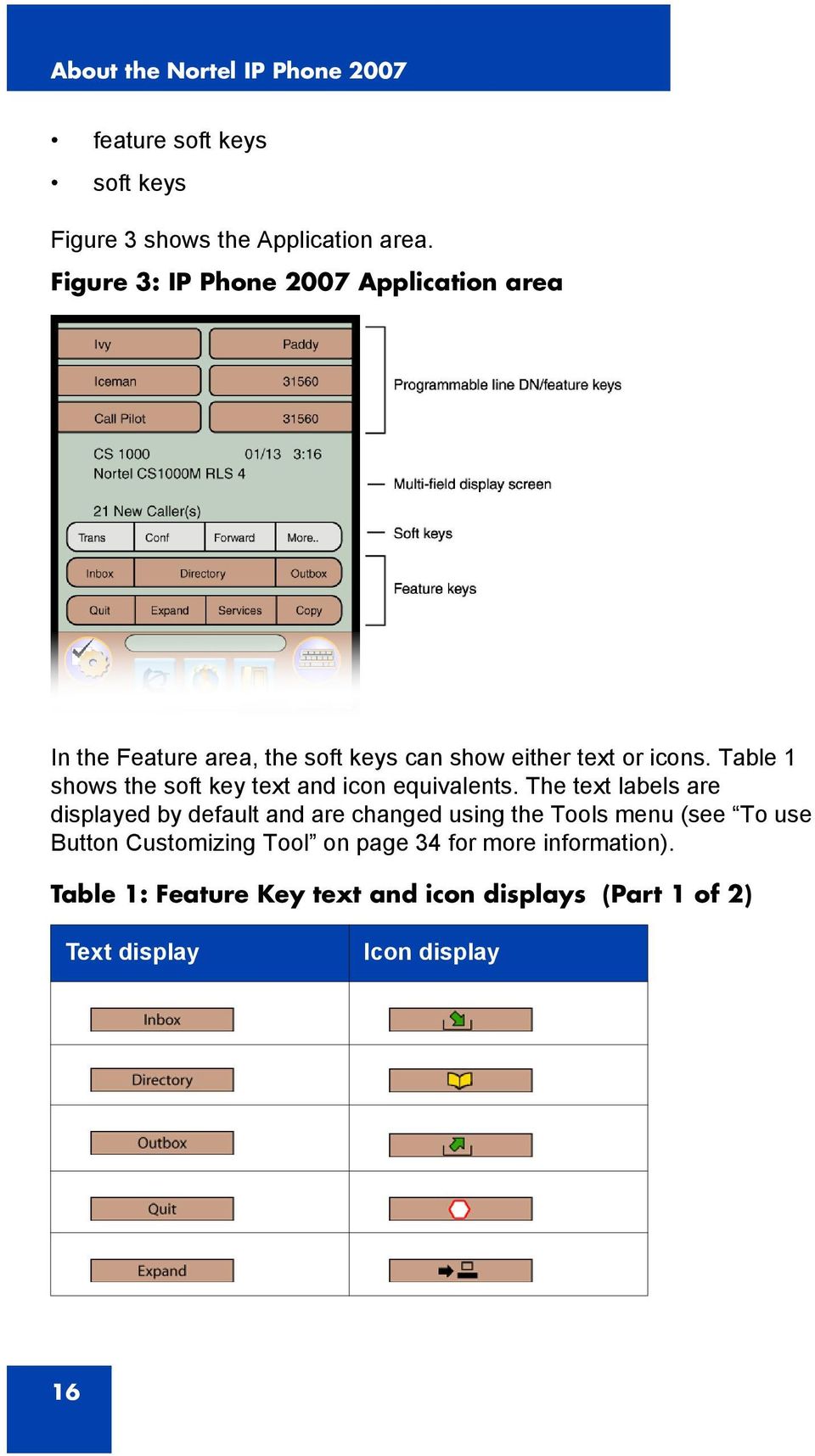
15 About the Nortel IP Phone 2007 The IP Phone 2007 window-based user interface has two display areas: Application area Tools/Navigation area Figure 2 shows an example of an idle LCD display screen. Figure 2: IP Phone 2007 LCD display screen Note: The display can differ from the above example. To extend the life of the LCD panel, the panel goes dark ( sleeps ) after a configured period of time. See To use Contrast and Brightness on page 30 for information on configuring the time before the telephone sleeps. Application area The Application area provides: line and feature soft key status information items such as caller number, caller name, feature prompt strings, user-entered digits, date and time information, and set information 15

16 About the Nortel IP Phone 2007 feature soft keys soft keys Figure 3 shows the Application area. Figure 3: IP Phone 2007 Application area In the Feature area, the soft keys can show either text or icons. Table 1 shows the soft key text and icon equivalents. The text labels are displayed by default and are changed using the Tools menu (see To use Button Customizing Tool on page 34 for more information). Table 1: Feature Key text and icon displays (Part 1 of 2) Text display Icon display 16
17 About the Nortel IP Phone 2007 Table 1: Feature Key text and icon displays (Part 2 of 2) Text display Icon display Tools/Navigation area The Tools/Navigation area provides controls for navigating between features and selecting tools. This area is visible and functional at all times. Figure 4 on page 17 shows the Tools/Navigation area. Figure 4: IP Phone 2007 Tools/Navigation area The Tools/Navigation area has five main elements presented as touchable soft keys: Tap this icon to determine which external graphical applications are registered (for example, My CallPilot), and launch them by tapping on the appropriate icon. Tap this icon to access the Telephone screen. 17

18 About the Nortel IP Phone 2007 Tap this soft key to go to the primary graphical external application, as configured by the administrator. The soft key displays the icon of the primary graphical application. Tap this icon to access the following tools used on the IP Phone 2007: Network Configuration Local Diagnostics Touch Panel Setup Contrast and Brightness USB Devices TFTP Upgrade Preferences Tap this icon to display a virtual keyboard (pop-up keyboard) for text entry. The pop-up or USB keyboards can be used to enter text in some of the applications. See Enter and edit text on page 23 for further information. Touch panel You perform point-and-click operations on your IP Phone 2007 using the touch panel. The touch panel is used with the graphical user interface (GUI) to present soft keys directly on the display. You can activate all Line/DN soft keys and feature soft keys by using the touch panel. See Cleaning the Telephone Screen on page 19 for important information. 18

19 About the Nortel IP Phone 2007 Calibrate the touch panel You calibrate the touch panel through the Tools menu, which enables you to fine-tune the touch panel. You are prompted to use the stylus to tap three targets. See To use Touch Panel Setup tool on page 29 for further information. Stylus You operate the touch panel using a stylus or your finger. However, use of a stylus is recommended to avoid damage to the touch panel. Cleaning the Telephone Screen Hold down the Goodbye key, and then gently wipe the telephone screen with a soft, dry cloth. CAUTION Do not use any liquids or powders on the telephone. Using anything other than a soft, dry cloth can contaminate telephone components and cause premature failure. Call features and Flexible Feature Codes System administration is required for call features and Flexible Feature Codes (FFCs). Contact your system administrator to configure these features and codes on your telephone. The Call features and FFCs must be assigned to your telephone and supported by system software. Security features The following security features are available on your IP Phone 2007: Secure communication Managing your Station Control Password (SCPW) 19

20 About the Nortel IP Phone 2007 Secure Communication Your IP Phone 2007 supports secure communication using SRTP and a Pre-Shared Key (PSK) media encryption feature. If the feature is enabled, a security icon (:) appears on the screen when your call is secured using SRTP (PSK). Contact your system administrator to find out if this feature is enabled on your phone. Managing your Station Control Password (SCPW) Your Station Control Password (SCPW) enables the following security features: Electronic Lock to prevent others from making calls from your telephone. Password-protected telephone features (for example, Personal Directory, Callers List, and Redial List). Your initial SCPW is defined by your system administrator. Please contact your system administrator for detailed information. To change your SCPW 1. Tap the Services soft key. 2. Press the Up/Down keys to scroll and highlight Password Admin. 3. Tap the Select soft key. 4. Use the dialpad to enter your password at the prompt. 5. Press the Up/Down keys to scroll and highlight New Password. 20

21 About the Nortel IP Phone Tap the Select soft key. 7. Use the dialpad to enter the new password. 8. Tap the Select soft key to accept the new password. Note: If you are locked out of your IP Phone 2007 or forget your SPCW, contact your system administrator. To turn Password Protection On/Off Note: 1. Tap the Directory soft key. 2. Press the Up/Down navigation keys to scroll and highlight Change Protection Mode. 3. Use the dialpad to enter your password (if Password Protection is enabled). 4. Tap the Enter soft key. 21
22 About the Nortel IP Phone Press the Up/Down navigation keys to scroll and highlight one of the following: Enable Password Protection Disable Password Protection or 6. Choose one of the following: Yes to accept the selection. No to return to the Directory menu. 7. Tap the Done soft key. 22
23 Enter and edit text Enter and edit text You can enter and edit text on your IP Phone 2007 using the following methods: telephone dialpad soft keys pop-up keyboard USB keyboard (optional) The use of any of these methods for text entry depends on the application. Table 2 shows the applications and input devices that can be used for text entry: Table 2: Application Text Entry For: Call Server related applications (for example, changing feature key labels, adding personal directory entries or for dialing) Graphical applications Tools menu Use: Dialpad Pop-up or USB keyboard for numeric entries only Pop-up or USB keyboard Pop-up or USB keyboard Dialpad for numeric entries Enter text using the telephone dialpad You use the dialpad to enter text when you use features such as programming an AutoDial soft key. For example, to enter the letter A, press the number 2 key once. To enter the letter C, press the number 2 key three times. Note: No letters are associated with the number 1 or the number 0 key. 23
24 Enter and edit text When entering IP addresses with the dialpad, the address is entered as xxx*xxx*xxx*xxx, and the telephone translates this to xxx.xxx.xxx.xxx. Edit text using the soft keys You use soft keys to access text when you work with such applications as Personal Directory, Redial List, and Callers List. Table 3 describes the soft key editing functions on the IP Phone Table 3: Editing soft key description Soft key Cancel Choose Clear Case Delete Done/Select/Enter More Description Stop the current action.. Select a symbol. Clear the input field. Switch the next character to either uppercase or lowercase. Backspace one character. Depends on application. Access additional soft keys. Enter text using the pop-up keyboard A full uppercase and lowercase keyboard and a number pad are available to enter text. The user can type on the keyboard with the stylus. The pop-up keyboard can be used to enter text in the tools and graphical applications. For number entry in telephone applications (for example, when dialing), the keyboard can be used to enter digits (0 9), as well as star (*) and pound (#). Other characters are ignored. 24
25 Enter and edit text Enter text using the USB keyboard The USB keyboard, when connected, can be used to enter text in the tools and graphical applications. For number entry in telephone applications (for example, when dialing), the keyboard may be used to enter digits (0 9), as well as * and #. Other characters are ignored. When on a call, the function keys (f1, f2, f3, f4, f5, f6, f7, and f8) can be used to control the telephone. Table 4 shows the function keys and their associated action during telephone calls. Table 4: USB keyboard function keys during telephone calls Function key f1 f2 f3 f4 f5 f6 f7 f8 Action Go to Handsfree mode Go to Headset mode Place the current call on Hold Mute the current call Volume Up Volume Down Copy Quit 25
26 Connect the IP Phone 2007 components Connect the IP Phone 2007 components Before you begin CAUTION Damage to Equipment Do not plug the IP Phone 2007 into a regular telephone jack. This results in severe damage to the IP Phone. Consult your system administrator to ensure that you plug your set into a 10/100BaseT Ethernet jack. Steps 1. Connect one end of the handset cord to the handset jack (identified with a handset icon) on the back of the telephone. Connect the other end to the jack on the handset. 2. Choose one of the following connections: a. For a telephone not sharing LAN access with a PC, connect one end of the CAT5 line cable to the LAN Ethernet port located on the back of the telephone (identified with a LAN icon). Plug the other end of the CAT5 line cable into the IP network. b. For a telephone sharing LAN access with a PC, connect one end of the CAT5 line cable to the LAN Ethernet port located on the back of the telephone (identified with a LAN icon) and the other end to the IP network. Insert a second CAT5 line cable into the PC Ethernet port located on the back of the telephone (identified with a PC icon) and the other end into the Ethernet port of the computer. 26
27 Connect the IP Phone 2007 components 3. Contact your installation technician for the proper power option. This telephone can be powered by an optional AC adapter or using Power over Ethernet. WARNING If using an AC adapter, you must use the IP Phone 2007 Global Power Adapter (part number N ) or your phone will fail to operate. 4. Thread the cord around the strain relief, retaining hook, and channel provided for a secure power connection. 5. Secure the telephone footstand to the telephone base. Use the angle grip on the top back of the telephone to change position. 6. Contact your system administrator for configuration instructions. Figure 5 shows connections on the IP Phone Figure 5: IP Phone connections 27
28 Configure IP Phone Local Options Configure IP Phone Local Options Your IP Phone 2007 has both local and server-based options. The local options cover the following entries in the Tools menu: Network Configuration Local Diagnostics Touch Panel Setup Contrast and Brightness USB Devices TFTP Upgrade Preferences Note 1: Many of the selections in the Tools menu are intended for system administrator use only. Note 2: If Password Protection is enabled on your IP Phone 2007, you are prompted for a password when you open the Tools menu. Entering text in the Tools menu items is easier with a USB keyboard. Use Network Configuration The Network Configuration displays the information that was configured when the telephone was installed. This tool is for administrator use only. See IP Phones: Description, Installation, and Operation ( ) for detailed instructions. Use Local Diagnostics The Local Diagnostic menu contains tools that are used to diagnose local problems. This menu is for administrator use only. See IP Phones: Description, Installation, and Operation ( ) for detailed instructions. 28
29 Configure IP Phone Local Options Use Touch Panel Setup The Touch Panel Setup tool calibrates the touch panel and stylus. Calibration is required when stylus taps are not interpreted correctly. To use Touch Panel Setup tool 1. Tap the Tools icon. 2. Tap the Touch Panel Setup soft key. The screen displays a calibration map, the CANCEL soft key is displayed, and the system prompts Touch the center of the red ball. 3. Using the stylus, tap each of the dots, in order, starting with the red dot in the lower-left portion of the screen, and following the sequence as prompted. 4. After the third dot is tapped, the display changes to indicate the result of the calibration. If the calibration is successful, the telephone reports Data calibration is CORRECT, prompts Save Data Calibration?, and displays the YES and NO soft keys, and calibration statistics. 29
30 Configure IP Phone Local Options Choose one of the following: Tap the YES soft key to save the calibration settings and exit to the main display. Tap the NO soft key to abandon the calibration settings and exit to the main display. 5. If the calibration is not successful, the telephone reports Data calibration is WRONG, prompts Repeat Calibration?, and displays the YES and NO soft keys, and calibration statistics. Choose one of the following: Tap the YES soft key to try the calibration again (starting at step 3). Tap the NO soft key to abandon the calibration and exit to the main display. Use Contrast and Brightness The Contrast and Brightness tools are used to alter the physical settings of the display. To use Contrast and Brightness 1. Tap the Tools icon. 2. Tap the Contrast and Brightness soft key. 30
31 Configure IP Phone Local Options 3. The screen displays: Contrast, and a set of Down and Up soft keys Brightness, and a set of Down and Up soft keys Sleep in xxx, where xxx is a time in minutes or hours, and a set of Down and Up soft keys. 4. To increase the display contrast, tap the Up soft key beside the Contrast label. 5. To decrease the display contrast, tap the Down soft key beside the Contrast label. 6. To increase the display brightness, tap the Up soft key beside the Brightness label. 7. To decrease the display brightness, tap the Down soft key beside the Contrast label. 31
32 Configure IP Phone Local Options 8. To increase the time before the display sleeps (goes black), tap the Up soft key beside the Sleep in label. The sleep time increases from the default, and provides settings for: 5m (five minutes) 15m (15 minutes) 30m (30 minutes) 1h (one hour default) 2h (two hours) Never (screen does not go black). Note: Extending the sleep time or never sleeping reduces the life span of the display screen. 9. To decrease the time before the display sleeps (goes black), tap the Down soft key beside the Sleep in label. The time decreases from the default, and provides settings for: Never (screen does not go black) 2h (two hours) 1h (one hour default) 30m (30 minutes) 15m (15 minutes) 5m (five minutes). 10. Tap the Exit soft key to exit to the main display. Changes are saved automatically. Use USB Devices The USB Devices menu provides information about the Universal Serial Bus (USB) devices plugged into the USB port in the back of the telephone. 32
33 Configure IP Phone Local Options To use USB Devices 1. Tap the Tools icon. 2. Tap the USB Devices soft key. The screen displays information about the device connected. 3. Tap the Exit soft key to exit to the main display. Use TFTP Upgrade The TFTP Upgrade menu is used to upgrade the firmware in the telephone. This menu is for administrator use only. See IP Phones: Description, Installation, and Operation ( ) for detailed instructions. 33
34 Configure IP Phone Local Options Use Preferences Configure individual user preferences using the Preferences tool. The Preferences menu contains the Button Customizing Tool and the Exit soft key. To use Button Customizing Tool 1. Tap the Tools icon. 2. Tap the Preferences soft key. 3. Tap the Button Customizing Tool soft key. Three columns appear, labelled Buttons, Icons, and Labels: Buttons Icons Labels _ 34
35 Configure IP Phone Local Options The boxes shown with a black outline are the current settings. 4. To change a soft key from displaying text to displaying the icon, tap the associated icon button. A black box appears around the icon. Example: to change the soft key labeled Inbox on the main display to the icon, tap the Inbox icon. 5. To change a soft key to display a custom label: a. Tap twice on the corresponding field in the Label column; a blinking cursor appears, and a black box appears around the label. b. Enter text by typing on the USB keyboard or virtual keyboard. c. Tap somewhere on the screen to stop editing the field. Note: The system truncates the label if the text does not fit into the display area of the soft key. 35
36 Configure IP Phone Local Options or or 6. Choose one of the following: To apply the changes, tap the Apply soft key. The system responds Saving is in progress and then Saving is complete. To abandon the changes, tap the Exit soft key. The system responds Save changes? and the Yes and No soft keys display. Choose one of the following: Tap the Yes soft key to save the changes. Tap the No soft key to abandon the changes and exit to the Preferences menu. 7. Tap the Exit soft key to return to the Preferences menu. To exit from the Preferences menu Tap the Exit soft key to return to the main display. 36
37 Configure services on the IP Phone 2007 Configure services on the IP Phone 2007 The IP Phone 2007 Services menu lists the following submenus: The Telephone Options menu enables you or your system administrator to configure telephone preferences. The Password Admin menu enables you or your system administrator to change the Station Control Password. The Virtual Office Login and Test Local Mode (for branch office) menus are listed when an IP Phone 2007 Class of Service is set for Virtual Office and branch office. For more information, see Virtual Office on page 122. Note: The Password Admin, Virtual Office Login, and Test Local Mode menus may not be available on your IP Phone Consult your system administrator. The Telephone Options menu offers the following menu options: Volume adjustment Contrast adjustment Language Date/Time Display diagnostics Local DialPad Tone Set Info Diagnostics Call Log Options Ring type Call timer OnHook default path Change FeatureKey label 37
38 Configure services on the IP Phone 2007 Name Display Format Note: When an option has a sublist, an ellipsis (...) appears after the option. In the Services menu, the current setting for options is marked with a telephone icon. Because this menu comes from the Call Server, use the Up/Down navigation keys for scrolling and tap the Select soft key. Use the Telephone Options menu To use the Telephone Options menu 1. Tap the Services soft key. 2. Press the Up/Down navigation keys to scroll and highlight Telephone Options. 3. Tap the Select soft key. 4. Press the Up/Down navigation keys to scroll and highlight an option (for example, Language ). 5. Tap the Select soft key. The display provides information required to adjust your selection. 38
39 Configure services on the IP Phone 2007 or 6. Choose one of the following: Tap the Select soft key to save changes and return to the Telephone Options menu. Tap the Cancel soft key to keep existing settings. Adjust volume To adjust the volume, tap the Services soft key, select Telephone Options, and select Volume adjustment from the menu. Choose one of the following: Ringer Handset listen Handsfree listen Headset listen Buzzer To adjust Ringer volume 1. Press the Up/Down navigation keys to scroll and highlight Ringer. 2. Tap the Select soft key. The phone rings. or 3. To increase or decrease the volume, choose one of the following: Tap the Up or Down soft keys. Press the Up/Down navigation keys. 39
40 Configure services on the IP Phone 2007 or 4. Choose one of the following: Tap the Select soft key to save the changes and return to the Telephone Options menu. Tap the Cancel soft key to keep existing settings. To adjust Handset listen volume 1. Press the Up/Down navigation keys to scroll and highlight Handset listen. 2. Tap the Select soft key. or 3. To increase or decrease the volume, choose one of the following: Tap Up or Down soft keys. Press the Up/Down navigation keys. or 4. Choose one of the following: Tap the Select soft key to save the changes and return to the Telephone Options menu. Tap the Cancel soft key to keep existing settings. 40
41 Configure services on the IP Phone 2007 To adjust the Handsfree listen volume 1. Press the Up/Down navigation keys to scroll and highlight Handsfree listen. 2. Tap the Select soft key. or 3. To increase or decrease the volume, choose one of the following: Tap the Up or Down soft keys. Press the Up/Down navigation keys. or 4. Choose one of the following: Tap the Select soft key to save the changes and return to the Telephone Options menu. Tap the Cancel soft key to keep existing settings. To adjust the Headset listen volume 1. Press the Up/Down navigation keys to scroll and highlight Headset listen. 2. Tap the Select soft key. 41
42 Configure services on the IP Phone 2007 or 3. To increase or decrease the volume, choose one of the following: Tap the Up or Down soft keys. Press the Up/Down navigation keys. or 4. Choose one of the following: Tap the Select soft key to save the changes and return to the Telephone Options menu. Tap the Cancel soft key to keep existing settings. To adjust the Buzzer volume 1. Press the Up/Down navigation keys to scroll and highlight Buzzer. 2. Tap the Select soft key. The buzzer sounds. or 3. To increase or decrease the volume, choose one of the following: Tap the Up or Down soft keys. Press the Up/Down navigation keys. 42
43 Configure services on the IP Phone 2007 or 4. Choose one of the following: Tap the Select soft key to save the changes and return to the Telephone Options menu. Tap the Cancel soft key to keep existing settings. Adjust display screen contrast There are two ways to adjust the display screen contrast: Services > Telephone Options menu Tools menu Telephone Options menu To adjust the LCD display screen contrast, tap the Services soft key, select Telephone Options, and select Contrast adjustment from the menu. To adjust display screen contrast or 1. To increase or decrease the display contrast level, choose one of the following: Tap the Up or Down soft keys. Press the Up/Down navigation keys. 43
44 Configure services on the IP Phone 2007 or 2. Choose one of the following: Tap the Select soft key to save the changes and return to the Telephone Options menu. Tap the Cancel soft key to keep existing settings. Tools menu The Tools menu method lets you adjust the contrast when the phone is not connected to a call server. See Use Contrast and Brightness on page 30 for the procedure. Select a language The display is available in multiple languages. The language for parts of the display are locally configured using the Tools menu, while others are configured through the call server. Telephone Options menu To choose a language, tap the Services soft key, select Telephone Options, and select Language from the menu. To select a language 1. Press the Up/Down navigation keys to scroll and highlight the desired language (for example, German [Deutsche]). 44
45 Configure services on the IP Phone 2007 or 2. Choose one of the following: Tap the Select soft key to save the desired language and return to the Telephone Options menu. Tap the Cancel soft key to keep existing settings. Tools menu Use the procedure described in Use Preferences on page 34 to change the language for the local labels of the graphical user interface. Select Date/Time format Several Date/Time formats are available. Formats are based on the 12-hour and 24-hour clocks. To select a date and time format, tap the Services soft key, select Telephone Options and choose Date/Time from the menu. To select date and time 1. Press the Up/Down navigation keys to scroll and highlight the desired format. Sample formats appear on the upperright side of the display area. or 2. Choose one of the following: Tap the Select soft key to save the format and return to the Telephone Options menu. Tap the Cancel soft key to keep existing settings. 45
46 Configure services on the IP Phone 2007 Display diagnostics The Display diagnostics option tests the telephone display screen and indicator lights.to access Display diagnostics, tap the Services soft key, select Telephone Options, and select Display diagnostics from the menu. To select Display diagnostics 1. Press the Up/Down navigation keys to scroll through the list to view display capabilities. or 2. Tap the Cancel or Quit soft key to return to the Telephone Options menu. Choose Local DialPad Tone The Local DialPad Tone option produces Dual-Tone Multi-Frequency (DTMF) sounds, a single tone, or no sound when you press a key on the dialpad. To choose a Local DialPad Tone, tap the Services soft key, select Telephone Options, and select Local DialPad Tone from the menu. To choose a Local DialPad Tone 1. Press the Up/Down navigation keys to scroll and highlight one of the following dialpad tones: None to disable all tones. Short Click to enable a single tone for all keys. DTMF to turn on a separate DTMF tone for each key. 46
47 Configure services on the IP Phone 2007 or 2. Choose one of the following: Tap the Select soft key to save the tone selection and return to the Telephone Options menu. Tap the Cancel soft key to keep existing settings. View telephone information The Set Info option displays the following: General Information Set IP Information Ethernet Information Server Information To view telephone information, tap the Services soft key, select Telephone Options, and select Set Info from the menu. To view telephone information 1. Press the Up/Down navigation keys to scroll through the list to view telephone information. 2. Tap the Cancel soft key to return to the Telephone Options menu. Diagnostics Choosing the diagnostics option in the Telephone Options menu presents the user with a screen that indicates the option is unsupported. The OK soft key is presented. 47
48 Configure services on the IP Phone 2007 Configure call log options Use the Call Log option to configure the following preferences: Incoming Calls Log Mode New Call Indication Preferred Name Match Area code setup Configure the Callers List log You can configure the Callers List to log all incoming calls or only unanswered calls. The default setting is Log all calls. To log only unanswered calls, tap the Services soft key, select Telephone Options, and select Call Log Options from the menu. To log only unanswered calls 1. Press the Up/Down navigation keys to scroll and highlight the Incoming Calls option. 2. Tap the Select soft key. 3. Press the Up/Down navigation keys to scroll and highlight the Log Mode option. 4. Tap the Select soft key. 48
49 Configure services on the IP Phone Press the Up/Down navigation keys to scroll and highlight Log unanswered calls. or 6. Choose one of the following: Tap the Select soft key to save the setting. Tap the Cancel soft key to keep existing settings. To log all calls 1. Press the Up/Down navigation keys to scroll and highlight the Incoming Calls option. 2. Tap the Select soft key. 3. Press the Up/Down navigation keys to scroll and highlight the Log Mode option. 4. Tap the Select soft key. 5. Press the Up/Down navigation keys to scroll and highlight Log All Calls. 49
50 Configure services on the IP Phone 2007 or 6. Choose one of the following: Tap the Select soft key to save the setting. Tap the Cancel soft key to keep existing settings. Configure New Call indication You can configure the IP Phone 2007 to display a message to indicate a new incoming call was received. The default setting is ON. To configure New Call indication, tap the Services soft key, select Telephone Options, and select Call Log Option from the menu. To configure New Call indication 1. Tap the Select soft key to select Incoming Calls. 2. Press the Up/Down navigation keys to scroll and highlight New Call Indication. 3. Tap the Select soft key. 4. Press the Up/Down navigation keys to scroll and highlight one of the following: New call indication:on New call indication:off 50
51 Configure services on the IP Phone 2007 or 5. Choose one of the following: Tap the Select soft key to save the setting. Tap the Cancel soft key to keep existing settings. Configure Preferred Name Match You can configure the IP Phone 2007 to display the name of the caller as defined in your Personal Directory. The default setting is OFF. To configure Preferred Name Match, tap the Services soft key, select Telephone Options, and select Call Log Option from the menu. To configure Preferred Name Match 1. Press the Up/Down navigation keys to scroll and highlight Preferred Name Match. 2. Tap the Select soft key. 3. Press the Up/Down navigation keys to scroll and highlight one of the following: Pref Name Match: On Pref Name Match: Off or 4. Choose one of the following: Tap the Select soft key to save the setting. Tap the Cancel soft key to keep existing settings. 51
52 Configure services on the IP Phone 2007 Configure Area Codes The Area Code Setup menu enables a user to save up to three area codes. When an incoming call arrives with an area code that matches one of the three stored area codes, the incoming call number is reordered to display the telephone number followed by the area code (as opposed to the area code followed by the telephone number). This reordering is also performed when a user scrolls through their Callers List. To configure an area code, tap the Services soft key, select Telephone Options, and select Call Log Option from the menu. To configure default area codes (three maximum) 1. Press the Up/Down navigation keys to scroll and highlight Area Code Setup. 2. Tap the Select soft key. 3. Press the Up/Down navigation keys to scroll and highlight one of the following: 1st Code: 2nd Code: 3rd Code: 4. Tap the Select soft key. 5. Use the dialpad to enter the new area code at the prompt. 52
53 Configure services on the IP Phone 2007 or 6. Choose one of the following: Tap the Select soft key to save the setting. Tap the Cancel soft key to keep the existing settings. To edit area code display 1. Press the Up/Down navigation keys to scroll and highlight Area Code Setup. 2. Tap the Select soft key. 3. Press the Up/Down navigation keys to scroll and highlight one of the following: 1st Code: 2nd Code: 3rd Code: 4. Tap the Select soft key. 5. Use the Clear soft key to clear the area code. 6. Use the dialpad to enter the new area code, using the Delete soft key to remove errors. 53
54 Configure services on the IP Phone 2007 or 7. Choose one of the following: Tap the Select soft key to save the setting. Tap the Cancel soft key to keep existing settings. Choose Ring type The Ring type option sets the telephone ring tone. To choose a ring type, tap the Services soft key, select Telephone Options, and select Ring type from the menu. To select a Ring type 1. Press the Up/Down navigation keys to scroll and highlight one of the ring types. 2. Tap the Play soft key to hear the ring tone. 3. Tap the Stop soft key to stop the tone. 4. Choose one of the following: Tap the Select soft key to save the ring type and return to the Telephone Options menu. Tap the Cancel soft key to keep existing settings. 54
55 Configure services on the IP Phone 2007 Enable Call Timer The Call Timer measures the length of each call. To enable Call Timer, tap the Services soft key, select Telephone Options, and select Call Timer from the menu. To enable Call Timer 1. Press the Up/Down navigation keys to scroll and highlight either: Call timer: Off Call timer: On or 2. Choose one of the following: Tap the Select soft key to save the setting and return to the Telephone Options menu. Tap the Cancel soft key to keep existing settings. Enable OnHook Default Path The OnHook Default Path option allows you to use a headset or the Handsfree feature to operate your IP Phone while it is on-hook.to enable OnHook Default Path, tap the Services soft key, select Telephone Options, and select OnHook Default Path from the menu. To enable OnHook Default Path 1. Select one of the following: Handsfree enabled Headset enabled 55
56 Configure services on the IP Phone 2007 or 2. Choose one of the following: Tap the Select soft key to save your choice. Tap the Cancel soft key to keep existing settings. Change feature soft key labels The Change FeatureKey label option renames the label displayed next to each feature soft key or restores the default labels to the soft keys (collectively or individually). To rename feature soft key labels, tap the Services soft key, select Telephone Options, and select Change FeatureKey labels from the menu. Note: If a feature soft key is configured as an autodial soft key, the label does not change if the AutoDial soft key configuration changes. To change a label 1. Tap the Select soft key. 2. Use the Up/Down navigation keys to scroll to highlight Change FeatureKey label. 3. Tap the Select soft key. 4. Tap the feature soft key to be changed. Note: If you tap a prime DN soft key, an error message displays. 56
57 Configure services on the IP Phone Enter the new information for the feature soft key label. For information about entering text, refer to Enter text using the telephone dialpad on page 23. Note: Press the key until the desired character is displayed, then wait until the cursor moves before entering the next character. Use the More.. soft key and the CASE or case soft keys to toggle between uppercase and lowercase. 6. To enter special characters, press the Up or Down navigation key to display several sets of special characters. Note: When choosing the special characters, use the navigation keys to move right or left, until the cursor is immediately before the desired character. or 7. Choose one of the following: Tap the Select soft key to save the changes and return to the Telephone Options menu. Tap the Cancel soft key to keep existing settings. 57
58 Configure services on the IP Phone 2007 Restore all the default labels To restore all feature soft key labels, tap the Services soft key, select Telephone Options, and select Change FeatureKey labels from the menu. 1. Tap the Select soft key. 2. Use the Up/Down navigation keys to scroll and highlight Restore all key labels. or 3. Choose one of the following: Tap Yes to change all feature soft keys to default values. Note: When labels are changed to default values, you cannot undo the change. The label settings must be re-entered. Tap No to exit without changing the soft keys. Restore one default label To restore one feature soft key label, tap the Services soft key, select Telephone Options, and select Change FeatureKey labels from the menu. 1. Tap the Select soft key. 58
59 Configure services on the IP Phone Use the Up/Down navigation keys to scroll and highlight Restore one key label. 3. Tap the Select soft key. 4. Tap the feature soft key. or 5. Choose one of the following: Tap Yes to change the feature soft keys to default values. Note: When a label is changed to default values, you cannot undo the change. The label setting must be re-entered. Tap No to exit without changing the soft key. Configure Name Display format You can configure the IP Phone 2007 to display the name of the incoming calling party in the following formats: first name, last name last name, first name To configure Name Display format, tap the Services soft key, and select Telephone Options. 59
60 Configure services on the IP Phone 2007 To configure Name Display format 1. Press the Up/Down navigation keys to scroll and highlight Name Display format. 2. Tap the Select soft key. 3. Press the Up/Down navigation keys to scroll and highlight one of the following: last name, first name first name, last name or 4. Choose one of the following: Tap the Select soft key to save the setting. Tap the Cancel soft key to keep existing settings. 60
61 Make a call Make a call This section describes features associated with making a call. There are several ways to make a call from an IP Phone Use Off-hook dialing 1. Lift the handset. 2. Dial the number. 3. To terminate the call, choose one of the following: Replace the handset into the cradle. Press the Goodbye key. Use On-hook dialing 1. Leave the handset in the cradle. 2. Tap the line (DN) soft key. 3. Dial the number when the dial tone sounds. 61
62 Make a call 4. When the called party answers, lift the handset. 5. To terminate the call, choose one of the following: Replace the handset into the cradle. Press the Goodbye key. Use Handsfree dialing Use Handsfree dialing to use a built-in microphone and speaker, or a headset, instead of the handset. While on an active call, you can switch between Handset and Handsfree mode. 1. Press the Handsfree key. 2. If a headset is connected, press the Headset key. 3. Dial the number. To discontinue a handsfree call Press the Goodbye key. 62
63 Make a call To mute a handsfree call 1. Press the Mute key. The LED indicator flashes. 2. Press the Mute key again to return to a two-way handsfree conversation. To switch from Handsfree mode to Handset mode Lift the handset. To switch from Handset mode to Handsfree mode 1. Press the Handsfree key. 2. Replace the handset. To use a headset 1. Connect the headset to the headset jack or the handset jack. 2. Press the Headset key. 63
64 Make a call To switch from Handsfree mode to Headset mode Press the Headset key. Use the Directory applications You can make calls using various Directory applications available on your IP Phone The applications include: Corporate Directory Personal Directory Callers List Redial List Make a call using Corporate Directory The Corporate Directory feature provides an alphabetical list of entries using last names. You can search by name, view additional information on each entry, and dial Corporate Directory numbers. To use Corporate Directory, tap the Directory soft key and select Corporate Directory. To search for a specific number 1. When prompted, use the dialpad to enter the desired name in the last name, first name format. 2. Tap the Search soft key to find the desired name. A list of all the matches displays. 64
65 Make a call 3. Press the Up/Down navigation keys to scroll and highlight a name in the Corporate Directory. 4. Choose one of the following: Tap the Dial soft key to dial the resulting number. If there is no match to the search query, start a new search or change the information in the initial search. Tap the Cancel soft key to exit without dialing. 65
66 Make a call Make a call using Personal Directory The Personal Directory feature allows you to store a maximum of 100 entries consisting of names and numbers. To use Personal Directory, tap the Directory soft key and select Personal Directory. For more information on how to configure and use Personal Directory, refer to Personal Directory on page 115. To use the Personal Directory 1. Press the Up/Down navigation keys to scroll and highlight a name in the Personal Directory. or 2. Choose one of the following: Tap the Dial soft key to dial the resulting number. Tap the Cancel soft key to exit without dialing. Make a call using Callers List The Callers List feature automatically stores up to a maximum of 100 callers. After 100 callers are stored, each additional caller overwrites the oldest entry. To use Callers List, tap the Directory soft key and select Callers List. For information on how to configure and use Callers List, refer to Callers List on page 118. To use the Callers List 1. Press the Up/Down navigation keys to scroll and highlight a name in the Callers List. 66
67 Make a call or 2. Choose one of the following: Tap the Dial soft key to dial the resulting number. Tap the Cancel soft key to exit without dialing. Make a call using Redial List The Redial List feature automatically stores a maximum of 20 previously dialed telephone numbers. To use Redial List, tap the Directory soft key and select Redial List. For information on how to configure and use Redial List, refer to Redial List on page 119. To use the Redial List 1. Press the Up/Down navigation keys to scroll and highlight a name in the Redial List. or 2. Choose one of the following: Tap the Dial soft key to dial the resulting number. Tap the Cancel soft key to exit without dialing. 67
68 Make a call Use Predial Use the Predial feature to enter, preview, and edit numbers before dialing. To use Predial 1. Without selecting the line soft key, enter the number to be dialed. 2. Tap a line soft key to dial the number. 3. Lift the Handset when the called party answers or, if in Handsfree mode, begin to speak. To edit a Predial number 1. Use the dialpad to enter the number. or 2. Choose one of the following: To erase all numbers, tap the Clear soft key. Re-enter the numbers to be dialed. To change numbers one at a time, tap the Delete soft key to backspace. Re-enter the number. 68
69 Make a call 3. Tap a line soft key to dial the number. Use AutoDial Use the AutoDial feature to display, store, and automatically dial telephone numbers. To store an AutoDial number 1. Without lifting the handset, tap the appropriate AutoDial soft key. Note: The display screen displays the word Autodial next to the appropriate soft key. 2. Using the dialpad, dial the telephone number (including access code) to be stored on the selected AutoDial soft key. 3. Tap the AutoDial soft key a second time to store the number on the selected soft key. Note: Once a number has been stored, the word Autodial disappears, and the stored number displays. 4. Assign a label to the soft key. Note: After the label is assigned, the number disappears and only the label appears on the screen next to the soft key. 69
70 Make a call To display an AutoDial number 1. Tap the Display soft key.telephone Options 2. Tap an AutoDial soft key in the upper display area to display the number associated with that soft key. To use AutoDial 1. Lift the handset. 2. Tap an AutoDial soft key in the upper display area to dial the number associated with that soft key. Activate Ring Again Use the Ring Again feature if you receive a busy tone, or if there is no answer. Your IP Phone rings when the person you called becomes available. Ring Again automatically redials the number. To activate Ring Again 1. Dial a number and receive a busy tone or no answer. 70
71 Make a call 2. Choose one of the following: Tap the Ring Again soft key. Enter the Ring Again Activate FFC. To call a Ring Again party when you receive notification 1. After receiving the notification ring, lift the handset, or if you are using the headset, go to Step Tap the Ring Again soft key to automatically dial the number. To deactivate Ring Again before notification Choose one of the following: Tap the Ring Again soft key a second time. Enter the Ring Again Deactivate FFC. 71
72 Make a call Redial the last number called Use the Last Number Redial feature to automatically redial the last dialed number. To use Last Number Redial Choose one of the following: 1. To redial using the handset: a. Lift the handset. b. Tap the line (DN) soft key. 2. To redial without lifting the handset, tap the line (DN) soft key twice (the last number dialed is automatically redialed). Use Speed Call Use the Speed Call feature to place internal and external calls by dialing a one-, two-, or three-digit code to store, edit, and automatically dial frequently called telephone numbers. To store a Speed Call number 1. Tap the Speed Call Controller soft key. The triangular icon flashes, indicating programming mode. 2. At the prompt: Enter a one-, two-, or three-digit code (0-999). If required, dial the access code. 72
73 Make a call 3. Tap the Speed Call Controller soft key again to save the code and number. The flashing icon turns off. To make a Speed Call 1. Lift the handset. 2. Tap the Speed Call Controller soft key. 3. Dial the Speed Call code to automatically dial the number. Make a System Speed Call Use the System Speed Call feature to dial Speed Call codes that override dialing restrictions placed on your telephone. To make a System Speed Call 1. Lift the handset. or 2. Choose one of the following: Tap the System Speed Call (SScUsr) soft key. Tap the System Speed Call Controller (SScCtl) soft key. 73
74 Make a call 3. Dial the Speed Call code to automatically dial the number. Make a call using Hot Line Use the Hot Line feature to automatically dial a specific number. To use Hot Line Tap the Hot Line soft key to automatically dial the number. Make an Intercom call Use the Intercom feature to call a member of your intercom group by tapping the code assigned to each member. To make an Intercom call 1. Lift the handset. 2. Tap the Intercom soft key. 3. Dial the one- or two-digit code for the desired intercom group member. 74
75 Make a call To answer an Intercom call while on a line other than your Intercom group line 1. Choose one of the following keys: Press the Hold key to put the current call on hold. Press the Goodbye key to end the call. 2. Tap the Intercom soft key and begin to speak. 75
76 Answer a call Answer a call Each incoming call causes the telephone to ring, the line/dn soft key to flash and show a, and the Message Indicator lamp to flash. To answer a call Choose one of the following: Lift the handset. Press the Handsfree button located on the left side of the handset. Tap the line (DN) soft key beside the LCD indicator as it flashes. Press the Headset key if a headset is connected to your telephone. 76
77 While on an active call While on an active call This section describes features available during an active call. Place a call on hold Use the Hold feature when talking on one line and another call arrives on a second line. Retain the original call by putting it on hold, and then answer the second call. To place a call on hold Press the Hold key. The LCD indicator flashes beside the line on hold. Note: If Automatic Hold is enabled, the active call is automatically put on hold when you answer the second call. To retrieve a call on hold Tap the flashing line (DN) soft key. Transfer a call Use the Transfer feature to redirect a call to the appropriate person. To use the Transfer feature to direct a call to a third party 1. Tap the Transfer soft key. The other party is put on hold and a dial tone sounds. The LCD indicator light flashes steadily. 77
78 While on an active call 2. Dial the DN number to which the call is to be transferred, or use Personal Directory, Redial List, or Callers List to select a number to dial. 3. When that number rings or a person answers, tap the Transfer soft key to connect the calling party. To return to the original call if the transfer is incomplete If the person called is not available, tap the line (DN) soft key (next to the LCD indicator) to reconnect to the original call. Use Timed Reminder Recall Use the Timed Reminder Recall feature to receive a reminder tone when a transferred call is not answered. To use Timed Reminder Recall 1. Tap the Transfer soft key. The call is put on hold. 2. Dial the number to which the call is being transferred. 78
79 While on an active call 3. Choose one of the following to start the call timer: Tap the Transfer soft key. Replace the handset before the extension answers. Note: If the transfer is complete, the recall timer stops. If the transferred call is not answered, your telephone rings 1. Lift the handset to reconnect to the original caller. 2. Choose one of the following: Tap the Transfer soft key and repeat the transfer. If the transfer is picked up while you are on the line, press the Goodbye key to complete the transfer. 79
80 While on an active call Use Attendant Recall Use the Attendant Recall feature to contact an attendant during a call and to connect the call to the attendant. To contact the attendant while on a call 1. Tap the Attendant Recall soft key and stay on the line until the attendant answers. 2. Press the Goodbye key. The caller remains connected to the attendant. Use Call Park Use the Call Park feature to hold temporarily (park) and retrieve a call from any telephone. Using Call Park does not tie up a line. When configured network-wide, Call Park can be used across networks. A System Park Extension can be set to automatically park most calls. To park a call on the System Park DN or your own DN During an active call, tap the Park soft key twice. Note: By default, the call is parked on your DN, unless a System Park is enabled to automatically park calls on the system. 80
81 While on an active call To park a call on a DN other than the System Park DN or your own DN 1. Tap the Park soft key. 2. Dial the DN where you want to park the call. 3. Tap the Park soft key. To park a call using the SPRE code or FFC or 1. Choose one of the following: Tap the Transfer soft key. Tap the Conference soft key. 2. Dial the Call Park FFC. 3. To use an alternate DN from the System Park DN or your own DN, dial the DN where you want to park the call. Otherwise, proceed to Step 4. or 4. Choose one of the following: Tap the Transfer soft key. Tap the Conference soft key. 81
82 While on an active call To retrieve a parked call 1. Lift the handset. 2. Tap the Park soft key. 3. Dial the DN where you parked the call. Note: If a parked call is not retrieved within a specified period of time, it rings back to your telephone or to the attendant. Record a Calling Party Number Use the Calling Party Number feature to record a caller s number, or to charge a call to an account number, during an established call. To record a caller s number for accounting purposes 1. Tap the Call Party soft key. The caller is placed on hold. 2. Dial a charge account number or the caller s number. Note: For information on using the Charge soft key, see Charge a call or charge a forced call on page Tap the Call Party soft key to return to the call. 82
83 While on an active call Display incoming calls Use the Display feature to display a second incoming caller s number and name (if available) during an active call, without interfering with the call in progress. To view the information on an incoming call while on a call in progress 1. Tap the Display soft key. 2. Tap the flashing line (DN) soft key. The call waiting information displays. Note: When used with other feature soft keys, the Display soft key displays information associated with those feature soft keys. Trace a Malicious call Use the Malicious Call Trace feature to trace nuisance calls within your system. Note: This is not a default feature. Contact your system administrator to configure this feature on your telephone. To use Call Trace while on a call Tap the Call Trace soft key. 83
84 While on an active call To use Call Trace without a Call Trace soft key or 1. Choose one of the following: Tap the Transfer soft key. Tap the Conference soft key. 2. Dial the SPRE code followed by 83 or dial the Call Trace FFC to automatically reconnect. 84
85 Incoming calls Incoming calls This section describes features used with incoming calls. Activate Automatic Answerback When the Automatic Answerback feature is active, your set automatically answers in Handsfree mode after one ring; however, calls are not forwarded to the voice message service. To activate Automatic Answerback Tap the Automatic Answerback soft key. To deactivate Automatic Answerback Tap the Automatic Answerback soft key again. Activate Call Pickup Use the Call Pickup feature to pick up calls from any telephone in the same pickup group or another pickup group. To answer a call in your own call pickup group 1. Lift the handset. 85
86 Incoming calls 2. Choose one of the following: Tap the Pickup soft key. Enter the Pickup Ringing Number FFC. To answer an incoming call in another call pickup group 1. Lift the handset. 2. Tap the Group Pickup soft key or enter the Pickup Group FFC. 3. Dial the pickup group number of the ringing telephone. 86
87 Incoming calls To answer a call at a specific extension in any pickup group 1. Lift the handset. 2. Choose one of the following: Tap the DN Pickup soft key. Enter the Pickup Directory Number FFC. 3. Dial the DN of the telephone that is ringing (in your call pickup group). If the pickup DN or group number is invalid (an overflow burst tone sounds and the screen displays Goodbye and try again), press the Goodbye key. Use Call Waiting The Call Waiting feature alerts you to an incoming call by producing a tone. It also puts the current call on hold while you answer the new call. To answer an incoming call while on another call (Hold) 1. When the incoming call tone sounds, press the Hold key to put a current call on hold. Note: If Automatic Hold is enabled, it is not necessary to press the Hold key. 2. Tap the Call Waiting soft key. 87
88 Incoming calls To return to the first telephone call 1. Choose one of the following: Press the Hold key to put the second call on hold. Press the Goodbye key to end the second call. 2. Tap the line (DN) soft key associated with the first call. If you do not have a Call Waiting soft key 1. Press the Goodbye key to end the current call. 2. Tap the flashing fine (DN) soft key to answer the incoming call. 88
89 While away from your desk While away from your desk This section describes features to use when you are away from your desk. Use Call Forward Use the Call Forward feature to direct incoming calls to ring on another line (DN). If the telephone is in the process of ringing, the call cannot be forwarded. To forward your calls or change the forward number 1. Choose one of the following: Tap the Forward soft key. Lift the handset and enter the Call Forward All Calls Activate FFC. 2. Dial the DN where you want to forward your calls. 3. Tap the Forward soft key. To deactivate Call Forward Choose one of the following: Tap the Forward soft key. Lift the handset and enter the Call Forward All Calls Deactivate FFC. 89
90 While away from your desk To reinstate Call Forward to the same number Tap the Forward soft key twice. Use Internal Call Forward Use Internal Call Forward to accept only calls originating at internal DNs to ring at another DN. Calls originating outside your telephone system still ring at your telephone. Current incoming calls cannot be forwarded. To forward internal calls 1. Choose one of the following: Tap the Internal Call Forward soft key. Lift the handset and enter the Internal Call Forward Activate FFC. 2. Dial the DN to which your internal calls will be forwarded. 3. Tap the Internal Call Forward soft key. 90
91 While away from your desk To deactivate Internal Call Forward Choose one of the following: Tap the Internal Call Forward soft key. Lift the handset and enter the Internal Call Forward Deactivate FFC. To reinstate Call Forward to the same number Tap the Internal Call Forward soft key twice. Use Remote Call Forward Use the Remote Call Forward feature to forward calls (from any telephone other than your own) to any telephone. To activate Remote Call Forward 1. Lift the handset. 2. If calling from a telephone outside the system, dial your direct system access number and wait for dial tone. 3. Dial the Remote Call Forward Activate FFC to activate the feature. 91
92 While away from your desk 4. Dial your Station Control Password. A dial tone sounds. 5. Choose one of the following: Dial your DN. To forward calls to the previous call forward telephone number, press the # key. (Do not perform steps 6 and 7.) 6. Dial the number to which calls are being forwarded. If calls are forwarded to an invalid number, a fast busy signal sounds. 7. Press the # key. To deactivate Remote Call Forward 1. Lift the handset. 2. If calling from a telephone outside the system, dial the direct system access number and wait for the dial tone. 3. Dial the Remote Call Forward Deactivate FFC. 92
93 While away from your desk 4. Dial your Station Control Password. 5. After hearing the dial tone, dial your DN. 6. Press the # key. Secure your telephone Use the Electronic Lock feature to prevent others from making calls from your telephone. The Electronic Lock feature is controlled using your Station Control Password (SCPW). To change your Station Control Password, refer to Security features on page 19. To lock your telephone 1. Lift the handset. 2. Dial the Electronic Lock Activate FFC. 3. Dial your Station Control Password. 93
94 While away from your desk 4. Choose one of the following: If dialing locally, press the Goodbye key. If dialing the FCC remotely, dial your DN. To unlock your telephone 1. Lift the handset. 2. Dial the Electronic Lock Deactivate FFC. 3. Dial your Station Control Password. 4. Choose one of the following: If dialing locally, press the Goodbye key. If dialing the FCC remotely, dial your DN. 94
95 Talk with more than one person Talk with more than one person This section describes features that enable conversations between more than two people. Use the Call Join feature Use the Call Join feature to connect a call to a current active call. This creates a conference between the two callers and yourself. To connect a call on hold (on a different line) to your current call 1. Tap the Conference soft key. 2. Tap the line soft key that has the number of the caller you want to connect to your current call. 3. Tap the Conference soft key to add the person on hold to your conversation. 95
96 Talk with more than one person Set up a Conference call Use the Conference feature to set up a conference call for three or six people including yourself. The number of people the conference feature supports depends on your telephone configuration. To set up a conference call 1. While on a call, tap the Conference soft key to place the party on hold. You receive dial tone. 2. Dial the number of the person you want to add to the conference call. You can talk privately to the person you are adding at this time. Note: If you tap the Directory soft key, you can also use Corporate Directory or Personal Directory, Redial List, and Callers List to find and dial the number of the person you want to add to the conference call. 3. Tap the Conference soft key a second time to conference all parties together. 96
97 Talk with more than one person If the person you attempt to add to the conference is unavailable 1. Press the Goodbye key. 2. Tap the line (DN) soft key with the flashing status icon to return to your original call. Use the Conferee Selectable Display and Disconnect feature Use the Conferee Selectable Display feature to list active conferees and disconnect a conferee from the conference call. To view active conferees 1. While on a conference call, tap the Conferee Selectable Display soft key to turn on the LCD indicator. Each tap changes the screen to show a different active conferee. Note: This action has no effect on the display of other telephones involved in the conference. 2. Press the Goodbye key. If configured, the Conference Count Display returns an updated total count of conferees. The LCD indicator turns off. 97
98 Talk with more than one person To disconnect a conferee 1. While on a conference call, tap the Conferee Selectable Display soft key until the conferee you want to disconnect appears on the screen. 2. Tap the DN soft key on which the conference call is established. 3. Choose one of the following: For a single conferee, press the Goodbye key. If configured, the Conference Count Display returns an updated total count of conferees. The LCD indicator turns off. For multiple conferees, repeat steps 1 and 2 until all conferees are disconnected. Then press the Goodbye key. Use Group Call Use the Group Call feature to automatically call members of a predefined group, one at a time, until they all answer. To call group members 1. Lift the handset. 98
99 Talk with more than one person 2. Tap the Group Call soft key or enter the Group Call FFC. The feature automatically calls all group members. The icon flashes until all members answer. The telephone numbers of the group members appear on the display as they answer. When the last person answers, the Group Call indicator lights steadily. When parties in your group are on a conference call or another group call, they are not connected to your group call. After everyone in the group has answered, only the person who made the group call can put the call on hold. To answer a group call 1. Lift the handset. Note the following about notification tones: If you are on a call and receive three ten-second tones, a group call is on your current extension. If you are on a call on another line when a group call is made, you receive a long tone through the handset or speaker. If you are already on a conference call or another group call, you do not receive notification of a group call. 99
100 Talk with more than one person To end a group call Press the Goodbye key. Note: When the person who made the group call disconnects, the call terminates for all members of the group. However, the members of the group call can disconnect from the call without affecting other members on the call. 100
101 Work without interruption Work without interruption This section describes features that provide uninterrupted work time. Activate Make Set Busy Use the Make Set Busy feature to make your telephone appear busy to all callers. To activate Make Set Busy Choose one of the following: Tap the Make Set Busy soft key. Lift the handset and enter the Make Set Busy Activate FFC. To deactivate Make Set Busy Choose one of the following: Tap the Make Set Busy soft key a second time to deactivate the feature. Lift the handset and enter the Make Set Busy Deactivate FFC. 101
102 Additional call features Additional call features Contact your system administrator to determine if the following call features are available on your telephone. Use AutoDial Transfer Use the AutoDial Transfer feature to transmit digits through your AutoDial soft key to the Central Office after a Trunk Switchhook Flash. You must be on a Central Office/Exchange (CO) trunk call from or to a Central Office (CO) that offers Centrex or exchange line-type features. To use AutoDial Transfer when picking up an incoming trunk call 1. Tap the Centrex Switchhook Line Flash soft key and wait for interrupted dial tone. 2. Tap the AutoDial soft key to call the number desired. 3. Press the Goodbye key to end the call. 102
103 Additional call features Use the Buzz signal Use the Buzz feature to notify another person of a call, a visitor, or a request. Two telephones linked together enable one person to signal the other. The person signaled hears a buzz. To buzz the telephone linked to your telephone Tap the Buzz soft key. The telephone linked to your telephone buzzes as long as you hold the soft key. Use Call Page Connect to make an announcement Use the Call Page Connect feature to make an announcement over a paging system. Note: A Page soft key on an attendant console overrides and disconnects the telephones. The telephones must re-access the page trunk. To connect to Call Page 1. Lift the handset. 2. Dial the Page Trunk Access Code to complete the connection to the page system. 3. Make your announcement. 4. Press the Goodbye key. 103
104 Additional call features Use Centrex/Exchange Line Switchhook Flash Use the Centrex/Exchange Line Switchhook Flash feature during an established call to use a Centrex service, such as Call Transfer or Three- Way Calling. To use Centrex/Exchange Line Switchhook Flash 1. While on a call, tap the Centrex Line Switchhook Flash soft key. A special dial tone sounds. 2. Dial the codes for your custom Centrex feature. 3. Press the Goodbye key to end the call. Charge a call or charge a forced call Use the Call Charge feature to charge a call to a specific account. The Forced Charge feature charges long-distance calls from a telephone restricted to local calls. To charge a local or long-distance call to an account before you dial 1. Lift the handset. 2. Tap the Charge soft key or dial the Call Detail Recording FFC. 104
105 Additional call features 3. Dial the charge account number. 4. When the dial tone sounds, dial the number. To charge a call in progress or 1. Choose one of the following: Tap the Transfer soft key. Tap the Conference soft key. 2. Choose one of the following: Tap the Charge soft key. Dial the Call Detail Recording FFC. 3. Dial the charge account number. 4. Tap the line (DN) soft key to return to the call. 105
106 Additional call features To charge a call to an account when you transfer a call 1. Tap the Transfer soft key. The call is placed on hold. 2. Choose one of the following: Tap the Charge soft key Dial the Call Detail Recording FFC. 3. Dial the charge account number. 4. After the dial tone, dial the number to where the call is to be transferred. 5. Tap the Transfer soft key when you hear the telephone ring. Note: You can talk privately to the person at the transfer number before you tap the Transfer soft key. To charge a call to an account when you add someone to a conference call 1. Tap the Conference soft key. The call is placed on hold. 106
107 Additional call features 2. Choose one of the following: Tap the Charge soft key. Dial the Call Detail Recording FFC. 3. Dial the charge account number. 4. Dial the number of the person you want to add to the conference. 5. Tap the Conference soft key. Use Enhanced Override Use the Enhanced Override feature to override an active call after you attempt a Forced Camp-on (see Use Forced Camp-on feature on page 108). Use Enhanced Override to make a simple call or a consultation call, such as placing a call on hold and calling another party. To use Enhanced Override You receive a busy signal after dialing a telephone number. 107
108 Additional call features 1. Choose one of the following: Tap the Override soft key. Enter the Override FFC to initiate a Forced Camp-on. If either person on the call disconnects at this time, you receive an overflow (fast busy/engaged) signal. 2. Choose one of the following: Tap the Override soft key again. Enter the Override FFC again. The other two persons on the call receive an override tone and a conference call is established between the three of you. If anyone disconnects, the other two persons remain connected. 3. To terminate the call, press the Goodbye key. Use Forced Camp-on feature Use the Forced Camp-on feature to automatically ring another telephone (internal or external) immediately after that telephone disconnects from its current call. To use Forced Camp-on You receive a busy signal after dialing a telephone number. 108
109 Additional call features 1. Choose one of the following: Tap the Override soft key. Enter the Override FFC, to initiate a Forced Camp-on. Note: The person you called receives a tone. You receive a ring/ringback or a busy/engaged signal, depending on the options chosen. You are now camped-on to the number you dialed. 2. Hang up the telephone. 3. When the person you called finishes the existing call, your telephone automatically dials the number and both telephones ring. Answering a call camped-on to your extension When your telephone rings, lift the handset. Note: You can program your telephone for either Camp-on or Call Waiting, but not both. 109
110 Additional call features Override a busy signal Use the Override feature to override a busy signal and interrupt another call. To override a busy/engaged signal 1. Dial a telephone number and receive a busy signal. 2. Choose one of the following: Tap the Override soft key. Enter the Override FFC. The people in the targeted call receive a tone for approximately one second. After Override feature joins you to their call, a short tone repeats every 16 seconds. 3. To terminate the call, press the Goodbye key. Use Privacy Release Use the Privacy Release feature to enable one or more people who share your DN to join a call. To use Privacy Release in an established state Tap the Privacy Release soft key during a call. Parties join the call by tapping the shared number (DN) soft key on their telephones (Multiple Appearance DN feature). 110
111 Additional call features Use Radio Page Use the Radio Page feature to page a person and stay on the line until that person answers. The paged person answers the call after entering a special Page Meet-me code from any telephone. To use Automatic Preselection (Meet-me page) 1. Lift the handset. 2. Dial the Radio Paging Access FFC. The paging tone sounds (two beeps followed by a dial tone). 3. Dial the number of the party you want to page. After dialing, the ringback tone sounds. Note: The paged person can use any telephone to enter a Radio Paging Answer FFC, plus their own DN number. 4. If your call goes unanswered for a preset time period, and a 15-second highpitched tone sounds followed by silence, press the Goodbye key or replace the handset. To use Automatic Post selection 111
112 Additional call features The called party is either busy on the telephone or away from the telephone. To page the called party, there is no need to redial the number of the called party. 1. Tap the Radio Page soft key. A special dial tone sounds. 2. Dial the Radio Paging Access FFC. The ringback tone sounds. Note: The paged parties can use any telephone to enter a Radio Paging Answer FFC, plus their own DN number. 3. If your call goes unanswered for a preset time period, and a 15-second highpitched tone sounds followed by silence, press the Goodbye key or replace the handset. 112
113 Additional call features To answer a Radio Page If you carry a Radio Pager, a page indicates that someone dialed your DN. If the Radio Page system is set up to function in Meet-me mode, you can answer the page call from any telephone. 1. Lift the handset. 2. Dial the Radio Page Answer FFC. The paging tone sounds. 3. Dial your own DN to connect to the paging caller. If the caller has hung up, a steady high-pitched (Number Unavailable) tone sounds. Use Voice Call Use the Voice Call feature to page another person or make an announcement through someone else s telephone speaker. To make a voice call 1. Lift the handset. 2. Tap the Voice Call soft key and make the announcement. 3. Press the Goodbye key. 113
114 Additional call features To respond to a voice call Your telephone rings once and the caller's voice transmits through your speaker. Lift the handset. 114
115 Additional features Additional features Personal Directory Use the Personal Directory feature to create and store up to 100 directory entries. A Personal Directory entry can contain: last name (up to 24 characters) first name (up to 24 characters) telephone numbers (up to 31 characters) To use Personal Directory, tap the Directory soft key and select Personal Directory. To add an entry 1. Tap the AddNew soft key. Note: If the message Directory is full appears, one or more entries must be deleted to add a new entry. 2. Tap the Next soft key. 3. Use the dialpad to enter the telephone number. 4. Tap the Next soft key. 5. Use the dialpad to enter the name. 115
116 Additional features or 6. Do one of the following: Tap the Done soft key to save the new entry. Tap the Cancel soft key to return to the Add screen. To edit an entry 1. Press the Up/Down navigation keys to scroll and highlight the desired entry. 2. Tap the Edit soft key and perform your edits. or 3. Choose one of the following: Tap the Done soft key to save the changes. Tap the Cancel soft key. 116
117 Additional features To delete an entry 1. Press the Up/Down navigation keys to scroll and highlight the desired entry. 2. Tap the Delete soft key. or 3. Choose one of the following: Tap the Confirm soft key. Tap the Cancel soft key. To search for an entry 1. Press the Up/Down navigation keys to scroll and highlight the desired entry. or 2. Choose one of the following: Tap the Dial soft key to dial the resulting number. Tap the Cancel soft key to exit without dialing. 117
118 Additional features Callers List The Callers List feature logs all incoming calls. Callers List can store up to 100 entries in the list. When the list is full, the system overwrites the oldest entry. Use the Callers List feature to review missed calls and to dial calls. The Callers List contains: the caller s last and first name (if available) the DN of the caller the time/date of the call the number of times the caller calls Entries in Callers List are sorted according to the time calls are received. Note: Calling Party Name Display (CPND) is affected depending on the preferred name match option. If preferred name match is on, the CPND appears according to your settings. If the preferred name match option is off, the CPND appears according to the system settings. To access the Callers List, tap the Directory soft key and select Callers List. Note: If password control is enabled, enter your SCPW at the prompt. To dial an entry 1. Press the Up/Down navigation keys to scroll and highlight the desired entry. 2. Tap the Dial soft key. 118
119 Additional features To delete an entry 1. Press the Up/Down navigation keys to scroll and highlight the desired entry. 2. Tap the Delete soft key. or 3. Choose one of the following: Tap the Confirm soft key. Tap the Cancel soft key. To delete the entire Callers List 1. Tap the Delete soft key. or 2. Choose one of the following: Yes to delete entire Callers List. No to return to the previous screen. Redial List The Redial List feature logs all outgoing calls. Redial List can store up to 20 entries in the list. When the list is full, the system overwrites the oldest entry. Use the Redial List feature to review calls made, and to redial previously dialed calls. The Redial List contains: last and first names of the dialed party (if available) DN of the dialed party time/date of the last dialed occurrence 119
120 Additional features Entries in the Redial List are sorted according to the time the calls are received. Note: Calling Party Name Display (CPND) is affected depending on the preferred name match option. If preferred name match is on, the CPND appears according to your settings. If the preferred name match option is off, the CPND appears according to the system settings. To access Redial List, tap the Directory soft key and select Redial List. Note: If password control has been enabled, enter your SCPW at the prompt. To dial an entry 1. Press the Up/Down navigation keys to scroll and highlight the desired entry. 2. Tap the Dial soft key. 120
121 Additional features To delete an entry 1. Press the Up/Down navigation keys to scroll and highlight the desired entry. 2. Tap the Delete soft key. or 3. Choose one of the following: Tap the Confirm soft key. Tap the Cancel soft key. To delete the entire Redial List 1. Tap the Delete soft key. or 2. Choose one of the following: Yes to delete entire Redial List. No to return to the previous screen. 121
122 Additional features Virtual Office When you are away from your office telephone, use the Virtual Office feature to transfer calls, and all of your office telephone features, to a remote telephone. Note 1: Consult your system administrator to verify if the Virtual Office feature is available for your use. Note 2: When designated as the office telephone, the IP Phone 2007 can be activated for Virtual Office by an IP Phone 2002, IP Phone 2004, IP Phone 2006, IP Softphone 2050, or another IP Phone Note 3: When an IP Phone 2002 is logged in to an IP Phone 2004, IP Phone 2006, IP Phone 2007, or an IP Softphone 2050 using Virtual Office, feature soft keys 4, 5, and the Shift key are not available to it. Note 4: A Virtual Office login from an IP Phone 2007 to an IP Phone 2002 or IP Softphone 2050 can be blocked in certain situations. Consult your system administrator. Virtual Office login To activate Virtual Office on your office telephone from your remote telephone 1. Tap the Services soft key. 2. Press the Up/Down navigation keys to scroll and highlight Virtual Office Login. 3. Tap the Select soft key. 122
123 Additional features 4. At the prompt, enter your User ID. 5. Tap the Select soft key. 6. At the prompt, enter the home Station Control Password (SCPW). Note 1: If the User ID is not found locally, the message Locating Remote Server displays. Note 2: After three failed login attempts, wait one hour before attempting to log in again, or contact your system administrator to reset your password. For more information, see Security features on page 19. A successful login transfers all the features, time, date, and tones to your remote telephone from your office telephone. 123
124 Additional features Virtual Office on your office telephone When activated for Virtual Office by a remote telephone, your office telephone is logged out and is no longer operational. A Logged Out message displays on your telephone alerting you that it is being used for Virtual Office. To regain operation of a telephone being used for Virtual Office Choose one of the following: 1. To completely disconnect your office telephone from the remote telephone: a. Tap the Home soft key. b. Enter your User ID and password (this logs the office telephone back on to your office network). 2. To use your office telephone as the remote telephone for Virtual Office, tap the Virtual soft key to log in to another IP Phone. 124
125 Additional features Virtual Office logout 1. Tap the Services soft key. 2. Press the Up/Down navigation keys to scroll and highlight Virtual Office Logout. 3. Tap the Select soft key. Troubleshoot Virtual Office When you use Virtual Office, error messages can display on-screen. Table 5 lists error messages and actions to correct the causes. Table 5: Troubleshoot Virtual Office (Part 1 of 3) Displayed Message Probable Cause Actions Busy, try again Remote IP Phone is active (not idle). ACD is logged in. Make-Set-Busy is inactive on ACD IP Phone. Wait for remote IP Phone to become idle and try again. Log out of ACD IP Phone before initiating Virtual Office from another IP Phone. Set Make-Set-Busy active on ACD IP Phone. 125
126 Additional features Table 5: Troubleshoot Virtual Office (Part 2 of 3) Displayed Message Probable Cause Actions Invalid ID (1) Invalid ID (2) Invalid ID (3) Locked from Login Permission Denied (1) Permission Denied (3) Incorrect User ID entered. User ID is not in Gatekeeper database. Incorrect User ID entered. Incorrect User ID entered. User ID in Gatekeeper database points to originating Call Server. Three failed attempts to enter the correct Station Control Password. Remote telephone has no Station Control Password. Incorrect User ID entered. Remote telephone has no Station Control Password. Enter correct User ID. Notify system administrator. Enter correct User ID. Enter correct User ID. Notify system administrator. Wait one hour for the lock to clear automatically, or notify system administrator to clear lock. Notify system administrator. Enter correct User ID. Notify system administrator. 126
127 Additional features Table 5: Troubleshoot Virtual Office (Part 3 of 3) Displayed Message Probable Cause Actions Permission Denied (4) Permission Denied (5) Permission Denied (6) Server Unreachable (1) Server Unreachable (2) Incorrect User ID entered. Attempt to log in to a remote IP Phone 2002 or IP Softphone 2050 from an IP Phone 2007 (some restrictions apply). Incorrect User ID entered. Remote telephone does not have VOUA Class of Service. Incorrect User ID entered. Incorrect Station Control Password entered. Network problem. Network problem. Enter correct User ID. Go to an IP Phone 2002 or IP Softphone 2050 and try again, or consult your local system administrator. Enter correct User ID. Notify system administrator. Enter correct User ID. Select Retry, and try again with the correct Station Control Password. Notify system administrator, if problem persists. Notify system administrator, if problem persists. 127
128 Additional features Media Gateway 1000B The Media Gateway 1000B (MG 1000B) telephone can operate in Normal or Local Mode. Normal Mode The telephone registers with the Main Office and receives telephone services from the Main Office. At any time during Normal Mode, you can check local mode functionality (make and receive calls) by enabling Local Mode and returning to Normal Mode. After testing, you can return to Normal Mode by using the Resume Normal Mode command or by waiting for ten minutes. Local Mode If the WAN connection goes down, the IP Phone loses communication with the Main Office Terminal Proxy Server (TPS). The IP Phone then registers with the MG 1000B and receives telephone services from the MG 1000B. Features such as Personal Directory, Redial List, and Callers List are not available when operating in Local Mode. When in Local Mode, the telephone displays LOCAL MODE. Test Local Mode Use Test Local Mode to check local mode functionality (make and receive telephone calls). This is useful when provisioning has changed for an IP Phone on an MG 1000B Controller. 1. Tap the Services soft key. 2. Press the Up/Down navigation keys to scroll and highlight Test Local Mode. 3. Tap the Select soft key (the telephone resets and registers to the branch office). 128
129 Additional features Resume Normal Mode Use the Resume Normal Mode command to return to Normal Mode after testing survival functionality. Note: If the Resume Normal Mode command is not performed after testing, the telephone automatically returns to Normal Mode in ten minutes. 1. Tap the Services soft key. 2. Press the Up/Down navigation keys to scroll and highlight Resume Normal Mode. 3. Tap the Select soft key (the telephone registers back to the Main Office). Troubleshoot MG 1000B When using MG 1000B, error messages can display on your screen. Table 6 lists error messages and actions to correct the causes. Table 6: Troubleshoot MG 1000B (Part 1 of 2) Display Message Probable Cause Actions Local Mode Test Local mode. Tap the Services soft key, and then select Resume Normal Mode. Network problem. Contact system administrator if problem persists. 129
130 Additional features Table 6: Troubleshoot MG 1000B (Part 2 of 2) Display Message Probable Cause Actions Local Mode Invalid ID (1) Local Mode Invalid ID (2) Gatekeeper unable to find endpoint from Branch User ID. Branch User ID not found in any equipped Terminal Number (TN). Notify system administrator. Notify system administrator. 130
131 Hospitality features Hospitality features Hospitality features are intended for hotel operations. Set Automatic Wake-Up Use the Automatic Wake-Up feature to receive a timed reminder call. From your telephone, you can program the system to automatically place a call to yourself at a predetermined time. When you answer the call, recorded music plays for up to 30 seconds, followed by a prerecorded announcement or the attendant. To enter the time for an Automatic Wake-Up call 1. Lift the handset. 2. Dial the Automatic Wake-Up Request FFC. 3. Dial the Automatic Wake-Up time in a 24-hour time format (hhmm). A tone sounds to confirm your entered time. Note: In a 24-hour time format, 7:30 a.m. is entered as 0730; 9:45 p.m. is entered as Press the Goodbye key. 131
132 Hospitality features To deactivate an Automatic Wake-Up call 1. Lift the handset. 2. Dial the Automatic Wake-Up Quit FFC. 3. Press the Goodbye key. To verify the time for the Automatic Wake-Up call 1. Lift the handset. 2. Dial the Automatic Wake-Up Verify FFC. 3. Dial the Automatic Wake-Up time in a 24-hour time format (hhmm). If your query matches the preset time, a confirmation tone sounds. Note: In a 24-hour time format, 7:30 a.m. is entered as 0730; 9:45 p.m. is Press the Goodbye key. 132
133 Hospitality features Activate Message Registration Use the Message Registration feature to read, change, or reset meters that log your hotel telephone calls. To read meters 1. Tap the Message Registration soft key. 2. Dial the room Directory Number (DN). 3. Tap the Message Registration soft key. To change a meter 1. Tap the Message Registration soft key. 2. Dial the room DN number. 3. Dial the correct meter count. 4. Press the * key. 133
134 Hospitality features 5. Tap the Message Registration soft key. To reset a meter to zero 1. Tap the Message Registration soft key. 2. Dial the room Directory Number (DN). 3. Press the * key. 4. Tap the Message Registration soft key. Use Maid Identification Use the Maid Identification feature to track the cleaning status of rooms. The maid enters the information from the telephone in each room. To enter cleaning status 1. Tap the Room Status soft key. 2. Dial the Directory Number (DN) of the room for which the cleaning status is being changed. 134
135 Hospitality features 3. Dial one of the following cleaning status codes: 1 = Cleaning requested 2 = Cleaning in progress 3 = Room cleaned 4 = Room passed inspection 5 = Room failed inspection 6 = Cleaning skipped 7 = Not for sale The interrupted dial tone sounds. 4. Press the * key. 5. Dial the Maid ID. If you dial the wrong Maid ID, press the * key and redial the ID. 6. Tap the Room Status soft key. Display Room Status Use the Room Status feature to print the status of a room using the Display Module. To read the status of a room 1. Tap the Room Status soft key. 135
136 Hospitality features 2. Dial the Directory Number (DN) of the room. The DN displays followed by a two-digit code. The first digit indicates the occupancy status: 0 = Room vacant 1 = Room occupied The second digit indicates the cleaning status of the room: 1 = Cleaning requested 2 = Cleaning in progress 3 = Room cleaned 4 = Room passed inspection 5 = Room failed inspection 6 = Cleaning skipped 7 = Not for sale 3. Tap the Room Status soft key. To change the status of a room 1. Tap the Room Status soft key. 136
137 Hospitality features 2. Dial the Directory Number (DN) of the room. The DN displays followed by a two-digit code. The first digit indicates the occupancy status: 0 = Room vacant 1 = Room occupied The second digit indicates the cleaning status of the room: 1 = Cleaning requested 2 = Cleaning in progress 3 = Room cleaned 4 = Room passed inspection 5 = Room failed inspection 6 = Cleaning skipped 7 = Not for sale 3. Using the dialpad, enter the new status code for the room. A three-digit code appears. The first digit indicates the occupancy status, the second is the old cleaning status, and the third is the new status. 4. Tap the Room Status soft key. 137
138 External server applications External server applications Use External Server Applications to access a variety of applications directly from your IP Phone For more information about the External Server Applications, consult the Nortel IP Phone External Server Applications User Guide. 138
139 Flexible Feature Codes (FFC) Flexible Feature Codes (FFC) Use Table 7 to track the FFCs assigned by your system administrator. Table 7: Flexible Feature Codes FFC Feature FFC Feature Automatic Wake-Up Malicious Call Trace Activate Automatic Wake-Up Deactivate Automatic Wake-Up Verify Call Detail Recording Charge Account Call Forward All Calls Activate Call Forward All Calls Deactivate Call Park Electronic Lock Activate Electronic Lock Deactivate Group Call Internal Call Forward Activate Internal Call Forward Deactivate Make Set Busy Activate Make Set Busy Deactivate Override Pickup Directory Number Pickup Group Pickup Ringing Number Radio Paging Access Radio Paging Answer Remote Call Forward Activate Remote Call Forward Deactivate Ring Again Activate Ring Again Deactivate Station Control Password Change Virtual Office Terminal Log Off Virtual Office Terminal Log On 139
140 Flexible Feature Codes (FFC) 140
141 Regulatory and safety information Regulatory and safety information Table 8 lists EMC compliance for various jurisdictions, while Table 9 lists compliance with Safety standards Table 8: EMC Jurisdiction Standard United States FCC CFR 47 Part 15 Description Class B Emissions: FCC Rules for Radio Frequency Devices (see Notes 1a and 1b) Canada ICES-003 Class B Emissions: Interference Causing Equipment Standard: Digital Apparatus Australia/ New Zealand European Community AS/NZS 3548 CISPR 22 EN 55022/ CISPR 22 Class B Emissions: Information technology equipment Radio disturbance Class B Emissions: Information technology equipment Radio disturbance EN Information technology equipment Immunity characteristics Limits and methods of measurement EN Limits for harmonic current emissions (equipment input current <= 16 A per phase) EN Limitation of voltage fluctuations and flicker in low-voltage supply systems for equipment with rated current <= 16 A Note 1: This equipment has been tested and found to comply with the limits for a Class B digital device, pursuant to part 15 of the FCC Rules. These limits are designed to provide reasonable protection against harmful interference in a residential installation. This equipment generates, uses, and can radiate radio frequency energy and, if not installed and used in accordance with the instructions, may cause harmful interference to radio communications. However, there is no guarantee that interference 141
142 Regulatory and safety information will not occur in a particular installation. If this equipment does cause harmful interference to radio or television reception, which can be determined by turning the equipment off and on, the user is encouraged to try to correct the interference by one or more of the following measures: Reorient or relocate the receiving antenna. Increase the separation between the equipment and receiver. Connect the equipment into an outlet on a circuit different from that to which the receiver is connected. Consult the dealer or an experienced radio/tv technician for help. Note 2: The user should not make changes or modifications not expressly approved by Nortel. Any such changes could void the user's authority to operate the equipment. Table 9: Safety Jurisdiction Standard Description United States UL rd Edition Safety of Information Technology Equipment Canada CSA Safety of Information Technology Equipment European Community Australia/New Zealand Other Safety Approvals: IEC : ITE equipment - Safety - Part 1: General requirements Other EN ITE equipment - Safety - Part 1: General requirements AS/NZS :2003 Safety of Information Technology Equipment US/Canada: Hearing Aid Compatibility (HAC) as per FCC Part 68 Australia: AS/ACIF S004: Voice Frequency Performance Requirements for Customer Equipment This equipment complies with the CE Marking requirements. 142
143 Index Index A About the IP Phone Answer a call 76 Attendant Recall 80 AutoDial 69 AutoDial Transfer 102 Automatic Answerback 85 Automatic Wake-Up 131 B Basic features 12 Buzz signal 103 C Calibrate the touch panel 19 Call features and Flexible Feature Codes 19 Call Forward 89 Call Join 95 Call Page Connect 103 Call Park 80 Call Pickup 85 Call timer 55 Call Waiting 87 Callers List 66 Calling Party Number 82 Camp-on, Forced 74, 108 Centrex/Exchange Line Switchhook Flash 104 Change feature key labels 56 Charge a call or charge a forced call 104 Conferee Selectable Display and Disconnect 97 Conference call 96 Configure area code setup 52 Configure call log options 48 Configure Callers List log 48 Configure Local Options 28 Configure Name Display format 59 Configure New Call indication 50 Configure options 37 Configure Preferred Name Match 51 Connect the components 26 Contrast adjustment 43 Contrast and Brightness 30 Corporate Directory 64 D Date/Time format 45 Directory applications 64 Display diagnostics 46 Display incoming calls 83 E Electronic Lock 93 Enhanced Override 107 Enter and edit text 23 External server applications 138 F Flexible Feature Codes (FFCs)
144 Index Forced Camp-on 74 G Goodbye key 13 Group Call 98 H Handsfree dialing 62 Headset key 14 Hold key 13 Hospitality features 131 Hot Line 74 Hot Line feature 74 I Intercom call 74 Internal Call Forward 90 L Language display 44 Last Number Redial 72 Local Area Network (LAN) 11 Local Diagnostics 28 Local Dialpad Tone 46 Local Mode 128 M Maid Identification 134 Make Set Busy 101 Malicious Call Trace 83 Media Gateway 1000B 128 Meet-me page 111 Message Registration 133 Message waiting indicator 14 Mute key 14 N Navigation keys 14 Network Configuration 28 Normal Mode 128 O Off-hook dialing 61 Onhook Default Path 55 On-hook dialing 61 Override a busy signal 110 P Personal Directory 66 Place a call on hold 77 Predial feature 68 Preferences 34 Privacy Release 110 R Radio Page 111 Record a Calling Party Number 82 Redial List 67 Remote Call Forward 91 Resume Normal Mode 129 Ring Again 70 Ring type 54 Ringback/ring tone 109 Room Status 135 S Secure your telephone 93 Security features
145 Index Set information 47 Speaker key 14 Speed Call 72 System Speed Call 73 T Telephone display 14 Telephone Options 38 Test Local Mode 128 Timed Reminder Recall 78 Touch panel 18 Cleaning 19 Setup 29 Transfer a call 77 U USB Devices 32 USB keyboard function keys 25 V Virtual Office 122 Virtual Office login 122 Virtual Office logout 125 Virtual Office on your Office telephone 124 Virtual Office on your office telephone 124 Voice Call 113 Volume adjustment 39 Volume control bar
146 Index 146
147
148 Nortel Communication Server 1000 IP Phone 2007 User Guide Copyright 2006 Nortel Networks. All rights reserved. The Information in this document is subject to change without notice. The statements, configurations, technical data, and recommendations in this document are believed to be accurate and reliable, but are presented without express or implied warranty. Users must take full responsibilty for their applications of any products specified in this document. The information in this document is proprietary to Nortel Networks. Nortel, Nortel (Logo), the Globemark, SL-1, Meridian 1, and Succession are trademarks of Nortel Networks. Publication Number: NN Document Release: Preliminary 2.03 Date: February 2006 Produced in Canada
Title page. IP Phone 2002. User Guide. Nortel Networks Communication Server 1000
 Title page Nortel Networks Communication Server 1000 IP Phone 2002 User Guide Revision history Revision history September 2004 Standard 3.00. This document is up-issued to support Nortel Networks Communication
Title page. IP Phone 2002. User Guide. Nortel Communication Server 1000
 Title page Nortel Communication Server 1000 IP Phone 2002 User Guide Revision history Revision history March 2006 Preliminary 5.09. This document is up-issued to support Nortel Communication Server 1000
Title page. IP Phone 2004. User Guide. Nortel Communication Server 1000
 Title page Nortel Communication Server 1000 IP Phone 2004 User Guide Revision history Revision history August 2005 Standard 6.00. This document is up-issued to support Nortel Communication Server 1000
Title page. IP Phone 2004. User Guide. Nortel Communication Server 1000
 Title page Nortel Communication Server 1000 IP Phone 2004 User Guide Revision history Revision history July 2006 Standard 8.00. This document is up-issued to support Nortel Communication Server 1000 Release
Title page. IP Phone 1120E. User Guide. Nortel Communication Server 1000
 Title page Nortel Communication Server 1000 IP Phone 1120E User Guide Revision history Revision history May 2007 Standard 01.01. This document is up-issued to support CS 1000 Release 5.0.This document
i2002 Internet Telephone User Guide
 Title page Meridian 1, Succession 1000, Succession 1000M Succession 3.0 Software i2002 Internet Telephone User Guide Revision history Revision history October 2003 Standard 2.00. This document is up-issued
Meridian 1 and Succession Communication Server for Enterprise 1000 i2004 Internet Telephone User Guide
 Meridian 1 and Succession Communication Server for Enterprise 1000 i2004 Internet Telephone User Guide Revision History November 2002 June 2001 Standard 2.00. This document is up-issued to support Meridian
Title page. IP Phone 1140E. User Guide. Nortel Communication Server 1000
 Title page Nortel Communication Server 1000 IP Phone 1140E User Guide Revision history Revision history May 2007 Standard 01.01. This document is up-issued to support CS 1000 Release 5.0. This document
Nortel IP Phone 1140E User Guide
 Nortel IP Phone 1140E User Guide NN10300-023 Document status: Standard Document version: 0103 Document date: 13 April 2007 All Rights Reserved The information in this document is sourced in Canada, the
Title page. IP Phone 2001. User Guide. Nortel Communication Server 1000
 Title page Nortel Communication Server 1000 IP Phone 2001 User Guide Revision history Revision history March 2006 Preliminary 4.08. This document is up-issued to support Nortel Communication Server 1000
Title page. IP Phone 1140E. User Guide. Business Communications Manager
 Title page Business Communications Manager IP Phone 1140E User Guide Revision history Revision history November 2005 Preliminary 0.22. This document is up-issued to support Nortel Business Communications
Title page. IP Phone 2001. User Guide. Nortel Networks Communication Server 1000
 Title page Nortel Networks Communication Server 1000 IP Phone 2001 User Guide Revision history Revision history September 2004 Standard 2.00. This document is up-issued to support Nortel Networks Communication
Carrier VoIP Nortel IP Phone 2004 User Guide (CICM) Release: CICM 10.1 Document Revision: 09.01. www.nortel.com NN10300-009
 Nortel IP Phone 2004 User Guide (CICM) Release: CICM 10.1 Document Revision: 09.01 www.nortel.com NN10300-009. Release: CICM 10.1 Publication: NN10300-009 Document status: Standard Document release date:
IP Phone 1140E User Guide. BCM Business Communications Manager
 IP Phone 1140E User Guide BCM Business Communications Manager Document Status: Standard Document Version: 03.02 Document Number: NN40050-105 Date: November 2006 Copyright Nortel Networks Limited 2006,
Nortel IP Phone 1120E User Guide (CICM)
 Nortel IP Phone 1120E User Guide (CICM) NN10300-022 Document status: Standard Document version: 0201 Document date: 15 June 2007 All Rights Reserved Sourced in Canada, the United States of America, and
Title page. IP Phone 2004. Call Center User Guide. Nortel Communication Server 1000
 Title page Nortel Communication Server 1000 IP Phone 2004 Call Center User Guide Revision history Revision history May 2007 Standard 01.01. This document is issued to support Communication Server 1000
Title page. IP Phone 1150E. User Guide. Nortel Communication Server 1000
 Title page Nortel Communication Server 1000 IP Phone 1150E User Guide Revision history Revision history May 2007 October 2006 Standard 01.02. This document is up-issued to support Nortel Communication
Telephone Training. This Course Covers: An overview of the 1140E phone. Answering calls on the 1140E. Placing calls on the 1140E
 Saint Louis University Nortel IP Phone 1140E Telephone Training This Course Covers: An overview of the 1140E phone Answering calls on the 1140E Placing calls on the 1140E Call Pilot from Nortel Voicemail
Title page. IP Phone 1140E. Call Center User Guide. Nortel Communication Server 1000
 Title page Nortel Communication Server 1000 IP Phone 1140E Call Center User Guide Revision history Revision history May 2007 Standard 01.01. This document is up-issued to support CS 1000 Release 5.0.
Introducing your Meridian Digital Telephone 1
 Contents Introducing your Meridian Digital Telephone 1 Meridian Digital Telephones 1 M3820 1 M3310 2 M3110 3 Selecting a position for your Meridian Digital Telephone 4 Parts of your Meridian Digital Telephone
Nortel IP Audio Conference Phone 2033
 Title page Nortel Communication Server 1000 Nortel IP Audio Conference Phone 2033 User Guide Revision history Revision history May 2009 Standard 02.01. This document is up-issued to support Communication
Title page. IP Phone 1140E. Call Center User Guide. Nortel Communication Server 1000
 Title page Nortel Communication Server 1000 IP Phone 1140E Call Center User Guide Revision history Revision history June 2010 May 2009 April 2008 May 2007 Standard 04.01. This document is up-issued to
Telephone Features User Guide. BCM50 2.0 Business Communications Manager
 Telephone Features User Guide BCM50 2.0 Business Communications Manager Document Status: Standard Document Version: 01.01 Part Code: NN40020-100 Date: September 2006 Telephone button icons Use this guide
TABLE: The 2420 Telephone Components
 2420 Telephone TABLE: The 2420 Telephone Components 1. Display, Call Appearance and Feature buttons: Call Appearance Keys allow the user to handle multiple calls and the display shows call information.
M3905 Call Center Meridian Digital Telephone
 Nortel Knowledge Network M3905 Call Center Meridian Digital Telephone User Guide Enterprise Voice Solutions Customer Documentation While you are away from your desk: Call Forward 38 Table of Contents Introduction
Avaya 2033 IP Conference Phone User Guide
 Avaya 2033 IP Conference Phone User Guide Avaya Communication Server 1000 Document Status: Standard Document Version: 05.01 Part Code: NN43111-100 Date: March 2013 2013 Avaya Inc. All Rights Reserved.
Meridian Digital Telephones
 Nortel Knowledge Network Meridian Digital Telephones M2006 M2008/M2008HF M2616 User Guide Enterprise Solutions Documentation While you are away from your desk: Call Forward 38 Contents Contents Introducing
Meridian Digital Telephones
 Ntel Knowledge Netwk Meridian Digital Telephones M3902 M3903 M3904 Quick Reference Guide Enterprise Voice Solutions Customer Documentation While you are away from your desk: Call Fward 38 Contents M3902,
Carrier VoIP Nortel IP Phone 1150E User Guide (CICM) Release: CICM 10.1 MR2 Document Revision: 04.01. www.nortel.com NN10300-025
 Nortel IP Phone 1150E User Guide (CICM) Release: CICM 10.1 MR2 Document Revision: 04.01 www.nortel.com NN10300-025. Release: CICM 10.1 MR2 Publication: NN10300-025 Document status: Standard Document release
OfficeSuite Mitel IP Phone User Reference Guide Release 4.1
 OfficeSuite Mitel IP Phone User Reference Guide Release 4.1 2004-2009 Broadview Networks & Natural Convergence Inc. All rights reserved. Table of Contents TABLE OF CONTENTS...I INTRODUCTION...4 WHAT'S
Meridian Digital Telephones
 Ntel Knowledge Netwk Meridian Digital Telephones M3902 M3903 M3904 Quick Reference Guide Enterprise Voice Solutions Customer Documentation While you are away from your desk: Call Fward 38 Contents M3902,
Napa Valley College Cisco Telephone User Guide
 Napa Valley College Cisco Telephone User Guide Button Legend 1 Programmable buttons Depending on configuration, programmable buttons provide access to: Phone lines (line buttons) Speed-dial numbers (speed-dial
User Guide for Cisco Unified IP Phones 7961G and 7941G
 User Guide for Cisco Unified IP Phones 7961G and 7941G Common Phone Tasks Softkey Definitions View online help on the phone Press. Place a call Redial a number Switch to the handset during a call Switch
TABLE OF CONTENTS TABLE OF CONTENTS. 1. Introduction:
 TABLE OF CONTENTS TABLE OF CONTENTS 1. Introduction: General... 4 Telephone Layout... 4 Key Definitions... 5 IP Telephone Log In/Out Hot Desking... 16 Speed Dial Programming Personal or Station... 17 Speed
Title page. SIP Firmware Release 1.1 for IP Phone 1120E. User Guide
 Title page SIP Firmware Release 1.1 for IP Phone 1120E User Guide Revision history Revision history July 2007 Standard 02.06. This document is up issued to support SIP Firmware for IP Phone 1120E Maintenance
Avaya 1165E IP Deskphone User Guide
 Avaya 1165E IP Deskphone User Guide Avaya Communication Server 1000 Document Status: Standard Document Version: 03.05 Part Code: NN43101-102 Date: Nov 2011 2011 Avaya Inc. All Rights Reserved. Notices
How To Use A Mitel 5340 Ip Phone
 silhouette Mitel IP Phone User Reference Guide Release 4.0 Final Contents Introduction...1 Setting your language...1 Setting your language for the web interface...1 Setting your language for the phone
Quick Start Guide Cisco 7940/7960 IP Telephone
 Quick Start Guide Cisco 7940/7960 IP Telephone Contents: Cisco 7960/7940 IP Phone Feature and Key Overview...2 Basic Features...5 Installing the IP Phone and Connecting to the Network...5 Adjusting the
TELEPHONE BUTTONS & ICONS TOUCHSCREEN OVERVIEW
 This Telephone Guide describes the various features available to you. Telephone Buttons and Icons describe the physical buttons and keys on the phone, the Touchscreen Overview outlines basic functions,
3102 Business Telephone Guide for 3Com Asterisk. Part Number 900-0469-01 Rev AB Published January 2008 http://www.3com.com/
 3102 Business Telephone Guide for 3Com Asterisk Part Number 900-0469-01 Rev AB Published January 2008 http://www.3com.com/ 3Com Corporation 350 Campus Drive Marlborough, MA 01752-3064 Copyright 2007-2008,
Cisco 7941 / 7961 IP Phone User Guide
 Cisco 7941 / 7961 IP Phone User Guide Emergency To dial 911 for emergency service, you must dial the Outside Access Digit first (usually 9) + 911. Customer Service / Technical Support (919) 459-2300, option
1. Primary Phone Line 2. Programmable Button Indicators 3. Soft Key Labels 4. Status Line 5. Call Activity Area 6. Phone Tab 7.
 CISCO IP 7975 Series QUICK REFRENCE 1. Programmable Buttons 2. Foot stand Button 3. Display Button 4. Messages Button 5. Directies Button 6. Help Button 7. Settings Button 8. Services Button 9. Volume
silhouette Cloud-Based Phone System Mitel IP Phone User Reference Guide Release 5.0 Final
 silhouette Cloud-Based Phone System Mitel IP Phone User Reference Guide Release 5.0 Final Contents Introduction...1 Setting your language...1 Setting your language for the web interface...1 Setting your
Meridian Digital Telephones
 Ntel Knowledge Netwk Meridian Digital Telephones M3901 M3902 M3903 M3904 User Guide Enterprise Voice Solutions Customer Documentation Contents M3900 Series Meridian Digital Telephone 1 M3901... 1 M3902...
OfficeSuite Cloud-Based Phone System Mitel IP Phone User Reference Guide Release 5.0 Final
 OfficeSuite Cloud-Based Phone System Mitel IP Phone User Reference Guide Release 5.0 Final Note: The information contained in this document is the property of Broadview Networks Inc. and is disclosed to
MITEL IP PHONE USER REFERENCE GUIDE Release 4.0
 MITEL IP PHONE USER REFERENCE GUIDE Release 4.0 Simple as your phone. Smart as the internet. NOTICE The information contained in this document is believed to be accurate in all respects but is not warranted
Quick Start Guide Cisco 7912 IP Telephone
 Quick Start Guide Cisco 7912 IP Telephone Contents: Cisco 7912 IP Phone Feature and Key Overview...3 Basic Features...5 Installing the IP Phone and Connecting to the Network...5 Placing a Call...5 Answering
2 Session buttons. 1 Phone Screen
 1 Phone Screen 2 Session buttons Shows information about your phone, including directory number (extension), call information (for example caller ID, icons for an active call or call on hold) and available
ISDN 970 Telephone USER MANUAL. Copyright 1999 Lucent Technologies Inc. All rights reserved. Printed in Mexico. Issue L3 847937794
 ISDN 970 Telephone USER MANUAL Copyright 1999 Lucent Technologies Inc. All rights reserved. Printed in Mexico. Issue L3 847937794 Table of Contents ABOUT ISDN... 3 ISDN TERMS... 3 A GUIDE TO THIS MANUAL...
Mitel IP Phone User Reference Guide Release 5.0
 830 Parkview Drive North, El Segundo, CA 90245 Tel: 310 747 3232 Fax: 310 747 3233 WWW.UNIVOIP.COM OfficeConnect Mitel IP Phone User Reference Guide Release 5.0 Note: The information contained in this
Ipiphony Phone System. User Manual. 1 P a g e
 Ipiphony Phone System User Manual 1 P a g e About this Guide This guide explains how to use the basic features of your new Aastra phones. Not all features listed are available by default. Contact your
Avaya one-x Deskphone Edition 9620 IP Telephone User Guide for University of North Dakota users
 Avaya one-x Deskphone Edition 9620 IP Telephone User Guide for University of North Dakota users 16-300699 Issue 5 February 2009 1 9620 User Guide 2 9620 User Guide Blank Page Contents Chapter 1: Introduction
M3905 Call Center. Meridian Digital Telephone
 Nortel Knowledge Network M3905 Call Center Meridian Digital Telephone Quick Reference Guide Enterprise Voice Solutions Customer Documentation Contents M3905 Call Center Meridian Digital Telephone 1 Call
Office of Telecommunications. Using Your Temple University Voice Over IP Phone
 Office of Telecommunications Using Your Temple University Voice Over IP Phone Version 2.0 January 2015 Table of Contents Page Aastra 6737i Telephone... 5 Feature Overview... 5 Key Descriptions... 7 Aastra
Polycom SoundPoint IP 650
 Polycom SoundPoint IP 650 User Guide For training/documentation, please visit us @ http://customertraining.verizonbusiness.com or call 1 800 662 1049 2009 Verizon. All Rights Reserved. The Verizon and
How To Use A 9608 Phone On A Cell Phone On Sim Sims 2 (Satellite) On A Sims 3 (Cell Phone) On An Iphone Or Ipad Or Ipa 2 (Cellphone) On Sims 4
 AVAYA 9608 SIP DESKPHONE INSTRUCTIONS MESSAGE WAITING INDICATOR YOUR PHONE 9608 PHONE INSTRUCTIONS If there are messages in your Avaya Voice Mailbox, the light on the top right corner of your telephone
Avaya 2033 IP Conference Phone User Guide. Avaya Business Communications Manager
 Avaya 2033 IP Conference Phone User Guide Avaya Business Communications Manager Document Status: Standard Document Number: NN40050-102 Document Version: 04.01 Date: May 2010 2010 Avaya Inc. All Rights
M6320 Featurephone. User Guide
 M6320 Featurephone User Guide Introduction The M6320 Featurephone is a practical and convenient way to use a wide range of business telephone features, including Call Forward, Conference Calling, and Speed
Features of Your Cisco Unified IP Phone
 Cisco Unified IP Phone 8961, page 1 Cisco Unified IP Phone 9951, page 9 Cisco Unified IP Phone 9971, page 18 General Phone Information, page 27 Cisco Unified IP Phone 8961 The following sections describe
2420 Digital Telephone Instruction Booklet
 2420 Digital Telephone Instruction Booklet * 7 line x 29 character display * 24 system call appearance/feature button * Provides automated call tracking with 100-entry call log * Provides access to 104
Cisco IP 7961 Telephone & Unity Voicemail User s Guide
 Cisco IP 7961 Telephone & Unity Voicemail User s Guide Office of Information Technology Telecommunications and Network Operations Table of Contents General Information...1 Understanding Lines vs. Calls...2
Venture Multiline Communications System
 THREE LINE TELEPHONE User Guide Venture Multiline Communications System Introduction...1 Your Venture phone... 2 Key descriptions... 3 Unpacking the phone... 4 Getting started...5 Preparing for the installation...
Avaya 9650 IP Telephone End User Guide
 Avaya 9650 IP Telephone End User Guide 9650 IP Telephone End User Guide 1 P age Table of Contents About Your Telephone... 3 9650 IP Telephone Button/Feature Descriptions... 3 About Application Buttons,
Business Communications Manager Telephone Feature Card
 Business Communications Manager Telephone Feature Card 2002 Nortel Networks P0993297 Issue 01 Buttons The Business Series Terminal (T-series) Feature button is a small globe icon. The M-series Feature
Introducing your Meridian 1 telephone 1 Your telephone s controls 2 Your telephone s features 3 Terms you should know 3.
 i Contents Introducing your Meridian 1 telephone 1 Your telephone s controls 2 Your telephone s features 3 Terms you should know 3 Modular options 5 The basics of using your telephone 6 Answering calls
Polycom SoundPoint IP 550
 Polycom SoundPoint IP 550 User Guide For training/documentation, please visit us @ http://customertraining.verizonbusiness.com or call 1 800 662 1049 2009 Verizon. All Rights Reserved. The Verizon and
Cisco IP Phone 7941 and 7961 User Guide
 Cisco IP Phone 7941 and 7961 User Guide Depending on configuration, programmable buttons provide access to: Phone lines (line buttons) Speed-dial numbers (speed-dial buttons) 1 The buttons illuminate to
VoIP Handset User Manual. Digital Voice Quality Business Grade Handset Easy Plug & Play
 Digital Voice Quality Business Grade Handset Easy Plug & Play Table of Contents 1.0 Getting Started... 1 1.1 Unpacking the box... 1 1.2 Assembling the Phone... 2 2.0 Phone Button Features... 3 3.0 Phone
Cisco Unified IP Phone 6945 User Guide for Cisco Unified Communications Manager Express Version 8.8 (SCCP)
 Cisco Unified IP Phone 6945 User Guide for Cisco Unified Communications Manager Express Version 8.8 (SCCP) First Published: July 22, 2011 Last Modified: July 22, 2011 Americas Headquarters Cisco Systems,
Meridian Digital Telephones
 Ntel Knowledge Netwk Meridian Digital Telephones M3901 M3902 M3903 M3904 User Guide Enterprise Voice Solutions Customer Documentation While you are away from your desk: Call Fward 38 Contents M3900 Series
Avaya one-x Deskphone Edition for 9630/9630G IP Telephone User Guide
 Avaya one-x Deskphone Edition for 9630/9630G IP Telephone User Guide 16-300700 Issue 3 May 2007 Contents Contents Notices... 5 Introduction to the 9630/9630G IP Telephone... 7 Overview... 7 Scrolling and
Avaya one-x Deskphone Edition for 9620 IP Telephone User Guide
 Avaya one-x Deskphone Edition for 9620 IP Telephone User Guide 16-300699 Issue 3 January 2007 Contents Contents Notices... 5 Introduction to the 9620 IP Telephone... 7 Overview... 7 About Scrolling and
Avaya 2410 Digital Telephone End User Guide
 Avaya 2410 Digital Telephone End User Guide 2410 Digital Telephone End User Guide 1 P age Table of Contents About Your Telephone... 3 The Home Screen... 5 Navigating in the Home Screen Pages... 6 Call
3904 USER GUIDE. Stores one phone number per key for quick dial.
 AUTO DIAL To Program NOTE To Dial CALL PARK - Park a call - Retrieve the call CALL PICKUP Without Call Pickup key With Call Pickup key CALLING PARTY PRIVACY Stores one phone number per key for quick dial.
Avaya one-x Deskphone Edition for 9640 IP Telephone User Guide
 Avaya one-x Deskphone Edition for 9640 IP Telephone User Guide 16-600910 Issue 1 January 2007 Contents Contents Notices... 5 Introduction to the 9640 IP Telephone... 7 Overview... 7 About Scrolling and
Using the 5215 IP Phone in Remote Mode 3 About Feature Access Codes 3 For Users on Resilient 3300 ICP Systems 3
 USER GUIDE 3300 ICP - 7.0 Contents ABOUT YOUR PHONE 1 Using the 5215 IP Phone in Remote Mode 3 About Feature Access Codes 3 For Users on Resilient 3300 ICP Systems 3 TIPS FOR YOUR COMFORT AND SAFETY 3
Model No. KX-TGP500. Model No. KX-TGP550
 Panasonic Telephone Systems KX-TGP500/KX-TGP550 KX-TGP500, KXTGP500, TGP500, KX-TGP550, KXTGP550, TGP550 www.voicesonic.com Phone 877-289-2829 User Guide SIP Cordless Phone Model No. KX-TGP500 Model No.
Cisco IP Phone Models 7941 and 7945 Quick Reference Guide December 23, 2011
 Emergency Calls Dial 911 or 3 911 Cisco IP Phone Models 7941 and 7945 Quick Reference Guide December 23, 2011 Place a Call Lift handset (or press the Speaker button, the line button, or New Call soft key)
Quick Start Guide. Cisco 7940/7960. IP Telephone
 Quick Start Guide Cisco 7940/7960 IP Telephone Quick Start Guide Cisco 7940/7960 IP Telephone CONTENTS CISCO 7960/7940 IP PHONE FEATURE AND KEY OVERVIEW... 3 BASIC FEATURES... 5 Installing the IP Phone
AVAYA VOICE OVER INTERNET PROTOCOL (VOIP) TELEPHONE USER MANUAL. Revised by Leeward CC IT October 2012. University of Hawaiʻi Community Colleges
 AVAYA VOICE OVER INTERNET PROTOCOL (VOIP) TELEPHONE USER MANUAL Revised by Leeward CC IT October 2012 University of Hawaiʻi Community Colleges Hawaiian Telecom Copyright 2012 Table of Contents PLACING
Cisco VoIP 8961/9951/9971 Phones Reference Guide ICIT Technology Training and Advancement [email protected]
 Cisco VoIP 8961/9951/9971 Phones Reference Guide ICIT Technology Training and Advancement [email protected] Updated on 8/1/2014 TABLE OF CONTENTS Phone Overview... 4 Phone Terms... 5 Operating Your Phone...
Avaya Campus PBX MICHIGAN STATE UNIVERSITY. Telecommunication Systems. Avaya 2410 User Guide
 Avaya Campus PBX MICHIGAN STATE UNIVERSITY Telecommunication Systems Avaya 2410 User Guide MICHIGAN STATE UNIVERSITY Avaya 2410 Telephone User Guide Michigan State University Telecommunication Systems
User Guide. Nortel Networks. i2004 Internet Telephone
 User Guide Nortel Networks i2004 Internet Telephone Table of Contents Description of the i2004 Internet Telephone 1 Control keys... 1 Display screen... 1 Description of keys...2 Notification of message
SIP-T22P User s Guide
 SIP-T22P User s Guide Thank you for choosing this T-22 Enterprise IP Phone. This phone is especially designed for active users in the office environment. It features fashionable and sleek design, and abundant
IP Office 5420/2420 Phone User Guide
 IP Office 5420/2420 Phone User Guide Issue 6d (15 th September 2005) Table of Contents The Telephone... 4 Overview... 4 Call Appearance Keys... 6 Call Appearance Keys Icons... 7 System Features... 7 Basic
2616 TELEPHONE. Listed below are the basic key functions that can be added to the phone.
 2616 TELEPHONE The 2616 Telephone is a multi-line, digital, business phone that has a display. The display provides additional information such as the telephone number calling and the building and room
IP Phone System: Cisco 7960G and 7940G
 IP Phone System: Cisco 7960G and 7940G Table of Contents: IP Phone System 7940G and 7960G CISCO IP PHONE ROAD MAP...1 NAVIGATE THE PHONE SYSTEM AND USE THE LCD SCREEN...2 SOFT KEYS... 2 USE THE NAVIGATION
AVAYA 9608 & 9611G IP DESKPHONE INSTRUCTIONS
 AVAYA 9608 & 9611G IP DESKPHONE INSTRUCTIONS 1 MESSAGE WAITING INDICATOR PHONE DISPLAY NAVIGATION ARROWS and the OK BUTTON PHONE BUTTON MESSAGE BUTTON CONTACTS HISTORY HOME HEADSET SPEAKER VOLUME BUTTON
Aastra 673xi / 675xi. Telephony with SIP Phones at the Aastra 800/OpenCom 100 Communications System User Guide
 Aastra 673xi / 675xi Telephony with SIP Phones at the Aastra 800/OpenCom 100 Communications System User Guide Welcome to Aastra Thank you for choosing this Aastra product. Our product meets the strictest
CISCO IP 7962 Series QUICK REFRENCE
 CISCO IP 7962 Series QUICK REFRENCE 1. Programmable Buttons 2. Phone Screen 3. Foot stand Button 4. Messages Button 5. Directies Button 6. Help Button 7. Settings Button 8. Services Button 9. Volume Button
Cloud Voice Service. Cisco Unified IP Phone 7942G User Guide. (Version 1.0)
 Cisco Unified IP Phone 7942G User Guide (Version 1.0) Table of Content 1. Phone Set Features and Functions... 2 1.1 Operation for IP Phone 7942G... 3 1.2 Adjusting the Height of the Footstand... 4 2. Preference