
Peoria Avenue Corridor Improvement Study: Jackrabbit Trail Parkway to Dysart Road
|
|
|
- Victor Hubbard
- 10 years ago
- Views:
Transcription
1 : Final Report July 2011

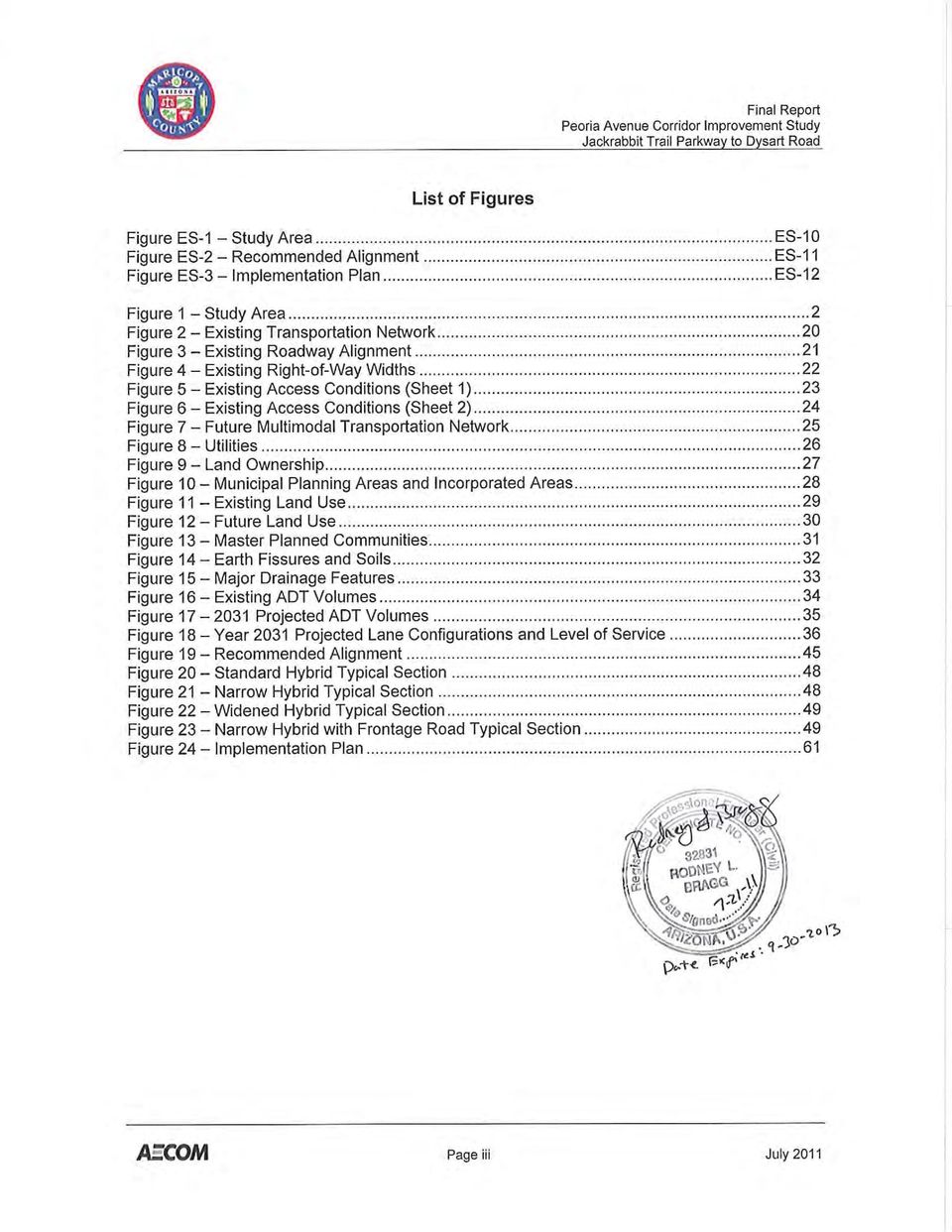
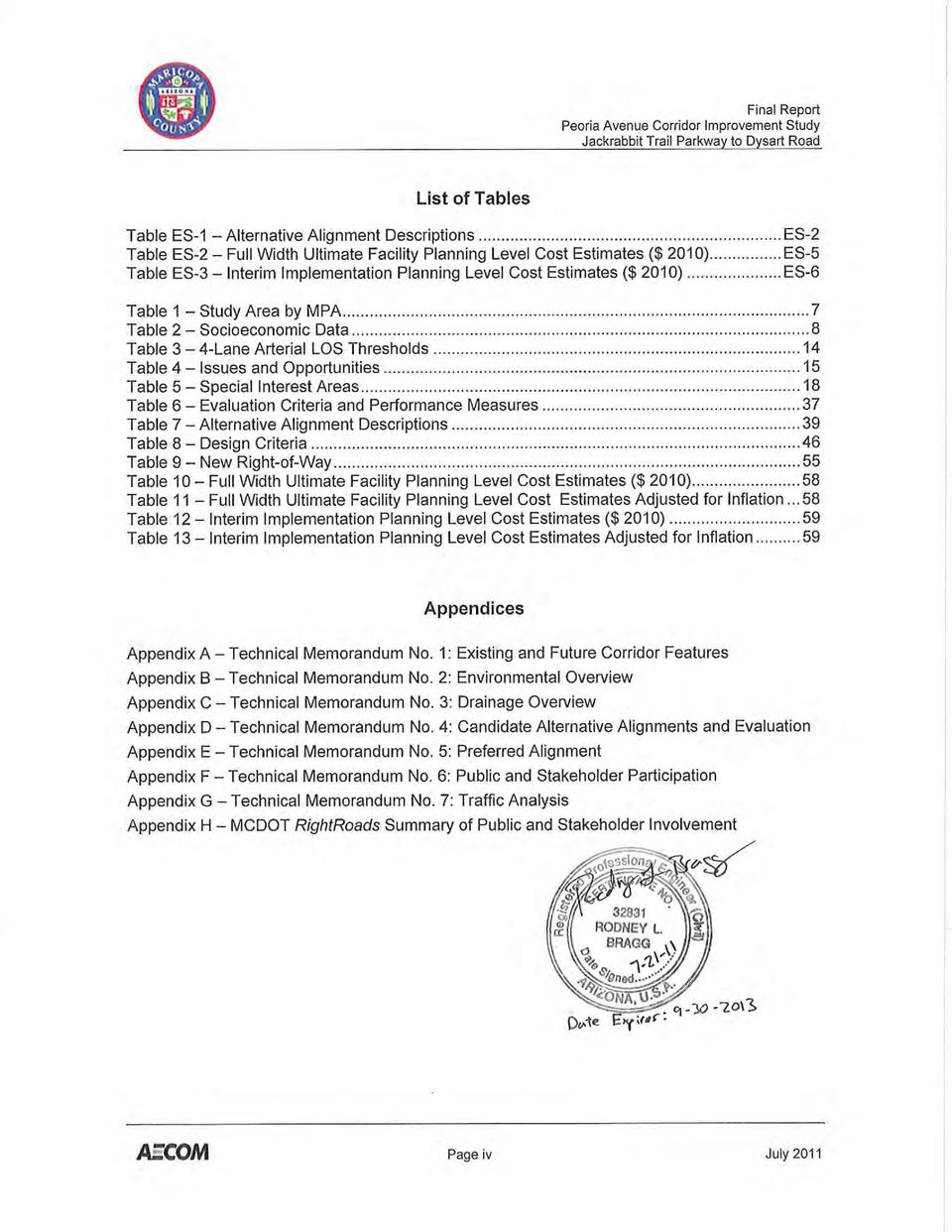
2

3
4
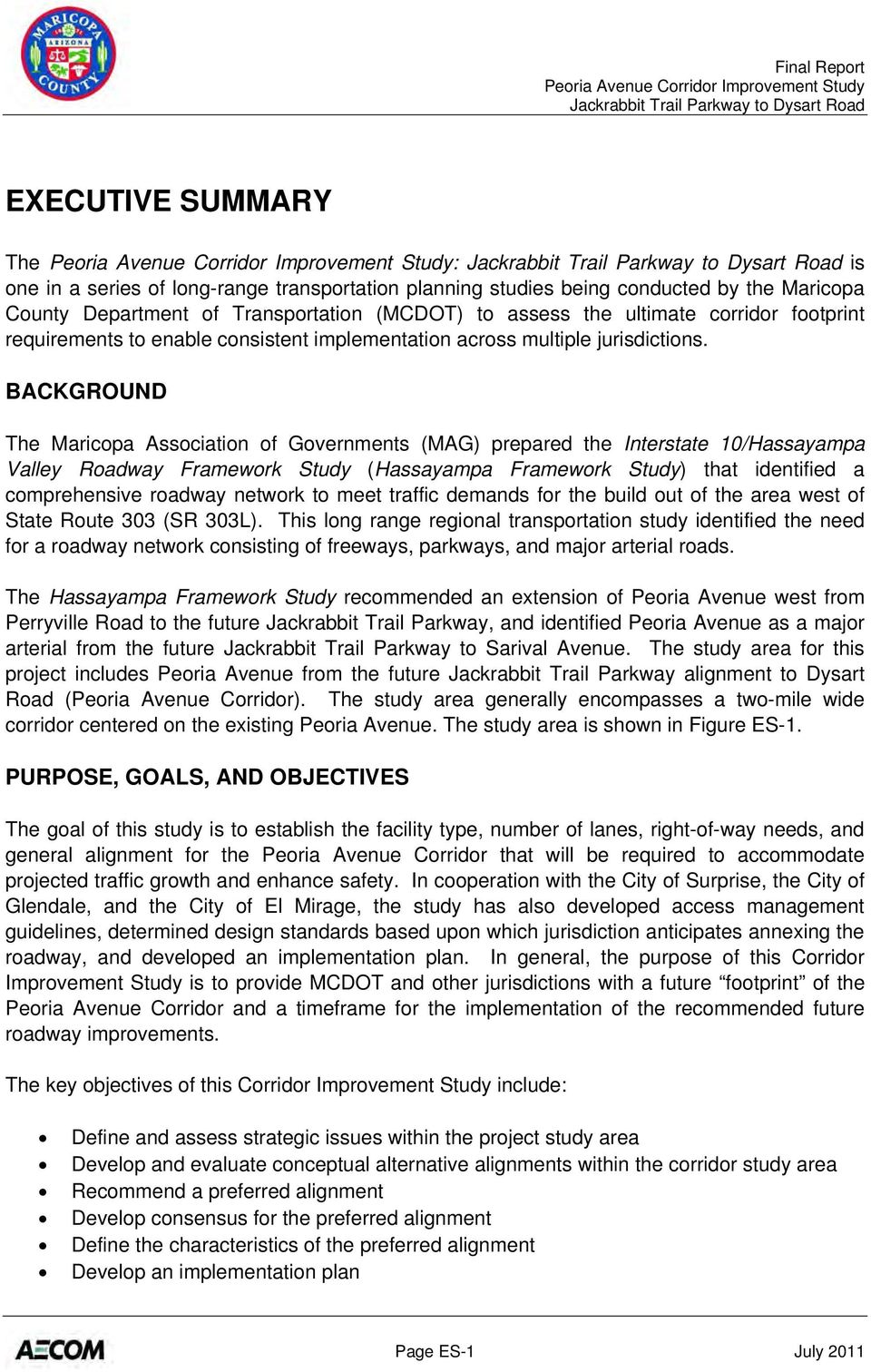
5 EXECUTIVE SUMMARY The : is one in a series of long-range transportation planning studies being conducted by the Maricopa County Department of Transportation (MCDOT) to assess the ultimate corridor footprint requirements to enable consistent implementation across multiple jurisdictions. BACKGROUND The Maricopa Association of Governments (MAG) prepared the Interstate 10/Hassayampa Valley Roadway Framework Study (Hassayampa Framework Study) that identified a comprehensive roadway network to meet traffic demands for the build out of the area west of State Route 303 (SR 303L). This long range regional transportation study identified the need for a roadway network consisting of freeways, parkways, and major arterial roads. The Hassayampa Framework Study recommended an extension of Peoria Avenue west from Perryville Road to the future Jackrabbit Trail Parkway, and identified Peoria Avenue as a major arterial from the future Jackrabbit Trail Parkway to Sarival Avenue. The study area for this project includes Peoria Avenue from the future Jackrabbit Trail Parkway alignment to Dysart Road (Peoria Avenue Corridor). The study area generally encompasses a two-mile wide corridor centered on the existing Peoria Avenue. The study area is shown in Figure ES-1. PURPOSE, GOALS, AND OBJECTIVES The goal of this study is to establish the facility type, number of lanes, right-of-way needs, and general alignment for the Peoria Avenue Corridor that will be required to accommodate projected traffic growth and enhance safety. In cooperation with the City of Surprise, the City of Glendale, and the City of El Mirage, the study has also developed access management guidelines, determined design standards based upon which jurisdiction anticipates annexing the roadway, and developed an implementation plan. In general, the purpose of this Corridor Improvement Study is to provide MCDOT and other jurisdictions with a future footprint of the Peoria Avenue Corridor and a timeframe for the implementation of the recommended future roadway improvements. The key objectives of this Corridor Improvement Study include: Define and assess strategic issues within the project study area Develop and evaluate conceptual alternative alignments within the corridor study area Recommend a preferred alignment Develop consensus for the preferred alignment Define the characteristics of the preferred alignment Develop an implementation plan Page ES-1 July 2011
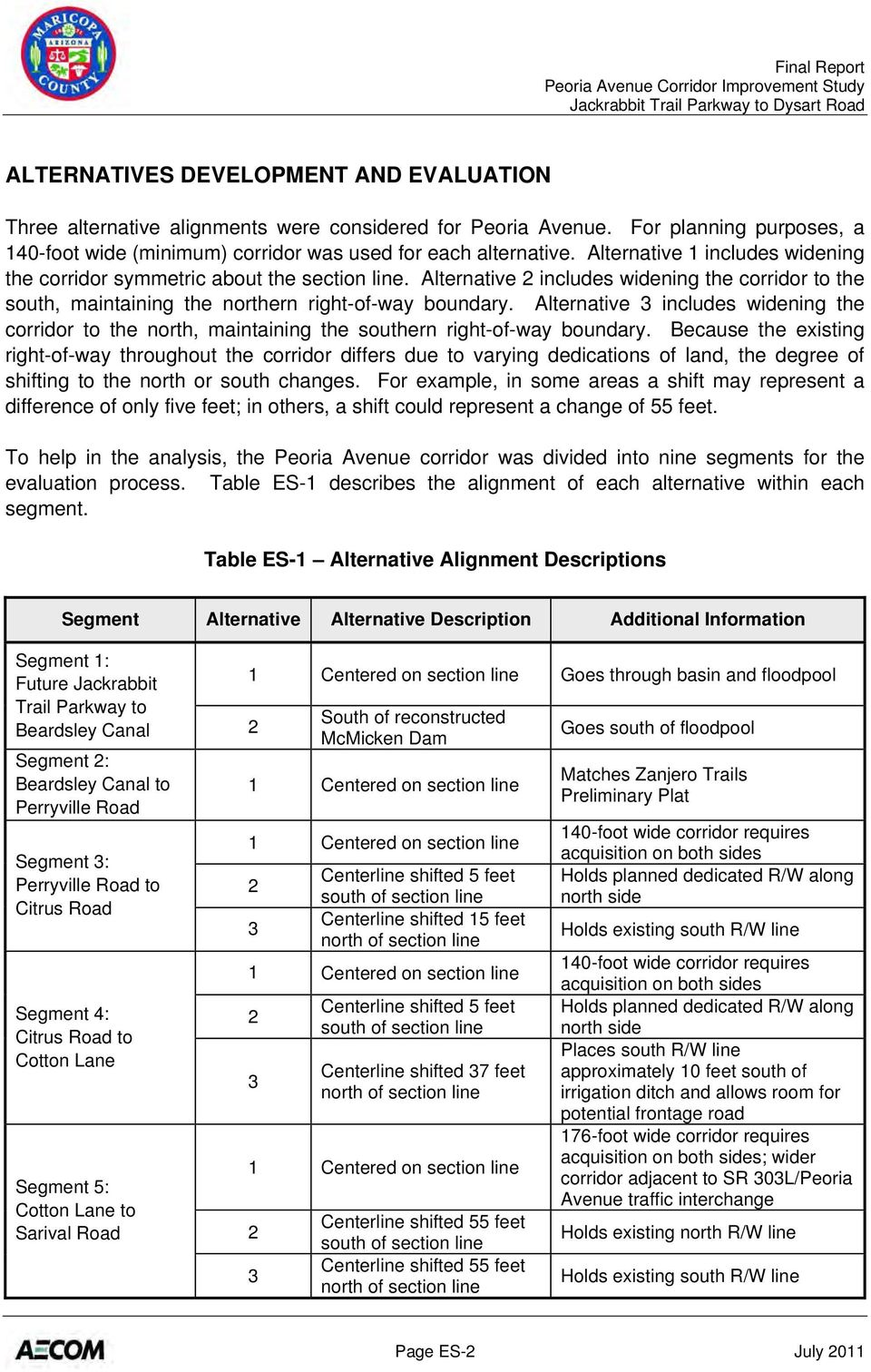
6 ALTERNATIVES DEVELOPMENT AND EVALUATION Three alternative alignments were considered for Peoria Avenue. For planning purposes, a 140-foot wide (minimum) corridor was used for each alternative. Alternative 1 includes widening the corridor symmetric about the section line. Alternative 2 includes widening the corridor to the south, maintaining the northern right-of-way boundary. Alternative 3 includes widening the corridor to the north, maintaining the southern right-of-way boundary. Because the existing right-of-way throughout the corridor differs due to varying dedications of land, the degree of shifting to the north or south changes. For example, in some areas a shift may represent a difference of only five feet; in others, a shift could represent a change of 55 feet. To help in the analysis, the Peoria Avenue corridor was divided into nine segments for the evaluation process. Table ES-1 describes the alignment of each alternative within each segment. Table ES-1 Alternative Alignment Descriptions Segment Alternative Alternative Description Additional Information Segment 1: Future Jackrabbit Trail Parkway to Beardsley Canal Segment 2: Beardsley Canal to Perryville Road Segment 3: Perryville Road to Citrus Road Segment 4: Citrus Road to Cotton Lane Segment 5: Cotton Lane to Sarival Road 1 Centered on section line Goes through basin and floodpool 2 South of reconstructed McMicken Dam 1 Centered on section line 1 Centered on section line 2 3 Centerline shifted 5 feet south of section line Centerline shifted 15 feet north of section line 1 Centered on section line 2 3 Centerline shifted 5 feet south of section line Centerline shifted 37 feet north of section line 1 Centered on section line 2 3 Centerline shifted 55 feet south of section line Centerline shifted 55 feet north of section line Goes south of floodpool Matches Zanjero Trails Preliminary Plat 140-foot wide corridor requires acquisition on both sides Holds planned dedicated R/W along north side Holds existing south R/W line 140-foot wide corridor requires acquisition on both sides Holds planned dedicated R/W along north side Places south R/W line approximately 10 feet south of irrigation ditch and allows room for potential frontage road 176-foot wide corridor requires acquisition on both sides; wider corridor adjacent to SR 303L/Peoria Avenue traffic interchange Holds existing north R/W line Holds existing south R/W line Page ES-2 July 2011
7 Table ES-1 Continued Segment Alternative Alternative Description Additional Information Segment 6: Sarival Road to Reems Road Segment 7: Reems Road to Bullard Avenue Segment 8: Bullard Avenue to Litchfield Road Segment 9: Litchfield Road to Dysart Road 1 Centered on section line 2 3 Centerline shifted 15 feet south of section line Centerline shifted 5 feet north of section line 1 Centered on section line 2 3 Centerline shifted 5 feet south of section line Centerline shifted 30 feet north of section line 1 Centered on section line 2 3 Centerline shifted 15 feet south of section line Centerline shifted 30 feet north of section line 1 Centered on section line 2 3 Centerline shifted south of section line (varies from 2 feet [west end], to 37 feet [middle], to 2 feet [east end]) Centerline shifted north of section line (varies from 30 feet [east end] to 37 feet [west end]) 140-foot wide corridor requires acquisition on both sides Holds existing R/W line along developed areas Holds existing R/W line along developed areas 140-foot wide corridor requires acquisition on both sides Holds existing R/W line along developed areas Holds existing south R/W line 140-foot wide corridor requires acquisition on both sides Holds existing north R/W line Holds existing south R/W line 140-foot wide corridor requires acquisition on both sides Holds existing north R/W line Holds existing south R/W line Source: Project Team, November 2010 The evaluation was conducted by a multidisciplinary consultant team, with input from various sources, including the Technical Advisory Committee, as well as the public at an open house meeting. Each alternative was evaluated with respect to each segment, and each segment was evaluated independently of the others. Through the evaluation process, some segments (2, 4, 6 and 8) contained constraints and/or opportunities that clearly favored one alternative. Once their alignment recommendations were established, these segments assisted in determining the recommended alternative for the adjacent segments (3, 5, 7 and 9). PREFERRED ALIGNMENT Based on the results of the alternatives development and evaluation process, a preferred alignment was chosen that generally follows and is centered upon the Peoria Avenue section Page ES-3 July 2011

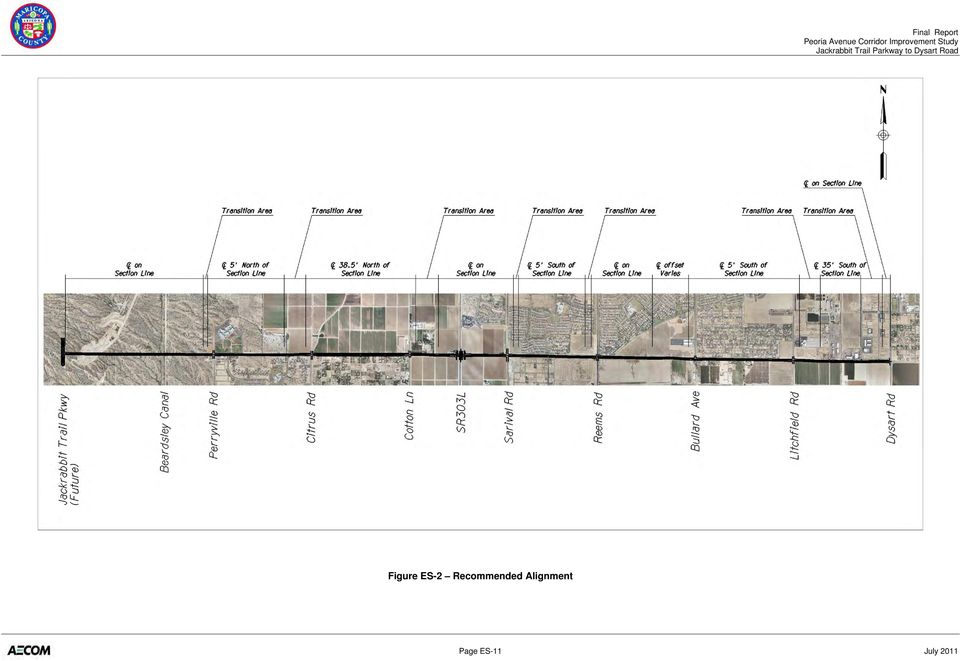
8 line except where existing constraints limit the corridor and warrant a slight alignment change. Transition areas are planned between alignment shifts to maintain corridor fluidity. The preferred alignment is illustrated in Figure ES-2. Typical Section The Peoria Avenue section line serves as a boundary between two jurisdictional agencies with different design standards the City of Surprise to the north, and Maricopa County to the south. Without an executed operation and maintenance agreement in place, roadway designs and development plans will be reviewed and approved by one of the two different agencies, depending on whether the site is north or south of Peoria Avenue. Due to the differing design standards for a principal arterial, as well as differing corridor constraints, hybrid typical sections were developed for Peoria Avenue, including: Standard Hybrid Typical Section: Ultimate right-of-way width of 133 feet; north halfstreet reflects City of Surprise standard, south half-street reflects Maricopa County standard; would be utilized between Jackrabbit Trail Parkway and Perryville Road, Reems Road and Bullard Avenue, and Litchfield Road and Dysart Road. Narrow Typical Section: Ultimate right-of-way width of 120 feet; similar to Standard Hybrid Typical Section with reduced median widths and buffer distances; would be utilized between Perryville Road and Citrus Road, Sarival Road and Reems Road, and Bullard Avenue and Litchfield Road. Widened Hybrid Typical Section: Ultimate right-of-way width of 169 feet to accommodate the addition of turn lanes and/or auxiliary lanes near SR 303L; would be utilized between Cotton Lane and Sarival Road. Narrow Hybrid with Frontage Road Typical Section: Ultimate right-of-way with of 145 feet; designed as an access management strategy for residential properties with direct access to Peoria Avenue; would be utilized between Citrus Road and Cotton Lane. Planning-Level Cost Estimates Preliminary planning-level cost estimates for the Preferred Alignment were developed with the following assumptions: 6-lane typical section Two traffic signals per mile (every half-mile) Underground signal equipment provided at quarter-mile locations Traffic signal interconnection system for the entire length No street lighting 8-foot masonry sound wall adjacent to existing development (actual noise mitigation to be based on future study at time of construction following current noise abatement policy) Eight driveways per mile, per side Page ES-4 July 2011

9 Minimal earthwork assuming roadway would be at or near existing ground Remove and replace existing roadway features On-site roadway drainage system includes catch basins spaced approximately every 500 feet that discharge into a drainage channel along the roadway $4 per square foot for right-of-way acquisition Table ES-2 summarizes the planning-level cost estimates in 2010 dollars. In addition to construction, several other types of project costs are included in the overall cost estimates: Design costs are assumed to be 12 percent of the construction cost Construction management costs are assumed to be 15 percent of the construction cost Administration costs are assumed to be 10 percent of the construction cost Table ES-2 Full Width Ultimate Facility Planning Level Cost Estimates ($ 2010) Cost Category Jackrabbit Trail Pkwy to Perryville Rd (1.5 miles) Perryville Rd to SR 303L (2.5 miles) 2010 Dollars SR 303L to Bullard Ave (2.5 miles) Bullard Ave to Dysart Rd (2 miles) Construction $7,750,000 $13,700,000 $11,830,000 $10,540,000 Design $930,000 $1,640,000 $1,420,000 $1,260,000 Construction $1,160,000 $2,050,000 $1,770,000 $1,580,000 Management Right-of-Way $4,390,000 $4,540,000 $2,090,000 $1,840,000 Structures $310,000 $1,570,000 $560,000 $580,000 Utility Relocation $440,000 $7,380,000 $6,170,000 $7,850,000 Administration $770,000 $1,370,000 $1,180,000 $1,050,000 Total $15,750,000 $32,250,000 $25,020,000 $24,700,000 Table ES-2 is based on implementation of the ultimate facility and includes full reconstruction in areas where Peoria Avenue currently exists. However, a majority of this corridor will be built by developers as the adjacent land is developed. Therefore, interim cost estimates were prepared for the projects that most likely will be implemented by either the city or county, as follows (Table ES-3): Perryville Road to Citrus Road: Minor improvements at west end and east end to provide 6-lane roadway Citrus Road to Cotton Lane: South half-street including frontage road and realignment west of Citrus Road and east of Cotton Lane Bullard Avenue to Litchfield Road: South half-street from approximately Bullard Avenue to 143 rd Avenue; and north half-street from approximately Bullard Avenue to 140 th Avenue Litchfield Road to Dysart Road: Full street width from Litchfield Road to BNSF Ennis Spur; and north half-street from BNSF Ennis Spur to Dysart Road Page ES-5 July 2011

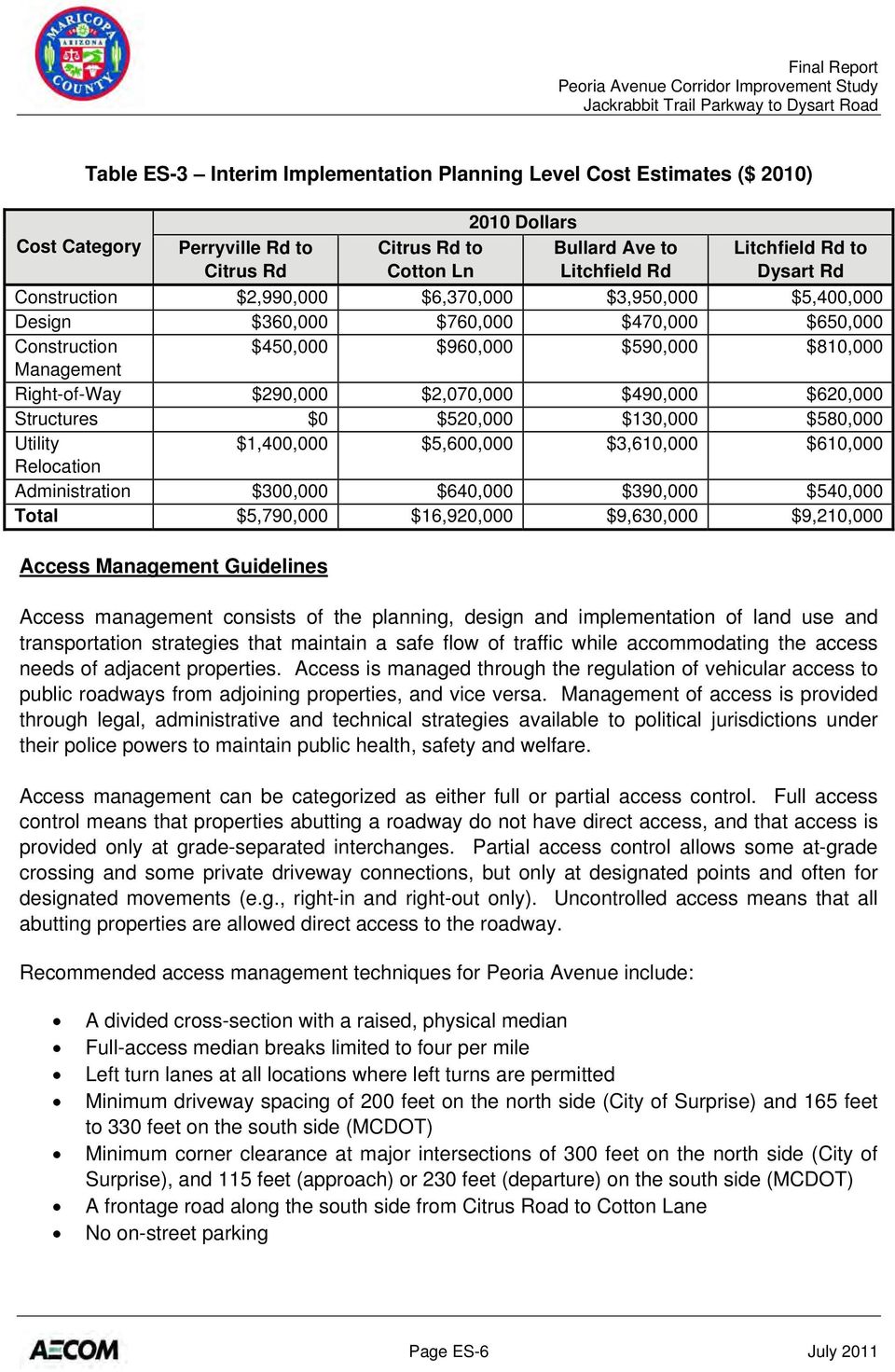
10 Cost Category Table ES-3 Interim Implementation Planning Level Cost Estimates ($ 2010) Perryville Rd to Citrus Rd Citrus Rd to Cotton Ln 2010 Dollars Bullard Ave to Litchfield Rd Litchfield Rd to Dysart Rd Construction $2,990,000 $6,370,000 $3,950,000 $5,400,000 Design $360,000 $760,000 $470,000 $650,000 Construction $450,000 $960,000 $590,000 $810,000 Management Right-of-Way $290,000 $2,070,000 $490,000 $620,000 Structures $0 $520,000 $130,000 $580,000 Utility $1,400,000 $5,600,000 $3,610,000 $610,000 Relocation Administration $300,000 $640,000 $390,000 $540,000 Total $5,790,000 $16,920,000 $9,630,000 $9,210,000 Access Management Guidelines Access management consists of the planning, design and implementation of land use and transportation strategies that maintain a safe flow of traffic while accommodating the access needs of adjacent properties. Access is managed through the regulation of vehicular access to public roadways from adjoining properties, and vice versa. Management of access is provided through legal, administrative and technical strategies available to political jurisdictions under their police powers to maintain public health, safety and welfare. Access management can be categorized as either full or partial access control. Full access control means that properties abutting a roadway do not have direct access, and that access is provided only at grade-separated interchanges. Partial access control allows some at-grade crossing and some private driveway connections, but only at designated points and often for designated movements (e.g., right-in and right-out only). Uncontrolled access means that all abutting properties are allowed direct access to the roadway. Recommended access management techniques for Peoria Avenue include: A divided cross-section with a raised, physical median Full-access median breaks limited to four per mile Left turn lanes at all locations where left turns are permitted Minimum driveway spacing of 200 feet on the north side (City of Surprise) and 165 feet to 330 feet on the south side (MCDOT) Minimum corner clearance at major intersections of 300 feet on the north side (City of Surprise), and 115 feet (approach) or 230 feet (departure) on the south side (MCDOT) A frontage road along the south side from Citrus Road to Cotton Lane No on-street parking Page ES-6 July 2011
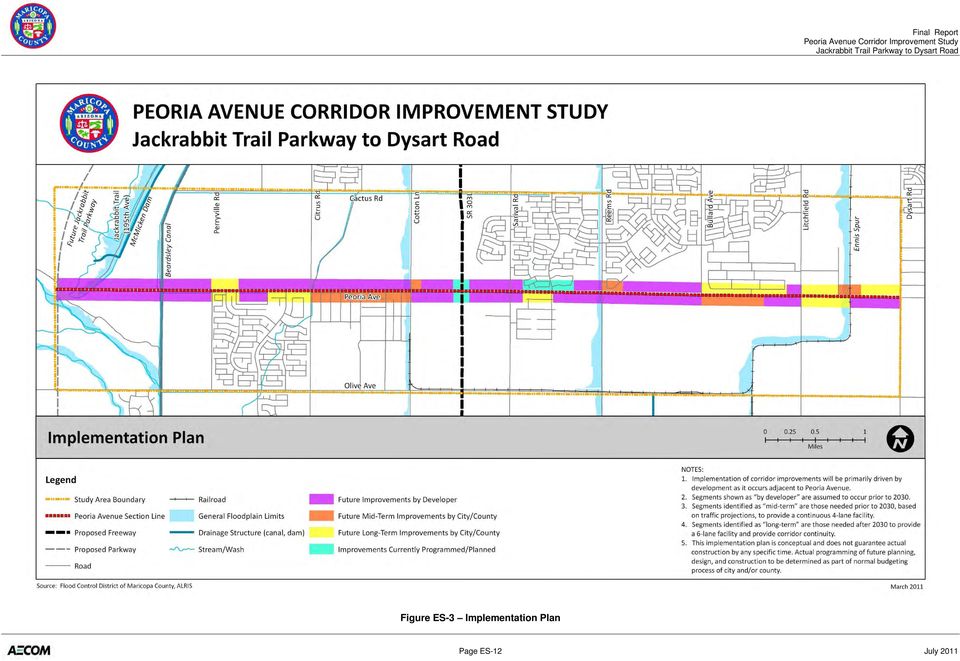
11 Development policies intended to help achieve access management that can be implemented through future development and redevelopment include: Encourage alternative access ways that connect to Peoria Avenue at identified major access points Encourage on-site circulation or parallel routes that would discourage direct access to Peoria Avenue Encourage the use of direct access to minor roadways connecting to the corridor Minimize the number of driveways to reduce traffic conflicts Implementation Plan The recommendations of this study are intended to be used to preserve corridor right-of-way since construction of improvements will not likely be completed in the near-term, but rather as development occurs along the corridor, as shown in Figure ES-3. All timetables are subject to change, depending on such circumstances as identification of additional funding, new opportunities for cost-sharing with partner jurisdictions, and development of land adjacent to Peoria Avenue. In the near-term, projects that are already programmed should be completed, such as improvements at the SR 303L/Peoria Avenue interchange to be constructed by ADOT when SR 303L is upgraded to a freeway facility, as well as the City of Surprise planned completion of the north half-street between Sarival and Reems Roads. Other near-term improvements recommended for consideration include: Acquire right-of-way and construct a two-lane roadway between Citrus Road and Cotton Lane Drainage improvements at Litchfield and Sarival Roads Assuming completion of the segments to be implemented by developers, several additional improvement projects would be needed in the mid-term timeframe to provide a continuous 4- lane facility by the year 2030, including: South half-street and frontage road construction between Citrus Road and Cotton Lane Cotton Lane intersection improvements Reems Road intersection improvements South half-street construction between Bullard Avenue and Litchfield Road South half-street construction between Litchfield Road and BNSF Ennis Spur Page ES-7 July 2011
12 Long-term (likely beyond 2030) improvements will focus on bringing uniformity to the corridor and widening to the ultimate 6-lane facility. Areas where these improvements would occur include: Perryville Road to Citrus Road Sarival Road to Reems Road Bullard Road to Litchfield Road Litchfield Road to Dysart Road The MCDOT Transportation Improvement Program (TIP), updated annually, is based on a 5- year projection of available transportation funding and a countywide prioritization of roadway system needs. No projects (Design Concept Report, design, or construction) along this portion of Peoria Avenue are a part of the current 5-year TIP. CONSIDERATIONS FOR FUTURE STUDY AND DESIGN Arizona State Land Department Holding West of Beardsley Canal The west end of the corridor from Jackrabbit Trail Parkway to Beardsley Canal is owned by the Arizona State Land Department (ASLD). These State Trust Lands will likely be sold or leased to private interests for development. At such time, a detailed land development plan will be developed, including roadway alignments. The Preferred Alignment for Peoria Avenue is coincident with the section line in this segment. However, future development plans could result in a different alignment for Peoria Avenue as long as the connection to Jackrabbit Trail Parkway is maintained and connectivity to the east is provided. The Preferred Alignment crosses a flood retention basin owned by the Flood Control District of Maricopa County (FCDMC). A FCDMC right-of-way use permit would be required for any improvements that are located on their property. Future coordination will be required with FCDMC on all studies and design efforts pertaining to this proposed roadway alignment. The roadway must not impact the safety and function of the existing FCDMC facilities and associated basin, channel, and dam. For example, the proposed roadway must not reduce the existing basin volume or adversely impact existing flow conveyance. In addition, all FCDMC requirements pertaining to operations and maintenance, environment, and land rights must be met. Citrus Road to Cotton Lane Between Citrus Road and Cotton Lane, the Preferred Alignment includes a shift to the north and the construction of a frontage road along the south side of Peoria Avenue. The Preferred Alignment would require approximately 100 feet of right-of-way north of the section line. The planned Prasada development within the City of Surprise contained provisions for a landscape buffer along the north side of Peoria Avenue to accommodate a drainage channel. With the proposed Peoria Avenue shift to the north, a portion of the planned landscape buffer would be Page ES-8 July 2011
13 occupied by Peoria Avenue. Further investigation is required to determine the necessary drainage channel configuration and landscape configuration. This unpaved one-mile segment of the corridor generated the most interest from the public during the open house meetings conducted during this study. The primary feedback was to immediately implement improvements to mitigate dust issues, and to place the ultimate roadway as far north as possible. In addition, concern was expressed regarding vehicle speeds along Peoria Avenue adjacent to the homes along the south side, with a strong desire for a reduced speed limit (below 40 miles per hour) within this segment. In addition, the public requested to limit the number of connections to the frontage road from the south, such that some of the existing north-south streets would not connect to the frontage road. A future box culvert crossing under Citrus Road is planned north of Peoria Avenue. This crossing will be in conflict with the existing Maricopa Water District (MWD) Cross-Cut Canal. Future design and coordination efforts will be needed to address this crossing. Realignment West of Bullard Avenue West of Bullard Avenue, the Preferred Alignment includes a northerly shift near the center of the segment to avoid the existing irrigation facilities and well sites. If corridor conditions change in the future (e.g., removal of the irrigation facilities on the south side or new development on the north side) this recommendation should be reconsidered. For example, if development occurs first on the south side of Peoria Avenue, the existing irrigation facilities would likely be relocated as part of the development. If this were the case, then the alignment could stay on the section line and the realignment would not be necessary. However, if development were to occur first on the north side of Peoria Avenue, then the northerly shift should be implemented to avoid relocation of the irrigation facilities. BNSF Ennis Spur The existing BNSF Ennis Spur crossing of Peoria Avenue is at-grade and proposed improvements maintain the at-grade crossing. Future development plans near the BNSF Ennis Spur should provide building set-backs to allow the future implementation of a grade separated crossing, if deemed necessary in the future. Page ES-9 July 2011
14 Figure ES-1 Study Area Page ES-10 July 2011

15 Figure ES-2 Recommended Alignment Page ES-11 July 2011
16 Figure ES-3 Implementation Plan Page ES-12 July 2011
17 1.0 INTRODUCTION The Maricopa Association of Governments (MAG) prepared the Interstate 10/Hassayampa Valley Roadway Framework Study (Hassayampa Framework Study) that identified a comprehensive roadway network to meet traffic demands for the build out of the area west of State Route 303 (SR 303L). This long range regional transportation study identified the need for a roadway network consisting of freeways, parkways, and major arterial roads. The Hassayampa Framework Study recommended an extension of Peoria Avenue west from Perryville Road to the future Jackrabbit Trail Parkway, and identified Peoria Avenue as a major arterial from the future Jackrabbit Trail Parkway to Sarival Avenue. The study area for this project includes Peoria Avenue from the future Jackrabbit Trail Parkway alignment to Dysart Road (Peoria Avenue Corridor). The study area generally encompasses a two-mile wide corridor centered on the existing Peoria Avenue. The study area is shown in Figure 1. The goal of this study is to establish the facility type, number of lanes, right-of-way needs, and general alignment for the Peoria Avenue Corridor that will be required to accommodate projected traffic growth and enhance safety. In cooperation with the City of Surprise, the City of Glendale, and the City of El Mirage, the study has also developed access management guidelines, determined design standards based upon which jurisdiction anticipates annexing the roadway, and developed an implementation plan. In general, the purpose of this Corridor Improvement Study is to provide the Maricopa County Department of Transportation (MCDOT) and other jurisdictions with a future footprint of the Peoria Avenue Corridor and a timeframe for the implementation of the recommended future roadway improvements. The key objectives of this Corridor Improvement Study include: Define and assess strategic issues within the project study area Develop and evaluate conceptual alternative alignments within the corridor study area Recommend a preferred alignment Develop consensus for the preferred alignment Define the characteristics of the preferred alignment Develop an implementation plan This report summarizes the findings of the project, with full technical memoranda located in the report s appendices. Page 1 July 2011
18 Figure 1 Study Area Page 2 July 2011

19 2.0 EXISTING AND FUTURE CORRIDOR FEATURES This section summarizes information gathered and documented in Technical Memorandums No. 1: Existing and Future Corridor Features, No. 2: Environmental Overview, No. 3: Conceptual Drainage Report, and No. 7: Traffic Analysis. The full text for these technical memoranda can be found in Appendices A, B, C, and G of this Report. Key exhibits are provided to graphically display the existing and future corridor features that were considered in identifying and evaluating feasible candidate corridor alternatives. 2.1 EXISTING TRANSPORTATION NETWORK Figure 2 illustrates the existing transportation network in the study area. Peoria Avenue is a two-lane roadway, with varying degrees of improvements. Peoria Avenue extends west as far as Perryville Road as a paved road, with the exception of a one-mile segment between Citrus Road and Cotton Lane that is unpaved. Between Perryville Road and the Beardsley Canal, an unpaved and narrow maintenance/access road exists. The existing roadway currently has a speed limit of 45 miles per hour, with no designated parking lanes or bicycle lanes along the roadway. Sidewalks (primarily detached) are located at various locations along the route where curb and gutter exist. In the wider context of the study area, Jackrabbit Trail Parkway does not yet exist; Olive Avenue is the only crossing of the Beardsley Canal providing access to the west; and SR 303L remains a major arterial road with no freeway improvements completed. Local roadways are intermittently developed, depending on the degree of built residential and industrial land uses. The BNSF Ennis Spur crosses Peoria Avenue at an at-grade railroad crossing, protected by lights and gates Roadway Classification Based on its current function in the existing network, MCDOT functionally classifies the existing Peoria Avenue roadway as a major collector in the Maricopa County Transportation System Plan (February 2007). A major collector provides short-distance (less than three miles) traffic movement, collects and distributes traffic between local and arterial streets, and provides direct access to abutting land Existing Alignment The current roadway alignment generally follows the Peoria Avenue section line, with some variation (Figure 3). The segments that are centered on the section line include: between Perryville Road and a half-mile east, between a quarter-mile west of Cotton Lane and a halfmile east of Sarival Road, between Reems Road and Bullard Avenue, and between Litchfield Road and Dysart Road. The existing roadway shifts slightly to the south so that the Peoria Avenue section line is near the north edge of the existing roadway between a half-mile east of Page 3 July 2011
20 Perryville Road and Citrus Road, and between a half-mile east of Sarival Road and Reems Road. Between Bullard Avenue and Litchfield Road, the existing roadway shifts slightly to the north so that the Peoria Avenue section line is near the south edge of the existing roadway Existing Right-of-Way The existing right-of-way width along Peoria Avenue varies along the corridor. Figure 4 provides representative right-of-way width information along Peoria Avenue from Perryville Road to Dysart Road. It is important to note that information presented on this map includes formally recorded right-of-way per the Maricopa County Assessor s Office, as of September This does not reflect right-of-way dedications that may be in process, municipality required developer stipulations that have not been administered, or any other situations not documented with the county Intersection and Lane Geometry The existing portion of Peoria Avenue within the study area has eight major cross-street intersections from Perryville Road to Dysart Road. The intersection with Litchfield Road is a four-legged signal controlled intersection. The other seven intersections are either two-way stop controlled or all-way stop controlled. The Perryville Road intersection is a T intersection, with the existing Peoria Avenue terminating here Access Conditions There are thirty-four driveways and fifteen intersections on Peoria Avenue. In addition to these defined access points, there is also undefined access throughout the corridor at various locations. All of the intersections have full access configurations, but only a few have separate lanes for left and right turns. The approximate locations of these minor intersections and driveways are shown in Figures 5 and 6. The figures include example photos of the various types of access conditions that are present along the corridor. All intersections and driveways along existing Peoria Avenue have full movement access in all directions (no limited access). 2.2 FUTURE TRANSPORTATION NETWORK For the planned future network, functional classification is the process by which roads are grouped into classes or systems according to the kind of service they will provide in the future. Roadways functionally classified as high-speed, high-capacity facilities tend to maximize mobility and minimize direct land access. The hierarchy of functional classification typically includes freeways, expressways, parkways, major and minor arterials, collectors, and local streets. Maricopa County and MAG similarly classify Peoria Avenue as an urban principal arterial in the future network. However, Peoria Avenue actually falls within multiple jurisdictions in the study area. Each jurisdiction has assigned its own future functional classification to the portion of Page 4 July 2011

21 Peoria Avenue within its boundaries. The overlapping classifications are even more complex where Peoria Avenue forms the boundary between jurisdictions. For the planned future network, Peoria Avenue has been classified by local jurisdictions as listed below: MCDOT Urban Principal Arterial: The future MCDOT functional classification of Peoria Avenue in the study area is as an urban principal arterial, as stated in the Maricopa County Major Streets and Routes Plan, adopted in 2001 and revised in A principal arterial is defined as a street that provides for long-distance traffic movement within Maricopa County or between Maricopa County and urban areas. Access to abutting land is restricted and controlled through frontage roads and raised medians, as well as by the spacing and location of driveways and intersections. Opposing traffic flows may be separated by a raised median. MAG Major Arterial: The MAG Hassayampa Framework Study identifies Peoria Avenue as a major arterial. This is supported in the 2010 MAG Regional Transportation Plan (RTP). City of El Mirage Minor Arterial: Incorporated El Mirage includes the area south of Peoria Avenue between the BNSF Ennis Spur and Dysart Road. El Mirage classifies Peoria Avenue as a minor arterial (based on City of Peoria standard details). City of Glendale Major Arterial: The City of Glendale maintains planning jurisdiction over the south side of Peoria Avenue from the BNSF Ennis Spur to Perryville Road as part of its municipal planning area (MPA). One-half mile between SR 303L and Sarival Road is incorporated, fronting Peoria Avenue to the south. Recent General Plan amendments have upgraded Peoria Avenue to a major arterial roadway. City of Surprise Major Arterial: The City of Surprise incorporated area within the study area extends north from Peoria Avenue, between the Beardsley Canal and Dysart Road. Surprise classifies Peoria Avenue as a major arterial in the current General Plan. Much of the surrounding roadway system to the project area does not exist or is planned to be expanded or adjusted from its current configuration. SR 303L and Jackrabbit Trail Parkway are the two most significant roadway facilities in the surrounding network that will provide regional access. SR 303L Corridor: SR 303L is located roughly in the center of the study area. It intersects Peoria Avenue between Cotton Lane and Sarival Road. SR 303L is currently being improved from an interim two-lane roadway into a Rural Major Freeway, as classified by MAG. The ultimate improved SR 303L will be a fully access-controlled, grade-separated freeway. Peoria Avenue is one of the thirteen service interchanges planned for the build out of the SR 303L corridor. Page 5 July 2011
22 Jackrabbit Trail Parkway: Jackrabbit Trail Parkway has recently undergone several planning and corridor-level studies. In the 2007 MAG Hassayampa Framework Study, Jackrabbit Trail was established as an Arizona Parkway, a new functional classification category in Arizona. In 2008, MCDOT completed the Jackrabbit Trail Access Control and Corridor Improvement Study, which further refined the corridor and established a preferred alignment. Jackrabbit Trail Parkway will follow the new Design Guideline Recommendations for the Arizona Parkway (MCDOT, August 2008), which includes an intermediate-capacity, sixto eight-lane divided highway with partial access control and no direct left turns permitted at major intersections. The junction of Peoria Avenue with Jackrabbit Trail Parkway will need to consider the design standards in the Arizona Parkway Intersection/Interchange Operational Analysis and Design Concepts Study (MCDOT, August 2009). Figure 7 illustrates the future multimodal transportation network in the study area, including future roadway classifications, planned public transit routes and bicycle lanes/multi-use pathways. 2.3 UTILITIES Numerous utilities are present within the study area (Figure 8). The portion of the study area between the Beardsley Canal and Reems Road is within the Maricopa Water District (MWD) Conservation District Number One service area boundaries. MWD is primarily an irrigation water conservation district providing water services to its customers. The District s irrigation conveyance and delivery channels and pipelines span the entire length of its service areas along Peoria Avenue. Many MWD wells and private irrigation wells (active and inactive) are also sited along Peoria Avenue. Under a contract with Arizona Public Service (APS), MWD also delivers power and energy through APS s distribution facilities to water wells belonging to the District and its customers. Numerous overhead power distribution lines run in an east-west direction parallel to Peoria Avenue, along both sides of the roadway, as well as in a north-south direction along the cross streets: Cotton Lane, Sarival Avenue, Dysart Road, and the BNSF Ennis Spur. Aboveground power lines along Peoria Avenue are fragmented, a result of gradual burying of overhead distribution lines in front of new housing developments over the years. The future APS West Valley-North 230kV power transmission line, scheduled to be placed in service in 2015 in a corridor west of SR 303L, follows SR 303L from Olive Avenue to Cactus Road through the study area, where it will then turn west to parallel Cactus Road to the north. Power substation sites are planned on the adjacent major arterials to Peoria Avenue (Olive Avenue and Cactus Road). City utilities along Peoria Avenue include underground water and sewer lines, and appurtenances, including a 30-inch reclaimed water line and reclaimed water delivery headers on the south side of Peoria Avenue across from the City of Surprise South Water Reclamation Plant (SSWRP). Other public utilities along Peoria Avenue include Southwest Gas natural gas lines and Qwest overhead and underground telephone lines. Page 6 July 2011
23 2.4 LAND USE, OWNERSHIP, AND MANAGEMENT Land ownership is identified in terms of public or private control, whereas land jurisdiction refers to the city, town, county, state, or federal agency or agencies exercising governmental authority over an area. The majority of the land in the study area is privately owned, with only about 20 percent of the westernmost study area publicly owned by the Arizona State Land Department (ASLD) (Figure 9). While much of the private land is parceled out and owned by individual property owners, there are several major private land holdings in the study area, including the Flood Control District of Maricopa County (FCDMC), MWD, and Dysart Unified School District #89, as well as major master planned community land owners. Figure 10 depicts the boundaries of all the jurisdictions and their MPAs within the study area: City of El Mirage, City of Glendale, and City of Surprise. Peoria Avenue serves as the boundary between the Glendale and Surprise MPAs. Maricopa County has planning and zoning authority over the unincorporated areas, including areas inside an MPA but outside the current city limits. The MPAs of El Mirage and Surprise are largely incorporated in the study area, while the areas in the Glendale MPA are mostly unincorporated, with the exception of a parcel abutting SR 303L and a 10-foot strip of land along the south side of Peoria Avenue from Perryville Road to east of Litchfield Road. This annexation is part of the City of Glendale Strip Annex Area which includes approximately 39 square miles of land, with Peoria Avenue serving as the northern boundary. Within the Glendale MPA, Maricopa County Planning and Development Department administers the zoning and subdivision ordinances. Table 1 notes the extent of the study area in each MPA, as well as the remaining land within the county. Table 1 Study Area by MPA MPA/Jurisdiction Area (acres) Percent of Study Area El Mirage 320 3% Glendale 4,160 38% Surprise 5,440 50% Maricopa County 960 9% Total 10, % Source: Flood Control District of Maricopa County. In 2005, the study area had a population of approximately 4,550 persons and an employment base of approximately 1,500 employees. By 2030, these numbers are expected to dramatically increase. Table 2 presents the socioeconomic data for the existing 2005 and adopted 2030 forecast scenarios, as well as the percent change between the two forecast years. Page 7 July 2011
24 Table 2 Socioeconomic Data Scenario Population (persons) Employment (employees) ,550 1, ,330 21,010 Percent Change 698% 1,300% Source: MAG, Figure 11 illustrates existing land uses within the study area. The majority of the area is categorized as vacant (i.e., undeveloped) or agricultural. Several single-family residential subdivisions are built or under development, which include three elementary schools, one middle school, and one high school within the communities. Several existing homes, not associated with large master-planned communities, are located adjacent to Peoria Avenue. Small clusters of industrial and commercial development are scattered throughout the area. Figure 12 illustrates anticipated future build out land uses within the study area, based on longrange planning efforts conducted by each jurisdiction. This map shows that the majority of the vacant and agricultural land will be converted to single-family residential housing and mixed-use developments in the future. Commercial and industrial development will expand, but remain scattered throughout the study area. The majority of employment land uses are clustered in the eastern part of the study area, between Litchfield and Dysart Roads. With the exception of the southeast portion of the study area, which is affected by the noise contours of Luke Air Force Base, much of the study area is anticipated to lie within master planned communities (Figure 13). About half of the major residential communities located in the study area are built or actively in the development phase. These communities are primarily composed of residences, with some local commercial development. The only major retail town center thus far envisioned is at the north end of Sycamore Farms, between SR 303L and Sarival Avenue, abutting Cactus Road on the south side. Three commercial/business parks are planned between Litchfield and Dysart Roads; one is in the development phase. Due to current economic conditions, the rate of growth has slowed, but it is expected to increase in the future, although the timeframe for build out will likely be extended. 2.5 ENVIRONMENTAL SUMMARY The full survey of environmental considerations is documented in Technical Memorandum No. 2: Environmental Overview, located in Appendix B. Many of the topics explored in Technical Memorandum No. 2 do not present obstacles to improving Peoria Avenue, or if they do, they include clear mitigation actions. The more significant environmental issues that should be explored further in additional studies and corridor design include those discussed in the following subsections. Page 8 July 2011
25 2.5.1 Section 4(f) Resources Section 4(f) of the Department of Transportation Act of 1966 (49 USC 303) prohibits the use of land of significant publicly owned parks, recreation areas, wildlife and waterfowl refuges, and land of a historic site for transportation projects unless the Federal Highway Administration (FHWA) determines that there is no feasible and prudent avoidance alternative and that all possible planning to minimize harm has occurred. While there are no city or county parks within the study area (White Tank Mountain Regional Park is located just west of the study area), there are several community or pocket parks within developed communities. School playgrounds may qualify as Section 4(f) resources if they are publicly owned, open to the public, have a major recreational purpose, and are considered by the community to be a significant resource. For instance, Shadow Ridge High School is located immediately adjacent to Peoria Avenue in the western limits of the study area. There are several other schools within the study limits, though not immediately adjacent to Peoria Avenue: Mountain View Elementary, Sonoran Heights Elementary, Rancho Gabriela Elementary, and Imagine Middle School. Some historic sites on or eligible for the National Register of Historic Places (NRHP) may also be afforded protection by Section 4(f). However, there are currently limited amounts of information available regarding historic properties within the study area. Of the known sites, the Beardsley Canal and the BNSF Ennis Spur could potentially be afforded protection under Section 4(f) Soils and Earth Fissures As shown in Figure 14, there are areas of soils with high shrink-swell potential located on both the western and eastern boundaries of the study area. These soils are one of several soil units present throughout the study area that are rated as having limited suitability for road building by the Natural Resources Conservation Service (NRCS), due to flooding characteristics, large stone content, low strength, and shrink-swell potential. Fissures are cracks in the ground surface that occur due to uneven land subsidence and can form gullies as much as 50 feet wide and 10 to 15 feet deep. Existing and potential locations of earth fissures have been mapped south of McMicken Dam, at SR 303L near Olive Avenue, and at Peoria Avenue near Sarival Road (Figure 14). The effects of earth fissures can be significant, causing damage to infrastructure, increasing flood potential, worsening groundwater pollution, and accelerating soil erosion. Continued land subsidence and accompanying earth fissures will likely occur in this area as long as groundwater overdraft continues Wildlife and Wildlife Movement Maintaining access between large habitat blocks, such as the White Tank Mountain Regional Park located just west of the study area, and natural corridors in the landscape, such as the Page 9 July 2011
26 Agua Fria River which is located just east of the study area, is key to maintaining native biodiversity as much as possible in the metropolitan area. The Peoria Avenue Corridor could provide such a connection if low-cost wildlife connectivity features are considered during the design process. Guidelines for facilitating wildlife connectivity have been developed by the Arizona Wildlife Linkages Workgroup, the Arizona Game and Fish Department (AGFD), and Arizona Missing Linkages organization. The relatively undisturbed desert land in the western portion offers potential habitat for many desert wildlife species of all sizes. The proximity and connectivity to the White Tank Mountain Regional Park likely allows use of the area by larger animals than would often be found in land adjacent to urban areas. A significant portion of the more urbanized study area has long been developed for agricultural uses and offer some nesting and foraging habitat for birds, small rodents, and other small mammals. As residential and commercial uses develop, a variety of wildlife species adapted to urban conditions will continue to use vegetation in residential and commercial landscaping, parks, and remaining agricultural fields Hazardous Materials A regulatory database search for hazardous materials was conducted for the study area. A review of the records search identified six registered underground storage tanks (USTs), two leaking USTs, previous chemical spills and illegal dumping, over 400 drywells, and 94 groundwater wells. Many groundwater wells and drywells within the study area may be impacted, depending on the chosen alignment. Further investigation of hazardous materials issues is recommended in subsequent studies and design. Once the construction area has been established, additional research and visual inspection should be performed to evaluate the potential presence of groundwater wells, dry wells, and/or surface contamination within the construction zone. Prior to project construction activities, performing a Phase I/II site assessment on the property acquired for the project would provide information necessary to determine environmental conditions and reduce exposure from hazardous materials contamination Cultural Resources To identify potential cultural resources, sources examined include files at the State Historic Preservation Office (SHPO) and the AZSITE electronic database. Records reviewed show that the study area consists of approximately 24 cultural resource inventories undertaken from 1987 to Inventory levels range from unsurveyed to completely surveyed, with the majority of sections only partially surveyed. Not all archaeological inventories conducted may appear on AZSITE if they were undertaken on private land, as private land owners are not required to report inventories to public officials. The existing cultural resource inventories identify 22 sites within the study area. The majority of NRHP-eligible sites and those requiring testing are located west of the proposed SR 303L. Page 10 July 2011
27 While numerous sections of the historic Beardsley Canal are considered eligible, the section within the study area has not been evaluated. The BNSF Railway has been determined eligible, however the BNSF Ennis Spur has not been evaluated for NRHP eligibility. There are no records of historic property inventories within the study area. However, a preliminary field review observed residences and structures present on the parcels adjacent to Peoria Avenue that could potentially be 50 years old or older. Typically, historic properties are at least 50 years old, but younger properties may be considered for listing if they are of exceptional importance. Should project design include any of these parcels, the structure(s) may need to be evaluated for their eligibility for inclusion in the NRHP. 2.6 DRAINAGE SUMMARY Technical Memorandum No. 3: Drainage Overview documents the full overview of existing drainage conditions within the study area (Appendix C). Figure 15 summarizes these conditions and depicts the major drainage features for the Peoria Avenue study area. Major drainage structures include: McMicken Dam: The dam is almost eleven miles long, following an alignment offset from the Beardsley Canal, beginning at Peoria Avenue west of Perryville Road and extending north and east to Happy Valley Road west of Bullard Avenue. The dam is operated and maintained by the FCDMC. The dam detains storm runoff and meters outflows through a channel located at the east end of the structure. The Peoria Avenue section line intersects the detention basin located immediately south of the dam. Canals: The Beardsley Canal is located approximately a half mile west of Perryville Road and is owned by the MWD. A series of irrigation canals/ditches are also owned by the MWD in the study area. These east-west canals connect with the Beardsley Canal on the west end, extending to approximately one-half mile east of Sarival Road, located south of Peoria Avenue and south of Cactus Road. Parallel, but privately owned, irrigation canals also exist in segments along the south side of Peoria Avenue. Additionally, MWD manages the Cross-Cut Canal and Pipeline, which crosses Peoria Avenue underground, along Citrus Avenue. Reems Road Channel and Basin: This structure is a regional flood control facility to intercept and convey the 100-year stormwater event. The ultimate facility includes a channel flowing south along Reems Road from Bell Road to the Reems Basin, an offline detention basin is located a quarter-mile south of Peoria Avenue. The purpose of the channel is to protect Reems Road and the land to the east, including the City of Surprise wastewater treatment plant and various utilities. While no rivers are located within the study area, several streams and washes traverse the area, generally located in the westernmost portion, draining from the White Tank Mountains. Page 11 July 2011
28 Federal Emergency Management Agency (FEMA) maps show most of the study area to be within the 100-year to 500-year floodplain. Concentrations of land are located within the 100- year floodplain, including drainage areas west of McMicken Dam, major washes, and the channels west of Cotton Lane, Reems Road, and the BNSF Ennis Spur. The 100-year floodplains adjacent to major roadways serve as permanent drainage channels, with the land owned and controlled by the FCDMC, and therefore preserved against future development. As uncontrolled or natural drainage features, both Waterfall and Cholla Washes include floodway areas. A number of wells exist in the study area, including several located adjacent to Peoria Avenue, whose locations will need to be considered with respect to potential roadway improvements. A series of channels and basins are in varying stages of development throughout the corridor, including public channels and basins being implemented by the FCDMC, as well as a series of private channels and basins, such as at Shadow Ridge High School and within the master planned communities of Greer Ranch, Twelve Oaks Estates, and Copper Canyon Ranch (Mountain Gate). The following summarizes major drainage issues considered in the development of alternatives and selection of the preferred alternative: Under current conditions, roadways within the study area are exposed to flooding as berms and irrigation facilities preclude off-site runoff from sheet flowing onto agricultural fields. As land use changes and urbanization expands, less off-site runoff is expected to reach the roadway grid. The completion of recommended FCDMC capital improvement projects will significantly reduce the amount of flow that runs along Peoria Avenue, making existing and planned developer-built roadside channels sufficient to contain off-site flows. The intersection of Litchfield Road and Peoria Avenue is of special concern, as the anticipated outfall channel to the south may take a while to be completed. The corridor should include a system of roadside channels and culverts to accept combined off-site and on-site flows. The proposed channels along SR 303L, Reems Road, and the BNSF Ennis Spur have sufficient capacity to accept flows from the Peoria Avenue system. Closed storm drain systems that connect to roadside channels can be used in areas where right-of-way availability is limited. 2.7 TRAFFIC SUMMARY Technical Memorandum No. 7: Traffic Analysis documents the full analysis of existing and future traffic conditions within the study area (Appendix G). A summary of the analysis follows Existing Traffic Volumes Historical traffic volumes were obtained from the City of Surprise and MCDOT for years where available. In addition, Traffic Research & Analysis, Inc. (TRA) conducted traffic Page 12 July 2011
29 counts in August 2010 at several locations in the study area. The existing average daily traffic (ADT) volumes within the study area are shown in Figure 16. Existing ADT on Peoria Avenue varies from approximately 900 vehicles per day (vpd) at the west end to 9,000 vpd between Bullard Avenue and Litchfield Road. A majority of the north/south arterial cross streets along the corridor currently carry more traffic than Peoria Avenue itself. With the exception of SR 303L, Litchfield Road has the highest existing cross street daily traffic volume (16,500 to 14,600 vpd) in the study area. Classification counts were also conducted at three locations within the study area: (1) Peoria Avenue east of Cotton Lane; (2) Cotton Lane north of Peoria Avenue; and (3) Litchfield Road north of Peoria Avenue. All three locations show that passenger cars comprise a vast majority of the existing daily traffic volumes (approximately 98 percent) while large trucks comprise less than 1 percent of the daily traffic volumes. The remaining 1 to 2 percent is medium-sized vehicles (e.g., buses, RVs, small trucks) Future Traffic Volumes MAG provided design year 2031 traffic volume projections for use in this study. MAG network simulations were provided for the 2031 design year. For the purposes of the MAG model, the network includes three traffic lanes in each direction of travel on Peoria Avenue. The 2031 traffic volume projections are shown in Figure 17. MCDOT does not include a Peoria Avenue crossing of the Agua Fria River in its current or future roadway network. Other regional planning studies have suggested a need for a river crossing and the City of El Mirage has included a crossing in its planned roadway network. While this river crossing may not be implemented in the near future, a conservative approach (by including the river crossing) was used to project the 2031 Peoria Avenue travel demand. While the transportation plans described in Section 2.2 were used to establish the ultimate Peoria Avenue classification, the 2031 travel demand analysis was used to help determine an implementation strategy for the corridor Traffic Analysis and Results Table 2.1 of the MCDOT Roadway Design Manual includes information regarding planning level traffic volume thresholds for different facility types. According to this table, a 4-lane urban arterial can accommodate approximately 35,000 vpd. In addition, planning level analyses were conducted using Highway Capacity Software to estimate volume thresholds for a 4-lane urban arterial roadway. Based on these analyses, Table 3 shows the resulting daily traffic ranges and corresponding level-of-service thresholds. Page 13 July 2011
30 Table 3 4-Lane Arterial LOS Thresholds ADT Range - Arterial Level-of-Service (veh/day) C < 19,000 D 19,000 31,000 E 31,000 33,000 F > 33,000 The resultant analysis generally shows that a 4-lane arterial can accommodate approximately 30,000 vpd. Daily traffic volumes greater than approximately 30,000 vpd would warrant a 6-lane arterial. As shown in Figure 17, the 2031 traffic volumes along Peoria Avenue range from approximately 10,000 vpd to 31,000 vpd. According to the criteria established above, in 2031, a 4-lane facility would be warranted from however, the ultimate classification is for 6 lanes. The results of an intersection analysis to determine 2031 lane configurations are shown in Figure 18. For the 2031 design year, single left-turn lanes are recommended at a majority of the intersections with dual left-turn lanes being recommended at Jackrabbit Trail Parkway and at Cotton Lane. All of the intersections are expected to operate at level-of-service C or better during the peak hours. Figure 18 also shows, based on the 2031 traffic volumes, that all major intersections along Peoria Avenue would warrant signalization by Since the 2031 traffic volumes warrant a 4-lane facility, a sensitivity analysis was conducted to help determine if and when a 6-lane facility might be needed, as all of the study area jurisdictions (Maricopa County, City of Surprise, and City of Glendale) classify Peoria Avenue as a 6-lane arterial facility in the future. The analysis included a review of 2031 socioeconomic data in the MAG model to determine the land use densities assumed in 2031; a review of the growth trends in the travel demand from 2010 to 2031; and a review of the MAG Hassayampa Framework Study travel demand model, which is generally representative of a potential build out scenario in the far west valley. The sensitivity analysis resulted in the following conclusions: The 2031 socioeconomic data used in the MAG model could be below the future potential build out of the study area Additional development has the potential to occur which could result in increased travel demand along Peoria Avenue above that reflected in the 2031 model The MAG Hassayampa Framework Study travel demand model produced daily traffic projections that would warrant a 6-lane arterial facility Based on the growth trends between 2010 and 2031, a 6-lane facility may be warranted by approximately 2040 Page 14 July 2011
31 2.8 ISSUES, OPPORTUNITIES, AND SPECIAL INTEREST AREAS Table 4 presents issues and opportunities identified as part of the Peoria Avenue Corridor Improvement Study. The list was developed from observations in the field, review of existing studies and plans, and discussions with the Technical Advisory Committee (TAC). Table 4 Issues and Opportunities Opportunity Roadway Topic Location Description Peoria Avenue between Perryville Road and Citrus Road Corridor-wide Full street cross-section built out; tie into and utilize existing improvements Maximize use of existing half-streets Major Utility Corridor-wide Burying local power lines for corridor consistency Issue/Constraint Roadway Major Utility Corridor-wide Peoria Avenue and SR 303L Corridor-wide Parallel to SR 303L Peoria Avenue, between Litchfield Road and the BNSF Ennis Spur Corridor-wide Corridor-wide Corridor-wide Corridor-wide Converting irrigation ditches into pipes to increase corridor safety Planned upgrade to freeway, including traffic interchange at Peoria Avenue Peoria Avenue forms boundary between multiple jurisdictions, causing undefined ultimate control and responsibility of corridor (e.g.,land to the north of Peoria Avenue is incorporated by Surprise, land to the south of Peoria Avenue and east of the BNSF Ennis Spur incorporated by El Mirage, some land south of Peoria Avenue incorporated by Glendale, including 10-foot wide strip annex) Installation of future APS West Valley-North 230kV power transmission line 30-inch reclaimed water line and reclaimed water delivery headers Numerous well sites directly adjacent to Peoria Avenue right-of-way Underground city water and sewer lines and appurtenances Underground Southwest Gas natural gas lines Qwest overhead and underground telephone lines Page 15 July 2011
32 Table 4 Continued Topic Location Description Issue/Constraint Drainage Beardsley Canal, west of Perryville Road Major drainage structure McMicken Dam, west of Beardsley Canal Major drainage structure; cannot cross Waterfall Wash, west of Major drainage feature that crosses Peoria Beardsley Canal and south of Avenue section line McMicken Dam South side of Peoria Avenue, west half of corridor Parallel private irrigation ditches Adjacent to Cotton Lane, Reems Road, and the BNSF Flood channels/100-year floodplains Ennis Spur Peoria Avenue and Citrus Road MWD underground Cross-Cut Canal Topography Peoria Avenue section line, south of McMicken Dam Existing fissures Peoria Avenue and Sarival Road Existing fissures Land Ownership East of Beardsley Canal State Trust Land Existing Northeast corner of Peoria Development Avenue and Perryville Road Shadow Ridge High School South of Peoria Avenue, Perryville Road to Citrus Road Cortessa master planned community; active development Adjacent custom home development; individual South of Peoria Avenue, Citrus driveway access to Peoria Avenue; mostly built Road to Cotton Lane out North of Peoria Avenue, SR 303L to Sarival Road Limited development within Sycamore Farms master-planned community; active development North of Peoria Avenue, Sarival Road to Reems Road Greer Ranch master planned community; active development South of Peoria Avenue, Sarival Road and half-mile east North of Peoria Avenue, Reems Road to Bullard Avenue North of Peoria Avenue, Bullard Avenue to Litchfield Road North of Peoria Avenue, Litchfield Road to the BNSF Ennis Spur Twelve Oaks Estate master planned community; active development Rancho Gabriela master planned community; built out Copper Canyon Ranch master planned community; active development Desert Cove Commercial Park ; active development Page 16 July 2011
33 Table 4 Continued Topic Location Description Issue/Constraint Future Development Growth Areas North of Peoria Avenue, the BNSF Ennis Spur to Dysart Road North of Peoria Avenue, Beardsley Canal to half-mile east of Perryville Road; South of Peoria Avenue Beardsley Canal to Perryville Road North of Peoria Avenue, halfmile east of Perryville Road to Cotton Lane South of Peoria Avenue, Citrus Road to Cotton Lane South of Peoria Avenue, SR 303L to Sarival Road North of Peoria Avenue, Reems Road to Bullard Avenue South of Peoria Avenue, the BNSF Ennis Spur to Dysart Road Parallel to the BNSF Ennis Spur Future Peoria Avenue/SR 303L traffic interchange North of Peoria Avenue, Litchfield Road to Dysart Road Skyway Business Park; active development Zanjero Trails master planned community Proposed Prasada master planned community Proposed Zanjero Pass master planned community; south of existing development directly adjacent to Peoria Avenue Glendale 303 commercial development Two planned megachurch developments John F. Long Industrial Complex Potential industrial development Potential major commercial employment center Potential major office/industrial employment center Table 5 presents a series of special interest areas to be considered in further design of the infrastructure improvements proposed. Page 17 July 2011
34 Table 5 Special Interest Areas Special Interest Area Peoria Avenue/BNSF Ennis Spur Crossing Peoria Avenue from Citrus Road to Cotton Lane Beardsley Canal to Jackrabbit Trail Parkway Description Improvements to Peoria Avenue should include close coordination with the BNSF Railway. As traffic may significantly increase along the Ennis Spur in the future, consideration could be given to a grade separation of these two transportation facilities. Special consideration should be given to this corridor segment due to its unique circumstances, including numerous large lot homes with individual driveway access on the south side, the future Prasada master planned community on the north side, and the use of this segment by school buses for access to Shadow Ridge High School. Planning an extension of Peoria Avenue west of Perryville Road to the future Jackrabbit Trail Parkway will require close consideration of environmental and drainage features, including coordination with MWD and FCDMC. This extension will include a crossing of the Beardsley Canal, and is in close proximity to the McMicken Dam and Waterfall Wash. In addition, any planned community circulation connections to Jackrabbit Trail Parkway from the west should be understood to construct a seamless Peoria Avenue corridor. 2.9 RELEVANT PLANS, REPORTS, AND GUIDELINES Many existing plans, reports, and guidelines were compiled, reviewed, and summarized for this project. Relevant findings, conclusions, and recommendations from these documents are discussed in Technical Memorandum No. 1. A listing of such references follow. Arizona Department of Transportation (ADOT) SR 303L 60% Project Plans APS West Valley-North Power Line and Substation Project, 2005 Arizona Geological Survey Earth Fissure Map of Maricopa County, December 2009 City of El Mirage FY Capital Improvement Plan, 2009 City of El Mirage General Plan, 2010 City of Glendale FY Capital Improvement Plan, 2009 City of Glendale General Plan, 2002 City of Glendale Major General Plan Amendments, 2005 City of Glendale Zoning Ordinance, 2009 City of Surprise Development Master Plans (Copper Canyon Ranch/Mountain Gate, Desert Cove, Greer Ranch, Prasada, Rancho Gabriela, Sycamore Farms, Zanjero Trails) City of Surprise Designated Truck Routes, 2007 City of Surprise Developments Status, 2010 Page 18 July 2011
35 City of Surprise General Plan, 2008 City of Surprise Major General Plan Amendments, 2010 City of Surprise Transportation Plan, 2005 City of Surprise FY Capital Improvement Plan, 2009 City of Surprise Zoning Ordinance, 2010 FCDMC Loop 303/White Tanks ADMP, 2003 FCDMC McMicken Dam Fissure Zone Remediation Project FCDMC Wittman ADMP, 2007 MAG TIP, 2010 MAG Desert Spaces Plan, 2003 MAG Interstate 10/Hassayampa Valley Transportation Framework Study, 2008 MAG RTP, 2010 Maricopa County Comprehensive Plan, 2002 Maricopa County Major Streets and Routes Plan (Atlas and Policy Document), 2004 Maricopa County McMicken Dam Scenic Corridor Guidelines Maricopa County Olive Avenue Scenic Corridor Guidelines Maricopa County Regional Trail System Plan, 2004 Maricopa County Transportation System Plan, 2007 Maricopa County Zoning Ordinance, 2010 MCDOT Design Guideline Recommendations for the Arizona Parkway, 2008 MCDOT TIP FY , 2010 Page 19 July 2011
36 Figure 2 Existing Transportation Network Page 20 July 2011
37 Figure 3 Existing Roadway Alignment Page 21 July 2011
38 Figure 4 Existing Right-of-Way Widths Page 22 July 2011
39 Figure 5 Existing Access Conditions (Sheet 1) Page 23 July 2011
40 Figure 6 Existing Access Conditions (Sheet 2) Page 24 July 2011
41 Figure 7 Future Multimodal Transportation Network Page 25 July 2011
42 Figure 8 Utilities Page 26 July 2011
43 Figure 9 Land Ownership Page 27 July 2011
44 Figure 10 Municipal Planning Areas and Incorporated Areas Page 28 July 2011
45 Figure 11 Existing Land Use Page 29 July 2011
46 Figure 12 Future Land Use Page 30 July 2011
47 Figure 13 Master Planned Communities Page 31 July 2011
48 Figure 14 Earth Fissures and Soils Page 32 July 2011
49 Figure 15 Major Drainage Features Page 33 July 2011
50 Figure 16 Existing ADT Volumes Page 34 July 2011
51 Figure Projected ADT Volumes Page 35 July 2011
52 Figure 18 Year 2031 Projected Lane Configurations and Level of Service Page 36 July 2011
53 3.0 DEVELOPMENT AND EVALUATION OF ALTERNATIVE ALIGNMENTS Technical Memorandum No. 4: Candidate Alternative Alignments and Evaluation documents the alternatives development and evaluation process used for this project. The full technical memorandum is located in Appendix D. After completion of the inventory of existing conditions and traffic forecasts, the study team conducted a single-tiered process of developing and evaluating alternatives, including the following major steps: Development of evaluation criteria and performance measures upon which candidate alternatives would be evaluated Development of candidate alternatives Evaluation of candidate alternatives, with input from the TAC and general public Determination of recommended alternative 3.1 EVALUATION CRITERIA Table 6 lists the evaluation criteria, a short description, and performance measures associated with each. The number of performance measures varies for each criterion, reflecting the inherent complexity and amount of data available for each element. The performance measures are intended to minimize or maximize an outcome that reflects fulfillment of the criterion. Some of the measures are evaluated numerically; others are based on a qualitative assessment. Table 6 Evaluation Criteria and Performance Measures Criteria Title Right-of-Way Considerations Compatibility with Existing Developments Criteria Description An assessment of the amount and value of the right-of-way that would need to be acquired for corridor alternatives in relation to other alternatives under consideration for the segment. An estimate of the potential effect of proposed corridor alternatives on the existing developments most directly affected. Key considerations include the proximity to existing developments and potential displacements. Criteria Performance Measure Quantitative assessment of acres or square feet of acquisition Qualitative assessment of potential cost Qualitative assessment of compatibility Page 37 July 2011
54 Criteria Title Compatibility with Planned Future Developments Compatibility with Existing and Planned Roadway Improvements Engineering Complexity and Constructability Public Acceptability Local Agency Support Drainage/Flood Control Considerations Environmental Considerations Utility Considerations Table 6 Continued Criteria Description An estimate of the potential effect of the corridor alternatives on planned developments and/or land that is currently under the jurisdiction of the Arizona State Land Department. Key considerations include compatibility with approved master plans and/or preliminary and final plats. An assessment of the compatibility of the corridor alternatives with the existing and planned roadway improvements. A general assessment of engineering complications, exclusive of cost considerations, which could arise from construction of the roadway. Key considerations include roadway geometry, permitting requirements, construction staging, etc. Estimated community support for and acceptance of the corridor alternative, based on input from municipal staff, stakeholders, homeowner associations, and the public. Estimated local agency (city) support for and acceptance of the corridor alternative, based on input from municipal staff. An estimate of potential impacts from the proposed corridor alternatives to both existing FCDMC facilities as well as to future improvements. An assessment of social, ecological, and cultural environment in the study area. Estimate of potential impacts from the proposed corridor alternative to both existing and planned future utility facilities such as the MWD canals, wells, reclaimed water delivery headers, and overhead lines. Criteria Performance Measure Qualitative assessment of compatibility Qualitative assessment of compatibility Qualitative assessment of complexity and constructability Qualitative assessment of acceptability Qualitative assessment of acceptability Qualitative assessment of potential impacts Qualitative assessment of potential impacts to socioeconomic environment Qualitative assessment of potential impacts to physical and natural environment Qualitative assessment of potential impacts to cultural resources Quantitative assessment of potential impacts Source: Project Team, October 2010 Page 38 July 2011
55 3.2 CANDIDATE ALTERNATIVES AND EVALUATION A series of three alternative alignments were considered for Peoria Avenue. For planning purposes, a 140-foot wide (minimum) corridor was used for each alternative. Alternative 1 includes widening the corridor symmetric about the section line. Alternative 2 includes widening the corridor to the south, maintaining the northern right-of-way (R/W) boundary. Alternative 3 includes widening the corridor to the north, maintaining the southern R/W boundary. Because the existing R/W throughout the corridor differs due to varying dedications of land, the degree of shifting to the north or south changes. For example, in some areas a shift may represent a difference of only five feet; in others, a shift could represent a change of 55 feet. To help in the analysis, the Peoria Avenue corridor was divided into nine segments for the evaluation process (delineated in the table below). Table 7 describes the alignment of each alternative within each segment. Because Peoria Avenue does not yet exist through Segments 1 and 2, and because of other constraints, fewer alternatives were considered for these segments than elsewhere. The full technical memorandum, located in Appendix D, contains plan sheets showing the various alternatives. Table 7 Alternative Alignment Descriptions Segment Alternative Alternative Description Additional Information Segment 1: Future Jackrabbit Trail Parkway to Beardsley Canal Segment 2: Beardsley Canal to Perryville Road Segment 3: Perryville Road to Citrus Road Segment 4: Citrus Road to Cotton Lane 1 Centered on section line Goes through basin and floodpool 2 South of reconstructed McMicken Dam 1 Centered on section line 1 Centered on section line 2 3 Centerline shifted 5 feet south of section line Centerline shifted 15 feet north of section line 1 Centered on section line 2 3 Centerline shifted 5 feet south of section line Centerline shifted 37 feet north of section line Goes south of floodpool Matches Zanjero Trails Preliminary Plat 140-foot wide corridor requires acquisition on both sides Holds planned dedicated R/W along north side Holds existing south R/W line 140-foot wide corridor requires acquisition on both sides Holds planned dedicated R/W along north side Places south R/W line approximately 10 feet south of irrigation ditch and allows room for potential frontage road Page 39 July 2011
56 Table 7 Continued Segment Alternative Alternative Description Additional Information Segment 5: Cotton Lane to Sarival Road Segment 6: Sarival Road to Reems Road Segment 7: Reems Road to Bullard Avenue Segment 8: Bullard Avenue to Litchfield Road Segment 9: Litchfield Road to Dysart Road 1 Centered on section line 2 3 Centerline shifted 55 feet south of section line Centerline shifted 55 feet north of section line 1 Centered on section line 2 3 Centerline shifted 15 feet south of section line Centerline shifted 5 feet north of section line 1 Centered on section line 2 3 Centerline shifted 5 feet south of section line Centerline shifted 30 feet north of section line 1 Centered on section line 2 3 Centerline shifted 15 feet south of section line Centerline shifted 30 feet north of section line 1 Centered on section line 2 3 Centerline shifted south of section line (varies from 2 feet [west end], to 37 feet [middle], to 2 feet [east end]) Centerline shifted north of section line (varies from 30 feet [east end] to 37 feet [west end]) 176-foot wide corridor requires acquisition on both sides; wider corridor adjacent to SR 303L/Peoria Avenue traffic interchange Holds existing north R/W line Holds existing south R/W line 140-foot wide corridor requires acquisition on both sides Holds existing R/W line along developed areas Holds existing R/W line along developed areas 140-foot wide corridor requires acquisition on both sides Holds existing R/W line along developed areas Holds existing south R/W line 140-foot wide corridor requires acquisition on both sides Holds existing north R/W line Holds existing south R/W line 140-foot wide corridor requires acquisition on both sides Holds existing north R/W line Holds existing south R/W line Source: Project Team, November 2010 Page 40 July 2011
57 3.3 ALTERNATIVES EVALUATION Each alternative was evaluated with respect to each segment, and each segment was evaluated independently of the others. The full results of the evaluation can be found in Tables 3 through 10 of Technical Memorandum No. 4, located in Appendix D. The evaluation was conducted by a multidisciplinary consultant team, with input from various sources, including the TAC during December 2010 and January 2011, as well as the public at an open house meeting held in January Results and Recommendations Through the evaluation process, some segments (2, 4, 6 and 8) contained constraints and/or opportunities that clearly favored one alternative. Once their alignment recommendations were established, these segments assisted in determining the preferred alternative for the adjacent segments (3, 5, 7 and 9). To show this process, the following evaluation highlights are presented out of numerical order. Segment 2: Beardsley Canal to Perryville Road The Zanjero Trails master planned community is planned on both sides of Peoria Avenue between the Beardsley Canal and Perryville Road. The preliminary plat dedicates 136 feet of R/W for Peoria Avenue, centered on the section line. Because Zanjero Trails is expected to move forward with this plat configuration in the future, the section line option (Alternative 1) was decided to be the only practical alternative. Because this segment has only one alternative, no evaluation was necessary. Segment 4: Citrus Road to Cotton Lane Maricopa County and the City of Surprise do not appear to have sufficient R/W to accommodate the recommended improvements in this segment, so regardless of alternative, R/W negotiations will be required. Key factors for this segment include existing and planned land uses. To the north, the Prasada community is planned, although no preliminary plat yet exists. To the south, Peoria Avenue is lined with existing large-lot, single-family houses that front the roadway corridor and often have driveways that access Peoria Avenue. In addition, two irrigation canals run parallel to Peoria Avenue to the south. Because of the more imminent constraint that the existing land uses pose, the recommendation favors Alternative 3: shifting the roadway north to minimize impacts on existing land uses to the south. Alternative 3 also provides the opportunity to construct a frontage road along the south side of Peoria Avenue so the existing access locations do not have direct access to Peoria Avenue. Therefore, Alternative 3 is recommended to be further refined to minimize impacts to the south and north, while providing route continuity and a connection to Jackrabbit Trail Parkway. Page 41 July 2011
58 Segment 6: Sarival Road to Reems Road Existing residential development and related drainage facilities are located on both sides of Peoria Avenue through Segment 6. As these criteria potentially impact the corridor the greatest, an effort was made to balance the impacts to both sides of the corridor. Therefore, Alternative 1 (symmetric on section line) is recommended. Segment 8: Bullard Avenue to Litchfield Road Like Segment 6, Segment 8 contains existing residential development on both sides of the corridor. To the north, a newer residential subdivision has a small landscaped buffer between the R/W and property lines. To the south, individual large-lot, single-family homes front Peoria Avenue but are offset approximately 100 feet from the roadway. Recommending Alternative 1 (symmetric on section line) best balances the impacts to existing development. Segments 2, 4, 6, and 8 provided the context that influenced the recommendation for the oddnumbered segments. Often, two or three alternatives in these segments achieved similar scores, with no alternative presenting a clear advantage. In these cases, connectivity with the adjacent segments helped determine the most practical solution. Likewise, transitional subsegments were strategically placed to avoid constraints or take advantage of opportunities to seamlessly connect segments. Because of the relative equality of the impacts of the different alternatives, if conditions change in the future (e.g., wells removed, advanced development plats, etc.), the recommendations for the following segments could be reviewed and changed to reflect current conditions. Segment 3: Perryville Road to Citrus Road Existing and planned developments, as well as existing and planned roadway improvements, were the key factors for Segment 3. To the north, Shadow Ridge High School has been built at the west end. A portion of the remaining land is platted through Zanjero Trails and preliminarily planned as part of the Prasada community. To the south, the Cortessa subdivision has been constructed, as well as several irrigation facilities and wells. On the west end, between Cortessa and the high school, is the corridor s only street section constructed to full width. In an effort to maximize use of this full-width street, which is built symmetric on the section line, Alternative 1 is recommended. This supports a connection to Segment 2 to the west, which is also recommended to be located symmetric to the section line. To the east, Segment 4 is recommended to shift north. Because of the constraint that the existing development on the south side of the corridor poses in Segment 4, the transition area from the section line to a northerly shift is recommended to occur in the eastern portion of Segment 3. Segment 5: Cotton Lane to Sarival Road The key determinant for Segment 5 is ADOT s final design for SR 303L, which includes a traffic interchange at Peoria Avenue, centered on the section line. Very little development exists today through this segment. As SR 303L requires a section line alignment and such an alignment was also recommended for Segment 6, the recommendation for Segment 5 is to move forward with Alternative 1 (symmetric on section line). Because of the constraint that the existing development on the south side of the corridor poses in Segment 4, the transition area from the Page 42 July 2011
59 section line to a northerly shift is recommended to occur in the western portion of Segment 5, slightly impacting an existing development to the north, but no structures. Segment 7: Reems Road to Bullard Avenue Because of the noise contours associated with Luke Air Force Base, the majority of this segment is undeveloped, with the exception of approximately four houses that back up to Peoria Avenue on the west end. However, the presence of these houses skews the evaluation away from an option that impacts the north side of the corridor. The south side of the corridor, however, contains irrigation facilities and well sites. Section line alignments are recommended for the adjacent links, Segments 6 and 8. In an effort to reduce impact to the drainage facilities and the existing development, and also to connect to the adjacent segments, the recommendation for this segment includes a northerly shift in the center of the segment to avoid the irrigation facilities and well sites, with transition areas back to the section line at the east and west ends, avoiding impact to the existing development. If corridor conditions change in the future (e.g., removal of the irrigation facilities on the south side or new development on the north side) this recommendation could be reconsidered to recommend a section line alignment. Segment 9: Litchfield Road to Dysart Road Segment 9 contains no existing or platted development to the south. To the north of Peoria Avenue, existing land uses are next to the BNSF Ennis Spur, located in the middle of the segment. Development is planned and platted to the east and west. Half streets have been constructed on the north side throughout, but with no constant centerline offset. Therefore, the corridor s constructed half-street varies with differing amounts of R/W. To minimize impacts to existing land uses, the recommendation for this segment includes a southerly shift in the alignment, with transition areas to connect back to the section line on the east and west ends. Like Segment 7, if corridor conditions change in the future (e.g., existing land uses are redeveloped), maintaining a section line alignment may be considered. Segment 1: Jackrabbit Trail Parkway to Beardsley Canal Segment 1 is unique because no roadway or existing development is currently present and no development plans are imminent. Only two alternatives are practical for this section Alternative 1, alignment symmetric to the section line, and Alternative 2, which does not follow the other widening guidelines (e.g., maintaining the north or south R/W boundary). Alternative 2 in this segment dips south to miss the flood basin south of the truncated McMicken Dam. Drainage impacts and local agency support (specifically of FCDMC) are the two key determining factors. After the evaluation, Alternative 1, which travels through the flood basin, was seen to have the least drainage impacts, as Alternative 2 would cross numerous washes, some of which may require substantial crossings. The recommendation for Segment 1 is to move forward with Alternative 1, based upon received consensus from FCDMC that it is less impactful to cross the basin than to cross a number of natural washes. By recommending a section line alignment, this alternative also maximizes the ability of the ASLD to auction larger tracts of developable land in the future. (Currently, ASLD has a general master plan for the land, but no formal planning will be documented until a developer assumes responsibility.) In addition, Alternative 1 would provide better intersection spacing along the future Jackrabbit Trail Parkway. Page 43 July 2011
60 Figure 19 illustrates the preferred alignment. Corridor alignment recommendations were based on a 140-foot planning corridor and were slightly refined to match the corridor s typical sections, defined in more detail after the alternatives evaluation process (discussed in Section 4.1). Page 44 July 2011
61 Figure 19 Recommended Alignment Page 45 July 2011
62 4.0 PREFERRED ALIGNMENT Technical Memorandum No. 5: Preferred Alignment documents the detailed information regarding the proposed alignment and characteristics of the ultimate Peoria Avenue corridor (Appendix E). The preferred alignment generally follows and is centered upon the Peoria Avenue section line except where existing constraints limit the corridor and warrant a slight alignment change. Transition areas are planned between alignment shifts to maintain corridor fluidity. A generalized illustration of the shifts and transition areas is depicted on the previous page, on Figure 19. Table 8 shows the major design features recommended for Peoria Avenue. These design criteria are for urban roadway sections and apply to the envisioned ultimate cross-section of Peoria Avenue. Interim construction may not include all of these elements. Pertinent criteria are discussed in more detail throughout this section. Table 8 Design Criteria Description Criteria Typical Section Urban Principal Arterial Design Year Design year for future projects should be 20 years after construction completion Design Vehicle WB-50 Design Speed 55 mph (urban) Pavement Design Life 20 years Number of Lanes 3 through lanes in each direction Roadway Width See typical sections (Figures 20 23) Drainage (Pavement) 10-year event Minimum Right-of-Way Requirements See typical sections (Figures 20 23) Lane Widths 12 feet Clear Zone Width Approx. 25 min. (varies based on side slopes, design speed, and traffic volume) Median See typical sections (Figures 20 23) Maximum Superelevation Rate e max = 4% (urban) Maximum Gradient 5% Minimum Radius at normal crown R = 10,000 feet (approx.) 4.1 TYPICAL SECTION Between the Beardsley Canal and Dysart Road, the Peoria Avenue section line is the southern boundary of the incorporated limits for the City of Surprise. South of the section line lies within unincorporated Maricopa County, with the exception of a parcel abutting SR 303L and a 10-foot strip of land along the south side of Peoria Avenue from Perryville Road to east of Litchfield Road (City of Glendale Strip Annex Area). Maricopa County Planning and Development Department administers the zoning and subdivision ordinances within unincorporated areas and the strip annex area. The Peoria Avenue section line serves as a boundary between two jurisdictional agencies with different design standards the City of Surprise to the north, and Page 46 July 2011
63 Maricopa County to the south. Without an executed operation and maintenance agreement in place, roadway designs and development plans will be reviewed and approved by one of the two different agencies, depending on whether the site is north or south of Peoria Avenue. Due to the differing design standards for a principal arterial, hybrid typical sections were developed for Peoria Avenue. As shown in Figure 20, the half-street to the north reflects the City of Surprise standard for a major arterial, while the half-street to the south reflects Figure 5.7 from the MCDOT Roadway Design Manual. This Standard Hybrid Typical Section, including an ultimate R/W width of 133 feet, would be utilized in the following areas: Jackrabbit Trail Parkway to Perryville Road, Reems Road to Bullard Avenue, and Litchfield Road to Dysart Road. In numerous segments along the corridor, existing constraints limit the ultimate R/W to 120 feet. In these segments, the Narrow Hybrid Typical Section shown in Figure 21 would be utilized. This reduced-width typical section is similar to the typical section shown in Figure 20 with reduced median widths and buffer distances (offset from curb to right-of-way line). This typical section would be utilized in the following areas: Perryville Road to Citrus Road, Sarival Road to Reems Road, and Bullard Avenue to Litchfield Road. The segment from Cotton Lane to Sarival Road would utilize the Widened Hybrid Typical Section shown in Figure 22, which is similar to Figure 20 with an expanded right-of-way width to facilitate the addition of turn lanes and/or auxiliary lanes near SR 303L (169 feet). The segment from Citrus Road to Cotton Lane contains numerous residential properties along the south side of Peoria Avenue that have direct access on to Peoria Avenue. The Narrow Hybrid with Frontage Road Typical Section, as shown in Figure 23, was developed for this segment as an access management strategy. To summarize, the following typical sections are recommended in the following segments: Figure 20 (Standard Hybrid Typical Section): Jackrabbit Trail Parkway to Perryville Road Reems Road to Bullard Avenue Litchfield Road to Dysart Road Figure 21 (Narrow Hybrid Typical Section): Perryville Road to Citrus Road Sarival Road to Reems Road Bullard Avenue to Litchfield Road Figure 22 (Widened Hybrid Typical Section): Cotton Lane to Sarival Road Figure 23 (Narrow Hybrid with Frontage Road Typical Section): Citrus Road to Cotton Lane Page 47 July 2011
64 Figure 20 Standard Hybrid Typical Section Figure 21 Narrow Hybrid Typical Section Page 48 July 2011
65 Figure 22 Widened Hybrid Typical Section Figure 23 Narrow Hybrid with Frontage Road Typical Section Page 49 July 2011
66 4.2 DESIGN FEATURES Detailed schematic drawings of the preferred alternative can be found in the appendix of Technical Memorandum No. 5 (Appendix E of this document). These drawings show the proposed conceptual alignment for Peoria Avenue, including the proposed centerline, pavement widths, and right-of-way widths Geometrics The preliminary corridor alignment recommendations were based on a 140 foot wide corridor. The recommended typical sections vary in width from 120 feet to 169 feet. Therefore, in some segments of the corridor, slight adjustments were made to the recommended centerline location to balance the improvements within the existing right-of-way. The resulting corridor horizontal alignment is shown in Figure 19 and described below. Jackrabbit Parkway to Perryville Road Centerline coincident with section line 5-foot shift to north occurs just west of Perryville Road (55:1 taper) Perryville Road to Citrus Road Centerline 5 feet north of and parallel to the section line Near Cortessa Parkway, horizontal curvature would shift the centerline to a 38.5-foot offset north of the section line, west of Citrus Road Citrus Road to Cotton Lane Centerline 38.5 feet north of and parallel to the section line Cotton Lane to Sarival Road East of Cotton Lane, horizontal curvature would shift the centerline to the south to be coincident with the section line Centerline remains coincident with section line to Sarival Road Sarival Road to Reems Road 5-foot shift to the south occurs east of Sarival Road (55:1 taper) Centerline remains 5 feet south of and parallel to the section line 5-foot shift to the north (to become coincident with the section line) occurs west of Reems Road (55:1 taper) Reems Road to Bullard Avenue Centerline coincident with section line Approximately 3,000 feet east of Reems Road, horizontal curvature would shift the centerline 30 feet to the north, and then transition to a 5-foot offset south of the section line, prior to reaching Bullard Avenue Page 50 July 2011
67 Bullard Avenue to Litchfield Road Centerline 5 feet south of and parallel to the section line Litchfield Road to Dysart Road East of Litchfield Road, horizontal curvature would shift the centerline to the south to an offset 35 feet south of the section line Centerline would continue to the east, 35 feet south of and parallel to the section line for approximately 2,200 feet Horizontal curvature would be introduced to shift the alignment back to the section line, west of the Dysart Road Generally, the vertical alignment would closely follow the existing ground or existing roadway. SR 303L will be constructed to go over Peoria Avenue with Peoria Avenue remaining at-grade. According to the MCDOT Roadway Design Manual, the minimum longitudinal grade should be 0.25 percent, while the City of Surprise standards require a minimum longitudinal grade of 0.30 percent. Therefore, the minimum longitudinal grade should be 0.30 percent. In areas where the existing roadway does not meet this requirement, consideration should be given to increasing the longitudinal slope to meet this minimum requirement Drainage For an arterial roadway, Maricopa County Drainage Policies and Standards require a drainage system with the capacity to: Maintain one 12-foot dry driving lane in each direction of travel and flow depths not to exceed the curb height for the 10-year storm event. Convey the 50-year frequency flow in adjacent channels, with a maximum allowed depth of 6 inches over the pavement surface for the 100-year frequency flow. Keep the headwater elevation at culvert crossings below the lowest adjacent road subgrade for the 50-year frequency flow, with a maximum allowed depth of 6 inches over the pavement surface for the 100-year frequency flow. Maintain a minimum of 2-feet freeboard below the low chord of bridges for the 100-year frequency flow. The following off-site and on-site drainage improvements, as well as structural changes, are recommended in order to meet these requirements. Off-Site Improvements Mitigation of impacts to the FCDMC 500-year retention basin located south of the McMicken Dam will need to be implemented as a result of Peoria Avenue crossing the basin. Reconfiguration of the basin and/or addition of flood-pool leveling culverts would be needed to retain safety, function, operation, and capacity requirements of the basin. A bridge crossing of Waterfall Wash would be required should the roadway alignment be shifted south of the basin. Page 51 July 2011
68 Culvert crossings of Peoria Avenue are proposed to implement a pass-through system for the small washes downstream of the dam in the segment between the basin and the Beardsley Canal. The existing channel along the north side of Peoria Avenue at Shadow Ridge High School is planned to be extended east in the development plans of Zanjero Trails and Prasada. A new channel would need to be constructed along the north side of Peoria Avenue from Cotton Lane to the SR 303L channel to provide an ultimate outfall. This channel is not in any development plans at this time and will need to be coordinated with the FCDMC and ADOT for compliance with SR 303L design parameters. A culvert crossing of Peoria Avenue is proposed to discharge into the SR 303L channel downstream of the freeway channel s box culvert. A culvert crossing of Sarival Road and a channel extension to the east is proposed along the north side of Peoria Avenue to allow the conveyance of flows from the Sarival Road Channel to the Greer Ranch channel, mitigating current flooding problems at the Sarival Road intersection. A culvert crossing of the intersection of Litchfield Road and Peoria Avenue, and a new channel along the south side of Peoria Avenue are proposed to convey flows from the Copper Canyon channel to the future BNSF Railway (Ennis Spur) Channel. The south side of Peoria Avenue is proposed for the channel because of conflicts with existing development and private retention basins on the north side. A pipe culvert that crosses the intersection of Dysart Road and Peoria Avenue will need to be extended as a result of the Peoria Avenue widening. Consequently, a roadside channel along the west side of Dysart Road would need to be relocated for the widened intersection. On-Site Improvements On-site pavement runoff can be collected in catch basins and scuppers along Peoria Avenue, and where needed, conveyed through storm drain laterals to the nearest off-site channel or culvert. Segments of Peoria Avenue where there are no off-site channels along the roadway will require storm drain trunk lines to collect flows from laterals and convey them to the nearest outfall, such as the segments from the Beardsley Canal to Perryville Road, SR 303L to Sarival Road, Reems Road to Bullard Avenue, and the BNSF Ennis Spur to Dysart Road. Future development on either side of Peoria Avenue may be able to accommodate pavement runoff within their on-site retention and therefore eliminate the need for trunk lines. The on-site retention alternative is more viable where the parcels of land on both sides of the roadway are undeveloped, as opposed to segments where existing private retention basins on one side may have insufficient capacity to accept larger flows from a widened Peoria Avenue half-street. Page 52 July 2011
69 Structures Immediately west of Reems Road, a concrete box culvert (CBC) conveys the Reems Road Channel beneath Peoria Avenue. Based on the ultimate plan for Peoria Avenue, this CBC will need to be extended to accommodate the planned turn lanes and future bus bay. A crossing of the Beardsley Canal is planned west of Perryville Road. This crossing could be a CBC or a bridge structure. Coordination will be required with MWD to comply with their crossing requirements and to secure the necessary easements and/or permits to cross their facility. A future box culvert crossing under Citrus Road is planned north of Peoria Avenue. This crossing will be in conflict with the existing MWD Cross-Cut Canal. Future design and coordination efforts are needed to address this crossing. ADOT s SR 303L project will construct a new CBC to convey the SR 303L drainage channel beneath Peoria Avenue, and a new two-span bridge to carry SR 303L traffic over Peoria Avenue. It is envisioned that both of these structures will be compatible with the ultimate Peoria Avenue cross-section and that additional improvements will not be necessary Trails A planned Maricopa County trails runs along the west side of the Beardsley Canal. At Peoria Avenue, this trail is planned to turn west and may be adjacent to Peoria Avenue. In addition, Maricopa County Parks and Recreation Department is planning a trailhead staging area at the south end of the McMicken Dam. Future studies and designs should plan for an appropriate interface between pedestrian, equestrian, and vehicular movements Utilities As improvements to Peoria Avenue are constructed, the MWD facilities will be impacted. MWD Lateral 8, which is located along the south side of Peoria Avenue, will need to be relocated outside of the roadway right-of-way in an MWD easement. In addition, numerous MWD and private well sites will be impacted and will require new wells to replace those that are removed or abandoned with the roadway improvements. Coordination will be required with MWD to relocate these facilities. Appendix E contains a detailed list of the facilities that would likely be impacted, and also contains MWD Easement Guidelines. City utilities along Peoria Avenue include underground water and sewer lines and appurtenances, and a 30-inch reclaimed water line and reclaimed water delivery headers on the south side of Peoria Avenue across from the Surprise South Water Reclamation Plant. The reclaimed water delivery headers will be impacted and will require relocation. Other public utilities along Peoria Avenue include Southwest Gas natural gas lines and Qwest overhead and underground communication lines. A majority of the underground utilities will not be directly impacted by the roadway itself. However, future designs will need to verify that sufficient cover is provided with the new roadway. Relocations may be necessary due to the Page 53 July 2011
70 drainage facilities associated with the roadway improvements. Utility companies will be responsible for relocation costs if they cannot prove prior rights BNSF Ennis Spur The City of Surprise is working with BNSF and private developers to create a new industrial park along the Ennis Spur. New warehouse districts, distribution centers, and commercial enterprises are expected to double the business demand on the BNSF branch in the future. Additionally, BNSF plans to improve the Ennis Spur with construction of a new wye at Grand Avenue (US 60) and a new rail-oriented business park adjacent to Luke Air Force Base, likely causing rail traffic crossing Peoria Avenue to increase in the future. The existing Ennis Spur crossing of Peoria Avenue is at-grade and the improvements shown in Appendix E maintain the at-grade crossing. However, in the future, if the rail traffic using the BNSF Ennis Spur were to increase along with increased vehicular traffic on Peoria Avenue, it may be desirable to implement a grade separated crossing at this location. Future development plans near the Ennis Spur should provide building set-backs to allow the future potential implementation of a grade separated crossing Right-of-Way The minimum right-of-way requirements are shown in the hybrid typical section drawings in Section 4.1. Additional right-of-way and/or easements may be needed: Generally, for turn lanes, bus bays, drainage facilities, side slopes, utilities, or landscaping At the Beardsley Canal crossing, or the retention basin crossing west of the Beardsley Canal Between Citrus Road and Cotton Lane to accommodate the proposed frontage road For the drainage channel along Peoria Avenue, and the MWD irrigation facilities along the south side of Peoria Avenue Table 9 shows the amount of new right-of-way required for the ultimate corridor. Table 10 does not account for impacts outside of the roadway right-of-way such as drainage easements or MWD easements. A parcel-by-parcel assessment was not conducted to determine the size of the remnant parcels or whether total acquisition is warranted. It is envisioned that a majority of the right-of-way will be obtained through dedications as development of the adjacent land occurs, and only a limited amount will be acquired through actual purchases. Page 54 July 2011
71 Table 9 New Right-of-Way Segment New R/W (acres) New R/W (sq ft) Jackrabbit Trail Parkway to Perryville Road ,097,100 Perryville Road to SR 303L ,134,000 SR 303L to Bullard Avenue ,390 Bullard Avenue to Dysart Road , Considerations for Future Study and Design Arizona State Land Department Holding West of Beardsley Canal The west end of the corridor from Jackrabbit Trail Parkway to Beardsley Canal is owned by the ASLD. These State Trust Lands will likely be sold or leased to private interests for development. At such time, a detailed land development plan will be developed, including roadway alignments. The Preferred Alignment for Peoria Avenue is coincident with the section line in this segment. However, future development plans could result in a different alignment for Peoria Avenue as long as the connection to Jackrabbit Trail Parkway is maintained and regional connectivity to the east is provided. The Preferred Alignment crosses a flood retention basin owned by FCDMC. A FCDMC right-ofway use permit would be required for any improvements that are located on FCDMC property. Future coordination will be required with FCDMC on all studies and design efforts pertaining to this proposed roadway alignment. The roadway must not impact the safety and function of the existing FCDMC facilities and associated basin, channel and dam. For example, the proposed roadway must not reduce the existing basin volume or adversely impact existing flow conveyance. In addition, all FCDMC requirements pertaining to operations and maintenance, environment, and land rights must be met. Citrus Road to Cotton Lane Between Citrus Road and Cotton Lane, the Preferred Alignment includes a shift to the north and the construction of a frontage road along the south side of Peoria Avenue. The Preferred Alignment would require approximately 100 feet of right-of-way north of the section line. The planned Prasada development within the City of Surprise contained provisions for a landscape buffer along the north side of Peoria Avenue to accommodate a drainage channel. With the proposed Peoria Avenue shift to the north, a portion of the planned landscape buffer would be occupied by Peoria Avenue. Further investigation is required to determine the necessary drainage channel configuration and landscape configuration. This unpaved one-mile segment of the corridor generated the most interest from the public during the open house meetings conducted during this study. The primary feedback was to immediately implement improvements to mitigate dust issues, and to place the ultimate roadway as far north as possible. In addition, concern was expressed regarding vehicle speeds along Peoria Avenue adjacent to the homes along the south side, with a strong desire for a reduced speed limit (below 40 miles per hour) within this segment. In addition, the public requested to limit the number of connections to the frontage road from the south, such that some of the Page 55 July 2011
72 existing north-south streets would not connect to the frontage road. A future box culvert crossing under Citrus Road is planned north of Peoria Avenue. This crossing will be in conflict with the existing MWD Cross-Cut Canal. Future design and coordination efforts will be needed to address this crossing. Realignment West of Bullard Avenue West of Bullard Avenue, the Preferred Alignment includes a northerly shift near the center of the segment to avoid the existing irrigation facilities and well sites. If corridor conditions change in the future (e.g., removal of the irrigation facilities on the south side or new development on the north side) this recommendation should be reconsidered. For example, if development occurs first on the south side of Peoria Avenue, the existing irrigation facilities would likely be relocated as part of the development. If this were the case, then the alignment could stay on the section line and the realignment would not be necessary. However, if development were to occur first on the north side of Peoria Avenue, then the northerly shift should be implemented to avoid relocation of the irrigation facilities. BNSF Ennis Spur The existing BNSF Ennis Spur crossing of Peoria Avenue is at-grade and proposed improvements maintain the at-grade crossing. Future development plans near the BNSF Ennis Spur should provide building set-backs to allow the future implementation of a grade separated crossing, if deemed necessary in the future. 4.3 ACCESS MANAGEMENT GUIDELINES Access management consists of the planning, design and implementation of land use and transportation strategies that maintain a safe flow of traffic while accommodating the access needs of adjacent properties. Access is managed through the regulation of vehicular access to public roadways from adjoining properties, and vice versa. Management of access is provided through legal, administrative and technical strategies available to political jurisdictions under their police powers to maintain public health, safety and welfare. Access management can be categorized as either full or partial access control. Full access control means that properties abutting a roadway do not have direct access, and that access is provided only at grade-separated interchanges. Partial access control allows some at-grade crossing and some private driveway connections, but only at designated points and often for designated movements (e.g., right-in and right-out only). Uncontrolled access means that all abutting properties are allowed direct access to the roadway. Recommended access management techniques for Peoria Avenue include: A divided cross-section with a raised, physical median Full-access median breaks limited to four per mile Left turn lanes at all locations where left turns are permitted Minimum driveway spacing of 200 feet on the north side (City of Surprise) and 165 feet to 330 feet on the south side (MCDOT) Page 56 July 2011
73 Minimum corner clearance at major intersections of 300 feet on the north side (City of Surprise), and 115 feet (approach) or 230 feet (departure) on the south side (MCDOT) A frontage road along the south side from Citrus Road to Cotton Lane No on-street parking Development policies intended to help achieve access management that can be implemented through future development and redevelopment include: Encourage alternative access ways that connect to Peoria Avenue at identified major access points Encourage on-site circulation or parallel routes that would discourage direct access to Peoria Avenue Encourage the use of direct access to minor roadways connecting to the corridor Minimize the number of driveways to reduce traffic conflicts 4.4 PLANNING LEVEL COST ESTIMATES Preliminary planning-level cost estimates for the Preferred Alignment were developed with the following assumptions: 6-lane typical section Two traffic signals per mile (every half-mile) Underground signal equipment provided at quarter-mile locations Traffic signal interconnection system for the entire length No street lighting 8-foot masonry sound wall adjacent to existing development (actual noise mitigation to be based on future study at time of construction following current noise abatement policy) Eight driveways per mile, per side Minimal earthwork assuming roadway would be at or near existing ground Remove and replace existing roadway features On-site roadway drainage system includes catch basins spaced approximately every 500 feet that discharge into a drainage channel along the roadway $4 per square foot for right-of-way acquisition Table 10 summarizes the planning-level cost estimates in 2010 dollars while Table 11 summarizes the costs adjusted for inflation. In addition to construction, several other types of project costs are included in the overall cost estimates: Design costs are assumed to be 12 percent of the construction cost Construction management costs are assumed to be 15 percent of the construction cost Administration costs are assumed to be 10 percent of the construction cost Page 57 July 2011
74 Table 10 Full Width Ultimate Facility Planning Level Cost Estimates ($ 2010) Cost Category Jackrabbit Trail Pkwy to Perryville Rd (1.5 miles) Perryville Rd to SR 303L (2.5 miles) 2010 Dollars SR 303L to Bullard Ave (2.5 miles) Bullard Ave to Dysart Rd (2 miles) Construction $7,750,000 $13,700,000 $11,830,000 $10,540,000 Design $930,000 $1,640,000 $1,420,000 $1,260,000 Construction $1,160,000 $2,050,000 $1,770,000 $1,580,000 Management Right-of-Way $4,390,000 $4,540,000 $2,090,000 $1,840,000 Structures $310,000 $1,570,000 $560,000 $580,000 Utility Relocation $440,000 $7,380,000 $6,170,000 $7,850,000 Administration $770,000 $1,370,000 $1,180,000 $1,050,000 Total $15,750,000 $32,250,000 $25,020,000 $24,700,000 Cost Category Table 11 Full Width Ultimate Facility Planning Level Cost Estimates Adjusted for Inflation Jackrabbit Trail Pkwy to Perryville Rd (1.5 miles) Perryville Rd to SR 303L (2.5 miles) Inflation Adjusted* SR 303L to Bullard Ave (2.5 miles) Bullard Ave to Dysart Rd (2 miles) Construction $9,200,000 $16,260,000 $14,050,000 $12,520,000 Design $1,100,000 $1,950,000 $1,680,000 $1,500,000 Construction $1,380,000 $2,440,000 $2,110,000 $1,880,000 Management Right-of-Way $5,210,000 $5,390,000 $2,480,000 $2,190,000 Structures $360,000 $1,860,000 $660,000 $680,000 Utility Relocation $530,000 $8,760,000 $7,320,000 $9,330,000 Administration $920,000 $1,620,000 $1,400,000 $1,250,000 Total $18,700,000 $38,280,000 $29,700,000 $29,350,000 * 5 3.5% annual inflation rate Tables 10 and 11 are based on implementation of the ultimate facility and include full reconstruction in areas where Peoria Avenue currently exists. However, a majority of this corridor will be built by developers as the adjacent land is developed, as discussed in Section 4.5 (Implementation Plan). Therefore, additional interim cost estimates were prepared for the projects that most likely will be implemented by either the city or county, as follows: Perryville Road to Citrus Road - Minor improvements at west end and east end to provide 6-lane roadway Citrus Road to Cotton Lane - South half-street including frontage road and realignment west of Citrus Road and east of Cotton Lane Page 58 July 2011
75 Bullard Avenue to Litchfield Road - South half-street from approximately Bullard Avenue to 143 rd Avenue; and north half-street from approximately Bullard Avenue to 140 th Avenue Litchfield Road to Dysart Road - Full street width from Litchfield Road to BNSF Ennis Spur; and north half-street from BNSF Ennis Spur to Dysart Road Table 12 summarizes these planning-level cost estimates in 2010 dollars, while Table 13 summarizes these costs adjusted for inflation. Cost Category Table 12 Interim Implementation Planning Level Cost Estimates ($ 2010) Perryville Rd to Citrus Rd Citrus Rd to Cotton Ln 2010 Dollars Bullard Ave to Litchfield Rd Litchfield Rd to Dysart Rd Construction $2,990,000 $6,370,000 $3,950,000 $5,400,000 Design $360,000 $760,000 $470,000 $650,000 Construction $450,000 $960,000 $590,000 $810,000 Management Right-of-Way $290,000 $2,070,000 $490,000 $620,000 Structures $0 $520,000 $130,000 $580,000 Utility Relocation $1,400,000 $5,600,000 $3,610,000 $610,000 Administration $300,000 $640,000 $390,000 $540,000 Total $5,790,000 $16,920,000 $9,630,000 $9,210,000 Table 13 Interim Implementation Planning Level Cost Estimates Adjusted for Inflation Cost Category Perryville Rd to Citrus Rd Citrus Rd to Cotton Ln Inflation Adjusted* Bullard Ave to Litchfield Rd Litchfield Rd to Dysart Rd Construction $3,560,000 $7,560,000 $4,690,000 $6,410,000 Design $430,000 $910,000 $560,000 $770,000 Construction $530,000 $1,130,000 $700,000 $960,000 Management Right-of-Way $340,000 $2,460,000 $580,000 $740,000 Structures $0 $610,000 $160,000 $680,000 Utility Relocation $1,660,000 $6,640,000 $4,290,000 $730,000 Administration $350,000 $760,000 $470,000 $640,000 Total $6,870,000 $20,070,000 $11,450,000 $10,930,000 * 5 3.5% annual inflation rate 4.5 IMPLEMENTATION PLAN The recommendations of this study are intended to be used to preserve corridor right-of-way since construction of improvements will not likely be completed in the near-term, but rather as development occurs along the corridor, as shown in Figure 24. All timetables are subject to Page 59 July 2011
76 change, depending on such circumstances as identification of additional funding, new opportunities for cost-sharing with partner jurisdictions, and development of land adjacent to Peoria Avenue. In the near-term, projects that are already programmed should be completed, such as improvements at the SR 303L/Peoria Avenue interchange to be constructed by ADOT when SR 303L is upgraded to a freeway facility, as well as the City of Surprise planned completion of the north half-street between Sarival and Reems Roads. Other near-term improvements recommended for consideration include: Acquire right-of-way and construct a two-lane roadway between Citrus Road and Cotton Lane Drainage improvements at Litchfield and Sarival Roads Assuming completion of the segments to be implemented by developers, several additional improvement projects would be needed in the mid-term timeframe to provide a continuous 4- lane facility by the year 2030, including: South half-street and frontage road construction between Citrus Road and Cotton Lane Cotton Lane intersection improvements Reems Road intersection improvements South half-street construction between Bullard Avenue and Litchfield Road South half-street construction between Litchfield Road and BNSF Ennis Spur Long-term (likely beyond 2030) improvements will focus on bringing uniformity to the corridor and widening to the ultimate 6-lane facility. Areas where these improvements would occur include: Perryville Road to Citrus Road Sarival Road to Reems Road Bullard Road to Litchfield Road Litchfield Road to Dysart Road The MCDOT Transportation Improvement Program (TIP), updated annually, is based on a 5- year projection of available transportation funding and a countywide prioritization of roadway system needs. No projects (Design Concept Report, design, or construction) along this portion of Peoria Avenue are a part of the current 5-year TIP. Page 60 July 2011
77 Figure 24 Implementation Plan Page 61 July 2011
78 5.0 PUBLIC INVOLVEMENT OVERVIEW This section summarizes the MCDOT RightRoads public and stakeholder involvement process, as documented in Technical Memorandum No. 6: Public and Stakeholder Participation (Appendix F) and MCDOT s RightRoads Summary of Public and Stakeholder Involvement (Appendix H). Gaining consensus among stakeholder agencies and the public is critical to the success of this transportation study, as well as the future implementation of its recommendations to provide a long-term functional and efficient transportation corridor. 5.1 TECHNICAL ADVISORY COMMITTEE A Technical Advisory Committee (TAC) was established to solicit feedback from partnering agencies and key stakeholders at multiple stages of the corridor improvement study. Members of the TAC include: Maricopa County (Transportation, Engineering, Traffic, Planning and Development, Environmental, Cultural Resources, Parks and Recreation, Intergovernmental Relations, Real Estate, Utilities) Flood Control District of Maricopa County (FCDMC) Maricopa Association of Governments (MAG) Arizona Department of Transportation (ADOT) Arizona Game and Fish Department (AGFD) Arizona State Land Department (ASLD) Arizona Public Service (APS) City of El Mirage City of Glendale City of Surprise Dysart School District Luke Air Force Base Maricopa Water District (MWD) Major land developers The role and responsibility of the TAC was to meet at key decision point during the study to receive an update on project progress, as well as offer advice and guidance on study issues. The TAC was asked to review and comment on all draft technical memoranda and the draft final report. Five separate TAC meetings were planned over the course of the study: The first TAC meeting was held on August 23, The purpose of this meeting was to initiate the MCDOT, define the role of the TAC, gather information relative to the study needs, and share next steps with the committee. Preparations were made for the first public open house. Page 62 July 2011
79 The second TAC meeting was held on October 12, The meeting presented study area issues, constraints, and opportunities learned through the development of the first three technical memoranda, discussed potential alternatives and evaluation criteria, gathered additional information from TAC members to consider as the next phase of the project progressed, and shared next steps. Traffic volume information was presented to determine the corridor s ultimate typical section parameters. The third TAC meeting was planned for November 2010, but was cancelled and instead, information was disseminated through to gain consensus on evaluation criteria and alternative corridor scenarios. The fourth TAC meeting was held on December 14, The meeting discussed progress on the alternatives development, evaluation, and preliminary recommendations; and gathered pertinent information to complete the evaluation. Planning efforts for the second public open house were discussed. The fifth TAC meeting was held on February 15, The meeting presented the results of the alternatives evaluation process, discussed design features of the recommended alignment, and preliminary implementation plan. Minutes and meeting materials for all TAC meetings may be found in Appendix F. 5.2 PUBLIC MEETINGS Three public meetings were held during the course of the Peoria Avenue Corridor Improvement Study, all located at Shadow Ridge High School, positioned at the western end of the study corridor. All meetings were conducted in an open house format which provided a free and open exchange of information between area residents with specific issues or questions and the project team. Study fact sheets and comment cards were distributed to all those in attendance. The first meeting was held for scoping purposes (September 20, 2010) to provide area residents and impacted stakeholders an opportunity to inform project team members about study area issues and local transportation needs. This meeting also provided project team members an opportunity to present and elicit feedback on the study purpose, process, and goals and objectives. The second meeting was held to discuss alternatives development and analysis (January 18, 2011), presenting three separate alternative alignment options in each of the nine corridor segments allowing a myriad of preferred corridor recommendations. Proposed roadway cross sections and the project team s preliminary evaluation were presented for public review and comment. Out of this meeting, a series of additional alignment options were requested for consideration by the public for the western portion of the study area between Cotton Lane and the future Jackrabbit Trail Parkway. The third meeting focused on the findings and recommendations of the Peoria Avenue Corridor Improvement Study (March 22, 2011). The evaluated alternatives along with the recommended roadway cross section and future roadway alignment was presented for public review and comment. Positive feedback was received on the preferred alignment and innovative solutions presented to accommodate corridor obstacles. Page 63 July 2011
80 The following outreach methods were used to inform and notify the general public and impacted residents about the study and meeting dates and locations: Media releases Newspaper articles Display advertisements in local and regional publications MCDOT website Partner agency mediums Direct mail flyers to adjacent property owners and previous meeting attendees Meeting flyers, newspaper notices and articles, and information presented at all three public meetings may be found in Appendix H. Page 64 July 2011
14-97. 14-97.002 Definitions. For the purposes of this rule chapter the following definitions shall apply unless the context clearly shows otherwise:
 14-97 14-97.001 Purpose. This rule chapter sets forth an access control classification system and access management standards to implement the State Highway System Access Management Act of 1988. The implementation
FILE NO.: Z-6915-C. Gamble Road Short-form PCD and Land Alteration Variance Request
 FILE NO.: Z-6915-C NAME: Gamble Road Short-form PCD and Land Alteration Variance Request LOCATION: Located on the Northwest corner of Chenal Parkway and Gamble Road DEVELOPER: Davis Properties P.O. Box
CLACKAMAS COUNTY ZONING AND DEVELOPMENT ORDINANCE
 1008 STORM DRAINAGE (3/24/05) 1008.01 PURPOSE To minimize the amount of stormwater runoff resulting from development utilizing nonstructural controls where possible, maintain and improve water quality,
City of Valdosta Land Development Regulations. Table of Contents
 TITLE 1 ADMINISTRATION Chapter 102 General Provisions 102-1 Title 102-2 Purpose 102-3 Authority 102-4 Jurisdiction 102-5 Application of Ordinance 102-6 Relationship to Existing Ordinances 102-7 Powers
THE APPRAISAL OF REAL ESTATE 3 RD CANADIAN EDITION BUSI 330
 THE APPRAISAL OF REAL ESTATE 3 RD CANADIAN EDITION BUSI 330 REVIEW NOTES by CHUCK DUNN CHAPTER 10 Copyright 2010 by the Real Estate Division and Chuck Dunn. All rights reserved ARE 3 rd EDITION REVIEW
WESTFIELD-WASHINGTON ADVISORY PLAN COMMISSION December 7, 2015 1512-SPP-24 & 1512-ODP-24
 Petition Number: Subject Site Address: Petitioner: Request: East side of Oak Road, north of 151 st Street Langston Development Co. Primary Plat and Overall Development Plan amendment review for Mapleridge
DESIGN ASSISTANCE APPLICATION
 DESIGN ASSISTANCE APPLICATION for FY 2016 NEW RIVER MULTI USE PATH: PINNACLE PEAK ROAD TO HAPPY VALLEY ROAD CITY OF PEORIA APPLICATIONS ARE DUE VIA ONLINE SUBMITTAL BY 10:00 AM ON MONDAY, JUNE 29, 2015
EXHIBIT A LOCATION MAP AND LAND USE INFORMATION
 EXHIBIT A LOCATION MAP AND LAND USE INFORMATION In accordance with Arizona Corporation Commission Rules of Practice and Procedure R14-3-219, Applicant provides the following location maps and land use
Corridor Goals and Objectives
 Corridor Goals and Objectives This chapter presents the goals and objectives, developed by the Corridor Study Committee, that serve as the purpose and intent of the Corridor Plan. This plan covers a twenty
8+ %!0"% 8+1!%"'$%,$"$
 8+ 8+ %!0"% The next step in developing recommendations for improvements to Grand Avenue was to identify, develop and evaluate alternatives to address the issues and needs identified in the previous chapter.
3.1 Historical Considerations
 3. Recommended Scope of Bridge improvements 3.1 Historical Considerations In the fall of 2000, an outside consultant, Fraser Design, suggested that the existing 4 th St. Bridge is potentially eligible
1161.01 CONFORMITY WITH PLANS; DRAINAGE.
 CHAPTER 1161 Subdivision Requirements 1161.01 Conformity with plans; drainage 1161.07 Easements 1161.02 Trees 1161.08 Streets 1161.03 Subdivision name 1161.09 Blocks 1161.04 Street names 1161.10 Lots 1161.05
How To Amend A Stormwater Ordinance
 Regulatory Alternatives to Address Stormwater Management and Flooding in the Marlboro Street Study Area Alternative 1: Amend Existing Local Regulations This proposed alternative provides an incremental
Planning and Zoning Commission Johnston, Iowa June 29, 2015
 ITEM NO. 15-19 Planning and Zoning Commission Johnston, Iowa June 29, 2015 SUBJECT: Consider recommending approval of the Final Plat for Crosshaven Plat 6 subdividing 28.28 acres into 47 single family
URBAN DRAINAGE CRITERIA
 URBAN DRAINAGE CRITERIA I. Introduction This division contains guidelines for drainage system design and establishes a policy for recognized and established engineering design of storm drain facilities
5. Environmental Analysis
 5.11 The potential for adverse impacts on utilities and service systems was evaluated based on information concerning current service levels and the ability of the service providers to accommodate the
Proposed General Plan Update Goals, Policies, and Implementation Actions
 Proposed General Plan Update Goals, Policies, and Implementation Actions The construction and maintenance of infrastructure is necessary to support existing and planned land uses and to achieve Environmental
the interchange of business
 the interchange of business project overview PV303 is a master planned business park designed to meet the growing demand for commercial and industrial opportunities in the greater Phoenix area. Located
Chapter 7 ZONING PLAN
 Chapter 7 ZONING PLAN Introduction This Chapter opens with a general description of a zoning plan. It is followed by a brief explanation of the relationship between this Growth Management Plan and the
AGENCY COORDINATION AND PUBLIC INVOLVEMENT
 5 AGENCY COORDINATION AND PUBLIC INVOLVEMENT 5.1 AGENCY COORDINATION As part of the planning process for the Oregon Avenue Final EA, DDOT conducted an agency coordination program. This coordination included
2010 Salida Community Priorities Survey Summary Results
 SURVEY BACKGROUND The 2010 Salida Community Priorities Survey was distributed in September in an effort to obtain feedback about the level of support for various priorities identified in the draft Comprehensive
PLANNED UNIT DEVELOPMENT & SIDEWALK WAIVER REQUEST STAFF REPORT Date: November 7, 2013
 PLANNED UNIT DEVELOPMENT & SIDEWALK WAIVER REQUEST STAFF REPORT Date: November 7, 2013 NAME LOCATION Audubon Properties, LLC. 4700 & 4960 Dauphin Island Parkway West side of Dauphin Island Parkway, 580
5.14 Floodplains and Drainage/Hydrology
 I-70 East Final EIS 5.14 Floodplains and Drainage/Hydrology 5.14 Floodplains and Drainage/Hydrology This section discusses floodplain and drainage/hydrology resources and explains why they are important
ENGINEERING DESIGN GUIDELINES. for SUBDIVISIONS OR COMMERCIAL DEVELOPMENTS
 ENGINEERING DESIGN GUIDELINES for SUBDIVISIONS OR COMMERCIAL DEVELOPMENTS City of Birmingham Department of Planning, Engineering and Permits Engineering Division Office of the City Engineer 2008 TABLE
720 Contour Grading. General. References. Resources. Definitions
 720 Contour Grading General Contour grading directs water to a desired point, prevents erosion, provides noise deflection, provides visual fit of the facility into the landscape, and protects desirable
HIGHWAY DEPARTMENT ACCESS AND RIGHT OF WAY WIDTH GUIDELINES
 Approved 6/26/01 HIGHWAY DEPARTMENT ACCESS AND RIGHT OF WAY WIDTH GUIDELINES All new, modified and/or changed use access(es) onto county roads shall be subject to the access and corridor protection guidelines
WASHINGTON STATE DEPARTMENT OF TRANSPORTATION SUMMARY OF INVENTORY FINDINGS:
 WASHINGTON STATE DEPARTMENT OF TRANSPORTATION SUMMARY OF INVENTORY FINDINGS: Spokane River Dissolved Oxygen Total Maximum Daily Load October 15, 2013 Introduction Special Condition S6 of the Washington
CHAN & PARTNERS ENGINEERING, LLC
 July 2012 CHAN & PARTNERS ENGINEERING, LLC Consulting Civil Engineers Imagine Austin Comprehensive Plan Infrastructure, Operations, Maintenance & Service Cost Comparison Preferred Growth Scenario and Trend
INTRODUCTION TO ZONING DISTRICT REGULATIONS
 INTRODUCTION TO ZONING DISTRICT REGULATIONS Classification of Zoning Districts Zoning districts in Dorchester County are categorized as Suburban Urban, Suburban Transition, or Rural. These districts are
SANTA BARBARA COUNTY COMPREHENSIVE PLAN LOMPOC AREA
 SANTA BARBARA COUNTY COMPREHENSIVE PLAN LOMPOC AREA A. LAND USE ELEMENT INTERPRETIVE GUIDELINES B. COMMUNITY BENEFITS C. COUNTY ACTION ITEMS Adopted by the Board of Supervisors November 9, 1999 A. Santa
Frequently-Asked Questions about Floodplains and Flood Insurance FLOOD INSURANCE
 Frequently-Asked Questions about Floodplains and Flood Insurance What is a floodplain? The floodplain is any area covered by water during normal water flows, and which could be inundated as a result of
8.1.3 General Design Guidelines. The following guidelines shall be used when designing inlets along a street section:
 . Introduction Presented in this chapter are the criteria and methodology for design and evaluation of storm sewer inlets located in Town of Castle Rock. The review of all planning submittals will be based
FHWA Colorado Division Control of Access to the Interstate and its Right-of-Way February 2005
 FHWA Colorado Division Control of Access to the Interstate and its Right-of-Way February 2005 Background: It is in the national interest to maintain the Interstate System to provide the highest level of
Summary and Description of 2014 Enhancements to New Jersey Model Stormwater Control Ordinance for Municipalities
 Summary and Description of 2014 Enhancements to New Jersey Model Stormwater Control Ordinance for Municipalities This document summarizes and provides explanation for the purpose and intent of major recommended
Texas Case Studies in Access Management. Ed Hard, TTI
 Texas Case Studies in Access Management Ed Hard, TTI 8 th National Conference on Access Management August 15, 2006 Presentation Overview TxDOT Arterial Widenings, College Station, TX Processes for Median
3.4 DRAINAGE PLAN. 3.4.1 Characteristics of Existing Drainages. 3.4.2 Master Drainage System. Section 3: Development Plan BUTTERFIELD SPECIFIC PLAN
 3.4 DRAINAGE PLAN This section describes the existing onsite drainage characteristics and improvements proposed within this Specific Plan. Following this description, drainage plan development standards
ENVIRONMENTAL REVIEW SCREENING QUESTIONS
 ENVIRONMENTAL REVIEW SCREENING QUESTIONS All applications to WHEDA are required to meet the Department of Housing and Urban Development s environmental compliance standards listed in 24 CFR Part 58. Your
DOÑA ANA COUNTY DESIGN STORM CRITERIA GUIDELINES FOR COMMERCIAL AND RESIDENTIAL SITES. Run-off Analysis Methods
 DOÑA ANA COUNTY DESIGN STORM CRITERIA GUIDELINES FOR COMMERCIAL AND RESIDENTIAL SITES Run-off Analysis Methods This document sets forth the minimum design, technical criteria and specifications for the
HARRIS TEETER AT LADY S ISLAND CITY OF BEAUFORT DRB CONCEPTUAL PROJECT NARRATIVE Submittal Date: September 2, 2015 Meeting Date: September 10, 2015
 HARRIS TEETER AT LADY S ISLAND CITY OF BEAUFORT DRB CONCEPTUAL PROJECT NARRATIVE Submittal Date: September 2, 2015 Meeting Date: September 10, 2015 PROPOSED REDEVELOPMENT The project consists of demolishing
Low Impact Development Checklist
 New Jersey Stormwater Best Management Practices Manual February 2004 A P P E N D I X A Low Impact Development Checklist A checklist for identifying nonstructural stormwater management strategies incorporated
BASSETT CREEK VALLEY MASTER PLAN OPEN HOUSE
 BASSETT CREEK VALLEY MASTER PLAN OPEN HOUSE February 23, 2006 PROJECT INTRODUCTION Project Area 230 acres $50 million estimated market value (approximately) 50 acres parkland 100 residences (estimated)
Chapter Forty-seven. RURAL TWO-LANE/MULTILANE STATE HIGHWAYS (New Construction/Reconstruction) BUREAU OF DESIGN AND ENVIRONMENT MANUAL
 Chapter Forty-seven RURAL TWO-LANE/MULTILANE STATE HIGHWAYS (New Construction/Reconstruction) BUREAU OF DESIGN AND ENVIRONMENT MANUAL Illinois RURAL TWO-LANE/MULTILANE STATE HIGHWAYS December 2009 2 Illinois
Infrastructure assets are distinguished from other capital assets because they normally:
 4. REPORTING 4.2 Government-Wide Financial Statements 4.2.6 Infrastructure Reporting 4.2.6.10 Governments are required to report all of their capital assets in the statement of net position. Infrastructure
APPENDIX F RIGHTS-OF-WAY PRESERVATION GUIDELINES
 Los Angeles County Metropolitan Transportation Authority (Metro) 2009 Transportation Improvement Program Call for Projects APPENDIX F RIGHTS-OF-WAY PRESERVATION GUIDELINES Los Angeles County Metropolitan
TH 23 Access Management Study Richmond to Paynesville
 TH 23 Access Management Study Richmond to Paynesville Prepared For: Minnesota Department of Transportation District 8 Prepared By: Short Elliott Hendrickson Inc. July 2015 Table of Contents I. Introduction...
Rezoning case no. RZ15-08: Adam Development Properties, LP
 PLANNING AND ZONING COMMISSION STAFF REPORT June 4, 2015 Rezoning case no. RZ15-08: Adam Development Properties, LP CASE DESCRIPTION: LOCATION: a request to amend the development plan of a previously-approved
Village of Spring Valley Comprehensive Plan 2009-2029
 Chapter 8: Intergovernmental Cooperation Introduction Intergovernmental communication, coordination, and cooperation can make a significant difference in the implementation and administration of a comprehensive
Adopted 9/23/98 CHATTAHOOCHEE CORRIDOR PLAN. The goals of the Chattahoochee Corridor Plan (hereinafter also referred to as the Plan ) are:
 CHATTAHOOCHEE CORRIDOR PLAN Adopted 9/23/98 PART 1: GOALS. POLICY. COVERAGE. A. Goals The goals of the Chattahoochee Corridor Plan (hereinafter also referred to as the Plan ) are: 1. Preservation and protection
TRAFFIC IMPACT ANALYSIS (TIA)
 GUIDELINES FOR TRAFFIC IMPACT ANALYSIS (TIA) FOR REZONING APPLICATIONS AND OTHER DEVELOPMENT APPROVALS REQUIRING TRANSPORTATION IMPACT ANALYSIS IN SUMTER COUNTY, FLORIDA July 17, 2007 PURPOSE AND APPLICABILITY
Draft Goals and Objectives Wadena Comprehensive Plan City of Wadena, Minnesota. Land Use Goals:
 Draft Goals and Objectives Wadena Comprehensive Plan City of Wadena, Minnesota Land Use Goals: 1. Growth in Wadena will be undertaken in such a manner as to create a full range of living, working, shopping,
Preliminary Plan Application and Checklist
 ALL APPLICATIONS ARE DUE AT 12:00 NOON ON THE FILING DATE Office Use Only PRELIMINARY / REVISED PRELIMINARY PLAN $300.00 Fee Paid: $ Date Paid: ALL FIELDS HIGHLIGHTED IN RED ARE REQUIRED FIELDS Case No.:
St. Clair College Planning Area Introduction
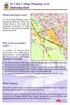 Introduction What is the Study Area? St. Clair College Planning Area is bounded by Highway 3 to the west, Cabana Road to the north, the residential community of South Windsor to the east and Cousineau
SEMINOLE PRATT WHITNEY ROAD & NORTHLAKE BLVD. FREQUENTLY ASKED QUESTIONS
 UPDATED: 01/31/14 SEMINOLE PRATT WHITNEY ROAD & NORTHLAKE BLVD. FREQUENTLY ASKED QUESTIONS Q. 1. What are the County s plans for Seminole Pratt Whitney Road between SR 80 (Southern Blvd) and the Bee Line
REVISED GENERAL DEVELOPMENT PLAN PDR-99-02(G)(R-2) - GAMBLE CREEK, L.C./TWIN RIVER
 REVISED GENERAL DEVELOPMENT PLAN PDR-99-02(G)(R-2) - GAMBLE CREEK, L.C./TWIN RIVER THE BOARD OF COUNTY COMMISSIONERS OF MANATEE COUNTY, FLORIDA, having specifically considered the recommendation of the
Interlocking Concrete Pavement Institute (ICPI) Model Stormwater Ordinance for Permeable Interlocking Concrete Pavements August 2010
 Interlocking Concrete Pavement Institute (ICPI) Model Stormwater Ordinance for Permeable Interlocking Concrete Pavements August 2010 Background What are permeable interlocking concrete pavements (PICP)?
Chapter 5. Transportation. Decatur County Comprehensive Plan. Introduction. Goals and Objectives. Goal. Objectives. Goal.
 Chapter 5 Transportation Chapter 5: Transportation Introduction The transportation system forms the backbone of a community. I-74 connects Decatur County with the large metropolitan areas of Cincinnati
28.0 Development Permit Area #2 (Neighbourhood District)
 28.0 Development Permit Area #2 (Neighbourhood District) Goals and Objectives To provide a guide for infill and new development in the Neighbourhood District. To outline the nature, form and character
Model Subdivision and Land Development (SALDO) Subdivision/ Land Development Presentation Overview. Why Subdivision and Land Development Regulations?
 Model Subdivision and Land Development (SALDO) Subdivision/ Land Development Presentation Overview Purpose of Subdivision/ Land Development Ordinances (SALDO) Municipalities Planning Code Process Design
TRANSPORTATION SERVICE STANDARDS ELEMENT GOALS, OBJECTIVES & POLICIES
 TRANSPORTATION SERVICE STANDARDS ELEMENT GOALS, OBJECTIVES & POLICIES Background One of the most critical public services provided by a community is the community s transportation system. An effective
TABLE OF CONTENTS. INTRODUCTION...1 Purpose of a Comprehensive Plan...1 McKenzie County Comprehensive Plan...1 Definitions...2 Goal...2 Vision...
 MCKENZIE COUNTY COMPREHENSIVE PLAN TABLE OF CONTENTS INTRODUCTION...1 Purpose of a Comprehensive Plan...1 McKenzie County Comprehensive Plan...1 Definitions...2 Goal....2 Vision...3 ECONOMIC DEVELOPMENT...4
Chapter 3 SENSITIVE AREAS AND VEGETATED CORRIDORS
 Chapter 3 3.01 General Provisions 3.01.1 Introduction 3.01.2 Application and Interpretation of Chapter 3.01.3 Unbuildable Lots 3.01.4 Other Permits 3.01.5 Prohibited Activities 3.02 Service Provider Letter
City of Douglas Commercial Building Permit Site Application
 City of Douglas Commercial Building Permit Site Application *Complete the following information including a complete site plan and floor plan. *Incomplete information may result in delay and/or rejection
AREA: 2.37 acres NUMBER OF LOTS: 1 FT. NEW STREET: 0 LF. Single-family, Non-conforming machine shop
 FILE NO.: Z-8958 NAME: Rock Structure Repair Short-form PID LOCATION: Located at 8024 Stanton Road DEVELOPER: Rock Structure Repair Attn. Rudy Gutierrez 3 Kipling Court Little Rock, AR 72209 ENGINEER:
Chapter 5.0. Stormwater Credits for Innovative Site Planning
 Chapter 5.0 Stormwater Credits for Innovative Site Planning Chapter 5. Stormwater Credits...Introduction 5.0 Stormwater Credits In Maryland, there are many programs at both the State and local level that
Chapter Thirty-five ACCESS CONTROL/ ACCESS MANAGEMENT BUREAU OF DESIGN AND ENVIRONMENT MANUAL
 Chapter Thirty-five ACCESS CONTROL/ ACCESS MANAGEMENT BUREAU OF DESIGN AND ENVIRONMENT MANUAL Chapter Thirty-five ACCESS CONTROL/ACCESS MANAGEMENT Table of Contents Section Page 35-1 GENERAL CONCEPTS...
Chapter 13: Implementation Plan
 Chapter 13: 13.1. INTRODUCTION The purpose of the implementation chapter of the Comprehensive Plan is to set forth the actions that the City will take to ensure that the plans, programs and policies set
March 2008. Prepared by: Irvine Ranch Water District. 15600 Sand Canyon Avenue. Irvine, CA 92618. Contact: Natalie Likens (949) 453-5633
 ADDENDUM TO THE MICHELSON WATER RECLAMATION PLANT PHASE 2 & 3 CAPACITY EXPANSION PROJECT FEBRUARY 2006 FINAL ENVIRONMENTAL IMPACT REPORT AND THE SAN JOAQUIN FRESHWATER MARSH ENHANCEMENT PLAN REVISED SEPTEMBER
PUBLIC INFORMATIONAL MEETING THURSDAY APRIL 30, 2015
 PUBLIC INFORMATIONAL MEETING THURSDAY APRIL 30, 2015 AT ACTON TOWN HALL FAULKNER ROOM 472 MAIN STREET ACTON, MASSACHUSETTS 7:00 PM FOR THE PROPOSED ASSABET RIVER RAIL TRAIL (ARRT) IN THE TOWNS OF ACTON
 Walkable Communities Florida Department of Transportation State Safety Office Pedestrian and Bicycle Program April 1995 www.dot.state.fl.us/safety Twelve Steps for an Effective Program Page 1 Twelve Steps
ORDINANCE NO. 2013 -
 ORDINANCE NO. 2013 - AN ORDINANCE OF BREVARD COUNTY, FLORIDA AMENDING CHAPTER 62, LAND DEVELOPMENT REGULATIONS SECTION 62-2891, LOT DRAINAGE, AND CHAPTER 22 BUILDINGS AND BUILDING REGULATIONS, SECTION
3 Tappan Zee Bridge Rehabilitation Options
 3 Tappan Zee Bridge Rehabilitation Options 3.1 Introduction This chapter describes possible options that rehabilitate and enhance the existing Tappan Zee Bridge. Four Rehabilitation Options have been developed:
Topic 2 11/28/2012 Blocks & Street Network
 TOPIC 2 Blocks & Street Network Implementation Note: 1. Some recommendations are summarized in the tables herein. For complete recommendation language, please see the. 2. Recommendations referenced in
Transportation Policy and Design Strategies. Freight Intensive. Level of Freight Presence
 Appendix G Transportation Policy and Design Strategies CONTEXT SENSITIVE SOLUTIONS To address the need to describe freight systems which account for the population distress which may result, an analysis
CAPACITY AND LEVEL-OF-SERVICE CONCEPTS
 CHAPTER 2 CAPACITY AND LEVEL-OF-SERVICE CONCEPTS CONTENTS I. INTRODUCTION...2-1 II. CAPACITY...2-2 III. DEMAND...2-2 IV. QUALITY AND LEVELS OF SERVICE...2-2 Service Flow Rates...2-3 Performance Measures...2-3
NAPA COUNTY WATERSHED SYMPOSIUM
 Planning, Building, and Environmental Services NAPA VALLEY GROWTH NAPA COUNTY WATERSHED SYMPOSIUM Plunging Forward May 15, 2015 1 YOU CAN T CROSS THE SEA MERELY BY STANDING AND STARING AT THE WATER. Rabindranath
Floodplain Development Land Use Review
 COMMUNITY DEVELOPMENT DEPARTMENT Planning Division P.O. Box 490 333 Broadalbin Street SW Albany, OR 97321 Phone 541-917-7550 Fax 541-791-0150 www.cityofalbany.net Floodplain Development Land Use Review
Soapstone Connector Feasibility Study
 Technical Report Soapstone Connector Feasibility Study Prepared by ATCS, plc., 2553 Dulles View Drive, Herndon, VA 20171, (703) 430-7500 www.atcsplc.com In association with: Michael Baker Corporation,
Engineering. 2006 2007 2007 2008 2008 2008 Major Service Actual Budget Projected Request Executive Adopted
 Engineering Agency Number: 53 Budget Function: Public Works and Transportation The Engineering Division is responsible for the design, supervision and inspection of all street, highway, sidewalk and bike
COUNTY OF ALBEMARLE PLANNING STAFF REPORT SUMMARY. Staff: Claudette Grant
 COUNTY OF ALBEMARLE PLANNING STAFF REPORT SUMMARY Project Name: ZMA 2013-00004 Hollymead Town Center Block VI Planning Commission Public Hearing: July 29, 2014 Staff: Claudette Grant Board of Supervisors
8.1 APPENDIX A. SUBDIVISION DATA REQUIREMENTS
 ARTICLE 8 APPENDICES 8.1 APPENDIX A. SUBDIVISION DATA REQUIREMENTS 8.1.1 Pre-application Process, Data Requirements a. Sketch Plan. A sketch plan may be prepared by the subdivider which shows the proposed
1.7.0 Floodplain Modification Criteria
 1.7.0 Floodplain Modification Criteria 1.7.1 Introduction These guidelines set out standards for evaluating and processing proposed modifications of the 100- year floodplain with the following objectives:
CHAPTER 1 GENERAL PROVISIONS
 CHAPTER 1 GENERAL PROVISIONS 12-1-010 Short Title. 12-1-020 Purpose. 12-1-030 Interpretation. 12-1-040 Definitions. 12-1-050 Considerations. 12-1-060 General Responsibilities. 12-1-070 Appeal of Planning
The Urban Renewal Authority of Pueblo
 The Urban Renewal Authority of Pueblo The Urban Renewal Plan for the Saint Charles Industrial Park Urban Renewal Project Area Page 1 I. DEFINITIONS The terms used in this Urban Renewal Plan shall have
INDOT 2000-2025 Long Range Plan
 Chapter 9 INDOT 2000-2025 Long Range Plan Highway Needs Analysis Overview The statewide transportation planning process provides for the identification of highway needs through a comprehensive process
9988 REDWOOD AVENUE PROJECT TRAFFIC IMPACT ANALYSIS. April 24, 2015
 9988 REDWOOD AVENUE PROJECT TRAFFIC IMPACT ANALYSIS April 24, 2015 Kunzman Associates, Inc. 9988 REDWOOD AVENUE PROJECT TRAFFIC IMPACT ANALYSIS April 24, 2015 Prepared by: Bryan Crawford Carl Ballard,
Lincoln Downtown Master Plan Update
 Lincoln Downtown Master Plan Update Table of Contents Executive Summary........................................... 1 Complete Streets Framework.................................... 3 Promenade Creating
Chapter 2 PLAN AND PLAT REVIEW PROCESS
 www.cityofknoxville.org/engineering/ Chapter 2 PLAN AND PLAT REVIEW PROCESS 2.1 Overall Sequence for Large Projects The overall sequence of major development and redevelopment projects will generally follow
Section 6 Traffic Analysis
 Section 6 Traffic Analysis Traffic Operations of the Preferred Network Alternative After the Preferred Network was identified and confirmed by local policy makers and area residents, detailed traffic analysis
EXHIBIT A Accessible Truck Routes Map
 EXHIBIT A Accessible Truck Routes Map ASHEVILLE, NORTH CAROLINA ROUTE: A ROUTE: B ROUTE: C ROUTE: D ROUTE: E EXHIBIT A EXHIBIT B Craven Street Improvements Map ASHEVILLE, NORTH CAROLINA EXHIBIT B EXHIBIT
Homeowner s Guide to Drainage
 Homeowner s Guide to Drainage a scottsdale homeowner s guide to drainage produced by the city of scottsdale s stormwater management division Transportation Department TABLE OF CONTENTS Introduction 2 Drainage
IMPLEMENTATION STRATEGIES The following sections list the implementation strategies for following chapters.
 CHAPTER 13: IMPLEMENTATION INTRODUCTION The purpose of the Implementation Chapter is to set forth the actions that the City will take to ensure that the plans, programs, and policies set forth in the plan
Drainage Analysis for the McKownville Area
 Drainage Analysis for the McKownville Area Town of Guilderland Albany County, New York Prepared by: DELAWARE ENGINEERING, P.C. 28 Madison Avenue Extension Albany, New York 12203 June 2010 Town of Guilderland