
Surface Area and Porosity Determinations by Physisorption. Measurements and Theory
|
|
|
- Blaze Barker
- 10 years ago
- Views:
Transcription
1
2 Surface Area and Porosity Determinations by Physisorption Measurements and Theory i

3 This page intentionally left blank ii

4 Surface Area and Porosity Determinations by Physisorption Measurements and Theory James B. Condon Professor of Chemistry Roane State Community College Harriman, TN USA Amsterdam Boston Heidelberg London New York Oxford Paris San Diego San Francisco Singapore Sydney Tokyo iii

5 Elsevier Radarweg 29, PO Box 211, 1000 AE Amsterdam, The Netherlands The Boulevard, Langford Lane, Kidlington, Oxford OX5 1GB, UK First edition 2006 Copyright 2006 Elsevier B.V. All rights reserved No part of this publication may be reproduced, stored in a retrieval system or transmitted in any form or by any means electronic, mechanical, photocopying, recording or otherwise without the prior written permission of the publisher Permissions may be sought directly from Elsevier s Science & Technology Rights Department in Oxford, UK: phone (+44) (0) ; fax (+44) (0) ; [email protected]. Alternatively you can submit your request online by visiting the Elsevier web site at and selecting Obtaining permission to use Elsevier material Notice No responsibility is assumed by the publisher for any injury and/or damage to persons or property as a matter of products liability, negligence or otherwise, or from any use or operation of any methods, products, instructions or ideas contained in the material herein. Because of rapid advances in the medical sciences, in particular, independent verification of diagnoses and drug dosages should be made Library of Congress Cataloging-in-Publication Data Condon, James B. Surface area and porosity determinations by physisorption : measurements and theory / James B. Condon. 1st ed. p. cm. Includes bibliographical references and index. Includes index. ISBN-13: ISBN-10: Physisorption. 2. Porosity. 3. Surfaces, Isothermic. 4. Density functionals. 5. Adsorption. I. Title. QD547.C dc British Library Cataloguing in Publication Data A catalogue record for this book is available from the British Library For information on all Elsevier publications visit our website at books.elsevier.com Printed and bound in The Netherlands iv

6 Table of Contents Foreword...xi Acknowledgments...xv Symbol List...xvii CHAPTER 1 : AN OVERVIEW OF PHYSISORPTION Introduction Scope and Terminology...1 General Description of Physisorption...1 Measuring the Surface Area by Physisorption...4 Preliminary Analysis...6 The Adsorption Isotherm Types...6 Characterization of Hysteresis Loops...11 Measuring the Surface Area from the Isotherm...14 Determining Porosity by Physical Adsorption...16 Micropores...16 Mesopores...18 Obtaining Pore Radius from the Two Slopes...19 The Use of the Kelvin Equation Value of r p for Mesopores...21 Macropores...21 Statistical Treatment of Isotherms...21 Adsorption Types in Standard Isotherm Transformations...23 References...26 v

7 vi Table of Contents CHAPTER 2 : MEASURING THE PHYSISORPTION ISOTHERM Introduction: Equipment Requirements...29 The Volumetric Method...30 Equipment Description...30 Determination Method...32 Error Analysis for the Volumetric Method...34 Design Errors...34 Poor Calibration of V Molecular Flow Versus Viscous Flow...35 Equation of State Errors...37 Temperature Control of the Sample...37 Limit of Detection...37 Advantages and Disadvantages of the Volumetric Technique...38 The Gravimetric Method...38 Equipment Description...38 Determination Method...41 Error Analysis for the Gravimetric Technique...42 Advantages and Disadvantages of the Gravimetric Technique...43 General Error Analysis Common to both Volumetric and Gravimetric...44 Pressure and Temperature Measurements...44 Kinetic Problems...46 Sample Density Problems...46 Calorimetric Techniques...47 Adiabatic Calorimetry...47 Measuring the Isosteric Heat of Adsorption...48 The Thermal Absolute Method...49 Differential Scanning Calorimetry...50 Flow Method or Carrier Gas Method...51 References...52 CHAPTER 3 : INTERPRETING THE PHYSISORPTION ISOTHERM Objectives in Interpreting Isotherms...55 Determination of Surface Area from Isotherms...59 The BET Analysis...60

8 Table of Contents vii χ Plot Analysis...62 The Method of Determining Surface Area by Dubinin et al Tóth T-Equation Isotherm...63 The Harkins Jura Absolute/Relative Method...64 Porosity Determinations from the Isotherm...65 Micropore Analysis...66 Mesoporosity Analysis...68 Isotherm Fits which Yield Relative Numbers for the Surface Area...72 Langmuir Isotherm...72 Freundlich Isotherm...74 Polanyi Formulations...75 deboer Zwikker Formulation...76 The Frenkel, Halsey, Hill (FHH) Isotherm...76 Analysis Using Standard Isotherms...77 Standard Isotherms...78 The α s -Curve Standard (see Sing, Everett and Ottewill [6])...78 The t-curve...78 IUPAC Standards on Silica and Carbon...80 RMBM Carbon Standard...82 KFG Segmented Standard Carbon Curve...84 Cranston and Inkley Standard for Pore Analysis...84 Thoria Standard Curves...85 Standard Curves for Lunar Soil...86 References...89 CHAPTER 4 : THEORIES BEHIND THE CHI PLOT Introduction: Historical Background...91 Theory Behind χ Plots...91 The Disjoining Pressure Derivation...91 The Meaning of Γ m in the Hard Sphere Model...93 The Quantum Mechanical Derivation of the Simple χ Equation...95 The Meaning of a ex the Perfect Adsorption Equation for Hard Spheres...98 The Energy Correction...99 Simultaneous Physisorption and Chemisorption...102

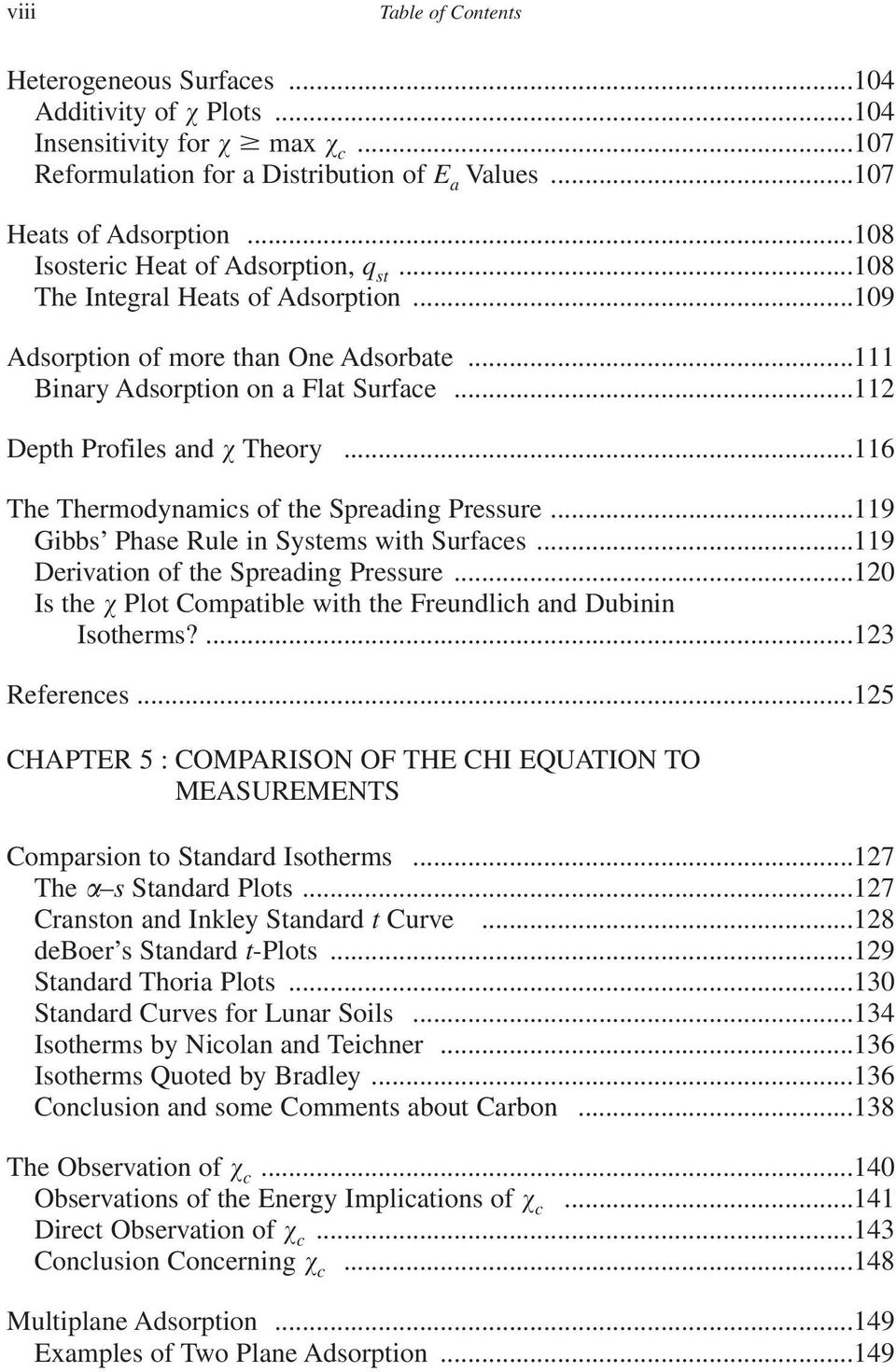
9 viii Table of Contents Heterogeneous Surfaces Additivity of χ Plots Insensitivity for χ max χ c Reformulation for a Distribution of E a Values Heats of Adsorption Isosteric Heat of Adsorption, q st The Integral Heats of Adsorption Adsorption of more than One Adsorbate Binary Adsorption on a Flat Surface Depth Profiles and χ Theory The Thermodynamics of the Spreading Pressure Gibbs Phase Rule in Systems with Surfaces Derivation of the Spreading Pressure Is the χ Plot Compatible with the Freundlich and Dubinin Isotherms? References CHAPTER 5 : COMPARISON OF THE CHI EQUATION TO MEASUREMENTS Comparsion to Standard Isotherms The α s Standard Plots Cranston and Inkley Standard t Curve deboer s Standard t-plots Standard Thoria Plots Standard Curves for Lunar Soils Isotherms by Nicolan and Teichner Isotherms Quoted by Bradley Conclusion and some Comments about Carbon The Observation of χ c Observations of the Energy Implications of χ c Direct Observation of χ c Conclusion Concerning χ c Multiplane Adsorption Examples of Two Plane Adsorption...149
10 Table of Contents ix The Freundlich, Dubinin-Polanyi and Tóth Isotherms Conclusion Concerning Multiple Energies Heat of Adsorption Adsorption of more than One Adsorbate Adsorption on Non-Porous Surface Binary Adsorption in Micropores Lewis Rule Assumption Binary Adsorption at a Constant Pressure Comparison to Experiments Conclusions Regarding Binary Adsorption Statistical Comparisons of other Isotherms to the χ Plot General Conclusions References CHAPTER 6 : POROSITY CALCULATIONS Introduction Micropore Analysis The BDDT Equation The DR and DA Equations Standard Curve Analysis using Distributions Uninterpreted Chi Theory Interpretation of the Distribution Fit Surface Areas and Pore Volume Calculations Calculation of Pore Size Assuming a Geometry Calculating r p from χ p Examples of Results Analysis of Mesoporosity Some Comments about the Standard Plot of Determining Mesoporosity..187 The Broekhoff deboer Theory Is it Microporous or Mesoporous and Does it Matter? Combined Mesopore/Micropore Equation The Interpretation of Mesopore Equation using Standard Curve The Boundary between Mesopores and Micropores...198

11 x Table of Contents Does it Matter Whether to Use a Micropore or a Mesopore Analysis? Real Data Examples What Does Chi Theory Say about Hysteresis? Conclusions References CHAPTER 7 : DENSITY FUNCTIONAL THEORY Introduction What is a Functional? The Functional Derivative Correlation Functions A Quick Trip through Some Partition Functions Direct Correlation Functions The Hard-Rod Approximations Hard Rods between Two Walls Percus Yevick Solution Expansion for Hard Spheres Thiele Analytical Approximation The Carnahan Starling Approximation Helmholtz Free Energy from the CS Approximation Non-Local Density Functional Theory Modeling with the Presence of a Surface References APPENDIX : EQUIPMENT SPECIFICATIONS Author Index Subject Index...273

12 Foreword The objective of this book is to present the practice of measuring and interpreting physical adsorption. It is intended to be a practical guide and not an extensive review of either the literature or the theories involved with physical adsorption. Extensive reviews are available and the book by Gregg and Sing [1], though about 20 years old, is still highly recommended. A couple of more recent theoretical aspects are not covered in the book by Gregg and Sing. These are density functional theory (DFT) and chi (χ) theory for which there are no comprehensive reviews. A review by Evans [2] and additional article by Tarazona et al. [3, 4], would be a good start for DFT. χ theory [5, 6] is rather simple and will be explained in one of the chapters. As with all scientific writing there are various levels that can be presented. For example, infrared spectroscopy could be used on simply the pattern recognition level or at the more sophisticated level of quantum mechanics. So it is with physical adsorption. One can use the data from physical adsorption measurements as a simple control device, i.e. Does this powder have the right adsorption isotherm to meet production requirements?, or on a different level What is the meaning of the isotherm in terms of surface and pore structure and chemical attractions? For most applications, the level of sophistication is somewhat intermediate. In this book, the simple interpretations of the physisorption experiments are presented in Chapter 1. Chapter 2 presents the important details on how to make the measurements usually associated with physical adsorption. If one already has a commercial instrument, this chapter may be irrelevant. Chapter 3 is designed to present step-by-step analysis of the isotherms by a few methods and to present other isotherm interpretations. It is generally not a good idea to rely upon manufacturers software supplied with the instruments. Although the programers are quite knowledgeable about physisorption, it is still best to examine the data carefully. Chapter 4 xi
![Extensive reviews are available and the book by Gregg and Sing [1], though about 20 years old, is still highly recommended.](/docs-images/41/6959902/images/page_12.jpg "A couple of more recent theoretical aspects are not covered in the book by Gregg and Sing. These are density functional theory (DFT) and chi (χ) theory for which there are no comprehensive reviews.")
13 xii Foreword presents extensive derivations of some theories of adsorption starting with the disjoining pressure approach. The derivations of most isotherms have been extensively reviewed in other books (for example, see Gregg and Sing). After all, most have been used for more than 50 years. However, the more recent χ theory and DFT have not been reviewed. Therefore, more detailed descriptions of χ theory and DFT are presented along with some results. The analysis of one of the more promising techniques for studying adsorption, that is calorimetry, is not presented. A variety of others that are useful for porosity measurements such as X-ray, NM, FTIR, etc., are also not presented. There is a vast body of literature on these latter subjects which have been used extensively especially for the zeolites. For most practical applications using commercial instruments, and given that one is accustomed to analysis that physical chemists use, Chapter 1 could suffice. The results of the theories formulated will be used in a cook book fashion in Chapter 1 with little explanation. The caveat to the simplified treatments is that occasionally a simple explanation for the behavior of the adsorption is not appropriate. Hopefully, by recognizing patterns in the original or transformed isotherms most misinterpretations can be avoided. The pattern recognition utilizes the set of isotherm types as originally presented by deboer and modified by Brunauer [7] and later expanded by Sing [8] and by χ plot features. Recognition of the possibilities of the complicating features beyond the simple isotherm is important for physical adsorption to be of value. Such features may be interpreted in terms of multiple surface areas, pore sizes and volume, energies of adsorption and the distribution of pore sizes or of adsorption energies. The isotherms are generally interpreted in terms of these features and these features have physical quantities associated with them that in many cases would be useful to know. Unfortunately, the physical quantities associated with the physical features listed above must be extracted using some theoretical assumptions and the associated mathematical manipulations. It is not at all certain at this time that any generalized theory is capable of this. The theories available yield quite different values for these quantities and at the moment there has not been any resolution as to which interpretation, if any, is correct. Most theories of adsorption do not even yield values for these physical quantities and some that claim to do so in reality do not. For example, the only theories that have a theoretical basis for calculating surface area of unknown samples are the Brunauer, Emmitt and Teller (BET) [9] and the χ theory. Both of these will be explained in the theoretical portions of this book. The BET is unquestionably the most widely used theory to calculate the surface area but it has some very serious

14 Foreword xiii flaws. χ theory is a recent development that has not been thoroughly tested. Another possibility is the continuing development of DFT, which has so far not been successful in calculating the surface area independent of the BET results or from assumed equations of state. There are numerous theories and methods for determining (meso) pore volume; however, to determine the pore radius most rely upon BET. Furthermore, the BET is used as a correction in these methods as well. Most theories yield approximately the same answer, within a factor of 10, due to an obvious feature in the isotherm that would allow an educated guess to be correct. There is hope that in the future some of these questions will be resolved, but for the moment there is a need for some answer even if only approximate. It is unlikely that any theory will yield answers with the precision which chemists or physicists are used to, say better than 1%, due not just to the uncertainties of the theories and the associated calculations, but also due to the defining questions regarding the physical quantities. For example, what is the pore size for pores in the range of 2 nm diameters? Where is the inner boundary for these pores? Atomic sizes begin to have meaning in this range. How does one account for surface roughness on a nearly atomic scale? Again, the same uncertainity in definition. Luckily, these questions may not be of practical importance in many applications. If a pore is large enough to allow, say, methanol to adsorb but not ethanol, there is a parameter that one could possibly extract to yield the distinction. If a catalyst s activity is proportional to the surface area, whatever that means, there is probably a parameter that is proportional to the surface area to make a relative distinction. So, in spite of the theoretical uncertainties, the measurement of physical adsorption is a very useful tool and promises to be more so in the future. REFERENCES [1] S.J. Gregg and K.S.W. Sing, Adsorption, Surface Area and Porosity, Academic Press, London and New York, ISBN , [2] R. Evans, in Fundamentals of Inhomogeneous Fluids (D. Henderson, ed.), p.85, Marcel Dekker, New York, [3] P. Tarazona, Phys. Rev. A, 31 (1985) 2672, Phys. Rev. A, 32 (1985) [4] P. Tarazona, U.M.B. Marconi and R. Evans, Mol. Phys., 60 (1987) 573. [5] E.L. Fuller, Jr., J.B. Condon, Colloid Surf., 37 (1989) 171. [6] J.B. Condon, Microporous Mesoporous Mat., 38 (2000) [7] S. Brunaur, L.S. Deming, W.S. Deming and E. Teller, J. Am. Chem. Soc., 62 (1940) [8] S. Brunaur, P.H. Emmett and E.J. Teller, J. Am. Chem. Soc., 60 (1938) 309.

15 This page intentionally left blank xiv

16 Acknowledgments For special recognition for facilitating the possibility of the creation of this book are Prof. Tilman Schober, formerly of Forschungszentrum Jülich, who made the facilities available to me and Dr. E. Loren Fuller, Jr. formerly with the Oak Ridge National Laboratory who was very instrumental in the development of the χ theory. xv

17 This page intentionally left blank xvi

18 Symbol List α a constant relating A w to A ex,0 α 1 α surface coverage in the localized layer β kt γ the surface tension of the liquid adsorptive coverage or surface excess 1 a monolayer surface excess γ gl the surface tension between the gas and liquid phase m the value of at which Φ is a minimum δ a distance parameter for correcting γ gl δ() Dirac delta function ε ε 12 ε 21 ε 11 ε 22 μ μ ad μ liquid χ χ χ c χ p χ p χ c ψ the excess Helmholtz free energy functional derivative, normally from Carnahan Starling E a group of energy terms ( zero if the two molar volumes are the same) in binary adsorption H enthalpy evolved H v molar enthalpy of vaporization ε i, j energy of interaction between molecules i and j ζ Na ex /A s ζ i ζ for the ith adsorbate η j a probe value for the fit to the isotherm data θ the amount on the surface per unit area θ i θ in the ith layer λ the perturbation parameter xvii

19 xviii Symbol List λ characteristic length in disjoining pressure formulation λ f the mean free path of the gas μ ad the chemical potential of the adsorbate μ c the chemical potential of the condensed phase flat μ g the chemical potential of the adsorbent μ l chemical potential of pure liquid phase at the saturation pressure μ liq chemical potentials of the liquid ν factor set for the sensitivity of the convergent of σ for mesoporosity Ξ the grand canonical ensemble π spreading pressure of adsorbate π γ o γ Π the disjoining pressure Π 0 the disjoining pressure at t 0 ρ liquid density ρ(r) number density function ρ(r) a smoothed density function ρ{r 1..r M } number density of particle 1 at r 1 particle M at r M ρ 0 number density of homogeneous fluid σ the standard deviation in the pore size distribution φ an energy functional Φ the excess surface energy χ ln( ln(p/p s )) χ p the value of χ at which the capillary filling takes place, the mean is χ p a the cross-sectional area of the adsorbate molecule A molar Helmholtz free energy a ex a/( ) A ex high-pressure area from slope (pore analysis) includes A w and A o A excess an excess free-energy functional term to the Helmholtz free energy a ex,i a ex for the ith adsorbate A external the external field contribution to the Helmholtz free energy A gl the area of the adsorbate layer gas interface a i molecular diameter of ith molecule (used in DFT chapter) A I the ideal gas contribution to the Helmholtz free energy A m the molar area for an adsorbate A o area of the pore openings A p surface area inside the pores A ref reference Helmholtz free energy A s the surface area A s,i the surface areas for ith segment or plane in χ theory A w edge-on walls or the non-porous area of the outer surface

20 Symbol List xix b pore fractal factor b buoyance correction coefficient B constant in the simplified Polanyi formulation C combinations used in deriving certain equations C the BET constant C (1) the singlet direct correlation function C (2) the direct correlation function C i the KFG coefficients C p,ad heat capacity (constant pressure) of adsorbate C p,l the heat capacity at constant pressure for the liquid phase of adsorptive d distance D tube diameter D 1 a distribution function which gets doubly integrated D 2 a distribution function which gets both doubly and singly integrated d p pore diameter (cylindrical) or distance between the slit pore sides E(θ) energy function for the Polanyi formulation E 1 energy of adsorption for the localized layer E a energy of adsorption for the first adsorbate molecule E a,i E a of coadsorbate i E a,i energy of adsorption for the first adsorbate molecule on the ith plane in χ theory E LJ the Lennard Jones 6 12 potential f a value is between 1.82 and 1.92 for χ theory f(t ) portion of Ξ due to internal molecular modes, vibrational, etc. F(x, T ) standard isotherm function G a parameter in mesopore fit ( for χ it A s /fa m ) G gibbs free energy g(r 1,r 2 ) (two body) correlation function for position h a constant depending upon the pore geometry H the total of the classical potential and kinetic energy (Hamiltonian) H a parameter in mesopore fit ( for χ it pg) I BET the intercept of the transformed BET plot I hi the high-pressure intercept in the χ plot for porosity calculations I lo the low-pressure intercept in the χ plot for porosity calculations J a parameter in mesopore fit ( for χ it V p /V m ) k Boltzmann constant K simply an equilibrium constant k a constant which includes k FHH and n m k FHH an empirical constant in the Frenkel Halsey Hill isotherm

21 xx Symbol List k P constant in the simplified Polanyi formulation l the total length of all the pores l average length per pore l p the pore length M number of adsorbate molecules in localized first layer M the molar mass M ad the molar mass of the adsorbate m b mass gain from buoyancy m mf (P) correction for molecular flow (a function of pressure) m p mass recording of the trial for mass flow correction M p the molar mass of the buoyancy probe gas N number of adsorbate molecules N being the number of allowed layers in BDDT equation n 1 the number of moles adsorbed in the localized layer N A Avogadro s number ( mol 1 ) n ad amount of adsorbate n ad,i amount of adsorbate for ith adsorbate n i incremental number of moles adsorbed for one data point. N i number of adsorbate molecules of species i n m the number of moles of adsorbate in a monolayer n p the moles of adsorbate needed to fill the pores N p the number of pore openings per gram P adsorptive pressure P one-dimensional pressure (not italicized to distinguish it from probability) P(χ) probability normal mass function with χ as independent variable P{} probability of whatever is in {} usually a particle position and/or velocity P 1 equilibrium pressure for a reading of a data point P cr the critical adsorptive pressure in the BdB theory P f final pressure reading for determining dead space or final reading for a data point P i first pressure reading for determining dead space or initial reading for a data point P i overpressure for the ith adsorbate P s the saturated vapor pressure over the bulk liquid P s,i the saturated vapor pressure over the pure bulk liquid for ith adsorptive Q the integral energy of adsorption as defined by Hill Q the partition function
22 Symbol List xxi Q molar integral heat of adsorption as defined by Morrison, Los and Drain Q integral heat of adsorption as defined by Morrison, Los and Drain q la heat of the liquid-adsorbate transition q st the isosteric heat q st isosteric heat of adsorption r the distance between centers in the plane of the surface R the gas constant r c the core radius r F the Freundlich isotherm constant r FHH an empirical constant in the Frenkel Halsey Hill isotherm 2 to 3 r i position of particle #i r m the center-to-center distance between adsorbate molecules r p pore radius (cylindrical) r p the pore radius or half the distance across the pore r t the radius of the immobile surface atom or ion s fraction of the excluded area compared to the hard-sphere ratio S BET the slope of the transformed BET plot S hi the high-pressure slope in the χ plot for porosity calculations S lo the low-pressure slope in the χ plot for porosity calculations t the film thickness (before the prefilling starts) t time T temperature T 1 temperature of volume designated with V 1 T 2 temperature of volume designated with V 2 T 3 temperature of volume designated with V 3 t cr the critical thickness in the BdB theory t mono a monolayer thickness t 1/2 the half life constant for pressure decay u potential energy U the unit step function u ex the potential energy due to external force u in potential energy due to inter-particle forces V the volume of gas adsorbed at STP V molar volume V 1 a calibrated volume V 2 manifold volume excluding the calibrated volume V 3 the volume at the sample temperature V d the dead space v i velocity of particle #i
23 xxii Symbol List V m the liquid adsorptive molar volume V mon the volume of gas at STP that is required for a monolayer V p total pore volume V s the volume of the sample w i Tarazona weighting functions x P/P s z πa 3 ρ/6 where a is the diameter of the hard sphere Z N the configuration partition function for N particles
24 Chapter 1 An Overview of Physisorption INTRODUCTION SCOPE AND TERMINOLOGY The term physical adsorption or physisorption refers to the phenomenon of gas molecules adhering to a surface at a pressure less than the vapor pressure. The attractions between the molecules being adsorbed and the surface are relatively weak and definitely not covalent or ionic. In Table 1 definitions used in this book and in most of the literature on physisorption are given [1]. For most adsorption experiments the temperature at which the measurements are made is less than the triple point of the gas being used but above its freezing point. This being the case, one would normally expect that the adsorbate characteristics resemble the liquid phase rather than the solid phase of the adsorptive. This is the normal assumption used for most adsorption theories. The principle measurement performed as an adsorption experiment is the measurement of the adsorption isotherm. The adsorption isotherm is the measurement of amount adsorbed versus adsorptive pressure at constant temperature. This is the easiest measurement to make. Another type of measurement is calorimetry. One form of calorimetry measures the amount of heat evolved as the adsorptive is adsorbed. Another form measures the heat capacity of the adsorbate. There are various forms of calorimetry but the most accurate methods are very difficult to perform and only a few examples are available in the literature. Another form of calorimetry, which is easier to perform, is scanning calorimetry. This calorimetry form is a good tool to determine qualitative features of the adsorption and to yield a fair indication of the physical quantities. GENERAL DESCRIPTION OF PHYSISORPTION For purpose of this book distinctions will be made between physical adsorption for the liquid-like state and in the solid-like state. Figs. 1 and 2 illustrate 1
25 2 Surface Area and Porosity Determinations by Physisorption Table 1 Some definitions needed to comprehend the first part of this book Term Definition Adsorbate The molecules adsorbed on the surface of the solid material Adsorbent The solid material upon which the adsorbate is adsorbed Adsorption Addition of adsorbate to the adsorbent by increasing the adsorptive pressure Adsorptive The gas in equilibrium with the adsorbate Chemisorption Enhancement of the amount of gas molecules on the surface of a solid caused by covalent or ionic bonding Chi (χ) plot A plot of amount adsorbed versus ln( ln(p/p s )) Desorption Removal of adsorbate from the adsorbent by decreasing the adsorptive pressure or increasing the temperature Hysteresis The phenomenon of the desorption isotherm being different from the adsorption isotherm. (The amount of adsorbate is greater for desorption.) Macropores Pores with diameters greater than 50 nm a (IUPAC definition [1]) Mesopores Pores with diameters between 2 and 50 nm a (IUPAC definition [1]) Micropores Pores with a diameter of less than 2 nm a (IUPAC definition [1]) Monolayer A uniform liquid film of adsorbate one molecular layer thick Monolayer equivalent The amount of adsorbate that has the same number of molecules as the theoretical monolayer. Symbol for this is n m Physical adsorption Enhancement of the amount of gas molecules on the surface of a solid caused by van der Waal forces (includes dipole dipole, dipole-induced dipole, London forces and possibly hydrogen bonding.) Physisorption Same as physical adsorption Standard plot Refers to one of these: α s plot, the t-thickness plot, the χ plot and others that may be specific to an adsorbate adsorbent pair. A generalize standard plot function will be designated as F(P/P s ) in this book 2D 2 Dimensional refers to a cylindrical interface, i.e. cylindrical coordinates 3D 3 Dimensional refers to a spherical interface, i.e. spherical coordinates Saturated vapor the vapor pressure over the flat surface of the liquid adsorptive. pressure (P s ) a The practical distinction between these depends upon conditions and especially the adsorbate. The above definition is based on nitrogen adsorbate and the IUPAC standard.
26 An Overview of Physisorption 3 (A) (B) in-register with bonded between surface atoms surface atoms Fig. 1. A model of adsorption of the in-register type, e.g. chemisorption, epitaxy. (A) (B) collision arrival time stacked molecules after separation Fig. 2. Models of two types of physisorption. A, gas-like; B, liquid-like;, before encounter;, after encounter; hatched is during encounter. the atomic scale difference between the two types of adsorption. For solidlike state of Fig. 1 the adsorbate molecules are located on definite sites in relation to the underlying atoms of the adsorbent. For example, they lie directly over one of the atoms or in between two or three atoms in a defined geometry. One could refer to this as an in-register adsorption or even epitaxy. Chemisorption, where the attraction between the adsorbate and adsorbent is a covalent or ionic bond, would be an example of such adsorption. Adsorption well below the triple point in temperature would also be expected to follow this pattern. Additional adsorption above the first layer, might also be in register. The other mode of adsorption, which is the subject of this book, is illustrated in Fig. 2, of which two theoretical sub-possibilities exists. For this adsorption, referred to as physisorption, in adsorbent provides an
27 4 Surface Area and Porosity Determinations by Physisorption overall attraction for which no particular site has a strong enough attraction to localize the adsorbate. In other words, the adsorbate molecules are free to skate over the entire surface, at least for a fair distance, even though there might be bumpy spots. For this physisorption picture there can be further distinctions, one where the adsorbate is behaving as a gas and there is only adsorption on top of the adsorbate, or one where the adsorbate behaves like a liquid, where adsorbate molecules can roll over one another and an adsorptive molecule can adsorb upon an adsorbate molecule. Most adsorption isotherms are performed under conditions where the liquid-like condition is assumed to exist. Calculations of the gas-like state indicate that the amount that can be adsorbed in this fashion is very low for most practical experimental conditions. Nevertheless, one would expect some of this to exist even with the presence of the liquid-like adsorbate. MEASURING THE SURFACE AREA BY PHYSISORPTION There are two principal methods to measure the adsorption isotherm, volumetric and gravimetric. In both methods the adsorbent is held at a constant temperature, usually near or at the boiling point of the adsorptive. The adsorptive pressure is increased step-wise and held constant for a period of time to allow the adsorption to occur and the temperature of the adsorbent to re-equilibrate. The length of time required depends upon the physical arrangement and the system being studied. Since re-equilibration might take hours in some cases, it is best to monitor the progress of the adsorption to determine when equilibrium is achieved. The amount adsorbed is measure in the case of the volumetric system by measuring the pressure change and comparing this to the expected pressure change if the adsorbent were absent. In the case of the gravimetric measurement the amount adsorbed is indicated by the mass gain. In both cases, some corrections to the raw data must be performed to take into account the experimental set-up. Details of how this is done are presented in Chapter 2. A typical isotherm then is a plot of the amount adsorbed versus the adsorptive pressure. Usually, the pressure is expressed as a ratio of the adsorptive pressure, P, to the saturated vapor pressure over the bulk liquid, P s. The preferred unit for adsorbate amount is millimoles or micromoles adsorbate per gram of adsorbent (mmol g 1 or µmol g 1 ). The literature has a variety of units for adsorbate with milliliters at STP (T 0 C, P) preferred in most of the older literature.
28 An Overview of Physisorption 5 Each of the methods of measuring the isotherm has advantages and disadvantages. Both isotherm measuring methods normally cool the sample to or below the boiling point of the adsorptive. The sample is then exposed to adsorptive gas while the gas pressure is measured. Since the temperature of the sample is known, usually by use of a gas liquid thermometer, then the vapor pressure of the adsorptive over its liquid is known and thus the ratio P/P s can be calculated. This is the most precisely measured physical quantity, although P s could be significantly off if the temperature of the sample is not carefully checked. This measurement is common to all the techniques. The other measurement differs depending upon the technique. The most common measurement of the isotherm is volumetric method. This method has the advantage that it is the simplest and relatively inexpensive. It has the disadvantage of a greater uncertainty in the results. In this technique the amount of gas adsorbed is determined by measuring how much gas is used from a reservoir. This sometimes referred to as a gas burette. There are several corrections that need to be checked, the principal one being what is referred to as the dead volume. In this technique temperature measurements, both in the cooled zone and for the gas burette portion, are very important. A low-cost alternative to the volumetric is the flow or carrier gas system. The disadvantage of this method is that the results are very uncertain and normally does not yield the isotherm. Generally, the gravimetric method is more accurate and precise, however such instrumentation is more expensive and requires a little more skill and patience to operate. Normally one uses a balance that is referred to as a microbalance. The balance should have at least a sensitivity of For example, if the normal load on the balance is about 1.0 g then it would normally be sensitive to 0.1 mg. For the most sensitive measurements one must make buoyancy corrections. Calorimetric measurements are less common than the measurements mentioned above and yield a different physical quantity. To be effective, the calorimetric method needs to be combined with either the volumetric technique, which is normal, or with the gravimetric technique which is a little more difficult for high-quality work. Both methods are used. Calorimetry measures the temperature change as the adsorption occurs. This along with a heat capacity measurements of the resultant adsorbate adsorbent combination yields the heat of adsorption as a function of pressure. Less precise calorimetric measurements measure only the heat evolved which gives
29 6 Surface Area and Porosity Determinations by Physisorption some idea of the various adsorption mechanism involved. Calorimetry is not widely used since accurate calorimetry is extremely difficult to perform and requires a great amount of time and effort. PRELIMINARY ANALYSIS The Adsorption Isotherm Types Some of the forms of the isotherm are shown in Figs These types are labeled I through VI according to the classification developed by deboer, codified by Brunauer et al. [2] and supplemented by Gregg and Sing [3]. These classifications are widely used in the literature on physisorption and normally have the interpretations listed in Table 2. In type VI, an initial adsorption step may be observed if a chemisorption occurs along with physisorption, however the chemisorption portion should be somewhat irreversible and subsequent isotherms will differ from the first measured isotherm. The units on the abscissa in these figures are arbitrary. Today they are usually in mmol g 1. The first step in analysis of the isotherm is to determine to which classification the isotherm belongs. A further recommendation is to determine the classification of the isotherm according to the standard curve representation or the χ plot representation. This used to be more difficult than present since Fig. 3. Type I isotherm P/ P s
30 An Overview of Physisorption 7 Fig. 4. Type II isotherm P/ P s Fig. 5. Type III isotherm P/ P s each adsorbent adsorbate combination had its own standard curve that was numerically obtained. There is now a universal representation [4] of the standard curve based upon a quantum mechanical theory of adsorption. This representation is referred to as the chi, χ, representation. A χ plot is a plot of
31 8 Surface Area and Porosity Determinations by Physisorption Fig. 6. Type IV isotherm P/ P s P/ P s Fig. 7. Type V isotherm. amount adsorbed versus the quantity ln( ln(p/p s ). The explanation for this will be presented more fully in Chapter 4. In general the χ plot of a nonporous adsorbent for which there is only one energy of adsorption for a particular adsorbent adsorbate combination is a straight line. Thus, deviations
32 An Overview of Physisorption P/ P s Fig. 8. Type VI isotherm. Table 2 Classifications of physical adsorption isotherms Type I II III IV V VI Interpretation This is characteristic of either a chemisorption isotherm (in which case the final upswing at high pressures may not be present) or physisorption on a material that has extremely fine pores (micropores) This is characteristic of a material, which is not porous, or possibly macroporous, and has a high energy of adsorption This is characteristic of a material, which is not porous, or possibly macroporous, and has a low energy of adsorption This is characteristic of a material, which contains mesoporosity and has a high energy of adsorption. These often contain hysteresis attributed to the mesoporosity This is characteristic of a material, which contains mesoporosity and has a low energy of adsorption. These often contain hysteresis attributed to the mesoporosity This type of isotherm is attributed to several possibilities the most likely being, if the temperature is below the adsorptive triple point, that the adsorbate is more like a solid forming a structured layer, i.e. epitaxial growth. Other possible explanations include multiple pore sizes. If the steps are at the lowpressure portion of the isotherm, then the steps may be due to two or more distinct energies of adsorption. If the steps are at the high pressure part of the isotherm, then the steps might be due to sharp steps on the adsorbate surface
33 10 Surface Area and Porosity Determinations by Physisorption from this straight line in either the positive or negative direction indicates deviations from this simple case. Table 3 shows a summary of the possible features that the χ plot can have in addition to a straight line. At the end of this chapter are the χ plots that correspond to the types I VI isotherms given in Figs In addition a second type VI plot is presented that differs from the one presented in Fig. 8, which has the χ plot feature 5. When transformed, types II and III are identical and so are types IV and V. Thus, the χ representation cuts down on the number of isotherms to consider and specifies exactly the physical feature that each χ plot feature corresponds to. One of the possible type VI isotherms that shows feature 5 in Table 3 above can be distinguished from the pore-filling feature 3 in the χ plot, whereas in the isotherm this discernment is not possible. It has been a general practice to determine where a monolayer of material is adsorbed by the following method. First, one inspects the isotherm, most of which have the appearance of type I or II. In the low-pressure end of the isotherm, there is a portion that has a negative curvature. In the middle of this curvature is the point called the B point. There are prescriptions as how to unbiasedly determine this point. There are two problems with this approach. First, the knee bend is somewhat gradual and, second, the point of sharpest bend is dependent upon the scale used to view the isotherm. This is assuming that one has data that has little scatter. Thus there are other Table 3 Non-linear features of the χ plot Item Feature Interpretation 1. Positive curvature at the lowest pressures A distribution of adsorption energies 2. Negative curvatures Decrease in adsorption potential due to filling of pores 3. Large positive curvature followed by Mesopore filling due to negative curvature to yield a slope of capillary action the χ plot that is less than at lower pressures 4. Hysteresis associated with item 3. Several possibilities: a shift in adsorption energy, odd shaped pores, major and minor pores, distortion of the adsorbent 5. A break in the straight line at Similar to item 1 except the distri moderately low pressures bution may be 2 or 3 distinct values
34 An Overview of Physisorption 11 unbiased mathematical methods, or at least this is the hope, to determine the monolayer value. The most widely used is the Brunaver, Emmett and Teller (BET) equation but there are other methods as well including standard plots and other theories. Unfortunately, most of the other methods, excepting the χ method, rely in some way on the BET to get started. (For example, for both α s or t-plots, which are standard plots, the relationship to monolayers adsorbed depends upon the BET determination.) In the next chapter, a more detailed discussion of the B point is given. It seems, however, that this method is no better than a factor of 5. Even this is questionable with a type I isotherm where other interpretations of the negative curvature are operative. Characterization of Hysteresis Loops Hysteresis loops are classified into four types. These types were given the designation of H1 H4 by an IUPAC committee [5]. Figs are schematic representations of these four types. The characteristics and conventional interpretation of these hysteresis loops are given in Table 4. However, there is much work still being performed to understand these forms. (See, for example, the recent publication by Roja et al. [6]. They interpret, with modeling to back up their conclusions, that the loop shapes, at least type H1 and H2, depend upon two factors: (1) the size difference between spherical chambers and connecting passages and (2) the number of passages versus chambers. Neimark and Ravikovitch [7], on the Fig. 9. Type H1 hysteresis loop P/P s
35 12 Surface Area and Porosity Determinations by Physisorption P/P s Fig. 10. Type H2 hysteresis loop. Fig. 11. Type H3 hysteresis loop P/P s other hand, have modeled adsorption in MCM-41-type zeolite with NLDFT methods. Their conclusion is that the adsorption branch corresponds to the spinodal condensation, i.e. metastable situation, and the desorption branch corresponds to the equilibrium capillary condensation/evaporation situation. Kowalczyk et al. [8], have calculated the hysteresis using a lattice density functional theory. The basis of their work stems from similar simulations by
36 An Overview of Physisorption 13 Fig. 12. Type H4 hysteresis loop P/P s Table 4 Characteristics and interpretation of hysteresis loop types Type Characteristics Usual interpretation H1 Nearly vertical and parallel adsorption Regular even pores without and desorption branches interconnecting channels H2 Sloping adsorption branch and nearly Pores with narrow and wide sections vertical desorption branch and possible interconnecting channels H3 Sloping adsorption and desorption Slit-like pores for which branches covering a large range of adsorbent adsorbate pair which P/P s with underlying type II isotherm would yield a type II isotherm without pores H4 Underlying type I isotherm with large Slit-like pore for the type I range for the hysteresis loop adsorbent adsorbate pair Arnovitch and Donohue [9]. Their calculations demonstrate the H1-type hysteresis loop due to the curved moving meniscus. (This latter publication gives an extensive review of previous work.) Although some interpretations are given in Table 4, there is probably not any consensus at this time. There appears to be a relative pressure (P/P s ) below which hysteresis does not occur. According to Harris [10], the value for this is 0.42 for nitrogen adsorption. Even for samples which demonstrate hysteresis above this value, if the loop extends to this value, then a sudden cut-off will occur.
37 14 Surface Area and Porosity Determinations by Physisorption Trens et al. [11], have correlated the intersection of the desorption branch with the adsorption branch at the low pressure (referred to as the reversible pore filling or rpf ) with thermodynamic properties. Specifically, it seems to follow the Clausius Clapeyron equation and follows that relationship expected from corresponding states relationship. This indicates that the rpf is characteristic of a first-order gas liquid transition. The enthalpy of this transition is somewhat higher than the liquid gas transition in the bulk, which should not be surprising since the interaction of the solid with the adsorbate should supply an extra energy. Further complicating comparing the various modeling with experimental data is the possibility that the energy of adsorption might shift, and possibly in a reproducible manner, from the adsorption branch to the desorption branch. Although such a shift cannot explain all of hysteresis, especially the types other than H1, it creates problems in comparing modeled hysteresis with observed hysteresis. MEASURING THE SURFACE AREA FROM THE ISOTHERM As hinted at in the previous section, if one can determine the amount of material in one monolayer of adsorbate, then the surface area can be calculated from this. One simply needs to know what the average cross-sectional area of the adsorbate molecule. The calculation is then rather simple. If n m is the number of moles of adsorbate in a monolayer and a the cross-sectional area of the adsorbate molecule, then the surface area, A s, is given by A n N a s m A where N A is Avogadro s number ( mol 1 ). Two problems are involved with this. Firstly, how does one arrive at n m? Secondly, what is the value for a? In the first instance some theory should yield n m. The most widely used theory is the BET [12], which assumes that the adsorbate molecules settle on two types of specific local sites, either a site on the adsorbent surface or on top of another adsorbate molecule. The spaces of the sites are exactly that expected for the close packing of the adsorbent molecules. Thus, the adsorptive solid phase spacing in the close-packed arrangement is used for a. This formulation seems to work quite well with the following provisos: 1. The adsorption is a high-energy adsorption, such as on silica. 2. The range of fit for the BET equation is restricted to for the value of P/P s. (1)
38 An Overview of Physisorption 15 The latter condition must be adjusted depending upon the adsorbate adsorbent combinations. The BET equation is n n ad CP ( P P )1 ( C 1)( P P ) m s s (2) where n ad is the amount of the adsorbate and C the (so-called) BET constant. This is normally rearranged to P 1 C 1 P n ( P P) n C n C P ad s m m s (3) By plotting the quantity on the left of this equation versus P/P s one can add the slope and intercept of this plot to obtain C and thus substitute this into either the slope or intercept expression to obtain n m. The plot should be taken over the P/P s range as mentioned above. Beyond these values the linearity of the plot breaks down. (The sequence to derive this is to invert both sides of Eq. (2) and then multiply both sides by P/P s. One might wonder why the latter operation was performed.) The most common adsorptive used is nitrogen and the value used for a is m 2. Another method to determine the surface area comes from χ theory. The values obtained by this method (as analyzed by Condon [13]) seem to agree with some other methods, such as the absolute method of Harkins and Jura [14] and the conclusions by Kaganer [15, 16]. It also consistent with X-ray analysis for some porous samples. For a non-porous, single energy surface the following equation holds according to χ theory [17]: n fa A ad s m n ( χ χ ) U( χ χ ) m c c (4) where U is the unit step function (i.e. negative values of n ad are meaningless), P χ ln ln and χ ln Ea c P RT s (5)
39 16 Surface Area and Porosity Determinations by Physisorption The constant f has a value between 1.82 and 1.92 depending upon the relative sizes of the adsorbate and adsorbent molecules or ions. From the plot of n versus χ one can obtain n m f as the slope and E a can be calculated from the x-axis intercept. Eq. (1) is used to obtain the surface area. The value of a is calculated from the liquid density by: M a ρ A ( N ) (6) where M is the molar mass (units: g mol 1 ) and ρ the liquid density (units: gm 3 obtained by multiplying the density in g ml by the factor ml m 3 ). At this time, all the other theories that yield the isotherm or parts of the isotherm depend upon the BET, either directly or indirectly through a standard curve, in order to obtain the surface area. DETERMINING POROSITY BY PHYSICAL ADSORPTION There have been several methods to determine porosity using physical adsorption. The first step is to determine if the porosity consists of micropores or mesopores. By definition, macropores are too large to show up as pores within the experimental data range. Type I isotherm is usually interpreted as an indication of micropores. Type IV, V and possibly VI are characteristic of mesopores. A far as the χ plot or the standard plots features are concerned, whenever the slope of the plot decreases, with or without an intervening positive increase, pores are present. The presence of the intervening positive increase is an indication (χ definition) of mesopores. In the Brunauer, Deming, Deming and Teller (BDDT) designation, a type II or III isotherm does not indicate porosity, however in the χ transform a type II or III appearing isotherm might indeed indicate porosity. If a mix of micropores and mesopores are present then typing might prove difficult but the χ plot might reveal these individual features. If more than one size of micropore is present, the χ plot has proven to be successful in determining this [18]. Although both micropores and mesopores can be handled simultaneously, for clarity they will be separated in this treatment. Micropores Classically, micropores have been treated using the Langmuir [19, 20] isotherm with the assumption that since the micropores were too small for
40 An Overview of Physisorption 17 more than one molecular layer to adsorb, that the multilayer consideration (as assumed for the BET) was irrelevant. The Langmuir equation is n n ad m KP 1 KP (7) which may be rearranged to a linear form so x n 1 Kn x n ad m m (8) where x = P/P s. From the plot of x/n versus x the slope and intercept can be obtained to yield K and n m. K is simply an equilibrium constant. From an analysis of standard curves, this analysis for n m will be off by as much as a factor of 4 for physical adsorption in micropores. Another possibility in analyzing for micropores is to modify the BET equation to allow for only a certain number of monolayers to adsorb. This introduces another parameter, i.e. the number of allowed monolayers. This equation is not widely used and has not proven to be successful. With N being the number of allowed layers, the modified equation, called the BDDT [21], is n n ad m cx 1 ( N 1) x Nx N 1 cx 1 ( c 1) x cx N N 1 1 (9) The most reasonable method to analyze micropores is to use the standard curves. Fig. 13 illustrates the technique. Plotting the amount adsorbed versus the standard plot value listed in the figure as F(P/P o ) (or in the case of a χ plot the χ value) one should obtain two linear regions. The slope of the low linear region (labeled L) is proportional to the surface area, including the surfaces of the micropores. The slope of the upper linear region (labeled H) is proportional, with the same proportionality constant, to the area outside the pores plus the pore openings. The (n/n m ) intercept of this upper line is the amount of adsorbent that can fit into the micropores. This is therefore an indication of the pore volume. It has been speculated that the round-off between these curves is an indication of the geometry of the pore. That is, a sharp transition indicates slit-like pores, whereas a rounded transition indicates more cylindrical pores. This is not entirely clear at this time.
41 18 Surface Area and Porosity Determinations by Physisorption 2.0 H n/n m L F(P/P o ) Fig. 13. A χ plot or standard plot of a type I isotherm. Mesopores Mesopores generate either a type IV or V isotherm. In types IV and V isotherms a similar strategy as that for micropores can be used as illustrated in Fig. 14. Notice, however in this case that the lower line, L, and the upper line, H, intersect at a higher value of χ than the commencement of the negative change in the slope. The analysis from these lines remains the same as for the micropore case (Fig. 13), but there is additional information. One could refer to such pores as pre-filled or capillary filled since it is normally attributed to capillary action. Notice that this particular part of the analysis an answer for the pore volume, total surface area and external surface area is independent of whether the adsorption or desorption branch of the isotherm is used. The interpretation of the hysteresis loop is a matter of some current discussion. The primary explanation is based upon the Kelvin equation as modified by Cohan [22]. which is: P hvm RT ln P γ r t s p (10) The following are the meanings of the new symbols, γ is the surface tension of the liquid adsorptive, V m the liquid adsorptive molar volume, r p the pore
42 An Overview of Physisorption 19 H n ad / n m L χ or F(P/P s ) Fig. 14. A χ plot or a standard plot of either a type IV or V isotherm. radius or half the distance across the pore, t the film thickness before the prefilling starts and h a constant depending upon the pore geometry. For h the following are used: h = 1 for slit-shaped pores h = 2 for cylindrical-shaped pores 1 < h < 2 for oblate-shaped pores h < 1 for slits that have many concave sides. Values above 2 would be an indication of some fractal arrangement. The t thickness is the thickness assumed given by the following equation: radv t A s m (11) Obtaining Pore Radius from the Two Slopes The following then is the information that one would hope to extract from these plots. Assuming one can relate the slopes of L and H to areas either by comparison to non-porous standard or through the theoretical χ treatment, one has the areas A s corresponding to the L slope and A ex corresponding to the H slope. (χ treatment would use the analytical expressions of Eqs. (4) and (5).) These are related to the physical quantities of the total
43 20 Surface Area and Porosity Determinations by Physisorption surface, A s, the area inside the pores, A p, the total surface area of the pore openings, A o, and the area of the edge-on walls or the non-porous area of the outer surface, A w,by A A A s p w A A A ex w o (12) (13) The total pore volume, V p, should be well approximated by the intercept mentioned. At this point a geometry must be assumed to analyze further. If cylindrical pores are assumed then there will be an average length per pore, l. Basing the following upon a fixed amount of adsorbent, conventionally exactly 1 g, one can construct the following equations: Vp πr 2 p l Np A 2πr l N A p p p πr 2 N o p p (14) (15) (16) where N p is the number of pore openings per gram and r p the pore radius. For microporous plots (Fig. 13), these equations present the problem that there are more physical quantities which need to be extracted than there is information available. For these cases, the assumption normally used is that A o <<A w thus making A ex =A w and A p =A s A ex. Other assumptions could be made, for example if the wall thickness of the zeolite were about the same size as the pore radius, then A w A w and therefore A w 0.5 A ex. In general, one could insert a factor, 0<α<1 to relate A w to A ex. The r p then would be r p 2Vp A αa s ex (17) Eq. (17) is capable of yielding a range of values for the pore radius using the slopes and intercepts of the standard plots for both micropores and mesopores.
44 An Overview of Physisorption 21 The Use of the Kelvin Equation Value of r p for Mesopores In the case of the analysis of mesopores (Fig. 14) a separate determination of r p may be obtained using Eqs. (10) and (11). The pressure used in Eq. (10) is that at which a sudden increase is observed or the average value in the step. n ad is for the purpose of calculating t extracted from the L portion of the standard plot or its extrapolation. Both of these assumptions are approximations. In general there is also a distribution of either pore sizes or of adsorption energies, which complicates this simplistic analysis. These complications can be overcome and are addressed in Chapter 6. The simple treatment however follows along these lines. 1. Using the value of r p, which is obtained from Eqs.(10) and (11), determine the product l N p -from Eq. (14). 2. Substitute r p l N p into Eq. (15) to obtain A p. 3. Obtain A w by substituting A p into Eq. (12). 4. Obtain A o by substituting A w into Eq. (13). 5. Obtain N p by substituting A p into Eq. (16). 6. l is then obtained by dividing out N p from l N p. Thus for an isotherm indicating mesoporosity one should be able to obtain all of the physical quantities unambiguously. This analysis requires very good data to yield results. Notice that in step 3, that A p and A s should be much larger than A w. If this is not the case then there is a high uncertainty in A w and obtaining a nonsense answer is possible. Macropores Almost by definition macropores cannot be observed in the isotherm, at least until now. This is because the pore filling would occur at pressures too close to the vapor pressure, P s, to be reliably measured. This, however, may be changing. By using a differential technique and very good temperature control and handling methods Denoyel, Barrande and Beurroies [23] have been able to extend the reliable pressure range to of P s and measured porosity up to 12 µm The analysis method should be identical to that used for mesopore (IUPAC). STATISTICAL TREATMENT OF ISOTHERMS The principal fact to keep in mind when analyzing an adsorption isotherm is that the pressure reading is invariably much more precise than the
45 22 Surface Area and Porosity Determinations by Physisorption measurement of the amount adsorbed. If a transform for P/P s is used in the analysis, very little error (indeed usually insignificant error) is introduced in the statistical analysis. Whereas, if a transform is performed upon n ad then a statistical error is introduced unless some compensating weighting factors are introduced. For example, the linearized BET equation (Eq. (2)) transforms both P/P s and n ad but one need only be concerned with the error introduced by n ad. There could be a significant error in the assumed value of P s,however the recommendation is to use only values of P between 0.05 and 0.35 of P s which eliminates most of this uncertainty. Since the function used in n ad is 1/n ad then the error is approximated by εn ad 2, where ε is the error or uncertainty expected in n ad. The average uncertainty is often assumed to be constant regardless of the value of n ad. Thus the lower the value of n ad, the greater is the error in the transformed plot. In computing a linear least squares on the transformed plot a weighting factor of n ad2 should be used. Over the P s range this gives a variation in error of a factor of about 50. A more precise choice would be to use a non-linear leastsquares routine for the untransformed equation (Eq. (14)) in which case the initial estimates of n m and C could be obtained from the transformed plot. The practical consequence of not using a weighted regression (leastsquares) method is that under most practical conditions, the error is small when one uses the non-weighted regression. Simulations of adsorption on ceramic materials have indicated that a probable error of about 3 4% is introduced by the transform. The answer for the surface area from the non-weighted method is always less than the weighted value. Interpretation of the statistics from the transformed plot, however, is not straightforward. For example, what does the meaning of the statistical outputs such as R 2 and parameter deviations (σ x and σ y ) indicate in the regression analysis? The problems of interpretation of statistical parameters and error introduced by data transformation are not present in the standard isotherms, such as the α s plot, t-plot or others, nor are they problems with the χ plot. In these cases, n remains untransformed and the error for the full range is approximately constant. A straight application of a simple linear regression is therefore appropriate. This makes the derived statistics, such as standard deviation, R 2, σ x, σ y, etc., easy and straightforward to interpret. These statistics then relate directly to the physical quantities that they are associated with.
46 An Overview of Physisorption 23 ADSORPTION TYPES IN STANDARD ISOTHERM TRANSFORMATIONS The type I VI isotherms of Figs. 3 8, are shown in Figs In order for the type I to simulate a Langmuir isotherm as assumed one must include an energy of adsorption (that is E a ) as a distribution of energies. This, however is usually not observed experimentally since the very low pressure range is not normally measured. Type II and type III are basically identical except for the value for E a. A distribution of E a was added to the type III here for illustration χ Fig. 15. Type I isotherm expressed as a standard plot or a χ plot. An energy distribution has been added to allow n ad 0 simultaneous as P χ Fig. 16. Type II isotherm expressed as a standard plot of a χ plot. No energy distribution is assumed.
47 24 Surface Area and Porosity Determinations by Physisorption χ 4 Fig. 17. Type III isotherm expressed as a standard plot or χ plot. An energy distribution has been added since low E a s usually include this χ Fig. 18. Type IV isotherm expressed as a standard plot of χ plot. purposes and is not a necessary feature. Types IV and V are also identical except for the differences in E a s. There is a possibility of obtaining a false hysteresis loop if the energy of adsorption (E a ) shifts to a lower value for the desorption isotherm. This is very likely, so a plot of n ad versus χ might be more appropriate. There is another plot that one can observe in the χ representation that might appear
48 An Overview of Physisorption χ Fig. 19. Type V isotherm expressed as a standard plot or χ plot χ Fig. 20. Type VI isotherm expressed as a standard plot or χ plot. as a type VI plot. This is characteristic of samples with two or more types of surface with differing energies (E a ) of adsorption. The feature, however, might be obscured in the normal isotherm representation. The standard or χ plot is represented by Fig. 21. Fig. 22 shows the normal isotherm one would obtain with the two different E a values revealed in Fig. 21. This feature may not be obvious in the normal isotherm representation depending upon the various values but is very obvious in the standard or χ plot representation. This plot is very characteristic of carbon as an adsorbent.
49 26 Surface Area and Porosity Determinations by Physisorption χ Fig. 21. A standard or χ plot of an alternate type VI isotherm (VIA). This is the result of two surfaces with differing E a s P/P s Fig. 22. The normal isotherm for the alternate type VI isotherm (VIA) where one can observe the steps due to different E a s. REFERENCES [1] D.H. Everett, IUPAC Mannual of Symbols and Terminology, Appendix 2, part 1, Colloid Surf. Sci., Pure Appl. Chem., 31 (1972) 578. [2] S. Brunaur, L.S. Deming, W.S. Deming and E. Teller, J. Am. Chem. Soc., 62 (1940) [3] S.J. Gregg and K.S.W. Sing, in Adsorption, Surface Area and Porosity, Academic Press, London, ISBN , 1982.
50 An Overview of Physisorption 27 [4] J.B. Condon, Langmuir, 17 (2001) [5] K.S.W. Sing, D.H. Everett, R.A.W. Haul, L. Moscou, R. Pierotti, J. Rouquerol and T. Siemienwska, Pure Appl. Chem., 57 (1985) 603. [6] F. Roja, K. Korhause, C. Felipe, J.M. Esparza, S. Cordero, A. Domingues and J. Il Riccardo, Phys. Chem. Chem. Phys., 4 (2002) [7] A.V. Neimark and P.I. Ravikovitch, Micro. Mesporous Mat (2001) 697. [8] P. Kowalczyk, K. Kaneko, L. Solarz, A.P. Terzyk, H. Tanaka and R. Holysk, Langmuir, 21 (2005) [9] M.D. Donohue and G.L. Aranovich, J. Colloid Sci., 205 (1998) 121. [10] M.R. Harris, Chem. Ind. (London), (1955) 288. [11] P. Trens, N. Tanchoux, A. Galareau, D. Brunel, B. Fubini, E. Garrone, F. Fajula and F. DiRenzo, Langmuir, 21 (2005) [12] S. Brunaur, P.H. Emmett and E.J. Teller, J. Am. Chem. Soc., 60 (1938) 309. [13] J.B. Condon, Micropor. Mesoporous Mater., 53 (2002) 21. [14] W.D. Harkins and G.J. Jura, J. Am. Chem. Soc., 66 (1944) 919. [15] M.G. Kaganer, Dokl. Akad. Nauk SSSR, 122 (1959) 416. [16] M.G. Kaganer, Zh. Fiz. Khim., 33 (1959) [17] E.L. Fuller, Jr. and J.B. Condon, Colloids Surf. A, 37 (1989) 171. [18] E.L. Fuller, Jr.,. Morphology Of Carbons Deduced From Physisorption Isotherms: I. Nuclear Grade Graphite and Morphology Of Carbons Deduced From Physisorption Isotherms: II. Activated Carbon, 24th Conference on Carbon, Vol. 1, pp.14, 16, Jul 11 16, [19] I. Langmuir, J. Am. Chem. Soc., 38 (1916) [20] I. Langmuir, J. Am. Chem. Soc., 40 (1918) [21] S. Brunauer, L.S. Deming, W.E. Deming and E. Teller, J. Am. Chem. Soc., 60 (1938) 309. [22] L.H. Cohan, J. Am. Chem. Soc., 60 (1938) 433. [23] B. Denoyel, M. Barrande and I. Beurroies, 7th International Conference on the Characterization of Porous Materials, 2005.
51 This page intentionally left blank 28
52 Chapter 2 Measuring the Physisorption Isotherm INTRODUCTION: EQUIPMENT REQUIREMENTS There are principally two methods widely used to determine surface areas by physisorption. They are the volumetric method and the gravimetric method. The general object is the same for both. One wishes to measure the amount of a gas that adsorbs on the surface as a function of the pressure of this gas. One ends up with a series of paired data, the amount adsorbed versus pressure, from which some physical parameters are extracted. These parameters almost always include a number believed to be the surface area and a quantity related in some way to the strength of the forces holding the adsorbate to the adsorbent. Other parameters sometimes identified are the porosity in terms of pore size and volume. The volumetric technique uses one type of measurement to obtain both the data sets. This measurement is of the pressure. The gravimetric technique measures the pressure and the mass gain of the adsorbate with separate instrumentation, using some minor pressure corrections for the weight. Both techniques have their advantages and disadvantages, so it is important to be knowledgeable about both, especially if a decision is to be made as to which one to use or if a purchase is imminent. The primary differences between the two are: 1. Cost. Usually, the gravimetric technique is costlier than the volumetric technique. The volumetric technique requires only high precision pressure transducers and high precision volume measurements. The gravimetric, however, requires a high precision vacuum balance and, perhaps, considerable set-up effort. 2. Capability. Usually, the gravimetric technique is more precise and accurate. It is a better research method than the volumetric technique. The volumetric technique is incapable of some measurements needed in research, but for most routine work, given some important caveats, it is sufficient. 29
53 30 Surface Area and Porosity Determinations by Physisorption The details which follow are required reading for a sound purchasing decision. In both methods, the adsorption is performed in a temperature and pressure range just below the condensation point of the gas to liquid transition. Usually, the temperature is picked, for practical reasons, as the boiling point of the gas. For example, in measuring the adsorption of nitrogen, liquid nitrogen is used to control the temperature of the sample. This is a convenient coolant, which assures a known vapor pressure over the sample. Research work often gets away from this restriction in order to study the adsorption at other temperatures. This latter change could also increase the cost and complexity of the instrumentation. Liquids, however, which have a reasonable vapor pressure at room temperature and above are more easily handled. An example of a fairly well-characterized inert gas with a higher vapor pressure would be perfluoro-cyclohexane or sulfur hexafluoride. However, these are rarely used. Use of water, alkanes and alcohols are quite common and temperature control is only a minimal problem. There is always the question of interpretation with these gases, however. For convenience, the following discussions will assume a nitrogen adsorbate and liquid nitrogen as the temperature controlling fluid. The sample will be referred to as a powder which is not a requirement. Contiguous, open porous samples are also characterized by the techniques. THE VOLUMETRIC METHOD Equipment Description The basic volumetric method is shown schematically in Fig. 23. System parts are not to scale. This is an idealized system and some of the features may not be present on some of the commercial instruments. Furthermore, there may be features on some commercial instruments that are not shown here. An example is the matching tube system to automatically compensate for the dead volume. Sample chambers are usually constructed from Pyrex using metal vacuum flanges. Even though there are many systems that are all pyrex, an all-metal system is the best. The powdered sample (P) is contained in the sample tube (H). (Note of caution if the powder sample is produced in the tube, such as hydriding a metal, one should be certain that enough room is available for expansion. A rule of thumb is at least a five fold expansion. Multiple chemical treatments are not recommended in this vertical arrangement due to packing and swelling. For that purpose, a horizontal tube with at least a 10-fold increase in effective
54 Measuring the Physisorption Isotherm 31 D V 2 C V 1 F G Z S H U T L V 3 P B Fig. 23. Schematic of a volumetric system. sample volume is recommended. In either case metal tubes are recommended.) This tube is immersed in a liquid nitrogen bath (L) for temperature control. Between the liquid nitrogen-cooled area and the rest of the equipment at room temperature (recommended to be thermostated to 0.1 C) is a transition zone (Z). This transition is indicated in the figure as the zone between the dashed lines in the upper (V 2 ) and lower (V 3 ) zone. It is recommended that this transition zone be controlled. One way to do this is to have a U-shaped cup (U) attached to the sample tube and control the liquid nitrogen such that the level is about halfway up this U-cup. Thus, one either has to watch the liquid nitrogen level carefully or use a level detector (D) to control the flow of liquid nitrogen (F) into the Dewar (large black object). To admit gas, one opens the valve from the nitrogen supply (G) (nitrogen supply should have pressure controller, safety valves, etc.) with the valve to the sample area (C) closed. One then measures the pressure with a Bourdon or other membrane-type pressure transducer (B). With today s technology there is little reason to use the traditional manometers (and one very good reason not to). The volume between the two valves (S tubing valves transducer) should be calibrated using PV methods and any competent standards laboratory can accomplish this. The valve C is opened when one wishes to adsorb the gas. For temperature measurement, a thermometer well (T) is provided. In the case of liquid nitrogen temperatures, a gas liquid equilibrium thermometer is recommended. This requires another pressure transducer and
55 32 Surface Area and Porosity Determinations by Physisorption additional tubing and valves, but yields the vapor pressure of N 2 directly. It is also very sensitive. Determination Method Note in Fig. 23 that there are three zones labeled indicating three volumes one must consider, V 1, V 2 and V 3. V 1 and V 2 are the manifold. The volume of V 1, a calibrated volume, is already known at the beginning of the measurements. This calibration should have been performed either at a standard laboratory or against a secondary standard which is traceable. The first problem is to determine the volumes of V 2 and V 3. What s the dead space? Volumes V 2 and V 3 are at different temperatures, T 2 and T 3. Using the ideal gas equation, the total number of moles in the two volumes, assuming P 2 P 3 P is n n 2 n 3 P/R (V 2 /T 2 V 3 /T 3 ) Imagine then that the entire region is a T 2 to yield an imaginary effective volume for the sum. V d nrt 2 /P V d T 2 (V 2 /T 2 V 3 /T 3 ) One could therefore think of the dead space (without sample) as a weighted average of V 2 and V 3 according to inverse temperature. Normally V 2 is at a different temperature from V 3 so the total volume cannot be measured correctly. However, an effective volume called the dead space, V d, can be measured. This quantity will then be used in subsequent calculations. To determine the dead space, one first does a calibration of the system without a sample with T 2 and T 3 (temperatures of V 2 and V 3 ) at the operating temperature anticipated. The adsorbing gas is admitted to the calibrated volume area V 1 (through valve G) with the valve to V 2 (C) closed. The pressure measurement, P i, is taken. The valve C is then opened and a second pressure measurement, P f, is taken. The dead space volume is given by V d PV i 1 V P 1 f (18)
56 Measuring the Physisorption Isotherm 33 If the volume of the sample, V s, is known, then a small correction can be made for its volume. This correction modifies Eq. (18) to V d PV i 1 VT s V1 P T f 1 3 (19) The volume of the sample can be obtained if one knows both the open- and closed porosity of the sample and its theoretical density. The closed porosity of the sample should be included in V s but the open porosity should not be included. These are subtle points which for many practical applications make little difference and can be ignored. At any rate, it is a good idea to attempt to subtract V s even with crude data. It is recommended that this dead space be measured over a range of pressures. A properly designed instrument will have little variation over a large pressure range. Problems concerning the location of the boundary between V 2 and V 3 can lead to errors. Furthermore, the transport properties of the gas can change with pressure, especially in the low-pressure range. In the next section, the errors due to uncertainty in the boundary between V 2 and V 3 and the error due to uncertainty in the gas transport properties is discussed further. Once V d is determined, one can apply this to the uptake of the adsorbate on the surface. After sealing the sample in the sample tube, with degassing and other preparation steps, the system is evacuated. The details of the degassing depend upon the sample. For careful scientific investigations degassing procedure, with for instance ceramics, would be to bake the entire system under an ultrahigh vacuum (better than 10 9 atm) at a temperature of 200 C. Routine degassing is often much less vigorous. The interpretation of the data, however, is often dependent upon these steps. For the adsorption process one starts by first opening valve G and measuring the pressure (P i ). Then valve G is closed and valve C is opened and the pressure drop is followed until a new stable pressure is reached. This may take some time, and it is highly advised to have patience. During this step, it is also advised that the data be recorded and followed as a function of time. Usually, an exponential decay is observed, following a curve such as P Pf ( P1 Pf)exp(0.692 t t1 2) (20)
57 34 Surface Area and Porosity Determinations by Physisorption where t ½ is the half life constant for pressure decay, so that after a time, P f is approached. The amount adsorbed for this single data point is given by n ad PV i 1 Pf( Vd V1) RT (21) After the first data point is taken, valve C is closed and the procedure is repeated. An additional amount is then adsorbed, again according to Eq. (21). One should keep a log of the values of P i and P f as the procedure advances. As one approaches the vapor pressure of the adsorbate in the bulk liquid state, P s, the amount adsorbed per unit of pressure change becomes larger and larger. At some point, say P P s, the measurements become impractical to perform and the procedure is terminated. To obtain the total isotherm, the increments, i, of an amount, n i,are added from n 1 to n i for the total amount adsorbed at any particular P f. This then yields the amount adsorbed as a function of gas pressure. For the analysis of this isotherm one should refer Chapter 1 or for a more advanced analysis Chapter 3. Error Analysis for the Volumetric Method In this section, potential errors for the volumetric technique are discussed. Also, relevant are the errors analyzed under General Error Analysis section. Design Errors Hopefully, none of these errors will be encountered. They are listed here so one can be aware of potential problems when constructing or buying equipment. Uncertainty about the boundary between V 2 and V 3 : Most problematic with this design error is the sharpness and stability of the temperature transition from liquid N 2 (or other temperature control) to the room temperature region of V 2. The U-cup arrangement for liquid N 2 is recommended. Other temperatures or control methods will require similar thought. Some instruments come supplied with matching hang-down tubes to automatically compensate. If V 2 and V 3 vary during the measurements, thus varying V d, then an unknown, unsystematic error is introduced. Some instruments use a continuous correction to the dead volume by having a matched volume in the same temperature bath. With this arrangement it is not quite so necessary to make sure that the level of the bath is
58 Measuring the Physisorption Isotherm 35 constant. The temperature leveling cup U shown in Fig. 23 might not be necessary for precision work. Poor Calibration of V 1 A poor calibration of V 1 is a systematic error and is additive across all n i. This means that a 10% error in V 1 leads to a 10% error in the amount adsorbed. As errors go, this is not bad. Furthermore, a post calibration can correct all preceding errors directly. A 10% error in V 1 would also be unlikely, since even a crude measurement of volume should yield a number within 1%. In determining the pore sizes using the modified Kelvin, a poor calibration of V 1 is not critical since the primary size determination is with the pressure measurement. It will directly affect the pore volume measurement. Molecular Flow Versus Viscous Flow This can be a large, usually unrecognized error. Proper tube design, that is, proper diameter tubing for the temperature and pressure ranges, is needed to avoid this problem. This is especially true in the low-pressure range. This error can be critical for the low-pressure work and can lead to incorrect conclusions, including the wrong values of surface area and porosity. A discussion of the regions of the two realms can be found in most books on vacuum technology, for example the book by Roth [1]. The problem is that in the low-pressure range, P 3 is not equal to P 2 but is related to it by P P 2 3 T2 T 3 12 (22) At high pressures P 2 P 3. The transition between these two regions is governed by the Knudsen number, which is the ratio of the tube diameter, D, to the mean free path of the gas, λ f. If D/λ f 110, then P 2 P 3 If D/λ f 1, then (22) holds If 1 D/λ f 110, something intermediate The mean free path, λ f, can be calculated from some gas equations of state, usually the van der Waal equation. Table 5 is a list of some typical values for λ f which might be of importance. The λ f is inversely proportional to the pressure, so the particular requirements of a system may be calculated from this table.
59 36 Surface Area and Porosity Determinations by Physisorption Table 5 Values for the mean free path, λ, and minimum sample tube diameters required for some gases are 25 C Gas λ f at λ f at λ f at 10 3 atm (m) 10 4 atm (m) 10 5 atm (m) H He N O Ar H 2 O CO Min. tube Min. tube Min. tube dia. /cm dia./cm dia./m H He N O Ar H 2 O CO Note from the table that at low pressures (0.001 P 0 for the usual N 2 isotherm) the volumetric method breaks down. Although one can attempt corrections, the transition region is very hard to control and should be avoided. One could argue that not much is adsorbed below atm and therefore the error in the overall amount adsorbed is slight. Unfortunately, this is incorrect for some high-energy materials. For this adsorbent a monolayer equivalent is already adsorbed at this pressure. For analysis, with the use of Brunauer, Emmitt and Teller (BET) or other isotherms, this is critical and yields a large error. Notice that with this type of error, a systematic error is introduced in both the dependent and independent variable in the transformed BET equation. As will be seen later, however, this is not a serious error for the chi (χ) theory analysis if one is interested in only the surface area. (The caveat for this last statement is that for porous samples a much more complicated situation exists and thorough degassing and very low-pressure measurements may be required.) Besides note that the Knudsen correction is not necessary when one considers small size pores
60 Measuring the Physisorption Isotherm 37 since the immediately outside of the pores the temperature is the same as that inside the pores. Equation of State Errors The above discussion on how to calculate the amount of adsorbate was based on the ideal gas law. Whether this holds up or not can be easily checked. For N 2 using a liquid N 2 bath the error is slight. At full P s the error is only about 0.03%. (In recent developments for measuring into the macropore range, a correction for this deviation may be necessary.) This might not be true for other adsorbates and other pressures and temperatures. The usual correction used for this is the Van der Waal equation, for which the constants may be found in many handbooks (e.g. the CRC Handbook [2]). A closer approximation would be the Carnahan Starling [3] equation of state or an empirical virial equation. Temperature Control of the Sample A temperature error reading at the sample can affect the isotherm considerably in the upper pressure range. Such errors are usually attributed to radiative heating or inhomogeneous temperatures in the sample. Radiative heating is due to the infrared radiation originating in the V 2 section and traveling to the V 3 section. This is difficult to avoid. One possibility is to use baffles in the V 3 section to eliminate this radiation. Baffles, however, can complicate the molecular flow problem previously mentioned and should be carefully designed. Baffles are easier to use with the gravimetric technique. More about this error is presented in the General Error Analysis section. Limit of Detection Due to limitation of the pressure-sensing devices, the very low-pressure isotherms are almost never measured by the volumetric technique. The problem can be corrected by employing more than one sensor device to obtain values below atm. Two problems are present for this technique. Firstly, the cross-calibration between the two pressure sensors must be very good to avoid large errors. Secondly, the problem of molecular flow becomes important as mentioned in a previous section. This leads to both an accounting problem and a problem in determining an important quantity for isotherm interpretation, the chemical potential of the adsorbate. Theoretically, these problems can be handled. Practically, it is easier and more certain not to use the volumetric method in this range.
61 38 Surface Area and Porosity Determinations by Physisorption Advantages and Disadvantages of the Volumetric Technique One big advantage of the volumetric technique is that it is usually less costly. As one wishes to do more sophisticated work the cost naturally goes up. The primary disadvantage of the technique is that it is not as suited for careful research work as the gravimetric technique. To use it in this mode, the cost advantage begins to disappear and the amount of effort required to do careful work becomes quite large, with many potential pitfalls. This is especially true for the low-pressure range of the isotherm, but it can also be true for the upper range where porosity measurements are extracted. THE GRAVIMETRIC METHOD Equipment Description The principle of the gravimetric method is simpler than that of the volumetric method. For the gravimetric method, one simply brings in a pressure of the adsorbate and measures the mass gain of the sample. The isotherm is then simply mass gain (or reworked into preferred units such as moles) versus the pressure. In the engineering of the equipment, however, things are not so simple. The vacuum system is usually a conventional metal system but the balance is a very high-precision model. The method is usually confined to high-quality research work. The instrumentation, which was used to determine the isotherms obtained in researching the χ theory cost around $1 M (1970). Subsequently, five more instruments were built at a cost of less than $500,000 each. Today the cost is considerably less. This is mentioned to indicate that the instrumentation is much more complex and sophisticated than at first appears. It is, however, true that the instrumentation was built for a purpose other than investigating physisorption and was more than required for physisorption measurements. A list of the system requirements for the high-quality work is below. The system requirements are as follows [4]: 1. The balance should have at least a relative sensitivity of 1 μg per gram sample. This would be for argon or nitrogen adsorption on samples with a surface area of 1 m 2 g 1 or greater. 2. The system should be all ultrahigh vacuum, including the balance. High outgassing metals such as platinum should be avoided. Metals which react with hydrogen should also be avoided. The system should be capable of being baked to 400 C with hydrogen inside at a pressure of 10 2 atm.
62 > Measuring the Physisorption Isotherm The system should be fastened securely in a heavy table. A machine table is appropriate, but a table made from heavy metal is needed. This table should be fastened securely to a concrete floor, preferably a balance table floor with a foundation on bedrock. No attempt should be made to dampen vibrations to the table. This simply leads to intolerable drifting of the weight. The area where this is installed is hopefully free of excess vibrations through the earth. The area where the above-mentioned instruments were installed was susceptible to an occasional earthquake and to blasting in the distance. A few experiments had to be discarded due to these effects. 4. Some method for long-term data taking is required. The referred to balances were computer controlled and data taken automatically. Today, this should not be much of a challenge. Long-term data taking is required to determine the thermodynamically valid numbers. 5. Proper temperature baffling is a must. Fig. 24 shows baffles arrangement permanently in place using two copper gaskets on a two-side vacuum flange. To save space, the bottom matching flange had tapped holes for the flange bolts. A lower flange was used to access the hang-down pan. The upper matching flange for this flange also has tapped holes for the flange bolts. The holes in the copper gaskets, except for the holes for the solid Cu gaskets with staggered holes SS flange with tapped holes > normal SS flange > double sided SS flange > > > Cu gasket > normal SS flange > > liquid gas thermometer inlet Fig. 24. A drawing of the gravimetric method sample area showing the baffle arrangement.
63 40 Surface Area and Porosity Determinations by Physisorption hang-down wire, were staggered both radially (not shown) and transversely as shown. This arrangement allowed very little radiative heating and an assurance that the temperature read by the gas thermometer was very close to the sample temperature. It cannot be emphasized too strongly that an incorrect temperature reading is a serious, even invalidating, error. The temperature needs to be corrected to within 0.01 C, especially if one utilizes any part of the isotherm above 0.3P s. 6. Baking in hydrogen and sample admission with a counter flow of inert gas is often required. Therefore, provisions for this are needed. Additionally, it is recommended that a high quality, controlled and monitored glove box be available for the sample admission side of the balance, since the state of the surface is very sensitive to gas contamination. 7. Pressure gauges should range from 10 to atm. A combination of Bourdon or diaphragm-type gauges and a Bayard Alpert-type gauge would cover this. The diaphragm gauges are used for the pressure measurement for the isotherm. The sensitivity can be as low as 10 6 atm. The Bayard Alpert gauges are needed for vacuum and degassing measurements. Many of the requirements listed may be loosened, depending on the material being investigated and the quality of the work and pressure range needed. Fig. 25 is an overall view of a typical gravimetric system. Provisions for the uniform operation of the cooling bath (L) utilizing a liquid nitrogen pressure gauge balance chamber gas inlet valve L ultra high vacuum pumpout counterweight chamber sample chamber solid tiedown Fig. 25. An overview of the system used for the gravimetric method.
64 Measuring the Physisorption Isotherm 41 coolant are included here. The entire system is also temperature controlled with an air box. Temperature control is not quite as critical with the gravimetric system, excluding of course the sample temperature, since errors in the pressure measurement are not too great. For very precise measurement the use of a U cup about the hang-down tube would be advisable in order to minimize pressure variations. If the chamber area is minimized, as one might wish to do in order to measure two adsorbates simutaneously, this would probably be necessary. It may be advantageous to have the gas inlet valve, a controllable valve, which can be automatically controlled with a feedback loop from the pressure gauge. This can provide a fully automatic, computer-controlled system. Determination Method For careful work, the gravimetric method also needs to be pre-calibrated. This calibration is for some small corrections. Firstly, there is the buoyancy of the sample and the balance equipment. This correction is usually performed in one of two ways. Method 1. A fully dense sample of equivalent volume as the anticipated sample is placed in the sample chamber. The system is then sealed and evacuated. All arrangements, such as the liquid nitrogen cooling bath, should be put in place just as if a sample were present. The adsorbate gas is admitted from very low pressures in increments up to nearly P s. This should yield a very linear plot of mass gain or buoyancy, m b versus pressure. The equation is m b bp (23) where b can be either positive or negative. A least-squares routine should be used to determine b, so that the statistical information (R, σs, etc.) is available. For the isotherm, a quantity bp should therefore be subtracted from each isotherm data point. Method 2. The second method is to determine the buoyancy with a non-adsorbing gas with the actual sample. For example, for a nitrogen adsorption isotherm, use of Ne or He as probe gases would be appropriate. The buoyancy, b, is calculated from the pressure of the probe gas, P p,by mm b b PM p ad p (24)
65 42 Surface Area and Porosity Determinations by Physisorption where M p is the molar mass of the probe gas and M ad the molar mass of the adsorbate. If the baffling or tubing is improperly designed or if one wishes to operate the instrument into and below the crossover from viscous to molecular flow, then a molecular flow correction must also be made. This means that Eq. (23) will not be linear in the very low-pressure range but will be approached at higher pressures. It is recommended that the first procedure be performed to yield b in the higher pressure range and make this subtraction from the full range of the calibration. The function left should be sample independent and repeatable for the particular instrument geometry. This should be an even smaller correction than buoyancy. If it is not, the use of different baffles or a longer hang-down tube should be considered. The equation relating the correction for molecular flow, m mf (P), in relation to the mass recording of the trial, m p, is given by m ( P) m bp mf p (25) Therefore, one can determine m mf (P) with a single calibration. The constant b, however, will change with the sample and needs to be determined for each type sample. For routine analysis of similar samples, that is, samples of the same theoretical density and closed porosity, one could initially determine b as a function of sample mass, thus saving some subsequent analysis time. If this is done, one must be sure to use the same counter weights on the other leg of the balance for a particular sample mass. One could also determine b as a function of sample mass and theoretical density, provided the samples contained no closed porosity. For the actual measurement of the isotherm one simply admits the adsorbate to the system at the pressure desired and wait for the mass measurement to settle. This may take some time. For example, for low-pressure measurements several hours may be required for thermal equilibrium to be reached. Therefore, it is highly advised to have patience. See the comments before and after Eq. (20). For each mass data point, the buoyancy and molecular flow corrections are subtracted. For high-quality work the T 1/2 corrections are needed for pressure. Where this applies is indicated by the ratio of the function m mf (P) to P. Error Analysis for the Gravimetric Technique With the buoyancy correction and the molecular flow correction, the data obtained from the gravimetric technique should be very accurate. The limit of
66 Measuring the Physisorption Isotherm 43 detection is the limit imposed by the quality of the balance. Only small pressure corrections are needed in the low-pressure range. No pressure correction is required if the hang-down tube has been properly designed for the transition region and the pressures under consideration. However, this may not be possible if very low pressures are to be used as Table 5 would indicate. (The diameter of the hang-down tube need not be restricted and in theory could be several meters wide. In the volumetric method this would create intolerable dead space problems. The room size could be the limit for the gravimetric method. This may not be as big a problem as at first appears, since the only problem with pressure is the question of what the pressure is in the sample area; that is, what is the true chemical potential? Thus, the pressure in the balance chamber area is irrelevant, albeit related. Molecular versus viscous flow is unimportant so long as m mf (P) is measured. An alternative pressure transducer method for only the sample area is possible by several arrangements.) Advantages and Disadvantages of the Gravimetric Technique The primary advantage of the gravimetric method is very high precision and accuracy. (A similar advantage is found in normal gravimetric analytical chemistry.) High-quality research work and pore analysis should be performed with this technique. There are not many errors associated with the method. The calibration is relatively simple and for routine analysis, trivial. The gravimetric method is usually faster in routine mode than the volumetric method, due to the fact that fewer calibrations are needed. Sample preparation, degassing, reacting and modifying are simpler and can be followed in a straightforward fashion in-situ using the mass changes. This is a very important advantage which is not generally or naturally available with the volumetric method. Switching over to production or preparation conditions and measurements under these conditions is very easy with no removal of the sample. Due to this, other investigations of the sample material can be combined with the surface analysis. Examples of this are the measurements of oxidation kinetics or catalytic activity. The primary disadvantage is expense. In a gravimetric system it is expensive to purchase a good micro-balance. The sensitivity of the balance, and thus the quality of the work, is directly related to how much one spends. A second expense is the high-quality table and positioning. It was recommended that this table be tied directly to a concrete floor, preferably to a slab meant for a balance. This is an additional expense, but not absolutely
67 44 Surface Area and Porosity Determinations by Physisorption necessary. A third expense is the vacuum system and set-up expenses that rarely come with the balance. A lot of near-by ground noise is also a problem. Earthquakes are not normally a problem since they are relatively rare, even in California, and some data might be lost for the normal surface analysis operation. For other, longer term studies, for which this system is suited, earthquakes and blasting within a range of several miles could be a problem. These latter studies, however, are not normally possible in a volumetric system anyway. GENERAL ERROR ANALYSIS COMMON TO BOTH VOLUMETRIC AND GRAVIMETRIC In this section, errors that one should be aware of regardless of the technique are presented. There will be some duplication from the above discussion and potential errors due to theoretical interpretation are not covered. These will be addressed later. Most of these errors can be avoided with careful instrument design. Pressure and Temperature Measurements It is assumed here that the pressure and temperature measuring devices are properly calibrated. They should be traceable to the National Institute of Standards and Testing (for USA). The problem is to measure what one thinks is being measured. Here is a list of potential problems and their consequences. 1. Sample temperature problems can arise from inhomogeneous temperature of the sample. With respect to this problem, a highly exothermic adsorption can have a significant effect on sample temperature. (Significant in this case means 0.01 C or more.) The solution to this is to be patient in allowing the adsorption to settle down. Advice about this has already been given in both experimental sections. 2. Sample temperature problems can arise from radiative sample heating. With respect to this second problem, the gravimetric system would seem to suffer from this more than the volumetric. Proper baffling is therefore necessary. Another trick to play with the gravimetric method, in order to get the sample to temperature faster is to arrange a contact plate slightly below the sample pan. Being sure that the sample side is always a little heavier than the counter weight side, one can simply turn the balance off, allowing the sample pan to make contact with the
68 Measuring the Physisorption Isotherm 45 plate for thermal equilibration. Some manufacturers have some ingenious methods of decoupling the sample hang-down from the balance itself and provide such platforms as a part of the system. Alternatively, one can use patience. Volumetric analysis suffers from the problem that baffling is not advised due to pressure problems. However, direct contact with the thermostated walls is normal. It must be remembered, though, that many samples are quite insulating and thermal gradients are inevitable. For such samples, a new arrangement must be made to counter this, such as a horizontal bent tube. The most likely error is that the sample temperature will be higher than measured or believed. Such an error leads to very large errors in P s and essentially makes the high end of the isotherm useless. This is the range where porosity analysis is performed. To illustrate this problem, in Fig. 26 is a simulation of the effect of incorrect temperature control or measurement. For example, a temperature of only 0.5 K higher than assumed with liquid nitrogen yields an error of 8% in P s. This translates to an adsorption error at 0.9P 0 of a factor greater than 2. It could also create problems in analyzing for the surface area. If this error is known to exist then steps are possible with χ theory to overcome the problem. 3. Insufficient low-pressure pump-out and degassing can lead to false conclusions. simulated θ T = +1.0 K T = +0.5 K 2 1 T = -1.0 K P/P o Fig. 26. Consequences of errors in temperature measurement/control in the isotherm.
69 46 Surface Area and Porosity Determinations by Physisorption For high-energy materials, such as ceramics, a monolayer can already exist on the surface of the sample at 10 6 atm (10 3 Torr) which is low vacuum. Although the surface area can be measured for most samples from this point, false conclusions can be drawn if one takes the data too seriously. A pump-out and degas should be performed to at least 10 9 atm and preferably lower. Most gravimetric systems are capable of this and atm is not unusual. Kinetic Problems Between each increase or decrease in pressure, one should wait for the adsorption to settle. There are some instruments based on gravimetric methods which calculate how long this period should be. This computer decision is made on the adsorption behavior and the criteria can be set by the operator. In many cases a decision can be made as to how close to get to equilibrium, and stop the measurement at that point. Alternatively, the process can be speeded up somewhat by assuming that the approach to equilibrium is an exponential decay. Using this assumption, one can extrapolate to the equilibrium value. This has the potential danger of extrapolating too far from equilibrium for this assumption to be a good approximation. In either case, this obviously requires some type of pressure or mass recording. Automatic data taking is an ideal solution to this problem, allowing the instrument to work for 24 h. Many samples have very long settling times and without such a system there would be an enormous loss of time. Sample Density Problems The philosophical question sometimes comes up as to what to count as surface. Obviously, closed porosity is not counted in this method. If one has very small pores, they may or may not be counted. If poor degassing or low vacuum is used, then some small pores may already be filled before the measurement is made. Another problem is what is referred to as bed porosity. This is the space between the particles. If porosity is the primary concern, then one needs to be concerned with bed porosity in the data interpretation. Bed porosity, however, is not normally a concern for most surface area analyses since it affects the higher portions of the isotherm and the values obtained at low pressure would suffice. Indeed if one were to use the traditional BET analysis, only relatively low-pressure data are used anyway.
70 Measuring the Physisorption Isotherm 47 CALORIMETRIC TECHNIQUES Calorimetry is conceptually easy but in practice deceptively difficult. Adiabatic Calorimetry In Fig. 27 a schematic representation of a typical cryostat adiabatic calorimeter is shown. In this case liquid nitrogen is designated as the coolant. (The number of walls in the cryostat depends upon the temperature range selected. With helium temperatures, one needs an outer cryostat for liquid nitrogen and an inner cryostat for the liquid helium.) The various parts are as follows: G gas inlet and vacuum pump-out port HL heater leads I insulating stand-offs C copper adiabatic chamber H heater coils for the adiabatic chamber CH calibrating heater TS temperature detector for the sample S powder sample TC adiabatic chamber temperature detector G HL I C H CH TS S TC N 2 (l) Fig. 27. A schematic of a liquid nitrogen-cooled adiabatic calorimeter.
71 48 Surface Area and Porosity Determinations by Physisorption The temperature sensors depend upon range and sensitivity requirements. They could include gas liquid thermometers, platinum resistance thermometers, thermocouples or thermistors. It is advised to have more than one device in the sample and on the copper adiabatic shield. Very good computer adiabatic controllers are easy to construct. One must take into account in programming, the power required for various temperatures to match the heat capacity of the shield, that is, one needs to adjust the power and damping that the power supply puts out according to calorimeter and sample. This may take some preliminary runs to adjust it correctly. Cooling in a vacuum could be a problem at low temperatures. It is traditional to do the preliminary cooling by back-filling both the sample chamber and the insulating spaces with helium. During the measurements, however, the cooling will need to be natural. The measurement of the isotherm is a necessary step in analyzing the data obtained from the calorimeter. The arrangement may be constructed so that the isotherm is obtained at the same time as the calorimetric data. Preliminary measurement of the calorimeter without a sample, in order to obtain the heat capacity of the calorimeter and of the powder, is highly recommended. By doing so, one can obtain the additional information of the heat capacity of the adsorbate. The calculations required to obtain meaningful information are somewhat complex and tedious. These are described in the analysis section. Measuring the Isosteric Heat of Adsorption The isosteric heat, q st, is the heat of adsorption at a constant adsorbate amount. In terms of thermodynamics it is related to the pressure and temperature by q st RT ln P (1 T ) n ad (26) Attempts have been made to determine this from the isotherms (for example see Joyner and Emmett [5]). To do this one measures two or more isotherms at different temperatures that are fairly close. One then fits the isotherms either manually, for example with a spline fit, or mathematically. Unfortunately, errors accumulate very heavily in this case and the choice of fit can greatly distort that answer. Use of the analytical form of the standard curves [6]may aid in this attempt and appears to be successful in some cases but porosity and multiple heats of adsorption make this unreliable as well.
72 Measuring the Physisorption Isotherm 49 The Thermal Absolute Method Harkins and Jura [7] described a method of obtaining the surface area in an absolute way from a calorimetric measurement. They addressed many of the concerns regarding the method [8] but one must still qualify the method as being very limited. Porosity of any type would significantly alter the answer. The apparatus is schematically represented in Fig. 28. The powdered sample, which is known to be non-porous, is allowed to equilibrate over liquid water. (In principle this should work for any liquid.) It is assumed that a film of water is adsorbed about the particles as envisioned in Fig. 29. The powder is then lowered into liquid water. In the process of doing this the outer film of the adsorbed water is destroyed thus releasing the surface energy of this film. Since the surface tension of water is known, then the surface area may be calculated from the heat evolved, ΔH, or by the simple equation, H γ gl A s (27) where γ gl is the surface tension between the gas and liquid phase. Since the water vapor is nearly the saturation pressure they assumed that there were at least eight monolayers of water on the powder initially. This is believed to be sufficiently thick so that the component of the film energy due to the solid liquid tension, γ sl remains constant. (By more recent calculations the number of monolayer equivalents was closer to four monolayers. However, this is sufficient for the assumption to be approximately correct). In order to eliminate the possibility that there is additional heat of adsorption, they performed a series of experiments to measure the heat of immersion as a powder sample calibrating heater P gas P s thermocouple water liquid Fig. 28. A schematic of the Harkin and Jura calorimeter to measure the surface area of a powder.
73 50 Surface Area and Porosity Determinations by Physisorption H immersion in gas phase in water phase Fig. 29. A schematic of how the adsorbed film is destroyed when the powder is immersed in the liquid phase thus releasing its surface energy. function of the exposure pressure [9]. Indeed, at the exposure pressure the value of the heat of immersion was leveling off. There is not much work performed using this method. Possibly the reason for this is the uncertainty in the interpretation and the difficulty of controlling the experiment. Bed porosity should be a large problem, although one could find samples for experimentation that would minimize this problem. An example of these latter adsorbents would be the rare earth plasters. The measurement of the surface area in this case is at the very high-pressure region versus the BET, which is at the low-pressure region. Thus a comparison between the BET and this absolute method is somewhat questionable. More importantly, for most researchers and engineers, this technique is very limited to special types of powders. With an unknown sample it does not seem to have much utility, as ingenious as it is. Differential Scanning Calorimetry Differential scanning calorimetry is often combined with thermogravimetric analysis of some type, which is thermal desorption or adsorption. The method yields fine details in the analysis. Adsorption experiments are performed by addition of the adsorbate at a rate that is 1. slow enough that the system is very close to equilibrium but 2. fast enough to obtain a temperature increase enough to measure in the differential mode. The first criterion can be checked by doing some kinetic studies, either gravimetric or volumetric. The second criterion would probably be obvious during the calorimetry experiment. The calorimetry system has been described by Rouguerol et al. [10]. It provides details of the thermodynamics of
74 Measuring the Physisorption Isotherm 51 adsorption that gravimetric and volumetric methods may not be able to supply and is an excellent complimentary research tool. This is evident, for example, in the study of N 2 and Ar adsorption carbon (Sterling MT 1100) performed by Rouquerol et al. [11]. In this article there are clear peaks in the heat of adsorption in a region where the isotherm shows only a vague break. The difference between N 2, Ar and O 2 adsorptions are quite clear. The differential scanning calorimeter has the advantage that the heat of adsorption or desorption is compared to a standard using a differential temperature measuring method, usually two thermopiles for which the voltage difference between them is measured. Fig. 30 is a schematic of the system that Rouquerol et al. employed. ( TCP indicates the thermopile, S the sample chamber, M a matching reference chamber and L is a slow He leak. FLOW METHOD OR CARRIER GAS METHOD The flow technique or carrier gas technique is very similar to gas chromatography. A carrier gas, typically helium is used to carry adsorbate gas such as N 2. The sample is cooled down to the adsorption temperature (usually liquid N 2 temperature). During this cool-down, the adsorbate is adsorbed. A downstream detector, usually a heat conductivity detector, picks up the signal indicating that there is a decrease in the adsorbate. The N 2, O 2, Ar He TCP S M N 2 (l) L Fig. 30. Schematic of the differential calorimeter by Rouquerol et al.
75 52 Surface Area and Porosity Determinations by Physisorption Signal Temperature sample is allowed to cool long enough for the signal to return to the baseline. The coolant is then removed or the sample heated up by some method. A reverse signal is then detected indicating the desorption of the adsorbate. A schematic of the type of signal one observes is presented in Fig. 31. The detector is calibrated by the insertion of a shot of adsorbate gas without the coolant. The primary advantages of this technique are: 1. the equipment is very inexpensive, 2. the throughput is very high. The disadvantages of this technique are: 1. The precision and accuracy are poor; 2. Normally the isotherm is not obtained. The technique is probably most useful for rapid throughput for quality assurance purposes, although this should not be the exclusive criterion since identical results can be obtained for very different samples. In the appendix, a current listing of commercially available instruments for all the techniques and their manufacturer s specifications is given. REFERENCES Time Fig. 31. Schematic of the signal observed for the flow system. [1] A. Roth, Vacuum Technology, North-Holland Publishing, Amsterdam, ISBN , [2] D.R. Lide, ed., CRC in Handbook of Chemistry and Physics, 76th edition, pp.6 48, CRC Press, Boca Raton, FL, 1995 (or many other editions).
76 Measuring the Physisorption Isotherm 53 [3] N.F. Carnahan and K.E. Starling, J. Chem. Phys., 51 (1969) 635. [4] K.A. Thompson, Microbeam. Anal., 22 (1987) 115. [5] L.G. Joyner and P.H. Emmett, J. Amr. Chem. Soc., 70 (1948) [6] J.B. Condon, Micropor. Mesopor. Mat., 53 (2002) 21. [7] W.D. Harkins and G. Jura, J. Chem. Phys., 11 (1943) 430. [8] W.D. Harkins and G. Jura, J. Chem. Phys., 13 (1945) 449. [9] W.D. Harkins and G. Jura, J. Am. Chem. Soc.,71 (1944) 919. [10] J. Rouquerol, R. Rouquerol, Y. Grillet and R.J. Ward, Characterization of Porous Solid, p. 67, IIUPAC Symposium, Elsevier Press, Amsterdam, [11] J. Rouquerol, S. Partyka and F. Rouquerol, J. Chem. Soc., Faraday Trans. I, 73 (1977) 306.
77 This page intentionally left blank 54
78 Chapter 3 Interpreting the Physisorption Isotherm OBJECTIVES IN INTERPRETING ISOTHERMS It is normally conceded that an interpretation of the isotherm obtained is desirable. Intuitively, one would think that the interpretation of the isotherm would yield some measurement or estimate of the value for the surface area of the sample and some energy term related to the strength of the forces between the adsorbate and adsorbent. These are the two basic parameters to be sought from adsorption isotherms. Other parameters include some measure of porosity, such as pore radius, the distribution of adsorption energies and the distribution of pore radii. There are some isotherms which are most useful for finding the pore volume, but little else. To be of practical use, the isotherm should be able to yield the parameters of surface area and adsorption energy for a surface of unknown composition. This point is often obscured in the literature with the development of various theories of adsorption. Theories that cannot yield the surface area and adsorption energy independently from some other method is of questionable value. Likewise, a theory of adsorption should also not be dependent upon the type of adsorbate or adsorbent. For example, a theory that requires a knowledge of the exact nature of the surface atoms and the interactions between these atoms and the adsorbate might yield some insight into the adsorption process but it has little practical predictive power. The reason for this is usually the exact nature of the adsorbent surface is unknown. There are several isotherm interpretations available. The most widely used is the Brunauer, Emmett and Teller (BET) [1] and its various modifications including the Brunauer, Deming, Deming and Teller (BDDT) [2]. 55
79 56 Surface Area and Porosity Determinations by Physisorption Another widely used isotherm, especially for porous material, is the Dubinin Radushkevich (DR) [3],[4] isotherm. A modified theory of the latter, the DR Kaganer (DRK) [5], applies to non-porous surfaces. Standard curves are more useful, especially if one is interested in porosity, although most depend upon calibration by some other interpretation, usually the BET. These standard curves include the α s -curve (see Sing [6]), the t-curve (see deboer et al. [7]), the Cranston and Inkley standard [8], the Karnavkhor, Fenelono and Gavrilov (KFG) [9] standard fit and others. The theories based upon density functional theory (DFT) and Monte Carlo simulations appear to be promising, but at the moment must be classified at best as a method of generating standard curves. Several theories have been developed but so far all require calibrations and are dependent upon the specifics of the adsorbate and adsorbent. Another isotherm, the chi (χ) curve, will be introduced here both theoretically and practically, as a analytical standard curve which does not require calibration with the BET. It is first instructive to look at the general form of a typical isotherm. The general shape of the overall adsorption isotherm curve for the simplest (type I) cases of physisorption may be seen in the upper left graph of Fig. 32. The curves simulate three different isotherms. These simulations fit some standard isotherms. Historically, the monolayer was selected as being approximately at the position of the knee of the isotherm. This position is indicated roughly by the solid vertical line. This selection was in analogy to the Langmuir isotherm. Some judgement had to be made as to where this knee was, but it was roughly at about of the vapor pressure. It turns out that for many materials studied at that time, this value gives the equivalent of a monolayer within about a factor of 4. The problem with this approach is that the shape of the curve in the low-pressure range is nearly invariant with scale. Thus if one uses a different scale, say the isotherm from 0 0.1P o instead of 0 1P o, one gets a different position for the knee. This is illustrated in Fig. 32 with the three different magnifications of these curves. To fix this problem, an non-bias analytical method was pursued. Several equations were constructed to describe these isotherms, some of which will be reviewed here. The natural tendency was to seek an equation which could fit the obtained isotherms fairly well and yield an answer for the surface area. Several equations are available which fit many isotherms but do not yield the surface area or the energies involved. Until recently, the only known equation which could provide an answer was the BET equation. The following discussion is obviously not all-inclusive and the reader is referred to
80 Interpreting the Physisorption Isotherm 57 θ /monolayers P/P s 1 θ /monolayers P/Ps 0.1 θ /monolayers θ /monolayers P/P s P/P s Fig. 32. Some typical adsoption isotherm for non-porous materials illustrating the problem of identifying the knee due to scaling. other texts, such as that by Rudzinski and Everett [10], Adamson [11] or Hiemenz [12] for more information It is hoped that within some of the isotherm equations there exist parameters which are identified with some physical quantity such as surface area or pore volume. To extract these parameters a least-squares routine of some sort may be used to determine the values. Some isotherm equations such as the BET, for surface area, and DR, for pore volume, restrict the range over which the fit is valid. This range is unfortunately a matter of judgement and phrase such as over the linear range is often used in the literature. In recent years there has been general agreement to use the saturation pressure range of , that is the pressure one would observe over the bulk liquid, P s, for the BET equation. This works fine for some ceramic materials but unfortunately poorly for most organic materials. To make a judgement what the linear range is, one must plot a transformed set of equations. Figs show some examples of transformed plots, the BET and the DR. (Or rather the DRK form where the moles of adsorbate in a monolayer is indicated by n m,. For the DR form this would be replaced by the moles of adsorbate needed to fill the pores, n p.)
81 58 Surface Area and Porosity Determinations by Physisorption 1.0 P/[n ad (P s - P)] BET Range P/P s Fig. 33. The transformed BET plot to determine surface are typical of silica material. Linear range is assumed to be of P s. 2.0 P/[n ad (P s - P)] BET Range Fig. 34. The transformed BET plot for an organic material. The range yields a very poor linear fit; thus a high range should be selected. P/P s 2 1 ln(n ad / n m ) ln 2 (P s /P) 320 Fig. 35. A linear fit to the DRK representation of the adsorption isotherm for a nonporous surface. The fit covers about 2/3 of the ln 2 range.
82 Interpreting the Physisorption Isotherm 59 In the case of the BET, a linear portion of the curve for the high-energy surfaces such as silica and alumina is at about of P s. For lower energy surfaces this does not hold. The DRK transformed plot usually has a very long linear portion. The DR theory is useful for determining pore volumes. The intercept of the ln(n ad ) axis should be a good indication of number of moles needed to fill the pore volume, n p. For the DRK case it is an indication of the number of moles in a monolayer, n m. Almost all of the relative measurements, such as the standard curves, refer back to the BET surface area measurement. One might say offhand, What is the point of using the standard plots then when one could simply use the BET to begin with? There are two principal reasons to use standard curves. First, one can use them when only a relative answer is needed, for example comparing two samples or for quality control. Second, it is generally agreed that the full isotherm contains other valuable information, particularly the mesoporosity and the microporosity. By a comparison with standard curves, which are (hopefully) characteristic of non-porous materials, one can deduce some measurements of porosity and possibly other properties. From the above discussion, it is obvious that it is chancy to go on automatic when analyzing adsorption isotherms for the relevant physical quantities. In the following section, some more details are presented to enable one to extract some meaningful quantities from the isotherm. The interpretation for the adsorption of more than one adsorbate has not been settled upon but the calculation made possible by χ theory is presented in the next chapter as an advanced subject. There are several equations and interpretations in the literature, all of which have either a weak foundation or are simply empirical for the materials at hand. This is fine and may be appropriate for organizing information for the moment, but should not be relied upon for predictions. First, some analysis methods are presented which cover most of the practical applications for physisorption. The following, then, is a quick description of how to analyze the isotherm of the adsorption of one adsorbate. DETERMINATION OF SURFACE AREA FROM ISOTHERMS There are two methods of obtaining the surface area from the isotherm for adsorbent with unknown surface character: BET method and the χ theory method. Other theories either need the surface composition specified or use the BET as the basic equation to analyze the surface area. The BET is widely used and has been available since around Since this analysis is so
83 60 Surface Area and Porosity Determinations by Physisorption widely used, much of the information available for materials refer only to the BET surface area. The original data for the isotherms have been lost. Therefore, it is important to be able to use and interpret the isotherm in terms of the BET. The methodologies for both the BET and χ methods are presented here and the theories behind them are presented in a later chapter 4. The BET Analysis The original form for the BET equation is V V mon Cx P where x (1 x) 1 ( C 1) x P s (28) Here V indicates the volume of gas adsorbed at STP, V mon the volume of gas that is required for a monolayer, P s the vapor pressure of the bulk liquid at the same temperature, P the adsorptive pressure and C a constant. For analysis, the equation is rearranges into the transformed form: x 1 C 1 x V(1 x) CV CV mon mon (29) The general approach to using transformed equations and the BET in particular is as follows: 1. Rework the data according to the transform required. In the case of the BET analysis, this means that the dependent variable (computer y) will be x y V(1 x) (30) The independent variable (computer x) is x ( P/P o ). 2. Plot the x y data and determine the slope and intercept over the region which appears as a straight line. (For repeated experiments, be sure to use the same region for consistency.) Many spread sheets have linear regression analysis built-in, but be sure to properly specify the range. 3. Equate the determined values of the slope, S BET, and intercept, I BET, with the expression for the slope and intercept in the transformed equation. Thus for the BET analysis, S BET C 1 1 and IBET CV CV mon mon (31)
84 Interpreting the Physisorption Isotherm Solve the parameters of interest from these slopes and intercepts. For the BET, V mon S BET 1 and from V mon, one can obtain I BET (32) 1 C V mon I BET (33) 5. Relate the parameters obtained to surface area or other physical quantities. For the BET, V mon can be related to the number of moles of a monolayer. In the case of N 2 and Ar adsorption IUPAC has set a conversion factor. To convert this number into a surface area number, the IUPAC convention settled on a number of 16.2 Å 2 (0.162 nm 2 ) per nitrogen molecule as a standard. The origin of this number is from a recommendation by Emmett and Brunauer [13]. This recommendation used an equation relating the effective molecular crosssectional area, a, to the liquid density, ρ, and the molar mass, M ad : Mad a (34) N Aρ The constant is referred to as the packing factor. Unfortunately, according to Pickering and Eckstrom [14], a depends upon the adsorbate and adsorbent. Furthermore, according to Emmett [15], it is also a function of C; very seldom is the parameter C reported. In the above analysis it may be the number of moles, n ad, adsorbed rather than volume being reported. What is reported may also be in terms of per gram of sample, which is the normal method of reporting. All the equations remain the same with number of moles, n m, in a monolayer reported out. V mon is usually reported in standard milliliter; so to convert in to moles: Vmon nm (35) 22,400 and to surface area in m 2 g 1, with m as the sample mass in grams, is given as: A s nma m N A (36)
85 62 Surface Area and Porosity Determinations by Physisorption χ Plot Analysis The basic equation for the χ theory is nfam P Ea ln ln ln (37) A P s s RT The equivalent steps in the analysis are: 1. The transformed equation is rather simple. Use y n ad and x ln( ln(p/p s )). 2. Plot the transformed data. This may give more than one straight line segment. Refer to later sections for the meaning of these segments. At any rate if there is more than one straight line segment, analyze each separately. 3. Obtain the slope, S i, and intercept, I i, for each (i) segment. The slope yields the surface area according to As Ea Si and Ii Si ln (38) fa RT m 4. Obtain the surface area, using the value of 1.84 for f and determining the value of A m (the molar area) from A ( V ) ( N ) m m A (39) where V m is the molar volume and N A is Avogadro s number. The value of A m for nitrogen is m 2 mol 1 and for argon is m 2 mol 1 at their normal boiling points. If there are several segments, the surface areas for each segment, A s,i is given by A 1.84 A ( S S ) si, m i i 1 (40) where S 0 0, i.e. there is no segment 0. The E a,i are given by Ii Eai, RTexp S i (41) Each E a,i is interpreted as the energy of adsorption for the ith type of surface. The total area upon which there is adsorption is the sum of surface areas starting with the lowest in value of χ ( ln( ln(p/p s )) and summing
86 Interpreting the Physisorption Isotherm 63 as the segments, A s,i, appear, provided there is no negative curvature in the χ plot. If there is a sudden large increase followed by a sudden decrease to a slope of nearly zero, this is an indication of mesoporosity and needs special treatment. The Method of Determining Surface Area by Dubinin et al. It is questionable as to whether the various isotherms attributed to Dubinin and coworkers yield the surface area. They are definitely useful for finding the mesoporosity volume due to the clear linear extrapolation. According to Kaganer [16] the intercept of the DR equation is the monolayer amount. This seems to have been empirically based upon the BET formulation. The modified DR equation, referred to as the DRK equation, for a flat surface is V ln ln 2 Ps A Vmon P (42) A plot of ln(v) versus ln 2 (P/P s ) yields a plot which is linear over a fair range of values. A typical DRK plot has been presented in Fig. 35. It has been demonstrated [17], according to χ theory, that the value of V mon is indeed proportional to the monolayer coverage. One of the problems with this formulation is that both porosity and surface area are dependent upon the intercept value. In other words, there is no way to separate the two physical quantities in this case. Therefore, if one has a sample that is porous and has a significant external area the separation of these two physical quantities is not possible. The methodology for the DRK calculation is as follows: 1. Use y lnv ad or y ln n ad and use x (ln(p/p s )) 2 2. Plot y as function of χ and draw the best estimated fit for the portion that is the most linear. This would be roughly through point at the inflection point of the curve and should cover about 2/3 of the plot. 3. From the intercept (y 0) of the plot obtain ln V mon or ln n m. 4. Convert to monolayer coverage or area as was done for the BET. Tóth T-Equation Isotherm Another theoretical treatment that matches the experimental results for many adsorbents is the Tóth [18] isotherms, referred to as the T-equation
87 64 Surface Area and Porosity Determinations by Physisorption [19]. The basic equation is n ad 1 m 1 P nm 1 K Ps m 1 m 1 P 1 k P kp K Ps P s re, (43) where n m, K, m, k and P r,e are fitting parameters which were designated by the derivation. P r,e is a low relative pressure value and can be ignored with a small amount of distortion. This equation can be rearranged somewhat to yield a simpler looking equation, however, with five fitting parameters probably the best approach is to simply set up a minimum search routine. It is not clear how useful this equation is although it is claimed that the parameter n m yields the monolayer coverage value. The values obtained from this have been compared favorably with the BET values and, with some reservations, the same surface area value is obtained regardless of the adsorbent. One of the basic assumptions for the theory behind the T-equation is the validity of Henry s law and the notion that the virial equation is a thermodynamic requirement. This latter assumption is approximately correct for many situations but is strictly incorrect. The Harkins Jura Absolute/Relative Method Harkins and Jura [20] describe a method to obtain the absolute surface area of a solid by the following method. Firstly, the powder is exposed to a high vapor pressure of water. Indeed it is best to expose it in a high-sensitivity calorimeter over a reservoir of water. The powder is then allowed to fall into the reservoir and the amount of heat produced is measured. By doing so, one eliminates the outer surface of the adsorbed film releasing the energy associated with the liquid gas interface surface tension. Since the liquid gas surface tension energy is known one may then calculate from the amount of heat released the area of the powder (or at least the outer surface area of the adsorbed film before immersion). The principal problem with this technique is the difficulties involved experimentally. Assuming that these are overcome, there are still the following questions: Are the particles well dispersed after immersion? and Is there significant porosity or bed porosity in the sample that would lower the observed area due to capillary action? Both of these questions were
88 Interpreting the Physisorption Isotherm 65 addressed by Harkins and Jura [21]. One of the unforeseen problems is the variation in heats of adsorption with coverage. Thus, if the adsorbed film thickness is too thin then there will be an additional heat due to the additional adsorption. The can be accounted for by measuring the heat of adsorption as well. This seems like a simple method and conceptually it is. However, those who have performed calorimetry, especially for physisorption, know fully well that such a method is experimentally very difficult and tricky, with many pitfalls and compensating calculations that are needed. This is definitely not recommended for the novice. POROSITY DETERMINATIONS FROM THE ISOTHERM There are three classifications of porosity. Officially the IUPAC has classified these according to pore diameter as follows: Below 2 nm micropores Between 2 and 10 nm mesopores Large than 10 nm macropores In this section a looser definition will be used. Micropores will be the smallest of the pore which do not cause any positive deviation from linearity in the standard plot or the χ plot. Micropore causes only negative curvatures in the standard plot. For mesopores there will exists a positive deviation due to pore filling, usually referred to as capillary filling, in the intermediate to high end of the standard or χ plot. This increase is then followed by a decrease in the slope to a value less than the slope before the capillary filling. Macropores are pores for which the capillary filling is at such a high pressure that it is not practical to observe it on the isotherm. The official definition might change as more sensitive instruments become available. The possibility of a change in the boundary between mesopores and macropores is very likely. Furthermore, the functional definitions presented here and the IUPAC definition may not always coordinate. Another point to remember is that the IUPAC definitions are geared to N 2 adsorption and there is no reason to presume that other adsorbates, for example, SF 6 which is much larger than N 2, should behave similarly. How to exactly calculate porosity from the isotherms is a matter of much discussion at this time. The following is one method of interpreting the isotherm with respect to porosity. It is a more detailed and advanced method than presented in Chapter 6.
89 66 Surface Area and Porosity Determinations by Physisorption Micropore Analysis Some typical data which indicate microporosity are in Fig. 36. The data used are from Goldman and Polanyi [22] for CS 2 adsorption on activated charcoal. Not much can be deduced from this isotherm as presented. A transformation of the plot (Fig. 37) using a standard isotherm begins the process. 1. Leave the y-axis as amount adsorbed, preferably in units of moles. Transform the P/P s using a standard plot. Here the analytical [23] χ plot equation is being used for the standard plot. 2. Fit the high and low values to a straight line. These are labeled in the figure as S lo and S hi. 3. Extract the slopes from the high and low lines and the intercept from the high line. 4. The slopes, S lo and S hi, can be related to the surface areas of the pores and the external surface. This is an approximation for which one can find a minimum and a maximum surface area for pores. For the conversion, e.g. surface area, one must use either that listed for the standard isotherm, based on the BET, or use the χ theory conversion. Here, for illustration, the χ is being used. Example. The slopes and the high intercept, I hi, in Fig. 37 are S lo 4.53 mmol g 1, S lo mmol g 1 I hi 8.54 mmol g n ad /mmol g P/P s Fig. 36. A typical type I adsorption isotherm indicating microporosity.
90 Interpreting the Physisorption Isotherm n ad /mmol g S hi S lo χ 4 Fig. 37. The Transformed plot using a standard curve to change the x axis. Using the conversion factor from Eq. (39) and the standard curve calibration (or for χ, Eqs. (4) and (5)) with the molar volume V m m 3 mol 1 and therefore A m m 2 g 1 the following areas and volumes are obtained: A p 1082 m 2 g 1 A ex 61.3 m 2 g 1 d (A ex includes both the wall edges and the pore openings.) V p m 3 g 1 Use the following formulas for cylindrical and slit pores: 2Vp rp Sp 2V dp S p p or d p 4V S for slit - like pores p p for cylindrical pores (44) where r p indicates pore radius or d p indicates pore diameter or distance between the slit pore sides. Thus the answer for the above example is r p m (d p m) for cylindrical pores and d p m for slit-like pores. A more sophisticated analysis has been presented in the literature [24] but the factor of 1.84 is missing. Using the method in the literature, which accounts for several other factors, the answer is r p m, which might indicate that the additional effort is not worthwhile.
91 68 Surface Area and Porosity Determinations by Physisorption Mesoporosity Analysis The following is the simple technique to calculate the mesoporosity. Again, a more sophisticated analysis exists but does not seem to be a great improvement. Fig. 38 illustrates the parameters to be extracted from the χ plot (a plot of n adsorbed versus χ value). The analysis using the χ theory is similar to that used for standard curves such as the α s[26, 27], except a standard from a similar non-porous material is not necessary. The following symbols are used in this analysis: A p surface area inside pores A w surface area of outside walls A o area of pores openings V p total pore volume f 1.84 Then S lo ( Ap Aw) fa m (45) n ad /mmol Slope, S hi Intercept, I hi (33.1) Slope, S lo 10 Intercept, I lo (12.81) χ Fig. 38. Preliminary parameters obtained from the isotherm to analyze surface area and porosity. Data values were extracted from an article by Krug and Jaroniec [10].
92 Interpreting the Physisorption Isotherm 69 and S hi A fa ex m ( Ao Aw) fa m (46) The value of χ c is required to make the subsequent calculations. χ c is given by χ c I S lo lo (47) where I lo is the intercept of the low-pressure linear portion. The pore volume is then V V ( S χ I ) p m hi c hi (48) If A w A p then A p can be obtained from Eq. (45) directly; otherwise it is true that A fa S p m lo (49) These considerations may be used to make one of the estimates of the pore diameter, d p. From the determined values, d p 2 Vm( Shiχc Ihi) fa S m lo (50) The other estimate, from the modified Kelvin equation, yields the diameter along with the pore size distribution. For the data analyzed here this distribution is assumed to be a normal distribution in χ. A more detailed analysis does not seem justified by the number of data points in the transition zone. Obviously, if there is some microporosity present then unless it can be separated in the isotherm then the above answer may be far from correct. A better method of obtaining the mesoporosity is as follows using the modified Kelvin equation. The χ method is used here, but in principle any wellcalibrated standard curve should work.
93 70 Surface Area and Porosity Determinations by Physisorption The capillary filling equation theory, that is the Kelvin equation as modified by Cohan [28], can be expressed for cylindrical pores as P 2γgl ln (51) Ps RTrc where γ gl is the surface tension of the gas liquid interface for the adsorption, r c the core radius, and is equal to the pore radius, r p, minus the thickness of the adsorbed layer, t. In light of χ theory this is modified to χ 2γ V p gl m e RT( r t) p (52) Here the χ p is the value of χ at which the capillary filling takes place. (In the case of a distribution of pores it will be the mean value, χ p.) The value of t is obtained by using the difference between χ p and χ c, or χ p χ p χ c, since this would be related to the overall thickness by pv t χ fa m m (53) Thus, r p 2γ V RT e χ V gl m p m χ p fam (54) for d p 2r p. Eq. (51) along with the χ equations leads to a pore radius as given in Eq. (54). This equation is specifically dependent upon χ and therefore any positive deviation from the straight projected line in the χ plot can be interpreted as capillary filling. Initially, a probability normal mass function (PMF) in χ is assumed. To go beyond this assumption is, in principle, not difficult but for the data presented here it does not seem justified. The PMF, P, is e P( χ) 2 2 χ χp 2σ 2πσ 2 (55)
94 Interpreting the Physisorption Isotherm 71 where σ is the standard deviation in the pore size distribution. A method of successive approximations is used to obtain χ p and σ. Using an initial estimate for χ p and setting σ to a very low value, a probe value for the fit to the isotherm data, η j, is created from the equation η P χ χ j j p j χ χ S S 1 P χ χ i 2 i i 1 lo hi i p (56) where the subscript i indicates the ith data point between points k and l on either side of the pore filling. A new value of χ p is calculated from a weighted average of χ using the square of the difference as the weighting factor, i.e. l 2 p i ad, i i i k χ χ ( n η ) ( n η ) l i k ad, i i 2 (57) Using this new χ p, new estimates are made for η. This is repeated until convergence is satisfactory. If the fit on both sides of the transition had similar data scatter, the above method would work very well. However, there are different number of data points on two sides of the transition which weigh into the summations. To avoid this problem, it is best to select data points that are judged to be in the transition zone, along with roughly a few additional data points on either side of the transition. In other words, points k and l should be symmetrically located outside the transition zone. The value of σ is obtained by a similar successive approximation method. l σ σ ν sign( χ χ )( n η ) new previous i p ad, i i i k (58) where v is a factor set for the sensitivity of the convergent. It should be set small enough to avoid oscillations between approximations. (In place of the function behind the, one could use other functions to provide convergence such as (n ad,i η i ) 3. However, this latter function seems to be considerably less stable.) For the distribution, σ is in terms of χ and may be converted into distance by simply taking χ p σ and determining its value to give r p σ. All of this seems rather involved but it gives the information that one needs, that is, the mean pore radius and the pore radius distribution. This
95 72 Surface Area and Porosity Determinations by Physisorption can easily be programmed into a simple spread sheet to ease the calculations, and more sophisticated programming is not necessary. The above calculation should yield the correct answer under equilibrium conditions, which is often not obtained. Modifying the Kelvin equation (51) by eliminating the factor 2 for the adsorption branch has often been suggested. This assumes that the cylindrical adsorption does not collapse from the ends or from constrictions of the capillaries but rather from the sides. There are reasons to assume either one. Hysteresis is a big problem for mesopore measurements, and research by many groups on this subject is ongoing. ISOTHERM FITS WHICH YIELD RELATIVE NUMBERS FOR THE SURFACE AREA Langmuir Isotherm The Langmuir isotherm is most appropriately suited for the description of chemisorption. The underlying assumption is that the adsorbate from the gas is in equilibrium with a bonded or tightly held species on the surface. A reaction such as G S G S for the gas species, G, and the surface sites, S, is assumed. The site assumption is extremely important and restricts the use of this isotherm, as it does for any other isotherm based upon surface sites. The activity of the surface sites is assumed to be important and the activities are proportional to the number of moles, n ad, on the surface. Therefore, by simple equilibrium calculation one gets nad K P ( n n ) G S ad (59) where n S is the number of surface sites (here expressed in terms of moles) and P G the pressure of the gas. This can be rearranged to n ad n S PG K P G (60) where K 1/K. This isotherm has been widely used for chemisorption. For dissociative adsorption, consider an example of hydrogen chemisorption on
96 Interpreting the Physisorption Isotherm 73 an active metal where a diatomic molecule will become monatomic on the surface or H 2 2S 2H S. Then eq. (60) is modified to n ad n S 1/ 2 PH 2 K P 1/ 2 H2 (61) The general shape of this curve is presented in Fig. 39 with different values of K. The value of n S is set to 1 in this figure. The value of n G approaches n S as P. For subsequent discussions one could say for this figure that estimating n S by looking at where the knee, at least on this scale, give a correct value within 50%. (This is deceptive due to the approximate invariance of the scaling.) Using the Langmuir isotherm one cannot obtain a surface area number, unless one knows how the surface sites are distributed. If one knows that the approximate area required for one bonding location is 0.2 nm 2, then one can conclude from a calculation of n S what the area is. An assumption implied in this is that the activity of the surface site is proportional to the number of sites available divided by the original number, i.e. the mole fraction of species on the surface. In bulk calculations, this is referred to as the saturation limit. The assumption that full saturation is the same as the number of original sites may not be valid either in the bulk or on surfaces. 1.0 θ (amount adsorbed) Pressure /arbitrary units Fig. 39. Examples of Langmuir isotherms and the position of the knee as it varies with adsorption energy.
97 74 Surface Area and Porosity Determinations by Physisorption (Some readers may find this statement surprising. The effect where saturation is reached before the number of identical sites are used up has been observed in many solubility measurements with solids. The reasons are multiple, but one must remember that the solute modifies the solvent chemically, i.e. electronically.) This method of determining the surface area of a solid is often called titration, in analogy to solution chemistry. As useful as the Langmuir isotherm is, due to the site assumption, it is impossible to use it for physisorption. There have been some derivations which assume that the sites do not exist; however, these derivations suffer from the unrealistic assumption of localized forces without localization. Implicit in chemical bonding is the assumption of directional, local bonds. Freundlich Isotherm The Freundlich isotherm was originally an empirical isotherm. There have been numerous theoretical justifications for it for many years up to the present. The equation for the isotherm is n ad K P r F F 1/ (62) where n ad is the moles of the adsorbate on the surface and r F is a constant, and will be referred to here as the Freundlich constant. A special case of r F 1 is referred to as Henry s law, which should not be confused with the solution equation of state called Henry s law. The use of this latter name is confusing to some. The terminology probably should be avoided. Of interest is the derivation of the Freundlich isotherm with r F 1 from the ideal two-dimensional surface gas. Assuming a surface equation of state similar to the ideal gas law, using π in place of P and A s in place of V, one has πa n RT s ad (63) (Often the units for π are dyn m 2 to yield numbers that are simpler. This is not necessary, however. We prefers to leave all units in SI for simplicity. Today π is often reported in units of mj m 2 ) For most thermodynamic treatments (see Hiemenz [12]), the surface Gibbs-Duhem equation would be Adγ n dμ s ad (64)
98 Interpreting the Physisorption Isotherm 75 or since π γ 0 γ, nadrt dγ dln P A s (65) Substituting in Eq. (63) and integrating and identifying γ 0 γ as π, one obtains the γ F 1 Freundlich isotherm with an arbitrary K. Reversing the process with any γ F, will yield in place of Eq. (63), πa s nadrt r F (66) which is difficult to justify (but has been and continues to be worked upon [29]). The Freundlich isotherm equations do not have the surface area explicitly as a parameter in the equations. Therefore, the surface area cannot be determined using these equations. Polanyi Formulations Polanyi [30 32] basically stated that the free energy of the surface is a function of the coverage of the surface. Thus, the pressure is related to E(θ) as f RT P ln E( ) P θ s (67) which is often simplified to RT ln P E( θ) (68) where θ is the amount on the surface per unit area. For convenience, θ will be used throughout as the amount on the surface relative to exactly one monolayer, or the equivalent monolayer coverage. One equivalent monolayer coverage is equal to the amount of material that, if it were all restricted to being in contact only with the solid surface, would exactly cover the entire surface. An especially successful isotherm of this form was found to be RT P Be k p ln θ (69)
99 76 Surface Area and Porosity Determinations by Physisorption where B and k P are constants. This form of the equation was known for many years to be an excellent fit to most isotherms, indeed in the judgement of some [11] the best fit by far. This isotherm equation suffers from the same problem as the Freundlich isotherm equation. The surface area is not an explicit parameter in the equation, but is bound with a multiplicative constant, k P. Notice that using any formulation based on the Polanyi theory one cannot obtain the surface area without some additional assumption. This was the primary shortcoming of the approach. deboer Zwikker Formulation The deboer Zwikker [33] polarization theory is a special case of Eq. (69). Taking the ln of both sides of this equation and using relative pressures, i.e. compared to the vapor pressure of the liquid state of the adsorbate, one obtains ln ln( P P) B k θ s p (70) deboer Zwikker derived a very similar equation from classical polarization theory, which was ε0 avl ln ln( Ps P) ln RT va 0 s (71) from which the surface area could be derived. The problem with this formulation is that by using classical polarization theory one obtains numbers which are very far from correct. This theory was generally disregarded and deboer pursued the standard curve route. Experimentally, however, this theory fits most adsorption data better than any of the other theories. Badmann et al. [34] used a similar function successfully in a much later publication. The Frenkel, Halsey, Hill (FHH) Isotherm The Frenkel Halsey Hill (FHH) isotherm has found much utilization due to the range specified for its application. It seems especially handy for porosity determinations. It seems to work well between relative pressures in the range The equation is ln( P P) k θ r FHH s FHH (72)
100 Interpreting the Physisorption Isotherm 77 where k FHH is an empirical constant and r FHH lies between 2 and 3. It is easier to transform this equation for plotting purposes; so ln ln( P P) ln k r ln n s FHH ad (73) where k is a constant along with the monolayer coverage value. Obviously, this cannot be used to determine the monolayer coverage but may be used with caution to interpret data. Analysis Using Standard Isotherms Standard isotherm admittedly do not yield the surface area value by themselves. However, they are probably the most useful of the methods of analysis. The question as to why one would use an analysis that does not yield a value for the surface area may seem puzzling. First, there are times when all one really needs is a relative value. Second, the isotherms are useful for extrapolation and as input into various theories, such as porosity calculations. Most absolute numbers for surface area from these isotherms refer back to the BET equation for standardization. With a good standard, one can obtain values for surface area and porosity. There are now several standard isotherms. However, the two most used are still the α s standard isotherms and the t-thickness isotherm. The standard t-thickness isotherm on alumina may, however, be slightly inaccurate at higher pressures. There is a tendency today to construct a standard isotherm for the adsorbent adsorbate pair being used. This is a bit tricky since these standard isotherms are usually used for porosity measurements, and to obtain a nearly flat surface that is energetically the same as the porous material seems unlikely. Nevertheless, it often seems to work. The standard curve method follows these steps: 1. Measure an isotherm on a known material. In the case of silica and alumina and other materials mentioned later in this chapter, this has already been done. 2. Obtain the amount adsorbed as a function, F, of relative pressure, x P/P s or n A F( x, T) ad s (74) Normally this curve is measured at only one temperature. If one knows the surface area of this standard, then the value of F is
101 78 Surface Area and Porosity Determinations by Physisorption scaled so that A s in the above equation is the surface area value of the standard. 3. Plot n ad of the unknown sample against the function F. 4. Calculate the surface area of the unknown as the slope times the known A s. Standard Isotherms Isotherms measured on well-characterized material and are used for comparison with isotherms of unknowns are referred to as standard isotherms. Tables of a variety of standard isotherms that are described here are presented in this section. The α s -Curve Standard (see Sing, Everett and Ottewill [6]) The α s -curve has an advantage that the original data have not been severely reworked. Originally, these plots were simple n-plots (i.e. number of moles adsorbed as a function of pressure.) The procedure for obtaining these curves was to obtain a multiplicity of adsorption isotherms on many powders of the same type of material. The surface area number, however, is based on the BET surface area. These curves are very useful for porosity determinations due to the high degree of confidence in the basic standard curve. The curve is averaged and smoothed for several similar silica samples. Generally, in the literature, it works quite well, even in the high-pressure range. Curves for both nitrogen and argon are available. The data in Table 6 are some starting data (from Bhambhani et al. [35] and the smoothed data as presented [36]. Table 7 presents some additional data by Payne et al. [37] for the same purpose. In Table 8 are the α s curves normalized to P/P s value of 0.4 [38]. The t-curve One of the earliest standard curves was the t-curve by Lippens, et al. [39], which was for the adsorption of N 2 on alumina. The data were reported in terms of film thickness in angstroms (unit designator Å and equal to m). The data for both the smoothed curve and the original data are in Table 9. The conversion from volume adsorbed in ml g 1 is given by the equation t 3.54( V V m )Å (75)
102 Interpreting the Physisorption Isotherm 79 Table 6 α s curves on silica for N 2 Smoothed curve Original data P/P s μmol m 2 P/P s μmol m 2 P/P s Std. ml From Ref. [26]. Table 7 Data for α s curves Ar data on SiO 2 N 2 data on SiO 2 P/P s Std. ml P/P s Std. ml P/P s Std. ml P/P s Std. ml From Ref. [37].
103 80 Surface Area and Porosity Determinations by Physisorption Table 8 Smoothed α s curve on silica normalized to V 0.4 as listed by Gregg and Sing N 2 P/P s V/V 0.4 P/P s V/V 0.4 P/P s V/V 0.4 P/P s V/V Ar IUPAC Standards on Silica and Carbon The original purpose of the IUPAC (compiled by Everett et al. [40]) round-robin investigation was to create some confidence in the methodology of adsorption isotherm measurements. Standard samples from the same production batches were used and various laboratories performed the same experiments. The results were not intended as standard curves but the agreement between the various laboratories was generally very good, within 2%. Therefore, these would be as good standards as one would be able to
104 Interpreting the Physisorption Isotherm 81 Table 9 Data and smooth t-curve N 2 adsorbed on alumina t-curve (smoothed data) Original data P/P s t/ä P/P s t/ä P/P s t/ä From Ref. [39].
105 82 Surface Area and Porosity Determinations by Physisorption find. Apparently the archive for these standards no longer exists. The data presented below were extracted from the literature from laboratory H. This seemed to be a typical data run. The isotherms determined were for Gisil silica, TK800 silica (silica in Table 10), Vulcan 3G carbon and Sterling FT carbon (carbons in Table 11). RMBM Carbon Standard A standard adsorption isotherm curve for activated carbon has been published by Rodriguez-Reinoso et al. (RMBM) [41]. The data and the α-s standard are presented in Table 12. The carbon studied was an activated carbon form and contained macropores and micropores [42]. The micropores were closed by heating to 2073 K [43]. The value for A s was obtained from Table 10 IUPAC silica isotherms Gisil silica TK800 silica P/P s V/std.mL g 1 P/P s V/std.mL g 1 P/P s V/std.mL g
106 Interpreting the Physisorption Isotherm 83 Table 11 IUPAC carbon samples Vulcan 3G Sterling FT P/P s V a P/P s V a P/P s V a P/P s V a a Units for V: std ml g 1 Table 12 Standard isotherm for activated charcoal P/P s n/n M α s P/P s n/n M α s P/P s n/n M α s From Ref. [41]. the BET surface area and was reported to be m 2 g 1. This curve is a smoothed curve and at the low-pressure range is very different from other standards. In the literature, there are several standards for carbon. There is probably an appropriate standard available for the carbon material of particular interest.
107 84 Surface Area and Porosity Determinations by Physisorption KFG Segmented Standard Carbon Curve Karnaukhov et al. [9] have presented a standard curve with a segmented least-squares fit to the data of α versus P/P s. The fit is for the equation n ad 5 i 0 C i Ps ln P i (76) The coefficients, C i, are listed in Table 13. n ad is given here in units of mol m 2 but the surface area per gram of sample is not listed. To use this in the usual fashion a α s curve this is constructed from the coefficients presented in Table 14. This curve may be useful for determining mesoporosity. It does not extrapolate below 0.10 P/P s. Cranston and Inkley Standard for Pore Analysis Cranston and Inkley [44] developed a general standard isotherm, which did a fair job for a variety of adsorbents including silica and alumina. Table 13 KFG coefficients for a standard curve extracted from carbons Coefficients C i Range Table 14 α s curve using coefficients form Table 13 P/P s n/n 0.4 P/P s n/n 0.4 P/P s n/n
108 Interpreting the Physisorption Isotherm 85 Basically, the data were averaged and smoothed to yield the standard curve. The data for this curve are not presented in their article but a graph of the averaged isotherm is given. It would be best for those who wish to use this curve to consult the original. Thoria Standard Curves Thoria has the interesting property that it can be fired to a high temperature without changing morphology. Thus, a degassing temperature to clean the surface at 1000 C does not change the surface area. It is therefore an interesting research tool as well as being used for a variety of commercial applications. In Table 15 is the standard nitrogen curves, obtained by Gammage et al. [45] for thoria out-gassed at 25 C are given. For higher out-gassing temperature the standard curve is the same at high values of χ (high relative pressure) but deviates with a χ plot break, at a low value of χ. This is due to the degassing of a higher energy plane. The original smoothed curve has been made into a α s curve. The standard curve for water on thoria is in Table 16. A similar treatment has been used for the smoothed curve. The standard curve for argon adsorption is given in Table 17. Table 15 Standard isotherms of low termperature out-gassed thoria Original data Smoothed α s curve P/P s t (Ä) P/P s t (Å) P/P s n/n 0.4 P/P s n/n
109 86 Surface Area and Porosity Determinations by Physisorption Standard Curves for Lunar Soil In Tables the standard isotherms from lunar soil as supplied to NASA [46] are given. For these samples the standard curves have been converted here to α s curves. The first three points were ignored for the Table 16 Standard curve to water adsorption of thoria Original data Smoothed α s curve P/P s t (Å) P/P s t (Å) P/P s n/n 0.4 P/P s n/n Table 17 Argon adsorption on 25 C out-gassed thoria Original data Smoothed α s P/P s t/(å) P/P s t/(å) P/P s t/(å) P/P s t/(å)
110 Interpreting the Physisorption Isotherm 87 Table 17 (continued) Argon adsorption on 25 C out-gassed thoria Original data Smoothed α s P/P s t/(å) P/P s t/(å) P/P s t/(å) P/P s t/(å) Table 18 N 2 adsorption of non-porous lunar soil Original data Smoothed α s curve P/P s n ad ( mol g 1 ) P/P s n/n 0.4 P/P s n/n
111 88 Surface Area and Porosity Determinations by Physisorption Table 19 Argon adsorption on non-porous lunar soil Original data Smoothed α s curve P/P s n ad ( mol g 1 ) P/P s n ad ( mol g 1 ) P/P s n/n 0.4 P/P s n/n Table 20 Adsorption of O 2 on non-porous lunar soil Original data Smoothed α s curve P/P s n ad ( mol g 1 ) P/P s n ad ( mol g 1 ) P/P s n/n 0.4 P/P s n/n α s curve fit for oxygen adsorption. The reason for the zero values is discussed in the section Threshold phenomenon. Details about the lunar soils can be obtained in a US government report [47] and additional information is available from an article by Fuller [48].
112 Interpreting the Physisorption Isotherm 89 Table 21 CO adsorption on non-porous lunar soil Original data Smoothed α s curve P/P s n ad ( mol g 1 ) P/P s n ad ( mol g 1 ) P/P s n/n 0.4 P/P s n/n REFERENCES [1] S. Brunauer, P.H. Emmett and E.J. Teller, Am. Chem Soc., 60 (1938) 309. [2] S. Brunauer, L.S. Deming, W.E. Deming and E. Teller, J. Am. Chem. Soc., 60, (1938) 309. [3] M.M. Dubinin, E.D. Zaverina and L.V. Radushkevich, Zh. Fiz. Khim., 21 (1947) [4] M.M. Dubinin, Chemistry and Physics of Carbon, Vol. 2, p. 51, Dekker, New York, [5] M.G. Karganer, Zhur. Fiy. Khim., 33 (1959) [6] K.S.W. Sing, in Surface Area Determination D. H. Everett and R. H. Ottewill (eds.), p. 25, Butterworths, London, [7] J.H. deboer, B.G. Linsen and Th. J. Osinga, J. Catal., 4 (1965) 643. [8] R.W. Cranston and F.A. Inkley, Adv. Catal., 9 (1957) 143. [9] A.P. Karnaukhov, V.B. Fenelonov and V.Yu. Gavrilov, Pure Appl. Chem., 61 (1989) [10] W. Rudzinski and D.H. Everett, Adsorption of Gases on Heterogeneous Surfaces, Academic Press, New York, [11] A.W. Adamson, Physical Chemistry of Surfaces, 2nd Ed., Wiley, New York, [12] P.C. Hiemenz, Principles of Colloid and Surface Chemistry, 2nd Ed., Marcel Dekker, New York, ISBN , (1986). [13] P.H. Emmett and S. Brunauer, J. Am. Chem. Soc., 59 (1937) [14] H.L. Pickering and H.C. Eckstrom, J. Am. Chem. Soc., 71 (1952) [15] P.H. Emmett, J. Am. Chem. Soc., 65 (1946) [16] M.G. Kaganer, Zhur. Fiy. Khim., 33 (1959) [17] J.B. Condon, Microporous Mesoporous Mat., 38 (1000) 359. [18] J. Tóth, Adv. Colloid. Interf. Sci., 55 (1955) 1.
113 90 Surface Area and Porosity Determinations by Physisorption [19] J. Tóth, Colloid. Surface. 49 (1990) 57. [20] D. Harkins and G. Jura, J. Chem. Phys., 11 (1943) 430. [21] D. Harkins and G. Jura, J. Chem. Phys., 13 (1945) 449. [22] F. Goldman and M. Polanyi, Physikal. Chem., 132 (1928) 321. [23] J.B. Condon, Langmuir, 17 (2001) [24] J.B. Condon, Microporous Mesoporous Mat., 55 (2002) 15. [25] M. Krug and M. Jaroniec, Microporous Mesoporous Mater., (2001) 723. [26] M.R. Bhanbhani, R.A. Cutting, K.S.W. Sing and D.H. Turk, J. Colloid Inter. Sci., 82 (1981) 534. [27] S. Gregg and K.S.W. Sing, Adsorption, Surface Area and Porosity, Academia Press, New York, [28] L.H. Cohan, J. Am. Chem. Soc., 60 (1938) 433. [29] M. Giona and M. Giustiniani, Langmuir, 13 (1997) [30] M. Polanyi, Verk. Deutsch. Physik. Gas, 16 (1914) [31] M. Polanyi, Z. Elecktrochem., 26 (1920) 371. [32] M. Polanyi, Z. Elecktrochem., 35 (1929) 431. [33] J.H. deboer and C. Zwikker, Z. Physik. Chem., B3 (1929) 407. [34] R. Badmann, N Stockhausen and M.J. Setzer, J. Colloid. Interf. Sci., 82 (1981) 534. [35] M.R. Bhambhani, P.A. Cutting, K.S.W. Sing and D.H. Turk, J. Colloid Interf. Sci., 38, 109 (1972). [36] D.H. Everett, G.D. Parfitt, K.S.W. Sing and R. Wilson, J. Appl. Biochem. Technol., 24 (1974) 199. [37] D.A. Payne, K.S.W. Sing and D.H. Turk, J. Collid. Interf. Sci., 43 (1973) 287. [38] S.J. Gregg and K.S.W. Sing, Surface Area and Porosity, Academic Press, New York, (1982). [39] B.C. Lippens, G.G. Linsen and J. H. deboer, J. Catal., 3 (1964) 32. [40] D.H. Everett, G.D. Parfitt, K.S.W. Sing and R. Wilson, J. Appl. Chem. Biotechnol., 24 (1974) 199. [41] F. Rodriguez-Reinoso, J.M. Martin-Martinez, C. Prado-Burguete and B. McEnaney J. Phys. Chem., 91 (1987) 515. [42] F. Rodriguez-Reinoso, J.M. Martin-Martinez, M. Molina-Sabio, R. Torregrosa and J. Garrido-Segovia, J. Collid. Interf. Sci., 106 (1985) 315. [43] K.J. Masters and B. McEnaney, Carbon, 22 (1984) 595. [44] R.W. Cranston and F.A. Inkley, Adv. Catal., 9 (1957) 143. [45] R.B. Gammage, E.L. Fuller, Jr. and H.F. Holmes, J. Colloid. Interf. Sci., 34 (1970) 428. [46] R.B. Gammage, H.F. Holmes, E.L. Fuller, Jr. and D.R. Glasson, J. Colloid. Interf. Sci., 47 (1974) 350 [47] E.L. Fuller, Jr. and P.A. Agron, The reactions of Atmospheric vapors with Lunar Soil, U.S. Government Report ORNL-5129 (UC-34B), March, [48] E.L. Fuller, Jr., J. Colloid. Interf. Sci., 55 (1976) 358.
114 Chapter 4 Theories Behind the Chi Plot INTRODUCTION: HISTORICAL BACKGROUND In this chapter, the theory behind the use of the chi (χ) plots is presented. As early as 1929, deboer [1] recognized that what is being referred to here as the χ plot was an excellent fit to adsorption data. The accuracy of the χ plot has been known for many years, starting with the deboer Zwikker [2] equation. Adamson [3] described it as being the best description for the entire isotherm ever devised. The deboer Zwikker theory depended upon polarizability to explain the isotherm. In spite of its obvious advantage the theory behind it seemed, according to Brunauer, very weak. It was claimed that polarizability could not account for the high energies observed. This claim may or may not be justified. It is known that London forces are not the only forces operating for strongly adsorbed molecules. Therefore, the forces are much greater than initially calculated. Two derivations will be presented to explain the χ plot. These include the disjoining potential theory and the quantum mechanical derivation or χ theory. The classical derivation [4] or auto-shielding physisorption theory (ASP) theory [5] is very similar to the quantum mechanical derivation THEORY BEHIND χ PLOTS The Disjoining Pressure Derivation The disjoining pressure theory by Churaev et al. [6] begins with the definition of the disjoining pressure, Π. There is a quantity that is a function of the coverage,, or adsorbed film thickness 1, t, defined by the equation (for the theory t and can be used interchangeably) f() t Π() t t T (77) 1 The meaning of film thickness on a nearly atomic scale in somewhat questionable. Nevertheless, it is a convenient concept from our macroscopic, continuum viewpoint. 91
115 92 Surface Area and Porosity Determinations by Physisorption This physical quantity is interpreted to be the pressure needed to separate two parallel plates from each other when there is an intervening liquid phase. In this case, the liquid phase is interpreted to be an adsorbed phase. Thus, the chemical potential of this intervening phase may be specified by the pressure of the gas phase. Π can be related to the difference in the chemical potential, μ, between the pure liquid phase at the saturation pressure, μ 1, and the chemical potential of the adsorbate, μ ad,or μ μ μ ad l (78) or, more simply, μ RT ln( P P s ) (79) By the expression [7], V m Π () t μ (80) (Notice that since μ is negative then by definition Π is positive.) The excess surface energy, Φ, is obtained from the product of the surface excess,, and the change in chemical potential, provided the surface is flat. Using the above equation then Φ ( ) V m Π ( ) (81) (Φ is negative since it is an expression of exothermicity.) Up to this point, no modeling has been introduced, merely thermodynamics and definitions. The functionality of Π becomes important to proceed. The dependence of Π upon the film thickness is known [8,9] to reliably follow an exponential equation or Π( t) Π exp( t λ) 0 (82) where λ has been referred to as a characteristic length. λ seems to be about a monolayer in distance. Substituting into Eq. (81) and replacing t/λ with the an equivalent type expression in, i.e. / m, one obtains Φ ( ) Π exp( ) 0V m m (83)
116 Theories Behind the Chi Plot 93 Γ m Φ Γ Fig. 40. The functionality of surface excess energy, Φ, with coverage,. Fig. 40 is a sketch of how this function looks like. The function starts out at Φ 0 and goes to a minimum at m. This can be demonstrated by differentiating Eq. (83) dφ ( ) 0 Π0V m exp( m ) exp( m ) d m (84) from which one can obtain (min Φ) m. The question is: What is the molecular meaning of m? A similar question will be addressed in the χ theory formulation about the meaning of a ex. The Meaning of m in the Hard Sphere Model Although one could argue whether the exponential assumption of Eq. (83) is or is not part of thermodynamics but rather modeling, it is clear that the meaning of m does require a model. There is no clear connection up to this point between m and the actual surface coverage. The following model should be a fairly accurate picture of what is happening on an atomic scale. It is important to realize that the modeling is based upon the hard sphere model for the adsorbate molecules and a correction should be made to this assumption. This will be performed for the χ-theory formulation in correcting the value for a ex and should apply equally to m. The maximum incremental energy released by the adsorption process should be at this minimum point. In other words, for two plates held
117 94 Surface Area and Porosity Determinations by Physisorption together by the intermolecular forces of the liquid, m is the point at which the maximum force operates. Assuming the molecules are hard spheres, this should occur when there is exactly one monolayer between the two plates. One may be able to visualize this by referring to Fig. 41. The maximum number of adsorbate plate interactions is available in the arrangement B, that is when there is one monolayer between the plates. This implies that below a monolayer, as illustrated by A, the absolute value of Φ is less. When the value in a monolayer is exceeded, then the Π falls off due to the fact that there must be more than one adsorbate molecule between the two plates at some positions. Assuming that the forces between the adsorbate molecules are weaker than the forces between the adsorbate molecules and the plate molecules, then a relative easy separation can occur between adsorbate molecules that are stacked between the plates. This is the arrangement depicted as C in Fig. 41. The conclusion is that there is a minimum in Φ, when there is exactly one monolayer of adsorbate between two plates. This, however is on average exactly 1/2 a monolayer for one plate. Using the symbol 1 for a monolayer surface excess, then m 1/2 1 within the first approximation assumed with the hard sphere approximation. Using this together with Eq. (79), (80) and (82) one arrives at 2 RT exp V Π 1 m 0 P ln P s (85) Although in this form it looks different from the χ theory equation, it is identical if V m Π 0 E a in the χ theory. One would expect that this theory should not work for anything less than a monolayer since it depends upon the concept of a film and is therefore incorrect. It will be demonstrated in the next section that this criticism is unjustified. The quantum mechanical considerations validates the theory down to the very first adsorbed molecule. (A) (B) (C) Fig. 41. Adsorbate molecules between two plates to account for the size of the force between them.
118 Theories Behind the Chi Plot 95 The Quantum Mechanical Derivation of the Simple χ Equation The quantum mechanical derivation of the χ theory is quite simple. First a simple principle is stated. Given the solution to the wave equation, that is the energy as a function of quantum number, if one introduces a perturbation then for most wave numbers the energy is a volume (in the case of a surface an area) average of the original energy and the perturbation. Possible exceptions to this would be when the perturbation is of a size to cause significant scattering. This is the reason why the energy versus k diagrams in metal band calculations have an ideal parabolic shape near the origin for k. Therefore, if the thermal wavelength is significantly shorter then the perturbation it is very likely that this area averaging will work. Given this then the following derivation can proceed. It is assumed that the temperature of adsorption is such that the adsorbed molecule will behave much as a liquid molecule would behave. That is, the specific potential wells on the surface are overall small compared to translational energy of the molecule. Therefore for the first adsorbate molecule to arrive at the surface one can treat it as simply a particle-in-a-potential-box. The energy of the potential of the box will be designated as E a. For the second particle, it will arrive at the surface and it will experience one of two potentials. One of these potentials is E a, which implies that if it were to (classically) encounter the first molecule it would roll under that molecule. On the other hand, if it were to roll over the other molecule then the energy would be an area average of E a and the energy of interaction between the adsorbate molecules. The energy of the first molecule is also modified in the same manner due to the presence of the second molecule. In addition to this there is now the interaction energy between the molecules regardless of which one rolls over or under. Thus, for the two molecules, E E E A s a a a A ex 2 1 s ε (86) This logic is repeated for the third molecule: E E E A s a 3 a a A s ex E A s a a A s ex 2 3ε (87)
119 96 Surface Area and Porosity Determinations by Physisorption and for the Nth molecule, N 1 E E A s a N a A m 0 s ex m 1 ( m 1)ε (88) The second term in Eq. (88) overestimates the number of lateral interactions possible for a molecule since it is not in contact with all other simultaneously. This is therefore modified with an average overall coordination number to be included in ε so that Eq. (88) will read as N 1 E E A s a N a A m 0 s ex m 1 Nε (89) This takes into account all the possible interactions that could be present including lateral interactions. Typically, the thermal wavelength of the adsorbate molecules is about 1/20th of the size of the molecule itself, but the model takes into account even the long-range interactions. The wave functions for the combination of the first two molecules may be expressed as Ψ φo(1) φu(2) φo(2) φu(1) (90) This is then extended to three and beyond by the various indistinguishable combinations. The number of these combinations is given by C = N N! N! M M! ( N M)! M! ( N M)! M 2 M 2 N (91) It is relatively easy to show that C 1/2N for large N. Rather than including this term in the ensemble that follows, it will be included in the discussion of a ex. Defining a quantity, 2 ζ Na ex /A s and recognizing that for large N the first part of the sum in Eq. (89) may be replaced with an integral; thus E E e dm N N a 0 ζ (92) 2 The symbol θ will not be used here due to the implication that it is the number of monolayers. The symbol ζ will be used hopefully not to be confused with zeta potential. The relationship between ζ and θ will be established later.
120 Theories Behind the Chi Plot 97 Here the definition of the e function has been taken advantage of in taking the limit of high value of N to obtain the χ term as given. Since the energy and combinational consideration are settled, one can proceed by various paths to arrive at the isotherm. The grand canonical ensemble is convenient for this purpose. This is then given by Ξ N N ( λz) exp N Ea exp( ζ) dm Nε 1 2NkT 1 exp( χ) Nf( T) 0 (93) The third and fourth terms of the exponential function are small terms which include: 1. the loss of some translational modes for the molecules near the adsorbent leading to a difference in heat capacity of 1/2kT for low coverages and 2. possible changes in vibrational modes, etc., for heat capacity effects in function f. These terms are always small but the first one has been observed with the heats of adsorption [10]. The usual method is to take the ln of Ξ and then differentiate with respect to N the maximum term obtained from the ln and setting it to 0. The canonical ensemble term λz is replaced by the fugacity, or simply P at low pressures. Thus ζ ln(max term Ξ) Eae ε 1 2 kt f( T) 0 ln( P) (94) N kt Ignoring the small terms for translation and heat capacity effect, this is rearranged and the ln function performed to yield Ea ε ln ln( P) ln ln kt ζ kt kt (95) (Since the adsorption is exothermic E a 0 so the ln works out well.) Knowing that as N then P P s this may be included along with the P term. Defining Ea P χc ln, χ ln ln and χ χ χ kt Ps c (96)
121 98 Surface Area and Porosity Determinations by Physisorption and knowing that negative values of N and therefore χ are not allowed then the simple form of the χ theory equation is obtained: ζ χu( χ) (97) where U is the unit (Heaviside) step function. This equation is useful by itself. It is capable of yielding an analytical expression for standard isotherms and heats of adsorption when reported in terms of moles of material adsorbed rather than coverage. The relationship with surface area, however, is not established since the value for a ex is to be determined. The Meaning of a ex the Perfect Adsorption Equation for Hard Spheres To relate Eq. (97), or ζ, to the surface area, a value for a ex, the excluded area, needs to be determined. First, the hard sphere approximation to an adsorbed molecule will be determined. The area one would expect an average liquid molecule to cover is given by the molar area. This physical quantity, designated as a here, is given by the equation V a N m A 23 (98) Sometimes the quantity molar area is used, A m, which is defined as 23 m 13 m A A V N (99) However, a ex cannot be a since the amount of area excluded when a test molecule travels toward another adsorbed molecule is determined by the van der Waals radius. This difference is illustrated in Fig. 42. The van der Waal radius is twice the radius one expects from the liquid and the area that one molecule excludes another molecule is four times what one would expect from the liquid area. This is not the entire picture, however. First, according to Eq. (91) and the approximation thereafter, half the time an adsorbate molecule will exclude another adsorbate molecule from its area and half the time it will not. Therefore, with the hard sphere approximation the excluded area is half of the van der Waal area or twice the liquid area. Second, the hard sphere approximation assumes that the energy profile as a molecule rolls over
122 Theories Behind the Chi Plot 99 Hard sphere limit r liq r vdw Fig. 42. The relationship between the van der Waal area and the area expected from liquid density and the difference between the energy profile expected from a hard sphere model and a more realistic energy profile. another is like a step function. This is illustrated by the broken line on the right part of Fig. 42, whereas the solid line is more realistic. This is an additional correction, which may be dependent upon the details of the adsorbent and adsorbate. Using only the hard sphere approximation it is possible to provide the relationship between a ex and A m. The hard sphere approximation for the χ equation becomes 2nad A A s m χu( χ) (100) From the slope of the χ plot, that is number of moles adsorbed, n ad, versus χ, one may obtain the surface area for any particular coverage, i.e. A A n s 2 m χ ad (101) The Energy Correction Fig. 42 illustrates the potential difference between the hard sphere model and a more realistic energy profile. As mentioned at the beginning of the χ theory derivation, if the quantum number is held constant and a small perturbation is made in one part of the potential energy well, then the area averaged potential energy will be observed. This principle can be applied to make a correction
123 100 Surface Area and Porosity Determinations by Physisorption to the hard sphere approximation. The exact form of this perturbation is not obvious but here a Lennard Jones 6-12 (LJ 6-12) potential will be used. This LJ 6-12 potential is assumed for both the adsorbate and the surface atoms. Since the adsorbate molecules are free to travel over the surface, the 6-12 potential is considered as a uniform average in the parallel plane of the surface. By referring to Fig. 43, the following geometrical arguments may be made. This is a side view corresponding to the energy diagram presented in Fig. 42. The LJ potential has a distance, r o, designated in the 6-12 equation by E LJ ro 4ε r 12 6 ro r and is related to the other r values by (102) 16 o m t r 2 ( r 2 r ) (103) where r m is the center-to-center distance between adsorbate molecules and r t is the radius of the immobile surface atom or ion, that is, center-to-edge. By simple geometry, (see Fig. 43), the distance between the average surface molecule or ion and the molecule that is rolling over is r m r 2 r s m r 2 1/2 r m r t r (104) r m r s r t Fig. 43. The arrangement of an adsorbate molecule rolling over another and the distances defined for the treatment of the energy correction.
124 Theories Behind the Chi Plot 101 where r is the distance between centers in the plane of the surface. Using this, the effective fraction of the excluded area compared to the hard sphere ratio, s, may be calculated from the expression s rm 12 6 ro ro 4 ε (2 πrdr ) rs rs E(2 πr) dr 0 0 rm (105) Making the appropriate substitution for r s and evaluating numerically, s is given as rt s r m (106) Defining a factor f 2s one may replace the factor 2 in Eq. (100) and (101) with f: n fa A ad s m χu χ (107) Thus for ζ, ζ n fa A ad s m (108) The ratio of r t to r m is always greater than 0 and is unlikely to be greater than 0.5. Therefore the reasonable range for f is from 1.83 to This value is independent of the value for E a or the adsorbate intermolecular force. It depends on the ratio of radii but not on the absolute values of the individual radii. The recommendation, if nothing is known about the adsorbent surface, would be to use the lower number, i.e. 1.83, for this factor A A n s 1.83 m χ ad (109) It is unlikely that this factor will be incorrect by more than 3%.
125 102 Surface Area and Porosity Determinations by Physisorption SIMULTANEOUS PHYSISORPTION AND CHEMISORPTION The term localized adsorption will be used in a rather broad sense in this section. This could refer to any type of adsorption that is site-specific including chemical bonds or chemisorption, strong localized forces, such as pi-coordinate complexing or hydrogen bonds to the surface. If the bonds are very strong then basically one has modified the surface permanently and one can revert to the normal χ plot to determine the properties of the modified surface. If these local attractions are fairly weak, then there could be reversible effects operating. One type of surface where one would expect this sort of behavior is that of graphitic carbon. In that case the exposed basal planes present the opportunity for large pi interactions. Adsorption of benzene or other aromatics on metals [11] would be another example. For the derivation, assume that there are K sites on the surface for localized adsorption. A parameter, α, is defined as the amount of surface that is covered by localized adsorption. α can obviously vary from 0 to 1 depending upon the position in the isotherm. For the number of molecules in the first layer, M, the distribution is the familiar Langmuir form. The number of combinations is given by K! C M! ( K M)! (110) This consideration should then be added to the grand canonical partition function. Leaving the definition of ζ in the grand canonical partition function, Eq. (93), as the same for the adsorbent except that the localized adsorbate molecules are excluded, i.e. ζ f( nad n1 ) A A s m (111) where n 1 is the number of moles adsorbed in the localized layer. The energy of adsorption for this will be designated as E 1. (There might be several E 1 s as is well known in the chemisorption literature.) The energy of adsorption for subsequent layers will vary according to the amount in the localized layer; in other words by a factor of (1 α). Given these
126 Theories Behind the Chi Plot 103 considerations, Eq. (93) (for simplicity ignoring the small terms) may easily be modified to Ξ M N K! M!(K M)! (λz) N M (112) exp ME 1 [E a (1 α) αε] N 0 exp ( ζ)dx Nε kt The derivatives of the (ln max term) with respect to both M and N are now required. The results are α E1 ln P ln 1 α kt (113) (This is the expected results, the Langmuir isotherm.) and kt ln P E a (1 α) αε exp( ζ) ε (114) which is very similar to the previous equations except for the factor of (1 α) and the factor αε being added to compensate for the loss of free surface. This latter factor may actually differ from these values if some of the adsorbate is fairly tightly bonded to the surface. This would change the interaction energy between a first layer adsorbate and subsequent adsorbate molecule to be different from that of the bulk liquid. A few simulations of these equations in a χ plot would be useful to illustrate some of the unusual features. Fig. 44 presents a few simulations. These would be approximate for nitrogen adsorption (with an ε of about 1 kj mol 1 ) at 77 K with the following three cases: Case A. E 1 6 kj mol 1 and E a 12 kj mol 1 : The first part looks very much like a Langmuir isotherm followed by the onset of physisorption. Case B. E 1 4 kjmol 1 and E a 12 kj mol 1 : Here one sees an interesting phenomenon. At the start of the isotherm there occurs some physisorption. However, with increased pressure the localized adsorption becomes greater, displacing some of the physisorbed material, thus producing the first step that is seen. The second step is due almost entirely to the localized adsorption. With the near completion of the first layer, this is followed by the onset of the final physisorption.
127 104 Surface Area and Porosity Determinations by Physisorption A θ C B χ Fig. 44. Some generated χ plots for cases where there is localized adsorption. Case A, a high E 1 and a low E a ; Case B, a low E 1 and a low E a ; Case C, a low E 1 and a high E a. Case C. E 1 4 kj mol 1 and E a 16 kj mol 1 : This is an interesting case where the displacement of the initial physisorbed material is greater than the amount of localized adsorption. This is probably not realistic. Case B (or if it exists Case C) present some interesting implications. The heats of adsorption or isosteric heats, for example, will not be as simple as with the totally delocalized physisorption that obeys the χ plot. Multiple peaks in the heats of adsorption are to be expected. HETEROGENEOUS SURFACES Additivity of χ Plots One of the nice features of the χ plots is that for several mixed surfaces the χ plots add. This is quite obvious because the dependent variable in the χ equation is amount adsorbed which, of course, must add experimentally. An important feature of the χ theory is the unit step function in Eq. (107). If there are several surface planes of different energies they would simply add n ad i A si, fa m χ U( χ ) i i (115)
128 Theories Behind the Chi Plot 105 Thus, for the various slopes, n χ ad i Asi, χ fa U ( i ) m (116) An additional step is taken to determine the second differential 2 n χ ad 2 i A fa si, m δχ ( ) ci, (117) The usefulness of this last equation is that the sum of δ functions is an expression of the distribution of χ c s and thus the distribution of the various energies of adsorption. This fact will be utilized when a distribution is detected, which is χ plot feature 1. According to Eq. (116) when several surfaces are present with distinct energies of adsorption, the χ plot will start at low pressures with the highest energy surface. The slope then yields the surface area. After the appropriate χ c for the next surface the slope yields the sum of the two surfaces. This addition is continued until all the χ c values have been exceeded. Thus, at least in the early portion of the χ plot, an upward bending of the χ plot is an indication of more surfaces becoming active in the adsorption process. An upward bend can also be indicative of capillary filling in mesopores; however, this happens at the high end of the χ plot. As a rough rule, below χ 2.5, an upward bend may be due to additional surfaces adsorbing; above χ 1.5 an upward bend, especially a large upswing, is due to capillary filling. This leaves unfortunately some overlap and judgement may be required to distinguish the two. It is not common to find pure materials with more than two distinct energies of adsorption. It may be common to find energy distributions as will be illustrated below. A couple of examples of two distinct energies of adsorption are found with carbon and with some ceramics that have distinct crystallographic planes on the surface. Figs show some examples of χ plot where it appears that two or more energy surfaces are involved. These are vulcan and sterling FT carbon [12] and high-fired thoria [13]. The adsorption on thoria has an addition feature due to mesoporosity, which can be separated out from the simple surface adsorption. This separation will be used as an example in a later section.
129 106 Surface Area and Porosity Determinations by Physisorption 50 V ad /std ml g χ Fig. 45. χ plot of nitrogen adsorbed on vulcan carbon indicating two energies of adsorption by the two straight line fits. 7 thickness /nm χ Fig. 46. χ plot of nitrogen adsorbed on sterling FT carbon indicating two energies of adsorption by the two straight line fits.
130 Theories Behind the Chi Plot t /nm χ Fig. 47. χ plot of nitrogen adsorbed on high-fired thoria indicating two energies of adsorption and some other features by the multiple straight line fits. Insensitivity for χ max χ c It should be obvious from Eq. (116) that after the last break in the χ plot, the slope of the line yields the total surface area. Mathematically, this can be written as A fa n ad s m χ χ χmax i (118) Provided other complications are absent, such as capillary filling or bed porosity capillary filling, the final answer is the surface area of the total sample. Reformulation for a Distribution of E a Values Eq. (117) is the starting point for treating surfaces that have a distribution of energies. In place of the sum of δ functions one may insert a distribution function. Any distribution function allows both continuous or a series of δ functions or a combination. One of the more common distributions in energy [14] is the ln normal distribution, which is the same as a normal distribution in χ c. Therefore the modified Eq. (117) is 2 nad As e 2 χ fa σ 2π m 2 2 χ χc 2σ (119)
131 108 Surface Area and Porosity Determinations by Physisorption where the symbol χ c indicates the mean of the χ c values. σ is the standard deviation in the χ c distribution. (When σ 0.48 the low-pressure Freundlich isotherms are generated, whereas σ 0.23 generates the low-pressure range for the Dubinin sets of isotherms. The demonstration of this is in a later section.) Without any additional complications, such as porosity, Eq. (119) may be integrated from to χ twice to yield the shape of the isotherm as n ad As χ χc σ χ c c χ χ χ fam 2 2π exp 1 2σ 2 erf 2 σ 2 (120) This is basically the same equation as Eq. (100) with the quantity in the square brackets replacing the step function (and indeed becomes as σ 0). The shape of the isotherm was given in Chapter 1 as the χ representation of type III. HEATS OF ADSORPTION Isosteric Heat of Adsorption, q st Dubinin [15], to derive features of the isotherm, postulated what he referred to as the thermodynamic criterion, which is RT ln( Ps P) T n ad 0 (121) There does not seem to be any justification put forward for this but one can make the following interpretation. This partial derivative is the same as S going from the bulk liquid phase to the adsorbed condition. Thus, the molecular arrangement in the adsorbed phase is identical to the molecular arrangement in the liquid phase. (This contradicts the Brunauer, Emmitt and Teller (BET) formulation which requires a phase transition at high coverages.) The justification for this becomes clear with the development of the χ theory [16]. If one performs this operation on the simplified χ equation, (97), an identical result is obtained. If one does not ignore only the internal modes in Eq. (94) represented by f(t) then one has for the partial of ln(p/p s ), with respect to 1/T, ln( PP s ) RT (1 T ) nad ( E 1 2 RT) e a ζ (122)
132 Theories Behind the Chi Plot 109 and the partial with respect to T is relatively small but finite and possibly measurable by calorimetry: RT ln( Ps P) T n ad 12 R (123) Dubinin referred to the quantity RT ln(p/p s ) as the adsorption potential and represented it by the symbol A. One of the problems when one looks at the literature or when calorimetric quantities are reported is the variety of definitions of heat. Hopefully the following will aid in clearing up the confusion. The quantity derived in Eq. (122) is what is often referred to as the isosteric heat of adsorption, which causes some confusion with the experimental quantity which refers a 1 atm standard state. Here it will be referred to as the heat of the liquid adsorbate transition or q la. Therefore by χ theory, q ( E 1 2 RT) e la a ζ (124) (recalling that n ad fa m /A s ). The isosteric heat should include this plus the molar enthalpy of vaporization qst qla H v (125) The Integral Heats of Adsorption Experimentally, q st is very difficult to measure directly. Attempts to find the partial of ln(p/p s ) with respect to 1/T by measuring the isotherm at two or more temperatures have not been very accurate. This is due to the uncertainty in the shape of the isotherm compared to the precision that is acceptable. Direct calorimetric measurements have been more successful. Calorimetric measurements are more precise but they measure the integral heat of adsorption, Q, and the molar heat of adsorption, Q, as defined by Morrison et al. [17]. Another quantity, the integral energy of adsorption, Q, was defined by Hill [18, 19] for constant volume conditions. These quantities can be obtained with more accuracy and precision than the isosteric heat. Nevertheless, the isosteric heat is often reported.
133 110 Surface Area and Porosity Determinations by Physisorption From these experimental quantities the isosteric heat is obtained by the usual method. This usual method is as follows: 1. Q is measured up to a certain amount of adsorption. The calorimetric details involve steps to calibrate the calorimeter and determine the heat capacity of the calorimeter, the adsorbent and the adsorbate and adsorptive up to the pressure corresponding to n (the subscript ad will be dropped here for simplicity with the understanding that n is the number of moles adsorbed) that Q corresponds to. The isotherm must also be measured. Thus one has, after significant mathematical manipulation, a set of Q i, n i and P i. 2. It is assumed that the q st for an average of two points n i and n i+1 is given by q Q i 1 Q i ni and n i 1 ni 1 n i (126) Unfortunately, there are two problems associated with this method. The first problem is critical in terms of archiving. 1. Information is lost and cannot be recovered if the original data are not presented in some place. This is because the number of points is one less than measured. Although this may seem to be a minor problem, none of the original data can be recovered since this is a threaded string of calculations. 2. Problem 1 would not be so serious, if it was not for the fact that this method introduces errors due to the averaging effect. There is no guarantee that Q is linear as implied by Eq. (126) and indeed may change suddenly. Thus, the reported Q will be different from the actual value. 3. An additional problem is the usual introduction of scatter when one tried to digitally differentiate data as implied in Eq. (126). Given the problems associated with this method, it would be highly advised to report Q and not q st. After all Q is just as useful both theoretically and practically as q st. The molar integral heat, Q, is defined as the integral heat per mole of the adsorbate or Q (n ad ) Q n ad (127)
134 Theories Behind the Chi Plot 111 Both of these quantities may be referenced to the liquid state rather than to 1 atm. Using subscripts la to indicate this, the following may be derived by substituting into Eq. (124) A s Q la (E a 1/2 RT)(1 e ζ ) (128) fam and the molar integral heat is 1 Q la (E a 1/2 RT)(1 e ζ ) ζ (129) (One may also derive the expected heat capacity, C p,ad, by differentiating Q la with respect to T.) Thus, ζ Cpad (1 e ) R C n ad 2ζ, pl, (130) where C p,l signifies the heat capacity at constant pressure for the liquid phase. Since the first term is small ( 1/2R), one expects the heat capacity of the adsorbed film to be about the same as the bulk liquid. ADSORPTION OF MORE THAN ONE ADSORBATE 3 Binary adsorption in χ theory has not been thoroughly tested due to the lack of appropriate experimental data. Here two approximations are presented. First, the approximation for the adsorption on nearly flat surfaces is discussed and, second, adsorption in pores that are filled or nearly filled is presented. For both of these cases there is some information in the literature against which the assumptions could be tested. 3 The next two sections, binary adsorption and depth profiles, have not yet been published and no doubt additional research is required, both theoretically and experimentally.
135 112 Surface Area and Porosity Determinations by Physisorption Binary Adsorption on a Flat Surface In the derivation of the χ theory, E a was defined to derive the grand canonical ensemble. For convenience, the quantities E a,1 for adsorbate 1 in relation to its E a may be defined by Ea,1 E1 12 kt f( T) (131) f(t) for simple molecules should be zero and the 1/2kT is small and will be ignored to simplify matters. The E a in Eq. (93) is given here as E 1. Following the same prescription as before and noting that now molecules of type 2 may also form teeth in the particle in the box description, the energy E N,1 for the adsorbate number 1 is E N 1 aex,1 aex E 1 1 A A N,1 1 M1 1 s M1 1 N2,2 s (132) In this and subsequent equations, there are identical equations for adsorbate 2 with the indexes 1 and 2 switched. Added to this is the energy of interaction, E int,1 between the adsorbed molecules. Since this is a big box approximation, the energy between the molecules will be a weighted average, or for adsorbate 1 this is E N N ε + N ε in,1 1 N N (133) This is obviously the regular solution assumption so one would expect that at high pressures the regular solution theory equation would be the result. This term could be replaced by other more complicated assumptions to yield different solution answers. In constructing the grand canonical ensemble for the χ equations for one adsorbate, no accounting was needed for the sequence in which the molecules adsorbed, since they were all indistinguishable. In the case of two adsorbates, however, this is not the case. The number of ways one can arrive at a system with N 1 molecules of adsorbate 1 and N 2 molecules of adsorbate 2 is given by the (well-known) expression ( N1 N2)! Number of sequences N! N! 1 2 (134)
136 Theories Behind the Chi Plot 113 From the above considerations, the grand canonical ensemble may be written as N Ξ λ 1 Z 1 N 1 λ 2 Z 2 (N 2 N 1 N 2 1 N 2 )! N1!N 2! exp E 1 N 1 exp E 2 N e xa ex,1 N 2 a ex,2 A s dx/kt (135) e N 1a ex,1 xa ex,2 A s dx/kt exp N 1 N 2 N2 1 ε 11 N 1 N 2 ε 21 N 2 2 ε 22 N 1 N 2 ε 12 N 1 N 2 kt Following the usual procedure and taking the partial differential with respect to N 1 of the ln max term Ξ one obtains, ln(max term Ξ) ( ζ1 ζ2) 0 kt kt ln( λ1z1 ) kt Ea,1e N1 ( ζ ) 2 a a e 1 ζ E 2 ζ e 1 ε X ε ktlnx ex,1 ex,2 a, (136) where ζ 1 and ζ 2 have the same meaning with respect to components 1 and 2, respectively, as before (ζ Na ex /A s ) and the factor f is required to relate this to moles and molar area (ζ n ad fa m /A s ). X 1 and X 2 are the mole fractions of adsorbates 1 and 2, respectively, and ε is defined as ε ε12 ε21 ε11 ε22 (137) Using the relationship ln(λ 1 Z 1 ) lnp 1 and the previous definition using the subscript s to designate the vapor pressure of the adsorptive over its liquid with a flat surface, kt ln( P ) ε kt s,1 11 (138)
137 114 Surface Area and Porosity Determinations by Physisorption Substituting and rearranging P 1 kt ln Ea P s,1 A A,1 m,1 m,2 A A m,1 m,2 E a,2 e ( ζ1 ζ2) 2 E e ζ1 X ε ktlnx a,2 2 1 (139) since a ex,1 /a ex,2 A m,1 /A m,2. There are a few things to notice about Eq. (139): 1. As n ad,1 and n ad,2 both approach, the pressure approaches the regular solution theory relationship. This fulfills one very important requirement for a valid adsorption theory, that is this limit should yield a reasonable bulk liquid answer. 2. As n ad,2 approaches 0, the equation approaches the single χ theory equation. 3. As n ad,1 approaches, the equation yields Raoult s law for solutions. 4. If n ad,1 is a small value and n ad,2 approaches, the equation yields Henry s law for solutions. 5. Subtraction of the #2 counterpart from Eq. (139) gives PP 1 s,2x2 X X kt kt ln e E e PP 2 s,1x 1 Am,2 ζ A 2 m,1 ζ1 Ea,1 e Ea,2 e A A m,1 ε( 1 2) ( ζ1 ζ 2) m,2 (140) where E includes a group of energy terms and is zero if the two molar volumes are the same. Notice that as the coverage increases, the right-hand side of the equation tends to zero and the pressure ratios approach the regular solution of the bulk liquid. It is instructive to look at the function form of Eq. (140). As an example assume the experiment as performed with a mixture of gas whose composition is held constant, that is the ratio of P 1 /P 2 is constant. At the low relative pressures there is first a tendency for the higher energy adsorbate to adsorb first with little adsorption of the lower energy adsorbate. This is followed by a region of adsorption where the relationship between the adsorbates is linear, that is n Sn I ad,2 ad,1 (141)
138 Theories Behind the Chi Plot 115 This is illustrated in Fig. 48 for the following values (which yields an interesting undulating curve): E 1 /RT 10 (χ c, ), E 2 /RT 13 (χ c, ), A 1 /A 2 0.9, ε/rt 1.0, P 1 /P The extrapolated amount of adsorbate 2 is of about 0.2 monolayers on this scale and the slope is primarily determined by the energies of adsorption. At higher pressures, as can be seen in Fig. 49, the extrapolated intercept is through the origin and the slope of the fit is what is expected from the normal solution value. There appears to be only one good example of the 0.8 θ 2 /monolayers Extrapolation Calculation θ 1 /monolayers 0.8 Fig. 48. The low-pressure end of the plot of n ad,1 versus n ad,2 in terms of monolayers. 8 θ 2 /monolayers Calculation Extrapolation θ 1 /monolayers Fig. 49. The high-pressure end of the plot n ad,1 versus n ad,2 in terms of monolayers.
139 116 Surface Area and Porosity Determinations by Physisorption low-pressure adsorption in the literature without capillary filling. This is presented in Chapter 5. DEPTH PROFILES AND χ THEORY By using the χ theory, with the original postulate, one cannot calculate the depth profile. This should not be surprising since the assumptions made dealt with the two dimensional energy profile on the surface and ignored the third dimension. The overall average thickness may be calculated but the details of the profile cannot be calculated. This is in contrast to the calculations by density functional theory (DFT), where the profile is an integral part of the calculation and therefore is one of the resultant outputs. The principal disadvantage of DFT, however, is the dependence upon the specifics of the surface which is usually unknown. A secondary disadvantage is the difficulty of the calculation, which probably in the future will be no hindrance. The situation, however, can be rectified with additional assumptions, one of which was used to determine the value for f and therefore a ex. The value for f, however, could vary from 1.84 to 1.92 depending upon the specifics of the potential between the adsorbent surface atoms and the adsorbate molecules. The value of 1.84 has been used as most reasonable, but this could introduce an error of as much as 5%. It does, however, leave the theory free from the burden of needing to know the specifics of the surface composition. The assumption of the LJ 6-12 assumption for both adsorbate and adsorbent is retained. A second assumption is that within the LJ 6-12 potential only the ground quantum state of vibration is important. This is an extremely justifiable assumption since most adsorption measurements are performed at room temperature or below. Some simple calculations indicate for most cases that the second state is occupied by much less than a part per million. (Spectroscopists consistently use this assumption almost without thinking about it.) The ground state for vibration is represented by the first Hermite polynomial (H 0 ), which is conveniently identical to the probability mass function (PMF) or Gaussian: ψ Ne ( r r min ) 2 4σ 2 (142) Another reasonable assumption is that there is no reason to assign a different probability for the fractional occupancy of the second layer than for the
140 Theories Behind the Chi Plot 117 first layer, 4 nor for the third layer, etc. One may not, however, have a negative coverage. Thus for whatever amount of adsorbate that is not in the first layer is first assigned to the second layer given the same conditional probability as arrived at for the first layer. Assuming the surface is flat, the same continues for subsequent layers and this may be written mathematically as n P( θn 1 ) P θ θi θn 0 i 1 (143) The occupancy, or monolayer equivalence, of the first layer, θ 1, is the complementary function to the excluded area. Thus, by χ theory this is given as θ1 1 exp( χ) (144) where θ is given by n ad A m /A s. In the absence of porosity θ χ/f. Substituting it for the individual θ s and using the concept of Eq. (143) one obtains for the nth layer, n 1 1 θn max 0, 1 exp θ θi f n 1 (145) The greater than zero condition is required because the function is negative before any adsorbate molecules are allowed in the nth layer. This is analogous to the threshold pressure concept. Eq. (145) provides a convenient method to calculate the number of adsorbate molecules that exists in each layer. An interesting aspect of this equation is that there is no dependence on the energy of adsorption. Fig. 50 and 51 show some results obtained from this calculation. Fig. 50 shows the buildup of the individual layers as χ increases. Fig. 51 shows the overall profile that one expects if a perfectly flat hard-wall surface is assumed. The adsorbate assumed is argon. The hard-wall assumption is, of course, unrealistic and makes the profile of the 4 The definition of adsorbate layer by χ theory is not dependent upon distance from the surface but rather how many intervening adsorbate molecules there are between it and the surface. However, when the underlying layers have a value of θ approaching 1, then the correspondence to geometry is much closer.
141 118 Surface Area and Porosity Determinations by Physisorption 1.0 layer θ layer χ Fig. 50. The individual monolayer coverages for layers ρ/ρ(l) 2 8 & Distance from hard wall /nm Fig. 51. Argon depth profiles against a hard-wall for 1, 2, 4, 8 and 20 monolayer equivalent coverages. first layer unrealistically sharp. The assumption that went into the profile calculation is that the LJ, 6-12 potential may be approximated by a parabolic potential and therefore the adatoms are perfect harmonic quantum oscillators. (Given that the surface atoms are also acting as oscillators, the
142 Theories Behind the Chi Plot 119 profile shown here for the second layer is probably closer to the real profile for the first layer.) The results are very similar to calculations made using DFT or grand canonical Monte Carlo calculations. (see Fig. 119). THE THERMODYNAMICS OF THE SPREADING PRESSURE As noted earlier in this chapter, there is definite relationship between the disjoining pressure theory of adsorption and the χ theory. In this section, some thermodynamic relationships for the spreading pressure are derived. It is questionable at this point how useful these relationships will be. They may be useful in extending the theory into the solution chemistry since these relationships are important in that area of research. It should first be noticed that any theories that claim both the continuity to the liquid state at high pressures and the consistency with Henry s law violate Gibbs phase rule. ( Henry s law is in quotes because it is really not Henry s law as it applies to solutions. If it is assumed that the pressure and amount adsorbed approach zero simultaneously, then the relationship has the appearance of a Henry s law type behavior. The postulate that Henry s law must apply to any theory of adsorption can easily be disproved by finding only one system where this is not true. In Chapter 5 under The observation of χ c several such examples will be presented.) One could also say that critical points violate the phase rule as well, so some researchers have made such an analogy. First, then, Gibbs phase rule as it applies to surfaces will be reviewed. Gibbs Phase Rule in Systems with Surfaces The origin of Gibbs phase rule in thermodynamics is fairly easily deduced. It is not necessary to totally derive it here since it is available in almost any physical chemistry text (for example, see [20] p. 391). Disregarding the surface as important the phase rule reads N 2 C P (146) where N is the number of degrees of freedom, C the number of chemical components and P the number of phases present. The number 2 is a result of the terms in the free energy of PV and TS. If one adds to this a surface area with a significant surface excess, an additional term similar to these two, which is γa s, is to be considered. Applying this to Eq. (146), N 3 C P (147)
143 120 Surface Area and Porosity Determinations by Physisorption Consider, for example, the bulk case where there is only one phase and one component. For example hydrogen in a container; then the temperature and pressure may be varied arbitrarily provided, of course, the container can be made larger or smaller. This is what is meant by two degrees of freedom. If one has both a liquid and gas present, then the temperature and pressure are interdependent. This lowers N to 1. Now consider the case where there is a surface. N now becomes 3 if only the gas phase is present. What is the third degree of freedom? In a thought process, one could say this additional degree of freedom is the surface area, which could therefore be arbitrarily varied without requiring any adjustments in either T or P. If the adsorbed gas on the surface is contiguous with the gas phase (which is the basis for Freundlich isotherm with r F 1) then the surface excess must be zero for this to be true. (Remember that this is about thermodynamics, which is related to molecular theories through statical mechanics. This requires large number of molecules and a few adsorbate molecules here and there would not be counted.) On the other hand, if a new phase forms on the surface, for simplicity call it the adsorbate, then the number of degrees decreases to 2. Now if the adsorbate phase changes, an adjustment must be made in either T or P (or both, but there is now a triplet relationship between n ad, T and P). Of course, normally it is T that is held constant to produce the isotherm. Thus, the adsorbed phase is contiguous with the bulk liquid phase and not the gas phase. This requires a phase transition at some pressure which is not zero. Most strenuous objection to the χ theory has been the prediction of a threshold pressure for adsorption. The above consideration not only allows a threshold pressure for the adsorbate phase to form, but requires it. This does not preclude the possibility of a surface gas phase, but some simple energy calculations demonstrate that if such phase existed and given reasonable energies of adsorption, the amount adsorbed would be well below today s limit of detection. (Assuming a very high energy of adsorption, 15 kj mol 1, and a very thick distance of 1 nm for this energy to operate, the number of moles that one would adsorb is about mol m 2. Even with a large surface area, this is still below most limits of detection. As an example, a realistic value for N 2 adsorption on silica at liquid N 2 temperature would be mol m 2.) Derivation of the Spreading Pressure The spreading pressure, π, is normally defined as the negative value of the surface tension. One may utilize the χ theory to obtain π in terms of
144 Theories Behind the Chi Plot 121 surface area and amount of adsorbate. It would be easiest to start with the simplified χ equation, that is to ignore changes in translational and internal modes. In principle, these could be added in but at this point does not seem to present any additional insight. The simplified χ equation is n ad A s Ea P ln ln ln fa m RT Ps (148) This may be rearranged to solve for ln P: E ln P ln Ps RT e a nad fam As (149) Differentiating (recall that E a 0 by definition of exothermicity), ln P n ad T EafA RTA m s e nad fam As (150) Using the fact that RTd ln P dμ one may substitute into the Gibbs Duhem equation, which is Adπ n dμ s ad (151) to arrive at En fa d π 2 A a ad m s e nad fam As dn ad (152) At this point there are two integrations (see the article A [21], which is the same as here except that it is expressed in terms of χ) that can be performed. If the reference is the liquid state as is required for excess surface work then Ea n fa A s γ γad π π A e A ad m s n fa s m ad (153)
145 122 Surface Area and Porosity Determinations by Physisorption The other reference is n ad 0 (but not P 0) so Ea Ea n fa A s γ0 γad π π0 fa A e A ad m s n fa m s m ad (154) It is usually conceded that π 0 0 (or π 0 when n ad 0 as Eq. (154) would then imply). This implies that π E a /fa m. The relationship to the disjoining pressure and excess surface work may be also derived. The defined [22] μ ( μ ad μ liquid ) which is consistent with the reference state for χ theory is accordingly, μ Ee nad As fam a (155) Therefore disjoining pressure is related to the partial molar spreading pressure by π n ad n fa V 2 A ad m m s Π (156) or to π by Vm As E π Π nad A fa fa s m a m (157) or another way of looking at this is through the surface excess work, Φ: Vm E π tmonoπ Φ A fa s a m (158) where t mono is a monolayer thickness. Also π n ad famv A 2 s m Φ (159) Thus, the partial molar spreading pressure is related directly to the surface excess work. Therefore, the minimum in Φ and in the χ theory plot is the maximum in the partial molar spreading pressure. The relationship with the spreading pressure itself is not very clear.
146 Theories Behind the Chi Plot 123 Is the χ Plot Compatible with the Freundlich and Dubinin Isotherms? The relationship to the Freundlich isotherms is important for two reasons. First the question as to whether the χ theory can predict isotherms such as the Freundlich (of which r F 1 is a special case), Dubinin Astakov, Dubinin Radushkevich and Tóth isotherms? All but the Tóth isotherm will be referred to as the Dubinin Polanyi (DP) isotherm. Second, the reason for the observation that in most cases P appears to approach 0 as n ad approaches 0. Even though there are cases where P approaches a finite value, thus disproving the universal application of Henry s law, this is not convincing without an explanation as to why it is observed in many cases. The log-normal energy distribution has been expressed in Eq. (119), which yields the isotherm in the χ representation as expressed in Eq. (120). The DP isotherms may all be expressed as n ad n 0 exp A 1n(P/P s ) k (160) This formulation is the generalized form for all the DP isotherms. The details of each may be found in the literature [23] along with additional equivalency comparisons to χ theory. If k 1, this is the special case of the Freundlich isotherm. Define a quantity χ 0 as χ 0 ln A k (161) Then the χ representation of the low pressure isotherm is nad n0exp exp k χ χ0 (162) The question is then whether this is the same as Eq. (120) in the low-pressure range or not. To make a match, the second derivative of this expression should yield an expression that matches the energy distribution described by Eq. (119). The second derivative of equation (162) is 2 n χ ad 2 2 nkexp exp k χ χ o exp 2k χ χ exp χ χ (163) One of the important features to notice in this equation is that when χ χ 0 the distribution is zero. If χ χ 0 the distribution becomes negative. Noting
147 124 Surface Area and Porosity Determinations by Physisorption the fact that this second derivative yields the energy distribution which is not dependent upon χ theory, one must therefore conclude that the above χ 0 relationships, that is the DP, etc., cannot be literally correct. Luckily the amount of negative distribution above χ 0 is not too great. To match Eq. (163) with Eq. (119), the third and fourth derivatives (1st and 2nd of (163)) are required to match the peak position and the curvature. Performing these operations yields the following relationships: χ c χ 2ln 1 5 ln χ 0 (164) k k and σ is related to the DP k parameter by σ k (165) In Fig. 52 some examples of generated energy distribution curves for the DP isotherms and the χ theory are given. These are normalized by dividing by the constant at the beginning of the distributions. A value of 2.0 was choosen for χ c and χ 0 was calculated from Eq. (164). k values of 1, 1.5 and 2 were choosen and the corresponding σ calculated from Eq. (165). As may 1 normalized energy distribution 0-3 DP Theories χ theory -2-1 χ Fig. 52. A comparison of the χ theory energy distribution and DP distribution. DP k values used were, starting from the outside, 1, 1.5 and 2.
148 Theories Behind the Chi Plot 125 be discerned from the figure the match between the two energy distributions are almost identical except where the DP distribution drops to zero at the high-energy end. The Freundlich isotherm is identical to the DP isotherm with k 1 and χ c 0. It is very unlikely for an adsorbate adsorbent pair to have exactly this χ c value. This value corresponds to an E a at liquid nitrogen temperature of about 650 J mol 1. This is a very low value. For most ceramics the value is kj mol 1. Therefore, Freundlich isotherms with r F 1 are extremely unlikely to be observed but higher powers, r F 1 are likely. REFERENCES [1] J.H. deboer, Proc. R. Acad. (Amsterdam), 31 (1928) 109. [2] J.H. deboer and C. Zwikker, Z. Phys. Chem., B3 (1929) 407. [3] A.W. Adamson, Physical Chemistry of Surfaces, 2nd Ed., Wiley, New York, [4] J.B. Condon, The Derivation of a Simple, Practical Equation for the Analysis of the Entire Surface Physical Adsorption isotherm, Y-2406, US-DOE Printing Office, National Technical Information Service, US Dept. of Commerce, Springfield, VA, USA, [5] E.L. Fuller, Jr. and J.B. Condon, Colloid. Surface, 37 (1989) 171. [6] N.V. Churaev, G. Starke and J. Adolphs, J. Colloid Interf. Sci., 221 (2000) 246. [7] B.V. Derjaguin, N.V. Churaev, J. Colloid Interf. Sci., 54 (1975) 157. [8] J. Adolphs and M.J. Setzer, J. Colloid Interf. Sci., 180 (1996) 70. [9] J. Adolphs and M.J. Serzer, J. Colloid Interf. Sci., 207 (1998) 349. [10] J.B. Condon, Micropor. Mesoporous Mat., 53 (2002) 21. [11] R.B. Moyes, P.B. Wells, Adv. Catal., 23 (1973) 121. [12] D.H. Everett, G.D. Parfitt and K.S.W. Sing, J. Chem. Biotechnol., 24 (1974) 199. [13] R.B. Gammage, E.L. Fuller, Jr. and H.F. Holmes, J. Colloid Interf. Sci., 34 (1970) 428. (Digital data obtained directly from E.L. Fuller.) [14] K.S.W. Sing and S.J. Gregg, Adsorption, Surface Area and Porosity, 2nd ed., p. 29, Academic Press, London, [15] M.M. Dubinin, in Progress in Membrane and Surface Science, (D.A. Cadenhead, J.F. Danielli, M.D. Rosenberg eds.), Vol. 9, pp. 1 70, Academic Press, New York, 1975 (ISBN ). [16] J.B. Condon, Microporous Mesoporous Mat., 53 (2002) 21. [17] J.A. Morrison, J.M. Los and L.E. Drain, Trans. Faraday Soc., 47 (1951) [18] T.L. Hill, J. Chem. Phys., 17 (1949) 520. [19] T.L. Hill, Trans. Faraday Soc., 47 (1951) 376. [20] A.W. Adamson, A Textbook of Physical Chemistry, 2nd Ed., Academic Press, New York, ISBN , [21] J.B. Condon, Microporous Mesoporous Mat., 38 (2000) 359. [22] N.V. Churaev, G. Starke, J. Adolphs, J. Colloid Interf. Sci., 221 (2000) 246. [23] J.B. Condon, Microporous Mesoporous Mat., 38 (2000) 377.
149 This page intentionally left blank 126
150 Chapter 5 Comparison of the Chi Equation to Measurements The purpose of this chapter is to first establish that the chi (χ) plot is, in most cases, an excellent analytical description of the various standard curves. Indeed, it is now questionable that those standard curves, which do not follow the χ plot are free from multiple energies of adsorption or from microporosity. Once this is established, then the χ theory (disjoining theory or standard plot application since they are all equivalent) may be used to analyze various adsorption experiments, including heat of adsorption, microporosity, mesoporosity, heterogeneity, etc. Along with this, some predictions and preliminary evidence will be presented that these predictions are correct. Additional details concerning the fit of the standard curves, regardless of these problems are given in the literature [1]. COMPARSION TO STANDARD ISOTHERMS In Chapter 3, a variety of standard plots is presented. It is instructive to plot these as χ plots to see how well they obey the analytical expression. In the following, the χ plot fits will be performed only on original data where available. Creation of the standard plot by some fitting routine or simply using a manual spline fit is in itself a distortion of the data. Indeed, the thoria and lunar soils standard plots were created using the insights of the χ plot, so the standard plot by definition must fit the χ plot perfectly. Similar problems are encountered in analyzing heat of adsorption. In the analysis that follows, the slope of the fit, the χ intercept (χ c ), the standard deviation of the fit and the statistical R will be presented. The α s Standard Plots The most widely used standard plot is the α s plot created by Sing et al. [2], for both N 2 and Ar adsorption. The original data [3] is presented in Fig. 53 for argon adsorption and in Fig. 54 for nitrogen adsorption. For Ar the following statistics for the fit are generated: slope 21.1 ml; χ c 2.23; σ 1.1 ml; R
151 128 Surface Area and Porosity Determinations by Physisorption V ad /std ml χ 1 2 Fig. 53. Argon absorption on silica used to create the standard α s plot as a χ plot. The line is the χ plot least-squares fit V ad /std ml χ 1 2 Fig. 54. Nitrogen adsorption on silica used to create the standard α s plot as a χ plot. The line is the χ plot least-squares fit. For the N 2 adsorption the last two points were not used in the χ plot fit. As mentioned in the first chapter, occasionally the data at high pressures, for a variety of reasons, may not be reliable. The most likely deviation is in the positive direction as seen here. Other silica data do not indicate this upswing. The N 2 α s plot generated the following statistics: slope 19.8 ml; χ c 2.78; σ 0.99 ml; R Cranston and Inkley Standard t Curve The t curve by Cranston and Inkley [4] is a fairly early standard curve. The data were an average curve for a variety of ceramic materials including
152 Comparison of the Chi Equation to Measurements t /nm χ Fig. 55. Standard t curve constructed by Cranston and Inkley [4]. The circles are the constructed data point by the authors and the line is the χ plot least-squares fit. alumina and silica. Given this, the statistics would seem to be meaningless, so they are not presented here. However, it is clear from Fig. 55 that the χ description is indeed a very good description of this standard plot. deboer s Standard t-plots deboer et al. performed many experiments from which a standard t-plot could be constructed. These included most prominently the standard t curve on alumina by Lippens et al. [5]. (The calculation of the thickness value depends upon the BET calculation. Even though the actual value for the monolayer equivalence is in question, for the present discussion this does not matter.) If the standard t curve is plotted as a χ plot, a noticeable curvature is detected. If, however, the original data, available in the same series of papers by deboer et al. [6], are plotted, it is not so obvious that this curvature is real. In Fig. 56 the original data used to construct the t-plot are given. The earliest plot of adsorbate versus ln( ln(p/p s )) was proposed by deboer [7] which fit the adsorption of I 2 on CaF 2. Fig. 57 is the illustration of these data in χ plot representation. It was recognized by deboer at that time that the fit to the χ plot was very good. Another example is that used by deboer and Zwikker [8] to develop the polarization model. This example is of argon adsorption on tin II oxide as shown in Fig. 58. It appears, however, that the sample had some microporosity, however, the fit is very good up to quite a high value of χ. In addition to the well-known alumina adsorption, deboer, Linsen and Osinga created standard plots for BaSO 4,TiO 2, ZrO 2, MgO, SiO 2 -aerosil, Nickel antigorite, Graphon 1 carbon, Graphon 2 carbon and Sterling FT carbon. According to these authors, all but the carbon
153 130 Surface Area and Porosity Determinations by Physisorption 6 5 t - thickness χ Fig. 56. Standard t curve data by deboer et al. [6]. The data are the circles and the line is the χ plot least-squares fit t /nm χ 2 Fig. 57. N 2 adsorption of Ni antigorite according to deboer et al. [6]. samples fit the standard t curve well. The χ plots of some of these are presented in Figs. 59 and 60. All but the carbon samples had upswings at high pressures indicating possible bed porosity. Standard Thoria Plots One of the advantages that thoria presents is that it is very stable with respect to high temperatures. Once a thoria produced powder is high fired to 1600 C, it is virtually physically stable. The surface chemistry is also stable with no change in stoichiometry. It is therefore an ideal powder with which to perform basic research.
154 Comparison of the Chi Equation to Measurements V ad /std ml g χ Fig. 58. Adsorption of iodine on CaF showing the χ plot relationship according to deboer [7]. This is one of the earliest observations of the χ relationship 0.3 V ad /std ml g χ Fig. 59. Absorption of Ar on SnO according to deboer and Zwikker [8]. The roundoff in the upper portion is probably due to microporosity. Gammage et al. [9] have performed extensive research on this material and have determined that for powders that are out-gassed at 1000 C there are several complicating feature. Firstly, there is adsorption that is similar to chemisorption, possibly high-absorption sites in small micropores. Secondly, there is some mesoporosity and then thirdly, a normal non-porous flat surface adsorption. If the material is exposed to water and then degassed at low temperatures, one observes only the flat surface area. The isotherm for the high-temperature outgas has been presented in Chapter 4. What is of special interest is the analysis of the low-temperature out-gassed material. The thoria had previously been out-gassed at 1000 C and then exposed to water vapor. The subsequent high-vacuum degas was at 25 C. This treatment apparently covered the high-energy areas and filled the microporosity, so that
155 132 Surface Area and Porosity Determinations by Physisorption t /nm χ 2 Fig. 60. N 2 adsorption on MgO aerosoil according to deboer et al. [6]. 2.0 α-s value n ad /n χ Fig. 61. Argon adsorption on thoria normalized to 0.4 P/P s. Data by Gammage et al. [9]. only the outer surface area is in this case being measured. Figs. 61 and 62 exhibit the Ar and N 2 adsorption plots. In these figures the data have been normalized to P/P s of 0.4 as one would do for an α s plot. Even the water adsorption isotherm reveals a good fit to the χ plot. The plot in Fig. 63 is for water adsorption at 25 C on a powder that had been previously exposed to water seven times but had been out-gassed at 25 C for an extended period of time between exposures. For each exposure there was some additional irreversible adsorption. This would be the indication that the high energy planes and micropores were being masked for subsequent adsorption cycles. The fit to the linear χ plot in Fig. 63 is quite good. In Table 22 the statistics for the three thoria adsorption isotherms are given.
156 Comparison of the Chi Equation to Measurements α-s value n ad /n χ Fig. 62. Nitrogen adsorption on thoria normalized to 0.4 P/P s Data by Gammage et al. [9] α-s value n ad /n χ Fig. 63. Adsorption of water at 25 C after several prior adsorption cycles. Data is normalized to 0.4 P/P s. Data by Gammage et al. [9]. Table 22 The statistics for the adsorption of gases on 25 C out-gassed thoria N 2 adsorption Ar adsorption Water adsorption Slope σ χ c R The units for the slope and σ are relative σ s units and mol mol
157 134 Surface Area and Porosity Determinations by Physisorption Standard Curves for Lunar Soils Lunar soils have an interesting property that they were well outgassed. Soil collected from the moon was placed in a well cleaned ultrahigh vacuum aluminum alloy moon box. The moon box was sealed on the moon with an indium seal. Upon arrival on the earth, the moon box was transferred to a pure argon box and the soils transferred to smaller wellsealed containers for distribution. It is probably true that no sample, much less soil, has been handled in such clean and uncontaminating conditions. The soils obtained were of surprisingly uniform composition. Several different isotherms were obtained. The χ plot for these are in Fig One of the interesting features for the oxygen isotherm will be described in the section The observation of χ c. 9 n ad / µmol g χ Fig. 64. N 2 adsorption on lunar soil n ad / µmol g χ Fig. 65. Ar adsorption on lunar soil.
158 Comparison of the Chi Equation to Measurements n ad / µmol g χ 1 Fig. 66. CO adsorption on lunar soil n ad / µmol g χ Fig. 67. O 2 adsorption on lunar soil. Apparently, due to the very clean and uniform conditions of the surface of these soils, the χ plots are very linear. In Table 23 the statistics for the lunar soil χ plot fits are given. The following data points were ignored for these fits: the first three data points for O 2 for an obvious reason and the last three data points for N 2, which seemed to be experimentally out of line. Either from the graphs or Table 23, it is obvious that the χ plot is an excellent description.
159 136 Surface Area and Porosity Determinations by Physisorption Table 23 The statistics for the adsorption of gases on lunar soil N 2 adsorption Ar adsorption CO adsorption O 2 absorption Slope σ χ c R The unit for the slope and σ is μmol g 1. Isotherms by Nicolan and Teichner Nicolan and Teichner [10] obtained several isotherms for various materials. They studied adsorption on non-porous silica and NiO. The χ plots of the adsorption on silica are presented in Figs Although, these indicate a nearly linear fit, the applicability is questionable since the lowest data point is more than a (postulated) monolayer of adsorbate. Furthermore, the range of the data is, compared to the α s data, relatively rather short. The data for the adsorption of N 2 on NiO are presented in Fig. 70. Here the range of the data is better and the fit to the χ plot is also very good. Isotherms Quoted by Bradley In addition to his own work [11,12] of Ar adsorption on sulfate salts, Bradley cited the work of McGavack and Patrick [13] of SO 2 adsorption on SiO 2 and water adsorption on CuO by Bray and Draper [14]. Although these data are quite old, there is no reason to suspect that they are not accurate. Furthermore, they represent some rather unique isotherms which provide here a broader perspective. Figs. 71 and 72 show the isotherms of Ar on CuSO 4 and Al 2 (SO 4 ) 3 by Bradley in the χ representation. For the adsorption of Ar on CuSO 4, several measurements were made at slightly different temperatures in an attempt to extract the isosteric heat of adsorption. One can see this in Fig. 71 by groupings of data with trends at the low-adsorption end of the isotherm. The data by Bray and Draper of water on CuO and on a mix of 38.1% MnO 2 and 61.9% CuO show obvious evidence of porosity. The data by McGavack and Patrick are a bit inconsistent but do not evidence porosity. Their higher data points, however, are too close to the P s, indeed some are greater, to be seriously considered. The data may be represented quite well by either a Freundlich isotherm or a χ plot as may be discerned from Figs. 73 and 74. In these figures, three plots of adsorption of SO 2 are shown at 0 C, which was the only repeated temperature. It is clear that something was not
160 Comparison of the Chi Equation to Measurements 137 molecular layers χ 1 Fig. 68. N 2 adsorption on SiO 2 by Nicolan and Teichner [10]. molecular layers χ 1 Fig. 69. Ar adsorption on SiO 2 by Nicolan and Teichner [10]. 100 V ad /std ml g χ Fig. 70. N 2 adsorption on NiO by Nicolan and Teichner [10].
161 138 Surface Area and Porosity Determinations by Physisorption X ad /µmol Ar mol (S) χ Fig. 71. Adsorption of Ar on CuSO 4 according to Bradley [11,12]. 0.2 X ad /µmol Ar mol (S) χ Fig. 72. Adsorption of Ar on Al 2 (SO 4 ) 3 according to Bradely [11,12]. controlled satisfactorily since the slopes of the three χ plots and the magnitudes of the Freundlich isotherms are different. The χ plots indicate that these samples have different surface areas, about a factor of 2 variations, but very similar E a s of about 15.0 kj mol 1. Conclusion and some Comments about Carbon From the discussion above, it should be quite clear that the χ plot is at least a good empirical description for most simple isotherms. In constructing a standard isotherm, the fit to the χ plot would be the overall best choice. Numerous other examples could be cited with a variety of adsorbates adsorbent pairs
162 Comparison of the Chi Equation to Measurements ln(n ad /mmol g -1 ) ln(p/p s ) 0 Fig. 73. The Freundlich isotherm representation of the absorption of SO 2 on SiO 2 according to McGavack and Patrick [13] n ad / mmol g χ Fig. 74. The χ plot representation of the adsorption of SO 2 on SiO 2 according to McGavack and Patrick [13]. and an analytical expression for standard curves could then be constructed. It is, however, much more that just a standard curve. It frees one from the restrictions and uncertainties of the standard curve. As related in Chapter 3, it allows calculations of microporosity and mesoporosity without the use of a standard and all the uncertainties attached with this approach. Furthermore, it provides a value for the surface area that is founded upon some very sound principles and reasonable assumptions.
163 140 Surface Area and Porosity Determinations by Physisorption α-s value (n ad /n 0.4 ) χ Fig. 75. The RMBM standard α s carbon curve. There are several cases where more than one energy of adsorption must be dealt with. One of these is carbon. Most carbon samples have the additional complicating feature of microporosity. Apparently in some carbon sample, such as the Sterling FT and Vulcan 3G do not have this complicating feature but still have more than one energy of adsorption. Indeed, one of these may be an in-register adsorption of either nitrogen or argon and has a very high adsorption energy. Representative of such adsorption is the Rodrigues, Martin, Prado and McEnaney (RMBM), [15]) standard curve. Using the values of this standard curve and plotting them as a χ plot, as in Fig. 75, one is able to see two adsorption curves. The first one has a calculated energy of adsorption of about 45 kj mol 1, which is very high for delocalized adsorption. The second one has a reasonable physisorption energy of adsorption of about 4.5 kj mol 1. The individual carbon curves have similar double fits. In general the low-energy (higher pressure) line is about the same for all the curves, whereas the energy of the high-energy portion varies from about 30 to 100 kj mol 1. This is an obvious indication that something other than simple physisorption is present. THE OBSERVATION OF χ c The implication of χ c is one of the most controversial aspects of χ theory. The presence of this parameter, which is related to the energy of adsorption of the first adsorbed molecule, implies that below a certain pressure of adsorption there exists no adsorbate on the surface. (Again this is from thermodynamics,
164 Comparison of the Chi Equation to Measurements 141 i.e. large numbers, point of view.) In Chapter 4, the argument was put forth that Gibbs phase rule requires the presence of a threshold pressure. The theory that Henry s law, in spite of the fact that it is hardly ever observed, if one does not count the other Freundlich isotherms as Henry s law, must be present is easily disproved by only one observation of the threshold pressure. It should be emphasized at this point that Henry s law for adsorption is not derivable from nor is it required by thermodynamics. Henry s law for adsorption is a postulated equation of state just as is, for example, the ideal gas law is for gases. It is a result of the Langmuir isotherm, however, the Langmuir isotherm was formulated for chemisorption in which case a new component is created in the process, which in turn changes the values in the Gibbs phase rule. If the material on the surface is the same component as in the gas, then the Langmuir isotherm is not relevant. These arguments, however, do not seem to carry much weight so in this section some examples are presented where there is clear evidence of a threshold pressure. There are three reasons that the threshold pressure has not been recognized in the past. Firstly, researchers knowing that Henry s law should be obeyed have not looked for a threshold pressure. Indeed, there are many incidences in the literature where an extrapolation is performed on the data to include 0,0 and some computer programs for instruments likewise to perform this extrapolation. Secondly, most adsorbents studied are ceramic materials which have a fairly high energy of adsorption. The threshold pressure for these materials is typically below a P/P s of , below the normal measurement range. An extrapolation from of P/P s to this value appears no different than an extrapolation through 0.0. (In other words, precisely speaking the threshold pressure is insignificant.) The third reason is that many samples have heterogeneous surfaces or are contaminated with a variety of chemisorbed species thus giving the appearance of a heterogeneous surface. With a heterogeneous surface, an energy distribution is obtained that obscures the threshold effect. The calculations in Chapter 4 demonstrated this. Firstly, there is some indirect evidence for the presence of χ c, which is the energy consideration. Observations of the Energy Implications of χ c The value of χ c is related to an energy, E a, by the equation E a kt c e χ (166)
165 142 Surface Area and Porosity Determinations by Physisorption where E a is interpreted to be the energy that the first adsorbate molecule for any particular patch of surface releases upon adsorption. It is also related to the threshold pressure, E ktln( P P ) a t s (167) A discussion of how this energy is related to the substrate and the adsorbing gas has been given elsewhere [16]. Intuitively, one would expect this energy to be a function of both the gas and the solid. The expected trends for the value of -E a would follow: for adsorbing gases, the expected trends should follow the values of the dipole moment, polarity, etc. Thus, one expects for E a : H 2 O CO 2 N 2 O 2 Ar He and for solids, one expects the trend to follow the energy of a cleaved surface of the material (also follow the trend in surface dipole moments, etc.) Thus, one expects, for example; ThO 2 MgO polystyrene polytetrafluoroethylene (Teflon ). For a series of compounds, such as oxides, the trend in E a should follow closely the enthalpies of the compound formations. The reason for this is that the higher the fh o the more polarized are the oxide ions. Thus, for the following oxides the trends would be given as UO2 U3O8 Y2O 3 Al2O3 ThO2 SiO2 BeO H2O CO Experimental observation of such a trend in E a would be a strong indication that the threshold phenomenon is real. Fig. 76 shows the results of nitrogen adsorption on the above-mentioned oxides most of which were reported by Fuller and Thompson [17]. (H 2 O is for water pre-covered oxides and CO is for partially oxidized carbon.) The value for E a of oxides is plotted as a function of the enthalpy of their formation. Since the threshold pressures for some of the oxides are too low to be measured directly, χ c values are obtained from the χ theory equation. It is apparent that the correlation does exist as predicted. Although not claimed, due to the question of stoichiometry to be used for the cleaved solid surface, this figure shows a linear relationship between the energies of the threshold and the enthalpies of formations. For the intersection at fh o = 0, the value for E a should be
166 Comparison of the Chi Equation to Measurements U -E a /kj mol Y Th Si Be Al 10 H C f H /kj mol -1 Fig. 76. E a versus the enthalpy of formation of various oxides. that expected for the liquefaction of N 2. The data point on this axis represents a surface whose energy is such that there is no preference for liquefying on the surface. A fit for the data yields a value of 8.6 kj mol 1, which is somewhat high but in qualitative agreement. Direct Observation of χ c In this section, to satisfy the disproof of Henry s law several instances of the observed χ c are presented. This has indeed been reported in the literature by others. With the adsorption of water on NaCl reported by Peters and Ewing [18,19] the threshold pressure is very clear, confirmed by both the isotherm and by infrared. In their investigation of the microporosity of Y-zeolites for which very low-pressure measurements were needed Guo et al. [20] reveal threshold pressures along with the reported oscillating adsorption. The oscillations are undoubtedly due to a variety of effect but one of these could be change in E a. Gil et al. [21] present data which seem to evidence a threshold pressure for N 2 adsorption. This observation was for nitrogen adsorption on microporous carbon. What is important about this data is that the threshold pressure is obvious even when looking at the data from the point of view of Henry s law. Fig. 77 illustrates this quite well. This plot illustrates that the threshold pressure is not an artifact of the transformation to the χ plot. In this figure the threshold pressure appears to be at about P/P s ; whereas, a χ plot indicates it to be about P/P s.
167 144 Surface Area and Porosity Determinations by Physisorption n ad / µmol g P/P s x 10 6 Fig. 77. The observation of a threshold pressure by Gil, de la Puente and Grange [21] with microporous carbon. In an attempt to observe the threshold pressure, Thompson selected a material that one would believe to have a low energy of adsorption. The direct observation of the threshold pressure is possible, if the interaction energy between the surface and the adsorbed molecules is small. This can be easily illustrated with adsorption of N 2 or Ar on polytetrafluoroethylene (Teflon ) obtained by Thompson [22], which according to theory should have a very high threshold pressure. The threshold pressure may clearly be seen at a pressure of about 0.01 atm (about 8 Torr), well within (by a factor of at least 10 5 ) the capability of the most modern instrumentation. Direct observations of threshold pressures, which are lower, require the use of more sensitive gravimetric techniques. This was also found experimentally by Thompson with adsorption data on diamond and alumina that had an ultrahigh vacuum surface cleaning. Since the results of Thompson s polytetrafluoroethylene experiments have not been reported in the open literature, these will be discussed in some detail. The powder used was a Teflon Dupont resin obtained from Aldrich Chemical Company (polytetrafluoroethylene lot #6). The measurements on this material were performed over an extended period of time in both the adsorption and desorption mode. There was absolutely no indication that the isotherms exhibited any type of metastable condition or that the phenomenon reported herein is related to kinetics. The kinetics of both adsorption and desorption were indeed measured. The adsorption measurements
168 Comparison of the Chi Equation to Measurements 145 and the desorption measurements were in agreement after the kinetic stage. What is shown here are only the stable thermodynamically valid portions of the measurements. The results of the adsorption Ar on Teflon shown in Fig. 78 are in the untransformed form to illustrate the shape of the isotherm. The data for this figure are given in Table 24 to show the precision and accuracy that is obtainable with the instrumentation described. In this form, even with a high threshold pressure, the presence of a threshold pressure for most experiments, especially the volumetric type, would be missed. The zero pressure recording, however, is very obvious with the instruments described. This value is well within any conceivable error by a factor of The flat portion of the pressure curve is more evident in the χ plot. This plot is shown 50 n ad / µmol g P/P s Fig. 78. Ar adsorption on polytetrafluoroethylene (Teflon ) with the normal P/P s axis by Thompson [22]. Table 24 Data for the adsorption of Ar on polytetrafluoroethylene (Teflon ) P/P s m ad (g g 1 ) P/P s m ad (g g 1 )
169 146 Surface Area and Porosity Determinations by Physisorption in Fig. 79. Here the presence of the threshold pressure becomes very obvious. This is very strong confirming evidence for the validity of the χ theory with respect to the threshold phenomenon. A variety of isotherms were obtained and the experiment repeated several times. Fig. 80 shows some data for three different types of experiments. For the low coverages, a slight rounding off of the χ equation plot is apparent as seen in Fig. 80. However, the threshold pressure still exists well above the limit of detection. This rounding phenomenon may be attributed to the heterogeneous nature of the surface energy. The threshold pressure with this rounding is also seen with some other common standard isotherms. 50 n ad / µmol g χ 0 1 Fig. 79. The χ plot of the argon adsorption on Teflon. 40 n ad / µmol g Ar N 2 O χ 1 Fig. 80. Various adsorption isotherms on polytetrafluoroethylene (Teflon ).
170 Comparison of the Chi Equation to Measurements 147 Similar threshold behavior is also apparent for both well-cleaned diamond and alumina surfaces only at lower pressures. The results of these experiments are available in the open literature from a conference proceedings [23]. Thompson performed several experiments on these materials to test the hypothesis that a uniform surface may be created by a good ultrahigh vacuum cleaning, thus simulating the possible conditions that the lunar soils had. Heating in hydrogen at a high temperature and degassed under an ultrahigh vacuum created the right conditions to observe a threshold pressure for the argon adsorption isotherm. Some of the details of the experiment are as follows. The diamond powder was 1 μm powder obtained from Amplex Corporation. This powder was degassed and heated in H 2 to obtain a clean surface. It is well known that heating in H 2 up to 1000 C can eliminate the graphitic carbon that often contaminates diamond surfaces, but there should also be other chemically bonded contaminates. The alumina powder was NBS 8571 which was cleaned in a similar manner. Entirely different isotherms for both materials are obtained if the outgassing step is performed in a different fashion. According to Smirnov et al. [24], such a difference in surface structure with diamond may be due to the variation of the radicals on the surface. On the other hand, alumina may become slightly sub-stoichiometric on the surface. Figs. 81 and 82 contain the results of the adsorption isotherms in the χ plot form on these materials. A very important observation was made with these materials. When the surfaces 100 n ad / µmol g χ 1 Fig. 81. χ plot of argon adsorption on diamond that has been cleaned in hydrogen data by Thompson [22].
171 148 Surface Area and Porosity Determinations by Physisorption 3 n ad / mmol g χ 0 Fig. 82. Nitrogen adsorption on hydrogen-cleaned alumina. Data by Thompson [22]. were contaminated, the threshold was not as apparent. Indeed, for diamond the adsorption isotherm followed the in-register χ theory analysis. This is probably due to the contamination creating a number of high-energy adsorption sites on the surface, thus masking the threshold effect. The hydrogen treated alumina evidences a threshold pressure; whereas, normally alumina χ curves, have abundant literature some of which are presented in this book, do not go to low enough pressures to observe this. The hydrogen treatment, which could yield a sub-stoichiometric surface, apparently creates a lower energy of adsorption for nitrogen on alumina. Fig. 67 presents the χ plot for the adsorption of oxygen on lunar soils. It should be noted that the adsorption of oxygen below a χ-value of 1.72 was non-existent. This was indeed observed for this material and was not an error in measurement. Thus, well-cleaned soil from the moon exhibits the threshold phenomenon with oxygen are at a relative high value of P/P s, i.e. about P/P s = Whether the other adsorbates would have exhibited such a clear threshold is unknown since the value of χ c was below the detection limit. Conclusion Concerning χ c As mentioned previously, in order to disprove the universality of Henry s law one needs to present only one example of a threshold pressure. Several examples have been presented above so the disproof is complete. Along with the observation of the threshold pressure the indirect evidence of the energy implications was also presented. The prediction of both the threshold pressure and energy implications is very strong supporting
172 Comparison of the Chi Equation to Measurements 149 evidence for the validity of the χ theory. The predictions of the isosteric heats of adsorption, calculations of porosity, measurements of multiple plane adsorption (with its additive nature) and calculations of binary adsorbate mixture are not only supporting evidence but are quite useful. It is certainly an improvement over the BET which is theoretically weak and predicts very little. MULTIPLANE ADSORPTION The terminology plane and multiplane here are used in the sense that there are distinct areas with differing E a s. These may indeed be different crystallographic planes, but adsorption experiments cannot determine this. The different E a s may be due to other factor such as, for example, microporosity. In the case of a distribution, it may be due to a multiplicity of chemical species on the surface or contamination. Examples of Two Plane Adsorption An example of a multiplane adsorption has already been presented in Fig. 75. This, however, is a compilation of isotherms for carbon adsorbent. Examining just one isotherm for carbon, for example N 2 adsorption on Sterling FT carbon in Fig. 83, the break in the isotherm is still obvious, if not more so. In this figure, there are two lines drawn on the right axis corresponding to a monolayer of the total surface, the upper line, and a monolayer of the high-energy planes only, the lower line. It seems unlikely that n ad / mmol g θ of total χ 1 Fig. 83. Chi plot of IUPAC lab H adsorption of N 2 on Sterling FT carbon.
173 150 Surface Area and Porosity Determinations by Physisorption the adsorption on the high-energy planes is by physisorption only since the extrapolation to χ c yields an energy of about 150 kj mol 1. There is probably one of two possibilities that would show up if lower, pressure measurements were available. Firstly, there could be some chemisorption or in-register adsorption taking place on about 1/5th of the surface or secondly, and more likely as observed on other carbon samples [25], there is a considerable amount of microporosity present and the observed adsorption for the first fit is only the external area of these particular portions. The filling of the microporosity would have already been accomplished before the observation of the first data point. Another example of multiplane adsorption is the 1000 C fired thoria powder mentioned in Chapter 3. This sample, however, evidences some mesoporosity and will be a good example to analyze in the next chapter. The Freundlich, Dubinin-Polanyi and Tóth isotherms The comparison to isotherms, when there is a distribution, comes back to the Henry s law question. Why is it that sometimes one observes the Freundlich isotherm and thus at least the appearance that the pressure and adsorbate amount simultaneously approach zero. As demonstrated in Chapter 4 a log-normal distribution in E a yields the Dubinin Polanyi (DP) set of isotherms of which the Freundlich isotherm is a subset. The Tóth isotherm is similar but mathematically not in this class. The question becomes, are the generated isotherms, and not just the energy distributions, similar. For these isotherms, especially the DP and Tóth isotherms, not only must the distribution in E a be considered but also the distribution in the micropore sizes. The reason for this is that these two distributions are close enough to overlap somewhat, thus interacting to change the values of the parameters. As a review, the general form for the Freudlich Dubinin Polanyi equation is Ps nad Aexp rf ln P r DP (168) where A, r F and r DP are the parameters. This may also be written in terms of χ n Aexp( r exp)( r χ) ad F DP (169)
174 Comparison of the Chi Equation to Measurements 151 With r DP 1, one obtains the Freundlich isotherms and if additionally r F 1 then one obtains Henry s law. With r DP 2, one obtains the Dubinin Raduchkevich [26] (-Kaganer) equation. Other values of r DP yield the Dubinin Astakhov [27] equation. The DP equations were originally used to analyze porous carbon for which the porosity is slit-like. Thus, the simple formulation of the χ theory, that is initial adsorption followed by a cutoff of adsorption with a simple normal distribution for both, is appropriate. One need not be concerned about the possibility that geometrical changes will change the effective surface area as might be the case with cylindrical pores. Thus, the energy distribution together with the cutoff of the pores will consist of two normal distributions 2 2 n A ( χ χ ) ( χ χ ) ad s c p exp F exp 2 2 χ famσ 2π 2σ 2 c 2σ p 2 (170) where the subscripts c and p correspond to the energy distribution and the pore distribution, respectively. The parameter F is the fraction of the surface area that is inside the slit pores. For the purposes here it will be assumed that F is 1. For very porous carbon samples this could be close to 1. The problem is as stated before. To see the correspondence between Eqs. (169) and (170) one needs to double integrate (170) and set the values of each at χ to be equal. One then needs to find the maxima and minima in (170) and the maxima and minima in the second derivative of (169) (given in Chapter 4) and set the magnitude and curvature of each to be equal. This is mathematically a little messy but possible. In Chapter 4 this was performed with only the energy distribution for the χ equation and the match between these demonstrated. Here the porosity is introduced. Examples of the matches are shown in Figs In these figures the dotted line is the second derivative of the DP equations and the circles are the overall DP isotherm. The solid lines are the results expected from the χ theory with a distribution for both the E a and pore size. Fig. 84 shows the DP isotherm which is identical to Henry s law isotherm, r F 1, whereas Fig. 85 shows a more realistic Freundlich isotherm with r F 0.5. The only difference is a shift on the χ axis. Fig. 86 is the case of the Dubinin-Raduchkevich (DR) equation. These figures have all been normalized to a final pore volume of 1. The second derivative match is not perfect in Fig. 86, but it is evident that it is good enough to match the overall isotherm.
175 152 Surface Area and Porosity Determinations by Physisorption n ad (normalized) χ 4 Fig. 84. Comparison of Henry s law isotherm to a χ theory plot with an E a distribution and a pore distribution n ad (normalized) χ 3 4 Fig. 85. Comparison of a Freundlich isotherm to a χ theory plot with an E a distribution and a pore distribution. The Tóth isotherms [28], referred to as the T-equation [29] were presented in Chapter 3 as a good representation for many isotherms. This should not be surprising since it includes five fitting parameters (n m, K, m, k, and P r,e ). P r,e is a low relative pressure value and can be ignored with a small amount of distortion. Figs. 87 and 88 show two examples of a comparison with the T-equation fit for nitrogen and argon adsorbed on SiO 2. In these figures the second derivative for the Tóth T-equation was obtained
176 Comparison of the Chi Equation to Measurements n ad (normalized) χ 3 Fig. 86. Comparsion of the DR equation to the χ theory with a distribution in E a and pore size n ad / mmol g χ Fig. 87. Comparison of the Tóth T-equation versus χ theory fit for nitrogen adsorbed on silica. digitally and is slightly offset due to this. It should be noticed that the T-equation second derivative has a tendency to exceed 0 at high values, which does not make sense from an energy point of view. In terms of χ theory an upward bend in the isotherm is either due to additional lower energy planes adsorbing or capillary filling has commenced. It is unlikely that SiO 2 would have these low-energy planes and capillary filling would be more rapid than shown here.
177 154 Surface Area and Porosity Determinations by Physisorption 10 8 n ad / mmol g As was the case for the DP isotherms, Eq. (170) was used to simulate the energy and pore size distributions. For the nitrogen adsorption, about 55% of the adsorbate is in micropores whereas for argon 90% is in micropores according to the χ analysis. The Tóth analysis indicated nearly identical surface areas using either N 2 and Ar, whereas the χ analysis indicates the surface area with the N 2 was less than with Ar. These conclusions from the χ analysis are quite possible since the N 2 molecule is about 10% larger than the Ar atom. In addition to fewer molecules be packed into the micropores, some of the micropores available for Ar adsorption may not be available to N 2. The above comparison to some well-known isotherms is not strong support for χ theory since porosity must be assumed without any other indicators. It does, however, demonstrate that the theory is consistent with the literature. Conclusion Concerning Multiple Energies χ theory is capable of very simply explaining the results obtained from isotherms that do not seem to follow the standard isotherm model. It is straightforward and consistent with the entire theoretical framework of the χ theory. HEAT OF ADSORPTION χ Fig. 88. Comparison of the Tóth T-equation versus χ theory fit for argon adsorbed on silica. Heat of adsorption is an area where the χ theory is clearly superior to other theories of adsorption. The Dubinin concept of adsorption potential and the
178 Comparison of the Chi Equation to Measurements 155 postulated thermodynamic criterion imply that the adsorption potential does not vary with temperature. This can easily be derived from χ theory. The adsorption potential is simply the Gibbs free energy going from the bulk liquid state to the physisorbed state and the χ theory predicts that this value should be 1/2RT. This is very small compared to most heat of adsorption thus yielding the thermodynamic criterion. A few examples of the predictions of χ theory to yield the various defined heat of adsorption are presented here. Other examples and more detail can be found in an article on the subject [30]. In order to make a parameterless prediction of the isosteric or integral heat of adsorption, an adsorption isotherm is first obtained. If there are no complicating features, such as simultaneous chemisorption or microporosity, then these heat of adsorptions can be predicted without any further information. (This is what is referred to as a parameterless prediction or fit. That is, all the constants needed to make a calculation are available from some other measurements.) One of the problems encountered in the literature is that the data have been transformed and presented in such a way that it is difficult, if not impossible, to unscramble the presentation to obtain the original data. Luckily, some can be obtained directly, as is the case with data by Pace et al. [31,32], from original sources, such as PhD dissertations [33,34], or mathematically unwinding it as is the case with information supplied by Harkins and Jura [35]. Fig. 89 shows the molar integral heat of adsorption of water on anatase as obtained Q /kj mol n ad / mmol g -1 Fig. 89. The dependence of the molar integral heat of adsorption with amount adsorbed from the data by Harkins and Jura [35]. The line is the zero parameter calculation.
179 156 Surface Area and Porosity Determinations by Physisorption Q /kj mol n ad / mmol g -1 Fig. 90. The dependence of the molar integral heat of adsorption with amount adsorbed from the data by Berg [34]. The upper and lower lines are the calculation 1σ and σ. from the data by Harkins and Jura. It is interesting to note that and alternative one parameter fit can be performed on these data but yields very little improvement. The adsorption of Kr on anatase was performed by Berg [34]. In this case, the isotherm is used to obtain the entire dependence of the molar heat of adsorption as a function of the amount adsorbed. Fig. 90 shows a representation of the calculation obtained for this along with the data by Berg. The upper and lower lines are the calculation 1σ with the χ-theory predict 1/2 RT included. At 140 K there is a significant difference, about 0.6 kj mol 1. The uncertainty lines drawn are for one standard deviation as determined in the χ plot. One point to notice is that even with this treatment, the calculated uncertainty increases from the adsorption isotherm to the heat of adsorption. For more examples, one should consult the cited article. ADSORPTION OF MORE THAN ONE ADSORBATE The theoretical foundation for the interpretation of binary adsorption by χ theory was presented in Chapter 4. A few examples illustrate these predictions. Adsorption on Non-Porous Surface The only experiment of binary adsorption on non-porous materials, at least to this author s knowledge, where the adsorbates are different enough to have differing E a s and differing A s s is that by Arnold [36]. Arnold studied
180 Comparison of the Chi Equation to Measurements 157 the co-adsorption of N 2 and O 2 on anatase. (Luckily, counter to intuition, anatase was a good choice with only one E a as was later seen from the data by Berg.) Fig. 91 shows the χ plots for the adsorption of the pure N 2 and O 2 with an extrapolated χ c s of and 2.477, respectively. There is considerable uncertainty in these numbers as one would gather from the scatter and higher pressure deviation as seen in Fig. 91. The resultant binary plot with the ratios of the pressures staying constant at 50.2% O 2 and 49.8% N 2 is shown in Fig. 92 along with the calculation. The overall picture is fairly close with the offset in the 0.3 Calculation Data Liquid ratio n ad (N 2 ) /mmol Data fit n ad (O 2 ) /mmol 0.10 Fig. 91. The moles of nitrogen adsorbed versus moles of oxygen adsorbed for 50% mix of gases. The calculation yields about the same intercept as the data. 0.4 n ad / mmol N n ad / mmol O χ Fig. 92. Chi plot of the pure nitrogen and pure oxyen adsorption on anatase by Arnold [36].
181 158 Surface Area and Porosity Determinations by Physisorption calculation being about 0.17 mmol, whereas the experimental value is about 0.10 mmol. The value for ε/kt, the regular solution correction, for this system is about 0.22 and makes very little difference in the calculation. It is interesting to note that the offset actually due to the energy difference is only about 0.04 by calculation. This is evident in the inset of the figure. (It is easy to test this by setting both E a s to be equal in the simulation and seeing what difference results.) The rest of the offset is due to a multiplicity of factors and is not intuitively obvious. The data by Arnold, which after all was performed with instrumentation that today would be considered rudimentary, reveal a fair agreement between experiment and the χ theory. Surely, more experiments along this line with modern instruments would be very useful. Binary Adsorption in Micropores For the following simplified case of binary adsorption one could expect that Lewis-Randall [37] rule should apply: 1. the pores are filled or nearly full, 2. the adsorbate molecules are approximately the same size, 3. the adsorbate molecules have simple geometry and 4. the intermolecular forces are simple van der Waal forces. Lewis Rule Assumption Lewis rule assumes that (1) the densities of the adsorbates are the same as the densities of the liquid-phase adsorptive and (2) the volumes of the adsorbates add to yield the pore volume. Both assumptions could be incorrect, but for mixing liquid phases, assumption (2) is usually fairly good. These assumptions yield n V n V V ad,1 m,1 ad,2 m,2 p (171) or n ad,1 n p,1 nad,2 1 n p,2 (172) where the n p s are the determined number of moles adsorbed to fill the pores for each adsorbate alone.
182 Comparison of the Chi Equation to Measurements 159 Assumption (1) could be incorrect as observed by Dubinin et al. [38] and calculated by χ theory [39]. An intuitive explanation for this phenomenon is that the first layer is not fully dense, therefore the subsequent layers also cannot be fully dense. Since the areal density is not the same as the liquid density, then the molar volumes also cannot be the same as the molar volume of the liquid. (The Brunaver, Deming, Deming and Teller (BDDT) equation also predicts this.) Fig. 93 shows a calculation of the molar volume as a function of monolayer equivalent coverage as calculated from χ theory. In this calculation, it is assumed that the density in the normal direction from the surface is not affected, but only the areal density. From the figure it is apparent that by a surface coverage of 2 monolayers the molar volume of the adsorbate is nearly the same as the liquid. Even at 1 monolayer equivalence the correction is not large. In any case, micropores with a radius or width less than a monolayer thickness would not allow adsorption within the pore. Therefore, the minimum measurement possible for a filled pore is at 1 monolayer and it is more likely to be greater than this amount. Therefore, the correction for the change in molar volume would not seem to be an issue for adsorption in pores. The analysis of binary adsorption in micropores depends somewhat upon the analysis of adsorption of the pure adsorptives. The ideal situation would be to analyze the adsorption of the pure adsorptives and from this information predict the adsorption of the binary adsorptives. The analysis of the pure adsorbates is given in Chapter 6. Some of the results of the analysis will be used here to demonstrate a few points V m (ad)/v m (l) θ /monolayers Fig. 93. Relative molar volume as a function of coverage in terms of monolayer equivalence.
183 160 Surface Area and Porosity Determinations by Physisorption It is not completely necessary to do a thorough investigation of the pure adsorbates, if one is willing to make a few measurements for the binary system. The following analysis will demonstrate this. Binary Adsorption at a Constant Pressure Assuming that Lewis rule applies regardless of the pressure and that the value for n p,1 and n p,2 are specified only by the value one expects for the pure adsorbate (1 or 2) at the specified pressure then Eq. (172) could be symbolized as. n n,1 nad,2 1 ( P) n ( P) ad p,1 p,2 (173) where P designates the total pressure. Here, the external amount adsorbed may be included in n p,1 and n p,2 so that even at pressures where the pores are completely filled there might be a slight pressure dependence. Obviously, the simplest case, both theoretical and experimental, is to hold P constant and just vary the composition. For such a case, n p,1 and n p,2 revert to being constants which, if required, are relatively easy to obtain from the pure adsorbate isotherms. It is clear that within the space of the pores that it is not possible for both adsorbates 1 and 2 to follow the χ equation or the standard curve. If adsorbate 1 has a much higher E a than adsorbate 2 then the adsorption of 1 will predominate and adsorbate 2 will fill out the remaining space according to Lewis rule. Therefore, the value of χ c for adsorbate 1 will remain unchanged, whereas χ c for adsorbate 2 will change due to the pre-adsorption of 1. For whatever total pressure is used, then n p,1 will equal n ad,1 at that pressure. Picking a particular pressure for a standard (in many cases 1 atm at which the experiment is performed) and since n ad is linear with χ, this yields two equations * * nad,1 mχ1 b 0 mχ b c,1 (174) where the symbol * indicates at the pressure picked for the experiment. From these equations, m and b may be obtained. Thus, n ad,1 n * ad,1 * χ1 ( χ χ ) 1 c,1 χ c,1 (175)
184 Comparison of the Chi Equation to Measurements 161 The quantities n * ad,1 and χ c,1 may be obtained from the isotherm of the pure adsorbate 1. n ad,2 is therefore, n n 1 * * ad,1 ad,2 nad,2 * χ1 ( χ1 χc,1) χ c,1 (176) where n * ad,2 may be obtained from the isotherm of pure adsorbate 2. Notice that n ad,2 is not linear with χ 2 but rather linear with χ 1. One need not have the information from the pure adsorbates to obtain the parameters for Eqs. (175) and (176). One may instead use some data from the binary adsorption isotherm at the pressure of interest. This is particularly advantageous for obtaining n * ad,1 and n * ad,2, since these quantities would normally be obtained in such a measurement. A few additional data points are needed to obtain χ c,1. Comparison to Experiments An example of some data where both the pure adsorption isotherms were obtained over a broad pressure range and the binary phase diagrams at 1 atm pressure were also measured are given by Danner and Wenzel [40]. The measurements were made for the various combinations of CO, N 2 and O 2 on 5A and 10X zeolites. A summary of the obtained parameters is given in Table 25. The analyses of the adsorption isotherms for the pure adsorbate is given in Chapter 6. The simple, flat-surface χ theory is not appropriate for analysis in micropores and the expansion on the theory is present in Chapter 6. The order of the E a s are CO N O 2 2 Thus for the combination CO N 2 and CO O 2 the χ c for CO should be used and for N 2 O 2 combination the χ c for N 2 is proper (as italicized in the second column). Thus, the χ c for O 2 is not relevant. The χ c,1 values from the pure adsorbate experiments and the binary experiments are in fair agreement except for two cases. The adsorption of CO O 2 on 5A zeolite is particularly a variant and the adsorption of N 2 CO
185 162 Surface Area and Porosity Determinations by Physisorption Table 25 Analysis of the parameters for binary adsorption versus the pure adsorbates. Italics indicate the high energy absorbate Absorbate χ c a n ad,760 Binary 5A N 2 O N 2 CO CO O Pure 5A CO N O Binary 10X N 2 O N 2 CO CO O Pure 10X CO N O a χ c for the pure adsorbates is the mean χ c calculated in Chapter n ad / mmol g χ CO Fig. 94. Adsorption of CO N 2 mix on 5A zeolite at 1 atm. on 10X zeolite is nearly as bad a fit. Figs. 94 and 95 present two cases of the plots of the n ad s versus the appropriate χ 1. In these figures: the solid lines are the χ fits from the binary experiment and the dotted line is the prediction from the measurements with the pure adsorbates.
186 Comparison of the Chi Equation to Measurements n ad / mmol g χ CO Fig. 95. Adsorption of CO O 2 mix on 5A zeolite at 1 atm. Fig. 94 is for the 5A with the binary mix of N 2 CO, which according to Table 25 was fairly well predicted by the pure adsorption isotherms. The difference between the χ c,1 from the pure to binary measurement was Fig. 95 is for the adsorption of CO and O 2 on 5A, which according to the data of Table 25 was the set with the worst agreement between the binary adsorption and that expected from the pure adsorbate isotherms. The difference in χ c,1 for this latter set was The reason for the difference for this latter data set could be experimental. The calculated value for E a for the binary adsorption is about 29 kj mol 1, which seems to be quite high. One normally does not observe E a s for these adsorbates on silica materials greater than 20 kj mol 1. A common method of presenting the adsorption data for binary mixes is the gas-adsorbate phase diagram. This is a plot of partial pressure versus amount adsorbed at constant total pressure. The data and fits shown in Figs. 94 and 95 may be redrawn to form such phase diagrams, these are shown in Figs. 96 and 97. In these figures: The solid lines are the χ fits to binary measurements. The dashed lines are predictions from the pure adsorption. The lines with arrows are Henry s law for liquid gas. An additional piece of information is provided in these figures, that is, the expected phase diagram from Henry s law (liquid gas). The arrows are intended to indicate that the Henry s law line is on the opposite side of the diagram from the data. The difference between a liquid gas diagram and adsorbate gas diagram is very obvious in these cases.
187 164 Surface Area and Porosity Determinations by Physisorption P ad,x /P ad,total n ad,x /n ad,total 1.0 Fig. 96. Phase diagram of N 2 CO in 5A zeolite. CO, N P ad,x /P ad,total n ad,x /n ad,total 1.0 Fig. 97. Phase diagram of CO O 2 in 5A zeolite. CO, O 2. Except for the two cases mentioned, the predictions from the pure adsorbate isotherms would be, for most practical purposes acceptable. The advantage of being able to predict the phase diagrams from the pure isotherms is that if one wishes to do a screening study the number of isotherms for n adsorbents is n, whereas for the various combinations it is n(n 1) which for a large number of adsorbents could be considerably more work. There are several other sets of experimental data available in the literature. For most, the χ formulation works quite well.
188 Comparison of the Chi Equation to Measurements 165 Conclusions Regarding Binary Adsorption With the possible exception of density functional theory (DFT), χ theory is the only theory which is capable of making some predictions regarding binary adsorption. DFT, in principle, should be able to calculate the binary adsorption for all types of pores given all the atomic details. The latter proviso is the principal problem with DFT, that is it is presently not capable of dealing with unknown surfaces and unknown geometries. χ theory determines some of the properties from the experimental data and then goes on to make predictions. There is no doubt that much more research is needed in the area of binary adsorption, both theoretical and experimental. The binary adsorption in micropores depends upon the development of the theory of adsorption in micropores which, as noted in Chapter 6, itself could benefit from further development. STATISTICAL COMPARISONS OF OTHER ISOTHERMS TO THE χ PLOT A statistical comparison of χ theory with the BET or the DP isotherm fits is not completely possible due to the fact that for the latter two a best-fit range is required in order obtain the parameters. This requires some judgement as to what this range is. The normal recommendation for the BET is to select the range in P/P s from 0.05 to However, this can also vary as noted previously depending upon the energetics of the adsorption. For ceramic materials, this range is usually OK. The DP range, however, is best determined by an examination of the transformed plot, i.e. ln(n ad ) versus ln(p/p s ). Fig. 98 shows a typical example of the three fits to the data used for the construction of the α s plot. It should be noted that the DP isotherms were originally not intended for non-porous materials although the extension by Kagener would indicate this. The DP formulations are best for fitting the data at the high coverage end of the isotherm for microporous adsorbates. In Fig. 98 it is obvious that the deviation is very great for the BET equation at the higher pressures. The DP formulation deviates somewhat in the low direction for these high pressures. Table 26 presents statistics for the fit to the data used to construct the α s curves. Not surprisingly, the F-test for the full range of the isotherms for the BET and DP isotherms are very poor. Even over the range that was judged best for these fits, the F-test would indicate a slightly better fit for the χ theory. (As noted before, the last data point for the N 2 adsorption is probably too high and is ignored in this analysis.)
189 166 Surface Area and Porosity Determinations by Physisorption 200 V ad / std ml g BET DP P/P s Fig. 98. Agraphical comparison of the BET, DP and χ theories. Table 26 Statistics comparing the BET, DP and χ theories. Adsorption on silica used for the α s plot χ BET DP N 2 adsorption Range a Sigma F-test full F-test in range Ar adsorption Range Sigma F-test full F-test in range a Full range was For another example, the adsorption of N 2 and Ar on the 25 C outgassed thoria are presented in Table 27. The advantages for these data are presented under the Standard Thoria Plots in Chapter 5, which are the stability and uniformity of this powder with this treatment, but in addition to these, the advantage is that the measurements could be performed in a very accurate and controlled gravimetric system and many data points were collected. There is still, however, the question of range selection. The fewer the data points selected for the BET and DP fit, the better the statistics should be. (After all, if one were to select two data points one would obtain a perfect fit.) A best
190 Comparison of the Chi Equation to Measurements 167 Table 27 Statistics comparing the BET, DP and χ theories. Adsorption on 25 C outgassed thoria χ BET DP N 2 adsorption Range Sigma F-test full F-test in range Ar adsorption Range Sigma F-test full F-test in range effort for selecting the DP range was used and the BET range was selected as the normal recommended range. Even so, the fit for the χ theory is still better. These statistics are so close, at least in the selected ranges, that a definitive distinction is not possible. It is, however, possible to create a large number of equations that would fit the data very well. There are at least over a 100 isotherms listed in the literature from which one could choose. GENERAL CONCLUSIONS In this section, the terminology χ theory has been used, but one must remember that many of the applications could use a good standard curve. Furthermore, as previously demonstrated, χ theory and disjoining pressure theory are basically the same with the modification specified to calculate the surface area. The advantage of χ theory over other standard curve methods, is that the standard is internal, that is the energy of adsorption is calculated directly from the specific adsorbent sample being investigated rather than from a simulated sample. Using a simulated sample could be a source of considerable error. If one prefers to reject the theoretical basis of χ theory, then the formulation as a standard curve is still very useful. As noted in the comparison to standard curves, the χ function is a very good analytical form for most standard curves. Having an analytical form for the standard curve is extremely handy for both practical measurements and theoretical development. The prediction of the heats of adsorption from the adsorption isotherm without the introduction of any parameters is very difficult to explain. This
191 168 Surface Area and Porosity Determinations by Physisorption provides an explanation for the Dubinin thermodynamic criterion, which was an assumption for which previously there was little theoretical basis. REFERENCES [1] J.B. Condon, Langmuir, 17 (2001) [2] K.S.W. Sing, in Surace Area Determination D.H. Everett and R.H. Ottewill (eds.), p.25, Butterworths, London, [3] M.R. Bhanbhani, R.A. Cutting, K.S.W. Sing and D.H. Turk, J. Colloid Interf. Sci., 82 (1981) 534. [4] R.W. Carnston and F.A. Inkley, Adv. Catal., 9 (1957) 143. [5] B.C. Lippens, B.G. Linsen and J.H. deboer, J. Catal., 3 (1964) 32. [6] J.H. deboer B.G. Linsen and Th.J. Osinga, J. Catal., 4 (1965) 643. [7] J.H. deboer, Proc. R. Acad. (Amsterdam), 31 (1928) 109. [8] J.H. deboer and C.Z. Zwikker, Z. Phy. Chem., 28 (1929) 407. [9] R.B. Gammage, E.L. Fuller and H.F. Holmes, J. Colloid Inerf. Sci., 34 (1970) 428. [10] G.A. Nicolan and S.J. Teichner, J. Colloid Surf. Sci., 34 (1972) 172. [11] R.S. Bradley, J. Chem. Soc., (1936) [12] R.S. Bradley, J. Chem. Soc., (1936) [13] J. McGavack, Jr. and W.A. Patrick, J. Am. Chem. Soc., 42 (1920) 946. [14] W.C. Bray and H.D. Draper, Proc. Natl. Acad. Sci. USA, 12 (1926) 297. [15] F. Rodrigues-Reinoso, J.M. Martin-Martin, C. Prado-Burguete and B. McEnaney, J. Phys. Chem., 91 (1987) 515. [16] E.L. Fuller, Jr., J.B. Condon, M.H. Eager and L.L. Jones, Sorption Analysis in Material Science: Selected Oxides, DOE Report Y-DK-264, US Government Printing Office, Washington, DC, [17] E.L. Fuller, Jr. and K.A. Thompson, Langmuir, 3 (1987) 713. [18] S.J. Peters and G.E. Ewing, J. Phys. Chem. B, 101 (1997) [19] S.J. Peters and G.E. Ewing, Langmuir, 13 (1997) [20] X. Guo, Y. Han, Y. Zou, D. Li, J. Yu, S. Qiu and F.-S. Xiao, Micropor. Mesopor. Mat., 42 (2001) 325. [21] A. Gil, B. de la Puente and P Grange, Micropor. Mat., 12 (1997) 51. [22] K.A. Thompson, personal communication unpublished work. [23] K.A. Thompson, E.L. Fuller, Jr. and J.B. Condon, Further Evidence Supporting the Autoshielding Physisorption Equation, 17th DOE Surface Studies Confernce, US Government Printing Office, Washington, DC, [24] E.P. Smirnov, O.K. Semchinova, A.M. Abyzov and D. Uffmann, Carbon, 35 (1947) [25] J.D. Lopez-Gonzalez, F.G. Carpenter and V.R. Deitz, J. Res. Nat. Bur. Stand., 55 (1955) 11. [26] M.M. Dubinin, E.D. Zaverina and L.V. Radushkevich, Zhur. Fiz. Khim., 21 (1947) [27] M.M. Dubinin and V.A. Astakhov, Izv. Akad. Nauk SSSR, Ser. Khim., 1971 (1971) 11. [28] J. Tóth, Adv. Colloid. Interf. Sci., 55 (1955) 1.
192 Comparison of the Chi Equation to Measurements 169 [29] J. Tóth, Colloid. Surface., 49 (1990) 57. [30] J.B. Condon, Micropor. Mesopor. Mat., 33 (2002) 21. [31] E.I. Pace, K.S. Dennis and W.T. Berg, J. Chem. Phys., 23 (1955) [32] E.I. Pace, W.T. Berg and A.R. Siebert, J. Am. Chem. Soc., 78 (1956) 1531 [33] K.S. Dennis, Heat Capacities from K and Entropies of Keypton Adsorbed on Rutile PhD thesis, Western Reserve University (now Case Western Reserve University) Cleveland, OH, USA, [34] W.T. Berg. Heat Capacities from K and Entropies of Keypton Adsorbed on Anatase, PhD thesis, Western Reserve University (now Case Western Reserve University) Cleveland, OH, USA, [35] W.D. Harkins and G.J. Jura, J. Am. Chem. Soc., 66 (1944) 919. [36] J.R. Arnold, J. Am. Chem. Soc., 71 (1949) 104. [37] K. Denbigh, The Principles of Chemical Equilibrium, 3rd ed., p. 152, Cambridge at the University Press, [38] M.M. Dubinin, E.G. Zhukovskaya and K.O. Murdmaa, Ivza, Acad. Nauk SSSR, Ser. Khim., 1966 (1966) 620. [39] J.B. Condon, Micropor. Mesopor. Mat., 38 (2000) 359. [40] R.P. Danner and L.A. Wenzel, AIChE J., 15 (1969) 515.
193 This page intentionally left blank 170
194 Chapter 6 Porosity Calculations INTRODUCTION In Chapter 3, two methods based upon the concept of the standard curve were presented for calculating the porosity. One method was presented for micropore calculations and another for mesopore calculations. Although the definition of micropore and mesopore is a bit arbitrary, the boundary being 1 nm radius by the IUPAC convention [1], it is of some practical use. It has been speculated that there is actually no difference for these cases, merely a matter of what appears obvious in the isotherm. Later on in this chapter a few calculations will be presented to illustrate this point. In this chapter, several alternative methods will be presented. This area of investigation is still ongoing but appears to be nearing a resolution. The most useful formulations are those which are not dependent upon the specifics of the adsorbent. As mentioned previously, the reason for this is often the details of the surface of the adsorbent are unknown regardless of expectations. A philosophical problem exists for the definition of the physical quantities surface area, pore volume and pore radius. What is meant by these terms? At first this seems to be simple, but when one considers that the physical quantity being measured and the measuring device, namely the adsorbate molecules, have approximately the same size the answer to this question becomes a little more difficult to answer. Add to this the possible molecular-sized roughness and the problem becomes more complex. This problem is the well-known fractal problem the measurement made depends upon the ruler being used. One should not expect to get the same answer for these physical quantities using different adsorbate. Furthermore, it should not be surprising that techniques other than physisorption, such as X-ray analysis or NMR, might also yield different results. The theoretical problem is to correlate these measurements and possibly bring them into agreement. The practical consequence is that given a certain set of physical quantities, 171
195 172 Surface Area and Porosity Determinations by Physisorption all obtained by measuring with the same adsorptive, one should be able to reproduce the same correlated physical behavior from sample to sample based upon these physical quantities. Thus, the effort to pursue reproducible, reliable and possibly accurate measurement of the basic physical quantities is not a waste. One could argue that such agreement is not important and that the correlations between the extracted parameters and the physical chemical behavior, for example catalytic activity, is all that is important. This, of course, can be and is done, but this then becomes an art rather than science and one is unlikely to be able to make the predictions that the scientific use of physical quantities and theories is capable of. One of the biggest problems in the area of mesopore analysis is the hysteresis effect, that is the adsorption isotherm is different from the desorption isotherm. The hysteresis loop formed in the isotherm covers only a portion of the isotherm. The desorption branch of the isotherm always has a higher amount of material adsorbed than does the adsorption branch, which from any semi-thermodynamic point of view makes sense. Several complications have been postulated for the phenomenon. Complicating the subject is a specific case that leads to what appears to be hysteresis, for example partial chemisorption and plastic deformation of the adsorbent. The solution to non-specific hysteresis may be found in density function theory (DFT) calculations of which several have been quite insightful. MICROPORE ANALYSIS Microporosity is defined by IUPAC as pore sizes (diameter or slit width) of 2 nm or less. Although this is the official definition, the practical definition would be in terms of the isotherm produced. The type of isotherm that is produced is usually a type I isotherm, although this could be misleading. The chi (χ) feature associated with microporosity is feature 2 in the absence of feature 3, that is a negative curvature in the χ plot without any preceding high-pressure positive curvature. All micropore analyses make the simple assumption that the adsorption is limited by the size of the pores, specifically the pore volume. Indeed, for the Dubinin Radushdkevich (DR) and Dubinin Astakhov (DA) equations the pore volume is the only practical physical quantity obtainable. The BDDT Equation One attempt to account for the adsorption in micropores was to modify the Brunauer, Emmett and Teller (BET) equation by limiting the number of
196 Porosity Calculations 173 adsorbed layers. The resultant equation is the Brunauer, Deming, Deming and Teller [2] (BDDT) equation. With N being the number of layers allowed, this is given as n n ad m CPP ( s)1 ( N 1)( PP s) NPP ( s ) 1 ( PP )1 ( C 1)( P P ) C( P P ) s N s N 1 N 1 s (177) The form of this equation fits many systems well. Fig. 99 illustrates the shape of this isotherm for several values of N. An obvious question is, If only integer values of N can exist, how could one obtain a fit to the isotherm that is not an integer? There are two possible answers to this. First, there is no reason to assume that the adsorbate molecules stack exactly in a row and, secondly, there may be a distribution of pores and N becomes a weighted average of the various sizes. For example if N 2.5, this could mean that half of the pores accommodate two layers and the other half accommodate three layers. Notice that regardless of the value for N the value for n m, which is interpreted to be the monolayer coverage, is extractable. This is a physical quantity that most other theories are unable to extract without the BET equation. 3 N = N = 5 N = 4 θ/monolayers 2 1 N = 1 N = 2 N = P/P s Fig. 99. The BDDT equation for various values of N. The c constant used for this was 20.
197 174 Surface Area and Porosity Determinations by Physisorption The DR and DA Equations The DR [3] and the DA [4] equations may be expressed as n ln n ad p B T β k ln k P s P (178) where n p are the number of moles that fill the pore volume. The constant β is interpreted to be an energy term. The interpretation of the parameters in equation other than n p is of little practical importance. Eq. (178) may be derived using the following assumptions: The quantity (RTln(P/P s )/ T 0 at constant n ad. This is called the Dubinin thermodynamic criterion. The energy of adsorption follows a distribution function, specifically the Weibull distribution curve. Thus, the parameters of Eq. (178) are related to this distribution function. The parameter k may be any value with k 2 being the special case of the DR equation. One of the advantages of Eq. (178) is that one can plot ln(n ad ) as a function of ln k (P s /P) and adjust k to obtain a straight line in the plot. With today s computers, adjusting k to obtain the best straight line is a trivial task. The intercept on the n ad axis yields the value for n p. For a wide range of micropore sizes and energies, one is able to find a fairly long range in the transformed isotherm where a straight-line fit is appropriate [5]. If the external surface area is negligible compared to pore volume such an analysis is not necessary since it is simple to extrapolate the untransformed isotherm to P/P s 1. The DR DA extrapolation, however, works well even in the presence of significant external surface area. Fig. 100 shows an example of a DA fit to some real data. These data are for N 2 adsorption on 5A zeolite by Danner and Wenzel [6] (chosen at random from many sets of data) and are quite typical. Often there is a slight upswing or curvature in the plot near the n ad axis, which indicates significant external surface area. In this case the external surface area was too small to cause this problem. Table 28 gives a summary of the DA analysis of the data by Danner and Wenzel. Notice that to obtain a straight-line fit, k has to have a considerable range.
198 Porosity Calculations ln(n ad ) ln 3.9 (P s /P) Fig An example of a DA plot illustrating the straight-line fit. The data are for N 2 adsorption in 5A zeolite by Danner and Wenzel [6]. Table 28 DA analysis of adsorption on 5A and 10X zeolites Adsorbent Adsorbate V p /ml g 1 k 10X O N CO A O N CO Data by Danner and Wenzel [6]. Standard Curve Analysis Using Distributions Uninterpreted In Chapter 3, the micropore analysis using a standard curve was presented. It was assumed that the system of pores was very simple in this analysis. The simplification was that there is one energy of adsorption and one pore size. This is very unlikely to be the case, so in this section additional parameters will be introduced into the standard curve analysis. In principle, any standard curve may be used in this analysis provided the standard curve is descriptive of a homogeneous, non-porous material of identical surface composition. This is quite an order and there are only a few materials for which one could with some confidence say the standard curve
199 176 Surface Area and Porosity Determinations by Physisorption use is appropriate. Such materials could include silica, alumina and thoria. The χ theory formulation, however, does not need a separate standard. This is the main advantage it has over a calibrated standard curve. In the following analysis, the χ curve will be used due to its simplicity, but one should keep in mind that a good standard curve would work just as well. The following analysis need not be interpreted in terms of physical quantities. Thus it yields an analytical form which one could use more easily with more traditional pore size analysis systems as well as χ theory or DFT. Included in the traditional digital methods is the pore length method originated by Wheeler [7] and developed by Shull [8], the Barrett Joyner and Halenda (BJH) [9] and the Cranston and Inkley [10]. It is, however, easier to visualize and it may be possible that once the parameters for a particular isotherm are obtained one could attach different meanings to them. Indeed, the χ plot representation has been presented [11] as a method to empirically construct an analytical expression for the standard curves. For the curve fitting, it will be assumed that there is a distribution of energies, E a s, and a distribution of pore sizes. Furthermore, some of the surface area is not inside the pores and is referred to as external. The pore radius is reflected in a cutoff in the standard curve or in terms of χ there is a mean value χ p for which the standard curve in the pores is terminated. The probability mass function (PMF) distribution will be used with the standard deviations for energy and pore size. Any reasonable distribution could be used and the parameters expanded, for example to include skewness, etc., but usually the experimental data would not justify this. Thus there are six parameters: 1. χ c the mean value of the start of the standard curve corresponding to the mean value of E a. 2. σ c the standard deviation of χ c in a distribution function. If one had extensive low-pressure data, it would be possible to formulate any energy distribution based on the second derivative of the χ plot. 3. χ p the mean value of the shutdown of adsorption due to the restriction of the pores. 4. σ 2 the standard deviation of χ p 5. A s total surface area (including pore surface area). 6. V p the volume inside the pores. At this point, no geometry will be assumed. With the assumption of geometry, other quantities such as pore radius may be calculated.
200 Porosity Calculations 177 The distribution for the energies implies 2 n A χ χ 2 2 χ σ 2π exp s s c fa 2σ m p c 2 (179) where the symbol n s is indicating the amount adsorbed on all the surfaces and would continue to adsorb with increasing pressure if there were no porosity restriction. Likewise, the distribution in the pore size implies 2 n V χ χ 2 2 χ σ 2π exp s p p V 2σ m (180) where the symbol n s indicates the amount of material that is not adsorbed due to the pore restriction. σ 2 reflects the cumulative distribution for both the energy and the pore sizes and is related to these through the well-known statistical relationship for non-correlated distributions: c p σ σ σ (181) The problem with Eq. (181) is that it could be possible that there exists a correlation between the energies of adsorption and the pore sizes. For example, χ theory predicts that the smaller a cylindrical pore the higher is its energy of adsorption. Thus, there is really no restriction on σ c versus σ 2. It is possible for σ 2 to be less than σ c for which an explanation would certainly be in order for such a cross-correlation. Obviously to get the entire isotherm Eq. (180) must be subtracted from Eq. (179) and the results doubly integrated form χ (which is P/P s 0) to whatever χ is of interest. (A similar equation is given in Chapter 5 in the discussion of the Freundlich and Dubinin-Polanyi isotherms. There the match to the second derivatives was used as being a more sensitive test.) This yields a rather messy but quite useable and easily calculated equation: nad GZ χ, χc, σc HZ χ, χp, σ2 (182)
201 178 Surface Area and Porosity Determinations by Physisorption where 2 s ( x y) Z( xys,, ) 2 2π exp 2s x y x y 1 erf 2 s 2 (183) The parameters G and H are introduced to replace A s /fa m and V p /V m, respectively. The six parameters are then G, H, χ c, χ p, σ c and σ 2. With six parameters one should be able to fit almost any isotherm that resembles a type I isotherm. Indeed, in many cases there are too many parameters so the following could be attempted to yield five parameters. (1) If the very lowpressure data are unavailable, set σ c to zero (or for practical purpose to use the same program to a very low number such as ). (2) If σ 2 drifts in the calculation to a smaller number than σ c then try setting σ 2 σ c or try (1), realizing that σ 2 σ c is possible. The simplest method to obtain the parameters for Eq. (182) is to run a minimum search routine. This is easily accomplished with a simple spread sheet. Some reasonable starting parameter would be 0.01 for both σs, 2.8 for χ c and 1.5 for χ p. G and H could be set equal to each other but the absolute size depends upon the sample, the measurement method and units. It would be advised to have a graphical representation of the data and the fit to have a visual guide for the initial estimates. If the starting parameters are very far from correct the calculation can drift off to a very incorrect false minimum. The criterion for minimization should be the minimization of the sum of squares of the difference between the calculated values and the experimental values. For illustration, the data by Danner and Wenzel for adsorption of CO, N 2 and O 2 on 10X and 5A zeolite at K are plotted in Figs. 101 and 102, with the calculation from Eq. (182) shown as solid lines. One of these data sets, CO adsorption on 5A zeolite, illustrates the provisos listed above and the number of parameters is 5 instead of 6. The data for this particular isotherm do not extend low enough to determine the parameter σ c. Table 29 lists the parameters extracted for Eq. (182). The CO adsorption on 5A zeolite has only five parameters, σ c being the parameter that was forced to be 0. An attempt at determining this parameter is given in parenthesis in Table 29.
202 Porosity Calculations n ad /mmol g CO N 2 O χ Fig Adsorption of CO, N 2 and O 2 on 10X zeolite by Danner and Wenzel [6]. 6 5 CO n ad /mmol g N 2 O χ Fig Adsorption of CO, N 2 and O 2 on 5A zeolite by Danner and Wenzel [6]. Table 29 Fit to Eq. (182) for the data by Danner and Wenzel [6] G H χ c χ p σ c σ 2 10X-O X-N X-CO A-O A-N A-CO (0.027) 0.127
203 180 Surface Area and Porosity Determinations by Physisorption Although the parameters are given symbols that would imply some interpretation, one may at this point assign whatever interpretation one wishes to these parameters. In the next section, these parameters will be interpreted in terms of the χ theory (or equally so, the disjoining pressure theory). Chi Theory Interpretation of the Distribution Fit Surface Areas and Pore Volume Calculations According the χ theory, the parameter G is indicative of the total surface area, inside and outside the pores, whereas H indicates the pore volume. The difference between G and H yields the external surface area, that is the surface area excluding the pore surface area. Thus, the total surface area is given by A s GfA m (184) where f 1.84 and A m V m 2/3 N A 1/3 is the molar area, with V m being the molar volume and N A the Avogadro s number. The molar volume is assumed to be that of the liquid. The problem with this assumption is the question of selection of the temperature for the liquid, since the density of the liquid varies with temperature. Between the normal boiling point of a liquid and its critical point, a factor of 2 or 3 is likely. The liquid density at the boiling point is selected here, which is an acknowledgment that this assumption is an open question for χ theory. The pore volume is obtained by extrapolating to χ χ c the linear asymptote for high values of χ. The slope of this asymptote is G H and the line passes through the point χ χ p and n ad G( χ p χ c ). Thus, V HV χ p m p (185) The external surface area, A ex, is therefore A ( G H) fa ex m (186) The external surface area includes at least two types of surfaces, the surface of the adsorbent that is not in the pores, which will be referred to as the wall area, A w, and the surface area of the filled pore openings, A o. Thus, A A A ex w o (187)
204 Porosity Calculations 181 This can cause problems in the analysis of porosity unless the external surface area is very small compared to the surface area within the pores. If one subtracts the wall surface area from the total surface area one may obtain the surface area inside the pores, A p. Unfortunately, the quantity A o is unknown, therefore As Ap As Aex (188) Calculation of Pore Size Assuming a Geometry There are two ways of calculating the pore size. For the first one, one needs to assume a pore geometry. For cylindrical pores, the pore radius is given by the simply derived geometrical relationship r p V 2 A p p (189) If slit-like pores were assumed then r p would become the distance between the slit walls. These are the primary types of pores; other types would require other relationships. Making the appropriate substitutions into Eq. (189) and taking into account Eq. (188) the following results: 2Vm χp 2HVm χ rp fa GfA m m p (190) Calculating r p from χ p An alternate derivation for Eq. (190) is to calculate r p from the value of χ p ( χ p χ p χ c ). The amount adsorbed up to any χ is given by n ad As χ fa m (191) The classical thickness if obtained from the molar volume and area covered is Vmn t A s ad (192)
205 182 Surface Area and Porosity Determinations by Physisorption Substituting one obtains pv t χ fa m m (193) This works for a flat surface; however for a restricted geometry the amount adsorbed remains the same and the thickness will vary. In a cylindrical pore with a radius r p, the amount adsorbed from the pore wall to a distance t from the wall is n ad A V s m 2 t t 2r p (194) or t is obtained from the equation χ fa m 2 t t 2r p (195) Obviously for micropores at χ p t r p the upper limit of Eq. (190) is obtained. Examples of Results Using the same data as was used in Table 29, the calculation for the appropriate physical quantities is given in Table 30. The experiments by Danner and Wenzel were performed above the critical point and a microporous analysis would seem appropriate since the gas liquid surface tension should be zero. In Table 30 both values for r p from Eq. (190) are listed (which of course includes Table 30 Interpretation of the parameters of Table 29 A p A s V p r p (nm) A access (m 2 kg 1 ) (m 2 kg 1 ) (ml g 1 ) (m 2 kg 1 ) 10X-O X-N X-CO A-O A-N A-CO
206 Porosity Calculations 183 Eq. (195)). The two values for A p are the range as designated in Eq. (188). If one were to follow the usual procedure for calculating the surface area one would not obtain the values listed in the first column of this table. However, the slope at any point on the isotherm is not directly reflective of the surface area. The reason for this is that as the pores fill, there is less surface area available for adsorption. Normally, it is the slope of the standard curve that determines the value of the surface area. Therefore due to the pore filling, either micropore or mesopore filling but especially micropore, the actual surface area would be underestimated. In other words, the accessible surface area for porous material should be less than the actual surface area. In the last column of Table 30, labeled A access, the surface area as calculated from the maximum slope of the chi plot is listed. (A closed analytic solution is messy but possible.) As demonstrated in the table, in all cases A access A s. It is also obvious from these values that the use of A access in place of A s could occasionally yield a very large error in the answer. For example, the data for CO or N 2 on 10 zeolite would yield an answer that is much lower than the actual surface area. For another example, Table 31 a re-interpretation of the classic data by Goldmann and Polanyi [12] for various adsorbates on activated charcoal is Table 31 Analysis of the data for adsorption on activated charcoal by Goldman and Polanyi [12] using the micropore analysis and χ theory interpretation Adsorbate T (K) σ c ¹ σ 2 A p V p r p (nm) (m 2 mg 1 ) (ml g 1 ) Ethylene * Chloride * * Diethylether * n-propane See note See note CS Note: (1) Owing to lack of sufficient low-pressure data, most values for σ c are extremely questionable. Possible exceptions are those labeled with an *. (2) The analysis of these data are questionable since eight or less data points were available.
207 184 Surface Area and Porosity Determinations by Physisorption given. In this table the range for r p from Eq. (190) is presented. None of the samples tested well for mesoporosity. This is not surprising since the radii are below 1 nm and, furthermore, the adsorbate molecules were considerably larger than the normal nitrogen or argon adsorbate molecule. Except for one of the data sets marked as having too few data points, there seems to be very good agreement at least within the adsorbate set and fair agreement across adsorbate sets. There are several cases where the calculated σ c σ 2, which should normally be a combination of σ c and σ p. However, the data for the low-pressure ranges for these data sets are lacking. The only data sets that had more than two data points within 1 standard deviation of χ c in this table are marked with an *. The contrast between the sets that one can obtain σ c and where one cannot is obvious from the examples in Figs. 103 and 104. In Fig. 103 there seems to be enough data at the low-pressure end to determine the value of σ c, In contrast, the lowpressure data are absent in Fig In spite of the perceived problem with the estimatation of σ c there is an agreement between data sets for r p, Thus it appears that a good estimate of σ c is not necessary to obtain the other physical quantities. An example of a data series where the value for σ c was in most cases not possible to obtain is from the data by Wisniewski and Wojsz [13]. The analysis of these data is given in Table 32. The reason that σ c is unspecified (and therefore set to 0) in this table is clear from the plots of the data. 8 6 n ad /mmol g χ Fig Adsorption of ethylene chloride on charcoal at 273 K by Goldmann and Polanyi [12], illustrating the low-pressure data needed for the calculation of σ c.
208 Porosity Calculations n ad /mmol g χ Fig Adsorption of n-pentane on charcoal at 257 K by Goldmann and Polanyi [12], illustrating the absence of the low-pressure data needed for the calculation of σ c. Table 32 Analysis of the microporosity from water adsorbed on Y- type zeolites Type σ 2 A p /m 2 mg 1 V p /ml g 1 r p /nm NH 4 Y CaY HY MgY NaY Data are by Wisniewski and Wojsz [13]. Fig. 105 shows the χ plot of the HY, CaY and MgY isotherms. The other isotherms are similar and are between the CaY and MgY isotherms. They are not presented here for clarity. The negative curvatures for the cutoff in adsorption due to the microporosity are quite clear, but the positive curvatures for the energy distribution at the beginning of the plots are missing. This is due simply to the fact that the low-pressure data were not obtained, a very common situation. (In this case the χ value of-2 is a pressure of about 0.02 Torr, which could have been their limit of detection.) To perform the calculation the value of σ c was set to be equal to σ 2, although it made little difference if it were set to zero. These examples are presented here to illustrate some problems that one might encounter both in the fitting of the standard curve in general and in
209 186 Surface Area and Porosity Determinations by Physisorption 20 MgY n ad /mmol g HY CaY χ 1 2 Fig Chi plot of the adsorption of water on Ca, H and Mg substituted Y-zeolites at 298 K according to Wisniewcki and Wojsz [13]. There was no data below χ 2. the interpretation by χ theory. One cannot blindly analyze the data but rather pay particular attention to the low-pressure data. If not enough data are available, there are two tactics which work. One tactic is to set the value of σ c to a very low number and not let it vary and the another is to set σ c to always be equal to σ 2. In all three cases, the use of the mesoporosity calculation is deemed unsuitable. For the Danner and Wenzel data, it was clearly inappropriate since γ is theoretically zero. For the Goldmann Polanyi data, the criterion to check if mesoporosity is consistent, as presented in the next section, failed by a large margin. For the Wisniewski and Wojsz data, when the mesoporosity calculation was turned on, the amount of capillary filling was extremely small and made an insignificant difference in the answer. Again, it is advised not to make these calculations blindly, but to examine the results, both numerically and graphically, to check for appropriateness of the calculation. ANALYSIS OF MESOPOROSITY The signals in the isotherm that indicate mesoporosity are the type IV and V isotherm or feature 3 in the standard plot designation, that is a positive curvature at pressure well above the threshold in the standard or χ plot. This would be a practical definition for purposes of analysis. The IUPAC definition is
210 Porosity Calculations 187 pore sizes greater than 2 nm but less than 10 nm. This high value might be extended in the future due to better control and measurements for the highpressure region. Nearly all of the analysis of mesoporosity starts with the Kelvin Cohan [14] formulation. Foster [15] proposed the Kelvin equation for the effect of vapor pressure on capillary rise but did not anticipate its use for very small capillaries where the adsorbate thickness is a significant geometrical perturbation. Cohan formulation subtracts the adsorbate film thickness from the radius of the pore to yield the modified Kelvin equation P b glvm RT ln γ P ( r t) s p (196) where γ gl is the gas liquid surface tension and m a constant which depends upon the geometry of the interface. The most common values of m are: m 1 for a cylindrical interface, herein referred to as the 2-dimensional (2D) case m 2 for a spherical interface, herein referred to as the 3-dimensional (3D) case Whether one is referring to a 2D or 3D case is not necessarily the same as the pore geometry and is embedded in whatever theory is being used. This could be a confusing point and herein it will be clearly stated as whether a 2D or 3D interface is being referred to. There could be intermediate cases between strictly a cylindrical interface and a spherical interface and there could be, in principle at least, cases where m is 2. Obviously for flat surfaces m 0 and P P s. Therefore P s will always be used for the flat surface vapor pressure. (The notation P o has been used occasionally in the literature for the vapor pressure over a pure liquid with possibly a curved interface. Therefore it will be avoided here.) Some Comments about the Standard Plot of Determining Mesoporosity The most common method for determining the mesoporosity from a standard plot was presented in Chapter 3 in some detail. This will not be repeated here. It should be noted that the derivation in Chapter 3 assumed a 3D form for the Kelvin Cohan equation. In other words, the meniscus that is causing
211 188 Surface Area and Porosity Determinations by Physisorption the prefilling is a spherical meniscus with the assumption that it is very difficult to have a perfectly cylindrical pore that is open at both ends. This would seem to be the equilibrium situation and the situation upon desorption. If the metastable 2D situation should arise upon adsorption this would lead to a hysteresis. This hysteresis would yield the pressure dependance of approximately a square root proportionality. That is, given t for adsorption is approximately the same as t for desorption then: P adsorption P s P desorption P s (197) This is only approximate since the two ts are not equal. The relationship between the two pressures may be determined using Eq. (27) in Chapter 3 since r p is the only parameter in common between adsorption and desorption. Even χ c can change from adsorption to desorption for a variety of reasons. This latter fact is usually ignored. The use of the Kelvin Cohan equation does not necessarily imply that a liquid film, with a sharp gas liquid interface exists before commencement of capillary filling. It only implies, that given other alternatives, that the lowest Gibbs free energy situation is for the sudden appearance of a 2D or 3D interface. Thus, a continuous correction for the surface tension before capillary filling may not be justified if the theory does not depend upon an interface before the transition. This is the case for most conventional calculations of capillary filling and χ theory is in this respect conventional. One of the subtleties of the χ theory was ignored in Chapter 3 and that was the density variation and the change in V m upon adsorption. The question is, Is this correction important in the mesopore calculation? It certainly was important for micropore analysis. The calculation for Fig. 93 yields the answer. For example, assuming χ p 3 changes the molar volume by a little more than 3% and corresponds to the adsorption of about 1.6 monolayer equivalences. From the other perspective, a 2 nm cylindrical pore, or a 1 nm radius, for Ar adsorption would have a cutoff of 2.8 monolayer equivalences. The molar volume for this amount adsorbed would be 99.6% that of the pure liquid. Thus for most practical purposes, this correction is not necessary. The most widely used theory for calculating the mesoporosity other than the Kelvin Cohan method is the Broekhoff deboer (BdB) method. This is presented next.
212 Porosity Calculations 189 The Broekhoff deboer Theory The BdB theory [16] relates to the capillary filling of cylindrical pores. It makes the following assumptions: 1. The adsorbed layer is continuous with the density of the liquid phase, thus with a sharp outer boundary. 2. The chemical potential of the adsorbed layer is what determines the thickness of the film using the same functional dependence as with a flat adsorbed layer. 3. The Kelvin Cohen equation determines the chemical potential for a curved adsorbate layer. For cylindrical pores, this is the 2D use of the equation. 4. The surface tension, γ gl, of the gas liquid (or -adsorbent) is a constant. Given these assumptions and some rather fundamental thermodynamic relationships some equations are derived for a generalized isotherm. The isotherm function is written in terms of the gas pressure, P, and the vapor pressure over a flat surface, P s,as RT P ln t P F( ) s (198) where F(t) is an arbitrary function of the layer thickness, t, that may be found either theoretically or experimentally. One need not know the theory behind F(t) so long as one can write a reasonably good analytical form for it. Alternately, one may write this in terms of the chemical potentials of the liquid, μ liq (again over a flat surface) and the adsorbed layer μ ad : μliq μad F( t) (199) Using the following thermodynamic relationship one can obtain the equilibrium condition dg, μ dn μ dn γ da P T c ad g ad gl gl (200) where μ c is the chemical potential of the condensed phase flat or otherwise, μ g the chemical potential of the adsorbent and A gl the area of the adsorbate
213 190 Surface Area and Porosity Determinations by Physisorption layer gas interface. The equilibrium condition may be obtained knowing da gl /dn ad. Since what is being addressed here are cylindrical pores, the inside area of the adsorbed layer in the pore of radius r p is given by A 2 π( r t) l gl p (201) where l is the total length of all the pores. The number of moles adsorbed is given by n ad 2π V r 2 p r p t 2 l m (202) Differentiating both of these equations and combining one obtains da dn gl ad glv γ r t p m (203) This is the 2D assumption since what is being considered here is the adsorbed film with a cylindrical shape. Since for equilibrium dg P,T /dn ad 0, then μ Utilizing assumption 2, that is that μ ad μ c Eq. (204) μ c γglvm μg r t liq p γglvm μg F( t) r t p (204) and adding Eq. (199) to (205) or the modified isotherm is P glvm RT ln γ t P F( ) r t s p (206) One way of viewing this equation is to think of the chemical potential inside the adsorbed film as being the sum of the chemical potential of the gas
214 Porosity Calculations 191 adsorbent plus the change in the chemical potential due to the hydrostatic pressure produced by the gas liquid interface. This is very similar to the effect of osmotic pressure with the gas liquid interface acting as a semipermeable membrane. Fig. 106 illustrates this schematically. The second term on the right side of Eqs. (204) (206) is the hydrostatic correction term. For thermodynamic stability, the condition (a minimum and not a maximum in the Gibbs free energy change) 2 dg dn PT, 0 2 ad (207) must be met. In this case the condition is stable provided df( t) γglvm 0 2 dt ( r t) p (208) Thus there could be some value of t for which the right-hand side of this equation becomes 0. This is referred to as the critical thickness, t cr, and a corresponding pressure, P cr, for which the layer becomes unstable. Above Adsorbent Adsorbate t µ g = -RT lnp r p µ g = -RT lnp µ a = µ g + µ interface pore opening Fig The BdB model for adsorption in a cylindrical pore. The adsorbate gas interface creates a hydrostatic pressure which changes the chemical potential of the adsorptive.
215 192 Surface Area and Porosity Determinations by Physisorption P cr the condition of the 2D, i.e. a cylindrical coordinate, adsorbed layer may no longer exist and the capillary filling commences to convert to the 3D, i.e. spherical coordinate, condition. Notice that the second term of the equation must always be positive therefore the slope of F(t) must be negative, that is F is a decreasing function with P. Upon examination of the definition (198) this must be the case. The question then is whether the value for df/dt is large enough to satisfy Eq. (208). If given that t cr exists then one can determine the free-energy change from this value to other values by substituting into Eq. (199) and integrating: t tcr t P Vm dg PT, RT ln γ Ft () dn t ad, cr Ps rp t t r p (209) where μ c μ g has been replaced. Converting dn ad into terms of t using the pore length, l p, G πlp P RT ln t tcr rp t tcr F t rp x dx γ Vm Ps ( )(2 ) 2 t ( )( ) 2 V m t t ( t cr) cr (210) For equilibrium this value of G is set to 0 to obtain the desorption pressure at which the filled capillary will spontaneously revert to an adsorbed layer. Since for the filled pore t r p this value should be different from the spontaneous capillary filling value t c. Thus Eq. (210) becomes Fx r xdx P t p cr Vm RT ln 2 ( )( ) 2γ P 2 ( r t ) ( r t ) s rp p cr p cr (211) This then should, according the BdB theory, yield the desorption branch. There is a very close resemblance between Eqs. (206) and (211) with the former containing the 2D form of the Kelvin Cohan equation and the latter the 3D form. Notice that by L Hospital s rule as t cr r p the first term on the right-hand side will approach F(t cr ) thus yielding the 3D form.
216 Porosity Calculations 193 Fig. 107 is an illustration of the capillary filling and capillary emptying as envisioned by the BdB theory. The difference in the filling and emptying geometry is the postulated reason for hysteresis. The sequence from left to right: just before core collapse, just after collapse, at fully filled, desorption at same geometry as 2, just before capillary emptying and just after emptying. It would be instructive to show some plots of the isotherm predicted by Eq. (206) to see what this equation means. Fig. 108 shows some plots in terms of moles adsorbed for a 2, 5 and 10 nm pore radius. This calculation uses the α s plot for the function F(t). At the points marked with a the critical thickness is reached and the isotherm follows the dotted lines. The point of capillary filling as predicted by Eq. (208) and the amount of capillary filling are indicated by the dashed lines. Fig. 109 shows the dependance of t and P/P s on the pore radius. A comparison of the BdB theory with the Kelvin Cohan equation, both the 2D and 3D form, is shown in Fig Fig The BdB model of pore filling and pore emptying.
217 194 Surface Area and Porosity Determinations by Physisorption 60 n ad /mmol g r p = 2 nm r p = 10 nm r p = 5 nm P/P s Fig The isotherms for adsorption on porous SiO 2 according to the BdB theory. P/P s t P/P s t /nm r p / nm Fig The relationship between the pore radius in SiO 2 as the critical thickness and the critical relative pressure according to the BdB theory. The lines correspond to the s in Fig Several modifications have been made to the theory including proposals for the function F(t) and making γ a function of t (or r p t ) as well. For example, Kowalczyk et al. [17] proposed a double χ form for F(t): i.e. Ft () Π exp( t λ ) Π exp( t λ ) (212)
218 Porosity Calculations P/P s K-C 2D criterion 0.2 K-C 3D criterion BdB criterion r p / nm 10 Fig Comparison of the BdB theory with the Kelvin Cohan calculation for the switch to capillary filling. F(t) uses the α s for nitrogen on SiO 2 as the model isotherm. where the subscripted quantities are basically parameters which are interpreted in terms of the disjoining pressure theory (see Chapter 4). Along with this equation a dependence of γ gl on the core radius as proposed by Miyahara et al. [18,19] was used. This relationship was given as δ γ( rc ) γ 1 r c (213) where r c r p t and the value of δ is about the same value as the van der Waal radius. (For consistency and practical purposes, r c and r p are positive throughout this book.) At the low end of the mesopore range this could yield about a 40% correction for nitrogen adsorption. This is about a 10% correction for a pore radius of 3 nm. A similar correction to γ has been calculated by Ahn et al. [20]. The calculations are rather complex but yield results similar to that derived by Tolman [21]: γ() δ r (214) γ r which is more convenient. The values for the parameter δ are approximately the same as the diameter of the liquid molecule, i.e. the van der Waal radius.
219 196 Surface Area and Porosity Determinations by Physisorption Table 33 δ values for the Tolman equation to correct γ for surface curvature Liquid δ/nm Argon Nitrogen Cyclohexane Benzene Water In Table 33 some values for this parameter are given. Clearly the two corrections for γ gl are not the same, with the latter being more complex than the former. For liquid N 2 the first correction is about 16% for a 2 nm pore, whereas the second one is about 50%. Whether this correction is required or not is still a question. The original BdB theory, due to assumption 1, cannot be applied to slitlike pores. Indeed, the BdB theory predicts that slit-like mesopores should behave the same as micropores with no capillary filling upon adsorption. IS IT MICROPOROUS OR MESOPOROUS AND DOES IT MATTER? This is an obvious question. What if one were to treat a microporous sample as a mesoporous sample or vice versa? Furthermore, how can one really tell if the sample is microporous or mesoporous? What is precisely the boundary between the two? Combined Mesopore/Micropore Equation To answer these questions, a few calculations are in order. The following simulations are based upon the ideas presented previously for the analysis of microporosity and mesoporosity. These two methods can be combined into one formulation with a special interpretation for mesoporosity. Using the χ donation (again, any standard curve notation would work as well) the following has been postulated. For a single energy of adsorption and a single pore size, n ad As χu χ p χ pu χ p fam Vp U χ p V χ m (215)
220 Porosity Calculations 197 where χ has the usual meaning, i.e. χ χ c, χ p is the difference between the zero adsorption point and the pore-filling, i.e. χ p χ p χ c and p the fractional amount that is in the pores, so that (1 p) is the amount external. The molar volume of the adsorbate, V m, could be a function of χ as shown. This possibility will be ignored. If instead of a single energy and a single pore size there is a distribution of energy, D 1, and a distribution of pore sizes, D 2 then the delta function that created the step function expression is replaced with the appropriate integral expressions χ x n dx GD y, χ, σ,... HD y, χ, σ,... dy ad 1 c c 2 p 2 χ J D2 y, χp, σ2,... dy (216) where the parameters G ( A s /fa m ), H ( pg) and J (V p /V m ) have been introduced to remove the equation from interpretation. The distributions could be any arbitrary distribution. An obvious requirement for the D is that the values approach 0 when the value of y approaches either or. The question is whether anything more complicated than a PMF is justified by the precision of the data. The number of parameters in the distribution, other than position on the standard (or χ) axis, mean value and the standard deviation, is also arbitrary. Again beyond these three distribution parameters, the data usually do not justify more. All together then Eq. (216) has seven parameters. If the forms of both Ds are PMFs, then Eq. (216) on integration becomes n GZ χ, χ, σ HZ χ, χ, σ ad c c p J χ χp 2 1 erf s 2 2 (217) which is simply Eq. (182) with an added term. The function Z is the same as before, that is, Eq. (183). Eq. (217) could be used as a non-interpreted fit to the isotherm. Again, as with Eq. (182), the simplest method of determining the parameters is a minimum search routine. The Interpretation of Mesopore Equation Using Standard Curve The interpretation of Eq. (217) presented here is classical in its approach and should work for any standard curve. The χ interpretation of the standard curve is used here.
221 198 Surface Area and Porosity Determinations by Physisorption First a practical matter. χ theory can provide some guidance for the initial estimates of the parameters. The estimates are the same as for Eq. (182) but the same advice concerning a graphical guidance apply. This latter method is the best way to get an initial estimate of J. The interpretation of the parameters is basically the same for the mesopore analysis as it is for the micropore analysis with additional relationship with respect to the presence of the parameter J. Thus, Eq. (190) is a test for the validity of the calculation of the pore radius. Eqs. (184) and (186) yield the total surface area and the final external surface area (wall plus pore openings), respectively. Eq. (185) is modified by the addition of the parameter J: V V ( H χ J) p m p (218) In addition, r p may be calculated from χ p and χ p using the Kelvin Cohan Eq. (196) and Eq. (194). In this case t r p and is specified by Eq. (195). Converting in to χ notation, r p 2γ V RT gl m χ p e t (219) (One could solve for t in Eq. (195) and substitute into this equation and solve for r p or as a practical matter simply leave it as is and make a circular calculation to solve for r p ). The above analysis, which includes the last term of Eq. (217), will be referred to as the mesopore analysis. An analysis without this last term, which is identical to the analysis for microporous materials described previously will be referred to as micropore analysis. Essentially, the non-interpreted micropore analysis uses Eq. (217) without the last term and sets the pore radius, in place of Eq. (196) equal to t obtained from Eq. (194). (Simply doing this does not yield the same value for t as obtained from the mesopore analysis due to the interactions between the parameters in the fitting routine.) It would be instructive to first examine and compare by modeling, the micropore and mesopore regions. This will answer some of the questions posed above. The Boundary Between Mesopores and Micropores Using the above equations, one could model how isotherm should look like as a function of pore size. The most sensitive representation is the standard
222 Porosity Calculations n ad /mmol nm 1.0 nm 1.5 nm χ Fig Standard plot using the modeling that includes mesopores to illustrate the transition from micropores to mesopores. plot representation, whereas with the use of P/P s some details in the low-pressure portion become obscured. In Fig. 111 are the standard plots for modeled adsorption of N 2 at 77 K on porous silica for the pore radii of 0.5, 1.0 and 1.5 nm (pore sizes 1, 2 and 3 nm). (The other input quantities are χ c 2.8. σ c 0.20, σ thus σ p 0.15, percent in pores 95%, γ 8.8 mj m 2. The surface area and χ p were adjusted to yield the desired r p with the pore volume held constant for scaling purposes). The sample with pore radius of 1.5 nm is from the diagram obviously mesoporous and the sample with a pore radius of 0.5 nm would obviously be declared microporous. For the 1.0 nm pore radius the answer is not so obvious even over the full range. A common range for measurement is indicated by the dotted box in the figure which would make the 1.0 nm sample appear very much as if no mesoporosity were present. From this one would conclude that there is a continuous transition from mesopore to micropore the quotes indicating that this is a rather artificial definition based upon judgement. The next question is: Does it matter in the answer? Does it Matter Whether to Use a Micropore or a Mesopore Analysis? There are some complications in answering this question. First, is the question of the precision of the data. If Eq. (217) is to be fitted to the data,
223 200 Surface Area and Porosity Determinations by Physisorption the simplest method is to run a minimum search routine comparing the equation to the data. Unfortunately, such a method can get stuck in the many false minima that even very precise data provide. Graphically adjusting the input parameters to get an approximate fit before running such a routine helps. Second, if the low-pressure data are not present, leaving σ c as a parameter is very likely to create an error. Therefore, in such cases σ c should be set to a very low value (0 is not tolerated in the PMF) and not allow it to change. Third, data that lack the low-pressure points will make it difficult to separate the various parameters and large uncertainty arises in the final answer. Nevertheless, it is instructive to attempt analysis on some modeled data to see what happens. In the following, the data generated for Fig. 111 are analyzed in four different ways: 1. All the data are used and the capillary filling part of the equation is used. 2. All the data are used but the capillary filling is ignored and r p is determined as for the micropore case. 3. The higher pressure data (above χ 2) are used and the capillary filling part retained 4. The higher pressure data (above χ 2) are used and the micropore analysis is performed. The results of this exercise for the 1.0 and 1.5 nm were very far from correct as expected. Table 34 contains the results for 0.5 nm model. Several attempts were made with differing starting approximations, which led to a large spread in the calculations for the microporous analysis assumption. Unfortunately, in the microporous analysis the fit looked graphically very good for all the fits obtained, so there does not appear to be a way to discern that between the numbers. Keeping in mind that this is with perfect data then for experimental data the problem must surely be worse. The mesoporous analyses works very well with the values rebounding nicely to about the same value. Table 34 Analysis to yield r p from modeled data (starting with r p 0.50 nm) by the two techniques and by availability of data Micro Meso Micro (only Meso (only (all data used) (all data used) χ 2 used) χ 2 used) nm 0.50 nm 039 nm 0.49 nm
224 Porosity Calculations 201 The answer seems to be that it does indeed make a difference whether the mesoporous portion of the analysis is used. For microporous samples it should be noted that the collapsing core is small compared to the amount already adsorbed in the pore; thus an error in the value for γ gl does not lead to a large error in the answer. Of course, γ gl needs to be approximately correct. With the more mesoporous samples the value of γ becomes more critical, but the possible dependance of γ gl on t would not be a problem. An analysis of the effect of changing γ gl on the answer for the pore radius obtained is given in Table 35. The trend makes sense since the proportion of the amount in the adsorbed layer before capillary filling versus the amount of core that is filled is relatively greater for the smaller pores. This is consistent with the conclusions made above concerning the qualitative appearance of the isotherm. Real Data Examples So far questions have been answered using simulated data, which is fine if comparisons are made. The question remains: How well does the method work on real data? Not much work has been performed to answer this question. Some analysis of data by Qiao et al. [22] for adsorption of N 2 on MCM-41 porous materials has been successfully performed [23]. MCM- 41 material has been described extensively in the literature since its discovery and development [24, 25]. It is a regular uniform mesoporous material for which the pore size may be varied depending upon preparation. The advantage of the specific data used is that X-ray analysis of the material was performed that yielded the packing distances between pores. With an assumption about the wall thickness between the pores, the pore radius is easily calculated. Table 35 The effect of changing γ gl on the answer for the pore radius, r p. The answer is the answer for r p as a percent of the original Pore size Percentage change in γ 150 (%) 75 (%) 0.50 nm nm nm
225 202 Surface Area and Porosity Determinations by Physisorption Table 36 Mesopore analysis of the data by Qiao et al. [22] Sample X-ray r p Wall r p Wall designator d 100 Adsorption thickness Desorption thickness (nm) (nm) (nm) (nm) (nm) C C C C C C Table 36 gives the summary of the mesopore analysis using the above method. From the mesopore analysis and the X-ray data, the wall thickness is calculated. With the exception of the desorption data for the last data set, which is designated C-22, the wall thickness is calculated to be between 0.60 and 0.87 nm, which is fairly reasonable according to the criterion of Eq. (190). What Does Chi Theory Say about Hysteresis? Hysteresis is undoubtedly a real phenomenon. It has been widely reported and reproducibly observed. The BdB theory and the theories that propose a switch from 2D to 3D meniscus are capable of explaining it, although whether they calculate it properly is open to question. It is unclear whether this is an experimental problem, that is a matter of kinetics, or not. χ theory does not explain hysteresis except for the following caveat. This caveat should be taken into account for any calculation that may be attempted. Referring to the data by Qiao et al., in the untransformed isotherm there appears to be hysteresis for nearly all the samples. However in the analysis it should be noticed that the r p for adsorption is nearly the same as that for desorption, indicating no hysteresis. Thus in the plots of n ad versus χ, instead of χ, the adsorption data and the desorption data coincide. This is true for all the samples except the largest pore size sample, C-22 (which interestingly enough has a pore size just exceeding the value specified by the BdB theory where one should observe hysteresis). Even for sample C-22 in the plot n ad versus χ instead of χ, the hysteresis is considerably less about half. The absence of hysteresis on a χ plot for all samples except C-22 and the decrease in the hysteresis for C-22 would indicate that the value of E a increases from the adsorption branch to the desorption branch.
226 Porosity Calculations n ad /mmol g desorption energy corrected adsorption adsorption Fig The hysteresis loop for the data Qiao et al. showing the original data and the postulated energy correction for the adsorption data. P/P s There are several explanations for this phenomenon, one of which is that the adsorption process eliminates pre-adsorbed gases which would artificially lower the adsorption energy. Adsorbed gases such as CO or H 2 are very difficult to avoid even in very good ultrahigh vacuums. To illustrate the decreased amount of hysteresis, the data of sample C-22 for adsorption are modified by shifting the P/P s value by an energy amount required by the difference in χ c of the adsorption versus desorption. Thus an untransformed plot of energy corrected adsorption may be obtained to compare with the desorption branch. The plot so obtained along with the original adsorption and desorption data is illustrated in Fig Although this explains some of the hysteresis, it does not explain all of the hysteresis. The use of the nearly half-power relationship mentioned with respect to Eq. (197), or using 1 in place of 2 in Eq. (196), overestimates the hysteresis by a considerable amount and does not explain the total absence of hysteresis for the other samples. The BdB theory also considerably overestimates the magnitude of the hysteresis. CONCLUSIONS All theories of porosity require the following: A reliable measurement of the surface area A reliable standard curve against which to compare the porous materials
227 204 Surface Area and Porosity Determinations by Physisorption A mechanism for the cutoff of adsorption for micropores A mechanism for the enhanced adsorption for mesopores An explanation for the switch-over from microporous behavior to mesoporous behavior The first requirement is normally fulfilled using the BET equation for the low-pressure adsorption. The usual procedure is to determine the standard curve and the BET surface area associated with it and to use this standard curve to analyze the porous material. There are several problems with this: The linear range, deemed to yield the correct surface area, varies widely from adsorbate adsorbent pairs. For some, it is not possible to find a linear range. The range of P/P s is appropriate for SiO 2 materials. For microporous materials, the actual surface area may be much larger than the surface area determined from a BET-based standard plot. This is due to the difference between the accessible surface, i.e. that not covered by filled pores, and the real surface area under the adsorbate. There is much controversy about the validity of the BET equation as it relates to adsorption within the liquid film temperature range. There are a large number of references [26] that have pointed out the weakness of the theory. Even if the BET yielded the correct surface area for a standard, it is very difficult to create standards that exactly mimic the surface properties of the porous material. An alternative to the BET approach is to use the χ theory approach. The disjoining pressure approach is identical if one takes into account the factors presented in Chapter 3. χ theory is basically a sample-determined standard curve approach and as such could be reinterpreted in terms of any theory, for example with the BdB theory. With the χ theory approach, one does not need a separate standard curve; it is incorporated directly in the theory. The principal problem with χ theory is that it has not been sufficiently tested and several aspects are still in question. For the cutoff in adsorption for microporous materials, all theories assume the same postulate, that is, the adsorption stops when the pores are fully filled. An exception to this is the problem associated with the change in density of the adsorbate with the amount adsorbed. This problem was first discovered by Dubinin et al. [27] and seems to be predicted by χ theory [28]. If this were the case, then the values for the microporosity listed in tables of micropore radii would be quite low.
228 Porosity Calculations 205 The enhanced filling associated with mesoporosity is dependent on all cases upon the Kelvin equation in some way. Some of the theories, such as the original Cohan formulation or the BdB theory, assume a fully formed liquid film with a sharp liquid gas interface. REFERENCES [1] IUPAC Manual of Symbols and Terminology, Appendix 2, part 1, Colloid and Surface Science, Pure Appl. Chem., 31 (1972) 578. [2] S. Brunauer, L.S. Deming, W.E. Deming and E. Teller, J. Am. Chem. Soc., 60, (1938) 309. [3] M.M. Dubinin, E.D. Zaverina and L.V. Radushkevich, Zhur. Fiz. Khim., 12 (1947) [4] M.M. Dubinin and V.A. Astakhov, Izv. Adad. Nauk SSSR, Ser. Khim., 1971 (1) (1971) [5] J.B. Condon, Micropor. Mesopor. Mater., 38 (2000) 359. [6] R.P. Danner and L.A. Wenzel, AlChE J., 32 (1986) [7] A. Wheeler, Catalysis, Vol II, p. 118, Reinhold, NY, [8] C.G. Shull, J. Am. Chem. Soc., 79 (1948) [9] E.P. Barrett, L.G. Joyner and P.H. Halenda, J. Am. Chem. Soc., 73 (1951) 373. [10] R.W. Cranston and F.A. Inkley, Adv. Catal. 9 (1957) 143. [11] J.B. Condon, Langmuir, 17 (2001) [12] F. Goldmann and M. Polanyi, Physikal. Chem., 132 (1928) 321. [13] K.E. Wisneiwski and R. Wojsz, Zeolites, 12 (1992) 37. [14] L.H. Cohan, J. Am. Chem. Soc., 60 (1938) 433. [15] A.G. Foster, Trans. Faraday Soc., 28 (1932) 645. [16] J.C.P. Broekhoff and J.H. deboer, J. Catal., 9 (1967) 8. [17] P. Kowalczyk, M. Jaroniec, A.P. Terzyk, K. Kaneka and D.D. Do, Langmuir, 21 (2005) [18] M. Miyahara, H. Kanda, T. Yoshioka and M. Okazaki, Langmuir, 16, (2000) [19] H. Kanda, M. Miyahara, T. Yoshioka and M. Okazaki, Langmuir, 16 (2000) [20] W.S. Ahn, M.S. Jhon, H. Pak and S. Chang, J. Coll. Interf. Sci., 33 (1972) 605. [21] R.C. Tolman, J. Chem. Phys., 17 (1949) 333. [22] S.Z. Qiao, S.K. Bhatia and X.S. Zhao, Micropor. Mesopor. Mater., 65 (2003) 287. [23] J.B. Condon, Micropor. Mesopor. Mater., 84 (2005) 105. [24] J.S. Beck, J.C. Vartuli, W.J. Roth, M.E. Leonowicz, C.T. Krege, K.D. Schmitt, C.T. -W. chu, D.H. Olson, E.W. Sheppard, S.B. McCullen, J.B. Higgins and J.L. Schlenker, J. Am. Chem. Soc., 114 (1992) [25] D. Zhao, Q. Huo, J. Feng, B.F. Chmelka and G.D. Stucky, J. Am. Chem. Soc., 120 (1998) [26] G. Halsey, J. Chem. Phys., 16 (1948) 931. [27] M.M. Dubinin, E.G. Zhukovskaya and K.O. Murdmaa, Ivza. Acad. Nuak USSR, Ser. Khim 1966 (1966) 620. [28] J.B. Condon, Micropor. Mesopor. Mater., 38 (2000) 359.
229 This page intentionally left blank 206
230 Chapter 7 Density Functional Theory INTRODUCTION Density functional theory (DFT) as applied to adsorption is a classical statistical mechanic technique. For a discussion of DFT and classical statistical mechanics, with specific applications to surface problems, the text book by Davis [1] is highly recommended. (Here the more commonly used symbol for number density ρ(r) is used. Davis uses n(r) so one will have to make an adjustment for this text.) The calculations at the moment may be useful for modeling but are questionable for analysis with unknown surfaces. The reason for this is that the specific forces, or input parameters, required for a calculation are dependent upon the atoms assumed to be present on the surface. For unknown surfaces, a reversion to the use of the Brunaver, Emmett and Teller (BET) equation is often employed. DFT and for that matter the Monte Carlo techniques are methods for calculating the modeling of adsorption given certain assumptions. These assumptions usually include site-wise attractions between the surface atoms and the adsorbate molecules and attractions between the adsorbate molecules. Interaction potentials and surface spacings are assumed. The configuration of the adsorbate molecules are adjusted to yield a minimum in the overall free energy of the system. In DFT this adjustment in configuration is performed by adjusting the number density as a function of distance from the surface, primarily. It is difficult to find a complete explanation of how DFT works in the literature, so in the following an attempt is made to explain the technique. There are several parts that need to put together in DFT calculations, so it may seem that the sections reviewed here are not related until they are finally compiled. WHAT IS A FUNCTIONAL? First the question is: What is a functional? One may think of a functional as a function of a function. Thus, one writes F(y(r)) where y is a 207
231 208 Surface Area and Porosity Determinations by Physisorption function of the vector r and F depends upon y. One might ask what is the difference then between a function and a functional since the mapping of r to the final values of F is like a function? Indeed, if the function y remained constant, then F would be simply a function but this is not necessarily the case with functionals. Consider an example from quantum mechanics. The expectation value for a particular physical quantity is given by a functional which contains the wave functions in the functional. For example, using 1 dimension for purposes of illustration, the energy is given by E n * n x n x dx ψ ( ) H ψ ( ) * ψ ( x) ψ ( x) dx n n (220) The subscripts n are more than just numbers; they change the function ψ and not simply its argument x. For another example, examine the functional F 1 ( y ( x) x) dx 0 (221) Clearly, F has a definite value and can be determined provided y is known. One would not, however, expect to get the same value for F for different functions of y. Consider the series y x n as an example. The values obtained for F for some of the functions y are given in Table 37. The function inside the functional need not be an analytic function. For example, what approximately is the average age for all Iowans given the Table 37 The values of the functional, F, from Eq. (221) given the function y y x, F 1 y x 2, F 5/6 y x 3, F 3/4 y x 4, F 7/8 y x 5, F 2/3
232 Density Functional Theory 209 number of people who have had their first, second, third, etc. birthday? This could be approximated by F in n i i i i (222) where i is the last birthday passed and n i are the number of people who have obtained that ith birthday status. Obviously, this functional will vary with time as the distribution in n changes. Thus a functional may be dependent upon an arbitrary function, even a digitally specified function as is normally the case for the density distribution for adsorbate molecules. Notice that for the birthday functional the size of the population is not relevant in the answer, which has led to the idea of statistical sampling, i.e. given a sufficiently large random sample one can get a good estimate of F without sampling the entire population. The challenge in modeling adsorption is to first construct a functional of number density of the adsorbed molecule that is capable of calculating the free energy of the system. The density, which is a function of position, is then adjusted to minimize this free energy. THE FUNCTIONAL DERIVATIVE One of the steps in DFT will be to find the most probable arrangement, i.e. the most probable physical distribution of the adsorbate molecules. Assuming one is able to write the free energy as a function of the distribution then minimizing this energy by rearranging the distribution will solve the entire adsorption problem. Between the distribution of where the molecules are, referred to as the density distribution, the free energy is the construction of a model to relate the two. Irrespective of the model proposed, the free energy will be a functional of the density and the minimization will require a type of derivative. This derivative is referred to as a functional derivative. How does one minimize or, for that matter, finds other extrema, of a functional? Referring to the functional as F(y(x)) the question is how are total changes of y for the entire range of x (from a to b) going to change F. Thus the entire range of x is to be considered and if one were to select probe values of x for this, one would add these up so that F( y ( x) ε( x))= i a x b F( y( xi )) ε ( xi ) y i (223)
233 210 Surface Area and Porosity Determinations by Physisorption with ε being a small incremental change in the function y. To make this a continuous expression in place of a sum we can make the increments between the x i to be of constant size and change the sum to an integral. (Note the following may not be rigorous but should give a feel for what the functional derivative is.) Define another functional G(y, x) such that b F G( y, x) dx a (224) Then, b F( y( x) ε( x)) G( y( x) ε( x), x) dx a (225) Expanding G b G F( y( x) ε ( x)) G( y( x), x) δ dx a δy δy (226) where the δy is related to ε. Evaluating the first term of the integral, which is simply F(y(x)), and subtracting this from the left-hand side, thus making this df : b G df δ dx a δy δy (227) Since a limit is taken to obtain df (lim ε 0) the higher terms of G may be ignored. The functional δg/δy is referred to as the functional derivative of F and is simply represented by the notation δf/δy rather than using a new letter. One important property of a functional derivative is obtained from the mathematics involved with Euler LaGrange relationships. If F is of the form F( y( x)) G( y( x), x) dx (228)
234 Density Functional Theory 211 that is with G being a function of only x and y, then the functional derivative of F is readily obtained by δf G y( x), x ( ) δy( x) y (229) By setting δf/δy 0 one should obtain the extrema for the variation of F as a function of y as evaluated for the entire range from a to b. As with functions, whether a particular extremum is a local minimum, maximum or a (vertical) inflection point may be determined by the second and third derivatives. The extension of the functional to higher dimensions follows the same principles. For n classical particles, one can construct a functional describing the positions and velocities of all the particles, in which case there would be 6n dimensions. CORRELATION FUNCTIONS A well-known relationship in statistics is if two sets of observations are independent of each other then the variances are additive. However, if they are not, then there is what is referred to as a correlation between the observations. In terms of probability this can be expressed as follows. Given a probability that particle #1 s position is at the coordinate position r 1, i.e., P{r 1 } regardless of the position of all the other particles and likewise for particle #2 at position r 2, i.e. P{r 2 }, if they are independent of each other then the combined probabilities, P{r 1,r 1 }, is equal to P r, r = P r P r (230) If this is not true, then there is a correlation between the two probabilities designated by g(r 1,r 2 ) defined as P r, r P r P r g( r, r ) (231)
235 212 Surface Area and Porosity Determinations by Physisorption The function g is referred to as the (two-body) correlation function. It is convenient to define a number density by the following. The number density, ρ{r 1 r M }, for M particles in a system of N total particles is! ρ r1 rm N r1 rm (232) ( N M)! P N Obviously, the number density inspecting just one particle is NP{r 1 }. Since N is normally very large, ρ r, r ρ r ρ r g( r, r ) (233) The velocity components of P have no cross-terms where the velocity of one component depends directly on another particle (i.e. ½ m 1 v 12, for example has no sub 2, etc., term and the kinetic energies are additive in the exponent of P) and therefore cancel. Determining of g is very important. Given the function g and the interparticle and external potentials for the entire system in question, one may calculate all of the thermodynamic functions and ρ(r). If one were to know g for the entire system in question (including its dependence as a function of position) and the distribution of molecular velocities or kinetic energies (using the Maxwell distribution since what is referred to here is classical), then all thermodynamic functions can be determined. A QUICK TRIP THROUGH SOME PARTITION FUNCTIONS In calculations of statistical mechanics, it is only the two-body correlations which are important, although there may be many particles that have an influence upon a particular particle. The reason for this is simply that the forces acting upon a body from multiple directions are additive in a vector sense. Since the force is the divergence of potential energy, the calculated potential energies generated from the particles are also additive at each point in space. Or for forces, F, and potential energies, u, F j F, thus, u u i i, j j i, j i uj ui, j c i and therefore (234) where c is the inevitable arbitrary offset for potential energies. Here the index i,j indicates the quantity expected with only particles i and j are present, and
236 Density Functional Theory 213 the index j indicates the total force or potential on the particle labeled j. Thus, only pair-wise interactions and correlations are of importance. (The vectors F above all have the same coordinate system. The most convenient, of course, would be with the origin at the center of particle j.) Using very simple arguments (for most this is simply a review for orientation purposes. For a more thorough and rigorous explanation see, for example, Denbigh [2]), one can relate probabilities to energy states. In the following the probability is in a general fashion related to the energy state, that is, P{E i } f(e i ), where P{E i } is the probability of a particle being in designated state which has the energy E i. For two isothermal bodies of constant volume that are in contact the probabilities are multiplicative. Furthermore, the first law of thermodynamic dictates that the total energy for the overall probability P{E i E j } is simply the sum of individual energies, E i E j. Thus, PE E PE PE i j i j (235) Therefore, since Ps are real they must be of the form βe βe i j PE i Cie, PE j Cje β Ei Ej and P E E C e ( ) i j ij (236) β and the Cs are arbitrary constants. Since the sum of all probabilities is 1, i.e. P i 1, the values for the Cs are given by C i 1 e βei 1 Q (237) The normalizing factor Q is referred to as the partition function. Further arguments relating these relationships to thermodynamics by analogy reveals that β kt (or RT on a per mole basis). Partition functions in general can usually be separated into separate multiplicative parts, such as rotational, vibrational, electronic and translational. For the following discussions, the internal portions, that is vibrational and electronic, are being ignored and the molecules in question are assumed to be spherically symmetrical, or nearly so, so the rotational portion is also ignored.
237 214 Surface Area and Porosity Determinations by Physisorption Examining the classical notation, the probability that N particles will have the positions r 1 for particle #1, r 2 for particle #2, r N for particle #N and velocities v 1 for particle #1, v 2 for particle #2, v N for particle #N (or more precisely #1 between r 1 and d 3 r 1, etc.) is designated by P r r, v v 1 N 1 N H( r r, v v ) kt 1 N 1 N e H( r1 rn, v1 vn) kt N 3 e d r i id 3 v 1 i (238) where H is the total of the classical potential and kinetic energies (Hamiltonian) and the rs and vs inside the integrals are dummy variables that are integrated over all space and velocity, versus the specific rs and vs in the numerator. The denominator of this expression is a normalizing factor so that all the singular probabilities or combinations of probabilities that would include all the particles add up to 1, the certainty probability. For the classical system, i.e. which uses continuous variation in r and v versus states, the summation for the partition function is replaced by an integral N HkT N N Q 3 3 e dr dr 3 d i defining r i 1 (239) In general, the total energy may be separated into velocity-(kinetic) and position-dependent (potential) portions yielding a product in the integrals in equation. Thus, e N N 2 (1 kt ) 1 2 mivi uij i 1 i 1, j i 1 e 3 N 3 N dr dv N N 2 (1 kt ) 1 2 m v (1 kt ) u i i ij i 1 3 N i 1, j i 1 dv e dr 3 N (240) The second term of this equation is defined as the configuration partition function for N particles, Z N : Z N N (1 kt ) u ij i 1, j i 1 3 N e d r (241)
238 Density Functional Theory 215 In similar fashion, one may define a configuration probability distribution function for particles 1 through S in a total population of N particles: P r r 1 S N 1 exp kt ij S 1 N i S 1, j i 1 Z N N u 3 N S d r (242) (In Eqs. (240) and (242) the factors which are obtained from the kinetic energy cancel since 2 mv i 3 2 exp 2kT dv πkt i m 32.) (243) Of interest in adsorption are systems that are open, that is where particles are able to move with a certain over-pressure. To take this into account, one could imagine that energy is brought in an out of the system by pig-backing on particles. (Again this is not rigorous. Most readers are probably already familiar with the grand canonical partition function anyway.) With this in mind, one modifies Eqs. (238) and (239) to add a term Nμ/kT to the exponents. A similar normalizing factor to Eq. (240) is obtained : Ξ e 2 Nμ 12 mvi uin ( ri rj ) uex ( ri ) i ij, i i kt 3 N 3 N dr dv (244) which is the grand partition function. In this function the potential energy due to external force has been added by using the symbol u ex to distinguish it from the potential energy due to inter-particle forces which is designated by u in. The density distribution for m particles from a population of N particles in an open system if thus given by ρ r r 1 m N m 1 ( N m)! Ξ e 2 Nμ 12 mvi uin ( ri rj ) uex ( ri ) kt i ij, i i 3 m 1 dr 3 N dr (245)
239 216 Surface Area and Porosity Determinations by Physisorption DIRECT CORRELATION FUNCTIONS The equation for a non-ideal gas could be written as the ideal gas equation plus additional terms. The chemical potential could likewise be written as 32 2πMRT (1) μ kt ln Qint uex () ktln(()) ρ C 2 h r r () r (246) where C (1) (r) is the correction factor to the ideal gas chemical potential and is referred to as the singlet direct correlation function. C (1) (r) is related to Eq. (245) which yields the direct correlation function by functional derivatives as demonstrated below. A functional φ is defined as φ() r () r μ u ex (247) Using Eq. (245) one can demonstrate that δ ρ r kt ln Ξ δφ() r (248) and 2 δρ r 2 δ lnξ kt ( kt ) ρ{, rr } ρ r ρ r ρ r δ( r r) δφ( r ) δφ( r ) δφ( r) (249) where the notation δ() represents the Dirac delta function. Using the functional derivative chain rules and rearranging one ends up with the following equation: δφ() r δ( r r ) (2) (, rr) δρ r kt C ρ r (250)
240 Density Functional Theory 217 where C (2) includes several ρ terms and is referred to as the direct correlation function. On the other hand, by taking the functional derivative of (245) with respect to ρ(r) one obtains (1) δφ() r δ r r δ () r δρ{ r } ( ) C kt ρ r δρ r (251) so it is obvious that C (2) (1) δc () r (, rr ) δφ( r ) (252) With a few mathematical manipulations and the definition of g given in Eq. (233), one can obtain the equation (2) (2) 3 g( rr, ) 1 C ( rr, ) C ( rr, ) ρ( r ) g( r, r ) 1 d r (253) This equation is known as the Ornstein Zernicke equation and if one were able to solve it, all the thermodynamic quantities, along with the density profiles, etc., would be known. To do so, C (2), or alternatively C (1),is required at least as a function of the other functions in Eq. (253). The Percus Yevick approximation uses C (2) =g[1-exp(u in /kt)] to obtain the physical quantities of a homogeneous fluid. Before examining this and the Carnahan Starling (CS) approximation for hard spheres, some manipulations for one-dimensional (1D) rods is presented to get a feel for the methods. THE HARD-ROD APPROXIMATIONS The reason for studying the hard-rod approximations is to obtain some qualitative intuition of the consequences of various assumptions. By simplifying to one dimension, rather than three dimensions, the mathematics is simpler, albeit still messy in some places. More than one type of particle can also be included. To make the following discussion simple, only two molecular diameters will be assumed, a 1 and a 2 for species 1 and 2, respectively.
241 218 Surface Area and Porosity Determinations by Physisorption The canonical partition function is given as Q N L x 0 where Λ L x 0 e ux ( x 1 2) kt N! N! ΛΛ 1or h 2πm dx dx 2 1 1or2 kt N 12, x d and ux ( ), x d (254) where d is the distance (a 1 a 2 )/2, (a 1 a 1 )/2 of (a 2 a 2 )/2, depending upon which is appropriate and L the length of the 1D box which contains these particles. The integral in the numerator of this equation is the configuration partition function, Z N. Given the conditions with respect to u, i.e. the hardrod conditions, this can be simplified to Z ( L N a N a ) N N (255) For the open system, one needs the grand canonical partition function or Ξ N1 0 N2 0 e ( N1μ1 N2μ2 ) kt Q N (256) or, using the above considerations (257) The unit step function, U, is inserted to account for the obvious fact that the total length of the rod cannot exceed the length of the box. For each individual N 1 and N 2 the probability, P{N 1,N 2 } is PN, N N1 0 N ( N μ N μ ) kt e N Ξ ( L N1a1 N2a2) U( L N1a1 N N 2a 1 N 2) 2 N! N! Λ Λ ( N μ N μ ) kt e N ( L N a N a L N N ) U( Na Na Ξ 1 2 N! N! Λ Λ ) (258)
242 Density Functional Theory 219 The 1D pressure, P, 1 is obtained from Ξ by analogy to the 3D case, that is the length, L, replaces the volume; so lnξ P kt L T, μ1, μ2 (259) or, NkT P provided L N a N a L N a N a (260) The extension to more than two molecular species should be clear from the above by simply adding additional terms for species 3, 4, etc. It is easy to model the above on a spread sheet. To obtain an idea of what this would look like, consider the case of only one species. For the probabilities as a function of the distance, L, Eq. (258) becomes Nμ kt 1e N P N ( L Na) U( L Na) N Ξ N! Λ (261) The number density is ρ N 0 NP N L (262) and the total 1D pressure would be P N 0 NkT L Na (263) From these equations one can easily calculate the profiles of these quantities. The results of these calculations are shown in Figs The values for 1 The IUPAC rule for italicing pressure is being broken here to distinguish between probalility P{} and pressure P.
243 220 Surface Area and Porosity Determinations by Physisorption 1.0 P {1} P{2} P{3} 0.8 Probability L/a Fig Probabilities for the number of layers to be 1, 2, 3, etc. for the hard-rod calculation as a function of layer thickness Σn{x} x (= L/a) Fig Number density (total) for the hard-rod case as a function of thickness. Λ and kt are arbitrary and scaled for clarity. These figures represent the various quantities as a function of layer thickness and not a distance between confining walls. The extension to multiple adsorbates is obvious from the above equations but requires some little more calculation since for a total of N particles there may be several combinations for N 1 and N 2.
244 Density Functional Theory 221 P L/a Fig D pressure for the hard-rod model as a function of thickness. HARD RODS BETWEEN TWO WALLS Another relatively easy modeling is for hard rods confined between two walls. The mathematics is a little messier and will not be completely given here (see Davis [1] or other statistical mechanic books). The modeling can also include an external field, which is also instructive. Using y and z for the position of the walls, Q, the canonical partition function for this case is Q N z z N uij ( x x N v x 1 2) i( i) exp dx1 dx kt kt y y i j 1 i 1 N! N!ΛΛ N (264) With a considerable amount of reworking, a reformulation of this is obtained in what is referred to as the p formulation. The p formulation separates the solution into two solutions, one from each wall. The solutions are p ( x) wi( x ai 2)e i x a i p z dz x ( ) (265)
245 222 Surface Area and Porosity Determinations by Physisorption with the function w i for the ith size rod given by μi vi( x) kt e w i ( x) Λi (266) The number density for the ith size rod is obtained from ρ i (x) w i (x)exp x [p (z a i /2) p (z a i /2)]dz (267) The solution to these equations is rather messy because of the shifts in x that are required. Notice that in Eq. (265) there is a shift from x a i /2 to x. Numerical techniques are obviously called for to perform this calculation. Restricting the calculation to one-sized rod is relatively simple for a spreadsheet calculation. Fig. 116 shows a series of calculations for various slit widths (varying distance between the walls) with the chemical potential, temperature held constant and the externally imposed potential, v(x), set to zero. For this calculation, one wall was held as x 0 and the other wall was allowed to move. Since the center of the rod cannot approach any closer to the fixed wall than the distance a/2, n is zero up to this point. A similar comment is in order for the wall that is allowed to move. 6a 5a 4a wall separation 3a 2.5a 2a distance from x = 0 in units of x/a Fig Number density as a function of slit width for one type of rod with a length of a.
246 Density Functional Theory 223 external catenary potential without external potential with external potential n(x)/ n(x)dx Fig The effect of an external field on the number distribution. L/a With the above equations it is simple to add in an external potential to see how the adsorption is affected. In Fig. 117 a catenary potential has been added, that is bx b L x u ( x) c e e ( ) ex (268) As one would expect, the density is suppressed at the walls and enhanced in the middle with such a field present. The hard-rod modeling should not be taken too seriously as reflecting the situation in adsorption other than in a qualitative sense. One could start adding such features as a Leanard Jones 6-12 potential for the walls as an external potential and add in interparticle potentials. Such modeling does not seem to be justified for the 1D case. First, molecules are not hard spheres and, second, the 1D picture is not very accurate since even the hard spheres would not line up exactly like a string of beads. It does, however, indicate that the density functional approach is at least qualitatively reasonable. PERCUS YEVICK SOLUTION EXPANSION FOR HARD SPHERES Almost all of the DFT calculations require a hard-sphere equation of state as part of the calculation. The van der Waal and other approximations have
247 224 Surface Area and Porosity Determinations by Physisorption been used but the most widely used approximation is the CS. The following sequence utilizes the Ornstein Zernicke equation and makes some assumption to solve the equation. The first of these assumption yields a solution by Percus and Yevick [3] () r ( ) exp () 1 exp 1 ( )(1 ukt g u r 3 r ρ g r g( r r )) d r kt (269) (with u here being u in ). This equation was rewritten in a form easier to solve with u() r τ( r): exp () r kt g (270) to give u( r ) ( r r ) τ() r 1 ρ τ( r )exp u 1 exp kt kt 3 τ( r r ) 1 d r (271) With this equation Percus and Yevick were able to extract various thermodynamic quantities and the virial coefficients. The virial coefficients agreed very well with the results of Monte Carlo calculations lending credibility to the approach. THIELE ANALYTICAL APPROXIMATION Thiele [4], having noticed the precision of the Percus Yevick equation, postulated that an exact analytical solution could be found. Starting with this equation and after considerable mathematical manipulations he arrived at the equation for pressure as 1 2z 3z P nkt 2 (1 z) 2 where 3 πa ρ z 6 (272) and a is the diameter of the hard sphere.
248 Density Functional Theory 225 THE CARNAHAN STARLING APPROXIMATION An accurate reduced equation of state for the hard-sphere approximation using the virial expression was determined by Ree and Hoover [5]. The first six virial coefficients 2 are given by PV 1 4z 10z 18.36z 28.2z 39.5z nrt (273) where z has the same meaning as above. It was noticed by Carnahan and Starling [6] that the expression PV 1 4z 10z 2 18z 3 28z 4 40z 5 nrt (274) is very close to the virial equation shown above, and may be (Padé) approximated by PV 1 4 z 2 z 3 nrt (1 z) 2 (275) Eq. (275) has been written here in the form of two terms. The first term on the right-hand side is the same as the ideal gas. One may think of the second term as a correction to the ideal gas. In Fig. 118 is a comparison of Eq. (275) with the virial equation derived by Ree and Hoover. It is apparent that this is a good approximation above a value of V/V m (l) 2. Comparison to experimental data is difficult since, firstly, there is no such gas represented by hard spheres and, secondly, experimental virial coefficients even for gases such as argon are not readily available to the fifth term. This, however, seems to be a reasonable staring point for modeling. Notice that this does not include any attractive potential as one would add in, for example, the van der Waal equation. Some authors have added in 2 The units for the coefficients are not given but they are such that each term of the virial equation on the right-hand side is dimensionless. Likewise, the second term of Eq. (275) is dimensionless overall.
249 226 Surface Area and Porosity Determinations by Physisorption PV/nRT Ree-Hoover Carnahan-Starling V/ V m (I) Fig A comparison of the Carnahan-Starling approximation with the Ree and Hoover hard sphere calculation. an attractive term dependent upon the square of the molecular density to give what is referred to as Carnahan Starling van der Waal approximation, i.e. P z z a ρkt 3 (1 z) N vdw A ρ (276) where a vdw is the usual van der Waal constant associated with pressure. HELMHOLTZ FREE ENERGY FROM THE CS APPROXIMATION There are several forms similar to Eq. (275) which could be used to arrive at a Helmholtz free energy. The CS form, however, is presently the most widely used. In the following the internal contributions, vibrational electronic, etc., are not considered. The molar Helmholtz free energy, A, is related to the pressure of the fluid at constant temperature whether ideal or not by da PdV T (277)
250 Density Functional Theory 227 where V is the molar volume. Thus for an ideal gas, d A I T RT d V V (278) Integration of Eq. (278) yields the Helmholtz free energy of the ideal gas with the question of what the integration constant is. This, however, is known from quantum statistical thermodynamics, i.e. Α I V 3 mkt RT ln N 2 ln 1 2 2πħ (279) The second term of Eq. (275) may be integrated keeping in mind that the ideal gas is applicable as the volume approaches infinity and so the total CS Helmholtz free energy, A CS is z 2 ( 1) 2 ρ() r z Α CS RT ln n Q z (280) where n Q is referred to as the quantum density (or n Q = 1/Λ 3, where Λ is the debrolie wavelength). NON-LOCAL DENSITY FUNCTIONAL THEORY The distinction between the local and the non-local density functional theory (NLDFT) is the assumption for the local that the fluid is structureless for calculating the long-range interactions between fluid particles. This assumption works when there are no strongly interacting boundaries but breaks down for surface adsorption. Intuitively, this seems obvious from the calculation made for the 1D hard-rod case above. As seen in the figures, the walls have a considerable influence upon the number density as does the strong catenary potential. In adsorption it is not usual for the adsorption potential to be 5 to 10 times greater than the interparticle potential, so the non-local assumption is called for.
251 228 Surface Area and Porosity Determinations by Physisorption To compensate, Nordholm et al. [7] introduced a non-local calculation based upon the van der Waal model. Percus [3] provided a general framework for the NLDFT that follows these lines: A reference Helmholtz free energy 3 and a perturbation energy are assumed to compose of the overall Helmholtz free energy; so Α Α λα ref p (281) A ref consists of the following parts: (1) the external field contribution, A external, (2) the ideal gas contribution, A I and (3) an excess free energy functional term, A excess. A external is given by 3 Α external ρ() ru external () r d r (282) and A I is given by Eq. (279) above. The free-energy approach developed by Tarazona [8] and Evans [9] has been the most successful modeling approach so far. In this modeling, the excess free-energy term is obtained by using a smoothed density functional. This is given by 3 Α excess ρ() ψ(()) ρ d r r r (283) where ρ is a smoothed density function. From the derivative of pressure with respect to volume from the CS equation ((275) above) one has for Δψ, 2 3 kt(4z 3 z ) πa ρ ψρ ( ) 2 z (1 z) 6 (284) The smoothed density functional, ρ, is expanded to a quadratic series to make the homogeneous fluid match the Percus Yevick using the expression 2 ρ() r () ρ w ( r r )( ρ r ) d r i 0 i i 3 (285) 3 The standard IUPAC Helmholtz free-energy symbol used here is A. Many physics paper use the symbol F for this. I have also expanded the subscripts to be more descriptive.
252 Density Functional Theory 229 where the w functions are referred to as weighting functions. The conditions for a homogeneous fluid also require w ( r r ) dr 1 0 w ( r r ) dr 0 1or2 3 3 (286) The functions w 0 through w 2 are evaluated as a function of r/a. The weighting function w 0 for the homogeneous fluid is given simply as w 0 3 4πa 0, 3, r a r a (287) which fulfills the first integral of Eq. (286) (reflecting that the volume of a hard sphere is simply 4πa 3 /3). Using only this weighting function yields a generalized van der Waal modeling. Thus, the higher powers in the smoothed density are the more subtle (but important) corrections to the vdw approach. To obtain w 1 and w 2 the following strategy is used: 1. The direct correlation, defined in Eq. (252), is related to the excess free energy, Eq. (283), by 1 δδ ρ() r ψ(()) ρ r d r C(, rr ) kt δρ() r δρ( r ) 3 (288) so that evaluating the functional derivatives for the homogenous fluid with a density of ρ 0 2 ψ( ρ ) 0 δρ() r δδρ( r ) 3 ktc ( r r ) ρ0 ρ() r δρ( r ) d r δρ() r δρ( r ) ρ0 2 ( 0) 0 ( r ) ( r ) 3 ψ ρ ρ δρ δρ d ρ ρ r δρ() r δρ( r ) ρ0 ρ0 (289)
253 230 Surface Area and Porosity Determinations by Physisorption 2. The function Δψ is obtained from the CS approximation or, as recommended by Tarazona, from the original virial expansion expression for the hard sphere. The derivatives are then easily obtained. 3. The derivatives of ρ are obtained from Eq. (285) with w being expanded into a power series in ρ : w(, r ρ) w () r w () r ρ w () r ρ (290) The terms beyond ρ 2 are assumed to be small. 4. This information is substituted back into ρ, Eq. (285), and into the derivatives of ρ. 5. ρ, Δψ and their derivatives are then substituted into the direct correlation function thus getting a power series for C. 6. The power series for C must agree with the direct correlation function results from the Percus Yevick calculation for the homogeneous fluid over a large range. Thus a match is made to obtain the appropriate functions for the w i s for Eq. (290). These functions are available in either Davis book or in the original article by Tarazona. MODELING WITH THE PRESENCE OF A SURFACE The presence of a surface is modeled with an external potential simulating the solid surface. The external field portion is typically modeled as an infinitely high-potential hard wall or, with more sophistication, a LJ potential. The former model, used by Tarazona, can be used for a slit pore with the conditions a, x x L a uex ( x ) 2 and 2 a 0, x L a 2 2 (291) Using only the x direction the weighing function coefficients are appropriately adjusted. This condition is equivalent to making ρ 0 when x 0 or x L. (Thus the integrals may end with a 0 or L.)
254 Density Functional Theory 231 The results of the calculation are in excellent agreement with Monte Carlo calculations, which require considerably more computer computations. Fig. 119 shows the results of this calculation from one side of a hard-wall slit with a comparison with the expected results from χ theory. The χ theory calculation used a harmonic oscillator approximation to the LJ 6-12 potential to calculate the normal direction profile. The χ theory calculation is broader and deeper than the Monte Carlo calculation, whereas the DFT calculation is almost indistinguishable from the Monte Carlo calculation. It is desirable to replace the hard-wall assumption, Eq. (291), with a wall potential. This potential could be a detailed LJ 6-12 potential (see Eq. (102)) or possibly an average-type potential such as the Steele [10] potential. This modifies A external accordingly. The part left for inclusion is A p in Eq. (281). For this perturbation, the interparticle forces are normally chosen to be a LJ 6-12 potential. With the perturbation fully in force, that is λ 1, Α p 1 ρ()( r ρ r )(, g r r ) E LJ r r dr dr 2 (292) where r r in the LJ potential, E LJ, is the distance between the centers of the molecules, that is r of Eq. (102). 4 3 ρ/ρ(l) r/r LJ Fig Results of the NLDFT calculation by Tarazona (solid line) and results of harmonic oscillator approximation from χ theory (dashed).
255 232 Surface Area and Porosity Determinations by Physisorption The chemical potential of the adsorbent/adsorbate is give by the derivative of the Helmholtz free energy with respect to the number density: δ μ A δρ() r (293) Combining the parts of A together (substituting (102) into (292), substituting (284) into (283) and adding these to (279) and (282)) and differentiating with respect to ρ(r) one obtains the relationship between the density profile and μ (on a number basis): 3 δ ψ( ρ( r)) μ kt ln( Λ ρ( r)) ψ( ρ( r)) ρ( r) δρδρdr δρ ρ( r ) E LJ r r dr u ex (r) (294) The smoothing and g are those obtained by using Tarazona s weighting functions. Since the CS formulation is used for Δψ one obtains two roots for each value of μ, one corresponding to the adsorbate and one for the adsorbent. Needless to say solving this equation requires successive approximations for ρ for each μ specified. The amount adsorbed is then obtained by integrating the profile from the surface to a large value. Advances on this technique for use in analyzing adsorption isotherms and porosity measurements are being pursued with some encouraging results. For example, Olivier [11] has made calculations for the adsorption of argon and nitrogen on carbon materials. The initial results indicated a somewhat stepped isotherm, which followed the experimental isotherm reasonably. The initial assumption, however, was that the correlation function, g, was the same as the homogeneous liquid regardless of the location with respect to the surface. This assumption intuitively would seem to be an oversimplification. Although one is not normally interested in the depth profiles in adsorption experiments, the calculation requires the accurate accounting of the profile due to the integration of the profile. To correct the profile, Olivier introduced an additional weighting function which depends upon distance from the surface. This weighting function compensates for the postulated variation of g with respect to distance. This weighting function varies with distance from the surface and should be characteristic of the adsorbate. Therefore, once one has this standard weighting curve for a
256 Density Functional Theory 233 particular adsorbate, it should apply to all isotherms. Excellent fits to the isotherms are obtained using this technique. This technique has been incorporated in some of the instruments that measure the isotherm. There are a large number of calculations, modifications and explanations for NLDFT as applied to physisorption and porosity measurements. Some are mentioned here for a starting reference. Sokolowski and Fischer [12] calculated adsorption on capillary filling for generic pores, which gave insight into the observed isotherms. More specifically, adsorption on real mesoporous materials and comparison to the experimental isotherms are available. Many MCM-41 porous materials were calculated and the pore size distributions determined using NLDFT by Ravikovitch et al. [13] with fair agreement to experiment. Ravikovitch and Neimark [14], [15] have used NLDFT to calculate the surface area and porosity of the zeolite materials designated as SBA, which have larger pores. The explanation of hysteresis appears to be within reach [14,16,17] with the calculation of the metastable and equilibrium branches of adsorption in mesopores. It is anticipated that NLDFT will in the future be very useful especially if it were combined with QM considerations. REFERENCES [1] H.T. Davis, Stastical Mechanics of Phases, Interfaces, and Thin Films, VCH Publishers, New York, 1955, ISBN [2] K. Denbeig, The Principles of Chemical Equilibrium, 3rd ed., Cambridge University Press, Cambridge, U.K., 1971, chapter 11. [3] J.K. Percus and G.J. Yevick, Phys. Rev., 110 (1958) 1. [4] E. Thicle, J. Chem. Phys., 39 (1963) 474. [5] F.H. Ree and W.G. Hoover, J. Chem. Phys., 40 (1964) 939. [6] N.F. Carnahan and K.E. Starling, J. Chem. Phys., 51 (1969) 635. [7] S. Nordholm, M. Johnson and B.C. Fraesier, Aust. J. Chem., 33 (1980) [8] P. Tarazona, Phys. Rev. A, 31 (1985) [9] P. Tarazona and R. Evans, Mol. Phy., 52 (1984) 847. [10] W.A. Steele, Surf. Sci., 36 (1973) 317. [11] J.P. Oliver, J. Porous Mat., 2 (1995) 9. [12] S. Sokolowski and J. Fischer, J. Chem. Soc. Farady Trans., 89 (1993) 789. [13] P.I. Ravikovitch, G.L. Haller and A.V. Neimark, Adv. Coll. Inter. Sci., (1998) 203. [14] P.I. Ravikovitch and A.V. Neimark, Langmuir, 18 (2002) [15] P.I. Ravikovitch and A.V. Neimark, J. Phys. Chem. B, 105 (2001) [16] A.V. Neimark and P.I. Ravikovitch, Micropor. Mesopor. Mat., (2001) 697. [17] P.I. Ravikovitch, A. Vishayakov and A.V. Neimark, Phy. Rev. E, 64 (2001)
257 This page intentionally left blank 234
258 Appendix EQUIPMENT SPECIFICATIONS The following list of equipment and the specifications were obtained from the manufacturers. The author was able to identify 19 equipment manufacturers to measure the physical adsorption isotherm. Prices are not included since they can vary considerably. The author does not have personal experience with any of the equipment since he has constructed all of his own equipment in the past with the exception of a large number of Cahn microbalances (some models are still available) used for long-term studies. The following list and information contained is not guaranteed and the individual should contact the manufacturers or representatives for information. Information was obtained from a variety of sources directly from manufactures, from representatives at conferences, from information on the internet and personal contact. Corrections, additions and contact information for future reference would be appreciated. 235
259 236 Surface Area and Porosity Determinations by Physisorption Manufacturer Beckman Coulter Model SA 3100 Measurement method Maximum sample size Volumetric Limited by tube size Sensitivity 0.01 m 2 g 1 Number of simultaneous sampling 1 3 sample prep ports Pressure range Pressure sensitivity Temperature control sample Temperature control manifold Vacuum capability Method of data collection Computer control Auxiliary equipment Special features Contact Torr Minimum relative pressure degas: C degas: 1 C Torr Collected and analyzed with a variety of choices Fully automated Multiple contacts worldwide. See:
260 Appendix 237 Manufacturer Model Measurement method Maximum sample size Sensitivity Bel Japan, Inc. Belsorp-mini Volumetric 2 ml (5 ml option) 0.01 m 2 g 1 Number of simultaneous sampling 3 high precision 1 Pressure range Pressure sensitivity Temperature control sample Temperature control manifold Vacuum capability Method of data collection Computer control Auxiliary equipment Special features Contact Torr, four ranges 0.25% of full range of sensor Cryogenic Computer collected and analyzed with a variety of programs Optional pretreament system available with three ports Compensating gas balance gas bulb to eliminate dead volume error due to change in liquid N 2 level or dilution with O 2 Bel Japan, Inc , 2-Chome, ShinKitano, Yodogawa-ku, Osaka Japan Colloidal Dynamics 11 Knight st. Building E18 Warwick, RI 02886, USA Tel.:
261 238 Surface Area and Porosity Determinations by Physisorption Manufacturer Model Measurement method Maximum sample size Sensitivity Hiden Analytical, Inc. HTP1-S Volumetric gas sorption and TPD-MS 10 g 1 μg Number of simultaneous sampling 1 Pressure range Torr with selection of four different ranges down to 1 Torr Pressure sensitivity 0.02% full scale and 0.1% full scale depending upon range Temperature control sample C Electrical heating as standard and optional refrigrerated recirculating water bath or cryo-cooling pump Manifold T control Vacuum capability Method of data collection Computer control Auxiliary equipment Special features Contact Ultrahigh vacuum, leak rate atm Ls 1 Data collected by digital and analogue interface direct with imbedded PC. Sorption data analyzed in real time by applications PC using trend analysis of the approach to equilibrium Pressure control separate from data collection Minimum of vacuum pumps and PC The HTP1-S is most commonly used as a hydrogen storage analyzer and provides two methods for measuring the sorption capacity, both by volumetric (Sievert s) sorption and by quantitative thermal desorption Hiden Analytical, Inc. 75 Hancock Road Suite H Peterborugh, NH
262 Appendix 239 Manufacturer Model Measurement method Maximum sample size Sensitivity Hiden Analytical, Inc. HTP1-V Volumetric gas sorption 10 g 1 μg Number of simultaneous sampling 1 Pressure range Torr with selection of four different ranges down to 1 Torr Pressure sensitivity 0.02% full scale and 0.1% full scale depending upon range Temperature control sample C. Electrical heating as standard and optional refrigrerated recirculating water bath or cryo-cooling pump Manifold T control Vacuum capability Method of data collection Computer control Auxiliary equipment Special features Contact Ultrahigh vacuum, leak rate atm Ls 1 Data collected by digital and analogue interface direct with imbedded PC. Sorption data analyzed in real time by applications PC using trend analysis of the approach to equilibrium Pressure control separate from data collection Minimum of vacuum pumps and PC The HTP1-V is most commonly used when the requirement is for both ideal and non-ideal gases and is therefore complementary with the Hiden IGA-001. A typical application is the measurement of isothermal uptake of hydrogen in storage media combined with in situ surface area and porosity analysis Hiden Analytical, Inc. 75 Hancock Road Suite H Peterborugh, NH
263 240 Surface Area and Porosity Determinations by Physisorption Manufacturer Model Measurement method Maximum sample size Sensitivity Hiden IAG-001 Gravimetric dynamic gas sorption 5 g 0.1 μg Number of simultaneous sampling 1 Pressure range Torr with selection of four different ranges down to 1 Torr Pressure sensitivity 0.02% full scale and 0.1% full scale depending upon range Temperature control sample C liquid N 2, cryofurnace, refrigerated recirulating water bath, infra-red or conventional furnaces Manifold T control Vacuum capability Method of data collection Computer control Special features Auxiliary equipment Contact DNA Ultrahigh vacuum, leak rate atm Ls 1 Data collected by digital and analogue interface direct with imbedded PC. Sorption data analysed in real time by applications PC using trend analysis of the approach to equilibrium Pressure control separate from data collection The IGA-001 is suited to a wide range of single component gas sorption analyses and is most commonly used when the requirement is for both ideal and non-ideal gases. A typical application is the measurement of isothermal uptake of hydrogen in storage media and this can be combined with in situ surface area and porosity analysis Minimum of vacuum pumps, PC and one thermostat option to suit application Hiden Analytical, Inc. 75 Hancock Road Suite H Peterborugh, NH
264 Appendix 241 Manufacturer Model Measurement method Maximum sample size Sensitivity Hiden Analytical, Inc. IGA-002 Gravimetric gas and vapor sorption 5 g 0.1 μg Number of simultaneous sampling 1 Pressure range Torr with four different ranges down to 1 Torr Pressure sensitivity 0.02% 0.1% full range depending on range selection Temperature control sample C Liquid N 2, cryofurnace, refrigerated recirculating water bath, infra-red or conventional furnaces Manifold T control Vacuum capability Method of data collection Computer control Auxiliary equipment Special features Contact DNA Ultrahigh vacuum, leak rate < atm Ls 1 Data collected by digital and analogue interface direct with imbedded PC. Sorption data analyzed in real time by applications PC using trend analysis of the approach to equilibrium Pressure control separate Minimum of vacuum pumps, PC and one thermostat option to suit application The IGA-002 is suited to a wide range of single-component gas and vapor sorption analyses and is most commonly used for the characterization of equilibria and diffusivity in porous media using diverse non-ideal probe molecules Hiden Analytical, Inc. 75 Hancock Road Suite H Peterborugh, NH
265 242 Surface Area and Porosity Determinations by Physisorption Manufacturer Model Measurement method Maximum sample size Sensitivity Hiden IAG-003 Gravimetric dynamic gas sorption and (optional) TGA-MS 5 g 0.1 μg Number of simultaneous sampling 1 Pressure range Torr with selection of four different ranges down to 1 Torr Pressure sensitivity 0.02% full scale and 0.1% full scale depending upon range Measurement sensitivity 0.2 μg Temperature control sample Manifold T control Vacuum capability Method of data collection Computer control Special features Auxiliary equipment C liquid N 2, cryofurnace, refrigerated recirulating water bath, infra-red or conventional furnaces DNA Ultrahigh vacuum, leak rate atm Ls 1 Data collected by digital and analogue interface direct with imbedded PC. Sorption data analysed in real time by applications PC using trend analysis of the approach to equilibrium Pressure control separate from data collection The IGA-003 is suited to a wide range of singleand multicomponent gas sorption analyses and is most commonly used for the characterization of heterogeneous catalysts. The IGA-003 is supplied with between two and six flow controllers to generate gas mixtures for dynamic experiments. The system operates with a combination of upstream flow control and down stream pressure control Minimum of vacuum pumps, PC and one thermostat option to suit application. Dynamic Sampling Mass Spectrometer (DSMS) is required for optional TGA-MS mode
266 Appendix 243 Contact Hiden Analytical, Inc. 75 Hancock Road Suite H Peterborugh, NH
267 244 Surface Area and Porosity Determinations by Physisorption Manufacturer Model Measurement method Maximum sample size Sensitivity Hiden Analytical, Inc. IGA-100 Gravimetric dynamic gas and vapor sorption and (optional) TGA-MS 5 g 0.1 μg Number of simultaneous sampling 1 Pressure range Torr with four different ranges down to 1 Torr Pressure sensitivity % full range depending on range selection Temperature control sample C Liquid N 2, cryofurnace, refrigerated recirculating water bath, infra-red or conventional furnaces Manifold T control Vacuum capability Method of data collection Computer control Auxiliary equipment Special features Contact DNA Ultrahigh vacuum leak rate atm Ls 1 Data collected by digital and analogue interface direct with imbedded PC. Sorption data analyzed in real time by applications PC using trend analysis of the approach to equilibrium Pressure control separate from data collection Minimum of vacuum pumps, PC and one thermostat option to suit application The IGA-100 is supplied with between two and six flow controllers to generate gas mixtures for dynamic experiments. The system operates with a combination of upstream flow control and down stream pressure control. The IGA-100 is suited to the widest possible range of single and multi-component gas/vapor sorption analyses Hiden Analytical, Inc. 75 Hancock Road, Suite H Peterborugh, NH
268 Appendix 245 Manufacturer Model Measurement method Maximum sample size Sensitivity Number of simultaneous sampling 1 Pressure range Pressure sensitivity Temperature control sample Manifold T control Vacuum capability Method of data collection Computer control Auxiliary equipment Special features Contact Hiden Analytical, Inc. IGA-Sorp Gravimetric dynamic water sorption 5 g 0.1 μg N/A. Uses humidification at ambient pressure DNA C DNA DNA Data collected by digital and analogue interface direct with imbedded PC. Sorption data analyzed in real time by applications PC using trend analysis of the approach to equilibrium Pressure control separate from data collection PC The IGAsorp is most commonly used in the characterization of pharmaceuticals, e.g. for the measurement of hydrates and amorphicity Hiden Analytical, Inc. 75 Hancock Road Suite H Peterborugh, NH
269 246 Surface Area and Porosity Determinations by Physisorption Manufacturer Model Kelvin 1040 Measurement method Insurface Adsorption Instruments Flow method Maximum sample size 20 ml Sensitivity 0.01 m 2 g 1 Pore sizes: 2 50 nm 3% Precision Number of simultaneous sampling 6 Pressure range P 0 Pressure sensitivity Temperature control sample Temperature control manifold Vacuum capability Method of data collection Computer control Auxiliary Equipment Special Features Contact Degassing: C Ambient: C DNA A variety of data analyses equations used Six Single-point analyses in 15 min Rubotherm Präzisionsmesstechnik, GmbH Universität St Bochum, Germany
270 Appendix 247 Manufacturer Model Kelvin 1040 Measurement method Maximum sample size Sensitivity Number of simultaneous sampling 6 Insurface Adsorption Instruments Flow method 20 ml 0.01 m 2 g 1 Pore sizes: nm 3% precision Pressure range , of P 0 Pressure sensitivity Temperature control sample Temperature control manifold Vacuum capability Method of data collection Computer control Auxiliary equipment Special features Contact Degassing: C Ambient: C DNA A variety of data analyses equations used Six single-point analyses in 15 min Rubotherm Präzisionsmesstechnik, GmbH Universität St Bochum, Germany
271 248 Surface Area and Porosity Determinations by Physisorption Manufacturer Micromeritics Model ASAP 2020 Measurement method Maximum sample size Sensitivity Number of simultaneous sampling 1 Pressure range Pressure sensitivity Temperature control sample Volumetric 9 ml depends upon specific application bulb 3000 m 2 g m 2 g Torr 1000 Torr transducer = Torr 10 Torr transducer = Torr 1 Torr transducer = Torr Cryogenic up to 72 h Temperature control manifold Accuracy 5 C, precision and stability 1 C Vacuum capability High-vacuum capable with pumps installed, atm Method of data collection Computer-controlled data collection recommended Computer control Auxiliary equipment Special features Capable of sample temperatures up to 1100 C Contact Micromeritics One Mircomeritics Drive Norcross, GA Phones: US , International (001)
272 Appendix 249 Manufacturer Micromeritics Model Autochem II 2920 Measurement method Maximum sample size Sensitivity Number of simultaneous sampling Pressure range Pressure sensitivity Temperature control sample Temperature control manifold Vacuum capability Method of data collection Computer control Auxiliary equipment Special features Contact Volumetric flow through Quick turnaround for successive sample with a special cooler C Programable for temperature-programed (TP) cycles Four internal independent zones that may be heated to 150 C Computer collected and analyzed for graphical display. Programs for analyzing MS data included Computer controlled included Vapor generator, cryocooler Includes a large array of temperatureprogramed cycles. Main use is to study chemisorption and catalysis. Analyses include TPR (reduction), TPD (desorption), TPO (oxidation), TPRx (reaction) as well as surface area measurements. Includes MS port Micromeritics One Mircomeritics Drive Norcross, GA Phones: US , International (001)
273 250 Surface Area and Porosity Determinations by Physisorption Manufacturer Model Measurement method Maximum sample size Sensitivity Number of simultaneous sampling 1 Pressure range Pressure sensitivity Temperature control sample Temperature control manifold Vacuum capability Method of data collection Computer control Auxiliary equipment Special features Contact Micromeritics FlowSorb III Series Flowing gas method 9 ml depends upon specific application bulb 280 m 2 g m 2 g 1 DNA Cryogenic DNA DNA Computer data collection Automated operation designed for rapid sample throughput Micromeritics One Mircomeritics Drive Norcross, GA Phones: US , International (001)
274 Appendix 251 Manufacturer Model Measurement method Maximum sample size Sensitivity Number of simultaneous sampling 1 Pressure range Micromeritics Gemini V Series Volumetric Up to 12 ml 0.01 m 2 g 1 for specific surface area for pore volume Torr Pressure sensitivity 0.01% Temperature control sample Temperature control manifold Vacuum capability Method of data collection Computer control Auxiliary equipment Special features Contact Cryogenic 20 μtorr Computer supplied optional two versions of embedded software Has a balance tube to eliminate deadspace correction errors as cryogenic fluid evaporates Micromeritics One Mircomeritics Drive Norcross, GA Phones: US , International (001)
275 252 Surface Area and Porosity Determinations by Physisorption Manufacturer Micromeritics Model TriStar 3000 Measurement method Maximum sample size Sensitivity Number of simultaneous sampling 3 Pressure range Pressure sensitivity Temperature control sample Temperature control manifold Vacuum capability Method of data collection Computer control Auxiliary equipment Special features Contact Volumetric 10 ml As low as 0.01 m 2 g Torr 0.05 Torr Cryogenic 0.25 C 20 μtorr Computer control is versatile with many built-in analyses programs Micromeritics One Mircomeritics Drive Norcross, GA Phones: US , International (001)
276 Appendix 253 Manufacturer Model Measurement method Maximum sample size Porotec, GmbH QSurf M1 Volumetric surface area and pore volume 50 m 2 g 1 Sensitivity 0.05 m 2 g m 3 g 1 Number of 1 simultaneous sampling 2 sample prep ports Pressure range 0 2 atm Pressure sensitivity 0.25% of reading (0.15% optional) Temperature control sample Sample preparation up to 300 C liquid N 2 adsorption Temperature control manifold Sample prep: 1 C Vacuum capability Method of data collection Computer control Auxiliary equipment Special features Contact DNA Output to printer. Output ports for computer data collection N 2 in He as adsorbate varied for control Five single-point BETs per hour or 1 multipoint per hour Porotec Vertrib von Wissenshaftlichen Geräten, GmbH Niederhofheimer Str. 55a Hofheim/Ts. Germany Also available from Thermo Electron Corporation,
277 254 Surface Area and Porosity Determinations by Physisorption Manufacturer Model Measurement method Maximum sample size Sensitivity Porotec, GmbH QSurf M3 Volumetric surface area and pore volume 50 m 2 g m 2 g m 3 g 1 Number of 3 simultaneous sampling 3 sample prep ports Pressure range 0 2 atm Pressure sensitivity 0.25% of reading (0.15% optional) Temperature control sample Sample preparation up to 300 C Liquid N 2 adsorption Temperature control manifold Sample prep: 1 C Vacuum capability Method of data collection Computer control Auxiliary equipment Special features Contact DNA Output to printer. Output ports for computer data collection N 2 in He as adsorbate varied for control 15 single-point BETs per hour or three multipoint per hour Porotec Vertrib von Wissenshaftlichen Geräten, GmbH Niederhofheimer Str. 55a Hofheim/Ts. Germany Also available from Thermo Electron Corporation,
278 Appendix 255 Manufacturer Model Measurement method Maximum sample size Porotec, GmbH QSurf S1 Volumetric surface area only 50 m 2 g 1 Sensitivity 0.05 m 2 g 1 Number of 1 simultaneous sampling 2 sample prep ports Pressure range 0 2 atm Pressure sensitivity 0.25% of reading (0.15% optional) Temperature control sample Sample preparation up to 300 C Liquid N 2 adsorption Temperature control manifold Sample prep: 1 C Vacuum capability Method of data collection Computer control Auxiliary equipment Special features Contact DNA Output to printer. Output ports for computer data collection 30% N 2 in He as adsorbate rotameter control Five single-point BETs per hour Porotec Vertrib von Wissenshaftlichen Geräten, GmbH Niederhofheimer Str. 55a Hofheim/Ts. Germany Also available from Thermo Electron Corporation,
279 256 Surface Area and Porosity Determinations by Physisorption Manufacturer Model Measurement method Maximum sample size Porotec, GmbH QSurf S1 Volumetric surface area only 50 m 2 g 1 Sensitivity 0.05 m 2 g 1 Number of 3 simultaneous sampling 3 sample prep ports Pressure range 0 2 atm Pressure sensitivity 0.25% of reading (0.15% optional) Temperature control sample Sample preparation up to 300 C Liquid N 2 adsorption Temperature control manifold Sample prep: 1 C Vacuum capability Method of data collection Computer control Auxiliary equipment Special features Contact DNA Output to printer. Output ports for computer data collection 30% N 2 in He as adsorbate rotameter control 15 single-point BETs per hour Porotec Vertrib von Wissenshaftlichen Geräten, GmbH Niederhofheimer Str. 55a Hofheim/Ts. Germany Also available from Thermo Electron Corporation,
280 Appendix 257 Manufacturer Porotec, GmbH Model Sorptomatic 1990 Measurement method Maximum sample size Sensitivity Volumetric Only limited by sample bulb 0.2 m 2 g 1 surface area (0.005 m 2 g 1 with Kr) ml g 1 pore volume Number of 1 simultaneous sampling Pressure range Torr standard 0 10 Torr for micropore option Torr for chemisorption option Pressure sensitivity 0.25% of reading (0.15% optional) Temperature control sample sample preparation up to 450 C Temperature control manifold Vacuum capability Method of data collection Computer control Auxiliary equipment Special features Contact Sample prep: 1 C Torr standard, Torr optional turbopump Computer collected and displayed Fully automatic Special gas burette arrangement for chemisorption option Automatic pressure sensor calibrations and leaktests. Automatic gas introduction Porotec Vertrib von Wissenshaftlichen Geräten, GmbH Niederhofheimer Str. 55a Hofheim/Ts. Germany Also available from Thermo Electron Corporation,
281 258 Surface Area and Porosity Determinations by Physisorption Manufacturer Model Measurement method Porous Material, Inc. BET Liquisorb Sorptometer Volumetric Maximum sample size Limited by tube size Sensitivity 0.01 m 2 g 1 surface area nm pore sizes Number of simultaneous 1 sampling Multiple sample chamber available as option Pressure range Pressure sensitivity Temperature control sample Temperature control manifold Vacuum capability Method of data collection Computer control Auxiliary equipment Special features Contact ,000 Torr Accuracy: 0.15%, precision: Elevated temperatures possible Computer data collection and analysis Can handle all controls, data collection and analysis Porous Materials, Inc. 20 Dutch Mill Rd. Ithaca, NY USA [email protected] PMI Europe Koningin Fabiolapark 45 BE 9820 Merelbeke Belgium
282 Appendix 259 Manufacturer Model Measurement method Porous Material, Inc. BET Sorptometer Volumetric Maximum sample size Limited by sample bulb size Sensitivity 0.01 m 2 g 1 surface area 3.5 to 2000 µm pore size Number of simultaneous 1 sampling Multiple sample chambers available as option Pressure range Torr Pressure sensitivity Accuracy: 0.15%, precision: Temperature control sample Temperature control manifold Vacuum capability Method of data collection Computer control Auxiliary equipment Special features Contact Sample prep. from sub-freezing to elevated cryogenic adsorption Computer data collection and analysis Can handle all controls, data collection and analysis Chemisorption over a wide range of pressures and temperature Porous Materials, Inc. 20 Dutch Mill Rd. Ithaca, NY USA [email protected] PMI Europe Koningin Fabiolapark 45 BE 9820 Merelbeke Belgium
283 260 Surface Area and Porosity Determinations by Physisorption Manufacturer Model Measurement method Maximum sample size Porous Material, Inc. Envelope Surface Area Analyzer Flow method 10 m 2 g 1 Sensitivity 0.1 m 2 g 1 surface area Number of 1 simultaneous sampling Multiple sampe chamber available as option Pressure range 0 250,000 Torr flow from 10 to 100 ml min 1 Pressure sensitivity Temperature control sample Temperature control manifold Vacuum capability Method of data collection Computer control Auxiliary equipment Special features Contact Computer data collection and analysis Can handle all controls, data collection and analysis Test time approximately 5 min for fast throughput Porous Materials, Inc. 20 Dutch Mill Rd. Ithaca, NY USA [email protected] PMI Europe Koningin Fabiolapark 45 BE 9820 Merelbeke Belgium
284 Appendix 261 Manufacturer Model Measurement method Maximum sample size Sensitivity Number of simultaneous sampling Pressure range Pressure sensitivity Quantachrome Instruments Autosorb-1-C Volumetric designed to include chemisorption Depends upon sample tube mol either adsorbed or desorbed m 2 surface area, ml porosity 5 automatically switched Torr, 3 detectors 1, 10 and 1000 Torr % of full range of detectors Temperature control sample Chemisorption up to 1100 C Crogenic adsorption control to 450 C coolant control to 0.5 mm Temperature control manifold Vacuum capability Method of data collection Computer control Auxiliary equipment Special features Contact Torr Computer collected with a large array of programs for analysis including standard plots, DR, NLDFT, etc.calculated active metal at the surface Fully automatic Most features standard with a few options Automated Chemisorption/Physisorption Surface Area and Pore Size Analyzer, P/N C-1LP, is a fully automated, vacuum volumetric, gas sorption system. The Autosorb -1-C is a highthroughput, cost-effective system that tests one sample while simultaneously and independently degassing a further two samples Quantachrome Instruments 1900 Corporate Drive Boynton Beach, Florida USA Don Weirick [email protected] Office Cellular
285 262 Surface Area and Porosity Determinations by Physisorption Manufacturer Model Measurement method Maximum sample size Sensitivity Quantachrome Instruments Autosorb-1-MP/LP Volumetric Depends upon sample tube mol either adsorbed or desorbed m 2 surface area, ml porosity Number of 1 simultaneous sampling 2 Degassing stations Pressure range Torr, 3 detectors 1, 10 and 1000 Torr Pressure sensitivity 0.05% full scale for 1000 Torr, 0.15% of reading for 1 and 10 Torr % of full range of detectors Temperature control sample Degassing up to 450 C thermister controlled 1% of set-point Automatic coolant control to 0.5 mm Temperature control manifold Vacuum capability Method of data collection Computer control Auxiliary equipment Special features Contact Ultrahigh ( Torr) Computer collected with a large array of programs for analysis including standard plots and NLDFT for some systems Included Most features standard with a few options Quantachrome Instruments 1900 Corporate Drive Boynton Beach, Florida USA Don Weirick [email protected] Office Cellular
286 Appendix 263 Manufacturer Model Measurement method Maximum sample size Sensitivity Quantachrome Instruments Autosorb-1- Multi Gas Volumetric Depends upon sample tube mol either adsorbed or desorbed 0.05 m 2 surface area, ml porosity Number of 1 simultaneous sampling Pressure range Torr, 3 detectors 1, 10 and 1000 Torr Pressure sensitivity % of full range of detectors Temperature control sample Degassing up to 450 C thermister controlled 1% of set point Automatic coolant control to 0.5 mm Temperature control manifold Vacuum capability Method of data collection Computer control Auxiliary equipment Special features Contact Torr Computer collected with a large array of programs for analysis including standard plots, DR, NLDFT, etc. Included Most features standard with a few options Fully automated for rapid throughput Quantachrome Instruments 1900 Corporate Drive Boynton Beach, Florida USA Don Weirick [email protected] Office Cellular
287 264 Surface Area and Porosity Determinations by Physisorption Manufacturer Model Measurement method Maximum sample size Quantachrome Instruments Monosorb Volumetric 0.01 m 2 g 1 Sensitivity 0.1 m 2 surface area, ml porosity Number of 1 simultaneous sampling 1 built in preparation stations Pressure range Torr Pressure sensitivity % Temperature control sample Preparation: 450 C Adsorption: liquid N 2 Temperature control manifold Preparation control by TC bridge Vacuum capability Torr Method of data collection Computer control Auxiliary equipment Special features Contact Direct readout for single-point BET Most features standard with a few options The Monosorb Automated Surface Area Analyzer, P/N , is a dynamic flow, single-point BET surface area analyzer with direct front panel readout of results, complete with built-in automatic dewar elevator and sample preparation station Single-point analysis typically 2 5 min Quantachrome Instruments 1900 Corporate Drive Boynton Beach, Florida USA Don Weirick [email protected] Office Cellular
288 Appendix 265 Manufacturer Model Measurement method Quantachrome Instruments Nova 1200e Volumetric Maximum sample size 0.01 m 2 g 1 Sensitivity mol 0.01 m 2 surface area, ml porosity Number of 1 simultaneous sampling 2 Built-in preparation stations Pressure range Torr Pressure sensitivity % Temperature control sample Preparation: 450 C (with quartz option) Adsorption: liquid N 2 Temperature control manifold Preparation 1% Vacuum capability Method of data collection Computer control Auxiliary equipment Special features Contact Torr Computer collected with a large array of programs for analysis including standard plots, DR, NLDFT, etc. Fully automatic Most features standard with a few options High-Speed, Automated Surface Area and Pore Size Analyzer, P/N AG-1, is a fully automated, vacuum volumetric, gas sorption system. High throughput, cost effective system tests one sample while degassing a further two samples Quantachrome Instruments 1900 Corporate Drive Boynton Beach, Florida USA Don Weirick [email protected] Office Cellular
289 266 Surface Area and Porosity Determinations by Physisorption Manufacturer Model Measurement method Maximum sample size Sensitivity Rubotherm DNA Gravimetric 80 or 10 g About 1 μg max Precision 0.002% of measured value Number of 1 simultaneous sampling Special attachment allows up to 10 Pressure range Ultrahigh vacuum to 500 atm for metal system Low vacuum to 1.3 atm for glass system Pressure sensitivity 0.25% Temperature control sample (coupled to balance) Temperature control manifold Vacuum capability Method of data collection Computer control Auxiliary equipment Special features Contact C in metal system C in glass system Up to 2000 C in metal system Up to 900 C in glass system DNA Ultrahigh for metal, low vacuum for glass Computer data collection recommended Has a magnetic separation between the balance and the sample chamber May also be used in flow system A very versatile system for variety of measurements Capable of being linked with a volumetric method Rubotherm Präzisionsmesstechnik, GmbH Universität St Bochum, Germany Donald Lupfer 92 Glen St. Natick, MA USA
290 Appendix 267 Manufacturer Model Measurement method Sartorius ME5 and SE2 Ultra-Micro balances Gravimetric Maximum sample size ME5: 5.1 g, SE2: 2.1 g Sensitivity ME5: 1μg, SE2: 0.1 g Number of 1 simultaneous sampling Pressure range DNA Pressure sensitivity DNA Temperature control sample DNA Temperature control manifold DNA Vacuum capability DNA Method of data collection Digital (RS232C) output Computer control Only for balance control Auxiliary equipment Consists only of the balance all the rest of the equipment must be supplied Special features Fully automatic calibration and adjustment Contact Sartorius AG Weender Landstrasse Goettingen, Germany Tel.: (0)
291 268 Surface Area and Porosity Determinations by Physisorption Manufacturer Thermo Electron Corporation Model Cahn C-34 and C-35 Measurement method Gravimetric Maximum sample size loop A: 1.5 g, loop B: 3.5 g Sensitivity loop A: 0.1 mg, loop B: 10 mg Number of 1 simultaneous sampling Pressure range DNA Pressure sensitivity DNA Temperature control sample DNA Temperature control manifold DNA Vacuum capability DNA Method of data collection Digital (RS232) output Computer control Only for balance control Auxiliary equipment All vacuum, pressure, etc. must be supplied Special features Contact Thermo Electron Corporation 81 Wyman Street Waltham, MA Tel.: Fax:
292 Author Index Abyzov, A.M., 147 Adamson, A.W., 57, 91 Adolphs, J., 91, 122 Ahn, W.S., 195 Arnold, J.R., 156 Arnovitch, G.L., 13 Astakhov, V.A., 123, 174 Badmann, R., 76 Barrande, M., 21 Berg, W.T., 155, 156 Beurroies, I., 21 Bhambhani, M.R., 35 Bhatia, S.K., 201 Bradley, R.S., 136 Bray, W.C., 136 Broekhoff, J.C.P., 188 Brunauer, S., xii, 6, 55, 61, 173 Brunel, D., 14 Carnahan, N.F., 217, 225 Carpenter, F.G., 150 Chang, S., 195 Churaev, N.V., 91 Cohan, L.H., 18, 187 Cordero, S., 11 Cranston, R.W., 56, 84, 128 Cutting, R.A., 78 Danner, R.P., 161, 174 Davis, H.T., 207 de lapuente, B., 143 deboer, J.H., xii, 6, 56, 76, 78, 91, 129,188 Deitz, V.R., 150 Deming, L.S., 6, 17, 55, 173 Deming, W.E., 6, 17, 55, 173 Denbigh, K., 213 Dennis, K.S., 155 Denoyel, B., 21 DiRenzo, F., 14 Do, D.D., 194 Domingues, A., 11 Donohue, M.D., 13 Drain, L.E., xxi, 109 Draper, H.D., 136 Dubinin, M.M., 56, 63, 108, 123, 174, 204 Eckstrom, H.C., 61 Emmett, P.H., 6, 48, 55, 61, 172 Esparza, J.M., 11 Evans, R., xi, 228 Everett, D.H., 26, 78, 80 Ewing, G.E., 143 Fajula, F., 14 Felipe, C., 11 Fenelonov, V.B., 56, 84 Fischer, J., 233 Foster, A.G., 187 Freasier, B.C., 228 Frenkel, J., xix, xxi, 76 Freundlich, H.M.F., 74, 123 Fubini, B., 14 Fuller, E.L., 85, 131 Galareau, A., 14 Gammage, R.B., 85, 131 Garrido-Segovia, J., 82 Garrone, E., 14 Gavrilov, V.Yu., 56, 84 Gil, A., 143 Giona, M., 75 Giustiniani, M., 75 Goldmann, F., 183 Grange, P., 143 Gregg, S., xi, 6 Grillet, Y., 50 Guo, X., 143 Haller, G.L., 233 Halsey, G., xix, xxi, 76 Han, Y., 143 Harkins, W.D., 15, 49, 64, 155 Harris, M.R.,
293 270 Author Index Hiemenz, P.C., 57 Hill, T.L., xix, xx, 76, 109 Holmes, H.F., 85, 131 Holyst, R., 12 Hoover, W.G., 225 Inkley, F.A., 56, 84, 128 Jaroniec, M., 68, 194 Jhon, M.S., 195 Johnson, M., 228 Joyner, L.G., 48 Jura, G.J., 15, 49, 64, 155 Kaganer, M.G., 15, 56, 63 Kanda, H., 195 Kaneka, K., 194 Kaneko, K., 12 Karnaukhov, A.P., 56, 84 Korhause, K., 11 Kowalczyk, P., 12, 194 Krug, M., 68 Langmuir, I., 16, 23, 72 Lewis, G.N., 158 Li, D., 143 Linsen, G.G., 56, 78, 129 Lippens, B.C., 78, 129 Lopez-Gonzalez, J.D., 150 Los, J.M., xxi, 109 Martin-Martinez, J.M., 82, 140 McEnaney, B., 82, 140 McGavack, J.Jr., 136 Miyahara, M., 195 Morrison, J.A., xxi, 109 Murdmaa, K.O., 204 Neimark, A.V., 11, 233 Nicolan, G.A., 136 Nordholm, S., 228 Okazaki, M., 195 Olivier, J.P., 232 Ornstein, L.S., 217 Osinga, Th.J., 56, 129 Ottewill, R.H., 78 Pace, E.I., 155 Pak, H., 195 Parfitt, G.D., 78, 80 Partyka, S., 51 Patrick, W.A., 136 Percus, J.K., 217, 228 Peters, S.J., 143 Pickering, H.L., 61 Polanyi, M., 75, 183 Prado-Burguete, C., 82, 140 Qiao, S.Z., 201 Qiu, S., 143 Radushkevich, L.V., 56, 63, 123, 174 Ravikovitch, P.I., 11, 233 Ree, F.H., 225 Riccardo, J., 11 Rodriguez-Reinoso, F., 82, 140 Roja, F., 11 Roth, A., 35 Rouguerol, J., 50 Rouguerol, R., 50 Rudzinski, W., 57 Semchinova, O.K., 147 Setzer, M.J., 76 Sieber, A,R., 155 Sing, K.S.W., xi, 6, 56, 78, 127 Smirnov, E.P., 147 Sokolowski, S., 233 Solarz, L., 12 Starke, G., 91 Starling, K.E., 217, 225 Steele, W.A., 231 Stockhausen, N., 76 Tanaka, H., 12 Tanchoux, N., 14 Tarazona, P., xi, 228, 230 Teichner, S.J., 136 Teller, E., xii, 6, 55, 173 Terzyk, A.P., 12, 194 Thiele, E., 224 Thompson, K.A., 38, 144 Tolman, R.C., 195 Torregrosa, R., 82
294 Author Index 271 Tóth, J., 63, 123 Trens, P., 14 Turk, D.H., 78 Uffmann, D., 147 Ward, R.J., 50 Wenzel, L.A., 161, 174 Wilson, R., 78, 80 Wisniewcki, K.E., 184 Wojsz, R., 184 Xiao, F.-S., 143 Yevick, G.J., 217, 224, 228 Yoshioka, T., 195 Yu, J., 143 Zernicke, F., 217 Zhao, D., 201 Zhukovskaya, E.G., 204 Zou, Y., 143 Zwikker, C., 76, 91, 129
295 This page intentionally left blank 272
296 Subject Index A Additivity of χ plots, 104 Adiabatic calorimetry, 47 Advantage of gravimetric, 43 volumetric, 38 α-s curve, 78, 127 Aluminum sulfate, 136 Anatase, 156 ASP theory, 91 B Barium Sulfate, 129 BDDT equation, 172 Bed porosity, 46 BET analysis, 60 Binary adsorption, 112 chi (χ), 156 Broekhoff-deBoer theory, 189 Buoyancy, 41 C CaY zeolite, 185 Chemisorption, 102 Chi (χ) depth profile, 116 energy correction, 99 plot analysis, 62 theory equation, 98 theory - QM derivation, 95 Configuration partition function, 214 Copper II oxide, 136 sulfate, 136 Correlation function, 211 Cranston Inkley Standard, 84, 128 D Dead space, 32 calculating, 32 deboer-zwikker Formulation, 76 Density functional theory, 207 Diamond powder, 147 Direct correlation function, xix, 216 Disadvantage of gravimetric, 43 volumetric, 38 Disjoining pressure theory, 91 Distribution of E a values, 107 Double chi form, 194 DRK equation, 63 Dubinin-Astakhov, 151, 174 Dubinin-Polanyi, 150 isotherms, 123 Dubinin-Raduchkevich, 63, 151, 174 E Energy distribution for χ, 151 Equipment capabilities, 29 cost, 29 requirements, 29 volumetric description, 30 Equivalent monolayer, 75 Error analysis bed porosity, 46 general, 44 gravimetric, 42 kinetics, 46 pressure, 44 sample den., 46 temperature, 44 volumetric, 34 Euler-LaGrange, 210 F FHH isotherm, 76 Freundlich isotherm, 74, 108, 123, 150, 151 Functional definition, 207 derivative,
297 274 Subject Index G Gibbs-Duhem equation, 74 Gibbs phase rule, 119, 141 Graphon 1 carbon, 129 Graphon 2 carbon, 129 Gravimetric method, 38 H Hard rod approximation, 217 Harkins and Jura method, 64 Heats of Adsorption, 108, 154 Henry s law, 74, 150 HY zeolite, 185 Hysteresis, 202 I Integral heats of adsorption, 109 Isosteric heat, 48 Isotherm overview, 56 IUPAC convention -pores, 171 pore classifications, 65 standards, 80 K Kelvin-Cohan formulation, 187 Kelvin equation, 187 KFG standard, 84 Knudsen number, 35 L Langmuir isotherm, 72 Lewis rule, 160 Lunar soil standard, 86 Lunar soils, 134 M Magnesium oxide, 129 Meso-micropore boundary, 198 Mesoporosity analysis, 68 MgY zeolite, 185 Micropore analysis, 66 Microporosity, 172 Molar area, 98 Molecular cross section, 61 Multiplane adsorption, 149 N Nickel antigorite, 129 oxide, 136 NLDFT chemical potential, 232 O Ornstein-Zernicke equation, 217 P p formulation, 221 Partition function, 213 Percus-Yevick solution, 223 Polanyi formulations, 75 R Reference Helmholtz, 228 RMBM carbon standard, 82, 140 S Silica aerosil, 129 oxide, 129 Smoothed density functional, xviii, 228 Spreading pressure, 119 derivation, 120 Standard Isotherms, 77 Sterling FT carbon, 82, 105, 129 Surface Area Determination, 59 T t-curve, 78, 128 Thermodynamic criterion, 108 Thoria, 105 plots, 130 standard, 85 Threshold pressure, 140 Titanium oxide, 129 Tóth isotherm, 123, 150, 152 T-equation, 63 Two plane adsorption, 149 V Vulcan carbon, 82, 105 Z Zirconium oxide, 129
Surface Area and Porosity
 Surface Area and Porosity 1 Background Techniques Surface area Outline Total - physical adsorption External Porosity meso micro 2 Length 1 Å 1 nm 1 µm 1 1 1 1 1 mm macro meso micro metal crystallite 1-1
Heterogeneous Catalysis and Catalytic Processes Prof. K. K. Pant Department of Chemical Engineering Indian Institute of Technology, Delhi
 Heterogeneous Catalysis and Catalytic Processes Prof. K. K. Pant Department of Chemical Engineering Indian Institute of Technology, Delhi Module - 03 Lecture 10 Good morning. In my last lecture, I was
presented by Neal Leddy CMA Analytical Workshop 2012 SURFACE AREA AND POROSITY
 presented by Neal Leddy CMA Analytical Workshop 2012 SURFACE AREA AND POROSITY Adsorption When a gas or vapour phase is brought into contact with a solid, part of it is taken up and remains on the outside
EXPERIMENTAL METHODS IN COLLOIDS AND SURFACES
 EXPERIMENTAL METHODS IN COLLOIDS AND SURFACES PARTICLE SURFACE AREA FROM GAS ADSORPTION TYPES OF ADSORPTION Physical adsorption: rapid, depends on adsorbate bulk concentration, multiple molecular layers
Texture characteristic of membrane materials ASAP, BET
 Texture characteristic of membrane materials ASAP, BET Theory Specific surface (surface area) is used for the characterization of many materials. There are various techniques how measure the specific surface
Adsorption. December 2014
 Adsorption December 2014 1 Nanosized objects have a large surface area Dividing the size of an object by 2... doubles the accessible surface 2 Adsorption Absorption Absorption is a phenomenon that occurs
Some generalization of Langmuir adsorption isotherm
 Internet Journal of Chemistry, 2000, 3, 14 [ISSN: 1099-8292]. Article 14 Some generalization of Langmuir adsorption isotherm Leszek Czepirski, Mieczyslaw R. Balys, Ewa Komorowska-Czepirska University of
Motivation Physisorption Chemisorption Outlook
 Surface area determination - physisorption and chemisorption Literature: Motivation Physisorption Chemisorption Outlook 1. DIN ISO 9277: BET method 2. DIN 66136: Dispersion measurement of metals 3. DIN
BET Surface Area Analysis of Nanoparticles
 OpenStax-CNX module: m38278 1 BET Surface Area Analysis of Nanoparticles Nina Hwang Andrew R. Barron This work is produced by OpenStax-CNX and licensed under the Creative Commons Attribution License 3.0
PHYSISORPTION DETERMINATIONS
 G A S S O R P T I O N A N A L Y S I S PHYSISORPTION DETERMINATIONS Most atoms that make up a solid are bound on all sides by other atoms in the bulk of the solid. The atoms on the surface of the solid,
vii TABLE OF CONTENTS CHAPTER TITLE PAGE DECLARATION DEDICATION ACKNOWLEDGEMENT ABSTRACT ABSTRAK
 vii TABLE OF CONTENTS CHAPTER TITLE PAGE DECLARATION DEDICATION ACKNOWLEDGEMENT ABSTRACT ABSTRAK TABLE OF CONTENTS LIST OF TABLES LIST OF FIGURES LIST OF SYMBOLS / ABBREVIATIONS LIST OF APPENDICES ii iii
Integrated Reservoir Asset Management
 Integrated Reservoir Asset Management Integrated Reservoir Asset Management Principles and Best Practices John R. Fanchi AMSTERDAM. BOSTON. HEIDELBERG. LONDON NEW YORK. OXFORD. PARIS. SAN DIEGO SAN FRANCISCO.
Physical Chemistry Practical Course, Oxford University. Determination of the Surface Area of Alumina by Nitrogen Adsorption at 77K (4 points)
 Physical Chemistry Practical Course, Oxford University 1.06 Determination of the Surface Area of Alumina by Nitrogen Adsorption at 77K (4 points) What you will do In this experiment you will study the
The literature pertaining to the sorption of gases by solids is now so vast that it is
 13 Chapter 2 Physical Adsorption The literature pertaining to the sorption of gases by solids is now so vast that it is impossible for any, except those who are specialists in the experimental technique,
Hydrogen Adsorption on Nanoporous Biocarbon
 Hydrogen Adsorption on Nanoporous Biocarbon Mikael Wood, Jacob Burress, Cintia Lapilli, Peter Pfeifer, Parag Shah, Galen Suppes University of Missouri-Columbia Phillip Parilla, Anne Dillon National Renewable
Surface Parameters of Stannic Oxide in Powder, Ceramic and Gel Forms by Nitrogen Adsorption Techniques l
 PHYSICAL SCIENCES 137 Surface Parameters of Stannic Oxide in Powder, Ceramic and Gel Forms by Nitrogen Adsorption Techniques l JAMES L. RUTLEDGE, Department of Physics OIdahoma State University, StlUwater
Derivation of the BET and Langmuir Isotherms
 Derivation of the BET and Langmuir Isotherms October 5, 2011 1 Langmuir Isotherm Assumptions used for the Langmuir isotherm 1. Gaseous molecules behave ideally 2. Only one monolayer forms 3. All sites
The use of nitrogen adsorption for the characterisation of porous materials
 Colloids and Surfaces A: Physicochemical and Engineering Aspects 187 188 (2001) 3 9 www.elsevier.nl/locate/colsurfa Review The use of nitrogen adsorption for the characterisation of porous materials Kenneth
Federal Institute for Materials Research and Testing
 Federal Institute for Materials Research and Testing CERTIFIED REFERENCE MATERIAL FOR THE GAS ADSORPTION BAM-PM-101 Material: SiO 2 with specific surface area (BET) of 0.177 0.004 m² g -1 Mean of means
Chapter 8 Maxwell relations and measurable properties
 Chapter 8 Maxwell relations and measurable properties 8.1 Maxwell relations Other thermodynamic potentials emerging from Legendre transforms allow us to switch independent variables and give rise to alternate
Nano-pore structure characterization of shales using gas adsorption and mercury intrusion techniques
 Available online www.jocpr.com Journal of Chemical and Pharmaceutical Research, 2014, 6(4):850-857 Research Article ISSN : 0975-7384 CODEN(USA) : JCPRC5 Nano-pore structure characterization of shales using
ISO 12800 INTERNATIONAL STANDARD
 INTERNATIONAL STANDARD ISO 12800 First edition 2003-12-01 Nuclear fuel technology Guide to the measurement of the specific surface area of uranium oxide powders by the BET method Technologie du combustible
Low Temperature Adsorption Versus Pore Size in Activated Carbons
 Low Temperature Adsorption Versus Pore Size in Activated Carbons D. Martins 1, I. Catarino 1, D. Lopes 1, I. Esteves 2, J.P. Mota 2, G. Bonfait 1 1 CEFITEC Departamento de Física, Faculdade de Ciências
Pharmaceutical Physical Characterization: Surface Area and Porosity
 Whitepaper Authors: Dr John M. Zielinski Intertek Chemicals & Pharmaceuticals, Allentown, USA Dr Lorna Kettle Intertek Chemicals & Pharmaceuticals, Manchester, UK Date: April 2013 Pharmaceutical Physical
= 1.038 atm. 760 mm Hg. = 0.989 atm. d. 767 torr = 767 mm Hg. = 1.01 atm
 Chapter 13 Gases 1. Solids and liquids have essentially fixed volumes and are not able to be compressed easily. Gases have volumes that depend on their conditions, and can be compressed or expanded by
Studies on Pore Systems in Catalysts
 JOURNAL OF CATALYSIS 4, 319323 (1965) Studies on Pore Systems in Catalysts V. The t Method B. C. LIPPENS* AND J. H. DE BOER From the Department of Chemical Technology, Technological University of Delft,
Statistical Mechanics, Kinetic Theory Ideal Gas. 8.01t Nov 22, 2004
 Statistical Mechanics, Kinetic Theory Ideal Gas 8.01t Nov 22, 2004 Statistical Mechanics and Thermodynamics Thermodynamics Old & Fundamental Understanding of Heat (I.e. Steam) Engines Part of Physics Einstein
Adsorption and Catalysis
 Adsorption and Catalysis Dr. King Lun Yeung Department of Chemical Engineering Hong Kong University of Science and Technology CENG 511 Lecture 3 Adsorption versus Absorption H H H H H H H H H Adsorption
a) Use the following equation from the lecture notes: = ( 8.314 J K 1 mol 1) ( ) 10 L
 hermodynamics: Examples for chapter 4. 1. One mole of nitrogen gas is allowed to expand from 0.5 to 10 L reversible and isothermal process at 300 K. Calculate the change in molar entropy using a the ideal
ADSORPTION OF N2 ON SILICA GEL
 Chapter 6. Adsorption of N 2 41 6 ADSORPTION OF N2 ON SILICA GEL The purpose of this experiment is to study the adsorption of gases on solid surfaces and to introduce you to some aspects of vacuum technique
Modern Construction Materials Prof. Ravindra Gettu Department of Civil Engineering Indian Institute of Technology, Madras
 Modern Construction Materials Prof. Ravindra Gettu Department of Civil Engineering Indian Institute of Technology, Madras Module - 2 Lecture - 2 Part 2 of 2 Review of Atomic Bonding II We will continue
Physical Adsorption Characterization of Nanoporous Materials
 DOI: 10.1002/cite.201000064 Characterization of nanoporous materials 1059 Physical Adsorption Characterization of Nanoporous Materials Matthias Thommes During recent years, major progress has been made
Name Class Date. In the space provided, write the letter of the term or phrase that best completes each statement or best answers each question.
 Assessment Chapter Test A Chapter: States of Matter In the space provided, write the letter of the term or phrase that best completes each statement or best answers each question. 1. The kinetic-molecular
A New Technique Provides Faster Particle Size Analysis at a Lower Cost Compared to Conventional Methods
 A New Technique Provides Faster Particle Size Analysis at a Lower Cost Compared to Conventional Methods Howard Sanders and Akshaya Jena Porous Material Inc. Ithaca, NY The technique described here calculates
Chemistry. The student will be able to identify and apply basic safety procedures and identify basic equipment.
 Chemistry UNIT I: Introduction to Chemistry The student will be able to describe what chemistry is and its scope. a. Define chemistry. b. Explain that chemistry overlaps many other areas of science. The
A SIMPLE TECHNIQUE FOR SURFACE AREA DETERMINATION THROUGH SUPERCRITICAL CO 2 ADSORPTION
 MAKARA, TEKNOLOGI, VOL. 14, NO. 1, APRIL 2010: 1-6 A SIMPLE TECHNIQUE FOR SURFACE AREA DETERMINATION THROUGH SUPERCRITICAL CO 2 ADSORPTION Mahmud Sudibandriyo Departemen Teknik Kimia, Fakultas Teknik,
IDEAL AND NON-IDEAL GASES
 2/2016 ideal gas 1/8 IDEAL AND NON-IDEAL GASES PURPOSE: To measure how the pressure of a low-density gas varies with temperature, to determine the absolute zero of temperature by making a linear fit to
Surface area and pore size determination
 Modern Methods in Heterogeneous Catalysis Research Further reading Surface area and pore size determination 01. November 2013 A. Trunschke S. Lowell, J.E. Shields, M.A. Thomas, M. Thommes, Characterization
Thermodynamics of Adsorption
 CTI_CHAPTER_21.qxd 6/7/24 3:31 PM Page 243 CHAPTER 21 Thermodynamics of Adsorption ALAN L. MYERS 1 Introduction The attachment of molecules to the surface of a solid by adsorption is a broad subject. This
10.7 Kinetic Molecular Theory. 10.7 Kinetic Molecular Theory. Kinetic Molecular Theory. Kinetic Molecular Theory. Kinetic Molecular Theory
 The first scheduled quiz will be given next Tuesday during Lecture. It will last 5 minutes. Bring pencil, calculator, and your book. The coverage will be pp 364-44, i.e. Sections 0.0 through.4. 0.7 Theory
Adsorption from theory to practice
 Advances in Colloid and Interface Science Ž. 93 2001 135 224 Adsorption from theory to practice A. Dąbrowski Faculty of Chemistry, M.Curie-Skłodowska Uni ersity, 20031 Lublin, Poland Abstract Adsorption
Experimental Study of Micropore Size Distribution in Coals
 2012 International Conference on Fluid Dynamics and Thermodynamics Technologies (FDTT 2012) IPCSIT vol.33(2012) (2012) IACSIT Press, Singapore Experimental Study of Micropore Size Distribution in Coals
CLASSICAL CONCEPT REVIEW 8
 CLASSICAL CONCEPT REVIEW 8 Kinetic Theory Information concerning the initial motions of each of the atoms of macroscopic systems is not accessible, nor do we have the computational capability even with
Analytical Services. Part number Measurement Description. Single-Point BET with Nitrogen 06000-1N. Multi-Point BET With Nitrogen 06000-3N
 06000-1N 06000-3N Single-Point BET with Nitrogen Multi-Point BET With Nitrogen Single-point BET specific surface area (P/Po = 0.3) by nitrogen adsorption at 77K. Dynamic flow method unless otherwise requested.
AP Physics 1 and 2 Lab Investigations
 AP Physics 1 and 2 Lab Investigations Student Guide to Data Analysis New York, NY. College Board, Advanced Placement, Advanced Placement Program, AP, AP Central, and the acorn logo are registered trademarks
Chapter 1: Chemistry: Measurements and Methods
 Chapter 1: Chemistry: Measurements and Methods 1.1 The Discovery Process o Chemistry - The study of matter o Matter - Anything that has mass and occupies space, the stuff that things are made of. This
Adsorption at Surfaces
 Adsorption at Surfaces Adsorption is the accumulation of particles (adsorbate) at a surface (adsorbent or substrate). The reverse process is called desorption. fractional surface coverage: θ = Number of
Forensic Science Standards and Benchmarks
 Forensic Science Standards and Standard 1: Understands and applies principles of scientific inquiry Power : Identifies questions and concepts that guide science investigations Uses technology and mathematics
Review - After School Matter Name: Review - After School Matter Tuesday, April 29, 2008
 Name: Review - After School Matter Tuesday, April 29, 2008 1. Figure 1 The graph represents the relationship between temperature and time as heat was added uniformly to a substance starting at a solid
Characterization of Porous Glasses by Adsorption: Models, Simulations and Data Inversion
 Characterization of Porous Glasses by Adsorption: Models, Simulations and Data Inversion Lev D. Gelb and K. E. Gubbins North Carolina State University Department of Chemical Engineering Raleigh, NC 27695-7905,
7. 1.00 atm = 760 torr = 760 mm Hg = 101.325 kpa = 14.70 psi. = 0.446 atm. = 0.993 atm. = 107 kpa 760 torr 1 atm 760 mm Hg = 790.
 CHATER 3. The atmosphere is a homogeneous mixture (a solution) of gases.. Solids and liquids have essentially fixed volumes and are not able to be compressed easily. have volumes that depend on their conditions,
The PMI Advanced. BET SORPTOMETER BET-201-AELC-2OS Not just products...solutions!
 The PMI Advanced BET SORPTOMETER BET-201-AELC-2OS Not just products...solutions! DESCRIPTION The Fully automated equipment is intended for measurement of adsorption characteristics of various gases on
The Mole Concept. The Mole. Masses of molecules
 The Mole Concept Ron Robertson r2 c:\files\courses\1110-20\2010 final slides for web\mole concept.docx The Mole The mole is a unit of measurement equal to 6.022 x 10 23 things (to 4 sf) just like there
CHARACTERIZATION OF POROUS GLASS
 2.1. Introduction The characterisation of amorphous networked materials is problematic because the structure of the materials is enormously complex, and a "complete'' characterisation requires no less
We will try to get familiar with a heat pump, and try to determine its performance coefficient under different circumstances.
 C4. Heat Pump I. OBJECTIVE OF THE EXPERIMENT We will try to get familiar with a heat pump, and try to determine its performance coefficient under different circumstances. II. INTRODUCTION II.1. Thermodynamic
Calorimetry: Heat of Vaporization
 Calorimetry: Heat of Vaporization OBJECTIVES INTRODUCTION - Learn what is meant by the heat of vaporization of a liquid or solid. - Discuss the connection between heat of vaporization and intermolecular
Steady Heat Conduction
 Steady Heat Conduction In thermodynamics, we considered the amount of heat transfer as a system undergoes a process from one equilibrium state to another. hermodynamics gives no indication of how long
TDS. Dirk Rosenthal Department of Inorganic Chemistry Fritz-Haber-Institut der MPG Faradayweg 4-6, DE 14195 Berlin [email protected].
 Modern Methods in Heterogeneous Catalysis Research TDS Dirk Rosenthal Department of Inorganic Chemistry Fritz-Haber-Institut der MPG Faradayweg 4-6, DE 14195 Berlin [email protected] TDS = TPD
DETERMINATION OF THE HEAT STORAGE CAPACITY OF PCM AND PCM-OBJECTS AS A FUNCTION OF TEMPERATURE. E. Günther, S. Hiebler, H. Mehling
 DETERMINATION OF THE HEAT STORAGE CAPACITY OF PCM AND PCM-OBJECTS AS A FUNCTION OF TEMPERATURE E. Günther, S. Hiebler, H. Mehling Bavarian Center for Applied Energy Research (ZAE Bayern) Walther-Meißner-Str.
Diffusion and Fluid Flow
 Diffusion and Fluid Flow What determines the diffusion coefficient? What determines fluid flow? 1. Diffusion: Diffusion refers to the transport of substance against a concentration gradient. ΔS>0 Mass
Boyle s law - For calculating changes in pressure or volume: P 1 V 1 = P 2 V 2. Charles law - For calculating temperature or volume changes: V 1 T 1
 Common Equations Used in Chemistry Equation for density: d= m v Converting F to C: C = ( F - 32) x 5 9 Converting C to F: F = C x 9 5 + 32 Converting C to K: K = ( C + 273.15) n x molar mass of element
Indiana's Academic Standards 2010 ICP Indiana's Academic Standards 2016 ICP. map) that describe the relationship acceleration, velocity and distance.
 .1.1 Measure the motion of objects to understand.1.1 Develop graphical, the relationships among distance, velocity and mathematical, and pictorial acceleration. Develop deeper understanding through representations
Analysis of nitrogen and carbon tetrachloride adsorption isotherms and pore size distribution for siliceous MCM-41 synthesized from rice husk silica
 ORIGINAL ARTICLE Analysis of nitrogen and carbon tetrachloride adsorption isotherms and pore size distribution for siliceous MCM-41 synthesized from rice husk silica Siriluk Chiarakorn 1, Nurak Grisdanurak
The interaction of Cu(100)-Fe surfaces with oxygen studied with photoelectron spectroscopy. I
 5 The interaction of Cu(100)-Fe surfaces with oxygen studied with photoelectron spectroscopy. I Mg Kα excited photoemission. Abstract The oxidation of Cu(100)-Fe surfaces was studied using XPS. Surfaces
5. Which temperature is equal to +20 K? 1) 253ºC 2) 293ºC 3) 253 C 4) 293 C
 1. The average kinetic energy of water molecules increases when 1) H 2 O(s) changes to H 2 O( ) at 0ºC 3) H 2 O( ) at 10ºC changes to H 2 O( ) at 20ºC 2) H 2 O( ) changes to H 2 O(s) at 0ºC 4) H 2 O( )
How To Understand Isotherm Theory
 Gas Adsorption and Separation Properties of Porous Materials Wolfson Northern Carbon Reduction Laboratories School of Chemical Engineering and Advanced Materials Jayne Armstrong A Thesis Submitted for
Lecture 3: Models of Solutions
 Materials Science & Metallurgy Master of Philosophy, Materials Modelling, Course MP4, Thermodynamics and Phase Diagrams, H. K. D. H. Bhadeshia Lecture 3: Models of Solutions List of Symbols Symbol G M
HEAT UNIT 1.1 KINETIC THEORY OF GASES. 1.1.1 Introduction. 1.1.2 Postulates of Kinetic Theory of Gases
 UNIT HEAT. KINETIC THEORY OF GASES.. Introduction Molecules have a diameter of the order of Å and the distance between them in a gas is 0 Å while the interaction distance in solids is very small. R. Clausius
Thermodynamics of Mixing
 Thermodynamics of Mixing Dependence of Gibbs energy on mixture composition is G = n A µ A + n B µ B and at constant T and p, systems tend towards a lower Gibbs energy The simplest example of mixing: What
Chapter Test B. Chapter: Measurements and Calculations
 Assessment Chapter Test B Chapter: Measurements and Calculations PART I In the space provided, write the letter of the term or phrase that best completes each statement or best answers each question. 1.
Science Standard Articulated by Grade Level Strand 5: Physical Science
 Concept 1: Properties of Objects and Materials Classify objects and materials by their observable properties. Kindergarten Grade 1 Grade 2 Grade 3 Grade 4 PO 1. Identify the following observable properties
Integration of a fin experiment into the undergraduate heat transfer laboratory
 Integration of a fin experiment into the undergraduate heat transfer laboratory H. I. Abu-Mulaweh Mechanical Engineering Department, Purdue University at Fort Wayne, Fort Wayne, IN 46805, USA E-mail: [email protected]
RESULTS OF ICARUS 9 EXPERIMENTS RUN AT IMRA EUROPE
 Roulette, T., J. Roulette, and S. Pons. Results of ICARUS 9 Experiments Run at IMRA Europe. in Sixth International Conference on Cold Fusion, Progress in New Hydrogen Energy. 1996. Lake Toya, Hokkaido,
Standard Test Methods for Carbon Black Surface Area by Multipoint B.E.T. Nitrogen Adsorption 1
 Designation: D 4820 99 Standard Test Methods for Carbon Black Surface Area by Multipoint B.E.T. Nitrogen Adsorption 1 This standard is issued under the fixed designation D 4820; the number immediately
Use the BET (after Brunauer, Emmett and Teller) equation is used to give specific surface area from the adsorption
 Number of moles of N 2 in 0.129dm 3 = 0.129/22.4 = 5.76 X 10⁻³ moles of N 2 gas Module 8 : Surface Chemistry Objectives Lecture 37 : Surface Characterization Techniques After studying this lecture, you
CHEMISTRY STANDARDS BASED RUBRIC ATOMIC STRUCTURE AND BONDING
 CHEMISTRY STANDARDS BASED RUBRIC ATOMIC STRUCTURE AND BONDING Essential Standard: STUDENTS WILL UNDERSTAND THAT THE PROPERTIES OF MATTER AND THEIR INTERACTIONS ARE A CONSEQUENCE OF THE STRUCTURE OF MATTER,
Heat Transfer Prof. Dr. Ale Kumar Ghosal Department of Chemical Engineering Indian Institute of Technology, Guwahati
 Heat Transfer Prof. Dr. Ale Kumar Ghosal Department of Chemical Engineering Indian Institute of Technology, Guwahati Module No. # 04 Convective Heat Transfer Lecture No. # 03 Heat Transfer Correlation
(S&G 5th ed. Expt 27, 6th, 7th & 8th eds. Expt 26)
 Chem 367-2/ Physical Adsorption 63 PHYSICAL ADSORPTION (S&G 5th ed. Expt 27, 6th, 7th & 8th eds. Expt 26) The sample used in this experiment needs to be conditioned for at least two hours before the experiment;
10.7 Kinetic Molecular Theory. 10.7 Kinetic Molecular Theory. Kinetic Molecular Theory. Kinetic Molecular Theory. Kinetic Molecular Theory
 Week lectures--tentative 0.7 Kinetic-Molecular Theory 40 Application to the Gas Laws 0.8 Molecular Effusion and Diffusion 43 Graham's Law of Effusion Diffusion and Mean Free Path 0.9 Real Gases: Deviations
KINETIC MOLECULAR THEORY OF MATTER
 KINETIC MOLECULAR THEORY OF MATTER The kinetic-molecular theory is based on the idea that particles of matter are always in motion. The theory can be used to explain the properties of solids, liquids,
Effect of surface area, pore volume and particle size of P25 titania on the phase transformation of anatase to rutile
 Indian Journal of Chemistry Vol. 48A, October 2009, pp. 1378-1382 Notes Effect of surface area, pore volume and particle size of P25 titania on the phase transformation of anatase to rutile K Joseph Antony
Prentice Hall. Chemistry (Wilbraham) 2008, National Student Edition - South Carolina Teacher s Edition. High School. High School
 Prentice Hall Chemistry (Wilbraham) 2008, National Student Edition - South Carolina Teacher s Edition High School C O R R E L A T E D T O High School C-1.1 Apply established rules for significant digits,
Final Exam CHM 3410, Dr. Mebel, Fall 2005
 Final Exam CHM 3410, Dr. Mebel, Fall 2005 1. At -31.2 C, pure propane and n-butane have vapor pressures of 1200 and 200 Torr, respectively. (a) Calculate the mole fraction of propane in the liquid mixture
Study the following diagrams of the States of Matter. Label the names of the Changes of State between the different states.
 Describe the strength of attractive forces between particles. Describe the amount of space between particles. Can the particles in this state be compressed? Do the particles in this state have a definite
Pore size and BET surface area. analysis at your fingertips. SA 3100. Gas Adsorption Analyzer
 Pore size and BET surface area analysis at your fingertips. SA 3100 Gas Adsorption Analyzer The History of Beckman Coulter Particle Characterization Introducing The SA 3100 Surface Area and Pore Size Analyzer
DO PHYSICS ONLINE FROM QUANTA TO QUARKS QUANTUM (WAVE) MECHANICS
 DO PHYSICS ONLINE FROM QUANTA TO QUARKS QUANTUM (WAVE) MECHANICS Quantum Mechanics or wave mechanics is the best mathematical theory used today to describe and predict the behaviour of particles and waves.
Chemistry 13: States of Matter
 Chemistry 13: States of Matter Name: Period: Date: Chemistry Content Standard: Gases and Their Properties The kinetic molecular theory describes the motion of atoms and molecules and explains the properties
FINESORB-3020. Surface Area. as or more than 0.1-2000m 2 /g. Distribution of Pore 0.35-500nm. Degas & Analysis Up to 12 Degas & 6 Analysis Station
 1 FINESORB-3020 Surface Area and Porosimetry Analyzer Finesorb-3020 is Surface Area and Porosimetry Analyzer based on vacuum system from fintec instrument company.you could do the Surface Area analysis,aperture
Chapter 5: Diffusion. 5.1 Steady-State Diffusion
 : Diffusion Diffusion: the movement of particles in a solid from an area of high concentration to an area of low concentration, resulting in the uniform distribution of the substance Diffusion is process
DIFFUSION IN SOLIDS. Materials often heat treated to improve properties. Atomic diffusion occurs during heat treatment
 DIFFUSION IN SOLIDS WHY STUDY DIFFUSION? Materials often heat treated to improve properties Atomic diffusion occurs during heat treatment Depending on situation higher or lower diffusion rates desired
In order to solve this problem it is first necessary to use Equation 5.5: x 2 Dt. = 1 erf. = 1.30, and x = 2 mm = 2 10-3 m. Thus,
 5.3 (a) Compare interstitial and vacancy atomic mechanisms for diffusion. (b) Cite two reasons why interstitial diffusion is normally more rapid than vacancy diffusion. Solution (a) With vacancy diffusion,
Characterization of Gas Shale Pore Systems by Analyzing Low Pressure Nitrogen Adsorption
 Characterization of Gas Shale Pore Systems by Analyzing Low Pressure Nitrogen Adsorption Presented by: Mehdi Labani PhD student in Petroleum Engineering Supervisor: Reza Rezaee September 212 Objective
Organic Chemistry Calculations
 Organic Chemistry Calculations There are three basic units for measurement in the organic laboratory mass, volume, and number, measured in moles. Most of the other types of measurements are combinations
A LAMINAR FLOW ELEMENT WITH A LINEAR PRESSURE DROP VERSUS VOLUMETRIC FLOW. 1998 ASME Fluids Engineering Division Summer Meeting
 TELEDYNE HASTINGS TECHNICAL PAPERS INSTRUMENTS A LAMINAR FLOW ELEMENT WITH A LINEAR PRESSURE DROP VERSUS VOLUMETRIC FLOW Proceedings of FEDSM 98: June -5, 998, Washington, DC FEDSM98 49 ABSTRACT The pressure
KINETIC THEORY AND THERMODYNAMICS
 KINETIC THEORY AND THERMODYNAMICS 1. Basic ideas Kinetic theory based on experiments, which proved that a) matter contains particles and quite a lot of space between them b) these particles always move
Fundamentals of THERMAL-FLUID SCIENCES
 Fundamentals of THERMAL-FLUID SCIENCES THIRD EDITION YUNUS A. CENGEL ROBERT H. TURNER Department of Mechanical JOHN M. CIMBALA Me Graw Hill Higher Education Boston Burr Ridge, IL Dubuque, IA Madison, Wl
Nitrogen Sorption Evaluation of the Porous Carbon Made from Cow Gelatin
 J. Chem. Eng. Chem. Res. Vol. 1, No. 2, 2014, pp. 101-109 Received: June 5, 2014; Published: August 25, 2014 Journal of Chemical Engineering and Chemistry Research Nitrogen Sorption Evaluation of the Porous
Performing Calculatons
 Performing Calculatons There are three basic units for measurement in the organic laboratory mass, volume, and number, measured in moles. Most of the other types of measurements are combinations of them,
FUNDAMENTALS OF ENGINEERING THERMODYNAMICS
 FUNDAMENTALS OF ENGINEERING THERMODYNAMICS System: Quantity of matter (constant mass) or region in space (constant volume) chosen for study. Closed system: Can exchange energy but not mass; mass is constant