
Forensic Science Standards and Benchmarks
|
|
|
- Gyles Boone
- 10 years ago
- Views:
Transcription
1 Forensic Science Standards and Standard 1: Understands and applies principles of scientific inquiry Power : Identifies questions and concepts that guide science investigations Uses technology and mathematics to improve investigations and communications Formulates and revises scientific explanations and models using logic and evidence Recognizes and analyzes alternative explanations and models A. Formulates and revises scientific explanations and models B. Understands how scientific knowledge changes with new evidence C. Uses technology and mathematics to perform accurate scientific investigations and communications scientific model data scientific method reconstruction scientific knowledge evidence ethics technology mathematics scientific investigations scientific communication spreadsheet and graphs chain of custody PCR, STR, TLC, electrophoresis Knows scientific explanations and models are based on data Knows new data may lead to the modification of scientific explanations and models Knows examples of scientific knowledge that changed when new evidence was presented Knows that science is an ongoing process and is always open to new ideas Knows mathematical computations and formulas are essential to scientific investigations Knows tables, charts, and symbols are alternative ways of representing data and relationships, and can be translated from one to another Analyzes data with respect to scientific explanations and models (ACT, SAT, ITED, ) Adjusts scientific explanations and models based on data (ACT, SAT, ITED, ) Describes how science concepts have evolved with the discovery of new evidence Hypothesizes how current science concepts and practices will influence future forensic practices. Determines tools most appropriate to use given a particular situation Uses the necessary mathematics for a particular situation (ACT, SAT, ITED,) Calculates results with a given degree of accuracy Formulates graphic representation of data (ACT, SAT, ITED, ) Forensic Science Curriculum Guide Emphasized throughout the entire curriculum Technology: use of science to solve everyday problems Forensic Science/Fall 08 1

2 Standard 1: Understands and applies principles of scientific inquiry (con t) Forensic Science Standards and Power : Identifies questions and concepts that guide science investigations Uses technology and mathematics to improve investigations and communications Formulates and revises scientific explanations and models using logic and evidence Recognizes and analyzes alternative explanations and models D. Demonstrates safe handling procedures OSHA EPA MSDS Right to Know hazardous safety procedures Knows appropriate safety procedures for a given situation Knows where safety devices are located in the classroom Understands the process of waste disposal Follows required safety procedures Recognizes, reports, and corrects safety problems Follows waste disposal procedures Forensic Science/Fall 08 2

3 Standard 2: Understands and applies principles of physical science Forensic Science Standards and Power Benchmark: Understands and applies knowledge of the structure and properties of matter A. Shows how periodicity of the elements relates to atomic structure atom atomic theory electron proton neutron nucleus atomic number isotope isotopic symbols hyphen name mass number atomic mass periodic table periodicity main group elements transition elements group period ground state excited state line-emission spectrum absorption emission orbital notation Knows the structure of the atom Understands matter behaves in predictable and understandable ways Understands the arrangement of the elements of the elements on the periodic table Understands the structure of matter Knows how the energy associated with individual atoms and molecules can be used to identify the substances they comprise Relates the position of elements in the periodic table to their atomic number and atomic mass (AP CHEM) Recognizes metals, semimetals, and nonmetals by their position on the periodic table Describes and interprets trends in properties of elements (AP CHEM) Determines the number of electrons atoms have available for bonding Relates the position of an element in the periodic table to its electron configuration Evaluates the Bohr model of the atom, its significance and its contribution to the current model Relates spectral lines to the transitions of electrons between energy levels Chemistry Curriculum Guide Forensic Science/Fall 08 3

4 Forensic Science Standards and Power Benchmark: Understands and applies knowledge of the structure and properties of matter Understands and applies knowledge of chemical reactions B. Recognizes patterns in the properties of matter 1. Forming Bonds Forming Bonds covalent bonding ionic bonding nonpolar-covalent bond polar polar-covalent bond molecule molecular compound chemical formula diatomic molecules ionic compound formula unit metallic bonding malleability ductility octet rule electron-dot notation shared pair unshared pair lone pair Lewis structures structural formula single bond double bond triple bond multiple bonds ion Forming Bonds Knows atoms are made up of a positive nucleus surrounded by negative electrons Knows an atom s electron configuration determines how the atom can interact with other atoms Knows atoms form bonds to other atoms by transferring or sharing electrons Forming Bonds Categorizes bonds by type Generates Lewis dot structures for various chemicals Predicts the geometry of simple molecules (AP CHEM) Explains why most atoms form chemical bonds (AP CHEM) Illustrates ionic, covalent, and metallic bonding Relates electronegativity and ionization energy to bond formation and bond polarity (AP CHEM) Correlates the type of bond with the physical properties of the substance (AP CHEM) Chemistry Curriculum Guide Forensic Science/Fall 08 4

5 Forensic Science Standards and Power Benchmark: Understands and applies knowledge of the structure and properties of matter Understands and applies knowledge of chemical reactions B. Recognizes patterns in the properties of matter (con t) 2. Chemical Naming Chemical Naming subscript nomenclature numerical prefixes coefficient Chemical Naming Knows symbolic statements can be combined to look for values of variables Chemical Naming Determines the formula or name of an ionic compound when given either Determines the formula or name of a molecular compound when given either Chemistry Curriculum Guide Forensic Science/Fall 08 5

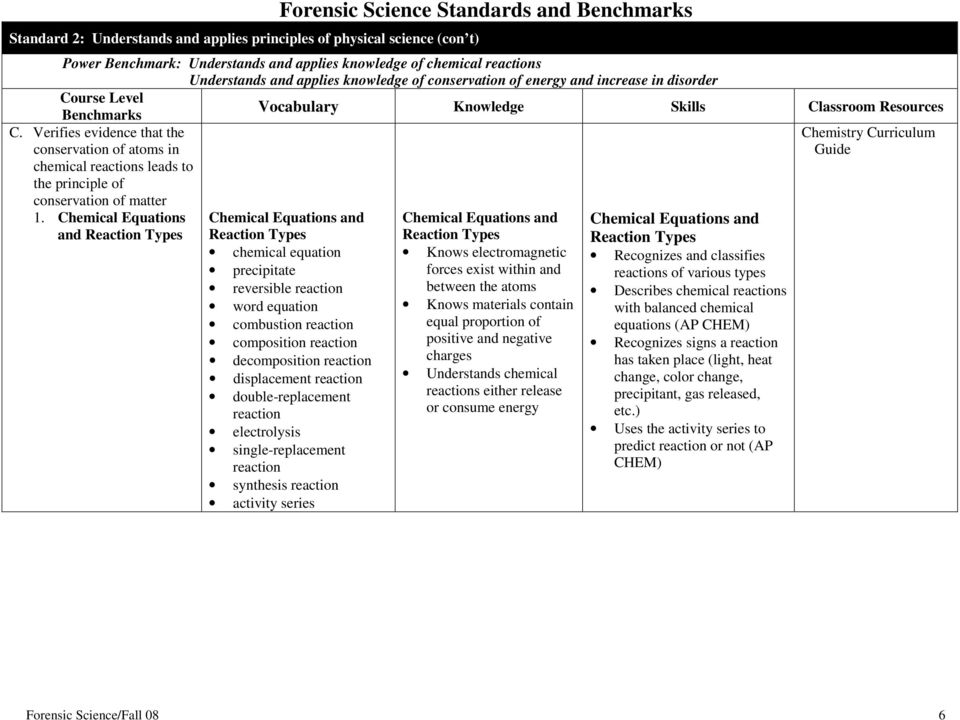
6 Forensic Science Standards and Power Benchmark: Understands and applies knowledge of chemical reactions Understands and applies knowledge of conservation of energy and increase in disorder C. Verifies evidence that the conservation of atoms in chemical reactions leads to the principle of conservation of matter 1. Chemical Equations and Reaction Types Chemical Equations and Reaction Types chemical equation precipitate reversible reaction word equation combustion reaction composition reaction decomposition reaction displacement reaction double-replacement reaction electrolysis single-replacement reaction synthesis reaction activity series Chemical Equations and Reaction Types Knows electromagnetic forces exist within and between the atoms Knows materials contain equal proportion of positive and negative charges Understands chemical reactions either release or consume energy Chemical Equations and Reaction Types Recognizes and classifies reactions of various types Describes chemical reactions with balanced chemical equations (AP CHEM) Recognizes signs a reaction has taken place (light, heat change, color change, precipitant, gas released, etc.) Uses the activity series to predict reaction or not (AP CHEM) Chemistry Curriculum Guide Forensic Science/Fall 08 6
7 Forensic Science Standards and Power Benchmark: Understands and applies knowledge of chemical reactions Understands and applies knowledge of conservation of energy and increase in disorder C. Verifies evidence that the conservation of atoms in chemical reactions leads to the principle of conservation of matter (con t) 2. Stoichiometry Stoichiometry stoichiometry mole ratio actual yield theoretical yield percent yield Avogadro s Law Stoichiometry Knows one mole has 6.02 x particles Knows how to use calculators to solve stoichiometry problems Stoichiometry Calculates percent composition for any compound Demonstrates the principle of conservation of mass applies to changes in chemical systems Uses the principal of conservation of mass to make calculations related to chemical reactions (AP CHEM) Chemistry Curriculum Guide 3. Nuclear Chemistry Nuclear Chemistry radioactive decay half life isotopes nuclear fission nuclear fusion alpha radiation beta radiation gamma radiation Nuclear Chemistry Knows protons and neutrons in the nucleus are held together by strong nuclear forces Knows many naturally occurring isotopes are radioactive Knows the energy released in nuclear reactions is much larger than chemical reactions Nuclear Chemistry Calculates the amount of radioactive substance remaining after an integral number of half lives have passed Describes how alpha, beta, and gamma radiation produce different amounts and kinds of damage in matter Analyzes societal issues associated with nuclear chemistry Forensic Science/Fall 08 7

8 Forensic Science Standards and Power Benchmark: Understands and applies knowledge of conservation of energy and increase in disorder D. Uses the gas laws to explain the properties of gases Kinetic Molecular Theory ideal gas elastic collision kinetic energy gas laws pressure volume temperature Standard Temperature and Pressure constant absolute zero direct relationship inverse relationship Understands matter behaves in predictable and understandable ways Knows the total energy of the universe remains constant Summarizes the values and meanings of STP Relates the temperature of a gas to the average kinetic energy of its particles Applies the gas laws relationship between pressure, temperature, and volume of any amount of ideal gas (AP CHEM) Solves problems using the ideal gas law, PV=nRT Chemistry Curriculum Guide Forensic Science/Fall 08 8

9 Forensic Science Standards and Power Benchmark: Understands and applies knowledge of the structure and properties of matter E. Analyzes solutions and their behavior 1. Properties of Water Properties of Water water molecule water properties hydrogen bonding surface tension vaporization evaporation freezing ice water quality Properties of Water Knows water is good at dissolving ionic compounds Knows how the chemical and physical properties make water an unique solvent Properties of Water Examines the properties of water Explains how chemistry impacts water quality Chemistry Curriculum Guide 2. Solutions Solutions soluble solubility solvent solute electrolyte nonelectrolyte surface area agitating saturated hydration polar/nonpolar Henry s Law miscible concentration molarity Solutions Knows parts of a solution Understands the factors that affect the dissolving process Understands compounds are more or less soluble in a solvent Understands ionization Solutions Relates the terms solute and solvent to solutions Determines the concentration of a solute Interprets a solubility graph (AP CHEM) Examines the relationship of a solute concentration to solution properties Forensic Science/Fall 08 9

10 Forensic Science Standards and Power Benchmark: Understands and applies knowledge of the structure and properties of matter E. Analyzes solutions and their behavior (con t) 3. Acids, Bases, and ph Acids, Bases, and ph acids bases neutralization ionization binary acids oxyacids strong/weak acids alkaline Arrhenius acids and bases salt acid rain Acids, Bases, and ph Knows the ph scale is a feature of the concentration of H + and OH - ions in solution Acids, Bases, and ph Relates the strength of acids and bases to their tendencies toward dissociation (AP CHEM) Calculates ph from the hydrogen-ion concentration and interprets its meaning Chemistry Curriculum Guide Forensic Science/Fall 08 10

Prentice Hall. Chemistry (Wilbraham) 2008, National Student Edition - South Carolina Teacher s Edition. High School. High School
 Prentice Hall Chemistry (Wilbraham) 2008, National Student Edition - South Carolina Teacher s Edition High School C O R R E L A T E D T O High School C-1.1 Apply established rules for significant digits,
CHEMISTRY STANDARDS BASED RUBRIC ATOMIC STRUCTURE AND BONDING
 CHEMISTRY STANDARDS BASED RUBRIC ATOMIC STRUCTURE AND BONDING Essential Standard: STUDENTS WILL UNDERSTAND THAT THE PROPERTIES OF MATTER AND THEIR INTERACTIONS ARE A CONSEQUENCE OF THE STRUCTURE OF MATTER,
Chemistry. The student will be able to identify and apply basic safety procedures and identify basic equipment.
 Chemistry UNIT I: Introduction to Chemistry The student will be able to describe what chemistry is and its scope. a. Define chemistry. b. Explain that chemistry overlaps many other areas of science. The
Southeastern Louisiana University Dual Enrollment Program--Chemistry
 Southeastern Louisiana University Dual Enrollment Program--Chemistry The Southeastern Dual Enrollment Chemistry Program is a program whereby high school students are given the opportunity to take college
STATE UNIVERSITY OF NEW YORK COLLEGE OF TECHNOLOGY CANTON, NEW YORK COURSE OUTLINE CHEM 150 - COLLEGE CHEMISTRY I
 STATE UNIVERSITY OF NEW YORK COLLEGE OF TECHNOLOGY CANTON, NEW YORK COURSE OUTLINE CHEM 150 - COLLEGE CHEMISTRY I PREPARED BY: NICOLE HELDT SCHOOL OF SCIENCE, HEALTH, AND PROFESSIONAL STUDIES SCIENCE DEPARTMENT
Introduction to Chemistry. Course Description
 CHM 1025 & CHM 1025L Introduction to Chemistry Course Description CHM 1025 Introduction to Chemistry (3) P CHM 1025L Introduction to Chemistry Laboratory (1) P This introductory course is intended to introduce
Indiana's Academic Standards 2010 ICP Indiana's Academic Standards 2016 ICP. map) that describe the relationship acceleration, velocity and distance.
 .1.1 Measure the motion of objects to understand.1.1 Develop graphical, the relationships among distance, velocity and mathematical, and pictorial acceleration. Develop deeper understanding through representations
Keystone Exams: Chemistry Assessment Anchors and Eligible Content. Pennsylvania Department of Education www.education.state.pa.
 Assessment Anchors and Pennsylvania Department of Education www.education.state.pa.us 2010 PENNSYLVANIA DEPARTMENT OF EDUCATION General Introduction to the Keystone Exam Assessment Anchors Introduction
AAHS-CHEMISTRY FINAL EXAM PREP-REVIEW GUIDE MAY-JUNE 2014 DR. GRAY CLASS OF 2016
 AAHS-CHEMISTRY FINAL EXAM PREP-REVIEW GUIDE MAY-JUNE 2014 DR. GRAY CLASS OF 2016 UNIT I: (CHAPTER 1-Zumdahl text) The Nature of Science and Chemistry 1. Explain why knowledge of chemistry is central to
One Stop Shop For Teachers
 Physical Science Curriculum The Georgia Performance Standards are designed to provide students with the knowledge and skills for proficiency in science. The Project 2061 s Benchmarks for Science Literacy
The content is based on the National Science Teachers Association (NSTA) standards and is aligned with state standards.
 Literacy Advantage Physical Science Physical Science Literacy Advantage offers a tightly focused curriculum designed to address fundamental concepts such as the nature and structure of matter, the characteristics
Science Standard Articulated by Grade Level Strand 5: Physical Science
 Concept 1: Properties of Objects and Materials Classify objects and materials by their observable properties. Kindergarten Grade 1 Grade 2 Grade 3 Grade 4 PO 1. Identify the following observable properties
What You Need To Know for the Chemistry Regents Exam
 Name: What You Need To Know for the Chemistry Regents Exam The Test The Chemisty Regents Exam is broken down into three sections: Part A: 35 mulitple choice questions from all units covered over the course
A Teaching Portfolio for General Chemistry Harry Pang, Ph.D.
 A Teaching Portfolio for General Chemistry Harry Pang, Ph.D. Table of Content I. Teaching Philosophy II. Critical Thinking Practices III. Course Syllabus IV. Student Evaluation V. Final Report I. My Teaching
Chemical Reactions in Water Ron Robertson
 Chemical Reactions in Water Ron Robertson r2 f:\files\courses\1110-20\2010 possible slides for web\waterchemtrans.doc Properties of Compounds in Water Electrolytes and nonelectrolytes Water soluble compounds
The Mole Concept. The Mole. Masses of molecules
 The Mole Concept Ron Robertson r2 c:\files\courses\1110-20\2010 final slides for web\mole concept.docx The Mole The mole is a unit of measurement equal to 6.022 x 10 23 things (to 4 sf) just like there
Instructional Notes/Strategies. GLEs. Evidence / Assessments of learning Knowledge/Synthesis. Resources # SI-1 (E)
 Lafayette Parish School System Curriculum Map Honors Chemistry (Pearson) Unit 1: Introduction to Chemistry Time Frame 1 week August 15 August 21, 2011 Unit Description - This unit focuses on Why It Is
ARIZONA Science Standards High School Chemistry: Matter and Change 2005
 ARIZONA Science Standards High School Chemistry: Matter and Change 2005 OBJECTIVES Strand 1: Inquiry Process Concept 1: Observations, Questions, and Hypotheses Formulate predictions, questions, or hypotheses
Title: General Chemistry I. Department: Credits: 5 Lecture Hours:4 Lab/Studio Hours:3
 Code: CHEM-101 Title: General Chemistry I Institute: STEM Department: Chemistry Course Description:The student will investigate the fundamental concepts of chemistry from a theoretical approach and participate
Bergen Community College Division of Mathematics, Science and Technology Department of Physical Sciences
 Semester and year: Course Number: Meeting Times and Locations: Instructor: Office Location: Phone: Office Hours: Email Address: Bergen Community College Division of Mathematics, Science and Technology
CHEM 110: CHAPTER 3: STOICHIOMETRY: CALCULATIONS WITH CHEMICAL FORMULAS AND EQUATIONS
 1 CHEM 110: CHAPTER 3: STOICHIOMETRY: CALCULATIONS WITH CHEMICAL FORMULAS AND EQUATIONS The Chemical Equation A chemical equation concisely shows the initial (reactants) and final (products) results of
a. pure substance b. composed of combinations of atoms c. held together by chemical bonds d. substance that cannot be broken down into simpler units
 Chemical Bonds 1. Which of the following is NOT a true compound? a. pure substance b. composed of combinations of atoms c. held together by chemical bonds d. substance that cannot be broken down into simpler
Chemistry. Essential Question: How can one explain the structure, properties, and interactions of matter?
 Chemistry Special Note for the 2014-15 School Year: In 2013, the Maryland State Board of Education adopted the Next Generation Science Standards (NGSS) that set forth a vision for science education where
COURSE SYLLABUS CHEM 103: General Chemistry- Fall 2010 University of Wisconsin-Eau Claire
 COURSE SYLLABUS CHEM 103: General Chemistry- Fall 2010 University of Wisconsin-Eau Claire Instructor Dr. Sudeep Bhattacharyay Office P-452 Office Phone 715 836 2278 Office Hours By appointment E-mail [email protected]
Honors Chemistry: Unit 6 Test Stoichiometry PRACTICE TEST ANSWER KEY Page 1. A chemical equation. (C-4.4)
 Honors Chemistry: Unit 6 Test Stoichiometry PRACTICE TEST ANSWER KEY Page 1 1. 2. 3. 4. 5. 6. Question What is a symbolic representation of a chemical reaction? What 3 things (values) is a mole of a chemical
Chapter 4: Structure and Properties of Ionic and Covalent Compounds
 Chapter 4: Structure and Properties of Ionic and Covalent Compounds 4.1 Chemical Bonding o Chemical Bond - the force of attraction between any two atoms in a compound. o Interactions involving valence
FOR TEACHERS ONLY. The University of the State of New York REGENTS HIGH SCHOOL EXAMINATION PHYSICAL SETTING/CHEMISTRY
 FOR TEACHERS ONLY PS CH The University of the State of New York REGENTS HIGH SCHOOL EXAMINATION PHYSICAL SETTING/CHEMISTRY Wednesday, January 29, 2003 9:15 a.m. to 12:15 p.m., only SCORING KEY AND RATING
ONLINE CHEMISTRY 1110 / GENERAL CHEMISTRY I. Term CRN #
 ONLINE CHEMISTRY 1110 / GENERAL CHEMISTRY I Term CRN # Professor: Office Hours: Office Phone: E-mail: Credit Hours: 4 Prerequisites: Exemption from or completion of ENGL 0810, READ 0810 and MATH 0810.
Chemistry B11 Chapter 4 Chemical reactions
 Chemistry B11 Chapter 4 Chemical reactions Chemical reactions are classified into five groups: A + B AB Synthesis reactions (Combination) H + O H O AB A + B Decomposition reactions (Analysis) NaCl Na +Cl
AP Chemistry Semester One Study Guide
 AP Chemistry Semester One Study Guide Unit One: General Chemistry Review Unit Two: Organic Nomenclature Unit Three: Reactions Unit Four: Thermochemistry Unit Five: Electronic Structure of the Atom Unit
PTAC: Applied Chemistry COURSE OUTLINE & OBJECTIVES ESC Approved November 19, 2004
 INTRODUCTION PTAC: Applied Chemistry COURSE OUTLINE & OBJECTIVES ESC Approved November 19, 2004 A. Introduction to Chemistry Terms 1. Define basic terms associated with chemistry: Organic/inorganic/biochemistry/physical
Chemical Bonds. Chemical Bonds. The Nature of Molecules. Energy and Metabolism < < Covalent bonds form when atoms share 2 or more valence electrons.
 The Nature of Molecules Chapter 2 Energy and Metabolism Chapter 6 Chemical Bonds Molecules are groups of atoms held together in a stable association. Compounds are molecules containing more than one type
STUDENT COURSE INFORMATION
 STUDENT COURSE INFORMATION FANSHAWE COLLEGE OF APPLIED ARTS AND TECHNOLOGY HEALTH SCIENCES JANUARY 2010 CHEM-1004 -- CHEMISTRY I Duration: 45 total course hours Credit Units: 3.00 *NOTE: The hours may
APS Science Curriculum Unit Planner
 APS Science Curriculum Unit Planner Grade Level/Subject Chemistry Stage 1: Desired Results Enduring Understanding Topic 1: Elements and the Periodic Table: The placement of elements on the periodic table
Part B 2. Allow a total of 15 credits for this part. The student must answer all questions in this part.
 Part B 2 Allow a total of 15 credits for this part. The student must answer all questions in this part. 51 [1] Allow 1 credit for 3 Mg(s) N 2 (g) Mg 3 N 2 (s). Allow credit even if the coefficient 1 is
CHM 111 - General Chemistry I Lecture Fall 2014
 CHM 111 - General Chemistry I Lecture Fall 2014 Dr. Stuart T. Gentry Holroyd 329 215-951-1259 [email protected] Class Postings, Lecture Notes, and PowerPoint Slides Available on Canvas and at www.lasalle.edu/~gentry
ATOMS AND BONDS. Bonds
 ATOMS AND BONDS Atoms of elements are the simplest units of organization in the natural world. Atoms consist of protons (positive charge), neutrons (neutral charge) and electrons (negative charge). The
Chapter 13 & 14 Practice Exam
 Name: Class: Date: Chapter 13 & 14 Practice Exam Multiple Choice Identify the choice that best completes the statement or answers the question. 1. Acids generally release H 2 gas when they react with a.
VCE CHEMISTRY UNIT 2 Environmental Chemistry SAMPLE COURSE OUTLINE
 VCE CHEMISTRY UNIT 2 Environmental Chemistry SAMPLE COURSE OUTLINE Week Area of Study Key knowledge Possible activities Key skills 1 1 Water Role of water in maintaining life in the environment unique
Chapter 13 - LIQUIDS AND SOLIDS
 Chapter 13 - LIQUIDS AND SOLIDS Problems to try at end of chapter: Answers in Appendix I: 1,3,5,7b,9b,15,17,23,25,29,31,33,45,49,51,53,61 13.1 Properties of Liquids 1. Liquids take the shape of their container,
CHEMISTRY. Matter and Change. Section 13.1 Section 13.2 Section 13.3. The Gas Laws The Ideal Gas Law Gas Stoichiometry
 CHEMISTRY Matter and Change 13 Table Of Contents Chapter 13: Gases Section 13.1 Section 13.2 Section 13.3 The Gas Laws The Ideal Gas Law Gas Stoichiometry State the relationships among pressure, temperature,
CHAPTER 6 Chemical Bonding
 CHAPTER 6 Chemical Bonding SECTION 1 Introduction to Chemical Bonding OBJECTIVES 1. Define Chemical bond. 2. Explain why most atoms form chemical bonds. 3. Describe ionic and covalent bonding.. 4. Explain
Chem101: General Chemistry Lecture 9 Acids and Bases
 : General Chemistry Lecture 9 Acids and Bases I. Introduction A. In chemistry, and particularly biochemistry, water is the most common solvent 1. In studying acids and bases we are going to see that water
Laboratory 11: Molecular Compounds and Lewis Structures
 Introduction Laboratory 11: Molecular Compounds and Lewis Structures Molecular compounds are formed by sharing electrons between non-metal atoms. A useful theory for understanding the formation of molecular
Unit 1 Measurement, Matter and Change
 Unit 1 Measurement, Matter and Change Part one: Scientific Measurement 1. Apply the rules of safety in the Chemistry laboratory 2. Distinguish between quantitative and qualitative measurements 3. Distinguish
Just want the standards alone? You can find the standards alone at http://dpi.state.nc.us/acre/standards/new-standards/#science.
 This document is designed to help North Carolina educators teach the Essential Standards (Standard Course of Study). NCDPI staff are continually updating and improving these tools to better serve teachers.
Wallingford Public Schools - HIGH SCHOOL COURSE OUTLINE
 Wallingford Public Schools - HIGH SCHOOL COURSE OUTLINE Course Title: Applied Chemistry Course Number: G 2614 Department: Science Grade(s): 11-12 Level(s): General Credit: 1 Course Description This is
(1) e.g. H hydrogen that has lost 1 electron c. anion - negatively charged atoms that gain electrons 16-2. (1) e.g. HCO 3 bicarbonate anion
 GS106 Chemical Bonds and Chemistry of Water c:wou:gs106:sp2002:chem.wpd I. Introduction A. Hierarchy of chemical substances 1. atoms of elements - smallest particles of matter with unique physical and
Introductory Chemistry (Allied Health Emphasis)- Chem 1406 Course Syllabus: Summer 2015
 Introductory Chemistry (Allied Health Emphasis)- Chem 1406 Course Syllabus: Summer 2015 Northeast Texas Community College exists to provide responsible, exemplary learning opportunities. Bryan Trickey
Chemistry. CHEMISTRY SYLLABUS, ASSESSMENT and UNIT PLANNERS GENERAL AIMS. Students should be able to
 i CHEMISTRY SYLLABUS, ASSESSMENT and UNIT PLANNERS GENERAL AIMS Students should be able to - apply and use knowledge and methods that are typical to chemistry - develop experimental and investigative skills,
Molecular Models in Biology
 Molecular Models in Biology Objectives: After this lab a student will be able to: 1) Understand the properties of atoms that give rise to bonds. 2) Understand how and why atoms form ions. 3) Model covalent,
Science Standards of Learning for Virginia Public Schools January 2010. Physical Science
 Physical Science Introduction The Science Standards of Learning for Virginia Public Schools identify academic content for essential components of the science curriculum at different grade levels. Standards
Calculations and Chemical Equations. Example: Hydrogen atomic weight = 1.008 amu Carbon atomic weight = 12.001 amu
 Calculations and Chemical Equations Atomic mass: Mass of an atom of an element, expressed in atomic mass units Atomic mass unit (amu): 1.661 x 10⁻²⁴ g Atomic weight: Average mass of all isotopes of a given
Name Class Date. In the space provided, write the letter of the term or phrase that best completes each statement or best answers each question.
 Assessment Chapter Test A Chapter: States of Matter In the space provided, write the letter of the term or phrase that best completes each statement or best answers each question. 1. The kinetic-molecular
CHEMISTRY II FINAL EXAM REVIEW
 Name Period CHEMISTRY II FINAL EXAM REVIEW Final Exam: approximately 75 multiple choice questions Ch 12: Stoichiometry Ch 5 & 6: Electron Configurations & Periodic Properties Ch 7 & 8: Bonding Ch 14: Gas
In the box below, draw the Lewis electron-dot structure for the compound formed from magnesium and oxygen. [Include any charges or partial charges.
 Name: 1) Which molecule is nonpolar and has a symmetrical shape? A) NH3 B) H2O C) HCl D) CH4 7222-1 - Page 1 2) When ammonium chloride crystals are dissolved in water, the temperature of the water decreases.
CST Practice Test. Multiple Choice Questions
 CST Practice Test Young NAME CST Practice Test Multiple Choice Questions 1) At 1 atm and 298 K, which of the K a values listed below represents the strongest acid? 5) Which electron-dot symbol represents
Chapter 8: Chemical Equations and Reactions
 Chapter 8: Chemical Equations and Reactions I. Describing Chemical Reactions A. A chemical reaction is the process by which one or more substances are changed into one or more different substances. A chemical
RELEASED. Student Booklet. Chemistry. Fall 2014 NC Final Exam. Released Items
 Released Items Public Schools of North arolina State oard of Education epartment of Public Instruction Raleigh, North arolina 27699-6314 Fall 2014 N Final Exam hemistry Student ooklet opyright 2014 by
AP Chemistry A. Allan Chapter 8 Notes - Bonding: General Concepts
 AP Chemistry A. Allan Chapter 8 Notes - Bonding: General Concepts 8.1 Types of Chemical Bonds A. Ionic Bonding 1. Electrons are transferred 2. Metals react with nonmetals 3. Ions paired have lower energy
Chemistry Diagnostic Questions
 Chemistry Diagnostic Questions Answer these 40 multiple choice questions and then check your answers, located at the end of this document. If you correctly answered less than 25 questions, you need to
Electrons in Atoms & Periodic Table Chapter 13 & 14 Assignment & Problem Set
 Electrons in Atoms & Periodic Table Name Warm-Ups (Show your work for credit) Date 1. Date 2. Date 3. Date 4. Date 5. Date 6. Date 7. Date 8. Electrons in Atoms & Periodic Table 2 Study Guide: Things You
List the 3 main types of subatomic particles and indicate the mass and electrical charge of each.
 Basic Chemistry Why do we study chemistry in a biology course? All living organisms are composed of chemicals. To understand life, we must understand the structure, function, and properties of the chemicals
Chapter 13 - Solutions
 Chapter 13 - Solutions 13-1 Types of Mixtures I. Solutions A. Soluble 1. Capable of being dissolved B. Solution 1. A homogeneous mixture of two or more substances in a single phase C. Solvent 1. The dissolving
Boyle s law - For calculating changes in pressure or volume: P 1 V 1 = P 2 V 2. Charles law - For calculating temperature or volume changes: V 1 T 1
 Common Equations Used in Chemistry Equation for density: d= m v Converting F to C: C = ( F - 32) x 5 9 Converting C to F: F = C x 9 5 + 32 Converting C to K: K = ( C + 273.15) n x molar mass of element
KS3 Science: Chemistry Contents
 summary KS3 Science MyWorks Guide Chemistry KS3 Science: Chemistry Mini zes: 40 Super zes: 5 Extension zes: 4 Skills zes: 6 TOTAL 54 What are MyWorks zes? MyWorks zes are short individual learning tasks
CP Chemistry Review for Stoichiometry Test
 CP Chemistry Review for Stoichiometry Test Stoichiometry Problems (one given reactant): 1. Make sure you have a balanced chemical equation 2. Convert to moles of the known substance. (Use the periodic
Calculating Atoms, Ions, or Molecules Using Moles
 TEKS REVIEW 8B Calculating Atoms, Ions, or Molecules Using Moles TEKS 8B READINESS Use the mole concept to calculate the number of atoms, ions, or molecules in a sample TEKS_TXT of material. Vocabulary
Composition of nucleus. Priority Vocabulary: Electron, Proton, Neutron, Nucleus, Isotopes, Atomic Number, Atomic Mass, Element, Electron Shell,
 Lake County, Lakeview, 9 th grade, Physical Science, Brent Starr Standard: H1P1 Explain how atomic structure is related to the properties of elements and their position in the Periodic Table. Explain how
Chemistry 13: States of Matter
 Chemistry 13: States of Matter Name: Period: Date: Chemistry Content Standard: Gases and Their Properties The kinetic molecular theory describes the motion of atoms and molecules and explains the properties
Chapter 3. Chemical Reactions and Reaction Stoichiometry. Lecture Presentation. James F. Kirby Quinnipiac University Hamden, CT
 Lecture Presentation Chapter 3 Chemical Reactions and Reaction James F. Kirby Quinnipiac University Hamden, CT The study of the mass relationships in chemistry Based on the Law of Conservation of Mass
Coimisiún na Scrúduithe Stáit State Examinations Commission
 Coimisiún na Scrúduithe Stáit State Examinations Commission LEAVING CERTIFICATE EXAMINATION, 2007 CHEMISTRY - ORDINARY LEVEL TUESDAY, 19 JUNE AFTERNOON 2.00 TO 5.00 400 MARKS Answer eight questions in
Chemistry 11 Some Study Materials for the Final Exam
 Chemistry 11 Some Study Materials for the Final Exam Prefix Abbreviation Exponent giga G 10 9 mega M 10 6 kilo k 10 3 hecto h 10 2 deca da 10 1 deci d 10-1 centi c 10-2 milli m 10-3 micro µ 10-6 nano n
EXPERIMENT 1: Survival Organic Chemistry: Molecular Models
 EXPERIMENT 1: Survival Organic Chemistry: Molecular Models Introduction: The goal in this laboratory experience is for you to easily and quickly move between empirical formulas, molecular formulas, condensed
Chapter 1 The Atomic Nature of Matter
 Chapter 1 The Atomic Nature of Matter 6. Substances that cannot be decomposed into two or more simpler substances by chemical means are called a. pure substances. b. compounds. c. molecules. d. elements.
AP* Atomic Structure & Periodicity Free Response Questions KEY page 1
 AP* Atomic Structure & Periodicity ree Response Questions KEY page 1 1980 a) points 1s s p 6 3s 3p 6 4s 3d 10 4p 3 b) points for the two electrons in the 4s: 4, 0, 0, +1/ and 4, 0, 0, - 1/ for the three
CHEMISTRY BONDING REVIEW
 Answer the following questions. CHEMISTRY BONDING REVIEW 1. What are the three kinds of bonds which can form between atoms? The three types of Bonds are Covalent, Ionic and Metallic. Name Date Block 2.
Science 20. Unit A: Chemical Change. Assignment Booklet A1
 Science 20 Unit A: Chemical Change Assignment Booklet A FOR TEACHER S USE ONLY Summary Teacher s Comments Chapter Assignment Total Possible Marks 79 Your Mark Science 20 Unit A: Chemical Change Assignment
INSPIRE GK12 Lesson Plan. The Chemistry of Climate Change Length of Lesson
 Lesson Title The Chemistry of Climate Change Length of Lesson 180 min Created By David Wilson Subject Physical Science / Chemistry / Organic Chemistry Grade Level 8-12 State Standards 2c, 4d / 2a, 4d /
Chemical Equations and Chemical Reactions. Chapter 8.1
 Chemical Equations and Chemical Reactions Chapter 8.1 Objectives List observations that suggest that a chemical reaction has taken place List the requirements for a correctly written chemical equation.
LOS ANGELES MISSION COLLEGE-SUMMER 2013 CHEMISTRY 51-SECTIONS 0552 Lecture: MTWTh 10:35-12:40 ; Room: CMS-028 Lab: MTWTh 1:00-2:25 ; Room: CMS-201
 LOS ANGELES MISSION COLLEGE-SUMMER 2013 CHEMISTRY 51-SECTIONS 0552 Lecture: MTWTh 10:35-12:40 ; Room: CMS-028 Lab: MTWTh 1:00-2:25 ; Room: CMS-201 INSTRUCTOR: Said Pazirandeh OFFICE PHONE: (818)364-7705
Element of same atomic number, but different atomic mass o Example: Hydrogen
 Atomic mass: p + = protons; e - = electrons; n 0 = neutrons p + + n 0 = atomic mass o For carbon-12, 6p + + 6n 0 = atomic mass of 12.0 o For chlorine-35, 17p + + 18n 0 = atomic mass of 35.0 atomic mass
AS1 MOLES. oxygen molecules have the formula O 2 the relative mass will be 2 x 16 = 32 so the molar mass will be 32g mol -1
 Moles 1 MOLES The mole the standard unit of amount of a substance the number of particles in a mole is known as Avogadro s constant (L) Avogadro s constant has a value of 6.023 x 10 23 mol -1. Example
Chemistry Assessment Unit AS 1
 Centre Number 71 Candidate Number ADVANCED SUBSIDIARY (AS) General Certificate of Education January 2011 Chemistry Assessment Unit AS 1 assessing Basic Concepts in Physical and Inorganic Chemistry [AC111]
Acids and Bases: A Brief Review
 Acids and : A Brief Review Acids: taste sour and cause dyes to change color. : taste bitter and feel soapy. Arrhenius: acids increase [H ] bases increase [OH ] in solution. Arrhenius: acid base salt water.
CHEMISTRY 103 - GENERAL CHEMISTRY Calvin College Whoever can be trusted with very little can also be trusted with much.
 CHEMISTRY 103 - GENERAL CHEMISTRY Calvin College Whoever can be trusted with very little can also be trusted with much. Luke 16:10a Instructor: Herb Fynewever Office: DeVries Hall 229 [email protected]
IB Chemistry. DP Chemistry Review
 DP Chemistry Review Topic 1: Quantitative chemistry 1.1 The mole concept and Avogadro s constant Assessment statement Apply the mole concept to substances. Determine the number of particles and the amount
Chemical Calculations: The Mole Concept and Chemical Formulas. AW Atomic weight (mass of the atom of an element) was determined by relative weights.
 1 Introduction to Chemistry Atomic Weights (Definitions) Chemical Calculations: The Mole Concept and Chemical Formulas AW Atomic weight (mass of the atom of an element) was determined by relative weights.
Chapter 2 Atoms, Molecules, and Ions
 Chapter 2 Atoms, Molecules, and Ions 1. Methane and ethane are both made up of carbon and hydrogen. In methane, there are 12.0 g of carbon for every 4.00 g of hydrogen, a ration of 3:1 by mass. In ethane,
EXPERIMENT 9 Dot Structures and Geometries of Molecules
 EXPERIMENT 9 Dot Structures and Geometries of Molecules INTRODUCTION Lewis dot structures are our first tier in drawing molecules and representing bonds between the atoms. The method was first published
Prerequisites: CHEM 1311 and CHEM 1111, or CHEM 1411 General Chemistry I (Lecture and Laboratory)
 Course Syllabus CHEM 1412 General Chemistry II Revision Date: 8/21/2014 Catalog Description: Chemical equilibrium; phase diagrams and spectrometry; acid-base concepts; thermodynamics; kinetics; electrochemistry;
Correlation of Nelson Chemistry Alberta 20 30 to the Alberta Chemistry 20 30 Curriculum
 Correlation of Nelson Chemistry Alberta 20 30 to the Alberta Chemistry 20 30 Curriculum Unit 5 Organic Chemistry General Outcomes Students will: 1. explore organic compounds as a common form of matter
F321 MOLES. Example If 1 atom has a mass of 1.241 x 10⁻²³ g 1 mole of atoms will have a mass of 1.241 x 10-23 g x 6.02 x 10 23 = 7.
 Moles 1 MOLES The mole the standard unit of amount of a substance (mol) the number of particles in a mole is known as Avogadro s constant (N A ) Avogadro s constant has a value of 6.02 x 10 23 mol -1.
neutrons are present?
 AP Chem Summer Assignment Worksheet #1 Atomic Structure 1. a) For the ion 39 K +, state how many electrons, how many protons, and how many 19 neutrons are present? b) Which of these particles has the smallest
Exam 2 Chemistry 65 Summer 2015. Score:
 Name: Exam 2 Chemistry 65 Summer 2015 Score: Instructions: Clearly circle the one best answer 1. Valence electrons are electrons located A) in the outermost energy level of an atom. B) in the nucleus of
AVERAGE ATOMIC MASS, MASS NUMBER, AND ATOMIC NUMBER
 Chemistry Curriculum Guide Standard CH.1 (scientific process) is below at the end of this document. Standard CH.2 a, b, c The student will investigate and understand that the placement of elements on the
Bonding & Molecular Shape Ron Robertson
 Bonding & Molecular Shape Ron Robertson r2 n:\files\courses\1110-20\2010 possible slides for web\00bondingtrans.doc The Nature of Bonding Types 1. Ionic 2. Covalent 3. Metallic 4. Coordinate covalent Driving
The polarity of water molecules results in hydrogen bonding [3]
![The polarity of water molecules results in hydrogen bonding [3]](/thumbs/40/21376601.jpg "The polarity of water molecules results in hydrogen bonding [3]") GUIDED READING - Ch. 3 PROPERTIES OF WATER NAME: Please print out these pages and HANDWRITE the answers directly on the printouts. Typed work or answers on separate sheets of paper will not be accepted.
GUIDED READING - Ch. 3 PROPERTIES OF WATER NAME: Please print out these pages and HANDWRITE the answers directly on the printouts. Typed work or answers on separate sheets of paper will not be accepted.