
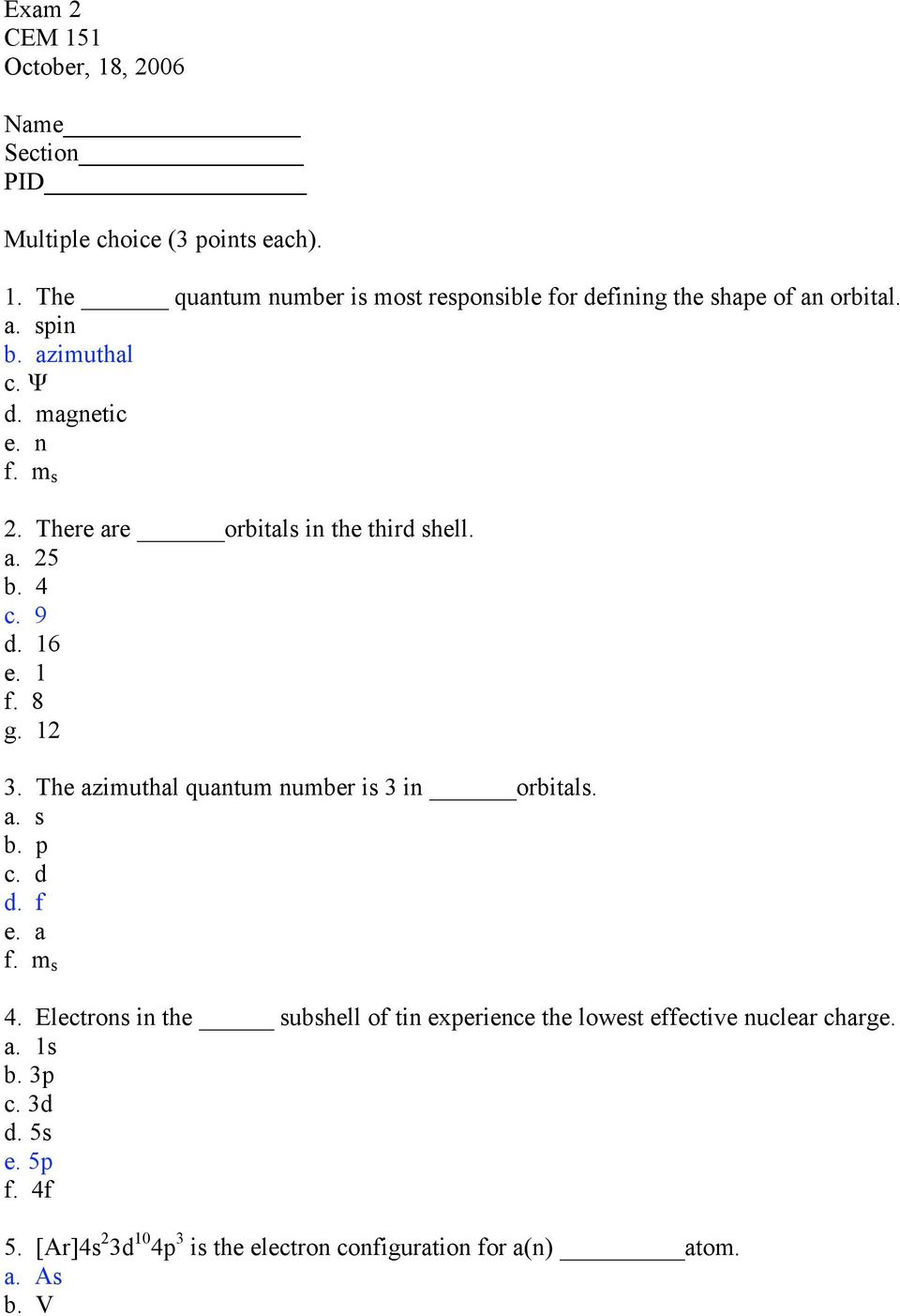
4. Electrons in the subshell of tin experience the lowest effective nuclear charge. a. 1s
|
|
|
- Alexandrina Ford
- 9 years ago
- Views:
Transcription
1 Exam 2 CEM 151 October, 18, 2006 Name Section PID Multiple choice (3 points each). 1. The quantum number is most responsible for defining the shape of an orbital. a. spin b. azimuthal c. Ψ d. magnetic e. n f. m s 2. There are orbitals in the third shell. a. 25 b. 4 c. 9 d. 16 e. 1 f. 8 g The azimuthal quantum number is 3 in orbitals. a. s b. p c. d d. f e. a f. m s 4. Electrons in the subshell of tin experience the lowest effective nuclear charge. a. 1s b. 3p c. 3d d. 5s e. 5p f. 4f 5. [Ar]4s 2 3d 10 4p 3 is the electron configuration for a(n) atom. a. As b. V
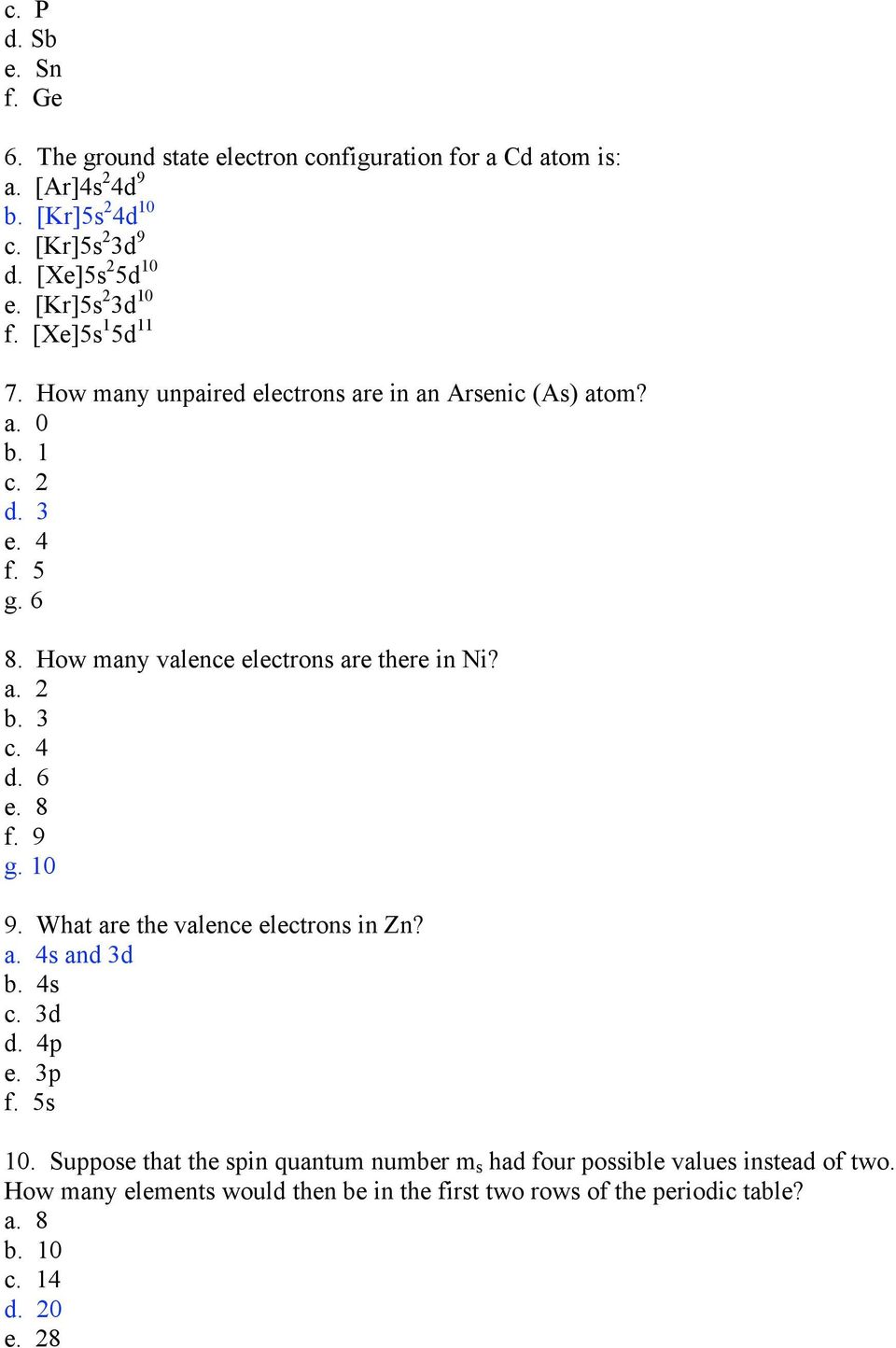
2 c. P d. Sb e. Sn f. Ge 6. The ground state electron configuration for a Cd atom is: a. [Ar]4s 2 4d 9 b. [Kr]5s 2 4d 10 c. [Kr]5s 2 3d 9 d. [Xe]5s 2 5d 10 e. [Kr]5s 2 3d 10 f. [Xe]5s 1 5d How many unpaired electrons are in an Arsenic (As) atom? a. 0 b. 1 c. 2 d. 3 e. 4 f. 5 g How many valence electrons are there in Ni? a. 2 b. 3 c. 4 d. 6 e. 8 f. 9 g What are the valence electrons in Zn? a. 4s and 3d b. 4s c. 3d d. 4p e. 3p f. 5s 10. Suppose that the spin quantum number m s had four possible values instead of two. How many elements would then be in the first two rows of the periodic table? a. 8 b. 10 c. 14 d. 20 e. 28
3 f Predict the atomic number of the next Noble gas (below Rn). a. 126 b. 112 c. 118 d. 106 e. 96 f Which of the following electrons would you predict to feel the highest effective nuclear charge. a. The 3s electrons in Mg b. The 3p electrons in Al c. The 3p electrons in Cl d. The 3p electrons in P e. The 4s electrons in Ca. f. The 4s electrons in K. 13. Which of the following are correctly listed in the order of size (smallest to largest)? a. K, Ca, Cu, Ga, Ge, As, Se b. Se, As, Ge, Ga, Cu, Ca, K c. Cu, Se, As, Ge, Ga, Ca, K d. Cu, K, Ca, Ga, Ge, As, Se e. Se, As, Ge, Ga, Ca, K, Cu f. Cl, S, P, Mg, Si, Al 14. Which of the following ions has the smallest radius? a. Li + b. Be + c. K + d. Mg + e. B 3+ f. Al 2+ g. F - h. Cl Which of the following are in the correct order of first ionization energy (most positive to least positive or negative). a. Na > F > O > C > Be > Li b. Na > Li > Be > C > O > F c. Li > Be > C > O > F > Na d. F > O > C > Be > Li > Na

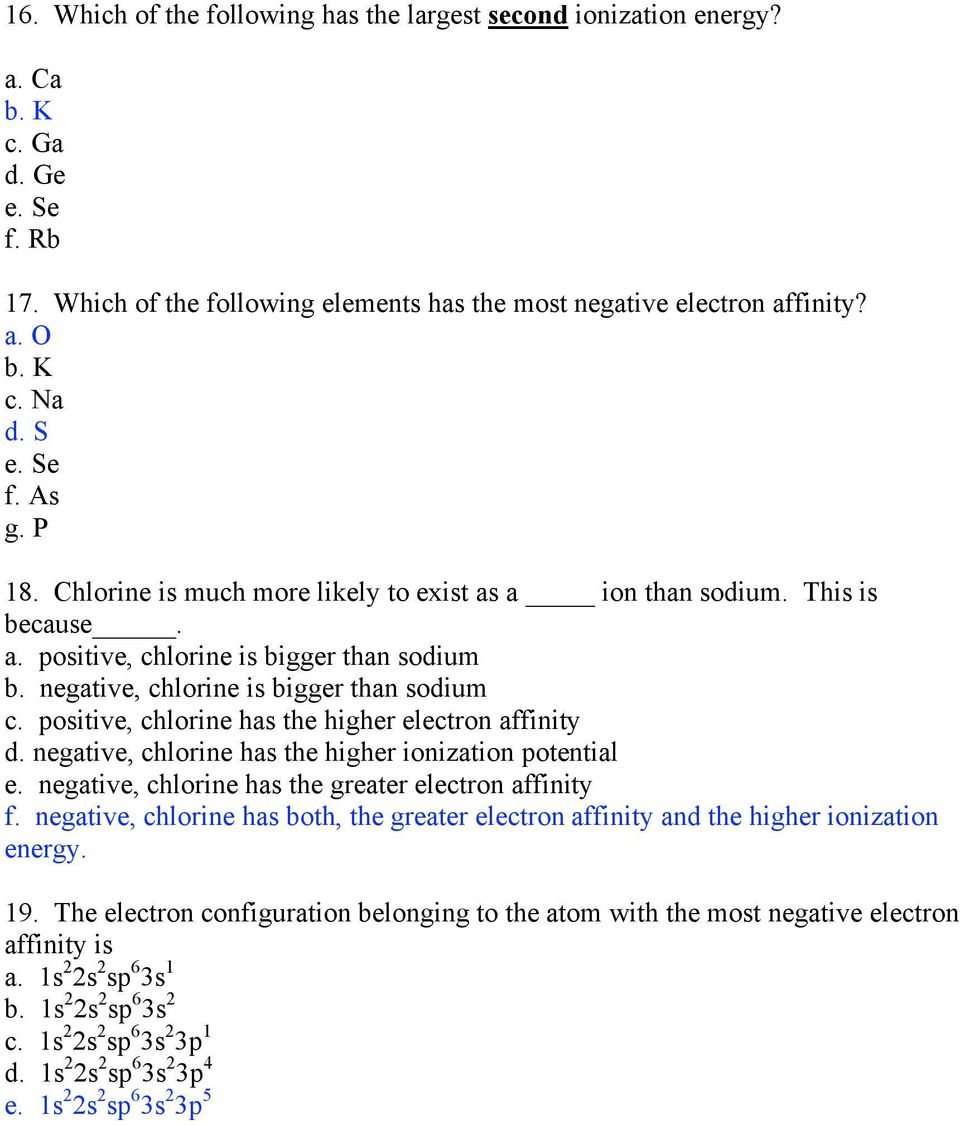
4 16. Which of the following has the largest second ionization energy? a. Ca b. K c. Ga d. Ge e. Se f. Rb 17. Which of the following elements has the most negative electron affinity? a. O b. K c. Na d. S e. Se f. As g. P 18. Chlorine is much more likely to exist as a ion than sodium. This is because. a. positive, chlorine is bigger than sodium b. negative, chlorine is bigger than sodium c. positive, chlorine has the higher electron affinity d. negative, chlorine has the higher ionization potential e. negative, chlorine has the greater electron affinity f. negative, chlorine has both, the greater electron affinity and the higher ionization energy. 19. The electron configuration belonging to the atom with the most negative electron affinity is a. 1s 2 2s 2 sp 6 3s 1 b. 1s 2 2s 2 sp 6 3s 2 c. 1s 2 2s 2 sp 6 3s 2 3p 1 d. 1s 2 2s 2 sp 6 3s 2 3p 4 e. 1s 2 2s 2 sp 6 3s 2 3p 5
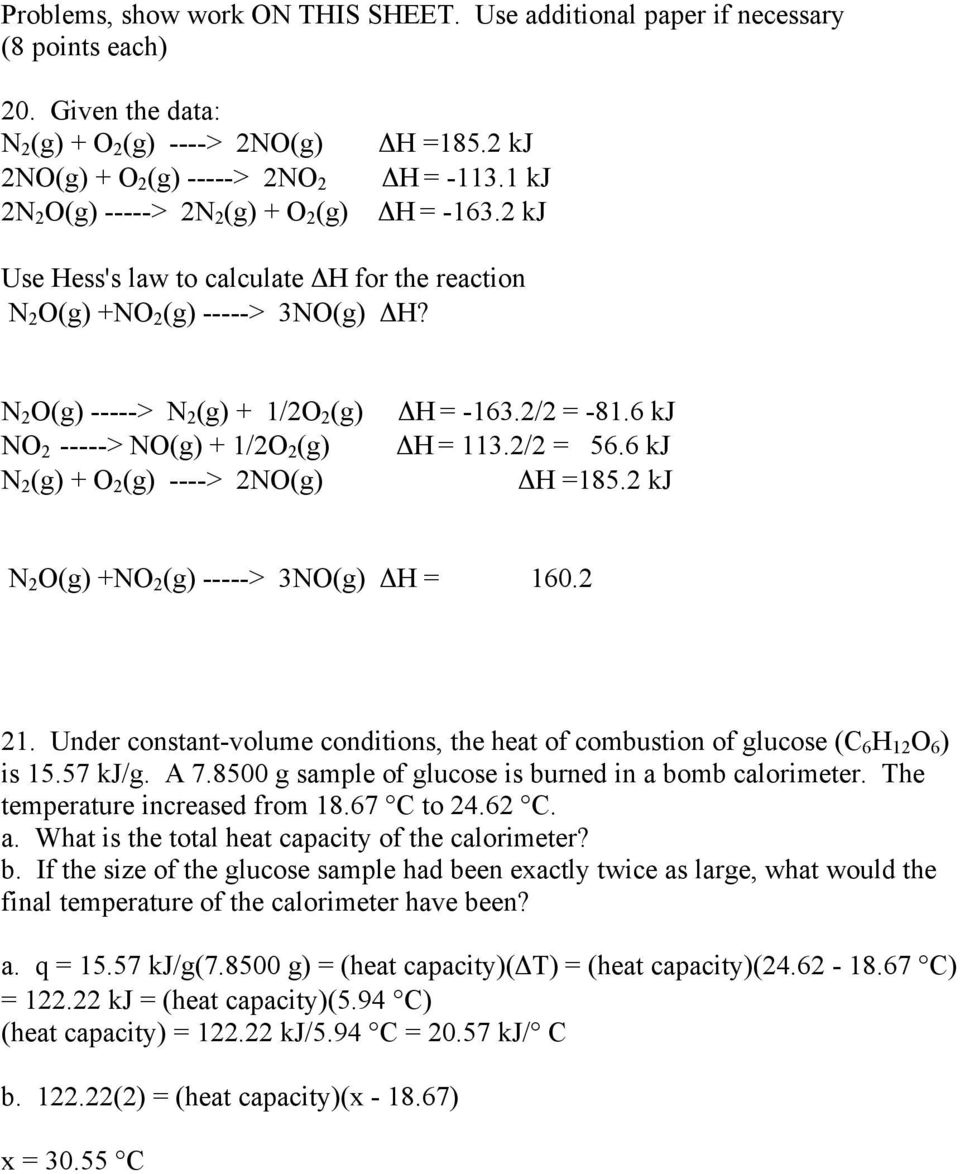
5 Problems, show work ON THIS SHEET. Use additional paper if necessary (8 points each) 20. Given the data: N 2 (g) + O 2 (g) ----> 2NO(g) 2NO(g) + O 2 (g) -----> 2NO 2 2N 2 O(g) -----> 2N 2 (g) + O 2 (g) ΔH =185.2 kj ΔH = kj ΔH = kj Use Hess's law to calculate ΔH for the reaction N 2 O(g) +NO 2 (g) -----> 3NO(g) ΔH? N 2 O(g) -----> N 2 (g) + 1/2O 2 (g) NO > NO(g) + 1/2O 2 (g) N 2 (g) + O 2 (g) ----> 2NO(g) ΔH = /2 = kj ΔH = 113.2/2 = 56.6 kj ΔH =185.2 kj N 2 O(g) +NO 2 (g) -----> 3NO(g) ΔH = Under constant-volume conditions, the heat of combustion of glucose (C 6 H 12 O 6 ) is kj/g. A g sample of glucose is burned in a bomb calorimeter. The temperature increased from C to C. a. What is the total heat capacity of the calorimeter? b. If the size of the glucose sample had been exactly twice as large, what would the final temperature of the calorimeter have been? a. q = kj/g( g) = (heat capacity)(δt) = (heat capacity)( C) = kj = (heat capacity)(5.94 C) (heat capacity) = kj/5.94 C = kj/ C b (2) = (heat capacity)(x ) x = C
6 22. Consider the following reaction: CH 3 OH(g) -----> CO(g) + 2H 2 (g) ΔH = 90.7 kj a. Is heat absorbed or evolved in the course of this reaction? b. Calculate the amount of heat transferred when 62 g of CH 3 OH(g) is decomposed by this reaction at constant pressure. c. For a given sample of CH 3 OH, the enthalpy change on reaction is 36.7 kj. How many grams of hydrogen gas are produced? a. Absorbed b. moles CH 3 OH: 62 g/32 g/mol = 1.93 moles 1.93 moles (90.7 kj/mole CH 3 OH) = kj = 180 kj. c kj/2 moles H 2 = kj/mole H kj/45.35 kj/mole = mole H 2 (2 g/mole) = 1.62 g 23. How many grams of methane (CH 4 (g)) must be combusted to heat 2.4 kg of water 25 C to 85 C, assuming a standard combustion reaction? CH 4(g) + 2O 2(g) -----> 2H 2 O(g or l acceptable) + CO 2 (g) ΔH form (-241.8) + (-393.5) - [ ) = kj q = 2400 g (4.184 j/molk)(60) = J = kj/mol(x mole methane) x = moles(16 g/mol) = 12 g. (answer from if you showed you did it right) 24. Carotenoids, present in all organisms capable of photosynthesis, extend the range of light absorbed by the organism. They exhibit maximal capacity for absorption of light in the range of nm. Calculate the energy in kilojoules represented by absorption of an Avogadro's number of photons of wavelength 455 nm. c = λν ν = 3.0 x 10 8 m/sec/455 x 10-9 m/= x E = hνn A = (6.626 x J-s/photon)( x sec -1 )( x photons) = 263 x 10 3 J
CHAPTER 8 PRACTICE TEST QUESTIONS (END OF CHAPTER 7 TOO)
 CHAPTER 8 PRACTICE TEST QUESTIONS (END OF CHAPTER 7 TOO) Information that most likely will be on the front cover of your exam: h i Z 2 ΔE = @ 2.18 x 10 @ 18 f Z 2 f J j @ k n f 2 n i 2 1. Which of the
Chem 1A Exam 2 Review Problems
 Chem 1A Exam 2 Review Problems 1. At 0.967 atm, the height of mercury in a barometer is 0.735 m. If the mercury were replaced with water, what height of water (in meters) would be supported at this pressure?
REVIEW QUESTIONS Chapter 8
 Chemistry 101 ANSWER KEY REVIEW QUESTIONS Chapter 8 Use only a periodic table to answer the following questions. 1. Write complete electron configuration for each of the following elements: a) Aluminum
3. What would you predict for the intensity and binding energy for the 3p orbital for that of sulfur?
 PSI AP Chemistry Periodic Trends MC Review Name Periodic Law and the Quantum Model Use the PES spectrum of Phosphorus below to answer questions 1-3. 1. Which peak corresponds to the 1s orbital? (A) 1.06
B) atomic number C) both the solid and the liquid phase D) Au C) Sn, Si, C A) metal C) O, S, Se C) In D) tin D) methane D) bismuth B) Group 2 metal
 1. The elements on the Periodic Table are arranged in order of increasing A) atomic mass B) atomic number C) molar mass D) oxidation number 2. Which list of elements consists of a metal, a metalloid, and
Name period AP chemistry Unit 2 worksheet Practice problems
 Name period AP chemistry Unit 2 worksheet Practice problems 1. What are the SI units for a. Wavelength of light b. frequency of light c. speed of light Meter hertz (s -1 ) m s -1 (m/s) 2. T/F (correct
Chapter 8 Atomic Electronic Configurations and Periodicity
 Chapter 8 Electron Configurations Page 1 Chapter 8 Atomic Electronic Configurations and Periodicity 8-1. Substances that are weakly attracted to a magnetic field but lose their magnetism when removed from
Chemistry 151 Final Exam
 Chemistry 151 Final Exam Name: SSN: Exam Rules & Guidelines Show your work. No credit will be given for an answer unless your work is shown. Indicate your answer with a box or a circle. All paperwork must
ELECTRON CONFIGURATION (SHORT FORM) # of electrons in the subshell. valence electrons Valence electrons have the largest value for "n"!
 179 ELECTRON CONFIGURATION (SHORT FORM) - We can represent the electron configuration without drawing a diagram or writing down pages of quantum numbers every time. We write the "electron configuration".
Chapter 7 Periodic Properties of the Elements
 Chapter 7 Periodic Properties of the Elements 1. Elements in the modern version of the periodic table are arranged in order of increasing. (a). oxidation number (b). atomic mass (c). average atomic mass
neutrons are present?
 AP Chem Summer Assignment Worksheet #1 Atomic Structure 1. a) For the ion 39 K +, state how many electrons, how many protons, and how many 19 neutrons are present? b) Which of these particles has the smallest
3) Of the following, radiation has the shortest wavelength. A) X-ray B) radio C) microwave D) ultraviolet E) infrared Answer: A
 1) Which one of the following is correct? A) ν + λ = c B) ν λ = c C) ν = cλ D) λ = c ν E) νλ = c Answer: E 2) The wavelength of light emitted from a traffic light having a frequency of 5.75 1014 Hz is.
The Advanced Placement Examination in Chemistry. Part I Multiple Choice Questions Part II Free Response Questions Selected Questions from1970 to 2010
 The Advanced Placement Examination in Chemistry Part I Multiple Choice Questions Part II Free Response Questions Selected Questions from1970 to 2010 Atomic Theory and Periodicity Part I 1984 1. Which of
MODERN ATOMIC THEORY AND THE PERIODIC TABLE
 CHAPTER 10 MODERN ATOMIC THEORY AND THE PERIODIC TABLE SOLUTIONS TO REVIEW QUESTIONS 1. Wavelength is defined as the distance between consecutive peaks in a wave. It is generally symbolized by the Greek
Find a pair of elements in the periodic table with atomic numbers less than 20 that are an exception to the original periodic law.
 Example Exercise 6.1 Periodic Law Find the two elements in the fifth row of the periodic table that violate the original periodic law proposed by Mendeleev. Mendeleev proposed that elements be arranged
6.5 Periodic Variations in Element Properties
 324 Chapter 6 Electronic Structure and Periodic Properties of Elements 6.5 Periodic Variations in Element Properties By the end of this section, you will be able to: Describe and explain the observed trends
13- What is the maximum number of electrons that can occupy the subshell 3d? a) 1 b) 3 c) 5 d) 2
 Assignment 06 A 1- What is the energy in joules of an electron undergoing a transition from n = 3 to n = 5 in a Bohr hydrogen atom? a) -3.48 x 10⁻¹⁷ J b) 2.18 x 10⁻¹⁹ J c) 1.55 x 10⁻¹⁹ J d) -2.56 x 10⁻¹⁹
Questions on Chapter 8 Basic Concepts of Chemical Bonding
 Questions on Chapter 8 Basic Concepts of Chemical Bonding Circle the Correct Answer: 1) Which ion below has a noble gas electron configuration? A) Li 2+ B) Be 2+ C) B2+ D) C2+ E) N 2-2) Of the ions below,
CHAPTER 9 THE PERIODIC TABLE AND SOME ATOMIC PROPERTIES
 CHAPTER 9 THE PERIODIC TABLE AND SOME ATOMIC PROPERTIES PRACTICE EXAMPLES 1A 1B A B A Atomic size decreases from left to right across a period, and from bottom to top in a family. We expect the smallest
SUGGESTION ANSWER SCHEME CHAPTER 8: THERMOCHEMISTRY. 1 (a) Use the data in the table below to answer the following questions:
 SUGGESTION ANSWER SCHEME CHAPTER 8: THERMOCHEMISTRY ANSWER SCHEME UPS 2004/2005 SK027 1 (a) Use the data in the table below to answer the following questions: Enthalpy change ΔH (kj/mol) Atomization energy
Periodic Table Questions
 Periodic Table Questions 1. The elements characterized as nonmetals are located in the periodic table at the (1) far left; (2) bottom; (3) center; (4) top right. 2. An element that is a liquid at STP is
It takes four quantum numbers to describe an electron. Additionally, every electron has a unique set of quantum numbers.
 So, quantum mechanics does not define the path that the electron follows; rather, quantum mechanics works by determining the energy of the electron. Once the energy of an electron is known, the probability
CHEM 1411 Chapter 5 Homework Answers
 1 CHEM 1411 Chapter 5 Homework Answers 1. Which statement regarding the gold foil experiment is false? (a) It was performed by Rutherford and his research group early in the 20 th century. (b) Most of
Unit 3 Study Guide: Electron Configuration & The Periodic Table
 Name: Teacher s Name: Class: Block: Date: Unit 3 Study Guide: Electron Configuration & The Periodic Table 1. For each of the following elements, state whether the element is radioactive, synthetic or both.
Chapter 3, Elements, Atoms, Ions, and the Periodic Table
 1. Which two scientists in 1869 arranged the elements in order of increasing atomic masses to form a precursor of the modern periodic table of elements? Ans. Mendeleev and Meyer 2. Who stated that the
Sample Exercise 6.1 Concepts of Wavelength and Frequency
 Sample Exercise 6.1 Concepts of Wavelength and Frequency Two electromagnetic waves are represented in the margin. (a) Which wave has the higher frequency? (b) If one wave represents visible light and the
Copyrighted by Gabriel Tang B.Ed., B.Sc.
 Chapter 8: The Periodic Table 8.1: Development of the Periodic Table Johann Dobereiner: - first to discover a pattern of a group of elements like Cl, Br, and I (called triads). John Newland: - suggested
Chem 115 POGIL Worksheet - Week 4 Moles & Stoichiometry Answers
 Key Questions & Exercises Chem 115 POGIL Worksheet - Week 4 Moles & Stoichiometry Answers 1. The atomic weight of carbon is 12.0107 u, so a mole of carbon has a mass of 12.0107 g. Why doesn t a mole of
Chapter 8 Basic Concepts of the Chemical Bonding
 Chapter 8 Basic Concepts of the Chemical Bonding 1. There are paired and unpaired electrons in the Lewis symbol for a phosphorus atom. (a). 4, 2 (b). 2, 4 (c). 4, 3 (d). 2, 3 Explanation: Read the question
KEY. Honors Chemistry Assignment Sheet- Unit 3
 KEY Honors Chemistry Assignment Sheet- Unit 3 Extra Learning Objectives (beyond regular chem.): 1. Related to electron configurations: a. Be able to write orbital notations for s, p, & d block elements.
2. John Dalton did his research work in which of the following countries? a. France b. Greece c. Russia d. England
 CHAPTER 3 1. Which combination of individual and contribution is not correct? a. Antoine Lavoisier - clarified confusion over cause of burning b. John Dalton - proposed atomic theory c. Marie Curie - discovered
87 16 70 20 58 24 44 32 35 40 29 48 (a) graph Y versus X (b) graph Y versus 1/X
 HOMEWORK 5A Barometer; Boyle s Law 1. The pressure of the first two gases below is determined with a manometer that is filled with mercury (density = 13.6 g/ml). The pressure of the last two gases below
47374_04_p25-32.qxd 2/9/07 7:50 AM Page 25. 4 Atoms and Elements
 47374_04_p25-32.qxd 2/9/07 7:50 AM Page 25 4 Atoms and Elements 4.1 a. Cu b. Si c. K d. N e. Fe f. Ba g. Pb h. Sr 4.2 a. O b. Li c. S d. Al e. H f. Ne g. Sn h. Au 4.3 a. carbon b. chlorine c. iodine d.
AP* Atomic Structure & Periodicity Free Response Questions KEY page 1
 AP* Atomic Structure & Periodicity ree Response Questions KEY page 1 1980 a) points 1s s p 6 3s 3p 6 4s 3d 10 4p 3 b) points for the two electrons in the 4s: 4, 0, 0, +1/ and 4, 0, 0, - 1/ for the three
NOTE: This practice exam contains more than questions than the real final.
 NOTE: This practice exam contains more than questions than the real final 1 The wavelength of light emitted from a green laser pointer is 532 10 2 nm What is the wavelength in meters? 532 10-7 m 2 What
Electron Configuration Worksheet (and Lots More!!)
 Electron Configuration Worksheet (and Lots More!!) Brief Instructions An electron configuration is a method of indicating the arrangement of electrons about a nucleus. A typical electron configuration
CLASS TEST GRADE 11. PHYSICAL SCIENCES: CHEMISTRY Test 6: Chemical change
 CLASS TEST GRADE PHYSICAL SCIENCES: CHEMISTRY Test 6: Chemical change MARKS: 45 TIME: hour INSTRUCTIONS AND INFORMATION. Answer ALL the questions. 2. You may use non-programmable calculators. 3. You may
Chem 115 POGIL Worksheet - Week 4 Moles & Stoichiometry
 Chem 115 POGIL Worksheet - Week 4 Moles & Stoichiometry Why? Chemists are concerned with mass relationships in chemical reactions, usually run on a macroscopic scale (grams, kilograms, etc.). To deal with
Stoichiometry. Lecture Examples Answer Key
 Stoichiometry Lecture Examples Answer Key Ex. 1 Balance the following chemical equations: 3 NaBr + 1 H 3 PO 4 3 HBr + 1 Na 3 PO 4 2 C 3 H 5 N 3 O 9 6 CO 2 + 3 N 2 + 5 H 2 O + 9 O 2 2 Ca(OH) 2 + 2 SO 2
Chemistry: The Periodic Table and Periodicity
 Chemistry: The Periodic Table and Periodicity Name: per: Date:. 1. By what property did Mendeleev arrange the elements? 2. By what property did Moseley suggest that the periodic table be arranged? 3. What
EXPERIMENT 4 The Periodic Table - Atoms and Elements
 EXPERIMENT 4 The Periodic Table - Atoms and Elements INTRODUCTION Primary substances, called elements, build all the materials around you. There are more than 109 different elements known today. The elements
100% ionic compounds do not exist but predominantly ionic compounds are formed when metals combine with non-metals.
 2.21 Ionic Bonding 100% ionic compounds do not exist but predominantly ionic compounds are formed when metals combine with non-metals. Forming ions Metal atoms lose electrons to form +ve ions. Non-metal
Chapter 3. Elements, Atoms, Ions, and the Periodic Table
 Chapter 3. Elements, Atoms, Ions, and the Periodic Table The Periodic Law and the Periodic Table In the early 1800's many elements had been discovered and found to have different properties. In 1817 Döbreiner's
WAVES AND ELECTROMAGNETIC RADIATION
 WAVES AND ELECTROMAGNETIC RADIATION All waves are characterized by their wavelength, frequency and speed. Wavelength (lambda, ): the distance between any 2 successive crests or troughs. Frequency (nu,):
Untitled Document. 1. Which of the following best describes an atom? 4. Which statement best describes the density of an atom s nucleus?
 Name: Date: 1. Which of the following best describes an atom? A. protons and electrons grouped together in a random pattern B. protons and electrons grouped together in an alternating pattern C. a core
Electrons in Atoms & Periodic Table Chapter 13 & 14 Assignment & Problem Set
 Electrons in Atoms & Periodic Table Name Warm-Ups (Show your work for credit) Date 1. Date 2. Date 3. Date 4. Date 5. Date 6. Date 7. Date 8. Electrons in Atoms & Periodic Table 2 Study Guide: Things You
Chemistry CP Unit 2 Atomic Structure and Electron Configuration. Learning Targets (Your exam at the end of Unit 2 will assess the following:)
 Chemistry CP Unit 2 Atomic Structure and Electron Learning Targets (Your exam at the end of Unit 2 will assess the following:) 2. Atomic Structure and Electron 2-1. Give the one main contribution to the
5.4 Trends in the Periodic Table
 5.4 Trends in the Periodic Table Think about all the things that change over time or in a predictable way. For example, the size of the computer has continually decreased over time. You may become more
PERIODIC TABLE OF GROUPS OF ELEMENTS Elements can be classified using two different schemes.
 1 PERIODIC TABLE OF GROUPS OF ELEMENTS Elements can be classified using two different schemes. Metal Nonmetal Scheme (based on physical properties) Metals - most elements are metals - elements on left
Chapter Test. Teacher Notes and Answers 5 The Periodic Law TEST A 1. b 2. d 3. b 4. b 5. d 6. a 7. b 8. b 9. b 10. a 11. c 12. a.
 Assessment Chapter Test A Teacher Notes and Answers 5 The Periodic Law TEST A 1. b 2. d 3. b 4. b 5. d 6. a 7. b 8. b 9. b 10. a 11. c 12. a 13. c 14. d 15. c 16. b 17. d 18. a 19. d 20. c 21. d 22. a
Mr. Bracken. Multiple Choice Review: Thermochemistry
 Mr. Bracken AP Chemistry Name Period Multiple Choice Review: Thermochemistry 1. If this has a negative value for a process, then the process occurs spontaneously. 2. This is a measure of how the disorder
AP Chemistry 2009 Scoring Guidelines
 AP Chemistry 2009 Scoring Guidelines The College Board The College Board is a not-for-profit membership association whose mission is to connect students to college success and opportunity. Founded in 1900,
Thermochemical equations allow stoichiometric calculations.
 CHEM 1105 THERMOCHEMISTRY 1. Change in Enthalpy ( H) Heat is evolved or absorbed in all chemical reactions. Exothermic reaction: heat evolved - heat flows from reaction mixture to surroundings; products
TRENDS IN THE PERIODIC TABLE
 Noble gases Period alogens Alkaline earth metals Alkali metals TRENDS IN TE PERIDI TABLE Usual charge +1 + +3-3 - -1 Number of Valence e - s 1 3 4 5 6 7 Electron dot diagram X X X X X X X X X 8 Group 1
CHEM 105 HOUR EXAM III 28-OCT-99. = -163 kj/mole determine H f 0 for Ni(CO) 4 (g) = -260 kj/mole determine H f 0 for Cr(CO) 6 (g)
 CHEM 15 HOUR EXAM III 28-OCT-99 NAME (please print) 1. a. given: Ni (s) + 4 CO (g) = Ni(CO) 4 (g) H Rxn = -163 k/mole determine H f for Ni(CO) 4 (g) b. given: Cr (s) + 6 CO (g) = Cr(CO) 6 (g) H Rxn = -26
UNIT (2) ATOMS AND ELEMENTS
 UNIT (2) ATOMS AND ELEMENTS 2.1 Elements An element is a fundamental substance that cannot be broken down by chemical means into simpler substances. Each element is represented by an abbreviation called
CHAPTER 8 ELECTRON CONFIGURATION AND CHEMICAL PERIODICITY
 CHAPTER 8 ELECTRON CONFIGURATION AND CHEMICAL PERIODICITY 8.1 Elements are listed in the periodic table in an ordered, systematic way that correlates with a periodicity of their chemical and physical properties.
Bomb Calorimetry. Example 4. Energy and Enthalpy
 Bomb Calorimetry constant volume often used for combustion reactions heat released by reaction is absorbed by calorimeter contents need heat capacity of calorimeter q cal = q rxn = q bomb + q water Example
4. Using the data from Handout 5, what is the standard enthalpy of formation of BaO (s)? What does this mean?
 HOMEWORK 3A 1. In each of the following pairs, tell which has the higher entropy. (a) One mole of liquid water or one mole of water vapor (b) One mole of dry ice or one mole of carbon dioxide at 1 atm
MULTIPLE CHOICE. Choose the one alternative that best completes the statement or answers the question.
 Practice Questions - Chapter 7 Name MULTIPLE CHOICE. Choose the one alternative that best completes the statement or answers the question. 1) Which one of the following represents an impossible set of
Unit 3: Quantum Theory, Periodicity and Chemical Bonding
 Selected Honour Chemistry Assignment Answers pg. 9 Unit 3: Quantum Theory, Periodicity and Chemical Bonding Chapter 7: The Electronic Structure of Atoms (pg. 240 to 241) 48. The shape of an s-orbital is
Ch. 9 - Electron Organization. The Bohr Model [9.4] Orbitals [9.5, 9.6] Counting Electrons, configurations [9.7]
![Ch. 9 - Electron Organization. The Bohr Model [9.4] Orbitals [9.5, 9.6] Counting Electrons, configurations [9.7]](/thumbs/27/11797291.jpg "Ch. 9 - Electron Organization. The Bohr Model [9.4] Orbitals [9.5, 9.6] Counting Electrons, configurations [9.7]") Ch. 9 - Electron Organization The Bohr Model [9.4] Orbitals [9.5, 9.6] Counting Electrons, configurations [9.7] Predicting ion charges from electron configurations. CHEM 100 F07 1 Organization of Electrons
Ch. 9 - Electron Organization The Bohr Model [9.4] Orbitals [9.5, 9.6] Counting Electrons, configurations [9.7] Predicting ion charges from electron configurations. CHEM 100 F07 1 Organization of Electrons
Notes Chapter 9 Limiting Reagent Sample Problems Page 1
 Notes Chapter 9 Limiting Reagent Sample Problems Page 1 Problem 1: Sodium chloride can be prepared by the reaction of sodium metal with chlorine gas. Suppose that 6.70 Na reacts with 3.20 Cl 2. A. What
Chapter 2: Atomic Structure and Chemical Bonding
 Chapter 2: Atomic Structure and Chemical Bonding Materials Molecules Atoms Atoms = protons (p) + neutrons (n) + electrons (e) Protons and neutrons are made of quarks Quantitative measurements need units:
Bonding Practice Problems
 NAME 1. When compared to H 2 S, H 2 O has a higher 8. Given the Lewis electron-dot diagram: boiling point because H 2 O contains stronger metallic bonds covalent bonds ionic bonds hydrogen bonds 2. Which
1. How many hydrogen atoms are in 1.00 g of hydrogen?
 MOLES AND CALCULATIONS USING THE MOLE CONCEPT INTRODUCTORY TERMS A. What is an amu? 1.66 x 10⁻²⁴ g B. We need a conversion to the macroscopic world. 1. How many hydrogen atoms are in 1.00 g of hydrogen?
Sample Exercise 8.1 Magnitudes of Lattice Energies
 Sample Exercise 8.1 Magnitudes of Lattice Energies Without consulting Table 8.2, arrange the following ionic compounds in order of increasing lattice energy: NaF, CsI, and CaO. Analyze: From the formulas
SCPS Chemistry Worksheet Periodicity A. Periodic table 1. Which are metals? Circle your answers: C, Na, F, Cs, Ba, Ni
 SCPS Chemistry Worksheet Periodicity A. Periodic table 1. Which are metals? Circle your answers: C, Na, F, Cs, Ba, Ni Which metal in the list above has the most metallic character? Explain. Cesium as the
IONISATION ENERGY CONTENTS
 IONISATION ENERGY IONISATION ENERGY CONTENTS What is Ionisation Energy? Definition of t Ionisation Energy What affects Ionisation Energy? General variation across periods Variation down groups Variation
APPENDIX B: EXERCISES
 BUILDING CHEMISTRY LABORATORY SESSIONS APPENDIX B: EXERCISES Molecular mass, the mole, and mass percent Relative atomic and molecular mass Relative atomic mass (A r ) is a constant that expresses the ratio
KEY for Unit 1 Your Chemical Toolbox: Scientific Concepts, Fundamentals of Typical Calculations, the Atom and Much More
 KEY for Unit 1 Your Chemical Toolbox: Scientific Concepts, Fundamentals of Typical Calculations, the Atom and Much More The Modern Periodic Table The Periodic Law - when elements are arranged according
AP Chemistry 2009 Free-Response Questions
 AP Chemistry 009 Free-Response Questions The College Board The College Board is a not-for-profit membership association whose mission is to connect students to college success and opportunity. Founded
ENTHALPY CHANGES FOR A CHEMICAL REACTION scaling a rxn up or down (proportionality) quantity 1 from rxn heat 1 from Δ r H. = 32.
 CHEMISTRY 103 Help Sheet #10 Chapter 4 (Part II); Sections 4.6-4.10 Do the topics appropriate for your lecture Prepared by Dr. Tony Jacob http://www.chem.wisc.edu/areas/clc (Resource page) Nuggets: Enthalpy
The Lewis structure is a model that gives a description of where the atoms, charges, bonds, and lone pairs of electrons, may be found.
 CEM110 Week 12 Notes (Chemical Bonding) Page 1 of 8 To help understand molecules (or radicals or ions), VSEPR shapes, and properties (such as polarity and bond length), we will draw the Lewis (or electron
1 Exercise 2.19a pg 86
 In this solution set, an underline is used to show the last significant digit of numbers. For instance in x = 2.51693 the 2,5,1, and 6 are all significant. Digits to the right of the underlined digit,
2 The Structure of Atoms
 CHAPTER 4 2 The Structure of Atoms SECTION Atoms KEY IDEAS As you read this section, keep these questions in mind: What do atoms of the same element have in common? What are isotopes? How is an element
Stoichiometry. 1. The total number of moles represented by 20 grams of calcium carbonate is (1) 1; (2) 2; (3) 0.1; (4) 0.2.
 Stoichiometry 1 The total number of moles represented by 20 grams of calcium carbonate is (1) 1; (2) 2; (3) 01; (4) 02 2 A 44 gram sample of a hydrate was heated until the water of hydration was driven
Thermodynamics Worksheet I also highly recommend Worksheets 13 and 14 in the Lab Manual
 Thermodynamics Worksheet I also highly recommend Worksheets 13 and 14 in the Lab Manual 1. Predict the sign of entropy change in the following processes a) The process of carbonating water to make a soda
Potassium ion charge would be +1, so oxidation number is +1. Chloride ion charge would be 1, so each chlorine has an ox # of -1
 Chapter 18-1 1. Assign oxidation numbers to each atom in: Ni Nickel ion charge would be +2, so oxidation number is +2 Chloride ion charge would be 1, so each chlorine has an ox # of -1 Mg 2 Ti 4 Magnesium
10. Calculate the mass percent nitrogen in (NH 4 ) 2 CO 3 (molar mass = 96.09 g/mol). a. 29.1 % c. 17.9 % e. 14.6 % b. 35.9 % d. 0.292 % f. 96.
 Chem 171-2-3: Final Exam Review Multiple Choice Problems 1. What is the molar mass of barium perchlorate, Ba(ClO 4 ) 2? a. 189.90 g/mol c. 272.24 g/mol e. 336.20 g/mol b. 240.24 g/mol d. 304.24 g/mol f.
Periodic Table. 1. In the modern Periodic Table, the elements are arranged in order of increasing. A. atomic number B. mass number
 Name: ate: 1. In the modern, the elements are arranged in order of increasing. atomic number. mass number. oxidation number. valence number 5. s the elements in Group I are considered in order of increasing
2014 Spring CHEM101 Ch1-2 Review Worksheet Modified by Dr. Cheng-Yu Lai,
 Ch1 1) Which of the following underlined items is not an intensive property? A) A chemical reaction requires 3.00 g of oxygen. B) The density of helium at 25 C is 1.64 10-4 g/cm3. C) The melting point
The Periodic Table; Chapter 5: Section 1 - History of the Periodic Table Objectives: Explain the roles of Mendeleev and Moseley in the development of
 The Periodic Table; Chapter 5: Section 1 - History of the Periodic Table Objectives: Explain the roles of Mendeleev and Moseley in the development of the periodic table. Describe the modern periodic table.
Introductory Chemistry, 3 rd Edition Nivaldo Tro. Roy Kennedy Massachusetts Bay Community College Wellesley Hills, Maqqwertd ygoijpk[l
 Introductory Chemistry, 3 rd Edition Nivaldo Tro Quantities in Car an octane and oxygen molecules and carbon dioxide and water Chemical Reactions Roy Kennedy Massachusetts Bay Community College Wellesley
Unit 2: Chemical Bonding and Organic Chemistry
 Chemistry AP Unit : Chemical Bonding and Organic Chemistry Unit : Chemical Bonding and Organic Chemistry Chapter 7: Atomic Structure and Periodicity 7.1: Electromagnetic Radiation Electromagnetic (EM)
8. Relax and do well.
 CHEM 1314 3:30 pm Section Exam II ohn II. Gelder October 16, 2002 Name TA's Name Lab Section INSTRUCTIONS: 1. This examination consists of a total of 8 different pages. The last three pages include a periodic
Chapter 6 Chemical Calculations
 Chapter 6 Chemical Calculations 1 Submicroscopic Macroscopic 2 Chapter Outline 1. Formula Masses (Ch 6.1) 2. Percent Composition (supplemental material) 3. The Mole & Avogadro s Number (Ch 6.2) 4. Molar
Exam. Name. 1) Chlorine (atomic number = 17) has the electronic configuration:. E) 1s22s22d103s2
 Exam Name 1) Chlorine (atomic number = 17) has the electronic configuration:. A) 1s22s22p62d63s1 B) 1s22s22p63s23d5 C) 1s22s22p62d53s2 D) 1s22s22p63s23p5 E) 1s22s22d103s2 2) The complete electron configuration
Write an equation, including state symbols, for the ionisation of indium that requires the minimum energy.(1)
 MINI MOCK Questions Unit 1 Atomic Structure AS Chemistry Q1. Indium is in Group 3 in the Periodic Table and exists as a mixture of the isotopes 113 In and 115 In. (a) Use your understanding of the Periodic
Molecules, Atoms, Grams and Mole Calculation Practice
 Molecules, Atoms, Grams and Mole Calculation Practice Helpful HINTS: In these problems look for two things: 1) From what unit to what unit? 2) Does the object stay the same, or does the object change?
TIME OF COMPLETION NAME SOLUTION DEPARTMENT OF NATURAL SCIENCES. PHYS 3650, Exam 2 Section 1 Version 1 October 31, 2005 Total Weight: 100 points
 TIME OF COMPLETION NAME SOLUTION DEPARTMENT OF NATURAL SCIENCES PHYS 3650, Exam 2 Section 1 Version 1 October 31, 2005 Total Weight: 100 points 1. Check your examination for completeness prior to starting.
CHEMISTRY BONDING REVIEW
 Answer the following questions. CHEMISTRY BONDING REVIEW 1. What are the three kinds of bonds which can form between atoms? The three types of Bonds are Covalent, Ionic and Metallic. Name Date Block 2.
Stoichiometry. 1. The total number of moles represented by 20 grams of calcium carbonate is (1) 1; (2) 2; (3) 0.1; (4) 0.2.
 Stoichiometry 1 The total number of moles represented by 20 grams of calcium carbonate is (1) 1; (2) 2; (3) 01; (4) 02 2 A 44 gram sample of a hydrate was heated until the water of hydration was driven
Semester Exam Practice Questions
 Name: Class: _ Date: _ Semester Exam Practice Questions Multiple Choice Identify the choice that best completes the statement or answers the question. 1. Which of the following is not a material? a. air
AP CHEMISTRY 2007 SCORING GUIDELINES (Form B)
 AP CHEMISTRY 2007 SCORING GUIDELINES (Form B) First Ionization Energy Question 6 Second Ionization Energy Third Ionization Energy (kj mol 1 ) (kj mol 1 ) (kj mol 1 ) Element 1 1,251 2,300 3,820 Element
CHEM 107 (Spring-2005) Final Exam (100 pts)
 CHEM 107 (Spring-2005) Final Exam (100 pts) Name: ------------------------------------------------------------------------, Clid # ------------------------------ LAST NAME, First (Circle the alphabet segment
Chapter 8 Concepts of Chemical Bonding
 Chapter 8 Concepts of Chemical Bonding Chemical Bonds Three types: Ionic Electrostatic attraction between ions Covalent Sharing of electrons Metallic Metal atoms bonded to several other atoms Ionic Bonding
IONISATION ENERGY CONTENTS
 IONISATION ENERGY IONISATION ENERGY CONTENTS What is Ionisation Energy? Definition of t Ionisation Energy What affects Ionisation Energy? General variation across periods Variation down groups Variation
Chemistry 2 Chapter 13: Electrons in Atoms Please do not write on the test Use an answer sheet! 1 point/problem 45 points total
 Chemistry 2 Chapter 13: Electrons in Atoms Please do not write on the test Use an answer sheet! 1 point/problem 45 points total 1. Calculate the energy in joules of a photon of red light that has a frequency