
1 Exercise 2.19a pg 86
|
|
|
- Annabella Bell
- 9 years ago
- Views:
Transcription
1 In this solution set, an underline is used to show the last significant digit of numbers. For instance in x = the 2,5,1, and 6 are all significant. Digits to the right of the underlined digit, the 9 & 3 in the example, are not significant and would be rounded off at the end of calculations. Carrying these extra digits for intermediate values in calculations reduces rounding errors and ensures we get the same answer regardless of the order of arithmetic steps. Numbers without underlines (including final answers) are shown with the proper number of sig figs. 1 Exercise 2.19a pg 86 Given The standard enthalpy of combustion of cyclopropane is 2091 kj mol 1 at 25 C. formation of its isomer propene is kj mol 1. Additionally, the enthalpy of In terms of given variables, this is written: r H = 2091 kj mol 1 cyclopropane combustion f H = kj mol 1 propene enthalpy of formation Find Calculate... (a) The enthalpy of formation of cyclopropane (b) The enthalpy of isomerization from cyclopropane to propene Strategy We begin by constructing the balanced chemical equation for combustion of cyclopropane 2C 3 H 6 + 9O 2 (g) 6H 2 O(l) + 6CO 2 (g) r H = kj mol 1 For any such reaction the reaction enthalpy can related to the enthalpy of products and reactants by (Equation 2.32 on pg 68 in your text book) which for this reaction is r H = Products ν p f H p Reactants ν r f H r r H = 6 f H (H 2 O(l)) + 6 f H (CO 2 (g)) 2 f H (C 3 H 6 ) + 9 f H (O 2 (g)) } {{ } } {{ } products reactants Using the fact that the standard state of oxygen is O 2 (g) ( f H (O 2 (g)) = 0) the following expression for f H (C 3 H 6 ) is obtained through rearrangement 1

2 f H (C 3 H 6 ) = 3 f H (H 2 O(l)) + 3 f H (CO 2 (g)) 1 2 rh = kj mol kj mol kj mol 1 2 = kj mol 1 With this information we can now calculate the enthalpy of isomerization of cyclopropane to propene. The balanced equation for this process is The enthalpy of this reaction is simply given by C 3 H 6 (cyclopropane) C 3 H 6 (propene) r H =? r H = f H (propene) f H (cyclopropane) = kj mol = Solution The enthalpy of formation of cyclopropane is f H (C 3 H 6 ) = 53 kj mol 1. The isomerization enthalpy of cyclopropane to propene is r H = 33 kj mol 1. 2

3 2 Exercise 2.20a pg 86 Given When a 120 mg sample of naphthalene, C 10 H 8 (s), was burned in a bomb calorimeter the temperature rose by 3.05 K. Additionally, we are to predict the temperature rise for the combustion of 10 mg sample of phenol in the same calorimeter (the enthalpy of combustion of phenol is c H (C 6 H 5 OH(s)) = 7061 kj mol 1 ). In terms of given variables, this is written: m C10 H 8 (s) = 120 mg T = 3.05 K m C6H 5OH(s) = 10 mg c H (C 6 H 5 OH(s)) = 7061 kj mol 1 Find Calculate the calorimeter constant. By how much will the temperature rise after the phenol sample is burned? Strategy To determine the calorimeter constant C we ll need to determine how much heat was released in this combustion reaction and for this we ll need to know the combustion enthalpy of naphthalene. We ll start by constructing the balanced chemical equation for the combustion of naphthalene. We can calculate the enthalpy of this reaction from C 10 H 8 (s) + 12O 2 (g) 4H 2 O(l) + 10CO 2 (g) r H =? r H = Products ν p f H p Reactants ν r f H r = 4 f H (H 2 O(l)) + 10 f H (CO 2 (g)) f H (C 10 H 8 (s)) + 12 f H (O 2 (g)) = kj mol kj mol kj mol = kj mol 1 To calculate the heat released in this specific combustion we ll next need to know how many moles of naphthalene were burned. n = 120 mg C 10 H 8 (s) 1 g 1 mol 1000 mg g = mol C 10 H 8 (s) 3
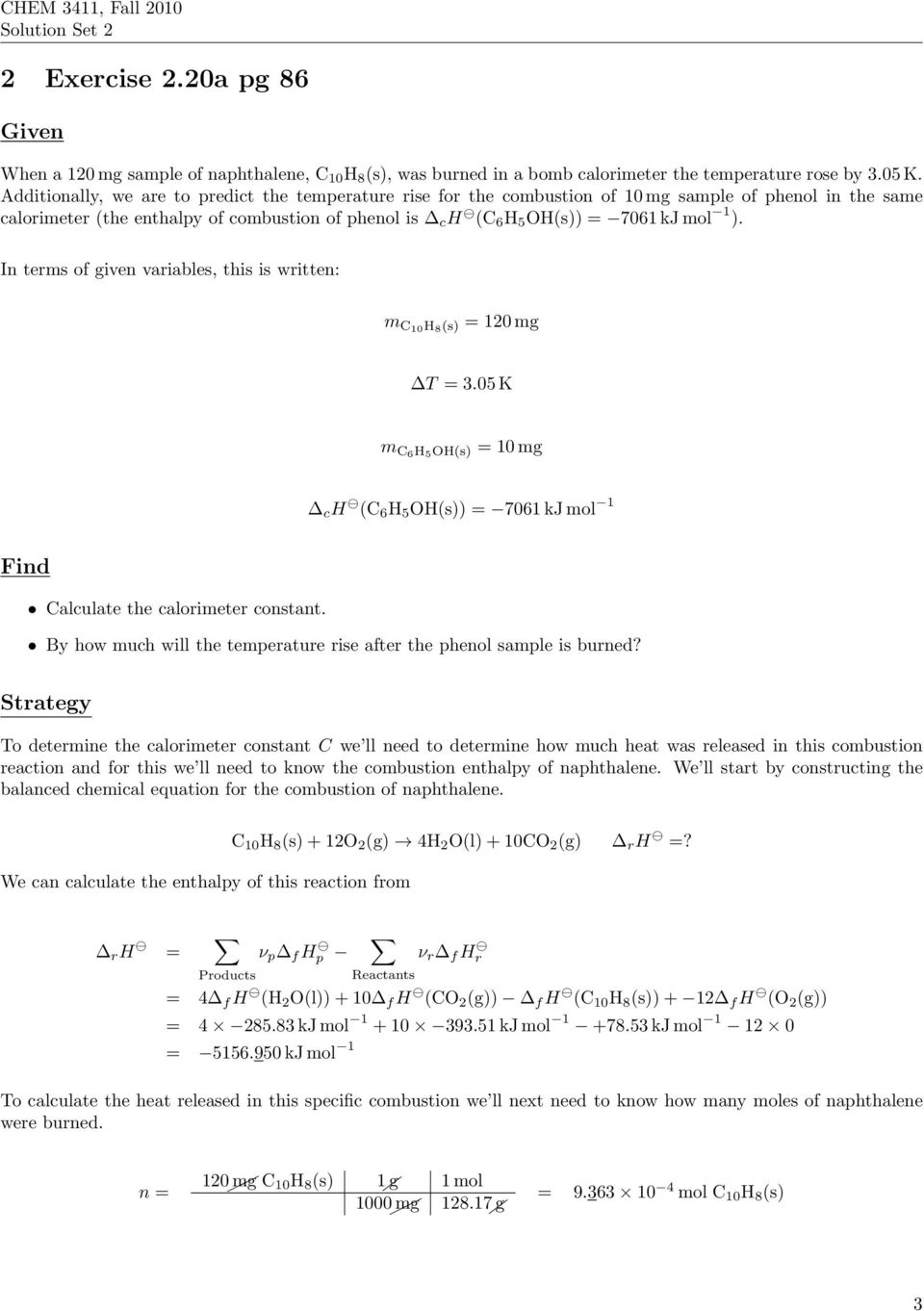
4 We can now easily calculate the heat produced q p in the combustion of this quantity of moles. q p = n r H = mol kj mol 1 = kj The calorimeter absorbed this heat q a = q p = kj. As we know the temperature change in the calorimeter resulting from the absorption of this heat, we can calculate the calorimeter constant C from q = C T. C = q a T kj = 3.05 K = kj K 1 As we now know the calorimeter constant we can go ahead and determine the calorimeter temperature change for burning the phenol sample. The balanced chemical equation for this reaction is and the enthalpy of this reaction is C 6 H 5 OH(s) + 7O 2 (g) 3H 2 O(l) + 6CO 2 (g) r H =? r H = Products ν p f H p Reactants ν r f H r = 3 f H (H 2 O(l)) + 6 f H (CO 2 (g)) f H (C 6 H 5 OH(s)) + 7 f H (O 2 (g)) = kj mol kj mol kj mol = kj mol 1 To determine the heat, we ll need the moles in this combustion. n = 10 mg C 6 H 5 OH(s) 1 g 1 mol 1000 mg g = mol C 10 H 8 (s) Now we ll calculate the heat produced in combustion. q p = n r H = mol kj mol 1 = kj And lastly we ll determine the temperature change induced in the calorimeter by absorbing this heat. T = q a C kj = kj K 1 = K 4

5 Solution The calorimeter constant is C = 1.6 kj K 1. Burning phenol will lead to a temperature increase of T = 0.2 K. 5

6 3 Exercise 2.24a pg 87 Given For the reaction C 2 H 5 OH(l) + 3O 2 (g) 2CO 2 (g) + 3H 2 O(g), r U = 1373 kj mol 1 at T = 298 K. In terms of given variables, this is written: r U = 1373 kj mol 1 T = 298 K Find Calculate r H of this reaction. Strategy The following equation relates the enthalpy change of a reaction to the internal energy change (Equation 2.21 on pg 58 in your text book). H = U + n g RT where n g RT is the change in quantity of gas molecules of the reaction. In analyzing this reaction C 2 H 5 OH(l) + 3O 2 (g) 2CO 2 (g) + 3H 2 O(g) we see that 5 moles of gas are produced (2 moles of CO 2 (g) and 3 of H 2 O(g)) while 3 are consumed (O 2 (g)). Therefore n g = 2 and r H is easily calculated as r H = r U + n g RT = J mol mol gas 1 mol reaction J K 1 mol K = J mol 1 = kj mol 1 Solution r H = 1368 kj mol 1 6

7 4 Exercise 2.26a pg 87 Given Consider the reaction 2NO 2 (g) N 2 O 4 (g) at T = 100 C (T = 373 K) and the information in table 2.8 Find Calculate the standard reaction enthalpy of this reaction at this temperature. Strategy For this problem, we ll use the fact that enthalpy is a state function to create a series of processes identical to this reaction at the non-standard temperature. By summing summing the change in enthalpy over these steps we ll arrive at the enthalpy of this reaction at the non-standard temperature. These processes can be summarized as cooling 2 moles of NO 2 (g) from T = 373 K to the standard temperature of T = 298 K. At this standard temperature the 2 moles of NO 2 (g) can be reacted to form 1 mole of N 2 O 4 (g) and we can calculate the reaction enthalpy at this standard temperature. Lastly, we ll heat the 1 mole of N 2 O 4 (g) from T = 298 K to T = 373 K. Summing the enthalpy changes over these three processes will give us the enthalpy difference between 2 moles of NO 2 (g) and 1 mole of N 2 O 4 (g) at T = 373 K and this is the enthalpy difference of the reaction of interest. This is summarized as 2 mol NO 2 (g) at T = 373 K cool H cool 2 mol NO 2 (g)att = 298 K rh (at T = 298 K) 1 mol N 2 O 4 (g)att = 298 K H heat 1 mol N 2 O 4 (g)att = 373 K r H (at T = 373 K) = H cool + r H (at T = 298 K) + H heat The enthalpy of cooling or heating a substance can be determined from the substance s constant pressure heat capacity C p. H = Tf T i For this problem we ll assume heat capacities are temperature independent over the temperature range of interest and this simplifies the calculations. C p dt 7

8 Tf H = C p dt T i Tf = C p dt T i = C p (T f T i ) = C p T Using heat capacities from our textbook we can calculate the enthalpy of heating the 2 moles of NO 2 (g) and cooling 1 mole of N 2 O 4 (g). H cool = ν C p T (Cool NO 2 (g)) = J K 1 mol 1 (298 K 373 K) = = kj mol 1 H heat = ν C p T (Heat N 2 O 4 (g)) = J K 1 mol 1 (373 K 298 K) = = kj mol 1 (Note that in these last two expressions the reaction coefficients are exact quantities and don t affect number of significant figures.) In the original solution sets the temperatures were swapped which changed the signs of these enthalpies. The enthalpy of the reaction at the standard temperature of T = 298 can be calculated from enthalpies of formation. r H = Products ν p f H p Reactants ν r f H r = kj mol kj mol 1 = kj mol 1 Summing these enthalpies gives the reaction enthalpy at the non-standard temperature r H (at T = 373 K) = H cool + r H (at T = 298 K) + H heat = kj mol kj mol kj mol 1 = kj mol 1 Solution r H (at T = 373 K) = kj mol 1 8

9 5 Exercise 2.29a pg 87 Given We are given the following enthalpies... Enthalpy of sublimation of Mg(s) sub H = kj mol 1 Mg(s) Mg(g) sub H = kj mol 1 First ionization enthalpy of Mg(g) ion1 H = ev Mg(g) Mg + (g) ion1 H = ev Second ionization enthalpy of Mg(g) ion2 H = ev Mg + (g) Mg +2 (g) ion2 H = ev Dissociation enthalpy of Cl 2 (g) dis H = kj mol 1 Cl 2 (g) 2Cl(g) dis H = kj mol 1 Electron gain enthalpy of Cl(g) elec H = 3.78 ev Cl(g) Cl (g) elec H = 3.78 ev Enthalpy of solution of MgCl 2 (s) sol H = kj mol 1 MgCl 2 (s) Mg +2 (aq) + 2Cl (aq) sol H = kj mol 1 Enthalpy of hydration of Cl (g) hyd H = kj mol 1 Cl (g) Cl (aq) hyd H = kj mol 1 Find Calculate the enthalpy of hydration hyd H of for Mg +2 (g). Strategy For this problem we need to construct a thermodynamic cycle which includes the unknown process; hydration of Mg +2 (g), Mg +2 (g) hyd H. If we know the enthalpies all other processes in this cycle, then we can solve for the single unknown enthalpy. Such a cycle is shown is Figure 5 where one mole of Mg +2 (g) and two moles of Cl (g) are solvated through two different pathways. These sum of enthalpies over each of these two paths are thereby equal. For this cycle we found it necessary to include a process that was not given to us by the textbook: the enthalpy of formation of MgCl 2 (s) from Mg(s) and Cl 2 (g). We can calculate the enthalpy for this process from its balanced chemical equation The enthalpy of this reaction is calculated as Mg(s) + Cl 2 (g) MgCl 2 (s) 9

10 Figure 1: Thermodynamic cycle diagram r H = Products ν p f H p Reactants ν r f H r = f H (MgCl 2 (s)) f H (Mg(s)) f H (Cl 2 (g)) = kj mol = kj mol 1 This gives us the enthalpy of the additional process we need: The enthalpy of formation of MgCl 2 (s) f H = kj mol 1 Mg(s) + Cl 2 (g) MgCl 2 (s) f H = kj mol 1 To reiterate, we had to obtain this quantity because it doesn t appear possible to complete this problem with only the given information. The themodynamic cycle diagram in the figure also illustrates the fact that we can t complete the cycle unless we link the MgCl 2 (s) to the corresponding stable elements. The formation reaction is precisely the missing link, and the problem statement didn t have to provide it because we are able to obtain it using information from the Table 2.8. If we equate the sum of the enthalpies of the two solvation paths in this thermodynamic cycle we get the following equation: 10

11 2 hyd H (Cl (g)) + hyd H (Mg +2 (g)) = [ ion1 H (Mg(g)) + ion2 H (Mg + (g)) + sub H (Mg(s)) ] [ 2 elec H (Cl (g)) + dis H (Cl 2 (g)) ] This equation can be solved for our unknown hyd H (Mg +2 (g)) + f H (MgCl 2 (s)) + sol H (MgCl 2 (s)) hyd H (Mg +2 (g)) = [ ion1 H (Mg(g)) + ion2 H (Mg + (g)) + sub H (Mg(s)) ] [ 2 elec H (Cl (g)) + dis H (Cl 2 (g)) ] + f H (MgCl 2 (s)) + sol H (MgCl 2 (s)) + 2 hyd H (Cl (g)) = [ kj mol kj mol kj mol 1] [ kj mol kj mol 1 + ] kj mol kj mol kj mol 1 = kj mol 1 where the energies in electron-volts have been converted by the following expression ion1 H = ion2 H = elec H = ev J 1 kj electrons 1 ev 1000 J 1 mol ev J 1 kj electrons 1 ev 1000 J 1 mol 3.78 ev J 1 kj electrons 1 ev 1000 J 1 mol = kj mol 1 = kj mol 1 = kj mol 1 Solution hyd H (Mg +2 (g)) = kj mol 1 11
![hyd H (Cl (g)) = [ 737.722 kj mol 1 + 1450.650 kj mol 1 + 167.2 kj mol 1] [ 2 364.71 kj mol 1 + 241.6 kj mol 1 + ] + 641.32 kj mol 1 + 150.5 kj mol 1 + 2 383.7 kj mol 1 = 3346.](/docs-images/47/20870145/images/page_11.jpg "012 kj mol 1 where the energies in electron-volts have been converted by the following expression ion1 H = ion2 H = elec H = 7.646 ev 1.60218 10 19 J 1 kj 6.0221 10 23 electrons 1 ev 1000 J 1 mol 15.")
12 6 Exercise 2.30a pg 87 Given When a certain freon used in refrigeration was expanded adiabatically from an initial pressure of p i = 32 atm and a T i = 0 C to a final pressure of p f = 1.00 atm, the temperature fell by T = 22 K. In terms of given variables, this is written: p i = 32 atm T i = 0 C p f = 1.00 atm T = 22 K Find Calculate the Joule-Thomson coefficient, µ, at T = 0 C assuming it remains constant over this temperature range. Strategy The Joule-Thomson coefficient is defined as µ = ( ) T p H If we assume µ is constant over the range of temperature and pressures changes then the derivative can be replaced with finite differences. µ = T p Substituting in our temperature and pressure changes gives µ = 22 K 1.00 atm 32 atm = K atm 1 Solution µ = 0.71 K atm 1 12

Bomb Calorimetry. Example 4. Energy and Enthalpy
 Bomb Calorimetry constant volume often used for combustion reactions heat released by reaction is absorbed by calorimeter contents need heat capacity of calorimeter q cal = q rxn = q bomb + q water Example
Thermochemical equations allow stoichiometric calculations.
 CHEM 1105 THERMOCHEMISTRY 1. Change in Enthalpy ( H) Heat is evolved or absorbed in all chemical reactions. Exothermic reaction: heat evolved - heat flows from reaction mixture to surroundings; products
SUGGESTION ANSWER SCHEME CHAPTER 8: THERMOCHEMISTRY. 1 (a) Use the data in the table below to answer the following questions:
 SUGGESTION ANSWER SCHEME CHAPTER 8: THERMOCHEMISTRY ANSWER SCHEME UPS 2004/2005 SK027 1 (a) Use the data in the table below to answer the following questions: Enthalpy change ΔH (kj/mol) Atomization energy
1. Thermite reaction 2. Enthalpy of reaction, H 3. Heating/cooling curves and changes in state 4. More thermite thermodynamics
 Chem 105 Fri 10-23-09 1. Thermite reaction 2. Enthalpy of reaction, H 3. Heating/cooling curves and changes in state 4. More thermite thermodynamics 10/23/2009 1 Please PICK UP your graded EXAM in front.
Chemistry B11 Chapter 4 Chemical reactions
 Chemistry B11 Chapter 4 Chemical reactions Chemical reactions are classified into five groups: A + B AB Synthesis reactions (Combination) H + O H O AB A + B Decomposition reactions (Analysis) NaCl Na +Cl
Module 5: Combustion Technology. Lecture 34: Calculation of calorific value of fuels
 1 P age Module 5: Combustion Technology Lecture 34: Calculation of calorific value of fuels 2 P age Keywords : Gross calorific value, Net calorific value, enthalpy change, bomb calorimeter 5.3 Calculation
www.chemsheets.co.uk 17-Jul-12 Chemsheets A2 033 1
 www.chemsheets.co.uk 17-Jul-12 Chemsheets A2 033 1 AS THERMODYNAMICS REVISION What is enthalpy? It is a measure of the heat content of a substance Enthalpy change ( H) = Change in heat content at constant
Introductory Chemistry, 3 rd Edition Nivaldo Tro. Roy Kennedy Massachusetts Bay Community College Wellesley Hills, Maqqwertd ygoijpk[l
 Introductory Chemistry, 3 rd Edition Nivaldo Tro Quantities in Car an octane and oxygen molecules and carbon dioxide and water Chemical Reactions Roy Kennedy Massachusetts Bay Community College Wellesley
YIELD YIELD REACTANTS PRODUCTS
 Balancing Chemical Equations A Chemical Equation: is a representation of a chemical reaction in terms of chemical formulas Example: 1. Word Description of a Chemical Reaction When methane gas (CH 4 ) burns
The first law: transformation of energy into heat and work. Chemical reactions can be used to provide heat and for doing work.
 The first law: transformation of energy into heat and work Chemical reactions can be used to provide heat and for doing work. Compare fuel value of different compounds. What drives these reactions to proceed
Name Class Date. Section: Calculating Quantities in Reactions. Complete each statement below by writing the correct term or phrase.
 Skills Worksheet Concept Review Section: Calculating Quantities in Reactions Complete each statement below by writing the correct term or phrase. 1. All stoichiometric calculations involving equations
AP CHEMISTRY 2007 SCORING GUIDELINES. Question 2
 AP CHEMISTRY 2007 SCORING GUIDELINES Question 2 N 2 (g) + 3 F 2 (g) 2 NF 3 (g) ΔH 298 = 264 kj mol 1 ; ΔS 298 = 278 J K 1 mol 1 The following questions relate to the synthesis reaction represented by the
Chapter 18 Homework Answers
 Chapter 18 Homework Answers 18.22. 18.24. 18.26. a. Since G RT lnk, as long as the temperature remains constant, the value of G also remains constant. b. In this case, G G + RT lnq. Since the reaction
ENTHALPY CHANGES FOR A CHEMICAL REACTION scaling a rxn up or down (proportionality) quantity 1 from rxn heat 1 from Δ r H. = 32.
 CHEMISTRY 103 Help Sheet #10 Chapter 4 (Part II); Sections 4.6-4.10 Do the topics appropriate for your lecture Prepared by Dr. Tony Jacob http://www.chem.wisc.edu/areas/clc (Resource page) Nuggets: Enthalpy
INTI COLLEGE MALAYSIA A? LEVEL PROGRAMME CHM 111: CHEMISTRY MOCK EXAMINATION: DECEMBER 2000 SESSION. 37 74 20 40 60 80 m/e
 CHM111(M)/Page 1 of 5 INTI COLLEGE MALAYSIA A? LEVEL PROGRAMME CHM 111: CHEMISTRY MOCK EXAMINATION: DECEMBER 2000 SESSION SECTION A Answer ALL EIGHT questions. (52 marks) 1. The following is the mass spectrum
Standard Free Energies of Formation at 298 K. Average Bond Dissociation Energies at 298 K
 1 Thermodynamics There always seems to be at least one free response question that involves thermodynamics. These types of question also show up in the multiple choice questions. G, S, and H. Know what
Determination of the enthalpy of combustion using a bomb calorimeter TEC
 Determination of the enthalpy of TEC Related concepts First law of thermodynamics, Hess s law of constant heat summation, enthalpy of combustion, enthalpy of formation, heat capacity. Principle The bomb
Mr. Bracken. Multiple Choice Review: Thermochemistry
 Mr. Bracken AP Chemistry Name Period Multiple Choice Review: Thermochemistry 1. If this has a negative value for a process, then the process occurs spontaneously. 2. This is a measure of how the disorder
Chapter 3. Chemical Reactions and Reaction Stoichiometry. Lecture Presentation. James F. Kirby Quinnipiac University Hamden, CT
 Lecture Presentation Chapter 3 Chemical Reactions and Reaction James F. Kirby Quinnipiac University Hamden, CT The study of the mass relationships in chemistry Based on the Law of Conservation of Mass
Energy and Chemical Reactions. Characterizing Energy:
 Energy and Chemical Reactions Energy: Critical for virtually all aspects of chemistry Defined as: We focus on energy transfer. We observe energy changes in: Heat Transfer: How much energy can a material
Chapter 6 Chemical Calculations
 Chapter 6 Chemical Calculations 1 Submicroscopic Macroscopic 2 Chapter Outline 1. Formula Masses (Ch 6.1) 2. Percent Composition (supplemental material) 3. The Mole & Avogadro s Number (Ch 6.2) 4. Molar
Transfer of heat energy often occurs during chemical reactions. A reaction
 Chemistry 111 Lab: Thermochemistry Page I-3 THERMOCHEMISTRY Heats of Reaction The Enthalpy of Formation of Magnesium Oxide Transfer of heat energy often occurs during chemical reactions. A reaction may
Thermochemistry: Calorimetry and Hess s Law
 Thermochemistry: Calorimetry and Hess s Law Some chemical reactions are endothermic and proceed with absorption of heat while others are exothermic and proceed with an evolution of heat. The magnitude
AP Chemistry 2005 Scoring Guidelines Form B
 AP Chemistry 2005 Scoring Guidelines Form B The College Board: Connecting Students to College Success The College Board is a not-for-profit membership association whose mission is to connect students to
7. 1.00 atm = 760 torr = 760 mm Hg = 101.325 kpa = 14.70 psi. = 0.446 atm. = 0.993 atm. = 107 kpa 760 torr 1 atm 760 mm Hg = 790.
 CHATER 3. The atmosphere is a homogeneous mixture (a solution) of gases.. Solids and liquids have essentially fixed volumes and are not able to be compressed easily. have volumes that depend on their conditions,
Enthalpy of Reaction and Calorimetry worksheet
 Enthalpy of Reaction and Calorimetry worksheet 1. Calcium carbonate decomposes at high temperature to form carbon dioxide and calcium oxide, calculate the enthalpy of reaction. CaCO 3 CO 2 + CaO 2. Carbon
Sample Problem: STOICHIOMETRY and percent yield calculations. How much H 2 O will be formed if 454 g of. decomposes? NH 4 NO 3 N 2 O + 2 H 2 O
 STOICHIOMETRY and percent yield calculations 1 Steps for solving Stoichiometric Problems 2 Step 1 Write the balanced equation for the reaction. Step 2 Identify your known and unknown quantities. Step 3
The Mole and Molar Mass
 The Mole and Molar Mass 1 Molar mass is the mass of one mole of a substance. Molar mass is numerically equal to atomic mass, molecular mass, or formula mass. However the units of molar mass are g/mol.
Test 5 Review questions. 1. As ice cools from 273 K to 263 K, the average kinetic energy of its molecules will
 Name: Thursday, December 13, 2007 Test 5 Review questions 1. As ice cools from 273 K to 263 K, the average kinetic energy of its molecules will 1. decrease 2. increase 3. remain the same 2. The graph below
stoichiometry = the numerical relationships between chemical amounts in a reaction.
 1 REACTIONS AND YIELD ANSWERS stoichiometry = the numerical relationships between chemical amounts in a reaction. 2C 8 H 18 (l) + 25O 2 16CO 2 (g) + 18H 2 O(g) From the equation, 16 moles of CO 2 (a greenhouse
Chem 1A Exam 2 Review Problems
 Chem 1A Exam 2 Review Problems 1. At 0.967 atm, the height of mercury in a barometer is 0.735 m. If the mercury were replaced with water, what height of water (in meters) would be supported at this pressure?
Thermodynamics Worksheet I also highly recommend Worksheets 13 and 14 in the Lab Manual
 Thermodynamics Worksheet I also highly recommend Worksheets 13 and 14 in the Lab Manual 1. Predict the sign of entropy change in the following processes a) The process of carbonating water to make a soda
1 Exercise 4.1b pg 153
 In this solution set, an underline is used to show the last significant digit of numbers. For instance in x = 2.51693 the 2,5,1, and 6 are all significant. Digits to the right of the underlined digit,
Name Date Class STOICHIOMETRY. SECTION 12.1 THE ARITHMETIC OF EQUATIONS (pages 353 358)
 Name Date Class 1 STOICHIOMETRY SECTION 1.1 THE ARITHMETIC OF EQUATIONS (pages 353 358) This section explains how to calculate the amount of reactants required or product formed in a nonchemical process.
Chemical Reactions 2 The Chemical Equation
 Chemical Reactions 2 The Chemical Equation INFORMATION Chemical equations are symbolic devices used to represent actual chemical reactions. The left side of the equation, called the reactants, is separated
87 16 70 20 58 24 44 32 35 40 29 48 (a) graph Y versus X (b) graph Y versus 1/X
 HOMEWORK 5A Barometer; Boyle s Law 1. The pressure of the first two gases below is determined with a manometer that is filled with mercury (density = 13.6 g/ml). The pressure of the last two gases below
Calculations with Chemical Formulas and Equations
 Chapter 3 Calculations with Chemical Formulas and Equations Concept Check 3.1 You have 1.5 moles of tricycles. a. How many moles of seats do you have? b. How many moles of tires do you have? c. How could
Problem Set 4 Solutions
 Chemistry 360 Dr Jean M Standard Problem Set 4 Solutions 1 Two moles of an ideal gas are compressed isothermally and reversibly at 98 K from 1 atm to 00 atm Calculate q, w, ΔU, and ΔH For an isothermal
Stoichiometry. Lecture Examples Answer Key
 Stoichiometry Lecture Examples Answer Key Ex. 1 Balance the following chemical equations: 3 NaBr + 1 H 3 PO 4 3 HBr + 1 Na 3 PO 4 2 C 3 H 5 N 3 O 9 6 CO 2 + 3 N 2 + 5 H 2 O + 9 O 2 2 Ca(OH) 2 + 2 SO 2
Balance the following equation: KClO 3 + C 12 H 22 O 11 KCl + CO 2 + H 2 O
 Balance the following equation: KClO 3 + C 12 H 22 O 11 KCl + CO 2 + H 2 O Ans: 8 KClO 3 + C 12 H 22 O 11 8 KCl + 12 CO 2 + 11 H 2 O 3.2 Chemical Symbols at Different levels Chemical symbols represent
DETERMINING THE ENTHALPY OF FORMATION OF CaCO 3
 DETERMINING THE ENTHALPY OF FORMATION OF CaCO 3 Standard Enthalpy Change Standard Enthalpy Change for a reaction, symbolized as H 0 298, is defined as The enthalpy change when the molar quantities of reactants
1. What is the molecular formula of a compound with the empirical formula PO and a gram-molecular mass of 284 grams?
 Name: Tuesday, May 20, 2008 1. What is the molecular formula of a compound with the empirical formula PO and a gram-molecular mass of 284 grams? 2 5 1. P2O 5 3. P10O4 2. P5O 2 4. P4O10 2. Which substance
Final Exam Review. I normalize your final exam score out of 70 to a score out of 150. This score out of 150 is included in your final course total.
 Final Exam Review Information Your ACS standardized final exam is a comprehensive, 70 question multiple choice (a d) test featuring material from BOTH the CHM 101 and 102 syllabi. Questions are graded
CHEM 105 HOUR EXAM III 28-OCT-99. = -163 kj/mole determine H f 0 for Ni(CO) 4 (g) = -260 kj/mole determine H f 0 for Cr(CO) 6 (g)
 CHEM 15 HOUR EXAM III 28-OCT-99 NAME (please print) 1. a. given: Ni (s) + 4 CO (g) = Ni(CO) 4 (g) H Rxn = -163 k/mole determine H f for Ni(CO) 4 (g) b. given: Cr (s) + 6 CO (g) = Cr(CO) 6 (g) H Rxn = -26
Chapter 6 Thermodynamics: The First Law
 Key Concepts 6.1 Systems Chapter 6 Thermodynamics: The First Law Systems, States, and Energy (Sections 6.1 6.8) thermodynamics, statistical thermodynamics, system, surroundings, open system, closed system,
Thermodynamics. Thermodynamics 1
 Thermodynamics 1 Thermodynamics Some Important Topics First Law of Thermodynamics Internal Energy U ( or E) Enthalpy H Second Law of Thermodynamics Entropy S Third law of Thermodynamics Absolute Entropy
Adiabatic Bomb Calorimetry
 CHEM 366 II-1 Adiabatic Bomb Calorimetry Introduction Obtaining energy in the form of heat from the combustion or oxidation of thermodynamically unstable (and often kinetically inert) hydrocarbons and
SUPPLEMENTARY TOPIC 3 ENERGY AND CHEMICAL REACTIONS
 SUPPLEMENTARY TOPIC 3 ENERGY AND CHEMICAL REACTIONS Rearranging atoms. In a chemical reaction, bonds between atoms in one or more molecules (reactants) break and new bonds are formed with other atoms to
Test Review # 9. Chemistry R: Form TR9.13A
 Chemistry R: Form TR9.13A TEST 9 REVIEW Name Date Period Test Review # 9 Collision theory. In order for a reaction to occur, particles of the reactant must collide. Not all collisions cause reactions.
IB Chemistry 1 Mole. One atom of C-12 has a mass of 12 amu. One mole of C-12 has a mass of 12 g. Grams we can use more easily.
 The Mole Atomic mass units and atoms are not convenient units to work with. The concept of the mole was invented. This was the number of atoms of carbon-12 that were needed to make 12 g of carbon. 1 mole
Equilibria Involving Acids & Bases
 Week 9 Equilibria Involving Acids & Bases Acidic and basic solutions Self-ionisation of water Through reaction with itself: The concentration of water in aqueous solutions is virtually constant at about
Unit 6 The Mole Concept
 Chemistry Form 3 Page 62 Ms. R. Buttigieg Unit 6 The Mole Concept See Chemistry for You Chapter 28 pg. 352-363 See GCSE Chemistry Chapter 5 pg. 70-79 6.1 Relative atomic mass. The relative atomic mass
Answers and Solutions to Text Problems
 Chapter 7 Answers and Solutions 7 Answers and Solutions to Text Problems 7.1 A mole is the amount of a substance that contains 6.02 x 10 23 items. For example, one mole of water contains 6.02 10 23 molecules
How To Calculate Mass In Chemical Reactions
 We have used the mole concept to calculate mass relationships in chemical formulas Molar mass of ethanol (C 2 H 5 OH)? Molar mass = 2 x 12.011 + 6 x 1.008 + 1 x15.999 = 46.069 g/mol Mass percentage of
20.2 Chemical Equations
 All of the chemical changes you observed in the last Investigation were the result of chemical reactions. A chemical reaction involves a rearrangement of atoms in one or more reactants to form one or more
Chemistry 2014 Scoring Guidelines
 AP Chemistry 2014 Scoring Guidelines 2014 The College Board. College Board, Advanced Placement Program, AP, AP Central, and the acorn logo are registered trademarks of the College Board. Visit the College
Chapter 3: Stoichiometry
 Chapter 3: Stoichiometry Key Skills: Balance chemical equations Predict the products of simple combination, decomposition, and combustion reactions. Calculate formula weights Convert grams to moles and
The Mole Concept. The Mole. Masses of molecules
 The Mole Concept Ron Robertson r2 c:\files\courses\1110-20\2010 final slides for web\mole concept.docx The Mole The mole is a unit of measurement equal to 6.022 x 10 23 things (to 4 sf) just like there
Final Exam CHM 3410, Dr. Mebel, Fall 2005
 Final Exam CHM 3410, Dr. Mebel, Fall 2005 1. At -31.2 C, pure propane and n-butane have vapor pressures of 1200 and 200 Torr, respectively. (a) Calculate the mole fraction of propane in the liquid mixture
Spring 2009. kj mol 125 0-229 -92. H f. H rxn = Σ H f (products) - Σ H f (reactants)
 Spring 2009 2. The reaction of an elemental halogen with an alkane is a very common reaction. The reaction between chlorine and butane is provided below. (NOTE: Questions a d and f pertain to this reaction.)
Bomb Calorimetry. Electrical leads. Stirrer
 Bomb Calorimetry Stirrer Electrical leads Oxygen inlet valve Bomb Fuse Calorimeter Outer jacket Not shown: heating and cooling system for outer jacket, and controls that keep the outer jacket at the same
CHEM 110: CHAPTER 3: STOICHIOMETRY: CALCULATIONS WITH CHEMICAL FORMULAS AND EQUATIONS
 1 CHEM 110: CHAPTER 3: STOICHIOMETRY: CALCULATIONS WITH CHEMICAL FORMULAS AND EQUATIONS The Chemical Equation A chemical equation concisely shows the initial (reactants) and final (products) results of
Unit 5 Practice Test. Name: Class: Date: Multiple Choice Identify the choice that best completes the statement or answers the question.
 Name: Class: Date: Unit 5 Practice Test Multiple Choice Identify the choice that best completes the statement or answers the question. 1) The internal energy of a system is always increased by. A) adding
Enthalpy of Combustion via Calorimetry
 Enthalpy of Combustion via Calorimetry Introduction This experiment measures the enthalpy change when a system consisting of a known amount of a substance in the presence of excess oxygen is quantitatively
Chemical Equations & Stoichiometry
 Chemical Equations & Stoichiometry Chapter Goals Balance equations for simple chemical reactions. Perform stoichiometry calculations using balanced chemical equations. Understand the meaning of the term
Sample Exercise 3.1 Interpreting and Balancing Chemical Equations
 Sample Exercise 3.1 Interpreting and Balancing Chemical Equations The following diagram represents a chemical reaction in which the red spheres are oxygen atoms and the blue spheres are nitrogen atoms.
The 5 Types of Chemical Reactions (Chapter 11) By C B 6 th period
 The 5 Types of Chemical Reactions (Chapter 11) By C B 6 th period 1) Combination Reactions Is also referred to as a synthesis reaction It is a chemical change in which two or more substances react to form
IB Chemistry. DP Chemistry Review
 DP Chemistry Review Topic 1: Quantitative chemistry 1.1 The mole concept and Avogadro s constant Assessment statement Apply the mole concept to substances. Determine the number of particles and the amount
CHEM 36 General Chemistry EXAM #1 February 13, 2002
 CHEM 36 General Chemistry EXAM #1 February 13, 2002 Name: Serkey, Anne INSTRUCTIONS: Read through the entire exam before you begin. Answer all of the questions. For questions involving calculations, show
Chapter 5 Principles of Chemical Reactivity: Energy and Chemical Reactions
 PRACTICING SKILLS Energy Chapter 5 Principles of Chemical Reactivity: 1. To move the lever, one uses mechanical energy. The energy resulting is manifest in electrical energy (which produces light); thermal
Formulas, Equations and Moles
 Chapter 3 Formulas, Equations and Moles Interpreting Chemical Equations You can interpret a balanced chemical equation in many ways. On a microscopic level, two molecules of H 2 react with one molecule
Chemistry 122 Mines, Spring 2014
 Chemistry 122 Mines, Spring 2014 Answer Key, Problem Set 9 1. 18.44(c) (Also indicate the sign on each electrode, and show the flow of ions in the salt bridge.); 2. 18.46 (do this for all cells in 18.44
2. The percent yield is the maximum amount of product that can be produced from the given amount of limiting reactant.
 UNIT 6 stoichiometry practice test True/False Indicate whether the statement is true or false. moles F 1. The mole ratio is a comparison of how many grams of one substance are required to participate in
PREPARATION FOR CHEMISTRY LAB: COMBUSTION
 1 Name: Lab Instructor: PREPARATION FOR CHEMISTRY LAB: COMBUSTION 1. What is a hydrocarbon? 2. What products form in the complete combustion of a hydrocarbon? 3. Combustion is an exothermic reaction. What
Chapter 13 Chemical Kinetics
 Chapter 13 Chemical Kinetics Student: 1. The units of "reaction rate" are A. L mol -1 s -1. B. L 2 mol -2 s -1. C. s -1. D. s -2. E. mol L -1 s -1. 2. For the reaction BrO 3 - + 5Br - + 6H + 3Br 2 + 3H
Chemistry 12 Worksheet 1-1 - Measuring Reaction Rates
 Chemistry 12 Worksheet 1-1 - Measuring Reaction Rates 1. A chemist wishes to determine the rate of reaction of zinc with hydrochloric acid. The equation for the reaction is: Zn (s) + 2HCl (aq) oh 2(g)
Chapter 4: Chemical and Solution Stoichiometry
 Chapter 4: Chemical and Solution Stoichiometry (Sections 4.1-4.4) 1 Reaction Stoichiometry The coefficients in a balanced chemical equation specify the relative amounts in moles of each of the substances
Stoichiometry. What is the atomic mass for carbon? For zinc?
 Stoichiometry Atomic Mass (atomic weight) Atoms are so small, it is difficult to discuss how much they weigh in grams We use atomic mass units an atomic mass unit (AMU) is one twelfth the mass of the catbon-12
Chapter 1 The Atomic Nature of Matter
 Chapter 1 The Atomic Nature of Matter 6. Substances that cannot be decomposed into two or more simpler substances by chemical means are called a. pure substances. b. compounds. c. molecules. d. elements.
Unit 2: Quantities in Chemistry
 Mass, Moles, & Molar Mass Relative quantities of isotopes in a natural occurring element (%) E.g. Carbon has 2 isotopes C-12 and C-13. Of Carbon s two isotopes, there is 98.9% C-12 and 11.1% C-13. Find
Chapter 5. Chemical Reactions and Equations. Introduction. Chapter 5 Topics. 5.1 What is a Chemical Reaction
 Introduction Chapter 5 Chemical Reactions and Equations Chemical reactions occur all around us. How do we make sense of these changes? What patterns can we find? 1 2 Copyright The McGraw-Hill Companies,
MULTIPLE CHOICE. Choose the one alternative that best completes the statement or answers the question.
 Exam Name MULTIPLE CHOICE. Choose the one alternative that best completes the statement or answers the question. 1) Given: 4 NO2(g) + O2(g) 2 N2O5(g) ΔH = -110.2 kj find ΔH for N2O5(g) 2 NO2(g) + 1/2 O2(g).
UNIT 1 THERMOCHEMISTRY
 UNIT 1 THERMOCHEMISTRY THERMOCHEMISTRY LEARNING OUTCOMES Students will be expected to: THERMOCHEMISTRY STSE analyse why scientific and technological activities take place in a variety individual and group
AP Chemistry 2009 Scoring Guidelines
 AP Chemistry 2009 Scoring Guidelines The College Board The College Board is a not-for-profit membership association whose mission is to connect students to college success and opportunity. Founded in 1900,
Chapter Three: STOICHIOMETRY
 p70 Chapter Three: STOICHIOMETRY Contents p76 Stoichiometry - The study of quantities of materials consumed and produced in chemical reactions. p70 3-1 Counting by Weighing 3-2 Atomic Masses p78 Mass Mass
Ch 20 Electrochemistry: the study of the relationships between electricity and chemical reactions.
 Ch 20 Electrochemistry: the study of the relationships between electricity and chemical reactions. In electrochemical reactions, electrons are transferred from one species to another. Learning goals and
Chemical Calculations: Formula Masses, Moles, and Chemical Equations
 Chemical Calculations: Formula Masses, Moles, and Chemical Equations Atomic Mass & Formula Mass Recall from Chapter Three that the average mass of an atom of a given element can be found on the periodic
Stoichiometry Exploring a Student-Friendly Method of Problem Solving
 Stoichiometry Exploring a Student-Friendly Method of Problem Solving Stoichiometry comes in two forms: composition and reaction. If the relationship in question is between the quantities of each element
Chemical Reactions Practice Test
 Chemical Reactions Practice Test Chapter 2 Name Date Hour _ Multiple Choice Identify the choice that best completes the statement or answers the question. 1. The only sure evidence for a chemical reaction
5.111 Principles of Chemical Science
 MIT OpenCourseWare http://ocw.mit.edu 5.111 Principles of Chemical Science Fall 2008 For information about citing these materials or our Terms of Use, visit: http://ocw.mit.edu/terms. Page 1 of 10 pages
Determination of the enthalpy of combustion using a bomb calorimeter TEC. Safety precautions
 Safety precautions Naphthalene is harmful if swallowed. May cause cancer. Is further very toxic to aquatic organisms and can have long-term harmful effects in bodies of water. Equipment 1 Bomb calorimeter
Chemistry 11 Some Study Materials for the Final Exam
 Chemistry 11 Some Study Materials for the Final Exam Prefix Abbreviation Exponent giga G 10 9 mega M 10 6 kilo k 10 3 hecto h 10 2 deca da 10 1 deci d 10-1 centi c 10-2 milli m 10-3 micro µ 10-6 nano n
Problem Solving. Stoichiometry of Gases
 Skills Worksheet Problem Solving Stoichiometry of Gases Now that you have worked with relationships among moles, mass, and volumes of gases, you can easily put these to work in stoichiometry calculations.
vap H = RT 1T 2 = 30.850 kj mol 1 100 kpa = 341 K
 Thermodynamics: Examples for chapter 6. 1. The boiling point of hexane at 1 atm is 68.7 C. What is the boiling point at 1 bar? The vapor pressure of hexane at 49.6 C is 53.32 kpa. Assume that the vapor
Lecture Topics Atomic weight, Mole, Molecular Mass, Derivation of Formulas, Percent Composition
 Mole Calculations Chemical Equations and Stoichiometry Lecture Topics Atomic weight, Mole, Molecular Mass, Derivation of Formulas, Percent Composition Chemical Equations and Problems Based on Miscellaneous
Calculations and Chemical Equations. Example: Hydrogen atomic weight = 1.008 amu Carbon atomic weight = 12.001 amu
 Calculations and Chemical Equations Atomic mass: Mass of an atom of an element, expressed in atomic mass units Atomic mass unit (amu): 1.661 x 10⁻²⁴ g Atomic weight: Average mass of all isotopes of a given
Guide for Reading. chemical equations. Vocabulary stoichiometry. Section 12.1 The Arithmetic of Equations 353
 12.1 The Arithmetic of Equations Connecting to Your World Silk is one of the most beautiful and luxurious of all fabrics. It is spun from the cocoons of silkworms. Silk manufacturers know from experience
Atomic mass is the mass of an atom in atomic mass units (amu)
 Micro World atoms & molecules Laboratory scale measurements Atomic mass is the mass of an atom in atomic mass units (amu) By definition: 1 atom 12 C weighs 12 amu On this scale 1 H = 1.008 amu 16 O = 16.00
Chemistry: Chemical Equations
 Chemistry: Chemical Equations Write a balanced chemical equation for each word equation. Include the phase of each substance in the equation. Classify the reaction as synthesis, decomposition, single replacement,