
2014 Spring CHEM101 Ch1-2 Review Worksheet Modified by Dr. Cheng-Yu Lai,
|
|
|
- Olivia Johnston
- 9 years ago
- Views:
Transcription
1 Ch1 1) Which of the following underlined items is not an intensive property? A) A chemical reaction requires 3.00 g of oxygen. B) The density of helium at 25 C is g/cm3. C) The melting point of aluminum metal is 933 K. 2) The horizontal rows of the periodic table are called A) groups. B) periods. C) triads. D) elements. 3) The vertical columns of the periodic table are called A) groups. B) periods. C) triads. D) elements. 4) 1 A group is also called group in the periodic table. A) alkali metal B) alkaline earth metal C) halogen D) noble gas 5) 7 A group is also called group in the periodic table. A) alkali metal B) alkaline earth metal C) halogen D) noble gas 6) Argon belongs to the group of the periodic table. A) alkali metal B) alkaline earth C) halogen D) noble gas 7) Calcium belongs to the group of the periodic table. A) alkali metal B) alkaline earth C) halogen
2 D) noble gas 8) Identify the element that has an atomic number of 15. A) sulfur B) oxygen C) phosphorus D) silicon 9) All of the following are SI base units of measurement, EXCEPT A) meter B) gram C) second D) kelvin E) mole 10) What symbol is used to express the factor, 10-6? A) M B) m C) μ D) n 11) What symbol is used to represent the factor 10-3? A) M B) m C) μ D) n 12) What symbol is used to represent the factor 10-9? A) M B) m C) μ D) n 13) The factor 0.01 corresponds to which prefix? A) deka B) deci C) centi D) milli 14) A sailor circumnavigated the earth and covered 4,264,000 meters. Express this number in standard scientific notation. A) m
3 B) m C) m D) m 15) Convert 1 μm to meters. A) m B) m C) m D) m 16) The outside temperature is 35 C, what is the temperature in K? A) -238 K B) 308 K C) 95 K D) 31 K E) 63 K 17) Determine the density of an object that has a mass of g and displaces 12.1 ml of water when placed in a graduated cylinder. A) 8.08 g/ml B) 1.38 g/ml C) 12.4 g/ml D) 18.1 g/ml E) 11.4 g/ml 18) Determine the volume of an object that has a mass of g and a density of 19.3 g/cm3. A) 87.9 ml B) 42.4 ml C) 18.5 ml D) 23.6 ml E) 31.2 ml 19)If an object weighs 32.5 g and it is placed in 14.0 ml of water, the volume increases to 24.0 ml, what is the density of the material of which it is made? 20) Convert the quantity 2.0mg/cm2 into Kg/m2? 21) A student performs an experiment to determine the density of a sugar solution. She obtains the following results: 1.71 g/ml, 1.72 g/ml, 1.70 g/ml, 1.69 g/ml. If the actual value for the density of the sugar solution is 1.40 g/ml, which statement below best describes her results? A) Her results are precise, but not accurate. B) Her results are accurate, but not precise. C) Her results are both precise and accurate D) Her results are neither precise nor accurate.
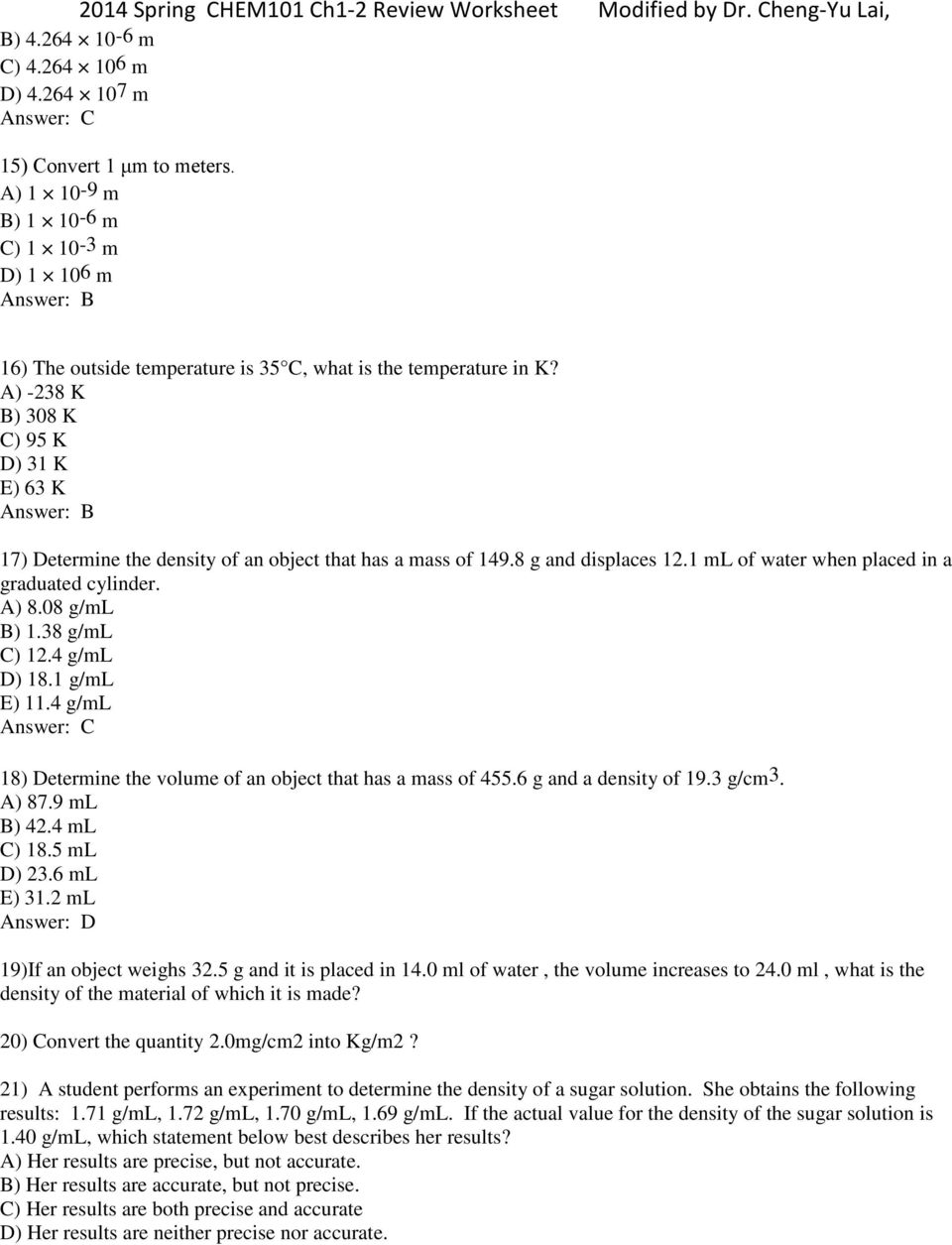
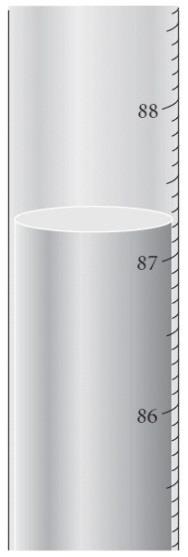
4 E) It isn't possible to determine with the information given. 22) A student performs an experiment to determine the density of a sugar solution. She obtains the following results: 1.79 g/ml, 1.81 g/ml, 1.80 g/ml, 1.81 g/ml. If the actual value for the density of the sugar solution is 1.80 g/ml, which statement below best describes her results? A) Her results are precise, but not accurate. B) Her results are accurate, but not precise. C) Her results are both precise and accurate D) Her results are neither precise nor accurate. E) It isn't possible to determine with the information given. 23) Read the temperature with the correct number of significant figures. A) 87 C B) 87.2 C C) C D) C E) C 24) What value should be reported for the buret reading shown? 22 23
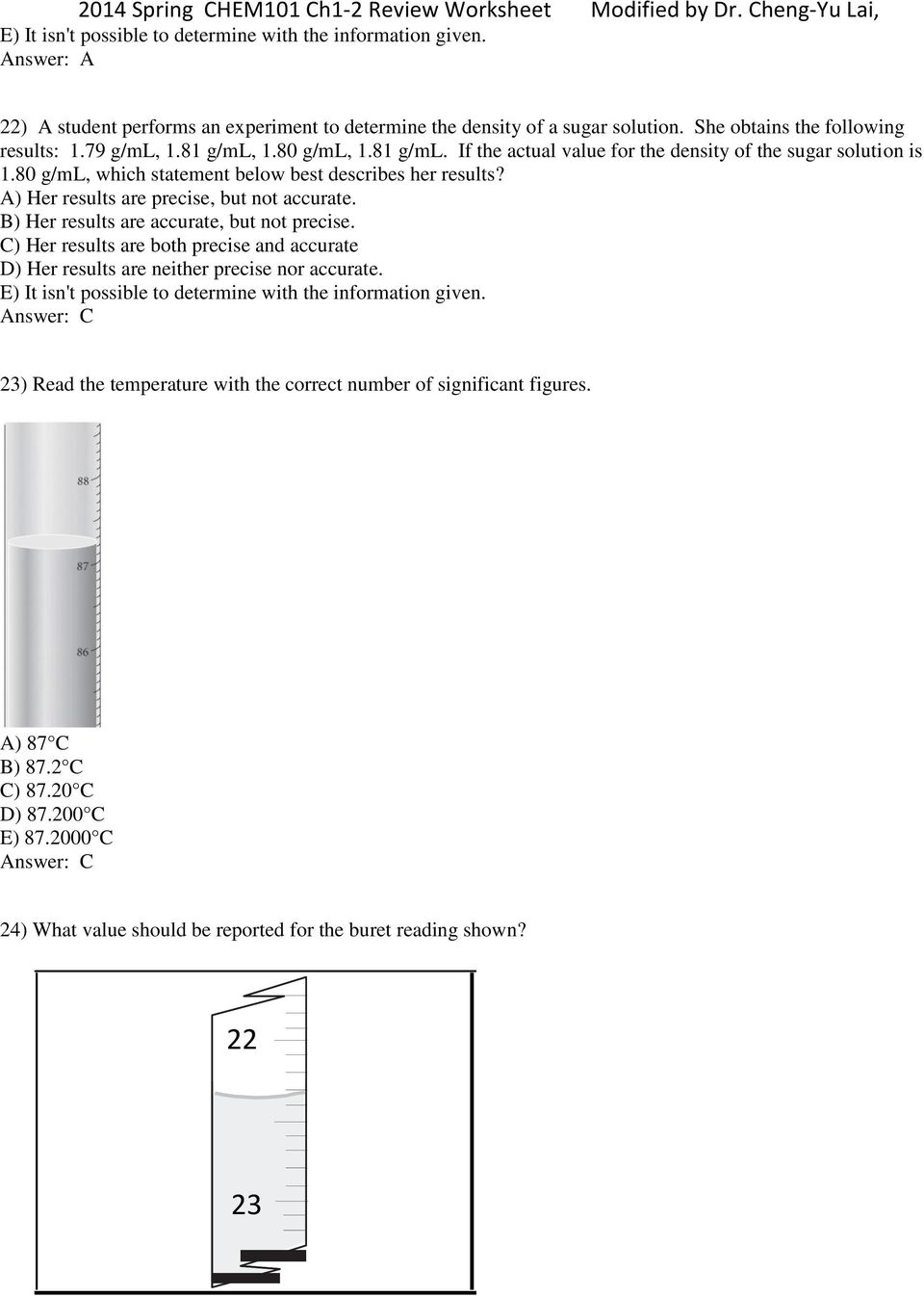
5 (A) 22.3 ml (B) ml (C) ml (D) ml Ch2 25) The observation that 15.0 g of hydrogen reacts with g of oxygen to form g of water is evidence for the law of A) definite proportions. B) energy conservation. C) mass conservation. D) multiple proportions. 26. The Law of Conservation of Mass states that the mass of the products is greater than the mass of the reactants. the mass of the products is less than the mass of the reactants. the mass of the products is equal to the mass of the reactant. none of the above 27) Methane and oxygen react to form carbon dioxide and water. What mass of water is formed if 3.2 g of methane reacts with 12.8 g of oxygen to produce 8.8 g of carbon dioxide? A) 7.2 g B) 8.8 g C) 14.8 g D) 16.0 g 28) Which of the following statements is FALSE according to Dalton's Atomic Theory? A) Atoms combine in simple whole number ratios to form compounds. B) All atoms of chlorine have identical properties that distinguish them from other elements. C) One carbon atom will combine with one oxygen atom to form a molecule of carbon monoxide. D) Atoms of sodium do not change into another element during chemical reaction with chlorine. E) An atom of nitrogen can be broken down into smaller particles that will still have the unique properties of nitrogen. Answer: E 29) Which of the following statements is not a postulate of Dalton's atomic theory? A) Each element is characterized by the mass of its atoms. B) Atoms are composed of protons, neutrons, and electrons. C) Chemical reactions only rearrange atomic combinations. D) Elements are composed of atoms.
6 30) The existence of electrons in atoms of all elements was demonstrated by A) Millikan's oil drop experiment. B) Rutherford's gold foil experiment. C) Thomson's cathode ray tube experiment. D) None of these 31) The charge-to-mass ratio of an electron was established by A) Millikan's oil drop experiment. B) Rutherford's gold foil experiment. C) Thomson's cathode ray tube experiment. D) None of these 32) The existence of neutrons in the nucleus of an atom was demonstrated by A) Millikan's oil drop experiment. B) Rutherford's gold foil experiment. C) Thomson's cathode ray tube experiment. D) None of these 33) Most of the alpha particles directed at a thin gold foil in Rutherford's experiment A) bounced directly back from the foil. B) passed directly through the foil undeflected. C) passed through the foil but were deflected at an angle. D) were absorbed by the foil. 34) Identify the charges of the protons, neutrons, and electrons. A) protons +1, neutrons 0, electrons -1 B) protons 0, neutrons -1, electrons +1 C) protons -1, neutrons 0, electrons +1 D) protons 0, neutrons +1, electrons -1 E) protons +1, neutrons -1, electrons 0 35) The mass number is equal to A) the sum of the number of the electrons and protons. B) the sum of the number of the neutrons and electrons. C) the sum of the number of protons, neutrons, and electrons. D) the sum of the number of protons and neutrons. 36) Which of the following two atoms are isotopes? A) 40 Ar 18 and 40 Ca 20 B) 12 6 C and 13 6 C C) 35 Cl 17 and 80 Br 35
7 D) Mg and 12 6 C 37) Which of the following represent isotopes? A: [ ] B: [ ] C: [ ] D: [ ] A) A and B B) A and C C) A and D D) C and D 38) How many protons (p), neutrons (n), and electrons (e) are in one atom of Mg? A) 12 p, 12 n, 12 e B) 12 p, 11 n, 12 e C) 12 p, 11 n, 10 e D) 12 p, 11 n, 14 e 39) Calculate the atomic mass of element "X", if it has 2 naturally occurring isotopes with the following masses and natural abundances: X amu 32.88% X amu 67.12% A) amu B) amu C) amu D) amu E) amu 40) An element has two naturally occurring isotopes. One has an abundance of 37.4% and an isotopic mass of amu, and the other has an abundance of 62.6% and a mass of amu. What is the atomic weight of the element? A) amu B) amu C) amu D) amu 41) What mass (in mg) does 2.63 moles of nickel have? A) 44.8 mg B) mg C) 129 mg D) 3.56 x 10⁵ mg E) 1.54 x 10⁵ mg Answer: E
8 42) How many moles and how many atoms of zinc are in a sample weighing 34.9 g? A) mol, atoms B) mol, atoms C) 1.87 mol, atoms D) 1.87 mol, atoms 43) Calculate the mass (in kg) of 4.87 x 1025 atoms of Zn. A) 5.29 kg B) 1.89 kg C) 8.09 kg D) 1.24 kg E) 1.09 kg 44) How many moles of potassium are contained in 300 g of potassium? A) 7.67 moles B) 1.44 moles C) 20.0 moles D) 15.8 moles E) 9.69 moles 45) Identify a cation. A) An atom that has lost an electron. B) An atom that has gained an electron. C) An atom that has lost a proton and a neutron. D) An atom that has gained a neutron. 46) Identify an anion. A) An atom that has lost an electron. B) An atom that has gained an electron. C) An atom that has lost a neutron and a proton. D) An atom that has gained a neutron. 47) Predict the charge of the single atom ions formed by these main group elements A) Al B) S C) F D) Ca 48) Which of the following metal commonly forms +3 ions? A) Fe B) Li
9 C) Zn D) Al E) S 2014 Spring CHEM101 Ch1-2 Review Worksheet Modified by Dr. Cheng-Yu Lai, 49) Give the number of protons in Na+1. A) 10 B) 13 C) 9 D) 11 E) 12 50) What is the identity of element Q if the ion Q2+ contains 10 electrons? A) C B) O C) Ne D) Mg 51) Give the number of electrons in P-3. A) 18 B) 12 C) 19 D) 15 E) 16 52) Give the number of protons in Na+1. A) 10 B) 13 C) 9 D) 11 E) 12 53) Calculate the formula mass of H2CO3. A) g/mole B) g/mole C) g/mole D) g/mole E) g/mole 54)
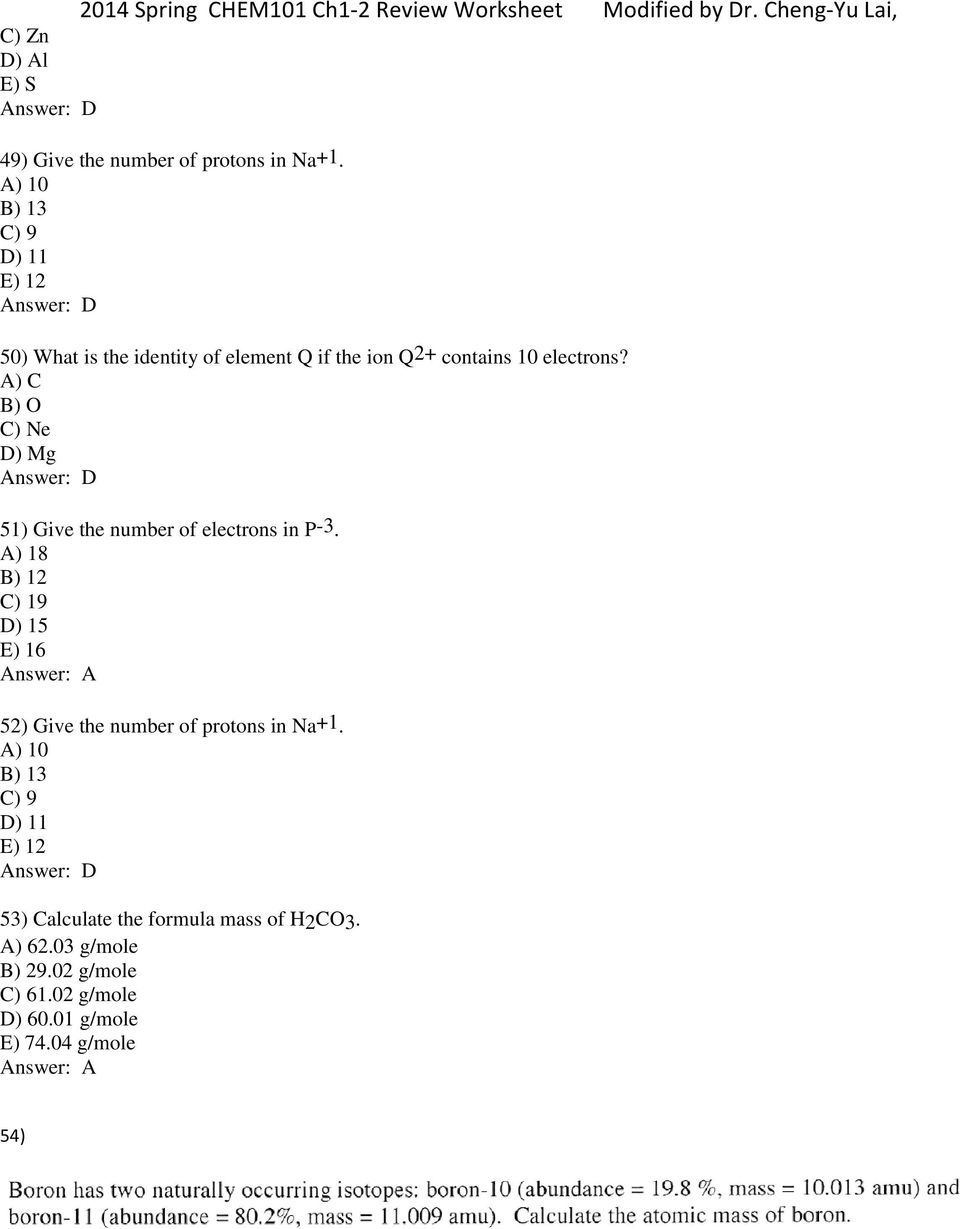
10

Chapter 2 Atoms, Ions, and the Periodic Table
 Chapter 2 Atoms, Ions, and the Periodic Table 2.1 (a) neutron; (b) law of conservation of mass; (c) proton; (d) main-group element; (e) relative atomic mass; (f) mass number; (g) isotope; (h) cation; (i)
ATOMS A T O M S, I S O T O P E S, A N D I O N S. The Academic Support Center @ Daytona State College (Science 120, Page 1 of 39)
 ATOMS A T O M S, I S O T O P E S, A N D I O N S The Academic Support Center @ Daytona State College (Science 120, Page 1 of 39) THE ATOM All elements listed on the periodic table are made up of atoms.
47374_04_p25-32.qxd 2/9/07 7:50 AM Page 25. 4 Atoms and Elements
 47374_04_p25-32.qxd 2/9/07 7:50 AM Page 25 4 Atoms and Elements 4.1 a. Cu b. Si c. K d. N e. Fe f. Ba g. Pb h. Sr 4.2 a. O b. Li c. S d. Al e. H f. Ne g. Sn h. Au 4.3 a. carbon b. chlorine c. iodine d.
Atomic Structure Chapter 5 Assignment & Problem Set
 Atomic Structure Name Warm-Ups (Show your work for credit) Date 1. Date 2. Date 3. Date 4. Date 5. Date 6. Date 7. Date 8. Atomic Structure 2 Study Guide: Things You Must Know Vocabulary (know the definition
Multiple Choice Identify the letter of the choice that best completes the statement or answers the question.
 Introduction to Chemistry Exam 2 Practice Problems 1 Multiple Choice Identify the letter of the choice that best completes the statement or answers the question. 1.Atoms consist principally of what three
CHM 1311: General Chemistry 1, Fall 2004 Exam #1, September 8, 2004. Name (print) SSN
 CHM 1311: General Chemistry 1, Fall 2004 Exam #1, September 8, 2004 Name (print) SSN Pledge: I have neither given nor received aid on this exam: Signature For ALL problems: SHOW ALL WORK TO GET FULL CREDIT
Untitled Document. 1. Which of the following best describes an atom? 4. Which statement best describes the density of an atom s nucleus?
 Name: Date: 1. Which of the following best describes an atom? A. protons and electrons grouped together in a random pattern B. protons and electrons grouped together in an alternating pattern C. a core
Chapter 2 Atoms, Molecules, and Ions
 Chapter 2 Atoms, Molecules, and Ions 1. Methane and ethane are both made up of carbon and hydrogen. In methane, there are 12.0 g of carbon for every 4.00 g of hydrogen, a ration of 3:1 by mass. In ethane,
Atomic Calculations. 2.1 Composition of the Atom. number of protons + number of neutrons = mass number
 2.1 Composition of the Atom Atomic Calculations number of protons + number of neutrons = mass number number of neutrons = mass number - number of protons number of protons = number of electrons IF positive
Atomic Theory: History of the Atom
 Atomic Theory: History of the Atom Atomic Theory: experimental observations that led scientists to postulate the existence of the atom (smallest bit of an element). 1. Law of Conservation of Mass -During
2. John Dalton did his research work in which of the following countries? a. France b. Greece c. Russia d. England
 CHAPTER 3 1. Which combination of individual and contribution is not correct? a. Antoine Lavoisier - clarified confusion over cause of burning b. John Dalton - proposed atomic theory c. Marie Curie - discovered
Chemistry CP Unit 2 Atomic Structure and Electron Configuration. Learning Targets (Your exam at the end of Unit 2 will assess the following:)
 Chemistry CP Unit 2 Atomic Structure and Electron Learning Targets (Your exam at the end of Unit 2 will assess the following:) 2. Atomic Structure and Electron 2-1. Give the one main contribution to the
UNIT (2) ATOMS AND ELEMENTS
 UNIT (2) ATOMS AND ELEMENTS 2.1 Elements An element is a fundamental substance that cannot be broken down by chemical means into simpler substances. Each element is represented by an abbreviation called
Atoms, Elements, and the Periodic Table (Chapter 2)
 Atoms, Elements, and the Periodic Table (Chapter 2) Atomic Structure 1. Historical View - Dalton's Atomic Theory Based on empirical observations, formulated as Laws of: Conservation of Mass Definite Proportions
Elements, Atoms & Ions
 Introductory Chemistry: A Foundation FOURTH EDITION by Steven S. Zumdahl University of Illinois Elements, Atoms & Ions Chapter 4 1 2 Elements Aims: To learn about the relative abundances of the elements,
PERIODIC TABLE OF GROUPS OF ELEMENTS Elements can be classified using two different schemes.
 1 PERIODIC TABLE OF GROUPS OF ELEMENTS Elements can be classified using two different schemes. Metal Nonmetal Scheme (based on physical properties) Metals - most elements are metals - elements on left
9/13/2013. However, Dalton thought that an atom was just a tiny sphere with no internal parts. This is sometimes referred to as the cannonball model.
 John Dalton was an English scientist who lived in the early 1800s. Dalton s atomic theory served as a model for how matter worked. The principles of Dalton s atomic theory are: 1. Elements are made of
Chapter Five: Atomic Theory and Structure
 Chapter Five: Atomic Theory and Structure Evolution of Atomic Theory The ancient Greek scientist Democritus is often credited with developing the idea of the atom Democritus proposed that matter was, on
KEY for Unit 1 Your Chemical Toolbox: Scientific Concepts, Fundamentals of Typical Calculations, the Atom and Much More
 KEY for Unit 1 Your Chemical Toolbox: Scientific Concepts, Fundamentals of Typical Calculations, the Atom and Much More The Modern Periodic Table The Periodic Law - when elements are arranged according
2 The Structure of Atoms
 CHAPTER 4 2 The Structure of Atoms SECTION Atoms KEY IDEAS As you read this section, keep these questions in mind: What do atoms of the same element have in common? What are isotopes? How is an element
Name period AP chemistry Unit 2 worksheet Practice problems
 Name period AP chemistry Unit 2 worksheet Practice problems 1. What are the SI units for a. Wavelength of light b. frequency of light c. speed of light Meter hertz (s -1 ) m s -1 (m/s) 2. T/F (correct
Chemical Calculations: Formula Masses, Moles, and Chemical Equations
 Chemical Calculations: Formula Masses, Moles, and Chemical Equations Atomic Mass & Formula Mass Recall from Chapter Three that the average mass of an atom of a given element can be found on the periodic
7-5.5. Translate chemical symbols and the chemical formulas of common substances to show the component parts of the substances including:
 7-5.5 Translate chemical symbols and the chemical formulas of common substances to show the component parts of the substances including: NaCl [salt], H 2 O [water], C 6 H 12 O 6 [simple sugar], O 2 [oxygen
Electrons in Atoms & Periodic Table Chapter 13 & 14 Assignment & Problem Set
 Electrons in Atoms & Periodic Table Name Warm-Ups (Show your work for credit) Date 1. Date 2. Date 3. Date 4. Date 5. Date 6. Date 7. Date 8. Electrons in Atoms & Periodic Table 2 Study Guide: Things You
ATOMS. Multiple Choice Questions
 Chapter 3 ATOMS AND MOLECULES Multiple Choice Questions 1. Which of the following correctly represents 360 g of water? (i) 2 moles of H 2 0 (ii) 20 moles of water (iii) 6.022 10 23 molecules of water (iv)
neutrons are present?
 AP Chem Summer Assignment Worksheet #1 Atomic Structure 1. a) For the ion 39 K +, state how many electrons, how many protons, and how many 19 neutrons are present? b) Which of these particles has the smallest
Chemical Calculations: The Mole Concept and Chemical Formulas. AW Atomic weight (mass of the atom of an element) was determined by relative weights.
 1 Introduction to Chemistry Atomic Weights (Definitions) Chemical Calculations: The Mole Concept and Chemical Formulas AW Atomic weight (mass of the atom of an element) was determined by relative weights.
Chapter 3 Mass Relationships in Chemical Reactions
 Chapter 3 Mass Relationships in Chemical Reactions Student: 1. An atom of bromine has a mass about four times greater than that of an atom of neon. Which choice makes the correct comparison of the relative
Chapter 1: Moles and equations. Learning outcomes. you should be able to:
 Chapter 1: Moles and equations 1 Learning outcomes you should be able to: define and use the terms: relative atomic mass, isotopic mass and formula mass based on the 12 C scale perform calculations, including
Find a pair of elements in the periodic table with atomic numbers less than 20 that are an exception to the original periodic law.
 Example Exercise 6.1 Periodic Law Find the two elements in the fifth row of the periodic table that violate the original periodic law proposed by Mendeleev. Mendeleev proposed that elements be arranged
Unit 3 Study Guide: Electron Configuration & The Periodic Table
 Name: Teacher s Name: Class: Block: Date: Unit 3 Study Guide: Electron Configuration & The Periodic Table 1. For each of the following elements, state whether the element is radioactive, synthetic or both.
CHEM 1411 Chapter 5 Homework Answers
 1 CHEM 1411 Chapter 5 Homework Answers 1. Which statement regarding the gold foil experiment is false? (a) It was performed by Rutherford and his research group early in the 20 th century. (b) Most of
Chem 1100 Chapter Three Study Guide Answers Outline I. Molar Mass and Moles A. Calculations of Molar Masses
 Chem 1100 Chapter Three Study Guide Answers Outline I. Molar Mass and Moles A. Calculations of Molar Masses B. Calculations of moles C. Calculations of number of atoms from moles/molar masses 1. Avagadro
3. What would you predict for the intensity and binding energy for the 3p orbital for that of sulfur?
 PSI AP Chemistry Periodic Trends MC Review Name Periodic Law and the Quantum Model Use the PES spectrum of Phosphorus below to answer questions 1-3. 1. Which peak corresponds to the 1s orbital? (A) 1.06
EARLY ATOMIC THEORY AND STRUCTURE
 CHAPTER 5 EARLY ATOMIC THEORY AND STRUCTURE SOLUTIONS TO REVIEW QUESTIONS 1. Elements are composed of indivisable particles called atoms. Atoms of the same element have the same properties; atoms of different
EXPERIMENT 4 The Periodic Table - Atoms and Elements
 EXPERIMENT 4 The Periodic Table - Atoms and Elements INTRODUCTION Primary substances, called elements, build all the materials around you. There are more than 109 different elements known today. The elements
1. How many hydrogen atoms are in 1.00 g of hydrogen?
 MOLES AND CALCULATIONS USING THE MOLE CONCEPT INTRODUCTORY TERMS A. What is an amu? 1.66 x 10⁻²⁴ g B. We need a conversion to the macroscopic world. 1. How many hydrogen atoms are in 1.00 g of hydrogen?
Periodic Table, Valency and Formula
 Periodic Table, Valency and Formula Origins of the Periodic Table Mendelѐѐv in 1869 proposed that a relationship existed between the chemical properties of elements and their atomic masses. He noticed
The Periodic Table: Periodic trends
 Unit 1 The Periodic Table: Periodic trends There are over one hundred different chemical elements. Some of these elements are familiar to you such as hydrogen, oxygen, nitrogen and carbon. Each one has
Woods Chem-1 Lec-02 10-1 Atoms, Ions, Mole (std) Page 1 ATOMIC THEORY, MOLECULES, & IONS
 Woods Chem-1 Lec-02 10-1 Atoms, Ions, Mole (std) Page 1 ATOMIC THEORY, MOLECULES, & IONS Proton: A positively charged particle in the nucleus Atomic Number: We differentiate all elements by their number
7.4. Using the Bohr Theory KNOW? Using the Bohr Theory to Describe Atoms and Ions
 7.4 Using the Bohr Theory LEARNING TIP Models such as Figures 1 to 4, on pages 218 and 219, help you visualize scientific explanations. As you examine Figures 1 to 4, look back and forth between the diagrams
Atoms, Ions and Molecules The Building Blocks of Matter
 Atoms, Ions and Molecules The Building Blocks of Matter Chapter 2 1 Chapter Outline 2.1 The Rutherford Model of Atomic Structure 2.2 Nuclides and Their Symbols 2.3 Navigating the Periodic Table 2.4 The
Tro's "Introductory Chemistry", Chapter 4
 1 Introductory Chemistry, 3 rd Edition Nivaldo Tro Atoms and Elements Opening figure showing a shore scene with molecules of O 2, N 2, triethyl amine (CH 3 CH 2 ) 3 N, and rocks made of silicates containing
B) atomic number C) both the solid and the liquid phase D) Au C) Sn, Si, C A) metal C) O, S, Se C) In D) tin D) methane D) bismuth B) Group 2 metal
 1. The elements on the Periodic Table are arranged in order of increasing A) atomic mass B) atomic number C) molar mass D) oxidation number 2. Which list of elements consists of a metal, a metalloid, and
Calculations and Chemical Equations. Example: Hydrogen atomic weight = 1.008 amu Carbon atomic weight = 12.001 amu
 Calculations and Chemical Equations Atomic mass: Mass of an atom of an element, expressed in atomic mass units Atomic mass unit (amu): 1.661 x 10⁻²⁴ g Atomic weight: Average mass of all isotopes of a given
Mole Notes.notebook. October 29, 2014
 1 2 How do chemists count atoms/formula units/molecules? How do we go from the atomic scale to the scale of everyday measurements (macroscopic scale)? The gateway is the mole! But before we get to the
Chemical Composition Review Mole Calculations Percent Composition. Copyright Cengage Learning. All rights reserved. 8 1
 Chemical Composition Review Mole Calculations Percent Composition Copyright Cengage Learning. All rights reserved. 8 1 QUESTION Suppose you work in a hardware store and a customer wants to purchase 500
Trends of the Periodic Table Diary
 Trends of the Periodic Table Diary Trends are patterns of behaviors that atoms on the periodic table of elements follow. Trends hold true most of the time, but there are exceptions, or blips, where the
Sample Exercise 2.1 Illustrating the Size of an Atom
 Sample Exercise 2.1 Illustrating the Size of an Atom The diameter of a US penny is 19 mm. The diameter of a silver atom, by comparison, is only 2.88 Å. How many silver atoms could be arranged side by side
Periodic Table Questions
 Periodic Table Questions 1. The elements characterized as nonmetals are located in the periodic table at the (1) far left; (2) bottom; (3) center; (4) top right. 2. An element that is a liquid at STP is
Multiple Choice questions (one answer correct)
 Mole Concept Multiple Choice questions (one answer correct) (1) Avogadro s number represents the number of atoms in (a) 12g of C 12 (b) 320g of sulphur (c) 32g of oxygen (d) 12.7g of iodine (2) The number
MOLES AND MOLE CALCULATIONS
 35 MOLES ND MOLE CLCULTIONS INTRODUCTION The purpose of this section is to present some methods for calculating both how much of each reactant is used in a chemical reaction, and how much of each product
Name: Teacher: Pd. Date:
 Name: Teacher: Pd. Date: STAAR Tutorial : Energy and Matter: Elements, Compounds, and Chemical Equations: 6.5C Differentiate between elements and compounds on the most basic level. 8.5F Recognize whether
The Structure of the Atom
 The Structure of the Atom Copyright Glencoe/McGraw-Hill, a division of the McGraw-Hill Companies, Inc. Section 4. Early Ideas About Matter pages 02 05 Section 4. Assessment page 05. Contrast the methods
CHAPTER 2 ATOMS AND THE ATOMIC THEORY
 1A 1B 2A 2B A CHAPTER 2 ATOMS AND THE ATOMIC THEORY PRACTICE EXAMPLES The total mass must be the same before and after reaction. mass before reaction = 0.82 g magnesium + 2.652 g nitrogen =.04 g mass after
The Advanced Placement Examination in Chemistry. Part I Multiple Choice Questions Part II Free Response Questions Selected Questions from1970 to 2010
 The Advanced Placement Examination in Chemistry Part I Multiple Choice Questions Part II Free Response Questions Selected Questions from1970 to 2010 Atomic Theory and Periodicity Part I 1984 1. Which of
Calculating Atoms, Ions, or Molecules Using Moles
 TEKS REVIEW 8B Calculating Atoms, Ions, or Molecules Using Moles TEKS 8B READINESS Use the mole concept to calculate the number of atoms, ions, or molecules in a sample TEKS_TXT of material. Vocabulary
10 The Mole. Section 10.1 Measuring Matter
 Name Date Class The Mole Section.1 Measuring Matter In your textbook, read about counting particles. In Column B, rank the quantities from Column A from smallest to largest. Column A Column B 0.5 mol 1.
Chapter 2 The Chemical Context of Life
 Chapter 2 The Chemical Context of Life Multiple-Choice Questions 1) About 25 of the 92 natural elements are known to be essential to life. Which four of these 25 elements make up approximately 96% of living
Unit 2: Quantities in Chemistry
 Mass, Moles, & Molar Mass Relative quantities of isotopes in a natural occurring element (%) E.g. Carbon has 2 isotopes C-12 and C-13. Of Carbon s two isotopes, there is 98.9% C-12 and 11.1% C-13. Find
ATOMS AND THE PERIODIC TABLE CHAPTER 3 PHYSICAL SCIENCE
 ATOMS AND THE PERIODIC TABLE CHAPTER 3 PHYSICAL SCIENCE Chapter 3 Vocabulary Words (27 words) Nucleus Atomic number Proton Mass number Neutron Isotopes Electron Atomic mass unit (amu) Energy level Average
Element of same atomic number, but different atomic mass o Example: Hydrogen
 Atomic mass: p + = protons; e - = electrons; n 0 = neutrons p + + n 0 = atomic mass o For carbon-12, 6p + + 6n 0 = atomic mass of 12.0 o For chlorine-35, 17p + + 18n 0 = atomic mass of 35.0 atomic mass
Chapter 5 TEST: The Periodic Table name
 Chapter 5 TEST: The Periodic Table name HPS # date: Multiple Choice Identify the choice that best completes the statement or answers the question. 1. The order of elements in the periodic table is based
Chapter 7 Periodic Properties of the Elements
 Chapter 7 Periodic Properties of the Elements 1. Elements in the modern version of the periodic table are arranged in order of increasing. (a). oxidation number (b). atomic mass (c). average atomic mass
TOPIC 7. CHEMICAL CALCULATIONS I - atomic and formula weights.
 TOPIC 7. CHEMICAL CALCULATIONS I - atomic and formula weights. Atomic structure revisited. In Topic 2, atoms were described as ranging from the simplest atom, H, containing a single proton and usually
Name Block Date Ch 17 Atomic Nature of Matter Notes Mrs. Peck. atoms- the smallest particle of an element that can be identified with that element
 Name Block Date Ch 17 Atomic Nature of Matter Notes Mrs. Peck atoms- the smallest particle of an element that can be identified with that element are the building blocks of matter consists of protons and
The Mole. 6.022 x 10 23
 The Mole 6.022 x 10 23 Background: atomic masses Look at the atomic masses on the periodic table. What do these represent? E.g. the atomic mass of Carbon is 12.01 (atomic # is 6) We know there are 6 protons
AP Chapter 1, 2, & 3: Atoms, Molecules, and Mass Relationships Name
 AP Chapter 1, 2, & 3: Atoms, Molecules, and Mass Relationships Name Warm-Ups (Show your work for credit) Date 1. Date 2. Date 3. Date 4. Date 5. Date 6. Date 7. Date 8. AP Chapter 1, 2, & 3: Atoms & Molecules,
Study Guide For Chapter 7
 Name: Class: Date: ID: A Study Guide For Chapter 7 Multiple Choice Identify the choice that best completes the statement or answers the question. 1. The number of atoms in a mole of any pure substance
The Mole Concept. The Mole. Masses of molecules
 The Mole Concept Ron Robertson r2 c:\files\courses\1110-20\2010 final slides for web\mole concept.docx The Mole The mole is a unit of measurement equal to 6.022 x 10 23 things (to 4 sf) just like there
APS Science Curriculum Unit Planner
 APS Science Curriculum Unit Planner Grade Level/Subject Chemistry Stage 1: Desired Results Enduring Understanding Topic 1: Elements and the Periodic Table: The placement of elements on the periodic table
Honors Chemistry: Unit 6 Test Stoichiometry PRACTICE TEST ANSWER KEY Page 1. A chemical equation. (C-4.4)
 Honors Chemistry: Unit 6 Test Stoichiometry PRACTICE TEST ANSWER KEY Page 1 1. 2. 3. 4. 5. 6. Question What is a symbolic representation of a chemical reaction? What 3 things (values) is a mole of a chemical
The Mole Concept and Atoms
 Copyright The McGraw-Hill Companies, Inc. Permission required for reproduction or display. Chapter 4 24 September 2013 Calculations and the Chemical Equation The Mole Concept and Atoms Atoms are exceedingly
Electron Configurations, Isoelectronic Elements, & Ionization Reactions. Chemistry 11
 Electron Configurations, Isoelectronic Elements, & Ionization Reactions Chemistry 11 Note: Of the 3 subatomic particles, the electron plays the greatest role in determining the physical and chemical properties
Unit 7A - The Mole. We Need to Count atoms. The Mole and Molar Mass
 Unit 7A - The Mole The Mole and Molar Mass We Need to Count atoms Airbags are inflated by a chemical reaction: electrical 2 NaN 3 (s) 3 N 2 (g) + 2 Na(s) decomposition Each airbag needs the right amount
NOTES ON The Structure of the Atom
 NOTES ON The Structure of the Atom Chemistry is the study of matter and its properties. Those properties can be explained by examining the atoms that compose the matter. An atom is the smallest particle
Worksheet # 8 Graham/09 Due
 CHE 100 Worksheet # 8 Graham/09 Name Key Due 1. According to the law of definite proportions, if a sample of a compound contains 7.00 grams of sulfur and 3.50 grams of oxygen, then another sample of the
Moles, Molecules, and Grams Worksheet Answer Key
 Moles, Molecules, and Grams Worksheet Answer Key 1) How many are there in 24 grams of FeF 3? 1.28 x 10 23 2) How many are there in 450 grams of Na 2 SO 4? 1.91 x 10 24 3) How many grams are there in 2.3
Unit 3 Notepack Chapter 7 Chemical Quantities Qualifier for Test
 Unit 3 Notepack Chapter 7 Chemical Quantities Qualifier for Test NAME Section 7.1 The Mole: A Measurement of Matter A. What is a mole? 1. Chemistry is a quantitative science. What does this term mean?
SCPS Chemistry Worksheet Periodicity A. Periodic table 1. Which are metals? Circle your answers: C, Na, F, Cs, Ba, Ni
 SCPS Chemistry Worksheet Periodicity A. Periodic table 1. Which are metals? Circle your answers: C, Na, F, Cs, Ba, Ni Which metal in the list above has the most metallic character? Explain. Cesium as the
Atomic Theory Part 1
 Atomic Theory Part 1 Reading: Ch 2 sections 1 6, 8 Homework: Chapter 2: 39, 47, 43, 49, 51*, 53, 55, 57, 71, 73, 77, 99, 103 (optional) * = important homework question The Atomic Theory (John Dalton, 1803)
IB Chemistry. DP Chemistry Review
 DP Chemistry Review Topic 1: Quantitative chemistry 1.1 The mole concept and Avogadro s constant Assessment statement Apply the mole concept to substances. Determine the number of particles and the amount
Chapter Test B. Chapter: Measurements and Calculations
 Assessment Chapter Test B Chapter: Measurements and Calculations PART I In the space provided, write the letter of the term or phrase that best completes each statement or best answers each question. 1.
The Mole. Chapter 10. Dimensional Analysis. The Mole. How much mass is in one atom of carbon-12? Molar Mass of Atoms 3/1/2015
 The Mole Chapter 10 1 Objectives Use the mole and molar mass to make conversions among moles, mass, and number of particles Determine the percent composition of the components of a compound Calculate empirical
About the course GENERAL CHEMISTRY. Recommended literature: Chemistry: science of the matter. Responsible for the course: Dr.
 About the course GENERAL CHEMISTRY University of Pécs Medical School Academic year 2009-2010. Responsible for the course: Dr. Attila AGÓCS Optional course for 2 credit points. To have grade at the and
Chemical Proportions in Compounds
 Chapter 6 Chemical Proportions in Compounds Solutions for Practice Problems Student Textbook page 201 1. Problem A sample of a compound is analyzed and found to contain 0.90 g of calcium and 1.60 g of
= 16.00 amu. = 39.10 amu
 Using Chemical Formulas Objective 1: Calculate the formula mass or molar mass of any given compound. The Formula Mass of any molecule, formula unit, or ion is the sum of the average atomic masses of all
Matter. Atomic weight, Molecular weight and Mole
 Matter Atomic weight, Molecular weight and Mole Atomic Mass Unit Chemists of the nineteenth century realized that, in order to measure the mass of an atomic particle, it was useless to use the standard
Chemistry 151 Final Exam
 Chemistry 151 Final Exam Name: SSN: Exam Rules & Guidelines Show your work. No credit will be given for an answer unless your work is shown. Indicate your answer with a box or a circle. All paperwork must
3 CHEMICAL FOUNDATIONS: ELEMENTS, ATOMS AND IONS
 3 CHEMICAL FOUNDATIONS: ELEMENTS, ATOMS AND IONS All matter is built up from chemical combinations of elements. As of 2003, there are 114 known elements, of which 88 are naturally occurring; the remaining
CHEM 101/105 Numbers and mass / Counting and weighing Lect-03
 CHEM 101/105 Numbers and mass / Counting and weighing Lect-03 Interpretation of Elemental Chemical Symbols, Chemical Formulas, and Chemical Equations Interpretation of an element's chemical symbol depends
Chemistry Diagnostic Questions
 Chemistry Diagnostic Questions Answer these 40 multiple choice questions and then check your answers, located at the end of this document. If you correctly answered less than 25 questions, you need to
CHEM 150 Exam 1 KEY Name Multiple Choice
 CEM 150 Exam 1 KEY Name Multiple Choice Identify the letter of the choice that best completes the statement or answers the question. _B 1. Which of the following is synonymous with "fact"? a. a hypothesis
CHAPTER 4: ATOMS AND ELEMENTS
 CHAPTER 4: ATOMS AND ELEMENTS Problems: 1-70 then after Chapter 9, complete 71-94, 103-104, 107-108, 113-114 4.1 Experiencing Atoms at Tiburon atom: smallest identifiable unit of an element All matter
W1 WORKSHOP ON STOICHIOMETRY
 INTRODUCTION W1 WORKSHOP ON STOICHIOMETRY These notes and exercises are designed to introduce you to the basic concepts required to understand a chemical formula or equation. Relative atomic masses of
Name: Worksheet: Electron Configurations. I Heart Chemistry!
 1. Which electron configuration represents an atom in an excited state? 1s 2 2s 2 2p 6 3p 1 1s 2 2s 2 2p 6 3s 2 3p 2 1s 2 2s 2 2p 6 3s 2 3p 1 1s 2 2s 2 2p 6 3s 2 Worksheet: Electron Configurations Name:
( + and - ) ( - and - ) ( + and + ) Atoms are mostly empty space. = the # of protons in the nucleus. = the # of protons in the nucleus
 Atoms are mostly empty space Atomic Structure Two regions of every atom: Nucleus - is made of protons and neutrons - is small and dense Electron cloud -is a region where you might find an electron -is
Chemistry Post-Enrolment Worksheet
 Name: Chemistry Post-Enrolment Worksheet The purpose of this worksheet is to get you to recap some of the fundamental concepts that you studied at GCSE and introduce some of the concepts that will be part
List the 3 main types of subatomic particles and indicate the mass and electrical charge of each.
 Basic Chemistry Why do we study chemistry in a biology course? All living organisms are composed of chemicals. To understand life, we must understand the structure, function, and properties of the chemicals
Test Bank - Chapter 4 Multiple Choice
 Test Bank - Chapter 4 The questions in the test bank cover the concepts from the lessons in Chapter 4. Select questions from any of the categories that match the content you covered with students. The