
SUGGESTION ANSWER SCHEME CHAPTER 8: THERMOCHEMISTRY. 1 (a) Use the data in the table below to answer the following questions:
|
|
|
- Derrick Carroll
- 9 years ago
- Views:
Transcription
1 SUGGESTION ANSWER SCHEME CHAPTER 8: THERMOCHEMISTRY ANSWER SCHEME UPS 2004/2005 SK027 1 (a) Use the data in the table below to answer the following questions: Enthalpy change ΔH (kj/mol) Atomization energy of iron First ionization energy of iron Second ionization energy of iron Atomization energy of chlorine Electron affinity of chlorine 364 Lattice energy of iron (II) chloride 2493 i. Define enthalpy of formation. Heat change when 1 mole of a compound is formed from its elements in their stable states at standard condition (25 C and 1 atm). Sketch the Born-Haber cycle for iron (II) chloride H f Fe (s) + Cl 2 (g) FeCl 2 (s) Fe (g) Fe + (g) 2Cl (g) Fe 2+ (g) + 2Cl - (g) (+ 121 x 2) ( 364 x 2) 2493 i Hence, calculate the enthalpy of formation for iron (II) chloride. H f = (+ 150) + (+ 736) + (+ 1450) + (+ 121 x 2) + ( 364 x 2) + ( 2493) = 643 [8 marks] 1

2 ANSWER SCHEME UPS 2005/2006 SK027 2 (a) Define the enthalpy of combustion. Heat released when 1 mole of substance/compound is completely combusted in excess oxygen at standard condition (25 C and 1 atm). [1 mark] (b) A bomb calorimeter experiment is performed with powdered xylose, C 5 H 10 O 5 as the combustible substance. The data obtained are: Mass of xylose burned Heat capacity of calorimeter Initial calorimeter temperature Final calorimeter temperature = g = kj C -1 = C = C i. Calculate the heat of combustion of xylose, in kilojoule per mole? Heat given off by xylose = heat absorbed by the calorimeter Q = CΔT = kj o C -1 ( ) o C = kj Mole of xylose = / 150 = 7.89 x 10⁻³ mol Heat of combustion = kj / 7.89 x 10-3 = kj/mol = x 10 3 kj/mol H c xylose = x 10 3 Write the thermochemical equation for combustion of xylose. C 5 H 10 O 5 (s) + 5 O 2 (g) 5 CO 2 (g) + 5 H 2 O (l) ΔH = x 10 3 J mol -1 [7 marks] (c) Which substance in the following pairs has larger lattice energy? Explain. KCl or RbCl KCl. The size of K + is smaller than Rb +. 2
![[1 mark] (b) A bomb calorimeter experiment is performed with powdered xylose, C 5 H 10 O 5 as the combustible substance.](/docs-images/47/20871327/images/page_2.jpg "The data obtained are: Mass of xylose burned Heat capacity of calorimeter Initial calorimeter temperature Final calorimeter temperature = 1.183 g = 4.728 kj C -1 = 23.29 C = 27.19 C i.")
3 ANSWER SCHEME UPS 2006/2007 SK027 3 (a) A g of magnesium is burned in a constant volume bomb calorimeter that has a heat capacity of 1769 J C -1. If the calorimeter contains g of water and the temperature increases by C, calculate the heat of combustion of magnesium in. [5 marks] Heat released by combustion = heat absorbed + heat absorbed by calorimeter by water q = C c ΔT + m w c w ΔT = [ 1769 J C -1 x C ] + [ 300 g x 4.18 J g -1 C -1 x C ] = x 10 3 J Mole of Mg = g / 24.3 g mol -1 = x 10-3 mol x x 10 3 J 1.0 mol = H c Mg = x 10 2 (b) Based on th data given below: ΔH hydration Na + ΔH hydration Cl - ΔH solution NaCl = 390 = 380 = + 6 i. Construct an energy cycle diagram to represent the dissolution of NaCl. H LE = x Na + (g) + Cl - (g) NaCl (s) H = 390 H = 380 H = + 6 Na (aq) + Cl - (aq) Calculatethe lattice energy of NaCl. Lattice energy = H hydration Na + + H hydration Cl - + H solution NaCl = [ ( 380) + ( 6)] = 776 [5 marks] 3
![[5 marks] Heat released by combustion = heat absorbed + heat absorbed by calorimeter by water q = C c ΔT + m w c w ΔT = [ 1769 J C -1 x 1.126 C ] + [ 300 g x 4.18 J g -1 C -1 x 1.126 C ] = 3.](/docs-images/47/20871327/images/page_3.jpg "403 x 10 3 J Mole of Mg = 0.1375 g / 24.3 g mol -1 = 5.658 x 10-3 mol 5.658 x 10-3 3.403 x 10 3 J 1.0 mol = 601.0 H c Mg = 601.0 @ 6.")
4 ANSWER SCHEME UPS2007/2008 SK027 4 (a) Combustion of C 8 H 18 (l) forms water and carbon dioxide. Using the data given, calculate the amount of heat released if g of C 8 H 18 (l) is completely burnt. H 2 (g) + ½ O 2 (g) H 2 O (l) ΔH 1 = 286 kj/mol --- (1) C (s) + O 2 (g) CO 2 (g) ΔH 2 = 392 kj/mol --- (2) 8 C (s) + 9 H 2 (g) C 8 H 18 (l) ΔH 3 = 250 kj/mol --- (3) [5 marks] Eq. (1) x 9 : 9 H 2 (g) + 9/2 O 2 (g) 9 H 2 O (l) Eq. (2) x 8 : 8 C (s) + 8 O 2 (g) 8 CO 2 (g) Rev Eq. (3) : C 8 H 18 (l) 8 C (s) + 9 H 2 (g) ΔH 1 = ( 286 x 9) kj ΔH 2 = ( 392 x 8) kj ΔH 3 = kj C 8 H 18 (l) + 25/2 O 2 (g) 8 CO 2 (g) + 9 H 2 O (l) H c = 5460 ΔH c = ΔH 1 + ΔH 2 + ΔH 3 = ( 3136) + (+ 250) = 5460 kj/mol No of mole of C 8 H 18 = 100 g / 114 g mol -1 = mol The amount of heat released = 5460 kj/mol x mol = kj = x 10 3 kj (b) The Born-Haber cycle for magnesium oxide is shown below: H 7 Mg 2+ (g) + O 2- (g) MgO (s) H 3 H 6 Mg + (g) + O - (g) H 2 H 5 Mg (g) + O (g) H 8 H 1 H 4 Mg (s) + ½ O 2 (g) 4
![H 2 (g) + ½ O 2 (g) H 2 O (l) ΔH 1 = 286 kj/mol --- (1) C (s) + O 2 (g) CO 2 (g) ΔH 2 = 392 kj/mol --- (2) 8 C (s) + 9 H 2 (g) C 8 H 18 (l) ΔH 3 = 250 kj/mol --- (3) [5 marks] Eq.](/docs-images/47/20871327/images/page_4.jpg "(1) x 9 : 9 H 2 (g) + 9/2 O 2 (g) 9 H 2 O (l) Eq. (2) x 8 : 8 C (s) + 8 O 2 (g) 8 CO 2 (g) Rev Eq.")
5 i. Name the enthalpy change for ΔH 1, ΔH 3 and ΔH 7. ΔH 1 enthalpy of sublimation of magnesium ΔH 3 second ionisation energy of magnesium ΔH 7 lattice energy of magnesium oxide [3 marks] Compare the lattice energy of magnesium oxide, MgO and barium oxide, BaO. Give reason. The lattice energy of MgO is higher/more electronegative than that of BaO. The size og Mg 2+ is smaller than Ba attractive forces between Mg 2+ and O 2- are stronger than those between Ba 2+ and O 2-. ANSWER SCHEME UPS 2008/2009 SK027 5 (a) A calorimeter contains ml of water at 25 C. If ml of water at 60 C is added to it, determine the final temperature. Assume that the heat absorbed by the calorimeter is negligible. Heat released by adding water = heat absorbed by adding water m 1 C 1 T 1 = m 2 C 2 T 2 T 1 = 60 C Y T 2 = Y 25 C 600 x 4.18 x (60 C Y) = 400 x 4.18 x (Y 25 C) Y = C [4 marks] (b) The combustion of a sample of aluminium produces 0.25 mol of aluminium oxide and releases kj of heat at standard conditions. Al (s) + ¾ O 2 (g) ½ Al 2 O 3 (s) i. Define the standard enthalpy of combustion. The amount of heat released when 1 mole of substance is completely burnt in excess of oxygen at standard conditions (25 C and 1 atm). Calculate the standard enthalpy of combustion of aluminium mol Al 2 O kj 0.5 mol Al 2 O 3? kj H c Al = 0.5 x 419 / 0.25 =

6 i Determine the enthalpy of formation of Al 2 O 3 and write its thermochemical equation. H f Al 2 O 3 = H c Al = 2 x ( 838) = Al (s) + 3/2 O 2 (g) Al 2 O 3 (s) H = 1676 [6 marks] UPS 2009/2010 SK027 6 (a) Define standard enthalpy of combustion. Heat released when 1 mole of substance/compound is completely combusted in excess oxygen at standard condition (25 C and 1 atm). [1 marks] (b) Propane, C 3 H 8, is a hydrocarbon gas that is commonly used as a fuel for cooking. The standard enthalpy of combustion is Write a balanced equation for the complete combustion of propane gas. Assuming all of the heat evolved in burning 10.0 g of propane is transferred to 8.0 kg of water, calculate the increase in temperature of the water. C 3 H 8 (g) + 5 O 2 (g) 3 CO 2 (g) + 4 H 2 O (l) H c = Mr C 3 H 8 = 44 g mol of C 3 H 8 releases kj mol of C 3 H 8 releases kj Heat released = mc T x 10 3 J = 8000 g x 4.18 J g -1 C -1 x T T = C [5 marks] 6

7 (c) When phosphorus is reacted with an excess of oxygen, tetraphosphorus decaoxide, P 4 O 10, is formed as shown in the following reaction: 4 P (s) + 5 O 2 (g) P 4 O 10 (s) Using the information below, calculate the heat of formation, H f, of P 4 O PCl 3 (l) + O 2 (g) 2 POCl 3 (l) P 4 O 10 (s) 6 PCl 5 (s) 10 POCl 3 (l) 2 P (s) + 3 Cl 2 (g) 2 PCl 3 (l) 2 P (s) + 5 Cl 2 (g) 2 PCl 5 (s) Eq (1) x 5 : 10 PCl 3 (l) + 5 O 2 (g) 10 POCl 3 (l) Rev. eq (2) : 10 POCl 3 (l) P 4 O 10 (s) + 6 PCl 5 (s) Eq (3) x 5 : 10 P (s) + 15 Cl 2 (g) 10 PCl 3 (l) Rev. eq (4) x 3: 6 PCl 5 (s) 6 P (s) + 15 Cl 2 (g) 4 P (s) + 5 O 2 (g) P 4 O 10 (s) H = 587 kj --- (1) H = 419 kj --- (2) H = 686 kj --- (3) H = 892 kj --- (4) H = 2935 kj H = 419 kj H = 3430 kj H = kj H f = 3270 [4 marks] ANSWER SCHEME UPS 2009/2010 TS027 7 (a) Define standard enthalpy of formation. Heat change (absorbed or released) when 1 mole of compound is formed from its elements under standard conditions (25 C and 1 atm). [1 mark] (b) Elements X and Y form an ionic compound XY. The enthalpy changes involved in the formation of this compound under standard conditions are as follows: X (s) X (g) ½ Y 2 (g) Y (g) X (g) X + (g) + e Y (g) + e Y - (g) X (s) + ½ Y 2 (g) XY (s) H = + 82 kj H = kj H = kj H = 333 kj H = 441 kj i. Write an equation that represents the lattice energy of compound XY. X + (g) + Y - (g) XY (s) 7

8 Calculate the value of the lattice energy by using energy cycle method. [6 marks] 411 kj X (s) + ½ Y 2 (g) XY (s) + 82 kj kj X (g) kj 333 kj Y (g) H LE X + (g) + Y - (g) (+ 82) + (+ 426) + (+118) + ( 333) + H LE = 411 kj H LE = 734 (c) An amount of 1.23 kj of heat is supplied to 70.0 g of water at a temperature of 28.0 C. Calculate the final temperature of the water. Q = mc T 1.23 kj = 70.0 g x 4.18 J g -1 C -1 x (T final T initial ) C 1.23 kj = 70.0 g x 4.18 J g -1 C -1 x (T final 28) C T final = 32.2 C [3 marks] ANSWER SCHEME UPS 2010/2011 SK027 8 (a) A matriculation student carried out an experiment involving a reaction between an acid and a base as shown in the following reaction: CH 3 COOH (aq) + NaOH (aq) CH 3 COONa (aq) + H 2 O (l) In this experiment, 20.0 cm 3 of 2.0 M of NaOH solution was added to 30.0 cm 3 of 1.0 M of CH 3 COOH solution in a plastic cup. A maximum rise of 5.8 C in temperature was recorded. [Heat capacity of the plastic cup = J C -1. Assume density of solution = density of water] i. Name the enthalpy for this reaction. Enthalpy of neutralization 8

9 Calculate the standard enthalpy for this reaction. Mol NaOH = 2.0 x 20.0 / 1000 = 0.04 mol Mol CH 3 COOH = 1.0 x 30.0 / 1000 = 0.03 mol Limiting reactant is CH 3 COOH Mol H 2 O = mol CH 3 COOH = 0.03 mol Assume volume of water = volume of solution Total volume = 20.0 cm cm 3 = 50.0 cm 3 Heat released = mc T + C T = (50.0 x 4.18 x 5.8) + (37.3 x 5.8) = kj H neutralisation = / 0.03 = [6 marks] (b) i. Construct a Born-Haber cycle for the formation of magnesium fluoride, MgF 2, by using the data below: Enthalpy of atomisation of magnesium Enthalpy of atomisation of fluorine First ionisation energy of magnesium Second ionisation energy of magnesium Electron affinity of fluorine 328 Standard enthalpy of formation of magnesium fluoride Mg (s) + F 2 (g) MgF 2 (s) Mg (g) Mg + (g) 2F (g) Mg 2+ (g) + 2F - (g) (+ 159 x 2) ( 328 x 2) H LE 9
![4285 kj H neutralisation = 1.4285 / 0.03 = 47.62 [6 marks] (b) i.](/docs-images/47/20871327/images/page_9.jpg "Construct a Born-Haber cycle for the formation of magnesium fluoride, MgF 2, by using the data below: Enthalpy of atomisation of magnesium + 148 Enthalpy of atomisation of fluorine + 159 First")
10 Based on the Born-Haber cycle, determine the lattice energy of magnesium fluoride. H LE = [148 + (159 x 2) ( 328 x 2)] = 3121 [4 marks] ANSWER SCHEME UPS 2010/2011 TK025 9 (a) Use the data in the table below to answer the following questions: Enthalpy change H (kj/mol) Atomisation energy of iron First ionisation energy of iron Second ionisation energy of iron Atomisation energy of chlorine Electron affinity of chlorine 364 Lattice energy of iron (II) chlorine 2493 (i) (ii) Define enthalpy of formation. Heat change when 1 mole of a compound is formed from its elements in their stable states at standard conditions. [1 mark] Sketch the Born-Haber cycle with appropriate enthalpy values for iron (II) chloride. [6 marks] H f Fe (s) + Cl 2 (g) FeCl 2 (s) Fe (g) Fe + (g) Fe 2+ (g) + 2Cl (g) 2Cl - (g) (+ 121 x 2) ( 364 x 2) 2493 [6 marks] 10

11 (iii) Calculate the enthalpy of formation for iron (II) chloride. H f = (121 x 2) + ( 364 x 2) + ( 2493) = [1 mark] (b) Which compound between KCl or RbCl has larger lattice energy? Explain. KCl. The size of K + is smaller than Rb +. The electrostatic attraction between K + and Cl - is stronger than that of Rb + and Cl (a) Define Hess s Law. The total enthalpy change for a reaction is the same whether it occurs in one step or in many steps. [1 mark] (b) Lattice energy of potassium chloride, KCl is + 4 and its enthalpy of hydration is 686. i. Write the thermochemical equation for the hydration process of potassium chloride. K + (g) + Cl - (g) K + (aq) + Cl - (aq) H hyd = 686 Calculate the enthalpy of solution for the salt. Method 1: K + (g) + Cl - (g) K + (aq) + Cl - (aq) H = 686 KCl (s) + K + (g) + Cl - (g) H = + 4 KCl (s) K + (aq) + Cl - (aq) H = 682 [3 marks] Method 2: 686 K + (g) + Cl - (g) K + (aq) + Cl - (aq) KCl (s) +4 H soln =? H soln = H hyd + H LE = ( ) =

12 (c) Determine the enthalpy change for the oxidation of ammonia. 4 NH 3 (g) + 5 O 2 (g) 4 NO (g) + 6 H 2 O (g) Given; N 2 (g) + 3 H 2 (g) 2 NH 3 (g) N 2 (g) + O 2 (g) 2 NO (g) 2 H 2 (g) + O 2 (g) 2 H 2 O (g) Rev. Eq (1) x 2: 4 NH 3 (g) 2 N 2 (g) + 6 H 2 (g) Eq (2) x 2 : 2 N 2 (g) + 2 O 2 (g) 4 NO (g) Eq (3) x 3 : 6 H 2 (g) + 3 O 2 (g) 6 H 2 O (g) 4 NH 3 (g) + 5 O 2 (g) 4 NO (g) + 6 H 2 O (g) H = kj --- (1) H = kj --- (2) H = kj --- (3) H = kj H = kj H = kj H = kj [4 marks] ANSWER SCHEME UPS 2011/2012 TK (a) i. What is calorimetry? Calorimetry is the measurement of a quantity of heat i [1 marks] What is the basic principle of the simple calorimeter? All the heat lost by a system is gained by its surrounding (or vice heat released = heat absorbed. [1 marks] A 1.50 g sample of an alloy is heated to 99.0 C. It is then dropped into 28.0 g water in a calorimeter. The water temperature rises from C to C. Calculate the specific heat capacity of the alloy. heat released = heat absorbed (mc T) alloy = (mc T) water 1.5 g x c x C = 28.0 g x 4.18 J g -1 C -1 x 2.25 C c = 2.29 J g -1 C -1 [3 marks] 12

13 (b) FIGURE below is the Born-Haber cycle diagram for the formation of potassium bromide, KBr crystals. K + (g) + Br (g) H 4 H 5 X H 3 K (g) + ½Br 2 (l) H 2 K (s) + ½Br 2 (l) H 1 K + (g) + KBr (s) Br - (g) (i) Name H 2 and H 5. H 2 = enthalpy of atomization of potassium H 5 = electron affinity of bromine (ii) Write the appropriate products for X. X = K + (g) + ½ Br 2 (l) [1 marks] (iii) What will happen to value of H 3 if potassium (K) metal in the above cycle is replaced by sodium (Na) metal? Explain. H 3 for Na is larger. Na is a smaller atom with the valence shell closer to the nucleus and hence bound more tightly. 12 (a) Define (i) Standard enthalpy of formation. Heat change when 1 mole of compound is formed from its elements under standard condition (25 C and 1 atm). (ii) Standard enthalpy of combustion. Heat released when 1 mole of a substance is burnt in oxygen under standard condition (25 C and 1 atm). [2 mark] 13

14 (b) Standard enthalpy of combustion of ethanol, CH 3 CH 2 OH is Write the thermochemical equation to represent the statement. State whether the reaction is exothermic or endothermic. CH 3 CH 2 OH (l) + 3 O 2 (g) 2 CO 2 (g) + 3 H 2 O (g) H = 1386 Exothemic reaction. (c) Standard enthalpy of combustion for propane, CH 3 CH 2 CH 3 is (i) How much energy is released when 1.0 g of propene undergoes complete combustion? Mr propane, C 3 H 8 = 44.0 g mol -1 (ii) H = 1.0 x 2220 / 44.0 = kj How much energy is released when 33.6 dm 3 of propane at STP is completely burnt? At STP: 22.4 dm 3 is equivalent to 1 mol 33.6 dm 3 equal to 1.5 mol H = 1.5 x 2220 = 3330 kj (iii) How many grams of propane must be completely burnt in order to produce 100 kj of heat? 2220 kj 1 mol 100 kj (100/200) x 1.0 mol = mol Mass of propane = x 44 = 1.98 g ANSWER SCHEME UPS 2011/2012 SK (a) Combustion of 1 mole of butane gas, C 4 H 10 involves 2874 kj of heat. i. Write a thermochemical equation for the combustion of butane. C 4 H 10 (g) + 13/2 O 2 (g) 4 CO 2 (g) + 5 H 2 O (l) H =

15 Calculate the mass of butane that must be burnt in order to increase 1.56 C of 1000 g water in a bomb calorimeter with a heat capacity of 958 J C -1. Q rxn = C c T + m w c w T = 958 J C (1.56 C) + (1000 g)(4.18 Jg -1 C -1 )(1.56 C) = J = 8.02 kj [5 marks] (b) i. Based on the data given in TABLE 1, construct an energy cycle diagram for dissolution of lithium chloride, LiCl. TABLE 1 Process Enthalpy of reaction ( ) Lattice energy of LiCl H = 846 Dissolution of LiCl H = 77 Hydration of Li + H = 510 Hydration of Cl - H = 413 Li + (g) + Cl - (g) kj 413 kj LiCl (s) 77 kj kj mol - 1 Li + (aq) + Cl - (aq) Which of these salts, LiCl or KCl, would have larger lattice energy? Explain. LiCl because Li + has smaller ionic radius than K + [5 marks] ANSWER SCHEME UPS 2012/2013 TK (a) i. Define the standard enthalpy of combustion of ethanol, C 2 H 5 OH. The heat released when 1 mol of ethanol is burned in excess oxygen under standard condition. 15

16 Using the following standard enthalpies of formation, calculate the standard enthalpy of combustion for ethanol. Compound H f ( ) C 2 H 5 OH H 2 O (l) CO 2 (g) C 2 H 5 OH (l) + 3O 2 (g) 2CO 2 (g) + 3 H 2 O (l) C (s) + O 2 (g) CO 2 (g) H 2 (g) + ½ O 2 (g) H 2 O (l) 2 C (s) + 3 H 2 (g) + ½ O 2 (g) C 2 H 5 OH (l) Eq (1) x 2: 2 C (s) + 2 O 2 (g) 2 CO 2 (g) Eq (2) x 3: 3 H 2 (g) + 3/2 O 2 (g) 3 H 2 O (l) Reverse : C 2 H 5 OH (l) 2 C (s) + 3 H 2 (g) + ½ O 2 (g) C 2 H 5 OH (l) + 3O 2 (g) 2CO 2 (g) + 3 H 2 O (l) H f = x H = (1) H = (2) H = (3) H = kj H = kj H = kj H f = i Write a thermochemical equation for the combustion of ethanol. C 2 H 5 OH (l) + 3O 2 (g) 2CO 2 (g) + 3 H 2 O (l) H f = [6 marks] (b) The following data is obtained from an experiment using ethanol as fuel to heat a sample of water. Mass of spirit lamp (g) Mass of spirit lamp + ethanol Volume of water heated (cm 3 ) By using the enthalpy of combustion of ethanol obtained in (a) (ii), calculate the increase in temperature of the water. [4 marks] 16
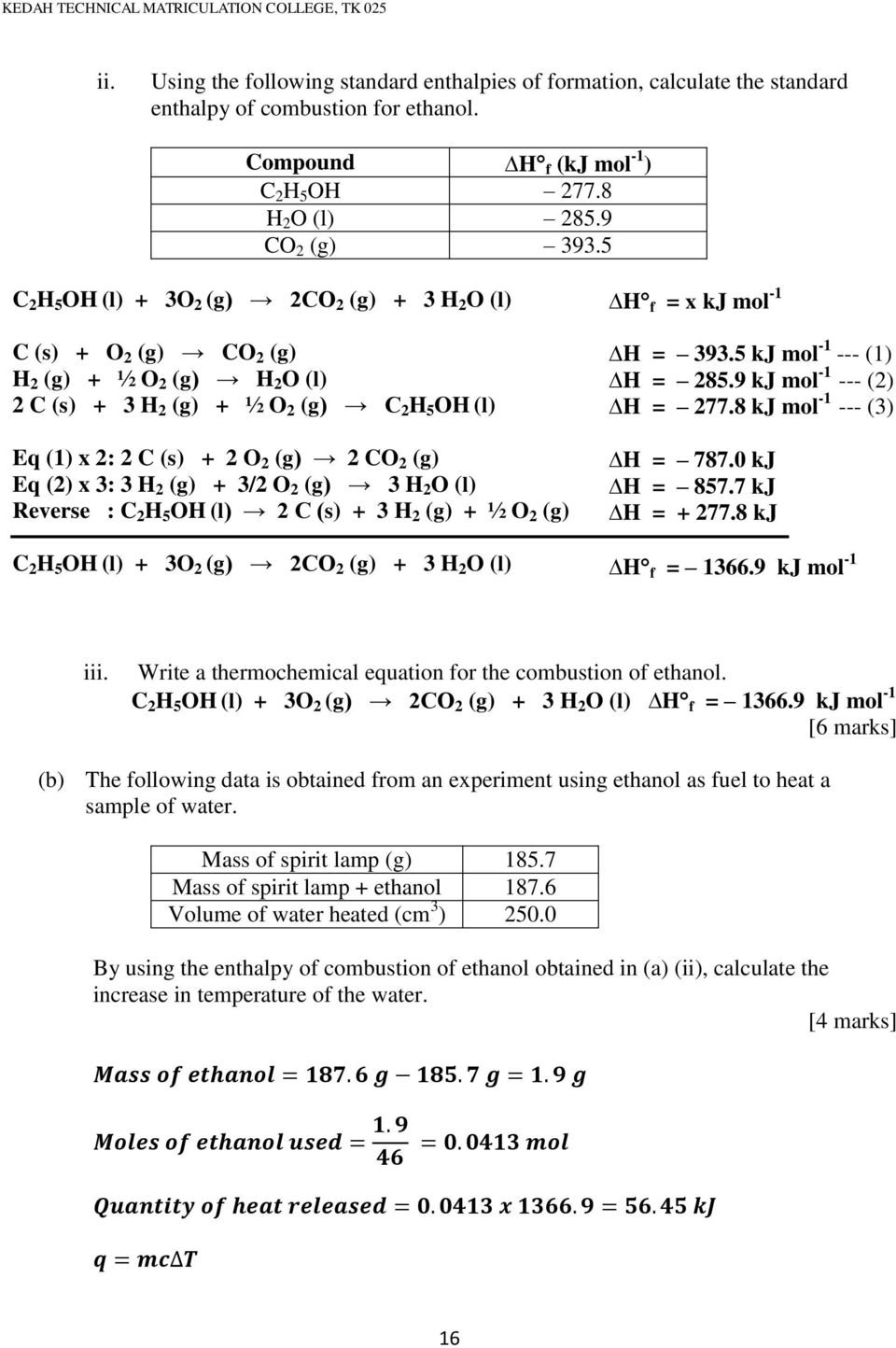
17 = C 15 (a) State Hess s Law. [1 mark] Hess s Law states that when reactants are converted to products, the overall change in enthalpy is the same whether the reaction takes place in a single step or in a series of steps. (b) Phosphorus pentachloride, PCl 5 is prepared from PCl 3 and Cl 2 : PCl 3 (l) + Cl 2 (g) PCl 5 (s) (1) Use equation (2) and (3) to calculate Hrxn of equation (1): P 4 (s) + 6 Cl 2 (g) 4 PCl 3 (l) H = 1280 kj (2) P 4 (s) + 10 Cl 2 (g) 4 PCl 5 (l) H = 1774 kj (3) [4 marks] Rev Eq (2) x ¼ : PCl 3 (l) ¼ P 4 (s) + 3/2 Cl 2 (g) H = kj Eq (3) x ¼ : ¼ P 4 (s) + 5/2 Cl 2 (g) PCl 5 (l) H = kj PCl 3 (l) + Cl 2 (g) PCl 5 (s) H = kj (c) The Born-Haber cycle for calcium fluoride is shown below: Ca 2+ (g) + 2 F - (g) CaF 2 (s) H 3 Ca + (g) H 5 H 2 Ca (g) + 2 F (g) H 7 H 1 H 4 Ca (s) + F 2 (g) i. Name the enthalpy change for H 1, H 3 and H 5. H 1 = enthalpy of atomization of calcium H 3 = second ionization energy of calcium H 5 = electron affinity of fluorine 17

18 Compare the lattice energy of calcium chloride and calcium fluoride. Give your reason. Lattice energy of CaF 2 is larger than lattice energy of CaCl 2 because the ionic radius of F - is smaller than Cl -, so interionic distance of CaF 2 is smaller. [5 marks] 18

www.chemsheets.co.uk 17-Jul-12 Chemsheets A2 033 1
 www.chemsheets.co.uk 17-Jul-12 Chemsheets A2 033 1 AS THERMODYNAMICS REVISION What is enthalpy? It is a measure of the heat content of a substance Enthalpy change ( H) = Change in heat content at constant
Enthalpy of Reaction and Calorimetry worksheet
 Enthalpy of Reaction and Calorimetry worksheet 1. Calcium carbonate decomposes at high temperature to form carbon dioxide and calcium oxide, calculate the enthalpy of reaction. CaCO 3 CO 2 + CaO 2. Carbon
Unit 5 Practice Test. Name: Class: Date: Multiple Choice Identify the choice that best completes the statement or answers the question.
 Name: Class: Date: Unit 5 Practice Test Multiple Choice Identify the choice that best completes the statement or answers the question. 1) The internal energy of a system is always increased by. A) adding
Thermochemical equations allow stoichiometric calculations.
 CHEM 1105 THERMOCHEMISTRY 1. Change in Enthalpy ( H) Heat is evolved or absorbed in all chemical reactions. Exothermic reaction: heat evolved - heat flows from reaction mixture to surroundings; products
DETERMINING THE ENTHALPY OF FORMATION OF CaCO 3
 DETERMINING THE ENTHALPY OF FORMATION OF CaCO 3 Standard Enthalpy Change Standard Enthalpy Change for a reaction, symbolized as H 0 298, is defined as The enthalpy change when the molar quantities of reactants
IB Chemistry. DP Chemistry Review
 DP Chemistry Review Topic 1: Quantitative chemistry 1.1 The mole concept and Avogadro s constant Assessment statement Apply the mole concept to substances. Determine the number of particles and the amount
87 16 70 20 58 24 44 32 35 40 29 48 (a) graph Y versus X (b) graph Y versus 1/X
 HOMEWORK 5A Barometer; Boyle s Law 1. The pressure of the first two gases below is determined with a manometer that is filled with mercury (density = 13.6 g/ml). The pressure of the last two gases below
Bomb Calorimetry. Example 4. Energy and Enthalpy
 Bomb Calorimetry constant volume often used for combustion reactions heat released by reaction is absorbed by calorimeter contents need heat capacity of calorimeter q cal = q rxn = q bomb + q water Example
Chem 1A Exam 2 Review Problems
 Chem 1A Exam 2 Review Problems 1. At 0.967 atm, the height of mercury in a barometer is 0.735 m. If the mercury were replaced with water, what height of water (in meters) would be supported at this pressure?
Balancing Chemical Equations Worksheet
 Balancing Chemical Equations Worksheet Student Instructions 1. Identify the reactants and products and write a word equation. 2. Write the correct chemical formula for each of the reactants and the products.
1. When the following equation is balanced, the coefficient of Al is. Al (s) + H 2 O (l)? Al(OH) 3 (s) + H 2 (g)
 1. When the following equation is balanced, the coefficient of Al is. Al (s) + H 2 O (l)? Al(OH) (s) + H 2 (g) A) 1 B) 2 C) 4 D) 5 E) Al (s) + H 2 O (l)? Al(OH) (s) + H 2 (g) Al (s) + H 2 O (l)? Al(OH)
Transfer of heat energy often occurs during chemical reactions. A reaction
 Chemistry 111 Lab: Thermochemistry Page I-3 THERMOCHEMISTRY Heats of Reaction The Enthalpy of Formation of Magnesium Oxide Transfer of heat energy often occurs during chemical reactions. A reaction may
SCH 4C1 Unit 2 Problem Set Questions taken from Frank Mustoe et all, "Chemistry 11", McGraw-Hill Ryerson, 2001
 SCH 4C1 Unit 2 Problem Set Questions taken from Frank Mustoe et all, "Chemistry 11", McGraw-Hill Ryerson, 2001 1. A small pin contains 0.0178 mol of iron. How many atoms of iron are in the pin? 2. A sample
Unit 10A Stoichiometry Notes
 Unit 10A Stoichiometry Notes Stoichiometry is a big word for a process that chemist s use to calculate amounts in reactions. It makes use of the coefficient ratio set up by balanced reaction equations
@ Oxford Fajar Sdn. Bhd. (008974-T) 2012. Matter. 1.1 Atoms and Molecules 1.2 Mole Concept 1.3 Stoichiometry
 1 Matter 1.1 Atoms and Molecules 1.2 Mole Concept 1.3 Stoichiometry 2 Chemistry for Matriculation Semester 1 1.1 Atoms and Molecules LEARNING OUTCOMES Describe proton, electron and neutron in terms of
Problem Solving. Stoichiometry of Gases
 Skills Worksheet Problem Solving Stoichiometry of Gases Now that you have worked with relationships among moles, mass, and volumes of gases, you can easily put these to work in stoichiometry calculations.
Topic 4 National Chemistry Summary Notes. Formulae, Equations, Balancing Equations and The Mole
 Topic 4 National Chemistry Summary Notes Formulae, Equations, Balancing Equations and The Mole LI 1 The chemical formula of a covalent molecular compound tells us the number of atoms of each element present
Chemistry: Chemical Equations
 Chemistry: Chemical Equations Write a balanced chemical equation for each word equation. Include the phase of each substance in the equation. Classify the reaction as synthesis, decomposition, single replacement,
stoichiometry = the numerical relationships between chemical amounts in a reaction.
 1 REACTIONS AND YIELD ANSWERS stoichiometry = the numerical relationships between chemical amounts in a reaction. 2C 8 H 18 (l) + 25O 2 16CO 2 (g) + 18H 2 O(g) From the equation, 16 moles of CO 2 (a greenhouse
CST Practice Test. Multiple Choice Questions
 CST Practice Test Young NAME CST Practice Test Multiple Choice Questions 1) At 1 atm and 298 K, which of the K a values listed below represents the strongest acid? 5) Which electron-dot symbol represents
Chapter 1: Moles and equations. Learning outcomes. you should be able to:
 Chapter 1: Moles and equations 1 Learning outcomes you should be able to: define and use the terms: relative atomic mass, isotopic mass and formula mass based on the 12 C scale perform calculations, including
Calculating Atoms, Ions, or Molecules Using Moles
 TEKS REVIEW 8B Calculating Atoms, Ions, or Molecules Using Moles TEKS 8B READINESS Use the mole concept to calculate the number of atoms, ions, or molecules in a sample TEKS_TXT of material. Vocabulary
Bonding Practice Problems
 NAME 1. When compared to H 2 S, H 2 O has a higher 8. Given the Lewis electron-dot diagram: boiling point because H 2 O contains stronger metallic bonds covalent bonds ionic bonds hydrogen bonds 2. Which
Unit 6 The Mole Concept
 Chemistry Form 3 Page 62 Ms. R. Buttigieg Unit 6 The Mole Concept See Chemistry for You Chapter 28 pg. 352-363 See GCSE Chemistry Chapter 5 pg. 70-79 6.1 Relative atomic mass. The relative atomic mass
Paper 1 (7405/1): Inorganic and Physical Chemistry Mark scheme
 AQA Qualifications A-level Chemistry Paper (7405/): Inorganic and Physical Chemistry Mark scheme 7405 Specimen paper Version 0.5 MARK SCHEME A-level Chemistry Specimen paper 0. This question is marked
W1 WORKSHOP ON STOICHIOMETRY
 INTRODUCTION W1 WORKSHOP ON STOICHIOMETRY These notes and exercises are designed to introduce you to the basic concepts required to understand a chemical formula or equation. Relative atomic masses of
INTI COLLEGE MALAYSIA A? LEVEL PROGRAMME CHM 111: CHEMISTRY MOCK EXAMINATION: DECEMBER 2000 SESSION. 37 74 20 40 60 80 m/e
 CHM111(M)/Page 1 of 5 INTI COLLEGE MALAYSIA A? LEVEL PROGRAMME CHM 111: CHEMISTRY MOCK EXAMINATION: DECEMBER 2000 SESSION SECTION A Answer ALL EIGHT questions. (52 marks) 1. The following is the mass spectrum
Lewis Dot Structures of Atoms and Ions
 Why? The chemical properties of an element are based on the number of electrons in the outer shell of its atoms. We use Lewis dot structures to map these valence electrons in order to identify stable electron
NOTE: This practice exam contains more than questions than the real final.
 NOTE: This practice exam contains more than questions than the real final 1 The wavelength of light emitted from a green laser pointer is 532 10 2 nm What is the wavelength in meters? 532 10-7 m 2 What
Stoichiometry. Lecture Examples Answer Key
 Stoichiometry Lecture Examples Answer Key Ex. 1 Balance the following chemical equations: 3 NaBr + 1 H 3 PO 4 3 HBr + 1 Na 3 PO 4 2 C 3 H 5 N 3 O 9 6 CO 2 + 3 N 2 + 5 H 2 O + 9 O 2 2 Ca(OH) 2 + 2 SO 2
ATOMS. Multiple Choice Questions
 Chapter 3 ATOMS AND MOLECULES Multiple Choice Questions 1. Which of the following correctly represents 360 g of water? (i) 2 moles of H 2 0 (ii) 20 moles of water (iii) 6.022 10 23 molecules of water (iv)
In the box below, draw the Lewis electron-dot structure for the compound formed from magnesium and oxygen. [Include any charges or partial charges.
 Name: 1) Which molecule is nonpolar and has a symmetrical shape? A) NH3 B) H2O C) HCl D) CH4 7222-1 - Page 1 2) When ammonium chloride crystals are dissolved in water, the temperature of the water decreases.
Chemical Calculations: Formula Masses, Moles, and Chemical Equations
 Chemical Calculations: Formula Masses, Moles, and Chemical Equations Atomic Mass & Formula Mass Recall from Chapter Three that the average mass of an atom of a given element can be found on the periodic
neutrons are present?
 AP Chem Summer Assignment Worksheet #1 Atomic Structure 1. a) For the ion 39 K +, state how many electrons, how many protons, and how many 19 neutrons are present? b) Which of these particles has the smallest
1. What is the molecular formula of a compound with the empirical formula PO and a gram-molecular mass of 284 grams?
 Name: Tuesday, May 20, 2008 1. What is the molecular formula of a compound with the empirical formula PO and a gram-molecular mass of 284 grams? 2 5 1. P2O 5 3. P10O4 2. P5O 2 4. P4O10 2. Which substance
Chem 1100 Chapter Three Study Guide Answers Outline I. Molar Mass and Moles A. Calculations of Molar Masses
 Chem 1100 Chapter Three Study Guide Answers Outline I. Molar Mass and Moles A. Calculations of Molar Masses B. Calculations of moles C. Calculations of number of atoms from moles/molar masses 1. Avagadro
602X10 21 602,000,000,000, 000,000,000,000 6.02X10 23. Pre- AP Chemistry Chemical Quan44es: The Mole. Diatomic Elements
 Pre- AP Chemistry Chemical Quan44es: The Mole Mole SI unit of measurement that measures the amount of substance. A substance exists as representa9ve par9cles. Representa9ve par9cles can be atoms, molecules,
Unit 2: Quantities in Chemistry
 Mass, Moles, & Molar Mass Relative quantities of isotopes in a natural occurring element (%) E.g. Carbon has 2 isotopes C-12 and C-13. Of Carbon s two isotopes, there is 98.9% C-12 and 11.1% C-13. Find
Stoichiometry. 1. The total number of moles represented by 20 grams of calcium carbonate is (1) 1; (2) 2; (3) 0.1; (4) 0.2.
 Stoichiometry 1 The total number of moles represented by 20 grams of calcium carbonate is (1) 1; (2) 2; (3) 01; (4) 02 2 A 44 gram sample of a hydrate was heated until the water of hydration was driven
HOMEWORK 4A. Definitions. Oxidation-Reduction Reactions. Questions
 HOMEWORK 4A Oxidation-Reduction Reactions 1. Indicate whether a reaction will occur or not in each of following. Wtiring a balcnced equation is not necessary. (a) Magnesium metal is added to hydrochloric
Problem Solving. Percentage Yield
 Skills Worksheet Problem Solving Percentage Yield Although we can write perfectly balanced equations to represent perfect reactions, the reactions themselves are often not perfect. A reaction does not
Name period AP chemistry Unit 2 worksheet Practice problems
 Name period AP chemistry Unit 2 worksheet Practice problems 1. What are the SI units for a. Wavelength of light b. frequency of light c. speed of light Meter hertz (s -1 ) m s -1 (m/s) 2. T/F (correct
Moles. Balanced chemical equations Molar ratios Mass Composition Empirical and Molecular Mass Predicting Quantities Equations
 Moles Balanced chemical equations Molar ratios Mass Composition Empirical and Molecular Mass Predicting Quantities Equations Micro World atoms & molecules Macro World grams Atomic mass is the mass of an
Chapter 6 Chemical Calculations
 Chapter 6 Chemical Calculations 1 Submicroscopic Macroscopic 2 Chapter Outline 1. Formula Masses (Ch 6.1) 2. Percent Composition (supplemental material) 3. The Mole & Avogadro s Number (Ch 6.2) 4. Molar
Summer Holidays Questions
 Summer Holidays Questions Chapter 1 1) Barium hydroxide reacts with hydrochloric acid. The initial concentration of the 1 st solution its 0.1M and the volume is 100ml. The initial concentration of the
Unit 9 Stoichiometry Notes (The Mole Continues)
 Unit 9 Stoichiometry Notes (The Mole Continues) is a big word for a process that chemist s use to calculate amounts in reactions. It makes use of the coefficient ratio set up by balanced reaction equations
B) atomic number C) both the solid and the liquid phase D) Au C) Sn, Si, C A) metal C) O, S, Se C) In D) tin D) methane D) bismuth B) Group 2 metal
 1. The elements on the Periodic Table are arranged in order of increasing A) atomic mass B) atomic number C) molar mass D) oxidation number 2. Which list of elements consists of a metal, a metalloid, and
Name: Class: Date: 2 4 (aq)
 Name: Class: Date: Unit 4 Practice Test Multiple Choice Identify the choice that best completes the statement or answers the question. 1) The balanced molecular equation for complete neutralization of
Amount of Substance. http://www.avogadro.co.uk/definitions/elemcompmix.htm
 Page 1 of 14 Amount of Substance Key terms in this chapter are: Element Compound Mixture Atom Molecule Ion Relative Atomic Mass Avogadro constant Mole Isotope Relative Isotopic Mass Relative Molecular
UNIT 1 THERMOCHEMISTRY
 UNIT 1 THERMOCHEMISTRY THERMOCHEMISTRY LEARNING OUTCOMES Students will be expected to: THERMOCHEMISTRY STSE analyse why scientific and technological activities take place in a variety individual and group
ENTHALPY CHANGES FOR A CHEMICAL REACTION scaling a rxn up or down (proportionality) quantity 1 from rxn heat 1 from Δ r H. = 32.
 CHEMISTRY 103 Help Sheet #10 Chapter 4 (Part II); Sections 4.6-4.10 Do the topics appropriate for your lecture Prepared by Dr. Tony Jacob http://www.chem.wisc.edu/areas/clc (Resource page) Nuggets: Enthalpy
4. Using the data from Handout 5, what is the standard enthalpy of formation of BaO (s)? What does this mean?
 HOMEWORK 3A 1. In each of the following pairs, tell which has the higher entropy. (a) One mole of liquid water or one mole of water vapor (b) One mole of dry ice or one mole of carbon dioxide at 1 atm
Chapter 8: Chemical Equations and Reactions
 Chapter 8: Chemical Equations and Reactions I. Describing Chemical Reactions A. A chemical reaction is the process by which one or more substances are changed into one or more different substances. A chemical
Chemistry 151 Final Exam
 Chemistry 151 Final Exam Name: SSN: Exam Rules & Guidelines Show your work. No credit will be given for an answer unless your work is shown. Indicate your answer with a box or a circle. All paperwork must
Atomic Structure. Name Mass Charge Location Protons 1 +1 Nucleus Neutrons 1 0 Nucleus Electrons 1/1837-1 Orbit nucleus in outer shells
 Atomic Structure called nucleons Name Mass Charge Location Protons 1 +1 Nucleus Neutrons 1 0 Nucleus Electrons 1/1837-1 Orbit nucleus in outer shells The number of protons equals the atomic number This
Stoichiometry. 1. The total number of moles represented by 20 grams of calcium carbonate is (1) 1; (2) 2; (3) 0.1; (4) 0.2.
 Stoichiometry 1 The total number of moles represented by 20 grams of calcium carbonate is (1) 1; (2) 2; (3) 01; (4) 02 2 A 44 gram sample of a hydrate was heated until the water of hydration was driven
Standard Free Energies of Formation at 298 K. Average Bond Dissociation Energies at 298 K
 1 Thermodynamics There always seems to be at least one free response question that involves thermodynamics. These types of question also show up in the multiple choice questions. G, S, and H. Know what
Chapter 3 Mass Relationships in Chemical Reactions
 Chapter 3 Mass Relationships in Chemical Reactions Student: 1. An atom of bromine has a mass about four times greater than that of an atom of neon. Which choice makes the correct comparison of the relative
Chemistry Assessment Unit AS 1
 Centre Number 71 Candidate Number ADVANCED SUBSIDIARY (AS) General Certificate of Education January 2011 Chemistry Assessment Unit AS 1 assessing Basic Concepts in Physical and Inorganic Chemistry [AC111]
1 Exercise 2.19a pg 86
 In this solution set, an underline is used to show the last significant digit of numbers. For instance in x = 2.51693 the 2,5,1, and 6 are all significant. Digits to the right of the underlined digit,
Name Class Date. Section: Calculating Quantities in Reactions. Complete each statement below by writing the correct term or phrase.
 Skills Worksheet Concept Review Section: Calculating Quantities in Reactions Complete each statement below by writing the correct term or phrase. 1. All stoichiometric calculations involving equations
Energy and Chemical Reactions. Characterizing Energy:
 Energy and Chemical Reactions Energy: Critical for virtually all aspects of chemistry Defined as: We focus on energy transfer. We observe energy changes in: Heat Transfer: How much energy can a material
SCPS Chemistry Worksheet Periodicity A. Periodic table 1. Which are metals? Circle your answers: C, Na, F, Cs, Ba, Ni
 SCPS Chemistry Worksheet Periodicity A. Periodic table 1. Which are metals? Circle your answers: C, Na, F, Cs, Ba, Ni Which metal in the list above has the most metallic character? Explain. Cesium as the
2. The percent yield is the maximum amount of product that can be produced from the given amount of limiting reactant.
 UNIT 6 stoichiometry practice test True/False Indicate whether the statement is true or false. moles F 1. The mole ratio is a comparison of how many grams of one substance are required to participate in
Introductory Chemistry, 3 rd Edition Nivaldo Tro. Roy Kennedy Massachusetts Bay Community College Wellesley Hills, Maqqwertd ygoijpk[l
 Introductory Chemistry, 3 rd Edition Nivaldo Tro Quantities in Car an octane and oxygen molecules and carbon dioxide and water Chemical Reactions Roy Kennedy Massachusetts Bay Community College Wellesley
Chapter 3: Stoichiometry
 Chapter 3: Stoichiometry Key Skills: Balance chemical equations Predict the products of simple combination, decomposition, and combustion reactions. Calculate formula weights Convert grams to moles and
1. Thermite reaction 2. Enthalpy of reaction, H 3. Heating/cooling curves and changes in state 4. More thermite thermodynamics
 Chem 105 Fri 10-23-09 1. Thermite reaction 2. Enthalpy of reaction, H 3. Heating/cooling curves and changes in state 4. More thermite thermodynamics 10/23/2009 1 Please PICK UP your graded EXAM in front.
Study Guide For Chapter 7
 Name: Class: Date: ID: A Study Guide For Chapter 7 Multiple Choice Identify the choice that best completes the statement or answers the question. 1. The number of atoms in a mole of any pure substance
Unit 3 Study Guide: Electron Configuration & The Periodic Table
 Name: Teacher s Name: Class: Block: Date: Unit 3 Study Guide: Electron Configuration & The Periodic Table 1. For each of the following elements, state whether the element is radioactive, synthetic or both.
CHEMICAL REACTIONS AND REACTING MASSES AND VOLUMES
 CHEMICAL REACTIONS AND REACTING MASSES AND VOLUMES The meaning of stoichiometric coefficients: 2 H 2 (g) + O 2 (g) 2 H 2 O(l) number of reacting particles 2 molecules of hydrogen react with 1 molecule
Formulae, stoichiometry and the mole concept
 3 Formulae, stoichiometry and the mole concept Content 3.1 Symbols, Formulae and Chemical equations 3.2 Concept of Relative Mass 3.3 Mole Concept and Stoichiometry Learning Outcomes Candidates should be
Sample Exercise 8.1 Magnitudes of Lattice Energies
 Sample Exercise 8.1 Magnitudes of Lattice Energies Without consulting Table 8.2, arrange the following ionic compounds in order of increasing lattice energy: NaF, CsI, and CaO. Analyze: From the formulas
Candidate Style Answer
 Candidate Style Answer Chemistry A Unit F321 Atoms, Bonds and Groups High banded response This Support Material booklet is designed to accompany the OCR GCE Chemistry A Specimen Paper F321 for teaching
Answers and Solutions to Text Problems
 Chapter 7 Answers and Solutions 7 Answers and Solutions to Text Problems 7.1 A mole is the amount of a substance that contains 6.02 x 10 23 items. For example, one mole of water contains 6.02 10 23 molecules
Chapter 8 Concepts of Chemical Bonding
 Chapter 8 Concepts of Chemical Bonding Chemical Bonds Three types: Ionic Electrostatic attraction between ions Covalent Sharing of electrons Metallic Metal atoms bonded to several other atoms Ionic Bonding
Chapter 17. The best buffer choice for ph 7 is NaH 2 PO 4 /Na 2 HPO 4. 19)
 Chapter 17 2) a) HCl and CH 3 COOH are both acids. A buffer must have an acid/base conjugate pair. b) NaH 2 PO 4 and Na 2 HPO 4 are an acid/base conjugate pair. They will make an excellent buffer. c) H
Unit 19 Practice. Name: Class: Date: Multiple Choice Identify the choice that best completes the statement or answers the question.
 Name: Class: Date: Unit 19 Practice Multiple Choice Identify the choice that best completes the statement or answers the question. 1) The first law of thermodynamics can be given as. A) E = q + w B) =
Chemical Equations & Stoichiometry
 Chemical Equations & Stoichiometry Chapter Goals Balance equations for simple chemical reactions. Perform stoichiometry calculations using balanced chemical equations. Understand the meaning of the term
Chemistry Post-Enrolment Worksheet
 Name: Chemistry Post-Enrolment Worksheet The purpose of this worksheet is to get you to recap some of the fundamental concepts that you studied at GCSE and introduce some of the concepts that will be part
Periodic Table Questions
 Periodic Table Questions 1. The elements characterized as nonmetals are located in the periodic table at the (1) far left; (2) bottom; (3) center; (4) top right. 2. An element that is a liquid at STP is
Questions on Chapter 8 Basic Concepts of Chemical Bonding
 Questions on Chapter 8 Basic Concepts of Chemical Bonding Circle the Correct Answer: 1) Which ion below has a noble gas electron configuration? A) Li 2+ B) Be 2+ C) B2+ D) C2+ E) N 2-2) Of the ions below,
CP Chemistry Review for Stoichiometry Test
 CP Chemistry Review for Stoichiometry Test Stoichiometry Problems (one given reactant): 1. Make sure you have a balanced chemical equation 2. Convert to moles of the known substance. (Use the periodic
Molar Mass Worksheet Answer Key
 Molar Mass Worksheet Answer Key Calculate the molar masses of the following chemicals: 1) Cl 2 71 g/mol 2) KOH 56.1 g/mol 3) BeCl 2 80 g/mol 4) FeCl 3 162.3 g/mol 5) BF 3 67.8 g/mol 6) CCl 2 F 2 121 g/mol
Chapter 1 The Atomic Nature of Matter
 Chapter 1 The Atomic Nature of Matter 6. Substances that cannot be decomposed into two or more simpler substances by chemical means are called a. pure substances. b. compounds. c. molecules. d. elements.
11-1 Stoichiometry. Represents
 11-1 Stoichiometry What is stoichiometry? Calculations that relate the quantities of substances. It is the study of quantitative (measurable amounts) relationships in chemical reactions and equations.
Coimisiún na Scrúduithe Stáit State Examinations Commission
 2015. M33 Coimisiún na Scrúduithe Stáit State Examinations Commission LEAVING CERTIFICATE EXAMINATION, 2015 CHEMISTRY ORDINARY LEVEL TUESDAY, 16 JUNE AFTERNOON 2.00 TO 5.00 400 MARKS Answer eight questions
IB Chemistry 1 Mole. One atom of C-12 has a mass of 12 amu. One mole of C-12 has a mass of 12 g. Grams we can use more easily.
 The Mole Atomic mass units and atoms are not convenient units to work with. The concept of the mole was invented. This was the number of atoms of carbon-12 that were needed to make 12 g of carbon. 1 mole
CHEMISTRY II FINAL EXAM REVIEW
 Name Period CHEMISTRY II FINAL EXAM REVIEW Final Exam: approximately 75 multiple choice questions Ch 12: Stoichiometry Ch 5 & 6: Electron Configurations & Periodic Properties Ch 7 & 8: Bonding Ch 14: Gas
Chapter 8 - Chemical Equations and Reactions
 Chapter 8 - Chemical Equations and Reactions 8-1 Describing Chemical Reactions I. Introduction A. Reactants 1. Original substances entering into a chemical rxn B. Products 1. The resulting substances from
Exercise 3.5 - Naming Binary Covalent Compounds:
 Chapter Exercise Key 1 Chapter Exercise Key Exercise.1 Classifying Compounds: Classify each of the following substances as either a molecular compound or an ionic compound. a. formaldehyde, CH 2 O (used
The Mole and Molar Mass
 The Mole and Molar Mass 1 Molar mass is the mass of one mole of a substance. Molar mass is numerically equal to atomic mass, molecular mass, or formula mass. However the units of molar mass are g/mol.
Chapter 3! Stoichiometry: Calculations with Chemical Formulas and Equations. Stoichiometry
 Chapter 3! : Calculations with Chemical Formulas and Equations Anatomy of a Chemical Equation CH 4 (g) + 2O 2 (g) CO 2 (g) + 2 H 2 O (g) Anatomy of a Chemical Equation CH 4 (g) + 2 O 2 (g) CO 2 (g) + 2
4 theoretical problems 2 practical problems
 1 st 4 theoretical problems 2 practical problems FIRST INTERNATIONAL CHEMISTRY OLYMPIAD PRAGUE 1968 CZECHOSLOVAKIA THEORETICAL PROBLEMS PROBLEM 1 A mixture of hydrogen and chlorine kept in a closed flask
Unit 3 Notepack Chapter 7 Chemical Quantities Qualifier for Test
 Unit 3 Notepack Chapter 7 Chemical Quantities Qualifier for Test NAME Section 7.1 The Mole: A Measurement of Matter A. What is a mole? 1. Chemistry is a quantitative science. What does this term mean?
Formulas, Equations and Moles
 Chapter 3 Formulas, Equations and Moles Interpreting Chemical Equations You can interpret a balanced chemical equation in many ways. On a microscopic level, two molecules of H 2 react with one molecule
Moles. Moles. Moles. Moles. Balancing Eqns. Balancing. Balancing Eqns. Symbols Yields or Produces. Like a recipe:
 Like a recipe: Balancing Eqns Reactants Products 2H 2 (g) + O 2 (g) 2H 2 O(l) coefficients subscripts Balancing Eqns Balancing Symbols (s) (l) (aq) (g) or Yields or Produces solid liquid (pure liquid)
Instructions Answer all questions in the spaces provided. Do all rough work in this book. Cross through any work you do not want to be marked.
 GCSE CHEMISTRY Higher Tier Chemistry 1H H Specimen 2018 Time allowed: 1 hour 45 minutes Materials For this paper you must have: a ruler a calculator the periodic table (enclosed). Instructions Answer all
Final Exam Review. I normalize your final exam score out of 70 to a score out of 150. This score out of 150 is included in your final course total.
 Final Exam Review Information Your ACS standardized final exam is a comprehensive, 70 question multiple choice (a d) test featuring material from BOTH the CHM 101 and 102 syllabi. Questions are graded
Chapter 5. Chemical Reactions and Equations. Introduction. Chapter 5 Topics. 5.1 What is a Chemical Reaction
 Introduction Chapter 5 Chemical Reactions and Equations Chemical reactions occur all around us. How do we make sense of these changes? What patterns can we find? 1 2 Copyright The McGraw-Hill Companies,
WRITING CHEMICAL FORMULA
 WRITING CHEMICAL FORMULA For ionic compounds, the chemical formula must be worked out. You will no longer have the list of ions in the exam (like at GCSE). Instead you must learn some and work out others.