
Electron Configuration Worksheet (and Lots More!!)
|
|
|
- Dylan Shannon Sharp
- 9 years ago
- Views:
Transcription
1 Electron Configuration Worksheet (and Lots More!!) Brief Instructions An electron configuration is a method of indicating the arrangement of electrons about a nucleus. A typical electron configuration consists of numbers, letters, and superscripts with the following format: 1. A number indicates the energy level (The number is called the principal quantum number.). 2. A letter indicates the type of orbital; s, p, d, f. 3. A superscript indicates the number of electrons in the orbital. Example: ls 2 means that there are two electrons in the s orbital of the first energy level. The element is helium. To write an electron configuration: 1. Determine the total number of electrons to be represented. 2. Use the Aufbau process to fill the orbitals with electrons. The Aufbau process requires that electrons fill the lowest energy orbitals first. In another words, atoms are built from the ground upwards. 3. The sum of the superscripts should equal the total number of electrons. Example: 12 Mg ls 2 2s 2 2p 6 3s 2 Configuration Writing Practice Write a ground state electron configuration for each neutral atom. Ground state means that all of the lowest possible energy levels (up to the proper number of electrons for the element) are filled. 1. Na 2. Pb 3. Sr 4. U 5. N 6. Ag 7. Ti 8. Ce 9. Cl 10. Hg Write a ground state electron configuration for these ions. Remember that ions have a change in the total number of electrons (positive have lost electrons and negative have gained). Example: N 3- is 1s 2 2s 2 2p 6. It has three extra electrons. 11. O Fe B Ni K Co 3+ An excited atom has an electron or electrons which are not in the lowest energy state. Excited atoms are unstable energetically. The electrons eventually fall to a lower level. * is used to indicate an excited atom. For example: *Li 1s 2 3p 1. (The ground state for Li is 1s 2 2s 1.) Write an excited state electron configuration for each. 17. Al 18. Ar 19. K 20. C 21. If each orbital can hold a maximum of two electrons, how many electrons can each of the following hold? a. 2s b. 5p c. 4f d. 3d e. 4d 22. What is the shape of an s orbital? 23. How many s orbitals can there be in an energy level? 24. How many electrons can occupy an s orbital? 25. What is the shape of a p orbital? 26. How many p orbitals can there be in an energy level? 27. Which is the lowest energy level that can have a s orbital? 28. Which is the lowest energy level that can have a p orbital? 29. Is it possible for two electrons in the same atom to have exactly the same set of quantum numbers? 30. Distinguish between an atom in its ground state and an excited atom. 31. How many d orbitals can there be in an energy level? 32. How many d electrons can there be in an energy level? 33. Which is the lowest energy level having d orbitals? 34. How many f electrons can there be in an energy level? 35. Which is the lowest energy level having f orbitals?

2 36. How many f orbitals can there be in an energy level? 37. How many energy levels are partially or fully ocupied in a neutral atom of calcium? 38. Why do the fourth and fifth series of elements contain 18 elements, rather than 8 as do the second and third series? 39. Which sublevels of the 3rd energy level are filled (a) in the element argon (b) in the element krypton? 40. Why does it take more energy to remove an electron from Al + than from Al? 41. What does the term principal quantum number refer to? 42. What is meant by the electron configuration of an atom? 43. What is the maximum number of electrons that can be present in an atom having three principal energy levels? 44. Which of the following notations shows the electron configuration of a neutral atom in an excited state? Name the element, and explain how you know it is excited: (a) 1s 2 2s 2 2p 1 (b) 1s 2 2s 2 2p 3 3s 1 (c) 1s 2 2s 2 2p 6 3s 2 3p Isoelectronic species have similar electron configurations. Which of these are isoelectronic? (a) Li +, H -, He (b) Ca 2+, Ne, S For the following elements list the electron configuration. If these is no charge listed, assume it is neutral. a. oxygen b. cesium c. krypton d. titanium e. scandium f. nitrogen g. chlorine h. fluorine 1- i. arsenic j. francium k. selenium 3- l. copper 1+ m. potassium 2- n. antimony 2+ o. thorium 1- p. mercury For the following elements list the shorthand electron configuration a. boron b. cadmium c. phosphorus d. neon e. radon f. iodine g. strontium h. chromium 3+ j. nickel k. iron l. astanine m. molybedenum 2- n. rubidium 3- o. bromine 1+ p. xenon q. europium For the following electron configurations choose 3 possible elements (or ions) they may represent a. 1s 2 2s 2 2p 6 3s 2 3p 6 4s 2 3d 10 4p 4 b. 1s 2 2s 2 2p 6 3s 2 3p 6 4s 2 3d 10 4p 5 c. 1s 2 2s 2 2p 6 3s 2 3p 6 4s 2 3d 10 4p 6 d. 1s 2 2s 2 2p 6 3s 2 3p 6 4s 2 3d 10 4p 6 5s 2 4d 10 5p 6 6s 2 4f 14 5d 10 6p 6 7s 1 e. 1s 2 2s 2 2p 6 3s 2 3p 6 4s 2 3d 10 4p 6 5s 2 4 d 10 5p 6 6s 2 4f 14 5d 10 6p 6 7s 2 5f 14 6d 8 f. 1s 2 2s 2 2p 6 3s 2 3p 6 4s 2 3d 10 4p 6 5s 2 4d 10 5p 6 6s 2 4f 10 g. 1s 2 2s 2 2p 6 3s 2 3p 6 4s 2 3d 10 4p 6 5s 2 4d 10 5p 6 6s 2 4f 14 5d 10 6p 4 h. 1s 2 2s 2 2p 6 3s 2 3p 6 4s 2 3d 5 i. 1s 2 2s 2 2p 6 3s 2 3p 6 4s 2 3d 10 4p 6 5s 2 4d 10 5p 2 j. [Kr] 5s 2 4d 10 5p 3 k. [Kr] 5s 2 4d 10 5p 6 l. [Ar] 4s 1 m. [Xe] 6s 2 4f 10 n. [Xe] 6s 2 4f 14 5d 7 o. [Ne] 3s 2 3p 1

3 Writing Electron Configurations 1. Electrons occupy the lowest energy orbital first, then move to the next one and so on. (The "Aufbau" Princple) 2. Orbitals are considered to be in the same shell if they have the same first number (no matter in what order filling is done). 3. An atom will gain or lose electrons in order to have eight electrons in its outer shell. (The "Octet" Rule) 4. The outer shell is the highest numbered shell which has electrons in it. Only s and p orbitals are part of the outer shell. An atom has the tendancy to lose electrons (to another atom) or to gain electrons (from another atom) in order to make the outer shell complete with eight electrons. Atoms with a complete outer shell (eight electrons) are considered stable. Some atoms naturally have eight electrons in their outer shell and are very stable. (Helium is the exception being stable with two electrons in its outer shell.) Complete the following chart: Element Atomic Number electrons Electron Number e After loss Charge number in each E level Configuration probably lost or gain, # on ion or gained e left O 8 2, 6 1s 2 2s 2 2p 4 gain Na 11 2, 8, 1 1s 2 2s 2 2p 6 3s 1 lose S K Al Cl Xe Ca F Br N Ar I Sr

4 Worksheet Questions 1. Define wave crest, trough, amplitude, and wavelength. 2. Draw a wave and label it, using the following terms: crest, trough, amplitude, wavelength. 3. Draw a wave with a wavelength of 3.0 cm. 4. A cork floating on water moves up and down 10 times in 30 seconds. What is the frequency of the water wave? 5. A tuning fork produces a sound of musical note middle C. It moves back and forth 256 times each second. What is the frequency of the tuning fork? 6. What is the wavelength of sound waves having a frequency of 256 sec 1. at 20 C? Speed of sound = 340 m/sec 7. What is the frequency of a sound wave with a wavelength of 1 meter at 20 C? 8. What is the frequency of sound waves which have wavelengths of 6 cm when the air temperature is 20 C? 9. What is the frequency of sound waves which have wavelengths of 12 meters when the air temperature is 20 C? 10. What is the electromagnetic spectrum? 11. a. How are infrared waves different from red light waves? b. How are ultraviolet waves different from violet light waves? c. In what ways are infrared, red, ultra-violet, and violet light waves alike? 12. What is the wavelength in meters of a radio wave with a frequency of 540,000 sec The electromagnetic waves used in FM broadcasting by radio or television have frequencies of approximately 100 megahertz. In standard AM radio broadcasting, the frequency is about 1 megahertz. (Remember mega = 10 6.) Using the relationship λν = c, calculate the wavelengths used in AM and FM broadcasting. 14. Choose your favorite radio station. Using its frequency (ν), calculate its wavelength (λ). Be sure to give the call letters of the station. 15. For each of the following wavelengths of visible light, determine the frequency and identify the region of the electromagnetic spectrum to which it belongs. a. 2.0 x meterb. 4.0 x 10 9 c. 6.0 x 10 7 meter d meter 16. For each of the following frequencies of visible light, determine the wavelength, and identify the color of light assoicated with each frequency. a. 6.4 x sec 1 b. 5.5 x sec 1 c. 5.0 x sec 1

5 17. A chemist is using radiation with a frequency of 6 x sec 1. a. What is the wavelength of this radiation in meters? b. Identify this radiation as red, blue, infrared, ultraviolet, and so on. c. Estimate the energy in kj for one photon of this radiation. Plank's constant (h) is 6.63 x J sec. The velocity of light is 3.00 x meters/sec. Use the relationship E = hν. 18. Use Plank's constant (6.63 x J sec) to determine the energy which corresponds to the following frequencies of the values by x photons/mole. a x hertz b x hertz c x hertz d x hertz e x hertz 19. In what region of the electromagnetic spectrum would you look for the spectral line resulting from the electronic transition from the fifth to the tenth electronic level in the hydrogen atom? (R H = 1.10 x 10 5 cm 1) 20. Use the Rydberg equation to calculate the frequency of a line in the hydrogen spectrum corresponding to a transition from n = 5 to n = 4. Identify the spectral region or color which corresponds to this frequency.

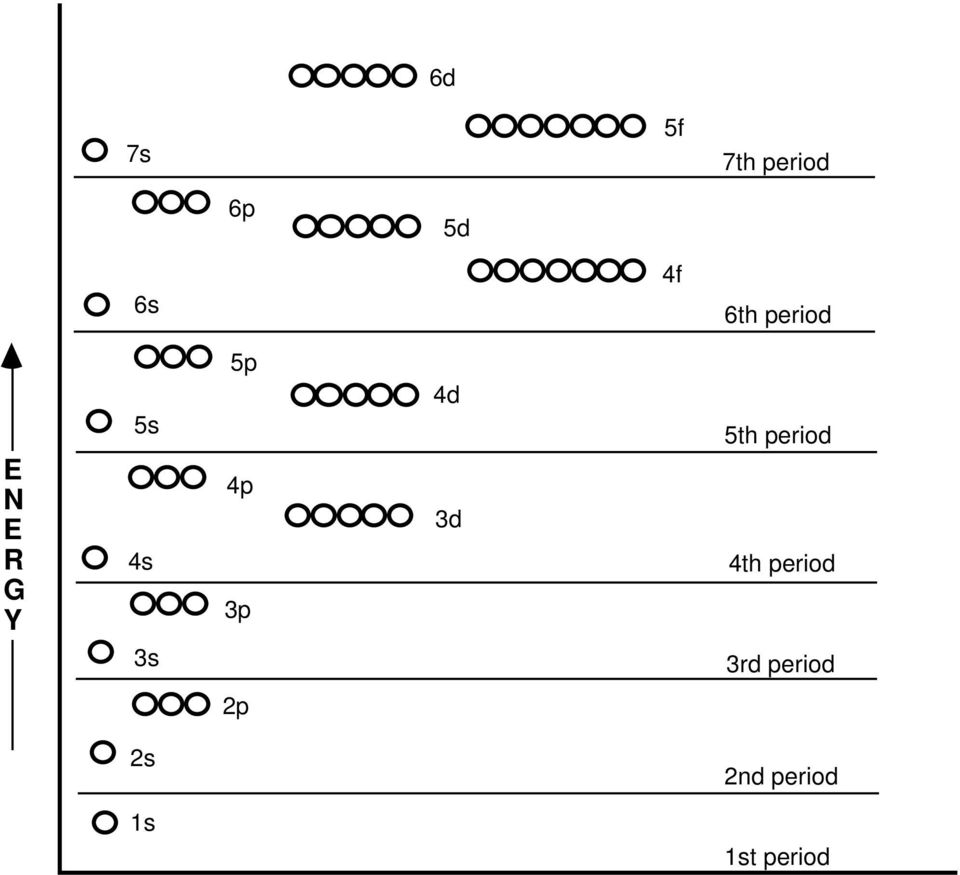
6 6d 7s 5f 7th period 6p 5d 6s 4f 6th period E N E R G Y 5s 4s 3s 5p 4p 3p 4d 3d 5th period 4th period 3rd period 2p 2s 2nd period 1s 1st period
47374_04_p25-32.qxd 2/9/07 7:50 AM Page 25. 4 Atoms and Elements
 47374_04_p25-32.qxd 2/9/07 7:50 AM Page 25 4 Atoms and Elements 4.1 a. Cu b. Si c. K d. N e. Fe f. Ba g. Pb h. Sr 4.2 a. O b. Li c. S d. Al e. H f. Ne g. Sn h. Au 4.3 a. carbon b. chlorine c. iodine d.
CHEM 1411 Chapter 5 Homework Answers
 1 CHEM 1411 Chapter 5 Homework Answers 1. Which statement regarding the gold foil experiment is false? (a) It was performed by Rutherford and his research group early in the 20 th century. (b) Most of
MODERN ATOMIC THEORY AND THE PERIODIC TABLE
 CHAPTER 10 MODERN ATOMIC THEORY AND THE PERIODIC TABLE SOLUTIONS TO REVIEW QUESTIONS 1. Wavelength is defined as the distance between consecutive peaks in a wave. It is generally symbolized by the Greek
Chapter 8 Atomic Electronic Configurations and Periodicity
 Chapter 8 Electron Configurations Page 1 Chapter 8 Atomic Electronic Configurations and Periodicity 8-1. Substances that are weakly attracted to a magnetic field but lose their magnetism when removed from
Atomic Structure: Chapter Problems
 Atomic Structure: Chapter Problems Bohr Model Class Work 1. Describe the nuclear model of the atom. 2. Explain the problems with the nuclear model of the atom. 3. According to Niels Bohr, what does n stand
UNIT (2) ATOMS AND ELEMENTS
 UNIT (2) ATOMS AND ELEMENTS 2.1 Elements An element is a fundamental substance that cannot be broken down by chemical means into simpler substances. Each element is represented by an abbreviation called
Name period AP chemistry Unit 2 worksheet Practice problems
 Name period AP chemistry Unit 2 worksheet Practice problems 1. What are the SI units for a. Wavelength of light b. frequency of light c. speed of light Meter hertz (s -1 ) m s -1 (m/s) 2. T/F (correct
Chapter 7. Electron Structure of the Atom. Chapter 7 Topics
 Chapter 7 Electron Structure of the Atom Copyright The McGraw-Hill Companies, Inc. Permission required for reproduction or display. 1 Chapter 7 Topics 1. Electromagnetic radiation 2. The Bohr model of
Unit 3 Study Guide: Electron Configuration & The Periodic Table
 Name: Teacher s Name: Class: Block: Date: Unit 3 Study Guide: Electron Configuration & The Periodic Table 1. For each of the following elements, state whether the element is radioactive, synthetic or both.
2. John Dalton did his research work in which of the following countries? a. France b. Greece c. Russia d. England
 CHAPTER 3 1. Which combination of individual and contribution is not correct? a. Antoine Lavoisier - clarified confusion over cause of burning b. John Dalton - proposed atomic theory c. Marie Curie - discovered
Periodic Table Questions
 Periodic Table Questions 1. The elements characterized as nonmetals are located in the periodic table at the (1) far left; (2) bottom; (3) center; (4) top right. 2. An element that is a liquid at STP is
SCPS Chemistry Worksheet Periodicity A. Periodic table 1. Which are metals? Circle your answers: C, Na, F, Cs, Ba, Ni
 SCPS Chemistry Worksheet Periodicity A. Periodic table 1. Which are metals? Circle your answers: C, Na, F, Cs, Ba, Ni Which metal in the list above has the most metallic character? Explain. Cesium as the
Find a pair of elements in the periodic table with atomic numbers less than 20 that are an exception to the original periodic law.
 Example Exercise 6.1 Periodic Law Find the two elements in the fifth row of the periodic table that violate the original periodic law proposed by Mendeleev. Mendeleev proposed that elements be arranged
Name: Worksheet: Electron Configurations. I Heart Chemistry!
 1. Which electron configuration represents an atom in an excited state? 1s 2 2s 2 2p 6 3p 1 1s 2 2s 2 2p 6 3s 2 3p 2 1s 2 2s 2 2p 6 3s 2 3p 1 1s 2 2s 2 2p 6 3s 2 Worksheet: Electron Configurations Name:
Name Date Class ELECTRONS IN ATOMS. Standard Curriculum Core content Extension topics
 13 ELECTRONS IN ATOMS Conceptual Curriculum Concrete concepts More abstract concepts or math/problem-solving Standard Curriculum Core content Extension topics Honors Curriculum Core honors content Options
Sample Exercise 6.1 Concepts of Wavelength and Frequency
 Sample Exercise 6.1 Concepts of Wavelength and Frequency Two electromagnetic waves are represented in the margin. (a) Which wave has the higher frequency? (b) If one wave represents visible light and the
The Advanced Placement Examination in Chemistry. Part I Multiple Choice Questions Part II Free Response Questions Selected Questions from1970 to 2010
 The Advanced Placement Examination in Chemistry Part I Multiple Choice Questions Part II Free Response Questions Selected Questions from1970 to 2010 Atomic Theory and Periodicity Part I 1984 1. Which of
WAVES AND ELECTROMAGNETIC RADIATION
 WAVES AND ELECTROMAGNETIC RADIATION All waves are characterized by their wavelength, frequency and speed. Wavelength (lambda, ): the distance between any 2 successive crests or troughs. Frequency (nu,):
Arrangement of Electrons in Atoms
 CHAPTER 4 PRE-TEST Arrangement of Electrons in Atoms In the space provided, write the letter of the term that best completes each sentence or best answers each question. 1. Which of the following orbital
Chemistry CP Unit 2 Atomic Structure and Electron Configuration. Learning Targets (Your exam at the end of Unit 2 will assess the following:)
 Chemistry CP Unit 2 Atomic Structure and Electron Learning Targets (Your exam at the end of Unit 2 will assess the following:) 2. Atomic Structure and Electron 2-1. Give the one main contribution to the
13- What is the maximum number of electrons that can occupy the subshell 3d? a) 1 b) 3 c) 5 d) 2
 Assignment 06 A 1- What is the energy in joules of an electron undergoing a transition from n = 3 to n = 5 in a Bohr hydrogen atom? a) -3.48 x 10⁻¹⁷ J b) 2.18 x 10⁻¹⁹ J c) 1.55 x 10⁻¹⁹ J d) -2.56 x 10⁻¹⁹
Electrons In Atoms Mr. O Brien (SFHS) Chapter 5 Standard 1D
 Electrons In Atoms Mr. O Brien (SFHS) Chapter 5 Standard 1D Electrons in Atoms (std.1d) What are Bohr Models? planetary model in which the negatively-charged electrons orbit a small, positively-charged
Chapter 2 Atoms, Ions, and the Periodic Table
 Chapter 2 Atoms, Ions, and the Periodic Table 2.1 (a) neutron; (b) law of conservation of mass; (c) proton; (d) main-group element; (e) relative atomic mass; (f) mass number; (g) isotope; (h) cation; (i)
CHEMSITRY NOTES Chapter 13. Electrons in Atoms
 CHEMSITRY NOTES Chapter 13 Electrons in Atoms Goals : To gain an understanding of : 1. Atoms and their structure. 2. The development of the atomic theory. 3. The quantum mechanical model of the atom. 4.
B) atomic number C) both the solid and the liquid phase D) Au C) Sn, Si, C A) metal C) O, S, Se C) In D) tin D) methane D) bismuth B) Group 2 metal
 1. The elements on the Periodic Table are arranged in order of increasing A) atomic mass B) atomic number C) molar mass D) oxidation number 2. Which list of elements consists of a metal, a metalloid, and
Electrons in Atoms & Periodic Table Chapter 13 & 14 Assignment & Problem Set
 Electrons in Atoms & Periodic Table Name Warm-Ups (Show your work for credit) Date 1. Date 2. Date 3. Date 4. Date 5. Date 6. Date 7. Date 8. Electrons in Atoms & Periodic Table 2 Study Guide: Things You
Chemistry: The Periodic Table and Periodicity
 Chemistry: The Periodic Table and Periodicity Name: per: Date:. 1. By what property did Mendeleev arrange the elements? 2. By what property did Moseley suggest that the periodic table be arranged? 3. What
Electron Configurations, Isoelectronic Elements, & Ionization Reactions. Chemistry 11
 Electron Configurations, Isoelectronic Elements, & Ionization Reactions Chemistry 11 Note: Of the 3 subatomic particles, the electron plays the greatest role in determining the physical and chemical properties
Part I: Principal Energy Levels and Sublevels
 Part I: Principal Energy Levels and Sublevels As you already know, all atoms are made of subatomic particles, including protons, neutrons, and electrons. Positive protons and neutral neutrons are found
Chapter 7 Periodic Properties of the Elements
 Chapter 7 Periodic Properties of the Elements 1. Elements in the modern version of the periodic table are arranged in order of increasing. (a). oxidation number (b). atomic mass (c). average atomic mass
Electron Arrangements
 Section 3.4 Electron Arrangements Objectives Express the arrangement of electrons in atoms using electron configurations and Lewis valence electron dot structures New Vocabulary Heisenberg uncertainty
neutrons are present?
 AP Chem Summer Assignment Worksheet #1 Atomic Structure 1. a) For the ion 39 K +, state how many electrons, how many protons, and how many 19 neutrons are present? b) Which of these particles has the smallest
3. What would you predict for the intensity and binding energy for the 3p orbital for that of sulfur?
 PSI AP Chemistry Periodic Trends MC Review Name Periodic Law and the Quantum Model Use the PES spectrum of Phosphorus below to answer questions 1-3. 1. Which peak corresponds to the 1s orbital? (A) 1.06
Ionic and Metallic Bonding
 Ionic and Metallic Bonding BNDING AND INTERACTINS 71 Ions For students using the Foundation edition, assign problems 1, 3 5, 7 12, 14, 15, 18 20 Essential Understanding Ions form when atoms gain or lose
TIME OF COMPLETION NAME SOLUTION DEPARTMENT OF NATURAL SCIENCES. PHYS 3650, Exam 2 Section 1 Version 1 October 31, 2005 Total Weight: 100 points
 TIME OF COMPLETION NAME SOLUTION DEPARTMENT OF NATURAL SCIENCES PHYS 3650, Exam 2 Section 1 Version 1 October 31, 2005 Total Weight: 100 points 1. Check your examination for completeness prior to starting.
Untitled Document. 1. Which of the following best describes an atom? 4. Which statement best describes the density of an atom s nucleus?
 Name: Date: 1. Which of the following best describes an atom? A. protons and electrons grouped together in a random pattern B. protons and electrons grouped together in an alternating pattern C. a core
TRENDS IN THE PERIODIC TABLE
 Noble gases Period alogens Alkaline earth metals Alkali metals TRENDS IN TE PERIDI TABLE Usual charge +1 + +3-3 - -1 Number of Valence e - s 1 3 4 5 6 7 Electron dot diagram X X X X X X X X X 8 Group 1
electron configuration
 electron configuration Electron Configuration Knowing the arrangement of electrons in atoms will better help you understand chemical reactivity and predict an atom s reaction behavior. We know when n=1
Chapter Outline. 3 Elements and Compounds. Elements and Atoms. Elements. Elements. Elements 9/4/2013
 3 Elements and Compounds Chapter Outline 3.1 Elements A. Distribution of Elements Foundations of College Chemistry, 14 th Ed. Morris Hein and Susan Arena Copyright This reclining Buddha in Thailand is
Models of the Atom and periodic Trends Exam Study Guide
 Name 1. What is the term for the weighted average mass of all the naturally occurring isotopes of an element? ans: atomic mass 2. Which is exactly equal to 1/12 the mass of a carbon -12 atom? ans: atomic
The Periodic Table; Chapter 5: Section 1 - History of the Periodic Table Objectives: Explain the roles of Mendeleev and Moseley in the development of
 The Periodic Table; Chapter 5: Section 1 - History of the Periodic Table Objectives: Explain the roles of Mendeleev and Moseley in the development of the periodic table. Describe the modern periodic table.
EXPERIMENT 4 The Periodic Table - Atoms and Elements
 EXPERIMENT 4 The Periodic Table - Atoms and Elements INTRODUCTION Primary substances, called elements, build all the materials around you. There are more than 109 different elements known today. The elements
Chapter 5 TEST: The Periodic Table name
 Chapter 5 TEST: The Periodic Table name HPS # date: Multiple Choice Identify the choice that best completes the statement or answers the question. 1. The order of elements in the periodic table is based
All answers must use the correct number of significant figures, and must show units!
 CHEM 10113, Quiz 2 September 7, 2011 Name (please print) All answers must use the correct number of significant figures, and must show units! IA Periodic Table of the Elements VIIIA (1) (18) 1 2 1 H IIA
Bonding Practice Problems
 NAME 1. When compared to H 2 S, H 2 O has a higher 8. Given the Lewis electron-dot diagram: boiling point because H 2 O contains stronger metallic bonds covalent bonds ionic bonds hydrogen bonds 2. Which
REVIEW QUESTIONS Chapter 8
 Chemistry 101 ANSWER KEY REVIEW QUESTIONS Chapter 8 Use only a periodic table to answer the following questions. 1. Write complete electron configuration for each of the following elements: a) Aluminum
Chemistry 2 Chapter 13: Electrons in Atoms Please do not write on the test Use an answer sheet! 1 point/problem 45 points total
 Chemistry 2 Chapter 13: Electrons in Atoms Please do not write on the test Use an answer sheet! 1 point/problem 45 points total 1. Calculate the energy in joules of a photon of red light that has a frequency
CHAPTER 8 PRACTICE TEST QUESTIONS (END OF CHAPTER 7 TOO)
 CHAPTER 8 PRACTICE TEST QUESTIONS (END OF CHAPTER 7 TOO) Information that most likely will be on the front cover of your exam: h i Z 2 ΔE = @ 2.18 x 10 @ 18 f Z 2 f J j @ k n f 2 n i 2 1. Which of the
6.5 Periodic Variations in Element Properties
 324 Chapter 6 Electronic Structure and Periodic Properties of Elements 6.5 Periodic Variations in Element Properties By the end of this section, you will be able to: Describe and explain the observed trends
MULTIPLE CHOICE. Choose the one alternative that best completes the statement or answers the question.
 Practice Questions - Chapter 7 Name MULTIPLE CHOICE. Choose the one alternative that best completes the statement or answers the question. 1) Which one of the following represents an impossible set of
Student Exploration: Electron Configuration
 Name: Date: Student Exploration: Electron Configuration Vocabulary: atomic number, atomic radius, Aufbau principle, chemical family, diagonal rule, electron configuration, Hund s rule, orbital, Pauli exclusion
Sample Exercise 8.1 Magnitudes of Lattice Energies
 Sample Exercise 8.1 Magnitudes of Lattice Energies Without consulting Table 8.2, arrange the ionic compounds NaF, CsI, and CaO in order of increasing lattice energy. Analyze From the formulas for three
Be (g) Be + (g) + e - O (g) O + (g) + e -
 2.13 Ionisation Energies Definition :First ionisation energy The first ionisation energy is the energy required when one mole of gaseous atoms forms one mole of gaseous ions with a single positive charge
ANSWER KEY : BUILD AN ATOM PART I: ATOM SCREEN Build an Atom simulation ( http://phet.colorado.edu/en/simulation/build an atom )
 ANSWER KEY : PART I: ATOM SCREEN Build an Atom simulation ( http://phet.colorado.edu/en/simulation/build an atom ) 1. Explore the Build an Atom simulation with your group. As you explore, talk about what
IONISATION ENERGY CONTENTS
 IONISATION ENERGY IONISATION ENERGY CONTENTS What is Ionisation Energy? Definition of t Ionisation Energy What affects Ionisation Energy? General variation across periods Variation down groups Variation
ELECTRON CONFIGURATION (SHORT FORM) # of electrons in the subshell. valence electrons Valence electrons have the largest value for "n"!
 179 ELECTRON CONFIGURATION (SHORT FORM) - We can represent the electron configuration without drawing a diagram or writing down pages of quantum numbers every time. We write the "electron configuration".
Chapter 9: ELECTRONS IN ATOMS AND THE PERIODIC TABLE
 Chapter 9: ELECTRONS IN ATOMS AND THE PERIODIC TABLE Problems: 1-3, 13-15, 19, 23-25, 31-32, 43, 45-46, 49c, 50a, 50b, 57c, 58 (b,c,d), 61-62, 69, 71-74, 77-88, 91-94 9.5 LIGHT: Electromagnetic Radiation
Trends of the Periodic Table Diary
 Trends of the Periodic Table Diary Trends are patterns of behaviors that atoms on the periodic table of elements follow. Trends hold true most of the time, but there are exceptions, or blips, where the
Question: Do all electrons in the same level have the same energy?
 Question: Do all electrons in the same level have the same energy? From the Shells Activity, one important conclusion we reached based on the first ionization energy experimental data is that electrons
Molecular Models & Lewis Dot Structures
 Molecular Models & Lewis Dot Structures Objectives: 1. Draw Lewis structures for atoms, ions and simple molecules. 2. Use Lewis structures as a guide to construct three-dimensional models of small molecules.
Chapter 2 Lecture Notes: Atoms
 Educational Goals Chapter 2 Lecture Notes: Atoms 1. Describe the subatomic structure of an atom. 2. Define the terms element and atomic symbol. 3. Understand how elements are arranged in the periodic table
Sample Exercise 8.1 Magnitudes of Lattice Energies
 Sample Exercise 8.1 Magnitudes of Lattice Energies Without consulting Table 8.2, arrange the following ionic compounds in order of increasing lattice energy: NaF, CsI, and CaO. Analyze: From the formulas
9/13/2013. However, Dalton thought that an atom was just a tiny sphere with no internal parts. This is sometimes referred to as the cannonball model.
 John Dalton was an English scientist who lived in the early 1800s. Dalton s atomic theory served as a model for how matter worked. The principles of Dalton s atomic theory are: 1. Elements are made of
PROTONS AND ELECTRONS
 reflect Imagine that you have a bowl of oranges, bananas, pineapples, berries, pears, and watermelon. How do you identify each piece of fruit? Most likely, you are familiar with the characteristics of
Flame Tests & Electron Configuration
 Flame Tests & Electron Configuration INTRODUCTION Many elements produce colors in the flame when heated. The origin of this phenomenon lies in the arrangement, or configuration of the electrons in the
Write an equation, including state symbols, for the ionisation of indium that requires the minimum energy.(1)
 MINI MOCK Questions Unit 1 Atomic Structure AS Chemistry Q1. Indium is in Group 3 in the Periodic Table and exists as a mixture of the isotopes 113 In and 115 In. (a) Use your understanding of the Periodic
Section 11.3 Atomic Orbitals Objectives
 Objectives 1. To learn about the shapes of the s, p and d orbitals 2. To review the energy levels and orbitals of the wave mechanical model of the atom 3. To learn about electron spin A. Electron Location
PERIODIC TABLE. reflect
 reflect Suppose you wanted to organize your locker at school. How could you separate and arrange everything in an organized way? You could place the books, notebooks, and folders on a shelf that is separate
P. Table & E Configuration Practice TEST
 P. Table & E Configuration Practice TEST Multiple Choice Identify the choice that best completes the statement or answers the question. 1. A line spectrum is produced when an electron moves from one energy
The Periodic Table: Periodic trends
 Unit 1 The Periodic Table: Periodic trends There are over one hundred different chemical elements. Some of these elements are familiar to you such as hydrogen, oxygen, nitrogen and carbon. Each one has
AP* Atomic Structure & Periodicity Free Response Questions KEY page 1
 AP* Atomic Structure & Periodicity ree Response Questions KEY page 1 1980 a) points 1s s p 6 3s 3p 6 4s 3d 10 4p 3 b) points for the two electrons in the 4s: 4, 0, 0, +1/ and 4, 0, 0, - 1/ for the three
KEY. Honors Chemistry Assignment Sheet- Unit 3
 KEY Honors Chemistry Assignment Sheet- Unit 3 Extra Learning Objectives (beyond regular chem.): 1. Related to electron configurations: a. Be able to write orbital notations for s, p, & d block elements.
18.2 Comparing Atoms. Atomic number. Chapter 18
 As you know, some substances are made up of only one kind of atom and these substances are called elements. You already know something about a number of elements you ve heard of hydrogen, helium, silver,
5.4 Trends in the Periodic Table
 5.4 Trends in the Periodic Table Think about all the things that change over time or in a predictable way. For example, the size of the computer has continually decreased over time. You may become more
Chem 1A Exam 2 Review Problems
 Chem 1A Exam 2 Review Problems 1. At 0.967 atm, the height of mercury in a barometer is 0.735 m. If the mercury were replaced with water, what height of water (in meters) would be supported at this pressure?
XIX. Chemistry, High School
 XIX. Chemistry, High School High School Chemistry Test The spring 05 high school Chemistry test was based on learning standards in the Chemistry content strand of the Massachusetts Science and Technology/Engineering
From lowest energy to highest energy, which of the following correctly orders the different categories of electromagnetic radiation?
 From lowest energy to highest energy, which of the following correctly orders the different categories of electromagnetic radiation? From lowest energy to highest energy, which of the following correctly
CHAPTER 8 THE PERIODIC TABLE
 CHAPTER 8 THE PERIODIC TABLE 8.1 Mendeleev s periodic table was a great improvement over previous efforts for two reasons. First, it grouped the elements together more accurately, according to their properties.
Electron Configurations. To answer this question, you will explore. Exploring the Topic. Electrons are arranged into shells numbered
 LESSON 24 Shell Game Electron Configurations Think About t Recall that the chemistry of the elements is closely related to the number of valence electrons in their atoms. The valence electrons are found
Noble Gases. Outline Nobel Gas Elements Radon and Health Chemistry Homework
 Radon and Other Noble Gases The elements in the last column of the periodic table are all very stable, mono-atomic gases. Until 1962, they were called inert gases because they did not react with other
CHAPTER 11: MODERN ATOMIC THEORY
 CHAPTER 11: MODERN ATOMIC THEORY Active Learning Questions: 1-2, 8-10, 14-18; End-of-Chapter Problems: 3-9, 11-13, 16, 18, 20-36, 45-54, 56-64, 66b, 67, 69-91, 98, 101-102, 108, 110, 113, 116, 11.2 ELECTROMAGNETIC
CHAPTER 8 ELECTRON CONFIGURATION AND CHEMICAL PERIODICITY
 CHAPTER 8 ELECTRON CONFIGURATION AND CHEMICAL PERIODICITY 8.1 Elements are listed in the periodic table in an ordered, systematic way that correlates with a periodicity of their chemical and physical properties.
3) Of the following, radiation has the shortest wavelength. A) X-ray B) radio C) microwave D) ultraviolet E) infrared Answer: A
 1) Which one of the following is correct? A) ν + λ = c B) ν λ = c C) ν = cλ D) λ = c ν E) νλ = c Answer: E 2) The wavelength of light emitted from a traffic light having a frequency of 5.75 1014 Hz is.
Monatomic Ions. A. Monatomic Ions In order to determine the charge of monatomic ions, you can use the periodic table as a guide:
 Monatomic Ions Ions are atoms that have either lost or gained electrons. While atoms are neutral, ions are charged particles. A loss of electrons results in a positive ion or cation (pronounced cat-eye-on
IONISATION ENERGY CONTENTS
 IONISATION ENERGY IONISATION ENERGY CONTENTS What is Ionisation Energy? Definition of t Ionisation Energy What affects Ionisation Energy? General variation across periods Variation down groups Variation
Periodic Table Bingo
 Periodic Table Bingo Materials: Periodic Table Bingo Card Periodic Table of Elements Colored pieces of paper or plastic discs Instructions: Print the Periodic Table Bingo Cards (pages 5-44). There are
7.4. Using the Bohr Theory KNOW? Using the Bohr Theory to Describe Atoms and Ions
 7.4 Using the Bohr Theory LEARNING TIP Models such as Figures 1 to 4, on pages 218 and 219, help you visualize scientific explanations. As you examine Figures 1 to 4, look back and forth between the diagrams
Atomic Structure Ron Robertson
 Atomic Structure Ron Robertson r2 n:\files\courses\1110-20\2010 possible slides for web\atomicstructuretrans.doc I. What is Light? Debate in 1600's: Since waves or particles can transfer energy, what is
Atomic Structure. Name Mass Charge Location Protons 1 +1 Nucleus Neutrons 1 0 Nucleus Electrons 1/1837-1 Orbit nucleus in outer shells
 Atomic Structure called nucleons Name Mass Charge Location Protons 1 +1 Nucleus Neutrons 1 0 Nucleus Electrons 1/1837-1 Orbit nucleus in outer shells The number of protons equals the atomic number This
Ch. 9 - Electron Organization. The Bohr Model [9.4] Orbitals [9.5, 9.6] Counting Electrons, configurations [9.7]
![Ch. 9 - Electron Organization. The Bohr Model [9.4] Orbitals [9.5, 9.6] Counting Electrons, configurations [9.7]](/thumbs/27/11797291.jpg "Ch. 9 - Electron Organization. The Bohr Model [9.4] Orbitals [9.5, 9.6] Counting Electrons, configurations [9.7]") Ch. 9 - Electron Organization The Bohr Model [9.4] Orbitals [9.5, 9.6] Counting Electrons, configurations [9.7] Predicting ion charges from electron configurations. CHEM 100 F07 1 Organization of Electrons
Ch. 9 - Electron Organization The Bohr Model [9.4] Orbitals [9.5, 9.6] Counting Electrons, configurations [9.7] Predicting ion charges from electron configurations. CHEM 100 F07 1 Organization of Electrons
APPENDIX B: EXERCISES
 BUILDING CHEMISTRY LABORATORY SESSIONS APPENDIX B: EXERCISES Molecular mass, the mole, and mass percent Relative atomic and molecular mass Relative atomic mass (A r ) is a constant that expresses the ratio
Department of Physics and Geology The Elements and the Periodic Table
 Department of Physics and Geology The Elements and the Periodic Table Physical Science 1422 Equipment Needed Qty Periodic Table 1 Part 1: Background In 1869 a Russian chemistry professor named Dmitri Mendeleev
Chapter 3. Elements, Atoms, Ions, and the Periodic Table
 Chapter 3. Elements, Atoms, Ions, and the Periodic Table The Periodic Law and the Periodic Table In the early 1800's many elements had been discovered and found to have different properties. In 1817 Döbreiner's
CHAPTER 9 THE PERIODIC TABLE AND SOME ATOMIC PROPERTIES
 CHAPTER 9 THE PERIODIC TABLE AND SOME ATOMIC PROPERTIES PRACTICE EXAMPLES 1A 1B A B A Atomic size decreases from left to right across a period, and from bottom to top in a family. We expect the smallest
Candidate Number. Other Names
 Centre Number Surname Candidate Signature Candidate Number Other Names Notice to Candidate. The work you submit for assessment must be your own. If you copy from someone else or allow another candidate
Atoms Absorb & Emit Light
 Atoms Absorb & Emit Light Spectra The wavelength of the light that an element emits or absorbs is its fingerprint. Atoms emit and absorb light First Test is Thurs, Feb 1 st About 30 multiple choice questions
Ions & Their Charges Worksheet
 Ions & Their Charges Worksheet Name Date Teacher Diagram of charges based on groups on the periodic table including transition metals and noble gases: IA IIA Transition IIIA IVA VA VIA VIIA VIIIA metals
19.1 Bonding and Molecules
 Most of the matter around you and inside of you is in the form of compounds. For example, your body is about 80 percent water. You learned in the last unit that water, H 2 O, is made up of hydrogen and
( + and - ) ( - and - ) ( + and + ) Atoms are mostly empty space. = the # of protons in the nucleus. = the # of protons in the nucleus
 Atoms are mostly empty space Atomic Structure Two regions of every atom: Nucleus - is made of protons and neutrons - is small and dense Electron cloud -is a region where you might find an electron -is
Chapter 3, Elements, Atoms, Ions, and the Periodic Table
 1. Which two scientists in 1869 arranged the elements in order of increasing atomic masses to form a precursor of the modern periodic table of elements? Ans. Mendeleev and Meyer 2. Who stated that the