
Chem 115 POGIL Worksheet - Week 4 Moles & Stoichiometry
|
|
|
- Moris Preston
- 9 years ago
- Views:
Transcription
1 Chem 115 POGIL Worksheet - Week 4 Moles & Stoichiometry Why? Chemists are concerned with mass relationships in chemical reactions, usually run on a macroscopic scale (grams, kilograms, etc.). To deal with the very large numbers of atoms and molecules in such samples, chemists developed the unit of the mole (abbreviated mol) and a unit of measure called the molar mass, which has units of g/mol. Next to the atomic theory, the mole concept is the most fundamental unifying idea in all chemistry. Learning Objective Understand the relationship between the mole and Avogadro s number Understand the meaning of molar mass of a substance Understand how the mole concept is applied to determining empirical formulas from analytical data Understand how the mole concept allows prediction of the mass relationships between reactants and products in a chemical reaction Understand the concept of the limiting reagent Success Criteria Convert between numbers of atoms, moles, and mass of sample by using Avogadro s number and the appropriate molar mass Calculate the empirical formula of a compound from percent composition data Calculate mass relationships between reactants and products, based on a balanced chemical equation Be able to determine the limiting reagent in a chemical reaction and calculate mass relationships for a chemical reaction based on it Prerequisite Have read Chapter 3 in the text One of the most important ideas in chemistry is the mole concept. A mole of substance is that amount that contains as many elementary units (atoms, molecules, or formula units, depending on the nature of the substance) as there are atoms in exactly 12 grams of an isotopically pure sample of 12 C. 12 g 12 C (exactly) = mole 12 C atoms The number of atoms in such a sample defines Avogadro's number (symbol N A ), which has been experimentally determined to be N A = x For most of our needs, a value of x will be sufficiently precise. It follows that if we had a mole of atoms of some other element, that sample would weigh its atomic weight in grams. For example, for aluminum (at. wt. = u), a sample weighing g would contain a mole of aluminum atoms; i.e., g Al = mole Al atoms
2 The mass in grams of one mole of substance is called its molar mass. For an element or compound that is composed of molecules, the molar mass in grams is numerically equal to its molecular weight in atomic mass units. The molar mass of a molecular substance contains an Avogadro's number of molecules of the substance. For CO 2 (m.w. = u), mole CO 2 = g CO 2 = x CO 2 molecules Because each CO 2 molecule is composed of one carbon atom and two oxygen atoms, we could say that a mole of CO 2 contains one mole of carbon atoms and two moles of oxygen atoms. In general, it is useful to think of a mole as just an Avogadro s number of things. In the case of molecular compounds, that number of molecules has a mass in grams that is numerically equal to the substance s molecular weight. For a compound described by an empirical formula (e.g., ionic compound, network solid, empirical formula unit of a molecular compound), the molar mass in grams is numerically equal to the formula weight in atomic mass units. The molar mass based on a formula weight contains an Avogadro's number of formula units of the substance. For NaCl (f.w. = u), mol NaCl = g NaCl = x NaCl formula units (Ionic compound - no molecules!) 1. The atomic weight of carbon is u, so a mole of carbon has a mass of g. Why doesn t a mole of carbon weigh 12 g? 2. The atomic weight of oxygen is u. What is the mass of a mole of O 2 (g)? How many O 2 molecules does a mole of O 2 (g) contain? How many moles of oxygen atoms does a mole of O 2 (g) contain? 3. The mole is sometimes described as the chemist s dozen. How is a mole like a dozen? Exercises 4. Consider a g sample of CO 2 (m.w. = 44.01u). How many moles of CO 2 are there in this sample? 5. How many CO 2 molecules are there in a g sample of carbon dioxide? 6. How many oxygen atoms are there in a g sample of carbon dioxide. 7. Fluorine consists of a single isotope, 19 F, with a mass of u. What is the mass in grams of a single fluorine atom? The elemental composition of a compound can be determined experimentally by a variety of techniques. The results of chemical analysis are usually expressed in terms of weight percentages of each element in the compound, which can be converted into masses of each
3 element for a given sample. The masses of each element can be used to calculate the numbers of moles of each element, from which the lowest whole number ratios between the moles of elements can be determined. These ratios are the same as the ratios between the numbers of individual atoms of each elements in the empirical formula. The strategy for converting analytical data into an empirical formula generally uses the following steps: 1. Convert weight percentages into grams of each element. Often it is helpful to assume a sample size of exactly 100 grams; then the given percentages are numerically equal to the number of grams of each element. 2. Convert grams of each element into moles of each element, using atomic weights. 3. Find the lowest whole number ratios among the moles of elements. To do this, start by dividing the smallest number of moles into each of the numbers of moles of elements (i.e., set the smallest number to 1). This may yield integers, or it may yield decimal results that correspond closely to rational fractions. For example, 1.25 : 2.75 = 1¼ : 2¾ = 5 : Write the empirical formula, using the same whole-number ratios between atoms of each element as the ratios among moles of elements. 5. If the molecular weight is known, divide the formula weight for the empirical formula into the molecular weight to determine the number of formula units in the molecular formula. Using this integer factor, multiply all the subscripts (including any implied 1's) in the empirical formula to obtain the molecular formula. 8. If you have data for the percent composition of a compound, element by element, do you need to know the size of the sample in order to figure out the empirical formula? Why or why not? 9. How is the molecular formula of a molecular compound related to its empirical formula? Exercises 10. A compound is found to contain 54.52% C, 9.17% H, and 36.31% O. What is the empirical formula of the compound? If the compound is found to have molecular weight of u, what is the molecular formula? 11. What is the empirical formula of an oxide of nitrogen whose composition is 25.94% nitrogen? One experimental method for determining the composition of organic compounds is combustion analysis, in which a weighed sample of the compound is burned in excess oxygen. In all cases all the carbon in the compound is converted to CO 2, and all the hydrogen is converted to H 2 O, which can be separated from each other and weighed. The masses of carbon and hydrogen in the

4 original sample can be calculated from the weights of CO 2 and H 2 O. If the compound also contains oxygen, its amount can be obtained by subtracting the found masses of carbon and hydrogen from the total mass of the sample. These masses can then be converted into moles, from which the empirical formula can be obtained. Exercise 12. A g sample of a certain hydrocarbon is burned in excess oxygen, producing g CO 2 (g) and g H 2 O(l). If the molecular weight of the hydrocarbon is found to be u, what is its molecular formula? [m.w. CO 2 = u; m.w. H 2 O = u] For the burning (combustion) of propane gas the balanced equation is C 3 H 8 (g) + 5 O 2 (g) 3 CO 2 (g) + 4 H 2 O(l) When we first encountered reaction equations, we thought of this in terms of ratios among reactant and product species; e.g., For every molecule of C 3 H 8 (g), five molecules of O 2 (g) are required to produce three molecules of CO 2 (g) and four molecules of H 2 O(l). The relationships between individual reactant and product species and between moles of those species is multiplication by the constant Avogadro s number. Therefore, the ratios among moles of reactants and products are the same as between individual reactant and product species; e.g., For every mole of C 3 H 8 (g), five moles of O 2 (g) are required to produce three moles of CO 2 (g) and four moles of H 2 O(l). Thus, we can routinely interpret balanced chemical equations in terms of mole relationships. Once we know the numbers of moles, we can use the relationships between moles and molar masses of the various species to calculate masses of reactants and/or products, as needed. These mass relationships, made through moles, are called stoichiometry (Gk stoicheon, element + -metry, measure). Using mole and mass relationships, we can calculate the mass of product that should be produced from a given amount of reactant when it is completely consumed in the reaction. This calculated amount of product is called the theoretical yield. In running real chemical reactions, it often occurs that less product is obtained than expected, for a variety of reasons. The amount obtained is the actual yield. A comparison of the actual yield to the theoretical yield, expressed as a percentage, is a statement of the percent yield; i.e., 13. In the complete combustion of propane, how many moles of CO 2 (g) are produced per mole of O 2 (g)?
5 14. In the complete combustion of propane, how many moles of H 2 O(l) are produced per mole of O 2 (g)? 15. In the complete combustion of propane, how many moles of H 2 O(l) are produced per mole of CO 2 (g)? Exercise 16. A g sample of propane is burned in excess oxygen. What are the theoretical yields (in grams) of CO 2 (g) and H 2 O(l) expected from the reaction? [m.w. C 3 H 8 = u, m.w. CO 2 = u, m.w. H 2 O = u) 17. If g of CO 2 (g) was obtained from the combustion of g of propane, what was the percent yield? Very often when we run a reaction between two or more substances, the amounts of reactants are not present in precisely the stoichiometric ratio indicated by the balanced chemical equation. In such cases, one reactant may be present in short supply, while other reactants may be present in abundance. Assuming complete reaction, the reactant in shortest supply will be completely consumed, but some amounts of the other reagents will be left over after the reaction is finished. In such cases, the amount of product obtained is limited by the reactant in shortest supply, which is called the limiting reagent. It is important to realize that the limiting reagent is present in shortest supply on the basis of the stoichiometry of the balanced chemical equation in moles; i.e., the mole ratios implied by the balanced equation. In some cases, the limiting reagent may be the substance present with larger absolute amount (either in grams or moles), but used in greater quantity in the balanced equation. In any case, the theoretical yield of product always will be limited by the stoichiometric relationship between the limiting reagent and products. Therefore, in any case where amounts of reactants are specified, determine the moles of each present, and then determine which reactant is the limiting reagent. All calculations of the theoretical yield for the reaction (or any other stoichiometric calculations) must be based on the amount of the limiting reagent, using the stoichiometric relationships in the balanced chemical equation. How do we know which of two or more reactants is limiting? There are a number of ways to determine this. One of the most efficient is to see the amounts of each reagent in terms stoichiometric units, or what we might call sets (for want of a better term). For example, suppose we were building toy wagons and had 24 wheels and 15 wagon bodies, We would take the wheels in sets of four and the bodies in sets of one to build each wagon. Therefore we have 24/4 = 6 sets of wheels and 15/1 = 15 sets of bodies. As we assemble wagons the wheels will run out (the limiting reagent ) before the bodies. Based on the wheels as the limiting reagent and their stoichiometric relationship to completed wagons (4 wheels/wagon), we could make only six wagons. In doing this, we would use six bodies, and we would have 15-6 = 9 bodies left over. Applying this approach to chemical reactions, if we take the number of moles of each reagent and divide that by its stoichiometric coefficient in the balanced equation, we will have a number for each that represents its number of reaction sets. The reagent that has the smallest number by this calculation is the limiting reagent; any other reagent is an excess reagent. We
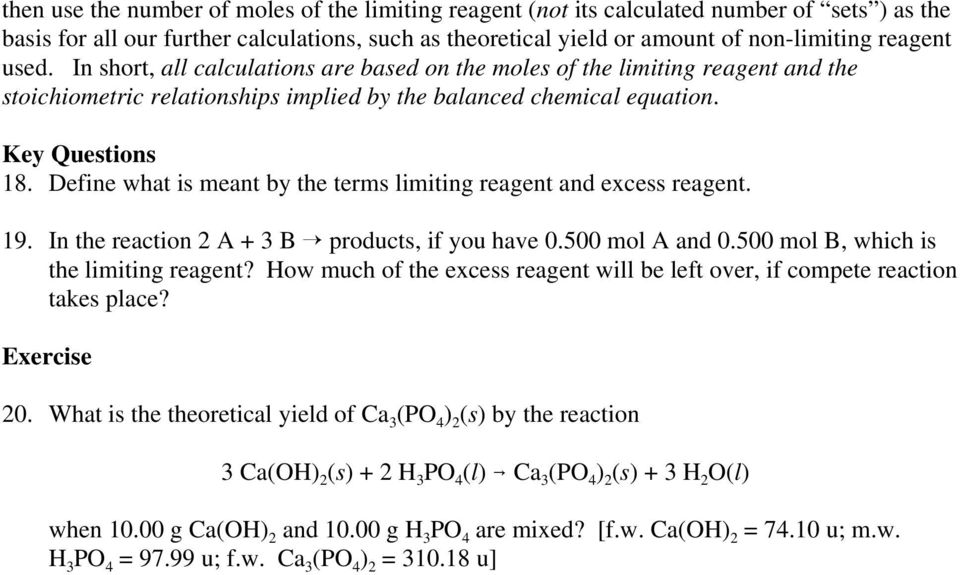
6 then use the number of moles of the limiting reagent (not its calculated number of sets ) as the basis for all our further calculations, such as theoretical yield or amount of non-limiting reagent used. In short, all calculations are based on the moles of the limiting reagent and the stoichiometric relationships implied by the balanced chemical equation. 18. Define what is meant by the terms limiting reagent and excess reagent. 19. In the reaction 2 A + 3 B products, if you have mol A and mol B, which is the limiting reagent? How much of the excess reagent will be left over, if compete reaction takes place? Exercise 20. What is the theoretical yield of Ca 3 (PO 4 ) 2 (s) by the reaction 3 Ca(OH) 2 (s) + 2 H 3 PO 4 (l) 6 Ca 3 (PO 4 ) 2 (s) + 3 H 2 O(l) when g Ca(OH) 2 and g H 3 PO 4 are mixed? [f.w. Ca(OH) 2 = u; m.w. H 3 PO 4 = u; f.w. Ca 3 (PO 4 ) 2 = u]
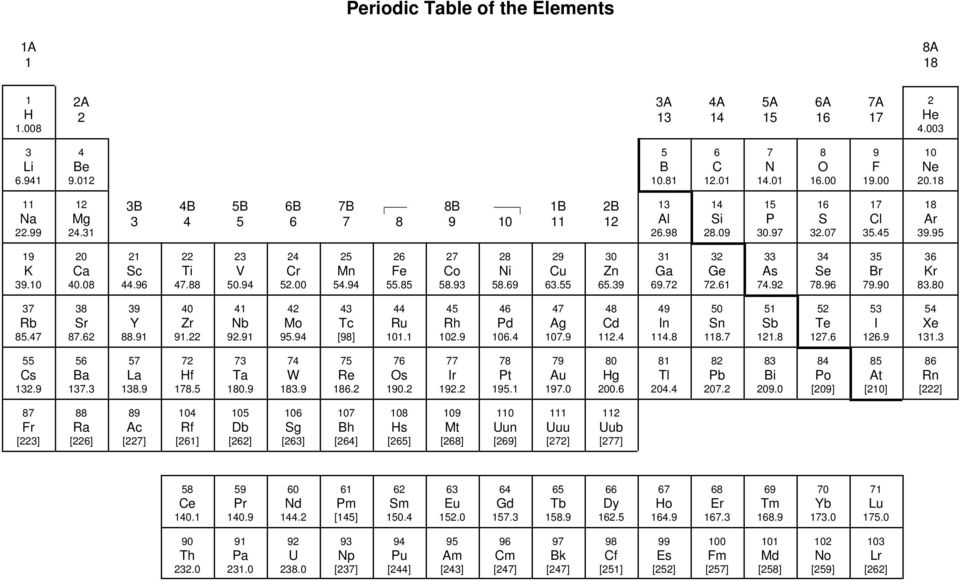
7 Periodic Table of the Elements 1A 1 8A 18 1 H A 2 3A 13 4A 14 5A 15 6A 16 7A 17 2 He Li Be B C N O F Ne Na Mg B 3 4B 4 5B 5 6B 6 7B 7 +))Q 8 8B 9 ))), 10 1B 11 2B Al Si P S Cl Ar K Ca Sc Ti V Cr Mn Fe Co Ni Cu Zn Ga Ge As Se Br Kr Rb Sr Y Zr Nb Mo Tc [98] 44 Ru Rh Pd Ag Cd In Sn Sb Te I Xe Cs Ba La Hf Ta W Re Os Ir Pt Au Hg Tl Pb Bi Po [209] 85 At [210] 86 Rn [222] 87 Fr [223] 88 Ra [226] 89 Ac [227] 104 Rf [261] 105 Db [262] 106 Sg [263] 107 Bh [264] 108 Hs [265] 109 Mt [268] 110 Uun [269] 111 Uuu [272] 112 Uub [277] 58 Ce Pr Nd Pm [145] 62 Sm Eu Gd Tb Dy Ho Er Tm Yb Lu Th Pa U Np [237] 94 Pu [244] 95 Am [243] 96 Cm [247] 97 Bk [247] 98 Cf [251] 99 Es [252] 100 Fm [257] 101 Md [258] 102 No [259] 103 Lr [262]
Chem 115 POGIL Worksheet - Week 4 Moles & Stoichiometry Answers
 Key Questions & Exercises Chem 115 POGIL Worksheet - Week 4 Moles & Stoichiometry Answers 1. The atomic weight of carbon is 12.0107 u, so a mole of carbon has a mass of 12.0107 g. Why doesn t a mole of
B I N G O B I N G O. Hf Cd Na Nb Lr. I Fl Fr Mo Si. Ho Bi Ce Eu Ac. Md Co P Pa Tc. Uut Rh K N. Sb At Md H. Bh Cm H Bi Es. Mo Uus Lu P F.
 Hf Cd Na Nb Lr Ho Bi Ce u Ac I Fl Fr Mo i Md Co P Pa Tc Uut Rh K N Dy Cl N Am b At Md H Y Bh Cm H Bi s Mo Uus Lu P F Cu Ar Ag Mg K Thomas Jefferson National Accelerator Facility - Office of cience ducation
CLASS TEST GRADE 11. PHYSICAL SCIENCES: CHEMISTRY Test 6: Chemical change
 CLASS TEST GRADE PHYSICAL SCIENCES: CHEMISTRY Test 6: Chemical change MARKS: 45 TIME: hour INSTRUCTIONS AND INFORMATION. Answer ALL the questions. 2. You may use non-programmable calculators. 3. You may
All answers must use the correct number of significant figures, and must show units!
 CHEM 10113, Quiz 2 September 7, 2011 Name (please print) All answers must use the correct number of significant figures, and must show units! IA Periodic Table of the Elements VIIIA (1) (18) 1 2 1 H IIA
Calculating Atoms, Ions, or Molecules Using Moles
 TEKS REVIEW 8B Calculating Atoms, Ions, or Molecules Using Moles TEKS 8B READINESS Use the mole concept to calculate the number of atoms, ions, or molecules in a sample TEKS_TXT of material. Vocabulary
Chapter 3: Stoichiometry
 Chapter 3: Stoichiometry Key Skills: Balance chemical equations Predict the products of simple combination, decomposition, and combustion reactions. Calculate formula weights Convert grams to moles and
From Quantum to Matter 2006
 From Quantum to Matter 006 Why such a course? Ronald Griessen Vrije Universiteit, Amsterdam AMOLF, May 4, 004 vrije Universiteit amsterdam Why study quantum mechanics? From Quantum to Matter: The main
CHEM 101/105 Numbers and mass / Counting and weighing Lect-03
 CHEM 101/105 Numbers and mass / Counting and weighing Lect-03 Interpretation of Elemental Chemical Symbols, Chemical Formulas, and Chemical Equations Interpretation of an element's chemical symbol depends
The Mole Concept. The Mole. Masses of molecules
 The Mole Concept Ron Robertson r2 c:\files\courses\1110-20\2010 final slides for web\mole concept.docx The Mole The mole is a unit of measurement equal to 6.022 x 10 23 things (to 4 sf) just like there
ELECTRON CONFIGURATION (SHORT FORM) # of electrons in the subshell. valence electrons Valence electrons have the largest value for "n"!
 179 ELECTRON CONFIGURATION (SHORT FORM) - We can represent the electron configuration without drawing a diagram or writing down pages of quantum numbers every time. We write the "electron configuration".
Chapter 1 The Atomic Nature of Matter
 Chapter 1 The Atomic Nature of Matter 6. Substances that cannot be decomposed into two or more simpler substances by chemical means are called a. pure substances. b. compounds. c. molecules. d. elements.
Chapter 3. Chemical Reactions and Reaction Stoichiometry. Lecture Presentation. James F. Kirby Quinnipiac University Hamden, CT
 Lecture Presentation Chapter 3 Chemical Reactions and Reaction James F. Kirby Quinnipiac University Hamden, CT The study of the mass relationships in chemistry Based on the Law of Conservation of Mass
Part One: Mass and Moles of Substance. Molecular Mass = sum of the Atomic Masses in a molecule
 CHAPTER THREE: CALCULATIONS WITH CHEMICAL FORMULAS AND EQUATIONS Part One: Mass and Moles of Substance A. Molecular Mass and Formula Mass. (Section 3.1) 1. Just as we can talk about mass of one atom of
1. How many hydrogen atoms are in 1.00 g of hydrogen?
 MOLES AND CALCULATIONS USING THE MOLE CONCEPT INTRODUCTORY TERMS A. What is an amu? 1.66 x 10⁻²⁴ g B. We need a conversion to the macroscopic world. 1. How many hydrogen atoms are in 1.00 g of hydrogen?
CHEMICAL FORMULA COEFFICIENTS AND SUBSCRIPTS. Chapter 3: Molecular analysis 3O 2 2O 3
 Chapter 3: Molecular analysis Read: BLB 3.3 3.5 H W : BLB 3:21a, c, e, f, 25, 29, 37,49, 51, 53 Supplemental 3:1 8 CHEMICAL FORMULA Formula that gives the TOTAL number of elements in a molecule or formula
Chemistry B11 Chapter 4 Chemical reactions
 Chemistry B11 Chapter 4 Chemical reactions Chemical reactions are classified into five groups: A + B AB Synthesis reactions (Combination) H + O H O AB A + B Decomposition reactions (Analysis) NaCl Na +Cl
Chem 1100 Chapter Three Study Guide Answers Outline I. Molar Mass and Moles A. Calculations of Molar Masses
 Chem 1100 Chapter Three Study Guide Answers Outline I. Molar Mass and Moles A. Calculations of Molar Masses B. Calculations of moles C. Calculations of number of atoms from moles/molar masses 1. Avagadro
100% ionic compounds do not exist but predominantly ionic compounds are formed when metals combine with non-metals.
 2.21 Ionic Bonding 100% ionic compounds do not exist but predominantly ionic compounds are formed when metals combine with non-metals. Forming ions Metal atoms lose electrons to form +ve ions. Non-metal
EXPERIMENT 4 The Periodic Table - Atoms and Elements
 EXPERIMENT 4 The Periodic Table - Atoms and Elements INTRODUCTION Primary substances, called elements, build all the materials around you. There are more than 109 different elements known today. The elements
Chapter 6 Chemical Calculations
 Chapter 6 Chemical Calculations 1 Submicroscopic Macroscopic 2 Chapter Outline 1. Formula Masses (Ch 6.1) 2. Percent Composition (supplemental material) 3. The Mole & Avogadro s Number (Ch 6.2) 4. Molar
8. Relax and do well.
 CHEM 1314 3:30 pm Section Exam II ohn II. Gelder October 16, 2002 Name TA's Name Lab Section INSTRUCTIONS: 1. This examination consists of a total of 8 different pages. The last three pages include a periodic
Atomic Masses. Chapter 3. Stoichiometry. Chemical Stoichiometry. Mass and Moles of a Substance. Average Atomic Mass
 Atomic Masses Chapter 3 Stoichiometry 1 atomic mass unit (amu) = 1/12 of the mass of a 12 C atom so one 12 C atom has a mass of 12 amu (exact number). From mass spectrometry: 13 C/ 12 C = 1.0836129 amu
PERIODIC TABLE OF GROUPS OF ELEMENTS Elements can be classified using two different schemes.
 1 PERIODIC TABLE OF GROUPS OF ELEMENTS Elements can be classified using two different schemes. Metal Nonmetal Scheme (based on physical properties) Metals - most elements are metals - elements on left
Moles. Balanced chemical equations Molar ratios Mass Composition Empirical and Molecular Mass Predicting Quantities Equations
 Moles Balanced chemical equations Molar ratios Mass Composition Empirical and Molecular Mass Predicting Quantities Equations Micro World atoms & molecules Macro World grams Atomic mass is the mass of an
Stoichiometry. What is the atomic mass for carbon? For zinc?
 Stoichiometry Atomic Mass (atomic weight) Atoms are so small, it is difficult to discuss how much they weigh in grams We use atomic mass units an atomic mass unit (AMU) is one twelfth the mass of the catbon-12
Honors Chemistry: Unit 6 Test Stoichiometry PRACTICE TEST ANSWER KEY Page 1. A chemical equation. (C-4.4)
 Honors Chemistry: Unit 6 Test Stoichiometry PRACTICE TEST ANSWER KEY Page 1 1. 2. 3. 4. 5. 6. Question What is a symbolic representation of a chemical reaction? What 3 things (values) is a mole of a chemical
How much does a single atom weigh? Different elements weigh different amounts related to what makes them unique.
 How much does a single atom weigh? Different elements weigh different amounts related to what makes them unique. What units do we use to define the weight of an atom? amu units of atomic weight. (atomic
Chapter 3! Stoichiometry: Calculations with Chemical Formulas and Equations. Stoichiometry
 Chapter 3! : Calculations with Chemical Formulas and Equations Anatomy of a Chemical Equation CH 4 (g) + 2O 2 (g) CO 2 (g) + 2 H 2 O (g) Anatomy of a Chemical Equation CH 4 (g) + 2 O 2 (g) CO 2 (g) + 2
Electronegativity and Polarity
 and Polarity N Goalby Chemrevise.org Definition: is the relative tendency of an atom in a molecule to attract electrons in a covalent bond to itself. is measured on the Pauling scale (ranges from 0 to
Other Stoich Calculations A. mole mass (mass mole) calculations. GIVEN mol A x CE mol B. PT g A CE mol A MOLE MASS :
 Chem. I Notes Ch. 12, part 2 Using Moles NOTE: Vocabulary terms are in boldface and underlined. Supporting details are in italics. 1 MOLE = 6.02 x 10 23 representative particles (representative particles
The Mole Notes. There are many ways to or measure things. In Chemistry we also have special ways to count and measure things, one of which is the.
 The Mole Notes I. Introduction There are many ways to or measure things. In Chemistry we also have special ways to count and measure things, one of which is the. A. The Mole (mol) Recall that atoms of
Chem 31 Fall 2002. Chapter 3. Stoichiometry: Calculations with Chemical Formulas and Equations. Writing and Balancing Chemical Equations
 Chem 31 Fall 2002 Chapter 3 Stoichiometry: Calculations with Chemical Formulas and Equations Writing and Balancing Chemical Equations 1. Write Equation in Words -you cannot write an equation unless you
Lecture 5, The Mole. What is a mole?
 Lecture 5, The Mole What is a mole? Moles Atomic mass unit and the mole amu definition: 12 C = 12 amu. The atomic mass unit is defined this way. 1 amu = 1.6605 x 10⁻²⁴ g How many 12 C atoms weigh 12 g?
Chemical Calculations: Formula Masses, Moles, and Chemical Equations
 Chemical Calculations: Formula Masses, Moles, and Chemical Equations Atomic Mass & Formula Mass Recall from Chapter Three that the average mass of an atom of a given element can be found on the periodic
Formulas, Equations and Moles
 Chapter 3 Formulas, Equations and Moles Interpreting Chemical Equations You can interpret a balanced chemical equation in many ways. On a microscopic level, two molecules of H 2 react with one molecule
Matter. Atomic weight, Molecular weight and Mole
 Matter Atomic weight, Molecular weight and Mole Atomic Mass Unit Chemists of the nineteenth century realized that, in order to measure the mass of an atomic particle, it was useless to use the standard
CHAPTER 8: CHEMICAL COMPOSITION
 CHAPTER 8: CHEMICAL COMPOSITION Active Learning: 1-4, 6-8, 12, 18-25; End-of-Chapter Problems: 3-4, 9-82, 84-85, 87-92, 94-104, 107-109, 111, 113, 119, 125-126 8.2 ATOMIC MASSES: COUNTING ATOMS BY WEIGHING
Chapter 3 Mass Relationships in Chemical Reactions
 Chapter 3 Mass Relationships in Chemical Reactions Student: 1. An atom of bromine has a mass about four times greater than that of an atom of neon. Which choice makes the correct comparison of the relative
The Lewis structure is a model that gives a description of where the atoms, charges, bonds, and lone pairs of electrons, may be found.
 CEM110 Week 12 Notes (Chemical Bonding) Page 1 of 8 To help understand molecules (or radicals or ions), VSEPR shapes, and properties (such as polarity and bond length), we will draw the Lewis (or electron
Chapter 3. Mass Relationships in Chemical Reactions
 Chapter 3 Mass Relationships in Chemical Reactions This chapter uses the concepts of conservation of mass to assist the student in gaining an understanding of chemical changes. Upon completion of Chapter
MASS RELATIONSHIPS IN CHEMICAL REACTIONS
 MASS RELATIONSHIPS IN CHEMICAL REACTIONS 1. The mole, Avogadro s number and molar mass of an element. Molecular mass (molecular weight) 3. Percent composition of compounds 4. Empirical and Molecular formulas
Element of same atomic number, but different atomic mass o Example: Hydrogen
 Atomic mass: p + = protons; e - = electrons; n 0 = neutrons p + + n 0 = atomic mass o For carbon-12, 6p + + 6n 0 = atomic mass of 12.0 o For chlorine-35, 17p + + 18n 0 = atomic mass of 35.0 atomic mass
Chemical Equations & Stoichiometry
 Chemical Equations & Stoichiometry Chapter Goals Balance equations for simple chemical reactions. Perform stoichiometry calculations using balanced chemical equations. Understand the meaning of the term
STOICHIOMETRY UNIT 1 LEARNING OUTCOMES. At the end of this unit students will be expected to:
 STOICHIOMETRY LEARNING OUTCOMES At the end of this unit students will be expected to: UNIT 1 THE MOLE AND MOLAR MASS define molar mass and perform mole-mass inter-conversions for pure substances explain
It takes four quantum numbers to describe an electron. Additionally, every electron has a unique set of quantum numbers.
 So, quantum mechanics does not define the path that the electron follows; rather, quantum mechanics works by determining the energy of the electron. Once the energy of an electron is known, the probability
CHAPTER 3 Calculations with Chemical Formulas and Equations. atoms in a FORMULA UNIT
 CHAPTER 3 Calculations with Chemical Formulas and Equations MOLECULAR WEIGHT (M. W.) Sum of the Atomic Weights of all atoms in a MOLECULE of a substance. FORMULA WEIGHT (F. W.) Sum of the atomic Weights
Chapter 2 Lecture Notes: Atoms
 Educational Goals Chapter 2 Lecture Notes: Atoms 1. Describe the subatomic structure of an atom. 2. Define the terms element and atomic symbol. 3. Understand how elements are arranged in the periodic table
The Mole Concept and Atoms
 Copyright The McGraw-Hill Companies, Inc. Permission required for reproduction or display. Chapter 4 24 September 2013 Calculations and the Chemical Equation The Mole Concept and Atoms Atoms are exceedingly
B) atomic number C) both the solid and the liquid phase D) Au C) Sn, Si, C A) metal C) O, S, Se C) In D) tin D) methane D) bismuth B) Group 2 metal
 1. The elements on the Periodic Table are arranged in order of increasing A) atomic mass B) atomic number C) molar mass D) oxidation number 2. Which list of elements consists of a metal, a metalloid, and
Study Guide For Chapter 7
 Name: Class: Date: ID: A Study Guide For Chapter 7 Multiple Choice Identify the choice that best completes the statement or answers the question. 1. The number of atoms in a mole of any pure substance
Chemical Calculations: The Mole Concept and Chemical Formulas. AW Atomic weight (mass of the atom of an element) was determined by relative weights.
 1 Introduction to Chemistry Atomic Weights (Definitions) Chemical Calculations: The Mole Concept and Chemical Formulas AW Atomic weight (mass of the atom of an element) was determined by relative weights.
CHEM 110: CHAPTER 3: STOICHIOMETRY: CALCULATIONS WITH CHEMICAL FORMULAS AND EQUATIONS
 1 CHEM 110: CHAPTER 3: STOICHIOMETRY: CALCULATIONS WITH CHEMICAL FORMULAS AND EQUATIONS The Chemical Equation A chemical equation concisely shows the initial (reactants) and final (products) results of
Unit 2: Quantities in Chemistry
 Mass, Moles, & Molar Mass Relative quantities of isotopes in a natural occurring element (%) E.g. Carbon has 2 isotopes C-12 and C-13. Of Carbon s two isotopes, there is 98.9% C-12 and 11.1% C-13. Find
Sample Problem: STOICHIOMETRY and percent yield calculations. How much H 2 O will be formed if 454 g of. decomposes? NH 4 NO 3 N 2 O + 2 H 2 O
 STOICHIOMETRY and percent yield calculations 1 Steps for solving Stoichiometric Problems 2 Step 1 Write the balanced equation for the reaction. Step 2 Identify your known and unknown quantities. Step 3
THE MOLE / COUNTING IN CHEMISTRY
 1 THE MOLE / COUNTING IN CHEMISTRY ***A mole is 6.0 x 10 items.*** 1 mole = 6.0 x 10 items 1 mole = 60, 00, 000, 000, 000, 000, 000, 000 items Analogy #1 1 dozen = 1 items 18 eggs = 1.5 dz. - to convert
Chemistry - A Quantitative Science
 56 Ba 137.33 1 H 1.0079 2 He 4.0026 5 B 10.811 6 C 12.011 7 N 14.007 8 O 15.999 9 F 18.998 10 Ne 20.180 13 Al 26.982 14 Si 28.086 15 P 30.974 16 S 32.066 17 Cl 35.453 18 Ar 39.948 3 Li 6.941 4 Be 9.0122
Lecture Topics Atomic weight, Mole, Molecular Mass, Derivation of Formulas, Percent Composition
 Mole Calculations Chemical Equations and Stoichiometry Lecture Topics Atomic weight, Mole, Molecular Mass, Derivation of Formulas, Percent Composition Chemical Equations and Problems Based on Miscellaneous
= 11.0 g (assuming 100 washers is exact).
 CHAPTER 8 1. 100 washers 0.110 g 1 washer 100. g 1 washer 0.110 g = 11.0 g (assuming 100 washers is exact). = 909 washers 2. The empirical formula is CFH from the structure given. The empirical formula
Stoichiometry. Unit Outline
 3 Stoichiometry Unit Outline 3.1 The Mole and Molar Mass 3.2 Stoichiometry and Compound Formulas 3.3 Stoichiometry and Chemical Reactions 3.4 Stoichiometry and Limiting Reactants 3.5 Chemical Analysis
KEY for Unit 1 Your Chemical Toolbox: Scientific Concepts, Fundamentals of Typical Calculations, the Atom and Much More
 KEY for Unit 1 Your Chemical Toolbox: Scientific Concepts, Fundamentals of Typical Calculations, the Atom and Much More The Modern Periodic Table The Periodic Law - when elements are arranged according
CHEM 107 (Spring-2005) Final Exam (100 pts)
 CHEM 107 (Spring-2005) Final Exam (100 pts) Name: ------------------------------------------------------------------------, Clid # ------------------------------ LAST NAME, First (Circle the alphabet segment
Ch. 10 The Mole I. Molar Conversions
 Ch. 10 The Mole I. Molar Conversions I II III IV A. What is the Mole? A counting number (like a dozen) Avogadro s number (N A ) 1 mole = 6.022 10 23 representative particles B. Mole/Particle Conversions
Calculations and Chemical Equations. Example: Hydrogen atomic weight = 1.008 amu Carbon atomic weight = 12.001 amu
 Calculations and Chemical Equations Atomic mass: Mass of an atom of an element, expressed in atomic mass units Atomic mass unit (amu): 1.661 x 10⁻²⁴ g Atomic weight: Average mass of all isotopes of a given
MOLAR MASS AND MOLECULAR WEIGHT Themolar mass of a molecule is the sum of the atomic weights of all atoms in the molecule. Molar Mass.
 Counting Atoms Mg burns in air (O 2 ) to produce white magnesium oxide, MgO. How can we figure out how much oxide is produced from a given mass of Mg? PROBLEM: If If 0.200 g of Mg is is burned, how much
Chapter 1: Moles and equations. Learning outcomes. you should be able to:
 Chapter 1: Moles and equations 1 Learning outcomes you should be able to: define and use the terms: relative atomic mass, isotopic mass and formula mass based on the 12 C scale perform calculations, including
IB Chemistry 1 Mole. One atom of C-12 has a mass of 12 amu. One mole of C-12 has a mass of 12 g. Grams we can use more easily.
 The Mole Atomic mass units and atoms are not convenient units to work with. The concept of the mole was invented. This was the number of atoms of carbon-12 that were needed to make 12 g of carbon. 1 mole
Chapter 3 Stoichiometry
 Chapter 3 Stoichiometry 3-1 Chapter 3 Stoichiometry In This Chapter As you have learned in previous chapters, much of chemistry involves using macroscopic measurements to deduce what happens between atoms
CONSERVATION OF MASS During a chemical reaction, matter is neither created nor destroyed. - i. e. the number of atoms of each element remains constant
 1 CHEMICAL REACTINS Example: Hydrogen + xygen Water H + H + + - Note there is not enough hydrogen to react with oxygen - It is necessary to balance equation. reactants products + H + H (balanced equation)
The Mole. 6.022 x 10 23
 The Mole 6.022 x 10 23 Background: atomic masses Look at the atomic masses on the periodic table. What do these represent? E.g. the atomic mass of Carbon is 12.01 (atomic # is 6) We know there are 6 protons
The Role of Triads in the Evolution of the Periodic Table: Past and Present
 The Role of Triads in the Evolution of the Periodic Table: Past and Present Eric Scerri Department of Chemistry and Biochemistry, University of California, Los Angeles, Los Angeles, CA 90095; [email protected]
Find a pair of elements in the periodic table with atomic numbers less than 20 that are an exception to the original periodic law.
 Example Exercise 6.1 Periodic Law Find the two elements in the fifth row of the periodic table that violate the original periodic law proposed by Mendeleev. Mendeleev proposed that elements be arranged
CHAPTER 3 MASS RELATIONSHIPS IN CHEMICAL REACTIONS
 CHAPTER 3 MASS RELATIONSHIPS IN CHEMICAL REACTIONS This chapter reviews the mole concept, balancing chemical equations, and stoichiometry. The topics covered in this chapter are: Atomic mass and average
Role of Hydrogen Bonding on Protein Secondary Structure Introduction
 Role of Hydrogen Bonding on Protein Secondary Structure Introduction The function and chemical properties of proteins are determined by its three-dimensional structure. The final architecture of the protein
We know from the information given that we have an equal mass of each compound, but no real numbers to plug in and find moles. So what can we do?
 How do we figure this out? We know that: 1) the number of oxygen atoms can be found by using Avogadro s number, if we know the moles of oxygen atoms; 2) the number of moles of oxygen atoms can be found
IB Chemistry. DP Chemistry Review
 DP Chemistry Review Topic 1: Quantitative chemistry 1.1 The mole concept and Avogadro s constant Assessment statement Apply the mole concept to substances. Determine the number of particles and the amount
Chapter 8 - Chemical Equations and Reactions
 Chapter 8 - Chemical Equations and Reactions 8-1 Describing Chemical Reactions I. Introduction A. Reactants 1. Original substances entering into a chemical rxn B. Products 1. The resulting substances from
Name Date Class CHEMICAL QUANTITIES. SECTION 10.1 THE MOLE: A MEASUREMENT OF MATTER (pages 287 296)
 Name Date Class 10 CHEMICAL QUANTITIES SECTION 10.1 THE MOLE: A MEASUREMENT OF MATTER (pages 287 296) This section defines the mole and explains how the mole is used to measure matter. It also teaches
Description of the Mole Concept:
 Description of the Mole Concept: Suppose you were sent into the store to buy 36 eggs. When you picked them up you would get 3 boxes, each containing 12 eggs. You just used a mathematical device, called
Chemical Composition Review Mole Calculations Percent Composition. Copyright Cengage Learning. All rights reserved. 8 1
 Chemical Composition Review Mole Calculations Percent Composition Copyright Cengage Learning. All rights reserved. 8 1 QUESTION Suppose you work in a hardware store and a customer wants to purchase 500
Balance the following equation: KClO 3 + C 12 H 22 O 11 KCl + CO 2 + H 2 O
 Balance the following equation: KClO 3 + C 12 H 22 O 11 KCl + CO 2 + H 2 O Ans: 8 KClO 3 + C 12 H 22 O 11 8 KCl + 12 CO 2 + 11 H 2 O 3.2 Chemical Symbols at Different levels Chemical symbols represent
The Mole. Chapter 2. Solutions for Practice Problems
 Chapter 2 The Mole Note to teacher: You will notice that there are two different formats for the Sample Problems in the student textbook. Where appropriate, the Sample Problem contains the full set of
Concept 1. The meaning and usefulness of the mole. The mole (or mol) represents a certain number of objects.
 Chapter 3. Stoichiometry: Mole-Mass Relationships in Chemical Reactions Concept 1. The meaning and usefulness of the mole The mole (or mol) represents a certain number of objects. SI def.: the amount of
Formulae, stoichiometry and the mole concept
 3 Formulae, stoichiometry and the mole concept Content 3.1 Symbols, Formulae and Chemical equations 3.2 Concept of Relative Mass 3.3 Mole Concept and Stoichiometry Learning Outcomes Candidates should be
Answers and Solutions to Text Problems
 Chapter 7 Answers and Solutions 7 Answers and Solutions to Text Problems 7.1 A mole is the amount of a substance that contains 6.02 x 10 23 items. For example, one mole of water contains 6.02 10 23 molecules
Stoichiometry. Lecture Examples Answer Key
 Stoichiometry Lecture Examples Answer Key Ex. 1 Balance the following chemical equations: 3 NaBr + 1 H 3 PO 4 3 HBr + 1 Na 3 PO 4 2 C 3 H 5 N 3 O 9 6 CO 2 + 3 N 2 + 5 H 2 O + 9 O 2 2 Ca(OH) 2 + 2 SO 2
neutrons are present?
 AP Chem Summer Assignment Worksheet #1 Atomic Structure 1. a) For the ion 39 K +, state how many electrons, how many protons, and how many 19 neutrons are present? b) Which of these particles has the smallest
Calculations with Chemical Formulas and Equations
 Chapter 3 Calculations with Chemical Formulas and Equations Concept Check 3.1 You have 1.5 moles of tricycles. a. How many moles of seats do you have? b. How many moles of tires do you have? c. How could
W1 WORKSHOP ON STOICHIOMETRY
 INTRODUCTION W1 WORKSHOP ON STOICHIOMETRY These notes and exercises are designed to introduce you to the basic concepts required to understand a chemical formula or equation. Relative atomic masses of
Chemical formulae are used as shorthand to indicate how many atoms of one element combine with another element to form a compound.
 29 Chemical Formulae Chemical formulae are used as shorthand to indicate how many atoms of one element combine with another element to form a compound. C 2 H 6, 2 atoms of carbon combine with 6 atoms of
Atomic mass is the mass of an atom in atomic mass units (amu)
 Micro World atoms & molecules Laboratory scale measurements Atomic mass is the mass of an atom in atomic mass units (amu) By definition: 1 atom 12 C weighs 12 amu On this scale 1 H = 1.008 amu 16 O = 16.00
Sample Exercise 3.1 Interpreting and Balancing Chemical Equations
 Sample Exercise 3.1 Interpreting and Balancing Chemical Equations The following diagram represents a chemical reaction in which the red spheres are oxygen atoms and the blue spheres are nitrogen atoms.
Moles. Moles. Moles. Moles. Balancing Eqns. Balancing. Balancing Eqns. Symbols Yields or Produces. Like a recipe:
 Like a recipe: Balancing Eqns Reactants Products 2H 2 (g) + O 2 (g) 2H 2 O(l) coefficients subscripts Balancing Eqns Balancing Symbols (s) (l) (aq) (g) or Yields or Produces solid liquid (pure liquid)
Chemistry 65 Chapter 6 THE MOLE CONCEPT
 THE MOLE CONCEPT Chemists find it more convenient to use mass relationships in the laboratory, while chemical reactions depend on the number of atoms present. In order to relate the mass and number of
The Mole and Molar Mass
 The Mole and Molar Mass 1 Molar mass is the mass of one mole of a substance. Molar mass is numerically equal to atomic mass, molecular mass, or formula mass. However the units of molar mass are g/mol.
Name Date Class STOICHIOMETRY. SECTION 12.1 THE ARITHMETIC OF EQUATIONS (pages 353 358)
 Name Date Class 1 STOICHIOMETRY SECTION 1.1 THE ARITHMETIC OF EQUATIONS (pages 353 358) This section explains how to calculate the amount of reactants required or product formed in a nonchemical process.
Chemical Proportions in Compounds
 Chapter 6 Chemical Proportions in Compounds Solutions for Practice Problems Student Textbook page 201 1. Problem A sample of a compound is analyzed and found to contain 0.90 g of calcium and 1.60 g of
APPENDIX B: EXERCISES
 BUILDING CHEMISTRY LABORATORY SESSIONS APPENDIX B: EXERCISES Molecular mass, the mole, and mass percent Relative atomic and molecular mass Relative atomic mass (A r ) is a constant that expresses the ratio
Unit 2 Matter and Chemical Change. Unit Test
 Unit Test Student Name Class Section 1 Properties of Matter 1. Aluminum foam is used to create lighter, safer cars. The reason that a lighter car is a safer car is because aluminum foam is A. less rigid
Chapter 4. Chemical Composition. Chapter 4 Topics H 2 S. 4.1 Mole Quantities. The Mole Scale. Molar Mass The Mass of 1 Mole
 Chapter 4 Chemical Composition Chapter 4 Topics 1. Mole Quantities 2. Moles, Masses, and Particles 3. Determining Empirical Formulas 4. Chemical Composition of Solutions Copyright The McGraw-Hill Companies,
Chapter Three: STOICHIOMETRY
 p70 Chapter Three: STOICHIOMETRY Contents p76 Stoichiometry - The study of quantities of materials consumed and produced in chemical reactions. p70 3-1 Counting by Weighing 3-2 Atomic Masses p78 Mass Mass