
GENERAL INFORMATION...5 COPYRIGHT...5 NOTICES AND CLASSIFICATIONS...5 CONTACT US...5
|
|
|
- Beatrix Harmon
- 10 years ago
- Views:
Transcription
1 Rev.04 1

2 Table of Contents GENERAL INFORMATION...5 COPYRIGHT...5 NOTICES AND CLASSIFICATIONS...5 CONTACT US...5 PRECAUTIONS FOR THE RAID SYSTEM...6 INTRODUCTION...7 FEATURES...7 SYSTEM REQUIREMENT...8 PC... 8 MAC... 8 OPTIONAL ACCESSORIES...8 PACKAGE CONTENTS...9 RC M4DJ (SATA esata/usb 2.0 combo)... 9 RC M4QJ (SATA esata/usb 2.0/FireWire 400/FireWire 800 combo)... 9 SYSTEM UNIT VIEWS...10 FRONT VIEW...10 TOP & COVER VIEWS (Exposed)...10 REAR VIEW...11 RC M4DJ (SATA esata/usb 2.0 combo)...11 RC M4QJ (SATA esata/usb 2.0/FireWire 400/FireWire 800 combo)...11 INSERTING/REPLACING THE HARD DRIVES IN THE RAID SYSTEM...12 FASTEN THE HANDLES ONTO THE HARD DRIVES...13 CONNECTING THE RAID SYSTEM TO A COMPUTER...16 LCM...19 LCM BUTTONS...19 BASIC MENU...19 MAIN MENU DESCRIPTIONS...20 SUB MENU DESCRIPTIONS...20 QUICK SETUP...20 DISK MANAGER...20 SYSTEM MANAGER...20 RAID CONFIGURATION...21 RAID MASTER...23 INSTALLATION...23 INSTALLATION FOR MAC...23 INSTALLATION FOR PC...23 BASIC MODE MENU...26 RAID AND DISK INFORMATION

3 EVENT LOG...28 BASIC RAID CONFIGURATION...29 SET UP RAID MODE...29 CHANGING OR DELETING AN ALREADY ASSIGNED RAID MODE...32 ADVANCED MODE MENU NOTIFICATION & EVENT SETTINGS...36 ADVANCE RAID CONFIGURATION...38 SET UP RAID MODE...38 CHANGING OR DELETING AN ALREADY ASSIGNED RAID MODE...40 ADDING OR CHANGING A SPARE...43 DELETING A SPARE...44 FIRMWARE INFORMATION...47 RAID SETTINGS...49 NUMBER OF DISKS SUPPORTING EACH RAID MODE...50 CONNECTING MULTIPLE DEVICES...50 SAFE REMOVAL OF THE RAID SYSTEM...50 LED INDICATORS...51 POWER LED x RAID ALERT LED x HDD LED x EXTERNAL BOOTUP...53 PC...53 MAC...53 DISK VOLUME OVER 2TB...54 BACKUP KIT...55 HOW TO BACKUP A MODIFIED HARD DRIVE...56 GLOSSORY...57 LCM DISPLAY OF STATUS...57 RAID MASTER POPUP WINDOWS OF STATUS...58 REBUILDING...58 BROKEN...58 DEGRADE (IN DANGER)...58 RAID MODES...59 RAID 0 (STRIPING)...59 RAID 1 (MIRRORING)...60 SPAN...61 CLONE...61 RAID RAID JBOD (JUST A BUNCH OF DISKS)...63 HOT SWAP...63 HOTSPARE (MANUAL OR AUTOMATIC REBUILD)...64 REBUILD...64 esata PCI EXPRESS CARD INSTALLATION
4 SYSTEM REQUIREMENTS...66 HARDWARE INSTALLATION...66 DRIVER INSTALLATION...67 VERIFY DRIVER INSTALLATION...67 MAC OS...67 WINDOWS OS...67 WINDOWS 2003 and XP...67 WINDOWS Q&As...69 GENERAL...69 HARD DRIVE CAPACITY...69 DISCREPANCY IN REPORTED & ACTUAL SIZE CAPACITY...70 RAID REBUILD...70 RAID MODE PASSWORD...71 RAID MASTER: USER NAME OR PASSWORD ERROR...71 RAID MASTER: FAILED RAID...72 RAID MASTER: ADJUST HARD DRIVE STORAGE SIZE...73 APPENDIX...74 SPECIFICATIONS...74 LCM PROCESS TREE...75 QUICK SETUP...75 DISK MANAGER...76 SYSTEM MANAGER
5 GENERAL INFORMATION COPYRIGHT 2011 Data Watch Technologies Co., Ltd. All rights reserved. No part of this publication may be reproduced, stored in a retrieval system, or transmitted in any form or by any means, electronic, mechanical, photocopying, recording or otherwise, without the prior written consent of Data Watch Technologies Co., Ltd or ONNTO Corporation. The product information provided in this manual is subject to change without prior notice and does not represent a commitment on behalf of the vendor. The vendor assumes no liability or responsibility for any errors that may appear in this manual. NOTICES AND CLASSIFICATIONS FCC-B Radio Frequency Interference Statement This device complies with Part 15 of the FCC rules. Operation is subject to the following two conditions: This device may not cause harmful interference. This device must accept any interference received, including interference that may cause undesired operation. This equipment has been tested and found to comply with the limits for a Class B digital device, pursuant to Part 15 of the FCC rules. These limits are designed to provide reasonable protection against harmful interference when the equipment is operated in a commercial environment. This equipment generates uses and can radiate radio frequency energy and, if not installed and used in accordance with the instruction manual, may cause harmful interference to radio communications. CONTACT US We are committed to offer economical, high-quality connectivity and storage enclosure solutions to the market. Your questions, inquiries or comments are welcomed. For the latest version of User Manual & Technical Support, please go to our website at Data Watch Technologies Co., Ltd. 3F, No. 60, Lane 321, Yang Guang St., Nei Hu, Taipei 114 Taiwan Tel: Fax: [email protected] 5

6 PRECAUTIONS FOR THE RAID SYSTEM Any loss, corruption, or destruction of data is the sole responsibility of the user of the RAID System. Under no circumstances will the manufacturer be held liable for the recovery or restoration of any data. Installation of RAID MASTER software in the host computer is required for proper operation. The main circuit board of the RAID System is susceptible to static electricity. Proper grounding is required to prevent electrical damage to the RAID System unit or other connected devices, including the host computer. Always place the RAID Unit on a smooth surface and avoid all dramatic movement, vibration and percussion. Do NOT allow water to enter the RAID Unit. Installation of additional equipment in the host computer may be required. Visit our website to download the latest product information updates. Do NOT attempt to service this unit yourself. Disassembling the RAID Unit s inner parts will expose you to dangerous voltages or other hazards. Do NOT block the ventilation. Proper airflow is required to ensure reliable operation and to prevent overheating. Do unplug the RAID Unit from the electrical outlet when not in use to provide an ecological friendly environment. Use only the power supply cable provided with the RAID Unit. 6

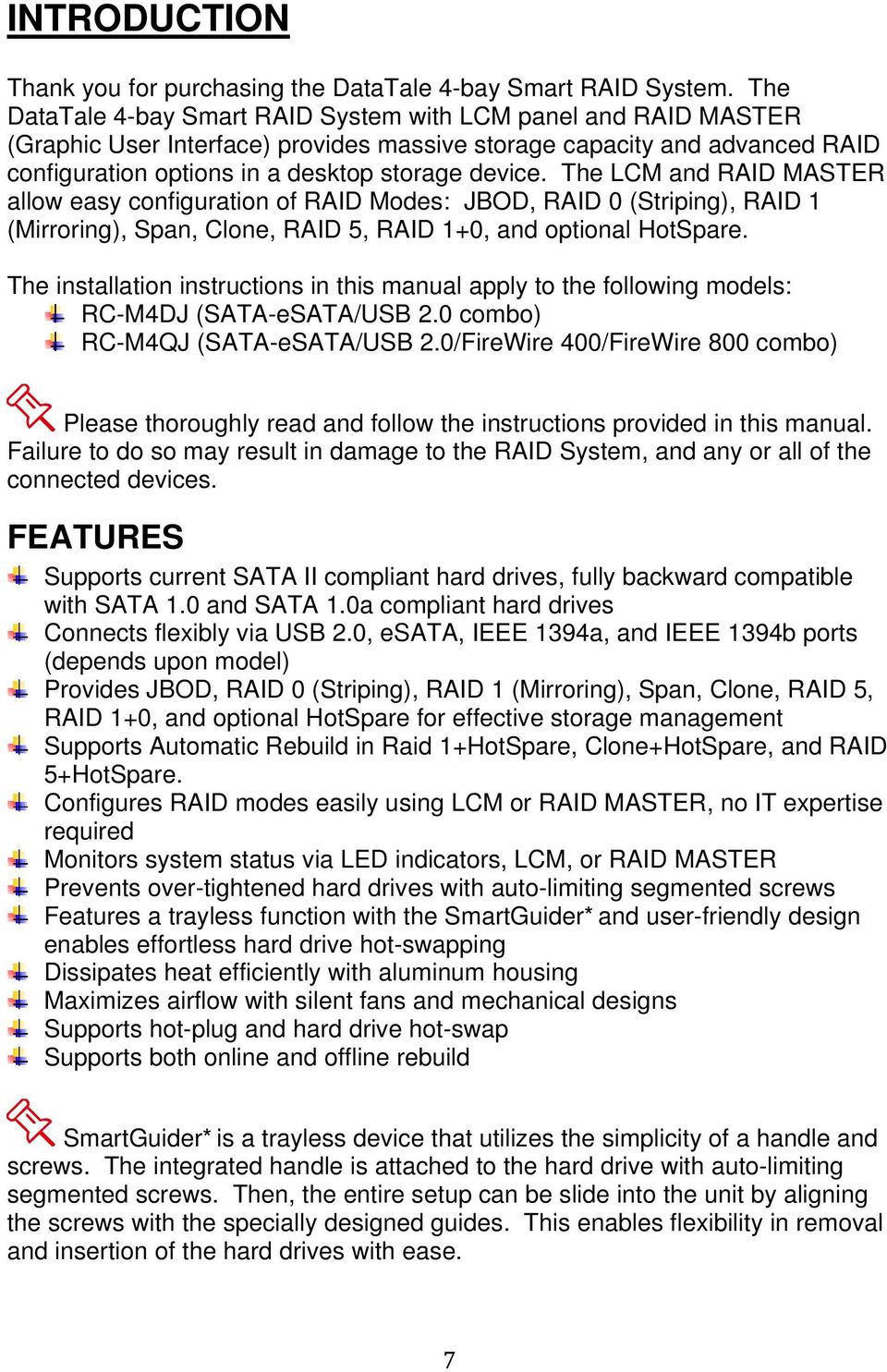
7 INTRODUCTION Thank you for purchasing the DataTale 4-bay Smart RAID System. The DataTale 4-bay Smart RAID System with LCM panel and RAID MASTER (Graphic User Interface) provides massive storage capacity and advanced RAID configuration options in a desktop storage device. The LCM and RAID MASTER allow easy configuration of RAID Modes: JBOD, RAID 0 (Striping), RAID 1 (Mirroring), Span, Clone, RAID 5, RAID 1+0, and optional HotSpare. The installation instructions in this manual apply to the following models: RC-M4DJ (SATA-eSATA/USB 2.0 combo) RC-M4QJ (SATA-eSATA/USB 2.0/FireWire 400/FireWire 800 combo) Please thoroughly read and follow the instructions provided in this manual. Failure to do so may result in damage to the RAID System, and any or all of the connected devices. FEATURES Supports current SATA II compliant hard drives, fully backward compatible with SATA 1.0 and SATA 1.0a compliant hard drives Connects flexibly via USB 2.0, esata, IEEE 1394a, and IEEE 1394b ports (depends upon model) Provides JBOD, RAID 0 (Striping), RAID 1 (Mirroring), Span, Clone, RAID 5, RAID 1+0, and optional HotSpare for effective storage management Supports Automatic Rebuild in Raid 1+HotSpare, Clone+HotSpare, and RAID 5+HotSpare. Configures RAID modes easily using LCM or RAID MASTER, no IT expertise required Monitors system status via LED indicators, LCM, or RAID MASTER Prevents over-tightened hard drives with auto-limiting segmented screws Features a trayless function with the SmartGuider* and user-friendly design enables effortless hard drive hot-swapping Dissipates heat efficiently with aluminum housing Maximizes airflow with silent fans and mechanical designs Supports hot-plug and hard drive hot-swap Supports both online and offline rebuild SmartGuider* is a trayless device that utilizes the simplicity of a handle and screws. The integrated handle is attached to the hard drive with auto-limiting segmented screws. Then, the entire setup can be slide into the unit by aligning the screws with the specially designed guides. This enables flexibility in removal and insertion of the hard drives with ease. 7
8 SYSTEM REQUIREMENT To use the DataTale 4-bay Smart RAID System, the minimum system configuration in the host computer require the following: PC 1GHz or faster CPU 512MB of RAM Microsoft Windows 2000, XP, 2003, Vista, 2008, 7 or higher One available USB 2.0, esata, IEEE 1394a, or IEEE 1394b port (depends upon model) MAC Macintosh PowerPC or Intel processors 512MB of RAM Mac OS X 10.4 or higher One available USB 2.0, esata, IEEE 1394a, or IEEE 1394b port (depends upon model) 3.5 SATA compatible hard drive is required for the RAID System unit. Once the hard drives are formatted, the actual available storage capacity can vary depending on the selected operating environment (normally 5-10 % less). Any loss, corruption, or destruction of data is the sole responsibility of the user of the RAID System. Under no circumstances will the manufacturer be held liable for the recovery or restoration of any data. OPTIONAL ACCESSORIES esata PCI, PCI-X, or PCI-Express Card 8

9 PACKAGE CONTENTS RC-M4DJ (SATA-eSATA/USB 2.0 combo) RC-M4QJ (SATA-eSATA/USB 2.0/FireWire 400/FireWire 800 combo) Please keep all package contents and packaging material in the event that the product must be returned. 9

10 SYSTEM UNIT VIEWS FRONT VIEW RAID Alert HDD 1 HDD 2 HDD 3 HDD 4 Power Up Down Esc Enter The status indication of each LED indicator is listed under the LED INDICATORS section. LCM Panel TOP & COVER VIEWS (Exposed) HDD Slots (indicate HDD 1 through HDD 4) 4 Spare HDD Screws Handles 10

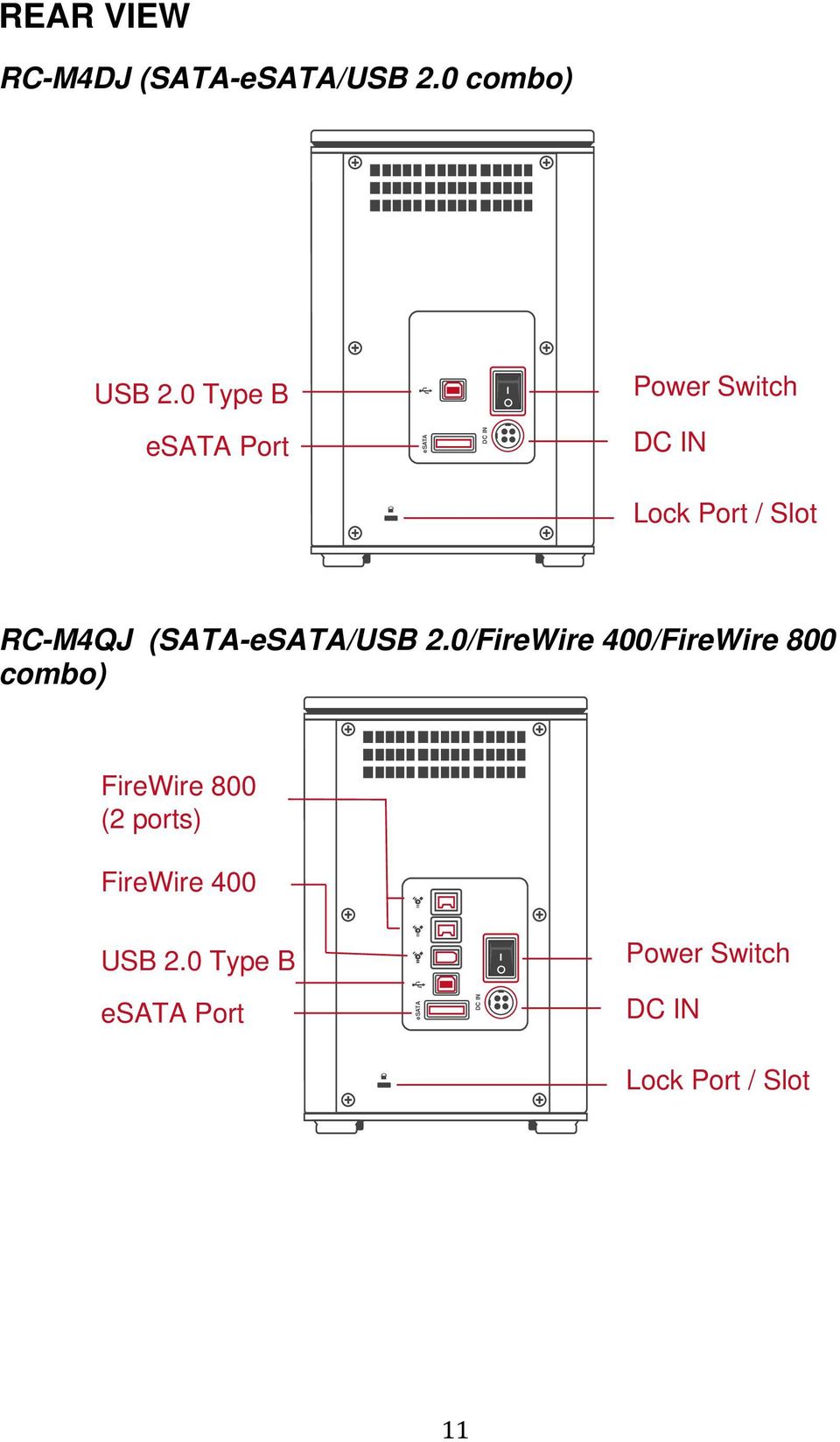
11 REAR VIEW RC-M4DJ (SATA-eSATA/USB 2.0 combo) USB 2.0 Type B Power Switch esata Port esata DC IN DC IN Lock Port / Slot RC-M4QJ (SATA-eSATA/USB 2.0/FireWire 400/FireWire 800 combo) FireWire 800 (2 ports) FireWire 400 USB 2.0 Type B Power Switch esata Port esata DC IN DC IN Lock Port / Slot 11
12 INSERTING/REPLACING THE HARD DRIVES IN THE RAID SYSTEM To assemble the RAID System, please follow the steps listed in the instructions below: 1. Place the RAID System with its front view facing you. Position one hand on the front edge and one on the back edge of the top lid. Simultaneously, push the lid in the direction away from you, front to back, using your thumbs. A click sound would indicate the release of the top lid security clasp. 2. Lift the top lid up to remove and expose the top view (or hard drive slots). Take out the handles from the enclosure itself and locate the hard drive screws in the packaging box. 12

13 FASTEN THE HANDLES ONTO THE HARD DRIVES 3. Place the hard drive with the metal cover side facing up and ensure that the interface connectors are oriented toward your left side. Connectors 4. Position the handle to the hard drive end, which is facing away from the interface connectors, and align it with the screw hole openings. Connectors 13

14 5. Fasten the handle onto the hard drive by inserting and tightening the screws on both ends of the handle. 6. Finally, test sliding the handle to make sure that the holes glide smoothly on the screw guides. Repeat the same procedures for rest of the hard drives. The auto-limiting segmented screws are designed to prevent the hard drives or/and the handles from damages due to over-tightening. Furthermore, this design makes the handle slide easily without any tightness. 14

15 9. Hold the hard drive with the metal cover side facing you and the handle attached on the upward position. When inserting the hard drive on its reverse side, the SmartGuider * System won t be able to align and the hard drive cannot be inserted. 10. Align the handle with the guide rails and slide the hard drive into the indicated slot. Firmly push downward until a thump sound is heard. Repeat the same procedures for the rest of hard drives. In most cases, you would need to firmly push the trays to a close until a thump sound is heard. 15

16 11. Place RAID System with its front view facing you and the top lid on. Position one hand on the front edge and one on the back edge of the top lid. Simultaneously, push the lid firmly downward and toward you, back to front. A click sound would indicate grasp of the top lid security clasp. CONNECTING THE RAID SYSTEM TO A COMPUTER 1. Connect the AC/DC power adapter. esata DC IN 16

17 2. Insert both ends of the USB 2.0, esata, FireWire 400, or FireWire 800 cable(s) into the corresponding port of the RAID System and the host. esata DC IN The RAID System should only be connected to a host computer via one interface. Connection of the system to a computer via two or more interfaces simultaneously is not recommended, especially when doing data transfer. 3. Turn the power switch to the on position. ON esata DC IN 17

18 DataTale ONNTO Corp. 4. When connected, the Power LED light will become steadily green, and the Hard Drive LED lights will become white and blink about 15 seconds. If the hard drives are inside the RAID System, the Hard Drive LED lights will remain steadily white; and the LCM Panel will show Initializing, then DataTale ONNTO Corp.. If there are no hard drives inside the RAID System, the Hard Drive LED lights will turn off after blinking; and the LCM Panel will only show DataTale ONNTO Corp.. DataTale ONNTO Corp. 5. You are now ready to begin using your RAID System! Ready to go! Due to compatibility issues, if you use the esata interface to do the data transfer, the Silicon Image esata host controller is highly recommended. 18

19 LCM The LCM on the DataTale 4-bay Smart RAID System will display basic information for the inserted hard drives, RAID System itself, and basic RAID function operations. LCM BUTTONS BUTTON X MEANING Esc or No Enter or Yes Up (Arrow) Down (Arrow) BASIC MENU Initializing... Initializing... DataTale ONNTO Corp. Main Menu Quick Setup Main Menu Disk Manager Main Menu System Manager Disk Manager: Select: Disk 1 Quick Setup: Create One RAID Quick Setup: Delete All RAID System Manager: System Info. System Manager: Change Password System Manager: Logout From Menu 19

20 MAIN MENU DESCRIPTIONS Quick Setup: Enables general basic set up functions. Disk Manager: Provides basic information of specified hard drive. System Manager: Supplies basic RAID System information, and password or access capabilities. SUB MENU DESCRIPTIONS QUICK SETUP Create One RAID: To assign and create the RAID System s inserted hard drives into a preferred RAID Mode. Also to set up a RAID Mode Password for this particular RAID mode s hard drives. Delete All RAID: To delete the current RAID Mode setup in the RAID System s inserted hard drives. DISK MANAGER Select Disk: To retrieve detailed information regarding the selected disk such as model, serial number, firmware version, total capacity, capacity not used, and disk status. SYSTEM MANAGER System Info: To retrieve detailed information regarding the RAID System such as firmware version and control number. Change Password: To set up or change the password for access to the LCM operations only. This is not the same as the RAID Mode Password set up via the RAID MASTER and LCM (Create One RAID). Logout From Menu: To esc or exit from the menu. Complete LCM Process Tree Guideline is provided under APPENDIX section. 20

21 RAID CONFIGURATION To assign and create the RAID System s inserted hard drives into a preferred RAID Mode, using the LCM only, please follow the steps listed in the instructions provided below: 1. Turn On the RAID System. After initializing, it will display DataTale ONNTO Corp.. Under Main Menu, press Down Button ( ) to select Quick Setup and press Enter ( ). Main Menu Quick Setup 2. Select Create One RAID and press Enter ( ). Quick Setup: Create One RAID 3. Use the Up ( ) and Down Buttons ( ) to select which RAID Mode to use. Select Level: RAID 0 If not enough hard drives are inserted inside the RAID System, then it will display Disk Not Enough, Cannot Create! 21
22 4. Enter the password. This password is the same one for RAID MASTER. Not the individual password for the LCM operation itself. Enter Password: If a password has not been created yet, please enter a new one. If prefer not to enter a password, simply leave it blank and press Enter ( ). Please refer to the RAID MODE PASSWORD section under Q&A. 5. After verifying the password, it will display Are You Sure? Enter: Yes Esc: No. Press Enter ( ) to confirm or Esc (X) to cancel. Are You Sure? Enter:Yes Esc:No 6. Then, the RAID System will begin processing the preferred RAID Mode and display Waiting System Re-initialize. Once completed, the RAID System is ready for usage under the chosen RAID Mode! Waiting System Re-initialize... For the rest of LCM functions, please use the provided buttons to operate. They are very intuitive and easy to follow. 22
23 RAID MASTER The RAID MASTER is a newly-designed GUI Software specifically for our DataTale 4-bay Smart RAID System. The drivers of the RAID MASTER for both PC and Mac are provided via CD or our website. It provides a more convenient yet modern way to manage your RAID System. The RAID System can still be managed using the basic LCM provided. INSTALLATION To install the RAID Master via CD, please insert the provided CD in the package. To install the RAID Master via online, please download the appropriate driver from our website at before beginning the installation process. INSTALLATION FOR MAC Please follow the steps listed in the instructions provided below: 1. If using the installation CD, please copy the driver for MAC to your Desktop. Double click the driver to decompress. Then, open the folder stating RAID MASTER MAC_vx.xx.xx. 2. Once opened, please double click on the RAID MASTER to open the program. Due to MAC s OS, installation and un-installation of RAID MASTER is unnecessary. Simply open the folder containing the program and double click to start. INSTALLATION FOR PC Please follow the steps listed in the instructions provided below: 1. If using the installation CD, please copy the driver for Windows to your Desktop. Double click the driver to decompress. Then, open the folder stating RAID MASTER Windows_vx.xx.xx. 23
24 2. Once opened, please double click on the icon stating Setup.exe to begin set up. Due to WINDOWS OS, installation and un-installation is necessary to operate the RAID MASTER. When there s a newer version of RAID MASTER, the previous version needs to be un-install first before installing the new version of the software. 3. Once clicked, this image stating DataTale RAID MASTER-Installation Wizard should appear. Click on Install to continue. 24
25 4. Then, this image stating The Installation Wizard has successfully installed the driver should appear. If choose to launch the RAID MASTER immediately after installation, click on the icon stating Launch the application right now. If not, then make sure the icon is not checked. Once decided, click on Finish to finish the installation. 5. Once the installation is completed, the RAID MASTER Menu page should appear. 25
26 BASIC MODE MENU RAID AND DISK INFORMATION: Provides the basic information for the RAID System itself once the RAID System is connected to the host. For example, the Controller information, serial number for each inserted hard drives, what kind of RAID format is assigned for each inserted hard drives, and much more. EVENT LOG: Records all process completed for the RAID System and can be saved to a text format file. BASIC RAID CONFIGURATION: o Provides the basic RAID Mode setup and configuration. o Give a place to insert and apply a password to protect any changes done on the RAID System. o Shows what type of RAID Mode is setup at the moment for the inserted hard drives. 26
27 RAID AND DISK INFORMATION To retrieve the basic information for the RAID System, please connect the RAID System to the host and open the RAID MASTER. Once connected, click on the first sub-menu icon (top) and two types of information will appear: 1. The connected RAID System(s) information with brand model and serial numbers for each inserted hard drives. Because the RAID MASTER can manage more than one unit of the RAID System, each RAID System connected to the host computer will reflect as Controller and in numbering order Controller 1, Controller 2, respectively. Due to chipset configuration, the Controller List will reflect the hard drives as M0, M1, M2, and M3 for hard drives 1, 2, 3, 4, respectively. 2. The type of RAID Mode is assigned and available storage capacity for each inserted hard drives. 27
28 EVENT LOG To keep a copy of all the recorded process and status for the RAID System, please complete using the following steps: 1. Click on the second sub-menu icon (middle). Once clicked, a list of process recording should appear as the Event Log Viewer. Each row should provide information such as: number of each event listing the oldest one first, issued module chosen and completed, date and time for the action, type of information provided for user, and memo note for each type. 2. To save a copy of the recorded list, please click on the icon Save To File. The Clear icon will erase all previous event logs permanently. 28
29 3. Once clicked, the box stating Save the event logs to a file should appear. Once appeared, please type in the file name and file type preferred, and select the location to save the file. Then, click on the Save icon. 4. Once saved, it will appear as a text format file (.txt). This file is important to save and provide essential information for our service team, especially when there s something wrong with the RAID System and it needs service. BASIC RAID CONFIGURATION SET UP RAID MODE To setup the RAID System under the Basic Mode, please complete using the following steps: 1. Please click on the third sub-menu icon (bottom). Once clicked, a list of RAID Mode options and basic information of the inserted hard drives should appear as the Basic RAID Configuration. 29
30 2. Select the preferred RAID Mode option on the list. Once selected, the RAID MASTER will automatically update the information on the right side for the inserted hard drives if are assigned the chosen RAID Mode. If decided to insert a password for change protection, please place it inside the password box. Then, click on the Apply icon to begin. Please review the RAID MODE PASSWORD section under Q&As for more information. Please review the RAID Mode options under Glossory to choose the best suitable RAID Mode for your needs and desire. If the number of inserted hard drives does not qualify for a particular RAID Mode, the option to choose that RAID Mode will not be available (faint image). 3. Once selected, the RAID MASTER will give an alert popup window stating specifying a basic RAID confirmation will result in all previous volumes being deleted and the data will be lost. Click on Yes icon to confirm. 30
31 4. Once selected, the RAID MASTER will begin processing the chosen RAID Mode onto the inserted hard drives. A popup window will appear reflecting status. 5. Once the process is completed, the same popup window will reflect the process-recording note for the Event Log Viewer. Click on the OK icon to confirm. 6. The inserted hard drives will reflect the assigned RAID Mode and show the basic information for them. The RAID System is now ready to be used under the preferred RAID Mode! 31
32 CHANGING OR DELETING AN ALREADY ASSIGNED RAID MODE To change the current assigned RAID Mode for the inserted hard drives for the RAID System under the Basic Mode, the previous RAID Mode must be deleted first. Please complete using the following steps: Changing the RAID Mode deletes all data stored on the hard drives. If you have saved data in the drives, backup all data before changing the RAID Mode. 1. Please click on the third sub-menu icon (bottom). Once clicked, the current assigned RAID Mode basic information should appear for the inserted hard drives and the option to DELETE ALL RAID under the list of RAID Mode options. Select the DELETE ALL RAID on the list. Once selected, the Apply icon will light up and click on it to begin. 32
33 If a password was already set up for the previously assigned RAID Mode, it needs to be input now inside the password box. If it is not correct or not inputted, then a popup window reflecting error will appear. 2. Once selected, the RAID MASTER will begin running the previous RAID Mode from the inserted hard drives. A popup window will appear giving a warning and asking for confirmation. Click on Yes to continue. 3. Once confirmed, the RAID MASTER will begin deleting the previous RAID Mode from the inserted hard drives. A popup window will appear reflecting status. 33
34 4. Once the process is completed, the same popup window will reflect the process-recording note for the Event Log Viewer. Click on the OK icon to confirm. 5. The inserted hard drives will now reflect as unreleased and the current basic information for them are available. The RAID System is now ready to be re-assigned and formatted for a new RAID Mode! 34
35 ADVANCED MODE MENU NOTIFICATION & EVENT SETTINGS: Available to set up Notification (such as in event of errors, alerts, and changes to the RAID System) and Event Settings based on preference. ADVANCE RAID CONFIGURATION: Similar to Basic RAID configuration with additional options. o Select which hard drives and their storage capacities o Perform a combination of RAID Modes at same time. For example, creating two sets of RAID 1 or have a combination set of RAID 0 and RAID 1. o Assign an additional hard drive as the spare and will perform automatic rebuild when another hard drive already in a RAID Mode setup fails (for RAID 1, CLONE, and RAID 5 only.) FIRMWARE INFORMATION: Provides Controller s firmware information such as product name, firmware version, manufacturer, and flash number. Also, gives an option to update the firmware when necessary. RAID SETTINGS: Allow set up of RAID Standby Timer Settings and RAID Rebuild Priority Settings based on preference. 35
36 NOTIFICATION & EVENT SETTINGS To set up the Notification and the Event Settings based on preference, please complete using the following steps: 1. Enter all the necessary information. SMTP Server Name: Enter the address of the mail server. SMTP Server Port: Enter the mail server s port number. Sender Enter the sender s address for this server. Sender Username: Enter the sender s username for this server. Sender Password: Enter the sender s password for this server. The password will be authenticated by the specified mail server when sending an . Recipient (s): Enter the address(es) of persons to receive a notification . Must enter ; between addresses for multiple recipients. 2. Select the preferred settings for the Event Settings by checking or unchecking them. To clear the previous settings, click on the X icon. 36
37 3. To send a test to the recipient(s) accounts before confirming, click on the Send Mail Test icon on the bottom. If a test has been sent already, a popup window reflecting status will appear and state It has sent a test mail to the specified recipient(s) already. 4. To load user s information from a previously-saved profile, click on the Load From Profile icon. 5. To save the current profile onto the host, click on Save To Profile icon. 6. Finally, click on Apply icon to confirm the Event Notification and Event Settings preferences. A popup window will appear to reflect status by stating Apply the notification and event settings successfully. 37
38 ADVANCE RAID CONFIGURATION SET UP RAID MODE To setup the RAID System under the Advance Mode, please complete using the following steps: 1. Please click on the second sub-menu icon (second top). The general information of the inserted hard drives should appear as the Advance RAID Configuration. Then, click on Create RAID under Configure RAID box. 2. Under the Create RAID box, click and choose the preferred RAID Mode under Select a RAID type option list. Once selected, the RAID MASTER will automatically update the information on the right side for the inserted hard drives if are assigned the chosen RAID Mode. Then, click on the Apply icon to begin. 38
39 Please review the RAID Mode options under Glossory to choose the best suitable RAID Mode for your needs and desire. If the number of inserted hard drives does not qualify for a particular RAID Mode, the option to choose that RAID Mode will not be available (faint image). Under Advance Mode, more than one set of RAID Modes can be performing at the same time Modes at same time. For example, to create two sets of RAID 1 or to have a combination set of RAID 0 and RAID 1. Please make sure the number of hard drives match with its selected RAID Mode. If decides to insert a password for change protection, please place it inside the password box. If decides to only use certain hard drives, check or uncheck the hard drives to use based on preference. If decides to adjust the hard drives storage capacities, click on the hard drive you would like to adjust and move the slide guide bar on the bottom of all hard drives from right to left. 3. Once selected, the RAID MASTER will give an alert popup window stating specifying an RAID configuration will result in all previous volumes being deleted and the data will be lost. Click on Yes icon to confirm. 4. Once selected, begin processing the chosen RAID Mode onto the inserted hard drives. A popup window will appear reflecting status. 39
40 5. Once the process is completed, the same popup window will reflect the process-recording note for the Event Log Viewer. Click on the OK icon to confirm. 6. The inserted hard drives will reflect the assigned RAID Mode and show the basic information for them. The RAID System is now ready to be used under the selected RAID Mode! CHANGING OR DELETING AN ALREADY ASSIGNED RAID MODE To change the current assigned RAID Mode for the inserted hard drives for the RAID System under the Advance Mode, the previous RAID Mode must be deleted first. Please complete using the following steps: Changing the RAID Mode deletes all data stored on the hard drives. If you have saved data in the drives, backup all data before changing the RAID Mode. 1. Please click on the second sub-menu icon (second top). Once clicked, the current assigned RAID Mode basic information should appear for the 40
41 inserted hard drives. Click on the DELETE RAID option under the list of RAID Mode options and check or uncheck the hard drives to be deleted. Once selected, the Apply icon will light up and click on it to begin. If a password was already set for the previously assigned RAID Mode, it needs to be input now inside the password box. If it is not correct or not inputted, then a popup window reflecting error will appear. 2. Once selected, the RAID Master will begin to run and delete the RAID Mode from the inserted hard drives. A popup window will appear giving a warning and asking for confirmation. Click on Yes to continue. 3. Once confirmed, the RAID MASTER will begin deleting the previous RAID Mode from the inserted hard drives. A popup window will appear reflecting status. 41
42 4. Once the process is completed, the same popup window will reflect the process-recording note for the Event Log Viewer. Click on the OK icon to confirm. 5. The inserted hard drives will now reflect as unreleased and the current basic information for them are available. The RAID System is now ready to be re-assigned and formatted for a new RAID Mode! 42
43 ADDING OR CHANGING A SPARE To add a new Spare hard drive or change the current assigned Spare hard drive for the RAID System under the Advance Mode, please complete using the following steps: 1. Under the Configure RAID box, click the Add Spare icon and choose the assigned RAID Mode under Select a RAID to add spare disk(s) option list. Once selected, the RAID Master will automatically update the information on the right side for the inserted hard drives for the assigned RAID Mode. If had previously inserted a password for change protection, please place it inside the password box. The unused hard drive will be highlighted in a different color. Only an automatic rebuilt can be setup for a Spare under RAID 1, CLONE, RAID 5 modes. 2. Once selected, the available hard drive will show up individually. Check the preferred hard drive as a Spare. Then, click on Apply icon to confirm. 43
44 3. The RAID MASTER will show up an alert popup window stating This configuration will add the selected spare disk(s) to the specified RAID. The spare disk(s) just act as the backup disk and will be used to rebuild the data when a member disk of the RAID is damaged or unplugged. Do you want to do the configuration? Click on the Yes icon to confirm. 4. Once confirmed, a popup window showing status will appear. 5. Once completed, a popup window stating has added a spare disk will appear. Click on the OK icon to confirm. DELETING A SPARE To delete the current assigned Spare hard drive for the RAID System under the Advance Mode, please complete using the following steps: 1. Under the Configure RAID box, click the Delete Spare icon and choose the assigned RAID Mode under Select a RAID to delete spare disk(s) option list. Once selected, the RAID MASTER will automatically update 44
45 the information on the right side for the inserted hard drives for the assigned RAID Mode. If had previously inserted a password for change protection, please place it inside the password box. The previously assigned Spare hard drive will be labeled Spare. Check the Spare hard drive. 2. Once selected, the Spare hard drive will show up individually. Check the assigned Spare hard drive to delete. Then, click on Apply icon to confirm. 3. The RAID MASTER will show up an alert popup window stating This configuration will delete the specified spare disk(s) from the RAID. It will result in the volumes on the specified disks being deleted and the data will be lost. Do you want to continue it. Click on the Yes icon to confirm. 45
46 4. Once confirmed, a popup window showing status will appear. 5. Once completed, a popup window stating The spare disk is deleted will appear. Click on the OK icon to confirm. 46
47 FIRMWARE INFORMATION The Controller 1 Firmware Information will show the product name, the firmware version, the manufacturer, and the flash number. To update the firmware when necessary, please complete using the following steps: 1. Under the third sub-menu (third from top), select to go into the Controller 1: Firmware Information. Click on the Browse icon to find the firmware update. 2. Find the new firmware version on the host. 47
48 3. After finding the firmware update, click on the Update icon to update the new firmware version. 4. Once updated, a popup window will appear to reflect status by stating Update the firmware successfully! Please shutdown the system and then restart it to take effect! 48
49 RAID SETTINGS To setup the RAID Standby Timer Settings and RAID Rebuild Priority Settings, please complete using the following steps: 1. Under the last sub-menu (bottom), select to go into the RAID Settings. Write in the amount of minutes preferred under Please enter a value between 0 and (minutes) for RAID Stand-by Timer Settings. Once set, after idling for the specified minutes, the RAID disks will enter into the stand-by mode. 2. Adjust the slider bar under Please select a value from the slider by going left or right. Left side indicate low and right side indicate high for speed of rebuilding and will affect the speed of data transfer based on set preference. The higher the RAID Rebuild Priority, the quicker the rebuild speed, and the slower the data access and transfer speed. 3. After entering preferences, click on the Apply icon to begin the process. Once completed, a popup window stating Apply the RAID standby timer settings successfully. Apply the RAID rebuild priority settings successfully will appear to confirm. Click on the Ok icon to re-confirm. 49
50 NUMBER OF DISKS SUPPORTING EACH RAID MODE RAID Modes Number of Disk in RAID RAID 0 (Striping) 2 to 4 RAID 1 (Mirroring) 2 Span 2 to 4 Clone 2 to 4 RAID 5 3 or 4 RAID JBOD 1 to 4 CONNECTING MULTIPLE DEVICES When using FireWire 400/800, you can Daisy chain and connect other computer hardware or digital devices to your Unit (such as digital video camera, another hard drive, DVD writer, and much more). However, you must use the same interface in order for the Daisy Chain to work. The computer will not recognize different interfaces if they are all used at the same time. If a mix of connections is used, the resulting speed will be limited to the lowest one available. If an USB or esata connector is connected to the host, the Unit cannot be daisy chained. SAFE REMOVAL OF THE RAID SYSTEM Safe removal of the RAID System from the host controller is highly recommended, especially when switching interfaces. In order to safely remove your RAID System from the host controller, you would need to eject the device on your host controller system. If using a MAC System, safe removal of the RAID System from the host for all interfaces is necessary. If using a PC System, safe removal of the RAID System from the host depends on the interface. Most current USB and FireWire host controllers handle USB and FireWire devices as external devices; thus, it is highly recommended that the RAID System be safely removed from the host if you are using either one of the interfaces. However, if you are using the esata interface, safe removal of the RAID System from the host is unnecessary because most hosts do not support it. 50
51 LED INDICATORS RAID Alert HDD 1 HDD 2 HDD 3 HDD 4 Power DataTale ONNTO Corp. POWER LED x 1 Indicators Power on Power off Color Green None RAID ALERT LED x 1 Indicators Healthy Rebuild Broken or Degrade Fan Error Color None Blink Red Red Flash Red 51
52 HDD LED x 8 There are 2 LEDs for each HDD slot. The left LED indicates Connection/Access and the right one indicates Health. The Connection/Access LED is only one-color (white). When the hard drive is connected, the white LED will be on. When hard drive is healthy and not being accessed, white LED color will be on. When the hard drive is being accessed, the white LED will flash. The Health LED is only one color (red). The red color is for Health condition of the hard drive. When the hard drive is not healthy, the red LED will be on. Indicator HDD (1, 2, 3, 4) Left (Connection/Access) Right (Health) RAID mode Disk Not Detected None None All modes Disk Detected White None All modes Disk Not Healthy White Red All modes Data Access Flash White None All modes Disk Rebuild Source Disk Target Disk RAID Alert Flash White Flash White Blink Red None Blink Red RAID 1, RAID 5, RAID 1+0, Clone The difference between a flashing LED and a blinking LED is that flashing refers to the read/write activity and blinking refers to slow but regular pulses. 52
53 EXTERNAL BOOTUP External Bootup may be required if the user has two different operating systems set up in both the host computer and the RAID System. PC The External Bootup with different interface: OS \ Interfaces USB 2.0 FireWire esata Windows No No Yes DOS Yes No Yes Linux No No Yes MAC The External Bootup varies with different platform and interfaces: esata Platform \ Interfaces USB 2.0 FireWire Mac driver Built-in Power PC CPU (G4 or Later) No No Yes No Intelbased CPU No driver Built-in CoreDuo Yes No Yes No Core2Duo Or Later Yes Yes Yes No If the computer does not come with esata interface and an optional esata card is added, choosing the card that comes with the built-in driver in the operation system is highly recommended. 53
54 DISK VOLUME OVER 2TB The 2+TB hard drive support is determined by the chipset used in the device and the operating system itself. The RAID System supports and recognizes 2+TB hard drives, but the actual 2+TB support will vary depending on the different operating systems used. OS USB FireWire esata Windows 2000, XP, or older No No No Windows XP 64-bit, Windows Windows bit/64-bit (SP1 and SP2) Yes No Yes Windows Vista, Windows bit/64-bit Yes Yes Yes Linux Linux 32-bit/64-bit Yes* No Yes* Mac Mac OS 9/10.1/10.2 No No No Mac OS 10.3/10.4/10.5 Yes Yes Yes * Depends on the Linux version. Please see the chart below: Linux OS USB esata Linux Fedora Core 8 / 32-bit No Yes Linux Fedora Core 8 / 64-bit No Yes Linux Fedora 10 / 64-bit Yes Yes If the OS does not support over 2TB, you can still use the RAID System with the Advance Mode to adjust the Hard Drive Storage Size to fit your host s OS. Please see RAID MASTER: ADJUST HARD DRIVE STORAGE SIZE section under Q&As. 54
55 BACKUP KIT The Deluxe Backup Kit is perfect for mobile professionals and power users who frequently share large files between different locations, need multiple duplications for further usage, or simply need more space capacity! The Deluxe Backup Kit includes a DataTale 4-Bay SMART RAID System and a DataTale Portable 3.5- inch HDD Enclosure. Due to the SmartGuider, one can backup with speed using the RAID System and make modifications using the Portable while on travel using the Backup Kit: under JBOD, Mirror, or Clone modes. Any of the hard drives can be taken out to perform necessary data modification with our compact DataTale Portable 3.5" HDD Enclosure (single drive) at another location. Under JBOD mode: Any hard drive taken from the RAID System can be modified inside the Portable Enclosure and placed back into the 4-Bay SMART RAID System as an individual hard drive. Under Mirror or Clone modes: After revising the extracted hard drive from the RAID System using the Portable Enclosure, the revised version can be Mirrored or Cloned onto the other (1 to 3) hard drive(s) in the RAID System for secure protection or for others to access, such as clients or team members! Please review the "How to Backup a Modified Hard Drive" section below for Mirror and Clone modes. 55
56 HOW TO BACKUP A MODIFIED HARD DRIVE To backup a modified hard drive, please follow the steps listed in the instructions below: Follow the steps below carefully to prevent data loss. 1. First, extract one of Mirrored or Cloned disks to perform the necessary data modification with Portable Enclosure. It is highly recommended to physically label or identify the taken out hard drive as Modified Disk or Source Disk. 2. Next, delete the RAID mode in the remaining disk(s) inside the RAID System via RAID MASTER or LCM Panel. Please refer to the LCM or Advance Mode Menu sections for more details. 3. Then, a popup window will appear stating, : Deleting RAID will result in the specified volumes being deleted and the data will be lost. Do you want to continue it? Press the Yes icon to continue deleting the RAID mode. 4. The Information Message will appear to reflect the deleting request. 5. Now, the RAID MASTER will reflect the Target Disk as Unreleased, which is now a new hard drive without any data inside. 6. Finally, insert the Modified hard drive into the RAID System. Re-assign the new unreleased hard drive(s) that the RAID mode has already been deleted before via Advanced Mode Menu of the RAID MASTER as Spare. Once completed, the RAID System will begin Automatic Rebuild. Please refer to the Adding or Changing a Spare section for more details. 56
57 GLOSSORY LCM DISPLAY OF STATUS IDLE SCREEN DISPLAY DataTale ONNTO Corp. RAID Rebuilding Disk % RAID Set is in Broken Mode RAID Set is in Degrade Mode DISK Detects as a Bad Disk! FAN Fail! Status Abnormal. DEFINITION If RAID is normal. If RAID is rebuilding. If RAID is broken or non-functioning. The data inside the RAID is lost and cannot be recovered. If RAID is degrade or non-functioning. The data inside the RAID is in danger, and need to replace the hard drive if necessary. If one or more of the hard drives are broken or nonfunctioning. If one of the fans are broken or non-functioning. Press Enter or Esc after the Idle Screen Display to continue or to find out more information. 57
58 RAID MASTER POPUP WINDOWS OF STATUS REBUILDING BROKEN DEGRADE (IN DANGER) 58
59 RAID MODES A Redundant Array of Independent (or Inexpensive) Disks (RAID) is a system that utilizes multiple hard drives to share or replicate data among the disks. The benefit, depending on the selected RAID Mode (combinations of disks), is one or more of increased data integrity, fault-tolerance, throughput or capacity when compared to single drives. Deleting the current partition prior to changing RAID modes is highly recommended. Using identical hard drives with the same capacity and RPM, and from the same manufacturer are highly recommended for best capacity utilization. RAID 0 (STRIPING) RAID 0 (Striping) is a performance-oriented, non-redundant data mapping technique. It combines multiple hard drives into a single logical unit. Instead of seeing several different hard drives, the operating system sees only one large drive. Striping splits data evenly across two or more disks simultaneously, dramatically increasing performance. Striping can be implemented in disks of differing sizes, but the storage space added to the array by each disk is limited to the size of the smallest disk. Although Striping is an easily implemented, simple configuration, Striping should never be used for mission critical applications. The speed of operation is excellent in comparison to other RAID modes. RAID 0 A1 A2 A3 A4 B1 C1 D1 B2 C2 D2 B3 C3 D3 B4 C4 D4 Disk 1 Disk 2 Disk 3 Disk 4 When you choose to insert only two hard drives, there is not limitation on the order of hard drive insertion or the slot number. Under Basic Setup Menu, if inserted all four hard drives, all will be assigned as the same mode. In Striping mode, if one disk in the RAID System fails, all data in installed disks will be lost. 59
60 RAID 1 (MIRRORING) RAID 1 (Mirroring) consists of at least two drives storing duplicate copies of the same data. In this mode, the data is simultaneously written to two disks. Thus, the storage capacity of a two-disk array is combined into a single disk and the capacity is limited to the size of the smallest disk. To rebuild, the Target hard drive should be added as the Spare. After the RAID System recognizes the target hard drive, the rebuild process will begin when the hard drive LED starts blinking. Under Mirroring mode, only 2 hard drives are allowed without limitations on the slot location. However, the rest of the hard drive slots are free to perform under other RAID Modes (requiring 1 or 2 hard drives) using the Advance Mode Menu. RAID 1 A B C D A B C D Disk 1 Disk 2 In Mirroring mode, if one of the disks fails, either source or backup, the data is still available. However, if the source disk fails during the rebuild process, the data in both disks will be lost. It is NOT recommended to do hot swap for the source disk during the rebuild process because the data in both disks will be lost. 60
61 SPAN Spanning provides another maximum capacity solution, which some call it as Large. Spanning combines multiple hard drives into a single logical unit. Unlike Striping, Spanning writes data to the first physical drive until it reaches full capacity. When the first disk reaches full capacity, data is written to the second physical disk. Spanning provides the maximum possible storage capacity, but does not increase performance. SPAN A1 B5 C9 D13 A2 B6 C10 D14 A3 B7 C11 D15 A4 B8 C12 D16 Disk 1 Disk 2 Disk 3 Disk 4 CLONE CLONE consists of at least two drives storing duplicate copies of the same data. In this mode, the data is simultaneously written to two or more disks. Thus, the storage capacity of the disk array is limited to the size of the smallest disk. CLONE A A A A B B B B C C C C D D D D Disk 1 Disk 2 Disk 3 Disk 4 The difference between Clone and RAID1 in our Smart RAID System is that Clone can perform with more than 2 disks at a time, when Mirror can only perform with 2 disks. 61
62 RAID 5 RAID 5 uses block-level striping with parity data distributed across all member disks. It is also called Parity RAID. Every time a block is written to a disk in a RAID 5 disk array, a parity block is generated within the same stripe. A block is composed of many consecutive sectors on a disk. A series of blocks (a block from each of the disks in an array) is collectively called a "stripe". The parity information inside the parity block is not the identical copy of the source data. It is generated via parity calculation. RAID 5 mode provides decent data protection and fault tolerance. The speed of operation is average in comparison to other RAID modes. The number of disks supported by RAID 5 is 3 or 4. The storage capacity will become all disks in total but minus 1. The capacity is limited to the size of the smallest disks. RAID 5 A1 A2 A3 Ap B1 C1 Dp B2 Cp D1 Bp C2 D2 B3 C3 D3 Disk 1 Disk 2 Disk 3 Disk 4 If one of the disks fails, the data can be reconstructed through parity calculation once the broken disk is replaced with a new one. RAID 1+0 In RAID 1+0, the data is first mirrored and then striped. Under this RAID Mode, it provides another way to achieve higher performance and data security, while increasing complexity. The key difference between RAID 0+1 and RAID 1+0 is that RAID 1+0 creates a striped set from a series of mirrored drives. In a failed disk situation, RAID 1+0 performs better because all the remaining disks can continue to be used. The array can sustain multiple drive losses as long as none of the mirror set loses all of its drives. 62
63 RAID 1+0 Striping Mirror Mirror Disk 1 Disk 2 Disk 3 Disk 4 RAID 1+0 requires a minimum of 4 drives in an array. If one of the drives defects, the identical backup data is available offhand. JBOD (JUST A BUNCH OF DISKS) Just a Bunch of Disks (JBOD) refers to a group of hard drives. In JBOD, the number of logical drives is equal to the number of physical drives. This mode allows the RAID System to operate as a multi-disk storage enclosure, but provides no data redundancy. Under the RAID MASTER, JBOD Mode is not listed as an option and the hard drives can be operated as JBOD simply in its original unreleased format. HOT SWAP Hard Drive Hot Swap refers to the ability to add or remove a device from the host computer without powering off the device; the system will automatically recognizes the change after the Hot Swapping is completed. Under Striping, Span and JBOD modes, it is not recommended to perform Hot Swapping when the hard drive is transferring data. Any attempt to do so may result in complete loss of all data. Under RAID 1, Clone, RAID 5, or RAID 1+0, any attempt of Hot Swapping may terminate the data transfer when using the USB2.0 connection. Please resume the data transfer without Hot Swapping. 63
64 HOTSPARE (MANUAL OR AUTOMATIC REBUILD) REBUILD In RAID 1, CLONE, and RAID 5 modes, if one of the hard drives fails and is replaced with a functional hard drive, it needs to be assigned under Advanced Mode Menu as the Spare before the RAID System will rebuild the Target Disk (the new functional hard drive or HotSpare) with data from the Source Disk (the remaining functional hard drive) sector by sector. In RAID 1, CLONE, and RAID 5 modes, if one of the hard drives fails and is already setup as combination with HotSpare, the RAID System will automatically rebuild the Target Disk (the new functional hard drive or HotSpare) with data from the Source Disk (the remaining functional hard drive) sector by sector. After the rebuild is completed, data in the new hard drive will replace the damaged or non-functioning hard drive. The use of identical hard drives from the same manufacturer, having the same capacity and RPM is highly recommended. Under the RAID Master, popup window notifications will appear accordingly: 1. One of the hard drives has failed or is non-functioning. 2. A new hard drive has been inserted and the RAID System is in rebuilding state. 64
65 The rebuilding state status will reflect on the bottom of the RAID MASTER Menu. The Rebuild Speed of the USB 2.0 Model is 200 GB per hour or MB per second, approximately. When the chipset is processing the Rebuild task, if data is accessed during this period, the speed of data access is depends on priority setting under Advanced Mode Menu; thus, access of the hard drive during a Rebuild is not recommended. Even if the RAID System loses connection to the host, the rebuild continues. If the RAID System is powered off, the RAID System will retain the rebuild status in memory. When the RAID System is powered on again, the rebuild process will resume from the previous status. Under USB 2.0 connection, a warning notice indicating that the device has not been safely removed when the hard drive is replaced may interrupt the rebuilding process. Please ignore the warning and continue the rebuilding process. 65
66 esata PCI EXPRESS CARD INSTALLATION Complete the steps provided in this section to install the esata PCI Express Card to use with the RAID System. The esata PCI Express Card provides a host computer with two Windows and Mac compatible esata ports. SYSTEM REQUIREMENTS Windows 2000 or later 32-bit/64-bit OS Mac OS 10.4.x or later An available PCI-Express slot CD-ROM or DVD-ROM drive HARDWARE INSTALLATION 1. Power off and unplug your computer. 2. Remove the housing of your computer and locate an available PCI-Express slot on your motherboard. 3. Insert the card in the available PCI-Express slot. Ensure that the card is firmly seated in the slot. 4. Replace the housing of your computer. System Frame Screw PCI Express Card Mounting Bracket 66
67 DRIVER INSTALLATION Follow the provided prompts to complete the driver installation. For the Windows system, the Add New Hardware Wizard will open automatically. Insert the installation CD included in the package, navigate to and open the installation file. For Mac OS, insert the installation CD and locate the Mac driver installation file. Follow the provided instructions to complete the driver installation. Please refer to User s Manual under esata Host Card section on our website. VERIFY DRIVER INSTALLATION MAC OS If a driver installation failure error message appears after restarting the computer, follow the recommendations provided in the error message. WINDOWS OS 1. Right-click the My Computer icon on your desktop and choose Manage from the pop-up menu. 2. Double-click Device Manager. 3. Double-click SCSI and RAID controllers. 4. Verify that the SiI 3132 SATALink Controller appears, as shown below. WINDOWS 2003 and XP 67
68 WINDOWS
69 Q&As GENERAL Q: How do I choose the proper RAID mode for my RAID System based on the tasks I need to perform? A: Since the RAID System is a Mass Storage device, which means its size capacity is sufficient for data management, the different RAID mode settings can help you administer the enormous data storage from the hard drives combination. It is highly recommended to choose the RAID mode based on what is the essential factor to complete your task. The most common three factors are size capacity, speed, and data protection. For example, if using the RAID System to simply watch films for enjoyment, the RAID 0 mode is perfect because it can maintain decent speed and still have a large storage capacity. However, if the work requires you to process large files and to have a high volume of data access such as for a graphic designer or film editor, it ll be more efficient to choose RAID 5 or RAID 5+HotSpare modes. Both modes provide the ability to do hard drive hot-swap without affecting the data itself, and have a higher data protection level. Lastly, if the work requires instant and continuous backup of data such as for a writer or editor, then RAID 1+0 would be the best choice since it can provide both high data protection and speed with less storage capacity. HARD DRIVE CAPACITY Q: All my hard drives are at least 1TB or above, will the RAID System be able to support the gigantic storage capacity? A: Yes, the RAID System will be able to support any hard drives over 1TB size capacity. However, most older host systems cannot support over 2TB of total capacity, only Mac OS 10.3 and newer, and PC Windows Vista or newer. In addition, based on the host system you have, there may be limitations on the port connections when the storage size is over 2TB. Please see the chart below. OS USB FireWire esata Windows 2000, XP, or older No No No Windows XP 64-bit, Windows Windows bit/64-bit (SP1 and SP2) Yes No Yes Windows 7, Vista, Windows bit/64-bit Yes Yes Yes Linux Linux 32-bit/64-bit Yes* No Yes* Mac Mac OS 9/10.1/10.2 No No No Mac OS 10.3/10.4/10.5 Yes Yes Yes * Depends on the Linux version. Please see the chart below: Linux OS USB esata Linux Fedora Core 8 / 32-bit No Yes Linux Fedora Core 8 / 64-bit No Yes Linux Fedora 10 / 64-bit Yes Yes 69
70 Q: I would like to format my hard drives with the FAT (a.k.a. File Allocation Table) format, which can be read and written by both Mac and PC. Is there any limitation on its capacity? A: Yes, please check the table below for reference. File NTFS FAT32 FAT (Format by FAT16 System Capacity Limitation Vista: 16384TB XP: 2TB Windows: 32GB Mac: 2TB Win2000 / WinXP) 4GB 2GB DISCREPANCY IN REPORTED & ACTUAL SIZE CAPACITY Q: If I have a 750GB hard drive, why does the RAID System only recognized the hard drive available space as to be less than 750GB? A: Many customers are confused by their host systems when it reports a discrepancy between reported capacity and actual capacity. Several factors can come into play when your host system views and reports the capacity of a hard drive. There are actually two different numbering systems used to express units of storage capacity: Binary, which says that a kilobyte is equal to 1024 bytes; and Decimal, which says that a kilobyte is equal to 1000 bytes. Most commonly used to display storage capacity is in Decimal. The surprising fact is that even though it seems like you will have more bytes under Binary, the Decimal calculation system actually presents a greater storage capacity. More description on capacity issues can be found at the Seagate website under FAQs. US&name=Storage_Capacity_Measurement_Standards_- _Seagate_Technology&vgnextoid= e73d5d010VgnVCM100000dd04090aRCRD RAID 1+0 Q: Normally when operating under the RAID 1+0 mode, two hard drives are allowed to fail without losing the data. Is there any special restrictions or limitations for the RAID System? A: As long as the two failed disks are not in the special combination of hard drive slots nos. 1&2 or 3&4, the data can be rebuild once the failed disks are replace with new ones. REBUILD Q: Does the RAID System have to be connected to the host computer when it is in rebuild mode? A: No, it does not have to be. The RAID System can support offline rebuild, which means it can perform the rebuild function without being connected to a host computer. 70
71 Q: I replaced a hard drive with the new one when the RAID System is rebuilding and a warning notice of the device is not safely removed pops out. What should I do? A: This only occurs when the RAID System is connected under the USB 2.0 interface. Please ignore the warning and continue the rebuilding process. Q: I replaced a bad hard drive with a new one, but the Automatic Rebuild is not triggered by itself. Why is that? A: You have to go to RAID MASTER to assign the new hard drive as a Spare under the Advanced Mode Menu. Once it is assigned, the Rebuild process should start. RAID MODE PASSWORD Q: What is the RAID Mode password for? I tend to forget the password I create so can I choose not to create one? A: The purpose of the password is to protect the changes done for the system under the RAID MASTER or LCM for the RAID Mode setup, not for the data itself. User can choose to or not to set up a password based on preference. The password is limited to 8 digits maximum. It is highly recommended to use numbers only because the same password would need to be inserted in the LCM if the RAID Master software is not available and each alphabet letter is represented by its placement in the alphabet (i.e. 1 for A, 11 for K, 26 for Z ), chosen by clicking the button that many times. Q: What if I forgot my RAID Mode password? A: If the password is forgotten, then the hard drives need to be reformatted individually under a Low Level Format (which needs to be performed under the BIOS of the host, not the OS itself). RAID MASTER: USER NAME OR PASSWORD ERROR Q: What happens if a popup window stating unexpected reply from SMTP server: Error: Authentication failed: Authentication failure"? A: It means that the entered Notification server information is not correct. Please double check the entered information to see if they re correct, especially user name and password. 71
72 RAID MASTER: FAILED RAID Q: How will the RAID Master alert me if one or more of the hard drives have failed? A: A popup window will appear as alert indicating which hard drives have failed. After clicking OK to confirm the alert, select the sub-menu RAID and Disk Information under Basic Mode Menu for more detailed information. 72
73 RAID MASTER: ADJUST HARD DRIVE STORAGE SIZE Q: Can the hard drive storage size be adjusted using the RAID Master? A: Yes, the hard drive storage size can be adjusted to better fit your host OS. Some older OS can only function the RAID System under a particular size limitation (please see Hard Drive Capacity for more detailed information). A sliding guide will appear under the hard drives image once selected. Adjust it from right to left based on your desired storage capacity. 73
74 APPENDIX SPECIFICATIONS Model Name RC-M4DJ RC-M4QJ esata x 1, USB 2.0 x 1, esata x 1, USB 2.0 x 1, Connector 1394a x 1, 1394b x SATA hard drive* Hard Drive Support *Identical hard drive recommended same manufacturer, capacity and RPM JBOD, RAID 0 (Striping), JBOD, RAID 0 (Striping), RAID 1 (Mirroring), Span, RAID 1 (Mirroring), Span, RAID Level Clone, RAID 5, RAID 10 Clone, RAID 5, RAID 10 (1+0), and optional HotSpare (1+0), and optional HotSpare Data Transfer Speed System Material LED Indicators Power Supply FAN Dimension Weight (without hard drive) Certification esata: up to 3Gbit/sec USB 2.0: up to 480Mbit/sec esata: up to 3Gbit/sec USB 2.0: up to 480Mbit/sec 1394a: up to 400Mbit/sec 1394b: up to 800Mbit/sec Aluminum case with plastic parts Power / Connection / Health / Access / Rebuild / RAID Alert Input: AC V Input: AC V Output: DC +12V/5A Output: DC +12V/5A Dimension: 80 x 80 x 10 mm Dimension: 80 x 80 x 10 mm x 2 x 2 Speed: 1900 R.P.M +-10% Speed: 1900 R.P.M +-10% Noise: db(a) max Noise: db(a) max 210 (L) x 138 (W) x 213 (H) 210 (L) x 138 (W) x 213 (H) mm mm 2.3 KGS 2.3 KGS CE, FCC 74
75 LCM PROCESS TREE QUICK SETUP Main Menu Quick Setup Main Menu Create One RAID Main Menu Delete All RAID Not enough HDDs to create RAID If password is empty If password is not empty If no RAID exists Select Level: RAID 0 RAID 1 RAID 5 RAID 10 SPAN CLONE Enter Password: Disk Not Enough Cannot Create! Are You Sure? Enter:Yes Esc:No Waiting System Re-intialize... If password is correct Verify Password: If password is wrong Password Error! Cannot Delete! No RAID Exists, Cannot Delete! Are You Sure? Enter:Yes Esc:No Waiting System Re-intialize... Note: Press Up & Down to select the RAID Level Always press "Esc" to go back to Main Menu 75
76 DISK MANAGER Main Menu Disk Manager Select: Disk 1 Model: Serial No.: Firmware Ver.: Total Capacity: Free Capacity If HDD is not a member of a RAID If HDD is a member part of a RAID Disk State: Pure HDD Disk State: RAID Member 76
77 SYSTEM MANAGER Main Menu System Manager System Manager: System Info System Manager: Change Password System Manager: Logout From Menu If password is empty If password is not empty Firmware Version: v0.955 Enter New PWD: Are You Sure? Enter:Yes Esc:No Controller Num: 1 Re-enter PWD: If password is correct Enter Old PWD: If password is correct If password is wrong If password is wrong Password Updated Press Any Key. Password Differ! Do Not Change! Password Error! Cannot Change! Note: Always press "Esc" to go back to Main Menu 77
DataTale SMART 2 Bay RAID System
 TM DataTale SMART 2 Bay RAID System www.datawatchtech.com Smart and user-friendly data management experience User s Manual USB 2.0 esata FireWire 400 FireWire 800 Please go onto Data Watch website at http://www.datawatchtech.com
GENERAL INFORMATION...4
 Rev. 06 1 Table of Contents GENERAL INFORMATION...4 COPYRIGHT...4 NOTICES AND CLASSIFICATIONS...4 CONTACT US...4 INTRODUCTION...6 FEATURES...6 SYSTEM REQUIREMENT...7 PC... 7 MAC... 7 OPTIONAL ACCESSORIES...7
GENERAL INFORMATION COPYRIGHT... 3 NOTICES... 3 XD5 PRECAUTIONS... 3 INTRODUCTION... 4 FEATURES... 4 SYSTEM REQUIREMENT... 4
 1 Table of Contents GENERAL INFORMATION COPYRIGHT... 3 NOTICES... 3 XD5 PRECAUTIONS... 3 INTRODUCTION... 4 FEATURES... 4 SYSTEM REQUIREMENT... 4 XD5 FAMILULARIZATION... 5 PACKAGE CONTENTS... 5 HARDWARE
Taurus Super-S3 LCM. Dual-Bay RAID Storage Enclosure for two 3.5-inch Serial ATA Hard Drives. User Manual March 31, 2014 v1.2 www.akitio.
 Dual-Bay RAID Storage Enclosure for two 3.5-inch Serial ATA Hard Drives User Manual March 31, 2014 v1.2 www.akitio.com EN Table of Contents Table of Contents 1 Introduction... 1 1.1 Technical Specifications...
Hydra Super-S Combo. 4-Bay RAID Storage Enclosure (3.5 SATA HDD) User Manual July 29, 2009 - v1.3
 4-Bay RAID Storage Enclosure (3.5 SATA HDD) User Manual July 29, 2009 - v1.3 EN Introduction 1 Introduction 1.1 System Requirements 1.1.1 PC Requirements Minimum Intel Pentium III CPU 500MHz, 128MB RAM
USB3.0/eSATA/1394b-to-SATA II RAID SUBSYSTEM
 USB3.0/eSATA/1394b-to-SATA II RAID SUBSYSTEM Revision 1.0 Contents Preface... 3 Before You Begin... 4 Chapter 1 Introduction... 6 1.1 Technical Specification... 7 1.2 Identifying Parts of the RAID Subsystem...
Taurus - RAID. Dual-Bay Storage Enclosure for 3.5 Serial ATA Hard Drives. User Manual
 Dual-Bay Storage Enclosure for 3.5 Serial ATA Hard Drives User Manual v1.0 August 23, 2007 EN Table of Contents CHAPTER 1 - INTRODUCTION 1 CHAPTER 3 - SYSTEM SET UP 9 ICON KEY 1 THE TAURUS RAID 1 AVAILABLE
Hydra esata. 4-Bay RAID Storage Enclosure. User Manual January 16, 2009 - v1.0
 4-Bay RAID Storage Enclosure User Manual January 16, 2009 - v1.0 EN Table of Contents 1 Introduction... 1 1.1 System Requirements... 1 1.1.1 PC Requirements... 1 1.1.2 Mac Requirements... 1 1.1.3 Supported
Mini-EPic System of RAID
 Mini-EPICa USB/IEEE 1394-to-SATA II RAID Subsystem Revision 1.2 Contents Preface... 3 Before You Begin... 4 Chapter 1 Introduction... 6 1.1 Technical Specification... 7 1.2 Identifying Parts of the RAID
ESATA PCI CARD. User s Manual
 ESATA PCI CARD User s Manual Introduction... 3 System Requirements... 3 RAID Introduction... 3 BIOS Configuration Utility... 5 Configuring Arrays... 5 RAID Mode Definitions... 5 BIOS Configuration Utility...
is605 Dual-Bay Storage Enclosure for 3.5 Serial ATA Hard Drives FW400 + FW800 + USB2.0 Combo External RAID 0, 1 Subsystem User Manual
 is605 Dual-Bay Storage Enclosure for 3.5 Serial ATA Hard Drives FW400 + FW800 + USB2.0 Combo External RAID 0, 1 Subsystem User Manual (English/Deutsch/ 中 文 ) v1.0 August 23, 2007 Table of Contents CHAPTER
2.5 HDD Enclosure Kit
 2.5 HDD Enclosure Kit User s Manual Introduction... 2 Important Reminders for all Enclosures... 2 Important Reminders for Encrypted HDD Enclosures... 2 Getting Started... 4 Assembling the 2.5 HDD Enclosure
FUSION R400 RAID USB 3.0
 FUSION R400 RAID USB 3.0 1U Rackmount 4-Drive Hardware RAID 5 SATA Storage System with USB 3.0 Interface User s Guide For Windows Contents 1 Fusion R400 RAID USB 3.0 Features 1 2 Drive Installation and
RAID SYSTEMS SOFTWARE USER MANUAL. www.xcellongear.com
 RAID SYSTEMS SOFTWARE USER MANUAL www.xcellongear.com Contents Basic Mode................................................... 3 RAID and Disk Information.................................... 3 Event Log
User s Manual. Home CR-H212. 2.5 2-BAY RAID Storage Enclosure
 User s Manual Home CR-H212 2.5 2-BAY RAID Storage Enclosure 1 Introduction 1.1 Features - 2-Bay Bus Powered Portable RAID Enclosure -Works with SATA HDD or SSD -Supports Big (JBOD), RAID0, RAID1, and Normal
3.5 Dual Bay USB 3.0 RAID HDD Enclosure
 3.5 Dual Bay USB 3.0 RAID HDD Enclosure User Manual August 11, 2011 v1.1 MFG Part # MT2U3-MP BARCODE Introduction 1 Introduction 1.1 System Requirements 1.1.1 PC Requirements Minimum Intel Pentium III
DF-7506 1-to-2 SATA II RAID Box
 DF-7506 1-to-2 SATA II RAID Box Version 1.0 Table of Contents Chapter 1 Product Introduction...3 1.1 Features...3 1.1.1 Shipping Package Content...3 1.2 Front View...4 1.3 Rear View...6 1.4 Disk Drive
Mini-EPICa SATA II-to-SATA II RAID SUBSYSTEM
 Mini-EPICa SATA II-to-SATA II RAID SUBSYSTEM Revision 1.5 Contents Preface... 3 Before You Begin... 4 Chapter 1 Introduction... 6 1.1 Technical Specification... 7 1.2 Identifying Parts of the RAID Subsystem...
RocketStor SMART RAID
 RocketStor SMART RAID User Guide v1.0 1 Copyright HighPoint Technologies Inc., 1995-2012. All rights reserved. OS X and Macintosh are registered trademarks of Apple Corporation. All other trademarks and
USER S MANUAL. www.vantecusa.com
 USER S MANUAL www.vantecusa.com Package Contents: Dual 3.5 RAID Enclosure w/fan USB 3.0 & esata Interface 1 NexStar MX 2 USB 3.0 Cable 3 esata Cable 4 Power Adapter 5 User s Manual 6 Enclosure Stand 7
Manual IB-3620 Series
 IB-RD3620SU3 1 IB-3620U3 CONTENT 1. Introduction... 3 1.1 General Information... 3 2. Hardware IB-3620 Series... 4 2.1 LED Indication / Button Front Panel... 4 2.2 Rear View... 5 3. HDD Installation...
5-Bay Raid Sub-System Smart Removable 3.5" SATA Multiple Bay Data Storage Device User's Manual
 5-Bay Raid Sub-System Smart Removable 3.5" SATA Multiple Bay Data Storage Device User's Manual www.vipower.com Table of Contents 1. How the SteelVine (VPMP-75511R/VPMA-75511R) Operates... 1 1-1 SteelVine
Serial ATA RAID PCI. User's Manual
 Serial ATA RAID PCI User's Manual Chapter 1 Introduction Table of Contents 1-1 Features and Benefits. 1 1-2 System Requirements. 1 Chapter 2 RAID Arrays 2-1 RAID Overview.. 2 2-1.1 RAID 0 (striping)...
2.5" SATA HDD Enclosure
 2.5" SATA HDD Enclosure Speedy Data Transfer and Flexible Connectivity User s Manual The product information provided in this manual is subject to change without prior notice and does not represent a commitment
5-BAY RAID STATION. Manual
 5-BAY RAID STATION Manual Content 1. Features 3 1.1 Overview 3 1.2 SATA features 3 1.3 USB features 4 2. Specifications 4 3. System requirements 4 4. The device at a glance 4 4.1 Rear panel 5 4.2 The LED
The SATA II PCIe RAID is an ultra high-speed two channel Serial ATA Generation II RAID controller for use in PCI Express enabled systems.
 SATA II PCIe RAID Quick Installation Guide Introducing the SATA II PCIe RAID The SATA II PCIe RAID is an ultra high-speed two channel Serial ATA Generation II RAID controller for use in PCI Express enabled
Your Data Security Guardian. SafeTANK GR5630-WSB3+ User Manual. v.1.0 (Oct, 2012) www.raidon.com.tw
 SafeTANK GR5630-WSB3+ User Manual v..0 (Oct, 202) Introduction Thank you for purchasing RAIDON products. This manual will introduce the GR5630-WSB3+. Before using your GR5630-WSB3+, please read this manual
Ultra ATA 133 RAID PCI Pro
 Ultra ATA 133 RAID PCI Pro 1-1 Introduction Quick Installation Guide This ultra high-speed dual channel Ultra ATA/133 RAID controller is designed to support RAID 0, 1, 0+1 and JBOD. RAID configurations
SATA RAID Function (Only for chipset Sil3132 used) User s Manual
 SATA RAID Function (Only for chipset Sil3132 used) User s Manual 12ME-SI3132-001 Table of Contents 1 WELCOME...4 1.1 SATARAID5 FEATURES...4 2 AN INTRODUCTION TO RAID...5 2.1 DISK STRIPING (RAID 0)...5
SATA II 4 Port PCI RAID Card RC217 User Manual
 SATA II 4 Port PCI RAID Card RC217 SATA II 4 Port PCI RAID Card This Manual is for many Models of SATAII RAID5 HBA that uses Silicon Image SATA II SiI3124 chipset: 1) 32bit PCI bus host card 2) 64bit PCI-X
Dual/Quad 3.5 SATA to USB 3.0 & esata External Hard Drive RAID/Non-RAID Enclosure w/fan. User s Manual
 Dual/Quad 3.5 SATA to USB 3.0 & esata External Hard Drive RAID/Non-RAID Enclosure w/fan User s Manual Package Contents: NextStar HX4/HX4R NextStar HX2R 1 2 1 2 3 4 3 4 5 6 5 6 7 1 NexStar HX4R/HX4 2 USB
XL-RAID-SATA2-USB. User Manual. v.1.2 (January, 2010)
 XL-RAID-SATA2-USB User Manual v.1.2 (January, 2010) With regard to this manual Thank you for using the product of Xtendlan Technology Inc. This manual will introduce XTENDLAN XL-RAID-SATA2-USB. Before
2 Bay FireWire 800/400/USB RAID Solution RAID 0, RAID 1, & JBOD. User Manual
 2 Bay FireWire 800/400/USB RAID Solution RAID 0, RAID 1, & JBOD User Manual CalDigit, Inc. 1941 Miraloma Ave, Unit B Placentia, CA 92870 USA www.caldigit.com The information of the products in this manual
Guardian MAXimus ASSEMBLY MANUAL & USER GUIDE
 Guardian MAXimus ASSEMBLY MANUAL & USER GUIDE TABLE OF CONTENTS 1. INTRODUCTION...1 1.1 MINIMUM SYSTEM REQUIREMENTS 1.1.1 Apple Mac Requirements 1.1.2 PC Requirements 1.1.3 Supported Drives 1.2 PACKAGE
2-Bay Raid Sub-System Smart Removable 3.5" SATA Multiple Bay Data Storage Device User's Manual
 2-Bay Raid Sub-System Smart Removable 3.5" SATA Multiple Bay Data Storage Device User's Manual www.vipower.com Table of Contents 1. How the SteelVine (VPMP-75211R/VPMA-75211R) Operates... 1 1-1 SteelVine
M5281/M5283. Serial ATA and Parallel ATA Host Controller. RAID BIOS/Driver/Utility Manual
 Serial ATA and Parallel ATA Host Controller Rev. 0.96 December 03, 2003 Copyright 2003 ULi Electronics Inc. All rights reserved. COPYRIGHT NOTICE All information in this document is considered ULi Electronics
2.5" SATA HDD Enclosure. Compact and Powerful SATA HDD Storage Solution. User s Manual. esata
 2.5" SATA HDD Enclosure Compact and Powerful SATA HDD Storage Solution User s Manual esata RoHS The product information provided in this manual is subject to change without prior notice and does not represent
**Please read this manual carefully before you use the product**
 -1- **Please read this manual carefully before you use the product** Description: The CEB-2355S is a multifunction storage device designed in a special body structure, which can be simply connected to
ARCTICROC 4T User Manual
 store your future ARCTICROC 4T User Manual 4-Bay RAID System esata, 2xFireWire 800, FireWire 400 & USB Raid 0, Raid 1, Raid 5, Raid 5+Hot-Spare and Raid 0+1 TABLE OF CONTENTS IMPORTANT NOTICES... 4 SAFETY
High Density RocketRAID 2711 + Rocket EJ220 Device Board Data RAID Installation Guide
 High Density RocketRAID 2711 + Rocket EJ220 Device Board Data RAID Installation Guide Introduction The HighPoint High Density Storage Solutions hammer down high density storage cost over a single mini-
Hydra Super-S LCM. 4-Bay RAID Storage Enclosure for four 3.5-inch Serial ATA Hard Drives. User Manual August 18, 2011 - v1.0 www.akitio.
 Hydra Super-S LCM 4-Bay RAID Storage Enclosure for four 3.5-inch Serial ATA Hard Drives User Manual August 18, 2011 - v1.0 www.akitio.com EN Hydra Super-S LCM Table of Contents Table of Contents 1 Introduction...
SSDNow For Desktops. Installation Guide
 Installation Guide Your purchase of the SSDNow with Accessory Kit will allow you to enjoy the benefits of increased system performance and reliability. All hardware and software necessary to replace your
SATA1.5G/ATA133 RAID Controller Card RC215 User Manual
 SATA1.5G/ATA133 RAID Controller Card RC215 Features and Benefits Compliant with Serial ATA 1.0 specification Compliant with PCI Specification, revision 2.2 Provides three independent channels to connect
Chapter 2 Array Configuration [SATA Setup Utility] This chapter explains array configurations using this array controller.
![Chapter 2 Array Configuration [SATA Setup Utility] This chapter explains array configurations using this array controller.](/thumbs/21/1077848.jpg "Chapter 2 Array Configuration [SATA Setup Utility] This chapter explains array configurations using this array controller.") Embedded MegaRAID SATA User's Guide Areas Covered Before Reading This Manual This section explains the notes for your safety and conventions used in this manual. Chapter 1 Overview This chapter introduces
Embedded MegaRAID SATA User's Guide Areas Covered Before Reading This Manual This section explains the notes for your safety and conventions used in this manual. Chapter 1 Overview This chapter introduces
This chapter explains how to update device drivers and apply hotfix.
 MegaRAID SAS User's Guide Areas Covered Before Reading This Manual This section explains the notes for your safety and conventions used in this manual. Chapter 1 Overview This chapter explains an overview
2 Bay USB 3.0 RAID 3.5in HDD Enclosure
 2 Bay USB 3.0 RAID 3.5in HDD Enclosure SAT3520U3SR *actual product may vary from photos DE: Bedienungsanleitung - de.startech.com FR: Guide de l'utilisateur - fr.startech.com ES: Guía del usuario - es.startech.com
OWC Mercury Elite Pro Dual ASSEMBLY MANUAL & USER GUIDE
 OWC Mercury Elite Pro Dual ASSEMBLY MANUAL & USER GUIDE TABLE OF CONTENTS 1. INTRODUCTION...1 1.1 MINIMUM SYSTEM REQUIREMENTS 1.1.1 Apple Mac Requirements 1.1.2 PC Requirements 1.1.3 Supported Drives 1.2
SATA+Ultra ATA RAID CONTROLLER RC212. User Manual
 SATA+Ultra ATA RAID CONTROLLER RC212 Contents Feature and benefits Package contents System requirement Magic Switch introduction and jumper setting Hardware installation Important message for user RAID
2» 10» 18» 26» PD3 34 00 42»
 » STARDOM Safe Capsule Series User Manual... 2» STARDOM Safe Capsule Serie Bedienungsanleitung... 10» Série STARDOM Safe Capsule Manuel de l utilisateur... 18 26 PD3500 34» Manual de usuario de STARDOM
SiS964 RAID. User s Manual. Edition. Trademarks V1.0 P/N: 91-187-U49-M2-0E
 SiS964 RAID User s Manual Edition V1.0 P/N: 91-187-U49-M2-0E Trademarks All brand or product names mentioned are trademarks or registered trademarks of their respective holders. CONTENTS Introduction...
esata 6G RAID PCIe 2.0 Controller Card
 esata 6G RAID PCIe 2.0 Controller Card User Manual Table of Contents Part 1: Introduction Page 3 a. Overview Page 3 b. MAXPower esata 6G RAID Features Page 3 c. What is esata 6Gb/s? Page 3 d. What is RAID?
Intel Rapid Storage Technology
 Intel Rapid Storage Technology User Guide August 2011 Revision 1.0 1 Document Number: XXXXXX INFORMATION IN THIS DOCUMENT IS PROVIDED IN CONNECTION WITH INTEL PRODUCTS. NO LICENSE, EXPRESS OR IMPLIED,
SoftRAID 5 QUICK START GUIDE. for OWC ThunderBay
 SoftRAID 5 QUICK START GUIDE for OWC ThunderBay TABLE OF CONTENTS INTRODUCTION...1 1.1 MINIMUM SYSTEM REQUIREMENTS 1.2 FEATURES 1.3 ABOUT THIS MANUAL SYSTEM SETUP...2 2.1 GETTING STARTED 2.2 INITIALIZING,
NVIDIA RAID Installation Guide
 NVIDIA RAID Installation Guide 1. NVIDIA BIOS RAID Installation Guide.. 2 1.1 Introduction to RAID. 2 1.2 RAID Configurations Precautions.. 3 1.3 Create Disk Array. 4 2. NVIDIA Windows RAID Installation
TOWERRAID TR8M-B TR8M
 TOWERRAID TR8M-B TR8M DETAILED USER S MANUAL v1.0 Table of Contents TABLE OF CONTENTS...2 CHAPTER 1 - OVERVIEW...4 1.1 PRECAUTION...4 1.2 FEATURES...4 1.2.1 DATA SECURITY...4 1.2.2 DATA VERSATILITY...4
How To Set Up A Hard Disk Drive With A Rkd (Sr5650) And A Hard Drive (Srs5650-Wbs1/Sb2)
 Version : 1.0 SR5650-4S-WBS1 SR5650-4S-SB2 User Manual SOHORAID Series Introduction About this Manual Thank you for using the product of RAIDON Technology Inc. This user manual will introduce the STARDOM
AMD RAID Installation Guide
 AMD RAID Installation Guide 1. AMD BIOS RAID Installation Guide.. 2 1.1 Introduction to RAID.. 2 1.2 RAID Configurations Precautions 3 1.3 Installing Windows 7 / 7 64-bit / Vista / Vista 64-bit / XP /
SATA RAID SIL 3112 CONTROLLER USER S MANUAL
 SATA RAID SIL 3112 CONTROLLER USER S MANUAL 120410056E1N Copyright Copyright 2003. All rights reserved. No part of this publication may be reproduced, transmitted, transcribed, stored in a retrieval system
How To Set Up A Hard Drive With A Harddrive With A 2Gb Hard Drive (I386) And 2Gb Drive (Amd64) On A Hardrive (I219) (Iee) (Amd66) (Ai219
 1 Package Contents Device User manual Power adapter Power cord USB 2.0 Cable FireWire 800 Cable (IEEE1394.B) esata cable 2 Front View of the Device A Drive eject button B LED indicator C Front door panel
ITE RAID Controller USER MANUAL
 ITE RAID Controller USER MANUAL 120410096E1N Copyright Copyright 2004. All rights reserved. No part of this publication may be reproduced, transmitted, transcribed, stored in a retrieval system or translated
Intel Matrix Storage Manager 8.x
 Intel Matrix Storage Manager 8.x User's Manual January 2009 Revision 1.0 Document Number: XXXXXX INFORMATION IN THIS DOCUMENT IS PROVIDED IN CONNECTION WITH INTEL PRODUCTS. NO LICENSE, EXPRESS OR IMPLIED,
Onboard-RAID. Onboard-RAID supports striping (RAID 0), mirroring (RAID 1), striping/mirroring (RAID 0+1), or spanning (JBOD) operation, respectively.
 1. Introduction Onboard-RAID IEI s Onboard-RAID is designed with Promise IDE RAID controller to provide a cost-effective, high performance RAID that adds performance and/or reliability to systems using
USB Flash Drive User s Manual
 USB Flash Drive User s Manual V4.01 Introduction Thank you for your purchasing the USB Drive. This manual will guide you through the usages of the USB Drive and of all management tools coming with it.
AMD RAID Installation Guide
 AMD RAID Installation Guide 1. AMD BIOS RAID Installation Guide.. 2 1.1 Introduction to RAID.. 2 1.2 RAID Configurations Precautions 3 1.3 Installing Windows XP / XP 64-bit / Vista / Vista 64-bit With
TOWERRAID TR4M-B TR4M
 TOWERRAID TR4M-B TR4M DETAILED USER S MANUAL v1.0 Table of Contents CHAPTER 1 - OVERVIEW...4 1.1 PRECAUTION...4 1.2 FEATURES...4 1.2.1 DATA SECURITY...4 1.2.2 DATA VERSATILITY...4 1.3 EASE OF USE...4 1.4
VIA / JMicron RAID Installation Guide
 VIA / JMicron RAID Installation Guide 1. Introduction to VIA / JMicron RAID Installation Guide. 3 2. VIA RAID Installation Guide. 3 2.1 VIA BIOS RAID Installation Guide.. 3 2.1.1 Introduction of RAID.
SATARAID5 Serial ATA RAID5 Management Software
 SATARAID5 Serial ATA RAID5 Management Software Home Edition Preliminary Draft Subject to Change Without Notice 05/7/04 Silicon Image, Inc. 1060 East Arques Ave. Sunnyvale CA 94085 (408) 616-4000 www.siliconimage.com
Serial ATA 4-Channel RAID Quick Installation Guide
 Serial ATA 4-Channel RAID Quick Installation Guide Introducing the Serial ATA 4-Channel RAID The Serial ATA 4-Channel RAID is an ultra high-speed four channel Serial ATA controller for use in Pentium class
SiS 180 S-ATA User s Manual. Quick User s Guide. Version 0.1
 SiS 180 S-ATA User s Manual Quick User s Guide Version 0.1 Edition April 2003 Copyright Trademarks SiS is a registered trademark of Silicon Integrated Systems Corp. All brand or product names mentioned
How To Set Up A Raid On A Hard Disk Drive On A Sasa S964 (Sasa) (Sasa) (Ios) (Tos) And Sas964 S9 64 (Sata) (
 SiS964/SiS180 SATA w/ RAID User s Manual Quick User s Guide Version 0.3 Edition December 2003 Copyright 2003 Silicon Integrated Systems Corp. Trademarks SiS is a registered trademark of Silicon Integrated
SiS964/SiS180 SATA w/ RAID User s Manual. Quick User s Guide. Version 0.3
 SiS964/SiS180 SATA w/ RAID User s Manual Quick User s Guide Version 0.3 Edition December 2003 Copyright 2003 Silicon Integrated Systems Corp. Trademarks SiS is a registered trademark of Silicon Integrated
VIA RAID Installation Guide
 VIA RAID Installation Guide 1 VIA BIOS RAID Installation Guide.... 3 1.1 Introduction of RAID... 3 1.2 RAID Configuration Precautions... 3 1.3 BIOS Configuration Utility.. 4 1.3.1 Enter BIOS Configuration
1. System Requirements
 BounceBack Data Transfer 14.2 User Guide This guide presents you with information on how to use BounceBack Data Transfer 14.2. Contents 1. System Requirements 2. Attaching Your New Hard Drive To The Data
AMD RAID Installation Guide
 AMD RAID Installation Guide 1. AMD BIOS RAID Installation Guide.. 2 1.1 Introduction to RAID.. 2 1.2 RAID Configurations Precautions 3 1.3 Installing Windows 8 / 8 64-bit / 7 / 7 64-bit / Vista TM / Vista
Beckhoff onboard SATA-RAID
 Installation and operating instructions for Beckhoff onboard SATA-RAID Version: 1.3 Date: 2009-07-24 Table of contents Table of contents 1. 2. 3. 4. 5. 6. 7. General notes 2 Notes on the documentation
Corsair Flash Voyager USB 2.0 Flash Drive UFD Utility User s Manual
 Corsair Flash Voyager USB 2.0 Flash Drive UFD Utility User s Manual Contents For AP v2.10.0.0 Release For Windows 98/ME/2000/XP Version 1.1B (08/27/2004) Contents...1 Introduction...1 Features & Specifications...2
NEC Express5800 Series MegaRAID Storage Manager User's Guide - Windows Edition -
 NEC Express5800 Series MegaRAID Storage Manager User's Guide - Windows Edition - 7th Edition 12-2006 808-882425-676-G Preface The User's Guide explains the utility MegaRAID Storage Manager to be used for
SATARaid Serial ATA RAID Management Software
 SATARaid Serial ATA RAID Management Software 05/12/04 Silicon Image, Inc. 1060 East Arques Ave. Sunnyvale CA 94085 (408) 616-4000 www.siliconimage.com Copyright 2003, Silicon Image, Inc. All rights reserved.
Table of Contents 1. INTRODUCTION TO THE DC-200 RAID CARD... 3
 Table of Contents 1. INTRODUCTION TO THE DC-200 RAID CARD... 3 1.1 UNDERSTANDING RAID CONCEPTS... 3 1.2 OVERVIEW OF DC-200 RAID CARD... 3 1.2.1 Features and specifications of the DC-200 RAID card... 5
RAID installation guide for ITE8212F
 RAID installation guide for ITE8212F Contents Contents 2 1 Introduction 3 1.1 About this Guide 3 1.2 The Basics 3 1.2.1 What is RAID? 3 1.2.2 Advantages of RAID 3 1.2.3 Disadvantages of RAID 3 1.3 Different
RAID User Guide. Edition. Trademarks V1.0 P/N: 91-187C51GME0-00
 RAID User Guide Edition V1.0 P/N: 91-187C51GME0-00 Trademarks All brand or product names mentioned are trademarks or registered trademarks of their respective holders. Contents NVIDIA RAID...1 RAID Arrays...1
SATA II PCIe RAID Quick Installation Guide
 SATA II PCIe RAID Quick Installation Guide Introducing the SATA II PCIe RAID The SATA II PCIe RAID is an ultra high-speed two channel Serial ATA Generation II RAID controller for use in PCI Express enabled
Configuring ThinkServer RAID 100 on the TS140 and TS440
 Configuring ThinkServer RAID 100 on the TS140 and TS440 Lenovo ThinkServer TS Series Servers Lenovo Enterprise Product Group Version 1.0 September 17, 2013 2013 Lenovo. All rights reserved. LENOVO PROVIDES
Addonics. 4-Port External SATA II PCI/PCI-X RAID5 Controller Card (ADS3GX4R5-E) User s Guide Revision 1.1 T E C H N O L O G I E S
 Addonics T E C H N O L O G I E S 4-Port External SATA II PCI/PCI-X RAID5 Controller Card (ADS3GX4R5-E) User s Guide Revision 1.1 FCC Warning Statement This equipment has been tested and found to comply
RAID Manual. Edition. Trademarks V1.0 P/N: 91-187-CK8-A5-0E
 RAID Manual Edition V1.0 P/N: 91-187-CK8-A5-0E Trademarks All brand or product names mentioned are trademarks or registered trademarks of their respective holders. Contents NVIDIA RAID... 1 RAID Arrays...
SATA II-150 PCI RAID
 SATA II-150 PCI RAID Quick Installation Guide Introducing the SATA II-150 PCI RAID The SATA II-150 PCI RAID is an ultra high-speed two channel Serial ATA Generation II RAID controller for use in PCI enabled
XTreme Files OS & Data Backup/Restore User Manual Please read the Instruction manual before using the XTreme Files (F Series) 1.
 XTreme Files OS & Data Backup/Restore User Manual Please read the Instruction manual before using the XTreme Files (F Series) 1. The suggested interface for your computer is USB2.0 to have better speed
esata 3.0Gbps RAID ExpressCard
 esata 3.0Gbps RAID ExpressCard 1. Introduction Quick Installation Guide The esata 3.0Gbps 2-channel RAID ExpressCard provides two ultra high-speed esata channels with RAID 0/1 features into your notebook
CRU RTX 800-TR User Manual
 CRU RTX 800-TR User Manual Features Supports JBOD and RAID levels 0, 1, 4, 5, 6, and 10 in hardware, with easy configuration using ATTO Technology s RAID management software. CRU TrayFree bays make adding
Guide to SATA Hard Disks Installation and RAID Configuration
 Guide to SATA Hard Disks Installation and RAID Configuration 1. Guide to SATA Hard Disks Installation... 2 1.1 Serial ATA (SATA) Hard Disks Installation... 2 2. Guide to RAID Configurations... 3 2.1 Introduction
RAID installation guide for Silicon Image SiI3114
 RAID installation guide for Silicon Image SiI3114 Contents Contents 2 1 Introduction 4 1.1 About this Guide 4 1.2 The Basics 4 1.2.1 What is RAID? 4 1.2.2 Advantages of RAID 4 1.2.3 Disadvantages of RAID
Using RAID Admin and Disk Utility
 Using RAID Admin and Disk Utility Xserve RAID Includes instructions for creating RAID arrays and monitoring Xserve RAID systems K Apple Computer, Inc. 2003 Apple Computer, Inc. All rights reserved. Under
Diamond II v2.3 Service Pack 4 Installation Manual
 Diamond II v2.3 Service Pack 4 Installation Manual P/N 460987001B ISS 26APR11 Copyright Disclaimer Trademarks and patents Intended use Software license agreement FCC compliance Certification and compliance
User Guide HUAWEI UML397. Welcome to HUAWEI
 User Guide HUAWEI UML397 Welcome to HUAWEI 1 Huawei UML397 4G LTE Wireless Modem User Manual CHAPTER 1 BEFORE USING YOUR UML397 WIRELESS MODEM ABOUT THIS USER MANUAL...4 WHAT S INSIDE THE PRODUCT PACKAGE...4
MaxAttach NAS 4000 Series OS 2.2 Hard Disk Drive Replacement
 MaxAttach NAS 4000 Series MaxAttach NAS 4000 Series OS 2.2 Hard Disk Drive Replacement DOCUMENT OVERVIEW Who Should Use This Instruction Set This MaxAttach NAS 4000 Series by Maxtor HDD Replacement Instruction
BounceBack Server Solution Reference Guide
 BounceBack Server Solution Reference Guide Contents Introduction... 2 System Requirements... 3 Initial Setup... 4 BounceBack Server Appliance Front View... 5 BounceBack Server Appliance Rear View... 6
Encore SATA2 RAID PCIe Card
 Encore SATA2 RAID PCIe Card User Manual Ver. 2.00 All brand names and trademarks are properties of their Respective owners. 1 Features and Benefits Compliant with PCI Express Base Specification 1.0a Compliant
FireWire 800 + Hi-Speed USB Combo Quick Installation Guide
 FireWire 800 + Hi-Speed USB Combo Quick Installation Guide Introducing the FireWire 800 + Hi-Speed USB Combo The FireWire 800+Hi-Speed USB Combo features the latest technology in FireWire 800 and USB 2.0.
PCI Express SATA / esata 6Gb/s RAID Card User Manual
 PCI Express SATA / esata 6Gb/s RAID Card User Manual Specifications : - 2 x SATA 6Gb/s Port (SATA version) - 2 x esata 6Gb/s Port (esata version) - Max. 6Gb/s transfer rate per port - Supports both SATA