
Acid Base Chemistry. Farmington Public Schools Grade Level: 10 Discipline:Chemistry
|
|
|
- Kelly Randall
- 9 years ago
- Views:
Transcription
1 Acid Base Chemistry Farmington Public Schools Grade Level: 10 Discipline:Chemistry Author(s) Gary Crisanti Heather Rauf DRAFT: 06/30/06 Farmington Public Schools

2 Table of Contents Unit Summary.3...page(s) Stage One: Standards Stage One identifies the desired results of the unit including the broad understandings, the unit outcome statement and essential questions that focus the unit, and the necessary knowledge and skills. The Understanding by Design Handbook, page(s) Stage Two: Assessment Package Stage Two determines the acceptable evidence that students have acquired the understandings, knowledge and skills identified in Stage One. 7 page(s) Stage Three: Curriculum and Instruction Stage Three helps teachers plan learning experiences and instruction that aligns with Stage One and enables students to be successful in Stage two. Planning and lesson options are given, however teachers are encouraged to customize this stage to their own students, maintaining alignment with Stages One and Two page(s) Appendices page(s) G. Crisanti Heather Rauf DRAFT: 08/03/06 Farmington Public Schools 2

3 Unit Summary This is a unit on Acid-Base Chemistry. It is designed to be a five-week unit used in grade 10, by level 2 chemistry students. It comes after units on Chemical Reactions and Equilibrium which contain knowledge and skills necessary to form an understanding of Acid-Base behavior (ie. reactions, theories of acids-bases, etc.). G. Crisanti Heather Rauf DRAFT: 08/03/06 Farmington Public Schools 3

4 Stage One: Standards Essential Understandings and Content Standards Science #1 Scientific inquiry is an ongoing process building knowledge about events and phenomena. The student will 1.25 frame, hypothesize, design, conduct, analyze, and communicate and defend the results of a controlled scientific experiment discusses the validity of experimental results. #3 The composition and structure of matter determine the properties of matter. The student will 3.14 predict the results of chemical processes based upon atomic theory analyze chemical reactions based upon the principle of conservation of mass and energy. #5 The ever-changing composition and structure of the Earth, its waters, and its atmosphere affect all life forms. The student will 5.21 evaluate how human activities have impacted the atmosphere, land and water. #9 Constancy, patterns, change and evolution permeate all systems. The student will 9.15 demonstrate a system in equilibrium 9.20 formulate predictions based upon identified patterns G. Crisanti Heather Rauf DRAFT: 08/03/06 Farmington Public Schools 4

5 Unit Outcome Statement As a result of this unit the students will know and understand how the theories of acids and bases explain and quantify the properties of these substances and how they affect our daily life. Students will understand uses and behaviors of acids and bases such as: Household uses Effect on infrastructure (Roads, Buildings, Monuments, etc.) Environmental impact Predict results of acid-base reactions and perform titrations Essential Questions What is an acid? What is a base? How do we know the difference? How is human activity affecting the balance of acids and bases in the environment? How do acids and bases influence peoples lives? Knowledge and Skills Knowledge Define the Arrhenius and the Bronsted-Lowry theories of acids and bases Know some of the chemical and physical properties of acids and bases Demonstrate knowledge of the equilibria constants K w,k a, and K b. Define and describe ph and poh Explain the process of titration Describe the products of neutralization reactions Define a buffers Identify acid precipitation and its cause Describe the relationship between acids, bases and biological systems Skills/Processes Classify acids and bases based on chemical structure. Discover if a substance contains an acid or a base depending upon its properties. Using the values of K a, and K b to make strength predictions. Write formulas for and name acids and bases. Investigate the acid-base nature of water, K w Determine acid-base conjugate pairs. Compare reactions of acids and bases to previous knowledge. G. Crisanti Heather Rauf DRAFT: 08/03/06 Farmington Public Schools 5

6 Calculate ph and poh and relate the two values Perform an acid-base titration Measure ph using various methods Thinking Skills Infer from/evaluate ideas-draw conclusions: Laboratory situations, Performance Assessment, and Acid Rain Study Identify appropriate evidence: Is their evidence of Acid Precipitation: Acid Rain Study Distinguish between cause and effect: What effect does acid rain have on the local infrastructure and environment Interdisciplinary Skills Language Arts Students will display appropriate use of Labs which are accurate, clear and scientifically valid. Mathematics Students will make use of Mathematical Skills to perform calculations. G. Crisanti Heather Rauf DRAFT: 08/03/06 Farmington Public Schools 6

7 Stage Two: Assessment Package Authentic Performance Task Goal: Determine if the effluent produced by a manufacturing facility will pass the EPA Guidelines for ph and to determine what is required to adjust the ph of the effluent. Role and Audience: Take on the role of a Chemist working for a manufacturing facility. As a chemist it will be the students job to determine if a sample of effluent from the facility meets the EPA Guidelines for ph. The chemists are also required to determine the concentration of acid in the effluent and decide the quantity of neutralizer necessary to bring the ph of a one-liter sample to the correct range. Standards and Criteria for success: Students will report their results to their supervisor in the form of a laboratory report. Students will: frame, hypothesize, design, conduct, analyze, and communicate and defend the results of a controlled scientific experiment; predict the results of chemical processes based upon atomic theory; analyze chemical reactions based upon the principle of conservation of mass and energy; interpret trends and evaluate patterns of change using tables, graphs, and equations; discuss the validity of experimental results; Represent, describe, and analyze mathematical relationships and patterns using simple equations and graphs. (1.25, 1.27, 3.14, 3.15, and 9.20) Tests, Quizzes, and Other Quick and Ongoing Checks for Understanding Practice questions and problems: To assess students knowledge and ability to represent, describe, and analyze mathematical relationships and patterns using simple equations; demonstrate a system in equilibrium; formulate predictions based upon identified patterns on a more topical basis (3.14, 3.15, 9.15, and 9.20) Unit Test: To assess students knowledge and ability to represent, describe, and analyze mathematical relationships and patterns using simple equations; demonstrate a system in equilibrium; formulate predictions based upon identified patterns (3.14, 3.15, 9.15, and 9.20) Quizzes: Same as Practice questions and problems.(3.14, 3.15, 9.15, and 9.20) Entrance/Exit Questions: Same as Practice questions and problems.(3.14, 3.15, 9.15, and 9.20) Student Self Assessments: Same as Practice questions and problems.(3.14, 3.15, 9.15, and 9.20) Projects, Reports, Etc. Observations of students as they work in Laboratory situations in order to assess laboratory skills and understanding of important related concepts. Lab design: frame, hypothesize, design, conduct, analyze, and communicate and defend the results of a controlled scientific experiment. (1.25 and 1.27) G. Crisanti Heather Rauf DRAFT: 6/30/06 Farmington Public Schools 7

8 CSDE Embedded Task; Strand III: Global Interdependence. Performance Task; Determine the effect of simulated acid rain upon various building materials. STS; Connecticut Brownfield Sites: Explore environmental issues that are close to home. Formulate a general procedure for exploring the effects of suspected contaminants on land that was once used for industrial, commercial or manufacturing purposes and surrounding property Acid Precipitation Study: To assess students recognition that science is a community activity in which results are shared and evaluated amongst peers and evaluate human activities on the environment (5.21) Formal lab reports: To determine if students are able to write an informative piece that is clear, accurate, draw valid conclusions, discuss the validity of results, and represents information from a variety of different sources. (1.25 and 1.27) G. Crisanti Heather Rauf DRAFT: 6/30/06 Farmington Public Schools 8

9 Stage Three: Learning Experiences and Instruction Learning Experiences and Instruction Guiding Questions Instructional Strategies Checking for Understanding Why do we study acids and bases(days 1) Are you familiar with the terms acid?; base? Have you ever used something that contained an acid or a base? Do acids and bases exist naturally in the environment or are they man made? Presentation of Essential Questions Class discussion of guiding questions. Determine what they already know and to establish the importance of acids and bases in their daily lives. Exit Question: Why do you think we should study acids and bases? Do human activities human affect the balance of acids and bases in the environment? Record the results of this discussion and place them some where in the room where they will remain visible for the entire unit. Be sure to lead them to the topic of Acid Precipitation. One class period. Properties of Acids and Bases (Days 2 3) What properties do you think acids and bases might have? What evidence do you have of these properties? Are some of these properties real or contrived? Laboratory Activity Properties of Acids and Bases. Take student results and draw conclusions about the properties of each. Have students relate the properties discussed in this lesson to there everyday experiences and possible effects on the environment and infrastructure. Results of student investigation Quiz Quiz on the properties of Acids and Bases. Affect of Acid Precipitation (Days 2) What are the implications of Student research project acid precipitation? Have students summarize their results and the results of each group. Summary of results G. Crisanti Heather Rauf DRAFT: 6/30/06 Farmington Public Schools 9

10 The Arrhenius Theory of acids and bases (Days 1) How do chemists define what an acid or a base is? Do all acids have something in common? Do all bases? Show ionization process and dissociation process of acids and bases. Have students examine the products of such reactions and search for a commonality amongst acids and bases. Exit Question: Write the equation showing the ionization and dissociation processes and have students identify the common links Worksheet on Arrhenius acids and bases Link the commonality of acids and the commonality of bases with their properties. Formula writing for acids and bases (Days 1) How do chemists and other Class discussion of formula scientist represent acids and writing bases using chemical symbols? Practice questions for formula writing Quiz on Formula Writing for Acids and Bases Calculating and measuring ph and poh (Days 3) Have you encountered the Class discussion of ph, poh. term ph before? Have you ever measured the ph of something in your home, community, or school? Before showing how to use the equation go over base 10 logarithms with the students. Calculating ph: Homework. Student activity results Quiz on calculating ph Have the students perform the If so what did you use to activity Acids and Bases, are measure ph? they important to me?. Acid Rain study(days 21) conducted over the length of the unit Results of study Does the Town of Farmington experience acid precipitation? Is there any evidence of the affect of acid precipitation in the Town of Farmington? Students perform Acid Rain study. Prompt: Answer the EQ: How is human activity affecting the balance of acids and bases in the environment? CSDE Embedded Task; Strand III: Global Interdependence (Days4) Performance Task; Determine Student reports the effect of simulated acid rain upon various building materials. STS; Connecticut Brownfield Sites: Explore environmental issues that are close to home. Formulate a general procedure for exploring the effects of suspected contaminants on land that was once used for industrial, commercial or manufacturing G. Crisanti Heather Rauf DRAFT: 6/30/06 Farmington Public Schools 10

11 purposes and surrounding property. Web sites listed in the Appendix. The Bronsted Lowry Theory of acids and bases (Days 1) The hydrogen ion has never Present the Bronsted-Lowry been found in a sample of theory of acids and bases on water. So how do we explain the board. Have students the properties of acids and practice identifying proton bases if this is true? donor and proton acceptor. Compare this theory with the Arrhenius theory. Introduce the idea of reversible reactions for acids or bases in solution Relative strength of acids and bases (Days 3) Why is it that acids of the same concentration can have different strengths? Why is it that bases of the same concentration can have different strengths? Is there a difference between strength and concentration? K a and K b (Days 1) How do reactions of acids and bases compare to those seen in previous units? Can we establish mathematical relationships similar to those established in the unit on equilibria? Laboratory activity on comparing ph of strong and weak acids and bases. Summarize results of activity then ask the guiding question. Revisit complete ionization and incomplete ionizations (reactions that go to completion vs. those in equilibrium) and there relationship to strength. Have students compare reactions. Present relative strengths of conjugate acidbase pairs. Class discussion of Ka and Kb. Spend time showing how to set up Ka and Kb expressions and how to calculate Ka and Kb. Establish the relationship between the value of Ka or Kb and strength. The Hydrolysis of water and ph (Days 1) What effect does adding an acid or a base have on pure water? Class discussion of water hydrolysis. Have students look at the stoichiometric relationship between the hydrogen ion and the hydroxide ion. Student practice questions Exit Questions: Have students write equations and identify conjugate acid-base Prompt: Answer the EQ: What is an acid? What is a base and how do the differ? Summary of results Homework on Ka and Kb Quiz Student practice problems Engage them into explaining how this relationship answers the question as to why water is neutral. Introduce the Kw constant and expression. G. Crisanti Heather Rauf DRAFT: 6/30/06 Farmington Public Schools 11

12 Discuss how adding an acid or base to pure water changes the hydrogen ion concentration and therefore changes the ph of the water. Acid-Base Reactions (Days 1) If not have you ever seen T.V. commercials for medicines for heartburn? What is the condition called heartburn? What is an antacid? What does the name imply? Acid-Base Titration (Days 3) How does a company that produces an antacid know how much you might need to take? Introduce neutralization reactions. This concept is initially introduced in the lesson on properties of acids and bases. Show how the reaction between a Bronsted-Lowry acids and bases and that the products are water and a salt. Titration. Go back and review acid-base neutralization reactions then introduce the idea of equivalence, and equivalence point. Introduce the use of an indicator to determine the equivalence point and end point of the indicator. Exit Questions: Write an equation showing the reaction between an acid and a base to form a salt and water. Have students identify the salt Have students practice solving titration problems. Student laboratory reports Student laboratory designs Student self assessment Buffers (Days 2) Have you ever heard of the term ph balanced? Is there any way of preventing negative affects of acids and bases? Have students perform the acid-base titration lab between a strong acid and a strong base and the titration between a weak acid and a strong base. Have students design a lab to measure the effectiveness of various antacids on simulated stomach acid using the technique of titration. Class discussion of buffers. Have students perform the laboratory activity on preparing a buffer and testing its use. Reporting of results from lab Essential Question (Days 1) Discuss the results of this activity in order to assess students understanding. G. Crisanti Heather Rauf DRAFT: 6/30/06 Farmington Public Schools 12

13 Prompt: Answer the EQ: How do acids and bases influence peoples lives? Formal Assessments (Days 4) Performance Assessment Unit Test G. Crisanti Heather Rauf DRAFT: 6/30/06 Farmington Public Schools 13

14 Appendices: All copies are in the Chemistry Units Binder in the Science Office. 1) Unit Test 2) Performance Assessment 3) Quizzes 4) Practice questions and problems 5) Laboratory Activities Complete set of Essential understandings for your discipline Any student work sheets List of resources including texts, videos, field trips, web sites, etc. Text: Chemistry; Addison Wesley; Prentice Hall Publishing Lab Manual: Chemistry; Addison - Wesley CD - rom: Chem ASAP!; Addison Wesley Resources: Farmington High School Library Web sites for CAPT STS G. Crisanti Heather Rauf DRAFT: 6/30/06 Farmington Public Schools 14

15 ACID - BASE PERFORMANCE ASSESMENT INTRODUCTION: Manufacturing facilities often are built on a large river or lake. One of the reasons for placing these facilities on a waterway was to have an easily accessible means of disposing of industrial waste. In the past the waste was just dumped into the water without being treated. The continued dumping of these wastes, which increased over time due to increases in manufacturing, began to take their toll on the environment. During the 1970 s legislators passed several laws regulating the waste that manufacturing facilities could dump into these waterways. The government agency responsible for making sure that companies obey the law is the Environmental Protection Agency or EPA. One thing that a company must be in compliance with is the ph level of the effluent (waste which is usually mostly water and that has unwanted industrial products dissolved in it) that is released into the waterway. Therefore the facility must have chemists that continuously monitor the ph of the effluent that is dumped into the waterway and make adjustments by adding the appropriate material that will either raise or lower the ph of the effluent so that the ph is within an appropriate range. TASK: It is your job to take on the roll of the chemist. You will be given a sample of simulated effluent from a manufacturing facility. The effluent contains hydrochloric acid. It will be your job to make the determination as whether the effluent will pass the EPA guidelines for ph. If it does not then you will have to make the decision as to what you would need to add to the effluent in order to adjust the ph. The substance we use to make the adjustment in ph is sodium carbonate (Na 2 CO 3 ). Then you will have to add the appropriate material in the correct amount and retest your sample to make sure that you have completed your task. EPA Guidelines Allowable ph range: 6.5 to 8.5 Material to be used to adjust the ph Sodium carbonate Na 2 CO 3 In order to solve this problem you will be allowed to use any equipment or materials that we used during the acid base unit. The reaction of hydrochloric acid with sodium carbonate is given below 2 HCl (aq) + Na 2 CO 3 (s) 2 NaCl (aq) + H 2 O (l) + CO 2 (g) Remember the numbers in front of the compounds (coefficients) represent the mole ratio of reactants and products. Your boss will need you to provide her with the following information The ph of the effluent. The concentration in moles/l or M of hydrochloric acid in the effluent. The amount of sodium carbonate you will need to add to your test sample in order to change its ph to the proper level. The ph of your sample after you have adjusted the ph. The amount of sodium carbonate required to adjust the ph to so it will meet the EPA guidelines. You must give the amount as the number of grams of sodium carbonate needed per liter of effluent G. Crisanti Heather Rauf DRAFT: 6/30/06 Farmington Public Schools 15

16 You may not do the sixth bullet by trial and error. This will earn you an automatic F! The following Grading Guidelines will be followed. A Your report is well organized, includes all appropriate data, and answers all of the above bullets correctly. B Your report is well organized, includes all appropriate data, and answers most of the bullets above correctly. C Your report is well organized, includes all appropriate data, and answers a few of the bullets above correctly D Your report is poorly organized, or does not include all appropriate data, and answers few of the bullets above correctly F Your report is poorly organized, does not include all appropriate data, and answers none of the bullets above correctly G. Crisanti Heather Rauf DRAFT: 6/30/06 Farmington Public Schools 16

17 TEST ON ACIDS AND BASES NAME: DATE: MULTIPLE CHOICE: Pick the one that best answers the question. 1. Acids taste a. Sweet b. Sour c. Bitter d. Salty 2. Bases react with a. acids b. metals c. nonmetals d. both a and b 3. Acids react with a. bases b. metals c. nonmetals d. both a and b 4. Bases taste a. Sweet b. Sour c. Bitter d. Salty 5. An acid is defined as a. A proton donor b. A proton c. A hydroxide ion d. A proton acceptor 6. A base is defined as a. a proton donor b. a proton c. a hydroxide ion d. a proton acceptor 7. Acids produce when dissolved in water a. Na+ ions b. OH- ions c. H+ ions d. Cl- ions 8. Bases produce when dissolved in water a. Na+ ions b. OH- ions c. H+ ions d. Cl- ions G. Crisanti Heather Rauf DRAFT: 6/30/06 Farmington Public Schools 17

18 9. A solution with a ph of 7 is.. a. Neutral b. Acidic c. Basic d. Salty 10. A solution with a ph of 11 is a. Neutral b. Acidic c. Basic d. Salty 11. The salt produced from a strong acid and a weak base is a. Acidic b. Basic c. Neutral d. Sweet tasting 12. The salt produced from a strong base and a weak acid is a. acidic b. basic c. neutral d. sweet tasting 13. If I add an acid to water the concentration of OH- a. Increases b. decreases c. stays the same d. water does not contain OH- 14. If I add a base to water the concentration of OH- a. Increases b. Decreases c. Stays the same d. Water does not contain OH- 15. An acid base indicator is a dye that a. is always the same color b. is colorless c. is the same color in both acids and bases d. is one color in an acid and a different color in a base 16. Two opposing events happening at the same time and the same rate is called. a. Activation energy b. Activated complex c. Enthalpy d. Equilibrium 17. The Keq expression for the following reaction is HF (aq) + H 2 O (l) H 3 O + (aq) + F - (aq) a. [H 3 O + ] [F - ] / [HF] b. [HF] / [H 3 O + ] [F - ] c. [H 3 O + ] [F - ] / [HF] [H 2 O] G. Crisanti Heather Rauf DRAFT: 6/30/06 Farmington Public Schools 18

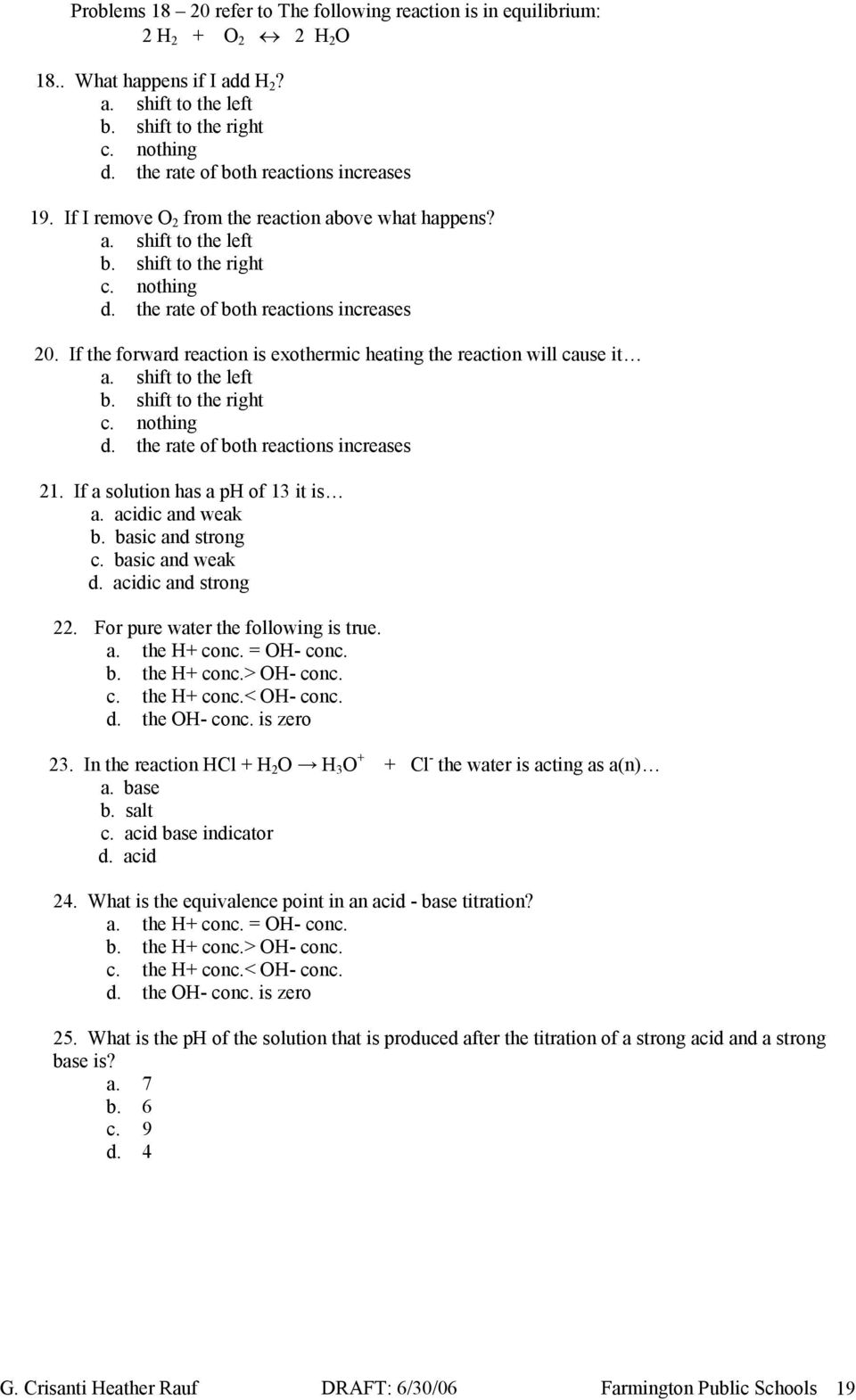
19 Problems refer to The following reaction is in equilibrium: 2 H 2 + O 2 2 H 2 O 18.. What happens if I add H 2? a. shift to the left b. shift to the right c. nothing d. the rate of both reactions increases 19. If I remove O 2 from the reaction above what happens? a. shift to the left b. shift to the right c. nothing d. the rate of both reactions increases 20. If the forward reaction is exothermic heating the reaction will cause it a. shift to the left b. shift to the right c. nothing d. the rate of both reactions increases 21. If a solution has a ph of 13 it is a. acidic and weak b. basic and strong c. basic and weak d. acidic and strong 22. For pure water the following is true. a. the H+ conc. = OH- conc. b. the H+ conc.> OH- conc. c. the H+ conc.< OH- conc. d. the OH- conc. is zero 23. In the reaction HCl + H 2 O H 3 O + + Cl - the water is acting as a(n) a. base b. salt c. acid base indicator d. acid 24. What is the equivalence point in an acid - base titration? a. the H+ conc. = OH- conc. b. the H+ conc.> OH- conc. c. the H+ conc.< OH- conc. d. the OH- conc. is zero 25. What is the ph of the solution that is produced after the titration of a strong acid and a strong base is? a. 7 b. 6 c. 9 d. 4 G. Crisanti Heather Rauf DRAFT: 6/30/06 Farmington Public Schools 19
20 FREE RESPONSE 1. For each of the following write the products formed when you dissolve the substance in water. Acid: HCl + H 2 O Base: F 1- + H 2 O Acid: HClO 4 + H 2 O Base: Br 1- + H 2 O 2. Complete the following chart. Show the work below H+ conc. OH- conc. ph Acidic or basic 5.7 x 10-5 M x 10-3 M x M 1 x 10⁻⁴ M G. Crisanti Heather Rauf DRAFT: 6/30/06 Farmington Public Schools 20

21 3. Label the acid, base, conjugate acid, and conjugate base. HF + H 2 O F - + H 3 O + 4. What is meant when we say that a solution is neutral? G. Crisanti Heather Rauf DRAFT: 6/30/06 Farmington Public Schools 21
An acid is a substance that produces H + (H 3 O + ) Ions in aqueous solution. A base is a substance that produces OH - ions in aqueous solution.
 Chapter 8 Acids and Bases Definitions Arrhenius definitions: An acid is a substance that produces H + (H 3 O + ) Ions in aqueous solution. A base is a substance that produces OH - ions in aqueous solution.
Chem101: General Chemistry Lecture 9 Acids and Bases
 : General Chemistry Lecture 9 Acids and Bases I. Introduction A. In chemistry, and particularly biochemistry, water is the most common solvent 1. In studying acids and bases we are going to see that water
Chapter 19: Acids and Bases Homework Packet (50 pts) Name: Score: / 50
 Chapter 19: Acids and Bases Homework Packet (50 pts) Topic pg Section 19.1 1-3 Section 19.2 3-6 Section 19.3 6-7 Section 19.4 8 Naming Acids 9 Properties of Acids/Bases 10-11 Conjugate Acid/Base Pairs
Note: (H 3 O + = hydronium ion = H + = proton) Example: HS - + H 2 O H 3 O + + S 2-
 AcidBase Chemistry Arrhenius acid: Substance that dissolves in water and provides H + ions Arrhenius base: Substance that dissolves in water and provides OH ions Examples: HCl H + and Cl Acid NaOH Na +
Chapter 17. How are acids different from bases? Acid Physical properties. Base. Explaining the difference in properties of acids and bases
 Chapter 17 Acids and Bases How are acids different from bases? Acid Physical properties Base Physical properties Tastes sour Tastes bitter Feels slippery or slimy Chemical properties Chemical properties
Acids and Bases: A Brief Review
 Acids and : A Brief Review Acids: taste sour and cause dyes to change color. : taste bitter and feel soapy. Arrhenius: acids increase [H ] bases increase [OH ] in solution. Arrhenius: acid base salt water.
Properties of Acids and Bases
 Lab 22 Properties of Acids and Bases TN Standard 4.2: The student will investigate the characteristics of acids and bases. Have you ever brushed your teeth and then drank a glass of orange juice? What
MULTIPLE CHOICE. Choose the one alternative that best completes the statement or answers the question.
 CHE 1400 - Spring 2015 - Chapter 7 Homework 7 MULTIPLE CHOICE. Choose the one alternative that best completes the statement or answers the question. 1)According to Arrhenius, an acid and a base will react
CHAPTER 16: ACIDS AND BASES
 CHAPTER 16: ACIDS AND BASES Active Learning: 4, 6, 14; End-of-Chapter Problems: 2-25, 27-58, 66-68, 70, 75-77, 83, 90-91, 93-104 Chapter 15 End-of-Chapter Problems: 69-74, 125, 129, 133 16.1 ACIDS AND
Chemistry 52. Reacts with active metals to produce hydrogen gas. Have a slippery, soapy feeling. React with carbonates to produce CO 2
 ACID AND BASE STRENGTH Experiment #2 PURPOSE: 1. To distinguish between acids, bases and neutral substances, by observing their effect on some common indicators. 2. To distinguish between strong and weak
ph: Measurement and Uses
 ph: Measurement and Uses One of the most important properties of aqueous solutions is the concentration of hydrogen ion. The concentration of H + (or H 3 O + ) affects the solubility of inorganic and organic
Name period Unit 9: acid/base equilibrium
 Name period Unit 9: acid/base equilibrium 1. What is the difference between the Arrhenius and the BronstedLowry definition of an acid? Arrhenious acids give H + in water BronstedLowry acids are proton
Acids and Bases. Chapter 16
 Acids and Bases Chapter 16 The Arrhenius Model An acid is any substance that produces hydrogen ions, H +, in an aqueous solution. Example: when hydrogen chloride gas is dissolved in water, the following
Chapter 9 Lecture Notes: Acids, Bases and Equilibrium
 Chapter 9 Lecture Notes: Acids, Bases and Equilibrium Educational Goals 1. Given a chemical equation, write the law of mass action. 2. Given the equilibrium constant (K eq ) for a reaction, predict whether
Chapter 14 - Acids and Bases
 Chapter 14 - Acids and Bases 14.1 The Nature of Acids and Bases A. Arrhenius Model 1. Acids produce hydrogen ions in aqueous solutions 2. Bases produce hydroxide ions in aqueous solutions B. Bronsted-Lowry
3 The Preparation of Buffers at Desired ph
 3 The Preparation of Buffers at Desired ph Objectives: To become familiar with operating a ph meter, and to learn how to use the Henderson-Hasselbalch equation to make buffer solutions at a desired ph
Properties of Aqueous Solutions of Acids and Bases. CHAPTER 10 Acids, Bases and Salts. Properties of Aqueous Solutions of Acids and Bases
 CAPTER Acids, Bases and Salts Properties of Aqueous Solutions of Acids and Bases Strong and Weak Acids Acids are substances that generate in aqueous solutions. Strong acids ionize 0% in water. That is,
Titrations. Acid-Base Indicators and Titration Curves. Shapes of Titration Curves. A titration curve is a graphical history of a titration
 Acid-Base Indicators and Titration Curves Titrations In a titration a solution of accurately known concentration is added gradually added to another solution of unknown concentration until the chemical
Q.1 Classify the following according to Lewis theory and Brønsted-Lowry theory.
 Acid-base A4 1 Acid-base theories ACIDS & BASES - IONIC EQUILIBRIA 1. LEWIS acid electron pair acceptor H, AlCl 3 base electron pair donor NH 3, H 2 O, C 2 H 5 OH, OH e.g. H 3 N: -> BF 3 > H 3 N BF 3 see
EXPERIMENT 20: Determination of ph of Common Substances
 Materials: ph paper and color chart (ph range 3 to 12) or ph meter distilled water white vinegar household ammonia (or baking soda) spot plate test or 3 small test tubes stirring rod solutions / fruits
UNIT (6) ACIDS AND BASES
 UNIT (6) ACIDS AND BASES 6.1 Arrhenius Definition of Acids and Bases Definitions for acids and bases were proposed by the Swedish chemist Savante Arrhenius in 1884. Acids were defined as compounds that
TOPIC 11: Acids and Bases
 TOPIC 11: Acids and Bases ELECTROLYTES are substances that when dissolves in water conduct electricity. They conduct electricity because they will break apart into Ex. NaCl(s)! Na + (aq) + Cl - (aq), and
Suggested Problems: p. 625-627 #58, 59, 65, 69, 74, 80, 85, 86, 90, 92, 93, 98, 99
 Chemistry I Accelerated Study Guideline - Chapter 19 Acids, Bases and Salts ------------------------------------------------------------------------------ By the end of this unit, the skills you should
Since we will be dealing with aqueous acid and base solution, first we must examine the behavior of water.
 Acids and Bases Know the definition of Arrhenius, Bronsted-Lowry, and Lewis acid and base. Autoionization of Water Since we will be dealing with aqueous acid and base solution, first we must examine the
Acids and Bases HW PSI Chemistry
 Acids and Bases HW PSI Chemistry Name 1) According to the Arrhenius concept, an acid is a substance that. A) is capable of donating one or more H + B) causes an increase in the concentration of H + in
Q1: What is the ph Scale? Q6: As acids become more acidic, their ph values
 Q1: What is the ph Scale? Q6: As acids become more acidic, their ph values increase or decrease? Q2: The range of values of the ph scale is: Q7: As bases become more alkaline, their ph values increase
Chapter 14: Acids and Bases
 Ch 14 Page 1 Chapter 14: Acids and Bases Properties of Acids Sour taste React with some metals Turns blue litmus paper red React with bases Some Common Acids HCl, hydrochloric acid H 2 SO 4, sulfuric acid
Q.1 Classify the following according to Lewis theory and Brønsted-Lowry theory.
 Acid-base 2816 1 Acid-base theories ACIDS & BASES - IONIC EQUILIBRIA LEWIS acid electron pair acceptor H +, AlCl 3 base electron pair donor NH 3, H 2 O, C 2 H 5 OH, OH e.g. H 3 N: -> BF 3 > H 3 N + BF
1. Read P. 368-375, P. 382-387 & P. 429-436; P. 375 # 1-11 & P. 389 # 1,7,9,12,15; P. 436 #1, 7, 8, 11
 SCH3U- R.H.KING ACADEMY SOLUTION & ACID/BASE WORKSHEET Name: The importance of water - MAKING CONNECTION READING 1. Read P. 368-375, P. 382-387 & P. 429-436; P. 375 # 1-11 & P. 389 # 1,7,9,12,15; P. 436
Sketch the model representation of the first step in the dissociation of water. H 2. O (l) H + (aq) + OH- (aq) + H 2. OH - (aq) + H 3 O+ (aq)
 Lesson Objectives Students will: Create a physical representation of the autoionization of water using the water kit. Describe and produce a physical representation of the dissociation of a strong acid
Notes on Unit 4 Acids and Bases
 Ionization of Water DEMONSTRATION OF CONDUCTIVITY OF TAP WATER AND DISTILLED WATER Pure distilled water still has a small conductivity. Why? There are a few ions present. Almost all the pure water is H
Acid-Base (Proton-Transfer) Reactions
 Acid-Base (Proton-Transfer) Reactions Chapter 17 An example of equilibrium: Acid base chemistry What are acids and bases? Every day descriptions Chemical description of acidic and basic solutions by Arrhenius
4. Acid Base Chemistry
 4. Acid Base Chemistry 4.1. Terminology: 4.1.1. Bronsted / Lowry Acid: "An acid is a substance which can donate a hydrogen ion (H+) or a proton, while a base is a substance that accepts a proton. B + HA
Stoichiometry and Aqueous Reactions (Chapter 4)
 Stoichiometry and Aqueous Reactions (Chapter 4) Chemical Equations 1. Balancing Chemical Equations (from Chapter 3) Adjust coefficients to get equal numbers of each kind of element on both sides of arrow.
Chemistry 3202. Unit 2 Acids and Bases
 Chemistry 3202 Unit 2 Acids and Bases Definitions of Acids and Bases An operational definition is one that is based on the observable properties, behaviours or uses of an entity. The earliest definitions
CHM1 Review for Exam 12
 Topics Solutions 1. Arrhenius Acids and bases a. An acid increases the H + concentration in b. A base increases the OH - concentration in 2. Strong acids and bases completely dissociate 3. Weak acids and
Unit Two: Acids and Bases
 Section One: Theoretical Stuff Unit Two: Acids and Bases The concept of acids and bases has existed for centuries. We can discuss them two ways, operational definitions and theoretical definitions. 1.
ACID-BASE TITRATIONS: DETERMINATION OF CARBONATE BY TITRATION WITH HYDROCHLORIC ACID BACKGROUND
 #3. Acid - Base Titrations 27 EXPERIMENT 3. ACID-BASE TITRATIONS: DETERMINATION OF CARBONATE BY TITRATION WITH HYDROCHLORIC ACID BACKGROUND Carbonate Equilibria In this experiment a solution of hydrochloric
Chemical Reactions in Water Ron Robertson
 Chemical Reactions in Water Ron Robertson r2 f:\files\courses\1110-20\2010 possible slides for web\waterchemtrans.doc Properties of Compounds in Water Electrolytes and nonelectrolytes Water soluble compounds
Acid/Base Definition. Acid/Base Reactions. Major vs. Minor Species. Terms/Items you Need to Know. you need to memorize these!!
 Acid/Base Reactions some covalent compounds have weakly bound H atoms and can lose them to water (acids) some compounds produce OH in water solutions when they dissolve (bases) acid/base reaction are very
CHAPTERS 15 FAKE TEST QUESTIONS. 1. According to the Brønsted Lowry definition, which species can function both as an acid and as a base?
 You might need to know the following K values: CHAPTERS 15 FAKE TEST QUESTIONS CH 3 COOH K a = 1.8 x 10 5 Benzoic Acid K a = 6.5 x 10 5 HNO 2 K a = 4.5 x 10 4 NH 3 K b = 1.8 x 10 5 HF K a = 7.2 x 10 4
20.2 Chemical Equations
 All of the chemical changes you observed in the last Investigation were the result of chemical reactions. A chemical reaction involves a rearrangement of atoms in one or more reactants to form one or more
Neutralizing an Acid and a Base
 Balancing Act Teacher Information Objectives In this activity, students neutralize a base with an acid. Students determine the point of neutralization of an acid mixed with a base while they: Recognize
Determination of the Amount of Acid Neutralized by an Antacid Tablet Using Back Titration
 Determination of the Amount of Acid Neutralized by an Antacid Tablet Using Back Titration GOAL AND OVERVIEW Antacids are bases that react stoichiometrically with acid. The number of moles of acid that
6) Which compound is manufactured in larger quantities in the U.S. than any other industrial chemical?
 MULTIPLE CHOICE. Choose the one alternative that best completes the statement or answers the question. 1) Which statement concerning Arrhenius acid-base theory is not correct? A) Acid-base reactions must
CHEM 110: CHAPTER 3: STOICHIOMETRY: CALCULATIONS WITH CHEMICAL FORMULAS AND EQUATIONS
 1 CHEM 110: CHAPTER 3: STOICHIOMETRY: CALCULATIONS WITH CHEMICAL FORMULAS AND EQUATIONS The Chemical Equation A chemical equation concisely shows the initial (reactants) and final (products) results of
Volumetric Analysis. Lecture 5 Experiment 9 in Beran page 109 Prelab = Page 115
 Volumetric Analysis Lecture 5 Experiment 9 in Beran page 109 Prelab = Page 115 Experimental Aims To prepare and standardize (determine concentration) a NaOH solution Using your standardized NaOH calculate
Acids, Bases, and ph
 CHAPTER 9 1 SECTION Acids, Bases, and Salts Acids, Bases, and ph KEY IDEAS As you read this section, keep these questions in mind: What properties do acids have? What properties do bases have? How can
CHEMISTRY 101 EXAM 3 (FORM B) DR. SIMON NORTH
 1. Is H 3 O + polar or non-polar? (1 point) a) Polar b) Non-polar CHEMISTRY 101 EXAM 3 (FORM B) DR. SIMON NORTH 2. The bond strength is considerably greater in HF than in the other three hydrogen halides
General Chemistry II Chapter 20
 1 General Chemistry II Chapter 0 Ionic Equilibria: Principle There are many compounds that appear to be insoluble in aqueous solution (nonelectrolytes). That is, when we add a certain compound to water
Chemistry. The student will be able to identify and apply basic safety procedures and identify basic equipment.
 Chemistry UNIT I: Introduction to Chemistry The student will be able to describe what chemistry is and its scope. a. Define chemistry. b. Explain that chemistry overlaps many other areas of science. The
Common Ion Effects. CH 3 CO 2 (aq) + Na + (aq)
 Common Ion Effects If two reactions both involve the same ion, then one reaction can effect the equilibrium position of the other reaction. The ion that appears in both reactions is the common ion. Buffers
Chapter 16 Acid-Base Equilibria
 Chapter 16 Acid-Base Equilibria Learning goals and key skills: Understand the nature of the hydrated proton, represented as either H + (aq) or H 3 O + (aq) Define and identify Arrhenuis acids and bases.
EXPERIMENT 4 Acid Strength
 EXPERIMENT 4 Acid Strength Introduction Many common substances are either acids or bases. Some acids, like stomach acid are necessary for our health, while others, like sulfuric acid are dangerous and
Forensic Science Standards and Benchmarks
 Forensic Science Standards and Standard 1: Understands and applies principles of scientific inquiry Power : Identifies questions and concepts that guide science investigations Uses technology and mathematics
Chapter 16: Acid-Base and Solubility Equilibria: Reactions in Soil and Water
 Chapter 16: Acid-Base and Solubility Equilibria: Reactions in Soil and Water Problems: 16.2-16.86 16.1 ACIDS AND BASES: THE BRØNSTED-LOWRY MODEL PROPERTIES OF ACIDS & BASES Acids produce hydrogen ions,
Return to Lab Menu. Stoichiometry Exploring the Reaction between Baking Soda and Vinegar
 Return to Lab Menu Stoichiometry Exploring the Reaction between Baking Soda and Vinegar Objectives -to observe and measure mass loss in a gas forming reaction -to calculate CO 2 loss and correlate to a
CHEM 1212 Test II. MULTIPLE CHOICE. Choose the one alternative that best completes the statement or answers the question.
 CHEM 1212 Test II MULTIPLE CHOICE. Choose the one alternative that est completes the statement or answers the question. 1) At 1000 K, the equilirium constant for the reaction is K p = 0.013. 2NO (g) +
ACID-BASE REACTIONS/ THE PH CONCEPT.
 Dr Mike Lyons School of Chemistry Trinity College Dublin. [email protected] ACID-BASE REACTIONS/ THE PH CONCEPT. Chemistry Preliminary Course 2011 1 Lecture topics. 2 lectures dealing with some core chemistry
Acids and Bases. AND a widemouth container of the following solids:
 Acids and Bases GOAL To introduce students to acids and bases. MATERIALS: 3 10oz clear plastic cups 1 4 oz. bottle white vinegar - labeled Acid 1 4 oz. bottle of water - labeled Water 1 4 oz. bottle of
Chapter 15 Acids and Bases. Fu-Yin Hsu
 Chapter 15 Acids and Bases Fu-Yin Hsu Stomach Acid and Heartburn The cells that line your stomach produce hydrochloric acid. To kill unwanted bacteria To help break down food To activate enzymes that break
Introduction to Chemistry. Course Description
 CHM 1025 & CHM 1025L Introduction to Chemistry Course Description CHM 1025 Introduction to Chemistry (3) P CHM 1025L Introduction to Chemistry Laboratory (1) P This introductory course is intended to introduce
Chapter 13 & 14 Practice Exam
 Name: Class: Date: Chapter 13 & 14 Practice Exam Multiple Choice Identify the choice that best completes the statement or answers the question. 1. Acids generally release H 2 gas when they react with a.
Answer Key Chemistry If8766 Moles And Mass
 If8766 Moles And Mass Free PDF ebook Download: If8766 Moles And Mass Download or Read Online ebook answer key chemistry if8766 moles and mass in PDF Format From The Best User Guide Database Moles and Mass.
Acids and Bases. An Introduction. David A Katz Department of Chemistry Pima Community College, Tucson, AZ, USA
 Acids and Bases An Introduction David A Katz Department of Chemistry Pima Community College, Tucson, AZ, USA Properties of Acids 1. Sour taste (examples: vinegar, citric acid, lemon juice) 2. Turns litmus
Letter to the Student... 5 Test-Taking Checklist... 6 Next Generation Sunshine State Standards Correlation Chart... 7
 Table of Contents Letter to the Student..................................... 5 Test-Taking Checklist.................................... 6 Next Generation Sunshine State Standards Correlation Chart...
Syllabus OC18 Use litmus or a universal indicator to test a variety of solutions, and classify these as acidic, basic or neutral
 Chemistry: 9. Acids and Bases Please remember to photocopy 4 pages onto one sheet by going A3 A4 and using back to back on the photocopier Syllabus OC18 Use litmus or a universal indicator to test a variety
6 Reactions in Aqueous Solutions
 6 Reactions in Aqueous Solutions Water is by far the most common medium in which chemical reactions occur naturally. It is not hard to see this: 70% of our body mass is water and about 70% of the surface
Chapter 4 Chemical Reactions
 Chapter 4 Chemical Reactions I) Ions in Aqueous Solution many reactions take place in water form ions in solution aq solution = solute + solvent solute: substance being dissolved and present in lesser
CHEMISTRY STANDARDS BASED RUBRIC ATOMIC STRUCTURE AND BONDING
 CHEMISTRY STANDARDS BASED RUBRIC ATOMIC STRUCTURE AND BONDING Essential Standard: STUDENTS WILL UNDERSTAND THAT THE PROPERTIES OF MATTER AND THEIR INTERACTIONS ARE A CONSEQUENCE OF THE STRUCTURE OF MATTER,
Prentice Hall. Chemistry (Wilbraham) 2008, National Student Edition - South Carolina Teacher s Edition. High School. High School
 Prentice Hall Chemistry (Wilbraham) 2008, National Student Edition - South Carolina Teacher s Edition High School C O R R E L A T E D T O High School C-1.1 Apply established rules for significant digits,
Correlation of Nelson Chemistry Alberta 20 30 to the Alberta Chemistry 20 30 Curriculum
 Correlation of Nelson Chemistry Alberta 20 30 to the Alberta Chemistry 20 30 Curriculum Unit 5 Organic Chemistry General Outcomes Students will: 1. explore organic compounds as a common form of matter
IB Chemistry 1 Mole. One atom of C-12 has a mass of 12 amu. One mole of C-12 has a mass of 12 g. Grams we can use more easily.
 The Mole Atomic mass units and atoms are not convenient units to work with. The concept of the mole was invented. This was the number of atoms of carbon-12 that were needed to make 12 g of carbon. 1 mole
Experiment 8 - Double Displacement Reactions
 Experiment 8 - Double Displacement Reactions A double displacement reaction involves two ionic compounds that are dissolved in water. In a double displacement reaction, it appears as though the ions are
The Determination of Acid Content in Vinegar
 The Determination of Acid Content in Vinegar Reading assignment: Chang, Chemistry 10 th edition, pages 153-156. Goals We will use a titration to determine the concentration of acetic acid in a sample of
Chemistry 201. Practical aspects of buffers. NC State University. Lecture 15
 Chemistry 201 Lecture 15 Practical aspects of buffers NC State University The everyday ph scale To review what ph means in practice, we consider the ph of everyday substances that we know from experience.
Acids, Bases, and Indicators Colorful Chemistry
 Cool Chemistry Show Activity 7 Acids, Bases, and Indicators Colorful Chemistry GOALS In this activity you will: Identify common household acids and bases. Identify characteristic properties of acids and
Acid/base Definitions. Acid/Base Definitions. Acid / Base Chemistry. Acid/Base Definitions. Identifying Acids and Bases
 Acids Identifying Acids and Bases Acid (anhydrides) contains H+ ions as the cation, with and other element as the anion Non-metal oxide H2SO4 HI P2O5 Bases Base (anhydrides) Contains OH- as the anion Combined
Chapter 17. The best buffer choice for ph 7 is NaH 2 PO 4 /Na 2 HPO 4. 19)
 Chapter 17 2) a) HCl and CH 3 COOH are both acids. A buffer must have an acid/base conjugate pair. b) NaH 2 PO 4 and Na 2 HPO 4 are an acid/base conjugate pair. They will make an excellent buffer. c) H
7-5.5. Translate chemical symbols and the chemical formulas of common substances to show the component parts of the substances including:
 7-5.5 Translate chemical symbols and the chemical formulas of common substances to show the component parts of the substances including: NaCl [salt], H 2 O [water], C 6 H 12 O 6 [simple sugar], O 2 [oxygen
ph. Weak acids. A. Introduction
 ph. Weak acids. A. Introduction... 1 B. Weak acids: overview... 1 C. Weak acids: an example; finding K a... 2 D. Given K a, calculate ph... 3 E. A variety of weak acids... 5 F. So where do strong acids
Auto-ionization of Water
 2H 2 O H 3 O + + OH Hydronium ion hydroxide ion Q: But how often does this happen? This is the fundamental concept of all acid-base chemistry In pure water, how much of it is water and how much is ions?
p3 Recognizing Acid/Base Properties when p11 Recognizing Basic versus Nonbasic
 General Chemistry II Jasperse Acid-Base Chemistry. Extra Practice Problems 1 General Types/Groups of problems: Conceptual Questions. Acids, Bases, and p1 K b and pk b, Base Strength, and using K b or p7-10
ph units constitute a scale which allows scientists to determine the acid or base content of a substance or solution. The ph 0
 ACID-BASE TITRATION LAB PH 2.PALM INTRODUCTION Acids and bases represent a major class of chemical substances. We encounter them every day as we eat, clean our homes and ourselves, and perform many other
Experiment 18: ph Measurements of Common Substances. Experiment 17: Reactions of Acids with Common Substances
 Experiment 18: ph Measurements of Common Substances and Experiment 17: Reactions of Acids with Common Substances What is this lab about? You mean what ARE THESE labs about? Ok, so what are THESE labs about?
Chemical Calculations: Formula Masses, Moles, and Chemical Equations
 Chemical Calculations: Formula Masses, Moles, and Chemical Equations Atomic Mass & Formula Mass Recall from Chapter Three that the average mass of an atom of a given element can be found on the periodic
To determine the equivalence points of two titrations from plots of ph versus ml of titrant added.
 Titration Curves PURPOSE To determine the equivalence points of two titrations from plots of ph versus ml of titrant added. GOALS 1 To gain experience performing acid-base titrations with a ph meter. 2
Topic 8 Acids and bases 6 hours
 Topic 8 Acids and bases 6 hours Hydronium ion (H3O + ) = more stable form of hydrogen ion (H + ) H + + H2O H3O + 8.1 Theories of acids and bases 2 hours 1. Arrhenius H-X / M-OH ACID a substance that dissociates
NH 3 + H 2 O + OH - NH 4. Acid-Base Concepts -- Chapter 15 + H + Conjugate Acid-Base Pairs: - H + base. acid
 Acid-Base Concepts -- Chapter 15 1. Arrhenius Acid-Base Concept (last semester) Acid: H+ supplier Base: OH- supplier 2. Brønsted-Lowry Acid-Base Concept (more general) (a) Definition (H+ transfer) Acid:
Chemistry B11 Chapter 4 Chemical reactions
 Chemistry B11 Chapter 4 Chemical reactions Chemical reactions are classified into five groups: A + B AB Synthesis reactions (Combination) H + O H O AB A + B Decomposition reactions (Analysis) NaCl Na +Cl
PTAC: Applied Chemistry COURSE OUTLINE & OBJECTIVES ESC Approved November 19, 2004
 INTRODUCTION PTAC: Applied Chemistry COURSE OUTLINE & OBJECTIVES ESC Approved November 19, 2004 A. Introduction to Chemistry Terms 1. Define basic terms associated with chemistry: Organic/inorganic/biochemistry/physical
4.1 Stoichiometry. 3 Basic Steps. 4. Stoichiometry. Stoichiometry. Butane Lighter 2C 4 H 10 + 13O 2 10H 2 O + 8CO 2
 4. Stoichiometry 1. Stoichiometric Equations 2. Limiting Reagent Problems 3. Percent Yield 4. Limiting Reagent Problems 5. Concentrations of Solutes 6. Solution Stoichiometry 7. ph and Acid Base Titrations
Write the acid-base equilibria connecting all components in the aqueous solution. Now list all of the species present.
 Chapter 16 Acids and Bases Concept Check 16.1 Chemists in the seventeenth century discovered that the substance that gives red ants their irritating bite is an acid with the formula HCHO 2. They called
To see how this data can be used, follow the titration of hydrofluoric acid against sodium hydroxide below. HF (aq) + NaOH (aq) H2O (l) + NaF (aq)
 Weak Acid Titration v120413 You are encouraged to carefully read the following sections in Tro (2 nd ed.) to prepare for this experiment: Sec 4.8, pp 158-159 (Acid/Base Titrations), Sec 16.4, pp 729-43
MOLARITY = (moles solute) / (vol.solution in liter units)
 CHEM 101/105 Stoichiometry, as applied to Aqueous Solutions containing Ionic Solutes Lect-05 MOLES - a quantity of substance. Quantities of substances can be expressed as masses, as numbers, or as moles.
Ch 8.5 Solution Concentration Units % (m/m or w/w) = mass of solute x 100 total mass of solution mass of solution = mass solute + mass solvent
 1 Ch 8.5 Solution Concentration Units % (m/m or w/w) = mass of solute x 100 total mass of solution mass of solution = mass solute + mass solvent % (v/v) = volume of solute x 100 volume of solution filled
Required Reading Material.
 JF Chemistry 1101 2014-2015 Introduction to Physical Chemistry: Acid Base and Solution Equilibria. Professor Mike Lyons School of Chemistry [email protected] Required Reading Material. Kotz, Treichel and
CHEMICAL DETERMINATION OF EVERYDAY HOUSEHOLD CHEMICALS
 CHEMICAL DETERMINATION OF EVERYDAY HOUSEHOLD CHEMICALS Purpose: It is important for chemists to be able to determine the composition of unknown chemicals. This can often be done by way of chemical tests.
Copyright 2009 by Pearson Education, Inc. Upper Saddle River, New Jersey 07458 All rights reserved.
 Sample Exercise 17.1 Calculating the ph When a Common Ion is Involved What is the ph of a solution made by adding 0.30 mol of acetic acid and 0.30 mol of sodium acetate to enough water to make 1.0 L of