
Introduction to Chemistry. Course Description
|
|
|
- Alisha Hampton
- 9 years ago
- Views:
Transcription
1 CHM 1025 & CHM 1025L Introduction to Chemistry Course Description CHM 1025 Introduction to Chemistry (3) P CHM 1025L Introduction to Chemistry Laboratory (1) P This introductory course is intended to introduce students to the study of chemistry by building concepts and skills related to investigating the structure and nature of matter, and its potential for change. The student will learn basic characteristics of matter, fundamental energy concepts, the principles of chemical nomenclature and stoichiometry, and begin to build a 3-dimensional visualization of the molecular world. The laboratory experience is an integral part of the course and will provide students with the opportunity to develop their skills in making observations, taking measurements, designing experiments, and communicating their data, results and conclusions in oral written and graphical form. The math reasoning skills and spatial visualization required in this course presumes prior experience with algebra and geometry. Pre-requisite: College Algebra (MAC 1105) or its equivalent Co-requisite: CHM 1025 & CHM 1025L must be taken together Rationale The study of chemistry enables students to build an interpretive and predictive model for understanding the properties of matter in all its forms and the potential for change through chemical reactions. Many students come to college ill prepared for the study of chemistry and this course will allow them to explore the subject without all of the details of College Chemistry, and/or to prepare themselves for further study of the subject. To that end, this course supports the college mission of providing the highest quality post-secondary education leading to the Associate of Arts degree, and further to a baccalaureate degree. The application of the scientific methodology to the study of matter and its potential for change promotes the opportunity for keen environmental awareness and a competent use of technology. The result will be a student capable of critical analysis, logical reasoning and problem solving using both mathematical and graphing tools. Impact Assessment Success in the course is highly dependent on math reasoning skills learned in College Algebra, and the foundation provided by high school science courses. It is offered as one of the options for students to meet the 3-hr minimum requirement in the physical sciences portion of the general education requirements for the Associate of Arts degree, and it is intended to provide the background required for success in College Chemistry. The laboratory experience is integral to success in the course; lecture and lab must be taken together.
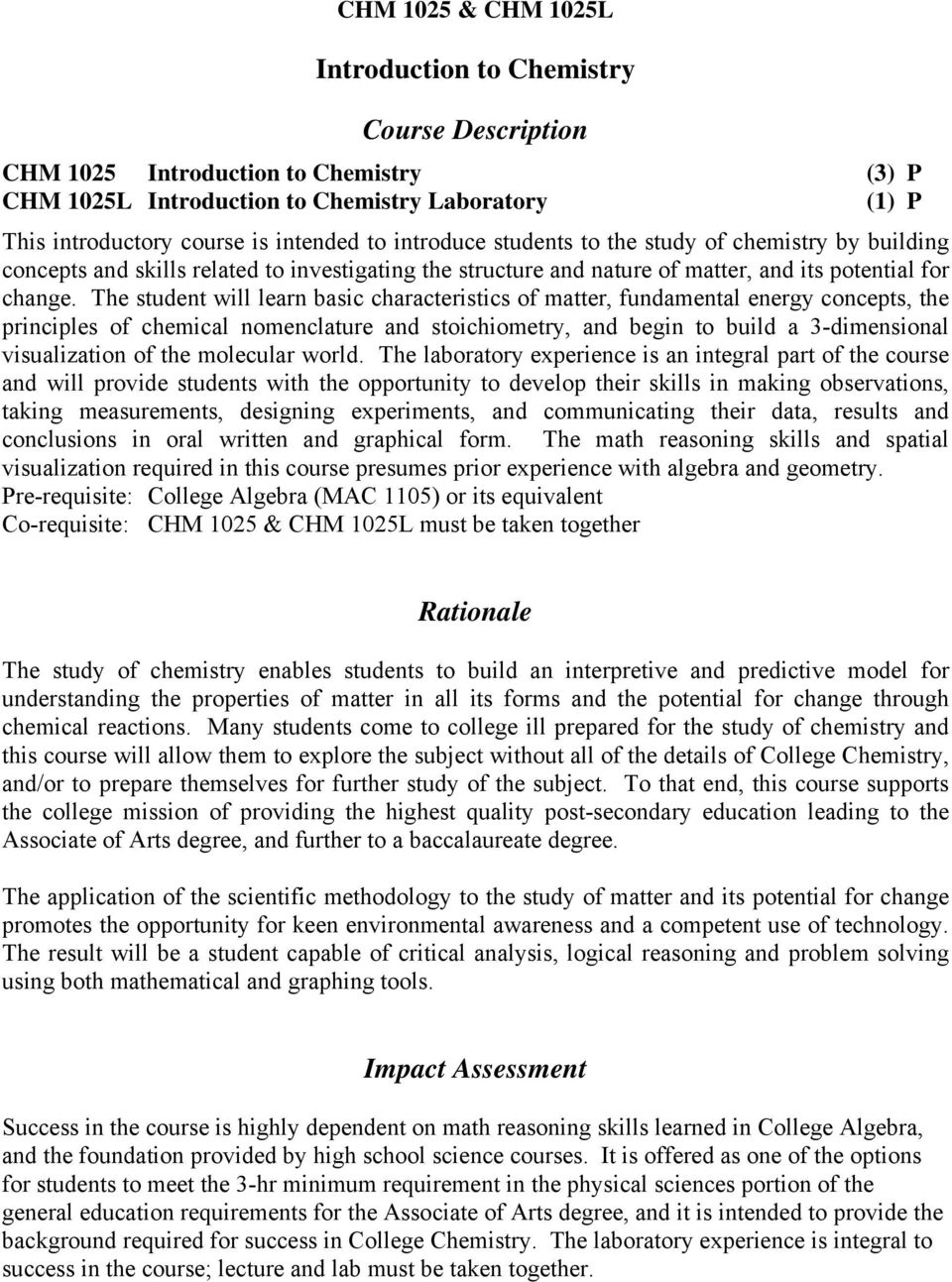
2 Broad Course Objectives This course supports the departmental goal of providing a foundation in the sciences for students to build upon for life-long learning or as a basis for further study in science. It provides students with an opportunity to develop an understanding of the atomic model for interpreting chemical phenomena, scientific reasoning skills, and mathematical and graphical analysis skills using modern computer technology. In order to achieve these objectives, the instructor will strive to: 1. Extend students ability to apply mathematics and math reasoning to chemistry 2. Enable students to develop their critical reasoning skills 3. Expand students experience with characteristic properties and chemical changes 4. Extend students vocabulary of science concepts and terms 5. Illustrate the methodology of scientific inquiry and 6. Reinforce students verbal, mathematical and computer skills. I. Mathematical Skills Topical Outline with Specific Objectives A. Systems of Measurement and unit analysis B. Scientific Notation C. Significant figures D. Data interpretation and analysis: direct proportions inverse proportions linear equations accuracy and precision 1. Use SI units and their accepted alternatives in chemistry 2. Demonstrate skills in measuring mass, volume and temperature 3. Describe the imprecise nature of all measurements 4. Use graphing techniques to represent or analyze experimental data 5. Determine the number of significant figures in a measured quantity and relate to the uncertainty. 6. Round off calculated results to the appropriate number of significant figures. 7. Correctly determine the unit of a derived quantity. 8. Show proficiency in using exponential notation. 2
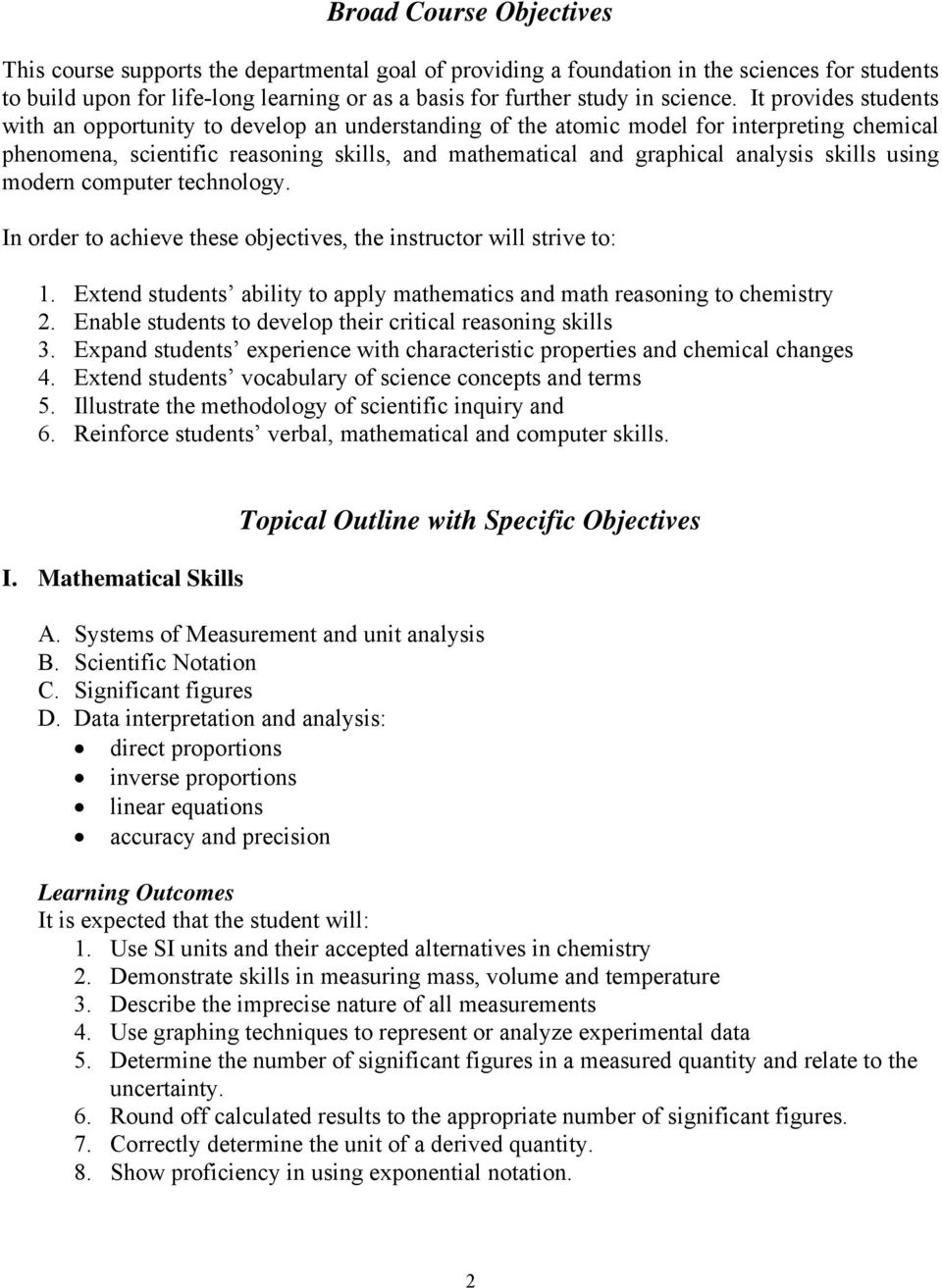
3 II. Energy and Energy Changes A. Stability/reactivity and energy content B. Relationships to electrostatic force (Coulomb s Law) C. H, endothermic, exothermic, relationship to bond making and bond breaking 1. Explain what happens to the energy of a system as it becomes more stable or less stable. 2. Show an understanding of force and energy. 3. Use Coulomb s Law to predict the effect on the force of attraction or repulsion when charges or distances between ions are changed. 4. Show an understanding of exothermic and endothermic by applying the terms correctly to various types of physical or chemical changes. III. Classification of Matter Emphasis on nano-macro visualization A. Pure substances: elements and compounds B. Mixtures: homogeneous and heterogeneous C. States of Matter D. Physical properties and its uses in the separation (purification) and identification of substances E. Chemical properties/chemical changes 1. Distinguish physical from chemical changes; extensive from intensive properties 2. Define BP, MP (FP), sublimation point 1. Define matter. 2. Describe and distinguish different types of matter (both macro and nanoscale views) 3. Describe the states of matter in terms of macroscale properties as well as nanoscale structure, interparticle distances and motion, and energies. 4. Classify a given material as an element, compound or mixture using the properties of the material. 5. Relate the observable (macroscopic) characteristics and properties of elements compounds and mixtures to the concept of atoms and molecules. 6. Relate heat changes that occur during a phase change to the energy required or released when separating or combining species that attract or repel. 7. Describe several ways that substances may be separated from one another. i.e. filtration, distillation, chromatography, etc. 3

4 IV. Atomic Structure A. Dalton s Theory B. Atoms as fundamental units of elements; molecules as fundamental units of molecular compounds: and ions as fundamental units of ionic compounds. C. Law of Conservation of Mass D. Law of Definite Proportions E. Subatomic particles: discovery, characteristics F. Atomic Number, mass number isotopes 1. Define atom, molecule and ion. 2. Describe early models of the atom. 3. Describe the relative position, mass and charge for the proton, neutron and electron. 4. Calculate the number of subatomic particles for an atom or monoatomic ion given the mass number and the charge. 5. Show how the Law of Conservation of Mass & of Definite Composition are explained in terms of Atomic Theory V. The Periodic Table A. Organization of the modern periodic table B. Elements as metals, nonmetals, and noble gases (emphasize stability) C. Names of common families in the periodic table 1. Classify elements as metal, nonmetal, or metalloid and locate them on the periodic table. 2. Identify the following families of elements: alkali metals, alkaline earth metals, halogens and noble gases. VI. Compounds: Molecular and Ionic A. ID formulas from nature of elements B. Nomenclature of ionic compounds C. Nomenclature of binary molecular compounds D. Lewis Dot Structures and valence electrons 4

5 1. Define covalent and ionic bonding. 2. Define valence electrons. 3. Demonstrate a knowledge that bonding involves valence electrons. 4. Draw electron dot diagrams for atoms. 5. Identify from a chemical formula whether a compound is molecular (covalent) or ionic. 6. Draw electron dot diagrams and structural formulae for simple molecules and ions and deduce the molecular formula. 7. Develop a vocabulary of common monoatomic ions (symbols and charges) and select polyatomic ions 8. Name ionic compounds from a formula and write the formula given the name 9. Name covalent compounds given the formula using the Greek prefix naming system and write the formula given the name VII. Introduction to Compound Stoichiometry A. The mole concept B. Formula mass C. Avogadro s number, number of atoms, ions, formula units, molecules 1. Define the mole 2. Determine the molar mass of an element or compound 3. Perform calculations relating the number of particles, moles and mass 4. Compare and contrast molecular and empirical formulas 5. Calculate the empirical formula of a compound from its % composition VIII. Introduction to Reaction Stoichiometry A. Basics of a chemical reaction or stoichiometric equation B. Apply the law of conservation of mass to a stoichiometric equation i.e. balance chemical reactions including enthalpy C. Introduction to common reaction types: synthesis, decomposition, replacement combustion and acid-base. 1. Define reactants and products 2. Observe and record changes that occur during a chemical reaction 3. Gather experimental data that lead to the law of conservation of mass 4. Apply the law of conservation of mass to a formula equation of a reaction to demonstrate that atoms are conserved in the reaction 5
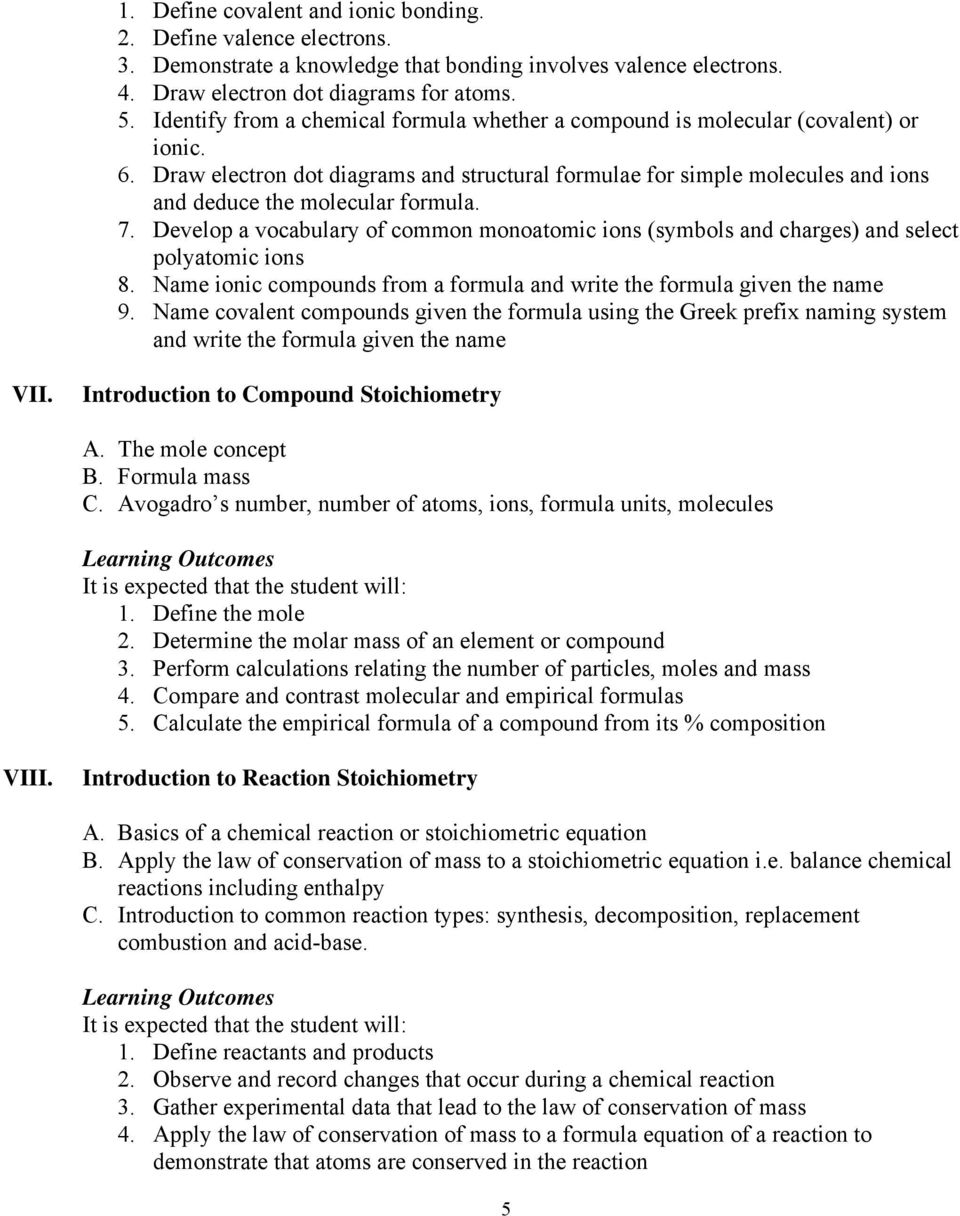
6 5. Balance chemical reactions 6. Define exothermic and endothermic reactions 7. Classify reactions as endothermic or exothermic based on experimental observations 8. Relate energy changes to bond breaking and formation 9. Write equations for chemical reactions including the energy term 10. Classify, predict products and write balanced equations for the following types of reactions: $ synthesis $ decomposition $ single replacement $ double replacement $ combustion $ acid-base neutralization IX. Intro to Kinds of Physical/Chemical Changes A. Ionic and molecular dissolutions - Intro to equilibrium B. Intro to acid/base reactions - Intro to equilibrium C. Simple Redox 1. Write aqueous ionic and molecular dissolution equations 2. Write the names and formulas of some common acids: HCl, H 2 SO 4, HNO 3, HC 2 H 3 O 2 3. Write simple aqueous molecular ionization equations XI. Molecular Structure A. Isomers B. Basic VSEPR (limit to linear, trigonal planar, and tetrahedral) C. Electronegativity and molecular polarity D. Relationship between molecular polarity and physical properties such as boiling pt. melting pt. and solubility 1. Given a simple molecular formula, draw the different structural isomers possible. 2. Use basic VSEPR to determine the molecular geometry and bond angle of simple molecules. 3. Define electronegativity and use it to classify bonds as polar or nonpolar. 4. Relate molecular geometry to molecular polarity. Be able to classify linear, 6
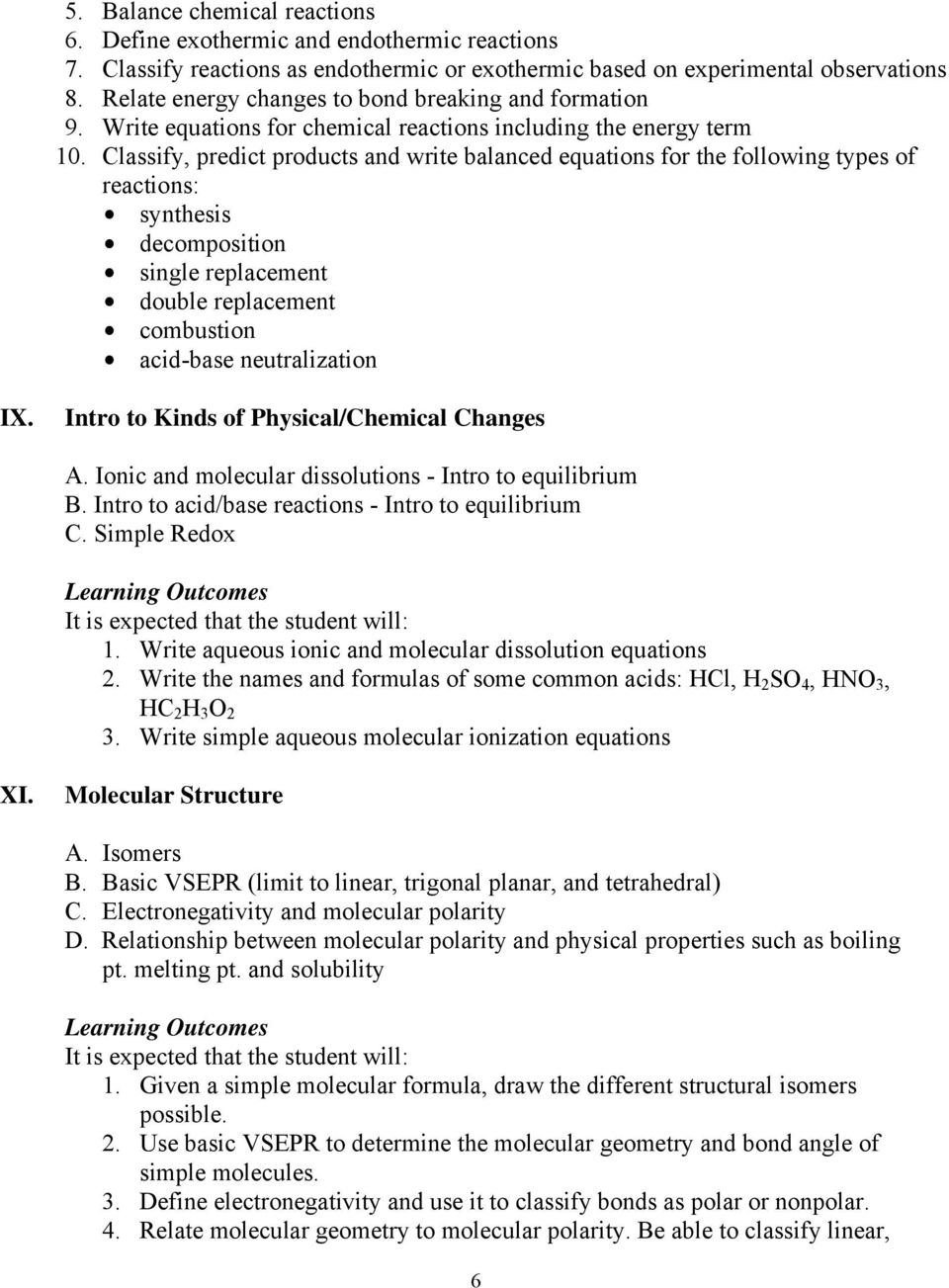
7 trigonal planar, and tetrahedral molecules as polar or nonpolar. 5. Explain the relationship between molecular polarity and physical properties. The Laboratory Component A. Lab Safety B. Measurement and communication C. Scientific methodology D. Classify matter and its observed changes E. Relate molecular models to chemical changes 1. Be able to describe how and when to use each piece of equipment 2. Describe common laboratory hazards and procedures or techniques to deal with such hazards. 3. Produce a list of rules of safe laboratory conduct. 4. Display a conscious safety attitude in the laboratory. 5. Demonstrate skills in measuring mass, volume, and temperature. 6. State the acceptability of numerical results of a lab experiment with regard to the uncertainty of the results. 7. Communicate results and data in clear and understandable forms 8. Show an understanding of the principles in good experimental design. Evaluation The evaluation design is left to the individual instructor but it should contain a real-time assessment of both laboratory and reasoning skills and at least a portion of every test should involve written responses and/or detailed solutions to problems. The final exam must be comprehensive and focus on the concepts and skills required for entry into the College Chemistry sequence. 25 October

Chemistry. The student will be able to identify and apply basic safety procedures and identify basic equipment.
 Chemistry UNIT I: Introduction to Chemistry The student will be able to describe what chemistry is and its scope. a. Define chemistry. b. Explain that chemistry overlaps many other areas of science. The
CHEMISTRY STANDARDS BASED RUBRIC ATOMIC STRUCTURE AND BONDING
 CHEMISTRY STANDARDS BASED RUBRIC ATOMIC STRUCTURE AND BONDING Essential Standard: STUDENTS WILL UNDERSTAND THAT THE PROPERTIES OF MATTER AND THEIR INTERACTIONS ARE A CONSEQUENCE OF THE STRUCTURE OF MATTER,
PTAC: Applied Chemistry COURSE OUTLINE & OBJECTIVES ESC Approved November 19, 2004
 INTRODUCTION PTAC: Applied Chemistry COURSE OUTLINE & OBJECTIVES ESC Approved November 19, 2004 A. Introduction to Chemistry Terms 1. Define basic terms associated with chemistry: Organic/inorganic/biochemistry/physical
Keystone Exams: Chemistry Assessment Anchors and Eligible Content. Pennsylvania Department of Education www.education.state.pa.
 Assessment Anchors and Pennsylvania Department of Education www.education.state.pa.us 2010 PENNSYLVANIA DEPARTMENT OF EDUCATION General Introduction to the Keystone Exam Assessment Anchors Introduction
AAHS-CHEMISTRY FINAL EXAM PREP-REVIEW GUIDE MAY-JUNE 2014 DR. GRAY CLASS OF 2016
 AAHS-CHEMISTRY FINAL EXAM PREP-REVIEW GUIDE MAY-JUNE 2014 DR. GRAY CLASS OF 2016 UNIT I: (CHAPTER 1-Zumdahl text) The Nature of Science and Chemistry 1. Explain why knowledge of chemistry is central to
A Teaching Portfolio for General Chemistry Harry Pang, Ph.D.
 A Teaching Portfolio for General Chemistry Harry Pang, Ph.D. Table of Content I. Teaching Philosophy II. Critical Thinking Practices III. Course Syllabus IV. Student Evaluation V. Final Report I. My Teaching
Instructional Notes/Strategies. GLEs. Evidence / Assessments of learning Knowledge/Synthesis. Resources # SI-1 (E)
 Lafayette Parish School System Curriculum Map Honors Chemistry (Pearson) Unit 1: Introduction to Chemistry Time Frame 1 week August 15 August 21, 2011 Unit Description - This unit focuses on Why It Is
STATE UNIVERSITY OF NEW YORK COLLEGE OF TECHNOLOGY CANTON, NEW YORK COURSE OUTLINE CHEM 150 - COLLEGE CHEMISTRY I
 STATE UNIVERSITY OF NEW YORK COLLEGE OF TECHNOLOGY CANTON, NEW YORK COURSE OUTLINE CHEM 150 - COLLEGE CHEMISTRY I PREPARED BY: NICOLE HELDT SCHOOL OF SCIENCE, HEALTH, AND PROFESSIONAL STUDIES SCIENCE DEPARTMENT
Bergen Community College Division of Mathematics, Science and Technology Department of Physical Sciences
 Semester and year: Course Number: Meeting Times and Locations: Instructor: Office Location: Phone: Office Hours: Email Address: Bergen Community College Division of Mathematics, Science and Technology
Forensic Science Standards and Benchmarks
 Forensic Science Standards and Standard 1: Understands and applies principles of scientific inquiry Power : Identifies questions and concepts that guide science investigations Uses technology and mathematics
Prentice Hall. Chemistry (Wilbraham) 2008, National Student Edition - South Carolina Teacher s Edition. High School. High School
 Prentice Hall Chemistry (Wilbraham) 2008, National Student Edition - South Carolina Teacher s Edition High School C O R R E L A T E D T O High School C-1.1 Apply established rules for significant digits,
AP Chemistry A. Allan Chapter 8 Notes - Bonding: General Concepts
 AP Chemistry A. Allan Chapter 8 Notes - Bonding: General Concepts 8.1 Types of Chemical Bonds A. Ionic Bonding 1. Electrons are transferred 2. Metals react with nonmetals 3. Ions paired have lower energy
Chemistry. Essential Question: How can one explain the structure, properties, and interactions of matter?
 Chemistry Special Note for the 2014-15 School Year: In 2013, the Maryland State Board of Education adopted the Next Generation Science Standards (NGSS) that set forth a vision for science education where
Bonding & Molecular Shape Ron Robertson
 Bonding & Molecular Shape Ron Robertson r2 n:\files\courses\1110-20\2010 possible slides for web\00bondingtrans.doc The Nature of Bonding Types 1. Ionic 2. Covalent 3. Metallic 4. Coordinate covalent Driving
Title: General Chemistry I. Department: Credits: 5 Lecture Hours:4 Lab/Studio Hours:3
 Code: CHEM-101 Title: General Chemistry I Institute: STEM Department: Chemistry Course Description:The student will investigate the fundamental concepts of chemistry from a theoretical approach and participate
What You Need To Know for the Chemistry Regents Exam
 Name: What You Need To Know for the Chemistry Regents Exam The Test The Chemisty Regents Exam is broken down into three sections: Part A: 35 mulitple choice questions from all units covered over the course
One Stop Shop For Teachers
 Physical Science Curriculum The Georgia Performance Standards are designed to provide students with the knowledge and skills for proficiency in science. The Project 2061 s Benchmarks for Science Literacy
AP Chemistry Semester One Study Guide
 AP Chemistry Semester One Study Guide Unit One: General Chemistry Review Unit Two: Organic Nomenclature Unit Three: Reactions Unit Four: Thermochemistry Unit Five: Electronic Structure of the Atom Unit
The content is based on the National Science Teachers Association (NSTA) standards and is aligned with state standards.
 Literacy Advantage Physical Science Physical Science Literacy Advantage offers a tightly focused curriculum designed to address fundamental concepts such as the nature and structure of matter, the characteristics
Indiana's Academic Standards 2010 ICP Indiana's Academic Standards 2016 ICP. map) that describe the relationship acceleration, velocity and distance.
 .1.1 Measure the motion of objects to understand.1.1 Develop graphical, the relationships among distance, velocity and mathematical, and pictorial acceleration. Develop deeper understanding through representations
Southeastern Louisiana University Dual Enrollment Program--Chemistry
 Southeastern Louisiana University Dual Enrollment Program--Chemistry The Southeastern Dual Enrollment Chemistry Program is a program whereby high school students are given the opportunity to take college
CHM 111 - General Chemistry I Lecture Fall 2014
 CHM 111 - General Chemistry I Lecture Fall 2014 Dr. Stuart T. Gentry Holroyd 329 215-951-1259 [email protected] Class Postings, Lecture Notes, and PowerPoint Slides Available on Canvas and at www.lasalle.edu/~gentry
Laboratory 11: Molecular Compounds and Lewis Structures
 Introduction Laboratory 11: Molecular Compounds and Lewis Structures Molecular compounds are formed by sharing electrons between non-metal atoms. A useful theory for understanding the formation of molecular
COURSE SYLLABUS CHEM 103: General Chemistry- Fall 2010 University of Wisconsin-Eau Claire
 COURSE SYLLABUS CHEM 103: General Chemistry- Fall 2010 University of Wisconsin-Eau Claire Instructor Dr. Sudeep Bhattacharyay Office P-452 Office Phone 715 836 2278 Office Hours By appointment E-mail [email protected]
STUDENT COURSE INFORMATION
 STUDENT COURSE INFORMATION FANSHAWE COLLEGE OF APPLIED ARTS AND TECHNOLOGY HEALTH SCIENCES JANUARY 2010 CHEM-1004 -- CHEMISTRY I Duration: 45 total course hours Credit Units: 3.00 *NOTE: The hours may
Science Standard Articulated by Grade Level Strand 5: Physical Science
 Concept 1: Properties of Objects and Materials Classify objects and materials by their observable properties. Kindergarten Grade 1 Grade 2 Grade 3 Grade 4 PO 1. Identify the following observable properties
WRIGHT COLLEGE PROGRAM/DISCIPLINE ASSESSMENT FORM
 Program/Discipline: Chemistry 201 Instructional Manager: Kevin Li Semester/Year: Fall/2012 Assessment Coordinator: Kris Ochwat Department Chair: Doris Espiritu Email: [email protected] Plan Title: The Improvement
Unit 1 Measurement, Matter and Change
 Unit 1 Measurement, Matter and Change Part one: Scientific Measurement 1. Apply the rules of safety in the Chemistry laboratory 2. Distinguish between quantitative and qualitative measurements 3. Distinguish
ARIZONA Science Standards High School Chemistry: Matter and Change 2005
 ARIZONA Science Standards High School Chemistry: Matter and Change 2005 OBJECTIVES Strand 1: Inquiry Process Concept 1: Observations, Questions, and Hypotheses Formulate predictions, questions, or hypotheses
Chapter Test B. Chapter: Measurements and Calculations
 Assessment Chapter Test B Chapter: Measurements and Calculations PART I In the space provided, write the letter of the term or phrase that best completes each statement or best answers each question. 1.
Chemistry B11 Chapter 4 Chemical reactions
 Chemistry B11 Chapter 4 Chemical reactions Chemical reactions are classified into five groups: A + B AB Synthesis reactions (Combination) H + O H O AB A + B Decomposition reactions (Analysis) NaCl Na +Cl
In the box below, draw the Lewis electron-dot structure for the compound formed from magnesium and oxygen. [Include any charges or partial charges.
 Name: 1) Which molecule is nonpolar and has a symmetrical shape? A) NH3 B) H2O C) HCl D) CH4 7222-1 - Page 1 2) When ammonium chloride crystals are dissolved in water, the temperature of the water decreases.
CHAPTER 6 Chemical Bonding
 CHAPTER 6 Chemical Bonding SECTION 1 Introduction to Chemical Bonding OBJECTIVES 1. Define Chemical bond. 2. Explain why most atoms form chemical bonds. 3. Describe ionic and covalent bonding.. 4. Explain
ONLINE CHEMISTRY 1110 / GENERAL CHEMISTRY I. Term CRN #
 ONLINE CHEMISTRY 1110 / GENERAL CHEMISTRY I Term CRN # Professor: Office Hours: Office Phone: E-mail: Credit Hours: 4 Prerequisites: Exemption from or completion of ENGL 0810, READ 0810 and MATH 0810.
Chemical Reactions in Water Ron Robertson
 Chemical Reactions in Water Ron Robertson r2 f:\files\courses\1110-20\2010 possible slides for web\waterchemtrans.doc Properties of Compounds in Water Electrolytes and nonelectrolytes Water soluble compounds
Chemistry 11 Some Study Materials for the Final Exam
 Chemistry 11 Some Study Materials for the Final Exam Prefix Abbreviation Exponent giga G 10 9 mega M 10 6 kilo k 10 3 hecto h 10 2 deca da 10 1 deci d 10-1 centi c 10-2 milli m 10-3 micro µ 10-6 nano n
5. Structure, Geometry, and Polarity of Molecules
 5. Structure, Geometry, and Polarity of Molecules What you will accomplish in this experiment This experiment will give you an opportunity to draw Lewis structures of covalent compounds, then use those
List the 3 main types of subatomic particles and indicate the mass and electrical charge of each.
 Basic Chemistry Why do we study chemistry in a biology course? All living organisms are composed of chemicals. To understand life, we must understand the structure, function, and properties of the chemicals
Chem101: General Chemistry Lecture 9 Acids and Bases
 : General Chemistry Lecture 9 Acids and Bases I. Introduction A. In chemistry, and particularly biochemistry, water is the most common solvent 1. In studying acids and bases we are going to see that water
Chapter 4: Structure and Properties of Ionic and Covalent Compounds
 Chapter 4: Structure and Properties of Ionic and Covalent Compounds 4.1 Chemical Bonding o Chemical Bond - the force of attraction between any two atoms in a compound. o Interactions involving valence
3/5/2014. iclicker Participation Question: A. MgS < AlP < NaCl B. MgS < NaCl < AlP C. NaCl < AlP < MgS D. NaCl < MgS < AlP
 Today: Ionic Bonding vs. Covalent Bonding Strengths of Covalent Bonds: Bond Energy Diagrams Bond Polarities: Nonpolar Covalent vs. Polar Covalent vs. Ionic Electronegativity Differences Dipole Moments
Chapter 2: The Chemical Context of Life
 Chapter 2: The Chemical Context of Life Name Period This chapter covers the basics that you may have learned in your chemistry class. Whether your teacher goes over this chapter, or assigns it for you
Chemistry 151 Final Exam
 Chemistry 151 Final Exam Name: SSN: Exam Rules & Guidelines Show your work. No credit will be given for an answer unless your work is shown. Indicate your answer with a box or a circle. All paperwork must
CHM 1311: General Chemistry 1, Fall 2004 Exam #1, September 8, 2004. Name (print) SSN
 CHM 1311: General Chemistry 1, Fall 2004 Exam #1, September 8, 2004 Name (print) SSN Pledge: I have neither given nor received aid on this exam: Signature For ALL problems: SHOW ALL WORK TO GET FULL CREDIT
Which substance contains positive ions immersed in a sea of mobile electrons? A) O2(s) B) Cu(s) C) CuO(s) D) SiO2(s)
 BONDING MIDTERM REVIEW 7546-1 - Page 1 1) Which substance contains positive ions immersed in a sea of mobile electrons? A) O2(s) B) Cu(s) C) CuO(s) D) SiO2(s) 2) The bond between hydrogen and oxygen in
EXPERIMENT 9 Dot Structures and Geometries of Molecules
 EXPERIMENT 9 Dot Structures and Geometries of Molecules INTRODUCTION Lewis dot structures are our first tier in drawing molecules and representing bonds between the atoms. The method was first published
RANGER COLLEGE CREDIT HOURS: 3 HRS/WK LECTURE & 3 HRS/WK LAB. LEC/LAB/HRS/WK COMBINATION: 4 credit hours total
 RANGER COLLEGE COURSE NUMBER AND TITLE: Chemistry 1411 General Chemistry I CREDIT HOURS: 3 HRS/WK LECTURE & 3 HRS/WK LAB LEC/LAB/HRS/WK COMBINATION: 4 credit hours total INSTRUCTOR: Kimberlea M. Adams
Theme 3: Bonding and Molecular Structure. (Chapter 8)
 Theme 3: Bonding and Molecular Structure. (Chapter 8) End of Chapter questions: 5, 7, 9, 12, 15, 18, 23, 27, 28, 32, 33, 39, 43, 46, 67, 77 Chemical reaction valence electrons of atoms rearranged (lost,
Correlation of Nelson Chemistry Alberta 20 30 to the Alberta Chemistry 20 30 Curriculum
 Correlation of Nelson Chemistry Alberta 20 30 to the Alberta Chemistry 20 30 Curriculum Unit 5 Organic Chemistry General Outcomes Students will: 1. explore organic compounds as a common form of matter
AVERAGE ATOMIC MASS, MASS NUMBER, AND ATOMIC NUMBER
 Chemistry Curriculum Guide Standard CH.1 (scientific process) is below at the end of this document. Standard CH.2 a, b, c The student will investigate and understand that the placement of elements on the
Atoms, Elements, and the Periodic Table (Chapter 2)
 Atoms, Elements, and the Periodic Table (Chapter 2) Atomic Structure 1. Historical View - Dalton's Atomic Theory Based on empirical observations, formulated as Laws of: Conservation of Mass Definite Proportions
Introductory Chemistry (Allied Health Emphasis)- Chem 1406 Course Syllabus: Summer 2015
 Introductory Chemistry (Allied Health Emphasis)- Chem 1406 Course Syllabus: Summer 2015 Northeast Texas Community College exists to provide responsible, exemplary learning opportunities. Bryan Trickey
Classification of Chemical Substances
 Classification of Chemical Substances INTRODUCTION: Depending on the kind of bonding present in a chemical substance, the substance may be called ionic, molecular or metallic. In a solid ionic compound
CHEMISTRY 101 EXAM 3 (FORM B) DR. SIMON NORTH
 1. Is H 3 O + polar or non-polar? (1 point) a) Polar b) Non-polar CHEMISTRY 101 EXAM 3 (FORM B) DR. SIMON NORTH 2. The bond strength is considerably greater in HF than in the other three hydrogen halides
EXPERIMENT 17 : Lewis Dot Structure / VSEPR Theory
 EXPERIMENT 17 : Lewis Dot Structure / VSEPR Theory Materials: Molecular Model Kit INTRODUCTION Although it has recently become possible to image molecules and even atoms using a high-resolution microscope,
Honors Chemistry: Unit 6 Test Stoichiometry PRACTICE TEST ANSWER KEY Page 1. A chemical equation. (C-4.4)
 Honors Chemistry: Unit 6 Test Stoichiometry PRACTICE TEST ANSWER KEY Page 1 1. 2. 3. 4. 5. 6. Question What is a symbolic representation of a chemical reaction? What 3 things (values) is a mole of a chemical
KS3 Science: Chemistry Contents
 summary KS3 Science MyWorks Guide Chemistry KS3 Science: Chemistry Mini zes: 40 Super zes: 5 Extension zes: 4 Skills zes: 6 TOTAL 54 What are MyWorks zes? MyWorks zes are short individual learning tasks
A mutual electrical attraction between the nuclei and valence electrons of different atoms that binds the atoms together is called a(n)
 Chemistry I ATOMIC BONDING PRACTICE QUIZ Mr. Scott Select the best answer. 1) A mutual electrical attraction between the nuclei and valence electrons of different atoms that binds the atoms together is
APS Science Curriculum Unit Planner
 APS Science Curriculum Unit Planner Grade Level/Subject Chemistry Stage 1: Desired Results Enduring Understanding Topic 1: Elements and the Periodic Table: The placement of elements on the periodic table
The Mole Concept. The Mole. Masses of molecules
 The Mole Concept Ron Robertson r2 c:\files\courses\1110-20\2010 final slides for web\mole concept.docx The Mole The mole is a unit of measurement equal to 6.022 x 10 23 things (to 4 sf) just like there
A pure covalent bond is an equal sharing of shared electron pair(s) in a bond. A polar covalent bond is an unequal sharing.
 CHAPTER EIGHT BNDING: GENERAL CNCEPT or Review 1. Electronegativity is the ability of an atom in a molecule to attract electrons to itself. Electronegativity is a bonding term. Electron affinity is the
Getting the most from this book...4 About this book...5
 Contents Getting the most from this book...4 About this book....5 Content Guidance Topic 1 Atomic structure and the periodic table...8 Topic 2 Bonding and structure...14 Topic 2A Bonding....14 Topic 2B
Untitled Document. 1. Which of the following best describes an atom? 4. Which statement best describes the density of an atom s nucleus?
 Name: Date: 1. Which of the following best describes an atom? A. protons and electrons grouped together in a random pattern B. protons and electrons grouped together in an alternating pattern C. a core
LOS ANGELES MISSION COLLEGE-SUMMER 2013 CHEMISTRY 51-SECTIONS 0552 Lecture: MTWTh 10:35-12:40 ; Room: CMS-028 Lab: MTWTh 1:00-2:25 ; Room: CMS-201
 LOS ANGELES MISSION COLLEGE-SUMMER 2013 CHEMISTRY 51-SECTIONS 0552 Lecture: MTWTh 10:35-12:40 ; Room: CMS-028 Lab: MTWTh 1:00-2:25 ; Room: CMS-201 INSTRUCTOR: Said Pazirandeh OFFICE PHONE: (818)364-7705
AP Chemistry A. Allan Chapter 1 Notes - Chemical Foundations
 AP Chemistry A. Allan Chapter 1 Notes - Chemical Foundations 1.1 Chemistry: An Overview A. Reaction of hydrogen and oxygen 1. Two molecules of hydrogen react with one molecule of oxygen to form two molecules
CHAPTER 6 REVIEW. Chemical Bonding. Answer the following questions in the space provided.
 Name Date lass APTER 6 REVIEW hemical Bonding SETIN 1 SRT ANSWER Answer the following questions in the space provided. 1. a A chemical bond between atoms results from the attraction between the valence
Chemistry. CHEMISTRY SYLLABUS, ASSESSMENT and UNIT PLANNERS GENERAL AIMS. Students should be able to
 i CHEMISTRY SYLLABUS, ASSESSMENT and UNIT PLANNERS GENERAL AIMS Students should be able to - apply and use knowledge and methods that are typical to chemistry - develop experimental and investigative skills,
CHEM 110: CHAPTER 3: STOICHIOMETRY: CALCULATIONS WITH CHEMICAL FORMULAS AND EQUATIONS
 1 CHEM 110: CHAPTER 3: STOICHIOMETRY: CALCULATIONS WITH CHEMICAL FORMULAS AND EQUATIONS The Chemical Equation A chemical equation concisely shows the initial (reactants) and final (products) results of
IB Chemistry 1 Mole. One atom of C-12 has a mass of 12 amu. One mole of C-12 has a mass of 12 g. Grams we can use more easily.
 The Mole Atomic mass units and atoms are not convenient units to work with. The concept of the mole was invented. This was the number of atoms of carbon-12 that were needed to make 12 g of carbon. 1 mole
Curriculum and Instruction Office of Science Physical Science
 Introduction In 2014, the Shelby County Schools Board of Education adopted a set of ambitious, yet attainable goals for school and student performance. The District is committed to these goals, as further
Science 20. Unit A: Chemical Change. Assignment Booklet A1
 Science 20 Unit A: Chemical Change Assignment Booklet A FOR TEACHER S USE ONLY Summary Teacher s Comments Chapter Assignment Total Possible Marks 79 Your Mark Science 20 Unit A: Chemical Change Assignment
Exam 2 Chemistry 65 Summer 2015. Score:
 Name: Exam 2 Chemistry 65 Summer 2015 Score: Instructions: Clearly circle the one best answer 1. Valence electrons are electrons located A) in the outermost energy level of an atom. B) in the nucleus of
Name Class Date. In the space provided, write the letter of the term or phrase that best completes each statement or best answers each question.
 Assessment Chapter Test A Chapter: States of Matter In the space provided, write the letter of the term or phrase that best completes each statement or best answers each question. 1. The kinetic-molecular
Unit 3: Quantum Theory, Periodicity and Chemical Bonding. Chapter 10: Chemical Bonding II Molecular Geometry & Intermolecular Forces
 onour Chemistry Unit 3: Quantum Theory, Periodicity and Chemical Bonding Chapter 10: Chemical Bonding II Molecular Geometry & Intermolecular orces 10.1: Molecular Geometry Molecular Structure: - the three-dimensional
Chemistry CA 2 Practice
 hemistry 2 Practice Some questions (c) 2015 by Region 10 Educational Service enter. Some questions (c) 2015 by Progress Testing. Page 2 1 Which of the following is the mass in grams of 4.25 10³ mol of
Enrollment Services: Rev 12/11/2012 1
 Enrollment Services: Rev 12/11/2012 1 Purpose of This Guide Page 3 CSULB Major Specific Requirements Page 4 Using ASSIST to Determine Course Equivalencies Between CSULB and California Community Colleges
6 Reactions in Aqueous Solutions
 6 Reactions in Aqueous Solutions Water is by far the most common medium in which chemical reactions occur naturally. It is not hard to see this: 70% of our body mass is water and about 70% of the surface
CHEMISTRY BONDING REVIEW
 Answer the following questions. CHEMISTRY BONDING REVIEW 1. What are the three kinds of bonds which can form between atoms? The three types of Bonds are Covalent, Ionic and Metallic. Name Date Block 2.
CHEMISTRY 103 - GENERAL CHEMISTRY Calvin College Whoever can be trusted with very little can also be trusted with much.
 CHEMISTRY 103 - GENERAL CHEMISTRY Calvin College Whoever can be trusted with very little can also be trusted with much. Luke 16:10a Instructor: Herb Fynewever Office: DeVries Hall 229 [email protected]
Why? Intermolecular Forces. Intermolecular Forces. Chapter 12 IM Forces and Liquids. Covalent Bonding Forces for Comparison of Magnitude
 1 Why? Chapter 1 Intermolecular Forces and Liquids Why is water usually a liquid and not a gas? Why does liquid water boil at such a high temperature for such a small molecule? Why does ice float on water?
CHEMISTRY II FINAL EXAM REVIEW
 Name Period CHEMISTRY II FINAL EXAM REVIEW Final Exam: approximately 75 multiple choice questions Ch 12: Stoichiometry Ch 5 & 6: Electron Configurations & Periodic Properties Ch 7 & 8: Bonding Ch 14: Gas
: : Solutions to Additional Bonding Problems
 Solutions to Additional Bonding Problems 1 1. For the following examples, the valence electron count is placed in parentheses after the empirical formula and only the resonance structures that satisfy
CST Practice Test. Multiple Choice Questions
 CST Practice Test Young NAME CST Practice Test Multiple Choice Questions 1) At 1 atm and 298 K, which of the K a values listed below represents the strongest acid? 5) Which electron-dot symbol represents
These instructions are for a classroom activity which supports OCR A Level Chemistry A.
 Lesson Element Keyword activities Instructions for teachers These instructions are for a classroom activity which supports OCR A Level Chemistry A. Just a minute! To run this activity you will need a set
******* KEY ******* Atomic Structure & Periodic Table Test Study Guide
 Atomic Structure & Periodic Table Test Study Guide VOCABULARY: Write a brief definition of each term in the space provided. 1. Atoms: smallest unit of an element that has all of the properties of that
Unit 1 Chemical Changes and Structure Revision Notes
 Unit 1 Revision Notes Rates of reaction The rate of reaction can be increased by: increasing the concentration of a solution decreasing the particle size of a solid increasing the temperature adding a
KEY for Unit 1 Your Chemical Toolbox: Scientific Concepts, Fundamentals of Typical Calculations, the Atom and Much More
 KEY for Unit 1 Your Chemical Toolbox: Scientific Concepts, Fundamentals of Typical Calculations, the Atom and Much More The Modern Periodic Table The Periodic Law - when elements are arranged according
EXPERIMENT 1: Survival Organic Chemistry: Molecular Models
 EXPERIMENT 1: Survival Organic Chemistry: Molecular Models Introduction: The goal in this laboratory experience is for you to easily and quickly move between empirical formulas, molecular formulas, condensed
Chapter 1: Moles and equations. Learning outcomes. you should be able to:
 Chapter 1: Moles and equations 1 Learning outcomes you should be able to: define and use the terms: relative atomic mass, isotopic mass and formula mass based on the 12 C scale perform calculations, including
a. pure substance b. composed of combinations of atoms c. held together by chemical bonds d. substance that cannot be broken down into simpler units
 Chemical Bonds 1. Which of the following is NOT a true compound? a. pure substance b. composed of combinations of atoms c. held together by chemical bonds d. substance that cannot be broken down into simpler
Prerequisites: CHEM 1311 and CHEM 1111, or CHEM 1411 General Chemistry I (Lecture and Laboratory)
 Course Syllabus CHEM 1412 General Chemistry II Revision Date: 8/21/2014 Catalog Description: Chemical equilibrium; phase diagrams and spectrometry; acid-base concepts; thermodynamics; kinetics; electrochemistry;
Composition of nucleus. Priority Vocabulary: Electron, Proton, Neutron, Nucleus, Isotopes, Atomic Number, Atomic Mass, Element, Electron Shell,
 Lake County, Lakeview, 9 th grade, Physical Science, Brent Starr Standard: H1P1 Explain how atomic structure is related to the properties of elements and their position in the Periodic Table. Explain how
DCI for Electronegativity. Data Table:
 DCI for Electronegativity Data Table: Substance Ionic/covalent EN value EN Value EN NaCl ionic (Na) 0.9 (Cl) 3.0 2.1 KBr (K) 0.8 (Br) 2.8 MgO (Mg) 1.2 (O) 3.5 HCl (H) 2.1 (Cl) 3.0 HF (H) 2.1 (F) 4.0 Cl
CHEM 110 A Chemistry I
 Columbia College Online Campus P a g e 1 CHEM 110 A Chemistry I Early Fall Session (15-51) Monday, August 17 Saturday, October 10, 2015 Course Description Fundamental course in the principles of chemistry.
B) atomic number C) both the solid and the liquid phase D) Au C) Sn, Si, C A) metal C) O, S, Se C) In D) tin D) methane D) bismuth B) Group 2 metal
 1. The elements on the Periodic Table are arranged in order of increasing A) atomic mass B) atomic number C) molar mass D) oxidation number 2. Which list of elements consists of a metal, a metalloid, and
Sample Exercise 8.1 Magnitudes of Lattice Energies
 Sample Exercise 8.1 Magnitudes of Lattice Energies Without consulting Table 8.2, arrange the following ionic compounds in order of increasing lattice energy: NaF, CsI, and CaO. Analyze: From the formulas
Chemistry - Elements Electron Configurations The Periodic Table. Ron Robertson
 Chemistry - Elements Electron Configurations The Periodic Table Ron Robertson History of Chemistry Before 16 th Century Alchemy Attempts (scientific or otherwise) to change cheap metals into gold no real
Chapter 8 Concepts of Chemical Bonding
 Chapter 8 Concepts of Chemical Bonding Chemical Bonds Three types: Ionic Electrostatic attraction between ions Covalent Sharing of electrons Metallic Metal atoms bonded to several other atoms Ionic Bonding
Health Science Chemistry I CHEM-1180 Experiment No. 15 Molecular Models (Revised 05/22/2015)
 (Revised 05/22/2015) Introduction In the early 1900s, the chemist G. N. Lewis proposed that bonds between atoms consist of two electrons apiece and that most atoms are able to accommodate eight electrons