
CHEMICAL DETERMINATION OF EVERYDAY HOUSEHOLD CHEMICALS
|
|
|
- Ferdinand Webster
- 9 years ago
- Views:
Transcription
1 CHEMICAL DETERMINATION OF EVERYDAY HOUSEHOLD CHEMICALS Purpose: It is important for chemists to be able to determine the composition of unknown chemicals. This can often be done by way of chemical tests. In this lab you will determine the chemical composition of some common household chemicals using common chemical tests. Background: Chemicals surround us at all times and encompass, literally, everything in our lives. We can taste, touch, see, and feel chemicals. We may not be able to see air, or taste the oxygen in it, but it makes up the wind that we can feel against our skin and hear blowing through trees. Although nearly all chemicals can do chemistry, not all chemicals in our lives actually do chemistry in the environment where they exist. Think about it, it would be impossible to sit in a plastic chair if the polymers that make it up were constantly breaking down; however, in a lab, chemists can easily break down polymers using very specific chemicals. You know that some chemicals can dissolve in other chemicals whereas others do not. Salt (sodium chloride) can dissolve in water whereas sand (silicon dioxide) does not. We refer to the ability to dissolve as solubility. Salt is water soluble, and sand is water insoluble. When a chemical is dissolved, chemistry can happen, but that doesn t mean it always does. If we evaporate salt water, the salt will be recovered. However, we can add other chemicals to the salt water that will react with the sodium chloride to give a new chemical. When we evaporate the water in those cases, the salt no longer exists, but a new chemical can be found this means a chemical reaction has occurred. The new chemical may or may not be soluble in the water. If it is soluble, you won t see much of a change in the solution. If it is insoluble, you will see the solution get cloudy. In this experiment, we will be using chemical reactions to identify the chemicals in ammonia, fertilizer, baking soda, table salt, and Epsom salt. Once you know how these respond to the chemical tests, you will be able to test an unknown compound to determine its composition by comparison. To understand the lab, you will need to know about chemical tests, equations, and several other terms defined below: Chemical tests: Each chemical test answers a very specific question. We can ask; does table salt contain chloride? We know the answer is yes, we known that table salt is sodium chloride. However, this information was not always known. We could therefore use a chloride test to test for the presence of chloride. In the same respect, e could use a sodium test to test for the presence of sodium. In this way, we could positively identify the components of table salt as both sodium and chloride. This is important to chemists who encounter new chemicals, both in the environment and in lab. If we want to know if a lake contains mercury, we can use a mercury test. If we want to know if that same lake has high lead levels, we can use a different test. Chemical equations: We can show how chemistry happens by writing chemical equations. These are expressions of our starting materials, products, and sometimes temperature, using the formulas for each chemical. A good example of this is the baking soda-vinegar reaction you may have seen in science-fair volcanoes:

2 In this equation, sodium bicarbonate reacts with acetic acid to yield carbon dioxide, water, and sodium acetate. Although at this point you probably don t recognize many of these formulas, you can see very clearly that the starting materials (on the left side of the arrow) are different than the products (on the right side of the arrow). This shows that chemistry has happened. Concentration: The concept of concentration is important to many reactions. Concentration deals with how much of a solute is present in a solvent at any time. There are several ways to measure concentration. If we have 2 g NaCl in 100 ml of water, we can report the concentration as 2 g NaCl/100 ml H 2 O. We can also report it is as a ratio, 1 g NaCl:50 ml H 2 O. A very common way of reporting concentrations in chemistry is using molarity. Molarity is defined as moles of solute per liter of solution (or simply, M). A mol (mole) is X atoms (we have discussed this briefly in class). If we have 0.5 mol of NaCl in 1 liter of water, then our molarity is 0.5 M. We will learn how to calculate molarity in the future, but for now, realize it is simply a measurement of concentration for a solution. Salts: When you think of salt you probably think of what you cook with. Chemists have another definition for salts. Salts can be thought of as an ionic compound that doesn t use H + (hydronium ion) as the cation and doesn t use OH - (hydroxide) or O 2- (oxide) as the anion. In other words, most ionic compounds are considered salts by chemists. Most salts are soluble in water, but several aren t. Precipitate: When, in the course of a chemical reaction, an insoluble material is formed that is visible in the reaction vessel. In a test tube reaction, a clear solution will turn cloudy when a precipitate forms. This typically means a non-soluble ionic compound has formed. Litmus paper: Litmus paper is used as an indicator of certain chemicals. Blue litmus paper tests for one type of chemical, and red litmus paper tests for another. At the start of a reaction, the paper can be one color, and by the end, it has changed color in response to a new chemical that was made. ***We will be using dangerous, caustic (things that corrode) chemicals in this lab, so it is important that you are very careful with them. Wear gloves if you prefer, and wash your hands if they are exposed to chemicals. Equipment: 150-mL beaker 3 disposable pipettes Several 15-cm test tubes and test tube rack Red litmus paper Procedure: Testing for ammonia: Ammonium salts (NH 4 + ) are converted to ammonia (NH 3 ) by the action of strong bases. Hence, one can test for the ammonium ion by adding sodium hydroxide (NaOH) and noting the familiar odor of NH 3 or by the use of red litmus. Ammonia turns red litmus blue. The net reaction is as follows:

3 Ammonium chloride a stable ammonium salt o Place about 1 ml of 1 M NH 4 Cl (ammonium chloride) in a test tube and hold a moist piece of red litmus paper over the mouth of the tube. Record your results on the data sheet. o Add 1 ml of 8 M NaOH and agitate carefully to mix. Test with the red litmus paper and record your results. You may need to carefully warm the reaction by heating it under hot tap water and testing again. Smelling salts a very unstable ammonium salt o Hold a moist piece of red litmus over the mouth of an open jar of ammonium carbonate ((NH 4 ) 2 CO 3 ). Record your results. Carefully fan your hand over the jar to smell the nowfamiliar odor. Fetilizer o Place a pea size amount of fertilizer in a new test tube and add 1 ml of water. Test with red litmus paper and record your results. o Add 1 ml of 8 M NaOH and test as before with moist red litmus paper. Record your results. o Is fertilizer ammonia based or ammonium based? Testing for carbonate: Bicarbonate (HCO 3 - ) and carbonate salts (CO 3 2- ) react with acids to form carbon dioxide (a gas) and water. We can test for the presence of these by adding acid and watching for the evolution of bubbles, that is, CO 2 gas. The net reaction is as follows: Baking soda o In a small, clean test tube, place a pea size amount of baking soda (NaHCO 3 ). Carefully add 1-2 drops of concentrated H 2 SO 4 (sulfuric acid). Record your observations. o Repeat the procedure using vinegar in place of sulfuric acid. Record the results. Testing for chloride: Chloride salts react with silver nitrate (AgNO 3 ) to form silver chloride (AgCl). Although many chloride salts are water soluble, readily dissolving in water, silver chloride is quite insoluble and will precipitate out of the reaction. The reaction is shown below: Table salt o Place a pea size amount of table salt NaCl in a test tube and add 15 drops of water and one drop of 3 M HNO 3. Add 4 drops of a 0.1 M AgNO 3 solution and swirl the test tube to mix the chemicals. Record your results.
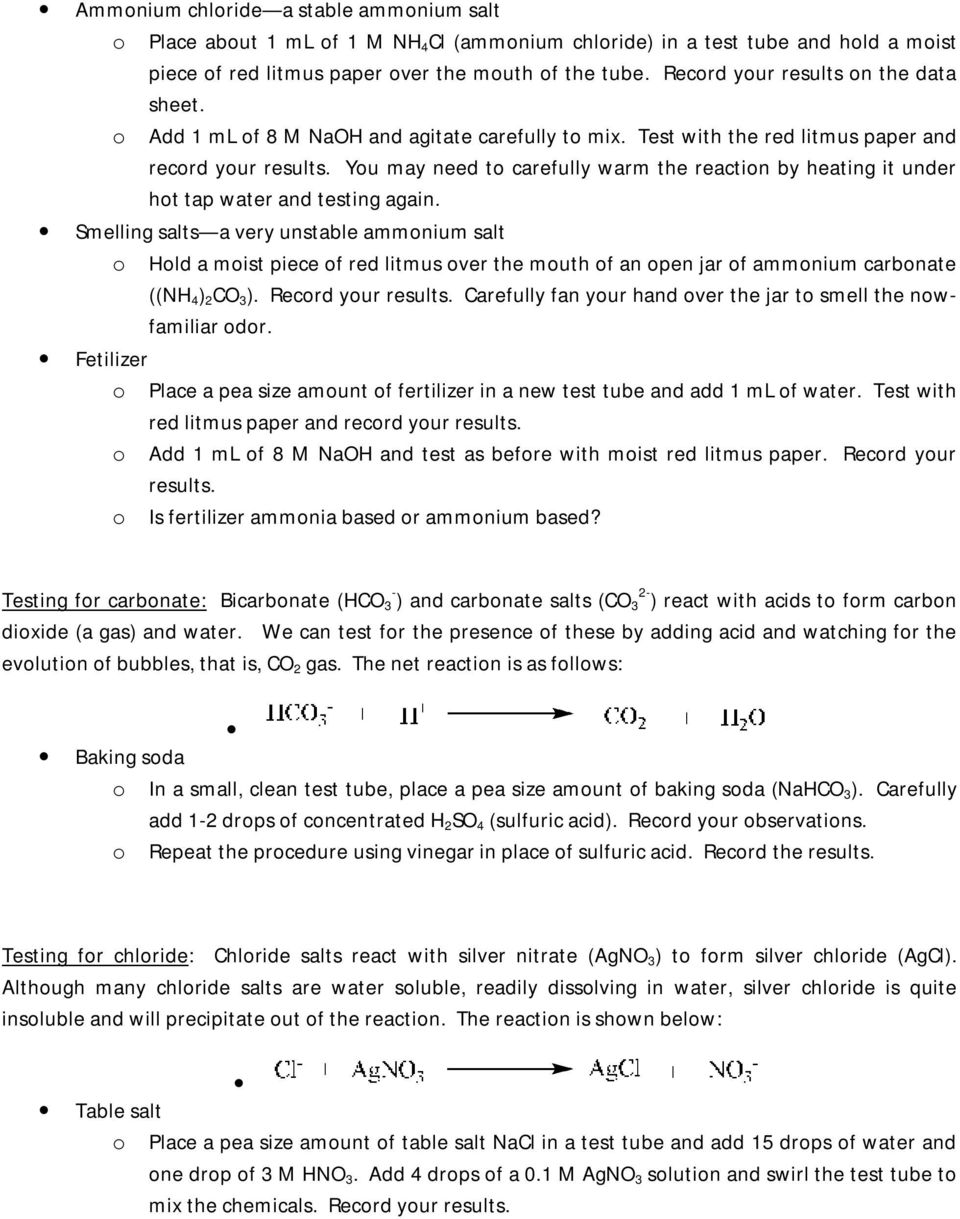
4 Testing for sulfate: Sulfate salts (SO 4 2- ) react with barium salts (Ba 2+ ) to form an insoluble precipitate, barium sulfate (BaSO 4 ). Like the chloride salts above, sulfate salts tend to be quite soluble, but barium sulfate is insoluble. The reaction is shown below: Epsom salts o Place a pea size amount of Epsom salts (MgSO 4 ) in a test tube and dissolve it in 1 ml of water. Add 1 drop of 3 M HNO 3 and then 2 drops of a 0.2 M BaCl 2 (barium chloride) solution. Record your results. Determination of an unknown: You will be given an unknown chemical that is a sulfate, carbonate, or chloride salt. You will use the above tests and results from those tests to figure out which type of salt you have. Remember that for a positive test, your results need to match those from above (other reactions could happen, but will not give you a definitive answer on what you have in the tube). Put a pea size amount of your unknown into three different test tubes. Follow the tests for sulfate, carbonate, and chloride determination. Record your results.

5 CHEMICAL DETERMINATION OF EVERYDAY HOUSEHOLD CHEMICALS PRE-LAB Name: 1. What is the common name for sodium chloride? 2. What is the common name for magnesium sulfate? 3. What is the common name for sodium bicarbonate? 4. When salt is dissolved in water, does a chemical change occur? 5. Think about your kitchen at home. What are two other chemicals that are dissolved in water, that do not seem to change physically? 6. If you add a chemical to a dissolved substance, and the solution turns cloudy, what has formed? Is this a chemical or physical change? 7. What do you look for to determine if a chloride test is positive? 8. If you do a sulfate (SO 2-4 ) test on an unknown chemical and there is precipitation observed, what can you conclude? 9. You did the following reaction to determine if Epsom salts contained sulfate. Balance the equation. 10. How can you check for the presence of ammonia? 11. Are all salts soluble?

6

7 CHEMICAL DETERMINATION OF EVERYDAY HOUSEHOLD CHEMICALS DATA SHEET Name: Partner(s): Unknown number: Testing for ammonia: 1. Ammonium chloride Color of litmus in NH 4 Cl litmus test Color of litmus in NH 4 Cl with 8 M NaOH litmus test 2. Smelling salts an unstable ammonium salt Color of litmus in (NH 4 ) 2 CO 3 test 3. Fertilizer Color of litmus in fertilizer litmus test Color of litmus in fertilizer with 8 M NaOH test If fertilizer ammonia or ammonium based? Testing for carbonate: 1. Baking soda Baking soda with H 2 SO 4 observations Baking soda with vinegar test observations

8 Testing for chloride: 1. Table salt Salt with HNO 3 and AgNO 3 test observations Testing for sulfate: 1. Epsom salts Epsom salts with HNO 3 and BaCl 2 test observations Unknown chemical determination: Observations for sulfate test Observations for carbonate test Observations for chloride test Which tests were positive? Which tests were negative? Questions: 1. Did your unknown have a sulfate, carbonate, or chloride component?

9 2. Assume you have a mixture of sodium chloride and sodium carbonate. How would you determine that the sodium carbonate is present without getting a false positive test from the sodium chloride? 3. Think about the issues regarding safety of chemicals, and the ease of using a chemical test to determine the presence of these chemicals. Where do YOU think a new chemical test would be useful in your home (lead tests already exist, as to pool testing kits)?

Experiment 8 - Double Displacement Reactions
 Experiment 8 - Double Displacement Reactions A double displacement reaction involves two ionic compounds that are dissolved in water. In a double displacement reaction, it appears as though the ions are
Properties of Acids and Bases
 Lab 22 Properties of Acids and Bases TN Standard 4.2: The student will investigate the characteristics of acids and bases. Have you ever brushed your teeth and then drank a glass of orange juice? What
Santa Monica College Chemistry 11
 Types of Reactions Objectives The objectives of this laboratory are as follows: To perform and observe the results of a variety of chemical reactions. To become familiar with the observable signs of chemical
Chapter 16: Tests for ions and gases
 The position of hydrogen in the reactivity series Hydrogen, although not a metal, is included in the reactivity series because it, like metals, can be displaced from aqueous solution, only this time the
Experiment 16-Acids, Bases and ph
 Definitions acid-an ionic compound that releases or reacts with water to form hydrogen ion (H + ) in aqueous solution. They taste sour and turn litmus red. Acids react with certain metals such as zinc,
Lab #13: Qualitative Analysis of Cations and Anions
 Lab #13: Qualitative Analysis of Cations and Anions Objectives: 1. To understand the rationale and the procedure behind the separation for various cations and anions. 2. To perform qualitative analysis
6 Reactions in Aqueous Solutions
 6 Reactions in Aqueous Solutions Water is by far the most common medium in which chemical reactions occur naturally. It is not hard to see this: 70% of our body mass is water and about 70% of the surface
Tutorial 4 SOLUTION STOICHIOMETRY. Solution stoichiometry calculations involve chemical reactions taking place in solution.
 T-27 Tutorial 4 SOLUTION STOICHIOMETRY Solution stoichiometry calculations involve chemical reactions taking place in solution. Of the various methods of expressing solution concentration the most convenient
Experiment 5. Chemical Reactions A + X AX AX A + X A + BX AX + B AZ + BX AX + BZ
 Experiment 5 Chemical Reactions OBJECTIVES 1. To observe the various criteria that are used to indicate that a chemical reaction has occurred. 2. To convert word equations into balanced inorganic chemical
General Chemistry I (FC, 09-10) Lab #3: The Empirical Formula of a Compound. Introduction
 General Chemistry I (FC, 09-10) Introduction A look at the mass relationships in chemistry reveals little order or sense. The ratio of the masses of the elements in a compound, while constant, does not
Syllabus OC18 Use litmus or a universal indicator to test a variety of solutions, and classify these as acidic, basic or neutral
 Chemistry: 9. Acids and Bases Please remember to photocopy 4 pages onto one sheet by going A3 A4 and using back to back on the photocopier Syllabus OC18 Use litmus or a universal indicator to test a variety
Acids, Bases, and ph
 CHAPTER 9 1 SECTION Acids, Bases, and Salts Acids, Bases, and ph KEY IDEAS As you read this section, keep these questions in mind: What properties do acids have? What properties do bases have? How can
Stoichiometry Review
 Stoichiometry Review There are 20 problems in this review set. Answers, including problem set-up, can be found in the second half of this document. 1. N 2 (g) + 3H 2 (g) --------> 2NH 3 (g) a. nitrogen
Chapter 8: Chemical Equations and Reactions
 Chapter 8: Chemical Equations and Reactions I. Describing Chemical Reactions A. A chemical reaction is the process by which one or more substances are changed into one or more different substances. A chemical
Chemical Reactions in Water Ron Robertson
 Chemical Reactions in Water Ron Robertson r2 f:\files\courses\1110-20\2010 possible slides for web\waterchemtrans.doc Properties of Compounds in Water Electrolytes and nonelectrolytes Water soluble compounds
Chemistry 51 Chapter 8 TYPES OF SOLUTIONS. A solution is a homogeneous mixture of two substances: a solute and a solvent.
 TYPES OF SOLUTIONS A solution is a homogeneous mixture of two substances: a solute and a solvent. Solute: substance being dissolved; present in lesser amount. Solvent: substance doing the dissolving; present
ACIDS AND BASES SAFETY PRECAUTIONS
 ACIDS AND BASES Mild acids and bases are used in cooking (their reaction makes biscuits and bread rise). Acids such as those in our stomachs eat away at food or digest it. Strong acids and bases are used
The Empirical Formula of a Compound
 The Empirical Formula of a Compound Lab #5 Introduction A look at the mass relationships in chemistry reveals little order or sense. The ratio of the masses of the elements in a compound, while constant,
Molarity of Ions in Solution
 APPENDIX A Molarity of Ions in Solution ften it is necessary to calculate not only the concentration (in molarity) of a compound in aqueous solution but also the concentration of each ion in aqueous solution.
Chapter 17. How are acids different from bases? Acid Physical properties. Base. Explaining the difference in properties of acids and bases
 Chapter 17 Acids and Bases How are acids different from bases? Acid Physical properties Base Physical properties Tastes sour Tastes bitter Feels slippery or slimy Chemical properties Chemical properties
General Chemistry II Chapter 20
 1 General Chemistry II Chapter 0 Ionic Equilibria: Principle There are many compounds that appear to be insoluble in aqueous solution (nonelectrolytes). That is, when we add a certain compound to water
1. Read P. 368-375, P. 382-387 & P. 429-436; P. 375 # 1-11 & P. 389 # 1,7,9,12,15; P. 436 #1, 7, 8, 11
 SCH3U- R.H.KING ACADEMY SOLUTION & ACID/BASE WORKSHEET Name: The importance of water - MAKING CONNECTION READING 1. Read P. 368-375, P. 382-387 & P. 429-436; P. 375 # 1-11 & P. 389 # 1,7,9,12,15; P. 436
Chemistry Ch 15 (Solutions) Study Guide Introduction
 Chemistry Ch 15 (Solutions) Study Guide Introduction Name: Note: a word marked (?) is a vocabulary word you should know the meaning of. A homogeneous (?) mixture, or, is a mixture in which the individual
Aqueous Ions and Reactions
 Aqueous Ions and Reactions (ions, acids, and bases) Demo NaCl(aq) + AgNO 3 (aq) AgCl (s) Two clear and colorless solutions turn to a cloudy white when mixed Demo Special Light bulb in water can test for
Chemistry 52. Reacts with active metals to produce hydrogen gas. Have a slippery, soapy feeling. React with carbonates to produce CO 2
 ACID AND BASE STRENGTH Experiment #2 PURPOSE: 1. To distinguish between acids, bases and neutral substances, by observing their effect on some common indicators. 2. To distinguish between strong and weak
IB Chemistry. DP Chemistry Review
 DP Chemistry Review Topic 1: Quantitative chemistry 1.1 The mole concept and Avogadro s constant Assessment statement Apply the mole concept to substances. Determine the number of particles and the amount
Number of moles of solute = Concentration (mol. L ) x Volume of solution (litres) or n = C x V
 44 CALCULATIONS INVOLVING SOLUTIONS INTRODUCTION AND DEFINITIONS Many chemical reactions take place in aqueous (water) solution. Quantities of such solutions are measured as volumes, while the amounts
Name: Class: Date: 2 4 (aq)
 Name: Class: Date: Unit 4 Practice Test Multiple Choice Identify the choice that best completes the statement or answers the question. 1) The balanced molecular equation for complete neutralization of
Neutralizing an Acid and a Base
 Balancing Act Teacher Information Objectives In this activity, students neutralize a base with an acid. Students determine the point of neutralization of an acid mixed with a base while they: Recognize
Return to Lab Menu. Stoichiometry Exploring the Reaction between Baking Soda and Vinegar
 Return to Lab Menu Stoichiometry Exploring the Reaction between Baking Soda and Vinegar Objectives -to observe and measure mass loss in a gas forming reaction -to calculate CO 2 loss and correlate to a
Other Stoich Calculations A. mole mass (mass mole) calculations. GIVEN mol A x CE mol B. PT g A CE mol A MOLE MASS :
 Chem. I Notes Ch. 12, part 2 Using Moles NOTE: Vocabulary terms are in boldface and underlined. Supporting details are in italics. 1 MOLE = 6.02 x 10 23 representative particles (representative particles
Solution a homogeneous mixture = A solvent + solute(s) Aqueous solution water is the solvent
 Solution a homogeneous mixture = A solvent + solute(s) Aqueous solution water is the solvent Water a polar solvent: dissolves most ionic compounds as well as many molecular compounds Aqueous solution:
General Chemistry Lab Experiment 6 Types of Chemical Reaction
 General Chemistry Lab Experiment 6 Types of Chemical Reaction Introduction Most ordinary chemical reactions can be classified as one of five basic types. The first type of reaction occurs when two or more
Unit 3 Notepack Chapter 7 Chemical Quantities Qualifier for Test
 Unit 3 Notepack Chapter 7 Chemical Quantities Qualifier for Test NAME Section 7.1 The Mole: A Measurement of Matter A. What is a mole? 1. Chemistry is a quantitative science. What does this term mean?
80. Testing salts for anions and cations
 Classic chemistry experiments 203 80. Testing salts for anions and cations Topic Qualitative analysis. Timing Description 12 hours. Students attempt to identify the anions and cations present in a salt
stoichiometry = the numerical relationships between chemical amounts in a reaction.
 1 REACTIONS AND YIELD ANSWERS stoichiometry = the numerical relationships between chemical amounts in a reaction. 2C 8 H 18 (l) + 25O 2 16CO 2 (g) + 18H 2 O(g) From the equation, 16 moles of CO 2 (a greenhouse
One problem often faced in qualitative analysis is to test for one ion in a
 Chemistry 112 Laboratory: Silver Group Analysis Page 11 ANALYSIS OF THE SILVER GROUP CATIONS Ag + Pb Analysis of a Mixture of Cations One problem often faced in qualitative analysis is to test for one
ANSWER KEY. Acids, Bases, and Solutions. Chapter Project Worksheet 1 1. Answers will vary. Sample: cherries, blueberries,
 Chapter Project Worksheet 1 1. Answers will vary. Sample: cherries, blueberries, and grass 2. Answers will vary. Sample: Cut 5 g of cherries into small pieces and place in blender. Blend for two minutes,
Chapter 7: Chemical Reactions
 Chapter 7 Page 1 Chapter 7: Chemical Reactions A chemical reaction: a process in which at least one new substance is formed as the result of a chemical change. A + B C + D Reactants Products Evidence that
Chemistry Unit Test Review
 SNC 2DI Chemistry Unit Test Review Note: this review sheet only covers the second half of our chemistry unit. You should use our mid-unit test review sheet to recall concepts from the first half of the
Chemistry Post-Enrolment Worksheet
 Name: Chemistry Post-Enrolment Worksheet The purpose of this worksheet is to get you to recap some of the fundamental concepts that you studied at GCSE and introduce some of the concepts that will be part
W1 WORKSHOP ON STOICHIOMETRY
 INTRODUCTION W1 WORKSHOP ON STOICHIOMETRY These notes and exercises are designed to introduce you to the basic concepts required to understand a chemical formula or equation. Relative atomic masses of
IB Chemistry 1 Mole. One atom of C-12 has a mass of 12 amu. One mole of C-12 has a mass of 12 g. Grams we can use more easily.
 The Mole Atomic mass units and atoms are not convenient units to work with. The concept of the mole was invented. This was the number of atoms of carbon-12 that were needed to make 12 g of carbon. 1 mole
Balancing Chemical Equations Worksheet
 Balancing Chemical Equations Worksheet Student Instructions 1. Identify the reactants and products and write a word equation. 2. Write the correct chemical formula for each of the reactants and the products.
Aqueous Chemical Reactions
 Name: Date: Lab Partners: Lab section: Aqueous Chemical Reactions The purpose of this lab is to introduce you to three major categories of reactions that occur in aqueous solutions: precipitation reactions,
Experiment 1 Chemical Reactions and Net Ionic Equations
 Experiment 1 Chemical Reactions and Net Ionic Equations I. Objective: To predict the products of some displacement reactions and write net ionic equations. II. Chemical Principles: A. Reaction Types. Chemical
SEPARATION OF A MIXTURE OF SUBSTANCES LAB
 SEPARATION OF A MIXTURE OF SUBSTANCES LAB Purpose: Every chemical has a set of defined physical properties, and when combined they present a unique fingerprint for that chemical. When chemicals are present
Mole Notes.notebook. October 29, 2014
 1 2 How do chemists count atoms/formula units/molecules? How do we go from the atomic scale to the scale of everyday measurements (macroscopic scale)? The gateway is the mole! But before we get to the
11-1 Stoichiometry. Represents
 11-1 Stoichiometry What is stoichiometry? Calculations that relate the quantities of substances. It is the study of quantitative (measurable amounts) relationships in chemical reactions and equations.
6) Which compound is manufactured in larger quantities in the U.S. than any other industrial chemical?
 MULTIPLE CHOICE. Choose the one alternative that best completes the statement or answers the question. 1) Which statement concerning Arrhenius acid-base theory is not correct? A) Acid-base reactions must
Chemical Equations & Stoichiometry
 Chemical Equations & Stoichiometry Chapter Goals Balance equations for simple chemical reactions. Perform stoichiometry calculations using balanced chemical equations. Understand the meaning of the term
MOLARITY = (moles solute) / (vol.solution in liter units)
 CHEM 101/105 Stoichiometry, as applied to Aqueous Solutions containing Ionic Solutes Lect-05 MOLES - a quantity of substance. Quantities of substances can be expressed as masses, as numbers, or as moles.
1. When the following equation is balanced, the coefficient of Al is. Al (s) + H 2 O (l)? Al(OH) 3 (s) + H 2 (g)
 1. When the following equation is balanced, the coefficient of Al is. Al (s) + H 2 O (l)? Al(OH) (s) + H 2 (g) A) 1 B) 2 C) 4 D) 5 E) Al (s) + H 2 O (l)? Al(OH) (s) + H 2 (g) Al (s) + H 2 O (l)? Al(OH)
EXPERIMENT 20: Determination of ph of Common Substances
 Materials: ph paper and color chart (ph range 3 to 12) or ph meter distilled water white vinegar household ammonia (or baking soda) spot plate test or 3 small test tubes stirring rod solutions / fruits
ATOMS. Multiple Choice Questions
 Chapter 3 ATOMS AND MOLECULES Multiple Choice Questions 1. Which of the following correctly represents 360 g of water? (i) 2 moles of H 2 0 (ii) 20 moles of water (iii) 6.022 10 23 molecules of water (iv)
Topic 4 National Chemistry Summary Notes. Formulae, Equations, Balancing Equations and The Mole
 Topic 4 National Chemistry Summary Notes Formulae, Equations, Balancing Equations and The Mole LI 1 The chemical formula of a covalent molecular compound tells us the number of atoms of each element present
Separation by Solvent Extraction
 Experiment 3 Separation by Solvent Extraction Objectives To separate a mixture consisting of a carboxylic acid and a neutral compound by using solvent extraction techniques. Introduction Frequently, organic
Return to Lab Menu. Acids and Bases in Your House
 Return to Lab Menu Acids and Bases in Your House OBJECTIVES Isolate a natural acid-base indicator. Determine the acid-base properties of common household solutions. INTRODUCTION Acids and bases are among
Formulae, stoichiometry and the mole concept
 3 Formulae, stoichiometry and the mole concept Content 3.1 Symbols, Formulae and Chemical equations 3.2 Concept of Relative Mass 3.3 Mole Concept and Stoichiometry Learning Outcomes Candidates should be
Chemistry 3202. Unit 2 Acids and Bases
 Chemistry 3202 Unit 2 Acids and Bases Definitions of Acids and Bases An operational definition is one that is based on the observable properties, behaviours or uses of an entity. The earliest definitions
Aqueous Solutions. Water is the dissolving medium, or solvent. Some Properties of Water. A Solute. Types of Chemical Reactions.
 Aqueous Solutions and Solution Stoichiometry Water is the dissolving medium, or solvent. Some Properties of Water Water is bent or V-shaped. The O-H bonds are covalent. Water is a polar molecule. Hydration
Chem101: General Chemistry Lecture 9 Acids and Bases
 : General Chemistry Lecture 9 Acids and Bases I. Introduction A. In chemistry, and particularly biochemistry, water is the most common solvent 1. In studying acids and bases we are going to see that water
- electrolytes: substances that dissolve in water to form charge-carrying solutions
 111 Electrolytes and Ionic Theory - electrolytes: substances that dissolve in water to form charge-carrying solutions * Electrolytes form ions in solution - (ions that are mobile are able to carry charge!).
Chemistry: Chemical Equations
 Chemistry: Chemical Equations Write a balanced chemical equation for each word equation. Include the phase of each substance in the equation. Classify the reaction as synthesis, decomposition, single replacement,
SOLUBILITY OF A SALT IN WATER AT VARIOUS TEMPERATURES LAB
 SOLUBILITY OF A SALT IN WATER AT VARIOUS TEMPERATURES LAB Purpose: Most ionic compounds are considered by chemists to be salts and many of these are water soluble. In this lab, you will determine the solubility,
Honors Chemistry: Unit 6 Test Stoichiometry PRACTICE TEST ANSWER KEY Page 1. A chemical equation. (C-4.4)
 Honors Chemistry: Unit 6 Test Stoichiometry PRACTICE TEST ANSWER KEY Page 1 1. 2. 3. 4. 5. 6. Question What is a symbolic representation of a chemical reaction? What 3 things (values) is a mole of a chemical
Acid 7 Base. 1. Describe two things hydrochloric acid does in your body system. 2. What does sodium hydrogencarbonate do in your body system?
 Acids and Bases acid: a compound that, when dissolved in water, forms a solution with a ph less than 7 base: a compound that, when dissolved in water, forms a solution with a ph greater than 7 ph: the
CHEMICAL REACTIONS. Chemistry 51 Chapter 6
 CHEMICAL REACTIONS A chemical reaction is a rearrangement of atoms in which some of the original bonds are broken and new bonds are formed to give different chemical structures. In a chemical reaction,
Chemical Calculations: Formula Masses, Moles, and Chemical Equations
 Chemical Calculations: Formula Masses, Moles, and Chemical Equations Atomic Mass & Formula Mass Recall from Chapter Three that the average mass of an atom of a given element can be found on the periodic
Topic 8 Acids and bases 6 hours
 Topic 8 Acids and bases 6 hours Hydronium ion (H3O + ) = more stable form of hydrogen ion (H + ) H + + H2O H3O + 8.1 Theories of acids and bases 2 hours 1. Arrhenius H-X / M-OH ACID a substance that dissociates
Unit 2: Quantities in Chemistry
 Mass, Moles, & Molar Mass Relative quantities of isotopes in a natural occurring element (%) E.g. Carbon has 2 isotopes C-12 and C-13. Of Carbon s two isotopes, there is 98.9% C-12 and 11.1% C-13. Find
Continuous process of sodium bicarbonate production by Solvay method
 Continuous process of sodium bicarbonate production by Solvay method Manual to experiment nr 10 Instructor: Dr Tomasz S. Pawłowski 1 Goal of the experiment The goal of the experiment is introduction of
Chemical Changes. Measuring a Chemical Reaction. Name(s)
 Chemical Changes Name(s) In the particle model of matter, individual atoms can be bound tightly to other atoms to form molecules. For example, water molecules are made up of two hydrogen atoms bound to
Chemical Equations and Chemical Reactions. Chapter 8.1
 Chemical Equations and Chemical Reactions Chapter 8.1 Objectives List observations that suggest that a chemical reaction has taken place List the requirements for a correctly written chemical equation.
Chapter 5, Lesson 3 Why Does Water Dissolve Salt?
 Chapter 5, Lesson 3 Why Does Water Dissolve Salt? Key Concepts The polarity of water molecules enables water to dissolve many ionically bonded substances. Salt (sodium chloride) is made from positive sodium
Chapter 5 Student Reading
 Chapter 5 Student Reading THE POLARITY OF THE WATER MOLECULE Wonderful water Water is an amazing substance. We drink it, cook and wash with it, swim and play in it, and use it for lots of other purposes.
EXPERIMENT 10: TITRATION AND STANDARDIZATION
 EXPERIMENT 10: TITRATION AND STANDARDIZATION PURPOSE To determine the molarity of a NaOH solution by titrating it with a standard HCl solution. To determine the molarity of acetic acid in vinegar using
Description of the Mole Concept:
 Description of the Mole Concept: Suppose you were sent into the store to buy 36 eggs. When you picked them up you would get 3 boxes, each containing 12 eggs. You just used a mathematical device, called
Liquid phase. Balance equation Moles A Stoic. coefficient. Aqueous phase
 STOICHIOMETRY Objective The purpose of this exercise is to give you some practice on some Stoichiometry calculations. Discussion The molecular mass of a compound is the sum of the atomic masses of all
Chemistry B11 Chapter 6 Solutions and Colloids
 Chemistry B11 Chapter 6 Solutions and Colloids Solutions: solutions have some properties: 1. The distribution of particles in a solution is uniform. Every part of the solution has exactly the same composition
Physical Changes and Chemical Reactions
 Physical Changes and Chemical Reactions Gezahegn Chaka, Ph.D., and Sudha Madhugiri, Ph.D., Collin College Department of Chemistry Objectives Introduction To observe physical and chemical changes. To identify
Chapter 6. Solution, Acids and Bases
 Chapter 6 Solution, Acids and Bases Mixtures Two or more substances Heterogeneous- different from place to place Types of heterogeneous mixtures Suspensions- Large particles that eventually settle out
MULTIPLE CHOICE. Choose the one alternative that best completes the statement or answers the question.
 CHE 1400 - Spring 2015 - Chapter 7 Homework 7 MULTIPLE CHOICE. Choose the one alternative that best completes the statement or answers the question. 1)According to Arrhenius, an acid and a base will react
EXPERIMENT 10 Chemistry 110. Solutions Part 2 ACIDS, BASES, AND ELECTROLYTES
 EXPERIMENT 10 Chemistry 110 Solutions Part 2 ACIDS, BASES, AND ELECTROLYTES PURPOSE: The purpose of this experiment is to determine the properties of solutions of acids, bases and electrolytes. Students
Chapter 4 Chemical Reactions
 Chapter 4 Chemical Reactions I) Ions in Aqueous Solution many reactions take place in water form ions in solution aq solution = solute + solvent solute: substance being dissolved and present in lesser
Stoichiometry and Aqueous Reactions (Chapter 4)
 Stoichiometry and Aqueous Reactions (Chapter 4) Chemical Equations 1. Balancing Chemical Equations (from Chapter 3) Adjust coefficients to get equal numbers of each kind of element on both sides of arrow.
2. DECOMPOSITION REACTION ( A couple have a heated argument and break up )
 TYPES OF CHEMICAL REACTIONS Most reactions can be classified into one of five categories by examining the types of reactants and products involved in the reaction. Knowing the types of reactions can help
Physical and Chemical Properties and Changes
 Physical and Chemical Properties and Changes An understanding of material things requires an understanding of the physical and chemical characteristics of matter. A few planned experiments can help you
MOLES AND MOLE CALCULATIONS
 35 MOLES ND MOLE CLCULTIONS INTRODUCTION The purpose of this section is to present some methods for calculating both how much of each reactant is used in a chemical reaction, and how much of each product
Chapter 19: Acids and Bases Homework Packet (50 pts) Name: Score: / 50
 Chapter 19: Acids and Bases Homework Packet (50 pts) Topic pg Section 19.1 1-3 Section 19.2 3-6 Section 19.3 6-7 Section 19.4 8 Naming Acids 9 Properties of Acids/Bases 10-11 Conjugate Acid/Base Pairs
Nomenclature and Household Items
 Nomenclature and Household Items NAME: DATE: PERIOD: Background: Many household items contain chemicals that are commonly used in everyday life. Some chemicals are edible while other compounds would be
CHEMICAL REACTIONS OF COPPER AND PERCENT YIELD KEY
 CHEMICAL REACTIONS OF COPPER AND PERCENT YIELD Objective To gain familiarity with basic laboratory procedures, some chemistry of a typical transition element, and the concept of percent yield. Apparatus
Moles. Balanced chemical equations Molar ratios Mass Composition Empirical and Molecular Mass Predicting Quantities Equations
 Moles Balanced chemical equations Molar ratios Mass Composition Empirical and Molecular Mass Predicting Quantities Equations Micro World atoms & molecules Macro World grams Atomic mass is the mass of an
Writing and Balancing Chemical Equations
 Name Writing and Balancing Chemical Equations Period When a substance undergoes a chemical reaction, chemical bonds are broken and new bonds are formed. This results in one or more new substances, often
Calculation of Molar Masses. Molar Mass. Solutions. Solutions
 Molar Mass Molar mass = Mass in grams of one mole of any element, numerically equal to its atomic weight Molar mass of molecules can be determined from the chemical formula and molar masses of elements
SCH 4C1 Unit 2 Problem Set Questions taken from Frank Mustoe et all, "Chemistry 11", McGraw-Hill Ryerson, 2001
 SCH 4C1 Unit 2 Problem Set Questions taken from Frank Mustoe et all, "Chemistry 11", McGraw-Hill Ryerson, 2001 1. A small pin contains 0.0178 mol of iron. How many atoms of iron are in the pin? 2. A sample
EXPERIMENT 4 Acid Strength
 EXPERIMENT 4 Acid Strength Introduction Many common substances are either acids or bases. Some acids, like stomach acid are necessary for our health, while others, like sulfuric acid are dangerous and
ph Measurements of Common Substances
 Chem 100 Section Experiment 10 Name Partner s Name Introduction ph Measurements of Common Substances The concentration of an acid or base is frequently expressed as ph. Historically, ph stands for the
ACIDS, BASES AND SALTS
 Acids are those chemical substances which have a sour taste. Bases are those chemical substances which have a bitter taste. A salt is an ionic compound which dissociates to yield a positive ion other than
Experiment 3: Extraction: Separation of an Acidic, a Basic and a Neutral Substance
 1 Experiment 3: Extraction: Separation of an Acidic, a Basic and a Neutral Substance Read pp 142-155, 161-162, Chapter 10 and pp 163-173, Chapter 11, in LTOC. View the videos: 4.2 Extraction (Macroscale);