
ESSENTIAL SURFACE & RELATED ANATOMY FOR CLINICAL PRACTICE
|
|
|
- Ruby Osborne
- 9 years ago
- Views:
Transcription
1 ESSENTIAL SURFACE & RELATED ANATOMY FOR CLINICAL PRACTICE Compiled by Dr Robert Whitaker & Dr Jessica White (See also pages in Instant Anatomy. Blackwell Publishing. 3 rd Edition by Whitaker & Borley) INSTRUCTIONS Consider the clinical relevance of each surface marking. Where possible find it on yourself or a colleague. Use this document for reference both now and later in your career. Regard the information as a means of communicating with both your patients and colleagues.

2 HEAD AND NECK 1. Supra-orbital foramen exit site for supra-orbital nerve. 2. Infra-orbital foramen exit site for infra-orbital nerve. 3. Mental foramen exit site for mental nerve. (Note: 1, 2, 3 above are all on an imaginary vertical line). 4. Marginal mandibular branch of facial nerve (VII) passes well below ramus of mandible before returning onto face to supply muscles of chin and lower lip - nerve damage possible whilst operating on submandibular gland. 5. Facial nerve (VII) - emerges from parotid gland onto face - nerve damage possible during parotid gland surgery. Complete unilateral paralysis of facial muscles suggests lower motor neurone lesion (Bell s palsy) whilst paralysis of lower face only suggests upper motor neurone lesion (CVA). 6. Mastoid process. Muscle attachments Sternocleidomastoid (SCM) on outer aspect and posterior belly of digastric on inner aspect. 7. External jugular vein - from angle of jaw to mid clavicle. 8. Internal jugular vein - from angle of jaw to sternoclavicular joint used for measurement of jugular venous height as marker of right sided heart pressure and for insertion of central line or cardiac pacemaker. - patient is 15 degrees head down and head turned to 45 degrees to left. Needle is aimed caudally and ventrally toward the right nipple underneath the sternocleidomastoid at an angle that is 45º to the sagittal and horizontal planes and 15º forward in the frontal plane. Aspiration is performed until there is free return of venous blood (FIGURE 1) 9. Superior vena cava forms at 1 st right intercostal space parasternally. 10. Spinal root of accessory nerve - supplies SCM and trapezius crosses posterior triangle of neck one third down posterior border of SCM to one third up anterior border of trapezius. Damage in the posterior triangle gives a loss of trapezius and inability to shrug or completely abduct the shoulder. 1

3 THORAX CARDIOVASCULAR SYSTEM 1. Pulses a. Limb pulses - (see upper and lower limb section). b. Carotid pulse - just medial to SCM in the mid-neck vital for examining character of the pulse and timing of the cardiac cycle while auscultating. c. Apex beat typically defined below in 2.d 2. Cardiac surface markings - there should be cardiac dullness on percussion within these limits. (FIGURE 2) a. Superior left border of heart - 2 nd left costal cartilage. b. Superior right border of heart - 3 rd right costal cartilage. c. Inferior right border of heart - 6 th costal cartilage parasternally. d. Inferior left border of heart - 5 th interspace in mid-clavicular line (corresponds to apex beat is displaced laterally by cardiac enlargement). 3. Auscultation Sites (FIGURE 2) a. Pulmonary valve area (P) 2 nd intercostal space parasternally on left side. b. Aortic valve area (A) 2 nd intercostal space parasternally on right side. c. Mitral valve area (M) (see 2.d above). d. Tricuspid valve area (T) lower sternum or just to right of it. (note - 4 th intercostal space left sternal edge for listening to aortic murmurs). 4. Internal jugular vein - (See No 8 in head and neck section above). 2

4 RESPIRATORY SYSTEM (FIGURE 3) 5 Pleural reflections Commence at apices of pleural cavities which are 3cm above the middle of the medial third of the clavicle. They extend above the anterior aspect of the first rib but not above its neck posteriorly. At ribs 2 angle of Louis - pleura meet in midline; ribs 4 - pleura separate; ribs 6 - left pleura swings to left to make room for the heart; ribs 8 - pleura symmetrical in midclavicular line; ribs 10 - pleura symmetrical in midaxillary line; ribs 12 - pleura symmetrical just below neck of 12 th rib. These reflections define the area of lungs to be percussed and auscultated. 6. Oblique fissures (both lungs) - spine of T3 posteriorly to rib 6 anteriorly, passing along the medial border of the abducted scapula. 7. Horizontal fissure (right lung only) rib 4 parasternally to rib 5 in midaxillary line. Knowledge of the fissures allow percussion and auscultation over individual lung lobes. 8. Lungs within visceral pleura apices of lungs extend superiorly as described for pleural above. Trauma from knife wounds and insertion of central lines, etc. Note that lungs are two spaces short of the lower reaches of the pleural cavities from below the 6 th rib in expiration, BUT note that the lungs fill the pleural cavity completely superiorly. 3

5 8. Mechanics of chest expansion (FIGURE 4) a. Upper rib cage expands in an anteroposterior plane. b. Lower rib cage expands in a side to side plane. (In combination, the rib cage expands typically by 3-5cm on full inspiration). 4

6 THORACIC JOINTS AND VERTEBRAL LEVELS (FIGURE 5) 9. a. Sternoclavicular atypical synovial - fibrocartilage on surface of the bones instead of hyaline. b. Costochondral junctions primary cartilaginous joints. c. Chondrosternal joints atypical synovial (see thorax 9a ) except first rib to manubrium which is a primary cartilaginous joint. d. Angle of Louis (sternomanubrial junction) 2 nd rib anteriorly, T4/5 vertebral disc posteriorly. Lying on plane are: under surface of arch of aorta, bifurcation of trachea, division of pulmonary trunk, ligamentum arteriosum, cardiac plexuses. Essential starting point for identification of ribs from rib 2 downwards. (FIGURE 5) 10. a. Suprasternal notch T2/3 disc - useful for counting down spaces to define position of the apex beat and also to measure upwards for position of the jugular venous pressure. b. 9 th costal cartilage on costal margin has small notch (midclavicular line). c. 7 th rib is last rib to attach to the sternum. QUESTIONS ON THORAX 1. Why are right sided murmurs loudest in inspiration and left sided murmurs louder in expiration? 2. What does positioning of the body do to the position of the heart (a) on sitting forward and (b) on lying on the left hand side? 5

7 ABDOMEN AREA AND QUADRANTS (FIGURE 6) 1. Division of abdomen into 4 quadrants a. Left and right upper b. Left and right lower 2. Division of abdomen into 9 areas a. Epigastric, left and right hypochondrium b. Umbilical, left and right loin (or renal) c. Suprapubic, left and right iliac fossa ABDOMINAL WALL (FIGURE 6) 3. Umbilicus Variable position (approx. level with iliac crest) depending on degree of obesity site of umbilical hernia and T10 dermatome. 4. Linea alba - Midline - midline laparotomy gives good exposure but may result in incisional hernia. Turns into linea negra in pregnancy. 5. Linea semilunaris - Lateral edge of the rectus sheath possible site of Spigelian hernia. 6. Arcuate line 5-6cm below umbilicus - no posterior rectus sheath below this point tendinous intersections - Six-pack appearance in upper abdomen anterior rectus sheath attaches to rectus abdominis muscle transversely in three areas on each side. 6

8 8. McBurney s point 1/3 along line from anterior superior iliac spine (ASIS) to umbilicus site for incision for appendicectomy. 9. Transpyloric plane (FIGURE 7). 10. Aortic bifurcation - L4 vertebral body palpable in thin patients below umbilicus. 11. Inferior vena cava forms at L5 vertebral body. 12. Falciform ligament - Remnant of ventral gastric mesentery joining anterior abdominal wall to liver and containing ligament teres (obliterated left umbilical vein). Distended veins are seen here in portal hypertension caput medusae. 13. Epigastric dermatomes - T5-9 - Pain referral from foregut via greater splanchnic nerve. 14. Peri-umbilical dermatomes T10, 11 - Pain referral from midgut via lesser splanchnic nerve. 15. Suprapubic dermatomes T12 - Pain referral from hindgut via least splanchnic nerve. Note: Knowledge of dermatomes is needed for assessing spinal cord damage or compression. 7

9 INGUINAL REGION (FIGURES 8 & 9) 16. Inguinal ligament Attached to pubic tubercle and anterior superior iliac spine. 17. Mid-inguinal point half way between ASIS and pubis - landmark for femoral artery in groin. (see lower limb pulses and cardiovascular examination). 18. Midpoint of inguinal ligament Half way between ASIS and pubic tubercle - landmark for deep inguinal ring and indirect inguinal hernia. Medial to this for direct inguinal hernia. 19. Inguinal canal a. Anterior wall - two muscles contributing - external oblique all the way and internal oblique laterally only. b. Posterior wall - two muscles contributing - internal oblique and transversus as conjoint tendon. c. Roof curved fibres of internal oblique and transversus. d. Floor inguinal ligament. 8

10 20. Two nerves IN the spermatic cord - sympathetics and genital branch of the genitofemoral. 21. One nerve ON the spermatic cord ilioinguinal. 22. Femoral canal a space medial to femoral vein, lateral to lacunar ligament, posterior to inguinal ligament and anterior to pectineal line of pubis. Contained within femoral sheath and transmitting lymphatics from lower limb to iliac region of abdomen. Site of femoral hernia, identified clinically as below and lateral to inguinal ligament and pubic tubercle. SITES FOR PALPATION OF ORGANS (FIGURE 10) 23. Liver must be percussed both superiorly and inferiorly as it may be either enlarged or merely pushed down by hyper-inflated lungs. 24. Kidneys Move a little with respiration ballotable often palpable even if normal in children and thin people. 25. Spleen Not normally palpable but when enlarged to twice its normal size, is felt beneath the left costal margin and enlarges towards the right iliac fossa. 26. Bladder When full in children it may be palpable suprapubically but not normally so in adults. 9

11 COMMON ABDOMINAL SURGICAL INCISIONS (All less common in era of laparoscopic surgery) (FIGURE 11 ) 27. Midline good for general exploration of abdomen and extensive surgery such as aortic aneurysm. 28. Paramedian Similar to midline but heals better. Slightly less access. 29. Subcostal Good for biliary surgery. More vascular and less nerve sparing. 30. Suprapubic (Pfannensteil) Excellent access to pelvis although not necessarily better than midline. Heals well and good cosmetic result. 31. Loin ( posterior subcostal) ideal for renal and adrenal surgery. Chest can be opened to give greater access. 10

12 ABDOMINAL VERTEBRAL LEVELS (FIGURE 12) QUESTIONS ON ABDOMEN 1. How would you determine the location of the appendix? 2. Why is one kidney higher than the other? Where does one put ones hands to try to ballot it? 3. Why is it not possible to get above the spleen? How is it distinguishable from a kidney? LOWER LIMB 1. PULSES (FIGURE 13) a. Femoral at mid inguinal point (see abdomen 17). b. Popliteal deep in popliteal fossa with knee flexed by 30 degrees. c. Posterior tibial 3cm postero-inferior to medial malleolus. d. Dorsalis pedis between extensor hallucis longus and extensor digitorum on dorsum of foot. (All important in reference to peripheral vascular disease). 2. VEINS (FIGURE 13) a. Great saphenous vein lies on anterior part of medial malleolus then passes a hands-breath medial to the patella on its way to saphenofemoral junction (see 2c below). Vein often harvested for coronary artery bypass. b. Short saphenous vein lies posterior to lateral malleolus then passes up posterior lower leg to enter popliteal vein in the popliteal fossa. 11

13 c. Saphenofemoral junction located 4cm inferior and lateral to pubic tubercle site of great saphenous vein passing through fascia lata (saphenous opening) to reach the femoral vein. Also superficial inguinal lymphatics passing deeply to join deep inguinal lymphatics which then enter into abdomen via femoral canal. 3. BONY AND OTHER LANDMARKS a. Lateral thigh site of iliotibial tract (thickened fascia lata), pulled upon by gluteus maximus and tensor fasciae latae to hold knee locked. Dermatome is L2 and 3 (lateral cutaneous nerve of thigh). Condition that is caused by irritation of this nerve is meralgia paraesthetica. b. Adductor tubercle on lower medial femur just above knee. Muscle attachment for adductor magnus. Hiatus in this muscle is for passage of femoral to popliteal vessels. 12
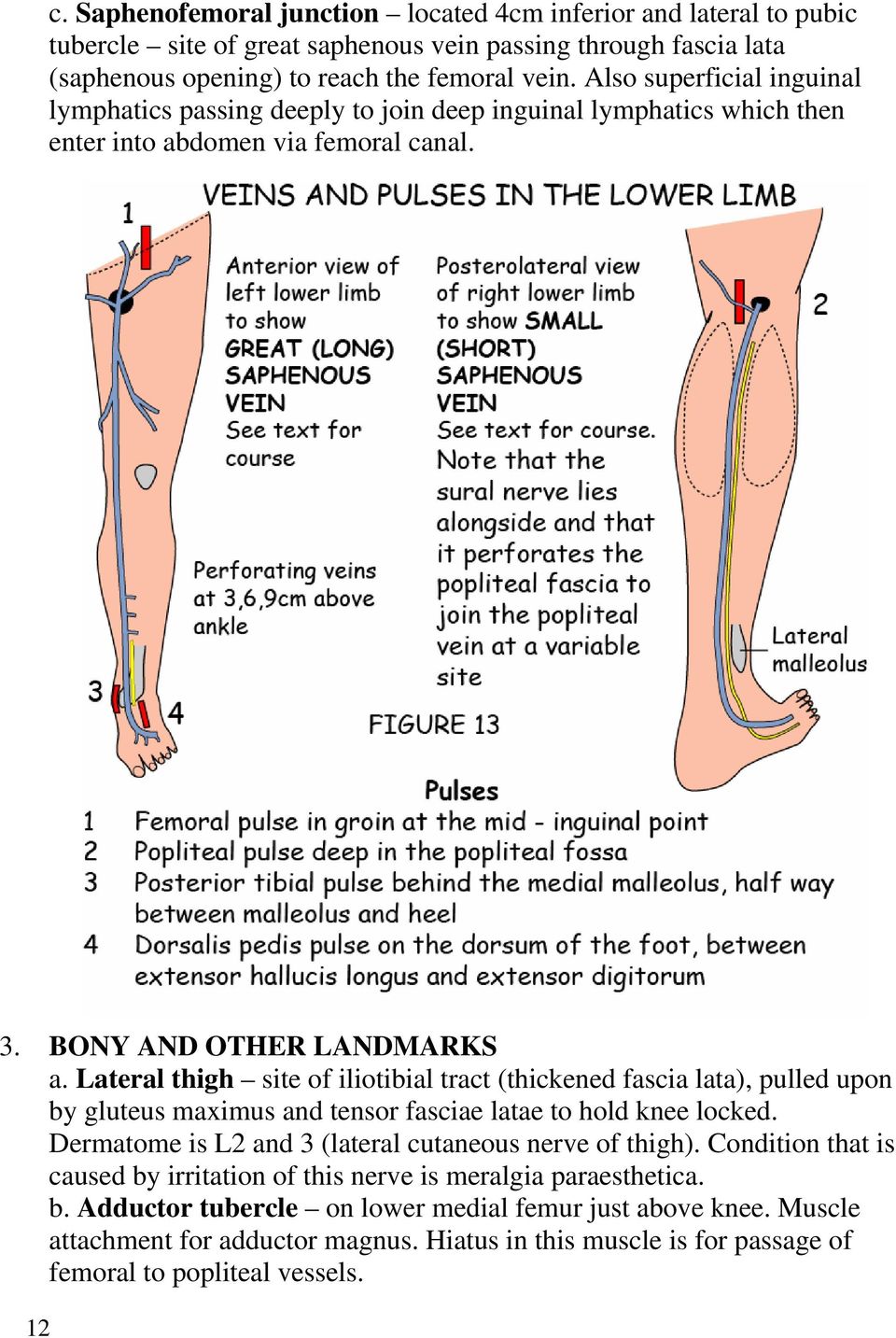
14 13 c. Patella liable to dislocate laterally because of Q angle but 3 factors helping to prevent this are fibres of medial vastus inserting into the patella, thicker medial retinacular fibres in the knee capsule and a more prominent lateral condyle of the femur. d. Femoral triangle medial border is MEDIAL border of adductor longus, lateral border is medial border of sartorius and superior border is inguinal ligament. (FIGURE 14)

15 e. Popliteal fossa diamond shaped area behind the knee bordered below by two heads of gastrocnemius and above by biceps femoris laterally and semitendinosus medially. f. Saphenous nerve Root value L4, lying with the great saphenous vein on the anterior aspect of the medial malleolus liable to damage when performing a cut-down cannulation. g. Gluteal Region Injections into upper outer quadrant to avoid sciatic nerve (FIGURE 15). QUESTIONS ON LOWER LIMB 1. Which two nerves enter the subsartorial canal? 2. Does the saphenous nerve pass through the adductor hiatus? 3. Is the dorsalis pedis pulse palpable between tibialis anterior and extensor hallucis longus or between the extensor hallucis longus and extensor digitorum? UPPER LIMB 1. PULSES a. Brachial just medial to tendon of biceps in cubital fossa - used during blood pressure measurement. b. Radial at wrist lateral to tendon of flexor carpi radialis. Ideal for measurement of heart rate and rhythm. 2. VEINS (FIGURE 16) a. Cephalic on lateral border of wrist and in deltopectoral groove. b. Basilic on medial forearm and piercing fascia on medial arm to join deep veins and become axillary vein. 14

16 3. AUTONOMOUS AREAS (with no overlap) FOR PERIPHERAL NERVES (FIGURE 17) a. Radial nerve first dorsal web space. b. Ulnar nerve pulp of little finger. c. Median nerve pulp of index finger. d Axillary nerve - upper lateral arm - referred to as regimental patch. 4. BONY AND OTHER LANDMARKS a. Head of radius palpated 3 fingers widths down from lateral epicondyle. Common site of fracture. b. Coracoid process just medial to head of humerus - attachment of pectoralis minor, coracobrachialis and short head of biceps. c. Acromion tip of shoulder - attachment of deltoid. d. Clavicle palpable throughout its length - supraclavicular nerves (C4) palpable over it. They supply shoulder tip relevant to referred pain in gall bladder disease. e. Anatomical snuff box - most dorsal tendon - extensor pollicis longus, more ventral tendons extensor pollicis brevis and abductor pollicis longus. (FIGURE 18) f. Lateral forearm - dermatome (C6), nerve is cutaneous branch of musculocutaneous nerve. g. Cubital fossa anterior to elbow bordered by pronator teres medially, medial border of brachioradialis laterally, and an imaginary line joining the epicondyles superiorly. Veins here usually used for venepuncture (blood tests). 15

17 h. Flexor retinaculum. carpal tunnel. (FIGURE 19) i. Medial epicondyle of humerus funny bone tingling down ulnar nerve. QUESTIONS 1. Are the symptoms of a carpal tunnel syndrome worse by day or by night? 2. Is the median nerve medial or lateral to the brachial artery in the cubital fossa? 16

18 Notes Last revised

Anatomy and Physiology 121: Muscles of the Human Body
 Epicranius Anatomy and Physiology 121: Muscles of the Human Body Covers upper cranium Raises eyebrows, surprise, headaches Parts Frontalis Occipitalis Epicranial aponeurosis Orbicularis oculi Ring (sphincter)
Upper Limb QUESTIONS UPPER LIMB: QUESTIONS
 1 Upper Limb QUESTIONS 1.1 Which of the following statements best describes the scapula? a. It usually overlies the 2nd to 9th ribs. b. The spine continues laterally as the coracoid process. c. The suprascapular
Buccinator Presses cheek against molar teeth Facial (CNVII) wrinkles forehead
 Muscles to Identify on the Cadaver and/or Models You are required to identify each of the following muscles or associated structures on the cadavers and/or models in lab. If the box is shaded in a particular
The Abdominal Wall And Hernias. Stanley Kurek, DO, FACS Associate Professor of Surgery UTMCK
 The Abdominal Wall And Hernias Stanley Kurek, DO, FACS Associate Professor of Surgery UTMCK The Abdominal Wall The structure of the abdominal wall is similar in principle to the thoracic wall. There are
Skin of eyebrows galea aponeurotica. Muscle and skin of mouth
 : SEE ALSO THE AP SITE FOR OTHER TABLES GROSS ANATOMY OF THE MUSCULAR SYSTEMM Muscles of the Head and Neck: Occipitofrontalis Frontalis Occipitalis Orbicularis oculi Orbicularis oris Buccinator Masseter
Muscular System. Student Learning Objectives: Identify the major muscles of the body Identify the action of major muscles of the body
 Muscular System Student Learning Objectives: Identify the major muscles of the body Identify the action of major muscles of the body Structures to be identified: Muscle actions: Extension Flexion Abduction
Anatomy of Human Muscles
 Anatomy of Human Muscles PURPOSE: To develop skill in identifying muscle names and locations relative to other regional structures. To determine origin, insertion and principle action of muscles through
Muscles of Mastication
 Muscles of Mastication Masseter Zygomatic Arch Mandibular angle Elevates mandible Mandibular ramus Temporalis Temporal fossa of the temporal bone Coronoid process of the mandible Elevates mandible Retracts
Surgical Art. Formulaic Drawing Method. DRAWING WORKSHOP Learning to sketch for patient notes
 DRAWING WORKSHOP Learning to sketch for patient notes Surgical Art Formulaic Drawing Method Formulaic figure drawing systems involve using abstract rhythms and interlocking shapes to construct the human
Muscle Name Origin Insertion Action Innervation Muscles of Upper Extremity Pectoralis Major Medial half of clavicle, front of sternum, costal
 Muscle Name Origin Insertion Action Innervation Muscles of Upper Extremity Pectoralis Major Medial half of clavicle, front of sternum, costal Crest of greater tubercle (Lateral lip of bicipital groove)
Anatomy & Physiology 120. Lab #7 Muscle Tissue and Skeletal Muscles
 Anatomy & Physiology 120 Lab #7 Muscle Tissue and Skeletal Muscles What you Need to Know Look briefly at the Structure of: 1) Skeletal, 2) Smooth & 3) Cardiac Muscle Naming, Identification, Functions You
Chapter 8. Muscular System: Skeletal Muscles of the Body
 Chapter 8 Muscular System: Skeletal Muscles of the Body INTRODUCTION This chapter continues our study of the muscular system by examining the distribution of muscles throughout the body. We learned in
Muscles of the Neck and Vertebral Column Sternocleidomastoid (anterior neck) Origin Insertion Action
 Muscular movements of the head (at the cervical spine/neck) and of the torso (thoracic and lumbar spine/upper, middle, and lower back): flexion, extension, lateral flexion, rotation. Muscles of the Neck
Laboratory 1 Anatomical Planes and Regions
 Laboratory 1 Anatomical Planes and Regions Goals: Define the anatomical position, including the application of the terms right and left. List and correctly use the major directional terms used in anatomy.
Clarification of Terms
 Shoulder Girdle Clarification of Terms Shoulder girdle = scapula and clavicle Shoulder joint (glenohumeral joint) = scapula and humerus What is the purpose (or function) of the shoulder and entire upper
Anatomy and Pathomechanics of the Sacrum and Pelvis. Charles R. Thompson Head Athletic Trainer Princeton University
 Anatomy and Pathomechanics of the Sacrum and Pelvis Charles R. Thompson Head Athletic Trainer Princeton University Simplify Everything There are actually only three bones: Two innominates, one sacrum.
Chapter 9 The Hip Joint and Pelvic Girdle
 Copyright The McGraw-Hill Companies, Inc. Reprinted by permission. The Hip Joint and Pelvic Girdle Chapter 9 The Hip Joint and Pelvic Girdle Structural Kinesiology R.T. Floyd, Ed.D, ATC, CSCS Hip joint
Medical Terminology, Anatompy & Physiology
 1. Which of the following BEST describes the anatomical position? a. Supine with arms crossed over the chest and knees slightly bent b. Standing, facing forward, with arms raised above the head c. Standing,
Diagnostic MSK Case Submission Requirements
 Diagnostic MSK Case Submission Requirements Note: MSK Ultrasound-Guided Interventional Procedures (USGIP) is considered a separate specialty. Corresponds with 4/21/16 Accred Newsletter* From the main site:
THE SHOULDER JOINT T H E G L E N O H U M E R A L ( G H ) J O I N T
 THE SHOULDER JOINT T H E G L E N O H U M E R A L ( G H ) J O I N T CLARIFICATION OF TERMS Shoulder girdle = scapula and clavicle Shoulder joint (glenohumeral joint) = scapula and humerus Lippert, p115
The Pilates Studio of Los Angeles / PilatesCertificationOnline.com
 Anatomy Review Part I Anatomical Terminology and Review Questions (through pg. 80) Define the following: 1. Sagittal Plane 2. Frontal or Coronal Plane 3. Horizontal Plane 4. Superior 5. Inferior 6. Anterior
Human Anatomy & Physiology
 PowerPoint Lecture Slides prepared by Barbara Heard, Atlantic Cape Community College Ninth Edition Human Anatomy & Physiology C H A P T E R 7 The Skeleton: Part B Annie Leibovitz/Contact Press Images Vertebral
Ken Ross BSc ST, Nat Dip ST
 Ken Ross BSc ST, Nat Dip ST Trunk Most people will suffer from back pain at some point in their lives. Good spinal posture places minimal strain on the muscles which maintain the natural curve of the spine
Body cavities. Body Planes
 Body cavities Body Planes Directional terms http://homepage.smc.edu/wissmann_paul/anatomy1textbook/1anatomytextch1.html abdomen abdominal front of elbow antecubital arm brachial groin inguinal armpit axillary
Laparoscopic Anatomy of the Pelvis
 2 Laparoscopic Anatomy of the Pelvis Intra-Abdominal Anatomy of the Male Pelvic Region Bladder Medial Umbilical Ligaments Lateral Umbilical Ligaments Spermatic Cords Iliac Vessels Ureters Seminal Vesicular
SPORT AND PHYSICAL ACTIVITY
 2016 Suite Cambridge TECHNICALS LEVEL 3 SPORT AND PHYSICAL ACTIVITY Unit 1 Body systems and the effects of physical activity K/507/4452 Guided learning hours: 90 Version 2 - Revised content - March 2016
Muscular System. Principles of Health Science Dr. Wood
 Muscular System Principles of Health Science Dr. Wood Characteristics of muscles Excitability: : irritability or ability to respond to stimulus Contractibility: : ability to contract (become short and
International Standards for the Classification of Spinal Cord Injury Motor Exam Guide
 C5 Elbow Flexors Biceps Brachii, Brachialis Patient Position: The shoulder is in neutral rotation, neutral flexion/extension, and adducted. The elbow is fully extended, with the forearm in full supination.
Administrative. Patient name Date compare with previous Position markers R-L, upright, supine Technical quality
 CHEST X-RAY Administrative Patient name Date compare with previous Position markers R-L, upright, supine Technical quality AP or PA ( with x-ray beam entering from back of patient, taken at 6 feet) Good
Deltoid Trapezius. Identify the muscle pair(s) that work together to produce the movements listed above.
 Shoulder- the major muscles in this group are the infraspinatus, subscapularis, terems major, teres minor deltoid, and trapezius. These muscles work together to move the shoulder area, allowing you, for
Common Regional Nerve Blocks Quick Guide developed by UWHC Acute Pain Service Jan 2011
 Common Regional Nerve Blocks Quick Guide developed by UWHC Acute Pain Service Jan 2011 A single shot nerve block is the injection of local anesthetic to block a specific nerve distribution. It can be placed
Anterior Superior Iliac Spine. Anterior Inferior Iliac Spine. head neck greater trochanter intertrochanteric line lesser trochanter
 Ilium Bones The Skeleton Ischium Pubis Sacro-iliac Joint Iliac Crest Anterior Superior Superior Pubic Ramus Anterior Inferior Acetabulum Obturator Foramen Ischio-pubic ramus Ischial tuberosity Pubic Crest
Musculoskeletal Ultrasound Technical Guidelines. IV. Hip
 European Society of MusculoSkeletal Radiology Musculoskeletal Ultrasound Technical Guidelines IV. Ian Beggs, UK Stefano Bianchi, Switzerland Angel Bueno, Spain Michel Cohen, France Michel Court-Payen,
Chapter 5. The Shoulder Joint. The Shoulder Joint. Bones. Bones. Bones
 Copyright The McGraw-Hill Companies, Inc. Reprinted by permission. Chapter 5 The Shoulder Joint Structural Kinesiology R.T. Floyd, Ed.D, ATC, CSCS Structural Kinesiology The Shoulder Joint 5-1 The Shoulder
Chapter 10: The Muscular System
 Chapter 10: The Muscular System Objectives: 1. Describe the function of prime movers, antagonists, synergists, and fixators. 2. List the criteria used in naming muscles. Provide an example to illustrate
Lower limb nerve blocks
 Lower limb nerve blocks Barry Nicholls is Consultant in Anaesthesia and Pain Management at Musgrove Hospital, Taunton, UK. He qualified from Liverpool University and trained in Newcastle, UK, and Seattle,
13 Adductor Muscle Group Excision
 Malawer Chapter 13 21/02/2001 15:36 Page 243 13 Adductor Muscle Group Excision Martin Malawer and Paul Sugarbaker OVERVIEW The adductor muscle group is the second most common site for high- and low-grade
Practice Anatomy Questions Semester 2
 1 - Which muscle layer does NOT wrap around the abdomen? a) external oblique b) internal oblique c) transversus abdominus d) rectus abdominus 2 - Which statement is correct? a) The fibres of the internal
BIO 113 LAB 1. Anatomical Terminology, Positions, Planes, and Sections and more
 BIO 113 LAB 1. Anatomical Terminology, Positions, Planes, and Sections and more Objectives Describe the anatomical position verbally or by demonstrating it Demonstrate ability to use anatomical terms describing
Muscles of the Spinal Column. Chapter 12
 Muscles of the Spinal Column Chapter 12 Cervical Muscles Splenius Splenius (capitis and cervicis) Origin: Cervicis spinous process of T3-T6 Capitis - lower half of ligmentum nuchea & spinous process of
The Muscular System. PowerPoint Lecture Presentations prepared by Jason LaPres. Lone Star College North Harris. 2012 Pearson Education, Inc.
 11 The Muscular System PowerPoint Lecture Presentations prepared by Jason LaPres Lone Star College North Harris An Introduction to the Muscular System Learning Outcomes 11-1 Describe the arrangement of
Anatomical Consideration and Brachial Plexus Anesthesia. Anatomy
 Brachial Plexus Anesthesia There are four approaches to the brachial plexus. These include the interscalene, supraclavicular, infraclavicular, and axillary approach. For the purposes of this lecture we
Flexibility Assessment and Improvement Compiled and Adapted by Josh Thompson
 Flexibility Assessment and Improvement Compiled and Adapted by Josh Thompson Muscles must have a full and normal range of motion in order for joints and skeletal structure to function properly. Flexibility
Muscle Movements, Types, and Names
 Muscle Movements, Types, and Names A. Gross Skeletal Muscle Activity 1. With a few exceptions, all muscles cross at least one joint 2. Typically, the bulk of the muscle lies proximal to the joint it crossed
Chapter 2 - Anatomy & Physiology of the Respiratory System
 Chapter 2 - Anatomy & Physiology of the Respiratory System Written by - AH Kendrick & C Newall 2.1 Introduction 2.2 Gross Anatomy of the Lungs, 2.3 Anatomy of the Thorax, 2.4 Anatomy and Histology of the
The wrist and hand are constructed of a series of complex, delicately balanced joints whose function is essential to almost every act of daily living.
 TOPIC OUTLINE 9- THE WRIST AND HAND. Introduction. The wrist and hand are constructed of a series of complex, delicately balanced joints whose function is essential to almost every act of daily living.
The Muscular System. Appendicular Musculature
 11 The Muscular System Appendicular Musculature CHAPTER OBJECTIVES 1. Describe the functions of the appendicular musculature. 2. Identify and locate the principal appendicular muscles of the body, together
PRIMARY HUMAN ANATOMY: BIOL20600 SPRING 2014
 PRIMARY HUMAN ANATOMY: BIOL20600 SPRING 2014 Instructors: Kit Muma, Rm. 158 CNS, (607) 274-3610, [email protected] Michelle Bamberger, Rm. 118A Williams Hall, [email protected] Mark Baustian, Rm. 118A
CONTINUING EDUCATION COURSES. for Massage Therapists. Online!
 CONTINUING EDUCATION COURSES for Massage Therapists Online! ccmh Halifax Canadian College of Massage & Hydrotherapy Online Continuing Education Program CCMH Halifax offers a variety of Continuing Education
The Muscular System General & Anatomy
 The Muscular System General & Anatomy General Functions: 1. movement voluntary skeletal muscles 2. internal movement of substances through various tubes and passageways eg blood, food, urine heart pumps
EXERCISE MANUAL PERSONALITY GYM
 EXERCISE MANUAL PERSONALITY GYM EXERCISE MANUAL PERSONALITY GYM legs. 1 calves raise Stand with the wide part of one foot on the seated row foot support. Start in a position with your calves stretched.
Structure & Function of the Knee. One of the most complex simple structures in the human body. The middle child of the lower extremity.
 Structure & Function of the Knee One of the most complex simple structures in the human body. The middle child of the lower extremity. Osteology of the Knee Distal femur (ADDuctor tubercle) Right Femur
Introduction to A&P (Chapter 1) Lecture Materials for Amy Warenda Czura, Ph.D. Suffolk County Community College Eastern Campus
 Introduction to A&P (Chapter 1) Lecture Materials for Amy Warenda Czura, Ph.D. Suffolk County Community College Eastern Campus Primary Sources for figures and content: Marieb, E. N. Human Anatomy & Physiology
An overview of the anatomy of the canine hindlimb
 An overview of the anatomy of the canine hindlimb Darren Kelly Artwork by Paddy Lennon Original photos courtesy of Mary Ferguson Students at University College Dublin, School of Veterinary Medicine. Video
PRACTICE GUIDELINE TITLE: INTRAVENOUS LINE INSERTION: PERIPHERAL AND CENTRAL
 PRACTICE GUIDELINE Effective Date: 9-17-04 Manual Reference: Deaconess Trauma Services TITLE: INTRAVENOUS LINE INSERTION: PERIPHERAL AND CENTRAL PURPOSE: To outline the indications and options for intravenous
Upper Extremity Special Tests. Cervical Tests. TMJ Dysfunction
 Upper Extremity Special Tests Cervical Tests Vertebral Artery Test: used to test for vertebral artery occlusion or insufficiency. The subject lies supine on the plinth with the examiner seated behind with
Introduction to A&P (Chapter 1) Lecture Materials for Amy Warenda Czura, Ph.D. Suffolk County Community College. Eastern Campus
 Introduction to A&P (Chapter 1) Lecture Materials for Amy Warenda Czura, Ph.D. Suffolk County Community College Primary Sources for figures and content: Eastern Campus Marieb, E. N. Human Anatomy & Physiology
II. Axial Skeleton (Skull, Thoracic Cage, and Vertebral Column)
 THE SKELETAL SYSTEM Lab Objectives Students should be able to: 1. Recognize bones and bone markings for the axial and appendicular skeleton 2. Recognize bones disarticulated and/or articulated 3. Identify
Chapter 4 The Shoulder Girdle
 Chapter 4 The Shoulder Girdle Key Manubrium Clavicle Coracoidprocess Acromionprocess bony landmarks Glenoid fossa Bones Lateral Inferior Medial border angle McGraw-Hill Higher Education. All rights reserved.
by joseph e. muscolino, DO photography by yanik chauvin
 by joseph e. muscolino, DO photography by yanik chauvin body mechanics palpation of the anterior neck ESOUCES For more information go to www.medlineplus.gov and search under anterior neck. The anterior
ANATOMY 1 LEARNING TARGETS
 ANATOMY 1 LEARNING TARGETS ORGANIZATION OF THE BODY 1. Define "anatomy" and "physiology." 2. Describe homeostasis. 3. Identify examples of homeostasis 4. Describe the organization of the body according
THE BENJAMIN INSTITUTE PRESENTS. Excerpt from Listen To Your Pain. Assessment & Treatment of. Low Back Pain. Ben E. Benjamin, Ph.D.
 THE BENJAMIN INSTITUTE PRESENTS Excerpt from Listen To Your Pain Assessment & Treatment of Low Back Pain A B E N J A M I N I N S T I T U T E E B O O K Ben E. Benjamin, Ph.D. 2 THERAPIST/CLIENT MANUAL The
Chapter 11 The Muscular System. Muscle Attachment Sites: Origin and Insertion
 Chapter 11 The Muscular System Skeletal muscle major groupings How movements occur at specific joints Learn the origin, insertion, function and innervation of all major muscles Important to allied health
Laerdal' Human Anatomy Manual The Skeleton
 Human Anatomy Manual The Skeleton Laerdal Texas P.O. Box 38.226 EM. 116 Gatesville,Texas U.S.A.76528 U.S.A.1-800-433-5539 IntemationaI1-254-865-7221 24 Hour Fax 254-865-8011 ~ Laerdal' TABLE OF CONTENTS
Biol 111 Comparative & Human Anatomy Lab 9: Circulatory System of the Cat Spring 2014
 Biol 111 Comparative & Human Anatomy Lab 9: Circulatory System of the Cat Spring 2014 Philip J. Bergmann Lab Objectives 1. To learn how blood flows through a dual circuit circulation with lungs. 2. To
The Nervous System: The Spinal Cord and Spinal Nerves
 14 The Nervous System: The Spinal Cord and Spinal Nerves PowerPoint Lecture Presentations prepared by Steven Bassett Southeast Community College Lincoln, Nebraska Introduction The Central Nervous System
LABORATORY EXERCISE 12 BONE STRUCTURE AND CLASSIFICATION
 LABORATORY EXERCISE 12 BONE STRUCTURE AND CLASSIFICATION FIG. 12.1 1. Articular cartilage (hyaline cartilage) 6. Periosteum 2. Spongy bone (red marrow) 7. Proximal epiphysis 3. Medullary cavity 8. Diaphysis
Blood Vessels and Circulation
 13 Blood Vessels and Circulation FOCUS: Blood flows from the heart through the arterial blood vessels to capillaries, and from capillaries back to the heart through veins. The pulmonary circulation transports
The cervical spine has three functions: supporting the head, allowing for the head s ROM and housing the spinal cord (Fig. 2.1).
 F10001-Ch02.qxd 4/7/06 9:04 AM Page 11 Spine 2 THE CERVICAL SPINE AND NECK The cervical spine has three functions: supporting the head, allowing for the head s ROM and housing the spinal cord (Fig. 2.1).
Skeletal System. Axial Skeleton: Vertebral Column and Ribs
 Skeletal System Axial Skeleton: Vertebral Column and Ribs Functions Regions Cervical Thoracic Lumbar Sacral Primary & secondary curvatures There are three major functions of the vertebral column. First,
GROSS ANATOMY. Unit #4: Upper and Lower Limbs. Lecture Syllabus 2008
 GROSS ANATOMY Lecture Syllabus 2008 Unit #4: Upper and Lower Limbs ANAT 6010 - Gross Anatomy Department of Neurobiology and Anatomy University of Utah School of Medicine G24- Upper Limb Overview, Shoulder,
Hemiplegic shoulder pain/shoulder subluxation
 UPPER LIMB NEUROMUSCULAR ELECTRICAL STIMULATION: Electrode positions Please note that the polarity (red and black leads) can be altered according to your clinical reasoning. The area in which you want
Dr. Weyrich G04: Anterior Thoracic Wall, Breast and Lymphatic System
 Dr. Weyrich G04: Anterior Thoracic Wall, Breast and Lymphatic System Reading: 1. Gray s Anatomy for Students, Chapter 3 2. Dissection Guide for Human Anatomy, Lab 4 Objectives: 1. Osteocartilaginous thoracic
Fascia Iliaca Compartment Block: LANDMARK AND ULTRASOUND APPROACH
 Fascia Iliaca Compartment Block: LANDMARK AND ULTRASOUND APPROACH ANAESTHESIA TUTORIAL OF THE WEEK 193 23 rd AUGUST 2010 Dr Christine Range, Specialist Registrar Anaesthesia Dr Christian Egeler, Consultant
MOLLOY COLLEGE DIVISION OF NURSING NURSE PRACTITIONER PROGRAMS. Study Guide for the Basic Physical Assessment Exam
 DIVISION OF NURSING S Study Guide for the Basic Physical Assessment Exam Questions will be based on following chapters in, Bickley, L.S. (2009). (10 th ed). Bates guide to physical examination and history
Gross Anatomy. Henryk Dancygier. Chapter Outline. Descriptive Anatomy
 Gross Anatomy Henryk Dancygier 2 Chapter Outline Descriptive Anatomy...11 Functional Anatomy...13 References...14 The present review of gross anatomy of the liver begins with a short discussion of the
RAT DISSECTION GUIDE
 RAT DISSECTION GUIDE INTRODUCTION Rats are often used in dissection classes because they are readily available and they possess the typical mammalian body plan. Most of what you learn on the rat is applicable
IV. DEFINITION OF LYMPH NODE GROUPS (FIGURE 1) Level IA: Submental Group
 IV. DEFINITION OF LYMPH NODE GROUPS (FIGURE 1) Fig. 1 The level system is used for describing the location of lymph nodes in the neck: Level I, submental and submandibular group; Level II, upper jugular
Introduction. I. Objectives. II. Introduction. A. To become familiar with the terms of direction and location.
 E X E R C I S E Introduction I. Objectives A. To become familiar with the terms of direction and location. B. To become familiar with different types of planes and sections. C. To learn the names and locations
www.ghadialisurgery.com
 P R E S E N T S Dr. Mufa T. Ghadiali is skilled in all aspects of General Surgery. His General Surgery Services include: General Surgery Advanced Laparoscopic Surgery Surgical Oncology Gastrointestinal
THE SKELETAL SYSTEM - THE AXIAL SKELETON
 THE SKELETAL SYSTEM - THE AXIAL SKELETON Chapter 7 Anatomy and Physiology Lecture 1 THE SKELETAL SYSTEM THE AXIAL SKELETON Skeletal System forms the framework of the body. TYPES OF BONES: FOUR PRINCIPAL
MD 2016. Back Muscles & Movements Applied Anatomy. A/Prof Chris Briggs Anatomy & Neuroscience
 MD 2016 Back Muscles & Movements Applied Anatomy A/Prof Chris Briggs Anatomy & Neuroscience WARNING This material has been provided to you pursuant to section 49 of the Copyright Act 1968 (the Act) for
Elbow & Forearm H O W V I T A L I S T H E E L B O W T O O U R D A I L Y L I V E S?
 Elbow & Forearm H O W V I T A L I S T H E E L B O W T O O U R D A I L Y L I V E S? Clarification of Terms The elbow includes: 3 bones (humerus, radius, and ulna) 2 joints (humeroulnar and humeroradial)
DSM Spine+Sport - Mobility
 To set yourself up for success, practice keeping a neutral spine throughout all of these movements. This will ensure the tissue mobilization is being applied to the correct area, and make the techniques
THORACIC OUTLET SYNDROME
 THORACIC OUTLET SYNDROME The Problem The term thoracic outlet syndrome is used to describe a condition of compression of the nerves and/or blood vessels in the region around the neck and collarbone, called
SECTION 1 General Principles
 SECTION 1 General Principles Pierre-Alain Clavien Michael G. Sarr Introduction Pierre A. Clavien, Michael G. Sarr A competent surgeon must be aware of all the general aspects of a surgical procedure to
DEVELOPMENT AND GROWTH OF THE MANDIBLE
 2012-2013 ORAL BIOLOGY DEVELOPMENT AND GROWTH OF THE MANDIBLE Ass. Prof. Dr. Heba M. Elsabaa Development and Growth of the Mandible DEVELOPMENT OF THE MANDIBLE The Mandible Is the largest and strongest
Divisions of the Skeletal System
 OpenStax-CNX module: m46344 1 Divisions of the Skeletal System OpenStax College This work is produced by OpenStax-CNX and licensed under the Creative Commons Attribution License 3.0 By the end of this
Difficult Vascular Access Alternative Approaches & Troubleshooting Tips
 Difficult Vascular Access Alternative Approaches & Troubleshooting Tips Michelle Lin, MD Associate Professor of Clinical Emergency Medicine UC San Francisco - San Francisco General Hospital [email protected]
SOUTHERN ILLINOIS UNIVERSITY SCHOOL OF MEDICINE DOCTORING SCREENING HEAD TO TOE PHYSICAL EXAMINATION 2011 2012
 SOUTHERN ILLINOIS UNIVERSITY SCHOOL OF MEDICINE DOCTORING SCREENING HEAD TO TOE PHYSICAL EXAMINATION 2011 2012 The following checklist will be used for evaluating your physical examination skills at Southern
Name the muscle, A: (Action), O: (Origin), and I: (Insertion)
 FRONTALIS - A: (Action) Elevates eyebrows in glancing upward and expressions of surprise or fright; draws scalp forward and wrinkles skin of forehead; O: (Origin) Galea aponeurotica; I: Subcutaneous tissue
ANATOMY & PHYSIOLOGY ONLINE COURSE - SESSION 2 ORGANIZATION OF THE BODY
 ANATOMY & PHYSIOLOGY ONLINE COURSE - SESSION 2 ORGANIZATION OF THE BODY Human beings are arguably the most complex organisms on this planet. Imagine billions of microscopic parts, each with its own identity,
Stretching the Major Muscle Groups of the Lower Limb
 2 Stretching the Major Muscle Groups of the Lower Limb In this chapter, we present appropriate stretching exercises for the major muscle groups of the lower limb. All four methods (3S, yoga, slow/static,
Chiropractic ICD 9 Code List
 Use of valid ICD 9 codes, billed with appropriate and corresponding CPT codes, benefits providers by facilitating treatment authorization and claims payment. The use of valid and appropriate codes also
Welcome to Anatomy & Physiology
 Welcome to Anatomy & Physiology Chapter 1 -Human Organization What do you need to do to pass this class? MEMORIZE! The Scope of Human Anatomy Human anatomy is the study of the structure of the human body.
Autonomic Nervous System of the Neck. Adam Koleśnik, MD Department of Descriptive and Clinical Anatomy Center of Biostructure Research, MUW
 Autonomic Nervous System of the Neck Adam Koleśnik, MD Department of Descriptive and Clinical Anatomy Center of Biostructure Research, MUW Autonomic nervous system sympathetic parasympathetic enteric Autonomic
MET: Posterior (backward) Rotation of the Innominate Bone.
 MET: Posterior (backward) Rotation of the Innominate Bone. Purpose: To reduce an anterior rotation of the innominate bone at the SI joint. To increase posterior (backward) rotation of the SI joint. Precautions:
ULTRASOUND GUIDED FEMORAL NERVE BLOCK ANAESTHESIA TUTORIAL OF THE WEEK 284
 ULTRASOUND GUIDED FEMORAL NERVE BLOCK ANAESTHESIA TUTORIAL OF THE WEEK 284 15 TH APRIL 2013 Dr Suresh Kumar Jeyaraj, Specialty Doctor Dr Tim Pepall, Consultant Anaesthetist Frimley Park Hospital NHS foundation