
DNA Bracelets
|
|
|
- Shanna Parks
- 9 years ago
- Views:
Transcription
1 DNA Bracelets by Louise Brown Jasko John Anthony Campbell Jack Dennis Cassidy Michael Nickelsburg Stephen Prentis Rohm Objectives: 1) Using plastic beads, construct a representation of "standard" sequence of amino acids based upon a provided DNA sequence. 2) Demonstrate the resulting effects of silent, point, and frameshift mutations in the original DNA strand on the RNA and amino acids. Activities: 1) General Directions: You will need to form a group of 5 students. Remove the staple from this packet and assign one page to each student. All students will need to refer to this beginning page for the amino acid/bead conversion chart. Each student will use their assigned DNA sequence, make any required changes, and write the corresponding mrna sequence. Use the codon chart in your text to translate the mrna sequence into an amino acid sequence. Next consult the amino acid/bead conversion chart on this page to determine which bead colors are coding for these amino acids. Construct a bead bracelet corresponding to your amino acid sequence. Answer the questions on your sheet. Compare bracelets with the others in your group and then answer the questions below. You may keep your bracelets as a special biology momento! Amino acid/ bead conversions arginine = orange cystine = brown glutamine = green histadine = black leucine = red methionine = yellow proline = purple serine = white threonine = blue valine = pink Summary Exercise: 1) Which type of mutation caused the greatest change in the final protein? Explain.

2 2) Which types of mutation caused the least change in the final protein? Explain. 3) Why don t all mutations change the final protein? Page 2: Standard DNA sequence Directions: Using the beads and the color chart on the first page of this packet, you will construct an amino acid chain using the "standard" DNA sequence as directed by your teacher. Be certain to show the RNA sequence you use to determine the final amino acid chain. Record the names of the amino acids and then construct the bracelet. When finished, show the beads to your teacher before moving on to the questions. DNA Sequence TAC GAA AGA TGA GAG AGT TGC GAC AGG TGT mrna Sequence: Amino acids: Bead colors: 1) What is special about the first codon? 2) Why does the sequence of colors repeat? 3) Does the same color bead always correspond to the same DNA sequence? Give at least 2 examples from this lesson. 4) What feature of the genetic code is demonstrated by your answer to question 3?

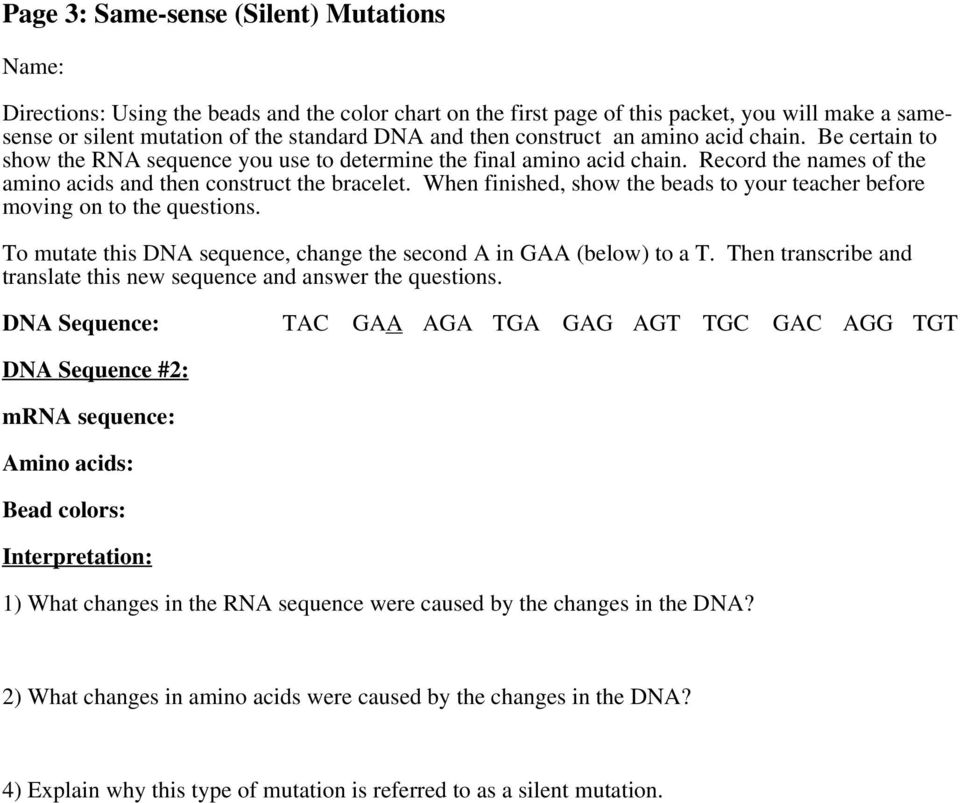
3 Page 3: Same-sense (Silent) Mutations Directions: Using the beads and the color chart on the first page of this packet, you will make a samesense or silent mutation of the standard DNA and then construct an amino acid chain. Be certain to show the RNA sequence you use to determine the final amino acid chain. Record the names of the amino acids and then construct the bracelet. When finished, show the beads to your teacher before moving on to the questions. To mutate this DNA sequence, change the second A in GAA (below) to a T. Then transcribe and translate this new sequence and answer the questions. DNA Sequence: TAC GAA AGA TGA GAG AGT TGC GAC AGG TGT DNA Sequence #2: mrna sequence: Amino acids: Bead colors: 1) What changes in the RNA sequence were caused by the changes in the DNA? 2) What changes in amino acids were caused by the changes in the DNA? 4) Explain why this type of mutation is referred to as a silent mutation.
4 Page 4: Insertion Mutations Directions: Using the beads and the color chart on the first page of this packet, you will make an insertion or addition mutation of the standard DNA and then construct an amino acid chain. Be certain to show the RNA sequence you use to determine the final amino acid chain. Record the names of the amino acids and then construct the bracelet. If you end up with a codon that only has 1 or 2 amino acids, assume that translation will stop and no amino acid will be added there. When finished, show the beads to your teacher before moving on to the questions. To mutate this sequence, add one base to the gene by adding a G between the TGC and GAC DNA triplets. DNA Sequence: TAC GAA AGA TGA GAG AGT TGC^ GAC AGG TGT DNA Sequence #3: mrna Sequence: Amino acids: Bead colors: 1) What changes in the RNA sequence were caused by the changes in the DNA? 2) What changes in amino acids were caused by the changes in the DNA? 3) What happens to the amino acid chain if the frame shift results in an RNA codon of UAA, UAG, or UGA? 1) How will the changes in amino acids affect the protein that is expressed by this gene? 4) Explain why this type of mutation is referred to as a frame shift mutation. Page 5: Deletion Mutations Directions: Using the beads and the color chart on the first page of this packet, you will make a deletion mutation of the standard DNA and then construct an amino acid chain. Be certain to show the RNA sequence you use to determine the final amino acid chain. Record the names of the amino acids and then construct the bracelet. If you end up with a codon that only has 1 or 2 amino acids, assume that translation will stop and no amino acid will be added there. When finished, show the beads to your teacher before moving on to the questions. Delete one base from the gene by dropping the second G in the GAG DNA triplet.

5 DNA Sequence TAC GAA AGA TGA GAG AGT TGC GAC AGG TGT DNA Sequence #4: mrna Sequence: Amino acids: Bead colors: 1) What changes in the RNA sequence were caused by the changes in the DNA? 2) What changes in amino acids were caused by the changes in the DNA? 3) What happens to the amino acid chain if the frame shift results in an RNA codon of UAA, UAG, or UGA? 3) How will the changes in amino acids affect the protein that is expressed by this gene? 4) Explain why this type of mutation is referred to as a frame shift mutation.

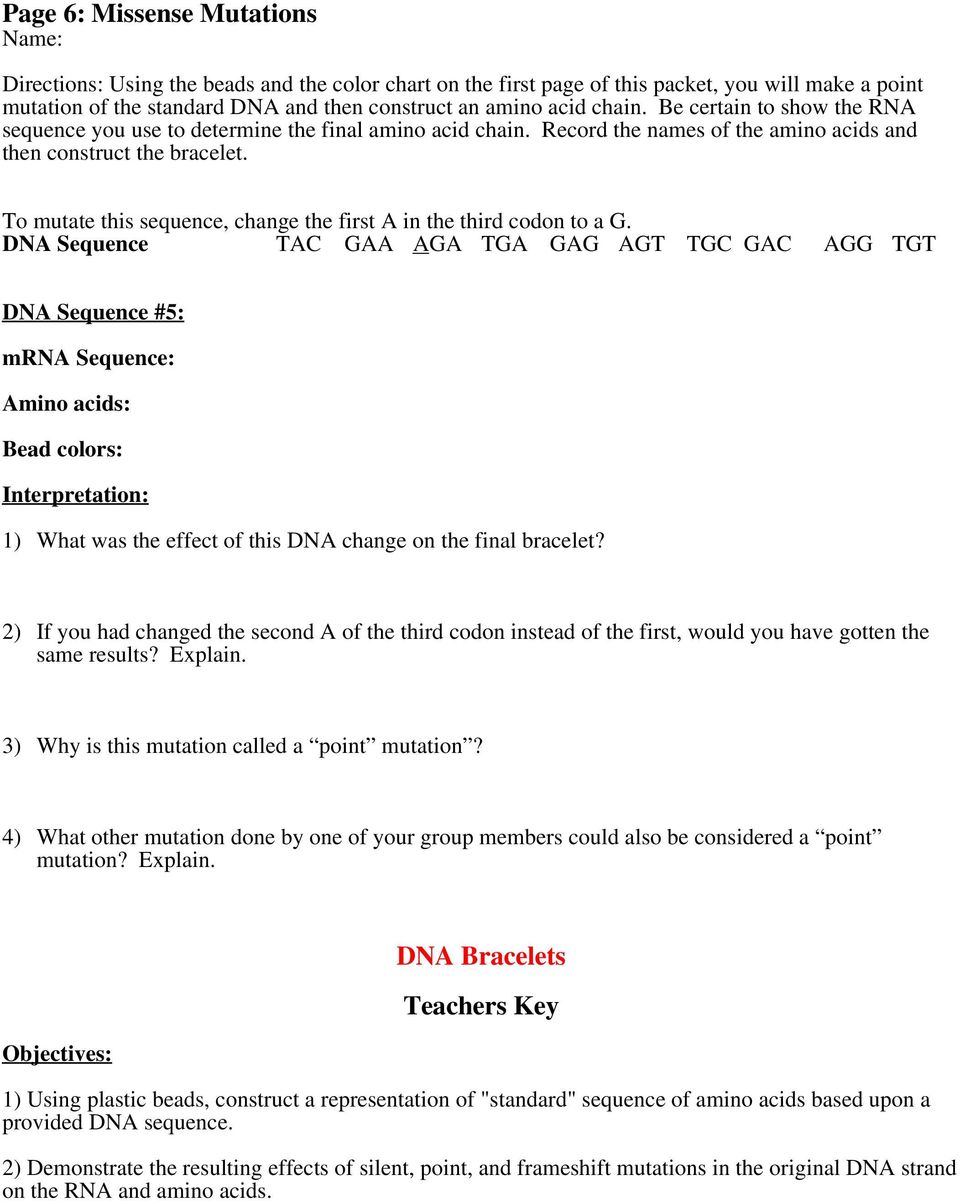
6 Page 6: Missense Mutations Directions: Using the beads and the color chart on the first page of this packet, you will make a point mutation of the standard DNA and then construct an amino acid chain. Be certain to show the RNA sequence you use to determine the final amino acid chain. Record the names of the amino acids and then construct the bracelet. To mutate this sequence, change the first A in the third codon to a G. DNA Sequence TAC GAA AGA TGA GAG AGT TGC GAC AGG TGT DNA Sequence #5: mrna Sequence: Amino acids: Bead colors: 1) What was the effect of this DNA change on the final bracelet? 2) If you had changed the second A of the third codon instead of the first, would you have gotten the same results? Explain. 3) Why is this mutation called a point mutation? 4) What other mutation done by one of your group members could also be considered a point mutation? Explain. Objectives: DNA Bracelets Teachers Key 1) Using plastic beads, construct a representation of "standard" sequence of amino acids based upon a provided DNA sequence. 2) Demonstrate the resulting effects of silent, point, and frameshift mutations in the original DNA strand on the RNA and amino acids.
7 Activities: 4) General Directions: You will need to form a group of 5 students. Remove the staple from this packet and assign one page to each student. All students will need to refer to this beginning page for the amino acid/bead conversion chart. Each student will use their assigned DNA sequence, make any required changes, and write the corresponding mrna sequence. Use the codon chart in your text to translate the mrna sequence into an amino acid sequence. Next consult the amino acid/bead conversion chart on this page to determine which bead colors are coding for these amino acids. Construct a bead bracelet corresponding to your amino acid sequence. Answer the questions on your sheet. Compare bracelets with the others in your group and then answer the questions below. You may keep your bracelets as a special biology momento! Amino acid/ bead conversions arginine = orange cystine = brown glutamine = green histadine = black leucine = red methionine = yellow proline = purple serine = white threonine = blue valine = pink Final Interpretations 1) Which type of mutation caused the greatest change in the final protein? Explain. Deletion. Because it altered the sequence earlier in the translation. 5) Which types of mutation caused the least change in the final protein? Explain. Silent mutation. The sequence was changed but it did not change the amino acid. 6) Why don t all mutations change the final protein? Some mutations may change the original DNA sequence but due to the degeneracy of the gentic code, do not change the amino acid in the final protein. Page 2: Standard DNA sequence Directions: Using the beads and the color chart on the first page of this packet, you will construct an amino acid chain using the "standard" DNA sequence as directed by your teacher. Be certain to show the RNA sequence you use to determine the final amino acid chain. Record the names of the amino acids and then construct the bracelet. When finished, show the beads to your teacher before moving on to the questions. DNA Sequence TAC GAA AGA TGA GAG AGT TGC GAC AGG TGT mrna Sequence: AUG CUU UCU ACU CUC UCA ACG CUG UCC ACA Amino acids: met leu ser thr leu ser thr leu ser thr Bead colors: Y R W Blu R W Blu R W Blu

8 5) What is special about the first codon? It an initiation codon. 6) Why does the sequence of colors repeat? Because different DNA sequences can code the same amino acid 7) Does the same color bead always correspond to the same DNA sequence? Give at least 2 examples from this lesson. No, different sequences can code for the same color. The DNA sequnces GAA and CAC both code code for leucine, red; AGA and AGGboth code for serine, white. 8) What feature of the genetic code is demonstrated by your answer to question 3? The genetic code is degenerate in that the code is redundancy in amino acid coding for. There are 64 codes for 20 amino acids.

9 Page 3: Same-sense (Silent) Mutations Directions: Using the beads and the color chart on the first page of this packet, you will make a samesense or silent mutation of the standard DNA and then construct an amino acid chain. Be certain to show the RNA sequence you use to determine the final amino acid chain. Record the names of the amino acids and then construct the bracelet. When finished, show the beads to your teacher before moving on to the questions. To mutate this DNA sequence, change the second A in GAA (below) to a T. Then transcribe and translate this new sequence and answer the questions. DNA Sequence: TAC GAA AGA TGA GAG AGT TGC GAC AGG TGT DNA Sequence #2: TAC GAT AGA TGA GAG AGT TGC GAC AGG TGT mrna sequence: AUG CUA UCU ACU CUC UCA ACG CUG UCC ACA Amino acids: met leu ser thr leu ser thr leu ser thr Bead colors: Y R W Blu R W Blu R W Blu 1) What changes in the RNA sequence were caused by the changes in the DNA? Adenine appeared in place of uracil in the transcription. 2) What changes in amino acids were caused by the changes in the DNA? There was no change in the amino acid. 3) Explain why this type of mutation is referred to as a silent mutation. The mutation is not manifested in the coded amino acid sequence.

10 Page 4: Insertion Mutations Directions: Using the beads and the color chart on the first page of this packet, you will make an insertion or addition mutation of the standard DNA and then construct an amino acid chain. Be certain to show the RNA sequence you use to determine the final amino acid chain. Record the names of the amino acids and then construct the bracelet. If you end up with a codon that only has 1 or 2 amino acids, assume that translation will stop and no amino acid will be added there. When finished, show the beads to your teacher before moving on to the questions. To mutate this sequence, add one base to the gene by adding a G between the TGC and GAC DNA triplets. DNA Sequence: TAC GAA AGA TGA GAG AGT TGC^ GAC AGG TGT DNA Sequence #3: TAC GAA AGA TGA GAG AGT TGC GGA CAG CAC T mrna Sequence: AUG GAT UCU ACU CUC UCA ACG CUG UCC ACA A Amino acids: met leu ser thr leu ser thr pro val his Bead colors: Y R W Blu R W Blu Pur Pnk Blk 1) What changes in the RNA sequence were caused by the changes in the DNA? The RNA was severely changed. The insertion shifted the order of the sequence. 2) What changes in amino acids were caused by the changes in the DNA? The coded amino acids were changed significantly. 3) What happens to the amino acid chain if the frame shift results in an RNA codon of UAA, UAG, or UGA? These are termination codons. Translation will stop prematurely. 4) How will the changes in amino acids affect the protein that is expressed by this gene? A different protein that may not have any function would be produced. 9) Explain why this type of mutation is referred to as a frame shift mutation. The sequence order was shifted by the number of nucleotides that were inserted. Page 5: Deletion Mutations Directions: Using the beads and the color chart on the first page of this packet, you will make a deletion mutation of the standard DNA and then construct an amino acid chain. Be certain to show the RNA sequence you use to determine the final amino acid chain. Record the names of the amino acids and then construct the bracelet. If you end up with a codon that only has 1 or 2 amino acids, assume that translation will stop and no amino acid will be added there. When finished, show the beads to your teacher before moving on to the questions.

11 Delete one base from the gene by dropping the second G in the GAG DNA triplet. DNA Sequence TAC GAA AGA TGA GAG AGT TGC GAC AGG TGT DNA Sequence #4: TACGAA AGA TGA GAA GTT GCG ACA GGT GT mrna Sequence: AUG GAT UCU ACU CUU CAA CGC UGU CCA X Amino acids: met leu ser thr leu gln arg cys pro X Bead colors: Y R W Blu R G O Brn Pur X 1) What changes in the RNA sequence were caused by the changes in the DNA? When the DNA sequence was changed, the RNA reading frame was shifted. 2) What changes in amino acids were caused by the changes in the DNA? Different amino acid were coded after the deletion shifted the sequence. 3) What happens to the amino acid chain if the frame shift results in an RNA codon of UAA, UAG, or UGA? These are termination codons. Translation will stop prematurely. 3) How will the changes in amino acids affect the protein that is expressed by this gene? A different, shortened protein will be produced that may not be functional. 4) Explain why this type of mutation is referred to as a frame shift mutation. The number of nucleotides that were deleted shifted the RNA reading frame.

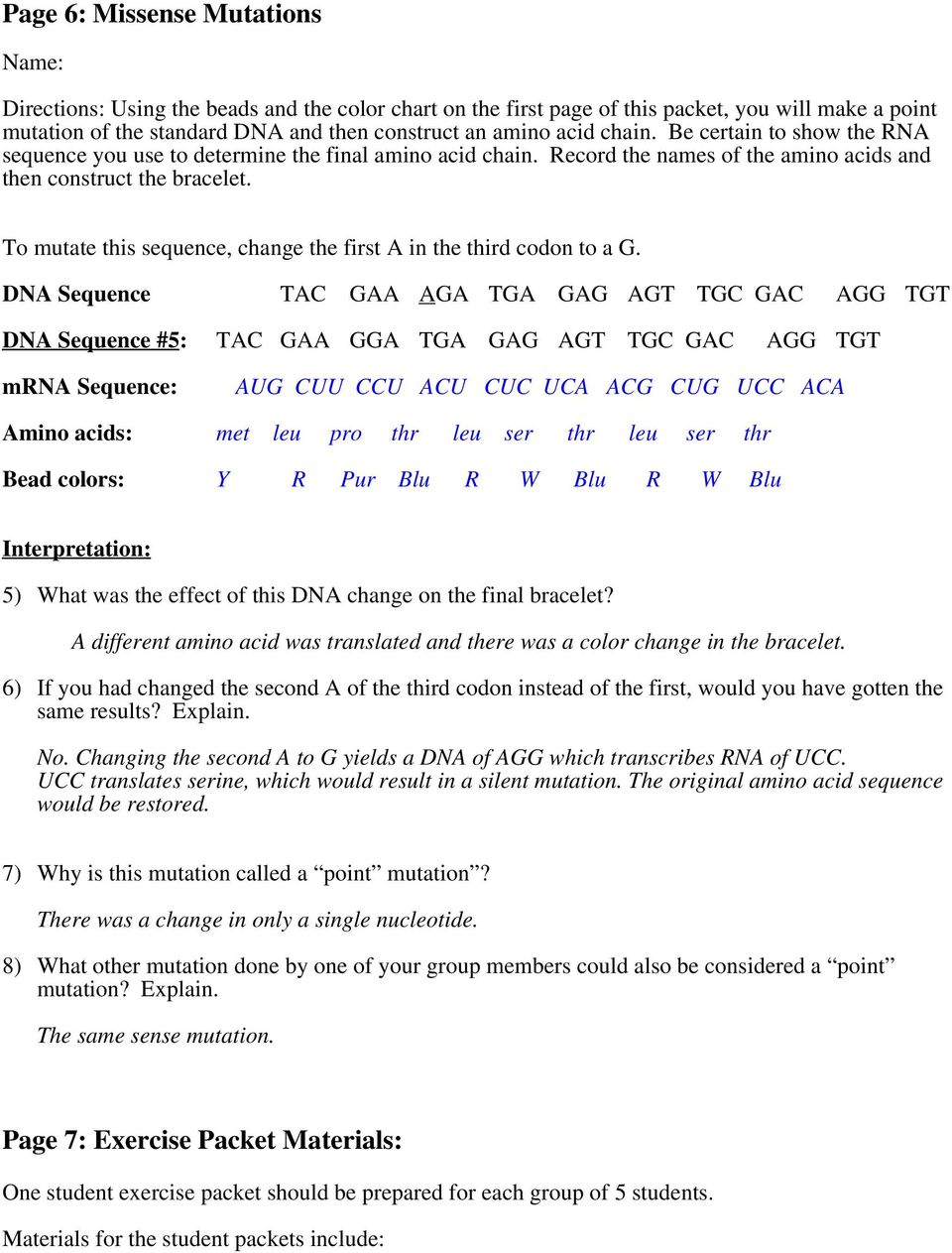
12 Page 6: Missense Mutations Directions: Using the beads and the color chart on the first page of this packet, you will make a point mutation of the standard DNA and then construct an amino acid chain. Be certain to show the RNA sequence you use to determine the final amino acid chain. Record the names of the amino acids and then construct the bracelet. To mutate this sequence, change the first A in the third codon to a G. DNA Sequence TAC GAA AGA TGA GAG AGT TGC GAC AGG TGT DNA Sequence #5: TAC GAA GGA TGA GAG AGT TGC GAC AGG TGT mrna Sequence: AUG CUU CCU ACU CUC UCA ACG CUG UCC ACA Amino acids: met leu pro thr leu ser thr leu ser thr Bead colors: Y R Pur Blu R W Blu R W Blu 5) What was the effect of this DNA change on the final bracelet? A different amino acid was translated and there was a color change in the bracelet. 6) If you had changed the second A of the third codon instead of the first, would you have gotten the same results? Explain. No. Changing the second A to G yields a DNA of AGG which transcribes RNA of UCC. UCC translates serine, which would result in a silent mutation. The original amino acid sequence would be restored. 7) Why is this mutation called a point mutation? There was a change in only a single nucleotide. 8) What other mutation done by one of your group members could also be considered a point mutation? Explain. The same sense mutation. Page 7: Exercise Packet Materials: One student exercise packet should be prepared for each group of 5 students. Materials for the student packets include:
13 Plastic sandwich bags (to hold kit contents). 5-8 inch long sisal, jute or any decorative cord that plastic beads may be stung on. Plastic colored beads in the following colors and numbers: A minimum of 5 yellow beads. A minimum of 13 red beads. A minimum of 3 purple beads. A minimum of 12 blue beads. A minimum of 11 white beads. A minimum of 1 pink bead. A minimum of 1 brown bead. A minimum of 1 black bead. A minimum of 1 orange bead. Note: Additional beads may be included at the instructor's discretion.

Hands on Simulation of Mutation
 Hands on Simulation of Mutation Charlotte K. Omoto P.O. Box 644236 Washington State University Pullman, WA 99164-4236 [email protected] ABSTRACT This exercise is a hands-on simulation of mutations and their
(http://genomes.urv.es/caical) TUTORIAL. (July 2006)
 (http://genomes.urv.es/caical) TUTORIAL (July 2006) CAIcal manual 2 Table of contents Introduction... 3 Required inputs... 5 SECTION A Calculation of parameters... 8 SECTION B CAI calculation for FASTA
Mutation. Mutation provides raw material to evolution. Different kinds of mutations have different effects
 Mutation Mutation provides raw material to evolution Different kinds of mutations have different effects Mutational Processes Point mutation single nucleotide changes coding changes (missense mutations)
Gene Finding CMSC 423
 Gene Finding CMSC 423 Finding Signals in DNA We just have a long string of A, C, G, Ts. How can we find the signals encoded in it? Suppose you encountered a language you didn t know. How would you decipher
Coding sequence the sequence of nucleotide bases on the DNA that are transcribed into RNA which are in turn translated into protein
 Assignment 3 Michele Owens Vocabulary Gene: A sequence of DNA that instructs a cell to produce a particular protein Promoter a control sequence near the start of a gene Coding sequence the sequence of
Molecular Facts and Figures
 Nucleic Acids Molecular Facts and Figures DNA/RNA bases: DNA and RNA are composed of four bases each. In DNA the four are Adenine (A), Thymidine (T), Cytosine (C), and Guanine (G). In RNA the four are
Mutations and Genetic Variability. 1. What is occurring in the diagram below?
 Mutations and Genetic Variability 1. What is occurring in the diagram below? A. Sister chromatids are separating. B. Alleles are independently assorting. C. Genes are replicating. D. Segments of DNA are
UNIVERSITETET I OSLO Det matematisk-naturvitenskapelige fakultet
 1 UNIVERSITETET I OSLO Det matematisk-naturvitenskapelige fakultet Exam in: MBV4010 Arbeidsmetoder i molekylærbiologi og biokjemi I MBV4010 Methods in molecular biology and biochemistry I Day of exam:.
Concluding lesson. Student manual. What kind of protein are you? (Basic)
 Concluding lesson Student manual What kind of protein are you? (Basic) Part 1 The hereditary material of an organism is stored in a coded way on the DNA. This code consists of four different nucleotides:
Gene and Chromosome Mutation Worksheet (reference pgs. 239-240 in Modern Biology textbook)
 Name Date Per Look at the diagrams, then answer the questions. Gene Mutations affect a single gene by changing its base sequence, resulting in an incorrect, or nonfunctional, protein being made. (a) A
PRACTICE TEST QUESTIONS
 PART A: MULTIPLE CHOICE QUESTIONS PRACTICE TEST QUESTIONS DNA & PROTEIN SYNTHESIS B 1. One of the functions of DNA is to A. secrete vacuoles. B. make copies of itself. C. join amino acids to each other.
Thymine = orange Adenine = dark green Guanine = purple Cytosine = yellow Uracil = brown
 1 DNA Coloring - Transcription & Translation Transcription RNA, Ribonucleic Acid is very similar to DNA. RNA normally exists as a single strand (and not the double stranded double helix of DNA). It contains
13.2 Ribosomes & Protein Synthesis
 13.2 Ribosomes & Protein Synthesis Introduction: *A specific sequence of bases in DNA carries the directions for forming a polypeptide, a chain of amino acids (there are 20 different types of amino acid).
Provincial Exam Questions. 9. Give one role of each of the following nucleic acids in the production of an enzyme.
 Provincial Exam Questions Unit: Cell Biology: Protein Synthesis (B7 & B8) 2010 Jan 3. Describe the process of translation. (4 marks) 2009 Sample 8. What is the role of ribosomes in protein synthesis? A.
a. Ribosomal RNA rrna a type ofrna that combines with proteins to form Ribosomes on which polypeptide chains of proteins are assembled
 Biology 101 Chapter 14 Name: Fill-in-the-Blanks Which base follows the next in a strand of DNA is referred to. as the base (1) Sequence. The region of DNA that calls for the assembly of specific amino
2006 7.012 Problem Set 3 KEY
 2006 7.012 Problem Set 3 KEY Due before 5 PM on FRIDAY, October 13, 2006. Turn answers in to the box outside of 68-120. PLEASE WRITE YOUR ANSWERS ON THIS PRINTOUT. 1. Which reaction is catalyzed by each
From DNA to Protein. Proteins. Chapter 13. Prokaryotes and Eukaryotes. The Path From Genes to Proteins. All proteins consist of polypeptide chains
 Proteins From DNA to Protein Chapter 13 All proteins consist of polypeptide chains A linear sequence of amino acids Each chain corresponds to the nucleotide base sequence of a gene The Path From Genes
Part ONE. a. Assuming each of the four bases occurs with equal probability, how many bits of information does a nucleotide contain?
 Networked Systems, COMPGZ01, 2012 Answer TWO questions from Part ONE on the answer booklet containing lined writing paper, and answer ALL questions in Part TWO on the multiple-choice question answer sheet.
Protein Synthesis. Page 41 Page 44 Page 47 Page 42 Page 45 Page 48 Page 43 Page 46 Page 49. Page 41. DNA RNA Protein. Vocabulary
 Protein Synthesis Vocabulary Transcription Translation Translocation Chromosomal mutation Deoxyribonucleic acid Frame shift mutation Gene expression Mutation Point mutation Page 41 Page 41 Page 44 Page
Protein Synthesis Simulation
 Protein Synthesis Simulation Name(s) Date Period Benchmark: SC.912.L.16.5 as AA: Explain the basic processes of transcription and translation, and how they result in the expression of genes. (Assessed
Bio 102 Practice Problems Genetic Code and Mutation
 Bio 102 Practice Problems Genetic Code and Mutation Multiple choice: Unless otherwise directed, circle the one best answer: 1. Beadle and Tatum mutagenized Neurospora to find strains that required arginine
DNA Replication & Protein Synthesis. This isn t a baaaaaaaddd chapter!!!
 DNA Replication & Protein Synthesis This isn t a baaaaaaaddd chapter!!! The Discovery of DNA s Structure Watson and Crick s discovery of DNA s structure was based on almost fifty years of research by other
Ms. Campbell Protein Synthesis Practice Questions Regents L.E.
 Name Student # Ms. Campbell Protein Synthesis Practice Questions Regents L.E. 1. A sequence of three nitrogenous bases in a messenger-rna molecule is known as a 1) codon 2) gene 3) polypeptide 4) nucleotide
Hiding Data in DNA. 1 Introduction
 Hiding Data in DNA Boris Shimanovsky *, Jessica Feng +, and Miodrag Potkonjak + * XAP Corporation + Dept. Computer Science, Univ. of California, Los Angeles Abstract. Just like disk or RAM, DNA and RNA
Chapter 9. Applications of probability. 9.1 The genetic code
 Chapter 9 Applications of probability In this chapter we use the tools of elementary probability to investigate problems of several kinds. First, we study the language of life by focusing on the universal
Molecular Genetics. RNA, Transcription, & Protein Synthesis
 Molecular Genetics RNA, Transcription, & Protein Synthesis Section 1 RNA AND TRANSCRIPTION Objectives Describe the primary functions of RNA Identify how RNA differs from DNA Describe the structure and
ISTEP+: Biology I End-of-Course Assessment Released Items and Scoring Notes
 ISTEP+: Biology I End-of-Course Assessment Released Items and Scoring Notes Page 1 of 22 Introduction Indiana students enrolled in Biology I participated in the ISTEP+: Biology I Graduation Examination
Biological One-way Functions
 Biological One-way Functions Qinghai Gao, Xiaowen Zhang 2, Michael Anshel 3 [email protected] [email protected] [email protected] Dept. Security System, Farmingdale State College / SUNY,
The p53 MUTATION HANDBOOK
 The p MUTATION HANDBOOK Version 1. /7 Thierry Soussi Christophe Béroud, Dalil Hamroun Jean Michel Rubio Nevado http://p/free.fr The p Mutation HandBook By T Soussi, J.M. Rubio-Nevado, D. Hamroun and C.
Pipe Cleaner Proteins. Essential question: How does the structure of proteins relate to their function in the cell?
 Pipe Cleaner Proteins GPS: SB1 Students will analyze the nature of the relationships between structures and functions in living cells. Essential question: How does the structure of proteins relate to their
Transcription and Translation of DNA
 Transcription and Translation of DNA Genotype our genetic constitution ( makeup) is determined (controlled) by the sequence of bases in its genes Phenotype determined by the proteins synthesised when genes
Protein Synthesis How Genes Become Constituent Molecules
 Protein Synthesis Protein Synthesis How Genes Become Constituent Molecules Mendel and The Idea of Gene What is a Chromosome? A chromosome is a molecule of DNA 50% 50% 1. True 2. False True False Protein
Insulin mrna to Protein Kit
 Insulin mrna to Protein Kit A 3DMD Paper BioInformatics and Mini-Toober Folding Activity Teacher Key and Teacher Notes www. Insulin mrna to Protein Kit Contents Becoming Familiar with the Data... 3 Identifying
Lab # 12: DNA and RNA
 115 116 Concepts to be explored: Structure of DNA Nucleotides Amino Acids Proteins Genetic Code Mutation RNA Transcription to RNA Translation to a Protein Figure 12. 1: DNA double helix Introduction Long
Genetic information (DNA) determines structure of proteins DNA RNA proteins cell structure 3.11 3.15 enzymes control cell chemistry ( metabolism )
 Biology 1406 Exam 3 Notes Structure of DNA Ch. 10 Genetic information (DNA) determines structure of proteins DNA RNA proteins cell structure 3.11 3.15 enzymes control cell chemistry ( metabolism ) Proteins
UNIT (12) MOLECULES OF LIFE: NUCLEIC ACIDS
 UIT (12) MLECULE F LIFE: UCLEIC ACID ucleic acids are extremely large molecules that were first isolated from the nuclei of cells. Two kinds of nucleic acids are found in cells: RA (ribonucleic acid) is
Name Class Date. Figure 13 1. 2. Which nucleotide in Figure 13 1 indicates the nucleic acid above is RNA? a. uracil c. cytosine b. guanine d.
 13 Multiple Choice RNA and Protein Synthesis Chapter Test A Write the letter that best answers the question or completes the statement on the line provided. 1. Which of the following are found in both
From DNA to Protein
 Nucleus Control center of the cell contains the genetic library encoded in the sequences of nucleotides in molecules of DNA code for the amino acid sequences of all proteins determines which specific proteins
LESSON 4. Using Bioinformatics to Analyze Protein Sequences. Introduction. Learning Objectives. Key Concepts
 4 Using Bioinformatics to Analyze Protein Sequences Introduction In this lesson, students perform a paper exercise designed to reinforce the student understanding of the complementary nature of DNA and
The Puzzle of Life A Lesson Plan for Life S cien ce Teach ers From: The G reat Lakes S cien ce C ent er, C lev elan d, OH
 Introduction: The Puzzle of Life A Lesson Plan for Life S cien ce Teach ers From: The G reat Lakes S cien ce C ent er, C lev elan d, OH In the Puzzle of Life activity, students will demonstrate how the
Modeling DNA Replication and Protein Synthesis
 Skills Practice Lab Modeling DNA Replication and Protein Synthesis OBJECTIVES Construct and analyze a model of DNA. Use a model to simulate the process of replication. Use a model to simulate the process
Mutation, Repair, and Recombination
 16 Mutation, Repair, and Recombination WORKING WITH THE FIGURES 1. In Figure 16-3a, what is the consequence of the new 5 splice site on the open reading frame? In 16-3b, how big could the intron be to
GENEWIZ, Inc. DNA Sequencing Service Details for USC Norris Comprehensive Cancer Center DNA Core
 DNA Sequencing Services Pre-Mixed o Provide template and primer, mixed into the same tube* Pre-Defined o Provide template and primer in separate tubes* Custom o Full-service for samples with unknown concentration
Academic Nucleic Acids and Protein Synthesis Test
 Academic Nucleic Acids and Protein Synthesis Test Multiple Choice Identify the letter of the choice that best completes the statement or answers the question. 1. Each organism has a unique combination
1 Mutation and Genetic Change
 CHAPTER 14 1 Mutation and Genetic Change SECTION Genes in Action KEY IDEAS As you read this section, keep these questions in mind: What is the origin of genetic differences among organisms? What kinds
Genomes and SNPs in Malaria and Sickle Cell Anemia
 Genomes and SNPs in Malaria and Sickle Cell Anemia Introduction to Genome Browsing with Ensembl Ensembl The vast amount of information in biological databases today demands a way of organising and accessing
The sequence of bases on the mrna is a code that determines the sequence of amino acids in the polypeptide being synthesized:
 Module 3F Protein Synthesis So far in this unit, we have examined: How genes are transmitted from one generation to the next Where genes are located What genes are made of How genes are replicated How
RNA & Protein Synthesis
 RNA & Protein Synthesis Genes send messages to cellular machinery RNA Plays a major role in process Process has three phases (Genetic) Transcription (Genetic) Translation Protein Synthesis RNA Synthesis
Bob Jesberg. Boston, MA April 3, 2014
 DNA, Replication and Transcription Bob Jesberg NSTA Conference Boston, MA April 3, 2014 1 Workshop Agenda Looking at DNA and Forensics The DNA, Replication i and Transcription i Set DNA Ladder The Double
DNA, RNA, Protein synthesis, and Mutations. Chapters 12-13.3
 DNA, RNA, Protein synthesis, and Mutations Chapters 12-13.3 1A)Identify the components of DNA and explain its role in heredity. DNA s Role in heredity: Contains the genetic information of a cell that can
Specific problems. The genetic code. The genetic code. Adaptor molecules match amino acids to mrna codons
 Tutorial II Gene expression: mrna translation and protein synthesis Piergiorgio Percipalle, PhD Program Control of gene transcription and RNA processing mrna translation and protein synthesis KAROLINSKA
AP BIOLOGY 2010 SCORING GUIDELINES (Form B)
 AP BIOLOGY 2010 SCORING GUIDELINES (Form B) Question 2 Certain human genetic conditions, such as sickle cell anemia, result from single base-pair mutations in DNA. (a) Explain how a single base-pair mutation
Regents Biology REGENTS REVIEW: PROTEIN SYNTHESIS
 Period Date REGENTS REVIEW: PROTEIN SYNTHESIS 1. The diagram at the right represents a portion of a type of organic molecule present in the cells of organisms. What will most likely happen if there is
Multiple Choice Write the letter that best answers the question or completes the statement on the line provided.
 Name lass Date hapter 12 DN and RN hapter Test Multiple hoice Write the letter that best answers the question or completes the statement on the line provided. Pearson Education, Inc. ll rights reserved.
Module 6: Digital DNA
 Module 6: Digital DNA Representation and processing of digital information in the form of DNA is essential to life in all organisms, no matter how large or tiny. Computing tools and computational thinking
Biology Final Exam Study Guide: Semester 2
 Biology Final Exam Study Guide: Semester 2 Questions 1. Scientific method: What does each of these entail? Investigation and Experimentation Problem Hypothesis Methods Results/Data Discussion/Conclusion
Ribosomal Protein Synthesis
 1 1 Ribosomal Protein Synthesis Prof. Dr. Wolfgang Wintermeyer 1, Prof. Dr. Marina V. Rodnina 2 1 Institut f r Molekularbiologie, Universit t Witten/Herdecke, Stockumer Stra e 10, 58448 Witten, Germany;
BioBoot Camp Genetics
 BioBoot Camp Genetics BIO.B.1.2.1 Describe how the process of DNA replication results in the transmission and/or conservation of genetic information DNA Replication is the process of DNA being copied before
(A) Microarray analysis was performed on ATM and MDM isolated from 4 obese donors.
 Legends of supplemental figures and tables Figure 1: Overview of study design and results. (A) Microarray analysis was performed on ATM and MDM isolated from 4 obese donors. After raw data gene expression
Bioinformatics Resources at a Glance
 Bioinformatics Resources at a Glance A Note about FASTA Format There are MANY free bioinformatics tools available online. Bioinformaticists have developed a standard format for nucleotide and protein sequences
Table S1. Related to Figure 4
 Table S1. Related to Figure 4 Final Diagnosis Age PMD Control Control 61 15 Control 67 6 Control 68 10 Control 49 15 AR-PD PD 62 15 PD 65 4 PD 52 18 PD 68 10 AR-PD cingulate cortex used for immunoblot
Lecture 3: Mutations
 Lecture 3: Mutations Recall that the flow of information within a cell involves the transcription of DNA to mrna and the translation of mrna to protein. Recall also, that the flow of information between
Umm AL Qura University MUTATIONS. Dr Neda M Bogari
 Umm AL Qura University MUTATIONS Dr Neda M Bogari CONTACTS www.bogari.net http://web.me.com/bogari/bogari.net/ From DNA to Mutations MUTATION Definition: Permanent change in nucleotide sequence. It can
Gene Switches Teacher Information
 STO-143 Gene Switches Teacher Information Summary Kit contains How do bacteria turn on and turn off genes? Students model the action of the lac operon that regulates the expression of genes essential for
Guidelines for Writing a Scientific Paper
 Guidelines for Writing a Scientific Paper Writing an effective scientific paper is not easy. A good rule of thumb is to write as if your paper will be read by a person who knows about the field in general
2. The number of different kinds of nucleotides present in any DNA molecule is A) four B) six C) two D) three
 Chem 121 Chapter 22. Nucleic Acids 1. Any given nucleotide in a nucleic acid contains A) two bases and a sugar. B) one sugar, two bases and one phosphate. C) two sugars and one phosphate. D) one sugar,
The Steps. 1. Transcription. 2. Transferal. 3. Translation
 Protein Synthesis Protein synthesis is simply the "making of proteins." Although the term itself is easy to understand, the multiple steps that a cell in a plant or animal must go through are not. In order
Name: Date: Period: DNA Unit: DNA Webquest
 Name: Date: Period: DNA Unit: DNA Webquest Part 1 History, DNA Structure, DNA Replication DNA History http://www.dnaftb.org/dnaftb/1/concept/index.html Read the text and answer the following questions.
BCOR101 Midterm II Wednesday, October 26, 2005
 BCOR101 Midterm II Wednesday, October 26, 2005 Name Key Please show all of your work. 1. A donor strain is trp+, pro+, met+ and a recipient strain is trp-, pro-, met-. The donor strain is infected with
RNA and Protein Synthesis
 Name lass Date RN and Protein Synthesis Information and Heredity Q: How does information fl ow from DN to RN to direct the synthesis of proteins? 13.1 What is RN? WHT I KNOW SMPLE NSWER: RN is a nucleic
Translation Study Guide
 Translation Study Guide This study guide is a written version of the material you have seen presented in the replication unit. In translation, the cell uses the genetic information contained in mrna to
Shu-Ping Lin, Ph.D. E-mail: [email protected]
 Amino Acids & Proteins Shu-Ping Lin, Ph.D. Institute te of Biomedical Engineering ing E-mail: [email protected] Website: http://web.nchu.edu.tw/pweb/users/splin/ edu tw/pweb/users/splin/ Date: 10.13.2010
BOC334 (Proteomics) Practical 1. Calculating the charge of proteins
 BC334 (Proteomics) Practical 1 Calculating the charge of proteins Aliphatic amino acids (VAGLIP) N H 2 H Glycine, Gly, G no charge Hydrophobicity = 0.67 MW 57Da pk a CH = 2.35 pk a NH 2 = 9.6 pi=5.97 CH
10 µg lyophilized plasmid DNA (store lyophilized plasmid at 20 C)
 TECHNICAL DATA SHEET BIOLUMINESCENCE RESONANCE ENERGY TRANSFER RENILLA LUCIFERASE FUSION PROTEIN EXPRESSION VECTOR Product: prluc-c Vectors Catalog number: Description: Amount: The prluc-c vectors contain
DNA Sample preparation and Submission Guidelines
 DNA Sample preparation and Submission Guidelines Requirements: Please submit samples in 1.5ml microcentrifuge tubes. Fill all the required information in the Eurofins DNA sequencing order form and send
Genetics Module B, Anchor 3
 Genetics Module B, Anchor 3 Key Concepts: - An individual s characteristics are determines by factors that are passed from one parental generation to the next. - During gamete formation, the alleles for
Molecular analyses of EGFR: mutation and amplification detection
 Molecular analyses of EGFR: mutation and amplification detection Petra Nederlof, Moleculaire Pathologie NKI Amsterdam Henrique Ruijter, Ivon Tielen, Lucie Boerrigter, Aafke Ariaens Outline presentation
Sickle cell anemia: Altered beta chain Single AA change (#6 Glu to Val) Consequence: Protein polymerizes Change in RBC shape ---> phenotypes
 Protein Structure Polypeptide: Protein: Therefore: Example: Single chain of amino acids 1 or more polypeptide chains All polypeptides are proteins Some proteins contain >1 polypeptide Hemoglobin (O 2 binding
pcas-guide System Validation in Genome Editing
 pcas-guide System Validation in Genome Editing Tagging HSP60 with HA tag genome editing The latest tool in genome editing CRISPR/Cas9 allows for specific genome disruption and replacement in a flexible
Next Generation Sequencing
 Next Generation Sequencing 38. Informationsgespräch der Blutspendezentralefür Wien, Niederösterreich und Burgenland Österreichisches Rotes Kreuz 22. November 2014, Parkhotel Schönbrunn Die Zukunft hat
Structure and Function of DNA
 Structure and Function of DNA DNA and RNA Structure DNA and RNA are nucleic acids. They consist of chemical units called nucleotides. The nucleotides are joined by a sugar-phosphate backbone. The four
Introduction to Perl Programming Input/Output, Regular Expressions, String Manipulation. Beginning Perl, Chap 4 6. Example 1
 Introduction to Perl Programming Input/Output, Regular Expressions, String Manipulation Beginning Perl, Chap 4 6 Example 1 #!/usr/bin/perl -w use strict; # version 1: my @nt = ('A', 'C', 'G', 'T'); for
The Making of the Fittest: Evolving Switches, Evolving Bodies
 OVERVIEW MODELING THE REGULATORY SWITCHES OF THE PITX1 GENE IN STICKLEBACK FISH This hands-on activity supports the short film, The Making of the Fittest:, and aims to help students understand eukaryotic
Recombinant DNA Technology
 Recombinant DNA Technology Stephen B. Gruber, MD, PhD Division of Molecular Medicine and Genetics November 4, 2002 Learning Objectives Know the basics of gene structure, function and regulation. Be familiar
To be able to describe polypeptide synthesis including transcription and splicing
 Thursday 8th March COPY LO: To be able to describe polypeptide synthesis including transcription and splicing Starter Explain the difference between transcription and translation BATS Describe and explain
Lecture Series 7. From DNA to Protein. Genotype to Phenotype. Reading Assignments. A. Genes and the Synthesis of Polypeptides
 Lecture Series 7 From DNA to Protein: Genotype to Phenotype Reading Assignments Read Chapter 7 From DNA to Protein A. Genes and the Synthesis of Polypeptides Genes are made up of DNA and are expressed
CHAPTER 30: PROTEIN SYNTHESIS
 CHAPTER 30: PROTEIN SYNTHESIS (Translation) Translation: mrna protein LECTURE TOPICS Complexity, stages, rate, accuracy Amino acid activation [trna charging] trnas and translating the Genetic Code - Amino
Gene mutation and molecular medicine Chapter 15
 Gene mutation and molecular medicine Chapter 15 Lecture Objectives What Are Mutations? How Are DNA Molecules and Mutations Analyzed? How Do Defective Proteins Lead to Diseases? What DNA Changes Lead to
Chapter 17: From Gene to Protein
 AP Biology Reading Guide Fred and Theresa Holtzclaw Julia Keller 12d Chapter 17: From Gene to Protein 1. What is gene expression? Gene expression is the process by which DNA directs the synthesis of proteins
TRANSCRIPTION TRANSLATION - GENETIC CODE AND OUTLINE OF PROTEIN SYNTHESIS
 TRANSCRIPTION TRANSLATION - GENETIC CODE AND OUTLINE OF PROTEIN SYNTHESIS Central Dogma of Protein Synthesis Proteins constitute the major part by dry weight of an actively growing cell. They are widely
SERVICES CATALOGUE WITH SUBMISSION GUIDELINES
 SERVICES CATALOGUE WITH SUBMISSION GUIDELINES 3921 Montgomery Road Cincinnati, Ohio 45212 513-841-2428 www.agctsequencing.com CONTENTS Welcome Dye Terminator Sequencing DNA Sequencing Services - Full Service
Pantone Matching System Color Chart PMS Colors Used For Printing
 Pantone Matching System Color Chart PMS Colors Used For Printing Use this guide to assist your color selection and specification process. This chart is a reference guide only. Pantone colors on computer
Basic Concepts of DNA, Proteins, Genes and Genomes
 Basic Concepts of DNA, Proteins, Genes and Genomes Kun-Mao Chao 1,2,3 1 Graduate Institute of Biomedical Electronics and Bioinformatics 2 Department of Computer Science and Information Engineering 3 Graduate
Part A: Amino Acids and Peptides (Is the peptide IAG the same as the peptide GAI?)
 ChemActivity 46 Amino Acids, Polypeptides and Proteins 1 ChemActivity 46 Part A: Amino Acids and Peptides (Is the peptide IAG the same as the peptide GAI?) Model 1: The 20 Amino Acids at Biological p See