
Coding sequence the sequence of nucleotide bases on the DNA that are transcribed into RNA which are in turn translated into protein
|
|
|
- Joseph Freeman
- 10 years ago
- Views:
Transcription
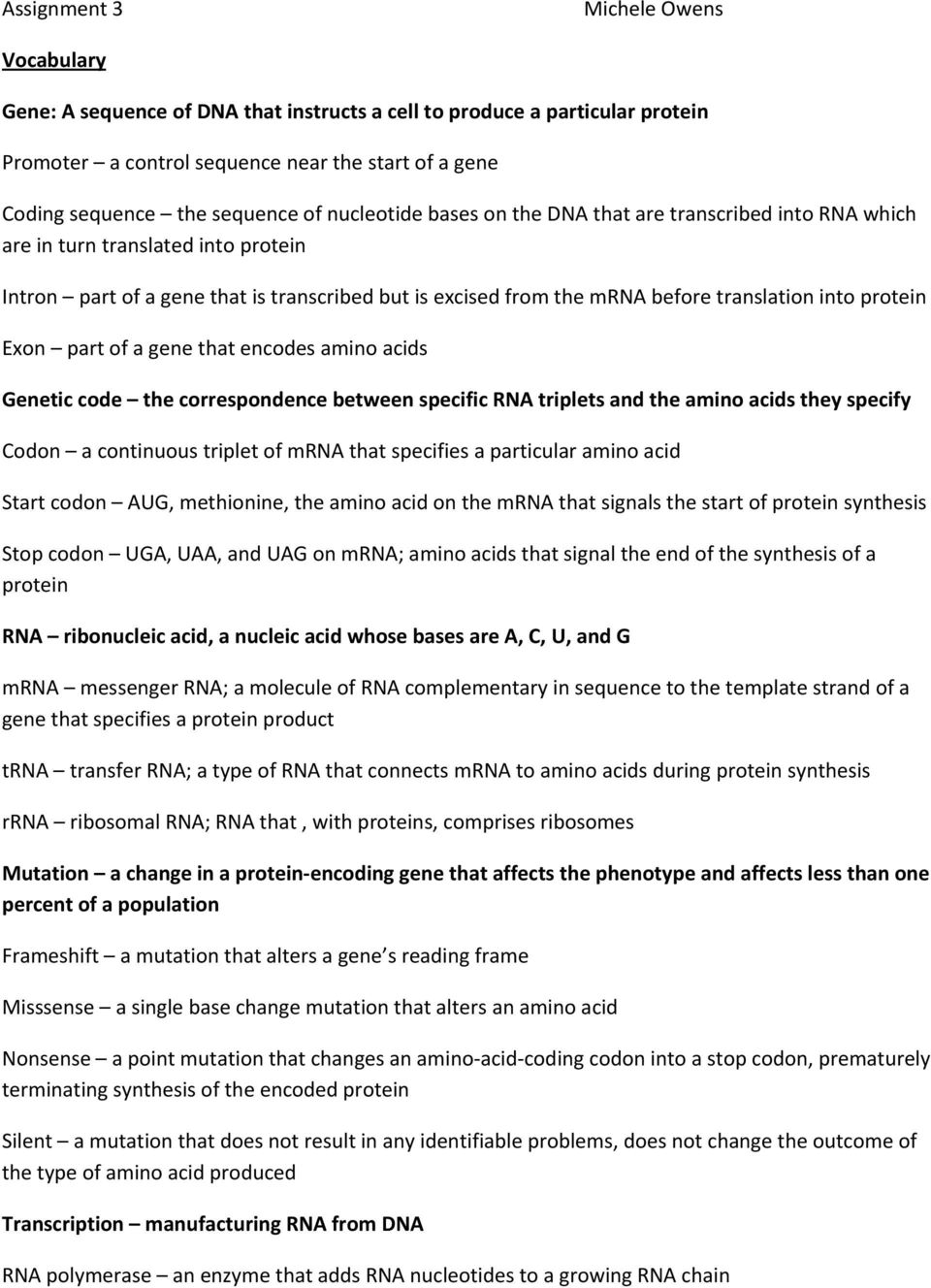
1 Assignment 3 Michele Owens Vocabulary Gene: A sequence of DNA that instructs a cell to produce a particular protein Promoter a control sequence near the start of a gene Coding sequence the sequence of nucleotide bases on the DNA that are transcribed into RNA which are in turn translated into protein Intron part of a gene that is transcribed but is excised from the mrna before translation into protein Exon part of a gene that encodes amino acids Genetic code the correspondence between specific RNA triplets and the amino acids they specify Codon a continuous triplet of mrna that specifies a particular amino acid Start codon AUG, methionine, the amino acid on the mrna that signals the start of protein synthesis Stop codon UGA, UAA, and UAG on mrna; amino acids that signal the end of the synthesis of a protein RNA ribonucleic acid, a nucleic acid whose bases are A, C, U, and G mrna messenger RNA; a molecule of RNA complementary in sequence to the template strand of a gene that specifies a protein product trna transfer RNA; a type of RNA that connects mrna to amino acids during protein synthesis rrna ribosomal RNA; RNA that, with proteins, comprises ribosomes Mutation a change in a protein encoding gene that affects the phenotype and affects less than one percent of a population Frameshift a mutation that alters a gene s reading frame Misssense a single base change mutation that alters an amino acid Nonsense a point mutation that changes an amino acid coding codon into a stop codon, prematurely terminating synthesis of the encoded protein Silent a mutation that does not result in any identifiable problems, does not change the outcome of the type of amino acid produced Transcription manufacturing RNA from DNA RNA polymerase an enzyme that adds RNA nucleotides to a growing RNA chain
2 Template strand the DNA strand carrying the information to be transcribed Non template (coding) strand the DNA strand whose sequence is identical to the RNA strand except with thymine in the place of uracil 5 cap a short sequence of modified nucleotides, several backwardly inserted guanine that attracts an enzyme that adds methyl groups; called a methylated cap it is a recognition site for protein synthesis 3 polya tail about 200 adenines added to the 3 end of the RNA, necessary for protein synthesis to begin, might possible stabilize the mrna RNA processing after the mrna is transcribed the ends are modified, introns removed, and proofreading done Transcription factor a protein that activates the transcription of certain genes Central Dogma described the relationship between nucleic acids and proteins as a directional flow of information Translation assembly of an amino acid chain according to the sequence of base triplets in a molecule of mrna Ribosome an organelle consisting of RNA and protein that is a scaffold for protein synthesis Small subunit part of the initiator complex, bonds to mrna at the start of protein synthesis Large subunit during the elongation stage of protein synthesis, the large subunit attaches to the initiation complex. Charged RNA a trna that has its appropriate amino acid attached Reading frame the grouping of DNA base triplets encoding an amino acid sequence Initiator RNA the trna that carries the amino acid methionine A site the site on the ribosome that hold the next amino acid to be added to the chain P site the site on the ribosome that holds the growing amino acid chain E site exit site Initiation complex formed when a small ribosomal subunit, with the mrna bonded to it and the initiator trna with its attached methionine come together at the appropriate AUG codon on the mrna Anticodon a three base sequence on one loop of a transfer RNA molecule that is complementary to an mrna codon, and brings together the appropriate amino acid and its mrna

3 Protein a type of macromolecule that is the direct product of genetic information; a chain of amino acids Amino acid a small organic molecule that is protein building block Polypeptide a substance that contains two or more amino acids Primary structure the amino acid sequence of a protein Secondary structure folds in a polypeptide caused by attractions between amino acids close together in the primary structure Tertiary structure folds in a polypeptide caused by interactions between amino acids and water. This draws together amino acids that are far apart in the primary structure Quaternary structure a protein that has more than one polypeptide subunit Chaperone a protein that binds a polypeptide and guides folding Proteosome a multiprotein structure in a cell shaped like a barrel through which misfolded proteins pass and are refolded or dismantled Peptide bond bonds formed between amino acids Review questions 1. Explain how complementary base pairing is responsible for a. the structure of the DNA double helix hydrogen bonds hold the complementary base pairs together; the double helix is formed when the antiparallel, base paired stands twist about one another in a regular fashion b. DNA replication the bases on each strand of DNA is able to pair up with their complements in order to duplicate the DNA c. transcription of RNA from DNA a mrna is made by aligning nucleotide base pairs up with the particular section of a DNA s nucleotide sequence d. the attachment of mrna to a ribosome the leader sequence of the mrna forms hydrogen bonds with a short sequence of rrna e. codon/anticodon pairing the codon is on the mrna, which is three consecutive base pairs, the amino acids have complementary bases, anticodons, these are carried on the trna to pair up with the mrna in the formation of protein f. trna conformation some of trna s nucleotide bases weakly bond to each other folding the trna into loops forming a characteristic cloverleaf appearance

4 2. A retrovirus has RNA as its genetic material. When it infects a cell, it uses enzymes to copy its RNA into DNA, which then integrates into the host cell s chromosome. Is this flow of genetic information consistent with the central dogma? Why or why not? It is not consistent with the central dogma. The central dogma describes a directional flow of information from DNA to RNA to protein. 3.What are the functions of these proteins? a. RNA polymerase an enzyme used in the synthesis of RNA from the template strand of DNA b. ubiquitin a protein used to tag misfolded proteins c. a chaperone protein a protein that stabilizes partially folded areas of a protein d. a transcription factor proteins that are instructed to bind certain areas of DNA to initiate transcription of RNA 4. Explain where a hydrogen bond forms and where a peptide bond forms. Hydrogen bonds form between nucleotide base pairs, peptide bonds form between amino acids. 5. List the differences between RNA and DNA. DNA is double stranded, has thymine as a base, has deoxyribose as a sugar, maintains protein encoding information, and cannot function as an enzyme. RNA is usually single stranded, has uracil as a base, has ribose as a sugar, carries protein encoding information and controls how information is used, and can function as an enzyme. 6. Where in a cell do DNA replication, transcription, and translation occur? In eukaryotes DNA replication and transcription take place in the nucleus, translation takes place in the cytoplasm. Prokaryotes do not have a nucleus so replication, transcription and translation takes place in the cytoplasm. 7. How does transcription control cell specialization? Only the particular genes that relate to the particular cell function are transcribed producing the proteins that the cell uses for its particular function. 8. How can the same mrna codon be at an A site on a ribosome at one time, but at a P site at another time? As the amino acids are added the ribosome moves down the mrna, the next codon becomes the new A site and the old A site is now the P site. 9. Describe the events of transcription initiation. transcription factors and RNA polymerase are attracted to a promoter of a gene 10. List the three major types of RNA and their functions. mrna carries the information that specifies a particular protein. rrna associate with certain proteins to form ribosomes. trna carries amino acids to mrna 11. Describe three ways RNA is altered after it is transcribed. a cap is put on the 5 end, a poly A tail is put on the 3 end, and introns are removed.

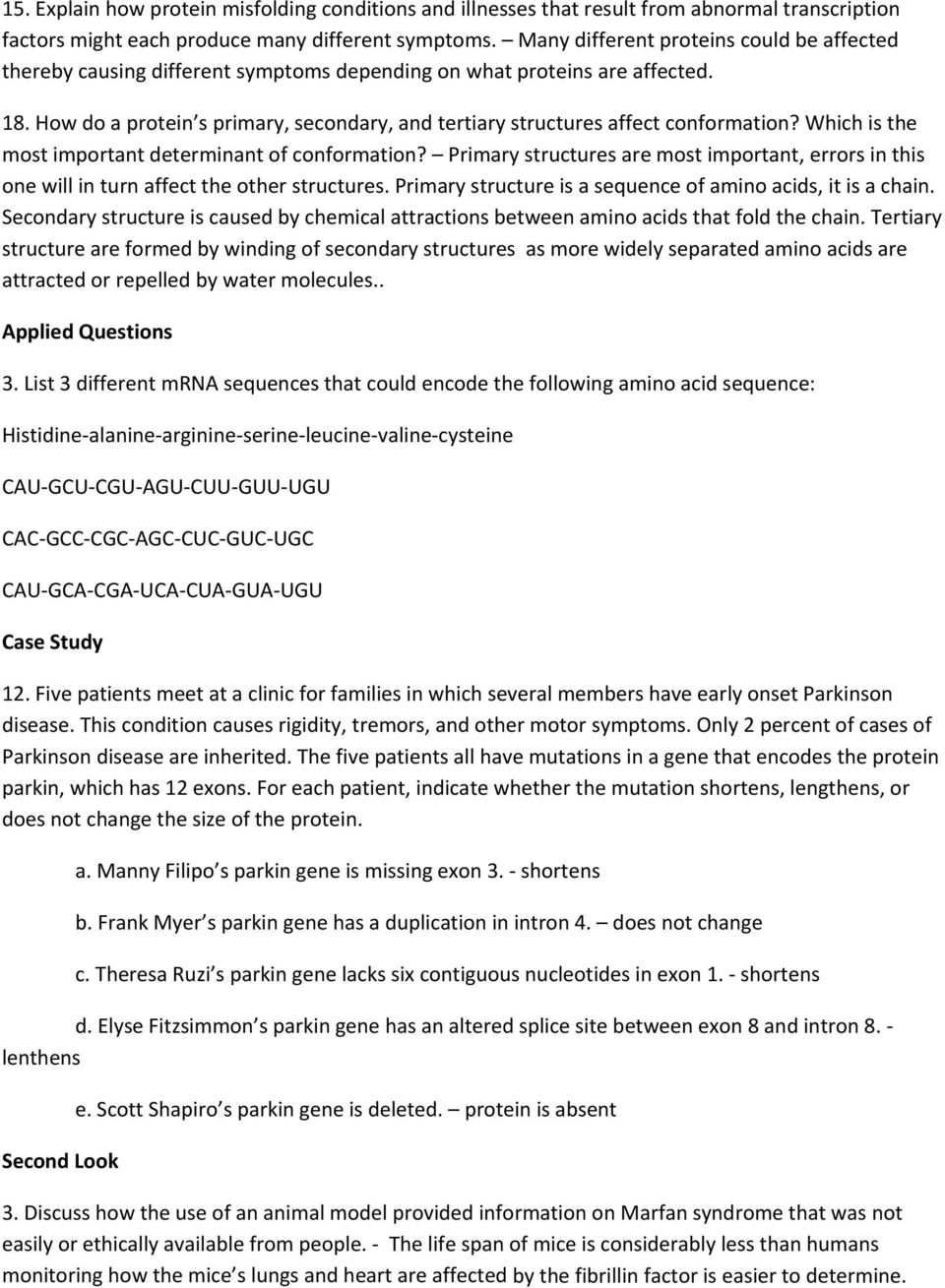
5 15. Explain how protein misfolding conditions and illnesses that result from abnormal transcription factors might each produce many different symptoms. Many different proteins could be affected thereby causing different symptoms depending on what proteins are affected. 18. How do a protein s primary, secondary, and tertiary structures affect conformation? Which is the most important determinant of conformation? Primary structures are most important, errors in this one will in turn affect the other structures. Primary structure is a sequence of amino acids, it is a chain. Secondary structure is caused by chemical attractions between amino acids that fold the chain. Tertiary structure are formed by winding of secondary structures as more widely separated amino acids are attracted or repelled by water molecules.. Applied Questions 3. List 3 different mrna sequences that could encode the following amino acid sequence: Histidine alanine arginine serine leucine valine cysteine CAU GCU CGU AGU CUU GUU UGU CAC GCC CGC AGC CUC GUC UGC CAU GCA CGA UCA CUA GUA UGU Case Study 12. Five patients meet at a clinic for families in which several members have early onset Parkinson disease. This condition causes rigidity, tremors, and other motor symptoms. Only 2 percent of cases of Parkinson disease are inherited. The five patients all have mutations in a gene that encodes the protein parkin, which has 12 exons. For each patient, indicate whether the mutation shortens, lengthens, or does not change the size of the protein. a. Manny Filipo s parkin gene is missing exon 3. shortens b. Frank Myer s parkin gene has a duplication in intron 4. does not change c. Theresa Ruzi s parkin gene lacks six contiguous nucleotides in exon 1. shortens d. Elyse Fitzsimmon s parkin gene has an altered splice site between exon 8 and intron 8. lenthens Second Look e. Scott Shapiro s parkin gene is deleted. protein is absent 3. Discuss how the use of an animal model provided information on Marfan syndrome that was not easily or ethically available from people. The life span of mice is considerably less than humans monitoring how the mice s lungs and heart are affected by the fibrillin factor is easier to determine.
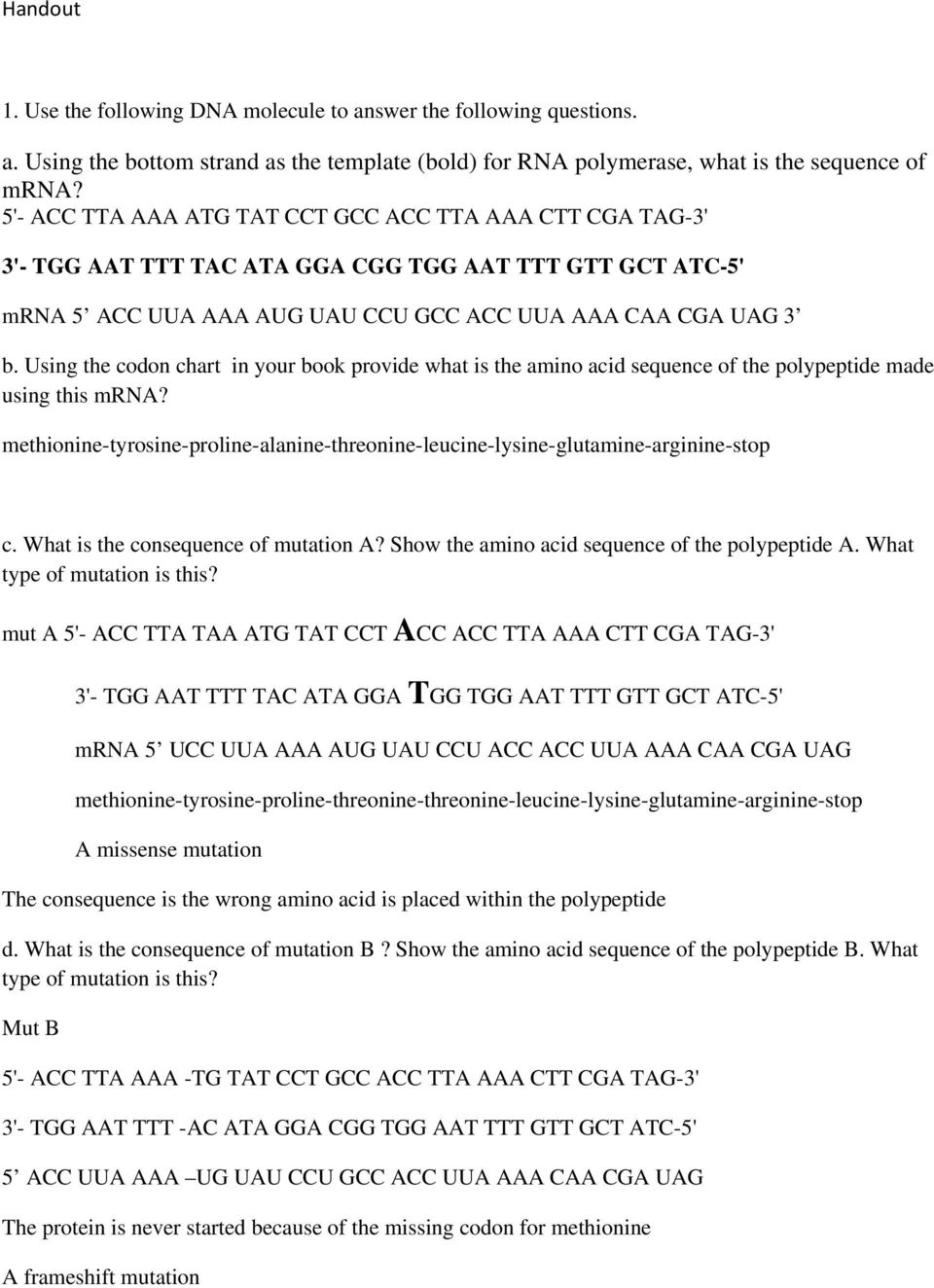
6 Handout 1. Use the following DNA molecule to answer the following questions. a. Using the bottom strand as the template (bold) for RNA polymerase, what is the sequence of mrna? 5'- ACC TTA AAA ATG TAT CCT GCC ACC TTA AAA CTT CGA TAG-3' 3'- TGG AAT TTT TAC ATA GGA CGG TGG AAT TTT GTT GCT ATC-5' mrna 5 ACC UUA AAA AUG UAU CCU GCC ACC UUA AAA CAA CGA UAG 3 b. Using the codon chart in your book provide what is the amino acid sequence of the polypeptide made using this mrna? methionine-tyrosine-proline-alanine-threonine-leucine-lysine-glutamine-arginine-stop c. What is the consequence of mutation A? Show the amino acid sequence of the polypeptide A. What type of mutation is this? mut A 5'- ACC TTA TAA ATG TAT CCT ACC ACC TTA AAA CTT CGA TAG-3' 3'- TGG AAT TTT TAC ATA GGA TGG TGG AAT TTT GTT GCT ATC-5' mrna 5 UCC UUA AAA AUG UAU CCU ACC ACC UUA AAA CAA CGA UAG methionine-tyrosine-proline-threonine-threonine-leucine-lysine-glutamine-arginine-stop A missense mutation The consequence is the wrong amino acid is placed within the polypeptide d. What is the consequence of mutation B? Show the amino acid sequence of the polypeptide B. What type of mutation is this? Mut B 5'- ACC TTA AAA -TG TAT CCT GCC ACC TTA AAA CTT CGA TAG-3' 3'- TGG AAT TTT -AC ATA GGA CGG TGG AAT TTT GTT GCT ATC-5' 5 ACC UUA AAA UG UAU CCU GCC ACC UUA AAA CAA CGA UAG The protein is never started because of the missing codon for methionine A frameshift mutation
7 2. Draw the Central Dogma include the steps between transcription and translation and steps following translation.

a. Ribosomal RNA rrna a type ofrna that combines with proteins to form Ribosomes on which polypeptide chains of proteins are assembled
 Biology 101 Chapter 14 Name: Fill-in-the-Blanks Which base follows the next in a strand of DNA is referred to. as the base (1) Sequence. The region of DNA that calls for the assembly of specific amino
DNA Replication & Protein Synthesis. This isn t a baaaaaaaddd chapter!!!
 DNA Replication & Protein Synthesis This isn t a baaaaaaaddd chapter!!! The Discovery of DNA s Structure Watson and Crick s discovery of DNA s structure was based on almost fifty years of research by other
Transcription and Translation of DNA
 Transcription and Translation of DNA Genotype our genetic constitution ( makeup) is determined (controlled) by the sequence of bases in its genes Phenotype determined by the proteins synthesised when genes
Genetic information (DNA) determines structure of proteins DNA RNA proteins cell structure 3.11 3.15 enzymes control cell chemistry ( metabolism )
 Biology 1406 Exam 3 Notes Structure of DNA Ch. 10 Genetic information (DNA) determines structure of proteins DNA RNA proteins cell structure 3.11 3.15 enzymes control cell chemistry ( metabolism ) Proteins
PRACTICE TEST QUESTIONS
 PART A: MULTIPLE CHOICE QUESTIONS PRACTICE TEST QUESTIONS DNA & PROTEIN SYNTHESIS B 1. One of the functions of DNA is to A. secrete vacuoles. B. make copies of itself. C. join amino acids to each other.
From DNA to Protein. Proteins. Chapter 13. Prokaryotes and Eukaryotes. The Path From Genes to Proteins. All proteins consist of polypeptide chains
 Proteins From DNA to Protein Chapter 13 All proteins consist of polypeptide chains A linear sequence of amino acids Each chain corresponds to the nucleotide base sequence of a gene The Path From Genes
Provincial Exam Questions. 9. Give one role of each of the following nucleic acids in the production of an enzyme.
 Provincial Exam Questions Unit: Cell Biology: Protein Synthesis (B7 & B8) 2010 Jan 3. Describe the process of translation. (4 marks) 2009 Sample 8. What is the role of ribosomes in protein synthesis? A.
Structure and Function of DNA
 Structure and Function of DNA DNA and RNA Structure DNA and RNA are nucleic acids. They consist of chemical units called nucleotides. The nucleotides are joined by a sugar-phosphate backbone. The four
Protein Synthesis How Genes Become Constituent Molecules
 Protein Synthesis Protein Synthesis How Genes Become Constituent Molecules Mendel and The Idea of Gene What is a Chromosome? A chromosome is a molecule of DNA 50% 50% 1. True 2. False True False Protein
Molecular Genetics. RNA, Transcription, & Protein Synthesis
 Molecular Genetics RNA, Transcription, & Protein Synthesis Section 1 RNA AND TRANSCRIPTION Objectives Describe the primary functions of RNA Identify how RNA differs from DNA Describe the structure and
DNA, RNA, Protein synthesis, and Mutations. Chapters 12-13.3
 DNA, RNA, Protein synthesis, and Mutations Chapters 12-13.3 1A)Identify the components of DNA and explain its role in heredity. DNA s Role in heredity: Contains the genetic information of a cell that can
Protein Synthesis. Page 41 Page 44 Page 47 Page 42 Page 45 Page 48 Page 43 Page 46 Page 49. Page 41. DNA RNA Protein. Vocabulary
 Protein Synthesis Vocabulary Transcription Translation Translocation Chromosomal mutation Deoxyribonucleic acid Frame shift mutation Gene expression Mutation Point mutation Page 41 Page 41 Page 44 Page
13.2 Ribosomes & Protein Synthesis
 13.2 Ribosomes & Protein Synthesis Introduction: *A specific sequence of bases in DNA carries the directions for forming a polypeptide, a chain of amino acids (there are 20 different types of amino acid).
Gene Finding CMSC 423
 Gene Finding CMSC 423 Finding Signals in DNA We just have a long string of A, C, G, Ts. How can we find the signals encoded in it? Suppose you encountered a language you didn t know. How would you decipher
Lecture Series 7. From DNA to Protein. Genotype to Phenotype. Reading Assignments. A. Genes and the Synthesis of Polypeptides
 Lecture Series 7 From DNA to Protein: Genotype to Phenotype Reading Assignments Read Chapter 7 From DNA to Protein A. Genes and the Synthesis of Polypeptides Genes are made up of DNA and are expressed
(http://genomes.urv.es/caical) TUTORIAL. (July 2006)
 (http://genomes.urv.es/caical) TUTORIAL (July 2006) CAIcal manual 2 Table of contents Introduction... 3 Required inputs... 5 SECTION A Calculation of parameters... 8 SECTION B CAI calculation for FASTA
Name Class Date. Figure 13 1. 2. Which nucleotide in Figure 13 1 indicates the nucleic acid above is RNA? a. uracil c. cytosine b. guanine d.
 13 Multiple Choice RNA and Protein Synthesis Chapter Test A Write the letter that best answers the question or completes the statement on the line provided. 1. Which of the following are found in both
Thymine = orange Adenine = dark green Guanine = purple Cytosine = yellow Uracil = brown
 1 DNA Coloring - Transcription & Translation Transcription RNA, Ribonucleic Acid is very similar to DNA. RNA normally exists as a single strand (and not the double stranded double helix of DNA). It contains
Translation Study Guide
 Translation Study Guide This study guide is a written version of the material you have seen presented in the replication unit. In translation, the cell uses the genetic information contained in mrna to
Hands on Simulation of Mutation
 Hands on Simulation of Mutation Charlotte K. Omoto P.O. Box 644236 Washington State University Pullman, WA 99164-4236 [email protected] ABSTRACT This exercise is a hands-on simulation of mutations and their
Name Date Period. 2. When a molecule of double-stranded DNA undergoes replication, it results in
 DNA, RNA, Protein Synthesis Keystone 1. During the process shown above, the two strands of one DNA molecule are unwound. Then, DNA polymerases add complementary nucleotides to each strand which results
RNA and Protein Synthesis
 Name lass Date RN and Protein Synthesis Information and Heredity Q: How does information fl ow from DN to RN to direct the synthesis of proteins? 13.1 What is RN? WHT I KNOW SMPLE NSWER: RN is a nucleic
RNA & Protein Synthesis
 RNA & Protein Synthesis Genes send messages to cellular machinery RNA Plays a major role in process Process has three phases (Genetic) Transcription (Genetic) Translation Protein Synthesis RNA Synthesis
The Steps. 1. Transcription. 2. Transferal. 3. Translation
 Protein Synthesis Protein synthesis is simply the "making of proteins." Although the term itself is easy to understand, the multiple steps that a cell in a plant or animal must go through are not. In order
2. The number of different kinds of nucleotides present in any DNA molecule is A) four B) six C) two D) three
 Chem 121 Chapter 22. Nucleic Acids 1. Any given nucleotide in a nucleic acid contains A) two bases and a sugar. B) one sugar, two bases and one phosphate. C) two sugars and one phosphate. D) one sugar,
Translation. Translation: Assembly of polypeptides on a ribosome
 Translation Translation: Assembly of polypeptides on a ribosome Living cells devote more energy to the synthesis of proteins than to any other aspect of metabolism. About a third of the dry mass of a cell
ISTEP+: Biology I End-of-Course Assessment Released Items and Scoring Notes
 ISTEP+: Biology I End-of-Course Assessment Released Items and Scoring Notes Page 1 of 22 Introduction Indiana students enrolled in Biology I participated in the ISTEP+: Biology I Graduation Examination
2006 7.012 Problem Set 3 KEY
 2006 7.012 Problem Set 3 KEY Due before 5 PM on FRIDAY, October 13, 2006. Turn answers in to the box outside of 68-120. PLEASE WRITE YOUR ANSWERS ON THIS PRINTOUT. 1. Which reaction is catalyzed by each
Gene and Chromosome Mutation Worksheet (reference pgs. 239-240 in Modern Biology textbook)
 Name Date Per Look at the diagrams, then answer the questions. Gene Mutations affect a single gene by changing its base sequence, resulting in an incorrect, or nonfunctional, protein being made. (a) A
To be able to describe polypeptide synthesis including transcription and splicing
 Thursday 8th March COPY LO: To be able to describe polypeptide synthesis including transcription and splicing Starter Explain the difference between transcription and translation BATS Describe and explain
Genetics Module B, Anchor 3
 Genetics Module B, Anchor 3 Key Concepts: - An individual s characteristics are determines by factors that are passed from one parental generation to the next. - During gamete formation, the alleles for
Specific problems. The genetic code. The genetic code. Adaptor molecules match amino acids to mrna codons
 Tutorial II Gene expression: mrna translation and protein synthesis Piergiorgio Percipalle, PhD Program Control of gene transcription and RNA processing mrna translation and protein synthesis KAROLINSKA
http://www.life.umd.edu/grad/mlfsc/ DNA Bracelets
 http://www.life.umd.edu/grad/mlfsc/ DNA Bracelets by Louise Brown Jasko John Anthony Campbell Jack Dennis Cassidy Michael Nickelsburg Stephen Prentis Rohm Objectives: 1) Using plastic beads, construct
Basic Concepts of DNA, Proteins, Genes and Genomes
 Basic Concepts of DNA, Proteins, Genes and Genomes Kun-Mao Chao 1,2,3 1 Graduate Institute of Biomedical Electronics and Bioinformatics 2 Department of Computer Science and Information Engineering 3 Graduate
The sequence of bases on the mrna is a code that determines the sequence of amino acids in the polypeptide being synthesized:
 Module 3F Protein Synthesis So far in this unit, we have examined: How genes are transmitted from one generation to the next Where genes are located What genes are made of How genes are replicated How
From DNA to Protein
 Nucleus Control center of the cell contains the genetic library encoded in the sequences of nucleotides in molecules of DNA code for the amino acid sequences of all proteins determines which specific proteins
Chapter 17: From Gene to Protein
 AP Biology Reading Guide Fred and Theresa Holtzclaw Julia Keller 12d Chapter 17: From Gene to Protein 1. What is gene expression? Gene expression is the process by which DNA directs the synthesis of proteins
Ms. Campbell Protein Synthesis Practice Questions Regents L.E.
 Name Student # Ms. Campbell Protein Synthesis Practice Questions Regents L.E. 1. A sequence of three nitrogenous bases in a messenger-rna molecule is known as a 1) codon 2) gene 3) polypeptide 4) nucleotide
Concluding lesson. Student manual. What kind of protein are you? (Basic)
 Concluding lesson Student manual What kind of protein are you? (Basic) Part 1 The hereditary material of an organism is stored in a coded way on the DNA. This code consists of four different nucleotides:
Mutation. Mutation provides raw material to evolution. Different kinds of mutations have different effects
 Mutation Mutation provides raw material to evolution Different kinds of mutations have different effects Mutational Processes Point mutation single nucleotide changes coding changes (missense mutations)
Academic Nucleic Acids and Protein Synthesis Test
 Academic Nucleic Acids and Protein Synthesis Test Multiple Choice Identify the letter of the choice that best completes the statement or answers the question. 1. Each organism has a unique combination
1 Mutation and Genetic Change
 CHAPTER 14 1 Mutation and Genetic Change SECTION Genes in Action KEY IDEAS As you read this section, keep these questions in mind: What is the origin of genetic differences among organisms? What kinds
BioBoot Camp Genetics
 BioBoot Camp Genetics BIO.B.1.2.1 Describe how the process of DNA replication results in the transmission and/or conservation of genetic information DNA Replication is the process of DNA being copied before
Molecular Facts and Figures
 Nucleic Acids Molecular Facts and Figures DNA/RNA bases: DNA and RNA are composed of four bases each. In DNA the four are Adenine (A), Thymidine (T), Cytosine (C), and Guanine (G). In RNA the four are
Sample Questions for Exam 3
 Sample Questions for Exam 3 1. All of the following occur during prometaphase of mitosis in animal cells except a. the centrioles move toward opposite poles. b. the nucleolus can no longer be seen. c.
Mutations and Genetic Variability. 1. What is occurring in the diagram below?
 Mutations and Genetic Variability 1. What is occurring in the diagram below? A. Sister chromatids are separating. B. Alleles are independently assorting. C. Genes are replicating. D. Segments of DNA are
Multiple Choice Write the letter that best answers the question or completes the statement on the line provided.
 Name lass Date hapter 12 DN and RN hapter Test Multiple hoice Write the letter that best answers the question or completes the statement on the line provided. Pearson Education, Inc. ll rights reserved.
Bio 102 Practice Problems Genetic Code and Mutation
 Bio 102 Practice Problems Genetic Code and Mutation Multiple choice: Unless otherwise directed, circle the one best answer: 1. Beadle and Tatum mutagenized Neurospora to find strains that required arginine
Nucleotides and Nucleic Acids
 Nucleotides and Nucleic Acids Brief History 1 1869 - Miescher Isolated nuclein from soiled bandages 1902 - Garrod Studied rare genetic disorder: Alkaptonuria; concluded that specific gene is associated
Announcements. Chapter 15. Proteins: Function. Proteins: Function. Proteins: Structure. Peptide Bonds. Lab Next Week. Help Session: Monday 6pm LSS 277
 Lab Next Week Announcements Help Session: Monday 6pm LSS 277 Office Hours Chapter 15 and Translation Proteins: Function Proteins: Function Enzymes Transport Structural Components Regulation Communication
AP BIOLOGY 2009 SCORING GUIDELINES
 AP BIOLOGY 2009 SCORING GUIDELINES Question 4 The flow of genetic information from DNA to protein in eukaryotic cells is called the central dogma of biology. (a) Explain the role of each of the following
LESSON 4. Using Bioinformatics to Analyze Protein Sequences. Introduction. Learning Objectives. Key Concepts
 4 Using Bioinformatics to Analyze Protein Sequences Introduction In this lesson, students perform a paper exercise designed to reinforce the student understanding of the complementary nature of DNA and
13.4 Gene Regulation and Expression
 13.4 Gene Regulation and Expression Lesson Objectives Describe gene regulation in prokaryotes. Explain how most eukaryotic genes are regulated. Relate gene regulation to development in multicellular organisms.
Transcription: RNA Synthesis, Processing & Modification
 Transcription: RNA Synthesis, Processing & Modification 1 Central dogma DNA RNA Protein Reverse transcription 2 Transcription The process of making RNA from DNA Produces all type of RNA mrna, trna, rrna,
Lecture 26: Overview of deoxyribonucleic acid (DNA) and ribonucleic acid (RNA) structure
 Lecture 26: Overview of deoxyribonucleic acid (DNA) and ribonucleic acid (RNA) structure Nucleic acids play an important role in the storage and expression of genetic information. They are divided into
CCR Biology - Chapter 8 Practice Test - Summer 2012
 Name: Class: Date: CCR Biology - Chapter 8 Practice Test - Summer 2012 Multiple Choice Identify the choice that best completes the statement or answers the question. 1. What did Hershey and Chase know
BCH401G Lecture 39 Andres
 BCH401G Lecture 39 Andres Lecture Summary: Ribosome: Understand its role in translation and differences between translation in prokaryotes and eukaryotes. Translation: Understand the chemistry of this
Replication Study Guide
 Replication Study Guide This study guide is a written version of the material you have seen presented in the replication unit. Self-reproduction is a function of life that human-engineered systems have
Proteins and Nucleic Acids
 Proteins and Nucleic Acids Chapter 5 Macromolecules: Proteins Proteins Most structurally & functionally diverse group of biomolecules. : o Involved in almost everything o Enzymes o Structure (keratin,
TRANSCRIPTION TRANSLATION - GENETIC CODE AND OUTLINE OF PROTEIN SYNTHESIS
 TRANSCRIPTION TRANSLATION - GENETIC CODE AND OUTLINE OF PROTEIN SYNTHESIS Central Dogma of Protein Synthesis Proteins constitute the major part by dry weight of an actively growing cell. They are widely
Lecture 5. 1. Transfer of proper aminoacyl-trna from cytoplasm to A-site of ribosome.
 Elongation & Termination of Protein Synthesis (5.1) Lecture 5 1. INITIATION Assembly of active ribosome by placing the first mrna codon (AUG or START codon) near the P site and pairing it with initiation
Lecture 1 MODULE 3 GENE EXPRESSION AND REGULATION OF GENE EXPRESSION. Professor Bharat Patel Office: Science 2, 2.36 Email: [email protected].
 Lecture 1 MODULE 3 GENE EXPRESSION AND REGULATION OF GENE EXPRESSION Professor Bharat Patel Office: Science 2, 2.36 Email: [email protected] What is Gene Expression & Gene Regulation? 1. Gene Expression
Cellular Respiration Worksheet 1. 1. What are the 3 phases of the cellular respiration process? Glycolysis, Krebs Cycle, Electron Transport Chain.
 Cellular Respiration Worksheet 1 1. What are the 3 phases of the cellular respiration process? Glycolysis, Krebs Cycle, Electron Transport Chain. 2. Where in the cell does the glycolysis part of cellular
GENE REGULATION. Teacher Packet
 AP * BIOLOGY GENE REGULATION Teacher Packet AP* is a trademark of the College Entrance Examination Board. The College Entrance Examination Board was not involved in the production of this material. Pictures
A disaccharide is formed when a dehydration reaction joins two monosaccharides. This covalent bond is called a glycosidic linkage.
 CH 5 Structure & Function of Large Molecules: Macromolecules Molecules of Life All living things are made up of four classes of large biological molecules: carbohydrates, lipids, proteins, and nucleic
Hiding Data in DNA. 1 Introduction
 Hiding Data in DNA Boris Shimanovsky *, Jessica Feng +, and Miodrag Potkonjak + * XAP Corporation + Dept. Computer Science, Univ. of California, Los Angeles Abstract. Just like disk or RAM, DNA and RNA
DNA (genetic information in genes) RNA (copies of genes) proteins (functional molecules) directionality along the backbone 5 (phosphate) to 3 (OH)
 DNA, RNA, replication, translation, and transcription Overview Recall the central dogma of biology: DNA (genetic information in genes) RNA (copies of genes) proteins (functional molecules) DNA structure
CHAPTER 30: PROTEIN SYNTHESIS
 CHAPTER 30: PROTEIN SYNTHESIS (Translation) Translation: mrna protein LECTURE TOPICS Complexity, stages, rate, accuracy Amino acid activation [trna charging] trnas and translating the Genetic Code - Amino
3120-1 - Page 1. Name:
 Name: 1) Which series is arranged in correct order according to decreasing size of structures? A) DNA, nucleus, chromosome, nucleotide, nitrogenous base B) chromosome, nucleus, nitrogenous base, nucleotide,
Protein Synthesis Simulation
 Protein Synthesis Simulation Name(s) Date Period Benchmark: SC.912.L.16.5 as AA: Explain the basic processes of transcription and translation, and how they result in the expression of genes. (Assessed
Insulin mrna to Protein Kit
 Insulin mrna to Protein Kit A 3DMD Paper BioInformatics and Mini-Toober Folding Activity Teacher Key and Teacher Notes www. Insulin mrna to Protein Kit Contents Becoming Familiar with the Data... 3 Identifying
Modeling DNA Replication and Protein Synthesis
 Skills Practice Lab Modeling DNA Replication and Protein Synthesis OBJECTIVES Construct and analyze a model of DNA. Use a model to simulate the process of replication. Use a model to simulate the process
Module 3 Questions. 7. Chemotaxis is an example of signal transduction. Explain, with the use of diagrams.
 Module 3 Questions Section 1. Essay and Short Answers. Use diagrams wherever possible 1. With the use of a diagram, provide an overview of the general regulation strategies available to a bacterial cell.
12.1 The Role of DNA in Heredity
 12.1 The Role of DNA in Heredity Only in the last 50 years have scientists understood the role of DNA in heredity. That understanding began with the discovery of DNA s structure. In 1952, Rosalind Franklin
Lecture 4. Polypeptide Synthesis Overview
 Initiation of Protein Synthesis (4.1) Lecture 4 Polypeptide Synthesis Overview Polypeptide synthesis proceeds sequentially from N Terminus to C terminus. Amino acids are not pre-positioned on a template.
UNIT (12) MOLECULES OF LIFE: NUCLEIC ACIDS
 UIT (12) MLECULE F LIFE: UCLEIC ACID ucleic acids are extremely large molecules that were first isolated from the nuclei of cells. Two kinds of nucleic acids are found in cells: RA (ribonucleic acid) is
Lab # 12: DNA and RNA
 115 116 Concepts to be explored: Structure of DNA Nucleotides Amino Acids Proteins Genetic Code Mutation RNA Transcription to RNA Translation to a Protein Figure 12. 1: DNA double helix Introduction Long
Chapter 5. The Structure and Function of Macromolecule s
 Chapter 5 The Structure and Function of Macromolecule s Most Macromolecules are polymers: Polymer: (poly: many; mer: part) Large molecules consisting of many identical or similar subunits connected together.
Lecture Overview. Hydrogen Bonds. Special Properties of Water Molecules. Universal Solvent. ph Scale Illustrated. special properties of water
 Lecture Overview special properties of water > water as a solvent > ph molecules of the cell > properties of carbon > carbohydrates > lipids > proteins > nucleic acids Hydrogen Bonds polarity of water
Basic Principles of Transcription and Translation
 The Flow of Genetic Information The information content of DNA is in the form of specific sequences of nucleotides The DNA inherited by an organism leads to specific traits by dictating the synthesis of
Microbial Genetics (Chapter 8) Lecture Materials for Amy Warenda Czura, Ph.D. Suffolk County Community College. Eastern Campus
 Microbial Genetics (Chapter 8) Lecture Materials for Amy Warenda Czura, Ph.D. Suffolk County Community College Primary Source for figures and content: Eastern Campus Tortora, G.J. Microbiology An Introduction
Activity 7.21 Transcription factors
 Purpose To consolidate understanding of protein synthesis. To explain the role of transcription factors and hormones in switching genes on and off. Play the transcription initiation complex game Regulation
Overview of Eukaryotic Gene Prediction
 Overview of Eukaryotic Gene Prediction CBB 231 / COMPSCI 261 W.H. Majoros What is DNA? Nucleus Chromosome Telomere Centromere Cell Telomere base pairs histones DNA (double helix) DNA is a Double Helix
MUTATION, DNA REPAIR AND CANCER
 MUTATION, DNA REPAIR AND CANCER 1 Mutation A heritable change in the genetic material Essential to the continuity of life Source of variation for natural selection New mutations are more likely to be harmful
T C T G G C C G A C C T;
 1. (a) Gene is a (length) of DNA; Gene is a sequence of bases/chain of nucleotides; Triplet (base) code/read in three s; On sense/coding strand; Triplet coding for amino acid; Degenerate code; non-overlapping;
Gene Models & Bed format: What they represent.
 GeneModels&Bedformat:Whattheyrepresent. Gene models are hypotheses about the structure of transcripts produced by a gene. Like all models, they may be correct, partly correct, or entirely wrong. Typically,
Genomes and SNPs in Malaria and Sickle Cell Anemia
 Genomes and SNPs in Malaria and Sickle Cell Anemia Introduction to Genome Browsing with Ensembl Ensembl The vast amount of information in biological databases today demands a way of organising and accessing
The Puzzle of Life A Lesson Plan for Life S cien ce Teach ers From: The G reat Lakes S cien ce C ent er, C lev elan d, OH
 Introduction: The Puzzle of Life A Lesson Plan for Life S cien ce Teach ers From: The G reat Lakes S cien ce C ent er, C lev elan d, OH In the Puzzle of Life activity, students will demonstrate how the
AP BIOLOGY 2010 SCORING GUIDELINES (Form B)
 AP BIOLOGY 2010 SCORING GUIDELINES (Form B) Question 2 Certain human genetic conditions, such as sickle cell anemia, result from single base-pair mutations in DNA. (a) Explain how a single base-pair mutation
The Molecules of Cells
 The Molecules of Cells I. Introduction A. Most of the world s population cannot digest milk-based foods. 1. These people are lactose intolerant because they lack the enzyme lactase. 2. This illustrates
Lecture 6. Regulation of Protein Synthesis at the Translational Level
 Regulation of Protein Synthesis (6.1) Lecture 6 Regulation of Protein Synthesis at the Translational Level Comparison of EF-Tu-GDP and EF-Tu-GTP conformations EF-Tu-GDP EF-Tu-GTP Next: Comparison of GDP
Umm AL Qura University MUTATIONS. Dr Neda M Bogari
 Umm AL Qura University MUTATIONS Dr Neda M Bogari CONTACTS www.bogari.net http://web.me.com/bogari/bogari.net/ From DNA to Mutations MUTATION Definition: Permanent change in nucleotide sequence. It can
Sickle cell anemia: Altered beta chain Single AA change (#6 Glu to Val) Consequence: Protein polymerizes Change in RBC shape ---> phenotypes
 Protein Structure Polypeptide: Protein: Therefore: Example: Single chain of amino acids 1 or more polypeptide chains All polypeptides are proteins Some proteins contain >1 polypeptide Hemoglobin (O 2 binding
Central Dogma. Lecture 10. Discussing DNA replication. DNA Replication. DNA mutation and repair. Transcription
 Central Dogma transcription translation DNA RNA Protein replication Discussing DNA replication (Nucleus of eukaryote, cytoplasm of prokaryote) Recall Replication is semi-conservative and bidirectional
Algorithms in Computational Biology (236522) spring 2007 Lecture #1
 Algorithms in Computational Biology (236522) spring 2007 Lecture #1 Lecturer: Shlomo Moran, Taub 639, tel 4363 Office hours: Tuesday 11:00-12:00/by appointment TA: Ilan Gronau, Taub 700, tel 4894 Office
Review Packet- Modern Genetics
 Review Packet- Modern Genetics Name 1. Base your answer to the following question on The type of molecule represented below is found in organisms. 3. The diagram below represents a structure found in most
2. True or False? The sequence of nucleotides in the human genome is 90.9% identical from one person to the next. False (it s 99.
 1. True or False? A typical chromosome can contain several hundred to several thousand genes, arranged in linear order along the DNA molecule present in the chromosome. True 2. True or False? The sequence
Chapter 5: The Structure and Function of Large Biological Molecules
 Name Period Concept 5.1 Macromolecules are polymers, built from monomers 1. The large molecules of all living things fall into just four main classes. Name them. 2. Circle the three classes that are called
Mutation, Repair, and Recombination
 16 Mutation, Repair, and Recombination WORKING WITH THE FIGURES 1. In Figure 16-3a, what is the consequence of the new 5 splice site on the open reading frame? In 16-3b, how big could the intron be to