
Lecture 14 - Multiphase Flows. Applied Computational Fluid Dynamics
|
|
|
- Bartholomew Chambers
- 9 years ago
- Views:
Transcription
1 Lecture 14 - Multiphase Flows Applied Computational Fluid Dynamics Instructor: André Bakker André Bakker ( ) Fluent Inc. (2002) 1

2 Definitions Multiphase flow is simultaneous flow of: Materials with different states or phases (i.e. gas, liquid or solid). Materials with different chemical properties but in the same state or phase (i.e. liquid-liquid systems such as oil droplets in water). The primary and secondary phases: One of the phases is continuous (primary) while the other(s) (secondary) are dispersed within the continuous phase. A diameter has to be assigned for each secondary phase to calculate its interaction (drag) with the primary phase. A secondary phase with a particle size distribution is modeled by assigning a separate phase for each particle diameter. 2

3 Definitions (2) Dilute versus dense phase: Refers to the volume fraction of secondary phase(s). Volume fraction of a phase = Volume of the phase in a cell/domain Volume of the cell/domain Laminar versus turbulent: Each phase can be laminar or turbulent. Fluid flow (primary phase) may be turbulent with respect to the secondary phase but may be laminar with respect to the vessel. 3

4 Why model multiphase flow? Multiphase flow is important in many industrial processes: Riser reactors. Bubble column reactors. Fluidized bed reactors. Scrubbers, dryers, etc. Typical objectives of a modeling analysis: Maximize the contact between the different phases, typically different chemical compounds. Flow dynamics. Rushton CD-6 BT-6 4

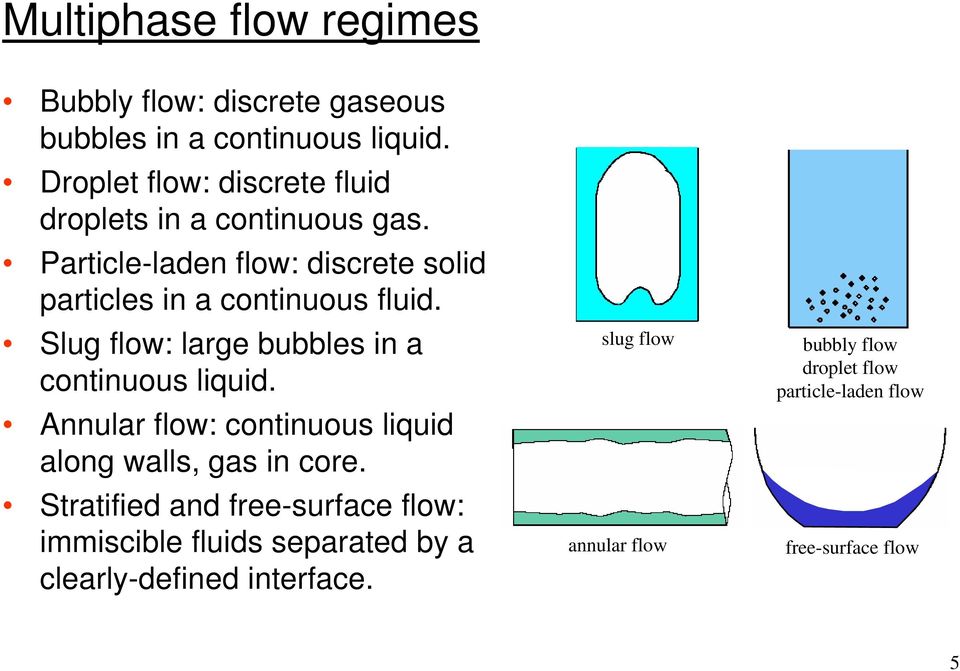
5 Multiphase flow regimes Bubbly flow: discrete gaseous bubbles in a continuous liquid. Droplet flow: discrete fluid droplets in a continuous gas. Particle-laden flow: discrete solid particles in a continuous fluid. Slug flow: large bubbles in a continuous liquid. Annular flow: continuous liquid along walls, gas in core. Stratified and free-surface flow: immiscible fluids separated by a clearly-defined interface. slug flow annular flow bubbly flow droplet flow particle-laden flow free-surface flow 5
6 Flow regimes: vertical gas-liquid flow Evaporator 3 Q( m / s) Superficial Velocity : vsg ( m / s) = 2 A( m ) 3 Q( m / s) Q ( VVM ) = 60 3 V ( m ) 6

7 Multiphase flow regimes User must know a priori the characteristics of the flow. Flow regime, e.g. bubbly flow, slug flow, annular flow, etc. Only model one flow regime at a time. Predicting the transition from one regime to another possible only if the flow regimes can be predicted by the same model. This is not always the case. Laminar or turbulent. Dilute or dense. Secondary phase diameter for drag considerations. 7

8 Modeling approach Empirical correlations. Lagrangian. Track individual point particles. Particles do not interact. Algebraic slip model. Dispersed phase in a continuous phase. Solve one momentum equation for the mixture. Two-fluids theory (multi-fluids). Eulerian models. Solve as many momentum equations as there are phases. Discrete element method. Solve the trajectories of individual objects and their collisions, inside a continuous phase. Fully resolved and coupled. Increased complexity 8

9 Coupling between phases One-way coupling: Fluid phase influences particulate phase via aerodynamic drag and turbulence transfer. No influence of particulate phase on the gas phase. Two-way coupling: Fluid phase influences particulate phase via aerodynamic drag and turbulence transfer. Particulate phase reduces mean momentum and turbulent kinetic energy in fluid phase. Four-way coupling: Includes all two-way coupling. Particle-particle collisions create particle pressure and viscous stresses. 9

10 Modeling multiphase flows What is the goal of the simulation? Which effects are important? Controlled by which hydrodynamic effects? Controlled by which other transport phenomena effects? All these factors influence which model to choose for the analysis. Flow Specific bubbly droplet particle-laden slug annular stratified/free surface rapid granular flow Model Specific Lagrangian Dispersed Phase Algebraic Slip Eulerian Eulerian Granular? Volume of Fluid Process Specific Separation Filtration Suspension Evaporation Reaction 10

11 Physical effects in dispersed systems Hydrodynamics: Change in shape. Diameter. Particle-wall collision. Particle-particle collision. Coalescence. Dispersion and breakup. Turbulence. Inversion. Other transport phenomena: Heat transfer. Mass transfer. Change in composition. Heterogeneous reactions. 11

12 Hydrodynamics: particle relaxation time When does the particle follow the flow? Time when particle reaches about 60% of the initial difference velocity. τ p d 2 d pρ p = 18µ f p g D = 0.1 mm τ p = s ρ p = 1000 kg / m 3 µ f g D = 1 10 = Re p 5 C Pa s D / 24 12

13 Hydrodynamics: particle relaxation time Typical relaxation times in process applications d p ρ p µ g τ p Coal combustion µ E-5 Pa s 1.7 E s Bubble columns 1-5 mm 1 1E-3 Pa s 5.5E-5 1.4E-3 s Sand/air mm E-5 Pa s 5.5E s Sand/water mm E-3 Pa s 1E s τ p = d 2 p ρ 18µ p g 13

14 Multiphase formulation Two phases Three phases Fluid Solids Fluid Solids - 1 Solids

15 Model overview Eulerian/Lagrangian dispersed phase model (DPM). All particle relaxation times. Particle-wall interaction always taken into account, particle-particle usually not. Algebraic Slip Mixture Model (ASM). Particle relaxation times < s. Neither particle-wall interaction nor particle-particle are taken into account. Eulerian-Eulerian model (EEM). All particle relaxation times. Particle-wall interaction taken into account, particle-particle usually not. Eulerian-granular model (EGM). All particle relaxation times. Both particle-wall and particle-particle interaction are taken into account.

16 Algebraic slip model (ASM) Solves one set of momentum equations for the mass averaged velocity and tracks volume fraction of each fluid throughout domain. Assumes an empirically derived relation for the relative velocity of the phases. For turbulent flows, single set of turbulence transport equations solved. This approach works well for flow fields where both phases generally flow in the same direction. 16

17 17 Solves one equation for continuity of the mixture: Solves for the transport of volume fraction of one phase: Solves one equation for the momentum of the mixture: r j k r i k k n k k i j j m i j m j m i eff i j j m m i m i j m u u x F g x u x u x x P u u x u t,, 1,,,,, ) ( ) ( ρ α ρ µ ρ ρ = = + 0 ) ( = + i i x u t ρ ρ 0 2, 2 = + i i m x u t α α ASM equations

18 ASM equations (2) Average density: ρ = α + 1 ρ1 α2 ρ2 Mass weighted average velocity: m r ρ α r u u m = ρ1α1 + ρ ρ 2 2 α α 2 2 r u 2 Velocity and density of each phase: Drift velocity: r u r 1 r u = 1 r u m u r, r ρ ρ 1 u2, 1, 2 Effective viscosity: µ = µ α + eff 1 1 µ 2α 2 18

19 Slip velocity and drag Uses an empirical correlation to calculate the slip velocity between phases. u = u r rel = a r τ p r r r r r um a = ( g ( um um + )) t f drag is the drag function. τ p = ( ρ m 18µ ρ ) d f f p drag 2 p f drag = Re Re if if Re Re 1000 >

20 Restrictions Applicable to low particle relaxation times τ p f drag = ( ρ m ρ ) d 18µ p f 2 p < s. One continuous phase and one dispersed phase. No interaction inside dispersed phase. One velocity field can be used to describe both phases. No countercurrent flow. No sedimentation. 20

21 Example: bubble column design Gas A bubble column is a liquid pool sparged by a process stream. Liquid 2 < L/D < 20 U G,sup up to 50 cm/s Liquid Pool U G,sup >> U L,sup Sparger Liquid/Slurry Inlet Gas Gas Inlet 21
22 Bubble columns: flow regimes Bubbly Flow Churn-Turbulent Flow ( Heterogeneous ) Flow Regime Map (Deckwer, 1980) 22
23 Bubble column design issues Design parameters: Gas holdup. Directly related to rise velocity. Correlations of the form α ~ u sga ρ lb σ c µ l d are commonly used. Mass transfer coefficient k l a. Correlations of the form k l a ~ u sga ρ lb σ c µ l d µ ge D f ρ g are commonly used. Axial dispersion occurs in both the liquid and gas phase, and correlations for each are available. Mixing time. Correlations are available for a limited number of systems. Volume, flow rates and residence time. Flow regime: homogeneous, heterogeneous, slug flow. 23
24 Bubble column design issues - cont d Accurate knowledge of the physical properties is important, especially the effects of coalescence and mass transfer affecting chemicals. Although good correlations are available for commonly studied air-water systems, these are limited to the ranges studied. Correlations may not be available for large scale systems or systems with vessel geometries other than cylinders without internals. Furthermore, experimental correlations may not accurately reflect changes in performance when flow regime transitions occur. 24
25 Bubble size At present, bubble column reactors are modeled using a single effective bubble size. Coalescence and breakup models are not yet mature. Statistical approach. Solve equation for number density. Population balance approach. Application of population balance with two-fluid models with initial focus on gas-liquid. The gas phase is composed of n bubble bins and share the same velocity as the second phase. The death and birth of each bubble bin is solved from the above models. 25
26 Model setup The flow in bubble column reactors is typically modeled as being transient. The time step used in the transient calculation needs to be small enough to capture the phenomena of interest and large enough to reduce CPU time. A typical time step would be of the order of 1E-3 times the gas residence time. Typically use standard k-ε model for turbulence. Use PISO. First order differencing for all variables except volume fraction (second order) and in time. Typical underrelaxation factors 0.5 for pressure, 0.2 for momentum, 0.8 for turbulence, 0.1 for slip velocity (with ASM model), and 0.5 for volume fraction. Initialization of gas volume fraction is not recommended. Start with α=0. Don t forget to turn on gravity:-) Turn on implicit body force treatment (in operating conditions panel). Set reference density, but exact value of reference density is not crucial. Generally set to that of the lighter phase. 26
27 Bubble column example - ASM 3D modeling of dynamic behavior of an air-water churn turbulent bubble-column using the ASM model. This model solves only one momentum equation for the gasliquid mixture. Constant bubble size is used. Iso-contours of gas volume fraction 27
28 Bubble column example - ASM Unstable flow in a 3-D bubble column with rectangular cross section. 28

29 Example - gas-liquid mixing vessel Combinations of multiple impeller types used. Bottom radial flow turbine disperses the gas. Top hydrofoil impeller provides good blending performance in tall vessels. Eulerian Gas-Liquid Simulation Animation 29
30 Eulerian-granular/fluid model features Solves momentum equations for each phase and additional volume fraction equations. Appropriate for modeling fluidized beds, risers, pneumatic lines, hoppers, standpipes, and particle-laden flows in which phases mix or separate. Granular volume fractions from 0 to ~60%. Several choices for drag laws. Appropriate drag laws can be chosen for different processes. Several kinetic-theory based formulas for the granular stress in the viscous regime. Frictional viscosity based formulation for the plastic regime stresses. Added mass and lift force. 30
31 Eulerian-granular/fluid model features Solves momentum equations for each phase and additional volume fraction equations. Appropriate for modeling fluidized beds, risers, pneumatic lines, hoppers, standpipes, and particle-laden flows in which phases mix or separate. Granular volume fractions from 0 to ~60%. Several choices for drag laws. Appropriate drag laws can be chosen for different processes. 31
32 Granular flow regimes Elastic Regime Plastic Regime Viscous Regime Stagnant Slow flow Rapid flow Stress is strain Strain rate Strain rate dependent independent dependent Elasticity Soil mechanics Kinetic theory 32
33 Fluidized-bed systems When a fluid flows upward through a bed of solids, beyond a certain fluid velocity the solids become suspended. The suspended solids: has many of the properties of a fluid, seeks its own level ( bed height ), assumes the shape of the containing vessel. Bed height typically varies between 0.3m and 15m. Particle sizes vary between 1 µm and 6 cm. Very small particles can agglomerate. Particle sizes between 10 µm and 150 µm typically result in the best fluidization and the least formation of large bubbles. Addition of finer size particles to a bed with coarse particles usually improves fluidization. Superficial gas velocities (based on cross sectional area of empty bed) typically range from 0.15 m/s to 6 m/s. 33
34 Fluidized bed example 34
35 Fluidized bed uses Fluidized beds are generally used for gas-solid contacting. Typical uses include: Chemical reactions: Catalytic reactions (e.g. hydrocarbon cracking). Noncatalytic reactions (both homogeneous and heterogeneous). Physical contacting: Heat transfer: to and from fluidized bed; between gases and solids; temperature control; between points in bed. Solids mixing. Gas mixing. Drying (solids or gases). Size enlargement or reduction. Classification (removal of fines from gas or fines from solids). Adsorption-desorption. Heat treatment. Coating. 35
36 Typical fluidized bed systems - 1 Gas Gas and entrained solids Dust Solids Feed Disengaging Space (may also contain a cyclone separator) Freeboard Separator Dust Fluidized Bed Bed depth Gas in Solids Discharge Windbox or plenum chamber Gas distributor or constriction plate 36
37 Typical fluidized bed systems - 2 Gas + solids Riser section of a recirculating fluidized bed Solids Gas Uniform Fluidization Bed with central jet 37
38 Fluidization regimes U mf U mb U U ch U Solids Return Solids Return Solids Return Gas Fixed Bed Particulate Regime Bubbling Regime Slug Flow Regime Turbulent Regime Fast Fluidization Pneumatic Conveying Increasing Gas Velocity 38
39 Fluidized bed design parameters Main components are the fluidization vessel (bed portion, disengagement space, gas distributor), solids feeder, flow control, solids discharge, dust separator, instrumentation, gas supply. There is no single design methodology that works for all applications. The design methodologies to be used depend on the application. Typical design parameters are bed height (depends on gas contact time, solids retention time, L/D for staging, space required for internal components such as heat exchangers). Flow regimes: bubbling, turbulent, recirculating, slugs. Flow regime changes can affect scale-up. Heat transfer and flow around heat exchanger components. Temperature and pressure control. Location of instrumentation, probes, solids feed, and discharges. 39
40 Fluidized bed - input required for CFD CFD can not be used to predict the: minimum fluidization velocity, and the minimum bubbling velocity. These depend on the: particle shape, particle surface roughness, particle cohesiveness, and the particle size distribution. All of these effects are lumped into the drag term. Hence we need to fine tune the drag term to match the experimental data for minimum fluidization or minimum bubbling velocity. 40
41 Fluidized bed - when to use CFD If the drag term is tuned to match the minimum fluidization velocity, CFD then can be used to predict: bed expansion gas flow pattern solid flow pattern bubbling size, frequency and population short circuiting effects of internals effects of inlet and outlets hot spots reaction and conversion rates mixing of multiple particle size residence times of solids and gases backmixing and downflows (in risers) solids distribution/segregation 41
42 Fluidized bed animation VOF of gas V s = 6 cm/s 42
43 Bubble size and shape - validation Gidaspow (1994) 43
44 Bubble size and shape - validation Gidaspow (1994) 44
45 Solution recommendations Use unsteady models for dense gas-solid flows (fluidized beds as well as dense pneumatic transport lines/risers). These flows typically have many complex features, and a steady state solution may not be numerically feasible unless a diffusive turbulence model (e.g. k-ε) is used. Use small time steps (0.001 to 0.1s) to capture important flow features. Always tune the drag formula for the specific applications, to match the minimum fluidization velocity. Broadly speaking, the Gidaspow model is good for fluidized beds and Syamlal s model is good for less dense flows. Higher order discretization schemes give more realistic bubble shapes, as do finer grids. 45
46 Conclusion Today discussed the: The algebraic slip model solves one momentum equation for the mixture. Eulerian model solves one momentum equation per phase. In next lectures we will discuss particle tracking and free surface models. 46
Computational Fluid Dynamics (CFD) and Multiphase Flow Modelling. Associate Professor Britt M. Halvorsen (Dr. Ing) Amaranath S.
 Computational Fluid Dynamics (CFD) and Multiphase Flow Modelling Associate Professor Britt M. Halvorsen (Dr. Ing) Amaranath S. Kumara (PhD Student), PO. Box 203, N-3901, N Porsgrunn, Norway What is CFD?
Lecture 16 - Free Surface Flows. Applied Computational Fluid Dynamics
 Lecture 16 - Free Surface Flows Applied Computational Fluid Dynamics Instructor: André Bakker http://www.bakker.org André Bakker (2002-2006) Fluent Inc. (2002) 1 Example: spinning bowl Example: flow in
Mixing in the process industry: Chemicals Food Pharmaceuticals Paper Polymers Minerals Environmental. Chemical Industry:
 Mixing Notes: Chapter 19 Robert P. Hesketh Mixing in the process industry: Chemicals Food Pharmaceuticals Paper Polymers Minerals Environmental Chemical Industry: Paints and Coatings Synthetic Rubbers
Heat transfer in Rotating Fluidized Beds in a Static Geometry: A CFD study
 Heat transfer in Rotating Fluidized Beds in a Static Geometry: A CFD study Nicolas Staudt, Juray De Wilde* * Université catholique de Louvain MAPR / IMAP Réaumur, Place Sainte Barbe 2 1348 Louvain-la-Neuve
CFD MODELLING OF HYDRODYNAMICS IN SUPERCRITICAL FLUID EXTRACTION SYSTEMS
 14 th European Conference on Mixing Warszawa, 10-13 September 2012 CFD MODELLING OF HYDRODYNAMICS IN SUPERCRITICAL FLUID EXTRACTION SYSTEMS Jan Krzysztoforski, Marek Henczka Warsaw University of Technology,
Model of a flow in intersecting microchannels. Denis Semyonov
 Model of a flow in intersecting microchannels Denis Semyonov LUT 2012 Content Objectives Motivation Model implementation Simulation Results Conclusion Objectives A flow and a reaction model is required
RESEARCH PROJECTS. For more information about our research projects please contact us at: [email protected]
 RESEARCH PROJECTS For more information about our research projects please contact us at: [email protected] Or visit our web site at: www.naisengineering.com 2 Setup of 1D Model for the Simulation
The CFD simulation and an experimental study of hydrodynamic behaviour of liquid-solid flow
 The CFD simulation and an experimental study of hydrodynamic behaviour of liquid-solid flow J.Křišťál, V. Jiřičný and V.Staněk Institute of Chemical Process Fundamentals. Academy of Sciences of the Czech
Basic Principles in Microfluidics
 Basic Principles in Microfluidics 1 Newton s Second Law for Fluidics Newton s 2 nd Law (F= ma) : Time rate of change of momentum of a system equal to net force acting on system!f = dp dt Sum of forces
Computational Fluid Dynamic Modeling Applications
 Computational Fluid Dynamic Modeling Applications Canadian Heavy Oil Conference Dr. Marvin Weiss What is CFD Computational Fluid Dynamics Colorful Fluid Dynamics Colors For Directors Carefully Fitted Data
VALIDATION, MODELING, AND SCALE-UP OF CHEMICAL LOOPING COMBUSTION WITH OXYGEN UNCOUPLING
 VALIDATION, MODELING, AND SCALE-UP OF CHEMICAL LOOPING COMBUSTION WITH OXYGEN UNCOUPLING A research program funded by the University of Wyoming School of Energy Resources Executive Summary Principal Investigator:
Use of OpenFoam in a CFD analysis of a finger type slug catcher. Dynaflow Conference 2011 January 13 2011, Rotterdam, the Netherlands
 Use of OpenFoam in a CFD analysis of a finger type slug catcher Dynaflow Conference 2011 January 13 2011, Rotterdam, the Netherlands Agenda Project background Analytical analysis of two-phase flow regimes
Lecture 6 - Boundary Conditions. Applied Computational Fluid Dynamics
 Lecture 6 - Boundary Conditions Applied Computational Fluid Dynamics Instructor: André Bakker http://www.bakker.org André Bakker (2002-2006) Fluent Inc. (2002) 1 Outline Overview. Inlet and outlet boundaries.
FLUID FLOW AND MIXING IN BIOREACTORS (Part 2 of 2)
 FLUID FLOW AND MIXING IN BIOREACTORS (Part 2 of 2) Overview Power requirements for mixing Newtonian and non-newtonian liquids Ungassed and gassed systems Scale-up issues, scale-down approach Adapting bioreactor
Overall pressure balance and system stability in a liquid solid circulating fluidized bed
 Chemical Engineering Journal 79 (2000) 145 153 Overall pressure balance and system stability in a liquid solid circulating fluidized bed Ying Zheng, Jing-Xu (Jesse) Zhu Department of Chemical and Biochemical
Fluid Mechanics: Static s Kinematics Dynamics Fluid
 Fluid Mechanics: Fluid mechanics may be defined as that branch of engineering science that deals with the behavior of fluid under the condition of rest and motion Fluid mechanics may be divided into three
ME6130 An introduction to CFD 1-1
 ME6130 An introduction to CFD 1-1 What is CFD? Computational fluid dynamics (CFD) is the science of predicting fluid flow, heat and mass transfer, chemical reactions, and related phenomena by solving numerically
Flow Assurance & Operability
 Flow Assurance & Operability Erosion due to sand production Date Business Name Overview 1. What causes erosion? 2. Sand production and transport 3. Sand management 4. Instrumentation / monitoring of sand
5.2. Vaporizers - Types and Usage
 5.2. Vaporizers - Types and Usage 5.2.1. General Vaporizers are constructed in numerous designs and operated in many modes. Depending upon the service application the design, construction, inspection,
XI / PHYSICS FLUIDS IN MOTION 11/PA
 Viscosity It is the property of a liquid due to which it flows in the form of layers and each layer opposes the motion of its adjacent layer. Cause of viscosity Consider two neighboring liquid layers A
THERMAL STRATIFICATION IN A HOT WATER TANK ESTABLISHED BY HEAT LOSS FROM THE TANK
 THERMAL STRATIFICATION IN A HOT WATER TANK ESTABLISHED BY HEAT LOSS FROM THE TANK J. Fan and S. Furbo Abstract Department of Civil Engineering, Technical University of Denmark, Brovej, Building 118, DK-28
CFD Analysis Of Multi-Phase Flow And Its Measurements
 IOSR Journal of Mechanical and Civil Engineering (IOSR-JMCE) e-issn: 2278-1684,p-ISSN: 2320-334X, Volume 9, Issue 4 (Nov. - Dec. 2013), PP 30-37 CFD Analysis Of Multi-Phase Flow And Its Measurements C
Simulation of Water-in-Oil Emulsion Flow with OpenFOAM using Validated Coalescence and Breakage Models
 Simulation of Water-in-Oil Emulsion Flow with OpenFOAM using Validated Coalescence and Breakage Models Gabriel G. S. Ferreira*, Jovani L. Favero*, Luiz Fernando L. R. Silva +, Paulo L. C. Lage* Laboratório
Qualification of Thermal hydraulic codes within NURESIM D. Bestion (CEA, France)
 Qualification of Thermal hydraulic codes within NURESIM D. Bestion (CEA, France) The thermalhydraulic codes used for nuclear safety applications Validation and Verification of codes Validation of system
AN EFFECT OF GRID QUALITY ON THE RESULTS OF NUMERICAL SIMULATIONS OF THE FLUID FLOW FIELD IN AN AGITATED VESSEL
 14 th European Conference on Mixing Warszawa, 10-13 September 2012 AN EFFECT OF GRID QUALITY ON THE RESULTS OF NUMERICAL SIMULATIONS OF THE FLUID FLOW FIELD IN AN AGITATED VESSEL Joanna Karcz, Lukasz Kacperski
CFD SIMULATION OF SDHW STORAGE TANK WITH AND WITHOUT HEATER
 International Journal of Advancements in Research & Technology, Volume 1, Issue2, July-2012 1 CFD SIMULATION OF SDHW STORAGE TANK WITH AND WITHOUT HEATER ABSTRACT (1) Mr. Mainak Bhaumik M.E. (Thermal Engg.)
Turbulence Modeling in CFD Simulation of Intake Manifold for a 4 Cylinder Engine
 HEFAT2012 9 th International Conference on Heat Transfer, Fluid Mechanics and Thermodynamics 16 18 July 2012 Malta Turbulence Modeling in CFD Simulation of Intake Manifold for a 4 Cylinder Engine Dr MK
By K.K.Parthiban / Boiler specialist / Venus Energy Audit System
 FINE TUNING EXPERIENCE OF A CFBC BOILER By K.K.Parthiban / Boiler specialist / Venus Energy Audit System Introduction The Industrial boilers have been seeing a growth in capacity in the recent years. Current
Basic Equations, Boundary Conditions and Dimensionless Parameters
 Chapter 2 Basic Equations, Boundary Conditions and Dimensionless Parameters In the foregoing chapter, many basic concepts related to the present investigation and the associated literature survey were
DEVELOPMENT OF CFD MODELS OF MINERAL FLOTATION CELLS
 Third International Conference on CFD in the Minerals and Process Industries CSIRO, Melbourne, Australia 10-12 December 2003 DEVELOPMENT OF CFD MODELS OF MINERAL FLOTATION CELLS P.T.L. KOH 1, M.P. SCHWARZ
Dr Jagannath K Professor, Dept of Mechanical and Mfg Engg, MIT Manipal, Manipal University, India
 Dr Jagannath K Professor, Dept of Mechanical and Mfg Engg, MIT Manipal, Manipal University, India 1 Nucleate Boiling Nucleate Boiling is an efficient mode of heat transfer. It has useful application in
TECHNICAL NOTES. Computational Fluid Mixing
 TECHNICAL NOTES TN144 Computational Fluid Mixing Elizabeth M. Marshall and André Bakker Fluent Inc. 10 Cavendish Court, Centerra Resource Park Lebanon, NH 03766 Software: Fluent, Polyflow Submitted to
NUCLEAR ENERGY RESEARCH INITIATIVE
 NUCLEAR ENERGY RESEARCH INITIATIVE Experimental and CFD Analysis of Advanced Convective Cooling Systems PI: Victor M. Ugaz and Yassin A. Hassan, Texas Engineering Experiment Station Collaborators: None
Basics of vehicle aerodynamics
 Basics of vehicle aerodynamics Prof. Tamás Lajos Budapest University of Technology and Economics Department of Fluid Mechanics University of Rome La Sapienza 2002 Influence of flow characteristics on the
MEL 807 Computational Heat Transfer (2-0-4) Dr. Prabal Talukdar Assistant Professor Department of Mechanical Engineering IIT Delhi
 MEL 807 Computational Heat Transfer (2-0-4) Dr. Prabal Talukdar Assistant Professor Department of Mechanical Engineering IIT Delhi Time and Venue Course Coordinator: Dr. Prabal Talukdar Room No: III, 357
LES SIMULATION OF A DEVOLATILIZATION EXPERIMENT ON THE IPFR FACILITY
 LES SIMULATION OF A DEVOLATILIZATION EXPERIMENT ON THE IPFR FACILITY F. Donato*, G. Rossi**, B. Favini**, E. Giacomazzi*, D. Cecere* F.R. Picchia*, N.M.S. Arcidiacono [email protected] * ENEA-UTTEI/COMSO
CFD Simulation of Subcooled Flow Boiling using OpenFOAM
 Research Article International Journal of Current Engineering and Technology E-ISSN 2277 4106, P-ISSN 2347-5161 2014 INPRESSCO, All Rights Reserved Available at http://inpressco.com/category/ijcet CFD
Heat Transfer Prof. Dr. Ale Kumar Ghosal Department of Chemical Engineering Indian Institute of Technology, Guwahati
 Heat Transfer Prof. Dr. Ale Kumar Ghosal Department of Chemical Engineering Indian Institute of Technology, Guwahati Module No. # 04 Convective Heat Transfer Lecture No. # 03 Heat Transfer Correlation
Express Introductory Training in ANSYS Fluent Lecture 1 Introduction to the CFD Methodology
 Express Introductory Training in ANSYS Fluent Lecture 1 Introduction to the CFD Methodology Dimitrios Sofialidis Technical Manager, SimTec Ltd. Mechanical Engineer, PhD PRACE Autumn School 2013 - Industry
Lecture 4 Classification of Flows. Applied Computational Fluid Dynamics
 Lecture 4 Classification of Flows Applied Computational Fluid Dynamics Instructor: André Bakker http://www.bakker.org André Bakker (00-006) Fluent Inc. (00) 1 Classification: fluid flow vs. granular flow
Differential Relations for Fluid Flow. Acceleration field of a fluid. The differential equation of mass conservation
 Differential Relations for Fluid Flow In this approach, we apply our four basic conservation laws to an infinitesimally small control volume. The differential approach provides point by point details of
Euler-Euler and Euler-Lagrange Modeling of Wood Gasification in Fluidized Beds
 Euler-Euler and Euler-Lagrange Modeling of Wood Gasification in Fluidized Beds Michael Oevermann Stephan Gerber Frank Behrendt Berlin Institute of Technology Faculty III: School of Process Sciences and
S.L. Chang, S.A. Lottes, C.Q. Zhou,** B. Golchert, and M. Petrick
 3 -- 3 CFD CODE DEVELOPMENT FOR PERFORMANCE EVALUATION OF A PILOT-SCALE FCC RISER REACTOR* S.L. Chang, S.A. Lottes, C.Q. Zhou,** B. Golchert, and M. Petrick Ekergy Systems Division Argonne National Laboratory
Battery Thermal Management System Design Modeling
 Battery Thermal Management System Design Modeling Gi-Heon Kim, Ph.D Ahmad Pesaran, Ph.D ([email protected]) National Renewable Energy Laboratory, Golden, Colorado, U.S.A. EVS October -8, 8, 006 Yokohama,
Contents. Microfluidics - Jens Ducrée Physics: Navier-Stokes Equation 1
 Contents 1. Introduction 2. Fluids 3. Physics of Microfluidic Systems 4. Microfabrication Technologies 5. Flow Control 6. Micropumps 7. Sensors 8. Ink-Jet Technology 9. Liquid Handling 10.Microarrays 11.Microreactors
Pros and Cons. of CFD and Physical Flow Modeling. A White Paper by: Kevin W. Linfield, Ph.D., P.E. Robert G. Mudry, P.E.
 Pros and Cons of CFD and Physical Flow Modeling A White Paper by: Kevin W. Linfield, Ph.D., P.E. Robert G. Mudry, P.E. August, 2008 2008 Airflow Sciences Corporation All Rights Reserved When it comes to
Swissmetro travels at high speeds through a tunnel at low pressure. It will therefore undergo friction that can be due to:
 I. OBJECTIVE OF THE EXPERIMENT. Swissmetro travels at high speeds through a tunnel at low pressure. It will therefore undergo friction that can be due to: 1) Viscosity of gas (cf. "Viscosity of gas" experiment)
Using Computational Fluid Dynamics (CFD) Simulation to Model Fluid Motion in Process Vessels on Fixed and Floating Platforms
 Using Computational Fluid Dynamics (CFD) Simulation to Model Fluid Motion in Process Vessels on Fixed and Floating Platforms Dr. Ted Frankiewicz Dr. Chang-Ming Lee NATCO Group Houston, TX USA IBC 9 th
COMPARISON OF SOLUTION ALGORITHM FOR FLOW AROUND A SQUARE CYLINDER
 Ninth International Conference on CFD in the Minerals and Process Industries CSIRO, Melbourne, Australia - December COMPARISON OF SOLUTION ALGORITHM FOR FLOW AROUND A SQUARE CYLINDER Y. Saito *, T. Soma,
www.klmtechgroup.com TABLE OF CONTENT
 Page : 1 of 45 Project Engineering Standard www.klmtechgroup.com KLM Technology #03-12 Block Aronia, Jalan Sri Perkasa 2 Taman Tampoi Utama 81200 Johor Bahru Malaysia (VAPOR)-LIQUID SEPARATORS TABLE OF
CASL-U-2013-0193-000
 L3:THM.CFD.P7.06 Implementation and validation of the new RPI boiling models using STAR-CCM+ as CFD Platform Victor Petrov, Annalisa Manera UMICH September 30, 2013 EXECUTIVE SUMMARY This milestone is
Vacuum Technology. Kinetic Theory of Gas. Dr. Philip D. Rack
 Kinetic Theory of Gas Assistant Professor Department of Materials Science and Engineering University of Tennessee 603 Dougherty Engineering Building Knoxville, TN 3793-00 Phone: (865) 974-5344 Fax (865)
Chapter 8: Flow in Pipes
 Objectives 1. Have a deeper understanding of laminar and turbulent flow in pipes and the analysis of fully developed flow 2. Calculate the major and minor losses associated with pipe flow in piping networks
Lecture 3 Fluid Dynamics and Balance Equa6ons for Reac6ng Flows
 Lecture 3 Fluid Dynamics and Balance Equa6ons for Reac6ng Flows 3.- 1 Basics: equations of continuum mechanics - balance equations for mass and momentum - balance equations for the energy and the chemical
GOOD PRACTICE GUIDE AN INTRODUCTION TO MULTIPHASE FLOW MEASUREMENT
 GOOD PRACTICE GUIDE AN INTRODUCTION TO MULTIPHASE FLOW MEASUREMENT www.tuvnel.com An introduction to multiphase flow measurement This guide provides an introduction to multiphase flow measurement. Firstly,
Abaqus/CFD Sample Problems. Abaqus 6.10
 Abaqus/CFD Sample Problems Abaqus 6.10 Contents 1. Oscillatory Laminar Plane Poiseuille Flow 2. Flow in Shear Driven Cavities 3. Buoyancy Driven Flow in Cavities 4. Turbulent Flow in a Rectangular Channel
CBE 6333, R. Levicky 1 Review of Fluid Mechanics Terminology
 CBE 6333, R. Levicky 1 Review of Fluid Mechanics Terminology The Continuum Hypothesis: We will regard macroscopic behavior of fluids as if the fluids are perfectly continuous in structure. In reality,
3. Prescribe boundary conditions at all boundary Zones:
 CFD ANALYSIS OF CHANGE IN SHAPE OF SUCTION MANIFOLD TO IMPROVE PERFORMANCE OF THE CENTRIFUGAL PUMP ABSTRACT Mr. Suraj K. Patil PG Student, Department of Mechanical Engineering /BIGCE, Solapur University,
Particle size distribution modeling in the object oriented simulation of gas solid flow
 Chemical Engineering Journal 122 (2006) 141 147 Particle size distribution modeling in the object oriented simulation of gas solid flow S.J.M. Cartaxo a, S.C.S. Rocha b,, H.B. de Sant ana a a Federal University
1. Fluids Mechanics and Fluid Properties. 1.1 Objectives of this section. 1.2 Fluids
 1. Fluids Mechanics and Fluid Properties What is fluid mechanics? As its name suggests it is the branch of applied mechanics concerned with the statics and dynamics of fluids - both liquids and gases.
NUMERICAL ANALYSIS OF THE EFFECTS OF WIND ON BUILDING STRUCTURES
 Vol. XX 2012 No. 4 28 34 J. ŠIMIČEK O. HUBOVÁ NUMERICAL ANALYSIS OF THE EFFECTS OF WIND ON BUILDING STRUCTURES Jozef ŠIMIČEK email: [email protected] Research field: Statics and Dynamics Fluids mechanics
STUDY OF MIXING BEHAVIOR OF CSTR USING CFD
 Brazilian Journal of Chemical Engineering ISSN 0104-6632 Printed in Brazil www.abeq.org.br/bjche Vol. 31, No. 01, pp. 119-129, January - March, 2014 STUDY OF MIXING BEHAVIOR OF CSTR USING CFD D. Rajavathsavai,
Validations of CFD Code for Density-Gradient Driven Air Ingress Stratified Flow
 INL/CON-0-7629 PREPRINT Validations of CFD Code for Density-Gradient Driven Air Ingress Stratified Flow ICONE 8 Chang H. Oh Eung S. Kim May 200 This is a preprint of a paper intended for publication in
Contents. Microfluidics - Jens Ducrée Physics: Fluid Dynamics 1
 Contents 1. Introduction 2. Fluids 3. Physics of Microfluidic Systems 4. Microfabrication Technologies 5. Flow Control 6. Micropumps 7. Sensors 8. Ink-Jet Technology 9. Liquid Handling 10.Microarrays 11.Microreactors
KINETIC MOLECULAR THEORY OF MATTER
 KINETIC MOLECULAR THEORY OF MATTER The kinetic-molecular theory is based on the idea that particles of matter are always in motion. The theory can be used to explain the properties of solids, liquids,
Lecture 11 Boundary Layers and Separation. Applied Computational Fluid Dynamics
 Lecture 11 Boundary Layers and Separation Applied Computational Fluid Dynamics Instructor: André Bakker http://www.bakker.org André Bakker (2002-2006) Fluent Inc. (2002) 1 Overview Drag. The boundary-layer
HEAT TRANSFER ANALYSIS IN A 3D SQUARE CHANNEL LAMINAR FLOW WITH USING BAFFLES 1 Vikram Bishnoi
 HEAT TRANSFER ANALYSIS IN A 3D SQUARE CHANNEL LAMINAR FLOW WITH USING BAFFLES 1 Vikram Bishnoi 2 Rajesh Dudi 1 Scholar and 2 Assistant Professor,Department of Mechanical Engineering, OITM, Hisar (Haryana)
FLUID FLOW STREAMLINE LAMINAR FLOW TURBULENT FLOW REYNOLDS NUMBER
 VISUAL PHYSICS School of Physics University of Sydney Australia FLUID FLOW STREAMLINE LAMINAR FLOW TURBULENT FLOW REYNOLDS NUMBER? What type of fluid flow is observed? The above pictures show how the effect
oil liquid water water liquid Answer, Key Homework 2 David McIntyre 1
 Answer, Key Homework 2 David McIntyre 1 This print-out should have 14 questions, check that it is complete. Multiple-choice questions may continue on the next column or page: find all choices before making
Numerical analysis of size reduction of municipal solid waste particles on the traveling grate of a waste-to-energy combustion chamber
 Numerical analysis of size reduction of municipal solid waste particles on the traveling grate of a waste-to-energy combustion chamber Masato Nakamura, Marco J. Castaldi, and Nickolas J. Themelis Earth
SBi 2013:12. Use of perforated acoustic panels as supply air diffusers in diffuse ceiling ventilation systems
 SBi 2013:12 Use of perforated acoustic panels as supply air diffusers in diffuse ceiling ventilation systems Use of perforated acoustic panels as supply air diffusers in diffuse ceiling ventilation systems
POLLUTED EMISSION TREATMENTS FROM INCINERATOR GASES
 POLLUTED EMISSION TREATMENTS FROM INCINERATOR GASES Ecole Nationale Supérieure de Chimie Avenue du Général Leclerc, Campus de Beaulieu 35700 Rennes, France Tel 33 (0)2 23 23 80 02 Fax 33 (0)2 23 23 81
NUMERICAL INVESTIGATIONS ON HEAT TRANSFER IN FALLING FILMS AROUND TURBULENCE WIRES
 NUMERICAL INVESTIGATIONS ON HEAT TRANSFER IN FALLING FILMS AROUND TURBULENCE WIRES Abstract H. Raach and S. Somasundaram Thermal Process Engineering, University of Paderborn, Paderborn, Germany Turbulence
International Journal of TechnoChem Research. Eldho Abraham
 International Journal of TechnoChem Research ISSN: 2395-4248 www.technochemsai.com Vol.01, No.01, pp 25-34, 2015 Study on Gas Induction and Comparison of Power Consumption of Gas Inducing Mechanically
Effect of Pressure Ratio on Film Cooling of Turbine Aerofoil Using CFD
 Universal Journal of Mechanical Engineering 1(4): 122-127, 2013 DOI: 10.13189/ujme.2013.010403 http://www.hrpub.org Effect of Pressure Ratio on Film Cooling of Turbine Aerofoil Using CFD Vibhor Baghel
Head Loss in Pipe Flow ME 123: Mechanical Engineering Laboratory II: Fluids
 Head Loss in Pipe Flow ME 123: Mechanical Engineering Laboratory II: Fluids Dr. J. M. Meyers Dr. D. G. Fletcher Dr. Y. Dubief 1. Introduction Last lab you investigated flow loss in a pipe due to the roughness
CFD Analysis of a butterfly valve in a compressible fluid
 CFD Analysis of a butterfly valve in a compressible fluid 1 G.TAMIZHARASI, 2 S.KATHIRESAN 1 Assistant Professor,Professor,Departmentment of Electronics and Instrumentation,Bharath university, chennai.
Set up and solve a transient problem using the pressure-based solver and VOF model.
 Tutorial 18. Using the VOF Model This tutorial was run using ANSYS FLUENT 12.1. The results have been updated to reflect the change in the default setting of node-based smoothing for the surface tension
CFD Application on Food Industry; Energy Saving on the Bread Oven
 Middle-East Journal of Scientific Research 13 (8): 1095-1100, 2013 ISSN 1990-9233 IDOSI Publications, 2013 DOI: 10.5829/idosi.mejsr.2013.13.8.548 CFD Application on Food Industry; Energy Saving on the
Lecture 5 Hemodynamics. Description of fluid flow. The equation of continuity
 1 Lecture 5 Hemodynamics Description of fluid flow Hydrodynamics is the part of physics, which studies the motion of fluids. It is based on the laws of mechanics. Hemodynamics studies the motion of blood
Ch 2 Properties of Fluids - II. Ideal Fluids. Real Fluids. Viscosity (1) Viscosity (3) Viscosity (2)
 Ch 2 Properties of Fluids - II Ideal Fluids 1 Prepared for CEE 3500 CEE Fluid Mechanics by Gilberto E. Urroz, August 2005 2 Ideal fluid: a fluid with no friction Also referred to as an inviscid (zero viscosity)
Chapter 10. Flow Rate. Flow Rate. Flow Measurements. The velocity of the flow is described at any
 Chapter 10 Flow Measurements Material from Theory and Design for Mechanical Measurements; Figliola, Third Edition Flow Rate Flow rate can be expressed in terms of volume flow rate (volume/time) or mass
Heat transfer in Flow Through Conduits
 Heat transfer in Flow Through Conduits R. Shankar Suramanian Department of Chemical and Biomolecular Engineering Clarkson University A common situation encountered y the chemical engineer is heat transfer
FLUID FLOW Introduction General Description
 FLUID FLOW Introduction Fluid flow is an important part of many processes, including transporting materials from one point to another, mixing of materials, and chemical reactions. In this experiment, you
12.307. 1 Convection in water (an almost-incompressible fluid)
 12.307 Convection in water (an almost-incompressible fluid) John Marshall, Lodovica Illari and Alan Plumb March, 2004 1 Convection in water (an almost-incompressible fluid) 1.1 Buoyancy Objects that are
Modeling and Simulations of Cavitating and Bubbly Flows
 Muon Collider/Neutrino Factory Collaboration Meeting Riverside, California, January 27-31, 2004 Modeling and Simulations of Cavitating and Bubbly Flows Roman Samulyak Tianshi Lu, Yarema Prykarpatskyy Center
Dynamic Process Modeling. Process Dynamics and Control
 Dynamic Process Modeling Process Dynamics and Control 1 Description of process dynamics Classes of models What do we need for control? Modeling for control Mechanical Systems Modeling Electrical circuits
Experiment 3 Pipe Friction
 EML 316L Experiment 3 Pipe Friction Laboratory Manual Mechanical and Materials Engineering Department College of Engineering FLORIDA INTERNATIONAL UNIVERSITY Nomenclature Symbol Description Unit A cross-sectional
Chemistry 13: States of Matter
 Chemistry 13: States of Matter Name: Period: Date: Chemistry Content Standard: Gases and Their Properties The kinetic molecular theory describes the motion of atoms and molecules and explains the properties
INTERNATIONAL JOURNAL OF MECHANICAL ENGINEERING AND TECHNOLOGY (IJMET)
 INTERNATIONAL JOURNAL OF MECHANICAL ENGINEERING AND TECHNOLOGY (IJMET) Proceedings of the 2 nd International Conference on Current Trends in Engineering and Management ICCTEM -2014 ISSN 0976 6340 (Print)
Fluids and Solids: Fundamentals
 Fluids and Solids: Fundamentals We normally recognize three states of matter: solid; liquid and gas. However, liquid and gas are both fluids: in contrast to solids they lack the ability to resist deformation.
Multiphase Flow - Appendices
 Discovery Laboratory Multiphase Flow - Appendices 1. Creating a Mesh 1.1. What is a geometry? The geometry used in a CFD simulation defines the problem domain and boundaries; it is the area (2D) or volume
10.1 Powder mechanics
 Fluid and Particulate systems 424514 /2014 POWDER MECHANICS & POWDER FLOW TESTING 10 Ron Zevenhoven ÅA Thermal and Flow Engineering [email protected] 10.1 Powder mechanics RoNz 2/38 Types of flow of
What is the most obvious difference between pipe flow and open channel flow????????????? (in terms of flow conditions and energy situation)
 OPEN CHANNEL FLOW 1 3 Question What is the most obvious difference between pipe flow and open channel flow????????????? (in terms of flow conditions and energy situation) Typical open channel shapes Figure
01 The Nature of Fluids
 01 The Nature of Fluids WRI 1/17 01 The Nature of Fluids (Water Resources I) Dave Morgan Prepared using Lyx, and the Beamer class in L A TEX 2ε, on September 12, 2007 Recommended Text 01 The Nature of
Lecture 3. Turbulent fluxes and TKE budgets (Garratt, Ch 2)
 Lecture 3. Turbulent fluxes and TKE budgets (Garratt, Ch 2) In this lecture How does turbulence affect the ensemble-mean equations of fluid motion/transport? Force balance in a quasi-steady turbulent boundary
Lecture 24 - Surface tension, viscous flow, thermodynamics
 Lecture 24 - Surface tension, viscous flow, thermodynamics Surface tension, surface energy The atoms at the surface of a solid or liquid are not happy. Their bonding is less ideal than the bonding of atoms