
Service 5. Workshop Manual FABIA Electrical System Edition Service Department. Technical Information
|
|
|
- Steven Welch
- 9 years ago
- Views:
Transcription
1 Service 5 Workshop Manual FABIA 2000 Electrical System Edition Service Department. Technical Information Printed in Czech Republic S

2 5 Service The Workshop Manual is intended only for use within the Organisation Škoda. It is not permitted to pass it on to other persons. Printed in Czech Republic S ŠKODA AUTO a. s.
3 List of Supplements to Workshop Manual FABIA 2000 Electrical System Edition Supplement Edition Subject Article Number Basic Edition S Supplement to Basic Edition S Coding the immobilizer S Modifications and supplements in Rep. Gr. 27, 92, 94, 96 S Navigation system, parking aid, telephone preinstallation, radio S operation, warning system, text revisions Modifications in Rep. Gr. 27, 90, 91 and 94 S Xenon headlight S Dash panel insert with WIV S Dash panel insert, on-board power network control unit, roof antenna S Dash panel insert with WIV, 1.2 ltr./47 kw, 1.4 ltr./55 kw TDI PD and 1.9 ltr./96 kw TDI PD Engines, Radio with CAN databus communication, Additional brake light S Modifications MR04 S Dash panel insert, on-board power network control unit, fog light S Battery, rear window washer system, battery - main fuse box S Edition S List of Supplements

4 List of Supplements Edition S

5 Table of Contents 27 Starter, Power supply Battery page 1 - Battery handling instructions Inspecting electrolyte level Measuring no-load voltage Measuring voltage under load page page page page Testing electrolyte density page 4 - Charging battery page 4 - Battery with a magic eye page 6 - Removing and installing the battery Removing and installing the battery tray Starter Removing and installing the starter Alternator Removing and installing the alternator page page page page page page Checking the carbon brushes of the AC generator page 1 - Removing and installing the voltage regulator page 1 - Removing and installing the V-ribbed belt pulley on the AC generator page 2 - Removing and installing the V-ribbed belt pulley with free wheel Removing and installing the cruise control (CC) page page Gauges, Instruments Dash panel insert Removing and installing the dash panel insert Contact assignment of plug connections on the dash panel insert Warning light symbols in dash panel insert Service interval display page page page page page Self-diagnosis of the dash panel insert I page 1 - General Instructions Initiating self-diagnosis of the dash panel insert Interrogating fault memory page page page Erasing fault memory page 4 - Ending output page 4 Self-diagnosis of the dash panel insert II Fault table for the dash panel insert Actuator diagnosis Coding dash panel insert Self-diagnosis of the dash panel insert III page page page page page Reading measured value block page 1 - Adjustment page 6 - Adapting odometer reading page 8 - Adjusting the service interval display when replacing the dash panel insert (QG0) page 9 - Adapting the service interval display when replacing the dash panel insert (QG1 and QG2) 90-4 page 11 - Adjust momentary fuel consumption gauge page 13 - Adjustment of the speedometer constant when replacing the dash panel insert page 14 Edition S Table of Contents I
6 - Testing fuel gauge (adjustment) page 14 - Performing the log-in procedure page 16 Self-diagnosis of the electric system control unit I page 1 - Initiating self-diagnosis page 1 - Interrogating fault memory... - Erasing fault memory... - Ending output page page page Self-diagnosis of the vehicle voltage control unit II page 1 - Fault table for the vehicle voltage control unit page 1 - Actuator diagnosis page 6 - Coding the vehicle voltage control unit page 8 Self-diagnosis of the vehicle voltage control unit III page 1 - Reading measured value block page 1 - Adjustment page 6 Self-diagnosis of the Gateway page 1 - Initiating self-diagnosis page 1 - Interrogating fault memory... - Fault table for the Gateway... - Erasing fault memory... - Ending output... - Coding control unit page page page page page Reading measured value block page 7 Data BUS... - Checking the data BUS drive... - Checking the data BUS Comfort version page page page Radio, Two-Way Radio, Mobile Phone Radio systems I page 1 - General Instructions page 1 - Overview of radio systems... - Removing and installing radio... - Removing and installing loudspeakers... - Removing and installing the roof aerial page page page page Removing and installing the concealed navigation system aerial page 7 - Contact assignment of multipin plug connections A, B, C on rear of radio... Radio systems II page page Self-diagnosis of radio system page 1 Radio-Navigation System (RNS) I page 1 - General description page 1 - Self-diagnosis of radio unit in RNS page 1 - Self-diagnosis of navigation unit in the RNS I page 1 Radio-Navigation System (RNS) II page 1 - Self-diagnosis of navigation unit in RNS II page 1 - Electronic anti-theft lock... - Plug connections at Radio-Navigation System page page Removing and installing Radio-Navigation System... - Control unit for traffic information over the radio -J559- (TMC box) page 10 page 11 II Table of Contents Edition S
7 Telephone preinstallation page 1 - Telephone preinstallation Connector assignment (item 5) Telephone preinstallation Connector assignment Assembly overview of mobile phone mount Removing and installing telephone operating electronics control unit -J Removing and installing microphone page page page page page page page CD changer page 1 - General instructions page 1 - Removing and installing CD changer page 1 92 Windscreen Wiper and Washer System Windscreen Washer System page 1 - Removing and installing windshield washer fluid reservoir page 1 - Removing and installing spray nozzles for windscreen washer system page 2 Windscreen Wiper and Washer System Removing and installing the windscreen wiper and washer system Setting park position of windscreen wiper blades Removing and installing wiper rubber Rear Window Wiper and Washer System page page page page page Rear window wiper system - Summary of components page 1 - Removing and installing rear window wiper Setting park position of rear window wiper Adjusting the spray nozzles Replacing spray nozzle FABIA page page page page Replacing spray nozzle FABIA Combi page 3 Headlamp cleaning system page 1 - Summary of components Adjusting the spray nozzles Removing and installing the spray nozzle holder Removing and installing the cylinder page page page page Exterior Lights, Bulbs and Switches Main headlight - halogen headlight page 1 - Summary of components Removing and installing headlight Adjust the fog light beam page page page Replacing bulbs in headlights page 2 - Replacing bulb for low beam light Replacing bulb for the side light Replacing bulb for the turn signal light Replacing bulb for the main beam Replacing bulb for the fog light Removing and installing the headlight range control motor Ungluing a halogen headlight Replace headlight fixing brackets page page page page page page page page Side Turn Signal Lamps page 1 Edition S Table of Contents III

8 - Removing and installing side turn signal lamps page 1 Rear Lamps page 1 - Assembly overview page 1 - Removing and installing bulb holder and bulbs page 1 - Removing and installing rear lamp page 2 Licence Plate Lighting page 1 - Removing and installing licence plate light page 1 Additional brake light page 1 - Removing and installing additional brake light - FABIA page 1 - Removing and installing additional brake light - FABIA Combi page 1 Steering column switch page 1 - Removing and installing steering column switch page 1 - Removing and installing lock cylinder page 2 - Contact assignment at ignition/starter switch page 2 Alarm system page 1 - Removing and installing alarm system with own power supply H page 1 - Replacing the own power supply of the alarm system page 1 - Removing and installing lid switch F page 1 Parking aid page 1 - Overall view of parking aid page 1 - Removing and installing parking aid control unit page 1 - Removing and installing parking aid senders page 2 - Self-diagnosis of parking aid (parking system) page 2 Headlight - xenon light page 1 - A general overview page 1 - Summary of components page 2 - Removing and installing headlight page 2 - Setting the headlight beam page 2 - Replacing bulbs in headlights page 2 - Removing and installing the D2S discharge lamp page 3 - Removing and installing ignition-high voltage unit page 3 - Removing and installing the headlight range control motor page 4 - Removing and installing the transmitter with rear controller page 4 - Installing the rear transmitter page 4 - Connection identification of the Xenon headlamps page 4 - Switching over the headlight-inner aperture page 5 - Replacing headlight fixing brackets page 5 Self diagnosis for the xenon headlight page 1 - Self diagnosis for the xenon headlight with automatic regulation page 1 - Fault table page 3 - Final control diagnosis page 4 - Initiating basic setting page 4 - Erasing fault memory page 5 - Ending output page 6 - Coding control unit page 6 - Reading measured value block page 6 IV Table of Contents Edition S

9 96 Interior Lights, Bulbs and Switches Self-diagnosis of immobiliser Initiating self-diagnosis of immobilizer Interrogating fault memory Fault table for immobiliser page page page page Erasing fault memory page 4 - Ending output page 4 - Reading measured value block page 5 - Adapt ignition key page 8 - Adapt immobiliser after replacing the dash panel insert Adapt immobiliser after replacing the engine control unit page 10 page 12 - Adapt immobiliser after insertion of a used engine control unit page 13 Interior Lights Removing and installing glove box light page page Removing and installing door warning lamp page 1 - Removing and installing luggage compartment light page 1 - Removing and installing switch for sun roof and interior light page 2 Switches in Dash Panel and in Doors Removing and installing switches in centre console Removing and installing light switch page page page Removing and installing headlight range control adjuster page 2 - Removing and installing hazard warning light switch page 2 - Removing and installing mirror adjustment switch page 2 - Removing and installing power window switches page 3 Horn page 1 - Removing and installing horn page 1 Interior Monitoring Sensor G page 1 - Removing and installing sensor page 1 - Check for proper operation page 1 - Regulate sensitivity page 1 97 Wiring Fuse Holder and Relay Carrier Removing and installing fuse holder Voltage distributor page page page Connector station A pillar page 2 - Connector station B pillar page 2 - Main fuse box page 2 - Multi-plug connector on partition panel page 3 Vehicle Voltage Control Unit Removing and installing vehicle voltage control unit page page 1 1 Edition S Table of Contents V
10 VI Table of Contents Edition S

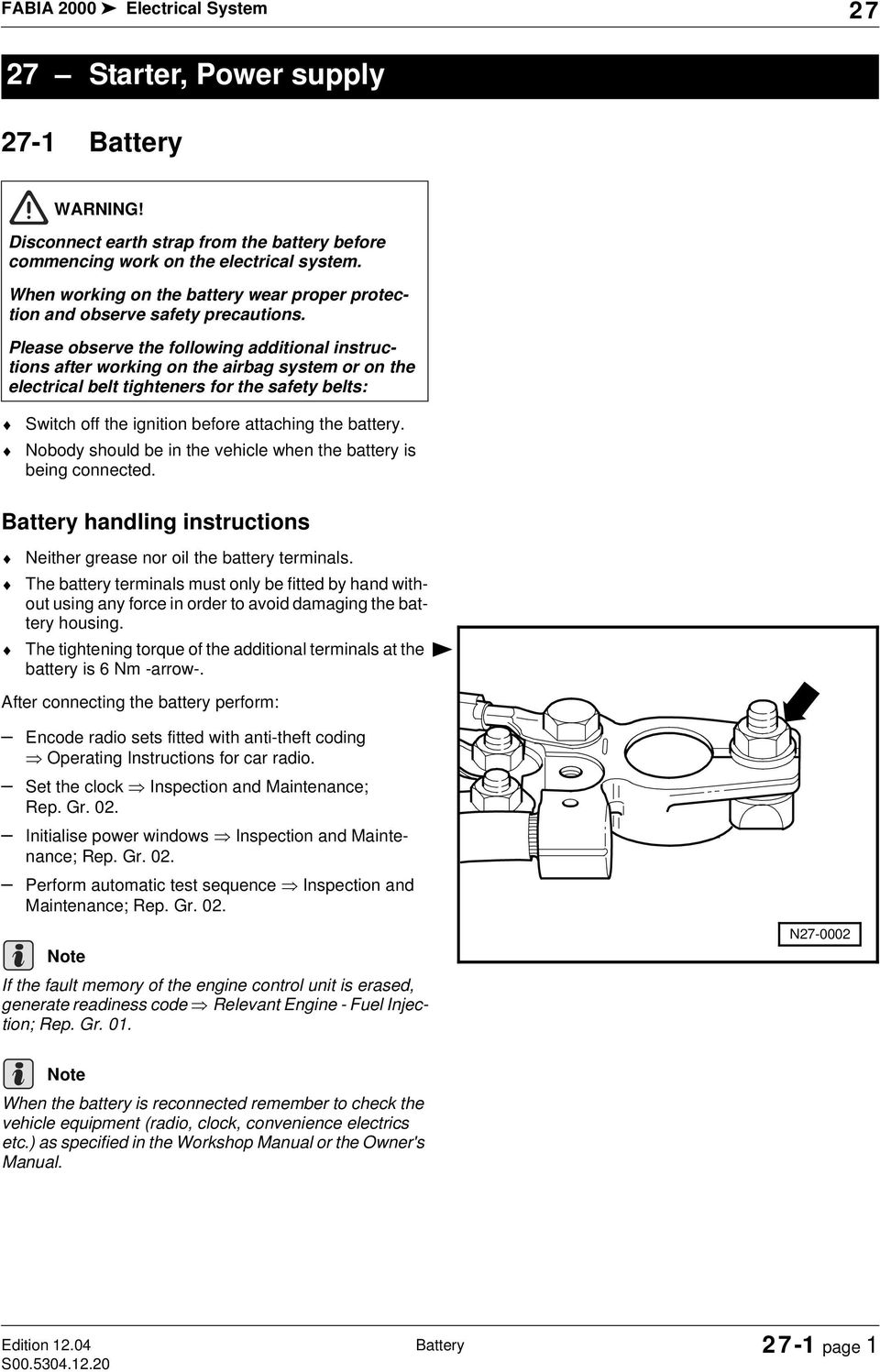
11 27 27 Starter, Power supply 27-1 Battery WARNING! Disconnect earth strap from the battery before commencing work on the electrical system. When working on the battery wear proper protection and observe safety precautions. Please observe the following additional instructions after working on the airbag system or on the electrical belt tighteners for the safety belts: Switch off the ignition before attaching the battery. Nobody should be in the vehicle when the battery is being connected. Battery handling instructions Neither grease nor oil the battery terminals. The battery terminals must only be fitted by hand without using any force in order to avoid damaging the battery housing. The tightening torque of the additional terminals at the battery is 6 Nm -arrow-. After connecting the battery perform: Encode radio sets fitted with anti-theft coding Operating Instructions for car radio. Set the clock Inspection and Maintenance; Rep. Gr. 02. Initialise power windows Inspection and Maintenance; Rep. Gr. 02. Perform automatic test sequence Inspection and Maintenance; Rep. Gr. 02. If the fault memory of the engine control unit is erased, generate readiness code Relevant Engine - Fuel Injection; Rep. Gr. 01. N When the battery is reconnected remember to check the vehicle equipment (radio, clock, convenience electrics etc.) as specified in the Workshop Manual or the Owner's Manual. Edition S Battery 27-1 page 1
12 27 Warning instructions and safety precautions for lead acid batteries FABIA 2000 Electrical System Observe the instructions on the battery, in the Workshop Manual Electrical System and in the Owner's Manual. 2 - Risk of acid burns: Battery acid is highly caustic, for this reason always wear protective gloves and eye protection. Do not tilt battery as otherwise acid may flow out of the vent openings. 3 - No fire, sparks, naked lights or smoking: Avoid creating sparks when hendling cables and electrical equipment. Avoid short circuits N Wear eye protection. 5 - Keep acid and batteries away from children. 6- Disposal: Old batteries must be disposed of in compliance with the country specific regulations. 7 - Never dispose of old batteries as domestic waste! 8 - Risk of explosion: A highly explosive gas mixture is produced when charging batteries. Inspecting electrolyte level Only top up with distilled water if the electrolyte level has dropped below the MIN marking If the battery electrolyte level exceeds the MAX marking the electrolyte will leak from the battery during operation (it is necessary to skim off electrolyte). An electrolyte level that is too low (below MIN marking) shortens the battery life considerably. Top up with distilled water. The battery plugs must always be inserted when charging the battery, measuring the voltage and conducting a test under load. Always insert the plugs with an O-ring after completing the test of the electrolyte density. Measuring no-load voltage Special tools, test and measuring equipment and auxiliary items required Handheld multimeter (e.g. -V.A.G 1526A-) Switch off ignition. Disconnect earth strap of the battery page 2 Battery Edition S

13 27 Wait at least 2 hours during which the battery must not be subjected to any load or charge: Use the handheld multimeter to measure the battery voltage. The battery no-load voltage must not fall below 12.5 V. If the handheld multimeter indicates 12.5 V or more, the battery voltage is O.K. If the handheld multimeter a battery voltage of less than 12.5 V: Charge battery 27-1 page 4. After charging wait at least 2 hours during which the battery must not be subjected to any load or charge: Use the handheld multimeter to measure the battery voltage. The battery no-load voltage must not fall below 12.5 V. If the no-load voltage is not O.K., replace the battery. Measuring voltage under load Disconnect earth strap of the battery. The voltage can be tested by using a battery tester (e.g. -V.A.G 1498-). The load current and the minimum voltage differ according to the capacity of the battery, refer to the sticker on the tester or the table below. Battery capacity [Ah] Cold test current [A] Load current [A] Minimum voltage (limit value) [V] , , , , ,5 If the voltage measured under a load lasting for 5 to 10 seconds is less than the minimum voltage: Replace battery. Explanations regarding battery load test: The battery voltage drops during this test as a result of the high load on the battery (a high current flows). If the battery is O.K., the voltage drops only as far as the minimum voltage. If the battery is faulty or only has a weak charge, the battery voltage will drop very rapidly below the specified minimum voltage. Edition S Battery 27-1 page 3

14 27 FABIA 2000 Electrical System After completion of the test, this low voltage is retained for a lengthy period, the voltage rises only slowly again. If the voltage measured under a load lasting for 5 to 10 sec. is less than the minimum voltage, then the battery is discharged or defective and the electrolyte level must be checked. Testing electrolyte density The electrolyte density, in combination with the voltage measurement (under load), provides accurate information concerning the charge level of the battery. Use a hydrometer for the test. The greater the density of the electrolyte extracted from the battery, the more the float rises. The electrolyte density can be read off on the scale as a specific weight (in kg/dm 3 ). The following measurements must be achieved: Charge state in moderate climatic zones Specific density (in kg/ dm 3 ) discharged 1,15 half charged 1,22 well charged 1,28 Charge state in tropical climatic zones Specific density (in kg/ dm 3 ) discharged 1,08 half charged 1,16 well charged 1,23 Charging battery Caution! The battery plugs must always be securely tightened when charging the battery, measuring the voltage and conducting a test under load to ensure they are really sealed. Do not smoke or use a naked light in rooms in which batteries are being charged. The reason is that a gas is formed by the charging process in the battery and this gas can easily ignite. Frozen batteries must be replaced. Special tools, test and measuring equipment and auxiliary items required Battery charger page 4 Battery Edition S
15 27 The battery must be at a temperature of at least 10 C. Batteries must not be quick-charged otherwise they may suffer damage. If a severely discharged battery is quick-charged, it will not accept any charge current or will be indicated as properly charged too soon as a result of so-called»surface charging«. Such batteries then appear to be OK. Charging a battery Switch off battery charger. Switch off ignition. First of all, disconnect the earth strap of the battery and then the positive cable of the battery. Connect positive cable of the battery charger to the positive terminal of the battery. Connect negative cable of the battery charger to the negative terminal of the battery. Set the charge current on the battery charger according to the battery capacity. Switch on battery charger. Procedure for charging a severely discharged battery Explanations regarding severely discharged batteries: Batteries which have not been operational for a long time, e.g. in stock vehicles, discharge themselves. A battery is severely discharged if the no-load voltage has dropped below 11.6 V. Measure no-load voltage 27-1 page 2. If a battery is severely discharged, the battery electrolyte (sulphuric acid/water mixture) consists practically only of water as the sulphuric acid portion is greatly reduced. Severely discharged batteries sulphate, i.e. the entire surface of the plates of the battery harden. If a severely discharged battery is re-charged immediately after losing its charge, the sulphate deposit forms again. If such batteries are not re-charged, the plates continue to harden and this restricts the battery's ability to accept a charge. This results in a loss of battery power. Severely discharged batteries must be charged with a low charge current by adopting the following procedure: Set the charge current to no more than 10 % of the battery capacity, i.e. the charge current for a 60 Ah battery is thus of maximum 6 A (Amperes). Charge battery 27-1 page 5. Edition S Battery 27-1 page 5
16 27 FABIA 2000 Electrical System Severely discharged batteries must on no account be quick-charged. Battery with a magic eye Identification marks The magic eye -1- informs one about the acid level and the charge left in the battery. There are three different eye colours which can be obtained: green - the battery is adequately charged up black - the battery is flat colourless or yellow - the acid is in a critical condition, top up with distilled water 27-1 page 6 We recommend to replace batteries which are older than 5 years of age. Topping up the electrolyte level Special tools, test and measuring equipment and auxiliary items required Filling bottle -V.A.S The supports on the filling bottle -V.A.S prevent overfilling of the battery when topping up with distilled water. The battery handling instructions should be observed when working on the battery 27-1 page 1. Pull the protective foil -2- off the battery. Screw out the plugs. Fill up the filling bottle -V.A.S with distilled water. Top up -V.A.S with distilled water. Screw in the plugs. Glue on the protective foil. Removing and installing the battery Removing Press the two catches on the right and left of the fuse carrier on the battery outwards and fold the fuse carrier and cover open. S page 6 Battery Edition S

17 27 Disconnect the two battery terminals -arrows-. Removing S Lift the fuse carrier -arrow- from the battery tray and place to the side. S Disconnect the two battery terminals -arrows-. S Edition S Battery 27-1 page 7

18 27 FABIA 2000 Electrical System Continued for all vehicles First of all, disconnect the earth strap of the battery and then the positive cable of the battery. Release screw -arrow- (22 Nm) and remove the locking plate. Remove battery from tray. Installing Installation is carried out in the reverse order. For vehicles press the catches -arrows- when lifting the fuse carrier and its cover. S Removing and installing the battery tray Removing First remove the battery 27-1 page 6. Unclip the fuse carrier and cover from the battery tray. Unhook the cable harness from the battery tray. Release the 3 screws -arrows- (20 Nm) and remove battery tray. S Installing Installation is carried out in the reverse order. S page 8 Battery Edition S

19 Starter Removing and installing the starter First remove: Engine cover Engine, Mechanics; Rep. Gr. 10. Noise insulation Engine, Mechanics; Rep. Gr Removing Disconnect connector -1- (terminal 50). Unscrew cable -2- (terminal 30) from the solenoid switch -3- (13 Nm). 2 S Release both hexagon nuts -arrows- (65 Nm) and remove the starter from below Only for gearbox 002: S Disconnect connector -1- (terminal 50). Unscrew cable -3- (terminal 30) from the solenoid switch -2- (13 Nm) S Edition S Starter 27-2 page 1
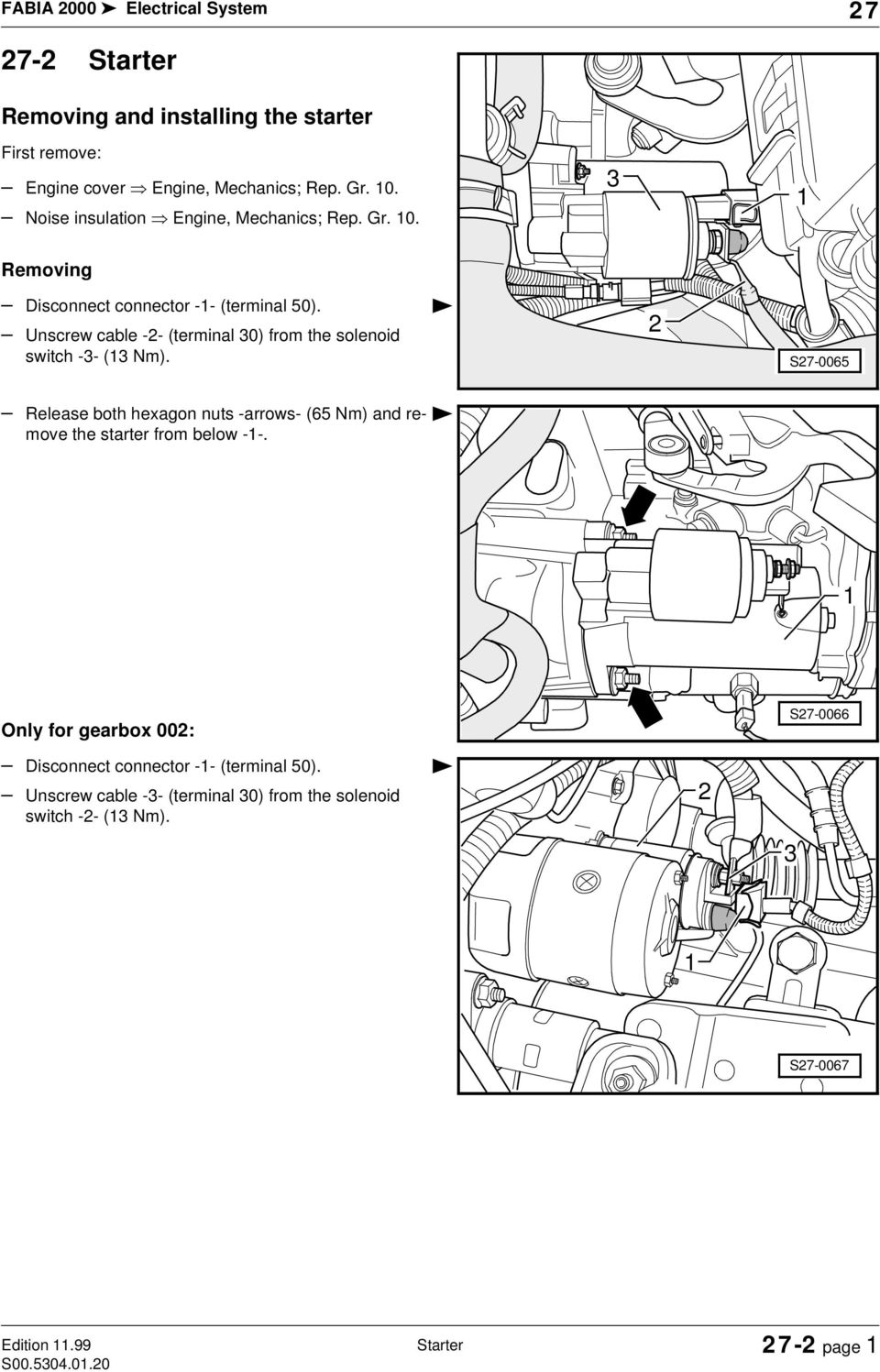
20 27 Release the three Allan screws -arrows- (65 Nm) and remove the starter from the top -1-. Installing FABIA 2000 Electrical System 1 Carry out the installation in the same way in reverse order. S page 2 Starter Edition S

21 Alternator Removing and installing the alternator Fixing the B+ wire to the generator Tightening torque for the fixing nut of the B+ cable -arrowis 15 Nm. The screw connection for the B+ cable at the compact generator is identified with B1+! If the B+ cable is not attached with the specified tightening torque, this may result in the following risks: The battery will not charge fully. Complete failure of vehicle electrics/electronics (breakdown). Risk of fire resulting from sparking. Damage resulting from overvoltages on electronic components and control units. N Checking the carbon brushes of the AC generator Length of carbon brushes when new = 12 mm Wear limit = 5 mm Tolerance of carbon brushes to each other = +1 mm Removing and installing the voltage regulator N Unscrew the fixing nuts -arrows A- and release the fixing screw -arrow B- of the protective cap. Remove the protective cap. A A B N Edition S Alternator 27-3 page 1
22 27 FABIA 2000 Electrical System Unscrew the bolts -arrows- attaching the voltage regulator and take off the voltage regulator. Removing and installing the V-ribbed belt pulley on the AC generator Special tools, test and measuring equipment and auxiliary items required Torque wrench Socket insert S1 -T30032 (3310)- N Use the socket insert -T30032 (3310)- to release or attach the V-ribbed belt pulley from/to the AC generator. Tightening torque of nut attaching ribbed V-belt pulley of generator is 65 Nm. Removing and installing the V-ribbed belt pulley with free wheel Special tools, test and measuring equipment and auxiliary items required Torque wrench Universal adapter for removing and installing ribbed V-belt pulley -MP (-3400-) Removing the installed V-ribbed belt pulley 27-3 page 2. Insert universal adapter for removing and installing ribbed V-belt pulley -MP ( ) into freewheel belt pulley. Screw freewheel belt pulley first of all by hand onto drive shaft of alternator as far as the stop. To mount the free wheel pulley adapt the torque spanner as follows: T30032 S page 2 Alternator Edition S
23 27 Release socket insert for removing and installing ribbed V-belt pulley and pull it off the handle part. Turn handle part of part of torque wrench 180 degrees and re-insert socket insert. Position direction of rotation of torque wrench to left. Adjust a tightening torque of 80 Nm on the torque wrench. Position the hexagon socket, SW 6 mm on the drive shaft of the AC generator. Counterhold universal adapter for removing and installing poly V-belt pulley -MP with ring wrench size 17 and tighten freewheel belt pulley to a torque of 80 Nm by turning drive shaft left by means of torque wrench. Clip the protective cap onto the free wheel pulley. MP S Edition S Alternator 27-3 page 3
24 27 FABIA 2000 Electrical System 27-3 page 4 Alternator Edition S
25 Removing and installing the cruise control (CC) Apart from the CC control switch in the left steering-column switch there are no additional components. Repairing the CC Engine, Fuel Injection; Rep. Gr. 24 and Current Flow Diagrams, Electrical Fault Finding and Fitting Locations. Edition S Removing and installing the cruise control (CC) 27-4 page 1
26 27 FABIA 2000 Electrical System 27-4 page 2 Removing and installing the cruise control (CC) Edition S
27 90 90 Gauges, Instruments 90-1 Dash panel insert Removing and installing the dash panel insert WARNING! Disconnect earth strap from the battery before commencing work on the electrical system. Before disconnecting the battery determine the code of radio sets fitted with anti-theft coding. Carry out additional operations if the battery earth strap is disconnected and connected Chapter Removing It is not necessary to remove the steering wheel. For reasons of clarity the steering wheel is not shown in the following illustrations. Pull the steering wheel out fully and lock it in its lowest position. Unclip the cover -1- and put it to one side. Screw out both screws -2- (1.4 Nm). Pull the dash panel insert -3- out slightly and disconnect the two plug connections. Remove the dash panel insert completely. Installing 1 Installation is carried out in the reverse order. If the dash panel insert has been replaced because of a fault, it is then necessary to carry out the following procedures: Check coding of the dash panel insert or code dash panel insert. S For vehicles with dash panel insert 6Y0 920 xxx x, the dash panel insert must be coded or adaptation at Vehicle Diagnosis, Measurement and Information System -VAS must be performed. Adapt odometer reading. Adapt service interval display. Edition S Dash panel insert 90-1 page 1
28 90 FABIA 2000 Electrical System Adapt immobiliser. The dash panel insert - a rear view The dash panel insert must not be disassembled. For fault finding perform self-diagnosis Chap pin plug connection, green; contact assignment 90-1 page Warning buzzer 3-8-pin plug connection, black; contact assignment 90-1 page Contact assignment of plug connections on the dash panel insert S pin plug connection, green 1 - Transponder coil 2 - Main beam 3 - Low beam 4 - Sender for the oil level/temperature (vehicles with WIV) 5 - Speedometer, output 6 - Speedometer, input 7 - Drive CAN databus (low) 8 - Drive CAN databus (high) 9 - Convenience system CAN databus (high) 10 - Convenience system CAN databus (low) 11 - MFD - top function selection 12 - MFD - bottom function selection 13 - Brake light bulb failure 14 - not assigned 15 - Fuel gauge 16 - Low coolant level 17 - Transponder coil 18 - Rear fog light 19 - Fog lights 20 - Belt buckle 21 - Handbrake 22 - Brake fluid level 23 - Oil pressure switch 24 - Wake-up CAN databus (electrical system control unit) 25 - Drive CAN databus (screening) 26 - Convenience CAN databus (screening) 27 - MFD Reset/level 1/ not assigned 29 - Driving lights bulb failure 30 - Washwater deficit (only for the Elegance vehicles) 31 - Outside temperature S page 2 Dash panel insert Edition S
29 Terminal 31 (sensor) 8-pin plug connection, black 1 - Brake wear 2 - not assigned 3 - not assigned 4 - Parking light on the right 5 - Terminal Parking light on the left 7 - Terminal Terminal Warning light symbols in dash panel insert S The dash panel insert must not be disassembled. Dash panel insert (6Y1 xxx xxx x, 6Y2 xxx xxx x and 6Y0 920 xxx xxx C) 1 - Low beam 2 - Fog lights 3 - Left turn signal light 4 - Coolant temperature/low coolant level 5 - Immobilizer 6 - Main beam 7 - Bulb failure 8 - Cruise control system 9 - Fuel reserve 10 - Fuel reserve 11 - Right turn signal light 12 - ESP/TCS warning light 13 - Brake indicator/brake system fault indicator 14 - Airbag 15 - Seat belt 16 - ABS 17 - Exhaust warning light 18 - Charge indicator 19 - Tailgate open 20 - Washwater deficit 21 - Brake pad wear 22 - Door open 23 - Oil pressure/oil level 24 - Coolant temperature/low coolant level 25 - Trailer turn signal lights 26 - Electronic throttle 27 - Electric power steering 28 - Rear fog light S Edition S Dash panel insert 90-1 page 3
30 90 FABIA 2000 Electrical System Dash panel insert (6Y0 920 xxx x) Dash panel inserts 6YO 920 xxx x are newly installed in the vehicles as of model year 03. These dash panel inserts can be distinguished from the older version according to Part No. and arrangement of warning lights in the dash panel insert. For dash panel insert version with MAXI DOT the display replaces the function of all warning lights in the center panel of the dash panel insert. 1 - Charge indicator 2 - Fog lights 3 - Left turn signal light 4 - Coolant temperature/low coolant level 5 - Immobilizer 6 - Main beam 7 - Rear backrest lock 8 - Low beam 9 - Fuel reserve 10 - Fuel reserve 11 - Right turn signal light 12 - ESP/TCS warning light 13 - Brake indicator/brake system fault indicator 14 - Airbag 15 - Seat belts 16 - ABS 17 - Exhaust warning light 18 - Bulb failure 19 - Tailgate open 20 - Washwater deficit 21 - Brake pad wear 22 - Door open 23 - Oil pressure/oil level 24 - Coolant temperature/low coolant level 25 - Trailer turn signal lights 26 - Electronic throttle 27 - Electric power steering 28 - Rear fog light Service interval display Operation The electronic control of the service interval display consists of a time counter and two distance counters page 4 Dash panel insert Edition S
31 90 The electronic control analyses the contents of the counters so that the customer is informed either after a defined period of time has elapsed or after a defined distance has been reached by the service interval display that a service is required (depending on what occurs first). Reset the service interval display Inspection and Maintenance. Edition S Dash panel insert 90-1 page 5
32 90 FABIA 2000 Electrical System 90-1 page 6 Dash panel insert Edition S
33 Self-diagnosis of the dash panel insert I General Instructions Technology of the dash panel insert The dash panel insert is available in three versions. The basic version (Classic). Version with multifunction display and additional warning lights (Comfort) and version similar to Comfort with bulb failure indicator (Elegance). The multifunction display is integrated in the rev counter. The following functions are indicated in the multifunction display: Digital clock Driving time and distance Average speed Average fuel consumption Momentary fuel consumption Outside temperature The basic version and the version with MAXI DOT display are fitted only with a digital clock in the rev counter. An LCD is provided in the speedometer for the odometer, trip counter and service interval display (SID). The warning lights are designed as LEDs and cannot be replaced. The dash panel insert is controlled by a microprocessor and features a comprehensive self-diagnosis. If faults occur in the system components, fault codes are stored in the fault memory of the dash panel insert. The following description relates to the vehicle system tester -V.A.G The use of the fault reader -V.A.G with integrated printer is similar. A minor deviation on the display read-out is possible. In addition, the following adaptation functions can be performed: Correction of fuel level display adjustment of service interval display adjustment of odometer when the dash panel insert is replaced Adaptation of the speedometer constant when the dash panel insert is replaced Edition S Self-diagnosis of the dash panel insert I 90-2 page 1
34 90 FABIA 2000 Electrical System Information on replacing the dash panel insert The dash panel insert must not be disassembled. If a replacement dash panel insert is fitted, the odometer reading and the service interval display can be adapted using the vehicle system tester -V.A.G Chap The immobilizer must be reset Chap If the control unit in the dash panel insert detects a fault in the programmed memory, the read-out def appears in the trip counter. If the read-out def appears, replace the dash panel insert Chap Initiating self-diagnosis of the dash panel insert Special tools, test and measuring equipment and auxiliary items required er -V.A.G Diagnostic cable -V.A.G 1551/3- Test requirements Always check the coding of the dash panel insert by referring to the table of codes Chap Test conditions Fuses o.k. Battery voltage at least 11 volts All electrical components must be switched off. Connecting vehicle system tester -V.A.G The diagnostic connection is located on the left next to the storage compartment on the driver's side. Unclip cover and remove downward. Connect vehicle system tester -V.A.G with diagnostic cable -V.A.G 1551/3-. Switch on ignition. If there is no readout on the display: Operating instructions of the vehicle system tester. V.A.G 1552 V.A.G 1551/3 Enter address word XX S Enter address word 1 7 dash panel insert and confirm entry with the Q key. 6Y B: Number or the dash panel insert COMBIINSTRUMENT: Designation of component 6Y B COMBIINSTRUMENT VDO X09 -> Coding WSC xxxxx 90-2 page 2 Self-diagnosis of the dash panel insert I Edition S
35 90 VDO: Manufacturer's identification X09: Software version of dash panel insert (other readouts are possible). Coding 20141: Coding of the dash panel insert WSC xxxxx: Workshop code Check coding by referring to the table of codes Chap Press. TMBMC46Y0Y SKZ7Z0W > TMBMC46Y0Y : Vehicle number SKZ7Z0W : 14-digit identification number for immobilizer control unit Press. If one of the following messages appears in the display, carry out fault finding as stated in the fault finding programme diagnostic cable Current Flow Diagrams, Electrical Fault Finding and Fitting Locations. The control unit does not respond! Fault in communication build-up K cable does not connect to earth Move forward in the programme with the key. K cable does not connect to pos. term. Self-diagnosis functions The following functions are possible: 02 - Interrogating fault memory 90-2 page Final control diagnosis Chap Erasing fault memory 90-2 page Ending output 90-2 page Coding control unit Chap Reading measured value block Chap Adaptation Chap Log-in procedure Chap Interrogating fault memory The displayed fault information is not constantly updated, this only occurs when self-diagnosis is initiated or if function 05 Erase fault memory is selected. Enter function 0 2 Interrogate fault memory and confirm with Q. Select function XX Edition S Self-diagnosis of the dash panel insert I 90-2 page 3
36 90 The number of faults stored appears in the display. The stored faults are displayed in sequence. Find the fault displayed in the fault table and rectify the fault Chap If No fault detected is shown in the display and if the key is pressed, the programme returns to the initial position. If anything else appears on the display: Operating instructions of the vehicle system tester. FABIA 2000 Electrical System X faults detected! No fault detected! -> Select function XX End output (Function 06) 90-2 page 4. Erasing fault memory The contents of the fault memory are output automatically after the fault memory is erased. If it is not possible to erase the fault memory, interrogate the fault memory once again and rectify any faults. Requirements: Fault memory was interrogated 90-2 page 3. All faults were rectified. After interrogating the fault memory: Select function 0 5 Erase fault memory and confirm with Q. The fault memory is now erased. Select function XX -> Fault memory erased! Press. Select function XX If the following message is displayed the test sequence is incorrect. Carefully follow the test sequence step by step: first interrogate the fault memory, if necessary rectify faults and then erase the fault memory. -> Fault memory was not interrogated Ending output Select function 0 6 End output and confirm with Q. Switch off ignition. Enter address word XX 90-2 page 4 Self-diagnosis of the dash panel insert I Edition S
37 90 Separate vehicle system tester -V.A.G Edition S Self-diagnosis of the dash panel insert I 90-2 page 5
38 90 FABIA 2000 Electrical System 90-2 page 6 Self-diagnosis of the dash panel insert I Edition S
39 Self-diagnosis of the dash panel insert II Fault table for the dash panel insert All the possible faults which can be detected by the vehicle system tester -V.A.G are listed below according to the 5-digit fault code. Before replacing components found to be defective first check the wiring and plug connections to these components as well as the earth cables according to the current flow diagram. After repair once again interrogate the fault memory using vehicle system tester -V.A.G and then erase the memory. All static and sporadic faults are stored in the fault memory. A fault is detected as static if it exists for at least 2 seconds. If the fault is then no longer present, it is stored as a sporadic (temporary) fault. /SP appears on the right of the display. After switching on the ignition, all the faults which exist are set to sporadic and are not stored as static faults unless they continue to exist after completing the check. If a sporadic fault no longer occurs during 50 driving cycles (ignition on for at least 5 minutes, road speed > 30 km/ h), it is erased. Display -V.A.G Possible cause of fault Possible effects Rectifying fault Short circuit after Sender for oil level/temperature - the positive Short circuit after E266 the earth an implausible signal Open circuit in wiring or short circuit to positive or to earth in the cable connection between - E266 and the dash panel insert Sender - E266 defect upon switching on the ignition the yellow warning light for the oil level blinks Test wiring Current Flow Diagrams, Electrical Fault Finding and Fitting Locations. Check connectors. Replace sender - E Open circuit in Fuel gauge sender -G wiring or short circuit to positive Short circuit to earth Open circuit in wiring or short circuit to positive or to earth in the cable connection between fuel gauge sender -G- and dash panel insert Fuel gauge sender - G- defective Fuel gauge is on empty Test wiring Current Flow Diagrams, Electrical Fault Finding and Fitting Locations. Check connectors. Reading measured value block 002 Chap Test fuel gauge Chapter Open circuit in Outside temp. wiring or short circuit to positive sensor -G17 Short circuit to earth Open circuit in wiring or short circuit to positive or to earth in the cable connection between outside temp. sensor -G17- and dash panel insert Outside temp. sensor -G17- faulty Only appear in the display of the multifunction display Test wiring Current Flow Diagrams, Electrical Fault Finding and Fitting Locations. Check connectors. Reading measured value block 002 Chap Replace outside temp. sensor -G17-. Edition S Self-diagnosis of the dash panel insert II 90-3 page 1
40 90 FABIA 2000 Electrical System Display -V.A.G Signal too high Sender for speedometer Speedometer defective sender -G Wiring from reading coil to dash Immobiliser reader coil -D2 panel insert defective Reading coil with cable defective Signal too low Reader coil or cable defective (con- Key tact resistance or loose contact) not authorised Electronics in ignition key (Transponder) missing or not operating Possible cause of fault The mechanically correct ignition key not adjusted electronically Engine control not authorised Engine control unit not adjusted unit Data BUS not O.K Key programming Key programming wrong wrong A control unit on Drive databus: incorrect software the data BUS drive is wrongly status coded Drive databus defective Data BUS defective Short circuit to positive Short circuit to earth Speedometer display OK Engine does not start and warning light flashes Engine does not start and warning light flashes Engine does not start and warning light flashes Engine does not start and warning light flashes Engine does not start and warning light flashes Warning lamp flashes rapidly Possible effects Poor vehicle handling possibly wrong displays in the dash panel insert Poor vehicle handling possibly wrong displays in the dash panel insert Rectifying fault Reading measured value block 001 Chap Replace speedometer sender -G22-. Check reading coil with wiring (visual inspection), if necessary replace reading coil. Erase the fault memory and then interrogate it again Chapter Check reading coil with wiring (visual inspection), if necessary replace reading coil. Replace ignition key and re-adjust all ignition keys Chapter Re-adjust all ignition keys and check proper operation Chapter Adjust the engine control unit Chapter Check data BUS Chapter Re-adjust all ignition keys and check proper operation Chapter Check data BUS Chapter Interrogate fault memory of gateway Chapter Check data BUS Chapter page 2 Self-diagnosis of the dash panel insert II Edition S
41 90 Display -V.A.G please read out Engine control fault memory unit No communication Gearbox control unit no communication Brake control unit please read out the fault memory No communication Airbag control unit -J No communication Multi-function unit control unit -J501 Possible cause of fault Data BUS defective Engine control unit defective Data BUS defective Gearbox control unit defective Data BUS defective ABS control unit defective Data BUS defective Airbag control unit defective Data BUS defective Control unit defective Group convenience defective Data BUS defective data bus Control electronics in dash panel Control unit defective insert defective Possible effects Poor vehicle handling possibly wrong displays in the dash panel insert Poor vehicle handling possibly wrong displays in the dash panel insert Poor vehicle handling possibly wrong displays in the dash panel insert possibly wrong displays in the dash panel insert possibly wrong displays in the dash panel insert No self-diagnosis is possible no displays in dash panel insert Rectifying fault Check data BUS Chapter Interrogate fault memory of engine control unit Engine, Fuel Injection; Rep. Gr. 01. Check data bus Chapter 90-9 Read out fault memory of gearbox control unit Automatic Gearbox; Rep. Gr. 01. Check data BUS Chapter Read out the fault memory of the ABS control unit Running Gear; Rep. Gr. 45. Check data BUS Chapter Read out fault memory of the airbag control unit Body Work; Rep. Gr. 01. Check data BUS Chapter Read out fault memory of vehicle electrical system control unit Chapter Check data BUS Chapter Replace dash panel insert Section Actuator diagnosis The final control diagnosis is a part of the electrical test. Final control diagnosis can be used to test the following components, depending on the equipment version: For example the versions for vehicles with WIV: Rev counter Coolant temperature gauge Edition S Self-diagnosis of the dash panel insert II 90-3 page 3
42 90 FABIA 2000 Electrical System Fuel gauge Speedometer Displays Coolant temperature/coolant level warning light Warning lamp for the vehicle immobiliser Fuel reserve warning light Oil pressure warning light Oil level warning light Brake pad warning light Brake system warning light Seat belt warning light Warning buzzer/gong If final control diagnosis reveals a fault, the dash panel insert should be replaced. Initiating a final control diagnosis If the engine is running or the vehicle is moved, it is either not possible to initiate final control diagnosis of the dash panel insert or the final control diagnosis is interrupted. It is possible to quit the test sequence at any time by pressing key C. During the test sequence only the warning lights for the corresponding vehicle equipment come on. On vehicles with MAXI DOT display, the warning lights fitted in the center panel of the dash panel insert usually do not come on. Connect vehicle system tester -V.A.G and select dash panel insert (address word 17); ignition is switched on Chapter Function 0 3 enter Final control diagnosis and confirm with Q. The pointer of the rev counter moves across the full range and then indicates approx Press. The pointer of the coolant temperature gauge moves across the full range and then moves to the halfway point. Press. The pointer of the fuel gauge moves across the full range and then moves to the halfway point. Select function XX Actuator diagnosis -> Rev counter Actuator diagnosis -> Temp. gauge Actuator diagnosis -> Fuel gauge 90-3 page 4 Self-diagnosis of the dash panel insert II Edition S
43 90 Press. The pointer of the speedometer moves across the full range and then indicates approx Press. All the segments of the display in the speedometer and in the rev counter are actuated and become visible. Actuator diagnosis -> Speedometer Actuator diagnosis -> Segment test All segments of the display are also activated successively and become visible on MAXI DOT display, if available. Press. The warning light for the glow period -K29- lights up. Press. The coolant temperature/low coolant level warning light comes on. Press. The warning light for the vehicle immobiliser lights up. Actuator diagnosis -> Glow period warning lamp -K29 Actuator diagnosis -> Overheating light Actuator diagnosis -> /Literature = Warning light for the vehicle immobiliser Press. The fuel reserve warning light -K105 comes on. Press. The oil pressure warning light -K3 (red) comes on. Press. The oil level warning light (yellow) comes on. Actuator diagnosis -> Fuel reserve warning light-k105 Actuator diagnosis -> Oil pressure warning light -K3 Actuator diagnosis -> (Information in the literature) = Oil level warning light. Press. Warning light indicating a low wash water level -K106- comes on. Press. Brake pad warning light -K32- comes on. Actuator diagnosis -> Warning light indicating a low wash water Actuator diagnosis -> Brake pad warning light -K32 Edition S Self-diagnosis of the dash panel insert II 90-3 page 5
44 90 Press. The brake system warning light -K7- comes on. Press. The seat belt warning light -K19- comes on. Press. The gong is operated. A gong signal sounds (at intervals). Press. The buzzer is actuated. A continuous warning signal sounds. Press. Press. FABIA 2000 Electrical System Actuator diagnosis -> Brake system warning light -K7 Actuator diagnosis -> Seat belt warning light -K19 Actuator diagnosis -> Gong Actuator diagnosis -> Buzzer/gong -H3 Actuator diagnosis -> END The actual values are again displayed on the dash panel insert. Coding dash panel insert Spare part dash panel inserts are already coded. Connect vehicle system tester -V.A.G and select dash panel insert (address word 17); ignition is switched on Chapter Check the coding. If the coding is not correct for the vehicle version code the dash panel insert. Select function XX For vehicles with dash panel insert 6Y0 920 xxx x the coding of the dash panel insert must be performed at Vehicle Diagnosis, Measurement and Information System -VAS Function 0 7 enter Code control unit and confirm entry with Q. Enter code number by referring to table of codes and confirm entry with Q. Select function XX Coding control unit Enter code number XXXXX ( ) 90-3 page 6 Self-diagnosis of the dash panel insert II Edition S
45 90 Table of codes For vehicles with dash panel insert 6Y1 xxx xxx x und 6Y2 xxx xxx x XX Vehicle equipment: 1) 0 No equipment 1 Brake pad warning light 2 Seat belt warning light 4 Windshield washer system warning light 8 not assigned 16 Clock function actuated in MFD X Country: 0 Germany 1 Europe and Rest of World 2 USA 3 Canada 4 Great Britain 5 Japan 6 Saudi Arabia 7 Australia X No. of cylinders (usually 4) X Engine fitted: 1 1.0/37 kw; 1.4/44 kw; 1.4/50 kw; 1.4/55 kw 2) ; 1.9/74 kw TDI PD 2 1.4/55 kw 3) ; 1.4/74 kw; 2.0/85 kw; 1.9/47 kw SDI 1) The individual functions are added and the result formed by the first two places of the code number 2) Vehicles with automatic gearbox 3) Vehicles fitted with a manual gearbox Edition S Self-diagnosis of the dash panel insert II 90-3 page 7
46 90 FABIA 2000 Electrical System For vehicles with dash panel insert 6Y0 920 xxx x XX Vehicle equipment: 1) 00 No equipment 01 Brake pad warning light 02 Seat belt warning light 04 Windshield washer system warning light 08 Warning light for failure of a light bulb 16 Warning light indicating an open door X Country: 0 Germany 1 Europe and Rest of World 2 USA 3 Canada 4 Great Britain 5 Japan 6 Saudi Arabia 7 Australia X Service intervals 0 Fixed service intervals (QG0) 1 WIV with variable service intervals (QG1) 2 WIV with fixed service intervals for changing the oil (QG2) 3 no service messages X The calibration constants of the tachometer 1 Constant (signal source - CAN) valid for all types of engines 1 Constant 3775 (signal source - tachometer sensor) valid for vehicles with 1.4 ltr./ 55 kw 2) ; 1.4 ltr./55 kw TDI PD and 1.9 ltr./74 kw TDI PD Engines 2 Constant 3904 (signal source - tachometer sensor) valid for vehicles with 1.2 ltr./40 kw; 1.2 ltr./47kw; 1.4 ltr./55 kw 3) ; 1.4 ltr./74 kw; 2.0 ltr./ 85 kw; 1.9 ltr./47 kw SDI and 1.9 ltr./96 kw TDI PD Engines 1) The individual functions are added and the result formed by the first two places of the code number 2) For models with an automatic gearbox 3) for vehicles with manual gearbox The control unit coding appears in the display, e.g Press. 6Y B COMBIINSTRUMENT VDO X09 -> Coding WSC xxxxx TMBMC46Y0Y SKZ7Z0W > Press. Select function 0 6 End output and confirm with Q. Select function XX 90-3 page 8 Self-diagnosis of the dash panel insert II Edition S
47 Self-diagnosis of the dash panel insert III Reading measured value block Enter function 0 8 Read measured value block and confirm the entry with key Q. Enter display group number 90-4 page 1. Select function XX Read measured value block Enter display group number XXX List of display groups The display always shows the actual values of the senders and sensors. These may differ in view of the fact that the values which appear in the dash panel insert are shown filtered! If the actual coolant temperature is between approx. 80 C to 100 C, it is always 90 C which appears in the display of the dash panel insert! Measured value block 001 Reading measured value block 1 Readout on display 50 km/h 2400 rpm Oil p2< min. 0: 0 h Time Sender for oil pressure Engine speed Oil p2< min. Oil p2 o.k. Vehicle speed 0 to 9990 rpm 0 through 300 km/h Edition S Self-diagnosis of the dash panel insert III 90-4 page 1
48 90 FABIA 2000 Electrical System Measured value block 002 Reading measured value block 2 Readout on display 2390 km 43 ltr. 62 Ohms 23.0 C Outside temperature (only for the Comfort and Elegance models) Fuel gauge 0 to 100 ltr. Odometer -40 to +70 C Fuel tank sender if open circuit 510 Ω if short circuit 0 Ω Measured value block 003 Reading measured value block 3 Readout on display 85,0 C o.k. 1) 89.0 C 1) not assigned Engine oil temperature Test signal from oil level sender OK - the oil level and signal is OK not OK - the oil level is too low or poor signal Coolant temperature 1) Only for vehicles with WIV. Measured value block 005 (only valid for vehicles with WIV) Reading measured value block 5 Readout on display The number of days which can elapse before a service is required 1) The number of km. which are left to drive before a service is required 2) The number of days which have elapsed since a scheduled service was not performed 1) The number of km. which have been driven since a scheduled service was not performed 2) 1) Value in days page 2 Self-diagnosis of the dash panel insert III Edition S
49 90 2) Value in hundreds of kilometres Only the last two values will be displayed if the service interval has not been reached yet. The first two values will be displayed if the service interval has already been reached. Measured value block 006 (only valid for vehicles with WIV) Reading measured value block 6 Readout on display 10 mm 18 mm 14 mm open Status sender for the engine hood open up - the engine hood is closed close - the engine hood is open The average value of the oil level deviations from the critical level over the last 100 km which were analysed The highest deviation of the oil level from the critical level during the service interval The minimum deviation of the oil level from the critical level during the service interval Measured value block 007 (only valid for vehicles with WIV) Reading measured value block 7 Readout on display 40 mm not assigned not assigned not assigned the current oil level according to the oil level sender Measured value block 012 (only valid for vehicles with WIV) Reading measured value block 12 Readout on display Channel 40: 86 Channel 41: 210 not assigned The number of days since the last inspection service not assigned The number of km. driven since the last inspection service 1) Edition S Self-diagnosis of the dash panel insert III 90-4 page 3
50 90 FABIA 2000 Electrical System 1) Value in hundreds of kilometres Measured value block 013 (only valid for vehicles with WIV) Reading measured value block 13 Readout on display Channel 42: 150 Channel 43: 300 not assigned not assigned The maximum distance in km which limits the service interval 1) The minimum distance in km which limits the service interval 1) 1) Value in hundreds of kilometres Measured value block 014 (only valid for vehicles with WIV) Reading measured value block 14 Readout on display Channel 44: 730 Channel 49: 365 not assigned The minimum value of the service interval in days not assigned The maximum value of the service interval in days Measured value block 015 (only valid for vehicles with WIV) Reading measured value block 15 Readout on display Channel 45: 2 Channel 46: 630 not assigned the amount of fuel consumed since the last service interval in terms of litres per cylinder 1) not assigned Oil quality 1 - oil within specification for QG2 2 - oil within specification for QG1 1) Only operational for petrol engines page 4 Self-diagnosis of the dash panel insert III Edition S
51 90 Measured value block 016 (only valid for vehicles with diesel engines with WIV) Reading measured value block 16 Readout on display Channel 47: 0 Channel 48: 0 not assigned Counter of thermal oil load 1) not assigned Oil smoke counter 1) 1) Value in hundreds of kilometres Measured value blocks 022, 023 and 024 Chapter 96-1 Measured value block 025 Reading measured value block 25 Readout on display 1 not assigned not assigned not assigned Generation of the vehicle immobiliser 1 = 3. generation Measured value block 050 Reading measured value block 50 Readout on display 2390 km 2400 rpm 26,0 C 85.0 C Coolant temperature Engine oil temperature Engine speed Odometer Edition S Self-diagnosis of the dash panel insert III 90-4 page 5
52 90 FABIA 2000 Electrical System Measured value block 201 Reading measured value block 201 Readout on display 3904 not assigned not assigned not assigned currently selected tachometer constant (number of impulses per km.) for vehicles with 1.4 ltr./55 kw 1) ; 1.4 ltr./55 kw TDI PD and 1.9 ltr./74 kw TDI PD Engines (signal source - tachometer sensor) for vehicles with 1.2 ltr./40 kw; 1.2 ltr./47kw; 1.4 ltr./55 kw 2) ; 1.4 ltr./74 kw; 2.0 ltr./ 85 kw; 1.9 ltr./47 kw SDI and 1.9 ltr./96 kw TDI PD Engines (signal source - tachometer sensor) for all types of engines (signal source - CAN) 1) For models with an automatic gearbox 2) for vehicles with manual gearbox Adjustment The following changes can be made with the adjustment function: Adjustment of momentary fuel consumption gauge adjustment (reset) of service interval display (SID) adjustment of odometer when the dash panel insert is replaced Adaptation of the speedometer constant when the dash panel insert is replaced adjustment of fuel gauge adjustment of service interval display What are retrieved are the individual functions by entering the respective number of the adjustment channel (see adjustment table 90-4 page 7) page 6 Self-diagnosis of the dash panel insert III Edition S
53 90 adjustment table: adjustment adjustment function channel 02 adjustment (reset) of service interval display 03 adjustment of momentary fuel consumption gauge 90-4 page 13 (only for dash panel inserts 6Y1 xxx xxx x und 6Y2 xxx xxx x) 04 Language versions (only for dash panel insert with maxi DOT display) - 1 = German, 2 = English, 3 = French, 4 = Italian, 5 = Spanish, 6 = Portuguese, 7 = not assigned, 8 = Czech 05 Adjust OIL value (km intervals - in thousands of kilometres), usually 15 - only for QG0 06 Adjust INSP value (km intervals - in thousands of kilometres), usually 30 - only for QG0 07 Adjust INSP value (time intervals - in months), usually 12 - only for QG0 09 Adjustment of the odometer reading 90-4 page 8 10 Service interval data for oil service (OIL service) - distance counter 90-4 page 9 - only for QG0 11 Service interval data for inspection service (INSP service) - distance counter 90-4 page 9 - only for QG0 12 Service interval data for inspection service (INSP service) - counter for days 90-4 page 9 - only for QG0 16 adjustment of tachometer constant 90-4 page 14 (only for dash panel inserts 6Y1 xxx xxx x und 6Y2 xxx xxx x) 21 adjustment of the ignition keys Chapter adjustment of fuel gauge 90-4 page Service intervals 90-4 page 11 - only for QG1 and QG2 50 adjustment of the vehicle immobiliser Chapter 96-1 First perform a log-in procedure before adapting the odometer reading in channel 9 and the speedometer constant in channel page 16. Subsequently proceed with function 10 - adjustment. Edition S Self-diagnosis of the dash panel insert III 90-4 page 7
54 90 FABIA 2000 Electrical System Performing function 10 - adjustment Function 1 0 enter Adjustment and confirm with Q. Enter the desired adjustment channel (adjustment table 90-4 page 7). Select function XX Adjustment Enter channel number XX After altering an adjustment value or quitting an adjustment channel, it is necessary to once again perform the function 10 -adjustment in order to select another adjustment channel! Adapting odometer reading The distance which the vehicle has covered can be read off from the faulty dash panel insert or be determined on the basis of the service schedule. The total distance indicated by the new dash panel insert must not be more than 100 km prior to adjustment. The total distance entered for the new dash panel insert must be greater than 100 km. Example: WARNING! The total distance can only be adapted once and in a positive direction. It is no longer possible to correct the entry if an incorrect entry is made and confirmed. The dash panel insert must then be replaced with a new one again. The faulty dash panel insert has an odometer reading of km. This km reading can be transferred to the new dash panel insert as follows: First perform a log-in procedure 90-4 page 16. Enter the channel number 0 9 and exit with Q. Press. Channel 9 Adjustment 0 -> Kilometer reading in 10 km - - It is only possible to make a direct entry with the keypad of the er -V.A.G 1552-! Channel 9 adjustment 0 Q Enter adjustment value XXXXX 90-4 page 8 Self-diagnosis of the dash panel insert III Edition S
55 90 The last digit of the kilometer reading must be rounded up to the next full 10 km. The adjustment value which is then obtained for an odometer reading of km is X X X X Hundred thousands: through km Ten thousands: to km Thousands: 1000 to 9000 km Hundreds: 100 to 900 km X Tens: 10 to 90 km Ones: rounded up to the next ten Enter adjustment value with the keypad. Confirm the entry with Q. Press. Channel 9 adjustment 0 Q Enter adjustment value Channel 9 Adjustment > Kilometer reading in 10 km - - The numerical value (km reading) entered now appears in the display of vehicle system tester -V.A.G Check the numbers entered and the numerical order carefully. If the displayed km reading is not correct, e.g. because an input error was made, press C and repeat the entry with the correct adaptation value. Confirm the entry with Q. The kilometer reading (89630) which has been entered now appears in the kilometer display of the dash panel insert. Channel 9 adjustment 8963 Q Store changed value? Channel 9 Adjustment > Changed value stored Press. Adjusting the service interval display when replacing the dash panel insert (QG0) If the dash panel insert is replaced, the current service interval data for: Select function XX Oil service (OIL service), distance in km Inspection service (INSP service), distance in km and Inspection service (INSP service), enter in days in the new dash panel insert. The data must be read before removing the faulty dash panel insert. Edition S Self-diagnosis of the dash panel insert III 90-4 page 9
56 90 FABIA 2000 Electrical System If it is not possible to read the data (dash panel insert faulty), it is then necessary to enter the data from the vehicle service schedule into the odometer display. Select the adjustment channels individually as stated in the table: adjustment table: adjustment channel Service event 10 OIL service (or OIL) 11 INSP service 12 INSP service Read-out on display of new dash panel insert after entering channel number 10: Channel 10 Adjustment 150 -> actual value OIL in 100 km - - The selected channel and the current counter reading for the service event are displayed in the top line. The nominal values of the service events state the value from which the distance and time counters of the service interval display count back Inspection and Maintenance. The adjustment values for adjustment channels 10 through 12 are calculated based on the difference between the respective nominal value and the actual driven value of the vehicle (time, total distance). Press. Channel 10 Adjustment 150 -> Enter adjustment value XXXXX The adjustment value must be entered as a 5-digit number (e.g for adjustment value 90, equals a distance of 9,000 km to the next service inspection). If an adjustment value of 256 is entered, the adjustment value jumps to the maximum value of 255 after key Q is pressed. Enter new adjustment value. Example: The total distance which the new vehicle has travelled is found to be 6000 km on the basis of the faulty dash panel insert (or of the service schedule). The customer has covered this distance within 160 days. It is necessary to adjust all the of service events in the new dash panel insert in order to obtain the following adjustment values: 90-4 page 10 Self-diagnosis of the dash panel insert III Edition S
57 90 Channel 10: km km = 9000 km (adjustment value 90) Channel 11: km km = km (adjustment value 240) Channel 12: 360 days days = 200 days (adjustment value 200) The time counter for the INSP service can be adjusted by a maximum of 360 days. Confirm with Q. Confirm with Q. Press. Channel 10 adjustment 90 Q actual value OIL in 100 km - - Channel 10 adjustment 100 Q Store changed value? Channel 10 Adjustment 100 -> Changed value stored Select function XX Adapting the service interval display when replacing the dash panel insert (QG1 and QG2) If the dash panel insert is replaced, the current service interval data must be entered into the new dash panel insert. If the original values are not entered the service intervals will again be set back to zero and the service message will be delayed. The adjustment channels 42, 43, 44, 45, 49 will be automatically adjusted once the dash panel insert has been coded. Adjustment channel 39 will be automatically set to 1 - ON. An adjustment table for the service intervals adjustment channel For vehicles 39 QG0, QG1 and QG2 40 QG1 and QG2 41 QG1 and QG2 42 QG1 and QG2 An analysis of the oil level 1 - on 0 - off Counter contents The number of km driven since the last inspection service (in km hundreds) The number of days since the last inspection service The minimum distance which limits the service interval (in hundreds of kilometres) Edition S Self-diagnosis of the dash panel insert III 90-4 page 11
58 90 FABIA 2000 Electrical System adjustment channel For vehicles 43 QG1 and QG2 44 QG1 and QG2 45 QG1 and QG2 46 QG1 and QG2 47 QG1 and QG2 48 QG1 and QG2 49 QG1 and QG2 The maximum distance which limits the service interval (in hundreds of kilometres) the maximum number of days which limit the service interval Oil quality 1 - oil within specification for QG2 2 - oil within specification for QG1 Counter contents the amount of fuel consumed since the last service interval Oil smoke counter (in hundreds of kilometres) - only for diesel engines Counter of thermal oil load (in hundreds of kilometres) - only for diesel engines the minimum number of days which limit the service interval Example: A total distance driven of 1500 km since the last inspection service for the vehicle was calculated based on the defect dash panel insert. The customer has covered this distance within 21 days. Fuel consumption was 40 litres per cylinder during the running of the vehicle. In the new dash panel insert it is necessary to adapt all of the service intervals in order to obtain the following adjustment values: Channel 40: 1500 km (adjustment value 00015) Channel 41: 21 days (adjustment value 00021) Channel 46: 40 litres (adjustment value 00040) Adjust momentary fuel consumption gauge Adjustment of momentary fuel consumption gauge can only be performed on vehicles fitted with multifunction display and dash panel inserts (6Y1 xxx xxx x and 6Y2 xxx xxx x). It is only possible to make an entry of between 85% and 115%. The entry must be made in steps of 5%. Enter 0 3 and confirm with Q. Press. Channel 3 Adjustment 100 -> - - It is only possible to make a direct entry with the keypad of the er -V.A.G 1552-! 90-4 page 12 Self-diagnosis of the dash panel insert III Edition S
59 90 Enter adjustment value in range Channel 3 Adaptation 100 Enter adjustment value xxxxx If a value of more than or less than is entered the adjustment function is ended and it is then necessary to recommence with the function 10 - adjustment! Confirm with Q. Confirm with Q. Confirm with Q. Press. Select function 0 6 End output and confirm with Q. Channel 3 adjustment 100 Q Enter adjustment value Channel 3 adjustment 093 Q - - Channel 3 adjustment 093 Q Store changed value? Channel 3 adjustment 093 -> Changed value stored Select function XX Adjustment of the speedometer constant when replacing the dash panel insert Adjust the speedometer constant in accordance with the equipment. The adjustment of speedometer constant can only be performed on vehicles fitted with dash panel inserts (6Y1 xxx xxx x and 6Y2 xxx xxx x). Performing the log-in procedure 90-4 page 16. Enter 1 6 and confirm with Q. Press. Channel 16 Adjustment 0 -> - - It is only possible to make a direct entry with the keypad of the er -V.A.G 1552-! Channel 16 adjustment 0 Q Enter adjustment value XXXXX Edition S Self-diagnosis of the dash panel insert III 90-4 page 13
60 90 FABIA 2000 Electrical System Vehicles with 1.0/37 kw, 1.4/44 kw, 1.4/50 kw, 1.9/74 kw TDI Engines and all engines with automatic gearbox Vehicles with 1.2/40 kw, 1.4/55 kw, 1.4/74 kw, 2.0/85 kw and 1.9/ 47 kw SDI Engines adjustment value Enter adjustment value via the keypad (e.g ). Confirm with Q. Press. Confirm with Q. Press. Select function 0 6 End output and confirm with Q. Channel 16 adjustment 0 Q Enter adjustment value Channel 16 Adjustment > - - Channel 16 adjustment 3775 Q Store changed value? Channel 16 Adjustment > Changed value stored Select function XX Testing fuel gauge (adjustment) If the fuel gauge indicates a fuel level that is too high or too low, it is possible to correct (adapt) the pointer of the fuel gauge in the dash panel insert, if necessary. Perform final control diagnosis for the dash panel insert Chapter If the final control diagnosis does not reveal any fault, it is then necessary to test the operation of the fuel gauge sender: Check the resistances of the fuel gauge sender in the measured value block 90-4 page 1. If the measured value block does not display a short circuit or open circuit in the wiring or in the fuel gauge sender, proceed with the test: Switch off ignition. Completely empty fuel tank and then fill with 6 litres of fuel. Connect vehicle system tester -V.A.G and switch on ignition. Enter address word 1 7 for dash panel insert and confirm the entry with Q. Press. 6Y B COMBIINSTRUMENT VDO X09 -> Coding WSC xxxxx 90-4 page 14 Self-diagnosis of the dash panel insert III Edition S
61 90 Function 1 0 enter Adjustment and confirm with Q. Enter 3 0 and confirm with Q. Select function XX Adjustment Enter channel number XX Channel 30 Adjustment 128 -> Actual value - - The adjustment value 128 is the average fuel tank sender characteristic curve set at the factory. It is only possible to make a direct entry with the keypad of the er -V.A.G in the value range from 120 to 136! Press. Enter an adjustment value in range Channel 30 Adaptation 128 Enter adjustment value xxxxx If a value of more than or less than is entered the adjustment function is ended and it is then necessary to recommence with the function 10 - adjustment! Confirm with Q. The fuel gauge is correctly adjusted if the pointer is in the red area (reserve) on the right as shown in the illustration! Channel 30 adjustment 128 Q Enter adjustment value Channel 30 adjustment 132 Q Actual value - - Confirm with Q. If the pointer position is O.K.: S Confirm with Q. Press. Channel 30 adjustment 132 Q Store changed value? Channel 30 Adjustment 132 -> Changed value stored Select function XX Edition S Self-diagnosis of the dash panel insert III 90-4 page 15
62 90 FABIA 2000 Electrical System Select function 0 6 End output and confirm with Q. The fuel gauge sender must only be replaced if it is not possible to correctly adjust the fuel gauge. Performing the log-in procedure For vehicle system testers with a new version of the program card, the message Coding 2 can be displayed instead of the log-in procedure. Connect vehicle system tester -V.A.G and switch on ignition Chapter Enter function 1 1 Login procedure and confirm entry with Q. Enter code number Confirm with Q. Select function XX Login procedure Enter code number XXXXX Log-in procedure Enter code number Select function XX Q 90-4 page 16 Self-diagnosis of the dash panel insert III Edition S
63 Self-diagnosis of the electric system control unit I Initiating self-diagnosis Special tools, test and measuring equipment and auxiliary items required er -V.A.G Diagnostic cable -V.A.G 1551/3, 3A, 3B nebo 3C- Test conditions Coding of the vehicle voltage control unit O.K. Chap Fuses according to current flow diagram O.K. Battery voltage at least 11 V all electrical components must be switched off Connecting vehicle system tester -V.A.G The diagnostic connection is located on the left next to the storage compartment on the driver's side. Unclip cover and remove downward. Connect vehicle system tester -V.A.G with appropriate cable. Switch on ignition. If there is no readout on the display: Operating instructions of the vehicle system tester Enter address word 0 9 for vehicle voltage control unit and confirm the entry with Q. After approx. 5 secs the display will show: 6Q : Number of the electric system control unit ELECTRIC SYSTEM-CU: Designation of component 1524: Software version of dash panel insert (other readouts are possible) Coding 09402: Coding the vehicle voltage control unit WSC xxxxx: Workshop code V.A.G 1552 Enter address word XX V.A.G 1551/3 6Q VEHICLE VOLTAGE-CU S Check coding by referring to the table of codes Chap Press. If one of the following messages appears in the display, carry out fault finding as stated in the fault finding pro- The control unit does not respond! Edition S Self-diagnosis of the electric system control unit I 90-5 page 1
64 90 FABIA 2000 Electrical System gramme diagnostic cable Current Flow Diagrams, Electrical Fault Finding and Fitting Locations. or or Fault in communication build-up K cable does not connect to earth or Move forward in the programme with the key. K cable doest not connect to pos. term. Self-diagnosis functions The following functions are possible: 02 - Interrogating fault memory 90-5 page Final control diagnosis Chap Erasing fault memory 90-5 page Ending output 90-5 page Coding control unit Chap Reading measured value block Chap Adaptation Chap Log-in procedure Chap Interrogating fault memory The fault information displayed is not constantly updated, but only when self-diagnosis is initiated, or with the function 05 Erase fault memory. Enter function 0 2 for Interrogate fault memory and confirm entry with Q. The number of faults stored appears on the display. The stored faults are displayed in sequence. Find the fault message displayed in the fault table and rectify the fault Chap If No fault detected the program returns to its initial position after key is pressed. If anything else appears on the display: Operating instructions of the vehicle system tester. End output (Function 06) 90-5 page 3. Select function XX X faults detected! No fault detected! -> Select function XX 90-5 page 2 Self-diagnosis of the electric system control unit I Edition S
65 90 Erasing fault memory The contents of the fault memory are output automatically after the fault memory is erased. If it is not possible to erase the fault memory, interrogate the fault memory once again and rectify any faults. Requirements: Fault memory interrogated 90-5 page 2. All faults rectified. After interrogating the fault memory: Select function 0 5 Erase fault memory and confirm entry with Q. The fault memory is now erased. Select function XX -> Fault memory erased! Press. Select function XX If the following message is displayed the test sequence is incorrect: Carefully follow the test sequence step by step: first interrogate the fault memory, if necessary rectify faults and then erase the fault memory. -> Fault memory was not interrogated Ending output Select function 0 6 End output and confirm entry with Q. Switch off ignition. Separate vehicle system tester -V.A.G Enter address word XX Edition S Self-diagnosis of the electric system control unit I 90-5 page 3
66 90 FABIA 2000 Electrical System 90-5 page 4 Self-diagnosis of the electric system control unit I Edition S
67 Self-diagnosis of the vehicle voltage control unit II Fault table for the vehicle voltage control unit All the possible faults which can be detected by the vehicle voltage control unit and can be displayed by -V.A.G are listed below according to the 5-digit fault code. Before replacing components found to be defective first check the wiring and plug connections to these components as well as the earth cables according to the current flow diagram. After repair always interrogate the fault memory using vehicle system tester -V.A.G and erase the memory. All static and sporadic faults are stored in the fault memory. A fault is detected as static if it exists for at least 2 seconds. If the fault is then no longer present, it is stored as a sporadic (temporary) fault. /SP appears on the right of the display. After switching on the ignition, all the faults which exist are set to sporadic and are not stored as static faults unless they continue to exist after completing the check. If a sporadic fault no longer occurs during 50 driving cycles (ignition on for at least 5 minutes, road speed > 30 km/ h), it is erased. Readout on - V.A.G Ignition/starter switch -D (terminal S) Ignition/starter switch -D (terminal X) Ignition/starter switch -D (terminal 50) Turn signal switch - E2 Implausible signal Implausible signal Implausible signal Implausible signal Possible causes of fault Loose contact Corrosion at plug connections Switch defective Loose contact Implausible signal Corrosion at plug connections Hazard warning light push-button - E Intermittent wiper switch -E22 Implausible signal Push-button defective Loose contact Corrosion at plug connections Switch defective Possible effects Operating problems Operating problems Operating problems Rectifying fault Test wiring Current Flow Diagrams, Electrical Fault Finding and Fitting Locations. Check connectors. Replace switch. Test wiring Current Flow Diagrams, Electrical Fault Finding and Fitting Locations. Check connectors. Replace push-button. Test wiring Current Flow Diagrams, Electrical Fault Finding and Fitting Locations. Check connectors. Replace switch. Edition S Self-diagnosis of the vehicle voltage control unit II 90-6 page 1
68 90 FABIA 2000 Electrical System Readout on - V.A.G Possible causes of fault Possible effects Rectifying fault Horn plate -H Implausible signal Heated rear window push-button - E Remote tailgate release push-button - E233 Implausible signal Implausible signal Loose contact Corrosion at plug connections Push-button defective Operating problems Test wiring Current Flow Diagrams, Electrical Fault Finding and Fitting Locations. Check connectors. Replace push-button Tailgate release push-button -E CCS/AICC operating unit -E45 Implausible signal Implausible signal Loose contact Corrosion at plug connections Switch defective Loose contact Tailgate locking Implausible signal connections Corrosion at plug unit -F256 The tailgate lock is defective Windscreen washer pump -V Wiper motor fuse - S Horn/dual tone fuse -S194 Implausible signal Loose contact Corrosion at plug connections Windscreen washer pump defective defective Loose contact Corrosion at plug connections Fuse No. 41 defective defective Loose contact Corrosion at plug connections Fuse No. 40 defective Operating problems Operating problems Operating problems no operation Test wiring Current Flow Diagrams, Electrical Fault Finding and Fitting Locations. Check connectors. Replace switch. Test wiring Current Flow Diagrams, Electrical Fault Finding and Fitting Locations. Check connectors. Replace tailgate lock. Test wiring Current Flow Diagrams, Electrical Fault Finding and Fitting Locations. Check connectors. Replace windscreen washer pump. Test wiring Current Flow Diagrams, Electrical Fault Finding and Fitting Locations. Check connectors. Replace fuse page 2 Self-diagnosis of the vehicle voltage control unit II Edition S
69 90 Readout on - V.A.G Loose contact/short Reversing lights Implausible signal circuit Corrosion at plug connections Short circuit to positive Reversing light switch defective Loose contact Remote tailgate release fuse -S195 defective Corrosion at plug connections Fuse No. 31 defective Loose contact Exterior mirror heater fuse -S196 defective Corrosion at plug connections Fuse No. 38 defective Loose contact Reversing light fuse -S40 defective Corrosion at plug connections Fuse No. 13 defective Operating problems no operation no operation no operation Short-circuit in cable Horn/dual tone Short circuit to connection horn -H1 positive Horn defective no operation Load management intervention Possible causes of fault Data bus fault Possible effects Poor vehicle handling Rectifying fault Test wiring Current Flow Diagrams, Electrical Fault Finding and Fitting Locations. Check connectors. Replace reversing light switch. Test wiring Current Flow Diagrams, Electrical Fault Finding and Fitting Locations. Check connectors. Replace fuse. Test wiring Current Flow Diagrams, Electrical Fault Finding and Fitting Locations. Check connectors. Replace fuse. Test wiring Current Flow Diagrams, Electrical Fault Finding and Fitting Locations. Check connectors. Replace fuse. Test wiring Current Flow Diagrams, Electrical Fault Finding and Fitting Locations. Check connectors. Replace horn. Perform self-diagnosis of engine control unit Engine - Fuel Injection; Rep. Gr Windscreen wiper motor -V (stage 1/ 2) defective Loose contact Corrosion at plug connections Windscreen wiper motor defective Loose contact Heated exterior mirror (24/25) Headlight cleaning system relay -J39 Short circuit to positive Short circuit to earth Corrosion at plug connections Short-circuit to positive terminal in the wiring Loose contact Corrosion at plug connections Relay defective Operating problems no operation no operation Test wiring Current Flow Diagrams, Electrical Fault Finding and Fitting Locations. Check connectors. Replace windscreen wiper motor. Test wiring Current Flow Diagrams, Electrical Fault Finding and Fitting Locations. Check connectors. Test wiring Current Flow Diagrams, Electrical Fault Finding and Fitting Locations. Check connectors. Replace relay. Edition S Self-diagnosis of the vehicle voltage control unit II 90-6 page 3
70 90 FABIA 2000 Electrical System Readout on - V.A.G Fuse (30) for the interior lights - S Turn signal light fuse -S Heated rear window fuse -S41 defective Loose contact Corrosion at plug connections Fuse No. 4 defective defective Loose contact Corrosion at plug connections Fuse No. 44 defective defective Loose contact Corrosion at plug connections Fuse No. 39 defective Relay for heated Short circuit to Loose contact windcreen -J410 positive Corrosion at plug (up to 04.02) connections Short-circuit to positive terminal in the wiring Switch heated Short circuit to Loose contact windcreen -E180 positive Corrosion at plug (up to 04.02) connections Short-circuit to positive terminal in the wiring Short-circuit in the Heated rear window -Z1 positive Short circuit to wiring to the rear window Consumer switchoff fuse -S Interior lighting defective Short circuit to positive Possible causes of fault Loose contact Corrosion at plug connections Fuse defective Short circuit in the wiring Possible effects no operation no operation no operation no operation no operation no operation no operation Rectifying fault Test wiring Current Flow Diagrams, Electrical Fault Finding and Fitting Locations. Check connectors. Replace fuse. Test wiring Current Flow Diagrams, Electrical Fault Finding and Fitting Locations. Check connectors. Replace fuse. Test wiring Current Flow Diagrams, Electrical Fault Finding and Fitting Locations. Check connectors. Replace relay. Test wiring Current Flow Diagrams, Electrical Fault Finding and Fitting Locations. Check connectors. Replace switch. Test wiring Current Flow Diagrams, Electrical Fault Finding and Fitting Locations. Check connectors. Replace rear window. Test wiring Current Flow Diagrams, Electrical Fault Finding and Fitting Locations. Check connectors. Replace fuse. Test wiring Current Flow Diagrams, Electrical Fault Finding and Fitting Locations. Check connectors page 4 Self-diagnosis of the vehicle voltage control unit II Edition S
71 90 Readout on - V.A.G Rain sensor -G No signal Line interruption Sensor defective Control unit wrongly coded Loose contact Terminal 30 - voltage supply relay - J317 Short circuit to positive Corrosion at plug connections Short-circuit in the wiring to the interior lights Loose contact/shortcircuit Starter relay -J53 Short circuit to to earth earth Corrosion at plug connections Relay defective Loose contact Load signal for alternator terminal DF Tailgate locking motor -V120 Implausible signal Possible causes of fault Corrosion at plug connections AC generator defective Loose contact Corrosion at plug connections Tailgate locking motor defective Loose contact/shortcircuit Selector lever lock Short circuit to to earth solenoid -N110 earth Corrosion at plug connections Solenoid defective Short circuit to positive Drive databus defective Short circuit to earth Data BUS defective no operation no operation no operation no operation Operating problems Operating problems Possible effects Poor vehicle handling possibly wrong displays in the dash panel insert Rectifying fault Test wiring Current Flow Diagrams, Electrical Fault Finding and Fitting Locations. Check connectors. Replace rain sensor -G213. Code control unit according to table 90-6 page 8. Test wiring Current Flow Diagrams, Electrical Fault Finding and Fitting Locations. Check connectors. Replace relay. Test wiring Current Flow Diagrams, Electrical Fault Finding and Fitting Locations. Check connectors. Replace relay. Test wiring Current Flow Diagrams, Electrical Fault Finding and Fitting Locations. Check connectors. Replace AC generator. Test wiring Current Flow Diagrams, Electrical Fault Finding and Fitting Locations. Check connectors. Replace tailgate locking motor. Test wiring Current Flow Diagrams, Electrical Fault Finding and Fitting Locations. Check connectors. Replace solenoid. Check data BUS Chapter Edition S Self-diagnosis of the vehicle voltage control unit II 90-6 page 5
72 90 FABIA 2000 Electrical System Readout on - V.A.G Data BUS defective Engine control unit No communication Engine control unit defective Data BUS defective Brake control unit No communication ABS control unit defective Data BUS defective Control unit with display in dash panel insert -J285 No communication Dash panel insert defective Data BUS defective Climatronic control unit -J255 No communication Air conditioning system control unit defective Data BUS defective Airbag control unit - J234 No communication Airbag control unit defective Data BUS defective Convenience system central control unit -J393 No communication Central locking control unit defective Battery discharged Vehicle battery voltage Control unit defective Signal too low Possible causes of fault Battery defective Control unit defective Possible effects Poor vehicle handling possibly wrong displays in the dash panel insert Poor vehicle handling possibly wrong displays in the dash panel insert No setting or incorrect display Poor vehicle handling Air conditioning system does not operate possibly wrong displays in the dash panel insert Central locking does not operate Engine does not start Rectifying fault Check data BUS Chapter Read fault memory of engine control unit. Engine - Fuel Injection; Rep. Gr. 01. Check data BUS Chapter Read out fault memory of ABS control unit Chassis; Rep. Gr. 45. Check data BUS Chapter Read out dash panel insert fault memory Chapter Check data BUS Chapter Read out air conditioning system fault memory Heating, Air conditioning; Rep. Gr. 01. Check data BUS Chapter Read out fault memory of the airbag control unit Body Work; Rep. Gr. 01. Check data BUS Chapter Read out fault memory of central locking control unit Body Work; Rep. Gr. 01. Charging battery. Test battery Chapter Replacing control unit Chapter Actuator diagnosis The final control diagnosis is a part of the electrical test. Final control diagnosis can be used to test the following components, depending on the equipment version: Warning lamp for hazard warning light system Windscreen wiper motor (stage 1 and 2) 90-6 page 6 Self-diagnosis of the vehicle voltage control unit II Edition S
73 90 Heated rear window Heated rear window warning light Horn/dual tone horn Power supply relay for interior lighting Interior lighting Actuation of tailgate remote unlocking Headlight cleaning system relay (only if fitted) Exterior mirror heater Heated exterior mirror warning light (not used) Reversing lights (for equipment of automatic gearbox) Initiating a final control diagnosis It is possible to quit the test sequence at any time by pressing key C. Connect vehicle system tester -V.A.G and select Vehicle voltage control unit (address word 09); ignition is switched on for this step Chapter Function 0 3 select Final control diagnosis and confirm with Q. The warning lamp in the hazard warning light switch flashes. Press. The windscreen wiper operates in stage 1. Press. The windscreen wiper operates in stage 2. Press. Rear window heater is switched on. Press. The warning lamp lights up. Press. The horn is audible. Select function XX Actuator diagnosis -> Warning lamp for hazard warninglight system Actuator diagnosis -> Windscreen wiper motor -V (stage 1/2) Actuator diagnosis -> Windscreen wiper motor -V (stage 1/2) Actuator diagnosis -> Heated rear window -Z1 Actuator diagnosis -> Heated rear window warning lamp -K10 Actuator diagnosis -> Horn/dual tone horn -H1 Press. Edition S Self-diagnosis of the vehicle voltage control unit II 90-6 page 7
74 90 The relay must click. Press. The interior lighting is on (interior lighting switch on door control ). Press. The tailgate opens. Press. The headlamp cleaning system is operated for a short time. Press. Ignore read-out. Press. The mirror heater is switched on. Press. Ignore read-out. Press. Press. FABIA 2000 Electrical System Actuator diagnosis -> Voltage supply relay tml.30-j317 Actuator diagnosis -> Interior lighting Actuator diagnosis -> Actuation of tailgate remote unlocking Actuator diagnosis -> HCS relay -J39 Actuator diagnosis -> Consumer cut-off Actuator diagnosis -> Heated exterior mirrors (Z4/Z5) Actuator diagnosis -> Warning lamp for heated ext. mirrors -K153 Actuator diagnosis -> END Select function XX Coding the vehicle voltage control unit Connect vehicle system tester -V.A.G and select Vehicle voltage control unit (address word 09); ignition is switched on for this step Chapter Select function 0 7 code the control unit and confirm with Q. Enter code number by referring to table of codes and confirm with Q. Select function XX Coding control unit Enter code number XXXXX ( ) Table of codes Complete with the individual values according to equipment page 8 Self-diagnosis of the vehicle voltage control unit II Edition S
75 90 Equipment Value Activation of the function EKP 1) - for vehicles from Rear window wiper with Convenience circuit not used not used Impulse-controlled tailgate remote release Rain sensor fitted Headlight cleaning system relay fitted Heated exterior mirrors heatable windscreen - for vehicles up to heated seats four-door version (two-door version = 0) - for vehicles up to Identification of rear backrest position - for vehicles as of Interior lighting control 2) electrical load management active 3) electrical tailgate remote release fitted Trailer coupling fitted ) Fuel prepumping when opening the driver door (pressure rise before switching the ignition on) 2) when removing the ignition key (separation of S-contact) the interior light comes on 3) Controlled power user shut-off (heatable rear window, heatable seats, heatable exterior mirror, air conditioning system) when there is high loading on the generator If the tailgate remote release is contact-controlled enter 0. e. g.: Vehicle with Rear window wiper with Convenience circuit Impulse-controlled tailgate remote release heated exterior mirror heated seats door version Interior lighting control Tailgate remote release fitted Code number: The display shows the control unit coding, e.g ): Press. Select function 0 6 End output and confirm with Q. 6Q VEHICLE VOLT.-CU Coding WSC xxxxx Select function XX Edition S Self-diagnosis of the vehicle voltage control unit II 90-6 page 9
76 90 FABIA 2000 Electrical System 90-6 page 10 Self-diagnosis of the vehicle voltage control unit II Edition S
77 Self-diagnosis of the vehicle voltage control unit III Reading measured value block Select function 0 8 Read measured value block and confirm the entry with key Q. Enter display group number 90-7 page 1. Select function XX Reading measured value block Enter display group number XXX List of display groups Measured value block 001 Reading measured value block 1 Readout on display activated off off off Terminal 15 Terminal X Off - ignition off On - ignition on Terminal 50 Off - switched off using the ignition key On - switched on using the ignition key Terminal S Off - switched off using the ignition key On - switched on using the ignition key activated - ignition key inserted disactivated - ignition key withdrawn Edition S Self-diagnosis of the vehicle voltage control unit III 90-7 page 1
78 90 FABIA 2000 Electrical System Measured value block 002 Reading measured value block 2 Readout on display 11.8 V activated off off Hazard warning lights off on Left, right turn signal lights off on Load management intervention Battery voltage activated not activated Measured value block 003 Reading measured value block 3 Readout on display off off off Stage 4 Intermittent wipe potentiometer Stage 1 Stage 2 Stage 3 Stage 4 Windscreen wiper in stage 2 position off on Windscreen wiper in stage 1 position off on Intermittent wipe position off on 90-7 page 2 Self-diagnosis of the vehicle voltage control unit III Edition S
79 90 Measured value block 004 Reading measured value block 4 Readout on display off not activated not activated off Engine hood contact Horn contact off - engine hood open on - engine hood closed not activated activated Rear window heater pushbutton not activated activated Windscreen washer pump off on Measured value block 005 Reading measured value block 5 Readout on display Door open Door closed Door closed Door closed Rear right door Rear left door Door closed - Door closed Door open - Door open Door closed - Door closed Door open - Door open Front passenger door Driver door Door closed - Door closed Door open - Door open Door closed - Door closed Door open - Door open Edition S Self-diagnosis of the vehicle voltage control unit III 90-7 page 3
80 90 FABIA 2000 Electrical System Measured value block 006 Reading measured value block 6 Readout on display on on not assigned not assigned Switch for luggage compartment lighting (additional contact for tailgate locking) off on not fitted Switch for the central locking system (additional contact for tailgate locking) off on not fitted Measured value block 007 Reading measured value block 7 Readout on display not activated not fitted off not assigned Service position of lock activated not activated not fitted Tailgate handle push-button off on not fitted Tailgate remote release interior push-button activated not activated not fitted 90-7 page 4 Self-diagnosis of the vehicle voltage control unit III Edition S
81 90 Measured value block 008 Reading measured value block 8 Readout on display not fitted off rev. g. off not fitted Heated windscreen push-button activated not activated not fitted Reversing light switch Rev. g. off - reverse gear not engaged Rev. g. on - reverse gear engaged not fitted Heated exterior mirror switch off on not fitted Headlamp cleaning system off on not fitted Measured value block 009 Reading measured value block 9 Readout on display activated not activated not activated not activated CC switch - acceleration (RES) activated not activated CC switch - brake phase (SET) activated not activated CC switch in intermediate position ON - locked (OFF) activated not activated CC switch - locked (OFF) activated - switch in position ON not activated - locked Edition S Self-diagnosis of the vehicle voltage control unit III 90-7 page 5
82 90 FABIA 2000 Electrical System Adjustment The following changes can be made and stored with the Adaptation function: Terminal 30G disconnect-restore Switch-off time for heated windscreen Switch-off time for heated exterior mirrors Switch-off time for heated rear window Time for tailgate remote unlocking after locking Convenience driving direction indicator, activation time Convenience driving direction indicator, number of cycles Additional wiper cycle after washing Headlight cleaning system (actuation frequency of the wiper lever required for the washing the headlights) What are retrieved are the individual functions by entering the respective number of the adjustment channel (see adjustment table 90-7 page 6). In the case of adjustment of the individual channels on control units with index B (6Q B) and without an index (6Q ) one should first select function 11 - Login Chapter 90-4 and then enter code number The function 11 - Login - is no longer needed from the control units with Index C (6Q C). Adaptation table adjustment chan- adjustment function nel 01 Terminal 30G disconnect-restore 02 Switching-off time for the heatable windscreen (for vehicles up to 04.02) 03 Switch-off time for heated exterior mirrors 04 Switch-off time for heated rear window 05 Time for tailgate remote unlocking 06 Convenience driving direction indicator, activation time Range of values on the time range indicator s min s min 254 infinite activation time s min 254 infinite activation time s min 254 infinite activation time ms seconds Basic value on the display Basic value for the time min min minutes (for vehicles up to 04.02) 254 without switching off (for vehicles as of 05.02) min 3 1 second 40 ms seconds 25 1 second 90-7 page 6 Self-diagnosis of the vehicle voltage control unit III Edition S
83 adjustment channel adjustment function 07 Convenience driving direction indicator, number of cycles 08 Additional wiper cycle after washing 09 Headlight cleaning system (actuation frequency of the wiper lever required for the washing the headlights) Range of values on the time range indicator Basic value on the display Basic value for the time s 5 5 second Performing function 10 Adaptation Function 1 0 enter Adjustment and confirm with Q. Enter the desired adjustment channel (adjustment table 90-7 page 6). Select function XX Adjustment Enter channel number XX Perform adaptation according to vehicle equipment. The adjustment process is explained taking the example of channel 04 - switch-off time of the heated rear window. Adaptation is performed in a similar way for the other adaptation channels. Enter the channel number 0 4 and exit with Q. Press key. Refer to the Adaptation table for the desired adaptation value and enter it with the keypad. Confirm the entry with Q. Press key. Confirm the entry with Q. Press key. Adaptation is completed. Channel 04 Adjustment 0 ( ) Channel 04 Adjustment 0 Enter adjustment value XXXXX Channel 04 Adjustment 0 Q Enter adjustment value Channel 04 Adjustment 20 ( ) Channel 04 Adjustment 20 Q Store changed value? Channel 04 Adjustment 20 Changed value stored Select function XX Edition S Self-diagnosis of the vehicle voltage control unit III 90-7 page 7
84 90 FABIA 2000 Electrical System 90-7 page 8 Self-diagnosis of the vehicle voltage control unit III Edition S
85 Self-diagnosis of the Gateway Initiating self-diagnosis Special tools, test and measuring equipment and auxiliary items required er -V.A.G Diagnostic cable -V.A.G 1551/3A, 3B oder 3C- Test requirements Always check the Gateway coding complies with the table of codes. Test conditions Fuses according to current flow diagram O.K. Battery voltage at least 11 volts All electrical components switched off Connecting vehicle system tester -V.A.G The diagnostic connection is located on the left next to the storage compartment on the driver's side. Unclip cover and remove downward. Connect vehicle system tester -V.A.G with appropriate cable. Switch on ignition. If there is nothing on the display Operating instructions for the vehicle system tester. V.A.G 1552 V.A.G 1551/3 Enter address word XX S Enter address word 1 9 Gateway databus and confirm the entry with Q After approx. 5 secs the display will show e.g.: 6N : Number of the Gateway Gateway K <-> CAN: Designation of component 1522: Softwareversion of Gateway Coding 00014: Coding of the Gateway WSC xxxxx: Workshop code 6N Gateway K <-> CAN 1522 Coding WSC xxxxx Check coding with the table of codes. Press. If one of the following messages appears in the display, carry out fault finding as stated in the fault finding pro- The control unit does not respond! Edition S Self-diagnosis of the Gateway 90-8 page 1
86 90 FABIA 2000 Electrical System gramme diagnostic cable Current Flow Diagrams, Electrical Fault Finding and Fitting Locations. Fault in communication build-up K cable does not connect to earth Move forward in the test program with. K cable doest not connect to pos. term. Self-diagnosis functions The following functions are possible: 02 - Interrogating fault memory 90-8 page Erasing fault memory 90-8 page Ending output 90-8 page Coding control unit 90-8 page Reading measured value block 90-8 page 7 Interrogating fault memory The displayed fault information is not constantly updated, this only occurs when self-diagnosis is initiated or if function 05 Erase fault memory is selected. Select function 0 2 Interrogate fault memory and confirm with Q. The number of faults stored appears on the display. The stored faults are displayed in sequence by pressing the arrow key. Find the fault displayed in the fault table and rectify the fault 90-8 page 3. If No fault detected the program returns to its initial position after key is pressed. If anything else appears in the display Operating instructions for vehicle system tester. End output (Function 06) 90-8 page 6. Select function XX X faults detected! No fault detected! -> Select function XX 90-8 page 2 Self-diagnosis of the Gateway Edition S
87 90 Fault table for the Gateway All the possible faults which can be detected by the vehicle system tester -V.A.G are listed below according to the 5-digit fault code. After repair always interrogate the fault memory using vehicle system tester -V.A.G and erase the memory. All static and sporadic faults are stored in the fault memory. A fault is detected as static if it exists for at least 2 seconds. If the fault is then no longer present, it is stored as a sporadic (temporary) fault. /SP appears on the right of the display. After switching on the ignition, all the faults which exist are set to sporadic and are not stored as static faults unless they continue to exist after completing the check. If a sporadic fault no longer occurs during 50 driving cycles (ignition on for at least 5 minutes, road speed > 30 km/ h), it is erased. Display - V.A.G Possible causes of fault Data BUS defective Steering angle sender No communication Sender not fitted -G Control unit not Control unit wrongly coded in accordance with configu- coded ration Data BUS defective Navigation system with CD drive control unit -J401 No communication Control unit not fitted Data BUS defective Language input control unit -J507 No communication Control unit not fitted Data BUS defective Telephone transmitter and receiver unit - No communication Control unit not fitted R Data BUS defective Radio No communication Control unit not fitted Data BUS defective Roof electronics control unit No communication Control unit not fitted Data BUS defective Power steering control unit -J500 No communication Control unit not fitted Data BUS defective Self-levelling suspension control unit -J197 No communication Control unit not fitted Possible effects No self-diagnosis is possible No self-diagnosis is possible No self-diagnosis is possible No self-diagnosis is possible No self-diagnosis is possible No self-diagnosis is possible No self-diagnosis is possible No self-diagnosis is possible No self-diagnosis is possible Data BUS defective No self-diagnosis Drive databus defective is possible Data BUS defective No self-diagnosis Engine control unit No communication Control unit not fitted is possible Rectifying fault Check data bus Chapter 90-9 Code control unit. Check data bus Chapter 90-9 Check data bus Chapter 90-9 Check data bus Chapter 90-9 Check data bus Chapter 90-9 Check data bus Chapter 90-9 Check data bus Chapter 90-9 Check data bus Chapter 90-9 Check data bus Chapter 90-9 Check data bus Chapter 90-9 Edition S Self-diagnosis of the Gateway 90-8 page 3
88 90 FABIA 2000 Electrical System Display - V.A.G Data BUS defective Gearbox control unit No communication Control unit not fitted Data BUS defective Brake control unit No communication Control unit not fitted Data BUS defective Control unit with display in dash panel insert -J285 No communication Control unit not fitted Data BUS defective Injection pump control unit -J399 No communication Control unit not fitted Data BUS defective Distance control unit - J428 No communication Control unit not fitted Data BUS defective Climatronic control unit -J255 No communication Control unit not fitted Data BUS defective Airbag control unit - J234 No communication Control unit not fitted Data BUS defective Multi-function unit control unit -J501 No communication Control unit not fitted Data BUS defective Four-wheel drive control unit -J492 No communication Control unit not fitted Data BUS defective Tyre pressure monitor control unit -J502 No communication Control unit not fitted Data BUS defective Multi-function steering wheel control unit No communication Control unit not fitted -J Data BUS defective Park aid control unit - J446 No communication Control unit not fitted Data BUS defective Convenience system central control unit - No communication Control unit not fitted J Data BUS defective Door control unit driver's side -J386 No communication Possible causes of fault Control unit not fitted Data BUS defective Door control unit front passenger's side - No communication Control unit not fitted J387 Possible effects No self-diagnosis is possible No self-diagnosis is possible No self-diagnosis is possible No self-diagnosis is possible No self-diagnosis is possible No self-diagnosis is possible No self-diagnosis is possible No self-diagnosis is possible No self-diagnosis is possible No self-diagnosis is possible No self-diagnosis is possible No self-diagnosis is possible No self-diagnosis is possible No self-diagnosis is possible No self-diagnosis is possible Rectifying fault Check data bus Chapter 90-9 Check data bus Chapter 90-9 Check data bus Chapter 90-9 Check data bus Chapter 90-9 Check data bus Chapter 90-9 Check data bus Chapter 90-9 Check data bus Chapter 90-9 Check data bus Chapter 90-9 Check data bus Chapter 90-9 Check data bus Chapter 90-9 Check data bus Chapter 90-9 Check data bus Chapter 90-9 Check data bus Chapter 90-9 Check data bus Chapter 90-9 Check data bus Chapter page 4 Self-diagnosis of the Gateway Edition S
89 90 Display - V.A.G Data BUS defective Door control unit rear left -J388 No communication Control unit not fitted Data BUS defective Door control unit rear right -J389 No communication Control unit not fitted Data BUS defective Seat/mirror position control unit Driver's side No communication Possible causes of fault Control unit not fitted Possible effects No self-diagnosis is possible No self-diagnosis is possible No self-diagnosis is possible Data BUS defective No self-diagnosis Group convenience defective is possible data bus in single-filament operation Data BUS defective No self-diagnosis CU with display in No communication Control unit not fitted is possible dash panel insert on CAN Comfort version -J285 Rectifying fault Check data bus Chapter 90-9 Check data bus Chapter 90-9 Check data bus Chapter 90-9 Check data bus Chapter 90-9 Check data bus Chapter 90-9 Erasing fault memory The contents of the fault memory are output automatically after the fault memory is erased. If it is not possible to erase the fault memory, interrogate the fault memory once again and rectify any faults. Requirements: Fault memory was interrogated 90-8 page 2. All faults were rectified. After interrogating the fault memory: Select function 0 5 Erase fault memory and confirm with Q. The fault memory is now erased. Select function XX -> Fault memory erased! Press. Select function XX Edition S Self-diagnosis of the Gateway 90-8 page 5
90 90 FABIA 2000 Electrical System If the following message is displayed the test sequence is incorrect. Carefully follow the test sequence step by step: first interrogate the fault memory, if necessary rectify faults and then erase the fault memory. -> Fault memory was not interrogated Ending output Select function 0 6 End output and confirm with Q. Switch off ignition. Separate vehicle system tester -V.A.G Enter address word XX Coding control unit Connect vehicle system tester -V.A.G and select Gateway data bus (address word 19); ignition is switched on for this step 90-8 page 1. Select function 0 7 code the control unit and confirm with Q. Enter code number by referring to table of codes and confirm with Q. Select function XX Coding control unit Enter code number XXXXX ( ) Table of codes Control units on data BUS drive Coding number Automatic gearbox ABS Airbag Power steering Add up the coding numbers of the fitted control units, e.g. ABS + Airbag + Power steering = The control units for the engine, dash panel and the control units on the data BUS Comfort version are not coded. The display shows the control unit coding, (e.g ): Press. 6N Gateway K <-> CAN 1522 Coding WSC xxxxx 90-8 page 6 Self-diagnosis of the Gateway Edition S
91 90 Select function 0 6 End output and confirm with Q. Select function XX Reading measured value block Select function 0 8 Read measured value block and confirm the entry with key Q. Enter display group number 90-8 page 7. Select function XX Read measured value block Enter display group number XXX List of display groups The data BUS connections are displayed. If a control element has not been fitted in accordance with the equipment, the relevant value is not displayed. Measured value block 125 Reading measured value block 125 Readout on display Engine 1 Gearbox 0 ABS 1 Combi 1 Dash panel insert ABS control unit Combi 1 - Data BUS connection OK Combi 0 - Data BUS connection not OK ABS 1 - Data BUS connection OK ABS 0 - Data BUS connection not OK Automatic gearbox control unit Gearbox 1 - Data BUS connection OK Gearbox 0 - Data BUS connection not OK Engine control unit Engine 1 - Data BUS connection OK Engine 0 - Data BUS connection not OK Edition S Self-diagnosis of the Gateway 90-8 page 7
92 90 FABIA 2000 Electrical System Measured value block 126 Reading measured value block 126 Readout on display Steering Airbag 1 Steering 1 D pump 0 angle 0 Injection pump control unit D pump 1 - Data BUS connection OK D pump 0 - Data BUS connection not OK power-assisted steering control unit Airbag control unit Steering 1 - Data BUS connection OK Steering 0 - Data BUS connection not OK Airbag 1 - Data BUS connection OK Airbag 0 - Data BUS connection not OK Steering angle sender Steering angle 1 - Data BUS connection OK Steering angle 0 - Data BUS connection not OK Measured value block 127 Reading measured value block 127 Readout on display El. CU 0 FWD 0 Distance 0 Clima 1 Climatronic control unit Clima 1 - Data BUS connection OK Clima 0 - Data BUS connection not OK Distance control unit Distance 1 - Data BUS connection OK Distance 0 - Data BUS connection not OK Four-wheel drive control unit FWD 1 - Data BUS connection OK FWD 0 - Data BUS connection not OK Multifunction unit control unit El. CU 1 - Data BUS connection OK El. CU 0 - Data BUS connection not OK 90-8 page 8 Self-diagnosis of the Gateway Edition S
93 90 Measured value block 130 Reading measured value block 130 Readout on display Two-wire Central 1 D door 1 FP door 1 Door control unit front passenger's side FP door 1 - Data BUS connection OK FP door 0 - Data BUS connection not OK Door control unit driver's door D door 1 - Data BUS connection OK D door 0 - Data BUS connection not OK Central control unit for convenience system Central 1 - Data BUS connection OK Central 0 - Data BUS connection not OK Status data BUS Comfort version Two-wire - OK Single-wire - fault Measured value block 131 Reading measured value block 131 Readout on display Door RL 1 Door RR 1 Memory 0 not assigned Seat/mirror position control unit driver's side Memory 1 - Data BUS connection OK Memory 0 - Data BUS connection not OK Door control unit rear right Door RR 1 - Data BUS connection OK Door RR 0 - Data BUS connection not OK Door control unit rear left Door RL 1 - Data BUS connection OK Door RL 0 - Data BUS connection not OK Edition S Self-diagnosis of the Gateway 90-8 page 9
94 90 FABIA 2000 Electrical System Measured value block 132 Reading measured value block 132 Readout on display Combi 1 Steering Clima 1 Tyres 0 wheel 0 Tyre pressure monitor control unit Tyres 1 - Data BUS connection OK Tyres 0 - Data BUS connection not OK Air conditioning control unit Clima 1 - Data BUS connection OK Clima 0 - Data BUS connection not OK Steering angle sender Dash panel insert Steering wheel 1 - Data BUS connection OK Steering wheel 0 - Data BUS connection not OK Combi 1 - Data BUS connection OK Combi 0 - Data BUS connection not OK Measured value block 140 Reading measured value block 140 Readout on display Radio 1 Navigation 0 Telephone 1 Telephone control unit Telephone 1 - Data BUS connection OK Telephone 0 - Data BUS connection not OK Navigation control unit Radio control unit Navigation 1 - Data BUS connection OK Navigation 0 - Data BUS connection not OK not assigned Radio 1 - Data BUS connection OK Radio 0 - Data BUS connection not OK 90-8 page 10 Self-diagnosis of the Gateway Edition S
95 Data BUS Two data BUS wiring with a different priority are elements of the electrical system of the vehicle: Data BUS drive priority 1 Data BUS Comfort priority 2 Both data BUS wiring are interlinked in the vehicle voltage control unit via the Gateway. The existence of a data BUS connection can be checked via measured value blocks 125 through 127 (data BUS drive) and 130 through 132 (data BUS Comfort) of the Gateway Chap Checking the data BUS drive To check the data BUS drive, first disconnect the connectors from all the control units (engine control unit -J220-, automatic gearbox control unit -J217-, ABS control unit - J104-, power steering control unit -J500-, control unit with display in dash panel insert -J218-, airbag control unit - J234- and vehicle voltage control unit -J519-). Only then is it possible to check the data BUS wiring for short circuits and for short circuits to earth and positive terminal. The central terminating resistor (66 Ω) is located in the motronic control unit. When working use the updated current flow diagrams Current Flow Diagrams, Electrical Fault Finding and Fitting Locations. Data BUS drive - overview Motronic control unit -J220-; Central terminating resistor 66 Ω 2 - Automatic gearbox control unit -J217-; only on vehicles fitted with automatic gearbox 3 - Control unit for ABS / ABS with EDL -J Power-assisted steering control unit -J Control unit with display in dash panel insert -J Airbag control unit -J Vehicle voltage control unit -J Gateway; ensures the diagnosis communication between control unit, diagnostic devices and K cable 9 - Data BUS, switched for new direct communicative generation of diagnostic units via Data BUS K cable 11 - Diagnostic connection S Special tools, test and measuring equipment and auxiliary items required Hand multimeter (e.g. -V.A.G 1526 A-) Adapter cable set (e.g. -V.A.G 1594 A -) Test box -V.A.G 1598/31- Current flow diagram Edition S Data BUS 90-9 page 1
96 90 FABIA 2000 Electrical System Test condition Ignition off. Procedure Test terminating resistance of data bus: Unlock connector at engine control unit and unplug it. Connect test box -V.A.G 1598/31- to the engine control unit. The wiring loom to the engine control unit is not connected. Test the central terminating resistor in the engine control unit. For this perform a resistance measurement between the test box bushes Current Flow Diagrams, Electrical Fault Finding and Fitting Locations. Specified value: 60 to 72 Ω If the measured value is not within the nominal value range: Replace engine control unit Chapter V.A.G 1598/31 S If the measured value is within the nominal value range: Unplug test box -V.A.G 1598/31- from engine control unit. Connect test box -V.A.G 1598/31- at wiring loom of engine control unit. Check the data BUS wiring for short circuit. For this perform a resistance measurement between the test box bushes Current Flow Diagrams, Electrical Fault Finding and Fitting Locations. Specified value: Ω If the nominal value is reached (there is no short-circuit between the cables): Test data BUS cables for a short-circuit to the positive battery terminal or earth or for interruption Current Flow Diagrams, Electrical Fault Finding and Fitting Locations. Checking the data BUS Comfort version To test the data BUS Comfort version, first disconnect the connectors of all control units (vehicle voltage control unit for convenience system -J393-, climatronic control unit - J255-, door control unit rear right for convenience system -J389, door control unit rear left for convenience system -J388-, door control unit front right for convenience system -J387, door control unit front left for convenience system -J386-, control unit for the vehicle electric system - J519-). Only then is it possible to check the data BUS wiring for short circuits, for short circuits to earth and short circuits for positive terminal, if necessary for open circuit page 2 Data BUS Edition S
97 90 When working use the updated current flow diagrams Current Flow Diagrams, Electrical Fault Finding and Fitting Locations. Data BUS Convenience system Vehicle voltage control unit for convenience system -J Climatronic control unit -J Door control unit rear right for convenience system -J Door control unit rear left for convenience system -J Door control unit front right for convenience system -J Door control unit front left for convenience system -J Vehicle voltage control unit -J Data BUS, switched for new direct communicative generation of diagnostic units via Data BUS 9 - Diagnostic connection 10 - K cable S Special tools, test and measuring equipment and auxiliary items required Hand multimeter (e.g. -V.A.G 1526 A-) Adapter cable set (e.g. -V.A.G 1594 A -) Current flow diagram Test condition Ignition off. Procedure Remove the black 18-pin plug (T18a/XS2) from the Vehicle voltage control unit. Connect the hand multimeter (e.g. -V.A.G 1526 A-) with cables from the Adapter cable set (e. g. -V.A.G 1594 A-) to contact 9 (CAN-L) and contact 12 (CAN-H). Check the data BUS wiring for short circuit. If the nominal value is reached (there is no short-circuit between the cables): Test data BUS cables for a short-circuit to the positive battery terminal or earth if necessary for interruption Current Flow Diagrams, Electrical Fault Finding and Fitting Locations. Specified value: Ω If the specified values are reached: Proceed with test. Re-connect all control units. Interrogate fault memory of all control units. Edition S Data BUS 90-9 page 3
98 90 FABIA 2000 Electrical System If one of faults 1309, 1312, 1314, 1315, 1316, 1317, 1321 occurs: Replace the relevant control unit (the relevant control units) page 4 Data BUS Edition S
99 91 91 Radio, Two-Way Radio, Mobile Phone 91-1 Radio systems I General Instructions WARNING! Disconnect earth strap from the battery before commencing work on the electrical system. Before disconnecting the battery determine the code of radio sets fitted with anti-theft coding. Carry out additional operations if the battery earth strap is disconnected and connected Chapter Additional information Operating Instructions for car radio. When retrofitting equipment, carrying out repair work or fault finding Current Flow Diagrams, Electrical Fault Finding and Fitting Locations and Installation Instructions for car radio. Detailed assembly information, e.g. detaching and attaching trim panels Body Fitting Work. Edition S Radio systems I 91-1 page 1
100 91 FABIA 2000 Electrical System Overview of radio systems 1- Radio in cover of centre console removing and installing 91-1 page Treble speaker nominal resistance = 4 Ω in exterior mirror trim panel on inside removing and installing 91-1 page Roof aerial with aerial amplifier removing and installing 91-1 page Bass speaker nominal resistance = 4 Ω removing and installing 91-1 page Treble speaker nominal resistance = 4 Ω next to door handle removing and installing 91-1 page Bass speaker nominal resistance = 4 Ω in door trim panel removing and installing 91-1 page S Removing and installing radio Special tools, test and measuring equipment and auxiliary items required Release tool -T Removing Before disconnecting the battery determine the code of radio sets fitted with anti-theft coding. If the radio is replaced, advise the customer of the new code number. Insert release tool into the release slot (see figure) until it locks in place. Remove radio from the dash panel using the grab rings on the release tool. T30005 S page 2 Radio systems I Edition S
101 91 Release tool -T must not be pushed to the side or twisted for remoing the radio. In order to pull off the release tool again, press in the side catches at the radio set. Remove aerial cable. Disconnect plug connections. Installing Connect aerial cable. Insert the connectors. Carefully insert radio into dash panel until it locks in the installation slot. Connect earth cable of the battery. Perform additional work after connecting battery Chapter Removing and installing loudspeakers Removing and installing the front bass speaker Removing: Remove front door trim panel Body Fitting Work; Rep. Gr. 70. Disconnect the socket connector at the loudspeaker. Use a suitable drill to drill open the four rivets -arrowsand take out the faulty speaker. Installing: Installation undertaken in the reverse order. Attach the new speaker with matching blind rivets. S Removing and installing the front treble speaker Removing: Unclip the exterior mirror cover. Separate the electrical plug connections. Unclip the speaker from the trim panel. Installing: Installation undertaken in the reverse order. S Edition S Radio systems I 91-1 page 3
102 91 FABIA 2000 Electrical System Removing and installing the rear treble speaker Removing: Unclip the speaker from the trim panel. Separate the electrical plug connections. Carefully unclip the treble speaker -1- from the mounting. Take speaker out of door trim panel. Installing: Installation undertaken in the reverse order. Removing and installing the rear bass speaker Removing: 1 Open tailgate. Turn back luggage compartment cover on the left and right. Separate the electrical plug connections. Remove securing screws -arrows- and take out speaker. S Installing: Installation undertaken in the reverse order. S page 4 Radio systems I Edition S
103 91 Removing and installing the roof aerial Roof aerial for radio and mobile phone On vehicles fitted only with radio, only the aerial cable for the mobile phone is not fitted item 4 in 91-1 page Aerial rod removable for vehicles up to MJ 2002 designed to fold away on vehicles from MJ 2003, component of the foot of the antenna item Aerial base Amplifier for roof aerial is installed in base of aerial removing and installing: Lower the moulded inner roof at the rear Body work; Rep. Gr Aerial cable for radio from roof aerial to radio set (centre console) 4 - Aerial cable for phone from roof aerial to control unit for telephone operating electronics 5-3 Nm 6 - Roof S Edition S Radio systems I 91-1 page 5
104 91 FABIA 2000 Electrical System Roof aerial for operating the radio, telephone and radio navigation system Just the aerial cable for the telephone is missing on vehicles which are only fitted only with a radio and radio navigation system item 4 in 91-1 page Foldable antenna The amplifier for the roof antenna and the antenna for the radio navigation system are installed in the foot of the antenna removing and installing: Lower the moulded inner roof at the rear Body work; Rep. Gr Antenna cable for the radio navigation from roof aerial to navigation (centre console) 3 - Aerial cable for radio from roof aerial to radio set (centre console) 4 - Aerial cable for phone from roof aerial to control unit for telephone operating electronics 5-3 Nm 6 - Roof 91-1 page 6 Radio systems I Edition S
105 91 Removing and installing the concealed navigation system aerial The navigation system aerial is built into the dash panel insert in limousine vehicles with a roller roof. 1 - Concealed aerial 2 - Central tube for dash panel insert 3 - Aerial holder 4-8 Nm 5-3 Nm 6 - Antenna cable for navigation from the concealed aerial to the navigation system S Contact assignment of multipin plug connections A, B, C on rear of radio Radios MS 202, 402, 502 and Symphony Multipin plug connection a, 8-pin 1 - Gala function (volume adaptation) 2 - Mute (telephone mode) 3 - Self-diagnosis/K wire 4 - Connection for ignition key-controlled On / Off 5 - Terminal 30 (not assigned to radio sets Symphony) 6 - Lighting (tml. 58b) 7 - Terminal Terminal 31 Multipin plug connection B, 8-pin C B A S Edition S Radio systems I 91-1 page 7
106 91 FABIA 2000 Electrical System 1 - Speaker + rear right 2 - Speaker - rear right 3 - Speaker + front right 4 - Speaker - front right 5 - Speaker + front left 6 - Speaker - front left 7 - Speaker + rear left 8 - Speaker - rear left Multipin plug connection C, part 1, yellow 1 - Line Out left rear, LR 2 - Line Out right rear, RR 3 - Line Out, earth 4 - Line Out left front, LF 5 - Line Out right front, RF 6 - Switched positive for sound amplifier Multipin plug connection C, part 2, green 7 - Telephone input signal, TEL+ 8 - Second display, CLOCK (for radio sets with CAN databus communication CAN High) 9 - Second display, DATA (for radio sets with CAN databus communication CAN Low) 10 - Second display, ENA (not assigned for radio sets with CAN databus communication) 11 - Remote control, REM (not assigned for radio sets with CAN databus communication) 12 - Telephone input signal, TEL- Multipin plug connection C, part 3, blue 13 - CD changer, DATA IN 14 - CD changer, DATA OUT 15 - CD changer, CLOCK 16 - CD changer, voltage supply (+), terminal CD changer, control signal 18 - CD changer, left and right channel, earth 19 - CD changer, left channel, CD/L 20 - CD changer, right channel, CD/R 91-1 page 8 Radio systems I Edition S
107 Radio systems II Self-diagnosis of radio system At present only valid for the radio sets Symphony and radio-navigation system (RNS). Connecting vehicle system tester V.A.G 1552 Special tools, test and measuring equipment and auxiliary items required er -V.A.G with cable -VAG 1551/3, 3A, 3B oder 3C- Test conditions All fuses must be OK in compliance with the current flow diagram. Battery voltage at least 11 volts The diagnostic connection is located on the left next to the storage compartment on the driver's side. Unclip cover and remove downward. Connect vehicle system tester -V.A.G with appropriate cable. Switch on ignition. If there is nothing on the display Operating instructions for the vehicle system tester. Enter 5 6 for Radio and confirm entry with the Q key. V.A.G 1552 V.A.G 1551/3 Enter address word XX S Interrogating control unit version 3B C: Version number of radio control unit Radio: System denomination 0103 : Software version number 0400 : Coding control unit WSC 00000: Workshop code 3B C Radio 0103-> Coding 0405 WSC Navigation system readout in display during self-diagnosis Diag. Press key. If one of the following messages appears in the display, carry out fault finding as stated in the fault finding programme diagnostic cable Current Flow Diagrams, Electrical Fault Finding and Fitting Locations. The control unit does not respond! Edition S Radio systems II 91-2 page 1
108 91 FABIA 2000 Electrical System Fault in communication build-up K cable does not connect to earth Move forward in the programme with the key. K cable doest not connect to pos. term. Overview of self-diagnosis functions The following functions are possible: 01 - Interrogating control unit version 91-2 page Interrogating fault memory 91-2 page Actuator diagnosis 91-2 page Erasing fault memory 91-2 page Ending output 91-2 page Coding control unit 91-2 page Reading measured value block 91-2 page 7 Interrogating fault memory The displayed fault information is not constantly updated, this only occurs when self-diagnosis is initiated or if function 05 Erase fault memory is selected. Enter function 0 2 Interrogate fault memory and confirm with Q. The number of faults stored appears on the display. The stored faults are displayed in sequence. Find the fault displayed in the fault table 91-2 page 3 and rectify fault. If No fault detected is shown in the display and if the key is pressed, the programme returns to the initial position. If anything else appears in the display Operating instructions for vehicle system tester End output (function 06). Select function XX X faults detected! No fault detected! -> Select function XX 91-2 page 2 Radio systems II Edition S
109 91 Fault table All the possible faults which can be detected by the vehicle system tester -V.A.G are listed below according to the 5-digit fault code. Before replacing components found to be defective first check the wiring and plug connections to these components as well as the earth cables according to the current flow diagram. After repair always interrogate the fault memory using vehicle system tester -V.A.G and erase the memory. All static and sporadic faults are stored in the fault memory. A fault is detected as static if it exists for at least 2 seconds. If the fault is then no longer present, it is stored as a sporadic (temporary) fault. /SP appears on the right of the display. After switching on the ignition, all the faults which exist are set to sporadic and are not stored as static faults unless they continue to exist after completing the check. If a sporadic fault no longer occurs during 50 driving cycles (ignition on for at least 5 minutes, road speed > 30 km/ h), it is erased. Display - V.A.G Possible causes of fault Battery voltage below 9.5 V, battery in- El. syst. voltage Signal too low tml. 30 sufficiently charged Battery defective AC generator defective S contact on ignition starter switch D Loudspeaker v Open circuit Short circuit Open circuit Ignition lock housing defective Line interruption or short-circuit Radio defective Short-circuit between the cables or to earth to one of the front loudspeakers Line interruption to one of the front loudspeakers Loudspeaker defective Possible effects poor or no function of radio set switched on radio set switches off automatically after approximately 1 hour the switched on radio set does not switch on automatically after switching the ignition on and off one front loudspeaker does not work one front bass speaker does not work Rectifying fault Read measured value block page 7. Test battery, recharge if necessary Chapter Inspecting AC generator Chap Read measured value block page 7. Test wiring Current Flow Diagrams, Electrical Fault Finding and Fitting Locations. Inspect and if necessary replace ignition lock housing Chap Performing actuator diagnosis 91-2 page 5. Read measured value block page 7. Test wiring Current Flow Diagrams, Electrical Fault Finding and Fitting Locations. Replacing loudspeaker Chapter Edition S Radio systems II 91-2 page 3
110 91 FABIA 2000 Electrical System Display - V.A.G Possible causes of fault Possible effects Rectifying fault Loudspeaker h Short circuit Open circuit Short-circuit between the cables or to earth to one of the rear loudspeakers Line interruption to one of the rear loudspeakers Loudspeaker defective one rear loudspeaker does not work Performing actuator diagnosis 91-2 page 5. Read measured value block 003 (if necessary 002) 91-2 page 7. Test wiring Current Flow Diagrams, Electrical Fault Finding and Fitting Locations. Replacing loudspeaker Chapter Link to CD changer No communication Wiring to CD changer defective CD changer defective Radio defective CD-changer function not Ok Read measured value block 006 (if necessary 005) 91-2 page 7. Test wiring Current Flow Diagrams, Electrical Fault Finding and Fitting Locations. Replacing radio Chapter Replacing CD changer Chapter Aerial at radio Short circuit Open circuit Aerial cable defective Aerial cable not plugged Aerial defective no or poor radio reception Read measured value block 004 (if necessary 003) 91-2 page 7. Test wiring Current Flow Diagrams, Electrical Fault Finding and Fitting Locations. Inspecting aerial. Replacing aerial Chapter Control unit wrongly coded Radio functions are not coded Radio functions or sound not OK implausible entries in the fault memory Code the radio 91-2 page Control unit defective Radio defective Function of radio set not OK Replacing radio Chapter Erasing fault memory The contents of the fault memory are output automatically after the fault memory is erased. If it is not possible to erase the fault memory, interrogate the fault memory once again and rectify any faults. Requirements: 91-2 page 4 Radio systems II Edition S
111 91 Fault memory was interrogated. All faults were rectified. After interrogating the fault memory: Select function 0 5 Erase fault memory and confirm with Q. The fault memory is now erased. Select function XX -> Fault memory erased! Press. Select function XX If the following message is displayed the test sequence is incorrect: Carefully follow the test sequence step by step: first interrogate the fault memory, if necessary rectify faults and then erase the fault memory. -> Fault memory was not interrogated Actuator diagnosis With the actuator diagnosis the following parts are activated in the sequence indicated: 1 - Loudspeaker 2 - Output radio display dash panel insert Point 2 is also performed if dash panel inserts which do not have a radio display, are fitted. Special tools, test and measuring equipment and auxiliary items required er -V.A.G with cable -V.A.G 1551/3, 3A, 3B oder 3C- Fuses o.k. Procedure Connect vehicle system tester -V.A.G and select radio (address word 56); ignition is switched on 91-2 page 1. Enter function 02 Final control diagnosis. Confirm entry with the key Q. The loudspeakers are tested with a test current. Enter address word XX 03 - Final control diagnosis Q Actuator diagnosis Loudspeaker Edition S Radio systems II 91-2 page 5
112 91 FABIA 2000 Electrical System If a loudspeaker circuit is recognized as faulty by the system, it is stored as a fault message in the fault memory. Interrogating fault memory. Repair wiring or the loudspeaker if necessary, erase fault memory and repeat final control diagnosis. If actuator diagnosis test is o.k.: Press key. Press key. Press key. Interrogate fault memory and erase 91-2 page 4. Ending output 91-2 page 11. Actuator diagnosis Output radio display dash panel insert Actuator diagnosis END Enter address word XX Code radio The following can be coded on the radio: Identification of country Sound tuning Number of loudspeakers Configuration of the system (aerial, CD changer, CAN databus communication) Table of codes X Coding number for the country 0 Europe and Rest of World X Coding number for sound tuning 0 Basic setting X Coding number for number of passive rear loudspeakers passive front loudspeakers 4 passive loudspeakers X Coding number for sound system correction 0 No correction X Coding number for radio configuration Radio with active roof aerial (without CD changer and CAN databus communication) Radio with CD changer and active roof aerial (without CAN databus communication) Radio with active roof aerial and CAN databus communication (without CD changer) Radio with active roof aerial, CD changer and CAN databus communication Conduct coding Enter function 0 7 code control unit. Confirm entry with the key Q. Coding control unit Enter code number XXXXX ( ) 91-2 page 6 Radio systems II Edition S
113 91 Enter code number as specified in the table of codes 91-2 page 6. Readout on display, e.g.: Confirm entry with the key Q. Ending output 91-2 page 11. Code control unit Enter code number ( ) Enter address word XX Reading measured value block For fault finding, display the status of the input signals in the measured value blocks. Procedure Connect vehicle system tester -V.A.G and select address word 3 7 for the Navigation system. Enter function 0 8 Read measured value block and confirm the entry with Q key. Enter the desired three-digit display group number and confirm entry with the Q key. Measured value block 001 Chap. 91-4, Measured value block 001 Measured value block 002 for Radio Symphony Select function XX Reading measured value block Enter display group number XXX Reading measured value block 2 Readout on display Lsp. FL o.k. Lsp. FR OK Status of speaker front right o.k. Short circuit Open circuit Speaker front right Status of speaker front left Speaker front left o.k. Short circuit Open circuit Edition S Radio systems II 91-2 page 7
114 91 FABIA 2000 Electrical System Measured value block 002 for other radios (except radio Symphony) Reading measured value block 2 Readout on display Lsp. front o.k. Lsp. rear o.k. Status of loudspeaker rear 1) o.k. Short circuit Open circuit Loudspeaker rear 1) Status of loudspeaker front o.k. Short circuit Open circuit Loudspeaker front 1) Display only in the case of passive rear loudspeakers. Measured value block 003 for Radio Symphony Reading measured value block 3 Readout on display Lsp. RL Open circuit Lsp.RR Open circuit Status of speaker rear right o.k. Short circuit Open circuit 1) Speaker rear right Status of speaker rear left o.k. Short circuit Open circuit 1) Speaker rear left 1) Display also if no speaker is fitted page 8 Radio systems II Edition S
115 91 Measured value block 003 for other radios (except radio Symphony) Reading measured value block 3 Readout on display active Aerial o.k. not assigned Status of aerial Type of aerial Aerial o.k. Short circuit Open circuit active (e.g. roof aerial with aerial amplifier) passive Measured value block 004 for Radio Symphony Reading measured value block 4 Readout on display active aerial o.k. not assigned Status of aerial Type of aerial not assigned o.k. Short circuit Open circuit active (e.g. roof aerial with aerial amplifier) passive Measured value block 004 for other radios (except radio Symphony) Reading measured value block 4 Readout on display 0 Telephone off Status of input telephone mute Telephone not assigned Status of control output of active amplifier Telephone in operation = on Telephone off = off 0 = Status N.O.K 1 = Short circuit to earth Edition S Radio systems II 91-2 page 9
116 91 FABIA 2000 Electrical System Measured value block 005 for Radio Symphony Reading measured value block 5 Readout on display 0 Telephone off Status of input telephone mute Telephone not assigned Status of control output of active amplifier Telephone in operation = on Telephone off = off 0 = O.K. 1 = Short circuit to earth Measured value block 005 for other radios (except radio Symphony) Reading measured value block 5 Readout on display CD link o.k. Status of CD link CD link o.k. n.o.k. 1) 1) Display also if no CD changer is fitted. Measured value block 006 for Radio Symphony Reading measured value block 6 Readout on display CD link o.k. Status of CD link CD link o.k. = OK n.o.k. = n.o.k. 1) 1) Display also if no CD changer is fitted page 10 Radio systems II Edition S
117 91 Ending output Select function 0 6 End output and confirm with Q. Switch off ignition. Separate vehicle system tester -V.A.G Enter address word XX Edition S Radio systems II 91-2 page 11
118 91 FABIA 2000 Electrical System 91-2 page 12 Radio systems II Edition S
119 Radio-Navigation System (RNS) I Disconnect earth strap from the battery before commencing work on the electrical system. Determine the anti-theft code of the radio set before disconnecting the battery. After connecting the battery, carry out the anti-theft coding of the radio set, set clock, on vehicles with power windows, initialise these Rep. Gr. 02; Inspection and Maintenance. General description The Navigation System (also known as the Radio-Navigation System = RNS) combines the functions of a navigation system with those of a high-performance RDS car radio. The double DIN housing of the system contains an RDS car radio a 5" colour liquid crystal display a navigation system with GPS satellite receiver a CD-ROM drive for the navigation system The aerial for the radio, telephone and navigation mode is linked to the navigation system by a plug connection. The radio functions can be enlarged by means of the connection facilities for a 6-CD changer. A TV input on the rear of the housing makes it possible to use TV and video functions. Fault finding The Radio-Navigation System is equipped with self-diagnosis. For fault finding, initiate self-diagnosis and interrogate the information stored with the vehicle system tester -V.A.G Self-diagnosis of radio unit in RNS Radio unit and navigation unit have different address words. The procedure for conducting self-diagnosis of the radio unit is identical to the self-diagnosis of the radio system Chap Self-diagnosis of navigation unit in the RNS I Measures for rectifying current and model-specific faults Operating Instructions of Navigation System. Edition S Radio-Navigation System (RNS) I 91-3 page 1
120 91 FABIA 2000 Electrical System The description which follows relates only to the vehicle system tester V.A.G 1552 using programme card 5.0 or higher. Connecting vehicle system tester V.A.G 1552 Special tools, test and measuring equipment and auxiliary items required er -V.A.G with cable -VAG 1551/3, 3A, 3B nebo 3C- Test conditions All fuses must be OK in compliance with the current flow diagram. Battery voltage at least 11 V The diagnostic connection is located on the left next to the storage area of the driver side. V.A.G 1552 V.A.G 1551/3 Connect vehicle system tester -V.A.G with appropriate cable. Switch on ignition. If there is no read-out on the display: Operating instructions of the vehicle system tester. Enter 37 for Navigation and confirm entry with the Q key. Enter address word XX S Interrogating control unit version 3B A: Control unit version number of navigation unit in RNS housing Navigation: System denomination 0002: Software version number 00000: Coding control unit WSC 00000: Workshop code 3B A navigace 0002-> Coding WSC Navigation system readout in display during self-diagnosis Diag. Radio unit and navigation unit have different control unit version numbers. The control unit version number displayed is not the part number for the complete Radio-Navigation System. The part number for the complete Radio-Navigation System is indicated on a sticker on the housing of the Radio-Navigation System! 91-3 page 2 Radio-Navigation System (RNS) I Edition S
121 91 If one of the following messages appears in the display, carry out fault finding as stated in the fault finding programme diagnostic cable Current Flow Diagrams, Electrical Fault Finding and Fitting Locations. The control unit does not respond! Fault in communication build-up K wire does not connect to earth Move forward in the programme with the key. K wire does not connect to positive Self-diagnosis functions The following functions are possible: 01 - Interrogating control unit version 91-3 page Interrogating fault memory 91-3 page Final control diagnosis Chap Erasing fault memory 91-3 page Ending output 91-3 page Reading measured value block Chap Adaptation Chap Interrogating fault memory The fault information displayed is not constantly updated, but only when self-diagnosis is initiated, or with the function 05 Erase fault memory. Enter function 0 2 Interrogate fault memory and confirm entry with Q. The number of faults stored appears on the display. The stored faults are displayed in sequence. Refer to the fault table with the fault displayed and rectify fault. If No fault detected is shown in the display and if the key is pressed, the programme returns to the initial position. If anything else appears on the display: Operating instructions of the vehicle system tester. End output (function 06). Select function XX X faults detected! No fault detected! -> Select function XX Edition S Radio-Navigation System (RNS) I 91-3 page 3
122 91 FABIA 2000 Electrical System Erasing fault memory The contents of the fault memory are output automatically after the fault memory is erased. If it is not possible to erase the fault memory, interrogate the fault memory once again and rectify any faults. Requirements: Fault memory was interrogated. All faults rectified. After interrogating the fault memory: Select function 0 5 Erase fault memory and confirm entry with Q. The fault memory is now erased. Select function XX -> Fault memory erased! Press. Select function XX If the following message is displayed the test sequence is incorrect: Carefully follow the test sequence step by step: first interrogate the fault memory, if necessary rectify faults and then erase the fault memory. -> Fault memory was not interrogated Ending output Select function 0 6 End output and confirm entry with Q. Switch off ignition. Separate vehicle system tester -V.A.G Enter address word XX Fault table All the possible faults which can be detected by the vehicle system tester -V.A.G are listed below according to the 5-digit fault code. Before replacing components found to be defective first check the wiring and plug connections to these components as well as the earth cables according to the current flow diagram. After repair once again interrogate the fault memory using vehicle system tester -V.A.G and then erase the memory page 4 Radio-Navigation System (RNS) I Edition S
123 91 All static and sporadic faults are stored in the fault memory. A fault is detected as static if it exists for at least 2 seconds. If the fault is then no longer present, it is stored as a sporadic (temporary) fault. /SP appears on the right of the display. After switching on the ignition, all the faults which exist are set to sporadic and are not stored as static faults unless they continue to exist after completing the check. If a sporadic fault no longer occurs during 50 driving cycles (ignition on for at least 5 minutes, road speed > 30 km/h), it is erased. Readout on -V.A.G Possible cause of fault El. syst. voltage Signal too low tml. 30 1) Battery voltage below 9.5 V Battery insufficiently charged Battery defective AC generator defective Large number of electrical components switched on Output radio display dash panel insert 2) Navigation (GPS) aerial - R50/R52 No communication Open/short to positive/short to earth Wiring defective Radio-Navigation System defective Dash panel insert defective Wiring defective Navigation (GPS) aerial defective Possible effects Poor or no function of navigation unit No data transfer between Radio-Navigation System and dash panel insert, readout in display of dash panel insert not o.k. Navigation system not operating correctly (positioning) Rectifying fault Read measured value block Chap Test battery, charge if necessary Rep. Gr. 27; Electrical System. Test alternator Rep. Gr. 27; Electrical System. Switch off all electrical components. Read measured value block Chap Test wiring according to current flow diagram. Conduct self-diagnosis of dash panel insert, replace dash panel insert if necessary Chap Replace Radio- Navigation System. Read measured value block Chap Test wiring according to current flow diagram. Test navigation (GPS) aerial, replace if necessary. Edition S Radio-Navigation System (RNS) I 91-3 page 5
124 91 FABIA 2000 Electrical System Readout on -V.A.G Link to ABS control unit Databus: Information Control unit defective Possible cause of fault No signal Wiring defective Wheel sensor defective ABS control unit defective No signal Wiring defective Radio-Navigation System defective Sound System (DSP) defective Radio-Navigation System defective Possible effects Navigation not o.k. Function of Sound System (DSP) not o.k. Navigation system not operating properly Rectifying fault Perform adaptation of wheel pulses Chap Read measured value block Chap Perform ABS selfdiagnosis. Test wiring according to current flow diagram. Read measured value block Chap Test wiring according to current flow diagram. Replace Radio- Navigation System. 1) This fault may also be stored if the starter has been operated for more than 10 sec.! 2) Each time a fault is rectified and the fault memory is erased, it is then necessary to perform an operational check of the second display and to then once again interrogate the fault memory! 91-3 page 6 Radio-Navigation System (RNS) I Edition S
125 Radio-Navigation System (RNS) II Self-diagnosis of navigation unit in RNS II Actuator diagnosis Final control diagnosis is not of significance for repair measures. Reading measured value block The input signals and voltages required for the operation of the Radio-Navigation System are constantly monitored by the self-diagnosis. For fault finding, display the status of the input signals in the measured value blocks. Procedure Connect vehicle system tester -V.A.G and select address word 37 for Navigation and confirm with Q. Enter 08 for the function Read measured value block and confirm entry with the Q key. Enter the desired three-digit display group number and confirm entry with the Q key. Select function XX Read measured value block Enter display group number XXX Q Edition S Radio-Navigation System (RNS) II 91-4 page 1
126 91 FABIA 2000 Electrical System Measured value block 001 Reading measured value block 1 Readout on display V 60 % on Status S contact 0 to 99% Voltage terminal 30 Measured behind filter Vehicle speed signal from speedo 0 or 1 (4 pulses for each revolution of tyre) Can be checked during continuous output of measured values Withdraw ignition key = readout off Switch on S contact again = readout on Dimming of radio lighting in percent (only with headlights "on") Measured value block 002 Reading measured value block 2 Readout on display rev. g. off Tml. 15 on Status terminal 15 Ignition switched on = tml. 15 on. Ignition switched off = tml. 15 off. Status of reversing light switch Reverse gear engaged = rev. g. on. Reverse gear not engaged = rev. g. off page 2 Radio-Navigation System (RNS) II Edition S
127 91 Measured value block 003 Reading measured value block 3 Readout on display GPS aerial o.k. Status GPS receiver o.k. interrupted GPS receiver Measured value block 004 Reading measured value block 4 Readout on display ext. displ. o.k. Status external display o.k. n.o.k. 1) External display (dash panel insert) 1) Readout also if dash panel insert without second display is fitted. Measured value block 005 Reading measured value block 5 Readout on display Databus o.k. Databus status o.k. n.o.k. Databus Edition S Radio-Navigation System (RNS) II 91-4 page 3
128 91 FABIA 2000 Electrical System Measured value block 006 Reading measured value block 6 Readout on display left 0 km/h right 0 km/h Vehicle speed right in km/h Right wheel speed sensor Vehicle speed left in km/h Left wheel speed sensor Adjustment The Navigation System also makes use of the tyre circumference and the pulses of wheel speed sensors for calculating the distance. The following changes can be stored with the Adaptation function: Tyre size Number of pulses of wheel speed sensors The individual functions are retrieved by entering the relevant number of the adaptation channel (refer to adaptation table). adjustment table: adjustment channel adjustment function 01 Tyre circumference in mm 02 Number of pulses of wheel speed sensors After changing an adaptation value or ending an adaptation channel, it is once again necessary to perform the function 10 Adaptation in order to select another adaptation channel! Adapting tyre circumference It is only necessary to adapt the tyre circumference if the Navigation System is replaced. Enter function 10 Adaptation and confirm entry with the Q key. Adjustment Enter channel number XX Enter 01 and confirm entry with the Q key. The channel selected and the tyre circumference currently stored in mm appear in the top line. Channel 1 Adaptation 1930 (- -) 91-4 page 4 Radio-Navigation System (RNS) II Edition S
129 91 Press key. Channel 1 Adaptation 1930 Enter adjustment value XXXXX Enter new tyre circumference. Place a 0 (zero) in front of the 4-digit number, e.g Table for tyre circumferences. Confirm entry with the Q key. Confirm entry with the Q key. Confirm entry with the Q key. Channel 1 adjustment 1915 Q (- -) Channel 1 adjustment 1915 Q Store changed value? Channel 1 Adaptation 1915 Changed value stored Press key. Enter 06 for the function End output. Table for tyre circumferences The tyre sizes of the relevant tyre circumferences can be obtained by referring to the table below. These tyre sizes are then used for adapting the tyre circumference to the Radio-Navigation System. It is only necessary to adapt the tyre circumference if the Navigation System is replaced. It is not necessary to carry out adaptation after fitting tyres of different size for the RNS system is calibrated automatically. Tyre designation Tyre circumference (mm) 155/80 R /70 R /60 R /55 R /50 R Adapting pulses of wheel speed sensors It is only necessary to adapt the wheel speed sensors if the Navigation System is replaced. Enter function 10 Adaptation and confirm entry with the Q key. Adjustment Enter channel number XX Enter 02 and confirm entry with the Q key. Channel 2 Adaptation 45 (- -) Edition S Radio-Navigation System (RNS) II 91-4 page 5
130 91 FABIA 2000 Electrical System The channel selected and the pulse number of the wheel speed sensors currently stored appear in the top line. Press key. Enter new number of pulses. Place three 0s ahead of the 2-digit number, e.g Channel 2 Adaptation 45 Enter adjustment value XXXXX Tyre designation No. of pulses 155/80 R /70 R14 185/60 R14 185/55 R15 195/50 R15 Confirm entry with the Q key. Confirm entry with the Q key. Confirm entry with the Q key. Press key. Enter 06 for the function End output. Channel 2 adjustment 43 Q (- -) Channel 2 adjustment 43 Q Store changed value? Channel 2 Adaptation 43 Changed value stored Electronic anti-theft lock The radio navigation system is equipped with an electronic anti-theft lock. If the electronic anti-theft lock is activated, the red LED in the top right of the front panel flashes when the unit is switched off and the ignition is off. When the radio navigation system is switched on, the LED goes out and the system is operational. The anti-theft lock is active and locks the system as soon as: the voltage supply (terminal 30) drops below a certain voltage the fuse for the Radio-Navigation System has blown the battery is disconnected for carrying out work on the vehicle Locking of the system by the electronic anti-theft lock is indicated by the SAFE text in the display when the unit is switched on. Cancelling the lock It is only possible to re-start the system by entering the correct code number for the electronic anti-theft lock. Determine code number of unit page 6 Radio-Navigation System (RNS) II Edition S
131 91 Code number is enclosed together with the unit number of the radio set Operating Instructions. For safety reasons the radio card with the code number should not be kept in the vehicle. Determine the code number from the customer, if it is not known. Each unit has its own code number. If the Radio-Navigation System is replaced, the code number of the new unit must also be used. The new code number must be handed over to the customer together with the unit documentation. Switch on the radio navigation system. The readout SAFE appears in the display. In addition the text Please enter a numerical code and the numerical series 0000 appear. Enter the code number indicated on the radio card by marking the digits on the selection field for letters and numbers and confirming. Confirm the code by pressing on the right-hand rotary knob/pushbutton. The unit is enabled and is now operational. If the code number has been correctly entered, the LED located at the top right of the unit must flash when the ignition key is withdrawn. If the LED flashes, the Radio- Navigation System is operational and the electronic antitheft lock is activated. If an incorrect code number has inadvertently been entered for cancelling the lock, SAFE appears in the display, first of all as a flashing readout and then as a constant readout. It is only possible to repeat the procedure for cancelling the electronic anti-theft lock twice. If an incorrect code number is entered once again, the unit is blocked for about 1 hour. It is only possible to carry out a further attempt to cancel the electronic anti-theft lock after this blocking period has elapsed. During the blocking period the unit must remain switched on and the ignition key must be left in the ignition lock. After the blocking period has elapsed, the number of attempts in the display disappears and the electronic antitheft lock can be cancelled again as described above. Edition S Radio-Navigation System (RNS) II 91-4 page 7
132 91 FABIA 2000 Electrical System Plug connections at Radio-Navigation System 1 - Connection for navigation system aerial 2-26-pin plug connection for navigation sensor Contact assignment 91-4 page RGB connection (video) This connection is not assigned 4 - Multipin plug connection I, II, III Contact assignment 91-4 page Connection for the radio antenna N Contact assignment of 26-pin plug connection for navigation sensor 26-pin plug connection N page 8 Radio-Navigation System (RNS) II Edition S
133 not assigned 2 - not assigned 3 - not assigned 4 - Terminal 15 (ignition) 5 - Left wheel speed sensor output (ABS signal) 6 - not assigned 7 - not assigned 8 - not assigned 9 - not assigned 10 - not assigned 11 - not assigned 12 - not assigned 13 - Navigation CAN bus (high) 14 - not assigned 15 - not assigned 16 - not assigned 17 - Reversing light switch 18 - Right wheel speed sensor output (ABS signal) 19 - not assigned 20 - not assigned 21 - not assigned 22 - not assigned 23 - not assigned 24 - not assigned 25 - Navigation CAN bus (low) Contact assignment of multipin plug connections I, II, III The multipin plug connection I, -T20-, consists of 3 parts which are colour-coded: Multipin plug connection I, part 1, yellow 1 - Line Out left rear, LR 2 - Line Out right rear, RR 3 - Line Out, earth 4 - Line Out left front, LF 5 - Line Out right front, RF 6 - Switched positive for the sound amplifier Multipin plug connection I, part 2, green 7 - Telephone input signal, TEL+ 8 - Second display, CLOCK 9 - Second display, DATA 10 - Second display, ENA 11 - Remote control, REM 12 - Telephone input signal, TEL A N Multipin plug connection I, part 3, blue 13 - CD changer, DATA IN 14 - CD changer, DATA OUT 15 - CD changer, CLOCK 16 - CD changer, voltage supply (+), terminal 30 Edition S Radio-Navigation System (RNS) II 91-4 page 9
134 91 FABIA 2000 Electrical System 17 - CD changer, control signal 18 - CD changer, left and right channel, earth 19 - CD changer, left channel, CD/L 20 - CD changer, right channel, CD/R Multipin plug connection II, -T8a-, 8-pin, brown 1 - Speaker + rear right 2 - Speaker - rear right 3 - Speaker + front right 4 - Speaker - front right 5 - Speaker + front left 6 - Speaker - front left 7 - Speaker + rear left 8 - Speaker - rear left Multipin plug connection III, -T8a-, 8-pin, black 1 - Gala (volume adaptation) 2 - Mute (telephone mode) 3 - Self-diagnosis/K wire 4 - Connection for ignition key-controlled On / Off 5 - Terminal 30 - Anti-theft lock control signal, SAFE 6 - Lighting (tml. 58b) 7 - Terminal Terminal 31 Removing and installing Radio-Navigation System The part number for the complete Radio-Navigation System is indicated on a sticker on the housing of the Radio- Navigation System! Special tools, test and measuring equipment and auxiliary items required Release tool -T (two sets) Removing: Determine the code number of the Radio-Navigation System before removing it. If the Radio-Navigation System is replaced, the electronic anti-theft lock should be activated (refer to Operating Instructions). The new code number must be advised to the customer. Insert release tools into the slots until they lock in place. Pull Radio-Navigation System out of the dash panel by holding at the eyes of the release tools. Unlock plug connections and separate. Pull off release tools: S page 10 Radio-Navigation System (RNS) II Edition S
135 91 Press locking catch -arrow- and pull out release tools. Installing: Fit together plug connections at Radio-Navigation System. Insert Radio-Navigation System straight into the dash panel until it locks in place. When inserting the RNS unit on no account press on the display or on the operating buttons otherwise they may be damaged. Control unit for traffic information over the radio -J559- (TMC box) S This only applies for the Radio-Navigation System with colour display. Plug connections on the control unit for traffic information over the radio -J Connection for the antenna cable coming from the roof antenna 2 - Connection for the antenna cable coming from the radio navigation unit 3-12-pin plug connection, contact assignment 91-4 page A Contact assignment of 12-pin plug connection 1 - not assigned 2 - Convenience system CAN databus (low) 3 - Convenience system CAN databus (high) 4 - not assigned 5 - not assigned 6 - Terminal not assigned 8 - Navigation CAN bus (low) 9 - Navigation CAN bus (high) 10 - not assigned 11 - not assigned 12 - Terminal A Removing and installing the control unit for traffic information over the radio -J559- Removing The control unit for traffic information over the radio -J559 - (TMC box) is located behind the middle part of the left dash panel insert. Removing the dash panel Body Work; Rep. Gr. 70. Edition S Radio-Navigation System (RNS) II 91-4 page 11
136 91 FABIA 2000 Electrical System Pull off the plug connector and the antenna cable on the control unit -1-. Screw out screws -5- (1.4 Nm) and remove the control unit -1- from the bracket -4-. Remove screws -3- (4 Nm) and take out holding bracket -4- from the dash panel crossmember -2-. Installing Installation is carried out in the reverse order page 12 Radio-Navigation System (RNS) II Edition S
137 Telephone preinstallation Disconnect earth strap from the battery before commencing work on the electrical system. Determine the anti-theft code of the radio set before disconnecting the battery. After connecting the battery, carry out the anti-theft coding of the radio set, set clock, on vehicles with power windows, initialise these Rep. Gr. 02; Inspection and Maintenance. On vehicles fitted with telephone preinstallation, it is possible to retrofit mobile phones (portables). Mobile phones always require their own operating electronics, a so-called interface box, for operation in SKODA vehicles. This creates the link between the mobile phone and the components installed in the vehicle by means of a standardised VDA plug connection. Whatever type of mobile phone is used, determine from the particular telephone manufacturer which interface box can be used. Interface boxes without a VDA connector require an appropriate adapter (available from e.g. Votex). Telephone preinstallation 1 Overview 1 - Roof aerial for radio and mobile phone 2- Radio 3 - Door speakers 4 - Voltage supply 5 - Telephone preinstallation connector 91-5 page Aerial cable for phone Connector assignment (item 5) Contact Assignment 1 Terminal 15a 2 Terminal 58b 3 Terminal 31 4 not assigned S Telephone preinstallation 2 Overview S Edition S Telephone preinstallation 91-5 page 1
138 91 FABIA 2000 Electrical System 1 - Roof aerial for radio and mobile phone 2- Radio 3 - Door speakers 4 - Voltage supply for telephone system 5 - Telephone microphone 91-5 page VDA plug connection for control unit of telephone operating electronics (interface box) - connector assignment 91-5 page Telephone operating electronics control unit -J412- (interface box) 91-5 page Plug connection for linking to interface box 91-5 page 2 Connector assignment Contact Assignment 1 Terminal 31 2 not assigned 3 Vehicle speed signal 4 To radio connector A (mute) 5 not assigned 6 not assigned 7 To radio connector C, part 2, contact 12 (telephone input signal, TEL-) 8 not assigned 9 Telephone microphone -R38 10 Terminal 15a 11 Terminal 30a 12 Terminal 58b 13 not assigned 14 not assigned 15 not assigned 16 To radio connector C, part 2, contact 7 (telephone input signal, TEL-) 17 not assigned 18 Telephone microphone -R Assembly overview of mobile phone mount Mount for mobile phone 1 - Mount for mobile phone 2 - Cover of mobile phone mount (pull to take off) Nm Nm 5 - Plug connection for linking to interface box S page 2 Telephone preinstallation Edition S
139 91 Removing and installing telephone operating electronics control unit -J412- Removing Removing the dash panel centre part Rep. Gr. 70; Body Work. Pull off aerial cable -2-. Separate plug connections and remove telephone operating electronics control unit -1- from mount in dash panel. 1 Installing Installation is carried out in the reverse order. Removing and installing microphone Removing Remove interior light Chap Separate plug connection and take off microphone by pulling. Installing 2 Installation is carried out in the reverse order. S Edition S Telephone preinstallation 91-5 page 3
140 91 FABIA 2000 Electrical System 91-5 page 4 Telephone preinstallation Edition S
141 CD changer General instructions WARNING! Disconnect earth strap from the battery before commencing work on the electrical system. Before disconnecting the battery determine the code of radio sets fitted with anti-theft coding. When the battery is reconnected perform the following operations depending on the vehicle equipment: Encode the radio, re-set the clock; on vehicles fitted with power windows, initialise them Inspection and Maintenance. Removing and installing CD changer The CD changer is located below the front passenger seat. Removing Remove front passenger seat Rep. Gr. 72; Body Fitting Work. Separate plug connection. Remove side covers of seat frame Rep. Gr. 72; Body Fitting Work. Take out the 4 screws -arrows- (1 Nm). S Take out CD changer. Installing Carry out the installation in the same way in reverse order. Edition S CD changer 91-6 page 1
142 91 FABIA 2000 Electrical System 91-6 page 2 CD changer Edition S
143 92 92 Windscreen Wiper and Washer System 92-1 Windscreen Washer System WARNING! Disconnect earth cable of battery before working on the electrical system. Before disconnecting the battery, determine the radio code of radio sets fitted with anti-theft coding. When the battery is re-connected, perform the following operations depending on the vehicle equipment: encode radio, re-set clock, initialise power windows Inspection and Maintenance. Removing and installing windshield washer fluid reservoir removing: 1 2 Take off the front bumper Body Fitting Work; Rep. Gr. 63. Unplug the connector -1- at the washer pump. S Detach the hoses from the pump -2-. Unscrew the two nuts -arrows- and take off the windscreen washer fluid reservoir to the front. The engine compartment is shown without battery and radiator to simplify the illustration. Installing Installation of the battery is carried out in the reverse order. S Edition S Windscreen Washer System 92-1 page 1
144 92 FABIA 2000 Electrical System Removing and installing spray nozzles for windscreen washer system Removing Take off the wiper arms Chap Remove the scuttle Body Fitting Work; Rep. Gr. 66. Carefully lever the angled pieces off the spray nozzles from below and lift the nozzles up and out. The spray nozzles cannot be adjusted. Installing Installation of the battery is carried out in the reverse order. S page 2 Windscreen Washer System Edition S
145 Windscreen Wiper and Washer System WARNING! Disconnect earth strap from the battery before commencing work on the electrical system. Before disconnecting the battery determine the code of radio sets fitted with anti-theft coding. When the battery is reconnected perform the following operations depending on the vehicle equipment: Encode the radio, re-set the clock; on vehicles fitted with power windows, initialise them Inspection and Maintenance. Removing and installing the windscreen wiper and washer system Removing and installing the wiper arms The wiper arms of the scuttle must be removed in order to be able to take off the wiper frame with linkage and wiper motor. Before removing the wiper arms ensure that the wiper motor is in the park position. This is important in order to correctly set the park position when re-installing the wiper arms. Wiping is deactivated on vehicles fitted with anti-theft alarm when the engine hood is open. Use a screwdriver to lever off the two caps -1-. Release the hexagon nuts (20 Nm) -2-, but do not unscrew completely. Move the wiper arms -3-slightly until they detach. Now fully unscrew the nuts and remove the wiper arms. Carry out the installation in the same way in reverse order S Removing wiper motor with linkage Unscrew the two hexagon bolts (5 Nm). Unplug the connector at the wiper motor. Take out the wiper motor together with the linkage. Carry out the installation in the same way in reverse order. S Edition S Windscreen Wiper and Washer System 92-2 page 1
146 92 FABIA 2000 Electrical System Removing wiper motor Use a large screwdriver to lever rod -1- off fixture -2-. Unscrew hexagon nut -3- (20 Nm) at the fixture. Remove the fixing screws (8 Nm) Installing wiper motor First plug in the connector to the wiper motor and run it until it is in park position by operating the wiper switch. Unplug the connector again and attach the wiper motor with the fixing screws -4- (5 Nm). Fit on the fixtures -2- so that they form a straight line with the rods. Tighten the hexagon nut fully (20 Nm) S Setting park position of windscreen wiper blades Run wiper motor until it is in park position. Position wiper blades on the marking -1- on teh windscreen, align and tighten nuts. Operate the flick wipe. If necessary, align wiper arms once again and tighten nuts (20 Nm). Tolerance between wiper blade and marking -1-: 5 mm S S page 2 Windscreen Wiper and Washer System Edition S
147 92 Removing and installing wiper rubber Removing Use combination pliers to compress both steel rails at the closed side of the wiper rubber, take them out of the top clip to the side and pull rubber complete with rail out of the remaining clips of the wiper blade. Installing S Fit new wiper rubber into the bottom clips of the wiper blade. Insert both rails into the first groove of the wiper rubber so that the recesses of the rails point towards the rubber and lock into the rubber lugs of the groove. Use combination pliers to again compress both steel rails and rubber and insert into the top clip so that the lugs of the clip on both sides engage in the retaining slots -arrow- of the wiper rubber. S Edition S Windscreen Wiper and Washer System 92-2 page 3
148 92 FABIA 2000 Electrical System 92-2 page 4 Windscreen Wiper and Washer System Edition S
149 Rear Window Wiper and Washer System WARNING! Disconnect earth strap from the battery before commencing work on the electrical system. Before disconnecting the battery determine the code of radio sets fitted with anti-theft coding. When the battery is reconnected perform the following operations depending on the vehicle equipment: Encode the radio, re-set the clock; on vehicles fitted with power windows, initialise them Inspection and Maintenance. Rear window wiper system - Summary of components 1- Wiper arm setting park position 92-3 page 2 removing and installing 92-3 page Wiper blade Removing and installing wiper rubber Chap Spray nozzle adjust 92-3 page 3 replace 92-3 page Gasket ring 5- Wiper motor removing and installing 92-3 page Hexagon nut M6, 8 Nm 7 - Rubber ring 8 - Spacer 9 - Gasket 10 - Hexagon nut waf Nm 11 - Cap S Edition S Rear Window Wiper and Washer System 92-3 page 1
150 92 FABIA 2000 Electrical System Removing and installing rear window wiper Detaching and attaching wiper arm Raise cap. Release hexagon nut (12 Nm) -arrow-. Raise wiper arm and detach by moving backwards and forwards in the taper. Unscrew hexagon nut and take off wiper arm. Installation is carried out in the reverse order. Removing and installing rear window wiper motor S Take off bottom trim panel of tailgate Body Work; Rep. Gr. 70. Unplug the connector -1- on the wiper motor. 1 2 Detach hose -2- from the washer nozzle. Unscrew hexagon nuts (7 Nm) -arrows- and remove wiper motor. Installation is carried out in the reverse order. S When installing the wiper motor, ensure that the seal in the rear window is positioned as shown in the illustration. Setting park position of rear window wiper The wiper blade must be positioned parallel to the bottom heating element -arrows- on the right of the rear window. S page 2 Rear Window Wiper and Washer System Edition S
151 92 Adjusting the spray nozzles The spray should strike the rear window as shown in the illustration when the vehicle is stationary. Replacing spray nozzle FABIA Removing Run wiper until it is in park position. Open cap of rear window wiper. Use suitable pliers to carefully pull out spray nozzle in direction of arrow. S Installing Push spray nozzle fully into the wiper shaft so that the opening of the spray nozzle is facing vertically up. Replacing spray nozzle FABIA Combi Removing Remove tailgate trim panel Rep. Gr. 70; Body Work. Detach clips holding brake light -arrows- and pull brake light out of vehicle. Detach connector and hose to washer nozzle. S Pull out spray nozzle Installing Push in spray nozzle so that the spray nozzle opening is pointing vertically down. S Edition S Rear Window Wiper and Washer System 92-3 page 3
152 92 FABIA 2000 Electrical System Adjusting the spray nozzles The spray should strike the rear window as shown in the illustration when the vehicle is stationary page 4 Rear Window Wiper and Washer System Edition S
153 Headlamp cleaning system Summary of components 1 - Front bumper 2 - Front cross member 3 - Hose to the cleaning water reservoir 4 - Hose to the cleaning water reservoir 5 - Cylinder with spray nozzles removing and installing 92-4 page Nm 7 - Spray nozzle adjust 92-4 page 1 8- Cap 9- Clip Hose joint 92-4 page Spray nozzle holder removing and installing 92-4 page S Adjusting the spray nozzles Adjust the spray nozzles in such a way that the jet hits the centre of the the headlamp evenly. Pull out the stray nozzle -arrow- up to the stop and using a suitable tool, e.g. needle, set the spray range Removing and installing the spray nozzle holder The spray nozzle holder can be installed and removed even when the bumper is fitted. S Edition S Headlamp cleaning system 92-4 page 1
154 92 FABIA 2000 Electrical System Removing Carefully remove and hold the spray nozzle holder. Using a screwdriver slightly raise the securing clip -arrow-. Pull out the spray nozzle holder. Installing Slide the spray nozzle holder in the cylinder securing clip. Adjust the spray nozzles 92-4 page 1. Removing and installing the cylinder S Removing The bumper must be removed Body Work; Rep. Gr. 63. Remove the relevant headlamp Chap Remove the spray nozzle holder 92-4 page 1. Release both screws -arrows- on the cylinder. S Pull off the hose connection clip and remove hose. Installing Carry out the installation in the same way in reverse order. Adjust the spray nozzles 92-4 page 1. S page 2 Headlamp cleaning system Edition S
155 94 94 Exterior Lights, Bulbs and Switches 94-1 Main headlight - halogen headlight WARNING! Disconnect earth strap from the battery before commencing work on the electrical system. Before disconnecting the battery determine the code of radio sets fitted with anti-theft coding. Carry out additional operations if the battery earth strap is disconnected and connected Chapter Summary of components 1- Cover 2 - Light bulb for low beam light Light bulb H7, 12 V, 55 W replace 94-1 page Lamp socket for the turn signal light 4 - Light bulb for the turn signal light Bulb 12 V, 21 W replace 94-1 page Bulb socket for parking light 6 - Light bulb for the parking light Bulb 12 V, 5 W replace 94-1 page Headlight housing adjust Inspection and Maintenance; Rep. Gr. 02 removing and installing 94-1 page Light bulb for main beam Bulb H3, 12 V, 55 W replace 94-1 page Headlight range control motor removing and installing 94-1 page S Edition S Main headlight - halogen headlight 94-1 page 1
156 94 FABIA 2000 Electrical System Removing and installing headlight Removing Remove front bumper Body Work; Rep. Gr. 63. Remove the two screws -arrows- (3.5 Nm). Separate the electrical plug connection. S Unscrew the two fixing screws -arrows- (5 Nm). Remove the headlight forwards. Installing The headlights along with both plastic fixing and setting elements must be aligned when replacing body parts such as the lock carrier or bumpers. Further installation occurs in reverse order. Adjust the headlight Inspection and Maintenance; Rep. Gr. 02. S Adjust the fog light beam Adjust Inspection and Maintenance; Rep. Gr. 02. Replacing bulbs in headlights Do not touch the glass when installing the bulb. Your fingers will leave traces of grease on the glass which then evaporate when the bulb is switched on causing it to cloud. Wear gloves and safety spectacles when changing the lamps. Remove first the cover by pressing down -arrows- and then remove the cover towards the rear. S page 2 Main headlight - halogen headlight Edition S
157 94 Replacing bulb for low beam light Separate plug connection -1-. Release wire spring clamp -2- above the locking lugs -3- and remove light bulb Replacing bulb for the side light S Pull out the light bulb and socket on the connector -arrow-. After replacing the bulb, press socket and bulb fully into the reflector. Replacing bulb for the turn signal light S Turn the lamp socket to the left -arrow- and remove. S Edition S Main headlight - halogen headlight 94-1 page 3
158 94 Replacing bulb for the main beam Disconnect the connector -1- and release the wire spring clamp -2- from the locking lug -3-. Take out the light bulb -4-. Replacing bulb for the fog light 3 2 FABIA 2000 Electrical System 1 4 For easy access remove the fog light. Unclip the cover -1- and screw out the screws -2-. Remove the fog light. S Vehicles up to MY S Vehicles as MY page 4 Main headlight - halogen headlight Edition S
159 94 Vehicles RS Remove cover by pressing the clamp -arrow- to the left (for the left fog light to the right) and then remove the cover towards the rear. 1 For all vehicles S Disconnect the connector -4- and release the wire spring clamp -2- from the locking lugs -3-. Take out the light bulb Removing and installing the headlight range control motor If the poistioning motors for the headlight range control are removed and installed or replaced, always check the setting of the headlight beam with the headlight beam setting device. The angle of the inclination is indicated on the rubber headlight housing. Removing Remove the cover by pressing down the clamps -arrows- and then remove the cover towards the rear S S Edition S Main headlight - halogen headlight 94-1 page 5
160 94 FABIA 2000 Electrical System Disconnect the plug connection at the control motor -arrow-. Release the control motor by turning to the left (for the left headlight) -arrow- and Take the motor downwards out of the catch on the reflector (for the right headlight release by turning to the right and take the motor upwards out of the catch on the reflector). Installing S Fit the spherical positioning shaft of the control motor in the ball head mount -arrow- (left headlight from the top, right headlight from the bottom). Hold the reflector with the hand at the appropriate height while doing this. Unlock the control motor by turning it in its initial position. Ungluing a halogen headlight The halogen headlights should have self-adhesive foil glued over them when driving in countries which drive on the right or the left thereby preventing blinding of the drivers travelling in the opposite direction. Left-hand drive vehicles in left-hand traffic S Glue the self-adhesive quadratic foil -1-, as shown in the figure, onto the parting plane (line) -arrow- on the right-hand side of the headlight glass. Glue the self-adhesive arrow foil -2-, as shown in the figure, onto the left-hand side of the headlight glass. Observe the dimension -a- (67 mm) 1 Right-hand drive vehicles in right-hand traffic Proceed according to the description above but place the self-adhesive quadratic foil on the left-hand headlight glass and the self-adhesive arrow foil on the right-hand headlight glass. Replace headlight fixing brackets If the top and side headlight fixing brackets are broken off, new top supports and side clamps with the corresponding fixing screws can be ordered according to the spare parts catalogue. a 2 S page 6 Main headlight - halogen headlight Edition S
161 94 The side clamps can be ordered only for vehicles manufactured after When ordering one must pay attention, if it is a side clamp for the left or the right headlight. Edition S Main headlight - halogen headlight 94-1 page 7
162 94 FABIA 2000 Electrical System 94-1 page 8 Main headlight - halogen headlight Edition S
163 Side Turn Signal Lamps Removing and installing side turn signal lamps WARNING! Disconnect earth cable of battery before working on the electrical system. Before disconnecting the battery, determine the radio code of radio sets fitted with anti-theft coding. 1 2 When the battery is re-connected, perform the following operations depending on the vehicle equipment: encode radio, re-set clock, initialise power windows Inspection and Maintenance. 3 4 Removing Take the 2 screws -4- (1.5 Nm) out of the wheelhouse. Press the turn signal lamp out from the inside with your hand. S Cover over the paintwork with a suitable protection (e.g. textile adhesive tape). The catch -arrow- is positioned at the front right or front left side of the vehicle, respectively. Pull the turn signal lamp out of the wing. Pull the housing -1- out of the rubber grommet -3-. The bulb -2- can now also be pulled out for replacing. Installing Installation of the battery is carried out in the reverse order. When installing the housing-1-, ensure that the guide lugs engage in the recesses of the socket. The housing of the turn signal lamp -1- must lock in place in the wing. Edition S Side Turn Signal Lamps 94-2 page 1
164 94 FABIA 2000 Electrical System 94-2 page 2 Side Turn Signal Lamps Edition S
165 Rear Lamps WARNING! Disconnect earth cable of battery before working on the electrical system. 1 Before disconnecting the battery, determine the radio code of radio sets fitted with anti-theft coding. When the battery is re-connected, perform the following operations depending on the vehicle equipment: encode radio, re-set clock, initialise power windows Inspection and Maintenance. 2 3 Assembly overview 1 - M5 nut (3 Nm) 2 - Plug connector 3 - Rear lamp with bulb holder; removing and installing bulb holder 94-3 page 1 Removing and installing bulb holder and bulbs S Removing Press together the two locking arms and remove the bulb holder. 1 - Bulb for brake light (12 V/21 W) 2 - Bulb for turn signal light (12 V/21 W) 3 - Bulb for reversing light (12 V/21 W) 4 - Two-filament bulb for rear fog light and left tail light (12 V/21 W/4 W) or bulb for right tail light (12 V/4W), respectively S Edition S Rear Lamps 94-3 page 1
166 94 FABIA 2000 Electrical System Removing and installing rear lamp Removing Open the tailgate/boot lid. Take off side trim panel. Separate the electric plug connection -2-. Unscrew the hexagon nuts -1- (3 Nm). Take the rear lamp -3- out to the rear. 1 Installing When installing, ensure that the seal between the body and the rear lamp housing provides a proper seal. Installation of the battery is carried out in the reverse order. Before tightening the nuts, match up the rear lamp to the bodywork (uniform size of gap all round). 2 3 S page 2 Rear Lamps Edition S
167 Licence Plate Lighting WARNING! Disconnect earth cable of battery before working on the electrical system. Before disconnecting the battery, determine the radio code of radio sets fitted with anti-theft coding. When the battery is re-connected, perform the following operations depending on the vehicle equipment: encode radio, re-set clock, initialise power windows Inspection and Maintenance. Removing and installing licence plate light Removing 2 The illustration shows only the left-hand licence plate light. Slacken the 2 cross-head screws -2- (2 Nm) at the light lens -1-. Take off the lamp. Take the bulb (12 V, 5 W) out of the socket. 1 S Installing Installation of the battery is carried out in the reverse order. Edition S Licence Plate Lighting 94-4 page 1
168 94 FABIA 2000 Electrical System 94-4 page 2 Licence Plate Lighting Edition S
169 Additional brake light WARNING! Disconnect earth strap from the battery before commencing work on the electrical system. Before disconnecting the battery determine the code of radio sets fitted with anti-theft coding. Carry out additional operations if the battery earth strap is disconnected and connected Chapter Removing and installing additional brake light - FABIA The additional brake lamp is installed in the top part of the tailgate. Removing 2 Open tailgate. Take off centre trim panel of tailgate Body Work; Rep. Gr. 70. Remove the two fixing screws -1- (1.5 Nm). Unplug the connector -3- and take off the additional brake lamp S Installing Installation undertaken in the reverse order. The additional brake lamp does not have a bulb but is fitted with a LED. Removing and installing additional brake light - FABIA Combi Procedure Chapter. 92-3, Replacing spray nozzle FA- BIA Combi. Edition S Additional brake light 94-5 page 1
170 94 FABIA 2000 Electrical System 94-5 page 2 Additional brake light Edition S
171 Steering column switch WARNING! Disconnect earth strap from the battery before commencing work on the electrical system. Before disconnecting the battery determine the code of radio sets fitted with anti-theft coding. When the battery is reconnected perform the following operations depending on the vehicle equipment: Encode the radio, re-set the clock; on vehicles fitted with power windows, initialise them Inspection and Maintenance. Removing and installing steering column switch 2 Removing Remove steering wheel Body Fitting Work; Rep. Gr. 69. Remove restoring ring together with slip ring Body Fitting Work; Rep. Gr. 69. Release the clamping screw -2- (2.8 Nm) and take off the steering column switch. Installing If the steering column switch has been taken off, it is necessary to set the clearance -a- between steering wheel and coil spring housing. Install the steering column switch. Install steering wheel Body Fitting Work; Rep. Gr. 69. Align the steering column switch so that it is horizontal. Now set the clearance -a Steering wheel 2 - Housing for coil spring 3 - Clamping screw for steering column switch a - approx. 2.5 mm Further installation occurs in reverse order A When installing the ignition/starter switch and the lock cylinder must be in the same position, e.g. Ignition ON. After tightening the two screws at the steering lock housing, secure them again with locking varnish. 1 a A Edition S Steering column switch 94-6 page 1
172 94 FABIA 2000 Electrical System Removing and installing lock cylinder Removing: Move adjustable steering wheel fully down. Take off covers. Separate plug connection of reader coil -1-. Insert key into ignition lock and turn into position Ignition ON. This reveals the hole (opening) on the face end next to the ignition key insert. Push in steel wire or pin (about 1.5 mm) as far as the stop and pull the lock cylinder and reader coil out of the steering lock housing. 1 If it is necessary to replace the lock cylinder, pay attention to the instructions for replacing the immobiliser reader coil Chap Installing: S Insert key into ignition lock and turn into position Ignition ON. Push lock cylinder and ignition key fully into steering lock housing. Fit together the electrical plug connection at the immobiliser reader coil. Fit on covers. Contact assignment at ignition/starter switch P 50b 15 - Terminal Terminal Terminal 50 50b- Terminal 50b 75 - Terminal 75 86s- Terminal 86s P - Park position s A page 2 Steering column switch Edition S
173 Alarm system WARNING! Disconnect earth strap from the battery before commencing work on the electrical system. 2 Perform additional work after disconnecting and connecting the battery Chap Removing and installing alarm system with own power supply H12 1 Removing Removing the cooling water tank cover Body Fitting Work; Rep. Gr. 66. Remove screws -2- and plastic cover -1-. S Separate plug connection -1- to spare siren of warning system -2-. Remove nut -3- and take out alarm system. Removing Vehicles from have the siren fitted on the left side of the vehicle at the exhaust manifold next to the fuel tank. 1 Installing Carry out the installation in the same way in reverse order. 3 2 S Replacing the own power supply of the alarm system As the own power supply is an element of the alarm system it must be replaced together with the complete alarm system Removing and installing lid switch F120 Removing Removing the lid lock Body Work; Rep. Gr. 55. Separate plug connection at the contact switch. Remove fuses -3- and take switch -1- out of the lock -2-. S Installing Carry out the installation in the same way in reverse order. Edition S Alarm system 94-7 page 1
174 94 FABIA 2000 Electrical System 94-7 page 2 Alarm system Edition S
175 Parking aid Overall view of parking aid WARNING! Disconnect earth strap from the battery before commencing work on the electrical system. Before disconnecting the battery determine the code of radio sets fitted with anti-theft coding. After connecting the battery perform: coding of coded radio set if applicable, set clock, initialise power windows on vehicle fitted with power windows Inspection and Maintenance; Rep. Gr. 02 Parking aid includes: Parking aid warning buzzer -H15- Removing: Remove interior lighting Chap Separate plug connection of warning buzzer and take off by pulling. Warning buzzer is attached to the roof of the car with Velcro fastener. Installing: Installation is carried out in the reverse order. Parking aid control unit -J446- in left of luggage compartment on wheel housing removing and installing 94-8 page 1 Parking aid senders they are located in the protective strip of the rear bumper removing and installing 94-8 page 2 Removing and installing parking aid control unit Removing Remove left side trim panel in luggage compartment Body Fitting Work; Rep. Gr. 70. The parking aid control unit is located in the left of the luggage compartment on the wheel housing. Edition S Parking aid 94-8 page 1
176 94 FABIA 2000 Electrical System Separate the electrical plug connections. Remove the two nuts and take out the parking aid control unit. Installing Installation is carried out in the reverse order. Removing and installing parking aid senders Removing Remove rear bumper Body Fitting Work; Rep. Gr. 63. Unplug connector -1- at sensor. Press the two catches -arrows- to the side. Take out ultrasound sensor. Installing 1 Installation is carried out in the reverse order. Self-diagnosis of parking aid (parking system) General instructions S The parking aid system measures the distance from the rear of the vehicle to an obstacle when reversing by means of four ultrasound sensors. If a trailer is hitched up to the vehicle and the trailer socket is plugged in, the parking aid sensors are switched off. Operation: After the ignition is switched on, a selftest is carried out for about one second. The parking aid control unit is now permanently in operation, but the distance measurement system is not activated until reverse gear is engaged. As soon as the parking aid is ready, a short signal sounds. (Delay of one second in the case of vehicles fitted with automatic gearbox) If the parking aid control unit detects a fault in the system, a continuous signal sounds for 3 seconds. If a fault exists in the park aid system, it is stored in the fault memory after a time delay of two minutes. The distance warning begins when reversing once the distance to an obstacle is about 1.5 m. The warning consists of sound pulses with a duration of about 75 ms page 2 Parking aid Edition S
177 94 The intervals between the sound pulses become proportionally shorter as the distance to the obstacle decreases. The sound pulses change into a continuous signal at a distance of less than 25 m. (The volume can be set with function 10 Adaptation ). Connecting vehicle system tester V.A.G 1552 Special tools, test and measuring equipment and auxiliary items required er -V.A.G with cable -VAG 1551/3, 3A, 3B, nebo 3C- Test conditions All fuses must be OK in compliance with the current flow diagram. Battery voltage at least 11 V The diagnostic connection is located on the left next to the storage area of the driver side. Unclip cover and remove downward. Connect vehicle system tester -V.A.G with appropriate cable. Switch on ignition. If there is no read-out on the display: Operating instructions of the vehicle system tester. Enter address word 76 Park aid and confirm entry with the Q key. V.A.G 1552 V.A.G 1551/3 Enter address word XX S Interrogating control unit version 6Y : Control unit version number of navigation system in RNS housing Park aid: System denomination 0001: Software version number 00123: Coding control unit WSC 00000: Workshop code 6Y Park aid 0001-> Coding WSC Navigation system readout in display during self-diagnosis Diag. If one of the following messages appears in the display, carry out fault finding as stated in the fault finding programme diagnostic cable Current Flow Diagrams, Electrical Fault Finding and Fitting Locations. The control unit does not respond! Fault in communication build-up K wire does not connect to earth Edition S Parking aid 94-8 page 3
178 94 FABIA 2000 Electrical System Move forward in the programme with the key. K wire does not connect to positive Self-diagnosis functions The following functions are possible: 01 - Interrogating control unit version 94-8 page Interrogating fault memory 94-8 page Erasing fault memory 94-8 page Ending output 94-8 page Coding control unit 08 - Reading measured value block 10 - Adaptation Interrogating fault memory The fault information displayed is not constantly updated, but only when self-diagnosis is initiated, or with the function 05 Erase fault memory. Enter function 0 2 Interrogate fault memory and confirm entry with Q. The number of faults stored appears on the display. The stored faults are displayed in sequence. Find the fault displayed in the fault table 94-8 page 5 and rectify fault. If No fault detected is shown in the display and if the key is pressed, the programme returns to the initial position. If anything else appears on the display: Operating instructions of the vehicle system tester. End output (function 06). Select function XX X faults detected! No fault detected! -> Select function XX Erasing fault memory The contents of the fault memory are output automatically after the fault memory is erased. If it is not possible to erase the fault memory, interrogate the fault memory once again and rectify any faults. Requirements: Fault memory was interrogated. All faults rectified. After interrogating the fault memory: 94-8 page 4 Parking aid Edition S
179 94 Select function 0 5 Erase fault memory and confirm entry with Q. The fault memory is now erased. Select function XX -> Fault memory erased! Press. Select function XX If the following message is displayed the test sequence is incorrect: Carefully follow the test sequence step by step: first interrogate the fault memory, if necessary rectify faults and then erase the fault memory. -> Fault memory was not interrogated Ending output Select function 0 6 End output and confirm entry with Q. Switch off ignition. Separate vehicle system tester -V.A.G Enter address word XX Fault table All the possible faults which can be detected by the vehicle system tester -V.A.G are listed below according to the 5-digit fault code. Before replacing components found to be defective first check the wiring and plug connections to these components as well as the earth cables according to the current flow diagram. After repair once again interrogate the fault memory using vehicle system tester -V.A.G and then erase the memory. All static and sporadic faults are stored in the fault memory. A fault is detected as static if it exists for at least 2 seconds. If the fault is then no longer present, it is stored as a sporadic (temporary) fault. /SP appears on the right of the display. After switching on the ignition, all the faults which exist are set to sporadic and are not stored as static faults unless they continue to exist after completing the check. If a sporadic fault no longer occurs during 50 driving cycles (ignition on for at least 5 minutes, road speed > 30 km/h), it is erased. Edition S Parking aid 94-8 page 5
180 94 FABIA 2000 Electrical System Readout on -V.A.G Possible cause of fault Possible effects Rectifying fault Park aid warning buzzer -H15- Short circuit to earth Short circuit between H15 and earth Warning buzzer defective No warning given when reversing Fault finding according to current flow diagram. Replace -H Park aid sensor RL -G203 Short to earth or short to positive Short circuit between -G203 and park aid control unit and earth -G203 defective No warning given when reversing Fault finding according to current flow diagram. Replace -G Park aid sensor RLM -G204 Short to earth or short to positive Short circuit between -G204 and park aid control unit and earth -G204 defective No warning given when reversing Fault finding according to current flow diagram. Replace -G Park aid sensor RRM -G205 Short to earth or short to positive Short circuit between -G205 and park aid control unit and earth -G205 defective No warning given when reversing Fault finding according to current flow diagram. Replace -G Park aid sensor RR -G206 Short to earth or short to positive Short circuit between -G206 and park aid control unit and earth -G206 defective No warning given when reversing Fault finding according to current flow diagram. Replace -G Voltage supply for park aid sensor Short circuit to earth Short circuit between sensor and park aid control unit No warning given when reversing Fault finding according to current flow diagram Control unit defective Park aid control unit -J446 defective No warning given when reversing Replace control unit. Coding park aid control unit This function can be used to code the park aid control unit as follows: Gearbox type: manual or automatic gearbox Signal for reverse gear engaged: with or without acknowledgement of function Vehicle model: e.g.: FABIA 94-8 page 6 Parking aid Edition S
181 94 The coding specifically sets the universal park aid control unit -J446 to the requirements of the particular model. Conduct coding Connect vehicle system tester -V.A.G and select Park aid (address word 76); ignition is switched on 94-8 page 3. Function 0 7 enter Code control unit and confirm entry with Q. Enter code number by referring to table of codes and confirm entry with Q. x x x x x Code number 0 without trailer coupling 1 with trailer coupling 0 manual gearbox 1 automatic gearbox 0 without acknowledgement of reverse gear engaged 1 with acknowledgement of reverse gear engaged 1 FABIA 2 FABIA Sedan, FABIA Combi 3 ŠKODA Select function XX Coding control unit Enter code number XXXXX ( ) The control unit coding appears in the display, e.g Press Q. Select function 0 6 End output and confirm entry with Q. 6Y Park aid 0001 Q Coding WSC Select function XX Reading measured value block For fault finding, display the status of the input signals in the measured value blocks. Procedure Connect vehicle system tester 94-8 page 3. Enter 08 for the function Read measured value block and confirm entry with the Q key. Enter the desired three-digit display group number and confirm entry with the Q key. Select function XX Read measured value block Enter display group number XXX Q Edition S Parking aid 94-8 page 7
182 94 FABIA 2000 Electrical System Measured value block 001 Reading measured value block 1 Readout on display 50 cm 110 cm 90 cm 50 cm Distance sensor, rear right 0 through 200 cm Distance sensor, rear right, middle 0 through 200 cm Distance sensor, rear left, middle 0 through 200 cm Distance sensor, rear left 0 through 200 cm Measured value block 002 Reading measured value block 2 Readout on display 50 cm 20 km/h Signal off. Light OFF Warning light Light ON Light OFF 1) Warning buzzer Vehicle speed Signal on. Signal off. 0 through 300 km/h Minimum distance Minimum distance of the four distances measured 1) Also displayed if warning light not fitted 94-8 page 8 Parking aid Edition S
183 94 Measured value block 003 Reading measured value block 3 Readout on display o.k. Rev. yes Tr. no activated Function button activated 1) not activated Trailer display Tr. yes Tr. no Reverse gear display Rev. yes Rev. no Park system status o.k. n.o.k. 1) Also displayed if function button not fitted Adaptation The volume of the warning signal can be altered with the Adaptation function (channel 01). Enter function 10 Adaptation and confirm entry with the Q key. Enter 01 and confirm entry with the Q key. Press key. Adaptation Enter channel number XX Channel 01 Adaptation 6 (- -) Channel 01 Adaptation 6 Enter adaptation value XXXXX Enter adaptation value (e.g ). The volume can be adjusted in stages from 1 through 10. Confirm entry with the Q key. Confirm entry with the Q key. Channel 01 Adaptation 6 Q Enter adaptation value Channel 01 Adaptation 5 Q (- -) Channel 01 Adaptation 5 Q Store changed value? Confirm entry with the Q key. Channel 01 Adaptation 5 Changed value stored Press key. Edition S Parking aid 94-8 page 9
184 94 FABIA 2000 Electrical System Select function XX 94-8 page 10 Parking aid Edition S
185 Headlight - xenon light WARNING! Disconnect earth strap from the battery before commencing work on the electrical system. Before disconnecting the battery determine the code of radio sets fitted with anti-theft coding. Carry out additional operations if the battery earth strap is disconnected and connected Chapter A general overview 1 - Headlight with step motor 2 - Dash panel insert Speed information Fault indication of the discharge lamp. 3 - Transmitter with rear control unit removing and installing 94-9 page 4 adjust 94-9 page S Edition S Headlight - xenon light 94-9 page 1
186 94 FABIA 2000 Electrical System Summary of components 1 - Ignition-high voltage unit removing and installing 94-9 page Plastic covering 3 - Discharge lamp D2S replace 94-9 page Lamp socket for turn signal light 5 - Lamp for the turn signal light Bulb 12 V, 21 W replacing Chapter Bulb socket for side light 7 - Headlight unit adjust 94-9 page 2 removing and installing 94-9 page Lamp for side light Bulb 12 V, 5 W replace 94-9 page Lamp for main beam Bulb H3, 12 V, 55 W replace 94-9 page Headlight range control motor removing and installing 94-9 page Holder for discharge Lamp D2S S Removing and installing headlight Removing and installing Chap If the right headlight is to be removed, the relevant ignition unit must first be removed 94-9 page 3. Setting the headlight beam Setting Chap Replacing bulbs in headlights Do not touch the glass when installing the bulb. Your fingers will leave traces of grease on the glass which then evaporate when the bulb is switched on causing it to cloud page 2 Headlight - xenon light Edition S
187 94 Replacing the main headlight beam, the side lights and the turn signal lights Remove headlight 94-9 page 2 Replacing Chap Removing and installing the D2S discharge lamp Removing Remove the front headlight 94-9 page 2 Disconnect the connector -3- of the ignition unit. Remove plastic cover. Detach the ignition unit -1- from discharge lamp. Remove holder of discharge lamp -2 - and take out the bulb Installing Carry out the installation in the same way in reverse order. S Removing and installing ignition-high voltage unit The ignition-high voltage unit of the right headlight is attached to the bottom of the lock carrier. The ignition-high voltage unit of the left headlight is attached to the plastic covering behind the headlight socket. Removing The headlight on the right: Press the spring in the -arrow direction- Push the assembly in the direction of engine compartment. Both headlights: Remove headlight 94-9 page 2 Disconnect the connector -3- of the ignition unit. Remove plastic cover. Detach the ignition unit -1- from discharge lamp. 1 2 S Installing Carry out the installation in the same way in reverse order. S Edition S Headlight - xenon light 94-9 page 3
188 94 FABIA 2000 Electrical System Removing and installing the headlight range control motor Removing and installing Chap Removing and installing the transmitter with rear controller Removing Raise vehicle. Disconnect controller. Unscrew the fastening screws of the transmitter -arrow A- (21 Nm) and the tension rod -arrow B- (16 Nm) Installing Carry out the installation in the same way in reverse order. Installing the rear transmitter The rear transmitter cannot be installed mechanically, it can only be installed intitiating the basic setting Chapt B A S Connection identification of the Xenon headlamps Connection identification of the controller 1 - Terminal Terminal not assigned 4 - Vehicle speed signal 5 - K cable of diagnosis 6 - Terminal 56 - Starting signal for low beam lights 7 - Step Motor 8 - not assigned Connection identification of the headlight 1 - Terminal 56b - low beam lights 2 - not assigned 3 - not assigned 4 - Terminal 31 step motor ground 5 - Terminal 56a - main light beam 6 - Signal of the transmitter at the rear axle. 7 - Terminal 58 - Side light 8 - Terminal 31 Main beam and side lights ground. 9 - Turn signal lamp 10 - Low beam light and turn signal lamp grounds 94-9 page 4 Headlight - xenon light Edition S
189 94 Switching over the headlight-inner aperture The headlight inner aperture should be switched over when driving in countries which drive on the right or the left thereby preventing blinding of the drivers travelling in the opposite direction. Remove headlight 94-9 page 2 Remove plastic cover. Left-hand drive vehicles in left-hand traffic Move the lever from the position -A- upwards to the position -B- Right-hand drive vehicles in right-hand traffic Move the lever from the position -B- downwards to the position -A- Right headlight is mirror immage displaced. Replacing headlight fixing brackets A B If the top and side headlight fixing brackets are broken off, new top supports and side clamps with the corresponding fixing screws can be ordered according to the spare parts catalogue. S Side clamps can be ordered only for vehicles manufactured after When ordering one must distinguish, if it is a side clamp for the left or the right headlight. Edition S Headlight - xenon light 94-9 page 5
190 94 FABIA 2000 Electrical System 94-9 page 6 Headlight - xenon light Edition S
191 Self diagnosis for the xenon headlight Self diagnosis for the xenon headlight with automatic regulation General Instructions The system contains a gas discharge D2S with automatic regulation of the headlight height depending on the angle of declination of the vehicle relative to the road surface. The self-actuated regulation of the headlight height works on the basis of data from a control unit which is positioned in the sender on the rear axle. The system in the dash panel insert is not fitted out with error signalisation and the message "Own discharge lamp not functional" only appears in the dash panel insert in the case of vehicles where there is a relay for monitoring torn threads. Connecting vehicle system tester V.A.G 1552 Special tools, test and measuring equipment and auxiliary items required er -V.A.G Diagnostic cable -V.A.G 1551/3, 3A, 3B oder 3C- Test conditions All fuses must be OK in compliance with the current flow diagram. Battery voltage at least 11 V. The diagnostic connection is located on the left next to the storage compartment on the driver's side. Unclip cover and remove downward. Connect vehicle system tester -V.A.G with appropriate cable. Switch on ignition. If there is nothing on the display Operating instructions for the vehicle system tester. V.A.G 1552 V.A.G 1551/3 Enter address word XX S Enter address word 5 5 headlight beam range regulation and confirm the entry with Q. 6N : Version number of the control unit HEADLIGHT BEAM RANGE REGULATION System denomination 0004: Software version number 6N HEADLIGHT BEAM RANGE REGULA- TION 0004-> Edition S Self diagnosis for the xenon headlight page 1
192 94 FABIA 2000 Electrical System 00010: Coding control unit WSC 00000: Workshop code Self-diagnosis functions The following functions are possible: 02 - Interrogating fault memory page Actuator diagnosis page Erasing fault memory page Ending output page Coding control unit page Reading measured value block page 6 Interrogating fault memory The fault information displayed is not constantly updated, but only when self-diagnosis is initiated, or with the function 05 Erase fault memory. Enter function 0 2 Interrogate fault memory and confirm with Q. The number of faults stored appears on the display. The stored faults are displayed in sequence. Find the fault displayed in the fault table page 3 and rectify fault. If No fault detected is shown in the display and if the key is pressed, the programme returns to the initial position. If anything else appears in the display Operating instructions for vehicle system tester. End output (function 06). Select function XX X faults detected! No fault detected! -> Select function XX page 2 Self diagnosis for the xenon headlight Edition S
193 94 Fault table All the possible faults which can be detected by the dash panel insert and can be displayed by -V.A.G are listed below according to the 5-digit fault code. Do not take any notice of the SAE code to the right of the fault code or the fault index (e.g. 136). Before replacing components found to be defective first check the wiring and plug connections to these components as well as the earth cables according to the current flow diagram. After repair always interrogate the fault memory using vehicle system tester -V.A.G and erase the memory. All static and sporadic faults are stored in the fault memory. A fault is detected as static if it exists for at least 2 seconds. If the fault no longer occurs after this, it is stored as a sporadic fault. /SP appears on the right of the display. After switching on the ignition, all the faults which exist are set to sporadic and are not stored as static faults unless they continue to exist after completing the check. If a sporadic fault no longer occurs during 50 driving cycles (ignition on for at least 5 minutes, road speed > 30 km/ h), it is erased. Readout on - V.A.G Possible causes of fault Possible effects Rectifying fault ) no fault detected ) Control unit defective Vehicle speed signal Sender for the vehicle level hl-g Control unit not coded Implausible signal Implausible signal Switching off due to the temperature If after repair No fault detected is displayed, the self-diagnosis is completed. Internal failure of the control unit Internal failure of the SG when preparing to ignite the discharge lamp Loose contact Corrosion at plug connections The sensor angle is outside the allowed range Loose contact Corrosion at plug connections The control unit overheated Control unit not coded Control unit defective Control unit not operational Headlight adjustment system not operational Headlight adjustment system not operational Headlight adjustment system not operational Replacing control unit Chapter Check lines Current Flow Diagrams, Electrical Fault Finding and Fitting Locations. Check connectors. Check the mechanical sensor deflection. Check lines Current Flow Diagrams, Electrical Fault Finding and Fitting Locations. Check connectors. Wait until the control unit has cooled down. Code the control unit page 6. Replacing control unit Chapter Edition S Self diagnosis for the xenon headlight page 3
194 94 FABIA 2000 Electrical System Readout on - V.A.G Possible causes of fault Possible effects Rectifying fault Control motors for the headlight beam range regulation - V48/ The headlight was not adjusted Signal outside tolerance 1) Index which shows the type of fault. An electrical fault was recognised when actuating the stepper motor (e.g. the motor is not connected up) Headlight adjustment - broken off, possibly not successful Headlight adjustment system not operational Headlight adjustment system not operational Check the stepper motor line Replace the stepper motor. Replace control unit. Initiate basic setting page 4. Final control diagnosis Precondition Vehicle stationary Ignition on If the engine is running or the vehicle is moved, it is not possible to initiate final control diagnosis or the final control diagnosis is interrupted. Perform self-diagnosis: The parabolas on both headlights should be checked during this operation. Enter the function 0 3 and confirm with Q. Both parabolas are set downwards to the deadstop. Press. The parabolas on both headlights are set upwards to the deadstop. Press. Press. Final control diagnosis -> The headlights will be lowered Final control diagnosis -> The headlights will be lifted upwards Final control diagnosis -> END Select function XX Initiating basic setting Conditions The vehicle after mechanical installation of the components (after lowering it from the lift platform or straightening bench) the zero positions (vehicle without driver, unloaded) page 4 Self diagnosis for the xenon headlight Edition S
195 94 Ignition on The low beam is switched on Select function XX Enter the function 0 4 and confirm with Q. Initiate basic setting Enter display group number XXX Q 0 0 Enter 1 and confirm with Q. The headlights move into the home position. Adjust the headlight mechanically Inspection and Maintenance. Press. Enter the function 0 4 and confirm with Q. 0 0 Enter 2 and confirm with Q. Press. System in basic setting 1 -> Setting the headlight beam Select function XX Initiate basic setting Enter display group number XXX System in basic setting 2 -> The regulated position has been learned Select function XX Q Erasing fault memory The contents of the fault memory are output automatically after the fault memory is erased. If it is not possible to erase the fault memory, interrogate the fault memory once again and rectify any faults. Requirements: Fault memory was interrogated page 2. All faults were rectified. After interrogating the fault memory: Select function 0 5 Erase fault memory and confirm with Q. The fault memory is now erased. Select function XX -> Fault memory erased! Press. Select function XX Edition S Self diagnosis for the xenon headlight page 5
196 94 FABIA 2000 Electrical System If the following message is displayed the test sequence is incorrect: Carefully follow the test sequence step by step: first interrogate the fault memory, if necessary rectify faults and then erase the fault memory. -> Fault memory was not interrogated Ending output Select function 0 6 End output and confirm with Q. Switch off ignition. Separate vehicle system tester. Enter address word XX Coding control unit Coding Connect up vehicle system tester-v.a.g and select headlight beam range regulation (Address word 55) page 1. Enter the function 0 7 and confirm with Q. Enter code number and confirm entry with the Q. The control unit coding is shown in the display: Press. Ending output page 6. Select function XX Code control unit Q Enter code number XXXXX ( ) 6N HEADLIGHT RANGE REGULATION 0004-> Select function XX Reading measured value block Select function XX Enter function 0 8 Read measured value block and confirm the entry with key Q. Enter display group number page 7. Read measured value block Enter display group number XXX page 6 Self diagnosis for the xenon headlight Edition S
197 94 List of display groups Measured value block 001 Reading measured value block 1 Readout on display 12.3 V V Output voltage of the sender at the rear Condition of the low beam 1 - On 0 - Off Voltage terminal 15 Measured value block 002 Reading measured value block 2 Readout on display % Nominal value at the step motor Angle of inclination at the sender at the rear Edition S Self diagnosis for the xenon headlight page 7
198 94 FABIA 2000 Electrical System page 8 Self diagnosis for the xenon headlight Edition S
199 96 96 Interior Lights, Bulbs and Switches 96-1 Self-diagnosis of immobiliser The electronic immobiliser consists of: a control unit, integrated in the dash panel insert an adapted engine control unit a reading coil on the ignition lock an adapted ignition key with electronic circuit an immobiliser warning lamp (K115) in the dash panel insert Initiating self-diagnosis of immobilizer Special tools, test and measuring equipment and auxiliary items required er -V.A.G Diagnostic cable -V.A.G 1551/3, 3A, 3B oder 3C- Test requirements Fuses according to current flow diagram O.K. Battery voltage at least 11 volts All electrical components switched off Connecting vehicle system tester -V.A.G C O Q V.A.G The diagnostic connection is located on the left next to the storage compartment on the driver's side. Unclip cover and remove downward. Connect vehicle system tester -V.A.G with appropriate cable. Switch on ignition. Enter address word XX As the immobiliser control unit is integrated in the dash panel insert it is necessary to use the common address word for the dash panel insert. If there is no readout on the display: Operating instructions of the vehicle system tester. Enter address word 1 7 dash panel insert and confirm with Q. Readout on display, e.g.: 6Y B: Number or the dash panel insert COMBIINSTRUMENT: Designation of component VDO: Manufacturer's identification 6Y B COMBIINSTRUMENT VDO X09 -> Coding WSC xxxxx Edition S Self-diagnosis of immobiliser 96-1 page 1
200 96 FABIA 2000 Electrical System X09: Software version of dash panel insert (other readouts are possible) Coding 20141: Coding of the dash panel insert WSC xxxxx: Workshop code Press. TMBMC46Y0Y SKZ7Z0W > TMBMC46Y0Y : Vehicle number SKZ7Z0W : immobiliser identification number Press. If the dash panel insert has already been used in another vehicle, after the is pressed, it also shows the identification number of the preceding vehicle. If one of the following messages appears in the display, carry out fault finding as stated in the fault finding programme diagnostic cable Current Flow Diagrams, Electrical Fault Finding and Fitting Locations. The control unit does not respond! Fault in communication build-up K cable does not connect to earth Press. K cable doest not connect to pos. term. Overview of selectable functions 02 - Interrogating fault memory 96-1 page Erasing fault memory 96-1 page Ending output 96-1 page Reading measured value block 96-1 page Adaptation 96-1 page 8 Interrogating fault memory The displayed fault information is not constantly updated, this only occurs when the ignition is switched on or if function 05 Erase fault memory is selected. Enter function 0 2 Interrogate fault memory and confirm with Q. The number of faults stored appears on the display. The stored faults are displayed in sequence. Find the faults displayed in the fault table and rectify the faults 96-1 page 3. Select function XX X faults detected! 96-1 page 2 Self-diagnosis of immobiliser Edition S
201 96 If No fault detected the program returns to its initial position after key is pressed. No fault detected! -> If anything else appears in the display Operating instructions for vehicle system tester Enter function 06 End output 96-1 page 4. Select function XX Fault table for immobiliser All the possible faults which can be detected by the vehicle system tester -V.A.G are listed below according to the 5-digit fault code. If parts are output as faulty: First check the cables and connectors to these parts as well as the earth leads of the system by referring to the current diagram. Replace component only if these tests do not reveal any fault. This applies in particular for faults that are output as sporadically occurred (SP) faults. After repair always interrogate the fault memory using vehicle system tester -V.A.G and erase the memory. All static and sporadic faults are stored in the fault memory. A fault is detected as static if it exists for at least 2 seconds. If the fault is then no longer present, it is stored as a sporadic (temporary) fault. /SP appears on the right of the display. After switching on the ignition, all the faults which exist are set to sporadic and are not stored as static faults unless they continue to exist after completing the check. If a sporadic fault no longer occurs during 50 driving cycles (ignition on for at least 5 minutes, road speed > 30 km/ h), it is erased. Readout on - V.A.G Possible causes of fault Wiring from reading coil to dash Immobiliser reader coil panel insert defective Reading coil with cable defective Signal too low Reader coil or cable defective (con- Key tact resistance or loose contact) not authorised Electronics in ignition key (Transponder) missing or not operating The mechanically correct ignition key not adjusted electronically Possible effects Engine does not start and warning light flashes Engine does not start and warning light flashes Engine does not start and warning light flashes Engine does not start and warning light flashes Rectifying fault Check reading coil with wiring (visual inspection), if necessary replace reading coil. Erase fault memory 96-1 page 4 and interrogate again 96-1 page 2. Check reading coil with wiring (visual inspection), if necessary replace reading coil. Replace ignition key and adapt all ignition keys 96-1 page 8. Re-adapt all ignition keys and check proper operation 96-1 page 8. Edition S Self-diagnosis of immobiliser 96-1 page 3
202 96 FABIA 2000 Electrical System Readout on - V.A.G Engine control not authorised Engine control unit not adjusted unit Data BUS not O.K incorrect Key programming Key programming wrong Control electronics in dash panel Control unit defective insert defective other fault codes Possible causes of fault Possible effects Engine does not start and warning light flashes Warning lamp flashes rapidly Engine does not start and warning light comes on Rectifying fault Adapt engine control unit 96-1 page 8. Check data BUS Chapter Re-adapt all ignition keys and check proper operation 96-1 page 8. Replace dash panel insert Section if fault codes which are not listed in this fault table are displayed Chap Erasing fault memory The contents of the fault memory are output automatically after the fault memory is erased. If it is not possible to erase the fault memory, interrogate the fault memory once again and rectify any faults. Test requirements Fault memory interrogated 96-1 page 2 All faults rectified After interrogating the fault memory: Enter function 0 5 Erase fault memory and confirm with Q. The fault memory is now erased. Select function XX -> Fault memory erased! Press. Select function XX If the following message is displayed the test sequence is incorrect. Carefully follow the test sequence step by step: first interrogate the fault memory, if necessary rectify faults and then erase the fault memory. -> Fault memory was not interrogated Ending output Enter function 0 6 End output and confirm with Q page 4 Self-diagnosis of immobiliser Edition S
203 96 Switch off ignition. Separate plug connection to vehicle system tester -V.A.G Enter address word XX Reading measured value block Enter function 0 8 Read measured value block and confirm the entry with key Q for the indicator group number 022 and confirm entry with Q. Readout on display, e.g.: Select function XX Reading measured value block -> Enter display group number XXX Reading measured value block 22 -> Analysing measured value block 22 Start operation authorised Engine control unit communicates Key code detected Number of adapted ignition keys 1 yes 1 yes 1 yes 2 0 no 0 no 0 no Fault analysis: Start authorised 0 A non-authorised or incorrectly coded key was used Engine control unit communicates 0 Engine control unit not adjusted The engine control unit is defective or there is a fault in the wiring Interrogate fault memory of engine control unit. Key code detected 0 A defective key or a key without transponder was used An ignition key with incorrect transponder type was used (permanent code transponder) There is a fault in the operation of the reader coil Read out fault memory (function 02) 96-1 page 2. Number of adapted keys: 2 If the displayed value in the first 3 display blocks is 1 : Press. Readout on display, e.g.: If a different read-out appears in the display, it is necessary to perform the function adapt ignition key 96-1 page 8. Reading measured value block 23 -> If the readout in display block 3 is 0 : An ignition key with incorrect transponder type was used. Edition S Self-diagnosis of immobiliser 96-1 page 5
204 96 FABIA 2000 Electrical System Obtain an ignition key with the correct transponder type. There are different ignition keys with different types of transponders. Pay attention to the Part No. when ordering! Press. Select function XX Measured value block 022 Reading measured value block 22 Readout on display Number of initialised keys 1 to 8 keys Key code detected 0 = no 1 = yes Engine control unit communicates Start authorised 0 = no 1 = yes 0 = no 1 = yes 96-1 page 6 Self-diagnosis of immobiliser Edition S
205 96 Measured value block 023 Reading measured value block 23 Readout on display Status of immobiliser 1 = Basic factory setting 2 = Control unit ready for adaptation 3 = Engine control unit is adapted; keys are learned 4 = Basic setting of replacement control unit 5 = The codes are read into the control unit; if these agree with the code of the engine control unit, move on to status 6 6 = Keys can be adapted 7 = Key adaptation programmed key code (key is learned) 0 = no 1 = yes non-authorised key (key locking) 0 = no 1 = yes authorised key (drive code of key) 0 = no 1 = yes Measured value block 024 Reading measured value block 24 Readout on display Blocking period for reading key code after 20x terminal 15 "on" with unauthorised key 0 to 10 minutes Blocking period of emergency release 0 to 255 minutes (FAIL lights up on the dash panel insert) Blocking period of adaptation 0 to 255 minutes (FAIL lights up on the dash panel insert) Blocking period of PIN entry 0 to 255 minutes (FAIL lights up on the dash panel insert) Edition S Self-diagnosis of immobiliser 96-1 page 7
206 96 FABIA 2000 Electrical System Measured value block 025 Reading measured value block 25 Readout on display 1 not assigned not assigned not assigned Generation of the vehicle immobiliser 1 = 3. generation Adapt ignition key If new or additional ignitions keys are required they must be adapted to the immobiliser control unit. Procedure when replacing the lock set, the reading coil and the immobilizer control unit section on procedure for changing lock set or immobilizer control unit. Always adapt all ignition keys, i.e. also the available ignition keys. If for various reasons it is not possible to adapt all keys, the customer should have this operation carried out subsequently by his ŠKODA dealer. The number of already adapted keys is displayed by selecting the function Adaptation. The adaptation can be interrupted with the C key of the vehicle system tester -V.A.G Requirements: All ignition keys present Secret number of immobiliser control unit is present. Insert the old (authorised) ignition key in the ignition lock. Connect vehicle system tester -V.A.G and enter address word 17 Dash panel insert 96-1 page 1. After control unit identification is displayed: Press. Select function 1 1 Login procedure and confirm entry with Q. Enter secret number, place a 0 ahead of the 4-digit number (e.g ). Select function XX Login procedure Enter code number XXXXX 96-1 page 8 Self-diagnosis of immobiliser Edition S
207 96 The secret number is indicated in the key fob and is made visible by carefully "scratching off" the protective layer (e.g. with a coin). If the secret number is not available obtain it from the Customer Service. If the PIN code indicated in the key fob is only a 2 or 3- digit number, the front entry must then be completed with zeros, e.g. 344 = Confirm the entry with Q. Select function XX If the following readout appears briefly in the display: PIN code is not accepted. Repeat entry. After the secret number has been incorrectly entered three times, the control unit is blocked. In the display of the trip counter in the dash panel insert appears FAIL. A further attempt is only permissible after waiting at least 10 minutes, if the ignition remains switched on constantly during this time and if you quit self-diagnosis with the function 06 End output This time is doubled after each additional three unsuccessful attempts. Function unknown or cannot -> be carried out at the moment Function 1 0 select Adjustment and confirm with Q. 2 1 Enter channel 21 and confirm with Q. If the following readout appears in the display: Repeat adaptation by entering the PIN code. The top line indicates that 2 ignition keys have been adapted to the system. Adjustment Enter channel number XX Function unknown or cannot -> be carried out at the moment Channel 21 Adjustment 2 -> (- -) Use key to reduce the number of the ignition keys or use key to increase the number of ignition keys e.g. to 3. or: Press. Press 0 four times and then the number of all ignition keys to be adapted, including the existing keys (e.g ). Up to 8 keys are possible. Confirm the entry with Q. Readout in display if 3 ignition keys are to be adapted: Channel 21 Adaptation 2 Enter adjustment value XXXXX Channel 21 adjustment 3 Q (- -) Edition S Self-diagnosis of immobiliser 96-1 page 9
208 96 Confirm the entry with Q. Confirm the entry with Q. Press. Enter function 0 6 End output and confirm with Q. FABIA 2000 Electrical System Channel 21 adjustment 3 Q Store changed value? Channel 21 Adjustment 3 -> Changed value stored The key in the ignition lock is now adapted. Switch off ignition and insert the next key in the ignition lock and switch on the ignition for at least 1 second. Repeat adaptation procedure until all keys have been adapted. Do not exceed a maximum period of 30 seconds between the adaptation of two keys. Select function 02 Interrogate fault memory. If no fault is stored, the function Key adaptation has been successfully completed. After each successful login, immobiliser function is enabled for 5 min if ignition key is withdrawn or for 45 min if ignition is switched off, i.e. it is not good practice to carry out a system test or operational test during this time. The following fault messages are a result of the adaptation procedure and can be ignored: Readout on display (ignore). Readout on display (ignore). Readout on display (ignore): The fault Key not authorised is displayed throughout the adaptation procedure as it is not permitted to start the engine during adaptation. The ignition key adaptation is automatically terminated if: Data transfer error Select function XX Key not authorised the number of adapted keys has been reached the ignition is once again switched on with an already adapted key and remains switched on for more than 1 second (fault is stored). the permissible adaptation time of 30 seconds from the moment the ignition is switched on with the 2nd key, is exceeded (fault is stored) Adapt immobiliser after replacing the dash panel insert The adaptation is required when replacing the dash panel insert page 10 Self-diagnosis of immobiliser Edition S
209 96 Requirements Secret number of immobiliser control unit is present. If the secret number is not available obtain it from the Customer Service. Insert the old (authorised) ignition key in the ignition lock. Switch on ignition Connect vehicle system tester -V.A.G and enter address word 17 Dash panel insert 96-1 page 1. After control unit identification is displayed: Press. Select function 1 1 Login procedure and confirm entry with Q. Enter the secret number of the new immobilizer control unit and confirm with Q. Function 1 0 select Adjustment and confirm with Q. Enter 5 0 for the display group number 50 and confirm entry with key Q. Press. Enter the secret number of the old immobilizer control unit and confirm with Q. After approx. 4 to 5 seconds the vehicle number is displayed and the immobilizer warning lamp -K115- lights up. Select function XX Login procedure Enter code number XXXXX Select function XX Adjustment Enter channel number XX Channel 50 Adjustment > PIN? (- -) Channel 50 adjustment Q Enter adaptation value XXXXX Channel 50 Adjustment > Wait (- -) If the previous adaptation process has been incorrectly performed, the control unit is blocked for a certain time. It is necessary to wait for this blocking time to elapse before carrying out the next adaptation procedure. Confirm the entry with Q. Confirm the entry with Q. Channel 50 adjustment Q TMBMC46Y0Y (- -) Channel 50 adjustment Q Store changed value? Edition S Self-diagnosis of immobiliser 96-1 page 11
210 96 The immobilizer warning lamp -K115- goes out. Press. The tester now goes to address word 17 and after approx. 2 seconds displays the vehicle number and the identification number of the immobizer. FABIA 2000 Electrical System Channel 50 Adjustment > Changed value stored TMBMC46Y0Y SKZ7Z0W > Press. Enter address word 0 6 End output and confirm with Q. Switch off ignition. The immobiliser control unit has now been adapted. Adapt existing ignition keys 96-1 page 8. Select function XX Adapt immobiliser after replacing the engine control unit Requirements Secret number of immobiliser control unit is present. With Magneti Marelli control unit and with new control units (as of MY02) the Login procedure is not performed. Enter address word 0 1 Engine electronics and confirm entry with Q Engine, Fuel Injection; Rep. Gr. 01. Select function 1 1 Login procedure and confirm entry with Q. Enter code number and confirm with Q. Table of code numbers: Enter address word XX Select function XX Login procedure Enter code number XXXXX Injection system Code number SIMOS Diesel engines Magneti Marelli no Engine control unit is abled for about 10 seconds 96-1 page 12 Self-diagnosis of immobiliser Edition S
211 Function 1 0 select Adjustment and confirm with Q. Enter 5 0 for channel 50 and confirm with Q. Press. Enter the secret number of the immobilizer control unit (e.g ) and confirm with Q. After approx. 4 to 5 seconds the vehicle number is displayed. Confirm the entry with Q. Confirm the entry with Q. Press. Select function XX Adjustment Enter channel number XX Channel 50 Adjustment > PIN? (- -) Channel 50 adjustment Q Enter adaptation value XXXXX Channel 50 Adjustment > Wait (- -) Channel 50 adjustment Q TMBMC46Y0Y (- -) Channel 50 adjustment Q Store changed value? Channel 50 Adjustment > Changed value stored TMBMC46Y0Y SKZ7Z0W > 96 Press. The immobilizer warning lamp -K115- goes out. Enter function 0 6 End output and confirm with Q. Switch off ignition. Select function XX Adapt immobiliser after insertion of a used engine control unit Requirements The secret number of the immobiliser control unit of the vehicle from which the engine control unit was removed is available. The secret number of the immobiliser control unit of the vehicle in which the engine control unit is fitted is available. Enter address word 0 1 Engine control unit and confirm entry with Q Engine, Fuel Injection; Rep. Gr. 01. Enter address word XX Select function XX Edition S Self-diagnosis of immobiliser 96-1 page 13
212 96 Select function 1 1 Login procedure and confirm entry with Q. Enter the secret number of the immobiliser control unit of the vehicle from which the engine control unit was removed and confirm with Q. Function 1 0 select Adjustment and confirm with Q. Enter 5 0 for channel 50 and confirm with Q. Press. Enter the secret number of the immobiliser control unit (e.g ) of the vehicle in which the used engine control unit is already installed, and confirm the entry with Q. After approx. 4 to 5 seconds the vehicle number is displayed. Confirm the entry with Q. Confirm the entry with Q. Press. Login procedure Enter code number XXXXX Select function XX Adjustment Enter channel number XX FABIA 2000 Electrical System Channel 50 Adjustment > PIN? (- -) Channel 50 adjustment Q Enter adaptation value XXXXX Channel 50 Adjustment > Wait (- -) Channel 50 adjustment Q TMBMC46Y0Y (- -) Channel 50 adjustment Q Store changed value? Channel 50 Adjustment > Changed value stored TMBMC46Y0Y SKZ7Z0W > Press. The immobilizer warning lamp -K115- goes out. Enter function 0 6 End output and confirm with Q. Switch off ignition. Select function XX 96-1 page 14 Self-diagnosis of immobiliser Edition S
213 Interior Lights WARNING! Disconnect earth strap from the battery before commencing work on the electrical system. Before disconnecting the battery determine the code of radio sets fitted with anti-theft coding. When the battery is reconnected perform the following operations depending on the vehicle equipment: Encode the radio, re-set the clock, initialise the power windows Inspection and Maintenance. Removing and installing glove box light Removing Use a cross-head screwdriver to grasp behind the lens and carefully lever out lamp. Remove lamp completely. Replace bulb 12 V, 5 W. S Installing Insert the lens with lamp socket in the glove box and lock into position. Removing and installing door warning lamp Removing Use a cross-head screwdriver to grasp behind the lens and carefully lever out lamp. Separate the plug connection. Replace bulb 12 V, 5 W. S Installing Carry out the installation in the same way in reverse order. Removing and installing luggage compartment light Removing Use a cross-head screwdriver to grasp behind the lens and carefully lever out lamp. Separate the plug connection. Replace bulb 12 V, 5 W. S Edition S Interior Lights 96-2 page 1
214 96 FABIA 2000 Electrical System Installing Carry out the installation in the same way in reverse order. Removing and installing switch for sun roof and interior light Removing Carefully pull the front part of the lens -arrow- downwards. S Unscrew the two cross-head screws -1-. Remove the interior light downwards and disconnect the electrical connectors. It is not necessary to remove the interior light to replace the bulb. Bulbs -3- without base 12 V, 5 W Soffitte-2-12 V, 10 W 1 Installing Insert the connectors. Insert the interior light with the sun roof switch in the roof lining and secure with the two cross-head screws (1.5 Nm). First position the lens with both lugs in the interior light slots and then press the lens upwards until it audibly clicks into position. 3 2 S page 2 Interior Lights Edition S
215 Switches in Dash Panel and in Doors WARNING! Disconnect earth cable of battery before working on the electrical system. Before disconnecting the battery, determine the radio code of radio sets fitted with anti-theft coding. When the battery is re-connected, perform the following operations depending on the vehicle equipment: encode radio, re-set clock, initialise power windows Inspection and Maintenance. Removing and installing switches in centre console Removing Use a small screwdriver inserted from the left to carefully lever out the relevant switch from the centre console. Then, pull the switch out fully and separate the plug connection. Installing Fit together the plug connections. Press switch into mount in the centre console and lock in place. Removing and installing light switch S Removing Press the light switch -1- and at the same time turn it to the right -2-. Hold the switch in this position and pull the light switch housing out to the front -3-. Separate the electrical connection at the switch. Installing Fit together the electrical connection. Carefully push light switch into the opening until the switch is heard to lock in place S Edition S Switches in Dash Panel and in Doors 96-3 page 1
216 96 FABIA 2000 Electrical System Removing and installing headlight range control adjuster Removing Remove the light switch 96-3 page 1. Use a suitable screwdriver to unclip the adjuster -2- at the catch -1- and press it back -arrow- out of the trim surround. Adjuster for headlamp range control and instrument lighting rheostat form a single unit. Installing Installation of the battery is carried out in the reverse order. Removing and installing hazard warning light switch 2 1 S Removing Unclip the dash panel vent in the middle -1-. Separate the plug connection at the switch. Unclip the hazard warning light switch -2- from the middle dash panel vent. Installing Installation of the battery is carried out in the reverse order. 2 Removing and installing mirror adjustment switch Removing Carefully unclip mirror adjustment switch together with trim surround -arrow-. Separate the plug connection at the mirror adjustment switch. Unclip the mirror adjustment switch from the trim surround. 1 S Installing Installation of the battery is carried out in the reverse order. S page 2 Switches in Dash Panel and in Doors Edition S
217 96 Removing and installing power window switches Removing The switch unit is screwed to the trim panel. Unclip the trim panel -1- from the door armrest. Separate the plug connection. Take out the screws -3- holding the unit and remove the operating unit Installing Installation of the battery is carried out in the reverse order S Edition S Switches in Dash Panel and in Doors 96-3 page 3
218 96 FABIA 2000 Electrical System 96-3 page 4 Switches in Dash Panel and in Doors Edition S
219 Horn WARNING! Disconnect earth cable of battery before working on the electrical system. Before disconnecting the battery, determine the radio code of radio sets fitted with anti-theft coding. When the battery is re-connected, perform the following operations depending on the vehicle equipment: encode radio, re-set clock, initialise power windows Inspection and Maintenance. Removing and installing horn Removing Unclip the two trim panels at the left of the front bumper. Unscrew the two nuts -arrows- attaching the horns and take the horn out to the front. Separate the electric plug connection. S Installing Installation of the battery is carried out in the reverse order. Edition S Horn 96-4 page 1
220 96 FABIA 2000 Electrical System 96-4 page 2 Horn Edition S
221 Interior Monitoring Sensor G273 A Removing and installing sensor WARNING! Disconnect earth strap from the battery before commencing work on the electrical system. 1 Before disconnecting the battery determine the code of radio set fitted with anti-theft coding. Battery handling instructions Chap B Removing Removing interior lighting Chap (version A), if necessary drive cover for sliding roof (version B). Disconnect plug connection from interior monitoring sensor -1-. Cover sensor -1- (version A) with adhesive tape, if necessary release screws -2- (version B) and remove. 2 1 S Installing Installation is carried out in the reverse order. Pay attention to correct installation position of the sensor. Plug connection must always point forwards in direction of travel. Check for proper operation Interior monitoring sensor is activated. Open the driver's door window slightly, so that you can reach in. Lock the vehicle with the key or remote control. Wait approx. 2 minutes for the alarm system to be fully effective. Repeated motion of the hand in the vehicle interior must immediately set off the alarm. Deactivate the alarm by unlocking the vehicle with the remote control. Regulate sensitivity The interior monitoring sensor is fitted with a regulator to control the response sensitivity. Edition S Interior Monitoring Sensor G page 1
222 96 FABIA 2000 Electrical System The factory setting is on medium sensitivity. The Service station will adapt the response sensitivity to the customer's requirements. Removing interior lighting Chap. 96-2, if necessary drive cover for sliding roof. Set the response sensitivity by turning the switch to + mark (high sensitivity), 0 (medium sensitivity) or - mark (low sensitivity). Perform a functional test 96-5 page page 2 Interior Monitoring Sensor G273 Edition S
223 97 97 Wiring 97-1 Fuse Holder and Relay Carrier WARNING! Disconnect earth strap from the battery before commencing work on the electrical system. Before disconnecting the battery determine the code of radio sets fitted with anti-theft coding. When the battery is reconnected perform the following operations depending on the vehicle equipment: Encode the radio, re-set the clock, initialise the power windows Inspection and Maintenance. Removing and installing fuse holder A Removing Carefully lever up the side cover of the dash panel insert. Remove the storage copmpartment on the driver's side Body work; Rep. Gr. 68. Take out the two fixing screws (2 Nm) -arrows- and take out the fuse holder -A- towards the inside. Installing Installation is carried out in the reverse order. Voltage distributor The voltage distributor is located above the relay carrier. The storage compartment on the driver's side must first be removed to open or remove the voltage distributor. S Take off the cover -2- from the housing -1- by releasing the two catches -arrows-. The voltage distributor»distributes«terminal 30 from the main fuse carrier in the battery Current Flow Diagrams, Electrical Fault Finding and Fitting Locations. 1 2 S Edition S Fuse Holder and Relay Carrier 97-1 page 1
224 97 FABIA 2000 Electrical System Connector station A pillar The connector station is located close to the top door hinge on the A pillar. 1 - Voltage supply, loudspeakers 2 - Mirror, CAN-BUS 3 - Door contact, warning lamps 4 - Central locking system Connector station B pillar S The connector station is located close to the top door hinge of the rear doors on the B pillar. 1 - Voltage supply, loudspeakers 2 - Door contact 3 - Central locking system Main fuse box S The main fuse box is located above the battery. Contact assignment Current Flow Diagrams, Electrical Fault Finding and Fitting Locations Removing Open the cover above the battery and disconnect the battery earth strap. Unbolt the battery positive terminal Separate the cables at the fuses and take out the fuses. Loosen the clamps and remove the wiring Installing S Installation is carried out in the reverse order. Torque Nuts for melt-off fuses -6 Nm 97-1 page 2 Fuse Holder and Relay Carrier Edition S
225 97 Multi-plug connector on partition panel Both multi-plug connectors are located at the rear of the left dash panel. Seen from the engine behind the windscreen wiper motor. Contact assignment Current Flow Diagrams, Electrical Fault Finding and Fitting Locations. Removing from the engine side Removing wiper motor with linkage Chap Release Allen screw -arrow-. S It is now possible to remove the multi-pin connector. Removing from the dash panel Removing the dash panel Body Work; Rep. Gr. 70. Draw the relevant central locking -1- for the right and -2- for the left towards the left or right. The relevant connectors can be released and removed by pressing the top catch S Installing Installation is carried out in the reverse order. 2 1 S Edition S Fuse Holder and Relay Carrier 97-1 page 3
226 97 FABIA 2000 Electrical System 97-1 page 4 Fuse Holder and Relay Carrier Edition S
227 Vehicle Voltage Control Unit WARNING! Disconnect earth cable of battery before working on the electrical system. Before disconnecting the battery, determine the radio code of radio sets fitted with anti-theft coding. When the battery is re-connected, perform the following operations depending on the vehicle equipment: encode radio, re-set clock, initialise power windows Inspection and Maintenance. Removing and installing vehicle voltage control unit 2 Removing Remove the storage compartment on driver side Body Fitting Work; Rep. Gr. 68. First of all, unplug the connector -1-. Push the catch -2- slightly up and remove the vehicle voltage control unit downward. 1 S Installing Installation of the battery is carried out in the reverse order. Edition S Vehicle Voltage Control Unit 97-2 page 1
228 97 FABIA 2000 Electrical System 97-2 page 2 Vehicle Voltage Control Unit Edition S
Service. Workshop Manual OCTAVIA. Electrical System. Service Department. Technical Information. S00.5117.50.20 Edition 08.96
 Service Workshop Manual OCTAVIA Electrical System Service Department. Technical Information S00.5117.50.20 Edition 08.96 The Workshop Manual is intended only for use within the ŠKODA Organisation; it is
Transporter Fitting Locations No. 804 / 1
 Page 1 of 10 Transporter Fitting Locations No. 804 / 1 Pin connector assigment of selected connections Overview: 1 - Ignition/starter switch -D- On steering column Connector assigment chapter 2 - Onboard
Cooling system components, removing and installing
 Engine BHW Cooling system components, removing and installing Page 1 / 24 19-1 Cooling system components, removing and installing Warning! When doing any repair work, especially in the engine compartment,
Transporter Current Flow Diagram No. 80 / 1
 Transporter Current Flow Diagram No. 80 / 1 2.5 l/65 kw direct injection turbo diesel, engine code AJT From May 1999 2.5 l/75 kw direct injection turbo diesel, engine codes ACV, AUF 2.5 l/111 kw direct
Cooling system components, removing and installing
 Page 1 of 34 19-1 Cooling system components, removing and installing WARNING! The cooling system is pressurized when the engine is warm. When opening the expansion tank, wear gloves and other appropriate
INSTRUMENT PANEL. 1995 Volvo 850 DESCRIPTION & OPERATION. 1995-96 ACCESSORIES & EQUIPMENT Volvo Instrument Panels
 INSTRUMENT PANEL 1995 Volvo 850 1995-96 ACCESSORIES & EQUIPMENT Volvo Instrument Panels 850 WARNING: When working around steering column and before performing repairs, disconnect and shield battery ground
5 Mechanisms and accessories
 5 Mechanisms and accessories 51A SIDE OPENING ELEMENT MECHANISMS 52A NON-SIDE OPENING ELEMENT MECHANISMS 54A WINDOWS 55A EXTERIOR PROTECTION 56A EXTERIOR EQUIPMENT 57A INTERIOR EQUIPMENT X79 NOVEMBER 2009
Cooling system components, removing and installing
 Volkswagen Touareg 3.2 - Cooling system components, removing and installing Page 1 / 24 19-1 Cooling system components, removing and installing Warning! Hot steam may escape when opening expansion tank.
Volkswagen Jetta, Golf, GTI 1999, 2000 Brake System 46 Brakes - Mechanical Components (Page GR-46)
 46 Brakes - Mechanical Components (Page GR-46) Front brakes Brake pads, removing and installing Brake pads, removing and installing FN 3 brake caliper, servicing FS III brake caliper, servicing Rear wheel
Vehicle electrics in Polo Model Year 2002
 Service. Self-Study Programme 265 Vehicle electrics in Polo Model Year 2002 265_061 The range of electrical systems in new vehicles is expanding increasingly as a result of the ever more effective safety
Volkswagen Jetta, Golf, GTI 1999, 2000 Brake System 47 Brakes - Hydraulic Components (Page GR-47)
 47 Brakes - Hydraulic Components (Page GR-47) FS III front brake calipers, servicing Front brake caliper piston, removing and installing FN 3 front brake calipers, servicing Front caliper piston, removing
Wiring diagrams 14 1. Component key for wiring diagrams 1 to 29 Note: Not all the items listed will be fitted to all models
 Wiring diagrams 14 1 Component key for wiring diagrams 1 to 29 Note: Not all the items listed will be fitted to all models No Description 00200 Alternator with built-in regulator 00500 Battery 01001 Starter
Electronically Controlled Air Suspension (ECAS) for Trucks
 $2.50 Electronically Controlled Air Suspension (ECAS) for Trucks Maintenance Manual No. 36 Issued 7-99 ECAS System for 6 x 2 and 6 x 4 Vehicles with Rear Air Suspensions Service Notes Service Notes This
ELECTRICAL WIRING (R.H. DRIVE VEHICLES)
 C-1 ELECTRICAL WIRING (R.H. DRIVE VEHICLES) CONTENTS GENERAL.......................... 3 WIRING HARNESS CONFIGURATION DIAGRAMS......................... 4 ENGINE COMPARTMENT................ 4 DASH PANEL...........................
Volkswagen Jetta, Golf, GTI 1999, 2000 2.8 Liter VR6 2V Engine Mechanical, Engine Code(s): AFP 17 Engine-Lubrication (Page GR-17)
 17 Engine-Lubrication (Page GR-17) Lubrication system components, removing and installing Oil filter housing, disassembling and assembling Oil pan, removing and installing Oil pressure and oil pressure
Introduction. In this Self-study Programme we will explain to you the design and function of the CAN data bus. SSP 186/01
 Introduction The requirements relating to driving safety, driving comfort, exhaust emissions and fuel economy are are becoming ever more stringent. This entails more intensive information exchange between
Electronic Power Control
 Service. Self-Study Programme 210 Electronic Power Control Design and Function With the Electronic Power Control system, the throttle valve is actuated only by an electric motor. This eliminates the need
Rear wheel brakes, servicing. Стр. 1 из 45. Note:
 Volkswagen Touareg - Rear wheel brakes, servicing Стр. 1 из 45 46-2 Rear wheel brakes, servicing Rear brakes, FN 44 brake caliper, servicing Note: After replacing brake pads, depress brake pedal firmly
2001 Mercedes-Benz ML320
 MODEL IDENTIFICATION 2001-04 STARTING & CHARGING SYSTEMS Starters - 163 Chassis WARNING: Vehicles are equipped with air bag supplemental restraint system. Before attempting any repairs involving steering
Cooling system components, servicing
 19-1 Cooling system components, servicing WARNING! The cooling system is pressurized when the engine is warm. When opening the expansion tank, wear gloves and other appropriate protection, cover the cap
ANTI-THEFT SYSTEM. 1995 Volvo 850 DESCRIPTION & OPERATION BASIC ALARM. 1995-96 ACCESSORIES & EQUIPMENT Volvo Anti-Theft Systems
 ANTI-THEFT SYSTEM 1995 Volvo 850 1995-96 ACCESSORIES & EQUIPMENT Volvo Anti-Theft Systems 850 DESCRIPTION & OPERATION WARNING: Deactivate air bag system before performing any service operation. For 1995
Workshop Repair Manual
 Workshop Repair Manual N.T. 2863A All types Basic manual: M.R. 302 - M.R. 307 - M.R. 311 - M.R. 312 M.R. 291 - M.R. 293 77 11 196 407 OCTOBER 1997 Edition Anglaise "The repair methods given by the manufacturer
ŠkodaOctavia Tour OWNER S MANUAL SIMPLY CLEVER
 ŠkodaOctavia Tour OWNER S MANUAL SIMPLY CLEVER Introduction You have opted for a Škoda - our sincere thanks for your confidence in us. Your new Škoda offers you a vehicle featuring the most modern engineering
Installing RNS-E SAT NAV for Audi A4
 As one of the major options on the A4 you can get a DVD Satellite Navigation System call the RNS-E. With the help of ebay these sat nav systems are now available to by at a rough cost of 650 plus the cost
Windshield Wiper System
 Volkswagen Golf 5 - Windshield Wiper System Volkswagen Technical Site: http://volkswagen.msk.ru http://vwts.info Page 1 / 15 92-1 Windshield Wiper System General information The windshield wiper system
Electronic Diesel Control EDC 16
 Service. Self-Study Programme 304 Electronic Diesel Control EDC 16 Design and Function The new EDC 16 engine management system from Bosch has its debut in the V10-TDI- and R5-TDI-engines. Increasing demands
Windshield Wiper System
 Windshield Wiper System Page 1 / 17 92-1 Windshield Wiper System General information Caution! When disconnecting and reconnecting battery terminals, observe all applicable Notes and torque specifications,
ŠKODA Fabia OWNER'S MANUAL
 ŠKODA Fabia OWNER'S MANUAL Introduction You have opted for a Škoda - our sincere thanks for your confidence in us. Your new Škoda offers you a vehicle featuring the most modern engineering and a wide range
Audi A3 Audi A3 Sportback Quick reference guide
 Audi A Audi A Sportback Quick reference guide Dear Audi Driver, This quick reference guide gives you a brief introduction to the main features and controls of your vehicle. However, it cannot replace the
Turbocharger system components, servicing
 21-1 Turbocharger system components, servicing Engine codes: AAZ, 1Z, AHU Observe rules of cleanliness Page 21-10 Turbocharger hoses and lines, connecting Page 21-11 WARNING! Do not re-use any fasteners
Front brakes (FN- 3), servicing
 j a t Front brakes (FN- 3), servicing 46-1 Front brakes, servicing Note: Install complete repair kit. After replacing brake pads and before moving vehicle, depress brake pedal several times firmly to properly
2009 QUICK REFERENCE GUIDE GET INFORMED. ROLL.
 xb 2009 QUICK REFERENCE GUIDE GET INFORMED. ROLL. 2009 Scion xb This Quick Reference Guide is a summary of basic vehicle operations. It contains brief descriptions of fundamental operations so you can
The Touran Electrical system
 Service. Self-study programme 307 The Touran Electrical system Design and function The networking technology, used until now only in luxury class vehicles, will be a feature in compact vans, such as the
Instrument panel. Volkswagen Touareg - Instrument panel. Special tools, testers and auxiliary items required. Release lever T10039
 Volkswagen Touareg - Instrument panel Page 1 / 14 70-1 Instrument panel Tools Special tools, testers and auxiliary items required Release lever T10039 Instrument panel, removing and installing Removing
Quickie Rhapsody Service Manual
 Quickie Rhapsody Service Manual 2006 Sunrise Medical Inc. 101976 Rev A Quickie Rhapsody Service Manual Contents Introduction... 0.1 VR2 Controller... 0.2 Plugs/Connectors... 0.3 Basic Tool List & Main
Electronic Manual Gearbox
 Service. Self-Study Programme 221 Electronic Manual Gearbox Design and Function Taking the Lupo as the basis, Volkswagen has developed the world's first 3 L car that will also go into volume production.
12 Volt 30 Amp Digital Solar Charge Controller
 12 Volt 30 Amp Digital Solar Charge Controller User s Manual WARNING Read carefully and understand all INSTRUCTIONS before operating. Failure to follow the safety rules and other basic safety precautions
Cooling system components
 Page 1 / 33 19-1 Cooling system components Caution! When doing any repair work, especially in the engine compartment, pay attention to the following due to clearance issues: Route lines of all types (e.g.
Audi A4 No. 2/1. Standard Equipment. Wiring diagram. from 2002 m. y. Edition 08/01 W42.USA.5504.01.21. Main fuse
 Audi A4 No. / Standard Equipment fm 00 m. y. Main fuse A97--00 Connector station E-box, plenum chamber 4 5 6 7 A97--048 4-Pin Relay Carrier w ith threaded connection A B C D E F 4 G H A97--045 Edition
The Touareg Electrical System
 Service. Self-Study Programme 298 The Touareg Electrical System Design and Function Vehicles with off-road capability are no longer just utility vehicles for a limited group of people. At all levels in
ZAPPY 3 OWNER S MANUAL. Read this manual completely before riding your Electric ZAPPY 3.
 ZAPPY 3 OWNER S MANUAL Read this manual completely before riding your Electric ZAPPY 3. TECHNICAL INFORMATION Model No. : ZAPPY 3 Product size Type of motor Motor power Battery type Battery Charger Charging
SIMPLY CLEVER. ŠKODA Fabia OWNER'S MANUAL
 SIMPLY CLEVER ŠKODA Fabia OWNER'S MANUAL Introduction You have opted for a ŠKODA our sincere thanks for your confidence in us. Your new ŠKODA offers you a vehicle featuring the most modern engineering
Interior - Lights and Switches
 Interior - Lights and Switches Стр. 1 из 3 96-1 Interior - Lights and Switches Footwell Lights Footwell lights: Left Footwell Light W9 Right Footwell Light W10 Note: The front foot well lights are located
Assembly overview - fuel tank
 Assembly overview - fuel tank vw-wi://rl/n.en-gb.k02589829.wi::33090894.xml?xsl=3 Page 1 of 2 Assembly overview - fuel tank 1 - Fuel tank 2 - Sleeve When removing, support using engine and gearbox jack
Table of Contents. Introducing AYGO. Accessing your vehicle 2 3. Lights 9. Wipers 10. Electric windows 4. Gear change 11
 AYGO Brief Guide Table of Contents Accessing your vehicle 2 3 Electric windows 4 Steering wheel (Vehicles with an adjustable type) 4 Seat and seat belt adjustment 5 Instrument Panel overview 6 Instrument
Subaru Reference. This reference contains the following information: connector pinouts. connector pinouts
 Subject: Source: 1993 2010 Impreza, WRX, and Sti and 2002 07 Outback Sport ABS wiring diagrams, harness routing, and connector locations and pinouts Subaru service manuals This reference contains the following
INSTALLATION INSTRUCTIONS
 INSTALLATION INSTRUCTIONS Accessory Application Publications No. AII23628 2003 PILOT Issue Date MAY 2002 PARTS LIST Security System Kit (sold separately): P/N 08E51-S84-100 2 Remote controls Attachment
400 Amp Rechargeable Jump Start System RAC-HP082
 400 Amp Rechargeable Jump Start System RAC-HP082 MAINTENANCE Always inspect the tool before use to ensure the cables are in good condition and the clamps are clean and free from corrosion. Keep clean by
SIMPLY CLEVER. ŠKODA Yeti OWNER'S MANUAL
 SIMPLY CLEVER ŠKODA Yeti OWNER'S MANUAL Introduction You have opted for a ŠKODA our sincere thanks for your confidence in us. Your new ŠKODA offers you a vehicle featuring the most modern engineering
Mercedes-Benz Vito. Specifications
 Mercedes-Benz Vito Specifications Mercedes-Benz Technical Data Panel Van Specification Body Style Rated output (kw @ rpm) Max torque (Nm @ rpm) Injection Fuel consumption 1 (litres/100km) Front axle load
Cooling system components, removing and installing
 Page 1 of 30 19-1 Cooling system components, removing and installing Notes: When the engine is warm the cooling system is under pressure. If necessary release pressure before commencing repair work. Secure
356 CHECKLIST ELECTRICAL: CHASSIS:
 356 CHECKLIST ELECTRICAL: Headlights hi/lo beam Taillights Running lights Turn signals Brake lights License light(s) Fog lights Reverse light Horn Dome lights Dash lights Temp guage Tank level guage Tachometer
Service. ŠkodaOctavia The second generation. Electrical components. Self-study programme
 Service 54 ŠkodaOctavia The second generation Electrical components Self-study programme This self-study programme informs you about the design and the function of certain components of the electrical
SIMPLY CLEVER. ŠKODA Octavia Owner's Manual
 SIMPLY CLEVER ŠKODA Octavia Owner's Manual Preface You have opted for a ŠKODA our sincere thanks for your confidence in us. Your new ŠKODA offers you a vehicle featuring the most modern engineering and
Volkswagen Golf 5 2004-> VW Rabbit GTI 2006->
 Стр. 1 из 24 Volkswagen Golf 5 2004-> VW Rabbit GTI 2006-> 19-1 Cooling system components Warning! Hot steam may escape when opening expansion tank. Wear protective goggles and protective clothing to prevent
Evaporative emissions system
 just a test. Evaporative emissions system 20-48 Function description of EVAP canister system Depending upon the air pressure and ambient temperature, fuel vapor will form above the level of fuel in the
HOW TO READ THE WIRING DIAGRAMS
 A-1 HOW TO READ THE WIRING DIAGRAMS CONTENTS COMPOSITION AND CONTENTS OF WIRING DIAGRAMS... 2 HOW TO READ CONFIGURATION DIAGRAMS... 3 MARKING FOR CONNECTOR EARTHING... 6 WIRE COLOUR CODES... 9 ABBREVIATION
Air conditioning, electrical testing
 just a test. Air conditioning, electrical testing 01-253 Wire and component test using VAG1598 A test box Special tools and equipment VAG 1598 A test box and VAG 1598/11 adapter cable and VAG 1598/12 VAG1526
The Crafter Electrical system
 Service Training Self-study Programme 370 Commercial Vehicles The Crafter Electrical system Design and function Innovations in automotive engineering are also taking place in the commercial vehicle segment.
Bulb Replacement REPLACING BULBS WARNING
 Bulb Replacement REPLACING BULBS Check the operation of all exterior lamps before you drive the vehicle. Caution: Before attempting to replace a bulb, ensure that both the affected lamp and the vehicle's
2017 Audi Maintenance Schedule - All Models
 2017 Audi Maintenance Schedule - All Models MY 2017 Maintenance Intervals - USA Service Intervals If you are not sure when you should bring your Audi in for service or which services are to be performed
6-years/75,000 miles Comprehensive coverage Subsequent Owner Warranty $100 Deductible
 LINCOLN PREMIER LIMITED WARRANTY 6-years/75,000 miles Comprehensive coverage Subsequent Owner Warranty $100 Deductible Comprehensive Coverage Because Lincoln has always been a brand you can trust and respect,
Practical accident assistance
 Practical accident assistance A guideline for Mercedes-Benz customers Please note: Changes may have been made to the products since this brochure went to press (12/2009). This brochure has been compiled
INSTALLATION INSTRUCTIONS
 INSTALLATION INSTRUCTIONS Accessory Application Publications No. AII 26327 2004 S2000 Issue Date OCT 2004 PARTS LIST Security System: P/N 08E51-S84-100 Attachment Kit: P/N 08E55-S2A-101 2 Remote controls
Retrofit Instructions Installing a Sport Heated Steering Wheel - Leather, Multifunction BMW X5, E53, 2001 2006
 Retrofit Instructions Installing a Sport Heated Steering Wheel - Leather, Multifunction BMW X5, E53, 2001 2006 Disclaimer: This set of instructions is simply a guide on how I installed my own heated steering
Volkswagen New Beetle 2.0 Liter 4-cyl General, Engine (Engine Code AEG) 17 Engine-Lubrication system (Page GR-17)
 17 Engine-Lubrication system (Page GR-17) Lubrication system components, removing and installing Oil pan, removing and installing Oil pressure and oil pressure switch, checking Dynamic oil pressure warning
ŠkodaOctavia OWNER S MANUAL SIMPLY CLEVER
 ŠkodaOctavia OWNER S MANUAL SIMPLY CLEVER Introduction You have opted for a Škoda - our sincere thanks for your confidence in us. Your new Škoda offers you a vehicle featuring the most modern engineering
The Starting System. Section 4. Starting System Overview. Starter. The starting system:
 The Starting System Starter The starter motor drives the engine through a pinion gear that engages the ring gear on the flywheel. Fig. 4-01 TL623f401c Starting System Overview The starting system: Uses
Operating Instructions Display, graphic. Numeric language
 Operating Instructions Display, graphic Numeric language Contents Numeric language, general... 1 Numeric language, general... 1 Display control stalk... 1 Text strings... 1 Stop message... 2 Change language...
Multi-information Display (see MID )
 Driving Position Memory (see Seats ) Power Mirrors (see Mirrors ) Indicators/Gauges (see Instrument Panel ) Multi-information Display (see MID ) HomeLink (see HomeLink ) Navigation System (see Navigation
ŠkodaOctavia Supplement - for vehicles with LPG drive
 SIMPLY CLEVER ŠkodaOctavia Supplement - for vehicles with LPG drive 01/2011 Supplement - for vehicles with LPG drive (natural gas) 1 Supplement - for vehicles with LPG drive (natural gas) This supplement
SIMPLY CLEVER. ŠKODA Citigo OWNER'S MANUAL
 SIMPLY CLEVER ŠKODA Citigo OWNER'S MANUAL Preface You have opted for a ŠKODA our sincere thanks for your confidence in us. Your new ŠKODA offers you a vehicle featuring the most modern engineering and
KVT-729DVD INSTALLATION MANUAL
 MONITOR WITH DVD RECEIVER KVT-729DVD INSTALLATION MANUAL B54-4516-00/00 (EV) Accessories 1 0...1...1 2!...1...2 3...1 4 5...1...1 6...2 7...4 8...4 9...2 2 KVT-729DVD Installation Procedure 1. To prevent
TT TOYS TOYS - OWNER S MANUAL. We are delighted that you have decided to purchase this TT Toys Toys children s car.
 TT TOYS TOYS - OWNER S MANUAL We are delighted that you have decided to purchase this TT Toys Toys children s car. This owner s manual contains important information for the safe assembly, handling and
INSPECTION BEFORE RIDING
 INSPECTION BEFORE RIDING Check the following items before riding. ITEM Engine cum transmission oil Fuel Tyres Battery Speedometer Lighting Steering Throttle Clutch Brakes Wheels WHAT TO CHECK FOR Availability
QUICK GUIDE WEB EDITION WELCOME TO YOUR NEW VOLVO! VOLVO C30
 VOLVO C30 QUICK GUIDE WEB EDITION WELCOME TO YOUR NEW VOLVO! Getting to know your new car is an exciting experience. Look through this Quick Guide in order to quickly and easily learn some of the most
ŠkodaOctavia SUPPLEMENT TO THE OWNER'S MANUAL
 SIMPLY CLEVER ŠkodaOctavia SUPPLEMENT TO THE OWNER'S MANUAL Technical Changes 11/2009 Introduction 1 Introduction Electronic stability programme (ESP)* This supplement replaces the Owner's manual Edition
TOYOTA ELECTRONIC TRANSMISSION CHECKS & DIAGNOSIS
 Checks and Adjustments The transmission requires regular maintenance intervals if it is to continue to operate without failure. As we discussed in previous sections, transmission fluid loses certain properties
Octavia (1U) 17-Dashboard up to 00 identification Octavia (1U) 17-Dashboard up to 00 07 - Coding Octavia (1U) 17-Dashboard up to 00 10 - Adaptation
 Octavia (1U) 17-Dashboard up to 00 identification Octavia (1U) 17-Dashboard up to 00 07 - Coding Octavia (1U) 17-Dashboard up to 00 10 - Adaptation Octavia (1U) 17-Dashboard from 01 identification Octavia
1978-83 Malibu 1978-87 Monte Carlo 1978-87 El Camino
 Important facts about this kit. 1. The dash panel used in this picture is used by permission of Covan's Classic. 2. This kit requires some modification to your original under dash wiring harness. It is
VEHICLE SPEED CONTROL SYSTEM
 PL VEHICLE SPEED CONTROL SYSTEM 8H - 1 VEHICLE SPEED CONTROL SYSTEM TABLE OF CONTENTS page DESCRIPTION AND SPEED CONTROL SYSTEM...1 SPEED CONTROL SERVO-PCM OUTPUT....2 SPEED CONTROL SWITCHES PCM INPUT...2
CHARGING SYSTEMS INTERNATIONAL
 CHARGING SYSTEMS INTERNATIONAL INSTALLATION AND OPERATING INSTRUCTIONS FOR THE FOLLOWING BATTERY CHARGING SYSTEMS: MODELS MAX AMPS/BANK NO. OF BANKS BATTERY SYSTEM PRO XL 6 1 12 DUAL PRO XL 6 2 12/24 PRO
Class 5 to 7 Truck and Bus Hydraulic Brake System
 Class 5 to 7 Truck and Bus Hydraulic Brake System Diagnostic Guide 1st Edition * 5+0 Important Service tes The information in this publication was current at the time of printing. The information presented
G PART NUMBER OF CONNECTORS
 A 1 A/C Ambient Temp. Sensor 90980 11070 Buckle SW RH (w/ Power Seat) A/C Condenser Fan Motor (1G FE) 90980 10928 B 9 Buckle SW RH (w/o Power Seat) 90980 11212 A 2 A/C Condenser Fan Motor (2JZ GE) 90980
12-Volt Negative Ground Installation Instructions
 12-Volt Negative Ground Installation Instructions For Part Number: 1141, 1164, 1165, 1181 CAUTION!!! Before installing, please read the following important information... 1. The Ignitor is designed for
Scion xb. Pocket Reference Guide. <http://www.scion.com/>, Contact
 EMAIL US , Contact 2006 CHAT On weekdays you can chat with a Scion Customer Advocate. , Have a Question? or Contact CALL US For the Scion Customer Experience
INSTALLATION MANUAL 3RP / 5RP 4-BUTTON SERIES VEHICLE SECURITY SYSTEMS
 3RP / 5RP 4-BUTTON SERIES VEHICLE SECURITY SYSTEMS INSTALLATION MANUAL Before you begin the installation Read the INSTRUCTIONS! Always use a multi-meter when verifying vehicle wiring. Before mounting the
Installation Instructions
 520 Installation Instructions Thank you very much for purchasing PIAA product. Please read this entire manual before installation and use of this product. For Installers Please give this Installation Manual
INSTALLATION INSTRUCTIONS
 INSTALLATION INSTRUCTIONS Accessory TRIM Application 2008 ACCORD 4-DOOR Publications No. AII 35362 Issue Date AUG 2007 PARTS LIST Steering Wheel Trim (Without Navigation) P/N 08Z13-TA0-100 Right steering
Diagnosing and Understanding Starting Problems on the ZR-1 Marc Haibeck 28-Sep-13
 Diagnosing and Understanding Starting Problems on the ZR-1 Marc Haibeck 28-Sep-13 There are three basic failure conditions: - A VATS security system lockout - A click from the starter solenoid but no engine
ŠkodaFabia ŠkodaRoomster SUPPLEMENT TO THE OWNER'S MANUAL
 ŠkodaFabia ŠkodaRoomster SUPPLEMENT TO THE OWNER'S MANUAL Technical Changes 11/2010 SIMPLY CLEVER Introduction 1 Introduction This supplement to the FABIA Owner's manual Edition 05.10 and the ROOMSTER
Installation instructions, accessories - Handsfree for cellular phone, system B, entry level
 XC90 Section Group Weight(Kg/Pounds) Year Month 3 39 0.5/1.1 2006 07 XC90 2003, XC90 2004 IMG-249663 Page 1 of 18 Required tools A0000162 A0000163 IMG-239664 M0000232 IMG-253123 IMG-252223 Page 2 of 18
OWNER S MANUAL. Model AE150/AE300/AE500 1.5AMP MULTI-USE SMART BATTERY CHARGER READ ENTIRE MANUAL BEFORE USING THIS PRODUCT
 Model AE150/AE300/AE500 MULTI-USE SMART BATTERY CHARGER Certified by Californiia BCS Regulations AE300E AE500E 5AMP MULTI-USE AUTOMOTIVE BATTERY CHARGER 3AMP MULTI-USE SMART BATTERY CHARGER AE500E 5AMP
Amps Per Bank. Total Output. Battery System. Model Name. 6 amps 12 amps 10 amps 20 amps 30 amps 40 amps 15 amps 30 amps 45 amps
 Model Name Total Output Amps Per Bank Battery System Pro XL Dual Pro XL Pro SE Dual Pro SE Three Bank Pro SE Four Bank Pro SE Pro Charger Dual Pro Charger Three Bank Pro Charger 6 amps 12 amps 10 amps
Companion Service Guide
 Companion Service Guide This Service Guide contains: Troubleshooting Replacement Instructions Contact Information Golden Technologies 401 Bridge Street Old Forge, PA 18518 Toll-free: 800-624-6374 Fax:
Group R-70 to R-75: only Vauxhall. Subject. Sound Package. Vehicles. Omega-B (only Saloon) General
 Group R-70 to R-75: only Vauxhall Subject Sound Package Vehicles Omega-B (only Saloon) General The Sound Package is available exclusively together with Radios SC 804 CDC or CD 300 RDS. In addition to the
AUTO TRANS DIAGNOSIS Article Text 1998 Volkswagen Passat This file passed thru Volkswagen Technical Site - http://volkswagen.msk.
 AUTO TRANS DIAGNOSIS Article Text 1998 Volkswagen Passat This file passed thru Volkswagen Technical Site - http://volkswagen.msk.ru ARTICLE BEGINNING 1997-98 AUTOMATIC TRANSMISSIONS Volkswagen Shift Interlock
1993 ACCESSORIES & EQUIPMENT Volkswagen Instrument Panels. Volkswagen; EuroVan, Passat
 Article Text Saturday, March 18, 2000 10:33PM ARTICLE BEGINNING 1993 ACCESSORIES & EQUIPMENT Volkswagen Instrument Panels Volkswagen; EuroVan, Passat DESCRIPTION & OPERATION Instrument cluster for most
SIMPLY CLEVER. ŠKODA Octavia OWNER'S MANUAL
 SIMPLY CLEVER ŠKODA Octavia OWNER'S MANUAL Introduction You have opted for a ŠKODA our sincere thanks for your confidence in us. Your new ŠKODA offers you a vehicle featuring the most modern engineering