
Lecture I FINITE AUTOMATA
|
|
|
- Kathryn Nicholson
- 9 years ago
- Views:
Transcription
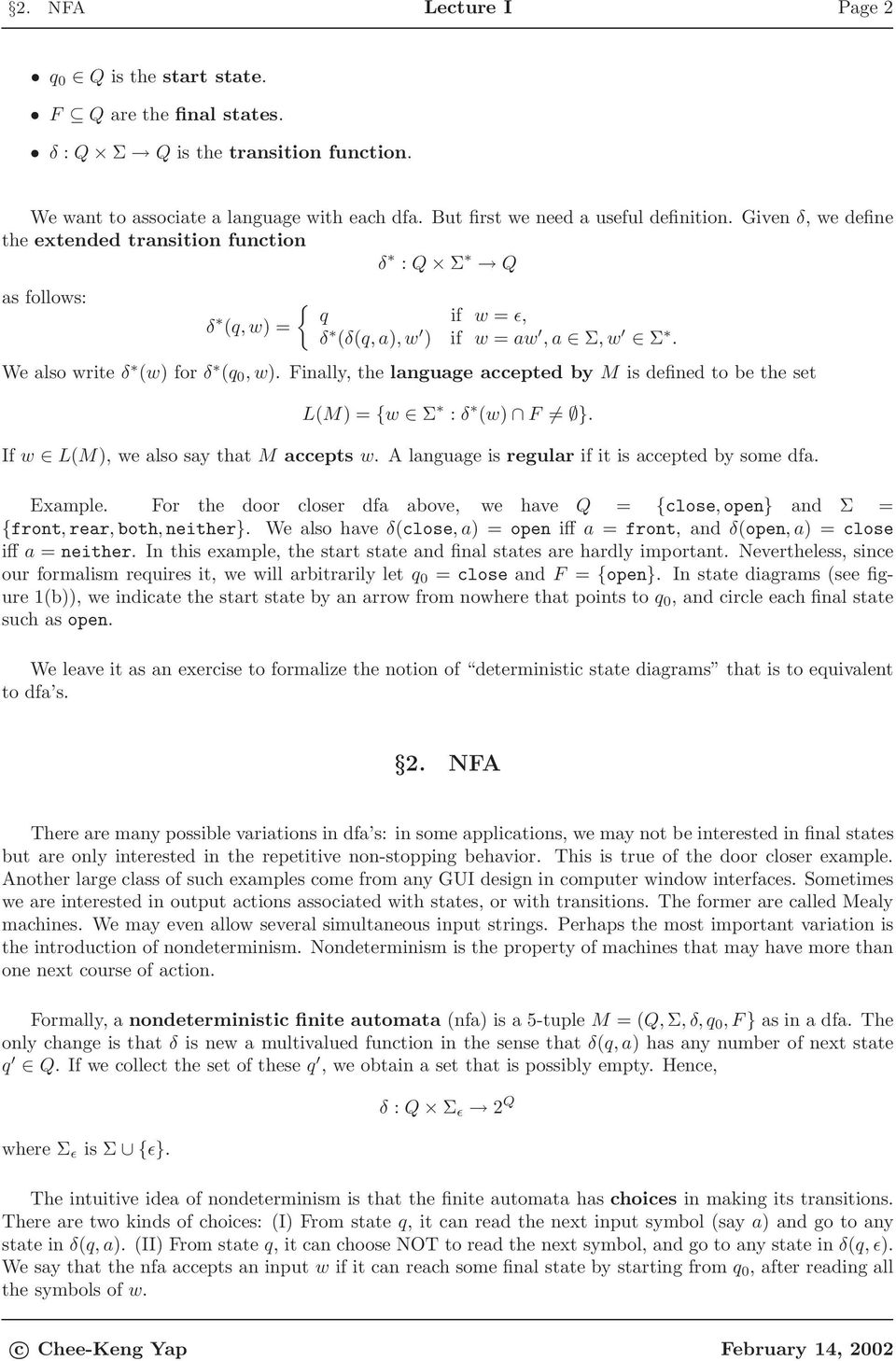
1 1. Regular Sets and DFA Lecture I Page 1 Lecture I FINITE AUTOMATA Lecture 1: Honors Theory, Spring 02, Yap We introduce finite automata (deterministic and nondeterministic) and regular languages. Some general concepts and notations are gathered at the end for easy reference. 1. Regular Sets and DFA We give an intuitive introduction to state diagrams using the example of an automatic door closer (see figure 1(a)). rear,both,neither front,rear,both front REAR FRONT close open neither (a) (b) Figure 1: (a) Door Plan, (b) State diagram The door can be in one of two states: open or close. There are two sensor pads, one in front and one behind the door. The door opens towards the rear, allowing a person on the front pad to pass through the door. There are 4 sensor inputs, corresponding to the presence or absence of pressure on the pads: front, rear, neither and both. Note that front means front pad only, neither means neither pad, etc. The state transitions are triggered by sensor inputs, and fully described in figure 1(b). From either state, there is only one input that can trigger a state change: if in the close state, we can only change to open if the input is front. In particular, we do not open the door if there is someone in the rear, as the door can hit that person. Similarly, from the open state, only the neither input can trigger a state change. This representation of the logic using a digraph with labels on edges is called a state diagram. Another example of an smart card wallet. State diagrams can also be formalized as finite automata, a term that emphasizes the finiteness of the number of states. A deterministic finite automata (dfa) is a 5-tuple such that M =(Q, Σ,δ,q 0,F) Q and Σ are finite sets, called the state set and the input alphabet (respectively).

2 2. NFA Lecture I Page 2 q 0 Q is the start state. F Q are the final states. δ : Q Σ Q is the transition function. We want to associate a language with each dfa. But first we need a useful definition. Given δ, we define the extended transition function δ : Q Σ Q as follows: { δ q if w = ɛ, (q, w) = δ (δ(q, a),w ) if w = aw,a Σ,w Σ. We also write δ (w) forδ (q 0,w). Finally, the language accepted by M is defined to be the set L(M) ={w Σ : δ (w) F }. If w L(M), we also say that M accepts w. A language is regular if it is accepted by some dfa. Example. For the door closer dfa above, we have Q = {close, open} and Σ = {front, rear, both, neither}. We also have δ(close,a)=open iff a = front, andδ(open,a)=close iff a = neither. In this example, the start state and final states are hardly important. Nevertheless, since our formalism requires it, we will arbitrarily let q 0 = close and F = {open}. In state diagrams (see figure 1(b)), we indicate the start state by an arrow from nowhere that points to q 0, and circle each final state such as open. We leave it as an exercise to formalize the notion of deterministic state diagrams that is to equivalent to dfa s. 2. NFA There are many possible variations in dfa s: in some applications, we may not be interested in final states but are only interested in the repetitive non-stopping behavior. This is true of the door closer example. Another large class of such examples come from any GUI design in computer window interfaces. Sometimes we are interested in output actions associated with states, or with transitions. The former are called Mealy machines. We may even allow several simultaneous input strings. Perhaps the most important variation is the introduction of nondeterminism. Nondeterminism is the property of machines that may have more than one next course of action. Formally, a nondeterministic finite automata (nfa) is a 5-tuple M =(Q, Σ,δ,q 0,F} as in a dfa. The only change is that δ is new a multivalued function in the sense that δ(q, a) has any number of next state q Q. If we collect the set of these q, we obtain a set that is possibly empty. Hence, where Σ ɛ is Σ {ɛ}. δ : Q Σ ɛ 2 Q The intuitive idea of nondeterminism is that the finite automata has choices in making its transitions. There are two kinds of choices: (I) From state q, it can read the next input symbol (say a) and go to any state in δ(q, a). (II) From state q, it can choose NOT to read the next symbol, and go to any state in δ(q, ɛ). We say that the nfa accepts an input w if it can reach some final state by starting from q 0, after reading all the symbols of w.
3 2. NFA Lecture I Page 3 To formalize this, we extend the function δ to a new function δ :2 Q Σ 2 Q. For P Q and w Σ,thesetδ (P, w) is, intuitively, the set of all states that we can reach by reading w, starting from any state of P. With such a definition, we can define the language accepted by an nfa M to be L(M) ={w Σ : δ ({q 0 },w) F }. Two preliminary steps will be helpful. First we can easily extend δ to δ 1 :2 Q Σ 2 Q where δ 1 (P, a) = p P δ(p, a). Next, we write q ɛ q if there is a finite sequence of ɛ-transitions from q to q.then { δ ɛ {q Q :( p P )[p q]} if w = ɛ, (P, w) = δ (δ 1 (δ (P, w ),a),ɛ) if w = w a, a Σ,w Σ. Again, let δ (w) =δ (q 0,w). Theorem 1 (Rabin-Scott) NFA s accept precisely the set of regular languages. Proof. Clearly every regular language is accepted by an nfa, since a dfa is an nfa. Conversely, given a nfa M =(Q, Σ,δ,q 0,F), we construct a dfa M =(Q, Σ, δ, q 0, F ) such that L(M) =L(M). The idea is quite simple: M must simulate all possible transitions of M simultaneously. This means for al w Σ,wewant the extension of δ to compute the set δ (w) ={ all the states in Q that can be reached from q 0 by M after reading w}. (1) Once we have this goal, it is natural to define the state set Q =2 Q, the start state q 0 = δ (q 0,ɛ)andtheset of final states to be F = {P Q : P F }. Now it is easy to see that L(M) =L(M). Thus it remains to define the transition function so that (1) is satisfied. For P Q and a Σ, we define δ(p, a) = q P δ (q, a). Note that δ(,a)=. This completes our description of the dfa M. Q.E.D. Two nfa s are said to be be equivalent if they accept the same language. The preceding lemma proves that nfa s and dfa s are equivalent. This equivalence is very useful, as illustrated in the following proof. Theorem 2 Regular languagues are closed under union, intersection, complementation, concatenation and Kleene-star. In particular, if A, B Σ are regular languages then so are A B, A =Σ \ A, A B, AB, A. Proof. (a) Let us show that C = A B is regular. Assume that A and B are accepted by the nfa s M A and M B that are in the following nice form : M i =(Q i, Σ,δ i,q 0i,F i )wherei = A, B. Also,q 0i q fi.itiseasy to put any nfa into this nice form. We construct M C =(Q C, Σ,δ C,q 0C,F C ) to accept C = A B. Let Q C = Q A Q B {q 0C },whereq 0C is a new symbol. Let F C = F A F B, and define δ C has all the transitions of δ A and δ B as well as the new transition δ C (q 0C,ɛ)={q 0A,q 0B }.

4 3. NOTATIONS AND TERMINOLOGY Lecture I Page 4 It is easy to see that L(M C )=A B. (b) To show that C = A =Σ \ A is regular, assume M A is a dfa that accepts A. We construct a nice nfa M C to accept C: start state is a new q 0C, final state set is F C = {q fc } where Q C = Q A {q 0C,q fc }. The transitions are those of M A together with δ C (q 0C,ɛ)={q 0A } and for each q Q A \ F C (i.e., non-final state q of M A ), δ C (q, ɛ) ={q fc }. This ensures that we accept the complement of A. (c) Remaining cases. It follows that the intersection of two regular languages is regular: A B = A B. Similar constructions will show AB and A. Q.E.D. Note how we exploited the equivalence of nfa and dfa in this proof. When we want to show the power of regular languages, it is easier to use nfa s. E.g., the constructed automaton M C is always an nfa. And in part (a), the automata can be assumed to be in nice form only because we assume an nfa. Conversely, when we want to limit the power of regular languages, we can use a dfa. E.g., we started out with a dfa M A in part (b). REMARK: we can extend the concept of a dfa by defining it to be a nfa in which δ(q, a) 1 for all q, a. Such a dfa can sometimes be stuck with no next state. The advantage of this is that when we draw state diagrams, we can avoid drawing lots of extraneous edges and labels. The idea of getting stuck must be distinguished from the idea of staying in the same state. For instance, one could introduce the convention for state diagrams where, if there is no explicit rule for a transition from state q on input a, then the implicit rule is δ(q, a) =q. The problem is that this convention means that we can never get stuck. See the exercise for regular languages that requires fewer states if we allow the nfa to have stuck states. 3. NOTATIONS AND TERMINOLOGY This section is a handy reference for common notations. Numbers. N is the set of natural numbers 0, 1, 2,... Z is the set of integers 0, ±1, ±2,... Q is the set of rational numbers (ratio of two integers, where the denominator is non-zero). R is the set of real numbers. Sets. If X is a well-defined set, we can introduce a new set by writing {x X : P (x)} where P (x) is a predicate on X. For instance, {x : x N,x is even} denotes the set of even natural numbers. The size X of X is the number of its elements. The empty set is denoted and thus =0. IfX = i I X i and the X i s are pairwise disjoint, we indicate this fact by writing X = i IX i, and call {X i : i I} a partition of X. The set of all subsets of a set X is the power set of X, denoted 2 X.Wehave 2 X =2 X. A subset of X of size k is called a k-set. The set of all k-sets of X is denoted ( ) X k. This recalls the binomial function ( ) n k = n! k!(n k)!. In fact, we have ( X ) ( k = X ) k. The Cartesian product of X and Y is X Y = {(x, y) :x X, y Y }. This can be generalized to X 1 X 2 X n or n i=1 X i (this notation exploits the associativity of Cartesian product). In case X 1 = X 2 = = X n,wewritex n for n i=1 X. Relations. An n-ary relation R is a subset of a Cartesian product n i=1 X i where S i are sets. We say the relationship R(a 1,...,a n ) holds in case (a 1,...,a n ) R. If n =1,R is also called a predicate on S 1. For a binary relation R, we may use an infix notation, and write write a 1 Ra 2 instead of R(a 1,a 2 ). A binary relation R S 2 is reflexive if ara for all a S; symmetric if arb imples bra; andtransitive if arb and brc implies arc. A partial order on S is a binary relation R S 2 that is reflexive, symmetric and transitive. We usually write a b for arb in case R is a partial order. If, in addition, we have either

5 3. NOTATIONS AND TERMINOLOGY Lecture I Page 5 a b or b a for all a, b S, thenr is called a total order. A total order A well order on S is a partial ordering such that every subset A S has a least element a A (i.e., for all b A, a b). Note that a well order is a total order. Functions. A function f has two associated sets D and R, called its domain and range respectively. We write f : D R to indicate this relationship. The function f specifies for each x D, a value in R which we denote by f(x). A function f is an injection (or one-one) ifx y implies f(x) f(y); it is a surjection (or onto) if{f(x) :x D} = R; itisabijection (or one-one onto) if it is both an injection and a bijection. Graphs. There are many varieties of graphs, but two varieties are important for us. A directed graph or digraph is a pair G =(V,E)whereV is any set and E V 2.Aundirected graph or bigraph ( bi for bidirectional) is a pair G =(V,E) wherev is any set and E ( V 2). For both kinds of graphs, the elements of V and E are called vertices and edges, respectively. We denote an edge by (u, v) where(u, v) E (if digraph) or {u, v} E (if bigraph). A path is a sequence p =(v 1,v 2,...,v k )where(v i,v i+1 ) are edges for i =1,...,k 1. We call p a path from v 1 to v k. Formal language theory. An alphabet Σ is a finite set of symbols, called letters. A word (or string) w over Σ is a finite sequence of letters of Σ, w = a 1 a n, (n 0) where a i Σ. The length of w is n, denoted w. Theempty word is denoted ɛ; thus ɛ = 0. We set of all words over Σ is denoted Σ.Also,Σ + := Σ \{ɛ} is the set of non-empty words over Σ. If a Σ, then define the counting function # a :Σ N where # a (w) is the number of occurences of a in w. Theith symbol in a word w is denoted w[i] wherei =1,..., w. Assume w[i] is undefined for i outside this range. The reverse of a word w is denoted w R.Thusw[i] =w R [n i +1]wheren = w. A palindrome is a word w such that w = w R. Let Σ denote the set of words over Σ. A language is a pair of the form (Σ,A)whereA Σ. We usually refer to A as the language (so the alphabet Σ is implicit). The complement of a language (Σ,A)is(Σ, Σ \ A), denoted co-a. IfC is a class of languages, let co-c = {co-a : A A}. Occasionally, we consider in infinite strings w = a 0 a 1 a 2 where a i Σ. Alternatively, w : N Σsow(n) =a n.wecallw an ω-word (or omega-sequence) over Σ. Let Σ ω denote the set of ω-words over Σ. Classes and Families. Above, we only allowed new sets to be constructed from known sets. Otherwise, there is some danger in using the concept of sets too liberally, giving rise to various logical paradoxes. For instance, the set of all sets will lead to such a paradox. In general paradoxes arise for very large sets such as the set of all sets. Logicians are careful to introduce other terms like classes or families for such large sets. We will use these terms informally (making no true distinction between them except for usage convention) for certain large sets in our book. For instance, consider L, the set of all languages. This is large because each language depends on an underlying alphabet, and there is no fixed 1 set alphabet that we wish to commit ourselves too. Hence, this set is not a mathematical set. It has many of the features of sets we can recognize members of it. Yet we never get into trouble because each particular use can be justified or suitably circumscribed. Moreover, certain set operations such as power set ought not to be performed. Two usage conventions: we consistently refer to a large sets of languages as a class of languages (or class for short). Likewise, we refer to a large set of machines as a family of machines. For example, we talk of the class of polynomial-time languages and the family of deterministic Turing machines. 1 Later in the book, we will actually establish two acceptable conventions in which these large sets can be completely rigorous. These are called conventions α and convention β respectively.

6 3. NOTATIONS AND TERMINOLOGY Lecture I Page 6 NOTES Finite automata was first studied in the 1950s. Most elementary books on the theory of computation have a treatment of finite automata and regular languages. For instance, Sipser [4] and Lewis and Papadimitriou [2]. The door closer example is from Sipser. The Rabin-Scott theorem appeared in [3]. An easy introduction to set theory where some paradoxes of large sets are discussed is Halmos book [1]. Exercises Exercise 3.1: Consider the following transformation: suppose M is a nfa with start state q 0 and final states F = {q f }. We transform it to M by making F = {q 0 }, and adding the transition δ(ɛ, q f )=q 0. This is illustrated in figure 2. Prove or disprove: L(M )=L(M). q 0 q f q 0 q f ɛ M M Figure 2: M to M transformation. Exercise 3.2: For n 2, let Σ n = {a 1,...,a n } be an alphabet with n letters and L n = {w Σ n :# ai (w) = 0forsomei =1,...,n}. (a) Show an nfa that accepts L n with n +1states. (b) Show a dfa that accepts L n with 2 n states. (c) Show that every dfa that accepts L n has at least 2 n states. Exercise 3.3: Recall that our nfa can get stuck. Show that you need more than n + 1 states if the nfa is not allowed to get stuck in part (a) of the previous question. Exercise 3.4: (a) Formalize the concept of deterministic state diagram using digraphs, and the language that it accepts. (b) Prove that your concept is equivalent to dfa s: for each dfa, there is a deterministic state diagram accepting the same language. Conversely, from any deterministic state diagram, there is a dfa for the same language. End Exercises
![The door closer example is from Sipser. The Rabin-Scott theorem appeared in [3]. An easy introduction to set theory where some paradoxes of large sets are discussed is Halmos book [1].](/docs-images/47/20662701/images/page_6.jpg "Exercises Exercise 3.1: Consider the following transformation: suppose M is a nfa with start state q 0 and final states F = {q f }.")
7 3. NOTATIONS AND TERMINOLOGY Lecture I Page 7 References [1] P. R. Halmos. Naive Set Theory. Van Nostrand Reinhold Company, New York, [2] H. R. Lewis and C. H. Papadimitriou. Elements of the Theory of Computation. Prentice-Hall Inc, Upper Saddle River, New Jersey, second ed. edition, [3] M. O. Rabin and D. Scott. Finite automata and their decision problems. IBM J. of Research and Development, 3: , [4] M. Sipser. Introduction to the Theory of Computation. PWS Publishing Co, Boston, 1997.
![Prentice-Hall Inc, Upper Saddle River, New Jersey, second ed. edition, 1998. [3] M. O. Rabin and D. Scott.](/docs-images/47/20662701/images/page_7.jpg "Finite automata and their decision problems. IBM J. of Research and Development, 3:114 125, 1959. [4] M. Sipser.")
Formal Languages and Automata Theory - Regular Expressions and Finite Automata -
 Formal Languages and Automata Theory - Regular Expressions and Finite Automata - Samarjit Chakraborty Computer Engineering and Networks Laboratory Swiss Federal Institute of Technology (ETH) Zürich March
Regular Languages and Finite State Machines
 Regular Languages and Finite State Machines Plan for the Day: Mathematical preliminaries - some review One application formal definition of finite automata Examples 1 Sets A set is an unordered collection
Lecture 17 : Equivalence and Order Relations DRAFT
 CS/Math 240: Introduction to Discrete Mathematics 3/31/2011 Lecture 17 : Equivalence and Order Relations Instructor: Dieter van Melkebeek Scribe: Dalibor Zelený DRAFT Last lecture we introduced the notion
Mathematics for Computer Science/Software Engineering. Notes for the course MSM1F3 Dr. R. A. Wilson
 Mathematics for Computer Science/Software Engineering Notes for the course MSM1F3 Dr. R. A. Wilson October 1996 Chapter 1 Logic Lecture no. 1. We introduce the concept of a proposition, which is a statement
Lecture 16 : Relations and Functions DRAFT
 CS/Math 240: Introduction to Discrete Mathematics 3/29/2011 Lecture 16 : Relations and Functions Instructor: Dieter van Melkebeek Scribe: Dalibor Zelený DRAFT In Lecture 3, we described a correspondence
6.045: Automata, Computability, and Complexity Or, Great Ideas in Theoretical Computer Science Spring, 2010. Class 4 Nancy Lynch
 6.045: Automata, Computability, and Complexity Or, Great Ideas in Theoretical Computer Science Spring, 2010 Class 4 Nancy Lynch Today Two more models of computation: Nondeterministic Finite Automata (NFAs)
Deterministic Finite Automata
 1 Deterministic Finite Automata Definition: A deterministic finite automaton (DFA) consists of 1. a finite set of states (often denoted Q) 2. a finite set Σ of symbols (alphabet) 3. a transition function
Reading 13 : Finite State Automata and Regular Expressions
 CS/Math 24: Introduction to Discrete Mathematics Fall 25 Reading 3 : Finite State Automata and Regular Expressions Instructors: Beck Hasti, Gautam Prakriya In this reading we study a mathematical model
Computability Theory
 CSC 438F/2404F Notes (S. Cook and T. Pitassi) Fall, 2014 Computability Theory This section is partly inspired by the material in A Course in Mathematical Logic by Bell and Machover, Chap 6, sections 1-10.
Automata on Infinite Words and Trees
 Automata on Infinite Words and Trees Course notes for the course Automata on Infinite Words and Trees given by Dr. Meghyn Bienvenu at Universität Bremen in the 2009-2010 winter semester Last modified:
CS 3719 (Theory of Computation and Algorithms) Lecture 4
 CS 3719 (Theory of Computation and Algorithms) Lecture 4 Antonina Kolokolova January 18, 2012 1 Undecidable languages 1.1 Church-Turing thesis Let s recap how it all started. In 1990, Hilbert stated a
Regular Expressions and Automata using Haskell
 Regular Expressions and Automata using Haskell Simon Thompson Computing Laboratory University of Kent at Canterbury January 2000 Contents 1 Introduction 2 2 Regular Expressions 2 3 Matching regular expressions
(IALC, Chapters 8 and 9) Introduction to Turing s life, Turing machines, universal machines, unsolvable problems.
 3130CIT: Theory of Computation Turing machines and undecidability (IALC, Chapters 8 and 9) Introduction to Turing s life, Turing machines, universal machines, unsolvable problems. An undecidable problem
Notes on Complexity Theory Last updated: August, 2011. Lecture 1
 Notes on Complexity Theory Last updated: August, 2011 Jonathan Katz Lecture 1 1 Turing Machines I assume that most students have encountered Turing machines before. (Students who have not may want to look
Turing Machines: An Introduction
 CIT 596 Theory of Computation 1 We have seen several abstract models of computing devices: Deterministic Finite Automata, Nondeterministic Finite Automata, Nondeterministic Finite Automata with ɛ-transitions,
Cartesian Products and Relations
 Cartesian Products and Relations Definition (Cartesian product) If A and B are sets, the Cartesian product of A and B is the set A B = {(a, b) :(a A) and (b B)}. The following points are worth special
CS154. Turing Machines. Turing Machine. Turing Machines versus DFAs FINITE STATE CONTROL AI N P U T INFINITE TAPE. read write move.
 CS54 Turing Machines Turing Machine q 0 AI N P U T IN TAPE read write move read write move Language = {0} q This Turing machine recognizes the language {0} Turing Machines versus DFAs TM can both write
INTRODUCTORY SET THEORY
 M.Sc. program in mathematics INTRODUCTORY SET THEORY Katalin Károlyi Department of Applied Analysis, Eötvös Loránd University H-1088 Budapest, Múzeum krt. 6-8. CONTENTS 1. SETS Set, equal sets, subset,
CS5236 Advanced Automata Theory
 CS5236 Advanced Automata Theory Frank Stephan Semester I, Academic Year 2012-2013 Advanced Automata Theory is a lecture which will first review the basics of formal languages and automata theory and then
Automata and Computability. Solutions to Exercises
 Automata and Computability Solutions to Exercises Fall 25 Alexis Maciel Department of Computer Science Clarkson University Copyright c 25 Alexis Maciel ii Contents Preface vii Introduction 2 Finite Automata
Automata and Formal Languages
 Automata and Formal Languages Winter 2009-2010 Yacov Hel-Or 1 What this course is all about This course is about mathematical models of computation We ll study different machine models (finite automata,
3515ICT Theory of Computation Turing Machines
 Griffith University 3515ICT Theory of Computation Turing Machines (Based loosely on slides by Harald Søndergaard of The University of Melbourne) 9-0 Overview Turing machines: a general model of computation
I. GROUPS: BASIC DEFINITIONS AND EXAMPLES
 I GROUPS: BASIC DEFINITIONS AND EXAMPLES Definition 1: An operation on a set G is a function : G G G Definition 2: A group is a set G which is equipped with an operation and a special element e G, called
Regular Languages and Finite Automata
 Regular Languages and Finite Automata 1 Introduction Hing Leung Department of Computer Science New Mexico State University Sep 16, 2010 In 1943, McCulloch and Pitts [4] published a pioneering work on a
1 Definition of a Turing machine
 Introduction to Algorithms Notes on Turing Machines CS 4820, Spring 2012 April 2-16, 2012 1 Definition of a Turing machine Turing machines are an abstract model of computation. They provide a precise,
Pushdown automata. Informatics 2A: Lecture 9. Alex Simpson. 3 October, 2014. School of Informatics University of Edinburgh [email protected].
 Pushdown automata Informatics 2A: Lecture 9 Alex Simpson School of Informatics University of Edinburgh [email protected] 3 October, 2014 1 / 17 Recap of lecture 8 Context-free languages are defined by context-free
1 if 1 x 0 1 if 0 x 1
 Chapter 3 Continuity In this chapter we begin by defining the fundamental notion of continuity for real valued functions of a single real variable. When trying to decide whether a given function is or
Lecture 1. Basic Concepts of Set Theory, Functions and Relations
 September 7, 2005 p. 1 Lecture 1. Basic Concepts of Set Theory, Functions and Relations 0. Preliminaries...1 1. Basic Concepts of Set Theory...1 1.1. Sets and elements...1 1.2. Specification of sets...2
On Winning Conditions of High Borel Complexity in Pushdown Games
 Fundamenta Informaticae (2005) 1 22 1 IOS Press On Winning Conditions of High Borel Complexity in Pushdown Games Olivier Finkel Equipe de Logique Mathématique U.F.R. de Mathématiques, Université Paris
Basic Concepts of Set Theory, Functions and Relations
 March 1, 2006 p. 1 Basic Concepts of Set Theory, Functions and Relations 1. Basic Concepts of Set Theory...1 1.1. Sets and elements...1 1.2. Specification of sets...2 1.3. Identity and cardinality...3
Automata Theory. Şubat 2006 Tuğrul Yılmaz Ankara Üniversitesi
 Automata Theory Automata theory is the study of abstract computing devices. A. M. Turing studied an abstract machine that had all the capabilities of today s computers. Turing s goal was to describe the
Finite Automata. Reading: Chapter 2
 Finite Automata Reading: Chapter 2 1 Finite Automaton (FA) Informally, a state diagram that comprehensively captures all possible states and transitions that a machine can take while responding to a stream
Lecture 2: Universality
 CS 710: Complexity Theory 1/21/2010 Lecture 2: Universality Instructor: Dieter van Melkebeek Scribe: Tyson Williams In this lecture, we introduce the notion of a universal machine, develop efficient universal
Basic Concepts of Point Set Topology Notes for OU course Math 4853 Spring 2011
 Basic Concepts of Point Set Topology Notes for OU course Math 4853 Spring 2011 A. Miller 1. Introduction. The definitions of metric space and topological space were developed in the early 1900 s, largely
1. Prove that the empty set is a subset of every set.
 1. Prove that the empty set is a subset of every set. Basic Topology Written by Men-Gen Tsai email: [email protected] Proof: For any element x of the empty set, x is also an element of every set since
This asserts two sets are equal iff they have the same elements, that is, a set is determined by its elements.
 3. Axioms of Set theory Before presenting the axioms of set theory, we first make a few basic comments about the relevant first order logic. We will give a somewhat more detailed discussion later, but
C H A P T E R Regular Expressions regular expression
 7 CHAPTER Regular Expressions Most programmers and other power-users of computer systems have used tools that match text patterns. You may have used a Web search engine with a pattern like travel cancun
Discrete Mathematics. Hans Cuypers. October 11, 2007
 Hans Cuypers October 11, 2007 1 Contents 1. Relations 4 1.1. Binary relations................................ 4 1.2. Equivalence relations............................. 6 1.3. Relations and Directed Graphs.......................
MA4001 Engineering Mathematics 1 Lecture 10 Limits and Continuity
 MA4001 Engineering Mathematics 1 Lecture 10 Limits and Dr. Sarah Mitchell Autumn 2014 Infinite limits If f(x) grows arbitrarily large as x a we say that f(x) has an infinite limit. Example: f(x) = 1 x
Two Way F finite Automata and Three Ways to Solve Them
 An Exponential Gap between LasVegas and Deterministic Sweeping Finite Automata Christos Kapoutsis, Richard Královič, and Tobias Mömke Department of Computer Science, ETH Zürich Abstract. A two-way finite
Finite Automata and Regular Languages
 CHAPTER 3 Finite Automata and Regular Languages 3. Introduction 3.. States and Automata A finite-state machine or finite automaton (the noun comes from the Greek; the singular is automaton, the Greek-derived
Cardinality. The set of all finite strings over the alphabet of lowercase letters is countable. The set of real numbers R is an uncountable set.
 Section 2.5 Cardinality (another) Definition: The cardinality of a set A is equal to the cardinality of a set B, denoted A = B, if and only if there is a bijection from A to B. If there is an injection
Testing LTL Formula Translation into Büchi Automata
 Testing LTL Formula Translation into Büchi Automata Heikki Tauriainen and Keijo Heljanko Helsinki University of Technology, Laboratory for Theoretical Computer Science, P. O. Box 5400, FIN-02015 HUT, Finland
Chapter 3. Cartesian Products and Relations. 3.1 Cartesian Products
 Chapter 3 Cartesian Products and Relations The material in this chapter is the first real encounter with abstraction. Relations are very general thing they are a special type of subset. After introducing
Solutions to In-Class Problems Week 4, Mon.
 Massachusetts Institute of Technology 6.042J/18.062J, Fall 05: Mathematics for Computer Science September 26 Prof. Albert R. Meyer and Prof. Ronitt Rubinfeld revised September 26, 2005, 1050 minutes Solutions
Mathematics Review for MS Finance Students
 Mathematics Review for MS Finance Students Anthony M. Marino Department of Finance and Business Economics Marshall School of Business Lecture 1: Introductory Material Sets The Real Number System Functions,
INCIDENCE-BETWEENNESS GEOMETRY
 INCIDENCE-BETWEENNESS GEOMETRY MATH 410, CSUSM. SPRING 2008. PROFESSOR AITKEN This document covers the geometry that can be developed with just the axioms related to incidence and betweenness. The full
1 The Concept of a Mapping
 Arkansas Tech University MATH 4033: Elementary Modern Algebra Dr. Marcel B. Finan 1 The Concept of a Mapping The concept of a mapping (aka function) is important throughout mathematics. We have been dealing
You know from calculus that functions play a fundamental role in mathematics.
 CHPTER 12 Functions You know from calculus that functions play a fundamental role in mathematics. You likely view a function as a kind of formula that describes a relationship between two (or more) quantities.
CSE 135: Introduction to Theory of Computation Decidability and Recognizability
 CSE 135: Introduction to Theory of Computation Decidability and Recognizability Sungjin Im University of California, Merced 04-28, 30-2014 High-Level Descriptions of Computation Instead of giving a Turing
So let us begin our quest to find the holy grail of real analysis.
 1 Section 5.2 The Complete Ordered Field: Purpose of Section We present an axiomatic description of the real numbers as a complete ordered field. The axioms which describe the arithmetic of the real numbers
Reliability Guarantees in Automata Based Scheduling for Embedded Control Software
 1 Reliability Guarantees in Automata Based Scheduling for Embedded Control Software Santhosh Prabhu, Aritra Hazra, Pallab Dasgupta Department of CSE, IIT Kharagpur West Bengal, India - 721302. Email: {santhosh.prabhu,
Introduction to Finite Automata
 Introduction to Finite Automata Our First Machine Model Captain Pedro Ortiz Department of Computer Science United States Naval Academy SI-340 Theory of Computing Fall 2012 Captain Pedro Ortiz (US Naval
GENERIC COMPUTABILITY, TURING DEGREES, AND ASYMPTOTIC DENSITY
 GENERIC COMPUTABILITY, TURING DEGREES, AND ASYMPTOTIC DENSITY CARL G. JOCKUSCH, JR. AND PAUL E. SCHUPP Abstract. Generic decidability has been extensively studied in group theory, and we now study it in
MASSACHUSETTS INSTITUTE OF TECHNOLOGY 6.436J/15.085J Fall 2008 Lecture 5 9/17/2008 RANDOM VARIABLES
 MASSACHUSETTS INSTITUTE OF TECHNOLOGY 6.436J/15.085J Fall 2008 Lecture 5 9/17/2008 RANDOM VARIABLES Contents 1. Random variables and measurable functions 2. Cumulative distribution functions 3. Discrete
6.2 Permutations continued
 6.2 Permutations continued Theorem A permutation on a finite set A is either a cycle or can be expressed as a product (composition of disjoint cycles. Proof is by (strong induction on the number, r, of
The Halting Problem is Undecidable
 185 Corollary G = { M, w w L(M) } is not Turing-recognizable. Proof. = ERR, where ERR is the easy to decide language: ERR = { x { 0, 1 }* x does not have a prefix that is a valid code for a Turing machine
Representing Reversible Cellular Automata with Reversible Block Cellular Automata
 Discrete Mathematics and Theoretical Computer Science Proceedings AA (DM-CCG), 2001, 145 154 Representing Reversible Cellular Automata with Reversible Block Cellular Automata Jérôme Durand-Lose Laboratoire
6.080/6.089 GITCS Feb 12, 2008. Lecture 3
 6.8/6.89 GITCS Feb 2, 28 Lecturer: Scott Aaronson Lecture 3 Scribe: Adam Rogal Administrivia. Scribe notes The purpose of scribe notes is to transcribe our lectures. Although I have formal notes of my
Introduction to Topology
 Introduction to Topology Tomoo Matsumura November 30, 2010 Contents 1 Topological spaces 3 1.1 Basis of a Topology......................................... 3 1.2 Comparing Topologies.......................................
. 0 1 10 2 100 11 1000 3 20 1 2 3 4 5 6 7 8 9
 Introduction The purpose of this note is to find and study a method for determining and counting all the positive integer divisors of a positive integer Let N be a given positive integer We say d is a
MA651 Topology. Lecture 6. Separation Axioms.
 MA651 Topology. Lecture 6. Separation Axioms. This text is based on the following books: Fundamental concepts of topology by Peter O Neil Elements of Mathematics: General Topology by Nicolas Bourbaki Counterexamples
Arkansas Tech University MATH 4033: Elementary Modern Algebra Dr. Marcel B. Finan
 Arkansas Tech University MATH 4033: Elementary Modern Algebra Dr. Marcel B. Finan 6 Permutation Groups Let S be a nonempty set and M(S be the collection of all mappings from S into S. In this section,
FUNCTIONAL ANALYSIS LECTURE NOTES: QUOTIENT SPACES
 FUNCTIONAL ANALYSIS LECTURE NOTES: QUOTIENT SPACES CHRISTOPHER HEIL 1. Cosets and the Quotient Space Any vector space is an abelian group under the operation of vector addition. So, if you are have studied
Scanner. tokens scanner parser IR. source code. errors
 Scanner source code tokens scanner parser IR errors maps characters into tokens the basic unit of syntax x = x + y; becomes = + ; character string value for a token is a lexeme
Math 223 Abstract Algebra Lecture Notes
 Math 223 Abstract Algebra Lecture Notes Steven Tschantz Spring 2001 (Apr. 23 version) Preamble These notes are intended to supplement the lectures and make up for the lack of a textbook for the course
Computational Models Lecture 8, Spring 2009
 Slides modified by Benny Chor, based on original slides by Maurice Herlihy, Brown Univ. p. 1 Computational Models Lecture 8, Spring 2009 Encoding of TMs Universal Turing Machines The Halting/Acceptance
Introduction to Theory of Computation
 Introduction to Theory of Computation Prof. (Dr.) K.R. Chowdhary Email: [email protected] Formerly at department of Computer Science and Engineering MBM Engineering College, Jodhpur Tuesday 28 th
Mathematical Methods of Engineering Analysis
 Mathematical Methods of Engineering Analysis Erhan Çinlar Robert J. Vanderbei February 2, 2000 Contents Sets and Functions 1 1 Sets................................... 1 Subsets.............................
24 Uses of Turing Machines
 Formal Language and Automata Theory: CS2004 24 Uses of Turing Machines 24 Introduction We have previously covered the application of Turing Machine as a recognizer and decider In this lecture we will discuss
ω-automata Automata that accept (or reject) words of infinite length. Languages of infinite words appear:
 ω-automata ω-automata Automata that accept (or reject) words of infinite length. Languages of infinite words appear: in verification, as encodings of non-terminating executions of a program. in arithmetic,
This chapter is all about cardinality of sets. At first this looks like a
 CHAPTER Cardinality of Sets This chapter is all about cardinality of sets At first this looks like a very simple concept To find the cardinality of a set, just count its elements If A = { a, b, c, d },
Finite Automata. Reading: Chapter 2
 Finite Automata Reading: Chapter 2 1 Finite Automata Informally, a state machine that comprehensively captures all possible states and transitions that a machine can take while responding to a stream (or
Omega Automata: Minimization and Learning 1
 Omega Automata: Minimization and Learning 1 Oded Maler CNRS - VERIMAG Grenoble, France 2007 1 Joint work with A. Pnueli, late 80s Summary Machine learning in general and of formal languages in particular
Discrete Maths. Philippa Gardner. These lecture notes are based on previous notes by Iain Phillips.
 Discrete Maths Philippa Gardner These lecture notes are based on previous notes by Iain Phillips. This short course introduces some basic concepts in discrete mathematics: sets, relations, and functions.
CMSC 858T: Randomized Algorithms Spring 2003 Handout 8: The Local Lemma
 CMSC 858T: Randomized Algorithms Spring 2003 Handout 8: The Local Lemma Please Note: The references at the end are given for extra reading if you are interested in exploring these ideas further. You are
The Ergodic Theorem and randomness
 The Ergodic Theorem and randomness Peter Gács Department of Computer Science Boston University March 19, 2008 Peter Gács (Boston University) Ergodic theorem March 19, 2008 1 / 27 Introduction Introduction
Follow links for Class Use and other Permissions. For more information send email to: [email protected]
 COPYRIGHT NOTICE: Ariel Rubinstein: Lecture Notes in Microeconomic Theory is published by Princeton University Press and copyrighted, c 2006, by Princeton University Press. All rights reserved. No part
Informatique Fondamentale IMA S8
 Informatique Fondamentale IMA S8 Cours 1 - Intro + schedule + finite state machines Laure Gonnord http://laure.gonnord.org/pro/teaching/ [email protected] Université Lille 1 - Polytech Lille
Undergraduate Notes in Mathematics. Arkansas Tech University Department of Mathematics
 Undergraduate Notes in Mathematics Arkansas Tech University Department of Mathematics An Introductory Single Variable Real Analysis: A Learning Approach through Problem Solving Marcel B. Finan c All Rights
Continued Fractions and the Euclidean Algorithm
 Continued Fractions and the Euclidean Algorithm Lecture notes prepared for MATH 326, Spring 997 Department of Mathematics and Statistics University at Albany William F Hammond Table of Contents Introduction
Introduction to Turing Machines
 Automata Theory, Languages and Computation - Mírian Halfeld-Ferrari p. 1/2 Introduction to Turing Machines SITE : http://www.sir.blois.univ-tours.fr/ mirian/ Automata Theory, Languages and Computation
Full and Complete Binary Trees
 Full and Complete Binary Trees Binary Tree Theorems 1 Here are two important types of binary trees. Note that the definitions, while similar, are logically independent. Definition: a binary tree T is full
Polarization codes and the rate of polarization
 Polarization codes and the rate of polarization Erdal Arıkan, Emre Telatar Bilkent U., EPFL Sept 10, 2008 Channel Polarization Given a binary input DMC W, i.i.d. uniformly distributed inputs (X 1,...,
Theory of Computation Chapter 2: Turing Machines
 Theory of Computation Chapter 2: Turing Machines Guan-Shieng Huang Feb. 24, 2003 Feb. 19, 2006 0-0 Turing Machine δ K 0111000a 01bb 1 Definition of TMs A Turing Machine is a quadruple M = (K, Σ, δ, s),
Linear Algebra I. Ronald van Luijk, 2012
 Linear Algebra I Ronald van Luijk, 2012 With many parts from Linear Algebra I by Michael Stoll, 2007 Contents 1. Vector spaces 3 1.1. Examples 3 1.2. Fields 4 1.3. The field of complex numbers. 6 1.4.
THE TURING DEGREES AND THEIR LACK OF LINEAR ORDER
 THE TURING DEGREES AND THEIR LACK OF LINEAR ORDER JASPER DEANTONIO Abstract. This paper is a study of the Turing Degrees, which are levels of incomputability naturally arising from sets of natural numbers.
x a x 2 (1 + x 2 ) n.
 Limits and continuity Suppose that we have a function f : R R. Let a R. We say that f(x) tends to the limit l as x tends to a; lim f(x) = l ; x a if, given any real number ɛ > 0, there exists a real number
Matrix Representations of Linear Transformations and Changes of Coordinates
 Matrix Representations of Linear Transformations and Changes of Coordinates 01 Subspaces and Bases 011 Definitions A subspace V of R n is a subset of R n that contains the zero element and is closed under
Georg Cantor (1845-1918):
 Georg Cantor (845-98): The man who tamed infinity lecture by Eric Schechter Associate Professor of Mathematics Vanderbilt University http://www.math.vanderbilt.edu/ schectex/ In papers of 873 and 874,
T-79.186 Reactive Systems: Introduction and Finite State Automata
 T-79.186 Reactive Systems: Introduction and Finite State Automata Timo Latvala 14.1.2004 Reactive Systems: Introduction and Finite State Automata 1-1 Reactive Systems Reactive systems are a class of software
Fundamentele Informatica II
 Fundamentele Informatica II Answer to selected exercises 1 John C Martin: Introduction to Languages and the Theory of Computation M.M. Bonsangue (and J. Kleijn) Fall 2011 Let L be a language. It is clear
BANACH AND HILBERT SPACE REVIEW
 BANACH AND HILBET SPACE EVIEW CHISTOPHE HEIL These notes will briefly review some basic concepts related to the theory of Banach and Hilbert spaces. We are not trying to give a complete development, but
Examination paper for MA0301 Elementær diskret matematikk
 Department of Mathematical Sciences Examination paper for MA0301 Elementær diskret matematikk Academic contact during examination: Iris Marjan Smit a, Sverre Olaf Smalø b Phone: a 9285 0781, b 7359 1750
a 11 x 1 + a 12 x 2 + + a 1n x n = b 1 a 21 x 1 + a 22 x 2 + + a 2n x n = b 2.
 Chapter 1 LINEAR EQUATIONS 1.1 Introduction to linear equations A linear equation in n unknowns x 1, x,, x n is an equation of the form a 1 x 1 + a x + + a n x n = b, where a 1, a,..., a n, b are given
1. Nondeterministically guess a solution (called a certificate) 2. Check whether the solution solves the problem (called verification)
 Some N P problems Computer scientists have studied many N P problems, that is, problems that can be solved nondeterministically in polynomial time. Traditionally complexity question are studied as languages:
TOPOLOGY: THE JOURNEY INTO SEPARATION AXIOMS
 TOPOLOGY: THE JOURNEY INTO SEPARATION AXIOMS VIPUL NAIK Abstract. In this journey, we are going to explore the so called separation axioms in greater detail. We shall try to understand how these axioms
6.080 / 6.089 Great Ideas in Theoretical Computer Science Spring 2008
 MIT OpenCourseWare http://ocw.mit.edu 6.080 / 6.089 Great Ideas in Theoretical Computer Science Spring 2008 For information about citing these materials or our Terms of Use, visit: http://ocw.mit.edu/terms.