
TAC I/NET. Installation Guide. Seven. Process Control Unit TCON /10. for TAC I/NET Building Automation Systems
|
|
|
- Preston Oscar Parker
- 9 years ago
- Views:
Transcription
1 vi TAC I/NET Seven Installation Guide Process Control Unit 5 for TAC I/NET Building Automation Systems TCON. 0/0

2 We at Schneider Electric have tried to make the information contained in this manual as accurate and reliable as possible. Nevertheless, Schneider Electric disclaims any warranty of any kind, whether express or implied, as to any matter whatsoever relating to this manual, including without limitation the merchantability or fitness for any particular purpose. Information in this document is based on specifications determined at the time of publication. As we introduce design enhancements, we reserve the right to make changes in specifications and models without obligation to notify the purchaser. In no event shall Schneider Electric be liable for any indirect, special, incidental, or consequential damages arising out of purchase or use of this manual or the information contained herein. The software described in this document is furnished under a license agreement or nondisclosure agreement. The software may be used or copied only in accordance with the terms of the agreement. It is against the law to copy Schneider Electric s TAC I/NET System software onto magnetic tape, disk, or any other medium for any purpose other than the purchaser's personal use. Printed in the United States of America. Document Number: Copyright 00 Schneider Electric. All rights reserved. On October st, 00, TAC became the Buildings business of its parent company Schneider Electric. This document reflects the visual identity of Schneider Electric; however, there remains references to TAC as a corporate brand in the body copy. As each document is updated, the body copy will be changed to reflect appropriate corporate brand changes.

3 Contents FCC Warning vi Overview Input/Output Communication Reset Physical Description PCBs and Baseplates Power Supply Input/Output Terminals Input Terminations Output Terminations Communication Ports Serial Communication Port LAN Communication Port Memory Static RAM Memory Exhaustion Warning Battery Backup Universal Enclosure RS Serial Expansion Module Installation Procedures Initial Installation Procedures Grounding Requirements Earth Ground Baseplate Ground LAN Ground Setting the 5 PCU Address Setting the Tap Emulation Setting the Tap Baud Rate Setting the Controller LAN Baud Rate Setting the Power Line Frequency Schneider Electric. All rights reserved. iii

4 Contents 5 Installation Guide Setting the Maximum Pulse Input Rate Installing the Input Field Connections V Sensor Connection V Sensor Connection Milliampere Sensor Connection Connecting Discrete Input Points Installing Supervised Field Inputs Connecting Thermistor Inputs Connecting Lini-Temp Inputs Variable Voltage Selection Resistor Installation Installing the Output Field Connections Form-C Relay (Universal) Output Connection Analog Output Connection Voltage-Sourcing Triac Output Connection Connecting the HHC Connecting the LAN Connecting an External PC Connecting the Modem Installing the Optional RS Serial Interface Board Connecting the Power Supply Field Hardware Checkout and Addressing Connecting the HHC Cold Starting the 5 PCU Check Signal Voltages Check Analog Inputs Checkout Discrete Inputs Checkout Discrete Outputs Set Up and Operation Hardware Inputs Lookup Tables Selecting Input Type Control Outputs Upper Motherboard Outputs Lower I/O Board Outputs Analog Output Points Triac Output Points iv 00 Schneider Electric. All rights reserved.

5 5 Installation Guide Contents Manual Override Communication Ports LEDs RS Port HHC Port RS85 LAN Port Protocol LAN Node Address Data Rate Serial Expansion Module RS Serial Expansion Module Function Tap Emulation and Modem Setup Emulation and Beeper Calls Tap Emulation and Pager Operation Modem Switch Settings Auto Dial/Auto Answer Integrated Dial Point Address Summary Outputs Inputs HOA Switch Status Resistor Configurations Troubleshooting Pinout Chart Upper Motherboard Lower I/O Board RS Expansion Module Internal RS Specifications Index Schneider Electric. All rights reserved. v
6 FCC Warning 5 Installation Guide FCC Warning FCC Warning The Federal Communications Commission (FCC) requirements prescribe certification of personal computers and any interconnected peripherals in the FCC rules and regulations. This device complies with Part 5 of the FCC rules. Operation is subject to the following two conditions: this device may not cause harmful interference, and this device must accept any interference received, including interference that may cause undesired operation. This equipment generates and uses radio frequency (rf) energy for its operation and, if not installed and used in accordance with the installation and operation manual, may cause interference to radio and television reception. It has been found to comply with the limits for a Class A computing device pursuant to the aforementioned regulations. These are designed to provide reasonable protection against such interference when operated in a residential area. Only peripherals (computer input/output devices) certified to comply with the Class A limits may be connected to this device. Operation with noncertified computer peripherals is likely to result in interference with radio and television reception. If this equipment does cause interference to radio or television reception, the user is encouraged to correct the situation by one or more of the following measures. Relocate the receiver with respect to the computer. Move the computer away from the receiver. Plug the equipment into a different outlet, so that the computing device and receiver are on different branch circuits. Disconnect and remove any unused cables that may be acting as a transmission source. Make certain that the computing device is plugged into a grounded outlet receptacle. If necessary, contact Schneider Electric for additional suggestions. vi 00 Schneider Electric. All rights reserved.

7 5 5 Installation Guide Overview Overview Input/Output The Model 5 Process Control Unit (PCU) from TAC is a combination of a highspeed, fully distributed microprocessor-based motherboard and a high-resolution I/O board which together provide full adaptive Direct Digital Control (DDC), energy management, and process control of up to 5 addressable I/O points. The 5 PCU is designed to connect directly to a controller LAN and works in conjunction with all other controllers and workstations on the TAC I/NET system. Processing, memory management, communication, and field input/output functions are provided on two printed circuit boards mounted in a double-layer stack. The upper motherboard provides the processing, memory, and communication support for the unit as well as a collection of I/O points. The lower I/O board provides an additional 0 I/O connections, conditioning, and analog signal processing with microprocessor management provided from the upper motherboard. The controller features all quick-disconnect terminals, downloadable firmware, onboard modem drivers, and a direct-connect RS port. The controller is further enhanced with extensive transient protection and automatic self-test features. The 5 PCU comes with the capability of supervising and controlling up to 5 addressable external points and internal points. The I/O configuration flexibility provided by the controller allows it to be interfaced with a variety of industry standard I/O devices. The 5 PCU supports the hardware I/Os listed in Table. Table. 5 PCU Hardware I/Os Upper Motherboard Lower I/O Board 8 universal inputs 8 universal relay outputs universal inputs 8 universal triac outputs 8 analog outputs Universal inputs can be defined as: analog inputs discrete inputs pulse inputs 00 Schneider Electric. All rights reserved.

8 Overview 5 Installation Guide Communication The 5 PCU provides up to four communication ports on the upper motherboard. A standard synchronous RS85 controller LAN port. Two asynchronous serial ports. These ports provide access to external PCs, external modems, and the Model HC0 hand-held console (HHC). The first asynchronous port provides an RS port for direct connection to a PC, or external Direct Distance Dial (Hayes compatible) modem. The RS port s baud rate is set using a TAC HC0. When connected directly to a PC, the 5 performs the functions of a TAC 80 Tap without consuming a second LAN address. When connected to a Hayes-compatible modem, the Integrated Dial function (i.e. one-way dial from the host PC to the controller LAN) is provided. The second asynchronous port provides a modular TTL-level interface to an HC0 and operates at 00 BPS. An optional plug-on board providing an RS serial port that can be used to connect an external synchronous or asynchronous modem or one of several communication multiplexing devices. (Refer to RS Serial Expansion Module on page 8.) Reset Upon power loss/restoration, the 5 PCU executes an automatic reset memory test of RAM and EPROM. The test uses a Checksum check, and, if the check is successful, control and execution is passed to programmed memory. A manual reset that is started by pressing the reset button executes the same tests. 00 Schneider Electric. All rights reserved.

9 5 Installation Guide Physical Description Physical Description PCBs and Baseplates The 5 PCU is comprised of two printed circuit boards mounted on a double-layer metal baseplate. The I/O board is mounted on the lower layer, while the motherboard is mounted on the top layer. The top layer is hinged such that easy access is provided to the lower interface. The baseplate provides keyhole mounting for easy installation within a TAC universal enclosure. All I/O connections to the 5 PCU are accomplished via plug-on terminal blocks. Power Supply The upper motherboard (see Figure ) measures approximately 8.5" W " H (.. cm); the baseplate measures approximately 8." W " H (.8. cm). A hinge allows the upper baseplate to swing downward, thus providing access to the lower I/O board. The lower I/O board (see Figure ) measures approximately 8.5" W 0" H (. 5. cm); the baseplate measures approximately." W " H (.. cm). The lower baseplate provides keyholes required for mounting the 5 unit within a TAC universal enclosure. Sensor input wiring to the upper interface board can be bundled and routed along the edge of the hinged upper baseplate to allow access to the lower I/O board without disconnecting the upper motherboard terminations. A cutout in the hinged upper baseplate provides user access to the HOA override switches on the lower I/O board. The lower I/O board connects to the upper motherboard through a 0-conductor ribbon cable. Electrical input power connections for the 5 PCU are provided along the lower left side of the lower I/O board. The 5 PCU is powered from a dual VAC source (external transformer). The AC input provides power to five on-board supplies. A switching power supply circuit is used to generate the +5 VDC logic power. Four linear power supplies are used to generate +5 VDC internal, +5 VDC External, 5 VDC and + VDC. The supply voltages are used for analog signal processing and RS communication. The separate +5 VDC (external) regulator is provided for supplying current loop excitation power to avoid loss of communication due to a field sensor wiring problem. Power line frequency selection (50/0 Hz) is available through an HHC connected directly to the Schneider Electric. All rights reserved.

10 Physical Description 5 Installation Guide lower baseplate width." (. cm) 8.5" (. cm) TB TB " (. cm) " (.8cm) RS85 port signal inputs TB signal inputs TB resistors resistors U U P U U LEDs reset button manual override switches TB signal outputs P RJ hand held console port TB power input serial option port I/O expansion port RS port modem or external PC P P 8." (.8 cm) Input/Output Terminals Figure. Upper Motherboard and Baseplate The 5 PCU s input and output terminals are located in different areas of both the upper motherboard and the lower I/O board. The inputs and outputs do not use the same number of terminals to make up a terminal set. See Figure for the upper motherboard terminal locations. See Figure for the lower I/O board terminal locations. Input Terminations Both the upper motherboard and lower I/O board provide universal inputs for the 5 PCU. The upper motherboard provides 8 universal inputs. The lower I/O board provides additional universal inputs. All universal inputs are user-configurable for 0 5 VDC, 0 0 VDC, 0 0 ma, or discrete/pulse contact input. Additionally, the lower I/O board universal inputs can be configured for fast scan of pulse input (0 Hz) points. 00 Schneider Electric. All rights reserved.
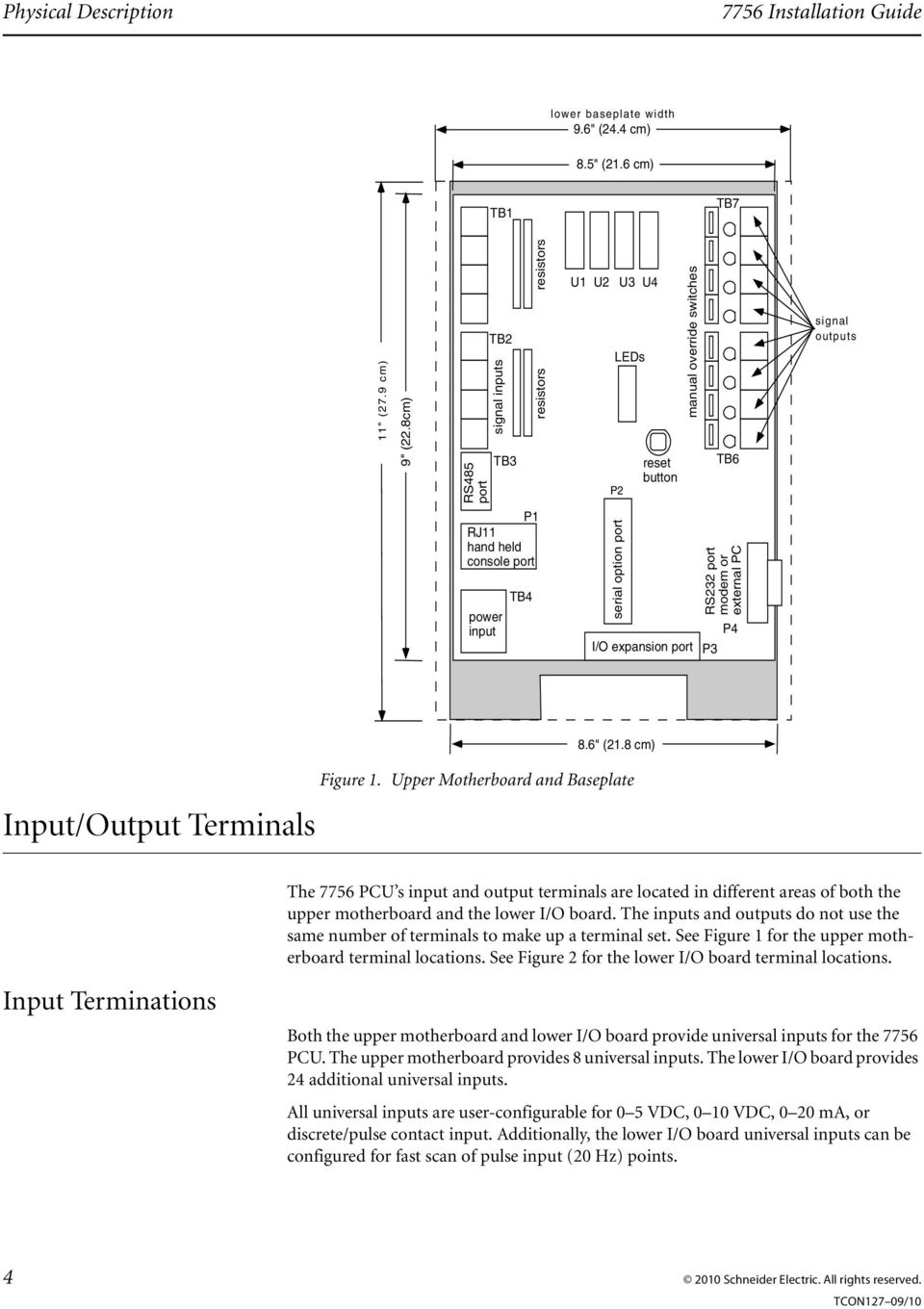
11 5 Installation Guide Physical Description.0" (.0 cm).00" (.8 cm) TBB TBA TB U U U5 U TBB TBA.00" (. cm).00" (.8 cm) TBB TBA Analog Type Selection Resistors TB 0" (5. cm) 0-Pin Ribbon Cable Connector TB P TB5A TB5B HOA Switches 8.50" (.0 cm) Figure. Lower I/O Board and Baseplate Signal inputs to the upper motherboard are provided along the upper left side of the board in two groups of four inputs (TB and TB). Three screw terminations are provided for each input (Signal, Ground and +5/ V). The inputs (analog, discrete, or pulse) use point addresses Jumper settings on the upper motherboard allow selection of variable voltages for contact excitation and input pull-up levels. Signal inputs to the lower I/O board are provided along the left side of the board in three groups of eight inputs. Each group provides two tiers of terminal blocks: TBA through TBA on the lower tiers, TBB through TBB on the upper tiers. The inputs (analog, discrete, or pulse) use point address (TBA/B), (TBA/B), and (TBA/B). Output Terminations Output terminations for the 5 PCU are provided along the right side of both the upper motherboard and the lower I/O board. Discrete (Form-C relay) outputs are provided on the upper motherboard. The lower I/O board provides two output types: analog and discrete voltage-sourcing triac. Universal output terminations along the upper right side of the upper motherboard are arranged in two groups of four outputs, with a single -pin plug-on terminal block for each group (TB and TB). Each output consists of a Form-C relay contact capable of 00 Schneider Electric. All rights reserved. 5

12 Physical Description 5 Installation Guide Communication Ports Serial Communication Port handling 0.5 amp (derated from amps) at volts AC/DC. Each output provides discrete control of a field contact or a proportional control via pulse-width-modulation of the output contact. The outputs use point addresses Output terminations for the lower I/O board are arranged in two groups: analog outputs along the upper right side (TB) and triac outputs below the analog outputs (TB). A single -pin plug-on terminal block is provided for each group. The analog output terminal block (TB) provides 8 high-resolution, -bit analog output points. Each output provides a 0 0 volt span and is capable of handling up to 5 ma. The eight analog outputs use point addresses The triac output terminal block (TB) provides 8 voltage-sourcing triac outputs which are user-configured as discrete latching, momentary contacts, or pulse-width-modulated (PWM) proportional outputs. Each output is capable of switching up to 0.5 amps at VAC. A manual override switch (HOA switch) is provided for each triac output as well as discrete input feedback of the switch status. Each HOA switch allows the individual output to be placed in Manual-On, Manual-Off, or Automatic mode. An LED indicator is provided adjacent to each HOA switch and will illuminate when the individual triac output is energized. The eight voltage-sourcing triac outputs use point addresses There are three communication ports on the upper motherboard and an optional communication board that can be added as a plug-on daughterboard. All connections to the LAN, modems, external PCs and the HHC are made using these ports. See Figure for port locations. The two asynchronous serial ports (on the upper motherboard) provide access to external PCs, external modems, and the HC0. Modem and PC Connection HHC Connection LAN Communication Port The first asynchronous port (P) provides an RS port for direct connection to a PC or external direct dial (Hayes) modem. The RS port s baud rate is set using the HHC. The second asynchronous port (P) provides a modular interface to the standard HC0 HHC and operates at 00 BPS. An RJ modular jack is provided along the lower left side of the upper motherboard for connection of the HHC. The LAN communication port (TB) is located along the lower left side of the upper motherboard. A terminal block provides connection of the RS85 shielded, twisted pair on the standard controller LAN. The normal speed of communication on the controller LAN is,00 baud. The controller LAN speed can be lowered to 00 baud using the HHC in order to accommodate lower grade cable installations. 00 Schneider Electric. All rights reserved.

13 5 Installation Guide Physical Description Memory The 5 PCU upper motherboard provides support for several types of memory with variable amounts of each. The memory is currently organized as follows: Table. 5 Memory Socket Amount Memory Type U KB EPROM (Stores boot firmware) U, U and U KB Static RAM The upper motherboard also provides 5 bytes of serial nonvolatile RAM (NOVRAM) memory storage. This memory is used to hold all parameters necessary to establish basic communication with the controller after a long-term power outage (i.e., loss of RAM memory). The software can be downloaded while the 5 is on-line with TAC I/NET. The software design and memory organization supports the complete download of all software, including revised LAN drivers that are invoked after completion of the download. The downloaded software is held in RAM. When the 5 is emulating a 80 Tap, it can store telephone numbers as a standard 80 Tap would. At least eight 5-digit telephone numbers can be stored in memory. Static RAM The 5 PCU provides a minimum of KB of battery-backed static RAM for software data storage and embedded 80, 805 and 80 Tap functions such as message queue, dial telephone numbers, and async/sync communication buffers. Memory Exhaustion Warning Battery Backup The PCU editors provide a warning message when the user adds a point or function that could exceed the available PCU memory. The 5 provides battery-backup of static RAM contents and of the clock/calendar. The onboard NiCad rechargeable battery provides backup for up to 0 days during a power failure. Note: The backup battery must be fully charged in order to provide the full span of backup power. Due to normal discharge during product storage and shipment, the battery may not be fully charged immediately following installation and power-up. You must allow the controller to operate continuously for a minimum of seven days (8 hours) before depending on battery backup. 00 Schneider Electric. All rights reserved.

14 Physical Description 5 Installation Guide Universal Enclosure TAC s universal enclosures provide a protected environment in locations in which dirt, dust, or other contaminants may exist. TAC universal enclosures are available in several sizes and capacities designed to house various combinations of TAC control units and interfaces. The model used for the 5 PCU is the ENCL8, measuring.5" W 8.5" H." D (.. 0. cm). The universal enclosure allows back panel mounting, providing additional space for optional equipment such as transformers and electrical junction boxes. The enclosure includes a door key lock. The 5 PCU boards are shipped already mounted on a double-layer baseplate. That baseplate/pcb assembly is then mounted into the universal enclosure. If the perforated backplane is used to mount the baseplate, then the size of the baseplate and the enclosure are the limiting factors for enclosure mounting. Baseplates vary in dimension depending upon the type of controller. All controllers or interface units are attached to a baseplate for mounting in a universal enclosure. Table. Universal Enclosure Dimensions Model Panel Dimensions Standard Door Mounting Baseplate Qty Perforated Panel Backplane Dimension W H D W H Panel Backplane w/studs Door Key Lock ENCL8 with Knockouts and Gasketed Door.5" (. cm) 8.5" (. cm)." (0. cm) None.5" (.5 cm).5" (. cm) (#8 hardware Optional Panel mounting Mount one (max.) TAC baseplate unit Options: Transformer Junction box Yes RS Serial Expansion Module The RS Serial Expansion Module provides a fourth serial interface. It provides a full complement of modem control, data, and clock signals on an RS port. It provides two-way dial or dedicated line communication as currently supplied by TAC s 80 or 805 Tap. This interface supports user-selected data rates up to,00 baud. This optional interface can be connected to: External auto-dial/auto-answer (AD/AA) modem When connected to a Hayescompatible AD/AA modem, the 5 will provide the functionality of the 80 Tap. The following types of modems are supported: Synchronous Use a synchronous modem when the controller is loaded with a TAC I/NET version.x or earlier binary file. The controller must also have TAC I/NET version.x boot firmware (EPROM). Asynchronous Use an asynchronous modem when the controller is loaded with a TAC I/NET 000 or later binary file. The controller must also have TAC I/NET 000 or later boot firmware (EPROM) Schneider Electric. All rights reserved.

15 5 Installation Guide Physical Description Note: Ensure that all AD/AA Taps within your TAC I/NET system are configured to use the same communication protocol either synchronous, or asynchronous. Mixing AD/AA protocols will cause communication errors. TAC I/NET 000 is compatible with TAC I/NET version.x Tap and controller binary loads. Therefore, when synchronous AD/AA communication is required on a TAC I/NET 000 system (for example, when using a 800, 8050, or 800 Tap), you must continue to use TAC I/NET version.x Tap and controller binary loads. External synchronous dedicated line modem When connected to an external Hayes-compatible dedicated line modem, the 5 provides the functionality of a TAC 805 Tap. Refer to TCON0, TAC I/NET Tap and Repeater Installation Guide, for a complete description the 805 Tap function. Another RS data communication device. 00 Schneider Electric. All rights reserved.

16 Installation Procedures 5 Installation Guide Installation Procedures This section provides instructions for installing the 5 PCU. Field checkout procedures using an HHC are also included in this section. Note: Operational errors may occur if equipment is inadequately grounded. Symptoms may include, but are not limited to: intermittent LAN communication, improper control actions, or loss of NOVRAM contents. Refer to Grounding Requirements on page during equipment installation. Initial Installation Procedures Use the following steps to install the 5 controller. This procedure allows you to set up the 5 with the proper DCU address, perform a field checkout on the hardware, and set Tap emulation, baud rate and controller LAN baud rate.. Disconnect power to the 5 PCU.. Disconnect power to all devices that will be connected to the 5 PCU. Warning: Failure to disconnect power from all interconnected equipment when performing electrical installation may result in electrical shock or burns.. Mount universal enclosure on a wall.. Bring conduit into box (conduit contains power, sensor cables, etc.). 5. Attach the double-layer metal baseplate (and its attached PCBs) into the universal enclosure box (keyhole mount).. If using the optional RS serial expansion module, install the module on the 5 upper motherboard at port P.. Terminate wires at PCBs. Refer to Installing the Input Field Connections on page and Installing the Output Field Connections on page. 8. Connect the modem or external PC.. Connect the power supply to the 5. Remember to set the power line frequency (50/0 Hz) using Setting the Power Line Frequency on page. 0. Reconnect power to devices that are connected to the 5 PCU.. Perform field checkout. (Refer to Field Hardware Checkout and Addressing on page.) 0 00 Schneider Electric. All rights reserved.

17 5 Installation Guide Installation Procedures Grounding Requirements Earth Ground To ensure proper operation of the controller, it is imperative that the unit be correctly grounded. Depending on the mounting location and mounting method used to install the unit, the controller chassis may not necessarily provide adequate ground for the input power circuit and interconnected sensors/devices: therefore, use the following grounding requirements during unit installation. Note: You must establish a proper earth ground connection point prior to connecting ground wires to electrical equipment. Baseplate Ground Electrical Service Earth Ground must be securely connected to the equipment chassis. The Electrical Service Earth Ground must then be connected to the ground terminal on the controller power input terminal block (TB5A pin ). Note: Baseplate grounding requirements apply to all controllers having a baseplate. Good contact must exist between the baseplate and chassis. Ensure that all mounting screws are tight. Attach a -AWG (. mm ) ground wire from the Electrical Service Earth Ground to the baseplate. Attach the ground wire to the baseplate grounding post in the lower right corner. LAN Ground Note: This procedure applies to all LAN controller connections. Shield drain wire continuity must be maintained as the LAN cable passes through each controller. Shield drain wires from each controller LAN cable must be bonded together, insulated, and tied back such that wires do not come in contact with ground or any conductive surface within a controller. Connect the shield drain wire directly to Electrical Service Earth Ground at only one end of the cable. Setting the 5 PCU Address. Connect the Model HC0 HHC and set the 5 s LAN address. Press [DCU ADDR]. The current 5 address displays in the two right-most digits of the HHC display.. Enter the desired address using the numeric keys. The address displays as it is entered.. Press [Enter]. The 5 NOVRAM is updated with the new address. 00 Schneider Electric. All rights reserved.

18 Installation Procedures 5 Installation Guide Setting the Tap Emulation. Press [Code].. Press 0 and then press [Enter]. The emulated device type model number displays in the read out.. Press [Inc] or [Dec] to select 80, 805 or 80 Tap emulation. Refer to Table for Tap emulation as it appears on the HHC. Table. HC0 Tap Emulation Selection Tap Model HC0 Display No Tap Emulation Press [Enter] to accept your choice. Setting the Tap Baud Rate. Press [Code]. Setting the Controller LAN Baud Rate Setting the Power Line Frequency. Enter and then press [Enter] to set the Tap baud rate.. Press [Inc] or [Dec] to cycle through the available PC port baud rates, typically 00.. Press [Enter] to accept your choice.. Press [Code].. Enter and then press [Enter] to set the controller LAN baud rate.. Press [Inc] or [Dec] to toggle between 00 baud and.k baud rates.. Press [Enter] to accept your choice.. Press [Code].. Enter and then press [Enter] to select the AC line frequency.. Press [Inc] or [Dec] to switch between 50 and 0 Hz.. Press [Enter] to accept your choice. 5. Connect the 5 to the LAN.. Program the PCU from the host PC. Refer to the TAC I/NET Operator Guide for instructions. 00 Schneider Electric. All rights reserved.
![Press [Enter] to accept your choice. Setting the Tap Baud Rate. Press [Code]. Setting the Controller LAN Baud Rate Setting the Power Line Frequency.](/docs-images/47/20575633/images/page_18.jpg "Enter and then press [Enter] to set the Tap baud rate.. Press [Inc] or [Dec] to cycle through the available PC port baud rates, typically 00.. Press [Enter] to accept your choice.. Press [Code].")
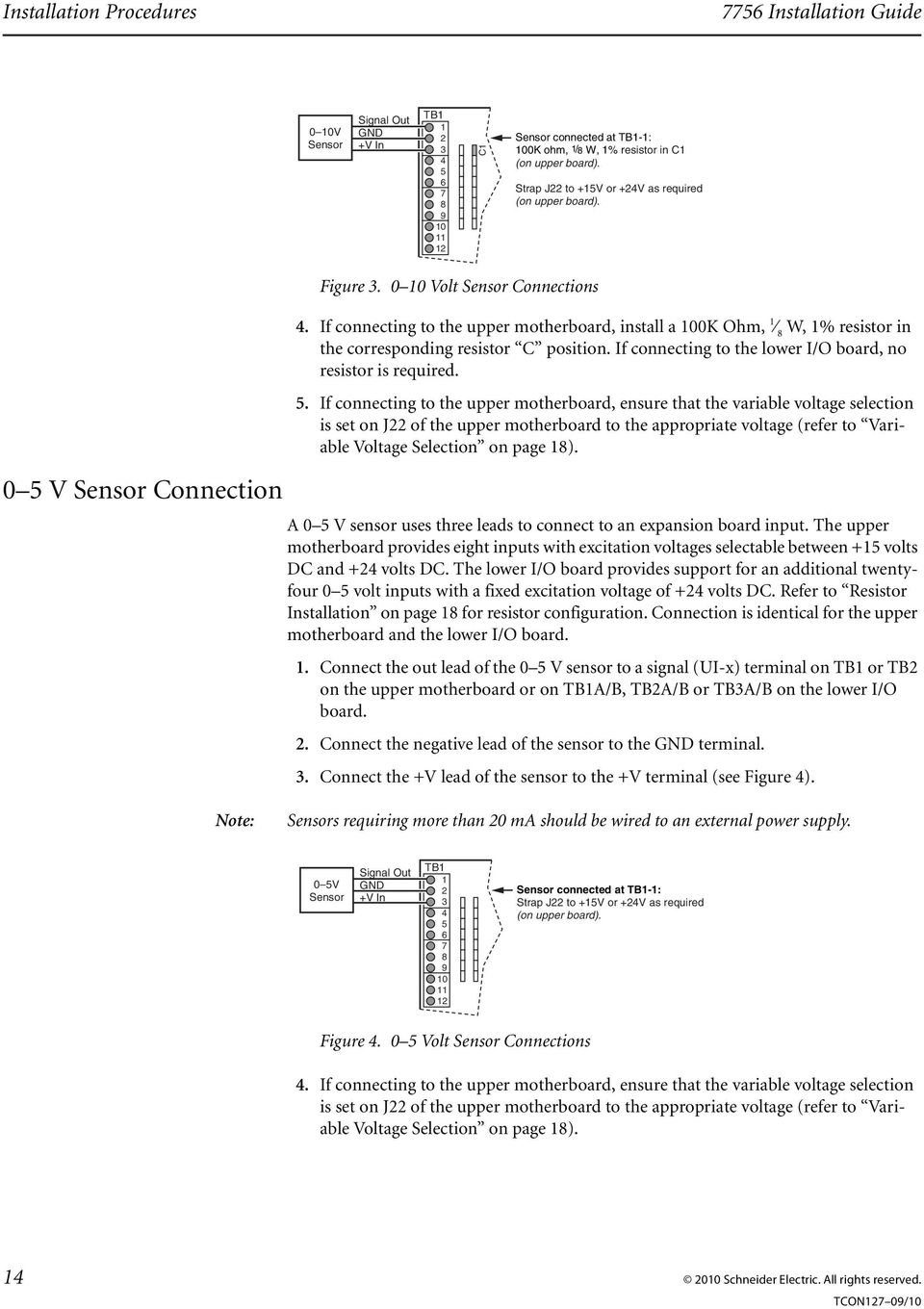
19 5 Installation Guide Installation Procedures Setting the Maximum Pulse Input Rate Installing the Input Field Connections. Press [Code].. Enter 0, press [Enter] to display the current rate, and press [Enter].. Enter 0 to set for a pulse rate of per second.. Enter to set for a pulse rate of 0 per second. 5. Press [Enter] to accept your selection. The 5 supports several types of inputs, each using different field connections. Use the procedures shown below to connect the sensors you use to the 5. The illustrations and procedures describe connection to the upper motherboard and to the lower I/O board. Warning: Caution: Note: Ensure that no power is connected to the 5 and all interconnected equipment when performing the following procedures. Failure to disconnect power from the 5 and all interconnected equipment when performing electrical installation may result in damage to the components and electrical shock or burns. The input, output and power wiring must be routed along the side of the controller. The wiring is not to lay across the controller. When field wiring the upper motherboard, wires should be bundled and routed up along the edge of the upper baseplate, and a service loop in the wiring should be provided in the area of the upper baseplate hinge. Proper wire routing will permit access to the lower I/O board without disconnection of the upper motherboard termination blocks. 0 0 V Sensor Connection Refer to Resistor Installation on page 8, to determine the correct resistor configuration for your inputs. A 0 0 V sensor uses three leads to connect to an input. The upper motherboard provides eight inputs with excitation voltages selectable between +5 volts DC and + volts DC. The lower I/O board provides support for an additional twenty-four 0 0 volt inputs with a fixed excitation voltage of + volts DC. Refer to Resistor Installation on page 8 for resistor configuration. Connection is identical for the upper motherboard and the lower I/O board.. Connect the out lead of the 0 0 V sensor to a signal (UI-x) terminal on TB or TB on the upper motherboard or on TBA/B, TBA/B or TBA/B on the lower I/O board.. Connect the negative lead of the sensor to the GND terminal.. Connect the +V lead of the sensor to the +V terminal (see Figure ). Note: Sensors requiring more than 0 ma should be wired to an external power supply. 00 Schneider Electric. All rights reserved.
![Press [Enter] to accept your selection. The 5 supports several types of inputs, each using different field connections. Use the procedures shown below to connect the sensors you use to the 5.](/docs-images/47/20575633/images/page_19.jpg "The illustrations and procedures describe connection to the upper motherboard and to the lower I/O board.")
20 Installation Procedures 5 Installation Guide 0 0V Sensor Signal Out GND +V In TB C Sensor connected at TB-: 00K ohm, /8 W, % resistor in C (on upper board). Strap J to +5V or +V as required (on upper board). 0 5 V Sensor Connection Figure. 0 0 Volt Sensor Connections. If connecting to the upper motherboard, install a 00K Ohm, 8 W, % resistor in the corresponding resistor C position. If connecting to the lower I/O board, no resistor is required. 5. If connecting to the upper motherboard, ensure that the variable voltage selection is set on J of the upper motherboard to the appropriate voltage (refer to Variable Voltage Selection on page 8). A 0 5 V sensor uses three leads to connect to an expansion board input. The upper motherboard provides eight inputs with excitation voltages selectable between +5 volts DC and + volts DC. The lower I/O board provides support for an additional twentyfour 0 5 volt inputs with a fixed excitation voltage of + volts DC. Refer to Resistor Installation on page 8 for resistor configuration. Connection is identical for the upper motherboard and the lower I/O board.. Connect the out lead of the 0 5 V sensor to a signal (UI-x) terminal on TB or TB on the upper motherboard or on TBA/B, TBA/B or TBA/B on the lower I/O board.. Connect the negative lead of the sensor to the GND terminal.. Connect the +V lead of the sensor to the +V terminal (see Figure ). Note: Sensors requiring more than 0 ma should be wired to an external power supply. 0 5V Sensor Signal Out GND +V In TB Sensor connected at TB-: Strap J to +5V or +V as required (on upper board). Figure. 0 5 Volt Sensor Connections. If connecting to the upper motherboard, ensure that the variable voltage selection is set on J of the upper motherboard to the appropriate voltage (refer to Variable Voltage Selection on page 8). 00 Schneider Electric. All rights reserved.
21 5 Installation Guide Installation Procedures 0 0 Milliampere Sensor Connection 0 0 milliampere sensors can be connected as shown in Figure 5. The upper motherboard provides eight inputs with excitation voltages selectable between +5 volts DC and + volts DC. The lower I/O board provides additional inputs for up to twenty-four 0 ma loops with a fixed excitation voltage of + volts DC. Refer to Resistor Installation on page 8 for resistor configuration. See Figure on page 0 for resistor installation.. Connect the output lead from the sensor to a SIGNAL terminal on TB or TB on the upper motherboard or on TBA/B, TBA/B or TBA/B on the lower I/O board.. Connect the output lead of the sensor to the +V terminal of the input set. 0 0mA, 0mA Sensor In Out (+) ( ) 0 0mA, 0mA In Out Sensor (+) ( ) Input Power External Power Supply + Output TB/TB A A Sensor connected at TB-: ohm, /8 W, 0.% resistor in A Sensor connected at TB-: ohm, /8 W, 0.% resistor in A Note: Use external power supply if more than eight (combined, upper and lower board) 0 0 or 0 ma sensors are used. Connecting Discrete Input Points Figure ma Sensor Connections. If connecting to the upper motherboard, ensure that the variable voltage selection is set on J of the upper motherboard to the appropriate voltage (refer to Variable Voltage Selection on page 8). For contact sensing on the upper motherboard or lower I/O board, either DI or PI, the excitation current for the field contact is achieved by placing a K ohm, W, 5% resistor in the appropriately numbered B position. The B position provides a pull-up on the input to 5 volts DC for dry contact excitation.. Connect one lead from the field contact to the signal (UI-x) terminal on TB or TB on the upper motherboard or on TBA/B, TBA/B or TBA/B on the lower I/O board.. Connect the other lead of the sensor to the GND terminal (see Figure ).. Install a K Ohm, W, 5% resistor in the corresponding resistor B position. Dry Contact For DI or PI Note: Contact closed = logical st or nd of state description pair. TB B Dry Contact connected at TB-: K ohm, / W, 5% resistor in B Figure. Dry Contact Connections 00 Schneider Electric. All rights reserved. 5
22 Installation Procedures 5 Installation Guide Installing Supervised Field Inputs Configure the field inputs for supervision in the resident I/O points editor of the host. You may supervise a single switch or contact in a normally-closed or normally-open configuration, or you may supervise multiple normally open switches or contacts connected in parallel. The contact/switch may be normally-open or normally-closed (see Figure and Figure 8). Single resistor supervision with a parallel resistor. Configuration is the same for normally closed switch/contact. Entire circuit is supervised for line cuts ( open wire) Double resistor supervision with a parallel and a series resistor. Entire circuit is supervised for line cuts ( open wire) K K K Parallel Resistor Parallel Resistor Series Resistor Normally Open Switch/Contact Figure. Supervised Single Switches/Contacts Portion of circuit is supervised for jumpers ( shorts in wiring) Normally Closed Switch/Contact Note: The components shown inside the dashed boxes should be in close physical proximity. Multiple switches or contacts connected to a supervised input (see Figure 8) must consist of normally-open switches or contacts wired in parallel. Single resistor supervision with a parallel resistor. Entire circuit is supervised for line cuts ( open wire) Double resistor supervision with a parallel and a series resistor. Entire circuit is supervised for line cuts ( open wire) Parallel Resistor Parallel Resistor Note: The components shown in the dashed box should be in close physical proximity. Figure 8. Supervised Multiple Switches/Contacts Series Resistor Portion of circuit is supervised for jumpers ( shorts in wiring) 00 Schneider Electric. All rights reserved.
23 5 Installation Guide Installation Procedures Connecting Thermistor Inputs The inputs on the lower I/O board are shipped in a thermistor input configuration with a 0K ohm, 8 W, 0.% resistor in the B position for each input.. Connect one lead from the thermistor to the signal (UI-x) terminal on TBA/B, TBA/B or TBA/B on the lower I/O board.. Connect the other lead of the sensor to the GND terminal (see Figure ). 0K Ohm Thermistor TBA Signal Ground VDC TBB B 0K Ohm Thermister at TBA-: 0K ohm, /8 W, 0.% resistor in B. Figure. Thermistor Connections on Lower I/O Board Note: For units containing upper motherboard assembly 05-0 Revision F or later, the upper motherboard may also use the 0K ohm thermistor. The connection method is the same as that described above for the lower I/O board. Connecting Lini-Temp Inputs Note: The lower I/O board should not be used for Lini-Temp sensor inputs. Only the upper motherboard allows selection of the +5 volts DC excitation voltage required for Lini-Temp sensors. The lower I/O board provides a fixed + volts DC excitation voltage. Signal inputs are provided along the upper left side of the upper motherboard in two groups of four inputs. Three screw terminations are provided for each input (Signal, Ground and +5/V) as shown in Figure 0. The LTS80 temperature sensors can be connected in a -wire or -wire configuration as shown in Figure 0. Refer to Resistor Installation on page 8 for resistor configuration. The -wire configuration does not require any resistor configuration. See Figure on page 0 for resistor installation.. Connect the white lead to a signal (UI-x) terminal on TB or TB on the upper motherboard.. Connect the orange lead to one of the +5 V terminals of terminal blocks TB or TB on the upper motherboard.. For -wire sensors, connect the blue lead to the GND terminal (see Figure 0).. When using a -wire sensor configuration, place a 0K, 8 W, 0.% resistor in the corresponding resistor A position. 5. Ensure that the variable voltage selection is set on J of the upper motherboard to +5 V (refer to Variable Voltage Selection on page 8). 00 Schneider Electric. All rights reserved.
24 Installation Procedures 5 Installation Guide WHT LTS Sensor ORN Typical -wire Sensor connection LTS Sensor Typical -wire Sensor connection WHT BLU ORN Signal +5 V Signal Ground +5 V TB A -Wire Connection: 0K ohm, /8 W, 0.% resistor in A. Strap J to 5V. -Wire Connection: No resistor required. Strap J to 5V. Variable Voltage Selection Figure 0. Lini-Temp Input Sensor Connections (Upper Motherboard) You may select either +5 or + volt DC power provided by the upper motherboard to a connected sensor by positioning a jumper on J (see Figure ). To achieve +5 volts, position the jumper on posts B and C. Position the jumper on posts A and B to achieve + volts. Refer to Table 5 for details. Table 5. Upper Motherboard Variable Voltage Selection Jumper Setting Result J B to C A to B +5 volts DC excitation on terminal blocks + volts DC excitation on terminal blocks Resistor Installation The eight inputs on the upper motherboard are shipped in a 0 0 ma configuration. The 0 0 ma configuration is achieved by placing ohm 0.% resistors in the appropriate plug-in position for each input. These positions are labeled A through A8, A corresponding to input UI- and A8 to UI-8. Table. Resistor Configurations Location Function Resistor Upper Motherboard ( bit A/D converter) 0 5 volts None 0 0 volts 00K ohm, 8 W, % in position C 0 0 ma ohm, 8 W, 0.% in position A, remove any resistor in position B Thermistor 0K ohm, 8 W, 0.% in position B Note: Thermistor may be used only on upper board assembly 05-0 Revision F or later. Discrete K ohm, 8 W, 5% in position B Low-speed pulse input (PI) K ohm, 8 W, 5% in position B Discrete Supervised Lini-Temp (-wire configuration only) K ohm, 8 W, 5% in position B and end-of-line resistor(s) (K ohm, W, %) 0K ohm, 8 W, 0.% in position A 8 00 Schneider Electric. All rights reserved.
25 5 Installation Guide Installation Procedures Lower I/O Board ( bit A/D converter) Note: Table. Resistor Configurations (Continued) Location Function Resistor 0 5 volts None (see note) 0 0 volts None 0 0 ma 0 0 ma Thermistor Discrete Low-speed pulse input (PI) High-speed pulse input ohm, 8 W, 0.% in position A, remove any resistor in position B (see note) ohm, 8 W, 0.% in position A, remove any resistor in position B 0K ohm, 8 W, 0.% in position B K ohm, 8 W, 5% in position B K ohm, 8 W, 5% in position B K ohm, 8 W, 5% in positions B and D K ohm, 8 W, 5% in position B and end-of-line Discrete Supervised resistor(s) (K ohm, W, %) Using 0 5 VDC or 0 0 ma inputs on the lower I/O board of the 5 PCU only uses half of the available A/D counts (0, counts rather than 0 5,55 counts). Keep this in mind when calculating conversion coefficients. The inputs on the lower I/O board are shipped in a thermistor configuration. The thermistor configuration is achieved by placing 0K ohm 0.% resistors in the appropriate plug-in position for each input. These positions are labeled B through B; B corresponding to input UI- and B corresponding to input UI-. The A positions provide a pull-down to DC ground on the input signal for analog input current sensing. The B positions provide a pull-up on the input to 5 volts DC. On the upper motherboard, the 5 volt source is suitable for the excitation of discrete contacts. On the lower I/O board, the 5 volt source is provided by a precision reference and is suitable for exciting thermistors as well as discrete contacts. The C positions allow you to configure the upper motherboard for 0- to 0-volt inputs. The lower I/O board accepts 0 0 V as a standard configuration (no resistor required). The D positions are used only on the lower I/O board to reduce input filtering to allow high-speed pulse input (up to 0 Hz) processing. Position D is not used on upper motherboard. In order to configure an input for 0 0 ma, insert a ohm 8 W, 0.% current sensing resistor in the corresponding resistor position (A through A8 or A through A). The position numbers (A A8) correspond to the inputs through 8 on the upper motherboard (see Figure ). The position numbers A A correspond to the inputs through on the lower I/O board (see Figure ). For -wire Lini-Temp, install a 0K Ohm 8 W, 0.% resistor in an A position. For 0 0 V on the upper motherboard, install a 00K Ohm, 8 W, % resistor in a C position. For 0 0 V on the lower I/O board, no resistor is required. Dry contact inputs (DI or PI) require a K Ohm, 8 W, 5% resistor in a B position. To configure an input for 0 0 ma, insert a ohm 8 W, 0.% current sensing resistor in the corresponding resistor A position. Remove any resistor in the corresponding B position for 0 0 ma or 0 0 ma inputs. Figure shows connection examples for -wire Lini-Temp, 0 0 V, 0 0 ma, and dry contact inputs. For high-speed processing of pulse inputs on the lower I/O board, install a K Ohm, 8 W, 5% resistor in a D position. See Figure for details of installation. 00 Schneider Electric. All rights reserved.
26 Installation Procedures 5 Installation Guide TB TB UI- GND +V UI- GND +V UI- GND +V UI- GND +V UI-5 GND +V UI- GND +V UI- GND +V UI-8 GND +V A A A A B B B B A5 A A A8 B5 B B B8 C C C C D D D D C5 C C C8 D5 D D D8 TBA UI- UI- 5 UI- 8 0 UI- UI- UI-0 UI- UI- UI- UI-8 UI- UI-0 TBA TBA TBB A B C D UI-5 5 UI- 8 UI- 0 UI-8 TBB A B C D UI- 5 UI- 8 UI-5 0 UI- TBB A B C D UI- 5 UI- 8 UI- 0 UI Upper Motherboard Lower I/O Board Figure. Input Configuration Resistors A A A A B B B B C C C C 0K, / 8W, 0.% For -Wire Lini-Temp, Part Number 00-00, W, 0.% For 0-0 ma Input, Part Number / 8 K, / W, 5% For Dry Contact Input (DI or PI) Part Number K, /8 W, % For 0-0V Input on Upper Motherboard Part Number Figure. Resistor Installation on Upper Motherboard 0 00 Schneider Electric. All rights reserved.
27 5 Installation Guide Installation Procedures A B C D 0 K, /8 W, 0.% For Thermistor on lower I/O board Part Number For 0Hz (high speed) pulse input on lower I/O board Part Number K,/8 W, 5% Required for low or high speed pulse inputs on lower I/O board K, /8 W, 5% resistor Figure. Resistor Installation on Lower I/O Board Installing the Output Field Connections Form-C Relay (Universal) Output Connection Form-C relay (universal) output terminations are provided along the upper right side of the upper motherboard (see Figure ). Each output consists of a Form-C relay contact capable of handling 0.5 amp at volts AC/DC. Each output provides discrete control of a field contactor or a proportional control via pulse-width-modulation (PWM) of the output contact. Analog output terminations are provided along the upper right side of the lower I/O board (see Figure 5). The eight high-resolution, -bit analog output points provide a 0- to 0-volt span and can each drive up to 5 ma. Discrete triac output terminations are also provided along the right side of the lower I/O board (see Figure ). Each discrete output consists of a voltage-sourcing ( VAC) triac contact capable of handling 0.5 amperes at volts AC. Each output provides discrete control of a field contactor or a proportional control via PWM of the output contact. When connecting a device to the upper motherboard universal output, first determine whether the device is normally open (NO) or normally closed (NC). Connect one wire to the middle terminal of the set (numbered through 8) and one wire to the terminal designated NO or NC (see Figure ).. Connect one lead from the device to the desired NO or NC terminal.. Connect the other lead to the corresponding Common terminal on the upper motherboard. 00 Schneider Electric. All rights reserved.
28 Installation Procedures 5 Installation Guide TB TB NC 8 NO NC NO NC NO NC 5 NO NC NO NC NO NC NO NC NO Note: When possible, ground the common side of the VAC source. Normally Closed Common Normally Open VAC Source MOV VAC Relay Coil Analog Output Connection Figure. Output Terminal Locations on Upper Motherboard When connecting an analog device to the lower I/O board, connect one lead to the signal output (AO-x) terminal and the other lead to the GND terminal (see Figure 5).. Connect the positive control lead from the device to the desired AO-x voltage output terminal.. Connect the negative control lead to the GND terminal(s) on the expansion module. TB Ground 0 0 V Control Actuator + Typical Voltage-Sourcing Triac Output Connection Figure 5. Analog Output Location on Lower I/O Board When connecting a discrete device to the lower I/O board triac output, connect one lead to the signal output (DO-x) terminal ( through 8) and the other lead to ground (see Figure ).. Connect one lead from the device to the desired DO-x terminal.. Repeat as required for additional connections. 00 Schneider Electric. All rights reserved.
29 5 Installation Guide Installation Procedures TB Chassis/Earth Ground MOV VAC Relay Coil Figure. Triac Output Location on Lower I/O Board. Twist return wires for all controllers together, and connect to ground. Connecting the HHC The asynchronous port (P) on the upper motherboard provides a modular TTL-level interface to a HC0 and operates at 00 BPS (see Figure ). Connect the HHC cord into the RJ jack on the upper motherboard. The console can then be attached to the inside of the universal enclosure by pressing the Velcro tab on the back of the console to the Velcro tab on the inside of the enclosure. P HHC Port TB Figure. HHC Connection (Upper Motherboard) Connecting the LAN The LAN port is located along the lower left side of the upper motherboard. It provides synchronous SDLC communication and supports the primary RS85 controller LAN connection. A terminal block provides connection of the RS85 shielded, twisted-pair cable (see Figure 8). 00 Schneider Electric. All rights reserved.
30 Installation Procedures 5 Installation Guide Caution: Ensure that you connect terminal to and terminal to on all controllers.. Connect the Com + line to terminal.. Connect the Com line to terminal.. Ensure that shield wire continuity is maintained as the LAN cable passes through each controller (see LAN Ground on page ).. Terminal is not used. Note: Connecting an External PC Connect controller LAN shield to earth ground at one location only. Splice Figure 8. LAN Connections Com+ Com TB The upper motherboard port P, with its -conductor D-Subminiature connector, provides asynchronous communication and is used to support the direct connection of a PC. This connector provides the circuit connections typical of the serial COM port on the PC. TAC provides two cables to connect the 5 to a PC. Use TAC cable number CBL0 for a -pin PC connection, and TAC cable number CBL0 for a 5-pin PC connection (see Figure ). A six-foot serial PC communication cable with low-profile right angle D-Sub connection can be obtained from TAC. Connect the right angle connector end of the cable to the controller, and the hood end of the cable to the PC. CBL0 DE (Female) DCD RXD TXD DTR GND 5 DSR RTS CTS 8 RI Controller (P) DE (Female) DCD RXD TXD DTR 5 GND DSR RTS 8 CTS RI PC Direct-connect to -pin PC COM Port CBL0 DE DB5 (Female) (Female) DCD RXD TXD DTR GND 5 DSR RTS CTS 8 RI Controller (P) TXD RXD GND PC Direct-connect to 5-pin PC COM Port CBL0 DE DB5 (Female) (Male) DCD RXD TXD DTR GND 5 DSR RTS CTS 8 RI Controller (P) 0 TXD RXD DTR GND RTS 5 CTS Modem Integrated Dial Through External Modem Figure. RS Port at P When the 5 is connected directly to a PC, the 5 performs the functions of a 80 Tap without consuming a second LAN address.. Connect the cable from the PC COM or COM port to this port on the upper motherboard.. Set the PC port baud rate to,00 baud using an HHC. Refer to Initial Installation Procedures on page Schneider Electric. All rights reserved.
31 5 Installation Guide Installation Procedures Connecting the Modem Port P provides a nine-conductor D-Subminiature connector. When the 5 is connected to a Hayes-compatible modem, the current Integrated Dial function (i.e. one-way dial from the host PC to the controller LAN) is provided. TAC cable number CBL0 is available from TAC (refer to Figure ).. Connect the modem to port P on the upper motherboard.. Set the baud rate (typically 00) via a standard HHC. (Refer to Setting the Tap Baud Rate on page.) Installing the Optional RS Serial Interface Board Warning: Ensure that no power is connected to the 5 when performing this procedure. Failure to disconnect power from all interconnected equipment when performing electrical installation may result in damage to the components and electrical shock or burns. After all connections (except power supply) are made to the upper motherboard, install this card on P, the serial option port (see Figure 0). TB P P Serial Option Port Power Input TB P P Connecting the Power Supply Figure 0. RS Serial Interface Board Connection Warning: Ensure that no power is connected to the 5 when performing this procedure. Failure to disconnect power from all interconnected equipment when performing electrical installation may result in damage to the components and electrical shock or burns. Electrical power connections for the VAC input power are provided along the lower left side of the lower I/O board (see Figure ). 00 Schneider Electric. All rights reserved. 5
32 Installation Procedures 5 Installation Guide Caution: Do not connect the -point VAC connector to the LAN connector at TB. This will cause damage to the LAN port!. Connect the yellow VAC input leads from the VAC transformer (TAC model XFMR0) to terminals and of terminal block TB5A on the lower I/O board.. Connect terminal of TB5A to a good earth ground using 8 AWG ( mm ) green wire.. Make a one-to-one connection of the VAC power from the lower I/O board TB5B to the upper motherboard TB using 8 AWG ( mm ) wire. a. Connect terminal of TB5B to terminal of TB on the upper motherboard using black wire. b. Connect terminal of TB5B to terminal of TB on the upper motherboard using white wire. c. Connect terminal of TB5B to terminal of TB on the upper motherboard using green wire.. Connect the yellow-and-black VAC input leads from the dual secondary VAC transformer (TAC model XFMR0) to terminals and of terminal block TB on the lower I/O board. IMPORTANT! Connect earth ground to TB5A pin as shown. Do NOT connect transformer secondaries to ground. Do NOT Connect Power Here TB P Dual VAC Transformer (CSI Model XFMR0, Part # ) Line Voltage yellow wire pair green wire yellow/black wire pair VAC TB VAC VAC VAC EGND TB5A TB5B black wire white wire green wire M0 VAC VAC EGND M TB Lower I/O Board (Lower left corner) Upper Motherboard (Lower left corner) Figure. Power Connections 00 Schneider Electric. All rights reserved.
33 5 Installation Guide Installation Procedures Field Hardware Checkout and Addressing Field hardware checkout is essential before any piece of mechanical equipment can begin to be controlled by the 5. This checkout ensures that the field devices are working correctly, and they are correctly wired to the 5. After successful checkout of the field hardware, the unit is ready to start controlling the mechanical equipment and final terminations to actual field devices can be completed. Use an HHC to perform all hardware checkout and addressing of the 5. Connections between the 5 and the HHC are made using an RJ connection (P) on the upper motherboard. Set the address of the 5 before connecting it to the LAN. Connecting the HHC Note:. Apply power to the 5.. Plug the HHC into the 5 at P on the upper motherboard.. Press the [Clear] key on the HHC. The display will show the PCU time in -hour format, updating every second if the unit is operating properly. When the 5 is powered up, it attempts to reconfigure the controller LAN and become part of it. This is indicated by the intermittent flashing of LED (RECON). Cold Starting the 5 PCU There are occasions when you may wish to cold start (clear the database) a PCU currently operating on the LAN. Using the HHC, complete the following procedure.. Plug the silver cord (P/N: ) into the RJ port labeled P (CONSOLE) on the upper motherboard.. Press [DCU ADDR]. The current PCU address displays in the two right-most digits of the HHC display.. Enter a different address using the numeric keys. If possible choose an address not already used by another DCU on the LAN. The address displays as it is entered.. Press [Enter]. The PCU RAM is cleared with all database information and the new PCU address is stored. 5. Re-enter the desired (original) address following Steps through.. Set the 5 data rate using the steps in Setting the Controller LAN Baud Rate on page. 00 Schneider Electric. All rights reserved.
34 Installation Procedures 5 Installation Guide Check Signal Voltages Check Analog Inputs You will need a digital voltage meter to complete the following checkout procedure. Check signal voltages for each analog input point using the meter. The GND terminal of each input point is common. Signal voltage should be present at input terminals through 8 on the upper motherboard and at input terminals through on the lower I/O board. Using the HHC, repeat the key entries listed in Table for each of the analog input devices connected to the 5. Checkout Discrete Inputs Table. Analog Input Key Entries HHC Key HHC Display Comments DSPLY AI Select analog input type. PPBB 0000 to to to to 00 The point address being checked. ENTER to 000FFF to 00FFFF on lower board in the display indicates a zero scale input. 000FFF (00FFFF on lower board) in the display indicates a full scale input. CLEAR TIME Current time in the PCU. Ensure that the correct field sensor is being monitored by the correct analog input address. Using the HHC, repeat the key entries listed in Table 8 for each of the discrete or pulsed input devices connected to the PCU. The PP portion of the address is the point address on the 5. The BB portion of the address will vary according to the input point being tested. Table 8. Discrete/Pulse Input Key Entries HHC Key HHC Display Comments DSPLY DI Select discrete input type. PPBB 0000 to to to to 00 The point address being checked in the display indicates an open set of contacts. ENTER or in the display indicates a closed set of contacts. CLEAR TIME Current time in the PCU Schneider Electric. All rights reserved.
35 5 Installation Guide Installation Procedures Checkout Discrete Outputs Ensure that the correct field sensor is being monitored by the correct discrete input address. Using the HHC, repeat the following key entries for each of the discrete output devices connected to the PCU. The SS portion of the address is the address of the Model 5. The PP portion of the address is the input or output address. The BB portion of the address will vary according to the output point being tested. Table. Discrete Output Key Entries HHC Key HHC Display Comments CTRL DO Select discrete output type. PPBB 0000 to to 00 The point address being checked. ENTER ON or OFF lamp on the HHC illuminates indicating status of the respective output. OFF TIME Relay is energized on PCU. CTRL DO PPBB 0000 to to 00 The point address is being checked. ENTER ON or OFF lamp on the HHC illuminates indicating status of the respective output. OFF lamp should be illuminated due to the previous sequence. ON TIME Relay is de-energized on PCU. Ensure that the correct field device is being controlled by the correct discrete output address. 00 Schneider Electric. All rights reserved.
36 Set Up and Operation 5 Installation Guide Set Up and Operation This chapter describes the various components of the 5 PCU. This unit mounts indoors on a wall surface in an area that meets the specifications outlined (refer to Specifications on page 5). The unit s address should be set after first powering up the unit and prior to connecting to the unit to the controller LAN. Identify and record input and output terminals and addresses with their physical terminal block and pin numbers. Also, identify the devices to which the terminals connect. Write this information on a copy of the Pinout Chart included in this installation guide (see page 50). The locations of major items involved in a typical installation are shown in Figure (upper motherboard) and Figure (lower I/O board). TB TB Signal Inputs Resistors U U U U Relay Outputs Signal Inputs TB Resistors LEDs Manual Override Switches Relay Outputs RS85 Port P Rj Hand Held Console Port Power Input J A B C TB TB P Serial Option Port Reset Button I/O Expansion Port RS Port Modem Or External Pc P TB P Figure. Upper Motherboard Component Locations 0 00 Schneider Electric. All rights reserved.
37 5 Installation Guide Set Up and Operation TBA TBB TB Analog Outputs U U U5 U TBA TBB Universal Inputs Analog Type Selection Resistors Triac Outputs TBA TBB TB TB 0-Pin Ribbon Cable Connector P TB5A TB5B HOA Switches ON AUTO OFF Figure. Lower I/O Board Component Locations Hardware Inputs The 5 PCU provides universal inputs. These inputs can be defined in the database as analog inputs (AI), discrete inputs (DI), or pulse inputs (PI). Note: Inputs may be defined as AI, DI or PI, but only one type can be defined for a specific point. As discrete and pulse inputs are scanned, points are tested for a value above or below a 5/5% threshold to determine if the device is an open or closed contact. Closed contact: A value below 5% scale (0 5 V) is considered a closed contact. Open contact: A value above 5% scale (0 5 V) is considered an open contact. Analog, discrete, or pulse inputs occupy point addresses on the upper motherboard and point addresses , , and on the lower I/O board (see Figure ). The same point number identifies an input point, regardless of its type. All inputs are equipped with transient suppression components. The analog input multiplexer will withstand input voltages up to +5 VDC without an effect on other channels. Power line frequency (50/0 Hz) is selected using the HHC. Refer to Setting the Power Line Frequency on page. 00 Schneider Electric. All rights reserved.
38 Set Up and Operation 5 Installation Guide Input Common/Gnd Supply Voltage TB TB Point Address Input Common/Gnd 00 Supply Voltage 8 0 TBA TBA TBA TBA TBB TBB TBB Upper Motherboard Figure. Universal Input Points and Addresses Lower I/O Board The 5 PCU provides a median value filter, as well as a 50/0 Hz notch filter, to reduce/eliminate random electrical noise, which normally shows up as momentary high/low readings on the input. Lookup Tables Selecting Input Type The 5 PCU allows you to define up to lookup tables, each containing up to points. You may use these lookup tables to create engineering units, create sensor limits, or focus resolution on an interval span of interest that you define. For instance, after you establish the upper and lower limits of the sensor for the lookup table, you can populate the remaining points in the table within a limited area. The area you populate with points can be grouped closely together and provide increased resolution within that span. You may also use the lookup tables to limit the sensor s boundaries within the accuracy range of the sensor. The lookup tables can be used with linear or non-linear sensors, and can be used with integer entries (0 5,55). Refer to the section on Station Parameters in the TAC I/NET Technical Reference Guide. The eight inputs on the upper motherboard are shipped in a 0 0 ma configuration. The inputs on the lower I/O board are shipped in a thermistor input configuration. The inputs on each board may be configured by removing resistors from, or placing 00 Schneider Electric. All rights reserved.
39 5 Installation Guide Set Up and Operation Control Outputs resistors in, the appropriate plug-in positions for each input. The PCU-5 boards may be configured with plug-in resistors for the following input types: -wire Lini-Temp 0 0 ma 0 5 V and 0 0 V contact sensing discrete inputs and pulse inputs fast scan for pulse input points (0 Hz) Refer to Resistor Installation on page 8 for instructions on resistor configurations for each type of input. You may select whether to provide +5 or + volts DC, with a maximum load of 0 ma, to sensors connected to the 5 PCU upper motherboard. Because the upper motherboard provides variable voltage selection, Lini-Temps and 0 0 ma sensors that require less than + volts DC should be connected to the upper motherboard (refer to Variable Voltage Selection on page 8). The lower I/O board provides a fixed excitation voltage of + volts DC. Upper Motherboard Outputs Lower I/O Board Outputs Analog Output Points Triac Output Points This section describes the outputs available for the 5 PCU. Eight relay outputs are provided on the upper motherboard. Each output provides a single Form-C contact with a derated current capacity of 0.5 A. These occupy the point address range of The outputs are terminated via two twelve-position plug-on terminal blocks (TB and TB). An LED indicator adjacent to each output relay is illuminated when the relay is energized (see Figure 5). The lower I/O board provides eight analog outputs and eight triac outputs. The following paragraphs describe each output type. The analog outputs are terminated via one -position plug-on terminal block (TB) (see Figure ). Each high-resolution -bit analog output provides a 0 0 volt span and can drive up to 5 ma. The analog outputs occupy the point address range of Eight voltage-sourcing triac outputs are provided on the lower I/O board. Each output provides VAC with a current capacity of up to 0.5 amperes. The eight voltage-sourcing triac outputs are terminated via one -position plug-on terminal block (TB) (see Figure ). The triac outputs occupy the point address range of Schneider Electric. All rights reserved.
40 Set Up and Operation 5 Installation Guide LEDs LEDs TB TB NC 8 NO NC NO NC NO NC 5 NO NC NO NC NO NC NO NC NO Point Address Figure 5. Upper Motherboard Output Terminals TB Ground Analog Outputs TB Ground Triac Outputs Figure. Lower I/O Board Output Terminals Manual Override Manual override switches (HOA switches) are provided for each Form-C output on the upper motherboard, and for each triac output on the lower I/O board. In addition, these HOA switches provide discrete input feedback of the switch status (see Figures and 8). 00 Schneider Electric. All rights reserved.
41 5 Installation Guide Set Up and Operation Manual Override Switches Off Auto On Off Auto On Off Auto On Off Auto On Off Auto On Off Auto On Off Auto On Off Auto On 8 5 TB TB NC 8 NO NC NO NC NO NC 5 NO NC NO NC NO NC NO NC NO Figure. Upper Motherboard Manual Override (HOA) Switches TB 0-Pin Ribbon Cable Connector P TB5A TB5B HOA Switches 5 8 ON AUTO OFF Figure 8. Lower I/O Board Manual Override (HOA) Switches In the Auto position, these switches permit the software to automatically control the devices attached to the outputs. You can manually place a switch in the On or Off position for maintenance or test purposes. When a switch is in the On or Off position, the software provides a discrete feedback, indicating that someone has put that point into manual override (refer to Table on page for feedback point addresses). Note: The switch On/Off position corresponds to the state of the relay. The actual state of the controlled environment depends on the contacts used on the output. Two status bits (DI points) are returned from each switch. When in the Auto position, both DI points will indicate an open contact. The feedback status bits will be mapped into the system on bit offsets 8 and of point addresses (Bit 8 set to indicates Manual On. Bit set to indicates Manual Off.) 00 Schneider Electric. All rights reserved. 5
42 Set Up and Operation 5 Installation Guide Communication Ports There are three communication ports on the upper motherboard, and an optional RS communication board that can be added as a plug-on daughterboard. All connections to the LAN, modems, external PCs, and the HHC are made using these ports. See Figure on page for port locations. The two asynchronous serial ports on the upper motherboard provide access to external PCs, external modems, and the HHC. The RS85 port provides connection for the TAC I/NET controller LAN, while the RS serial connection allows connection to a modem, or a direct connect to a TAC I/NET host PC. Refer to Installation Procedures on page 0 for instructions on connecting each of these communication ports. LEDs The upper motherboard provides a bank of ten LEDs (see Figure ) that show the status of communication in the controller and other information. TB TB U U U U LEDs RS85 Port J A B C TB P Reset Button TB P TB P P Figure. Upper Motherboard LED Location The functions of the LEDs are as shown in Table 0. Several LEDs have more than one illumination pattern, as shown in Table. 00 Schneider Electric. All rights reserved.
43 5 Installation Guide Set Up and Operation Table 0. LED Function LED Label Function LANTX Transmit data to the LAN LANRX Receive data from the LAN TX Transmit data to the PC port RX Receive data from the PC port 5 HHCTX Transmit data to the HHC port HHCRX Receive data from the HHC port RECON LAN reconfiguration 8 ALARM Controller point is in alarm NMI Low power 0 DISABLE Outputs disabled Table. LED Multiple Functions LED Label Description Indication LANTX Flashes several times/second Blinks for three seconds then stops for two seconds. The 5 is transmitting data onto the LAN. The 5 is not connected to the LAN. The 5 PCU is attempting to search the LAN for some other LAN device. LANRX Flashing continuously Data is being received on the LAN port. (Since the LAN port is a half-duplex communication channel, data can be coming from other devices on the LAN or from the 5 itself.) (There is always LAN communication activity, even if it is only the token passing from unit to unit.) Pause A LAN reconfiguration has begun or is about to begin. 5 HHCTX Flashes ( second intervals) Data is being transmitted from the serial communication processor to the CONSOLE port. (Flashes as time is updated on the HHC.) HHCRX Flashes Data is being received from the CONSOLE port. (Data originates from an HC0.) RECON Flashes Indicates that a LAN reconfiguration is in progress. Constant illumination LAN communication problem. 0 DISABLE Illuminates momentarily while unit is in operation Illuminates and stays lit Flashes once Watch-dog-timer has detected no processor activity and has reset the unit. Microprocessor has failed or is unable to execute programs (possibly due to an improperly seated memory chip). Power has been restored to the unit. 00 Schneider Electric. All rights reserved.
44 Set Up and Operation 5 Installation Guide RS Port HHC Port RS85 LAN Port The first asynchronous port (P) on the upper motherboard provides an RS port for direct connection to a TAC I/NET host PC or external direct dial (Hayes-compatible) modem. The RS port s baud rate is set using a standard HHC. When connected directly to a PC, the 5 performs the functions of a 80 Tap without consuming a second LAN address. When connected to a Hayes-compatible modem, Integrated Dial function (i.e. one-way dial from the host PC to the controller LAN) is provided. When connected to a modem or external PC, a nine-conductor D-Subminiature connector is provided for connection of the external PC or asynchronous modem. This connector provides the circuit connections typical of the serial COM port on the PC. Use cable number CBL0 for DE-, and CBL0 for DB-5 connections to PC comm ports. Use cable number CBL0 to connect the 5 to a synchronous modem using a 5-pin connector. The second asynchronous port (P) on the upper motherboard provides a modular interface to the standard HHC and operates at 00 BPS. An RJ modular jack is provided along the lower left side of the controller for connection of the HHC. The HHC is used to field check the PCU, set the LAN address, and set the baud rate of the 5 PCU before connecting it to the TAC I/NET controller LAN. The RS85 LAN port (TB) is accessed via a three-position terminal block located along the edge of the upper motherboard (see Figure 0). This port provides a communication pathway to the TAC I/NET controller LAN. When connected through this port, the 5 can communicate with up to other controllers. It may also share data with controllers on other controller LANs through Taps on the LANs via global and indirect points. TB RS85 Port A B C TB J P Figure 0. RS85 Port Location (Upper Motherboard) Field connections for the RS85 LAN port are listed in Table Schneider Electric. All rights reserved.
45 5 Installation Guide Set Up and Operation Table. RS85 Port Termination Terminal Function + Data (A) Data (B) No connection Protocol LAN Node Address Data Rate Serial Expansion Module The RS85 LAN port uses SDLC protocol and implements a token passing bus to regulate access to the controller LAN. The controller LAN can accommodate up to nodes. The LAN node address (0 ) of the controller is selected using the HHC. Refer to Setting the 5 PCU Address on page. The data rate for the RS85 SDLC LAN port on the base card is selectable from the HHC with the current selection maintained in nonvolatile storage. The rate selection supports selection of,00 or,00 baud using the on-chip baud generator. The normal rate is,00 baud. Refer to Setting the Controller LAN Baud Rate on page. The optional RS Serial Expansion Module provides a fourth serial interface. I/O data, address, and interrupt support are provided on the board (see Figure ). TXD RXD DCD RS Port P P Figure. RS Serial Interface Board The board connects to the upper motherboard at P (see Figure 0 on page 5). 00 Schneider Electric. All rights reserved.
46 Set Up and Operation 5 Installation Guide RS Serial Expansion Module Function This interface supports user-selected data rates up to,00 baud. This optional interface can be connected to: External auto-dial/auto-answer (AD/AA) modem When connected to a Hayescompatible AD/AA modem, the 5 will provide the functionality of the 80 Tap. This following types of modems are supported: Synchronous Use a synchronous modem when the controller is loaded with a TAC I/NET version.x or earlier binary file. The controller must also have TAC I/NET version.x boot firmware (EPROM). Asynchronous Use an asynchronous modem when the controller is loaded with a TAC I/NET 000 or later binary file. The controller must also have TAC I/NET 000 or later boot firmware (EPROM). Note: Ensure that all AD/AA Taps within your TAC I/NET system are configured to use the same communication protocol either synchronous, or asynchronous. Mixing AD/AA protocols will cause communication errors. TAC I/NET 000 is compatible with TAC I/NET version.x Tap and controller binary loads. Therefore, when synchronous AD/AA communication is required on a TAC I/NET 000 system (for example, when using a 800, 8050, or 800 Tap), you must continue to use TAC I/NET version.x Tap and controller binary loads. Use cable number CBL08 for connecting to either of these modems. Refer to the TAC I/NET Technical Reference Guide for more AD/AA information. External synchronous dedicated line modem When connected to an external Hayes-compatible dedicated line modem, the 5 provides the functionality of a 805 Tap. Use cable number CBL08 for this connection. Refer to TCON0, TAC I/NET Tap and Repeater Installation Guide, for a complete description the 805 Tap function. Another RS data communication device. Tap Emulation and Modem Setup Refer to TCON0, TAC I/NET Tap and Repeater Installation Guide, for details about TAC Taps. The 5 controller can be configured to emulate several types of TAC Taps, as follows: 80 Host Tap Using this emulated Tap, you can connect the following devices directly to the 5 controller at port P: Host Workstation This connection supports the Direct-connect function of the 80 host Tap. Asynchronous Hayes-compatible Modem When the modem is configured to auto-answer incoming calls, this connection supports the Integrated Dial function of the 80 host Tap. This configuration allows you to use voicegrade phone lines to communicate with the controller LAN from a remote PC Schneider Electric. All rights reserved.
47 5 Installation Guide Set Up and Operation 805 Site (LAN) Tap This emulated Tap requires the use of an optional RS expansion module. Using this Tap function, you can connect a synchronous dedicated-line (i.e., leased-line) modem to port P of the RS expansion module. 80 Dial Site (LAN) Tap This emulated Tap requires the use of an optional RS expansion module. Using this Tap function, you can connect a Hayescompatible modem to port P of the RS expansion module (refer to Serial Expansion Module on page ). You may then configure the modem for autodial/auto-answer (AD/AA) operation (refer to Modem Switch Settings on page ). 80 Emulation and Beeper Calls Beeper calls are used to notify a user of a specific condition occurring in the TAC I/NET system. This condition is user-definable using message masking and priorities. The beeper is only a notification tool. It contains no originating code or phone number. It issues either a tone or vibrates the beeper. To specify a beeper call, select Beep in the Type field of the 80 configuration editor. If a beeper service is used, enter the beeper service phone number. If a human response is expected, enter symbol at the end of the beeper number. This will allow the 80 Tap emulation to retry on busy and noanswer conditions. symbol will cause the modem to listen for a 5-second period of silence after the first ring is detected. The length of time that the modem will listen for this period of silence is established by the Timeout field in the editor. If a period of silence is detected, the call will be considered complete. Note: Some experimentation with the timeout period that is set in the Tap editor may be required. This timeout period should be set long enough to cause the modem to hang on the line until the 5-second period of silence can be detected. Since this beeper function is used internationally to cause dial out to numbers that will have a human response, it is necessary to accommodate differences in the manner in which beeper systems and humans respond. When using an external modem (80 Tap emulation) you should initialize your Hayes-compatible modem with the X command (factory default), which enables your modem to return the busy response code if it is expected that a person will answer (or not answer) the telephone. This will provide a rapid response to a busy error. Note: It is imperative that any modem used for beeper interfacing operate as described above. The 80 emulation will alter the modem initialization timing sequence to always initialize at a 00 baud data rate. Note: The 5 PCU will send a setup string to the modem to place it in the auto-answer mode. This auto-answer function will be set to answer on the first ring. 80 Tap Emulation and Pager Operation Select pager operation in the TAC I/NET software by selecting Beep from the Type field. Pager operation is used to notify a user of a specific condition occurring in the TAC I/NET system. This condition is user-definable using message masking and priorities. The pager is designed to receive a string of characters that are displayed on the recipient s 00 Schneider Electric. All rights reserved.
48 Set Up and Operation 5 Installation Guide pager. This string could represent a phone number or a recognizable warning code. You may call a pager using the 80 Tap emulation. The current version of TAC I/NET adds several additional phone number characters for use with dial strings. Table shows the additional characters and their definitions. Table. Pager Character Definition Pager Character Definition, Wait for two Wait for five seconds, replaces the need for numerous commas. Hang up immediately. Should be used at the end of every digital pager number ; dialed. (Not for use with a beeper.)! Issue a Hook flash, forcing the phone to go on-hook for 0.5 seconds. W Wait for a dial tone. # Accept number string (no more numbers will be added to number string). A pager differs from a beeper in that the pager sends a string of characters after a 5- second period of silence. Also, beepers never use the semi-colon in their call string, while digital pagers usually require the semi-colon at the end of their call string. It is important that you be familiar with your pager service and phone system so that you know of any specific characters that may be required to place a successful call. For example, if you were to enter a phone number for Southwestern Bell MobileComm Pagers in a 80 Tap emulation, using an ITT System 00 PBX, you would use the following format: TW85#@5#; The T at the beginning of the character string initiates tone dialing, the obtains an outside line. The W causes the Tap to wait for the modem to receive a dial tone before dialing the pager service phone number. At the end of the phone number is a # sign that causes this PBX to dial immediately, eliminating any unwanted delays. character causes the 80 Tap emulation to wait five seconds and then sends the code that will display on the recipient s pager. The # at the end signals the pager system to accept the number string (string is complete). The semi-colon causes the Tap to signal the modem to immediately go on-hook, ending the call. If your telephone system has no speed dial function, but has a period of silence exceeding five seconds before the connection is made, add characters or commas to prevent the Tap prematurely sending the pager code. If the number being dialed is really a pager system (particularly a digital pager system), the modem should be initialized with an X command. This will cause the modem to ignore at least some of the tones presented by the digital pager system (that may be interpreted as busy) when the call is successful. Note: Modem Switch Settings Some experimentation may be required to find the proper combination of characters to make the pager call successful. The 80 Integrated Dial and 80 AD/AA emulated Tap functions require the use of external modems. You must configure these modems for proper communication. For modems without hardware switch settings (i.e., with software-controlled switch settings 00 Schneider Electric. All rights reserved.
49 5 Installation Guide Set Up and Operation only), a terminal emulator, such as Procom, or the communication software received with your modem, must be used to issue command strings to the modem for proper initialization. The modem setup requirements are described in the following paragraphs. Auto Dial/Auto Answer Ensure that all AD/AA Taps within your TAC I/NET system are configured to use the same communication protocol either synchronous, or asynchronous. Mixing AD/AA protocols will cause communication errors. Refer to Serial Expansion Module on page for details on choosing the proper AD/AA modem. Integrated Dial The optional RS expansion module (port P) can be used as an interface for an external Hayes-compatible auto-dial/auto-answer (AD/AA) modem. This configuration is supported when the 5 is set to emulate a 80 site (LAN) Tap. Issue the following settings to your Hayes-compatible modem from a terminal emulator.. AT &F. AT E0 M Q0 V0 &C &D &M. AT S0= S=0. AT &W0 5. Cycle power on the modem to store the setup commands of the user s profile to the modem s NOVRAM. The asynchronous serial communication port (P) on the 5 can be used as an interface for an external Hayes-compatible auto-answer (i.e., Integrated Dial) modem. This configuration is supported when the 5 is set to emulate a 80 host Tap. Use the following setup instructions to configure the modem at the host workstation and the modem at the 5 controller. Call Initiating End Use the following DIP switch settings or software controlled switch settings to initialize your modem at the PC. Hayes,00 baud modem, or compatible, connected to the PC at the call initiating end must have switches,,,, and 0 up. Hayes,00 baud Smartmodem, or compatible, issue the following settings from a terminal emulator.. AT &F. AT E0 V0 X &C &D S=0. AT &W0. Cycle power on the modem to store the setup commands of the user s profile to the modem s NOVRAM. Hayes OPTIMA series Smartmodem, or compatible, issue the following settings from a terminal emulator.. AT &F. AT E0 V0 X0 &C &D S=0 (S=0 for OPTIMA 00 only). AT N0 &K0 &Q0 00 Schneider Electric. All rights reserved.
50 Set Up and Operation 5 Installation Guide Call Receiving End. AT &W0 5. Cycle power on the modem to store the setup commands of the user s profile to the modem s NOVRAM. The cable required to connect the modem to the COM port of the PC is a TAC model number CBL0008. Use the following DIP switch settings or software-controlled switch settings to initialize your modem on the controller LAN. Hayes,00 baud modem, or compatible, connected to the 800 Tap at the LAN call receiving end must have switches, 5,, 8, and 0 up. Hayes,00 baud Smartmodem, or compatible, issue the following settings from a terminal emulator.. AT &F. AT E0 Q &C &D0 S0= S=0. AT &W0. Cycle power on the modem to store the setup commands of the user s profile to the modem s NOVRAM. Hayes OPTIMA series Smartmodem, or compatible, issue the following settings from a terminal emulator.. AT &F. AT E0 Q &C &D0 S0= S=0. AT N &K0 &Q0. AT &W0 5. Cycle power on the modem to store the setup commands of the user s profile to the modem s NOVRAM. 00 Schneider Electric. All rights reserved.
51 5 Installation Guide Point Address Summary Point Address Summary Outputs Point addresses labeled below as internal will be used only as internal points (they do not have an external hardware point associated). Points labeled below as external can be defined as external (hardware points) or internal. There are a total of 0 output points available through the 5. Table. Output Point Addresses Location Point Type Number of Points Point Address Upper Motherboard External DO/PWM External DO/PWM External AO Lower I/O Board Bit offset 0 on points 0 0 Internal Bit offset 8 & on points 00 Output points may be defined as DO or PWM, but not as both. Inputs There are a total of 0 input points available through the 5. Table 5. Input Point Addresses Location Point Type Number of Points Point Address Upper Motherboard External AI/DI/PI Lower I/O Board External AI/DI/PI Bit offset 0 on points Base HOA Switched Internal 5 0 Input points may be defined as AI, DI, or PI, but only one type can be defined for a specific point. Upper Motherboard HOA External DI Lower I/O Board HOA External DI Bit offset 8 & on points 00 0 Bit offset 8 & on points Schneider Electric. All rights reserved. 5
52 HOA Switch Status 5 Installation Guide HOA Switch Status HOA switches are to the left of the output relays on the upper motherboard, and at the bottom of lower I/O board. Table. HOA Switch Functions Switch Position Upper Board Lower Board Operation Center Center Output is under Automatic control Down Up Output energized (ON) Bit 08 = Up Down Output deenergized (OFF) Bit 0 = Note: Software provides automatic control. Other positions are for maintenance. On the upper motherboard, DI points 0008 and 000 through 008 and 00 are the feedback addresses for the output addresses 0000 through 000. On the lower I/O board, DI points 0808 and 080 through 508 and 50 are the feedback addresses for the output addresses 000 through 00. If you place a switch in the On or Off position, the software indicates that someone has put that point into manual override. The corresponding feedback points are shown in Table with the inputs from the manual switches. Table. Feedback Points for Discrete Outputs Location DI Input Pt DOWN/UP Position Feedback for Point Upper Motherboard 0008 DOWN DO UP DO DOWN DO UP DO DOWN DO UP DO DOWN DO UP DO DOWN DO UP DO DOWN DO UP DO DOWN DO UP DO DOWN DO UP DO Schneider Electric. All rights reserved.
53 5 Installation Guide HOA Switch Status Table. Feedback Points for Discrete Outputs (Continued) Location DI Input Pt DOWN/UP Position Feedback for Point Lower I/O Board 0808 UP DO DOWN DO UP DO DOWN DO UP DO DOWN DO UP DO 00 0 DOWN DO UP DO 00 0 DOWN DO UP DO DOWN DO UP DO 00 0 DOWN DO UP DO DOWN DO Schneider Electric. All rights reserved.
54 Resistor Configurations 5 Installation Guide Resistor Configurations Table 8. Resistor Configuration Summary Location Point Type Resistor Type Configuration Upper Motherboard bit A/D converter Lower I/O Board bit A/D converter (0 0 VDC) Note: 0 5 volts None None 0 0 volts 00K ohm, /8 W, % C 0 0 ma ohm, /8 W, 0.% A Discrete K ohm, /8 W, % B Pulse input K ohm, /8 W, % B Discrete supervised K ohm, /8 W, % and end-of-line resistor(s) (K ohm, / W, %) B and end-of-line resistor 0 5 volts None None (see note) 0 0 volts None None 0 0 ma ohm, /8 W, 0.% A (see note) 0 0 ma ohm, /8 W, 0.% A and remove B Thermistor 0K ohm, /8 W, 0.% B Discrete K ohm, /8 W, % B Pulse input K ohm, /8 W, % B High-speed pulse input K ohm, /8 W, % B and D K ohm, /8 W, % and end-of-line Discrete supervised B and end-of-line resistor resistor(s) (K ohm, / W, %) Using 0 5 VDC or 0 0 ma inputs on the lower I/O board of the 5 PCU only uses half of the available A/D counts (0, counts rather than 0 5,55 counts). Keep this in mind when calculating conversion coefficients Schneider Electric. All rights reserved.
55 5 Installation Guide Troubleshooting Troubleshooting Symptom No LED indicators are flashing (unit is dead) Hand-held console will not work when connected to Tap Analog input readings are high/low Memory lost after power failure LAN reconfigures continuously Possible Cause(s) Power transformer not properly connected to AC power AC power input connector not seated Power cord damaged On-board power supply damaged AC power transformer damaged Connection not correct at Console port Hand-held consoles RJ connector is damaged Incorrect resistor has been installed for the input Analog power supply (+5 VDC) has been damaged Unit has not been powered up long enough to charge battery PCU has same station address as another device on the LAN Connections not correct at the LAN port. Look for wires touching each other Short has been created in communication cable. Use ohmmeter to determine if short exists Single LAN segment has exceeded 5,000 feet (,500 m) distance limitation. Install a TAC Model 808 Repeater Single LAN has more than TAC LAN devices on it. Install a TAC Model 808 Repeater The main trunk of the LAN has exceeded the 5,000' (,500 m) limitation use two segments separated by a repeater (808 Repeater Tap) There are more than four Model 808 Repeaters between any two TAC LAN devices Bias has not been set on the Model 808 Repeater for the LAN segment Warning: This product contains a nickel-cadmium (NiCad) rechargeable battery. This battery should not be burned or incinerated when disposing of this product. 00 Schneider Electric. All rights reserved.
56 Pinout Chart 5 Installation Guide Pinout Chart Upper Motherboard Location: Station Address: Inputs Terminal Block Point Type/ Address Point Description TB- AI/DI/PI 0000 TB- AI/DI/PI 000 TB- AI/DI/PI 000 TB-0 AI/DI/PI TB- AI/DI/PI 000 TB- AI/DI/PI 0005 TB- AI/DI/PI TB-0 AI/DI/PI 000 Outputs Terminal Block Point Type/ Address Point Description TB-,, DO/PWM 0000 TB-, 5, DO/PWM 000 TB-, 8, DO/PWM 000 TB-0,, DO/PWM TB-,, DO/PWM 000 TB-, 5, DO/PWM 0005 TB-, 8, DO/PWM TB-0,, DO/PWM 000 Lower I/O Board Inputs Terminal Block Point Type/Address Description UI- TBA- AI/DI/PI 000 UI- TBA- AI/DI/PI 00 UI- TBA- AI/DI/PI 00 UI- TBA-0 AI/DI/PI 00 UI-5 TBB- AI/DI/PI 00 UI- TBB- AI/DI/PI 005 UI- TBB- AI/DI/PI 00 UI-8 TBB-0 AI/DI/PI 00 UI- TBA- AI/DI/PI 000 UI-0 TBA- AI/DI/PI Schneider Electric. All rights reserved.
57 5 Installation Guide Pinout Chart Inputs Terminal Block Point Type/Address Description UI- TBA- AI/DI/PI 00 UI- TBA-0 AI/DI/PI 00 UI- TBB- AI/DI/PI 00 UI- TBB- AI/DI/PI 005 UI-5 TBB- AI/DI/PI 00 UI- TBB-0 AI/DI/PI 00 UI- TBA- AI/DI/PI 000 UI-8 TBA- AI/DI/PI 00 UI- TBA- AI/DI/PI 00 UI-0 TBA-0 AI/DI/PI 00 UI- TBB- AI/DI/PI 00 UI- TBB- AI/DI/PI 005 UI- TBB- AI/DI/PI 00 UI- TBB-0 AI/DI/PI 00 Outputs Terminal Block Point Type/Address Description TB- DO/PWM 000 TB- DO/PWM 00 TB- DO/PWM 00 TB- DO/PWM 00 5 TB-5 DO/PWM 00 TB- DO/PWM 005 TB- DO/PWM 00 8 TB-8 DO/PWM 00 TB-, 0,, Ground TB- AO 00 TB- AO 0 TB- AO 0 TB- AO 0 5 TB-5 AO 0 TB- AO 05 TB- AO 0 8 TB-8 AO 0 TB-, 0,, Ground 00 Schneider Electric. All rights reserved. 5
58 Pinout Chart 5 Installation Guide Internal RS Output Connection Emulation/Modem Description External PC Asynchronous 80 Tap Hayes-compatible modem RS Expansion Module Output Connection Emulation/Modem Description Synchronous or asynchronous dial modem Synchronous leased-line modem 80 Tap 805 Tap 5 00 Schneider Electric. All rights reserved.
59 5 Installation Guide Specifications Specifications Dimensions Baseplate (hinged):.0" W.00" H.5" D (... cm) Upper Motherboard: 8.5" W.0" H.8" D (...5 cm) Lower I/O Board: 8.5" W 0.0" H." D (. 5.. cm) RS Serial Expansion Board:." W.5" H (8. 8. cm) Discrete Inputs Contact excitation: 5 ma Contact loop resistance: 00 ohms maximum Input duration: 0 msec. minimum typical Lower board only: 5 msec. minimum (with plug-in at D ) Pulse Input Rate: Hz typical Lower board only: 0 Hz maximum (with plug-in at D ) Operating Environment Temperature: F (0 50 C) Humidity: 0 0%, noncondensing Power: AC: VAC ±0%, 50/0 Hz (0 VA max) AC (Triac): VAC ±0%, 50/0 Hz (8 VA max) Analog transducer power supply: 5 VDC or VDC (0 ma max. load) on upper motherboard VDC (80 ma max. load) on lower board Battery backup: 0 days Note: This product contains a Nickel-Cadmium (NiCad) rechargeable battery. This battery should not be crushed or incinerated when disposing of this product. The backup battery must be fully charged in order to provide the full span of backup power. Due to normal discharge during product storage and shipment, the battery may not be fully charged immediately following installation and power-up. You must allow the controller to operate continuously for a minimum of seven days (8 hours) before depending on battery backup. Processor: Universal Inputs Quantity: Zilog Z8 Analog inputs Range: 0 5 VDC, 0 0 VDC, 0 0 ma, or 0K ohm thermistor Input over range: 5 Volts max (with volts input) 0.5 Watt max (with current input) F (5 C): 0 5 V input ( bit A/D resolution): upper motherboard % lower I/O board N/A 0 0 V input ( bit A/D resolution): upper motherboard..... N/A lower I/O board % 0 0 ma input ( bit A/D resolution): upper motherboard % lower I/O board N/A 0 0 ma input ( bit A/D resolution): upper motherboard..... N/A lower I/O board % Temperature Coefficient: 00 PPM C Outputs Quantity: Type: 8 Form-C (SPDT) Relay Contacts, 8 Analog, 8 Voltage-Sourcing Triac 00 Schneider Electric. All rights reserved. 5
60 Specifications 5 Installation Guide Outputs (Continued) Relay Outputs: Rating: 0.5 A Operating Modes: Latched, Momentary and PWM Proportional Triac Outputs: Rating: 0.5 A each A maximum total triac current Operating Modes: Latched, Momentary and PWM Proportional Analog Outputs: Rating: ma Resolution: bit (05 counts) Accuracy: 0.% 5 C Temperature Coefficient: 00 PPM C Telephone Numbers Number: maximum of eight (8) Number of digits: maximum of twenty-five (5) LAN Port Baud Rate:. Kbaud, variant 00 baud Interface: RS85 Protocol: SDLC (Token passing bus) Universal Enclosures Model ENCL Schneider Electric. All rights reserved.
61 58 5 Installation Guide Index Index A Address checkout inputs bit offset 5 on motherboard 5 LAN, setting outputs on motherboard 5 AO output, connection of points description Asynchronous serial ports B Battery backup Beeper operation 80 Tap emulation selecting C Cable integrated dial modem 5, 8 PC 5-pin, 8 -pin, 8 Clock/calendar backup Code 0 Code Code 0 Code Code Cold start Communication ports RS RS85 D DIP switch, 00 baud modem settings Direct PC connection, 8 Discrete input connections, procedure 5 DO E discrete output, connection of PWM output, connection of Expansion board, RS beeper operation connection of function 0 modem switch settings pager operation F Field connections 0 0 V sensor 0 0 ma sensor V sensor Frequency, selection of G Grounding Baseplate Ground Earth Ground LAN Ground 00 Schneider Electric. All rights reserved. 55
62 Index 5 Installation Guide H Hayes modem, switch settings HC0 See HHC HHC address checkout, 8 connection of, 8 discrete input checkout 8 discrete output checkout hardware checkout HOA switches feedback points functions of I Input configuration 0 0 volt -0 milliamp discrete input Lini-Temp sensors Installation procedures 0 0 V sensor 0 0 ma sensor V sensor analog output points baud rate controller LAN, setting Tap, setting discrete input points 5 expansion board 5 external PC connection form-c relays frequency, power line grounding requirements HHC connection initial 0 LAN connection Lini-Temp inputs maximum pulse input rate, setting modem connection 5 PCU address, setting power line frequency, setting power supply 5 resistors 8 RS 5 L supervised field inputs Tap emulation, setting thermistor inputs variable voltage selection 8 voltage-sourcing triac LAN address address, programming of baud rate, setting connection of, Lini-Temp connections, procedure Look-up table M Maximum pulse input rate Modem AD/AA settings cable, PC to modem on-board RS port 8 Optima settings serial communications port serial communications port, 5 switch settings N NiCad battery O Optima, modem settings 5 00 Schneider Electric. All rights reserved.
63 5 Installation Guide Index P Pager operation 80 Tap emulation character definitions selecting Power frequency, setting Power supply R Reset actions of automatic manual Resistors configuration of inputs 8 installation of 8 RS direct connect, PC see also modem RS module emulation of Tap, 0 sync/async line modem, 0 S 5 discrete inputs, connection of 5 inputs Lini-Temp inputs, connection of on-board power supplies outputs power line frequency power supply signal inputs 5 universal output, connection of Static RAM backup Supervised field inputs, installation T Tap baud rate, setting of emulation of emulation procedure Thermistor field connections, procedure Triac output, connection of points description U UI 0 5 V sensor, connection of 0 0 V sensor, connection of 0 0 ma sensor, connection of 5 discrete inputs, connection of 5 Lini-Temp inputs, connection of supervised inputs, connection of thermistor inputs, connection of Universal enclosure 8 Universal inputs analog discrete pulse V Variable voltage selection PCU 5 upper motherboard 8 maximum load Z 0 0 ma field connections, procedure for V field connections, procedure for 0 5 V field connections, procedure for 00 Schneider Electric. All rights reserved. 5
64 Warranty Repair or Replacement If this unit fails to operate because of a defect in materials or workmanship within two () years of the date you purchased it, it will either be repaired or replaced by Schneider Electric at no charge to you. Before contacting Schneider Electric, it is recommended that you first contact the dealer from whom you purchased this equipment to determine whether they will have it repaired or replaced. If the dealer will not, please contact Schneider Electric to arrange to have this equipment repaired or replaced. SCHNEIDER ELECTRIC EXPRESSLY RESERVES THE RIGHT TO REPAIR OR REPLACE THIS EQUIPMENT WITH NEW OR REFURBISHED PARTS OR EQUIPMENT. Purchaser s Responsibility In order to obtain service under this warranty, you must deliver the equipment to the place of purchase or to Schneider Electric and provide proof of the original purchase date along with the returned equipment. Failure to provide adequate proof of the original purchase date could result in denial of warranty service. Out of Warranty Service Direct requests for information on out-of-warranty service to Product Service Manager at the address below. Exclusions and Limitations Your warranty does not cover: Damage by negligence, misuse, or accident Compatibility with the equipment of any other manufacturer Modifications to the equipment to make it compatible with the equipment of any other manufacturer Damage to the equipment resulting from improper installation or operation. Legal Rights and Limits All applicable implied warranties, including the implied warranty of merchantability and of fitness for a particular purpose given to you by law are hereby limited in durability to the duration of this warranty. Under no circumstances will Schneider Electric be liable for any incidental or consequential damages. Some states in the U.S.A. do not allow limitations on how long implied warranties last, or exclusions or limitations of incidental or consequential damages, so exclusions or limitations mentioned may not apply to you. This warranty gives you specific legal rights, and you may also have other rights which vary from state to state. Schneider Electric Buildings Europe Jägershillgatan 8 5 Malmö Sweden Phone: Fax: Schneider Electric Buildings Americas 50 W. Crosby Rd. Dallas, TX 500 USA Phone: + () Fax: + () 00 Schneider Electric Buildings Asia-Pacific Level /A Lord Street Botany NSW 0 Australia Phone: + (0) 8 00 Fax: + (0) You may obtain copies of this document by ordering document number. 00 Schneider Electric. All rights reserved.
viii TAC I/NET Seven Installation Guide Process Control Unit for TAC I/NET Building Automation Systems TCON106. 09/10
 viii TAC I/NET Seven Installation Guide Process Control Unit 7718 for TAC I/NET Building Automation Systems TCON106. 09/10 We at Schneider Electric have tried to make the information contained in this
TAC I/NETTM. Process Control Unit
 TAC I/NETTM 7756 Process Control Unit TAC s 7756 Process Control Unit (PCU), part of the TAC I/NETTM family of products, provides direct control and monitoring of process functions from a Peer-to-Peer
TAC I/NET. Installation Guide. Seven. LAN Interface Unit 7790A TCON109. 09/10. for TAC I/NET Building Automation Systems
 vi TAC I/NET Seven Installation Guide LAN Interface Unit 7790A for TAC I/NET Building Automation Systems TCON109. 09/10 We at Schneider Electric have tried to make the information contained in this manual
TAC I/NETTM MR-AHU-HP. Application Specific Controller
 TAC I/NETTM MR-AHU-HP Both the MR-AHU and MR-HP controllers are application specific controllers (ASCs). The intention of the design is to reduce total install cost through pre-engineered control algorithms
Troubleshooting and Diagnostics
 Troubleshooting and Diagnostics The troubleshooting and diagnostics guide provides instructions to assist in tracking down the source of many basic controller installation problems. If there is a problem
INSTALLATION INSTRUCTIONS
 LIGHTING CONTROL PANELS 4 AND 8 RELAYS INSTALLATION INSTRUCTIONS INSTALLATION OVERVIEW The installation instructions contained in this document are provided as a guide for proper and reliable installation.
TAC I/NETTM MR-VAV-AX. Application Specific MicroRegulator TM
 TAC I/NETTM TM TAC s TM has an extensive range ofpre-engineered VAV control sequences, which combined with a fully integrated actuator and airflow transducer, makes it a low Total Installed Cost solution
When any of the following symbols appear, read the associated information carefully. Symbol Meaning Description
 Samba OPLC SM35-J-R20 Installation Guide The Unitronics SM35-J-R20 offers the following onboard I/Os: 12 Digital Inputs, configurable via wiring to include: 1 HSC/Shaft-encoder Input, 2 Analog inputs (only
EQUIPMENT SPECIFICATIONS
 EQUIPMENT SPECIFICATIONS IC-1600 Intelligent Controller The IC-1600 Intelligent Controller is a fully intelligent panel that has a complete database on board. It operates in conjunction with the Access
TCP/IP MODULE CA-ETHR-A INSTALLATION MANUAL
 TCP/IP MODULE CA-ETHR-A INSTALLATION MANUAL w w w. c d v g r o u p. c o m CA-ETHR-A: TCP/IP Module Installation Manual Page Table of Contents Introduction...5 Hardware Components... 6 Technical Specifications...
DORMA MODEL PS-406BB POWER SUPPLY INSTALLATION INSTRUCTIONS
 Features: INSTALLATION Install in accordance with NFPA 70. DORMA MODEL PS-406BB POWER SUPPLY INSTALLATION INSTRUCTIONS Up to 1.95 Amps Load Capacity Class 2 Rated Outputs Overload, Over Voltage, and Short
TraceTek TTDM Series Leak Detection and Location Modules Replacement Parts Installation Instructions
 TraceTek TTDM Series Leak Detection and Location Modules Replacement Parts Installation Instructions TRACETEK TraceTek TTDM Replacement Parts General Information These instructions detail the steps to
Operation and Installation Manual
 Operation and Installation Manual RCM-10 Remote Control Monitor and RSM-10 Remote Status Monitor for the CNA-100 & CNA-200 Automations Revision 1.1 9/98 WARRANTY INFORMATION The RCM-10 Remote Control
EMBEDDED ACCESS CONTROL Hardware Installation Guide
 EMBEDDED ACCESS CONTROL Hardware Installation Guide Lenel goentry Hardware Installation Guide, product version 1.00. This guide is item number DOC- ENHW-ENU, revision 1.003, April 2009 Copyright 2009 Lenel
INSTALLATION GUIDE. Card Reader & Controller with KIM Swipe Reader for Solitaire 850 / 950 / 850L Learnlok PK2930
 INSTALLATION GUIDE Card Reader & Controller with KIM Swipe Reader for Solitaire 850 / 950 / 850L Learnlok PK2930 Card Reader and Controller Model 3.5 with KIM Swipe Reader Table of Contents 1. Features..................................
M68EVB908QL4 Development Board for Motorola MC68HC908QL4
 M68EVB908QL4 Development Board for Motorola MC68HC908QL4! Axiom Manufacturing 2813 Industrial Lane Garland, TX 75041 Email: [email protected] Web: http://www.axman.com! CONTENTS CAUTIONARY NOTES...3 TERMINOLOGY...3
110244-003. PrintPAD CN3/4/3e/4e. User Guide
 110244-003 PrintPAD CN3/4/3e/4e User Guide TABLE OF CONTENTS PrintPAD CN3/4 & PrintPAD CN3e/4e Printer Views...1 Open View...1 Closed View...1 Using Batteries: General Guidelines...1 Installing and/or
Automatic Transfer Switch FT-10 Network Control Communications Module (CCM-T) Kit 541 0811
 Instruction Sheet 1-2003 Automatic Transfer Switch FT-10 Network Control Communications Module (CCM-T) Kit 541 0811 PURPOSE OF KIT A CCM-T is used to monitor and control an automatic transfer switch. The
MAKING MODERN LIVING POSSIBLE. AK-SC255 On-Site Installation Guide DANFOSS ELECTRONIC CONTROLS & SENSORS
 MAKING MODERN LIVING POSSIBLE AK-SC255 On-Site Installation Guide DANFOSS ELECTRONIC CONTROLS & SENSORS How to Use This Guide Read this Guide completely as you install and start up your new AK-SC 255 controller.
UniPi technical documentation REV 1.1
 technical documentation REV 1.1 Contents Overview... 2 Description... 3 GPIO port map... 4 Power Requirements... 5 Connecting Raspberry Pi to UniPi... 5 Building blocks... 5 Relays... 5 Digital Inputs...
BroadBand PowerShield. User Manual
 BroadBand PowerShield User Manual 990-0375G 12/2006 Chapter 1 General Information The PowerShield provides a power source for broadband telephony and other DC applications. Safety This Safety Guide contains
SECTION 26 09 26 LOW VOLTAGE LIGHTING CONTROLS
 SECTION 26 09 26 LOW VOLTAGE LIGHTING CONTROLS PART 1 - GENERAL 1.01 RELATED DOCUMENTS: A. The Conditions of the Contract and applicable requirements of Division 1, "General Requirements", and Section
CONSOLE REMOTE I /O AC 9V
 CONSOLE CONSOLE REMOTE I /O AC 9V AC 9V REMOTE I /O User Manual CE-220 Read this guide thoroughly and follow the installation and operation procedures carefully in order to prevent any damage to the units
ELK-MM443. Magic Module Automation Controller
 ELK-MM443 Magic Module Automation Controller Features Re-Programmable Logic Controller Four (4) supervised inputs with analog or digital sensing. Four (4) dry contact SPDT relay outputs. Two relay outputs
Web Site: www.parallax.com Forums: forums.parallax.com Sales: [email protected] Technical: [email protected]
 Web Site: www.parallax.com Forums: forums.parallax.com Sales: [email protected] Technical: [email protected] Office: (916) 624-8333 Fax: (916) 624-8003 Sales: (888) 512-1024 Tech Support: (888) 997-8267
Applied Electronics. Commercial Dimming System UPDATE NOTICE
 REV. A Applied Electronics Commercial Dimming System UPDATE NOTICE This notice is to inform the end user of an additional feature added to this DP12/2400 dimming unit. This unit has been outfitted with
BACnet Automation Interface Module (Network Version)
 Sense +V Tx Rx LAN LINK Over ARCNET KBaud BACnet Rx BACnet Tx Archive Valid Port S Tx Port S Rx Low Battery Network- Enhanced Access Default MSTP PTP = Download Required on Rnet and Port S IP Address IP
NOTE: It is the responsibility of the installation organization to have only technically qualified personnel performing the installation.
 This quick start guide provides, basic installation information, drawings, first time power-on instructions, and short descriptions of key terms and concepts for installing the EntraGuard Platinum Telephone
EDI Distributor Control Interface Wiring and Setup Instructions
 Universal I/O EDI Distributor Control Interface Wiring and Setup Instructions EDI UNIVERSAL I/O INTERFACE MODULE The only interface needed for EDI-V5 controls Network compatible with all older EDI controls
SYSTEM 4C. C R H Electronics Design
 SYSTEM 4C C R H Electronics Design SYSTEM 4C All in one modular 4 axis CNC drive board By C R Harding Specifications Main PCB & Input PCB Available with up to 4 Axis X, Y, Z, A outputs. Independent 25
InnoMedia ESBC 9580-4B. Quick Install Guide. www.innomedia.com 1
 InnoMedia ESBC 9580-4B Quick Install Guide www.innomedia.com 1 Table of Contents Introduction 2 Package Contents 2 CAUTION 2 Installation 3 Wall-Mounting Instructions 5 Troubleshooting 6 Appendix A. LED
IPX AUTOMATIC IP NETWORK LOSS BACKUP A/B SWITCH INSTRUCTION BOOK IB6444-02
 IPX AUTOMATIC IP NETWORK LOSS BACKUP A/B SWITCH INSTRUCTION BOOK IB6444-02 TABLE OF CONTENTS DESCRIPTION 2 MOUNTING INSTRUCTIONS 2 HOW TO CABLE THE IPX 2/3 POWER SUPPLY INSTALLATION 3 OPERATION 3 CARE
ABB Drives. User s Manual. Pulse Encoder Interface Module RTAC-01
 ABB Drives User s Manual Pulse Encoder Interface Module RTAC-0 Pulse Encoder Interface Module RTAC-0 User s Manual 3AFE 64486853 REV A EN EFFECTIVE:.5.00 00 ABB Oy. All Rights Reserved. Safety instructions
Temperature & Humidity SMS Alert Controller
 Temperature & Humidity Alert Controller METERS 3 simple steps starting the unit: Insert the SIM card Plug in the sensors connectors Connect the AC power cord. Specifications: AC 90~260V Auto Select Internal
AXIS 291 1U Video Server Rack Installation Guide
 AXIS 291 1U Video Server Rack Installation Guide About This Document This document describes how to install Axis blade video servers in the AXIS 291 1U Video Server Rack. Updated versions of this document
HDMI Switch USER MANUAL VS481A
 HDMI Switch USER MANUAL VS481A FCC Information This equipment has been tested and found to comply with the limits for a Class B digital device, pursuant to Part 15 of the FCC Rules. These limits are designed
UniStream CPU-for-Panel
 UniStream CPU-for-Panel Installation Guide USC-P-B10 Unitronics UniStream platform comprises control devices that provide robust, flexible solutions for industrial automation. This guide provides basic
USER MANUAL. Model 6103 3U ForeFront Alarm Card SALES OFFICE (301) 975-1000 TECHNICAL SUPPORT (301) 975-1007. An ISO-9001 Certified Company
 USER MANUAL Model 6103 3U ForeFront Alarm Card An ISO-9001 Certified Company Part# 07M6103 Doc# 123011U Rev. A Revised 7/15/03 SALES OFFICE (301) 975-1000 TECHNICAL SUPPORT (301) 975-1007 CONTENTS 1.0
AXIS T81B22 DC 30W Midspan
 INSTALLATION GUIDE AXIS T81B22 DC 30W Midspan ENGLISH About this Document This document includes instructions for installing AXIS T81B22 on your network. Previous experience of networking will be beneficial
2100 POS System. 2100 User Guide
 2100 POS System 2100 User Guide Thank you for selecting UTC RETAIL s innovative Model 2100 Point of Sale solution! This guide is designed to acquaint you with the features and functionality of the 2100
OPLC Installation Guide
 Samba OPLC SM43-J-T20/ SM35-J-T20 OPLC Installation Guide 12 Digital Inputs, include 1 HSC/Shaft-encoder Input, 2 Analog inputs (only when the digital inputs are set to pnp), 8 Relay Outputs 12 Digital
8-Port HDMI Switch USER MANUAL VS0801H
 8-Port HDMI Switch USER MANUAL VS0801H FCC Information This equipment has been tested and found to comply with the limits for a Class B digital device, pursuant to Part 15 of the FCC Rules. These limits
HDMI Matrix Switch USER MANUAL VM0404H
 HDMI Matrix Switch USER MANUAL VM0404H FCC Information This equipment has been tested and found to comply with the limits for a Class B digital device, pursuant to Part 15 of the FCC Rules. These limits
PowerLogic Sub Meter Display (SMD and SMDOPN)
 Instruction Bulletin Z203742-0B PowerLogic Sub Display (SMD and SMDOPN) CONTENTS Introduction... 2 Parts of the Sub Display... 3 Dimensional Drawing... 4 Installation... 5 Mounting the SMD... 5 Mounting
GENERATOR START CONTROL MODULE - MINI (2 Wire to 3 Wire)
 FEATURES & APPLICATIONS Inexpensive 2 wire to 3 wire start controller for electric start high speed gas generators. Optimized for use with Outback Invertors. Supports three types of 3 wire generator control
ABB Drives. User s Manual HTL Encoder Interface FEN-31
 ABB Drives User s Manual HTL Encoder Interface FEN-31 HTL Encoder Interface FEN-31 User s Manual 3AUA0000031044 Rev B EN EFFECTIVE: 2010-04-06 2010 ABB Oy. All Rights Reserved. 5 Safety instructions
Programming Logic controllers
 Programming Logic controllers Programmable Logic Controller (PLC) is a microprocessor based system that uses programmable memory to store instructions and implement functions such as logic, sequencing,
SCREENLOGIC INTERFACE WIRELESS CONNECTION KIT
 SCREENLOGIC INTERFACE WIRELESS CONNECTION KIT FOR INTELLITOUCH AND EASYTOUCH CONTROL SYSTEMS INSTALLATION GUIDE IMPORTANT SAFETY INSTRUCTIONS READ AND FOLLOW ALL INSTRUCTIONS SAVE THESE INSTRUCTIONS Technical
A+ Guide to Managing and Maintaining Your PC, 7e. Chapter 1 Introducing Hardware
 A+ Guide to Managing and Maintaining Your PC, 7e Chapter 1 Introducing Hardware Objectives Learn that a computer requires both hardware and software to work Learn about the many different hardware components
3M Wrist Strap and Footwear Tester 740. User s Guide
 3M Wrist Strap and Footwear Tester 740 User s Guide Table of Contents Section Page Safety Information...3 1.0 General...4 2.0 Description...4 3.0 Operation...5 4.0 Wall Mounting...5 5.0 Wrist Strap Test...6
TAC I/NETTM. Intrusion Alarm System
 TAC I/NETTM Intrusion Alarm System The TAC I/NET intrusion alarm system (IAS) consists of a mix of security control products that can be combined and configured to provide intruder detection and alarm
Short Range Wireless Switch System Handheld 8 Installation and Operations Guide
 Phone: (866) 701-1146 Fax: (425) 216-7558 www.remotecontroltech.com Short Range Wireless Switch System Handheld 8 Installation and Operations Guide Introduction... 2 Before Installation... 2 Receiver Installation...
InnoMedia ESBC 9380-4B. Quick Install Guide. www.innomedia.com 1
 InnoMedia ESBC 9380-4B Quick Install Guide www.innomedia.com 1 Table of Contents Introduction 2 Package Contents 2 CAUTION 2 Installation 3 Wall-Mounting Instructions 5 Troubleshooting 6 Appendix A. LED
SYSTEM 45. C R H Electronics Design
 SYSTEM 45 C R H Electronics Design SYSTEM 45 All in one modular 4 axis CNC drive board By C R Harding Specifications Main PCB & Input PCB Available with up to 4 Axis X, Y, Z, & A outputs. Independent 25
DIALER SPECIFICATION VERBATIM MODULAR SERIES VSS
 DIALER SPECIFICATION VERBATIM MODULAR SERIES VSS 1. Description and Phone Number Dialing: The dialer shall be a solid state component capable of dialing up to 16 telephone numbers, each up to 60 digits
ScreenLogic Wireless Connection Kit. Installation Guide. pool/spa control system
 pool/spa control system ScreenLogic Wireless Connection Kit Installation Guide P/N 520663 - Rev B 8 Technical Support Contact Technical Support at: Sanford, North Carolina (8 A.M. to 5 P.M.) Phone: (800)
INTELLIGENT CONTROL MODULE SA-2000-II HARDWARE MANUAL. Access Technologies International, Inc.
 SA-2000-II HARDWARE MANUAL Access Technologies International, Inc. 1 Table of Contents 1. Introduction 3 2. Features 3 3. Specification 4 4. Identifying Supplied Parts 4 5. Panel Description 5 6. Connection
VS-0202 VS-0204. User Manual
 User Manual VS-0202 VS-0204 Read this guide thoroughly and follow the installation and operation procedures carefully in order to prevent any damage to the units and/or any devices that connect to them.
T7560A,B,C Digital Wall Module
 T7560A,B,C Digital Wall Module HONEYWELL EXCEL 5000 OPEN SYSTEM BEFORE INSTALLATION All wiring must comply with local electrical codes and ordinances or as specified on installation wiring diagrams. Digital
JNIOR. Overview. Get Connected. Get Results. JNIOR Model 310. JNIOR Model 312. JNIOR Model 314. JNIOR Model 410
 The INTEG is an Ethernet I/O (digital, analog) device that monitors and controls a small set of process signals. functions as both basic I/O for integration with another application or system AND as a
Screen 3.5" Color Touch 4.3" Color Touch Keypad or Function Keys Programming Com Port, Built-in
 Samba PLC+HMI SM35-J-RA22 SM43-J-RA22 Installation Guide 12 Digital Inputs, including 1 HSC/Shaft-encoder Inputs, 2 Analog Inputs, 2 PT100/TC inputs 8 Relay Outputs 2 Analog Outputs General Description
Model 201 Wiegand Touchpad Reader Installation Guide
 Model 201 Wiegand Touchpad Reader Installation Guide P/N 460353001C 15AUG11 2011 UTC Fire & Security. All rights reserved. This document may not be copied in whole or in part or otherwise reproduced without
9,'(2 #6(3$5$725 8VHU V#0DQXDO 96043;
 9,'(2 #6(3$5$725 8VHU V#0DQXDO 96043; Introduction 3 Features 3 Specifications 4 Installation 4 Stand-Alone Installation 4 Daisy-Chain Installation 5 Preventing Radio & TV Interference 6 Limited Warranty
Modular I/O System Analog and Digital Interface Modules
 OPERATING INSTRUCTIONS Modular I/O System Analog and Digital Interface Modules Installation Operation Maintenance Document Information Document ID Title: Operating Instructions Modular I/O System Part
Single Channel Loop Detector
 Single Channel Loop Detector Model - LD100 Series The LD100 is a single channel inductive loop detector designed for parking and access control applications. The detector is connected to an inductive loop
PCS0100en 02.2008. Persy Control Services B.V. Netherlands
 P-Bus Gateway PBGW2.128 Universal gateway between the P-bus protocol and open standard protocols. The variety of available electrical interfaces on the gateway offers a wide range of possibilities for
Secure Ethernet Gateway SEG-1 and SEG-M for IEI Access Systems Installation Manual
 Secure Ethernet Gateway SEG-1 and SEG-M for IEI Access Systems Installation Manual Section 1: Introduction SECURITY WARNING: New SEG's shipped after April 2008 will have Telnet setup option enabled by
USBSPYDER08 Discovery Kit for Freescale MC9RS08KA, MC9S08QD and MC9S08QG Microcontrollers User s Manual
 USBSPYDER08 Discovery Kit for Freescale MC9RS08KA, MC9S08QD and MC9S08QG Microcontrollers User s Manual Copyright 2007 SofTec Microsystems DC01197 We want your feedback! SofTec Microsystems is always on
Fire Fighter Phone System Installation Instructions
 Fire Fighter Phone System Installation Instructions Introduction This publication describes the installation procedure for the Fire Fighter s Phone on a 4100U or a 4100ES Fire Alarm Control Panel (FACP).
Compaq Presario Desktop Products. Upgrading and Servicing Guide
 Compaq Presario Desktop Products Upgrading and Servicing Guide The information in this document is subject to change without notice. Hewlett-Packard Company makes no warranty of any kind with regard to
FAQ s on Siemens Magmeters
 FAQ s on Siemens Magmeters 1. The cables for the coils and electrodes for the magmeters look the same. Does it matter which cable is used for coils and which one is used for the electrodes? Both cables
xpico Wi-Fi Embedded Device Server Evaluation Kit Quick Start Guide
 xpico Wi-Fi Embedded Device Server Evaluation Kit Quick Start Guide Part Number 900-685 Revision A June 2013 Copyright and Trademark Contacts 2013 Lantronix, Inc.. All rights reserved. No part of the contents
UPS PIco. to be used with. Raspberry Pi B+, A+, B, and A. HAT Compliant. Raspberry Pi is a trademark of the Raspberry Pi Foundation
 UPS PIco Uninterruptible Power Supply with Peripherals and I 2 C control Interface to be used with Raspberry Pi B+, A+, B, and A HAT Compliant Raspberry Pi is a trademark of the Raspberry Pi Foundation
Data sheet GIOD.1 Input/output module with CAN bus. ERP no.: 5204183. www.guentner.de. Data sheet GIOD.1 V_3.0
 Data sheet GIOD.1 Input/output module with CAN bus ERP no.: 5204183 www.guentner.de Page 2 / 10 Contents 1 GIOD.1... 3 1.1 Functional description...3 1.2 Connections... 5 1.3 Electrical properties of...
VARIO PROX CARD READER INSTALLATION MANUAL
 VARIO PROX CARD READER INSTALLATION MANUAL TABLE OF CONTENTS 1.0 INTRODUCTION...2 1.1 Legend...3 1.2 Terminology...4 2.0 MOUNTING...5 3.0 WIEGAND CONNECTION...6 4.0 AUX BUTTON INPUT...7 5.0 INSTALLER PROGRAMMING...8
ADA COMPLIANT BOX STYLE TELEPHONE INSTALLATION, PROGRAMMING AND OPERATING INSTRUCTIONS FOR MODEL PBX
 ADA COMPLIANT BOX STYLE TELEPHONE INSTALLATION, PROGRAMMING AND OPERATING INSTRUCTIONS FOR MODEL PBX INSTALLATION INSTRUCTIONS Step 1. Determine the position for the Hands-free phone in the elevator phone
DVI Video Splitter USER MANUAL VS-162 / VS-164
 DVI Video Splitter USER MANUAL VS-162 / VS-164 FCC Information This equipment has been tested and found to comply with the limits for a Class B digital device, pursuant to Part 15 of the FCC Rules. These
Installation & Operation Manual HANDS-FREE BLUETOOTH MEDIA INTEGRATION KIT. Perfect for ANDROID TM
 GET CONNECTED Installation & Operation Manual HANDS-FREE BLUETOOTH MEDIA INTEGRATION KIT TranzIt BLU HF ISFM2351 Perfect for ANDROID TM Note to Readers, The information contained within the following documentation
4 Port VGA Video Audio Switch with RS232 control
 4 Port VGA Video Audio Switch with RS232 control VS410RVGAA *actual product may vary from photos DE: Bedienungsanleitung - de.startech.com FR: Guide de l'utilisateur - fr.startech.com ES: Guía del usuario
Fiber Optic Selector Guide for Analog & Digital Data Links, Contact Closures & Multiplexers
 Fiber Optic Selector Guide for Analog & Digital Data Links, Contact Closures & Multiplexers Analog Data Links Multi-Channel Contact Closures Multiplexers Digital Data Links - Contact Closures Power Supply
Mercury Helios 2 ASSEMBLY MANUAL & USER GUIDE
 Mercury Helios 2 ASSEMBLY MANUAL & USER GUIDE TABLE OF CONTENTS INTRODUCTION...1 1.1 MINIMUM SYSTEM REQUIREMENTS 1.1.1 Apple Mac Requirements 1.1.2 PC Requirements 1.1.3 Supported PCIe Cards 1.2 PACKAGE
USER MANUAL VS92A / VS94A / VS98A
 Video Splitter USER MANUAL VS92A / VS94A / VS98A FCC Information This equipment has been tested and found to comply with the limits for a Class B digital device, pursuant to Part 15 of the FCC Rules. These
e-ask electronic Access Security Keyless-entry
 e-ask electronic Access Security Keyless-entry e-fob Keyless-entry entry System Full-Function Function Installation Manual FCC ID: TV2EFOB1 (UM20 ~ 22793-02) Table of Contents Introduction... 1 e-fob Operation
HP UPS R1500 Generation 3
 HP UPS R1500 Generation 3 Installation Instructions Part Number 650952-001 NOTE: The rating label on the device provides the class (A or B) of the equipment. Class B devices have a Federal Communications
Electronic Control Devices The European Product Catalogue 2007
 FX14 Field Controller (1/4) FX14 Field Controller The FX14 is an equipment field controller in the Facility Explorer range of products. The controller is designed specifically for commercial Heating, Ventilating,
Installation, Operation & Service Manual
 Installation, Operation & Service Manual 0RQLWRU Pulse Monitor Software Version 1 0 1 Pulse Monitor Card Software Revision 1 4 0 Pulse Monitor Card Product Revision 0 1 0 0 February, 2007 Copyright 2007,
430 Power/Electronics Replacement
 Replacing the main board WARNING Before proceeding, turn off the main power switch and unplug the power cord. Caution Make sure you are properly grounded with an ESD strap before continuing. The main printed
LDG DTS-4/4R Desktop Coaxial Switch / Remote
 LDG DTS-4/4R Desktop Coaxial Switch / Remote LDG Electronics 1445 Parran Road, PO Box 48 St. Leonard MD 20685-2903 USA Phone: 410-586-2177 Fax: 410-586-8475 [email protected] www.ldgelectronics.com
8-Port PoE Network Switch
 Page 1 of 12 8-Port PoE Network Switch User s Guide Document Number 91I00-1 Rev A August, 2009 FCC Warning: Page 2 of 12 This devices has been tested and found to comply with the regulations for Class
Model 70A00-1. GSM Cellular Communications Center
 Home Automation, Inc. Model 70A00-1 GSM Cellular Communications Center Operation Manual Document Number 70I00-1 Rev A August, 2009 Contents Description... 1 Use with security systems...1 Everyday use...2
Section 16935 TELEPHONE AUTOMATIC DIALER SYSTEM
 Section TELEPHONE AUTOMATIC DIALER SYSTEM PART 1 GENERAL 1.01 SYSTEM DESCRIPTION A. Design Requirements: 1. Electronic monitoring system shall interface plant alarms to public telephone system or cellular
RC2200DK Demonstration Kit User Manual
 Demonstration Kit User Manual Table of contents TABLE OF CONTENTS... 1 QUICK INTRODUCTION... 2 INTRODUCTION... 3 DEMONSTRATION BOARD... 4 POWER SUPPLY SECTION... 5 RS-232 INTERFACE... 6 CONNECTORS... 7
Options for ABB drives, converters and inverters. User s manual FDPI-02 diagnostics and panel interface
 Options for ABB drives, converters and inverters User s manual FDPI-02 diagnostics and panel interface Table of contents Table of contents 3 1. FDPI-02 diagnostics and panel interface Safety..............................................
NC-12 Modbus Application
 NC-12 Modbus Application NC-12 1 Table of Contents 1 Table of Contents... 2 2 Glossary... 3 SCADA...3 3 NC-12 Modbus in general... 3 4 Entire system... 4 4.1 PFC to PC connection alternatives...4 4.1.1
CM705B - Universal Expander Module CM707B - Plug On Zone Expander Security Systems
 CM705B - Universal Expander Module CM707B - Plug On Zone Expander Security Systems EN Security System CM705B CM705B - Universal Expander Module The CM705B universal expander provides a cost effective way
How To Wire Wireline Cable To A Cell Phone (New Zealand)
 Installation Guide EnerNOC Site Server - S2 Installation Guide - AUS, NZ v 1.7 EnerNOC New Zealand Limited 2 Collina Terrace PO Box 12-202 Thorndon Wellington NZ 6144 +64 4 909 7546 1 Table of Contents
WxGoos-1 Climate Monitor Installation Instructions Page 1. Connections. Setting an IP Address
 Instructions Page 1 Connections The WxGoos-1 is a self-contained web server and requires 6vdc of power at 300ma. A center-positive 2.1 mm plug is used. There are five ports: 1. 10/100 Ethernet RJ-45 receptacle
Whale 3. User Manual and Installation Guide. DC Servo drive. Contents. 1. Safety, policy and warranty. 1.1. Safety notes. 1.2. Policy. 1.3. Warranty.
 Whale 3 DC Servo drive User Manual and Installation Guide Contents 1. Safety, policy and warranty. 1.1. Safety notes. 1.2. Policy. 1.3. Warranty. 2. Electric specifications. 2.1.Operation ranges. 3. Connections
HMI display Installation Guide
 HMI display Installation Guide Product Description Specifications Important Information o Package Contents o Related Documents o Accessories Cautions and Warnings Mounting and Dimensions o BAC-DIS-ENC
Product Description. Onboard Security I/O. Expansion Modules
 3951 Westerre Parkway, Suite 350 Richmond, Virginia 23233 USA Security JACE (SEC-J-601) Mounting & Wiring Guide This document covers the mounting and wiring of the Vykon Security JACE (SEC-J-601) controller.