
Data Processing Flow Chart
|
|
|
- Bennett Higgins
- 9 years ago
- Views:
Transcription
1 Legend Start V1 V2 V3 Completed Version 2 Completion date Data Processing Flow Chart Data: Download a) AVHRR: b) MODIS: c) SPOT : No Progressing Started Did not start 03/12/12 Integrity Data Check: Is the data correct? SPOT Resampling from 1km to CMG N/A All Versions Version 1 03/19/12 NDVI, EVI2 are calculated and Rank SDS are incorporated Yes Optional Path (Version 1) Version 2 & 3 03/26/12 : 5, 10, 20 and 30 years Yes Interpolated to daily in support of optional Phenology products. 03/31/12 Data Filtering: Cloudy data is masked V2 uses an enhanced filtering New data plan (starting with V2) 04/06/12 7-Days compositing a) NCV-MVC b) Average of all values c) Average of N Vales 15-Days compositing a) NCV-MVC b) Average of all values c) Average of N Vales Monthly compositing a) NCV-MVC b) Average of all values c) Average of N Vales Quarter compositing a) NCV-MVC b) Average of all values c) Average of N Vales Estimation: 5, 10, 20 and 30 years Estimation: 5, 10, 20 and 30 years Estimation: 5, 10, 20 and 30 years Estimation: 5, 10, 20 and 30 years Estimation: 5, 10, 20 and 30 years 04/13/12 GAP Filling with Linear Interpolation GAP Filling with Linear Interpolation GAP Filling with Linear Interpolation GAP Filling with Linear Interpolation GAP Filling with Linear Interpolation 04/17/12 b) Bottom-Up (V1) b) Bottom-Up (V1) b) Bottom-Up (V1) b) Bottom-Up (V1) b) Bottom-Up (V1) 04/20/12 b) Bottom-up (V1) b) Bottom-up (V1) b) Bottom-up (V1) b) Bottom-up (V1) b) Bottom-up (V1) 04/27/12 Output: 30 years, global daily seamless data 5, 10, 20 and 30 years daily data Output: 30 years, global 7-days seamless data 5, 10, 20 and 30 years 7-days data Output: 30 years, global 15-Days seamless data 5, 10, 20 and 30 years 15-Days data Output: 30 years, global monthly seamless data 5, 10, 20 and 30 years monthly data Output: 30 years, global quarter seamless data 5, 10, 20 and 30 years quarter data 06/08/12 Output: global daily phenology Output: 5, 10, 15, 20 and 30 years avg, global daily phenology Output: global 7-days phenology Output: 5, 10, 15, 20 and 30 years avg, global 7-days phenology Output: global 15- days phenology Output: 5, 10, 15, 20 and 30 years avg, global 15-days phenology Output: global monthly phenology Output: 5, 10, 15, 20 and 30 years avg, global monthly phenology Output: global quarter phenology Output: 5, 10, 15, 20 and 30 years avg, global quarter phenology
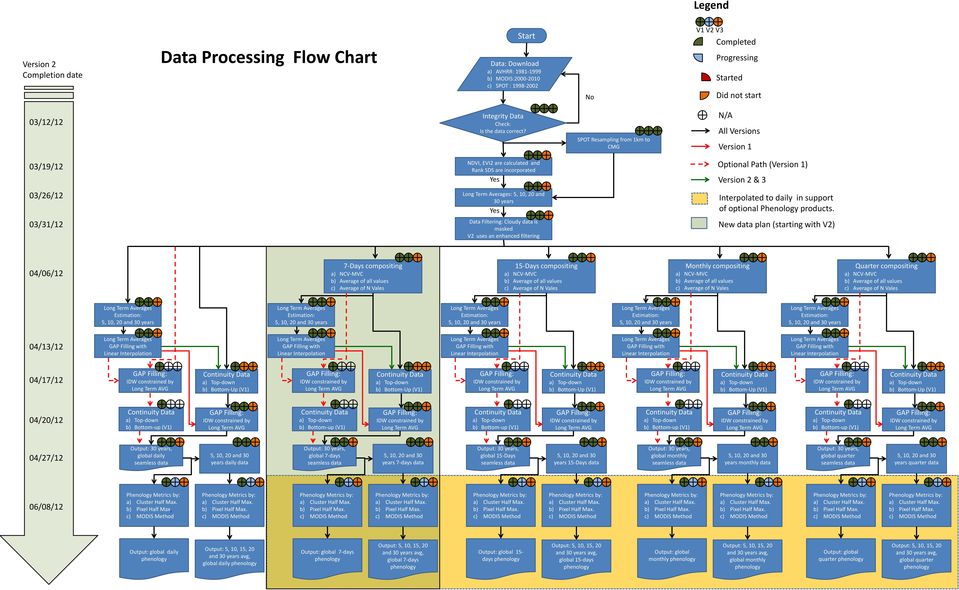

2 Input Data Download A 30+ years global CMG daily dataset is downloaded, composed of the following sensors: AVHRR ( ), SPOT ( ) and MODIS ( ). The daily global data from MODIS and LTDR both have 3600x7200 pixels. Data Availability AVHRR (Missing days) SPOT (Missing days) MODIS (Missing days)


3 SPOT Resampling Spatial resolution for SPOT is 1.0 km and for MODIS is 5.6 km, thus in order to combine the data, they must have the same resolution. First of all we have to inspect 6x6 pixels on SPOT image, then filter the data and finally determine the average of the retained pixels (see the figure above). This procedure will achieve a 6 km pixel which is good enough to combine with 5.6km pixel from MODIS.

4 VIS Estimation Back Vegetation indices (VI) are empirical measures that quantities vegetation biomass of the vegetation at the land surface. They often are function of the red and near infrared spectral functions. VIS Estimation: NDVI and EVI2 sds s are estimated and added to the downloaded data. In addition a Rank layer, describing the quality of the data, based on QA information is added to each file. NDVI & EVI2: As a ratio, the NDVI has the advantage of minimizing certain types of band-correlated noise (positively-correlated) and influences attributed to variations in direct/diffuse irradiance, clouds and cloud shadows, sun and view angles, topography, and atmospheric attenuation. On the other hand, EVI (Enhance Vegetation Index) was developed to minimize the atmospheric effect by using the difference in blue and red reflectances as an estimator of the atmosphere influence level. NDVI nir red EVI 2 2.5* nir red 2.4* 1 nir red nir red

5 START Data Filtering: Valid Data? No Rank =7 Yes Clouds? Rank=5 Yes No Snow? Rank=4 Yes No Cloud Note: Shadow? Yes The rank 6 was used No later on in the Low process to identify Aerosol No the data generated Yes using the gap filled Vz<=30 technique. No Yes Rank=1 Rank=2 Rank=3

6 Rank 7 The first aspect evaluated was the validity of the data. The data was considered not valid when at least one of the following factors occurred: surface reflectance value is out of the range, the area is not coverage by the sensor swath, instrumentation failure and/or high view zenith angles (>85⁰).

7 Rank 5 and 4 The second aspect was the presence of clouds on the data. If there is clouds, then the pixel is ranked as 5. The presence of snow on pixels was ranked 4.

8 Rank 1, 2 and 3 The pixels which passed the above filtering (clouds and snow) were taken to the next step where they were analyzed for cloud shadows and for aerosols which are normally the cause of poor quality when there are no clouds. Then, if the aerosols were low the data was evaluated to determine the influence of the view zenith and if this was larger than a pre-defined value (i.e.30 ) this data was considered negatively affected by this aspect. 1 being ideal data, 2 good to marginal data and requires additional postprocessing, 3 marginal to questionable data

9 Long Term Average Estimation: Go Back A second filter, using a long term data record, was considered to ensure the quality of the data. A long term average (LTAvg) profile was determined using both MODIS and AVHRR datasets and a confidence interval based on the standard deviation was established. A moving window of five years was used to determine the long term average profile for most pixels. For pixels where five years did not provided enough data, longer periods were used as necessary. The long term averages periods used in this project were 5, 10, 20 and 30 years period (Figure below). Example AVHRR MODIS 5-Years period 10-Years period 20-Years period 30-Years period

10 NDVI Data Filtering using Long Term Go Back Average Data: Vegetation Index profile for one year constrained by the long term average using daily information (see the black dots, ). The continuous line is the long term average plus one and a half standard deviations and the dashed line is the long term average minus one standard deviation. In this case only the data point denoted by the X s are rejected Oct-07 Jan-08 Apr-08 Jul-08 Nov-08 Feb-09 Date

11 Continuity : A seamless continuous dataset is produced by applying the continuity equations derived from MODIS, SPOT and AVHRR data records from the overlap period. Two different methods are used: 1) Top-Down 2) Bottom-up (this approach was implemented just in version 1)

12 Top-down, Direct Image Comparison ( for LTDR v.3) Spectral Transformation Equations to MODIS-equivalents (TOC, CMG) Go Back NDVI (x variable) Equation Uncertainty (95% PI) N-7 AVHRR, ROW, GAC y = x x 2 ± N-9 AVHRR, ROW, GAC y = x x 2 ± N-11 AVHRR, ROW, GAC y = x x 2 ± N-14 AVHRR, ROW, GAC y = x ± S-4 VEGETATION, TOC, CMGV y = x ±0.061 EVI2 (x variable) Equation Uncertainty (95% PI) N-7 AVHRR, ROW, GAC y = x ±0.088 N-9 AVHRR, ROW, GAC y = x ±0.088 N-11 AVHRR, ROW, GAC y = x ±0.088 N-14 AVHRR, ROW, GAC y = x ±0.088 S-4 VEGETATION, TOC, CMGV y = x ±0.037 By Tomoaki Miura and Javzan Tsend-Ayush

13 Bottom-up, Hyperspectral Analysis Spectral Transformation Equations to MODIS-equivalents (TOC, CMG) Go Back NDVI (x variable) Equation Uncertainty (95% PI) N-7 AVHRR, ROW, GAC y = x ±0.033 N-9 AVHRR, ROW, GAC y = x ±0.032 N-11 AVHRR, ROW, GAC y = x ±0.032 N-14 AVHRR, ROW, GAC y = x ±0.030 S-4 VEGETATION, TOC, CMGV y = x ±0.013 EVI2 (x variable) Equation Uncertainty (95% PI) N-7 AVHRR, ROW, GAC y = x ±0.023 N-9 AVHRR, ROW, GAC y = x ±0.022 N-11 AVHRR, ROW, GAC y = x ±0.022 N-14 AVHRR, ROW, GAC y = x ±0.022 S-4 VEGETATION, TOC, CMGV y = x ±0.006 By Tomoaki Miura and Javzan Tsend-Ayush

14 GAP Filling Gaps are filled using 1. Linear Interpolation 2. Inverse Distance Weighting. VI j i VI d i n ij 1 VI is the vegetation index value of the known points i d is the distance to the known point ij VI is the vegetation index value of the unknown point j i d n ij n is a power parameter, user selects the exponent (often 1, 2 or 3) 3. Values are constrained by the long term average moving window of 5, 10, 20 or 30 years. One standard deviation is used to restrict the boundaries of the values. Values outside of boundaries are replace with a long term average value and labeled within the Rank sds.

15 Compositing Compositing is a procedures to improve the quality of land products. It combines multiple daily images to generate a single cloud and problem free image over a predefined temporal intervals. This method reduces the noise due to the clouds and atmospheric constituents [Jonsson et. al. 2004]. The compositing can be the first filter to get a better and more accurate time series data. One type of composting is the maximum value composite (MVC). MVC compares all the images taken by a satellite, such as MODIS, during a pre-defined period of time and selects the pixels with the highest vegetation index value since it is assume that contamination reduces the VI values [Viovy et. al. 1992]. Daily data is used to generate composed images. A 15-days and Monthly datasets are generated. Each one based on the following approaches a) CV-MVC (Constrain View-Maximum Value Compositing): it minimizes the off-nadir tendencies of MVC. b) Average of All values c) Average of N max values
![This method reduces the noise due to the clouds and atmospheric constituents [Jonsson et. al. 2004]. The compositing can be the first filter to get a better and more accurate time series data.](/docs-images/47/20117212/images/page_15.jpg "One type of composting is the maximum value composite (MVC).")
16 Phenology Vegetation phenology can be defined as the plants study of the biological cycle events throughout the year and the seasonal and interannual response by climate variations. Phenology products, produced daily or on any compositing period, provided different parameters which describe the seasonal behavior of the vegetation. In general, the phenology is represented graphically it has a bell shape. The graphic below exhibits the following parameters: start of season (a), end of the season (b), length of the season (g), day of pick (e, time), rate of greening (, between a and c), rate of senescencing (, between d and b), cumulative green (h), pick green (e, NDVI), and average green. All of these parameters are shown below [Jonsson].

17 AVHRR missing days Go Back Year Missing Days , 178, , 88, , 114, , 187, 202, 237, 268, , 15, 51, 53, 62, 82, 101, 107, 205, 341, 342, 366* , 2, 18, 19, 39, 40, 41, 42, 70, , 73, 74, , 72, 73, 81, 90, 135, 136, 170, , , 235, 262, 281, , , 81, , 3, 59, , , 307, , 10-14, 41-43, , , , , 287, 288

18 SPOT missing days Go Back Year Missing Days , , 2, 303, , 80, 133, 250, 332,

19 MODIS missing days Terra Aqua Year Missing days Year Missing days , , , , 238, 239, , 105, , , 316, , , , , 182, 249, , , , 158,

MOD09 (Surface Reflectance) User s Guide
 MOD09 (Surface ) User s Guide MODIS Land Surface Science Computing Facility Principal Investigator: Dr. Eric F. Vermote Web site: http://modis-sr.ltdri.org Correspondence e-mail address: [email protected]
Review for Introduction to Remote Sensing: Science Concepts and Technology
 Review for Introduction to Remote Sensing: Science Concepts and Technology Ann Johnson Associate Director [email protected] Funded by National Science Foundation Advanced Technological Education program [DUE
STAR Algorithm and Data Products (ADP) Beta Review. Suomi NPP Surface Reflectance IP ARP Product
 STAR Algorithm and Data Products (ADP) Beta Review Suomi NPP Surface Reflectance IP ARP Product Alexei Lyapustin Surface Reflectance Cal Val Team 11/26/2012 STAR ADP Surface Reflectance ARP Team Member
MODIS IMAGES RESTORATION FOR VNIR BANDS ON FIRE SMOKE AFFECTED AREA
 MODIS IMAGES RESTORATION FOR VNIR BANDS ON FIRE SMOKE AFFECTED AREA Li-Yu Chang and Chi-Farn Chen Center for Space and Remote Sensing Research, National Central University, No. 300, Zhongda Rd., Zhongli
2.3 Spatial Resolution, Pixel Size, and Scale
 Section 2.3 Spatial Resolution, Pixel Size, and Scale Page 39 2.3 Spatial Resolution, Pixel Size, and Scale For some remote sensing instruments, the distance between the target being imaged and the platform,
Temporal variation in snow cover over sea ice in Antarctica using AMSR-E data product
 Temporal variation in snow cover over sea ice in Antarctica using AMSR-E data product Michael J. Lewis Ph.D. Student, Department of Earth and Environmental Science University of Texas at San Antonio ABSTRACT
Resolutions of Remote Sensing
 Resolutions of Remote Sensing 1. Spatial (what area and how detailed) 2. Spectral (what colors bands) 3. Temporal (time of day/season/year) 4. Radiometric (color depth) Spatial Resolution describes how
Cloud Masking and Cloud Products
 Cloud Masking and Cloud Products MODIS Operational Algorithm MOD35 Paul Menzel, Steve Ackerman, Richard Frey, Kathy Strabala, Chris Moeller, Liam Gumley, Bryan Baum MODIS Cloud Masking Often done with
Using Remote Sensing to Monitor Soil Carbon Sequestration
 Using Remote Sensing to Monitor Soil Carbon Sequestration E. Raymond Hunt, Jr. USDA-ARS Hydrology and Remote Sensing Beltsville Agricultural Research Center Beltsville, Maryland Introduction and Overview
Land Use/Land Cover Map of the Central Facility of ARM in the Southern Great Plains Site Using DOE s Multi-Spectral Thermal Imager Satellite Images
 Land Use/Land Cover Map of the Central Facility of ARM in the Southern Great Plains Site Using DOE s Multi-Spectral Thermal Imager Satellite Images S. E. Báez Cazull Pre-Service Teacher Program University
Environmental Remote Sensing GEOG 2021
 Environmental Remote Sensing GEOG 2021 Lecture 4 Image classification 2 Purpose categorising data data abstraction / simplification data interpretation mapping for land cover mapping use land cover class
Methods for Monitoring Forest and Land Cover Changes and Unchanged Areas from Long Time Series
 Methods for Monitoring Forest and Land Cover Changes and Unchanged Areas from Long Time Series Project using historical satellite data from SACCESS (Swedish National Satellite Data Archive) for developing
Time Series Analysis of Remote Sensing Data for Assessing Response to Community Based Rangeland Management
 Time Series Analysis of Remote Sensing Data for Assessing Response to Community Based Rangeland Management Jay Angerer Texas A&M University MOR2 Annual Meeting June, 2013 Research Questions During the
Moderate- and high-resolution Earth Observation data based forest and agriculture monitoring in Russia using VEGA Web-Service
 Moderate- and high-resolution Earth Observation data based forest and agriculture monitoring in Russia using VEGA Web-Service Sergey BARTALEV and Evgeny LOUPIAN Space Research Institute, Russian Academy
SAMPLE MIDTERM QUESTIONS
 Geography 309 Sample MidTerm Questions Page 1 SAMPLE MIDTERM QUESTIONS Textbook Questions Chapter 1 Questions 4, 5, 6, Chapter 2 Questions 4, 7, 10 Chapter 4 Questions 8, 9 Chapter 10 Questions 1, 4, 7
Towards assimilating IASI satellite observations over cold surfaces - the cloud detection aspect
 Towards assimilating IASI satellite observations over cold surfaces - the cloud detection aspect Tuuli Perttula, FMI + Thanks to: Nadia Fourrié, Lydie Lavanant, Florence Rabier and Vincent Guidard, Météo
Data processing (3) Cloud and Aerosol Imager (CAI)
 Data processing (3) Cloud and Aerosol Imager (CAI) 1) Nobuyuki Kikuchi, 2) Haruma Ishida, 2) Takashi Nakajima, 3) Satoru Fukuda, 3) Nick Schutgens, 3) Teruyuki Nakajima 1) National Institute for Environmental
Studying cloud properties from space using sounder data: A preparatory study for INSAT-3D
 Studying cloud properties from space using sounder data: A preparatory study for INSAT-3D Munn V. Shukla and P. K. Thapliyal Atmospheric Sciences Division Atmospheric and Oceanic Sciences Group Space Applications
Obtaining and Processing MODIS Data
 Obtaining and Processing MODIS Data MODIS is an extensive program using sensors on two satellites that each provide complete daily coverage of the earth. The data have a variety of resolutions; spectral,
Introduction to Imagery and Raster Data in ArcGIS
 Esri International User Conference San Diego, California Technical Workshops July 25, 2012 Introduction to Imagery and Raster Data in ArcGIS Simon Woo slides Cody Benkelman - demos Overview of Presentation
Cloud detection and clearing for the MOPITT instrument
 Cloud detection and clearing for the MOPITT instrument Juying Warner, John Gille, David P. Edwards and Paul Bailey National Center for Atmospheric Research, Boulder, Colorado ABSTRACT The Measurement Of
Australia s National Carbon Accounting System. Dr Gary Richards Director and Principal Scientist
 Australia s National Carbon Accounting System Dr Gary Richards Director and Principal Scientist Government Commitment The Australian Government has committed to a 10 year, 3 phase, ~$35M program for a
Satellite Remote Sensing of Volcanic Ash
 Marco Fulle www.stromboli.net Satellite Remote Sensing of Volcanic Ash Michael Pavolonis NOAA/NESDIS/STAR SCOPE Nowcasting 1 Meeting November 19 22, 2013 1 Outline Getty Images Volcanic ash satellite remote
Estimating Firn Emissivity, from 1994 to1998, at the Ski Hi Automatic Weather Station on the West Antarctic Ice Sheet Using Passive Microwave Data
 Estimating Firn Emissivity, from 1994 to1998, at the Ski Hi Automatic Weather Station on the West Antarctic Ice Sheet Using Passive Microwave Data Mentor: Dr. Malcolm LeCompte Elizabeth City State University
Measurement of the effect of biomass burning aerosol on inhibition of cloud formation over the Amazon
 Supporting Online Material for Koren et al. Measurement of the effect of biomass burning aerosol on inhibition of cloud formation over the Amazon 1. MODIS new cloud detection algorithm The operational
Amy K. Huff Battelle Memorial Institute [email protected] BUSINESS SENSITIVE 1
 Using NASA Satellite Aerosol Optical Depth Data to Create Representative PM 2.5 Fields for Use in Human Health and Epidemiology Studies in Support of State and National Environmental Public Health Tracking
The impact of window size on AMV
 The impact of window size on AMV E. H. Sohn 1 and R. Borde 2 KMA 1 and EUMETSAT 2 Abstract Target size determination is subjective not only for tracking the vector but also AMV results. Smaller target
SATELLITE IMAGES IN ENVIRONMENTAL DATA PROCESSING
 SATELLITE IMAGES IN ENVIRONMENTAL DATA PROCESSING Magdaléna Kolínová Aleš Procházka Martin Slavík Prague Institute of Chemical Technology Department of Computing and Control Engineering Technická 95, 66
GOES-R AWG Cloud Team: ABI Cloud Height
 GOES-R AWG Cloud Team: ABI Cloud Height June 8, 2010 Presented By: Andrew Heidinger 1 1 NOAA/NESDIS/STAR 1 Outline Executive Summary Algorithm Description ADEB and IV&V Response Summary Requirements Specification
McIDAS-V Tutorial Displaying Polar Satellite Imagery updated September 2015 (software version 1.5)
 McIDAS-V Tutorial Displaying Polar Satellite Imagery updated September 2015 (software version 1.5) McIDAS-V is a free, open source, visualization and data analysis software package that is the next generation
ECMWF Aerosol and Cloud Detection Software. User Guide. version 1.2 20/01/2015. Reima Eresmaa ECMWF
 ECMWF Aerosol and Cloud User Guide version 1.2 20/01/2015 Reima Eresmaa ECMWF This documentation was developed within the context of the EUMETSAT Satellite Application Facility on Numerical Weather Prediction
Development of an Integrated Data Product for Hawaii Climate
 Development of an Integrated Data Product for Hawaii Climate Jan Hafner, Shang-Ping Xie (PI)(IPRC/SOEST U. of Hawaii) Yi-Leng Chen (Co-I) (Meteorology Dept. Univ. of Hawaii) contribution Georgette Holmes
Hyperspectral Satellite Imaging Planning a Mission
 Hyperspectral Satellite Imaging Planning a Mission Victor Gardner University of Maryland 2007 AIAA Region 1 Mid-Atlantic Student Conference National Institute of Aerospace, Langley, VA Outline Objective
Land Use/ Land Cover Mapping Initiative for Kansas and the Kansas River Watershed
 Land Use/ Land Cover Mapping Initiative for Kansas and the Kansas River Watershed Kansas Biological Survey Kansas Applied Remote Sensing Program April 2008 Previous Kansas LULC Projects Kansas LULC Map
dynamic vegetation model to a semi-arid
 Application of a conceptual distributed dynamic vegetation model to a semi-arid basin, SE of Spain By: M. Pasquato, C. Medici and F. Francés Universidad Politécnica de Valencia - Spain Research Institute
Automatic land-cover map production of agricultural areas using supervised classification of SPOT4(Take5) and Landsat-8 image time series.
 Automatic land-cover map production of agricultural areas using supervised classification of SPOT4(Take5) and Landsat-8 image time series. Jordi Inglada 2014/11/18 SPOT4/Take5 User Workshop 2014/11/18
Multiangle cloud remote sensing from
 Multiangle cloud remote sensing from POLDER3/PARASOL Cloud phase, optical thickness and albedo F. Parol, J. Riedi, S. Zeng, C. Vanbauce, N. Ferlay, F. Thieuleux, L.C. Labonnote and C. Cornet Laboratoire
Remote sensing and GIS applications in coastal zone monitoring
 Remote sensing and GIS applications in coastal zone monitoring T. Alexandridis, C. Topaloglou, S. Monachou, G.Tsakoumis, A. Dimitrakos, D. Stavridou Lab of Remote Sensing and GIS School of Agriculture
Global environmental information Examples of EIS Data sets and applications
 METIER Graduate Training Course n 2 Montpellier - february 2007 Information Management in Environmental Sciences Global environmental information Examples of EIS Data sets and applications Global datasets
The NASA NEESPI Data Portal to Support Studies of Climate and Environmental Changes in Non-boreal Europe
 The NASA NEESPI Data Portal to Support Studies of Climate and Environmental Changes in Non-boreal Europe Suhung Shen NASA Goddard Space Flight Center/George Mason University Gregory Leptoukh, Tatiana Loboda,
WATER BODY EXTRACTION FROM MULTI SPECTRAL IMAGE BY SPECTRAL PATTERN ANALYSIS
 WATER BODY EXTRACTION FROM MULTI SPECTRAL IMAGE BY SPECTRAL PATTERN ANALYSIS Nguyen Dinh Duong Department of Environmental Information Study and Analysis, Institute of Geography, 18 Hoang Quoc Viet Rd.,
y = Xβ + ε B. Sub-pixel Classification
 Sub-pixel Mapping of Sahelian Wetlands using Multi-temporal SPOT VEGETATION Images Jan Verhoeye and Robert De Wulf Laboratory of Forest Management and Spatial Information Techniques Faculty of Agricultural
Vulnerability assessment of ecosystem services for climate change impacts and adaptation (VACCIA)
 Vulnerability assessment of ecosystem services for climate change impacts and adaptation (VACCIA) Action 2: Derivation of GMES-related remote sensing data Deliverable 1: Time-series of Earth Observation
Lectures Remote Sensing
 Lectures Remote Sensing ATMOSPHERIC CORRECTION dr.ir. Jan Clevers Centre of Geo-Information Environmental Sciences Wageningen UR Atmospheric Correction of Optical RS Data Background When needed? Model
Supervised Classification workflow in ENVI 4.8 using WorldView-2 imagery
 Supervised Classification workflow in ENVI 4.8 using WorldView-2 imagery WorldView-2 is the first commercial high-resolution satellite to provide eight spectral sensors in the visible to near-infrared
3.4 Cryosphere-related Algorithms
 3.4 Cryosphere-related Algorithms GLI Algorithm Description 3.4.-1 3.4.1 CTSK1 A. Algorithm Outline (1) Algorithm Code: CTSK1 (2) Product Code: CLFLG_p (3) PI Name: Dr. Knut Stamnes (4) Overview of Algorithm
Landsat Monitoring our Earth s Condition for over 40 years
 Landsat Monitoring our Earth s Condition for over 40 years Thomas Cecere Land Remote Sensing Program USGS ISPRS:Earth Observing Data and Tools for Health Studies Arlington, VA August 28, 2013 U.S. Department
Forest Fire Information System (EFFIS): Rapid Damage Assessment
 Forest Fire Information System (EFFIS): Fire Danger D Rating Rapid Damage Assessment G. Amatulli, A. Camia, P. Barbosa, J. San-Miguel-Ayanz OUTLINE 1. Introduction: what is the JRC 2. What is EFFIS 3.
How to calculate reflectance and temperature using ASTER data
 How to calculate reflectance and temperature using ASTER data Prepared by Abduwasit Ghulam Center for Environmental Sciences at Saint Louis University September, 2009 This instructions walk you through
How Landsat Images are Made
 How Landsat Images are Made Presentation by: NASA s Landsat Education and Public Outreach team June 2006 1 More than just a pretty picture Landsat makes pretty weird looking maps, and it isn t always easy
The APOLLO cloud product statistics Web service
 The APOLLO cloud product statistics Web service Introduction DLR and Transvalor are preparing a new Web service to disseminate the statistics of the APOLLO cloud physical parameters as a further help in
Comparison of NOAA's Operational AVHRR Derived Cloud Amount to other Satellite Derived Cloud Climatologies.
 Comparison of NOAA's Operational AVHRR Derived Cloud Amount to other Satellite Derived Cloud Climatologies. Sarah M. Thomas University of Wisconsin, Cooperative Institute for Meteorological Satellite Studies
LANDSAT 8 Level 1 Product Performance
 Réf: IDEAS-TN-10-QualityReport LANDSAT 8 Level 1 Product Performance Quality Report Month/Year: January 2016 Date: 26/01/2016 Issue/Rev:1/9 1. Scope of this document On May 30, 2013, data from the Landsat
The Role of SPOT Satellite Images in Mapping Air Pollution Caused by Cement Factories
 The Role of SPOT Satellite Images in Mapping Air Pollution Caused by Cement Factories Dr. Farrag Ali FARRAG Assistant Prof. at Civil Engineering Dept. Faculty of Engineering Assiut University Assiut, Egypt.
Data Visualization. Prepared by Francisco Olivera, Ph.D., Srikanth Koka Department of Civil Engineering Texas A&M University February 2004
 Data Visualization Prepared by Francisco Olivera, Ph.D., Srikanth Koka Department of Civil Engineering Texas A&M University February 2004 Contents Brief Overview of ArcMap Goals of the Exercise Computer
A remote sensing instrument collects information about an object or phenomenon within the
 Satellite Remote Sensing GE 4150- Natural Hazards Some slides taken from Ann Maclean: Introduction to Digital Image Processing Remote Sensing the art, science, and technology of obtaining reliable information
Adaptive HSI Data Processing for Near-Real-time Analysis and Spectral Recovery *
 Adaptive HSI Data Processing for Near-Real-time Analysis and Spectral Recovery * Su May Hsu, 1 Hsiao-hua Burke and Michael Griffin MIT Lincoln Laboratory, Lexington, Massachusetts 1. INTRODUCTION Hyperspectral
Denis Botambekov 1, Andrew Heidinger 2, Andi Walther 1, and Nick Bearson 1
 Denis Botambekov 1, Andrew Heidinger 2, Andi Walther 1, and Nick Bearson 1 1 - CIMSS / SSEC / University of Wisconsin Madison, WI, USA 2 NOAA / NESDIS / STAR @ University of Wisconsin Madison, WI, USA
APPLICATION OF TERRA/ASTER DATA ON AGRICULTURE LAND MAPPING. Genya SAITO*, Naoki ISHITSUKA*, Yoneharu MATANO**, and Masatane KATO***
 APPLICATION OF TERRA/ASTER DATA ON AGRICULTURE LAND MAPPING Genya SAITO*, Naoki ISHITSUKA*, Yoneharu MATANO**, and Masatane KATO*** *National Institute for Agro-Environmental Sciences 3-1-3 Kannondai Tsukuba
Spectral Response for DigitalGlobe Earth Imaging Instruments
 Spectral Response for DigitalGlobe Earth Imaging Instruments IKONOS The IKONOS satellite carries a high resolution panchromatic band covering most of the silicon response and four lower resolution spectral
SEMI-AUTOMATED CLOUD/SHADOW REMOVAL AND LAND COVER CHANGE DETECTION USING SATELLITE IMAGERY
 SEMI-AUTOMATED CLOUD/SHADOW REMOVAL AND LAND COVER CHANGE DETECTION USING SATELLITE IMAGERY A. K. Sah a, *, B. P. Sah a, K. Honji a, N. Kubo a, S. Senthil a a PASCO Corporation, 1-1-2 Higashiyama, Meguro-ku,
List 10 different words to describe the weather in the box, below.
 Weather and Climate Lesson 1 Web Quest: What is the Weather? List 10 different words to describe the weather in the box, below. How do we measure the weather? Use this web link to help you: http://www.bbc.co.uk/weather/weatherwise/activities/weatherstation/
Generation of Cloud-free Imagery Using Landsat-8
 Generation of Cloud-free Imagery Using Landsat-8 Byeonghee Kim 1, Youkyung Han 2, Yonghyun Kim 3, Yongil Kim 4 Department of Civil and Environmental Engineering, Seoul National University (SNU), Seoul,
Digital image processing
 746A27 Remote Sensing and GIS Lecture 4 Digital image processing Chandan Roy Guest Lecturer Department of Computer and Information Science Linköping University Digital Image Processing Most of the common
User Perspectives on Project Feasibility Data
 User Perspectives on Project Feasibility Data Marcel Šúri Tomáš Cebecauer GeoModel Solar s.r.o., Bratislava, Slovakia [email protected] http://geomodelsolar.eu http://solargis.info Solar Resources
VOLATILITY AND DEVIATION OF DISTRIBUTED SOLAR
 VOLATILITY AND DEVIATION OF DISTRIBUTED SOLAR Andrew Goldstein Yale University 68 High Street New Haven, CT 06511 [email protected] Alexander Thornton Shawn Kerrigan Locus Energy 657 Mission St.
Data source, type, and file naming convention
 Exercise 1: Basic visualization of LiDAR Digital Elevation Models using ArcGIS Introduction This exercise covers activities associated with basic visualization of LiDAR Digital Elevation Models using ArcGIS.
Remote Sensing, GPS and GIS Technique to Produce a Bathymetric Map
 Remote Sensing, GPS and GIS Technique to Produce a Bathymetric Map Mark Schnur EES 5053 Remote Sensing Fall 2007 University of Texas at San Antonio, Department of Earth and Environmental Science, San Antonio,
Active Fire Monitoring: Product Guide
 Active Fire Monitoring: Product Guide Doc.No. Issue : : EUM/TSS/MAN/15/801989 v1c EUMETSAT Eumetsat-Allee 1, D-64295 Darmstadt, Germany Tel: +49 6151 807-7 Fax: +49 6151 807 555 Date : 14 April 2015 http://www.eumetsat.int
Monitoring vegetation phenology at scales from individual plants to whole canopies, and from regions to continents: Insights from the PhenoCam network
 Monitoring vegetation phenology at scales from individual plants to whole canopies, and from regions to continents: Insights from the PhenoCam network Andrew D. Richardson Harvard University Mark Friedl
RESULTS FROM A SIMPLE INFRARED CLOUD DETECTOR
 RESULTS FROM A SIMPLE INFRARED CLOUD DETECTOR A. Maghrabi 1 and R. Clay 2 1 Institute of Astronomical and Geophysical Research, King Abdulaziz City For Science and Technology, P.O. Box 6086 Riyadh 11442,
NCDC s SATELLITE DATA, PRODUCTS, and SERVICES
 **** NCDC s SATELLITE DATA, PRODUCTS, and SERVICES Satellite data and derived products from NOAA s satellite systems are available through the National Climatic Data Center. The two primary systems are
Selecting the appropriate band combination for an RGB image using Landsat imagery
 Selecting the appropriate band combination for an RGB image using Landsat imagery Ned Horning Version: 1.0 Creation Date: 2004-01-01 Revision Date: 2004-01-01 License: This document is licensed under a
Interactive comment on Total cloud cover from satellite observations and climate models by P. Probst et al.
 Interactive comment on Total cloud cover from satellite observations and climate models by P. Probst et al. Anonymous Referee #1 (Received and published: 20 October 2010) The paper compares CMIP3 model
Best practices for RGB compositing of multi-spectral imagery
 Best practices for RGB compositing of multi-spectral imagery User Service Division, EUMETSAT Introduction Until recently imagers on geostationary satellites were limited to 2-3 spectral channels, i.e.
Received in revised form 24 March 2004; accepted 30 March 2004
 Remote Sensing of Environment 91 (2004) 237 242 www.elsevier.com/locate/rse Cloud detection in Landsat imagery of ice sheets using shadow matching technique and automatic normalized difference snow index
How To Check For Differences In The One Way Anova
 MINITAB ASSISTANT WHITE PAPER This paper explains the research conducted by Minitab statisticians to develop the methods and data checks used in the Assistant in Minitab 17 Statistical Software. One-Way
Information Contents of High Resolution Satellite Images
 Information Contents of High Resolution Satellite Images H. Topan, G. Büyüksalih Zonguldak Karelmas University K. Jacobsen University of Hannover, Germany Keywords: satellite images, mapping, resolution,
COMPARISON OF FIXED & VARIABLE RATES (25 YEARS) CHARTERED BANK ADMINISTERED INTEREST RATES - PRIME BUSINESS*
 COMPARISON OF FIXED & VARIABLE RATES (25 YEARS) 2 Fixed Rates Variable Rates FIXED RATES OF THE PAST 25 YEARS AVERAGE RESIDENTIAL MORTGAGE LENDING RATE - 5 YEAR* (Per cent) Year Jan Feb Mar Apr May Jun
COMPARISON OF FIXED & VARIABLE RATES (25 YEARS) CHARTERED BANK ADMINISTERED INTEREST RATES - PRIME BUSINESS*
 COMPARISON OF FIXED & VARIABLE RATES (25 YEARS) 2 Fixed Rates Variable Rates FIXED RATES OF THE PAST 25 YEARS AVERAGE RESIDENTIAL MORTGAGE LENDING RATE - 5 YEAR* (Per cent) Year Jan Feb Mar Apr May Jun
Near Real Time Blended Surface Winds
 Near Real Time Blended Surface Winds I. Summary To enhance the spatial and temporal resolutions of surface wind, the remotely sensed retrievals are blended to the operational ECMWF wind analyses over the
High Resolution Information from Seven Years of ASTER Data
 High Resolution Information from Seven Years of ASTER Data Anna Colvin Michigan Technological University Department of Geological and Mining Engineering and Sciences Outline Part I ASTER mission Terra
Meteorological Forecasting of DNI, clouds and aerosols
 Meteorological Forecasting of DNI, clouds and aerosols DNICast 1st End-User Workshop, Madrid, 2014-05-07 Heiner Körnich (SMHI), Jan Remund (Meteotest), Marion Schroedter-Homscheidt (DLR) Overview What
Welcome to NASA Applied Remote Sensing Training (ARSET) Webinar Series
 Welcome to NASA Applied Remote Sensing Training (ARSET) Webinar Series Introduction to Remote Sensing Data for Water Resources Management Course Dates: October 17, 24, 31 November 7, 14 Time: 8-9 a.m.
Joint Polar Satellite System (JPSS)
 Joint Polar Satellite System (JPSS) John Furgerson, User Liaison Joint Polar Satellite System National Environmental Satellite, Data, and Information Service National Oceanic and Atmospheric Administration
PTYS/ASTR 206 Section 2 Spring 2007 Homework #2 (Page 1/5) NAME: KEY
 PTYS/ASTR 206 Section 2 Spring 2007 Homework #2 (Page 1/5) NAME: KEY Due Date: start of class 2/6/2007 5 pts extra credit if turned in before 9:00AM (early!) (To get the extra credit, the assignment must
Exponential Smoothing with Trend. As we move toward medium-range forecasts, trend becomes more important.
 Exponential Smoothing with Trend As we move toward medium-range forecasts, trend becomes more important. Incorporating a trend component into exponentially smoothed forecasts is called double exponential