
Systems of Linear Equations
|
|
|
- Ezra McDowell
- 9 years ago
- Views:
Transcription
1 Chapter 1 Systems of Linear Equations 1.1 Intro. to systems of linear equations Homework: [Textbook, Ex. 13, 15, 41, 47, 49, 51, 65, 73; page 11-]. Main points in this section: 1. Definition of Linear system of equations and homogeneous systems. 2. Row-echelon form of a linear system and Gaussian elimination. 3. Solving linear system of equations using Gaussian elimination. 1
![13, 15, 41, 47, 49, 51, 65, 73; page 11-]. Main points in this section: 1.](/docs-images/48/19764277/images/page_1.jpg "Definition of Linear system of equations and homogeneous systems. 2.")
2 2 CHAPTER 1. SYSTEMS OF LINEAR EQUATIONS Definition A linear equation in n (unknown) variables x 1,..., x n has the form a 1 x 1 + a 2 x a n x n = b. Here a 1, a 2,..., a n, b are real numbers. We say b is the constant term and a i is the coefficient of x i. For real numbers s 1,..., s n, if a 1 s 1 + a 2 s a n s n = b we say that is a solution of this equation. x 1 = s 1, x 2 = s 2,..., x n = s n 1. An example of a linear equation in two unknowns is 2x + 7y = 5. A solution of this equation is x = 1, y = 1. The equation has many more solutions. The graph of this equation is a line. 2. An example of a linear equation in three unknowns is 2x+y+πz = π. A solution of this equation is x = 0, y = 0, z = 1. The equation has many more solutions. The graph of this equation (in 3-space) is a plane. 3. See [Textbook, Example 1, page 2] for examples of linear and non-linear equations. Definition By a System of Linear Equations in n variables x 1, x 2,..., x n we mean a collection of linear equations in these variables.

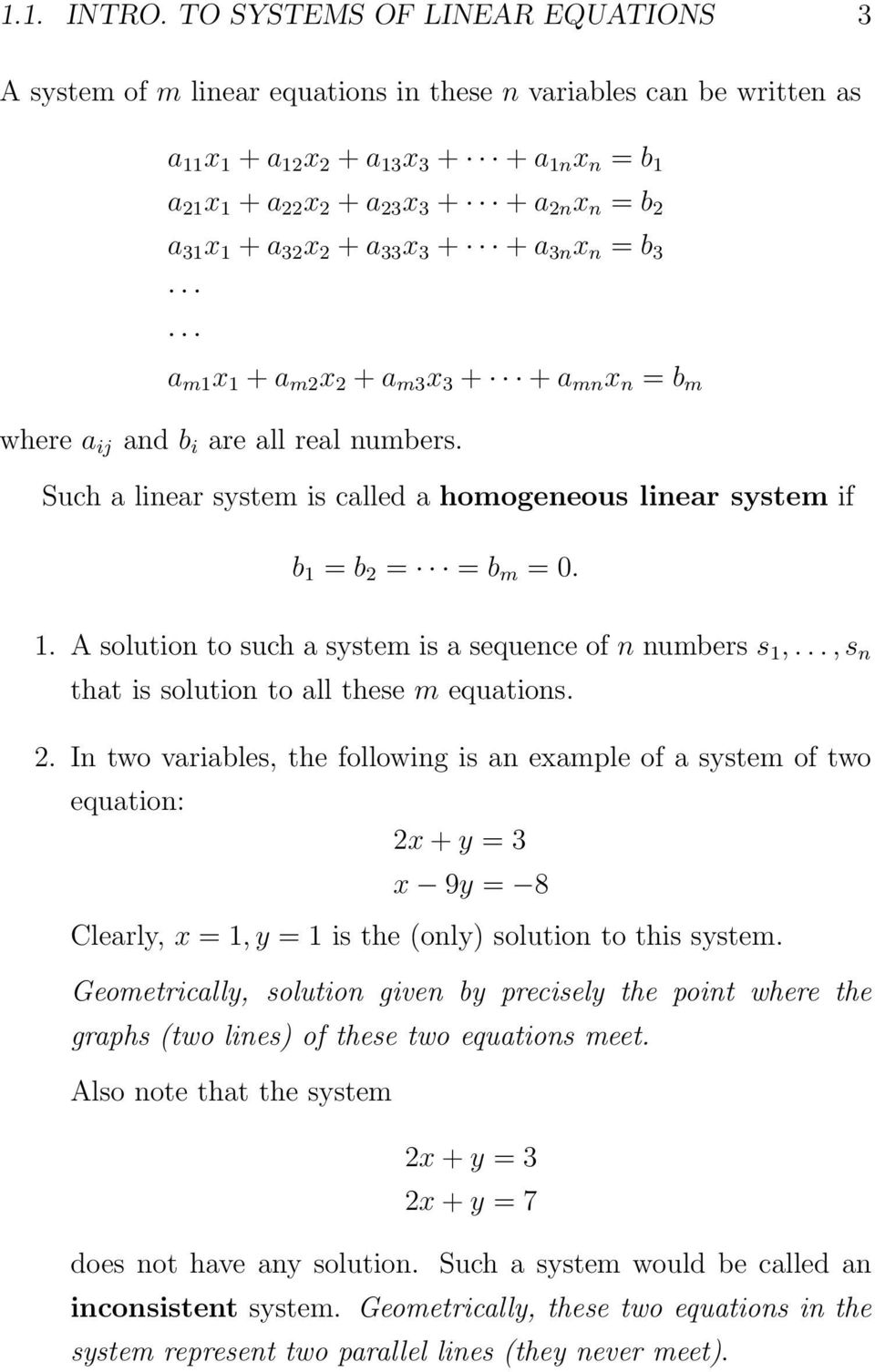
3 1.1. INTRO. TO SYSTEMS OF LINEAR EQUATIONS 3 A system of m linear equations in these n variables can be written as a 11 x 1 + a 12 x 2 + a 13 x a 1n x n = b 1 a 21 x 1 + a 22 x 2 + a 23 x a 2n x n = b 2 a 31 x 1 + a 32 x 2 + a 33 x a 3n x n = b 3 a m1 x 1 + a m2 x 2 + a m3 x a mn x n = b m where a ij and b i are all real numbers. Such a linear system is called a homogeneous linear system if b 1 = b 2 = = b m = A solution to such a system is a sequence of n numbers s 1,..., s n that is solution to all these m equations. 2. In two variables, the following is an example of a system of two equation: 2x + y = 3 x 9y = 8 Clearly, x = 1, y = 1 is the (only) solution to this system. Geometrically, solution given by precisely the point where the graphs (two lines) of these two equations meet. Also note that the system 2x + y = 3 2x + y = 7 does not have any solution. Such a system would be called an inconsistent system. Geometrically, these two equations in the system represent two parallel lines (they never meet).
4 4 CHAPTER 1. SYSTEMS OF LINEAR EQUATIONS 3. In three variables, the following is an example of a system of two equation: 2x + y + 2z = 3 x 9y + 2z = 8 Clearly, x = 1, y = 1, z = 0 is a solution to this system. This system has many more solutions. For example, x = 11, y = 0, z = 19/2 is also a solution of this system. Geometrically, solution given by precisely the points where the graphs (two planes) in 3-space of these two equations meet. 4. Classification of linear systems: Given a linear system in n variables, precisely on the the following three is true: (a) The system has exacly one solution (consistent system). (b) The system has infinitely many solutions (consistent system). (c) The system has NO solution (inconsistent system). 5. Two systems of linear equations are called equivalent, if they have precisely the same set of solutions. 6. Following operations on a system produces an equivalent system: (a) Interchange two equations. (b) Multiply an equation by a nonzero constant. (c) Add a multiple of an equation to another one. These three operations are sometimes known as basic or elementary operations.

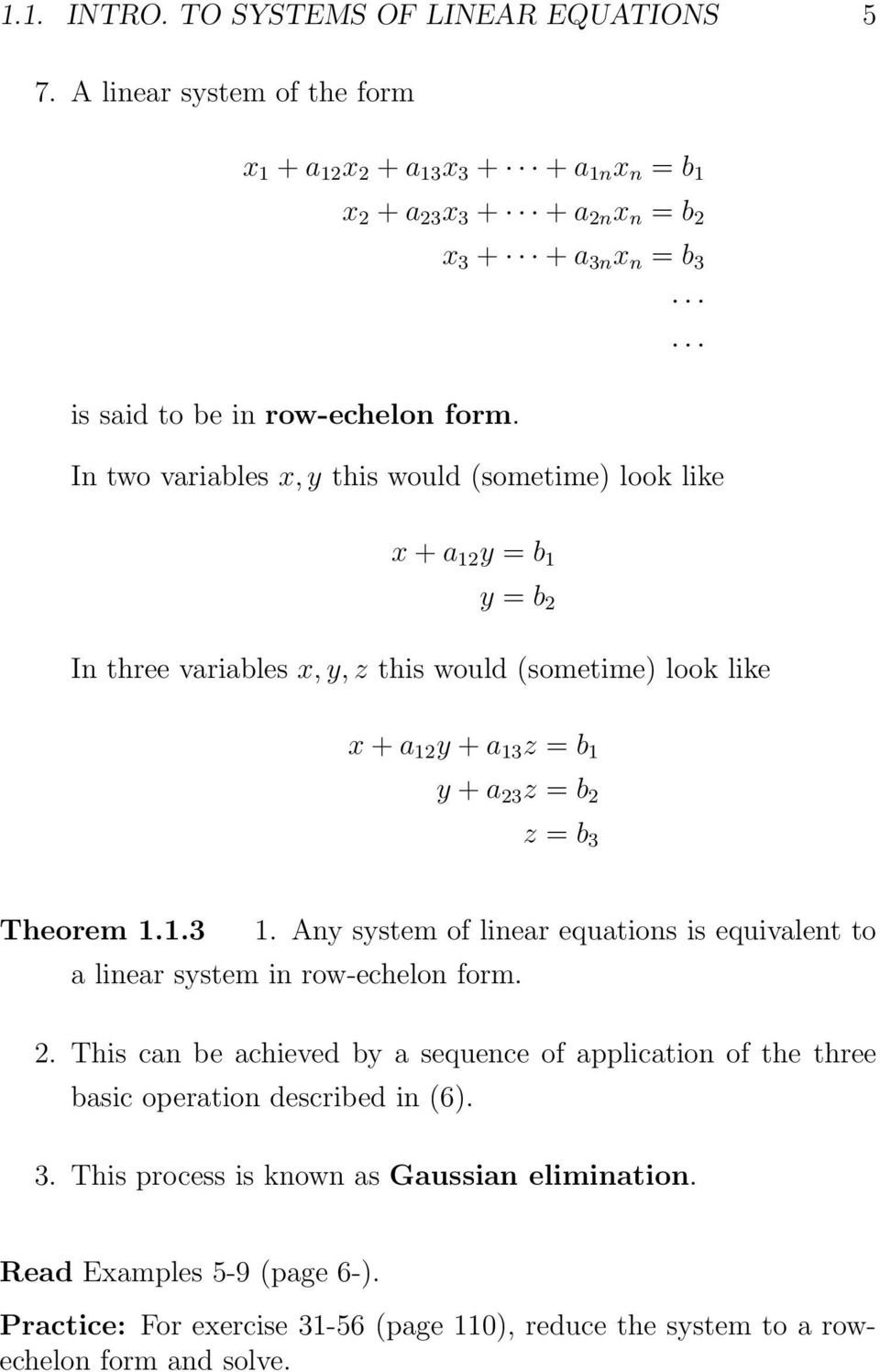
5 1.1. INTRO. TO SYSTEMS OF LINEAR EQUATIONS 5 7. A linear system of the form x 1 + a 12 x 2 + a 13 x a 1n x n = b 1 is said to be in row-echelon form. x 2 + a 23 x a 2n x n = b 2 x a 3n x n = b 3 In two variables x, y this would (sometime) look like x + a 12 y = b 1 y = b 2 In three variables x, y, z this would (sometime) look like x + a 12 y + a 13 z = b 1 y + a 23 z = b 2 z = b 3 Theorem Any system of linear equations is equivalent to a linear system in row-echelon form. 2. This can be achieved by a sequence of application of the three basic operation described in (6). 3. This process is known as Gaussian elimination. Read Examples 5-9 (page 6-). Practice: For exercise (page 110), reduce the system to a rowechelon form and solve.
6 6 CHAPTER 1. SYSTEMS OF LINEAR EQUATIONS Exercise (Ex. 32. p 11) Reduce the following system and solve: 4x 5y = 3 Eqn 1 8x + 10y = 14 Eqn 2 Add 2 times Enq-1 to Eqn-2: 4x 5y = 3 Eqn 1 0 = 20 Eqn 3 The Eqn-3 is absurd. So, the system has no solution. The system is inconsistent. Exercise (Ex. 34. p 11) Reduce the following system and solve: Multiply Eqn-2 by 18: Subtract Eqn-1 from the Eqn-3 Divide Eqn-4 by 10: Divide Eqn-1 by 9: 9x 4y = 5 Eqn 1 1 x + 1y = 0 Eqn x 4y = 5 Eqn 1 9x + 6y = 0 Eqn 3 9x 4y = 5 Eqn 1 10y = 5 Eqn 4 9x 4y = 5 Eqn 1 y = 1 2 Eqn 5 x 4 9 y = 5 9 Eqn 6 y = 1 2 Eqn 5

7 1.1. INTRO. TO SYSTEMS OF LINEAR EQUATIONS 7 This is the row-echelon form. Now substitute y = 1 in Eqn-6 2 x 4 ( 1 ) = or x = 1 3. So, the solution is x = 1 3, y = 1 2. Exercise (Ex. 44. p 12) multiply Eqn-1 by 12 and simplify: x x 2 1 = Eqn 1 2x 1 x 2 = 12 Eqn 2 3x 1 + 4x 2 = 7 Eqn 3 2x 1 x 2 = 12 Eqn 2 Add 2 3 times Eqn-3 to Eqn-2: Multiply Eqn-4 by 3 11 : Multiply Eqn-3 by 1 3 : 3x 1 + 4x 2 = 7 Eqn x 2 = 22 3 Eqn 4 3x 1 + 4x 2 = 7 Eqn 3 x 2 = 2 Eqn 5 x x 2 = 7 3 Eqn 6 x 2 = 2 Eqn 5 So, above is the row-echelon form of the system. Now substitute x 2 = 2 in Eqn-6 and get x 1 = = 5. So, the systme is consistentand 3 3 has unique solution x 1 = 5, x 2 = 2.

8 8 CHAPTER 1. SYSTEMS OF LINEAR EQUATIONS Exercise (Ex. 50, p 12) Deduce an equivalent row-echelon form and solove the following system: 5x 1 3x 2 + 2x 3 = 3 Eqn 1 2x 1 + 4x 2 x 3 = 7 Eqn 2 x 1 11x 2 + 4x 3 = 3 Eqn 3 First, switch Eqn-1 and Eqn-3: x 1 11x 2 + 4x 3 = 3 Eqn 3 2x 1 + 4x 2 x 3 = 7 Eqn 2 5x 1 3x 2 + 2x 3 = 3 Eqn 1 Subtract 2 times Eqn-3 from Eqn-2 and 5 times Eqn-3 from Eqn-1: x 1 11x 2 + 4x 3 = 3 Eqn 3 26x 2 9x 3 = 1 Eqn 4 52x 2 18x 3 = 12 Eqn 5 Subtract 2 times Eqn-4 from Eqn-5: x 1 11x 2 + 4x 3 = 3 Eqn 3 26x 2 9x 3 = 1 Eqn 4 0 = 14 Eqn 6 The system is inconsistent because Eqn-6 is absurd. row-echelon form, we divid Eqn-4 by 26: To obtain the x 1 11x 2 + 4x 3 = 3 Eqn 3 x 2 9 x 26 3 = 1 26 Eqn 7 0 = 14 Eqn 6 Exercise (Ex. 52, p 12) Deduce an equivalent row-echelon form and solove the following system: x 1 + 4x 3 = 13 Eqn 1 4x 1 2x 2 + x 3 = 7 Eqn 2 2x 1 2x 2 7x 3 = 19 Eqn 3

9 1.1. INTRO. TO SYSTEMS OF LINEAR EQUATIONS 9 Subtract 4 times Eqn-1 from Eqn-2 and suntract 2 times Eqn-1 from Equn-3: x 1 + 4x 3 = 13 Eqn 1 2x 2 15x 3 = 45 Eqn 4 2x 2 15x 3 = 45 Eqn 5 Subtract Eqn-4 from Eqn-5: x 1 + 4x 3 = 13 Eqn 1 2x 2 15x 3 = 45 Eqn 4 0 = 0 Eqn 6 Multiply Eqn-4 by -.5 and we get x 1 + 4x 3 = 13 Eqn 1 x x 3 = 22.5 Eqn 7 0 = 0 Eqn 6 The above is the row-echelon form of the system. The system is consistent. Since the echelon form has actually two equations and number of variables is three, the system has infinitely many solutions. For any value x 3 = t, we have x 2 = t and x 1 = 13 4t. So, a parametric solution of this system is x 1 = 13 4t, x 2 = t, x 3 = t. Exercise (Ex. 56, p 12) Deduce an equivalent row-echelon form and solve the following system: x 1 +3x 4 = 4 Eqn 1 2x 2 x 3 x 4 = 0 Eqn 2 3x 2 2x 4 = 1 Eqn 3 2x 1 x 2 +4x 3 = 5 Eqn 4

10 10 CHAPTER 1. SYSTEMS OF LINEAR EQUATIONS Subtract 2 time Eqn-1 from Eqn-4: x 1 +3x 4 = 4 Eqn 1 2x 2 x 3 x 4 = 0 Eqn 2 3x 2 2x 4 = 1 Eqn 3 x 2 +4x 3 6x 4 = 3 Eqn 5 Multiply Eqn-2 by.5: x 1 +3x 4 = 4 Eqn 1 x 2.5x 3.5x 4 = 0 Eqn 6 3x 2 2x 4 = 1 Eqn 3 x 2 +4x 3 6x 4 = 3 Eqn 5 Subtract 3 times Eqn-6 from Eqn-3 and add Eqn-2 to Eqn-5: x 1 +3x 4 = 4 Eqn 1 x 2.5x 3.5x 4 = 0 Eqn 6 1.5x 3.5x 4 = 1 Eqn 7 3.5x 3 6.5x 4 = 3 Eqn 8

11 1.1. INTRO. TO SYSTEMS OF LINEAR EQUATIONS 11 Myltiply Eqn-7 by 2 3 : x 1 +3x 4 = 4 Eqn 1 x 2.5x 3.5x 4 = 0 Eqn 6 Subtract 3.5 times Eqn-9 from Eqn-8: x x 4 = 2 3 Eqn 9 3.5x 3 6.5x 4 = 3 Eqn 8 x 1 +3x 4 = 4 Eqn 1 Multiply Eqn-10 by 3 16 : x 2.5x 3.5x 4 = 0 Eqn 6 x x 4 = 2 3 Eqn x 4 = 16 3 Eqn 10 x 1 +3x 4 = 4 Eqn 1 x 2.5x 3.5x 4 = 0 Eqn 6 x x 4 = 2 3 Eqn 9 x 4 = 1 Eqn 11 The above is a row-echelon form of the system. By back-substitution: x 4 = 1, x 3 = = 1, x 2 = 1, x 1 = 1.

12 12 CHAPTER 1. SYSTEMS OF LINEAR EQUATIONS 1.2 Gaussian, Gauss-Jordan Elimination Homework: [Textbook, Ex.21, 29, 33, 35(by Gauss-Jordan), 45, 47, 49, 53, 57, 63; page 26-] Main points in this section: 1. Definition of matrices. 2. Elementary row operation on a matrix. 3. Definition of Row-echelon form of matrix. 4. Gaussian elimination and Gauss-Jordan elimination. 5. Solving sytems of linear equations using Gaussian elimination and Gauss-Jordan elimination.

13 1.2. GAUSSIAN, GAUSS-JORDAN ELIMINATION 13 Definition For two positive integers m, n and m n matrix is a rectangular array a 11 a 12 a 13 a 1n a 21 a 22 a 23 a 2n a 31 a 32 a 33 a 3n a m1 a m2 a m3 a mn 1. the array has m rows ana n column. 2. Here a ij is a real number, to be called ij th entry. This entry sits in the i th row j th column. The first subscript i of a ij is called the row subscript and j is called the column subscript. 3. It is possible to talk about matrices whose entries a ij are not real numbers. We can talk about matrices of any kind of objects. We will only talk about matrices with real entries and such matrices are also called real matrices. 4. We say that the size of the matrix is m n. 5. A square matrix of order n is a matrix whose number of rows and columns are same and equal to n. 6. For a square matrix of order n, the entries a 11, a 22,..., a nn are called the main diaginal entries. The most common use, for this class, of matrices is to represent system of liner equation. Given a system of liner equations, an associated matrix to be called the augmented matrix contains all the information regarding the system.

14 14 CHAPTER 1. SYSTEMS OF LINEAR EQUATIONS Definition Given a system of m linear equations a 11 x 1 + a 12 x 2 + a 13 x a 1n x n = b 1 a 21 x 1 + a 22 x 2 + a 23 x a 2n x n = b 2 a 31 x 1 + a 32 x 2 + a 33 x a 3n x n = b 3 a m1 x 1 + a m2 x 2 + a m3 x a mn x n = b m the augmented matrix of the system is defined as a 11 a 12 a 13 a 1n b 1 a 21 a 22 a 23 a 2n b 2 a 31 a 32 a 33 a 3n b 3 a m1 a m2 a m3 a mn b m and the coefficient matrix is defined as a 11 a 12 a 13 a 1n a 21 a 22 a 23 a 2n a 31 a 32 a 33 a 3n a m1 a m2 a m3 a mn. 1. Conversely, given a m (n + 1) matrix, we can write down a system of linear m equations in n unknowns (variables). 2. Consider the linear system (from exercise 1.1.4): 4x 5y = 3 8x + 10y = 14

15 1.2. GAUSSIAN, GAUSS-JORDAN ELIMINATION 15 The augmented matrix of the system is ( ) and the coefficient matrix is ( ) 3. Consider the linear system (from exercise 1.1.7): 5x 1 3x 2 + 2x 3 = 3 2x 1 + 4x 2 x 3 = 7 x 1 11x 2 + 4x 3 = 3 The augmented and the coefficient matrices of this system are: ; Recall that we deduced an equivalent system in row-echelon form: x 1 11x 2 + 4x 3 = 3 Eqn 3 x = 1 26 Eqn 7 0 = 14 Eqn 6 The augmented and the coefficient of this row-echelon form is: ;

16 16 CHAPTER 1. SYSTEMS OF LINEAR EQUATIONS 4. Consider the linear system (from exercise 1.1.9): x 1 +3x 4 = 4 Eqn 1 2x 2 x 3 x 4 = 0 Eqn 2 3x 2 2x 4 = 1 Eqn 3 2x 1 x 2 +4x 3 = 5 Eqn 4 The augmented and the coefficient matrices are: ; Recall that we deduced an equivalent system in row-echelon form: x 1 +3x 4 = 4 Eqn 1 x 2.5x 3.5x 4 = 0 Eqn 6 x x 4 = 2 3 Eqn 9 x 4 = 1 Eqn 11 The augmented and the coefficient matrices of this echelon form are given by: ; The above discussions and examples demonstrate that the three basic operations that we used to reduce a system of linear equations to a row-echelon form, can be translated to a version for matrices. Definition By an elementary row operation on a matrix we mean one of the following three:
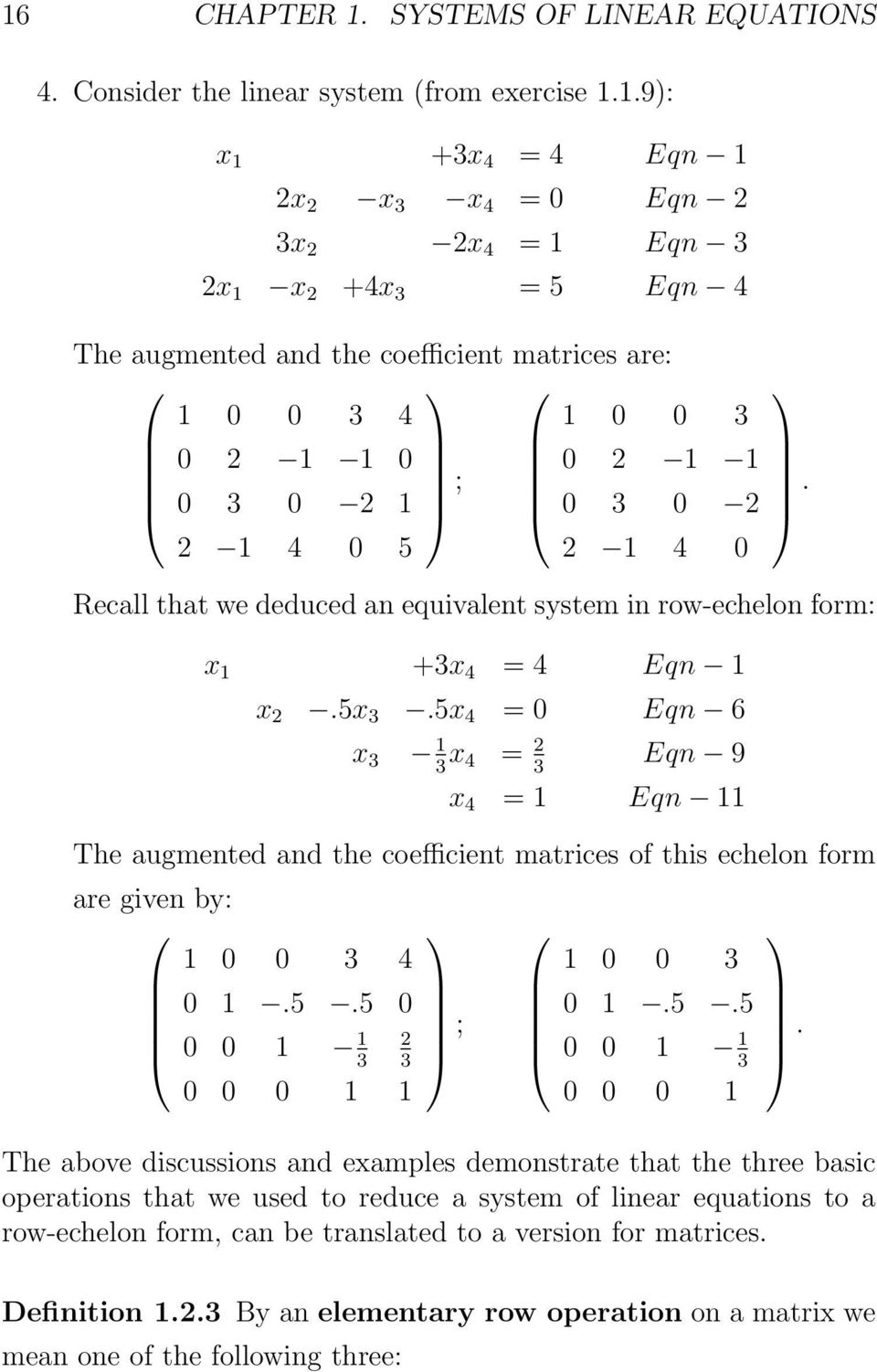
17 1.2. GAUSSIAN, GAUSS-JORDAN ELIMINATION Interchange two rows. 2. Multiply a row by a nonzero constant. 3. Add a multiple of a row to another row. Two matrices are said to be row-equivalent if one can be obtained from another by application of a sequence of elementary row operations. Two row-equivalent matrices, correspond to two equivalent system of equations. Now we define the matrix version of row-echelon form: Definition A matrix is said to be in row-echelon form, if it has the following properties: 1. All rows conssiting entierly of zeros occur at the bottom of the matrix. 2. For each non-zero row, first nonzero entry is 1 (called the leading 1). 3. For each successive nonzero rows, the leading 1 in the higher row is farther to the left than the leading 1 in the lower row. A matrix in row-echelon form is said to be in reduced row-echelon form, if every column that has a leading 1 has zeros in evey position above and below the leading 1. Theorem A matrix is row-equivalent to a matrix is row-echelon form. We gave (see below definition above) the augmented matrix of the system in exercise and that of the equivalent system in rowechelon form.

18 18 CHAPTER 1. SYSTEMS OF LINEAR EQUATIONS Read [Textbook, Example 4, p 16] for examples of matrices in row echelon form. Definition The method Gaussian elimination with becksubstitution of solving a system os equation is described as follows: 1. Write the augmented matrix of the system. 2. Use the elemetary row operations tto reduce the augmented matrix to a matrix in row-echelon form. 3. Write the linear system corresponding to the row-echeclon matrix and solve by back-substitution. Exercise (Ex 1.1.9se GEBS) We will use the method of Gaussian elimination with beck-substitution to solve exercise 1.1.9, using analogous steps. Recall the system: x 1 +3x 4 = 4 Eqn 1 2x 2 x 3 x 4 = 0 Eqn 2 3x 2 2x 4 = 1 Eqn 3 2x 1 x 2 +4x 3 = 5 Eqn 4 The augmented matrix is: Subtract 2 times row-1 from row-4:

19 1.2. GAUSSIAN, GAUSS-JORDAN ELIMINATION 19 Multiply row-2 by.5: Subtract 3 times row-2 from row-3 and add row-2 to Eqn-4: Myltiply row-3 by 2: Subtract 3.5 times row-3 from row-4: Multiply row-4 by 3 :

20 20 CHAPTER 1. SYSTEMS OF LINEAR EQUATIONS The above is a matrix in row-echelon form row-equivalent to the augmented matrix. Now the system of linear equations corresponding this row-echelon matrix is By back-substitution: x 1 +3x 4 = 4 x 2.5x 3.5x 4 = 0 x 3 1x 3 4 = 2 3 x 4 = 1 x 4 = 1, x 3 = = 1, x 2 = 1, x 1 = 1. Read [Textbook, Example 5, 6, p 19-] for other such use of this method. Definition A matrix in row-echelon form is said to be in Gauss- Jordan form, if all the entries above leading entries are zero. The method of Gaussian elimination with back substitution to solve system of linear equations can be refined by first further reducing the augmented matrix to a Gauss-Jordan form and work with the sytem corresponding to it. This method is called Gauss-Jordan elimination method of solving linear sytems. Consider exercise 1.2.7, the matrix in the row-echelon form, equivalent to the augmented matrix, is
![5x 4 = 0 x 3 1x 3 4 = 2 3 x 4 = 1 x 4 = 1, x 3 = 2 3 + 1 3 = 1, x 2 = 1, x 1 = 1. Read [Textbook, Example 5, 6, p 19-] for other such use of this method. Definition 1.2.8 A matrix in row-echelon form is said to be in Gauss- Jordan form, if all the entries above leading entries are zero.](/docs-images/48/19764277/images/page_20.jpg "The method of Gaussian elimination with back substitution to solve system of linear equations can be refined by first further reducing the augmented matrix to a Gauss-Jordan form and work with the")
21 1.2. GAUSSIAN, GAUSS-JORDAN ELIMINATION 21 All the entries above the leading 1 in row 2 is zero. So, we try to achieve the same above the leading 1 in row 3. Add.5 times row 3 to row 2: Now we want to get zeros above the leading 1 in row 4. Subtract 3 times the row 4 from row 1; add 2 times the row 4 from row 2; add times the row 4 from row 3: This matrix is in Gauss-Jordan form. The system of linear equation corresponding to this one is: x 1 = 1 So, the solution to the system is: x 2 = 1 x 3 = 1 x 4 = 1 x 4 = 1, x 3 = 1, x 2 = 1, x 1 = 1. Read [Textbook, Example 7, 8 p 22-23] for more on Gauss-Jordan elimination. Remark. If you feel comfortable working with matrices, it is best to reduce a system to Gauss-Jordan, instead of only to row-echelon form.
22 22 CHAPTER 1. SYSTEMS OF LINEAR EQUATIONS Exercise (Ex. 30, p 26) Solve the following using Gaussian elemination or Gauss-Jordan elemination: 2x 1 x 2 +3x 3 = 24 Eqn 1 2x 2 x 3 = 14 Eqn 2 7x 1 5x 2 = 6 Eqn 3 The augmented matrix is Divide first row by 2 and divide second row by 2: Subtract 7 times first row from third row: Add 3 2 times second row to the third row: Multiply third row by 4 :
23 1.2. GAUSSIAN, GAUSS-JORDAN ELIMINATION 23 The above matrix is in row-echelon form. So, we can use back substitution and solve the system. The system corresponding to this matrix is: By back-substitution: x x x 3 = 12 x x 3 = 7 x 3 = 6 x 3 = 6, x 2 = = 10, x 1 = = 8. 2 Alternately, we could reduce the row-echelon matrix to a Gauss-Jordan form. We will do this. To do this add 1 2 second row to the first: Subtract 1.25 times third rwo from the first: Now add.5 time the third row to the second: time the
24 24 CHAPTER 1. SYSTEMS OF LINEAR EQUATIONS This matrix is in Gauss-Jordan form. The system of liner equations corresponding to this matrix is: x 1 = 8 x 2 = 10 x 3 = 6 This gives the solution of our system. Exercise (Ex. 32, p 26) Solve the following using Gaussian elemination or Gauss-Jordan elemination: The augmented matrix is 2x 1 +3x 3 = 3 Eqn 1 4x 1 3x 2 +7x 3 = 5 Eqn 2 8x 1 9x 2 15x 3 = 10 Eqn We will reduce this matrix to row-echelon form. Subtract 2 times first row from second row and subtract 4times first row from 3rd row: Subtract 3 times the second row from third:
25 1.2. GAUSSIAN, GAUSS-JORDAN ELIMINATION 25 Divide first row by 2 and second row by -3: The matrix is in rwo-echelon form. The sytem corresponding to thsi equation is: x x 3 = 3 2 x 2 1x 3 3 = = 1 The last equation is absurd. So, the sytem is inconsistent. Exercise (Ex. 34, p 26) Solve the following using Gaussian elemination or Gauss-Jordan elemination: x +2y +z = 8 3x 6y 3z = 21 The augmented matrix is ( ) Add 3 times first row to the second row: ( The above matrix is in row-echelon form. The corresponding system of linear equations is ) x +2y +z = 8 0 = 3 The last equation is absurd. So, the system is inconsistent.
26 26 CHAPTER 1. SYSTEMS OF LINEAR EQUATIONS Exercise (Ex. 44, p26) Solve the homogeneous linear system corresponding to the coefficient matrix: ( ) Since it is a homogeneous sytems have all the constants zero and they system is: x 1 = 0 x 2 +x 3 = 0 The system is already in row-echelon form. So, by back substitution: x 2 = x 3, x 1 = 0. With x 3 = t a paramentric solution is x 1 = 0, x 2 = t, x 3 = t. Note that this is a four variable problem and unknowns are x 1, x 2, x 3, x 4. The variable x 4 does not appear in these equations. So for any x 4 = s for any s, for each solutions above. So, final parametric solution is x 1 = 0, x 2 = t, x 3 = t, x 4 = s where s, t are paramenters. Exercise (Ex. 50, p27) Consider the system of linear equations. x +y = 0 Eqn 1 y +z = 0 Eqn 2 x +z = 0 Eqn 3 ax +by +cz = 0 Eqn 4 Find the values of a, b, c such that the system has (a) a unique solution, (b) no solution (c) an infinite number of solution.
27 1.2. GAUSSIAN, GAUSS-JORDAN ELIMINATION 27 Solution: The augmented matrix of the equation: a b c 0 Subtract 1 times first row from third and a times first row from fourth: b a c 0 Add second row to third: b a c 0 Divide third row by 2: b a c 0 Add (a b) second row to fourth: c + a b 0
28 28 CHAPTER 1. SYSTEMS OF LINEAR EQUATIONS Subtract c + a b times third row from fourth: i The matrix is in row-echelon form. The corresponding liner system is: x +y = 0 y +z = 0 z = 0 0 = 0 The system is consistent for all values of a, b, c, and by back substitution the sytem has unique solution x = y = z = 0.
29 1.3. APPLICATION OF LINEAR SYSTEMS Application of Linear systems Homework: [Textbook, Ex. 1, 4, 13, 21, 23; page 38-] As the section heading suggests, we do a few applications of linear systems. We do the following applications: 1. Fitting polynimials, 2. Network anlysis, 3. Kirchoff s Laws for electrical networks
30 30 CHAPTER 1. SYSTEMS OF LINEAR EQUATIONS System of linear equations is much easier to handle than nonlinear systems. (I do not mean for this class only, I mean for expert mathematicians and scientists.) In fact, it is really very difficult to handle nonlinear systems. That is why, there is a wide range of applications of linear systems Polynomial curve fitting Recall two facts (1) there is exactly one line y = c + mx that passes through two given points; (2) there is exactly one parabola y = ax 2 + bx+c that passes through three given points (barring some exceptions). These facts generalizes to n number of points in the plane and polynomials p(x) of degree n 1, so that these points will pass through the graph of y = p(x). We describle it as follows. Suppose a collection of data is represented by n points: (x 1, y 1 ), (x 2, y 2 ),..., (x n, y n ). If the x coordinates x 1, x 2,..., x n are distinct, then there is a UNIQUE polynomial p(x) = a 0 + a 1 x 1 + a 2 x a n 1 x n 1 of degree n 1 (or less) so that the graph of y = p(x) passes through these points. Given n such points, to determine p(x) we need to find the coefficents a 0, a 1,..., a n 1. Since the points (x i, y i ) pass through the graph of y = p(x), we have y i = p(x i ). More explicitly, a 0 +a 1 x 1 +a 2 x a n 1 x n 1 1 = y 1 a 0 +a 1 x 2 +a 2 x a n 1 x n 1 2 = y 2 a 0 +a 1 x 3 +a 2 x a n 1 x n 1 3 = y 3 a 0 +a 1 x n +a 2 x 2 n + +a n 1 x n 1 n = y n This is a linear system of n equations, with n unknowns (variables) a 0, a 1, a 2,..., a n 1. It is known that, under our condition that x 1, x 2,..., x n are distinct, the system has a unique solution.
31 1.3. APPLICATION OF LINEAR SYSTEMS 31 The augmented matrix of this linear system is: and the coefficients matrix is 1 x 1 x 2 1 x n 1 1 y 1 1 x 2 x 2 2 x n 1 2 y 2 1 x 3 x 2 3 x n 1 3 y 3 1 x n x 2 n x n 1 n 1 x 1 x 2 1 x n x 2 x 2 2 x n x 3 x 2 3 x n x n x 2 n x n 1 n y n. The coefficients matrix is called Vandermonde-matrix in x 1, x 2,..., x n. Read [Textbook, Example 1-4, p 29-32]. Exercise (Ex. 3, p 38-Changed) Determine the polynomial function (of degree 2) that passes through the points (2, 4), (3, 6), (4, 10). Let p(x) = a + bx + cx 2. Since these points pass through the graph of y = p(x) = a + bx + cx 2, we have a +b2 +c2 2 = 4 a +b3 +c3 2 = 6 a +b4 +c4 2 = 10 or a +2b +4c = 4 a +3b +9c = 6 a +4b +16c = 10 The augmented matrix of this system is:
32 32 CHAPTER 1. SYSTEMS OF LINEAR EQUATIONS Now we reduce the matrix to the row-echelon form. To do this subtract row-1 from row-2 and row-3: Now, subtract 2 times row-2 from row-3: Divide the last row by 2: The matrix is in row-echelon form. They linear system corresponding to this matrix is: a +2b +4c = 4 b +5c = 2 c = 1. By back substitution c = 1, b = 2 5 = 3, a = = 6 So p(x) = a + bx + cx 2 = 6 3x + x 2. Use your TI to graph it. Exercise (Ex. 13, p 38-Changed) Some US census population data is given in the following table. Y ear population y Here population is given in millions.
33 1.3. APPLICATION OF LINEAR SYSTEMS Fit a second degree polynomial passing through these points. 2. Use it to predict popolation in year 2010 abd Solution: Let t be the variable time and set t = 0 for the year The table reduces to t y Let p(t) = a + bt + ct 2 be the polynomial that fits this data. Since the data points pass through the graph of y = p(t) = a + bt + ct 2, we have a +b0 +c0 2 = 227 a +b10 +c10 2 = 249 a +b20 +c20 2 = 281 or a = 227 a +10b +100c = 249 a +20b +400c = 281 The augmented matrix is Now use TI-84 (or you can hand reduce) to reduce the matrix to Gauss- Jordan form: So, a = 227, b = 1.7, c = 0.05 and y = p(t) = t +.05t 2. This answers part (1). For part (2), for year 2010, wehave t = 30 and prediceted population is p(30) = = 323 mi.
34 34 CHAPTER 1. SYSTEMS OF LINEAR EQUATIONS Similarly, for year 2020, wehave t = 40 and prediceted population is p(30) = = 375 mi Network Analysis A network consists of junctions and branches. Following is an example of netwrok: y x Z 13 z (It is a connected diagram, which I could not draw. Look at [Textbook, p 33].) Such network systems are used to model diverse situations, including in economics, traffic, telephone signal and electrical engineering. Such models assumes, the total flow into a junction is equal to total flow out of the junction. Accordingly, above network is represented by x = y z. Read [Textbook, Example 5-7, p 33-]. Exercise (Ex. 22, p 39) The flow of traffic (in vehicles per hour) through a network of streets is shown in the following figure: 300 x 1 A x 2 Y 200 x 3 x B Z x Solve this system for x 1, x 2, x 3, x 4, x Find the traffic flow when x 2 = 200 and x 3 = 50.
35 1.3. APPLICATION OF LINEAR SYSTEMS Find the traffic flow when x 2 = 150 and x 3 = 0. Solution: From junction A, we get x 1 + x 2 = 300 From junction B, we get x 1 + x 3 = x 4 OR x 1 + x 3 x 4 = 150 From junction Y, we get x = x 3 + x 5 OR x 2 x 3 x 5 = 200 From junction Z, we get x 4 + x 5 = 350. We will write the system in a better way: x 1 +x 2 = 300 x 1 +x 3 x 4 = 150 x 2 x 3 x 5 = 200 x 4 +x 5 = 350 To solve thsi linear system, we write the augmented matrix: We will reduce this matrix to row-echelon form. Subtract row 1 from row 2:
36 36 CHAPTER 1. SYSTEMS OF LINEAR EQUATIONS Add second row to third: Add third roe to fourth: Multiply second row by -1 and third row by -1: The matrix is in row-echelon form. The corresponding linear system is given by: x 1 +x 2 = 300 x 2 x 3 +x 4 = 150 x 4 +x 5 = = 0 Parametrically, with x 2 = t, x 3 = s, we have x 1 = 300 t, x 2 = t, x 3 = s, x 4 = 150 t+s, x 5 = 350 x 4 = 150+t s. This answers (1). For (2) t = X 2 = 200, s = x 3 = 50. So, x 1 = 100, x 2 = 200, x 3 = 50, x 4 = 0, x 5 = 300. For (3) t = X 2 = 150, s = x 3 = 0. So, x 1 = 150, x 2 = 150, x 3 = 0, x 4 = 0, x 5 = 350.
37 1.3. APPLICATION OF LINEAR SYSTEMS Kirchhoff s Laws Similarly, system of Linear equations is also applicable in electrical network. Analysis of electrical network is guided by two properties known as Kirchhoff s Laws: 1. All the current flowing into a junction must flow out of it. 2. The sum of the products IR (I is current and R is resistance) around a closed path is equal to the total voltage. A battery is denoted by or and the resistance is denoted by. Exercise (Ex. 25, p 40) Consider the electrical circuit. 3 I 1 v R 1 =4 I 2 J 1 J R 2 =3 2 I3 4 v R 3 =1 (The circuit should be connected, I could not draw a better one. See, [Textbook, Ex. 25, p 40] for the actual circuit.) Use Kirchhoff-Law to determine I 1, I 2, I 3. Solution: Apply (1) of Kirchhoff-Law to junction J 1, we have I 1 +I 3 = I 2 Eqn 1 Applying the same to J 2 wil give the same equation. So, we will not write it.
38 38 CHAPTER 1. SYSTEMS OF LINEAR EQUATIONS Now apply (2) of Kirchhoff-Law R 1 I 1 +R 2 I 2 = 3 R 2 I 2 +R 3 I 3 = 1 OR 4I 1 +3I 2 = 3 Eqn 2 3I 2 +I 3 = 1 Eqn 3 The the network system is given by The augmented matrix is: I 1 I 2 +I 3 = 0 Eqn 1 4I 1 +3I 2 = 3 Eqn 2 3I 2 +I 3 = 1 Eqn Now, we reduce this matrix to row-echelon form. To dothis, first subtract 4 time first reo from second: Divide row two by 7: Subtract 3 times rwo two from row three:
39 1.3. APPLICATION OF LINEAR SYSTEMS 39 Divide row three by 19 7 : Now, we further reduce it to Gauss-Jordan form. To do this, add second row to first: Now subtract times third row from first: Now, add 4 7 time third roe to second: The corresponding linear system s given by, I 1 = 9 19 I 2 = 7 19 I 3 = 2 19
Linear Equations ! 25 30 35$ & " 350 150% & " 11,750 12,750 13,750% MATHEMATICS LEARNING SERVICE Centre for Learning and Professional Development
 MathsTrack (NOTE Feb 2013: This is the old version of MathsTrack. New books will be created during 2013 and 2014) Topic 4 Module 9 Introduction Systems of to Matrices Linear Equations Income = Tickets!
Section 8.2 Solving a System of Equations Using Matrices (Guassian Elimination)
 Section 8. Solving a System of Equations Using Matrices (Guassian Elimination) x + y + z = x y + 4z = x 4y + z = System of Equations x 4 y = 4 z A System in matrix form x A x = b b 4 4 Augmented Matrix
1.2 Solving a System of Linear Equations
 1.. SOLVING A SYSTEM OF LINEAR EQUATIONS 1. Solving a System of Linear Equations 1..1 Simple Systems - Basic De nitions As noticed above, the general form of a linear system of m equations in n variables
Solving Systems of Linear Equations
 LECTURE 5 Solving Systems of Linear Equations Recall that we introduced the notion of matrices as a way of standardizing the expression of systems of linear equations In today s lecture I shall show how
a 11 x 1 + a 12 x 2 + + a 1n x n = b 1 a 21 x 1 + a 22 x 2 + + a 2n x n = b 2.
 Chapter 1 LINEAR EQUATIONS 1.1 Introduction to linear equations A linear equation in n unknowns x 1, x,, x n is an equation of the form a 1 x 1 + a x + + a n x n = b, where a 1, a,..., a n, b are given
Reduced echelon form: Add the following conditions to conditions 1, 2, and 3 above:
 Section 1.2: Row Reduction and Echelon Forms Echelon form (or row echelon form): 1. All nonzero rows are above any rows of all zeros. 2. Each leading entry (i.e. left most nonzero entry) of a row is in
Arithmetic and Algebra of Matrices
 Arithmetic and Algebra of Matrices Math 572: Algebra for Middle School Teachers The University of Montana 1 The Real Numbers 2 Classroom Connection: Systems of Linear Equations 3 Rational Numbers 4 Irrational
Solving Systems of Linear Equations Using Matrices
 Solving Systems of Linear Equations Using Matrices What is a Matrix? A matrix is a compact grid or array of numbers. It can be created from a system of equations and used to solve the system of equations.
Systems of Linear Equations
 Systems of Linear Equations Beifang Chen Systems of linear equations Linear systems A linear equation in variables x, x,, x n is an equation of the form a x + a x + + a n x n = b, where a, a,, a n and
Row Echelon Form and Reduced Row Echelon Form
 These notes closely follow the presentation of the material given in David C Lay s textbook Linear Algebra and its Applications (3rd edition) These notes are intended primarily for in-class presentation
MATRIX ALGEBRA AND SYSTEMS OF EQUATIONS. + + x 2. x n. a 11 a 12 a 1n b 1 a 21 a 22 a 2n b 2 a 31 a 32 a 3n b 3. a m1 a m2 a mn b m
 MATRIX ALGEBRA AND SYSTEMS OF EQUATIONS 1. SYSTEMS OF EQUATIONS AND MATRICES 1.1. Representation of a linear system. The general system of m equations in n unknowns can be written a 11 x 1 + a 12 x 2 +
MATRIX ALGEBRA AND SYSTEMS OF EQUATIONS
 MATRIX ALGEBRA AND SYSTEMS OF EQUATIONS Systems of Equations and Matrices Representation of a linear system The general system of m equations in n unknowns can be written a x + a 2 x 2 + + a n x n b a
MATH10212 Linear Algebra. Systems of Linear Equations. Definition. An n-dimensional vector is a row or a column of n numbers (or letters): a 1.
 MATH10212 Linear Algebra Textbook: D. Poole, Linear Algebra: A Modern Introduction. Thompson, 2006. ISBN 0-534-40596-7. Systems of Linear Equations Definition. An n-dimensional vector is a row or a column
December 4, 2013 MATH 171 BASIC LINEAR ALGEBRA B. KITCHENS
 December 4, 2013 MATH 171 BASIC LINEAR ALGEBRA B KITCHENS The equation 1 Lines in two-dimensional space (1) 2x y = 3 describes a line in two-dimensional space The coefficients of x and y in the equation
Solving Linear Systems, Continued and The Inverse of a Matrix
 , Continued and The of a Matrix Calculus III Summer 2013, Session II Monday, July 15, 2013 Agenda 1. The rank of a matrix 2. The inverse of a square matrix Gaussian Gaussian solves a linear system by reducing
2x + y = 3. Since the second equation is precisely the same as the first equation, it is enough to find x and y satisfying the system
 1. Systems of linear equations We are interested in the solutions to systems of linear equations. A linear equation is of the form 3x 5y + 2z + w = 3. The key thing is that we don t multiply the variables
MATH2210 Notebook 1 Fall Semester 2016/2017. 1 MATH2210 Notebook 1 3. 1.1 Solving Systems of Linear Equations... 3
 MATH0 Notebook Fall Semester 06/07 prepared by Professor Jenny Baglivo c Copyright 009 07 by Jenny A. Baglivo. All Rights Reserved. Contents MATH0 Notebook 3. Solving Systems of Linear Equations........................
Lecture 1: Systems of Linear Equations
 MTH Elementary Matrix Algebra Professor Chao Huang Department of Mathematics and Statistics Wright State University Lecture 1 Systems of Linear Equations ² Systems of two linear equations with two variables
5.5. Solving linear systems by the elimination method
 55 Solving linear systems by the elimination method Equivalent systems The major technique of solving systems of equations is changing the original problem into another one which is of an easier to solve
SYSTEMS OF EQUATIONS AND MATRICES WITH THE TI-89. by Joseph Collison
 SYSTEMS OF EQUATIONS AND MATRICES WITH THE TI-89 by Joseph Collison Copyright 2000 by Joseph Collison All rights reserved Reproduction or translation of any part of this work beyond that permitted by Sections
5 Homogeneous systems
 5 Homogeneous systems Definition: A homogeneous (ho-mo-jeen -i-us) system of linear algebraic equations is one in which all the numbers on the right hand side are equal to : a x +... + a n x n =.. a m
Name: Section Registered In:
 Name: Section Registered In: Math 125 Exam 3 Version 1 April 24, 2006 60 total points possible 1. (5pts) Use Cramer s Rule to solve 3x + 4y = 30 x 2y = 8. Be sure to show enough detail that shows you are
Solutions to Math 51 First Exam January 29, 2015
 Solutions to Math 5 First Exam January 29, 25. ( points) (a) Complete the following sentence: A set of vectors {v,..., v k } is defined to be linearly dependent if (2 points) there exist c,... c k R, not
LAB 11: MATRICES, SYSTEMS OF EQUATIONS and POLYNOMIAL MODELING
 LAB 11: MATRICS, SYSTMS OF QUATIONS and POLYNOMIAL MODLING Objectives: 1. Solve systems of linear equations using augmented matrices. 2. Solve systems of linear equations using matrix equations and inverse
1 Determinants and the Solvability of Linear Systems
 1 Determinants and the Solvability of Linear Systems In the last section we learned how to use Gaussian elimination to solve linear systems of n equations in n unknowns The section completely side-stepped
Solving Systems of Linear Equations
 LECTURE 5 Solving Systems of Linear Equations Recall that we introduced the notion of matrices as a way of standardizing the expression of systems of linear equations In today s lecture I shall show how
Methods for Finding Bases
 Methods for Finding Bases Bases for the subspaces of a matrix Row-reduction methods can be used to find bases. Let us now look at an example illustrating how to obtain bases for the row space, null space,
II. Linear Systems of Equations
 II. Linear Systems of Equations II. The Definition We are shortly going to develop a systematic procedure which is guaranteed to find every solution to every system of linear equations. The fact that such
Notes on Determinant
 ENGG2012B Advanced Engineering Mathematics Notes on Determinant Lecturer: Kenneth Shum Lecture 9-18/02/2013 The determinant of a system of linear equations determines whether the solution is unique, without
4.3-4.4 Systems of Equations
 4.3-4.4 Systems of Equations A linear equation in 2 variables is an equation of the form ax + by = c. A linear equation in 3 variables is an equation of the form ax + by + cz = d. To solve a system of
2.2/2.3 - Solving Systems of Linear Equations
 c Kathryn Bollinger, August 28, 2011 1 2.2/2.3 - Solving Systems of Linear Equations A Brief Introduction to Matrices Matrices are used to organize data efficiently and will help us to solve systems of
Lecture notes on linear algebra
 Lecture notes on linear algebra David Lerner Department of Mathematics University of Kansas These are notes of a course given in Fall, 2007 and 2008 to the Honors sections of our elementary linear algebra
3.1. Solving linear equations. Introduction. Prerequisites. Learning Outcomes. Learning Style
 Solving linear equations 3.1 Introduction Many problems in engineering reduce to the solution of an equation or a set of equations. An equation is a type of mathematical expression which contains one or
Lecture Notes 2: Matrices as Systems of Linear Equations
 2: Matrices as Systems of Linear Equations 33A Linear Algebra, Puck Rombach Last updated: April 13, 2016 Systems of Linear Equations Systems of linear equations can represent many things You have probably
Some Lecture Notes and In-Class Examples for Pre-Calculus:
 Some Lecture Notes and In-Class Examples for Pre-Calculus: Section.7 Definition of a Quadratic Inequality A quadratic inequality is any inequality that can be put in one of the forms ax + bx + c < 0 ax
Homogeneous systems of algebraic equations. A homogeneous (ho-mo-geen -ius) system of linear algebraic equations is one in which
 Homogeneous systems of algebraic equations A homogeneous (ho-mo-geen -ius) system of linear algebraic equations is one in which all the numbers on the right hand side are equal to : a x + + a n x n = a
1.5 SOLUTION SETS OF LINEAR SYSTEMS
 1-2 CHAPTER 1 Linear Equations in Linear Algebra 1.5 SOLUTION SETS OF LINEAR SYSTEMS Many of the concepts and computations in linear algebra involve sets of vectors which are visualized geometrically as
Section 1.1 Linear Equations: Slope and Equations of Lines
 Section. Linear Equations: Slope and Equations of Lines Slope The measure of the steepness of a line is called the slope of the line. It is the amount of change in y, the rise, divided by the amount of
10.2 Systems of Linear Equations: Matrices
 SECTION 0.2 Systems of Linear Equations: Matrices 7 0.2 Systems of Linear Equations: Matrices OBJECTIVES Write the Augmente Matrix of a System of Linear Equations 2 Write the System from the Augmente Matrix
Abstract: We describe the beautiful LU factorization of a square matrix (or how to write Gaussian elimination in terms of matrix multiplication).
 MAT 2 (Badger, Spring 202) LU Factorization Selected Notes September 2, 202 Abstract: We describe the beautiful LU factorization of a square matrix (or how to write Gaussian elimination in terms of matrix
Vector Spaces 4.4 Spanning and Independence
 Vector Spaces 4.4 and Independence October 18 Goals Discuss two important basic concepts: Define linear combination of vectors. Define Span(S) of a set S of vectors. Define linear Independence of a set
160 CHAPTER 4. VECTOR SPACES
 160 CHAPTER 4. VECTOR SPACES 4. Rank and Nullity In this section, we look at relationships between the row space, column space, null space of a matrix and its transpose. We will derive fundamental results
Linear Equations in Linear Algebra
 May, 25 :46 l57-ch Sheet number Page number cyan magenta yellow black Linear Equations in Linear Algebra WEB INTRODUCTORY EXAMPLE Linear Models in Economics and Engineering It was late summer in 949. Harvard
10.2 ITERATIVE METHODS FOR SOLVING LINEAR SYSTEMS. The Jacobi Method
 578 CHAPTER 1 NUMERICAL METHODS 1. ITERATIVE METHODS FOR SOLVING LINEAR SYSTEMS As a numerical technique, Gaussian elimination is rather unusual because it is direct. That is, a solution is obtained after
MATH 304 Linear Algebra Lecture 18: Rank and nullity of a matrix.
 MATH 304 Linear Algebra Lecture 18: Rank and nullity of a matrix. Nullspace Let A = (a ij ) be an m n matrix. Definition. The nullspace of the matrix A, denoted N(A), is the set of all n-dimensional column
How To Understand And Solve A Linear Programming Problem
 At the end of the lesson, you should be able to: Chapter 2: Systems of Linear Equations and Matrices: 2.1: Solutions of Linear Systems by the Echelon Method Define linear systems, unique solution, inconsistent,
10.1 Systems of Linear Equations: Substitution and Elimination
 726 CHAPTER 10 Systems of Equations and Inequalities 10.1 Systems of Linear Equations: Sustitution and Elimination PREPARING FOR THIS SECTION Before getting started, review the following: Linear Equations
LS.6 Solution Matrices
 LS.6 Solution Matrices In the literature, solutions to linear systems often are expressed using square matrices rather than vectors. You need to get used to the terminology. As before, we state the definitions
8.2. Solution by Inverse Matrix Method. Introduction. Prerequisites. Learning Outcomes
 Solution by Inverse Matrix Method 8.2 Introduction The power of matrix algebra is seen in the representation of a system of simultaneous linear equations as a matrix equation. Matrix algebra allows us
Math 312 Homework 1 Solutions
 Math 31 Homework 1 Solutions Last modified: July 15, 01 This homework is due on Thursday, July 1th, 01 at 1:10pm Please turn it in during class, or in my mailbox in the main math office (next to 4W1) Please
BookTOC.txt. 1. Functions, Graphs, and Models. Algebra Toolbox. Sets. The Real Numbers. Inequalities and Intervals on the Real Number Line
 College Algebra in Context with Applications for the Managerial, Life, and Social Sciences, 3rd Edition Ronald J. Harshbarger, University of South Carolina - Beaufort Lisa S. Yocco, Georgia Southern University
2.3. Finding polynomial functions. An Introduction:
 2.3. Finding polynomial functions. An Introduction: As is usually the case when learning a new concept in mathematics, the new concept is the reverse of the previous one. Remember how you first learned
1 Review of Least Squares Solutions to Overdetermined Systems
 cs4: introduction to numerical analysis /9/0 Lecture 7: Rectangular Systems and Numerical Integration Instructor: Professor Amos Ron Scribes: Mark Cowlishaw, Nathanael Fillmore Review of Least Squares
Linear Algebra Notes for Marsden and Tromba Vector Calculus
 Linear Algebra Notes for Marsden and Tromba Vector Calculus n-dimensional Euclidean Space and Matrices Definition of n space As was learned in Math b, a point in Euclidean three space can be thought of
Vieta s Formulas and the Identity Theorem
 Vieta s Formulas and the Identity Theorem This worksheet will work through the material from our class on 3/21/2013 with some examples that should help you with the homework The topic of our discussion
These axioms must hold for all vectors ū, v, and w in V and all scalars c and d.
 DEFINITION: A vector space is a nonempty set V of objects, called vectors, on which are defined two operations, called addition and multiplication by scalars (real numbers), subject to the following axioms
1 VECTOR SPACES AND SUBSPACES
 1 VECTOR SPACES AND SUBSPACES What is a vector? Many are familiar with the concept of a vector as: Something which has magnitude and direction. an ordered pair or triple. a description for quantities such
Definition 8.1 Two inequalities are equivalent if they have the same solution set. Add or Subtract the same value on both sides of the inequality.
 8 Inequalities Concepts: Equivalent Inequalities Linear and Nonlinear Inequalities Absolute Value Inequalities (Sections 4.6 and 1.1) 8.1 Equivalent Inequalities Definition 8.1 Two inequalities are equivalent
MAT 200, Midterm Exam Solution. a. (5 points) Compute the determinant of the matrix A =
 MAT 200, Midterm Exam Solution. (0 points total) a. (5 points) Compute the determinant of the matrix 2 2 0 A = 0 3 0 3 0 Answer: det A = 3. The most efficient way is to develop the determinant along the
CURVE FITTING LEAST SQUARES APPROXIMATION
 CURVE FITTING LEAST SQUARES APPROXIMATION Data analysis and curve fitting: Imagine that we are studying a physical system involving two quantities: x and y Also suppose that we expect a linear relationship
Using row reduction to calculate the inverse and the determinant of a square matrix
 Using row reduction to calculate the inverse and the determinant of a square matrix Notes for MATH 0290 Honors by Prof. Anna Vainchtein 1 Inverse of a square matrix An n n square matrix A is called invertible
DERIVATIVES AS MATRICES; CHAIN RULE
 DERIVATIVES AS MATRICES; CHAIN RULE 1. Derivatives of Real-valued Functions Let s first consider functions f : R 2 R. Recall that if the partial derivatives of f exist at the point (x 0, y 0 ), then we
II. Linear Systems of Equations
 II. Linear Systems of Equations II. The Definition We are shortly going to develop a systematic procedure which is guaranteed to find every solution to every system of linear equations. The fact that such
Linearly Independent Sets and Linearly Dependent Sets
 These notes closely follow the presentation of the material given in David C. Lay s textbook Linear Algebra and its Applications (3rd edition). These notes are intended primarily for in-class presentation
Solution of Linear Systems
 Chapter 3 Solution of Linear Systems In this chapter we study algorithms for possibly the most commonly occurring problem in scientific computing, the solution of linear systems of equations. We start
Mathematics Course 111: Algebra I Part IV: Vector Spaces
 Mathematics Course 111: Algebra I Part IV: Vector Spaces D. R. Wilkins Academic Year 1996-7 9 Vector Spaces A vector space over some field K is an algebraic structure consisting of a set V on which are
Brief Introduction to Vectors and Matrices
 CHAPTER 1 Brief Introduction to Vectors and Matrices In this chapter, we will discuss some needed concepts found in introductory course in linear algebra. We will introduce matrix, vector, vector-valued
Direct Methods for Solving Linear Systems. Matrix Factorization
 Direct Methods for Solving Linear Systems Matrix Factorization Numerical Analysis (9th Edition) R L Burden & J D Faires Beamer Presentation Slides prepared by John Carroll Dublin City University c 2011
Lecture 3: Finding integer solutions to systems of linear equations
 Lecture 3: Finding integer solutions to systems of linear equations Algorithmic Number Theory (Fall 2014) Rutgers University Swastik Kopparty Scribe: Abhishek Bhrushundi 1 Overview The goal of this lecture
Chapter 17. Orthogonal Matrices and Symmetries of Space
 Chapter 17. Orthogonal Matrices and Symmetries of Space Take a random matrix, say 1 3 A = 4 5 6, 7 8 9 and compare the lengths of e 1 and Ae 1. The vector e 1 has length 1, while Ae 1 = (1, 4, 7) has length
8.1. Cramer s Rule for Solving Simultaneous Linear Equations. Introduction. Prerequisites. Learning Outcomes. Learning Style
 Cramer s Rule for Solving Simultaneous Linear Equations 8.1 Introduction The need to solve systems of linear equations arises frequently in engineering. The analysis of electric circuits and the control
Math Common Core Sampler Test
 High School Algebra Core Curriculum Math Test Math Common Core Sampler Test Our High School Algebra sampler covers the twenty most common questions that we see targeted for this level. For complete tests
Inner Product Spaces
 Math 571 Inner Product Spaces 1. Preliminaries An inner product space is a vector space V along with a function, called an inner product which associates each pair of vectors u, v with a scalar u, v, and
2.5 Zeros of a Polynomial Functions
 .5 Zeros of a Polynomial Functions Section.5 Notes Page 1 The first rule we will talk about is Descartes Rule of Signs, which can be used to determine the possible times a graph crosses the x-axis and
Matrix Algebra. Some Basic Matrix Laws. Before reading the text or the following notes glance at the following list of basic matrix algebra laws.
 Matrix Algebra A. Doerr Before reading the text or the following notes glance at the following list of basic matrix algebra laws. Some Basic Matrix Laws Assume the orders of the matrices are such that
Zeros of a Polynomial Function
 Zeros of a Polynomial Function An important consequence of the Factor Theorem is that finding the zeros of a polynomial is really the same thing as factoring it into linear factors. In this section we
Vocabulary Words and Definitions for Algebra
 Name: Period: Vocabulary Words and s for Algebra Absolute Value Additive Inverse Algebraic Expression Ascending Order Associative Property Axis of Symmetry Base Binomial Coefficient Combine Like Terms
by the matrix A results in a vector which is a reflection of the given
 Eigenvalues & Eigenvectors Example Suppose Then So, geometrically, multiplying a vector in by the matrix A results in a vector which is a reflection of the given vector about the y-axis We observe that
Equations, Inequalities & Partial Fractions
 Contents Equations, Inequalities & Partial Fractions.1 Solving Linear Equations 2.2 Solving Quadratic Equations 1. Solving Polynomial Equations 1.4 Solving Simultaneous Linear Equations 42.5 Solving Inequalities
Au = = = 3u. Aw = = = 2w. so the action of A on u and w is very easy to picture: it simply amounts to a stretching by 3 and 2, respectively.
 Chapter 7 Eigenvalues and Eigenvectors In this last chapter of our exploration of Linear Algebra we will revisit eigenvalues and eigenvectors of matrices, concepts that were already introduced in Geometry
MATH 304 Linear Algebra Lecture 9: Subspaces of vector spaces (continued). Span. Spanning set.
 MATH 304 Linear Algebra Lecture 9: Subspaces of vector spaces (continued). Span. Spanning set. Vector space A vector space is a set V equipped with two operations, addition V V (x,y) x + y V and scalar
Linear Algebra Notes
 Linear Algebra Notes Chapter 19 KERNEL AND IMAGE OF A MATRIX Take an n m matrix a 11 a 12 a 1m a 21 a 22 a 2m a n1 a n2 a nm and think of it as a function A : R m R n The kernel of A is defined as Note
EQUATIONS and INEQUALITIES
 EQUATIONS and INEQUALITIES Linear Equations and Slope 1. Slope a. Calculate the slope of a line given two points b. Calculate the slope of a line parallel to a given line. c. Calculate the slope of a line
1 Sets and Set Notation.
 LINEAR ALGEBRA MATH 27.6 SPRING 23 (COHEN) LECTURE NOTES Sets and Set Notation. Definition (Naive Definition of a Set). A set is any collection of objects, called the elements of that set. We will most
Section 13.5 Equations of Lines and Planes
 Section 13.5 Equations of Lines and Planes Generalizing Linear Equations One of the main aspects of single variable calculus was approximating graphs of functions by lines - specifically, tangent lines.
Algebra Unpacked Content For the new Common Core standards that will be effective in all North Carolina schools in the 2012-13 school year.
 This document is designed to help North Carolina educators teach the Common Core (Standard Course of Study). NCDPI staff are continually updating and improving these tools to better serve teachers. Algebra
PUTNAM TRAINING POLYNOMIALS. Exercises 1. Find a polynomial with integral coefficients whose zeros include 2 + 5.
 PUTNAM TRAINING POLYNOMIALS (Last updated: November 17, 2015) Remark. This is a list of exercises on polynomials. Miguel A. Lerma Exercises 1. Find a polynomial with integral coefficients whose zeros include
3.3. Solving Polynomial Equations. Introduction. Prerequisites. Learning Outcomes
 Solving Polynomial Equations 3.3 Introduction Linear and quadratic equations, dealt within Sections 3.1 and 3.2, are members of a class of equations, called polynomial equations. These have the general
8 Square matrices continued: Determinants
 8 Square matrices continued: Determinants 8. Introduction Determinants give us important information about square matrices, and, as we ll soon see, are essential for the computation of eigenvalues. You
Similarity and Diagonalization. Similar Matrices
 MATH022 Linear Algebra Brief lecture notes 48 Similarity and Diagonalization Similar Matrices Let A and B be n n matrices. We say that A is similar to B if there is an invertible n n matrix P such that
Algebra 2 Chapter 1 Vocabulary. identity - A statement that equates two equivalent expressions.
 Chapter 1 Vocabulary identity - A statement that equates two equivalent expressions. verbal model- A word equation that represents a real-life problem. algebraic expression - An expression with variables.
( ) which must be a vector
 MATH 37 Linear Transformations from Rn to Rm Dr. Neal, WKU Let T : R n R m be a function which maps vectors from R n to R m. Then T is called a linear transformation if the following two properties are
6.1 Add & Subtract Polynomial Expression & Functions
 6.1 Add & Subtract Polynomial Expression & Functions Objectives 1. Know the meaning of the words term, monomial, binomial, trinomial, polynomial, degree, coefficient, like terms, polynomial funciton, quardrtic
LINEAR EQUATIONS IN TWO VARIABLES
 66 MATHEMATICS CHAPTER 4 LINEAR EQUATIONS IN TWO VARIABLES The principal use of the Analytic Art is to bring Mathematical Problems to Equations and to exhibit those Equations in the most simple terms that
Linear Equations in Linear Algebra
 1 Linear Equations in Linear Algebra 1.5 SOLUTION SETS OF LINEAR SYSTEMS HOMOGENEOUS LINEAR SYSTEMS A system of linear equations is said to be homogeneous if it can be written in the form A 0, where A
Prerequisites: TSI Math Complete and high school Algebra II and geometry or MATH 0303.
 Course Syllabus Math 1314 College Algebra Revision Date: 8-21-15 Catalog Description: In-depth study and applications of polynomial, rational, radical, exponential and logarithmic functions, and systems
Chapter 6. Linear Transformation. 6.1 Intro. to Linear Transformation
 Chapter 6 Linear Transformation 6 Intro to Linear Transformation Homework: Textbook, 6 Ex, 5, 9,, 5,, 7, 9,5, 55, 57, 6(a,b), 6; page 7- In this section, we discuss linear transformations 89 9 CHAPTER
Question 2: How do you solve a matrix equation using the matrix inverse?
 Question : How do you solve a matrix equation using the matrix inverse? In the previous question, we wrote systems of equations as a matrix equation AX B. In this format, the matrix A contains the coefficients
MATH 551 - APPLIED MATRIX THEORY
 MATH 55 - APPLIED MATRIX THEORY FINAL TEST: SAMPLE with SOLUTIONS (25 points NAME: PROBLEM (3 points A web of 5 pages is described by a directed graph whose matrix is given by A Do the following ( points
PYTHAGOREAN TRIPLES KEITH CONRAD
 PYTHAGOREAN TRIPLES KEITH CONRAD 1. Introduction A Pythagorean triple is a triple of positive integers (a, b, c) where a + b = c. Examples include (3, 4, 5), (5, 1, 13), and (8, 15, 17). Below is an ancient