
Solving Systems of Linear Equations Using Matrices
|
|
|
- Harriet McCormick
- 9 years ago
- Views:
Transcription
1 Solving Systems of Linear Equations Using Matrices What is a Matrix? A matrix is a compact grid or array of numbers. It can be created from a system of equations and used to solve the system of equations. Matrices have many applications in science, engineering, and math courses. This handout will focus on how to solve a system of linear equations using matrices. How to Solve a System of Equations Using Matrices Matrices are useful for solving systems of equations. There are two main methods of solving systems of equations: Gaussian elimination and Gauss-Jordan elimination. Both processes begin the same way. To begin solving a system of equations with either method, the equations are first changed into a matrix. The coefficient matrix is a matrix comprised of the coefficients of the variables which is written such that each row represents one equation and each column contains the coefficients for the same variable in each equation. The constant matrix is the solution to each of the equations written in a single column and in the same order as the rows of the coefficient matrix. The augmented matrix is the coefficient matrix with the constant matrix as the last column. Example: Write the coefficient matrix, constant matrix, and augmented matrix for the following system of equations: 3x y + 4z = 9 3y z = 5 4x 3y + z = 7 Solution: The coefficient matrix is created by taking the coefficients of each variable and entering them into each row. The first equation will be the first row; the second equation will be the second row, and the third equation will be the third row. Also, the first column will represent the x variable; the second column will represent the y variable, and the third column will represent the z variable. 3 4 [ 0 3 ] 4 3 Provided by Tutoring Services 1 Solving Systems of Linear Equations Using Matrices Summer 014

2 Because the second equation does not contain an x variable, a 0 has been entered into the x column in the second row. The constant matrix is a single column matrix consisting of the solutions to the equations. 9 [ 5] 7 To create the augmented matrix, add the constant matrix as the last column of the coefficient matrix [ 0 3 5] For the Gaussian elimination method, once the augmented matrix has been created, use elementary row operations to reduce the matrix to Row-Echelon form. There are three basic types of elementary row operations: (1) row swapping, () row multiplication, and (3) row addition. Row multiplication and row addition can be combined together. (1) In row swapping, the rows exchange positions within the matrix. The matrix resulting from a row operation or sequence of row operations is called row equivalent to the original matrix. Example: Swap row one and row three Solution: [ [ 0 3 5] ] R 1 R 3 () In row multiplication, every entry in a row is multiplied by the same constant. Example: Multiply row one by 1 3 Solution: [ /3 4/3 3 [ 0 3 5] ] 1 3 R 1 Provided by Tutoring Services Solving Systems of Linear Equations Using Matrices Summer 014
![9 [ 5] 7 To create the augmented matrix, add the constant matrix as the last column of the coefficient matrix.](/docs-images/44/20856722/images/page_2.jpg "3 4 9 [ 0 3 5] 4 3 7 For the Gaussian elimination method, once the augmented matrix has been created, use elementary row operations to reduce the matrix to Row-Echelon form.")
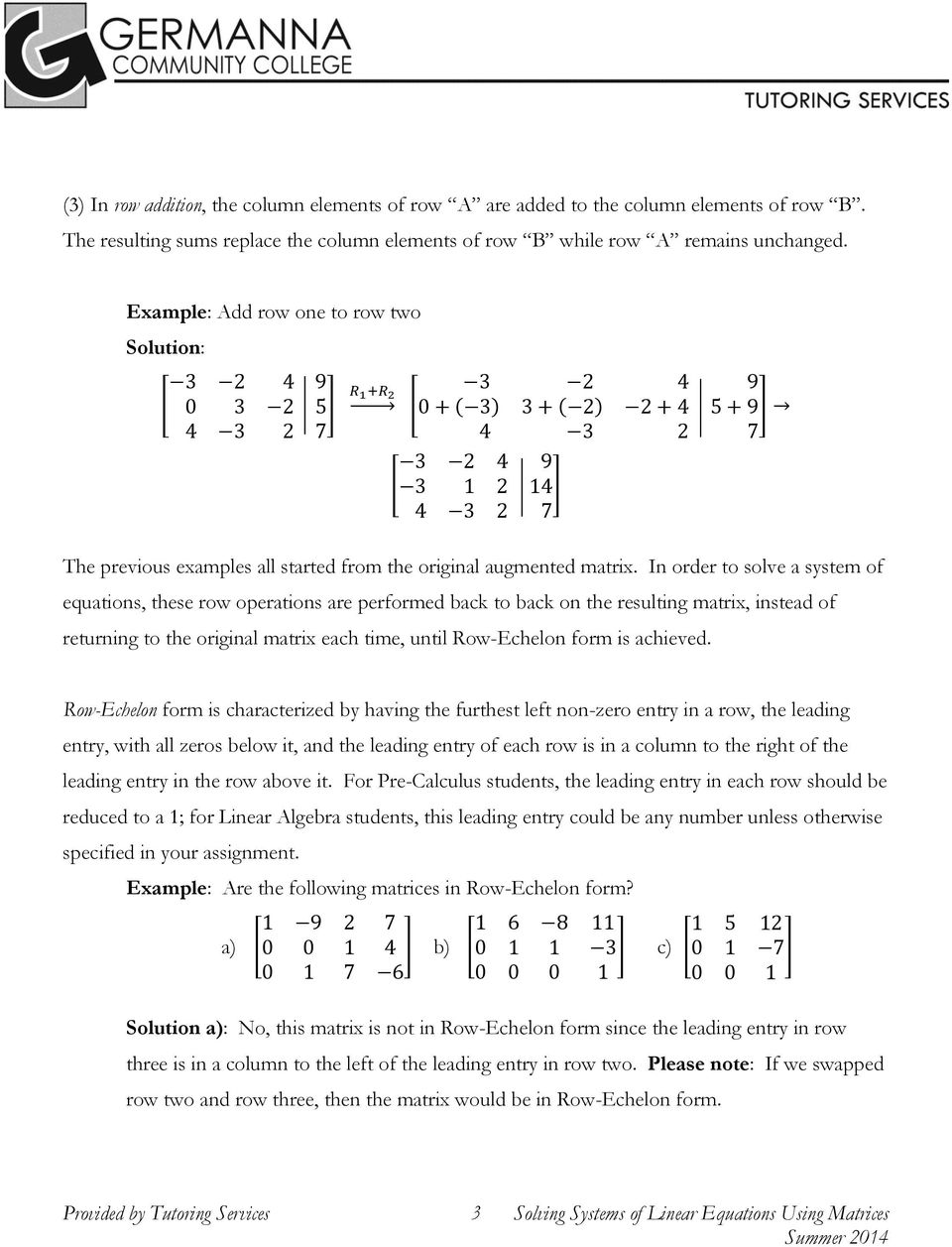
3 (3) In row addition, the column elements of row A are added to the column elements of row B. The resulting sums replace the column elements of row B while row A remains unchanged. Example: Add row one to row two Solution: [ [ 0 + ( 3) 3 + ( ) ] [ ] ] R 1+R The previous examples all started from the original augmented matrix. In order to solve a system of equations, these row operations are performed back to back on the resulting matrix, instead of returning to the original matrix each time, until Row-Echelon form is achieved. Row-Echelon form is characterized by having the furthest left non-zero entry in a row, the leading entry, with all zeros below it, and the leading entry of each row is in a column to the right of the leading entry in the row above it. For Pre-Calculus students, the leading entry in each row should be reduced to a 1; for Linear Algebra students, this leading entry could be any number unless otherwise specified in your assignment. Example: Are the following matrices in Row-Echelon form? a) [ ] b) [ ] c) [ 0 1 7] Solution a): No, this matrix is not in Row-Echelon form since the leading entry in row three is in a column to the left of the leading entry in row two. Please note: If we swapped row two and row three, then the matrix would be in Row-Echelon form. Provided by Tutoring Services 3 Solving Systems of Linear Equations Using Matrices Summer 014
4 Solution b): Yes, this matrix is in Row-Echelon form as the leading entry in each row has 0 s below, and the leading entry in each row is to the right of the leading entry in the row above. Notice the leading entry for row three is in column 4 not column 3. The leading entry is allowed to skip columns, but it cannot be to the left of the leading entry in any row above it. Solution c): Yes, this matrix is in Row-Echelon form. Each leading entry in each row is to the right of the leading entry in the row above it, and each leading entry contains only 0 s below it. The following example will demonstrate how to use the elementary row operations to reduce the augmented matrix from a system of equations to Row-Echelon form. After Row-Echelon form is achieved, back substitution can be used to find the solution to the system of equations. Example: Solve the following system of equations using Gaussian Elimination: 3x y + 4z = 9 3y z = 5 4x 3y + z = 7 Solution: First, create the augmented matrix for the system [ 0 3 5] Next use the elementary row operations to reduce the matrix to Row-Echelon form [ [ [ ] 1 3 R 1 [ ] R 3 R [ ] 4R 1+R 3 ] 3R +R [ ] 56 ] 3 R 3 3 R 3 Provided by Tutoring Services 4 Solving Systems of Linear Equations Using Matrices Summer 014
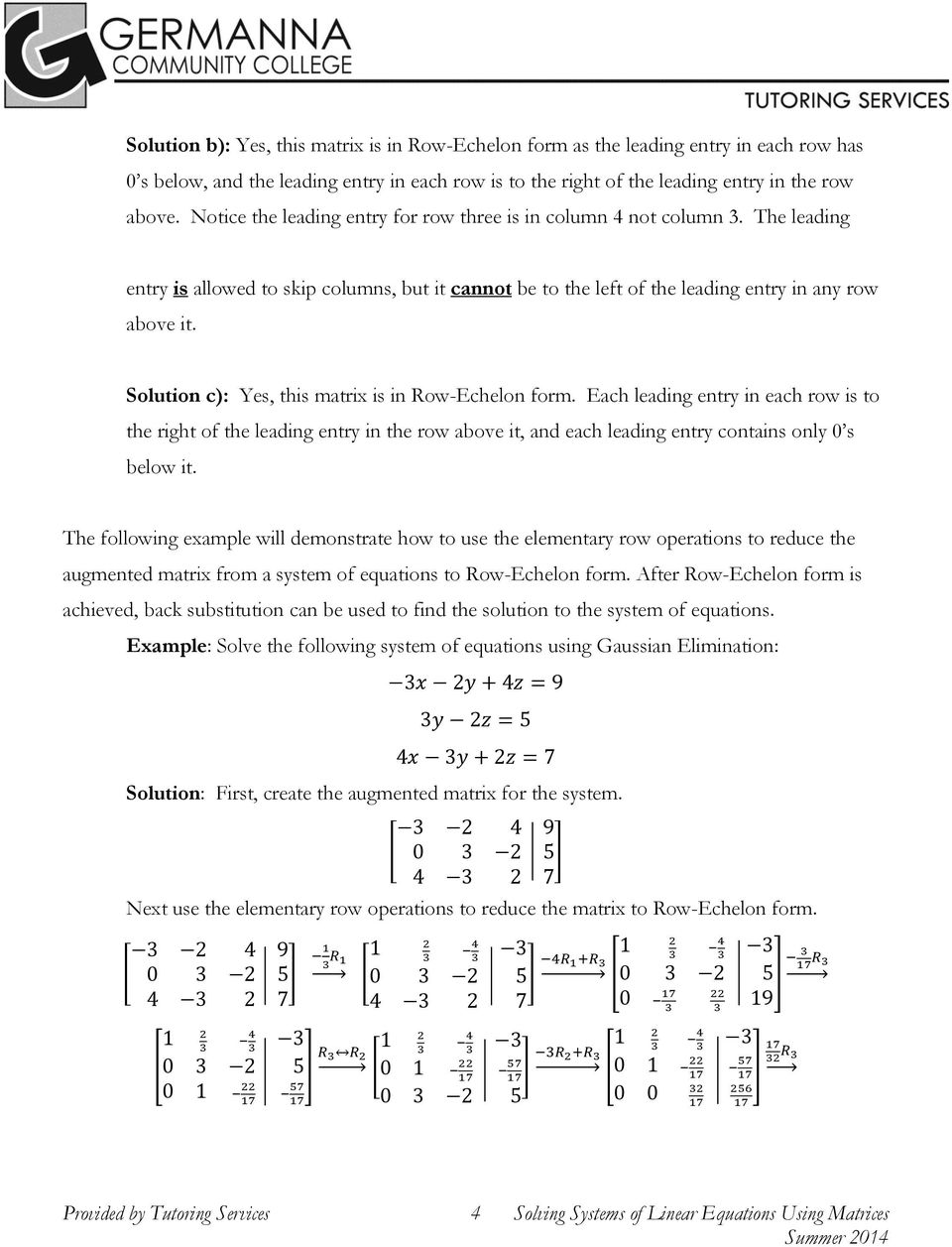
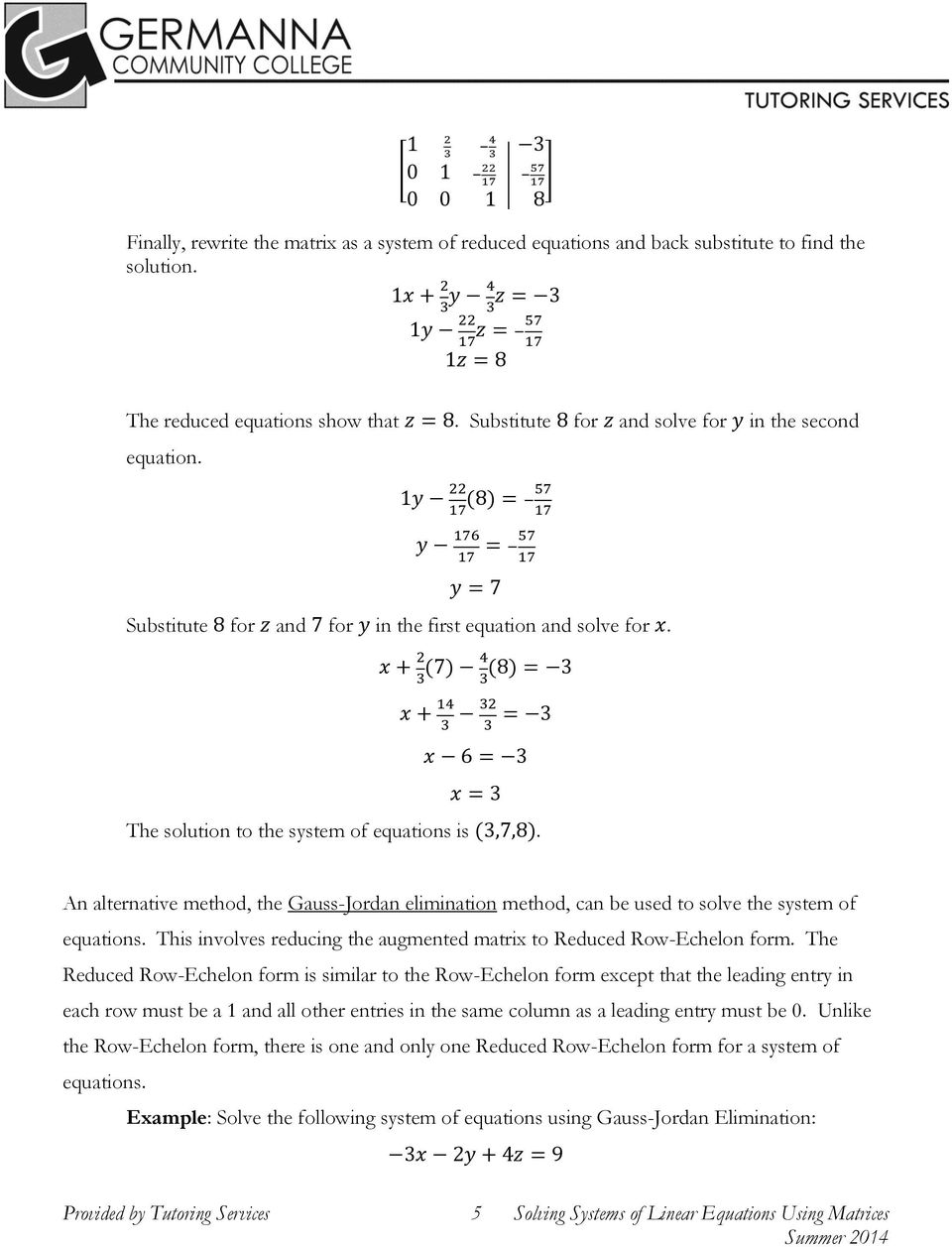
5 [ ] Finally, rewrite the matrix as a system of reduced equations and back substitute to find the solution. 1x + y 4 z = 3 1y z = 57 1z = 8 The reduced equations show that z = 8. Substitute 8 for z and solve for y in the second equation. 1y (8) = 57 y 6 = 57 y = 7 Substitute 8 for z and 7 for y in the first equation and solve for x. x + (7) 4 (8) = 3 x = 3 x 6 = 3 x = 3 The solution to the system of equations is (3,7,8). An alternative method, the Gauss-Jordan elimination method, can be used to solve the system of equations. This involves reducing the augmented matrix to Reduced Row-Echelon form. The Reduced Row-Echelon form is similar to the Row-Echelon form except that the leading entry in each row must be a 1 and all other entries in the same column as a leading entry must be 0. Unlike the Row-Echelon form, there is one and only one Reduced Row-Echelon form for a system of equations. Example: Solve the following system of equations using Gauss-Jordan Elimination: 3x y + 4z = 9 Provided by Tutoring Services 5 Solving Systems of Linear Equations Using Matrices Summer 014
6 3y z = 5 4x 3y + z = 7 Solution: First, create the augmented matrix for the system [ 0 3 5] Next, use the elementary row operations to reduce the matrix to Reduced Row-Echelon form [ [ ] 1 3 R 1 [ ] 4R 1+R 3 1 [ 0 3 5] R [ ] 3R 4 3 +R 3 [ ] [ ] R 3 [ ] 3+R1 [ ] [ ] ] 3 R 3 3 R 3 3 R +R1 The solution to the system can be written directly from the Reduced Row-Echelon form by converting the matrix back to equation form. x = 3 y = 7 z = 8 Thus, the solution to the system of equations is (3,7,8). This is the same solution obtained by using the Gaussian elimination method in the previous example. The system of equations above is an example of a consistent system of equations. A consistent system of equations is characterized by having a leading coefficient in each column of the coefficient matrix Provided by Tutoring Services 6 Solving Systems of Linear Equations Using Matrices Summer 014
![7] 0 0 1 8 0 0 1 8 0 0 1 8 1 0 0 3 [ 0 1 0 7] 0 0 1 8 ] 3 R 3 3 R 3 3 R +R1 The solution to the system can be written directly from the Reduced Row-Echelon form by converting the matrix back to](/docs-images/44/20856722/images/page_6.jpg "equation form. x = 3 y = 7 z = 8 Thus, the solution to the system of equations is (3,7,8). This is the same solution obtained by using the Gaussian elimination method in the previous example.")
7 when it is row reduced to either Row-Echelon form or Reduced Row-Echelon form. In other words, each variable represented by a column can be solved for a specific number. With an inconsistent system of equations, the leading coefficient in one of the rows will be in the last column of the augmented matrix. Example: Determine if the following system of equations is consistent or inconsistent and state the solution. x 4y + z = 3 x 3y + z = 5 3x 7y + z = 1 Solution: First, create the augmented matrix [ ] Use the elementary row operations to obtain a Row-Echelon form [ ] R R [ [ ] R 1+R ] 3R 1+R [ [ 0 1 7] R [ ] ] 1R +R 3 The last row indicates the system is inconsistent. This can most easily be seen if the last row is converted back to an equation. 0x + 0y + 0z = 4 According to this equation, there are not any values of x, y, or z that will make the above equation true. Therefore, the system has no solution; this is represented by the symbol for the null set,. Any augmented system of equations is inconsistent if the Row-Echelon form Provided by Tutoring Services 7 Solving Systems of Linear Equations Using Matrices Summer 014
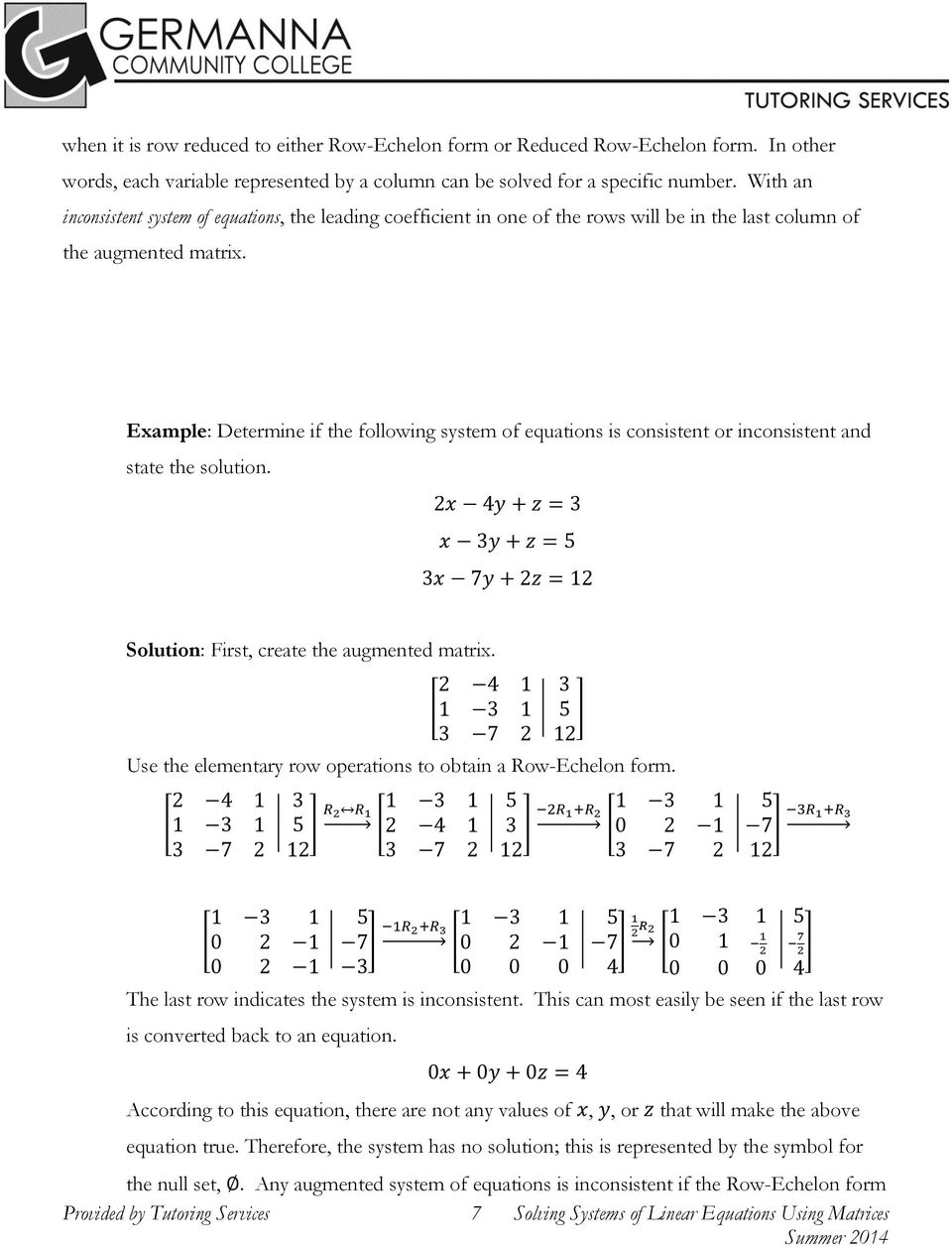
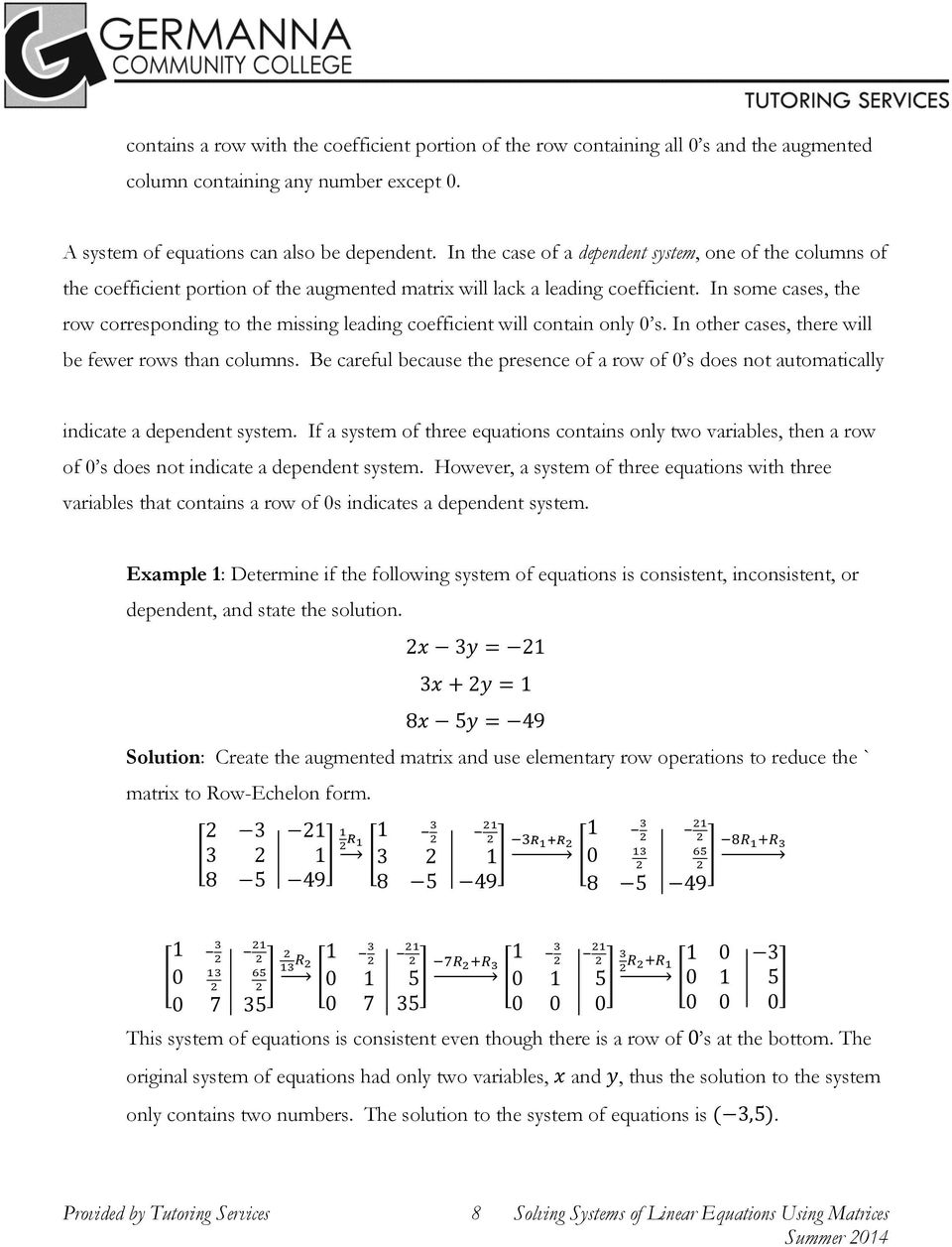
8 contains a row with the coefficient portion of the row containing all 0 s and the augmented column containing any number except 0. A system of equations can also be dependent. In the case of a dependent system, one of the columns of the coefficient portion of the augmented matrix will lack a leading coefficient. In some cases, the row corresponding to the missing leading coefficient will contain only 0 s. In other cases, there will be fewer rows than columns. Be careful because the presence of a row of 0 s does not automatically indicate a dependent system. If a system of three equations contains only two variables, then a row of 0 s does not indicate a dependent system. However, a system of three equations with three variables that contains a row of 0s indicates a dependent system. Example 1: Determine if the following system of equations is consistent, inconsistent, or dependent, and state the solution. x 3y = 1 3x + y = 1 8x 5y = 49 Solution: Create the augmented matrix and use elementary row operations to reduce the ` matrix to Row-Echelon form [ 3 1] R 1 1 [ ] 3R 1+R [ ] 8R 1+R R [ ] [ [ 0 1 5] R +R [ 0 1 5] ] 7R +R This system of equations is consistent even though there is a row of 0 s at the bottom. The original system of equations had only two variables, x and y, thus the solution to the system only contains two numbers. The solution to the system of equations is ( 3,5). Provided by Tutoring Services 8 Solving Systems of Linear Equations Using Matrices Summer 014
9 Example : Determine if the following system of equations is consistent, inconsistent, or dependent, and state the solution. 8x + 5y + 11z = 30 x 4y + z = 3 x y + 5z = 1 Solution : Create the augmented matrix and use elementary row operations to reduce the matrix to Row-Echelon form [ [ ] 1R [ ] R 1 R ] 8R 1+R [ [ ] R [ [ ] ] R 1+R ] 9R +R 3 This system is dependent because the z column does not have a leading coefficient, and the last row of the matrix contains only 0s. Next, solve for the dependent solution to the system of equations. To begin, write the resulting system of equations. x + 4y z = 3 y z = 0 = 0 Then, solve the second equation for y in terms of z. y z = y = z Substitute the result for y into the first equation, and solve for x in terms of z. x + 4y z = 3 Provided by Tutoring Services 9 Solving Systems of Linear Equations Using Matrices Summer 014
![8 5 11 30 [ 1 4 3 1 5 1 1 4 3 [ 8 5 11 30] 1R 1 4 3 1 [ 8 5 11 30 1 5 1 1 5 1 ] R 1 R ] 8R 1+R 1 4 3 [ 0 7 7 54 1 5 1 1 4 3 [ 0 7 7 54] 1 1 4 3 7 R [ 0 1 1 0 9 9 18 0 9 9 18 1 4 3 [ 0 1 1 ] 0 0 0 0 ]](/docs-images/44/20856722/images/page_9.jpg "R 1+R ] 9R +R 3 This system is dependent because the z column does not have a leading coefficient, and the last row of the matrix contains only 0s.")
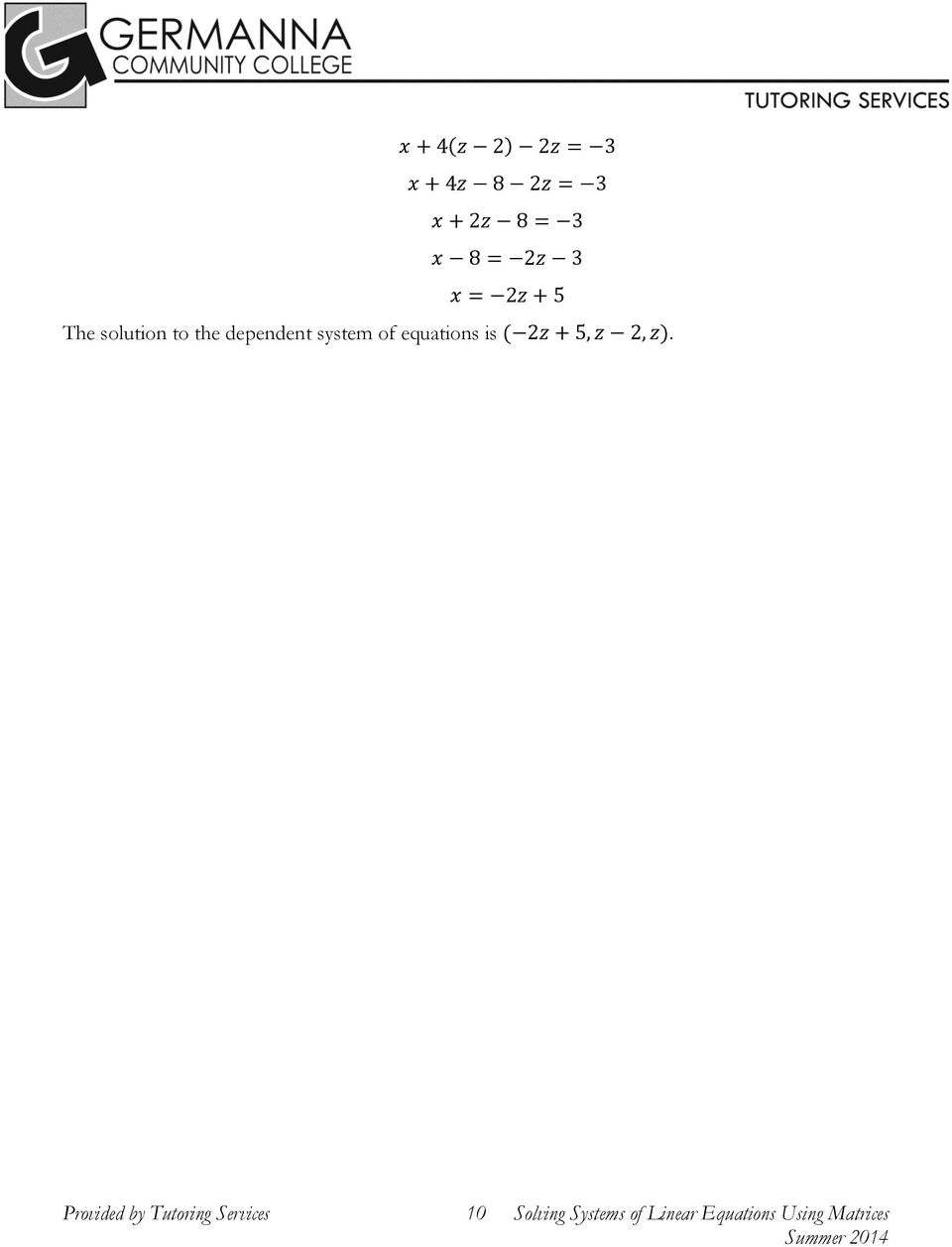
10 x + 4(z ) z = 3 x + 4z 8 z = 3 x + z 8 = 3 x 8 = z 3 x = z + 5 The solution to the dependent system of equations is ( z + 5, z, z). Provided by Tutoring Services 10 Solving Systems of Linear Equations Using Matrices Summer 014
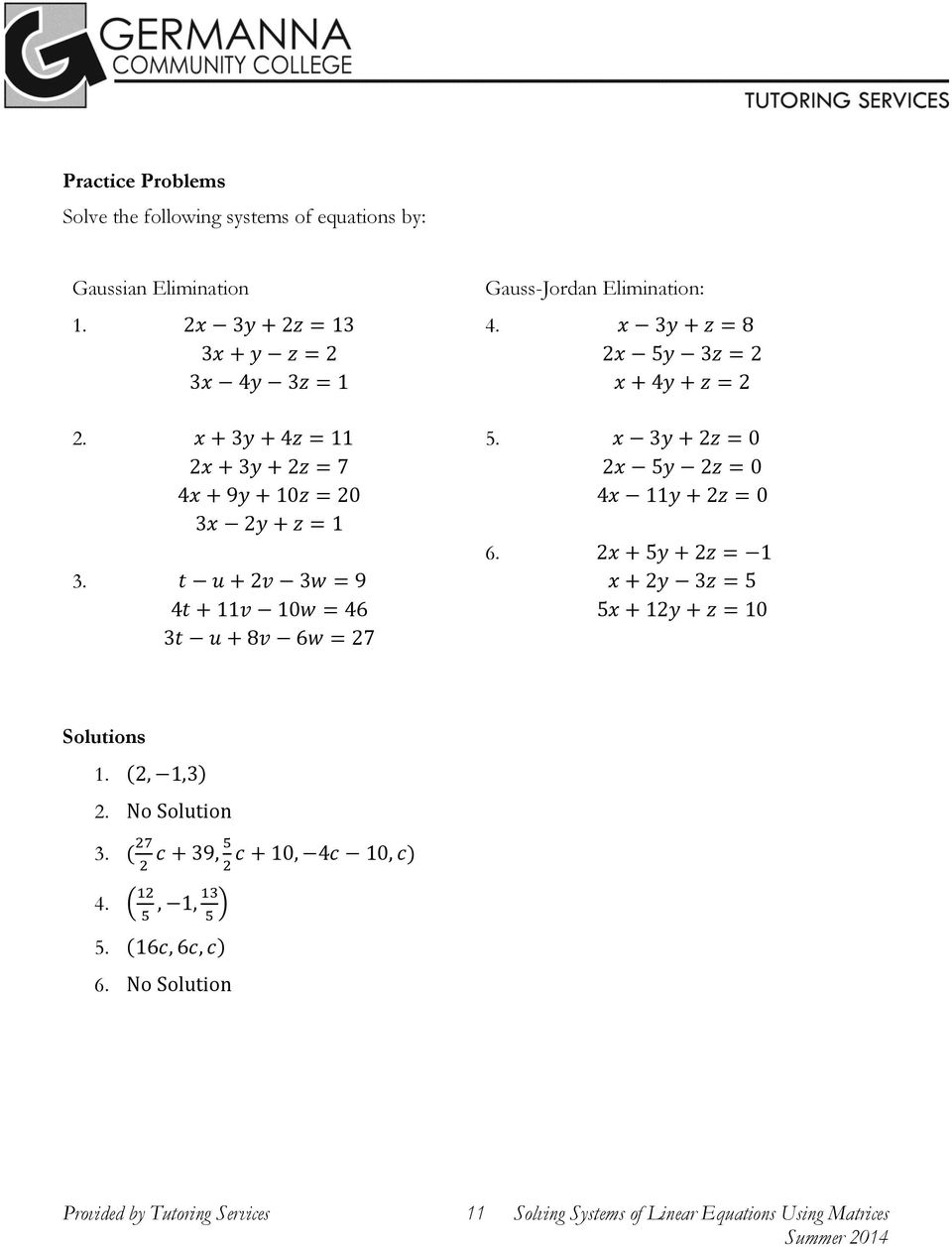
11 Practice Problems Solve the following systems of equations by: Gaussian Elimination Gauss-Jordan Elimination: 1. x 3y + z = x 3y + z = 8 3x + y z = x 5y 3z = 3x 4y 3z = 1 x + 4y + z =. x + 3y + 4z = x 3y + z = 0 x + 3y + z = 7 x 5y z = 0 4x + 9y + 10z = 0 4x 11y + z = 0 3x y + z = 1 6. x + 5y + z = 1 3. t u + v 3w = 9 x + y 3z = 5 4t + 11v 10w = 46 5x + 1y + z = 10 3t u + 8v 6w = 7 Solutions 1. (, 1,3). No Solution 3. ( 7 c + 39, 5 c + 10, 4c 10, c) 4. ( 1 13, 1, ) (16c, 6c, c) 6. No Solution Provided by Tutoring Services 11 Solving Systems of Linear Equations Using Matrices Summer 014
Section 8.2 Solving a System of Equations Using Matrices (Guassian Elimination)
 Section 8. Solving a System of Equations Using Matrices (Guassian Elimination) x + y + z = x y + 4z = x 4y + z = System of Equations x 4 y = 4 z A System in matrix form x A x = b b 4 4 Augmented Matrix
Solving Systems of Linear Equations
 LECTURE 5 Solving Systems of Linear Equations Recall that we introduced the notion of matrices as a way of standardizing the expression of systems of linear equations In today s lecture I shall show how
5.5. Solving linear systems by the elimination method
 55 Solving linear systems by the elimination method Equivalent systems The major technique of solving systems of equations is changing the original problem into another one which is of an easier to solve
Arithmetic and Algebra of Matrices
 Arithmetic and Algebra of Matrices Math 572: Algebra for Middle School Teachers The University of Montana 1 The Real Numbers 2 Classroom Connection: Systems of Linear Equations 3 Rational Numbers 4 Irrational
2x + y = 3. Since the second equation is precisely the same as the first equation, it is enough to find x and y satisfying the system
 1. Systems of linear equations We are interested in the solutions to systems of linear equations. A linear equation is of the form 3x 5y + 2z + w = 3. The key thing is that we don t multiply the variables
1.2 Solving a System of Linear Equations
 1.. SOLVING A SYSTEM OF LINEAR EQUATIONS 1. Solving a System of Linear Equations 1..1 Simple Systems - Basic De nitions As noticed above, the general form of a linear system of m equations in n variables
2.2/2.3 - Solving Systems of Linear Equations
 c Kathryn Bollinger, August 28, 2011 1 2.2/2.3 - Solving Systems of Linear Equations A Brief Introduction to Matrices Matrices are used to organize data efficiently and will help us to solve systems of
Linear Equations ! 25 30 35$ & " 350 150% & " 11,750 12,750 13,750% MATHEMATICS LEARNING SERVICE Centre for Learning and Professional Development
 MathsTrack (NOTE Feb 2013: This is the old version of MathsTrack. New books will be created during 2013 and 2014) Topic 4 Module 9 Introduction Systems of to Matrices Linear Equations Income = Tickets!
Question 2: How do you solve a matrix equation using the matrix inverse?
 Question : How do you solve a matrix equation using the matrix inverse? In the previous question, we wrote systems of equations as a matrix equation AX B. In this format, the matrix A contains the coefficients
10.2 ITERATIVE METHODS FOR SOLVING LINEAR SYSTEMS. The Jacobi Method
 578 CHAPTER 1 NUMERICAL METHODS 1. ITERATIVE METHODS FOR SOLVING LINEAR SYSTEMS As a numerical technique, Gaussian elimination is rather unusual because it is direct. That is, a solution is obtained after
MATH10212 Linear Algebra. Systems of Linear Equations. Definition. An n-dimensional vector is a row or a column of n numbers (or letters): a 1.
 MATH10212 Linear Algebra Textbook: D. Poole, Linear Algebra: A Modern Introduction. Thompson, 2006. ISBN 0-534-40596-7. Systems of Linear Equations Definition. An n-dimensional vector is a row or a column
Row Echelon Form and Reduced Row Echelon Form
 These notes closely follow the presentation of the material given in David C Lay s textbook Linear Algebra and its Applications (3rd edition) These notes are intended primarily for in-class presentation
Solving Linear Systems, Continued and The Inverse of a Matrix
 , Continued and The of a Matrix Calculus III Summer 2013, Session II Monday, July 15, 2013 Agenda 1. The rank of a matrix 2. The inverse of a square matrix Gaussian Gaussian solves a linear system by reducing
December 4, 2013 MATH 171 BASIC LINEAR ALGEBRA B. KITCHENS
 December 4, 2013 MATH 171 BASIC LINEAR ALGEBRA B KITCHENS The equation 1 Lines in two-dimensional space (1) 2x y = 3 describes a line in two-dimensional space The coefficients of x and y in the equation
Lecture Notes 2: Matrices as Systems of Linear Equations
 2: Matrices as Systems of Linear Equations 33A Linear Algebra, Puck Rombach Last updated: April 13, 2016 Systems of Linear Equations Systems of linear equations can represent many things You have probably
MATRIX ALGEBRA AND SYSTEMS OF EQUATIONS
 MATRIX ALGEBRA AND SYSTEMS OF EQUATIONS Systems of Equations and Matrices Representation of a linear system The general system of m equations in n unknowns can be written a x + a 2 x 2 + + a n x n b a
Solving Systems of Linear Equations
 LECTURE 5 Solving Systems of Linear Equations Recall that we introduced the notion of matrices as a way of standardizing the expression of systems of linear equations In today s lecture I shall show how
Abstract: We describe the beautiful LU factorization of a square matrix (or how to write Gaussian elimination in terms of matrix multiplication).
 MAT 2 (Badger, Spring 202) LU Factorization Selected Notes September 2, 202 Abstract: We describe the beautiful LU factorization of a square matrix (or how to write Gaussian elimination in terms of matrix
8.2. Solution by Inverse Matrix Method. Introduction. Prerequisites. Learning Outcomes
 Solution by Inverse Matrix Method 8.2 Introduction The power of matrix algebra is seen in the representation of a system of simultaneous linear equations as a matrix equation. Matrix algebra allows us
SYSTEMS OF EQUATIONS AND MATRICES WITH THE TI-89. by Joseph Collison
 SYSTEMS OF EQUATIONS AND MATRICES WITH THE TI-89 by Joseph Collison Copyright 2000 by Joseph Collison All rights reserved Reproduction or translation of any part of this work beyond that permitted by Sections
MATH2210 Notebook 1 Fall Semester 2016/2017. 1 MATH2210 Notebook 1 3. 1.1 Solving Systems of Linear Equations... 3
 MATH0 Notebook Fall Semester 06/07 prepared by Professor Jenny Baglivo c Copyright 009 07 by Jenny A. Baglivo. All Rights Reserved. Contents MATH0 Notebook 3. Solving Systems of Linear Equations........................
Systems of Linear Equations
 Chapter 1 Systems of Linear Equations 1.1 Intro. to systems of linear equations Homework: [Textbook, Ex. 13, 15, 41, 47, 49, 51, 65, 73; page 11-]. Main points in this section: 1. Definition of Linear
Math 202-0 Quizzes Winter 2009
 Quiz : Basic Probability Ten Scrabble tiles are placed in a bag Four of the tiles have the letter printed on them, and there are two tiles each with the letters B, C and D on them (a) Suppose one tile
Reduced echelon form: Add the following conditions to conditions 1, 2, and 3 above:
 Section 1.2: Row Reduction and Echelon Forms Echelon form (or row echelon form): 1. All nonzero rows are above any rows of all zeros. 2. Each leading entry (i.e. left most nonzero entry) of a row is in
Lecture 1: Systems of Linear Equations
 MTH Elementary Matrix Algebra Professor Chao Huang Department of Mathematics and Statistics Wright State University Lecture 1 Systems of Linear Equations ² Systems of two linear equations with two variables
Using row reduction to calculate the inverse and the determinant of a square matrix
 Using row reduction to calculate the inverse and the determinant of a square matrix Notes for MATH 0290 Honors by Prof. Anna Vainchtein 1 Inverse of a square matrix An n n square matrix A is called invertible
Linearly Independent Sets and Linearly Dependent Sets
 These notes closely follow the presentation of the material given in David C. Lay s textbook Linear Algebra and its Applications (3rd edition). These notes are intended primarily for in-class presentation
Methods for Finding Bases
 Methods for Finding Bases Bases for the subspaces of a matrix Row-reduction methods can be used to find bases. Let us now look at an example illustrating how to obtain bases for the row space, null space,
Solving simultaneous equations using the inverse matrix
 Solving simultaneous equations using the inverse matrix 8.2 Introduction The power of matrix algebra is seen in the representation of a system of simultaneous linear equations as a matrix equation. Matrix
Linear Equations in One Variable
 Linear Equations in One Variable MATH 101 College Algebra J. Robert Buchanan Department of Mathematics Summer 2012 Objectives In this section we will learn how to: Recognize and combine like terms. Solve
MAT 200, Midterm Exam Solution. a. (5 points) Compute the determinant of the matrix A =
 MAT 200, Midterm Exam Solution. (0 points total) a. (5 points) Compute the determinant of the matrix 2 2 0 A = 0 3 0 3 0 Answer: det A = 3. The most efficient way is to develop the determinant along the
MATRIX ALGEBRA AND SYSTEMS OF EQUATIONS. + + x 2. x n. a 11 a 12 a 1n b 1 a 21 a 22 a 2n b 2 a 31 a 32 a 3n b 3. a m1 a m2 a mn b m
 MATRIX ALGEBRA AND SYSTEMS OF EQUATIONS 1. SYSTEMS OF EQUATIONS AND MATRICES 1.1. Representation of a linear system. The general system of m equations in n unknowns can be written a 11 x 1 + a 12 x 2 +
Solving Systems of Linear Equations Substitutions
 Solving Systems of Linear Equations Substitutions Outcome (lesson objective) Students will accurately solve a system of equations algebraically using substitution. Student/Class Goal Students thinking
Solving Systems of Linear Equations Substitutions
 Solving Systems of Linear Equations Substitutions Outcome (learning objective) Students will accurately solve a system of equations algebraically using substitution. Student/Class Goal Students thinking
How To Understand And Solve A Linear Programming Problem
 At the end of the lesson, you should be able to: Chapter 2: Systems of Linear Equations and Matrices: 2.1: Solutions of Linear Systems by the Echelon Method Define linear systems, unique solution, inconsistent,
160 CHAPTER 4. VECTOR SPACES
 160 CHAPTER 4. VECTOR SPACES 4. Rank and Nullity In this section, we look at relationships between the row space, column space, null space of a matrix and its transpose. We will derive fundamental results
Solutions to Math 51 First Exam January 29, 2015
 Solutions to Math 5 First Exam January 29, 25. ( points) (a) Complete the following sentence: A set of vectors {v,..., v k } is defined to be linearly dependent if (2 points) there exist c,... c k R, not
Chapter 6. Linear Programming: The Simplex Method. Introduction to the Big M Method. Section 4 Maximization and Minimization with Problem Constraints
 Chapter 6 Linear Programming: The Simplex Method Introduction to the Big M Method In this section, we will present a generalized version of the simplex method that t will solve both maximization i and
4.3-4.4 Systems of Equations
 4.3-4.4 Systems of Equations A linear equation in 2 variables is an equation of the form ax + by = c. A linear equation in 3 variables is an equation of the form ax + by + cz = d. To solve a system of
Systems of Linear Equations
 Systems of Linear Equations Beifang Chen Systems of linear equations Linear systems A linear equation in variables x, x,, x n is an equation of the form a x + a x + + a n x n = b, where a, a,, a n and
MATH 304 Linear Algebra Lecture 18: Rank and nullity of a matrix.
 MATH 304 Linear Algebra Lecture 18: Rank and nullity of a matrix. Nullspace Let A = (a ij ) be an m n matrix. Definition. The nullspace of the matrix A, denoted N(A), is the set of all n-dimensional column
1.5 SOLUTION SETS OF LINEAR SYSTEMS
 1-2 CHAPTER 1 Linear Equations in Linear Algebra 1.5 SOLUTION SETS OF LINEAR SYSTEMS Many of the concepts and computations in linear algebra involve sets of vectors which are visualized geometrically as
Math Common Core Sampler Test
 High School Algebra Core Curriculum Math Test Math Common Core Sampler Test Our High School Algebra sampler covers the twenty most common questions that we see targeted for this level. For complete tests
MAT 242 Test 2 SOLUTIONS, FORM T
 MAT 242 Test 2 SOLUTIONS, FORM T 5 3 5 3 3 3 3. Let v =, v 5 2 =, v 3 =, and v 5 4 =. 3 3 7 3 a. [ points] The set { v, v 2, v 3, v 4 } is linearly dependent. Find a nontrivial linear combination of these
Linear Programming. March 14, 2014
 Linear Programming March 1, 01 Parts of this introduction to linear programming were adapted from Chapter 9 of Introduction to Algorithms, Second Edition, by Cormen, Leiserson, Rivest and Stein [1]. 1
Elementary Matrices and The LU Factorization
 lementary Matrices and The LU Factorization Definition: ny matrix obtained by performing a single elementary row operation (RO) on the identity (unit) matrix is called an elementary matrix. There are three
These axioms must hold for all vectors ū, v, and w in V and all scalars c and d.
 DEFINITION: A vector space is a nonempty set V of objects, called vectors, on which are defined two operations, called addition and multiplication by scalars (real numbers), subject to the following axioms
a 11 x 1 + a 12 x 2 + + a 1n x n = b 1 a 21 x 1 + a 22 x 2 + + a 2n x n = b 2.
 Chapter 1 LINEAR EQUATIONS 1.1 Introduction to linear equations A linear equation in n unknowns x 1, x,, x n is an equation of the form a 1 x 1 + a x + + a n x n = b, where a 1, a,..., a n, b are given
5 Homogeneous systems
 5 Homogeneous systems Definition: A homogeneous (ho-mo-jeen -i-us) system of linear algebraic equations is one in which all the numbers on the right hand side are equal to : a x +... + a n x n =.. a m
1 Solving LPs: The Simplex Algorithm of George Dantzig
 Solving LPs: The Simplex Algorithm of George Dantzig. Simplex Pivoting: Dictionary Format We illustrate a general solution procedure, called the simplex algorithm, by implementing it on a very simple example.
x y The matrix form, the vector form, and the augmented matrix form, respectively, for the system of equations are
 Solving Sstems of Linear Equations in Matri Form with rref Learning Goals Determine the solution of a sstem of equations from the augmented matri Determine the reduced row echelon form of the augmented
by the matrix A results in a vector which is a reflection of the given
 Eigenvalues & Eigenvectors Example Suppose Then So, geometrically, multiplying a vector in by the matrix A results in a vector which is a reflection of the given vector about the y-axis We observe that
Homogeneous systems of algebraic equations. A homogeneous (ho-mo-geen -ius) system of linear algebraic equations is one in which
 Homogeneous systems of algebraic equations A homogeneous (ho-mo-geen -ius) system of linear algebraic equations is one in which all the numbers on the right hand side are equal to : a x + + a n x n = a
LAB 11: MATRICES, SYSTEMS OF EQUATIONS and POLYNOMIAL MODELING
 LAB 11: MATRICS, SYSTMS OF QUATIONS and POLYNOMIAL MODLING Objectives: 1. Solve systems of linear equations using augmented matrices. 2. Solve systems of linear equations using matrix equations and inverse
THE DIMENSION OF A VECTOR SPACE
 THE DIMENSION OF A VECTOR SPACE KEITH CONRAD This handout is a supplementary discussion leading up to the definition of dimension and some of its basic properties. Let V be a vector space over a field
Recall that two vectors in are perpendicular or orthogonal provided that their dot
 Orthogonal Complements and Projections Recall that two vectors in are perpendicular or orthogonal provided that their dot product vanishes That is, if and only if Example 1 The vectors in are orthogonal
10.2 Systems of Linear Equations: Matrices
 SECTION 0.2 Systems of Linear Equations: Matrices 7 0.2 Systems of Linear Equations: Matrices OBJECTIVES Write the Augmente Matrix of a System of Linear Equations 2 Write the System from the Augmente Matrix
PREPARATION FOR MATH TESTING at CityLab Academy
 PREPARATION FOR MATH TESTING at CityLab Academy compiled by Gloria Vachino, M.S. Refresh your math skills with a MATH REVIEW and find out if you are ready for the math entrance test by taking a PRE-TEST
K80TTQ1EP-??,VO.L,XU0H5BY,_71ZVPKOE678_X,N2Y-8HI4VS,,6Z28DDW5N7ADY013
 Hill Cipher Project K80TTQ1EP-??,VO.L,XU0H5BY,_71ZVPKOE678_X,N2Y-8HI4VS,,6Z28DDW5N7ADY013 Directions: Answer all numbered questions completely. Show non-trivial work in the space provided. Non-computational
Zeros of Polynomial Functions
 Zeros of Polynomial Functions The Rational Zero Theorem If f (x) = a n x n + a n-1 x n-1 + + a 1 x + a 0 has integer coefficients and p/q (where p/q is reduced) is a rational zero, then p is a factor of
Part 1 Expressions, Equations, and Inequalities: Simplifying and Solving
 Section 7 Algebraic Manipulations and Solving Part 1 Expressions, Equations, and Inequalities: Simplifying and Solving Before launching into the mathematics, let s take a moment to talk about the words
Integrating algebraic fractions
 Integrating algebraic fractions Sometimes the integral of an algebraic fraction can be found by first epressing the algebraic fraction as the sum of its partial fractions. In this unit we will illustrate
General Framework for an Iterative Solution of Ax b. Jacobi s Method
 2.6 Iterative Solutions of Linear Systems 143 2.6 Iterative Solutions of Linear Systems Consistent linear systems in real life are solved in one of two ways: by direct calculation (using a matrix factorization,
Solving Systems of Linear Equations Elimination (Addition)
 Solving Systems of Linear Equations Elimination (Addition) Outcome (lesson objective) Students will accurately solve systems of equations using elimination/addition method. Student/Class Goal Students
1 0 5 3 3 A = 0 0 0 1 3 0 0 0 0 0 0 0 0 0 0
 Solutions: Assignment 4.. Find the redundant column vectors of the given matrix A by inspection. Then find a basis of the image of A and a basis of the kernel of A. 5 A The second and third columns are
Standard Form of a Linear Programming Problem
 494 CHAPTER 9 LINEAR PROGRAMMING 9. THE SIMPLEX METHOD: MAXIMIZATION For linear programming problems involving two variables, the graphical solution method introduced in Section 9. is convenient. However,
Lecture 3: Finding integer solutions to systems of linear equations
 Lecture 3: Finding integer solutions to systems of linear equations Algorithmic Number Theory (Fall 2014) Rutgers University Swastik Kopparty Scribe: Abhishek Bhrushundi 1 Overview The goal of this lecture
( ) which must be a vector
 MATH 37 Linear Transformations from Rn to Rm Dr. Neal, WKU Let T : R n R m be a function which maps vectors from R n to R m. Then T is called a linear transformation if the following two properties are
5 Systems of Equations
 Systems of Equations Concepts: Solutions to Systems of Equations-Graphically and Algebraically Solving Systems - Substitution Method Solving Systems - Elimination Method Using -Dimensional Graphs to Approximate
MATHEMATICS FOR ENGINEERS BASIC MATRIX THEORY TUTORIAL 2
 MATHEMATICS FO ENGINEES BASIC MATIX THEOY TUTOIAL This is the second of two tutorials on matrix theory. On completion you should be able to do the following. Explain the general method for solving simultaneous
COLLEGE ALGEBRA 10 TH EDITION LIAL HORNSBY SCHNEIDER 1.1-1
 10 TH EDITION COLLEGE ALGEBRA LIAL HORNSBY SCHNEIDER 1.1-1 1.1 Linear Equations Basic Terminology of Equations Solving Linear Equations Identities 1.1-2 Equations An equation is a statement that two expressions
Algebraic expressions are a combination of numbers and variables. Here are examples of some basic algebraic expressions.
 Page 1 of 13 Review of Linear Expressions and Equations Skills involving linear equations can be divided into the following groups: Simplifying algebraic expressions. Linear expressions. Solving linear
How To Understand And Solve Algebraic Equations
 College Algebra Course Text Barnett, Raymond A., Michael R. Ziegler, and Karl E. Byleen. College Algebra, 8th edition, McGraw-Hill, 2008, ISBN: 978-0-07-286738-1 Course Description This course provides
7 Gaussian Elimination and LU Factorization
 7 Gaussian Elimination and LU Factorization In this final section on matrix factorization methods for solving Ax = b we want to take a closer look at Gaussian elimination (probably the best known method
Name: Section Registered In:
 Name: Section Registered In: Math 125 Exam 3 Version 1 April 24, 2006 60 total points possible 1. (5pts) Use Cramer s Rule to solve 3x + 4y = 30 x 2y = 8. Be sure to show enough detail that shows you are
Notes on Determinant
 ENGG2012B Advanced Engineering Mathematics Notes on Determinant Lecturer: Kenneth Shum Lecture 9-18/02/2013 The determinant of a system of linear equations determines whether the solution is unique, without
Direct Methods for Solving Linear Systems. Matrix Factorization
 Direct Methods for Solving Linear Systems Matrix Factorization Numerical Analysis (9th Edition) R L Burden & J D Faires Beamer Presentation Slides prepared by John Carroll Dublin City University c 2011
Prerequisites: TSI Math Complete and high school Algebra II and geometry or MATH 0303.
 Course Syllabus Math 1314 College Algebra Revision Date: 8-21-15 Catalog Description: In-depth study and applications of polynomial, rational, radical, exponential and logarithmic functions, and systems
1 Determinants and the Solvability of Linear Systems
 1 Determinants and the Solvability of Linear Systems In the last section we learned how to use Gaussian elimination to solve linear systems of n equations in n unknowns The section completely side-stepped
Linear Algebra Notes
 Linear Algebra Notes Chapter 19 KERNEL AND IMAGE OF A MATRIX Take an n m matrix a 11 a 12 a 1m a 21 a 22 a 2m a n1 a n2 a nm and think of it as a function A : R m R n The kernel of A is defined as Note
4.5 Linear Dependence and Linear Independence
 4.5 Linear Dependence and Linear Independence 267 32. {v 1, v 2 }, where v 1, v 2 are collinear vectors in R 3. 33. Prove that if S and S are subsets of a vector space V such that S is a subset of S, then
Undergraduate Notes in Mathematics. Arkansas Tech University Department of Mathematics
 Undergraduate Notes in Mathematics Arkansas Tech University Department of Mathematics A Semester Course in Finite Mathematics for Business and Economics Marcel B. Finan c All Rights Reserved August 10,
Linear Algebra Notes for Marsden and Tromba Vector Calculus
 Linear Algebra Notes for Marsden and Tromba Vector Calculus n-dimensional Euclidean Space and Matrices Definition of n space As was learned in Math b, a point in Euclidean three space can be thought of
Linear Algebra and TI 89
 Linear Algebra and TI 89 Abdul Hassen and Jay Schiffman This short manual is a quick guide to the use of TI89 for Linear Algebra. We do this in two sections. In the first section, we will go over the editing
Solution of Linear Systems
 Chapter 3 Solution of Linear Systems In this chapter we study algorithms for possibly the most commonly occurring problem in scientific computing, the solution of linear systems of equations. We start
Linear Equations in Linear Algebra
 May, 25 :46 l57-ch Sheet number Page number cyan magenta yellow black Linear Equations in Linear Algebra WEB INTRODUCTORY EXAMPLE Linear Models in Economics and Engineering It was late summer in 949. Harvard
Continued Fractions and the Euclidean Algorithm
 Continued Fractions and the Euclidean Algorithm Lecture notes prepared for MATH 326, Spring 997 Department of Mathematics and Statistics University at Albany William F Hammond Table of Contents Introduction
Solving Systems of Linear Equations Graphing
 Solving Systems of Linear Equations Graphing Outcome (learning objective) Students will accurately solve a system of equations by graphing. Student/Class Goal Students thinking about continuing their academic
Au = = = 3u. Aw = = = 2w. so the action of A on u and w is very easy to picture: it simply amounts to a stretching by 3 and 2, respectively.
 Chapter 7 Eigenvalues and Eigenvectors In this last chapter of our exploration of Linear Algebra we will revisit eigenvalues and eigenvectors of matrices, concepts that were already introduced in Geometry
Application of Linear Algebra in. Electrical Circuits
 Application of Linear Algebra in Electrical Circuits Seamleng Taing Math 308 Autumn 2001 December 2, 2001 Table of Contents Abstract..3 Applications of Linear Algebra in Electrical Circuits Explanation..
MATH 551 - APPLIED MATRIX THEORY
 MATH 55 - APPLIED MATRIX THEORY FINAL TEST: SAMPLE with SOLUTIONS (25 points NAME: PROBLEM (3 points A web of 5 pages is described by a directed graph whose matrix is given by A Do the following ( points
LS.6 Solution Matrices
 LS.6 Solution Matrices In the literature, solutions to linear systems often are expressed using square matrices rather than vectors. You need to get used to the terminology. As before, we state the definitions
1 Determine whether an. 2 Solve systems of linear. 3 Solve systems of linear. 4 Solve systems of linear. 5 Select the most efficient
 Section 3.1 Systems of Linear Equations in Two Variables 163 SECTION 3.1 SYSTEMS OF LINEAR EQUATIONS IN TWO VARIABLES Objectives 1 Determine whether an ordered pair is a solution of a system of linear
Solving Linear Equations in One Variable. Worked Examples
 Solving Linear Equations in One Variable Worked Examples Solve the equation 30 x 1 22x Solve the equation 30 x 1 22x Our goal is to isolate the x on one side. We ll do that by adding (or subtracting) quantities
Solving Rational Equations
 Lesson M Lesson : Student Outcomes Students solve rational equations, monitoring for the creation of extraneous solutions. Lesson Notes In the preceding lessons, students learned to add, subtract, multiply,
Similarity and Diagonalization. Similar Matrices
 MATH022 Linear Algebra Brief lecture notes 48 Similarity and Diagonalization Similar Matrices Let A and B be n n matrices. We say that A is similar to B if there is an invertible n n matrix P such that
Operation Count; Numerical Linear Algebra
 10 Operation Count; Numerical Linear Algebra 10.1 Introduction Many computations are limited simply by the sheer number of required additions, multiplications, or function evaluations. If floating-point
Linear Programming. April 12, 2005
 Linear Programming April 1, 005 Parts of this were adapted from Chapter 9 of i Introduction to Algorithms (Second Edition) /i by Cormen, Leiserson, Rivest and Stein. 1 What is linear programming? The first
13 MATH FACTS 101. 2 a = 1. 7. The elements of a vector have a graphical interpretation, which is particularly easy to see in two or three dimensions.
 3 MATH FACTS 0 3 MATH FACTS 3. Vectors 3.. Definition We use the overhead arrow to denote a column vector, i.e., a linear segment with a direction. For example, in three-space, we write a vector in terms