
Lecture notes on linear algebra
|
|
|
- Hilary Doyle
- 10 years ago
- Views:
Transcription
1 Lecture notes on linear algebra David Lerner Department of Mathematics University of Kansas These are notes of a course given in Fall, 2007 and 2008 to the Honors sections of our elementary linear algebra course. Their comments and corrections have greatly improved the exposition. c 2007, 2008 D. E. Lerner
2 Contents Matrices and matrix algebra. Examples of matrices Operations with matrices Matrices and systems of linear equations 7 2. The matrix form of a linear system Row operations on the augmented matrix More variables The solution in vector notation Elementary row operations and their corresponding matrices 2 3. Elementary matrices The echelon and reduced echelon (Gauss-Jordan form The third elementary row operation Elementary matrices, continued 6 4. Properties of elementary matrices The algorithm for Gaussian elimination Observations Why does the algorithm (Gaussian elimination work? Application to the solution(s of Ax = y Homogeneous systems Solutions to the homogeneous system Some comments about free and leading variables Properties of the homogenous system for A mn Linear combinations and the superposition principle The Inhomogeneous system Ax = y, y Solutions to the inhomogeneous system Choosing a different particular solution Square matrices, inverses and related matters The Gauss-Jordan form of a square matrix Solutions to Ax = y when A is square An algorithm for constructing A i

3 8 Square matrices continued: Determinants Introduction Aside: some comments about computer arithmetic The formal definition of det(a Some consequences of the definition Computations using row operations Additional properties of the determinant The derivative as a matrix Redefining the derivative Generalization to higher dimensions Subspaces 49 Linearly dependent and independent sets 53. Linear dependence Linear independence Elementary row operations Basis and dimension of subspaces The concept of basis Dimension The rank-nullity (dimension theorem Rank and nullity of a matrix The rank-nullity theorem Change of basis The coordinates of a vector Notation Matrices and Linear transformations m n matrices as functions from R n to R m The matrix of a linear transformation The rank-nullity theorem - version Choosing a useful basis for A Eigenvalues and eigenvectors Definition and some examples Computations with eigenvalues and eigenvectors Some observations Diagonalizable matrices Inner products Definition and first properties Euclidean space ii
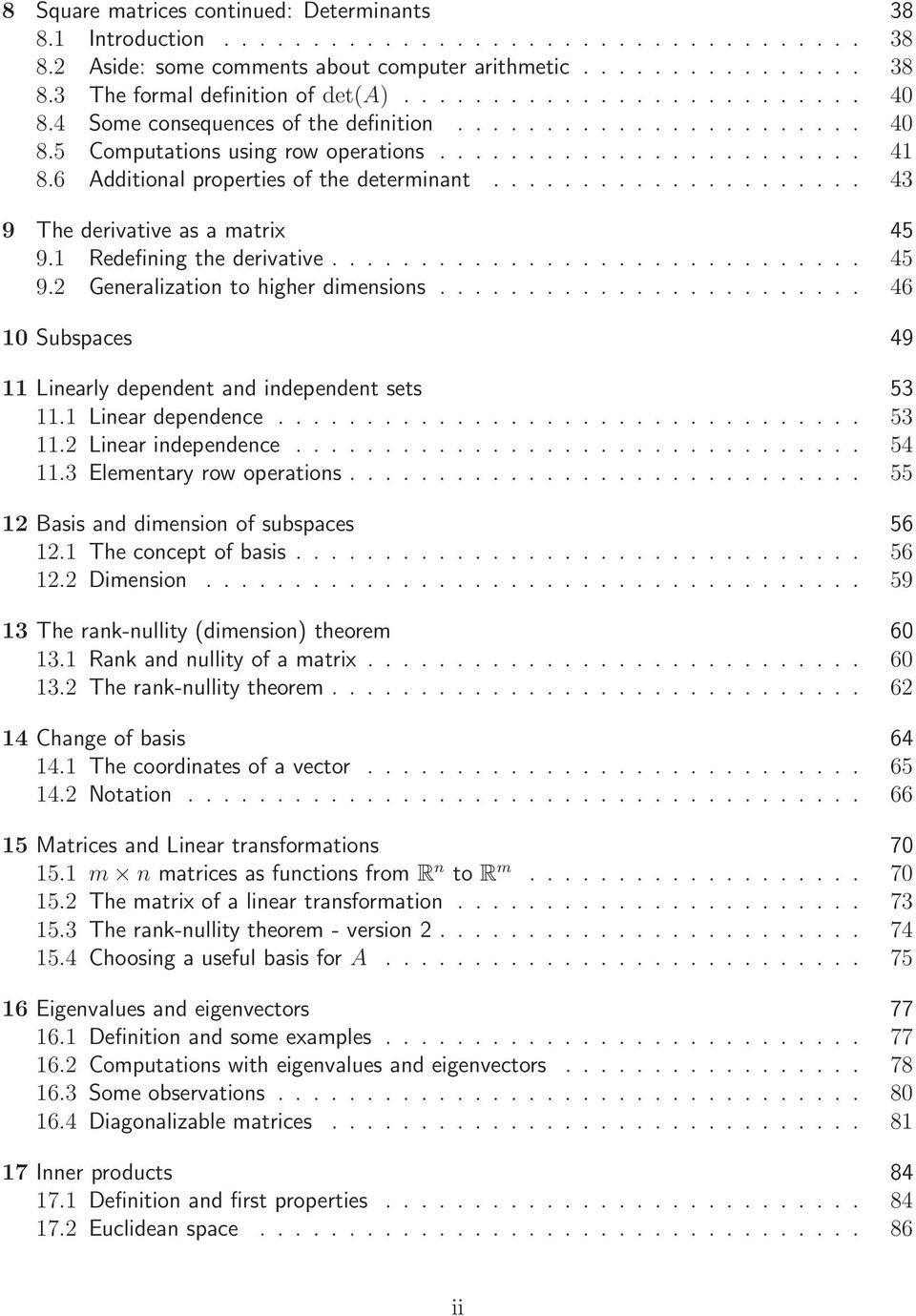
4 8 Orthonormal bases and related matters Orthogonality and normalization Orthonormal bases Orthogonal projections and orthogonal matrices Orthogonal decompositions of vectors Algorithm for the decomposition Orthogonal matrices Invariance of the dot product under orthogonal transformations Projections onto subspaces and the Gram-Schmidt algorithm Construction of an orthonormal basis Orthogonal projection onto a subspace V Orthogonal complements Gram-Schmidt - the general algorithm Symmetric and skew-symmetric matrices Decomposition of a square matrix into symmetric and skew-symmetric matrices Skew-symmetric matrices and infinitessimal rotations Properties of symmetric matrices Approximations - the method of least squares 22. The problem The method of least squares Least squares approximations - II The transpose of A Least squares approximations the Normal equation Appendix: Mathematical implications and notation 9 iii

5 To the student These are lecture notes for a first course in linear algebra; the prerequisite is a good course in calculus. The notes are quite informal, but they have been carefully read and criticized by two sections of honors students, and their comments and suggestions have been incorporated. Although I ve tried to be careful, there are undoubtedly some errors remaining. If you find any, please let me know. The material in these notes is absolutely fundamental for all mathematicians, physical scientists, and engineers. You will use everything you learn in this course in your further studies. Although we can t spend too much time on applications here, three important ones are treated in some detail the derivative (Chapter 9, Helmholtz s theorem on infinitessimal deformations (Chapter 2 and least squares approximations (Chapters 22 and 23. These are notes, and not a textbook; they correspond quite closely to what is actually said and discussed in class. The intention is for you to use them instead of an expensive textbook, but to do this successfully, you will have to treat them differently: Before each class, read the corresponding lecture. You will have to read it carefully, and you ll need a pad of scratch paper to follow along with the computations. Some of the easy steps in the computations are omitted, and you should supply them. It s not the case that the important material is set off in italics or boxes and the rest can safely be ignored. Typically, you ll have to read each lecture two or three times before you understand it. If you ve understood the material, you should be able to work most of the problems. At this point, you re ready for class. You can pay attention in class to whatever was not clear to you in the notes, and ask questions. The way most students learn math out of a standard textbook is to grab the homework assignment and start working, referring back to the text for any needed worked examples. That won t work here. The exercises are not all at the end of the lecture; they re scattered throughout the text. They are to be worked when you get to them. If you can t work the exercise, you don t understand the material, and you re just kidding yourself if you go on to the next paragraph. Go back, reread the relevant material and try again. Work all the unstarred exercises. If you can t do something, get help, or ask about it in class. Exercises are all set off by Exercise:, so they re easy to find. The ones with asterisks (* are a bit more difficult. You should treat mathematics as a foreign language. In particular, definitions must be memorized (just like new vocabulary words in French. If you don t know what the words mean, you can t possibly do the math. Go to the bookstore, and get yourself a deck of index cards. Each time you encounter a new word in the notes (you can tell, because the new words are set off by Definition:, write it down, together with its definition, and at least one example, on a separate index card. Memorize the material on the cards. At least half the time when students make a mistake, it s because they don t really know what the words in the problem mean. There s an appendix on proofs and symbols; it s not really part of the text, but you iv
6 may want to check there if you come upon a symbol or some form of reasoning that s not clear. Along with definitions come proofs. Doing a proof is the mathematical analog of going to the physics lab and verifying, by doing the experiment, that the period of a pendulum depends in a specific way on its length. Once you ve done the proof or experiment, you really know it s true; you re not taking someone else s word for it. The proofs in this course are (a relatively easy, (b unsurprising, in the sense that the subject is quite coherent, and (c useful in practice, since the proof often consists of an algorithm which tells you how to do something. This may be a new approach for some of you, but, in fact, this is the way the experts learn math and science: we read books or articles, working our way through it line by line, and asking questions when we don t understand. It may be difficult or uncomfortable at first, but it gets easier as you go along. Working this way is a skill that must be mastered by any aspiring mathematician or scientist (i.e., you. v
7 To the instructor These are lecture notes for our 2-credit introductory linear algebra course. They correspond pretty closely to what I said (or should have said in class. Two of our Math 29 classes have gone over the notes rather carefully and have made many useful suggestions which have been happily adopted. Although the notes are intended to replace the standard text for this course, they may be somewhat abbreviated for self-study. How to use the notes: The way I ve used the notes is simple: For each lecture, the students homework was to read the section (either a chapter or half of one of the text that would be discussed in class. Most students found this difficult (and somewhat unpleasant at first; they had to read the material three or four times before it began to make sense. They also had to work (or at least attempt all the unstarred problems before class. For most students, this took between one and three hours of real work per class. During the actual class period, I answered questions, worked problems, and tried to lecture as little as possible. This worked quite well for the first half of the course, but as the material got more difficult, I found myself lecturing more often - there were certain things that needed to be emphasized that might not come up in a discussion format. The students soon became accustomed to this, and even got to like it. Since this is the way real scientists learn (by working though papers on their own, it s a skill that must be mastered and the sooner the better. Students were required to buy a 3 5 inch deck of index cards, to write down each definition on one side of a card, and any useful examples or counterexamples on the back side. They had to memorize the definitions: at least 25% of the points on each exam were definitions. The only problems collected and graded were the starred ones. Problems that caused trouble (quite a few were worked out in class. There are not many standard drill problems. Students were encouraged to make them up if they felt they needed practice. Comments on the material: Chapters through 8, covering the solution of linear algebraic systems of equations, contains material the students have, in principle, seen before. But there is more than enough new material to keep everyone interested: the use of elementary matrices for row operations and the definition of the determinant as an alternating form are two examples. Chapter 9 (optional but useful talks about the derivative as a linear transformation. Chapters 0 through 6 cover the basic material on linear dependence, independence, basis, dimension, the dimension theorem, change of basis, linear transformations, and eigenvalues. The learning curve is fairly steep here; and this is certainly the most challenging part of the course for most students. The level of rigor is reasonably high for an introductory course; why shouldn t it be? Chapters 7 through 2 cover the basics of inner products, orthogonal projections, orthonormal bases, orthogonal transformations and the connection with rotations, and diagonalization of symmetric matrices. Helmholtz s theorem (optional on the infinitessimal motion of a non-rigid body is used to motivate the decomposition of the derivative into its symmetric vi
8 and skew-symmetric pieces. Chapters 22 and 23 go over the motivation and simple use of the least squares approximation. Most of the students have heard about this, but have no idea how or why it works. It s a nice application which is both easily understood and uses much of the material they ve learned so far. Other things: No use was made of graphing calculators. The important material can all be illustrated adequately with 2 2 matrices, where it s simpler to do the computations by hand (and, as an important byproduct, the students actually learn the algorithms. Most of our students are engineers and have some acquaintance with MatLab, which is what they ll use for serious work, so we re not helping them by showing them how to do things inefficiently. In spite of this, every student brought a graphing calculator to every exam. I have no idea how they used them. No general definition of vector space is given. Everything is done in subspaces of R n, which seems to be more than enough at this level. The disadvantage is that there s no discussion of vector space isomorphisms, but I felt that the resulting simplification of the exposition justified this. There are some shortcomings: The level of exposition probably varies too much; the demands on the student are not as consistent as one would like. There should be a few more figures. Undoubtedly there are typos and other minor errors; I hope there are no major ones. vii

9 Chapter Matrices and matrix algebra. Examples of matrices Definition: A matrix is a rectangular array of numbers and/or variables. For instance A = x 3 π is a matrix with 3 rows and 5 columns (a 3 5 matrix. The 5 entries of the matrix are referenced by the row and column in which they sit: the (2,3 entry of A is 0.7. We may also write a 23 = 0.7, a 24 = x, etc. We indicate the fact that A is 3 5 (this is read as three by five by writing A 3 5. Matrices can also be enclosed in square brackets as well as large parentheses. That is, both ( and are perfectly good ways to write this 2 2 matrix. Real numbers are matrices. A vector such as x v = y z [ is a 3 matrix. We will generally use upper case Latin letters as symbols for general matrices, boldface lower case letters for the special case of vectors, and ordinary lower case letters for real numbers. Definition: Real numbers, when used in matrix computations, are called scalars. Matrices are ubiquitous in mathematics and the sciences. Some instances include: ]
10 Systems of linear algebraic equations (the main subject matter of this course are normally written as simple matrix equations of the form Ax = y. The derivative of a function f : R 3 R 2 is a 2 3 matrix. First order systems of linear differential equations are written in matrix form. The symmetry groups of mathematics and physics, some of which we ll look at later, are groups of matrices. Quantum mechanics can be formulated using infinite-dimensional matrices..2 Operations with matrices Matrices of the same size can be added or subtracted by adding or subtracting the corresponding entries: π x = π x Definition: If the matrices A and B have the same size, then their sum is the matrix A+B defined by (A + B ij = a ij + b ij. Their difference is the matrix A B defined by. (A B ij = a ij b ij Definition: A matrix A can be multiplied by a scalar c to obtain the matrix ca, where (ca ij = ca ij. This is called scalar multiplication. We just multiply each entry of A by c. For example ( ( = Definition: The m n matrix whose entries are all 0 is denoted 0 mn (or, more often, just by 0 if the dimensions are obvious from context. It s called the zero matrix. Definition: Two matrices A and B are equal if all their corresponding entries are equal: A = B a ij = b ij for all i, j. 2

11 Definition: If the number of columns of A equals the number of rows of B, then the product AB is defined by k (AB ij = a is b sj. Here k is the number of columns of A or rows of B. If the summation sign is confusing, this could also be written as (AB ij = a i b j + a i2 b 2j + + a ik b kj. s= Example: ( = ( = ( If AB is defined, then the number of rows of AB is the same as the number of rows of A, and the number of columns is the same as the number of columns of B: A m n B n p = (AB m p. Why define multiplication like this? The answer is that this is the definition that corresponds to what shows up in practice. Example: Recall from calculus (Exercise! that if a point (x, y in the plane is rotated counterclockwise about the origin through an angle θ to obtain a new point (x, y, then x = x cosθ y sin θ y = x sin θ + y cos θ. In matrix notation, this can be written ( ( x cosθ sin θ y = sin θ cosθ ( x y. If the new point (x, y is now rotated through an additional angle φ to get (x, y, then ( ( ( x cosφ sin φ x y = sin φ cos φ y ( ( ( cosφ sin φ cosθ sin θ x = sin φ cosφ sin θ cosθ y ( ( cosθ cosφ sin θ sin φ (cos θ sin φ + sin θ cosφ x = cosθ sin φ + sin θ cosφ cosθ cosφ sin θ sin φ y ( ( cos(θ + φ sin(θ + φ x = sin(θ + φ cos(θ + φ y 3
12 This is obviously correct, since it shows that the point has been rotated through the total angle of θ +φ. So the right answer is given by matrix multiplication as we ve defined it, and not some other way. Matrix multiplication is not commutative: in English, AB BA, for arbitrary matrices A and B. For instance, if A is 3 5 and B is 5 2, then AB is 3 2, but BA is not defined. Even if both matrices are square and of the same size, so that both AB and BA are defined and have the same size, the two products are not generally equal. Exercise: Write down two 2 2 matrices and compute both products. Unless you ve been very selective, the two products won t be equal. Another example: If ( 2 A = 3, and B = ( 2, then AB = ( , while BA = (8. Two fundamental properties of matrix multiplication:. If AB and AC are defined, then A(B + C = AB + AC. 2. If AB is defined, and c is a scalar, then A(cB = c(ab. Exercise: * Prove the two properties listed above. (Both these properties can be proven by showing that, in each equation, the (i, j entry on the right hand side of the equation is equal to the (i, j entry on the left. Definition: The transpose of the matrix A, denoted A t, is obtained from A by making the first row of A into the first column of A t, the second row of A into the second column of A t, and so on. Formally, a t ij = a ji. So t = ( Here s one consequence of the non-commutatitivity of matrix multiplication: If AB is defined, then (AB t = B t A t (and not A t B t as you might expect.. Example: If then A = AB = ( ( ( 2, and B = 4 3, ( 2 3, so (AB t =
13 And as advertised. B t A t = ( ( = ( Exercise: ** Can you show that (AB t = B t A t? You need to write out the (i, j th entry of both sides and then observe that they re equal. Definition: A is square if it has the same number of rows and columns. An important instance is the identity matrix I n, which has ones on the main diagonal and zeros elsewhere: Example: I 3 = Often, we ll just write I without the subscript for an identity matrix, when the dimension is clear from the context. The identity matrices behave, in some sense, like the number. If A is n m, then I n A = A, and AI m = A. Definition: Suppose A and B are square matrices of the same dimension, and suppose that AB = I = BA. Then B is said to be the inverse of A, and we write this as B = A. Similarly, B = A. For instance, you can easily check that ( ( ( 2 0 = 2 0 and so these two matrices are inverses of one another: ( ( ( 2 = and 2 2, = ( 2. Example: Not every square matrix has an inverse. For instance ( 3 A = 3 has no inverse. Exercise: * Show that the matrix A in the above example has no inverse. Hint: Suppose that ( a b B = c d is the inverse of A. Then we must have BA = I. Write this out and show that the equations for the entries of B are inconsistent. 5

14 Exercise: Which matrices are invertible, and what are their inverses? Exercise: Show that if ( a b A = c d, and ad bc 0, then A = ad bc ( d b c a. Hint: Multiply A by the given expression for A and show that it equals I. If ad bc = 0, then the matrix is not invertible. You should probably memorize this formula. Exercise: * Show that if A has an inverse that it s unique; that is, if B and C are both inverses of A, then B = C. (Hint: Consider the product BAC = (BAC = B(AC. 6

15 Chapter 2 Matrices and systems of linear equations 2. The matrix form of a linear system You have all seen systems of linear equations such as 3x + 4y = 5 2x y = 0. (2. This system can be solved easily: Multiply the 2nd equation by 4, and add the two resulting equations to get x = 5 or x = 5/. Substituting this into either equation gives y = 0/. In this case, a solution exists (obviously and is unique (there s just one solution, namely (5/, 0/. We can write this system as a matrix equation, in the form Ax = y: ( ( ( 3 4 x 5 =. (2.2 2 y 0 Here x = ( x y is called the coefficient matrix. ( 5, and y = 0 ( 3 4, and A = 2 This formula works because if we multiply the two matrices on the left, we get the 2 matrix equation ( ( 3x + 4y 5 =. 2x y 0 And the two matrices are equal if both their entries are equal, which holds only if both equations in (2. are satisfied. 7
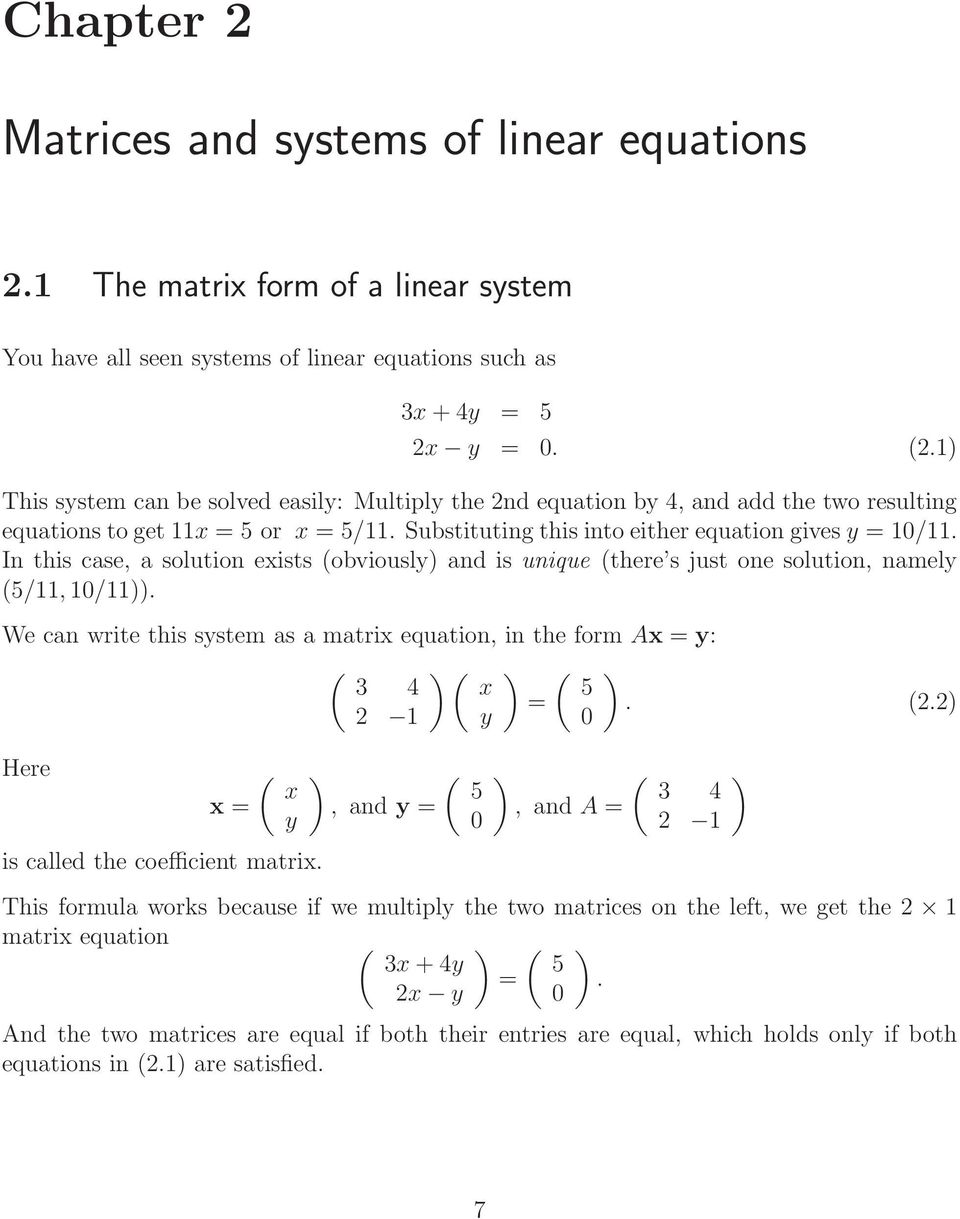
16 2.2 Row operations on the augmented matrix Of course, rewriting the system in matrix form does not, by itself, simplify the way in which we solve it. The simplification results from the following observation: The variables x and y can be eliminated from the computation by simply writing down a matrix in which the coefficients of x are in the first column, the coefficients of y in the second, and the right hand side of the system is the third column: ( (2.3 We are using the columns as place markers instead of x, y and the = sign. That is, the first column consists of the coefficients of x, the second has the coefficients of y, and the third has the numbers on the right hand side of (2.. We can do exactly the same operations on this matrix as we did on the original system : ( : Multiply the 2nd eqn by ( ( : Add the st eqn to the 2nd : Divide the 2nd eqn by The second equation now reads x + 0 y = 5/, and we ve solved for x; we can now substitute for x in the first equation to solve for y as above. Definition: The matrix in (2.3 is called the augmented matrix of the system, and can be written in matrix shorthand as (A y. Even though the solution to the system of equations is unique, it can be solved in many different ways (all of which, clearly, must give the same answer. For instance, start with the same augmented matrix ( ( ( ( : Replace eqn with eqn - eqn 2 : Subtract 2 times eqn from eqn 2 : Divide eqn 2 by - to get y = 0/ The purpose of this lecture is to remind you of the mechanics for solving simple linear systems. We ll give precise definitions and statements of the algorithms later. 8
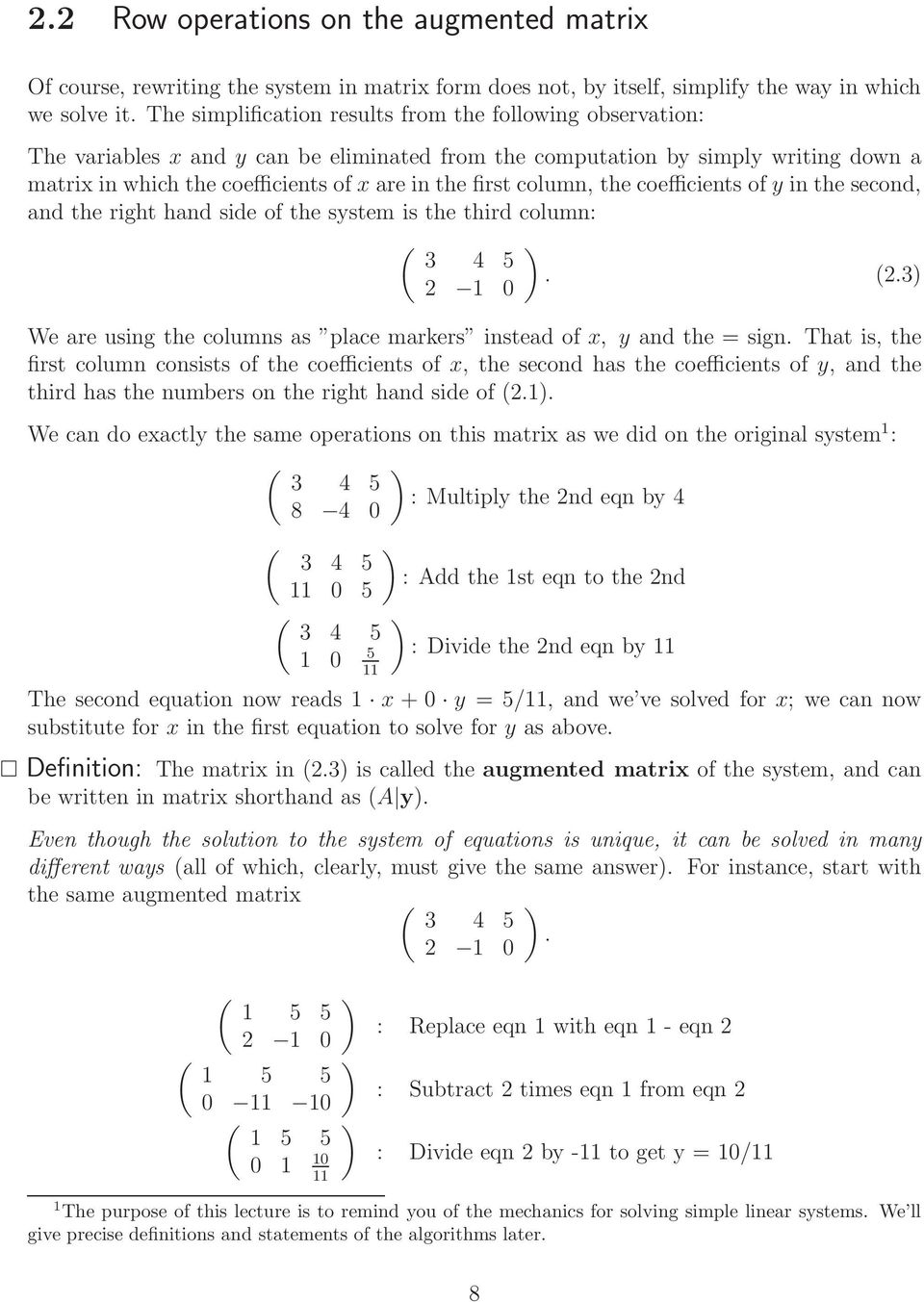
17 The second equation tells us that y = 0/, and we can substitute this into the first equation x + 5y = 5 to get x = 5/. We could even take this one step further: ( : We added -5(eqn 2 to eqn The complete solution can now be read off from the matrix. What we ve done is to eliminate x from the second equation, (the 0 in position (2, and y from the first (the 0 in position (,2. Exercise: What s wrong with writing the final matrix as ( ? The system above consists of two linear equations in two unknowns. Each equation, by itself, is the equation of a line in the plane and so has infinitely many solutions. To solve both equations simultaneously, we need to find the points, if any, which lie on both lines. There are 3 possibilities: (a there s just one (the usual case, (b there is no solution (if the two lines are parallel and distinct, or (c there are an infinite number of solutions (if the two lines coincide. Exercise: (Do this before continuing with the text. What are the possibilities for 2 linear equations in 3 unknowns? That is, what geometric object does each equation represent, and what are the possibilities for solution(s? 2.3 More variables Let s add another variable and consider two equations in three unknowns: 2x 4y + z = 4x + y z = 3 (2.4 Rather than solving this directly, we ll work with the augmented matrix for the system which is ( We proceed in more or less the same manner as above - that is, we try to eliminate x from the second equation, and y from the first by doing simple operations on the matrix. Before we start, observe that each time we do such an operation, we are, in effect, replacing the original system of equations by an equivalent system which has the same solutions. For instance, if we multiply the first equation by the number 2, we get a new equation which has exactly the same solutions as the original. Exercise: * This is also true if we replace, say, equation 2 with equation 2 plus some multiple of equation. Why? 9
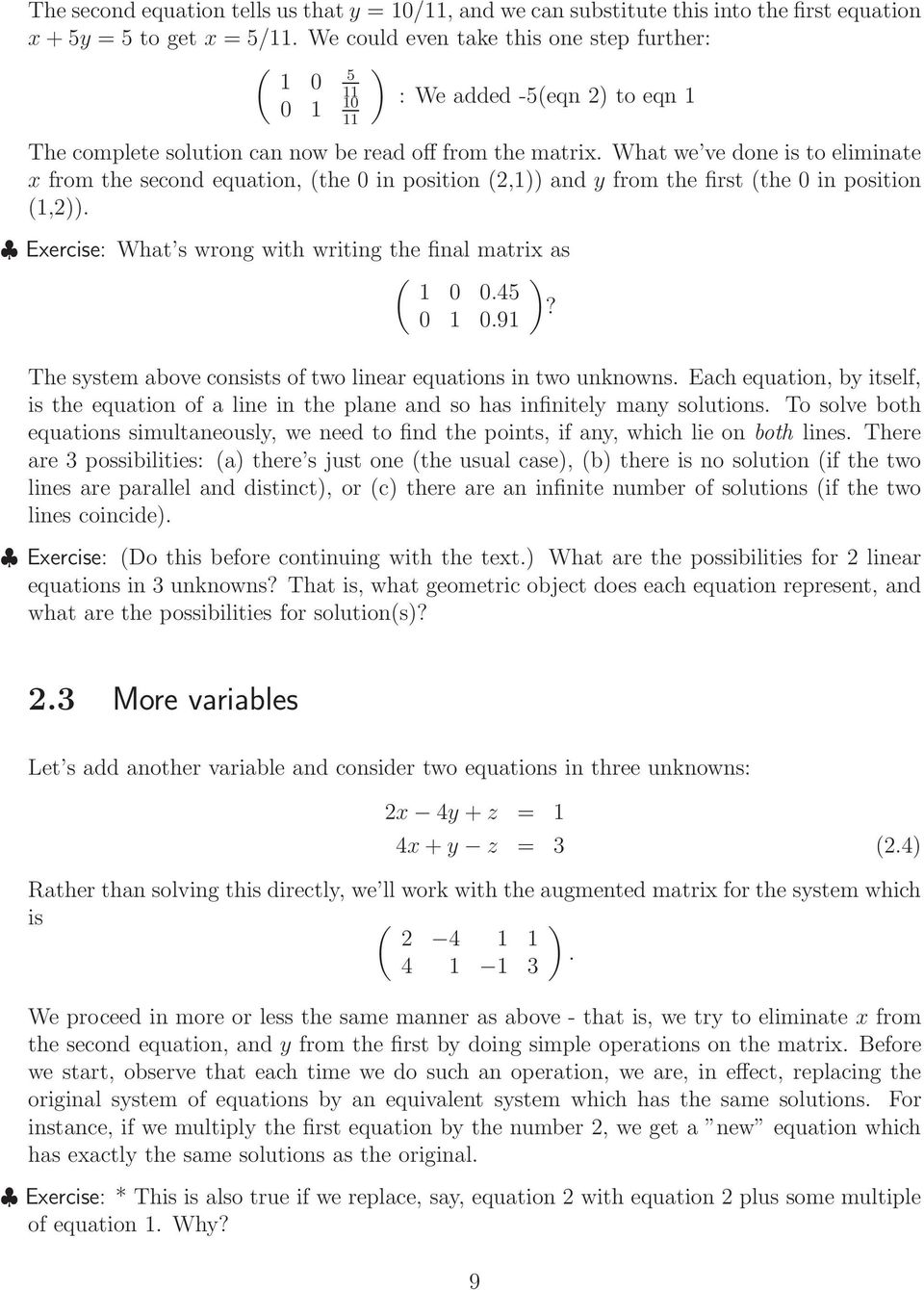
18 So, to business: ( ( ( ( : Mult eqn by /2 : Mult eqn by -4 and add it to eqn 2 : Mult eqn 2 by /9 (2.5 : Add (2eqn 2 to eqn (2.6 The matrix (2.5 is called an echelon form of the augmented matrix. The matrix (2.6 is called the reduced echelon form. (Precise definitions of these terms will be given in the next lecture. Either one can be used to solve the system of equations. Working with the echelon form in (2.5, the two equations now read x 2y + z/2 = /2 y z/3 = /9. So y = z/3 + /9. Substituting this into the first equation gives x = 2y z/2 + /2 = 2(z/3 + /9 z/2 + /2 = z/6 + 3/8 Exercise: Verify that the reduced echelon matrix (2.6 gives exactly the same solutions. This is as it should be. All equivalent systems of equations have the same solutions. 2.4 The solution in vector notation We see that for any choice of z, we get a solution to (2.4. Taking z = 0, the solution is x = 3/8, y = /9. But if z =, then x = 8/9, y = 4/9 is the solution. Similarly for any other choice of z which for this reason is called a free variable. If we write z = t, a more familiar expression for the solution is x y z = t t t = t (2.7 This is of the form r(t = tv + a, and you will recognize it as the (vector parametric form of a line in R 3. This (with t a free variable is called the general solution to the system (??. If we choose a particular value of t, say t = 3π, and substitute into (2.7, then we have a particular solution. Exercise: Write down the augmented matrix and solve these. If there are free variables, write your answer in the form given in (2.7 above. Also, give a geometric interpretation of the solution set (e.g., the common intersection of three planes in R 3. 0

19 . 3x + 2y 4z = 3 x 2y + 3z = x 4y = 3 3x + 2y = x y = 0 3. x + y + 3z = 4 It is now time to think about what we ve just been doing: Can we formalize the algorithm we ve been using to solve these equations? Can we show that the algorithm always works? That is, are we guaranteed to get all the solutions if we use the algorithm? Alternatively, if the system is inconsistent (i.e., no solutions exist, will the algorithm say so? Let s write down the different operations we ve been using on the systems of equations and on the corresponding augmented matrices:. We can multiply any equation by a non-zero real number (scalar. The corresponding matrix operation consists of multiplying a row of the matrix by a scalar. 2. We can replace any equation by the original equation plus a scalar multiple of another equation. Equivalently, we can replace any row of a matrix by that row plus a multiple of another row. 3. We can interchange two equations (or two rows of the augmented matrix; we haven t needed to do this yet, but sometimes it s necessary, as we ll see in a bit. Definition: These three operations are called elementary row operations. In the next lecture, we ll assemble the solution algorithm, and show that it can be reformulated in terms of matrix multiplication.

20 Chapter 3 Elementary row operations and their corresponding matrices 3. Elementary matrices As we ll see, any elementary row operation can be performed by multiplying the augmented matrix (A y on the left by what we ll call an elementary matrix. Just so this doesn t come as a total shock, let s look at some simple matrix operations: Suppose EA is defined, and suppose the first row of E is (, 0, 0,..., 0. Then the first row of EA is identical to the first row of A. Similarly, if the i th row of E is all zeros except for a in the i th slot, then the i th row of the product EA is identical to the i th row of A. It follows that if we want to change only row i of the matrix A, we should multiply A on the left by some matrix E with the following property: Every row except row i should be the i th row of the corresponding identity matrix. The procedure that we illustrate below is used to reduce any matrix to echelon form (not just augmented matrices. The way it works is simple: the elementary matrices E, E 2,... are formed by (a doing the necessary row operation on the identity matrix to get E, and then (b multiplying A on the left by E. Example: Let A = ( To multiply the first row of A by /3, we can multiply A on the left by the elementary matrix ( 0 E =

21 (Since we don t want to change the second row of A, the second row of E is the same as the second row of I 2. The first row is obtained by multiplying the first row of I by /3. The result is ( 4 5 E A = You should check this on your own. Same with the remaining computations. 2. To add -2(row to row 2 in the resulting matrix, multiply it by ( 0 E 2 =. 2 The general rule here is the following: To perform an elementary row operation on the matrix A, first perform the operation on the corresponding identity matrix to obtain an elementary matrix; then multiply A on the left by this elementary matrix The echelon and reduced echelon (Gauss-Jordan form Continuing with the problem, we obtain ( 4 E 2 E A = Note the order of the factors: E 2 E A and not E E 2 A! Now multiply row 2 of E 2 E A by 3/ using the matrix ( 0 E 3 = 0 3, yielding the echelon form ( 4 E 3 E 2 E A = Last, we clean out the second column by adding (-4/3(row 2 to row. The corresponding elementary matrix is ( 4 E 4 = 3. 0 Carrying out the multiplication, we obtain the Gauss-Jordan form of the augmented matrix ( 0 5 E 4 E 3 E 2 E A =
22 Naturally, we get the same result as before, so why bother? The answer is that we re developing an algorithm that will work in the general case. So it s about time to formally identify our goal in the general case. We begin with some definitions. Definition: The leading entry of a matrix row is the first non-zero entry in the row, starting from the left. A row without a leading entry is a row of zeros. Definition: The matrix R is said to be in echelon form provided that. The leading entry of every non-zero row is a. 2. If the leading entry of row i is in position k, and the next row is not a row of zeros, then the leading entry of row i + is in position k + j, where j. 3. All zero rows are at the bottom of the matrix. The following matrices are in echelon form: (, 0 0, and Here the asterisks (* stand for any number at all, including 0. Definition: The matrix R is said to be in reduced echelon form if (a R is in echelon form, and (b each leading entry is the only non-zero entry in its column. The reduced echelon form of a matrix is also called the Gauss-Jordan form. The following matrices are in reduced row echelon form: ( , 0 0, and Exercise: Suppose A is 3 5. What is the maximum number of leading s that can appear when it s been reduced to echelon form? Same questions for A 5 3. Can you generalize your results to a statement for A m n?. (State it as a theorem. Once a matrix has been brought to echelon form, it can be put into reduced echelon form by cleaning out the non-zero entries in any column containing a leading. For example, if 2 3 R = 0 2 0, which is in echelon form, then it can be reduced to Gauss-Jordan form by adding (-2(row 2 to row, and then (-3(row 3 to row. Thus =
23 and = Note that column 3 cannot be cleaned out since there s no leading there. 3.3 The third elementary row operation There is one more elementary row operation and corresponding elementary matrix we may need. Suppose we want to reduce the following matrix to Gauss-Jordan form A = Multiplying row by /2, and then adding -row to row 3 leads to E 2 E A = = Now we can clearly do 2 more operations to get a leading in the (2,3 position, and another leading in the (3,2 position. But this won t be in echelon form (why not? We need to interchange rows 2 and 3. This corresponds to changing the order of the equations, and evidently doesn t change the solutions. We can accomplish this by multiplying on the left with a matrix obtained from I by interchanging rows 2 and 3: E 3 E 2 E A = = Exercise: Without doing any written computation, write down the Gauss-Jordan form for this matrix. Exercise: Use elementary matrices to reduce ( 2 A = 3 to Gauss-Jordan form. You should wind up with an expression of the form E k E 2 E A = I. What is another name for the matrix B = E k E 2 E? 5..
24 Chapter 4 Elementary matrices, continued We have identified 3 types of row operations and their corresponding elementary matrices. To repeat the recipe: These matrices are constructed by performing the given row operation on the identity matrix:. To multiply row j (A by the scalar c use the matrix E obtained from I by multiplying j th row of I by c. 2. To add (c(row j (A to row k (A, use the identity matrix with its k th row replaced by (...,c,...,,.... Here c is in position j and the is in position k. All other entries are 0 3. To interchange rows j and k, use the identity matrix with rows j and k interchanged. 4. Properties of elementary matrices. Elementary matrices are always square. If the operation is to be performed on A m n, then the elementary matrix E is m m. So the product EA has the same dimension as the original matrix A. 2. Elementary matrices are invertible. If E is elementary, then E is the matrix which undoes the operation that created E, and E EA = IA = A; the matrix followed by its inverse does nothing to A: Examples: E = ( 0 2 adds ( 2(row (A to row 2 (A. Its inverse is ( 0 E = 2 6,
25 which adds (2(row (A to row 2 (A. You should check that the product of these two is I 2. If E multiplies the second row of a 2 2 matrix by, then 2 ( 0 E =. 0 2 If E interchanges two rows, then E = E. For instance ( ( 0 0 = I 0 0 Exercise:. If A is 3 4, what is the elementary matrix that (a subtracts (7(row 3 (A from row 2 (A?, (b interchanges the first and third rows? (c multiplies row (A by 2? 2. What are the inverses of the matrices in exercise? 3. (*Do elementary matrices commute? That is, does it matter in which order they re multiplied? Give an example or two to illustrate your answer. 4. (** In a manner analogous to the above, define three elementary column operations and show that they can be implemented by multiplying A m n on the right by elementary n n column matrices. 4.2 The algorithm for Gaussian elimination We can now formulate the algorithm which reduces any matrix first to row echelon form, and then, if needed, to reduced echelon form:. Begin with the (, entry. If it s some number a 0, divide through row by a to get a in the (, position. If it is zero, then interchange row with another row to get a nonzero (, entry and proceed as above. If every entry in column is zero, go to the top of column 2 and, by multiplication and permuting rows if necessary, get a in the (, 2 slot. If column 2 won t work, then go to column 3, etc. If you can t arrange for a leading somewhere in row, then your original matrix was the zero matrix, and it s already reduced. 2. You now have a leading in some column. Use this leading and operations of the type (arow i (A + row k (A row k (A to replace every entry in the column below the location of the leading by 0. When you re done, the column will look like
26 3. Now move one column to the right, and one row down and attempt to repeat the process, getting a leading in this location. You may need to permute this row with a row below it. If it s not possible to get a non-zero entry in this position, move right one column and try again. At the end of this second procedure, your matrix might look like where the second leading entry is in column 3. Notice that once a leading has been installed in the correct position and the column below this entry has been zeroed out, none of the subsequent row operations will change any of the elements in the column. For the matrix above, no subsequent row operations in our reduction process will change any of the entries in the first 3 columns. 4. The process continues until there are no more positions for leading entries we either run out of rows or columns or both because the matrix has only a finite number of each. We have arrived at the row echelon form., The three matrices below are all in row echelon form: , or , or Remark: The description of the algorithm doesn t involve elementary matrices. As a practical matter, it s much simpler to just do the row operation directly on A, instead of writing down an elementary matrix and multiplying the matrices. But the fact that we could do this with the elementary matrices turns out to be quite useful theoretically. Exercise: Find the echelon form for each of the following: 2 ( ( ,, (3, 4, Observations ( The leading entries progress strictly downward, from left to right. We could just as easily have written an algorithm in which the leading entries progress downward as we move from right to left, or upwards from left to right. Our choice is purely a matter of convention, but this is the convention used by most people. Definition: The matrix A is upper triangular if any entry a ij with i > j satisfies a ij = 0. 8
27 (2 The row echelon form of the matrix is upper triangular (3 To continue the reduction to Gauss-Jordan form, it is only necessary to use each leading to clean out any remaining non-zero entries in its column. For the first matrix in (4.2 above, the Gauss-Jordan form will look like Of course, cleaning out the columns may lead to changes in the entries labelled with *. 4.4 Why does the algorithm (Gaussian elimination work? Suppose we start with the system of equations Ax = y. The augmented matrix is (A y, where the coefficients of the variable x are the numbers in col (A, the equals sign is represented by the vertical line, and the last column of the augmented matrix is the right hand side of the system. If we multiply the augmented matrix by the elementary matrix E, we get E(A y. But this can also be written as (EA Ey. Example: Suppose (A y = ( a b c d e f and we want to add two times the first row to the second, using the elementary matrix ( 0 E =. 2 The result is ( E(A y =, a b c 2a + d 2b + e 2c + f But, as you can easily see, the first two columns of E(A y are just the entries of EA, and the last column is Ey, so E(A y = (EA Ey, and this works in general. (See the appropriate problem. So after multiplication by E, we have the new augmented matrix (EA Ey, which corresponds to the system of equations EAx = Ey. Now suppose x is a solution to Ax = y. Multiplication of this equation by E gives EAx = Ey, so x solves this new system. And conversely, since E is invertible, if x solves the new system, EAx = Ey, multiplication by E gives Ax = y, so x solves the original system. We have just proven the Theorem: Elementary row operations applied to either Ax = y or the corresponding augmented matrix (A y don t change the set of solutions to the system.. 9
28 The end result of all the row operations on Ax = y takes the form E k E k E 2 E Ax = E k E y, or equivalently, the augmented matrix becomes (E k E k E 2 E A E k E k E y = R, where R is an echelon form of (A y. And if R is in echelon form, we can easily work out the solution. 4.5 Application to the solution(s of Ax = y Definition: A system of equations Ax = y is consistent if there is at least one solution x. If there is no solution, then the system is inconsistent. Suppose that we have reduced the augmented matrix (A y to either echelon or Gauss-Jordan form. Then. If there is a leading anywhere in the last column, the system Ax = y is inconsistent. Why? 2. If there s no leading entry in the last column, then the system is consistent. The question then becomes How many solutions are there? The answer to this question depends on the number of free variables: Definition: Suppose the augmented matrix for the linear system Ax = y has been brought to echelon form. If there is a leading in any column except the last, then the corresponding variable is called a leading variable. For instance, if there s a leading in column 3, then x 3 is a leading variable. Definition: Any variable which is not a leading variable is a free variable. Example: Suppose the echelon form of (A y is ( Then the original matrix A is 2 3, and if x, x 2, and x 3 are the variables in the original equations, we see that x and x 3 are leading variables, and x 2 is a free variable. By definition, the number of free variables plus the number of leading variables is equal to the number of columns of the matrix A. 20
29 If the system is consistent and there are no free variables, then the solution is unique there s just one. Here s an example of this: If the system is consistent and there are one or more free variables, then there are infinitely many solutions Here x 2 is a free variable, and we get a different solution for each of the infinite number of ways we could choose x 2. Just because there are free variables does not mean that the system is consistent. Suppose the reduced augmented matrix is Here x 2 is a free variable, but the system is inconsistent because of the leading in the last column. There are no solutions to this system. Exercise: Reduce the augmented matrices for the following systems far enough so that you can tell if the system is consistent, and if so, how many free variables exist. Don t do any extra work x + 5y + z = 8 3x + y 2z = 7 4x + 0y + 2z = 20 2x + 5y + z = 8 3x + y 2z = 7 4x + 0y + 2z = 6 2
30 3. 2x + 5y + z = 8 3x + y 2z = 7 2x + 0y + 2z = x + 3y = 8 x 4y = 7 Definition: A matrix A is lower triangular if all the entries above the main diagonal vanish, that is, if a ij = 0 whenever i < j. Exercise:. The elementary matrices which add k row j (A to row i (A, j < i are lower triangular. Show that the product of any two 3 3 lower triangular matrices is again lower triangular. 2. (** Show that the product of any two n n lower triangular matrices is lower triangular. 22
31 Chapter 5 Homogeneous systems Definition: A homogeneous (ho-mo-jeen -i-us system of linear algebraic equations is one in which all the numbers on the right hand side are equal to 0: a x a n x n = 0.. a m x a mn x n = 0 In matrix form, this reads Ax = 0, where A is m n, and 0 is n. x = x. x n n, 5. Solutions to the homogeneous system The homogenous system Ax = 0 always has the solution x = 0. It follows that any homogeneous system of equations is consistent Definition: Any non-zero solutions to Ax = 0, if they exist, are called non-trivial solutions. These may or may not exist. We can find out by row reducing the corresponding augmented matrix (A 0. Example: Given the augmented matrix (A 0 = ,
32 row reduction leads quickly to the echelon form Observe that nothing happened to the last column row operations do nothing to a column of zeros. Equivalently, doing a row operation on a system of homogeneous equations doesn t change the fact that it s homogeneous. For this reason, when working with homogeneous systems, we ll just use the matrix A, rather than the augmented matrix. The echelon form of A is Here, the leading variables are x and x 2, while x 3 and x 4 are the free variables, since there are no leading entries in the third or fourth columns. Continuing along, we obtain the Gauss- Jordan form (You should be working out the details on your scratch paper as we go along No further simplification is possible because any new row operation will destroy the structure of the columns with leading entries. The system of equations now reads.. x 8x 3 7x 4 = 0 x 2 + 4x 3 + 3x 4 = 0, In principle, we re finished with the problem in the sense that we have the solution in hand. But it s customary to rewrite the solution in vector form so that its properties are more evident. First, we solve for the leading variables; everything else goes on the right hand side: x = 8x 3 + 7x 4 x 2 = 4x 3 3x 4. Assigning any values we choose to the two free variables x 3 and x 4 gives us one the many solutions to the original homogeneous system. This is, of course, why the variables are called free. For example, taking x 3 =, x 4 = 0 gives the solution x = 8, x 2 = 4. We can distinguish the free variables from the leading variables by denoting them as s, t, u, 24
33 etc. This is not logically necessary; it just makes things more transparent. Thus, setting x 3 = s, x 4 = t, we rewrite the solution in the form x x 2 x 3 x 4 = 8s + 7t = 4s 3t = s = t More compactly, the solution can also be written in matrix and set notation as x H = x x 2 x 3 x 4 = s t : for all s, t R (5. The curly brackets { } are standard notation for a set or collection of objects. Definition: x H is called the general solution to the homogeneous equation. Notice that x H is an infinite set of objects (one for each possible choice of s and t and not a single vector. The notation is somewhat misleading, since the left hand side x H looks like a single vector, while the right hand side clearly represents an infinite collection of objects with 2 degrees of freedom. We ll improve this later. 5.2 Some comments about free and leading variables Let s go back to the previous set of equations x = 8x 3 + 7x 4 x 2 = 4x 3 3x 4. Notice that we can rearrange things: we could solve the second equation for x 3 to get x 3 = 4 (x 2 + 3x 4, and then substitute this into the first equation, giving x = 2x 2 + x 4. Now it looks as though x 2 and x 4 are the free variables! This is perfectly all right: the specific algorithm (Gaussian elimination we used to solve the original system leads to the form in which x 3 and x 4 are the free variables, but solving the system a different way (which is perfectly legal could result in a different set of free variables. Mathematicians would say that the concepts of free and leading variables are not invariant notions. Different computational schemes lead to different results. 25
34 BUT... What is invariant (i.e., independent of the computational details is the number of free variables (2 and the number of leading variables (also 2 here. No matter how you solve the system, you ll always wind up being able to express 2 of the variables in terms of the other 2! This is not obvious. Later we ll see that it s a consequence of a general result called the dimension or rank-nullity theorem. The reason we use s and t as the parameters in the system above, and not x 3 and x 4 (or some other pair is because we don t want the notation to single out any particular variables as free or otherwise they re all to be on an equal footing. 5.3 Properties of the homogenous system for A mn If we were to carry out the above procedure on a general homogeneous system A m n x = 0, we d establish the following facts: Exercise: The number of leading variables is min(m, n. The number of non-zero equations in the echelon form of the system is equal to the number of leading entries. The number of free variables plus the number of leading variables = n, the number of columns of A. The homogenous system Ax = 0 has non-trivial solutions if and only if there are free variables. If there are more unknowns than equations, the homogeneous system always has nontrivial solutions. (Why? This is one of the few cases in which we can tell something about the solutions without doing any work. A homogeneous system of equations is always consistent (i.e., always has at least one solution.. What sort of geometric object does x H represent? 2. Suppose A is 4 7. How many leading variables can Ax = 0 have? How many free variables? 3. (* If the Gauss-Jordan form of A has a row of zeros, are there necessarily any free variables? If there are free variables, is there necessarily a row of zeros? 26
35 5.4 Linear combinations and the superposition principle There are two other fundamental properties of the homogeneous system:. Theorem: If x is a solution to Ax = 0, then so is cx for any real number c. Proof: x is a solution means Ax = 0. But A(cx = c(ax = c0 = 0, so cx is also a solution. 2. Theorem: If x and y are two solutions to the homogeneous equation, then so is x + y. Proof: A(x + y = Ax + Ay = = 0, so x + y is also a solution. These two properties constitute the famous principle of superposition which holds for homogeneous systems (but NOT for inhomogeneous ones. Definition: If x and y are vectors and s and t are scalars, then sx + ty is called a linear combination of x and y. Example: 3x 4πy is a linear combination of x and y. We can reformulate this as: Superposition principle: if x and y are two solutions to the homogenous equation Ax = 0, then any linear combination of x and y is also a solution. Remark: This is just a compact way of combining the two properties: If x and y are solutions, then by property, sx and ty are also solutions. And by property 2, their sum sx + ty is a solution. Conversely, if sx + ty is a solution to the homogeneous equation for all s, t, then taking t = 0 gives property, and taking s = t = gives property 2. You have seen this principle at work in your calculus courses. Example: Suppose φ(x, y satisfies LaPlace s equation 2 φ x + 2 φ 2 y = 0. 2 We write this as φ = 0, where = 2 x y 2. The differential operator has the same property as matrix multiplication, namely: if φ(x, y and ψ(x, y are two differentiable functions, and s and t are any two real numbers, then (sφ + tψ = s φ + t ψ. 27
36 Exercise: Verify this. That is, show that the two sides are equal by using properties of the derivative. The functions φ and ψ are, in fact, vectors, in an infinite-dimensional space called Hilbert space. It follows that if φ and ψ are two solutions to Laplace s equation, then any linear combination of φ and ψ is also a solution. The principle of superposition also holds for solutions to the wave equation, Maxwell s equations in free space, and Schrödinger s equation in quantum mechanics. For those of you who know the language, these are all (systems of homogeneous linear differential equations. Example: Start with white light (e.g., sunlight; it s a collection of electromagnetic waves which satisfy Maxwell s equations. Pass the light through a prism, obtaining red, orange,..., violet light; these are also solutions to Maxwell s equations. The original solution (white light is seen to be a superposition of many other solutions, corresponding to the various different colors (i.e. frequencies. The process can be reversed to obtain white light again by passing the different colors of the spectrum through an inverted prism. This is one of the experiments Isaac Newton did when he was your age. Referring back to the example (see Eqn (5., if we set x = 8 4 0, and y = then the susperposition principle tells us that any linear combination of x and y is also a solution. In fact, these are all of the solutions to this system, as we ve proven above , 28
37 Chapter 6 The Inhomogeneous system Ax = y, y 0 Definition: The system Ax = y is inhomogeneous if it s not homogeneous. Mathematicians love definitions like this! It means of course that the vector y is not the zero vector. And this means that at least one of the equations has a non-zero right hand side. 6. Solutions to the inhomogeneous system As an example, we can use the same system as in the previous lecture, except we ll change the right hand side to something non-zero: x + 2x 2 x 4 = 2x 3x 2 + 4x 3 + 5x 4 = 2 2x + 4x 2 2x 4 = 3. Those of you with sharp eyes should be able to tell at a glance that this system is inconsistent that is, there are no solutions. Why? We re going to proceed anyway because this is hardly an exceptional situation. The augmented matrix is (A y = We can t discard the 5th column here since it s not zero. The row echelon form of the augmented matrix is
38 And the reduced echelon form is The third equation, from either of these, now reads. 0x + 0x 2 + 0x 3 + 0x 4 =, or 0 =. This is false! How can we wind up with a false statement? The actual reasoning that led us here is this: If the original system has a solution, then performing elementary row operations will give us an equivalent system with the same solution. But this equivalent system of equations is inconsistent. It has no solutions; that is no choice of x,..., x 4 satisfies the equation. So the original system is also inconsistent. In general: If the echelon form of (A y has a leading in any position of the last column, the system of equations is inconsistent. Now it s not true that any inhomogenous system with the same matrix A is inconsistent. It depends completely on the particular y which sits on the right hand side. For instance, if y = 2, 2 then (work this out! the echelon form of (A y is and the reduced echelon form is Since this is consistent, we have, as in the homogeneous case, the leading variables x and x 2, and the free variables x 3 and x 4. Renaming the free variables by s and t, and writing out the equations solved for the leading variables gives us x = 8s + 7t 7 x 2 = 4s 3t + 4 x 3 = s = t x 4. 30
39 This looks like the solution to the homogeneous equation found in the previous section except for the additional scalars 7 and + 4 in the first two equations. If we rewrite this using vector notation, we get x I = x x 2 x 3 x 4 = s t : s, t R (The symbol is mathematical shorthand for the words for all or, equivalently, for any, or for each, or for every. Definition: x I is called the general solution to the inhomogeneous equation. Compare this with the general solution x H to the homogenous equation found before. Once again, we have a 2-parameter family (or set of solutions. We can get a particular solution by making some specific choice for s and t. For example, taking s = t = 0, we get the particular solution x p = We can get other particular solutions by making other choices. Observe that the general solution to the inhomogeneous system worked out here can be written in the form x I = x H + x p. In fact, this is true in general: Theorem: Let x p and ˆx p be two solutions to Ax = y. Then their difference x p ˆx p is a solution to the homogeneous equation Ax = 0. The general solution to Ax = y can be written as x I = x p + x H where x H denotes the general solution to the homogeneous system. Proof: Since x p and ˆx p are solutions, we have A(x p ˆx p = Ax p Aˆx p = y y = 0. So their difference solves the homogeneous equation. Conversely, given a particular solution x p, then the entire set x p + x H consists of solutions to Ax = y: if z belongs to x H, then A(x p + z = Ax p + Az = y + 0 = y and so x p + z is a solution to Ax = y Choosing a different particular solution Going back to the example, suppose we write the general solution to Ax = y in the vector form x I = {sv + tv 2 + x p, s, t R}, where 3
40 v = 8 4 0, v 2 = 7 3 0, and x p = Any different choice of s, t, for example taking s =, t =, gives another solution: We can rewrite the general solution as ˆx p = x I = (s + v + (t + v 2 + x p = (s v + (t v 2 + ˆx p. = ŝv + ˆtv 2 + ˆx p As ŝ and ˆt run over all possible pairs of real numbers we get exactly the same set of solutions as before. So the general solution can be written as ˆx p +x H as well as x p +x H! This is a bit confusing unless you recall that these are sets of solutions, rather than single solutions; (ŝ, ˆt and (s, t are just different sets of coordinates. But running through either set of coordinates (or parameters produces the same set. Remarks Those of you taking a course in differential equations will encounter a similar situation: the general solution to a linear differential equation has the form y = y p + y h, where y p is any particular solution to the DE, and y h denotes the set of all solutions to the homogeneous DE. We can visualize the general solutions to the homogeneous and inhomogeneous equations we ve worked out in detail as follows. The set x H is a 2-plane in R 4 which goes through the origin since x = 0 is a solution. The general solution to Ax = y is obtained by adding the vector x p to every point in this 2-plane. Geometrically, this gives another 2-plane parallel to the first, but not containing the origin (since x = 0 is not a solution to Ax = y unless y = 0. Now pick any point in this parallel 2-plane and add to it all the vectors in the 2-plane corresponding to x H. What do you get? You get the same parallel 2-plane! This is why x p + x H = ˆx p + x H. Exercise: Using the same example above, let x p be the solution obtained by taking s = 2, t =. Verify that both x p x p and ˆx p x p are solutions to the homogeneous equation. 32
41 x p + z x p x H 0 z Figure 6.: The lower plane (the one passing through 0 represents x H ; the upper is x I. Given the particular solution x p and a z in x H, we get another solution to the inhomogeneous equation. As z varies in x H, we get all the solutions to Ax = y. 33
42 Chapter 7 Square matrices, inverses and related matters 7. The Gauss-Jordan form of a square matrix Square matrices are the only matrices that can have inverses, and for this reason, they are a bit special. In a system of linear algebraic equations, if the number of equations equals the number of unknowns, then the associated coefficient matrix A is square. If we row reduce A to its Gauss-Jordan form, there are two possible outcomes:. The Gauss-Jordan form for A n n is the n n identity matrix I n (commonly written as just I. 2. The Gauss-Jordan form for A has at least one row of zeros. The second case is clear: The GJ form of A n n can have at most n leading entries. If the GJ form of A is not I, then the GJ form has n or fewer leading entries, and therefore has at least one row of zeros. In the first case, we can show that A is invertible. To see this, remember that A is reduced to GJ form by multiplication on the left by a finite number of elementary matrices. If the GJ form is I, then when all the dust settles, we have an expression like E k E k...e 2 E A = I, where E k is the matrix corresponding to the k th row operation used in the reduction. If we set B = E k E k...e 2 E, then clearly BA = I and so B = A. Furthermore, multiplying BA on the left by (note the order!!! E k, then by E k, and continuing to E, we undo all the row operations that brought A to GJ form, and we get back A. In detail, we get (E E 2...E k E k BA = (E E2...E k E k (E E 2...E k E k (E ke k...e 2 E A = E E 2...E k E k 34 A = E E 2...E k E k I or
43 We summarize this in a Theorem: The following are equivalent (i.e., each of the statements below implies and is implied by any of the others The square matrix A is invertible. The Gauss-Jordan or reduced echelon form of A is the identity matrix. A can be written as a product of elementary matrices. Example: - (fill in the details on your scratch paper We start with A = ( 2 2 We multiply row by /2 using the matrix E : ( 0 E A = 2 0 We now add -(row to row 2, using E 2 : ( 0 E 2 E A = Now multiply the second row by 2: 3 ( 0 E 3 E 2 E A = And finally, add (row 2 to row : 2 ( E 4 E 3 E 2 E A = 2 0 So Exercise: A =. ( 2 2 ( A = E 4 E 3 E 2 E = 3 ( 2 2 = ( 2 0 =. ( = ( 2 2 ( 2 0. ( 0 0 Check the last expression by multiplying the elementary matrices together. Write A as the product of elementary matrices. The individual factors in the product of A are not unique. They depend on how we do the row reduction. Find another factorization of A. (Hint: Start things out a different way, for example by adding -(row 2 to row. Let A = ( 2 3 Express both A and A as the products of elementary matrices
44 7.2 Solutions to Ax = y when A is square If A is invertible, then the equation Ax = y has the unique solution A y for any right hand side y. For, Ax = y A Ax = A y x = A y. In this case, the solution to the homogeneous equation is also unique - it s the trivial solution x = 0. If A is not invertible, then there is at least one free variable (why?. So there are nontrivial solutions to Ax = 0. If y 0, then either Ax = y is inconsistent (the most likely case or solutions to the system exist, but there are infinitely many. Exercise: * If the square matrix A is not invertible, why is it likely that the inhomogeneous equation is inconsistent? Likely, in this context, means that the system should be inconsistent for a y chosen at random. 7.3 An algorithm for constructing A The work we ve just done leads immediately to an algorithm for constructing the inverse of A. (You ve probably seen this before, but now you know why it works!. It s based on the following observation: suppose B n p is another matrix with the same number of rows as A n n, and E n n is an elementary matrix which can multiply A on the left. Then E can also multiply B on the left, and if we form the partitioned matrix C = (A B n (n+p, Then, in what should be an obvious notation, we have where EA is n n and EB is n p. EC = (EA EB n n+p, Exercise: Check this for yourself with a simple example. (* Better yet, prove it in general. The algorithm consists of forming the partitioned matrix C = (A I, and doing the row operations that reduce A to Gauss-Jordan form on the larger matrix C. If A is invertible, we ll end up with E k...e (A I = (E k...e A E k...e I = (I A. In words: the same sequence of row operations that reduces A to I will convert I to A. The advantage to doing things this way is that we don t have to write down the elementary matrices. They re working away in the background, as we know from the theory, but if all we want is A, then we don t need them explicitly; we just do the row operations. 36
45 Example: Then row reducing (A I, we get (A I = Let A = r r2 do col do column So, and column 3 A = Exercise: Write down a 2 2 matrix and do this yourself. Same with a 3 3 matrix. 37
46 Chapter 8 Square matrices continued: Determinants 8. Introduction Determinants give us important information about square matrices, and, as we ll soon see, are essential for the computation of eigenvalues. You have seen determinants in your precalculus courses. For a 2 2 matrix the formula reads For a 3 3 matrix A = ( a b c d, det(a = ad bc. a a 2 a 3 a 2 a 22 a 23 a 3 a 32 a 33 life is more complicated. Here the formula reads det(a = a a 22 a 33 + a 3 a 2 a 32 + a 2 a 23 a 3 a 2 a 2 a 33 a a 23 a 32 a 3 a 22 a 3. Things get worse quickly as the dimension increases. For an n n matrix A, the expression for det(a has n factorial = n! = 2...(n n terms, each of which is a product of n matrix entries. Even on a computer, calculating the determinant of a 0 0 matrix using this sort of formula would be unnecessarily time-consuming, and doing a matrix would take years!, 8.2 Aside: some comments about computer arithmetic It is often the case that the simple algorithms and definitions we use in class turn out to be cumbersone, inaccurate, and impossibly time-consuming when implemented on a computer. There are a number of reasons for this: 38
47 . Floating point arithmetic, used on computers, is not at all the same thing as working with real numbers. On a computer, numbers are represented (approximately! in the form x = (d d 2 d n 2 a a 2 a m, where n and m might be of the order 50, and d... a m are binary digits (either 0 or. This is called the floating point representation (It s the decimal point that floats - you can represent the number 8 as , as 0 2 2, etc. As a simple example of what goes wrong, suppose that n = 5. Then 9 = , and therefore has the binary representation 00. Since it has 5 digits, it s represented correctly in our system. So is the number 9, represented by 00. But the product 9 9 = 7 has the binary representation 000, which has 8 digits. We can only keep 5 significant digits in our (admittedly primitive representation. So we have to decide what to do with the trailing 0 (which is 3 in decimal. We can round up or down: If we round up we get 0000 = = 76, while rounding down gives = 68. Neither is a very good approximation to 7. Certainly a modern computer does a better job than this, and uses much better algorithms, but the problem, which is called roundoff error still remains. When we do a calculation on a computer, we almost never get the right answer. We rely on something called the IEEE standard to prevent the computer from making truly silly mistakes, but this doesn t always work. 2. Most people know that computer arithmetic is approximate, but they imagine that the representable numbers are somehow distributed evenly along the line, like the rationals. But this is not true: suppose that n = m = 5 in our little floating point system. Then there are 2 5 = 32 floating point numbers between = 2 0 and 2 = 2. They have binary representations of the form to.. (Note that changing the exponent of 2 doesn t change the number of significant digits; it just moves the decimal point. Similarly, there are precisely 32 floating point numbers between 2 and 4. And between 2 0 = 2 30 (approximately billion and 2 = 2 3 (approximately 2 billion! The floating point numbers are distributed logarithmically which is quite different from the even distribution of the rationals. Any number 2 3 or 2 3 can t be represented at all. Again, the numbers are lots bigger on modern machines, but the problem still remains. 3. A frequent and fundamental problem is that many computations don t scale the way we d like them to. If it takes 2 msec to compute a 2 2 determinant, we d like it to take 3 msec to do a 3 3 one,..., and n seconds to do an n n determinant. In fact, as you can see from the above definitions, it takes 3 operations (2 multiplications and one addition to compute the 2 2 determinant, but 7 operations (2 multiplications and 5 additions to do the 3 3 one. (Multiplying 3 numbers together, like xyz requires 2 operations: we multiply x by y, and the result by z. In the 4 4 case (whose formula is not given above, we need 95 operations (72 multiplications and 23 additions. The evaluation of a determinant according to the above rules is an excellent example of something we don t want to do. Similarly, we never solve systems of linear equations using Cramer s rule (except in some math textbooks!. 39
48 4. The study of all this (i.e., how to do mathematics correctly on a computer is an active area of current mathematical research known as numerical analysis. Fortunately, as we ll see below, computing the determinant is easy if the matrix happens to be in echelon form. You just need to do a little bookkeepping on the side as you reduce the matrix to echelon form. 8.3 The formal definition of det(a Let A be n n, and write r for the first row, r 2 for the second row, etc. Definition: The determinant of A is a real-valued function of the rows of A which we write as det(a = det(r,r 2,...,r n. It is completely determined by the following four properties:. Multiplying a row by the constant c multiplies the determinant by c: det(r,r 2,...,cr i,...,r n = c det(r,r 2,...,r i,...,r n 2. If row i is the sum of the two row vectors x and y, then the determinant is the sum of the two corresponding determinants: det(r,r 2,...,x + y,...,r n = det(r,r 2,...,x,...,r n + det(r,r 2,...,y,...,r n (These two properties are summarized by saying that the determinant is a linear function of each row. 3. Interchanging any two rows of the matrix changes the sign of the determinant: det(...,r i,...,r j... = det(...,r j,...,r i, The determinant of any identity matrix is. 8.4 Some consequences of the definition Proposition : If A has a row of zeros, then det(a = 0: Because if A = (...,0,..., then A also = (...,c0,... for any c, and therefore, det(a = c det(a for any c (property. This can only happen if det(a = 0. Proposition 2: If r i = r j, i j, then det(a = 0: Because then det(a = det(...,r i,...,r j,... = det(...,r j,...,r i,..., by property 3, so det(a = det(a which means det(a = 0. 40
49 Proposition 3: If B is obtained from A by replacing r i with r i +cr j, then det(b = det(a: det(b = det(...,r i + cr j,...,r j,... = det(...,r i,...,r j,... + det(...,cr j,...,r j,... = det(a + c det(...,r j,...,r j,... = det(a + 0 The second determinant vanishes because both the i th and j th rows are equal to r j. These properties, together with the definition, tell us exactly what happens to det(a when we perform row operations on A. Theorem: The determinant of an upper or lower triangular matrix is equal to the product of the entries on the main diagonal. Proof: Suppose A is upper triangular and that none of the entries on the main diagonal is 0. This means all the entries beneath the main diagonal are zero. This means we can clean out each column above the diagonal by using a row operation of the type just considered above. The end result is a matrix with the original non zero entries on the main diagonal and zeros elsewhere. Then repeated use of property gives the result. A similar proof works for lower triangular matrices. For the case that one or more of the diagonal entries is 0, see the exercise below. Remark: This is the property we use to compute determinants, because, as we know, row reduction leads to an upper triangular matrix. Exercise: ** If A is an upper triangular matrix with one or more 0s on the main diagonal, then det(a = 0. (Hint: show that the GJ form has a row of zeros. 8.5 Computations using row operations Examples:. Let A = (
50 Note that r = (2, = 2(,, so that, by property of the definition, 2 det(a = 2 det And by proposition 3, this = 2 det Using property again gives and by the theorem, this.. = (2( 2 det 2 0 =, Exercise: Evaluate det(a for Justify all your steps. A = ( We can derive the formula for a 2 2 determinant in the same way: Let ( a b A = c d And suppose that a 0. Then b det(a = a det a c d b = det a 0 d bc a = a(d bc = ad bc a Exercise: (*Suppose a = 0 in the matrix A. Then we can t divide by a and the above computation won t work. Show that it s still true that det(a = ad bc. Show that the three types of elementary matrices all have nonzero determinants. 42
51 Using row operations, evaluate the determinant of the matrix A = (* Suppose that row k (A is a linear combination of rows i and j, where i j k: So r k = ar i + br j. Show that det(a = Additional properties of the determinant There are two other important properties of the determinant, which we won t prove here. The determinant of A is the same as that of its transpose A t. Exercise: *** Prove this. Hint: suppose we do an elementary row operation on A, obtaining EA. Then (EA t = A t E t. What sort of column operation does E t do on A t? If A and B are square matrices of the same size, then det(ab = det(a det(b Exercise: *** Prove this. Begin by showing that for elementary matrices, det(e E 2 = det(e det(e 2. There are lots of details here. From the second of these, it follows that if A is invertible, then det(aa = det(i = = det(a det(a, so det(a = / det(a. Definition: If the (square matrix A is invertible, then A is said to be non-singular. Otherwise, A is singular. Exercise: (**Show that A is invertible det(a 0. (Hint: use the properties of determinants together with the theorem on GJ form and existence of the inverse. (* A is singular the homogeneous equation Ax = 0 has nontrivial solutions. (Hint: If you don t want to do this directly, make an argument that this statement is logically equivalent to: A is non-singular the homogeneous equation has only the trivial solution. 43
52 Compute the determinants of the following matrices using the properties of the determinant; justify your work: , , and π (* Suppose a = are two vectors in the plane. Let ( a a 2 A = (a b = and b = ( b b 2 ( a b. a 2 b 2 Show that det(a equals ± the area of the parallelogram spanned by the two vectors. When is the sign plus? 44
53 Chapter 9 The derivative as a matrix 9. Redefining the derivative Matrices appear in many situations in mathematics, not just when we need to solve a system of linear equations. An important instance is linear approximation. Recall from your calculus course that a differentiable function f can be expanded about any point a in its domain using Taylor s theorem. We can write f(x = f(a + f (a(x a + f (c (x a 2, 2! where c is some point between x and a. The remainder term f (c 2! (x a 2 is the error made by using the linear approximation to f at x = a, f(x f(a + f (a(x a. That is, f(x minus the approximation is exactly equal to the error (remainder term. In fact, we can write Taylor s theorem in the more suggestive form f(x = f(a + f (a(x a + ǫ(x, a, where the remainder term has now been renamed the error term ǫ(x, a and has the important property ǫ(x, a lim x a x a = 0. (The existence of this limit is another way of saying that the error term looks like (x a 2. This observation gives us an alternative (and in fact, much better definition of the derivative: Definition: The real-valued function f is said to be differentiable at x = a if there exists a number A and a function ǫ(x, a such that f(x = f(a + A(x a + ǫ(x, a, 45
54 where lim x a ǫ(x, a x a = 0. Remark: the error term ǫ = f (c 2 (x a 2 just depends on the two variables x and a. Once these are known, the number c is determined. Theorem: This is equivalent to the usual calculus definition. Proof: If the new definition holds and we compute f (x in the usual way, we find lim x a f(x f(a x a = A + lim x a ǫ(x, a x a = A + 0 = A, and A = f (a according to the standard definition. Conversely, if the standard definition of differentiability holds, then we can define ǫ(x, a to be the error made in the linear approximation: ǫ(x, a = f(x f(a f (a(x a. Then ǫ(x, a lim x a x a = lim f(x f(a f (a = f (a f (a = 0, x a x a so f can be written in the new form, with A = f (a. Example: Let f(x = 4 + 2x x 2, and let a = 2. So f(a = f(2 = 4, and f (a = f (2 = 2 2a = 2.. Now subtract f(2 + f (2(x 2 from f(x to get 4 + 2x x 2 (4 2(x 2 = 4 + 4x x 2 = (x 2 2. This is the error term, which is quadratic in x 2, as advertised. So 8 2x ( = f(2 + f (2(x 2 is the correct linear approximation to f at x = 2. Suppose we try some other linear approximation - for example, we could try f(2 4(x 2 = 2 4x. Subtracting this from f(x gives 8 + 6x x 2 = 2(x 2 (x 2 2, which is our new error term. But this won t work, since 2(x 2 (x 2 2 lim x 2 (x 2 = 2, which is clearly not 0. The only linear approximation that leaves a purely quadratic remainder as the error term is the one formed in the usual way, using the derivative. Exercise: Interpret this geometrically in terms of the slope of various lines passing through the point (2, f( Generalization to higher dimensions Our new definition of derivative is the one which generalizes to higher dimensions. We start with an 46
55 Example: Consider a function from R 2 to R 2, say ( ( ( x u(x, y 2 + x + 4y + 4x f(x = f = = 2 + 5xy y 2 y v(x, y x + 2y 2x 2 + 3xy + y 2 By inspection, as it were, we can separate the right hand side into three parts. We have ( 2 f(0 = and the linear part of f is the vector ( x + 4y x + 2y, which can be written in matrix form as ( 4 Ax = 2 ( x y By analogy with the one-dimensional case, we might guess that. f(x = f(0 + Ax + an error term of order 2 in x, y. where A is the matrix A = u x v x u y v y (0, 0. And this suggests the following Definition: A function f : R n R m is said to be differentiable at the point x = a R n if there exists an m n matrix A and a function ǫ(x,a such that where f(x = f(a + A(x a + ǫ(x,a, lim x a ǫ(x, a x a = 0. The matrix A is called the derivative of f at x = a, and is denoted by Df(a. Generalizing the one-dimensional case, it can be shown that if u (x f(x =., u m (x 47
56 is differentiable at x = a, then the derivative of f is given by the m n matrix of partial derivatives u u x x n Df(a =... (a. u m u m x x n Conversely, if all the indicated partial derivatives exist and are continuous at x = a, then the approximation f(x f(a + Df(a(x a is accurate to the second order in x a. Exercise: Find the derivative of the function f : R 2 R 3 at a = (, 2 t, where (x + y 3 f(x = x 2 y 3 y/x Exercise: * What goes wrong if we try to generalize the ordinary definition of the derivative (as a difference quotient to higher dimensions? m n 48
57 Chapter 0 Subspaces Now, we are ready to start the course. From this point on, the material will be new to most of you. This means that most of you will not get it at first. You may have to read each lecture a number of times before it makes sense; fortunately the chapters are short! Your intuition is often a good guide: if you have a nagging suspicion that you don t quite understand something, then you re probably right and should ask a question. If you sort of think you understand it, that s the same thing as having a nagging suspicion that you don t. And NO ONE understands mathematics who doesn t know the definitions! With this cheerful, uplifting message, let s get started. Definition: A linear combination of the vectors v,v 2,...,v m is any vector of the form c v + c 2 v c m v m, where c,...,c m are any two scalars. Definition: A subset V of R n is a subspace if, whenever v,v 2 belong to V, and c, and c 2 are any real numbers, the linear combination c v + c 2 v 2 also belongs to V. Remark: Suppose that V is a subspace, and that x,x 2,...,x m all belong to V. Then c x + c 2 x 2 V. Therefore, (c x + c 2 x 2 + c 3 x 3 V. Similarly, (c x +...c m x m + c m x m V. We say that a subspace is closed under linear combinations. So an alternative definition of a subspace is Definition: A subspace V of R n is a subset of R n which is closed under linear combinations. Examples:. For an m n matrix A, the set of all solutions to the homogeneous equation Ax = 0 is a subspace of R n. Proof: Suppose x and x 2 are solutions; we need to show that c x + c 2 x 2 is also a solution. Because x is a solution, Ax = 0. Similarly, Ax 2 = 0. Then for any scalars c, c 2, A(c x +c 2 x 2 = c Ax +c 2 Ax 2 = c 0+c 2 0 = 0. So c x +c 2 x 2 is also a solution. The set of solutions is closed under linear combinations and so it s a subspace. Definition: This important subspace is called the null space of A, and is denoted Null(A. 49
58 For example, if A = (,, 3, then the null space of A consists of all solutions to Ax = 0. If x x = y, z then x Null(A x y +3z = 0. The matrix A is already in Gauss-Jordan form, and we see that there are two free variables. Setting y = s, and z = t, we have 3 Null(A = s + t 0, where s, t R The set consisting of the single vector 0 is a subspace of R n for any n: any linear combination of elements of this set is a multiple of 0, and hence equal to 0 which is in the set. 3. R n is a subspace of itself since any linear combination of vectors in the set is again in the set. 4. Take any finite or infinite set S R n Definition: The span of S is the set of all finite linear combinations of elements of S: span(s = {x : x = n c i v i, where v i S, and n < } i= Exercise: Show that span(s is a subspace of R n. Definition: If V = span(s, then the vectors in S are said to span the subspace V. (So the word span is used in 2 ways, as a noun and a verb. Example: Referring back to the example above, suppose we put 3 v =, and v 2 = 0. 0 Then Null(A = {sv + tv 2, t, s R}. So Null(A = span(v,v 2. And, of course, Null(A is just what we called x H in previous lectures. (We will not use the obscure notation x H for this subspace any longer. How can you tell if a particular vector belongs to span(s? You have to show that you can (or cannot write it as a linear combination of vectors in S. 50
59 Example: in the span of 0, Is v = = {x,x 2 }? Answer: It is if there exist numbers c and c 2 such that v = c x + c 2 x 2. Writing this out gives a system of linear equations: 2 v = 2 = c 0 + c In matrix form, this reads ( c c 2 = 2 3 As you can (and should! verify, this system is inconsistent. No such c, c 2 exist. So v is not in the span of these two vectors. 5. The set of all solutions to the inhomogeneous system Ax = y, y 0 is not a subspace. To see this, suppose that x and x 2 are two solutions. We ll have a subspace if any linear combination of these two vectors is again a solution. So we compute A(c x + c 2 x 2 = c Ax + c 2 Ax 2 = c y + c 2 y = (c + c 2 y, Since for general c, c 2 the right hand side is not equal to y, this is not a subspace. NOTE: To determine whether V is a subspace does not, as a general rule, require any prodigious intellectual effort. Just assume that x,x 2 V, and see if c x + c 2 x 2 V for arbitrary scalars c, c 2. If so, it s a subspace, otherwise no. The scalars must be arbitrary, and x,x 2 must be arbitrary elements of V. (So you can t pick two of your favorite vectors and two of your favorite scalars for this proof - that s why we always use generic elements like x, and c. 6. In addition to the null space, there are two other subspaces determined by the m n matrix A: Definition: The m rows of A form a subset of R n ; the span of these vectors is called the row space of the matrix A. Definition: Similarly, the n columns of A form a set of vectors in R m, and the space they span is called the column space of the matrix A. 5
60 Example: For the matrix A = , Exercise: the row space of A is span{(, 0,, 2 t, (3, 4, 6, t, (2, 5, 9, 7 t }, and the column space is 0 2 span 3, 4, 6, A plane through 0 in R 3 is a subspace of R 3. A plane which does not contain the origin is not a subspace. (Hint: what are the equations for these planes? Which lines in R 2 are subspaces of R 2? Show that any subspace must contain the vector 0. It follows that if 0 / V, then V cannot be a subspace. ** Let λ be a fixed real number, A a square n n matrix, and define E λ = {x R n : Ax = λx}. Show that E λ is a subspace of R n. (E λ is called the eigenspace corresponding to the eigenvalue λ. We ll learn more about this later. In many texts, vectors are written as row vectors for typographical reasons (it takes up less space. But for computations the vectors should always be written as colums, which is why the symbols for the transpose appear here 52
61 Chapter Linearly dependent and independent sets. Linear dependence Definition: A finite set S = {x,x 2,...,x m } of vectors in R n is said to be linearly dependent if there exist scalars (real numbers c, c 2,...,c m, not all of which are 0, such that c x + c 2 x c m x m = 0. Examples:. The vectors x =, x 2 = 2 are linearly dependent because 2x + x 2 x 3 = 0., and x 3 = 2. Any set containing the vector 0 is linearly dependent, because for any c 0, c0 = In the definition, we require that not all of the scalars c,..., c n are 0. The reason for this is that otherwise, any set of vectors would be linearly dependent. 4. If a set of vectors is linearly dependent, then one of them can be written as a linear combination of the others: (We just do this for 3 vectors, but it is true for any number. Suppose {x,x 2,x 3 } are linearly dependent. Then there exist scalars c, c 2, c 3 such that c x + c 2 x 2 + c 3 x 3 = 0, where at least one of the c i 0 If, say, c 2 0, then we can solve for x 2 : x 2 = ( /c 2 (c x + c 3 x 3. So x 2 can be written as a linear combination of x and x 3. And similarly if some other coefficient is not zero. 5. In principle, it is an easy matter to determine whether a finite set S is linearly dependent: We write down a system of linear algebraic equations and see if there are
62 solutions. (You may be getting the idea that many questions in linear algebra are answered in this way! For instance, suppose S = 2, 0, = {x,x 2,x 3 }. By the definition, S is linearly dependent we can find scalars c, c 2, and c 3, not all 0, such that c x + c 2 x 2 + c 3 x 3 = 0. We write this equation out in matrix form: 2 0 c c 2 c 3 = Evidently, the set S is linearly dependent if and only if there is a non-trivial solution to this homogeneous equation. Row reduction of the matrix leads quickly to This matrix is non-singular, so the only solution to the homogeneous equation is the trivial one with c = c 2 = c 3 = 0. So the vectors are not linearly dependent Linear independence Definition: The set S is linearly independent if it s not linearly dependent. What could be clearer? The set S is not linearly dependent if, whenever some linear combination of the elements of S adds up to 0, it turns out that c, c 2,... are all zero. That is, c x + + c n x n = 0 c = c 2 = = c n = 0. So an equivalent definition is Definition: The set {x,...,x n } is linearly independent if c x + + c n x n = 0 c = c 2 = = c n = 0. In the example above, we assumed that c x +c 2 x 2 +c 3 x 3 = 0 and were led to the conclusion that all the coefficients must be 0. So this set is linearly independent. The test for linear independence is the same as that for linear dependence. We set up a homogeneous system of equations, and find out whether (dependent or not (independent it has non-trivial solutions. Exercise: 54
63 . A set S consisting of two different vectors u and v is linearly dependent one of the two is a nonzero multiple of the other. (Don t forget the possibility that one of the vectors could be 0. If neither vector is 0, the vectors are linearly dependent if they are parallel. What is the geometric condition for three nonzero vectors in R 3 to be linearly dependent? 2. Find two linearly independent vectors belonging to the null space of the matrix A = Are the columns of A (above linearly independent in R 3? Why? Are the rows of A linearly independent in R 4? Why?.3 Elementary row operations We can show that elementary row operations performed on a matrix A don t change the row space. We just give the proof for one of the operations; the other two are left as exercises. Suppose that, in the matrix A, row i (A is replaced by row i (A+c row j (A. Call the resulting matrix B. If x belongs to the row space of A, then x = c row (A c i row i (A c j row j (A + c m row m (A. Now add and subtract c c i row j (A to get x = c row (A c i row i (A + c c i row j (A (c j c i crow j (A + c m row m (A = c row (B c i row i (B (c j c i crow j (B c m row m (B. This shows that x can also be written as a linear combination of the rows of B. So any element in the row space of A is contained in the row space of B. Exercise: Show the converse - that any element in the row space of B is contained in the row space of A. Definition: Two sets X and Y are equal if X Y and Y X. This is what we ve just shown for the two row spaces. Exercise:. Show that the other two elementary row operations don t change the row space of A. 2. **Show that when we multiply any matrix A by another matrix B on the left, the rows of the product BA are linear combinations of the rows of A. 3. **Show that when we multiply A on the right by B, that the columns of AB are linear combinations of the columns of A 55
64 Chapter 2 Basis and dimension of subspaces 2. The concept of basis Example: Consider the set S = {( 2 ( 0, ( 2, }. Exercise: span(s = R 2. In fact, you can show that any two of the elements of S span R 2. So we can throw out any single vector in S, for example, the second one, obtaining the set {( ( } 2 Ŝ =,. 2 And this smaller set Ŝ also spans R2. (There are two other possibilities for subsets of S that also span R 2. But we can t discard an element of Ŝ and still span R2 with the remaining one vector. Why not? Suppose we discard the second vector of Ŝ, leaving us with the set {( } S =. 2 Now span( S consists of all scalar multiples of this single vector (a line through 0. But anything not on this line, for instance the vector ( v = 0 is not in the span. So S does not span R 2. What s going on here is simple: in the first instance, the three vectors in S are linearly dependent, and any one of them can be expressed as a linear combination of the remaining 56
65 two. Once we ve discarded one of these to obtain Ŝ, we have a linearly independent set, and if we throw away one of these, the span changes. This gives us a way, starting with a more general set S, to discard redundant vectors one by one until we re left with a set of linearly independent vectors which still spans the original set: If S = {e,...,e m } spans the subspace V but is linearly dependent, we can express one of the elements in S as a linear combination of the others. By relabeling if necessary, we suppose that e m can be written as a linear combination of the others. Then span(s = span(e,...,e m. Why? If the remaining m vectors are still linearly dependent, we can repeat the process, writing one of them as a linear combination of the remaining m 2, relabeling, and then span(s = span(e,...,e m 2. We continue this until we arrive at a minimal spanning set, say {e,...,e k } which is linearly independent. No more vectors can be removed from S without changing the span. Such a set will be called a basis for V : Definition: The set B = {e,...,e k } is a basis for the subspace V if span(b = V. The set B is linearly independent. Remark: In definitions like that given above, we really should put iff (if and only if instead of just if, and that s the way you should read it. More precisely, if B is a basis, then B spans V and is linearly independent. Conversely, if B spans V and is linearly independent, then B is a basis. Examples: In R 3, the set is a basis.. Why? (a Any vector B = 0 0, 0 0, v = a b c 0 0 = {e,e 2,e 3 } in R 3 can be written as v = ae + be 2 + ce 3, so B spans R 3. And (b: if c e + c 2 e 2 + c 3 e 3 = 0, then c 0 c 2 = 0, c
66 Exercise: which means that c = c 2 = c 3 = 0, so the set is linearly independent. Definition: The set {e,e 2,e 3 } is called the standard basis for R 3. The set S = {( 2 ( 3, (, is linearly dependent. Any two elements of S are linearly dependent and form a basis for R 2. Verify this!. The vector 0 is never part of a basis. 2. Any 4 vectors in R 3 are linearly dependent and therefore do not form a basis. You should be able to supply the argument, which amounts to showing that a certain homogeneous system of equations has a nontrivial solution. 3. No 2 vectors can span R 3. Why not? 4. If a set B is a basis for R 3, then it contains exactly 3 elements. This has mostly been done in the first two parts, but put it all together. 5. (** Prove that any basis for R n has precisely n elements. Example: Find a basis for the null space of the matrix A = Solution: Since A is already in Gauss-Jordan form, we can just write down the general solution to the homogeneous equation. These vectors are precisely the elements of the null space of A. We have, setting x 4 = s, and x 5 = t, x = 3s 2t x 2 = s + t x 3 = 2s 3t, x 4 = s x 5 = t so the general solution to Ax = 0 is given by Null(A = {sv + tv 2 : s, t R}, where 3 2 v = 2, and v 2 = }
67 It is obvious by inspection of the last two entries in each that the set B = {v,v 2 } is linearly independent. Furthermore, by construction, the set B spans the null space. So B is a basis. 2.2 Dimension As we ve seen above, any basis for R n has precisely n elements. Although we re not going to prove it here, the same property holds for any subspace of R n : the number of elements in any basis for the subspace is the same. Given this, we make the following Definition: Let V {0} be a subspace of R n for some n. The dimension of V, written dim(v, is the number of elements in any basis of V. Examples: Exercise: dim(r n = n. Why? For the matrix A above, the dimension of the null space of A is 2. The subspace V = {0} is a bit peculiar: it doesn t have a basis according to our definition, since any subset of V is linearly independent. We extend the definition of dimension to this case by defining dim(v = 0.. (*** Show that the dimension of the null space of any matrix A is equal to the number of free variables in the echelon form. 2. Show that the dimension of the set {(x, y, z such that 2x 3y + z = 0} is two by exhibiting a basis for the null space. When we say it s obvious or that something is clear, we mean that it can easily be proven; if you can do the proof in your head, fine. Otherwise, write it out. 59
68 Chapter 3 The rank-nullity (dimension theorem 3. Rank and nullity of a matrix Definition: The rank of the matrix A is the dimension of the row space of A, and is denoted R(A Examples: The rank of I n n is n; the rank of 0 m n is 0. The rank of the 3 5 matrix considered above is 3. Theorem: The rank of a matrix in Gauss-Jordan form is equal to the number of leading variables. Proof: In the GJ form of a matrix, every non-zero row has a leading, which is the only non-zero entry in its column. No elementary row operation can zero out a leading, so these non-zero rows are linearly independent. Since all the other rows are zero, the dimension of the row space of the GJ form is equal to the number of leading s, which is the same as the number of leading variables. Definition: The nullity of the matrix A is the dimension of the null space of A, and is denoted by N(A. (This is to be distinguished from Null(A, which is a subspace; the nullity is a number. Examples: The nullity of I is 0. The nullity of the 3 5 matrix considered above (Chapter 2 is 2. The nullity of 0 m n is n. Theorem: The nullity of a matrix in Gauss-Jordan form is equal to the number of free variables. Proof: Suppose A is m n, and that the GJ form has j leading variables and k free variables, where j+k = n. Then, when computing the solution to the homogeneous equation, we solve for the first j (leading variables in terms of the remaining k free variables which we ll call s, s 2,...,s k. Then the general solution to the homogeneous equation, as we know, 60
69 consists of all linear combinations of the form s v + s 2 v 2 + s k v k, where.. v =,...,v k =, and where, in v, the appears in position j +, and so on. The vectors {v,...,v k } are linearly independent and form a basis for the null space of A. And there are k of them, the same as the number of free variables. Exercise: What are the rank and nullity of the following matrices? 0 ( A = , B = We now have to address the question: how are the rank and nullity of the matrix A related to those of its Gauss-Jordan form? Definition: The matrix B is said to be row equivalent to A if B can be obtained from A by a finite sequence of elementary row operations. If B is row equivalent to A, we write B A. In pure matrix terms, B A there exist elementary matrices E,...,E k such that B = E k E k E 2 E A. If we write C = E k E k E 2 E, then C is invertible. Conversely, if C is invertible, then C can be expressed as a product of elementary matrices, so a much simpler definition can be given: Definition: B is row equivalent to A if B = CA, where C is invertible. We can now establish two important results: Theorem: If B A, then Null(B =Null(A. Proof: Suppose x Null(A. Then Ax = 0. Since B A, then for some invertible matrix C B = CA, and it follows that Bx = CAx = C0 = 0, so x Null(B. Therefore Null(A Null(B. Conversely, if x Null(B, then Bx = 0. But B = CA, where C is invertible, being the product of elementary matrices. Thus Bx = CAx = 0. Multiplying by C gives Ax = C 0 = 0, so x Null(A, and Null(B Null(A. So the two sets are equal, as advertised. Theorem: If B A, then the row space of B is identical to that of A Proof: We ve already done this (see section.. We re just restating the result in a slightly different context. 6
70 Summarizing these results: Row operations change neither the row space nor the null space of A. Corollary : If R is the Gauss-Jordan form of A, then R has the same null space and row space as A. Corollary 2: If B A, then R(B = R(A, and N(B = N(A. Proof: If B A, then both A and B have the same GJ form, and hence the same rank (equal to the number of leading ones and nullity (equal to the number of free variables. The following result may be somewhat surprising: Theorem: The number of linearly independent rows of the matrix A is equal to the number of linearly independent columns of A. In particular, the rank of A is also equal to the number of linearly independent columns, and hence to the dimension of the column space of A Proof (sketch: As an example, consider the matrix 3 A = Observe that columns, 2, and 3 are linearly dependent, with col (A = 2col 2 (A col 3 (A. You should be able to convince yourself that doing any row operation on the matrix A doesn t affect this equation. Even though the row operation changes the entries of the various columns, it changes them all in the same way, and this equation continues to hold. The span of the columns can, and generally will change under row operations (why?, but this doesn t affect the result. For this example, the column space of the original matrix has dimension 2 and this is preserved under any row operation. The actual proof would consist of the following steps: ( identify a maximal linearly independent set of columns of A, (2 argue that this set remains linearly independent if row operations are done on A. (3 Then it follows that the number of linearly independent columns in the GJ form of A is the same as the number of linearly independent columns in A. The number of linearly independent columns of A is then just the number of leading entries in the GJ form of A which is, as we know, the same as the rank of A. 3.2 The rank-nullity theorem This is also known as the dimension theorem, and version (we ll see another later in the course goes as follows: Theorem: Let A be m n. Then n = N(A + R(A, 62
71 where n is the number of columns of A. Let s assume, for the moment, that this is true. What good is it? Answer: You can read off both the rank and the nullity from the echelon form of the matrix A. Suppose A can be row-reduced to Then it s clear (why? that the dimension of the row space is 3, or equivalently, that the dimension of the column space is 3. Since there are 5 columns altogether, the dimension theorem says that n = 5 = 3 + N(A, so N(A = 2. We can therefore expect to find two linearly independent solutions to the homogeneous equation Ax = 0. Alternatively, inspection of the echelon form of A reveals that there are precisely 2 free variables, x 2 and x 5. So we know that N(A = 2 (why?, and therefore, rank(a = 5 2 = 3. Proof of the theorem: This is, at this point, almost trivial. We have shown above that the rank of A is the same as the rank of the Gauss-Jordan form of A which is equal to the number of leading entries in the Gauss-Jordan form. We also know that the dimension of the null space is equal to the number of free variables in the reduced echelon (GJ form of A. And we know further that the number of free variables plus the number of leading entries is exactly the number of columns. So as claimed. Exercise: n = N(A + R(A, Find the rank and nullity of the following - do the absolute minimum (zero! amount of computation possible: ( ( , (T/F For any matrix A, R(A = R(A t. Give a proof or counterexample. (T/F For any matrix A, N(A = N(A t. Give a proof or counterexample. 63
72 Chapter 4 Change of basis When we first set up a problem in mathematics, we normally use the most familiar coordinates. In R 3, this means using the Cartesian coordinates x, y, and z. In vector terms, this is equivalent to using what we ve called the standard basis in R 3 ; that is, we write x y z = x y where {e,e 2,e 3 } is the standard basis z 0 0 = xe + ye 2 + ze 3, But, as you know, for any particular problem, there is often another coordinate system that simplifies the problem. For example, to study the motion of a planet around the sun, we put the sun at the origin, and use polar or spherical coordinates. This happens in linear algebra as well. Example: Let s look at a simple system of two first order linear differential equations dx dt dx 2 dt = 3x + x 2 (4. = x + 3x 2. To solve this, we need to find two functions x (t, and x 2 (t such that both equations hold simultaneously. Now there s no problem solving a single differential equation like dx/dt = 3x. In fact, we can see by inspection that x(t = ce 3t is a solution for any scalar c. The difficulty with the system ( is that x and x 2 are coupled, and the two equations must be solved simulataneously. There are a number of straightforward ways to solve this system which you ll learn when you take a course in differential equations, and we won t worry about that here. 64
73 But there s also a sneaky way to solve ( by changing coordinates. We ll do this at the end of the lecture. First, we need to see what happens in general when we change the basis. For simplicity, we re just going to work in R 2 ; generalization to higher dimensions is (really! straightforward. 4. The coordinates of a vector Suppose we have a basis {e,e 2 } for R 2. It doesn t have to be the standard basis. Then, by the definition of basis, any vector v R 2 can be written as a linear combination of e and e 2. That is, there exist scalars c, c 2 such that v = c e + c 2 e 2. Definition: The numbers c and c 2 are called the coordinates of v in the basis {e,e 2 }. And v e = ( c is called the coordinate vector of v in the basis {e,e 2 }. Theorem: The coordinates of the vector v are unique. Proof: Suppose there are two sets of coordinates for v. That is, suppose that v = c e +c 2 e 2, and also that v = d e + d 2 e 2. Subtracting the two expressions for v gives c 2 0 = (c d e + (c 2 d 2 e 2. But {e,e 2 } is linearly independent, so the coefficients in this expression must vanish: c d = c 2 d 2 = 0. That is, c = d and c 2 = d 2, and the coordinates are unique, as claimed. Example: Let us use the basis {( {e,e 2 } = 2, ( 2 3 }, and suppose ( 3 v = 5. Then we can find the coordinate vector v e in this basis in the usual way, by solving a system of linear equations. We are looking for numbers c and c 2 (the coordinates of v in this basis such that ( ( ( 2 3 c + c 2 2 =. 3 5 In matrix form, this reads where A = ( Av e = v, ( 3, v = 5 65 ( c, and v e = c 2.
74 We solve for v e by multiplying both sides by A : ( 3 2 v e = A v = (/7 2 ( 3 5 ( 9 = (/7 = ( 9/7 /7 Exercise: Find the coordinates of the vector v = ( 2, 4 t in this basis. 4.2 Notation In this section, we ll develop a compact notation for the above computation that is easy to remember. Start with an arbitrary basis {e,e 2 } and an arbitrary vector v. We know that v = c e + c 2 e 2, where ( c c 2 is the coordinate vector. We see that the expression for v is a linear combination of two column vectors. And we know that such a thing can be obtained by writing down a certain matrix product: If we define the 2 2 matrix E = (e e 2 then the expression for v can be simply written as = v e v = E v e. Moreover, the coordinate vector v e can be obtained from v e = E v. Suppose that {f,f 2 } is another basis for R 2. Then the same vector v can also be written uniquely as a linear combination of these vectors. Of course it will have different coordinates, and a different coordinate vector v f. In matrix form, we ll have v = F v f. Exercise: Let {f,f 2 } be given by {(, ( }. If v = ( 3 5 (same vector as above find v f and verify that v = F v f = E v e. Remark: This works just the same in R n, where E = (e e n is n n, and v e is n. 66,
75 Continuing along with our examples, since E is a basis, the vectors f and f 2 can each be written as linear combinations of e and e 2. So there exist scalars a, b, c, d such that ( ( ( 2 f = = a + b ( ( 2 ( 3 2 f 2 = = c + d 2 3 We won t worry now about the precise values of a, b, c, d, since you can easily solve for them. Definition: The change of basis matrix from E to F is ( a c P =. b d Note that this is the transpose of what you might think it should be; this is because we re doing column operations, and it s the first column of P which takes linear combinations of the columns of E and replaces the first column of E with the first column of F, and so on. In matrix form, we have F = E P and, of course, E = F P. Exercise: Find a, b, c, d and the change of basis matrix from E to F. Given the change of basis matrix, we can figure out everything else we need to know. Suppose v has the known coordinates v e in the basis E, and F = E P. Then v = E v e = F P v e = F v f. Remember that the coordinate vector is unique. This means that v f = P v e. If P changes the basis from E to F, then P changes the coordinates from v e to v f. Compare this with the example at the end of the first section. For any nonsingular matrix P, the following holds: v = E v e = E P P v e = G v g, where P is the change of basis matrix from E to G: G = E P, and P v e = v g are the coordinates of the vector v in this basis. Warning: Some texts use P instead of P for the change of basis matrix. This is a convention, but you need to check. 67
76 This notation is consistent with the standard basis as well. Since ( ( 0 e =, and e 0 2 =, we have E = I 2, and v = I 2 v Remark: When we change from the standard basis to the basis {e,e 2 }, the corresponding matrices are I (for the standard basis and E. So according to what s just been shown, the change of basis matrix will be the matrix P which satisfies E = I P. In other words, the change of basis matrix in this case is just the matrix E. Exercise: Let E = (e e 2, and F = (f f 2, where ( E = 2, and F = ( 2 2. Using the technique described in the notes, find the change of basis matrix P from E to F by expressing {f,f 2 } as linear combinations of e and e Now that you know the correct theology, observe that F = EE F, and therefore the change of basis matrix must, in fact, be given by P = E F. Compute P this way and compare with ( First example, cont d: We can write the system of differential equations in matrix form as ( dv 3 dt = v = Av. 3 We change from the standard basis to F via the matrix ( F =. Then, according to what we ve just worked out, we ll have v f = F v, and taking derivatives, dv f dt. = F dv dt. So using v = Fv f and substituting into the original differential equation, we find F dv f dt = AFv f, or dv f dt = F AFv f. 68
77 Now an easy computation (do it! shows that ( 4 0 F AF = 0 2 and in the new coordinates, we have the system, dv f dt dv f2 dt = 4v f = 2v f2 In the new coordinates, the system is now decoupled and easily solved to give v f = c e 4t v f2 = c 2 e 2t, where c, c 2 are arbitrary constants of integration. We can now transform back to the original (standard basis to get the solution in the original coordinates: ( ( ( ( v c e v = Fv f = = 4t c e c 2 e 2t = 4t + c 2 e 2t c e 4t c 2 e 2t. v 2 A reasonable question at this point is: How does one come up with this new basis F? Evidently it was not chosen at random. The answer has to do with the eigenvalues and eigenvectors of the coefficient matrix of the differential equation, namely the matrix A = ( 3 3. All of which brings us to the subject of the next lecture. 69
78 Chapter 5 Matrices and Linear transformations 5. m n matrices as functions from R n to R m We have been thinking of matrices in connection with solutions to linear systems of equations like Ax = y. It is time to broaden our horizons a bit and start thinking of matrices as functions. In general, a function f whose domain is R n and which takes values in R m is a rule or recipe that associates to each x R n a vector y R m. We can write either y = f(x or, equivalently f : R n R m. The first expression is more familiar, but the second is more useful: it tells us something about the domain and range of the function f (namely that f maps points of R n to points of R m. Examples: f : R R is a real-valued function of one real variable - the sort of thing you studied in calculus. f(x = sin(x + xe x is an example. f : R R 3 defined by f(t = x(t y(t z(t = t 3t 2 + sin(t assigns to each real number t the point f(t R 3 ; this sort of function is called a parametric curve. Depending on the context, it could represent the position or the velocity of a mass point. f : R 3 R defined by f x y z = (x 2 + 3xyz/z 2. 70
79 Since the function takes values in R it is customary to write f rather than f. An example of a function from R 2 to R 3 is ( x f = y x + y cos(xy x 2 y 2 In this course, we re primarily interested in functions that can be defined using matrices. In particular, if A is m n, we can use A to define a function which we ll call f A from R n to R m : f A sends x R n to Ax R m. That is, f A (x = Ax. Example: Let If then we define f A (x = Ax = A 2 3 = x = ( ( x y z R 3, x y z =. ( x + 2y + 3z 4x + 5y + 6z. This function maps each vector x R 3 to the vector f A (x = Ax R 2. Notice that if the function goes from R 3 to R 2, then the matrix is 2 3 (not 3 2. Definition: A function f : R n R m is said to be linear if f(x + x 2 = f(x + f(x 2, and f(cx = cf(x for all x,x 2 R n and for all scalars c. A linear function f is also known as a linear transformation. Proposition: f : R n R m is linear for all vectors x,x 2 and all scalars c, c 2, f(c x + c 2 x 2 = c f(x + c 2 f(x 2. Exercise: Prove this. Examples: Define f : R 3 R by f x y z = 3x 2y + z. 7
80 Then f is linear because for any x = x y z, and x 2 = x 2 y 2 z 2, we have f(x + x 2 = f x + x 2 y + y 2 z + z 2 = 3(x + x 2 2(y + y 2 + (z + z 2. And the right hand side can be rewritten as (3x 2y + z + (3x 2 2y 2 + z 2, which is the same as f(x + f(x 2. So the first property holds. So does the second, since f(cx = 3cx 2cy + cz = c(3x 2y + z = cf(x. Notice that the function f is actually f A for the right A: if A 3 = (3, 2,, then f(x = Ax. If A m n is a matrix, then f A : R n R m is a linear transformation because f A (x +x 2 = A(x + x 2 = Ax + Ax 2 = f A (x + f A (x 2. And A(cx = cax f A (cx = cf A (x. (These are two fundamental properties of matrix multiplication. It can be shown(next section that any linear transformation on a finite-dimensional space can be written as f A for a suitable matrix A. The derivative (see Chapter 9 is a linear transformation. Df(a is the linear approximation to f(x f(a. There are many other examples of linear transformations; some of the most interesting ones do not go from R n to R m :. If f and g are differentiable functions, then d df (f + g = dx dx + dg dx, and d (cf = cdf dx dx. Thus the function D(f = df/dx is linear. 2. If f is continuous, then we can define If(x = x 0 f(s ds, and I is linear, by well-known properties of the integral. 3. The Laplace operator,, defined before, is linear. 4. Let y be twice continuously differentiable and define L(y = y 2y 3y. Then L is linear, as you can (and should! verify. 72
81 Exercise: Linear transformations acting on functions, like the above, are generally known as linear operators. They re a bit more complicated than matrix multiplication operators, but they have the same essential property of linearity.. Give an example of a function from R 2 to itself which is not linear. 2. Which of the functions on the first two pages of this chapter are linear? Answer: none. Be sure you understand why! 3. Identify all the linear transformations from R to R. Definition: If f : R n R m is linear then the kernel of f is defined by Ker(f := {v R n such that f(v = 0}. Definition: If f : R n R m, then the range of f is defined by Range(f = {y R m such that y = f(x for some x R n } Exercise: If f : R n R m is linear then. Ker(f is a subspace of R n. 2. Range(f is a subspace of R m 5.2 The matrix of a linear transformation In this section, we ll show that if f : R n R m is linear, then there exists an m n matrix A such that f(x = Ax for all x. Let e = 0. 0 n 0,e 2 =. 0 n 0,, e n = 0. be the standard basis for R n. And suppose x R n. Then x x 2 x =. = x e + x 2 e x n e n. x n 73 n
82 If f : R n R m is linear, then f(x = f(x e + x 2 e x n e n = x f(e + x 2 f(e x n f(e n This is a linear combination of {f(e,...,f(e n }. Now think of f(e,...,f(e n as n column vectors, and form the matrix A = (f(e f(e 2 f(e n m n. (It s m n because each vector f(e i is a vector in R m, and there are n of these vectors making up the columns. To get a linear combination of the vectors f(e,...,f(e n, all we have to do is to multiply the matrix A on the right by a vector. And, in fact, it s apparent that f(x = x f(e + x 2 f(e x n f(e n = (f(e f(e n x = Ax. So, given the linear transformation f, we now know how to assemble a matrix A such that f(x = Ax. And of course the converse holds: given a matrix A m n, the function f A : R n R m defined by f A (x = Ax is a linear transformation. Definition: The matrix A defined above for the function f is called the matrix of f in the standard basis. Exercise: * Show that Range(f is the column space of the matrix A defined above, and that Ker(f is the null space of A. Exercise: After all the above theory, you will be happy to learn that it s almost trivial to write down the matrix A if f is given explicitly: If 2x 3x 2 + 4x 4 f(x = x 2 x 3 + 2x 5 x 2x 3 + x 4, find the matrix of f in the standard basis by computing f(e,.... Also, find a basis for Range(f and Ker(f. 5.3 The rank-nullity theorem - version 2 Recall that for A m n, we have n = N(A+R(A. Now think of A as the linear transformation f A : R n R m. The domain of f A is R n ; Ker(f A is the null space of A, and Range(f A is the column space of A. Since any linear transformation can be written as f A for some matrix A, we can restate the rank-nullity theorem as the Dimension theorem: Let f : R n R m be linear. Then dim(domain(f = dim(range(f + dim(ker(f. 74
83 Exercise: Show that the number of free variables in the system Ax = 0 is equal to the dimension of Ker(f A. This is another way of saying that while the particular choice of free variables may depend on how you solve the system, their number is an invariant. 5.4 Choosing a useful basis for A We now want to study square matrices, regarding an n n matrix A as a linear transformation from R n to itself. We ll just write Av for f A (v to simplify the notation, and to keep things really simple, we ll just talk about 2 2 matrices all the problems that exist in higher dimensions are present in R 2. There are several questions that present themselves: Can we visualize the linear transformation x Ax? One thing we can t do in general is draw a graph! Why not? Connected with the first question is: can we choose a better coordinate system in which to view the problem? The answer is not an unequivocal yes to either of these, but we can generally do some useful things. To pick up at the end of the last lecture, note that when we write f A (x = y = Ax, we are actually using the coordinate vector of x in the standard basis. Suppose we change to some other basis {v,v 2 } using the invertible matrix V. Then we can rewrite the equation in the new coordinates and basis: We have x = V x v, and y = V y v, so y = Ax V y v = AV x v, and y v = V AV x v That is, the matrix equation y = Ax is given in the new basis by the equation y v = V AV x v. Definition: The matrix V AV will be denoted by A v and called the matrix of the linear transformation f in the basis {v,v 2 }. We can now restate the second question: Can we find a nonsingular matrix V so that V AV is particularly useful? Definition: The matrix A is diagonal if the only nonzero entries lie on the main diagonal. That is, a ij = 0 if i j. 75
84 Example: A = ( is diagonal. Given this diagonal matrix, we can (partially visualize the linear transformation corresponding to multiplication by A: a vector v lying along the first coordinate axis is mapped to 4v, a multiple of itself. A vector w lying along the second coordinate axis is also mapped to a multiple of itself: Aw = 3w. It s length is tripled, and its direction is reversed. An arbitrary vector (a, b t is a linear combination of the basis vectors, and it s mapped to (4a, 3b t. It turns out that we can find vectors like v and w, which are mapped to multiples of themselves, without first finding the matrix V. This is the subject of the next lecture. 76
85 Chapter 6 Eigenvalues and eigenvectors 6. Definition and some examples Definition: If a vector x 0 satisfies the equation Ax = λx, for some real or complex number λ, then λ is said to be an eigenvalue of the matrix A, and x is said to be an eigenvector of A corresponding to the eigenvalue λ. Example: If then A = ( (, and x = ( 5 Ax = = 5x. 5, So λ = 5 is an eigenvalue of A, and x an eigenvector corresponding to this eigenvalue. Remark: Note that the definition of eigenvector requires that v 0. The reason for this is that if v = 0 were allowed, then any number λ would be an eigenvalue since the statement A0 = λ0 holds for any λ. On the other hand, we can have λ = 0, and v 0. See the exercise below. Those of you familiar with some basic chemistry have already encountered eigenvalues and eigenvectors in your study of the hydrogen atom. The electron in this atom can lie in any one of a countable infinity of orbits, each of which is labelled by a different value of the energy of the electron. These quantum numbers (the possible values of the energy are in fact the eigenvalues of the Hamiltonian (a differential operator involving the Laplacian. The allowed values of the energy are those numbers λ such that Hψ = λψ, where the eigenvector ψ is the wave function of the electron in this orbit. (This is the correct description of the hydrogen atom as of about 925; things have become a bit more sophisticated since then, but it s still a good picture. Exercise: 77
86 . Show that ( is also an eigenvector of the matrix A above. What s the eigenvalue? 2. Show that v = ( is an eigenvector of the matrix ( 3 3 What is the eigenvalue? 3. Eigenvectors are not unique. Show that if v is an eigenvector for A, then so is cv, for any real number c 0. Definition: Suppose λ is an eigenvalue of A.. E λ = {v R n such that Av = λv} is called the eigenspace of A corresponding to the eigenvalue λ. Exercise: Show that E λ is a subspace of R n. (N.b: the definition of E λ does not require v 0. E λ consists of all the eigenvectors plus the zero vector; otherwise, it wouldn t be a subspace. What is E 0? Example: The matrix A = ( 0 0 ( cos(π/2 sin(π/2 = sin(π/2 cos(π/2 represents a counterclockwise rotation through the angle π/2. Apart from 0, there is no vector which is mapped by A to a multiple of itself. So not every matrix has real eigenvectors. Exercise: What are the eigenvalues of this matrix? 6.2 Computations with eigenvalues and eigenvectors How do we find the eigenvalues and eigenvectors of a matrix A? Suppose v 0 is an eigenvector. Then for some λ R, Av = λv. Then Av λv = 0, or, equivalently (A λiv = 0. So v is a nontrivial solution to the homogeneous system of equations determined by the square matrix A λi. This can only happen if det(a λi = 0. On the other hand, if λ is a 78
87 real number such that det(a λi = 0, this means exactly that there s a nontrivial solution v to (A λiv = 0. So λ is an eigenvalue, and v 0 is an eigenvector. Summarizing, we have the Theorem: λ is an eigenvalue of A if and only if det(a λi = 0.. If λ is real, then there s an eigenvector corresponding to λ. (If λ is complex, then there s a complex eigenvector, but not a real one. See below. How do we find the eigenvalues? For a 2 2 matrix ( a b A =, c d we compute ( a λ b det(a λi = det c d λ = λ 2 (a + dλ + (ad bc. Definition: The polynomial p A (λ = det(a λi is called the characteristic polynomial of the matrix A and is denoted by p A (λ. The eigenvalues of A are just the roots of the characteristic polynomial. The equation for the roots, p A (λ = 0, is called the characteristic equation of the matrix A. Example: If Then A λi = ( λ 3 3 λ A = ( 3 3., and p A (λ = ( λ 2 9 = λ 2 2λ 8. This factors as p A (λ = (λ 4(λ + 2, so there are two eigenvalues: λ = 4, and λ 2 = 2. We should be able to find an eigenvector for each of these eigenvalues. To do so, we must find a nontrivial solution to the corresponding homogeneous equation (A λiv = 0. For λ = 4, we have the homogeneous system ( v = ( ( v v 2 = This leads to the two equations 3v + 3v 2 = 0, and 3v 3v 2 = 0. Notice that the first equation is a multiple of the second, so there s really only one equation to solve. Exercise: What property of the matrix A λi guarantees that one of these equations will be a multiple of the other? The general solution to the homogeneous system 3v 3v 2 = 0 consists of all vectors v such that ( ( v v = = c, where c is arbitrary. v 2 79 ( 0 0.
88 Notice that, as long as c 0, this is an eigenvector. The set of all eigenvectors is a line with the origin missing. The one-dimensional subspace of R 2 obtained by allowing c = 0 as well is what we called E 4 in the last section. We get an eigenvector by choosing any nonzero element of E 4. Taking c = gives the eigenvector ( v = Exercise:. Find the subspace E 2 and show that v 2 = is an eigenvector corresponding to λ 2 = 2. ( 2. Find the eigenvalues and corresponding eigenvectors of the matrix ( 2 A = Same question for the matrix A = ( Some observations What are the possibilities for the characteristic polynomial p A? For a 2 2 matrix A, it s a polynomial of degree 2, so there are 3 cases:. The two roots are real and distinct: λ λ 2, λ, λ 2 R. We just worked out an example of this. 2. The roots are complex conjugates of one another: λ = a + ib, λ 2 = a ib. Example: ( 2 3 A =. 3 2 Here, p A (λ = λ 2 4λ + 3 = 0 has the two roots λ ± = 2 ± 3i. Now there s certainly no real vector v with the property that Av = (2 + 3iv, so there are no eigenvectors in the usual sense. But there are complex eigenvectors corresponding to the complex eigenvalues. For example, if A = ( ,
89 p A (λ = λ 2 + has the complex eigenvalues λ ± = ±i. You can easily check that Av = iv, where ( i v =. We won t worry about complex eigenvectors in this course. 3. p A (λ has a repeated root. An example is ( 3 0 A = = I Here p A (λ = (3 λ 2 and λ = 3 is the only eigenvalue. The matrix A λi is the zero matrix. So there are no restrictions on the components of the eigenvectors. Any nonzero vector in R 2 is an eigenvector corresponding to this eigenvalue. But for A = ( 0 as you saw in the exercise above, we have p A (λ = ( λ 2. In this case, though, there is just a one-dimensional eigenspace., 6.4 Diagonalizable matrices Example: In the preceding lecture, we showed that, for the matrix ( 3 A =, 3 if we change the basis using E = (e e 2 = (, then, in this new basis, we have which is diagonal. A e = E AE = ( Definition: Let A be n n. We say that A is diagonalizable if there exists a basis {e,...,e n } of R n, with corresponding change of basis matrix E = (e e n such that is diagonal. A e = E AE, 8
90 In the example, our matrix E has the form E = (e e 2, where the two columns are two eigenvectors of A corresponding to the eigenvalues λ = 4, and λ = 2. In fact, this is the general recipe: Theorem: The matrix A is diagonalizable there is a basis for R n consisting of eigenvectors of A. Proof: Suppose {e,...,e n } is a basis for R n with the property that Ae j = λ j e j, j n. Form the matrix E = (e e 2 e n. We have AE = (Ae Ae 2 Ae n = (λ e λ 2 e 2 λ n e n = ED, where D = Diag(λ, λ 2,...,λ n. Evidently, A e = D and A is diagonalizable. Conversely, if A is diagonalizable, then the columns of the matrix which diagonalizes A are the required basis of eigenvectors. Definition: To diagonalize a matrix A means to find a matrix E such that E AE is diagonal. So, in R 2, a matrix A can be diagonalized eigenvectors. Examples: we can find two linearly independent Diagonalize the matrix A = ( Solution: From the previous exercise set, we have λ = 3, λ 2 = 2 with corresponding eigenvectors ( ( 2 v =, v 2 =. 3 We form the matrix E = (v v 2 = ( 2 3 ( 3 2, with E = (/5 and check that E AE = Diag(3, 2. Of course, we don t really need to check: the result is guaranteed by the theorem above! The matrix A = ( 0 has only the one-dimensional eigenspace spanned by the eigenvector (. 0 82,
91 There is no basis of R 2 consisting of eigenvectors of A, so this matrix cannot be diagonaized. Theorem: If λ and λ 2 are distinct eigenvalues of A, with corresponding eigenvectors v, v 2, then {v,v 2 } are linearly independent. Proof: Suppose c v + c 2 v 2 = 0, where one of the coefficients, say c is nonzero. Then v = αv 2, for some α 0. (If α = 0, then v = 0 and v by definition is not an eigenvector. Multiplying both sides on the left by A gives Av = λ v = αav 2 = αλ 2 v 2. On the other hand, multiplying the same equation by λ and then subtracting the two equations gives 0 = α(λ 2 λ v 2 which is impossible, since neither α nor (λ λ 2 = 0, and v 2 0. It follows that if A 2 2 has two distinct real eigenvalues, then it has two linearly independent eigenvectors and can be diagonalized. In a similar way, if A n n has n distinct real eigenvalues, it is diagonalizable. Exercise:. Find the eigenvalues and eigenvectors of the matrix ( 2 A =. 3 Form the matrix E and verify that E AE is diagonal. 2. List the two reasons a matrix may fail to be diagonalizable. Give examples of both cases. 3. (** An arbitrary 2 2 symmetric matrix (A = A t has the form ( a b A =, b c where a, b, c can be any real numbers. Show that A always has real eigenvalues. When are the two eigenvalues equal? 4. (** Consider the matrix A = ( 2 2 Show that the eigenvalues of this matrix are +2i and 2i. Find a complex eigenvector for each of these eigenvalues. The two eigenvectors are linearly independent and form a basis for C
92 Chapter 7 Inner products 7. Definition and first properties Up until now, we have only examined the properties of vectors and matrices in R n. But normally, when we think of R n, we re really thinking of n-dimensional Euclidean space - that is, R n together with the dot product. Once we have the dot product, or more generally an inner product on R n, we can talk about angles, lengths, distances, etc. Definition: An inner product on R n is a function with the following properties: (, : R n R n R. It is bilinear, meaning it s linear in each argument: that is (c x + c 2 x 2,y = c (x,y + c 2 (x 2,y, x,x 2,y, c, c 2. and (x, c y + c 2 y 2 = c (x,y + c 2 (x,y 2, x,y,y 2, c, c It is symmetric: (x,y = (y,x, x,y R n. 3. It is non-degenerate: If (x,y = 0, y R n, then x = 0. These three properties define a general inner product. Some inner products, like the dot product, have another property: The inner product is said to be positive definite if, in addition to the above, 4. (x,x > 0 whenever x 0. Remark: An inner product is also known as a scalar product (because the inner product of two vectors is a scalar. Definition: Two vectors x and y are said to be orthogonal if (x,y = 0. 84
93 Remark: Non-degeneracy (the third property, has the following meaning: the only vector x which is orthogonal to everything is the zero vector 0. Examples of inner products The dot product in R n is defined in the standard basis by (x,y = x y = x y + x 2 y x n y n Exercise: The dot product is positive definite - all four of the properties above hold. Definition: R n with the dot product as an inner product is called n-dimensional Euclidean space, and is denoted E n. Exercise: In E 3, let v = and let v = {x : x v = 0}. Show that v is a subspace of E 3. Show that dim(v = 2 by finding a basis for v. 2 2 In R 4, with coordinates t, x, y, z, we can define, (v,v 2 = t t 2 x x 2 y y 2 z z 2. This is an inner product too, since it satisfies ( - (3 in the definition. But for x = (,, 0, 0 t, we have (x,x = 0, and for x = (, 2, 0, 0, (x,x = = 3, so it s not positive definite. R 4 with this inner product is called Minkowski space. It is the spacetime of special relativity (invented by Einstein in 905, and made into a nice geometric space by Minkowski several years later. It is denoted M 4. Definition: A square matrix G is said to be symmetric if G t = G. It is skew-symmetric if G t = G. Let G be an n n non-singular (det(g 0 symmetric matrix. Define (x,y G = x t Gy. It is not difficult to verify that this satisfies the properties in the definition. For example, if (x,y G = x t Gy = 0 y, then x t G = 0, because if we write x t G as the row vector (a, a 2,...,a n, then x t Ge = 0 a = 0, x t Ge 2 = 0 a 2 = 0, etc. So all the components of x t G are 0 and hence x t G = 0. Now taking transposes, we find that G t x = Gx = 0. Since G is nonsingular by definition, this means that x = 0, (otherwise the homogeneous system Gx = 0 would have non-trivial solutions and G would be singular and the inner product is non-degenerate. You should verify that the other two properties hold as well. In fact, any inner product on R n can be written in this form for a suitable matrix G. Although we don t give the proof, it s along the same lines as the proof showing that any linear transformation can be written as x Ax for some matrix A. Examples: 85
94 x y = x t Gy with G = I. For instance, if 3 x = 2, and y = then x y = x t Iy = x t y = (3, 2, , = = 5 The Minkowski inner product has the form x t Gy with G = Diag(,,, : t 2 t 2 (t, x, y, z x y 2 = (t, x, y, z x 2 y 2 = t t 2 x x 2 y y 2 z z z 2 z 2 Exercise: ** Show that under a change of basis given by the matrix E, the matrix G of the inner product becomes G e = E t GE. This is different from the way in which an ordinary matrix (which can be viewed as a linear transformation behaves. Thus the matrix representing an inner product is a different sort of object from that representing a linear transformation. (Hint: We must have x t Gy = x t e G ey e. Since you know what x e and y e are, plug them in and solve for G e. For instance, if G = I, so that x y = x t Iy, and ( 3 E = 3, then x y = x t EG E y E, with G E = ( Exercise: *** A matrix E is said to preserve the inner product if G e = E t GE = G. This means that the recipe or formula for computing the inner product doesn t change when you pass to the new coordinate system. In E 2, find the set of all 2 2 matrices that preserve the dot product Euclidean space From now on, we ll restrict our attention to Euclidean space E n. The inner product will always be the dot product. Definition: The norm of the vector x is defined by x = x x. In the standard coordinates, this is equal to ( n /2 x = xi 2. i= 86
95 Example: Proposition: If x = 2 4, then x = ( = 2 x > 0 if x 0. cx = c x, c R. Exercise: Give the proof of this proposition. As you know, x is the distance from the origin 0 to the point x. Or it s the length of the vector x. (Same thing. The next few properties all follow from the law of cosines, which we assume without proof: For a triangle with sides a, b, and c, and angles opposite these sides of A, B, and C, c 2 = a 2 + b 2 2ab cos(c. This reduces to Pythagoras theorem if C is a right angle, of course. In the present context, we imagine two vectors x and y with their tails located at 0. The vector going from the tip of y to the tip of x is x y. If θ is the angle between x and y, then the law of cosines reads x y 2 = x 2 + y 2 2 x y cosθ. ( On the other hand, from the definition of the norm, we have Comparing ( and (2, we conclude that x y 2 = (x y (x y = x x x y y x + y y or x y 2 = x 2 + y 2 2x y x y = cosθ x y, or cosθ = x y x y (2 (3 Since cosθ, taking absolute values we get Theorem: x y x y (4 Definition: The inequality (4 is known as the Cauchy-Schwarz inequality. And equation (3 can be used to compute the cosine of any angle. Exercise:. Find the angle θ between the two vectors v = (, 0, t and (2,, 3 t. 87
96 2. When does x y = x y? What is θ when x y = 0? Using the Cauchy-Schwarz inequality, we (i.e., you can prove the triangle inequality: Theorem: For all x, y, x + y x + y. Exercise: Do the proof. (Hint: Expand the dot product x + y 2 = (x + y (x + y, use the Cauchy-Schwarz inequality, and take the square root. Suppose ABC is given. Let x lie along the side AB, and y along BC. Then x + y is the side AC, and the theorem above states that the distance from A to C is the distance from A to B plus the distance from B to C, a familiar result from Euclidean geometry. 88
97 Chapter 8 Orthonormal bases and related matters 8. Orthogonality and normalization Recall that two vectors x and y are said to be orthogonal if x y = 0. (This is the Greek version of perpendicular. Example: The two vectors 0 and are orthogonal, since their dot product is (2( + (2( + (4(0 = 0. Definition: A set of non-zero vectors {v,...,v k } is said to be mutually orthogonal if v i vj = 0 for all i j. The standard basis vectors e,e 2,e 3 R 3 are mutually orthogonal. The vector 0 is orthogonal to everything. Definition: A unit vector is a vector of length. If its length is, then the square of its length is also. So v is a unit vector v v =. Definition: If w is an arbitrary nonzero vector, then a unit vector in the direction of w is obtained by multiplying w by w : ŵ = (/ w w is a unit vector in the direction of w. The caret mark over the vector will always be used to indicate a unit vector. Examples: The standard basis vectors are all unit vectors. If w = 2,
98 then a unit vector in the direction of w is ŵ = w w = 4 Definition: The process of replacing a vector w by a unit vector in its direction is called normalizing the vector. For an arbitrary nonzero vector in R 3 the corresponding unit vector is x y z, x2 + y 2 + z 2 In physics and engineering courses, this particular vector is often denoted by r. For instance, the gravitational force on a particle of mass m sitting at (x, y, z t due to a particle of mass M sitting at the origin is F = GMm r, r 2 where r 2 = x 2 + y 2 + z 2. x y z Orthonormal bases Although we know that any set of n linearly independent vectors in R n can be used as a basis, there is a particularly nice collection of bases that we can use in Euclidean space. Definition: A basis {v,v 2,...,v n } of E n is said to be orthonormal if. v i vj = 0, whenever i j the vectors are mutually orthogonal, and 2. v i vi = for all i and they are all unit vectors. Examples: The standard basis is orthonormal. The basis {( ( }, is orthogonal, but not orthonormal. We can normalize these vectors to get the orthonormal basis {( ( } / 2 / / 2, 2 / 2 90
99 You may recall that it can be tedious to compute the coordinates of a vector w in an arbitrary basis. An important benefit of using an orthonormal basis is the following: Theorem: Let {v,...,v n } be an orthonormal basis in E n. Let w E n. Then w = (w v v + (w v 2 v (w v n v n. That is, the i th coordinate of w in this basis is given by w v i, the dot product of w with the i th basis vector. Alternatively, the coordinate vector of w in this orthonormal basis is w v w v = w v 2. w v n Proof: Since we have a basis, we know there are unique numbers c,..., c n (the coordinates of w in this basis such that w = c v + c 2 v c n v n. Take the dot product of both sides of this equation with v : using the linearity of the dot product, we get v w = c (v v + c 2 (v v2 + + c n (v vn. Since the basis is orthonormal, all the dot products vanish except for the first, and we have (v w = c (v v = c. An identical argument holds for the general v i. Example: Find the coordinates of the vector ( 2 w = 3 in the basis {v,v 2 } = {( / 2 / 2, ( / 2 / 2 }. Solution: w v = 2/ 2 3/ 2 = / 2, and w v 2 = 2/ 2 + 3/ 2 = 5/ 2. So the coordinates of w in this basis are (. 2 5 Exercise:. In E 2, let {e (θ,e 2 (θ} = {( cosθ sin θ, ( sin θ cosθ }. Show that {e (θ,e 2 (θ} is an orthonormal basis of E 2 for any value of θ. What s the relation between {e (θ,e 2 (θ} and {i,j} = {e (0,e 2 (0}? 9
100 2. Let v = ( 2 3. Find the coordinates of v in the basis {e (θ,e 2 (θ} By using the theorem above. By writing v = c e (θ + c 2 e 2 (θ and solving for c, c 2. By setting E θ = (e (θ e 2 (θ and using the relation v = E θ v θ. 92
101 Chapter 9 Orthogonal projections and orthogonal matrices 9. Orthogonal decompositions of vectors We often want to decompose a given vector, for example, a force, into the sum of two orthogonal vectors. Example: Suppose a mass m is at the end of a rigid, massless rod (an ideal pendulum, and the rod makes an angle θ with the vertical. The force acting on the pendulum is the gravitational force mge 2. Since the pendulum is rigid, the component of the force parallel θ The pendulum bob makes an angle θ with the vertical. The magnitude of the force (gravity acting on the bob is mg. mg sin(θ The component of the force acting in the direction of motion of the pendulum has magnitude mg sin(θ. mg to the rod doesn t do anything (i.e., doesn t cause the pendulum to move. Only the force orthogonal to the rod produces motion. The magnitude of the force parallel to the pendulum is mg cosθ; the orthogonal force has the magnitude mg sin θ. If the pendulum has length l, then Newton s second law (F = ma 93
102 reads or ml θ = mg sin θ, θ + g l sin θ = 0. This is the differential equation for the motion of the pendulum. For small angles, we have, approximately, sin θ θ, and the equation can be linearized to give g θ + ω 2 θ = 0, where ω = l, which is identical to the equation of the harmonic oscillator. 9.2 Algorithm for the decomposition Given the fixed vector w, and another vector v, we want to decompose v as the sum v = v + v, where v is parallel to w, and v is orthogonal to w. See the figure. Suppose θ is the angle between w and v. We assume for the moment that 0 θ π/2. Then v θ v cos(θ w If the angle between v and w is θ, then the magnitude of the projection of v onto w is v cos(θ. v or ( v w w v = v cosθ = v = v v w w, v = v a unit vector in the direction of w And v is this number times a unit vector in the direction of w: w w ( v v = v w w = w w. w w In other words, if ŵ = (/ w w, then v = (v ŵŵ. This is worth remembering. Definition: The vector v = (v ŵŵ is called the orthogonal projection of v onto w. 94
103 The nonzero vector w also determines a -dimensional subspace, denoted W, consisting of all multiples of w, and v is also known as the orthogonal projection of v onto the subspace W. Since v = v + v, once we have v, we can solve for v algebraically: v = v v. Example: Let v = 2 Then w = 2, so ŵ = (/ 2w, and Then, and w = (v ŵŵ = v = v v = 2 and you can easily check that v v = 0. 3/2 0 3/2 3/2 0 3/2. 0. = /2 /2 Remark: Suppose that, in the above, π/2 < θ π, so the angle is not acute. In this case, cosθ is negative, and v cosθ is not the length of v (since it s negative, it can t be a length. It is interpreted as a signed length, and the correct projection points in the opposite direction from that of w. In other words, the formula is correct, no matter what the value of θ. Exercise:.. Find the orthogonal projection of v = onto Find the vector v. 2. When is v = 0? When is v = 0? w =
104 3. This refers to the pendulum figure. Suppose the mass is located at (x, y R 2. Find the unit vector parallel to the direction of the rod, say r, and a unit vector orthogonal to r, say θ, obtained by rotating r counterclockwise through an angle π/2. Express these orthonormal vectors in terms of the angle θ. And show that F θ = mg sin θ as claimed above. 4. (For those with some knowledge of differential equations Explain (physically why the linearized pendulum equation is only valid for small angles. (Hint: if you give a real pendulum a large initial velocity, what happens? Is this consistent with the behavior of the harmonic oscillator? 9.3 Orthogonal matrices Suppose we take an orthonormal (o.n. basis {e,e 2,...,e n } of R n and form the n n matrix E = (e e n. Then e t E t e t 2 E =. (e e n = I n, because e t n (E t E ij = e t i e j = e i ej = δ ij, where δ ij are the components of the identity matrix: δ ij = { if i = j 0 if i j Since E t E = I, this means that E t = E. Definition: A square matrix E such that E t = E is called an orthogonal matrix. Example: {e,e 2 } = {( / 2 / 2 ( / 2, / 2 is an o.n. basis for R 2. The corresponding matrix E = (/ ( 2 is easily verified to be orthogonal. Of course the identity matrix is also orthogonal. Exercise: If E is orthogonal, then the columns of E form an o.n. basis of R n. 96 }
105 If E is orthogonal, so is E t, so the rows of E also form an o.n. basis. (* If E and F are orthogonal and of the same dimension, then EF is orthogonal. (* If E is orthogonal, then det(e = ±. Let {e (θ, e 2 (θ} = {( cosθ sin θ, ( sin θ cosθ Let R(θ = (e (θ e 2 (θ. Show that R(θR(τ = R(θ + τ. }. If E and F are the two orthogonal matrices corresponding to two o.n. bases, then F = EP, where P is the change of basis matrix from E to F. Show that P is also orthogonal. 9.4 Invariance of the dot product under orthogonal transformations In the standard basis, the dot product is given by x y = x t Iy = x t y, since the matrix which represents is just I. Suppose we have another orthonormal basis, {e,...,e n }, and we form the matrix E = (e e n. Then E is orthogonal, and it s the change of basis matrix taking us from the standard basis to the new one. We have, as usual, So x = Ex e, and y = Ey e. x y = x t y = (Ex e t (Ey e = x t e Et Ey e = x t e Iy e = x t e y e. What does this mean? It means that you compute the dot product in any o.n. basis using exactly the same formula that you used in the standard basis. Example: Let x = ( 2 3 So x y = x y + x 2 y 2 = (2(3 + ( 3( = 3. ( 3, and y =. In the o.n. basis we have {e,e 2 } = { 2 ( (, 2 }, x e = x e = / 2 x e2 = x e 2 = 5/ 2 and y e = y e = 4/ 2 y e2 = y e 2 = 2/ 2. 97
106 And x e y e + x e2 y e2 = 4/2 + 0/2 = 3. This is the same result as we got using the standard basis! This means that, as long as we re operating in an orthonormal basis, we get to use all the same formulas we use in the standard basis. For instance, the length of x is the square root of the sum of the squares of the components, the cosine of the angle between x and y is computed with the same formula as in the standard basis, and so on. We can summarize this by saying that Euclidean geometry is invariant under orthogonal transformations. Exercise: ** Here s another way to get at the same result. Suppose A is an orthogonal matrix, and f A : R n R n the corresponding linear transformation. Show that f A preserves the dot product: Ax Ay = x y for all vectors x,y. (Hint: use the fact that x y = x t y. Since the dot product is preserved, so are lengths (i.e. Ax = x and so are angles, since these are both defined in terms of the dot product. 98
107 Chapter 20 Projections onto subspaces and the Gram-Schmidt algorithm 20. Construction of an orthonormal basis It is not obvious that any subspace V of R n has an orthonormal basis, but it s true. In this chapter, we give an algorithm for constructing such a basis, starting from an arbitrary basis. This is called the Gram-Schmidt procedure. We ll do it first for a 2-dimensional subspace of R 3, and then do it in general at the end: Let V be a 2-dimensional subspace of R 3, and let {f,f 2 } be a basis for V. The project is to construct an o.n. basis {e,e 2 } for V, using f,f 2. The first step is easy. We normalize f and define e = f f. This is the first vector in our basis. We now need a vector orthogonal to e which lies in the plane spanned by f and f 2. We get this by decomposing f 2 into vectors which are parallel to and orthogonal to e : we have f 2 = (f 2 e e, and f 2 = f 2 f 2. We now normalize this to get e 2 = f 2 = (/ f 2 f 2. Since f 2 is orthogonal to e, so is e 2. Moreover f 2 = f 2 ( f2 f f 2 f, so f 2 and hence e 2 are linear combinations of f and f 2. Therefore, e and e 2 span the same space and give an orthonormal basis for V. We ll revert to the more customary notation of R n for the remainder of the text, it being understood that we re really in Euclidean space. 99
108 Example: Let V be the subspace of R 2 spanned by 2 {v,v 2 } =, 2 0. Then v = 6, so And Normalizing, we find v 2 = v 2 (v 2 e e = e = (/ (2/3 e 2 = (/ 2 2 = (/3 So {e,e 2 } is an orthonormal basis for V. Exercise: Let E 3 2 = (e e 2, where the columns are the orthonormal basis vectors found above. What is E t E? What is EE t? Is E an orthogonal matrix? Exercise: Find an orthonormal basis for the null space of the 3 matrix A = (, 2, 4. Exercise: ** Let {v,v 2,...,v k } be a set of (non-zero orthogonal vectors. Prove that the set is linearly independent. (Hint: suppose, as usual, that c v + + c k v k = 0, and take the dot product of this with v i Orthogonal projection onto a subspace V Suppose we have a 2-dimensional subspace V R 3 and a vector x R 3 that we want to project onto V. Intuitively, what we d like to do is drop a perpendicular from the tip of x to the plane V. If this perpendicular intersects V in the point P, then the orthogonal projection of x onto V should be the vector y = 0P. We ll denote this projection by Π V (x. We have to make this precise. Let {e,e 2 } be an o.n. basis for the subspace V. We can write the orthogonal projection as a linear combination of these vectors: The original vector x can be written as Π V (x = (Π V (x e e + (Π V (x e 2 e 2. x = Π v (x + x, where x is orthogonal to V. This means that the coefficients of Π V (x can be rewritten: Π V (x e = (x x e = x e x e = x e, 00
109 since x is orthogonal to V and hence orthogonal to e. Applying the same reasoning to the other coefficient, our expression for the orthogonal projection now becomes Π V (x = (x e e + (x e 2 e 2. The advantage of this last expression is that the projection does not appear explicitly on the left hand side; in fact, we can use this as the definition of orthogonal projection: Definition: Suppose V R n is a subspace, with {e,e 2,...,,e k } an orthonormal basis for V. For any vector x R n, let Π V (x = k (x e i e i. Π V (x is called the orthogonal projection of x onto V. i= This is the natural generalization to higher dimensions of the projection of x onto a onedimensional space considered before. Notice what we do: we project x onto each of the -dimensional spaces determined by the basis vectors and then add up these projections. The orthogonal projection is a function: Π V : R n V ; it maps x R n to Π V (x V. In the exercises below, you ll see that it s a linear transformation. Example: Let V R 3 be the span of the two orthonormal vectors {e,e 2 } = (/ 6 2,(/ This is a 2-dimensional subspace of R 3 and {e,e 2 } is an o.n. basis for the subspace. So if x = (, 2, 3 t, Π V (x = (x e e + (x e 2 e 2 = (7/ 6e + (/ 2e 2 Exercise: = (7/6 2 + (/2 (* Show that the function Π V : R n V is a linear transformation. (***: Normally we don t define geometric objects using a basis. When we do, as in the case of Π V (x, we need to show that the concept is well-defined. In this case, we need to show that Π V (x is the same, no matter which orthonormal basis in V is used.. Suppose that {e,...,e k } and {ẽ,...,ẽ k } are two orthonormal bases for V. Then ẽ j = k i= P ije i for some k k matrix P. Show that P is an orthogonal matrix by computing ẽ j ẽl. 2. Use this result to show that (x e i e i = (x ẽ j ẽ j, so that Π V (x is independent of the basis
110 20.3 Orthogonal complements Definition: V = {x R n such that x v = 0, for all v V } is called the orthogonal complement of V in R n. Exercise: Show that V is a subspace of R n. Example: Let Then V = v R3 such that v V = span. = 0 = x y z such that x + y + z = 0 This is the same as the null space of the matrix A = (,,. (Isn t it?. So writing s = y, t = z, we have s t V = s = s + t 0, s, t R. t 0 A basis for V is clearly given by the two indicated vectors; of course, it s not orthonormal, but we could remedy that if we wanted. Exercise:. Let {w,w 2,...,w k } be a basis for W. Show that v W v w i = 0, i. 2. Let W = span 2, 2 Find a basis for W. Hint: Use the result of exercise to get a system of two equations in two unknowns and solve it. 3. (** We know from a previous exercise that any orthogonal matrix A has det(a = ±. Show that any 2 2 orthogonal matrix A with det(a = can be written uniquely in the form ( cos(θ sin(θ A =, for some θ [0, 2π. sin(θ cos(θ (Hint: If A = ( a b c d, 02
111 assume first that a and c are known. Use the determinant and the fact that the matrix is orthogonal to write down (and solve a system of two linear equations for b and c. Then use the fact that a 2 + c 2 = to get the result. What about the case det(a =? It can be shown that this corresponds to a rotation followed by a reflection in one of the coordinate axes (e.g., x x, y y. 4. (*** Let A be a 3 3 orthogonal matrix with determinant. (a Show that A has at least one real eigenvalue, say λ, and that λ =. (b Suppose for now that λ =. Let e be a unit eigenvector corresponding to λ, and let e be the orthogonal complement of e. Suppose that v e. Show that Av e. That is, A maps the subspace e to itself. (c Choose an orthonormal basis {e 2,e 3 } for e so that det(e e 2 e 3 =. (Note: For any o.n. basis {e 2,e 3 }, the matrix (e e 2 e 3 is an orthogonal matrix, so it must have determinant ±. If the determinant is, then interchange the vectors e 2 and e 3 to get the desired form. Then the matrix of A in this basis has the form where A e = a b 0 c d ( a b c d is a 2 2 orthogonal matrix with determinant. From the previous exercise, we know that this matrix represents a counterclockwise rotation through some angle θ about the axis determined by the eigenvector e. Note that this implies (even though we didn t compute it that the characteristic polynomial of A has only one real root. (Remember we have assumed λ =. Suppose instead that λ =. Then by proceeding exactly as above, and choosing e 2,e 3 so that det(e e 2 e 3 =, we reverse the order of these two vectors in e. The result (we omit the details is that we have a counterclockwise rotation about the vector e. Result: Let A be an orthogonal 3 3 matrix with det(a =. Then the linear transformation f A : R 3 R 3 determined by A is a rotation about some line through the origin. This is a result originally due to Euler., 20.4 Gram-Schmidt - the general algorithm Let V be a subspace of R n, and {v,v 2,...,v m } an arbitrary basis for V. We construct an orthonormal basis out of this as follows:. e = v (recall that this means we normalize v so that it has length. Let W be the subspace span{e }. 03
112 2. Take f 2 = v 2 Π W (v 2 ; then let e 2 = f 2. Let W 2 = span{e,e 2 }. 3. Now assuming that W k has been constructed, we define, recursively f k+ = v k+ Π Wk (v k+, e k+ = f k+, and W k+ = span{e,...,e k+ }. 4. Continue until W m has been defined. Then {e,...,e m } is an orthonormal set in V, hence linearly independent, and thus a basis, since there are m vectors in the set. NOTE: The basis you end up with using this algorithm depends on the ordering of the original vectors. Why? Exercise:. Find the orthogonal projection of the vector 2 v = onto the subspace spanned by the two vectors v = 0, v 2 = 2. Find an orthonormal basis for R 3 starting with the basis consisting of v and v 2 (above and 0 v 3 =
113 Chapter 2 Symmetric and skew-symmetric matrices 2. Decomposition of a square matrix into symmetric and skewsymmetric matrices Let C n n be a square matrix. We can write C = (/2(C + C t + (/2(C C t = A + B, where A t = A is symmetric and B t = B is skew-symmetric. Examples: Let Then C = (/2 and C = (/ C = (/ (/ = , Let f : R n R n be any differentiable function. Fix an x 0 R n and use Taylor s theorem to write f(x = f(x 0 + Df(x 0 x + higher order terms. 05.
114 Neglecting the higher order terms, we get what s called the first-order (or infinitessimal approximation to f at x 0. We can decompose the derivative Df(x 0 into its symmetric and skew-symmetric parts, and write f(x f(x 0 + A(x 0 x + B(x 0 x, where A = (/2(Df(x 0 + (Df(x 0 t, and B is the difference of these two matrices. This decomposition corresponds to the Theorem of Helmholtz: The most general motion of a sufficiently small non-rigid body can be represented as the sum of. A translation (f(x 0 2. A rotation (the skew-symmetric part of the derivative acting on x, and 3. An expansion (or contraction in three mutually orthogonal directions (the symmetric part. Parts (2 and (3 of the theorem are not obvious; they are the subject of this chapter. 2.2 Skew-symmetric matrices and infinitessimal rotations We want to indicate why a skew-symmetric matrix represents an infinitessimal rotation, or a rotation to first order. Statements like this always mean: write out a Taylor series expansion of the indicated thing, and look at the linear (first order part. Recall from the last chapter that a rotation in R 3 is represented by an orthogonal matrix. Suppose we have a one-parameter family of rotations, say R(s, where R(0 = I. For instance, we could fix a line in R 3, and do a rotation through an angle s about the line. Then, using Taylor s theorem, we can write R(s = R(0 + (dr/ds(0s + higher order stuff. The matrix dr/ds(0 is called an infinitessimal rotation. Theorem: An infinitessimal rotation is skew-symmetric. Proof: As above, let R(s be a one-parameter family of rotations with R(0 = I. Then, since these are all orthogonal matrices, we have, for all s, R t (sr(s = I. Take the derivative of both sides of the last equation: d/ds(r t R(s = dr t (s/dsr(s + R t (sdr(s/ds = 0, since I is constant and di/ds = 0 (the zero matrix. Now evaluate this at s = 0 to obtain dr t /ds(0i + IdR/ds(0 = (dr/ds(0 t + dr/ds(0 = 0. If we write B for the matrix dr/ds(0, this last equation just reads B t +B = 0, or B t = B, so the theorem is proved. 06
115 Note: If you look back at Example, you can see that the skew-symmetric part of the 3 3 matrix has only 3 distinct entries: All the entries on the diagonal must vanish by skew-symmetry, and the (, 2 entry determines the (2, entry, etc. The three components above the diagonal, with a bit of fiddling, can be equated to the three components of a vector Ψ R 3, called an axial vector since it s not really a vector. If this is done correctly, one can think of the direction of Ψ as the axis of rotation and the length of Ψ as the angle of rotation. You might encounter this idea in a course on mechanics. Exercise: What is the general form of a 2 2 skew-symmetric matrix? Show that such a matrix always has pure imaginary eigenvalues. 2.3 Properties of symmetric matrices For any square matrix A, we have or Ax y = (Ax t y = x t A t y = x A t y. Ax y = x A t y. In words, you can move A from one side of the dot product to the other by replacing A with A t. But if A is symmetric, this simplifies to We ll need this result in what follows. Av w = v Aw, v,w R n. (2. Theorem: The eigenvalues of a symmetric matrix are real numbers. The corresponding eigenvectors can always be assumed to be real. Before getting to the proof, we need to review some facts about complex numbers: If z = a + ib is complex, then its real part is a, and its imaginary part is b (both real and imaginary parts are real numbers. If b = 0, then we say that z is real; if a = 0, then z is imaginary. Its complex conjugate is the complex number z = a ib. A complex number is real it s equal to its complex conjugate: z = z, (because this means that ib = ib which only happens if b = 0. The product of z with z is positive if z 0 : zz = (a ib(a + ib = a 2 (ib 2 = a 2 (i 2 b 2 = a 2 + b 2. To remind ourselves that this is always 0, we write zz as z 2 and we call z 2 = z the norm of z. For a complex vector z = (z, z 2,...,z n t, we likewise have z z = z 2 + z z n 2 > 0, unless z = 0. Proof of the theorem: Suppose λ is an eigenvalue of the symmetric matrix A, and z is a corresponding eigenvector. Since λ might be complex, the vector z may likewise be a complex vector. We have Az = λz, and taking the complex conjugate of this equation, 07
116 A z = λ z, where we ve used the fact that Ā = A since all the entries of A are real. Now take the dot product of both sides of this equation with z to obtain A z z = λ z z. Now use (2. on the left hand side to obtain A z z = z Az = z λz = λ z z. Comparing the right hand sides of this equation and the one above leads to (λ λ z z = 0. (2.2 Since z is an eigenvector, z 0 and thus, as we saw above, z z > 0. In order for (2.2 to hold, we must therefore have λ = λ, so λ is real, and this completes the first part of the proof. For the second, suppose z is an eigenvector. Since we now know that λ is real, when we take the complex conjugate of the equation Az = λz, we get Adding these two equations gives A z = λ z. A(z + z = λ(z + z. Thus z + z is also an eigenvector corresponding to λ, and it s real. So we re done. Comment: For the matrix A = ( 3 3 one of the eigenvalues is λ =, and an eigenvector is ( v =. But (2 + 3iv is also an eigenvector, in principle. What the theorem says is that we can always find a real eigenvector. If A is real but not symmetric, and has the eigenvalue λ, then λ may well be complex, and in that case, there will not be a real eigenvector. Theorem: The eigenspaces E λ and E µ are orthogonal if λ and µ are distinct eigenvalues of the symmetric matrix A. Proof: Suppose v and w are eigenvectors of λ and µ respectively. Then, Av w = v Aw (A is symmetric. So λv w = v µw = µv w. 08
117 This means that (λ µv w = 0. But λ µ by our assumption. Therefore v w = 0 and the two eigenvectors must be orthogonal. Example: Let A = ( 2 2 Then p A (λ = λ 2 2λ 3 = (λ 3(λ +. Eigenvectors corresponding to λ = 3, λ 2 = are ( ( v =, and v 2 =. They are clearly orthogonal, as advertised. Moreover, normalizing them, we get the orthonormal basis { v, v 2 }. So the matrix P = ( v v 2 is orthogonal. Changing to this new basis, we find A p = P AP = P t AP =. ( In words: We have diagonalized the symmetric matrix A using an orthogonal matrix. In general, if the symmetric matrix A 2 2 has distinct eigenvalues, then the corresponding eigenvectors are orthogonal and can be normalized to produce an o.n. basis. What about the case of repeated roots which caused trouble before? It turns out that everything is just fine provided that A is symmetric. Exercise:. An arbitrary 2 2 symmetric matrix can be written as ( a b A =, b c where a, b, and c are any real numbers. Show that p A (λ has repeated roots if and only if b = 0 and a = c. (Use the quadratic formula. Therefore, if A 2 2 is symmetric with repeated roots, A = ci for some real number c. In particular, if the characteristic polynomial has repeated roots, then A is already diagonal. (This is more complicated in dimensions > Show that if A = ci, and we use any orthogonal matrix P to change the basis, then in the new basis, A p = ci. Is this true if A is just diagonal, but not equal to ci? Why or why not? It would take us too far afield to prove it here, but the same result holds for n n symmetric matrices as well. We state the result as a. 09
118 Theorem: Let A be an n n symmetric matrix. Then A can be diagonalized by an orthogonal matrix. Equivalently, R n has an orthonormal basis consisting of eigenvectors of A. Example (2 (cont d: To return to the theorem of Helmholtz, we know that the skewsymmetric part of the derivative gives an infinitessimal rotation. The symmetric part A = (/2(Df(x 0 + (Df t (x 0, of the derivative is called the strain tensor. Since A is symmetric, we can find an o.n. basis {e,e 2,e 3 } of eigenvectors of A. The eigenvectors determine the three principle axes of the strain tensor. The simplest case to visualize is that in which all three of the eigenvalues are positive. Imagine a small sphere located at the point x 0. When the elastic material is deformed by the forces, this sphere (a will now be centered at f(x 0, and (b it will be rotated about some axis through its new center, and (c this small sphere will be deformed into a small ellipsoid, the three semi-axes of which are aligned with the eigenvectors of A with the axis lengths determined by the eigenvalues. 0
119 Chapter 22 Approximations - the method of least squares 22. The problem Suppose that for some y, the equation Ax = y has no solutions. It may happpen that this is an important problem and we can t just forget about it. If we can t solve the system exactly, we can try to find an approximate solution. But which one? Suppose we choose an x at random. Then Ax y. In choosing this x, we ll make an error given by the vector e = Ax y. A plausible choice (not the only one is to seek an x with the property that Ax y, the magnitude of the error, is as small as possible. (If this error is 0, then we have an exact solution, so it seems like a reasonable thing to try and minimize it. Since this is a bit abstract, we look at a familiar example: Example: Suppose we have a bunch of data in the form of ordered pairs: {(x, y, (x 2, y 2,...,(x n, y n }. These data might come from an experiment; for instance, x i might be the current through some device and y i might be the temperature of the device while the given current flows through it. The n data points then correspond to n different experimental observations. The problem is to fit a straight line to this data. When we do this, we ll have a mathematical model of our physical device in the form y = mx + b. If the model is reasonably accurate, then we don t need to do any more experiments in the following sense: if we re given a current x, then we can estimate the resulting temperature of the device when this current flows through it by y = mx + b. So another way to put all this is: Find the linear model that best predicts y, given x. Clearly, this is a problem which has (in general no exact solution. Unless all the data points are collinear, there s no single line which goes through all the points. Our problem is to choose m and b so that y = mx + b gives us, in some sense, the best possible fit to the data. It may not be obvious, but this example is a special case (one of the simplest of finding an approximate solution to Ax = y:
120 Suppose we fix m and b. If the resulting line (y = mx + b were a perfect fit to the data, then all the data points would satisfy the equation, and we d have y = mx + b y 2 = mx 2 + b. y n = mx n + b. If no line gives a perfect fit to the data, then this is a system of equations which has no exact solution. Put y x ( y = y 2, A = x 2 m, and x =. b y n x n Then the linear system above takes the form y = Ax, where A and y are known, and the problem is that there is no solution x = (m, b t The method of least squares We can visualize the problem geometrically. Think of the matrix A as defining a linear function f A : R n R m. The range of f A is a subspace of R m, and the source of our problem is that y / Range(f A. If we pick an arbitrary point Ax Range(f A, then the error we ve made is e = Ax y. We want to choose Ax so that e is as small as possible. Exercise: ** This could be handled as a calculus problem. How? (Hint: Write down a function depending on m and b whose critical point(s minimize the total mean square error e 2. Instead of using calculus, we prefer to draw a picture. We decompose the error as e = e +e, where e Range(f A and e Range(f A. See the Figure. Then e 2 = e 2 + e 2 (by Pythagoras theorem!. Changing our choice of Ax does not change e, so the only variable at our disposal is e. We can make this 0 by choosing Ax so that Π(y = Ax, where Π is the orthogonal projection of R m onto the range of f A. And this is the answer to our question. Instead of solving Ax = y, which is impossible, we solve for x in the equation Ax = Π(y, which is guaranteed to have a solution. So we have minimized the squared length of the error e, thus the name least squares approximation. We collect this information in a Definition: The vector x is said to be a least squares solution to Ax = y if the error vector e = A x y is orthogonal to the range of f A. Example (cont d.: Note: We re writing this down to demonstrate that we could, if we had to, find the least squares solution by solving Ax = Π(y directly. But this is not what s done in practice, as we ll see in the next lecture. In particular, this is not an efficient way to proceed. 2
121 y e 0 e Ax e Figure 22.: The plane is the range of f A. To minimize e, we make e = 0 by choosing x so that A x = Π V (y. So A x is the unlabeled vector from 0 to the foot of e. That having been said, let s use what we now know to find the line which best fits the data points. (This line is called the least squares regression line, and you ve probably encountered it before. We have to project y into the range of f A, where A = x x 2 x n To do this, we need an orthonormal basis for the range of f A, which is the same as the column space of the matrix A. We apply the Gram-Schmidt process to the columns of A, starting with the easy one: e = n.. If we write v for the first column of A, we now need to compute A routine computation (exercise! gives v = v = v (v e e x x x 2 x x n x, where x = n n i= x i 3
122 is the mean or average value of the x-measurements. Then x x e 2 = x 2 x n σ, where σ2 = (x i x 2 i= x n x is the variance of the x-measurements. Its square root, σ, is called the standard deviation of the measurements. We can now compute Π(y = (y e e + (y e 2 e 2 = routine computation here... { = ȳ n + σ 2 i= x i y i n xȳ} x x x 2 x x n x. For simplicity, let { n } α = x σ 2 i y i n xȳ. i= Then the system of equations Ax = Π(y reads mx + b = αx + ȳ α x mx 2 + b = αx 2 + ȳ α x mx n + b = αx n + ȳ α x, and we know (why? that the augmented matrix for this system has rank 2. So we can solve for m and b just using the first two equations, assuming x x 2 so these two are not multiples of one another. Subtracting the second from the first gives m(x x 2 = α(x x 2, or m = α. Now substituting α for m in either equation gives b = ȳ α x. These are the formulas your graphing calculator uses to compute the slope and y-intercept of the regression line. This is also about the simplest possible least squares computation we can imagine, and it s much too complicated to be of any practical use. Fortunately, there s a much easier way to do the computation, which is the subject of the next chapter. 4
123 Chapter 23 Least squares approximations - II 23. The transpose of A In the next section we ll develop an equation, known as the normal equation, which is much easier to solve than Ax = Π(y, and which also gives the correct x. We need a bit of background first. The transpose of a matrix, which we haven t made much use of until now, begins to play a more important role once the dot product has been introduced. If A is an m n matrix, then as you know, it can be regarded as a linear transformation from R n to R m. Its transpose, A t then gives a linear transformation from R m to R n, since it s n m. Note that there is no implication here that A t = A the matrices needn t be square, and even if they are, they need not be invertible. But A and A t are related by the dot product: Theorem: x A t y = Ax y Proof: The same proof given for square matrices works here, although we should notice that the dot product on the left is in R n, while the one on the right is in R m. We can move A from one side of the dot product to the other by replacing it with A t. So for instance, if Ax y = 0, then x A t y = 0, and conversely. In fact, pushing this a bit, we get an important result: Theorem: Ker(A t = (Range(A. (In words, for the linear transformation determined by the matrix A, the kernel of A t is the same as the orthogonal complement of the range of A. Proof: Let y (Range(A. This means that for all x R n, Ax y = 0. But by the previous theorem, this means that x A t y = 0 for all x R n. But any vector in R n which is orthogonal to everything must be the zero vector (non-degenerate property of. So A t y = 0 and therefore y Ker(A t. Conversely, if y Ker(A t, then for any x R n,x A t y = 0. And again by the theorem, this means that Ax y = 0 for all such x, which means that y Range(A. We have shown that (Range(A Ker(A t, and conversely, that Ker(A t (Range(A. 5
124 So the two sets are equal Least squares approximations the Normal equation Now we re ready to take up the least squares problem again. We want to solve the system Ax = Π(y. where y has been projected orthogonally onto the range of A. The problem with solving this, as you ll recall, is that finding the projection Π involves lots of computation. And now we ll see that it s not necessary. We can decompose y in the form y = Π(y + y, where y is orthogonal to the range of A. Suppose that x is a solution to the least squares problem Ax = Π(y. Multiply this equation by A t to get A t Ax = A t Π(y. So x is certainly also a solution to this. But now we notice that, in consequence of the previous theorem, A t y = A t (Π(y + y = A t Π(y, since A t y = 0. (It s orthogonal to the range, so the theorem says it s in Ker(A t. So x is also a solution to the normal equation A t Ax = A t y. Conversely, if x is a solution to the normal equation, then A t (Ax y = 0, and by the previous theorem, this means that Ax y is orthogonal to the range of A. But Ax y is the error made using an approximate solution, and this shows that the error vector is orthogonal to the range of A this is our definition of the least squares solution! The reason for all this fooling around is simple: we can compute A t y by doing a simple matrix multiplication. We don t need to find an orthonormal basis for the range of A to compute Π. We summarize the results: Theorem: x is a least-squares solution to Ax = y x is a solution to the normal equation A t Ax = A t y. Example: Find the least squares regression line through the 4 points (, 2, (2, 3, (,, (0,. Solution: We ve already set up this problem in the last lecture. We have 2 ( A = 2, y = 3 m, and x =. b 0 We compute A t A = ( ( 7, A t y = 7 6
125 And the solution to the normal equation is ( 4 2 x = (A t A A t y = (/ ( 7 7 So the regression line has the equation y = (7/0x + 7/5. = ( 7/0 7/5 Remark: We have not addressed the critical issue of whether or not the least squares solution is a good approximate solution. The normal equation can always be solved, so we ll always get an answer, but how good is the answer? This is not a simple question, but it s discussed at length under the general subject of linear models in statistics texts. Another issue which often arises: Looking at the data, in might seem more reasonable to try and fit the data points to an exponential or trigonometric function, rather than to a linear one. This still leads to a least squares problem if it s approached properly. Example: Suppose we d like to fit a cubic (rather than linear function to our data set {(x, y,...,(x n, y n }. The cubic will have the form y = ax 3 + bx 2 + cx + d, where the coefficients a, b, c, d have to be determined. Since the (x i, y i are known, this still gives us a linear problem:. y y n = ax 3 + bx2 + cx + d. = ax 3 n + bx2 n + cx n + d or y = y. y n = x 3 x 2 x.. x 3 n x 2 n x n This is a least squares problem just like the regression line problem, just a bit bigger. It s solved the same way, using the normal equation. Exercise:. Find a least squares solution to the system Ax = y, where 2 A = 3, and y = Suppose you want to model your data {(x i, y i : i n} with an exponential function y = ae bx. Show that this is the same as finding a regression line if you use logarithms. a b c d 7
126 3. (* For these problems, think of the row space as the column space of A t. Show that v is in the row space of A v = A t y for some y. This means that the row space of A is the range of f A t (analogous to the fact that the column space of A is the range of f A. 4. (** Show that the null space of A is the orthogonal complement of the row space. (Hint: use the above theorem with A t instead of A. 8
127 Chapter 24 Appendix: Mathematical implications and notation Implications Most mathematical statements which require proof are implications of the form ARightarrowB, which is read A implies B. Here A and B can be any statements. The meaning: IF A is true, THEN B is true. At the basic level, implications can be either true or false. Examples: If α is a horse, then α is a mammal is true, while the converse implication, If α is a mammal, then α is a horse is false. We can also write B A - this is the same thing as A B. To show that an implication is true, you have to prove it; to show that it s false, you need only provide a counterexample an instance in which A is true and B is false. For instance, the observation that cats are mammals which are not horses suffices to disprove the second implication. Sometimes, A B and B A are both true. In that case, we write, more compactly, A B. To prove this, you need to show that A B and B A. The symbol is read as implies and is implied by, or if and only if, or (classically is necessary and sufficient for. If you think about it, the statement A B is logically equivalent to the statement B A, where the symbol is mathematical shorthand for not. Example: if α is not a mammal, then α is not a horse. 9
128 Mathematical implications come in various flavors: there are propositions, lemmas, theorems, and corollaries. There is no hard and fast rule, but usually, a proposition is a simple consequence of the preceding definition. A theorem is an important result; a corollary is an immediate consequence (like a proposition of a theorem, and a lemma is result needed in the upcoming proof of a theorem. Notation Some expressions occur so frequently that mathematicians have developed a shorthand for them: : this is the symbol for membership in a set. For instance the statement that 2 is a real number can be shortened to 2 R. : this is the symbol for the words for all. Synonyms include for each, for every, and for any. In English, these may, depending on the context, have slightly different meanings. But in mathematics, they all mean exaclty the same thing. So it avoids confusion to use the symbol. : the symbol for there exists. Synonyms include there is, and for some.,, : see above : the symbol for subset. If A and B are subsets, then A B means that x A x B. A = B in this context means A B and B A. Sets are often (but not always defined by giving a rule that lets you determine whether or not something belongs to the set. The rule is generally set off by curly braces. For instance, suppose Γ is the graph of the function f(x = sin x on the interval [0, π]. Then we could write Γ = { (x, y R 2 : 0 x π and y = sin x }. 20
5 Homogeneous systems
 5 Homogeneous systems Definition: A homogeneous (ho-mo-jeen -i-us) system of linear algebraic equations is one in which all the numbers on the right hand side are equal to : a x +... + a n x n =.. a m
December 4, 2013 MATH 171 BASIC LINEAR ALGEBRA B. KITCHENS
 December 4, 2013 MATH 171 BASIC LINEAR ALGEBRA B KITCHENS The equation 1 Lines in two-dimensional space (1) 2x y = 3 describes a line in two-dimensional space The coefficients of x and y in the equation
MATRIX ALGEBRA AND SYSTEMS OF EQUATIONS
 MATRIX ALGEBRA AND SYSTEMS OF EQUATIONS Systems of Equations and Matrices Representation of a linear system The general system of m equations in n unknowns can be written a x + a 2 x 2 + + a n x n b a
MATRIX ALGEBRA AND SYSTEMS OF EQUATIONS. + + x 2. x n. a 11 a 12 a 1n b 1 a 21 a 22 a 2n b 2 a 31 a 32 a 3n b 3. a m1 a m2 a mn b m
 MATRIX ALGEBRA AND SYSTEMS OF EQUATIONS 1. SYSTEMS OF EQUATIONS AND MATRICES 1.1. Representation of a linear system. The general system of m equations in n unknowns can be written a 11 x 1 + a 12 x 2 +
MATH10212 Linear Algebra. Systems of Linear Equations. Definition. An n-dimensional vector is a row or a column of n numbers (or letters): a 1.
 MATH10212 Linear Algebra Textbook: D. Poole, Linear Algebra: A Modern Introduction. Thompson, 2006. ISBN 0-534-40596-7. Systems of Linear Equations Definition. An n-dimensional vector is a row or a column
Solving Systems of Linear Equations
 LECTURE 5 Solving Systems of Linear Equations Recall that we introduced the notion of matrices as a way of standardizing the expression of systems of linear equations In today s lecture I shall show how
a 11 x 1 + a 12 x 2 + + a 1n x n = b 1 a 21 x 1 + a 22 x 2 + + a 2n x n = b 2.
 Chapter 1 LINEAR EQUATIONS 1.1 Introduction to linear equations A linear equation in n unknowns x 1, x,, x n is an equation of the form a 1 x 1 + a x + + a n x n = b, where a 1, a,..., a n, b are given
Solution of Linear Systems
 Chapter 3 Solution of Linear Systems In this chapter we study algorithms for possibly the most commonly occurring problem in scientific computing, the solution of linear systems of equations. We start
8 Square matrices continued: Determinants
 8 Square matrices continued: Determinants 8. Introduction Determinants give us important information about square matrices, and, as we ll soon see, are essential for the computation of eigenvalues. You
1 Introduction to Matrices
 1 Introduction to Matrices In this section, important definitions and results from matrix algebra that are useful in regression analysis are introduced. While all statements below regarding the columns
Linear Equations ! 25 30 35$ & " 350 150% & " 11,750 12,750 13,750% MATHEMATICS LEARNING SERVICE Centre for Learning and Professional Development
 MathsTrack (NOTE Feb 2013: This is the old version of MathsTrack. New books will be created during 2013 and 2014) Topic 4 Module 9 Introduction Systems of to Matrices Linear Equations Income = Tickets!
MAT188H1S Lec0101 Burbulla
 Winter 206 Linear Transformations A linear transformation T : R m R n is a function that takes vectors in R m to vectors in R n such that and T (u + v) T (u) + T (v) T (k v) k T (v), for all vectors u
Notes on Determinant
 ENGG2012B Advanced Engineering Mathematics Notes on Determinant Lecturer: Kenneth Shum Lecture 9-18/02/2013 The determinant of a system of linear equations determines whether the solution is unique, without
Linear Algebra Notes for Marsden and Tromba Vector Calculus
 Linear Algebra Notes for Marsden and Tromba Vector Calculus n-dimensional Euclidean Space and Matrices Definition of n space As was learned in Math b, a point in Euclidean three space can be thought of
[1] Diagonal factorization
![[1] Diagonal factorization](/thumbs/40/21671034.jpg "[1] Diagonal factorization") 8.03 LA.6: Diagonalization and Orthogonal Matrices [ Diagonal factorization [2 Solving systems of first order differential equations [3 Symmetric and Orthonormal Matrices [ Diagonal factorization Recall:
8.03 LA.6: Diagonalization and Orthogonal Matrices [ Diagonal factorization [2 Solving systems of first order differential equations [3 Symmetric and Orthonormal Matrices [ Diagonal factorization Recall:
1 Sets and Set Notation.
 LINEAR ALGEBRA MATH 27.6 SPRING 23 (COHEN) LECTURE NOTES Sets and Set Notation. Definition (Naive Definition of a Set). A set is any collection of objects, called the elements of that set. We will most
1 VECTOR SPACES AND SUBSPACES
 1 VECTOR SPACES AND SUBSPACES What is a vector? Many are familiar with the concept of a vector as: Something which has magnitude and direction. an ordered pair or triple. a description for quantities such
Linear algebra and the geometry of quadratic equations. Similarity transformations and orthogonal matrices
 MATH 30 Differential Equations Spring 006 Linear algebra and the geometry of quadratic equations Similarity transformations and orthogonal matrices First, some things to recall from linear algebra Two
SYSTEMS OF EQUATIONS AND MATRICES WITH THE TI-89. by Joseph Collison
 SYSTEMS OF EQUATIONS AND MATRICES WITH THE TI-89 by Joseph Collison Copyright 2000 by Joseph Collison All rights reserved Reproduction or translation of any part of this work beyond that permitted by Sections
Lecture 14: Section 3.3
 Lecture 14: Section 3.3 Shuanglin Shao October 23, 2013 Definition. Two nonzero vectors u and v in R n are said to be orthogonal (or perpendicular) if u v = 0. We will also agree that the zero vector in
Recall the basic property of the transpose (for any A): v A t Aw = v w, v, w R n.
 ORTHOGONAL MATRICES Informally, an orthogonal n n matrix is the n-dimensional analogue of the rotation matrices R θ in R 2. When does a linear transformation of R 3 (or R n ) deserve to be called a rotation?
MATH2210 Notebook 1 Fall Semester 2016/2017. 1 MATH2210 Notebook 1 3. 1.1 Solving Systems of Linear Equations... 3
 MATH0 Notebook Fall Semester 06/07 prepared by Professor Jenny Baglivo c Copyright 009 07 by Jenny A. Baglivo. All Rights Reserved. Contents MATH0 Notebook 3. Solving Systems of Linear Equations........................
Solutions to Math 51 First Exam January 29, 2015
 Solutions to Math 5 First Exam January 29, 25. ( points) (a) Complete the following sentence: A set of vectors {v,..., v k } is defined to be linearly dependent if (2 points) there exist c,... c k R, not
Systems of Linear Equations
 Systems of Linear Equations Beifang Chen Systems of linear equations Linear systems A linear equation in variables x, x,, x n is an equation of the form a x + a x + + a n x n = b, where a, a,, a n and
Similarity and Diagonalization. Similar Matrices
 MATH022 Linear Algebra Brief lecture notes 48 Similarity and Diagonalization Similar Matrices Let A and B be n n matrices. We say that A is similar to B if there is an invertible n n matrix P such that
1.2 Solving a System of Linear Equations
 1.. SOLVING A SYSTEM OF LINEAR EQUATIONS 1. Solving a System of Linear Equations 1..1 Simple Systems - Basic De nitions As noticed above, the general form of a linear system of m equations in n variables
CS3220 Lecture Notes: QR factorization and orthogonal transformations
 CS3220 Lecture Notes: QR factorization and orthogonal transformations Steve Marschner Cornell University 11 March 2009 In this lecture I ll talk about orthogonal matrices and their properties, discuss
Linear Algebra Done Wrong. Sergei Treil. Department of Mathematics, Brown University
 Linear Algebra Done Wrong Sergei Treil Department of Mathematics, Brown University Copyright c Sergei Treil, 2004, 2009, 2011, 2014 Preface The title of the book sounds a bit mysterious. Why should anyone
Solution to Homework 2
 Solution to Homework 2 Olena Bormashenko September 23, 2011 Section 1.4: 1(a)(b)(i)(k), 4, 5, 14; Section 1.5: 1(a)(b)(c)(d)(e)(n), 2(a)(c), 13, 16, 17, 18, 27 Section 1.4 1. Compute the following, if
Eigenvalues and Eigenvectors
 Chapter 6 Eigenvalues and Eigenvectors 6. Introduction to Eigenvalues Linear equations Ax D b come from steady state problems. Eigenvalues have their greatest importance in dynamic problems. The solution
15.062 Data Mining: Algorithms and Applications Matrix Math Review
 .6 Data Mining: Algorithms and Applications Matrix Math Review The purpose of this document is to give a brief review of selected linear algebra concepts that will be useful for the course and to develop
LINEAR ALGEBRA. September 23, 2010
 LINEAR ALGEBRA September 3, 00 Contents 0. LU-decomposition.................................... 0. Inverses and Transposes................................. 0.3 Column Spaces and NullSpaces.............................
Mathematics Course 111: Algebra I Part IV: Vector Spaces
 Mathematics Course 111: Algebra I Part IV: Vector Spaces D. R. Wilkins Academic Year 1996-7 9 Vector Spaces A vector space over some field K is an algebraic structure consisting of a set V on which are
ISOMETRIES OF R n KEITH CONRAD
 ISOMETRIES OF R n KEITH CONRAD 1. Introduction An isometry of R n is a function h: R n R n that preserves the distance between vectors: h(v) h(w) = v w for all v and w in R n, where (x 1,..., x n ) = x
Lecture Notes 2: Matrices as Systems of Linear Equations
 2: Matrices as Systems of Linear Equations 33A Linear Algebra, Puck Rombach Last updated: April 13, 2016 Systems of Linear Equations Systems of linear equations can represent many things You have probably
Inner Product Spaces and Orthogonality
 Inner Product Spaces and Orthogonality week 3-4 Fall 2006 Dot product of R n The inner product or dot product of R n is a function, defined by u, v a b + a 2 b 2 + + a n b n for u a, a 2,, a n T, v b,
Vectors 2. The METRIC Project, Imperial College. Imperial College of Science Technology and Medicine, 1996.
 Vectors 2 The METRIC Project, Imperial College. Imperial College of Science Technology and Medicine, 1996. Launch Mathematica. Type
Recall that two vectors in are perpendicular or orthogonal provided that their dot
 Orthogonal Complements and Projections Recall that two vectors in are perpendicular or orthogonal provided that their dot product vanishes That is, if and only if Example 1 The vectors in are orthogonal
Math 312 Homework 1 Solutions
 Math 31 Homework 1 Solutions Last modified: July 15, 01 This homework is due on Thursday, July 1th, 01 at 1:10pm Please turn it in during class, or in my mailbox in the main math office (next to 4W1) Please
Similar matrices and Jordan form
 Similar matrices and Jordan form We ve nearly covered the entire heart of linear algebra once we ve finished singular value decompositions we ll have seen all the most central topics. A T A is positive
MATH 304 Linear Algebra Lecture 18: Rank and nullity of a matrix.
 MATH 304 Linear Algebra Lecture 18: Rank and nullity of a matrix. Nullspace Let A = (a ij ) be an m n matrix. Definition. The nullspace of the matrix A, denoted N(A), is the set of all n-dimensional column
3. INNER PRODUCT SPACES
 . INNER PRODUCT SPACES.. Definition So far we have studied abstract vector spaces. These are a generalisation of the geometric spaces R and R. But these have more structure than just that of a vector space.
( ) which must be a vector
 MATH 37 Linear Transformations from Rn to Rm Dr. Neal, WKU Let T : R n R m be a function which maps vectors from R n to R m. Then T is called a linear transformation if the following two properties are
13 MATH FACTS 101. 2 a = 1. 7. The elements of a vector have a graphical interpretation, which is particularly easy to see in two or three dimensions.
 3 MATH FACTS 0 3 MATH FACTS 3. Vectors 3.. Definition We use the overhead arrow to denote a column vector, i.e., a linear segment with a direction. For example, in three-space, we write a vector in terms
α = u v. In other words, Orthogonal Projection
 Orthogonal Projection Given any nonzero vector v, it is possible to decompose an arbitrary vector u into a component that points in the direction of v and one that points in a direction orthogonal to v
Lecture L3 - Vectors, Matrices and Coordinate Transformations
 S. Widnall 16.07 Dynamics Fall 2009 Lecture notes based on J. Peraire Version 2.0 Lecture L3 - Vectors, Matrices and Coordinate Transformations By using vectors and defining appropriate operations between
Linear Algebra: Vectors
 A Linear Algebra: Vectors A Appendix A: LINEAR ALGEBRA: VECTORS TABLE OF CONTENTS Page A Motivation A 3 A2 Vectors A 3 A2 Notational Conventions A 4 A22 Visualization A 5 A23 Special Vectors A 5 A3 Vector
MAT 200, Midterm Exam Solution. a. (5 points) Compute the determinant of the matrix A =
 MAT 200, Midterm Exam Solution. (0 points total) a. (5 points) Compute the determinant of the matrix 2 2 0 A = 0 3 0 3 0 Answer: det A = 3. The most efficient way is to develop the determinant along the
Linear Algebra Done Wrong. Sergei Treil. Department of Mathematics, Brown University
 Linear Algebra Done Wrong Sergei Treil Department of Mathematics, Brown University Copyright c Sergei Treil, 2004, 2009, 2011, 2014 Preface The title of the book sounds a bit mysterious. Why should anyone
Section 5.3. Section 5.3. u m ] l jj. = l jj u j + + l mj u m. v j = [ u 1 u j. l mj
![Section 5.3. Section 5.3. u m ] l jj. = l jj u j + + l mj u m. v j = [ u 1 u j. l mj](/thumbs/31/14930763.jpg "Section 5.3. Section 5.3. u m ] l jj. = l jj u j + + l mj u m. v j = [ u 1 u j. l mj") Section 5. l j v j = [ u u j u m ] l jj = l jj u j + + l mj u m. l mj Section 5. 5.. Not orthogonal, the column vectors fail to be perpendicular to each other. 5..2 his matrix is orthogonal. Check that
Section 5. l j v j = [ u u j u m ] l jj = l jj u j + + l mj u m. l mj Section 5. 5.. Not orthogonal, the column vectors fail to be perpendicular to each other. 5..2 his matrix is orthogonal. Check that
Numerical Analysis Lecture Notes
 Numerical Analysis Lecture Notes Peter J. Olver 5. Inner Products and Norms The norm of a vector is a measure of its size. Besides the familiar Euclidean norm based on the dot product, there are a number
Orthogonal Diagonalization of Symmetric Matrices
 MATH10212 Linear Algebra Brief lecture notes 57 Gram Schmidt Process enables us to find an orthogonal basis of a subspace. Let u 1,..., u k be a basis of a subspace V of R n. We begin the process of finding
Row Echelon Form and Reduced Row Echelon Form
 These notes closely follow the presentation of the material given in David C Lay s textbook Linear Algebra and its Applications (3rd edition) These notes are intended primarily for in-class presentation
Dot product and vector projections (Sect. 12.3) There are two main ways to introduce the dot product
 Dot product and vector projections (Sect. 12.3) Two definitions for the dot product. Geometric definition of dot product. Orthogonal vectors. Dot product and orthogonal projections. Properties of the dot
Chapter 17. Orthogonal Matrices and Symmetries of Space
 Chapter 17. Orthogonal Matrices and Symmetries of Space Take a random matrix, say 1 3 A = 4 5 6, 7 8 9 and compare the lengths of e 1 and Ae 1. The vector e 1 has length 1, while Ae 1 = (1, 4, 7) has length
Notes on Orthogonal and Symmetric Matrices MENU, Winter 2013
 Notes on Orthogonal and Symmetric Matrices MENU, Winter 201 These notes summarize the main properties and uses of orthogonal and symmetric matrices. We covered quite a bit of material regarding these topics,
Introduction to Matrix Algebra
 Psychology 7291: Multivariate Statistics (Carey) 8/27/98 Matrix Algebra - 1 Introduction to Matrix Algebra Definitions: A matrix is a collection of numbers ordered by rows and columns. It is customary
Cross product and determinants (Sect. 12.4) Two main ways to introduce the cross product
 Cross product and determinants (Sect. 12.4) Two main ways to introduce the cross product Geometrical definition Properties Expression in components. Definition in components Properties Geometrical expression.
Inner Product Spaces
 Math 571 Inner Product Spaces 1. Preliminaries An inner product space is a vector space V along with a function, called an inner product which associates each pair of vectors u, v with a scalar u, v, and
LINEAR ALGEBRA W W L CHEN
 LINEAR ALGEBRA W W L CHEN c W W L Chen, 1997, 2008 This chapter is available free to all individuals, on understanding that it is not to be used for financial gain, and may be downloaded and/or photocopied,
Linear Algebra Review. Vectors
 Linear Algebra Review By Tim K. Marks UCSD Borrows heavily from: Jana Kosecka [email protected] http://cs.gmu.edu/~kosecka/cs682.html Virginia de Sa Cogsci 8F Linear Algebra review UCSD Vectors The length
x1 x 2 x 3 y 1 y 2 y 3 x 1 y 2 x 2 y 1 0.
 Cross product 1 Chapter 7 Cross product We are getting ready to study integration in several variables. Until now we have been doing only differential calculus. One outcome of this study will be our ability
THREE DIMENSIONAL GEOMETRY
 Chapter 8 THREE DIMENSIONAL GEOMETRY 8.1 Introduction In this chapter we present a vector algebra approach to three dimensional geometry. The aim is to present standard properties of lines and planes,
Chapter 6. Linear Transformation. 6.1 Intro. to Linear Transformation
 Chapter 6 Linear Transformation 6 Intro to Linear Transformation Homework: Textbook, 6 Ex, 5, 9,, 5,, 7, 9,5, 55, 57, 6(a,b), 6; page 7- In this section, we discuss linear transformations 89 9 CHAPTER
MATH 551 - APPLIED MATRIX THEORY
 MATH 55 - APPLIED MATRIX THEORY FINAL TEST: SAMPLE with SOLUTIONS (25 points NAME: PROBLEM (3 points A web of 5 pages is described by a directed graph whose matrix is given by A Do the following ( points
Homogeneous systems of algebraic equations. A homogeneous (ho-mo-geen -ius) system of linear algebraic equations is one in which
 Homogeneous systems of algebraic equations A homogeneous (ho-mo-geen -ius) system of linear algebraic equations is one in which all the numbers on the right hand side are equal to : a x + + a n x n = a
Systems of Linear Equations
 Chapter 1 Systems of Linear Equations 1.1 Intro. to systems of linear equations Homework: [Textbook, Ex. 13, 15, 41, 47, 49, 51, 65, 73; page 11-]. Main points in this section: 1. Definition of Linear
Summation Algebra. x i
 2 Summation Algebra In the next 3 chapters, we deal with the very basic results in summation algebra, descriptive statistics, and matrix algebra that are prerequisites for the study of SEM theory. You
9.2 Summation Notation
 9. Summation Notation 66 9. Summation Notation In the previous section, we introduced sequences and now we shall present notation and theorems concerning the sum of terms of a sequence. We begin with a
Equations Involving Lines and Planes Standard equations for lines in space
 Equations Involving Lines and Planes In this section we will collect various important formulas regarding equations of lines and planes in three dimensional space Reminder regarding notation: any quantity
Adding vectors We can do arithmetic with vectors. We ll start with vector addition and related operations. Suppose you have two vectors
 1 Chapter 13. VECTORS IN THREE DIMENSIONAL SPACE Let s begin with some names and notation for things: R is the set (collection) of real numbers. We write x R to mean that x is a real number. A real number
Lecture 1: Systems of Linear Equations
 MTH Elementary Matrix Algebra Professor Chao Huang Department of Mathematics and Statistics Wright State University Lecture 1 Systems of Linear Equations ² Systems of two linear equations with two variables
Solving Linear Systems, Continued and The Inverse of a Matrix
 , Continued and The of a Matrix Calculus III Summer 2013, Session II Monday, July 15, 2013 Agenda 1. The rank of a matrix 2. The inverse of a square matrix Gaussian Gaussian solves a linear system by reducing
Introduction to Matrices for Engineers
 Introduction to Matrices for Engineers C.T.J. Dodson, School of Mathematics, Manchester Universit 1 What is a Matrix? A matrix is a rectangular arra of elements, usuall numbers, e.g. 1 0-8 4 0-1 1 0 11
Matrix Algebra. Some Basic Matrix Laws. Before reading the text or the following notes glance at the following list of basic matrix algebra laws.
 Matrix Algebra A. Doerr Before reading the text or the following notes glance at the following list of basic matrix algebra laws. Some Basic Matrix Laws Assume the orders of the matrices are such that
Arithmetic and Algebra of Matrices
 Arithmetic and Algebra of Matrices Math 572: Algebra for Middle School Teachers The University of Montana 1 The Real Numbers 2 Classroom Connection: Systems of Linear Equations 3 Rational Numbers 4 Irrational
University of Lille I PC first year list of exercises n 7. Review
 University of Lille I PC first year list of exercises n 7 Review Exercise Solve the following systems in 4 different ways (by substitution, by the Gauss method, by inverting the matrix of coefficients
Lecture 2 Matrix Operations
 Lecture 2 Matrix Operations transpose, sum & difference, scalar multiplication matrix multiplication, matrix-vector product matrix inverse 2 1 Matrix transpose transpose of m n matrix A, denoted A T or
1 2 3 1 1 2 x = + x 2 + x 4 1 0 1
 (d) If the vector b is the sum of the four columns of A, write down the complete solution to Ax = b. 1 2 3 1 1 2 x = + x 2 + x 4 1 0 0 1 0 1 2. (11 points) This problem finds the curve y = C + D 2 t which
Applied Linear Algebra I Review page 1
 Applied Linear Algebra Review 1 I. Determinants A. Definition of a determinant 1. Using sum a. Permutations i. Sign of a permutation ii. Cycle 2. Uniqueness of the determinant function in terms of properties
Math 215 HW #6 Solutions
 Math 5 HW #6 Solutions Problem 34 Show that x y is orthogonal to x + y if and only if x = y Proof First, suppose x y is orthogonal to x + y Then since x, y = y, x In other words, = x y, x + y = (x y) T
MATH 304 Linear Algebra Lecture 9: Subspaces of vector spaces (continued). Span. Spanning set.
 MATH 304 Linear Algebra Lecture 9: Subspaces of vector spaces (continued). Span. Spanning set. Vector space A vector space is a set V equipped with two operations, addition V V (x,y) x + y V and scalar
Section 6.1 - Inner Products and Norms
 Section 6.1 - Inner Products and Norms Definition. Let V be a vector space over F {R, C}. An inner product on V is a function that assigns, to every ordered pair of vectors x and y in V, a scalar in F,
Linear Algebra: Determinants, Inverses, Rank
 D Linear Algebra: Determinants, Inverses, Rank D 1 Appendix D: LINEAR ALGEBRA: DETERMINANTS, INVERSES, RANK TABLE OF CONTENTS Page D.1. Introduction D 3 D.2. Determinants D 3 D.2.1. Some Properties of
Using row reduction to calculate the inverse and the determinant of a square matrix
 Using row reduction to calculate the inverse and the determinant of a square matrix Notes for MATH 0290 Honors by Prof. Anna Vainchtein 1 Inverse of a square matrix An n n square matrix A is called invertible
26. Determinants I. 1. Prehistory
 26. Determinants I 26.1 Prehistory 26.2 Definitions 26.3 Uniqueness and other properties 26.4 Existence Both as a careful review of a more pedestrian viewpoint, and as a transition to a coordinate-independent
COLLEGE ALGEBRA. Paul Dawkins
 COLLEGE ALGEBRA Paul Dawkins Table of Contents Preface... iii Outline... iv Preliminaries... Introduction... Integer Exponents... Rational Exponents... 9 Real Exponents...5 Radicals...6 Polynomials...5
The Matrix Elements of a 3 3 Orthogonal Matrix Revisited
 Physics 116A Winter 2011 The Matrix Elements of a 3 3 Orthogonal Matrix Revisited 1. Introduction In a class handout entitled, Three-Dimensional Proper and Improper Rotation Matrices, I provided a derivation
CITY UNIVERSITY LONDON. BEng Degree in Computer Systems Engineering Part II BSc Degree in Computer Systems Engineering Part III PART 2 EXAMINATION
 No: CITY UNIVERSITY LONDON BEng Degree in Computer Systems Engineering Part II BSc Degree in Computer Systems Engineering Part III PART 2 EXAMINATION ENGINEERING MATHEMATICS 2 (resit) EX2005 Date: August
Name: Section Registered In:
 Name: Section Registered In: Math 125 Exam 3 Version 1 April 24, 2006 60 total points possible 1. (5pts) Use Cramer s Rule to solve 3x + 4y = 30 x 2y = 8. Be sure to show enough detail that shows you are
discuss how to describe points, lines and planes in 3 space.
 Chapter 2 3 Space: lines and planes In this chapter we discuss how to describe points, lines and planes in 3 space. introduce the language of vectors. discuss various matters concerning the relative position
Chapter 6. Orthogonality
 6.3 Orthogonal Matrices 1 Chapter 6. Orthogonality 6.3 Orthogonal Matrices Definition 6.4. An n n matrix A is orthogonal if A T A = I. Note. We will see that the columns of an orthogonal matrix must be
Methods for Finding Bases
 Methods for Finding Bases Bases for the subspaces of a matrix Row-reduction methods can be used to find bases. Let us now look at an example illustrating how to obtain bases for the row space, null space,
9 Multiplication of Vectors: The Scalar or Dot Product
 Arkansas Tech University MATH 934: Calculus III Dr. Marcel B Finan 9 Multiplication of Vectors: The Scalar or Dot Product Up to this point we have defined what vectors are and discussed basic notation
Linear Algebra I. Ronald van Luijk, 2012
 Linear Algebra I Ronald van Luijk, 2012 With many parts from Linear Algebra I by Michael Stoll, 2007 Contents 1. Vector spaces 3 1.1. Examples 3 1.2. Fields 4 1.3. The field of complex numbers. 6 1.4.
by the matrix A results in a vector which is a reflection of the given
 Eigenvalues & Eigenvectors Example Suppose Then So, geometrically, multiplying a vector in by the matrix A results in a vector which is a reflection of the given vector about the y-axis We observe that
Notes from February 11
 Notes from February 11 Math 130 Course web site: www.courses.fas.harvard.edu/5811 Two lemmas Before proving the theorem which was stated at the end of class on February 8, we begin with two lemmas. The
PYTHAGOREAN TRIPLES KEITH CONRAD
 PYTHAGOREAN TRIPLES KEITH CONRAD 1. Introduction A Pythagorean triple is a triple of positive integers (a, b, c) where a + b = c. Examples include (3, 4, 5), (5, 1, 13), and (8, 15, 17). Below is an ancient
Continued Fractions and the Euclidean Algorithm
 Continued Fractions and the Euclidean Algorithm Lecture notes prepared for MATH 326, Spring 997 Department of Mathematics and Statistics University at Albany William F Hammond Table of Contents Introduction
Factorization Theorems
 Chapter 7 Factorization Theorems This chapter highlights a few of the many factorization theorems for matrices While some factorization results are relatively direct, others are iterative While some factorization