
Grounding and Electrical Safety of Shore Power Supply and DC Stinger System Design
|
|
|
- Jocelin Nicholson
- 9 years ago
- Views:
Transcription
1 Grounding and Electrical Safety of Shore Power Supply and DC Stinger System Design Dev Paul AECOM 2101 Webster Street, Suite 1900, Oakland, Ca (510) Abstract: To enhance personnel safety and equipment protection, design of the shore power supply, also known as Head End Power (HEP) to the diesel locomotive train should consider appropriate source grounding design. Statistical data indicate that 75% to 85% of all faults involve ground; and therefore design of the power system source grounding should be appropriately designed to minimize ground fault current and associated equipment damage and unpredictable threat of safety to the maintenance person. The first part of this paper explores this problem. The second part of the paper will cover design of dc power supply to the maintenance shop required for maintenance of the vehicles that use dc power supply for train operation and vehicle auxiliaries. This paper will cover both types of vehicles that receive power from the overhead contact wire system (OCS) and from the 3 rd rail system. Hazards of dc arc during fault condition are well known to the transit industry, however, author believe that there is a need for APTA/IEEE recommended practice for the design of dc power supply inside the maintenance shop. This will allow UL listed enclosures for the 1000 V dc control panels, 1000V dc disconnect switches, and local controllers for the contactor s and stingers. Finally, this paper provides recommendations for the HEP ac power supply and the DC power supply in the maintenance shop. Index Terms Arcing fault, disconnect switch, fuse, grounding, head end power (HEP), ground fault, overhead contact wire system (OCS), stinger system, maintenance shop, protection, system charging current, and tripping. I. INTRODUCTION HEP power supply at 480V, 3-phase to the vehicle should consider: what is the impact of ground fault developed by wiring system inside the vehicle? It appears that even if the wiring terminations at equipment inside the vehicle and inside the enclosures use appropriate terminations for the vehicle operation, however, the vehicle movement has certain effect on the terminations making them loose or simply cause some fatigue. Ground fault current can be minimized by appropriate design techniques of controlling the ground fault current by resistance grounded system, but they can t be eliminated due to inherent characteristics of the power system. Ground fault damage is 1

2 related to the magnitude of the ground fault current and it s clearing time. One method of reducing the ground fault current is to use a neutral resistor at the power source. By design experience, industry learned that the minimum ground fault current needs to be slightly higher than the system charging current in order to prevent transient overvoltage on the un-faulted phases during lineground fault on one phase [1]. This type of resistor grounding is called High-Resistance Grounding (HRG) system [1] [10] [13] [14] [16]. By application of a sensitive toroidal neutral current transformer (CT) and a sensitive micro-process ground fault relay, device 50/51G, any ground fault with fault resistance (fault current as low as 20% of the bolted line-ground fault) can be isolated in minimum time to minimize the damage due to ground fault and to improve personnel safety and minimize equipment damage. More recent developments of the new standard [2] on the electrical arc-hazards and enforcement of OSHA safety regulations; it has become extremely important to review current recommended APTA guidelines. These APTA guidelines are APTA PR-E-RP [3], and APTA PR-E-RP [4], and PRIIA /Amtrak 995 Technical Specifications (Chapter 13) [5]. Other related codes and standards that provide recommendations for improvement in grounding, ground fault protection and to minimize equipment damage due to ground faults are IEEE standard [1] and IEEE technical papers [10][13] [14][16]. This paper makes recommendation for using HRG grounded power source for design of HEP power supply based upon ground fault current analysis affecting equipment damage and personnel safety. Existing APTA standards should be reviewed to make HEP power from a HRG grounded power source. For such a design, the design engineers, contractors, rail transit authority, supplier of HEP controller, and vehicle supplier all need to know the benefits of HRG system and agree to such a design recommendation. In the maintenance facility 750V dc or 1000V dc equipment enclosures can cause safety concerns, if the maintenance staff has not taken electrical arc hazard training along with management staff at the rail transit facility. No recommended guidelines exist today to perform dc arc hazard analysis [11] similar to IEEE Standard 1584 for AC arc hazard [2]. Therefore safety of dc arc hazards, dc electrical equipment energy labeling and warning signs, and importance of using personnel protective equipment (PPE) can t be enforced in a scientific manner. For safety reasons, this paper presents recommendation for HEP power system to be HRG grounded. Paper also makes recommendation for APTA recommended guidelines for dc power supply to maintenance shop. II. HEAD END POWER (HEP) A brief description of shore power supply (HEP power supply) for the diesel locomotive passenger rail cars (vehicles) is included in this section. Power supply for the vehicle lighting, HVAC equipment, PA system, CCTV, dining facilities, door open close mechanism including indicating lights, and operation of some emergency push buttons are operated from low voltage ac or dc. This power supply is generated by on-board diesel-engine generator rated at 480Y/277V voltage and 2
![phases during lineground fault on one phase [1]. This type of resistor grounding is called High-Resistance Grounding (HRG) system [1] [10] [13] [14] [16].](/docs-images/48/19061837/images/page_2.jpg "By application of a sensitive toroidal neutral current transformer (CT) and a sensitive micro-process ground fault relay, device 50/51G, any ground fault with fault resistance (fault current as low")
3 then stepped down for 120V. In the maintenance facility diesel locomotive automatically shutdown diesel engine propulsion system along with auxiliary power generator. Then this three-phase, 480V, 3-wire, 60 Hz power supply is distributed from a shore-side power controller by using three power conductors and three control wires to the first car, which then get distributed to each car in a train by use of a standard flexible cable and couplers between each car [4]. To minimize ground fault hazard within the cars, normally electrical generator is equipped with HRG grounding and ground fault protection scheme or it is ungrounded system. However, author recommends not using ungrounded power system discussed in section III of this paper. For maintenance and routine check of the vehicles, the power from the utility source is provided by use of plug and receptacle assembly to first vehicle, also known as stinger system. To minimize the ground fault hazard and to keep touch potential of the vehicle low (safe voltage less than 30 V) during line-ground fault, the shore power supply should use HRG grounded isolation transformer. Since the utility power supply for the maintenance building is generally supplied by the utility solidly grounded transformer and thus the use of an isolation transformer with 480V delta primary to 480Y/277V wye secondary with HRG grounded neutral is necessary. Current APTA standard APTA PR-E-RP [3] needs to be updated to make it clear that the upper limit of ground fault indicated as 1 A. This current is based upon system charging current of the 480 V HEP power system including vehicle wiring systems not to exceed 1 A. This value of fault current not possible unless it is from a HRG system which controls the line-ground fault current. This paper is considering this value to be 0.5 A as 480V HEP wiring charging current will not be more 0.5 A, especially if the trains are two cars or three cars. However, whether it is 1A or 0.5A current, it is only possible if it is from a power source using HRG grounding scheme. It should be noted that the return current path for the ground fault current for a fault inside the vehicle can vary from season to season, very low during rainy season and very high during dry weather season. Other relevant sections of this standard describing solidly grounded power source should be changed to HRG grounded power source. Likewise, other APTA standards [4] and [5] also require proper review to reflect HEP power supply from a HRG grounded power system. III. CHARACTERISTICS OF HIGH RESISTANCE GROUNDED (HRG) POWER SOURCE When the resistor value at the neutral of the power source is such that during bolted line-ground fault on one phase, the maximum current flow through the neutral resistor is equal to or slightly greater than the system charging current then it is called high-resistance grounded (HRG) power system [1]. Such a HRG power system is not new to the industry; it is applied to both the medium voltage (MV) and to the low voltage (LV) power system design to many industries. Presently, for petrochemical, refineries, and some other critical process industries, LV with HRG system is applied to continue operation upon detecting first line to ground fault with alarm. This allows operator to orderly manage the ground fault condition without shutting down the system and impacting the critical plant operation. In addition, arc hazard analysis proved this system to be much safer compared to solidly grounded power system. 3
![distributed to each car in a train by use of a standard flexible cable and couplers between each car [4].](/docs-images/48/19061837/images/page_3.jpg "To minimize ground fault hazard within the cars, normally electrical generator is equipped with HRG grounding and ground fault protection scheme or it is ungrounded system.")
4 This paper will first provide a brief description of the design criteria of a HRG system, then the ground fault current flow diagram during bolted line-ground fault condition which has been misunderstood by the industry and need correction to IEEE Std. 142 [1][16]. A discussion of a practical line-to-ground arcing fault; assuming impedance of the arc as pure resistance is described in a published paper, A Novel Method of Measuring Inherent Power System Charging Current [16]. In this paper, a vector diagram was used to illustrate the effect of arc resistance on a lineground fault current, damage at the fault location, and concluding that the HRG criteria will be maintained during arcing ground fault condition. Using vector diagram approach, this paper provided an electrical equivalent circuit of a HRG system during line-to-ground arcing fault condition assuming arc impedance as a pure resistance. Follow up papers [13] [14[16] by the same author, used analytical approach to describe the same equivalent circuit establishing much needed technical knowledge about the characteristics of HRG system. This equivalent circuit helps to understand quickly how HRG criteria is maintained, how arcing fault can lead to damage at the fault location and mathematical relationship between the arc resistance and the neutral resistor. A. Inherent System Charging Current Each power system component is inherently coupled to ground (earth) through certain capacitance. This capacitance value varies depending upon the type of equipment, for examples cables has more inherent capacitance to ground as compared to switchgear. This inherent capacitance appear as distributed equal capacitance between each phase to ground and therefore inherent system charging current of equal magnitude is supplied by the power system at all times, once the power system is energized. Fig. 1 HRG Grounded power system, normal condition, system charging current flow 4

5 If the capacitance reactance of each phase to ground is assumed as X CO; which is equal in magnitude for practical purposes, then the inherent system charging current (I CO) of each phase will be shown by equation (1). I CO = E LN /X CO (1) Under normal operation, the vector sum of the individual phases charging current will be zero as they are at 120 degree phase apart from each other. Although such a system charging current is flowing in each phase, but no current flows through ground and back to power source. Distributed capacitance poses balanced 3-phase load on the power system. For analysis purposes, inherent distributed capacitance of three phase power system can be considered as a lumped wye grounded capacitor bank on the system. Irrespective of whether the system is grounded or ungrounded inherent, system charging current will always be present so long the power system is energized. Total system charging current (I C) will be as follows: I C = 3I CO (2) Fig. 2 HRG grounded power system, line to ground bolted fault on phase C, (a) fault current flow diagram (b) system charging current and neutral resistance current flow (c) vector diagram of the ground fault current. B. Design Criteria for a HRG System 5

6 The magnitude of the total inherent system charging current (I C) should be known to design a HRG power system]. Estimation of the system charging current can be determined based upon the power distribution system equipment configuration as described in reference paper, charging current data for guess-free design of high-resistance grounded systems [8] Discussion of a bolted line to ground fault in the HRG power system is a good example for understanding the maximum expected ground fault current at the fault location and two components of the fault current i.e. resistive current I R and capacitive current I C as shown in Fig. 2. If the system charging current is known, then neutral grounding resistor R N rating in ohms can be determined. The criteria for the HRG system is that during bolted line-ground fault condition on one phase the following relationship should apply [1]: I R I C (3) I GF = I R + I C (4) I GF = I R 2 + I C 2 (5) NRG (R) E LN (SIC ) Ω (6) Where: NRG (R N) Neutral grounding resistor in ohms E LN I C I R I GF S Each phase line to neutral voltage in volts Inherent system charging current in amperes Current through R N in amperes Line to ground fault current in amperes Safety factor, author recommends this to be 1.25 to account for an error in estimating system charging current based upon the engineering calculations using distributed capacitance of every component of the power system to ground. This criteria is based upon the experience that during line to ground arcing fault condition on one phase of a HRG system, the transient overvoltage on the other two phases may lead to 5 to 7 times the rated system voltage (line-to neutral 60 Hz) within few cycles if the resistive component of the fault current becomes lesser than the system charging current, as it will act as ungrounded power system. To avoid this transient overvoltage condition, NGR rating should be selected to account for the inaccuracy of estimating the system charging current. [16]. For this reason, some safety factor (S) as indicated in equation (6) should be applied to increase I R to be more than I C during bolted line to ground fault current condition. 6
![design of high-resistance grounded systems [8] Discussion of a bolted line to ground fault in the HRG power system is a good example for understanding the maximum expected ground fault current at the](/docs-images/48/19061837/images/page_6.jpg "fault location and two components of the fault current i.e. resistive current I R and capacitive current I C as shown in Fig. 2.")
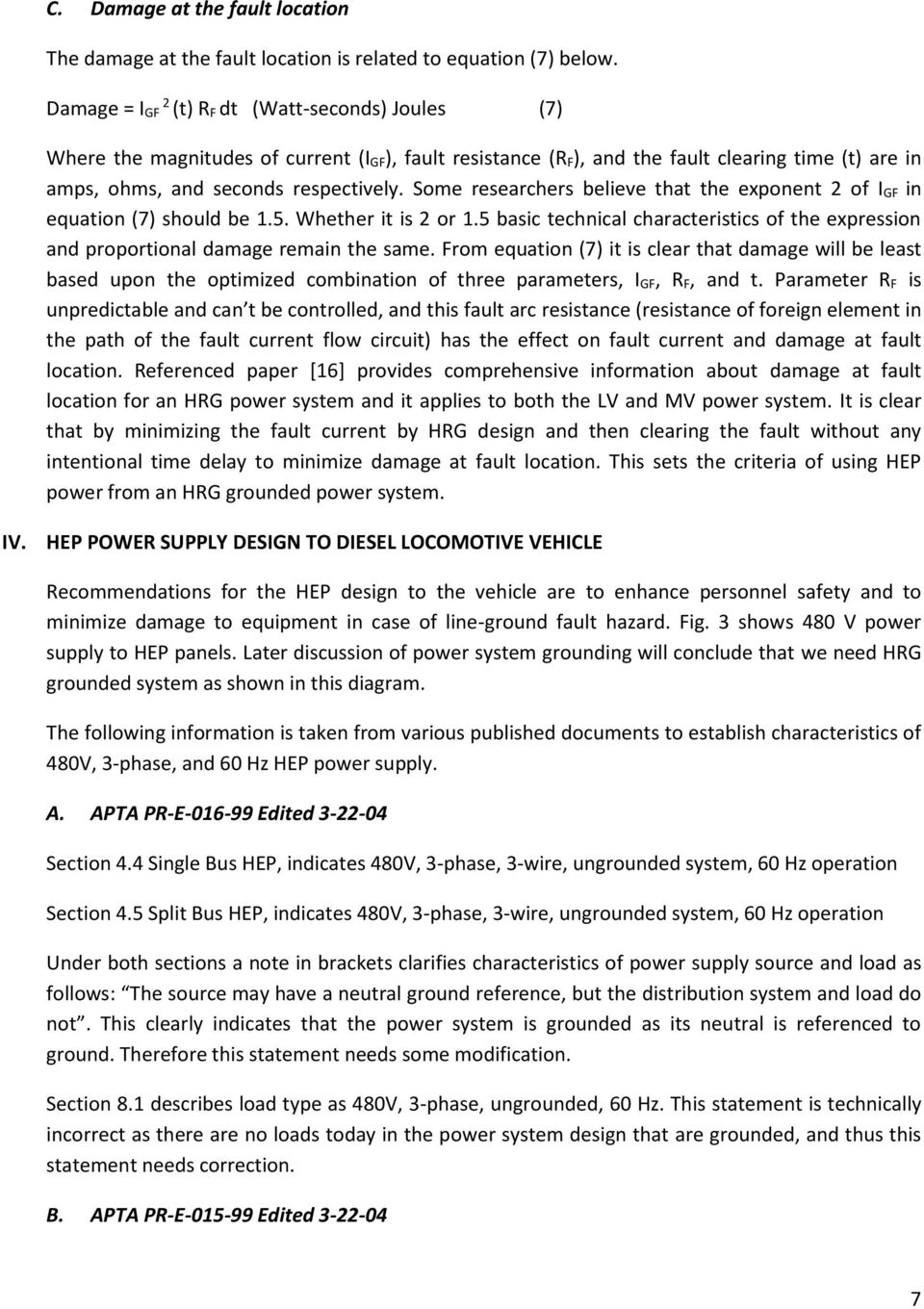
7 C. Damage at the fault location The damage at the fault location is related to equation (7) below. Damage = I GF 2 (t) R F dt (Watt-seconds) Joules (7) Where the magnitudes of current (I GF), fault resistance (R F), and the fault clearing time (t) are in amps, ohms, and seconds respectively. Some researchers believe that the exponent 2 of I GF in equation (7) should be 1.5. Whether it is 2 or 1.5 basic technical characteristics of the expression and proportional damage remain the same. From equation (7) it is clear that damage will be least based upon the optimized combination of three parameters, I GF, R F, and t. Parameter R F is unpredictable and can t be controlled, and this fault arc resistance (resistance of foreign element in the path of the fault current flow circuit) has the effect on fault current and damage at fault location. Referenced paper [16] provides comprehensive information about damage at fault location for an HRG power system and it applies to both the LV and MV power system. It is clear that by minimizing the fault current by HRG design and then clearing the fault without any intentional time delay to minimize damage at fault location. This sets the criteria of using HEP power from an HRG grounded power system. IV. HEP POWER SUPPLY DESIGN TO DIESEL LOCOMOTIVE VEHICLE Recommendations for the HEP design to the vehicle are to enhance personnel safety and to minimize damage to equipment in case of line-ground fault hazard. Fig. 3 shows 480 V power supply to HEP panels. Later discussion of power system grounding will conclude that we need HRG grounded system as shown in this diagram. The following information is taken from various published documents to establish characteristics of 480V, 3-phase, and 60 Hz HEP power supply. A. APTA PR-E Edited Section 4.4 Single Bus HEP, indicates 480V, 3-phase, 3-wire, ungrounded system, 60 Hz operation Section 4.5 Split Bus HEP, indicates 480V, 3-phase, 3-wire, ungrounded system, 60 Hz operation Under both sections a note in brackets clarifies characteristics of power supply source and load as follows: The source may have a neutral ground reference, but the distribution system and load do not. This clearly indicates that the power system is grounded as its neutral is referenced to ground. Therefore this statement needs some modification. Section 8.1 describes load type as 480V, 3-phase, ungrounded, 60 Hz. This statement is technically incorrect as there are no loads today in the power system design that are grounded, and thus this statement needs correction. B. APTA PR-E Edited
8 Section Single Bus HEP, indicates 480V, 3-phase, 3-wire, ungrounded system, 60 Hz operation Section Split Bus HEP, indicates 480V, 3-phase, 3-wire, ungrounded system, 60 Hz operation Under both sections a note in brackets clarifies characteristics of power supply source and load as follows: The source may have a neutral ground reference, but the distribution system and load do not. This clearly indicates that the power system is grounded as its neutral is referenced to ground. Therefore this statement needs some modification. Section HEP alternator and regulator clearly indicates machine should be high impedance grounded (consistent with the ground fault detection requirements of and to the locomotive car body. Section and Section Inverter: both indicate that the unit should be connected through high impedance grounded to the locomotive car body. Section Indicator: require ground fault indicator Section Protection: require indicator only, no power shutdown Section Utility Source: indicate transformer should have a grounded wye connected secondary. No further clarification on the impedance grounding of the transformer. Section Protection: utility source HEP and Section Protection: engine-driven source HEP, both require ground fault protection Section 7.5 Wayside power commission tests require calibration of the ground fault trip setting Figure 7 [3] Single line Schematics HEP Sources indicate impedance grounded power sources Figure 10 [3] Power Schematic: 480V wayside HEP indicate 480Y/277V with neutral conductor (all other documents indicate without neutral). C. PRIIA /Amtrak 995 Technical Specifications (Chapter 13) At no place in this document provides characteristics of 480V HEP power supply other than in Section Wiring and Connections it indicates wire 4/0 recommended in APTA recommended Practice RP-E Based upon the reviews of referenced documents [3] [4] [5] described earlier in this paper, it should be concluded that the documents try to describe that the HEP power should result in minimum ground fault current equal to system charging current of ungrounded power system (equal to system charging current) or square of two of the system charging current in case of high impedance grounded system during bolted line to ground fault current. Since this ground fault current is low and thus it may be concluded that there is no need to trip the power source but an alarm of the ground fault condition is needed to isolate the faulted section of the power system in an orderly fashion. To trip or not to trip automatically upon detecting first line-ground fault should 8

9 be the decision by the car supplier. It has been determined that on an ungrounded power system although the line-ground fault is very low, however, if the fault is an arcing fault it will result in a very high transient overvoltage 5 to 7 times normal peak voltage in very short period of time (within 5 to 6 cycles) which can result in insulation failure and destruction inside the car at the fault location [1]. From this it is concluded that ungrounded power system is not suitable. It is recommended that a high-resistance grounded (HRG) power system with automatic ground fault tracing and alarm should be used. D. 480V Power Supply System Grounding choice based upon safety analysis It is an important element of the design that all parties involved in the design construction and operation (designer, contractor, transit facility personnel, vehicle supplier, and supplier of HEP controller) should understand this important issue of using solidly grounded or ungrounded power source. This will result in proper HEP power controller by the manufacturer with proper protection features. It is important that the vehicle supplier also provide proper necessary information for the on-board 480V power supply system to assure it matches with the existing on-board ungrounded or high impedance grounded power system. Author does not recommend ungrounded vehicle onboard system as it can cause insulation damage or even fire. In one project, author was involved in investigation of the HEP power supply and indicated that an isolation 480 delta to 480Y/277V wye with high resistance grounded neutral should be used to supply HEP power supply to the vehicle instead of using solidly grounded 480Y/277V power supply tapped from the maintenance facility power provided by the solidly grounded utility power transformer. Safety analysis of using HRG system and solidly grounded system are discussed in this paper. In the examples below, a bolted line-ground fault is used which provides highest ground fault current in each type of grounding system, solidly grounded or HRG grounded. E. Solidly Grounded Power System It is noted that a line-ground fault current in case of solidly grounded power system will be equal to or higher than the three phase fault current depending upon the impedance of the zero sequence path to be equal to lower than the positive or negative sequence impedances. Generally positive sequence impedance is equal to negative sequence impedance. Thus; it may cause major ground fault current leading to dangerous vehicle touch potential and may even cause damage to vehicle equipment at the fault location, see Fig. 4 and Fig. 5. Person in contact with the vehicle will have current flow derived from the equivalent circuit Fig. 5 as follows: I SHORT = 277V/10Ω = 27.7A (8) I BODY = I SHORT [0.25/ ( )] = [(27.7 x 1000) x (0.25/500.25)] = ma (9) Touch potential for the above body current will be approximately 277 V assuming negligible voltage drop in the feeder cable. 9
![7 times normal peak voltage in very short period of time (within 5 to 6 cycles) which can result in insulation failure and destruction inside the car at the fault location [1].](/docs-images/48/19061837/images/page_9.jpg "From this it is concluded that ungrounded power system is not suitable.")
10 F. HRG Grounded Power System Fig. 6 and Fig. 7 show bolted line to ground fault current flow and ground fault equivalent circuit respectively for a HRG grounded power system. I SHORT = 277V/564Ω = A (10) I BODY = I SHORT [0.25/ ( )] = ma (11) The touch potential for the above calculated body current will be approximately 277 V, assuming voltage drop in the supply feeder is negligible compared to voltage drop in the HRG resistor. It should be noted that the body current is case of HRG system is very less compared to solidly grounded power system (0.245 ma compared to ma). This current may not be dangerous to the maintenance person or damaging to car at the fault location so long it is sensed and fault is isolated without intentional time delay. It must be emphasized that if without much understanding of the equipment grounding design where design engineers and contractors normally provide underground 4/0 bare copper to bond all electrical equipment enclosures and then make connection to running rails. This obviously conclude that the at both the running rail and at the transformer 5 ohms grounding electrodes shown in Fig. 4 will be bypassed and then the fault current and body currents will change as follows. I SHORT = 277V/0.30Ω = 923A I BODY = I SHORT [0.25/ ( )] = [(923 x 1000) x (0.25/500.25)] = ma (10A) (11A) The above calculation is based upon assumed total impedance of ground fault current loop of 0.30 ohms, however, return path impedance through ground can vary with season. This current may not be sensed by the feeder breaker to clear the fault and thus may present danger. It may also cause damage to car body at fault location if fault persists for longer duration without tripping the power system. Recommendation is that no grounding and bonding of rails to electrical enclosures be allowed for HEP power supply. This applies equally to HRG grounded power system. Therefore HRG system which controls maximum fault current to be equal to square root of two times the system charging current in case of a bolted phase to ground faults condition. The body current is not dangerous due to limited line-ground fault current and damage to vehicle is also less as the fault current is low. If the system do not need to be tripped on a first line to ground fault on a HRG system and alarm is adequate then it will also work as orderly isolation of the faulted section can be accomplished. In addition, HRG systems today comes with automatic controller for tracing of ground fault location. In North America all petro-chemical pants and refineries use HRG system with alarm and automatic fault location. This provides continuous operation of the critical operation with minimum danger of arc hazard and minimum equipment damage. 10

11 Based upon these considerations, locomotive vehicles for DMU trains should use HEP power from HRG grounded power system with proper ground fault sensor for alarm and automatic delayed tripping if so desired. Fig. 3 One line diagram of power supply to a maintenance facility including HEP power supply 11

12 Fig. 4 solidly grounded power supply system fault current flow during ground fault condition on phase C inside the vehicle Fig. 5. Equivalent circuit for a ground fault condition shown in Fig. 4 12

13 Fig. 6 HRG grounded power supply system fault current flow during ground fault condition on phase C inside the vehicle Fig. 7. Equivalent circuit for a ground fault condition shown in Fig. 6 13

14 G. Method of HEP power supply connection to vehicle Industry have established standards for HEP power connection using power supply cabinet located on wayside which will be connected to shore power supply and then inside the cabinet will be a contactor which will establish 480V power by closing contactor only when train-line connection (TLC) interlocks establish that all power and control connectors from one vehicle to next vehicle are established. Fig. 8 below depicts such an interlock assuming dc control power supply is inside the vehicle and HEP power supply cabinet will use this control power supply for design interlocks. One conceptual design of HEP power supply controller is shown in Fig. 9. Figure 10 show all control details for the HEP cabinet with the exception that the supplier of this cabinet has not been informed that the maximum ground fault anywhere on the HEP system will never be more than 1A as has been described in APTA standard [4] and the thus designer of the shore power supply will use 480V to 480Y/277V isolation transformer with HRG scheme. Therefore, ground fault CTs ratios needs to be low (5/1A ratio) instead of 200/5 A CTs shown in this Fig. 10. High accuracy CTs are recommended inside the HEP cabinet for sensing low ground fault current much less than 1 A. Fig. 8 Train-line complete (TLC) loop system Fig. 9 Typical vehicle supplier TLC loop and HEP power supply scheme 14

15 Fig. 10 HEP power supply controller schematic diagram V. MAINTENANCE FACILITY - DC POWER SUPPLY SYSTEM TO LRT SYSTEM This section of the OCS within the shop maintenance building is electrically isolated by inline section insulator. In addition, the shop building gate located at the entrance tracks automatically opens when vehicle enters the shop in such way that it bridges the OCS contact wire with an inline insulator when door is in open position. The vehicle entering the shop will have its pantograph down and the OCS Bridge is down for the gate to open and then when vehicle enters the building the OCS Bridge automatically lifts up to bridge the OCS contact wire. Designs of such an operation require proper interlocks of all interfacing devices. The main objective is to keep inside OCS section electrically isolated/insulated from the outside section of the OCS. There are two separate designs to provide dc power to the maintenance vehicle, they are by a) use of OCS and B) use plug and receptacle assembly also called stinger system. They are described below. 15

16 A. OCS Supply System Fig. 11 and Fig. 13 show one line diagram and control schematic respectively for the shop dc power supply to shop OCS system. Proper layout design of the OCS wire near the ceiling and the monorail operation in the close vicinity to the OCS is coordinated so that their operation is not affected and poses any hazard. Fig. 14 show wall mounted dc disconnect switch, ANSI/IEEE device (89), which is electrically interlocked with a companion dc disconnect switch, ANSI/IEEE device (89),located inside the dc switchboard by use of a 125V dc contactor. This 125V dc contactor, ANSI/IEEE device (29), inside the enclosure becomes local controller for energizing and de-energizing the OCS. Interposing control relays and indication lights can be used so that contactor operation is safe from switching in the dc contactor contact in a no load condition for establishing the 750V dc circuit to the shop OCS. B. Stinger Supply System Fig. 12 and Fig. 13 show one line diagram and control schematic respectively for the shop dc power supply to shop stinger system. Fig. 15 show wall mounted dc disconnect switch ANSI device (89) which is electrically interlocked with a companion dc disconnect switch (89) located inside the dc switchboard by use of a 125V dc contactor. The control schematic of 125V dc contactor ANSI device (29) enclosure with additional interlocks is shown in Fig. 16 and is part of local controller for energizing and de-energizing the stinger s 750V dc power receptacle. Interposing control relays and indication lights can be used so that contactor operation is safe from switching in the dc contactor contact in a no load condition for establishing the 750V dc circuit to the vehicle power receptacle. C. General Discussion of Vehicle 750V Power Supply Author is presenting the dc contactor control schematics to complete the 750V or 1000Vdc current path with help of a dc contactor installed inside a local wall mounted enclosure to avoid hazard of completing the circuit by operating 750 V or 1000Vdc disconnect switches. Design engineers can have slightly different control schematic to energize and de-energize the contactor, however, each designer is using 120V ac control power and then using suitable rectifier to provide 125V dc control power for the contactor. Number of interlocks in the control circuit can vary based upon the physical layout of the shop equipment. For safety enhancement; additional interlocks with maintenance shop fall gate switches and monorail crane switches could be implemented. Adequate electrical interlocks appears to be justified even if control interface wiring become more involved with interlocks as safety of operators is improved against the malfunctioning of the fall gates and malfunctioning of the monorail near dc energized components. These interlocks can be described as follows: Shop DC disconnect switches closed in the de-energized condition only. Warning signs, beacon lights, and mechanical interlocks can be added not to open or close the 750V dc disconnect switch in the energized condition at the individual disconnect switches and switches inside the dc panel board. DC disconnect switches inside the dc switchboard can be interlocked with the dc switchgear feeder breakers. 16

17 Low voltage interlocks are provided with the door switch to the controller and maintenance shop dc disconnect switch handle contacts. Interlocks are also used with maintenance shop gate and the energized monorail crane to assure shop gate is opened and closed safety from the hazard of 750V dc and monorail is not operated when OCS is energized. Each transit facility may have slight variations of the design of the contactor control and interlocks; however, ultimate objective of the design is identical. Based upon author s review of three installations, it appears that the industry experts and maintenance operators should gather their collective thoughts to make uniform standardized recommended design guide that is safe, reliable, cost effective and easy to operate and maintain. Future research and development may minimize human exposure to hazards of 1000V dc in the maintenance shop. Light rail projects operating at 600V dc to 750V dc with OCS system can have vehicle equipped with or without single pole 1000V dc rated power receptacle with proper cap and interlocks. When vehicle is in the maintenance shop then dc power supply to the vehicle can be provided by using 750V dc matching single pole female plug to those vehicles which are equipped with the proper matching power receptacle. Those vehicles that do not have power receptacle will receive power from the OCS section located inside the maintenance building directly above the maintenance bay and the track rails. In each case 750V power supply to the vehicle inside the maintenance building is provided from a maintenance shop rectifier substation. DC feeder breakers inside the dc switchgear located inside the rectifier substation are used to provide power to dc switchboards rated at 750V dc. These dc switchboards are equipped with several individual disconnect switches and individual fuses. Interlocks should be added that the fuses can t be pulled out unless the upstream switching device opens and makes de-energized circuit. Such a device is not depicted in the figures included in this paper. In addition, there is no assurance that 1000V V dc fuses shown in the shop dc switchboard will provide proper protection for the low level arcing fault. Therefore, there is need for reviews that the 1000V dc fuse application as shown is proper. These fuses can impose arc hazard if not properly fitted in their house or maintenance person by mistake pulls such a fuse under energized condition. 17

18 Fig. 11 Maintenance shop 750V DC - OCS power supply one line diagram 18

19 Fig. 12 Maintenance shop 750V DC Stinger system power supply one line diagram Fig. 13 Control schematic of a dc contactor for the shop OCS or stinger dc power supply 19

20 Fig. 14 Layout of the wall mounted dc disconnect switch enclosure used for the maintenance shop dc power supply Fig. 15 Power supply to vehicle by using wall mounted enclosure with plug for the stinger system 20

21 Fig. 16 Control schematic of dc contactor for the maintenance shop dc power supply to stinger system with additional safety interlocks with monorail crane and gates VI MAINTENANCE FACILITY - DC POWER SUPPLY SYSTEM 3 rd RAIL SYSTEM In case of heavy rail system, dc power supply to the train inside the maintenance building is normally provided by using dc plug and receptacle assembly to keep 3 rd rail outside the shop building. 21
22 Local controller with a selector switch to open or close the dc supply circuit by energizing or deenergizing the dc contactor which in turn closes or opens the dc contacts wired in-line with dc supply to the power receptacles. Adequate electrical interlocks are implemented for safe dc power supply design. Heavy rail (3 rd rail) maintenance shop stinger system is described in this section. One track with four individual floor pits under the track rails, and five emergency push buttons are shown in the floor plan, see Fig. 17. One 150 KW 1000V dc power supply stinger unit consisting of 480V power supply breaker CB1, contactor K1, manual primary voltage tap selector, rectifier transformer (isolation transformer), 6-pulse rectifier unit, 1000V dc output terminals and metering units along 120V ac power supply control system including DC contactor for opening and closing the 1000V dc power supply are all installed in a floor mounted enclosure (enclosure not shown), see one line diagram of the 1000V dc rectifier in Fig. 21 and control schematic of the same rectifier in Fig. 22. The floor mounted rectifier unit then provides 1000V dc power supply to 150 kw dual stinger power supply unit, see figure 19 showing 150 kw dual stingers power supply and service stinger stanchions. See Fig. 19 for the stinger cable assembly schematic diagram for connecting PSU to stanchions (Fig. 18) and then to vehicle where negative return feeder from the vehicle to PSU is indicted by others. Fig. 17 General layout of one maintenance track showing location of emergency pushbuttons, location of power supply unit(psu),stinger stanchion cabinets, and stinger cables 22
23 Fig. 18 Stanchion cabinet for use of stinger cable connection Fig. 19 Simplified control of dual stinger power supply unit cabinet (PSU) with local control Nomenclature: A Transit vehicle positive feeder connector (female power receptacle) B 1/C - 2 kv unshielded copper wire #2AWG (positive feed) C Watertight male plug, 1000V dc, 100A, 2-pole & ground plus pilot pins Fig. 20 Stinger cable assembly schematic diagram 23
24 21. One line diagram and control of 480V ac to 1000V dc power supply system 24
25 Fig. 22 Control schematic of the rectifier and 1000V dc power supply unit 25
26 D. ARC FLASH HAZRAD ANALYSIS Arc Flash Hazard Analysis is related to electrical safety improvement by design and then to use personnel protective equipment (PPE) during maintenance to enhance protection of the maintenance person from the electrical arc hazard that may take place during maintenance of the electrical equipment. There are recommended standards for performing ac arc flash hazard analysis and continuous work is going on all round the world through IEEE on electrical safety to help the industry to improve personnel safety and to protect equipment [10]. However, dc arc hazard analysis standards have not been developed so far for the rail industry [10]. There is a great need for such standards as dc power supply is used in the rail transit system, in the ship on board distribution systems and in many other chemical plants and industrial systems. VI. CONCLUSIONS AND RECOMMENDATIONS Following conclusions and/or recommendations are provided for: 1) There should be an AC HEP power supply to the diesel locomotive from a HRG grounded power source when the vehicle is in the maintenance shop 2) There is a need for the APTA recommended guidelines for dc power supply to the vehicle in the maintenance shop. 3) There will be minimum damage due to ground fault and maximum safety to the personnel if HEP power is supplied from HRG grounded power system. 4) Underground 4/0 grounding connections between the HEP power supply equipment enclosures bonding with track running rails should not be installed. Otherwise HRG resistor will be bypassed. 5) The grounding conductor shown between main switchboards to shore power pedestal is to meet NEC code requirements and will not affect HRG system so long installation of ground conductor and the transformer neutral use HRG resistor before it get connected to the transformer enclosure as shown in Fig. 6. 6) It is recommended that the existing APTA standards [2] [3] should make it clear that HEP power supply should be from a HRG grounded power source. Use of an isolation transformer shown in Fig. 3 can be added to these standards for the benefit of the design engineer in the transit industry. 7) Ungrounded power supply system as described in some of the APTA documents [3] [4] [5] is not a proper choice as it can cause insulation failure with transient overvoltage far more the capability of vehicle wiring system. This should be reviewed and corrected. 8) For dc power supply to shop, local dc contactor controller with proper interlocks for safety of the operator and protection of supply equipment with visual indication at the controller and inside the shop are required. 9) Maintenance operator inside the shop should be trained for dc arc hazard analysis and use of PPE while handling operation of dc controller. 26
27 10) Rail transit industry should get involved in developing APTA/IEEE standard for dc arc hazard analysis similar to IEEE Standard This will help the industry for proper dc arc hazard analysis and mitigate safety problems we encounter today from dc arc hazard. 11) APTA recommended guidelines for dc power supply to maintenance shop is needed for uniform design and proper equipment enclosures with UL labels. Without such recommended guidelines equipment may prove hazardous and design may prove inadequate. Author came across non-uniform design in different transit agencies maintenance shop due to lack of recommended guidelines. ACKNOWLEDGMENT Author would like to thank Hailu Keremo of AECOM in developing many figures used in the paper. Many thanks to Kinh Pham of Elcon Associates, Manjit Khalsa and Krishan Sabherwal of VTA for LRT shop OCS and stinger system design which author was involved in the design many years ago and finally Vitaly Lusherovich of BART for discussing 3 rd rail dc power supply to shop stinger system as it was designed by Kaiser Engineers which is now AECOM. REFERENCES [1] IEEE Std. 142, Recommended Practice for Grounding of Industrial and Commercial Power Systems. [2] IEEE Std. 1584, IEEE Guide for Performing Arc Flash Calculations. [3]. APTA-PR-E-RP Edited , Recommended Practice for Head End Power Source Characteristics. [4] APTA-PR-E-RP Edited , Recommended Practice for 480 VAC Head End Power System. [5] APTA-PR-E-RP Edited , Recommended Practice for 480 VAC Head End Power Jumper and Receptacle Hardware. [6]. Dev Paul, "Operational Safety and Maintenance Considerations for People Movers, D-C Grounding Systems", American Public Transit Association's (APTA) Rapid Transit Conference, Buffalo, New York, June 1988 [7] Dev Paul, "DC Traction Power System Grounding", IEEE Transactions on Industry Applications, Vol. 38, No. 3, May/June 2002, pp [8] Dev Paul, "DC Rapid Transit System OCS Pole Grounding Technical Analysis and Safety", American Public Transit Association's (APTA) Rapid Transit Conference, San Jose, California, June 2003 [9] Dev Paul, How Effective is Automatic Grounding Devices at the Floating Negative Rail System of a DC Powered Rail Transit System? APTA Conference Vancouver B.C June,
28 [10] Dev Paul, Peter Sutherland and Sergio Panetta, A Novel Method of Measuring Inherent Power System Charging Current IEEE Transactions on Industry Appl. Vol.47, No. 6, Nov. /Dec. 2011, pp [11] Dev Paul, Electric Arc and Associated Hazards in the Rail Transit. Are we up to date with current developments? Paper presentation at the APTA Conference, June 2011, Boston [12] Dev Paul, Electrical Design of a Rail Transit System based upon the criteria, Design by Safety. Paper presentation at the APTA Conference, June 2012, Dallas Ford worth, Texas. [13] Dev Paul, High Resistance Grounded Power System Equivalent Circuit, Damage at the Line- Ground Fault Location (Part 1), IEEE Transactions on Industry Appl. Vol.50, No. 6, Nov. /Dec. 2014, pp [14] Dev Paul and Peter E Sutherland, High Resistance Grounded Power System Equivalent Circuit, Damage at the Line-Ground Fault Location (Part 2), IEEE Transactions on Industry Appl. Vol.50, No. 6, Nov. /Dec. 2014, pp [15]. Dev Paul and Ben Chavdarian, Ground Fault Current Protection of a 480Y/277V Power System, Compliance with NEC Design Requirements. This paper was first presented at 2013 PCIC conference, later it was presented at I&CPS 2014 conference. Now the same paper titled, Under current Protection Power System has been published in the IEEE Industry Applications Magazine, Vol. 21, and No.1 ISSN , Jan. /Feb pp This year the same paper got selected for best paper power system protection paper award at I&CPS 2015 May Conference in Calgary, Canada. [16] Dev Paul High-Resistance Grounded Power System Paper approved for publication in the IEEE Transactions on Industry Appl. Vol.xx, No. x, Nov. /Dec. 2015, pp xxxx. This paper has been requested by IEEE for special issue on Power System Grounding Papers 28
Grounding of Electrical Systems NEW CODE: Grounding and Bonding
 Grounding of Electrical Systems NEW CODE: Grounding and Bonding Presented By Scott Peele PE Grounding of Electrical Systems Outline Defining the Terms Why should I Ground? Types of Grounding Systems Separately
System Grounding and Ground-Fault Protection Methods for UPS-Supplied Power Systems
 System Grounding and Ground-Fault Protection Methods for -Supplied Power Systems Bill Brown, P.E., Square D Critical Power Competency Center 1. INTRODUCTION The use of solid grounding for -supplied power
Product Guide. Low voltage grounding system. Answers for industry.
 Product Guide Low voltage grounding system Answers for industry. Advanced switchgear solutions for process industries In today s high-tech manufacturing world, profitability can be greatly impacted by
Arc Flash Avoidance and its Application to Overhead Traveling Cranes
 Arc Flash Avoidance and its Application to Overhead Traveling Cranes Whitepaper August 2012 Jason Wellnitz, Controls Product Manager Material Handling Numerous technical papers, bulletins, magazine articles
Fortune Oregon Data Center Increases Reliability with a High Resistance Grounding System
 Fortune Oregon Data Center Increases Reliability with a High Resistance Grounding System Cory David Smith, Project Manager, ECOM Engineering Inc., and David Lawrence Smith, Principal, ECOM Engineering
What are the basic electrical safety issues and remedies in solar photovoltaic installations?
 What are the basic electrical safety issues and remedies in solar photovoltaic installations? Presented by: Behzad Eghtesady City of Los Angeles Department of Building and Safety Topics Covered Photovoltaic
2a. IEM Indoor Metal Clad Medium Voltage Switchgear 15KV 16346-1. 2a. Section 16346 INDOOR METAL CLAD MEDIUM VOLTAGE SWTICHGEAR (Std.
 2a. IEM Indoor Metal Clad Medium Voltage Switchgear 15KV 16346-1 2a. Section 16346 INDOOR METAL CLAD MEDIUM VOLTAGE SWTICHGEAR (Std. Relays) Part 1 General 1.1 CONDITIONS AND REQUIREMENTS: A. Refer to
White Paper SolarEdge Three Phase Inverter System Design and the National Electrical Code. June 2015 Revision 1.5
 White Paper SolarEdge Three Phase Inverter System Design and the National Electrical Code June 2015 Revision 1.5 Shalhevet Bar-Asher; SolarEdge Technologies, Inc. Bill Brooks, PE; Brooks Engineering LLC
GROUND DETECTION CIRCUITS FOR STATIONARY APPLICATIONS (IN PLAIN DOWN TO EARTH LANGUAGE)
 GROUND DETECTION CIRCUITS FOR STATIONARY APPLICATIONS (IN PLAIN DOWN TO EARTH LANGUAGE) Matthew Theriault Designer Hindle Power Inc. Easton, PA SCOPE AND PURPOSE OF THE PAPER Why do we bother to monitor
Bypass transfer switch mechanisms
 Power topic #6013 Technical information from Cummins Power Generation transfer switch mechanisms > White paper By Gary Olson, Director, Power Systems Development This paper describes the configuration
Fault Characteristics in Electrical Equipment
 1. Introduction Proper design and installation of electrical equipment minimizes the chance of electrical faults. Faults occur when the insulation system is compromised and current is allowed to flow through
Top Commercial / Residential Electrical Requirements *
 Department of Community Development Building Division 4800 West 92 nd Avenue Westminster, Colorado 80031 For Information call (303) 658-2075 Fax (303) 706-3922 www.westminsterpermits.com Top Commercial
Digital Energy ITI. Instrument Transformer Basic Technical Information and Application
 g Digital Energy ITI Instrument Transformer Basic Technical Information and Application Table of Contents DEFINITIONS AND FUNCTIONS CONSTRUCTION FEATURES MAGNETIC CIRCUITS RATING AND RATIO CURRENT TRANSFORMER
Application of Four-Pole Circuit Breakers within Data Centers
 Application of Four-Pole Circuit Breakers within Data Centers December 2013/AT324 by Frank Waterer, Fellow Engineer, Schneider Electric Engineering Services Make the most of your energy SM Revision #1
Application Bulletin 103 - NEC Reference Guide for SolarBridge-Enabled AC Module Installers
 9229 Waterford Centre Dr. Bldg C, Suite 110 Austin, Tx 78758 Application Bulletin 103 - NEC Reference Guide for SolarBridge-Enabled AC Module Installers Current Version: 13 AC Modules are a new product
Electrical Grounding. Appendix C
 Appendix C Electrical Grounding Low-Voltage Equipment Grounding The most frequently cited Office of Safety and Health Administration (OSHA) electrical violation is improper occupational grounding of equipment
Electrical Safety Tester Verification
 Ensuring Validity of Regulatory Tests Verification of electrical safety testing equipment is a procedure that is often overlooked by manufacturers. Running test verification is crucial to ensuring that
GLOLAB Two Wire Stepper Motor Positioner
 Introduction A simple and inexpensive way to remotely rotate a display or object is with a positioner that uses a stepper motor to rotate it. The motor is driven by a circuit mounted near the motor and
Submit shop drawings for equipment provided under this section Shop drawings shall indicate:
 Section 16435 - SWITCHBOARDS Introduction Part 1 - General Reference The work under this section is subject to requirements of the Contract Documents including the General Conditions, Supplementary Conditions,
SIZING THE PRIMARY POWER SYSTEM FOR RESISTANCE WELDERS
 SIZING THE PRIMARY POWER SYSTEM FOR RESISTANCE S By Jack Farrow, May, 2004 WELDING TECHNOLOGY CORPORATION ABSTRACT Information on how to select the correct size of substation transformer and 480V bus to
FIT TIER 2 Application
 FIT TIER 2 Application Application Information The below information Auto-Fills from your registration information: Building Permit Application Date: Project Completion Date: Name: Address: City: State:
Part 1 System Modeling & Studies for Existing Systems
 Part 1 System Modeling & Studies for Existing Systems Operation Technology, Inc. Copyright 2009 Result of rapid release of energy due to an arcing fault between two conductors. Bus voltages > 208V Temperatures
Three-Phase Electric Power Distribution for Computer Data Centers
 Three-hase Electric ower Distribution for Computer Data Centers WHITE AER E901 Geist January 008 Summary This paper will describe the characteristics of three-phase power and outline the advantages of
SPECIAL TOPICS ON GROUND FAULT PROTECTION AND PROTECTION COORDINATION IN INDUSTRIAL AND COMMERCIAL POWER SYSTEMS
 SPECIAL TOPICS ON GROUND FAULT PROTECTION AND PROTECTION COORDINATION IN INDUSTRIAL AND COMMERCIAL POWER SYSTEMS Claudio S. Mardegan [email protected] www.engepower.com Phone: 55 3579-8777
SECTION 26 29 23 VARIABLE FREQUENCY DRIVES
 SECTION 26 29 23 VARIABLE FREQUENCY DRIVES PART 1 GENERAL 1.01 SCOPE A. Furnish and install individual freestanding variable frequency AC drives (VFD) as shown on the Drawings and specified herein. 1.02
CIRCUIT BREAKER INTERRUPTING CAPACITY AND SHORT-TIME CURRENT RATINGS
 CIRCUIT BREAKER INTERRUPTING CAPACITY AND SHORT-TIME CURRENT RATINGS David D. Roybal, P.E. Senior Member, IEEE Eaton Electrical 3697 Mount Diablo Boulevard Lafayette, CA 94549 Abstract Low-voltage circuit
ELECTRICAL INSPECTION BULLETIN (Effective 2000-03-01)
 ELECTRICAL INSPECTION BULLETIN (Effective 2000-03-01) Rule 28-900 Standby Generator Installations Due to the increasing number of standby generator installations being established to maintain continuity
Hyperlinks are Inactive
 Prepared by: NIB/EOB PLANNING GUIDE FOR SINGLE CUSTOMER SUBSTATIONS SERVED FROM TRANSMISSION LINES 05503 Department: Electric T&D Section: T&D Engineering and Technical Support Approved by: G.O. Duru (GOD)
Typical Data Requirements Data Required for Power System Evaluation
 Summary 66 Carey Road Queensbury, NY 12804 Ph: (518) 792-4776 Fax: (518) 792-5767 www.nepsi.com [email protected] Harmonic Filter & Power Capacitor Bank Application Studies This document describes NEPSI
METER REQUIREMENTS GENERAL REQUIREMENTS SECTION D
 12 - ELECTRIC SERVICE HANDBOOK SECTION D METER REQUIREMENTS This chapter gives you information on Central Lincoln s metering requirements. It's divided into three sections: General requirements This section
The following table shows approximate percentage wise the
 SHORT-CIRCUIT CALCULATION INTRODUCTION Designing an electrical system is easy and simple, if only the normal operation of the network is taken into consideration. However, abnormal conditions which are
ARC FLASH CALCULATIONS & LABELING REQUIREMENTS
 ARC FLASH CALCULATIONS & LABELING REQUIREMENTS Presented by: Edmund Elizalde EYP Mission Critical Facilities, Inc. Slides by: Lonnie Lindell SKM Systems Analysis, Inc. 1 Agenda NEC 110.16 NFPA 70E IEEE
Paralleling Power Sources Which Share a Common Neutral
 Paralleling Power Sources Which Share a Common Neutral By: Tony Hoevenaars, P.E., President & CEO, Mirus International, Inc. Mike McGraw, President, NSOEM, Inc. When paralleling power sources that share
Arc Flash Mitigation. Remote Racking and Switching for Arc Flash danger mitigation in distribution class switchgear.
 Arc Flash Mitigation Remote Racking and Switching for Arc Flash danger mitigation in distribution class switchgear. Distance is Safety We will discuss through examples of actual occurrences and possible
Product Data Bulletin
 Product Data Bulletin Power System Harmonics Causes and Effects of Variable Frequency Drives Relative to the IEEE 519-1992 Standard Raleigh, NC, U.S.A. INTRODUCTION This document describes power system
CAPACITOR BANK TESTING SWP
 1. PURPOSE AND SCOPE The purpose of this Standard Work Practice (SWP) is to standardise and prescribe the method for testing Capacitor Banks including capacitors, tuning reactors and inrush limiting reactors.
Ground Fault Protection on Ungrounded and High Resistance Grounded Systems
 > the power to protect Ground Fault Protection on Ungrounded and High Resistance Grounded Systems Application Guide www.i-gard.com table of contents SUBJECT PAGE 1. Introduction...1 2. Ungrounded Systems...1
Short Circuit Current Calculations
 Introduction Several sections of the National Electrical Code relate to proper overcurrent protection. Safe and reliable application of overcurrent protective devices based on these sections mandate that
Circuit Breakers and Switchgear. Thomas Greer Director of Engineering TLG Services
 Circuit Breakers and Switchgear Thomas Greer Director of Engineering TLG Services Presentation Outline Switchgear Definition Overcurrent Protection Devices Circuit Breaker Trip Curves and Coordination
LIMITING SHORT-CIRCUIT CURRENTS IN MEDIUM-VOLTAGE APPLICATIONS
 LIMITING SHORT-CIRCUIT CURRENTS IN MEDIUM-VOLTAGE APPLICATIONS Terence Hazel Senior Member IEEE Schneider Electric 38050 Grenoble France Abstract The power requirements for large industrial sites is increasing.
Guidelines on the Short Circuit Current Rating for Industrial Control Panels
 usa.siemens.com/sccr Guidelines on the Short Circuit Current Rating for Industrial Control Panels Technical Paper for Practical Applications White Paper I October 2014 As per NEC Edition 2014, and UL508A
Radial Distribution Test Feeders
 Radial Distribution Test Feeders Distribution System Analysis Subcommittee Report Abstract: Many computer programs are available for the analysis of radial distribution feeders. In 1992 a paper was published
Rule 5.500 Fast Track Analysis for National Life Insurance Co.
 Rule 5.500 Fast Track Analysis for National Life Insurance Co. For a 500 kw Solar array to be located at 155 Northfield Street in Montpelier, Vermont Green Mountain Power Pam Allen Date: 5/31/13 SECTION
Unified requirements for systems with voltages above 1 kv up to 15 kv
 (1991) (Rev.1 May 2001) (Rev.2 July 2003) (Rev.3 Feb 2015) Unified requirements for systems with voltages above 1 kv up to 15 kv 1. General 1.1 Field of application The following requirements apply to
DC disconnects for solar photovoltaic installations. Connecting the. power of the sun
 DC disconnects for solar photovoltaic installations Connecting the power of the sun Solar energy is heating up Interest in renewable energy sources has never been greater, and the fastest growing of these
ECEN 1400, Introduction to Analog and Digital Electronics
 ECEN 1400, Introduction to Analog and Digital Electronics Lab 4: Power supply 1 INTRODUCTION This lab will span two lab periods. In this lab, you will create the power supply that transforms the AC wall
Step Voltage Regulators
 Step Voltage Regulators Don Wareham Field Application Engineer Today s Agenda Introduction Voltage Regulator theory Voltage Regulator application considerations Installation and proper bypassing Wrap-up/questions
SECTION 26 09 13 - POWER MONITOR FOR ELECTRICAL, STEAM CONDENSATE, AND WATER PART I - GENERAL
 SECTION 26 09 13 - POWER MONITOR FOR ELECTRICAL, STEAM CONDENSATE, AND WATER PART I - GENERAL 1.1 SUMMARY A. This section describes the requirements for the installation of Power Monitors and associated
ARCO Electric Products Installation and Maintenance Manual Low Voltage Automatic Power Factor Correction Capacitor Systems 2013
 ARCO Electric Products Installation and Maintenance Manual Low Voltage Automatic Power Factor Correction Capacitor Systems 2013 READ CAREFULLY These instructions are intended to cover good practices in
Section B: Electricity
 Section B: Electricity We use mains electricity, supplied by power stations, for all kinds of appliances in our homes, so it is very important to know how to use it safely. In this chapter you will learn
ELECTRICAL SAFETY. The standard unit for measuring electrical current.
 ELECTRICAL SAFETY Introduction The following sections provide general safety guidelines and procedures for electrical safety. This chapter covers the following topics: TOPIC PAGE General Electrical Safety
Proper Application of 415V Systems in North American Data Centers. A White Paper from the Experts in Business-Critical Continuity
 Proper Application of 415V Systems in North American Data Centers A White Paper from the Experts in Business-Critical Continuity Introduction Increasing pressure to reduce operating expenses and be more
CURRENT TRANSFORMERS INSTALLATION GUIDE
 CURRENT TRANSFORMERS INSTALLATION GUIDE Information contained within this document is subject to change without notice and does not represent a commitment on the part of PRI Ltd or its agents. E&OE. Copyright
White Paper Mervin Savostianik P. Eng. Littelfuse, Inc.
 Ground-Fault Protection with VFDs How to use a Sensitive Relay to Find Hard-to-Spot Ground Faults in VFDs on Resistance-Grounded Systems White Paper Mervin Savostianik P. Eng. Littelfuse, Inc. How to Use
Integrating SPDs in Switchgear & Switchboards Causes More Problems than it Solves
 Integrating SPDs in Switchgear & Switchboards Causes More Problems than it Solves White Paper July 2010 Integrating surge protective devices (SPD) into distribution equipment (i.e. switchgear, switchboards,
Atlanta Chapter IEEE Industry Applications Society
 Atlanta Chapter IEEE Industry Applications Society Electrical Equipment Room Design Considerations presented at the Sheraton Buckhead Hotel Atlanta, Georgia November 20, 2006 Outline 1. Definitions 2.
QUESTIONS and ANSWERS RFB 745-15-9894, Metal Clad Switchgear and Power Control Room
 QUESTIONS and ANSWERS RFB 745-15-9894, Metal Clad Switchgear and Power Control Room 1) When you click on the UTHSCSA Drawing the site takes you to the E-1 drawing no other. Will there be other drawings
UNIVERSITY OF WASHINGTON Facilities Services Design Guide. Electrical. Metering and Monitoring. Basis of Design
 Basis of Design This section applies to the design, installation and integration of metering and monitoring equipment, including: hardware installed in the electrical service and distribution equipment,
OPTIMIZING POWER SYSTEM PROTECTION FOR MODERN DATA CENTERS
 OPTIMIZING POWER SYSTEM PROTECTION FOR MODERN DATA CENTERS Data center power systems are constructed with a premium on reliability at a significant cost. The return on this investment is realized if it
Definition AC Power Distribution
 COMMON AC POWER DISTRIBUTION CONFIGURATIONS The input voltage needed to power electronic equipment is provided by the manufacture in the product specifications. Matching this requirement to the facility
misconceptions about arc-flash hazard assessments
 misconceptions about arc-flash hazard assessments There are some common misconceptions about Arc-Flash Hazard Assessments which reduce the effectiveness of the Assessments and can increase electrical hazards.
Test Before Touch Easier Said Than Done. Ken Crawford, DuPont Kent Haggerty, Dupont
 Test Before Touch Easier Said Than Done Ken Crawford, DuPont Kent Haggerty, Dupont Overview Test Before Touch (TBT) Principles Key Learnings by One Company One Method for Performing a TBT Induced Voltages
ELECTRONIC POWER SYSTEMS
 ELECTRONIC POWER SYSTEMS TRADEOFFS BETWEEN SINGLE-PHASE & THREE-PHASE POWER WHITE PAPER: TW0057 1 Executive Summary Modern Electronic Systems are quite often powered from a three-phase power source. While
100% Stator Ground Fault Detection Implementation at Hibbard Renewable Energy Center. 598 N. Buth Rd 3215 Arrowhead Rd
 100% Stator Ground Fault Detection Implementation at Hibbard Renewable Energy Center Introduction Roger Hedding Steven Schoenherr, P.E. ABB Inc. Minnesota Power 598 N. Buth Rd 3215 Arrowhead Rd Dousman,
How Much Voltage Drop Is Acceptable?
 How Much Voltage Drop Is Acceptable? Article supplied by Ideal The National Electrical Code (NEC) recommends that the combined voltage drop of the electrical system (branch circuit and feeders) not exceed
ELECTRICAL INSULATION TESTING OF HV EQUIPMENT UP TO 33kV
 1. SCOPE This document details PowerSystems requirements for electrical testing of HV Equipment up to and including 33kV. 2. ISSUE RECORD This is a Reference document. The current version of Controlled
Secondary Unit Substations
 14 SWITCHGEAR Secondary Unit Substations Overview Siemens offers a wide variety of unit substation designs to meet customer requirements. A unit substation consists of one or more transformers mechanically
IMPLEMENTING THE NEW ELECTRICAL SAFETY REQUIREMENTS
 IMPLEMENTING THE NEW ELECTRICAL SAFETY REQUIREMENTS Paul A Zoubek, CSP, CIH Occupational Services, Inc. San Diego, CA 619-861 861-0612 [email protected] OCCUPATIONAL SERVICES, INC. BACKGROUND Update Update
S&C BankGuard PLUS Control
 S&C BankGuard PLUS Control For Substation Capacitor Banks and Shunt Reactors Application S&C s BankGuard PLUS Control utilizes flexible, reliable microprocessor technology to: Protect substation shunt
HIGH VOLTAGE SHORE CONNECTION
 Guide for High Voltage Shore Connection GUIDE FOR HIGH VOLTAGE SHORE CONNECTION NOVEMBER 2011 American Bureau of Shipping Incorporated by Act of Legislature of the State of New York 1862 Copyright 2011
AMFA-27 AMFA-29. Operator s Manual & Installation Instructions. Rev. 2.5
 AMFA-27 AMFA-29 Operator s Manual & Installation Instructions Rev. 2.5 Date: 17 July, 2010 Permanently-connected, utility Interactive, single-phase, inverters Model AMFA-27 WIND TURBINE INVERTER (240 VAC
SUBJECT: How to wire a motor starter Number: AN-MC-004 Date Issued: 2/08/2005 Revision: Original
 SUBJECT: How to wire a motor starter Number: AN-MC-004 Date Issued: 2/08/2005 Revision: Original A motor starter is a combination of devices to allow an induction motor to start, run and stop according
Advantages of Fixed Circuit Breaker Switchgear
 Advantages of Fixed Circuit Breaker Switchgear by Lionel Mackay, EDF Energy, and Mike Adams, Schneider Electric Ltd Introduction The purpose of this paper is to review the advantages of fixed circuit breaker
Generator Stator Protection, under/over voltage, under /over frequency and unbalanced loading. Ramandeep Kaur Aujla S.NO 250447392
 1 Generator Stator Protection, under/over voltage, under /over frequency and unbalanced loading By Ramandeep Kaur Aujla S.NO 250447392 ES 586b: Theory and applications of protective relays Department of
National Craft Assessment and Certification Program S P E C I F I C A T I O N S
 National Craft Assessment and Certification Program S P E C I F I C A T I O N S INDUSTRIAL ELECTRICIAN V4 ELEC26_O4 Released September 2013 Focus Statement An Industrial Electrician must be able to interpret
MODEL 5010 DUAL CHANNEL SMOKE/FIRE DETECTION MODULE
 DESCRIPTION MODEL 5010 DUAL CHANNEL SMOKE/FIRE DETECTION MODULE DESCRIPTION The SST Model 5010 Two Channel Smoke/Fire Detection Module provides two independent detection input channels for the NOVA-5000
Connecting the Power of the Sun. DC Disconnects for Solar Photovoltaic Installations. DC disconnects for. solar photovoltaic installations
 Connecting the Power of the Sun DC Disconnects for Solar Photovoltaic Installations DC disconnects for solar photovoltaic installations Solar energy is heating up Interest in renewable energy sources has
Transformerless UPS systems and the 9900 By: John Steele, EIT Engineering Manager
 Transformerless UPS systems and the 9900 By: John Steele, EIT Engineering Manager Introduction There is a growing trend in the UPS industry to create a highly efficient, more lightweight and smaller UPS
NFPA 70E 2012 Rolls Out New Electrical Safety Requirements Affecting Data Centers
 NFPA 70E 2012 Rolls Out New Electrical Safety Requirements Affecting Data Centers A market position paper from the experts in Business-Critical Continuity TM Executive Summary Electrocutions are the fourth
Services. Three Phase Service
 Services Primary Service vs Secondary Service Overhead vs Underground Common Service Types Three Phase Wye Closed Open Delta Corner Grounded Center Tapped Open Single Phase Three Phase Service Wye Delta
Suitable for Emergency, Peak and Prime Power System Applications. Low Voltage Automatic Transfer Switch Systems
 Suitable for Emergency, Peak and Prime Power System Applications Low Voltage Automatic Transfer Switch Systems THE POWER AUTHORITY THE POWER AUTHORITY ASCO s experience and commitment to excellence in
Arc Flash Hazards. Electrical Hazards. Dan Neeser Field Application Engineer [email protected]. Electrical Hazards 2/18/2015. Shock.
 Arc Flash Hazards Dan Neeser Field Application Engineer [email protected] Electrical Hazards Electrical Hazards Shock Arc Flash Arc Blast 2 1 Arcing Fault Basics 35,000 F Radiant Heat & UV Speed of
Pilot-wire differential relay for lines with two or more terminals
 Pilot-wire differential relay for lines with two or more terminals Page 1 Issued: March 2003 Revision: A Data subject to change without notice Pilot-wire differential relay with RXHL 401 Features Phase
PORTABLE GENERATORS AND OSHA CONSTRUCTION REGULATIONS
 PORTABLE GENERATORS AND OSHA CONSTRUCTION REGULATIONS Monograph by: John Grizzy Grzywacz, Professor OSHA National Training Institute Arlington Heights, Illinois Contributing: Michael Kovacic, President
Understanding Arc Flash
 Understanding Arc Flash Presented by Eddie F. Jones, PE 1 2 3 4 5 Five to 10 arc flash explosions occur in electric equipment every day in the United States. This number does not include cases in which
Best Methods for Safe Hipot Testing
 Best Methods for Safe Hipot Testing When working with electrical safety test equipment, instruments that output potentially dangerous voltages and currents, it is always important to regular review and
Inverter / Charger Installation General Operations and AC and DC Connections
 Inverter / Charger Installation General Operations and AC and DC Connections The Inverter is just one piece. Sometimes, a tendency is to mount the inverter and batteries, and make it work It is better
Line Reactors and AC Drives
 Line Reactors and AC Drives Rockwell Automation Mequon Wisconsin Quite often, line and load reactors are installed on AC drives without a solid understanding of why or what the positive and negative consequences
..OR How To Protect your 3-Phase Equipment Investment with 3-Phase Monitors from Time Mark...
 ..OR How To Protect your 3-Phase Equipment Investment with 3-Phase Monitors from Time Mark... TIME MARK CORPORATION 11440 EAST PINE STREET TULSA, OK 74116 USA tel 918 438-1220 fax 918 437-7584 www.time-mark.com
Common Electrical Hazards in the Workplace Including Arc Flash. Presented by Ken Cohen, PhD, PE & CIH (Ret.)
 Common Electrical Hazards in the Workplace Including Arc Flash Presented by Ken Cohen, PhD, PE & CIH (Ret.) 1 What s New In February 1972, OSHA incorporated the 1971 edition of the National Fire Protection
Dead Tank Circuit Breaker 72PM40-C Proven reliability through common platforms
 Dead Tank Circuit Breaker 72PM40-C Proven reliability through common platforms ABB innovations for changing demands ABB (www.abb.com) is a leader in power and automation technologies that enables utility
Corner-Grounded Delta (Grounded B Phase) Systems
 Data Bulletin 2700DB0202R03/12 09/2012 Replaces 2700DB0202R2/09 dated 02/2009 Corner-Grounded Delta (Grounded B Phase) Systems Class 2700 Retain for future use. Introduction Corner-grounded delta systems
INSTALLATION & SERVICE MANUAL. Display Panel
 INSTALLATION & SERVICE MANUAL Display Panel The PowerLine EMS TM is a specialized power distribution and energy management system intended to be used in recreational vehicles. The Control Module is housed
CHECKING AND TESTING ELECTRICAL INSTALLING WORK
 CHECKING AND TESTING ELECTRICAL INSTALLING WORK Department of Consumer and Employment Protection Energy Safety Preface It is a requirement of the Electricity (Licensing) Regulations 1991 that all electrical
Engineering innovation
 Eaton's Electrical Engineering Services & Systems Solutions Focus Seamless Solutions for Reliable, Efficient and Safe Power Systems Engineering innovation Progressive solutions for today s power systems
Fundamentals of Modern Electrical Substations Part 1: Mission of Electrical Substations and their Main Components
 Fundamentals of Modern Electrical Substations Part 1: Mission of Electrical Substations and their Main Components Course No: E02-010 Credit: 2 PDH Boris Shvartsberg, Ph.D., P.E., P.M.P. Continuing Education
4.5 Transformer Connections
 ELECTRIC POWER SYSTEMS IN COMMERCIAL BUILDINGS IEEE Std 241-1990 5) Flat Billing Ñ Certain applications involve service to the load of a Þxed characteristic. For such loads, the supplying utility may offer
City of Riverside Building & Safety Division Phone: (951) 826-5697 www.riversideca.gov
 City of Riverside Building & Safety Division Phone: (951) 826-5697 www.riversideca.gov PHOTOVOLTAIC PERMITTING GUIDELINES The information provided in this document is general and is intended only as a
Arc Terminator Active Arc-Resistant Switchgear
 Arc Terminator Active Arc-Resistant Switchgear Increasing safety and productivity by extinguishing internal arcing faults within the switchgear. The Square D Arc Terminator from Schneider Electric offers
Management Systems 10 Electrical Safety Audit 14 PPE 20 Arc Mitigation 22 Hazard Assessment 26
 Management Systems 10 Electrical Safety Audit 14 PPE 20 Arc Mitigation 22 Hazard Assessment 26 Assessing The Hazards Of High and Low Voltage Single-Phase Arc-Flash By Albert Marroquin One common question