
VTCT Level 3 Certificate in Personal Training (QCF)
|
|
|
- Brendan Gray
- 9 years ago
- Views:
Transcription
1 VTCT Level 3 Certificate in Personal Training (QCF) Accreditation start date: 1 April 2010 Credit value: 36 Guided learning hours (GLH): 245 Qualification number: 500/8721/6 Statement of unit achievement By signing this statement of unit achievement you are confirming that all learning outcomes, assessment criteria and range statements have been achieved under specified conditions and that the evidence gathered is authentic. This statement of unit achievement table must be completed prior to claiming certification. Unit code Date achieved Learner signature Assessor initials IV signature (if sampled) Mandatory units UV20524 UV20523 UV30536 UV20525 UV30539 UV30540 UV30541 AF30079F_v3

2 The qualification Introduction The VTCT Level 3 Certificate in Personal Training (QCF) will prepare you for a career in the sport and active leisure industry as a personal trainer. Throughout this qualification you will develop an understanding of the theory underpinning personal training, including anatomy and physiology, principles of exercise and fitness, how to support clients, health and safety, and the principles of nutrition. You will also develop the knowledge and skills needed to plan, design, manage, adapt, deliver and evaluate personal training sessions. As part of the qualification you will produce a progressive training programme (12 week plan) for an individual that takes into account short, medium and long term goals. National Occupational Standards (NOS) Units in this qualification have been mapped to the relevant NOS (where applicable). This qualification is accredited on the Qualifications and Credit Framework (QCF). This qualification is approved and supported by SkillsActive, the sector skills council for active leisure and learning. Approved by the Register of Exercise Professionals (REPs) This qualification is approved by the Register of Exercise Professionals (REPs). On successful completion of this qualification you will be eligible to register onto the REPs as an advanced instructor as a Level 3 Personal Trainer. Prerequisites You must hold a Level 2 nationally recognised qualification in fitness instructing (gym-based exercise) to access the VTCT Level 3 Certificate in Personal Training (QCF). 2
3 Progression On completion of this qualification you will be able to work as a personal trainer in sport and active leisure. You will also be able to progress to the following VTCT qualifications: Level 3 Diploma in Mat Pilates (QCF) Level 3 Award in Adapting Physical Activity for Older Adults (QCF) Level 3 Award in Adapting Physical Activity for People with Disabilities (QCF) Level 3 Award in Adapting Physical Activity for Antenatal and Postnatal Clients (QCF) Level 3 Award in Instructing Sports Specific Conditioning (QCF) 3
4 Qualification structure Total credits required - 36 All mandatory units must be completed. Mandatory units - VTCT unit code UV20524 UV20523 UV30536 Ofqual unit reference T/600/9016 M/600/9015 A/600/ credits Unit title Credit value GLH Health, safety and welfare in a fitness environment Know how to support clients who take part in exercise and physical activity Anatomy and physiology for exercise and health UV20525 A/600/9017 Principles of exercise, fitness and health 4 28 UV30539 L/600/9054 Applying the principles of nutrition to a physical activity programme 6 40 UV30540 F/600/9052 Programming personal training with clients 7 47 UV30541 J/600/9053 Delivering personal training sessions

5 Guidance on assessment This book contains the mandatory units that make up this qualification. Optional units will be provided in additional booklets (if applicable). Where indicated, VTCT will provide assessment materials. Assessments may be internal or external. The method of assessment is indicated in each unit. Internal assessment (any requirements will be shown in the unit) Assessment is set, marked and internally verified by the centre to clearly demonstrate achievement of the learning outcomes. Assessment is sampled by VTCT external verifiers. External assessment (any requirements will be shown in the unit) Externally assessed question papers completed electronically will be set and marked by VTCT. Externally assessed hard-copy question papers will be set by VTCT, marked by centre staff and sampled by VTCT external verifiers. Assessment explained VTCT courses are assessed and verified by centre staff. Work will be set to improve your practical skills, knowledge and understanding. For practical elements, you will be observed by your assessor. All your work must be collected in a portfolio of evidence and crossreferenced to requirements listed in this record of assessment book. Your centre will have an internal verifier whose role is to check that your assessment and evidence is valid and reliable and meets VTCT and regulatory requirements. An external verifier, appointed by VTCT, will visit your centre to sample and quality-check assessments, the internal verification process and the evidence gathered. You may be asked to attend on a different day from usual if requested by the external verifier. This record of assessment book is your property and must be in your possession when you are being assessed or verified. It must be kept safe. In some cases your centre will be required to keep it in a secure place. You and your course assessor will together complete this book to show achievement of all learning outcomes, assessment criteria and ranges. 5
6 Creating a portfolio of evidence As part of this qualification you are required to produce a portfolio of evidence. A portfolio will confirm the knowledge, understanding and skills that you have learnt. It may be in electronic or paper format. Your assessor will provide guidance on how to prepare the portfolio of evidence and how to show practical achievement, and understanding of the knowledge required to successfully complete this qualification. It is this booklet along with the portfolio of evidence that will serve as the prime source of evidence for this qualification. Evidence in the portfolio may take the following forms: Observed work Witness statements Audio-visual media Evidence of prior learning or attainment Written questions Oral questions Assignments Case studies All evidence should be documented in the portfolio and cross referenced to unit outcomes. Constructing the portfolio of evidence should not be left to the end of the course. Many frequently asked questions and other useful information are detailed in the VTCT Candidate s Handbook, which is available on the VTCT website at Other questions should be addressed to the tutor, lecturer or assessor. 6

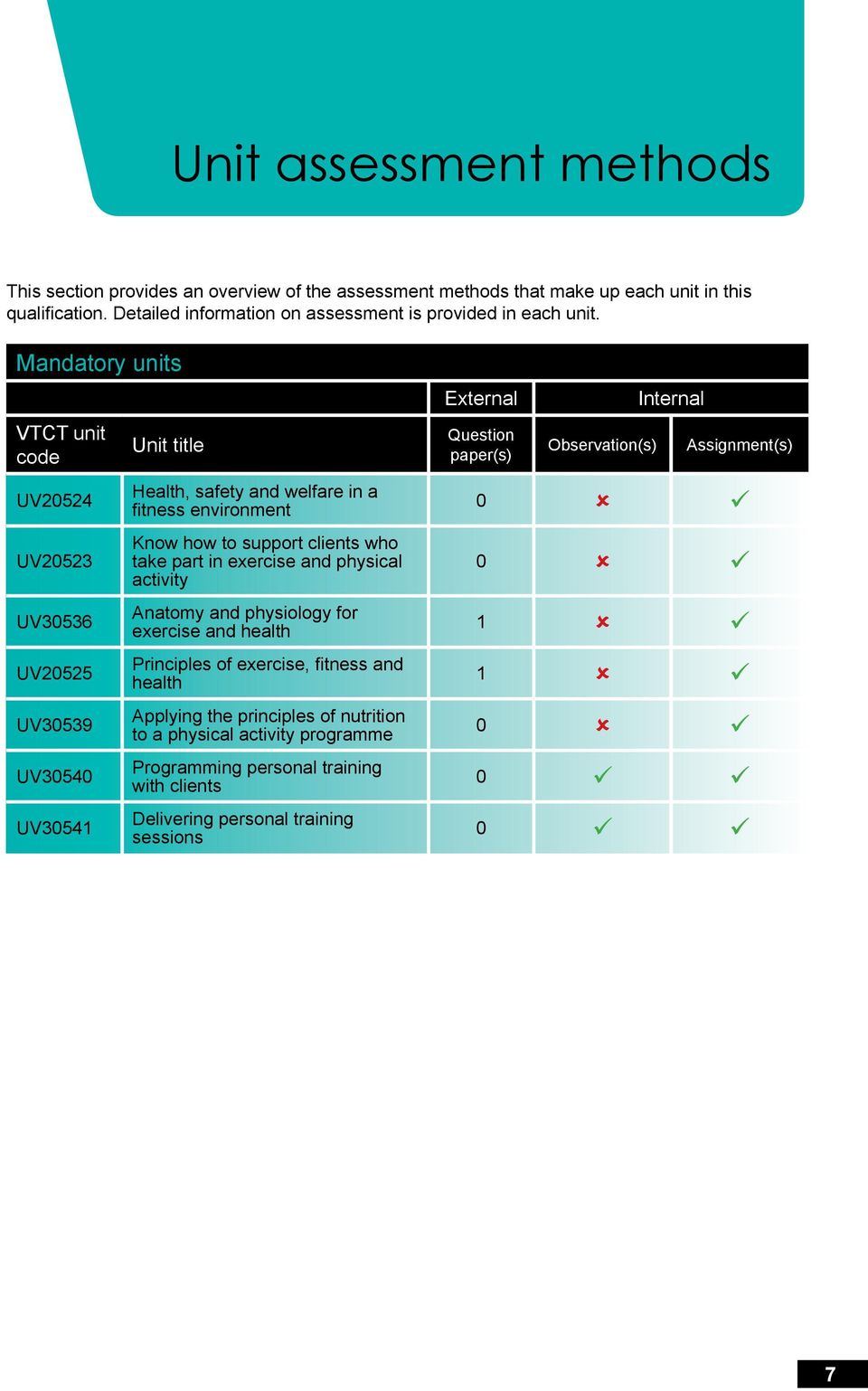
7 Unit assessment methods This section provides an overview of the assessment methods that make up each unit in this qualification. Detailed information on assessment is provided in each unit. Mandatory units VTCT unit code UV20524 UV20523 UV30536 UV20525 UV30539 UV30540 UV30541 Unit title Health, safety and welfare in a fitness environment Know how to support clients who take part in exercise and physical activity Anatomy and physiology for exercise and health Principles of exercise, fitness and health Applying the principles of nutrition to a physical activity programme Programming personal training with clients Delivering personal training sessions External Question paper(s) Observation(s) Internal Assignment(s)
8 Unit glossary Description VTCT product code Unit title National Occupational Standards (NOS) Level Credit value Guided learning hours (GLH) Observations Learning outcomes Evidence requirements Maximum service times Observation outcome Knowledge outcome Assessment criteria Range All units are allocated a unique VTCT product code for identification purposes. This code should be quoted in all queries and correspondence to VTCT. The title clearly indicates the focus of the unit. NOS describe the skills, knowledge and understanding needed to undertake a particular task or job to a nationally recognised level of competence. Level is an indication of the demand of the learning experience, the depth and/or complexity of achievement and independence in achieving the learning outcomes. There are 9 levels of achievement within the Qualifications and Credit Framework (QCF). This is the number of credits awarded upon successful achievement of all unit outcomes. Credit is a numerical value that represents a means of recognising, measuring, valuing and comparing achievement. GLH is an estimate of the time allocated to teach, instruct, assess and support learners throughout a unit. Learner initiated private study, preparation and marking of formative assessment is not taken into account. This indicates the minimum number of observations required to achieve the unit. The learning outcomes are the most important component of the unit, they set out what is expected in terms of knowing, understanding and practical ability as a result of the learning process. Learning outcomes are the results of learning. This section provides guidelines on how evidence must be gathered. The maximum time in which a particular service or practical element must be completed. An observation outcome details the practical tasks that must be completed to achieve the unit. A knowledge outcome details the theoretical requirements of a unit that must be evidenced through oral questioning, a mandatory written question paper or portfolio of evidence. Assessment criteria set out what is required, in terms of achievement, to meet a learning outcome. The assessment criteria and learning outcomes are the components that inform the learning and assessment that should take place. Assessment criteria define the standard expected to meet learning outcomes. The range indicates what must be covered. Ranges must be practically demonstrated in parallel to the unit s observation outcomes. 8

9 UV20524 Health, safety and welfare in a fitness environment It is the aim of this unit to develop your knowledge and understanding of how to maintain health, safety and welfare in a fitness environment, including the safeguarding of children and vulnerable adults. UV20524_v5

10 Level 2 Credit value 2 GLH 16 Observation(s) 0 External paper(s) 0

11 Health, safety and welfare in a fitness environment Learning outcomes On completion of this unit you will: 1. Understand emergency procedures in a fitness environment 2. Understand health and safety requirements in a fitness environment 3. Understand how to control risks in a fitness environment 4. Understand how to safeguard children and vulnerable adults Evidence requirements 1. Knowledge outcomes There must be evidence that you possess all the knowledge and understanding listed in the Knowledge section of this unit. This evidence may include projects, assignments, case studies, reflective accounts, oral/written questioning and/or other forms of evidence. 2. Tutor/Assessor guidance You will be guided by your tutor/assessor on how to achieve learning outcomes in this unit. All outcomes must be achieved. 3. External paper There is no external paper requirement for this unit. UV

12 Developing knowledge Achieving knowledge outcomes You will be guided by your tutor and assessor on the evidence that needs to be produced. Your knowledge and understanding will be assessed using the assessment methods listed below: Observed work performance Witness testimony/statements Audio-visual media Evidence of prior learning or attainment Written questions Oral questions Assignments Case studies Professional discussion Employer-provided question papers and tests E-assessment. 12 UV20524

13 Knowledge Outcome 1 Understand emergency procedures in a fitness environment You can: Portfolio reference / Assessor initials* a. Identify the types of emergencies that may occur in a fitness environment b. Describe the roles that different staff and external services play during an emergency c. Explain the importance of following emergency procedures calmly and correctly d. Describe how to maintain the safety of people involved in typical emergencies, including children, older people and disabled people *Assessor initials to be inserted if orally questioned. UV

14 Outcome 2 Understand health and safety requirements in a fitness environment You can: Portfolio reference / Assessor initials* a. Outline why health and safety is important in a fitness environment b. Identify the legal and regulatory requirements for health and safety relevant to working in a fitness environment c. Describe the duty of care and professional role boundaries in relation to special population groups d. Identify the typical roles of individuals responsible for health and safety in a fitness organisation e. Describe the types of security procedures that may apply in a fitness environment f. Describe the key health and safety documents that are relevant in a fitness environment *Assessor initials to be inserted if orally questioned. 14 UV20524

15 Outcome 3 Understand how to control risks in a fitness environment You can: Portfolio reference / Assessor initials* a. Identify possible hazards in a fitness environment, relating to: facilities equipment working practices, including lifting and handling of equipment client behaviour security hygiene b. Describe how to risk assess the types of possible hazards in a fitness environment c. Describe how to control risks associated with hazards in a fitness environment d. Identify the appropriate person/position to contact within a fitness organisation when hazards and risks cannot be controlled personally *Assessor initials to be inserted if orally questioned. UV

16 Outcome 4 Understand how to safeguard children and vulnerable adults You can: Portfolio reference / Assessor initials* a. Describe what is meant by safeguarding the welfare of children and vulnerable adults b. Describe the responsibilities and limitations of a fitness instructor in regard to safeguarding children and vulnerable adults c. Identify the types of abuse which an instructor may encounter (physical, emotional, neglect, bullying and sexual) d. Identify possible signs of abuse (physical, emotional, neglect, bullying and sexual) e. Describe a fitness organisation s policies and procedures in relation to safeguarding children and vulnerable adults, including typical reporting procedures f. Describe the procedures to follow to protect yourself from accusations of abuse g. Identify the statutory agencies responsible for safeguarding children and vulnerable adults h. Explain when it may be necessary to contact statutory agencies i. Describe how to maintain the confidentiality of information relating to possible abuse *Assessor initials to be inserted if orally questioned. 16 UV20524

17 Unit content This section provides guidance on the recommended knowledge and skills required to enable you to achieve each of the learning outcomes in this unit. Your tutor/assessor will ensure you have the opportunity to cover all of the unit content. Outcome 1: Understand emergency procedures in a fitness environment Types of emergencies: First aid (accidental injury, medical conditions), accident (using equipment, trips, slips, falls), fire (building, equipment, flammable products), missing person (child, disabled person, vulnerable adults), suspected bomb, chemicals. Roles of staff and external services: Instructor (deal with situation when it arises within limits of own responsibility, refer situation if necessary, report emergency), receptionist (contact emergency services, meet and direct emergency services to location), instructor or line/duty manager (complete incident/report form according to organisation requirements), paramedic (treat medical emergency), Police (investigate missing person), Fire Service (investigate, resolve and make safe fire emergency). Importance of following emergency procedures: To ensure the emergency is resolved, the health and safety of all clients and staff, staff responsibilities are clearly allocated and followed, the emergency is reported and recorded. Maintaining the safety of people involved: Stop the fitness activity, provide information to keep people informed, direct to a safe environment (other area, first aid room, fire assembly point), contact appropriate personnel (line manager, emergency services, parent or guardian, significant others), consider needs of specific populations (disabilties, older adult, children), ensure appropriate procedures are in place. UV

18 Outcome 2: Understand health and safety requirements in a fitness environment Importance of health and safety: Protect clients and staff, ensure provision of safe and effective equipment, ensure safe and hygienic premises, to meet health and safety requirements and industry standards. Legal and regulatory requirements: Health and safety legislathon, disability discrimination legislation, Law of Tort, occupiers liability, REPS Code of Conduct, employee and public liability insurance, control of substances hazardous to health, CRB checks. Duty of care and professional role boundaries: Duty of care (ensure no unreasonable harm or loss, three criteria for negligence), greater duty of care with vulnerable adults (over 18 years and in need of community care services, mental or other disability, unable to care for self, potential for exploitation), greater duty of care with clients undergoing special physiological lifespan processes (ageing, childhood, antenatal, postnatal). Professional role boundaries for special populations: Unable to practise or advertise as a special populations instructor, unable to instruct special population clients on one to one or group basis, unable to plan a progressive and long term special population activity programme, health screened and asymptomatic special populations may be accommodated on an occasional basis within mainstream exercise sessions, clients must be informed of instructor role boundaries and given the choice to participate, instructors should obtain relevant qualifications if regularly working with special population clients, insurance policies must cover the instruction of special populations, other referral sources for maintaining professional role boundaries (Code of Ethics, REPS Code of Conduct, general practitioner, physiotherapist, first aider, line manager). Roles of individuals in health and safety: Role of instructor (equipment and facility checks, service and maintenance, completing and recording specific activity risk assessments, maintaining safe practice during exercise services), role of managers (monitor health and safety practice, review risk assessments, review organisational health and safety policy, update staff on health and safety policy), health and safety executive (inspection and review of organisation s health and safety procedures and practice). Types of security procedures: Controlled and recorded reception access/departure, CCTV coverage of public areas, entrances and exits, lockable storage for personal valuables, locked storage of maintenance and cleaning products, locked doors to areas with restricted public access, locked storage of client data records, opening and closing procedures, fire and evacuation procedures, fire alarm testing. Key health and safety documents: Organisation health and safety policy, risk assessment, accident/incident report form, first aid book, equipment and facility maintenance and service records. 18 UV20524

19 Outcome 3: Understand how to control risks in a fitness environment Possible hazards: Facilities (e.g. slippery or uneven floor surfaces, obstructed floor areas, fire), equipment (e.g. broken, improper technical use), working practices (e.g. inappropriate exercise type and intensity, improper exercise technique, lifting, handling), client behaviour (e.g. abuse), security (e.g. medical condition, unauthorised persons, theft), hygiene (e.g. cross-infection, contact with hazardous cleaning and maintenance products), anything that may cause harm. Risk assessment: Visual inspection and appraisal of possible hazards, identification of who may be harmed, written completion of risk assessment form (hazards, harm potential, people affected, risk severity, risk frequency, risk rating, additional control measures), review of risks. Risk control: Facilities (e.g. cleaning and maintenance schedule, appropriate activities, sufficient floor area, suitable client footwear, location of fire exits, location of fire extinguishers, serviced fire extinguishers, storage of flammable products, organisational procedure for fire emergency), equipment (e.g. service and maintenance schedule undertaken and recorded, out of order equipment clearly marked, correct technical instruction), working practices (e.g. correct technical instruction, appropriate exercise type and intensity, correct lifting and handling technique), client behaviour (e.g. rules and standards information), security (e.g. qualified first aider, replenished first aid kit, location of nearest first aid kit, organisational procedure for medical emergency, controlled reception access), hygiene (e.g. regular cleaning schedule, clothing guidelines for clients, client hygiene information). Appropriate personnel: Referral of hazards outside the limits of personal responsibility (line manager, organisation health and safety manager, external services, health and safety executive). UV

20 Outcome 4: Understand how to safeguard children and vulnerable adults Safeguarding welfare: Children and vulnerable adults, protecting from maltreatment, preventing impairment of health and development, ensuring provision of safe and effective care, ensuring optimum life chances, acts that affect those working with children and vulnerable adults (the children act, the police act, the protection of children act, every child matters act, safeguarding vulnerable groups act, the disability discrimination act), protect yourself with CRB check. Responsibilities and limitations: Responsibility of fitness instructor (duty of care to safeguard children and adults during provision of service, refer suspected and reported abuse to the designated employee), limitations (refer but not deal with suspected or reported abuse). Types of abuse: Physical (e.g. hitting, shaking, throwing, poisoning, burning, drowning, suffocating, causing physical harm, forcing training and competition exceeding the capacity of the body, giving drugs to enhance performance or delay puberty), emotional (e.g. constant criticism, name calling, sarcasm, bullying, under constant pressure to perform to unrealistically high standards), neglect (e.g. not ensuring safety, exposure to undue cold or heat, exposure to unnecessary risk of injury), bullying (e.g. name calling, insults, verbal abuse, being deliberately embarrassed and humiliated by others, being made to feel different, being lied about, being physically assaulted or threatened with violence, being ignored), sexual (e.g. forcing or enticing a person to take part in sexual activities, involving people in looking at, or in the production of, sexual online images, watching sexual activities, or encouraging people to behave in sexually inappropriate ways). Possible signs of abuse: Physical (e.g. unexplained recurrent injuries or burns, probable excuses or refusal to explain injuries, wearing clothes to cover injuries, refusal to undress for exercise, bald patches, chronic running away, fear of medical help or examination, self destructive tendencies, aggression towards others, fear of physical contact), emotional (e.g. physical, mental and emotional development lags, sudden speech disorders, continual self depreciation, overreaction to mistakes, extreme fear of any new situation, inappropriate response to pain, neurotic behaviour, extremes of passivity or aggression), neglect (e.g. constant hunger, poor personal hygiene, constant tiredness, poor state of clothing, untreated medical problems, no social relationships, destructive tendencies), bullying (e.g. become withdrawn, start stammering, lack confidence, become distressed and anxious, stop eating, attempt or threaten suicide, have their possessions go missing, refuse to talk about problems, have unexplained bruises and cuts, begin to bully others, become aggressive and unreasonable), sexual (e.g. distracted, sudden mood swings, exhibit or mimic sexual behaviours, poor self body image, resist changing clothes, wetting and soiling accidents, self injury). Policies, procedures and reporting procedures: For a specific fitness organisation (safeguarding children, safeguarding vulnerable adults, protection from accusations of abuse). Statutory agencies: Social Services, Police, National Society for the Prevention 20 UV20524

21 of Cruelty to Children (NSPCC), Ofsted, Independent Safeguarding Authority (ISA), associated roles and responsibilities, when to contact statutory agencies (when abuse is suspected, when abuse has been reported). Maintaining confidentiality: Follow organisational procedures, refer to designated member of staff, use a safe and private place to discuss the issue, record and store details according to the data protection act. UV
22 Notes Use this area for notes and diagrams 22 UV20524
23 UV20523 Know how to support clients who take part in exercise and physical activity The aim of this unit is to develop your knowledge and understanding of how to support clients and provide ongoing customer service. You will also develop the skills to support clients taking part in exercise and physical activity. UV20523_v6
24 Level 2 Credit value 2 GLH 13 Observation(s) 0 External paper(s) 0
25 Know how to support clients who take part in exercise and physical activity Learning outcomes On completion of this unit you will: 1. Understand how to form effective working relationships with clients 2. Understand how to address barriers to exercise/physical activity that clients experience 3. Understand how to support clients to adhere to exercise/physical activity 4. Understand how to provide ongoing customer service to clients Evidence requirements 1. Knowledge outcomes There must be evidence that you possess all the knowledge and understanding listed in the Knowledge section of this unit. This evidence may include projects, assignments, case studies, reflective accounts, oral/written questioning and/or other forms of evidence. 2. Tutor/Assessor guidance You will be guided by your tutor/assessor on how to achieve learning outcomes in this unit. All outcomes must be achieved. 3. External paper There is no external paper requirement for this unit. UV
26 Developing knowledge Achieving knowledge outcomes You will be guided by your tutor and assessor on the evidence that needs to be produced. Your knowledge and understanding will be assessed using the assessment methods listed below: Observed work performance Witness testimony/statements Audio-visual media Evidence of prior learning or attainment Written questions Oral questions Assignments Case studies Professional discussion Employer-provided question papers and tests E-assessment. 26 UV20523
27 Knowledge Outcome 1 Understand how to form effective working relationships with clients You can: Portfolio reference / Assessor initials* a. Explain why it s important to form effective working relationships with clients b. Explain why it s important to present oneself and the organisation positively to clients c. Describe how different communication skills can be used to assist clients with motivation d. Explain the importance of valuing equality and diversity when working with clients *Assessor initials to be inserted if orally questioned. UV
28 Outcome 2 Understand how to address barriers to exercise/physical activity that clients experience You can: Portfolio reference / Assessor initials* a. Identify the typical barriers to exercise/physical activity that clients experience b. Explain how incorporating a client s exercise/physical activity preference into their programme can strengthen motivation and adherence c. Describe different incentives and rewards that can strengthen client motivation and adherence d. Describe different strategies that can help clients overcome typical barriers to exercise/physical activity *Assessor initials to be inserted if orally questioned. 28 UV20523
29 Outcome 3 Understand how to support clients to adhere to exercise/ physical activity You can: Portfolio reference / Assessor initials* a. Explain why it is important for a client to take personal responsibility for their own fitness and motivation b. Describe how to assist clients to develop their own strategy for motivation and adherence c. Identify different behaviour change approaches/strategies to encourage adherence to exercise/physical activity d. Describe how to set short, medium and long term SMART goals e. Describe how to review and revise short, medium and long term SMART goals *Assessor initials to be inserted if orally questioned. UV
30 Outcome 4 Understand how to provide ongoing customer service to clients You can: Portfolio reference / Assessor initials* a. Explain the importance of client care both for the client and the organisation b. Explain why it is important to deal with client needs to their satisfaction c. Identify where to source relevant and appropriate information to meet client needs d. Explain the importance of dealing with any delay in meeting client needs timely and effectively e. Give examples of how to exceed customer expectations, when appropriate f. Explain the importance of handling client complaints positively following an organisation s procedure *Assessor initials to be inserted if orally questioned. 30 UV20523
31 Unit content This section provides guidance on the recommended knowledge and skills required to enable you to achieve each of the learning outcomes in this unit. Your tutor/assessor will ensure you have the opportunity to cover all of the unit content. Outcome 1: Understand how to form effective working relationships with clients Effective working relationships with clients: Different clients (specific needs, apparently healthy adults, apparently healthy young people, antenatal and postnatal clients, disabled clients), importance of gaining mutual respect, gaining mutual confidence, gaining mutual trust, determine client needs, establish rapport. Positive presentation of self and organisation: Presentation (professional conduct, dress/appearance, attitude, show respect, equal opportunities, inclusion and exclusion, punctuality), importance of gaining clients confidence, gaining clients respect, enhance professional image and reputation, gain repeat clients, word of mouth, gain new clients. Communication skills and client motivation: Personalised, client feels valued, friendly and welcoming with new and returning clients, verbal (telephone, face to face, language, voice intonation, accent, dialect), non-verbal (questionnaires, handouts, posters, s, websites, social networking), body language to provide positive feedback to clients, active listening to encourage client views about their performance, open questions, demonstration to show and reinforce exercise techniques, informal consultation to discuss client needs and set goals, written communication to summarise agreed goals and plans. Importance of valuing equality and diversity: To maintain respect and dignity, to ensure fair treatment, to meet individual needs, to provide individual encouragement to reach potential, to provide a safe, supportive and welcoming environment, equality and diversity can be met by maintaining professional boundaries, staying non-judgmental and ensuring equal rights (gender, race, nationality, ethnic or national origin, religious or political beliefs, disability, marital status, social background, family circumstance, sexual orientation, gender reassignment, spent criminal convictions, age or for any other reason). UV
32 Outcome 2: Understand how to address barriers to exercise/physical activity that clients experience Typical barriers to exercise: Threatened by super-fit instructors/beautiful people, access, transport, cost, time, energy, lack of motivation, lack of knowledge, self-conscious, low self-efficacy, low selfesteem, lack of childcare, gender, age, ethnicity, socio-economic status, social pressure, health and injury concerns, no exercise partner to motivate, unreadiness to change behaviour. Strengthen motivation and adherence: Incorporate client s exercise and physical preferences, plan programmes accordingly, preferences (health related, fitness related, enjoyment related, social), consideration of these factors strengthen motivation and adherence (increase intrinsic motivation, increase client control and autonomy, increase self-efficacy, increase potential competence and ability, increase enjoyment). Incentives and rewards: Physical and psychological health benefits, physical fitness improvements, achievement of personal goals, social interaction, fun and enjoyment, improved ability to complete daily living tasks, positive praise and feedback from others, free memberships, free training sessions, free personal instruction, gym challenges, social events, rewards based on attendance, rewards based on achievement of goals. Strategies to overcome barriers to exercise: Select appropriate exercise activities (ability, fitness level, enjoyment, client needs, peer group), provide financial concessions, appropriate time scheduling of exercise activities, provide accurate exercise information and advice, provide access to childcare, referral to relevant health professionals, social support and inclusion, encourage exercise partners, goal setting (SMART), positive reinforcement, enthusiasm, encouragement, social support, rapport with instructor, teaching approaches (learning style, verbal/non-verbal communication, equal opportunities). 32 UV20523
33 Outcome 3: Understand how to support clients to adhere to exercise/ physical activity Importance of taking personal responsibility: Increase intrinsic motivation, increase control and autonomy, increase potential for exercise adherence, encourage personal reflection of progress and needs. Assisting clients to develop their own strategy: Regular consultations with client, clarify goals, establish realistic expectations, review exercise behaviour, address barriers to exercise, make strategy plan for relapse. Behaviour change approaches/ strategies: Behaviour change (stages of behaviour change, relapse prevention model), approaches/strategies (prompting, contract between trainer and client, rewarding attendance, positive feedback on progress, goal setting and review, social support, reduce barriers, provide exercise information and guidance). Goal setting: Needs and wants analysis, SMART principles (specific, measurable, achievable, realistic, time bound), short, medium and long term SMART goals (improve health, develop specific fitness components, sport specific, improve psychological wellbeing, improve social interaction, fun and enjoyment, lifestyle, functional ability for daily life, weight management). Review and revise goals: Review short, medium and long term SMART goals, goal review methods (consultation, written client questionnaire, analysis of exercise records), review progress (achievement of agreed goals, previous and current client needs), and set new SMART goals. UV
34 Outcome 4: Understand how to provide ongoing customer service to clients Importance of client care: For the client (personalised customer service, enhanced customer experience, achievement of goals), for the organisation (avoidance of litigation (law of tort), improved retention, growth of business, maintain image and reputation). Importance of dealing with client needs: Maintain satisfaction of client, meet client needs, achieve client goals, maintain confidence and trust of client, promote client adherence and attendance, maintain professional and organisation image, positive word of mouth, potential increase in client base. Sources of appropriate information to meet client needs: Timetables, noticeboard, s to keep clients informed, REPs code of conduct, organisation s procedures, referral professionals (GP, physiotherapist, nutritionist), evidence based journals, evidence based websites, evidence based text books, customer feedback. Importance of meeting client needs timely and effectively: Maintain client satisfaction, to stop a problem escalating, optimise effectiveness of service, maintain customer loyalty, minimise risk of relapse or drop-out, maintain reputation and professional image. Exceed customer expectations: Customer needs analysis, provide service over and above what is expected, follow organisation s procedures, examples of exceeding expectations (level of personal attention and service, standard of exercise service provided, levels of personal communication experienced). Handle client complaints positively: Acknowledge complaint immediately (HEAT Hear, Empathise, Apologise, Take action), handle complaints (privately, positively, confidently, professionally, promptly, confidentially, empathetically, with trust and respect, to client s satisfaction), follow agreed procedures (organisation s operational procedures and good practice, REPs Code of Conduct). 34 UV20523
35 UV30536 Anatomy and physiology for exercise and health It is the aim of this unit to develop your knowledge and understanding of the anatomy and physiology underpinning exercise and health. UV30536_v5
36 Level 3 Credit value 6 GLH 43 Observation(s) 0 External paper(s) 1
37 Anatomy and physiology for exercise and health Learning outcomes On completion of this unit you will: 1. Understand the heart and circulatory system and its relation to exercise and health 2. Understand the musculoskeletal system and its relation to exercise 3. Understand postural and core stability 4. Understand the nervous system and its relation to exercise 5. Understand the endocrine system and its relation to exercise and health 6. Understand energy systems and their relation to exercise Evidence requirements 1. Knowledge outcomes There must be evidence that you possess all the knowledge and understanding listed in the Knowledge section of this unit. This evidence may include projects, assignments, case studies, reflective accounts, oral/written questioning and/or other forms of evidence. 2. Tutor/Assessor guidance You will be guided by your tutor/assessor on how to achieve learning outcomes in this unit. All outcomes must be achieved. 3. External paper Knowledge and understanding in this unit will be assessed by an external paper. There is one external paper that must be achieved. UV
38 Developing knowledge Achieving knowledge outcomes You will be guided by your tutor and assessor on the evidence that needs to be produced. Your knowledge and understanding will be assessed using the assessment methods listed below: Observed work performance Witness testimony/statements Audio-visual media Evidence of prior learning or attainment Written questions Oral questions Assignments Case studies Professional discussion Employer-provided question papers and tests E-assessment. Achieving the external paper The external paper will test your knowledge of all criteria in this section. A pass mark of 70% must be achieved. Your assessor will complete this table when the 70% pass mark has been achieved. Paper Date achieved Assessor initials 1 of 1 38 UV30536
39 Knowledge Outcome 1 Understand the heart and circulatory system and its relation to exercise and health You can: Portfolio reference / Assessor initials* a. Explain the function of the heart valves b. Describe coronary circulation c. Explain the effect of disease processes on the structure and function of blood vessels d. Explain the short and long term effects of exercise on blood pressure, including the valsalva effect e. Explain the cardiovascular benefits and risks of endurance/aerobic training f. Define blood pressure classifications and associated health risks *Assessor initials to be inserted if orally questioned. UV
40 Outcome 2 Understand the musculoskeletal system and its relation to exercise You can: Portfolio reference / Assessor initials* a. Explain the cellular structure of muscle fibres b. Describe the sliding filament theory c. Explain the effects of different types of exercises on muscle fibre type d. Identify and locate the muscle attachment sites for the major muscles of the body e. Name, locate and explain the function of skeletal muscle involved in physical activity f. Identify the anatomical axis and planes with regard to joint actions and different exercises g. Explain the joint actions brought about by specific muscle group contractions h. Describe joints/joint structure with regard to range of motion/ movement and injury risk i. Describe joint movement potential and joint actions j. Describe the structure of the pelvic girdle and associated muscles and ligaments *Assessor initials to be inserted if orally questioned. 40 UV30536
41 Outcome 3 Understand postural and core stability You can: Portfolio reference / Assessor initials* a. Describe the structure and function of the stabilising ligaments and muscles of the spine b. Describe local muscle changes that can take place due to insufficient stabilisation c. Explain the potential effects of abdominal adiposity and poor posture on movement efficiency d. Explain the potential problems that can occur as a result of postural deviations e. Explain the impact of core stabilisation exercise and the potential for injury/aggravation of problems f. Explain the benefits, risks and applications of the following types of stretching: static (passive and active) dynamic proprioceptive neuromuscular facilitation *Assessor initials to be inserted if orally questioned. UV
42 Outcome 4 Understand the nervous system and its relation to exercise You can: Portfolio reference / Assessor initials* a. Describe the specific roles of: the central nervous system (CNS) t h e p e r i p h e r a l n e r v o u s s y s t e m ( P N S ) i n c l u d i n g s o m a t i c a n d autonomic systems b. Describe nervous control and transmission of a nervous impulse c. Describe the structure and function of a neuron d. Explain the role of a motor unit e. Explain the process of motor unit recruitment and the significance of a motor unit s size and number of muscle fibres f. Explain the function of muscle proprioceptors and the stretch reflex g. Explain reciprocal inhibition and its relevance to exercise h. Explain the neuromuscular adaptations associated with exercise/ training i. Explain the benefits of improved neuromuscular co-ordination/ efficiency to exercise performance *Assessor initials to be inserted if orally questioned. 42 UV30536
43 Outcome 5 Understand the endocrine system and its relation to exercise and health You can: Portfolio reference / Assessor initials* a. Describe the functions of the endocrine system b. Identify the major glands in the endocrine system c. Explain the function of hormones including: growth hormone thyroid hormones corticosteroids catecholamines insulin glucagon *Assessor initials to be inserted if orally questioned. UV
44 Outcome 6 Understand energy systems and their relation to exercise You can: Portfolio reference / Assessor initials* a. Identify the contribution of energy according to: duration of exercise/activity being performed type of exercise/activity being performed intensity of exercise/activity being performed b. Identify the by-products of the three energy systems and their significance in muscle fatigue c. Describe the effect of endurance training/advanced training methods on the use of fuel for exercise *Assessor initials to be inserted if orally questioned. 44 UV30536
45 Unit content This section provides guidance on the recommended knowledge and skills required to enable you to achieve each of the learning outcomes in this unit. Your tutor/assessor will ensure you have the opportunity to cover all of the unit content. Outcome 1: Understand the heart and circulatory system and its relation to exercise and health Function of heart valves: Heart structure (ventricles, atria, interventricular septum, interatrial septum), atrioventricular valves (tricuspid valve, bicuspid valve, chordate tendinae, papillary muscle), semi-lunar valves (aortic and pulmonary), function of valves (control blood flow through heart chambers, prevent backflow of blood). Coronary circulation: Circulatory process (superior and inferior vena cava, right atrium, tricuspid valve, right ventricle, pulmonary semi-lunar valve, pulmonary arteries, pulmonary circulation, pulmonary veins, left atrium, bicuspid valve, left ventricle, aortic semi-lunar valves, aorta, systemic circulation), blood (oxygenated, deoxygenated). Disease processes and the blood vessels: Structure and function (arteries, arterioles, capillaries, veins, venules), diseases (arteriosclerosis, atherosclerosis), processes (thickening of artery walls, loss of elasticity, endothelial damage, smooth muscle fibre proliferation, lesions formed by fatty plaque). Blood pressure and exercise: Definition of blood pressure (systolic pressure, diastolic pressure), blood pressure classifications (hypotension, normal, high normal, mild hypertension, moderate hypertension, severe hypertension), associated health risks of hypertension (stroke, coronary heart disease, coronary artery disease, kidney disease, loss of vision), short term effects of exercise (no change in diastolic pressure, progressive increase in systolic pressure), long term effects of exercise (reduction in resting blood pressure, improved regulation of blood pressure), valsalva effect. Cardiovascular benefits and risks of endurance/aerobic training: Benefits increased heart strength and efficiency, increased capillary network, increased elasticity of blood vessels, improved blood flow distribution, improved blood cholesterol profile, reduced blood pressure, improved ability to tolerate heat, reduced risk of cardiovascular diseases. Risks overexertion, aggravation of cardiovascular contra-indications to exercise, overtraining, overuse injuries. UV
46 Outcome 2: Understand the musculoskeletal system and its relation to exercise Sliding filament theory: Actin, myosin, cross-bridges, troponin-tropomyosin, complex, depolarisation, calcium ions, adenosine triphosphate, shortening of sarcomere, motor unit recruitment. Exercise and muscle fibre type: Muscle fibre type characteristics (I slow oxidative, IIa fast oxidative/glycolytic, IIb fast glycolytic), effects of aerobic exercise on type I fibres (increased concentration of aerobic enzymes, increased size and number of mitochondria, increased ability to use fat as an energy source, increased storage of muscle glycogen, increased supply of intramuscular fat, increased myoglobin, increased number of capillaries), effects of resistance training on type II fibres (increase in muscle mass and cross-sectional area, possible increase in number of type II muscle fibres, increased motor unit recruitment). Structure of muscle: Muscle structure (epimysium, perimysium, endomysium), cellular muscle structure (sarcolemma, myofibrils, sarcoplasm, sarcoplasmic reticulum, sarcomere, actin, myosin, mitochondria, terminal cisternae, t-tubules, troponin, tropomyosin), other microscopic structures (Z lines, A and I bands, H zone, M line). Axial and appendicular skeleton: Names and locations of axial bones (cranium, cervical vertebrae, thoracic vertebrae, lumbar vertebrae, sacral vertebrae, sternum, ribs, coccyx), names and locations of appendicular bones (scapula, clavicle, humerus, ulna, radius, carpals, metacarpals, phalanges, ilium, ischium, pubis, femur, patella, tibia, fibula, tarsals, calcaneus, metatarsals). Major skeletal muscles and attachment sites: Names and locations of major muscles to include rotator cuff (teres minor, supraspinatus, subscapularis, infraspinatus), shoulder girdle (pectoralis major, pectoralis minor, levator scapulae, serratus anterior, trapezius, rhomboids major/minor, teres major), spinal extensors (erector spinae, iliocostalis, longissimus, spinalis, multifidus, quadratus lumborum), hip flexors (iliopsoas, iliacus, psoas major/ minor), adductors (magnus, brevis, longus, pectineus, gracilis, sartorius), abductors (gluteus medius, gluteus minimus, piriformis, tensor fascia latae), abdominals (rectus abdominus, internal and external obliques, transverse abdominus), intercostals, diaphragm, quadriceps (rectus femoris, vastus intermedius, vastus medialis, vastus lateralis), hamstrings (biceps femoris, semitendinosus, semimembranosus), tibialis anterior, sternocleidomastoid, scalenes, deltoids (anterior, medial posterior), gastrocnemius, soleus, tibialis posterior, biceps brachii, brachialis, coracobrachialis, triceps brachii, gluteus maximus, latissimus dorsi, major muscle attachment sites (origin, insertion). Function of skeletal muscle: Functions (movement, maintain posture and stability, heat generation), principles of muscle work (muscles pull on bones, muscle contract in fibre direction, muscle cross joints, muscles work in pairs), leverage (fulcrum, resistance, effort), types of levers during exercise (first class, second class, third class), muscle contractions during exercise (dynamic concentric, dynamic eccentric, isotonic, isometric), muscle roles during exercise (agonist, antagonist, fixator, synergist). 46 UV30536
47 Outcome 2: Understand the musculoskeletal system and its relation to exercise (continued) Anatomical axis and planes: Frontal plane (anterior/posterior axis movements (adduction, abduction, lateral flexion, eversion, inversion)), sagittal plane (bilateral axis movements (flexion, extension)), transverse plane (vertical axis movements (internal rotation, external rotation, horizontal flexion/adduction, horizontal extension/abduction)), associated exercises in different planes and axis. Joint structure: Fibrous synarthrosis, immovable, have no joint cavity, are connected via fibrous connective tissue e.g. skull bones are connected by fibrous joints. Cartilaginous amphiarthosis, slightly moveable, a joint in which the surfaces are connected by disks of fibrocartilage, as between vertebrae. Synovial diarthrosis, freely moveable, all diarthroses have this characteristic space between the bones that is filled with synovial fluid. Structure of a synovial joint joint capsule, ligaments, synovial fluid, articular cartilage, bone. Types and locations of synovial joint gliding, ellipsoid, hinge, saddle, pivot, ball and socket. Associated range and stability of motion/movement of synovial joint types range norms, factors affecting stability (shape of articular surfaces, capsule, ligaments, muscle tone, gravity). Associated injury risk to joints types and ligaments e.g. joints must be used in correct plane, joint must be aligned, joints not taken beyond end range, greater range of movement allows increased risk of injury. Joint movement potential and actions: Shoulder (flexion, extension, abduction, adduction, horizontal flexion/adduction, horizontal extension/abduction, internal rotation, external rotation), elbow (flexion, extension, supination, pronation), shoulder girdle (elevation, depression, protraction, retraction), spine (flexion, extension, lateral flexion, rotation), hip (flexion, extension, abduction, adduction, internal rotation, external rotation), knee (flexion, extension), ankle (plantarflexion, dorsiflexion, inversion, eversion), significance of joint type and structure for movement potential, associated joints crossed by muscles, associated muscle group contractions, analysis of different multi-joint and single joint exercises. Structure of pelvic girdle: Structural bones (ilium, ischium, pubis, sacro-iliac joint), associated muscles (iliopsoas, pectineus, rectus femoris, sartorius, adductors, gluteus maximus, hamstrings, hip abductors), ligaments (iliolumbar, sacrospinous, sacrotuberous, anterior and posterior sacroiliac), pubis symphysis articulation, sacroiliac articulation, importance of pelvic girdle for weight bearing exercise, male and female differences (femur angle, injury risk). UV
48 Outcome 3: Understand postural and core stability Structure of the spine: Vertebrae structure (facet joints, vertebral foramen, spinal cord, spinal canal, cartilaginous discs), specific functions of vertebral regions (cervical, thoracic, lumbar, sacrum, coccyx). Stabilising ligaments and muscles of the spine: Structure and function, ligaments (ligamentum flavum, anterior and posterior longitudinal ligaments), intrasegmental and intersegmental ligament systems, role of spinal ligaments in core stability, location and role of local postural stabilisers (lumbar multifidus, transversus abdominus, diaphragm, pelvic floor muscles, abdominal aponeurosis, thoracolumbar fascia), location and role of global phasic stabilisers (rectus abdominis, internal obliques, external obliques, transverse abdominis, erector spinae, quadratus lumborum). Local muscle changes due to insufficient stabilisation: Stabilisation systems, reasons for insufficient stabilisation (heredity, medical conditions, lifestyle, ageing, muscle imbalances), muscle changes (muscles lengthened, muscles shortened, weak/inactive muscles, overactive/strong muscles, imbalanced kinetic chain, compensation patterns, synergistic dominance, inefficient movements). Effects of abdominal adiposity and poor posture: Inefficient movement patterns, compensation, muscle imbalances, stability, alignment, centre of gravity excursions. Postural deviations: Deviations (flat back, sway back, kyphosis, lordosis, scoliosis), importance of deviations for exercise safety, potential problems of deviations (muscle imbalances and compensation, inefficient movement patterns, joint and muscle pain, spinal disorders), methods of identifying deviations (postural analysis form, postural photography, postural analysis computer software), referral to appropriate professionals (GP, physiotherapist), reasons and procedures for referral. Impact of core stabilisation exercises: Definition of core stability (maintaining spinal alignment and pelvic position, statically and dynamically), impact (improved posture, improved motor skill performance, improved power application, muscle balance throughout kinetic chain, injury prevention for spine and shoulder girdle, improved aesthetics), potential for injury and aggravation of problems (improper technique, contra-indicated exercises for specific postural problems and deviations, importance of maintaining neutral spine, importance of maintaining correct spinal curvature). Benefits, risks and applications of stretching: Types of stretching (static active and passive, dynamic, CRAC, proprioceptive neuromuscular facilitation), benefits (improved range of motion, improved posture, reduced risk of injury, improved functional ability), risks (improper technique leading to overstretching, injury to muscles and tendons, injury to ligaments and joint capsules), applications (general and specific warm up, cool down, flexibility development, functional development, injury rehabilitation). 48 UV30536
49 Outcome 4: Understand the nervous system and its relation to exercise Roles of the nervous system: Main functions (sense changes to stimuli, information processing, response to stimuli), central nervous system components (brain, spinal cord), CNS roles (receive messages from peripheral nervous system about environment, interprets information, sends messages back to the peripheral nervous system), peripheral nervous system components (sensory neurons, motor neurons), PNS roles (transmits information from receptors to CNS, transmits information from CNS to muscles and glands), peripheral nervous system divisions (autonomic nervous system, somatic nervous system, sympathetic system, parasympathetic system). Specific nervous system roles: Somatic system roles (sensory input, control of voluntary muscle), autonomic system roles (sense hormonal balance, internal organ function, control of involuntary muscle, control of endocrine glands), sympathetic division roles (increase heart rate, increase breathing rate, mobilise energy stores, regulation of blood pressure, blood flow redistribution, most active during exercise), parasympathetic division (slows down functions, more active during rest and recovery). Nervous control and nerve impulse transmission: Role of the brain and spinal cord, nerve impulse, sensory neurones, receptor organs, synapse, motor neurones, axon terminal, acetylcholine, neuromuscular junction, effector organs, action potentials. Structure and function of a neuron: Structure (dendrites, nucleus, cytoplasm, axon, myelin sheath, nodes of Ranvier, nerve endings), function (transmit signals to muscles). Role of a motor unit: In muscle contraction, small motor units (type I), large motor units (type II), size principle, factors affecting recruitment patterns (specific movement pattern, high and low firing threshold, skill and experience of participant), motor unit recruitment. Muscle proprioceptors and the stretch reflex: Function of muscle spindles (detect changes in muscle length), function of golgi tendon organs (detect changes in muscle tension), stretch reflex (contraction of stretched muscle, reflex arc). Reciprocal inhibition: Agonist muscle contraction, antagonist muscle relaxation, relevance to exercise (allows appropriate muscle contraction, can be used to promote flexibility development). Neuromuscular adaptations to exercise/training: Aerobic training adaptations (improved aerobic capacity of trained muscles, glycogen sparing, increased fat utilisation), resistance training adaptations (improved motor recruitment, increased ability to achieve stronger muscle contractions, muscle fibre hypertrophy, muscle fibre hyperplasia, improved recruitment of fast twitch fibres), types of motor skills training (reaction time, balance, co-ordination, speed, agility, spatial awareness), motor skills training adaptations (growth of new nervous system connections, increased frequency of nerve impulses to motor units, improved synchronous motor unit recruitment, improved intermuscular coordination, automatic performance of movement patterns), methods of motor skill development (short training duration, UV
50 Outcome 4: Understand the nervous system and its relation to exercise (continued) repetition, progressing movement speed, whole-part-whole, progressive layering of demands on motor skills, positive reinforcement and feedback). Benefits of improved neuromuscular coordination: Improved movement efficiency and economy, improved accuracy of movement patterns, improved force generation, improved stability, improved spatial awareness, automatic movement patters. Outcome 5: Understand the endocrine system and its relation to exercise and health Functions of the endocrine system: Maintains homeostasis, regulation of growth, development and metabolism, production of hormones, close links with nervous system. Major glands: Location and role to include pituitary, thyroid, parathyroid, pancreas, adrenal glands, kidney, testes, and ovaries. Functions of hormones: Growth hormone (growth of body cells, protein anabolism, elevation of blood glucose), thyroid hormones (metabolism, growth, development, nervous system control), corticosteroids (regulate metabolism), adrenalin and noradrenalin (control of sympathetic nervous system, fight or flight response before exercise), insulin (lowers blood glucose, increases lipogensis, stimulates protein synthesis), glucagon (raises blood glucose, conversion of nutrients to glucose for energy release). 50 UV30536
51 Outcome 6: Understand energy systems and their relation to exercise Energy contribution: Energy systems (phosphogen system/atp-pc, glycolysis/ glycolytic system, aerobic system), proportion of energy system contribution (exercise type, exercise duration, exercise intensity), proportion of energy system contribution during different sports and activities (e.g. distance running, football, tennis, weightlifting, sprinting). By-products: Phosphogen (adenosine diphosphate, phosphate, hydrogen ions), glycolysis (lactic acid), aerobic (water, carbon dioxide), associated significance of by-products in muscle fatigue (limitation of mechanical and biochemical muscle contraction processes, lactate threshold, onset of blood lactate accumulation (OBLA)). Effects of endurance training: On relative proportions of fuel use for exercise, glycogen sparing, ability to utilise fats at higher exercise intensities, increased lactate threshold, improved ability to tolerate and remove lactate, lower lactate levels following exercise. UV
52 Notes Use this area for notes and diagrams 52 UV30536
53 UV20525 Principles of exercise, fitness and health It is the aim of this unit to develop your knowledge and understanding of safe and effective exercise for a range of clients, the health benefits of physical activity and the importance of healthy eating. UV20525_v6
54 Level 2 Credit value 4 GLH 28 Observation(s) 0 External paper(s) 1
55 Principles of exercise, fitness and health Learning outcomes On completion of this unit you will: 1. Understand the effects of exercise on the body 2. Understand the components of fitness 3. Understand how to apply the principles and variables of fitness to an exercise programme 4. Understand exercise contra-indications and the key safety guidelines for special populations 5. Understand how to safely monitor exercise intensity 6. Understand the health benefits of physical activity 7. Understand the importance of healthy eating Evidence requirements 1. Knowledge outcomes There must be evidence that you possess all the knowledge and understanding listed in the Knowledge section of this unit. This evidence may include projects, assignments, case studies, reflective accounts, oral/written questioning and/or other forms of evidence. 2. Tutor/Assessor guidance You will be guided by your tutor/assessor on how to achieve learning outcomes and ranges in this unit. All outcomes must be achieved. 3. External paper Knowledge and understanding in this unit will be assessed by an external paper. There is one external paper that must be achieved. UV
56 Developing knowledge Achieving knowledge outcomes You will be guided by your tutor and assessor on the evidence that needs to be produced. Your knowledge and understanding will be assessed using the assessment methods listed below: Observed work performance Witness testimony/statements Audio-visual media Evidence of prior learning or attainment Written questions Oral questions Assignments Case studies Professional discussion Employer-provided question papers and tests E-assessment. Achieving the external paper The external paper will test your knowledge of all criteria in this section. A pass mark of 70% must be achieved. Your assessor will complete this table when the 70% pass mark has been achieved. Paper Date achieved Assessor initials 1 of 1 56 UV20525
57 Knowledge Outcome 1 Understand the effects of exercise on the body You can: Portfolio reference / Assessor initials* a. Describe cardiovascular and respiratory adaptations to endurance/ aerobic training b. Identify the short and long term effects of exercise on blood pressure c. Describe the blood pooling effect following exercise d. Describe the effects of exercise on bones and joints including the significance of weight bearing exercise e. Describe Delayed Onset of Muscle Soreness (DOMS) f. Identify exercises or techniques likely to cause DOMS g. Describe the short and long term effects of different types of exercise on muscle h. Describe different exercises that can improve posture *Assessor initials to be inserted if orally questioned. UV
58 Outcome 2 Understand the components of fitness You can: Portfolio reference / Assessor initials* a. Define the components of health related fitness b. Define the components of skill related fitness c. Identify the factors that affect health and skill related fitness *Assessor initials to be inserted if orally questioned. 58 UV20525
59 Outcome 3 Understand how to apply the principles and variables of fitness to an exercise programme You can: Portfolio reference / Assessor initials* a. Describe the physiological implications of: specificity progressive overload reversibility adaptability individuality recovery time b. Explain the principles of FITT (Frequency, Intensity, Time and Type) c. Explain the principles of a progressive training programme in developing components of fitness d. Explain how to recognise when and how to regress a training programme e. Explain the principles of adaptation, modification and progression for each component of FITT f. Describe the effect of speed on posture, alignment and intensity g. Describe the effect of levers, gravity and resistance on exercise h. Describe the differences between programming exercise for physical fitness and for health benefits *Assessor initials to be inserted if orally questioned. UV
60 Outcome 4 Understand exercise contra-indications and the key safety guidelines for special populations You can: Portfolio reference / Assessor initials* a. Describe the exercise contra-indications and key safety guidelines for working with older people (aged 50+) b. Describe the exercise contra-indications and key safety guidelines for working with antenatal and postnatal clients c. Describe the exercise contra-indications and key safety guidelines for working with young people (aged 14-16) d. Describe the key safety considerations for working with disabled people *Assessor initials to be inserted if orally questioned. 60 UV20525
61 Outcome 5 Understand how to safely monitor exercise intensity You can: Portfolio reference / Assessor initials* a. Describe the benefits and limitations of different methods of monitoring exercise intensity including: the talk test Rating of Perceived Exertion (RPE) heart rate monitoring and the use of different heart rate zones *Assessor initials to be inserted if orally questioned. UV
62 Outcome 6 Understand the health benefits of physical activity You can: Portfolio reference / Assessor initials* a. Describe the health benefits of physical activity b. Describe the effect of physical activity on the causes of certain diseases including: coronary heart disease some cancers type 2 diabetes hypertension obesity osteoporosis *Assessor initials to be inserted if orally questioned. 62 UV20525
63 Outcome 7 Understand the importance of healthy eating You can: Portfolio reference / Assessor initials* a. Describe the national food model/guide b. Describe key healthy eating advice that underpins a healthy diet c. Explain the importance of adequate hydration d. Explain professional role boundaries in relation to offering nutritional advice e. Explain the dietary role of the key nutrients f. Identify the common dietary sources of the key nutrients g. Describe the energy balance equation h. Explain the health risks of poor nutrition *Assessor initials to be inserted if orally questioned. UV
64 Unit content This section provides guidance on the recommended knowledge and skills required to enable you to achieve each of the learning outcomes in this unit. Your tutor/assessor will ensure you have the opportunity to cover all of the unit content. Outcome 1: Understand the effects of exercise on the body Adaptations to endurance training: Cardiovascular (improved oxygen transport, increased heart size, increased stroke volume, decreased resting heart rate, increased cardiac output, improved blood flow distribution, increased blood volume, capillarisation, decreased blood pressure, respiratory (improved pulmonary ventilation, improved pulmonary diffusion, arterial-venous oxygen difference, decreased resting breathing rate, increased lung capacity). Effects of exercise on blood pressure: Short term effects of exercise (no change in diastolic pressure, progressive increase in systolic pressure), long term effects of exercise (reduction in overall resting blood pressure, improved regulation of overall blood pressure). Blood pooling: In the extremities, venous return (skeletal muscle pump, non-return valves), associated risks (dizziness, fainting), prevention of blood pooling through progressive cool down. Effects of exercise on bones and joints: Improved bone density, increased joint stability, improved mobilisation and range of motion at joints, significance of weight bearing exercise (bone structure, ageing and osteoporosis), types of weight bearing exercise (walking, running, resistance training), potential risk of injury. Effects of exercise on muscles: Short term (increased contractility, increased excitability, increased elasticity, increased energy metabolism, heat generation), long term effects of aerobic exercise (increased concentration of aerobic enzymes, increased size and number of mitochondria, increased ability to use fat as an energy source, increased storage of muscle glycogen, increased supply of intramuscular fat), hypertrophy (increase in muscle mass and cross-sectional area, possible increase in number of muscle fibres, increased motor unit recruitment). Delayed onset of muscle soreness (DOMS): Structural muscle damage (microscopic fibre tears, muscle cell leakage), effects of eccentric muscle contra actions, causal exercises and techniques (e.g. plyometrics, eccentric resistance training, isometric training, downhill running, higher than normal exercise intensity). Exercises to improve posture: Floor based core stability exercises, equipment based core stability exercises, exercise starting positions (standing, seated, lying prone, lying supine, lying sideways, hand and knees), equipment (swiss ball, stability discs, cable machines), other functional multi-joint exercises, progression of exercises (resistance through levers and external, combined movements, rate and speed of movement, repetitions, range of motion), technique consideration (correct pelvic tilt, neutral spine, engaging core muscles). 64 UV20525
65 Outcome 2: Understand the components of fitness Components of fitness: Definitions of health related fitness components (cardiovascular endurance, muscular endurance, muscular strength, flexibility, body composition), definitions of skill related fitness components (speed, power, agility, balance, co-ordination, reaction time), importance of fitness components for different activities. Factors affecting fitness: Genetics, gender, age, body type, training status, lifestyle factors (nutrition, smoking, alcohol, drugs, rest, stress). Outcome 3: Understand how to apply the principles and variables of fitness to an exercise programme Principles and variables of training: Definitions (specificity, progressive overload, reversibility, adaptability, individuality, recovery time), associated physiological implications, application for each component of fitness. FITT principles: Definitions for health and fitness (Frequency, Intensity, Time, Type), American College of Sports Medicine (ACSM) standard guidelines (application for each component cardiovascular health, cardiovascular fitness, muscular strength and endurance, flexibility, physical activity). Progression of a training programme: Training needs analysis, specificity, adaptation, overload, recovery (adaptation), reversibility, ACSM progression guidelines using FITT principles, SMART goal setting (Specific, Measurable, Achievable, realistic, Time bound). Regression of a training programme: Causes of overtraining (inadequate recovery, overparticipation in competition, repetitive and boring training, consistent high intensity, high levels of non-training stress), recognising signs and symptoms of overtraining (condition and performance, psychological, movement co-ordination), periodisation through manipulation of training principles and variables (intensity, volume), guidelines for prevention and recovery of overtraining, importance of rest and recovery. Effect of speed: Slow exercise speed (allows strict posture, allows accurate alignment), faster exercise speed (increases intensity, increases potential for injury risk, increases potential for improper posture and alignment). Effect of levers, gravity and resistance: Levers during exercise, effects of levers on exercise (speed of movement, force generation, range of motion, torque loads), gravity (speed and control of eccentric movements, power generation), resistance (intensity, speed of movement). Exercise programming differences: Differences between programming for health and physical fitness, reasons for differences. UV
66 Outcome 4: Understand exercise contra-indications and the key safety guidelines for special populations Exercise contra-indications and key safety guidelines for older adults (50+): Clients (screened and asymptomatic, little or no experience of the type of exercise, only 1% of the 50+ population is highly trained, activity levels are low and decline with age, 1-2% loss in physical components of fitness each year), contra indications (loss of physiological and psychological function, poor functional status, signs and symptoms of a potentially serious disease, sensory and cognitive declines), safety guidelines (undertake a pre-exercise health screening, refer to other professionals if required, undertake longer and more gradual mobility and warm-up, undertake a gradually tapered cool down, exercise intensity must be at a challenging but health related level, use RPE scale to monitor intensity, emphasise correct exercise technique, increase duration of transitions, simplify exercise when required, learn new exercises at the most basic level, avoid extreme spinal flexion). Exercise contra-indications and key safety guidelines for antenatal and postnatal women: Clients (normal and healthy adult women, normal and healthy pregnancy, normal and healthy birth, previously normal and healthy pregnancies and births), contra-indications (injury, joint misalignment, muscle imbalance, motor skill decline, embolism, thrombosis, haemorrhage, pelvic floor dysfunction, neck and shoulder pain, experiencing other pregnancy related symptoms), safety guidelines (non-exercisers should begin with 15 minutes continuous aerobic activity gradually increasing to 30 minutes, do not exceed 45 minutes duration, maintain adequate hydration and calorie intake, avoid exercising in hot and humid conditions, use the RPE scale to monitor intensity not heart rate, avoid supine exercise after 16 weeks of pregnancy, avoid prone exercise, avoid prolonged motionless standing, avoid heavy isometric or overhead resistance exercise, avoid leg adduction and abduction against resistance, avoid loaded forward flexion, avoid rapid changes of direction, avoid uncontrolled twisting or ballistic movements, avoid risk of falling or trauma, avoid high intensity or impact exercise, re-educate post-birth women on posture and joint alignment before progressing, avoid crunching and twisting abdominal exercises, babies should be excluded from the exercise area, ensure instructor s first aid skills are up to date, follow exercise guidelines for trimesters of pregnancy, Exercise contra-indications and key safety guidelines for young people (aged 14-16): Clients (screened and asymptomatic, apparently healthy young people), contra-indications (stage of growth and development, musculoskeletal injuries), safety guidelines (wear appropriate clothing and footwear, undertake a gradual warm up and cool down, avoid heavy resistance exercises, use RPE to monitor exercise intensity, resistance training should use light weights and high reps, emphasise correct exercise technique, avoid ballistic stretching, ensure adequate hydration and calorie intake). Exercise contra-indications and key safety guidelines for disabled people: Contra-indications (impaired physical condition and function, impaired motor skills, impaired neurological or cognitive function, impaired sensory 66 UV20525
67 Outcome 4: Understand exercise contra-indications and the key safety guidelines for special populations (continued) function, musculoskeletal imbalances and postural deviations), safety guidelines (undertake exercise in a safe and supportive environment, make reasonable adjustments to enable access, refer to other professionals if required, adapt exercise for the disability, provide specialist assistance if required, incorporate functional and life related movement, use specialist equipment if required). Outcome 5: Understand how to safely monitor exercise intensity Methods of monitoring exercise intensity: Talk test, visual signs, rating of perceived exertion (RPE), heart rate monitoring, using different heart rate training zones (for health benefits, for specific fitness improvements), benefits and limitations of methods (specific clients needs, safety, practicality, reliability, validity). Outcome 6: Understand the health benefits of physical activity Health benefits of physical activity: Reduced early mortality, reduced morbidity (coronary heart disease, diabetes), improved mental health and psychological wellbeing (anxiety, depression, stress, mood), cardio protective mechanisms, improved weight management and body composition, improved posture, prevention of lower back pain, reduced risk of injury, improved joint stability, increased bone density, improved ability to perform active daily living tasks. Effect of physical activity on disease causes: Coronary heart disease (reduced blood pressure, improved blood cholesterol profile, improved elasticity of blood vessels, capillarisation, improved blood flow distribution), some cancers (reduced stress and lifestyle changes), type 2 diabetes (improved regulation of insulin, improved blood glucose regulation), hypertension (reduced blood pressure, improved blood flow distribution, improved elasticity of blood vessels, reduced muscular tension, reduced stress level), obesity (improved fat metabolism, increased calorie expenditure), osteoporosis (increased bone formation, improved density, improved posture, reduced risk of injury). UV
68 Outcome 7: Understand the importance of healthy eating Healthy eating: Principles of a healthy balanced diet, National Food Guide, Food Standards Agency (FSA), eat well plate (balance of good health), Government Department of Health five a day recommendation. Importance of hydration: Type of drink, intake quantity, timing of intake, importance (maintain body balance/ homeostasis, maintain body processes and functions, maintain physical and mental performance). Professional role boundaries: Code of Ethics, REPs Code of Conduct, when to refer to GP or dietary professionals (obesity, malnutrition, excessively underweight, eating disorders). Key nutrients: Macronutrients (carbohydrates, fats, proteins), micronutrients (water soluble vitamins C and B, fat soluble vitamins A, D, E and K), minerals (calcium, copper, iron, magnesium, phosphorus, potassium, sodium, selenium, zinc), water. Dietary role of key nutrients: Carbohydrate (energy, digestion, nervous system function), fats (provide essential fatty acids, insulation, protection of vital organs, energy, transport fat-soluble vitamins), protein (muscle growth, muscle repair, oxygen transport, fight disease, energy), vitamins (energy metabolism, protein synthesis, glycogen synthesis, blood clotting, red blood cell formation, aid growth, maintenance of teeth and bones, aids vision), minerals (bone growth, teeth growth, energy production, enzyme function, nerve and muscle function, water balance, blood clotting, oxygen transport in red blood cells), water (maintain hydration, maintain homeostasis, heat regulation, maintain blood plasma volume, removal of waste products). Dietary sources of the key nutrients: Simple carbohydrates (sugar, sweets, chocolate, fruit), complex carbohydrates (beans, bread, pasta, potatoes, rice, corn), fats (meat, dairy products, processed foods cakes, biscuits, pies, oils), protein (meat, fish, eggs, dairy products, grains, beans, leafy vegetables), vitamins (vegetables, fruit, milk, fish, eggs), minerals (milk, nuts, vegetables, meats). Energy balance equation: Energy needs for different activities, energy intake, energy expenditure, positive energy balance, negative energy balance, basic metabolic rate (BMR), physical activity levels, calculating energy intake and expenditure. Health risks of poor nutrition: Obesity, diabetes, malnutrition, heart disease, stroke, osteoporosis, cancer, poor circulation, hypertension, arthritis, mental health problems (depression, anxiety, low self image). 68 UV20525
69 UV30539 Applying the principles of nutrition to a physical activity programme It is the aim of this unit to develop your knowledge and understanding of the principles of nutrition. It also aims to develop the skills needed to apply nutrition to an exercise and physical activity programme, in support of client goals. UV30539_v8
70 Level 3 Credit value 6 GLH 40 Observation(s) 0 External paper(s) 0
71 Applying the principles of nutrition to a physical activity programme Learning outcomes On completion of this unit you will: 1. Be able to collect and analyse nutritional information 2. Be able to apply the principles of nutrition to a physical activity programme 3. Understand the principles of nutrition 4. Understand key guidelines in relation to nutrition 5. Understand nationally recommended practice in relation to providing nutritional advice 6. Understand the relationship between nutrition and physical activity Evidence requirements 1. Knowledge outcomes There must be evidence that you possess all the knowledge and understanding listed in the Knowledge section of this unit. This evidence may include projects, assignments, case studies, reflective accounts, oral/written questioning and/or other forms of evidence. 2. Tutor/Assessor guidance You will be guided by your tutor/assessor on how to achieve learning outcomes in this unit. All outcomes must be achieved. 3. External paper There is no external paper requirement for this unit. 7. Understand how to collect information relating to nutrition 8. Understand how to use nutritional information 9. Understand the principles of nutritional goal setting with clients UV
72 Developing knowledge Achieving knowledge outcomes You will be guided by your tutor and assessor on the evidence that needs to be produced. Your knowledge and understanding will be assessed using the assessment methods listed below: Observed work performance Witness testimony/statements Audio-visual media Evidence of prior learning or attainment Written questions Oral questions Assignments Case studies Professional discussion Employer-provided question papers and tests E-assessment. 72 UV30539
73 Knowledge Outcome 1 Be able to collect and analyse nutritional information You can: Portfolio reference / Assessor initials* a. Collect information needed to provide clients with appropriate healthy eating advice b. Record information about clients and their nutritional goals in an approved format c. Analyse collected information including nutritional needs and preferences in relation to the clients current status and nutritional goals *Assessor initials to be inserted if orally questioned. UV
74 Outcome 2 Be able to apply the principles of nutrition to a physical activity programme You can: Portfolio reference / Assessor initials* a. Access and make use of credible sources of educational information and advice in establishing nutritional goals with clients b. Design and agree nutritional goals that are compatible with the analysis, accepted good practice and national guidelines c. Ensure that the nutritional goals support and integrate with other programme components d. Agree review points with the clients e. Review the clients understanding of how to follow the nutritional advice as part of their physical activity programme f. Monitor, evaluate and review the clients progress towards their nutritional goals *Assessor initials to be inserted if orally questioned. 74 UV30539
75 Outcome 3 Understand the principles of nutrition You can: Portfolio reference / Assessor initials* a. Describe the structure and function of the digestive system b. Explain the meaning of key nutritional terms including: diet healthy eating nutrition balanced diet c. Describe the function and metabolism of: macronutrients micronutrients d. Explain the main food groups and the nutrients they contribute to the diet e. Identify the calorific value of nutrients f. Explain the common terminology used in nutrition including: UK dietary reference values (DRV) recommended daily allowance (RDA) recommended daily intake (RDI) glycemic index g. Interpret food labelling information h. Explain the significance of healthy food preparation i. Explain the relationship between nutrition, physical activity, body composition and health including: links to disease/disease risk factors cholesterol types of fat in the diet *Assessor initials to be inserted if orally questioned. UV
76 Outcome 4 Understand key guidelines in relation to nutrition You can: Portfolio reference / Assessor initials* a. Identify the range of professionals and professional bodies involved in the area of nutrition b. Explain key healthy eating advice that underpins a healthy diet c. Describe the nutritional principles and key features of the national food model/guide d. Define portion sizes in the context of the national food model/guide e. Explain how to access reliable sources of nutritional information f. Distinguish between evidence-based knowledge versus the unsubstantiated marketing claims of suppliers *Assessor initials to be inserted if orally questioned. 76 UV30539
77 Outcome 5 Understand nationally recommended practice in relation to providing nutritional advice You can: Portfolio reference / Assessor initials* a. Explain professional role boundaries with regard to offering nutritional advice to clients b. Explain the importance of communicating health risks associated with weight loss fads and popular diets to clients c. Evaluate the potential health and performance implications of severe energy restriction, weight loss and weight gain d. Identify clients at risk of nutritional deficiencies e. Explain how cultural and religious dietary practices can influence nutritional advice f. Describe safety, effectiveness and contra-indications relating to protein and vitamin supplementation g. Explain why detailed or complex dietary analysis that incorporates major dietary change should always be referred to a registered dietician *Assessor initials to be inserted if orally questioned. UV
78 Outcome 6 Understand the relationship between nutrition and physical activity You can: Portfolio reference / Assessor initials* a. Define the role of carbohydrate, fat and protein as fuels for aerobic and anaerobic energy production b. Explain the components of energy expenditure and the energy balance equation c. Explain how to calculate an estimate of Basal Metabolic Rate (BMR) d. Explain how to estimate energy requirements based on physical activity levels and other relevant factors e. Identify energy expenditure for different physical activities f. Evaluate the nutritional requirements and hydration needs of clients engaged in physical activity *Assessor initials to be inserted if orally questioned. 78 UV30539
79 Outcome 7 Understand how to collect information relating to nutrition You can: Portfolio reference / Assessor initials* a. Explain why it is important to obtain clients informed consent before collecting nutritional information b. Describe the information that needs to be collected to offer nutritional advice to clients c. Explain the legal and ethical implications of collecting nutritional information d. Describe different formats for recording nutritional information e. Explain why confidentiality is important when collecting nutritional information f. Describe issues that may be sensitive when collecting nutritional information g. Explain different methods that can be used to measure body composition and health risk in relation to weight *Assessor initials to be inserted if orally questioned. UV
80 Outcome 8 Understand how to use nutritional information You can: Portfolio reference / Assessor initials* a. Describe basic dietary assessment methods b. Explain how to analyse and interpret collected information so that clients needs and nutritional goals can be identified with reference to the national food model/guide recommendations c. Describe how to interpret information gained from methods used to assess body composition and health risk in relation to weight d. Explain how to sensitively divulge collected information and results to clients e. Explain how to recognise the signs and symptoms of disordered eating and healthy eating patterns f. Explain how to recognise the signs and symptoms of disordered eating and healthy eating patterns g. Describe the key features of the industry guidance note on Managing users with suspected eating disorders h. Explain the circumstances in which a client should be recommended to visit their GP about the possibility of referral to a registered dietician *Assessor initials to be inserted if orally questioned. 80 UV30539
81 Outcome 9 Understand the principles of nutritional goal setting with clients You can: Portfolio reference / Assessor initials* a. Explain how to apply the principles of goal setting when offering nutritional advice b. Explain how to translate nutritional goals into basic healthy eating advice that reflects current national guidelines c. Explain when people other than the client should be involved in nutritional goal setting d. Define which other people could be involved in nutritional goal setting e. Identify the barriers which may prevent clients achieving their nutritional goals f. Explain how to apply basic motivational strategies to encourage healthy eating and prevent non-compliance or relapse g. Explain the need for reappraisal of clients body composition and other relevant health parameters at agreed stages of the programme *Assessor initials to be inserted if orally questioned. UV
82 Unit content This section provides guidance on the recommended knowledge and skills required to enable you to achieve each of the learning outcomes in this unit. Your tutor/assessor will ensure you have the opportunity to cover all of the unit content. Outcome 1: Be able to collect and analyse nutritional information Collect information: Personal goals, specific fitness needs, general health needs, lifestyle (occupation, physical activity), medical history (including body composition), diet history (food and fluid timings, food and fluid types, food and fluid portion sizes/amounts, method of cooking or preparation, mood after eating), food preferences, supplement use, nutritional knowledge, attitudes and motivation, stage of readiness, use methods for collecting information (verbal discussion, questionnaires, audio, video, food diary). Record information about clients: Use approved formats (written, ICT spreadsheet), adhere to data protection legislation, confidentiality, record nutritional SMART goals (healthy eating, weight management, improved fitness, improved self image). Analyse collected information: Nutritional needs and preferences, in relation to current status and nutritional goals, calculation of energy intake and energy expenditure, calculation of daily calorific intake, comparison of nutrient intakes to recommended amounts, comparison of dietary behaviour to national guidelines and recommendations, comparison of body composition to normative data tables, classification of health risk (underweight, healthy, overweight, obese, moderately obese, and severely obese). 82 UV30539
83 Outcome 2: Be able to apply the principles of nutrition to a physical activity programme Access and make use of credible sources of information: Evidence based books, evidence based journals, evidence based websites. Design and agree nutritional goals: Short, medium and long term, SMART (Specific, Measurable, Achievable, Realistic, Time bound), goals (healthy eating, weight management, improved fitness, and improved self image), agree (use communication skills, use negotiation skills, reach a mutual agreement). Ensure goals integrate with other programme components: Types of exercise and activity, schedule of exercise and activity, health and fitness development, lifestyle. Agree review points with clients: Review points (short, medium, long term), agree (use communication skills, use negotiation skills, reach a mutual agreement). Review the client s understanding: Summarise the nutritional advice, discuss the advice with the client, question the client about key advice, provide opportunity for the client to ask questions. Monitor, evaluate and review the client s progress: Against previous SMART goals, fitness re-assessment, food diary analysis, evaluate client strengths and areas for improvement, set new SMART goals, address barriers, review motivation and support strategies. UV
84 Outcome 3: Understand the principles of nutrition Structure and function of the digestive system: Structure (mouth, oesophagus, stomach, duodenum, pancreas, liver, gall bladder, small intestine, large intestine, rectum, kidneys, digestive juices and enzymes), functions (digestion, absorption, excretion). Key nutritional terms: Diet, healthy eating, nutrition, balanced diet. Macronutrients: Carbohydrates simple carbohydrates (monosaccharides, disaccharides), complex carbohydrates (polysaccharides, soluble and insoluble fibre). Fats saturated, unsaturated, cholesterol, fatty acids, trans fats, omega 3, omega 6. Proteins essential, non-essential. Micronutrients: Vitamins water soluble vitamins C and B, fat soluble vitamins A, D, E and K. Minerals calcium, copper, iron, magnesium, phosphorus, potassium, sodium, selenium, zinc, water. Function of macronutrients: Carbohydrates energy, digestion, nervous system function. Fats provide essential fatty acids, insulation, protection of vital organs, energy, transport fat soluble vitamins, synthesis of nerves and cell membranes. Protein muscle growth, muscle repair, oxygen transport, fight disease, energy. Metabolism of macronutrients: Carbohydrates glucose stored in the blood as blood sugar, stored as glycogen in liver and muscles. Fats glycerol and fatty acids. Proteins amino acids. Function of micronutrients: Vitamins energy, metabolism, protein synthesis, glycogen synthesis, blood clotting, red blood cell formation, aids growth, maintenance of teeth and bones, aids vision. Minerals Bone growth, teeth growth, energy production, enzyme function, nerve and muscle function, water balance, blood clotting, oxygen transport in red blood cells. Function of water: Maintain hydration, maintain homeostasis, heat regulation, maintain blood plasma volume, removal of waste products. Main food groups and nutrients: Grains e.g. bread, pasta, potatoes, cereal and rice, (food group we should eat most often, provide carbohydrates for energy, fibre). Fruit and vegetables wide variety should be eaten, provide fibre, vitamins and minerals, low in fat and calories. Dairy milk, cheese and yoghurt, best source of calcium for strong teeth and bones. Meat and protein fish, nuts, dry beans and eggs, provides us with protein, iron and zinc. Fats oils, sweets including cakes, biscuits, pastries etc, provide hardly any nutrition, eat sparingly. Calorific value of nutrients: Definition of calorie, carbohydrate (4kcal), protein (4 kcal), fat (9 kcal), alcohol (7kcal). 84 UV30539
85 Outcome 3: Understand the principles of nutrition (continued) Common terminology used in nutrition: UK Dietary Reference Values (DRV), Recommended Daily Allowance (RDA), Recommended Daily Intake (RDI), Glycemic Index (GI), Glycemic Load (GL). Food labelling information: Requirement for most packaged foods, name of food, weight of the food, any special storage considerations, a best before date, a use before date, the name and address of the manufacturer, the place of origin, not a legal requirement to have nutritional information on a product unless a specific claim has been made e.g. low fat, additional information that is usually included (macronutrient amounts in grams, nutritional information provided per 100 grams/per portion of food, total energy value (Kjoules, Kcal), micronutrient % RDA, ingredients, (saturated fats, sugars, sodium, salt, fibre), food standards agency guidelines). Significance of healthy food preparation: Food preparation (baking, grilling, boiling, steaming, healthy cooking oils, adding salt), significance (healthy levels of fat and salt intake, preserving nutrients in the preparation process). Relationship between nutrition, physical activity, body composition and health: Links to disease/disease risk factors (e.g. hypertension, CHD, osteoporosis, diabetes, obesity, excessive alcohol intake), cholesterol (effect of intake and physical activity on LDL:HDL ratio, effect of intake on body composition), types of fat in diet (effects of intake on body composition and health). UV
86 Outcome 4: Understand key guidelines in relation to nutrition Professionals and professional bodies: Professionals (dietician, nutritionist, G.P.), professional bodies (British Dietetic Association, Association for Nutrition, Food Standards Agency). Healthy eating advice: Balanced intake of nutrients, regular timing of food intake, high fibre, low in fat, low in salt, five portions of fruit and vegetables a day, alcohol intake within recommended guidelines. National food guide: Model (Food Standards Agency Eatwell Plate - Balance of Good Health), nutritional principles and features (food types, balanced intake of macronutrients and micronutrients, food proportions, food choices), portion sizes. Portion sizes: Balance of good health plate approximate portion sizes, servings per day. Grains six to eleven. Fruit and vegetables three servings of fruit and three to five servings of vegetables. Dairy two to four servings. Meat and protein two to three servings. Fat, oils and sweets eat sparingly. Correct proportions of each food group per day: Carbohydrates 50% to 60%. Fat less than 35% from fat, no more than 10% from saturated fat. Protein 15%. Fibre 18gm of fibre/starch polysaccharides. Variation of dietary needs vary according to age, sex, activity levels, health, body size and genetics. Reliable sources of information: Evidence based text books, evidence based journals, evidence based websites, Food Standards Agency. Unsubstantiated marketing claims of suppliers: Advertising has to conform to strict legal guidelines, definitions of low sugar, low fat, light, less than 5% fat, 95% fat free, reduced fat, lite. 86 UV30539
87 Outcome 5: Understand nationally recommended practice in relation to providing nutritional advice Professional role boundaries: Code of Ethics, REPS Code of Conduct, scope of practice, when to refer to GP or dietary professional for advice (medical conditions e.g. obesity or CHD, malnutrition, underweight, eating disorders). Importance of communicating health risks: Reduce risk of diet-related health problems, raise awareness of the dangers of unsubstantiated diets, promote safe and effective dietary practice for weight management and physical activity. Potential health and performance implications: Severe energy restriction (e.g. exhaustion, skin problems, confusion, loss of muscle mass, reduced muscular fitness, reduced aerobic capacity), weight loss (e.g. fatigue, reduced concentration, weakened immune system, reduced muscular fitness), weight gain (e.g. obesity, diabetes, hypertension, CHD, increased risk of musculoskeletal injury, reduced aerobic capacity, reduced range of motion and mobility, reduced self esteem, negative body image). Clients at risk of nutritional deficiencies: Overweight/obese clients, older clients, on fad or popular diets, on restricted diets, on vegetarian or vegan diets, on gluten free diets, pregnancy, with medical conditions (e.g. celiac disease, irritable bowel syndrome). Cultural and religious dietary practices: Cultures and religions (e.g. Muslim, Jewish, Buddhist, Hindu), influence on nutritional advice (e.g. forbidden foods, periods of dietary fasting or restriction). Protein and vitamin supplementation: Safety (approved, intake within recommended guidelines), effectiveness (for supplementing restricted diets, for supporting intense training programmes), contra-indications (e.g. abnormalities in liver and kidney function, digestive system problems). Dietary analysis: Complex or detailed dietary analysis, major dietary change, reasons for referral to registered dietician (potential health impacts, outside professional role boundaries, recognised standard of specialist expertise). UV
88 Outcome 6: Understand the relationship between nutrition and physical activity Fuels for aerobic and anaerobic energy production: Role of carbohydrate (for anaerobic glycolysis, for aerobic energy production during higher exercise intensity), fats (for aerobic energy production during lower exercise intensity), role of protein (used for aerobic energy production during energy depletion), relative contributions of energy substrates during different activities and exercise intensities. Energy expenditure and energy balance: Components of energy expenditure (Basal Metabolic Rate, physical activity level), energy balance equation (energy intake, energy expenditure, positive energy balance, negative energy balance). Estimate Basal Metabolic Rate: Calculating estimates using equations (e.g. Harris-Benedict), indirect calorimetry. Estimate energy requirements: Based on physical activity levels (sedentary, moderately active, very active lifestyles), physical activity log, physical activity reference tables, based on other relevant factors (e.g. occupation, lifestyle, physical activity). Energy expenditure for different physical activities: Energy expenditure (METs, Kcal/h), physical activities (e.g. running, walking, swimming, cycling, gardening, housework). Evaluate nutritional requirements and hydration needs: Evaluation of needs (goals, body composition, physical activity levels, exercise levels, sports participation, occupation, and lifestyle), requirements pre, during and post-activity. 88 UV30539
89 Outcome 7: Understand how to collect information relating to nutrition Importance of informed consent: Law of Tort (Delict in Scotland), REPS Code of Conduct, insurance policies, to ensure clients full understanding, clear up misconceptions. Information to be collected: Personal goals, lifestyle (occupation, physical activity), medical history, diet history (food and fluid timings, food and fluid types, food and fluid portion sizes/amounts, method of cooking or preparation, mood after eating), food preferences, supplement use, nutritional knowledge, attitudes and motivation, stage of readiness. Legal and ethical implications: Law of Tort, REPS Code of Conduct, data protection legislation, confidentiality. Recording nutritional information: Food diary or log (written, ICT spreadsheet), questionnaires, audio record, video record. Importance of confidentiality: Adherence to the law, follow professional codes of conduct, maintain client s trust and respect. Sensitive issues: Weight, body composition, anthropometrical measurements, dietary habits (e.g. over eating, yo-yo dieting), eating disorders, medical conditions, alcohol intake. Methods used to measure body composition: Body mass index (BMI), waist to hip ratio, visceral measurements, skin-fold callipers, bio-electrical impedance, hydrostatic weighing, classification of health risk in relation to weight (underweight, overweight, obese, moderately obese, and severely obese). UV
90 Outcome 8: Understand how to use nutritional information Dietary assessment methods: food diary (food and fluid timings, food and fluid types, food and fluid portion sizes/amounts, method of cooking or preparation, mood after eating), use of computer software to assess daily caloric intake. Analyse and interpret collected information: Calculation of energy intake and energy expenditure, calculation of daily caloric intake, comparison of nutrient intakes to recommended amounts, comparison of dietary behaviour to national guidelines and recommendations. Interpret information gained from methods: Calculations, comparison to normative data tables, classification of health risk (underweight, healthy, overweight, obese, moderately obese, and severely obese). Sensitively divulging collected information and results: Confidentiality, empathy, calm and relaxed, emphasis on positive action, use of verbal and nonverbal communication skills. Signs and symptoms of disordered eating: Obsession with body weight, obsessive perceptions of being underweight/overweight, eating a limited or restricted diet, making excuses not to eat, picking at food, using the bathroom immediately after eating, fluctuations in weight, mood swings, excessive or obsessive exercise behaviour, physical and psychological symptoms of anorexia nervosa and bulimia. Managing users with suspected eating disorders: Institute of Sport and Recreation Management guidance note, key features (recognising warning signs, recognising signs and symptoms, what to do, operational implications and recommendations). Circumstances to recommend a visit to a GP: Medical conditions e.g. obesity or CHD, malnutrition, excessively underweight, eating disorders. 90 UV30539
91 Outcome 9: Understand the principles of nutritional goal setting with clients Principles of goal setting: Short, medium and long term, SMART (specific, measurable, achievable, realistic, time bound), goals (healthy eating, weight management, improved fitness, improved self image). Translating nutritional goals: Translate technical terminology into recognised terminology e.g. timings of food intake, quantities and portion sizes, appropriate food choices, balance on the plate, servings of fruit and vegetables. Others involved in nutritional goal setting: Dietician, nutritionist, GP, family, friends, when others should be involved (health risks or medical conditions, eating disorders, additional motivation and support required). Barriers to achievement: Time, cost, lack of knowledge, lifestyle, occupation, attitudes and beliefs of family and peers, culture and religion. Motivational strategies: Goal setting, positive reinforcement, contracting, rewarding achievement, information and education, decision balance, support from others, regular contact. Reappraisal of body composition: Monitor and review progress and achievement, monitor health status, set new nutritional goals, review energy requirements, provide motivation. UV
92 Notes Use this area for notes and diagrams 92 UV30539
93 UV30540 Programming personal training with clients It is the aim of this unit to develop the knowledge, understanding and skills that you need to design, manage, and adapt a personal training programme with apparently healthy adults of all ages. UV30540_v6
94 Level 3 Credit value 7 GLH 47 Observation(s) 1 External paper(s) 0
95 Programming personal training with clients Learning outcomes On completion of this unit you will: 1. Be able to collect information about clients 2. Be able to agree goals with clients 3. Be able to plan a personal training programme with clients 4. Be able to manage a personal training programme 5. Be able to review progress with clients 6. Be able to adapt a personal training programme with clients 7. Understand how to prepare personal training programmes 8. Understand the importance of long term behaviour change for personal training 9. Understand the principles of collecting information to plan a personal training programme 10. Understand how to screen clients prior to a personal training programme 11. Understand how to identify personal training goals with clients 12. Understand how to plan a personal training programme with clients 13. Understand how to adapt a personal training programme with clients Evidence requirements 1. Environment Evidence for this unit must be gathered in a real or realistic working environment. 2. Simulation Simulation is not allowed in this unit. 3. Observation outcomes Competent performance of Observation outcomes must be demonstrated to your assessor on at least one occasion. 4. Range All ranges must be competently demonstrated. 5. Knowledge outcomes There must be evidence that you possess all the knowledge and understanding listed in the Knowledge section of this unit. This evidence may include projects, assignments, case studies, reflective accounts, oral/written questioning and/or other forms of evidence. 6. Tutor/Assessor guidance You will be guided by your tutor/assessor on how to achieve learning outcomes and ranges in this unit. All outcomes and ranges must be achieved. 7. External paper There is no external paper requirement for this unit. 8. Personal training programme You must produce a 12-week (minimum) personal training programme. This must be evidenced in your portfolio. UV
96 Achieving observations and range Achieving observation outcomes Your assessor will observe your performance of practical tasks. The minimum number of observations required is indicated in the evidence requirements section of this unit. Criteria may not always naturally occur during a practical observation. In such instances you will be required to produce other forms of evidence or asked questions to demonstrate your competence in this area. Your assessor will document the criteria that have been achieved through oral questioning. Achieving range The range section indicates what must be covered. Ranges should be practically demonstrated as part of an observation. All ranges must be covered. Your assessor will document the portfolio reference once a range has been competently achieved. Your assessor will sign off an outcome when all criteria have been competently achieved. Twelve-week personal training programme A 12-week personal training programme must be produced to achieve this unit. Your assessor will complete the table below when when the 12-week personal training programme has been completed and is documented in your portfolio of evidence. Date achieved Assessor initials 96 UV30540
97 Observations Outcome 1 Be able to collect information about clients You can: a. Establish a rapport with the client b. Explain own role and responsibilities to clients c. Collect the information needed to plan a programme using appropriate methods, to include physical/fitness assessments d. Show sensitivity and empathy to clients and the information they provide e. Record the information using appropriate formats in a way that will aid analysis f. Treat confidential information correctly *May be assessed through oral questioning. Observation 1 Optional Optional Date achieved Criteria questioned orally Portfolio reference Assessor initials Learner signature UV
98 Outcome 2 Be able to agree goals with clients You can: a. Work with clients to agree short, medium and long term goals appropriate to their needs b. Ensure the goals are: specific, measurable, achievable, realistic and time bound consistent with industry good practice c. Agree with clients their needs and readiness to participate *May be assessed through oral questioning. Observation 1 Optional Optional Date achieved Criteria questioned orally Portfolio reference Assessor initials Learner signature 98 UV30540
99 Outcome 3 Be able to plan a personal training programme with clients You can: a. Agree the demands of the programme with clients b. Agree a timetable of sessions with clients c. Agree appropriate evaluation methods and review dates d. Agree how to maintain contact with the client between sessions *May be assessed through oral questioning. Observation 1 Optional Optional Date achieved Criteria questioned orally Portfolio reference Assessor initials Learner signature UV
100 Outcome 4 Be able to manage a personal training programme You can: a. Monitor effective integration of all programme exercises/physical activities and sessions b. Provide alternatives to the programmed exercises/physical activities if clients cannot take part as planned c. Monitor clients progress using appropriate methods *May be assessed through oral questioning. Observation 1 Optional Optional Date achieved Criteria questioned orally Portfolio reference Assessor initials Learner signature 100 UV30540
101 Outcome 5 Be able to review progress with clients You can: a. Explain the purpose of review to clients b. Review short, medium and long term goals with clients at agreed points in the programme, taking into account any changes in circumstances c. Encourage clients to give their own views on progress d. Use suitable methods of evaluation that will help to review client progress against goals and initial baseline data e. Give feedback to clients during their review that is likely to strengthen their motivation and adherence f. Agree review outcomes with clients g. Keep an accurate record of reviews and their outcome *May be assessed through oral questioning. Observation 1 Optional Optional Date achieved Criteria questioned orally Portfolio reference Assessor initials Learner signature UV
102 Outcome 6 Be able to adapt a personal training programme with clients You can: a. Identify goals and exercises/physical activities that need to be redefined or adapted b. Agree adaptations, progressions or regressions to meet clients needs to optimise achievement c. Identify and agree any changes to resources and environments with the client d. Introduce adaptations in a way that is appropriate to clients and their needs e. Record changes to programme plans to take account of adaptations f. Monitor the effectiveness of adaptations and update the programme as necessary *May be assessed through oral questioning. Observation 1 Optional Optional Date achieved Criteria questioned orally Portfolio reference Assessor initials Learner signature 102 UV30540
103 Range *You must practically demonstrate that you have: Planned for physical activity in a minimum of 2 environments (must include 1 not specifically designed for exercise) Gym Studio/sport hall Client s home or other enclosed space Outdoors Planned for the use of all equipment CV machines Portable equipment Fixed equipment (resistance machines) Planned a progressive programme that includes all goals Short term goals Medium term goals Long term goals Portfolio reference Portfolio reference Portfolio reference *It is strongly recommended that all range items are practically demonstrated. Where this is not possible, other forms of evidence may be produced to demonstrate competence. UV
104 *You must practically demonstrate that you have: Planned a progressive programme including all types of exercises/activities Cardiovascular fitness Muscular fitness Flexibility Motor skills Core stability Planned for a minimum of 2 cardiovascular approaches to training Interval Fartlek Continuous Portfolio reference Portfolio reference *It is strongly recommended that all range items are practically demonstrated. Where this is not possible, other forms of evidence may be produced to demonstrate competence. 104 UV30540
105 *You must practically demonstrate that you have: Planned a minimum of 1 core stability exercise Stabilisation (local) Mobilisation (global) Integrated a minimum of 4 resistance systems in programmes Pyramid systems Super-setting Giant sets Tri sets Forced repetitions Pre/post exhaust Negative/eccentric training Muscular strength endurance/muscular fitness Portfolio reference Portfolio reference *It is strongly recommended that all range items are practically demonstrated. Where this is not possible, other forms of evidence may be produced to demonstrate competence. UV
106 Developing knowledge Achieving knowledge outcomes You will be guided by your tutor and assessor on the evidence that needs to be produced. Your knowledge and understanding will be assessed using the assessment methods listed below: Where possible your assessor will integrate knowledge outcomes into practical observations through oral questioning. Observed work performance Witness testimony/statements Audio-visual media Evidence of prior learning or attainment Written questions Oral questions Assignments Case studies Professional discussion Employer-provided question papers and tests E-assessment. 106 UV30540
107 Knowledge Outcome 3 Be able to plan a personal training programme with clients You can: Portfolio reference / Assessor initials* e. Plan specific outcome measures, stages of achievement and exercises/physical activities that are: appropriate to clients goals and level of fitness consistent with accepted good practice f. Ensure the components of fitness are built into the programme g. Apply the principles of training to help clients to achieve short, medium and long term goals h. Identify the resources needed for the programme, including the use of environments not designed for exercise i. Record plans in a format that will help clients and others involved to implement the programme *Assessor initials to be inserted if orally questioned. UV
108 Outcome 7 Understand how to prepare personal training programmes You can: Portfolio reference / Assessor initials* a. Describe the range of resources required to deliver a personal training programme, including: environment for the session portable equipment fixed equipment b. Explain how to work in environments that are not specifically designed for exercise/physical activity *Assessor initials to be inserted if orally questioned. 108 UV30540
109 Outcome 8 Understand the importance of long term behaviour change for personal training You can: Portfolio reference / Assessor initials* a. Explain why it is important for clients to understand the advantages of personal training b. Explain why it is important for a personal trainer to work together with clients to agree goals, objectives, programmes and adaptations c. Explain the importance of long term behaviour change in developing client fitness d. Explain how to ensure clients commit themselves to long term change *Assessor initials to be inserted if orally questioned. UV
110 Outcome 9 Understand the principles of collecting information to plan a personal training programme You can: Portfolio reference / Assessor initials* a. Explain the principles of informed consent b. Explain why informed consent should be obtained before collecting information for a personal training programme c. Summarise the client information that should be collected when designing a personal training programme to include: personal goals lifestyle medical history physical activity history physical activity likes and dislikes motivation and barriers to participation current fitness level stage of readiness posture and alignment functional ability d. Explain how to select the most appropriate methods of collecting client information according to client need e. Explain the legal and ethical implications of collecting client information, including confidentiality *Assessor initials to be inserted if orally questioned. 110 UV30540
111 Outcome 10 Understand how to screen clients prior to a personal training programme You can: Portfolio reference / Assessor initials* a. Explain how to interpret information collected from the client in order to identify client needs and goals b. Explain how to analyse client responses to the Physical Activity Readiness Questionnaire (PAR-Q) c. Describe the types of medical conditions that will prevent personal trainers from working with a client unless they have specialist training and qualifications d. Explain how and when personal trainers should refer clients to another professional *Assessor initials to be inserted if orally questioned. UV
112 Outcome 11 Understand how to identify personal training goals with clients You can: Portfolio reference / Assessor initials* a. Explain how to identify clients short, medium and long term goals to include: general health and fitness physiological psychological lifestyle social functional ability b. Identify when personal trainers should involve others, apart from their clients, in goal setting c. Explain how to use specific, measurable, achievable, realistic and time bound (SMART) objectives in a personal training programme *Assessor initials to be inserted if orally questioned. 112 UV30540
113 Outcome 12 Understand how to plan a personal training programme with clients You can: Portfolio reference / Assessor initials* a. Identify credible sources of guidelines on programme design and safe exercise b. Summarise the key principles of designing programmes to achieve short, medium and long term goals, including the order and structure of sessions c. Describe a range of safe and effective exercises/physical activities to develop: cardiovascular fitness muscular fitness flexibility motor skills core stability d. Explain how to include physical activities as part of the client s lifestyle to complement exercise sessions e. Explain how to design programmes that can be run in environments not designed specifically for exercise f. Identify when it might be appropriate to share the programme with other professionals *Assessor initials to be inserted if orally questioned. UV
114 Outcome 13 Understand how to adapt a personal training programme with clients You can: Portfolio reference / Assessor initials* a. Explain how the principles of training can be used to adapt the programme where: goals are not being achieved new goals have been identified b. Describe the different training systems and their use in providing variety and in ensuring programmes remain effective c. Explain why it is important to keep accurate records of changes and the reasons for change *Assessor initials to be inserted if orally questioned. 114 UV30540
115 Unit content This section provides guidance on the recommended knowledge and skills required to enable you to achieve each of the learning outcomes in this unit. Your tutor/assessor will ensure you have the opportunity to cover all of the unit content. Outcome 1: Be able to collect information about clients Establish a rapport: Use client s name, address client personally, inclusion and involvement, supportive and approachable, demonstrate interest and active listening, engage with client, communication skills (positive and conversational verbal communication, positive and friendly facial expressions, open body language and gestures). Explain own roles and responsibilities: Role to provide a safe and effective personal training programme. Responsibilities to undertake preexercise screening, to plan a training programme, to safely and effectively instruct the client, to monitor and review progress, to provide support when needed. Collect information: Personal goals, lifestyle, medical history, physical activity history, physical activity likes and dislikes, motivation and barriers to participation, current fitness level, stage of readiness, posture and alignment, functional ability. Appropriate methods to collect information: Interview (one-to-one, informal communication), questionnaire (PAR-Q, informed consent), observation (posture analysis, exercise technique), physical/fitness assessment (manual and digital blood pressure, anthropometrics, height and weight, BMI, waist circumference, waist to hip ratio, body composition), cardiovascular fitness (use validated/recognised protocols, Astrand bike test, Rockport walking test), range of motion (use validated/recognised protocols e.g. sit and reach test, visual assessment during stretch postions), muscular fitness (use validated/recognised protocols e.g. abdominal curl/sit up test, press-up test). Show sensitivity and empathy: Towards personal needs and goals, regarding barriers, for stage of readiness. Record information: Accurately and clearly, appropriate formats (written forms and tables, ICT databases and spreadsheets, video, audio). Treat confidential information: According to data protection legislation, store information appropriately and securely. UV
116 Outcome 2: Be able to agree goals with clients Agree client s goals: Based on collected client information, based on client needs, goal timescale (short term, medium term, long term), general health and fitness (e.g. energy level), physiological (e.g. muscular endurance), psychological (e.g. self esteem), lifestyle (e.g. diet), social (e.g. interaction), functional ability (e.g. mobility), goals consistent with industry good practice, agree goals (use communication skills, consider client preferences and needs, use negotiation skills, reach a mutual agreement). Ensure goals are SMART and consistent: SMART goals (Specific, Measureable, Attainable, Realistic, Time bound), consistent with industry good practice e.g. REPS. Agree needs and readiness to participate: Determine stage of change, determine readiness to change, identify and overcome barriers to participation (e.g. access, time, anxiety), agree needs and readiness (use communication skills, use negotiation skills, reach a mutual agreement). 116 UV30540
117 Outcome 3: Be able to plan a personal training programme with clients Plan: Specific outcome measures (fitness, performance, participation), stages of achievement (short term, medium term, long term), exercises and physical activities, appropriate to client goals (general health and fitness, physiological, psychological, social, lifestyle, functional ability), appropriate to level of fitness (beginner, intermediate, advanced, elite level), consistent with accepted good practice (e.g. REPs code of conduct). Components of fitness: Health-related components (cardiovascular endurance, muscular endurance, muscular strength, flexibility, body composition), skill-related components (power, speed, agility, balance, co-ordination, reaction time), built into programme (e.g. through exercise and activities). Apply the principles of training: Principles (progression, overload, specificity, variation, adaptation, individuality, reversibility, rest and recovery, FITT Frequency, Intensity, Time, Type), incorporate into programme to achieve goals over time. Agree programme demands, timetable of session and evaluation methods: Programme demands (e.g. time commitments, physical demands), timetable of sessions (times and dates, venues), evaluation methods (e.g. discussion, fitness assessment). Identify resources needed: Environment for the session (e.g. gym, studio, sports hall), portable equipment (e.g. Swiss ball, medicine ball, skipping rope, bench, barbell, dumbbell, step, tubing, fixed equipment (e.g. treadmill, bike, cross trainer, stepper, versa climber, chest press, lat pull down, shoulder press, leg press, leg extension, leg curl), environments not designed for physical exercise (e.g. client s home, outdoors). Record plans: Twelve week plan information (activities and exercises, strategies, progressions, modifications, adaptations), session plan information (warm up phase, main phase, cool down and flexibility), other session plan information (timings, exercise alternatives, teaching points), format of document (tables, charts, posters, spreadsheets, handout), appropriate methods (hand written, word processed using ICT), appropriate presentation (clear, concise). Agree how to maintain client contact: Methods ( , telephone, post, text message, face to face), agree (use communication skills, use negotiation skills, reach a mutual agreement). UV
118 Outcome 4: Be able to manage a personal training programme Integration of exercises/physical activities: Cardiovascular fitness (e.g. walking, running, cycling, cardiovascular machines), muscular fitness (e.g. resistance machines, free weights exercises, bodyweight exercises), flexibility (e.g. static stretching exercises, dynamic stretching exercises, PNF stretching exercises), motor skills (e.g. free weights exercises, balance exercises, agility drills, speed drills), core stability (e.g. bodyweight exercises, stability ball exercises, medicine ball exercises). Provide alternatives: Provide similar exercises/activities to achieve the same training response (e.g. leg press as an alternative to squat, recumbent bike as an alternative to upright bike), modified exercise alternatives (e.g. lever length, range of motion, speed of movement, resistance). Monitor clients progress using appropriate methods: Visual observation of client s performance, discussion of progress with client, monitor written exercise records, compare progress against objectives. Outcome 5: Be able to review progress with clients Purpose of review: Assess progress, to adapt the programme as required, to identify and reward achievements, to identify areas for improvement, to provide motivation, to promote adherence. Review goals: Assess achievement of goals (short, medium and long term), set and record new goals, account for changes in circumstances (e.g. health, socioeconomic, time, support). Encourage client views: Positive encouragement, active listening, and views on progress e.g. performance, achievement, motivation, enjoyment, satisfaction. Use agreed evaluation guidelines: Compare progress and performance against goals, fitness assessment results. Give feedback to clients: Positive, constructive, motivational, confidential, timely, clear and accurate, positive reinforcement of specific strengths and progress, constructive identification of specific areas for improvement, give personalised ways to address weakness, ensure the client s understanding, provide verbal information on managing own future activities (suggested activities, training recommendations or guidelines). Agree review outcomes: Strengths and areas for improvement, progress or regress training, programme adaptations required. Keep an accurate record: Methods (written, ICT, audio), records (e.g. set goals, client views). 118 UV30540
119 Outcome 6: Be able to adapt a personal training programme with clients Identify goals and exercises/physical activities: Redefine goals not being achieved, set new goals, identify exercises or physical activities which need adaptation to achieve goals. Agree adaptations, progressions or regressions: Adapting goals and exercises/physical activities, progression, regression, technique, response to questioning, range of movement, injury, stability, speed of movement, environment, comfort, base of support, lever length. Identify and agree changes: More suitable resources and environments, change of resources and environment to achieve variation, according to client preferences and needs, agree changes (use communication skills, use negotiation skills, reach a mutual agreement). Introduce adaptations: Appropriate to client needs, purpose and rationale of adaptations, demonstrate and explain adaptations. Record changes to programme plans: Written programme, in exercise diary or log. Monitor the effectiveness of adaptations: Discuss performance, compare progress against objectives, review goals, fitness assessments, exercise diary or log. Outcome 7: Understand how to prepare personal training programmes Environment for the session: Gym, studio, sports hall, home, outdoors, garage, garden. Portable equipment (not an exhaustive list): Swiss ball, medicine ball, skipping rope, bench, barbell, dumbbell, step, exercise tubing, bosu, balance/stability equipment. Fixed equipment (not an exhuastive list): Treadmill, rower, bike, cross trainer, stepper, versa climber, chest press, lat pull down, shoulder press, leg press, leg extension, leg curl. Environments not designed for physical exercise: Client s home (room, garage, garden), outdoors (parks, beaches, woodland), how to work in environments (health and safety, use of space and location, suitability of activities). UV
120 Outcome 8: Understand the importance of long term behaviour change for personal training Advantages of personal training: Advantages (e.g. expertise, enjoyment, personal support, social interaction, progress, improved motivation and adherence), importance of understanding advantages (commitment and motivation, adherence, optimise benefits). Working with clients: Agree goals, agree objectives, agree programmes and adaptations, importance (promote inclusion and involvement, promote ownership and autonomy, improve motivation, improve adherence). Long term behaviour change: Stages of change (pre-contemplation, contemplation, preparation, action, maintenance), readiness to change, importance of long term behaviour change (e.g. exercise adherence and maintenance, making progress, motivation level), strategies to ensure participants commit to long term change (prompting, contracting, block booking sessions, charting and rewarding attendance, positive feedback on progress, goal setting and review, social support, reduce barriers, provide exercise information and guidance). Outcome 9: Understand the principles of collecting information to plan a personal training programme Principles of informed consent: Clarifying the purpose of activities, explaining the physical and technical demands of activities (including fitness testing), clarifying the benefits and risks, explaining the meaning of informed consent to the client, providing the client with opportunity to reflect on verbal and written information provided, checking the clients understanding, providing the client with opportunity to make an informed decision about participation, recording signed consent, secure and confidential storage of written informed consent, why informed consent should be obtained (legal implications, ethical implications). Client information: Personal goals, lifestyle, medical history, physical activity history, physical activity likes and dislikes, motivation and barriers to participation, current fitness level, stage of readiness, posture and alignment, functional ability. Selecting methods for collecting client information: Methods (interview/ discussion, questionnaire, observation, physical/fitness assessments), strengths and weaknesses of different methods, how to select methods (resources available, time available, client personality type, client needs). Legal and ethical implications: Legal implications (data protection requirements, confidentiality), ethical implications (code of ethics, REPS code of conduct), organisational implications (following procedures, appropriate storage of information, maintain participant s trust). 120 UV30540
121 Outcome 10: Understand how to screen clients prior to a personal training programme How to interpret information: Comparison of information (against normative data, against national guidelines), clients strengths and areas for improvement, interpret collected information (need for referral, participation/ inclusion, for exercise selection, for progression and adaptation, specific needs and requirements), analysis of PAR-Q responses (adapt programme/exercises, refer). Types of medical conditions: Cardiac conditions (e.g. CHD), respiratory conditions (e.g. COPD, asthma), metabolic conditions (e.g. obesity and diabetes), musculoskeletal conditions (e.g. osteoporosis, arthritis, low back pain), neurological and neuromuscular conditions (e.g. dementia, multiple sclerosis), symptomatic clients (older adults, disabled, ante and post-natal). Referral of clients: Other professionals (e.g. physiotherapist, osteopath, GP, massage therapist, specialist fitness instructor, personal trainer), referral procedures to follow (organisational requirements), when to refer clients (prior to participation, when contra-indications are identified, when outside the limits of professional responsibility). Outcome 11: Understand how to identify personal training goals with clients Identifying client s goals: Based on collected client information, based on client needs, goal timescale (short term, medium term, long term), general health and fitness (e.g. energy level), physiological (e.g. muscular endurance), psychological (e.g. self esteem), lifestyle (e.g. diet), social (e.g. interaction), functional ability (e.g. mobility). Others involved in goal setting: When to involve others (when outside limits of personal responsibility, for contraindications and referrals, to improve motivation and support), others involved (e.g. professionals, colleagues, coaches, friends and family). SMART objectives: SMART (Specific, Measureable, Agreed, Realistic, Time bound), planned physical performance objectives. UV
122 Outcome 12: Understand how to plan a personal training programme with clients Sources of guidelines on programme design and safe exercise: Expert reviewed text books, journals, recognised websites, organisations (ACSM, AHA, NICE). Key principles of programme design: Progression, overload, specificity, variation, adaptation, individuality, reversibility, rest and recovery, FITT (Frequency, Intensity, Time, Type), periodisation (macrocycle, mesocycle, microcycle), exercise order and session structure. Safe and effective exercises/physical activities: Cardiovascular fitness (e.g. walking, running, cycling, cardiovascular machines), muscular fitness (e.g. resistance machines, free weights exercises, bodyweight exercises), flexibility (e.g. static stretching, dynamic stretching, PNF stretching), motor skills (e.g. free weights exercises, balance exercises, agility drills, speed drills), core stability (e.g. bodyweight exercises, stability ball exercises, medicine ball exercises). Including physical activities: Walking, running or cycling to and from destinations (e.g. work, shops), participation in active hobbies (e.g. gardening, dancing, and swimming). Programmes for environments not designed for exercise: Client s home (room, garage, garden), outdoors (parks, beaches, woodland), how to work in environments (health and safety, use of space and location, suitability of activities). Sharing the programme with other professionals: When to share with others (when outside limits of personal responsibility, for contra-indications and referrals, to improve motivation and support), others involved (e.g. professionals and colleagues, friends, family). 122 UV30540
123 Outcome 13: Understand how to adapt a personal training programme with clients Principles of training: Principles (progression, overload, specificity, variation, adaptation, individuality, reversibility, rest and recovery, FITT Frequency, Intensity, Time, Type), adapt the programme when goals are not being achieved (e.g. incorporate variation, change exercise type), adapt the programme when new goals have been identified (e.g. progress activities, select specific exercise types). Different training systems: Cardiovascular systems (interval, fartlek, continuous), resistance training systems (pyramid sets, super-sets, giant sets, tri sets, forced repetitions, pre/postexhaustion, negative/eccentric training, muscular strength endurance, muscular fitness). Importance of keeping accurate records: Professionalism, monitor client progress, undertake programme review, provide client motivation, promote client understanding of changes. UV
124 Notes Use this area for notes and diagrams 124 UV30540
125 UV30541 Delivering personal training sessions It is the aim of this unit to develop the knowledge, understanding and skills that you need to deliver exercise and physical activity as part of a personal training programme for apparently healthy adult of all ages. UV30541_v5
126 Level 3 Credit value 9 GLH 58 Observation(s) 1 External paper(s) 0
127 Delivering personal training sessions Learning outcomes On completion of this unit you will: 1. Be able to plan and prepare personal training sessions 2. Be able to prepare clients for personal training sessions 3. Be able to instruct and adapt planned exercises 4. Be able to bring exercise sessions to an end 5. Be able to reflect on providing personal training sessions 6. Understand how to instruct exercise during personal training sessions 7. Understand how to adapt exercise to meet client needs during personal training sessions 8. Understand how to review personal training sessions with clients Evidence requirements 1. Environment Evidence for this unit must be gathered in a real or realistic working environment. 2. Simulation Simulation is not allowed in this unit. 3. Observation outcomes Competent performance of Observation outcomes must be demonstrated to your assessor on at least one occasion. 4. Range All ranges must be competently demonstrated. 5. Knowledge outcomes There must be evidence that you possess all the knowledge and understanding listed in the Knowledge section of this unit. This evidence may include projects, assignments, case studies, reflective accounts, oral/written questioning and/or other forms of evidence. 6. Tutor/Assessor guidance You will be guided by your tutor/assessor on how to achieve learning outcomes and ranges in this unit. All outcomes and ranges must be achieved. 7. External paper There is no external paper requirement for this unit. UV
128 Achieving observations and range Achieving observation outcomes Your assessor will observe your performance of practical tasks. The minimum number of observations required is indicated in the evidence requirements section of this unit. Criteria may not always naturally occur during a practical observation. In such instances you will be required to produce other forms of evidence or asked questions to demonstrate your competence in this area. Your assessor will document the criteria that have been achieved through oral questioning. Achieving range The range section indicates what must be covered. Ranges should be practically demonstrated as part of an observation. All ranges must be covered. Your assessor will document the portfolio reference once a range has been competently achieved. Your assessor will sign off an outcome when all criteria have been competently achieved. 128 UV30541
129 Observations Outcome 1 Be able to plan and prepare personal training sessions You can: a. Identify, obtain and prepare the resources needed for planned exercises/physical activities, improvising safely where necessary *May be assessed through oral questioning. Observation 1 Optional Optional Date achieved Criteria questioned orally Portfolio reference Assessor initials Learner signature UV
130 Outcome 2 Be able to prepare clients for personal training sessions You can: a. Help clients feel at ease in the exercise environment h. Record changes to clients plans b. Explain the planned objectives and exercises/physical activities to clients c. Explain to clients how objectives and exercises/physical activities support their goals d. Explain the physical and technical demands of the planned exercises/physical activities to clients e. Explain to clients how planned exercise/ physical activity can be progressed or regressed to meet their goals f. Assess clients state of readiness and motivation to take part in the planned exercises/physical activities g. Negotiate and agree with clients any changes to the planned exercises/physical activities that: meet their goals and preferences enable them to maintain progress *May be assessed through oral questioning. Observation 1 Optional Optional Date achieved Criteria questioned orally Portfolio reference Assessor initials Learner signature 130 UV30541
131 Outcome 3 Be able to instruct and adapt planned exercises You can: a. Use motivational styles that: are appropriate to the clients are consistent with accepted good practice b. Explain the purpose and value of a warm up to clients i. Correct techniques at appropriate points j. Progress or regress exercises according to clients performance c. Provide warm ups appropriate to the clients, planned exercise and the environment d. Make best use of the environment in which clients are exercising e. Provide instructions, explanations and demonstrations that are technically correct, safe and effective f. Adapt verbal and non-verbal communication methods to make sure clients understand what is required g. Ensure clients can carry out the exercises safely on their own h. Analyse clients performance, providing positive reinforcement throughout *May be assessed through oral questioning. Observation 1 Optional Optional Date achieved Criteria questioned orally Portfolio reference Assessor initials Learner signature UV
132 Outcome 4 Be able to bring exercise sessions to an end You can: a. Allow sufficient time for the closing phase of the session b. Explain the purpose and value of cool down activities to clients c. Select cool down activities according to the type and intensity of physical exercise and client needs and condition d. Provide clients with feedback and positive reinforcement e. Explain to clients how their progress links to their goals f. Leave the environment in a condition suitable for future use *May be assessed through oral questioning. Observation 1 Optional Optional Date achieved Criteria questioned orally Portfolio reference Assessor initials Learner signature 132 UV30541
133 Outcome 5 Be able to reflect on providing personal training sessions You can: a. Review the outcomes of working with clients including their feedback b. Identify: how well the sessions met clients goals how effective and motivational the relationship with the client was how well the instructing styles matched the clients needs c. Identify how to improve personal practice d. Explain the value of reflective practice* *May be assessed through oral questioning. Observation 1 Optional Optional Date achieved Criteria questioned orally Portfolio reference Assessor initials Learner signature UV
134 Range You must practically demonstrate that you have: Delivered personal training in a minimum of 2 environments (must include 1 not specifically designed for exercise) Gym Studio/sports hall Client s home or other enclosed space Outdoors Prepared all resources Environment for the session Portable equipment Fixed equipment Implemented all screening methods PAR-Q Informed consent Taken all physical measurements Blood pressure Anthropometrics Body composition Cardiovascular fitness Range of motion Muscular fitness Portfolio reference Portfolio reference Portfolio reference Portfolio reference 134 UV30541
135 You must practically demonstrate that you have: Provided all information to clients Test results of a sensitive nature Relevant healthy lifestyle advice (within limits of knowledge and competence) Instructed a minimum of 2 cardiovascular approaches to training Interval Fartlek Continuous Instructed all correct lifting and passing techniques Deadlift with barbell Spotting Instructed participants to use all equipment Resistance machines Free weights CV machines Portfolio reference Portfolio reference Portfolio reference Portfolio reference UV
136 You must practically demonstrate that you have: Instructed a minimum of 4 resistance systems Pyramid systems Super-setting Giant sets Tri sets Forced repetitions Pre/post exhaust Negative/eccentric training Muscular strength endurance/muscular fitness Instructed a minimum of 1 core stability exercise Stabilisation (local) Mobilisation (global) Addressed all considerations in client review process Progress Necessary adaptations New goals Goals not being achieved Portfolio reference Portfolio reference Portfolio reference 136 UV30541
137 Developing knowledge Achieving knowledge outcomes You will be guided by your tutor and assessor on the evidence that needs to be produced. Your knowledge and understanding will be assessed using the assessment methods listed below: Where possible your assessor will integrate knowledge outcomes into practical observations through oral questioning. Observed work performance Witness testimony/statements Audio-visual media Evidence of prior learning or attainment Written questions Oral questions Assignments Case studies Professional discussion Employer-provided question papers and tests E-assessment. UV
138 Knowledge Outcome 1 Be able to plan and prepare personal training sessions You can: Portfolio reference / Assessor initials* b. Plan a range of exercises/physical activities to help clients achieve their objectives and goals, covering: cardiovascular fitness muscular fitness flexibility motor skills core stability *Assessor initials to be inserted if orally questioned. 138 UV30541
139 Outcome 6 Understand how to instruct exercise during personal training sessions You can: Portfolio reference / Assessor initials* a. Explain the importance of non-verbal communication when instructing clients b. Describe how to adapt communication to meet clients needs c. Evaluate different methods of maintaining clients motivation, especially when clients are finding exercises difficult d. Explain the importance of correcting client technique *Assessor initials to be inserted if orally questioned. UV
140 Outcome 7 Understand how to adapt exercise to meet client needs during personal training sessions You can: Portfolio reference / Assessor initials* a. Explain why it is important to monitor individual progress especially if more than one client is involved in the session b. Describe different methods of monitoring clients progress during exercise c. Explain when it may be necessary to adapt planned exercises to meet clients needs d. Explain how to adapt exercise/exercise positions as appropriate to individual clients and conditions e. Explain how to modify the intensity of exercise according to the needs and response of the client *Assessor initials to be inserted if orally questioned. 140 UV30541
141 Outcome 8 Understand how to review personal training sessions with clients You can: Portfolio reference / Assessor initials* a. Explain why personal trainers should give clients feedback on their performance during a session b. Explain why clients should be given the opportunity to ask questions, provide feedback and discuss their performance c. Explain how to give clients feedback on their performance in a way that is accurate but maintains client motivation and commitment d. Explain why clients need to see their progress against objectives in terms of their overall goals and programme e. Explain why clients need information about future exercise and physical activity, both supervised and unsupervised *Assessor initials to be inserted if orally questioned. UV
142 Unit content This section provides guidance on the recommended knowledge and skills required to enable you to achieve each of the learning outcomes in this unit. Your tutor/assessor will ensure you have the opportunity to cover all of the unit content. Outcome 1: Be able to plan and prepare personal training sessions Plan physical activities: Plan to achieve objectives and goals, plan according to fitness test results, physical activities (cardiovascular fitness, muscular fitness, flexibility, motor skills, core stability), resistance systems (pyramid, super-setting, giant sets, tri sets, forced repetitions, pre/post-exhaust, negative/eccentric training, muscular strength endurance/muscular fitness), cardiovascular systems (interval, fartlek, continuous). Fitness testing: Blood pressure manual and digital. Anthropometrics height and weight, BMI, waist circumference, waist to hip ratio. Cardiovascular fitness use validated/ recognised protocols e.g. Astrand bike test, Rockport walking test. Range of motion use validated/ recognised protocols e.g. sit and reach test, visual assessment during stretch postions. Muscular fitness use validated/ recognised protocols e.g. abdominal curl/sit up test, press-up test. Plan realistic timings, intensities and sequences: Timings (session components, work/rest periods), intensities (RPE, target heart rate, resistance), sequences (e.g. exercise order, transitions), agree the focus of exercises. Resources: Environment for the session (e.g. gym, studio, sports hall), portable equipment (Swiss ball, medicine ball, skipping rope, bench, barbell, dumbbell, step, tubing), fixed equipment (treadmill, bike, cross trainer, stepper, versa climber, chest press, lat pull down, shoulder press, leg press, leg extension, leg curl, cables), environments not designed for physical exercise (client s home, outdoors), utilise resources available (according to guidelines, improvise where necessary), identify and obtain resources (availability, suitability), prepare resources (safely, correctly). 142 UV30541
143 Outcome 2: Be able to prepare clients for personal training sessions Help clients feel at ease: Orientation, privacy, informal, in different exercise environments (gym, studio/sports hall, clients home or other enclosed space, outdoors). Explain planned objectives and exercises: Appropriate fitness tests, cardiovascular fitness, muscular fitness, flexibility, motor skills, core stability, how objectives and exercises support client goals, part of informed consent process. Explain physical and technical demands: Physical (muscular strength, muscular endurance, cardio-respiratory endurance, flexibility), technical (skill and technique, co-ordination), part of informed consent process. Demonstrate how clients can progress or regress: Levers, resistance, reps and sets, rest periods, speed of movement, range of movement, target heart rate, RPE. Assess clients state of readiness and motivation: Methods (verbal discussion, client questioning), readiness (e.g. presession nutrition and hydration, clothing and equipment, energy levels), motivation (attitude, mood, self-determination). Negotiate and agree changes: Meet goals and preferences, to enable them to maintain progress, negotiate and agree (evaluate alternatives with client, consider client goals and preferences, consider benefits of alternatives, reach a mutual agreement). Record changes to plans: Written programme, in exercise diary or log. UV
144 Outcome 3: Be able to instruct and adapt planned exercises Use motivational styles: Positive feedback and reinforcement, voice pitch and tone, body language and positioning, self motivation, reward motivation, goal motivation, peer motivation. Explain purpose and value of warm up: Safe physiological and psychological preparation, reduce injury risk, specific skill rehearsal. Provide appropriate warm ups: Components (mobility, pulse raising, preparatory stretching, skill rehearsal), gradual and progressive, adapt for client needs (duration, intensity, transitions), adapt for environmental needs (temperature, space, type and intensity of session). Make best use of the environment: Environment (gym, sports hall, studio, client s home, outdoors), use of environment (risk management, suitability for exercises, available space, resources). Provide instructions, explanations and demonstrations: Instruction positioning, break down exercises to component parts, gradually build up exercises to develop co-ordination, provide accurate exercise information, reinforce teaching points, provide adaptations and alternatives to meet needs, verbal and ethical tactile correction of technique. Demonstrations technically safe and correct, relevant, observable, side profile demonstrations to illustrate correct technique, posture, change positioning. Explanations purpose, relevant teaching points, adaptations, verbal and visual cueing, auditory and sensory cueing. Adapt verbal and non-verbal communication: Verbal use non-technical language. Non-verbal use clear demonstration or tactile guidance. Ensure clients exercise safely: Correct lifting and passing techniques (dead lifting from the floor, spotting, self spotting), performing exercises with safe and effective technique, without direct supervision. Analyse clients performance: Visual observation of participants (safety, effort and physical response, technique), monitoring exercise intensity (talk test, heart rate, RPE). Correct techniques: Observe and analyse technique, identify correct technique, identify faults, correction of technique (verbal feedback and teaching points, visual demonstration, tactile guidance), correctly, tactfully and discreetly. Progress or regress exercises: Levers, resistance, reps and sets, rest periods, speed of movement, range of movement, target heart rate, RPE. 144 UV30541
145 Outcome 4: Be able to bring exercise sessions to an end Allow sufficient time for the closing phase: Fitness levels, experience, individual needs, group needs. Purpose and value of cool down: Return body and mind to resting state, to prevent venous pooling, to promote recovery from exercise, to reduce soreness and discomfort, maintain or increase flexibility, relaxation, consolidation of objectives. Select cool down activities: Components (pulse lowering after cardiovascular exercise, re-warming after resistance exercise, maintenance stretching, developmental stretching, relaxation, revitalising), select for client needs (duration, intensity, transitions), adapt for environmental needs (temperature, space, type and intensity of session). Feedback: Verbal feedback (positive, constructive, motivational, confidential, timely, clear and accurate), positive reinforcement of specific strengths and progress, constructive identification of specific areas for improvement, give personalised ways to address weaknesses, ensure the client s understanding. Progress links to goals: Track progress against short, medium, and long term goals, provide verbal information on managing own future activities (suggested activities, training recommendations or guidelines). Leave environment for future use: Environment (clean, hygienic, tidy, temperature, ventilation, and lighting), resources and equipment (clean, hygienic, removed and safely stored/stacked), report and record maintenance/faults (environment, equipment). Outcome 5: Be able to reflect on providing personal training sessions Review the outcomes: Working with clients (achieved goals, achieved objectives, performance progress), client feedback (positive, negative). Reflect: How well sessions met client goals (short, medium and long term), effectiveness of relationship with client (rapport, respect and trust, motivation, communication), how well instructing styles matched client s needs (demonstrations and explanations, teaching, motivation). How to improve personal practice: Improvements based on evaluation (e.g. planning, communication, risk management), personal action plan (identify strengths, identify areas for improvement, identify and justify action required, identify professional development and training, identify timescales for action and achievement, set personal SMART goals). Value of reflective practice: Identify personal strengths, identify personal areas for improvement, improve professional practice and standards, to enable more effective planning and delivery of personal training, to more effectively meet client needs. UV
146 Outcome 6: Understand how to instruct exercise during personal training sessions Importance of communication: Nonverbal communication (facial expression, hand gestures, body position), importance (e.g. professional, demonstrate confidence, motivational, approachable, build up rapport). Adapting communication: For motivation (e.g. positive tone of voice and body language), for instruction (e.g. break down demonstration into smaller chunks, change position). Methods of maintaining clients motivation: Verbal persuasion, positive reinforcement, imagery/visualisation, goal setting, rewarding achievement, strengths and weaknesses of different methods. Importance of correcting client technique: Promote safety and reduce injury risk, to promote correct technique, to optimise specific benefits of exercise. Outcome 7: Understand how to adapt exercise to meet client needs during personal training sessions Importance of monitoring client s progress: Meet individual needs, ensure appropriate exercise intensity, ensure progress is being achieved, increase motivation, meet needs of groups (plan and postion self appropriately, monitor all participants, participants have paid for personal attention, individual needs of all has to be met). Methods of monitoring clients progress: Visual, rate of perceived exertion (RPE), signs/symptoms of over exertion, client feedback. When to adapt exercises: Availability of resources, change of venue, injury or medical condition, exercises are too easy or difficult (progression or regression), clients request. How to adapt exercise positions: For comfort, posture and support, range of movement, lever length, for different exercises. How to modify exercise intensity: Levers, resistance, reps and sets, rest periods, speed of movement, range of movement, target heart rate, RPE. 146 UV30541
147 Outcome 8: Understand how to review personal training sessions with clients Feedback to client: Motivation, reinforce correct technique, to give positive praise about performance, identify strengths and areas for improvement. Give clients opportunity to feedback: Raise confidence levels, build rapport, clarify understanding, educate, to ensure on track to meet goals, to identify changes that need to be made to the programme. How to give clients feedback: Verbal feedback (positive, constructive, motivational, confidential, timely, clear and accurate), positive reinforcement of specific strengths and progress, constructive identification of specific areas for improvement, give personalised ways to address weaknesses, show tact and sensitivity, ensure the client understands. Giving clients opportunities: Ask questions (e.g. training, nutrition), provide feedback (own performance during the session, on progress, on future sessions and needs, teaching and instructing, enjoyment and satisfaction), discuss performance (e.g. strengths, areas for improvement), reasons (inclusion and involvement, education, motivation). Progress against objectives: Measure success, identify strengths, identify areas for improvement, provide motivation. Information about future activities: Supervised sessions (e.g. timetable, structure, exercises and activities, adaptations), unsupervised (suggested activities, physical activities as part of daily life patterns, training recommendations), why clients need information (inclusion and involvement, motivation and adherence, vision of future progress). UV
148 Notes Use this area for notes and diagrams 148 UV30541
Know how to support clients who take part in exercise and physical activity
 Know how to support clients who take part in exercise and physical activity UV20523 M/600/9015 Learner name: VRQ Learner number: VTCT is the specialist awarding body for the Hairdressing, Beauty Therapy,
EHFA Assessment Strategy (EAD 03) Name of Training Organisation:
 EHFA Assessment Strategy (EAD 03) Name of Training Organisation: Introduction European Health and Fitness Association (EHFA) Standards The following EHFA standards are currently available: Fitness Instructor
MOCK PAPER Level 3 Anatomy and Physiology For Exercise and Health. Unit Accreditation Number A/600/9051
 MULTIPLE CHOICE QUESTION PAPER Paper number APEH 3.01 Please insert this reference number in the appropriate boxes on your candidate answer sheet Title Time allocation 60 minutes MOCK PAPER Level 3 Anatomy
Level 2 Certificate in Fitness Instructing Unit 1: Anatomy and Physiology
 Level 2 Certificate in Fitness Instructing Unit 1: Anatomy and Physiology These questions have been compiled based on the information available for the above qualification and unit. This mock should be
MOCK Level 3 Anatomy and Physiology for Exercise and Health
 MULTIPLE CHOICE QUESTION PAPER Paper number APEH 3.0 Please insert this reference number in the appropriate boxes on your candidate answer sheet Title Time allocation 50 minutes MOCK Level 3 Anatomy and
Anatomy and Physiology for Exercise and Health Level 3
 Anatomy and Physiology for Exercise and Health Level 3 A/600/9051 Mock Paper There are 25 questions within this paper To achieve a pass you will need to score 18 out of 25 marks All questions are multiple
SPORT AND PHYSICAL ACTIVITY
 2016 Suite Cambridge TECHNICALS LEVEL 3 SPORT AND PHYSICAL ACTIVITY Unit 1 Body systems and the effects of physical activity K/507/4452 Guided learning hours: 90 Version 2 - Revised content - March 2016
The skeletal and muscular systems
 anatomy and physiology The skeletal and muscular systems CHAPTER 1: Anatomy and physiology LEARNING OBJECTIVES By the end of this chapter, you should be able to: Describe an overview of the skeletal system
Muscles of Mastication
 Muscles of Mastication Masseter Zygomatic Arch Mandibular angle Elevates mandible Mandibular ramus Temporalis Temporal fossa of the temporal bone Coronoid process of the mandible Elevates mandible Retracts
The Pilates Studio of Los Angeles / PilatesCertificationOnline.com
 Anatomy Review Part I Anatomical Terminology and Review Questions (through pg. 80) Define the following: 1. Sagittal Plane 2. Frontal or Coronal Plane 3. Horizontal Plane 4. Superior 5. Inferior 6. Anterior
NETWORK FITNESS FACTS THE HIP
 NETWORK FITNESS FACTS THE HIP The Hip Joint ANATOMY OF THE HIP The hip bones are divided into 5 areas, which are: Image: www.health.com/health/static/hw/media/medical/hw/ hwkb17_042.jpg The hip joint is
Gym Instructor. 01227 831 840 www.amactraining.co.uk. Course Guide. Course Package. Pre requisites
 Gym Instructor Course Guide Thank for you your interest in the Gym Instructor course with Amac. Within this course guide, you will find information on the different parts of the course and working as a
Anterior Superior Iliac Spine. Anterior Inferior Iliac Spine. head neck greater trochanter intertrochanteric line lesser trochanter
 Ilium Bones The Skeleton Ischium Pubis Sacro-iliac Joint Iliac Crest Anterior Superior Superior Pubic Ramus Anterior Inferior Acetabulum Obturator Foramen Ischio-pubic ramus Ischial tuberosity Pubic Crest
Qualification Specification. Focus Awards Level 3 Certificate in Personal Training (QCF) 601/4709/x
 Qualification Specification Focus Awards Level 3 Certificate in Personal Training (QCF) 601/4709/x Contents Qualification Details...... Page 3 Qualification Aim..... Page 3 Qualification Objective......
PLEASE COMPLETE THE FOLLOWING BOXES IN BLACK OR BLUE INK. USE BLOCK CAPITALS. DO NOT USE PENCIL.
 VTT - UV30536 natomy and physiology for exercise and health Single unit assessment Multiple choice question paper (Mock paper) Time: Up to: 2 hours PLESE OMPLETE THE FOLLOWING OXES IN LK OR LUE INK. USE
Biology 105 Human Biology PRACTICE MIDTERM EXAM 1. Essentials of Anatomy and Physiology, 5e (Martini/Nath) Chapter 7 The Muscular System
 Essentials of Anatomy and Physiology, 5e (Martini/Nath) Chapter 7 The Muscular System Multiple-Choice Questions 1) Which of the following is (are) a function of skeletal muscle? A) produce movement B)
VTCT Level 3 NVQ Diploma in Hospitality Supervision and Leadership (QCF)
 VTCT Level 3 NVQ Diploma in Hospitality Supervision and Leadership (QCF) Operational start date: 1 March 2012 Credit value: 37 Guided learning hours (GLH): 206-276 Qualification number: 600/4532/2 Statement
Chapter 6: The Muscular System
 Chapter 6: The Muscular System I. Overview of Muscle Tissues Objectives: Describe the similarities and differences in the structure and function of the three types of muscle tissue, and indicate where
01227 831 840 www.amactraining.co.uk
 Children s Fitness Instructor Course Guide Thank for you your interest in the Children s Fitness Instructor course w ith Amac. Within this course guide, you will find in for mation on the different par
Biology 2401 Anatomy and Physiology I Exam 3 Notes- Muscular System Ch. 8
 Biology 2401 Anatomy and Physiology I Exam 3 Notes- Muscular System Ch. 8 Functions of the muscular system: movement of body or body parts and materials within the body maintain posture and body position
Anatomy for Sport and Exercise
 Unit 1: Anatomy for Sport and Exercise Unit code: M/600/0038 QCF Level 3: BTEC National Credit value: 10 Guided learning hours: 60 Aim and purpose This unit explores the structure and function of the skeletal,
Understanding back pain 1 The anatomy & physiology of back pain
 Understanding back pain 1 The anatomy & physiology of back pain Dr James Tang, MBA, BDS, LDS RCS General Dental Practitioner, Level 3 Personal Trainer (REP registration no R1045463), Sports Nutritionist
Definition: A joint or articulation is a place in the body where two bones come together.
 Definition: A joint or articulation is a place in the body where two bones come together. CLASSES OF JOINTS. 1. Joints are classified according to how the bones are held together. 2. The three types of
Part 1: Introduction Tell the name of your organ system and describe the major functions.
 Team Members: System: Your team s job is prepare a presentation to educate your classmates about one of the body systems that makes up the human body. Your presentation must include the following requirements:
Anatomy & Physiology 120. Lab #7 Muscle Tissue and Skeletal Muscles
 Anatomy & Physiology 120 Lab #7 Muscle Tissue and Skeletal Muscles What you Need to Know Look briefly at the Structure of: 1) Skeletal, 2) Smooth & 3) Cardiac Muscle Naming, Identification, Functions You
Anatomy and Physiology 121: Muscles of the Human Body
 Epicranius Anatomy and Physiology 121: Muscles of the Human Body Covers upper cranium Raises eyebrows, surprise, headaches Parts Frontalis Occipitalis Epicranial aponeurosis Orbicularis oculi Ring (sphincter)
Anatomy of Human Muscles
 Anatomy of Human Muscles PURPOSE: To develop skill in identifying muscle names and locations relative to other regional structures. To determine origin, insertion and principle action of muscles through
Ken Ross BSc ST, Nat Dip ST
 Ken Ross BSc ST, Nat Dip ST Trunk Most people will suffer from back pain at some point in their lives. Good spinal posture places minimal strain on the muscles which maintain the natural curve of the spine
Chapter 9 The Hip Joint and Pelvic Girdle
 Chapter 9 The Hip Joint and Pelvic Girdle Manual of Structural Kinesiology R.T. Floyd, EdD, ATC, CSCS Hip relatively joint (acetabularfemoral) functions bony strong large stable due to The enhanced architecture
Mobility and Exercise for Health and Social Care
 Unit 32: Mobility and Exercise for Health and Social Care Unit code: QCF Level 3: Credit value: 10 Guided learning hours: 60 Aim and purpose R/600/8987 BTEC National This unit aims to enable learners to
Chapter 9: Muscular System
 Shier, Butler, and Lewis: Hole s Human Anatomy and Physiology, 10 th ed. Chapter 9: Muscular System Chapter 9: Muscular System I. Structure of a Skeletal Muscle A. Introduction 1. A skeletal muscle is
CHAPTER 9 BODY ORGANIZATION
 CHAPTER 9 BODY ORGANIZATION Objectives Identify the meaning of 10 or more terms relating to the organization of the body Describe the properties of life Describe the function for the structures of the
SKELETON AND JOINTS G.C.S.E. PHYSICAL EDUCATION. Unit 1. Factors Affecting Participation and Performance. G.C.S.E. P.E. Teacher:.
 G.C.S.E. PHYSICAL EDUCATION Unit 1 Factors Affecting Participation and Performance SKELETON AND JOINTS Name: G.C.S.E. P.E. Teacher:. By the end of this booklet you should be able to: Understand what the
International Standards for the Classification of Spinal Cord Injury Motor Exam Guide
 C5 Elbow Flexors Biceps Brachii, Brachialis Patient Position: The shoulder is in neutral rotation, neutral flexion/extension, and adducted. The elbow is fully extended, with the forearm in full supination.
Dr. Larry VanSuch s BASEBALL SWING MECHANICS. Identifying the movements and muscles of the baseball swing for exceptional hitting!
 Dr. Larry VanSuch s BASEBALL SWING MECHANICS Identifying the movements and muscles of the baseball swing for exceptional hitting! Copyright 2013 by Dr. Larry VanSuch. First Edition. All rights reserved.
Muscle Movements, Types, and Names
 Muscle Movements, Types, and Names A. Gross Skeletal Muscle Activity 1. With a few exceptions, all muscles cross at least one joint 2. Typically, the bulk of the muscle lies proximal to the joint it crossed
Medical Terminology, Anatompy & Physiology
 1. Which of the following BEST describes the anatomical position? a. Supine with arms crossed over the chest and knees slightly bent b. Standing, facing forward, with arms raised above the head c. Standing,
MUSCULAR SYSTEM REVIEW. 1. Identify the general functions of the muscular system
 MUSCULAR SYSTEM REVIEW 1. Identify the general functions of the muscular system 2. Define the four characteristics of muscular tissue a. irritability (excitability) - b. extensibility- c. contractibility
What Are the Health Benefits Associated with Strength Training?
 Strength Training Program Necessary Basic information to obtain results. -- Most of the information contained in this handout is based on information gathered, researched, and presented by the National
LOCOMOTION AND MOVEMENT
 UNIT - HUMAN PHYSIOLOGY Chapter 18 LOCOMOTION AND MOVEMENT Movement is an important feature of living organism. Both the microbes and macrobes show wide range of movements. The movements results in change
Basic techniques of pulmonary physical therapy (I) 100/04/24
 Basic techniques of pulmonary physical therapy (I) 100/04/24 Evaluation of breathing function Chart review History Chest X ray Blood test Observation/palpation Chest mobility Shape of chest wall Accessory
Module F SKELETAL SYSTEM & ARTICULATIONS
 Module F SKELETAL SYSTEM & ARTICULATIONS Topic from General functions of bone & the skeletal system Structural components microscopic anatomy Structural components gross anatomy Physiology of embryonic
Delivering personal training sessions
 Delivering personal training sessions UV30541 J/600/9053 Learner name: VRQ Learner number: VTCT is the specialist awarding body for the Hairdressing, Beauty Therapy, Complementary Therapy and Sport and
Muscle Fibres. Anatomy and Physiology Advanced Diploma Course Sample Pages Page 1
 Muscle Fibres Muscles are composed of thousands of individual muscle fibres, which are held together by connective tissue. However, muscle fibres may differ in physiological makeup. Anatomy and Physiology
The Muscular System. Appendicular Musculature
 11 The Muscular System Appendicular Musculature CHAPTER OBJECTIVES 1. Describe the functions of the appendicular musculature. 2. Identify and locate the principal appendicular muscles of the body, together
Muscles of the Neck and Vertebral Column Sternocleidomastoid (anterior neck) Origin Insertion Action
 Muscular movements of the head (at the cervical spine/neck) and of the torso (thoracic and lumbar spine/upper, middle, and lower back): flexion, extension, lateral flexion, rotation. Muscles of the Neck
Chapter 9 The Hip Joint and Pelvic Girdle
 Copyright The McGraw-Hill Companies, Inc. Reprinted by permission. The Hip Joint and Pelvic Girdle Chapter 9 The Hip Joint and Pelvic Girdle Structural Kinesiology R.T. Floyd, Ed.D, ATC, CSCS Hip joint
1.1.1 To include: Body language - facial expressions, gestures, eye contact and posture
 Unit 415 Delivering Personal Training Sessions Recommended Guided Learning Hours: 58 Credit value 9 QCF Unit Number J/600/9053 1. Understand how to instruct exercise during personal training sessions 1.1
Level 3 Certificate in Personal Training (4926-03)
 Level 3 Certificate in Personal Training (4926-03) Qualification handbook 500/8049/0 www.cityandguilds.com April 2010 Version 1.0 About City & Guilds City & Guilds is the UK s leading provider of vocational
The Muscular System. PowerPoint Lecture Presentations prepared by Jason LaPres. Lone Star College North Harris. 2012 Pearson Education, Inc.
 11 The Muscular System PowerPoint Lecture Presentations prepared by Jason LaPres Lone Star College North Harris An Introduction to the Muscular System Learning Outcomes 11-1 Describe the arrangement of
American Osteopathic Academy of Sports Medicine James McCrossin MS ATC, CSCS Philadelphia Flyers April 23 rd, 2015
 American Osteopathic Academy of Sports Medicine James McCrossin MS ATC, CSCS Philadelphia Flyers April 23 rd, 2015 Coming together is a beginning; keeping together is progress; working together is success.
Provide information and advice to learners and employers
 Provide information and advice to learners and employers UV30797 R/502/9554 Learner name: VRQ Learner number: VTCT is the specialist awarding body for the Hairdressing, Beauty Therapy, Complementary Therapy
CONTINUING EDUCATION COURSES. for Massage Therapists. Online!
 CONTINUING EDUCATION COURSES for Massage Therapists Online! ccmh Halifax Canadian College of Massage & Hydrotherapy Online Continuing Education Program CCMH Halifax offers a variety of Continuing Education
Chapter 10: The Muscular System
 Chapter 10: The Muscular System Objectives: 1. Describe the function of prime movers, antagonists, synergists, and fixators. 2. List the criteria used in naming muscles. Provide an example to illustrate
Strength Training for the Runner
 Strength Training for the Runner Strength Training for the Runner What? The goal of resistance training for runners is not necessarily adding muscle mass but 1. improving muscular strength, 2. improving
CDC 502 Support policies, procedures and practice to safeguard children and ensure their inclusion and well-being
 Child Care Occupational Standard MQF Level 5 CDC 501 Establish and develop working relationships CDC 502 Support policies, procedures and practice to safeguard children and ensure their inclusion and well-being
Detailed Knowledge of Anatomy, Physiology, and Kinesiology
 Detailed Knowledge of Anatomy, Physiology, and Kinesiology 2 chapter CHAPTER OUTLINE Areas of Competence Anatomical Position Planes of Motion Cavities of the Body Body Movements Types of Contractions Muscle
Structure and Function of the Hip
 Structure and Function of the Hip Objectives Identify the bones and bony landmarks of the hip and pelvis Identify and describe the supporting structures of the hip joint Describe the kinematics of the
UltraSports. Sports Massage Certification Program. Information Packet. Massage Therapy, Inc.
 UltraSports Massage Therapy, Inc. Sports Massage Certification Program Information Packet Revised April 2009 Table of Contents Sports Massage Certification Program Introduction... Page 3 Program Requirements...
BALANCED BODYWORKS LA Rejuvenate. Heal. Restore.
 Tools For Myofascial Self Massage and Stretching Foam Roller Lacrosse Ball (Hard) Stretch Strap What is Foam Rolling? Foam Rolling or Self Myofascial Release, is a form of soft tissue massage. Similar
QUALIFICATION HANDBOOK
 QUALIFICATION HANDBOOK Level 2 Certificate in Assisting and Moving Individuals for Social Care Settings (0402-01) Level 3 Award in Inducting others in the Assisting and Moving of Individuals in Social
Chapter 9 Anatomy and Physiology Lecture
 Chapter 9 1 JOINTS Chapter 9 Anatomy and Physiology Lecture Chapter 9 2 JOINTS (Bones are too rigid to bend without causing damage.) (Bones are held together at joints by flexible connective tissue.) (Imagine
Rotator Cuff and Shoulder Conditioning Program. Purpose of Program
 Prepared for: Prepared by: OrthoInfo Purpose of Program After an injury or surgery, an exercise conditioning program will help you return to daily activities and enjoy a more active, healthy lifestyle.
SIS30310 : Certificate III in Fitness. Notebook
 SIS30310 : Certificate III in Fitness Notebook SISFFIT301A Provide fitness orientation and health screening 1 SISFFIT301A :Provide fitness orientation and health screening Client orientation, induction
Rehabilitation after shoulder dislocation
 Physiotherapy Department Rehabilitation after shoulder dislocation Information for patients This information leaflet gives you advice on rehabilitation after your shoulder dislocation. It is not a substitute
THE SKELETAL SYSTEM FUNCTIONS OF THE SKELETAL SYSTEM
 THE SKELETAL SYSTEM The skeleton is the body s bony framework which consists of 206 bones. The bones are made up of water(45%), calcium and phosphorous(35%) and other organic materials(20%). The calcium
Practice Chapter 6. Figure 6.3. Multiple Choice Identify the choice that best completes the statement or answers the question.
 Practice Chapter 6 Multiple Choice Identify the choice that best completes the statement or answers the question. 1. Voluntary muscle tissue is; a. smooth muscle b. skeletal muscle c. dense regular d.
Muscular System. Principles of Health Science Dr. Wood
 Muscular System Principles of Health Science Dr. Wood Characteristics of muscles Excitability: : irritability or ability to respond to stimulus Contractibility: : ability to contract (become short and
Skeletal system. 2012 Pearson Education, Inc.
 NURS1004 Week 6 Part I Prepared by Didy Button Skeletal system An Introduction to the Skeletal System The Skeletal System Includes: Bones of the skeleton Cartilages, ligaments, and connective tissues 6-1
Chapter 8. Muscular System: Skeletal Muscles of the Body
 Chapter 8 Muscular System: Skeletal Muscles of the Body INTRODUCTION This chapter continues our study of the muscular system by examining the distribution of muscles throughout the body. We learned in
The Time Constrained Athlete:
 The Time Constrained Athlete: Developing a 15 Minute Rehabilitation Program Joshua Stone, MA, ATC, NASM-CPT, CES, PES Sports Medicine Program Manager National Academy of Sports Medicine Agenda 1. Time
Shampoo and conditioning
 Shampoo and conditioning UV30336 L/502/3753 Learner name: VRQ Learner number: VTCT is the specialist awarding body for the Hairdressing, Beauty Therapy, Complementary Therapy and Sport and Active Leisure
THE SKELETAL AND MUSCULAR SYSTEMS
 i A Wealth of Information. A World of Ideas. Instructor s Guide The Human Body: How It Works Introduction This program is part of the nine-part series The Human Body: How It Works. The series uses physiologic
Certificate in Personal Training Case-Study Marking Checklist Unit Number: 500/8259/0of 2
 Candidate Name: Assessor Name: IV Name: Certificate in Personal Training Case-Study Marking Checklist Unit Number: 500/8259/0of 2 Date: Date: NB: Candidates must achieve enough passes to show competency
Unit 4: Skeletal System Test Review Test Review
 Name: Period: Unit 4: Skeletal System Test Review Test Review 1. List four functions of the skeletal system: a. b. c. d. 2. Define ossification and identify the roles of the osteoblasts, osteocytes, and
CHAPTER 8: JOINTS OF THE SKELETAL SYSTEM. 4. Name the three types of fibrous joints and give an example of each.
 OBJECTIVES: 1. Define the term articulation. 2. Distinguish between the functional and structural classification of joints, and relate the terms that are essentially synonymous. 3. Compare and contrast
Bringing Back the Shoulders
 Bringing Back the Shoulders Mike Kamal Peak performance in competition should always be the primary goal of training. The unfortunate and sometimes unavoidable consequences of sport are fatigue, breakdown
Divisions of the Skeletal System
 OpenStax-CNX module: m46344 1 Divisions of the Skeletal System OpenStax College This work is produced by OpenStax-CNX and licensed under the Creative Commons Attribution License 3.0 By the end of this
Don t. Hamstrings. Calf Muscles. both legs 2-3 times. stretch is felt in the back of the calf. Repeat with both legs 2-3 times.
 Remember to: Warm-up your muscles first before stretching (e.g. stretch after walking). Stretch until you feel mild discomfort, not pain. Never bounce or force a stretch. Hold the stretch for 10-30 seconds
PROGRAMMING PERSONAL TRAINING WITH CLIENTS
 UNIT 5 PROGRAMMING PERSONAL TRAINING WITH CLIENTS This is a mandatory unit that is locally assessed and internally verified and subject to external verification by an OCR external verifier. The following
Chapter 8 - Muscular System 8.1 Introduction (p. 178 ) A. The three types of muscle in the body are skeletal, smooth, and cardiac muscle. B.
 Chapter 8 - Muscular System 8.1 Introduction (p. 178 ) A. The three types of muscle in the body are skeletal, smooth, and cardiac muscle. B. This chapter focuses on skeletal muscle. 8.2 Structure of a
Flexibility Assessment and Improvement Compiled and Adapted by Josh Thompson
 Flexibility Assessment and Improvement Compiled and Adapted by Josh Thompson Muscles must have a full and normal range of motion in order for joints and skeletal structure to function properly. Flexibility
Move and position individuals in accordance with their plan of care
 Move and position individuals in accordance with their plan of care Page 1 of 21 Level 2 Diploma in Health and Social Care Unit HSC 2028 Tutor Name: Akua Quao Thursday 12 th September 2013 Release Date:
Sheet 1A. Treating short/tight muscles using MET. Pectorals. Upper trapezius. Levator scapula
 Sheet 1A Treating short/tight muscles using MET Pectorals Once daily lie at edge of bed holding a half-kilo can, arm out sideways. Raise arm and hold for 10 seconds, then allow arm to hang down, stretching
Muscle Energy Technique. Applied to the Shoulder
 Muscle Energy Technique Applied to the Shoulder MUSCLE ENERGY Theory Muscle energy technique is a manual therapy procedure which involves the voluntary contraction of a muscle in a precisely controlled
Nerve Tissue. Muscle Tissue. Connective Tissue
 Human Body Tissues Levels of Organization 1. Cells 2. = groups of similar cells that perform a 3. Organ = 4. = group of organs Four Major Tissues 1. 2. 3. 4. Epithelial Tissue Nerve Tissue Muscle Tissue
THE SHOULDER JOINT T H E G L E N O H U M E R A L ( G H ) J O I N T
 THE SHOULDER JOINT T H E G L E N O H U M E R A L ( G H ) J O I N T CLARIFICATION OF TERMS Shoulder girdle = scapula and clavicle Shoulder joint (glenohumeral joint) = scapula and humerus Lippert, p115
Clarification of Terms
 Shoulder Girdle Clarification of Terms Shoulder girdle = scapula and clavicle Shoulder joint (glenohumeral joint) = scapula and humerus What is the purpose (or function) of the shoulder and entire upper
Muscular System. Student Learning Objectives: Identify the major muscles of the body Identify the action of major muscles of the body
 Muscular System Student Learning Objectives: Identify the major muscles of the body Identify the action of major muscles of the body Structures to be identified: Muscle actions: Extension Flexion Abduction
What muscles do cyclists primarily use?
 Stress & Injury The following information has been taken from freely available articles from British Cycling and other Cycling organisations. Sources are noted at the end of this document. Please note
The Code. Professional standards of practice and behaviour for nurses and midwives
 The Code Professional standards of practice and behaviour for nurses and midwives Introduction The Code contains the professional standards that registered nurses and midwives must uphold. UK nurses and
Lead a team to improve customer service
 Lead a team to improve customer service H/601/1568 Learner name: Learner number: VTCT is the specialist awarding body for the Hairdressing, Beauty Therapy, Complementary Therapy, Hospitality and Catering
SAMPLE WORKOUT Full Body
 SAMPLE WORKOUT Full Body Perform each exercise: 30 secs each x 2 rounds or 2-3 sets of 8-12 reps Monday & Wednesday or Tuesday & Thursday Standing Squat Muscles: glutes (butt), quadriceps (thigh) Stand
Practical class 3 THE HEART
 Practical class 3 THE HEART OBJECTIVES By the time you have completed this assignment and any necessary further reading or study you should be able to:- 1. Describe the fibrous pericardium and serous pericardium,
Government of Western Australia Department for Child Protection and Family Support. How do I recognise when a child is at risk of abuse or neglect?
 Government of Western Australia Department for Child Protection and Family Support How do I recognise when a child is at risk of abuse or neglect? Physical abuse Physical abuse is when someone is deliberately
CONTENTS... 3 OVERVIEW... 4 PRIVACY... 6 CLIENT SELECTION... 7
 CONTENTS CONTENTS... 3 OVERVIEW... 4 PRIVACY... 6 CLIENT SELECTION... 7 TASK 1 CLIENT PREPARATION... 8 PART A GAINING CONSENT... 8 PART B PREPARE FOR CLIENT SCREENING & TESTING... 8 PART C FITNESS BUSINESS
Skin of eyebrows galea aponeurotica. Muscle and skin of mouth
 : SEE ALSO THE AP SITE FOR OTHER TABLES GROSS ANATOMY OF THE MUSCULAR SYSTEMM Muscles of the Head and Neck: Occipitofrontalis Frontalis Occipitalis Orbicularis oculi Orbicularis oris Buccinator Masseter
ITEC Level 3. Unit 821 - Client Care and Communication in Beauty Related Industries. Recommended minimum guided learning hours 28
 ITEC Level 3 Unit 821 - Client Care and Communication in Beauty Related Industries Recommended minimum guided learning hours 28 QCA Qualification Accreditation Number: T/601/4457 Learning outcome Learners
Animal Anatomy and Physiology
 The Further Education and Training Awards Council (FETAC) was set up as a statutory body on 11 June 001 by the Minister for Education and Science. Under the Qualifications (Education & Training) Act, 1999,