
QUALIFICATION HANDBOOK
|
|
|
- Eugenia McCarthy
- 9 years ago
- Views:
Transcription
1 QUALIFICATION HANDBOOK Level 2 Certificate in Assisting and Moving Individuals for Social Care Settings ( ) Level 3 Award in Inducting others in the Assisting and Moving of Individuals in Social Care ( ) Qualification Handbook February 2012 Version 1.0

2 Qualification at a glance Subject area City & Guilds number 0402 Age group approved 16+ Assessment Fast track Support materials Registration and certification Health and Social Care Assignments. Available Centre handbook Assignment pack Consult the Walled Garden/Online Catalogue for last dates Title and level Level 2 Certificate in Assisting and Moving Individuals for Social Care Settings Level 3 Award in Inducting others in the Assisting and Moving of Individuals in Social Care City & Guilds number Accreditation number /3939/ /4047/6 2 Level 2 (Certificate) and Level 3 (Award) in Assisting and Moving of Individuals in Social Care Qualification Handbook ( /02)
3 Contents 1 Introduction 5 Structure 6 2 Centre requirements 8 Approval 8 Resource requirements 8 Candidate entry requirements 9 3 Delivering the qualification 11 Initial assessment and induction 11 Support materials 11 4 Assessment 12 Assessment of the qualification 12 Recognition of prior learning (RPL) 13 5 Units 14 Unit 201 Unit 202 Unit 203 Understanding and enabling assisting and moving individuals 15 Select and use appropriate techniques and equipment when dealing with falls 19 Select and use appropriate strategies and equipment when assisting and moving individuals 21 Unit 204 Moving Inanimate Loads 24 Unit 205 Move and position individuals in accordance with their plan of care 26 Unit 206 Principles of Infection Prevention and Control 30 Unit 207 Causes and spread of infection 33 Unit 208 Unit 209 Cleaning, Decontamination and Waste Management35 Principles of Safeguarding and Protection in Health and Social care 37 Unit 210 Contribute to Health and Safety in Social care 40 Unit 211 Provide support for therapy sessions 44 Unit 212 Provide support for mobility 47 Unit 213 Understanding physical disability 50 Unit 214 Unit 215 Understand the context of supporting individuals with learning disabilities 53 Principles of positive risk taking for individuals with disabilities 57 Unit 216 Dementia Awareness 61 Unit 217 Introductory awareness of sensory loss 64 Unit 218 Understand mental health problems 67 Unit 301 Provide a workplace induction in the assisting and moving of individuals 70 Level 2 (Certificate) and Level 3 (Award) in Assisting and Moving of Individuals in Social Care Qualification Handbook ( /02) 3

4 Appendix 1 Sources of general information 73 4 Level 2 (Certificate) and Level 3 (Award) in Assisting and Moving of Individuals in Social Care Qualification Handbook ( /02)

5 1 Introduction This document tells you what you need to do to deliver the qualifications: Area Who are the qualifications for? What do the qualifications cover? What opportunities for progression are there? Description The City & Guilds qualifications for assisting and moving individuals in social care are based on the National Back Exchange (NBE) standards and reflect current best practice in the area. These qualifications aim to develop knowledge and skills for a range of individuals involved in assisting and moving of people in a variety of Health and Social Care settings. Employers have responsibilities for the health and safety of their employees. There is a legal requirement to ensure that employees are competent to perform their tasks. The Health and Safety at Work Act 1974 places a general duty on employers to "ensure so far as is reasonably practicable, the health, safety and welfare at work of all staff" (Section 2(1)). The completion of the Level 2 Certificate will ensure a competent worker. The Management of Health and Safety at Work Regulations 1999 and The Manual Handling Operations Regulations 1992, (amended 2004), supplement the employers' existing responsibilities with specific duties. The Regulations require that the employer should avoid hazardous manual handling or where not possible to avoid, carry out suitable and sufficient (ergonomic) assessments of the risks, to reduce as far as is reasonably practicable". The completion of the Level 3 Award, combined with an appropriate train the trainer qualification will equip supervisors and managers with the skills to give an effective induction into assisting and moving for their workers. These qualifications provide specialist knowledge in the area of assisting and moving individuals for a range of individuals working in the Health and Social Care. Level 2 (Certificate) and Level 3 (Award) in Assisting and Moving of Individuals in Social Care Qualification Handbook ( /02) 5
6 Structure To achieve the Level 2 Certificate in Assisting and Moving Individuals for Social Care Settings, learners must achieve 6 credits from the mandatory units, 4 credits from optional group A and a minimum of 4 credits from optional group B. Level 2 Certificate in Assisting and Moving Individuals for Social Care Settings Unit accreditation number City & Guilds unit number Unit title Mandatory L/502/ Select and use appropriate 2 techniques and equipment when dealing with falls F/502/ Select and use appropriate 3 strategies and equipment when assisting and moving individuals A/502/ Moving Inanimate Loads 1 Optional Group A K/502/ Understanding and enabling 4 assisting and moving individuals J/601/ Move and position individuals 4 in accordance with their plan of care Optional Group B L/501/ Principles of Infection 3 Prevention and Control H/501/ Causes and spread of infection 2 R/501/ Cleaning, Decontamination and 2 Waste Management A/601/ Principles of Safeguarding and 3 Protection in Health and Social care R/601/ Contribute to Health and Safety 4 in Social care D/601/ Provide support for therapy 2 sessions H/601/ Provide support for mobility 2 L/601/ Understanding physical 2 disability K/601/ Understand the context of 4 supporting individuals with learning disabilities K/601/ Principles of positive risk taking for individuals with disabilities 2 Credit value 6 Level 2 (Certificate) and Level 3 (Award) in Assisting and Moving of Individuals in Social Care Qualification Handbook ( /02)
7 J/601/ Dementia Awareness 2 F/601/ Introductory awareness of sensory loss J/602/ Understand mental health problems 2 3 To achieve the Level 3 Award in Inducting Others in the Assisting and Moving Individuals for Social Care Settings, learners must achieve 5 credits from the mandatory units. Level 3 Award in Inducting others in the Assisting and Moving of Individuals in Social Care Mandatory M/502/ Provide a workplace induction in the assisting and moving of individuals 5 Level 2 (Certificate) and Level 3 (Award) in Assisting and Moving of Individuals in Social Care Qualification Handbook ( /02) 7

8 2 Centre requirements Approval If your Centre is approved to offer any of the following qualifications you can apply for the new Level 2 Certificate in Assisting and Moving Individuals for Social Care Settings ( ) or Level 3 Award in Assisting and Moving Individuals for Social Care Settings ( ) approval using the fast track approval form, available from the City & Guilds website. Please see the fast track approval form for full details. City & Guilds Diploma in Health and Social Care ( , -22, -31 to -33, - 91 to -95) City & Guilds Healthcare and Support Services ( , -02, -11 to -16, - 81, -82, -91 to -96) Level 3 Diploma for Children's Care, Learning and Development (Wales & Northern Ireland) ( ) Certificate in Preparing to Work in Adult Social Care ( , -03, -92, - 93) Centres should use the fast track form if: there have been no changes to the way the qualifications are delivered, and they meet all of the approval criteria in the fast track form guidance notes. To offer these qualifications, new centres will need to gain both centre and qualification approval. Please refer to the Centre Manual - Supporting Customer Excellence for further information. Centre staff should familiarise themselves with the structure, content and assessment requirements of the qualifications before designing a course programme. Resource requirements Physical resources and site agreements Centres must ensure that the physical resources are sufficient to deliver the planned learning programme and assessment activities Centres must provide access to sufficient equipment in the centre to ensure candidates have the opportunity to cover all of the practical activities. The qualification should be delivered in the settings that are most appropriate to the learner and reflect the learning outcomes within the units, wherever possible real and relevant settings that motivate the learner should be used. 8 Level 2 (Certificate) and Level 3 (Award) in Assisting and Moving of Individuals in Social Care Qualification Handbook ( /02)

9 Centre staffing Staff delivering these qualifications must be able to demonstrate that they meet the following occupational expertise requirements. They should: Have occupational knowledge in the area they are delivering training and conducting assessments, they must have sufficient knowledge and current practice in the sector to ensure the credibility of their judgements. This knowledge must be at least to the same level as the training being delivered. Credible experience of providing training Centre staff may undertake more than one role eg, tutor and assessor or internal verifier, but must never internally verify their own assessments. Internal Verifiers must must be occupationally knowledgeable in the Health and Social Care Sector Their knowledge must be at least to the same level as the qualification being verified They must have experience of using quality assurance systems as applied to qualifications Organised & participate in standardisation activities Continuing professional development (CPD) Centres must support their staff to ensure that they have current knowledge of the occupational area, that delivery, mentoring, training, assessment and verification is in line with best practice, and that it takes account of any national or legislative developments. Candidate entry requirements Candidates should not be entered for a qualification of the same type, content and level as that of a qualification they already hold. There are no formal entry requirements for candidates undertaking these qualifications. However centres must ensure that candidates have the potential and opportunity to successfully gain the qualification and therefore we suggest an initial assessment of each candidate prior to the start of their programme to ensure they are entered for an appropriate type and level of qualification. Access to assessment Qualifications on the Qualifications and Credit Framework are open to all, irrespective of gender, race, creed, age or special needs. The centre coordinator should ensure that no candidate is subject to unfair discrimination on any ground in relation to access to assessment and the fairness of the assessment. City & Guilds Access to assessment and qualifications guidance and regulations document is available on the City & Guilds website. It provides full details of the arrangements that may be made to facilitate access to assessments and qualifications for candidates who are eligible for adjustments in assessment. Access arrangements are pre-assessment adjustments primarily based on history of need and provision, for instance the provision of a reader for a visually impaired candidate. Level 2 (Certificate) and Level 3 (Award) in Assisting and Moving of Individuals in Social Care Qualification Handbook ( /02) 9

10 Age restrictions City & Guilds cannot accept any registrations for candidates under 16 as these qualifications are not approved for under 16s. Other legal considerations Candidates entering the health and social care workforce may be legally required to undergo criminal record checks prior to taking up employment/work placement. Centres, employers and placement providers will need to liaise closely with one another to ensure that any requirements for this particular area of work are fully met. As the requirements between sectors and countries may vary, checks should be made with the appropriate regulatory body and/or government department/s if employers or placement providers are uncertain of the requirements. 10 Level 2 (Certificate) and Level 3 (Award) in Assisting and Moving of Individuals in Social Care Qualification Handbook ( /02)

11 3 Delivering ering the qualification Initial assessment and induction There are no formal entry requirements for candidates undertaking these qualifications. However centres must ensure that candidates have the potential and opportunity to successfully gain the qualification and therefore we suggest an initial assessment of each candidate prior to the start of their programme to ensure they are entered for an appropriate type and level of qualification. The initial assessment should identify any specific training needs the candidate has, and the support and guidance they may require when working towards their qualification. City & Guilds recommends that centres provide an induction programme to ensure the candidate fully understands the requirements of the qualifications they will work towards, their responsibilities as a candidate, and the responsibilities of the centre. Support materials The following resources are available for these qualifications: Description Assignment Pack Fast Track from How to access Level 2 (Certificate) and Level 3 (Award) in Assisting and Moving of Individuals in Social Care Qualification Handbook ( /02) 11
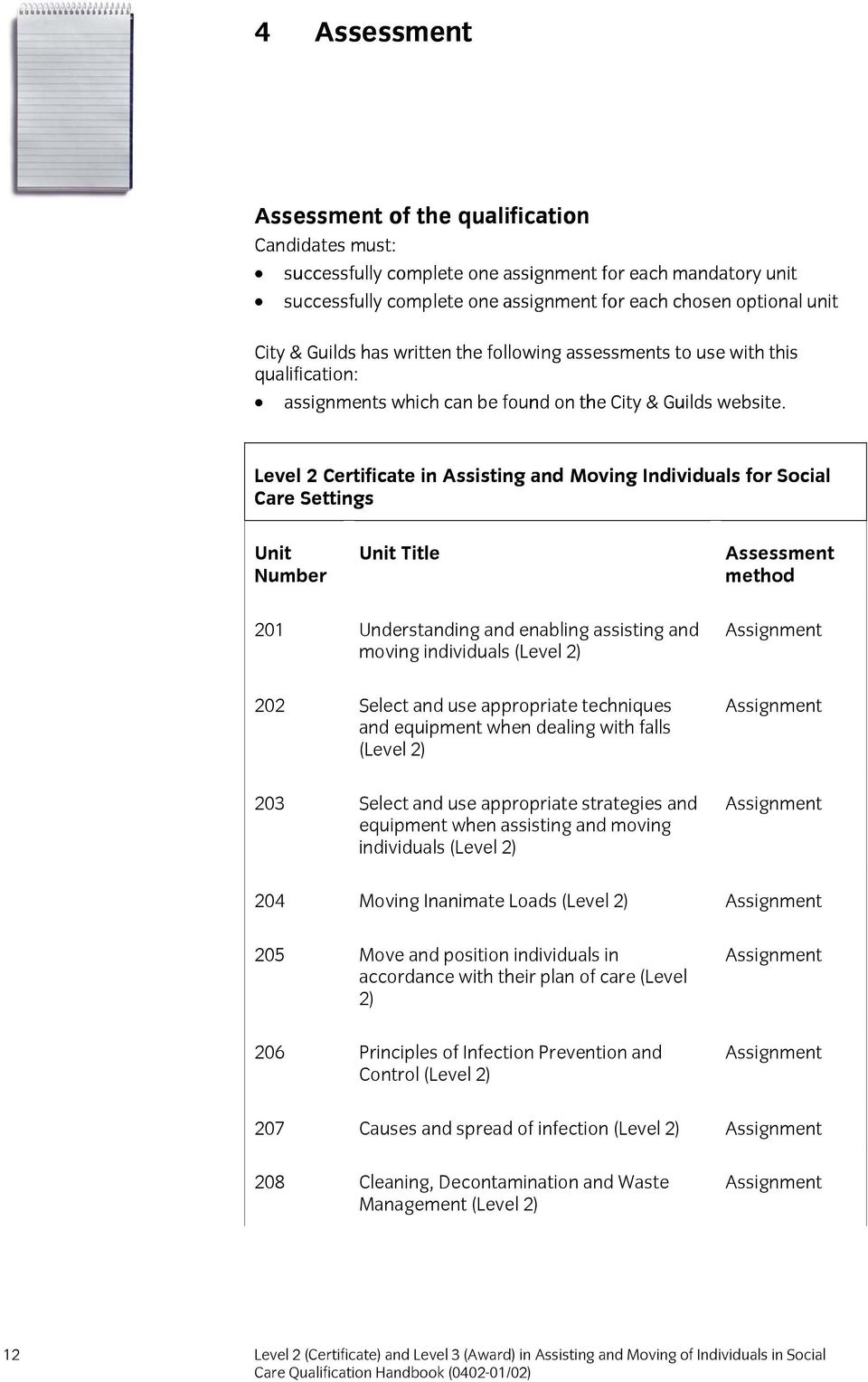
12 4 Assessment Assessment of the qualification Candidates must: successfully complete one assignment for each mandatory unit successfully complete one assignment for each chosen optional unit City & Guilds has written the following assessments to use with this qualification: assignments which can be found on the City & Guilds website. Level 2 Certificate in Assisting and Moving Individuals for Social Care Settings Unit Number Unit Title Assessment method 201 Understanding and enabling assisting and moving individuals (Level 2) 202 Select and use appropriate techniques and equipment when dealing with falls (Level 2) 203 Select and use appropriate strategies and equipment when assisting and moving individuals (Level 2) Assignment Assignment Assignment 204 Moving Inanimate Loads (Level 2) Assignment 205 Move and position individuals in accordance with their plan of care (Level 2) 206 Principles of Infection Prevention and Control (Level 2) Assignment Assignment 207 Causes and spread of infection (Level 2) Assignment 208 Cleaning, Decontamination and Waste Management (Level 2) Assignment 12 Level 2 (Certificate) and Level 3 (Award) in Assisting and Moving of Individuals in Social Care Qualification Handbook ( /02)
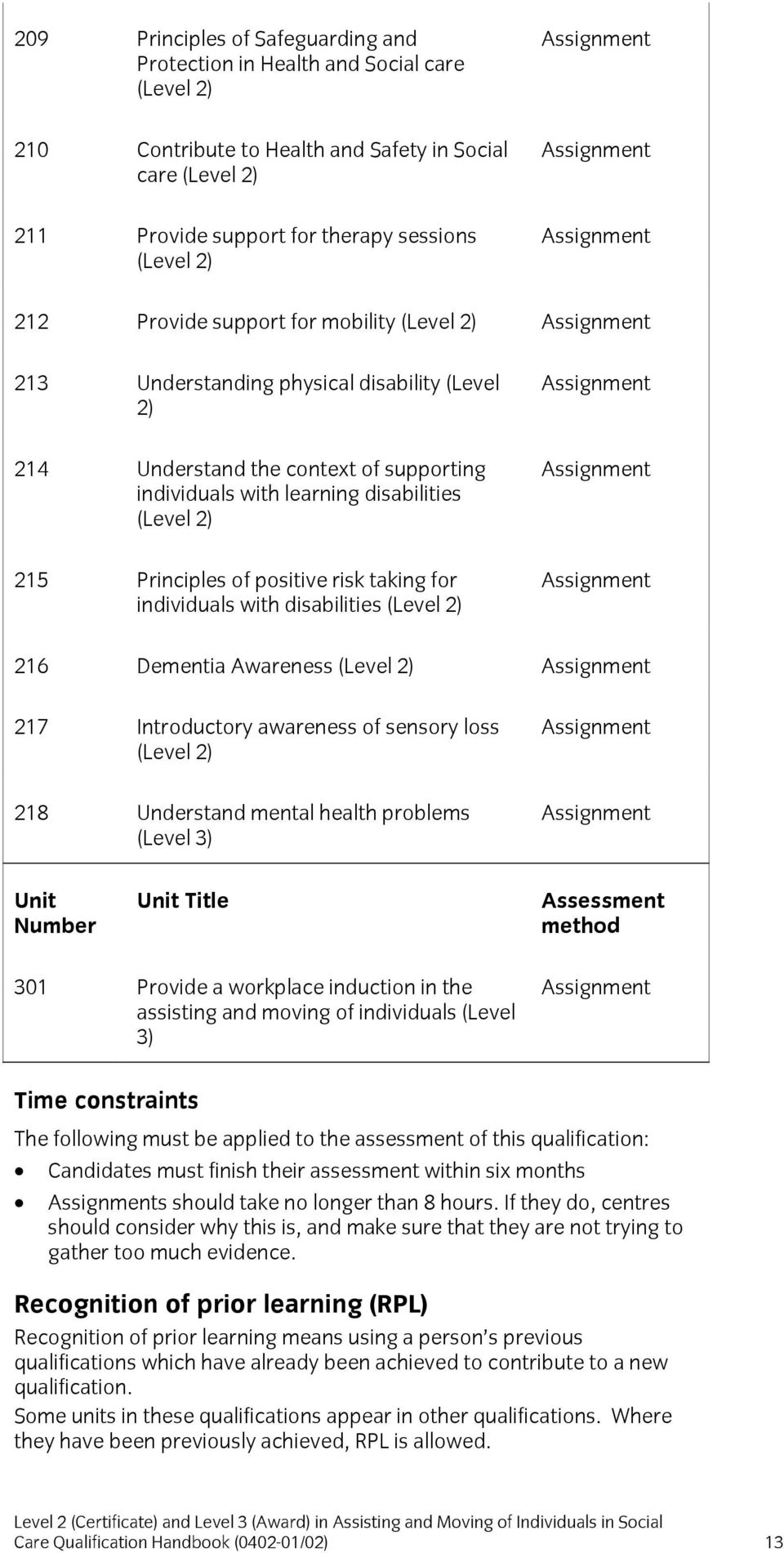
13 209 Principles of Safeguarding and Protection in Health and Social care (Level 2) 210 Contribute to Health and Safety in Social care (Level 2) 211 Provide support for therapy sessions (Level 2) Assignment Assignment Assignment 212 Provide support for mobility (Level 2) Assignment 213 Understanding physical disability (Level 2) 214 Understand the context of supporting individuals with learning disabilities (Level 2) 215 Principles of positive risk taking for individuals with disabilities (Level 2) Assignment Assignment Assignment 216 Dementia Awareness (Level 2) Assignment 217 Introductory awareness of sensory loss (Level 2) 218 Understand mental health problems (Level 3) Assignment Assignment Unit Number Unit Title Assessment method 301 Provide a workplace induction in the assisting and moving of individuals (Level 3) Assignment Time constraints The following must be applied to the assessment of this qualification: Candidates must finish their assessment within six months Assignments should take no longer than 8 hours. If they do, centres should consider why this is, and make sure that they are not trying to gather too much evidence. Recognition of prior learning (RPL) Recognition of prior learning means using a person s previous qualifications which have already been achieved to contribute to a new qualification. Some units in these qualifications appear in other qualifications. Where they have been previously achieved, RPL is allowed. Level 2 (Certificate) and Level 3 (Award) in Assisting and Moving of Individuals in Social Care Qualification Handbook ( /02) 13
14 5 Units Availability of units The following units can also be obtained from The Register of Regulated Qualifications: Structure of units These units each have the following: City & Guilds reference number unit accreditation number title level credit value unit aim relationship to NOS, other qualifications and frameworks endorsement by a sector or other appropriate body learning outcomes which are comprised of a number of assessment criteria 14 Level 2 (Certificate) and Level 3 (Award) in Assisting and Moving of Individuals in Social Care Qualification Handbook ( /02)

15 Unit 201 Understanding and enabling assisting and moving individuals UAN: K/502/7583 Level: Level 2 Credit value: 4 GLH: 28 Relationship to NOS: This unit is linked to MH203. Endorsement by a sector or regulatory body: Aim: This unit is endorsed by Skills for Care and Development, the Sector Skills Council for people providing social work, social care and children's services to the people of the UK. This unit covers the movement, assistance and positioning of individuals as part of their care and support plan. This unit promotes the risk reduction strategy as identified through the individual s risk assessment. The unit is aimed at learners who may work in diverse settings and who will be assisting and moving individuals who have a range of abilities. 1. understand the key concepts of manual handling in relation to assisting and moving individuals. 1.1 define the term manual handling. 1.2 describe the following terms in relation to moving and assisting individuals: (a) risk, (b) hazards, (c) risk assessment, (d) care plan, (e) ergonomic approach. 1.3 describe how current legislation relates to assisting and moving individuals. 1.4 identify agreed ways of working that relate to assisting and moving individuals. Level 2 (Certificate) and Level 3 (Award) in Assisting and Moving of Individuals in Social Care Qualification Handbook ( /02) 15

16 2. understand the impact of assisting and moving for workers and individuals. 2.1 describe the basic anatomy of the human body affected by assisting and moving. 2.2 describe a range of aids and equipment that is available for assisting and moving individuals. 2.3 describe the potential injuries to the worker which may arise by failing to follow approved assisting and moving techniques. 2.4 describe the potential injuries to the individual which may arise by failing to follow approved assisting and moving techniques. 2.5 describe the potential legal consequences of injuries to the individual 3. understand the role of workers and others in relation to assisting and moving. 3.1 describe responsibilities of worker's own role in relation to assisting and moving individuals. 3.2 identify limitations of worker's own role in relation to assisting and moving individuals. 3.3 describe the role of others in relation to assisting and moving. 3.4 describe when advice and/or assistance should be sought to assist or move an individual safely. 4. be able to prepare an environment before assisting and moving an individual. 4.1 describe why necessary preparatory checks are completed including: (a) the individual s care plan, (b) moving and handling risk assessment, (c) legal requirements for the safety 4.2 demonstrate that standard precautions for infection prevention and control are applied to: (a) the worker, (b) the individual, (c) equipment. 4.3 identify any immediate risks to the individual and how these should be assessed both formally (documented) and informally (on the spot). 4.4 describe the use of written risk assessment tools in relation to identified risks. 16 Level 2 (Certificate) and Level 3 (Award) in Assisting and Moving of Individuals in Social Care Qualification Handbook ( /02)

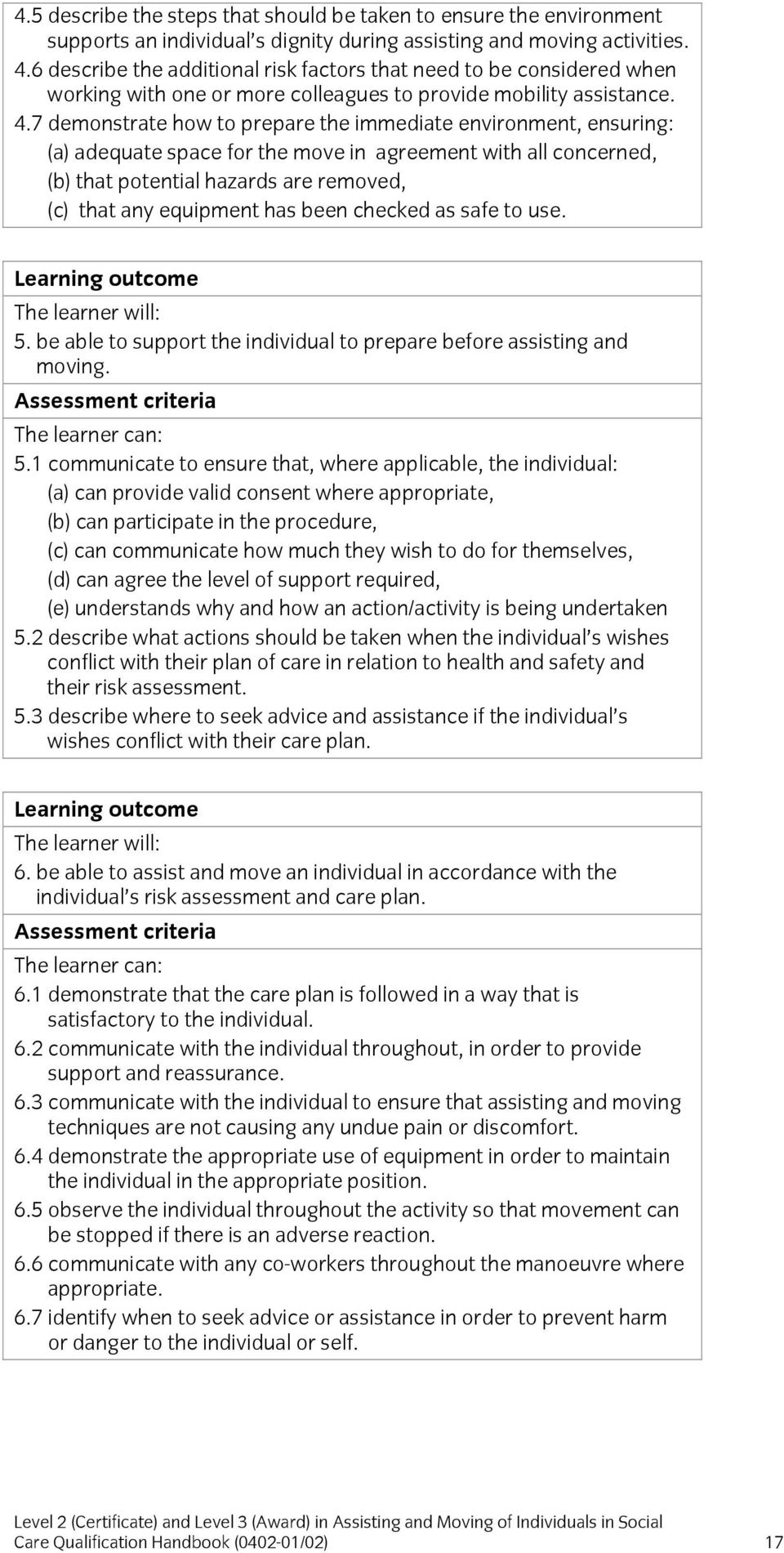
17 4.5 describe the steps that should be taken to ensure the environment supports an individual s dignity during assisting and moving activities. 4.6 describe the additional risk factors that need to be considered when working with one or more colleagues to provide mobility assistance. 4.7 demonstrate how to prepare the immediate environment, ensuring: (a) adequate space for the move in agreement with all concerned, (b) that potential hazards are removed, (c) that any equipment has been checked as safe to use. 5. be able to support the individual to prepare before assisting and moving. 5.1 communicate to ensure that, where applicable, the individual: (a) can provide valid consent where appropriate, (b) can participate in the procedure, (c) can communicate how much they wish to do for themselves, (d) can agree the level of support required, (e) understands why and how an action/activity is being undertaken 5.2 describe what actions should be taken when the individual s wishes conflict with their plan of care in relation to health and safety and their risk assessment. 5.3 describe where to seek advice and assistance if the individual s wishes conflict with their care plan. 6. be able to assist and move an individual in accordance with the individual s risk assessment and care plan. 6.1 demonstrate that the care plan is followed in a way that is satisfactory to the individual. 6.2 communicate with the individual throughout, in order to provide support and reassurance. 6.3 communicate with the individual to ensure that assisting and moving techniques are not causing any undue pain or discomfort. 6.4 demonstrate the appropriate use of equipment in order to maintain the individual in the appropriate position. 6.5 observe the individual throughout the activity so that movement can be stopped if there is an adverse reaction. 6.6 communicate with any co-workers throughout the manoeuvre where appropriate. 6.7 identify when to seek advice or assistance in order to prevent harm or danger to the individual or self. Level 2 (Certificate) and Level 3 (Award) in Assisting and Moving of Individuals in Social Care Qualification Handbook ( /02) 17
18 7. be able to report and record changes that may affect the individual s care and support plan for assisting and moving. 7.1 describe what changes may occur in relation to: (a) the individual, (b) environment, (c) equipment. and how this may impact on the care and support plan of an individual. 7.2 describe how changes should be reported and recorded. 18 Level 2 (Certificate) and Level 3 (Award) in Assisting and Moving of Individuals in Social Care Qualification Handbook ( /02)

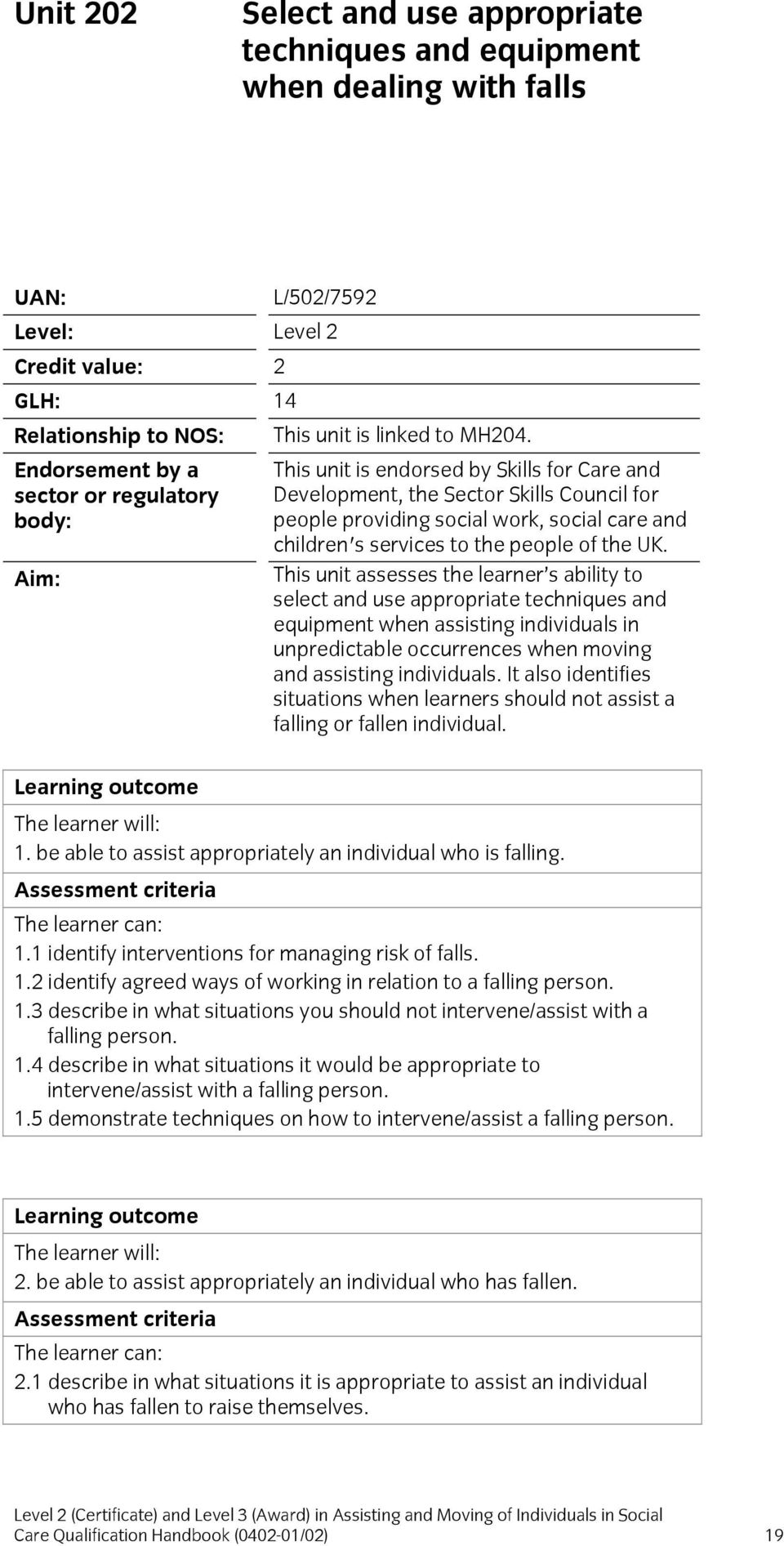
19 Unit 202 Select and use appropriate techniques and equipment when dealing with falls UAN: L/502/7592 Level: Level 2 Credit value: 2 GLH: 14 Relationship to NOS: This unit is linked to MH204. Endorsement by a sector or regulatory body: Aim: This unit is endorsed by Skills for Care and Development, the Sector Skills Council for people providing social work, social care and children's services to the people of the UK. This unit assesses the learner s ability to select and use appropriate techniques and equipment when assisting individuals in unpredictable occurrences when moving and assisting individuals. It also identifies situations when learners should not assist a falling or fallen individual. 1. be able to assist appropriately an individual who is falling. 1.1 identify interventions for managing risk of falls. 1.2 identify agreed ways of working in relation to a falling person. 1.3 describe in what situations you should not intervene/assist with a falling person. 1.4 describe in what situations it would be appropriate to intervene/assist with a falling person. 1.5 demonstrate techniques on how to intervene/assist a falling person. 2. be able to assist appropriately an individual who has fallen. 2.1 describe in what situations it is appropriate to assist an individual who has fallen to raise themselves. Level 2 (Certificate) and Level 3 (Award) in Assisting and Moving of Individuals in Social Care Qualification Handbook ( /02) 19
20 2.2 identify agreed ways of working in relation to the fallen person. 2.3 describe in what situations it is inappropriate to assist an individual who has fallen to raise themselves. 2.4 describe the techniques that can be used to support the individual to raise themselves. 2.5 identify the appropriate technique and equipment to raise an individual who has fallen and is unable to assist him/herself. 2.6 describe the steps that should be taken to ensure the environment supports an individual s dignity. 3. be able to maintain and update records which relate to assisting and moving falling/fallen individuals. 3.1 describe what information should be reported and recorded when an individual has fallen. 3.2 describe how changes may affect the moving and handling risk assessment of an individual. 20 Level 2 (Certificate) and Level 3 (Award) in Assisting and Moving of Individuals in Social Care Qualification Handbook ( /02)

21 Unit 203 Select and use appropriate strategies and equipment when assisting and moving individuals UAN: F/502/7587 Level: Level 2 Credit value: 3 GLH: 21 Relationship to NOS: This unit is linked to MH205. Endorsement by a sector or regulatory body: Aim: This unit is endorsed by Skills for Care and Development, the Sector Skills Council for people providing social work, social care and children's services to the people of the UK. This unit assesses the learner s ability to select and use appropriate techniques and equipment when moving and assisting individuals. The unit is aimed at learners who may work in diverse settings and who will be assisting and moving individuals who have a range of abilities. 1. be able to assist the individual to sit, stand and walk safely. 1.1 demonstrate a range of manoeuvres which may assist the individual to move. 1.2 demonstrate techniques which may assist an individual to move which rely on the assistance of one or more workers in the following: (a) moving the individual forward in a chair; (b) moving the individual back in a chair; (c) sitting to standing from a chair; (d) standing to sitting in a chair; (e) sitting to standing at edge of the bed; (f) standing to sitting at edge of the bed; (g) assisted walking. 2. be able to apply safe handling practices to assist individuals to move in and around their bed. Level 2 (Certificate) and Level 3 (Award) in Assisting and Moving of Individuals in Social Care Qualification Handbook ( /02) 21
22 2.1 demonstrate a range of manoeuvres which can assist the individual to move independently in and around their bed. 2.2 demonstrate strategies which assist an individual to move which rely on the assistance of one or more workers in the following: (a) turning in bed, (b) getting in and out of bed, (c) fitting and removing tubular and flat slide sheets, (d) sliding a supine individual up and down the bed, (e) sitting an individual up from lying in the bed, (f) sitting an individual up and on to the edge of a bed, (g) assisting an individual to lie down from sitting on the edge of a bed. 2.3 demonstrate the use of appropriate equipment for the above techniques. 2.4 demonstrate an ergonomic approach to providing personal care to an individual in bed 3. be able to apply safe handling practices to assist the transfer of individuals. 3.1 demonstrate a range of manoeuvres which can assist the individual to transfer. 3.2 demonstrate relevant techniques which assist an individual to transfer which rely on the assistance of one or more workers: (a) standing transfer from bed to chair or chair to bed, (b) seated transfer from bed to chair or chair to bed, (c) transfer from chair to chair or commode, (d) transfer to toilet with minimal assistance, (e) transfer to toilet using a hoist, (f) lateral supine transfer from bed, (g) transfer to and from bath and shower. 3.3 demonstrate the correct procedure for: (a) fitting a sling using glide sheets, (b) fitting a sling with an individual in a chair, (c) fitting a sling with an individual in a bed, (d) connecting a sling to the relevant hoist 3.4 describe the appropriate procedures for the following: (a) transferring an individual using a stand aid hoist, (b) transferring an individual using a sling lifting hoist, (c) hoisting an individual from the floor. 22 Level 2 (Certificate) and Level 3 (Award) in Assisting and Moving of Individuals in Social Care Qualification Handbook ( /02)
23 4. understand the importance of maintaining and updating records which relate to moving and assisting individuals. 4.1 describe what changes should be reported and recorded in relation to: (a) the individual, (b) the environment, (c) equipment. 4.2 describe how changes may affect the care and support plan of an individual. Level 2 (Certificate) and Level 3 (Award) in Assisting and Moving of Individuals in Social Care Qualification Handbook ( /02) 23
24 Unit 204 Moving Inanimate Loads UAN: A/502/7586 Level: Level 2 Credit value: 1 GLH: 10 Endorsement by a sector or regulatory body: Aim: This unit is endorsed by Skills for Care and Development, the Sector Skills Council for people providing social work, social care and children's services to the people of the UK. This unit is about the learners ability to move inanimate loads safely. 1. understand the key concepts of manual handling in relation to moving inanimate loads. 1.1 define the term manual handling. 1.2 describe the following terms in relation to moving inanimate loads: (a) risk, (b) hazard, (c) risk assessment, (d) ergonomic approach. 1.3 describe how current legislation relates to moving inanimate loads. 1.4 identify agreed ways of working that relate to moving inanimate loads. 1.5 identify when a moving and handling procedure should be stopped and help or guidance should be obtained. 1.6 list a range of moving and handling equipment and their uses. 2. understand the impact on workers and others of moving inanimate loads. 2.1 describe the basic anatomy of the human body, including the structure of the spine, affected by moving and handling. 2.2 identify worker s own ability in relation to assisting and moving. 2.3 describe the potential injuries which may arise by failing to follow approved moving techniques. 24 Level 2 (Certificate) and Level 3 (Award) in Assisting and Moving of Individuals in Social Care Qualification Handbook ( /02)
25 2.4 explain the importance of keeping up to date on current techniques, equipment and legislation with regard to moving inanimate loads. 2.5 describe when advice and/or assistance should be sought to move an inanimate load safely. 2.6 describe the additional risk factors when moving inanimate loads with one or more workers. 3. understand the requirements for preparing the environment prior to moving inanimate loads. 3.1 describe why preparatory checks are necessary in relation to moving inanimate loads. 3.2 describe how the environment can be a barrier to moving inanimate loads. 3.3 describe ways to overcome environmental barriers when moving inanimate loads. 4. be able to safely handle and store inanimate loads. 4.1 demonstrate safe practice in the following areas: (a) pushing and pulling, (b) supporting, (c) lifting and lowering at a variety of levels, (d) carrying a load, (e) safety checks of appropriate equipment. 4.2 demonstrate safe storage of inanimate loads. Level 2 (Certificate) and Level 3 (Award) in Assisting and Moving of Individuals in Social Care Qualification Handbook ( /02) 25
26 Unit 205 Move and position individuals in accordance with their plan of care UAN: J/601/8027 Level: Level 2 Credit value: 4 GLH: 26 Relationship to NOS: This unit is linked to CHS6. Endorsement by a sector or regulatory body: Aim: This unit is endorsed by Skills for Care and Development, the Sector Skills Council for people providing social work, social care and children's services to the people of the UK. This unit is aimed at those working in a wide range of settings. It provides the learner with the knowledge and skills required to move and position individuals as part of their plan of care to their specific needs. 1. understand anatomy and physiology in relation to moving and positioning individuals 1.1 outline the anatomy and physiology of the human body in relation to the importance of correct moving and positioning of individuals 1.2 describe the impact of specific conditions on the correct movement and positioning of an individual 2. understand legislation and agreed ways of working when moving and positioning individuals 2.1 describe how legislation and agreed ways of working affect working practices related to moving and positioning individuals 2.2 describe what health and safety factors need to be taken into account when moving and positioning individuals and any equipment used to do this 26 Level 2 (Certificate) and Level 3 (Award) in Assisting and Moving of Individuals in Social Care Qualification Handbook ( /02)
27 3. be able to minimise risk before moving and positioning individuals 3.1 access up-to-date copies of risk assessment documentation 3.2 carry out preparatory checks using: the individual s care plan the moving and handling risk assessment 3.3 identify any immediate risks to the individual 3.4 describe actions to take in relation to identified risks 3.5 describe what action should be taken if the individual s wishes conflict with their plan of care in relation to health and safety and their risk assessment 3.6 prepare the immediate environment ensuring adequate space for the move in agreement with all concerned that potential hazards are removed 3.7 apply standard precautions for infection prevention and control 4. be able to prepare individuals before moving and positioning 4.1 demonstrate effective communication with the individual to ensure that they understand the details and reasons for the action/activity being undertaken agree the level of support required 4.2 obtain valid consent for the planned activity 5. be able to move and position an individual 5.1 follow the care plan to ensure that the individual is positioned using the agreed technique in a way that will avoid causing 5.2 demonstrate effective communication with any others involved in the manoeuvre 5.3 describe the aids and equipment that may be used for moving and positioning 5.4 use equipment to maintain the individual in the appropriate position 5.5 encourage the individual s active participation in the manoeuvre 5.6 monitor the individual throughout the activity so that the procedure can be stopped if there is any adverse reaction Level 2 (Certificate) and Level 3 (Award) in Assisting and Moving of Individuals in Social Care Qualification Handbook ( /02) 27
28 5.7 demonstrate how to report and record the activity noting when the next positioning manoeuvre is due 6. know when to seek advice from and/or involve others when moving and positioning an individual 6.1 describe when advice and/or assistance should be sought to move or handle an individual safely 6.2 describe what sources of information are available about moving and positioning individuals 28 Level 2 (Certificate) and Level 3 (Award) in Assisting and Moving of Individuals in Social Care Qualification Handbook ( /02)
29 Unit 205 Move and position individuals in accordance with their plan of care Supporting information Guidance Agreed ways of working will include policies and procedures and guidelines where these exist Valid consent must be in line with agreed UK country definition Active participation is a way of working that recognises an individuals right to participate in the activities and relationships of everyday life as independently as possible; the individual is regarded as an active partner in their own care or support, rather that a passive recipient. Level 2 (Certificate) and Level 3 (Award) in Assisting and Moving of Individuals in Social Care Qualification Handbook ( /02) 29
30 Unit 206 Principles of Infection Prevention and Control UAN: L/501/6737 Level: Level 2 Credit value: 3 GLH: 20 Relationship to NOS: Endorsement by a sector or regulatory body: Aim: There are some relationships between this unit and those of other standards such as Key Skills, Functional Skills and Skills for Life. This unit is based upon Skills for Health Infection Control. This unit is endorsed by Skills for Care and Development, the Sector Skills Council for people providing social work, social care and children's services to the people of the UK. This unit is designed to introduce the learner to national and local policies in relation to infection control; to explain employer and employee responsibilities in this area; to understand how procedures and risk assessment can help minimise the risk of outbreak of infection. Learners will also gain an understanding of how to use PPE correctly and the importance of good personal hygiene. 1. understand roles and responsibilities in the prevention and control of infections 1.1 explain employees roles and responsibilities in relation to the prevention and control of infection 1.2 explain employers responsibilities in relation to the prevention and control of infection 2. understand legislation and policies relating to prevention and control of infections 30 Level 2 (Certificate) and Level 3 (Award) in Assisting and Moving of Individuals in Social Care Qualification Handbook ( /02)
31 2.1 outline current legislation and regulatory body standards which are relevant to the prevention and control of infection 2.2 describe local and organisational policies relevant to the prevention and control of infection 3. understand systems and procedures relating to the prevention and control of infections 3.1 describe procedures and systems relevant to the prevention and control of infection 3.2 explain the potential impact of an outbreak of infection on the individual and the organisation 4. understand the importance of risk assessment in relation to the prevention and control of infections 4.1 define the term risk 4.2 outline potential risks of infection within the workplace 4.3 describe the process of carrying out a risk assessment 4.4 explain the importance of carrying out a risk assessment 5. understand the importance of using Personal Protective Equipment (PPE) in the prevention and control of infections 5.1 demonstrate correct use of PPE 5.2 describe different types of PPE 5.3 explain the reasons for use of PPE 5.4 state current relevant regulations and legislation relating to PPE 5.5 describe employees responsibilities regarding the use of PPE 5.6 describe employers responsibilities regarding the use of PPE 5.7 describe the correct practice in the application and removal of PPE 5.8 describe the correct procedure for disposal of used PPE Level 2 (Certificate) and Level 3 (Award) in Assisting and Moving of Individuals in Social Care Qualification Handbook ( /02) 31
32 6. understand the importance of good personal hygiene in the prevention and control of infections 6.1 describe the key principles of good personal hygiene 6.2 demonstrate good hand washing technique 6.3 describe the correct sequence for hand washing 6.4 explain when and why hand washing should be carried out 6.5 describe the types of products that should be used for hand washing 6.6 describe correct procedures that relate to skincare 32 Level 2 (Certificate) and Level 3 (Award) in Assisting and Moving of Individuals in Social Care Qualification Handbook ( /02)
33 Unit 207 Causes and spread of infection UAN: H/501/7103 Level: Level 2 Credit value: 2 GLH: 20 Relationship to NOS: Endorsement by a sector or regulatory body: Aim: This unit is linked to Health and Social Care NVQ unit HCS22, Health NVQ unit GEN 3, Infection Control NOS and Core dimension 3: Health, safety and security Monitor and maintain health, safety and security of others. This unit is endorsed by Skills for Care and Development, the Sector Skills Council for people providing social work, social care and children's services to the people of the UK. This unit is to enable the learner to understand the causes of infection and common illnesses that may result as a consequence. To understand the difference between both infection and colonisation and pathogenic and non pathogenic organisms, the areas of infection and the types caused by different organisms. In addition the learner will understand the methods of transmission, the conditions needed for organisms to grow, the ways infection enter the body and key factors that may lead to infection occurring. 1. understand the causes of infection 1.1 identify the differences between bacteria, viruses, fungi and parasites 1.2 identify common illnesses and infections caused by bacteria, viruses, fungi and parasites 1.3 describe what is meant by infection and colonisation 1.4 explain what is meant by systemic infection and localised infection 1.5 identify poor practices that may lead to the spread of infection Level 2 (Certificate) and Level 3 (Award) in Assisting and Moving of Individuals in Social Care Qualification Handbook ( /02) 33
34 2. understand the transmission of infection 2.1 explain the conditions needed for the growth of micro-organisms 2.2 explain the ways an infective agent might enter the body 2.3 identify common sources of infection 2.4 explain how infective agents can be transmitted to a person 2.5 identify the key factors that will make it more likely that infection will occur 34 Level 2 (Certificate) and Level 3 (Award) in Assisting and Moving of Individuals in Social Care Qualification Handbook ( /02)
35 Unit 208 Cleaning, Decontamination and Waste Management UAN: R/501/6738 Level: Level 2 Credit value: 2 GLH: 20 Relationship to NOS: Endorsement by a sector or regulatory body: Aim: This unit is linked to Health and Social Care NOS HSC 246, 230, 0032 and Infection Prevention and Control NOS IPC1, 3, 4, 6, 7. This unit is endorsed by Skills for Care and Development, the Sector Skills Council for people providing social work, social care and children's services to the people of the UK. To explain to the learner the correct way of maintaining a clean environment in accordance with national policies; to understand the procedures to follow to decontaminate an are from infection; and to explain good practice when dealing with waste materials. This unit does not cover the decontamination of surgical instruments. 1. understand how to maintain a clean environment to prevent the spread of infection 1.1 state the general principles for environmental cleaning 1.2 explain the purpose of cleaning schedules 1.3 describe how the correct management of the environment minimises the spread of infection 1.4 explain the reason for the national policy for colour coding of cleaning equipment 2. understand the principles and steps of the decontamination process 2.1 describe the three steps of the decontamination process 2.2 describe how and when cleaning agents are used Level 2 (Certificate) and Level 3 (Award) in Assisting and Moving of Individuals in Social Care Qualification Handbook ( /02) 35
36 2.3 describe how and when disinfecting agents are used 2.4 explain the role of personal protective equipment (PPE) during the decontamination process 2.5 explain the concept of risk in dealing with specific types of contamination 2.6 explain how the level of risk determines the type of agent that may be used to decontaminate 2.7 describe how equipment should be cleaned and stored 3. understand the importance of good waste management practice in the prevention of the spread of infection 3.1 identify the different categories of waste and the associated risks 3.2 explain how to dispose of the different types of waste safely and without risk to others 3.3 explain how waste should be stored prior to collection 3.4 identify the legal responsibilities in relation to waste management 3.5 state how to reduce the risk of sharps injury 36 Level 2 (Certificate) and Level 3 (Award) in Assisting and Moving of Individuals in Social Care Qualification Handbook ( /02)
37 Unit 209 Principles of Safeguarding and Protection in Health and Social care UAN: A/601/8574 Level: Level 2 Credit value: 3 GLH: 26 Relationship to NOS: This unit is linked to HSC 24, HSC 240. Content recurs throughout HSC NOS knowledge requirements. Endorsement by a sector or regulatory body: Aim: This unit is endorsed by Skills for Care and Development, the Sector Skills Council for people providing social work, social care and children's services to the people of the UK. This unit is aimed at those working in a wide range of settings. This unit introduces the important area of safeguarding individuals from abuse. It identifies different types of abuse and the signs and symptoms that might indicate abuse is occurring. It considers when individuals might be particularly vulnerable to abuse and what a learner must do if a abuse is suspected or alleged. 1. know how to recognise signs of abuse. 1.1 define the following types of abuse: Physical abuse Sexual abuse Emotional/psychological abuse Financial abuse Institutional abuse Self neglect Neglect by others 1.2 identify the signs and/or symptoms associated with each type of abuse. 1.3 describe factors that may contribute to an individual being more vulnerable to abuse. Level 2 (Certificate) and Level 3 (Award) in Assisting and Moving of Individuals in Social Care Qualification Handbook ( /02) 37
38 2. know how to respond to suspected or alleged abuse. 2.1 explain the actions to take if there are suspicions that an individual is being abused. 2.2 explain the actions to take if an individual alleges that they are being abused 2.3 identify ways to ensure that evidence of abuse is preserved. 3. understand the national and local context of safeguarding and protection from abuse. 3.1 identify national policies and local systems that relate to safeguarding and protection from abuse. 3.2 explain the roles of different agencies in safeguarding and protecting individuals from abuse. 3.3 identify reports into serious failures to protect individuals from abuse. 3.4 identify sources of information and advice about own role in safeguarding and protecting individuals from abuse. 4. understand ways to reduce the likelihood of abuse. 4.1 explain how the likelihood of abuse may be reduced by: working with person centred values encouraging active participation promoting choice and rights 4.2 explain the importance of an accessible complaints procedure for reducing the likelihood of abuse. 5. know how to recognise and report unsafe practices. 5.1 describe unsafe practices that may affect the well-being of individuals 5.2 explain the actions to take if unsafe practices have been identified. 5.3 describe the action to take if suspected abuse or unsafe practices have been reported but nothing has been done in response. 38 Level 2 (Certificate) and Level 3 (Award) in Assisting and Moving of Individuals in Social Care Qualification Handbook ( /02)
39 Unit 209 Principles of Safeguarding and Protection in Health and Social care Supporting information Guidance An individual will usually mean the person supported by the learner but may include those for whom there is no formal duty of care. Factors may include: o a setting or situation o the individual. The actions to take constitute the learners responsibilities in responding to allegations of suspicions of abuse. They include actions to take if the allegation or suspicion implicates: o a colleague o someone in the individuals personal network o the learner o the learners line manager o others A setting where there is no formal duty of care includes adult health or social care settings. Local systems may include: o employer/organisational policies and procedures o multi-agency adult protection arrangements for a locality Person centred values include: o individuality o rights o choice o privacy o independence o dignity o respect o partnership. Active participation is a way of working that recognises an individuals right to participate in the activities and relationships of everyday life as independently as possible: the individual is regarded as an active partner in their own care or support, rather than a passive recipient. Unsafe practices may include: o poor working practices o resource difficulties o operational difficulties Level 2 (Certificate) and Level 3 (Award) in Assisting and Moving of Individuals in Social Care Qualification Handbook ( /02) 39
40 Unit 210 Contribute to Health and Safety in Social care UAN: R/601/8922 Level: Level 2 Credit value: 4 GLH: 33 Relationship to NOS: Endorsement by a sector or regulatory body: Aim: This unit is linked to HSC 22, HSC 221, HSC 223. This unit is endorsed by Skills for Care and Development, the Sector Skills Council for people providing social work, social care and children's services to the people of the UK. This unit is aimed at those working in a wide range of settings. It provides the learner with the knowledge and skills required to carry out their work safely. 1. understand own responsibilities, and the responsibilities of others, relating to health and safety in the work setting 1.1 identify legislation relating to general health and safety in a health or social care work setting 1.2 describe the main points of the health and safety policies and procedures agreed with the employer 1.3 outline the main health and safety responsibilities of: self the employer or manager others in the work setting 1.4 identify tasks relating to health and safety that should not be carried out without special training 1.5 explain how to access additional support and information relating to health and safety 2. understand the use of risk assessments in relation to health and safety 40 Level 2 (Certificate) and Level 3 (Award) in Assisting and Moving of Individuals in Social Care Qualification Handbook ( /02)
41 2.1 explain why it is important to assess health and safety hazards posed by the work setting or by particular activities 2.2 explain how and when to report potential health and safety risks that have been identified 2.3 explain how risk assessment can help address dilemmas between rights and health and safety concerns 3. understand procedures for responding to accidents and sudden illness 3.1 describe different types of accidents and sudden illness that may occur in own work setting 3.2 outline the procedures to be followed if an accident or sudden illness should occur 4. be able to reduce the spread of infection 4.1 demonstrate the recommended method for hand washing 4.2 demonstrate ways to ensure that own health and hygiene do not pose a risk to others at work 5. be able to move and handle equipment and other objects safely 5.1 identify legislation that relates to moving and handling 5.2 explain principles for moving and handling equipment and other objects safely 5.3 move and handle equipment or other objects safely 6. know how to handle hazardous substances and materials 6.1 identify hazardous substances and materials that may be found in the work setting Level 2 (Certificate) and Level 3 (Award) in Assisting and Moving of Individuals in Social Care Qualification Handbook ( /02) 41
42 6.2 describe safe practices for: storing hazardous substances using hazardous substances disposing of hazardous substances and materials 7. understand how to promote fire safety in the work setting 7.1 describe practices that prevent fires from: starting spreading 7.2 outline emergency procedures to be followed in the event of a fire in the work setting 7.3 explain the importance of maintaining clear evacuation routes at all times 8. be able to implement security measures in the work setting 8.1 use agreed ways of working for checking the identity of anyone requesting access to: premises information 8.2 implement measures to protect own security and the security of others in the work setting 8.3 explain the importance of ensuring that others are aware of own whereabouts 9. know how to manage own stress 9.1 identify common signs and indicators of stress 9.2 identify circumstances that tend to trigger own stress 9.3 describe ways to manage own stress 42 Level 2 (Certificate) and Level 3 (Award) in Assisting and Moving of Individuals in Social Care Qualification Handbook ( /02)
43 Unit 210 Contribute to Health and Safety in Social care Supporting information Guidance Others may include: o Team members o Other colleagues o Those who use or commission their own health or social care services o Families, carers and advocates Work setting may include one specific location or a range of locations, depending on the context of a particular work role Policies and procedures may include other agreed ways of working as well as formal policies and procedures Tasks that the learner should not carry out without special training may include those relating to: o Use of equipment o First aid o Medication health care procedures o Food handling and preparation Stress can have positive as well as negative effects, but in this unit the word is used to refer to negative stress. Level 2 (Certificate) and Level 3 (Award) in Assisting and Moving of Individuals in Social Care Qualification Handbook ( /02) 43
44 Unit 211 Provide support for therapy sessions UAN: D/601/9023 Level: Level 2 Credit value: 2 GLH: 14 Relationship to NOS: This unit is linked to HSC 212. Endorsement by a sector or regulatory body: Aim: This unit is endorsed by Skills for Care and Development, the Sector Skills Council for people providing social work, social care and children's services to the people of the UK. This unit is aimed at those working in a wide range of settings. The unit provides the learner with the knowledge and skills needed to support individuals participating in therapy sessions. It covers preparation, support, observation, recording and review of therapy sessions. 1. understand the benefits of therapy sessions 1.1 identify different types of therapy sessions in which an individual may participate 1.2 describe how therapy sessions can benefit an individual 2. be able to prepare for therapy sessions 2.1 establish own responsibilities in preparing for a therapy session 2.2 identify with the individual their preferences and requirements for the therapy session 2.3 follow instructions to prepare the environment, materials, equipment and self for the session 44 Level 2 (Certificate) and Level 3 (Award) in Assisting and Moving of Individuals in Social Care Qualification Handbook ( /02)
45 3. be able to provide support in therapy sessions 3.1 provide support during a therapy session that takes account of: the therapist s directions the individual s preferences and requirements 3.2 promote the active participation of the individual during the session 3.3 describe ways to overcome fears or concerns an individual may have about a therapy session 4. be able to observe and record therapy sessions 4.1 agree what observations need to be carried out during therapy sessions 4.2 agree how observations will be recorded 4.3 carry out agreed observations 4.4 record agreed observations as required 5. be able to contribute to the review of therapy sessions 5.1 contribute to a review of therapy sessions to identify issues and progress 5.2 contribute to agreeing changes to therapy sessions with the individual and others Level 2 (Certificate) and Level 3 (Award) in Assisting and Moving of Individuals in Social Care Qualification Handbook ( /02) 45
46 Unit 211 Provide support for therapy sessions Supporting information Guidance Therapy sessions may include: o Occupational therapy o Physiotherapy o Hydrotherapy o Aromatherapy An individual is someone requiring care or support Others may include: o Therapist o Line manager o Family o Friends o Advocates o Others who are important to the individual s well being Active participation is a way of working that recognises an individual s right to participate in the activities and relationships of everyday life as independently as possible; the individual is regarded as an active partner in their own care or support, rather than a passive recipient. 46 Level 2 (Certificate) and Level 3 (Award) in Assisting and Moving of Individuals in Social Care Qualification Handbook ( /02)
47 Unit 212 Provide support for mobility UAN: H/601/9024 Level: Level 2 Credit value: 2 GLH: 14 Relationship to NOS: This unit is linked to HSC 215. Endorsement by a sector or regulatory body: Aim: This unit is endorsed by Skills for Care and Development, the Sector Skills Council for people providing social work, social care and children's services to the people of the UK. This unit is aimed at those who work in a wide range of settings. The unit provides the learner with the knowledge and skills needed to support mobility activities. It covers preparation, support and observations of mobility activities. 1. understand the importance of mobility 1.1 define mobility 1.2 explain how different health conditions may affect and be affected by mobility 1.3 outline the effects that reduced mobility may have on an individual s well-being 1.4 describe the benefits of maintaining and improving mobility 2. be able to prepare for mobility activities 2.1 agree mobility activities with the individual and others 2.2 remove or minimise hazards in the environment before a mobility activity 2.3 check the suitability of an individual s clothing and footwear for safety and mobility 2.4 check the safety and cleanliness of mobility equipment and appliances Level 2 (Certificate) and Level 3 (Award) in Assisting and Moving of Individuals in Social Care Qualification Handbook ( /02) 47
48 3. be able to support individuals to keep mobile 3.1 promote the active participation of the individual during a mobility activity 3.2 assist an individual to use mobility appliances correctly and safely 3.3 give feedback and encouragement to the individual during mobility activities 4. be able to observe, record and report on activities to support mobility 4.1 observe an individual to monitor changes and responses during a mobility activity 4.2 record observations of mobility activity 4.3 report on progress and/or problems relating to the mobility activity including: choice of activities equipment appliances the support provided 48 Level 2 (Certificate) and Level 3 (Award) in Assisting and Moving of Individuals in Social Care Qualification Handbook ( /02)
49 Unit 212 Provide support for mobility Supporting information Guidance Mobility activities may include: o exercises o physiotherapy o occupational therapy o household activities An individual is someone requiring care or support Others may include: o mobility specialists o line manager o family o friends o advocates o others who are important to the individual s well being Mobility equipment and appliances may include: o wheel chairs o sticks o walking frames o custom-made appliances Active participation is a way of working that recognises an individual s right to participate in the activities and relationships of everyday life as independently as possible; the individual is regarded as an active partner in their own care or support, rather than a passive recipient. Level 2 (Certificate) and Level 3 (Award) in Assisting and Moving of Individuals in Social Care Qualification Handbook ( /02) 49
50 Unit 213 Understanding physical disability UAN: L/601/6117 Level: Level 2 Credit value: 2 GLH: 19 Endorsement by a sector or regulatory body: Aim: This unit is endorsed by Skills for Care and Development, the Sector Skills Council for people providing social work, social care and children's services to the people of the UK. This unit is aimed at those who provide a service for people with physical disabilities. It covers an understanding of physical disability, the impact of a physical disability on a person s life, the environment in which the service is provided and person centred working. 1. understand the importance of differentiating between the individual and the disability 1.1 explain why it is important to recognise and value an individual as a person 1.2 describe the importance of recognising an individual s strengths and abilities 1.3 describe how to work in a person centred way that fully involves the individual 2. understand the concept of physical disability 2.1 describe what is meant by physical disability 2.2 describe what a congenital disability is 2.3 give examples of congenital disabilities and their causes 2.4 describe what a progressive disability is 2.5 give examples of progressive disabilities and their causes 50 Level 2 (Certificate) and Level 3 (Award) in Assisting and Moving of Individuals in Social Care Qualification Handbook ( /02)
51 3. understand how the challenges of living with a physical disability can be addressed 3.1 identify social and physical barriers that can have a disabling effect on an individual 3.2 identify positive and negative attitudes towards individuals with a disability 3.3 describe steps that can be taken to challenge and change discriminatory attitudes 3.4 describe the impact of disability legislation on community attitudes and practices 3.5 describe the effects that having a physical disability can have on a person s day to day life 3.6 identify the importance for the individual of positive risk-taking 4. understand the importance of independence and inclusion for the individual with physical disability 4.1 describe how the individual can be in control of their care needs and provision of social care services 4.2 describe the importance of supporting independence and inclusion within the community 4.3 describe how to assist with independence and inclusion within the community Level 2 (Certificate) and Level 3 (Award) in Assisting and Moving of Individuals in Social Care Qualification Handbook ( /02) 51
52 Unit 213 Understanding physical disability Supporting information Guidance The individual is the person requiring care or support Day to day life o education opportunities o housing o employment o access to leisure activities o relationships o health care 52 Level 2 (Certificate) and Level 3 (Award) in Assisting and Moving of Individuals in Social Care Qualification Handbook ( /02)
53 Unit 214 Understand the context of supporting individuals with learning disabilities UAN: K/601/5315 Level: Level 2 Credit value: 4 GLH: 35 Endorsement by a sector or regulatory body: Aim: This unit is endorsed by Skills for Care and Development, the Sector Skills Council for people providing social work, social care and children's services to the people of the UK. This unit explores the meaning of learning disability and considers issues closely linked with learning disability support. These include an awareness of how the attitudes and beliefs of others affect individuals who have learning disabilities. The unit introduces themes of inclusion, human rights, advocacy, empowerment and active participation and also considers the central place of communication in working with individuals who have learning disabilities. 1. understand the legislation and policies that support the human rights and inclusion of individuals with learning disabilities 1.1 identify legislation and policies that are designed to promote the human rights, inclusion, equal life chances and citizenship of individuals with learning disabilities 1.2 explain how this legislation and policies influence the day to day experiences of individuals with learning disabilities and their families 2. understand the nature and characteristics of learning disability 2.1 explain what is meant by learning disability 2.2 give examples of causes of learning disabilities Level 2 (Certificate) and Level 3 (Award) in Assisting and Moving of Individuals in Social Care Qualification Handbook ( /02) 53
54 2.3 describe the medical and social models of disability 2.4 state the approximate proportion of individuals with a learning disability for whom the cause is not known 2.5 describe the possible impact on a family of having a member with a learning disability 3. understand the historical context of learning disability 3.1 explain the types of services that have been provided for individuals with learning disabilities over time 3.2 describe how past ways of working may affect present services 3.3 identify some of the key changes in the following areas of the lives of individuals who have learning disabilities: a) where people live b) daytime activities c) employment d) sexual relationships and parenthood e) the provision of healthcare 4. understand the basic principles and practice of advocacy, empowerment and active participation in relation to supporting individuals with learning disabilities and their families 4.1 explain the meaning of the term social inclusion 4.2 explain the meaning of the term advocacy 4.3 describe different types of advocacy 4.4 describe ways to build empowerment and active participation into everyday support with individuals with learning disabilities 5. understand how views and attitudes impact on the lives of individuals with learning disabilities and their family carers 5.1 explain how attitudes are changing in relation to individuals with learning disabilities 5.2 give examples of positive and negative aspects of being labelled as having a learning disability 5.3 describe steps that can be taken to promote positive attitudes towards individuals with learning disabilities and their family carers 54 Level 2 (Certificate) and Level 3 (Award) in Assisting and Moving of Individuals in Social Care Qualification Handbook ( /02)
55 5.4 explain the roles of external agencies and others in changing attitudes, policy and practice 6. know how to promote communication with individuals with learning disabilities 6.1 identify ways of adapting each of the following when communicating with individuals who have learning disabilities a) verbal communication b) non-verbal communication 6.2 explain why it is important to use language that is both age appropriate and ability appropriate when communicating with individuals with learning disabilities 6.3 describe ways of checking whether an individual has understood a communication, and how to address any misunderstandings Level 2 (Certificate) and Level 3 (Award) in Assisting and Moving of Individuals in Social Care Qualification Handbook ( /02) 55
56 Unit 214 Understand the context of supporting individuals with learning disabilities Supporting information Guidance An individual is someone requiring care or support Causes should include: before birth, during birth and after birth Ways to build empowerment should include person-centred thinking Active participation is a way of working that recognises an individual s right to participate in the activities and relationships of everyday life as independently as possible; the individual is regarded as an active partner in their own care or support, rather than a passive recipient. External agencies include: advocacy services; parent/carer support groups; campaign groups etc Others may include: o mobility specialists o line manager o family o friends o advocates o others who are important to the individual s well being 56 Level 2 (Certificate) and Level 3 (Award) in Assisting and Moving of Individuals in Social Care Qualification Handbook ( /02)
57 Unit 215 Principles of positive risk taking for individuals with disabilities UAN: K/601/6285 Level: Level 2 Credit value: 2 GLH: 20 Relationship to NOS: This unit is linked to HSC 240. Endorsement by a sector or regulatory body: Aim: This unit is endorsed by Skills for Care and Development, the Sector Skills Council for people providing social work, social care and children's services to the people of the UK. This unit provides the knowledge behind positive risk-taking. It highlights the importance of positive risk taking for individuals with disabilities. It explores how to take a person-centred approach to enabling individuals to take risks and how to balance risk-taking with duty of care. The legislative context is also covered. 1. know the importance of risk taking in everyday life for individuals with disabilities 1.1 identify aspects of everyday life in which risk plays a part 1.2 identify aspects of everyday life in which, traditionally, individuals with disabilities were not encouraged to take risks 1.3 outline the consequences for individuals with disabilities of being prevented or discouraged from taking risks 1.4 explain how supporting individuals to take risks can enable them to have choice over their lives to: gain in self-confidence develop skills take an active part in their community 2. understand the importance of positive, person-centred risk assessment Level 2 (Certificate) and Level 3 (Award) in Assisting and Moving of Individuals in Social Care Qualification Handbook ( /02) 57
58 2.1 explain how a person-centred approach to risk assessment can have a more positive outcome than traditional approaches 2.2 identify the features of a person-centred approach to risk assessment 2.3 describe ways in which traditional risk assessments have tended to have a negative focus 3. know how legislation and policies are relevant to positive risk taking 3.1 identify legislation and policies which promote the human rights of individuals with disabilities 3.2 describe how to use a human rights based approach to risk management 4. understand how to support individuals with disabilities in decisions about risk-taking 4.1 explain the connection between an individual s right to take risks and their responsibilities towards themselves and others 4.2 outline how the principle of Duty of Care can be maintained whilst supporting individuals to take risks 4.3 describe ways of enabling individuals with disabilities to make informed choices about taking risks 4.4 outline the particular challenges that may arise when supporting individuals to make decisions if they have had limited previous experience of making their own decisions 4.5 explain the potential positive and negative consequences of the choices made about taking risks 4.6 describe what action to take if an individual decides to take an unplanned risk that places him/herself or others in immediate or imminent danger 4.7 explain why it is important to record and report all incidents, discussions and decisions concerning risk taking 5. understand how to support individuals with disabilities to manage identified risks 5.1 explain the importance of including risks in the individual s support plan 58 Level 2 (Certificate) and Level 3 (Award) in Assisting and Moving of Individuals in Social Care Qualification Handbook ( /02)
59 5.2 explain why it is important to review risks in the individual s support plan 5.3 outline why it is important to communicate and work in a consistent way with all those supporting the individual 5.4 describe ways of supporting individuals with disabilities to test out the risk they wish to take Level 2 (Certificate) and Level 3 (Award) in Assisting and Moving of Individuals in Social Care Qualification Handbook ( /02) 59
60 Unit 215 Principles of positive risk taking for individuals with disabilities Supporting information Guidance An individual is someone requiring care or support Person-centred reflects what is important to individuals and helps them to live the life they choose Others may include: o The individual o colleagues o members of the public o families or carers o friends o advocates o other professionals Duty of care legal duty to take responsible care to avoid others being harmed 60 Level 2 (Certificate) and Level 3 (Award) in Assisting and Moving of Individuals in Social Care Qualification Handbook ( /02)
61 Unit 216 Dementia Awareness UAN: J/601/2874 Level: Level 2 Credit value: 2 GLH: 17 Relationship to NOS: This unit is linked to DEM 201. Endorsement by a sector or regulatory body: Aim: This unit is endorsed by Skills for Care and Development, the Sector Skills Council for people providing social work, social care and children's services to the people of the UK. The aim of the unit is to enable learners to gain knowledge of what dementia is, the different forms of dementia and how others can have an impact on the individual with dementia. 1. understand what dementia is 1.1 explain what is meant by the term dementia 1.2 describe the key functions of the brain that are affected by dementia 1.3 explain why depression, delirium and age related memory impairment may be mistaken for dementia 2. understand key features of the theoretical models of dementia 2.1 outline the medical model of dementia 2.2 outline the social model of dementia 2.3 explain why dementia should be viewed as a disability 3. know the most common types of dementia and their causes Level 2 (Certificate) and Level 3 (Award) in Assisting and Moving of Individuals in Social Care Qualification Handbook ( /02) 61
62 3.1 list the most common causes of dementia 3.2 describe the likely signs and symptoms of the most common causes of dementia 3.3 outline the risk factors for the most common causes of dementia 3.4 identify prevalence rates for different types of dementia 4. understand factors relating to an individual s experience of dementia 4.1 describe how different individuals may experience living with dementia depending on age, type of dementia, and level of ability and disability 4.2 outline the impact that the attitudes and behaviours of others may have on an individual with dementia 62 Level 2 (Certificate) and Level 3 (Award) in Assisting and Moving of Individuals in Social Care Qualification Handbook ( /02)
63 Unit 216 Dementia Awareness Supporting information Guidance Others may include: o care workers o colleagues o advocates o managers o social worker o occupational therapist o GP o speech & Language Therapist o physiotherapist o pharmacist o nurse o psychologist o admiral nurses o Independent Mental Capacity Advocate o Community Psychiatrist Nurse o Dementia Care Advisors o support groups Level 2 (Certificate) and Level 3 (Award) in Assisting and Moving of Individuals in Social Care Qualification Handbook ( /02) 63
64 Unit 217 Introductory awareness of sensory loss UAN: F/601/3442 Level: Level 2 Credit value: 2 GLH: 16 Relationship to NOS: This unit is linked to the Sensory Services 1, 2, 3, 4, 5, 6, 7, 8, 9, 11. Endorsement by a sector or regulatory body: Aim: This unit is endorsed by Skills for Care and Development, the Sector Skills Council for people providing social work, social care and children's services to the people of the UK. The purpose of this unit is to provide the learner with introductory knowledge about sensory loss. 1. understand the factors that impact on an individual with sensory loss and steps that can be taken to overcome these 1.1 describe how a range of factors have a negative and positive impact on individuals with sensory loss 1.2 identify steps that can be taken to overcome factors that have a negative impact on individuals with sensory loss 1.3 explain how individuals with sensory loss can be disabled by attitudes and beliefs 1.4 identify steps that could be taken to overcome disabling attitudes and beliefs 2. understand the importance of effective communication for individuals with sensory loss 2.1 outline what needs to be considered when communicating with individuals with: sight loss hearing loss deafblindness 64 Level 2 (Certificate) and Level 3 (Award) in Assisting and Moving of Individuals in Social Care Qualification Handbook ( /02)
65 2.2 describe how effective communication may have a positive impact on the lives of individuals with sensory loss 2.3 explain how information can be made accessible to individuals with sensory loss 3. know the main causes and conditions of sensory loss 3.1 outline the main causes of sensory loss 3.2 explain the difference between congenital and acquired sensory loss 3.3 state what percentage of the general population is likely to have sensory loss 4. know how to recognise when an individual may be experiencing sight and / or hearing loss 4.1 outline the indicators and signs of: sight loss deafblindness hearing loss 4.2 explain where additional advice and support can be sourced in relation to sensory loss 5. know how to report concerns about sensory loss 5.1 describe to whom and how concerns about sight and / or hearing loss can be reported Level 2 (Certificate) and Level 3 (Award) in Assisting and Moving of Individuals in Social Care Qualification Handbook ( /02) 65
66 Unit 217 Introductory awareness of sensory loss Supporting information Guidance Sensory Loss could include: o Sight loss o Hearing loss o Deafblindness Factors could include: o Communication Information Familiar layouts and routines mobility 66 Level 2 (Certificate) and Level 3 (Award) in Assisting and Moving of Individuals in Social Care Qualification Handbook ( /02)
67 Unit 218 Understand mental health problems UAN: J/602/0103 Level: Level 3 Credit value: 3 GLH: 14 Relationship to NOS: Endorsement by a sector or regulatory body: Aim: This unit is linked to HSC 3111 and MH14. This unit is endorsed by Skills for Care and Development, the Sector Skills Council for people providing social work, social care and children's services to the people of the UK. This unit aims to provide the learner with knowledge of the main forms of mental health problems according to the psychiatric classification system. Learners also consider the strengths and limitations of this model and look at alternative frameworks for understanding mental distress. The focus of the unit is on understanding the different ways in which mental health problems impact on the individual and others in their social network. It also considers the benefits of early intervention in promoting mental health and well-being. 1. know the main forms of mental ill health 1.1 describe the main types of mental ill health according to the psychiatric (DSM/ICD) classification system: mood disorders, personality disorders, anxiety disorders, psychotic disorders, substance-related disorders, eating disorders, cognitive disorders. 1.2 explain the key strengths and limitations of the psychiatric classification system. 1.3 explain two alternative frameworks for understanding mental distress. 1.4 explain how mental ill health may be indicated through an individual s emotions, thinking and behaviour. Level 2 (Certificate) and Level 3 (Award) in Assisting and Moving of Individuals in Social Care Qualification Handbook ( /02) 67
68 2. know the impact of mental ill health on individuals and others in their social network 2.1 explain how individuals experience discrimination due to misinformation, assumptions and stereotypes about mental ill health. 2.2 explain how mental ill health may have an impact on the individual including: a. psychological and emotional b. practical and financial c. the impact of using services d. social exclusion e. positive impacts 2.3 explain how mental ill health may have an impact on those in the individual s familial, social or work network including: a. psychological and emotional b. practical and financial c. the impact of using services d. social exclusion e. positive impacts 2.4 explain the benefits of early intervention in promoting an individual s mental health and well-being. 68 Level 2 (Certificate) and Level 3 (Award) in Assisting and Moving of Individuals in Social Care Qualification Handbook ( /02)
69 Unit 218 Understand mental health problems Supporting information Guidance In learning outcome 1, assessment criterion 1, learners are asked to describe the main types of mental ill health according to the psychiatric (DSM/ICD) classification system. Learners should demonstrate knowledge of how types of mental health are categorised by their main signs and symptoms and how the system attempts to draw a line between mental health and mental disorder. Learners do not need to demonstrate detailed knowledge of each form of disorder within each category. Level 2 (Certificate) and Level 3 (Award) in Assisting and Moving of Individuals in Social Care Qualification Handbook ( /02) 69
70 Unit 301 Provide a workplace induction in the assisting and moving of individuals UAN: M/502/7598 Level: Level 3 Credit value: 5 GLH: 40 Endorsement by a sector or regulatory body: Aim: This unit is endorsed by Skills for Care and Development, the Sector Skills Council for people providing social work, social care and children's services to the people of the UK. This unit covers the workplace induction of those involved in assisting and moving individuals as part of their care and support plan. This unit promotes the need to provide an effective induction in the workplace which includes being able to assess competence and record the outcomes of such an assessment. The learner should already be familiar with basic strategies for assisting and moving individuals, and be in a position to induct others into the work environment, and demonstrate their ability to role model the use of approved techniques. 1. understand the importance of workplace induction in the assisting and moving of individuals. 1.1 describe the responsibilities of the employer to provide induction in the assisting and moving of individuals in accordance with current legislation and agreed ways of working. 1.2 explain the processes which would contribute to workplace induction in the assisting and moving of individuals. 2. understand own role and responsibilities. 70 Level 2 (Certificate) and Level 3 (Award) in Assisting and Moving of Individuals in Social Care Qualification Handbook ( /02)
71 2.1 explain the responsibilities and limitations of own role in workplace induction 3. be able to facilitate the learning and development of the workplace inductee. 3.1 explain different learning styles and how these can apply to workplace induction in the assisting and moving of individuals. 3.2 describe how to motivate inductees and put them at ease. 3.3 demonstrate the ability to relay the concepts of assisting and moving individuals in a clear, concise and professional manner. 3.4 explain and justify actions to be taken if advice and/or assistance should be sought if a lack of compliance, lack of understanding or lack of ability is demonstrated by the inductee. 3.5 assess inductee s ability to conduct a moving and handling task, using the LITE /TILE Risk Assessment strategies. 3.6 demonstrate the ability to provide constructive feedback to inductee about their observed practice. 4. be able to report and record changes that may affect the individual s care and support plan for assisting and moving. 4.1 demonstrate the use of a range of techniques, aids and equipment available in the workplace for moving and assisting individuals. 4.2 provide a clear explanation to the inductee regarding the principles of safe handling and the legal responsibilities of self and others. 4.3 describe how to role model appropriate moving and handling techniques in the workplace in relation to induction. 4.4 demonstrate how to involve an individual and others in risk assessments. 5. be able to develop and record the competence of others in the workplace. 5.1 explain ways of ensuring that inductee s skill in moving and assisting individuals, and knowledge about equipment and risk assessment is maintained and kept current. Level 2 (Certificate) and Level 3 (Award) in Assisting and Moving of Individuals in Social Care Qualification Handbook ( /02) 71
72 5.2 explain ways in which competence can be developed in the workplace. 5.3 develop the personal development plan of the inductee 5.4 record the competence of the inductee. 72 Level 2 (Certificate) and Level 3 (Award) in Assisting and Moving of Individuals in Social Care Qualification Handbook ( /02)
73 Appendix 1 Sources of general information The following documents contain essential information for centres delivering City & Guilds qualifications. They should be referred to in conjunction with this handbook. To download the documents and to find other useful documents, go to the Centres and Training Providers homepage on Centre Manual - Supporting Customer Excellence contains detailed information about the processes which must be followed and requirements which must be met for a centre to achieve approved centre status, or to offer a particular qualification, as well as updates and good practice exemplars for City & Guilds assessment and policy issues. Specifically, the document includes sections on: The centre and qualification approval process Assessment, internal quality assurance and examination roles at the centre Registration and certification of candidates Non-compliance Complaints and appeals Equal opportunities Data protection Management systems Maintaining records Assessment Internal quality assurance External quality assurance. Our Quality Assurance Requirements encompasses all of the relevant requirements of key regulatory documents such as: Regulatory Arrangements for the Qualifications and Credit Framework (2008) SQA Awarding Body Criteria (2007) NVQ Code of Practice (2006) and sets out the criteria that centres should adhere to pre and post centre and qualification approval. Access to Assessment & Qualifications provides full details of the arrangements that may be made to facilitate access to assessments and qualifications for candidates who are eligible for adjustments in assessment. The centre homepage section of the City & Guilds website also contains useful information on such things as: Level 2 (Certificate) and Level 3 (Award) in Assisting and Moving of Individuals in Social Care Qualification Handbook ( /02) 73
74 Walled Garden: how to register and certificate candidates on line Qualifications and Credit Framework (QCF): general guidance about the QCF and how qualifications will change, as well as information on the IT systems needed and FAQs Events: dates and information on the latest Centre events Online assessment: how to register for GOLA/e-volve assessments. 74 Level 2 (Certificate) and Level 3 (Award) in Assisting and Moving of Individuals in Social Care Qualification Handbook ( /02)
75 Useful contacts UK learners General qualification information International learners General qualification information Centres Exam entries, Certificates, Registrations/enrolment, Invoices, Missing or late exam materials, Nominal roll reports, Results Single subject qualifications Exam entries, Results, Certification, Missing or late exam materials, Incorrect exam papers, Forms request (BB, results entry), Exam date and time change International awards Results, Entries, Enrolments, Invoices, Missing or late exam materials, Nominal roll reports Walled Garden Re-issue of password or username, Technical problems, Entries, Results, e-assessment, Navigation, User/menu option, Problems Employer Employer solutions, Mapping, Accreditation, Development Skills, Consultancy Publications Logbooks, Centre documents, Forms, Free literature T: +44 (0) E: T: +44 (0) F: +44 (0) E: T: +44 (0) F: +44 (0) E: T: +44 (0) F: +44 (0) F: +44 (0) (BB forms) E: T: +44 (0) F: +44 (0) E: T: +44 (0) F: +44 (0) E: T: +44 (0) E: T: +44 (0) F: +44 (0) Every effort has been made to ensure that the information contained in this publication is true and correct at the time of going to press. However, City & Guilds products and services are subject to continuous development and improvement and the right is reserved to change products and services from time to time. City & Guilds cannot accept liability for loss or damage arising from the use of information in this publication. If you have a complaint, or any suggestions for improvement about any of the services that we provide, [email protected]
76 About City & Guilds As the UK s leading vocational education organisation, City & Guilds is leading the talent revolution by inspiring people to unlock their potential and develop their skills. We offer over 500 qualifications across 28 industries through 8500 centres worldwide and award around two million certificates every year. City & Guilds is recognised and respected by employers across the world as a sign of quality and exceptional training. City & Guilds Group The City & Guilds Group operates from three major hubs: London (servicing Europe, the Caribbean and Americas), Johannesburg (servicing Africa), and Singapore (servicing Asia, Australia and New Zealand). The Group also includes the Institute of Leadership & Management (management and leadership qualifications), City & Guilds Land Based Services (land-based qualifications), the Centre for Skills Development (CSD works to improve the policy and practice of vocational education and training worldwide) and Learning Assistant (an online e-portfolio). Copyright The content of this document is, unless otherwise indicated, The City and Guilds of London Institute and may not be copied, reproduced or distributed without prior written consent. However, approved City & Guilds centres and candidates studying for City & Guilds qualifications may photocopy this document free of charge and/or include a PDF version of it on centre intranets on the following conditions: centre staff may copy the material only for the purpose of teaching candidates working towards a City & Guilds qualification, or for internal administration purposes candidates may copy the material only for their own use when working towards a City & Guilds qualification The Standard Copying Conditions (see the City & Guilds website) also apply. Please note: National Occupational Standards are not The City and Guilds of London Institute. Please check the conditions upon which they may be copied with the relevant Sector Skills Council. Published by City & Guilds, a registered charity established to promote education and training City & Guilds 1 Giltspur Street London EC1A 9DD T +44 (0) F +44 (0) HB
Level 2 Certificate in. Assisting and Moving Individuals for Social Care Settings. Specification. Ofqual Accreditation Number 600/1245/6
 Level 2 Certificate in Assisting and Moving Individuals for Social Care Settings Specification Ofqual Accreditation Number 600/1245/6 Ofqual Accreditation Start Date 17/03/2011 Ofqual Accreditation Review
Level 3 Diploma in Health and Social Care (Adults) for England (4222-31)
 Level 3 Diploma in Health and Social Care (Adults) for England (4222-31) Candidate logbook 501/1194/2 All pathways www.cityandguilds.com June 2011 Version 1.0 About City & Guilds As the UK s leading vocational
Move and position individuals in accordance with their plan of care
 Move and position individuals in accordance with their plan of care Page 1 of 21 Level 2 Diploma in Health and Social Care Unit HSC 2028 Tutor Name: Akua Quao Thursday 12 th September 2013 Release Date:
Level 2 Diploma in Health and Social Care (Adults) for England (4222-21)
 Level 2 Diploma in Health and Social Care (Adults) for England (4222-21) Qualification handbook for centres 501/1306/9 www.cityandguilds.com September 2015 Version 6.1 About City & Guilds City & Guilds
Level 3 Diploma in Dental Nursing (5234-01/91) January 2014 Version 1.1 (February 2015)
 Level 3 Diploma in Dental Nursing (5234-01/91) QUALIFICATION HANDBOOK January 2014 Version 1.1 (February 2015) Qualification at a glance Subject area City & Guilds number 5234 Age group approved 16+ Assessment
TDASTL13 Contribute to moving and handling individuals
 Overview Who is this unit for? This unit is for those who support pupils with physical impairments by helping them to move and/or reposition themselves. What is this unit about? This unit is about the
Qualification Specification HABC Level 3 Diploma in Health and Social Care (Adults) for England (QCF)
 www.highfieldabc.com Qualification Specification HABC Level 3 Diploma in Health and Social Care (Adults) for England (QCF) Qualification Number: 600/4121/3 Qualification Number: 6002926/2 Highfield House
WELSH LOCAL GOVERNMENT ASSOCIATION MANUAL HANDLING PASSPORT SCHEME MANUAL HANDLING OF PEOPLE
 WELSH LOCAL GOVERNMENT ASSOCIATION MANUAL HANDLING PASSPORT SCHEME MANUAL HANDLING OF PEOPLE Version 3.2 Manual Handling of People October 2011 INDEX Page Title 4 Index of Hyperlinks 6 Introduction to
Level 2 Certificate in International Trade and Logistics Operations (3293-01)
 Level 2 Certificate in International Trade and Logistics Operations (3293-01) Qualification handbook 501/1989/8 www.cityandguilds.com April 2011 Version 1.1 (June 2011) About City & Guilds As the UK s
QCF. Residential childcare. Centre Handbook
 QCF Residential childcare Centre Handbook OCR Level 3 Diploma for Residential Childcare (England) Entry code 10405 OCR Level 5 Diploma in Leadership and Management for Residential Childcare (England) Entry
Level 1 Award in ICT Systems Support (7276-11)
 Level 1 Award in ICT Systems Support (7276-11) Qualification handbook 501/1174/7 500/6805/2 www.cityandguilds.com September 2010 Version 1.0 About City & Guilds City & Guilds is the UK s leading provider
QUALIFICATION HANDBOOK
 Level 2 Award in Biohazard Cleaning (2045-02) QUALIFICATION HANDBOOK November 2013 Version 1.1 Qualification at a glance Subject area City & Guilds number 2045-02 Age group approved 16-18, 19+ Entry requirements
Level 2 Certificate in Understanding the Safe Handling of Medicines (QCF)
 Skillsfirst Awards Handbook Level 2 Certificate in Understanding the Safe Handling of Medicines (QCF) SHMC2 Suite 215 Fort Dunlop Fort Parkway Birmingham B24 9FD www.skillsfirst.co.uk Contents Page Section
QUALIFICATION HANDBOOK
 QUALIFICATION HANDBOOK Level 2 Extended Certificate in Health Informatics (7450-12) February 2012 Version 1.0 Qualification at a glance Subject area City & Guilds number 7450 Health Informatics Age group
Level 3 Diploma for Children s Care, Learning and Development (4227-06) (Wales and Northern Ireland)
 Level 3 Diploma for Children s Care, Learning and Development (4227-06) (Wales and Northern Ireland) Qualification handbook for centres 501/1410/4 Group A units (Mandatory) www.cityandguilds.com December
QUALIFICATION HANDBOOK
 QUALIFICATION HANDBOOK Level 2 and 3 NVQ Certificate in Rail Engineering Traction and Rolling Stock (7597-05/10) September 2011 Version 1.1 (September 2011) Qualification at a glance Subject area Rail
H5VV 04 (SCDHSC0042) Lead Practice for Health and Safety in the Work Setting 1
 H5VV 04 (SCDHSC0042) Lead Practice for Health and Safety in the Work Setting Overview This standard identifies the requirements when leading practice for health and safety in settings where children, young
SCDHSC0393 Promote participation in agreed therapeutic group activities
 Promote participation in agreed therapeutic group activities Overview This standard identifies the requirements when you promote participation in agreed therapeutic group activities. This includes planning
Level 3 Certificate in Community Justice (7499-01)
 Level 3 Certificate in Community Justice (7499-01) Qualification handbook QCA Number 500/1868/1 www.cityandguilds.com February 2008 Version 1.0 About City & Guilds City & Guilds is the UK s leading provider
1 The key purpose identified for those working in health and social care settings is to provide an integrated, ethical
 HSC223 Contribute to moving and handling individuals (Level 2) Elements of Competence HSC223a Prepare individuals, environments and equipment for moving and handling HSC223b Enable individuals to move
H5NC 04 (SCDHS0024) Support the Safeguarding of Individuals
 H5NC 04 (SCDHS0024) Support the Safeguarding of Individuals Overview This standard identifies the requirements associated with safeguarding which must permeate all your work with individuals. The standard
Level 2 Diploma in Health and Social Care (Adults) for Wales and Northern Ireland (4222-22)
 Level 2 Diploma in Health and Social Care (Adults) for Wales and Northern Ireland (4222-22) Qualification handbook for centres 501/1260/0 www.cityandguilds.com January 2013 Version 3.0 (September2015)
QUALIFICATION HANDBOOK
 QUALIFICATION HANDBOOK Level 3 NVQ Diploma in Engineering Technical Support (Engineering Software Development) (1786-35) September 2011 Version 1.0 Qualification at a glance Subject area City & Guilds
Levels 1 & 2 in Cleaning and Support Services Skills (QCF)
 Levels 1 & 2 in Cleaning and Support Services Skills (QCF) Qualification Handbook Level 1 Award/Certificate 7648-01 Award 500/9760/X Certificate 500/9209/1 www.cityandguilds.com May 2011 Version 1.1 Level
SCDHSC0233 Develop effective relationships with individuals
 Overview This standard identifies the requirements when you develop effective relationships with individuals. This includes identifying individuals' preferences and needs regarding your relationship with
SCDHSC0032 Promote health, safety and security in the work setting
 Promote health, safety and security in the work setting Overview This standard identifies the requirements when you promote the health, safety and security of yourself and others for whom you are responsible
431 SUPPORT INDIVIDUALS WHERE ABUSE HAS BEEN DISCLOSED
 Unit overview Elements of competence 431a 431b Support individuals who disclose abuse Support individuals who have been abused About this unit For this unit you will need to support individuals who have
H5PJ 04 (SCDHSC0045) Lead practice That Promotes the Safeguarding of Individuals
 H5PJ 04 (SCDHSC0045) Lead practice That Promotes the Safeguarding of Individuals Overview This standard identifies the requirements associated with safeguarding which must permeate all your work with individuals.
Supporting Teaching and Learning in Schools
 QCF Supporting Teaching and Learning in Schools OCR Level 3 Certificate in Supporting Teaching and Learning in Schools Scheme code 04468 Scheme code 04469 Scheme code 04470 Centre Handbook OCR Level 3
SKILLSOFT S CARE CERTIFICATE SOLUTION. Health and Social Care
 SKILLSOFT S CARE CERTIFICATE SOLUTION Health and Social Care CARE CERTIFICATE SOLUTION The Care Certificate is the new training standard for all social and health care workers in England. Introduced in
H5T9 04 (SCDHSC0393) Promote Participation in Agreed Therapeutic Group Activities
 H5T9 04 (SCDHSC0393) Promote Participation in Agreed Therapeutic Group Activities Overview This standard identifies the requirements when you promote participation in agreed therapeutic group activities.
QUALIFICATION HANDBOOK
 QUALIFICATION HANDBOOK Level 3 NVQ Diploma in Engineering Technical Support (Computer Control Programming) (1786-33) September 2011 Version 1.0 Qualification at a glance Subject area City & Guilds number
QUALIFICATION HANDBOOK
 QUALIFICATION HANDBOOK Level 4 Award in the Design and Verification of Electrical Installations (2396-01) November 2011 Version 1.0 Qualification at a glance Subject area City & Guilds number 2396 Age
Level 2 NVQ Certificate in Pharmacy Service Skills (QCF) (5355-02)
 Level 2 NVQ Certificate in Pharmacy Service Skills (QCF) (5355-02) Qualification handbook for centres 500/9234/0 www.cityandguilds.com September 2010 Version 3.0 (May 2013) About City & Guilds City & Guilds
QUALIFICATION HANDBOOK
 QUALIFICATION HANDBOOK Level 3 NVQ Diploma in Mechanical Manufacturing Engineering (CNC Machining) (1712-31) September 2011 Version 1.0 Qualification at a glance Subject area City & Guilds number 1712-31
Level 2 NVQ in Warehousing and Storage (1009)
 Level 2 NVQ in Warehousing and Storage (1009) Candidate logbook QCA number - 500/4022/4 www.cityandguilds.com June 2008 Version 1.0 About City & Guilds City & Guilds is the UK s leading provider of vocational
Code of Practice for Social Service Workers. and. Code of Practice for Employers of Social Service Workers
 Code of Practice for Social Service Workers and Code of Practice for Employers of Social Service Workers 1 Code of Practice for Social Service Workers Introduction This document contains agreed codes of
Holistic Delivery Guidance for QCF
 Introduction Holistic Delivery Guidance for QCF Within the QCF Framework, each unit is capable of being assessed independently of other units. However, holistic assessment arrangements that enable evidence
Level 2 Certificate in Warehousing and Storage Skills (QCF)
 Level 2 Certificate in Warehousing and Storage Skills (QCF) Qualification Handbook www.cityandguilds.com September 2010 Version 1.1 Level 2 Certificate 1016-02 QAN 501/1082/2 About City & Guilds City &
The Care Certificate Standards
 The Care Certificate Standards Copyright Health Education England, Skills for Care and Skills for Health 1 What is the Care Certificate? The Care Certificate is an identified set of standards that health
Level 3 IVQs in Teaching, Training and Assessing Learning (1106)
 Level 3 IVQs in Teaching, Training and Assessing Learning (1106) Level 3 IVQ Advanced Diploma in Teaching, Training and Assessing Learning (1106-21) (500/5753/4) www.cityandguilds.com September 2006 Version
32 PROMOTE, MONITOR AND MAINTAIN HEALTH, SAFETY AND SECURITY IN THE WORKING ENVIRONMENT
 Unit overview Elements of competence 32a 32b 32c Monitor and maintain the safety and security of the working environment Promote health and safety in the working environment Minimise risks arising from
Qualification Information Booklet Level 2 Certificate in Lifting and Positioning Engineering Construction Loads
 Qualification Information Booklet Level 2 Certificate in Lifting and Positioning Engineering Construction Loads CONTENTS INTRODUCTION...3 1. WHAT IS AN ECITB QCF QUALIFICATION?...4 1.1 What is the process
4 5 F/502/3300 ASM 1 Recognise indications of substance misuse and refer individuals to specialists
 Workforce Development Fund Acceptable Units List 2016-17 Qualification (QCF) Units Last updated July 2016 It is important to note that a maximum of 60 credits can be claimed per learner per funding year
Specification. Issue 5. First teaching September 2010
 Pearson BTEC Entry Level Award in Business Administration (Entry 3) (QCF) Pearson BTEC Level 1 Award/Certificate/ Diploma in Business Administration (QCF) Specification Issue 5 First teaching September
Level 2 NVQ Diploma in Trowel Occupations (Construction) (6570-02) May 2014 Version 2.0
 QUALIFICATION HANDBOOK Level 2 NVQ Diploma in Trowel Occupations (Construction) (6570-02) May 2014 Version 2.0 Qualification at a glance Subject area City & Guilds number 6570 Age group approved 16-18,19+
JOB DESCRIPTION. Community Mental Health Services Sector Manager
 JOB DESCRIPTION Title of Post: Support Worker, Mental Health Grade/ Band: Band 3 Directorate: Reports to: Accountable to: Initial Location: Hours: Adult Services, Mental Health Programme Team Leader Community
Level 2 Diploma for Software developers (7266-22)
 Level 2 Diploma for Software developers (7266-22) Qualification handbook 500/1729/9 www.cityandguilds.com September 2007 Version 1.0 About City & Guilds City & Guilds is the UK s leading provider of vocational
Specification. Edexcel NVQ qualification. Edexcel Level 3 NVQ Certificate in Management (QCF)
 Specification Edexcel NVQ qualification Edexcel Level 3 NVQ Certificate in Management (QCF) For first registration August 2010 Edexcel, a Pearson company, is the UK s largest awarding organisation offering
Assessment Strategy for SVQ 3 in Dental Nursing. Skills for Health
 Assessment Strategy for SVQ 3 in Dental Nursing Skills for Health 1. General Introduction This Assessment Strategy has been produced by Skills for Health in cooperation with sector representative and Awarding
Level 3 Advanced Diploma in ICT Systems Support (7266-27)
 Level 3 Advanced Diploma in ICT Systems Support (7266-27) Qualification handbook 500/1870/X www.cityandguilds.com September 2007 Version 1.0 About City & Guilds City & Guilds is the UK s leading provider
The Care Certificate Standards Self-Assessment Tool
 The Care Certificate Standards Self-Assessment Tool Copyright Health Education England, Skills for Care and Skills for Health 1 What is the Care Certificate? The Care Certificate is an identified set of
Domiciliary Care Agencies. Minimum Standards
 Domiciliary Care Agencies Minimum Standards Updated August 2011 CONTENTS Page Introduction 3 Values underpinning the standards 6 SECTION 1 - MINIMUM STANDARDS Quality Care 1. Service users involvement
Business Administration SAMPLE. NCFE Level 2 Certificate in Business Administration Knowledge. Part A
 NCFE Level 2 Certificate in Business Administration Knowledge Part A 1 These learning resources and assessment questions have been approved and endorsed by NCFE as meeting the requirements of the Level
We are the regulator: Our job is to check whether hospitals, care homes and care services are meeting essential standards.
 Inspection Report We are the regulator: Our job is to check whether hospitals, care homes and care services are meeting essential standards. Amvale Medical Transport - Ambulance Station Unit 1D, Birkdale
Mandatory Training Service Training Plan. Course Content Outline from the Health and Safety Group
 Mandatory Training Service Training Plan Course Content Outline from the Health and Safety Group Course content overview covers the following subjects: 1. Health and Safety at Work 2. Control of Substances
35 PROMOTE CHOICE, WELL-BEING AND THE PROTECTION OF ALL INDIVIDUALS
 Unit overview Elements of competence 35a 35b 35c Develop supportive relationships that promote choice and independence Respect the diversity and difference of individuals and key people Contribute to the
Practice Educator Professional Standards for Social Work
 Practice Educator Professional Standards for Social Work Revised version May 2012, transition starts from September 2012 These Practice Educator Professional Standards (PEPS) set out requirements at two
SCDLMCB2 Lead and manage service provision that promotes the well being of individuals
 Lead and manage service provision that promotes the well being of Overview This standard identifies the requirements associated with leading and managing practice that supports the health and well being
Level 3 Awards/Diplomas in Beauty Therapy (3003) Qualification handbook for centres
 Level 3 Awards/Diplomas in Beauty Therapy (3003) Qualification handbook for centres www.cityandguilds.com October 2014 Version 5.2 About City & Guilds City & Guilds is the UK s leading provider of vocational
PRTL and Renewal 5. Continuous Learning and Development Standards Post Registration Training and Learning (PRTL) Guidance for Social Care Registrants
 PRTL and Renewal 5 Continuous Learning and Development Standards Post Registration Training and Learning (PRTL) Guidance for Social Care Registrants March 2012 Produced by: Northern Ireland Social Care
datasheet QCF Contact Centre Operations What is an NVQ?
 QCF Contact Centre Operations Contact Centre Operations Level 2 Certificate (10265) Contact Centre Operations Level 3 Diploma (10268) Contact Centre Operations Level 4 Diploma (10269) OCR s qualifications
Level 2 and 3 Award/Certificate/Diploma in Business Administration/Support (4475-02/03/12/13/22/23)
 Level 2 and 3 Award/Certificate/Diploma in Business Administration/Support (4475-02/03/12/13/22/23) Qualification handbook for centres 600/1648/6 600/1646/2 501/0159/6 501/0093/2 600/8254/9 600/8120/X
Arrangements for: Professional Development Award (PDA) in. Health and Social Care: Administration of Medication at SCQF level 7
 Arrangements for: Professional Development Award (PDA) in Health and Social Care: Administration of Medication at SCQF level 7 Group Award Code:G9V5 47 Validation date: May 2010 Date of original publication:
Course Brochure From the UK s leading e-learning provider. Providing specialist online training to the healthcare sector
 Course Brochure From the UK s leading e-learning provider Providing specialist online training to the healthcare sector The Healthcare e-academy The Healthcare e-academy provides flexible and cost effective
SCDHSC0033 Develop your practice through reflection and learning
 Develop your practice through reflection and learning Overview This standard identifies the requirements for reflecting on and developing your practice within settings where individuals are cared for or
CITY & GUILDS LEVEL 2 PRINCIPLES OF SAFE HANDLING AND APPLICATION OF PESTICIDES (PA1)
 CITY & GUILDS LEVEL 2 PRINCIPLES OF SAFE HANDLING AND APPLICATION OF PESTICIDES (PA1) PA1 GUIDANCE Assessed via E-volve Essential Information Not to be used by the Candidate during Assessment Qualification
Codes Of Practice. For Social Care Workers. Web and print-friendly version
 General Social Care Council Goldings House 2 Hay s Lane London SE1 2HB 020 7397 5100 www.gscc.org.uk Copyright General Social Care Council 2010 Codes Of Practice For Social Care Workers Web and print-friendly
Healthcare Support Worker Induction Book
 Healthcare Support Worker Induction Book This book has been designed to give you information about your Healthcare Support Worker Induction Programme. This programme follows on from your Trust Induction
INTRODUCTION 1 STRUCTURE AND APPROACH 1 CONTEXT AND PURPOSE 2 STATEMENT OF PURPOSE 3
 June 2007 Table of Contents INTRODUCTION 1 STRUCTURE AND APPROACH 1 CONTEXT AND PURPOSE 2 STATEMENT OF PURPOSE 3 3 Standard 1: Statement of purpose 3 Standard 2: Written guide to the adoption service for
SUPPORT KNOWLEDGE QUALIFY PETROCTM
 SUPPORT KNOWLEDGE QUALIFY PETROCTM DISTANCE LEARNING Courses for the caring professions, and more Distance learning courses for caring careers Certificate in Mental Health Awareness...... 3 Certificate
National end of life qualifications and Six Steps Programme. Core unit mapping tool for learning providers
 National end of life qualifications and Six Steps Programme Core unit mapping tool for learning providers National end of life qualifications and Six Steps Programme - Core unit mapping tool for learning
Health and Safety Management in Healthcare
 Health and Safety Management in Healthcare Information Sheet Nov 2010 This information sheet gives guidance on the key elements of health and safety management in healthcare. It is intended for small employers
datasheet NVQ What is an NVQ? Who are these NVQs for? What is its purpose?
 NVQ OCR Level 1 NVQ in Contact Centre Operations (03447) OCR Level 2 NVQ in Contact Centre Operations (03448) OCR Level 3 NVQ for Contact Centre Professionals (03449) OCR Level 4 NVQ for Contact Centre
The process of validation of informal and nonformal learning for Child Care Workers in Child Care Centres
 CHILD CARE WORKER MQF/EQF LEVEL 4 INFORMATION HANDBOOK ON The process of validation of informal and nonformal learning for Child Care Workers in Child Care Centres 1 The Assessment Board The Assessment
CDC 502 Support policies, procedures and practice to safeguard children and ensure their inclusion and well-being
 Child Care Occupational Standard MQF Level 5 CDC 501 Establish and develop working relationships CDC 502 Support policies, procedures and practice to safeguard children and ensure their inclusion and well-being
Level 2 Certificate in Accounting (7437-02)
 Level 2 Certificate in Accounting (7437-02) Qualification handbook for centres 501/0004/X www.cityandguilds.com October 2010 Version 1.0 About City & Guilds City & Guilds is the UK s leading provider of
QUALIFICATION HANDBOOK
 QUALIFICATION HANDBOOK Level 3 Award in Requirements for Electrical Installations BS7671: June 2008 (2011) (2382-12) October 2011 Version 1.1 (October 2011) Version 1.2 (March 2012) Qualification at a
Nursing Agencies. Minimum Standards
 Nursing Agencies Minimum Standards 1 Contents Page Introduction 3 Values underpinning the standards 6 SECTION 1 - MINIMUM STANDARDS Management of the nursing agency 1. Management and control of operations
SCDCCLD0319 Promote healthy living for children and families
 Overview This standard identifies the requirements when promoting healthy living for children, young people and families. This includes working with families to help them identify healthy living options,
Level 3 NVQ Certificate in Installing and Commissioning Air Conditioning and Heat Pump Systems (6187-03)
 Level 3 NVQ Certificate in Installing and Commissioning Air Conditioning and Heat Pump Systems (6187-03) Candidate performance evidence logbook 600/0900/7 www.cityandguilds.com February 2012 Version 1.0
JOB DESCRIPTION. Rehabilitation Assistant Stroke Rehab/Elderly Rehab/ Fracture Rehab Team. Belfast Trust (rotational through Intermediate Care)
 JOB DESCRIPTION POST: LOCATION: Rehabilitation Assistant Stroke Rehab/Elderly Rehab/ Fracture Rehab Team Belfast Trust (rotational through Intermediate Care) GRADE: Band 3 REPORTS TO: RESPONSIBLE TO: Co-Ordinator
Qualification Specification for OCN NI Level 3 Certificate in Holistic Health and Complementary Therapies (QCF) Qualification No: 601/2776/4
 Qualification Specification for OCN NI Level 3 Certificate in Holistic Health and Complementary Therapies (QCF) Qualification No: 601/2776/4 1 Qualification Regulation Information Qualification Number:
H7M3 04 (SCDLMCE2) Lead the Performance Management of Care Service Provision
 H7M3 04 (SCDLMCE2) Lead the Performance Management of Care Service Provision Overview This standard identifies the requirements when leading and managing the performance of the care service provision.
www.gdc-uk.org Standards for Education Standards and requirements for providers of education and training programmes
 www.gdc-uk.org Standards for Education Standards and requirements for providers of education and training programmes November 2012 GDC Standards for Education The Standards for Education and the requirements
VTCT Level 3 NVQ Diploma in Hospitality Supervision and Leadership (QCF)
 VTCT Level 3 NVQ Diploma in Hospitality Supervision and Leadership (QCF) Operational start date: 1 March 2012 Credit value: 37 Guided learning hours (GLH): 206-276 Qualification number: 600/4532/2 Statement
Code of Ethics for Pharmacists and Pharmacy Technicians
 Code of Ethics for Pharmacists and Pharmacy Technicians About this document Registration as a pharmacist or pharmacy technician carries obligations as well as privileges. It requires you to: develop and
SCDLMCB3 Lead and manage the provision of care services that deals effectively with transitions and significant life events
 Lead and manage the provision of care services that deals effectively with transitions and significant life events Overview This standard identifies the requirements associated with leading and managing
Code of Professional Conduct and Ethics for Social Workers. Bord Clárchúcháin na noibrithe Sóisialta Social Workers Registration Board
 Code of Professional Conduct and Ethics for Social Workers Bord Clárchúcháin na noibrithe Sóisialta Social Workers Registration Board 1 Code of Professional Conduct and Ethics for Social Workers Contents
BABCP. Standards of Conduct, Performance and Ethics. www.babcp.com. British Association for Behavioural & Cognitive Psychotherapies
 BABCP www.babcp.com Standards of Conduct, Performance and Ethics British Association for Behavioural & Cognitive Psychotherapies 2 YOUR DUTIES AS A MEMBER OF BABCP The standards of conduct, performance
Qualification Specification HABC Level 1 Award in Principles of Health and Safety in the Workplace (QCF)
 www.highfieldabc.com Qualification Specification HABC Level 1 Award in Principles of Health and Safety in the Workplace (QCF) Qualification Number: 600/6789/5 Highfield House Heavens Walk Lakeside Doncaster
Level 4 Diploma in Hospitality Management (7148-41)
 Level 4 Diploma in Hospitality Management (7148-41) Candidate logbook 600/6626/X www.cityandguilds.com June 2013 Version 1.0 About City & Guilds As the UK s leading vocational education organisation, City
1.2 Evidence-based practice 1.3 Environment 1.4 Multi-professional working 2. Enhance the patient/client experience 2.1 Person-centred care
 JOB DESCRIPTION Title of Post: Diabetes Specialist Nurse Grade of Post: Band 7 Reports to: Accountable to: Location: Hours: Clinical Manager Assistant Director Medical Specialties Diabetes Acute Services
Manual handling. Introduction. The legal position
 Manual handling Introduction Work-related musculoskeletal disorders (MSDs), including manual handling injuries, are the most common type of occupational ill health in the UK. Back pain and other MSDs account
F36D 04 (LMC B1) Lead and manage provision of care services that respects, protects and
 Elements of competence LMC B1.1 LMC B1.2 LMC B1.3 Lead and manage provision that complies with legislation, registration, regulation and inspection requirements Lead and manage provision that promotes
The National Occupational Standards. Social Work. Topss UK Partnership
 The National Occupational Standards for Social Work Topss UK Partnership May 2002.doc &.pdf files edition Every effort has been made to keep the file sizes of this document to a manageable size. This edition
Leadership and management for all doctors
 Leadership and management for all doctors The duties of a doctor registered with the General Medical Council Patients must be able to trust doctors with their lives and health. To justify that trust you
IAM Level 2. NVQ Certificate in Business and Administration. Qualification handbook. 2012 edition
 IAM Level 2 NVQ Certificate in Business and Administration Qualification handbook 2012 edition Published by the IAM IAM 2012 Registered charity number 254807 Published 2012 All rights reserved. This publication
Level 1 Certificate in Network Construction Operations - Gas (6028-10)
 Level 1 Certificate in Network Construction Operations - Gas (6028-10) Learner logbook www.cityandguilds.com January 2013 Version 2.0 Qualification title Number QAN Level 1 Certificate in Network Construction