
Qualification Specification. Focus Awards Level 3 Certificate in Personal Training (QCF) 601/4709/x
|
|
|
- Primrose Norris
- 9 years ago
- Views:
Transcription
1 Qualification Specification Focus Awards Level 3 Certificate in Personal Training (QCF) 601/4709/x

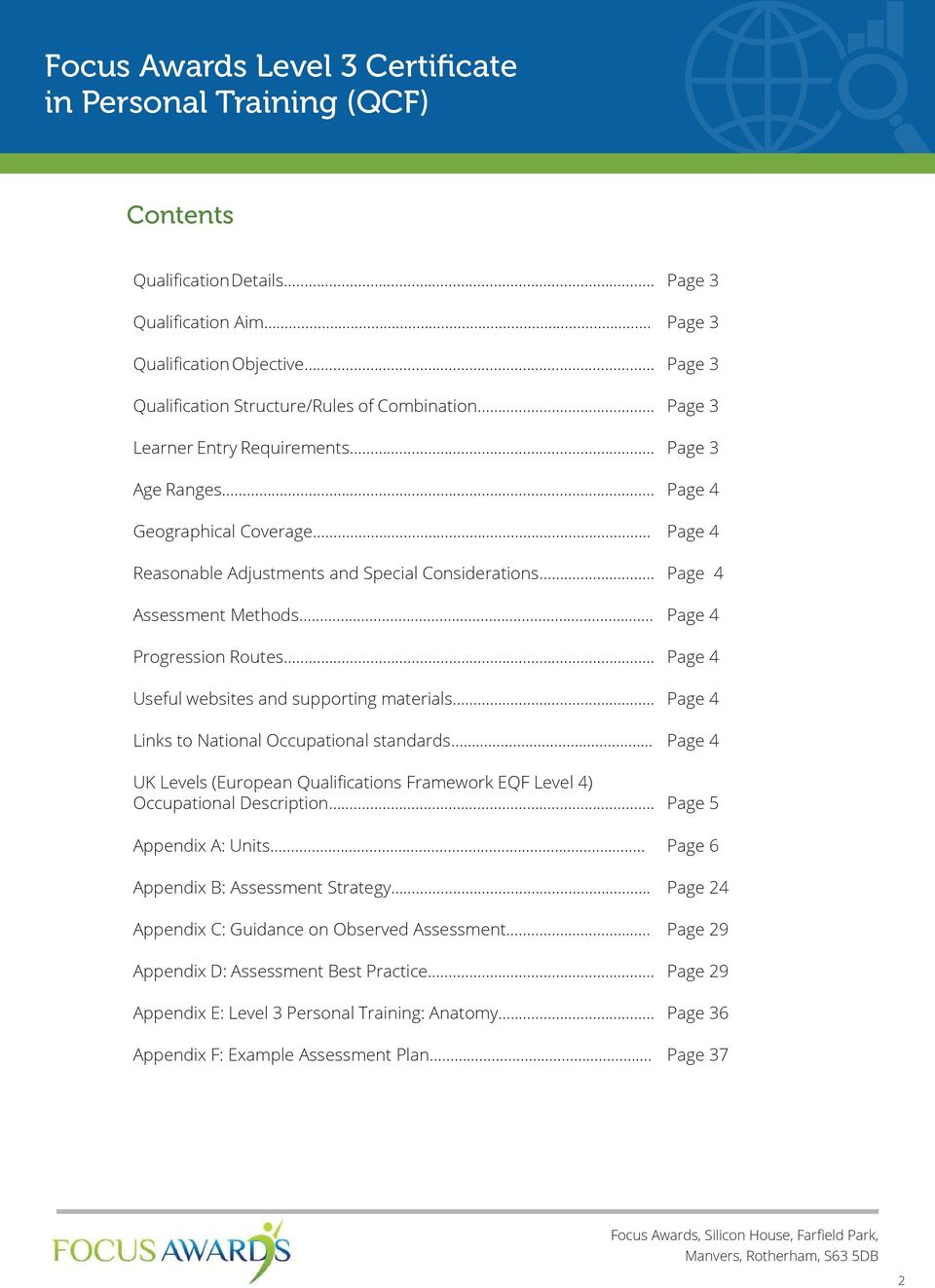
2 Contents Qualification Details Page 3 Qualification Aim..... Page 3 Qualification Objective Page 3 Qualification Structure/Rules of Combination Page 3 Learner Entry Requirements Page 3 Age Ranges Page 4 Geographical Coverage Page 4 Reasonable Adjustments and Special Considerations Page 4 Assessment Methods Page 4 Progression Routes Page 4 Useful websites and supporting materials Page 4 Links to National Occupational standards Page 4 UK Levels (European Qualifications Framework EQF Level 4) Occupational Description Page 5 Appendix A: Units... Page 6 Appendix B: Assessment Strategy... Page 24 Appendix C: Guidance on Observed Assessment... Page 29 Appendix D: Assessment Best Practice... Page 29 Appendix E: Level 3 Personal Training: Anatomy Page 36 Appendix F: Example Assessment Plan Page 37 2
3 Qualification Details QAN: 601/4709/x GLH: 245 NLH: 360 Credit: 36 Qualification Structure/Rules of Combination Learners must achieve all seven of the following mandatory units to achieve a total credit of 36. Unit Title Unit Ref Level GLH Credit Qualification Aim The Focus Awards Level 3 Certificate in Personal Training (QCF) aims to provide the learner with the skills, knowledge and competence required for an individual to work unsupervised as a personal trainer. This includes being able to offer one-to-one training, baseline assessment, nutritional advice and progressive programming which is specific to the individual needs of a client. This qualification is recognised as an approved qualification for entry on to the Register of Exercise Professionals (REPs) at Level 3. Qualification Objective To provide learners with the knowledge of anatomy and physiology, functional kinesiology and concepts and components of fitness To provide learners with the knowledge and skills to successfully gather and analyse client information using the most accepted techniques Anatomy and physiology for exercise and health Principles of exercise, fitness and health Know how to support clients who take part in exercise and physical activity Health, safety and welfare in a fitness environment Applying the principles of nutrition to a physical activity Programming Personal Training with Clients Delivering Personal Training sessions A/600/ A/600/ M/600/ T/600/ L/600/ F/600/ J/600/ To provide learners with the knowledge and skills to assess a client s current health and fitness status To provide learners with the knowledge and skills to be able to plan and conduct a physical activity session, within a variety of environments using multiple resources To provide learners with the knowledge and skills to perform a client consultation using the most accepted methods and providing strategies for successful behaviour change To provide learners with the knowledge and skills to be able to communicate effectively to build successful relationships with their clients and other health care professionals To provide learners with the knowledge and skills to be able to manage, evaluate and improve own performance Learner Entry Requirements Prior to enrolling on the Level 3 Certificate in Personal Training, learners must have the necessary underpinning knowledge at level 2. Therefore, learners must have already achieved a Level 2 Certificate in Fitness Instructing in Gym, or equivalent. The course requires physical exertion and individual participation is essential, therefore a degree of physical fitness is necessary. There is an element of communication (discussing, presenting, reading and writing) and application of number involved, and learners should have basic skills in communication and application of number at levels 3 and 2 respectively To provide learners with the knowledge to be able to offer nutritional advice for physical activity based on clients needs 3

4 Age Ranges Entry is at the discretion of the centre; however learners should be 16 and over to undertake the qualification. Geographical Coverage This qualification has been accredited for use in England, Wales and Northern Ireland. Reasonable Adjustments and Special Considerations Please refer to the Focus Awards Reasonable Adjustments and Special Considerations Policy. Assessment Methods The Focus Awards Level 3 Certificate in Personal Training is internally assessed. Each learner is required to create a portfolio of evidence which demonstrates achievement of all the learning outcomes and assessment criteria associated with each unit. The main pieces of evidence for the portfolio could include: Assessor observation completed observational checklists on related action plans Witness Testimony Learner product Worksheets Assignments/projects/reports Record of oral and written questioning Learner and peer reports Recognition of prior learning (RPL) Evidence may be drawn from actual or simulated situations where appropriate. Progression Routes Learners wishing to progress from this qualification can undertake the following qualifications: Level 3 Certificate in Fitness Management Level 4 Higher Professional Diploma in Sport and Recreation Management Level 4 HNC Diploma in Sport (QCF) Level 4 Certificate In Exercise And Nutritional Interventions For Obesity And Diabetes Level 4 Certificate In Exercise For The Management Of Low Back Pain Level 5 HND Diploma in Sport and Exercise Sciences (QCF) Useful websites and supporting materials www. exerciseregister.org Links to national occupational standards There are direct links to the NOS in Instructing Exercise and Fitness: C22 Promote health, safety and welfare in active leisure and recreation C317 Motivate clients to maintain long term adherence to exercise and physical activity A335 Reflect on and develop own practice in providing exercise and physical activity D459 Evaluate exercise and physical activity programmes D460 Design, manage and adapt a personal training programme with clients D461 Deliver exercise and physical activity as part of a personal training programme D462 Apply the principles of nutrition to support client goals as part of an exercise and physical activity programme Any other Level 3 qualification in the Health and Fitness Industry Level 3 NVQ in Instructing Physical Exercise and Nutrition 4

5 UK LEVEL 3 (European Qualifications Framework EQF Level 4) Occupational Descriptor Occupational Title Fitness Instructor/Personal Trainer. Occupational Description A fitness instructor/personal trainer s role includes designing and implementing exercise programmes for a range of individual clients by collecting and analysing client information to ensure the effectiveness of personal exercise programmes. A personal trainer should also actively encourage potential clients/ members to join and adhere to regular exercise programmes, employing appropriate motivational strategies to achieve this. Occupational Roles The personal trainer should be involved in: 1. Collecting information relating to individual clients 2. Carrying out fitness assessments to establish client fitness and skill level 3. Analysing information relating to individual clients 4. Identifying, agreeing and reviewing short, medium and long term goals to ensure the effectiveness of exercise programmes 5. Providing a range of exercise programmes in accordance with the needs of the clients by applying principles of exercise programming 6. Making best use of the environment in which clients are exercising 7. Providing clients with accurate information on the principles of nutrition and weight management 8. Developing and applying strategies to motivate clients to join and adhere to an exercise programme 9. Acting as a positive role model for all clients 10. Proactively interact and develop positive relationships with clients in order to facilitate client retention. 11. Promoting healthy activities and related strategies for daily living to clients/members 12. Keeping up-to-date with health and fitness industry developments to ensure high standards of programmes that meet client needs in the short, medium and long term goals 13. Making the appropriate decisions relating to clients and their programmes/goals and, where required, refer the client to a more appropriate professional 14. Working within the parameters given at Level 3, recognising the standards and professional limitations that this provides, referring to appropriate members of staff for guidance and support Occupational Competence Level 3 Personal Trainers should: 1. Be aware of their professional role boundaries as listed. 2. Give guidance to encourage special population clients* to follow the key safety guidelines and discourage them from anything deemed to be potentially hazardous/contraindicated to enable them to take part in sessions. *Special population clients including: year olds (young people) disabled people older people (50+) ante and postnatal women 3. Get advice from another appropriate professional if there are any objectives, physical activities or risks that fall outside their professional boundaries or that they do not feel competent to deal with and/or refer on to the appropriate person. Level 3 Personal Trainers (who do not possess the appropriate special population qualification/s in older adults, ante/postnatal women and disabled people) should NOT: Be a specialist instructor in the area of special populations, or advertise as such Instruct special population clients on a 1:1 basis or in groups on a regular or progressive basis 5
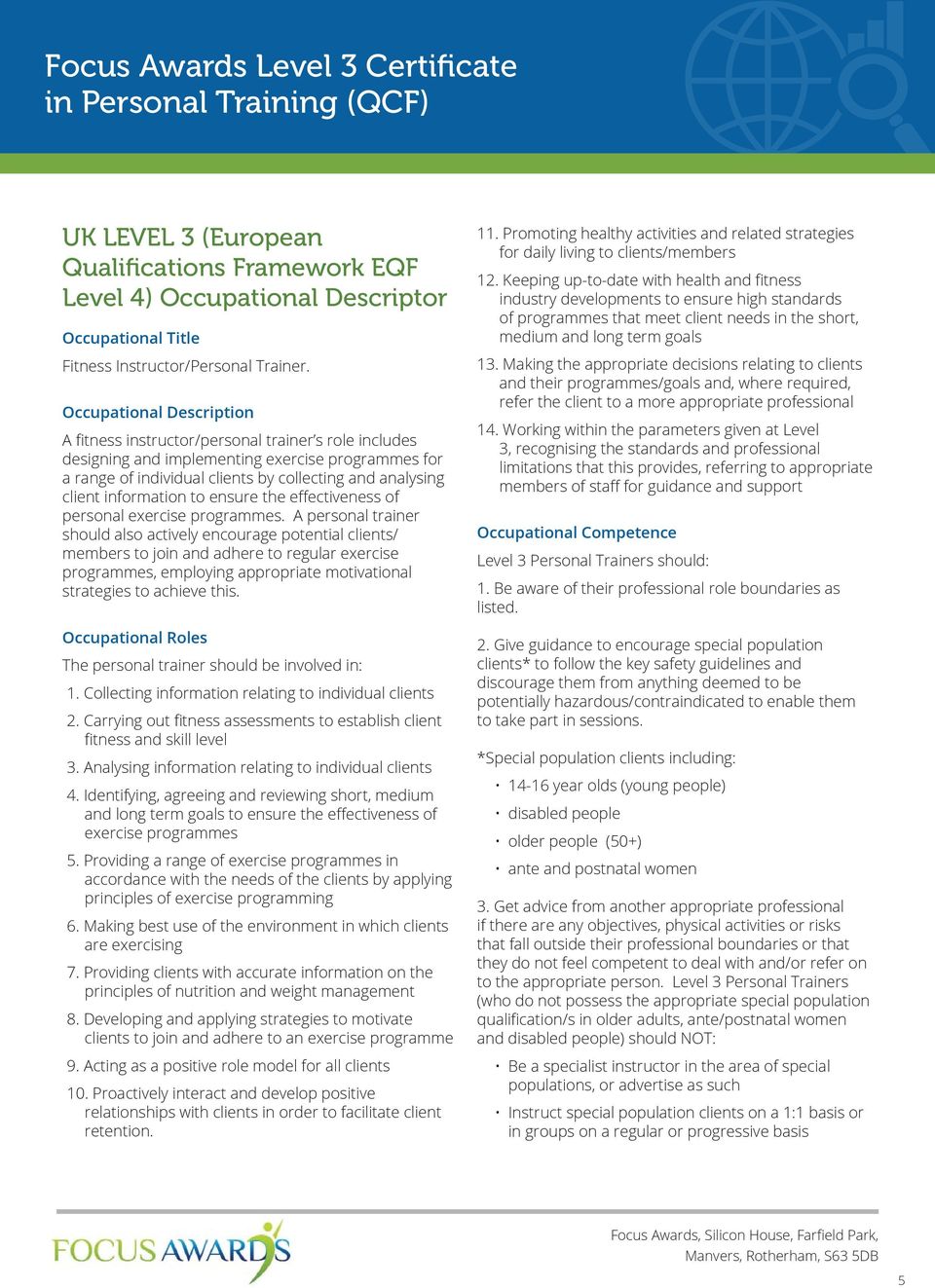
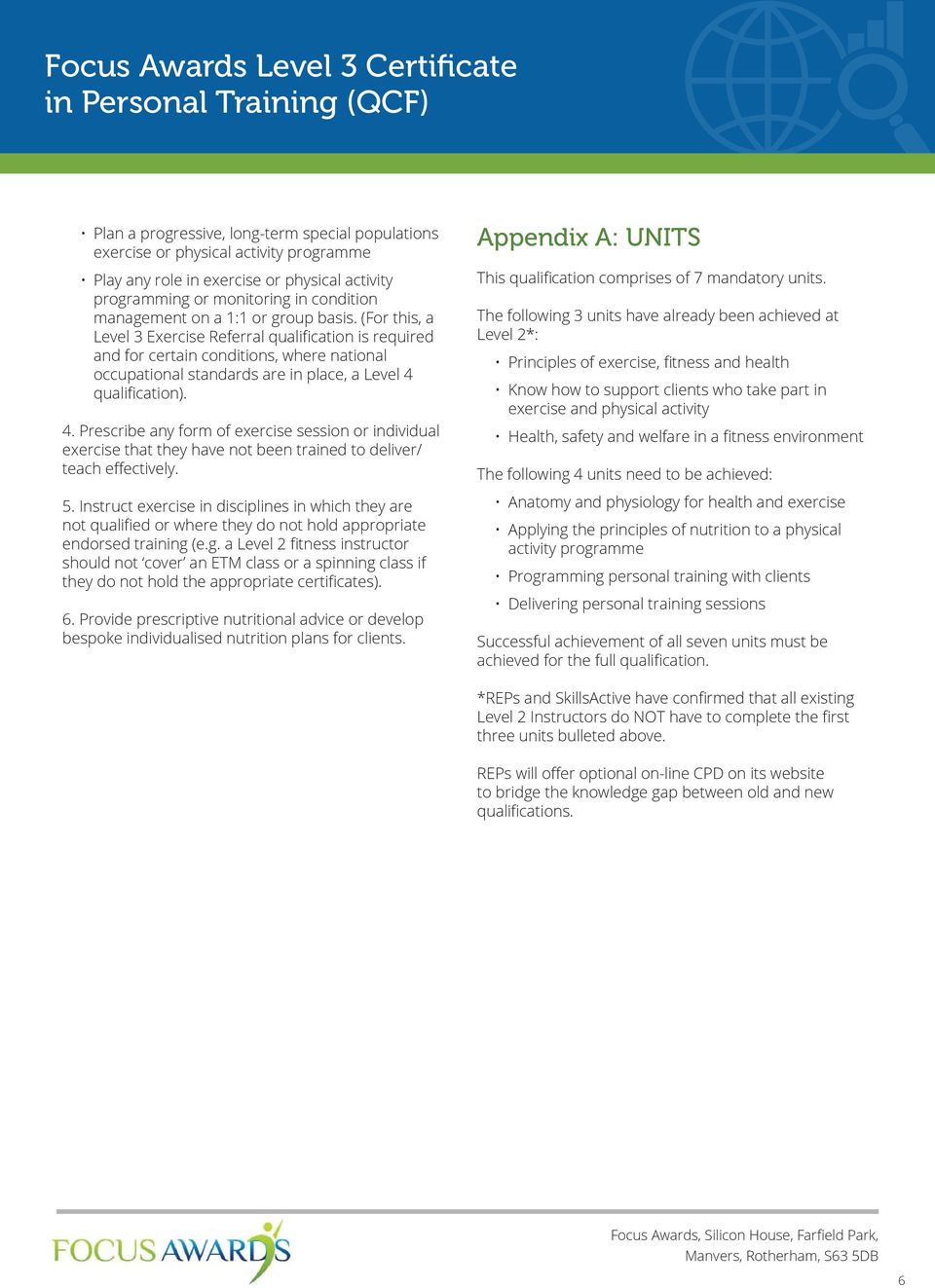
6 Plan a progressive, long-term special populations exercise or physical activity programme Play any role in exercise or physical activity programming or monitoring in condition management on a 1:1 or group basis. (For this, a Level 3 Exercise Referral qualification is required and for certain conditions, where national occupational standards are in place, a Level 4 qualification). 4. Prescribe any form of exercise session or individual exercise that they have not been trained to deliver/ teach effectively. 5. Instruct exercise in disciplines in which they are not qualified or where they do not hold appropriate endorsed training (e.g. a Level 2 fitness instructor should not cover an ETM class or a spinning class if they do not hold the appropriate certificates). 6. Provide prescriptive nutritional advice or develop bespoke individualised nutrition plans for clients. Appendix A: UNITS This qualification comprises of 7 mandatory units. The following 3 units have already been achieved at Level 2*: Principles of exercise, fitness and health Know how to support clients who take part in exercise and physical activity Health, safety and welfare in a fitness environment The following 4 units need to be achieved: Anatomy and physiology for health and exercise Applying the principles of nutrition to a physical activity programme Programming personal training with clients Delivering personal training sessions Successful achievement of all seven units must be achieved for the full qualification. *REPs and SkillsActive have confirmed that all existing Level 2 Instructors do NOT have to complete the first three units bulleted above. REPs will offer optional on-line CPD on its website to bridge the knowledge gap between old and new qualifications. 6
7 Unit Title: Unit No: Principles of exercise, fitness and health A/600/9017 Level: 2 GLH: 28 Credit: 4 Unit details: The aim of this unit is to develop knowledge and understanding of the key principles of exercise, fitness and health, including the components, principles and variables of fitness, the health and benefits of physical activity and the importance of healthy eating Learning Outcome The learner will: Assessment Criterion The learner can: 1.1 Describe cardiovascular and respiratory adaptations to endurance/aerobic training Understand the effects of exercise on the body Understand the components of fitness Understand how to apply the principles and v ariables of fitness to an exercise programme 1.2 Identify the short and long term effects of exercise on blood pressure 1.3 Describe the blood pooling effect following exercise 1.4 Describe the effects of exercise on bones and joints including the significance of weight bearing exerciset 1.5 Describe delayed onset of muscle soreness (DOMS) 1.6 Identify exercises or techniques likely to cause delayed onset of muscle soreness 1.7 Describe the short and long term effects of different types of exercise on muscle 1.8 Describe different exercises that can improve posture 2.1 Define the components of health related fitness 2.2 Define the components of skill related fitness 2.3 Identify the factors that affect health and skill related fitness 3.1 Describe the physiological implications of: specificity progressive overload reversibility adaptability individuality recovery time 3.2 Explain the principles of FITT (Frequency, Intensity, Time and Type) 3.3 Explain the principles of a progressive components of fitness 3.4 Explain how to recognise when and how to regress a training programme 3.5 Explain the principles of adaptation, modification and progression for each component of FITT (Frequency, Intensity, Time and Type) 3.6 Describe the effect of speed on posture, alignment and intensity 3.7 Describe the effect of levers, gravity and resistance on exercise 3.8 Describe the differences between programming exercise for physical fitness and for health benefits 7

8 4. 5. Understand the Exercise contraindications and key safety guidelines for specia populations Understand how to collect information relating to nutrition 4.1 Describe the exercise contraindications and key safety guidelines for working with older people (50 plus) 4.2 Describe the exercise contraindications and key safety guidelines for working with antenatal and postnatal clients 4.3 Describe the exercise contraindications and key safety guidelines for working with young people (14-16) 4.4 Describe the key safety considerations for working with disabled people 5.1 Describe the benefits and limitations of different methods of monitoring exercise intensity including: the talk test Rate of Perceived Exertion (RPE) heart rate monitoring and the use of different heart rate zones 6.1 Describe the health benefits of physical activity 6. Understand the health benefits of physical activity 6.2 Describe the effect of physical activity on the causes of certain diseases including: Coronary Heart Disease Some cancers Type 2 Diabetes Hypertension Obesity Osteoporosis 7. Understand the importance of healthy eating 7.1 Describe the national food model/guide 7.2 Describe key healthy eating advice that underpins a healthy diet 7.3 Explain the importance of adequate hydration 7.4 Explain professional role boundaries in relation to offering nutritional advice 7.5 Explain the dietary role of the key nutrients 7.6 Identify the common dietary sources of the key nutrients 7.7 Describe the energy balance equation 7.8 Explain the health risks of poor nutrition 8

9 Unit Title: Unit No: Know how to support clients who take part in exercise and physical activity M/600/9015 Level: 2 GLH: 13 Credit: 2 Unit details: The aim of this unit is to develop knowledge and understanding of how to develop effective working relationships with clients, how to provide ongoing customer services, and how to support clients to adhere to exercise/physical activity. Learning Outcome The learner will: Assessment Criterion The learner can: 1.1 Explain why it s important to form effective working relationships with clients Understand how to form effective working relationships with clients Understand how to address barriers to exercise/physical activity that clients experience Understand how to support clients to adhere to exercise/physical activity Understand how to provide ongoing customer service to clients 1.2 Explain why it s important to present oneself and the organisation positively to clients 1.3 Describe how different communication skills can be used to assist clients with motivation 1.4 Explain the importance of valuing equality and diversity when working with clients 2.1 Identify the typical barriers to exercise/physical activity that clients experience 2.2 Explain how incorporating clients exercise/physical activity preferences into their programme can strengthen motivation and adherence 2.3 Describe different incentives and rewards that can strengthen clients motivation and adherence 2.4 Describe different strategies that can help clients overcome typical barriers to exercise/physical activity 3.1 Explain why it is important for a client to take personal responsibility for their own fitness and motivation 3.2 Describe how to assist clients to develop their own strategy for motivation and adherence 3.3 Identify different behaviour change approaches/strategies to encourage adherence to exercise/physical activity 3.4 Describe how to set short, medium and long term SMART goals 3.5 Describe how to review and revise short, medium and long term SMART goals 4.1 Explain the importance of client care both for the client and the organisation 4.2 Explain why it is important to deal with clients needs to their satisfaction 4.3 Identify where to source relevant and appropriate information to meet clients needs 4.4 Explain the importance of dealing with any delay in meeting clients needs timely and effectively 4.5 Give examples of how to exceed customer expectations, when appropriate 4.6 Explain the importance of handling client complaints positively following an organisations procedure 9

10 Unit Title: Unit No: Health, safety and welfare in a fitness environment T/600/9016 Level: 2 GLH: 16 Credit: 2 Unit details: The aim of this unit is to develop knowledge and understanding of how to develop effective working relationships with clients, how to provide ongoing customer services, and how to support clients to adhere to exercise/physical activity. Learning Outcome The learner will: Assessment Criterion The learner can: 1.1 Identify the types of emergencies that may occur in a fitness environment Understand emergency procedures in a fitness environment Understand health and safety requirements in a fitness environment Understand how to control risks in a fitness environment 1.2 Describe the roles that different staff and external services play during an emergency 1.3 Explain the importance of following emergency procedures calmly and correctly 1.4 Describe how to maintain the safety of people involved in typical emergencies, including children, older people and disabled people 2.1 Outline why health and safety is important in a fitness environment 2.2 Identify the legal and regulatory requirements for health and safety relevant to working in a fitness environment 2.3 Describe Duty of Care and professional role boundaries in relation to special population groups 2.4 Identify the typical roles of individuals responsible for health and safety in a fitness organisation 2.5 Describe the types of security procedures that may apply in a fitness environment 2.6 Describe the key health and safety documents that are relevant in a fitness environment 3.1 Identify possible hazards in a fitness environment, relating to: facilities equipment working practices, including lifting and handling of equipment client behaviour security hygiene 3.2 Describe how to risk assess the types of possible hazards in a fitness environment 3.3 Describe how to control risks associated with hazards in a fitness environment 3.4 Identify the appropriate person/position to contact within a fitness organisation when hazards and risks cannot be controlled personally 10

11 4.1 Describe what is meant by safeguarding the welfare of children and vulnerable adults 4.2 Describe the responsibilities and limitations of a fitness instructor in regard to safeguarding children and vulnerable adults 4.3 Identify the types of abuse which an instructor may encounter: physical, emotional, neglect, bullying and sexual 4 Understand how to safeguard children and vulnerable adults 4.4 Identify possible signs of abuse: physical, emotional, neglect, bullying and sexual 4.5 Describe a fitness organisations policies and procedures in relation to safeguarding children and vulnerable adults, including typical reporting procedures 4.6 Describe the procedures to follow to protect oneself from accusations of abuse 4.7 Identify the statutory agencies responsible for safeguarding children and vulnerable adults 4.8 Explain when it may be necessary to contact statutory agencies 4.9 Describe how to maintain the confidentiality of information relating to possible abuse 11

12 Unit Title: Unit No: Anatomy and physiology for exercise and health A/600/9051 Level: 3 GLH: 43 Credit: 6 Unit details: The aim of this unit is to develop learner knowledge and understanding of anatomy and physiology of the human body and how this relates to exercise and health, including postural and core stability. Learning Outcome The learner will: Assessment Criterion The learner can: Understand the heart and circulatory system and its relation to exercise and health Understand the musculoskeletal system and its relation to exercise Understand postural and core stability 1.1 Explain the function of the heart valves 1.2 Describe coronary circulation 1.3 Explain the effect of disease processes on the structure and function of blood vessels 1.4 Explain the short and long term effects of exercise on blood pressure, including the valsalva effect 1.5 Explain the cardiovascular benefits and risks of endurance/aerobic training 1.6 Define blood pressure classifications and associated health risks 2.1 Explain the cellular structure of muscle fibres 2.2 Describe the sliding filament theory 2.3 Explain the effects of different types of exercises on muscle fibre type 2.4 Identify and locate the muscle attachment sites for the major muscles of the body 2.5 Name, locate and explain the function of skeletal muscle involved in physical activity 2.6 Identify the anatomical axis and planes with regard to joint actions and different exercises 2.7 Explain the joint actions brought about by specific muscle group contractions 2.8 Describe joints/joint structure with regard to range of motion/movement and injury risk 2.9 Describe joint movement potential and joint actions 2.10 Describe the structure of the pelvic girdle and associated muscles and ligaments 3.1 Describe the structure and function of the stabilising ligaments and muscles of the spine 3.2 Describe local muscle changes that can take place due to insufficient stabilisation 3.3 Explain the potential effects of abdominal adiposity and poor posture on movement efficiency 3.4 Explain the potential problems that can occur as a result of postural deviations 12

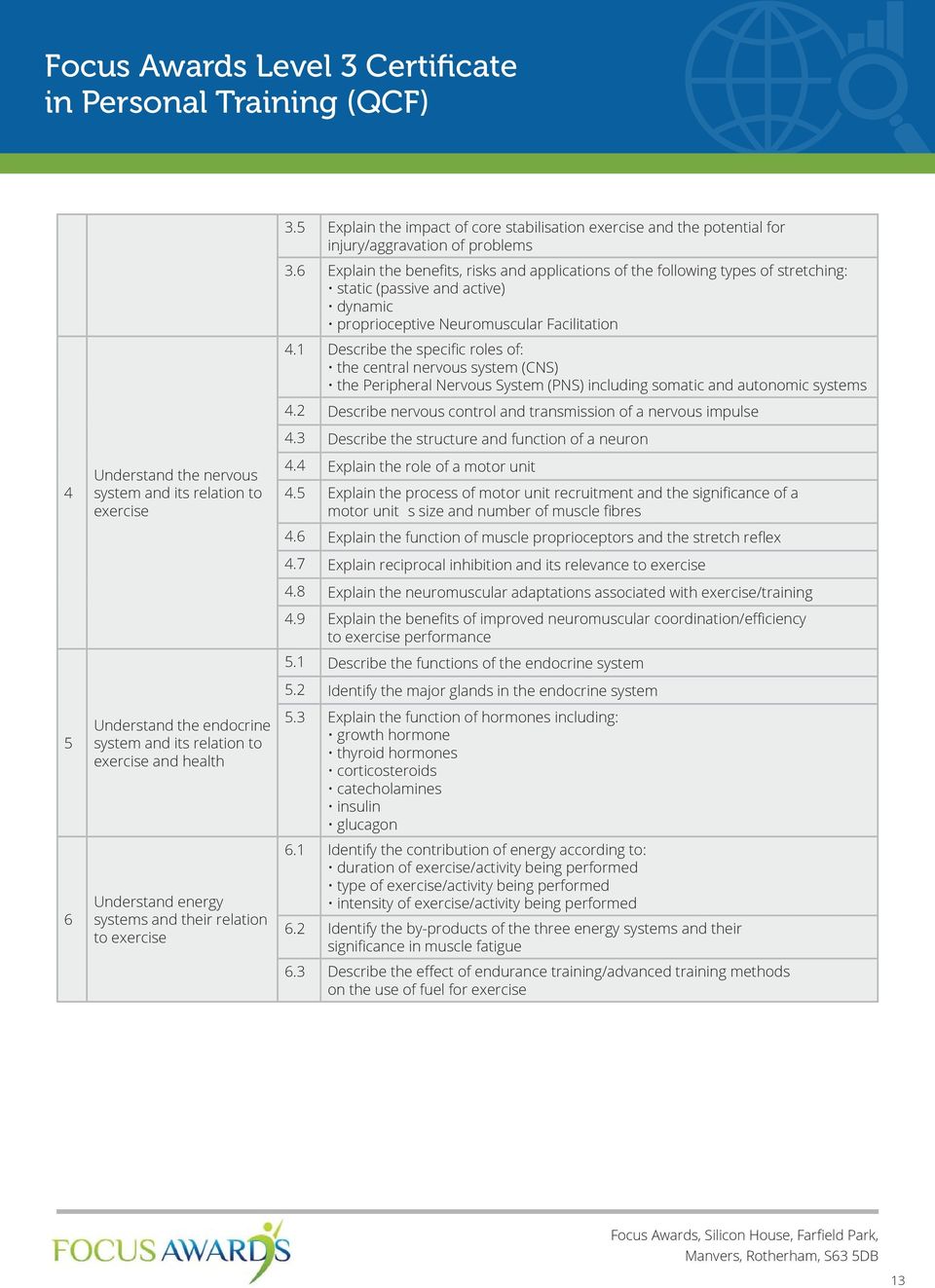
13 3.5 Explain the impact of core stabilisation exercise and the potential for injury/aggravation of problems 3.6 Explain the benefits, risks and applications of the following types of stretching: static (passive and active) dynamic proprioceptive Neuromuscular Facilitation 4.1 Describe the specific roles of: the central nervous system (CNS) the Peripheral Nervous System (PNS) including somatic and autonomic systems 4.2 Describe nervous control and transmission of a nervous impulse 4.3 Describe the structure and function of a neuron Understand the nervous system and its relation to exercise Understand the endocrine system and its relation to exercise and health Understand energy systems and their relation to exercise 4.4 Explain the role of a motor unit 4.5 Explain the process of motor unit recruitment and the significance of a motor units size and number of muscle fibres 4.6 Explain the function of muscle proprioceptors and the stretch reflex 4.7 Explain reciprocal inhibition and its relevance to exercise 4.8 Explain the neuromuscular adaptations associated with exercise/training 4.9 Explain the benefits of improved neuromuscular coordination/efficiency to exercise performance 5.1 Describe the functions of the endocrine system 5.2 Identify the major glands in the endocrine system 5.3 Explain the function of hormones including: growth hormone thyroid hormones corticosteroids catecholamines insulin glucagon 6.1 Identify the contribution of energy according to: duration of exercise/activity being performed type of exercise/activity being performed intensity of exercise/activity being performed 6.2 Identify the by-products of the three energy systems and their significance in muscle fatigue 6.3 Describe the effect of endurance training/advanced training methods on the use of fuel for exercise 13
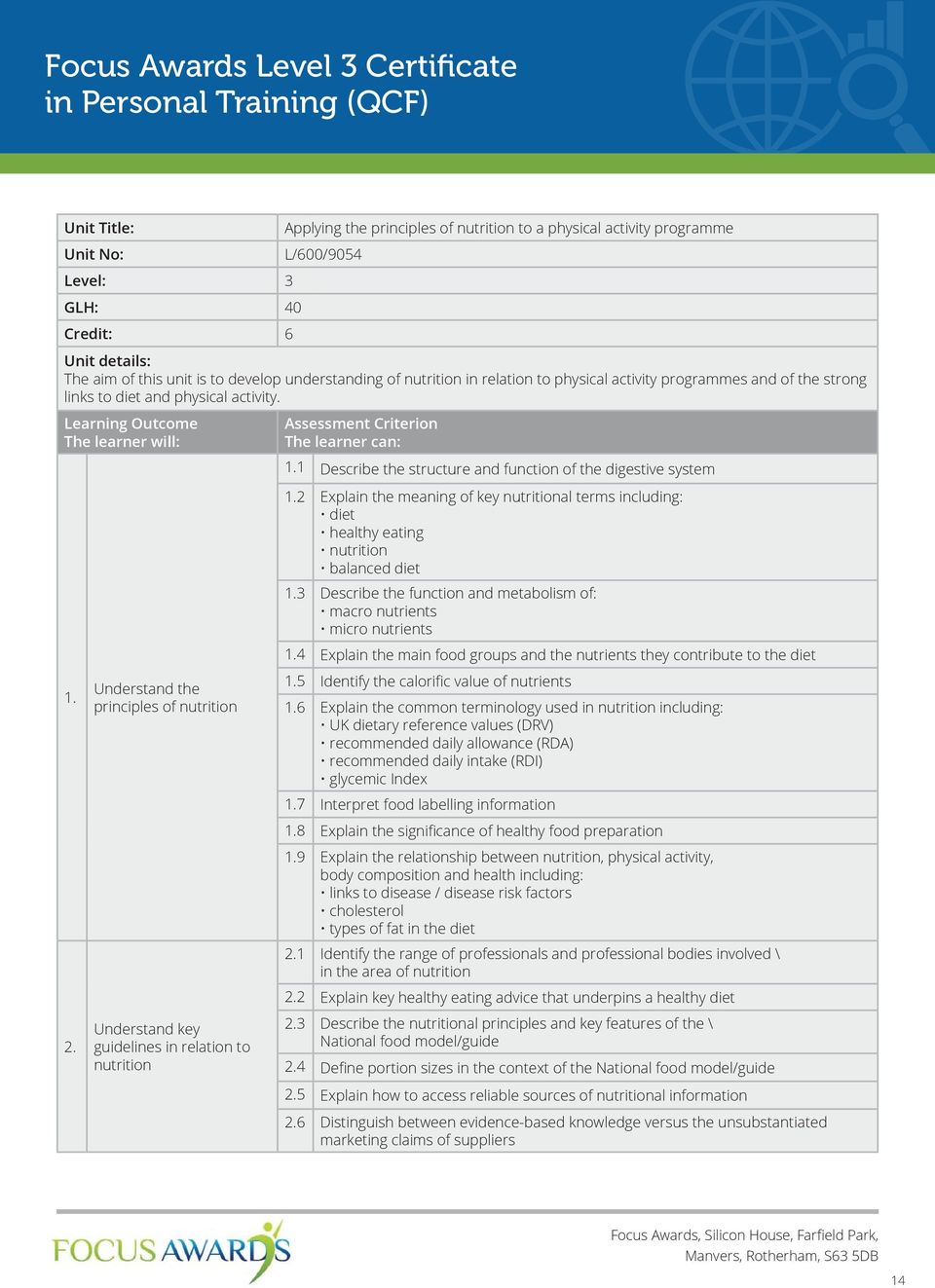
14 Unit Title: Unit No: Applying the principles of nutrition to a physical activity programme L/600/9054 Level: 3 GLH: 40 Credit: 6 Unit details: The aim of this unit is to develop understanding of nutrition in relation to physical activity programmes and of the strong links to diet and physical activity. Learning Outcome The learner will: Assessment Criterion The learner can: Understand the principles of nutrition Understand key guidelines in relation to nutrition 1.1 Describe the structure and function of the digestive system 1.2 Explain the meaning of key nutritional terms including: diet healthy eating nutrition balanced diet 1.3 Describe the function and metabolism of: macro nutrients micro nutrients 1.4 Explain the main food groups and the nutrients they contribute to the diet 1.5 Identify the calorific value of nutrients 1.6 Explain the common terminology used in nutrition including: UK dietary reference values (DRV) recommended daily allowance (RDA) recommended daily intake (RDI) glycemic Index 1.7 Interpret food labelling information 1.8 Explain the significance of healthy food preparation 1.9 Explain the relationship between nutrition, physical activity, body composition and health including: links to disease / disease risk factors cholesterol types of fat in the diet 2.1 Identify the range of professionals and professional bodies involved \ in the area of nutrition 2.2 Explain key healthy eating advice that underpins a healthy diet 2.3 Describe the nutritional principles and key features of the \ National food model/guide 2.4 Define portion sizes in the context of the National food model/guide 2.5 Explain how to access reliable sources of nutritional information 2.6 Distinguish between evidence-based knowledge versus the unsubstantiated marketing claims of suppliers 14
15 3.1 Explain professional role boundaries with regard to offering nutritional advice to clients 3.2 Explain the importance of communicating health risks associated with weight loss fads and popular diets to clients Understand nationally recommended practice in relation to providing nutritional advice Understand the relationship between nutrition and physical activity Understand how to collect information relating to nutrition Understand how to use nutritional information 3.3 Evaluate the potential heath and performance implications of severe energy restriction, weight loss and weight gain 3.4 Identify clients at risk of nutritional deficiencies 3.5 Explain how cultural and religious dietary practices c an influence nutritional advice 3.6 Describe safety, effectiveness and contraindications relating to protein and vitamin supplementation 3.7 Explain why detailed or complex dietary analysis that incorporates major dietary change should always be referred to a Registered Dietician 4.1 Define the role of carbohydrate, fat and protein as fuels for aerobic and anaerobic energy production 4.2 Explain the components of energy expenditure and the energy balance equation 4.3 Explain how to calculate an estimate of Basal Metabolic Rate (BMR) 4.4 Explain how to estimate energy requirements based on physical activity levels and other relevant factors 4.5 Identify energy expenditure for different physical activities 4.6 Evaluate the nutritional requirements and hydration needs of clients engaged in physical activity 5.1 Explain why it is important to obtain clients informed consent before collecting nutritional information 5.2 Describe the information that needs to be collected to offer nutritional advice to clients 5.3 Explain the legal and ethical implications of collecting nutritional information 5.4 Describe different formats for recording nutritional information 5.5 Explain why confidentiality is important when collecting nutritional information 5.6 Describe issues that may be sensitive when collecting nutritional information 5.7 Explain different methods that can be used to measure body composition and health risk in relation to weight 6.1 Describe basic dietary assessment methods 6.2 Explain how to analyse and interpret collected information so that clients needs and nutritional goals can be identified with reference to the National food model/ guide recommendations 6.3 Describe how to interpret information gained from methods used to assess body composition and health risk in relation to weight 6.4 Explain how to sensitively divulge collected information and results to clients 6.5 Explain how to recognise the signs and symptoms of disordered eating and healthy eating patterns 15

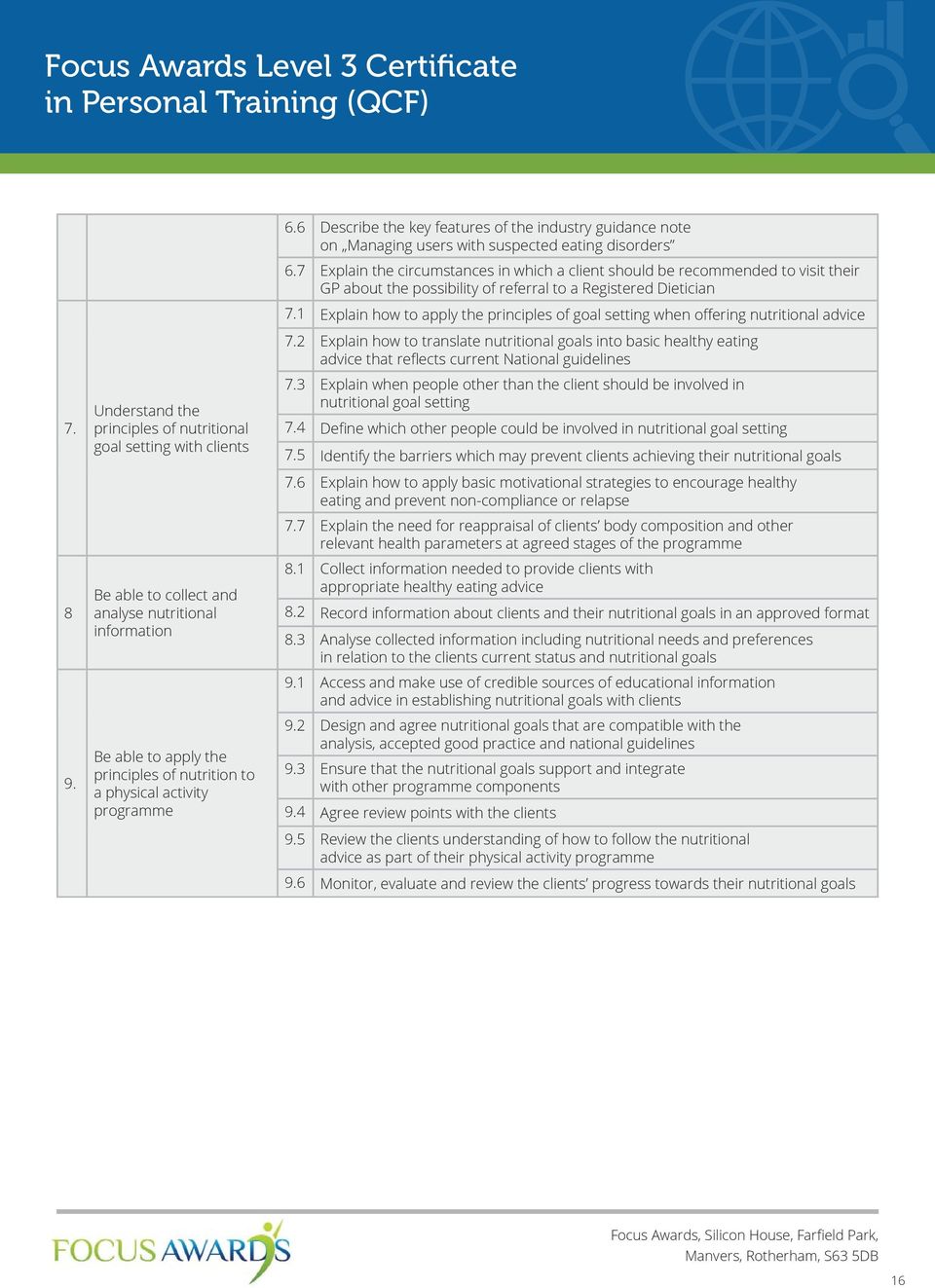
16 6.6 Describe the key features of the industry guidance note on Managing users with suspected eating disorders 6.7 Explain the circumstances in which a client should be recommended to visit their GP about the possibility of referral to a Registered Dietician 7.1 Explain how to apply the principles of goal setting when offering nutritional advice 7.2 Explain how to translate nutritional goals into basic healthy eating advice that reflects current National guidelines Understand the principles of nutritional goal setting with clients Be able to collect and analyse nutritional information Be able to apply the principles of nutrition to a physical activity programme 7.3 Explain when people other than the client should be involved in nutritional goal setting 7.4 Define which other people could be involved in nutritional goal setting 7.5 Identify the barriers which may prevent clients achieving their nutritional goals 7.6 Explain how to apply basic motivational strategies to encourage healthy eating and prevent non-compliance or relapse 7.7 Explain the need for reappraisal of clients body composition and other relevant health parameters at agreed stages of the programme 8.1 Collect information needed to provide clients with appropriate healthy eating advice 8.2 Record information about clients and their nutritional goals in an approved format 8.3 Analyse collected information including nutritional needs and preferences in relation to the clients current status and nutritional goals 9.1 Access and make use of credible sources of educational information and advice in establishing nutritional goals with clients 9.2 Design and agree nutritional goals that are compatible with the analysis, accepted good practice and national guidelines 9.3 Ensure that the nutritional goals support and integrate with other programme components 9.4 Agree review points with the clients 9.5 Review the clients understanding of how to follow the nutritional advice as part of their physical activity programme 9.6 Monitor, evaluate and review the clients progress towards their nutritional goals 16
17 Unit Title: Unit No: Programming personal training with clients F/600/9052 Level: 3 GLH: 47 Credit: 7 Unit details: The aim of this unit is to develop the knowledge and understanding a personal trainer needs to design, manage, and adapt a personal training programme with apparently healthy adults of all ages. Learning Outcome The learner will: Understand how to prepare personal training programmes Understand the importance of long term behaviour change for personal training Assessment Criterion The learner can: 1.1 Describe the range of resources required to deliver a personal training programme, including: environment for the session portable equipment fixed equipment 1.2 Explain how to work in environments that are not specifically designed for exercise/physical activity 2.1 Explain why it is important for clients to understand the advantages of personal training 2.2 Explain why it is important for a personal trainer to work together with clients to agree goals, objectives, programmes and adaptations 2.3 Explain the importance of long-term behaviour change in developing client fitness 3. Understand the principles of collecting information to plan a personal training programme 2.4 Explain how to ensure clients commit themselves to long-term change 3.1 Explain the principles of informed consent 3.2 Explain why informed consent should be obtained before collecting information for a personal training programme 3.3 Summarise the client information that should be collected when designing a personal training programme to include: personal goals lifestyle medical history physical activity history physical activity likes and dislikes motivation and barriers to participation current fitness level stage of readiness posture and alignment functional ability 3.4 Explain how to select the most appropriate methods of collecting client information according to client need 3.5 Explain the legal and ethical implications of collecting client information, including confidentiality 17

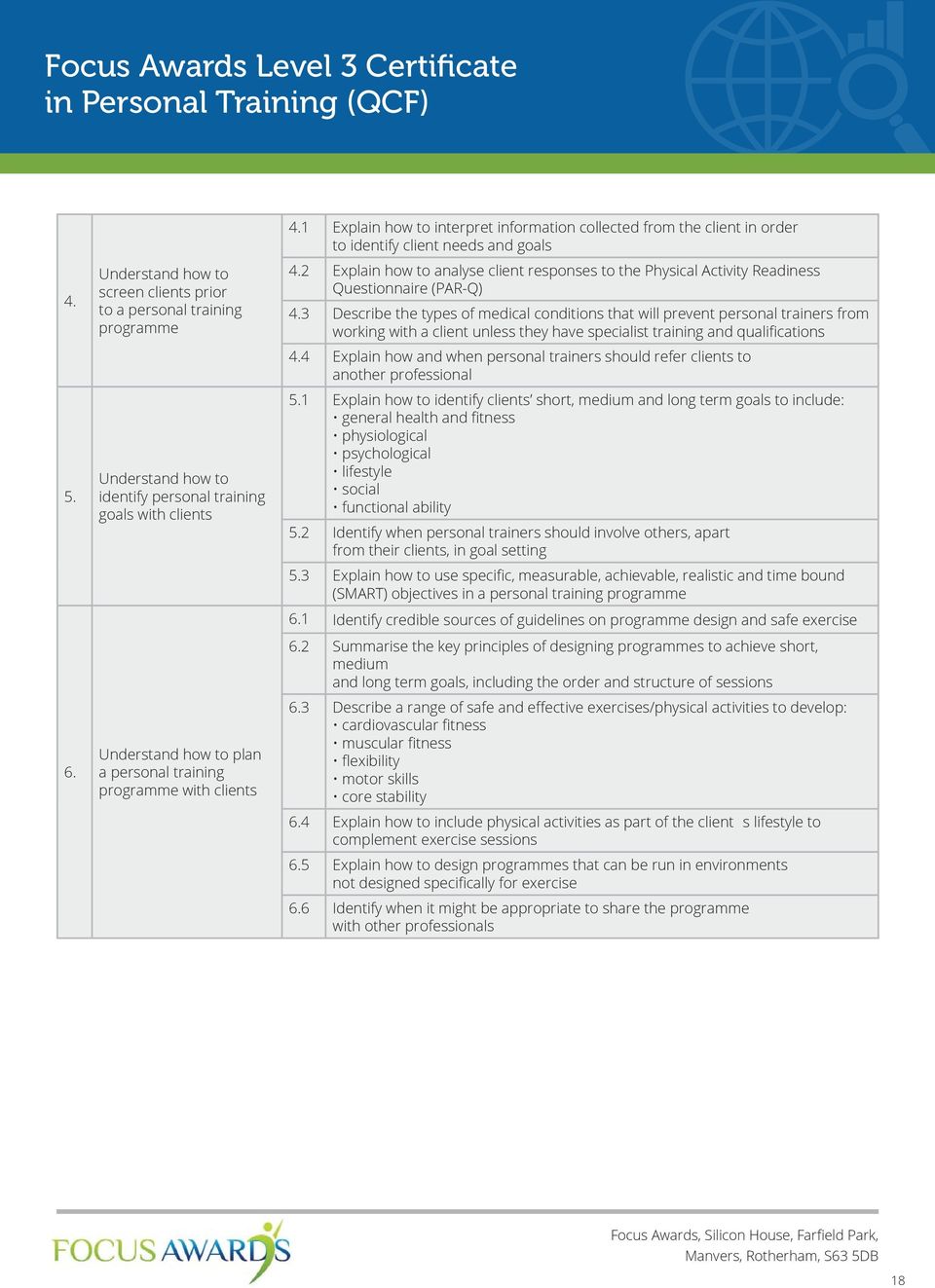
18 4.1 Explain how to interpret information collected from the client in order to identify client needs and goals Understand how to screen clients prior to a personal training programme Understand how to identify personal training goals with clients Understand how to plan a personal training programme with clients 4.2 Explain how to analyse client responses to the Physical Activity Readiness Questionnaire (PAR-Q) 4.3 Describe the types of medical conditions that will prevent personal trainers from working with a client unless they have specialist training and qualifications 4.4 Explain how and when personal trainers should refer clients to another professional 5.1 Explain how to identify clients short, medium and long term goals to include: general health and fitness physiological psychological lifestyle social functional ability 5.2 Identify when personal trainers should involve others, apart from their clients, in goal setting 5.3 Explain how to use specific, measurable, achievable, realistic and time bound (SMART) objectives in a personal training programme 6.1 Identify credible sources of guidelines on programme design and safe exercise 6.2 Summarise the key principles of designing programmes to achieve short, medium and long term goals, including the order and structure of sessions 6.3 Describe a range of safe and effective exercises/physical activities to develop: cardiovascular fitness muscular fitness flexibility motor skills core stability 6.4 Explain how to include physical activities as part of the clients lifestyle to complement exercise sessions 6.5 Explain how to design programmes that can be run in environments not designed specifically for exercise 6.6 Identify when it might be appropriate to share the programme with other professionals 18
19 Understand how to adapt a personal training programme with clients Be able to collect information about clients Be able to agree goals with clients Be able to plan a personal training programme with clients Be able to manage a personal training programme 7.1 Explain how the principles of training can be used to adapt the programme where: goals are not being achieved new goals have been identified 7.2 Describe the different training systems and their use in providing variety and in ensuring programmes remain effective 7.3 Explain why it is important to keep accurate records of changes and the reasons for change 8.1 Establish a rapport with the client 8.2 Explain own role and responsibilities to clients 8.3 Collect the information needed to plan a programme using appropriate methods, to include physical/fitness assessments 8.4 Show sensitivity and empathy to clients and the information they provide 8.5 Record the information using appropriate formats in a way that will aid analysis 8.6 Treat confidential information correctly 9.1 Work with clients to agree short, medium and long-term goals appropriate to their needs 9.2 Ensure the goals are: specific, measurable, achievable, realistic and time bound consistent with industry good practice 9.3 Agree with clients their needs and readiness to participate 10.1 Plan specific outcome measures, stages of achievement and exercises/physical activities that are: appropriate to clients goals and level of fitness consistent with accepted good practice 10.2 Ensure the components of fitness are built into the programme 10.3 Apply the principles of training to help clients to achieve short, medium and long term goals 10.4 Agree the demands of the programme with clients 10.5 Agree a timetable of sessions with clients 10.6 Agree appropriate evaluation methods and review dates 10.7 Identify the resources needed for the programme, including the use of environments not designed for exercise 10.8 Record plans in a format that will help clients and others involved to implement the programme 10.9 Agree how to maintain contact with the client between sessions 11.1 Monitor effective integration of all programme exercises/physical activities and sessions 11.2 Provide alternatives to the programmed exercises/physical activities i f clients cannot take part as planned 11.3 Monitor clients progress using appropriate methods 19

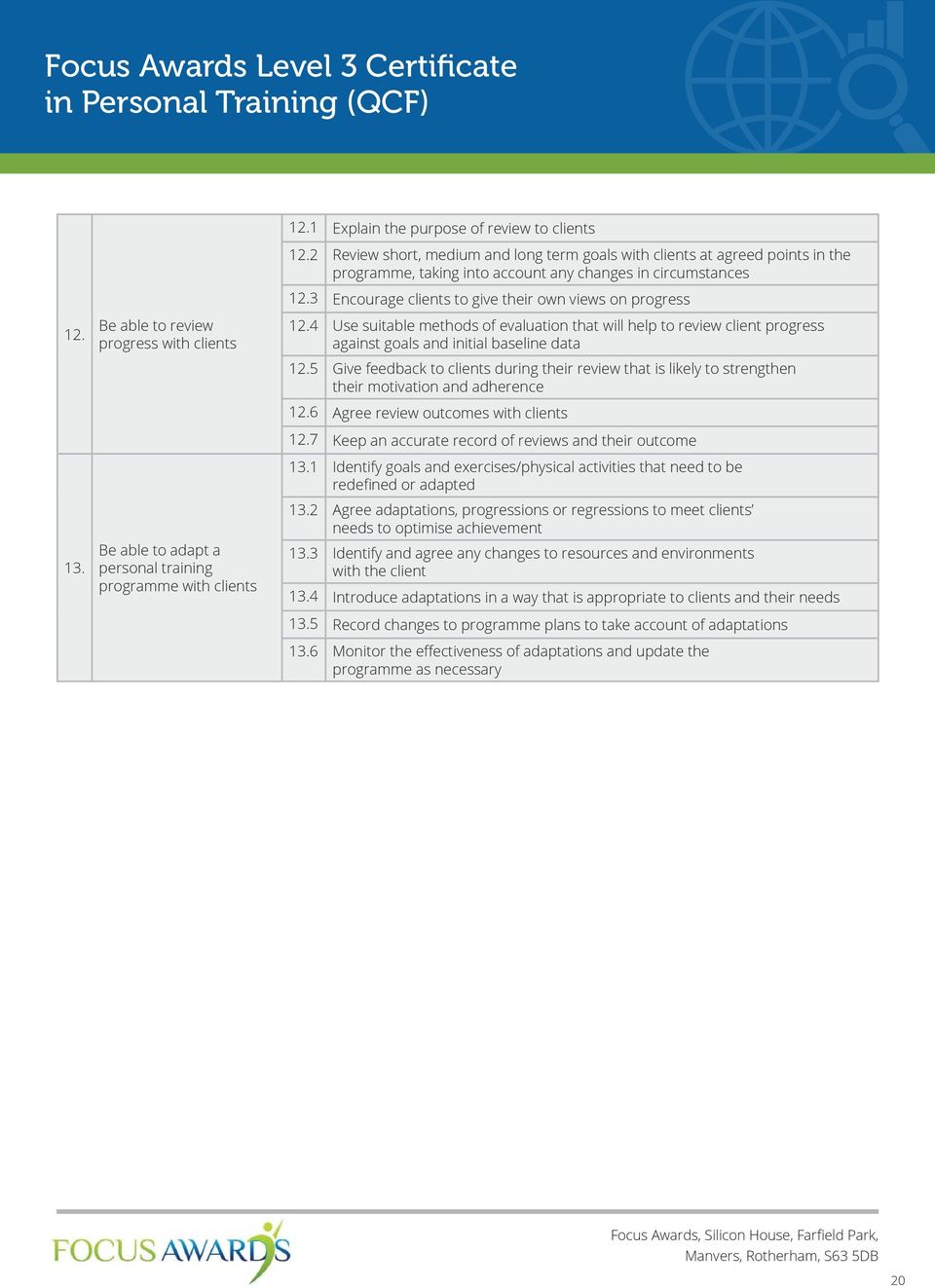
20 12.1 Explain the purpose of review to clients 12.2 Review short, medium and long term goals with clients at agreed points in the programme, taking into account any changes in circumstances 12.3 Encourage clients to give their own views on progress Be able to review progress with clients Be able to adapt a personal training programme with clients 12.4 Use suitable methods of evaluation that will help to review client progress against goals and initial baseline data 12.5 Give feedback to clients during their review that is likely to strengthen their motivation and adherence 12.6 Agree review outcomes with clients 12.7 Keep an accurate record of reviews and their outcome 13.1 Identify goals and exercises/physical activities that need to be redefined or adapted 13.2 Agree adaptations, progressions or regressions to meet clients needs to optimise achievement 13.3 Identify and agree any changes to resources and environments with the client 13.4 Introduce adaptations in a way that is appropriate to clients and their needs 13.5 Record changes to programme plans to take account of adaptations 13.6 Monitor the effectiveness of adaptations and update the programme as necessary 20
21 Unit Title: Unit No: Delivering personal training sessions J/600/9053 Level: 3 GLH: 58 Credit: 9 Unit details: The aim of this unit is to develop the knowledge and understanding a personal trainer needs to deliver exercise and physical activity as part of a programme for apparently healthy adults of all ages. Learning Outcome The learner will: Assessment Criterion The learner can: 1.1 Explain the importance of non-verbal communication when instructing clients Understand how to instruct exercise during personal training sessions Understand how to adapt exercise to meet client needs during personal training sessions Understand how to review personal training sessions with clients Be able to plan and prepare personal training sessions 1.2 Describe how to adapt communication to meet clients needs 1.3 Evaluate different methods of maintaining clients motivation, especially when clients are finding exercises difficult 1.4 Explain the importance of correcting client technique 2.1 Explain why it is important to monitor individual progress especially if more than one client is involved in the session 2.2 Describe different methods of monitoring clients progress during exercise 2.3 Explain when it may be necessary to adapt planned exercises to meet clients needs 2.4 Explain how to adapt exercise/exercise positions as appropriate to individual clients and conditions 2.5 Explain how to modify the intensity of exercise according to the needs and response of the client 3.1 Explain why personal trainers should give clients feedback on their performance during a session 3.2 Explain why clients should be given the opportunity to ask questions, provide feedback and discuss their performance 3.3 Explain how to give clients feedback on their performance in a way that is accurate but maintains client motivation and commitment 3.4 Explain why clients need to see their progress against objectives in terms of their overall goals and programme 3.5 Explain why clients need information about future exercise and physical activity, both supervised and unsupervised 4.1 Plan a range of exercises/physical activities to help clients achieve their objectives and goals, covering: cardiovascular fitness muscular fitness flexibility motor skills core stability 4.2 Identify, obtain and prepare the resources needed for planned exercises/physical activities, improvising safely where necessary 21
22 5.1 Help clients feel at ease in the exercise environment 5.2 Explain the planned objectives and exercises/physical activities to clients 5.3 Explain to clients how objectives and exercises/physical activities support their goals Be able to prepare clients for personal training sessions Be able to instruct and adapt planned exercises Be able to bring exercise sessions to an end 5.4 Explain the physical and technical demands of the planned exercises/physical activities to clients 5.5 Explain to clients how planned exercise/physical activity can be progressed or regressed to meet their goals 5.6 Assess clients state of readiness and motivation to take part in the planned exercises/physical activities 5.7 Negotiate and agree with clients any changes to the planned exercises/physical activities that: meet their goals and preferences enable them to maintain progress 5.8 Record changes to clients plans 6.1 Use motivational styles that: are appropriate to the clients are consistent with accepted good practice 6.2 Explain the purpose and value of a warm-up to clients 6.3 Provide warm-ups appropriate to the clients, planned exercise and the environment 6.4 Make best use of the environment in which clients are exercising 6.5 Provide instructions, explanations and demonstrations that are technically correct, safe and effective 6.6 Adapt verbal and non-verbal communication methods to make sure clients understand what is required 6.7 Ensure clients can carry out the exercises safely on their own 6.8 Analyse clients performance, providing positive reinforcement throughout 6.9 Correct techniques at appropriate points 6.10 Progress or regress exercises according to clients performance 7.1 Allow sufficient time for the closing phase of the session 7.2 Explain the purpose and value of cooldown activities to clients 7.3 Select cool-down activities according to the type and intensity of physical exercise and client needs and condition 7.4 Provide clients with feedback and positive reinforcement 7.5 Explain to clients how their progress links to their goals 7.6 Leave the environment in a condition suitable for future use 22
23 8.1 Review the outcomes of working with clients including their feedback 8. Be able to reflect on providing personal training sessions 8.2 Identify: how well the sessions met clients goals how effective and motivational the relationship with the client was how well the instructing styles matched the clients needs 8.3 Identify how to improve personal practice 8.4 Explain the value of reflective practice 23
24 Appendix B: Assessment Strategy Anatomy and physiology for exercise and health The aim of this unit is to assess the learner s knowledge and understanding of anatomy and physiology for exercise. All learning outcomes of this unit must be assessed using methods appropriate to the assessment of knowledge and understanding. There must be valid, authenticate and sufficient evidence for the assessment criteria. However, one piece of evidence may be used to meet the requirements of more than one learning outcome or assessment criteria. Evidence for this unit could take the form of: Written statements or answers by the learner Oral statements or answers by the learner Professional discussion between the learner and their assessor Assignments Projects Please see Appendix 1 for further guidance on the bones, joints and muscles which must be covered Applying the principles of nutrition to a physical activity programme The aim of this unit is to assess the learner s knowledge, understanding and performance of applying the principles of nutrition to a physical activity programme. All learning outcomes of this unit must be assessed using methods appropriate to the assessment of knowledge, understanding and performance. There must be valid, authenticate and sufficient evidence for the assessment criteria. However, one piece of evidence may be used to meet the requirements of more than one learning outcome or assessment criteria. Learning Outcomes 1-7 are knowledge based and evidence could take the form of: Written statements or answers by the learner Oral statements or answers by the learner Professional discussion between the learner and their assessor Assignments Projects Performance based assessment strategy» The learner should demonstrate the ability to provide sensitive feedback and any relevant healthy lifestyle advice to clients (within the limits of their knowledge and competence) based on collected information and test results/ norms.» Learners must also provide evidence of their ability to apply the principles of nutrition to a physical activity programme by collecting and analysing appropriate information and agreeing nutritional goals with clients that are compatible with the analysis, accepted good practice and national guidelines.» To cover the above requirements and the assessment criteria listed within Learning Outcomes 8 and 9 the following evidence could be gathered: Client interview Overview of client goals Evaluation and action plan For this unit the learner will need to work with a client for a minimum of 4 weeks. The learner will need to collect personal information from the client and ascertain their nutritional goals. They must carry out appropriate screening and take at least two measurements that are appropriate for their client (e.g. height and weight, BMI, waist circumference or waist to hips ratio, callipers, bio-electrical impedance etc ). The client interview should comprise of questions relating to the client s motivation, barriers, and personal preferences for exercise, lifestyle and their short, medium and long term physical and nutritional goals. It is possible to combine the evidence collection for this unit within the progressive programme required for the unit Programming personal training with clients. 24
25 Programming personal training with clients The aim of this unit is to assess the learner s knowledge, understanding and performance of programming personal training with clients. All learning outcomes of this unit must be assessed using methods appropriate to the assessment of knowledge, understanding and performance. There must be valid, authenticate and sufficient evidence for the assessment criteria. However, one piece of evidence may be used to meet the requirements of more than one learning outcome or assessment criteria. Learning Outcomes 1-7 are knowledge based and evidence could take the form of: Written statements or answers by the learner Oral statements or answers by the learner Professional discussion between the learner and their assessor Assignments Projects Performance based assessment strategy» There must be evidence that the learner has carried out appropriate screening (e.g. use of the PARQ and informed consent) and taken physical measurements as appropriate for the client, from the following: Blood pressure (manual and digital where available) Anthropometrics (e.g. height and weight, BMI, waist circumference or waist to hips ratio) Body composition (e.g. callipers, bio-electrical impedance etc) Cardiovascular fitness (using validated/recognised protocols such as Astrand bike test, Rockport walking test etc) Range of motion (e.g. using validated/recognised protocols such as sit and reach test, visual assessment during stretch positions etc) Muscular fitness (e.g. using validated/recognised protocols such as abdominal curl/sit-up test, press-up test etc)» The learner should demonstrate the ability to provide sensitive feedback and any relevant healthy lifestyle advice to clients (within the limits of their knowledge and competence) based on collected information and test results/ norms.»there must be evidence that a learner has planned participants in the use of the following types of equipment; Cardiovascular Machines» Learners must also show planning of a minimum of two of the following cardiovascular approaches to training Interval Fartlek Continuous» There must be evidence that a learner has planned participants in the use of the following types of equipment; Resistance Machines Free Weights; including barbells and dumbbells and cables where available» Learners must also show planning using different resistance machines and free weights, of a minimum of four of the following resistance approaches to training: Pyramid systems Super-setting Giant sets Tri sets Forced repetitions Pre / post exhaust Negative / eccentric training Muscular Strength Endurance / muscular fitness N.B. the number of machines/items of equipment will depend upon the learners plan but the minimum number of training approaches must be adhered to. 25
26 » There must be evidence that a learner has planned participants in a minimum of one core stability exercise (e.g. an exercise to improve muscles associated with stabilisation (local) and mobilisation (global)).» There must be evidence that a learner has planned for exercise/physical activity that can be run in environments not designed specifically for exercise. This should include physical activities the client can undertake as part of their lifestyle (e.g. at home or outdoors) to complement exercise sessions.» Learners must provide evidence that they have planned a progressive programme for a client ensuring effective integration of all exercises and physical activities to allow clients to achieve short, medium and long term goals. They should demonstrate their ability to review client progress and make any necessary adaptations to the programme where goals are not being achieved or new goals are identified. To cover the above requirements and the assessment criteria listed within Learning Outcomes 8 and 9 the following evidence could be gathered: Client interview Overview of client goals Evaluation and action plan The learner is required to work with a client within a gym environment and as part of this process they will need to collect some personal information about them, carry out appropriate screening and take at least two physical measurements that are appropriate for their client. The client interview should comprise of questions relating to the client s motivation, barriers, and personal preferences for exercise, lifestyle and their short, medium and long term physical and nutritional goals. The learner will need to design a progressive programme of exercise to meet their client s needs (a minimum of 8 weeks in duration), selecting exercise activities that are appropriate to the client s goals taking into consideration the clients: Health status and any contraindications The progressive programme should clearly demonstrate applications of the principles of FITT (Frequency Intensity, Time and Type) to the design of the programme. Within the programme the following types of equipment must be used: Cardiovascular machines Resistance machines Free weights including barbells and dumbbells and cables where available The learner must use at least two cardiovascular approaches to training from the list below within their progressive programme and indicate the target heart rate training zone within each stage of the programme: Interval Fartlek Continuous The learner must include at least four of the resistance approaches to training from the list below in their progressive programme across a range of resistance machines and free weights: Pyramid systems Super-setting Giant sets Tri sets Forced repetitions Pre / post exhaust Negative / eccentric training Muscular strength endurance / muscular fitness The learner must also include at least one core stability exercise Please note, the number of machines/pieces of equipment the learner chooses to use will depend upon their client s needs. Injury status and any specific recommended adaptations if appropriate Any other precautions identified during client consultation 26
27 The progressive programme should contain the following: Client Analysis (inclusive of a minimum of 2 physical measurements listed above) Overview of the programme (this could be in the form of a periodisation plan) A minimum of 2 programme cards Evaluation and action plan Please note - Each programme card should recorded in a format that will help clients and others involved to implement the programme and contain the following: warm up main section (across the programme cards that are produced the learner must demonstrate the above evidence requirements) cool down and flexibility timings and sequences exercise / physical activities which can be done outside of the gym environment any additional precautions or comments Please ensure that alongside the above evidence requirements, the progressive programme has complete coverage of the assessment criteria within Learning Outcomes Delivering personal training sessions The aim of this unit is to assess the learner s knowledge, understanding and performance of delivering personal training sessions. All learning outcomes of this unit must be assessed using methods appropriate to the assessment of knowledge, understanding and performance. There must be valid, authenticate and sufficient evidence for the assessment criteria. However, one piece of evidence may be used to meet the requirements of more than one learning outcome or assessment criteria. Learning Outcomes 1-3 are knowledge based and evidence could take the form of: Written statements or answers by the learner Oral statements or answers by the learner Professional discussion between the learner and their assessor Assignments Projects Performance based assessment strategy» There must be evidence that a learner has instructed participants in the use of the following types of equipment; Cardiovascular Machines» Learners must also show instructing of a minimum of two of the following cardiovascular approaches to training Interval Fartlek Continuous» There must be evidence that a learner has instructed participants in the use of the following types of equipment; Resistance Machines Free Weights; including barbells and dumbbells and cables where available» Learners must demonstrate correct lifting and passing techniques, including dead lifting the barbell safely from the floor and spotting. 27
28 » Learners must also show instructing using different resistance machines and free weights, of a minimum of four of the following resistance approaches to training: Pyramid systems Super-setting Giant sets Please note, alongside the above requirements, you must ensure the observation has complete coverage of the assessment criteria within Learning Outcomes 4 7.» Learning Outcome 8 can be assessed by the learner completing a client evaluation form with their client after the session has ended. Tri sets Forced repetitions Pre / post exhaust Negative / eccentric training Muscular Strength Endurance / muscular fitness N.B. the number of machines/items of equipment will depend upon the learners plan but the minimum number of training approaches must be adhered to» There must be evidence that a learner has instructed participants in a minimum of one core stability exercise (e.g. an exercise to improve muscles associated with stabilisation (local) and mobilisation (global)). Evidence to meet the above assessment strategy must take the form of the following:» Assessor observation of the learner instructing a personal training session with their client.» The personal training session needs to be one that has been planned on one of the programme cards.» The learner will need to demonstrate instruction of the minimum of the following: main section using a range of cardiovascular equipment, including 2 CV training approaches main section using a range of resistance training equipment and free weights (including barbells and dumbbells and cables where available), including 4 resistance training approaches at least one core stability exercise 28
29 APPENDIX C : Guidance on Observed Assessment Assessment briefing When a planned observed assessment is to be carried out, it is essential that a briefing is conducted by the assessor prior to the assessment. This assessment briefing should cover the following information: Where the assessment will be carried out How the assessment will be organised What the learner is expected to present or demonstrate in terms of performance evidence Any documentation which forms part of the assessment Where and when questioning and feedback will take place What the learner needs to do if there is a disagreement with the assessment decision (appeals procedure) The assessor should also use this briefing activity to let students seek clarification or ask questions on any issue relating to the planned assessment. Other individuals such as clients who are involved in the assessment process should also be part of the assessment briefing. The assessment briefing can be conducted in either a one to one or group briefing. In group situations the assessor will briefly confirm the process with each individual before beginning the assessment Observing the learner Observation involves the assessor viewing the learner while they carry out the planned tasks and is the primary method used to assess practical competence. The assessor should adhere to the following guidelines when carrying out an observed assessment: Involve the learner Complete an adequate briefing Use an assessment checklist Avoid carrying out an assessment in a noisy environment Ensure a good observational position which enables seeing and hearing the events taking place appropriately Avoid involvement in the assessment process except for the purpose of health and safety or when moving on When moving on, use only limited dialogue, the phrase thank you, can you move onto the next exercise please is sufficient Avoid using dialogue which could give an indication of performance such as well done or that s great Ensure that adequate time is planned for the purpose of giving immediate feedback following the assessment Discreet and unobtrusive methods of recording the observation should be used where possible. Shuffling paperwork can be disruptive in a quiet environment where people are focussed on what is being assessed Be seen to be observing, never leave the room, eat, talk to other people, use a mobile phone or perform any other action which will distract from the observation Avoid using positive/negative body language such as nodding the head as this could give an indication of performance Following the learner s performance ensure that the feedback is delivered in a suitably private, quiet and comfortable environment Please note, assessors are not allowed to move learners on, if it is an NVQ assessment. Recommended Stages of an Observation Step 1 Initial briefing with the learner Step 2 Observation of learner Step 3 Assessor led Learner/Client Feedback Step 4 Learner Evaluation with the client (15 minutes minimum) Step 5 Assessor Questions to assess knowledge and understanding (non-leading and open) Step 6 Assessor adjudication (pass/refer) Step 7 Assessor Feedback (written and verbal concise, constructive, and relevant to performance criteria,) 29
30 Questioning to Assess Knowledge and Understanding It is essential that learners are questioned whenever there is doubt about underpinning knowledge. It is easy to assume a level of understanding by what is seen during an observation A question should not be asked if the assessor does not see a particular performance criteria Questions can be divided into two types: Open questions start with the words, Who? How?, Where? What?, When?, and Why? - These words act as prompts and enable learners to answer using their own words Closed questions enable the learner to respond with a simple Yes or No answer. For example, Would you ask a new client to complete a registration document? Assessors should always use open questions when assessing underpinning knowledge It is a Focus Awards requirement that all questions asked as part of an assessment are recorded together with the learner s responses. These must be written out in full and signed and dated by both the assessor and the learner Assessors writing learner answered correctly next to a question is not acceptable. If an appeal against the assessment decision is raised a clearly auditable trail of evidence which shows the question that was asked, and the learner response, must be available Non-Leading Questions Assessors must be careful not to use questions that could give clues to a learner and lead them to the right answer. Assessors should also be aware of any opinions or preferences they may hold which could affect the way they direct their questions. It is also possible to lead a learner to an answer by the tone or inflection of the voice or through body language or facial expression. Examples of leading questions would be: During the initial consultation your client did not provide any contact details, should you have asked for them? Your client asked for a service you do not provide, should you apologise for not offering the service or refer them to a specialist? Feedback Structured, helpful information that is given to someone to suggest what can be done to improve a performance Feedback following an assessment should specifically relate to what has been assessed and how the evidence witnessed meets, or does not fully meet the standards being assessed Feedback should not include an assessor s opinion and should not be delivered as criticism. Criticism is subjective it is one individual s judgement of another person, or their work. Criticism will likely make a person feel angry or devalued; it does not boost self-confidence or assist a learner with solving a problem. Criticism indicates disapproval, dismissal, or rejection, and is unlikely to lead to the result intended; it may however create a negative situation or a hostile response Effective feedback should always be constructive and positive; it must be a two way process which involves the learner at all times and should be delivered using the feedback sandwich model of placing constructive feedback between positive comments The assessment decision should be given to the learner at the beginning of the feedback session. The learner will then be more able to concentrate and focus on their feedback and not be distracted waiting for the pass/refer result of their performance 30
31 APPENDIX D: Assessment Best Practice The assessment process The assessment process is a systematic procedure which should be followed to give learners a positive experience. This can be achieved by following the assessment cycle. The cycle will continue until all aspects of the qualification have been achieved by your learner(s). Throughout the cycle, standardisation of assessment practice between assessors should take place; this will ensure consistency and fairness of decisions and that all assessors interpret the requirements in the same way. Internal Quality Assurance will also take place throughout the cycle as part of your Centre s internal quality assurance arrangements. The assessment cycle assessment process for example claiming exemptions, equivalences, credit transfer or Recognition of Prior Learning (RPL). It will also give you vital information if your learner requires further training or any additional support they may need. This process might not always be carried out by the assessor, but the information obtained must be passed onto the assessor in order for them to effective move onto the next stage of the assessment cycle and plan the learner assessment. Initial assessment is known as assessment for learning, as it helps prepare learners for assessment and identifies their potential. Assessment planning Assessment planning should be short and medium/ long term, to allow for both formative and summative assessment to take place. Including your learner(s) in the planning process will help identify what they have learnt, how and when they will be assessed and will allow for communication to take place to clarify any points or concerns. Assessment activity Review of progress Initial assessment Assessment planning The assessor must use relevant methods, approaches and activities for example observation, questioning, assignments or gathering appropriate evidence of competence. Assessment can be formative (usually ongoing and to check progress) and summative (usually at the end, that fully achieves the assessment criteria and fully concludes the assessment cycle). Assessment decision and feedback Assessment decision and feedback Assessment activity The assessor makes a judgment of success or otherwise, giving constructive feedback and agreeing further action that may be necessary. Records of what was assessed and the decisions made should always be maintained. Review of progress Initial assessment The assessor must ascertain if the learner has any previous knowledge and/or experience of the subject/ topic/unit to be assessed. This information can be obtained through application forms, interviews or professional discussions. The results of the initial assessment will give you vital information regarding your learners which you may be able to use within the The assessor reviews the progress and achievement with the learner, discussing any other issues that may be relevant to the learning and assessment process. Within this session, the assessor will naturally start the assessment cycle again, by identifying what is the next stage in the assessment of the qualification, how the learner will achieve this and then planning the assessment. Records should be maintained throughout all aspects of the assessment cycle and internal quality assurance activities should take place on an ongoing basis. 31
32 Exemptions, equivalences, credit transfer and RPL With the introduction of the QCF learners are able to avoid duplication of learning and assessment through exemptions or equivalences as follows: It is possible to transfer credit (equivalence) for achievements within the QCF Exemption from the requirement to achieve credits for designated units can be claimed by individuals with certificated achievements outside the QCF Where the unit has previously been achieved by the learner through a different awarding organisation, this will be regarded as as a credit transfer. Due to the learner already having their achievement recognised, and having received a certificate to confirm this, in all of these instances their recognised achievement concerning this specific qualification MUST be shown as an exemption, equivalence or credit transfer and credit achievement MUST NOT be allocated Recognition of Prior Learning (RPL) is a method of assessment that considers whether a learner can demonstrate that they can meet the assessment requirements for a unit through knowledge, understanding or skills they already possess and do not need to develop through a course of learning. Therefore the learner is either awarded the unit or can progress straight to assessment without the need for delivery. This will show as a unit achievement on the certificate. For any learner who has previously achieved units that have been approved as Exemptions, Equivalences, and Credit Transfer or will be achieved through RPL it is your responsibility to inform Focus Awards at registration, through the use of the registration Excel spread sheet. The claim must first of all be made to your Centre and it is your responsibility to make the initial consideration if you are in any doubt you should request advice/clarification from Focus Awards. Upon authorising the request, you must ensure that appropriate evidence and documentation is reviewed, maintained and made available to Focus Awards staff as required. Guidance for Tutors, Assessors and IQA s All Tutor s, Assessors and IQAs should: Hold a discipline specific qualification comparable to the Level 2 NVQ Certificate in Activity Leadership Exhibit active involvement during the past two years in a process of industry relevant Continued Professional Development Have a commitment to, and knowledge of, the Exercise and Fitness Code of Ethical Practice Desirable Criteria All Assessors and IQA s should be registered with the Register of Exercise Professionals Requirements for Tutors: Tutors should hold, or be working towards a teaching qualification. The following are suitable: Level 5 Diploma in Education and Training Level 4 Certificate in Education and Training Level 3 Award in Education and Training Diploma in Teaching in the Lifelong Learning Sector (DTLLS) Certificate in Teaching in the Lifelong Learning Sector (CTLLS) Preparing to Teach in the Lifelong Learning Sector (PTLLS) Focus Awards will consider other teaching qualifications upon submission and will inform you of their decision. Tutors must also be able to establish the following: Appropriate technical/occupational proficiency in the disciplines or units they are teaching Requirements for assessors: Please be advised that Focus Awards policy dictates that the decisions of trainee assessors will need to be countersigned by a suitably qualified assessor. Requirements for Internal Quality Assurers (IQA): Requirements for Internal Quality Assurers (IQA): Focus Awards require that IQAs hold or are working towards the following: D34 V1 qualification Level 4 Award in the Internal Quality Assurance of Assessment Processes and Practice Show relevant technical/occupational competency in the disciplines or units they are verifying Please be advised that Focus Awards policy dictates that the decisions of trainee IQAs will need to be countersigned by a suitably qualified IQA. 32
33 Guided learning hours The number of guided learning hours specified for each unit gives the minimum amount of time required for delivery of the course, it includes: All times when a member of staff is present to give specific guidance towards learning aims and outcomes, as well as: Other structured learning time such as supported individual study, directed assignments, or practice and assessments The specified number of guided learning hours does not include time spent on work initiated by the learner; or the time tutors spend marking assignments where the learner is not in attendance. Assessment To comply with Focus Awards Equality and Diversity Policy assessment practices it is a requirement that reasonable adjustments be made, where necessary, to enable individual learners to undertake assessments without bias. Please familiarise yourself with Focus guidance and the procedures for applying reasonable adjustments. To ensure compliance, assessments must fulfil all assessment criteria and learning outcomes set out in the qualification specification and assessment strategy guidelines. The method of assessment may be adjusted to accommodate learners requiring alternative assessment methods in order to evaluate a learner s competency fairly. Detailed assessment and evidence requirements are provided in the qualification assessment strategy. Consistency of assessment decisions Focus Awards strives to maintain consistency with regard to assessment decisions overarching learners, assessors and sites. This key component necessitates the following in order to meet Focus Awards stringent principles: Assessors are either qualified or working towards current assessor standards: Level 3 Award in Assessing Competence in the Work Environment or Level 3 Award in Assessing Vocational Achievement (A1 and D32/33 are also acceptable) Assessors have competency in the subjects relevant to the units that they wish to assess Assessors are observed at least annually by qualified IQA s during assessment Focus Awards make available Assessment Guidance documentation for each qualification Standardisation exercises take place within the Centre Centre training days run by Focus Awards include assessment best practice External quality assurance is carried out by trained and qualified EQA s at least twice per year in each Centre Judging authenticity All centres and assessors must monitor and control the generation of evidence to ensure that evidence provided by learners is their own and is current, reliable, sufficient, valid and meets the qualification standard Learners must complete an assignment declaration form to confirm that the materials they present are their own work. All centres, trainers and assessors should ensure that this declaration is signed by the learners A Record of Achievement document must be implemented to record how the assessment criteria and learning outcomes have been sufficiently covered. By using this document and signing off learners evidence the assessors and IQAs are confirming that the assessment evidence submitted by the learner is authentic, is their own unassisted work and that it meets the stated assessment criteria and learning outcomes required Where the authenticity of the work is in doubt, checks to ascertain its authenticity should be carried out by the assessor, the use of oral questioning, for example, to check that the learner s knowledge matches the evidence provided Evidence which is not considered to be authentic should be disallowed 33
34 Guidance on re-submission of learner assessment There is no maximum to the number of times that work may be resubmitted for assessment by the learner. However, you may wish to implement your own systems and policies for additional advice/support for those learners who have been unsuccessful on a number of occasions There is no limit to the number of times that the learner may redraft their assessment prior to it being submitted for assessment Assessors/tutors must not give learners, or lead them to, the correct answers, they may however offer some assistance to learners in completing written work, such as explaining what the questions mean or offering additional guidance when they have previously answered questions incorrectly Assessors/tutors should not add to learners answers where they do not fully meet the required standard in the worksheets, etc. The learner should be asked to add to their own answers until they have demonstrated competence at the required standard Use of language and stimulus materials It is the responsibility of each individual Centre to provide its learners with appropriate resources and assessment materials to support them in their learning journey. The resources and any assessment materials and the language they contain should be appropriate and suitable for the learners needs. They are appropriate only if they: Require skills, knowledge, and understanding that are required for the qualification Are clear and unambiguous (except where ambiguity forms part of the assessment) and Are not expected to cause unnecessary offence to learners. These materials and their use will be reviewed during EQA monitoring visits to the Centre and an EQA will take into account the following when considering whether language and stimulus materials for learning and assessment are appropriate: The age of learners who may realistically be expected to take the qualification The qualification level The qualification objective The skills, knowledge and understanding assessed for the qualification It comprises content or language which could lead to a group of learners sharing a common attribute or circumstance experiencing an unreasonable disadvantage in the level of achievement that they are able to demonstrate in the assessment because of that attribute or circumstance Please note that, you must show how each of the learning outcomes has been covered for the creation of manuals or text books, and for assessment materials an evidence referencing system must be adopted to show how each of the assessment criteria has been covered. Facilitate learners to demonstrate their level of attainment 34
35 Appendix E Level 3 Personal Training: Anatomy Bones Axial Skeleton Cranium Cervical Vertebrae Thoracic Vertebrae Lumbar Vertebrae Sacral Vertebrae Sternum Ribs Coccyx Appendicular Skeleton Scapula Clavicle Humerus Ulna Radius Carpals Metacarpals Phalanges Ilium Ischium Pubis Femur Patella Tibia Fibula Tarsals Calcaneus Metatarsals Joints As level 2 plus: Synovial Condyloid / Ellipsoid Saddle Major Muscles (building on Level 2) Rotator Cuff - Teres minor, - Supraspinatus - Subscapularis - Infraspinatus Shoulder Girdle - Levator Scapulae - Pectoralis Minor - Serratus Anterior - Trapezius - Rhomboids major/minor - Teres Major Spinal Extensors - Erector Spinae: Iliocostalis, Longissimus, Spinalis - Multifidus - QuadratusLumborum Hip Flexors (Iliopsoas) - Iliacus - Psoas Major Adductors - Magnus, - Brevis, - Longus, - Pectinius, - Gracilis, - Sartorius Abdominals - Internal and external Obliques, - Transverse abdominis Quadriceps - Rectus Femoris - VastusLateralis - VastusMedialis - VastusIntermedius Hamstrings - Semitendinosus - Semimembranosus 35
36 Appendix F Example Assessment Plan Assessor name:... Learner name:... Date:... Date and timings of planned assessment Unit/s and/or learning outcome/s to be assessed What is to be assessed? Describe the activity or process you will observe or the product to be produced. Assessment Method (Please see key below) Date assessment completed I confirm that the assessment process, the activity and evidence to be generated has been fully explained to me: Signed by Learner:... OQ - Oral Questioning, O Observation, WT - Witness Testimony, S - Simulation, PD - Professional Discussion, WQ - Written Questions, A - Assignment/Project, WP - Work Project, CS - Case Study, RA Reflective Account, RPL Recognition of prior learning Date: 36
37 Professional Discussion Learner name: Assessor name: Date: Assessment criteria / topic of discussion Learner response: Assessor signature: Learners signature: Internal quality assurer signature: Date: Date: Date: 37
38 Assessor Question Sheet Qualification:... Unit:... Assessor question Learner response Assessment criteria covered Assessor signature: Learners signature: Internal quality assurer signature: Date: Date: Date: 38
39 Assessor Feedback Sheet Qualification:... Unit(s):... Performance criteria / assessment criteria Assessor feedback Assessor signature: Learners signature: Internal quality assurer signature: Date: Date: Date: 39
40 Learner Assessment Record Evidence Date Achieved Assessor signature Learner Signature 40
41 Evidence Record Sheet Qualification:... Unit:... Evidence Learning outcome I confirm that the evidence provided is a result of my own work: Signature of learner:... Date:... I confirm that the learner has demonstrated competence by satisfying all of the learning outcomes and assessment criteria for this unit: Signature of assessor:... Date:... Signature of IQA:... Date:... 41
SKAD462 (SQA Unit Code - FG6J 04) Apply the principles of nutrition to support client goals as part of an exercise and physical activity programme
 Apply the principles of nutrition to support client goals as part of an exercise and physical activity programme Overview Nutrition affects general health status as well as physical performance. There
1.1.1 To include: Body language - facial expressions, gestures, eye contact and posture
 Unit 415 Delivering Personal Training Sessions Recommended Guided Learning Hours: 58 Credit value 9 QCF Unit Number J/600/9053 1. Understand how to instruct exercise during personal training sessions 1.1
Gym Instructor. 01227 831 840 www.amactraining.co.uk. Course Guide. Course Package. Pre requisites
 Gym Instructor Course Guide Thank for you your interest in the Gym Instructor course with Amac. Within this course guide, you will find information on the different parts of the course and working as a
Delivering personal training sessions
 Delivering personal training sessions UV30541 J/600/9053 Learner name: VRQ Learner number: VTCT is the specialist awarding body for the Hairdressing, Beauty Therapy, Complementary Therapy and Sport and
PROGRAMMING PERSONAL TRAINING WITH CLIENTS
 UNIT 5 PROGRAMMING PERSONAL TRAINING WITH CLIENTS This is a mandatory unit that is locally assessed and internally verified and subject to external verification by an OCR external verifier. The following
01227 831 840 www.amactraining.co.uk
 Children s Fitness Instructor Course Guide Thank for you your interest in the Children s Fitness Instructor course w ith Amac. Within this course guide, you will find in for mation on the different par
CPT. Content Outline and Domain Weightings
 Appendix J CPT Content Outline and Domain Weightings National Academy of Sports Medicine (NASM) Page 147 National Academy of Sports Medicine - Certified Personal Trainer (CPT) Content Outline Domain I:
Know how to support clients who take part in exercise and physical activity
 Know how to support clients who take part in exercise and physical activity UV20523 M/600/9015 Learner name: VRQ Learner number: VTCT is the specialist awarding body for the Hairdressing, Beauty Therapy,
Certificate in Personal Training Case-Study Marking Checklist Unit Number: 500/8259/0of 2
 Candidate Name: Assessor Name: IV Name: Certificate in Personal Training Case-Study Marking Checklist Unit Number: 500/8259/0of 2 Date: Date: NB: Candidates must achieve enough passes to show competency
CONTENTS... 3 OVERVIEW... 4 PRIVACY... 6 CLIENT SELECTION... 7
 CONTENTS CONTENTS... 3 OVERVIEW... 4 PRIVACY... 6 CLIENT SELECTION... 7 TASK 1 CLIENT PREPARATION... 8 PART A GAINING CONSENT... 8 PART B PREPARE FOR CLIENT SCREENING & TESTING... 8 PART C FITNESS BUSINESS
Level 3 Certificate in Personal Training (4926-03)
 Level 3 Certificate in Personal Training (4926-03) Qualification handbook 500/8049/0 www.cityandguilds.com April 2010 Version 1.0 About City & Guilds City & Guilds is the UK s leading provider of vocational
CURRICULUM OVERVIEW. Please contact your child s subject teacher or Head of Department for answers to subject related questions
 CURRICULUM OVERVIEW Please contact your child s subject teacher or Head of Department for answers to subject related questions SUBJECT SHORT COURSE GCSE PE YEAR GROUP Y9 &10 This course is for students
Personal Training Diploma plus Special Populations
 Course information If becoming a personal trainer is your goal and you want to specialise in training clients with a range of medical conditions or life stage scenarios, then this Personal Training Diploma
Department of Education and Training Western Australia. RPL Assessment Tool Kit. SRF30206 Certificate III in Fitness
 Department of Education and Training Western Australia SRF30206 Certificate III in Fitness First Published 2009 ISBN 978-1-74205-325-7 Department of Education and Training All rights reserved. Western
Fitness Training and Programming
 Unit 9: Fitness Training and Programming Unit code: QCF Level 3: Credit value: 10 Guided learning hours: 60 Aim and purpose D/502/5619 BTEC National The aim of this unit is for learners to be able to plan
17/02/2015 Katie Williams Senior Industry Development Officer Exercise & Sports Science Australia [email protected]
 17/02/2015 Katie Williams Senior Industry Development Officer Exercise & Sports Science Australia [email protected] Re: Stakeholder feedback on AWLC401 Certificate IV in Weight Management. To
Course description 9/712. Introductory Level Courses. EXSC1001. Foundations of exercise science (6 credits)
 The University of Hong Kong Institute of Human Performance Major / Minor in Exercise Science For non-exercise&health Students admitted to 4-year curriculum (2014-2015 and thereafter) Course description
American Council on Exercise Certified Personal Trainer Certification Course 16 th October 2015 to 13 th December 2015
 Call 6423 0668 now for more information or email [email protected] Registration closing date: 6 th October 2015 (Registration will close when we have reached a maximum class capacity.) American Council
IQ Level 3 NVQ Diploma in Management (QCF) Specification
 IQ Level 3 NVQ Diploma in Management (QCF) Specification Regulation No: 600/6699/4 Page 1 of 94 IQB/0.2/115 Version 1.0 10/10/2012 Author CZ Contents Page Introduction... 4 About this Qualification (Description,
SISSRGU203A Participate in conditioning for Rugby Union
 SISSRGU203A Participate in conditioning for Rugby Union Release: 2 SISSRGU203A Participate in conditioning for Rugby Union Modification History Not Applicable Unit Descriptor This unit describes the performance
QUALIFICATION HANDBOOK
 QUALIFICATION HANDBOOK Level 2 Certificate in Assisting and Moving Individuals for Social Care Settings (0402-01) Level 3 Award in Inducting others in the Assisting and Moving of Individuals in Social
Course description. Introductory Level Courses. EXSC1001. Foundations of exercise science (6 credits)
 1 The University of Hong Kong Institute of Human Performance Major / Minor in Exercise Science For non-exercise&health Students admitted to 4-year curriculum (2013-2014) Course description Introductory
Edexcel BTEC Level 3 Certificate in Personal. Training (QCF) Specification. BTEC specialist qualification
 Edexcel BTEC Level 3 Certificate in Personal Training (QCF) Specification BTEC specialist qualification First teaching March 2012 Edexcel, a Pearson company, is the UK's largest awarding body offering
Specification. Edexcel NVQ qualification. Edexcel Level 3 NVQ Certificate in Management (QCF)
 Specification Edexcel NVQ qualification Edexcel Level 3 NVQ Certificate in Management (QCF) For first registration August 2010 Edexcel, a Pearson company, is the UK s largest awarding organisation offering
Release: 1. SIS30313 Certificate III in Fitness
 Release: 1 SIS30313 Certificate III in Fitness SIS30313 Certificate III in Fitness Modification History The version details of this endorsed qualification are the table below. The latest information is
AMERICAN COUNCIL ON EXERCISE Certified Personal Trainer Course Recognized by the fitness industry worldwide
 NEXT INTAKE 14 Aug 2015 to 17 Oct 2015 Registration Deadline: 07 Aug 2015 AMERICAN COUNCIL ON EXERCISE Certified Personal Trainer Course Recognized by the fitness industry worldwide This course is designed
Level 2 NVQ in Coaching, Teaching and Instructing
 Level 2 NVQ in Coaching, Teaching and Instructing Candidate pack www.city-and-guilds.co.uk Publications and enquiries City & Guilds publications are available from Publications Sales City & Guilds 1 Giltspur
Exercise, Health and Lifestyle
 Unit 14: Exercise, Health and Lifestyle Unit code: QCF Level 3: Credit value: 10 Guided learning hours: 60 Aim and purpose T/502/5724 BTEC National The aim of this unit is for learners to be able to assess
Personal Trainer Knowledge, Skills, and Abilities (1/01/12)
 1. Core Knowledge A. Kinesiology: Anatomy and Biomechanics B. Exercise Physiology C. Basic Nutrition and Weight Management D. Human Behavior 2. Health and Medical Review; and Fitness Assessment A. Health
Animal Anatomy and Physiology
 The Further Education and Training Awards Council (FETAC) was set up as a statutory body on 11 June 001 by the Minister for Education and Science. Under the Qualifications (Education & Training) Act, 1999,
Level 2 Certificate in Preparing and Delivering a Sustainable Social Enterprise Activity (QCF)
 Level 2 Certificate in Preparing and Delivering a Sustainable Social Enterprise Activity (QCF) 601/0432/6 Qualification and Unit Specification 2013 SFEDI Awards Contents About SFEDI Awards... 3 Customer
A: Nursing Knowledge. Alberta Licensed Practical Nurses Competency Profile 1
 A: Nursing Knowledge Alberta Licensed Practical Nurses Competency Profile 1 Competency: A-1 Anatomy and Physiology A-1-1 A-1-2 A-1-3 A-1-4 A-1-5 A-1-6 A-1-7 A-1-8 Identify the normal structures and functions
To provide standardized Supervised Exercise Programs across the province.
 TITLE ALBERTA HEALTHY LIVING PROGRAM SUPERVISED EXERCISE PROGRAM DOCUMENT # HCS-67-01 APPROVAL LEVEL Executive Director Primary Health Care SPONSOR Senior Consultant Central Zone, Primary Health Care CATEGORY
Exercise and Fitness Instruction
 Unit 14: Exercise and Fitness Instruction Unit code: QCF Level 2: Credit value: 10 Guided learning hours: 60 Aim and purpose J/502/5534 BTEC First The aim of this unit is to equip learners with the knowledge
9 TH GRADE KINETIC WELLNESS
 Teacher: Mr. Hartung 9 TH GRADE KINETIC WELLNESS Introduction to 9 th Grade Physical Education Introduction/Overview Chapter 1 10 reasons to get and stay in shape - Key terms you should be able to define
Level 5 Diploma in Managing the Supply Chain (QCF) Qualification Specification
 Level 5 Diploma in Managing the Supply Chain (QCF) Qualification Specification Created: May 2012 Version: 1.0 Accreditation Number: 600/5605/8 Qualification Start Date: 1 st June 2012 Qualification Last
SUPPORT KNOWLEDGE QUALIFY PETROCTM
 SUPPORT KNOWLEDGE QUALIFY PETROCTM DISTANCE LEARNING Courses for the caring professions, and more Distance learning courses for caring careers Certificate in Mental Health Awareness...... 3 Certificate
Customer Service. Level 3 Diploma in Customer Service (QCF) 2014 Skills CFA Level 3 Diploma in Customer Service (QCF) Page 1
 Customer Service Level 3 Diploma in Customer Service (QCF) 2014 Level 3 Diploma in Customer Service (QCF) Page 1 Level 3 Diploma in Customer Service (combined qualification) Qualification Title Credit
Qualification Specification for OCN NI Level 3 Certificate in Holistic Health and Complementary Therapies (QCF) Qualification No: 601/2776/4
 Qualification Specification for OCN NI Level 3 Certificate in Holistic Health and Complementary Therapies (QCF) Qualification No: 601/2776/4 1 Qualification Regulation Information Qualification Number:
Active IQ Level 3 Diploma in Fitness Instructing and Personal Training
 Thanks for expressing your interest in VITA Personal Training. This booklet is designed to give potential learners an idea of what to expect during the 12 week REPS Accredited Active IQ Level 3 Personal
CHCAC417A Implement interventions with older people at risk of falls
 CHCAC417A Implement interventions with older people at risk of falls Release: 1 CHCAC417A Implement interventions with older people at risk of falls Modification History Not Applicable Unit Descriptor
Republic Polytechnic. Continuing Education & Training. Course Structure: Anatomy & Physiology
 Republic Polytechnic Continuing Education & Training Course Structure: Anatomy & Physiology Module Anatomy and Physiology Description This module introduces the basic human anatomical organization, tissue
Program of Study: Bachelor of Science in Athletic Training
 Program of Study: Bachelor of Science Training Program Description Athletic training, as defined by the National Athletic Trainer s Association, is practiced by athletic trainers, health care professionals
QCF. Residential childcare. Centre Handbook
 QCF Residential childcare Centre Handbook OCR Level 3 Diploma for Residential Childcare (England) Entry code 10405 OCR Level 5 Diploma in Leadership and Management for Residential Childcare (England) Entry
MOCK PAPER Level 3 Anatomy and Physiology For Exercise and Health. Unit Accreditation Number A/600/9051
 MULTIPLE CHOICE QUESTION PAPER Paper number APEH 3.01 Please insert this reference number in the appropriate boxes on your candidate answer sheet Title Time allocation 60 minutes MOCK PAPER Level 3 Anatomy
Faculty of Physical Education University of Pune, Pune- 411043. Proposal. Diploma for Gym Instructor
 Faculty of Physical Education University of Pune, Pune- 411043 Proposal Diploma for Gym Instructor Diploma for Gym Instructor 1. General Objectives of the Course: 1. To enable student to become competent
Master of Science. Obesity and Weight Management
 Department of Clinical Sciences and Nutrition Master of Science in Obesity and Weight Management Dublin Part-Time Taught Modular Masters Programme Module Descriptor Outlines XN7201 The Obesity Epidemic
Arrangements for: SQA Level 2 Certificate in Plant Operations General Construction (Construction) (QCF) SQA Code: GD3R 54 Ofqual Code: 600/2724/1
 Arrangements for: SQA Level 2 Certificate in Plant Operations General Construction (Construction) (QCF) SQA Code: GD3R 54 Ofqual Code: 600/2724/1 Operational start date: 1 September 2011 Date of original
Anatomy and Physiology for Exercise and Health Level 3
 Anatomy and Physiology for Exercise and Health Level 3 A/600/9051 Mock Paper There are 25 questions within this paper To achieve a pass you will need to score 18 out of 25 marks All questions are multiple
SIS30310 : Certificate III in Fitness. Notebook
 SIS30310 : Certificate III in Fitness Notebook SISFFIT301A Provide fitness orientation and health screening 1 SISFFIT301A :Provide fitness orientation and health screening Client orientation, induction
Exercise Prescription Case Studies
 14 Exercise Prescription Case Studies 14 14 Exercise Prescription Case Studies Case 1 Risk Stratification CY CHAN is a 43-year-old man with known history of hypertension on medication under good control.
USC RECREATIONAL SPORTS
 USC RECREATIONAL SPORTS PERSONAL TRAINING INFORMATION PACKET WELCOME TO USC REC SPORTS PERSONAL TRAINING GETTING STARTED The information included in this packet is everything you need to get started with
Service Skills Australia. Fitness Training Package Consultation. April 2014
 Service Skills Australia Fitness Training Package Consultation April 2014 The Dietitians Association of Australia (DAA) is the national association of the dietetic profession with over 5500 members, and
Personal Training Pre-Participation Packet
 Client name: W# Personal Trainer: Returning Client: YES or NO Personal Training Pre-Participation Packet Dear Client, Welcome to the Personal Training Program. We are excited that you have chosen to participate
Preparing for the NASM Certified Personal Trainer Exam DESIGNED TO HELP CANDIDATES PREPARE FOR THE NASM CPT CERTIFICATION EXAM
 Preparing for the NASM Certified Personal Trainer Exam DESIGNED TO HELP CANDIDATES PREPARE FOR THE NASM CPT CERTIFICATION EXAM Copyright 2011 National Academy of Sports Medicine Printed in the United States
KIH Cardiac Rehabilitation Program
 KIH Cardiac Rehabilitation Program For any further information Contact: +92-51-2870361-3, 2271154 [email protected] What is Cardiac Rehabilitation Cardiac rehabilitation describes all measures used to
Nutrition. September 2001. Module Descriptor. www.fetac.ie
 The Further Education and Training Awards Council (FETAC) was set up as a statutory body on 11 June 2001 by the Minister for Education and Science. Under the Qualifications (Education & Training) Act,
SENIOR S HEALTH INFORMATION PACK. www.northsfitness.com.au
 SENIOR S HEALTH INFORMATION PACK www.northsfitness.com.au North Sydney Leagues Club 12 Abbott Street, Cammeray NSW 2062 T: 02 9245 3011 E: [email protected] It s never too late to start... Seniors
TASK FORCE SUPPLEMENT FOR FUNCTIONAL CAPACITY EVALUATION
 TASK FORCE SUPPLEMENT FOR FUNCTIONAL CAPACITY EVALUATION A. GENERAL PRINCIPLES Use of a Functional Capacity Evaluation (FCE) is to determine the ability of a patient to safely function within a work environment.
Units of Competency List for ACSF Courses Certificate III in Fitness (SIS30315)
 Units of Competency List for ACSF Courses Certificate III in Fitness (SIS30315) The Certificate III in Fitness is made up of 16 units of competencies, which are made up of 9 core and 7 elective units,
What Are the Health Benefits Associated with Strength Training?
 Strength Training Program Necessary Basic information to obtain results. -- Most of the information contained in this handout is based on information gathered, researched, and presented by the National
REGULATIONS FOR THE DEGREE OF MASTER OF SCIENCE IN SPORTS SCIENCE (MSc[SportsScience]) *
![REGULATIONS FOR THE DEGREE OF MASTER OF SCIENCE IN SPORTS SCIENCE (MSc[SportsScience]) *](/thumbs/25/6339904.jpg "REGULATIONS FOR THE DEGREE OF MASTER OF SCIENCE IN SPORTS SCIENCE (MSc[SportsScience]) *") 276 REGULATIONS F THE DEGREE OF MASTER OF SCIENCE IN SPTS SCIENCE (MSc[SportsScience]) * (See also General Regulations) Any publication based on work approved for a higher degree should contain a reference
276 REGULATIONS F THE DEGREE OF MASTER OF SCIENCE IN SPTS SCIENCE (MSc[SportsScience]) * (See also General Regulations) Any publication based on work approved for a higher degree should contain a reference
Health Science Career Cluster Fundamentals of Exercise Physiology Course Number: 25.45400
 Health Science Career Cluster Fundamentals of Exercise Physiology Course Number: 25.45400 Course Description: As the third course in the Physical Medicine/Exercise Physiology Career Pathway, this course
Provide information and advice to learners and employers
 Provide information and advice to learners and employers UV30797 R/502/9554 Learner name: VRQ Learner number: VTCT is the specialist awarding body for the Hairdressing, Beauty Therapy, Complementary Therapy
Principles of Sports Nutrition
 Principles of Sports Nutrition Student Education Program Course Outline CHI Sports Nutrition Education Program Course Title: Course Hours: Principles of Sports Nutrition (PSN) 24 12 weeks (12 - two hour
Business Administration. Level 3 Diploma in Business Administration (QCF) 2014 Skills CFA Level 3 Diploma in Business Administration (QCF) Page 1
 Business Administration Level 3 Diploma in Business Administration (QCF) 2014 Level 3 Diploma in Business Administration (QCF) Page 1 Level 3 Diploma in Business Administration (combined qualification)
BTEC Level 3 Certificate, BTEC Level 3 Subsidiary Diploma, BTEC Level 3 90-credit Diploma, BTEC Level 3 Diploma and BTEC Level 3 Extended Diploma in
 BTEC Level 3 Certificate, BTEC Level 3 Subsidiary Diploma, BTEC Level 3 90-credit Diploma, BTEC Level 3 Diploma and BTEC Level 3 Extended Diploma in Issue 2 Pearson Education Ltd is one of the UK s largest
Suite Overview...2. Glossary...8. Functional Map.11. List of Standards..15. Youth Work Standards 16. Signposting to other Standards...
 LSI YW00 Youth Work National Occupational Standards Introduction Youth Work National Occupational Standards Introduction Contents: Suite Overview...2 Glossary......8 Functional Map.11 List of Standards..15
How To Know Your Health
 Interpreting fitnessgram Results FITNESSGRAM uses criterion-referenced standards to evaluate fitness performance. These standards have been established to represent a level of fitness that offers some
Advanced Certificate in Professional Business and Enterprise Support Services. Qualification and Unit Specification
 Advanced Certificate in Professional Business and Enterprise Support Services Qualification and Unit Specification Contents Page Qualification Overview.............................................. 3 Unit
NEW YORK STATE TEACHER CERTIFICATION EXAMINATIONS
 NEW YORK STATE TEACHER CERTIFICATION EXAMINATIONS TEST DESIGN AND FRAMEWORK September 2014 Authorized for Distribution by the New York State Education Department This test design and framework document
Level 6 Certificate in Managing the Supply Chain
 Level 6 Certificate in Managing the Supply Chain Regulator Ofqual Qualification Reference Number 600/7830/3 Qualification Start Date 1 February 2013 Last Date for Registration 31 December 2017 Available
IFA Senior Fitness Certification Test Answer Form
 IFA Senior Fitness Certification Test Answer Form In order to receive your certification card, take the following test and mail this single page answer sheet in with your check or money order in US funds.
USCGA Health and Physical Education Fitness Preparation Guidelines
 USCGA Health and Physical Education Fitness Preparation Guidelines MUSCULAR STRENGTH Muscular strength and endurance can be improved by systematically increasing the load (resistance) that you are using.
EXERCISE SCIENCE AND NUTRITION
 EXERCISE SCIENCE AND NUTRITION BEAU GREER, PH.D., CSCS, DIRECTOR Phone: 203-396-8064 Fax: 203-365-4723 Email: [email protected] Program Rationale The program offers graduate level study in exercise
Tymikia S. Glenn, BS ACSM CPT Fitness and Membership Director Milan Family YMCA
 Tymikia S. Glenn, BS ACSM CPT Fitness and Membership Director Milan Family YMCA Benefits of Starting an Exercise Program 1. Helps build and maintain healthy bones, muscles and joints 2. Reduces feelings
The HealthWizard 5 suite includes six programs: Health History. Fitness Profile. Wellness Profile. MicroFit Manager. SF-36 Health Survey
 HealthWizard 5 is a seamlessly integrated suite of six software programs designed for organizations that promote wellness and fitness. Offering maximum flexibility, the six program modules can be purchased
What is Sports Medicine and Exercise Science? What Can I Do With a Degree in Sports Medicine or Exercise Science?
 Careers in Sports Medicine and Exercise Science Career decisions are often difficult to make. The fields of sports medicine and exercise science are developing so rapidly that choosing the right career
Release: 1. SISSSCO513 Plan and implement high performance training and recovery programs
 Release: 1 SISSSCO513 Plan and implement high performance training and recovery programs SISSSCO513 Plan and implement high performance training and recovery programs Modification History The release details
Level 3 Diploma in Hospitality Supervision and Leadership (NVQ) (7250) Logbook
 Level 3 Diploma in Hospitality Supervision and Leadership (NVQ) (7250) Logbook www.cityandguilds.com December 2009 Version 1.6 2 About the qualification 2.2 The structure of the Level 3 Diploma in Hospitality
The Physiology of Fitness
 Unit 2: The Physiology of Fitness Unit code: QCF Level 3: Credit value: 5 Guided learning hours: 30 Aim and purpose R/502/5486 BTEC National This unit provides an opportunity for learners to explore the
Re: Stakeholder feedback on Advanced Diploma of Sports Therapy
 18/02/2015 Katie Lyndon Senior Industry Development Officer [email protected] Re: Stakeholder feedback on Advanced Diploma of Sports Therapy To Whom It May Concern: Thank you for providing (ESSA)
Specification ISMM Level 2 NVQ Certificate in Sales (QCF)
 Specification ISMM Level 2 NVQ Certificate in Sales (QCF) Level 2 NVQ Competence Based Qualification for the Apprenticeship Valid from 01.12.12 Version 3 Ofqual regulated The Institute of Sales and Marketing
Kinesiology. Kinesiology. Associate Degree. Certificates. Contact Information. Full-Time Faculty. Certificate of Achievement. Personal Fitness Trainer
 Kinesiology Associate Degree Students interested in the field of kinesiology can earn an Associate in Arts degree in Liberal Arts with an Area of Emphasis in Applied Health, Nutrition, and Kinesiology
Welcome to Reaseheath College
 Welcome to Reaseheath College Reaseheath College is a leading specialised land based college based in Nantwich, Cheshire. The College has 330 hectares of farms, parklands, lake, woodland and sports facilities,
Release 4. SIS40210 Certificate IV in Fitness
 Release 4 SIS40210 Certificate IV in Fitness SIS40210 Certificate IV in Fitness Modification History The release details of this qualification are in the table below. The latest information is at the top.
Managed learning solutions for aged care providers
 Corporate Brochure Managed learning solutions for aged care providers Ongoing learning and development is central to the CQI process that underpins Residential Care accreditation and Home Care quality
Pearson Edexcel Level 5 NVQ Diploma in Management (QCF) Specification
 Pearson Edexcel Level 5 NVQ Diploma in Management (QCF) Specification NVQ/Competence-based qualification First registration February 2014 Edexcel and BTEC qualifications are awarded by Pearson, the UK
QUALIFICATION SPECIFICATIONS ILM LEVEL 7 CERTIFICATE IN EXECUTIVE COACHING AND LEADERSHIP MENTORING
 QUALIFICATION SPECIFICATIONS ILM LEVEL 7 CERTIFICATE IN EXECUTIVE COACHING AND LEADERSHIP MENTORING QS/L7CECLM/0911 Circulation of Qualification Specifications These Qualification Specifications are provided
VTCT Level 3 NVQ Diploma in Hospitality Supervision and Leadership (QCF)
 VTCT Level 3 NVQ Diploma in Hospitality Supervision and Leadership (QCF) Operational start date: 1 March 2012 Credit value: 37 Guided learning hours (GLH): 206-276 Qualification number: 600/4532/2 Statement
431 SUPPORT INDIVIDUALS WHERE ABUSE HAS BEEN DISCLOSED
 Unit overview Elements of competence 431a 431b Support individuals who disclose abuse Support individuals who have been abused About this unit For this unit you will need to support individuals who have
Level 2 Certificate in Understanding the Safe Handling of Medicines (QCF)
 Skillsfirst Awards Handbook Level 2 Certificate in Understanding the Safe Handling of Medicines (QCF) SHMC2 Suite 215 Fort Dunlop Fort Parkway Birmingham B24 9FD www.skillsfirst.co.uk Contents Page Section
Sport, Active Health & Fitness Qualifications
 Sport, Active Health & Fitness Qualifications 2013/14 Keep in Contact If you would like to register with VTCT to receive monthly updates or if you have any queries regarding our Sport, Active Health &
Release: 1. CHCFCS802B Provide relationship counselling
 Release: 1 CHCFCS802B Provide relationship counselling CHCFCS802B Provide relationship counselling Modification History Not Applicable Unit Descriptor Unit Descriptor This unit of competency describes
NMC Standards of Competence required by all Nurses to work in the UK
 NMC Standards of Competence required by all Nurses to work in the UK NMC Standards of Competence Required by all Nurses to work in the UK The Nursing and Midwifery Council (NMC) is the nursing and midwifery
IOR Strategy 3 Year PlanThe Professional Body for Recruiters & HR
 IOR Strategy Year PlanThe Professional Body for Recruiters & HR Professional Certificate in Social Recruiting (IOR Cert) Part Qualified in HR Online 1 Why IOR Professional Qualifications? The IOR is a
Learning Disabilities Nursing: Field Specific Competencies
 Learning Disabilities Nursing: Field Specific Competencies Page 7 Learning Disabilities Nursing: Field Specific Competencies Competency (Learning disabilities) and application Domain and ESC Suitable items