
Gene Transcription in Prokaryotes
|
|
|
- Eustacia Bradford
- 9 years ago
- Views:
Transcription
1 Gene Transcription in Prokaryotes Operons: in prokaryotes, genes that encode protein participating in a common pathway are organized together. This group of genes, arranged in tandem, is called an OPERON. Genes of an operon are transcribed together into a single mrna molecule: polycistronic mrna. There are two types of bacterial genes: Constitutive and Inducible. 1
2 Constitutive Genes Gene is always on Remains at a constant high level Cannot be modulated 2
3 Inducible Genes They can be turned on or off depending on the environment they are in. An Inducer acts as a switch to turn the gene on or off. a chemical substance in the nutrient medium The Inducer influences the transcription of the inducible gene(s) via controlling sites called Operators on the DNA adjacent to the coding sequence of the gene(s). The Operatoris usually where a regulatory protein binds. 3
4 General Organization of an Inducible Gene (Operator) Peter J. Russell, igenetics: Copyright Pearson Education, Inc., publishing as Benjamin Cummings 4

5 Regulatory Proteins can activate or block transcription of inducible genes 5
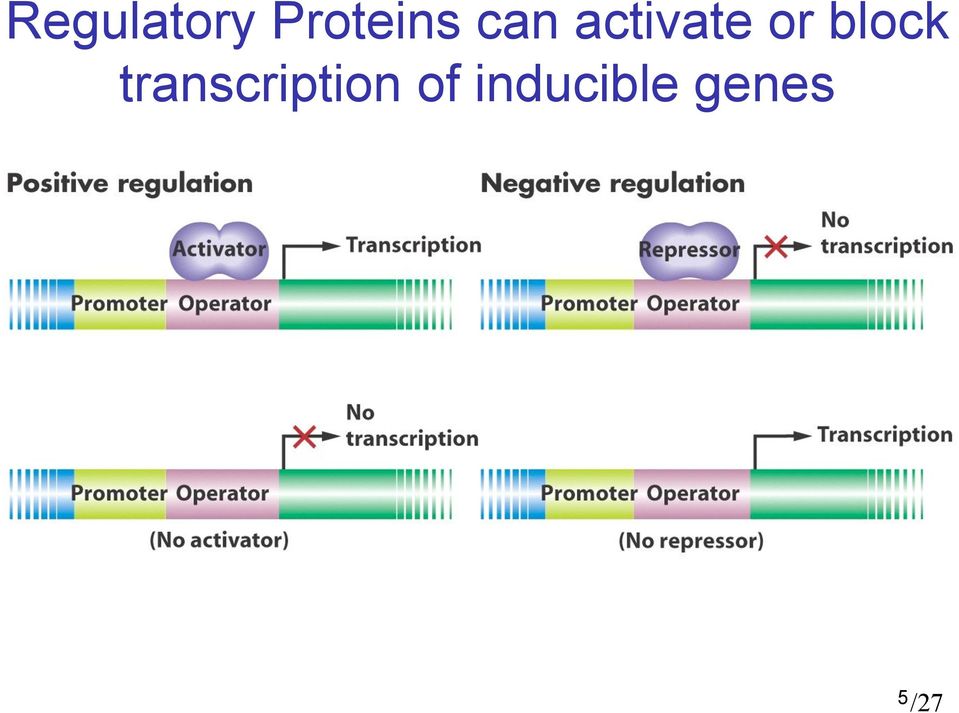
6 Generic Negative Regulation 6

7 Generic Positive Regulation 7

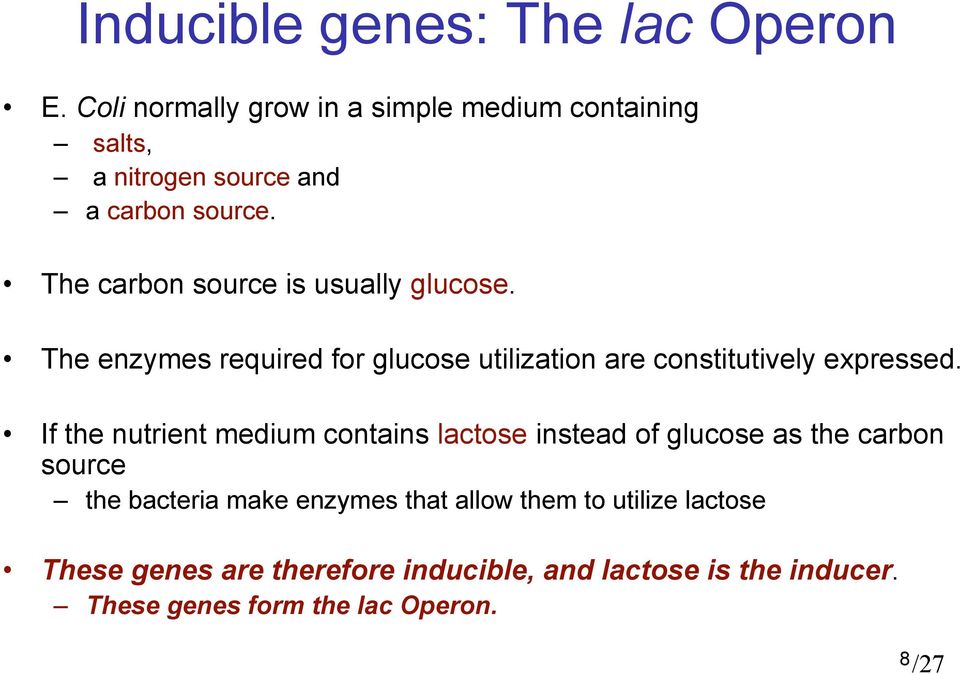
8 Inducible genes: The lac Operon E. Coli normally grow in a simple medium containing salts, a nitrogen source and a carbon source. The carbon source is usually glucose. The enzymes required for glucose utilization are constitutively expressed. If the nutrient medium contains lactose instead of glucose as the carbon source the bacteria make enzymes that allow them to utilize lactose These genes are therefore inducible, and lactose is the inducer. These genes form the lac Operon. 8
9 Details of Organization of the lac genes in E. Coli Peter J. Russell, igenetics: Copyright Pearson Education, Inc., publishing as Benjamin Cummings 9

10 Regulation of lac Operon The lac operon consists of the three functional genes lac Z, lac Y and lac A, plus: The operator region lac O, just downstream from the promoter region: this DNA sequence directly mediates cis-regulation The repressor region, lac I, just upstream from the promoter region: this region constitutively synthesizes repressor proteins which mediate trans-regulation by binding to the lac O sequence. In the presence of lactose, allolactose is formed, which binds to the repressor protein, rendering it incapable of binding to the lac O sequence. This prevents repression of the lac operon causing high level expression. 10
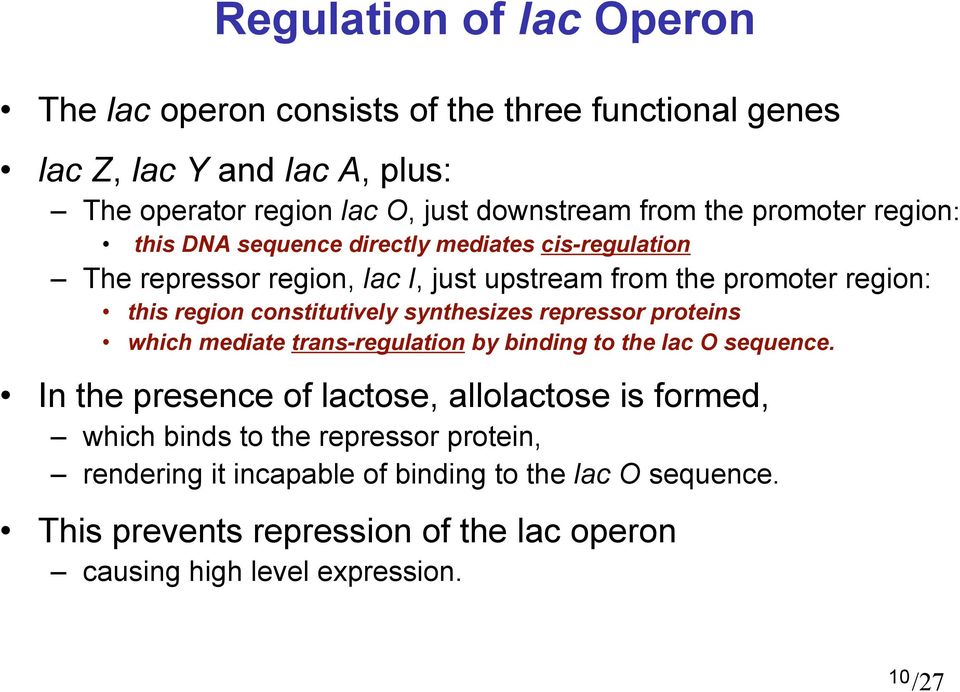
11 Regulation of lac operon in Wild-Type E.Coli in the absence of Lactose Peter J. Russell, igenetics: Copyright Pearson Education, Inc., publishing as Benjamin Cummings 11
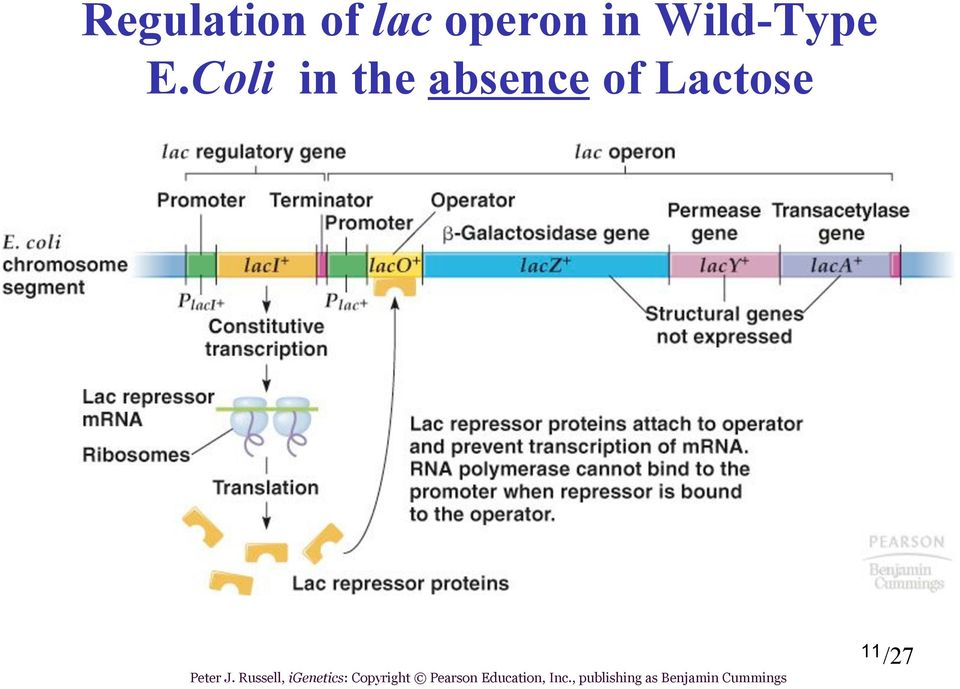
12 Regulation of lac operon in the presence of Lactose Peter J. Russell, igenetics: Copyright Pearson Education, Inc., publishing as Benjamin Cummings 12
13 How are the lac operon genes regulated? Two scientists, Jacob and Monod, developed mutant strains of E. Coli in which the lac operon genes were constitutively expressed. They identified two types of mutants: Mutation in a sequence termed lac O, upstream of the lac Z gene. Now we know as the Operator Mutation in a sequence further upstream termed lac I. If either of these regions was mutated there was constitutive expression of all of the lac operon genes. THEY MUST BE IMPORTANT FOR REGULATION! 13
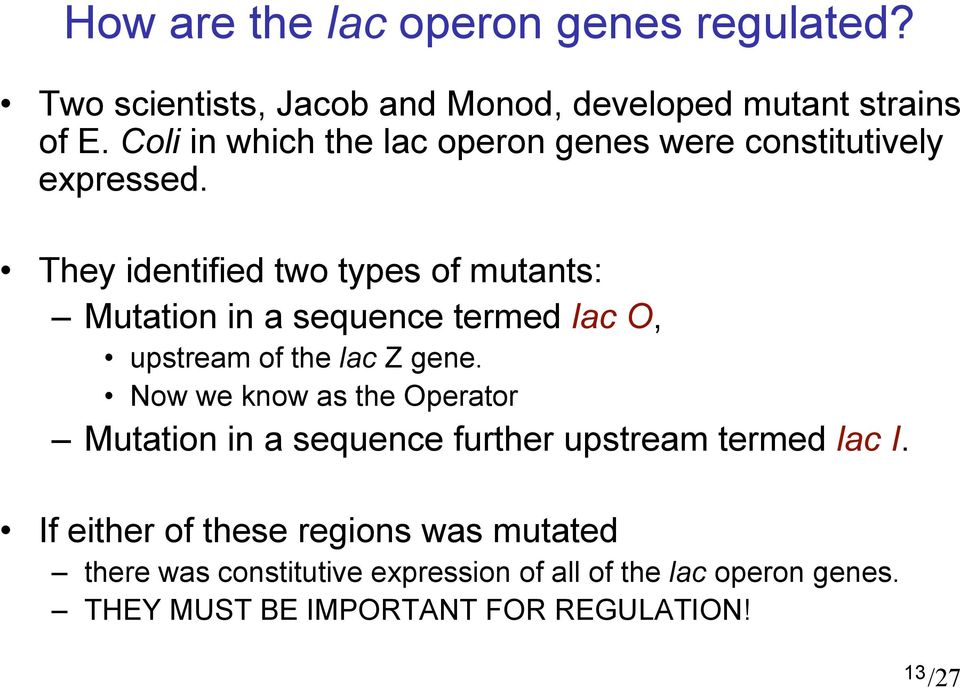
14 lac Oc (constitutive mutant) Absence of Inducer (No Lactose): Peter J. Russell, igenetics: Copyright Pearson Education, Inc., publishing as Benjamin Cummings 14
15 lac O c mutation Presence of Inducer (Lactose!): Peter J. Russell, igenetics: Copyright Pearson Education, Inc., publishing as Benjamin Cummings 15

16 lac I - mutation + or - Inducer (lactose) Peter J. Russell, igenetics: Copyright Pearson Education, Inc., publishing as Benjamin Cummings 16

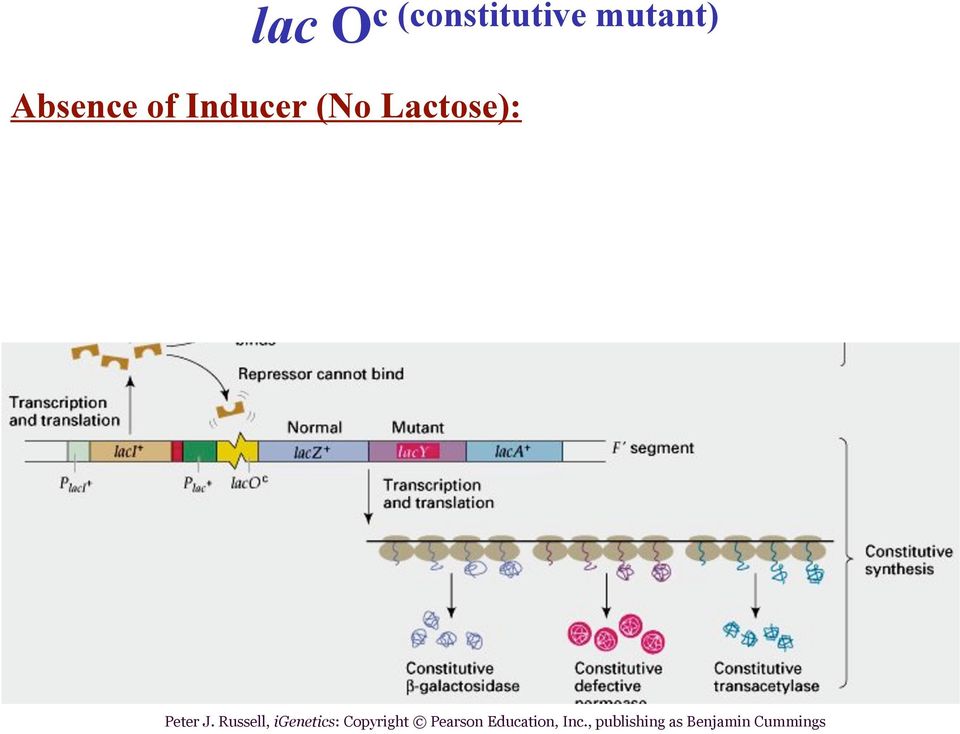
17 Trans-dominant effect of lac I S mutation (super repressor) Show no production of any of the operon genes either in the presence or absence of the inducer, lactose. The mutation causes a conformational change in the repressor protein it cannot bind to lactose, but can bind to the operator sequence. Peter J. Russell, igenetics: Copyright Pearson Education, Inc., publishing as Benjamin Cummings 17
18 The attenuation of gene expression: The presence of tryptophan activates a repressor of the trp operon trpr gene produces repressor Corepressor tryptophan binds to trp repressor allowing it to bind to operator DNA and inhibit transcription 18

19 19

20 Arabinose Operon Dual Positive and Negative Control Single DNA-binding protein may act as either a repressor or an activator arac protein Different from Lac Operon where 1 protein for neg reg Repressor protein (there is also a different protein for positive reg, but we are not going to talk about that!!!) 20
21 Arabinose Operon arac - constitutively active control gene O- operator arai - initiator containing the promoter arab, araa, arad - inducible polycistronic genes 21
22 The looping of DNA is a common feature of regulatory proteins (a) Arabinose present Arabinose binds to arai CAP-cAMP binds to arai Nothing binds to arao. RNA polymerase interacts with arac at the arai sites and transcribes genes (b) No arabinose arac acts as both a repressor and activator Binding of arac to arao and arai causes looping and prevents RNA from transcribing 22
23 Global regulatory mechanisms coordinate the expression of many genes Normal Temperature: Normal sigma factor (! 70 ) binds to RNA polymerase and recognizes sequence in promoter to initiate transcription High temperature: Disables normal sigma factor (! 70 ) Alternate sigma factor (! 32 ) binds to RNA polymerase and recognizes a different sequence in promoters of heat induced genes (heat shock genes) to initiate transcription Heat shock genes enhance survival at high temps 23
24 The Prokaryotic Transcription Process: Initiation of Transcription Most E. coli genes have a! 70 promoter, the most abundant sigma factor in the cell. Other sigma factors may be produced in response to changing conditions: 1.! 70 recognizes the sequence TTGACA at "35, and TATAAT at "10. 2.! 32 recognizes the sequence CCCCC at "39 and TATAAATA at "15. Sigma 32 arises in response to heat shock and other forms of!stress. 3.! 23 recognizes the sequence TATAATA at position "15. Sigma 23 is present in cells infected with phage T4. 24
25 Global regulatory mechanisms coordinate the expression of many genes Hexamers
26 Homework Problems Chapter 19 DON T forget to take the online QUIZ! DON T forget to submit the online iactivity: Mutations and Lac 26
MICROBIAL GENETICS. Gene Regulation: The Operons
 MICROBIAL GENETICS Gene Regulation: The Operons Pradeep Kumar Burma Reader Department of Genetics University of Delhi South Campus Benito Juarez Road New Delhi-110021 E-mail: [email protected] 05-May-2006
Lecture 1 MODULE 3 GENE EXPRESSION AND REGULATION OF GENE EXPRESSION. Professor Bharat Patel Office: Science 2, 2.36 Email: [email protected].
 Lecture 1 MODULE 3 GENE EXPRESSION AND REGULATION OF GENE EXPRESSION Professor Bharat Patel Office: Science 2, 2.36 Email: [email protected] What is Gene Expression & Gene Regulation? 1. Gene Expression
How To Understand How Gene Expression Is Regulated
 What makes cells different from each other? How do cells respond to information from environment? Regulation of: - Transcription - prokaryotes - eukaryotes - mrna splicing - mrna localisation and translation
Module 3 Questions. 7. Chemotaxis is an example of signal transduction. Explain, with the use of diagrams.
 Module 3 Questions Section 1. Essay and Short Answers. Use diagrams wherever possible 1. With the use of a diagram, provide an overview of the general regulation strategies available to a bacterial cell.
Gene Regulation -- The Lac Operon
 Gene Regulation -- The Lac Operon Specific proteins are present in different tissues and some appear only at certain times during development. All cells of a higher organism have the full set of genes:
GENE REGULATION. Teacher Packet
 AP * BIOLOGY GENE REGULATION Teacher Packet AP* is a trademark of the College Entrance Examination Board. The College Entrance Examination Board was not involved in the production of this material. Pictures
Gene Switches Teacher Information
 STO-143 Gene Switches Teacher Information Summary Kit contains How do bacteria turn on and turn off genes? Students model the action of the lac operon that regulates the expression of genes essential for
Chapter 18 Regulation of Gene Expression
 Chapter 18 Regulation of Gene Expression 18.1. Gene Regulation Is Necessary By switching genes off when they are not needed, cells can prevent resources from being wasted. There should be natural selection
Complex multicellular organisms are produced by cells that switch genes on and off during development.
 Home Control of Gene Expression Gene Regulation Is Necessary? By switching genes off when they are not needed, cells can prevent resources from being wasted. There should be natural selection favoring
Name Class Date. Figure 13 1. 2. Which nucleotide in Figure 13 1 indicates the nucleic acid above is RNA? a. uracil c. cytosine b. guanine d.
 13 Multiple Choice RNA and Protein Synthesis Chapter Test A Write the letter that best answers the question or completes the statement on the line provided. 1. Which of the following are found in both
Control of Gene Expression
 Home Gene Regulation Is Necessary? Control of Gene Expression By switching genes off when they are not needed, cells can prevent resources from being wasted. There should be natural selection favoring
13.4 Gene Regulation and Expression
 13.4 Gene Regulation and Expression Lesson Objectives Describe gene regulation in prokaryotes. Explain how most eukaryotic genes are regulated. Relate gene regulation to development in multicellular organisms.
Chem 465 Biochemistry II
 Chem 465 Biochemistry II Name: 2 points Multiple choice (4 points apiece): 1. Formation of the ribosomal initiation complex for bacterial protein synthesis does not require: A) EF-Tu. B) formylmethionyl
Activity 7.21 Transcription factors
 Purpose To consolidate understanding of protein synthesis. To explain the role of transcription factors and hormones in switching genes on and off. Play the transcription initiation complex game Regulation
7. 2. Regulation of gene expression. Unit 7: Molecular biology and genetics
 7. 2 Regulation of gene expression We all start off as one stem cell (a fertilised ovum) that divides to give a ball of cells. These cells then differentiate and become specialised to carry out specific
Transcription in prokaryotes. Elongation and termination
 Transcription in prokaryotes Elongation and termination After initiation the σ factor leaves the scene. Core polymerase is conducting the elongation of the chain. The core polymerase contains main nucleotide
1 Mutation and Genetic Change
 CHAPTER 14 1 Mutation and Genetic Change SECTION Genes in Action KEY IDEAS As you read this section, keep these questions in mind: What is the origin of genetic differences among organisms? What kinds
Genetics 301 Sample Final Examination Spring 2003
 Genetics 301 Sample Final Examination Spring 2003 50 Multiple Choice Questions-(Choose the best answer) 1. A cross between two true breeding lines one with dark blue flowers and one with bright white flowers
Central Dogma. Lecture 10. Discussing DNA replication. DNA Replication. DNA mutation and repair. Transcription
 Central Dogma transcription translation DNA RNA Protein replication Discussing DNA replication (Nucleus of eukaryote, cytoplasm of prokaryote) Recall Replication is semi-conservative and bidirectional
Biotechnology and Recombinant DNA (Chapter 9) Lecture Materials for Amy Warenda Czura, Ph.D. Suffolk County Community College
 Biotechnology and Recombinant DNA (Chapter 9) Lecture Materials for Amy Warenda Czura, Ph.D. Suffolk County Community College Primary Source for figures and content: Eastern Campus Tortora, G.J. Microbiology
Translation. Translation: Assembly of polypeptides on a ribosome
 Translation Translation: Assembly of polypeptides on a ribosome Living cells devote more energy to the synthesis of proteins than to any other aspect of metabolism. About a third of the dry mass of a cell
Bacterial Transformation and Plasmid Purification. Chapter 5: Background
 Bacterial Transformation and Plasmid Purification Chapter 5: Background History of Transformation and Plasmids Bacterial methods of DNA transfer Transformation: when bacteria take up DNA from their environment
Using chromosomal laci Q1 to control. high copy number plasmids in Escherichia coli. Weickert; Gene 223; 1998 : 221 231
 Using chromosomal laci Q1 to control expression of genes on high copy number plasmids in Escherichia coli Christopher B Glascock Michael J Christopher B. Glascock, Michael J. Weickert; Gene 223; 1998 :
Genetic information (DNA) determines structure of proteins DNA RNA proteins cell structure 3.11 3.15 enzymes control cell chemistry ( metabolism )
 Biology 1406 Exam 3 Notes Structure of DNA Ch. 10 Genetic information (DNA) determines structure of proteins DNA RNA proteins cell structure 3.11 3.15 enzymes control cell chemistry ( metabolism ) Proteins
IP-Free E. coli Inducible Expression Vectors. E. coli Secretion Signals. IP-Free E. coli Expression Vectors with the IPTG-inducible T5 Promoter
 IP-Free E. coli Inducible Expression Vectors E. coli expression vectors are available with the following promoters: T5 or T7 (IPTG-inducible), rhabad (rhamnose-inducible), ara (arabinose and IPTG-inducible)
The Effects of Glycerol, Glucose, Galactose, Lactose and Glucose with Galactose on the Induction of β-galactosidase in Escherichia coli
 The Effects of Glycerol, Glucose, Galactose, Lactose and Glucose with Galactose on the Induction of β-galactosidase in Escherichia coli VICKY CHAN, LISA F. DREOLINI, KERRY A. FLINTOFF, SONJA J. LLOYD,
DNA Fingerprinting. Unless they are identical twins, individuals have unique DNA
 DNA Fingerprinting Unless they are identical twins, individuals have unique DNA DNA fingerprinting The name used for the unambiguous identifying technique that takes advantage of differences in DNA sequence
from Cloned Genes Learning outcomes: By the end of this chapter you will have an understanding of:
 9 Production of Proteins from Cloned Genes Learning outcomes: By the end of this chapter you will have an understanding of: the reasons for producing proteins from cloned genes some of the more common
Bacterial Transformation with Green Fluorescent Protein. Table of Contents Fall 2012
 Bacterial Transformation with Green Fluorescent Protein pglo Version Table of Contents Bacterial Transformation Introduction..1 Laboratory Exercise...3 Important Laboratory Practices 3 Protocol...... 4
LAB 16 Rapid Colony Transformation of E. coli with Plasmid DNA
 LAB 16 Rapid Colony Transformation of E. coli with Plasmid DNA Objective: In this laboratory investigation, plasmids containing fragments of foreign DNA will be used to transform Escherichia coli cells,
Gene expression and regulation
 PYF12 3/21/05 8:04 PM Page 191 Chapter 12 Gene expression and regulation Bacterial genomes usually contain several thousand different genes. Some of the gene products are required by the cell under all
Feed Forward Loops in Biological Systems
 Feed Forward Loops in Biological Systems Dr. M. Vijayalakshmi School of Chemical and Biotechnology SASTRA University Joint Initiative of IITs and IISc Funded by MHRD Page 1 of 7 Table of Contents 1 INTRODUCTION...
Multiple Choice Write the letter that best answers the question or completes the statement on the line provided.
 Name lass Date hapter 12 DN and RN hapter Test Multiple hoice Write the letter that best answers the question or completes the statement on the line provided. Pearson Education, Inc. ll rights reserved.
A N OVERVIEW OF GENE EXPRESSION
 C H A P T E R E I G H T 8 C o n t r o l o f G e n e E x p r e s s i o n An organism's DNA encodes all of the RNA and protein molecules that are needed to make its cells. Yet a complete description of the
The Making of the Fittest: Evolving Switches, Evolving Bodies
 OVERVIEW MODELING THE REGULATORY SWITCHES OF THE PITX1 GENE IN STICKLEBACK FISH This hands-on activity supports the short film, The Making of the Fittest:, and aims to help students understand eukaryotic
Genetics Lecture Notes 7.03 2005. Lectures 1 2
 Genetics Lecture Notes 7.03 2005 Lectures 1 2 Lecture 1 We will begin this course with the question: What is a gene? This question will take us four lectures to answer because there are actually several
RNA: Transcription and Processing
 8 RNA: Transcription and Processing WORKING WITH THE FIGURES 1. In Figure 8-3, why are the arrows for genes 1 and 2 pointing in opposite directions? The arrows for genes 1 and 2 indicate the direction
Control of Gene Expression
 Control of Gene Expression What is Gene Expression? Gene expression is the process by which informa9on from a gene is used in the synthesis of a func9onal gene product. What is Gene Expression? Figure
Structure and Function of DNA
 Structure and Function of DNA DNA and RNA Structure DNA and RNA are nucleic acids. They consist of chemical units called nucleotides. The nucleotides are joined by a sugar-phosphate backbone. The four
Sample Questions for Exam 3
 Sample Questions for Exam 3 1. All of the following occur during prometaphase of mitosis in animal cells except a. the centrioles move toward opposite poles. b. the nucleolus can no longer be seen. c.
Green Fluorescent Protein (GFP): Genetic Transformation, Synthesis and Purification of the Recombinant Protein
 Green Fluorescent Protein (GFP): Genetic Transformation, Synthesis and Purification of the Recombinant Protein INTRODUCTION Green Fluorescent Protein (GFP) is a novel protein produced by the bioluminescent
Molecular Genetics. RNA, Transcription, & Protein Synthesis
 Molecular Genetics RNA, Transcription, & Protein Synthesis Section 1 RNA AND TRANSCRIPTION Objectives Describe the primary functions of RNA Identify how RNA differs from DNA Describe the structure and
BCH401G Lecture 39 Andres
 BCH401G Lecture 39 Andres Lecture Summary: Ribosome: Understand its role in translation and differences between translation in prokaryotes and eukaryotes. Translation: Understand the chemistry of this
Student Manual. pglo Transformation
 Student Manual pglo Transformation Lesson 1 Introduction to Transformation In this lab you will perform a procedure known as genetic transformation. Remember that a gene is a piece of DNA which provides
Chapter 6: Biological Networks
 Chapter 6: Biological Networks 6.4 Engineering Synthetic Networks Prof. Yechiam Yemini (YY) Computer Science Department Columbia University Overview Constructing regulatory gates A genetic toggle switch;
AP Biology TEST #5 - Chapters 11-14, 16 - REVIEW SHEET
 NAME: AP Biology TEST #5 - Chapters 11-14, 16 - REVIEW SHEET 1. Griffith's experiments showing the transformation of R strain pneumococcus bacteria to S strain pneumococcus bacteria in the presence of
From DNA to Protein. Proteins. Chapter 13. Prokaryotes and Eukaryotes. The Path From Genes to Proteins. All proteins consist of polypeptide chains
 Proteins From DNA to Protein Chapter 13 All proteins consist of polypeptide chains A linear sequence of amino acids Each chain corresponds to the nucleotide base sequence of a gene The Path From Genes
Induction of Enzyme Activity in Bacteria:The Lac Operon. Preparation for Laboratory: Web Tutorial - Lac Operon - submit questions
 Induction of Enzyme Activity in Bacteria:The Lac Operon Preparation for Laboratory: Web Tutorial - Lac Operon - submit questions I. Background: For the last week you explored the functioning of the enzyme
CCR Biology - Chapter 8 Practice Test - Summer 2012
 Name: Class: Date: CCR Biology - Chapter 8 Practice Test - Summer 2012 Multiple Choice Identify the choice that best completes the statement or answers the question. 1. What did Hershey and Chase know
Bacterial and Phage Genetic Switches
 Bacterial and Phage Genetic Switches Prof. C. J. Dorman Department of Microbiology, Moyne Institute of Preventive Medicine, Trinity College, Dublin. Lecture 1 The genetic switch controlling the lytic-lysogen
Actions of Hormones on Target Cells Page 1. Actions of Hormones on Target Cells Page 2. Goals/ What You Need to Know Goals What You Need to Know
 Actions of Hormones on Target Cells Graphics are used with permission of: Pearson Education Inc., publishing as Benjamin Cummings (http://www.aw-bc.com) Page 1. Actions of Hormones on Target Cells Hormones
GENETIC TRANSFORMATION OF BACTERIA WITH THE GENE FOR GREEN FLUORESCENT PROTEIN (GFP)
 GENETIC TRANSFORMATION OF BACTERIA WITH THE GENE FOR GREEN FLUORESCENT PROTEIN (GFP) LAB BAC3 Adapted from "Biotechnology Explorer pglo Bacterial Transformation Kit Instruction Manual". (Catalog No. 166-0003-EDU)
Name: Date: Period: DNA Unit: DNA Webquest
 Name: Date: Period: DNA Unit: DNA Webquest Part 1 History, DNA Structure, DNA Replication DNA History http://www.dnaftb.org/dnaftb/1/concept/index.html Read the text and answer the following questions.
Transfection-Transfer of non-viral genetic material into eukaryotic cells. Infection/ Transduction- Transfer of viral genetic material into cells.
 Transfection Key words: Transient transfection, Stable transfection, transfection methods, vector, plasmid, origin of replication, reporter gene/ protein, cloning site, promoter and enhancer, signal peptide,
BCOR101 Midterm II Wednesday, October 26, 2005
 BCOR101 Midterm II Wednesday, October 26, 2005 Name Key Please show all of your work. 1. A donor strain is trp+, pro+, met+ and a recipient strain is trp-, pro-, met-. The donor strain is infected with
AP BIOLOGY 2009 SCORING GUIDELINES
 AP BIOLOGY 2009 SCORING GUIDELINES Question 4 The flow of genetic information from DNA to protein in eukaryotic cells is called the central dogma of biology. (a) Explain the role of each of the following
Modeling and Simulation of Gene Regulatory Networks
 Modeling and Simulation of Gene Regulatory Networks Hidde de Jong INRIA Grenoble - Rhône-Alpes [email protected] http://ibis.inrialpes.fr INRIA Grenoble - Rhône-Alpes and IBIS IBIS: systems biology
DNA Replication in Prokaryotes
 OpenStax-CNX module: m44488 1 DNA Replication in Prokaryotes OpenStax College This work is produced by OpenStax-CNX and licensed under the Creative Commons Attribution License 3.0 By the end of this section,
Milestones of bacterial genetic research:
 Milestones of bacterial genetic research: 1944 Avery's pneumococcal transformation experiment shows that DNA is the hereditary material 1946 Lederberg & Tatum describes bacterial conjugation using biochemical
Effects of Antibiotics on Bacterial Growth and Protein Synthesis: Student Laboratory Manual
 Effects of Antibiotics on Bacterial Growth and Protein Synthesis: Student Laboratory Manual I. Purpose...1 II. Introduction...1 III. Inhibition of Bacterial Growth Protocol...2 IV. Inhibition of in vitro
Disaccharides consist of two monosaccharide monomers covalently linked by a glycosidic bond. They function in sugar transport.
 1. The fundamental life processes of plants and animals depend on a variety of chemical reactions that occur in specialized areas of the organism s cells. As a basis for understanding this concept: 1.
What is the difference between basal and activated transcription?
 What is the difference between basal and activated transcription? Regulation of Transcription I. Basal vs. activated transcription for mrna genes A. General transcription factor (TF) vs. promoterspecific
RNA & Protein Synthesis
 RNA & Protein Synthesis Genes send messages to cellular machinery RNA Plays a major role in process Process has three phases (Genetic) Transcription (Genetic) Translation Protein Synthesis RNA Synthesis
GENE CLONING AND RECOMBINANT DNA TECHNOLOGY
 GENE CLONING AND RECOMBINANT DNA TECHNOLOGY What is recombinant DNA? DNA from 2 different sources (often from 2 different species) are combined together in vitro. Recombinant DNA forms the basis of cloning.
What are the particular activities designed to do?
 Notes to Instructors Chapter 16 The Molecular Basis of Inheritance What is the focus of these activities? Almost all introductory biology students know that DNA is the hereditary material in living cells.
Catalysis by Enzymes. Enzyme A protein that acts as a catalyst for a biochemical reaction.
 Catalysis by Enzymes Enzyme A protein that acts as a catalyst for a biochemical reaction. Enzymatic Reaction Specificity Enzyme Cofactors Many enzymes are conjugated proteins that require nonprotein portions
NO CALCULATORS OR CELL PHONES ALLOWED
 Biol 205 Exam 1 TEST FORM A Spring 2008 NAME Fill out both sides of the Scantron Sheet. On Side 2 be sure to indicate that you have TEST FORM A The answers to Part I should be placed on the SCANTRON SHEET.
Plant Growth & Development. Growth Stages. Differences in the Developmental Mechanisms of Plants and Animals. Development
 Plant Growth & Development Plant body is unable to move. To survive and grow, plants must be able to alter its growth, development and physiology. Plants are able to produce complex, yet variable forms
The world of non-coding RNA. Espen Enerly
 The world of non-coding RNA Espen Enerly ncrna in general Different groups Small RNAs Outline mirnas and sirnas Speculations Common for all ncrna Per def.: never translated Not spurious transcripts Always/often
Translation Study Guide
 Translation Study Guide This study guide is a written version of the material you have seen presented in the replication unit. In translation, the cell uses the genetic information contained in mrna to
Qualitative Simulation and Model Checking in Genetic Regulatory Networks
 An Application of Model Checking to a realistic biological problem: Qualitative Simulation and Model Checking in Genetic Regulatory Networks A presentation of Formal Methods in Biology Justin Hogg [email protected]
The sequence of bases on the mrna is a code that determines the sequence of amino acids in the polypeptide being synthesized:
 Module 3F Protein Synthesis So far in this unit, we have examined: How genes are transmitted from one generation to the next Where genes are located What genes are made of How genes are replicated How
To be able to describe polypeptide synthesis including transcription and splicing
 Thursday 8th March COPY LO: To be able to describe polypeptide synthesis including transcription and splicing Starter Explain the difference between transcription and translation BATS Describe and explain
Chapter 5: Organization and Expression of Immunoglobulin Genes
 Chapter 5: Organization and Expression of Immunoglobulin Genes I. Genetic Model Compatible with Ig Structure A. Two models for Ab structure diversity 1. Germ-line theory: maintained that the genome contributed
Protein Synthesis How Genes Become Constituent Molecules
 Protein Synthesis Protein Synthesis How Genes Become Constituent Molecules Mendel and The Idea of Gene What is a Chromosome? A chromosome is a molecule of DNA 50% 50% 1. True 2. False True False Protein
DNA as a Mass-Storage Device: 1
 DNA as a Mass-Storage Device Robert J. Robbins Johns Hopkins University [email protected] DNA as a Mass-Storage Device: 1 Goals of the Genome Project Sequence the Genome equivalent to obtaining an image
DNA Replication & Protein Synthesis. This isn t a baaaaaaaddd chapter!!!
 DNA Replication & Protein Synthesis This isn t a baaaaaaaddd chapter!!! The Discovery of DNA s Structure Watson and Crick s discovery of DNA s structure was based on almost fifty years of research by other
Chapter 11: Molecular Structure of DNA and RNA
 Chapter 11: Molecular Structure of DNA and RNA Student Learning Objectives Upon completion of this chapter you should be able to: 1. Understand the major experiments that led to the discovery of DNA as
PRACTICE TEST QUESTIONS
 PART A: MULTIPLE CHOICE QUESTIONS PRACTICE TEST QUESTIONS DNA & PROTEIN SYNTHESIS B 1. One of the functions of DNA is to A. secrete vacuoles. B. make copies of itself. C. join amino acids to each other.
CHAPTER 6: RECOMBINANT DNA TECHNOLOGY YEAR III PHARM.D DR. V. CHITRA
 CHAPTER 6: RECOMBINANT DNA TECHNOLOGY YEAR III PHARM.D DR. V. CHITRA INTRODUCTION DNA : DNA is deoxyribose nucleic acid. It is made up of a base consisting of sugar, phosphate and one nitrogen base.the
2006 7.012 Problem Set 3 KEY
 2006 7.012 Problem Set 3 KEY Due before 5 PM on FRIDAY, October 13, 2006. Turn answers in to the box outside of 68-120. PLEASE WRITE YOUR ANSWERS ON THIS PRINTOUT. 1. Which reaction is catalyzed by each
Cellular Respiration Worksheet 1. 1. What are the 3 phases of the cellular respiration process? Glycolysis, Krebs Cycle, Electron Transport Chain.
 Cellular Respiration Worksheet 1 1. What are the 3 phases of the cellular respiration process? Glycolysis, Krebs Cycle, Electron Transport Chain. 2. Where in the cell does the glycolysis part of cellular
Gene Models & Bed format: What they represent.
 GeneModels&Bedformat:Whattheyrepresent. Gene models are hypotheses about the structure of transcripts produced by a gene. Like all models, they may be correct, partly correct, or entirely wrong. Typically,
R. Landstorfer et al. BMC Genomics, 2014. Audrey Segura
 Comparison of strand-specific transcriptomes of enterohemorrhagic Escherichia coli O157:H7 EDL933 under eleven different environmental conditions including radish sprouts and cattle feces R. Landstorfer
Name Date Period. 2. When a molecule of double-stranded DNA undergoes replication, it results in
 DNA, RNA, Protein Synthesis Keystone 1. During the process shown above, the two strands of one DNA molecule are unwound. Then, DNA polymerases add complementary nucleotides to each strand which results
Mechanism of hormone action
 Mechanism of hormone action ผศ.ดร.พญ.ส ว ฒณ ค ปต ว ฒ ภาคว ชาสร รว ทยา คณะแพทยศาสตร ศ ร ราชพยาบาล Aims What is hormone receptor Type of hormone receptors - cell surface receptor - intracellular receptor
Enzymes and Metabolism
 Enzymes and Metabolism Enzymes and Metabolism Metabolism: Exergonic and Endergonic Reactions Chemical Reactions: Activation Every chemical reaction involves bond breaking and bond forming A chemical reaction
Lecture 6. Regulation of Protein Synthesis at the Translational Level
 Regulation of Protein Synthesis (6.1) Lecture 6 Regulation of Protein Synthesis at the Translational Level Comparison of EF-Tu-GDP and EF-Tu-GTP conformations EF-Tu-GDP EF-Tu-GTP Next: Comparison of GDP
A Mathematical Model of a Synthetically Constructed Genetic Toggle Switch
 BENG 221 Mathematical Methods in Bioengineering Project Report A Mathematical Model of a Synthetically Constructed Genetic Toggle Switch Nick Csicsery & Ricky O Laughlin October 15, 2013 1 TABLE OF CONTENTS
Recombinant DNA & Genetic Engineering. Tools for Genetic Manipulation
 Recombinant DNA & Genetic Engineering g Genetic Manipulation: Tools Kathleen Hill Associate Professor Department of Biology The University of Western Ontario Tools for Genetic Manipulation DNA, RNA, cdna
Transcription and Translation of DNA
 Transcription and Translation of DNA Genotype our genetic constitution ( makeup) is determined (controlled) by the sequence of bases in its genes Phenotype determined by the proteins synthesised when genes
Genetics Test Biology I
 Genetics Test Biology I Multiple Choice Identify the choice that best completes the statement or answers the question. 1. Avery s experiments showed that bacteria are transformed by a. RNA. c. proteins.