
GENETIC TRANSFORMATION OF BACTERIA WITH THE GENE FOR GREEN FLUORESCENT PROTEIN (GFP)
|
|
|
- Marybeth Cox
- 9 years ago
- Views:
Transcription
1 GENETIC TRANSFORMATION OF BACTERIA WITH THE GENE FOR GREEN FLUORESCENT PROTEIN (GFP) LAB BAC3 Adapted from "Biotechnology Explorer pglo Bacterial Transformation Kit Instruction Manual". (Catalog No EDU) BIO-RAD Laboratories, 2000 Alfred Nobel Drive, Hercules CA STANDARDS ADDRESSED A/3.1.12A Apply concepts of systems and control at the molecular level to assess the outcome of bacterial transformation B/3.2.12B Describe the transformation results using precise quantitative and qualitative skills based on observations. Evaluate the experimental data correctly within experimental limits C/3.3.12C Describe how genetic information is inherited and expressed at t the molecular level. KEY CONCEPTS: Genetic transformation, plasmid DNA, cloning, restriction enzymes, antibiotic selection, gene regulation, transcription, protein expression INTRODUCTION Genetic transformation is the process by which a gene or genes from one organism are transferred to another organism via an engineered molecule of DNA. If the procedure is successful, the organism is capable of producing the protein encoded by the transformed gene, thus creating a genetic change. Genetic transformation is commonly used in biotechnology. In agriculture, transformation is used to confer genes for pest, frost and spoilage resistance. Transformation of the human insulin gene into bacteria has allowed for production of the protein on a large scale. 1 To aid in bioremediation of oil spills, bacteria are transformed with genes that allow them to digest toxic components of the oil. 2 The procedure contained in this lab will allow for the transformation of bacteria with a gene from the bioluminescent jellyfish, Aequorea victoria. A successful transformation will result in the expression of the green fluorescent protein (GFP) in the bacteria, causing them to glow bright green under long-wave UV light MICRO3-1

2 Transformation and Antibiotic Selection: Genetic transformation in this laboratory will be facilitated by using the pglo plasmid (see below). A plasmid is a circular, selfreplicating DNA molecule which can be contained in a bacterial host cell without interfering with the function of the bacterial chromosome. Bacteria are capable, on their own, of randomly acquiring small pieces of DNA from their environment, but the process is inefficient. The transformation protocol in this lab uses a chemical, calcium chloride (CaCl 2 ), plus heat to increase the efficiency of DNA uptake by the bacterial cell. Even with the chemical transformation procedure, not every bacterial cell will incorporate the pglo Figure 1 plasmid into the bacteria, not every cell will receive a copy of the plasmid. To isolate only the cells containing the pglo DNA, the plasmid contains the beta-lactamase gene which encodes for an ampicillin resistance (Amp r ) protein. After the transformation, the cells are grown on a solid medium called an agar plate. This medium will contain the antibiotic ampicillin. In the presence of the ampicillin, only the bacteria containing the pglo plasmid will have the Amp r protein which will break down the antibiotic, and be able to grow (Fig. 2). This process is called antibiotic selection. Figure 2. Transformed Bacterium: This is a diagram of what is occurring inside a bacterium transformed with the pglo plasmid. The bacterium is plated on agar medium containing ampicillin. To grow, the bacterium must contain a pglo plasmid and be expressing the ampicillin resistance protein, β-lactamase (Amp r ). The ampicillin is inactivated by the β-lactamase protein, allowing the bacterium to grow on medium containing the antibiotic. = pglo plasmid =Amp r Bacterial chromosome pore = transcription & translation = ampicillin/ inactivation Cloning a Gene: Plasmids can be engineered to carry a variety of genes that are not endogenous to the host cell, like the GFP gene. A plasmid usually starts out as a very small piece of DNA that contains a replication origin, an antibiotic resistance gene and a cloning region, an area of the DNA that has multiple unique restriction enzyme sites. BAC3-2

3 Restriction enzymes are proteins which recognize specific DNA sequences and will cleave, or cut, the DNA backbone at these sequences. Once the DNA backbone is cleaved, it is possible to add, or clone, new DNA into this site. The diagram of the pglo plasmid (Fig. 1) shows restriction sites for the enzymes NdeI, EcoRI, and HindIII, enzymes that are part of the original cloning site on the plasmid. The pglo plasmid also carries the gene arac, which produces a protein needed for transcription of genes in the presence of arabinose sugar. The purpose of this protein is discussed below. Transcriptional Gene Regulation: In many cases, a researcher may want to control when a cloned gene is producing mrna, and the corresponding protein. Proteins called transcription factors are frequently used by cells to turn transcription on or off depending on environmental conditions. The transcription, or production of mrna, of the pglo gene is controlled by using a promoter that is only active in the presence of the sugar arabinose (Fig. 3). The AraC protein, encoded by the arac gene on the pglo plasmid, is the transcription factor necessary for this control. This protein is bound at the pglo promoter site, but without arabinose is in the incorrect conformation, or shape, to recruit RNA polymerase and initiate transcription. (See figure below) In the presence of arabinose, the sugar binds to the AraC protein and changes its conformation so that in combination with RNA polymerase, transcription is initiated and an mrna transcript is produced. In bacteria, transcription and translation, or protein synthesis, occurs simultaneously, and the GFP protein is produced. BAC3-3

4 Fig. 3 Regulation of the GFP Gene promoter AraC GFP A. In a cell with no arabinose present, the AraC protein, bound to the DNA, is in the wrong configuration to recruit RNA polymerase to the transcriptional promoter. This means the promoter is off and there is no transcription of the GFP gene. arabinose AraC GFP B. A bacterium is able to take up arabinose when it is present in the environment. Once inside the cell, arabinose binds to the AraC protein, changing its shape, or conformation, on the DNA. This new protein conformation recruits RNA polymerase to the transcriptional promoter. AraC RNA Pol GFP C. The binding of the RNA polymerase turns the promoter on and allows transcription of the GFP gene. mrna transcript AraC GFP RNA Pol D. Transcription of the GFP produces an mrna transcript. In bacteria, transcription and translation (synthesis of proteins) can occur simultaneously, and the GFP protein is produced within the cell. In this lab, it is important to confirm which cells have received the plasmid, and under which conditions the β-lactamase and GFP proteins are being produced (Fig. 4). When the pglo transformations are plated on agar medium containing ampicillin and arabinose, a series of controls will be plated as well (Fig. 5). Two transformations will be performed: one with pglo plasmid (+pglo) and one without the plasmid present (- pglo). A portion of the pglo transformation is plated on an agar medium without ampicillin or arabinose. This control is to be sure the bacteria are viable after the chemical and heat transformation procedure. This plate should be covered with a bacterial lawn. Another portion of the pglo transformation is plated on an agar plate BAC3-4

5 Figure 4. Expression of GFP: This is a diagram of what is occurring inside a bacterium transformed with the pglo plasmid. The bacterium is plated on agar medium containing ampicillin and arabinose. To grow, the bacterium must contain a pglo plasmid and be expressing the ampicillin resistance protein, β-lactamase. In the presence of arabinose, transcription of the GFP gene is enabled, resulting in expression of the GFP protein. = pglo plasmid =Amp r Bacterial chromosome pore = GFP protein = transcription & translation containing ampicillin. No bacteria should grow on this plate. If it does, it means the bacterial culture has acquired resistance and is no longer suitable for use in this experiement. The +pglo transformation is also plated on two different types of media. The first portion of the transformation is plated on agar containing ampicillin only. This control proves that the transcriptional control of the GFP gene is intact, and no GFP protein is produced in the absence of the arabinose sugar. The final plate is the experimental plate, containing both ampicillin and arabinose. The bacteria on this plate are the only ones that should glow when exposed to long-wave UV light. Figure 5: Controls for transformation of the pglo plasmid LB = positive control for cell growth LB amp= negative control for cell growth LB amp = transformation; Amp r w/o GFP expression LB amp/ara = transformation; Amp r and GFP production -pglo Plasmid HB101 cells +pglo Plasmid HB101 cells BAC3-5

6 PROCEDURES It is important to remember that sterile technique is extremely important for this lab. All the materials provided are sterile and proper handling of these supplies and reagents should result in minimal contamination problems. Lab Station Materials 2 sterile 1.5 ml microtubes Sharpie pen Sterile transfer pipets (10) Sterile CaCl 2 transformation solution (600 µl) Sterile loops (8) pglo plasmid DNA Ice water baths Foam microtube rack LB plate (black stripe) 2 LB amp plates (red stripe) LB amp/ara plate (green stripe) Water 42 C Sterile LB broth (600 µl) C Incubator (optional) Lab tape Microtube rack Procedure 1. There are 2 sterile 1.5 ml microfuge tubes at the lab station. Label one tube +pglo, the other -pglo. 2. Locate the tube labeled Transformation Solution ; this contains a solution of CaCl 2. With a sterile pipet, aliquot 250 µl transformation solution to both the -pglo and +pglo tubes. Place both tubes in an ice water bath. 3. The lab station will contain a starter plate of HB101 bacteria. These bacteria contain only chromosomal DNA. Take notes on how these bacteria look in visible and UV light for comparison with the transformed bacteria later in the lab. The lab station will also include pre-packaged sterile loops (look like a very small soap bubble wand). Remove a sterile loop from the package being careful not to touch the loop on anything outside the bag. Remove the cover from the starter plate and pick a single colony of the HB101 bacteria. Immediately place the loop into the transformation solution in the tube marked +pglo and spin the loop until the entire colony is dispersed into the liquid. Check to be sure there are no bacterial clumps floating in the transformation solution; cell clumps will negatively affect the efficiency of the transformation. Place the tube back in the ice water bath when the cell suspension is complete. 4. Using a new sterile loop, repeat the procedure in Step 3 for the -pglo tube of transformation solution. 5. Inspect the pglo plasmid solution with the UV lamp provided and note your observations. What do you expect to see at this step? Take the 2-20 µl pipettor, set it to BAC3-6

7 5 µl. Carefully remove 5 µl of the pglo plasmid solution and add the DNA into the +pglo cell suspension. Mix the plasmid with the bacterial cells by tapping the tube gently on the bench top. Close the tube and return it to the ice water bath. Why do you not add plasmid DNA to the tube labeled -pglo? 6. Incubate both the +pglo and the -pglo tubes in the ice water bath for 10 min. Make sure the bottom of the tube is pushed through the foam rack and is in contact with the ice water. 7. While the tubes are incubating on ice, label the 4 agar plates at your lab station as follows: Color code: red stripe green stripe red stripe black stripe Be sure to label the bottom of the plates (the portion containing the agar). It is very important to label each plate correctly! Remember, the color code on the side of the agar plates indicates which medium already contains the ampicillin for antibiotic selection and arabinose for GFP expression. It will be confusing to analyze the results if you have mislabeled the plates! 8. To transform the plasmid DNA into the bacteria, the cells must undergo a heat shock. This is performed by removing the foam rack from the ice water bath and placing it rapidly in a 42 C water bath. Incubate the tubes at 42 C for exactly 50 seconds. Again, it is important that the tubes are pushed down in the rack so that the bottom of the tubes have optimal contact with the 42 C water. After the heat shock, immediately place the foam rack back in the ice water and incubate for a further 2 min. 9. Remove the foam rack from the ice water bath and place the tubes in the microtube rack on the bench. Add 250 µl of LB broth to each tube, close the cap and gently tap the +pglo and -pglo tube to mix the contents. Incubate the tubes for 10 min at room temperature. This step of the procedure allows the cells to recover from the heat shock treatment before performing the next part of the experiment. It also lets the cells that have acquired a pglo plasmid begin to express the β-lactamase protein (for ampicillin resistance) before the cells are placed on plates that contain ampicillin. BAC3-7

8 10. Using a new sterile pipet for each tube, pipet 100 µl of the transformation and control suspensions onto the appropriate plates 11. Spread the suspensions evenly around the agar plate by quickly sliding the flat loop surface back and forth across the plate surface. Turning the plate in a circular motion with your fingers while swishing the loop back and forth aids in spreading the bacterial suspensions evenly. Do not press down too firmly or you will gouge the surface of the agar plate. This can complicate both the growth and analysis of the bacteria on the plates. Remember to use a new sterile loop for each plate! Let the plates sit on the bench for 2-3 minutes to allow the suspensions to soak into the plate. 12. Stack the plates and tape them together. Label the tape with the group name and class period, if necessary. Turn the plates upside down (with agar at top of plate) and place in a 37 C incubator overnight. If an incubator is not available, the plates may be grown on the bench top for 2-3 days. Stack of upsidedown plates: Incubate at 37 C BAC3-8

9 DATA & ANALYSIS SHEETS Name: Class: Date: Day 1: Predictions & Questions a. Which agar plate should contain the most colonies? The least? What do these two control plates tell us? b. On which plate(s) should the bacterial colonies glow when examined with the UV light? c. One of these plates will contain bacteria that contain the pglo plasmid, but will not fluoresce when examined with the UV light. Which plate is this, and why won t the colonies glow? d. In the -pglo tube, there was no DNA present to transform into the cells. Why does this tube need to go through the heat shock procedure? Day 2: Data Collection and Analysis of Results Observe the results you obtained from the transformation lab under normal room lighting. Then turn out the lights and hold the ultraviolet light over the plates. 1. Carefully observe and draw what you see on each of the four plates in the table below. Record your data to allow you to compare observations of the + pglo cells with your observations for the non-transformed E. coli. Write down the following observations for each plate. 2. How much bacterial growth do you see on each plate, relatively speaking? 3. What color are the bacteria? 4. How many bacterial colonies are on each plate (count the spots you see)? BAC3-9

10 Data Collection Table: General growth # bacteria color (vis/uv light) Analysis of Data: 1. On Day 1, you made predictions about what would happen on each plate in terms of bacterial growth. How does the data collected compare with your predictions? If there are significant differences, what do you think caused them? BAC3-10

11 2. Both of the plates that contain the -pglo samples are controls. What information is given by these plates that aids in interpreting the +pglo plates? a. -pglo on LB agar: b. -pglo on LB amp agar: 3. Very often an organism s traits are caused by a combination of its genes and its environment. Think about the green color you saw in the genetically transformed bacteria: a. What two factors must be present in the bacteria s environment for you to see the green color? (Hint: One factor is in the plate, the other is in how you observe the bacteria.) b. What do you think each of the two environmental factors you listed above are doing to cause the genetically transformed bacteria to turn green? c. What advantage would there be for an organism to be able to turn on or off particular genes in response to certain conditions? BAC3-11

12 4. Your and your partner performed the pglo transformation lab, correctly plated the bacteria after transformation and placed your carefully labeled plates in the 37 C incubator. Unfortunately, as an April Fools Day prank, another student wiped all the identifying labels off the plates with an organic chemical. Assume the transformation was successful. Based on your predictions and the data you collect from the plates, is there a way to deduce which plate is which? Which plates contain bacteria with the transformed pglo plasmid? Which plate is the LB agar? Which plates contain ampicillin, arabinose or both? What factors help you make your decision? Appearance of Bacteria # bacteria room light under UV pglo? Amp/Ara? 88 tan green Lawn tan white No growth tan white BAC3-12

13 EXTENSION ACTIVITY C alculate Transformation Efficiency Transformation efficiency is a way of calculating how many bacterial cells actually received the pglo plasmid during the transformation procedure. In many experiments, like gene therapy, optimizing the number of cells receiving new genetic material is very important. There are two important pieces of information you will need to determine the transformation efficiency. 1. The total number of green fluorescent colonies growing on the LB amp/ara plate. This is data you have already obtained when analyzing your plates. = # of green fluorescent colonies 2. The total amount of pglo plasmid DNA in the bacterial cells spread on the LB amp/ara plate. This part of the calculation has a several steps which will determine the amount of pglo plasmid spread on the LB amp/ara plate. a. The stock solution of pglo plasmid DNA is: 80 ng or 0.08 μ g μ L μl b. The total amount of pglo plasmid added to the transformation tube is calculated by multiplying: (concentration of DNA in µg/µl) x (volume of DNA in µl) = DNA in µg Or 5 µl X 0.08 μ g = µg = Total pglo in transformation μl c. Since not all the DNA you added to the bacterial cells will be transferred to the agar plate, you need to find out what fraction of the DNA was actually spread onto the LB amp/ara plate. To do this, divide the volume of the transformation solution spread on the LB amp/ara plate by the total volume of liquid in the test tube containing the DNA. Calculate the total transformation solution volume: CaCl 2 Solution = µl Volume on plate = µl pglo plasmid solutio n = µl LB broth = µl µl total volume BAC3-13

14 Fraction of transformation = Volume spread on LB amp/ara plate (µl) = used Total transformation volume in tube (µl) d. The fraction of transformation solution gives a percentage. To calculate the amount of pglo plasmid on the plate, multiply this percentage (from c.) by the total µg pglo DNA (from b.). (Fraction of transformation) X (total µg pglo) = pglo plasmid on plate (µg) X µg = µg e. The final calculation is to determine the number of colony forming units (cfu) per ug DNA transformed. Divide the number of colonies counted on the LB amp/ara plate (see Step 1) by the µg DNA determined in 2d. (above). # colonies = = cfu µg DNA µg µg The transformation efficiency will vary greatly depending on the method of transformation used. It is almost always expressed in scientific notation. For example, if you calculate a transformation efficiency of 550 cfu/µg, then you would write this as: x 10 cfu/µg BAC3-14

15 Flow Chart of pglo Transformation Protocol = Overnight step Label two tubes +pglo and -pglo. Add 250 µl transformation _ solution to each. Place + tube in ice water bath + _ Inoculate each tube with HB101 bacterial colony from starter plate. Disperse bacteria evenly and place tubes back in ice water bath + Add 5 µl of the pglo plasmid to the +pglo tube. Mix well and place tube back in ice water bath. _ Incubate tubes on ice for 10 min. Label LB agar plates during incubation. -pglo LB -pglo LB amp +pglo LB amp +pglo LB amp/ara + Heat shock transformation mix tubes in 42 C water bath for 50 sec. _ Incubate tubes on ice for 2 more min. _ + Remove tubes from ice & place on bench. Add 250 µl LB broth to each. Incubate for 10 min at room temperature. (Go to next page.) BAC3-15
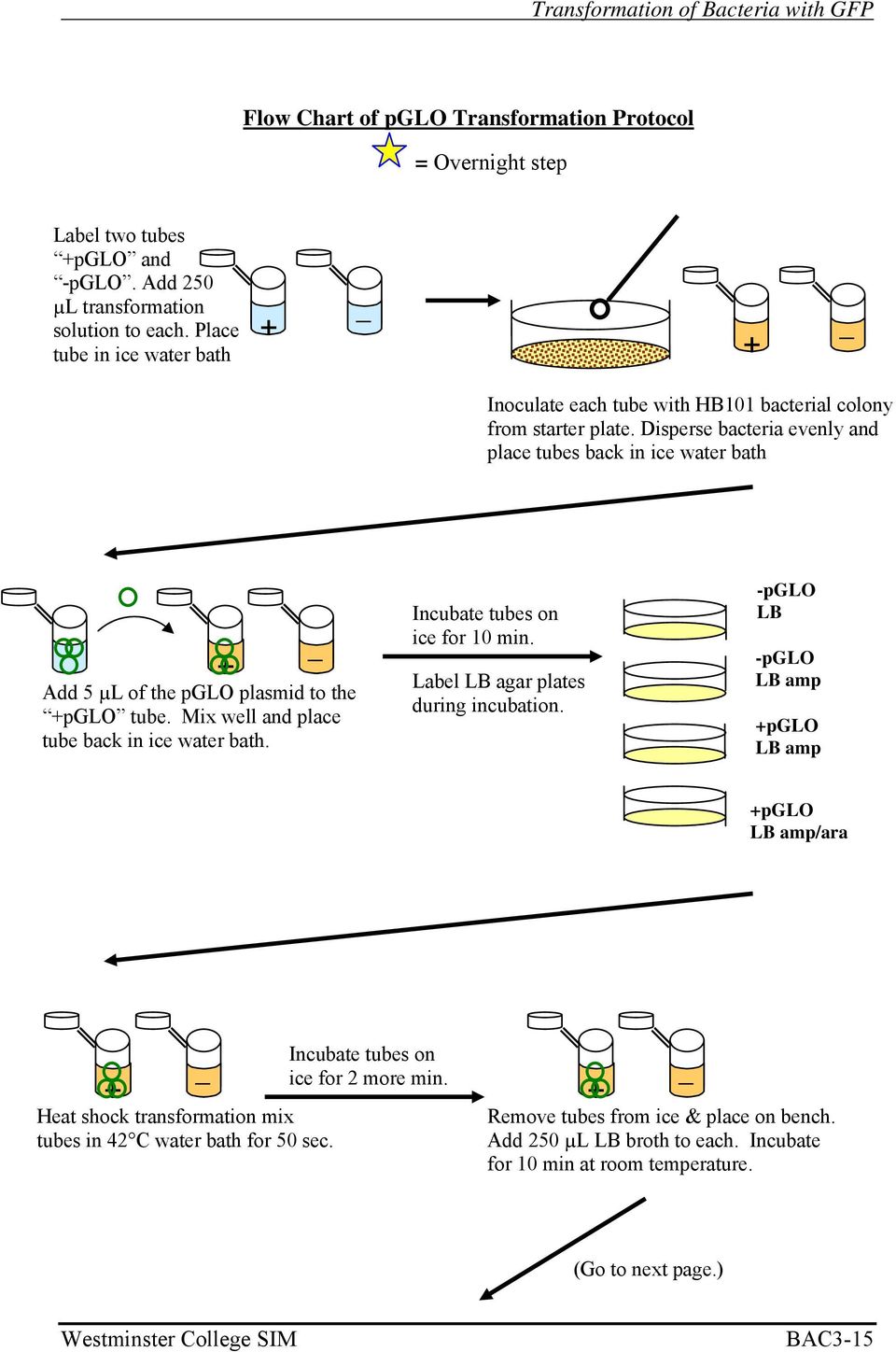
16 _ Use a sterile spreader to plate 100 µl of appropriate transformation mix on each labeled agar plate. + LB = positive control for growth LB amp= negative control for growth LB amp = transformation; Amp r w/o GFP expression LB amp/ara = transformation; Amp r and GFP production Grow plates overnight at 37 C. Do not overgrow or individual colonies may be difficult to count. LB = positive control for growth LB amp= negative control for growth LB amp = transformation; Amp r w/o GFP expression LB amp/ara = transformation; Amp r and GFP production Analyze results of plates in the following class period. BAC3-16

Green Fluorescent Protein (GFP): Genetic Transformation, Synthesis and Purification of the Recombinant Protein
 Green Fluorescent Protein (GFP): Genetic Transformation, Synthesis and Purification of the Recombinant Protein INTRODUCTION Green Fluorescent Protein (GFP) is a novel protein produced by the bioluminescent
Bacterial Transformation with Green Fluorescent Protein. Table of Contents Fall 2012
 Bacterial Transformation with Green Fluorescent Protein pglo Version Table of Contents Bacterial Transformation Introduction..1 Laboratory Exercise...3 Important Laboratory Practices 3 Protocol...... 4
Transformation of the bacterium E. coli. using a gene for Green Fluorescent Protein
 Transformation of the bacterium E. coli using a gene for Green Fluorescent Protein Background In molecular biology, transformation refers to a form of genetic exchange in which the genetic material carried
Student Manual. pglo Transformation
 Student Manual pglo Transformation Lesson 1 Introduction to Transformation In this lab you will perform a procedure known as genetic transformation. Remember that a gene is a piece of DNA which provides
Transformation Kit BACTERIAL TRANSFORMATION: GREEN FLUORESCENT PROTEIN. Partnership for Biotechnology and Genomics Education
 Transformation Kit BACTERIAL TRANSFORMATION: GREEN FLUORESCENT PROTEIN Partnership for Biotechnology and Genomics Education Barbara Soots Linda Curro Education Coordinator University of California Davis
LAB 16 Rapid Colony Transformation of E. coli with Plasmid DNA
 LAB 16 Rapid Colony Transformation of E. coli with Plasmid DNA Objective: In this laboratory investigation, plasmids containing fragments of foreign DNA will be used to transform Escherichia coli cells,
Lab 10: Bacterial Transformation, part 2, DNA plasmid preps, Determining DNA Concentration and Purity
 Lab 10: Bacterial Transformation, part 2, DNA plasmid preps, Determining DNA Concentration and Purity Today you analyze the results of your bacterial transformation from last week and determine the efficiency
Biotechnology Explorer
 arac ori pglo bla GFP Biotechnology Explorer pglo Bacterial Transformation Kit Catalog Number 166-0003EDU explorer.bio-rad.com Store components of this kit at room temperature. Duplication of any part
DNA CAN BE TRANSFERRED BETWEEN BACTERIA GENETIC ENGINEERING USING RECOMBINANT DNA TECHNOLOGY
 Bacterial Transformation DNA CAN BE TRANSFERRED BETWEEN BACTERIA Background Information Plasmid Transformed Cell Figure 1: Bacterial Transformation Quick Reference Abbreviations GFP pgfp gfp Green fl uorescent
Biotechnology Explorer
 arac ori pglo bla GFP Biotechnology Explorer pglo Bacterial Transformation Kit Catalog #166-0003EDU explorer.bio-rad.com See individual components for storage temperature. Duplication of any part of this
Bacterial Transformation and Plasmid Purification. Chapter 5: Background
 Bacterial Transformation and Plasmid Purification Chapter 5: Background History of Transformation and Plasmids Bacterial methods of DNA transfer Transformation: when bacteria take up DNA from their environment
GROWING BACTERIA INTRODUCTION
 GROWING BACTERIA INTRODUCTION E. coli is a normal part of the bacterial flora of the human gut. It is not generally considered pathogenic, although some strains are highly toxic (recent food poisonings
Transformation Protocol
 To make Glycerol Stocks of Plasmids ** To be done in the hood and use RNase/DNase free tips** 1. In a 10 ml sterile tube add 3 ml autoclaved LB broth and 1.5 ul antibiotic (@ 100 ug/ul) or 3 ul antibiotic
Transformation of E.coli with pgal
 The Biotechnology Education Company ATTENTION! This experiment includes either BactoBeads or LyphoCells. If you have received LyphoCells, please refer to the addendum posted on the last page of this literature.
Effects of Antibiotics on Bacterial Growth and Protein Synthesis: Student Laboratory Manual
 Effects of Antibiotics on Bacterial Growth and Protein Synthesis: Student Laboratory Manual I. Purpose...1 II. Introduction...1 III. Inhibition of Bacterial Growth Protocol...2 IV. Inhibition of in vitro
Transferring a Broth Culture to Fresh Broth
 Sterile Technique It is very important in microbiology to work with pure cultures. Unfortunately this is difficult. The world around us is covered with microorganisms. Microorganisms are even carried on
Cloning GFP into Mammalian cells
 Protocol for Cloning GFP into Mammalian cells Studiepraktik 2013 Molecular Biology and Molecular Medicine Aarhus University Produced by the instructors: Tobias Holm Bønnelykke, Rikke Mouridsen, Steffan
Agrobacterium tumefaciens-mediated transformation of Colletotrichum graminicola and Colletotrichum sublineolum
 Agrobacterium tumefaciens-mediated transformation of Colletotrichum graminicola and Colletotrichum sublineolum Flowers and Vaillancourt, 2005. Current Genetics 48: 380-388 NOTE added by L. Vaillancourt:
SAMPLE. Bacterial Transformation. Lab 8 BACKGROUND INFORMATION. Neo/SCI Student s Guide Name... Teacher/Section...
 1431489 REV 001 Neo/SCI Lab 8 Bacterial Transformation BACKGROUND INFORMATION What Is Biotechnology? Before you start doing biotechnology laboratory exercises, it is important to know exactly what biotechnology
Quantifying Bacterial Concentration using a Calibrated Growth Curve
 BTEC 4200 Lab 2. Quantifying Bacterial Concentration using a Calibrated Growth Curve Background and References Bacterial concentration can be measured by several methods, all of which you have studied
The E. coli Insulin Factory
 The E. coli Insulin Factory BACKGROUND Bacteria have not only their normal DNA, they also have pieces of circular DNA called plasmids. Plasmids are a wonderfully ally for biologists who desire to get bacteria
AP BIOLOGY 2007 SCORING GUIDELINES
 AP BIOLOGY 2007 SCORING GUIDELINES Question 4 A bacterial plasmid is 100 kb in length. The plasmid DNA was digested to completion with two restriction enzymes in three separate treatments: EcoRI, HaeIII,
TransformAid Bacterial Transformation Kit
 Home Contacts Order Catalog Support Search Alphabetical Index Numerical Index Restriction Endonucleases Modifying Enzymes PCR Kits Markers Nucleic Acids Nucleotides & Oligonucleotides Media Transfection
LAB 11 PLASMID DNA MINIPREP
 LAB 11 PLASMID DNA MINIPREP STUDENT GUIDE GOAL The objective of this lab is to perform extraction of plasmid DNA and analyze the results. OBJECTIVES After completion, the student should be able to: 1.
Biological Sciences Initiative
 Biological Sciences Initiative HHMI Student Activities Measuring Antibiotic Resistance Introduction: You might be aware that antibiotics were once thought of as a magic bullet; a nearly perfect drug for
Enzymes: Amylase Activity in Starch-degrading Soil Isolates
 Enzymes: Amylase Activity in Starch-degrading Soil Isolates Introduction This week you will continue our theme of industrial microbiologist by characterizing the enzyme activity we selected for (starch
MGC premier Expression-Ready cdna clones TCH1103, TCM1104, TCR1105, TCB1106, TCH1203, TCM1204, TCR1205, TCB1206, TCH1303, TCM1304, TCR1305
 MGC premier Expression-Ready cdna clones TCH1103, TCM1104, TCR1105, TCB1106, TCH1203, TCM1204, TCR1205, TCB1206, TCH1303, TCM1304, TCR1305 The MGC premier Expression-Ready collection has the high quality,
Genetics and Information Transfer
 Genetics and Information Transfer Big Idea 3 investigation 8 BIOTECHNOLOGY: BACTERIAL TRANSFORMATION* How can we use genetic engineering techniques to manipulate heritable information? BACKGROUND Are genetically
LAB 7 DNA RESTRICTION for CLONING
 BIOTECHNOLOGY I DNA RESTRICTION FOR CLONING LAB 7 DNA RESTRICTION for CLONING STUDENT GUIDE GOALS The goals of this lab are to provide the biotech student with experience in DNA digestion with restriction
Recombinant DNA and Biotechnology
 Recombinant DNA and Biotechnology Chapter 18 Lecture Objectives What Is Recombinant DNA? How Are New Genes Inserted into Cells? What Sources of DNA Are Used in Cloning? What Other Tools Are Used to Study
In order to be useful, a smear must have the following qualities:
 Smear Preparation and Simple Stain Objectives: Make bacterial smear slides (usually called smears) Distinguish cells on these slides using a simple stain procedure Unstained microbial cells are nearly
Lab 5: DNA Fingerprinting
 Lab 5: DNA Fingerprinting You are about to perform a procedure known as DNA fingerprinting. The data obtained may allow you to determine if the samples of DNA that you will be provided with are from the
A and B are not absolutely linked. They could be far enough apart on the chromosome that they assort independently.
 Name Section 7.014 Problem Set 5 Please print out this problem set and record your answers on the printed copy. Answers to this problem set are to be turned in to the box outside 68-120 by 5:00pm on Friday
BACTERIAL ENUMERATION
 BACTERIAL ENUMERATION In the study of microbiology, there are numerous occasions when it is necessary to either estimate or determine the number of bacterial cells in a broth culture or liquid medium.
Lab Exercise 3: Media, incubation, and aseptic technique
 Lab Exercise 3: Media, incubation, and aseptic technique Objectives 1. Compare the different types of media. 2. Describe the different formats of media, plate, tube etc. 3. Explain how to sterilize it,
CLONING IN ESCHERICHIA COLI
 CLONING IN ESCHERICHIA COLI Introduction: In this laboratory, you will carry out a simple cloning experiment in E. coli. Specifically, you will first create a recombinant DNA molecule by carrying out a
UltraClean Soil DNA Isolation Kit
 PAGE 1 UltraClean Soil DNA Isolation Kit Catalog # 12800-50 50 preps New improved PCR inhibitor removal solution (IRS) included Instruction Manual (New Alternative Protocol maximizes yields) Introduction
One Shot TOP10 Competent Cells
 USER GUIDE One Shot TOP10 Competent Cells Catalog Numbers C4040-10, C4040-03, C4040-06, C4040-50, and C4040-52 Document Part Number 280126 Publication Number MAN0000633 Revision A.0 For Research Use Only.
Biotechnology Explorer TM. Green Fluorescent Protein (GFP) Purification Kit. Instruction Manual
 Biotechnology Explorer TM Green Fluorescent Protein (GFP) Purification Kit Instruction Manual Catalog #166-0005EDU explorer.bio-rad.com Duplication of any part of this document is permitted for classroom
Catalytic Activity of Enzymes
 Catalytic Activity of Enzymes Introduction Enzymes are biological molecules that catalyze (speed up) chemical reactions. You could call enzymes the Builders and Do-ers in the cell; without them, life could
HiPer RT-PCR Teaching Kit
 HiPer RT-PCR Teaching Kit Product Code: HTBM024 Number of experiments that can be performed: 5 Duration of Experiment: Protocol: 4 hours Agarose Gel Electrophoresis: 45 minutes Storage Instructions: The
Transfection-Transfer of non-viral genetic material into eukaryotic cells. Infection/ Transduction- Transfer of viral genetic material into cells.
 Transfection Key words: Transient transfection, Stable transfection, transfection methods, vector, plasmid, origin of replication, reporter gene/ protein, cloning site, promoter and enhancer, signal peptide,
Lab # 12: DNA and RNA
 115 116 Concepts to be explored: Structure of DNA Nucleotides Amino Acids Proteins Genetic Code Mutation RNA Transcription to RNA Translation to a Protein Figure 12. 1: DNA double helix Introduction Long
RNA Extraction and Quantification, Reverse Transcription, and Real-time PCR (q-pcr)
 RNA Extraction and Quantification, Reverse Transcription, and Real-time Preparation of Samples Cells: o Remove media and wash cells 2X with cold PBS. (2 ml for 6 well plate or 3 ml for 6cm plate) Keep
Biotechnology and Recombinant DNA (Chapter 9) Lecture Materials for Amy Warenda Czura, Ph.D. Suffolk County Community College
 Biotechnology and Recombinant DNA (Chapter 9) Lecture Materials for Amy Warenda Czura, Ph.D. Suffolk County Community College Primary Source for figures and content: Eastern Campus Tortora, G.J. Microbiology
TransIT -2020 Transfection Reagent
 Quick Reference Protocol, MSDS and Certificate of Analysis available at mirusbio.com/5400 INTRODUCTION TransIT -2020 Transfection Reagent is a high-performance, animal-origin free, broad spectrum reagent
HCS604.03 Exercise 1 Dr. Jones Spring 2005. Recombinant DNA (Molecular Cloning) exercise:
 HCS604.03 Exercise 1 Dr. Jones Spring 2005 Recombinant DNA (Molecular Cloning) exercise: The purpose of this exercise is to learn techniques used to create recombinant DNA or clone genes. You will clone
How Does a Doctor Test for AIDS?
 Edvo-Kit #S-70 How Does a Doctor Test for AIDS? S-70 Experiment Objective: The Human Immunodefi ciency Virus (HIV) is an infectious agent that causes Acquired Immunodefi ciency Syndrome (AIDS) in humans.
Fighting the Battles: Conducting a Clinical Assay
 Fighting the Battles: Conducting a Clinical Assay 6 Vocabulary: In Vitro: studies in biology that are conducted using components of an organism that have been isolated from their usual biological surroundings
Activity 4 Long-Term Effects of Drug Addiction
 Activity 4 Long-Term Effects of Drug Addiction Core Concept: Addictive drugs may lead to long-term changes in brain function. Class time required: Approximately 60-80 minutes Teacher Provides: Copy of
Bio 3A Lab: DNA Isolation and the Polymerase Chain Reaction
 Bio 3A Lab: DNA Isolation and the Polymerase Chain Reaction Objectives Understand the process of DNA isolation Perform DNA isolation using cheek cells Use thermal cycler and Taq polymerase to perform DNA
DNA SPOOLING 1 ISOLATION OF DNA FROM ONION
 DNA SPOOLING 1 ISOLATION OF DNA FROM ONION INTRODUCTION This laboratory protocol will demonstrate several basic steps required for isolation of chromosomal DNA from cells. To extract the chromosomal DNA,
Biotechnology: DNA Technology & Genomics
 Chapter 20. Biotechnology: DNA Technology & Genomics 2003-2004 The BIG Questions How can we use our knowledge of DNA to: diagnose disease or defect? cure disease or defect? change/improve organisms? What
Today you will extract DNA from some of your cells and learn more about DNA. Extracting DNA from Your Cells
 DNA Based on and adapted from the Genetic Science Learning Center s How to Extract DNA from Any Living Thing (http://learn.genetics.utah.edu/units/activities/extraction/) and BioRad s Genes in a bottle
CHEF Genomic DNA Plug Kits Instruction Manual
 CHEF Genomic DNA Plug Kits Instruction Manual Catalog Numbers 170-3591 170-3592 170-3593 For Technical Service Call Your Local Bio-Rad Office or in the U.S. Call 1-800-4BIORAD (1-800-424-6723) Table of
GRS Plasmid Purification Kit Transfection Grade GK73.0002 (2 MaxiPreps)
 1 GRS Plasmid Purification Kit Transfection Grade GK73.0002 (2 MaxiPreps) (FOR RESEARCH ONLY) Sample : Expected Yield : Endotoxin: Format : Operation Time : Elution Volume : 50-400 ml of cultured bacterial
UTILIZATION of PLASMA ACTIVATED WATER in Biotechnology, Pharmacology and Medicine. JSC TECHNOSYSTEM-ECO Moscow, Russia April, 2009
 UTILIZATION of PLASMA ACTIVATED WATER in Biotechnology, Pharmacology and Medicine JSC TECHNOSYSTEM-ECO Moscow, Russia April, 2009 METHOD of WATER ACTIVATION with PLASMA of GAS DISCHARGE ANODE VACUUM WATER
Induction of Enzyme Activity in Bacteria:The Lac Operon. Preparation for Laboratory: Web Tutorial - Lac Operon - submit questions
 Induction of Enzyme Activity in Bacteria:The Lac Operon Preparation for Laboratory: Web Tutorial - Lac Operon - submit questions I. Background: For the last week you explored the functioning of the enzyme
A STUDY ON THE EFFECTIVENESS OF PEER TUTORING AS A TEACHING METHOD IN HIGH SCHOOL BIOTECHNOLOGY LABS. June Camerlengo. Santa Fe High School
 A STUDY ON THE EFFECTIVENESS OF PEER TUTORING AS A TEACHING METHOD IN HIGH SCHOOL BIOTECHNOLOGY LABS. 1 June Camerlengo Santa Fe High School A STUDY ON THE EFFECTIVENESS OF PEER TUTORING AS A TEACHING
Mir-X mirna First-Strand Synthesis Kit User Manual
 User Manual Mir-X mirna First-Strand Synthesis Kit User Manual United States/Canada 800.662.2566 Asia Pacific +1.650.919.7300 Europe +33.(0)1.3904.6880 Japan +81.(0)77.543.6116 Clontech Laboratories, Inc.
First Strand cdna Synthesis
 380PR 01 G-Biosciences 1-800-628-7730 1-314-991-6034 [email protected] A Geno Technology, Inc. (USA) brand name First Strand cdna Synthesis (Cat. # 786 812) think proteins! think G-Biosciences
Related topics: Application Note 27 Data Analysis of Tube Formation Assays.
 Tube Formation Assays in µ-slide Angiogenesis Related topics: Application Note 27 Data Analysis of Tube Formation Assays. Contents 1. General Information... 1 2. Material... 2 3. Work Flow Overview...
Chapter 18 Regulation of Gene Expression
 Chapter 18 Regulation of Gene Expression 18.1. Gene Regulation Is Necessary By switching genes off when they are not needed, cells can prevent resources from being wasted. There should be natural selection
PRODUCT INFORMATION...
 VIROMER RED In vitro plasmid DNA and mrna Standard Transfection PRODUCT INFORMATION... 2 GENERAL... 2 RED OR YELLOW?... 3 PROTOCOL GUIDELINES... 4 GENERAL REMARKS... 4 CELL CULTURE AND PLATING... 4 FORWARD/REVERSE
ANTIBIOTIC INHIBITION OF BACTERIA
 ANTIBIOTIC INHIBITION OF BACTERIA STANDARDS 3.2.10B, 3.2.12B Apply process knowledge and evaluate experimental information 3.3.10B, 3.3.12B Chemical and structural basis of living organisms Westminster
pmod2-puro A plasmid containing a synthetic Puromycin resistance gene Catalog # pmod2-puro For research use only Version # 11H29-MM
 pmod2-puro A plasmid containing a synthetic Puromycin resistance gene Catalog # pmod2-puro For research use only Version # 11H29-MM PrOduct information content: - 20 mg of lyophilized pmod2-puro plasmid
BUGS" THAT PRODUCE DRUGS TO KILL "BUGS Microbes Produce Antibiotics
 BUGS" THAT PRODUCE DRUGS TO KILL "BUGS Microbes Produce Antibiotics Science in the Real World Microbes In Action BUGS" THAT PRODUCE DRUGS TO KILL "BUGS is a curriculum unit developed as part of the Science
MEF Starter Nucleofector Kit
 page 1 of 7 MEF Starter Nucleofector Kit for Mouse Embryonic Fibroblasts (MEF) MEF display significant phenotypic variations which depend on the strain, the genetic background of the mice they are isolated
Optimized Protocol sirna Test Kit for Cell Lines and Adherent Primary Cells
 page 1 of 8 sirna Test Kit for Cell Lines and Adherent Primary Cells Kit principle Co-transfection of pmaxgfp, encoding the green fluorescent protein (GFP) from Pontellina p. with an sirna directed against
DETECTION OF BACTERIAL MOTILITY. To demonstrate bacterial motility by microscopic and macroscopic techniques.
 DETECTION OF BACTERIAL MOTILITY I. OBJECTIVES To demonstrate bacterial motility by microscopic and macroscopic techniques. To observe flagella in prepared slides stained by specific flagellar stains. II.
Molecular Biology Techniques: A Classroom Laboratory Manual THIRD EDITION
 Molecular Biology Techniques: A Classroom Laboratory Manual THIRD EDITION Susan Carson Heather B. Miller D.Scott Witherow ELSEVIER AMSTERDAM BOSTON HEIDELBERG LONDON NEW YORK OXFORD PARIS SAN DIEGO SAN
Agarose Gel Electrophoresis with Food Color- Teacher Guide
 Page 1 of 7 Project Home Gateway to the Project Laboratory Activities What the Project can do in the classroom Biotechnology Resources Favorite resources online and in print Agarose Gel Electrophoresis
LAB 4. Cultivation of Bacteria INTRODUCTION
 LAB 4. Cultivation of Bacteria Protocols for use of cultivation of bacteria, use of general growth, enriched, selective and differential media, plate pouring, determination of temperature range for growth
Genetics Lecture Notes 7.03 2005. Lectures 1 2
 Genetics Lecture Notes 7.03 2005 Lectures 1 2 Lecture 1 We will begin this course with the question: What is a gene? This question will take us four lectures to answer because there are actually several
Control of Gene Expression
 Home Gene Regulation Is Necessary? Control of Gene Expression By switching genes off when they are not needed, cells can prevent resources from being wasted. There should be natural selection favoring
DNA Electrophoresis Lesson Plan
 DNA Electrophoresis Lesson Plan Primary Learning Outcomes: Students will learn how to properly load a well in an agarose gel. Students will learn how to analyze the results of DNA electrophoresis. Students
BioResearch. RAFT 3D Cell Culture Kit Protocol
 BioResearch RAFT 3D Cell Culture Kit Protocol RAFT 3D Cell Culture Kit This protocol describes in detail how to produce RAFT 3D Cell Cultures in 96-well plates, 24-well plates and 24-well inserts. It is
Proto col. GoClone Repor ter Construc ts: Sample Protocol for Adherent Cells. Tech support: 877-994-8240. Luciferase Assay System
 Luciferase Assay System Proto col GoClone Repor ter Construc ts: Sample Protocol for Adherent Cells LightSwitch Luciferase Assay System GoClone Reporter Assay Workflow Step 1: Seed cells in plate format.
Agencourt RNAdvance Blood Kit for Free Circulating DNA and mirna/rna Isolation from 200-300μL of Plasma and Serum
 SUPPLEMENTAL PROTOCOL WHITE PAPER Agencourt RNAdvance Blood Kit for Free Circulating DNA and mirna/rna Isolation from 200-300μL of Plasma and Serum Bee Na Lee, Ph.D., Beckman Coulter Life Sciences Process
Enzyme Pre-Lab. Using the Enzyme worksheet and Enzyme lab handout answer the Pre-Lab questions the pre-lab must be complete before beginning the lab.
 Enzyme Pre-Lab Using the Enzyme worksheet and Enzyme lab handout answer the Pre-Lab questions the pre-lab must be complete before beginning the lab. Background: In this investigation, you will study several
Cloning and Transformation
 Cloning and Transformation 2 Exp. 2.1 Preparation of Competent Cells and Heat-Shock Transformation Objective To prepare competent cells of bacteria by chemical treatment and transformation by heat shock.
Amazing DNA facts. Hands-on DNA: A Question of Taste Amazing facts and quiz questions
 Amazing DNA facts These facts can form the basis of a quiz (for example, how many base pairs are there in the human genome?). Students should be familiar with most of this material, so the quiz could be
Chemical reaction (slow): Enzyme-catalyzed reaction (much faster):
 1 Enzymes Introduction Enzymes are Biological Catalysts Recall that a catalyst is an agent which speeds up a chemical reaction without actually being consumed or changed by the reaction. Enzymes are proteins
RT-PCR: Two-Step Protocol
 RT-PCR: Two-Step Protocol We will provide both one-step and two-step protocols for RT-PCR. We recommend the twostep protocol for this class. In the one-step protocol, the components of RT and PCR are mixed
Gene Switches Teacher Information
 STO-143 Gene Switches Teacher Information Summary Kit contains How do bacteria turn on and turn off genes? Students model the action of the lac operon that regulates the expression of genes essential for
RESTRICTION ENZYME ANALYSIS OF DNA
 University of Massachusetts Medical School Regional Science Resource Center SUPPORTING MATHEMATICS, SCIENCE AND TECHNOLOGY EDUCATION 222 Maple Avenue, Stoddard Building Shrewsbury, MA 01545-2732 508.856.5097
STOP. Before using this product, please read the Limited Use License statement below:
 STOP Before using this product, please read the Limited Use License statement below: Important Limited Use License information for pdrive5lucia-rgfap The purchase of the pdrive5lucia-rgfap vector conveys
ENUMERATION OF MICROORGANISMS. To learn the different techniques used to count the number of microorganisms in a sample.
 ENUMERATION OF MICROORGANISMS I. OBJECTIVES To learn the different techniques used to count the number of microorganisms in a sample. To be able to differentiate between different enumeration techniques
Sample Liver Enzyme Lab
 Sample Liver Enzyme Lab Design Aspect 1: Research Question This lab will be driven by the research question, Do changes in temperature have an effect on the activity of the enzyme catalase? Pearson Baccalaureate:
Activity Sheets Enzymes and Their Functions
 Name: Date: Activity Sheets Enzymes and Their Functions amylase What are Enzymes? starch glucose Enzymes are compounds that assist chemical reactions by increasing the rate at which they occur. For example,
DNA Scissors: Introduction to Restriction Enzymes
 DNA Scissors: Introduction to Restriction Enzymes Objectives At the end of this activity, students should be able to 1. Describe a typical restriction site as a 4- or 6-base- pair palindrome; 2. Describe
NIH Mammalian Gene Collection (MGC)
 USER GUIDE NIH Mammalian Gene Collection (MGC) Catalog number FL1002 Revision date 28 November 2011 Publication Part number 25-0610 MAN0000351 For Research Use Only. Not for diagnostic procedures. ii Table
DNA Isolation Kit for Cells and Tissues
 DNA Isolation Kit for Cells and Tissues for 10 isolations of 00 mg each for tissue or 5 x 10 7 cultured cells Cat. No. 11 81 770 001 Principle Starting material Application Time required Results Benefits
Recombinant DNA & Genetic Engineering. Tools for Genetic Manipulation
 Recombinant DNA & Genetic Engineering g Genetic Manipulation: Tools Kathleen Hill Associate Professor Department of Biology The University of Western Ontario Tools for Genetic Manipulation DNA, RNA, cdna
Purification of Plasmid DNA
 Purification of Plasmid DNA Introduction: The growth of colonies on antibiotic medium provides phenotypic evidence that cells have been transformed. To confirm this at the genotypic level, plasmid DNA
Disc Diffusion Susceptibility Methods
 Disc Diffusion Susceptibility Methods Introduction When a filter paper disc impregnated with a chemical is placed on agar the chemical will diffuse from the disc into the agar. This diffusion will place
Procedure for RNA isolation from human muscle or fat
 Procedure for RNA isolation from human muscle or fat Reagents, all Rnase free: 20% SDS DEPC-H2O Rnase ZAP 75% EtOH Trizol Chloroform Isopropanol 0.8M NaCitrate/1.2M NaCl TE buffer, ph 7.0 1. Homogenizer-probe
2. The number of different kinds of nucleotides present in any DNA molecule is A) four B) six C) two D) three
 Chem 121 Chapter 22. Nucleic Acids 1. Any given nucleotide in a nucleic acid contains A) two bases and a sugar. B) one sugar, two bases and one phosphate. C) two sugars and one phosphate. D) one sugar,
Microbiology BIOL 275 DILUTIONS
 DILUTIONS Occasionally a solution is too concentrated to be used as is. For example, when one is performing manual blood counts, the blood contains too many cells to be counted as such. Or when performing