
What are the particular activities designed to do?
|
|
|
- Letitia Neal
- 9 years ago
- Views:
Transcription
1 Notes to Instructors Chapter 16 The Molecular Basis of Inheritance What is the focus of these activities? Almost all introductory biology students know that DNA is the hereditary material in living cells. Many of them have a difficult time visualizing its overall structure, however, and how that structure and the characteristics of associated enzymes determine its mode of replication. What are the particular activities designed to do? Activity 16.1 Is the hereditary material DNA or protein? This activity is designed to help students organize and review the experiments and thought processes that lead first to an understanding that DNA is the hereditary material and later to the structure of the DNA double helix. Activity 16.2 How does DNA replicate? This activity is designed to give students a better understanding of both the overall process of DNA replication and the experimental evidence used to support the semiconservative model of replication. What misconceptions or difficulties can these activities reveal? Activity 16.1 This activity asks students to review and integrate the evidence from a series of experiments that together demonstrated that DNA (not protein) is the hereditary material. The vast majority of introductory biology students already know that DNA is the hereditary material (and have known this all their lives ). As a result, they often can t see the point in rehashing old experiments. It is often necessary to be very explicit about what you want them to learn from this review. You may need to state that you want students to understand the logic behind the experiments in addition to the evidence that the experiments provide. In addition, many students don t understand the experiments of Meselson and Stahl. We offer a couple of reasons: 1. Many don t understand why growing bacteria in a medium that contains only 15 N means that the DNA the bacteria produce will ultimately contain 15 N in its nucleotides. It is useful to let them know that, like plants, many bacteria are capable of manufacturing macromolecules (like nucleotides) from inorganic precursors. 104 Notes to Instructors

2 2. Students may not understand why DNA that contains 15 N will layer out in a centrifuge tube lower than DNA that contains 14 N. They generally don t understand that the centrifuge tube contains a density gradient established prior to the addition of DNA and that centrifugation separates compounds based on their density. (Note: A density gradient can be set up by centrifuging a concentrated solution of CsCl in an ultracentrifuge for up to 24 hours.) Activity 16.2 Students tend to encounter a number of difficulties, misconceptions, and missing conceptions as they model DNA replication. Here are several possible problems: 1. Many students don t understand what 5 and 3 mean relative to the structure of DNA. To explain this, it is useful to draw a deoxyribose molecule and show how the carbons are numbered clockwise in the ring (from the oxygen). The phosphate group is attached to the number 5 carbon, the base is attached to the number 1 carbon, and the number 3 carbon is the only one left with an open hydroxyl group. As a result, one nucleotide is attached to the next by adding to this hydroxyl group on the number 3 carbon. The chain of nucleotides appears to grow in the direction of the number 3 carbon that is, from the 5 end to the 3 end. 2. Many students want to know why DNA polymerase can add nucleotides only to an open hydroxyl group at the 3 end of a nucleotide. Remind them that enzymes operate in a lock-and-key type of operation. The active site has a specific configuration and can operate only in this configuration, which in this case dictates that DNA polymerase can add only onto the 3 end of a nucleotide. 3. The majority of students have difficulty understanding both why and how Okasaki fragments are produced on the lagging strand. When they understand the limitations of DNA polymerase, the why is clear. The how becomes more apparent as they work through the model. 4. Students may not understand how RNA primers on the lagging strand are removed by a second type of DNA polymerase. Again, the model helps explain this. Knowing that this removal is done by a second polymerase also helps students understand why these fragments need to be ligated together by the action of ligase. 5. Most students are able to understand which strand of replicating DNA is the leading strand and which is the lagging strand if they begin replication at one end of a DNA strand. It is more difficult for them to visualize this, however, if replication begins in the middle of the strand. It may be useful to have students look at what happens on one side of the replication bubble first and then look at the other side. Finally, they can combine the two images to get the overall picture. Notes to Instructors 105

3 Answers Activity 16.1 Is the hereditary material DNA or protein? Accumulating and Analyzing the Evidence Build a concept map to review the evidence used to determine that DNA was the genetic material, the structure of DNA, and its mode of replicaton. Keep in mind that there are many ways to construct a concept map. First, develop a separate concept map for each set of terms (A to D on the next page). Begin by writing each term on a separate sticky note or sheet of paper. Then organize each set of terms into a map that indicates how the terms are associated or related. Draw lines between the terms and add action phrases to the lines to indicate how the terms are related. Here is an example: DNA Nucleus contains Chromosomes made of Proteins After you have completed each of the individual concept maps, merge or interrelate the maps to show the overall logic used to conclude that DNA (not protein) is the hereditary material. When you have completed the overall concept map, answer the questions. 106 Activity 16.1

4 Terms Map A Griffith mice S strain of Streptococcus R strain of Streptococcus live heat-killed transformation Avery, McCarty, and MacLeod DNA protein Map B Hershey and Chase bacteria bacteriophage (phage) (only a protein and DNA) 35 S 32 P Waring blender high-velocity centrifugation Map C Watson and Crick X-ray crystallography Chargaff s rule purine structure pyrimidine structure H bonds phosphate sugar backbone Map D Meselson and Stahl conservative dispersive semiconservative nucleic acid bases 14 N 15 N bacteria density equilibrium centrifugation replication 1. In the early to mid-1900s, there was considerable debate about whether protein or DNA was the hereditary material. a. For what reasons did many researchers assume that protein was the genetic material? Biologists understood that chromosomes segregated to opposite poles in mitosis and that the chromosome number was halved in meiosis. They also knew that chromosomes were made of both protein and DNA. Chemistry had revealed that proteins were made up of about 20 different amino acids. In contrast, DNA was composed of only four different nucleotides: adenine, thymine, guanine, and cytosine. Proteins were also known to have a more complex structure. As a result, the general feeling was that protein was more likely than DNA to be the genetic material. Activity

5 b. What key sets of experiments led to the understanding that, in fact, DNA and not protein was the hereditary material? Griffith experimented with a lethal S strain of bacteria and a nonlethal R strain of the same bacterial species. S strain injected into mice killed them. R strain didn t, and neither did heat-killed S strain. If heatkilled S and live R strains were mixed and injected simultaneously, however, the mice died. When autopsied, live S bacteria were found. Avery, McCarty, and MacLeod repeated Griffith s experiments and confirmed his results. They then separated and purified the various components of the heat-killed S strain: carbohydrates, proteins, and DNA. They added each of the purified compounds separately to R bacteria. Only the DNA fraction caused R bacteria to transform to S bacterial. Hershey and Chase knew that T2 phage were made of only protein and DNA. They also knew that T2 phage could somehow cause bacteria to produce more T2 phage. Hershey and Chase grew two different cultures of phage, one on cells that contained amino acids labeled with radioactive sulfur, and the other on cells that contained nucleotides labeled with radioactive phosphorus. They used these viruses to infect unlabeled bacteria. They added 35 S phage to bacteria, waited a few minutes, and then blended the mixture in a Waring blender. When they centrifuged the mixture, bacterial cells pelleted to the bottom of the tube. Any viruses or virus parts that were not attached to the cells remained in the supernate. In a second set of experiments, they did the same with the 32 P-labeled viruses and a new culture of the bacteria. c. What evidence did each experiment provide? These experiments indicated that some factor from the heat-killed S strain was able to transform live R into S bacteria. These experiments indicated that it was the DNA that caused the transformation and not the protein. Critics argued that the DNA fraction was not pure, however, that it contained some protein. They thought it was the associated protein and not the DNA that caused the transformation. These experiments showed that only the 32 P- labeled viruses were associated with the bacterial cells that pelleted out in the centrifuge. If the researchers cultured these cells further, they could show that new viruses were produced. As a result, they demonstrated that it was the DNA in the viruses that was transferred to the bacteria and caused the production of new viruses. (There was arguably some protein contamination in these experiments, too, but by this time, enough evidence had accumulated that most were willing to accept this experiment as conclusively settling the argument that is, showing that DNA is the hereditary material.) 108 Activity 16.1

6 2. Watson and Crick were the first to correctly describe the structure of DNA. What evidence did they use to do this? How did they use this evidence to put together or propose the structure of DNA? Watson and Crick collected the following evidence: Chargaff s rule indicated that the amount of adenine in DNA was equal to the amount of thymine and that the amount of guanine was equal to the amount of cytosine. The chemical structure of the four nucleotides was known. It was clear from their structure that adenine and thymine were each capable of forming two hydrogen bonds with other compounds and that guanine and cytosine were each capable of forming three hydrogen bonds. Rosalind Franklin s X-ray crystallography data allowed Watson and Crick to determine the width of the DNA molecule, the fact that it was helical, and the distance between turns on the helix. Chemical analysis of DNA indicated that it also contained phosphate and deoxyribose sugar. Watson and Crick used this evidence to build scale models of the molecules that make up DNA that is, of adenine, guanine, cytosine, and thymine, deoxyribose sugar, and phosphate groups. Using these models and what they knew to be the distance across the DNA molecule and the distance between turns of the helix, they pieced together a model that not only fit the evidence but also suggested a method of replication. (See pages of Campbell Biology, 9th edition, for further details.) 3. How did the results of Meselson and Stahl s experiments show that DNA replicates semiconservatively? To answer this, answer the following questions. a. Diagram the results that would be expected for each type of replication proposed. Meselson and Stahl grew bacteria for many generations in a medium containing heavy nitrogen (N 15 ). The bacteria used the heavy nitrogen to make the nitrogenous bases of their DNA. The scientists isolated the DNA from some of these bacteria and centrifuged it on a density gradient. The DNA banded out in a single heavy-density layer. DNA from a different culture of bacteria grown on N 14 medium only banded out in a single lighter-density layer. Meselson and Stahl then took some of the N 15 bacteria, placed them in N 14 medium, and allowed them to remain there for one DNA replication cycle. Next, they took some of these bacteria and allowed them to go through one more DNA replication cycle in N 14 medium. See Figure on page 312 in Campbell Biology, 9th edition, for the proposed outcomes of the experiment if replication was conservative versus dispersive versus semiconservative. Activity

7 b. What evidence allowed Meselson and Stahl to eliminate the conservative model? If the DNA replicated conservatively, after one replication cycle the two DNA molecules produced should have been the original DNA molecule and an entirely new DNA molecule. If the original DNA was labeled with N 15 and the new molecule was labeled with N 14, these should have banded out during centrifugation at two different levels (two different density bands), one light and one heavy. Instead the DNA was all found in a single intermediate-density band. This eliminated the conservative model as a possibility. c. What evidence allowed them to eliminate the dispersive model. If the dispersive model were correct, after the first division cycle they would expect to find one band of DNA at an intermediate density. At the end of the second replication cycle (in N 14 medium), they would expect to see one band again at a density level a bit closer to that of the N 14 DNA alone. Instead, after the second replication in N 14 medium, they found the DNA in two bands one that was at the N 14 level and another that was intermediate between the N 14 and N 15 levels. This eliminated the dispersive model and supported the semiconservative model Test Your Understanding An E. coli cell that contains a single circular chromosome made of double-stranded DNA is allowed to replicate for many generations in 15 N medium until all of the E. coli cells DNA is labeled with 15 N. One E. coli cell is removed from the 15 N medium and is placed into medium in which all of the available nucleotides are 14 N labeled. The E. coli cell is allowed to replicate until eight E. coli are formed. 1. Given this situation, which of the following is true? a. Some 15 N-labeled DNA will be found in all eight cells. b. Some 15 N-labeled DNA will be found in only four of the cells. c. Some 15 N-labeled DNA will be found in only two of the cells. d. Some 15 N-labeled DNA will be found in only one of the cells. c is the correct answer. See the drawing on the next page. 110 Activity 16.1

8 2. Draw the sequence of events that occurred to explain your answer. 15 N N N N N N N N 14 N 14 N Note: Although it is drawn in linear format here, the DNA in E. coli would be circular. Activity 16.2 How does DNA replicate? Working in groups of three or four, construct a dynamic (working or active) model of DNA replication. You may use the materials provided in class or devise your own. Building the Model Develop a model of a short segment of double-stranded DNA. Include a key for your model that indicates what each component represents in the DNA molecule for example, adenine, phosphate group, deoxyribose. Create a dynamic (claymation-type) model of replication. Actively move the required bases, enzymes, and other components needed to model replication of your DNA segment. Your model should describe the roles and relationships of all the following enzymes and structures in replication: parental DNA lagging strand Okazaki fragment nucleotide excision repair telomerase DNA polymerase daughter DNA 5 end helicase mutation 3 end DNA ligase antiparallel strands 3 5 versus 5 3 primase single-stranded DNA- nitrogenous bases RNA primers binding proteins A, T, G, C origin of replication leading strand replication fork telomeres replication bubble Activity

9 Use your model to answer the questions. 1. Explain how Meselson and Stahl s experiments support the idea that DNA replication is semiconservative. Three alternative models for replication of DNA were possible. See Figure on page 312 for diagrams of the conservative, semiconservative, and dispersive models. Meselson and Stahl grew bacteria in a culture medium that contained nucleotides labeled with heavy nitrogen (one extra neutron added), or 15 N. After many generations, the DNA in the bacteria was completely labeled with 15 N nucleotides. They grew other bacteria in only 14 N-labeled nucleotides. If they disrupted (broke open or lysed) the bacteria, they could extract the DNA. They could then layer the DNA on top of a CsCl gradient in a centrifuge tube. When they centrifuged this tube, the DNA settled out or layered at the density (in the CsCl solution) that was equal to its own density. When they followed this procedure with the 15 N-labeled DNA, it settled out into a layer at a higher density than when they used the 14 N-labeled DNA. Meselson and Stahl then removed some of the bacteria from this culture medium and placed them in a medium that contained only 14 N-labeled nucleotides. In this culture medium, the bacteria were known to replicate every 20 minutes. They let the bacteria replicate two times in this medium. They extracted their DNA, layered the DNA on CsCl gradients in centrifuge tubes, centrifuged the DNA, and looked to see where it layered or settled out in the density gradient. Only if the semiconservative model was true would they find two layers of DNA, one at the 14 N density level and one at a level intermediate between 14 N and 15 N. (Refer to Figure 16.11, page 312.) (Note: To develop a CsCl gradient in a centrifuge tube, a concentrated solution of CsCl is centrifuged for up to 24 hours in an ultracentrifuge. Today, different-colored beads of known density can be added to the solution. When a compound of unknown density is layered on top of this density gradient and then centrifuged, the location of the band relative to the beads allows researchers to easily identify the density of the compound.) 2. A new form of DNA is discovered that appears to be able to replicate itself both in the 3 5 direction and in the 5 3 direction. If this is true, how would this newly discovered DNA replication differ from DNA replication as we know it? No Okasaki fragments would be found in this new form of DNA replication. 3. Amazingly, an alien species of cellular organism is found alive in the remains of a meteorite that landed in the Mojave Desert. As a scientist, you are trying to determine whether this alien life-form uses DNA, protein, or some other type of compound as its hereditary material. a. What kinds of experiments would you propose to determine what the hereditary material is? 112 Activity 16.2

10 There are a number of different ways of doing this. Here is one possibility: You could try to grow some of the organism s cells in culture and then observe the cells. Do they have a nucleus and chromosomes? Do the chromosomes behave like chromosomes in eukaryotes on Earth? Can the chromosomes be observed to separate during cell divison? If not, what does separate to the daughter cells? Based on your findings, do some chemical analysis of the possible hereditary material to determine whether it is protein, DNA, or some other compound. b. Assuming that the hereditary material turns out to be similar to our DNA, describe the simplest experiments you could run to try to determine if it is double-stranded like our DNA, triple-stranded, or something else. Here is one possible way of doing this: You could do X-ray crystallography of the DNA from the organism to check the distance across the DNA molecule and the distance between turns of the helix (assuming it is a helix). You would also need to do an analysis of the relative amounts of adenine, thymine, guanine, and cytosine in the cell as well as the relative amounts of phosphate and deoxyribose. Then use the results of your analysis to build a model similar to that of Watson and Crick. 4. Some researchers estimate that the mutation rate for any given gene (or its DNA) in certain strains of bacteria is about This means that one error or mutation in a given gene is introduced for every 100-million cell divisions. a. What can cause mistakes in replication? An incorrect or mismatched nucleotide can be added during replication. Alteratively, X-rays, UV light, or chemicals can modify the DNA so that errors are perpetuated during subsequent replication events. b. How are such mistakes normally corrected? DNA polymerase inserts new nucleotides during replication. It also checks or proofreads each new nucleotide against the template for mismatches. If a mismatch is found, DNA polymerase removes it and replaces it with a correct nucleotide. Errors introduced by X-rays and other factors are generally repaired by DNA repair enzymes in the cell. (For an example, see Figure 16.19, page 318.) Activity

11 Notes to Instructors Chapter 17 From Gene to Protein What is the focus of this activity? It is very difficult for many introductory biology students to sort out and visualize active processes at the molecular level. Although viewing animations of such processes can help some students, most need to build active models for themselves to discover what it is they understand and, more important, what they don t. After modeling DNA replication in Activity 17.1, most students won t have difficulty modeling transcription; however, modeling and understanding the process of translation are more challenging for many students. What is this particular activity designed to do? Activity 17.1 Modeling transcription and translation: What processes produce RNA from DNA and protein from mrna? This activity allows students to build a visual model of transcription in the nucleus and translation of the transcript in the cytoplasm. Building an active model gives students a better understanding of these dynamic processes. What misconceptions or difficulties can this activity reveal? Activity 17.1 Students tend to encounter a number of difficulties, misconceptions, and missing conceptions as they model both transcription and translation. Here are several possible problems: 1. Most students are able to give the definition of a gene (for example, a gene is the region of DNA that produces an RNA molecule). However, many have difficulty defining a gene in terms of the bases in a template strand of DNA. 2. Many students want to know how we know which strand is the template strand. We often answer this by saying, the one that makes the mrna transcript. However, students may not realize that this means that the only way we know which strand is the template strand is by comparing the base sequence of the transcript with that of each DNA strand. 114 Notes to Instructors

12 3. In translation, many students have difficulty understanding what occurs at each of the various sites (A, P, and E) on the ribosome. Modeling what happens as each codon moves first into the A site, then the P site, and so on helps them sort this out. 4. Many students don t understand where the amino acids in the cell come from or where they are in the cell. It s often useful to remind them that the food they eat is digested or broken down into its monomers, including amino acids. The amino acids enter the bloodstream and are picked up by cells. Actively metabolizing cells will contain amino acids in their cytoplasm. 5. Students often ask how the various aminoacyl trna synthetases are able to find the correct amino acids and trna molecules. Again, it is useful to remind them that aminoacyl trna synthetases are enzymes. Ask them what properties enzymes have. This will help them understand that each is specific for a particular type (and therefore 3-D shape) of amino acid and trna. However, many students will still need to be reminded that interactions between these enzymes and their amino acid and trna molecules occur as a result of random interactions within the cell. 6. The modeling activity helps students to better understand why a stop codon actually stops polypeptide formation and allows the mrna and ribosome to dissociate. Answers Activity 17.1 Modeling transcription and translation: What processes produce RNA from DNA and protein from mrna? Create a model of the processes of transcription and translation. Your model should be a dynamic (working or active) representation of the events that occur first in transcription in the nucleus and then in translation in the cytoplasm. For the purposes of this activity, assume there are no introns in the mrna transcript. When developing and explaining your model, be sure to include definitions or descriptions of the following terms and structures: Activity

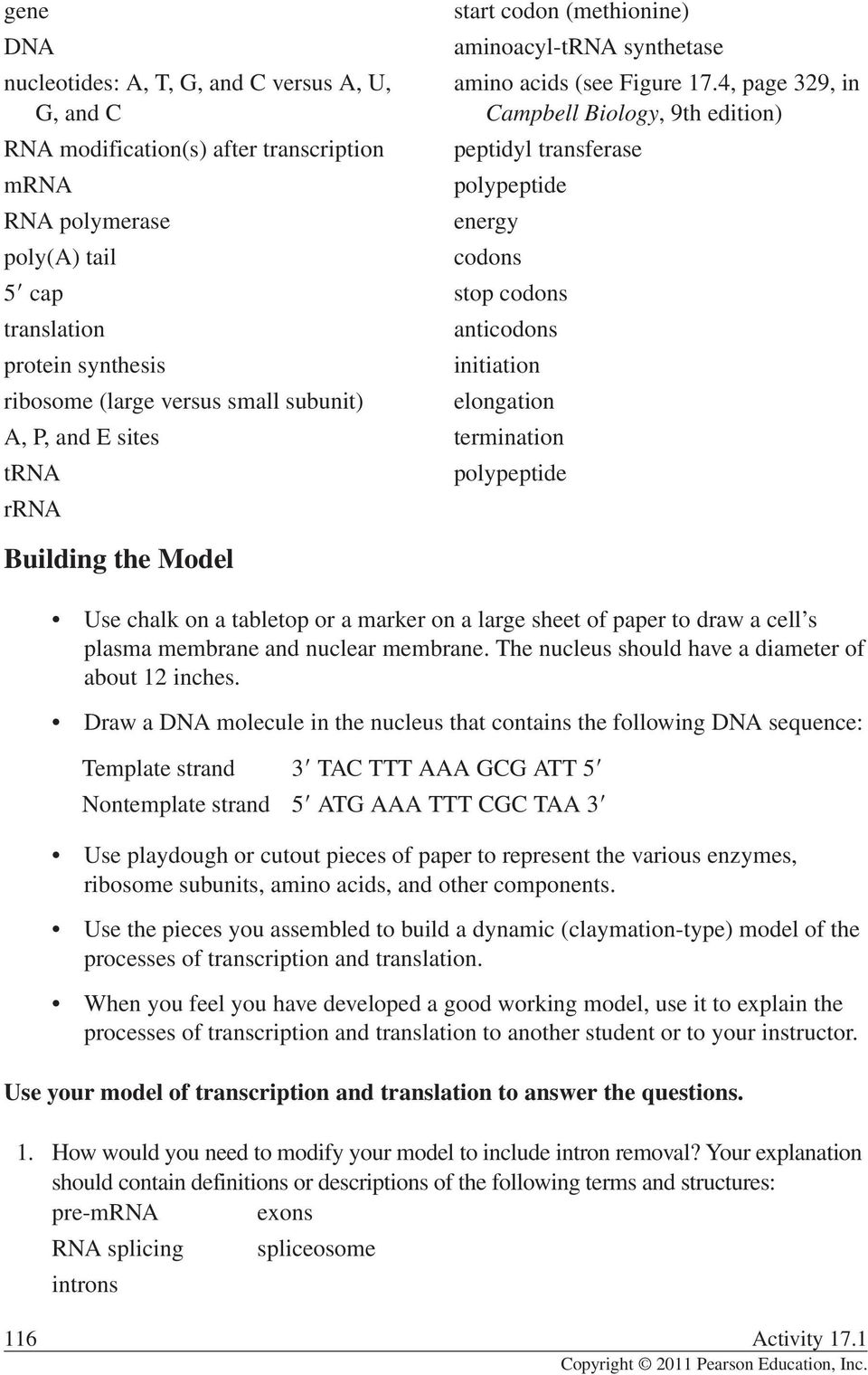
13 gene DNA nucleotides: A, T, G, and C versus A, U, G, and C RNA modification(s) after transcription mrna RNA polymerase poly(a) tail 5 cap translation protein synthesis ribosome (large versus small subunit) A, P, and E sites trna rrna start codon (methionine) aminoacyl-trna synthetase amino acids (see Figure 17.4, page 329, in Campbell Biology, 9th edition) peptidyl transferase polypeptide energy codons stop codons anticodons initiation elongation termination polypeptide Building the Model Use chalk on a tabletop or a marker on a large sheet of paper to draw a cell s plasma membrane and nuclear membrane. The nucleus should have a diameter of about 12 inches. Draw a DNA molecule in the nucleus that contains the following DNA sequence: Template strand Nontemplate strand 3 TAC TTT AAA GCG ATT 5 5 ATG AAA TTT CGC TAA 3 Use playdough or cutout pieces of paper to represent the various enzymes, ribosome subunits, amino acids, and other components. Use the pieces you assembled to build a dynamic (claymation-type) model of the processes of transcription and translation. When you feel you have developed a good working model, use it to explain the processes of transcription and translation to another student or to your instructor. Use your model of transcription and translation to answer the questions. 1. How would you need to modify your model to include intron removal? Your explanation should contain definitions or descriptions of the following terms and structures: pre-mrna exons RNA splicing spliceosome introns 116 Activity 17.1
14 To answer this question, review Figures and and the accompanying text on pages of Campbell Biology, 9th edition. 2. If 20% of the DNA in a guinea pig cell is adenine, what percentage is cytosine? Explain your answer. If 20% is adenine, then 20% is thymine. The remaining 60% is composed of cytosine and guanine in equal percentages so that each makes up 30% of the DNA. 3. A number of different types of RNA exist in prokaryotic and eukaryotic cells. List the three main types of RNA involved in transcription and translation. Answer the questions to complete the chart. a. Types of RNA b. Where are they produced? mrna In the nucleus, from specific genes (often called structural genes) on the DNA trna rrna Other genes in the nuclear DNA code for trna molecules Still other genes in the nuclear DNA code for rrna molecules. c. Where and how do they function in cells? mrna functions in the cytoplasm, where it is translated into protein. The mrna carries the information in codons that determine the order of amino acids in a protein. trna molecules function in the cytoplasm in translation Each trna molecule can combine with a specific amino acid. Complementary base pairing of trna molecule with a codon in the A site of the ribosome brings the correct amino acid into position in the growing polypeptide chain. rrna molecules combine with protein to form the ribosomes, which serve as the base for interactions between mrna codons and trna anticodons in traslation in the cytoplasm. (See Figure 17.17, page 340) Activity

15 4. Given your understanding of transcription and translation, fill in the blanks below and indicate the 5 and 3 ends of each nucleotide sequence. Again, assume no RNA processing occurs. Nontemplate strand of DNA: 5 A T G T A T G C C A A T G C A 3 Template strand of DNA: T mrna: A U Anticodons on complementary trna: / / / / / Template strand of DNA: mrna: trna: 3 T A C A T A C G G T T A C G T 5 5 A U G U A U G C C A A U G C A 3 3 U A C / A U A / C G G / U U A / C G U / 5 5. Scientists struggled to understand how four bases could code for 20 different amino acids. If one base coded for one amino acid, the cell could produce only four different kinds of amino acids (4 1 ). If two bases coded for each amino acid, there would be four possible choices (of nucleotides) for the first base and four possible choices for the second base. This would produce 4 2 or 16 possible amino acids. a. What is the maximum number of three-letter codons that can be produced using only four different nucleotide bases in DNA? 4 3, or 64 b. How many different codons could be produced if the codons were four bases long? 4 4, or 256 Mathematical logic indicates that at least three bases must code for each amino acid. This led scientists to ask: How can we determine whether this is true? Which combinations of bases code for each of the amino acids? To answer these questions, scientists manufactured different artificial mrna strands. When placed in appropriate conditions, the strands could be used to produce polypeptides. 118 Activity 17.1

16 Assume a scientist makes three artificial mrna strands: (x) 5 AAAAAAAAAAAAAAAAAAAAAAAAAA 3 (y) 5 AAACCCAAACCCAAACCCAAACCCAAA 3 (z) 5 AUAUAUAUAUAUAUAUAUAUAUAUAU 3 When he analyzes the polypeptides produced, he finds that: x produces a polypeptide composed entirely of lysine. y produces a polypeptide that is 50% phenylalanine and 50% proline. z produces a polypeptide that is 50% isoleucine and 50% tyrosine. c. Do these results support the three-bases-per-codon or the four-bases-per-codon hypothesis? Explain. Only if there were three bases per codon would both y and z produce only two different kinds of amino acids in equal proportions. In fact, each strand would produce the two in alternating order; for example, the z strand would produce a polypeptide chain of isoleucine followed by tyrosine followed by isoleucine, then tyrosine, and so on. d. This type of experiment was used to discover the mrna nucleotide codons for each of the 20 amino acids. If you were doing these experiments, what sequences would you try next? Explain your logic. There are many possible ways to answer this question. One possibility follows: Continue as above and make the remaining three types of mrna made up of only one type of nucleotide that is, poly G, poly U, or poly C. Then make all possible combinations of the nucleotides taken two at a time for example, GCGC, CGCG, AGAG, and so on. Next, make other combinations of nucleotides taken three at a time for example, AAAGGGAAAGGG and so on. Continue with combinations of nucleotides taken four at a time for example, AAAAUUUUAAAAUUUUAAAAUUUU and so on. In this last example, if the codon for each amino acid is three bases long, these combinations of nucleotides should give you a maximum of three different types of amino acids in equal proportions or percentages. 6. Now that the complete genetic code has been determined, you can use the strand of DNA shown here and the codon chart in Figure 17.4 on page 329 in Campbell Biology, 9th edition, to answer the next questions. Original template strand of DNA: 3 TAC GCA AGC AAT ACC GAC GAA 5 a. If this DNA strand produces an mrna, what does the sequence of the mrna read from 5 to 3? mrna 5 AUG CGU UCG UUA UGG CUG CUU 3 Activity

17 b. For what sequence of amino acids does this mrna code? (Assume it does not contain introns.) Sequence of amino acids: methionine-arginine-serine-leucine-tryptophanleucine-leucine c. The chart lists five point mutations that may occur in the original strand of DNA. What happens to the amino acid sequence or protein produced as a result of each mutation? (Note: Position 1 refers to the first base at the 3 end of the transcribed strand. The last base in the DNA strand, at the 5 end, is at position 21.) Original template strand: 3 TAC GCA AGC AAT ACC GAC GAA 5 Mutation i. Substitution of T for G at position 8. ii. Addition of T between positions 8 and 9. iii. Deletion of C at position 15. iv. Substitution of T for C at position 18. Effect on amino acid sequence This changes the codon in mrna to a stop codon; translation stops at this point. A shorter (truncated) polypeptide is produced and this shortened polypeptide is likely to be nonfunctional. Serine is still incorporated as the third amino acid, but the amino acids that follow all differ from the sequence in part b above. This is a frameshift mutation. The first four amino acids in the chain are not affected. The fifth amino acid becomes cysteine and the subsequent amino acids are also changed from part b. The original mrna codon, CUG, and the one resulting from the substitution, CUA, both code for leucine, so no change occurs in the polypeptide sequence. v. Deletion of C at position 18. Leucine is still inserted as the sixth amino acid in the polypeptide. However, since we re given only a part of the sequence, it is uncertain what the next amino acid in the chain will be. vi. Which of the mutations produces the greatest change in the amino acid sequence of the polypeptide coded for by this 21-base-pair gene? The addition of T between positions 8 and 9 still leaves the third amino acid intact; however, all amino acids after that are different. In the substitution of T for G at position 8, a stop codon is inserted and only the first two amino acids are unaltered. As a result, this mutation produces the greatest change. 120 Activity 17.1

18 7. Sickle-cell disease is caused by a single base substitution in the gene for the beta subunit of hemoglobin. This base substitution changes one of the amino acids in the hemoglobin molecule from glutamic acid to valine. Look up the structures of glutamic acid (glu) and valine (val) on page 79 of Campbell Biology, 9th edition. What kinds of changes in protein structure might result from this substitution? Explain. Glutamic acid is polar, and valine is nonpolar. Being polar, the glutamic acid molecule would have been able to interact with water and other polar molecules, but the valine molecule cannot. As a result, unlike glutamic acid, valine is more likely to have an interior position in the hemoglobin molecule. 8. Why do dentists and physicians cover patients with lead aprons when they take mouth or other X-rays? As noted in this and other chapters, X-rays, UV light, and many chemicals can damage DNA. Such damage can result in point mutations such as base substitutions, deletions, and insertions. These mutations can cause cancer. If they occur in the cells that will produce the gametes, the mutations can be passed on to offspring. As a result, lead aprons are used to shield the rest of your body from any stray radiation Test Your Understanding During DNA replication, which of the following would you expect to be true? Explain your answers. T/F 1. More ligase would be associated with the lagging strand than with the leading strand. True Okazaki fragments on the lagging strand would need to be connected by ligase. T/F 2. More primase would be used for the lagging strand than for the leading strand. True Each new Okazaki fragment would be started by addition of a short RNA sequence by primase. T/F 3. More helicase would be associated with the lagging strand than with the leading strand. False Both strands would need to be unwound equally. T/F 4. DNA ligase links the 3 end of one Okazaki fragment to the 5 end of the another Okazaki fragment in the lagging strand. True The end of the first Okazaki fragment would be 3 ; the next fragment would begin at the 5. T/F 5. In the lagging strand, the enzyme DNA polymerase III which produces the next Okazaki fragment also removes the short segment of primer RNA on the previous Okazaki fragment. False A different DNA polymerase removes the primer. Activity

19 6. You obtain a sample of double-stranded DNA and transcribe mrna from this DNA. You then analyze the base composition of each of the two DNA strands and the one mrna strand, and get the following results. The numbers indicate percentage of each base in the strand: A G C T U strand strand strand a. Which of these strands must be the mrna? Explain. Strand 1 must be the mrna because it contains U (uracil), which is found only in RNA. b. Which one is the template strand for the mrna? Explain. Strand 2 is the complement to strand 1. Therefore, it must be the template strand for the mrna. 7. In a new experiment, you obtain a different sample of double-stranded DNA and transcribe mrna from this DNA. You then analyze the base composition of each of the two DNA strands and the one mrna strand, and get the following results. The numbers indicate percentage of each base in the strand: A G C T U strand strand strand a. Which of these strands could be the mrna? Explain. Either strand 1 or 3 could be the mrna. b. Which one must be the template strand for the mrna? Explain. Strand 2 must be DNA and it must also be the template strand for the mrna because it is complementary to both strands 1 and Activity 17.1

20 8. Cystic fibrosis transmembrane conductance regulator (CFTR) proteins function in cell membranes to allow chloride ions across cell membranes. Individuals with cystic fibrosis (CF) have abnormal CFTR proteins that do not allow Cl to move across cell membranes. Chloride channels are essential to maintain osmotic balance inside cells. Without properly functioning Cl channels, water builds up inside the cell. One result is a thickening of mucous in lungs and air passages. You are doing research on a different disease, and you hypothesize that it may also be due to a defect in an ion channel in the cell membrane. a. Diagram or model production of a normal membrane ion channel. b. Based on you understanding of cell membrane structure and function, propose at least three different alterations that could result in a nonfunctional or missing ion channel. c. What questions would you need to answer to determine which of these may be correct? This question is designed to allow students to integrate their understanding of general cell structure and function with that of genetic mutation and control. a. Briefly, the diagram should include: i. DNA/gene(s) for the channel protein ii. RNA production and processing, including the target sequence on the gene to get it to the rer iii. Properly functioning Golgi that finalizes protein structure and functions to move the protein to the membrane, e.g., via targeted vesicles b. Alterations that could result in a nonfunctional or missing channel could include: i. Error/mutation in the DNA that results in faulty or nonexistent/terminated protein ii. Error in target sequence iii. Error in function of Golgi and/or vesicle transport to membrane c. Questions to be answered could include: i. Is the DNA sequence of the gene altered? ii. Is there an error in the splicing of the RNA or its targeting mechanism? iii. Is there an error in the translation of the RNA? iv. Are the Golgi functioning correctly in final folding, etc., of the protein channel, and in delivery of the protein to the membrane? Activity

21 Notes to Instructors Chapter 18 The Genetics of Viruses and Bacteria What is the focus of these activities? Many students try to memorize these systems instead of understanding the logic associated with their operation. These activities can be used to point out that it is much easier to understand how these systems work if students look at the logic behind their operation. Having students build models/diagrams of the systems and their operation is very useful in this regard. What are the particular activities designed to do? Activity 18.1 How is gene expression controlled in bacteria? Activity 18.2 Modeling the lac and trp operon systems: How can gene expression be controlled in prokaryotes? Activity 18.1 provides students with a mechanism to sort out similarities and differences in the control of gene expression for inducible versus repressible operons. Activity 18.2 asks students to develop a visual model of how gene expression can be controlled in prokaryotes. Both activities are designed to help students develop a better understanding of how bacteria control gene activity. In particular, they should help clarify both what operons are and how operons act to control gene expression. Activity 18.3 How is gene activity controlled in eukaryotes? Activity 18.3 asks students to integrate information from both Chapter 18 and earlier chapters to develop an understanding of the various levels (or mechanisms for) controlling gene expression in eukaryotes. For example, by this time, students understand the DNA RNA protein sequence. However, they may not have considered how many different types of control can exist in this general pathway or which of the available types of control allow for fast versus slow responses by the organism. Activity 18.4 What controls the cell cycle? Activity 18.4 asks students to review the major controls or checkpoints that regulate cell division. Cancer, uncontrolled cell division, can result if these controls fail. What misconceptions or difficulties can these activities reveal? Activity 18.1 Activity 18.2 Students tend to encounter a number of difficulties, misconceptions, and missing conceptions in their understanding of what operons are and how they function to control gene expression. We present three possible problems. 124 Notes to Instructors
22 1. Many students try to memorize these systems. Modeling is used to help students develop and understand the logic associated with the systems operation. As students work on the chart comparing the two types of operons and as they model the system, it is helpful to ask questions that focus on the logic. For example, if specific enzymes function to break down compound X, is it energetically efficient (or logical from an energy standpoint) for the cell to produce the enzymes when compound X is not present? Is it energetically efficient for the cell to produce glucose by hydrolyzing lactose if a supply of glucose is already present in the cell? Bacteria are capable of producing the amino acids they need from inorganic precursors; for example, E. coli produce tryptophan as the end product of a series of five reactions. This requires considerable energy expenditure. What would happen if the bacteria came upon a source of ready-made tryptophan in their environment? What type of control would allow the cell to simultaneously shut down production of all the enzymes required for tryptophan synthesis? 2. Students often have difficulty understanding why there are two levels of control for the lac operon. Again, it helps to direct students to look at these from an energetics viewpoint. As noted, if lactose is not present, there is no need for the cell to produce the enzymes for its digestion. However, is it energetically efficient for the cell to produce the enzymes for lactose digestion when glucose is readily available in the cell? One level of control determines whether or not the genes for lactose digestion can be transcribed. Another level of control (the camp-crp complex) determines the binding efficiency of the RNA polymerase to the promoter site. 3. Many students don t understand why camp levels vary relative to the level of glucose in the cell. To understand this, they need to realize that when glucose levels are high, the rate of metabolism and cell respiration in the cell is also likely to be high. As a result, the cell s supply of AMP is converted to ADP and the ADP is converted to ATP. Under these conditions, the ratio of AMP to ATP in the cell is low and the amount of camp is correspondingly low. When glucose supplies run low, the cell uses the energy stored in its ATP by converting it to ADP. To gain additional energy, the ADP is converted to AMP. The ratio of AMP to ATP increases, and the level of camp in the cell also increases. Activity 18.3 Before you assign this activity, it is a good idea to remind students that they already know the DNA RNA protein pathway. Given this understanding and their knowledge of how DNA, RNA, and protein function in the cell, you can ask them to work in small groups. Their assignment is to use simple logic (don t look in the textbook) to answer these questions: Under what conditions would a cell find it necessary to control expression of its genes? Which of these types of control would occur over the long term and which would have to occur quickly (in the short term)? Notes to Instructors 125
23 Collect ideas from the students and write them on the board. Then ask the following question: Given the answers to the previous questions, what types of control might exist in cells to deal with the longer-term versus shorter-term responses? Doing this exercise before assigning Activity 19.1 serves two purposes: It teaches students the types of questions they should be asking themselves as they study. It helps students understand how to put what they learn into a logical context that makes learning (and remembering what they learn) easier. Activity 18.4 Many students are unaware of how complex the cell cycle controls are. It is often counterintuitive to many that some of the controls actually function to disable or kill cells with damaged control systems. Answers Activity 18.1 How is gene expression controlled in bacteria? Fill in the chart to organize what we know about the lac and trp operons. Operon: lac trp Is the metabolic pathway anabolic or catabolic? Catabolic Hydrolyzes or breaks down lactose(a disaccharide) into glucose and galactose (two sixcarbon surgars) Anabolic Synthesizes tryptophan from precursors What regulatory genes are associated with the operon and what functions does each serve? Genes: laci promotor, CRP binding site operator Functions: laci produces an active repressor protein that binds to the operator in the absence of lactose. The promotor is the site where RNA polymerase binds to the DNA. Binding of RNA polymerase is enhanced when camp interacts with Genes: trpr promoter, operator Functions: trpr produces an inactive repressor protein that binds to the operator only when complexed with excess tryptophan. RNA polymerase binds at the promotor site and transcribes the genes for making tryptophan as long as tryptophan is not is excess. (Continued on next page) 126 Activity 18.1
24 Operon: lac trp CRP and the complex bind at the CRP site on the promotor region. As a result, the enzymes for lactose digestion are produced only when needed and only when glucose is not present. What structural genes are included in each operon and what does each produce? Is the operon inducible or repressible? Is the repressor protein produced in active or inactive from? The repressor protein becomes active when it interacts with: Genes: lacz lacy laca Products: LacZ codes for the -galactosidase enzyme, which digest lactose into glucose and galactose. LacY codes for a permease to allow lactose to enter the cell. LacA codes for transacetylase. Its function is unclear. The lac operon is inducible. The repressor protein is produced in its active form. (The active form binds to the operator and stops transcription of the structural genes) The repressor is active until it complexes with lactose (or allolactose). Then it becomes inactive. Genes: trya tryb tryc tryd trye Products: These five genes code for the five enzymes required to convert a precursor molecule to tryptophan (one of the amino acids required for protein synthesis) The trp operon is repressible. The repressor protein is produced in its inactive form. The repressor is inactive until it complexes with excess tryptophan in the cell. Tryptophan changes the configuration of the repressor, and it is capable to binding to the operator and stopping transcription of the enzymes that synthesize or make tryptophan. Activity
25 Activity 18.2 Modeling the lac and trp operon systems: How can gene expression be controlled in prokaryotes? Using the information in Activity 18.1 and in Chapter 18 of Campbell Biology, 9th edition, construct a model or diagram of the normal operation of both the lac and trp operon systems. In your models or diagrams, be sure to include these considerations: regulatory and structural genes inducible versus repressible control anabolic versus catabolic enzyme activity negative versus positive controls Use your model to answer the questions. 1. Under what circumstances would the lac operon be on versus off? The trp operon? The lac operon would be off when there is no lactose in the cell. The lac operon would be on when lactose is present and there is little or no glucose in the cell. However, the lac operon would be off (or operating at very low levels) even when lactose is present if sufficient glucose is simultaneously present. The trp operon would be off when excess tryptophan is readily available to the cell. It would be on at all other times. 2. How are the lac and trp operons similar (in structure, function, or both)? Both have regulatory genes that produce repressor proteins that can interact with the operator and shut down transcription of the structural genes. 3. What are the key differences between the lac and trp operons? The lac operon is inducible; the presence of lactose induces production of the enzymes needed for lactose digestion. The trp operon is repressible; it is ordinarily on, producing tryptophan, which is needed for protein production by the cells. It is turned off or repressed only when an excess of tryptophan is available to the cell. The lac operon is controlled by both a regulatory protein, which interacts with the operator and blocks RNA polymerase action, and a CRP site. RNA polymerase does not attach effectively to the operator unless CRP (complexed with camp) is attached at the CRP site. Once attached, it enhances the interaction of RNA polymerase with the promoter region. camp levels in cells tend to be low when glucose is present. As a result, even if lactose is present at relatively high levels, this second control keeps production of the enzymes for digesting lactose at very low levels if glucose is also present in the cells. 128 Activity 18.2
26 4. What advantages are gained by having genes organized into operons? As they are needed, both systems are set up to simultaneously turn on (or off) all of the genes required in a metabolic pathway. This is much more efficient than having each gene under independent control. 5. Strain X of E. coli contains a mutated lac regulatory gene on its bacterial genome. As a result, the gene produces a nonfunctional lac repressor protein. You add a plasmid (an extra circular piece of double-stranded DNA) to these cells. The plasmid contains a normal regulatory gene and a normal lac operon. Build a model or diagram of what one of these modified E. coli cells would look like. Then answer the questions and use your model or diagram to explain your answers. a. Before the addition of the plasmid, would the E. coli strain X cells be able to produce the enzymes for lactose digestion? Explain. Yes. The laci gene ordinarily produces an active repressor protein that inhibits production of the genes for lactose digestion. In this case, this gene is mutated so that it cannot produce the repressor protein. b. After the addition of the plasmid, would the plasmid s lac operon produce the enzymes for lactose digestion constitutively (all the time) or only when lactose was the available sugar source? Explain. The plasmid contains a normal regulatory gene and a normal lac operon. As a result, the plasmid s lac operon should produce the genes for lactose digestion only when lactose was the available sugar source. c. After the addition of the plasmid, would the bacterial genome s lac operon produce the enzymes for lactose digestion constitutively or only when lactose was the available energy source? Explain. The regulatory gene on the plasmid could produce enough repressor protein molecules to affect both the plasmid operon and the bacterial chromosome s operon. So, after addition of the plasmid, the bacterial genome s lac operon would produce enzymes for lactose digestion only when lactose was the available energy source. d. If equal amounts of lactose and glucose were present in the cell, would the lac operon in the bacterial DNA be off or on? Would the lac operon on the introduced plasmid be off or on? Explain. In combination with camp, CAP (catabolic activator protein) is an activator of transcription for the lac operon. When glucose is present, camp levels in the cell tend to be low. As a result, camp does not interact with CAP and CAP is unable to bind to the DNA. Therefore, even if lactose is present, little lac mrna will be synthesized from either the E. coli or plasmid DNA. Activity
27 Activity 18.3 How is gene activity controlled in eukaryotes? Human genes cannot all be active at the same time. If they were, all the cells in our bodies would look the same and have the same function(s). For specialization to occur, some genes or gene products must be active while others are turned off or inactive. 1. In eukaryotes, gene expression or gene product expression can be controlled at several different levels. Indicate what types of control might occur at each level of gene or gene product expression. Note: The table presents a representative sample of the various types of control mechanisms. It does not include all possible mechanisms of control. Level Types of control a. The gene or DNA itself Whole chromosomes or parts of chromosomes can be inactivated by DNA packing as heterochromatin. b. The mrna product of the gene c. The protein product of the mrna Transcription from DNA can also be controlled by enhancing or inhibiting the action of various proteins that interact with the DNA and/or RNA polymerase to make it more or less likely to produce an mrna transcript. At the mrna level, controls can affect whether the pre-mrna is processed into mrna, how long the mrna is active in translation, and whether the mrna is capable of attaching to the ribosome and being translated. The protein product may be made in an inactive form that becomes active only in specific environments. For example, digestive enzymes are usually produced in inactive form and activated only under specific conditions of ph or in the presence of specific activator molecules. If produced in active form, the protein may be inactivated by the presence of a molecule that changes its allosteric form. The protein product may have a very limited life span and, as a result, have a limited time of functioning in the cell. 130 Activity 18.3
28 18.3 Test Your Understanding Single-celled organisms such as Amoeba and Paramecia often live in environments that change quickly. Which of the following types of control allow organisms like Amoeba to respond most quickly to frequent short-term environmental changes? Explain your reasoning. a. Control of mrna transcription from DNA b. Control of enzyme concentration by controlling the rate of mrna translation c. Control of activity of existing enzymes d. Control of the amount of DNA present in the cell The answers to this question may vary depending on how frequently the changes occur and how one defines short-term. For example, overall, controlling the activity of existing enzymes allows the organism to respond very quickly to short-term changes in environmental conditions. However, maintaining a number of different enzymes in the cell is energetically efficient only if the short-term changes occur frequently over time. If the changes occur infrequently and do not result in the death of the organism but rather reduced function, then it is energetically more efficient to instead control the rate of mrna transcription from DNA. Activity 18.4 What controls the cell cycle? 1. Checkpoints in the normal cell cycle prevent cells from going through division if problems occur for example, if the DNA is damaged. a. What forms do the checkpoints take? That is, how do they control whether or not cell division occurs? A number of different cyclins are produced during interphase. Three of the major checkpoints in mitosis the G 1, G 2, and M phase checkpoints appear to be controlled by Cdks (cyclin-dependent kinases). The ratio of Cdks to their cyclins determines their activity. The activities of the different activated Cdks control the cell cycle. The cell can move past a given stage of the cycle only when the appropriate checkpoint s Cdk has been activated. b. In the space below, develop a handout or diagram to explain how these checkpoints work under normal conditions. Your diagram should include a description of each checkpoint, where it acts in the cell cycle, and what each does to control cell division. Refer to Figure 12.17, page 240, of Campbell Biology, 9th edition, which shows the molecular mechanisms associated with activity of the cyclin-cdk complex called Activity
29 MPF. Here is an easy way to repesent the G 1 and G 2 control points and their actions: Following Figure 12.17, draw the inner circle of arrows, with a diameter of about 3 inches, on a piece of paper. On another piece of paper, draw a circle about 4 inches in diameter, and around this draw another circle about 6 inches in diameter. Draw and label the lines that show the activity of cyclins versus Cdk (Figure 12.17) between these two lines. Cut out the center of this double circle. Place the circle over the cell cycle arrow diagram you drew first to create the same diagram you see in Figure Next, substitute the words G 1 checkpoint for MPF on the drawing. Now rotate the top sheet of paper so that the G 1 checkpoint lines up with its position in G 1 on the arrow diagram. Do the same for the G 2 checkpoint. c. Cancer results from uncontrolled cell division. Explain how mutations in one or more of the checkpoints might lead to cancer. The basic function of each checkpoint is to determine whether or not the cell is functioning normally and should enter into or continue through division. If these checkpoints break down, they could allow any cell to continue through the cell cycle that is, to divide. Cancer is uncontrolled cell division, so cancer can result from a breakdown of the operation of these checkpoints. 132 Activity 18.3
30 Notes to Instructors Chapter 19 Viruses What is the focus of these activities? Although almost all students recognize that viruses exist and are pathogenic organisms, few have a good understanding of how viruses cause disease and why they are so difficult to treat. What are the particular activities designed to do? Activity 19.1 How do viruses, viroids, and prions affect host cells? Activity 19.1 provides students with a mechanism to sort out what viruses are and how they affect host cells. Given an understanding of various pathogen characteristics and replication requirements, students are asked to consider what aspects of their structures or life cycles could be interrupted and therefore serve as effective treatments against infection. What misconceptions or difficulties can these activities reveal? Activity 19.1 Like most people, many students do not understand that antibiotics are designed to treat bacterial infections. Antibiotics do this by attacking bacteria-specific structures or functions e.g., 70s ribosomes, bacterial cell wall structures, or bacteria-specific enzymes. As a result, antibiotics (antibacterials) are not effective against viruses. Answers Activity 19.1 How do viruses, viroids, and prions affect host cells? 1. By definition, viruses are obligate intracellular parasites. What does this mean? An obligate intracellular parasite is one that can neither survive long term nor reproduce outside its host. 2. In general, how are viruses classified? Viruses are often classified based on the type of nucleic acid they contain e.g., ss or ds RNA or ss or ds DNA. See Chapter 19 of Campbell Biology, 9th edition. Activity
31 3. What is reverse transcriptase? Reverse transcriptase is the enzyme that allows retroviruses to make DNA from RNA strands and then + and RNA from the DNA. a. Where was reverse transcriptase first found? It was discovered in retroviruses. b. Of what use is reverse transcriptase to viruses? Of what use is it to scientists? It is useful in genetic recombination to make cdna from mrna and avoid the problem of eucaryotic introns. Reverse transcriptase allows viruses that invade eukayotic cells to make DNA from their RNA genome and use that DNA to make more viruses or to incorporate into the host s DNA. 4. Why must viruses invade other cells to reproduce? a. Describe the general process. Include a discussion of lytic and lysogenic viral cycles. Some viruses are only lytic. They enter the cell and take over the cell s machinery to make more viruses. Then they lyse the cell to allow the new viruses to escape and attack other cells. Some viruses also have a lysogenic stage and alternate between lysogenic and lytic stages throughout their life cycle. In the lysogenic stage, the virus incorporates the viral DNA into the host DNA and remains quiescent there, replicating with the host s DNA. It can later come out of the host s DNA and enter a lytic cycle. Environmental conditions that stress the host cell may trigger this. b. Which types of viruses are more likely to have a lysogenic phase? A number of double-stranded DNA viruses and retroviruses that can produce double stranded DNA can become lysogenic (incorporate into the host DNA). RNA viruses that do not produce DNA as templates for their reproduction are unable to incorporate into the host DNA. 5. More than 100 different viruses can cause the common cold in humans. Many of these are rhinoviruses. Other viruses influenza viruses cause the flu. While there are many different antibiotics for treating bacterial infections, there are relatively few drugs available to treat viral infections. Explain. Antibiotics used to counteract bacterial infections target bacteria-specific structures or functions such as 70s ribosomes, bacterial cell wall structures, or bacteria-specific enzymes. It is more difficult to find something that a virus requires for its function and replication that is not also required by the host for its normal metabolic functions. When a virus-specific coat protein or enzyme, such as reverse transcriptase, is found, high rates of mutation often make it difficult to develop a drug or vaccine against it. (For example, reverse transcriptase has an error rate of about 1/8000 bases where 134 Activity 19.1
32 other DNA polymerase and RNA polymerase error rates are about 1/million or so. In addition, reverse transcriptase has no proofreading capacity.) 6. a. How do viruses, viroids and prions differ in terms of both composition and function? Composition: Viruses nucleic acid core with protein coat or capsid. Viroid bare RNA. Prion altered 3-D structure of normally active protein. Function: Viruses take over cell machinery and ultimately kill the cells they invade. Viroids can do the same in plants. Prions accumulate in brain tissue and destroy it. The complete mechanisms of prion replication and action are still unknown. b. Compared to viral infections, do these differences make it easier or harder to treat viroid and prion infections? Explain your reasoning. Because viroids are basically bare RNA and prions are altered proteins, there are no easy ways of attacking them without simultaneously attacking the native RNAs and proteins required for normal cell function. As a result, these pathogens are even more difficult than viruses to treat. Activity
33 Notes to Instructors Chapter 20 Biotechnology What is the focus of this activity? Almost all students have heard of DNA technology and know that DNA typing (or profiling or fingerprinting) can be used in forensic analysis. Yet, fewer have a good understanding of the methods that are used, why these methods are used (that is, what they allow us to do), and what types of results can be expected. What is the particular activity designed to do? Activity 20.1 How and why are genes cloned into recombinant DNA vectors? This activity is designed to help students understand: how genes from other species can be cloned by incorporating them into bacterial plasmids, and how such recombinant bacteria can be used to produce a wide range of products, including human insulin. Activity 20.2 How can PCR be used to amplify specific genes? This activity is designed to help students understand: how using known primers and PCR allows us to amplify only targeted genes, and how DNA fingerprinting using RFLPs or STRs can be applied in forensics. What misconceptions or difficulties can this activity reveal? Activity 20.1 Students tend to encounter a number of difficulties, misconceptions, and missing conceptions that become evident as they try to build a model to demonstrate how genes can be cloned by incorporation into bacterial plasmids. Here are three possible problems: 1. The news media can help educate the public, but in some cases, it can also cause confusion. Some students have been convinced by what they read that gene cloning and recombinant technology are bad things with no redeeming value. To help counter this idea, this activity has students investigate the production of human insulin (Humulin) by bacteria. 2. If it hasn t surfaced before this time, you may notice that some students have the idea that the DNA in bacteria is single-stranded. This misconception often comes from their misunderstanding or misinterpreting statements like: The bacterial chromosome is composed of a single circular DNA molecule. 136 Notes to Instructors
34 3. Many students don t understand how restriction enzymes cut DNA. It is helpful to mention that the cuts are in the phosphate sugar backbone of the DNA molecule. These cuts are similar to the gaps left between Okazaki fragments. When the phosphate sugar backbone is cut, the hydrogen bonds between complementary bases are the only forces holding the structure together. Changes in the physiological conditions of the medium, including heating the solution, can cause these hydrogen bonds between complementary bases to break and produce the sticky ends required to interact with the complementary sticky ends of the gene of interest. Activity 20.2 Though the overall process of PCR is not conceptually complex, it is difficult to visualize without modeling or diagramming it. This exercise asks student to diagram what happens in several rounds or cycles of PCR. Having students do this will help them understand the whole process and how known primers can be used to specifically target genes for amplification. Answers Activity 20.1 How and why are genes cloned into recombinant DNA vectors? Develop a model to explain how a human gene can be cloned into a bacterial plasmid. Your model should be a dynamic (working or active) representation of the events that need to occur in order to clone the insulin gene into a bacterial plasmid, and transform the plasmid into E. coli. When you develop and explain your model, be sure to include definitions or descriptions of the following terms and components: restriction enzyme(s) ligase plasmid DNA human mrna (the mrna for insulin) reverse transcriptase transformation E. coli marker genes (an antibiotic resistance gene) cloning vector Activity
35 Building the Model Use chalk on a tabletop or a marker on a large sheet of paper to draw at least two test tubes and an E. coli cell s plasma membrane. The E. coli should have a diameter of at least 12 inches. The test tubes should have a width of at least 6 inches. Use the test tubes for producing the insulin gene and for cloning the gene into the plasmid. Then transform your recombinant plasmid into the E. coli cell. Use playdough or cutout pieces of paper to represent the enzymes, RNA molecules, and other components. Use the pieces you assembled to develop a dynamic (claymation-type) model to demonstrate how a gene can be cloned into a plasmid and how the plasmid can then be transformed into a bacterial cell. When you feel you have developed a good working model, demonstrate it to another student or to your instructor. Use your model to answer the questions. 1. Prior to recombinant gene technology, the insulin required to treat diabetes was obtained from the pancreases of slaughtered farm animals. Because the insulin was from other species, some humans developed immune responses or allergic reactions to it. As recombinant gene technology advanced, researchers explored the possibility of incorporating the human insulin gene into a plasmid that could be transformed into E. coli. If this technology was successful, the E. coli would produce human insulin that could be harvested from the bacterial culture medium. Researchers first needed to isolate the gene for insulin. To do this, they isolated mrna (rather than DNA) from the beta cells of human pancreas tissue. Using reverse transcriptase, they made double-stranded DNA molecules that were complementary to the mrna molecules they extracted from the pancreas cells. a. Based on what you know about eukaryotic chromosomes and genes, why did researchers choose to isolate mrna rather than DNA? Eukaryotic genes contain introns, which must be excised from any pre-mrna transcript produced. Bacterial cells do not contain the machinery (spliceosomes) required for doing this. b. What further adjustments might researchers need to make in the DNA molecules produced by reverse transcriptase before the molecules could be incorporated into bacterial plasmids? To incorporate the DNA molecules into the plasmid DNA, researchers would need to add the sticky ends for a specific restriction site. They would need to cut the plasmid DNA with the same restriction enzyme. When they combined the 138 Activity 20.1
36 plasmid DNA with the insulin DNA, some of the plasmid DNA could then combine with the insulin DNA and incorporate it. For the bacteria to produce the mrna for the insulin gene, researchers would also need to include a promoter site upstream of the insulin gene. c. Not all the DNA molecules produced by reverse transcription from pancreatic mrna contained the gene for insulin. Some contained other genes. What mechanisms can be used to locate those bacterial colonies that picked up plasmids containing any of the genes produced by reverse transcription from pancreatic mrnas? Grow the bacteria on a medium containing an antibiotic and X-gal. The plasmid selected has an antibiotic resistance gene on it and a lacz gene. The restriction site used lies in the lacz gene. As a result, only cells that have picked up plasmids will grow on medium containing the antibiotic. Cells with intact lacz genes that is, cells that picked up plasmids without an additional gene inserted into the lacz site will produce -galactosidase. The -galactosidase hydrolyzes X-gal and produces a blue compound. Colonies of these cells appear blue in color. Therefore, only the white bacterial colonies on the plate will contain plasmids carrying inserted genes. d. What mechanisms can be used to locate bacterial colonies that picked up only plasmids containing the insulin gene? A replica plate or blot of these white colonies can be made (see Figure 20.7, page 402). The filter used to make the replica separates the DNA into single strands and can be probed with labeled strands of DNA complementary to the desired gene. The label may be radioactive or fluorescent so that the colonies that carry the insulin gene can be easily identified on the blot. These colonies are then removed from the original plate and grown in culture medium. The bacteria from these colonies can be used to produce human insulin. Note: the bacteria produce the insulin, but do not use it themselves. (Note: Today almost all the insulin used for the treatment of human diabetes is produced using recombinant technology.) Activity 20.2 How can PCR be used to amplify specific genes? 1. Assume you are using PCR to make multiple copies of a gene (shaded in grey below). DNA containing gene of interest: 3 TATAAAGACTTACAAATTTGTCCCCATTTTGC5 5 ATATTTCTGAATGTTTAAACAGGGGTAAAACG3 Activity
37 On separate sheets of paper, describe the overall process and diagram the results you would obtain for 1, 2 and 3 rounds of PCR replication using the primers, ATGTT and CCATT. (Note: For simplicity we are showing DNA primers that are only 5 bases in length. In actual use, the DNA primers used are at least 17 bases long. This length is used to help reduce the risk that the primer anneals with [base pairs with] anything other than the specific segment of DNA to be amplified.) The explanation and diagram should look something like the following: a. Heat is applied (heat to 95 C) to separate the strands of the DNA molecule(s). 3 TATAAAGACTTACAAATTTGTCCCCATTTTGC5 (Temperature 95 C) 5 ATATTTCTGAATGTTTAAACAGGGGTAAAACG3 b. The temperature is reduced to between 45 and 60 C. 3 TATAAAGACTTACAAATTTGTCCCCATTTTGC5 (Temperature 50 C) 5 ATATTTCTGAATGTTTAAACAGGGGTAAAACG3 c. This allows the DNA primers to anneal. 3 TATAAAGACTTACAAATTTGTCCCCATTTTGC5 5 ATGTT CCATT 5 5 ATATTTCTGAATGTTTAAACAGGGGTAAAACG3 d. and e. The Taq polymerase adds DNTPs to the open 3 ends of the DNA primers. 3 TATAAAGACTTACAAATTTGTCCCCATTTTGC5 5 ATGTTTAAACAG 3 3 TTTGTCCCCATT 5 5 ATATTTCTGAATGTTTAAACAGGGGTAAAACG3 TOTAL Copies: 2 n (n number of cycles of PCR completed) f. In the next cycle, heating, cooling, primers annealing, and Taq polymerase elongating the DNA strands occurs again, but now on both of the daughter products of the first cycle: 3 TATAAAGACTTACAAATTTGTCCCCATTTTGC5 ATGTT 140 Activity 20.2
38 CCATT 5 ATGTTTAAACAGGGGTAAAACG3 3 TATAAAGACTTACAAATTTGTCCCCATT 5 ATGTT CCATT 5 ATATTTCTGAATGTTTAAACAGGGGTAAAACG3 The products of the second cycle are: 3 TATAAAGACTTACAAATTTGTCCCCATTTTGC5 5 ATGTTTAAACAGGGGTAAAACG3 3 TACAAATTTGTCCCCATT5 5 ATGTTTAAACAGGGGTAAAACG3 3 TATAAAGACTTACAAATTTGTCCCCATT 5 5 ATGTTTAAACAGGGGTAA3 3 TATAAAGACTTACAAATTTGTCCCCATT5 5 ATATTTC TGAATGTTTAAACAGGGGTAAAACG3 TOTAL Copies 2 n g. In the third cycle, heat separates the double strands of DNA. The system is then cooled to allow DNA primers to anneal, and the Taq polymerase produces the following 8 products: 3 TATAAAGACTTACAAATTTGTCCCCATTTTGC5 5 ATGTT CCATT5 5 ATGTTTAAACAGGGGTAAAACG3 3 TACAAATTTGTCCCCATT5 5 ATGTT CCATT5 5 ATGTTTAAACAGGGGTAAAACG3 3 TATAAAGACTTACAAATTTGTCCCCATT 5 5 ATGTT CCATT5 5 ATGTTTAAACAGGGGTAA3 3 TATAAAGACTTACAAATTTGTCCCCATT5 5 ATGTT CCATT5 5 ATATTTC TGAATGTTTAAACAGGGGTAAAACG3 TOTAL Copies 2 n Activity
39 2. PCR (polymerase chain reaction) is often used in forensics to amplify small amounts of DNA found at crime scenes. The amplified DNA is then tested for differences in RFLP (restriction fragment length polymorphisms) or STR (single tandem repeat) lengths. a. Explain what RFLPs and STRs are. RFLPs (restriction fragment length polymorphisms) are defined as the different restriction fragment patterns produced when DNA is cut using specified restriction enzymes. An individual s RFLPs are inherited in a Mendelian fashion. STRs (single tandem repeats) are very short lengths of DNA (a few base pairs) that are repeated many times within single gene loci. These are also genetically inherited. In forensics, the variations in STRs in satellite DNA are generally used to identify individuals. b. How do STRs compare for unrelated individuals versus for closely related individuals (for example, parent and child or brother and sister)? STRs are genetically inherited. Therefore, since half of a child s DNA comes from each parent, each of the STRs found in the child should be found in at least one of the parents. Similarly, on average, brothers and sisters share at least a quarter of their genes. Therefore, you would expect at least one-fourth of the STRs to compare between siblings. The same relationships should hold true for RFLPs. c. How reliable are these types of DNA fingerprinting for identifying individuals? What factors affect their reliability? Only a small portion of the DNA is selected for DNA fingerprinting. The specific RFLP or STR sites on the DNA that are commonly used tend to be highly variable among unrelated individuals. Probability estimates indicate that for any two unrelated individuals, there is a 1 in 100,000 to 1 in a billion chance that their DNA will match based on chance alone. Factors that can affect the reliability of DNA fingerprinting are how closely related the individuals are, the number of markers used in the tests, and the frequency of the specific markers in the population. For example, a specific ethnic group may share a marker more frequently than individuals outside of that ethnic group. This problem may be overcome by using more markers. 142 Activity 20.2
40 20.2 Test Your Understanding 1. Which of the following sequences (on one strand of a double stranded DNA molecule) is likely to be a cleavage site for a restriction enzyme? Explain your answer. a. CGTACC b. ATGTCG c. GATATG d. TGCGCA The correct answer is d. The complementary strand for d would read: ACGCGT, i.e., the reverse of the sequence in d. 2. After undergoing electrophoresis, the gel in the figure below shows the RFLP analysis of DNA samples obtained from a crime scene. Bloodstains on a suspect s shirt (B) were analyzed and compared with blood from the victim (V) and from the suspect (S). Are the bloodstains on the shirt from the victim or from the suspect? Explain. V S B If you examine the lane that contains the blood stains, you can find bands that do not match a band in either the victim s or the suspect s lane. As a result, the blood that contains this band could not have come from the suspect or the victim. Activity
DNA Replication & Protein Synthesis. This isn t a baaaaaaaddd chapter!!!
 DNA Replication & Protein Synthesis This isn t a baaaaaaaddd chapter!!! The Discovery of DNA s Structure Watson and Crick s discovery of DNA s structure was based on almost fifty years of research by other
2. The number of different kinds of nucleotides present in any DNA molecule is A) four B) six C) two D) three
 Chem 121 Chapter 22. Nucleic Acids 1. Any given nucleotide in a nucleic acid contains A) two bases and a sugar. B) one sugar, two bases and one phosphate. C) two sugars and one phosphate. D) one sugar,
Name Class Date. Figure 13 1. 2. Which nucleotide in Figure 13 1 indicates the nucleic acid above is RNA? a. uracil c. cytosine b. guanine d.
 13 Multiple Choice RNA and Protein Synthesis Chapter Test A Write the letter that best answers the question or completes the statement on the line provided. 1. Which of the following are found in both
Structure and Function of DNA
 Structure and Function of DNA DNA and RNA Structure DNA and RNA are nucleic acids. They consist of chemical units called nucleotides. The nucleotides are joined by a sugar-phosphate backbone. The four
Chapter 11: Molecular Structure of DNA and RNA
 Chapter 11: Molecular Structure of DNA and RNA Student Learning Objectives Upon completion of this chapter you should be able to: 1. Understand the major experiments that led to the discovery of DNA as
Genetic information (DNA) determines structure of proteins DNA RNA proteins cell structure 3.11 3.15 enzymes control cell chemistry ( metabolism )
 Biology 1406 Exam 3 Notes Structure of DNA Ch. 10 Genetic information (DNA) determines structure of proteins DNA RNA proteins cell structure 3.11 3.15 enzymes control cell chemistry ( metabolism ) Proteins
PRACTICE TEST QUESTIONS
 PART A: MULTIPLE CHOICE QUESTIONS PRACTICE TEST QUESTIONS DNA & PROTEIN SYNTHESIS B 1. One of the functions of DNA is to A. secrete vacuoles. B. make copies of itself. C. join amino acids to each other.
Name Date Period. 2. When a molecule of double-stranded DNA undergoes replication, it results in
 DNA, RNA, Protein Synthesis Keystone 1. During the process shown above, the two strands of one DNA molecule are unwound. Then, DNA polymerases add complementary nucleotides to each strand which results
1.5 page 3 DNA Replication S. Preston 1
 AS Unit 1: Basic Biochemistry and Cell Organisation Name: Date: Topic 1.5 Nucleic Acids and their functions Page 3 l. DNA Replication 1. Go through PowerPoint 2. Read notes p2 and then watch the animation
DNA. Discovery of the DNA double helix
 DNA Replication DNA Discovery of the DNA double helix A. 1950 s B. Rosalind Franklin - X-ray photo of DNA. C. Watson and Crick - described the DNA molecule from Franklin s X-ray. What is DNA? Question:
DNA, RNA, Protein synthesis, and Mutations. Chapters 12-13.3
 DNA, RNA, Protein synthesis, and Mutations Chapters 12-13.3 1A)Identify the components of DNA and explain its role in heredity. DNA s Role in heredity: Contains the genetic information of a cell that can
Genetics Module B, Anchor 3
 Genetics Module B, Anchor 3 Key Concepts: - An individual s characteristics are determines by factors that are passed from one parental generation to the next. - During gamete formation, the alleles for
Sample Questions for Exam 3
 Sample Questions for Exam 3 1. All of the following occur during prometaphase of mitosis in animal cells except a. the centrioles move toward opposite poles. b. the nucleolus can no longer be seen. c.
From DNA to Protein. Proteins. Chapter 13. Prokaryotes and Eukaryotes. The Path From Genes to Proteins. All proteins consist of polypeptide chains
 Proteins From DNA to Protein Chapter 13 All proteins consist of polypeptide chains A linear sequence of amino acids Each chain corresponds to the nucleotide base sequence of a gene The Path From Genes
Coding sequence the sequence of nucleotide bases on the DNA that are transcribed into RNA which are in turn translated into protein
 Assignment 3 Michele Owens Vocabulary Gene: A sequence of DNA that instructs a cell to produce a particular protein Promoter a control sequence near the start of a gene Coding sequence the sequence of
RNA and Protein Synthesis
 Name lass Date RN and Protein Synthesis Information and Heredity Q: How does information fl ow from DN to RN to direct the synthesis of proteins? 13.1 What is RN? WHT I KNOW SMPLE NSWER: RN is a nucleic
4. DNA replication Pages: 979-984 Difficulty: 2 Ans: C Which one of the following statements about enzymes that interact with DNA is true?
 Chapter 25 DNA Metabolism Multiple Choice Questions 1. DNA replication Page: 977 Difficulty: 2 Ans: C The Meselson-Stahl experiment established that: A) DNA polymerase has a crucial role in DNA synthesis.
Module 3 Questions. 7. Chemotaxis is an example of signal transduction. Explain, with the use of diagrams.
 Module 3 Questions Section 1. Essay and Short Answers. Use diagrams wherever possible 1. With the use of a diagram, provide an overview of the general regulation strategies available to a bacterial cell.
CCR Biology - Chapter 8 Practice Test - Summer 2012
 Name: Class: Date: CCR Biology - Chapter 8 Practice Test - Summer 2012 Multiple Choice Identify the choice that best completes the statement or answers the question. 1. What did Hershey and Chase know
1 Mutation and Genetic Change
 CHAPTER 14 1 Mutation and Genetic Change SECTION Genes in Action KEY IDEAS As you read this section, keep these questions in mind: What is the origin of genetic differences among organisms? What kinds
a. Ribosomal RNA rrna a type ofrna that combines with proteins to form Ribosomes on which polypeptide chains of proteins are assembled
 Biology 101 Chapter 14 Name: Fill-in-the-Blanks Which base follows the next in a strand of DNA is referred to. as the base (1) Sequence. The region of DNA that calls for the assembly of specific amino
Nucleotides and Nucleic Acids
 Nucleotides and Nucleic Acids Brief History 1 1869 - Miescher Isolated nuclein from soiled bandages 1902 - Garrod Studied rare genetic disorder: Alkaptonuria; concluded that specific gene is associated
3120-1 - Page 1. Name:
 Name: 1) Which series is arranged in correct order according to decreasing size of structures? A) DNA, nucleus, chromosome, nucleotide, nitrogenous base B) chromosome, nucleus, nitrogenous base, nucleotide,
AP Biology TEST #5 - Chapters 11-14, 16 - REVIEW SHEET
 NAME: AP Biology TEST #5 - Chapters 11-14, 16 - REVIEW SHEET 1. Griffith's experiments showing the transformation of R strain pneumococcus bacteria to S strain pneumococcus bacteria in the presence of
Multiple Choice Write the letter that best answers the question or completes the statement on the line provided.
 Name lass Date hapter 12 DN and RN hapter Test Multiple hoice Write the letter that best answers the question or completes the statement on the line provided. Pearson Education, Inc. ll rights reserved.
Transcription and Translation of DNA
 Transcription and Translation of DNA Genotype our genetic constitution ( makeup) is determined (controlled) by the sequence of bases in its genes Phenotype determined by the proteins synthesised when genes
12.1 The Role of DNA in Heredity
 12.1 The Role of DNA in Heredity Only in the last 50 years have scientists understood the role of DNA in heredity. That understanding began with the discovery of DNA s structure. In 1952, Rosalind Franklin
DNA: Structure and Replication
 7 DNA: Structure and Replication WORKING WITH THE FIGURES 1. In Table 7-1, why are there no entries for the first four tissue sources? For the last three entries, what is the most likely explanation for
Bio 102 Practice Problems Chromosomes and DNA Replication
 Bio 102 Practice Problems Chromosomes and DNA Replication Multiple choice: Unless otherwise directed, circle the one best answer: 1. Which one of the following enzymes is NT a key player in the process
Answer: 2. Uracil. Answer: 2. hydrogen bonds. Adenine, Cytosine and Guanine are found in both RNA and DNA.
 Answer: 2. Uracil Adenine, Cytosine and Guanine are found in both RNA and DNA. Thymine is found only in DNA; Uracil takes its (Thymine) place in RNA molecules. Answer: 2. hydrogen bonds The complementary
Protein Synthesis How Genes Become Constituent Molecules
 Protein Synthesis Protein Synthesis How Genes Become Constituent Molecules Mendel and The Idea of Gene What is a Chromosome? A chromosome is a molecule of DNA 50% 50% 1. True 2. False True False Protein
Chapter 6 DNA Replication
 Chapter 6 DNA Replication Each strand of the DNA double helix contains a sequence of nucleotides that is exactly complementary to the nucleotide sequence of its partner strand. Each strand can therefore
Lecture Series 7. From DNA to Protein. Genotype to Phenotype. Reading Assignments. A. Genes and the Synthesis of Polypeptides
 Lecture Series 7 From DNA to Protein: Genotype to Phenotype Reading Assignments Read Chapter 7 From DNA to Protein A. Genes and the Synthesis of Polypeptides Genes are made up of DNA and are expressed
Molecular Genetics. RNA, Transcription, & Protein Synthesis
 Molecular Genetics RNA, Transcription, & Protein Synthesis Section 1 RNA AND TRANSCRIPTION Objectives Describe the primary functions of RNA Identify how RNA differs from DNA Describe the structure and
Gene Switches Teacher Information
 STO-143 Gene Switches Teacher Information Summary Kit contains How do bacteria turn on and turn off genes? Students model the action of the lac operon that regulates the expression of genes essential for
Appendix C DNA Replication & Mitosis
 K.Muma Bio 6 Appendix C DNA Replication & Mitosis Study Objectives: Appendix C: DNA replication and Mitosis 1. Describe the structure of DNA and where it is found. 2. Explain complimentary base pairing:
Thymine = orange Adenine = dark green Guanine = purple Cytosine = yellow Uracil = brown
 1 DNA Coloring - Transcription & Translation Transcription RNA, Ribonucleic Acid is very similar to DNA. RNA normally exists as a single strand (and not the double stranded double helix of DNA). It contains
GENE REGULATION. Teacher Packet
 AP * BIOLOGY GENE REGULATION Teacher Packet AP* is a trademark of the College Entrance Examination Board. The College Entrance Examination Board was not involved in the production of this material. Pictures
Cellular Respiration Worksheet 1. 1. What are the 3 phases of the cellular respiration process? Glycolysis, Krebs Cycle, Electron Transport Chain.
 Cellular Respiration Worksheet 1 1. What are the 3 phases of the cellular respiration process? Glycolysis, Krebs Cycle, Electron Transport Chain. 2. Where in the cell does the glycolysis part of cellular
Provincial Exam Questions. 9. Give one role of each of the following nucleic acids in the production of an enzyme.
 Provincial Exam Questions Unit: Cell Biology: Protein Synthesis (B7 & B8) 2010 Jan 3. Describe the process of translation. (4 marks) 2009 Sample 8. What is the role of ribosomes in protein synthesis? A.
Protein Synthesis. Page 41 Page 44 Page 47 Page 42 Page 45 Page 48 Page 43 Page 46 Page 49. Page 41. DNA RNA Protein. Vocabulary
 Protein Synthesis Vocabulary Transcription Translation Translocation Chromosomal mutation Deoxyribonucleic acid Frame shift mutation Gene expression Mutation Point mutation Page 41 Page 41 Page 44 Page
13.2 Ribosomes & Protein Synthesis
 13.2 Ribosomes & Protein Synthesis Introduction: *A specific sequence of bases in DNA carries the directions for forming a polypeptide, a chain of amino acids (there are 20 different types of amino acid).
Academic Nucleic Acids and Protein Synthesis Test
 Academic Nucleic Acids and Protein Synthesis Test Multiple Choice Identify the letter of the choice that best completes the statement or answers the question. 1. Each organism has a unique combination
Lab # 12: DNA and RNA
 115 116 Concepts to be explored: Structure of DNA Nucleotides Amino Acids Proteins Genetic Code Mutation RNA Transcription to RNA Translation to a Protein Figure 12. 1: DNA double helix Introduction Long
Bio 102 Practice Problems Genetic Code and Mutation
 Bio 102 Practice Problems Genetic Code and Mutation Multiple choice: Unless otherwise directed, circle the one best answer: 1. Beadle and Tatum mutagenized Neurospora to find strains that required arginine
RNA & Protein Synthesis
 RNA & Protein Synthesis Genes send messages to cellular machinery RNA Plays a major role in process Process has three phases (Genetic) Transcription (Genetic) Translation Protein Synthesis RNA Synthesis
Control of Gene Expression
 Home Gene Regulation Is Necessary? Control of Gene Expression By switching genes off when they are not needed, cells can prevent resources from being wasted. There should be natural selection favoring
BCH401G Lecture 39 Andres
 BCH401G Lecture 39 Andres Lecture Summary: Ribosome: Understand its role in translation and differences between translation in prokaryotes and eukaryotes. Translation: Understand the chemistry of this
Complex multicellular organisms are produced by cells that switch genes on and off during development.
 Home Control of Gene Expression Gene Regulation Is Necessary? By switching genes off when they are not needed, cells can prevent resources from being wasted. There should be natural selection favoring
Lecture 1 MODULE 3 GENE EXPRESSION AND REGULATION OF GENE EXPRESSION. Professor Bharat Patel Office: Science 2, 2.36 Email: [email protected].
 Lecture 1 MODULE 3 GENE EXPRESSION AND REGULATION OF GENE EXPRESSION Professor Bharat Patel Office: Science 2, 2.36 Email: [email protected] What is Gene Expression & Gene Regulation? 1. Gene Expression
2006 7.012 Problem Set 3 KEY
 2006 7.012 Problem Set 3 KEY Due before 5 PM on FRIDAY, October 13, 2006. Turn answers in to the box outside of 68-120. PLEASE WRITE YOUR ANSWERS ON THIS PRINTOUT. 1. Which reaction is catalyzed by each
Ms. Campbell Protein Synthesis Practice Questions Regents L.E.
 Name Student # Ms. Campbell Protein Synthesis Practice Questions Regents L.E. 1. A sequence of three nitrogenous bases in a messenger-rna molecule is known as a 1) codon 2) gene 3) polypeptide 4) nucleotide
The Steps. 1. Transcription. 2. Transferal. 3. Translation
 Protein Synthesis Protein synthesis is simply the "making of proteins." Although the term itself is easy to understand, the multiple steps that a cell in a plant or animal must go through are not. In order
The Structure, Replication, and Chromosomal Organization of DNA
 Michael Cummings Chapter 8 The Structure, Replication, and Chromosomal Organization of DNA David Reisman University of South Carolina History of DNA Discoveries Friedrich Miescher Isolated nuclein from
Name: Date: Period: DNA Unit: DNA Webquest
 Name: Date: Period: DNA Unit: DNA Webquest Part 1 History, DNA Structure, DNA Replication DNA History http://www.dnaftb.org/dnaftb/1/concept/index.html Read the text and answer the following questions.
CHAPTER 6: RECOMBINANT DNA TECHNOLOGY YEAR III PHARM.D DR. V. CHITRA
 CHAPTER 6: RECOMBINANT DNA TECHNOLOGY YEAR III PHARM.D DR. V. CHITRA INTRODUCTION DNA : DNA is deoxyribose nucleic acid. It is made up of a base consisting of sugar, phosphate and one nitrogen base.the
The Molecules of Cells
 The Molecules of Cells I. Introduction A. Most of the world s population cannot digest milk-based foods. 1. These people are lactose intolerant because they lack the enzyme lactase. 2. This illustrates
Gene Regulation -- The Lac Operon
 Gene Regulation -- The Lac Operon Specific proteins are present in different tissues and some appear only at certain times during development. All cells of a higher organism have the full set of genes:
Chapter 5: The Structure and Function of Large Biological Molecules
 Name Period Concept 5.1 Macromolecules are polymers, built from monomers 1. The large molecules of all living things fall into just four main classes. Name them. 2. Circle the three classes that are called
How To Understand The Chemistry Of Organic Molecules
 CHAPTER 3 THE CHEMISTRY OF ORGANIC MOLECULES 3.1 Organic Molecules The chemistry of carbon accounts for the diversity of organic molecules found in living things. Carbon has six electrons, four of which
Translation. Translation: Assembly of polypeptides on a ribosome
 Translation Translation: Assembly of polypeptides on a ribosome Living cells devote more energy to the synthesis of proteins than to any other aspect of metabolism. About a third of the dry mass of a cell
13.4 Gene Regulation and Expression
 13.4 Gene Regulation and Expression Lesson Objectives Describe gene regulation in prokaryotes. Explain how most eukaryotic genes are regulated. Relate gene regulation to development in multicellular organisms.
Concluding lesson. Student manual. What kind of protein are you? (Basic)
 Concluding lesson Student manual What kind of protein are you? (Basic) Part 1 The hereditary material of an organism is stored in a coded way on the DNA. This code consists of four different nucleotides:
Central Dogma. Lecture 10. Discussing DNA replication. DNA Replication. DNA mutation and repair. Transcription
 Central Dogma transcription translation DNA RNA Protein replication Discussing DNA replication (Nucleus of eukaryote, cytoplasm of prokaryote) Recall Replication is semi-conservative and bidirectional
Translation Study Guide
 Translation Study Guide This study guide is a written version of the material you have seen presented in the replication unit. In translation, the cell uses the genetic information contained in mrna to
NO CALCULATORS OR CELL PHONES ALLOWED
 Biol 205 Exam 1 TEST FORM A Spring 2008 NAME Fill out both sides of the Scantron Sheet. On Side 2 be sure to indicate that you have TEST FORM A The answers to Part I should be placed on the SCANTRON SHEET.
Proteins and Nucleic Acids
 Proteins and Nucleic Acids Chapter 5 Macromolecules: Proteins Proteins Most structurally & functionally diverse group of biomolecules. : o Involved in almost everything o Enzymes o Structure (keratin,
Given these characteristics of life, which of the following objects is considered a living organism? W. X. Y. Z.
 Cell Structure and Organization 1. All living things must possess certain characteristics. They are all composed of one or more cells. They can grow, reproduce, and pass their genes on to their offspring.
Disaccharides consist of two monosaccharide monomers covalently linked by a glycosidic bond. They function in sugar transport.
 1. The fundamental life processes of plants and animals depend on a variety of chemical reactions that occur in specialized areas of the organism s cells. As a basis for understanding this concept: 1.
PRESTWICK ACADEMY NATIONAL 5 BIOLOGY CELL BIOLOGY SUMMARY
 Name PRESTWICK ACADEMY NATIONAL 5 BIOLOGY CELL BIOLOGY SUMMARY Cell Structure Identify animal, plant, fungal and bacterial cell ultrastructure and know the structures functions. Plant cell Animal cell
Biology Final Exam Study Guide: Semester 2
 Biology Final Exam Study Guide: Semester 2 Questions 1. Scientific method: What does each of these entail? Investigation and Experimentation Problem Hypothesis Methods Results/Data Discussion/Conclusion
DNA (genetic information in genes) RNA (copies of genes) proteins (functional molecules) directionality along the backbone 5 (phosphate) to 3 (OH)
 DNA, RNA, replication, translation, and transcription Overview Recall the central dogma of biology: DNA (genetic information in genes) RNA (copies of genes) proteins (functional molecules) DNA structure
ISTEP+: Biology I End-of-Course Assessment Released Items and Scoring Notes
 ISTEP+: Biology I End-of-Course Assessment Released Items and Scoring Notes Page 1 of 22 Introduction Indiana students enrolled in Biology I participated in the ISTEP+: Biology I Graduation Examination
A disaccharide is formed when a dehydration reaction joins two monosaccharides. This covalent bond is called a glycosidic linkage.
 CH 5 Structure & Function of Large Molecules: Macromolecules Molecules of Life All living things are made up of four classes of large biological molecules: carbohydrates, lipids, proteins, and nucleic
MCAS Biology. Review Packet
 MCAS Biology Review Packet 1 Name Class Date 1. Define organic. THE CHEMISTRY OF LIFE 2. All living things are made up of 6 essential elements: SPONCH. Name the six elements of life. S N P C O H 3. Elements
To be able to describe polypeptide synthesis including transcription and splicing
 Thursday 8th March COPY LO: To be able to describe polypeptide synthesis including transcription and splicing Starter Explain the difference between transcription and translation BATS Describe and explain
Every time a cell divides the genome must be duplicated and passed on to the offspring. That is:
 DNA Every time a cell divides the genome must be duplicated and passed on to the offspring. That is: Original molecule yields 2 molecules following DNA replication. Our topic in this section is how is
How To Understand How Gene Expression Is Regulated
 What makes cells different from each other? How do cells respond to information from environment? Regulation of: - Transcription - prokaryotes - eukaryotes - mrna splicing - mrna localisation and translation
Lecture 26: Overview of deoxyribonucleic acid (DNA) and ribonucleic acid (RNA) structure
 Lecture 26: Overview of deoxyribonucleic acid (DNA) and ribonucleic acid (RNA) structure Nucleic acids play an important role in the storage and expression of genetic information. They are divided into
Lecture 4. Polypeptide Synthesis Overview
 Initiation of Protein Synthesis (4.1) Lecture 4 Polypeptide Synthesis Overview Polypeptide synthesis proceeds sequentially from N Terminus to C terminus. Amino acids are not pre-positioned on a template.
DNA is found in all organisms from the smallest bacteria to humans. DNA has the same composition and structure in all organisms!
 Biological Sciences Initiative HHMI DNA omponents and Structure Introduction Nucleic acids are molecules that are essential to, and characteristic of, life on Earth. There are two basic types of nucleic
Keystone Review Practice Test Module A Cells and Cell Processes. 1. Which characteristic is shared by all prokaryotes and eukaryotes?
 Keystone Review Practice Test Module A Cells and Cell Processes 1. Which characteristic is shared by all prokaryotes and eukaryotes? a. Ability to store hereditary information b. Use of organelles to control
Chapter 5. The Structure and Function of Macromolecule s
 Chapter 5 The Structure and Function of Macromolecule s Most Macromolecules are polymers: Polymer: (poly: many; mer: part) Large molecules consisting of many identical or similar subunits connected together.
From DNA to Protein
 Nucleus Control center of the cell contains the genetic library encoded in the sequences of nucleotides in molecules of DNA code for the amino acid sequences of all proteins determines which specific proteins
4. Which carbohydrate would you find as part of a molecule of RNA? a. Galactose b. Deoxyribose c. Ribose d. Glucose
 1. How is a polymer formed from multiple monomers? a. From the growth of the chain of carbon atoms b. By the removal of an OH group and a hydrogen atom c. By the addition of an OH group and a hydrogen
Chapter 18 Regulation of Gene Expression
 Chapter 18 Regulation of Gene Expression 18.1. Gene Regulation Is Necessary By switching genes off when they are not needed, cells can prevent resources from being wasted. There should be natural selection
Chapter 17: From Gene to Protein
 AP Biology Reading Guide Fred and Theresa Holtzclaw Julia Keller 12d Chapter 17: From Gene to Protein 1. What is gene expression? Gene expression is the process by which DNA directs the synthesis of proteins
Basic Concepts of DNA, Proteins, Genes and Genomes
 Basic Concepts of DNA, Proteins, Genes and Genomes Kun-Mao Chao 1,2,3 1 Graduate Institute of Biomedical Electronics and Bioinformatics 2 Department of Computer Science and Information Engineering 3 Graduate
2. True or False? The sequence of nucleotides in the human genome is 90.9% identical from one person to the next. False (it s 99.
 1. True or False? A typical chromosome can contain several hundred to several thousand genes, arranged in linear order along the DNA molecule present in the chromosome. True 2. True or False? The sequence
Chapter 3: Biological Molecules. 1. Carbohydrates 2. Lipids 3. Proteins 4. Nucleic Acids
 Chapter 3: Biological Molecules 1. Carbohydrates 2. Lipids 3. Proteins 4. Nucleic Acids Elements in Biological Molecules Biological macromolecules are made almost entirely of just 6 elements: Carbon (C)
Specific problems. The genetic code. The genetic code. Adaptor molecules match amino acids to mrna codons
 Tutorial II Gene expression: mrna translation and protein synthesis Piergiorgio Percipalle, PhD Program Control of gene transcription and RNA processing mrna translation and protein synthesis KAROLINSKA
Today you will extract DNA from some of your cells and learn more about DNA. Extracting DNA from Your Cells
 DNA Based on and adapted from the Genetic Science Learning Center s How to Extract DNA from Any Living Thing (http://learn.genetics.utah.edu/units/activities/extraction/) and BioRad s Genes in a bottle
DNA Replication in Prokaryotes
 OpenStax-CNX module: m44488 1 DNA Replication in Prokaryotes OpenStax College This work is produced by OpenStax-CNX and licensed under the Creative Commons Attribution License 3.0 By the end of this section,
2007 7.013 Problem Set 1 KEY
 2007 7.013 Problem Set 1 KEY Due before 5 PM on FRIDAY, February 16, 2007. Turn answers in to the box outside of 68-120. PLEASE WRITE YOUR ANSWERS ON THIS PRINTOUT. 1. Where in a eukaryotic cell do you
K'NEX DNA Models. Developed by Dr. Gary Benson Department of Biomathematical Sciences Mount Sinai School of Medicine
 KNEX DNA Models Introduction Page 1 of 11 All photos by Kevin Kelliher. To download an Acrobat pdf version of this website Click here. K'NEX DNA Models Developed by Dr. Gary Benson Department of Biomathematical
MUTATION, DNA REPAIR AND CANCER
 MUTATION, DNA REPAIR AND CANCER 1 Mutation A heritable change in the genetic material Essential to the continuity of life Source of variation for natural selection New mutations are more likely to be harmful
Biochemistry of Cells
 Biochemistry of Cells 1 Carbon-based Molecules Although a cell is mostly water, the rest of the cell consists mostly of carbon-based molecules Organic chemistry is the study of carbon compounds Carbon
Microbial Genetics (Chapter 8) Lecture Materials for Amy Warenda Czura, Ph.D. Suffolk County Community College. Eastern Campus
 Microbial Genetics (Chapter 8) Lecture Materials for Amy Warenda Czura, Ph.D. Suffolk County Community College Primary Source for figures and content: Eastern Campus Tortora, G.J. Microbiology An Introduction
Bio 102 Practice Problems Recombinant DNA and Biotechnology
 Bio 102 Practice Problems Recombinant DNA and Biotechnology Multiple choice: Unless otherwise directed, circle the one best answer: 1. Which of the following DNA sequences could be the recognition site