
13.4 Gene Regulation and Expression
|
|
|
- Olivia Bryant
- 9 years ago
- Views:
Transcription
1 13.4 Gene Regulation and Expression Lesson Objectives Describe gene regulation in prokaryotes. Explain how most eukaryotic genes are regulated. Relate gene regulation to development in multicellular organisms. Lesson Summary Prokaryotic Gene Regulation Prokaryotes do not need to transcribe all of their genes at the same time. They can conserve energy and resources by regulating their activities, producing only those genes necessary for the cell to function. In prokaryotes, DNA-binding proteins regulate genes by controlling transcription. An operon is a group of genes that are regulated together. An example is the lac operon in the bacterium E. coli: This group of three genes must be turned on together before the bacterium can use lactose as food. When lactose is not present, the DNA-binding protein called lac repressor binds to a region called the operator, which switches the lac operon off. When lactose binds to the repressor, it causes the repressor to fall off the operator, turning the operon on. Eukaryotic Gene Regulation Transcription factors are DNA-binding proteins. They control the expression of genes in eukaryotes by binding DNA sequences in the regulatory regions. Gene promoters have multiple binding sites for transcription factors, each of which can influence transcription. Complex gene regulation in eukaryotes makes cell specialization possible. The process by which microrna (mirna) molecules stop mrna molecules from passing on their protein-making instructions is RNA interference (RNAi). RNAi technology holds the promise of allowing scientists to turn off the expression of genes from viruses and cancer cells, and it may provide new ways to treat and perhaps even cure diseases. Genetic Control of Development Regulating gene expression is especially important in shaping the way a multicellular organism develops. Gene regulation helps cells undergo differentiation, becoming specialized in structure and function. Master control genes are like switches that trigger particular patterns of development and differentiation in cells and tissues. Homeotic genes are master control genes that regulate organs that develop in specific parts of the body. Homeobox genes share a similar 130-base DNA sequence called homeobox. They code for transcription factors that activate other genes that are important in cell development and differentiation in certain regions of the body. Hox genes are a group of homeobox genes that tell the cells of the body how to differentiate as the body grows. Environmental factors can also affect gene expression. 205

2 Prokaryotic Gene Regulation 1. How do prokaryotes conserve energy? Prokaryotes regulate their activities, producing only those genes necessary for the cell to function. 2. How do DNA-binding proteins in prokaryotes regulate genes? They control transcription. Some of these regulatory proteins help switch genes on, while others turn genes off. 3. What is an operon? It is a group of genes that are regulated together. 4. What is in the lac operon in E. coli? three genes 5. What is the function of the genes in the lac operon of E. coli? They allow E. coli to use lactose for food when it is present. 6. What turns the lac operon off? A repressor protein turns the operon off. 7. How does a repressor protein turn off the lac operon? It binds to the operating region, blocking RNA polymerase from transcribing the lac genes. 8. How does lactose turn on the lac operon? It attaches to the repressor, which causes the repressor to fall off the operator. Transcription can take place. 9. Complete the table to describe the role of each regulatory region or molecule in the operation of the lac operon. Regulatory Region or Molecule Repressor protein What It Does Binds to the operator, preventing transcription of the lac genes Operator Binding site for the repressor protein RNA polymerase Lactose When the repressor is not present, this enzyme carries out the transcription of lac genes. Causes the repressor to drop off the operator so transcription of the lac genes can begin 206

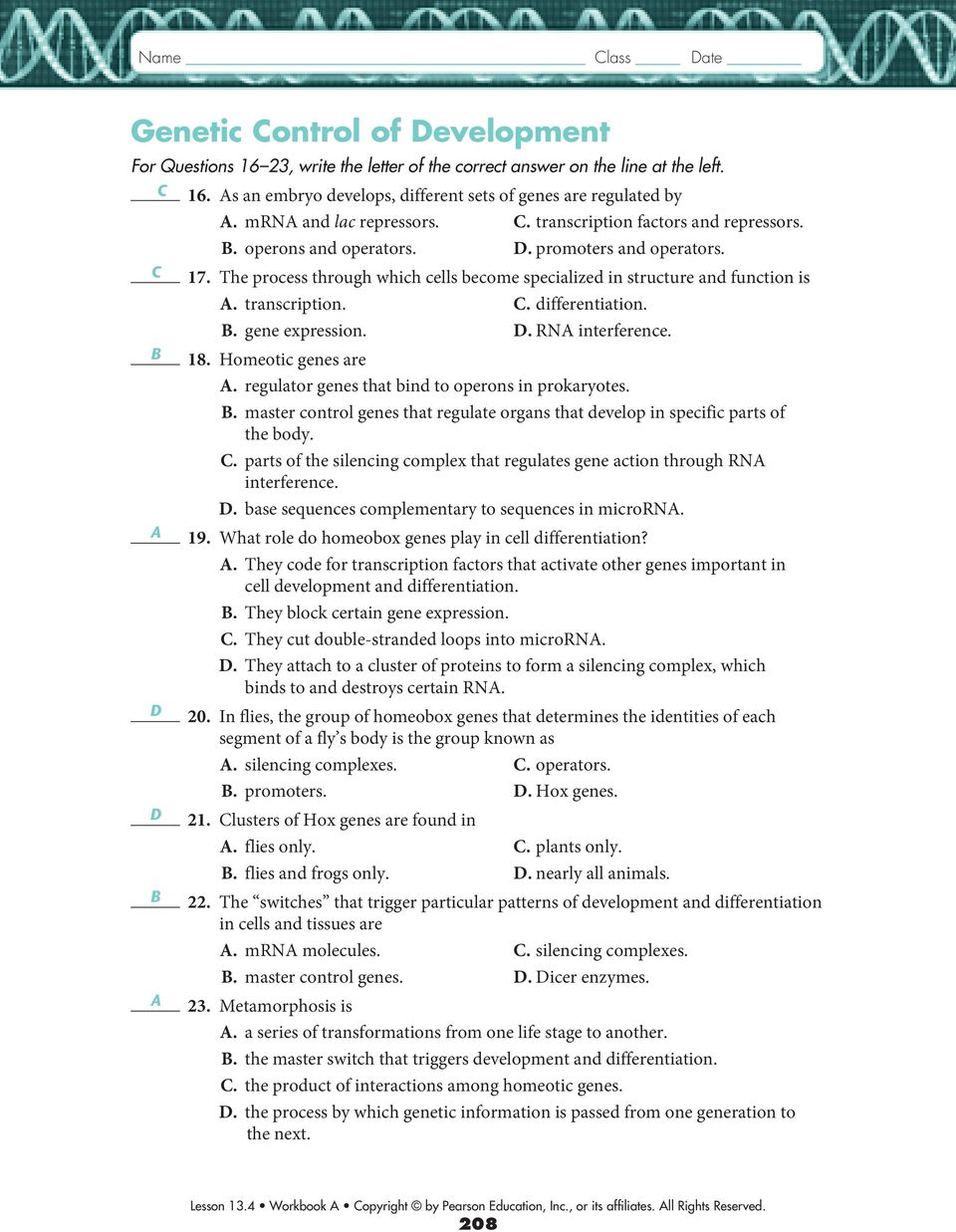
3 Eukaryotic Gene Regulation 10. In what two ways is gene regulation in eukaryotes different from gene regulation in prokaryotes? a. Most eukaryotic genes are controlled individually. b. Eukaryotic cells have more complex regulatory sequences than those of the lac repressor system. 11. What is a TATA box? What does a TATA box do? It is a short region of DNA that contains a sequence of T and A base pairs. The protein that binds to this site helps position RNA polymerase. 12. What are transcription factors and what do they do? They are DNA-binding proteins that bind to DNA sequences in the regulatory regions of genes and help control gene expression. 13. Explain how gene regulation makes cell specialization possible. It allows particular genes to be expressed in some kinds of cells but not others. 14. What is microrna and how is it related to mrna? Small RNA molecules are called microrna. They attach to certain mrna molecules and stop them from passing on their protein-making instructions. 15. Explain how the process of RNA interference works. Certain small RNA molecules fold into loops. The Dicer enzyme cuts them into microrna (mirna). The strands then separate. An mirna piece attaches to a cluster of proteins to form a silencing complex. The silencing complex binds to and destroys an mrna molecule that contains a base sequence complementary to the mirna. In this way, it blocks gene expression. 207
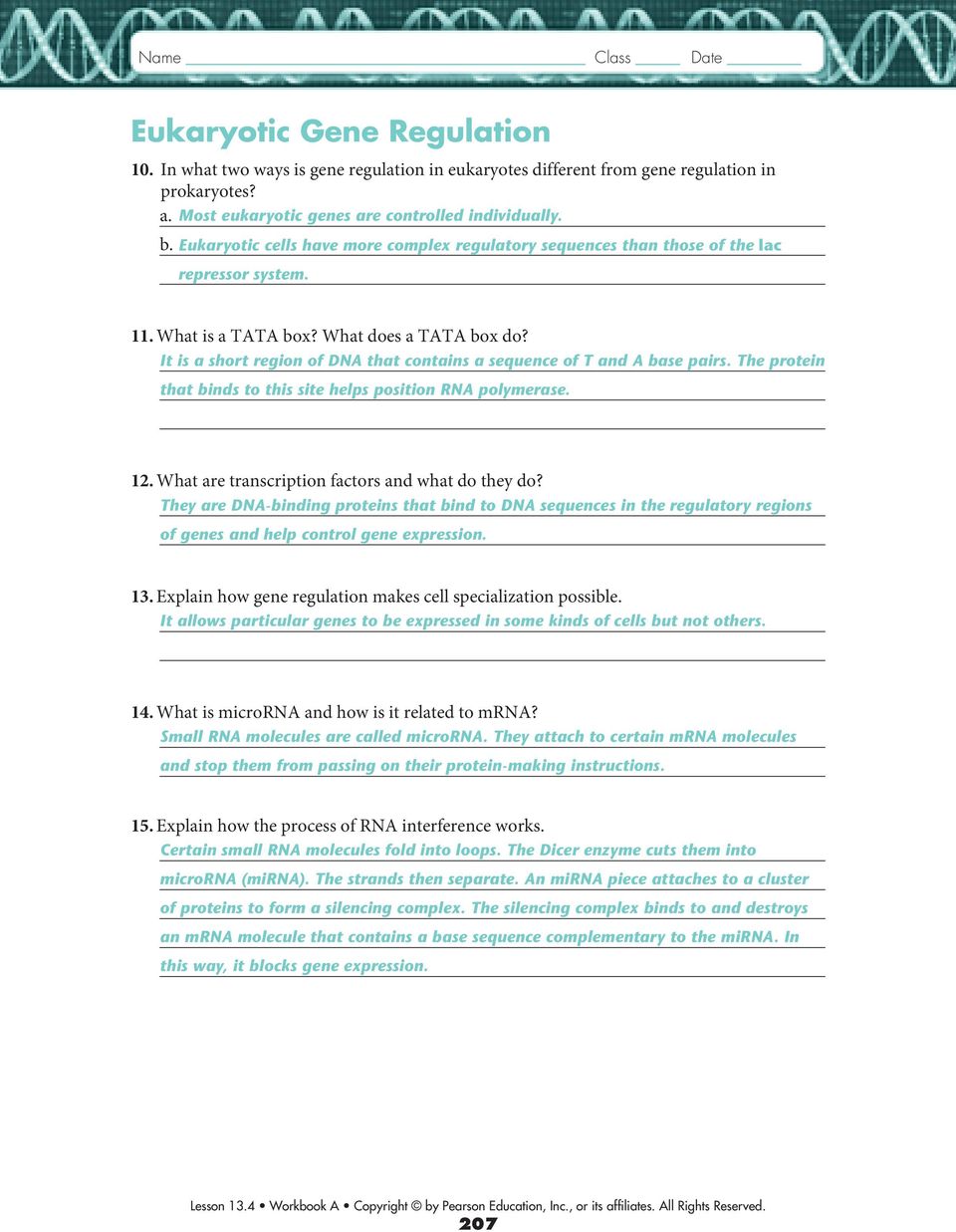
4 Genetic Control of Development For Questions 16 23, write the letter of the correct answer on the line at the left. C B A D D B C A 16. As an embryo develops, different sets of genes are regulated by A. mrna and lac repressors. C. transcription factors and repressors. B. operons and operators. D. promoters and operators. 17. The process through which cells become specialized in structure and function is A. transcription. C. differentiation. B. gene expression. D. RNA interference. 18. Homeotic genes are A. regulator genes that bind to operons in prokaryotes. B. master control genes that regulate organs that develop in specific parts of the body. C. parts of the silencing complex that regulates gene action through RNA interference. D. base sequences complementary to sequences in microrna. 19. What role do homeobox genes play in cell differentiation? A. They code for transcription factors that activate other genes important in cell development and differentiation. B. They block certain gene expression. C. They cut double-stranded loops into microrna. D. They attach to a cluster of proteins to form a silencing complex, which binds to and destroys certain RNA. 20. In flies, the group of homeobox genes that determines the identities of each segment of a fly s body is the group known as A. silencing complexes. C. operators. B. promoters. D. Hox genes. 21. Clusters of Hox genes are found in A. flies only. C. plants only. B. flies and frogs only. D. nearly all animals. 22. The switches that trigger particular patterns of development and differentiation in cells and tissues are A. mrna molecules. C. silencing complexes. B. master control genes. D. Dicer enzymes. 23. Metamorphosis is A. a series of transformations from one life stage to another. B. the master switch that triggers development and differentiation. C. the product of interactions among homeotic genes. D. the process by which genetic information is passed from one generation to the next. 208
5 24. Environmental factors can influence gene expression. Fill in the table below to show how organisms respond to conditions in their environment. E. coli with limited food supply Environmental Factor Influencing Gene Expression nutrient availability How the Organism Responds The lac operon is switched on when lactose is the only food source. A tadpole in a drying pond lack of water The tadpole may speed up its metamorphosis. 25. Many research studies have shown that different species may possess some of the exact same genes but show vastly different traits. How can that happen? The difference arises not from the genes themselves but from how they are regulated and expressed. For example, a gene may be turned on at a different time in one species than in another. Perhaps environmental factors have an effect, too. 209

6 Chapter Vocabulary Review For Questions 1 7, write True if the statement is true. If the statement is false, change the underlined word or words to make the statement true. RNA 1. DNA contains the sugar ribose. True 2. Messenger RNA carries copies of the instructions for making proteins from DNA to other parts of the cell. Transfer RNA 3. RNA polymerase transfers amino acids to ribosomes. True 4. The process of transcription produces a complementary strand of RNA on a DNA template. True 5. The enzyme that assembles a complementary strand of RNA on a DNA template is RNA polymerase. promoter 6. The region of DNA where the production of an RNA strand begins is called the intron. True 7. Exons are spliced together in forming messenger RNA. For Questions 8 16, match the term with its definition. Definition Term B 8. The sequence of bases that serves as the A. polypeptide language of life B. genetic code E 9. A sequence of three bases on a trna molecule C. codon that is complementary to a sequence of bases on an mrna molecule D. translation F 10. How genetic information is put into action in a E. anticodon I D G A C H living cell 11. Having extra sets of chromosomes 12. The decoding of an mrna message into a protein 13. A heritable change in genetic information 14. A chain of amino acids 15. The three consecutive bases that specify a single amino acid to be added to the polypeptide chain 16. A chemical or physical agent that causes a change in a gene F. gene expression G. mutation H. mutagen I. polyploidy For Questions 17 19, complete each statement by writing the correct word or words. 17. A group of genes that are regulated together is called a(n) operon. 18. A region of DNA where a repressor can bind is a(n) operator. 19. Master control genes, called homeotic genes, regulate organs that develop in specific parts of the body. Chapter 13 Workbook A Copyright by Pearson Education, Inc., or its affiliates. All Rights Reserved. 210

7 MOUSE-EYED FLY In the Chapter Mystery, you learned about a fly that was genetically manipulated to grow eyes in different places on its body. Scientists continue to develop techniques to modify a variety of other animals. But should they? Learning Should Genetic Experiments Be Performed on Animals? Some people think that the type of research that produced the mouse-eyed fly is perfectly acceptable. Others think that it s a terrible thing to do even to a fly. In the biological sciences, animal testing has always been controversial, and it probably always will be. Perspectives on Animal Genetic Experiments Animal rights groups have come a long way in recent years. More people are responding to the issues brought up by animal rights groups. For example, animal testing of cosmetics has been banned in a number of countries, and in the United States many companies have voluntarily stopped testing on animals. So what s the next frontier for animal rights activists? According to Edward Avellone of Animal Rights Now!, it s genetic experimentation. What purpose is there in creating a mouse with six legs or a sheep with one eye in the middle of its forehead? asks Avellone. Scientists are just playing around with a new technology. They re creating horribly deformed animals for no real reason. Some people disagree with this point of view. Says Ann Wilber of Scientists for the Ethical Treatment of Animals, We re responsible professionals, not monsters. Wilber explains that the one-eyed sheep was the unintended result of an attempt to understand how the eye developed and how it works. We ve also developed a sheep whose milk contains a protein that might cure emphysema. There are reasons for what we do. But to Avellone, the point is not simply the motivation behind the experimentation. It s also the process of the experiment. Only 10 percent of the animals they breed have the gene they want to study. The remaining 90 percent [of the animals] are simply killed. Wilber admits that this situation is sad, but true. Still, she says, We re working every day to improve our techniques and therefore our success rate. Even if the success rate never tops 10 percent, she asks, Isn t that a small price to pay for a cure for cancer, or multiple sclerosis, or Parkinson s disease? Continued on next page Chapter 13 Workbook A Copyright by Pearson Education, Inc., or its affiliates. All Rights Reserved. 211

8 Themes Science and Civic Literacy 1. Edward Avellone makes several arguments against animal testing in genetics experiments. Why does he think the process of animal genetic experimentation is flawed? He says that only 10 percent of animals scientists breed have the gene they want to study. He says the remaining 90 percent of the animals are killed because they are not useful. 2. Avellone argues that genetic experiments are unnecessary. What claim does he make about scientists motivations for doing such experiments? He says that scientists are performing experiments with no real scientific purpose, and that they are playing with new technology. 3. What is Ann Wilber s main argument in favor of genetic testing on animals? It could lead to cures for serious human diseases. 4. Which of her arguments could be summed up as, It s a necessary evil? Killing 90 percent of the animals they breed is a small price to pay to cure diseases. 5. Do you agree with Avellone, with Wilber, or with neither of them? Why? Accept any answers that are clearly argued, logical, and based on evidence, either from the article or from other reliable sources. Evaluating an Issue The skills used in this activity include creativity and intellectual curiosity, communication skills, interpersonal and collaborative skills, information and media literacy, and social responsibility. The issue of experimenting on animals, especially genetic experimentation, is complex; you can t construct an informed opinion after reading just one article. Working with a group, use library and Internet resources to collect opinions on both sides of the issue. Work through the material thoroughly and then make up your mind about how you feel about the issue. If everyone in the group agrees, create a multimedia presentation for your class in which you present your point of view. If the members of your group disagree, stage a debate in front of the class, with the same number of students arguing each side of the issue. Evaluate students presentations based on the thoroughness of their research, the inclusion of sources from both sides of the issue, and the quality of the sources they used; also, consider the cogency of the arguments they make to support their point of view. Chapter 13 Workbook A Copyright by Pearson Education, Inc., or its affiliates. All Rights Reserved. 212

Name Class Date. Figure 13 1. 2. Which nucleotide in Figure 13 1 indicates the nucleic acid above is RNA? a. uracil c. cytosine b. guanine d.
 13 Multiple Choice RNA and Protein Synthesis Chapter Test A Write the letter that best answers the question or completes the statement on the line provided. 1. Which of the following are found in both
1 Mutation and Genetic Change
 CHAPTER 14 1 Mutation and Genetic Change SECTION Genes in Action KEY IDEAS As you read this section, keep these questions in mind: What is the origin of genetic differences among organisms? What kinds
Genetic information (DNA) determines structure of proteins DNA RNA proteins cell structure 3.11 3.15 enzymes control cell chemistry ( metabolism )
 Biology 1406 Exam 3 Notes Structure of DNA Ch. 10 Genetic information (DNA) determines structure of proteins DNA RNA proteins cell structure 3.11 3.15 enzymes control cell chemistry ( metabolism ) Proteins
DNA Replication & Protein Synthesis. This isn t a baaaaaaaddd chapter!!!
 DNA Replication & Protein Synthesis This isn t a baaaaaaaddd chapter!!! The Discovery of DNA s Structure Watson and Crick s discovery of DNA s structure was based on almost fifty years of research by other
Translation Study Guide
 Translation Study Guide This study guide is a written version of the material you have seen presented in the replication unit. In translation, the cell uses the genetic information contained in mrna to
Transcription and Translation of DNA
 Transcription and Translation of DNA Genotype our genetic constitution ( makeup) is determined (controlled) by the sequence of bases in its genes Phenotype determined by the proteins synthesised when genes
Protein Synthesis How Genes Become Constituent Molecules
 Protein Synthesis Protein Synthesis How Genes Become Constituent Molecules Mendel and The Idea of Gene What is a Chromosome? A chromosome is a molecule of DNA 50% 50% 1. True 2. False True False Protein
RNA and Protein Synthesis
 Name lass Date RN and Protein Synthesis Information and Heredity Q: How does information fl ow from DN to RN to direct the synthesis of proteins? 13.1 What is RN? WHT I KNOW SMPLE NSWER: RN is a nucleic
Structure and Function of DNA
 Structure and Function of DNA DNA and RNA Structure DNA and RNA are nucleic acids. They consist of chemical units called nucleotides. The nucleotides are joined by a sugar-phosphate backbone. The four
Molecular Genetics. RNA, Transcription, & Protein Synthesis
 Molecular Genetics RNA, Transcription, & Protein Synthesis Section 1 RNA AND TRANSCRIPTION Objectives Describe the primary functions of RNA Identify how RNA differs from DNA Describe the structure and
Control of Gene Expression
 Home Gene Regulation Is Necessary? Control of Gene Expression By switching genes off when they are not needed, cells can prevent resources from being wasted. There should be natural selection favoring
From DNA to Protein. Proteins. Chapter 13. Prokaryotes and Eukaryotes. The Path From Genes to Proteins. All proteins consist of polypeptide chains
 Proteins From DNA to Protein Chapter 13 All proteins consist of polypeptide chains A linear sequence of amino acids Each chain corresponds to the nucleotide base sequence of a gene The Path From Genes
Complex multicellular organisms are produced by cells that switch genes on and off during development.
 Home Control of Gene Expression Gene Regulation Is Necessary? By switching genes off when they are not needed, cells can prevent resources from being wasted. There should be natural selection favoring
Lecture 1 MODULE 3 GENE EXPRESSION AND REGULATION OF GENE EXPRESSION. Professor Bharat Patel Office: Science 2, 2.36 Email: [email protected].
 Lecture 1 MODULE 3 GENE EXPRESSION AND REGULATION OF GENE EXPRESSION Professor Bharat Patel Office: Science 2, 2.36 Email: [email protected] What is Gene Expression & Gene Regulation? 1. Gene Expression
RNA & Protein Synthesis
 RNA & Protein Synthesis Genes send messages to cellular machinery RNA Plays a major role in process Process has three phases (Genetic) Transcription (Genetic) Translation Protein Synthesis RNA Synthesis
Chapter 18 Regulation of Gene Expression
 Chapter 18 Regulation of Gene Expression 18.1. Gene Regulation Is Necessary By switching genes off when they are not needed, cells can prevent resources from being wasted. There should be natural selection
13.2 Ribosomes & Protein Synthesis
 13.2 Ribosomes & Protein Synthesis Introduction: *A specific sequence of bases in DNA carries the directions for forming a polypeptide, a chain of amino acids (there are 20 different types of amino acid).
Genetics Module B, Anchor 3
 Genetics Module B, Anchor 3 Key Concepts: - An individual s characteristics are determines by factors that are passed from one parental generation to the next. - During gamete formation, the alleles for
Name Date Period. 2. When a molecule of double-stranded DNA undergoes replication, it results in
 DNA, RNA, Protein Synthesis Keystone 1. During the process shown above, the two strands of one DNA molecule are unwound. Then, DNA polymerases add complementary nucleotides to each strand which results
The sequence of bases on the mrna is a code that determines the sequence of amino acids in the polypeptide being synthesized:
 Module 3F Protein Synthesis So far in this unit, we have examined: How genes are transmitted from one generation to the next Where genes are located What genes are made of How genes are replicated How
Control of Gene Expression
 Control of Gene Expression What is Gene Expression? Gene expression is the process by which informa9on from a gene is used in the synthesis of a func9onal gene product. What is Gene Expression? Figure
DNA, RNA, Protein synthesis, and Mutations. Chapters 12-13.3
 DNA, RNA, Protein synthesis, and Mutations Chapters 12-13.3 1A)Identify the components of DNA and explain its role in heredity. DNA s Role in heredity: Contains the genetic information of a cell that can
GENE REGULATION. Teacher Packet
 AP * BIOLOGY GENE REGULATION Teacher Packet AP* is a trademark of the College Entrance Examination Board. The College Entrance Examination Board was not involved in the production of this material. Pictures
CCR Biology - Chapter 8 Practice Test - Summer 2012
 Name: Class: Date: CCR Biology - Chapter 8 Practice Test - Summer 2012 Multiple Choice Identify the choice that best completes the statement or answers the question. 1. What did Hershey and Chase know
Module 3 Questions. 7. Chemotaxis is an example of signal transduction. Explain, with the use of diagrams.
 Module 3 Questions Section 1. Essay and Short Answers. Use diagrams wherever possible 1. With the use of a diagram, provide an overview of the general regulation strategies available to a bacterial cell.
Multiple Choice Write the letter that best answers the question or completes the statement on the line provided.
 Name lass Date hapter 12 DN and RN hapter Test Multiple hoice Write the letter that best answers the question or completes the statement on the line provided. Pearson Education, Inc. ll rights reserved.
AP BIOLOGY 2009 SCORING GUIDELINES
 AP BIOLOGY 2009 SCORING GUIDELINES Question 4 The flow of genetic information from DNA to protein in eukaryotic cells is called the central dogma of biology. (a) Explain the role of each of the following
a. Ribosomal RNA rrna a type ofrna that combines with proteins to form Ribosomes on which polypeptide chains of proteins are assembled
 Biology 101 Chapter 14 Name: Fill-in-the-Blanks Which base follows the next in a strand of DNA is referred to. as the base (1) Sequence. The region of DNA that calls for the assembly of specific amino
To be able to describe polypeptide synthesis including transcription and splicing
 Thursday 8th March COPY LO: To be able to describe polypeptide synthesis including transcription and splicing Starter Explain the difference between transcription and translation BATS Describe and explain
Gene Switches Teacher Information
 STO-143 Gene Switches Teacher Information Summary Kit contains How do bacteria turn on and turn off genes? Students model the action of the lac operon that regulates the expression of genes essential for
Activity 7.21 Transcription factors
 Purpose To consolidate understanding of protein synthesis. To explain the role of transcription factors and hormones in switching genes on and off. Play the transcription initiation complex game Regulation
The Steps. 1. Transcription. 2. Transferal. 3. Translation
 Protein Synthesis Protein synthesis is simply the "making of proteins." Although the term itself is easy to understand, the multiple steps that a cell in a plant or animal must go through are not. In order
Just the Facts: A Basic Introduction to the Science Underlying NCBI Resources
 1 of 8 11/7/2004 11:00 AM National Center for Biotechnology Information About NCBI NCBI at a Glance A Science Primer Human Genome Resources Model Organisms Guide Outreach and Education Databases and Tools
14.3 Studying the Human Genome
 14.3 Studying the Human Genome Lesson Objectives Summarize the methods of DNA analysis. State the goals of the Human Genome Project and explain what we have learned so far. Lesson Summary Manipulating
2. The number of different kinds of nucleotides present in any DNA molecule is A) four B) six C) two D) three
 Chem 121 Chapter 22. Nucleic Acids 1. Any given nucleotide in a nucleic acid contains A) two bases and a sugar. B) one sugar, two bases and one phosphate. C) two sugars and one phosphate. D) one sugar,
Gene Regulation -- The Lac Operon
 Gene Regulation -- The Lac Operon Specific proteins are present in different tissues and some appear only at certain times during development. All cells of a higher organism have the full set of genes:
PRACTICE TEST QUESTIONS
 PART A: MULTIPLE CHOICE QUESTIONS PRACTICE TEST QUESTIONS DNA & PROTEIN SYNTHESIS B 1. One of the functions of DNA is to A. secrete vacuoles. B. make copies of itself. C. join amino acids to each other.
MUTATION, DNA REPAIR AND CANCER
 MUTATION, DNA REPAIR AND CANCER 1 Mutation A heritable change in the genetic material Essential to the continuity of life Source of variation for natural selection New mutations are more likely to be harmful
Coding sequence the sequence of nucleotide bases on the DNA that are transcribed into RNA which are in turn translated into protein
 Assignment 3 Michele Owens Vocabulary Gene: A sequence of DNA that instructs a cell to produce a particular protein Promoter a control sequence near the start of a gene Coding sequence the sequence of
BioBoot Camp Genetics
 BioBoot Camp Genetics BIO.B.1.2.1 Describe how the process of DNA replication results in the transmission and/or conservation of genetic information DNA Replication is the process of DNA being copied before
Basic Concepts of DNA, Proteins, Genes and Genomes
 Basic Concepts of DNA, Proteins, Genes and Genomes Kun-Mao Chao 1,2,3 1 Graduate Institute of Biomedical Electronics and Bioinformatics 2 Department of Computer Science and Information Engineering 3 Graduate
Lecture Series 7. From DNA to Protein. Genotype to Phenotype. Reading Assignments. A. Genes and the Synthesis of Polypeptides
 Lecture Series 7 From DNA to Protein: Genotype to Phenotype Reading Assignments Read Chapter 7 From DNA to Protein A. Genes and the Synthesis of Polypeptides Genes are made up of DNA and are expressed
How To Understand How Gene Expression Is Regulated
 What makes cells different from each other? How do cells respond to information from environment? Regulation of: - Transcription - prokaryotes - eukaryotes - mrna splicing - mrna localisation and translation
Gene Transcription in Prokaryotes
 Gene Transcription in Prokaryotes Operons: in prokaryotes, genes that encode protein participating in a common pathway are organized together. This group of genes, arranged in tandem, is called an OPERON.
The world of non-coding RNA. Espen Enerly
 The world of non-coding RNA Espen Enerly ncrna in general Different groups Small RNAs Outline mirnas and sirnas Speculations Common for all ncrna Per def.: never translated Not spurious transcripts Always/often
Genetics 301 Sample Final Examination Spring 2003
 Genetics 301 Sample Final Examination Spring 2003 50 Multiple Choice Questions-(Choose the best answer) 1. A cross between two true breeding lines one with dark blue flowers and one with bright white flowers
Genetics Test Biology I
 Genetics Test Biology I Multiple Choice Identify the choice that best completes the statement or answers the question. 1. Avery s experiments showed that bacteria are transformed by a. RNA. c. proteins.
Protein Synthesis. Page 41 Page 44 Page 47 Page 42 Page 45 Page 48 Page 43 Page 46 Page 49. Page 41. DNA RNA Protein. Vocabulary
 Protein Synthesis Vocabulary Transcription Translation Translocation Chromosomal mutation Deoxyribonucleic acid Frame shift mutation Gene expression Mutation Point mutation Page 41 Page 41 Page 44 Page
RNA Structure and folding
 RNA Structure and folding Overview: The main functional biomolecules in cells are polymers DNA, RNA and proteins For RNA and Proteins, the specific sequence of the polymer dictates its final structure
Control of Gene Expression
 Control of Gene Expression (Learning Objectives) Explain the role of gene expression is differentiation of function of cells which leads to the emergence of different tissues, organs, and organ systems
The Making of the Fittest: Evolving Switches, Evolving Bodies
 OVERVIEW MODELING THE REGULATORY SWITCHES OF THE PITX1 GENE IN STICKLEBACK FISH This hands-on activity supports the short film, The Making of the Fittest:, and aims to help students understand eukaryotic
Replication Study Guide
 Replication Study Guide This study guide is a written version of the material you have seen presented in the replication unit. Self-reproduction is a function of life that human-engineered systems have
Gene Models & Bed format: What they represent.
 GeneModels&Bedformat:Whattheyrepresent. Gene models are hypotheses about the structure of transcripts produced by a gene. Like all models, they may be correct, partly correct, or entirely wrong. Typically,
Lab # 12: DNA and RNA
 115 116 Concepts to be explored: Structure of DNA Nucleotides Amino Acids Proteins Genetic Code Mutation RNA Transcription to RNA Translation to a Protein Figure 12. 1: DNA double helix Introduction Long
Algorithms in Computational Biology (236522) spring 2007 Lecture #1
 Algorithms in Computational Biology (236522) spring 2007 Lecture #1 Lecturer: Shlomo Moran, Taub 639, tel 4363 Office hours: Tuesday 11:00-12:00/by appointment TA: Ilan Gronau, Taub 700, tel 4894 Office
Thymine = orange Adenine = dark green Guanine = purple Cytosine = yellow Uracil = brown
 1 DNA Coloring - Transcription & Translation Transcription RNA, Ribonucleic Acid is very similar to DNA. RNA normally exists as a single strand (and not the double stranded double helix of DNA). It contains
Academic Nucleic Acids and Protein Synthesis Test
 Academic Nucleic Acids and Protein Synthesis Test Multiple Choice Identify the letter of the choice that best completes the statement or answers the question. 1. Each organism has a unique combination
Name: Date: Period: DNA Unit: DNA Webquest
 Name: Date: Period: DNA Unit: DNA Webquest Part 1 History, DNA Structure, DNA Replication DNA History http://www.dnaftb.org/dnaftb/1/concept/index.html Read the text and answer the following questions.
Specific problems. The genetic code. The genetic code. Adaptor molecules match amino acids to mrna codons
 Tutorial II Gene expression: mrna translation and protein synthesis Piergiorgio Percipalle, PhD Program Control of gene transcription and RNA processing mrna translation and protein synthesis KAROLINSKA
12.1 The Role of DNA in Heredity
 12.1 The Role of DNA in Heredity Only in the last 50 years have scientists understood the role of DNA in heredity. That understanding began with the discovery of DNA s structure. In 1952, Rosalind Franklin
Biotechnology and Recombinant DNA (Chapter 9) Lecture Materials for Amy Warenda Czura, Ph.D. Suffolk County Community College
 Biotechnology and Recombinant DNA (Chapter 9) Lecture Materials for Amy Warenda Czura, Ph.D. Suffolk County Community College Primary Source for figures and content: Eastern Campus Tortora, G.J. Microbiology
From DNA to Protein
 Nucleus Control center of the cell contains the genetic library encoded in the sequences of nucleotides in molecules of DNA code for the amino acid sequences of all proteins determines which specific proteins
Given these characteristics of life, which of the following objects is considered a living organism? W. X. Y. Z.
 Cell Structure and Organization 1. All living things must possess certain characteristics. They are all composed of one or more cells. They can grow, reproduce, and pass their genes on to their offspring.
Sample Questions for Exam 3
 Sample Questions for Exam 3 1. All of the following occur during prometaphase of mitosis in animal cells except a. the centrioles move toward opposite poles. b. the nucleolus can no longer be seen. c.
DNA and the Cell. Version 2.3. English version. ELLS European Learning Laboratory for the Life Sciences
 DNA and the Cell Anastasios Koutsos Alexandra Manaia Julia Willingale-Theune Version 2.3 English version ELLS European Learning Laboratory for the Life Sciences Anastasios Koutsos, Alexandra Manaia and
Translation. Translation: Assembly of polypeptides on a ribosome
 Translation Translation: Assembly of polypeptides on a ribosome Living cells devote more energy to the synthesis of proteins than to any other aspect of metabolism. About a third of the dry mass of a cell
Provincial Exam Questions. 9. Give one role of each of the following nucleic acids in the production of an enzyme.
 Provincial Exam Questions Unit: Cell Biology: Protein Synthesis (B7 & B8) 2010 Jan 3. Describe the process of translation. (4 marks) 2009 Sample 8. What is the role of ribosomes in protein synthesis? A.
Bob Jesberg. Boston, MA April 3, 2014
 DNA, Replication and Transcription Bob Jesberg NSTA Conference Boston, MA April 3, 2014 1 Workshop Agenda Looking at DNA and Forensics The DNA, Replication i and Transcription i Set DNA Ladder The Double
Ms. Campbell Protein Synthesis Practice Questions Regents L.E.
 Name Student # Ms. Campbell Protein Synthesis Practice Questions Regents L.E. 1. A sequence of three nitrogenous bases in a messenger-rna molecule is known as a 1) codon 2) gene 3) polypeptide 4) nucleotide
CCR Biology - Chapter 9 Practice Test - Summer 2012
 Name: Class: Date: CCR Biology - Chapter 9 Practice Test - Summer 2012 Multiple Choice Identify the choice that best completes the statement or answers the question. 1. Genetic engineering is possible
Gene Switches A Model
 Gene Switches A Model Abstract Conceptually, how genetic switches function and their role in the process of evolution, can be difficult for students to visualize. Gene Switches A Model attempts to make
Unit I: Introduction To Scientific Processes
 Unit I: Introduction To Scientific Processes This unit is an introduction to the scientific process. This unit consists of a laboratory exercise where students go through the QPOE2 process step by step
DNA Fingerprinting. Unless they are identical twins, individuals have unique DNA
 DNA Fingerprinting Unless they are identical twins, individuals have unique DNA DNA fingerprinting The name used for the unambiguous identifying technique that takes advantage of differences in DNA sequence
ISTEP+: Biology I End-of-Course Assessment Released Items and Scoring Notes
 ISTEP+: Biology I End-of-Course Assessment Released Items and Scoring Notes Page 1 of 22 Introduction Indiana students enrolled in Biology I participated in the ISTEP+: Biology I Graduation Examination
RNA: Transcription and Processing
 8 RNA: Transcription and Processing WORKING WITH THE FIGURES 1. In Figure 8-3, why are the arrows for genes 1 and 2 pointing in opposite directions? The arrows for genes 1 and 2 indicate the direction
Basic Principles of Transcription and Translation
 The Flow of Genetic Information The information content of DNA is in the form of specific sequences of nucleotides The DNA inherited by an organism leads to specific traits by dictating the synthesis of
Recombinant DNA and Biotechnology
 Recombinant DNA and Biotechnology Chapter 18 Lecture Objectives What Is Recombinant DNA? How Are New Genes Inserted into Cells? What Sources of DNA Are Used in Cloning? What Other Tools Are Used to Study
Cellular Respiration Worksheet 1. 1. What are the 3 phases of the cellular respiration process? Glycolysis, Krebs Cycle, Electron Transport Chain.
 Cellular Respiration Worksheet 1 1. What are the 3 phases of the cellular respiration process? Glycolysis, Krebs Cycle, Electron Transport Chain. 2. Where in the cell does the glycolysis part of cellular
Human Genome and Human Genome Project. Louxin Zhang
 Human Genome and Human Genome Project Louxin Zhang A Primer to Genomics Cells are the fundamental working units of every living systems. DNA is made of 4 nucleotide bases. The DNA sequence is the particular
Appendix 2 Molecular Biology Core Curriculum. Websites and Other Resources
 Appendix 2 Molecular Biology Core Curriculum Websites and Other Resources Chapter 1 - The Molecular Basis of Cancer 1. Inside Cancer http://www.insidecancer.org/ From the Dolan DNA Learning Center Cold
The Practice of Peptide Synthesis
 The Practice of Peptide Synthesis Download: The Practice of Peptide Synthesis PDF ebook The Practice of Peptide Synthesis PDF - Are you searching for The Practice of Peptide Synthesis Books? Now, you will
AP Biology TEST #5 - Chapters 11-14, 16 - REVIEW SHEET
 NAME: AP Biology TEST #5 - Chapters 11-14, 16 - REVIEW SHEET 1. Griffith's experiments showing the transformation of R strain pneumococcus bacteria to S strain pneumococcus bacteria in the presence of
Micro RNAs: potentielle Biomarker für das. Blutspenderscreening
 Micro RNAs: potentielle Biomarker für das Blutspenderscreening micrornas - Background Types of RNA -Coding: messenger RNA (mrna) -Non-coding (examples): Ribosomal RNA (rrna) Transfer RNA (trna) Small nuclear
RNAi Shooting the Messenger!
 RNAi Shooting the Messenger! Bronya Keats, Ph.D. Department of Genetics Louisiana State University Health Sciences Center New Orleans Email: [email protected] RNA interference (RNAi) A mechanism by which
7. 2. Regulation of gene expression. Unit 7: Molecular biology and genetics
 7. 2 Regulation of gene expression We all start off as one stem cell (a fertilised ovum) that divides to give a ball of cells. These cells then differentiate and become specialised to carry out specific
Central Dogma. Lecture 10. Discussing DNA replication. DNA Replication. DNA mutation and repair. Transcription
 Central Dogma transcription translation DNA RNA Protein replication Discussing DNA replication (Nucleus of eukaryote, cytoplasm of prokaryote) Recall Replication is semi-conservative and bidirectional
NO CALCULATORS OR CELL PHONES ALLOWED
 Biol 205 Exam 1 TEST FORM A Spring 2008 NAME Fill out both sides of the Scantron Sheet. On Side 2 be sure to indicate that you have TEST FORM A The answers to Part I should be placed on the SCANTRON SHEET.
Chem 465 Biochemistry II
 Chem 465 Biochemistry II Name: 2 points Multiple choice (4 points apiece): 1. Formation of the ribosomal initiation complex for bacterial protein synthesis does not require: A) EF-Tu. B) formylmethionyl
BCH401G Lecture 39 Andres
 BCH401G Lecture 39 Andres Lecture Summary: Ribosome: Understand its role in translation and differences between translation in prokaryotes and eukaryotes. Translation: Understand the chemistry of this
4. DNA replication Pages: 979-984 Difficulty: 2 Ans: C Which one of the following statements about enzymes that interact with DNA is true?
 Chapter 25 DNA Metabolism Multiple Choice Questions 1. DNA replication Page: 977 Difficulty: 2 Ans: C The Meselson-Stahl experiment established that: A) DNA polymerase has a crucial role in DNA synthesis.
3120-1 - Page 1. Name:
 Name: 1) Which series is arranged in correct order according to decreasing size of structures? A) DNA, nucleus, chromosome, nucleotide, nitrogenous base B) chromosome, nucleus, nitrogenous base, nucleotide,
Regents Biology REGENTS REVIEW: PROTEIN SYNTHESIS
 Period Date REGENTS REVIEW: PROTEIN SYNTHESIS 1. The diagram at the right represents a portion of a type of organic molecule present in the cells of organisms. What will most likely happen if there is
Human Genome Organization: An Update. Genome Organization: An Update
 Human Genome Organization: An Update Genome Organization: An Update Highlights of Human Genome Project Timetable Proposed in 1990 as 3 billion dollar joint venture between DOE and NIH with 15 year completion
Transcription: RNA Synthesis, Processing & Modification
 Transcription: RNA Synthesis, Processing & Modification 1 Central dogma DNA RNA Protein Reverse transcription 2 Transcription The process of making RNA from DNA Produces all type of RNA mrna, trna, rrna,
Lecture 6. Regulation of Protein Synthesis at the Translational Level
 Regulation of Protein Synthesis (6.1) Lecture 6 Regulation of Protein Synthesis at the Translational Level Comparison of EF-Tu-GDP and EF-Tu-GTP conformations EF-Tu-GDP EF-Tu-GTP Next: Comparison of GDP
Nucleotides and Nucleic Acids
 Nucleotides and Nucleic Acids Brief History 1 1869 - Miescher Isolated nuclein from soiled bandages 1902 - Garrod Studied rare genetic disorder: Alkaptonuria; concluded that specific gene is associated
somatic cell egg genotype gamete polar body phenotype homologous chromosome trait dominant autosome genetics recessive
 CHAPTER 6 MEIOSIS AND MENDEL Vocabulary Practice somatic cell egg genotype gamete polar body phenotype homologous chromosome trait dominant autosome genetics recessive CHAPTER 6 Meiosis and Mendel sex
Modeling DNA Replication and Protein Synthesis
 Skills Practice Lab Modeling DNA Replication and Protein Synthesis OBJECTIVES Construct and analyze a model of DNA. Use a model to simulate the process of replication. Use a model to simulate the process
Outline. interfering RNA - What is dat? Brief history of RNA interference. What does it do? How does it work?
 Outline Outline interfering RNA - What is dat? Brief history of RNA interference. What does it do? How does it work? What is RNA interference? Recently discovered regulatory level. Genome immune system.