
POSTGRADUATE COURSEWORK
|
|
|
- Lisa Freeman
- 10 years ago
- Views:
Transcription
1 POSTGRADUATE COURSEWORK STUDY GUIDE 2015

2 POSTGRADUATE COURSEWORK STUDY GUIDE 2015 WELCOME TO UQ BUSINESS SCHOOL A postgraduate qualification from a highly-regarded institution such as The University of Queensland Business School is recognised by employers the world over. In addition to extending your knowledge in a specific area, postgraduate study will also help you develop your intellectual aptitude, as well as more general skills such as time management, communication and organisation. In addition to high-quality teaching, at UQ Business School we provide wide-ranging support to help you get the most out of further education and your future career. CONTENTS P. 03 Student Information P. 04 Credit & Exemption & International Opportunities P. 05 Professional Bodies P. 06 Graduate Certificate in Business P. 06 Master of Business P. 11 Graduate Certificate in Business Leadership P. 12 Graduate Certificate in Commerce P. 12 Master of Commerce P. 15 Graduate Certificate in Executive Leadership P. 16 Master of Global Management P. 18 Graduate Certificate in Project Management P. 18 Master of Project Management P. 20 Graduate Certificate in Property Studies P. 20 Master of Property Studies P. 21 Graduate Certificate in Research Commercialisation P. 22 Graduate Certificate in Research Methods P. 23 Graduate Diploma in Research Methods P. 24 Graduate Certificate in Technology & Innovation Management P. 24 Master of Technology & Innovation Management P. 26 Graduate Certificate in Tourism, Hotel and Event Management P. 26 Master of Tourism, Hotel and Event Management P. 28 Master of Tourism Leadership P. 30 Course Descriptions P. 54 Program Plans P. 62 How to Prepare Your Program Plan 2 UQ BUSINESS SCHOOL POSTGRADUATE STUDY GUIDE 2015
3 STUDENT INFORMATION STUDY OPTIONS Postgraduate programs may be undertaken either through full-time or part-time study. Part-time progression, as a general rule, takes twice as long as full-time study. Courses are offered through a variety of modes, including: weekly throughout the semester with classes scheduled between 8am and 10pm, Monday to Friday; weekend classes; and intensive mode. The mode of offering for a particular course may vary from semester to semester and students should confirm with the School the scheduling of course offerings at the commencement of each semester. The # symbol represents the unit value of each course. Courses are typically #2 (units) with a standard full-time study load per semester being #8 (units). RESOURCES Students should be aware of the important dates on the University academic calendar. For up-to-date information refer to the University student information website my.uq.edu.au Students may be eligible for FEE-HELP*. To enquire about eligibility, please visit the fees section on the my.adviser web page on the my.uq site. Alternatively, visit the government FEE-HELP website Courses and programs offered by UQ Business School involve extensive use of the internet and current software programs. For familiarisation with standard software resources, please investigate The University of Queensland Library s AskIT service, which offers computing help and training free to UQ students. Contact the AskIT Desk, Level 2, Duhig Building, St Lucia Campus or visit askit.uq.edu.au/index.php for further details. * FEE-HELP is a loan scheme for eligible students enrolled in fee paying postgraduate non-research programs. STUDENT ASSOCIATIONS UQ Business School has a comprehensive array of student associations that support our students. Refer to business.uq.edu.au/campus-life for further details. ENQUIRIES For general program enquiries, please contact: UQ Business School Level 2, Colin Clark Building (39) The University of Queensland St Lucia, Queensland 4072 P F E [email protected] W business.uq.edu.au Information on the complete range of student fees is available at the University s Student Centre on Level 1, JD Story Building, or visit the website uq.edu.au/study or uq.edu.au/uqanswers POSTGRADUATE STUDY GUIDE 2015 UQ BUSINESS SCHOOL 3
4 CREDIT & EXEMPTION CREDIT Students who have completed comparable postgraduate study may be eligible for credit. Credit is granted on the basis of previous postgraduate study that is deemed to be at least 70% equivalent to UQ Business School postgraduate courses. When granted credit, students are required to complete fewer units towards the award of the degree. Credit is not granted towards postgraduate study for work experience or undergraduate study. EXEMPTION Students who have completed courses in undergraduate programs that are deemed to be at least 70% equivalent to UQ Business School postgraduate courses may be granted exemptions towards the postgraduate degree. Students granted exemptions are required to replace the exempted course with another course of the same unit value from the program major or electives course list (depending on which part of the course list the exemption was granted from). NOTE: Exemptions do not reduce the number of units required for the program. HOW TO APPLY FOR CREDIT AND/OR EXEMPTION Students are required to apply for credit and/or exemptions by completing the credit/exemption application form, which is available for download on the my.uq website, or from the Student Centre or UQ Business School. If mailing, requests should be addressed to: The Manager Student Administration UQ Business School The University of Queensland St Lucia, Queensland, Australia 4072 Applications may be handed in at the UQ Business School Reception, Level 2, Colin Clark Building (39), St Lucia Campus. To facilitate timely processing of credit/exemption requests, UQ Business School requires the following information from an applicant: Detailed course outline with the following information: week-by-week list of topics, texts and other recommended readings, assessment criteria, and contact hours. Official academic record or certified copy (please note: copies of records, either by fax or mail, will not be accepted as a proper record and the application will not be processed). Please note, if all the relevant information is not received, the credit/exemption application will not be processed. INTERNATIONAL OPPORTUNITIES UQ Business School offers students the opportunity to study courses overseas through the UQ Abroad program (uq.edu.au/uqabroad) as well as specialised programs and courses within the School, as listed below. ESSAM ESSAM is a European Summer School held in the UK, in June/July. It has a strong European focus in both its program and learning process and requires participants to encounter cultural and social differences in a group environment as part of the process of developing managerial skills. For further information please visit the ESSAM website INTERNATIONAL STUDY IN ASIAN BUSINESS (IBUS7314) This course provides an opportunity for students to apply the knowledge gained from prerequisite courses to an international context in Asian businesses and to broaden their perspective. Further details are made available in April/May and travel occurs in July. Please contact your designated Postgraduate Student Liaison Officer if you are interested in this course. If you are interested in an exchange program or the other programs listed above, please see your designated Postgraduate Student Liaison Officer to determine whether this will fit into your program. In order for students to have a clear understanding of the total number of courses to be completed, students are encouraged to submit their credit/exemption requests in conjunction with an application for entry into a program. The International Student Application for Graduate Coursework contains a section dealing with this. Credit/exemption application forms are also available on the UQ Business School website business.uq.edu.au NOTE: Credit/exemption requests received without an application or current enrolment will not be processed. More information about UQ for International Students, including the study environment, links to estimated living costs, refund policies, support services, information for students with families, and your legal rights as an international student can be found at uq.edu.au/international-students 4 UQ BUSINESS SCHOOL POSTGRADUATE STUDY GUIDE 2015
5 PROFESSIONAL BODIES Information contained on these pages is correct at the time of print. Students wishing to become members of professional bodies should check the requirements of membership directly with the association concerned. CPA AUSTRALIA ASSOCIATE MEMBERS Graduates who have completed the appropriate courses in the Professional Accounting major within the Master of Commerce are eligible for Associate membership. CERTIFIED PRACTISING ACCOUNTANT (CPA) Graduates who wish to advance to CPA membership must complete the CPA Program and other requirements as stated by CPA at Enquiries CPA Australia Level 29, 10 Eagle Street, Brisbane QLD 4000 P ( outside Australia) E [email protected] W ASSOCIATION OF CERTIFIED CHARTERED ACCOUNTANTS (ACCA) Graduates of the Master of Commerce with a major in Professional Accounting may apply to become an Affiliate of ACCA. Enquiries Suite 3, Level 16, 30 Carrington Street, Sydney NSW 2000 P E [email protected] W www2.accaglobal.com/australia CHARTERED ACCOUNTANTS AUSTRALIA + NEW ZEALAND (CAANZ) Graduates of the Master of Commerce with a major in Professional Accounting may meet the educational requirements for admission to the CAANZ s CA Program. Please refer to MCom course list for details. Enquiries Level 32, Central Plaza One, 345 Queen Street, Brisbane QLD 4000 P ( outside Australia) F E [email protected] W GOVERNANCE INSTITUTE OF AUSTRALIA Enquiries Level 3, 370 Queen Street, Brisbane QLD 4000 P E [email protected] FINANCE & TREASURY ASSOCIATION Enquiries PO Box 6137, Melbourne VIC 3004 P F W FINANCIAL SERVICES INSTITUTE OF AUSTRALASIA Enquiries Level 18, 1 Bligh Street, Sydney NSW 2000 P 1300 FINSIA ( ) F E [email protected] W AUSTRALIAN INSTITUTE OF PROJECT MANAGEMENT Enquiries Level 9, 139 Macquarie Street, Sydney NSW 2000 P F E [email protected] W AUSTRALIAN PROPERTY INSTITUTE (API) Enquiries 2nd Floor, 131 Leichhardt Street, Spring Hill QLD 4004 P F E [email protected] W THE ROYAL INSTITUTION OF CHARTERED SURVEYORS (RICS) OCEANIA Enquiries Suite 1, Level 9, 1 Castlereagh Street, Sydney NSW 2000 P F E [email protected] W AUSTRALIAN HUMAN RESOURCES INSTITUTE Enquiries Level 13, 565 Bourke Street, Melbourne VIC 3000 P F E [email protected] W W POSTGRADUATE STUDY GUIDE 2015 UQ BUSINESS SCHOOL 5

6 BUSINESS SUITE OF PROGRAMS The Business suite of programs comprises the Graduate Certificate in Business and Master of Business. The Graduate Certificate in Business provides students with an alternative pathway to the Master of Business #32 (2 year program). Students completing the Master of Business (1.5 or 2 year program) must complete a field of study. These programs allow graduates to concentrate their studies in one of six areas of professional development: Entrepreneurship, Human Resource Management, International Business, Marketing, Public Sector Management or Sustainability. The Master of Business program offers two different entry points depending on your previous studies. The Master #24 (1.5 years) is designed for those graduates with a Bachelor s degree in the same discipline. The Master #32 (2 years) includes the core fundamentals of general management for those graduates with a Bachelor s degree from any discipline. GRADUATE CERTIFICATE IN BUSINESS (GCBus)* Duration 0.5 years full-time; or part-time equivalent. Can be commenced in Semester 1 or Semester 2. Entry requirements To enrol, a student must: 1. hold a bachelor degree with a GPA of at least 4 on a 7-point scale; OR 2. have completed post-secondary study and at least five years full-time work experience, approved by the Executive Dean; OR 3. have completed at least seven years full-time work experience, approved by the Executive Dean. Program requirements Students are required to obtain a total of #8 from the MBus(#32) course list comprising: #6 from Part A; and #2 from Part B. MASTER OF BUSINESS (#32) (MBus(#32))** Duration 2 years full-time; or part-time equivalent. Can be commenced in Semester 1 or Semester 2. Entry requirements To enrol, a student must: 1. hold a bachelor degree with a GPA of at least 4.5 on a 7-point scale; OR 2. hold the Graduate Certificate in Business from UQ with a GPA of at least 4.5 on a 7-point scale. Program requirements Students are required to obtain a total of #32 from the MBus(#32) course list comprising: #8 from Part A; and #12 from one field of study in Part B; and the remaining #12 as a second field of study from Part B or from a combination of other courses in Part B, Part C, Part D and/or other courses approved by the Head of School (up to a maximum of #4). Part D courses require permission from the Head of School before enrolment will be approved. MASTER OF BUSINESS (#24) (MBus(#24))** Duration 1.5 years full-time; or part-time equivalent. Can be commenced in Semester 1 or Semester 2. Entry requirements To enrol, a student must hold a bachelor degree in the same discipline, approved by the Executive Dean, with a GPA of at least 4.5 on a 7-point scale. Program requirements Students are required to obtain a total of #24 from the MBus(#24) course list comprising: #12 from one field of study in Part A; and #2 from Part B; and the remaining #10 as a second field of study from Part A or from a combination of other courses in Part A, Part C, Part D and/or other courses approved by the Head of School (up to a maximum of #4). Part D courses require permission from the Head of School before enrolment will be approved. * Students planning to progress to the Master of Business (#32) must consider their planned field of study and ensure that they enrol in the appropriate courses that will fulfill their field of study requirement. ** A student must undertake the program in a field of study. For students who have previously undertaken studies in business, entry will only be considered for a field of study not already undertaken. 6 UQ BUSINESS SCHOOL POSTGRADUATE STUDY GUIDE 2015

7 MASTER OF BUSINESS (#32) COURSE LIST (2 YEAR PROGRAM) CODE UNITS COURSE NAME Part A: Compulsory IBUS Operating International Business MGTS Principles of Strategic Management MKTG Fundamentals of Marketing TIMS Entrepreneurship & New Ventures Part B: Fields of Study Complete at least #12 units in one field of study Entrepreneurship ECON Economics of Innovation & Entrepreneurship TIMS Technology & Innovation Strategy TIMS New Product & Services Development TIMS Bio-Entrepreneurship & Innovation TIMS7325* 2 Commercialisation in Practice TIMS Management of Intellectual Property TIMS Strategies for Business Sustainability & Innovation TIMS Social Entrepreneurship in Practice TIMS Start-up Entrepreneurship in Practice TIMS Entrepreneurship Incubator Human Resource Management MGTS Managing Organisational Behaviour MGTS Strategic Human Resource Management MGTS Performance Leadership MGTS MGTS Contemporary Employment Relations Employee & Organisational Development MGTS Change Leadership International Business ADVT Global Media & Advertising IBUS Globalisation & the World Economy IBUS Doing Business in Asia IBUS7314** 2 International Study in Asian Business IBUS7315** 4 Extended International Study IBUS International Supply Chains IBUS International Service Operations Management MGTS Cross Cultural Management MKTG Service Strategy * TIMS7325 enrolment requires permission from the Course Coordinator (via an expression of interest). ** Study conducted at international institution required. Refer to the International Opportunities section for details. CODE UNITS COURSE NAME Marketing ADVT Global Media & Advertising ADVT Online Advertising & Marketing ADVT Fundamentals of Advertising ADVT Advertising Management & Production ADVT Social Marketing & Communication MKTG Strategic Marketing & Branding MKTG Consumer & Buyer Behaviour MKTG Service Strategy MKTG Product Strategy & Development MKTG Market & Consumer Research Public Sector Management MGTS Social Enterprises & Not for Profits MGTS Ethical Issues in Management MGTS The New Public Management MGTS Public Organisations: Design & Values MGTS Public Sector Accountability MGTS Designing Public Policy MGTS Government & Business Sustainability ENVM Systems Thinking for Sustainability ENVM Carbon & Energy Management MGTS Decision Making & Reporting for Sustainability TIMS Corporate Sustainability TIMS Technology & Innovation Strategy TIMS Strategies for Business Sustainability & Innovation or 2 units level 7 ENVM course approved by the Program Director. Part C: Electives ECON Consumer & Firm Behaviour IBUS International Study in Business 1 MGTS Virtual Organisation Management MGTS Advanced Strategic Management MGTS Business Negotiation MGTS Communication Management ORGC Communication & Organisation RBUS Research Report RBUS Business Industry Placement TIMS Biotechnology Venture Management PLEASE NOTE THAT COURSES ARE NOT OFFERED EVERY SEMESTER AND EVERY YEAR. POSTGRADUATE STUDY GUIDE 2015 UQ BUSINESS SCHOOL 7

8 MASTER OF BUSINESS (#32) COURSE LIST (2 YEAR PROGRAM)(Contd.) CODE UNITS COURSE NAME Part D: Research requires permission from Head of School MGTS Theory & Research in Strategic Management MGTS Organisational Research Paradigms MKTG Marketing Theory & Research I MKTG Marketing Theory & Research II RBUS RBUS RBUS Qualitative Business Research Methods Quantitative Business Research Methods I Quantitative Business Research Methods II RBUS Scientific Method in Management RBUS Industry Project RBUS7981*** 4 Research Project RBUS7991*** 8 Research Thesis *** These courses may be taken as a whole year or semester course. Please contact your Postgraduate Student Liaison Officer for the correct course code to enrol. PLEASE NOTE THAT COURSES ARE NOT OFFERED EVERY SEMESTER AND EVERY YEAR. 8 UQ BUSINESS SCHOOL POSTGRADUATE STUDY GUIDE 2015

9 MASTER OF BUSINESS (#24) COURSE LIST (1.5 YEAR PROGRAM) CODE UNITS COURSE NAME Part A: Fields of Study Complete at least #12 units in one field of study Entrepreneurship ECON Economics of Innovation & Entrepreneurship TIMS Principles of Entrepreneurship TIMS Technology & Innovation Strategy TIMS New Product & Services Development TIMS Bio-Entrepreneurship & Innovation TIMS7325* 2 Commercialisation in Practice TIMS Management of Intellectual Property TIMS Strategies for Business Sustainability & Innovation TIMS Social Entrepreneurship in Practice TIMS Start-up Entrepreneurship in Practice TIMS Entrepreneurship Incubator Human Resource Management MGTS Managing Organisational Behaviour MGTS Strategic Human Resource Management MGTS Performance Leadership MGTS Contemporary Employment Relations MGTS Employee & Organisational Development MGTS Change Leadership International Business ADVT Global Media & Advertising IBUS Operating International Business IBUS Globalisation & the World Economy IBUS Doing Business in Asia IBUS7314** 2 International Study in Asian Business IBUS7315** 4 Extended International Study IBUS International Supply Chains CODE UNITS COURSE NAME Marketing ADVT Global Media & Advertising ADVT Online Advertising & Marketing ADVT Fundamentals of Advertising ADVT Advertising Management & Production ADVT Social Marketing & Communication MKTG Fundamentals of Marketing MKTG Strategic Marketing & Branding MKTG Consumer & Buyer Behaviour MKTG Service Strategy MKTG Product Strategy & Development MKTG Market & Consumer Research Public Sector Management MGTS Social Enterprises & Not for Profits MGTS Ethical Issues in Management MGTS The New Public Management MGTS Public Organisations: Design & Values MGTS Public Sector Accountability MGTS Designing Public Policy MGTS Government & Business Sustainability ENVM Systems Thinking for Sustainability ENVM Carbon & Energy Management MGTS Decision Making & Reporting for Sustainability TIMS Corporate Sustainability TIMS Technology & Innovation Strategy TIMS Strategies for Business Sustainability & Innovation or 2 units level 7 ENVM course approved by the Program Director. Part B: Capstone MGTS Principles of Strategic Management IBUS International Service Operations Management MGTS Cross Cultural Management MKTG Service Strategy * TIMS7325 enrolment requires permission from the Course Coordinator (via an expression of interest). ** Study conducted at international institution required. Refer to the International Opportunities section for details. POSTGRADUATE STUDY GUIDE 2015 UQ BUSINESS SCHOOL 9

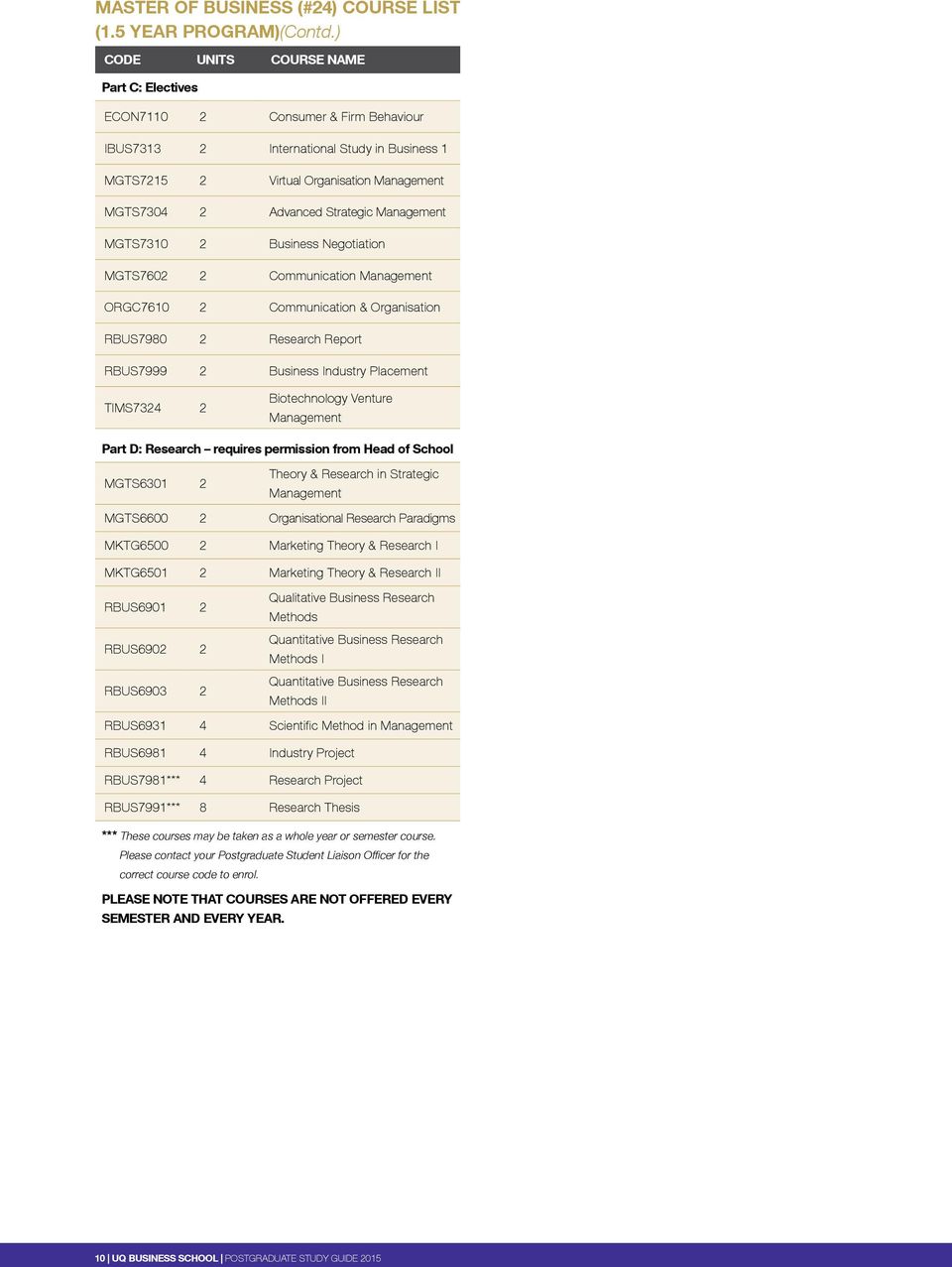
10 MASTER OF BUSINESS (#24) COURSE LIST (1.5 YEAR PROGRAM)(Contd.) CODE UNITS COURSE NAME Part C: Electives ECON Consumer & Firm Behaviour IBUS International Study in Business 1 MGTS Virtual Organisation Management MGTS Advanced Strategic Management MGTS Business Negotiation MGTS Communication Management ORGC Communication & Organisation RBUS Research Report RBUS Business Industry Placement TIMS Biotechnology Venture Management Part D: Research requires permission from Head of School MGTS Theory & Research in Strategic Management MGTS Organisational Research Paradigms MKTG Marketing Theory & Research I MKTG Marketing Theory & Research II RBUS RBUS RBUS Qualitative Business Research Methods Quantitative Business Research Methods I Quantitative Business Research Methods II RBUS Scientific Method in Management RBUS Industry Project RBUS7981*** 4 Research Project RBUS7991*** 8 Research Thesis *** These courses may be taken as a whole year or semester course. Please contact your Postgraduate Student Liaison Officer for the correct course code to enrol. PLEASE NOTE THAT COURSES ARE NOT OFFERED EVERY SEMESTER AND EVERY YEAR. 10 UQ BUSINESS SCHOOL POSTGRADUATE STUDY GUIDE 2015
11 GRADUATE CERTIFICATE IN BUSINESS LEADERSHIP (GCBusLead) A successful professional career requires an understanding of the business environment and business fundamentals. The Graduate Certificate in Business Leadership will enhance your understanding of key competencies and skills required to succeed in a business environment. You will learn about contemporary issues in leadership and understand and apply key business principles. Duration 0.5 years full-time; or part-time equivalent. Can be commenced in Semester 1 or Semester 2. Entry requirements To enrol, a student must: 1. hold a bachelor degree approved by the Executive Dean, with a GPA of at least 4 on a 7-point scale; OR 2. have completed post-secondary study and at least five years full-time work experience, approved by the Executive Dean; OR 3. have completed at least seven years full-time work experience, approved by the Executive Dean. Program requirements Students are required to obtain a total of #8 from the GCBusLead course list comprising: #8 from Part A; or #8 from one field of study in Part B. GRADUATE CERTIFICATE IN BUSINESS LEADERSHIP COURSE LIST CODE UNITS COURSE NAME Part A FINM Fundamentals of Finance and Accounting LAWS Business and Commercial Law MGTS Leadership and People Management MGTS Strategic Analysis and Implementation MGTS Principles of Business Management and Leadership MGTS Negotiation, Communication and Decision Making MGTS Service Quality and Customer Co-Creation MGTS Principles of Project Management MGTS Special Topics in Business Leadership 1 MGTS Special Topics in Business Leadership 2 MGTS Special Topics in Business Leadership 3 MGTS Special Topics in Business Leadership 4 MKTG Principles of Marketing Part B: Fields of Study - Sports Administration FINM Fundamentals of Finance and Accounting LAWS Principles of Sports Law MGTS Leadership and People Management MGTS The Sports Industry and Sports Markets PLEASE NOTE THAT COURSES ARE NOT OFFERED EVERY SEMESTER AND EVERY YEAR. POSTGRADUATE STUDY GUIDE 2015 UQ BUSINESS SCHOOL 11

12 COMMERCE SUITE OF PROGRAMS The Commerce suite of programs comprises the Graduate Certificate in Commerce and Master of Commerce. These programs allow graduates to concentrate their studies in one of four areas of professional development: Applied Finance, Electronic Commerce, Information Systems or Professional Accounting. The Graduate Certificate in Commerce provides students with an alternative pathway to the Master of Commerce #32 (2 year program). Students completing the Master of Commerce (1.5 or 2 year program) must complete a field of study. The Master of Commerce program offers two different entry points depending on your previous studies. The Master #24 (1.5 years) is designed for those graduates with a bachelor s degree in the same discipline. The Master #32 (2 years) includes the core fundamentals of general management for those graduates with a Bachelor s degree from any discipline. GRADUATE CERTIFICATE IN COMMERCE (GCCom)* Duration 0.5 years full-time; or part-time equivalent. Can be commenced in Semester 1 or Semester 2. Entry requirements To enrol, a student must: 1. hold a bachelor degree with a GPA of at least 4 on a 7-point scale; OR 2. have completed post-secondary study and at least five years full-time work experience, approved by the Executive Dean; OR 3. have completed at least seven years full-time work experience, approved by the Executive Dean. Program requirements Students are required to obtain a total of #8 from Part A of the MCom(#32) course list. MASTER OF COMMERCE (#32) (MCom(#32))** Duration 2 years full-time; or part-time equivalent. Can be commenced in Semester 1 or Semester 2. Entry requirements To enrol, a student must: 1. hold a bachelor degree with a GPA of at least 4.5 on a 7-point scale; OR 2. hold the Graduate Certificate in Commerce from UQ with a GPA of at least 4.5 on a 7-point scale. Program requirements Students are required to obtain a total of #32 from the MCom(#32) course list comprising: #8 from Part A; and #12 from one field of study in Part B; and the remaining #12 as a second field of study from Part B or from a combination of other courses in Part B, Part C, Part D and/or other courses approved by the Head of School (up to a maximum of #4). Part D courses require permission from the Head of School before enrolment will be approved. MASTER OF COMMERCE (#24) (MCom(#24))** Duration 1.5 years full-time; or part-time equivalent. Can be commenced in Semester 1 or Semester 2. Entry requirements To enrol, a student must hold a bachelor degree in the same discipline, approved by the Executive Dean, with a GPA of at least 4.5 on a 7-point scale. Program requirements Students are required to obtain a total of #24 from the MCom(#24) course list comprising: #12 from one field of study in Part A; and the remaining #12 as a second field of study from Part A or from a combination of other courses in Part A, Part B, Part C and/or other courses approved by the Head of School (up to a maximum of #4). Part C courses require permission from the Head of School before enrolment will be approved. * Students planning to progress to the Master of Commerce must consider their planned field of study and ensure that they enrol in the appropriate courses that will fulfill their field of study requirement. ** A student must undertake the program in a field of study. For students who have previously undertaken studies in commerce, approval will only be considered for a field of study not already undertaken. 12 UQ BUSINESS SCHOOL POSTGRADUATE STUDY GUIDE 2015

13 MASTER OF COMMERCE (#32) COURSE LIST (2 YEAR PROGRAM) CODE UNITS COURSE NAME Part A: Compulsory ACCT7101^ 2 Accounting ECON7002^ 2 Economics for Commerce FINM7401^ 2 Finance MGTS7202^ 2 Management Systems Part B: Fields of Study Complete at least #12 units in one field of study Applied Finance ACCT Financial Statement Analysis ECON Statistics for Business & Economics FINM Corporate Finance FINM Portfolio Management FINM Financial Risk Management FINM International Financial Management FINM Financial Institutions & Markets Electronic Commerce INFS Electronic Commerce Fundamentals INFS Developing Electronic Commerce Systems MGTS Managing Information Systems MGTS Managing Electronic Commerce Infrastructure MGTS Commercial Internet Security MGTS Virtual Organisation Management Information Systems ACCT Business Information Systems INFS Information Systems Control & Audit INFS Decision Support Systems INFS Information Analysis & Design MGTS Managing Application Databases MGTS Managing Information Systems Professional Accounting ACCT7102^ 2 Financial Accounting ACCT7103^ 2 Auditing ACCT7104^ 2 Corporate Accounting CODE UNITS COURSE NAME Part C: Electives ACCT Advanced Financial Accounting ACCT Advanced Management Accounting & Control ACCT Strategic Cost Management ECON The Macroeconomy ECON Elements of Econometrics FINM Superannuation, Insurance & Deposit Products LAWS Financial Planning Law LAWS Electronic Commerce Law MGTS Corporate Governance RBUS Business Industry Placement TIMS Management of Intellectual Property Part D: Research Requires permission from Head of School ACCT Financial Information in Capital Markets ACCT Accounting Honours Special Topic ACCT Managerial Accounting Honours A FINM Corporate Finance Honours FINM Empirical Fincance Honours FINM Empirical Fincance Honours II INFS Information Systems Honours RBUS RBUS RBUS Qualitative Business Research Methods Quantitative Business Research Methods I Quantitative Business Research Methods II RBUS Scientific Method in Commerce RBUS7981*** 4 Research Project RBUS7991*** 8 Research Thesis *** These courses may be taken as a whole year or semester course. Please contact your Postgraduate Student Liaison Officer for the correct course code to enrol. PLEASE NOTE THAT COURSES ARE NOT OFFERED EVERY SEMESTER AND EVERY YEAR. ACCT7107^ 2 Management Accounting & Control LAWS7012^ 2 Business Taxation LAWS7023^ 2 Business & Corporate Law Students wishing to meet requirements for CPA Australia or CAANZ must also complete the following course: ECON7300^ 2 Statistics for Business & Economics ^ For students wishing to meet the requirements for CPA/CAANZ. POSTGRADUATE STUDY GUIDE 2015 UQ BUSINESS SCHOOL 13

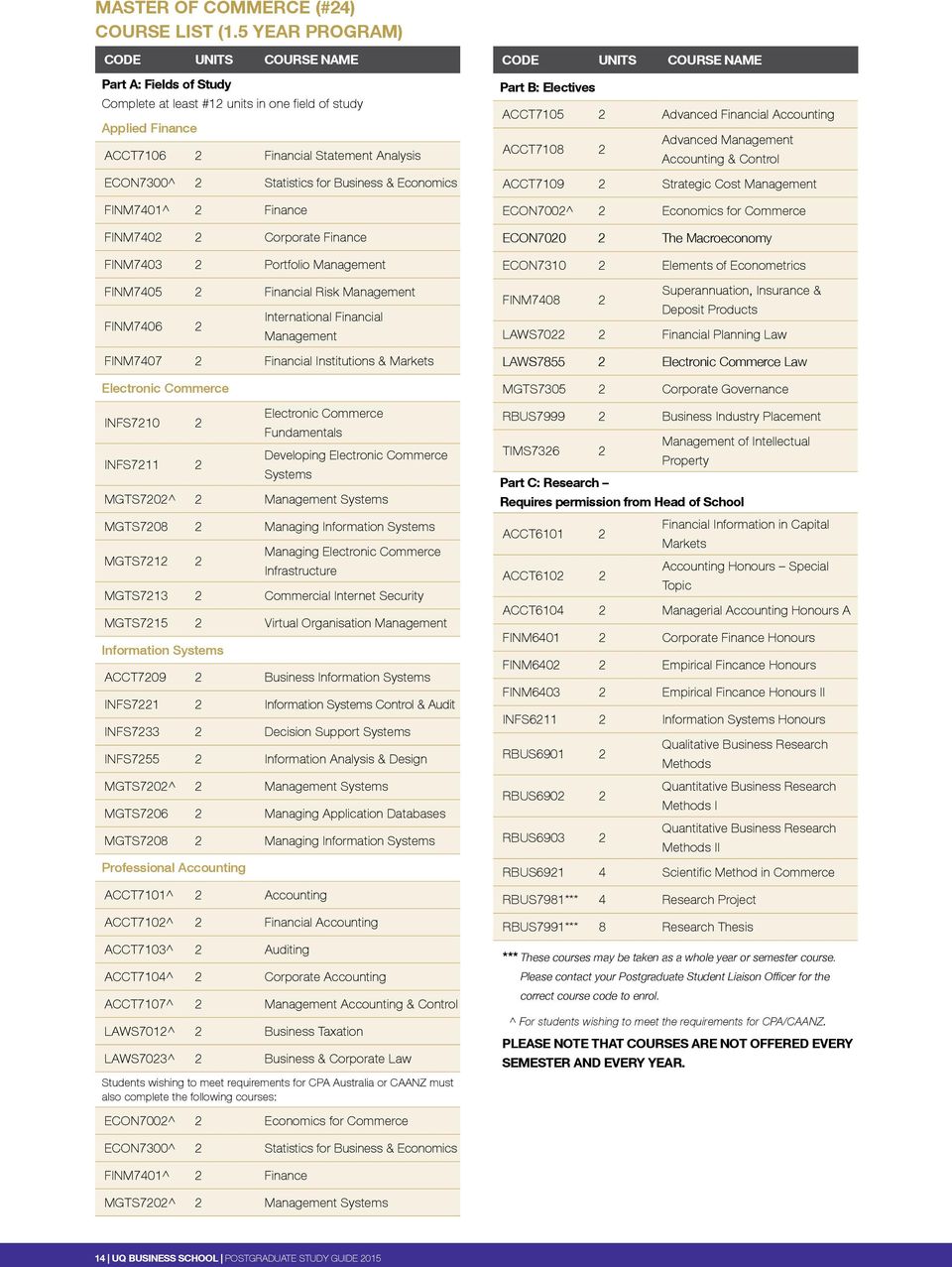
14 MASTER OF COMMERCE (#24) COURSE LIST (1.5 YEAR PROGRAM) CODE UNITS COURSE NAME Part A: Fields of Study Complete at least #12 units in one field of study Applied Finance ACCT Financial Statement Analysis ECON7300^ 2 Statistics for Business & Economics FINM7401^ 2 Finance FINM Corporate Finance FINM Portfolio Management FINM Financial Risk Management FINM International Financial Management FINM Financial Institutions & Markets Electronic Commerce INFS INFS Electronic Commerce Fundamentals Developing Electronic Commerce Systems MGTS7202^ 2 Management Systems MGTS Managing Information Systems MGTS Managing Electronic Commerce Infrastructure MGTS Commercial Internet Security MGTS Virtual Organisation Management Information Systems ACCT Business Information Systems INFS Information Systems Control & Audit INFS Decision Support Systems INFS Information Analysis & Design MGTS7202^ 2 Management Systems MGTS Managing Application Databases MGTS Managing Information Systems Professional Accounting ACCT7101^ 2 Accounting ACCT7102^ 2 Financial Accounting ACCT7103^ 2 Auditing ACCT7104^ 2 Corporate Accounting ACCT7107^ 2 Management Accounting & Control LAWS7012^ 2 Business Taxation LAWS7023^ 2 Business & Corporate Law Students wishing to meet requirements for CPA Australia or CAANZ must also complete the following courses: CODE UNITS COURSE NAME Part B: Electives ACCT Advanced Financial Accounting ACCT Advanced Management Accounting & Control ACCT Strategic Cost Management ECON7002^ 2 Economics for Commerce ECON The Macroeconomy ECON Elements of Econometrics FINM Superannuation, Insurance & Deposit Products LAWS Financial Planning Law LAWS Electronic Commerce Law MGTS Corporate Governance RBUS Business Industry Placement TIMS Management of Intellectual Property Part C: Research Requires permission from Head of School ACCT Financial Information in Capital Markets ACCT Accounting Honours Special Topic ACCT Managerial Accounting Honours A FINM Corporate Finance Honours FINM Empirical Fincance Honours FINM Empirical Fincance Honours II INFS Information Systems Honours RBUS RBUS RBUS Qualitative Business Research Methods Quantitative Business Research Methods I Quantitative Business Research Methods II RBUS Scientific Method in Commerce RBUS7981*** 4 Research Project RBUS7991*** 8 Research Thesis *** These courses may be taken as a whole year or semester course. Please contact your Postgraduate Student Liaison Officer for the correct course code to enrol. ^ For students wishing to meet the requirements for CPA/CAANZ. PLEASE NOTE THAT COURSES ARE NOT OFFERED EVERY SEMESTER AND EVERY YEAR. ECON7002^ 2 Economics for Commerce ECON7300^ 2 Statistics for Business & Economics FINM7401^ 2 Finance MGTS7202^ 2 Management Systems 14 UQ BUSINESS SCHOOL POSTGRADUATE STUDY GUIDE 2015
15 GRADUATE CERTIFICATE IN EXECUTIVE LEADERSHIP (GCELead) The Graduate Certificate in Executive Leadership enhances understanding of key competencies and skills required for executive business career development. The courses focus on the essentials of core business activities such as finance, marketing, leadership and strategy. Duration 0.5 years full-time; or part-time equivalent. Can be commenced in Semester 1 or Semester 2. Entry requirements To enrol, a student must: 1. hold a bachelor degree with a GPA of at least 4 on a 7-point scale and have completed at least four years full-time work experience post-graduation, including at least two of the four years full-time work experience gained while working in a dedicated supervisory/management role, approved by the Executive Dean; OR 2. have completed at least seven years full-time work experience, including at least three of the seven years full-time work experience gained while working in a dedicated supervisory/management role, approved by the Executive Dean. Program requirements Students are required to obtain #8 from the GCELead course list. GRADUATE CERTIFICATE IN EXECUTIVE LEADERSHIP COURSE LIST CODE UNITS COURSE NAME ACCT Accounting in a Governance Framework FINM Financial Management at Work MGTS Leading People & Teams MGTS Negotiating Skills for Today MGTS Special Topics in Contemporary Leadership MGTS Strategy in Action MGTS Valuing Human Capital MGTS The Leadership Challenge MGTS Sustaining Corporations MGTS Supply Chain Management MGTS Innovation Leadership MGTS MGTS MGTS Special Topics in Contemporary Leadership 2 Special Topics in Contemporary Leadership 3 Special Topics in Contemporary Leadership 4 MGTS Executive Leadership Industry Project MKTG Strategic Marketing POSTGRADUATE STUDY GUIDE 2015 UQ BUSINESS SCHOOL 15

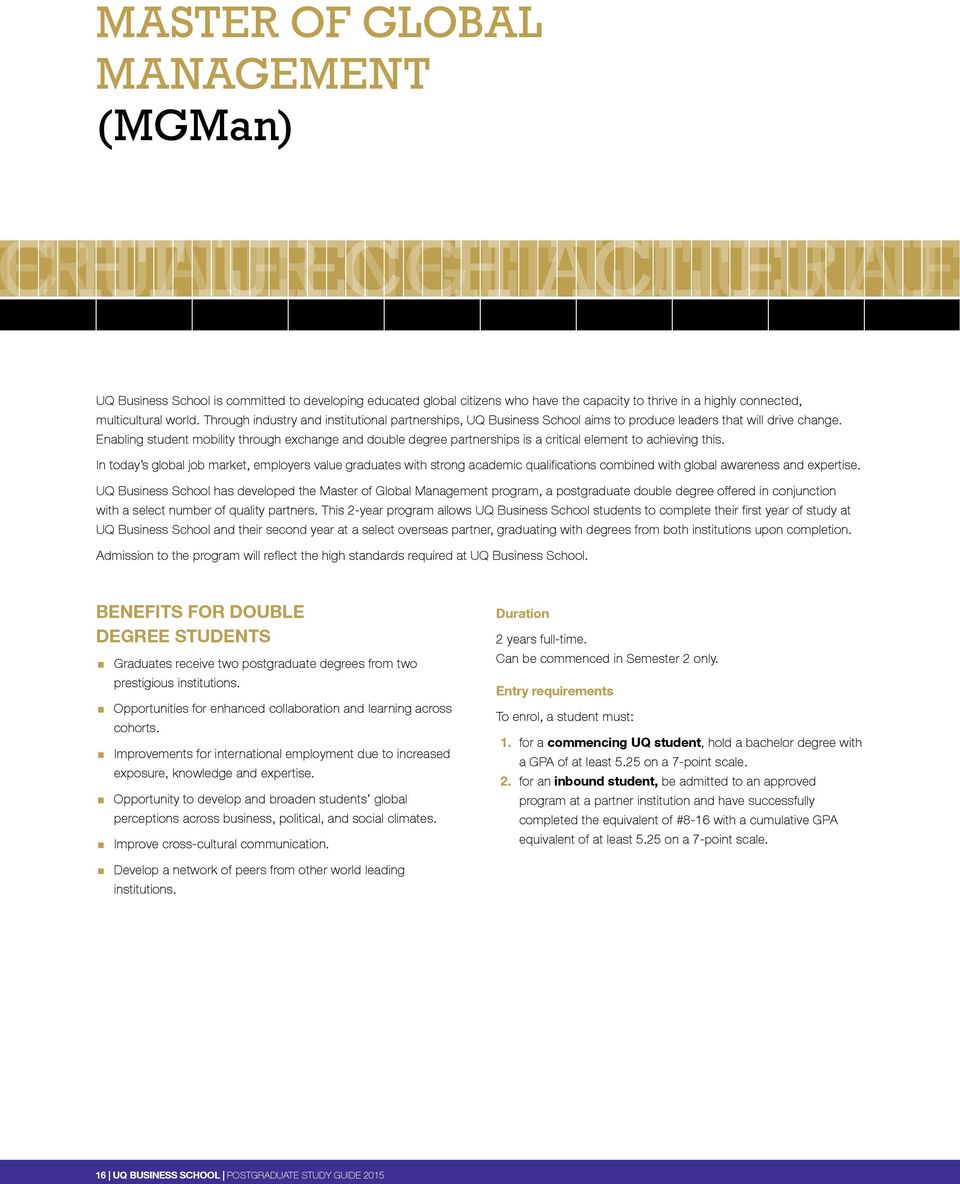
16 MASTER OF GLOBAL MANAGEMENT (MGMan) UQ Business School is committed to developing educated global citizens who have the capacity to thrive in a highly connected, multicultural world. Through industry and institutional partnerships, UQ Business School aims to produce leaders that will drive change. Enabling student mobility through exchange and double degree partnerships is a critical element to achieving this. In today s global job market, employers value graduates with strong academic qualifications combined with global awareness and expertise. UQ Business School has developed the Master of Global Management program, a postgraduate double degree offered in conjunction with a select number of quality partners. This 2-year program allows UQ Business School students to complete their first year of study at UQ Business School and their second year at a select overseas partner, graduating with degrees from both institutions upon completion. Admission to the program will reflect the high standards required at UQ Business School. BENEFITS FOR DOUBLE DEGREE STUDENTS Graduates receive two postgraduate degrees from two prestigious institutions. Opportunities for enhanced collaboration and learning across cohorts. Improvements for international employment due to increased exposure, knowledge and expertise. Opportunity to develop and broaden students global perceptions across business, political, and social climates. Improve cross-cultural communication. Duration 2 years full-time. Can be commenced in Semester 2 only. Entry requirements To enrol, a student must: 1. for a commencing UQ student, hold a bachelor degree with a GPA of at least 5.25 on a 7-point scale. 2. for an inbound student, be admitted to an approved program at a partner institution and have successfully completed the equivalent of #8-16 with a cumulative GPA equivalent of at least 5.25 on a 7-point scale. Develop a network of peers from other world leading institutions. 16 UQ BUSINESS SCHOOL POSTGRADUATE STUDY GUIDE 2015
17 MASTER OF GLOBAL MANAGEMENT (MGMan) Program requirement Students are required to obtain #32 from the MGMan course list comprising: #6 from Part A; and #26 from Part B. A student must complete #16 of those courses required from completed study at a partner institution. A commencing UQ student must, in order to progress to an overseas partner institution, complete their final #16, and meet the minimum GPA requirements of 5.25 and entry requirements set by the overseas partner institution. Students who do not meet the progression rules may exit the program with a Graduate Diploma in Business. A commencing UQ domestic student may be required to sit an entrance exam (e.g. GMAT) as set by the partner institution at which they intend to complete the final #16. A student may also be required to pass a qualifying examination in basic computing, written communication and basic mathematics and statistics before enrolment is approved. MASTER OF GLOBAL MANAGEMENT COURSE LIST Inbound MGMan students: the courses you are to study at UQ will vary depending on the credit you receive from prior study. Please ensure you consult UQ Business School if you have any queries. CODE UNITS COURSE NAME Part A: Compulsory IBUS Operating International Business IBUS Globalisation & The World Economy MGTS Cross Cultural Management Part B: Specialisations are not compulsory Students may choose to study up to two specialisations (each comprising #8), or choose to study any combination of courses from the lists below. Choose #26 from: International Economics & Finance Specialisation ECON International Trade & Investment ECON ECON Economics of Innovation & Entrepreneurship Globalisation & Economic Development ENVM Carbon & Energy Management FINM POLS International Financial Management Globalisation, International Political Economy & Development CODE UNITS COURSE NAME International Enterprise Management Specialisation ADVT Global Media & Advertising IBUS Doing Business in Asia IBUS International Supply Chains IBUS MGTS TIMS International Tourism Specialisation EVNT International Service Operations Management Strategic Human Resource Management Strategies for Business Sustainability & Innovation International Event Issues & Strategies HOSP Global Hospitality Operations HOSP Global Hotel, Resort and Casino Management HOSP Service Leadership in Hospitality TOUR Tourism in Developing Economies International Research Experience Specialisation IBUS Global Management Internship [IBUS7324 OR [IBUS7325 OR [IBUS Global Management Thesis A Global Management Thesis B Global Management Thesis C RBUS Qualitative Business Research Methods RBUS Quantitative Business Research Methods I RBUS Quantitative Business Research Methods II Other Electives MGTS Principles of Strategic Management MGTS Business Negotiation MGTS Change Leadership MKTG Strategic Marketing & Branding RBUS Special Topics in Business II TIMS Corporate Sustainability Management of Intellectual TIMS Property or any other level 7 course as approved by the Head of UQ Business School. Available only to incoming exchange students of the MGMan. PLEASE NOTE THAT COURSES ARE NOT OFFERED EVERY SEMESTER AND EVERY YEAR. POSTGRADUATE STUDY GUIDE 2015 UQ BUSINESS SCHOOL 17

18 PROJECT MANAGEMENT SUITE OF PROGRAMS Project Management is the discipline of organising and managing resources in such a way that they deliver all the work required to complete a project within defined scope, time, cost and quality constraints within acceptable levels of risk. Project Managers can be found in all industries. The postgraduate programs in project management at UQ Business School are based on the seven core knowledge areas of the international institutes of project management. Students are introduced to the principles and applications of project management in asset and operations mode. Graduates of the program demonstrate a strong understanding of the background, principles and applications of project management. GRADUATE CERTIFICATE IN PROJECT MANAGEMENT (GCPM) Duration 0.5 years full-time; or part-time equivalent. Can be commenced in Semester 1 or Semester 2. Entry requirements To enrol, a student must: 1. hold a bachelor degree with a GPA of at least 4 on a 7-point scale and have completed at least three years full-time work experience in the same discipline, approved by the Executive Dean; OR 2. have completed post-secondary study and at least five years full-time work experience in the same discipline, approved by the Executive Dean; OR 3. have completed at least seven years full-time work experience in the same discipline, approved by the Executive Dean. Program requirements Students are required to obtain #8 from Part A of the MPM course list. MASTER OF PROJECT MANAGEMENT (MPM) Duration 1.5 years full-time; or part-time equivalent. Can be commenced in Semester 1 or Semester 2. Entry requirements To enrol, a student must: 1. hold a bachelor degree in the same discipline, approved by the Executive Dean, with a GPA of at least 4.5 on a 7-point scale and have completed at least two years full-time work experience in the same discipline, approved by the Executive Dean; OR 2. hold a bachelor degree with a GPA of at least 4.5 on a 7-point scale and have completed at least five years full-time work experience in the same discipline, approved by the Executive Dean; OR 3. hold the Graduate Certificate in Project Management from UQ with a GPA of at least 4.5 on a 7-point scale. Program requirements Students are required to obtain #24 from the MPM course list comprising: #14 from Part A; and either #10 from Part B; OR #10 from one field of study in Part C. 18 UQ BUSINESS SCHOOL POSTGRADUATE STUDY GUIDE 2015

19 MASTER OF PROJECT MANAGEMENT COURSE LIST CODE UNITS COURSE NAME Part A: Compulsory [ECON7002 OR [ECON Economics for Commerce Consumer & Firm Behaviour ECON Benefit-Cost Analysis & Project Evaluation LAWS Business & Corporate Law [MGTS7601 OR [MGTS Managing Organisational Behaviour Strategic Human Resource Management PLAN Assessment of Development Projects PLAN Principles of Project Management PLAN Applications of Project Management CODE UNITS COURSE NAME Property Studies* LAWS Real Estate Law REDE Valuation of Industrial & Commercial Property REDE Valuation for Statutory Purposes REDE Valuation of Specialist Properties REDE International Property Investment REDE Property Development REDE Strategic Property Management REDE Sustainable Building Construction Management & Economics * Please note that the MPM field of study will not be displayed on your academic record. Part B: Students are required to select courses which correspond with their educational and career planning. All electives must be approved by the Executive Dean via the Program Director. Students may select electives from postgraduate level courses in a range of disciplines. Those chosen commonly include, but are not restricted to: ACCT, ARCH, CIVL, COMP, COMS, CSSE, ECON, ELEC, ENGG, ENVM, FINM, HOSP, INFS, MATE, MECH, MGTS, PLAN, POLS, REDE, TIMS and TOUR. Part C: Fields of Study* Engineering Practice* ENGG Advanced Computational Techniques in Engineering ENGG Advanced Engineering Practice ENGG Experimental Design ENGG MATE Advanced Engineering Laboratory Techniques Environmental Performance of Materials or other engineering courses approved by the Program Director. POSTGRADUATE STUDY GUIDE 2015 UQ BUSINESS SCHOOL 19

20 PROPERTY STUDIES SUITE OF PROGRAMS The Property Studies suite of programs introduces and equips students with the expertise to succeed in the dynamic industries of Real Estate, Property Development, Finance, Investment and Valuation. These programs are suited to those wishing to develop a professional career in the area of valuation and real estate development and management. GRADUATE CERTIFICATE IN PROPERTY STUDIES (GCPropertySt) Duration 0.5 years full-time; or part-time equivalent. Can be commenced in Semester 1. Semester 2 available for domestic part-time entry only. Entry requirements To enrol, a student must: 1. hold a bachelor degree in the same discipline, approved by the Executive Dean, with a GPA of at least 4 on a 7-point scale; OR 2. hold a bachelor degree with a GPA of at least 4 on a 7-point scale and have completed at least three years full-time work experience in the same discipline, approved by the Executive Dean; OR 3. have completed post-secondary study and at least five years full-time work experience in the same discipline, approved by the Executive Dean; OR 4. have completed at least seven years full-time work experience in the same discipline, approved by the Executive Dean. Program requirements GRADUATE CERTIFICATE IN PROPERTY STUDIES COURSE LIST CODE UNITS COURSE NAME LAWS Real Estate Law PLAN Principles of Project Management REDE Valuation of Industrial & Commercial Property REDE Valuation of Specialist Properties REDE International Property Investment REDE Property Development REDE Strategic Property Management MASTER OF PROPERTY STUDIES COURSE LIST CODE UNITS COURSE NAME Part A ACCT Accounting Students are required to obtain #8 from the GCPropertySt course list. [ECON7002 OR 2 Economics for Commerce [ECON Consumer & Firm Behaviour MASTER OF PROPERTY STUDIES (MPropertySt) Duration 1.5 years full-time; or part-time equivalent. Can be commenced in Semester 1. Semester 2 available for domestic part-time entry only. Entry requirements To enrol, a student must: 1. hold a bachelor degree in the same discipline, approved by the Executive Dean, with a GPA of at least 4.5 on a 7-point scale; OR 2. hold a bachelor degree with a GPA of at least 4.5 on a 7-point scale and have completed at least three years full-time work experience in the same discipline, approved by the Executive Dean; OR 3. hold the Graduate Certificate in Property Studies from UQ with a GPA of at least 4.5 on a 7-point scale. Program requirements Students are required to obtain #24 from the MPropertySt course list comprising: #16 from Part A; and #8 from Part B. FINM Finance LAWS7017^ 2 Real Estate Law MKTG Fundamentals of Marketing PLAN Principles of Project Management REDE Valuation of Industrial & Commercial Property REDE Valuation of Specialist Properties REDE7201^ 2 International Property Investment REDE7202^ 2 Property Development REDE7203^ 2 Strategic Property Management Part B REDE7100*^ 2 Valuation of Industrial & Commercial Property REDE7101*^ 2 Valuation for Statutory Purposes REDE7102*^ 2 Valuation of Specialist Properties REDE7300*^ 2 Sustainable Building Construction Management & Economics * For students wishing to meet requirements for RICS. ^ For students wishing to meet requirements for API. 20 UQ BUSINESS SCHOOL POSTGRADUATE STUDY GUIDE 2015

21 GRADUATE CERTIFICATE IN RESEARCH COMMERCIALISATION (GCResComm) The Graduate Certificate in Research Commercialisation is designed for students in all fields of study to develop knowledge and skills in commercialisation of research. This program examines the fundamentals of commercialisation, including the innovation process and the contribution of commercialisation to economic and social development. These fundamentals, and the context of commercialisation (including the role of the University and the methods used to commercialise research), are explored. The Graduate Certificate in Research Commercialisation provides researchers with the tools necessary to assess commercialisation opportunities and to commercialise research incomes. The skills developed in this program will enable graduates to apply specific research knowledge to a wide range of commercialisation ventures. These skills can be applied directly to current research outcomes or to positions within companies or government departments with Research and Development functions. Duration 0.5 years full-time; or part-time equivalent. Can be commenced in Semester 1 or Semester 2. Entry requirements To enrol, a student must: 1. hold a bachelor degree with a GPA of at least 4 on a 7-point scale; OR 2. have completed post-secondary study and at least five years full-time work experience, approved by the Executive Dean; OR 3. have completed at least seven years full-time work experience, approved by the Executive Dean. Program requirements Students are required to obtain #8 from the GCResComm course list. GRADUATE CERTIFICATE IN RESEARCH COMMERCIALISATION COURSE LIST CODE UNITS COURSE NAME TIMS Entrepreneurship & New Ventures TIMS Corporate Sustainability TIMS Technology & Innovation Strategy TIMS TIMS Management of Research & Development New Product & Services Development TIMS Developing Business from Science TIMS Bio-Entrepreneurship & Innovation TIMS7325* 2 Commercialisation in Practice TIMS Management of Intellectual Property * TIMS7325 enrolment requires permission from the Course Coordinator (via an expression of interest). POSTGRADUATE STUDY GUIDE 2015 UQ BUSINESS SCHOOL 21
22 RESEARCH METHODS SUITE OF PROGRAMS The program provides research training to students who wish to go on to complete a PhD or MPhil program. The program has been designed to provide training in qualitative and quantitative research and scientific methods, it also includes a thesis. Students graduating from these programs may be eligible for the PhD or MPhil programs. GRADUATE CERTIFICATE IN RESEARCH METHODS (GCResMeth) Duration 0.5 years full-time; or part-time equivalent. Can be commenced in Semester 1 or Semester 2. Entry requirements To enrol, a student must: 1. hold a bachelor degree with a GPA of at least 5.75 on a 7-point scale; OR 2. an approved qualification based on academic record and work experience, approved by the Executive Dean. Program requirements Students are required to obtain #8 from the field of Business in the GCResMeth course list. GRADUATE CERTIFICATE IN RESEARCH METHODS COURSE LIST CODE UNITS COURSE NAME Business ACCT ACCT Financial Information in Capital Markets Accounting Honours Special Topic ACCT Managerial Accounting Honours A FINM Corporate Finance Honours FINM Empirical Finance Honours FINM Empirical Finance Honours II INFS Information Systems Honours MGTS MGTS Theory & Research in Strategic Management Organisational Research Paradigms MKTG Marketing Theory & Research I MKTG Marketing Theory & Research II RBUS Qualitative Business Research Methods RBUS Quantitative Business Research Methods I RBUS Quantitative Business Research Methods II [RBUS6921 OR [RBUS Scientific Method in Commerce Scientific Method in Management or one of the following: Requires permission from Head of School RBUS7981** 4 Research Project RBUS7991** 8 Research Thesis ** These courses may be taken as a whole year or semester course. Please contact your Postgraduate Student Liaison Officer for the correct course code to enrol. PLEASE NOTE THAT COURSES ARE NOT OFFERED EVERY SEMESTER AND EVERY YEAR. 22 UQ BUSINESS SCHOOL POSTGRADUATE STUDY GUIDE 2015
23 GRADUATE DIPLOMA IN RESEARCH METHODS (GDipResMeth) Duration 1 year full-time; or part-time equivalent. Can be commenced in Semester 1 or Semester 2. Entry requirements To enrol, a student must: 1. hold a bachelor degree with a GPA of at least 5.75 on a 7-point scale; OR 2. an approved qualification based on academic record and work experience, approved by the Executive Dean. Program requirements Students are required to obtain #16 from the field of Business in the GDipResMeth course list. GRADUATE DIPLOMA IN RESEARCH METHODS COURSE LIST CODE UNITS COURSE NAME Business Part A: Core Courses One of the following: RBUS6991** 6 Honours Thesis RBUS7981** 4 Research Project RBUS7991** 8 Research Thesis Part B: Methods Courses At least #4 from: RBUS Qualitative Business Research Methods RBUS Quantitative Business Research Methods I RBUS Quantitative Business Research Methods II [RBUS6921 OR [RBUS Scientific Method in Commerce Scientific Method in Management Part C: Electives List Remaining courses from: ACCT Financial Information in Capital Markets ACCT Accounting Honours Special Topic ACCT Managerial Accounting Honours A FINM Corporate Finance Honours FINM Empirical Finance Honours FINM Empirical Finance Honours II INFS Information Systems Honours MGTS MGTS Theory & Research in Strategic Management Organisational Research Paradigms MKTG Marketing Theory & Research I MKTG Marketing Theory & Research II ** These courses may be taken as a whole year or semester course. Please contact your Postgraduate Student Liaison Officer for the correct course code to enrol. PLEASE NOTE THAT COURSES ARE NOT OFFERED EVERY SEMESTER AND EVERY YEAR. POSTGRADUATE STUDY GUIDE 2015 UQ BUSINESS SCHOOL 23
24 TECHNOLOGY AND INNOVATION MANAGEMENT SUITE OF PROGRAMS The Technology and Innovation Management suite of programs comprises the Graduate Certificate in Technology & Innovation Management and Master of Technology & Innovation Management. These programs allow graduates to effectively manage innovation and technology in both public and private sector organisations. The Graduate Certificate in Technology & Innovation Management provides students with an alternative pathway through to the Masters program as well as providing quality training in technology and innovation management related fields to students from diverse educational backgrounds. The programs provide students with grounding in fundamental technology and innovation management principles, while allowing them the opportunity to specialise in their area of interest. GRADUATE CERTIFICATE IN TECHNOLOGY & INNOVATION MANAGEMENT (GCTIM)* Duration 0.5 years full-time; or part-time equivalent. Can be commenced in Semester 1 or Semester 2. Entry requirements To enrol, a student must: 1. hold a bachelor degree in the same discipline, approved by the Executive Dean, with a GPA of at least 4 on a 7-point scale; OR 2. hold a bachelor degree with a GPA of at least 4 on a 7-point scale and have completed at least three years full-time work experience in the same discipline, approved by the Executive Dean; OR 3. have completed post-secondary study and at least five years full-time work experience in the same discipline, approved by the Executive Dean; OR 4. have completed at least seven years full-time work experience in the same discipline, approved by the Executive Dean. Program requirements MASTER OF TECHNOLOGY & INNOVATION MANAGEMENT (MTIM) Duration 1.5 years full-time; or part-time equivalent. Can be commenced in Semester 1 or Semester 2. Entry requirements To enrol, a student must: 1. hold a bachelor degree in the same discipline, approved by the Executive Dean, with a GPA of at least 4.5 on a 7-point scale; OR 2. hold a bachelor degree with a GPA of at least 4.5 on a 7-point scale and have completed at least three years full-time work experience in the same discipline, approved by the Executive Dean; OR 3. hold the Graduate Certificate in Technology & Innovation Management from UQ with a GPA of at least 4.5 on a 7-point scale. Program requirements Students are required to obtain #24 from the MTIM course list comprising: With no field of study: Students are required to obtain #8 from Part A and/or Part B of the MTIM course list. #8 from Part A; and #12 from Part B; and #4 from Part B or Part D or other electives as approved by the Head of School. With a field of study in Biotechnology: #8 from Part A; and #12 from Part C; and #4 from Part B or Part D or other electives as approved by the Head of School. * Students planning to progress to the Master of Technology & Innovation Management who wish to complete the Biotechnology field of study or general degree must consider this when enrolling in Part B courses in the Graduate Certificate in Technology & Innovation Management. 24 UQ BUSINESS SCHOOL POSTGRADUATE STUDY GUIDE 2015
25 MASTER OF TECHNOLOGY & INNOVATION MANAGEMENT COURSE LIST CODE UNITS COURSE NAME Part A: Compulsory MGTS Principles of Strategic Management TIMS Technology & Innovation Strategy TIMS New Product & Service Development TIMS Management of Intellectual Property Part B: Electives BIOT Emerging Biotechnologies BIOT Issues in Biotechnology ECON Economics of Innovation & Entrepreneurship FINM Finance CODE UNITS COURSE NAME Part D: Research Electives RBUS RBUS Qualitative Business Research Methods Quantitative Business Research Methods I RBUS Research Report RBUS7981** 4 Research Project * TIMS7325 enrolment requires permission from the Course Coordinator (via an expression of interest). ** This course may be taken as a whole year or semester course. Please contact your Postgraduate Student Liaison Officer for the correct course code to enrol. PLEASE NOTE THAT COURSES ARE NOT OFFERED EVERY SEMESTER AND EVERY YEAR. IBUS International Supply Chains MGTS Managing Organisational Behaviour MKTG Fundamentals of Marketing RBUS Business Industry Placement TIMS Corporate Sustainability TIMS Bio-Entrepreneurship & Innovation TIMS7325* 2 Commercialisation in Practice TIMS Strategies for Business Sustainability & Innovation Part C: Field of Study Biotechnology BIOT Emerging Biotechnologies BIOT Issues in Biotechnology ECON Economics of Innovation & Entrepreneurship TIMS Bio-Entrepreneurship & Innovation TIMS7325* 2 Commercialisation in Practice TIMS Strategies for Business Sustainability & Innovation POSTGRADUATE STUDY GUIDE 2015 UQ BUSINESS SCHOOL 25
26 TOURISM, HOTEL AND EVENT MANAGEMENT SUITE OF PROGRAMS The Tourism, Hotel and Event Management suite of programs comprises the Graduate Certificate in Tourism, Hotel and Event Management and Master of Tourism, Hotel and Event Management. These programs allow graduates to concentrate their studies in one of three areas of professional development: Event Management, Hotel Management or Travel and Tourism Management. The Graduate Certificate in Tourism, Hotel and Event Management provides students with an alternative pathway to the Master of Tourism, Hotel and Event Management #32 (2 year program). Students completing the Master of Tourism, Hotel and Event Management (1.5 or 2 year program) can complete a field of study. The Master of Tourism, Hotel and Event Management program offers two different entry points depending on your previous studies. The Master #24 (1.5 years) is designed for those graduates with a Bachelor s degree in the same discipline. The Master #32 (2 years) includes the core fundamentals of tourism management for those graduates with a Bachelor s degree from any discipline. GRADUATE CERTIFICATE IN TOURISM, HOTEL AND EVENT MANAGEMENT (GCTHEM) Duration 0.5 years full-time; or part-time equivalent. Can be commenced in Semester 1 or Semester 2. Entry requirements To enrol, a student must: 1. hold a bachelor degree with a GPA of at least 4 on a 7-point scale; OR 2. have completed post-secondary study and at least five years full-time work experience, approved by the Executive Dean; OR 3. have completed at least seven years full-time work experience, approved by the Executive Dean. Program requirements Students are required to obtain a total of #8 from Part A of the MTHEM(#32) course list. MASTER OF TOURISM, HOTEL AND EVENT MANAGEMENT (#32) (MTHEM(#32)) Duration 2 years full-time; or part-time equivalent. Can be commenced in Semester 1 or Semester 2. Entry requirements To enrol, a student must: 1. hold a bachelor degree with a GPA of at least 4.5 on a 7-point scale; OR 2. hold the Graduate Certificate in Tourism, Hotel and Event Management from UQ with a GPA of at least 4.5 on a 7-point scale. Program requirements Students are required to obtain a total of #32 from the MTHEM(#32) course list comprising: #8 from Part A; and #6 from Part B; and #2 from Part C; and #8 from Part D which may comprise one field of study; and MASTER OF TOURISM, HOTEL AND EVENT MANAGEMENT (#24) (MTHEM(#24)) Duration 1.5 years full-time; or part-time equivalent. Can be commenced in Semester 1 or Semester 2. Entry requirements To enrol, a student must hold a bachelor degree in the same discipline, approved by the Executive Dean, with a GPA of at least 4.5 on a 7-point scale. the remaining #8 as a second field of study from Part D or from a combination of other courses in Part D, Part E and/or other courses approved by the Head of School (up to a maximum of #4). Part E courses require permission from the Head of School before enrolment will be approved. Program requirements Students are required to obtain a total of #24 from the MTHEM(#24) course list comprising: #6 from Part A; and #2 from Part B; and #8 from Part C which may comprise one field of study; and the remaining #8 as a second field of study from Part C or from a combination of other courses in Part C and/or Part D. Part D courses require permission from the Head of School before enrolment will be approved. 26 UQ BUSINESS SCHOOL POSTGRADUATE STUDY GUIDE 2015
27 MASTER OF TOURISM, HOTEL AND EVENT MANAGEMENT (#32) COURSE LIST (2 YEAR PROGRAM) CODE UNITS COURSE NAME Part A: Foundation TOUR Tourism, Hospitality & Event Industries TOUR Tourism, Hospitality & Event Service TOUR TOUR Part B: Core Disciplinary Foundations of Tourism, Hospitality & Event Managing Resources in Tourism, Hospitality & Events TOUR Industry Research & Consultancy TOUR Visitor Management TOUR Part C: Capstone Marketing & Distribution Research Project [TOUR7040 OR [TOUR Professional Experience Destination Study Tour Part D: Fields of Study Complete #8 units in one field - Event Management EVNT EVNT EVNT International Event Issues and Strategies Event Planning & Project Management Event Marketing, Sponsorship & Fundraising EVNT Event Design, Staging & Production Hotel Management HOSP Designing Food and Beverage Experiences HOSP Global Hospitality Operations HOSP Global Hotel, Resort and Casino Management HOSP Service Leadership in Hospitality Travel and Tourism Management TOUR Special Interest Tourism TOUR Destination Management & Marketing TOUR Travel Distribution and Transport Systems TOUR Tourism in Developing Economies Part E: Research Requires permission from Head of School MASTER OF TOURISM, HOTEL AND EVENT MANAGEMENT (#24) COURSE LIST (1.5 YEAR PROGRAM) CODE UNITS COURSE NAME Part A: Core TOUR Industry Research and Consultancy TOUR Visitor Management TOUR Part B: Capstone Marketing & Distribution Research Project [TOUR7040 OR [TOUR Professional Experience Destination Study Tour Part C: Fields of Study Complete #8 units in one field - Event Management EVNT EVNT EVNT EVNT Hotel Management HOSP International Event Issues and Strategies Event Planning & Project Management Event Marketing, Sponsorship & Fundraising Event Design, Staging & Production Designing Food and Beverage Experiences HOSP Global Hospitality Operations HOSP Global Hotel, Resort and Casino Management HOSP Service Leadership in Hospitality Travel and Tourism Management TOUR Special Interest Tourism TOUR TOUR Destination Management & Marketing Travel Distribution and Transport Systems TOUR Tourism in Developing Economies Part D: Research Requires permission from Head of School TOUR Tourism Research Project TOUR Tourism Thesis PLEASE NOTE THAT COURSES ARE NOT OFFERED EVERY SEMESTER AND EVERY YEAR. TOUR Tourism Research Project TOUR Tourism Thesis POSTGRADUATE STUDY GUIDE 2015 UQ BUSINESS SCHOOL 27
28 MASTER OF TOURISM LEADERSHIP The Master of Tourism Leadership prepares graduates with experience working in the tourism, hospitality and events industries for international leadership, research and consultancy positions. This internationally recognised program will strengthen your leadership capacity and provide you with the skills to sustainably manage products, resources and facilities. You will also develop the research and analytical skills necessary for further academic study. In addition to building your core knowledge, you can choose to specialise in the fields of service management, tourism development, tourism marketing or visitor management. The program allows you to tackle real-life issues put forward by industry professionals and complete a research or consultancy project. MASTER OF TOURISM LEADERSHIP (MTLead) Duration 1.5 years full-time; or part-time equivalent. Can be commenced in Semester 1 or Semester 2. Entry requirements To enrol, a student must: 1. hold a bachelor degree in the same discipline, approved by the Executive Dean, with a GPA of at least 5 on a 7-point scale and have gained at least one year full-time work experience in the same discipline, approved by the Executive Dean; OR 2. hold a bachelor degree with a GPA of at least 5 on a 7-point scale and have gained at least three years full-time work experience in the same discipline, approved by the Executive Dean. Program requirements Students are required to obtain a total of #24 from the MTLead course list comprising: #8 from Part A; and #12 from one field of study in Part B; and #4 from a combination of other courses in Part B or other courses approved by the Head of School 28 UQ BUSINESS SCHOOL POSTGRADUATE STUDY GUIDE 2015
29 MASTER OF TOURISM LEADERSHIP COURSE LIST CODE UNITS COURSE NAME Part A: Compulsory TOUR Industry Research & Consultancy TOUR TOUR TOUR Part B: Fields of Study Service Management Complete #4 units from - HOSP Critical Issues in Tourism, Hospitality & Events Change & Innovation in Tourism, Hospitality & Events Advanced Research Methods & Analysis Designing Food & Beverage Experiences HOSP Service Leadership in Hospitality or other level 7 courses approved by the Head of School. And #8 units from - [TOUR7060 OR [TOUR7061 OR [TOUR7070 OR [TOUR Research Thesis I Research Thesis II Professional Consultancy Project I Professional Consultancy Project II Where the topic of study must be in the area of Service Management as approved by the Head of School. Tourism Development Complete #4 units from - TOUR Destination Management & Marketing TOUR Tourism in Developing Economies or other level 7 courses approved by the Head of School. And #8 units from - CODE UNITS COURSE NAME Tourism Marketing Complete #4 units from - EVNT TOUR Event Marketing, Sponsorship & Fundraising Marketing & Distribution Research Project or other level 7 courses approved by the Head of School. And #8 units from - [TOUR7060 OR [TOUR7061 OR [TOUR7070 OR [TOUR Research Thesis I Research Thesis II Professional Consultancy Project I Professional Consultancy Project II Where the topic of study must be in the area of Tourism Marketing as approved by the Head of School. Visitor Management Complete #4 units from - TOUR Visitor Management TOUR Special Interest Tourism or other level 7 courses approved by the Head of School. And #8 units from - [TOUR OR [TOUR OR [TOUR OR [TOUR Research Thesis I Research Thesis II Professional Consultancy Project I Professional Consultancy Project II Where the topic of study must be in the area of Visitor Marketing as approved by the Head of School. PLEASE NOTE THAT COURSES ARE NOT OFFERED EVERY SEMESTER AND EVERY YEAR. [TOUR7060 OR [TOUR7061 OR [TOUR7070 OR [TOUR Research Thesis I Research Thesis II Professional Consultancy Project I Professional Consultancy Project II Where the topic of study must be in the area of Tourism Development as approved by the Head of School. POSTGRADUATE STUDY GUIDE 2015 UQ BUSINESS SCHOOL 29
30 COURSE DESCRIPTIONS The following descriptions provide information on the courses offered in the postgraduate programs. NOTE: NOT EVERY COURSE IS OFFERED EACH YEAR. IT IS THE STUDENT S RESPONSIBILITY TO CHECK AVAILABILITY OF COURSES WITH THE SCHOOL OR VIA THE WEBSITE. Please check mysi-net (mysinet.uq.edu.au) for semester of offer. CODES USED IN COURSE DESCRIPTIONS #: indicates unit value Pre: indicates compulsory prerequisite course RP: (Recommended Prerequisites): non-compulsory prerequisite course C: (Companions): compulsory co-requisite course RC: (Recommended Companions): non-compulsory co-requisite course Inc: indicates incompatibility with specified course R: indicates restricted enrolment CODE COURSE NAME UNITS ACCT6101 FINANCIAL INFORMATION IN CAPITAL MARKETS 2 Pre: Permission from Head of School R: BCom(Hons), GCResMeth, GDipResMeth, MCom, PhD, MPhil. Quota: Minimum of 10 enrolments Economics-based research in financial accounting, in particular studies of use of accounting information in capital markets and factors influencing choices of accounting policy. ACCT6104 MANAGERIAL ACCOUNTING HONOURS A 2 Pre: ACCT permission from Head of School R: BCom(Hons), GCResMeth, GDipResMeth, MCom, PhD, MPhil. Quota: Minimum of 10 enrolments Implications of theory of the firm; research in managerial accounting; planning and control systems; budget process; divisional and managerial performance evaluation; information alternatives and managerial decision-making. ACCT7101 ACCOUNTING 2 Inc: ACCT2101 An introductory course that equips students with an integrated base of theoretical and technical knowledge and skills in financial accounting. Financial accounting is a system used to prepare reports that disseminate information about the performance and financial status of a business to external parties. For example, the system used by the directors of a public company to prepare financial statements in the annual report issued to shareholders of that company. This course commences with an introduction to accounting terminology, the basic financial statements required for most businesses in the context of the Australian regulatory environment and the latest Australian Accounting Standards after harmonisation with the International Accounting Standards. The body of the course focuses on the skills necessary for the preparation and analysis of information contained in external financial statements, these being - the Income Statement, the Balance Sheet, the Statement of Changes in Equity and the Cash Flow Statement. Specific accounting issues relating to revenues, expenses, assets, liabilities and equity are addressed within the context of the financial statements. Interpretation and evaluation of information presented in financial statements are also undertaken using ratio analysis techniques. ACCT7102 FINANCIAL ACCOUNTING 2 Pre: ACCT7101 Inc: ACCT3102 R: Quota: Minimum of 15 enrolments External reporting by companies, in particular, annual reports of public companies and reasons for alternative accounting and techniques used in such reports. ACCT7103 AUDITING 2 Pre: (ACCT ACCT7102) Inc: ACCT3101 R: Quota: Minimum of 15 enrolments Conceptual framework of field of auditing. Problem-solving skills to carry out effective and efficient audits. ACCT7104 CORPORATE ACCOUNTING 2 Pre: ACCT7101 Inc: ACCT3103 R: Quota: Minimum of 15 enrolments Impact of corporate structures on financial statements and contracts written by diversified entities. ACCT7105 ADVANCED FINANCIAL ACCOUNTING 2 Pre: (ACCT ) R: Quota: Minimum of 15 enrolments Professional financial accounting issues and implications of research literature. ACCT7106 FINANCIAL STATEMENT ANALYSIS 2 Pre: (ACCT FINM7401) R: Quota: Minimum of 15 enrolments Financial statement analysis, traditional procedures and current developments. Use of accounting data for valuation of firms. 30 UQ BUSINESS SCHOOL POSTGRADUATE STUDY GUIDE 2015
31 CODE COURSE NAME UNITS ACCT7107 MANAGEMENT ACCOUNTING AND CONTROL 2 Pre: ACCT7101 Inc: ACCT3104 R: Quota: Minimum of 15 enrolments To enable potential managers to make informed decisions about costs and cost management; organisational plans and budgets; and the evaluation of business and managerial performance within a framework value creation and the effective and efficient use of organisational resources. ACCT7108 ADVANCED MANAGEMENT ACCOUNTING AND CONTROL 2 Pre: ACCT7101 Inc: ACCT3105 R: Quota: Minimum of 15 enrolments Managerial accounting, planning and control systems. Divisional and managerial performance evaluation. Application of underlying conceptual frameworks in analysis of case studies in business and non-profit organisations. ACCT7109 STRATEGIC COST MANAGEMENT 2 Pre: ACCT7107 R: Quota: Minimum of 15 enrolments Study of formal bases for choice among managerial accounting systems. Information economics. ACCT7209 BUSINESS INFORMATION SYSTEMS 2 Pre: (ACCT MGTS7202) Inc: ACCT3201 R: Quota: Minimum of 15 enrolments Nature of systems in the real world; nature and functions of computer-based information systems used to support the processes and management of a business; practical experience with business applications software. ACCT7700 ACCOUNTING IN A GOVERNANCE FRAMEWORK 2 Pre: Permission from Head of School Inc: ACCT1101 or 7020 or 7804 or MEBS7101 R: Restricted to students in the GCELead. Quota: Minimum of 10 enrolments. UQ reserves the right to limit the number of participants from any one organisation. Accounting involves compiling and interpreting financial information about an enterprise and its activities as a basis for making and evaluating economic decisions about the deployment of resources. Therefore, a basic knowledge of accounting is important for anyone involved in modern enterprises, whether they be profit oriented or government/ non-profit entities. The aim of the course is to provide a broad understanding of the accounting discipline to enable students to comprehend, evaluate, interpret, question and intelligently discuss accounting information; and understand the uses, limitations, complexities and evolving nature of accounting. ADVT7506 GLOBAL MEDIA & ADVERTISING 2 Inc: ADVT2510 or MKTG2504 or 7506 RC: MKTG7501 R: Quota: Minimum of 15 enrolments This course explores the close relationship between advertising and media industries in global markets. It examines various media that are used for advertising and compares them in terms of costs, constraints, opportunities and measurement. The growing significance of sponsorship-linked advertising is emphasised, with particular focus upon global events. The course introduces students to current media industry issues including media fragmentation, digital media and convergence, and changing media consumption. Students will apply theoretical and practical knowledge acquired from lectures, workshops, industry guest lectures and case studies, to the development of a creative advertisement and media plan, and learn to critically examine media placement decisions and campaign strategy. ADVT7507 ONLINE ADVERTISING & MARKETING 2 Inc: MKTG7507 RC: MKTG7501 R: Quota: Minimum of 15 enrolments This course introduces students to marketing and advertising processes for creating value and managing consumers in expanding electronic, interactive, and networked environments. In this subject students will examine marketing s role in developing solutions that leverage consumers engagement with technological platforms and gain practical insight into the application of technology in product and service design, advertising, branding and communications, and e-marketing strategy. ADVT7508 FUNDAMENTALS OF ADVERTISING 2 Inc: ADVT2509 or MKTG3502 or 7508 RC: MKTG7501 R: Quota: Minimum of 15 enrolments The advertising and media industry plays a significant role in developed and an increasingly significant role in emerging economies. This course introduces students to the fundamentals of advertising, including the business of advertising, the history and structure of the industry, and the role of regulatory frameworks. There is a particular emphasis on developing a practical knowledge of advertising, including the process of developing advertising strategies and the evaluation of strategy effectiveness. Guest speakers from the advertising industry will share various stakeholder perspectives, and their views on the defining characteristics of successful campaigns. ADVT7509 ADVERTISING MANAGEMENT & PRODUCTION 2 Inc: ADVT3507 or MKTG7509 C: MKTG7501 R: Quota: Minimum of 15 enrolments This course provides students with an advanced understanding and practical experiences of creative advertising and contemporary media production. It brings together film-making techniques and advanced theoretical aspects of advertising, branding and consumer behaviour to offer students with opportunities to create real-life creative advertisements. Through fieldwork and in-class exercises, students will learn how to construct advertising concepts based on client briefs, and produce, film, and work with a production crew to maximise the impact of an advertising campaign. POSTGRADUATE STUDY GUIDE 2015 UQ BUSINESS SCHOOL 31
32 CODE COURSE NAME UNITS ADVT7511 SOCIAL MARKETING & COMMUNICATION 2 Inc: MKTG7511 or MKTG2507 RC: MKTG7501 R: Quota: Minimum of 15 enrolments This course is about the theory and principles of social marketing, and explains how traditional and novel approaches to marketing and advertising can and are being used to engage consumers in behaviour change strategies which improve their wellbeing. During this course students will gain practical insight into how to manage and evaluate the special needs of the not-for-profit sector and acquire a deeper understanding of how marketing management is used to improve societal outcomes. BIOT7009 EMERGING BIOTECHNOLOGIES 2 Inc: BIOT6009 Advanced study of the basic science underpinning new biotechnologies. Modules will include diagnostics, next generation genome sequencing, RNAi, biofuels, stem cells and gene therapy. BIOT7033 ISSUES IN BIOTECHNOLOGY 2 Inc: BIOT3001 or BIOT2002 or BIOT6006 Overview of topical issues in biotechnology: Scientific basis and principles of biotechnology. Technical and non-technical issues in biotechnology products. Intellectual property basics. QA/QC regulatory compliance. Social, ethical and economic considerations and their impact on research and marketing. Currently debated issues in biotechnology and familiarisation with sources of this information. ECON7002 ECONOMICS FOR COMMERCE 2 Inc: ([ECON2010 or 2400] ) or 7003 or 7010 or 7011 or EC865 or 868 Introduces professional accounting and management students to both microeconomics and macroeconomics; highlights practical applicability of economics to analysis of contemporary problems; market trends and government policies. ECON7110 CONSUMER AND FIRM BEHAVIOUR 2 Pre: ECON7000 Inc: ECON7010, ECON2010 This course builds on the economic theory developed in ECON7000 introducing a more advanced level of analysis of consumer and producer behaviour with additional tools and models. Topics may include partial and general equilibrium theory, producer and consumer theory, imperfect competition including monopoly and oligopoly, as well as various aspects of externalities, risk and uncertainty. ECON7300 STATISTICS FOR BUSINESS & ECONOMICS 2 RP: Snr Maths I or B or MATH1040 or MP127 or MT140 or equiv. Inc: ECON1320 or BA815 or EC134 or 136 or 834 Statistical inference, probability and sampling distributions, estimation, hypothesis tests, correlation and regression, experimental design, sample survey design, quality sampling, modern business decision theory. ECON7310 ELEMENTS OF ECONOMETRICS 2 Pre: ECON1320 or 7300 or EC134 or 136 or 834 Inc: ECON2300 or EC230 or 735 or 843 Introductory applied econometric course for students with basic economic statistics background. Topics covered include: economic models and role of econometrics, linear regression, general linear model, hypothesis testing, specification testing, dummy variables, simple dynamic models and simple cointegration models. Practical problems are solved using EViews or equivalent econometrics program. ECON7530 INTERNATIONAL TRADE & INVESTMENT 2 Pre: ECON2010 or 7002 or 7010 or 7011 R: Quota: Minimum of 15 enrolments (Summer) Survey of recent advances in foreign trade and investment. Topics include trade theory and policy, international factor movement, theories of international investment and contemporary trade and investment issues. ECON7540 ECONOMICS OF INNOVATION & ENTREPRENEURSHIP 2 Pre: ECON7000 Inc: ECON2540 Studies the process by which an economy or a business evolves as a complex network of flows of knowledge. Entrepreneurship and innovation are the two primary mechanisms in this process. Case studies are built upon a core of new economic theory. ECON7560 GLOBALISATION AND ECONOMIC DEVELOPMENT 2 Pre: ECON2510 or ECON2010 or ECON7010 or ECON7002 Changing economic development processes in the new globalised, on-line, knowledge-based economy. Case studies will vary from year to year, depending on interests of the Co-ordinator. Initially, case studies of India and China. Impacts of the rise of India and China on the global and Australian economies. ECON7740 BENEFIT-COST ANALYSIS & PROJECT EVALUATION 2 Pre: ECON2010 or 7002 or 7010 or 7000 Inc: ECON3220 R: Quota: Maximum of 120 enrolments Use of techniques of applied welfare economics and investment appraisal to undertake benefit/cost analysis of public and private sector projects, using spreadsheets. 32 UQ BUSINESS SCHOOL POSTGRADUATE STUDY GUIDE 2015
33 CODE COURSE NAME UNITS ENGG7302 ADVANCED COMPUTATIONAL TECHNIQUES IN ENGINEERING 2 Pre: MATH MATH STAT2202 R: Engineering Postgraduate suite. An advanced course designed to deepen student knowledge and capability in computational techniques in areas of particular importance to engineering. Topics are drawn from linear algebra, stochastic systems and optimisation theory with emphasis on applications and examples in various fields of engineering including but not limited to biomedical engineering, electricity market, embedded systems and microwave and telecommunications. Practical skills in MATLAB programming are developed. ENGG7600 ADVANCED ENGINEERING PRACTICE 2 Challenging problems from advanced engineering practice will be posed to the students. For each problem, the specific challenges and appropriate scientific tools will be identified. The state of the art and the future possibilities will be recognised. ENGG7601 EXPERIMENTAL DESIGN 2 Students will learn how to design experiments to explore the entire parameter space for an engineering problem and to test hypotheses to a desired degree of confidence; they will learn how to process data from engineering sensors and how to analyse such data using advanced multivariate statistics. ENGG7602 ADVANCED ENGINEERING LABORATORY TECHNIQUES 2 Introduction to the-state-of-the-art characterisation techniques and an updated overview of the unique capabilities of the advanced research instruments for mechanical, physical and chemical property measurements, and their working principles and potential applications. Students will have opportunities to gain hands-on experience with the nanomechanical and non-destructive testing instruments, advanced electronic microscopes, laser Raman spectroscope and Fourier transformation infrared spectral analyser. ENVM7523 SYSTEMS THINKING FOR SUSTAINABILITY 2 Managing for sustainability in any discipline requires an understanding of how complex systems work and how decisions and policies can influence system behaviour. This course introduces Systems Thinking and System Dynamics as tools for understanding sustainability issues and for predicting the consequences of management decisions and policies. ENVM7524 CARBON & ENERGY MANAGEMENT 2 Inc: ENVM2522 This course provides an advanced level of instruction and analysis on carbon and energy management principles and practices. The course covers climate policy and reviews the rules, key stakeholders and dynamics of global carbon markets. The course also includes instruction on a number of important carbon and energy management practices, such as carbon foot-printing, abatement and offset project design and appraisal, energy use auditing, alternative energy pathway design and appraisal, and emissions trading. EVNT7050 INTERNATIONAL EVENT ISSUES AND STRATEGIES 2 Inc: EVNT7001 The course examines issues and cornerstone theories that impact on international event planning, operations, marketing and resourcing. The complexities presented by (a) different markets, cultures and cultural settings, (b) different governments, policies and regulatory frameworks, and (c) different host countries/cities and public-private sector agencies and networks for optimising events tourism are a key focus in this course. Bidding strategies for international events, and the relationships and networks needed to organise and stage an international event, are also addressed. These topics provide a backdrop to the study of international event planning and logistics and global branding and marketing to attract inbound visitors, sponsors, exhibitors, performers and players. EVNT7051 EVENT PLANNING & PROJECT MANAGEMENT 2 Pre: EVNT7053 This course builds insights into the planning and project management principles of events (cultural, sport and business). It explores the linkages between an event s vision, mission and strategic plan and examines ways in which project management skills can be applied to ensure event viability. The legal and regulatory environment, stakeholder relationships, knowledge of event risk and opportunity, marketing and human resources are all examined and analysed. Students are exposed to the latest management software and technologies used by event practitioners to plan, monitor and evaluate event success. EVNT7052 EVENT MARKETING, SPONSORSHIP & FUNDRAISING 2 Inc: EVNT7002 This course examines and critically evaluates key areas of event marketing, including event concept creation, event bidding, event markets and event marketing environments. Event branding and measurement and alternative marketing strategies are also examined from an event vision and objectives. Students will draw on these insights when focusing on contemporary issues in event sponsorship management. Event asset analysis, customisation of sponsorship strategies and marketing objectives are examined with a view to leveraging and managing a sponsor s portfolio. The course also addresses the principles of fundraising in the context of events and explores avenues for attracting funding from the public sector and private sector philanthropy. POSTGRADUATE STUDY GUIDE 2015 UQ BUSINESS SCHOOL 33
34 CODE COURSE NAME UNITS EVNT7053 EVENT DESIGN, STAGING & PRODUCTION 2 This course explores the unique staging and production requirements of cultural, sports and business events. The interface between venue, space, people and performance in diverse event settings (festivals and concerts, sports events, conferences and exhibitions) serves to showcase both commonalities and contrasts in creative and logistical elements of staging and production across the events sector. Linkages between the event concept, staging, lighting and sound design, pre-production activities, finalisation of event production schedules, rehearsals, event execution and take-down or closing out of the event are addressed in this course. Students will focus on the unique design, staging and production needs of different types of events by interfacing with a real world event. FINM6401 CORPORATE FINANCE HONOURS 2 Pre: FINM permission from Head of School R: BCom(Hons), GCResMeth, GDipResMeth, MCom, PhD, MPhil. Quota: Minimum of 10 enrolments Develops a rigorous framework for analysing a range of corporate finance issues with a strong focus on practical applications. Centred around (i) cost of capital estimation, and (ii) creating firm value via capital structure management. Topics include the value of franking credits, market risk premium, marginal tax rates, beta estimation, credit ratings, default premiums, and optimal capital structure. FINM6402 EMPIRICAL FINANCE HONOURS 2 Pre: FINM permission from Head of School Inc: FINM7404 R: BCom(Hons), GCResMeth, GDipResMeth, MCom, PhD, MPhil. Quota: Minimum of 10 enrolments This subject examines empirical methods commonly-employed in finance and capital markets research. Students undertake in-depth study of key articles in the field. Students will also develop a strong working knowledge of various methodologies, as well as the requisite statistics and econometrics. As such, the dual focus is to understand the research methodologies that are employed in finance, and to develop skills in conducting independent research. FINM6403 EMPIRICAL FINANCE HONOURS II 2 Pre: FINM permission from Head of School R: BCom(Hons), GCResMeth, GDipResMeth, MCom, PhD, MPhil. Quota: Minimum of 10 enrolments The course provides a critical overview of literature in Asset Pricing, Investments and Corporate Governance with the primary goal of preparing students to do this type of research. The course is organised around selected published articles and working papers in each field with an emphasis on quantitative tools and techniques and a consideration of the associated research design choices underlying empirical work. Given the nature of material covered in this unit, it will have a broader relevance to empirical research design issues for Honours thesis topics beyond the illustrated areas. FINM7401 FINANCE 2 Inc: FINM2401 or 7065 or 7805 or MEBS7106 Provides a comprehensive introduction to financial management and financial analysis. Focuses on creating shareholder value. Topics include the time value of money, stock and bond valuation, capital budgeting and net present value, risk and diversification, and the Capital Asset Pricing Model. FINM7402 CORPORATE FINANCE 2 Pre: FINM7065 or 7401 or 7805 Inc: FINM3401 R: Quota: Minimum of 15 enrolments In depth analysis of financial issues confronting most firms. Strong focus on application and practical relevance. Topics include financing and dividend policy, real option valuation, risk management and mergers and acquisitions. FINM7403 PORTFOLIO MANAGEMENT 2 Pre: FINM7065 or 7401 or 7805 Inc: FINM3402 R: Quota: Minimum of 15 enrolments Provides students with techniques for evaluating investments on an individual basis and in the context of portfolios. Techniques for analysing investments focus on maximising expected returns while minimising risk. The most powerful way of achieving this objective is by creating a portfolio of investments. Topics covered are financial statement analysis, markets and investments, equity investments, debt investments and portfolio management. FINM7404 EMPIRICAL FINANCE 2 R: Quota: Minimum of 15 enrolments Examines the range of empirical techniques used in finance and capital markets research. Topics are introduced via a series of applied exercises. Topics include maximum likelihood estimation, discrete choice models, regression, event studies, stochastic volatility and data envelopment analysis. FINM7405 FINANCIAL RISK MANAGEMENT 2 Pre: FINM7065 or 7401 or 7805 R: Quota: Minimum of 15 enrolments Use of swaps and futures to manage interest rate, commodity price and exchange rate risk. Practical application of important risk management principles and tools in a bond trading game. 34 UQ BUSINESS SCHOOL POSTGRADUATE STUDY GUIDE 2015
35 CODE COURSE NAME UNITS FINM7406 INTERNATIONAL FINANCIAL MANAGEMENT 2 Pre: FINM7065 or 7401 or 7805 Inc: FINM3403 R: Quota: Minimum of 15 enrolments The course extends financial decision-making to the international setting. Topics include the foreign exchange market, predicting exchange rate movements, hedging exposures with various derivative and other alternatives, the GFC and the current European events as well as the challenges of raising funds internationally and the process and documents of international trade. The course makes extensive use of case studies and there is an expectation that students will make recommendations to real life problems and justify their decisions. This is a challenging course with a significant theory content which requires seminar attendance and participation in addition to the appropriate independent study and thought to be successful. FINM7407 FINANCIAL INSTITUTIONS AND MARKETS 2 Pre: FINM7065 or 7401 or 7805 R: Quota: Minimum of 15 enrolments Provides primarily an overview of the operation of financial institutions including risk management and profitability, as well as an overview of financial markets. FINM7408 SUPERANNUATION, INSURANCE AND DEPOSIT PRODUCTS 2 Pre: FINM7065 or 7401 or 7805 R: Quota: Minimum of 15 enrolments The course provides a comprehensive and practical examination of the regulatory framework and operations of superannuation, insurance and deposit-taking institutions. For each, it examines the products available, the industry structure and the historical development of the industry, as well as an overview of relevant taxation legislation.the course is designed to provide specialist knowledge of the financial services sector. FINM7701 FINANCIAL MANAGEMENT AT WORK 2 Pre: Permission from Head of School R: Restricted to students in the GCELead program. Quota: Minimum of 10 enrolments UQ reserves the right to limit the number of participants from any one organisation. This course explains the core concepts of finance and accounting in a straightforward and easy-to-understand manner. You will learn how financial data is generated and reported, and how it is used to make business decisions and evaluate an organisation s performance. The course covers the key terms and principles of finance and accounting, including financial statements, the distinction between income and cash flow, and valuation. It is ideal for those who have come from creative, scientific or technical backgrounds and now have a management role. A primary objective is to make the content applicable to your own business or managerial circumstances. You will be taught to relate the numbers to business reality through the use of case studies and applications. FINM7901 FUNDAMENTALS OF FINANCE AND ACCOUNTING 2 R: Restricted to students in the GCBusLead program. Quota: Minimum of 10 enrolments. UQ reserves the right to limit the number of participants from any one organisation. This course explains the core concepts of finance and accounting in a straight forward and easy-to-understand manner. You will learn how financial data is generated and reported, and how it is used to make business decisions and evaluate an organisation s performance. The course covers the key terms and principles of finance and accounting, including financial statements, the distinction between income and cash flow, and valuation. It is ideal for those who have come from creative, scientific or technical backgrounds and now have a management role. A primary objective is to make the content applicable to your own business or managerial circumstances. You will be taught to relate the numbers to business reality through the use of case studies and applications. HOSP7050 DESIGNING FOOD AND BEVERAGE EXPERIENCES 2 This course provides students with advanced professional skills in creating food and beverage experiences. It invites students to embrace a multidisciplinary perspective to investigate the design of food and beverage experiences in various contexts, including tourism, festivals and events and the traditional hospitality sector. Utilising an experiential teaching and learning style students will assess the impact of state of the art scientific and social scientific research that food and beverage professionals employ to construct and design experiences. Core concepts include food and beverage management, culinary arts, gastronomy and wine appreciation, authenticity, sustainability, servicescapes, food science, neuro-gastronomy, ego-involvement and destination/product marketing. HOSP7051 GLOBAL HOSPITALITY OPERATIONS 2 Inc: HOSP7000 This course aims to prepare students for careers within the international hospitality industry by critically examining the management of key operational departments. The primary focus of study is operations management in the international hotel industry. Insights into other significant and emerging hospitality sectors, including casinos and gaming, spas and resorts and the cruise industry are also investigated. Students will develop advanced knowledge and desirable attributes applicable to the key operational functions via engagement with a variety of departmental executives. HOSP7052 GLOBAL HOTEL, RESORT AND CASINO MANAGEMENT 2 Inc: HOSP7003 This course concentrates on the development of competitive advantage in the highly competitive industry of hotels, resorts and casinos. With a particular emphasis on the human resources, marketing and financial management aspects of multi-brand global hotel management strategies, this course will explore the complex economic, political, social and environmental issues affecting the industry through a combination of best practice case studies and simulations. POSTGRADUATE STUDY GUIDE 2015 UQ BUSINESS SCHOOL 35
36 CODE COURSE NAME UNITS HOSP7053 SERVICE LEADERSHIP IN HOSPITALITY 2 This course builds on the foundation service management course and examines service management theory in the context of the world s best hospitality and service organisations to better understand service excellence, service orientation and service culture. The course examines leadership at two levels - the individual level (people as leaders) and the organisational level (companies as leaders). Topics include the study of leadership theories and styles, creating a service-oriented organisational culture and values, decision-making, team dynamics, the role of emotions in leadership, and a review of international best practice hospitality organisations. Students will study industry best practice and create their own comprehensive case studies of service excellence in hospitality. IBUS7302 OPERATING INTERNATIONAL BUSINESS 2 Inc: IBUS2301 or 7310 or MGTS7802 R: Quota: minimum of 15 enrolments The course is divided into two parts. The first part is a macro view of international business. It examines at the national level the underlying causes and benefits of trade and foreign direct investment flows between nations. The second part of the course focuses on the micro or firm level aspects of international business management, including current research into the internationalisation processes of modern firms. IBUS7306 GLOBALISATION & THE WORLD ECONOMY 2 Inc: IBUS2302 R: Quota: minimum of 15 enrolments This course takes students through the major macro issues relating to the modern world of international business. The course is about the world environment of business addressed at a global, national and regional level. It does not address specific firm management topics, but rather is complementary to those topics. The course looks at the modern concept of globalisation, its causes and effects, the increasing importance of world financial markets, the multinational enterprise and government policies affecting the internationalisation of business, and the likely future directions of world business in a global context. The course reviews the major economies of the world, their participation in the globalisation process and a range of economic multilateral institutions. Criticisms of globalisation are also discussed. IBUS7311 MANAGING THE INTERNATIONAL ENTERPRISE 2 Pre: IBUS7302 or 7310 Inc: IBUS3303 R: Quota: minimum of 15 enrolments Management issues for business enterprises which spread across national boundaries. Topics include organisational structure, management style, cultural relations, legal aspects, trading patterns and technology. This course focuses on the firm s internal context. IBUS7312 DOING BUSINESS IN ASIA 2 Inc: IBUS3304 R: Quota: minimum of 15 enrolments With the economies of China and India growing rapidly, Asia is emerging as one of the key drivers of global economic growth. The purpose of this course is to understand the environmental and organisational issues confronted by firms doing business in Asia. These include various aspects of the external environment such as social, economic, political, cultural, legal, customer and competitive factors, as well as the strategic and organisational responses of firms to the complex, diverse and dynamic business challenges in Asia. Using real-life company cases, participants will learn how to take managerial decisions and solve business problems confronted by firms in Asia. IBUS7313 INTERNATIONAL STUDY IN BUSINESS 1 2 Pre: 8 units of level 7 Business School courses + permission from Head of School Inc: IBUS7314 or IBUS7315 R: Quota: minimum of 15 enrolments High level international study in Asia and Europe of current issues in international business. Case studies, field trips, guest lecturers. Topics vary from year to year. IBUS7314 INTERNATIONAL STUDY IN ASIAN BUSINESS 2 Pre: 8 units of level 7 Business School courses + permission from Head of School Inc: IBUS7313 or 7315 R: Quota: minimum of 15 enrolments High level international study in Asia of current issues in international business. Case studies and field trips. Topics vary from year to year. IBUS7315 EXTENDED INTERNATIONAL STUDY 4 Pre: 8 units of level 7 Business School courses + permission from Head of School Inc: IBUS7313 or 7314 R: Quota: minimum of 15 enrolments Study of the business, political and cultural environment of non-australian region. Economic unity and globalisation. Social pluralism. Political integration. Cultural diversity and history. Study at selected off-shore institutions. IBUS7316 INTERNATIONAL SUPPLY CHAINS 2 Inc: MGTS7710 or 7807 R: Quota: minimum of 15 enrolments The importance of international supply chains and the physical distribution of products has grown rapidly over the past few years due mainly to an increase in corporate goals of reducing manufacturing costs and the efficiencies that come from planning and managing the supply chain effectively. While many international logistical concepts are interrelated, the course tackles management issues relating to global supply chains by drawing upon recent case studies, keynote lectures and contemporary research findings. 36 UQ BUSINESS SCHOOL POSTGRADUATE STUDY GUIDE 2015
37 CODE COURSE NAME UNITS IBUS7322 INTERNATIONAL SERVICE OPERATIONS MANAGEMENT 2 R: Quota: minimum of 15 enrolments Together with its related activities, such as distribution warehousing and transport, service operations is one of the most important industries in this country. Moreover, the efficiency and effectiveness of service operations are key factors in maintaining a sustainable competitive advantage in what has now become a global business environment. Coles-Myer, Aldi, Netto, Ed, McDonald s and Wal-Mart typify the highly complex, international operations that rely on highly sophisticated information systems and multi-channels for their distribution to the ultimate customer. While many international service concepts are interrelated, the course tackles service operations management issues relating to global networks by drawing upon recent case studies, keynote lectures and contemporary service operations management research findings. IBUS7323 GLOBAL MANAGEMENT INTERNSHIP 4 Pre: 16 units from the MGMan List R: MGMan inbound students only The course will prepare students for employment in a management role outside of their home country. Students will be placed in management positions within leading firms in the Brisbane area where they will put into practice knowledge and theory from study in their home country, supplemented by theoretical study in other courses at this University. Guidance will be provided by an academic staff member of the University and a practioner in the firm. IBUS7324 GLOBAL MANAGEMENT THESIS A 4 Pre: 16 units from the MGMan List R: MGMan inbound students only Students are required to complete a research thesis on a topic of their interest within the global environment. Topics are to be approved by the Head of the Business School. IBUS7325 GLOBAL MANAGEMENT THESIS B 6 Pre: 16 units from the MGMan List R: MGMan inbound students only Students are required to complete a research thesis on a topic of their interest within the global environment. Topics are to be approved by the Head of the Business School. IBUS7326 GLOBAL MANAGEMENT THESIS C 8 Pre: 16 units from the MGMan List R: MGMan inbound students only Students are required to complete a research thesis on a topic of their interest within the global environment. Topics are to be approved by the Head of the Business School. IBUS7330 GLOBAL MANAGEMENT OUTBOUND A 8 Pre: 16 units from the MGMan List R: MGMan outbound students only For enrolment when undertaking the first semester of outbound exchange in the MGMan program. IBUS7331 GLOBAL MANAGEMENT OUTBOUND B 8 Pre: 16 units from the MGMan List R: MGMan outbound students only For enrolment when undertaking the second semester of outbound exchange in the MGMan program. INFS6211 INFORMATION SYSTEMS HONOURS 2 Pre: 2 units of INFS/MGTS course + permission from Head of School R: BCom(Hons), GCResMeth, GDipResMeth, MCom, PhD, MPhil. Quota: Minimum of 10 enrolments Critical analysis of current research in information systems. Review of principle perspectives in the current IS literature. Development of analytical capabilities in regard to modern IS research. INFS6222 RESEARCH IN ELECTRONIC COMMERCE 2 Pre: 2 units of INFS/MGTS course + permission from Head of School R: BCom(Hons), GCResMeth, GDipResMeth, MCom, PhD, MPhil. Quota: Minimum of 10 enrolments Present students with the latest research in foundational areas of electronic commerce/online business. Critically analyse current research in electronic commerce/online business. INFS7210 ELECTRONIC COMMERCE FUNDAMENTALS 2 Inc: INFS2233 or 7214 R: Quota: Minimum of 15 enrolments Introduces students to the nature of electronic commerce/online business, business decision making involving electronic commerce/online business. Management issues of technological infrastructure security, privacy and website development for electronic commerce/online business. INFS7211 DEVELOPING ELECTRONIC COMMERCE SYSTEMS 2 Pre: INFS7210 Inc: INFS2244 R: Quota: Minimum of 15 enrolments Approaches to analysing, designing and developing information systems to support online business. Developing web based applications to support online business. POSTGRADUATE STUDY GUIDE 2015 UQ BUSINESS SCHOOL 37
38 CODE COURSE NAME UNITS INFS7221 INFORMATION SYSTEMS CONTROL & AUDIT 2 Pre: ACCT7209 or (ACCT101 + MGTS7202) Inc: INFS7000 R: Quota: Minimum of 15 enrolments Management and application system controls; computer-assisted audit techniques; computer security; data quality; data privacy; approaches to information systems auditing; information systems audit profession and standards. INFS7233 DECISION SUPPORT SYSTEMS 2 Pre: MGTS7202 or 2 units COMP/COMS/INFS courses Inc: MGTS2202 R: Quota: Minimum of 15 enrolments Use of decision support and knowledge-based systems to support semi-structured and unstructured decisionmaking; structure and functions of decision support and knowledge-based systems; group support systems; executive support systems; practical experience with decision support system generator and knowledge-based system shell; critical analysis and discussion of recent research. INFS7255 INFORMATION ANALYSIS & DESIGN 2 Pre: MGTS7202 or 2 units COMP/COMS/INFS courses Inc: INFS3222 R: Quota: Minimum of 15 enrolments Structured and object-oriented analysis and design of business systems; testing and quality assurance; practical group experience with CASE tools integrated with a relational database for business systems. Critical analysis and discussion of recent research. LAWS6100 CORPORATIONS, LAW AND GOVERNANCE 2 Pre: LAWS3100 or 4112 or 5017 or permission from Head of School Inc: LAWS4100 or 7013 or 7806 R: Quota: Minimum of 10 enrolments Further examination of issues involving commercial companies, including insolvency and takeovers. LAWS7012 BUSINESS TAXATION 2 Pre: LAWS7000 or 7010 or 7023 or LAWS7936 Inc: LAWS3101 or 5144 or 7144 R: Not available to students in the LLM, LLM(Adv), LLM(#16) or LLM(#24) programs This course is an introductory level examination of the basic principles of taxation law in Australia, with particular emphasis on the topics required by professional accounting bodies for accreditation purposes. LAWS7017 REAL ESTATE LAW 2 Inc: LAWS2000 or REDE2200 or 2504 or 7200 R: Not available to students in the LLM, LLM(Adv), LLM(#16) or LLM(#24) programs Concepts of property and effects of doctrine of tenure, title and property rights upon valuation practice and the property industry. LAWS7023 BUSINESS AND CORPORATE LAW 2 Inc: (LAWS LAWS3100) or LAWS4112 or LAWS5017 or (LAWS LAWS7011) or (LAWS LAWS7011) or LAWS7117 or LAWS7234 or LAWS7317. Not available to students in the LLM, LLM(Adv), LLM(#16) or LLM(#24) programs R: Course is not recommended for students with legal qualifications This course introduces students to the Australian legal system and develops student knowledge of Australian business and corporations law. The course is intended to provide a foundation for non-legal professionals intending to work in business. LAWS7302 BUSINESS AND COMMERCIAL LAW 2 Inc: LAWS7023 R: Restricted to students in the GCBusLead program. Quota: Minimum of 10 enrolments. UQ reserves the right to limit the number of participants from any one organisation. This course introduces students to the Australian legal system and develops student knowledge of Australian business and corporations law. The course is intended to provide a foundation for non-legal professionals intending to work in business. LAWS7303 PRINCIPLES OF SPORTS LAW 2 Inc: LAWS7903 R: Restricted to students in the GCBusLead program. Quota: Minimum of 10 enrolments. UQ reserves the right to limit the number of participants from any one organisation. This course develops student knowledge of sports law. The course is intended to provide a foundation for non-legal professionals intending to work in the sports industry. LEIS7000 COMMERCIAL RECREATION & ENTREPRENEURSHIP 2 Inc: TALM7602 This course is intended to explore the current structure and operation of the leisure industry so that students gain a greater understanding of the complexities involved in delivering commercial recreation services. As part of this exploration, a consideration of the key elements that drive day-to-day leisure service delivery will be undertaken. Such a venture will, by necessity, include a review of some of the myriad situations that leisure professionals encounter using a case study approach in seeking to provide opportunities for meaningful engagement in leisure. 38 UQ BUSINESS SCHOOL POSTGRADUATE STUDY GUIDE 2015
39 CODE COURSE NAME UNITS LEIS7001 SPORT AND RECREATION OPERATIONS 2 This course is designed to introduce students to the diverse range of issues and processes related to the operation of sport and recreation organisations and related venues. Over the course of the semester, students will develop an appreciation of a range of basic designs, models and processes that are used by management of such services to ensure high levels of efficiency and effectiveness whilst still maintaining service standards. These standards are key considerations for sport and recreation managers intent on meeting the expressed needs of an increasingly discerning range of stakeholders. By necessity therefore, the course will also introduce students to the methods used for evaluating operations in the sport and recreation sector with a view to assessing the extent to which operations are achieving their goals and operational objectives. MATE7001 ENVIRONMENTAL PERFORMANCE OF MATERIALS 2 Corrosion fundamentals, design against corrosion, corrosion protection principles and practice, corrosion in common environments, corrosion resistant alloys, corrosion mechanisms, environment assisted fracture and fatigue. MGTS6301 THEORY AND RESEARCH IN STRATEGIC MANAGEMENT 2 R: BBusMan(Hons), GCResMeth, GDipResMeth, PhD, MPhil. Quota: Minimum of 10 enrolments This course is about strategic management as an area of theory building and empirical inquiry. It is an advancedlevel course that overviews strategic management theory and research through reading and critiquing the scholarly literature. The format is a seminar that emphasises guided student discussion of articles. MGTS6600 ORGANISATIONAL RESEARCH PARADIGMS 2 Inc: MGTS6300 R: BBusMan(Hons), GCResMeth, GDipResMeth, PhD, MPhil Quota: Minimum of 10 enrolments The objective of the course is to provide Honours and PhD students with knowledge of advanced organisational theory and research. The study of organisation is both an empirical and applied discipline that is informed by scholarly research in a number of related disciplines (e.g., psychology, anthropology, sociology, political science). This course provides a brief historical review of organisational theory and research (including a review of seminal works in various fields), a review of influential theories in the development of organisational studies, and an overview of contemporary theories and research. MGTS7202 MANAGEMENT SYSTEMS 2 Inc: MGTS1201 R: Quota: Minimum of 15 enrolments Uses of information systems in organisations, management of information systems. Overview of computers and information systems; information systems development, implementation and operation. Practical experience with spreadsheets, database management and other business applications software for business problems. MGTS7206 MANAGING APPLICATION DATABASES 2 Pre: MGTS7202 or 2 units of COMP/COMS/INFS courses Inc: INFS1200 or 7900 or MGTS3203 R: Quota: Minimum of 15 enrolments Data analysis, design and policy issues in business situations. Business issues in relation to database management, conceptual modelling and data modelling in business applications. Using Structured Query Language (SQL) to uncover critical information for business decision making. Business intelligence via data warehousing and data mining. Applications of database systems in a business context. Critical analysis and discussion of recent business research into database systems. MGTS7208 MANAGING INFORMATION SYSTEMS 2 Pre: INFS7211 or 7233 or 7255 Inc: MGTS3208 R: Quota: Minimum of 15 enrolments Examination of major concepts, theories and research to guide management of information systems function within organisations; extensive use of case studies to develop skills in applying concepts and theories. MGTS7212 MANAGING ELECTRONIC COMMERCE INFRASTRUCTURE 2 Pre: INFS7210 Inc: MGTS3204 or 7299 R: Quota: Minimum of 15 enrolments Managerial understanding of fundamental hardware and software infrastructure needed to support electronic commerce/online business emphasising standard internet protocols; cost-benefit analysis and connectivity options; capacity planning for management consideration. MGTS7213 COMMERCIAL INTERNET SECURITY 2 Pre: INFS7210 Inc: MGTS3205 R: Quota: Minimum of 15 enrolments A managerial perspective of controls and audit procedures associated with preserving authenticity, accuracy, completeness, timeliness and privacy of business electronic transactions over the Internet; quality assurance for electronic commerce/online business applications for business managers. MGTS7215 VIRTUAL ORGANISATION MANAGEMENT 2 Pre: INFS7211 or 7210 or MGTS7202 Inc: MGTS3207 R: Quota: Minimum of 15 enrolments Development of business plans for the management of virtual entities. Indepth understanding of the processes, practices, features and issues arising from operating in a virtual corporate environment. Managerial perspective on organisation structures, managing technology and communication procedures in a virtual organisation. Hands-on experience with virtual teams software. Legal implications and associated policy and strategy issues. POSTGRADUATE STUDY GUIDE 2015 UQ BUSINESS SCHOOL 39
40 CODE COURSE NAME UNITS MGTS7261 WORKING WITH GROUPS & TEAMS 2 The course gives a broad practical understanding of processes of group development and function including understanding team roles, personal interactions in groups, leadership and conflict management. (Minimum enrolment required - 10 for Semester 1 and 25 for Summer Semester) MGTS7303 PRINCIPLES OF STRATEGIC MANAGEMENT 2 Pre: 8 units of level 7 Business School courses Inc: MEBS7090 or MGTS3301 or 7090 or 7705 or 7803 or 7905 R: Quota: Minimum of 15 enrolments This course investigates the concepts and techniques of strategic analysis and implementation at the business and corporate levels. Specific concepts examined include industry and environment analysis; business strategy analysis, organisation performance analysis; capabilities analysis; gap analysis; business and corporate strategic options; strategic decision making; implementation; corporate strategic analysis; mergers and acquisitions; and strategic alliances. MGTS7304 ADVANCED STRATEGIC MANAGEMENT 2 Pre: MGTS7090 or MGTS7303 or 7705 or 7803 R: Quota: Minimum of 15 enrolments Explores in greater detail the literature, paradigms and contemporary issues arising in areas of strategic management. MGTS7305 CORPORATE GOVERNANCE 2 R: Quota: Minimum of 15 enrolments Corporate governance concerns the manner in which organisations are directed and controlled. Major topics include directors duties and responsibilities, the role of boards, regulation, aligning management and shareholders interests, corporate governance in practice, boards and corporate social responsibility, international corporate governance, and contemporary corporate governance issues. MGTS7308 SOCIAL ENTERPRISES AND NOT FOR PROFITS 2 R: Quota: Minimum of 15 enrolments This course endeavours to blend two strands of thinking and action: One is the classic social construct based on notions of public interest and service to community, embracing meeting social and economic needs through non profit service delivery and volunteering. The other includes introduction of facets of For Profit business enterprise and associated modern management theory and practice. This course examines the theoretical foundations of the concept of social enterprise. It then applies the concept through a comprehensive analysis of the many facets of Not for Profit organisations including their rationale, philosophy, mission, and key aspects of their leadership management and operations. Significant use is made of real life case studies, including presentations from leaders of Not for Profit organisations. Team teaching is a feature of the course involving faculty who are conducting research on many aspects in this field. MGTS7309 DECISION MAKING & REPORTING FOR SUSTAINABILITY 2 R: Quota: Minimum of 15 enrolments One of the key challenges faced by organisations in dealing with environmental, social and economic sustainability issues is the development of management systems and decision making structures that enable value oriented actions to be taken. This course looks at the need for reporting systems in the context of current and future sustainability challenges and how this can be met by present reporting frameworks. MGTS7310 BUSINESS NEGOTIATION 2 Inc: LAWS7842 or MGTS3602 or 7703 or 7606 R: Quota: Minimum of 15 enrolments Introduction to models and theories of business communication and negotiation, with focus on practice and application of specific negotiating skills and conflict resolution. MGTS7329 CROSS CULTURAL MANAGEMENT 2 Inc: IBUS3309 R: Quota: Minimum of 15 enrolments This course is designed to convey the major principles relating to management across cultural and national boundaries. It focuses on interpersonal approaches between people of different cultures in work settings as opposed to a country specific approach. That is, the approach is used to understand the effect of culture in a way that can then be applied to a wide variety of cross-cultural interactions in a number of organisational contexts. Participants will interact, examine concepts, cases to increase awareness, and understanding concerning the influence of culture on management and management practices. MGTS7601 MANAGING ORGANISATIONAL BEHAVIOUR 2 Inc: MEBS7102 or MGTS7050 or 7702 or 7810 R: Quota: Minimum of 15 enrolments This course discusses relevant issues in the management of people, including motivation, groups and teams, communication, individual differences, conflict and organisation change. MGTS7602 COMMUNICATION MANAGEMENT 2 R: Quota: Minimum of 15 enrolments Current knowledge on management of meaning and culture within and amongst organisations. Effective strategies and tactics for communicating with a wide variety of stakeholders. 40 UQ BUSINESS SCHOOL POSTGRADUATE STUDY GUIDE 2015
41 CODE COURSE NAME UNITS MGTS7603 STRATEGIC HUMAN RESOURCE MANAGEMENT 2 Inc: MGTS3603 or 7706 or 7809 R: Quota: Minimum of 15 enrolments Deals with a range of theoretical and practical issues concerning the management of people in paid or voluntary work including topic like HR strategy, HR systems, employee resourcing, performance management, rewards, and training and development. MGTS7605 PERFORMANCE LEADERSHIP 2 Inc: MGTS3607 R: Quota: Minimum of 15 enrolments Deals with a range of theoretical and practical issues to lead the performance management of people, including topics like understanding performance, ensuring an integrated approach to performance, designing a process for a performance management system, conducting performance feedback and coaching, dealing with diminished performance, and understanding the relationship between reward and performance. MGTS7607 ETHICAL ISSUES IN MANAGEMENT 2 Inc: MGTS7030 R: Quota: Minimum of 15 enrolments This course offers students an opportunity to develop a working command of ethical management. MGTS7609 CONTEMPORARY EMPLOYMENT RELATIONS 2 Inc: MGTS2607 R: Quota: Minimum of 15 enrolments This course will focus on employment relations in the workplace in both the Australian and International context. The course begins with an examination of international standards for, and approaches to, managing employment relations. The course discusses the relationship between the various stakeholders in the employment relationship and employment relations and the law. The focus then moves to workplace strategy including workplace bargaining and managing conflict at both theoretical and skills levels. Students will gain practical experience through simulated negotiation of a certified agreement. MGTS7611 EMPLOYEE AND ORGANISATIONAL DEVELOPMENT 2 R: Quota: Minimum of 15 enrolments Employee and organisational development underlies the ability of an organisation to adapt, compete and ultimately survive. This course deals with a range of theoretical and practical issues fundamental to leading the development of people and organisations. Topics include learning theory, workplace learning systems and e-learning, career management, process consultation, systems theory, 6 Sigma, action learning, appreciative inquiry, and measuring the return on investment (ROI) of development activities. MGTS7613 THE NEW PUBLIC MANAGEMENT 2 R: Quota: Minimum of 15 enrolments This course examines the nature and scope of contemporary public sector management. Examines institutional arrangements; contemporary trends (such as corporatisation, privatisation, managerialism); and strategic planning and program management. MGTS7614 PUBLIC ORGANISATIONS: DESIGN AND VALUES 2 R: Quota: Minimum of 15 enrolments Examines modern society as an organisational society, administrative power, sources, abuses, remedies and theories of problem solving, decision making and policy making. MGTS7615 PUBLIC SECTOR ACCOUNTABILITY 2 R: Quota: Minimum of 15 enrolments Overview of fundamental elements of the accountability framework governing the public sector, including external controls on administrative discretion and internal controls. MGTS7616 DESIGNING PUBLIC POLICY 2 R: Quota: Minimum of 15 enrolments Examines government inquiries, cost-benefit analysis, environmental impact statements, forward estimates, think tanks and aspects of the new public administration. MGTS7617 GOVERNMENT AND BUSINESS 2 Inc: MEBS7404 or MGTS7030 R: Quota: Minimum of 15 enrolments The global financial crisis focused public attention on the relationship between government and business in market economies. The crisis and reactions to it reveal the connection is fundamentally one of co-dependence. Government needs business for economic activity to generate its revenues from taxation and wealth for its citizens. Business needs government to provide services and infrastructure necessary for markets to work efficiently. Despite the mutual reliance there is often tension between the two parties. Globalisation is the background theme to how government and business play out their respective roles. This course takes an international view, of the subject with particular emphasis on OECD countries and focuses on questions like: Is it necessarily the case that what is good for business is good for the country? Are governments better than business at running a business? Is competition only possible with government help? Will global warming change everything? What does all this mean for public policy? POSTGRADUATE STUDY GUIDE 2015 UQ BUSINESS SCHOOL 41
42 CODE COURSE NAME UNITS MGTS7618 WISE LEADERSHIP 2 Inc: MEBS7130 or 7501 or MGTS3601 or 7080 or 7707 The concept of leadership is now widely understood neither as charismatic nor transactional. Instead authentic leaders who can transform organisations are desired by organisations as diverse as the armed forces and medical practice. Effective leaders need to be able to create missions and implement strategies that respond to longer term sustainability of the organisation as well as the society in which it operates and, ultimately, the very earth from which we sustain life. This course asks participants to continually reflect on their leadership capability in terms of wisdom principles of leadership that evolve throughout the course. MGTS7702 LEADING PEOPLE AND TEAMS 2 Pre: Permission from Head of School Inc: MEBS7102 or MGTS7050 or 7810 R: Restricted to students in the GCELead program. Quota: Minimum of 10 enrolments. UQ reserves the right to limit the number of participants from any one organisation. Leading and coordinating groups and teams is an increasingly important capability in the modern organisation. This course is focused on theories, models and practical frameworks for the effective and strategic leadership of teams. Activities and course discussions begin with a focus on the role of individual differences in group processes, and progresses to a discussion of team dynamics and the interplay between individual and team factors within organisations. The approach taken will provide opportunities for you to actively reflect on your current practice and assist you to integrate and practically apply fresh insights to improve your leadership effectiveness. Participants will leave the course with an in-depth understanding and a range of tools and techniques to lead and develop a high performing team. MGTS7703 NEGOTIATING SKILLS FOR TODAY 2 Pre: Permission from Head of School Inc: LAWS7842 or MGTS3602 or 7310 or 7606 R: Restricted to students in the GCELead program. Quota: Minimum of 10 enrolments. UQ reserves the right to limit the number of participants from any one organisation. Introduction to models and theories of business communication and negotiation, with focus on practice and application of specific negotiating skills and conflict resolution. MGTS7704 SPECIAL TOPICS IN CONTEMPORARY LEADERSHIP 2 Pre: Permission from Head of School R: Restricted to students in the GCELead program. Quota: Minimum of 10 enrolments. UQ reserves the right to limit the number of participants from any one organisation. Topics confined to specialised research and teaching interests of permanent or visiting staff. Details available from Head of School. MGTS7705 STRATEGY IN ACTION 2 Pre: Permission from Head of School Inc: MEBS7113 or 7090 or MGTS7303 R: Quota: Minimum of 10 enrolments. UQ reserves the right to limit the number of participants from any one organisation. Good strategy creates value for an organisation and its stakeholders. However, in an increasingly turbulent and competitive environment, leaders must both develop and execute strategy as an interlinked and ongoing process. Strategy in Action addresses this challenge by moving well beyond traditional strategic planning. It demonstrates how a logic of integration and a logic of execution combine to deliver good strategy, irrespective of whether the organisation is run for profit, not for profit or is in the public sector. This leading edge course uses live case studies and extensive class interaction to enable participants to develop and execute business models that deliver performance. MGTS7706 VALUING HUMAN CAPITAL 2 Pre: Permission from Head of School Inc: MGTS3603 or 7603 or 7809 R: Quota: Minimum of 10 enrolments. UQ reserves the right to limit the number of participants from any one organisation. Changing demographics and markets, new developments in technology and shifts in the political sphere are creating the demand for a fresh approach to HR strategy. Leaders need to explore new ideas about how to build capability and ensure they have the right people in place to execute their business strategy. This course will allow you to learn about new perspectives on human capital issues from leading experts in the field. It will provide a framework for strategic HR management, from recruiting and rewarding employees to managing performance, dealing with a diverse workforce and the impact of industrial relations reforms. It will also give an insight into cutting edge practice in HR strategy and explain how to implement it in your workplace. MGTS7707 THE LEADERSHIP CHALLENGE 2 Pre: Permission from Head of School Inc: MEBS7130 or 7501 or MGTS3601 or 7080 or 7618 R: Restricted to students in the GCELead program. Quota: Minimum of 10 enrolments. UQ reserves the right to limit the number of participants from any one organisation. There is compelling evidence globally that the one factor critical to business success is strong and effective leadership. Leadership is about ordinary people doing extraordinary things. It is the calibre of leaders personally, as well as the culture of leadership they create, that predicts organisational success. This course is designed to enhance your personal leadership style and to support your leadership journey. It will enable you to identify the potential for personal development in areas such as strategic and organisational leadership, team and change leadership. You will re-examine how strong leaders build culture and align it with strategy to effectively transform organisations. Drawing from contemporary research and consulting, as well as by hearing from industry leaders, you will see how the best leaders apply their knowledge, skills and influence to achieve tangible results in rapidly changing environments. 42 UQ BUSINESS SCHOOL POSTGRADUATE STUDY GUIDE 2015
43 CODE COURSE NAME UNITS MGTS7709 SUSTAINING CORPORATIONS 2 Pre: Permission from Head of School Inc: BSEB7317 or TIMS7317 R: Restricted to students in the GCELead program. Quota: Minimum of 10 enrolments. UQ reserves the right to limit the number of participants from any one organisation. Corporate sustainability will increasingly occupy the attention of senior management in the 21st century. This course will enable you to understand the challenges and opportunities that exist for business by taking a strategic approach to sustainability. You will explore key issues such as the business case for corporate sustainability and the impact emissions trading will have on corporate strategy. The course will provide a blueprint for senior managers wishing to transform their corporate culture to embrace a more proactive approach to tackling climate change. It also looks at the transition to a low carbon economy and presents an Australian perspective, examining mitigation and adaptation strategies within the context of international carbon markets. The course will equip you with the tools necessary to operate within international governance systems and the carbon markets and to develop an integrated sustainability strategy. MGTS7710 SUPPLY CHAIN MANAGEMENT 2 Pre: Permission from Head of School Inc: IBUS7316 R: Restricted to students in the GCELead program. Quota: Minimum of 10 enrolments. UQ reserves the right to limit the number of participants from any one organisation. Competing in a global market requires companies to manage their supply chains efficiently. This course will help strategic decision makers and operational managers in both domestic and international markets to manage logistics successfully across their business. You will learn how to create lean systems and organisational agility and how to solve problems using a range of practical tools. It will demonstrate how to put in place seamless processes for manufacturing and logistics, redefine supply chain processes and optimise resources. It will also cover topics including dynamic new product development, stock, transport and total-cost function modelling, innovation leadership and sustainable operations. The course will enable you to identify the current challenges facing supply chain managers and the issues within your own organisation, and learn about best practice and future directions in supply chain management. MGTS7711 INNOVATION LEADERSHIP 2 Pre: Permission from Head of School Inc: TIMS7811 R: Restricted to students in the GCELead program. Quota: Minimum of 10 enrolments. UQ reserves the right to limit the number of participants from any one organisation. Innovation is a fundamental source of competitive advantage in business and is critical to organisations of all sizes and sectors. Innovation changes our thinking and products. It is a dynamic, complex and open process involving many players and parts of an organisation. Managing innovation requires a sound understanding of the nature of the innovation process, which has changed radically over recent years. This course will equip you with the skills necessary to lead innovation for sustainable competitive advantage. The course is based on international best practice and presents an integrated framework for innovation management. It will cover topics including integrating innovation and the strategy, the idea management process and business model innovation. You will meet with leading innovation experts and managers who will reveal cutting edge practice in innovation strategy, development and implementation. MGTS7712 SPECIAL TOPICS IN CONTEMPORARY LEADERSHIP 2 2 Pre: Permission from Head of School R: Restricted to students in the GCELead program. Quota: Minimum of 10 enrolments. UQ reserves the right to limit the number of participants from any one organisation. Topics confined to specialised research and teaching interests of permanent or visiting staff. Details available from Head of School. MGTS7713 SPECIAL TOPICS IN CONTEMPORARY LEADERSHIP 3 2 Pre: Permission from Head of School R: Restricted to students in the GCELead program. Quota: Minimum of 10 enrolments. UQ reserves the right to limit the number of participants from any one organisation. Topics confined to specialist research and teaching interests of permanent or visiting staff. Details available from Head of School. MGTS7714 SPECIAL TOPICS IN CONTEMPORARY LEADERSHIP 4 2 Pre: Permission from Head of School R: Restricted to students in the GCELead program. Quota: Minimum of 10 enrolments. UQ reserves the right to limit the number of participants from any one organisation. Topics confined to specialist research and teaching interests of permanent or visiting staff. Details available from Head of School. MGTS7715 EXECUTIVE LEADERSHIP INDUSTRY PROJECT 2 Pre: Permission from Head of School R: Restricted to students in the GCELead program. Quota: Minimum of 10 enrolments. UQ reserves the right to limit the number of participants from any one organisation. In this course, students consolidate their knowledge and skills by engaging in a short placement in an organisation. POSTGRADUATE STUDY GUIDE 2015 UQ BUSINESS SCHOOL 43
44 CODE COURSE NAME UNITS MGTS7904 LEADERSHIP AND PEOPLE MANAGEMENT 2 R: Restricted to students in the GCBusLead program. Quota: Minimum of 10 enrolments. UQ reserves the right to limit the number of participants from any one organisation. Leading and coordinating groups and teams is an increasingly important capability in the modern organisation. This course is focused on theories, models and practical frameworks for the effective and strategic leadership of teams. Activities and course discussions begin with a focus on the role of individual differences in group processes, and progress to a discussion of team dynamics and the interplay between individual and team factors within organisations. The approach taken will provide opportunities for you to actively reflect on your current practice and assist you to integrate and practically apply fresh insights to improve your leadership effectiveness. Participants will leave the course with an in-depth understanding and a range of tools and techniques to lead and develop a high performing team. MGTS7905 STRATEGIC ANALYSIS AND IMPLEMENTATION 2 Inc: MGTS7303 R: Restricted to students in the GCBusLead program. Quota: Minimum of 10 enrolments. UQ reserves the right to limit the number of participants from any one organisation. This course investigates the concepts and techniques of strategic analysis and implementation at the business and corporate levels. Specific concepts examined include industry and environment analysis; business strategy analysis, organisation performance analysis; capabilities analysis; gap analysis; business and corporate strategic options; strategic decision making; implementation; corporate strategic analysis; mergers and acquisitions; and strategic alliances. MGTS7906 PRINCIPLES OF BUSINESS MANAGEMENT AND LEADERSHIP 2 R: Restricted to students in the GCBusLead program. Quota: Minimum of 10 enrolments. UQ reserves the right to limit the number of participants from any one organisation. The course introduces current supervisors, new managers and future leaders to a number of key principles required for having a good understanding of the key issues and strategies for managing the individual, group and organisational challenges that they will face, almost daily. The course provides specific areas of foundational knowledge, skills and insights that can be built further on through other courses, especially on leadership, leading teams, strategy and change management. MGTS7907 NEGOTIATION, COMMUNICATION AND DECISION MAKING 2 R: Restricted to students in the GCBusLead program. Quota: Minimum of 10 enrolments. UQ reserves the right to limit the number of participants from any one organisation. Introduction to models and theories of business communication and negotiation, with focus on practice and application of specific negotiating skills and conflict resolution. MGTS7908 SERVICE QUALITY AND CUSTOMER CO-CREATION 2 R: Restricted to students in the GCBusLead program. Quota: Minimum of 10 enrolments. UQ reserves the right to limit the number of participants from any one organisation. This course will enable you to learn about the latest marketing tools and concepts including key components of strategic marketing planning and how to develop, evaluate and implement successful marketing strategies. The course focuses on how to put marketing principles into practice, employing concepts and strategies relevant to today s business world. It covers strategic marketing, branding, communication and customer service in particular. Using cutting edge knowledge from world leaders in their fields, plus a mixture of seminars, group discussions, case studies and practical exercises, this course will give you fresh and innovative ways to define and implement marketing strategies in your organisation. MGTS7909 PRINCIPLES OF PROJECT MANAGEMENT 2 R: Restricted to students in the GCBusLead program. Quota: Minimum of 10 enrolments. UQ reserves the right to limit the number of participants from any one organisation. This course introduces the principles of project management, and provides an understanding and balance of the nine functions of project management, namely; cost, time, quality, risk, scope, communications, human resources, procurement and integration across the project lifecycle in terms of the Australian Competency Standards for Project Management. MGTS7910 SPECIAL TOPICS IN BUSINESS LEADERSHIP 1 2 Pre: Permission from Head of School R: Restricted to students in the GCBusLead program. Quota: Minimum of 10 enrolments. UQ reserves the right to limit the number of participants from any one organisation. Topics confined to specialist research and teaching interests of permanent or visiting staff. Details available from Head of School. MGTS7911 SPECIAL TOPICS IN BUSINESS LEADERSHIP 2 2 Pre: Permission from Head of School R: Restricted to students in the GCBusLead program. Quota: Minimum of 10 enrolments. UQ reserves the right to limit the number of participants from any one organisation Topics confined to specialist research and teaching interests of permanent or visiting staff. Details available from Head of School. 44 UQ BUSINESS SCHOOL POSTGRADUATE STUDY GUIDE 2015
45 CODE COURSE NAME UNITS MGTS7912 SPECIAL TOPICS IN BUSINESS LEADERSHIP 3 2 Pre: Permission from Head of School R: Restricted to students in the GCBusLead program. Quota: Minimum of 10 enrolments. UQ reserves the right to limit the number of participants from any one organisation. Topics confined to specialist research and teaching interests of permanent or visiting staff. Details available from Head of School. MGTS7913 SPECIAL TOPICS IN BUSINESS LEADERSHIP 4 2 Pre: Permission from Head of School R: Restricted to students in the GCBusLead program. Quota: Minimum of 10 enrolments. UQ reserves the right to limit the number of participants from any one organisation. Topics confined to specialist research and teaching interests of permanent or visiting staff. Details available from Head of School. MGTS7914 THE SPORTS INDUSTRY AND SPORTS MARKETS 2 R: Restricted to students in the GCBusLead program. Quota: Minimum of 10 enrolments. UQ reserves the right to limit the number of participants from any one organisation. The course will detail the extent and significance of the sports industry as widely defined. It will then study, empirically, the determinants of economic success for sporting teams and address issues of demand and supply management, player management, infrastructure, marketing and performance evaluation. MKTG6500 MARKETING THEORY AND RESEARCH I 2 R: BBusMan(Hons), GCResMeth, GDipResMeth, PhD, MPhil. Quota: Minimum of 10 enrolments. The objective of this course is to provide Management (Honours) students with knowledge of advanced marketing theory and research. Marketing is an applied discipline that is informed by professional scholarly research in marketing and related fields (eg. psychology, economics). This course provides a brief historical review of marketing theory and research, a review of influential theories in the development of marketing thought, and an overview of contemporary theories and research in marketing. MKTG6501 MARKETING THEORY & RESEARCH II 2 Pre: MKTG6500 R: BBusMan(Hons), GCResMeth, GDipResMeth, PhD, MPhil. Quota: Minimum of 10 enrolments. This course is about services marketing, which now forms an important field of research in marketing. It is an advanced level course that provides a broad overview of the evolution of the field and also examines key research areas. We will read and critique the scholarly literature on services marketing, including both classic as well as cutting edge articles. The format is a seminar that emphasises guided student discussion of articles. MKTG7501 FUNDAMENTALS OF MARKETING 2 Inc: MEBS7107 or MGTS7806 or MKTG1501 or 7040 or 7915 Introduction to marketing management; consumer behaviour; marketing research and segmentation; product life cycle theory; product and pricing strategies; distribution and logistics; promotional strategy including advertising and personal selling; marketing organisation, planning and control; international marketing, services marketing and marketing for not-for-profit organisations. MKTG7502 STRATEGIC MARKETING & BRANDING 2 Inc: MKTG3501 RC: MKTG7501R: Quota: Minimum of 15 enrolments Marketing theory and practice emphasising management decisions; strategic marketing planning; advanced concepts in product management, pricing strategy and promotion; strategic brand management; emphasis on positioning as the core of marketing strategy; examine the strategy of a company of your team s choice as the course content is applied to the analysis of a real world business. MKTG7503 CONSUMER & BUYER BEHAVIOUR 2 Inc: MKTG2501 RC: MKTG7501R: Quota: Minimum of 15 enrolments Behavioural study of buyer behaviour, cultural and social factors, personality, learning, attitude theory, brand loyalty, diffusion of innovations, models of consumer behaviour. MKTG7504 SERVICE STRATEGY 2 Inc: MKTG2503 RC: MKTG7501R: Quota: Minimum of 15 enrolments Special marketing requirements of service and not-for-profit organisations. Relevance and limitations of marketing theories and concepts, practical implications for Australian organisations. Understanding services, classifications, designing and delivering services, importance of people in organisation, quality service, managing customer service, developing strategies. MKTG7505 PRODUCT STRATEGY & DEVELOPMENT 2 Inc: ADVT2506 or MKTG2506 RC: MKTG7501R: Quota: Minimum of 15 enrolments This course examines the new product/service development and management process and particularly focusing on the contribution of marketing. Specific areas covered include market learning, R&D and marketing interface, unique characteristics of new service development (NSD) such as co-creation, product/service launch, the role of entrepreneurial marketing strategies reaching viable markets, marketing channels and building relationships with targeted customers. POSTGRADUATE STUDY GUIDE 2015 UQ BUSINESS SCHOOL 45
46 CODE COURSE NAME UNITS MKTG7510 MARKET & CONSUMER RESEARCH 2 Inc: MKTG2511 or 3504 RC: MKTG7501 R: Quota: Minimum of 15 enrolments This course is about market and consumer research, knowledge of which fundamentally informs marketing strategy and public policy making. It is an advanced level course that overviews the market research process and provides insight into contemporary market research practices. The format is a lecture/seminar that emphasises instructor guided discussion of relevant market and consumer research practices. MKTG7708 STRATEGIC MARKETING 2 Pre: Permission from Head of School Inc: MEBS7107 or MGTS7806 or MKTG1501 or 7040 or 7501 or 7806 R: Restricted to students in the GCELead program. Quota: Minimum of 10 enrolments UQ reserves the right to limit the number of participants from any one organisation. This course will enable you to learn about the latest marketing tools and concepts including key components of strategic marketing planning and how to develop, evaluate and implement successful marketing strategies. The course focuses on how to put marketing principles into practice, employing concepts and strategies relevant to today s business world. It covers strategic marketing, branding, communication and customer service in particular. Using cutting edge knowledge from world leaders in their fields, plus a mixture of seminars, group discussions, case studies and practical exercises, this course will give you fresh and innovative ways to define and implement marketing strategies in your organisation. MKTG7915 PRINCIPLES OF MARKETING 2 Inc: MKTG7501 R: Restricted to students in the GCBusLead program. Quota: Minimum of 10 enrolments. UQ reserves the right to limit the number of participants from any one organisation. Introduction to marketing management; consumer behaviour; marketing research and segmentation; product life cycle theory; product and pricing strategies; distribution and logistics; promotional strategy including advertising and personal selling; marketing organisation, planning and control; international marketing, services marketing and marketing for not-for-profit organisations. ORGC7610 COMMUNICATION AND ORGANISATION 2 Inc: ORGC2610 R: Quota: Minimum of 15 enrolments Communication and Organisation is designed to give students a substantive understanding of major issues, topics and approaches to the academic study of organisational communication. It is structured around major themes in organisational communication research rather than specific topics in organisational communication. These themes include organisational structure, culture, networks, identity, change, power, and internal and external communication. A systematic study of these themes provides an understanding about how the climate and organisational culture shape organisational practices. Communication strategies for effective organisational practice and performance and the organisational structures that emerge to support these strategies are investigated and applied in organisational settings. The course will also explore some emerging themes in research such as contradiction, practice and communication flow. In addition, the course takes a problem-centered approach, focusing on typical communication difficulties organisations experience. Case studies are used to learn how to effectively apply communication theory to actual organisational situations. It will explore a range of issues and topics, from gender, diversity and justice, to temporary labour, work-family issues, and corporate mergers. The course is highly interactive, and students will be required to practice the skills they have learnt, and to critically reflect upon their experiences in relation to the skills and knowledge they have learned. PLAN7638 ASSESSMENT OF DEVELOPMENT PROJECTS 2 The course analyses the different elements involved in the project cycle, emphasising the monitoring and evaluation of development projects and the use of several tools such as Log Framework Analysis, Social Impact Assessment, Environmental Impact Assessment, Multi-Criteria Analysis, and Cost Benefit Analysis. PLAN7900 INDUSTRY MENTORED RESEARCH PROJECT 4 Pre: Permission from Head of School Under the mentoring of a registered project manager and academic supervisor, identification and resolution of an industry-based problem through the principles and applications of project management. PLAN7901 PRINCIPLES OF PROJECT MANAGEMENT 2 R: Quota: Minimum of 10 enrolments Rationale and environment of project management in terms of the core knowledge areas identified by the Australian Institute of Project Management: integration, scope, time, cost, quality, human resources, communication, risk and procurement. PLAN7902 APPLICATIONS OF PROJECT MANAGEMENT 2 RP: PLAN7901 Reappraisal and reinforcement of core knowledge areas of project management; asset and operations applications of project management; group project and presentation. 46 UQ BUSINESS SCHOOL POSTGRADUATE STUDY GUIDE 2015
47 CODE COURSE NAME UNITS POLS7107 GLOBALISATION, INTERNATIONAL POLITICAL ECONOMY AND DEVELOPMENT 2 This course examines the economic and political aspects of globalisation. It introduces students to a range of theoretical perspectives on international political economy, globalisation and development. Globalisation is conceived of as both a distinct phenomenon in its own right and as an influence on domestic and trans-national relations. Specific issues include consideration of the evolving international economic system and the new governance structures that seek to shape it, and the way such processes have influenced development outcomes. RBUS6901 QUALITATIVE BUSINESS RESEARCH METHODS 2 Inc: RBUS3901 or 7901 R: BBusMan(Hons), GCResMeth, GDipResMeth, MBus, MCom, PhD, MPhil. Quota: Minimum of 10 enrolments. MCommun (Organisational Communication) students are required to [email protected] for permission to enrol. Within an applied managerial focus, the course provides the student with a set of skills in designing and undertaking qualitative research. RBUS6902 QUANTITATIVE BUSINESS RESEARCH METHODS I 2 Inc: RBUS3902 or 7902 R: BBusMan(Hons), GCResMeth, GDipResMeth, MBus, MCom, PhD, MPhil. Quota: Minimum of 10 enrolments. MCommun (Organisational Communication) students are required to [email protected] for permission to enrol. The course provides the student with a set of skills in designing and undertaking research and an understanding of the role of research. RBUS6903 QUANTITATIVE BUSINESS RESEARCH METHODS II 2 RP: RBUS6902 R: BBusMan(Hons), GCResMeth, GDipResMeth, MBus, MCom, PhD, MPhil. Quota: Minimum of 10 enrolments. Research in business is characterised by an increasing sophistication in methods and models. This course provides students with an introduction to the fundamentals of structural equations with latent variables. The course is a natural extension of RBUS6902 Quantitative Business Research Methods I, which emphasises structural equations with observed variables (i.e. linear regression models). This second course focuses on the fundamental theory of latent variable SEM, though the course is not particularly mathematical. Emphasis is placed on the concepts and statistical theory of latent variable SEM. The fundamentals of the full generalised SEM model, and applications and extensions of the model are discussed. Emphasis is further placed on the application of SEM to research in business and cogent social science disciplines (e.g. applied economics and psychology). RBUS6921/22 SCIENTIFIC METHOD IN COMMERCE 4 Pre: Permission from Head of School Inc: RBUS6900 or 6921 or 6922 R: BCom(Hons), GDipResMeth, MCom. Quota: Minimum of 10 enrolments. The scientific method and social science traditions are the particular focus of this course. Special attention is given to the application of scientific and social research methods to substantive research problems and issues in accounting, finance and management information systems. (If enrolling in this course across two semesters: Students commencing in semester 1 must enrol in RBUS6921 for both semesters. Students commencing in semester 2 must enrol in RBUS6922 for both semesters. Students enrolling in a single semester must enrol in RBUS6920). RBUS6931/32 SCIENTIFIC METHOD IN MANAGEMENT 4 Pre: Permission from Head of School Inc: RBUS6910 or 6995 or 6930 or 6931 or 6932 or 7994 R: BBusMan(Hons), GDipResMeth, MBus. Quota: Minimum of 10 enrolments. The scientific method and social science traditions are the particular focus of this course. Special attention is given to the application of scientific and social research methods to substantive research problems and issues in marketing, management and international business. (If enrolling in this course across two semesters: Students commencing in semester 1 must enrol in RBUS6931 for both semesters. Students commencing in semester 2 must enrol in RBUS6932 for both semesters.) RBUS6981 INDUSTRY PROJECT 4 Pre: Permission from Head of School R: MBus Extended industry-based project conducted under the guidance of an academic staff member and a practitioner. RBUS6991 /93/94 HONOURS THESIS 6 Pre: Permission from Head of School Inc: RBUS6991 or 6992 or 6993 or 6994 R: BCom(Hons), BBusMan(Hons), GDipResMeth Independent research thesis in any relevant field of management. Research supervised by academic staff and involves application of current models to investigate challenges facing modern organisation and its leaders. Students commencing in semester 1 enrol in RBUS6991 in both semesters. Students commencing in semester 2 enrol in RBUS6993 in both semesters. Students completing in one semester enrol in RBUS6994. POSTGRADUATE STUDY GUIDE 2015 UQ BUSINESS SCHOOL 47
48 CODE COURSE NAME UNITS RBUS7913 SPECIAL TOPICS IN BUSINESS I 2 Pre: Permission from Head of School R: Quota: Minimum of 15 enrolments Topics confined to specialised research and teaching interests of permanent or visiting staff. Details available from Head of School. RBUS7914 SPECIAL TOPICS IN BUSINESS II 2 Pre: Permission from Head of School R: Quota: Minimum of 15 enrolments Topics confined to specialised research and teaching interests of permanent or visiting staff. Details available from Head of School. RBUS7980 RESEARCH REPORT 2 Pre: 16 units of level 7 Business School courses + permission from Head of School Inc: RBUS7981 or 7982 or 7983 Opportunity for students to demonstrate ability to integrate theory and practice on topic of choice. Report can range from traditional research paper to literature review. RBUS7981 /82/83 RESEARCH PROJECT 4 Pre: 16 units of level 7 Business School courses + permission from Head of School Inc: RBUS7980 or 7981 or 7982 or 7983 or 7991 or 7992 or 7993 Research report on topic of student s choice requiring approximately 26 hours study and permission of Head of School. (If enrolling in this course across two semesters: Students commencing in semester 1 must enrol in RBUS7982 for both semesters. Students commencing in semester 2 must enrol in RBUS7983 for both semesters. Students enrolling in a single semester must enrol in RBUS7981). RBUS7991 /92/93 RESEARCH THESIS 8 Pre: 16 units of level 7 Business School courses + permission from Head of School Inc: RBUS7981 or 7982 or 7983 or 7991 or 7992 or 7993 Students required to complete research thesis on selected topic within their area of major interest. Topic to be approved by Head of School. For details consult Head of School. (If enrolling in this course across two semesters: Students commencing in semester 1 must enrol in RBUS7991 for both semesters. Students commencing in semester 2 must enrol in RBUS7992 for both semesters. Students enrolling in a single semester must enrol in RBUS7993). RBUS7999 BUSINESS INDUSTRY PLACEMENT 2 Pre: Permission from Head of School Inc: RBUS3999 R: UQ Business School programs only. Final year students. Placement must be in a project area not currently undertaken as paid employment. Students who have completed TIMS7325 are not permitted to take RBUS7999 placement through UniQuest. In this course, students consolidate their knowledge and skills by engaging in a short placement in an organisation. Further information can be found on the BEL Faculty website: careerservices.business.uq.edu.au/find-work-experience REDE7100 VALUATION OF INDUSTRIAL AND COMMERCIAL PROPERTY 2 Inc: REDE1100 or 1500 or 2501 or 3100 Introduction to the valuation of industrial and commercial property. Valuation methods, principles and their application. The roles and responsibilities of a professional valuer. Application of valuation methodology to industrial and commercial real estate. Applied computer modelling for income producing properties. REDE7101 VALUATION FOR STATUTORY PURPOSES 2 Inc: REDE3101 or 3501 Application of valuation methodology within a framework of legal precedents and statutory law. Land Court decisions and the role of an expert witness. Assessment of compensation for the compulsory purchase of land. The valuation of land for land tax and local government rating purposes. REDE7102 VALUATION OF SPECIALIST PROPERTIES 2 Pre: REDE7100 Inc: REDE3102 or 3502 Valuation of complex urban properties. An introduction to the valuation of rural property. Application of advanced computer based cash flow modelling and other software to the valuation of multi-tenanted real estate. Valuation of specialised properties with emphasis on ongoing concerns, retail property and land with development potential. REDE7201 INTERNATIONAL PROPERTY INVESTMENT 2 Inc: REDE2201 or 3503 International property market analysis. Property as an investment class. Australian and international investment in direct and indirect property assets. Strategic portfolio management and Modern Portfolio Theory. Real Estate Investment Trusts (REITS) and other securitised property investment vehicles. 48 UQ BUSINESS SCHOOL POSTGRADUATE STUDY GUIDE 2015
49 CODE COURSE NAME UNITS REDE7203 STRATEGIC PROPERTY MANAGEMENT 2 Inc: REDE3201 or 3500 The strategic management of real estate assets as an investment or business asset. The role of corporate real estate and workplace design in supporting business productivity. The maintenance of environmentally sustainable, efficient and effective property within an economic framework. REDE7300 SUSTAINABLE BUILDING CONSTRUCTION MANAGEMENT AND ECONOMICS 2 Inc: REDE1300 Construction techniques for domestic and commercial projects, building economics and time management, procurement methods, contract administration and sustainable development. TIMS7301 PRINCIPLES OF ENTREPRENEURSHIP 2 Inc: MEBS7116 or TIMS3302 R: Quota: Minimum of 15 enrolments Introduces theory, practice and research into starting and growing new ventures. Knowledge and skill development focuses on start-up planning as well as learning-by-doing through adaptive execution. Topics include matching types of new venture to entrepreneurial goals, the value creation process, designing business models for value, assessing market attractiveness, networking, raising finance, creating competitive advantage, writing business plans, franchising and managing growth. TIMS7317 CORPORATE SUSTAINABILITY 2 Inc: MGTS7709 R: Quota: Minimum of 15 enrolments Achieving corporate sustainability is a challenge that will increasingly occupy the attention of CEOs, senior executive teams, change agents and key stakeholders of twenty-first century organisations. The debate about the path forward will be protracted, noisy and tough. The resolution to fundamental dilemmas involved will come, not primarily through words, but through actions of those corporations that see opportunities inherent in the emerging ethos of sustainability.this ethos is already apparent in increasing pressures on corporations from governments, shareholders and political interest groups to change wasteful and destructive practices. This course focuses on how managers can implement effective strategies in relation to sustainability issues in their organisation. Topics include cultural change, value versus values, leadership in sustainability. The focus of this course is much more on the change strategies - incremental and transformational - required to shift organisations towards sustainability. In particular, the course examines the role played by business managers, CEOs and other stakeholders as change agents for sustainability. TIMS7318 TECHNOLOGY & INNOVATION STRATEGY 2 Inc: TIMS3309 R: Quota: Minimum of 15 enrolments Importance of technological innovation for competitiveness, the innovation process, elements of innovation strategy - accepting the challenge, formulating and implementing strategy, and delivering value - managing Research and Development, new product development, collaboration, commercialisation and production and operations. TIMS7319 MANAGEMENT OF RESEARCH & DEVELOPMENT 2 R: Quota: Minimum of 15 enrolments This course focuses on the organisational processes driving returns from R&D investments. Topics include connecting R&D management to corporate, business and technology strategy-making processes, managing the resource allocation process, R&D investment decisions, risk management, measuring R&D effectiveness, management of the science/commerce interface, interfirm R&D managing changing technology trends, and R&D portfolio planning. TIMS7320 NEW PRODUCT & SERVICES DEVELOPMENT 2 R: Quota: Minimum of 15 enrolments The purpose of this course is to position and detail new product and service development (NPSD) as critical business processes that drive growth in both revenues and profits. As such, the course is particularly relevant for students and managers of innovation who are interested in achieving organisational renewal and/or growth. Course design is based around four key areas underpinning NPSD as business processes. Part 1 establishes the connection between NPSD and organisational performance. Part 2 examines the empirical research informing effective NPSD practice. Part 3 casts a spotlight on the upper management roles needed to derive desired benefits from NPSD efforts. Included is a focus on strategic and portfolio planning. Part 4 presents considerations relevant to creating the work environment necessary to support NPSD processes. Graduates of the course will walk away with an advanced set of knowledge and skills for formulating and implementing NPSD as organisation-wide processes for growth and renewal. TIMS7321 DEVELOPING BUSINESS FROM SCIENCE 2 R: Quota: Minimum of 15 enrolments The course is built around developing an understanding of the innovation process and the economic and social importance of scientific research. It examines commercialisation from the perspectives of government, universities, research organisations, intermediaries and consultants, large and small firms, and the financial and legal communities. TIMS7323 BIO-ENTREPRENEURSHIP AND INNOVATION 2 R: Quota: Minimum of 15 enrolments This course blends both the theory and practice of entrepreneurship and innovation. It focuses on the lifecycles, market strategies, intellectual capital and property creation, network and alliance building, and external environmental considerations in achieving competitiveness for entrepreneurial firms in the unique biotechnology industry. POSTGRADUATE STUDY GUIDE 2015 UQ BUSINESS SCHOOL 49
50 CODE COURSE NAME UNITS TIMS7324 BIOTECHNOLOGY VENTURE MANAGEMENT 2 R: Quota: Minimum of 15 enrolments Biotechnology Venture Management focuses on the pre-seed, seed, start-up and early development stages of new biotechnology firms. Identifies the significant tasks in moving from a research project to commercial success. Important elements include financial and feasibility analysis for new ventures, project selection, venture creation, the entrepreneurial business plan, intellectual property management as a commercial imperative, and the need for an exit strategy. TIMS7325 COMMERCIALISATION IN PRACTICE 2 Pre: 8 units of level 7 Business School courses + permission from Head of School R: Quota: Minimum of 15 enrolments. Students who have completed RBUS7999 placement through UniQuest are not permitted to take TIMS7325. This course explores the topics in the introductory course TIMS Principles of Entrepreneurship in greater depth and from an applied perspective. The course focuses on the knowledge and skills necessary to research and write a business plan and pitch to potential investors. Students will be required to complete a non-disclosure agreement upon enrolment in this course. TIMS7326 MANAGEMENT OF INTELLECTUAL PROPERTY 2 R: Quota: Minimum of 15 enrolments This course will give students extensive knowledge of procedures involved in protecting, presenting and managing their Intellectual Property in the context of the business world. It will give insights into how businesses commercialise new technology and products through good management and marketing skills while at the same time having a legal framework for commercial protection. TIMS7327 MANAGING CREATIVITY AND INNOVATION 2 R: Quota: Minimum of 15 enrolments The course examines creative processes in general and within organisations specifically. It deals with the individual, group and organisational aspects of creativity and innovation and involves techniques to enhance creative problem solving. The course examines how successful companies channel creative ideas and solutions into workable outcomes that provide competitive advantage. TIMS7328 STRATEGIES FOR BUSINESS SUSTAINABILITY AND INNOVATION 2 R: Quota: Minimum of 15 enrolments This course examines the innovation strategies that businesses introduce to deal with issues associated with sustainability and climate change. The course looks at the emergence of new clean technologies - their applications in industry environments and the processes by which businesses translate this knowledge into competitive advantages. TIMS7329 SOCIAL ENTREPRENEURSHIP IN PRACTICE 2 Inc: TIMS7330 This course introduces students to social innovation and entrepreneurship via hands-on applied learning. An overarching theme is teaching students blended value business models and how to create both social and financial value at the same time. Key emphasis is on how to create positive sustainable social impact while also turning a profit. Students will form teams around a social opportunity of their passion and then be given the skills to further shape, evaluate and execute their project. Students are taught a discovery-driven approach to finding the right opportunity for innovation and entrepreneurship. Students must devise innovative solutions to their social opportunity and learn how to design it in a way that could transition into a viable and sustainable, financially self-sufficient business. Assessment in the course is based on the demonstration of course-taught practical skills, ability to make a financially sustainable social impact, and reflective learning-from-experience skills. The personal and professional development focus of the course culminates in an Awards Day which recognises the commitment and passion of outstanding individuals and teams. TIMS7330 START-UP ENTREPRENEURSHIP IN PRACTICE 2 Pre: TIMS7301 Inc: TIMS7329 This course is a sequel to Principles of Entrepreneurship and in particular those students wishing to pursue a for-profit start-up entrepreneurship opportunity. Students learn how to develop an entrepreneurial opportunity past ideation through building their skills at opportunity formation and evaluation. Students will develop their ideas into a business model by thinking through issues such as goals, value propositions, business strategy, competitor analysis, market segmentation, pricing, operations, risk management and business model alternatives. Students will put learning into action by being challenged to identify the most critical assumptions in their emerging business model and find inexpensive ways to convert those assumptions into facts about where their real and most valuable opportunity lies. The course thus advances entrepreneurship students along the skill pathway by building their ability to create entrepreneurial opportunities more likely to achieve their business goals. 50 UQ BUSINESS SCHOOL POSTGRADUATE STUDY GUIDE 2015
51 CODE COURSE NAME UNITS TIMS7331 ENTREPRENEURSHIP INCUBATOR 2 Pre: TIMS7301 or 7325 or 7329 or 7330 The purpose of this course is to allow students to continue to learn how to build their social or other entrepreneurship projects, which they started in TIMS7329, TIMS7325 or TIMS7301, into social enterprises OR for-profit start-ups. The course focuses on skills relevant to initial execution and incubation of their projects. Students will be judged in terms of customer impact, team skill development, personal development and business development results achieved. These assessments are seen as learning tools to motivate students to drive results from their projects. While the course has a strong practical application focus this is supported on a weekly basis with select theory and skill-building coaching. Successful students will graduate with tangible evidence of their ability to create social, team, personal and business value. TOUR7000 INDUSTRY RESEARCH AND CONSULTANCY 2 Inc: TALM6102 or 6106 or 7102 or TOUR6005 This course presents both the managerial and technical perspectives of research design and data collection to support decision making in tourism, hospitality and event organisations. Students will learn about the process of conducting an industry research project including designing, bidding for, and implementing, a research project. Topics include interpreting and analysing data and information from a number of sources; market research and project evaluation; applied research methods and data gathering techniques and basic approaches to the presentation of data. TOUR7007 TOURISM RESEARCH PROJECT 4 Pre: 16 units of level 7 Tourism courses and permission of Head of School Inc: MGTS7001 R: MTHEM This course provides an opportunity to research a project based on a real world issue or opportunity to consolidate and further develop research skills. Students will work on an approved topic and produce a report of 10,000 words. TOUR7009 TOURISM THESIS 8 Inc: QB806 or TALM7105 or MGTS7003 Students choose a research topic in a field related to their area of study. Normally the thesis will entail primary and secondary research, and therefore includes research methods, data analysis and discussion. The topic must be approved by the Course Co-ordinator, who will then appoint an advisor. TOUR7011 DESTINATION STUDY TOUR 2 Pre: 8 units comprising 6 units from Part A and 2 units from Part B of the MTHEM list. R: GCTHEM, MTHEM(#24), MTHEM(#32). Quota: Maximum of 20 enrolments. This course provides an insight into the complexities and challenges of destination development and management. It provides students with an opportunity to engage with various stakeholders by visiting a number of organisations in key areas of tourism, hospitality and events. Students will observe first-hand the various and competing perspectives, priorities and agendas of different stakeholders in a destination. TOUR7012 RESEARCH TOURISM PROJECT 4 Inc: QB806 or TALM7106 or MGTS7004 Students develop an academic literature review that is underpinned by a real world managerial problem/opportunity in a field related to their area of study. The topic must be approved by the course co-ordinator. TOUR7020 TOURISM, HOSPITALITY & EVENT INDUSTRIES 2 Inc: TOUR7003 This course introduces students to the characteristics, relationships, dynamics and complexity of the international tourism, hospitality and event industries. The course covers key topics such as definitions and concepts of tourism, hospitality and events; the nature and size of the tourism, hospitality and event industries; economic characteristics and employment outcomes; demand and supply aspects including the role of intermediaries, tourism operators, accommodation, food and beverage and events; and current trends and impacts. TOUR7021 TOURISM, HOSPITALITY & EVENT SERVICE 2 Inc: HOSP7001 This course provides an introduction to the underlying principles of service management in the tourism, hospitality and event industries. It is focused on the strategies, systems, processes and design aspects of creating and evaluating service delivery, service excellence and service orientation. Topics include understanding the service-dominant logic approach to marketing and managing service, setting service strategy, understanding customer needs, building a service-minded workforce, measuring and evaluating service quality, and drivers of service industry customer loyalty. TOUR7022 DISCIPLINARY FOUNDATIONS OF TOURISM, HOSPITALITY & EVENT 2 This course introduces the disciplinary foundations relevant to an understanding of tourism, hospitality and events. The course examines tourism, hospitality and events from the perspective of different disciplines, including economics, politics, geography, sociology, psychology, education and anthropology. The course also highlights the multi-disciplinary and post-disciplinary nature of tourism, hospitality and event research. Examples and cases will be used to illustrate how these disciplinary perspectives inform practice. POSTGRADUATE STUDY GUIDE 2015 UQ BUSINESS SCHOOL 51
52 CODE COURSE NAME UNITS TOUR7023 MANAGING RESOURCES IN TOURISM, HOSPITALITY & EVENTS 2 This course focuses on the business systems and processes for planning, organising and controlling resources in tourism, hospitality and event organisations. The course will examine the management of people, finances and risk and the implementation of sustainable and ethical business strategies. This foundation course will develop specialist theoretical and practical knowledge which will be developed further in more advanced tourism, hospitality and event management courses. TOUR7031 VISITOR MANAGEMENT 2 The course examines the design and management principles and practices of sustainable visitor experiences in tourism, hospitality and event operations and destinations. It will examine settings ranging from the global to local landscapes, streetscapes and servicescapes. Topics include visitor motives, decision making and behaviour; the experience economy; designing and staging experiences; orientation and place making; interpretation and visitor learning; and cross-cultural and social interactions. TOUR7032 MARKETING & DISTRIBUTION RESEARCH PROJECT 2 This course develops the skills needed to plan and manage marketing and sales in the tourism, hospitality and event industries. Topics covered include marketing communications, electronic marketing, social media, market analysis, relationship marketing, sales techniques, distribution channels, experiential marketing, business to business marketing and integrated destination marketing and branding. TOUR7033 CRITICAL ISSUES IN TOURISM, HOSPITALITY & EVENTS 2 R: Restricted to students in the MTLead program. This course uses a problem-based learning approach to examine critical contemporary issues in tourism, hospitality and event management. Representatives from the industry will present a real problem or issue for students to consider. Students will work in teams to identify solutions to the problem before reporting back to industry representatives. Topics and issues will be dynamic, varying from year to year. TOUR7034 CHANGE & INNOVATION IN TOURISM, HOSPITALITY & EVENTS 2 R: Restricted to students in the MTLead program. This course adopts a problem based learning approach to explore the topic of change and innovation as it affects tourism, hospitality and events. Issues of innovation and creativity are explored in a real world context and are applied to specific case studies. Broad trends and change drivers are critically examined and debated. Students are required to analyse and discuss the potential implications of innovation and creativity for the industry and propose appropriate industry responses to these trends. TOUR7035 ADVANCED RESEARCH METHODS AND ANALYSIS 2 R: Restricted to students in the MTLead program. This course explores the analysis and presentation of data for both academic and industry audiences. Students will learn about the management and analysis of qualitative and quantitative data using software. Topics include coding and formatting data sets, data quality and cleansing, descriptive statistics, inferential statistics, developing research conclusions, and reporting research methods and results for different audiences. TOUR7040 PROFESSIONAL EXPERIENCE 2 Pre: 8 units comprising 6 units from Part A and 2 units from Part B of the MTHEM list. R: GCTHEM, MTHEM(#24), MTHEM(#32) This course is designed as a capstone Work Integrated Learning experience for students studying postgraduate tourism, hospitality and event management. The coursework component will provide students with a critical appreciation and understanding of the complex set of skills demanded by the tourism, hospitality and event sectors. The course requires students to explore, develop and reflect on intrapersonal, interpersonal and team skills and provides an insight into why these skills are essential traits of successful tourism and hospitality professionals. The practical component will allow students to select from several practice-based streams. TOUR7050 SPECIAL INTEREST TOURISM 2 The tourism and leisure industries are being increasingly fragmented into a series of niche or specialty travel forms of tourism that have emerged over recent years. Many tourists are now searching for novel and exciting types of experiences rather than opting for the traditional offerings cased in terms of passive engagement in industry driven and mass-produced, packaged products and services. The tourist of the 21st century is a savvy consumer who is motivated by a desire to indulge in new experiences across a range of diverse settings and has a desire for the authentic. Managers need to respond to these trends by understanding how to engage with tourists and to better design their services. 52 UQ BUSINESS SCHOOL POSTGRADUATE STUDY GUIDE 2015
53 CODE COURSE NAME UNITS TOUR7051 DESTINATION MANAGEMENT & MARKETING 2 This course takes a destination management and marketing approach to tourism, and focuses on the planning of destination experiences, and the management of sustainable destinations. Students will identify, and analyse in detail, how these two principles have been integrated in a variety of destinations to enhance global competitiveness. Topics include the roles and functions of governments and destination management organisations (DMOs); planning and product development; policy and regulation; positioning and branding; resources, networks and partnerships; risk management and disaster recovery and the implementation of sustainable tourism. This course builds on, and considers, fundamental and advanced topics in tourism marketing, governance and sustainable planning and management. TOUR7052 TRAVEL DISTRIBUTION AND TRANSPORT SYSTEMS 2 Inc: TOUR7004 This course focuses on the flow of information and people in the travel and tourism industries. Students will develop an advanced understanding of the distribution and management of the travel and transport sectors of the tourism industry. This course will explore how visitors find and book travel products, and how they access tourism product through various transport modes. The role of travel distribution intermediaries and transport companies will be analysed from a sustainable management perspective. TOUR7053 TOURISM IN DEVELOPING ECONOMIES 2 This course adopts a social science perspective to examine the social, cultural, economic and environmental challenges and opportunities for tourism in developing economies. Students will understand the concept of development, and the potential opportunities, challenges and debates associated with tourism in developing economies. Topics include pro-poor tourism, tourism and poverty alleviation, community involvement, capacity building, fair trade in tourism, tourism in island nations, markets, arts and crafts, indigenous tourism and the involvement of women and minority groups in tourism in developing economies. TOUR7060 RESEARCH THESIS I 8 Pre: 8 units study Inc: TOUR7009, TOUR7061, TOUR7070, TOUR7071 R: Restricted to students in the MTLead program. This course offers a capstone experience in which students conduct a research project and produce a thesis of 20,000-25,000 words in a field related to their area of study. With guidance from an academic mentor, the student will conduct primary and secondary research which includes an academic literature search, research design, data analysis and discussion. The course allows the student to undertake advanced level research and produce a substantial piece of writing which advances knowledge in the selected field of research. TOUR7061 RESEARCH THESIS II 8 Pre: 8 units study Inc: TOUR7009, TOUR7060, TOUR7070, TOUR7071 R: Restricted to students in the MTLead program. This course offers a capstone experience in which students conduct a research project and produce a thesis of 20,000-25,000 words in a field related to their area of study. With guidance from an academic mentor, the student will conduct primary and secondary research which includes an academic literature search, research design, data analysis and discussion. The course allows the student to undertake advanced level research and produce a substantial piece of writing which advances knowledge in the selected field of research. TOUR7070 PROFESSIONAL CONSULTANCY PROJECT I 8 Pre: 8 units study Inc: TOUR7060, TOUR7061, TOUR7071, TOUR7009 R: Restricted to students in the MTLead program. This course offers a capstone experience that provides students with the opportunity to conduct a project focussed on a real world industry problem or opportunity in a field related to their area of study. Projects are expected to address specific issues and problems that are of practical relevance to the industry and that explicitly elaborate on themes from other courses in the program. Students will examine themes in the context of the problems and challenges facing the industry, undertake a thorough analysis of appropriate data, and then suggest solutions or options that might assist the industry in moving forward. Student projects will be supported by an industry mentor. Students commencing in semester 1 enrol in TOUR7071 in both semesters. Students commencing in semester 2 enrol in TOUR7070 in both semesters. TOUR7071 PROFESSIONAL CONSULTANCY PROJECT II 8 Pre: 8 units study Inc: TOUR7060, TOUR7061, TOUR7070, TOUR7009 R: Restricted to students in the MTLead program. This course offers a capstone experience that provides students with the opportunity to conduct a project focused on a real world industry problem or opportunity in a field related to their area of study. Projects are expected to address specific issues and problems that are of practical relevance to the industry and that explicitly elaborate on themes from other courses in the program. Students will examine themes in the context of the problems and challenges facing the industry, undertake a thorough analysis of appropriate data, and then suggest solutions or options that might assist the industry in moving forward. Student projects will be supported by an industry mentor. POSTGRADUATE STUDY GUIDE 2015 UQ BUSINESS SCHOOL 53
54 PROGRAM PLANS Please see below plans for the recommended sequence of courses for selected programs. If the program or major you are enrolled in is not featured here please see your Postgraduate Student Liaison Officer for advice. While every care is taken in formulating recommended program plans, course offerings are subject to change. It is the student s responsibility to check course offerings at the start of each semester and ensure that their course selection meets their program rules and requirements. Please contact your Postgraduate Student Liaison Officer at UQ Business School if you have any questions regarding course selection. MASTER OF BUSINESS #24 (1.5 YEAR PROGRAM) Single major* STUDENTS COMMENCING SEMESTER 1 OR SEMESTER 2 1ST SEMESTER 2ND SEMESTER 3RD SEMESTER Major course Major course Major course Major course Major course Major course Elective Elective Elective Elective Elective MGTS7303 (compulsory) * For students completing the Marketing major, you must complete MKTG7501 Fundamentals of Marketing in your first semester of study. For students who have previously completed a Fundamentals of Marketing course in their previous studies may apply for an exemption for MKTG7501, and replace this exemption with another course from the Marketing major. MASTER OF BUSINESS #24 (1.5 YEAR PROGRAM) Marketing & International Business dual major STUDENTS COMMENCING SEMESTER 1 OR SEMESTER 2 1ST SEMESTER 2ND SEMESTER 3RD SEMESTER MKTG7501* (Marketing major) Marketing major course Marketing major course Marketing major course International Business major course International Business major course Marketing major course International Business major course Marketing or International Business major course International Business major course International Business major course MGTS7303 (compulsory) * For students who have previously completed a Fundamentals of Marketing course in their previous studies may apply for an exemption for MKTG7501, and replace this exemption with another course from the Marketing major. 54 UQ BUSINESS SCHOOL POSTGRADUATE STUDY GUIDE 2015
55 MASTER OF BUSINESS #24 (1.5 YEAR PROGRAM) Human Resource Management & Marketing dual major STUDENTS COMMENCING SEMESTER 1 SEMESTER 1 SEMESTER 2 SEMESTER 1 MKTG7501* (Marketing major) Marketing major course MGTS7609 (HRM major) Marketing major course Marketing major course MGTS7618 (HRM major) Marketing major course MGTS7605 (HRM major) MGTS7601 OR MGTS7603 (HRM major) MGTS7601 OR MGTS7603 (HRM major) MGTS7611 (HRM major) MGTS7303 (compulsory) STUDENTS COMMENCING SEMESTER 2 SEMESTER 2 SEMESTER 1 SEMESTER 2 MKTG7501* (Marketing major) MGTS7609 (HRM major) MGTS7605 (HRM major) Marketing major course MGTS7618 (HRM major) MGTS7611 (HRM major) Marketing major course Marketing major course MGTS7601 OR MGTS7603 (HRM major) MGTS7601 OR MGTS7603 (HRM major) Marketing major course MGTS7303 (compulsory) * For students who have previously completed a Fundamentals of Marketing course in their previous studies may apply for an exemption for MKTG7501, and replace this exemption with another course from the Marketing major. MASTER OF BUSINESS #24 (1.5 YEAR PROGRAM) Entrepreneurship & Sustainability dual major STUDENTS COMMENCING SEMESTER 1 OR SEMESTER 2 1ST SEMESTER 2ND SEMESTER 3RD SEMESTER Entrepreneurship major course Entrepreneurship major course Entrepreneurship major course Entrepreneurship major course Entrepreneurship major course Sustainability major course Sustainability major course Sustainability major course Entrepreneurship or Sustainability major course Sustainability major course Sustainability major course MGTS7303 (compulsory) FOR ALL OTHER MASTER OF BUSINESS #24 DUAL MAJOR COMBINATIONS, PLEASE SEE UQ BUSINESS SCHOOL FOR AN APPROVED STUDY PLAN MASTER OF BUSINESS #32 (2 YEAR PROGRAM) STUDENTS COMMENCING SEMESTER 1 OR SEMESTER 2 1ST SEMESTER 2ND SEMESTER 3RD SEMESTER 4TH SEMESTER IBUS7302 TIMS7301 Major (1) course Major (1) course MKTG7501 MGTS7303 Major (2) course OR Elective Major (2) course OR Elective Major (1) course Major (1) course Major (2) course OR Elective Major (2) course OR Elective Major (1) course Major (1) course Major (2) course OR Elective Major (2) course OR Elective POSTGRADUATE STUDY GUIDE 2015 UQ BUSINESS SCHOOL 55
56 MASTER OF COMMERCE #24 (1.5 YEAR PROGRAM) Professional Accounting single major For students wishing to meet the requirements for CPA/CAANZ STUDENTS COMMENCING SEMESTER 1 OR SEMESTER 2 1ST SEMESTER 2ND SEMESTER 3RD SEMESTER ACCT7101 ACCT7102 ACCT7103 FINM7401 ACCT7107 ACCT7104 LAWS7023 LAWS7012 ECON7300 MGTS7202 ECON7002 Elective For students who have previously completed approved courses in their previous studies may apply for exemptions and replace these exemptions with approved electives. For students who do not wish to meet requirements for CPA/CAANZ, please consult with your Postgraduate Student Liaison Officer to create your study plan. MASTER OF COMMERCE #24 (1.5 YEAR PROGRAM) Applied Finance single major STUDENTS COMMENCING SEMESTER 1 OR SEMESTER 2 1ST SEMESTER 2ND SEMESTER 3RD SEMESTER FINM7401* (Applied Finance major) Applied Finance major course Applied Finance major course Elective** Applied Finance major course Applied Finance major course Elective Applied Finance major course Elective Elective Elective Elective * For students who have previously completed an approved Finance course in their previous studies may apply for an exemption for FINM7401, and replace this exemption with another course from the Applied Finance major. ** For students wishing to study the Applied Finance major course ACCT7106, please ensure you study the pre-requisite course of ACCT7101 as an elective in your first semester of study. MASTER OF COMMERCE #24 (1.5 YEAR PROGRAM) Electronic Commerce single major STUDENTS COMMENCING SEMESTER 1 SEMESTER 1 SEMESTER 2 SEMESTER 1 MGTS7202* Two Electronic Commerce major courses from: Two Electronic Commerce major courses from: INFS7210 INFS7211 OR MGTS7208 OR MGTS7215 MGTS7208 OR MGTS7212 OR MGTS7213 Elective Elective Elective Elective Elective Elective STUDENTS COMMENCING SEMESTER 2 SEMESTER 2 SEMESTER 1 SEMESTER 2 MGTS7202* MGTS7212 Two Electronic Commerce major courses from: INFS7210 MGTS7213 INFS7211 OR MGTS7208 OR MGTS7215 Elective Elective Elective Elective Elective Elective * For students who have previously completed an approved Business Information Systems course in their previous studies may apply for an exemption for MGTS7202, and replace this exemption with another course from the Electronic Commerce major. 56 UQ BUSINESS SCHOOL POSTGRADUATE STUDY GUIDE 2015
57 MASTER OF COMMERCE #24 (1.5 YEAR PROGRAM) Information Systems single major STUDENTS COMMENCING SEMESTER 1 SEMESTER 1 SEMESTER 2 SEMESTER 1 MGTS7202* ACCT7101 (pre-req for ACCT7209) OR Elective Elective Two Information Systems major courses from: INFS7233 OR MGTS7206 OR MGTS7208 Elective Three Electronic Commerce major courses from: ACCT7209 OR INFS7221 OR INFS7255 OR MGTS7208 Elective Elective Elective STUDENTS COMMENCING SEMESTER 2 SEMESTER 2 SEMESTER 1 SEMESTER 2 MGTS7202* ACCT7101 (pre-req for ACCT7209) OR Elective Elective Three Electronic Commerce major courses from: ACCT7209 OR INFS7221 OR INFS7255 OR MGTS7208 Two Electronic Commerce major courses from: INFS7211 OR MGTS7208 OR MGTS7215 Elective Elective Elective Elective * For students who have previously completed an approved Business Information Systems course in their previous studies may apply for an exemption for MGTS7202, and replace this exemption with another course from the Information Systems major. MASTER OF COMMERCE #32 (2 YEAR PROGRAM) Professional Accounting & Applied Finance dual majors For students wishing to meet the requirements for CPA/CAANZ STUDENTS COMMENCING SEMESTER 1 OR SEMESTER 2 1ST SEMESTER 2ND SEMESTER 3RD SEMESTER 4TH SEMESTER ACCT7101 ACCT7102 ACCT7103 ACCT7104 ECON7002 ECON7300 ACCT7107 Applied Finance major course FINM7401 LAWS7012 Applied Finance major course Applied Finance major course LAWS7023 MGTS7202 Applied Finance major course Applied Finance major course For students who have previously completed approved courses in their previous studies may apply for exemptions and replace these exemptions with approved electives. FOR ALL OTHER MASTER OF COMMERCE #32 DUAL MAJOR COMBINATIONS, PLEASE SEE UQ BUSINESS SCHOOL FOR AN APPROVED STUDY PLAN POSTGRADUATE STUDY GUIDE 2015 UQ BUSINESS SCHOOL 57
58 MASTER OF PROJECT MANAGEMENT (GENERAL) STUDENTS COMMENCING SEMESTER 1 SEMESTER 1 SEMESTER 2 SEMESTER 1 ECON7002 or ECON7110 ECON7740 Elective MGTS7601 or MGTS7603 PLAN7638 Elective LAWS7023 PLAN7902 Elective PLAN7901 Elective Elective STUDENTS COMMENCING SEMESTER 2 SEMESTER 2 SEMESTER 1 SEMESTER 2 LAWS7023 PLAN7901 PLAN7902 ECON7002 MGTS7603 or MGTS7601 ECON7740 PLAN7638 Elective Elective Elective Elective Elective MASTER OF PROJECT MANAGEMENT (ENGINEERING PRACTICE) STUDENTS COMMENCING SEMESTER 1 SEMESTER 1 SEMESTER 2 SEMESTER 1 ECON7002 or ECON7110 ECON7740 MGTS7601 or MGTS7603 PLAN7901 PLAN7638 LAWS7023 Engineering Practice course PLAN7902 Engineering Practice course Engineering Practice course Engineering Practice course Engineering Practice course STUDENTS COMMENCING SEMESTER 2 SEMESTER 2 SEMESTER 1 SEMESTER 2 LAWS7023 PLAN7901 PLAN7902 ECON7002 Engineering Practice course ECON7740 PLAN7638 Engineering Practice course Engineering Practice course MGTS7603 or MGTS7601 Engineering Practice course Engineering Practice course MASTER OF PROJECT MANAGEMENT (PROPERTY STUDIES) STUDENTS COMMENCING SEMESTER 1 SEMESTER 1 SEMESTER 2 SEMESTER 1 ECON7002 or ECON7110 ECON7740 MGTS7601 or MGTS7603 LAWS7023 PLAN7638 Property Studies course PLAN7901 PLAN7902 Property Studies course REDE7100 REDE7102 or LAWS7017 Property Studies course STUDENTS COMMENCING SEMESTER 2 SEMESTER 2 SEMESTER 1 SEMESTER 2 LAWS7023 PLAN7901 PLAN7902 ECON7002 Property Studies course ECON7740 PLAN7638 Property Studies course Property Studies course MGTS7603 or MGTS7601 Property Studies course Property Studies course 58 UQ BUSINESS SCHOOL POSTGRADUATE STUDY GUIDE 2015
59 MASTER OF PROPERTY STUDIES STUDENTS COMMENCING SEMESTER 1 SEMESTER 1 SEMESTER 2 SEMESTER 1 REDE7100 REDE7102 REDE7300 REDE7101 Part A course Part A course Part A course Part A course Part A course Part A course Part A course Part A course MASTER OF TECHNOLOGY & INNOVATION MANAGEMENT (GENERAL) STUDENTS COMMENCING SEMESTER 1 SEMESTER 1 SEMESTER 2 SEMESTER 1 TIMS7318 TIMS7320 MGTS7303 TIMS7326 Part B course Part B course Part B course Part B course Elective Part B course Part B course Elective STUDENTS COMMENCING SEMESTER 2 SEMESTER 2 SEMESTER 1 SEMESTER 2 TIMS7320 TIMS7318 MGTS7303 Part B course TIMS7326 Part B course Part B course Part B course Elective Part B course Part B course Elective MASTER OF TECHNOLOGY & INNOVATION MANAGEMENT (BIOTECHNOLOGY MAJOR) STUDENTS COMMENCING SEMESTER 1 SEMESTER 1 SEMESTER 2 SEMESTER 1 TIMS7318 BIOT7033 BIOT7009 TIMS7323 ECON7540 MGTS7303 TIMS7326 TIMS7320 TIMS7325 TIMS7328 Elective Elective STUDENTS COMMENCING SEMESTER 2 SEMESTER 2 SEMESTER 1 SEMESTER 2 BIOT7033 BIOT7009 MGTS7303 ECON7540 TIMS7318 TIMS7325 TIMS7320 TIMS7323 TIMS7326 Elective TIMS7328 Elective POSTGRADUATE STUDY GUIDE 2015 UQ BUSINESS SCHOOL 59
60 MASTER OF TOURISM, HOTEL & EVENT MANAGEMENT #24 (1.5 YEAR PROGRAM) completing one major in either Event Management, Hotel Management, or Travel & Tourism Management STUDENTS COMMENCING SEMESTER 1 SEMESTER 1 SEMESTER 2 SEMESTER 1 TOUR7000 TOUR7032 TOUR7040^ TOUR7031 EVNT7050/HOSP7051/TOUR7050 Field course EVNT7052/HOSP7050/TOUR7052 EVNT7051/HOSP7053/TOUR7051 Field course EVNT7053/HOSP7052/TOUR7053 Field course Field course STUDENTS COMMENCING SEMESTER 2 SEMESTER 2 SEMESTER 1 SEMESTER 2 TOUR7000 TOUR7031 TOUR7040^ TOUR7032 EVNT7052/HOSP7050/TOUR7052 Field course EVNT7050/HOSP7051/TOUR7050 EVNT7053/HOSP7052/TOUR7053 Field course EVNT7051/HOSP7053/TOUR7051 Field course Field course ^ or TOUR7011 winter intensive MASTER OF TOURISM, HOTEL & EVENT MANAGEMENT #24 (1.5 YEAR PROGRAM) no major STUDENTS COMMENCING SEMESTER 1 SEMESTER 1 SEMESTER 2 SEMESTER 1 TOUR7000 TOUR7032 TOUR7040^ TOUR7031 Field course Field course Field course Field course Field course Field course Field course Field course STUDENTS COMMENCING SEMESTER 2 SEMESTER 2 SEMESTER 1 SEMESTER 2 TOUR7000 TOUR7031 TOUR7040^ TOUR7032 Field course Field course Field course Field course Field course Field course Field course Field course ^ or TOUR7011 winter intensive 60 UQ BUSINESS SCHOOL POSTGRADUATE STUDY GUIDE 2015
61 MASTER OF TOURISM, HOTEL & EVENT MANAGEMENT #32 (2 YEAR PROGRAM) completing one or two majors in either Event Management, Hotel Management, or Travel & Tourism Management STUDENTS COMMENCING SEMESTER 1 SEMESTER 1 SEMESTER 2 SEMESTER 1 SEMESTER 2 TOUR7020 TOUR7023 EVNT7052/HOSP7050/TOUR7052 TOUR7000 TOUR7021 TOUR7032 EVNT7053/HOSP7052/TOUR7053 TOUR7040^ TOUR7022 EVNT7050/HOSP7051/TOUR7050 Major (2) OR field course Major (2) OR field course OR elective TOUR7031 EVNT7051/HOSP7053/TOUR7051 Major (2) OR field course Major (2) OR field course OR elective STUDENTS COMMENCING SEMESTER 2 SEMESTER 2 SEMESTER 1 SEMESTER 2 SEMESTER 1 TOUR7020 TOUR7021 EVNT7050/HOSP7051/TOUR7050 TOUR7000 TOUR7022 TOUR7031 EVNT7051/HOSP7053/TOUR7051 TOUR7040^ TOUR7023 EVNT7052/HOSP7050/TOUR7052 Major (2) OR field course Major (2) OR field course OR elective TOUR7032 EVNT7053/HOSP7052/TOUR7053 Major (2) OR field course Major (2) OR field course OR elective ^ or TOUR7011 winter intensive MASTER OF TOURISM, HOTEL & EVENT MANAGEMENT #32 (2 YEAR PROGRAM) no major STUDENTS COMMENCING SEMESTER 1 SEMESTER 1 SEMESTER 2 SEMESTER 1 SEMESTER 2 TOUR7020 TOUR7023 Field course TOUR7000 TOUR7021 TOUR7032 Field course TOUR7040^ TOUR7022 Field course Field course Field course OR elective TOUR7031 Field course Field course Field course OR elective STUDENTS COMMENCING SEMESTER 2 SEMESTER 2 SEMESTER 1 SEMESTER 2 SEMESTER 1 TOUR7020 TOUR7021 Field course TOUR7000 TOUR7022 TOUR7031 Field course TOUR7040^ TOUR7023 Field course Field course Field course OR elective TOUR7032 Field course Field course Field course OR elective ^ or TOUR7011 winter intensive MASTER OF TOURISM LEADERSHIP completing one major in either Service Management, Tourism Development, Tourism Marketing, or Visitor Management STUDENTS COMMENCING SEMESTER 1 SEMESTER 1 SEMESTER 2 SEMESTER 1 TOUR7000 TOUR7034 TOUR7060 OR TOUR7070 TOUR7033 HOSP7050/TOUR7053/EVNT7052/ TOUR7031 TOUR7035 HOSP7053/TOUR7051/TOUR7032/ TOUR7050 Field course OR elective TOUR7060 OR TOUR7070 Field course OR elective STUDENTS COMMENCING SEMESTER 2 SEMESTER 2 SEMESTER 1 SEMESTER 2 TOUR7000 TOUR7033 TOUR7061 OR TOUR7071 TOUR7034 TOUR7035 HOSP7053/TOUR7051/TOUR7032/ TOUR7050 HOSP7050/TOUR7053/EVNT7052/ TOUR7031 TOUR7061 OR TOUR7071 Field course OR elective Field course OR elective POSTGRADUATE STUDY GUIDE 2015 UQ BUSINESS SCHOOL 61
62 HOW TO PREPARE YOUR PROGRAM PLAN It is important when commencing a program that you develop a plan to effectively manage your study. These pages will help you organise a plan to suit your study needs. If after completing your program plan you find you still need help or advice, please contact UQ Business School to make an appointment with a Postgraduate Student Liaison Officer or to attend a student advisory session. POINTS TO CONSIDER WHEN DOING YOUR PLAN: Refer to guidelines for your program from this Study Guide. Read the program requirements for your program. If studying Master of Business or Master of Commerce, choose your major. If you are enrolling in the Graduate Certificate in Business or Commerce and you intend to articulate to the Masters program, you should consider which major you intend to study once enrolled in the Masters program, and plan accordingly. If you have been awarded credit/exemption from previous study towards your program, cross out the courses for which you have been awarded credit from the relevant program course list. For each course awarded as exemption you will need to replace it with another course of the same unit value from the program electives course list. Copy courses to be completed into the blank program plan on the opposite page, taking into consideration: The semester in which the course is offered. The prerequisites required before enrolling in the course. The incompatible courses listed before enrolling in the course. Program requirements. NOTE: The above information is available from the Course Descriptions section of this Study Guide, or mysi-net (sinet.uq.edu.au). The program plan includes spaces for summer intensive and July intensive (pre-semester 2) course offerings, but please be advised that the course offerings in these semesters may change from year to year. You will be required to bring a program plan with you to any appointments where you are seeking advice. Information is accurate at the time of publication. Should there be any discrepancy with this content and other publications the University Senate rules will apply. 62 UQ BUSINESS SCHOOL POSTGRADUATE STUDY GUIDE 2015
63 BLANK PROGRAM PLAN YEAR 1 SEMESTER 1 SEMESTER 2 JULY INTENSIVE SUMMER INTENSIVE YEAR 2 SEMESTER 1 SEMESTER 2 JULY INTENSIVE SUMMER INTENSIVE YEAR 3 SEMESTER 1 SEMESTER 2 JULY INTENSIVE SUMMER INTENSIVE YEAR 4 SEMESTER 1 SEMESTER 2 JULY INTENSIVE SUMMER INTENSIVE POSTGRADUATE STUDY GUIDE 2015 UQ BUSINESS SCHOOL 63
64 UQ Business School The University of Queensland Brisbane QLD AUSTRALIA 4072 CRICOS Provider Number 00025B P F E [email protected] business.uq.edu.au/programs
POSTGRADUATE COURSEWORK
 POSTGRADUATE COURSEWORK HANDBOOK 2014 POSTGRADUATE COURSEWORK HANDBOOK 2014 WELCOME TO UQ BUSINESS SCHOOL A postgraduate qualification from a highly-regarded institution such as The University of Queensland
Courses and Programs. Advertising. Information valid for students commencing 2014. 1 of 7 15-Oct-13 01:32 PM. Compulsory.
 1 of 7 15-Oct-13 01:32 PM Courses and Programs Information valid for students commencing 2014 Compulsory #24 for: ACCT1101 2 Accounting for Decision Making ECON1010 2 Introductory Microeconomics ECON1020
MASTER OF BUSINESS - 2015
 MASTER OF BUSINESS - 2015 Duration Commencement Semester 1 or 2 Fields of Study 2 years (1 year at TKU + 1 year at UQ) Entrepreneurship (EP) Human Resource Management (HRM) International Business (IB)
FACULTY OF BUSINESS SYDNEY BUSINESS SCHOOL
 FACULTY OF BUSINESS SYDNEY BUSINESS SCHOOL S The Sydney Business School operates from two main locations: UOW s main campus in Wollongong and the Sydney campus. Administration (MBA) go.uow.edu.au/mba 013031G
COURSE REGULATIONS SCHOOL OF BUSINESS MASTER OF PROFESSIONAL ACCOUNTING MPA COURSE CODE: 5105
 COURSE REGULATIONS SCHOOL OF BUSINESS MASTER OF PROFESSIONAL ACCOUNTING MPA COURSE CODE: 5105 THESE COURSE REGULATIONS ARE EFFECTIVE FROM 1.1.2014 SCHOOL OF BUSINESS 1. These Course Regulations apply to
Business. HANNE AASEN Norway Master of Business Advanced graduate
 Business HANNE AASEN Norway Master of Business Advanced graduate Studying an Advanced Masters Degree allowed me to specialise solely in my key interest, marketing. The subjects were both creative and practical,
COURSE REGULATIONS SCHOOL OF BUSINESS. MASTER OF BUSINESS MBus COURSE CODE: 5016
 COURSE REGULATIONS SCHOOL OF BUSINESS MASTER OF BUSINESS MBus COURSE CODE: 5016 THESE COURSE REGULATIONS ARE EFFECTIVE FROM 1.1.2014 SCHOOL OF BUSINESS 1. These Course Regulations apply to all students
COURSE REGULATIONS SCHOOL OF BUSINESS MASTER OF BUSINESS ADMINISTRATION MBA COURSE CODE: 5018
 COURSE REGULATIONS SCHOOL OF BUSINESS MASTER OF BUSINESS ADMINISTRATION MBA COURSE CODE: 5018 THESE COURSE REGULATIONS ARE EFFECTIVE FROM 1.1.2015 SCHOOL OF BUSINESS 1. These Course Regulations apply to
Bachelor of Applied Management and Graduate Diplomas
 PG3 Bachelor of Applied Management and Graduate Diplomas Faculty of Business and Information Technology Programme Guide 2016 Course of study and programme specific completion requirements. This programme
COURSE REGULATIONS SCHOOL OF BUSINESS. BACHELOR OF COMMERCE (HOSPITALITY MANAGEMENT) BComm(HospMgt) COURSE CODE: 3433
 COURSE REGULATIONS SCHOOL OF BUSINESS BACHELOR OF COMMERCE (HOSPITALITY MANAGEMENT) BComm(HospMgt) COURSE CODE: 3433 THESE COURSE REGULATIONS ARE EFFECTIVE FROM 1.1.2014 SCHOOL OF BUSINESS 1. These Course
Launch Your Career! Launch Your Career! Master of Business Degree Programs Administration (MBA) Graduate Diploma in Business. Administration (MBA)
 Formerly Formerly UIC UIC SYDNEY SYDNEY Launch Your Career! Launch Your Career! Master of Business Degree Programs Administration (MBA) Master of Business Discipline of Accounting Administration (MBA)
MASTER OF FINANCIAL PLANNING COURSE BROCHURE. Your success is how we measure our own
 MASTER OF FINANCIAL PLANNING COURSE BROCHURE Your success is how we measure our own Contents Master of Financial Planning 4 Graduate Diploma of Financial Planning 5 Graduate Certificate of Financial Planning
2014 Course Enrolment Guide
 2014 Course Enrolment Guide School of Business North Sydney, NSW Melbourne, VIC Brisbane, QLD Master of Commerce Graduate Diploma in Commerce Graduate Certificate in Commerce This Guide is provided to
COURSE REGULATIONS SCHOOL OF NURSING AND MIDWIFERY. MASTER OF NURSING (COURSEWORK) MNurs COURSE CODE: 5114
 COURSE REGULATIONS SCHOOL OF NURSING AND MIDWIFERY MASTER OF NURSING (COURSEWORK) MNurs COURSE CODE: 5114 THESE COURSE REGULATIONS ARE EFFECTIVE FROM 1.1.2014 SCHOOL OF NURSING AND MIDWIFERY 1. These Course
Accounting Programs Faculty of Business and Economics
 Accounting Programs Faculty of Business and Economics About the presenter DR CATRIONA LAVERMICOCCA DEPUTY HEAD OF DEPARTMENT OF ACCOUNTING AND CORPORATE GOVERNANCE Professional background working as a
MC-MGMTACT Master of Management (Accounting)
 MC-MGMTACT Master of Management (Accounting) Year and Campus: 2016 - Parkville CRICOS Code: Fees Information: Level: Duration & Credit Coordinator: 064499E Subject EFTSL, Level, Discipline & Census Date,
Faculty of Business Administration. Program Contents and Admission Regulations. Academic Year 2016/2017
 Faculty of Business Administration Program Contents and Admission Regulations Academic Year 2016/2017 I. Master of Business Administration P. 2 II. Master of Science in Accounting... - Curriculum for non-accounting
This course has specialisations available in financial planning and banking
 Education provider Course Duration Prerequisite Available majors Course description Charles Sturt University Master of Applied Finance 2 years full- time or equivalent part- time study CQUniversity Australia
BACHELOR OF BUSINESS. 1 P age
 BACHELOR OF BUSINESS WHY STUDY BUSINESS AT AVONDALE?... 2 BACHELOR OF BUSINESS... 2 Details... 2 Overview... 2 Entry Requirements... 3 Where it could take you... 3 Textbook and Other Costs... 3 Professional
Master of Clinical Psychology (Program 7601- coursework) Doctor of Philosophy (Clinical Psychology) (Program 9064 research)
 Graduate Programs in Clinical Psychology Master of Clinical Psychology (Program 7601- coursework) Doctor of Philosophy (Clinical Psychology) (Program 9064 research) In 2015, the Research School of Psychology
Accounting. Faculty of Business and Economics. Postgraduate Courses in Accounting 2014
 Faculty of Business and Economics Postgraduate Courses in Accounting 2014 Accounting Graduate Diploma in Accounting Master of Professional Accounting Master of Professional Accounting (Advanced) Master
COURSE REGULATIONS SCHOOL OF ARTS AND SCIENCES. BACHELOR OF COMMUNICATIONS AND MEDIA/BACHELOR OF MARKETING AND PUBLIC RELATIONS BComnMedBMktg&PR
 COURSE REGULATIONS SCHOOL OF ARTS AND SCIENCES BACHELOR OF COMMUNICATIONS AND MEDIA/BACHELOR OF MARKETING AND PUBLIC RELATIONS BComnMedBMktg&PR COURSE CODE: 3365 THESE COURSE REGULATIONS ARE EFFECTIVE
COURSE REGULATIONS SCHOOL OF BUSINESS. BACHELOR OF MARKETING AND PUBLIC RELATIONS / BACHELOR OF BEHAVIOURAL SCIENCE BMktg&PR/BBehSc COURSE CODE: 3505
 COURSE REGULATIONS SCHOOL OF BUSINESS BACHELOR OF MARKETING AND PUBLIC RELATIONS / BACHELOR OF BEHAVIOURAL SCIENCE BMktg&PR/BBehSc COURSE CODE: 3505 THESE COURSE REGULATIONS ARE EFFECTIVE FROM 1.1.2016
COURSE REGULATIONS SCHOOL OF EDUCATION. MASTER OF EDUCATION (SPECIAL LEARNING NEEDS) MEd(SN) COURSE CODE: 5032
 COURSE REGULATIONS SCHOOL OF EDUCATION MASTER OF EDUCATION (SPECIAL LEARNING NEEDS) MEd(SN) COURSE CODE: 5032 THESE COURSE REGULATIONS ARE EFFECTIVE FROM 1.1.2014 SCHOOL OF EDUCATION 1. These Course Regulations
PLAN YOUR FUTURE PLAN YOUR DEGREE
 PLAN YOUR FUTURE PLAN YOUR DEGREE 2014 Student Information Guide Semester 1 2014 Undergraduate Courses Bachelor of Business 1 www.swinburne.edu.au/business Table of Contents A message from the Director
International Business. Faculty of Business and Economics. Postgraduate Courses International Business 2014. Master of International Business
 Faculty of Business and Economics Postgraduate Courses International Business 2014 International Business Master of International Business AUSTRALIA CHINA INDIA ITALY MALAYSIA SOUTH AFRICA www.monash.edu/business-economics
Online Master of Professional Accounting
 SCU Online Online Master of Professional Accounting Be the brains behind the business CPA Australia and CA accredited Globally relevant and recognised Online, on-the-go learning Accelerated, flexible and
COURSE REGULATIONS SCHOOL OF EDUCATION. GRADUATE CERTIFICATE IN EDUCATION (LEADERSHIP AND MANAGEMENT) GradCertEd(L&M) COURSE CODE: 4071
 COURSE REGULATIONS SCHOOL OF EDUCATION GRADUATE CERTIFICATE IN EDUCATION (LEADERSHIP AND MANAGEMENT) GradCertEd(L&M) COURSE CODE: 4071 THESE COURSE REGULATIONS ARE EFFECTIVE FROM 1.1.2014. SCHOOL OF EDUCATION
2014 Course Enrolment Guide
 2014 Course Enrolment Guide School of Business North Sydney, NSW Melbourne, VIC Brisbane, QLD Bachelor of Accounting and Finance This Guide is provided to assist you to select your units for the 2014 academic
COURSE REGULATIONS: BACHELOR OF MARKETING AND PUBLIC RELATIONS / BACHELOR OF SPORT AND RECREATION MANAGEMENT RELATIONS (HONOURS) / BACHELOR OF SPORT
 COURSE REGULATIONS: BACHELOR OF MARKETING AND PUBLIC RELATIONS / BACHELOR OF SPORT AND RECREATION MANAGEMENT [BMKTGPR BSPRECMGMT] BACHELOR OF MARKETING AND PUBLIC RELATIONS (HONOURS) / BACHELOR OF SPORT
COURSE REGULATIONS SCHOOL OF BUSINESS. Graduate Diploma of Business (Children s Services MANAGEMENT) GDipBus(ChildServMgt) Course Code: 4140
 COURSE REGULATIONS SCHOOL OF BUSINESS Graduate Diploma of Business (Children s Services MANAGEMENT) GDipBus(ChildServMgt) Course Code: 4140 THESE COURSE REGULATIONS ARE EFFECTIVE FROM 1.1.2014 SCHOOL OF
Master of Accountancy. M.Acc. Degree
 East Tennessee State University College of Business and Technology Master of Accountancy M.Acc. Degree The Master of Accountancy (M.Acc.) degree is designed for individuals who desire advanced study of
Postgraduate Information Technology Business Analysis
 Postgraduate Information Technology Business Analysis swinburne.edu.au/postgrad }Information } technology business analysis Swinburne s postgraduate program in information technology business analysis
BACHELOR OF BUSINESS MANAGEMENT International Undergraduate Students Group Academic Advising
 This session is not for exchange students Study Abroad and Exchange Students: Enrolment and Timetable Session Study Abroad and Exchange Students: Academic Advising Session Today, Tuesday 21 July 2:00pm
COURSE REGULATIONS RESEARCH OFFICE DOCTOR OF BUSINESS ADMINISTRATION DBA COURSE CODE: 6100
 COURSE REGULATIONS RESEARCH OFFICE DOCTOR OF BUSINESS ADMINISTRATION DBA COURSE CODE: 6100 THESE COURSE REGULATIONS ARE EFFECTIVE FROM 1.1.2014 RESEARCH OFFICE 1. These Course Regulations apply to all
AUSTRALIAN NATIONAL BUSINESS SCHOOL SBS LOCATIONS
 The Sydney Business School (SBS) builds on the traditional strengths and reputation of the University of Wollongong. We have established a strong reputation for providing flexible, innovative educational
COURSE REGULATIONS SCHOOL OF EDUCATION. GRADUATE CERTIFICATE IN EDUCATION (EARLY CHILDHOOD) GradCertEd(ECE) COURSE CODE: 4069
 ` COURSE REGULATIONS SCHOOL OF EDUCATION GRADUATE CERTIFICATE IN EDUCATION (EARLY CHILDHOOD) GradCertEd(ECE) COURSE CODE: 4069 THESE COURSE REGULATIONS ARE EFFECTIVE FROM 1.1.2015. SCHOOL OF EDUCATION
Bachelor of Applied Management & Graduate Diplomas
 EG3 Bachelor of Applied Management & Graduate Diplomas Faculty of Business and Information Technology Programme Enrolment Guide 2014 Course of study and programme specific completion requirements. This
How To Get A Degree In Australia
 Made by the Academic Board of Monash University Version incorporating amendments as at 21 March 2013 Part 1 - General 1. Masters degrees The masters degrees that may be undertaken in the faculty are specified
FACULTY OF ECONOMICS AND BUSINESS AND THE FACULTY OF LAW PROPOSAL FOR MASTERS OF INTERNATIONAL BUSINESS AND LAW
 FACULTY OF ECONOMICS AND BUSINESS AND THE FACULTY OF LAW PROPOSAL FOR MASTERS OF INTERNATIONAL BUSINESS AND LAW 1. Content and Purpose This proposal is for a Masters in International Business and Law.
PhD Programmes. PROGRAMMES OF STUDY Faculty of Business Administration AREAS OF STUDY. Business Administration
 PROGRAMMES OF STUDY Faculty of Business Administration PhD Programmes AREAS OF STUDY Business Administration We offer the following majors for our PhD Program: - Accounting - Business Economics - Decision
COURSE REGULATIONS SCHOOL OF EDUCATION. GRADUATE CERTIFICATE IN EARLY CHILDHOOD EDUCATION GCertEaChEd COURSE CODE: 4147
 COURSE REGULATIONS SCHOOL OF EDUCATION GRADUATE CERTIFICATE IN EARLY CHILDHOOD EDUCATION GCertEaChEd COURSE CODE: 4147 THESE COURSE REGULATIONS ARE EFFECTIVE FROM 1.7.2016 SCHOOL OF EDUCATION 1. These
COURSE REGULATIONS SCHOOL OF BUSINESS BACHELOR OF SPORT AND RECREATION MANAGEMENT / BACHELOR OF SCIENCE BSPRECMGMT/BSC COURSE CODE: 3332
 COURSE REGULATIONS SCHOOL OF BUSINESS BACHELOR OF SPORT AND RECREATION MANAGEMENT / BACHELOR OF SCIENCE BSPRECMGMT/BSC COURSE CODE: 3332 THESE COURSE REGULATIONS ARE EFFECTIVE FROM 1.1.2015 SCHOOL OF BUSINESS
Post-graduate Programmes in Construction. Chartered Institute of Building; Royal Institution of Chartered Surveyors
 MSc Construction Management (full-time) For students entering in 2014/5 Awarding Institution: Teaching Institution: Relevant QAA subject Benchmarking group(s): Faculty: Programme length: Date of specification:
Upper Thomson Campus Ang Mo Kio Campus
 Business Bachelor of Business Bachelor of Business and Environmental Science Master of Business Administration Master of Professional Accounting Master of International Tourism and Hospitality Management
Information Technology Project Management
 n Postgraduate Information Technology Project Management swinburne.edu.au/postgrad Program details Master of Information Technology Project Management Graduate Diploma of Information Technology Project
This Programme Schedule applies to the Master of Applied Practice (MAppPrac) Level 9, 180 credits.
 PROGRAMME REGULATIONS Programme Schedule Master of Applied Practice To be read in conjunction with the Masters Generic Regulations. 1. Programme Schedule This Programme Schedule applies to the Master of
COURSE REGULATIONS SCHOOL OF BUSINESS. BACHELOR OF HUMAN RESOURCE MANAGEMENT / BACHELOR OF BEHAVIOURAL SCIENCE BHRM/BBehSc COURSE CODE: 3170
 COURSE REGULATIONS SCHOOL OF BUSINESS BACHELOR OF HUMAN RESOURCE MANAGEMENT / BACHELOR OF BEHAVIOURAL SCIENCE BHRM/BBehSc COURSE CODE: 3170 THESE COURSE REGULATIONS ARE EFFECTIVE FROM 1.1.2015 SCHOOL OF
School of Business Graduate Programs. Build on your Success
 School of Graduate Programs Build on your Success Studying at the University of Ballarat University of Ballarat The University of Ballarat is the third oldest tertiary institution in Australia. Established
The 2016 Monash University Handbook will be available from October 2015. This document contains interim 2016 course requirements information.
 Bachelor of Commerce Detailed Course Requirements The 2016 Monash University Handbook will be available from October 2015. This document contains interim 2016 course requirements information. Course outcomes
STUDY ABROAD AND MASTER OF ENGINEERING SCIENCE HANDBOOK
 UQ ENGINEERING CHINA PARTNER PROGRAM 3+1+1 STUDY ABROAD AND MASTER OF ENGINEERING SCIENCE HANDBOOK WELCOME TO THE UNIVERSITY This document details the process used within the Faculty of Engineering, Architecture
Master in Business Administration Graduate Certificate in Business Administration
 Master in Business Administration Graduate Certificate in Business Administration The way the world is doing business is changing and Griffith Business School is preparing you for the new rules. In the
POSTGRADUATE COURSEWORK INDEX
 POSTGRADUATE WORK INDEX AGRICULTURE & ENVIRONMENT SCIENCE VETERINARY SCIENCE 2014 NATURAL SCIENCEs This is quick index guide to the postgraduate coursework programs available to in 2014. This is where
ADVANCED DIPLOMA OF HOSPITALITY
 P a g e 1 ADVANCED DIPLOMA OF HOSPITALITY TORRENS UNIVERSITY AUSTRALIA Master of Business Administration & Master of Business Administration (Advanced) Course Information P a g e 2 MASTER OF BUSINESS ADMINISTRATION
ASSOCIATE DEGREE OF HOSPITALITY MANAGEMENT
 GOVERNMENT OF WESTERN AUSTRALIA ASSOCIATE DEGREE OF HOSPITALITY MANAGEMENT COURSE OUTLINE 2015 Information correct as of August 2014. Provider CRICOS Code 00020G Higher Education Provider The Administrative
COURSE REGULATIONS SCHOOL OF EDUCATION. MASTER OF TEACHING CONVERSION (KINDERGARTEN YEAR 7) MTeach(K-7) COURSE CODE: 5086
 COURSE REGULATIONS SCHOOL OF EDUCATION MASTER OF TEACHING CONVERSION (KINDERGARTEN YEAR 7) MTeach(K-7) COURSE CODE: 5086 THESE COURSE REGULATIONS ARE EFFECTIVE FROM 1 January 2014. SCHOOL OF EDUCATION
THE UNIVERSITY OF QUEENSLAND. Faculty of Business, Economics & Law
 THE UNIVERSITY OF QUEENSLAND Faculty of Business, Economics & Law WHERE IS UQ? BRISBANE, QUEENSLAND The University of Queensland GLOBAL REPUTATION UQ s international standing is reinforced by its global
2014 Course Enrolment Guide
 04 Course Enrolment Guide School of North Sydney, NSW Melbourne, VIC Brisbane, QLD Bachelor of Commerce / Bachelor of Administration For students enrolling in 04 ONLY This Guide is provided to assist you
BACHELOR OF MARKETING AND PUBLIC RELATIONS / BACHELOR OF COMMUNICATIONS [BMKTGPR BCOMN]
![BACHELOR OF MARKETING AND PUBLIC RELATIONS / BACHELOR OF COMMUNICATIONS [BMKTGPR BCOMN]](/thumbs/34/17173336.jpg "BACHELOR OF MARKETING AND PUBLIC RELATIONS / BACHELOR OF COMMUNICATIONS [BMKTGPR BCOMN]") COURSE REGULATIONS: BACHELOR OF MARKETING AND PUBLIC RELATIONS / BACHELOR OF COMMUNICATIONS [BMKTGPR BCOMN] BACHELOR OF MARKETING AND PUBLIC RELATIONS (HONOURS) / BACHELOR OF COMMUNICATIONS [BMKTGPR(HONS)
COURSE REGULATIONS: BACHELOR OF MARKETING AND PUBLIC RELATIONS / BACHELOR OF COMMUNICATIONS [BMKTGPR BCOMN] BACHELOR OF MARKETING AND PUBLIC RELATIONS (HONOURS) / BACHELOR OF COMMUNICATIONS [BMKTGPR(HONS)
Bachelor of Business Specialist
 Bachelor of Business Specialist Detailed Course Requirements The 2016 Monash University Handbook will be available from October 2015. This document contains interim 2016 course requirements information.
School of Accountancy
 School of Accountancy Master of Professional Accountancy and Finance (MPAF) Handbook Albany (Block) Distance 2014 Disclaimer The paper information and prescriptions included in this booklet are based on
COLLEGE OF BUSINESS BACHELOR OF BUSINESS (BBUS) SPECIALISATIONS
 Within the second semester of your course, a Specialisation Selection Seminar will be held where detailed information about 13 specialisations will be presented. BSPACT Accounting After developing a solid
Programme Specification May 2012
 Faculty of Business Computing and Law Programme Specification May 2012 MSc Accounting and Finance Valid from September 2012 JACS code N400/N300 Programme code Valid for delivery at University of Derby
COURSE REGULATIONS: GRADUATE CERTIFICATE IN CLINICAL NURSING
 COURSE REGULATIONS: GRADUATE CERTIFICATE IN CLINICAL NURSING (GRADCERTCLINNURS) (SYDNEY CAMPUS) COURSE CODE: 4128 These Course Regulations apply to all students who are enrolled in this course. Dean School
FACULTY OF LAW. Course Enrolment Guide. North Sydney Campus BACHELOR OF COMMERCE / BACHELOR OF LAWS. Commencing Students
 FACULTY OF LAW 2014 Course Enrolment Guide North Sydney Campus BACHELOR OF COMMERCE / BACHELOR OF LAWS Commencing Students Information last updated on 31Dec2013. Students should note that the Course Enrolment
B1.2 PROGRAMME SPECIFICATION. COURSE TITLE: MSc SPORT MANAGEMENT
 B1.2 PROGRAMME SPECIFICATION COURSE TITLE: MSc SPORT MANAGEMENT PLEASE NOTE: This specification provides a concise summary of the main features of the course and the learning outcomes that a typical student
Curious about... Postgraduate study in Accounting and Finance. by distance education. www.csu.edu.au
 Curious about... Postgraduate study in Accounting and Finance by distance education www.csu.edu.au Choose your level of study Postgraduate students work towards attainment of an advanced qualification.
COURSE REGULATIONS SCHOOL OF LAW BACHELOR OF LAWS/BACHELOR OF HUMAN RESOURCE MANAGEMENT LLB/BHRM
 COURSE REGULATIONS SCHOOL OF LAW BACHELOR OF LAWS/BACHELOR OF HUMAN RESOURCE MANAGEMENT LLB/BHRM BACHELOR OF LAWS (HONOURS)/BACHELOR OF HUMAN RESOURCE MANAGEMENT LLB(Hons)/BHRM COURSE CODES: 3402, 3394
Programme Specification (Master s Level) Executive MBA
 Programme Specification (Master s Level) This document provides a definitive record of the main features of the programme and the learning outcomes that a typical student may reasonably be expected to
PROGRAMME REGULATIONS. Programme Schedule. Bachelor of Business. 1. Programme Schedule. 2. Programme Specific Admission. 3. Discretionary Admission
 PROGRAMME REGULATIONS Programme Schedule Bachelor of Business To be read in conjunction with the Bachelors Generic Regulations. 1. Programme Schedule This Programme Schedule applies to: the Bachelor of
2016 GRADUATE PROGRAMS
 Business & Economics 2016 GRADUATE PROGRAMS ANU College of Business & Economics CBE PG Guide 2016, V1, printed May CONTENTS ANU College of Business and Economics 4 GRADUATE COURSEWORK Our graduate coursework
COURSE REGULATIONS SCHOOL OF MEDICINE. PRE-MEDICINE CERTIFICATE PreMedCert COURSE CODE: 0096
 COURSE REGULATIONS SCHOOL OF MEDICINE PRE-MEDICINE CERTIFICATE PreMedCert COURSE CODE: 0096 THESE COURSE REGULATIONS ARE EFFECTIVE FROM 1.1.2015 SCHOOL OF MEDICINE 1. These Course Regulations apply to
Finance & Accounting
 Programme Specification (Master s Level) MSc Finance & Accounting This document provides a definitive record of the main features of the programme and the learning outcomes that a typical student may reasonably
Business & Economics. 2015 graduate programs. ANU College of. Business & Economics
 Business & Economics 2015 graduate programs ANU College of Business & Economics Contents ANU College of Business and Economics 4 GRADUATE COURSEWORK Our graduate coursework programs at a glance 5 Accounting