
Shopping: Week 1 of 2
|
|
|
- Britney Boone
- 9 years ago
- Views:
Transcription
1 The Minnesota Literacy Council created this curriculum with funding from the MN Department of Education. We invite you to adapt it for your own classrooms. Beginning Level (CASAS reading scores of ) Shopping: Week 1 of 2 Unit Overview In this 2-week unit learners will practice clothing vocabulary in a variety of shopping situations, such as asking where to find something in a store or asking for a different size or color. Focus of Week 1 Clothing vocabulary Giving and receiving compliments Interpreting clothing store signs Asking where to find an item in a store Focus of Week 2 Asking for a different size Asking for a different color Interpreting store hours signs and messages Jessica Grace Jones, Minnesota Literacy Council, 2012 p. 1 Beginning Shopping Unit
2 Shopping Unit: Week 1, Monday Objectives Learners will be able to Life skill: identify common clothing items Literacy: read and write clothing item vocabulary Listening/speaking: give and receive compliments about clothing (ex, I like your shirt. That s a beautiful dress.). Materials Make Student Copies Textbook: Basic Grammar in Action, p Handout: Reading Test Practice Make Single Copies or Reference ESL Volunteer Tutor Manual, 2012, p Grammar: distinguish singular and plural clothing nouns Lesson Plan Warm up for today s Lesson Description: learners work in small groups to brainstorm all the clothing words they know. Materials/Prep: (none) Activity 1: Life skill, literacy Description: introduce and practice clothing vocabulary Materials/Prep: copies of Basic Grammar in Action, p Activity 2: grammar, literacy Description: sort clothing vocabulary by singular and plural nouns Materials/Prep: (none) Activity 3: literacy Description: practice reading skills needed for the CASAS Life and Work Reading Test Materials/Prep: copies of Reading Test Practice Activity 4: Listening & Speaking, Life Skills Description: practice complimenting each other s clothing Materials/Prep: ESL Volunteer Tutor Manual, 2012, Disappearing Dialogue, p Activity 5: Checking for Understanding Description: learners identify the clothing they are wearing Materials/Prep: (none) Jessica Grace Jones, Minnesota Literacy Council, 2012 p. 2 Beginning Shopping Unit
3 Teacher Directions: Warm Up -Materials: (none) In groups of 2-4 students, learners write down as many clothing words as they cannot without referencing their notebooks or dictionaries. Emphasize that spelling is not important. After a few minutes, have each group share 2-3 words from their list. Teacher Directions: Activity 1: Life Skills, Literacy -Materials: Basic Grammar in Action, p Step 1: Read and Pronounce vocabulary Distribute copies of p For each vocabulary word pictured: o Learners repeat after the teacher several times o Look for an example of someone in the classroom wearing this item Step 2: Partner Practice With a partner, one person says the name of an item on the worksheet. The other person finds and points to that item. Step 3: Workbook Practice Complete part A. on p Step 4: Talk about learners clothing Write on the board: He is wearing. She is wearing. Learners take turns describing what another classmate is wearing. Jessica Grace Jones, Minnesota Literacy Council, 2012 p. 3 Beginning Shopping Unit
4 Teacher Directions: Activity 2: Grammar, Literacy -Materials: (none) Step 1: Circle plural words Ask learners to find the picture of socks. Show how there is an S at the end of the word. It is plural. More than 1. There are two socks. Learners circle the word socks. Ask learners to find the picture of shorts. Show how there is an S at the end of the word. It is also plural. But there is only one. Some clothing words are always plural. Usually clothes for the legs. Learners circle the word Shorts Ask learners to circle all of the plural words. Practice saying the plural words as a class. Step 2: Grammar in Context Write on the board: I need a shirt. I need pants. Practice both phrases as a class. Point out how we use a before a singular word but not before a plural word. Learners take turns orally substituting other singular and plural nouns in the sentences on the board. Step 3: Writing. Learners write 3 sentences in their notebook about clothes they need. Jessica Grace Jones, Minnesota Literacy Council, 2012 p. 4 Beginning Shopping Unit
5 Teacher Directions: Activity 3: Literacy -Materials: Reading Test Practice Step 1: Independent Practice Before distributing the questions, remind learners that this is practice for their reading test. During the test they should not talk, look at their notebook or dictionary, or look at other learners papers. Model how to read the questions first, then the information above, then go back and circle the correct answer. Give everyone 3 minutes to complete questions 1-2. Use this time to walk around the room and see who has easily mastered this skill and who might need extra practice. Step 2: Reviewing Answers Use a projector to show the questions. Invite a student to come up and circle the correct answer. They should also circle the information above the questions that helped them find the correct answer. If there is much dispute about the correct answer, discuss all the answers as a class and model how to eliminate wrong answers. Teacher Directions: Activity 4: Listening & Speaking, Life Skills -Materials: (none) Step 1: Prep Write on the board and allow learners time to copy: I like your shirt. Thank you. That dress looks great on you. Thank you. It s new. Jessica Grace Jones, Minnesota Literacy Council, 2012 p. 5 Beginning Shopping Unit
6 Step 2: Model and Cultural Context With a student or volunteer, model both ways of complimenting someone s clothing. In the U.S. if someone says I like your shirt, it is good to say Thank you. In your country, what do you do? In some countries, people do not say thank you. They might say I think it s too big. It s not a good color. Step 3: Disappearing Dialogue Practice the second dialogue on the board using the instructions in the ESL Volunteer Tutor s Manual, 2012, Disappearing Dialogue, p Teacher Directions: Activity 5: Checking for Understanding -Materials: (none) Before leaving, or on their way out the door, ask each learner to name two of the thing they are wearing. They can just point and say the word. Jessica Grace Jones, Minnesota Literacy Council, 2012 p. 6 Beginning Shopping Unit
7 Reading Test Practice Mary is going shopping. She needs some new clothes for work. She doesn t have a lot of money Why is she going shopping? A. shirt B. sweater C. skirt D. suit. A. She has a lot of money. B. She needs some carrots. C. She needs clothes for work. D. She has a shirt. Jessica Grace Jones, Minnesota Literacy Council, 2012 p. 7 Beginning Shopping Unit
8 Shopping Unit: Week 1, Tuesday Objectives Learners will be able to Life skill: identify common clothing items Literacy: read and write clothing vocabulary Literacy: read and understand clothing department vocabulary (ex. men s, women s, children s, shoes) Listening/speaking: give and receive compliments about clothing Grammar: identify singular and plural clothing items Materials Make Student Copies Textbook: Stand Out Basic, 2 nd Ed. p. 64 Textbook: Basic Grammar in Action, p (for learners absent yesterday) Handout: Clothing Matching Handout: Reading Test Practice Make Single Copies or Reference ESL Volunteer Tutor Manual, 2012, p. 57 Props, Technology, or Other Resources Student scissors Lesson Plan Warm up and Review of Previous Lessons Description: learners draw pictures of clothing vocabulary to create their own memory game Materials/Prep: copies of Clothing Matching handout, student scissors Activity 1: Grammar Description: sort clothing vocabulary by singular and plural Materials/Prep: (none) Activity 2: Literacy Description: practice reading skills needed for the CASAS Life and Work Reading Test Materials/Prep: copies of Reading Test Practice Activity 3: Listening/speaking, Life Skill Description: review giving and receiving compliments Materials/Prep: ESL Volunteer Tutor Manual, 2012, Circle Drill, p. 57. Activity 4: Life Skills, Literacy Description: identify clothing items in a store by department Materials/Prep: copies of Stand Out Basic, 2 nd Ed. p. 64 Activity 5: Checking for Understanding Description: learners draw a picture of a person based on the teacher s description of their clothing Materials/Prep: (none) Jessica Grace Jones, Minnesota Literacy Council, 2012 p. 8 Beginning Shopping Unit
9 Teacher Directions: Warm Up and Review -Materials: Clothing Matching, student scissors, Basic Grammar in Action, p (a few copies for learners absent yesterday) Step 1: draw pictures Ask learners to take out p from yesterday. Distribute copies to learners who need them. Distribute copies of Clothing Matching handout. Review the pronunciation of each of the words on the Clothing Matching handout. Model how to draw a picture of the clothing item in the empty box next to the word. Step 2: Cut out cards Model how to cut on the dotted line to create 16 separate cards (8 pictures and 8 words). Learners cut out their own set of cards. Step 3: Play memory Using one set of cards, two learners place cards face down in a 4 x 4 grid. They take turns looking for matches. The person with the most matches at the end wins. Teacher Directions: Activity 1: Grammar -Materials: (none) Step 1: Review Singular and Plural Nouns Write on the board: I need a shirt. I need pants. Practice both phrases as a class. Point out the s at the end of pants. This word is plural Point out how we use a before a singular word but not before a plural word. Step 2: Sort words by singular and plural Using the word cards from their matching deck, learners sort the words into singular and plural. With a partner, practice the phrase on the board with each clothing item on the cards. Jessica Grace Jones, Minnesota Literacy Council, 2012 p. 9 Beginning Shopping Unit
10 Teacher Directions: Activity 2: Life Skills, Literacy -Reading Test Practice Step 1: Independent Practice Before distributing the questions, remind learners that this is practice for their reading test. During the test they should not talk, look at their notebook or dictionary, or look at other learners papers. Model how to read the questions first, then the information above, then go back and circle the correct answer. Give everyone 3 minutes to complete questions 1-2. Use this time to walk around the room and see who has easily mastered this skill and who might need extra practice. Step 2: Reviewing Answers Use a projector to show the questions. Invite a student to come up and circle the correct answer. They should also circle the information above the questions that helped them find the correct answer. If there is much dispute about the correct answer, discuss all the answers as a class and model how to eliminate wrong answers. Teacher Directions: Activity 3: Life Skills, Listening & Speaking -Materials: ESL Volunteer Tutor Manual, 2012, Circle Drill, p. 57. Step 1: Prep Write on the board and allow learners time to copy: I like your shirt. Thank you. That dress looks great on you. Thank you. It s new. Jessica Grace Jones, Minnesota Literacy Council, 2012 p. 10 Beginning Shopping Unit
11 Step 2: Circle Drill Using the phrases on the board, lead a Circle Drill, as described in the ESL Volunteer Tutor Manual, 2012, p. 57 Teacher Directions: Activity 4: Life Skills, Literacy -Materials: Stand Out Basic, 2 nd Ed. p. 64 Step 1: Context Look at the picture on p. 64. Ask What do you see? Where is this? What can you do here? Who works here? Step 2: Introduce new vocabulary For each clothing department (men s, women s, etc.): o Say the name of the dept. and have learners point to the sign in the picture. o Talk about the meaning of the word. o Ask What clothes do you see in (Children s)? Step 3: Complete part B. Model how to fill in the grid in part B by referring to the picture. Learners complete the grid independently then check with a partner. Teacher Directions: Activity 5: Checking for Understanding -Materials: (none) Step 1: Model the activity Draw a stick figure on the board. Say He is wearing a shirt. Draw a shirt on the stick figure. He is wearing pants. Draw pants. He is wearing shoes. Draw shoes. Step 2: Learners draw as teacher describes In their notebooks, learners draw a stick figure and his clothes as you describe them. Use words from Basic Grammar in Action, p Need a challenge?: learners can take turns standing up and describing the clothing as other learners draw the picture in their notebooks.. Jessica Grace Jones, Minnesota Literacy Council, 2012 p. 11 Beginning Shopping Unit
12 Clothing Matching Draw a picture next to the word. Cut on the dotted line. Match the words and pictures. shoes sweater dress pants Jessica Grace Jones, Minnesota Literacy Council, 2012 p. 12 Beginning Shopping Unit
13 Clothing Matching Draw a picture next to the word. Cut on the dotted line. Match the words and pictures. coat sandals shorts skirt Jessica Grace Jones, Minnesota Literacy Council, 2012 p. 13 Beginning Shopping Unit
14 Reading Test Practice Jim buys his clothes at Clothing World because they have good sales. Jim likes to save his money. He doesn t like to spend a lot on clothes 1. A. shoes B. socks C. shorts D. sneakers 2. Why does Jim like Clothing World? A. They have good sales B. He spends a lot of money C. He doesn t like clothes D. The clothes are good Jessica Grace Jones, Minnesota Literacy Council, 2012 p. 14 Beginning Shopping Unit
15 Shopping Unit: Week 1, Wednesday Objectives Learners will be able to Life skill: Ask for the location of clothing items in a store Literacy: read and understand clothing department vocabulary (ex. men s, women s, children s, shoes) Listening/speaking: ask and respond to the question Where are the? They re over there in the children s department. Transition & Critical Thinking: seek and offer clarification in a conversation between a customer and department store worker Grammar: use prepositional phrases to describe the location of items in a store (ex. over there, right here, on the right, on the left, in aisle 3). Materials Make Student Copies Handout: Reading Test Practice Handout: Where Are the Men s Shirts? Handout: BINGO Textbook: Basic Grammar in Action, p (for learners absent yesterday) Make Single Copies or Reference ESL Volunteer Tutor Manual, 2012, p. 69, p. 56 Props, Technology, or Other Resources Old magazines or clothing catalogs Student scissors Tape or glue Chips or markers for BINGO (optional) BINGO prizes Lesson Plan Warm up and Review of Previous Lessons Description: learners label clothing items in a catalog or magazine Materials/Prep: old magazines or clothing catalogs, student scissors, tape or glue Activity 1: Literacy Description: practice reading skills needed for the CASAS Life and Work Reading Test Materials/Prep: copies of Reading Test Practie Activity 2: Listening & Speaking, Grammar Description: introduce prepositional phrases (ex. over there, on the right) Materials/Prep: ESL Volunteer Tutor Manual, 2012, Substitution Drill, p. 56 Activity 3: Life Skill, Literacy, Listening & Speaking, Transition & Critical Thinking Description: practice asking for the location of clothing items in a store Materials/Prep: copies of Where Are The Men s Shirts?, ESL Volunteer Tutor Manual, 2012, Dialogue, p. 69. Activity 4: Checking for Understanding Description: play bingo with clothing vocabulary Materials/Prep: copies of BINGO handout Jessica Grace Jones, Minnesota Literacy Council, 2012 p. 15 Beginning Shopping Unit
16 Teacher Directions: Warm Up and Review -Materials: old magazines of clothing catalogs, student scissors, tape or glue, Basic Grammar in Action, p Step 1: Browse magazines Learners browse magazines and catalogs looking for a picture with at least 3 clothing items they know. If learners were absent Monday and Tuesday, give them a copy of Basic Grammar in Action, p Step 2: Cut, Paste, and Label Write on the board: He is wearing. She is wearing. Learners cut a picture from a magazine, paste it in their notebook, and write about the clothing in the picture. Teacher Directions: Activity 1: Literacy -Materials: Reading Test Practice Step 1: Independent Practice Before distributing the questions, remind learners that this is practice for their reading test. During the test they should not talk, look at their notebook or dictionary, or look at other learners papers. Model how to read the questions first, then the information above, then go back and circle the correct answer. Give everyone 3 minutes to complete questions 1-2. Use this time to walk around the room and see who has easily mastered this skill and who might need extra practice. Jessica Grace Jones, Minnesota Literacy Council, 2012 p. 16 Beginning Shopping Unit
17 Step 2: Reviewing Answers Use a projector to show the questions. Invite a student to come up and circle the correct answer. They should also circle the information above the questions that helped them find the correct answer. If there is much dispute about the correct answer, discuss all the answers as a class and model how to eliminate wrong answers. Teacher Directions: Activity 2: Listening & Speaking, Grammar -Materials: ESL Volunteer Tutor Manual, 2012, Substitution Drill, p. 56 Step 1: Context Ask: Where do you buy clothes? What clothes do you buy? Do you speak in English when you go shopping? Sometimes I go shopping. I don t see the shirts. I look and look. I ask a question, Where are the shirts? Step 2: Introduce new vocabulary NOTE: learners will receive this vocabulary on a handout in the next activity. Provide oral practice first, without writing the words. For each phrase, say the phrase, pantomime the location using hand gestures. Have learners repeat the word and the gesture several times. over there right here at the back of the store in the front of the store on the right on the left Step 3: Substitution Drill Using the phrases above, lead a substitution drill as described in the ESL Volunteer Tutor Manual, 2012, p. 56. Jessica Grace Jones, Minnesota Literacy Council, 2012 p. 17 Beginning Shopping Unit
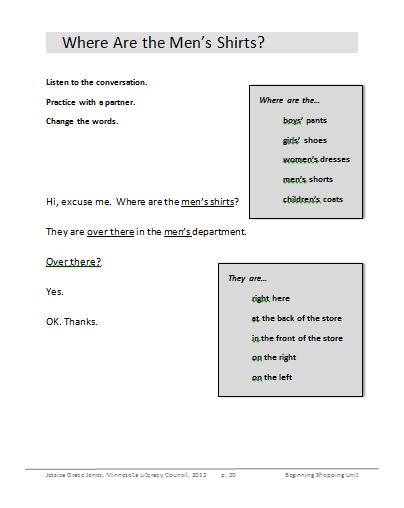
18 Teacher Directions: Activity 3: Life Skills, Literacy, Listening & Speaking -Materials: Where Are the Men s Shirts? Step 1: Introduce and Practice the Dialogue Distribute copies of Where Are the Men s Shirts? Handout Follow the Dialogue instructions in the ESL Volunteer Tutor Manual, 2012, p. 69. Step 2: vary the information Model how to vary the underlined words in the dialogue using the information in the boxes. Have learners practice varying the dialogue several times and with several different partners. Teacher Directions: Activity 4: Checking for Understanding -Materials: BINGO, bingo chips or markers, (optional) bingo prizes Step 1: Prep Learners look at p from today s warm up. Distribute blank bingo cards. Model how to randomly write the vocabulary words in different squares on the BINGO card so that everyone has a different card. Step 2: Play BINGO Instead of calling out the clothing vocabulary, show pictures from p on the projector. Jessica Grace Jones, Minnesota Literacy Council, 2012 p. 18 Beginning Shopping Unit
19 Reading Test Practice Women s Clothes Men s Clothes Girls Clothes Boys Clothes Shoes School Supplies Food Household Supplies 1. Where are the girls clothes? A. upstairs B. downstairs C. right D. left 2. Where are the school supplies? A. upstairs B. downstairs C. right D. left Adapted from Andrea Echelberger, MLC, 2012 Jessica Grace Jones, Minnesota Literacy Council, 2012 p. 19 Beginning Shopping Unit

20 Where Are the Men s Shirts? Listen to the conversation. Practice with a partner. Change the words. Where are the boys pants girls shoes women s dresses men s shorts Hi, excuse me. Where are the men s shirts? children s coats They are over there in the men s department. Over there? Yes. OK. Thanks. They are right here at the back of the store in the front of the store on the right on the left Jessica Grace Jones, Minnesota Literacy Council, 2012 p. 20 Beginning Shopping Unit
21 BINGO Jessica Grace Jones, Minnesota Literacy Council, 2012 p. 21 Beginning Shopping Unit
22 Shopping Unit: Week 1, Thursday Objectives Learners will be able to Life skill: Ask for the location of clothing items in a store Literacy: read and understand clothing department vocabulary (ex. men s, women s, children s, shoes) Listening/speaking: ask and respond to the question Where are the? They re over there in the children s department. Transition & Critical Thinking: categorize clothing items by type (ex. tops, bottoms, footwear) Grammar: use prepositional phrases to describe the location of items in a store (ex. over there, right here, on the right, on the left, in aisle 3). Materials Make Student Copies Textbook: Basic Grammar in Action, p (for learners absent yesterday) Handout: Where Are the Men s Shirts? (from yesterday) Make Single Copies or Reference ESL Volunteer Tutor Manual, 2012, p. 159, p. 69 Handout: Role-Play Cards Props, Technology, or Other Resources 8 blank sheets of paper tape Lesson Plan Warm up and Review of Previous Lessons Description: create a word web of clothing vocabulary Materials/Prep: a few copies of Basic Grammar in Action, p for learners absent yesterday. Activity 1: Listening & Speaking, Life Skill Description: practice giving and receiving compliments about clothing Materials/Prep: (none) Activity 2: Listening & Speaking, Grammar Description: review prepositional phrases (ex. over there, on the right) Materials/Prep: ESL Volunteer Tutor Manual, 2012, TPR, p. 159 Activity 3: Life Skill, Literacy, Listening & Speaking, Transition & Critical Thinking Description: practice asking for the location of clothing items in a store Materials/Prep: copies of Where Are The Men s Shirts?, ESL Volunteer Tutor Manual, 2012, Dialogue, p. 69 Activity 4: Checking for Understanding Description: role-play asking for the location of clothing items in a store Materials/Prep: copies of Role-Play Cards, 8 blank sheets of paper, tape Jessica Grace Jones, Minnesota Literacy Council, 2012 p. 22 Beginning Shopping Unit
23 Teacher Directions: Warm Up and Review -Materials: a few copies of Basic Grammar in Action, p for students absent this week. Step 1: Context Distribute textbook copies to learners who need them. Let s write some clothing words in groups. Step 2: Model the Word Web Remind students to put their pencils down. They will write in a few minutes. On the board, write the word clothes in the central circle. Write each of these words in the next level of circles: tops bottoms footwear underwear Using the worksheet as a reference, elicit words for each category. Write those words in the next level of circle. 1-4 words for each category is enough. Step 3: Learners copy the word web Learners copy the completed word web in their notebooks. Those who finish quickly can try to add more words or categories. Teacher Directions: Activity 1: Life Skills, Listening & Speaking -Materials: (none) Step 1: Prep Write on the board and allow learners time to copy: I like your shirt. Thank you. That dress looks great on you. Thank you. It s new. Step 2: Review the dialogue Practice the phrases on the board several time, substituting different articles of clothing. Learners stand up, mingle around the classroom, and give compliments to 3 other students. Jessica Grace Jones, Minnesota Literacy Council, 2012 p. 23 Beginning Shopping Unit
24 Teacher Directions: Activity 2: Listening & Speaking, Grammar -Materials: ESL Volunteer Tutor Manual, 2012, TPR, p. 159 Step 1: Review vocabulary For each phrase, say the phrase, pantomime the location using hand gestures. Have learners repeat the word and the gesture several times. over there right here at the back of the store in the front of the store on the right on the left Step 2: TPR (Total Physical Response) Practice Continue reviewing the phrases above using the instructions in the ESL Volunteer Tutor Manual, 2012, p. 159 Why is moving around important? Anyone who has studied another language knows that it is difficult to remember what you ve learned from one day to the next. Incorporating multiple senses into language learning helps lay down additional pathways in the brain that help us remember. So tell your students: This isn t just silly, it will help your brain remember! Teacher Directions: Activity 3: Life Skills, Literacy, Listening & Speaking -Materials: Where Are the Men s Shirts? Step 1: Introduce and Practice the Dialogue Distribute copies of Where Are the Men s Shirts? Handout (from yesterday) Follow the Dialogue instructions in the ESL Volunteer Tutor Manual, 2012, p. 69. Step 2: vary the information Model how to vary the underlined words in the dialogue using the information in the boxes. Have learners practice varying the dialogue several times and with several different partners. Jessica Grace Jones, Minnesota Literacy Council, 2012 p. 24 Beginning Shopping Unit
25 Teacher Directions: Activity 4: Checking for Understanding -Materials: one set of Role Play Cards, cut apart Step 1: Prep Use blank sheets of paper to create the following signs Men s Women s Boy s Girl s Men s Shoes Women s Shoes Children s Shoes Hang the signs in different areas of the classroom. Step 2: Introduce the Role-Play Point to the signs and review the names of the departments. Say This is a store. Ask for a volunteer. Give that learner a role-play card. Say You are going shopping. What do you need? Gesture to the role-play card. Learner describes the pictures -an item of clothing and a person (man, woman, boy, or girl). Say I work at the store. Ask me a question. Help the learner, as needed, to role-play the situation without looking at their worksheet from the last activity. Step 3: Learners take turns role-playing Learners take turns being store employees and customers. Each time the customer receives a role-play card and the employee must point them in the direction of the correct department using the phrases they ve learned. As you watch, note what aspects of this task are still difficult for learners. Report that to Monday s teacher. Jessica Grace Jones, Minnesota Literacy Council, 2012 p. 25 Beginning Shopping Unit
26 Role-Play Cards for for for for for for Jessica Grace Jones, Minnesota Literacy Council, 2012 p. 26 Beginning Shopping Unit
Transportation: Week 2 of 2
 The Minnesota Literacy Council created this curriculum with funding from the MN Department of Education. We invite you to adapt it for your own classrooms. Beginning Level (CASAS reading scores of 181-200)
Talking on the Phone: Week 1 of 1
 The Minnesota Literacy Council created this curriculum with funding from the MN Department of Education. We invite you to adapt it for your own classrooms. Beginning Level (CASAS reading scores of 181-200)
Looking for Work: Week 2 of 2
 The Minnesota Literacy Council created this curriculum with funding from the MN Department of Education. We invite you to adapt it for your own classrooms. Beginning Level (CASAS reading scores of 181-200)
Money: Week 1 of 2. Beginning Level (CASAS reading scores of 181-200)
 The Minnesota Literacy Council created this curriculum with funding from the MN Department of Education. We invite you to adapt it for your own classrooms. Beginning Level (CASAS reading scores of 181-200)
Borrowing & Saving: Week 1
 The Minnesota Literacy Council created this curriculum with funding from the MN Department of Education. We invite you to adapt it for your own classrooms. Intermediate Level (CASAS reading scores of 201-220)
School. Lesson plan. Topic. Aims. Age group. Level. Time. Materials. School, school objects, rules, subjects, rooms and uniforms
 School Lesson plan Topic School, school objects, rules, subjects, rooms and uniforms Aims To practise (depending on stages chosen): vocabulary: words connected to school, school objects, rules, subjects,
Intro Lesson (Ages 8-14)
 Lesson: General: Age: Time: Objectives: Structures: Target Vocab: 8-14 years 40 mins - 1 hour Greetings, Asking & answering personal questions, using modal verbs for rules, Identifying different classroom
MASTER Wh Questions: Week 1 of 1. Unit Overview:
 The Minnesota Literacy Council created this curriculum with funding from the MN Department of Education. We invite you to adapt it for your own classrooms. MASTER Wh Questions: Week 1 of 1 Unit Overview:
Lifelong Learning and Review
 U n i t 8 Lifelong Learning and Review Divers examine the remains of a skeleton found in an underwater cave. Unit Out c omes Organize study materials Make purchases Give and follow directions Make goals
To download the script for the listening go to: http://www.teachingenglish.org.uk/sites/teacheng/files/learning-stylesaudioscript.
 Learning styles Topic: Idioms Aims: - To apply listening skills to an audio extract of non-native speakers - To raise awareness of personal learning styles - To provide concrete learning aids to enable
Emergency Room: Week 1. Intermediate Level (CASAS reading scores of 201-220)
 The Minnesota Literacy Council created this curriculum with funding from ECHO (Emergency, Community, Health, and Outreach). The goal of the curriculum is to educate students on the different types of medical
ESOL Customer Service Training: Unit 1 1: 1 Student Book. Unit 1: Talking With Your Customer
 ESOL Customer Service Training: Unit 1 1: 1 Unit 1: Talking With Your Customer ESOL Customer Service Training: Unit 1 1: 2 What are your goals? Note to Instructor: If you have permission, use Stand Out
Pre-Literate Class Curriculum
 Pre-Literate Class Curriculum We d like to thank the following individuals and organizations for making this curriculum project possible. Acknowledgements: This curriculum was the result of years of effort
Buy The Complete Version of This Book at Booklocker.com:
 Practical, comprehensible ESL workshops centered on the adult ELL learner. The ESL Teachers Workshop Modules Buy The Complete Version of This Book at Booklocker.com: http://www.booklocker.com/p/books/4783.html?s=pdf
Active Learning Strategies
 Active Learning Strategies Right Brain Reports Let learners work in small groups to create informational reports to present to the large group. Instead of a verbal report on the information, have learners
What have I learned about networking and communication? MATERIALS
 4 communication & networking Networking Challenge The BIG Idea What have I learned about networking and communication? AGENDA Approx. 45 minutes I. Warm up: Game Plan (5 minutes) II. Networking Bingo Game
n Starter n The Paper Flow n What? When? n Create a System n Conclusion n Questions for Assessment
 Lesson getting Organized A G E N D A n Starter n The Paper Flow n What? When? n Create a System n Conclusion n Questions for Assessment Objectives Students will examine ways to organize information and
Teacher s Pack h"p://esol.bri.shcouncil.org/teaching5english5work/cleaners8
 Cleaners: preventing and reporting accidents! Teacher s Pack h"p://esol.bri.shcouncil.org/teaching5english5work/cleaners8 Cleaning: preventing and reporting accidents teachers notes Cleaning: preventing
English lesson plans for Grade 3
 English lesson plans for Grade 3 Lessons in this section 3.1 Vocabulary and speaking: How do you say in English? 76 3.2 Reading: We re going to take a holiday 80 3.3 Listening and writing: holiday plans
Tapescript. B Listen and write the words. C Help the baby spider. Draw a red line. D Help the baby frog. Listen and draw a green line.
 Unit 1 Hello! Topics animals, colours, numbers Functions following instructions, spelling and writing Grammar questions (What s? What are? What colour?), demonstratives (this/these), imperatives Vocabulary
Lesson 2: How to Give Compliments to Tutees
 Kids As Reading Helpers: A Peer Tutor Training Manual Copyright 2002 by Jim Wright www.interventioncentral.org L2-1 Lesson 2: How to Give Compliments to Tutees Introduction When correctly used, compliments
Telephone Skills Resource Kit: Lesson Plans
 Telephone Skills Resource Kit: Lesson Plans By Valerie Glass 2003 funded in part by the ESL Special Collection, a project of the National Institute for Literacy And Catholic Charities Immigration and Refugee
ESL Intensive ESLS 4000. Listening/Speaking 400 (CLB 4) Unit 2: Shopping. Instructor Resource Guide
 ESL Intensive ESLS 4000 Listening/Speaking 400 (CLB 4) Instructor Resource Guide V1.10 July 2010 Language Training and Adult Literacy ESL Intensive ESLS 4000 Listening/Speaking 4000 (CLB 4) Instructor
My week. Vocabulary (SB page 18) Unit objectives. My day. Word XP. To start. Power up
 02 My week Unit objectives Reading: Vocabulary: Grammar: Listening: Speaking: Writing: Vocabulary (SB page 18) Ask students: How many days are there in a week? Which days are the weekend and which are
Someone at the door Electricity meter reading Teacher s pack. English in my home Someone at the door. Unit 1a Electricity meter reading
 English in my home Someone at the door Unit 1a Electricity meter reading 1 Contents Unit 1a Electricity meter reading teacher s notes Electricity meter reading learner resources Electricity meter reading
I. Title of Lesson: Learning from Artifacts and What Artifacts Tell Us
 Lesson Plan Class: Seventh Grade Subject: World History Ancient Civilizations Topic: Unit One Investigating the Past: How are social scientists like detectives? I. Title of Lesson: Learning from Artifacts
Lesson Objectives: Identify the parts of the computer, vocabulary for communicating in the lab with lab assistant
 Teacher s Name: Michele C. REEP Levels: 100-150 Lifeskills Unit: Getting Started Lesson Objectives: Identify the parts of the computer, vocabulary for communicating in the lab with lab assistant Language
Lesson plan Shopping is GREAT
 Topic: Shopping in London Objectives: To give a short presentation about different types of shops To discuss different people s shopping habits To use idioms which contain the word shop To write a collaborative
PART II: ACTIVITY PACKETS. Lesson Planning. What Are the Essential Components of a Lesson Plan?
 PART II: ACTIVITY PACKETS Adult English language learners generally have limited time to devote to participating in language classes. A good lesson plan is an important tool that focuses both the instructor
Useful classroom language for Elementary students. (Fluorescent) light
 Useful classroom language for Elementary students Classroom objects it is useful to know the words for Stationery Board pens (= board markers) Rubber (= eraser) Automatic pencil Lever arch file Sellotape
Learning Styles. The VARK Categories. What is a Learning Style?
 Learning Styles What is a Learning Style? Learning styles focus on how your brain receives information. No one else learns or processes information exactly the way you do! If you discover how you process
Call 999: teacher s notes
 Call 999: teachers notes Call 999 Contents Call 999: teacher s notes Call 999: answers & transcripts Call 999: flashcards Call 999: classroom materials Copyright - please read All the materials on these
Storing Your Medicines Safely
 A H E A L T H Y H O U S E Why is it important to store medicines correctly? When you store your medicines correctly they work well when you need them. If you do not store your medicine in the right place
Suggested Grade 1 2 Lesson Plan Students Rights and Responsibilities
 Suggested Grade 1 2 Lesson Plan Students Rights and Responsibilities Lesson 1 My Rights and Responsibilities Grade 1 st and 2 nd Objective: The students will discuss and summarize their rights and responsibilities
TKT: YL (Young Learners) Part 3: Using practice activities Trainer s notes
 TKT: YL (Young Learners) Part 3: Using practice activities Trainer s notes Description This session covers the area of knowledge using practice activities to consolidate children s language learning. Participants
2. Provide the scoring guide/rubric for the culminating task (summative assessment).
 2. Provide the scoring guide/rubric for the culminating task (summative assessment). Criteria Oral Presentation- Group project Poster Presentation display/ visual aids 1 - Attempts the standard use the
TOP NOTCH Teaching Tips
 TOP NOTCH Teaching Tips for Teaching with ActiveTeach Joan Saslow and Allen Ascher What is ActiveTeach? ActiveTeach is an exciting digital classroom presentation tool. It allows you to display the Student
Consumer.gov Lesson Plan Sending Money Overseas
 Consumer.gov Lesson Plan Sending Money Overseas Teacher s Notes This lesson plan is designed to be flexible, so that you can use all or part of it depending on the level(s) of your learners, their learning
Plumbing Lesson Five: Pipe Fittings and Parts. Facilitator Guide
 Lesson Five: Pipe Fittings and Parts Facilitator Guide Building Basics was paid for under an EL Civics grant from the U. S. Department of Education administered by the Virginia Department of Education.
Getting School Ready in Iowa
 Getting School Ready in Iowa I want to be ready for kindergarten. How can the kindergarten be ready for me? A guide for families and early care, health, and education providers caring for children who
Someone on the phone An emergency Teacher s pack. English in my home Someone on the phone. Unit 2c An emergency
 English in my home Someone on the phone Unit 2c An emergency 1 Contents Unit 2c An emergency teacher s notes An emergency learner resources (including transcript) An emergency answers Video 2 Introduction
Special Topic Lesson: they re, there, their
 Dear Educator, Current research emphasizes the importance of explicit grammar instruction in providing an effective instructional program for English learners. A fun and effective way to squeeze some extra
Young Learners English
 University of Cambridge ESOL Examinations Young Learners English Starters Information for Candidates Information for candidates YLE Starters Dear Parent Thank you for encouraging your child to learn English
Theme 9. THEME 9: Spring Is Here
 Theme 9 64 CHALLENGE ACTIVITIES FOR Spring Is Here 65 WEEK 1 THEME 9/Week 1 1. What Season Is It? Think of some ways you can tell what season it is. You will make a picture riddle about a season. Choosing
TeachingEnglish Lesson plans. Mobile phones. Topic: Mobile phones and text communications
 Mobile phones Topic: Mobile phones and text communications Aims: - To develop students understanding of telephone and text communications - To give students a chance to practise speaking Level: Pre-intermediate
LEÇON 17 Le français pratique: L achat des vêtements
 Nom Unité 6. Le shopping LEÇON 17 Le français pratique: L achat des vêtements Projet 1 Articles promotionnels Unité 6 Leçon 17 Work in a group of four. Imagine that you are the editors and art designers
My Game. Or I say, I m in the window. Or else, I m out the door. I m on top of the table, Or I m under the floor.
 My Game I have a little pretend game I play When Daddy calls to me. I say, I m right here, Daddy! I m under the sea! Or I say, I m in the window. Or else, I m out the door. I m on top of the table, Or
Summary of Lesson Plan
 LESSON PLAN, UNIT 9: VOCABULARY (for Student pages 102-103) Summary of Lesson Plan Vocabulary (Student pages 102-103) 60 minutes Vocabulary (Student pages 102-103) 60 minutes Content: personal banking
We invite you to adapt it for your own classrooms.
 The Minnesota Literacy Council created this curriculum with funding from ECHO (Emergency, Community, Health, and Outreach). The goal of the curriculum is to to create awareness and promote discussion around
"Why is it important for ELL students to be active in listening, speaking, reading and writing on a daily basis?"
 "Why is it important for ELL students to be active in listening, speaking, reading and writing on a daily basis?" Monica Gonzalez Bilingual/ESL Specialist [email protected] "Tell me and I
DIVERSE UNIVERSE ELEMENTARY LESSON PLAN
 DIVERSE UNIVERSE ELEMENTARY LESSON PLAN. NATIONAL ASSOCIATION OF STUDENTS AGAINST VIOLENCE EVERYWHERE 322 Chapanoke Rd., Suite 110, Raleigh, North Carolina 27603 (Toll free) 866-343-7283 * Fax 919-661-7777
Fun ways to group students
 Fun ways to group students Tips for dividing into groups. Picture Cards: Hand out cards with images on such as strawberries, blueberries, blackberries and other such groups of things. Then get them to
2015 2016 Third Grade Room 6. Ms. Jessica Silver [email protected]
 Welcome back! 2015 2016 Third Grade Room 6 Ms. Jessica Silver [email protected] About the Teacher This is my second year at Merryhill School Calvine. I hold a Bachelors degree in Liberal Studies
Can you answer Milly s question and tell her why? Jot down your answers on a note pad, then check the answer key below.
 When you have to write a lesson plan is it sometimes difficult to write down your aims? This lesson will give you ideas on how to write better aims when you need to. Task 1 Milly s dilemma. Milly is asking
Consumer.gov Lesson Plan Opening a Bank Account
 Consumer.gov Lesson Plan Opening a Bank Account Teacher s Notes This lesson plan is designed to be flexible, so that you can use all or part of it depending on the level(s) of your learners, their learning
Expressive Objective: Realize the importance of using polite expressions in showing respect when communicating with others
 QUARTER 4 - WEEK 1 Theme: My School and Friends TARGET SKILLS : At the end of the lesson the students should be able to: Expressive Objective: Realize the importance of using polite expressions in showing
GED Language Arts, Writing Lesson 1: Noun Overview Worksheet
 CLN Televised Courses Nina Beegle, Instructor Lesson 1: Noun Overview Worksheet NOUNS: DEFINITION A NOUN can be a person, a place, a thing, or an idea. EXAMPLES: man, children, store, a dream There are
Child s Communication Book
 Written by: Nadia Mia What is a Communication Book? A communication book can mean different things to different people. In some schools, parents and teachers use a communication book to share information
www.eslkidstuff.com Lesson Plans for ESL Kids Teachers
 Lesson: General: Time: Objectives: Structures: Target Vocab: 40 mins - 1 hour Talking about different members of the family "Who is this?" "How are you?" "I m fine thank you" "See you soon" father, mother,
Strategies to use When Working with ELL Students
 Vocabulary Building Strategies to use When Working with ELL Students Dr. María Torres Director of Diversity and ESOL Ilona Olancin Secondary ELL Curriculum Facilitator Academic Development We require English
Young Learners English
 University of Cambridge ESOL Examinations Young Learners English Movers Information for Candidates Information for candidates YLE Movers Dear Parent Thank you for encouraging your child to learn English
Mathematics Curriculum
 New York State Common Core 3 G R A D E Mathematics Curriculum GRADE 3 MODULE 1 Topic B Division as an Unknown Factor Problem 3.OA.2, 3.OA.6, 3.OA.3, 3.OA.4 Focus Standard: 3.OA.2 Interpret whole-number
JA ECONOMICS FOR SUCCESS (2012 Version)
 JA ECONOMICS FOR SUCCESS (2012 Version) Important Notes: Reference Working with Students page before teaching. Session 1 When giving directions to students, please provide oral and written explanation
My Family FREE SAMPLE. This unit focuses on sequencing. These extension
 Unit 5 This unit focuses on sequencing. These extension Unit Objectives activities give the children practice with sequencing beginning, middle, and end. As the learn to name family members and rooms children
School starts at nine o clock. Contents. Language Analysis
 Year 3 Lesson 22 School starts at nine o clock. Grammar & Functions Aims Talking about daily routine Talking about what time routine activities start What time does school start? At nine o'clock. Contents
GESE Initial steps. Guide for teachers, Grades 1 3. GESE Grade 1 Introduction
 GESE Initial steps Guide for teachers, Grades 1 3 GESE Grade 1 Introduction cover photos: left and right Martin Dalton, middle Speak! Learning Centre Contents Contents What is Trinity College London?...3
Elicit Me too and Me neither by asking students if they have a sister or brother (or dog, cat ) and then responding appropriately.
 All about me. Topic: Personal interests, likes and dislikes Aims: To help students focus on fluency when speaking To develop students communication skills To develop students listening skills Level: Pre-intermediate
FIRST GRADE Number and Number Sense
 FIRST GRADE Number and Number Sense Hundred Chart Puzzle Reporting Category Number and Number Sense Topic Count and write numerals to 100 Primary SOL 1.1 The student will a) count from 0 to 100 and write
Adult Ed ESL Standards
 Adult Ed ESL Standards Correlation to For more information, please contact your local ESL Specialist: Basic www.cambridge.org/chicagoventures Please note that the Chicago Ventures correlations to the City
K/Grade 1 Recognizing Hazards Module 1. Lesson At A Glance. 45-60 minutes. Length
 Lesson At A Glance Length 45-60 minutes Learning Objectives Students will: identify hazards and use safe behaviours in the home, school and community demonstrate an ability to access emergency services
I start work at 8:30. Unit aims. Getting started
 I start work at 8:0 Unit aims In Unit, students learn about: Saying where you re from Reflecting and reaching Describing readiness Describing schedules Viewpoints: Working hours In business: Describe your
Places & Where We Live
 Lesson: General: Time: Objectives: Structures: Target Vocab: 40 mins - 1 hour Talking about where animals and people live " Dónde vives?" " Donde vive (la vaca)?" "Vivo en...", "Vive en..." pez, vaca,
Linked sounds Listening for spelling of names and phone numbers. Writing a list of names and phone numbers Work book pg 1-6
 TOPICS: Alphabet; greetings, names and titles of address; numbers and phone numbers PG 2-7 introduce themselves friends, say hello goodbye; ask for names and phone numbers Possessive adjectives my, your,
Unit One Employability Skills
 Unit One Employability Skills 1 Contents Unit Overview 3 Learning and Teaching Activities within this Unit 5 Theme 1 What Are Employability Skills, Qualities and Values? 6 Theme 2 Communicate It 8 Theme
GRAMMAR, SYNTAX, AND ENGLISH LANGUAGE LEARNERS
 GRAMMAR, SYNTAX, AND ENGLISH LANGUAGE LEARNERS When it comes to grammar, many writing tutors and instructors are unsure of the most effective way to teach ESL students. And while numerous studies, articles
Vocabulary Strategies Toolbox
 Graphic organizers help students to visualize the relationships between words and their possible meanings. Teachers can use these graphic organizers and games with explicit vocabulary instruction. These
CHECKING ACCOUNTS and ATM TRANSACTIONS
 Grades 6-8 Lesson 1 CHECKING ACCOUNTS and ATM TRANSACTIONS Key concepts: Checking accounts, ATMs, debit cards, credit cards, bank fees and regulation, safeguarding personal information Summary: This lesson
ESP MARKETING TEACHER S NOTES
 Teacher s notes: Level 1 (Intermediate) ESP MARKETING TEACHER S NOTES Worksheet A A. Vocabulary With stronger students, don t give them the correct answers until they have read the text and have had a
Grammar Unit: Pronouns
 Name: Miss Phillips Period: Grammar Unit: Pronouns Unit Objectives: 1. Students will identify personal, indefinite, and possessive pronouns and recognize antecedents of pronouns. 2. Students will demonstrate
OA3-10 Patterns in Addition Tables
 OA3-10 Patterns in Addition Tables Pages 60 63 Standards: 3.OA.D.9 Goals: Students will identify and describe various patterns in addition tables. Prior Knowledge Required: Can add two numbers within 20
SEMINOLE COUNTY PUBLIC SCHOOLS ESOL Strategies For Mainstream Teachers 2011-2012
 SEMINOLE COUNTY PUBLIC SCHOOLS ESOL Strategies For Mainstream Teachers 2011-2012 ESOL/World Languages Department For additional resources and strategies, visit the ESOL/ World Languages Department website
Week 4 Lesson Plan. Pre-K. Our Neighborhood. Macmillan /McGraw-Hill. Extend. the Unit
 Lesson Plan Extend Unit the Unit Pre-K Our Neighborhood Alphabet Time.....................2-3 Book Time.........................-5 Retelling Puppets..................6-7 Content Area......................8-9
Bar Graphs with Intervals Grade Three
 Bar Graphs with Intervals Grade Three Ohio Standards Connection Data Analysis and Probability Benchmark D Read, interpret and construct graphs in which icons represent more than a single unit or intervals
INTRODUCTION EL CIVICS EMPLOYMENT UNIT Intermediate Level
 INTRODUCTION EL CIVICS EMPLOYMENT UNIT Intermediate Level This guide will take you through the Employment 33 Objective. The objective is to: Identify and access employment and training resources needed
GRADE 1 MENTAL AND EMOTIONAL WELL-BEING
 GRADE 1 MENTAL AND EMOTIONAL WELL-BEING MENTAL AND EMOTIONAL WELL BEING GRADE: 1 LESSON: INTRODUCTION TO SCHOOL HEALTH PROGRAM THEME: CONCEPT: EVERYONE CAN MAINTAIN AND IMPROVE PERSONAL HEALTH AT SCHOOL
Kindergarten Social Studies Unit 10 Exemplar Lesson 01: How Families Meet Their Basic Needs
 Kindergarten Unit 10 Exemplar Lesson 01: How Families Meet Their Basic Needs This lesson is one approach to teaching the State Standards associated with this unit. Districts are encouraged to customize
Media: Participants learn about the media s influence on our lives; participants identify how
 Media: Participants learn about the media s influence on our lives; participants identify how the media influences their attitudes; participants brainstorm ways to combat the media s negative influence.
SAMPLE. Unit 6 Let s Eat Overview. Theme Food and preferences
 Unit 6 Let s Eat Overview Theme Food and preferences Developmental Focus Social Studies and Personal Development In this unit, children learn to express their feelings by talking about foods that they
STAAR 2014 Test Training
 STAAR 2014 Test Training This Training Session DOES NOT take the place of reading the manual!!!! Make sure you have read all of the directions prior to you giving the test!! Active Monitoring means that
Listening and Speaking Activities for Adult ESL Learners
 Listening and Speaking Activities for Adult ESL Learners Correlated to the BEST Plus Assessment and CASAS Listening Basic Skills Content Standards Jane C. Miller Colorado Department of Education Adult
How To Kit. Picture Bingo
 How To Kit Picture Bingo Steps to Organizing a Picture Bingo Community Event 1. Find a space in the community to hold the event. (school, band office, nursing station, library, community hall) 2. Advertise
Lesson Plan #2. Performance Objective(s): Given a worksheet of 12 sentences, the 2 nd grade students will identify the action verb 9 out of 12 times.
 Lesson Plan #2 Lesson: Action Verb Lesson with Book, Game, and Video Length: 45 minutes Age or Grade Level Intended: 2 nd Grade Source: Taken from www.lessonsnips.com and Emily Gallmeyer Academic Standard(s):
Accommodated Lesson Plan on Solving Systems of Equations by Elimination for Diego
 Accommodated Lesson Plan on Solving Systems of Equations by Elimination for Diego Courtney O Donovan Class: Algebra 1 Day #: 6-7 Grade: 8th Number of Students: 25 Date: May 12-13, 2011 Goal: Students will
Teacher s Pack h"p://esol.bri.shcouncil.org/teaching5english5work/cleaners8
 Cleaners: accident reports! Teacher s Pack h"p://esol.bri.shcouncil.org/teaching5english5work/cleaners8 Cleaning: accident reports teachers notes GGCleaning: accident reports Contents Accident reports:
Giving Second Graders the Write Skills Grade Level:
 Giving Second Graders the Write Skills Grade Level: Written by: Length of Unit: 2 nd Grade Tracy de Nieves, Cheyenne Mountain Charter Academy, Colorado Springs, CO Ten one hour lessons or (suggested) 20
Reading aloud to a child
 Reading aloud to a child Festivals and celebrations: introduction Me and my culture: festivals and celebrations Contents Festivals and celebrations: teachers notes Festivals and celebrations: classroom
TRY VISIT GO STAY TAKE WRITE FLY GO BUY
 Warm Up Work with a partner. Tell your partner three things about your last holiday. Vocabulary Match the verb to the activity. TRY VISIT GO STAY TAKE WRITE FLY GO BUY photographs sightseeing souvenirs