
Modeling and Control of a Satellite s Geostationary Orbit
|
|
|
- Paulina Lang
- 10 years ago
- Views:
Transcription
1 MASTER'S MASTER S THESIS 26:43 PB 27:43 Modeling and Control of a Satellite s Geostationary Orbit Kleanthis Neokleous Luleå University of Technology Master Thesis, Continuation Courses Space Science and Technology Department Department of Department of Space of Science, Space Science, Kiruna Kiruna 27:43 - ISSN: ISRN: LTU-PB-EX--7/43--SE

2 Czech Technical University in Prague Faculty of Electrical Engineering Space Master DIPLOMA THESIS Modeling and control of a satellite s geostationary orbit Department of Space Science, Kiruna Space Campus Prague, 27 Author: Kleanthis Neokleous

3 Declaration I, Kleanthis Neokleous, declare that this diploma Thesis is my own work and has not been submitted in any form for another degree or diploma at any university or other institute. Information derived from published and unpublished work of others has been acknowledged in the text and a list of references is given in the bibliography In Prague on Signature ii

4 Acknowledgments: I would firstly like to express my deep appreciation and thanks to all the people who helped me in any way in completing this Thesis work, but mostly my advisors Dr Ing. Jiri Roubal and Dr Ing. Petr Husek of the Czech Technical University, as well as Professor Andreas Johansson of the Luleå University of Technology. Moreover, I would also like to express my gratitude to Dr Zdeněk Hurák for his valuable advice in solving difficult technical problems. I would like also to thank the Human Spaceflight, Microgravity and Exploration Programmes of the European Space Agency (ESA) for the financial support and the recourses provided. Lastly, but not least I would like to thank my family, friends and colleagues for their patience and support during the last two years of the Spacemaster course. iii

5 Abstract In this Thesis a complete model of the dynamics describing the orbit of a geostationary satellite has been developed by using the Euler- Hill equations of relative motion. Following that, a system has been developed to control the satellite s motion, which was the main objective of this work. Typically, this is classic problem in formation flight when the objective is to follow a leader or an analogous formation. On a similar basis, the idea developed and applied in this Thesis, was to control the satellite in order to minimize the distance from the satellite to the leader which in this case, is considered as a point orbiting in an ideal trajectory, irrespective of external or internal influences or disturbances. Real satellites are influenced by disturbances mainly caused from body forces due to the non-homogeneity and oblateness of the earth, body forces due to thirdbody interactions that generate satellite perturbations, mainly from the moon and the sun, and traction forces from solar radiation and solar wind. Consequently, models causing those disturbances were developed. Finally, the satellite s trajectory has been controlled using optimum and robust control design methods such as an LQ regulator and an H- infinity optimal control synthesis approach. iv
6 - 1 - Table of contents List of figures 1. General description of the problem & derivation of relative equations of motion Introduction The Geostationary orbit Generation of suitable data for an ideal geostationary orbit of a point Data generation of a geostationary satellite orbit with perturbances Derivation of the non-linear equations of relative motion Derivation of the linear Euler-Hill equations Estimation of the forces acting on a satellite Introduction Estimation of the external forces acting on a satellite Body forces due to the non-homogeneity & oblateness of earth J 2 Effect (Non-Spherical Effect) Forces due to Third-Body Perturbations Forces due to the Solar Radiation and Solar wind Perturbing Forces in the Relative Equations of Motion The J2 effect The Moon and Sun disturbance forces Moon disturbance Disturbances from the sun SIMULINK model of the system and the perturbing forces Thruster forces Extended Kalman Filter Introduction The Extended Kalman Filer algorithm Application of the EKF to the satellite model State space equations in continuous and discrete time Calculation of A, B, C, D, Γ e and Γ u Final results 44

7 Linear Quadratic Regulator Introduction Static optimization Optimal control of discrete-time systems Performance index J for the satellite control problem Optimal Discrete-time Linear Quadratic Regulator Steady-sate closed-loop control and suboptimal feedback Control of the satellite using LQ regulator - discrete system Final results H-infinity Optimal Control Synthesis H controller synthesis Scaling Controller design Open- loop shaping Loop shaping for disturbance rejection Closed-loop shaping Limitations on performance Limitations on sensitivity Limitations on peaks Bandwidth limitation RHP-zero and performance at low frequencies Limitations imposed by unstable (RHP) poles Functional controllability The general control problem Obtaining the generalized plant P Control configuration including model uncertainty Unstructured uncertainty Robust stability with multiplicative uncertainty Robust performance The satellite s control problem Selection of filter weights Performance weight w P Robustness weight w I 82
8 Final results Comparisons and final conclusions Introduction Comparison between the two control schemes LQ Regulator Optimal Controller H-Infinity Optimal Control Non-linear model tests LQ Regulator Optimal Controller H-Infinity Optimal Control Conclusions Bibliography 95

9 - 4 - List of figures Figure 1.1. Local rotating coordinate system 11 Figure 2.1. Gravitational force at a point due to a mass element 18 Figure 2.2 Basic orbit parameters 19 Figure 2.3. Third body perturbation 2 Figure 2.4. Evolution of the satellites radius and relative error due to the J 2 effect 24 Figure 2.5. The three orbiting planes 25 Figure 2.6. Spherical coordinates 26 Figure 2.7. First transformation around x axis 27 Figure 2.8. Second transformation around y axis 28 Figure 2.9. Evolution of the satellites radius and relative error/ moon disturbance 3 Figure 2.1.Evolution of the satellites radius and relative error /sun disturbance 31 Figure 2.11.Simulink model of the equations of motion 32 Figure 2.12.Evolution of the satellites radius and relative error /all perturbances. 33 Figure 3.1. System with state observer 37 Figure 3.2. State observer 38 Figure 3.3. Measured and estimated relative x 44 Figure 3.4. Measured and estimated relative y 45 Figure 3.5. Measured and estimated relative z 46 Figure 3.6. Measured and estimated r 2 47 Figure 4.1. Free final state LQR optimal control scheme 54 Figure 4.2. Eigenvalues of the closed-loop system 58 Figure 4.3. Evolution of the states using LQ controller 59 Figure 4.4.a.b Evolution of satellites radius and relative error using LQ controller 59 Figure 5.1. General control configuration with no uncertainty 61 Figure 5.2. General plant including performance weights 73 Figure 5.3. Uncertainty block in the general configuration 75 Figure 5.4.a Original system with multiple perturbations 75 Figure 5.4.b Pulling out the perturbances 76 Figure 5.5. M structure 76 Figure 5.6. Multiplicative input uncertainty 77 Figure 5.7 General configuration of the satellites model 81

10 - 5 - Figure 5.8. Singular values of S = 1/ (I+L) S compared with 1/w P 82 Figure 5.9. Singular values of T= ((1+L) -1 L) compared to singular values of 1/W I 83 Figure 5.1 Evolution of the states with H inf optimal controller 84 Figure 5.11.Evolution of satellites radius and relative error with H inf controller 85 Figure 6.1. Evolution of satellites radius, relative error and boundary condition for the case were the controller was designed by LQ regulator methodology 88 Figure 6.2. Evolution of the thruster forces F x, F y and F z given by LQ controller 88 Figure 6.3. Evolution of the satellites radius, the relative error and the boundary condition for the case were the controller was designed by H inf controller 89 Figure 6.4. Evolution of the thruster forces F x, F y and F z given by H inf controller 9 Figure 6.5. Evolution of the satellites radius, the relative error with the control signal saturated and initial conditions of 1km by LQR Optimal Controller. 91 Figure 6.6. Evolution of thruster forces F x, F y and F z with control signal saturated 92 Figure 6.7. Evolution of the satellites radius, the relative error with the control signal saturated and initial conditions of 1km by H inf controller 92 Figure 6.8. Evolution of thruster forces F x, F y and F z with control signal saturated 93

11 - 6 - Notation valid for all Chapters: Scalars - small italic letters e.g a, b, c, Functions - CAPITAL non-italic letters e.g A, B, C, Vectors - small bold non-italic letters e.g a, b, c, Matrices - CAPITAL bold non-italic letters e.g A, B, C

12 - 7 - Chapter 1 Description of the problem & derivation of relative equations of motion Symbols for Chapter 1: ρ moon = Satellite s distance from the moon ρ sun = Satellite s distance from the sun F grav = Gravitational force r = Τhe orbit radius (from the center of the earth) R E λ Λ = The equatorial radius of the earth = The geocentric latitude of the orbit = The geocentric longitude of the orbit µ = The earth s gravitational constant Φ = Gravitational potential P l J l Ω ω i M m s = Legendre polynomials = Zonal harmonics (dimensionless coefficients). = Right ascension of the ascending node = Argument of perigee = Inclination of the orbit = n(t-t ) the mean anomaly, where n is the mean motion. = Satellites mass m moon = Moon's mass γ p = Acceleration caused by moon's gravitational field

13 Introduction A common problem in the operation of satellites is to guide them and position them at a desired orbit. During its motion however, it is influenced by numerous forces of diverse intensities and directions, emanating from different sources. These forces tend to disturb the satellite and put it into other than the desired orbit. In this chapter an analysis of the problems encountered in modeling and estimating the forces acting on a satellite will be made. Some basic concepts of the geostationary orbit will be described, which is the case to be studied for the work of this Thesis. Following that, the derivation of the relative equations of motion will be presented. The relative equations of motion are based on the Hill s equations mainly used for formation flight. However, in the case to be studied, the leader can be considered as an ideal point. That would be the satellite s target. More detail analysis about the Hill s equations on formation flight, can be seen in Marcel J. Sidi Spacecraft Dynamics and Control [1] 1.2. The Geostationary orbit In a geostationary orbit, there are two major stages that concern the control of a satellite s orbit. The first one is the transfer from the Geosynchronous transfer Orbit (GTO) to the Final Geostationary Orbit (GEO). The second stage is the so-called Mission Stage, which is generally expected to last more than ten years. In this Thesis only the second stage of the geosynchronous orbit will be studied. The main objective of the work is to simulate a geostationary orbit of a satellite and apply suitable control schemes in order to keep it in the desired orbit, irrespective of external influences and resulting perturbations, using the minimum possible fuel consumption.

14 - 9 - In the mission stage, the primary parameters of a satellite that change with time are the inclination, eccentricity and the longitude. Hence, the task of station-keeping at a geostationary orbit consists primarily of three adjustments. 1) Longitude (East-West) correction Summer 2) Inclination (North-South) correction Winter Orbit 3) Eccentricity correction v sat dv sun v sat dv sun However, in the case of the relative motion (with respect to the desired orbit) those adjustments will be interpreted as x, y and z corrections in the rotating coordinate system that will be placed on the satellite as will be shown below. In order to perform the desired control, it is necessary to model the equations of motion of the satellite. The Euler-Hill equations that describe the relative motion between satellites in neighboring orbits are commonly used. By considering an ideal (desired) circular orbit of a point and having a real satellite orbit, the relative distance between any two points on the two orbits can be calculated through the use of the Euler-Hill equations for a dynamical system such as the satellite. The task then is to minimize this distance with the constraint of seeking minimum fuel consumption.

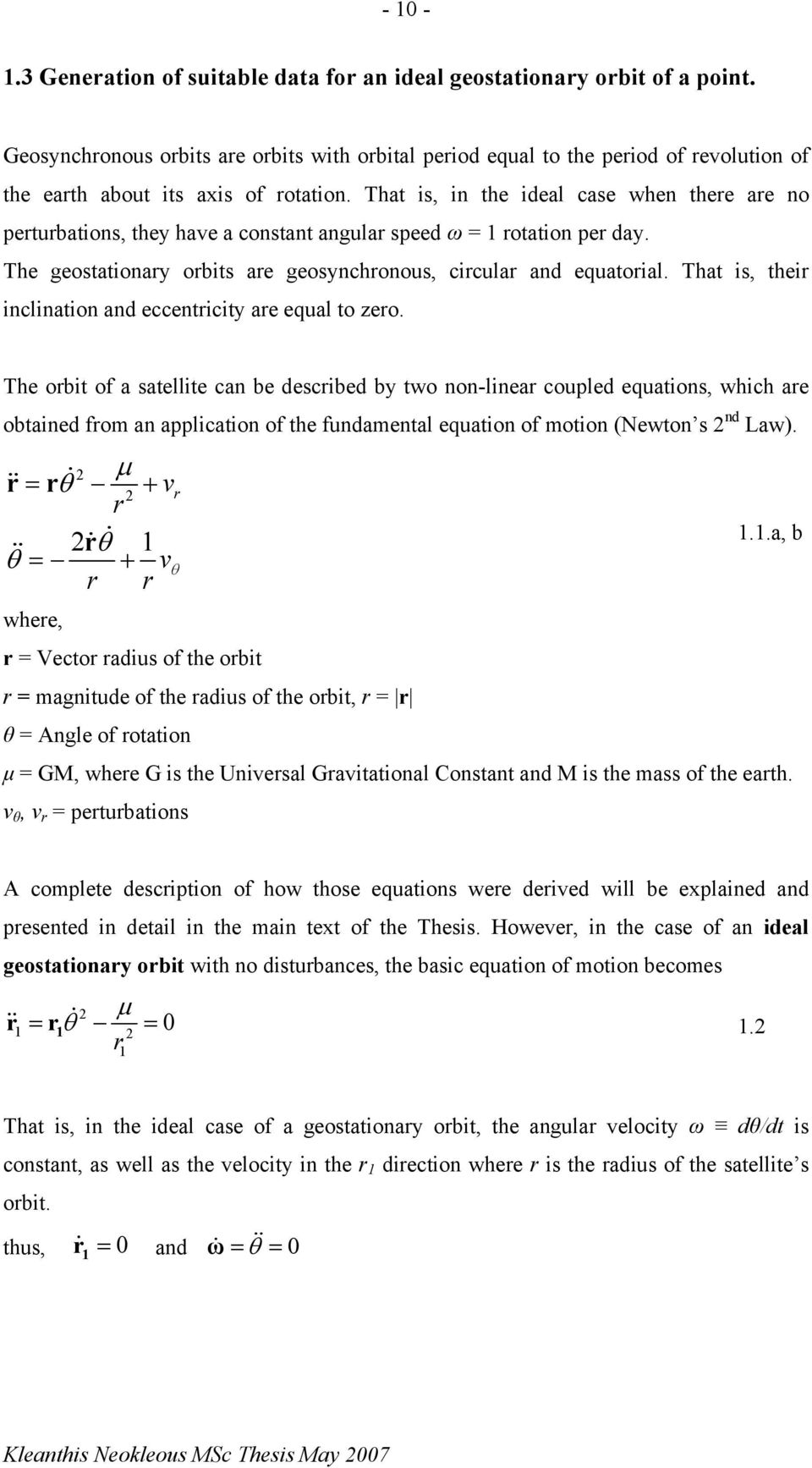
15 Generation of suitable data for an ideal geostationary orbit of a point. Geosynchronous orbits are orbits with orbital period equal to the period of revolution of the earth about its axis of rotation. That is, in the ideal case when there are no perturbations, they have a constant angular speed ω = 1 rotation per day. The geostationary orbits are geosynchronous, circular and equatorial. That is, their inclination and eccentricity are equal to zero. The orbit of a satellite can be described by two non-linear coupled equations, which are obtained from an application of the fundamental equation of motion (Newton s 2 nd Law). µ r r 2r θ 1 θ = + v r 2 = rθ + v 2 r r θ 1.1.a, b where, r = Vector radius of the orbit r = magnitude of the radius of the orbit, r = r θ = Angle of rotation µ = GM, where G is the Universal Gravitational Constant and M is the mass of the earth. v θ, v r = perturbations A complete description of how those equations were derived will be explained and presented in detail in the main text of the Thesis. However, in the case of an ideal geostationary orbit with no disturbances, the basic equation of motion becomes µ r = r θ = r1 That is, in the ideal case of a geostationary orbit, the angular velocity ω dθ/dt is constant, as well as the velocity in the r 1 direction where r is the radius of the satellite s orbit. thus, r = and ω = θ = 1
16 Generate data of a geostationary satellite orbit with perturbances In the case of the real satellite, the equations of motion describing the orbit are given by equations 1.3. µ r r r θ f = r2 2r 2θ θ = r 2 where the vector = y 1.3.a, b fx f f includes the total forces acting on the satellite, that is, the f z disturbances and the thruster forces. 1.5 Derivation of the non-linear equations of relative motion. In developing and applying the Euler-Hill equations [4], two coordinate systems are needed. An inertial coordinate system (geocentric) and a rotating coordinate system on the point of interest of the ideal orbit. A geocentric is a system that has fixed direction in space relative to the solar system. The Z axis is the axis of rotation of the earth in a positive direction, the X axis coincides with the vernal equinox vector, which is pointing to the sun on the 1st day of spring. The third axis Y completes an orthogonal right handed The local rotating coordinate system is placed on the orbiting point (x, y, z) as shown in Figure 1.1. In the local system, x is defined along the local vertical, z normal to the orbit plane and y completes a positive triad. Z z x y X (vernal equinox vector) r2 Y r1 Figure 1.1.Local rotating coordinate system.
![In developing and applying the Euler-Hill equations [4], two coordinate systems are needed.](/docs-images/44/12073687/images/page_16.jpg "An inertial coordinate system (geocentric) and a rotating coordinate system on the point of interest of the ideal orbit.")
17 As mentioned above, the orbit of the point is described with equation 1.2 and the satellite s orbit with equation 1.3 and presented here again. µ r r = r θ and r 1 r µ r = r 2 θ + 3 r2 f Let ρ = r1 r 2, µ r r ρ = a = + f ρ 3 3 r1 r2 However, in the local rotating coordinate system, the vector equation of the relative distance ρ is as shown below. In this coordinate system, ρ = ( x, yz, ) T and the acceleration is given by: 2 d ρ dρ dω ρ = aρ = + 2ω + ρ+ ω ω ρ dt dt dt Where ω = (,, θ ) and θ is the solution of equation 1.1 without the perturbances in the ideal orbit of the point. By substituting ω and r in equation 1.5, and finally substituting in equation 1.4, we get the non linear equations of motion, where in the rotating system r 1 = ( r1,,). x 2 θy θy θ x 2 1 = ( r+ x) + y + z ) 2 µ y y+ 2 θx + θx θ y = ( r+ x) + y + z ) z µ ( r + x) 1 = ( r+ x) + y + z ) 3/2 3/2 µ ( r + x) µ 2 r 1 3/2 1.6 This model is referred to as the true model and the simulations conducted using this model, are referred to as the complete nonlinear simulations.

18 Derivation of the linear Euler-Hill equations. By making the assumption that the distance between the reference point and the real orbit is small, equation 1.4 can be rewritten as 3 µ r 1 ρ = aρ = 3 r1 r 3 2+ f 1.7 r1 r2 Now, r ρ + r = r r ( + r + ) 3/2 1ρ ρ 1.8 Using a Taylor Series expansion, r ρ + r rρ1 2 = 1 O ( ρ ) 1.9 r2 r1 2 r1 By substituting in equation 1.7 and with r 1 r = (1,,) 1 we get, 2x µ a y ρ = + 3 r f z Finally, introducing equation 1.4 into 1.1 we get the equations of motion ( µ / r1 ) + θ θ 2 θ fx 2 3 v = θ θ ( µ / r1 ) x+ 2 θ v+ fy ( µ / r1 ) f z Where x = ( x, yz, ) T is the vector of the relative position of the real satellite and v = ( xyz,, ) is the velocity vector. These are the general linearized relative equations of motion for a Keplerian system. It is pointed that these relative equations of motion are valid for both circular and elliptic leader orbits.

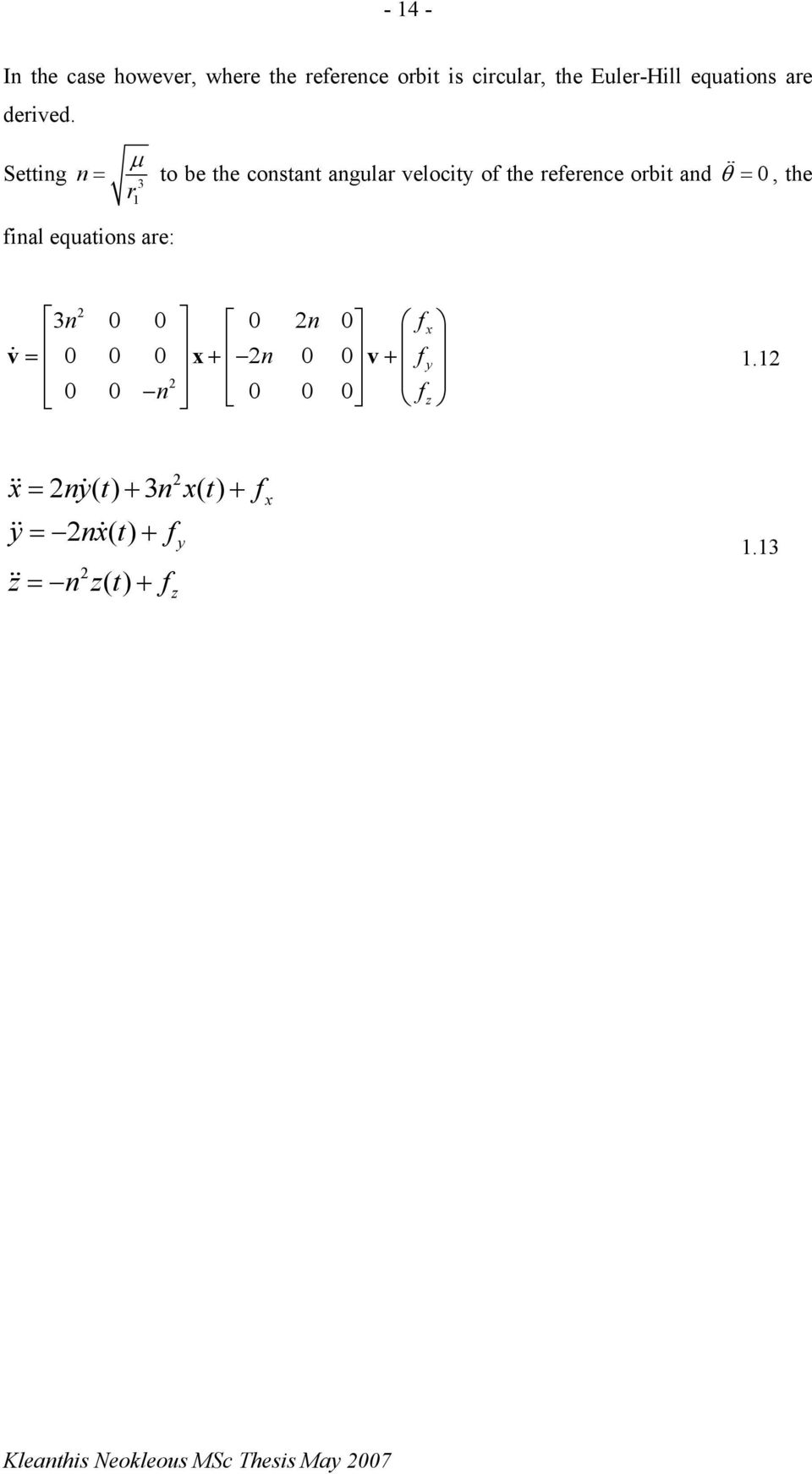
19 In the case however, where the reference orbit is circular, the Euler-Hill equations are derived. µ Setting n = to be the constant angular velocity of the reference orbit and θ =, the 3 r final equations are: 1 2 3n 2n fx v = 2n x+ v+ fy n f z = x 2 ny( t) 3 n x( t) fx y = 2 nx ( t) + f = + 2 z n z() t fz y 1.13
20 Chapter 2 Estimation of the forces acting on a satellite Symbols for Chapter 2: ρ moon = Satellite s distance from the moon ρ sun = Satellite s distance from the sun F grav = Gravitational force r = Τhe orbit radius (from the center of the earth) R E λ Λ = The equatorial radius of the earth = The geocentric latitude of the orbit = The geocentric longitude of the orbit µ = The earth s gravitational constant Φ = Gravitational potential P l J l Ω ω i M m s = Legendre polynomials = Zonal harmonics (dimensionless coefficients). = Right ascension of the ascending node = Argument of perigee = Inclination of the orbit = n(t-t ) the mean anomaly, where n is the mean motion. = Satellites mass m moon = Moon's mass γ p = Acceleration caused by moon's gravitational field

21 Introduction A satellite in space is subjected to external forces that tend to disturb and modify its desired orbit. The effect of these forces can be mild or serious, and consequent control action must be taken in order to keep the satellite at the desired path and attitude. The external forces may be classified as body or traction forces. The body forces act on all the constituent mass elements of the satellite. The traction forces act on the external surface of the satellite. There are many external sources for these forces, but the most important are the following four: i) Body forces that are due to the varying gravity from the earth, which are mainly due to variations in the mass distribution and density (nonhomogeneity) and to deviations of the earth s shape from a perfect sphere (oblateness). ii) Body forces originating from large third-bodies. iii) Traction forces from solar radiation and solar wind. iv) Traction forces from small surrounding particles (atmospheric drag). The atmospheric drag force is important at low-altitude orbits. For the geostationary orbit satellite that will be studied, where its altitude is in the order of km from the center of the earth, this kind of disturbance is not significant, and hence will not be included in the analysis. A general description of the three major external forces acting on the satellite will follow and then a complete analysis on how these forces will influence the relative motion of the satellite in respect to the ideal point will be presented. Finally, an analysis of the forces acting on the satellite by the thrusters will be presented.
22 Estimation of the external forces acting on a satellite In this part of the chapter a general description of the forces due to the non-homogeneity and oblateness of the earth, from third body perturbations, from solar wind and from radiation will be developed Body forces due to the non-homogeneity and oblateness of the earth. The disturbance caused by variations in the earth s gravitational field, is due to: a) The fact that the mean shape of the earth is not a perfect sphere, but more like an ellipsoid on which local deformations are superimposed, and b) To the non homogeneous distribution of the earth mass. There are various levels of detailing and modeling the gravitational forces. A brief description of the most significant models is described below. The disturbance caused by the earths gravitational field, is due to the fact that the earth is not a perfect sphere. In actuality, the earth is more like an ellipsoid with local deformations. If earth, could be modeled as a mass concentrated in a single point, or as a homogeneous sphere, then the gravitational potential would be given by the expression below [3]. µ Φ () r = 2.1 r µ Fgrav = Φ () r = r r However, there are many irregularities in the earth s Gravitational Field, and these are modeled by a complex mathematics, in a system referred to as Potential Theory [1].
23 Figure 2.1.Gravitational force at a point due to a mass element In Figure 2.1, each mass element m Q in the earth is considered when determining the gravitational potential. The total effect from the distribution of these elemental masses is given by the potential function [1]: l l l µ RE RE Φ( r, Λ, λ) = 1 Jl Plsin( λ) + Plsin( λ) Clmcos( mλ) Slmsin( mλ) r l= 2 r l= 2 m= 1 r where, J i for i = 2 Zonal harmonics C lm, S lm for l = m, Sectorial harmonics C lm, S lm for l m, Tesseral harmonics P l Legendre Polynomials Λ, Geocentric longitude λ Geocentric Latitude, 2.3 The zonal harmonics, J i, account for most of the earth s gravitational departure from a perfect sphere. This band and others reflect the earth s oblateness. The sectorial harmonics take into account the extra mass distribution in the longitudinal regions. The tesseral harmonics are primarily used to model earth deviations in specific regions, which depart from a perfect sphere.
24 For a body (planet) that has symmetry about the Z (polar) axis, i.e. has North/South symmetry, the form of the potential function (eq. 2.2) is significantly simplified, and is given by : l µ RE Φ(, r Λ, λ) = 1 Jl Plsin( λ) r l= 2 r where, P l r λ J l are the Legendre polynomials is the radius of the orbit is the geocentric latitude of the orbit are dimensionless coefficients J 2 Effect (Non-Spherical Effect) The largest perturbation due to the non-uniformity of the earth s mass is the J 2 component in the earth s geo-potential function given by: 2 µ R (,, ) 1 E Φ r Λ λ = J2 P2sin( λ) 2.5 r r where, 1 2 P2 sin( λ) = (3sin λ 1) is the second Legendre polynomial and J 2 = [3]. The J 2 effect has a direct influence in the variation of the classical orbit parameters shown in the figure below. Figure 2.2 Basic orbit parameters
25 - 2 - More specifically, the non-uniformity of the earth s mass has an influence in the variation of Ω, ω and M Forces due to Third-Body Perturbations Other large body influences, can originate from planets, stars, and other stellar bodies. The most significant are the gravitational forces from the sun and the moon that cause periodic variations in all orbital elements, especially for high altitude orbits, such as the case of the geostationary orbit. The sun and the moon can be treated as third bodies creating a perturbing force on an earth-orbiting satellite. Basically, this influence can be seen as the general case of the classic two-body problem. In a system consisting of n interacting bodies, the sum of the forces acting on the ith body, will be: j= nmmj F = G ( r r ) i j 2.7 i j= 1 i 3 rij j i { } Substituting in the equation of Newton's second law of motion, F d r m dt 2 i = i 2, it follows 2 d r dt j= n m i j that: = G ( ) { i j} r 2 3 j= 1 ij r r 2.8 j i If the specific case of perturbation caused by the moon s gravitational field, the perturbing acceleration can be calculated as below. Z m s ρ m moon r sat r moon M E Y X (vernal equinox vector) Figure 2.3.Third body perturbation
26 As can be seen in Figure 2.3, the origin of the inertial frame is located in the center of the earth. This leads to the final equation of the perturbing force caused by the moon as shown below. 2 d r r ρ r + G ( M + m ) = Gm dt r r or sat sat moon 2 3 E s moon 3 3 sat ρ moon r r + G sat sat ( M ) 3 E + ms = γp 2.1 r sat where, ρ r moon ρ rmoon γ p = Gmmoon = µ 3 3 moon 3 3 is the perturbing acceleration. ρ rmoon ρ rmoon µ It is interesting to mention that 3 moon r moon of moon is equal to 8.6x1-14 s and µ sun r 3 sun of the sun is equal to 3.96x1-14 s Forces due to the Solar Radiation and Solar wind Solar radiation includes all the electromagnetic waves radiated by the sun, in a wide range of wavelengths from x-rays to radio waves. The solar wind consists mainly of ionized nuclei and electrons, where both kinds of radiation may produce a physical pressure on the satellite s surface, and this pressure is proportional to the momentum flux of the radiation. That is, the momentum per unit area per unit time. The mean solar energy flux integrated at the earth's position is given by: Fe = cos( D) where, D is the phase of the year as calculated by starting on July 4 th. W m
27 This is equivalent to a mean momentum flux of: P = F e /c = 4.5x1-6 [kg.m -1.s -2 ] 2.12 where, c is the velocity of light. Finally, the solar radiation pressure F R is proportional to P, to the cross-section area A of the satellite perpendicular to the sun line, and to a coefficient C P that is dependent on the absorption characteristics of the satellite. F R = PAC P 2.13 where, C p lies between and 2. For a perfectly absorbing material (black body), C p =. The solar radiation momentum flux effect on the perturbations of the orbit is much greater than that of the solar wind (by a factor of 1 to 1), so the solar wind will not be considered as negligible compared to other effects Perturbing Forces in the Relative Equations of Motion The J 2 effect The Hill equations, in the linear form as derived previously, do not include the J 2 disturbance. So there is need of a set of linearized equations that are easy to use, but at the same time able to capture the J 2 effects. A very interesting work was done in the MSc Thesis of Schweighart [2], where a new set of linearized equations of motion where developed. These equations are like Hill s equations in form, but also capture the effects of the J 2 disturbance force. The basic idea of the analysis was to introduce the J 2 disturbance in the "real" satellites orbit equation as shown below. µ r = + J () 2 2 r = 2.14 r
28 Where J 2(r) is the force due to the J 2 disturbance [2] and r is the vector of the disturbed orbit. The analysis of J 2 force is respect to the x and z axis of the rotating coordinate system on the point of the ideal orbit is given by, 3 J µ R E 2 r J 2( r ) = (1 3sin sin θ) + (2sin 4 sinθcos θ) + (2sin sinθcos θ) i x i y i z 2.15 In the case of the geostationary orbit, the reference orbit to compare the relative motion is circular and equatorial. Let ρ be defined as the relative vector r ref - r. Then, the next step in the derivation was to linearize both the standard gravitational term and the J 2 disturbance around this reference orbit. r = g( ) + g( r ) iρ + J () r + J () r i ρ 2.16 ρ ρεφ ref 2 2 An important note to be stated at this point is that under the influence of the J 2 disturbance force, the orbital planes rotate around the Z axis (the North Pole). This is due to the fact that the J 2 disturbance force is symmetric across the equator. So, in the equatorial case, the linearized equations of motion correctly represent the outof-plane motion, (the normal vector to the orbital plane). Finally, as for the derivation of Hill s equations, in the local rotating coordinate system = + d d 2 ρ dt + ω ρ r dt + ref r ω ρ ω ω ρ 2.17 By substituting equation 2.2 into 2.3 and by defining ω of the reference orbit, the final equations of relative motion are derived as presented below. 2 2 x 2 ncy (5c 2) n x = fx y+ 2nx = f 2 2 z+ (3c 2) n z( t) = fz y 2.18
29 where, 3J µ R c= 1 + (1+ 3cos2 iref ) E 2 rref An important observation is that if x, y and z relative initial are zero, then the perturbed orbit will never have a different x, y, z from the ideal orbit, if the only perturbance considered is from the J 2 effect. The satellite s orbit can be seen in Figure 2.4.below where the only effect acting on the real satellite causing deviation from the ideal orbit is the J 2 effect. The time period were the evolution was made is for two days ( 288 min) x 14 Evolution of the satellites radius r ideal r real km Relative error r1-r2-2 m Figure 2.4.Evolution of the satellites radius as well as the relative error r1-r2 for the disturbance caused by the J 2 effect. However, from what is mentioned above, equations 2.18 include only the disturbances due to the J 2 effect.the disturbances caused by the Sun and Moon gravitational effects causing the North South drift, are not included. In this case, a model was derived about the disturbances from the Sun and the Moon since those disturbances are dependent on the position of the earth and the position of the satellite with respect to the earth. Those models are described in the next paragraphs.
30 The Moon and Sun disturbance forces. As pointed before, the satellite is influenced by perturbing forces from the earth, the sun and the moon. In order to calculate the direction of the force vector of every perturbance, the initial conditions of the position of the earth, moon and the satellite must be defined. For that, a specific day of the year should be considered, and that is the 21 st of June. So, the position of the sun with respect to the earth can be defined by placing a coordinate system in the center of mass of the earth and having X axis the same as X equinox, Y axis pointing at the center of mass of the sun and X, Y on the ecliptic plane. The equatorial plane is inclined with respect to the ecliptic by o The position of the moon at this specific day of the year is in the X, Z plane of the coordinate system described above. That is by considering the earth as the center of our system then the Sun and moon have a 9 o angle difference. Finally, the moon's orbiting plane is inclined by 5.3 o from the ecliptic plane in the X direction. The satellite initial position is on the equatorial plane in the X direction. The positions described above are shown in Figure 2.5 below and should be considered as the initial conditions for the following calculations. Inclination of moon's orbiting plane with the ecliptic 5.3 o Inclination of equatorial plane with the ecliptic plane o Figure 2.5.The three orbiting planes.
31 Moon disturbance As described above, the moon s gravitational field causes an acceleration to the satellite. This acceleration, multiplied by the mass of the satellite equals the force acting on the satellite by the moon's gravitational field, as per the fundamental Newton s second law. Fmoon = msatγ p However, since the moon and the satellite are both orbiting around the earth, the direction of the force vector is constantly changing. So a model was created to calculate the amplitude and direction of the force vector acting by the moon to the satellite. An effective approach in solving the problem of the combined movement of the moon and the satellite is to use spherical coordinates. That is, to assume that the moon is moving around the earth on the surface of a surrounding sphere. This can be visualized by thinking that the moon is orbiting in an approximately circular orbit around the center of mass of the earth and so is the satellite. So, by assuming that the satellite is stable, then it is the same like the moon is moving on a sphere. z Moon φ ρ r θ x y z y x Figure 2.6.Spherical coordinates. In Figure 2.6, if it is assumed that the green dot is the moon. Then, the position of the moon can be described by the three coordinates: ρ The radial distance of a point from a fixed origin
32 φ θ The zenith angle from the positive z-axis The azimuth angle from the positive x-axis. Those coordinates, however, should be defined relative to the rotating coordinate system on the orbiting point. In order for this to be done, a third coordinate system is placed on the rotating point. This coordinate system has the x m axis pointing to the center mass of the moon and y m axis is pointing to the sun on the ecliptic plane. Then the x m, y m, and z m of the moon can be defined relatively to the rotating coordinate system placed on the ideal orbiting point. For that, three transformations need to be made in respect to the rotating coordinate system. The transformations are made from the coordinate system placed on the orbiting point to the moons coordinate system described above. Then the inverse transformation should be applied to get the moons coordinates in respect to the rotating coordinate system. The first transformation is to go from the equatorial plane to the ecliptic. That is to rotate around x axis by o, as shown in figure 2.7. z z 1 Inclination of the earth s equatorial plane with the ecliptic, i earth = o y Sun Figure 2.7.First transformation around x axis. y 1 x1 1 x y = cos( i ) sin( i ) y 1 earth earth z 1 sin( iearth ) cos( iearth ) z 2.19
33 The second transformation is a rotation of 5.3 o around the y 2 axis. This can be seen in figure 2.8 where the sun is in the y direction. That is if we are watching figure 2.7 from behind the earth aligned with the sun. z 2 z 1 Inclination of Moon s orbital plane with the ecliptic, i moon =5.3 o Moon x 2 x 1 = X equinox Figure 2.8.Second transformation around y axis. x2 cos( imoon) sin( imoon) x1 y = 1 y 2 1 z 2 sin( imoon) cos( imoon ) z Finally the third transformation is around the z axis of the rotating system equal with the moon s rotation angle, which is the integration of the moon s orbital period which is 28 days. x3 cos( θmoon) sin( θmoon) ρmoon y = sin( θ ) cos( θ ) = 3 moon moon z Where ρ moon is the moon s distance with respect to the satellite. However, for simplification ρ moon is considered from the earth's center of mass since the satellite s radii
34 compared to the moon's radii is very small. That is, to assume that the satellite is placed in the center of mass of the earth and rotating around itself. Then x, y and z of the moon s coordinates with respect to the rotating coordinate system can be defined as below x 1 cos( i ) sin( i ) cos( θ ) sin( θ ) ρ y cos( iearth) sin( iearth) 1 sin( θmoon) cos( θmoon ) = i i = z sin( iearth ) cos( iearth ) sin( imoon) cos( imoon) moon moon moon moon moon So, if the moon s coordinates are known, then the direction of the force vector by the moon to the satellite can be defined by the spherical coordinates. From Figure 2.6, 1 z φ = cos ρmoon is the angle of the moon with respect to the z axis of the rotating system and θ tan y x 1 = θ sat rotating coordinate system. is the angle of the moon with respect to the x axis of the Then, F F x y z = Fsinφ cosθ = Fsinφ sinθ F = F cosφ 2.23 In Figure 2.9 below, the disturbance due to the moon's gravitational field is shown and the satellite s orbit as it deviates from the ideal orbit for a time period of two days.
35 x 14 Evolution of the satellites radius r ideal r real km Relative error r1-r2 1 5 m Figure 2.9.Evolution of the satellites radius as well as the relative error r1-r2 for the moon disturbance Disturbances from the sun Similar procedure can be made for the calculation of the direction of the force vector from the solar pressure on the satellites area. In this case, a fourth coordinate system is introduced on the orbiting point, with the x axis equal to the rotating coordinate systems x axis and at the case of the initial conditions equal to x equinox and y axis pointing to the sun s center of mass. The z axis completes the orthogonal triad. Again the assumption that the orbiting point is in the center of the earth s mass is made. However, in this case the rotation of the earth around the sun was not taken into consideration, since the control calculations are for the maximum of one week. Once again, the first transformation is to go from the equatorial plane to the ecliptic. That is to rotate around x axis by o, as shown in Figure 2.7. x1 1 x y = cos( i ) sin( i ) y 1 earth earth z 1 sin( iearth ) cos( iearth ) z 2.24
36 The second transformation is a rotation around the y axis by the satellites rotation angle θ sat. This would have been true if the satellite was stable and the Sun was orbiting around the satellite. So the rotation around the z axis should be -θ sat x2 cos( θsat ) sin( θsat ) ρsun y = 1 2 z 2 sin( θsat ) cos( θsat ) Fxsun 1 cos( θsat ) sin( θsat ) Fsun Fy sun cos( iearth ) sin( iearth) 1 = i 2.26 Fz sun sin( iearth) cos( iearth) sin( θsat ) cos( θsat ) In Figure 2.1 below, the disturbance due to the sun's gravitational field is shown and how the satellites orbit is deviated from the ideal orbit, again for a time period of two days x 14 Evolution of the satellites radius r ideal r real km Relative error r1-r2 1 m Figure 2.1.Evolution of the satellites radius as well as the relative error r1-r2 for the sun disturbance.
37 SIMULINK model of the system and the perturbing forces Finally a complete model of the satellite dynamics was developed in MATLAB - SIMULINK, including the perturbances described previously. This model can be seen in Figure 2.11 below, where the moon and sun perturbing force are calculated outside the block that computes the relative motion, and the J 2 disturbance is included in the equations of relative motion. Figure 2.11.Simulink model of the equations of motion.
38 In Figure 2.12 a simulation result is shown, based on the above SIMULINK model, where the influence of all the perturbances acting on the satellite can be seen x 14 Evolution of the satellites radius r ideal r real km Relative error r1-r2 4 2 m Figure 2.12.Evolution of the satellites radius as well as the relative error r1-r2 after the influence of all perturbances Thruster forces In order to be able to control the satellite, there is a need of translatory acceleration to act on the body of the satellite. Those accelerations are provided mainly by the propulsion system. Spacecraft propulsion systems are divided into three categories. Cold gas, chemicals (solid and liquid) and electrical, dependent on the way the trust is achieved. Propulsion systems, consists of several thrusters which their behavior is evaluated in terms of various characteristics. These basic characteristics include the thrust level F and the specific impulse I sp described below.
39 The basic equation of propulsion holds for all kinds of propellants. The amount of thrust F can be calculated as: dm F = Ve + A[ Pe Pa] 2.27 dt where P e, P a = gas and ambient pressures V e = exhaust velocity A = area of the nozzle exit. dm dt = mass flow rate of the propellant The second parameter relevant to the characteristics of the thrust source is the specific impulse I sp which is a measure of the efficiency with which the propellant mass is converted into thrust energy and is given by: dm Isp = F / g dt measured in seconds Besides the level of the thrust and the specific impulse, some additional characteristics are necessary in order to define a thruster completely, however this analysis is beyond the scope of this Thesis. For more information about propulsion systems and thrusters, the reader is directed to Sidi M. J. (1997).Spacecraft Dynamics and Control [1]. What is important for the purposes of testing the control methods that will be presented in detail in the next chapters is to define a limitation on the maximum absolute value of the force F that can be given by the thrusters. Usually for spacecraft control, liquid propeller thrusters are used which provide forces in the range of.1 1 N.
40 Chapter 3 Extended Kalman Filter Symbols for Chapter 3: ˆx = Estimated system states e = Measurement noise. υ = Process noise u = System input y = System output Q = Process noise covariance matrix R = Measurement noise covariance matrix P = Estimate error covariance L = Kalman gain to the predicted error e( t t 1) = y( t) y ˆ( t t 1), Where, the notation (t t-1) indicates the estimation at time t based on the information given to the state observer by time t-1 Chapters 3, 4, 5 and 6 are based on control theory, so in order to avoid confusion, a different and more specific notation is used in each Chapter Introduction. The Kalman Filter (KF) was developed by Rudolf Kalman (196) and it is basically a set of mathematical equations that provides an efficient computational (recursive) means to estimate the state of a process, in a way that minimizes the Mean Squared Error (MSE) between the real and estimated measurement. Kalman filters are mainly used in applications where it is needed to provide updated information on a continuous basis about the states of a dynamic system when given only some measurements, corrupted by noise. Thus, it is essentially a state predictor that uses limited available information.
41 The Kalman filter addresses the general problem of trying to estimate the state xˆ R (the caret ^ indicates the estimated states) of a discrete-time controlled process that is governed by the linear stochastic difference equation: n x( t+ 1) = Ax( t) + Bu( t) + υ ( t) 3.1 and the measurement output y() t = Cx() t + Du() t + e () t 3.2 where, υ(t) and e(t) are the process and measurement noise. In the case to be studied, these are assumed to be independent from each other (uncorrelated), white with zero mean, time uncorrelated and with normal probability distribution. T υ() t υ() t Q = () t () t e e R Then, the covariance ε δ ( t t ) where, δ ( t t ) = 1 2 1, t = t 1 2, otherwise Q and R are the process and measurement noise matrices. In practice, the process noise covariance and measurement noise covariance matrices might change with each time-step or measurement. For the satellite problem however, it is assumed that they are constant. The Kalman filter is a recursive estimator. This means that only the estimated state from the previous time step and the current measurement are needed to compute an estimate for the current state.
42 The state of the filter is represented by two variables: x ˆ( t ) t, the estimate of the state at time t P ( ) t t, the error covariance matrix (a measure of the estimated accuracy of the state estimate). The Kalman filter can be described by two phases. The Predict phase and the Update phase. In the predict phase, an estimation of the current state is made by using the information from the estimation of the previous timestep. In the update phase, measurement information from the current timestep is used to refine this prediction to arrive at a new, more accurate estimate. So, basically, what the Kalman state observer does, is to use the information of the system by including the dynamics of the system, and trying to minimize the error from the estimated to the real output. The error, e( t t 1) = y() t y ˆ( t t 1) passes through the Kalman gain L, which in the satellite case to be studied, it is time varying for more optimum estimations as shown in Figures 3.1 and 3.2 below. u(t) System x y(t) Observer ˆx (t) Figure 3.1.System with state observer.
43 u(t) System y(t) L - B ˆx (t+ts) 1 z ˆx (t) C A ˆx (t) Figure 3.2.State observer. As described above, the Kalman filter addresses the general problem of trying to estimate the state of a discrete-time controlled process that is governed by a linear stochastic difference equation. However, in the case that the process to be estimated or the measurement relationship to the process is non-linear, a linearization must be done about the current mean and covariance and this is called the Extended Kalman Filter (EKF) which is the model that will be used for estimating the states of the satellite s system that is presented in this Thesis. The reason for that is because although the equations of motion are linear, what can be measured is non-linear The Extended Kalman Filer algorithm. Let the system be described by: x( t+ 1) = f( x( t), u( t), υ( t)) y() t = g( x(), t u(), t e()) t 3.4 T υ() t υ() t Q = () t () t e e R with ε δ ( t t ) 1 2
44 Then, y() t = g( xˆ( t t 1), u(),) t + C()( t xˆ() t xˆ( t t 1) + Γ e ()() t e t 3.5 where, x ˆ( t t 1) indicates the estimation of the state ˆx at time t based on the information given to the state observer by time t-1 and C(t) is the linearized C matrix in the case where the non-linearity is on the measurements, defined by: C() t = g( x,u,e) x x= xtt ˆ( 1), u= ut (), e= 3.6 and Γ() t = g( x,u,e) e x= xtt ˆ( 1), u= ut (), e= et () 3.7 Then, the equations for the measurement update are: ( e e ) T T T L() t = P( t t 1) C () t C() t P( t t 1) C () t + Γ () t RΓ () t xˆ() t = xˆ( t t 1) + L(){() t y t g(( xˆ t t 1), u,} 1 ( e e ) T T T P( t t) = P( t t 1) L( t) C( t) P( t t 1) C ( t) + Γ ( t) RΓ ( t) L ( t) 3.8a.b.c and for the time update are: xˆ( t+ 1, t) = f( xˆ( t t), u( t),) ( t+ 1 t) = ( t) ( t t) T T P A P A ( t) + Γ ( t) QΓ ( t) υ υ 3.9.a.b
45 - 4 - Where, A(t) is the linearized A matrix in the case where the non-linearity is on the process to be estimated, defined by: A() t = f ( x,u, υ) x x= xˆ( tt ), u= u(), t υ = 3.1 and Γ u (t) is defined as: Γ υ f ( x,u, υ) () t = υ x= xtt ˆ( ), u= ut (), υ= υ() t Application of the EKF to the satellite model. As mentioned previously, in the case of estimating the satellite s states, an extended Kalman filter will be use, for the reason that the output measurements are non-linear. The reason for that, is that basically what can be measured is the satellite s radius which is: r r x y z = ( 1+ ) where, r 2 is the real satellite radius, r 1 is the ideal points radius, and x, y, z are the relative position coordinates of the satellite with respect to the ideal point. The second and third measurements are again non-linear, which are r 2,and the latitude of z the satellite, sin( lat) = r 2
46 However, what is actually used in the algorithm for measurements, for making the calculations simpler but not having significant deterioration on the accuracy of the results, are: y(1) = r r = 2rx+ x + y + z y(2) = ( r2 ) = ( r1+ x) x + yy + zz y(3) = r sin( lat) = z State space equations in continuous and discrete time. The equations of motion of the satellite, as presented in Chapter 2, are shown in 3.1.a, b and c below. = x 2 ncy (5c 2) n x f x y = 2nx + f = z (3c 2) n z( t) fz where, y J µ R c= 1 + (1+ 3cos2 iref ) E 2 rref Then, the states of the system can be defined as: x x1 x x 2 y x 3 = y x4 z x 5 z x Finally, according to the equations of motion of 3.14.a.b.c, the state space equations can be calculated in continuous and discrete time, as shown henceforth.
47 Continuous time x = x 1 2 x = 2 ncx + (5c 2) n x + f + υ x = x 3 4 x = 2nx + f + υ x 4 2 = x 5 6 x = (3c 2) n x + f + υ y y z z x x 3.17 and rx 1 1+ x1 + x3 + x5 + e 1 y( t) = g( ( t), ( t), ( t)) = ( r + x ) x + x x + x x + e x5 e + 3 x u e Discrete time x ( t+ 1) = x ( t) + Tx ( t) x ( t+ 1) = 2 Tncx () t + T(5c 2) n x () t + x () t + Tf + Tυ x ( t+ 1) = x ( t) + Tx ( t) x ( t+ 1) = 2 Tnx ( t) + x ( t) + Tf + Tυ x ( t+ 1) = x ( t) + Tx ( t) x ( t+ 1) = T(3c 2) n x ( t) + x ( t) + Tf + Tυ y y z where, T is the sampling time and the discretization was made by applying the derivative in T steps as shown below: z x x 3.19 x 1 = x1( t+ 1) x1( t) T Calculation of A, B, C, D, Γ e and Γ u For calculating the state space matrices in the extended Kalman filter, a linearization must be made around the area of the estimated values.
48 Then, for x( t+ 1) = f( x( t), u( t), υ( t)) y() t = g( x(), t u(), t e()) t the A, B, C, D, Γ e and Γ u matrices in discrete time are given by: 1 T 2 2 T(5c 2) n 1 2Tnc 1 T A = 2Tn 1 T 1 T 2 2 T(3c 2) n (r 1 + x1) 2x3 2x5, ( t )= x2 r 1 x1 x4 x3 x6 x 3.21,3.22 B = C where, g( x,u,e) C() t = x outputs are non-linear. x= xtt ˆ( 1), u= ut (), e= is the linearization of C matrix since the measured g(x, u, e) is given by 3.18 D ()= t 3.23 And finally, Γ u T 1 =, 1 Γe = T 1 T 3.24
49 Final results The results of the extended Kalman filter will be presented in the following Figures, where a comparison of the real with the estimated states can be made. m 2 comparison of x realative A x measured x estimated x 1-3 comparison of x d ot 1 x(dot) measured x(dot) estimated m/s -1 B (a),(b) comparison of x realative x measured x estimated x comparison of x d ot x(dot) measured x(dot) estimated m m/s (c) (d) Figure 3.3.Measured and estimated relative x. a) x versus time. b) x(dot) versus time. c) Detail at region A, x versus time. d) Detail at region B, x(dot) versus time.
50 comparison of y relative m -1-2 A y measured y estimated comparison of y d ot 1.5 y(dot) y(dot) y d ot measured y d ot estimated m/s B (a),(b) comparison of y relative x comparison of y d ot m -5 m/s (c) (d) Figure 3.4.Measured and estimated relative y. a) y versus time. b) y(dot) versus time. c) Detail at region A, y versus time. d) Detail at region B, y(dot) versus time.
51 comparison of z z measured z estimated m -2 A m/s comparison of z(dot).5 z(dot) measured -.5 B z(dot) estimated (a) and (b) -2 comparison of z x comparison of z d ot m m/s (c) Figure 3.5.Measured and estimated relative z. a) z versus time. b) z(dot) versus time. c) Detail at region A, z versus time. d) Detail at region B, z(dot) versus time. (d)
52 x 14 comparison of r r measured r estimated km A (a) x 1 4 comparison of r r measured r estimated km (b) Figure 3.6.Measured and estimated r 2. a) r 2 versus time. b) Detail at region A, r 2 versus time.
53 Chapter 4 Linear Quadratic Regulator Symbols for Chapter 4: L = scalar performance index u = control vector λ = Lagrange multiplier J = Performance index or cost function Q, R, S = weighting matrices 4.1. Introduction. In this chapter, a Linear Quadratic Regulator for discrete systems will be developed, which, basically, is a method of minimizing a cost function J associated with the control of a time varying system. The analysis that follows is largely based on Lewis and Syrmos [6] approach, so the same notation as in the reference will be used. A discrete time variant system could be described as x( t+ 1) = A( t) x( t) + B( t) u( t), x() = x 4.1 where the optimal control problem is to find the control u * (t) that drives the system along a trajectory x * (t) such that a suitable performance index or cost function (usually denoted by J) is minimized. The symbol * denotes the optimum variables. An optimization analysis will first presented for a static system, when time is not a parameter, and then it will be extended to a system developing dynamically through time.
54 Static optimization. Let L(x, u) be a scalar performance index, a function of the control vector m u R and a n state vector x R. The problem is to select u to minimize L(x, u) and simultaneously satisfy the constraint given by equation f(x, u) =. The Hamiltonian function is defined as: H( x,u, λ) = L( x,u) + λ Τ f( x,u ) 4.2 where, λ is the set of the so-called Lagrange multipliers [6]. It is well known from advanced calculus that by equating independently to zero all derivatives of H, yields a stationary point. In order then to have a minimum point of L(x, u) that also satisfies the constrain f(x, u) = some conditions must be fulfilled. Thus, the differential increments of H should be zero. Increments in H, however, depend on increments in x, u and λ according to: dh = H dx + H du + H dλ 4.3 T T T x u λ The usefulness of the Lagrange multipliers approach can be mentioned at this point where in reality, dx and du are not independent increments. So, by introducing an undetermined multiplier λ, we obtain an extra degree of freedom, and λ can be selected to make dx and du behave as if they were independent increments.
55 - 5 - By introducing Lagrange multipliers we replace the problem of minimizing L(x,u) subject to the constrain f(x,u) = with the problem of minimizing the Hamiltonian H(x,u,λ). Then the conditions for a minimum point of L(x, u) that also satisfy the condition f(x, u) = are: δη = f = δλ δη T = Lx + fx λ = δ x δη T = Lu + fu λ = δu 4.4 a, b, c 4.3. Optimal control of discrete-time systems. The problem described previously can now be extended for a system that develops dynamically through time, since now the constraint equations are the dynamical equations describing the evolution in time of the system. These are governed and fixed by the basic physics of the system, through using fundamental laws and constitutive relations. The performance index J (or cost function) that we seek to minimize is specified by us depending on the particular problem we seek to solve. Such a suitable J for the case of the satellite that has been studied is presented in the following sections Performance index J for the case of the satellite control problem The general form of the performance index, is N 1 J Φ ( N, x ) L ( x,u ) 4.5 = + k k i N k k = 1 where, [i, N] is the interval of interest in the behavior of the system. Φ ( N, x ) is a function of the final time N and the state at the final time. N ( x,u) is a time varying function of the state and control input at each intermediate Lk k k time L.
56 The optimal control then is to find the control u * k that drives the system along a trajectory x * k such that the performance index is minimized. In the case of satellite orbit control, which is the objective of this Thesis work, it is desired to find an optimum control u * k that minimizes the energy needed to position the satellite both for the final and for the intermediate states. Then, J i 1 1 = x S x + ( x Q x + u R u ) N 1 T T T N N N k k k k k k k = 1 Where, Q, R and S are suitable weighting matrices. Minimizing the energy corresponds to keeping the states and the control close to zero. Then, by proper weight matrices selection, an optimum control, in the sense of minimizing J, is found (calculated), which is the primary desired result. For example if we want the intermediate states to be small, then Q should be chosen to be relatively large, so that it is heavily weighted in J. If the concern is that the control energy is small, then large values of R should also be selected. In the case of the satellite s problem, it is desired to keep the intermediate states as small as possible. This means that the relative error is close to zero since the requirement is to take the satellite to the ideal orbit. However, this should be done with the minimum energy, so a trade-off between the weights Q and R should be made in order to achieve the optimum control Optimal Discrete-time Linear Quadratic Regulator. The plant of the satellite that will be controlled is described by the linear equations below: x( t+ 1) = A( t) x( t) + B( t) u( t), x() = x, 4.7 and the associated performance index is given by equation 4.6 were Q k, R k and S k are assumed to be symmetric positive semidefinite matrices and in addition R k for all k.
57 To solve this LQR problem, the following Hamiltonian function is used: 1 ( T T ) T H k = xk Qkxk + uk Rkuk + λk+1 ( Ax k k + Bu k k ) Then, the state and co-state equations are derived according to the Langrage multiplier formalism. x δη = k = Α x +B u δ λ k+1 k k k k k+1 (State equation) 4.9 δη k T λ = = Qx +A λ δ x k k k k k+1 k (Co-state equation) 4.1 and the stationary condition δη T = = Ru + B λ δu k κ κ κ κ κ According to 4.11 then = -1 T uk Rk Bk λ k Using equation 4.12 to eliminate u k in 4.9, we get: -1 T x k+1 = Αkxk -BkRk Bk λ k In the case of the control of the satellite s orbit, the final state x N is free. This means that x N can be varied while determining the constrained minimum, therefore, dx N and then it is required that [6] λ Ν dφ = dx N 4.14 where Φ is the final state weighting function: 1 T Φ = xn SN x N λ =S N x 4.16 Ν N
58 In order to solve these two boundary condition problems, the sweep method developed by Bryson and Ho (1975) is used. That is to assume that a linear relation like 4.16 holds for all times k N: λ =S k x 4.17 k k For equation 4.17 to be valid, a consistent formula for S k should exist. So, by substituting 4.17 into 4.13 and solving for x k+1 we get: x = ( I+B R B S ) Α x T 1 k+1 κ κ κ k+1 κ κ Then, if we substitute equation 4.17 to the co-state equation 4.1 and substitute x k+1 by 4.18, we have: S x = Q x + A T S ( I+B R -1 B T S ) Α x k k k k k k+1 κ κ κ k+1 κ κ Since x k is generally non-zero, and equation 4.19 holds for all state sequences, then S A S ( I+B R B S ) Α +Q k = T -1 T k k+1 κ κ κ k+1 κ k Finally by using the matrix inversion lemma [6] 4.2 become: S = A [S S B ( B S B +R ) B S ] Α + Q 4.21 T T 1 T k k k+1 k+1 κ κ k+1 κ κ κ k+1 κ k which is the well known Riccati equation. If, however, S k for all k, then the Riccati equation can be rewritten as: S = A (S B R B ) Α Q 4.22 T -1-1 T 1 k k k+1 + κ κ κ κ+ k Then the optimum control is given by: u R B x T k = κ κ S k+1 κ+1 If again we substitute the plant equation 4.7 we finally get the optimum control by uk = Kκx k 4.24
59 where K = ( B S B +R ) B S Α 4.25 T 1 T k κ k+1 κ κ κ k+1 κ K k is known as the Kalman gain What is important to mention at this point is that the Kalman gain is given in terms of the Riccati equation solution S k, the system and the weighting matrices. This means that it can be calculated off-line and then used on-line as shown in Figure 4.1 below. on line u k B k Z -1 x k A k K k Z off line S k K k S k+1 S = A [S S B ( B S B +R ) B S ] Α + Q T T 1 T k k k+1 k+1 κ κ k+1 κ κ κ k+1 κ k K = ( B S B + R ) B S Α T 1 T k κ k+1 κ κ κ k+1 κ Figure 4.1.Free final state LQR optimal control scheme Steady-sate closed-loop control and suboptimal feedback The closed-loop system described in the above section x = ( Α BK ) x 4.26 k+1 κ κ k κ is time varying since the optimal feedback gains are time-varying.
60 However, this time-varying feedback is not always convenient to implement. Instead, it is common to use a sub-optimal feedback gain u = Kx 4.27 k k which is easier to implement. Basically, if the limit of the optimal K k as the final time N goes to infinity exists, it provides a constant feedback which is often satisfactory. The Riccati equation 4.21 is solved backward in time, beginning at time N. Then, as k, the sequence S k can have several types of behavior. It can converge to a steady-state matrix S which may be zero, positive semidefinite or positive definite. It may also fail to converge. If, however, S k does converge, then for large negative k, we have that S S S k k 1 Thus, in the limit, the Riccati equation of 4.21 becomes: T T 1 T S = A [ S SB( B SB+ R) B S] Α + Q 4.29 Which is the Algebraic Riccati Equation (ARE). Then the limiting solution of 4.21 is of course also a solution of the ARE. However, since that ARE can also have non-positive semidefinite, nonsymmetric and even complex solutions, this means that not all the solutions of ARE are limiting solutions of the timevarying Riccati equation. If then the limiting solution of 4.21 exists and is denoted as S, then the corresponding steady-state Kalman gain is: K = ( B S B+ R) B S Α 4.3 T 1 T which is a constant gain. What is important to know however, is when a limiting solution S exists and if the closed-loop plant is asymptotically stable.
61 The answer to these questions can be given by the following two theorems [6]. Theorem1: Let A, B stabilizable, then for every choice of S N there is a bounded limiting solution of S. Furthermore, S is a positive semidefinite solution to the ARE. (for proof see [6]) Theorem2: Let C be a square root of the intermediate state weighting matrix, so that T Q= C C, and suppose that R > If we suppose that (A, C) is observable, then (A, B) is stabilizable if and only if: a) There is a unique positive definite limiting solution S to the Ricccati equation Also S is the unique positive definite solution to the ARE. b) The closed-loop plant x = ( Α -B K ) x 4.32 k+1 κ κ κ is asymptotically stable, where K is given by 4.3 What is basically stated by these two theorems is that if our system is stabilizable and if we select weighting matrix Q = C T C such as for some C the system is observable, then the steady-state feedback u k = K x is the optimal control, for it is the control that minimizes the performance criterion over the infinite time interval [, ]. k 4.4. Control of the satellite using LQ regulator - discrete system. Following the above analysis, what has to be tested is the controllability and observability of the satellite s system. Using the symbolic toolbox of MATLAB, it can be seen that the observability and controllability matrices have rank n = 6, which satisfies the criterion.
62 So, there exists a solution S which has been calculated with the MATLAB function [S_inf, e, G] = dare(a, B, Q, R) Finally the optimal control has been again found through the use of the MATLAB function: [K1, S_inf, e] = dlqr(a, B, Q, R) which internally calculates the discrete algebraic Riccati equation. The selection of matrices Q and R was made based to the fact that the requirements are to have as little fuel energy utilization as possible. For that case, matrix R and Q had been selected as R = 1, Q = The eigenvalues of the closed-loop system are: e = i i i i i i
63 y(jw) x Figure 4.2.Eigenvalues of the closed-loop system. As can be seen from Figure 4.2, the eigenvalue of the closed-loop system are within the stability margin. 4.5 Final results In the following figures, the evolution of the states as well as the comparison of the real satellite with the ideal will be presented. The initial conditions of the satellite were: x = y = z = 1m. The time of the simulation was made to be 2 minutes, since after that period of time there is not significant difference in the satellites trajectory.
64 rad/min x 1-3 Evolution of omega omega ideal omega real m 1.5 Evolution of x relative Evolution of y relative Evolution of z relative m m Figure 4.3.Measured and estimated states. a) angular velocity of the satellite (omega) versus time, b) x relative versus time, c) y relative versus time, d) z relative versus time x 14 Evolution of the satellites radius r ideal r real km Relative error r1-r2 m Figure 4.4.a.b Evolution of the satellites radius and the relative error.
65 - 6 - Chapter 5 H-infinity Optimal Control Synthesis Symbols for this Chapter: G = plant model G d r d y y m u P = disturbance model = reference input = disturbances = plant outputs = measured y = control signals = generalized plant includes G and G d and the interconnection structure between the plant and the controller. w = exogenous inputs (commands, disturbances, noise) z = exogenous outputs υ = controller inputs for the general configuration (measured signals) L = GK loop transfer function (K = controller transfer function) S = (1+L) -1 sensitivity function T = ((1+L) -1 L) complementary sensitivity function DEFINITIONS: Maximum peaks: M s max S( jω) ω and MT max T( jω) ω Typically, M s 2 and M T < 1.4 Bandwidth: Bandwidth is defined as the frequency range [ω 1, ω 2 ] over which control can be affective. Usually, but not always, ω 1 = and ω 2 ω Β is the bandwidth.
66 The closed-loop bandwidth is the frequency where S( jω ) first crosses the magnitude ratio of 1/ 2 =.77 3dB from below, while the bandwidth in terms of T, ω ΒΤ is the highest frequency where T( jω) crosses 1/ 2 =.77 3dB from above. ω C cross over frequency, which is the frequency where L(jω) first crosses a magnitude ratio of 1 from above H controller synthesis The main task of the problem is to design a controller that can stabilize the satellite and control its trajectory, irrespective of external influences which are mainly disturbances caused by the sun s and moon s gravitational field as well as from the non-homogeneity and oblateness of the earth. The approach that will be developed, demonstrated, simulated and appraised in this chapter is the so-called H controller ( H stands for Hardy spaces, while the infinity subscript indicates a minimax optimization). The H controller is essentially an optimal controller that can be applied to MIMO systems.this controller will be described in some detail below. A deterministic MIMO system can be represented by the following block diagram, (Figure 5.1) (weighted) exogenous inputs w z (weighted) exogenous outputs control signals u P K υ sensed outputs Figure 5.1.General control configuration with no uncertainty.
67 The overall control objective is to find a controller K, which, based on the information in υ,to generate control signals u that will counteracts the unwanted influence of w on z. by minimizing some suitable norm (in this case the H norm) of the transfer function relating w to z. That is, in the case of the control of the satellite s orbit, to find a controller that counteracts the external disturbances acting on the satellite by minimizing the closed-loop norm from w to z. The H norm of a scalar transfer function f(s) is simply the peak value of f(jω) as a function of frequency. That is, f () s max ω f( jω) 5.1 The H controller synthesis is basically a design method that tries to press down the peaks of one or selected transfer functions. The symbol, comes from the fact that the maximum magnitude over frequency can be written as p ( ) 1/ p max ω f( jω) = lim f( jω) dω 5.2 p That can be translated as taking the peak value of f by raising it at infinite power, since p. So, with this definition, H is the set of transfer functions with bounded -norms [11] Scaling. In the analysis that follows, in order to simplify the controller design and the performance analysis, the inputs, outputs and disturbances of the system are normalized by suitable scaling of the general transfer function G. For MIMO systems, such as the case to be studied, in order to scale the inputs and outputs of the system, the unscaled variables are divided by the maximum expected or allowed value.
68 If D d, D u, and D e define the diagonal scaling matrices for the disturbances, inputs and error (output), then the scaled variables are obtained by: d y, u u and e y d= D u= D y = D 5.3 where the caret ^ indicates scaled variables. Similarly, the scaled transfer functions will be: D ˆD D ˆ D G = e G u and Gd = e Gd d where G is the satellite s model transfer function and G d the disturbances transfer function. Since however, for the case of the satellite the disturbances are inertial forces expressed as accelerations acting on the mass of the satellite, then the disturbances can be considered as external forces acting on the plants input, so G d = G Controller design There are mainly three approaches to the controller design. a) By proper shaping of the open and closed-loop transfer functions. b) By the so-called signal-based approach, which this basically considers a disturbance or reference change and tries to optimize the closed loop response (LQG control). c) A numerical optimization: Multi-objective optimization to optimize directly the true objectives such as rise time and stability margins. The H controller synthesis is based on the first approach, where the amplitude of the open-loop transfer function L(jω) is shaped, as well as the closed-loop transfer functions S, T and KS.
69 Open- loop shaping By shaping the open-loop transfer function L(jω), some fundamental trade-offs must be taken, such as: 1. For good disturbance rejection, L must be large. 2. For a good command following (small errors), L must be large. 3. For measurement noise reduction, L must be small. 4. To keep the magnitude of the input signals small, K must be small and L must be small. The specifications of the desired loop transfer function are: 1. The gain crossover frequency ω c where L(jω) =1 2. The slope N of L(jω) in certain frequency ranges, where typically the slope N=( -2dB/dec) around the crossover and a larger roll-off at higher frequencies. The desired slope at low frequencies depends on the nature of the reference signal or of the disturbances. As mentioned before, in the case of the satellite s control, it is of primary interest to achieve good disturbance rejection Loop shaping for disturbance rejection The basic control problem can be described as y = G u u + G d d and the regulator problem is to counteract the disturbances d. That is the goal of the control is to make e = y = SG d d minimum. So, for achieving e(jω) 1 for d(jω) = 1 ( which is the worst case), then SGd ( jω) 1 or 1+ L Gd ω 5.5
70 Or, approximately L Gd ω So one good initial guess would be that L G ω min d Finally, at this point it may be concluded that the controller should contain the dynamics of the disturbance (G d ) and invert the dynamics of the inputs (G) For disturbances at the plant output G d =1 while for the case that will be examined where the disturbances are at the plants input, G d = G More specifically, the loop shape L(s) for our case could be modified based on the three points below: 1. Around crossover the slope to be around -1 for transient behavior with acceptable gain and phase margins 2. The loop gain should be increased for improving the settling time and reduce the steady state offset. 3. L(s) should also roll off faster at higher frequencies beyond the bandwidth in order to reduce the use of manipulated inputs and make the controller realizable. Also for noise reduction Closed-loop shaping For closed-loop shaping, we are interested in S and T. In the high frequencies where L(jω) >> 1 then, S L -1 and T 1, while in the lower frequencies where L(jω) << 1 T L -1 and S 1
71 However, in the crossover region where L(jω) 1, nothing can be inferred about S and T. The sensitivity function S is a good indicator of a closed-loop performance, both for SISO and MIMO systems. Ideally, S must be small. Typical specifications in terms of S include: 1. Minimum Bandwidth ω Β 2. Maximum tracking error at selected frequencies 3. The maximum steady state tracking error A 4. Shape of S over selected frequency ranges 5. Maximum peak magnitude of S, S( jω) Ms The typical values of M s =2. Peak specifications prevent amplification at high frequencies, as well as introduce a margin of robustness. These specifications may be captured by an upper boundary, 1/ w ( s ) on S, where w P is P the performance weight and is mainly used as a performance indicator. Then the performance requirements, become: 1 S( jω) < ( ) ω w P jω 5.6 w ( ) < 1 P S The typical performance weight, is: s + ωβ M s w p () s =, 5.7 s + ω Α Β What is of our interest is that 1 S( jω) < ( ) ω, 5.8 w P jω S( jω) < 1/ w ( jω) ω P so, what can be seen here is that at low frequencies, the weighting filter 1/ w P is equal to A.
72 So, typically A should be very close to zero in order to ensure approximate integral action with S(). However, for avoiding calculation errors, A usually takes a very small value. The desired closed-loop bandwidth ω Β may be different for each output of the filter weight and depends on the position of the zeros of the system. A large value of ω Βi yields a faster response for output i. Also, an additional upper boundary can be added for the magnitude of T in order to make sure that L does not roll off fast at high frequencies as well as to achieve robustness. That can be done by setting 1 T( jω) < ω, 5.9 w ( jω) T where w T is known as the weight for robustness. To restrict the magnitude of the input signals u = -KSG d d an upper bound on the magnitude of KS can be placed. That is to be less than 1/ w u where w u is the input weight. By combining these mixed sensitivity specifications the following stacking approach results. N = max ω σν( jω) < where N w u = TT w w PS KS and σ denotes the maximum singular value. The optimal controller is then obtained by solving the problem min ( ) K NK Numerically this problem is solved by the so-called γ-iteration where the solution is for a controller that achieves N <γ. Then γ is reduced iteratively to obtain the smallest value of γ for which solution exists.
73 Limitations on performance Limitations on sensitivity. From the definitions of S and T, it can be derived that S+T=I 5.11 Ideally, S should be small to obtain small control error for the disturbances as well as small T to avoid sensitivity to noise. Unfortunately, these requirements are not simultaneously possible since at any frequency, either S(jω) or T(jω) must be larger or equal to.5. However, for MIMO systems, which is the case that will be examined, from eq it can be seen that: σ( S) 1 σ( T) σ( S) a and σ( T) 1 σ( S) σ( T) b These can be combined to get σ( S) σ( T) c So, it is only possible for the magnitudes of σ ( S) and σ ( T ) to differ by at most 1 at a given frequency. There is also a limitation due to interpolation constrains, where if p is a RHP pole of the plant G(s), then T(p) = 1 and S(p) =. Similarly, if z is a RHP zero of G(s) then T(z) = and S(z) = 1. The main difference for MIMO systems is that basically for a multivariable system, the plant gain, RHP poles and zeros as well as disturbances, all have directions associated
74 with them. Poles and zeros directions, which is of primary concern, may be obtained from a singular value decomposition (SVD) of G(p) or G(z) [11] So, basically for MIMO systems, from interpolation constrains, if G(s) has a RHP zero at z with output direction y z then for internal stability of the feedback system, T must have a RHP pole in the same direction as G and that S(z) has an eigenvalue of 1 corresponding to the left eigenvector y z. That is, H H H y T( z) = and y S( z) = y, where y H is the conjugate transpose. z z z If G(s) has a RHP pole at p with output direction y p then for internal stability S( p) y = and T( p) y = y p p p One other limitation on sensitivity is what is known as the waterbed effect that basically states that if we push the sensitivity down at some frequencies, then it will have to increase at others. In general, a trade-off between sensitivity reduction and sensitivity increase must be performed whenever L(s) has at least two more poles than zeros or L(s) has a right hand plane (RHP) zero Limitations on peaks The term peak at this point means the maximum value of the frequency response or the H norm of important transfer functions such as S and T. So the main concern is to derive explicit bounds on these transfer functions. From the Maximum modulus principle [11], which basically states that for a stable f(s), then the maximum value of f(s) (for s in the right-hand plane) is attained on the region s boundary. More specifically, f( jω) max f( j ) f( s ) s RHP = ω ω 5.13
75 - 7 - Then by considering that f () s = w () s S() s and f () s = w () s T() s the following theorems are true. p T Weighted sensitivity theorem: If G(s) has a RHP zero z and w p is any stable weight, then for closed-loop stability, the weighted sensitivity function must satisfy w ( ) ps w p z 5.14a For MIMO systems, w p() sss () max ω σ( w p( jω) S( jω)) w p() z 5.14b = In MIMO systems, we generally have the freedom to move the effect of RHP zeros to different outputs by appropriate control. Weighted complementary sensitivity theorem: If G(s) has a RHP pole p and w T is any stable weight, then for closed-loop stability, the weighted sensitivity function must satisfy w T w ( p) 5.15a T T The above theorem for MIMO systems becomes: w p() sss () max ω σ( w p( jω) S( jω)) w p() z 5.15b = Also the weighted sensitivity and complementary sensitivity have limitations on their peaks caused by combination of RHP poles and zeros as well as from pairs of complex poles and zeros. All the above constrains have as effect the limitations on the bandwidth ω Β, which is a major factor on the selection of the weighting filters. However, since for the case of the satellite s model that is studied, it is of primary concern the rejection of disturbances, the following analysis is about bandwidth limitation on low frequencies Bandwidth limitation RHP-zero and performance at low frequencies
76 By considering the performance weight s/ Ms + ωβ w p () s =, a minimum bandwidth ω Β s + ω Α Β is defined by the performance limitation: S( jω) < 1/ w ( jω), ω. Also maximum peak of S less than M s and a steady-state offset less than A<1. If then the plant has a RHP-zero at s=z then from 5.14 a we have that z/ Ms + ωβ w p ( z) = < z + ω Α Β P In the case that z is real then all variables are real and positive and from 5.16 we derive the bound on ω Β. 1 1/ M ωb < z 1 A s If we assume A= and M s =2 we must at least have that ω Β <.5z 5.17 In the case that the system has a pair of complex conjugate RHP- zeros, z = x± jy, x, A= and M s =2 then: ω <.5x + x +.75y Β Limitations imposed by unstable (RHP) poles. By making similar assumptions as above, that is A= and M T =2 and considering as a complimentary sensitivity weight s 1 w T () s = M ω Β T T Then for a real RHP-pole at s = p and from the robustness limitation T( jω) < 1/ w ( jω), ω, Results that the minimum ω Β > 2p T Similarly, for a pair of complex RHP poles p= x± jy, x then: 2 2 ω Β >.67( x + 4x + 3 y ) 5.19
77 The above approximations are made for SISO systems. In the case of MIMO systems, lower bounds on various closed-loop functions can be derived by direct generalizations of those from the SISO systems if only the directions are taken into account. In the case of the satellite s MIMO model, G sat has the following poles and zeros which they were derived by the MATLAB function tzero(g) and pole(g) Poles:. +.44i. -.44i. +.44i. -.44i Zeros: 2. +.i 2. -.i By observing the poles and zeros of the system, what can be inferred to at this point is that ω < 1 rad / s. The second observation is that the system has six poles on the imaginary Β axis. This can cause a calculation problem when the MATLAB function hinfopt is called to calculate the optimum controller. However, this issue will be analyzed in the last part of this chapter Functional controllability In order to be able to control all outputs independently, it is required that the normal rank of the plant G sat (s) has the same rank as the number of outputs. This is basically the definition of functional controllability, where in the case of the satellite s model, if we define n the normal rank of G sat then it can be seen that n = 3 which is the number of the system s outputs. This means that the satellite s system is functionally controllable. All of the above analysis however, is a good indicator for the selection of the initial filter weights. What follows next is a lot of simulations and with trial and error the optimum controller is selected.
78 The general control problem. As described in the introduction of this chapter and from Figure 5.1, it can be seen that the overall objective is to minimize the H norm of the transfer function from w to z. The first step of this analysis is to obtain the general plant P. However, in order to get a meaningful controller synthesis, it is necessary to include the weights w u for penalizing the control inputs, w p for performance and w T to ensure robust performance, as shown in figure 5.2 below. w w u w T z 1 z 2 υ u - G + K + w p z 3 Figure 5.2.General plant including performance weights Ν The plant in Figure 5.2 is basically what will be used for solving the mixed sensitivity problem for controlling the satellite s orbit. In the case of the satellite, an important consideration is to bound σ ( S) for performance, σ ( T ) for robustness and σ ( KS) to penalize large control inputs. As mentioned previously, the above requirements can be combined to a mixed sensitivity problem, trying to find an optimal controller by solving w KS min N K ( K ) where N = utt w w PS It will be shown in the next part of this chapter that by solving the mixed sensitivity problem formulated here, an input multiplicative uncertainty which is my main interest in this case is included.
79 It can be seen from Figure 5.2 that N is the complete block. In order to obtain N we first need to derive the general plant P Obtaining the generalized plant P. P is the open loop transfer function from [w u ] T to [ z υ] T Then, wui TG P w = wpi wpg I G 5.2 P11 P21 In order however, to get N, P is needed to be partitioned as P = P12 P 22 Finally, by closing the loop, we have that z = Nw where N is given by N = P + P K( I P K) P F( P, K) l where, F l (P,K) denotes a lower linear fractional transformation (LFT) of P with K as a parameter. In the case of the satellite s model, P was derived by using the MATLAB function [P] = augtf(gg, W1, W2, W3) where G g is the scaled general plant for the equations of motion of the satellite.
80 Control configuration including model uncertainty. Model uncertainties, can be defined as the differences between the actual system and the system which was used to design. A control system is then robust if is insensitive to those differences. The general N structure is shown in Figure 5.3 below. w u Ν y z Figure 5.3.Uncertainty block in the general configuration. For the robustness analysis, a system representation is used where the uncertain perturbations are pulled out into a block diagonal matrix as shown in Figures 5.4a and b below. 3 w 1 z 2 Figure5.4.a.Original system with multiple perturbations
81 w z Ν Figure 5.4.b. Pulling out the perturbances As mentioned above N is related to P and K by a lower (LFT) N = P + P K( I P K) P F( P, K) l Similarly, the uncertain closed-loop transfer function from the input w to the output z is related to N and by an upper (LFT) F = Ν + Ν ( I Ν ) Ν F ( N, ) u For analyzing robust stability of F the system is then re-arranged into the M structured, where M = N 11 as shown in Figure 5.5 below. u Μ y Figure 5.5.M structure. Each perturbation in the structure, is assumed to be stable and normalized such as σ( ι ( jω)) 1 ω, i
82 Unstructured uncertainty. Unstructured uncertainty can be defined as a full complex perturbation matrix, where at any frequency, equation 5.23 is satisfied. There are basically six common forms of unstructured uncertainties. These are: Additive and inverse additive uncertainty Multiplicative and inverse multiplicative input uncertainty Multiplicative and inverse multiplicative output uncertainty. In the case of the control of the satellite, what is important and will be considered is the multiplicative input uncertainty for the reason that we are not absolutely sure what the output of the thrusters will be. The multiplicative input uncertainty is shown in Figure 5.6 below. w I I + + G Figure 5.6.Multiplicative input uncertainty. Then the perturbed plant, becomes: GP = G( I + EI) where EI =w I Ι Robust stability with multiplicative uncertainty. In order to ensure robust stability in the case that multiplicative uncertainty is applied to the system, the following analysis occurs [11] w L I 1 + L, ω 5.25 w I L 1, ω wiτ < 1, ω w IΤ 1 1 L <
83 Finally, for RS in SISO systems Τ < 1/ w Τ, ω 5.27 I In the case of MIMO system, which is the case of the satellite s plant, the following theorem stands for unstructured uncertainties [11]. Assuming that the nominal system M(s) is stable and that the perturbations (s) are also stable, then the M system of Figure 5.5 is stable for all perturbations satisfying < 1 In other words, we have RS if and only if σ( Μ ( jω)) 1 ω, i Μ Then, for the multiplicative uncertainty of Figure 5.6, we can assume that E = w, 1 2 Ι w 1, since now we are considering a MIMO system. To derive the matrix M the perturbation is isolated, and thus M = W 1 M o W Where, M o is the transfer function from the output to the input of the perturbation. For the case of the multiplicative uncertainty in the input, Μ ( ) I 1 = K I + GK G = T 5.3 Then from the theorem above, we get that W ( jωμ ) W ( jω) 1 ω Then if we consider a multiplicative uncertainty with a scalar weight GP = G( I + w I Ι ), Ι 1 For RS we have w T I I It can be seen here that equation 5.27 for SISO system is a special case of 5.32
84 Robust performance. As mentioned previously, for having nominal performance the condition is w S < 1 ω w < 1 + L, ω 5.33 P P If we define again L P = G P K, then from equation 5.24 for multiplicative input uncertainty, we have: L P =L+ w i L 5.34 What is required for robust performance (RP) is that the condition 5.33 is satisfied for all possible plants. Then, if we define S = (1 + L ) for RP we get: P P w S < 1 S ω P P P, or, w < 1 + L P P 5.35 Therefore, from equations 5.24, 5.34 and 5.35, we can finally get that: For RP w p + w L < 1 + L, ω I w p(1 L) wil(1 L), ω 5.36 Finally, for SISO systems, in order to ensure RP we have: ( ps IT ) maxω w + w < For Robust Performance on MIMO systems the structured singular value µ is introduced. One simple statement to define µ is: If we find the smallest structured (measured in terms of σ ( )) which makes det(i-m ) =, then µ(m) = 1/ σ ( ) 5.38 In MIMO systems, RP condition is the same as the RS only with an additional perturbation block P.
85 - 8 - From the next theorem [11] which states that from the N structure of Figure 5.3, if we assume nominal stability such as N is internally stable, then for RP F = F (, ) 1, 1 u N < 5.39 For RP in MIMO systems, ( j ) µ Ν ( ω) < 1, ω 5.4 where µ is computed with respect to the structure ˆ = p complex perturbation with the same dimensions as F and P is a full 5.6. The satellite s control problem. From the above analysis, it can be concluded that a good approach for solving the problem of controlling the satellite s orbit would be to try and find an optimal controller by minimizing the H norm of the transfer function of the inputs w to the outputs z as shown in Figure 5.2. With the proper selection of weights the configuration of Figure 2 can be seen as in the model a multiplicative input uncertainty is considered since from equation 5.11 in order to ensure robust stability we need w T 1. I I The optimal controller was calculated by using the MATLAB function [gamopt, sscp, sscl] = hinfopt(p) where P is the generalize plant. What is needed to be controlled in the satellite s case are the relative x, y and z. However those states are also the measured ones since with the use of the extended Kalman filter, we had very good estimations of those states. This configuration can be considered as the optimum since what we want to control, can be measured with the help of the extended Kalman filter. The general configuration in MATLAB SIMULINK is shown in Figure 5.7 below.
86 Figure 5.7 General configuration of the satellites model. However, what has to be stated at this point is as mentioned previously, the system has six poles on the imaginary axis, causing calculation problems if [gamopt, sscp, sscl] = hinfopt(p) is used. So, a solution to this problem was to add a small value e=.1 in order to move the eigenvalues of the system to the right hand plane. This has not significant influence to the system and makes the calculations easier Selection of filter weights As mentioned, all the previous analysis is a good indicator for choosing the initial weights. However for getting the final weights a lot of simulations were done and selected by trial and error. So the final weights are shown below:
87 Performance weight w P s/ Ms + ωβ w p () s = 5.41 s + ω Α Β Where w P is a diagonal matrix with components the scalar weights of equation 5.41 M s = 2, A =.3 and ω B = 1 rad/s. In Figure 5.8 below the singular values of the closed-loop transfer function S = (I+L) -1 where L = GK can be seen as well as the comparison with the singular values 1/w p. 1 5 Singular Values 1/ w p Singular Values (db) σ ( S) Frequency (rad/sec) Figure 5.8.Singular values of S = 1/ (I+L) S compared with 1/w P Robustness weight w I To represent unmodelled dynamics usually a simple multiplicative weight is used as shown in equation 5.42 below. τ s+ r w I () s = 5.42 ( τ / r ) s+ 1
88 where: r = the relative uncertainty at steady-state 1/τ = is (approximately) the frequency at which the relative uncertain reaches 1% r = the magnitude of the weight at high frequency. The final values of the filter w I after a number of simulations are: r =.3 τ =.1 r = 2 In Figure 5.9 below, the singular values of T= ((1+L) -1 L) compared to the singular values of 1/w I are shown. 15 Singular Values 1 Singular Values (db) σ ( T ) 1/ w I Frequency (rad/sec) Figure 5.9.Singular values of T= ((1+L) -1 L) compared to the singular values of 1/w I
89 Final results Finally, in the Figures below, the evolution of the states x,y and z relative are shown. The optimum control is to take the states to zero after the influence of the external disturbances caused by the sun, moon and the earth s non-homogeneous magnetic field. Then if the relative position of the satellite is x = y = z =, this means that the satellite will have the same position as the ideal point. The control of the satellite was made for 288 minutes, which is equivalent to two days. However, in the plots that follow only the first 2 minutes of the satellites trajectory are shown since there is not significant difference in any of the states after that period, and the results are clearer to see in this time scale. The initial conditions of the satellite were: x = y = z = 1m x 1-3 Evolution of omega 1 Evolution of x relative rad/m omega ideal omega real Evolution of y relative 1 m Evolution of z relative m m Figure 5.1.a omega ideal and omega real, evolution of x relative, evolution of y relative and evolution of z relative. As can be seen in Figures 5.1 the error of the states goes fast to zero, which means that the controller is cancelling satisfactory the disturbances from the sun moon and earth.
90 x 14 Evolution of the satellites radius r ideal r real km Relative error r1-r2 m Figure 5.11.a Evolution of the satellites radius and the relative error.
91 Chapter 6 Comparisons and final conclusions 6.1. Introduction Both of the control methods that were developed in the previous chapters, were tested with many simulations for different cases, such as for extreme initial conditions, high noise influencing the states of the system, and limited control signal after saturation was applied at the output of the controller. Both methods have very satisfactory results. However, those results were accomplished by analogous tuning for each case of the weights of the corresponding filters in the case of H inf optimal controller and the weights of the corresponding matrices in LQR. For example, when high gain to the weighting matrix R in the case of LQR or equivalently high gain to the weighting filter w u was applied, for both cases then it took more time to the satellite to reach the desired position, but the fuel consumption was very low. But in the case of penalizing strongly the control input, if an additional noise was added to the states of the system, in both cases small oscillations were noticed. On the contrary, if the gain of the weighting filter w u and the weighting matrix R was reduced, there were good results for robustness of the system, after the influence of noise, however the amount of fuel was considerably higher than the previous case. So, the main conclusion of the many simulations with various cases is that both methods, with the proper fine tuning can have very good results, in every case independently. In order however, to compare these two methods, an imaginary scenario was created with some restrictions and both methods were tested and compared to this scenario. In each of the control method was applied after many trials what could be considered as the best selection of weighting filters and matrices in order to handle this scenario. The results will be compared in respect to the total force applied to the satellite by each control method within the time window of 1 minutes.
92 Comparison between the two control schemes. As described in the introduction, an imaginary scenario will be implemented to test and compare the two optimization control methods. What will be presented are the plots of the total forces given by the controller to the satellite, as well as the performance of the satellite. The imaginary scenario, is described as follows: The satellites initial conditions would be x = y = z = 1m and the maximum absolute value of force that can be applied to the satellite by the thrusters is of 1N. In addition, noise will be added to the states of the system that may be caused by interactions of the space environment to the satellites model such as solar pressure, or gravitational forces from other non modeled planets. Finally, the satellite should be within a boundary of ±1cm from the ideal point after a period of 1 minutes. For this test, the saturation limit will not be placed at the output of the controller since this will create a non-linearity to the system and then stability of the system can not be implied. However, what will be tested is if the corresponding force given by the two controllers is within the acceptable limits. If saturation is applied at the output the easiest way to prove the stability is by simulations since the controllers are designed for a linear system. What will be used as a measurement of comparison is not the amount of fuel spent during the 1 minutes but the integration of the force acted on the satellite, since as can be seen from Chapter 2.5 the fuel flow rate is analogous of the thruster force. The equations of the thruster forces 2.27 and 2.28 are presented at this point again. dm F = Ve + A[ Pe Pa] 6.1 dt dm Isp = F/ g measured in seconds 6.2 dt
93 LQ regulator optimal controller km x 14 Evolution of the satellites radius r ideal r real m Relative error r1-r Relative error r1-r2 with boundary limits 1 m Figure 6.1.Evolution of the satellites radius, the relative error and the boundary condition for the case were the controller was designed by LQ regulator methodology..5 Evolution of the force Fx N Evolution of the force Fy.5 N Evolution of the force Fz.5 N Figure 6.2.Evolution of the thruster forces F x, F y and F z given by the LQ controller
94 In figure 6.1 what can be seen is the evolution of the satellites radius as well as how the satellite is within the boundary limit of ±1cm after 1 minutes. In addition Figure 6.2 shows the evolution of the forces in the three relative directions x, y and z. Since the whole model is in discrete time, the integration of the total force acting in the x, y and z direction is equal to the total summation of the absolute value. The reason that an absolute value is used is because the negative force is equivalent with a force caused by the thruster in the opposite direction. For the case of the LQ regulator in the time period of 1 minutes is: F x =.6619 N, F y.5869 N, F z =.626 N The total force acted on the satellite is: F total = N The weighting matrices Q and R were selected as: R = 2, Q = H-Infinity Optimal Control km x 14 Evolution of the satellites radius r ideal r real m Relative error r1-r Relative error r1-r2 with boundary limits 1 m Figure 6.3.Evolution of the satellites radius, the relative error and the boundary condition for the case were the controller was designed by H inf Optimal Control Synthesis.
95 Evolution of the force Fx N Evolution of the force Fy.1 N Evolution of the force Fz.1 N Figure 6.4.Evolution of the thruster forces F x, F y and F z The summation of the absolute value of the three forces given by the controller designed with H-Infinity Optimal Control Synthesis regulator in the time period of 1 minutes is: F x =.6 N, F y.5 N, F z =.33 N The total force acted on the satellite is: F total =.143 N The weighting filters w p, w I and w u were selected as shown below: s + ωβ M s w p () s = 6.4 s + ω Α Β where M s = 2, A =.3, ω Β = 1 rad/s, and is applied the same for the three system outputs τ s+ r w I () s = 6.5 ( τ / r ) s+ 1 where τ = 1/2, r =.3, r = 2, the same for the three outputs of the satellites plant And w 1.5 the same for the three outputs of the controller. 6.6 u =
96 Non-linear model tests. As described previously in this chapter, if the control signal is saturated then the system has nonlinearities and the easiest way to prove the stability is by simulations. Additionally, with the assumptions made in chapter 1 in order to derive the linear equations of motion the satellite should be near the ideal point. So, by taking large initial conditions the assumption does not stand. In the figures that follows, what is shown is the model simulated with initial conditions x = y = z = 1km, with additional noise added to the system and the output of the controller to be saturated at 1 N LQ regulator optimal controller km x 14 Evolution of the satellites radius r ideal r real m Relative error r1-r Relative error r1-r2 with boundary limits 1 m Figure 6.5.Evolution of the satellites radius, the relative error with the control signal saturated and initial conditions of 1km by LQR Optimal Controller.
97 Evolution of the force Fx N Evolution of the force Fy 1 N Evolution of the force Fz 1 N Figure 6.6.Evolution of the thruster forces F x, F y and F z with control signal saturated H-Infinity Optimal Control km x 14 Evolution of the satellites radius r ideal r real m Relative error r1-r Relative error r1-r2 with boundary limits 1 m Figure 6.7.Evolution of the satellites radius, the relative error with the control signal saturated and initial conditions of 1km by H inf Optimal Control Synthesis.
98 Evolution of the force Fx N Evolution of the force Fy 1 N Evolution of the force Fz 1 N Figure 6.8.Evolution of the thruster forces F x, F y and F z with control signal saturated. 6.3 Conclusions. After many simulations with different values for the weighting matrices and filters, as well as many different cases the conclusions are that basically both methods with the proper design and tuning can have very good results in the specific case. The basic differences in the special case of the imaginary scenario that I observed is that as far as robustness concern, the H inf controller is more reliable. Even with higher noise it could still stabilize the satellite still with low fuel consumption. In order for the controller given by the LQ regulator methodology, to stabilize the satellite when high noise was applied to the system, the weighting matrix Q had to become very large. This can also be confirmed if the Figures 6. 1, 2, 3 and 4 are observed when both methods were tested in the scenario described previously. The total force applied to the satellite within 1 minutes with the H inf controller its much less than that given by the LQR. Nevertheless, the above conclusions are applied specifically for the case of the scenario described and should not be considered as a general case since with proper tuning of the weighting matrices, LQ controller can have equally good results.
99 Another conclusion that was derived from the simulations that had been made is that even if the output of both of the controllers was saturated, and the initial conditions were set very far away from the ideal point, the satellite was still stabilized. On the other hand, what can be noticed is that with both control methods, additional oscillations occurred. The problem with the oscillations caused by the saturation of the control signal can be solved with two methods. The first method would be to add anti-wind strategy to the controller [14].This method basically stops the operation of the integrator at the point where the signal is saturated [15]. The second way to solve this problem would be by using a Model Predictive Control (MPC). The main idea of MPC is to choose the control action by repeatedly solving on line an optimal control problem. The online optimization problem takes account of system dynamics, constraints and control objectives. Conventional model predictive control requires the solution of an open-loop optimal control problem, in which the decision variable is a sequence of control actions, at each sample time. This aims at minimizing a performance criterion over a future horizon and most of the time when it is subject to constraints on the manipulated inputs and outputs [16]. For more information about Model Predictive Control, a number of references can be found on the webpage: As for designing of the controllers, there are advantages and disadvantages in both methods. With the H inf, the controller has some dynamics and probably is more difficult to be designed while with LQ, the controller is only a gain. The advantage though of the H inf controller that has been studied in this case, is that it takes as inputs only the three states which this makes it easier to adapt it in the satellite since there is not a lot of information needed. On the other hand, the LQ controller it s designed to have full state feedback.
100 Bibliography [1] Sidi M. J. (1997). Spacecraft Dynamics and Control. Cambridge. [2] Schweighart S. A. (21). Development and Analysis of a High Fidelity Linearized J2 Model for Satellite Formation Flying. MSc Thesis. MIT. [3] Willey J. L., James R. W. (1999). Space Mission and Analysis. Springer Verlag. [4] Professor Guelman, Lecture notes in formation flight. University of Wuerzburg, Erasmus Mundus SpaceMaster Course. [5] Anderson B. D., Moore J. B. (25). Optimal Filtering, Dover Publications. [6] Lewis F. L., Syrmos V. L. (1995). Optimal Control. 2 nd edition. John Wiley & sons. [7] Online slides ( [8] Franklin G. F., Powell J. D., Emami-Naeini A. (22). Feedback Control of Dynamic Systems. Prentice-Hall. [9] Roubal J., Augusta P., a Havlena V. (25). A Brief Introduction to Control Design Demonstrated on Laboratory Model Servo DR3 Amira. Acta Electrotechnica et Informatica, No. 5, Vol. 4, 25. [1] MATLAB tutorial of Robust Control Toolbox. [11] Skogestad S., Postletwaite I. (25). Multivariable Feedback Control, Analysis and Design. Wiley. [12] Boyd S. Linear Dynamic Systems. (
101 [13] Professor Hurák. Lecture notes on Optimal and robust control design. [14] Navneet K., Andrew R. T., Daoutidis P. (1998). An anti-windup design for linear systems with input saturation. Automatica v.34 n.5, p , May 1, [15] Gomes da Silva M. Jr, Tarbouriech S., Reginatto R. (22). Analysis of regions of stability for linear systems with saturating inputs through an anti-windup scheme. Proceedings of the IEE Conference on Control Applications (CCA), Glasgow, Scotland, 22, p [16] Roubal J.(26). Model Predictive Control of~2d~systems. Ph.D.Thesis, Czech Technical University, Prague.
Orbital Mechanics and Space Geometry
 Orbital Mechanics and Space Geometry AERO4701 Space Engineering 3 Week 2 Overview First Hour Co-ordinate Systems and Frames of Reference (Review) Kepler s equations, Orbital Elements Second Hour Orbit
CHAPTER 2 ORBITAL DYNAMICS
 14 CHAPTER 2 ORBITAL DYNAMICS 2.1 INTRODUCTION This chapter presents definitions of coordinate systems that are used in the satellite, brief description about satellite equations of motion and relative
Flight and Orbital Mechanics
 Flight and Orbital Mechanics Lecture slides Challenge the future 1 Material for exam: this presentation (i.e., no material from text book). Sun-synchronous orbit: used for a variety of earth-observing
2. Orbits. FER-Zagreb, Satellite communication systems 2011/12
 2. Orbits Topics Orbit types Kepler and Newton laws Coverage area Influence of Earth 1 Orbit types According to inclination angle Equatorial Polar Inclinational orbit According to shape Circular orbit
Orbital Mechanics. Angular Momentum
 Orbital Mechanics The objects that orbit earth have only a few forces acting on them, the largest being the gravitational pull from the earth. The trajectories that satellites or rockets follow are largely
Section 4: The Basics of Satellite Orbits
 Section 4: The Basics of Satellite Orbits MOTION IN SPACE VS. MOTION IN THE ATMOSPHERE The motion of objects in the atmosphere differs in three important ways from the motion of objects in space. First,
Penn State University Physics 211 ORBITAL MECHANICS 1
 ORBITAL MECHANICS 1 PURPOSE The purpose of this laboratory project is to calculate, verify and then simulate various satellite orbit scenarios for an artificial satellite orbiting the earth. First, there
Orbital Dynamics: Formulary
 Orbital Dynamics: Formulary 1 Introduction Prof. Dr. D. Stoffer Department of Mathematics, ETH Zurich Newton s law of motion: The net force on an object is equal to the mass of the object multiplied by
Chapter 2. Mission Analysis. 2.1 Mission Geometry
 Chapter 2 Mission Analysis As noted in Chapter 1, orbital and attitude dynamics must be considered as coupled. That is to say, the orbital motion of a spacecraft affects the attitude motion, and the attitude
Physics 9e/Cutnell. correlated to the. College Board AP Physics 1 Course Objectives
 Physics 9e/Cutnell correlated to the College Board AP Physics 1 Course Objectives Big Idea 1: Objects and systems have properties such as mass and charge. Systems may have internal structure. Enduring
Halliday, Resnick & Walker Chapter 13. Gravitation. Physics 1A PHYS1121 Professor Michael Burton
 Halliday, Resnick & Walker Chapter 13 Gravitation Physics 1A PHYS1121 Professor Michael Burton II_A2: Planetary Orbits in the Solar System + Galaxy Interactions (You Tube) 21 seconds 13-1 Newton's Law
Satellite Posi+oning. Lecture 5: Satellite Orbits. Jan Johansson [email protected] Chalmers University of Technology, 2013
 Lecture 5: Satellite Orbits Jan Johansson [email protected] Chalmers University of Technology, 2013 Geometry Satellite Plasma Posi+oning physics Antenna theory Geophysics Time and Frequency GNSS
Examination Space Missions and Applications I (AE2103) Faculty of Aerospace Engineering Delft University of Technology SAMPLE EXAM
 Examination Space Missions and Applications I AE2103 Faculty of Aerospace Engineering Delft University of Technology SAMPLE EXAM Please read these instructions first: This are a series of multiple-choice
Spacecraft Dynamics and Control. An Introduction
 Brochure More information from http://www.researchandmarkets.com/reports/2328050/ Spacecraft Dynamics and Control. An Introduction Description: Provides the basics of spacecraft orbital dynamics plus attitude
Lecture L17 - Orbit Transfers and Interplanetary Trajectories
 S. Widnall, J. Peraire 16.07 Dynamics Fall 008 Version.0 Lecture L17 - Orbit Transfers and Interplanetary Trajectories In this lecture, we will consider how to transfer from one orbit, to another or to
Halliday, Resnick & Walker Chapter 13. Gravitation. Physics 1A PHYS1121 Professor Michael Burton
 Halliday, Resnick & Walker Chapter 13 Gravitation Physics 1A PHYS1121 Professor Michael Burton II_A2: Planetary Orbits in the Solar System + Galaxy Interactions (You Tube) 21 seconds 13-1 Newton's Law
APPLIED MATHEMATICS ADVANCED LEVEL
 APPLIED MATHEMATICS ADVANCED LEVEL INTRODUCTION This syllabus serves to examine candidates knowledge and skills in introductory mathematical and statistical methods, and their applications. For applications
Solar System. 1. The diagram below represents a simple geocentric model. Which object is represented by the letter X?
 Solar System 1. The diagram below represents a simple geocentric model. Which object is represented by the letter X? A) Earth B) Sun C) Moon D) Polaris 2. Which object orbits Earth in both the Earth-centered
Astromechanics Two-Body Problem (Cont)
 5. Orbit Characteristics Astromechanics Two-Body Problem (Cont) We have shown that the in the two-body problem, the orbit of the satellite about the primary (or vice-versa) is a conic section, with the
Can Hubble be Moved to the International Space Station? 1
 Can Hubble be Moved to the International Space Station? 1 On January 16, NASA Administrator Sean O Keefe informed scientists and engineers at the Goddard Space Flight Center (GSFC) that plans to service
G U I D E T O A P P L I E D O R B I T A L M E C H A N I C S F O R K E R B A L S P A C E P R O G R A M
 G U I D E T O A P P L I E D O R B I T A L M E C H A N I C S F O R K E R B A L S P A C E P R O G R A M CONTENTS Foreword... 2 Forces... 3 Circular Orbits... 8 Energy... 10 Angular Momentum... 13 FOREWORD
Astrodynamics (AERO0024)
 Astrodynamics (AERO0024) 6. Interplanetary Trajectories Gaëtan Kerschen Space Structures & Systems Lab (S3L) Course Outline THEMATIC UNIT 1: ORBITAL DYNAMICS Lecture 02: The Two-Body Problem Lecture 03:
Attitude Control and Dynamics of Solar Sails
 Attitude Control and Dynamics of Solar Sails Benjamin L. Diedrich A thesis submitted in partial fulfillment of the requirements for the degree of Master of Science in Aeronautics & Astronautics University
The Sun. Solar radiation (Sun Earth-Relationships) The Sun. The Sun. Our Sun
 The Sun Solar Factoids (I) The sun, a medium-size star in the milky way galaxy, consisting of about 300 billion stars. (Sun Earth-Relationships) A gaseous sphere of radius about 695 500 km (about 109 times
Newton s Law of Gravity
 Gravitational Potential Energy On Earth, depends on: object s mass (m) strength of gravity (g) distance object could potentially fall Gravitational Potential Energy In space, an object or gas cloud has
Gravity Field and Dynamics of the Earth
 Milan Bursa Karel Pec Gravity Field and Dynamics of the Earth With 89 Figures Springer-Verlag Berlin Heidelberg New York London Paris Tokyo HongKong Barcelona Budapest Preface v Introduction 1 1 Fundamentals
SUN-SYNCHRONOUS ORBIT SLOT ARCHITECTURE ANALYSIS AND DEVELOPMENT. A Thesis. Presented to. the Faculty of California Polytechnic State University
 SUN-SYNCHRONOUS ORBIT SLOT ARCHITECTURE ANALYSIS AND DEVELOPMENT A Thesis Presented to the Faculty of California Polytechnic State University San Luis Obispo In Partial Fulfillment of the Requirements
Coverage Characteristics of Earth Satellites
 Coverage Characteristics of Earth Satellites This document describes two MATLAB scripts that can be used to determine coverage characteristics of single satellites, and Walker and user-defined satellite
SATELLITE ORBIT DETERMINATION AND ANALYSIS (S.O.D.A) A VISUAL TOOL OF SATELLITE ORBIT FOR SPACE ENGINEERING EDUCATION & RESEARCH
 SATELLITE ORBIT DETERMINATION AND ANALYSIS (S.O.D.A) A VISUAL TOOL OF SATELLITE ORBIT FOR SPACE ENGINEERING EDUCATION & RESEARCH 1 Muhammad Shamsul Kamal Adnan, 2 Md. Azlin Md. Said, 3 M. Helmi Othman,
DIRECT ORBITAL DYNAMICS: USING INDEPENDENT ORBITAL TERMS TO TREAT BODIES AS ORBITING EACH OTHER DIRECTLY WHILE IN MOTION
 1 DIRECT ORBITAL DYNAMICS: USING INDEPENDENT ORBITAL TERMS TO TREAT BODIES AS ORBITING EACH OTHER DIRECTLY WHILE IN MOTION Daniel S. Orton email: [email protected] Abstract: There are many longstanding
Development of an automated satellite network management system
 Development of an automated satellite network management system Iasonas Kytros Christos Porios Nikitas Terzoudis Varvara Chatzipavlou Coach: Sitsanlis Ilias February 2013 Abstract In this paper we present
Understanding Orbital Mechanics Through a Step-by-Step Examination of the Space-Based Infrared System (SBIRS)
 Understanding Orbital Mechanics Through a Step-by-Step Examination of the Space-Based Infrared System (SBIRS) Denny Sissom Elmco, Inc. May 2003 Pg 1 of 27 SSMD-1102-366 [1] The Ground-Based Midcourse Defense
DYNAMICS OF GALAXIES
 DYNAMICS OF GALAXIES 2. and stellar orbits Piet van der Kruit Kapteyn Astronomical Institute University of Groningen the Netherlands Winter 2008/9 and stellar orbits Contents Range of timescales Two-body
State Newton's second law of motion for a particle, defining carefully each term used.
 5 Question 1. [Marks 28] An unmarked police car P is, travelling at the legal speed limit, v P, on a straight section of highway. At time t = 0, the police car is overtaken by a car C, which is speeding
Attitude and Orbit Dynamics of High Area-to-Mass Ratio (HAMR) Objects and
 Attitude and Orbit Dynamics of High Area-to-Mass Ratio (HAMR) Objects and Carolin Früh National Research Council Postdoctoral Fellow, AFRL, [email protected] Orbital Evolution of Space Debris Objects Main
Section 2. Satellite Orbits
 Section 2. Satellite Orbits References Kidder and Vonder Haar: chapter 2 Stephens: chapter 1, pp. 25-30 Rees: chapter 9, pp. 174-192 In order to understand satellites and the remote sounding data obtained
11.1. Objectives. Component Form of a Vector. Component Form of a Vector. Component Form of a Vector. Vectors and the Geometry of Space
 11 Vectors and the Geometry of Space 11.1 Vectors in the Plane Copyright Cengage Learning. All rights reserved. Copyright Cengage Learning. All rights reserved. 2 Objectives! Write the component form of
Quasi-Synchronous Orbits
 Quasi-Synchronous Orbits and Preliminary Mission Analysis for Phobos Observation and Access Orbits Paulo J. S. Gil Instituto Superior Técnico Simpósio Espaço 50 anos do 1º Voo Espacial Tripulado 12 de
Satellite Mission Analysis
 CARLETON UNIVERSITY SPACECRAFT DESIGN PROJECT 2004 FINAL DESIGN REPORT Satellite Mission Analysis FDR Reference Code: FDR-SAT-2004-3.2.A Team/Group: Satellite Mission Analysis Date of Submission: April
*UDYLW\)LHOG7XWRULDO
 % *UDYLW\)LHOG7XWRULDO The formulae and derivations in the following Chapters 1 to 3 are based on Heiskanen and Moritz (1967) and Lambeck (1990). ([SDQVLRQRIWKHJUDYLWDWLRQDOSRWHQWLDOLQWRVSKHULFDOKDUPRQLFV
Forces on the Rocket. Rocket Dynamics. Equation of Motion: F = Ma
 Rocket Dynamics orces on the Rockets - Drag Rocket Stability Rocket Equation Specific Impulse Rocket otors Thrust orces on the Rocket Equation of otion: = a orces at through the Center of ass Center of
Notes: Most of the material in this chapter is taken from Young and Freedman, Chap. 13.
 Chapter 5. Gravitation Notes: Most of the material in this chapter is taken from Young and Freedman, Chap. 13. 5.1 Newton s Law of Gravitation We have already studied the effects of gravity through the
Calculation of Azimuth, Elevation and Polarization for non-horizontal aligned Antennas
 Calculation of Azimuth, Elevation and Polarization for non-horizontal aligned Antennas Algorithm Description Technical Document TD-1205-a Version 1.1 23.10.2012 In Co-operation with 1 Objective Many SatCom
Copyright 2011 Casa Software Ltd. www.casaxps.com
 Table of Contents Variable Forces and Differential Equations... 2 Differential Equations... 3 Second Order Linear Differential Equations with Constant Coefficients... 6 Reduction of Differential Equations
Astronomy 1140 Quiz 1 Review
 Astronomy 1140 Quiz 1 Review Prof. Pradhan September 15, 2015 What is Science? 1. Explain the difference between astronomy and astrology. (a) Astrology: nonscience using zodiac sign to predict the future/personality
Sunlight and its Properties. EE 495/695 Y. Baghzouz
 Sunlight and its Properties EE 495/695 Y. Baghzouz The sun is a hot sphere of gas whose internal temperatures reach over 20 million deg. K. Nuclear fusion reaction at the sun's core converts hydrogen to
Interaction of Energy and Matter Gravity Measurement: Using Doppler Shifts to Measure Mass Concentration TEACHER GUIDE
 Interaction of Energy and Matter Gravity Measurement: Using Doppler Shifts to Measure Mass Concentration TEACHER GUIDE EMR and the Dawn Mission Electromagnetic radiation (EMR) will play a major role in
Lecture L14 - Variable Mass Systems: The Rocket Equation
 J. Peraire, S. Widnall 16.07 Dynamics Fall 2008 Version 2.0 Lecture L14 - Variable Mass Systems: The Rocket Equation In this lecture, we consider the problem in which the mass of the body changes during
EDMONDS COMMUNITY COLLEGE ASTRONOMY 100 Winter Quarter 2007 Sample Test # 1
 Instructor: L. M. Khandro EDMONDS COMMUNITY COLLEGE ASTRONOMY 100 Winter Quarter 2007 Sample Test # 1 1. An arc second is a measure of a. time interval between oscillations of a standard clock b. time
Orbital Mechanics. Orbital Mechanics. Principles of Space Systems Design. 2001 David L. Akin - All rights reserved
 Energy and velocity in orbit Elliptical orbit parameters Orbital elements Coplanar orbital transfers Noncoplanar transfers Time and flight path angle as a function of orbital position Relative orbital
Tropical Horticulture: Lecture 2
 Lecture 2 Theory of the Tropics Earth & Solar Geometry, Celestial Mechanics The geometrical relationship between the earth and sun is responsible for the earth s climates. The two principal movements of
Name Class Date. true
 Exercises 131 The Falling Apple (page 233) 1 Describe the legend of Newton s discovery that gravity extends throughout the universe According to legend, Newton saw an apple fall from a tree and realized
RS platforms. Fabio Dell Acqua - Gruppo di Telerilevamento
 RS platforms Platform vs. instrument Sensor Platform Instrument The remote sensor can be ideally represented as an instrument carried by a platform Platforms Remote Sensing: Ground-based air-borne space-borne
Sound. References: L.D. Landau & E.M. Lifshitz: Fluid Mechanics, Chapter VIII F. Shu: The Physics of Astrophysics, Vol. 2, Gas Dynamics, Chapter 8
 References: Sound L.D. Landau & E.M. Lifshitz: Fluid Mechanics, Chapter VIII F. Shu: The Physics of Astrophysics, Vol., Gas Dynamics, Chapter 8 1 Speed of sound The phenomenon of sound waves is one that
APPENDIX D: SOLAR RADIATION
 APPENDIX D: SOLAR RADIATION The sun is the source of most energy on the earth and is a primary factor in determining the thermal environment of a locality. It is important for engineers to have a working
IN-FLIGHT CALIBRATION OF THE MICROSCOPE SPACE MISSION INSTRUMENT: DEVELOPMENT OF THE SIMULATOR
 SF2A 2011 G. Alecian, K. Belkacem, R. Samadi and D. Valls-Gabaud (eds) IN-FLIGHT CALIBRATION OF THE MICROSCOPE SPACE MISSION INSTRUMENT: DEVELOPMENT OF THE SIMULATOR E. Hardy 1, A. Levy 1, G. Métris 2,
Automatic tracking system for weather satellite image reception
 Turk J Elec Eng & Comp Sci, Vol.20, No.4, 2012, c TÜBİTAK doi:10.3906/elk-1003-401 Automatic tracking system for weather satellite image reception Wassila Leïla RAHAL, Noureddine BENABADJI, Ahmed Hafid
Dynamics of Iain M. Banks Orbitals. Richard Kennaway. 12 October 2005
 Dynamics of Iain M. Banks Orbitals Richard Kennaway 12 October 2005 Note This is a draft in progress, and as such may contain errors. Please do not cite this without permission. 1 The problem An Orbital
Niraj Sir GRAVITATION CONCEPTS. Kepler's law of planetry motion
 GRAVITATION CONCEPTS Kepler's law of planetry motion (a) Kepler's first law (law of orbit): Every planet revolves around the sun in an elliptical orbit with the sun is situated at one focus of the ellipse.
The dynamic equation for the angular motion of the wheel is R w F t R w F w ]/ J w
![The dynamic equation for the angular motion of the wheel is R w F t R w F w ]/ J w](/thumbs/25/5134815.jpg "The dynamic equation for the angular motion of the wheel is R w F t R w F w ]/ J w") Chapter 4 Vehicle Dynamics 4.. Introduction In order to design a controller, a good representative model of the system is needed. A vehicle mathematical model, which is appropriate for both acceleration
Chapter 4 Vehicle Dynamics 4.. Introduction In order to design a controller, a good representative model of the system is needed. A vehicle mathematical model, which is appropriate for both acceleration
Artificial Satellites Earth & Sky
 Artificial Satellites Earth & Sky Name: Introduction In this lab, you will have the opportunity to find out when satellites may be visible from the RPI campus, and if any are visible during the activity,
Sun Earth Relationships
 1 ESCI-61 Introduction to Photovoltaic Technology Sun Earth Relationships Ridha Hamidi, Ph.D. Spring (sun aims directly at equator) Winter (northern hemisphere tilts away from sun) 23.5 2 Solar radiation
A. 81 2 = 6561 times greater. B. 81 times greater. C. equally strong. D. 1/81 as great. E. (1/81) 2 = 1/6561 as great.
 Q12.1 The mass of the Moon is 1/81 of the mass of the Earth. Compared to the gravitational force that the Earth exerts on the Moon, the gravitational force that the Moon exerts on the Earth is A. 81 2
The following words and their definitions should be addressed before completion of the reading:
 Seasons Vocabulary: The following words and their definitions should be addressed before completion of the reading: sphere any round object that has a surface that is the same distance from its center
Fluid Mechanics Prof. S. K. Som Department of Mechanical Engineering Indian Institute of Technology, Kharagpur
 Fluid Mechanics Prof. S. K. Som Department of Mechanical Engineering Indian Institute of Technology, Kharagpur Lecture - 20 Conservation Equations in Fluid Flow Part VIII Good morning. I welcome you all
Use the following information to deduce that the gravitational field strength at the surface of the Earth is approximately 10 N kg 1.
 IB PHYSICS: Gravitational Forces Review 1. This question is about gravitation and ocean tides. (b) State Newton s law of universal gravitation. Use the following information to deduce that the gravitational
HybridSail. Hybrid Solar Sails for Active Debris Removal Final Report
 HybridSail Hybrid Solar Sails for Active Debris Removal Final Report Authors: Lourens Visagie (1), Theodoros Theodorou (1) Affiliation: 1. Surrey Space Centre - University of Surrey ACT Researchers: Leopold
Science Standard Articulated by Grade Level Strand 5: Physical Science
 Concept 1: Properties of Objects and Materials Classify objects and materials by their observable properties. Kindergarten Grade 1 Grade 2 Grade 3 Grade 4 PO 1. Identify the following observable properties
EN4 Dynamics and Vibrations. Design Project. Orbital Design for a Lunar Impact Mission. Synopsis
 EN4 Dynamics and Vibrations Design Project Orbital Design for a Lunar Impact Mission Synopsis NASA has identified a need for a low-cost mission to launch a satellite that will impact the moon. You will
Lecture L22-2D Rigid Body Dynamics: Work and Energy
 J. Peraire, S. Widnall 6.07 Dynamics Fall 008 Version.0 Lecture L - D Rigid Body Dynamics: Work and Energy In this lecture, we will revisit the principle of work and energy introduced in lecture L-3 for
Discrete mechanics, optimal control and formation flying spacecraft
 Discrete mechanics, optimal control and formation flying spacecraft Oliver Junge Center for Mathematics Munich University of Technology joint work with Jerrold E. Marsden and Sina Ober-Blöbaum partially
Renewable Energy. Solar Power. Courseware Sample 86352-F0
 Renewable Energy Solar Power Courseware Sample 86352-F0 A RENEWABLE ENERGY SOLAR POWER Courseware Sample by the staff of Lab-Volt Ltd. Copyright 2009 Lab-Volt Ltd. All rights reserved. No part of this
Physics Midterm Review Packet January 2010
 Physics Midterm Review Packet January 2010 This Packet is a Study Guide, not a replacement for studying from your notes, tests, quizzes, and textbook. Midterm Date: Thursday, January 28 th 8:15-10:15 Room:
The Two-Body Problem
 The Two-Body Problem Abstract In my short essay on Kepler s laws of planetary motion and Newton s law of universal gravitation, the trajectory of one massive object near another was shown to be a conic
Lecture 07: Work and Kinetic Energy. Physics 2210 Fall Semester 2014
 Lecture 07: Work and Kinetic Energy Physics 2210 Fall Semester 2014 Announcements Schedule next few weeks: 9/08 Unit 3 9/10 Unit 4 9/15 Unit 5 (guest lecturer) 9/17 Unit 6 (guest lecturer) 9/22 Unit 7,
CALCULATION OF CLOUD MOTION WIND WITH GMS-5 IMAGES IN CHINA. Satellite Meteorological Center Beijing 100081, China ABSTRACT
 CALCULATION OF CLOUD MOTION WIND WITH GMS-5 IMAGES IN CHINA Xu Jianmin Zhang Qisong Satellite Meteorological Center Beijing 100081, China ABSTRACT With GMS-5 images, cloud motion wind was calculated. For
Celestial Sphere. Celestial Coordinates. Lecture 3: Motions of the Sun and Moon. ecliptic (path of Sun) ecliptic (path of Sun)
 Lecture 3: Motions of the and Moon ecliptic (path of ) ecliptic (path of ) The 23.5 degree tilt of Earth s spin axis relative to its orbital axis around the causes the seasons Celestial Sphere Celestial
Specific Intensity. I ν =
 Specific Intensity Initial question: A number of active galactic nuclei display jets, that is, long, nearly linear, structures that can extend for hundreds of kiloparsecs. Many have two oppositely-directed
Two vectors are equal if they have the same length and direction. They do not
 Vectors define vectors Some physical quantities, such as temperature, length, and mass, can be specified by a single number called a scalar. Other physical quantities, such as force and velocity, must
Coordinate Systems. Orbits and Rotation
 Coordinate Systems Orbits and Rotation Earth orbit. The earth s orbit around the sun is nearly circular but not quite. It s actually an ellipse whose average distance from the sun is one AU (150 million
PHYSICS FOUNDATIONS SOCIETY THE DYNAMIC UNIVERSE TOWARD A UNIFIED PICTURE OF PHYSICAL REALITY TUOMO SUNTOLA
 PHYSICS FOUNDATIONS SOCIETY THE DYNAMIC UNIVERSE TOWARD A UNIFIED PICTURE OF PHYSICAL REALITY TUOMO SUNTOLA Published by PHYSICS FOUNDATIONS SOCIETY Espoo, Finland www.physicsfoundations.org Printed by
CRANFIELD UNIVERSITY CONTROL OF COLOCATED GEOSTATIONARY SATELLITES
 CRANFIELD UNIVERSITY S. HARDACRE CONTROL OF COLOCATED GEOSTATIONARY SATELLITES COLLEGE OF AERONAUTICS PhD THESIS CRANFIELD UNIVERSITY COLLEGE OF AERONAUTICS PhD THESIS Academic Year 1995-6 S. HARDACRE
1-2. What is the name given to the path of the Sun as seen from Earth? a.) Equinox b.) Celestial equator c.) Solstice d.
 Chapter 1 1-1. How long does it take the Earth to orbit the Sun? a.) one sidereal day b.) one month c.) one year X d.) one hour 1-2. What is the name given to the path of the Sun as seen from Earth? a.)
Central configuration in the planar n + 1 body problem with generalized forces.
 Monografías de la Real Academia de Ciencias de Zaragoza. 28: 1 8, (2006). Central configuration in the planar n + 1 body problem with generalized forces. M. Arribas, A. Elipe Grupo de Mecánica Espacial.
Lesson 11. Luis Anchordoqui. Physics 168. Tuesday, December 8, 15
 Lesson 11 Physics 168 1 Oscillations and Waves 2 Simple harmonic motion If an object vibrates or oscillates back and forth over same path each cycle taking same amount of time motion is called periodic
Satellites and Space Stations
 Satellites and Space Stations A satellite is an object or a body that revolves around another object, which is usually much larger in mass. Natural satellites include the planets, which revolve around
Physics 2A, Sec B00: Mechanics -- Winter 2011 Instructor: B. Grinstein Final Exam
 Physics 2A, Sec B00: Mechanics -- Winter 2011 Instructor: B. Grinstein Final Exam INSTRUCTIONS: Use a pencil #2 to fill your scantron. Write your code number and bubble it in under "EXAM NUMBER;" an entry
Presentation of problem T1 (9 points): The Maribo Meteorite
 Presentation of problem T1 (9 points): The Maribo Meteorite Definitions Meteoroid. A small particle (typically smaller than 1 m) from a comet or an asteroid. Meteorite: A meteoroid that impacts the ground
1. The orbit of each planet is an ellipse with the Sun at one focus. 2. The line joining the planet to the Sun sweeps out equal areas in equal times.
 Appendix A Orbits As discussed in the Introduction, a good first approximation for satellite motion is obtained by assuming the spacecraft is a point mass or spherical body moving in the gravitational
= = GM. v 1 = Ωa 1 sin i.
 1 Binary Stars Consider a binary composed of two stars of masses M 1 and We define M = M 1 + and µ = M 1 /M If a 1 and a 2 are the mean distances of the stars from the center of mass, then M 1 a 1 = a
DIN Department of Industrial Engineering School of Engineering and Architecture
 DIN Department of Industrial Engineering School of Engineering and Architecture Elective Courses of the Master s Degree in Aerospace Engineering (MAE) Forlì, 08 Nov 2013 Master in Aerospace Engineering
State Newton's second law of motion for a particle, defining carefully each term used.
 5 Question 1. [Marks 20] An unmarked police car P is, travelling at the legal speed limit, v P, on a straight section of highway. At time t = 0, the police car is overtaken by a car C, which is speeding
Chapter 3.8 & 6 Solutions
 Chapter 3.8 & 6 Solutions P3.37. Prepare: We are asked to find period, speed and acceleration. Period and frequency are inverses according to Equation 3.26. To find speed we need to know the distance traveled
The Four Seasons. A Warm Up Exercise. A Warm Up Exercise. A Warm Up Exercise. The Moon s Phases
 The Four Seasons A Warm Up Exercise What fraction of the Moon s surface is illuminated by the Sun (except during a lunar eclipse)? a) Between zero and one-half b) The whole surface c) Always half d) Depends
Lecture L29-3D Rigid Body Dynamics
 J. Peraire, S. Widnall 16.07 Dynamics Fall 2009 Version 2.0 Lecture L29-3D Rigid Body Dynamics 3D Rigid Body Dynamics: Euler Angles The difficulty of describing the positions of the body-fixed axis of
Earth-Sun Relationships. The Reasons for the Seasons
 Earth-Sun Relationships The Reasons for the Seasons Solar Radiation The earth intercepts less than one two-billionth of the energy given off by the sun. However, the radiation is sufficient to provide
Trajectory design for the Solar Orbiter mission
 Monografías de la Real Academia de Ciencias de Zaragoza. 25: 177 218, (2004). Trajectory design for the Solar Orbiter mission G. Janin European Space Operations Centre. European Space Agency. 64293 Darmstadt,
Chapter 2: Solar Radiation and Seasons
 Chapter 2: Solar Radiation and Seasons Spectrum of Radiation Intensity and Peak Wavelength of Radiation Solar (shortwave) Radiation Terrestrial (longwave) Radiations How to Change Air Temperature? Add