
Quasi-Synchronous Orbits
|
|
|
- Lucy Walsh
- 9 years ago
- Views:
Transcription
1 Quasi-Synchronous Orbits and Preliminary Mission Analysis for Phobos Observation and Access Orbits Paulo J. S. Gil Instituto Superior Técnico Simpósio Espaço 50 anos do 1º Voo Espacial Tripulado 12 de Abril de 2011 Simpósio Espaço, IST, 12 de Abril, 2011; Page: 1

2 Outline Introduction Distant Satellite Orbits Quasi-Satellite Orbits around Phobos Phobos Mission Analysis Issues Future Work Simpósio Espaço, IST, 12 de Abril, 2011; Page: 2
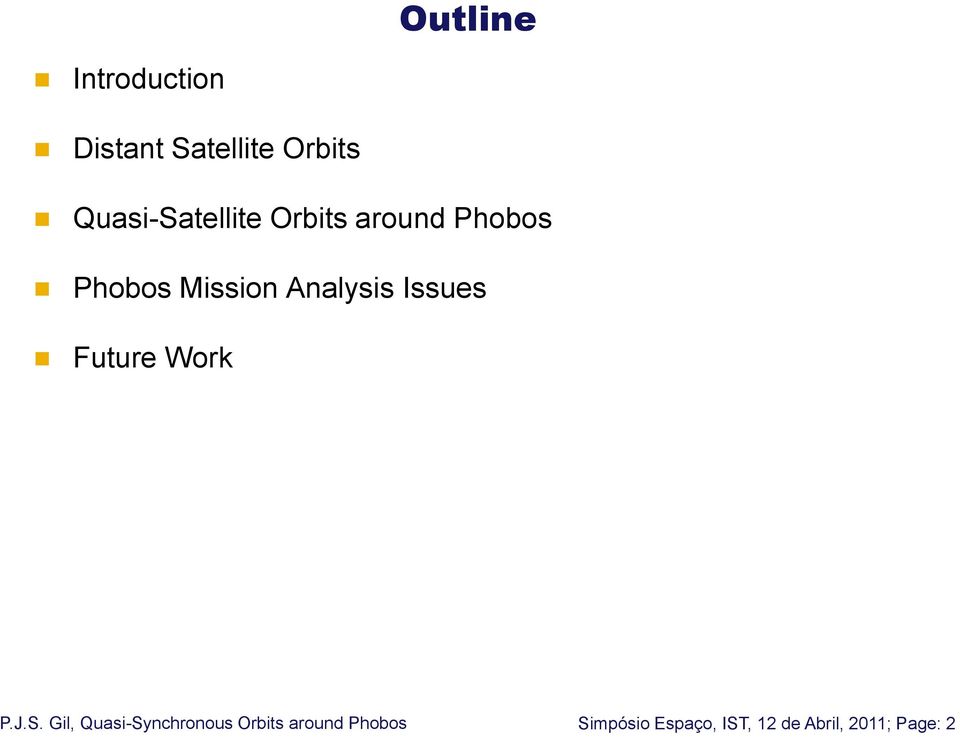
3 Introduction Target: Phobos Mars 1st and largest Moon Orbital major axis a = 9377 km, with sidereal period T= 0.32 d Almost, but not exactly, circular equatorial orbit e = , i ~ 1º Small, m ~ 10 16, irregular shape Ellipsoidal shape with mean radius km; huge crater: Stickney Very small gravity at surface g ~ 10-3 m/s 2 Tidally locked to Mars Particularly interesting for a sample return mission Possibly a captured asteroid Studies of the minor bodies of the solar system Simpósio Espaço, IST, 12 de Abril, 2011; Page: 3
4 Missions to Phobos Past Missions Phobos 1 & 2 launched in 1988 by Soviet Union - Failed Future Missions Phobos Grunt - Sample Return Mission to Phobos To be launched in 2012? Future ESA mission? Challenges when approaching Phobos Phobos: small mass impossible to orbit it a keplerian way There is a need to orbit it somehow but not negligible orbit not Martian Irregular gravitational field Ephemeris not well known Simpósio Espaço, IST, 12 de Abril, 2011; Page: 4
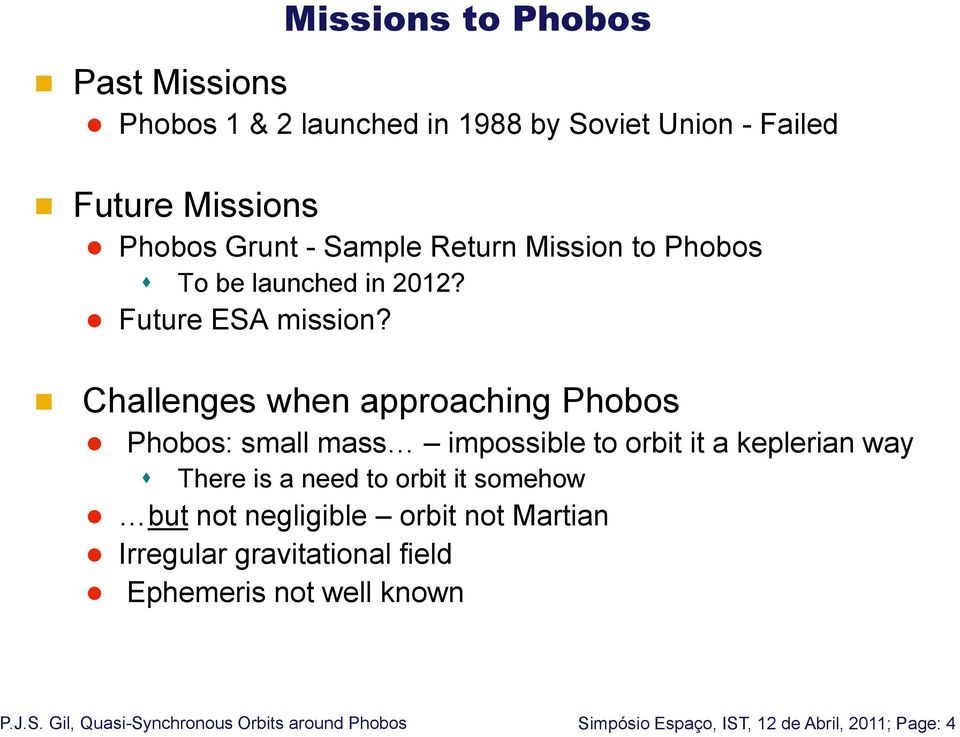
5 Challenge: Force Field at Phobos and 3BP In the case of a larger body e.g. the Moon, there is no problem orbiting it The region of influence is sufficiently large to allow keplerian-type orbits, where the Earth is a small perturbation The Hill sphere, where the Lagrange points are located, is large enough Case of Moon Problems appear when the moon is smaller and smaller the Hill s problem, when the mass ratio of the primaries goes to zero in a certain way Hill s sphere Region of influence Simpósio Espaço, IST, 12 de Abril, 2011; Page: 5
6 Challenge: Force Field at Phobos and 3BP Ellipsoidal model of Phobos The thinnest axis is represented by the solid line Hill s sphere just above Phobos (outer dashed line) r H Ph 3 M 1/ km Region of influence below the surface (inner dashed line): usual orbits impossible r inf Ph 2/5 7.2 km But mass is not negligible... M How to orbit Phobos? Simpósio Espaço, IST, 12 de Abril, 2011; Page: 6

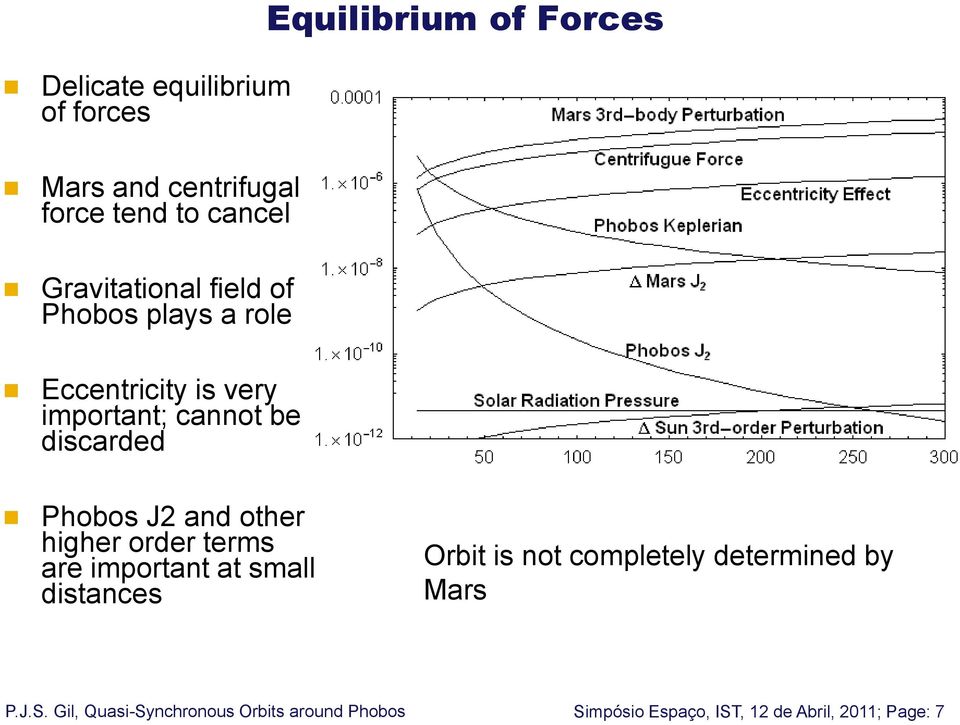
7 Equilibrium of Forces Delicate equilibrium of forces Mars and centrifugal force tend to cancel Gravitational field of Phobos plays a role Eccentricity is very important; cannot be discarded Phobos J2 and other higher order terms are important at small distances Orbit is not completely determined by Mars Simpósio Espaço, IST, 12 de Abril, 2011; Page: 7
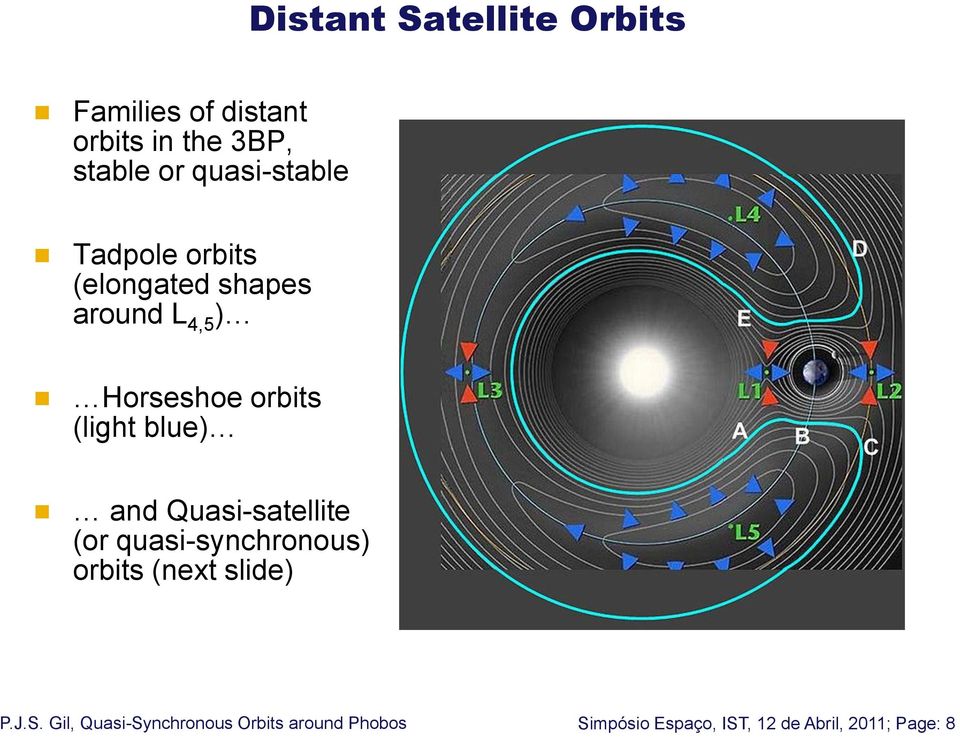
8 Distant Satellite Orbits Families of distant orbits in the 3BP, stable or quasi-stable Tadpole orbits (elongated shapes around L 4,5 ) Horseshoe orbits (light blue) and Quasi-satellite (or quasi-synchronous) orbits (next slide) Simpósio Espaço, IST, 12 de Abril, 2011; Page: 8
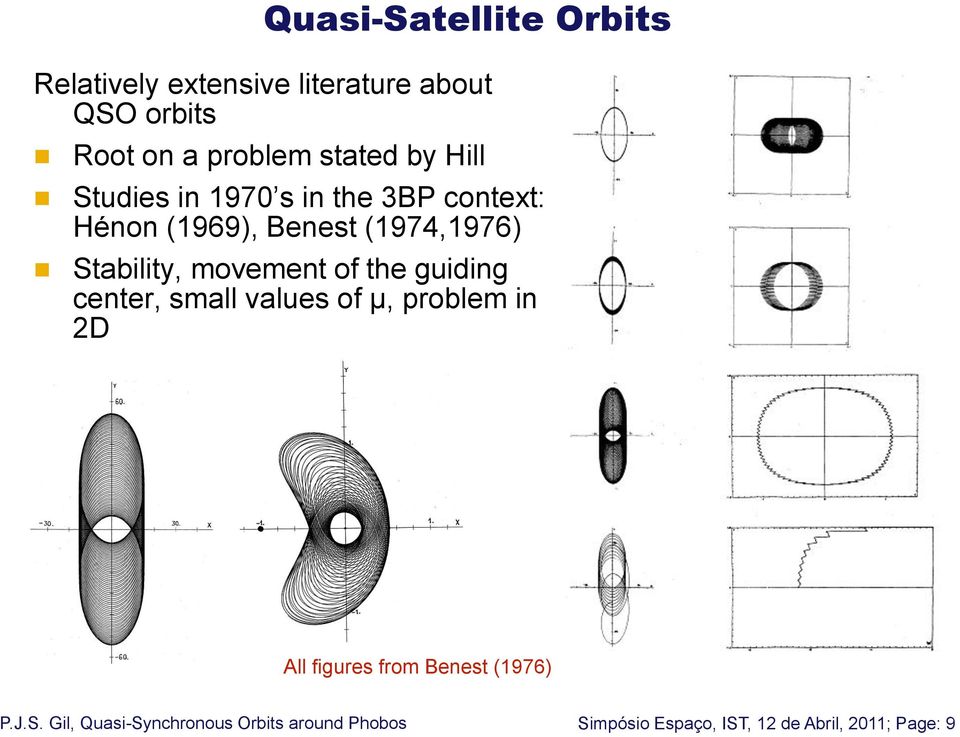
9 Quasi-Satellite Orbits Relatively extensive literature about QSO orbits Root on a problem stated by Hill Studies in 1970 s in the 3BP context: Hénon (1969), Benest (1974,1976) Stability, movement of the guiding center, small values of μ, problem in 2D All figures from Benest (1976) Simpósio Espaço, IST, 12 de Abril, 2011; Page: 9
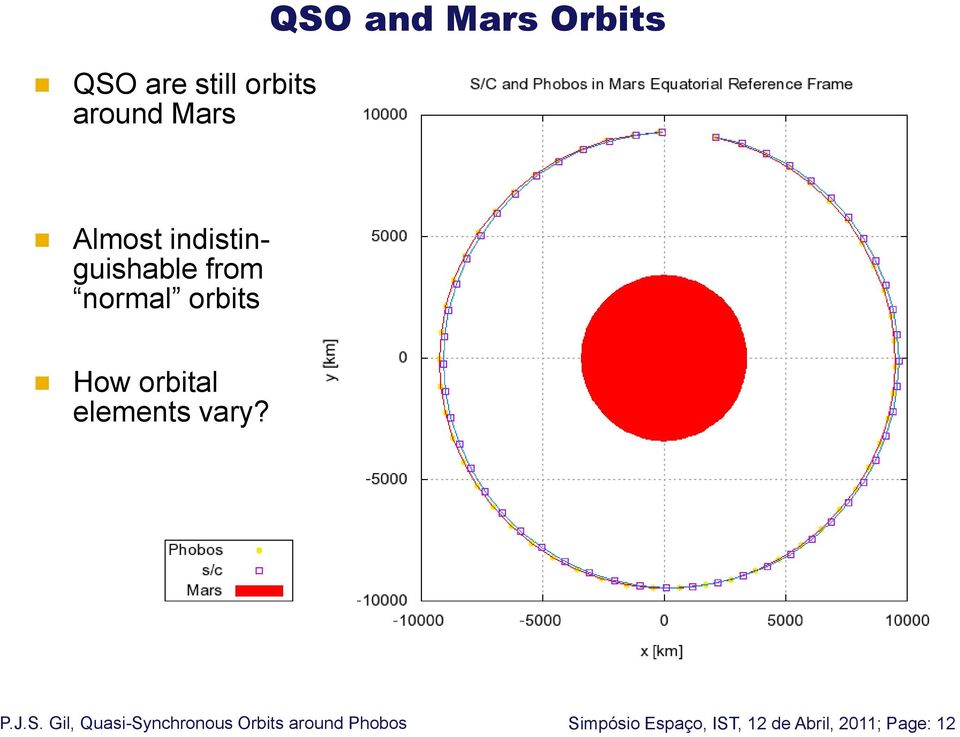
10 Quasi-Synchronous Orbits (QSO) Quasi-stable orbits around Phobos also called Quasi-Satellite Orbits Appear in the context of the 3BP, existing beyond the region of influence of the M 2 Motion is dominated by Mars gravity but the gravitational field of Phobos plays a role (quasi) stable orbits circumventing Phobos, observation and preparation for landing becomes possible Mars QSO in the synodic or LVLH ref. frame Simpósio Espaço, IST, 12 de Abril, 2011; Page: 10

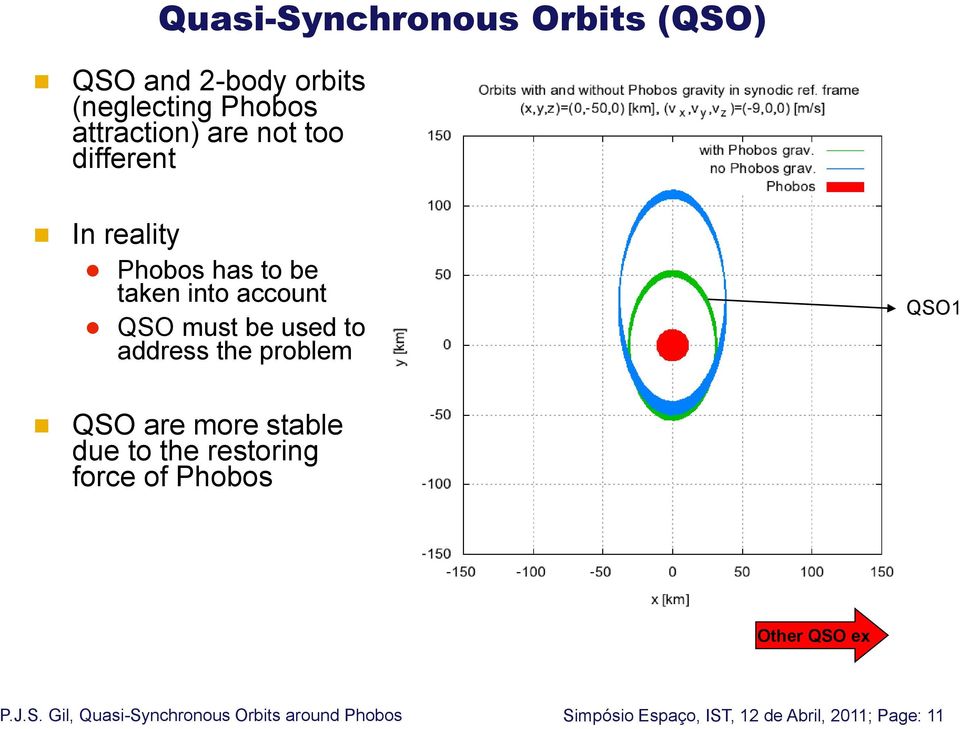
11 Quasi-Synchronous Orbits (QSO) QSO and 2-body orbits (neglecting Phobos attraction) are not too different In reality Phobos has to be taken into account QSO must be used to address the problem QSO1 QSO are more stable due to the restoring force of Phobos Other QSO ex Simpósio Espaço, IST, 12 de Abril, 2011; Page: 11
12 QSO and Mars Orbits QSO are still orbits around Mars Almost indistinguishable from normal orbits How orbital elements vary? Simpósio Espaço, IST, 12 de Abril, 2011; Page: 12
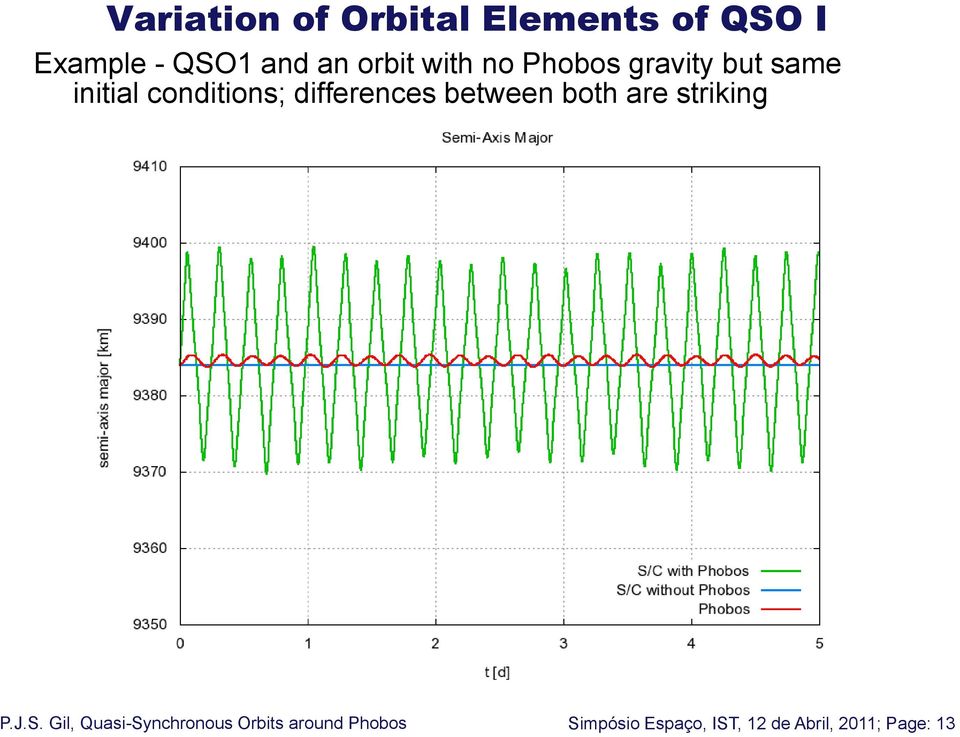
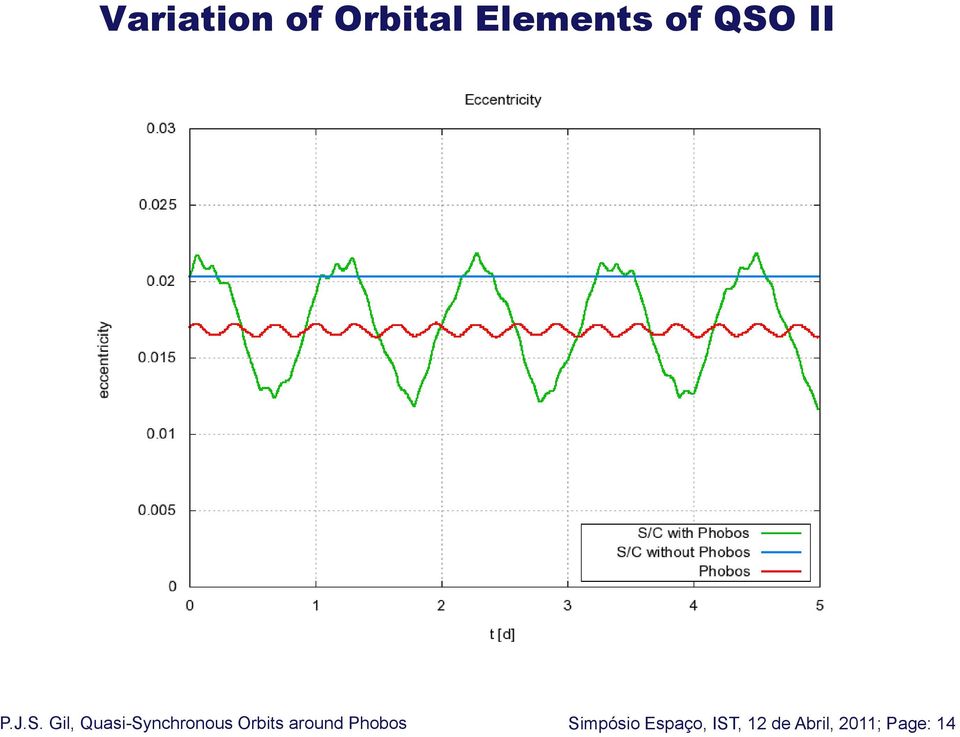
13 Variation of Orbital Elements of QSO I Example - QSO1 and an orbit with no Phobos gravity but same initial conditions; differences between both are striking Simpósio Espaço, IST, 12 de Abril, 2011; Page: 13
14 Variation of Orbital Elements of QSO II Simpósio Espaço, IST, 12 de Abril, 2011; Page: 14
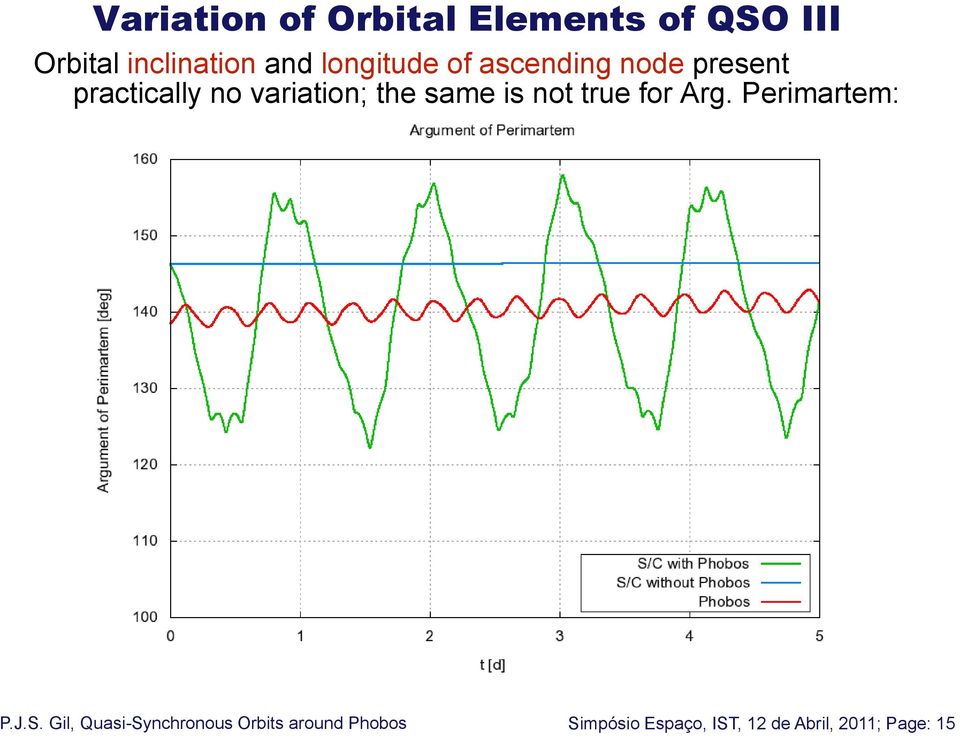
15 Variation of Orbital Elements of QSO III Orbital inclination and longitude of ascending node present practically no variation; the same is not true for Arg. Perimartem: Simpósio Espaço, IST, 12 de Abril, 2011; Page: 15
16 Historical Developments Henon, Benest (1970 s) identification of QSO in the context of the 3BP Kogan (1987,1990), others - First order perturbation methods and averaging techniques; Constants of motion of approximate equations Lidov & Vashkov yak (1993,1994) Lie perturbation method applied to the study of QSO (very complicated) Difficulties and Limitations (Lie method) Relative order of magnitude of the several parameters (µ, e, etc.) appearing in the problem is huge, making the theory of restrictive application in particular in the case of Phobos; higher order gravity terms not considered. Wiesel (1993) - 2D model including eccentricity, Mars oblateness, ellipsoidal model for Phobos, Zero eccentricity model as stepping stone to the more complex case from periodic orbits when e = 0 at any distance from Phobos to resonant orbits and non-periodic orbits in the e 0 case Floquet theory used after a periodic orbit has been found to determine the Poincaré exponents Numerical exploration of the phase space Simpósio Espaço, IST, 12 de Abril, 2011; Page: 16

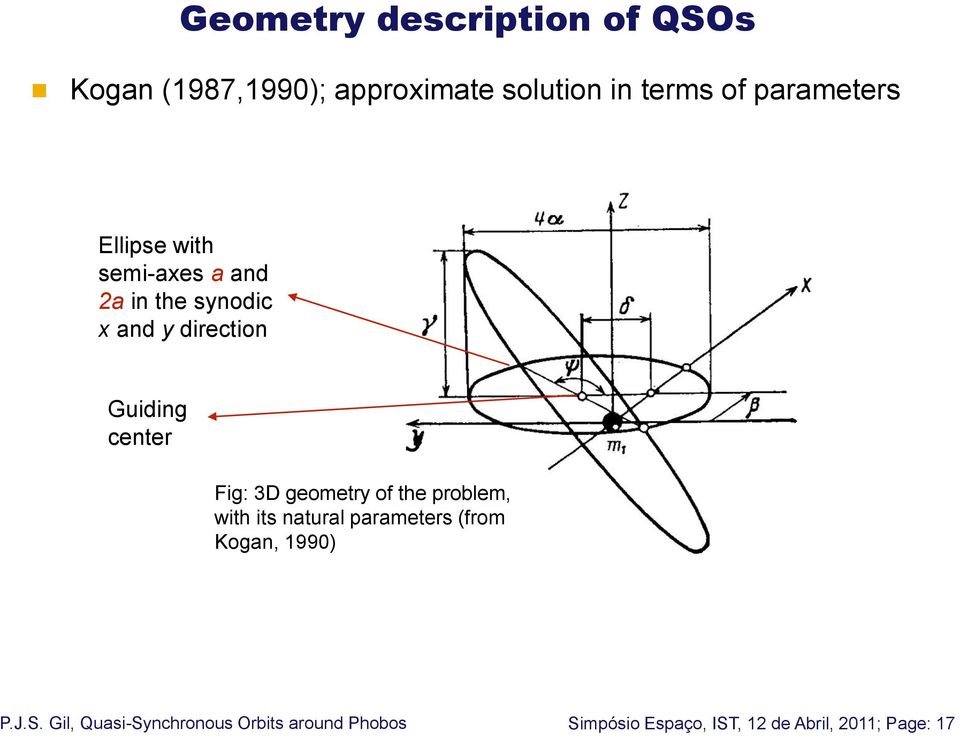
17 Geometry description of QSOs Kogan (1987,1990); approximate solution in terms of parameters Ellipse with semi-axes a and 2a in the synodic x and y direction Guiding center Fig: 3D geometry of the problem, with its natural parameters (from Kogan, 1990) Simpósio Espaço, IST, 12 de Abril, 2011; Page: 17
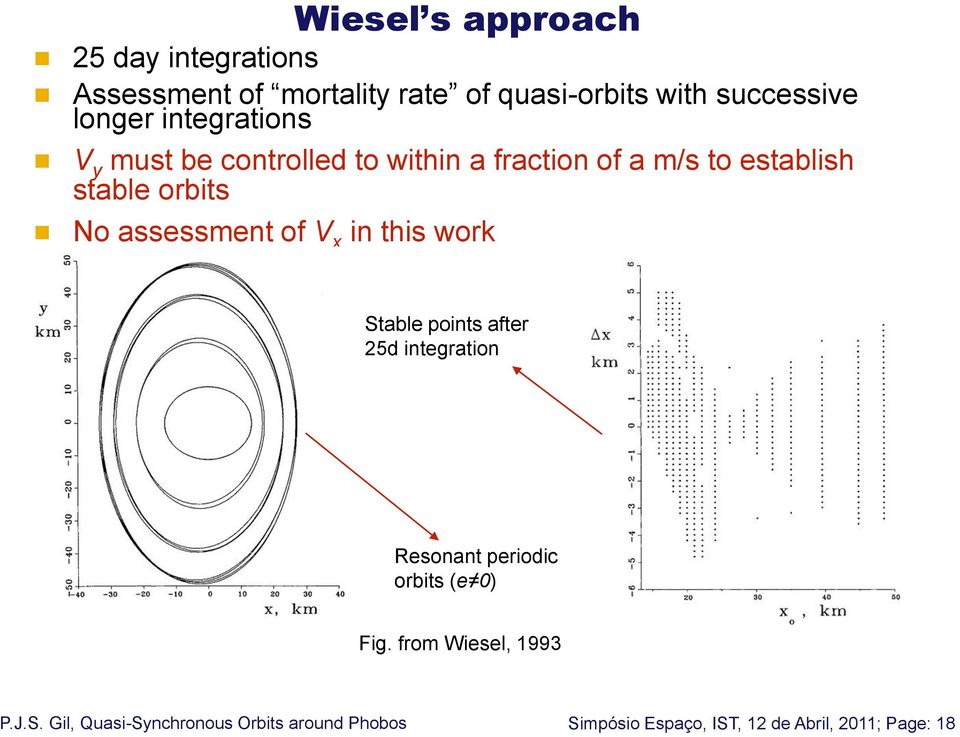
18 Wiesel s approach 25 day integrations Assessment of mortality rate of quasi-orbits with successive longer integrations V y must be controlled to within a fraction of a m/s to establish stable orbits No assessment of V x in this work Stable points after 25d integration Resonant periodic orbits (e 0) Fig. from Wiesel, 1993 Simpósio Espaço, IST, 12 de Abril, 2011; Page: 18
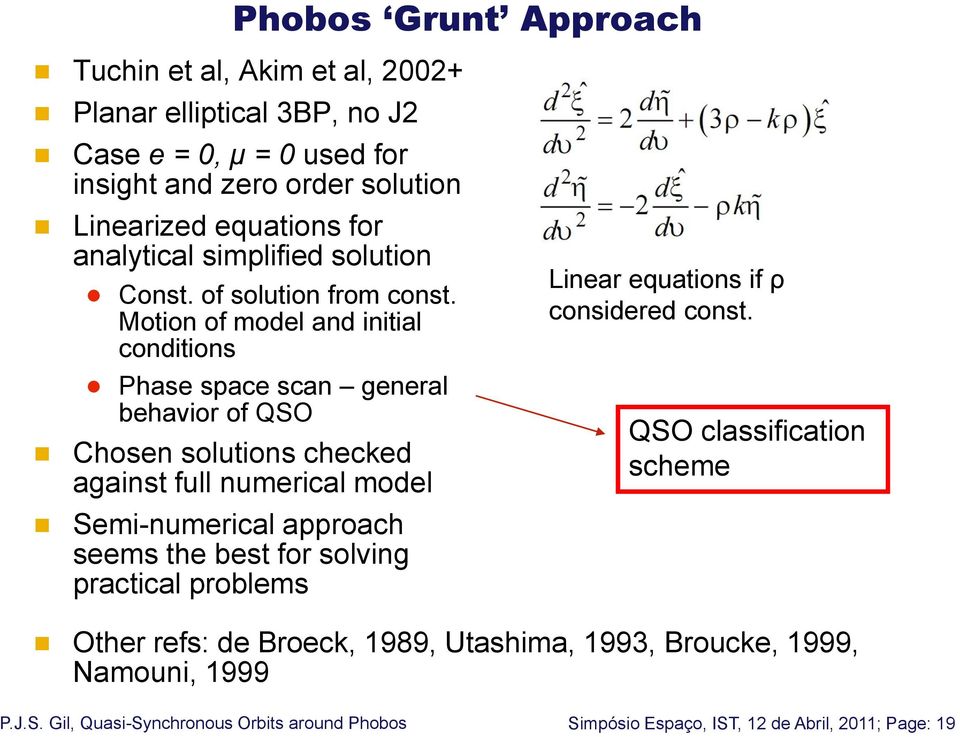
19 Phobos Grunt Approach Tuchin et al, Akim et al, Planar elliptical 3BP, no J2 Case e = 0, μ = 0 used for insight and zero order solution Linearized equations for analytical simplified solution Const. of solution from const. Motion of model and initial conditions Phase space scan general behavior of QSO Chosen solutions checked against full numerical model Semi-numerical approach seems the best for solving practical problems Linear equations if ρ considered const. QSO classification scheme Other refs: de Broeck, 1989, Utashima, 1993, Broucke, 1999, Namouni, 1999 Simpósio Espaço, IST, 12 de Abril, 2011; Page: 19
20 Objectives Acquire capabilities and experience in QSO for the possibility of a future ESA sample return mission to Phobos Knowledge and experience in dealing with QSO Mission design capabilities in problems involving QSO; applications to Phobos and possibly other minor bodies Search for better method to describe QSOs (e.g. 3D case) and search for enough stable solutions for practical problems (e 0) First step: full numerical simulations of QSO around Phobos; assessment of how to search for (quasi-)stable solutions; mission design issues Simpósio Espaço, IST, 12 de Abril, 2011; Page: 20
21 2D QSO quasi-stable solutions Stable = stable for at least 30 days Easy to generate stable QSO Points at equal times in fig: QSO easily obtained in the x- y plane 127x72, 103x62, 61x44, 42x34, Demonstration 3D QSO (next slides): (x,y,z) = (0,-100,40) [km] (initial relative inclination with Phobos: 21.8º) (v x,v y,v z ) = (-20,0,10) [m/s] Simpósio Espaço, IST, 12 de Abril, 2011; Page: 21
22 3 day simulation Simpósio Espaço, IST, 12 de Abril, 2011; Page: 22
23 3 day simulation (cont d) Simpósio Espaço, IST, 12 de Abril, 2011; Page: 23
24 30 day simulation Simpósio Espaço, IST, 12 de Abril, 2011; Page: 24
25 30 day simulation (cont d) QSO movie Simpósio Espaço, IST, 12 de Abril, 2011; Page: 25
26 Preliminary phase space exploration Assess and test the search for stable QSO; Point (x,y,z) = (0,-100,0) [km] seems much more forgiving than the x axis chosen by Wiesel Search for stable QSO varying the velocity components Start with a broad search and fine tune latter (v x,v y,v z ) = (10i,j,10k), i,j,k = -4,...,4 [m/s] a 1st broad exploration Starting point Simpósio Espaço, IST, 12 de Abril, 2011; Page: 26

27 1day simulation Variation in v z, then v y and then v x with max and min altitudes Simpósio Espaço, IST, 12 de Abril, 2011; Page: 27
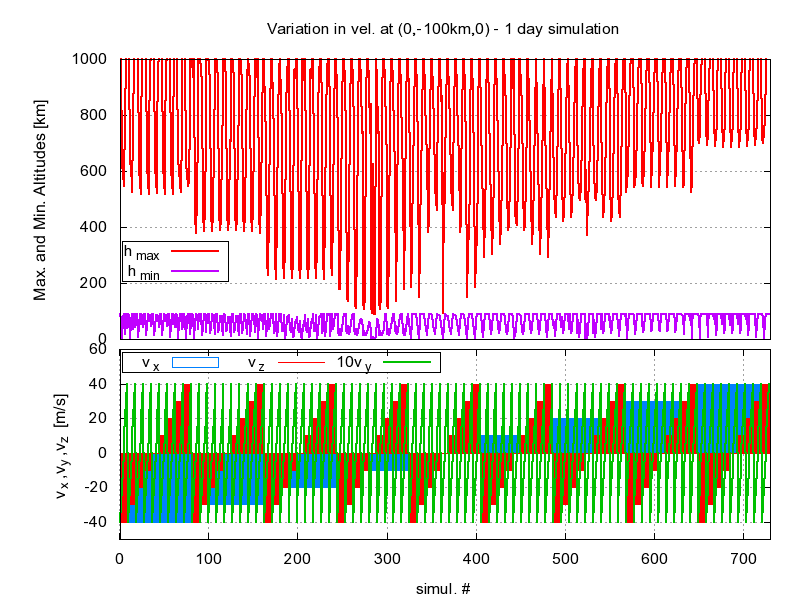
28 1day simulation Order of variation of velocities gives information: v y most crucial Simpósio Espaço, IST, 12 de Abril, 2011; Page: 28

29 1day simulation Another order of variation of velocities Simpósio Espaço, IST, 12 de Abril, 2011; Page: 29

30 1day simulation Less higher frequencies are easier to analyze since variation is slower Simpósio Espaço, IST, 12 de Abril, 2011; Page: 30
31 1day simulation - detail Analysis to prepare a refinement Simpósio Espaço, IST, 12 de Abril, 2011; Page: 31
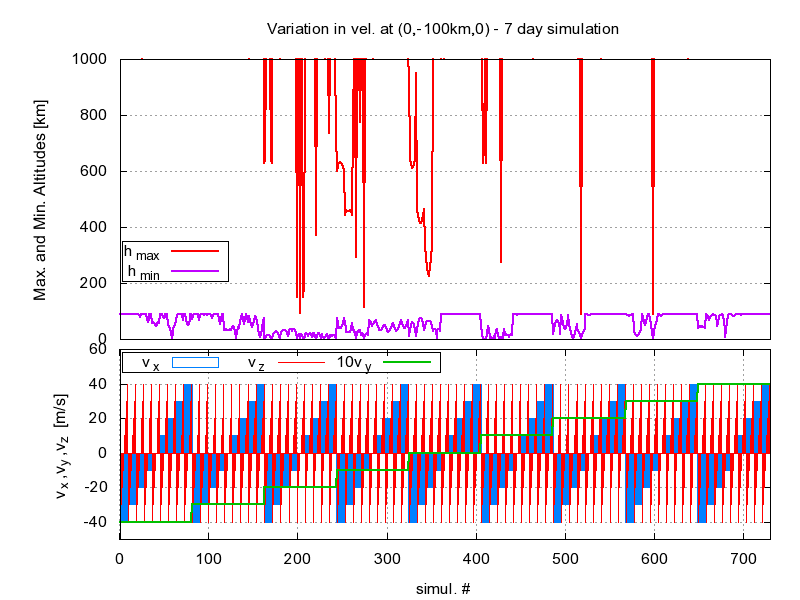
32 7 day simulation Extending the simulation more and more instabilities grow and less QSO remain stable Simpósio Espaço, IST, 12 de Abril, 2011; Page: 32
33 30 day simulation Extending the simulation more and more instabilities grow and less QSO remain stable 30 days provide a good margin for correcting trajectories Simpósio Espaço, IST, 12 de Abril, 2011; Page: 33
34 30 day simulation Detail Simpósio Espaço, IST, 12 de Abril, 2011; Page: 34
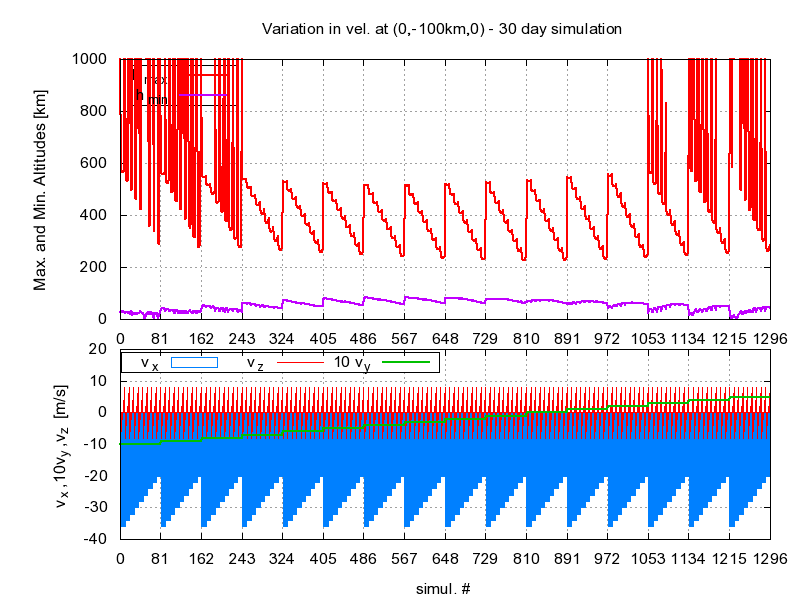
35 Refinement of Simulations V=(-36+2i,0.1j,2k), i=[0,8], j=[-10,5], k=[-4,4]; v y is the most critical parameter; must be within an interval of ~1 m/s Simpósio Espaço, IST, 12 de Abril, 2011; Page: 35
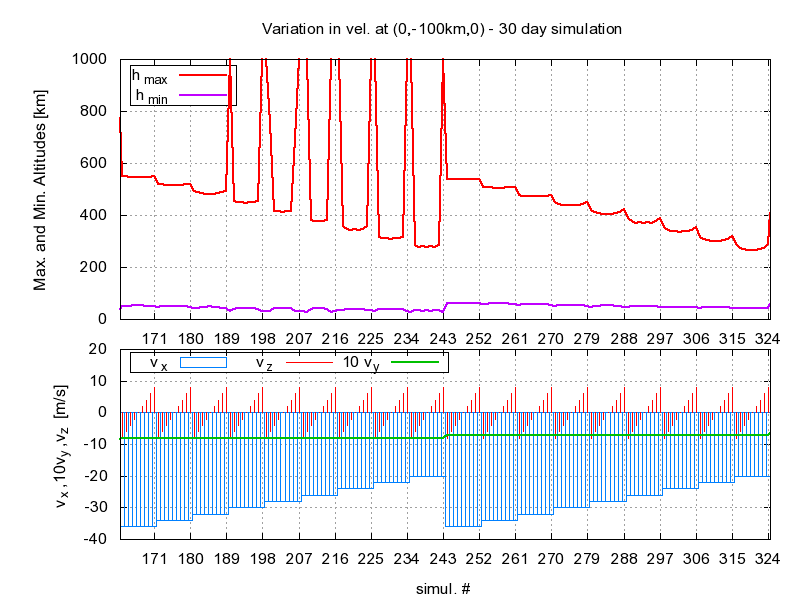
36 Detail Simpósio Espaço, IST, 12 de Abril, 2011; Page: 36
37 Another Simulation Example Other types of simulations possible e.g. Variation of v, Az, El at the initial point Example: variation of y and v x with (0,y,0), (v x,0,0), y, v x < 0 Stable v x negative since at the initial point m/s Include additional information about QSO Average dimensions in x and y QSO period, normalized by Phobos period of revolution Interesting features: Relation between the period and velocity, more than with distance Relation between max and min altitudes and axes of the QSO ellipse (distances) Results need to be interpreted r 22.8 Simpósio Espaço, IST, 12 de Abril, 2011; Page: 37
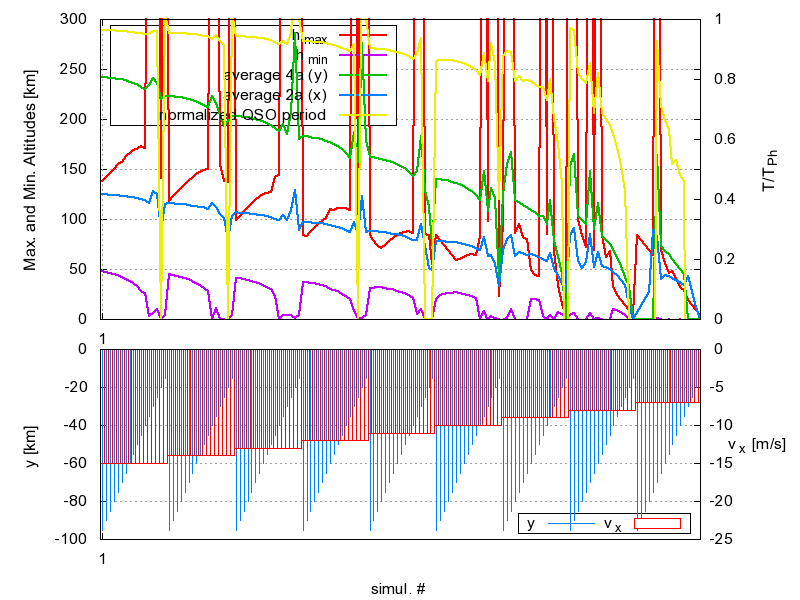
38 Total of simulation Simpósio Espaço, IST, 12 de Abril, 2011; Page: 38
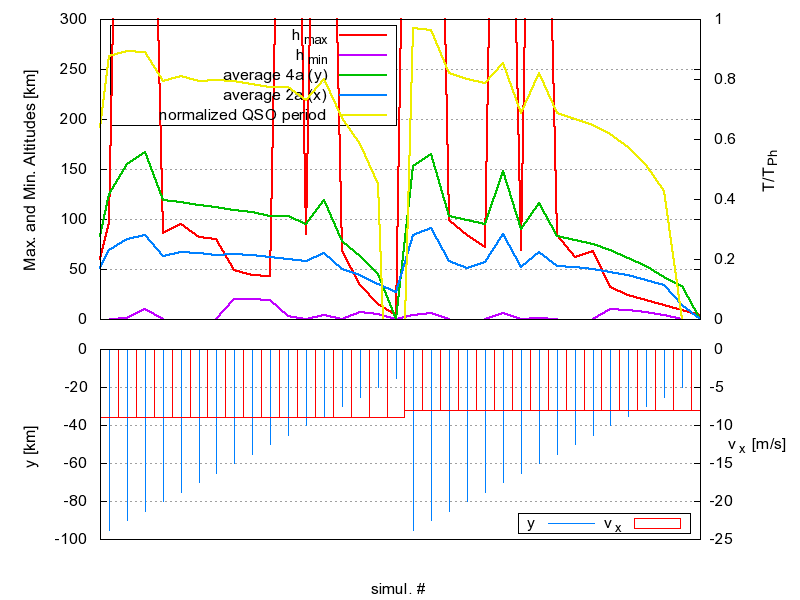
39 Detail some interesting observations Simpósio Espaço, IST, 12 de Abril, 2011; Page: 39
40 Mission Design Include Observation of Phobos surface and choice of QSO Illumination of observed surface Occurrence of eclipses and Earth occultation Insertion into a QSO for observation and approach of Phobos Geometry The best choice for minimizing possible insertion errors Trajectory for landing Simpósio Espaço, IST, 12 de Abril, 2011; Page: 40
41 Eclipse and Occultation Using the QSO example Simpósio Espaço, IST, 12 de Abril, 2011; Page: 41
42 Ground Track Motion relative to the surface: cf. QSO initial cond. (rel. inc.) Simpósio Espaço, IST, 12 de Abril, 2011; Page: 42
43 Sun Elevation and eclipse at ground track point Sun s elevation varies a lot and eclipses can take time Simpósio Espaço, IST, 12 de Abril, 2011; Page: 43
44 Eclipse at ground track point can last for days Eclipse for a long time; sun too low Whole simulation Simpósio Espaço, IST, 12 de Abril, 2011; Page: 44
45 Open questions QSO insertion strategy Phobos ephemeris not well known Need for prior observation Small delta-v but high precision required Fig. from Akim et al, 1993 Approach and Landing Avoid crash => small delta-v Highly irregular gravity field Velocity at surface from a QSO is several dozens of m/s 3D QSO Application to Saturn system and other minor bodies Simpósio Espaço, IST, 12 de Abril, 2011; Page: 45
46 Search Stability Using Fast Lyapunov Indeicators Fast Lyapunov Indicator (FLI) What: Chaosticity analysis technique Who: Pioneer work by Froechlé, Lega & Gonczi (1997) Objective: Distinguish regular from chaotic motion Technique derived from Lyapunov Characteristics Exponents (LCEs) FLI value has a different behavior for regular and chaotic motion Simpósio Espaço, IST, 12 de Abril, 2011; Page: 46
47 FLI Maps FLI Maps distinguishes the stability islands (purple) from the chaotic sea (yellow/orange), Villac & Lara 2005 Goal: generalization to the elliptical Case (in course, Gil & Cabral, 2011) Simpósio Espaço, IST, 12 de Abril, 2011; Page: 47
48 Summary QSOs can be used to orbit small bodies Lots of features and things to worry about Numerical application to the case of Phobos Mission design issues 3D QSOs can be interesting Need for approximate solutions New perturbation methods New techniques to Search for stable QSOs in the cases with eccentricity Approach and landing strategies Special QSO for special purposes Simpósio Espaço, IST, 12 de Abril, 2011; Page: 48
49 Summary Still many open questions => Lots of further work Simpósio Espaço, IST, 12 de Abril, 2011; Page: 49
50 Summary Still many open questions => Lots of further work Simpósio Espaço, IST, 12 de Abril, 2011; Page: 50
A. 81 2 = 6561 times greater. B. 81 times greater. C. equally strong. D. 1/81 as great. E. (1/81) 2 = 1/6561 as great.
 Q12.1 The mass of the Moon is 1/81 of the mass of the Earth. Compared to the gravitational force that the Earth exerts on the Moon, the gravitational force that the Moon exerts on the Earth is A. 81 2
Lecture L17 - Orbit Transfers and Interplanetary Trajectories
 S. Widnall, J. Peraire 16.07 Dynamics Fall 008 Version.0 Lecture L17 - Orbit Transfers and Interplanetary Trajectories In this lecture, we will consider how to transfer from one orbit, to another or to
F N A) 330 N 0.31 B) 310 N 0.33 C) 250 N 0.27 D) 290 N 0.30 E) 370 N 0.26
 Physics 23 Exam 2 Spring 2010 Dr. Alward Page 1 1. A 250-N force is directed horizontally as shown to push a 29-kg box up an inclined plane at a constant speed. Determine the magnitude of the normal force,
Orbital Mechanics and Space Geometry
 Orbital Mechanics and Space Geometry AERO4701 Space Engineering 3 Week 2 Overview First Hour Co-ordinate Systems and Frames of Reference (Review) Kepler s equations, Orbital Elements Second Hour Orbit
EDMONDS COMMUNITY COLLEGE ASTRONOMY 100 Winter Quarter 2007 Sample Test # 1
 Instructor: L. M. Khandro EDMONDS COMMUNITY COLLEGE ASTRONOMY 100 Winter Quarter 2007 Sample Test # 1 1. An arc second is a measure of a. time interval between oscillations of a standard clock b. time
Newton s Law of Gravity
 Gravitational Potential Energy On Earth, depends on: object s mass (m) strength of gravity (g) distance object could potentially fall Gravitational Potential Energy In space, an object or gas cloud has
Solar System. 1. The diagram below represents a simple geocentric model. Which object is represented by the letter X?
 Solar System 1. The diagram below represents a simple geocentric model. Which object is represented by the letter X? A) Earth B) Sun C) Moon D) Polaris 2. Which object orbits Earth in both the Earth-centered
Celestial Sphere. Celestial Coordinates. Lecture 3: Motions of the Sun and Moon. ecliptic (path of Sun) ecliptic (path of Sun)
 Lecture 3: Motions of the and Moon ecliptic (path of ) ecliptic (path of ) The 23.5 degree tilt of Earth s spin axis relative to its orbital axis around the causes the seasons Celestial Sphere Celestial
Orbital Mechanics. Angular Momentum
 Orbital Mechanics The objects that orbit earth have only a few forces acting on them, the largest being the gravitational pull from the earth. The trajectories that satellites or rockets follow are largely
2. Orbits. FER-Zagreb, Satellite communication systems 2011/12
 2. Orbits Topics Orbit types Kepler and Newton laws Coverage area Influence of Earth 1 Orbit types According to inclination angle Equatorial Polar Inclinational orbit According to shape Circular orbit
astronomy 2008 1. A planet was viewed from Earth for several hours. The diagrams below represent the appearance of the planet at four different times.
 1. A planet was viewed from Earth for several hours. The diagrams below represent the appearance of the planet at four different times. 5. If the distance between the Earth and the Sun were increased,
Astromechanics Two-Body Problem (Cont)
 5. Orbit Characteristics Astromechanics Two-Body Problem (Cont) We have shown that the in the two-body problem, the orbit of the satellite about the primary (or vice-versa) is a conic section, with the
Lecture 13. Gravity in the Solar System
 Lecture 13 Gravity in the Solar System Guiding Questions 1. How was the heliocentric model established? What are monumental steps in the history of the heliocentric model? 2. How do Kepler s three laws
Penn State University Physics 211 ORBITAL MECHANICS 1
 ORBITAL MECHANICS 1 PURPOSE The purpose of this laboratory project is to calculate, verify and then simulate various satellite orbit scenarios for an artificial satellite orbiting the earth. First, there
Earth in the Solar System
 Copyright 2011 Study Island - All rights reserved. Directions: Challenge yourself! Print out the quiz or get a pen/pencil and paper and record your answers to the questions below. Check your answers with
C B A T 3 T 2 T 1. 1. What is the magnitude of the force T 1? A) 37.5 N B) 75.0 N C) 113 N D) 157 N E) 192 N
 Three boxes are connected by massless strings and are resting on a frictionless table. Each box has a mass of 15 kg, and the tension T 1 in the right string is accelerating the boxes to the right at a
Dynamics of Iain M. Banks Orbitals. Richard Kennaway. 12 October 2005
 Dynamics of Iain M. Banks Orbitals Richard Kennaway 12 October 2005 Note This is a draft in progress, and as such may contain errors. Please do not cite this without permission. 1 The problem An Orbital
Astrodynamics (AERO0024)
 Astrodynamics (AERO0024) 6. Interplanetary Trajectories Gaëtan Kerschen Space Structures & Systems Lab (S3L) Course Outline THEMATIC UNIT 1: ORBITAL DYNAMICS Lecture 02: The Two-Body Problem Lecture 03:
Flight and Orbital Mechanics
 Flight and Orbital Mechanics Lecture slides Challenge the future 1 Material for exam: this presentation (i.e., no material from text book). Sun-synchronous orbit: used for a variety of earth-observing
The Gravitational Field
 The Gravitational Field The use of multimedia in teaching physics Texts to multimedia presentation Jan Hrnčíř [email protected] Martin Klejch [email protected] F. X. Šalda Grammar School, Liberec
Name: João Fernando Alves da Silva Class: 7-4 Number: 10
 Name: João Fernando Alves da Silva Class: 7-4 Number: 10 What is the constitution of the Solar System? The Solar System is constituted not only by planets, which have satellites, but also by thousands
From Aristotle to Newton
 From Aristotle to Newton The history of the Solar System (and the universe to some extent) from ancient Greek times through to the beginnings of modern physics. The Geocentric Model Ancient Greek astronomers
circular motion & gravitation physics 111N
 circular motion & gravitation physics 111N uniform circular motion an object moving around a circle at a constant rate must have an acceleration always perpendicular to the velocity (else the speed would
Name Class Period. F = G m 1 m 2 d 2. G =6.67 x 10⁻¹¹ Nm 2 /kg 2
 Gravitational Forces 13.1 Newton s Law of Universal Gravity Newton discovered that gravity is universal. Everything pulls on everything else in the universe in a way that involves only mass and distance.
Satellite Posi+oning. Lecture 5: Satellite Orbits. Jan Johansson [email protected] Chalmers University of Technology, 2013
 Lecture 5: Satellite Orbits Jan Johansson [email protected] Chalmers University of Technology, 2013 Geometry Satellite Plasma Posi+oning physics Antenna theory Geophysics Time and Frequency GNSS
Does currently available technology have the capacity to facilitate a manned mission to Mars?
 Furze Platt Senior School Does currently available technology have the capacity to facilitate a manned mission to Mars? Daniel Messias Date: 8/03/2015 Candidate Number: 7158 Centre Number: 51519 Contents
Lecture 07: Work and Kinetic Energy. Physics 2210 Fall Semester 2014
 Lecture 07: Work and Kinetic Energy Physics 2210 Fall Semester 2014 Announcements Schedule next few weeks: 9/08 Unit 3 9/10 Unit 4 9/15 Unit 5 (guest lecturer) 9/17 Unit 6 (guest lecturer) 9/22 Unit 7,
Chapter 2. Mission Analysis. 2.1 Mission Geometry
 Chapter 2 Mission Analysis As noted in Chapter 1, orbital and attitude dynamics must be considered as coupled. That is to say, the orbital motion of a spacecraft affects the attitude motion, and the attitude
RS platforms. Fabio Dell Acqua - Gruppo di Telerilevamento
 RS platforms Platform vs. instrument Sensor Platform Instrument The remote sensor can be ideally represented as an instrument carried by a platform Platforms Remote Sensing: Ground-based air-borne space-borne
Examination Space Missions and Applications I (AE2103) Faculty of Aerospace Engineering Delft University of Technology SAMPLE EXAM
 Examination Space Missions and Applications I AE2103 Faculty of Aerospace Engineering Delft University of Technology SAMPLE EXAM Please read these instructions first: This are a series of multiple-choice
Halliday, Resnick & Walker Chapter 13. Gravitation. Physics 1A PHYS1121 Professor Michael Burton
 Halliday, Resnick & Walker Chapter 13 Gravitation Physics 1A PHYS1121 Professor Michael Burton II_A2: Planetary Orbits in the Solar System + Galaxy Interactions (You Tube) 21 seconds 13-1 Newton's Law
Exam 1 Review Questions PHY 2425 - Exam 1
 Exam 1 Review Questions PHY 2425 - Exam 1 Exam 1H Rev Ques.doc - 1 - Section: 1 7 Topic: General Properties of Vectors Type: Conceptual 1 Given vector A, the vector 3 A A) has a magnitude 3 times that
Astronomy 110 Homework #04 Assigned: 02/06/2007 Due: 02/13/2007. Name:
 Astronomy 110 Homework #04 Assigned: 02/06/2007 Due: 02/13/2007 Name: Directions: Listed below are twenty (20) multiple-choice questions based on the material covered by the lectures this past week. Choose
Interaction of Energy and Matter Gravity Measurement: Using Doppler Shifts to Measure Mass Concentration TEACHER GUIDE
 Interaction of Energy and Matter Gravity Measurement: Using Doppler Shifts to Measure Mass Concentration TEACHER GUIDE EMR and the Dawn Mission Electromagnetic radiation (EMR) will play a major role in
Moon Phases & Eclipses Notes
 Moon Phases & Eclipses Notes Melka 2014-2015 The Moon The Moon is Earth s one natural satellite. Due to its smaller size and slower speed of rotation, the Moon s gravity is 1/6 of the Earth s gravitational
Section 4: The Basics of Satellite Orbits
 Section 4: The Basics of Satellite Orbits MOTION IN SPACE VS. MOTION IN THE ATMOSPHERE The motion of objects in the atmosphere differs in three important ways from the motion of objects in space. First,
Halliday, Resnick & Walker Chapter 13. Gravitation. Physics 1A PHYS1121 Professor Michael Burton
 Halliday, Resnick & Walker Chapter 13 Gravitation Physics 1A PHYS1121 Professor Michael Burton II_A2: Planetary Orbits in the Solar System + Galaxy Interactions (You Tube) 21 seconds 13-1 Newton's Law
Q3.2.a The gravitational force exerted by a planet on one of its moons is 3e23 newtons when the moon is at a particular location.
 Q3.2.a The gravitational force exerted by a planet on one of its moons is 3e23 newtons when the moon is at a particular location. If the mass of the moon were three times as large, what would the force
Use the following information to deduce that the gravitational field strength at the surface of the Earth is approximately 10 N kg 1.
 IB PHYSICS: Gravitational Forces Review 1. This question is about gravitation and ocean tides. (b) State Newton s law of universal gravitation. Use the following information to deduce that the gravitational
Note S1: Eclipses & Predictions
 The Moon's Orbit The first part of this note gives reference information and definitions about eclipses [14], much of which would have been familiar to ancient Greek astronomers, though not necessarily
Newton s Law of Universal Gravitation
 Newton s Law of Universal Gravitation The greatest moments in science are when two phenomena that were considered completely separate suddenly are seen as just two different versions of the same thing.
Notes: Most of the material in this chapter is taken from Young and Freedman, Chap. 13.
 Chapter 5. Gravitation Notes: Most of the material in this chapter is taken from Young and Freedman, Chap. 13. 5.1 Newton s Law of Gravitation We have already studied the effects of gravity through the
Version A Page 1. 1. The diagram shows two bowling balls, A and B, each having a mass of 7.00 kilograms, placed 2.00 meters apart.
 Physics Unit Exam, Kinematics 1. The diagram shows two bowling balls, A and B, each having a mass of 7.00 kilograms, placed 2.00 meters apart. What is the magnitude of the gravitational force exerted by
This paper is also taken for the relevant Examination for the Associateship. For Second Year Physics Students Wednesday, 4th June 2008: 14:00 to 16:00
 Imperial College London BSc/MSci EXAMINATION June 2008 This paper is also taken for the relevant Examination for the Associateship SUN, STARS, PLANETS For Second Year Physics Students Wednesday, 4th June
Chapter 5: Circular Motion, the Planets, and Gravity
 Chapter 5: Circular Motion, the Planets, and Gravity 1. Earth s gravity attracts a person with a force of 120 lbs. The force with which the Earth is attracted towards the person is A. Zero. B. Small but
Correct Modeling of the Indirect Term for Third-Body Perturbations
 AAS 07-47 Correct Modeling of the Indirect Term for Third-Body Perturbations Matthew M. Berry * Vincent T. Coppola The indirect term in the formula for third body perturbations models the acceleration
Orbital Dynamics. Orbital Dynamics 1/29/15
 Orbital Dynamics Orbital Dynamics 1/29/15 Announcements Reading for next class Chapter 5: Sections 5.1-5.4 Homework #2 due next class (Tuesday, Feb. 3) Project #1 topic ideas due next Tuesday (Feb. 3)
Astronomy 1140 Quiz 1 Review
 Astronomy 1140 Quiz 1 Review Prof. Pradhan September 15, 2015 What is Science? 1. Explain the difference between astronomy and astrology. (a) Astrology: nonscience using zodiac sign to predict the future/personality
Chapter 5 Using Newton s Laws: Friction, Circular Motion, Drag Forces. Copyright 2009 Pearson Education, Inc.
 Chapter 5 Using Newton s Laws: Friction, Circular Motion, Drag Forces Units of Chapter 5 Applications of Newton s Laws Involving Friction Uniform Circular Motion Kinematics Dynamics of Uniform Circular
Centripetal force, rotary motion, angular velocity, apparent force.
 Related Topics Centripetal force, rotary motion, angular velocity, apparent force. Principle and Task A body with variable mass moves on a circular path with ad-justable radius and variable angular velocity.
The Four Seasons. A Warm Up Exercise. A Warm Up Exercise. A Warm Up Exercise. The Moon s Phases
 The Four Seasons A Warm Up Exercise What fraction of the Moon s surface is illuminated by the Sun (except during a lunar eclipse)? a) Between zero and one-half b) The whole surface c) Always half d) Depends
TIDES. 1. Tides are the regular rise and fall of sea level that occurs either once a day (every 24.8 hours) or twice a day (every 12.4 hours).
 TIDES What causes tides? How are tides predicted? 1. Tides are the regular rise and fall of sea level that occurs either once a day (every 24.8 hours) or twice a day (every 12.4 hours). Tides are waves
Science Standard 4 Earth in Space Grade Level Expectations
 Science Standard 4 Earth in Space Grade Level Expectations Science Standard 4 Earth in Space Our Solar System is a collection of gravitationally interacting bodies that include Earth and the Moon. Universal
Name: Earth 110 Exploration of the Solar System Assignment 1: Celestial Motions and Forces Due in class Tuesday, Jan. 20, 2015
 Name: Earth 110 Exploration of the Solar System Assignment 1: Celestial Motions and Forces Due in class Tuesday, Jan. 20, 2015 Why are celestial motions and forces important? They explain the world around
Local Sidereal Time is the hour angle of the First Point of Aries, and is equal to the hour angle plus right ascension of any star.
 1 CHAPTER 7 TIME In this chapter we briefly discuss the several time scales that are in use in astronomy, such as Universal Time, Mean Solar Time, Ephemeris Time, Terrestrial Dynamical Time, and the several
Curso2012-2013 Física Básica Experimental I Cuestiones Tema IV. Trabajo y energía.
 1. A body of mass m slides a distance d along a horizontal surface. How much work is done by gravity? A) mgd B) zero C) mgd D) One cannot tell from the given information. E) None of these is correct. 2.
Gravitation and Newton s Synthesis
 Gravitation and Newton s Synthesis Vocabulary law of unviversal Kepler s laws of planetary perturbations casual laws gravitation motion casuality field graviational field inertial mass gravitational mass
Earth In Space Chapter 3
 Earth In Space Chapter 3 Shape of the Earth Ancient Greeks Earth casts a circular shadow on the moon during a lunar eclipse Shape of the Earth Ancient Greeks Ships were observed to disappear below the
Physics 2A, Sec B00: Mechanics -- Winter 2011 Instructor: B. Grinstein Final Exam
 Physics 2A, Sec B00: Mechanics -- Winter 2011 Instructor: B. Grinstein Final Exam INSTRUCTIONS: Use a pencil #2 to fill your scantron. Write your code number and bubble it in under "EXAM NUMBER;" an entry
Basic Coordinates & Seasons Student Guide
 Name: Basic Coordinates & Seasons Student Guide There are three main sections to this module: terrestrial coordinates, celestial equatorial coordinates, and understanding how the ecliptic is related to
SATELLITE ORBIT DETERMINATION AND ANALYSIS (S.O.D.A) A VISUAL TOOL OF SATELLITE ORBIT FOR SPACE ENGINEERING EDUCATION & RESEARCH
 SATELLITE ORBIT DETERMINATION AND ANALYSIS (S.O.D.A) A VISUAL TOOL OF SATELLITE ORBIT FOR SPACE ENGINEERING EDUCATION & RESEARCH 1 Muhammad Shamsul Kamal Adnan, 2 Md. Azlin Md. Said, 3 M. Helmi Othman,
Name Class Date. true
 Exercises 131 The Falling Apple (page 233) 1 Describe the legend of Newton s discovery that gravity extends throughout the universe According to legend, Newton saw an apple fall from a tree and realized
Lecture 19: Planet Formation I. Clues from the Solar System
 Lecture 19: Planet Formation I. Clues from the Solar System 1 Outline The Solar System:! Terrestrial planets! Jovian planets! Asteroid belt, Kuiper belt, Oort cloud Condensation and growth of solid bodies
Coverage Characteristics of Earth Satellites
 Coverage Characteristics of Earth Satellites This document describes two MATLAB scripts that can be used to determine coverage characteristics of single satellites, and Walker and user-defined satellite
Physics Midterm Review Packet January 2010
 Physics Midterm Review Packet January 2010 This Packet is a Study Guide, not a replacement for studying from your notes, tests, quizzes, and textbook. Midterm Date: Thursday, January 28 th 8:15-10:15 Room:
Presentation of problem T1 (9 points): The Maribo Meteorite
 Presentation of problem T1 (9 points): The Maribo Meteorite Definitions Meteoroid. A small particle (typically smaller than 1 m) from a comet or an asteroid. Meteorite: A meteoroid that impacts the ground
When the fluid velocity is zero, called the hydrostatic condition, the pressure variation is due only to the weight of the fluid.
 Fluid Statics When the fluid velocity is zero, called the hydrostatic condition, the pressure variation is due only to the weight of the fluid. Consider a small wedge of fluid at rest of size Δx, Δz, Δs
Our Planetary System. Earth, as viewed by the Voyager spacecraft. 2014 Pearson Education, Inc.
 Our Planetary System Earth, as viewed by the Voyager spacecraft 7.1 Studying the Solar System Our goals for learning: What does the solar system look like? What can we learn by comparing the planets to
The University of Texas at Austin. Gravity and Orbits
 UTeach Outreach The University of Texas at Austin Gravity and Orbits Time of Lesson: 60-75 minutes Content Standards Addressed in Lesson: TEKS6.11B understand that gravity is the force that governs the
Angular Velocity vs. Linear Velocity
 MATH 7 Angular Velocity vs. Linear Velocity Dr. Neal, WKU Given an object with a fixed speed that is moving in a circle with a fixed ius, we can define the angular velocity of the object. That is, we can
226 Chapter 15: OSCILLATIONS
 Chapter 15: OSCILLATIONS 1. In simple harmonic motion, the restoring force must be proportional to the: A. amplitude B. frequency C. velocity D. displacement E. displacement squared 2. An oscillatory motion
Dynamics of Celestial Bodies, 103-107 PLANETARY PERTURBATIONS ON THE ROTATION OF MERCURY
 Dynamics of Celestial Bodies, 103-107 Contributed paper PLANETARY PERTURBATIONS ON THE ROTATION OF MERCURY J. DUFEY 1, N. RAMBAUX 1,2, B. NOYELLES 1,2 and A. LEMAITRE 1 1 University of Namur, Rempart de
Binary Stars. Kepler s Laws of Orbital Motion
 Binary Stars Kepler s Laws of Orbital Motion Kepler s Three Laws of orbital motion result from the solution to the equation of motion for bodies moving under the influence of a central 1/r 2 force gravity.
Rotation: Moment of Inertia and Torque
 Rotation: Moment of Inertia and Torque Every time we push a door open or tighten a bolt using a wrench, we apply a force that results in a rotational motion about a fixed axis. Through experience we learn
State Newton's second law of motion for a particle, defining carefully each term used.
 5 Question 1. [Marks 20] An unmarked police car P is, travelling at the legal speed limit, v P, on a straight section of highway. At time t = 0, the police car is overtaken by a car C, which is speeding
The ecliptic - Earth s orbital plane
 The ecliptic - Earth s orbital plane The line of nodes descending node The Moon s orbital plane Moon s orbit inclination 5.45º ascending node celestial declination Zero longitude in the ecliptic The orbit
Study Guide: Solar System
 Study Guide: Solar System 1. How many planets are there in the solar system? 2. What is the correct order of all the planets in the solar system? 3. Where can a comet be located in the solar system? 4.
PHYSICS FOUNDATIONS SOCIETY THE DYNAMIC UNIVERSE TOWARD A UNIFIED PICTURE OF PHYSICAL REALITY TUOMO SUNTOLA
 PHYSICS FOUNDATIONS SOCIETY THE DYNAMIC UNIVERSE TOWARD A UNIFIED PICTURE OF PHYSICAL REALITY TUOMO SUNTOLA Published by PHYSICS FOUNDATIONS SOCIETY Espoo, Finland www.physicsfoundations.org Printed by
Vocabulary - Understanding Revolution in. our Solar System
 Vocabulary - Understanding Revolution in Universe Galaxy Solar system Planet Moon Comet Asteroid Meteor(ite) Heliocentric Geocentric Satellite Terrestrial planets Jovian (gas) planets Gravity our Solar
Chapter 7 Our Planetary System. What does the solar system look like? Thought Question How does the Earth-Sun distance compare with the Sun s radius
 Chapter 7 Our Planetary System 7.1 Studying the Solar System Our goals for learning:! What does the solar system look like?! What can we learn by comparing the planets to one another?! What are the major
USING MS EXCEL FOR DATA ANALYSIS AND SIMULATION
 USING MS EXCEL FOR DATA ANALYSIS AND SIMULATION Ian Cooper School of Physics The University of Sydney [email protected] Introduction The numerical calculations performed by scientists and engineers
DIRECT ORBITAL DYNAMICS: USING INDEPENDENT ORBITAL TERMS TO TREAT BODIES AS ORBITING EACH OTHER DIRECTLY WHILE IN MOTION
 1 DIRECT ORBITAL DYNAMICS: USING INDEPENDENT ORBITAL TERMS TO TREAT BODIES AS ORBITING EACH OTHER DIRECTLY WHILE IN MOTION Daniel S. Orton email: [email protected] Abstract: There are many longstanding
G U I D E T O A P P L I E D O R B I T A L M E C H A N I C S F O R K E R B A L S P A C E P R O G R A M
 G U I D E T O A P P L I E D O R B I T A L M E C H A N I C S F O R K E R B A L S P A C E P R O G R A M CONTENTS Foreword... 2 Forces... 3 Circular Orbits... 8 Energy... 10 Angular Momentum... 13 FOREWORD
Artificial Satellites Earth & Sky
 Artificial Satellites Earth & Sky Name: Introduction In this lab, you will have the opportunity to find out when satellites may be visible from the RPI campus, and if any are visible during the activity,
Section 2. Satellite Orbits
 Section 2. Satellite Orbits References Kidder and Vonder Haar: chapter 2 Stephens: chapter 1, pp. 25-30 Rees: chapter 9, pp. 174-192 In order to understand satellites and the remote sounding data obtained
ORBITAL DISPERSION SIMULATION OF NEAR-EARTH OBJECT DEFLECTION/FRAGMENTATION BY NUCLEAR EXPLOSIONS
 IAC-09-C1.10.2 ORBITAL DISPERSION SIMULATION OF NEAR-EARTH OBJECT DEFLECTION/FRAGMENTATION BY NUCLEAR EXPLOSIONS B. Kaplinger Iowa State University, United States [email protected] B. Wie Iowa State
Lecture L22-2D Rigid Body Dynamics: Work and Energy
 J. Peraire, S. Widnall 6.07 Dynamics Fall 008 Version.0 Lecture L - D Rigid Body Dynamics: Work and Energy In this lecture, we will revisit the principle of work and energy introduced in lecture L-3 for
Orbital Mechanics. Orbital Mechanics. Principles of Space Systems Design. 2001 David L. Akin - All rights reserved
 Energy and velocity in orbit Elliptical orbit parameters Orbital elements Coplanar orbital transfers Noncoplanar transfers Time and flight path angle as a function of orbital position Relative orbital
KINEMATICS OF PARTICLES RELATIVE MOTION WITH RESPECT TO TRANSLATING AXES
 KINEMTICS OF PRTICLES RELTIVE MOTION WITH RESPECT TO TRNSLTING XES In the previous articles, we have described particle motion using coordinates with respect to fixed reference axes. The displacements,
Gravity Field and Dynamics of the Earth
 Milan Bursa Karel Pec Gravity Field and Dynamics of the Earth With 89 Figures Springer-Verlag Berlin Heidelberg New York London Paris Tokyo HongKong Barcelona Budapest Preface v Introduction 1 1 Fundamentals
Why don t planets crash into each other?
 1 Just as we know that the sun will rise every morning, we expect the planets and the moon to stay in their orbits. And rightly so. For 400 years, people have understood that the movements of Earth, the
The Moon. Nicola Loaring, SAAO
 The Moon Nicola Loaring, SAAO Vital Statistics Mean distance from Earth Orbital Period Rotational Period Diameter 384,400 km 27.322 days 27.322 days 3476 km (0.272 x Earth) Mass 7.3477 10 22 kg (0.0123
Orbital Dynamics with Maple (sll --- v1.0, February 2012)
 Orbital Dynamics with Maple (sll --- v1.0, February 2012) Kepler s Laws of Orbital Motion Orbital theory is one of the great triumphs mathematical astronomy. The first understanding of orbits was published
Trajectory Design with STK/Astrogator. New Horizons Mission Tutorial
 Trajectory Design with STK/Astrogator New Horizons Mission Tutorial STK/Astrogator New Horizons Mission Tutorial Page 2 Mission Overview In this tutorial, we will model a Mission to Pluto. Starting from
1.1 A Modern View of the Universe" Our goals for learning: What is our place in the universe?"
 Chapter 1 Our Place in the Universe 1.1 A Modern View of the Universe What is our place in the universe? What is our place in the universe? How did we come to be? How can we know what the universe was
Supplemental Questions
 Supplemental Questions The fastest of all fishes is the sailfish. If a sailfish accelerates at a rate of 14 (km/hr)/sec [fwd] for 4.7 s from its initial velocity of 42 km/h [fwd], what is its final velocity?
UNIT V. Earth and Space. Earth and the Solar System
 UNIT V Earth and Space Chapter 9 Earth and the Solar System EARTH AND OTHER PLANETS A solar system contains planets, moons, and other objects that orbit around a star or the star system. The solar system
Physics Section 3.2 Free Fall
 Physics Section 3.2 Free Fall Aristotle Aristotle taught that the substances making up the Earth were different from the substance making up the heavens. He also taught that dynamics (the branch of physics
Attitude and Orbit Dynamics of High Area-to-Mass Ratio (HAMR) Objects and
 Attitude and Orbit Dynamics of High Area-to-Mass Ratio (HAMR) Objects and Carolin Früh National Research Council Postdoctoral Fellow, AFRL, [email protected] Orbital Evolution of Space Debris Objects Main