
Private security services industry. Securing future growth
|
|
|
- Loren Blair
- 10 years ago
- Views:
Transcription
1 Private security services industry Securing future growth

2 Contents Executive summary 5 Introduction 6 Industry structure 7 Global security services market 8 Size and growth expectations 8 Key segments of the global market 8 Competitive landscape 9 Trends in some of the key security services markets 10 India v. key global markets: a comparative snapshot 11 Overview of private security services market in India 13 Manned guarding 14 Fragmentation in manned guarding 15 Key user segments for manned guarding 15 Prevalent operating model 16 Trends in pricing 17 Cash services 18 Drivers for cash services 19 Prevalent operating model 20 Trends in pricing 21 Electronic security services 22 Critical success factors in the industry 23 Key challenges in the industry 24 Regulatory framework in the security services industry 25 Key regulations and the current state of compliance 25 Key regulatory reforms proposed 26 Competitive landscape 29 Strategic groupings in the industry 29 Key players in India 29 Future strategy of the key players 30 Outlook 31 Key growth enablers 32 2 Private security services industry: securing future growth

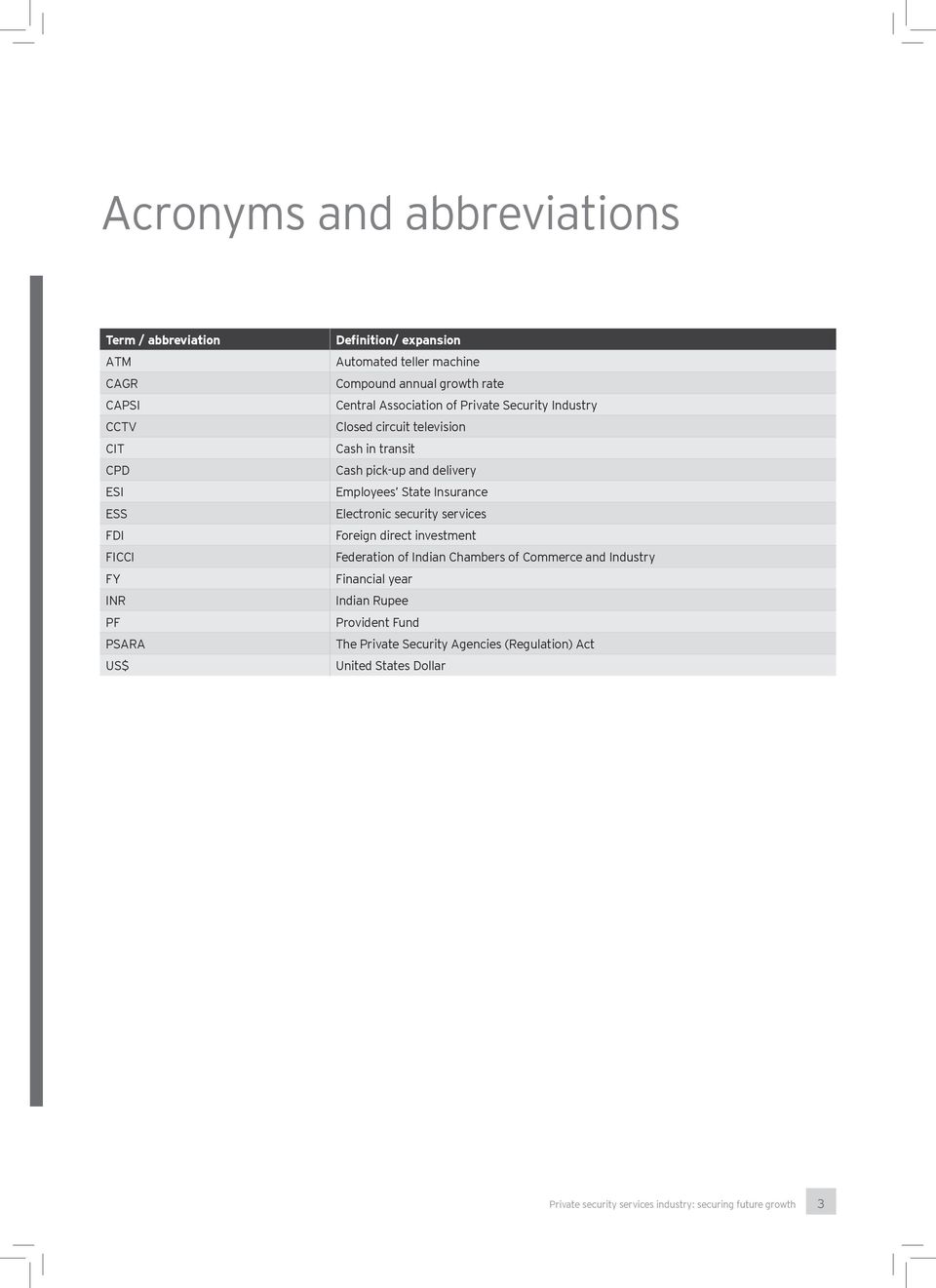
3 Acronyms and abbreviations Term / abbreviation ATM CAGR CAPSI CCTV CIT CPD ESI ESS FDI FICCI FY INR PF PSARA US$ Definition/ expansion Automated teller machine Compound annual growth rate Central Association of Private Security Industry Closed circuit television Cash in transit Cash pick-up and delivery Employees State Insurance Electronic security services Foreign direct investment Federation of Indian Chambers of Commerce and Industry Financial year Indian Rupee Provident Fund The Private Security Agencies (Regulation) Act United States Dollar Private security services industry: securing future growth 3
4 Foreword The private security industry has assumed a more critical role in recent years. With the exponential growth of the Indian economy over the last two decades, the need for security arrangements of industrial complexes, offices, IT parks and other public infrastructures such as airports, metro stations, shopping malls and public utilities has grown manifold. In order to meet this demand, the industry has significantly scaled its operational capabilities to supplement government machinery towards maintaining safety and security of citizens and their assets. The private security industry in India is estimated to be INR 350 billion, operating across 550 districts, directly employing more than 60 lakh individuals, notably finding traction from the youth population of the BPL category as an employment opportunity. This is indeed a sunrise sector, with potential to be the second-largest employment generator and a major source of revenue for the exchequer by way of taxes. India is estimated to be amongst the top 10 security markets in the world by 2020, which leads to significant opportunities to be leveraged. Besides adding to the economy, it has the potential to become an extended arm of law enforcement authorities. The FICCI EY report is an attempt to address various issues and key drivers of the private security industry. I am confident that the information presented in this report will serve as a valuable reference to all stakeholders. A. Didar Singh Secretary General, FICCI 4 Private security services industry: securing future growth

5 Executive summary The global private security services industry is estimated to be US$132 billion in 2011 and is expected to grow at a CAGR of 7% to reach US$220 billion by However, the Indian private security services industry is expected to grow much faster, at 20% over the next few years, and is estimated to grow from INR 365 billion in FY13 to INR 640 billion by FY18. Globally, and in India, manned guarding is the key segment in private security services space followed by cash services. Manned guarding contributes more than 90% of the private security services industry, and is estimated to employ more than 6 million people. The industry is expected to witness robust growth driven by sustained security threat perception and increase in labor wages according to statutory guidelines. Procurement and retention of quality manpower is the key challenge facing the industry. Manpower procurement and retention is expected to get tough with increase in alternate employment opportunities and rapid rise in manpower requirement to support the industry s growth. The industry is considerably fragmented today, and is expected to get more organized, with the enactment of the PSARA Act in states, and increase in organized play in user industry segments. Adherence to regulatory norms, particularly those related to wages is expected to improve going forward, and will impact margins, which are already under pressure due to intense competition. Cash services business, currently a small segment of the private security industry, is expected to grow at a rate of 25% over the next few years. The initiative of Ministry of Finance and introduction of white label ATMs will propel growth in the number of ATMs. Margins, however, are under pressure due to price competition by small players that are relatively less compliant with global industry norms as compared to bigger players. Security service companies in India are not allowed to procure arms licenses, and hence, have to rely on guards who have procured licenses in their personal capacity. Globally, several countries allow procurement of licenses by security service companies. A regulation that allows security agencies to procure arms while ensuring enough checks and balances to prevent unauthorized usage will be beneficial for the industry. Several security service companies provide allied services such as installation, operations and maintenance of electronic security products such as CCTVs. Currently, while the revenues from this segment, for large security service companies are generally not significant, it is going to gain increased importance as companies decide to cut operational costs and invest more in technology products. Despite the challenges, the security services industry is expected to continue its growth momentum forward. Leading companies expect strong organic growth in manned guarding, and cash services, and are increasing their capabilities in auxiliary services such as facility management and pest control, or value-added services such as consultancy and training. The industry has witnessed a spate of acquisitions and infusion of private equity funds in the past, and will continue to have significant potential in the future. Private security services industry: securing future growth 5

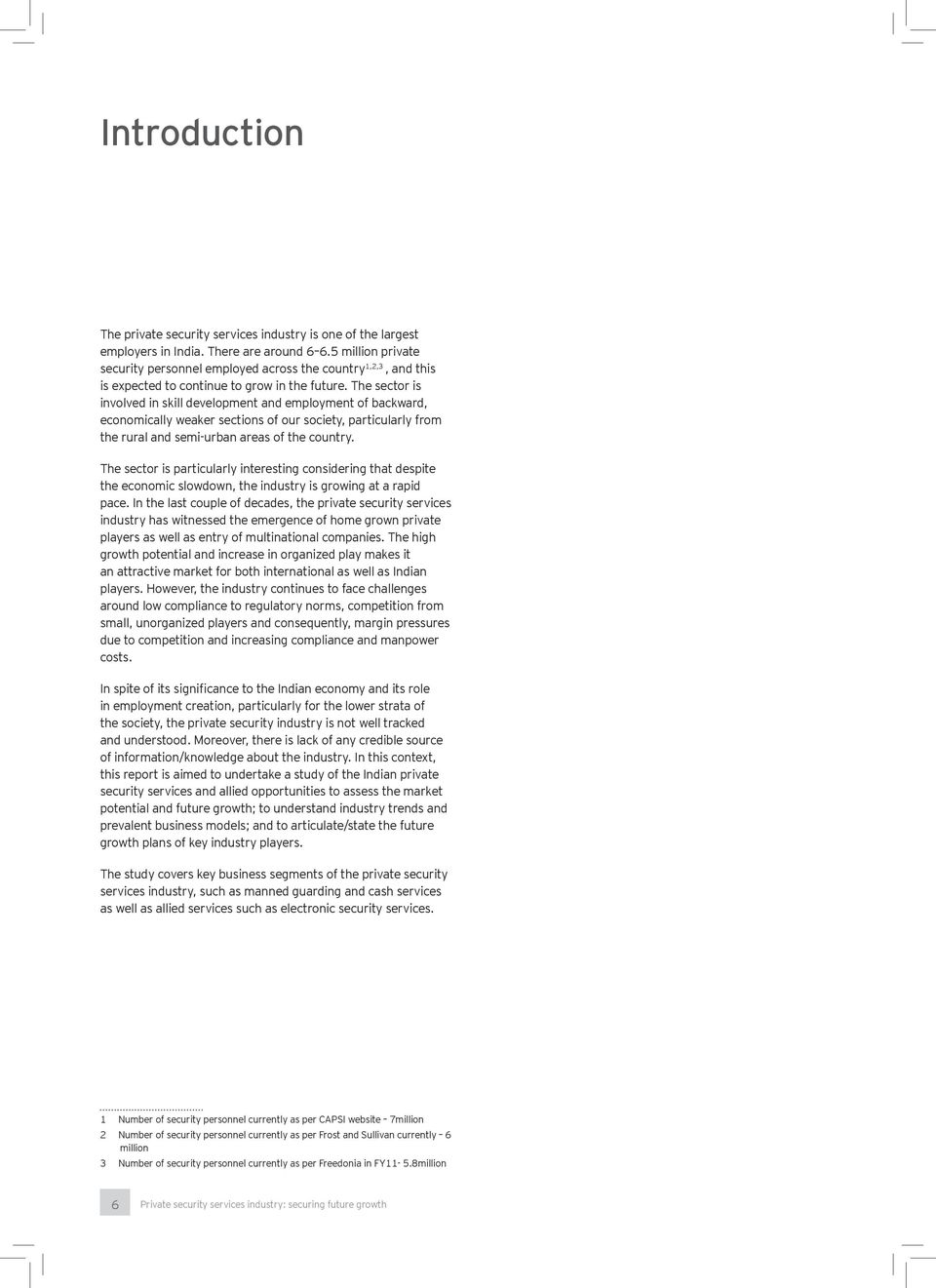
6 Introduction The private security services industry is one of the largest employers in India. There are around million private security personnel employed across the country 1,2,3, and this is expected to continue to grow in the future. The sector is involved in skill development and employment of backward, economically weaker sections of our society, particularly from the rural and semi-urban areas of the country. The sector is particularly interesting considering that despite the economic slowdown, the industry is growing at a rapid pace. In the last couple of decades, the private security services industry has witnessed the emergence of home grown private players as well as entry of multinational companies. The high growth potential and increase in organized play makes it an attractive market for both international as well as Indian players. However, the industry continues to face challenges around low compliance to regulatory norms, competition from small, unorganized players and consequently, margin pressures due to competition and increasing compliance and manpower costs. In spite of its significance to the Indian economy and its role in employment creation, particularly for the lower strata of the society, the private security industry is not well tracked and understood. Moreover, there is lack of any credible source of information/knowledge about the industry. In this context, this report is aimed to undertake a study of the Indian private security services and allied opportunities to assess the market potential and future growth; to understand industry trends and prevalent business models; and to articulate/state the future growth plans of key industry players. The study covers key business segments of the private security services industry, such as manned guarding and cash services as well as allied services such as electronic security services. 1 Number of security personnel currently as per CAPSI website 7million 2 Number of security personnel currently as per Frost and Sullivan currently 6 million 3 Number of security personnel currently as per Freedonia in FY11-5.8million 6 Private security services industry: securing future growth
7 Industry structure Exhibit 1: Industry structure Security services industry Allied services Manned guarding Cash services Electronic security services Unorganized Organized Predominantly organized Unorganized Organized Industry characteristics Manned guarding implies providing guarding services in client premises against unauthorized access or occupation, and guarding property against destruction and damage Key industry user segments BFSI IT/ITES Manufacturing Cash services are provided to banks for safe transit of cash in the banking network Cash services are also provided to large corporate and retail customers for collection of cash and valuables BFSI is the key industry user segment followed by retail The segment includes services such as system integration, operations and maintenance of electronic security products in customer premises Segment includes large OEMs with proprietary products and a number of system integrators Key industry user segments Office complexes Retail Airports and other public infrastructure Retail Commercial Focus on study Manned guarding is the largest segment in the security services industry and pertains to provision of manpower to secure premises and individuals. Relevant activities within manned guarding include surveillance and protection of industrial, commercial and infrastructure facilities goods and people (both static and mobile), security checks, crowd management (e.g., event security) and close protection. Cash services is a relatively small but rapidly growing opportunity. It relates to provision of secured logistics for cash and other valuables from banks and other corporate entities. While there are specialized cash services players, given the synergistic nature of the services, it is also an extension of manned guarding operations of a number of private security services players. While electronic security services is a substantial opportunity (albeit significantly smaller than manned guarding), it is primarily dominated by large international OEMs and building solutions provider. Security service companies typically provide electronic security services as an add-on service to their existing customers, and are involved in installation, monitoring and maintenance. Private security services industry: securing future growth 7

8 Global security services market Size and growth expectations The global security services industry was estimated at US$132 billion 4 in 2011 with the largest market being North America, followed by Western Europe, Asia Pacific and other countries. Exhibit 2: Global security services Industry ( ) 5 US$bn % 6% % % % N. America Western Europe Asia Pacific Others 7% 9% 10% 4% 4% economies of North America and Western Europe is expected to be driven by the economic recovery. Key segments of the global market The security services market comprises manned security, electronic security systems, cash solutions, and others. Manned security accounts for the biggest part of the security services market with a 62% 7 share of the market. Manned security is predominantly a labor cost plus mark-up business. Security systems and cash solutions are the other significant segments. Exhibit 3: Global security services: Service-wise split (2011) 8% 62% 20% 10% 5 The global security services market, which has grown at a 4% 6 CAGR between 2002 and 2011, is demonstrating major changes in its growth pattern. The developed markets of North America and Western Europe, which used to historically drive the global security services market, are currently registering low rate of growth as compared to the new markets of the Asia- Pacific region and other countries. In the Asia-Pacific region and other countries, there are several countries at varying stages of economic development. The growth of these economies, combined with security threats and low security utilization compared to Western market levels will drive the security services industry in the near future. Countries such as India and China hold significant business opportunities for security services companies as the governments in these two countries are making investments in upgrading airports, aviation systems, shipping ports, highways, tourism and retail sectors. The growth of the security services industry in developed 4 Initiating Coverage on Prosegur, Kepler Capital Markets report, June Initiating Coverage on Prosegur, Kepler Capital Markets report, June Initiating Coverage on Prosegur, Kepler Capital Markets report, June 2012 Manned Guarding Security Systems Cash Solutions Others Among its client base, industrial, government, energy/utilities and financial institutions form around 70% 8 of the market opportunity. Exhibit 4: Global security services: User industry split (2011) 7% 21% 13% 10% 14% Industrial Government Energy Utility Financial Institutions 15% Commercial Ports/Airports 20% Retail 7 Initiating Coverage on Prosegur, Kepler Capital Markets report, June Initiating Coverage on Prosegur, Kepler Capital Markets report, June Private security services industry: securing future growth

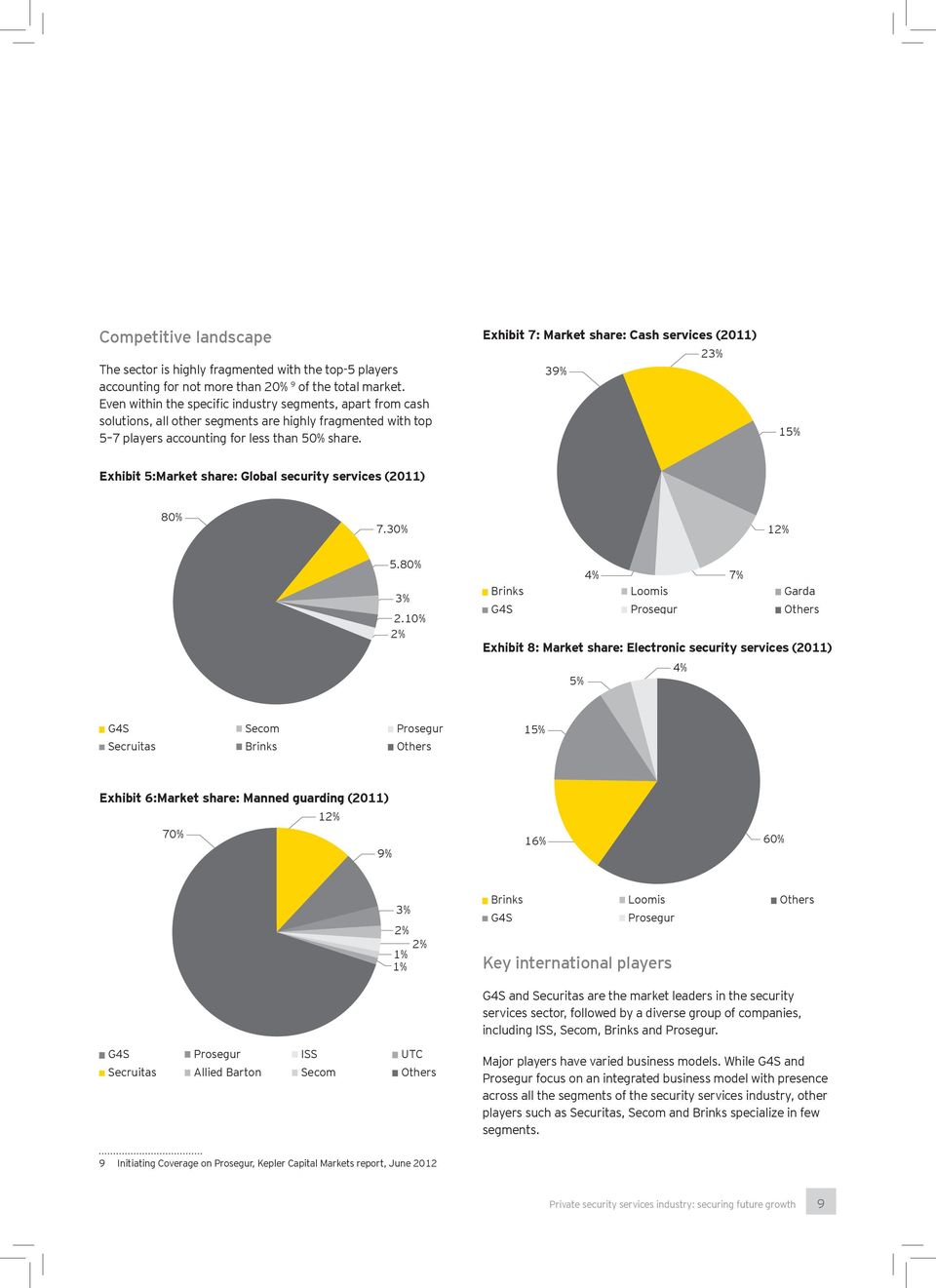
9 Competitive landscape The sector is highly fragmented with the top-5 players accounting for not more than 20% 9 of the total market. Even within the specific industry segments, apart from cash solutions, all other segments are highly fragmented with top 5 7 players accounting for less than 50% share. Exhibit 7: Market share: Cash services (2011) 39% 23% 15% Exhibit 5:Market share: Global security services (2011) 80% 7.30% 12% 5.80% 3% 2.10% 2% 4% 7% Brinks G4S Loomis Prosegur Garda Others Exhibit 8: Market share: Electronic security services (2011) 4% 5% G4S Secruitas Secom Brinks Prosegur Others 15% Exhibit 6:Market share: Manned guarding (2011) 12% 70% 9% 16% 60% 3% 2% 1% 2% 1% Brinks Loomis G4S Prosegur Key international players Others G4S and Securitas are the market leaders in the security services sector, followed by a diverse group of companies, including ISS, Secom, Brinks and Prosegur. G4S Secruitas Prosegur Allied Barton ISS Secom UTC Others Major players have varied business models. While G4S and Prosegur focus on an integrated business model with presence across all the segments of the security services industry, other players such as Securitas, Secom and Brinks specialize in few segments. 9 Initiating Coverage on Prosegur, Kepler Capital Markets report, June 2012 Private security services industry: securing future growth 9
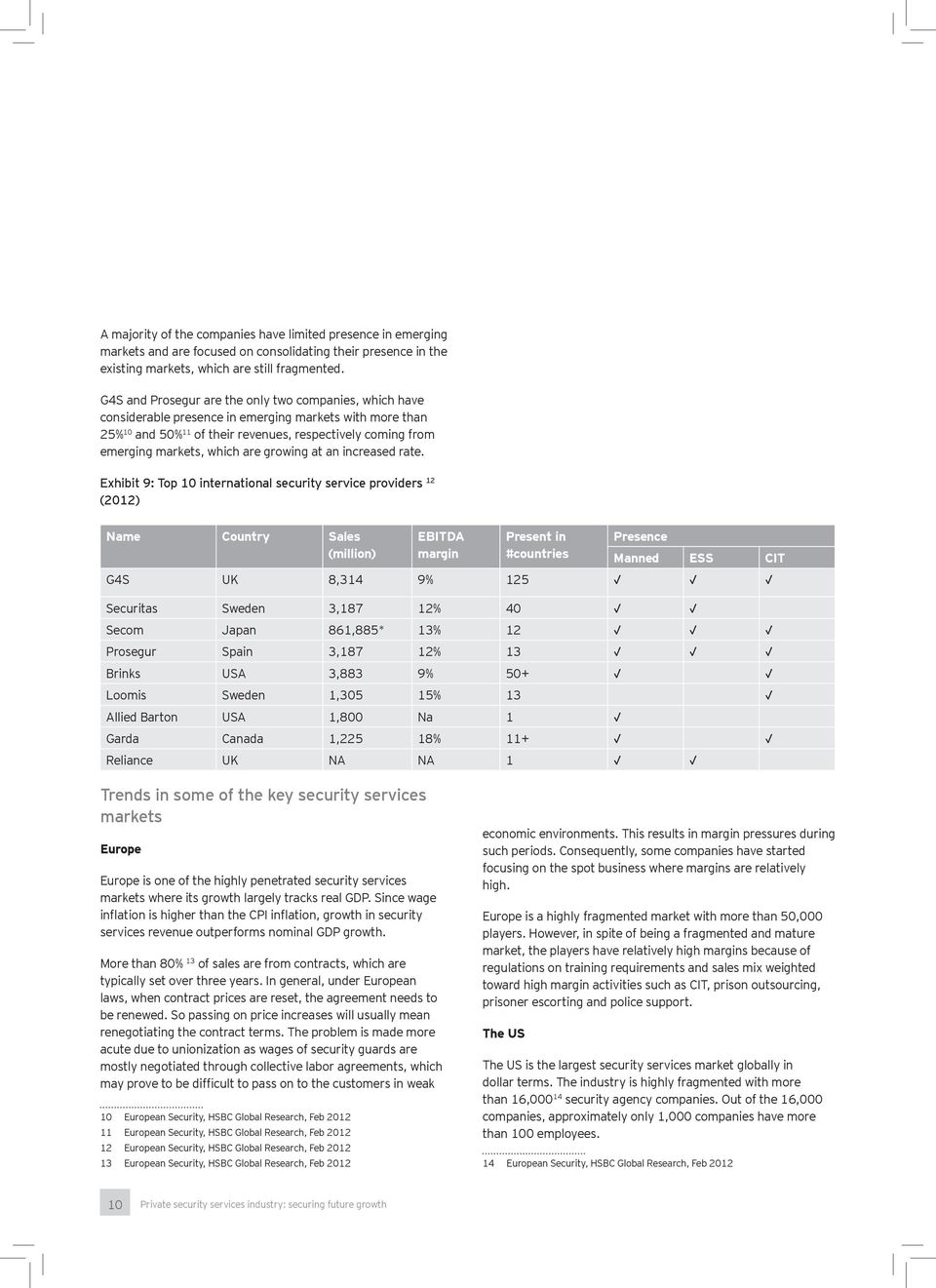
10 A majority of the companies have limited presence in emerging markets and are focused on consolidating their presence in the existing markets, which are still fragmented. G4S and Prosegur are the only two companies, which have considerable presence in emerging markets with more than 25% 10 and 50% 11 of their revenues, respectively coming from emerging markets, which are growing at an increased rate. Exhibit 9: Top 10 international security service providers 12 (2012) Name Country Sales EBITDA Present in Presence (million) margin #countries Manned ESS CIT G4S UK 8,314 9% 125 Securitas Sweden 3,187 12% 40 Secom Japan 861,885* 13% 12 Prosegur Spain 3,187 12% 13 Brinks USA 3,883 9% 50+ Loomis Sweden 1,305 15% 13 Allied Barton USA 1,800 Na 1 Garda Canada 1,225 18% 11+ Reliance UK NA NA 1 Trends in some of the key security services markets Europe Europe is one of the highly penetrated security services markets where its growth largely tracks real GDP. Since wage inflation is higher than the CPI inflation, growth in security services revenue outperforms nominal GDP growth. More than 80% 13 of sales are from contracts, which are typically set over three years. In general, under European laws, when contract prices are reset, the agreement needs to be renewed. So passing on price increases will usually mean renegotiating the contract terms. The problem is made more acute due to unionization as wages of security guards are mostly negotiated through collective labor agreements, which may prove to be difficult to pass on to the customers in weak 10 European Security, HSBC Global Research, Feb European Security, HSBC Global Research, Feb European Security, HSBC Global Research, Feb European Security, HSBC Global Research, Feb 2012 economic environments. This results in margin pressures during such periods. Consequently, some companies have started focusing on the spot business where margins are relatively high. Europe is a highly fragmented market with more than 50,000 players. However, in spite of being a fragmented and mature market, the players have relatively high margins because of regulations on training requirements and sales mix weighted toward high margin activities such as CIT, prison outsourcing, prisoner escorting and police support. The US The US is the largest security services market globally in dollar terms. The industry is highly fragmented with more than 16, security agency companies. Out of the 16,000 companies, approximately only 1,000 companies have more than 100 employees. 14 European Security, HSBC Global Research, Feb Private security services industry: securing future growth
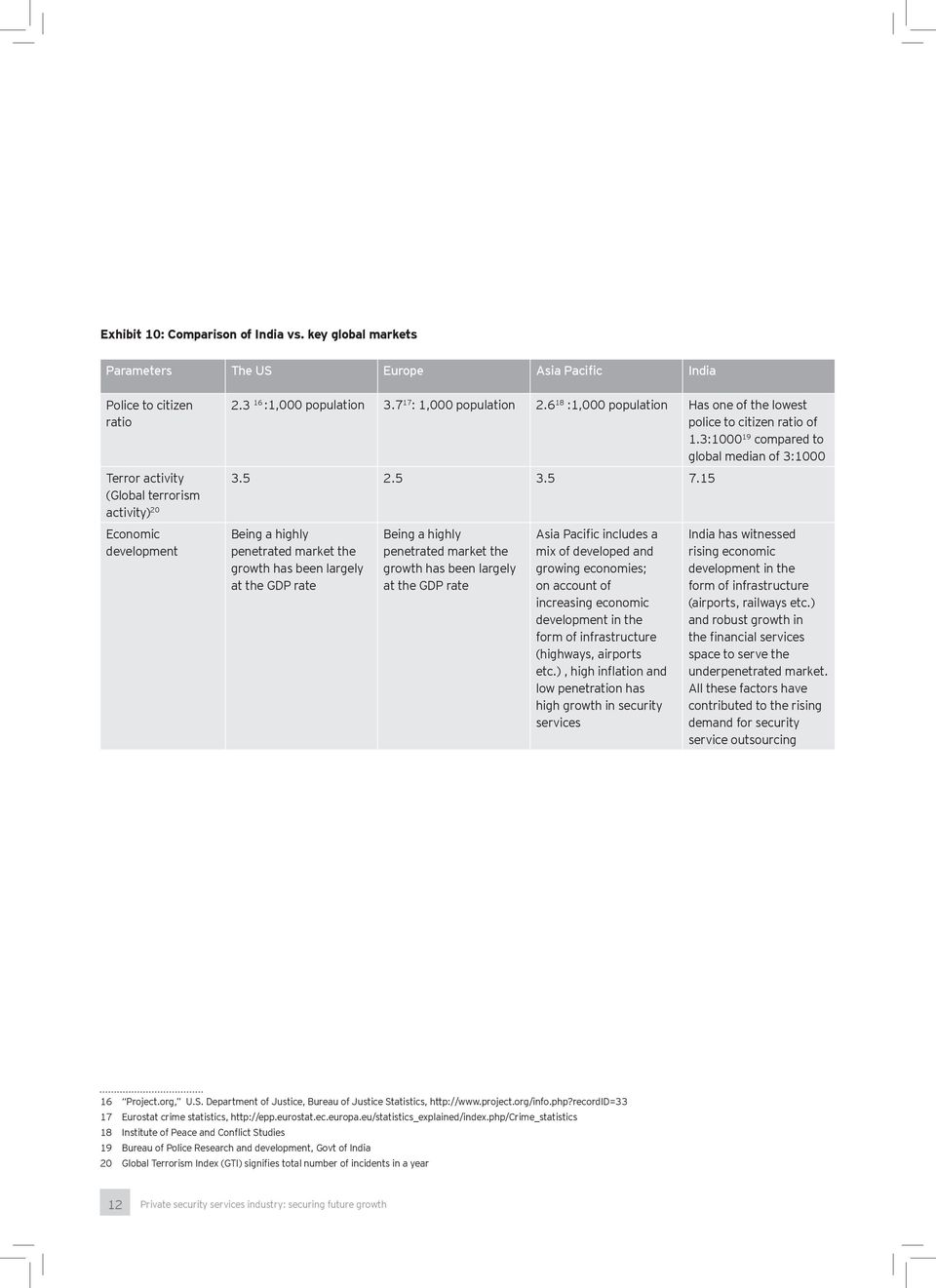
11 With the exception of the period after 9/11, security services revenue have grown broadly in line with the GDP. For security services companies, the mark-up on wages is not usually fixed and wage increases needs to be negotiated with the customer, usually on an annual basis. Given c80% 85% of the contracts are annual, the billing rate to customers may lag behind actual increases in wages. The margins in the US market differ materially by activity type. Security guarding and investigation have operating margins (c55% 60% of total security market in ) ranging from 5% to 8%. In contrast, the margins in security systems business can be as high as 25% 30%. Asia-Pacific region The security services market in the Asia-Pacific region (ex- Japan) is estimated at US$28 billion 15 in 2011, accounting for 21% of the world market. While the Asia-Pacific market growth has significantly exceeded the global average over the past two decades, low average per capita penetration of private security services, especially in emerging markets such as India and China, reflects the region s relatively untapped potential. Leading security companies in Asia- ex- Japan include G4S with US$1bn of revenue in the region, and strong Asia Pac players such as the SIS Group and Certis Cisco, both with revenues of US$500mm. While the SIS Group is one of the leading players in Australia and India, Certis is a key player in Singapore with operations in Malaysia, Indonesia, China, Hong Kong, Sri Lanka, UAE and Qatar. Global companies are also increasingly expanding or have firm plans to expand their presence in the region with its high growth potential. - Leading Indian player in security services Increasing terror threats and homicide cases in the Asia-Pacific countries, coupled with low police officer to population ratio is expected to lead to higher demand for private security. Unlike the developed economies, contracts in emerging markets have indexation measures, i.e., it is relatively easy to pass on increase in costs to customers thereby, protecting the margins of players. Traditionally, the core of most security services businesses is manned security, which is the provision of security guards on the clients premises. It is predominantly a labor-cost plus markup business. As is true for any low-margin labor-cost plus markup business, the low manned guarding margin business requires very disciplined and well-managed operation, especially on costs. Significant competition and companies deriving increased proportion of revenues from low margin manned security business has led to companies working on low margins. This has resulted in companies shifting to various adaptations to the basic model for increasing profits: Offering more expensive guards Targeting more specialized market segments Offering technology solutions along with manned guarding Integrated facility services India vs. key global markets: a comparative snapshot Security services market has grown globally from increased security consciousness because of increasing terror threat faced by countries and low police-to-citizen ratio resulting in the inability of the system to cater to the needs of the population. These factors and expected economic development will drive the growth in demand for private security services globally. When compared to some of the other markets, while India ranks significantly high on terror activity index (7.15 incidents v. 3.5 incidents for US and 2.5 incidents for Europe), it has one of the lowest police-to-citizen ratio (1.3:1,000 v. global median of 3:1,000). This fact, coupled with the expected rapid economic development and growth in financial services, suggest that private security services in India will grow at a faster rate than some of the other developed and matured markets. Given the fragmented nature of the industry, pricing will remain a key differentiator for security agencies, especially when cost savings become the key motivation for outsourcing. 15 European Security, HSBC Global Research, Feb 2012 Private security services industry: securing future growth 11

12 Exhibit 10: Comparison of India vs. key global markets Parameters The US Europe Asia Pacific India Police to citizen ratio Terror activity (Global terrorism activity) 20 Economic development :1,000 population : 1,000 population :1,000 population Has one of the lowest police to citizen ratio of 1.3: compared to global median of 3: Being a highly penetrated market the growth has been largely at the GDP rate Being a highly penetrated market the growth has been largely at the GDP rate Asia Pacific includes a mix of developed and growing economies; on account of increasing economic development in the form of infrastructure (highways, airports etc.), high inflation and low penetration has high growth in security services India has witnessed rising economic development in the form of infrastructure (airports, railways etc.) and robust growth in the financial services space to serve the underpenetrated market. All these factors have contributed to the rising demand for security service outsourcing Project.org, U.S. Department of Justice, Bureau of Justice Statistics, 17 Eurostat crime statistics, 18 Institute of Peace and Conflict Studies 19 Bureau of Police Research and development, Govt of India 20 Global Terrorism Index (GTI) signifies total number of incidents in a year 12 Private security services industry: securing future growth
13 Overview of private security services market in India The private security services market is dominated by large multinational and Indian players on one end of the market and a fairly fragmented, unorganized segment on the other. The key service offerings for private security players are around manned guarding and cash services and allied services such as electronic security services. The Indian security services industry has grown rapidly in the last decade, given the continuing threat perception from crime and terrorism; demand for security in new infrastructure projects such as airports roads and telecom towers; emergence of modern retail and growing need for security for movement of cash within the banking system. The industry appears to have been relatively less impacted by the current economic slowdown, and is expected to grow at 20% over the next few years. The private security services market is estimated to be INR billion in FY13. Manned guarding is the largest component of the private security services industry and is expected to contribute more than 90% of the private security services market. Cash services is expected to grow at a faster rate as compared to the manned guarding market over the next few years. However, considering the relative market sizes, manned guarding is expected to be a predominant component of the private security services market. Exhibit 11: Market size Private security services market CAGR % % % FY13E FY18P Market size (INR bn) Manned guarding Cash services

14 Manned guarding Manned guarding industry is estimated to be INR billion currently and is expected to grow at a CAGR of 20% by FY18. Exhibit 12: Projections for manned guarding market CAGR ~20% FY13E FY14P FY15P FY16P FY17P FY18P Lower estimate Higher estimate Market size (INR bn) 21 Exhibit 13: Methodology to estimate manned guarding 22, 23 market for FY13 Category Number of guards Revenue per guard per month Market size (INR bn) Top 10 players 5 6 lakhs 8,000-9, Other organized 8 9 lakhs 7,000-8, Unorganized lakhs ~4, Total lakhs Industry discussions suggest that the number of guards belonging to the top-10 players in the industry will be around 5 6 lakh guards and accounts for ~40% of the organized market. Information around minimum wages, revenue per guard for select key players and gross margins in the industry indicate that revenue per guard for large players will be around INR8,000 9,000 per month. Discussions also suggest that the level of compliance and consequently, the cost of compliance declines gradually across various tiers of players in the industry. 21 Industry discussions, EY analysis 22 Industry discussions, EY analysis 23 Note: Range for overall market size is based on estimated range of organized and unorganized segments Hence, revenue per guard for other organized players has been estimated to be marginally lower at INR 7,000 8,000 per month. Organized proportion of the market is at approximately 35%, which leads to a market size of INR billion for the total manned guarding industry in India. The manned guarding market in India has witnessed robust growth over the last few years. Growing incidences of terrorist attacks and crimes, and high pace of infrastructure development has led to significant demand for security service personnel. Furthermore, the availability of governmentemployed security personnel is limited and costly to deploy. CISF personnel employed by the Government at the periphery of airports, ports and other high consumption sites appear to be more expensive and scarce as a resource as compared to armed guards from the private sector. The Indian Parliament has recently passed the Central Industrial Security Force (Amendment) Bill 2008, paving the way for the government to provide Central Industrial Security Force (CISF) security to private industrial establishments on cost re-imbursement basis, besides providing CISF security cover for Indian embassies abroad as well as for India s UN missions. - Institute for defence studies and analysis, March 2009 The increase in demand and the gap between requirement and availability of government-employed security personnel has led to substantial growth for the manned guarding industry. Evolution of the manned guarding industry over time has also contributed to the growth in demand. As the quality of trained manpower has improved, an increasing number of companies have been confident and willing to outsource their security service requirements. This has led to increase in outsourcing of security services requirements by corporate entities. Furthermore, migration of men and women from rural to urban areas has also led to increased availability of manpower for private security service companies. Growth in manned guarding industry is driven by growth in number of guards, as well as increase in revenue per guard. Revenue per guard is usually linked to minimum wage rates as determined by various states on an occasional basis and is linked to inflation. There has been a ~15% increase in minimum wages over the last 2 years. 14 Private security services industry: securing future growth

15 The manned guarding market grows at 1.5-2x times of GDP and is also driven by increase in wages which is linked to inflation - Leading Indian player in security services Fragmentation in manned guarding Growth in the manned guarding industry has led to proliferation of a number of private security agencies. The industry is highly fragmented, with the share of organized market currently pegged at ~35% 24. The industry is expected to become more organized in the future, with 45% 50% of the industry being organized in the next five years. Exhibit 14: Expected trend in industry split- FY13 vs. FY18 35% 52% 65% 48% FY13 Organized Unorganized FY18 Drivers of an increase in proportion of the organized market are as follows: Strict enforcement of regulations such as minimum wages, provident fund norms, gratuity, insurance, etc. may also result in an increase in number of organized players. Increase in private infrastructure such as malls and office complexes, which require considerable manpower (more than 50 guards) from a single agency, also favor organized players. Adequate training is considered to be one of the key success factors in the industry; large organized players are better positioned to provide cost-effective training to their guards Industry discussions, EY analysis Key user segments for manned guarding The demand for manned guarding is expected to increase rapidly in the future, with the burgeoning of shopping malls, SEZs, townships, IT parks and other private infrastructure facilities. Industrial and manufacturing, BFSI, retail and IT/ITES segments currently form a significant proportion of revenue for most organized players in the market. Manufacturing and industrial units are the major user segment for most players. While penetration of organized players in the large- to medium-size units is high, the SMEs and small individual establishments continue to largely rely on unorganized players for manned guarding services. Similarly, while penetration of organized players is high in the organized retail segment, most single shop/retail establishments depend on the unorganized security service providers. Private security services industry: securing future growth 15

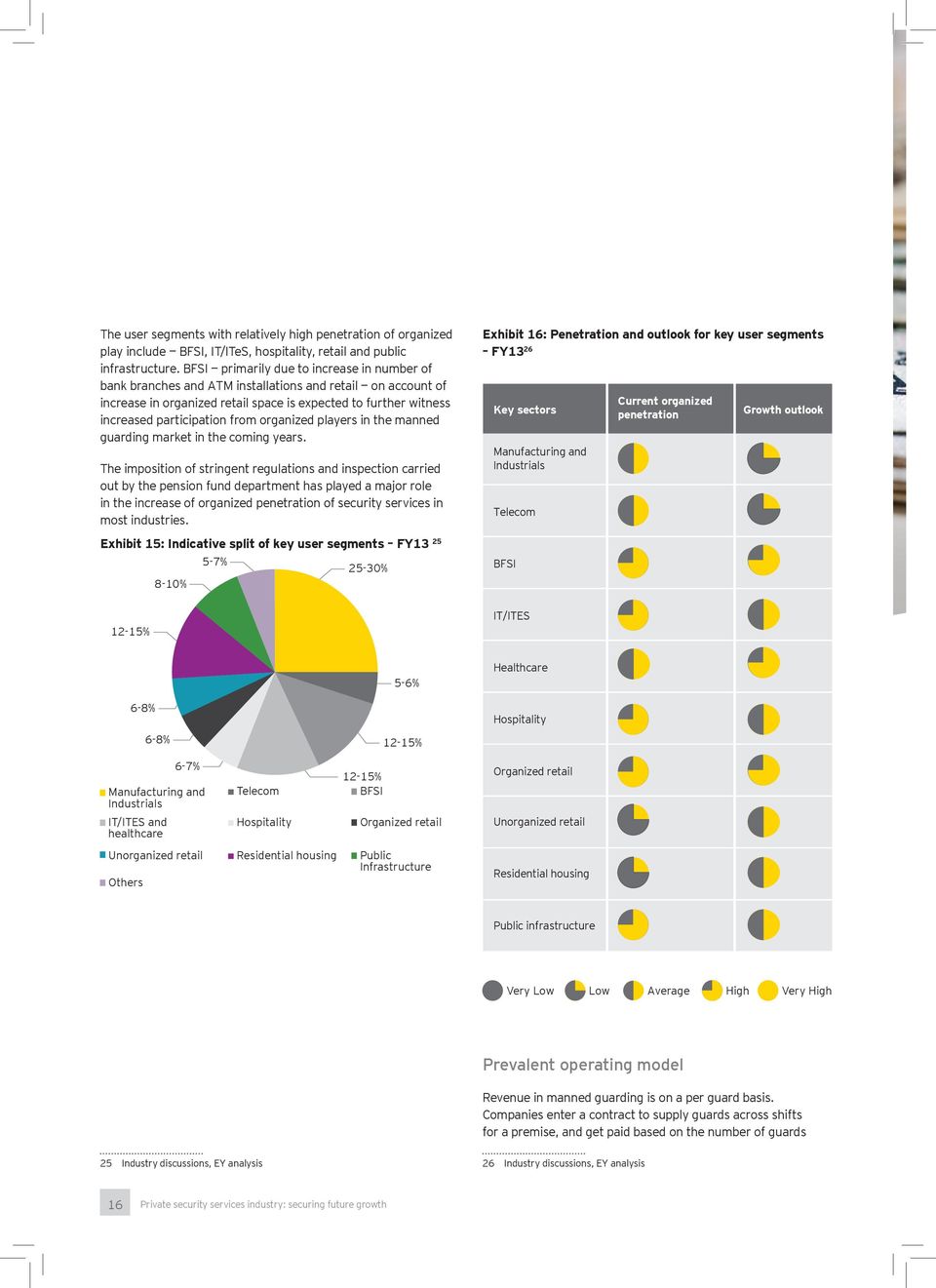
16 The user segments with relatively high penetration of organized play include BFSI, IT/ITeS, hospitality, retail and public infrastructure. BFSI primarily due to increase in number of bank branches and ATM installations and retail on account of increase in organized retail space is expected to further witness increased participation from organized players in the manned guarding market in the coming years. The imposition of stringent regulations and inspection carried out by the pension fund department has played a major role in the increase of organized penetration of security services in most industries. 25 Exhibit 15: Indicative split of key user segments FY % 25-30% 8-10% 12-15% Exhibit 16: Penetration and outlook for key user segments FY13 26 Key sectors Manufacturing and Industrials Telecom BFSI IT/ITES Current organized penetration Growth outlook 5-6% Healthcare 6-8% 6-8% 12-15% Hospitality 6-7% Manufacturing and Industrials IT/ITES and healthcare Telecom Hospitality 12-15% BFSI Organized retail Unorganized retail Residential housing Public Infrastructure Others Organized retail Unorganized retail Residential housing Public infrastructure Very Low Low Average High Very High Prevalent operating model Revenue in manned guarding is on a per guard basis. Companies enter a contract to supply guards across shifts for a premise, and get paid based on the number of guards 25 Industry discussions, EY analysis 26 Industry discussions, EY analysis 16 Private security services industry: securing future growth
17 supplied. Manpower-related expenses for the companies include wages, bonus and statutory contributions such as PF and ESI. Companies add a markup on the cost to company of a guard for invoicing to the client. Large customers often have centralized contracts with leading security service companies, which provides better administrative control. In certain instances, regional offices of companies take decisions on vendors for manned guarding. Leading companies often have branches across states, which serve as sales offices for developing relationships at a local level. Branches also serve as recruitment centers for guards. Moreover they often have their own P&Ls and they are responsible for their own revenue, costs and meeting guard deployment requirements. Large players also invest in training centers, which provide training to develop quality manpower. This trained manpower can then be absorbed for manned guarding requirements. I do not see any evolution in manned guarding business in the next few years. Globally, the model is on a revenue per guard basis predominantly - Leading Indian security services player Trends in pricing Pricing in manned guarding segment, as stated earlier, is predominantly on a cost plus basis. Wages for security guards employed with largely organized players is usually linked to minimum wages as defined by each state under the Minimum Wages Act and is usually revised from time to time by states. Large organized players are relatively more compliant to labor norms, and have to make contributions related to PF and ESI for the guards. As these contributions are linked to wages, pricing trends for the organized sector are predominantly governed by minimum wage guidelines. Discussions suggest that the pricing has increased by around 15% 20% for the large organized players, which has been in line with the increase in minimum wages. The unorganized segment is reportedly less compliant to labor laws, and wages in this segment are expected to be more a function of market dynamics. Hence, pricing in the unorganized sector is more market driven and is generally significantly lower than the organized sector. With more stringent enforcement of labor laws, the cost of compliance for small players is likely to increase in future. Private security services industry: securing future growth 17

18 Cash services The cash services industry size is estimated to be INR14 17 billion currently, and is estimated to be growing at 25% p.a. 27 Exhibit 17: Projections for cash services market 27 Market size (INR bn) CAGR ~25% FY13 FY14E FY15E FY16E The cash services segment is gradually evolving as a key and fast-growing service offering within the private security services industry. The key offerings within the cash services are: ATM replenishment: Involves providing cash replenishment and first-line maintenance services for ATM networks of banks Cash-In-Transit (CIT): Involves movement of cash and high value items within a bank s branch network Cash Pickup and Delivery (CPD): Involves secure pickup and delivery of cash and cheques for large corporate houses and their business outlets ATM replenishment is the largest segment of the cash services market. Replenishment of approximately 80,000-90,000 ATMs in India is estimated to be outsourced to cash services players. Industry discussions suggest that realization per ATM is in the range of INR7,000 9,000 per month. This leads to an estimated market size of INR7 10 billion. Industry discussions suggest that the other two segments in the cash services space, such as CPD and CIT business are estimated to be around INR3 4 billion each, currently. This pegs the cash services industry size to INR14-17 billion, currently. Exhibit 18: Segment-wise split of cash services market 28 CPD 20% CIT 27% 28 ATM replenishment 53% Banks constitute one of the largest user segments of this industry as they need to secure transport of cash for ATM replenishments as well as cash services for bank branches. Other user industries include modern retail and large corporate houses. ATM replenishment services are geared to ensure maximum uptime of ATMs along with the best utilization of cash. While cash replenishment in onsite ATMs (ATMs in bank premises) is sometimes done by the bank itself, offsite ATM servicing is often outsourced to cash services companies. Cash pick-up and delivery services include corporate and retail cash pickup and cheque collection services, cash, demand draft, and traveler s cheque delivery services at client s doorstep. Growth in the CPD market is expected to be driven by increase in organized play as well as increase in branch network of large corporate players. The cash services market is largely organized as the transaction involves significant amounts of cash and other valuables. The top seven to eight players account for around 75% 80% of the market. 27 Industry discussions, EY analysis 28 Industry discussions, EY analysis 18 Private security services industry: securing future growth

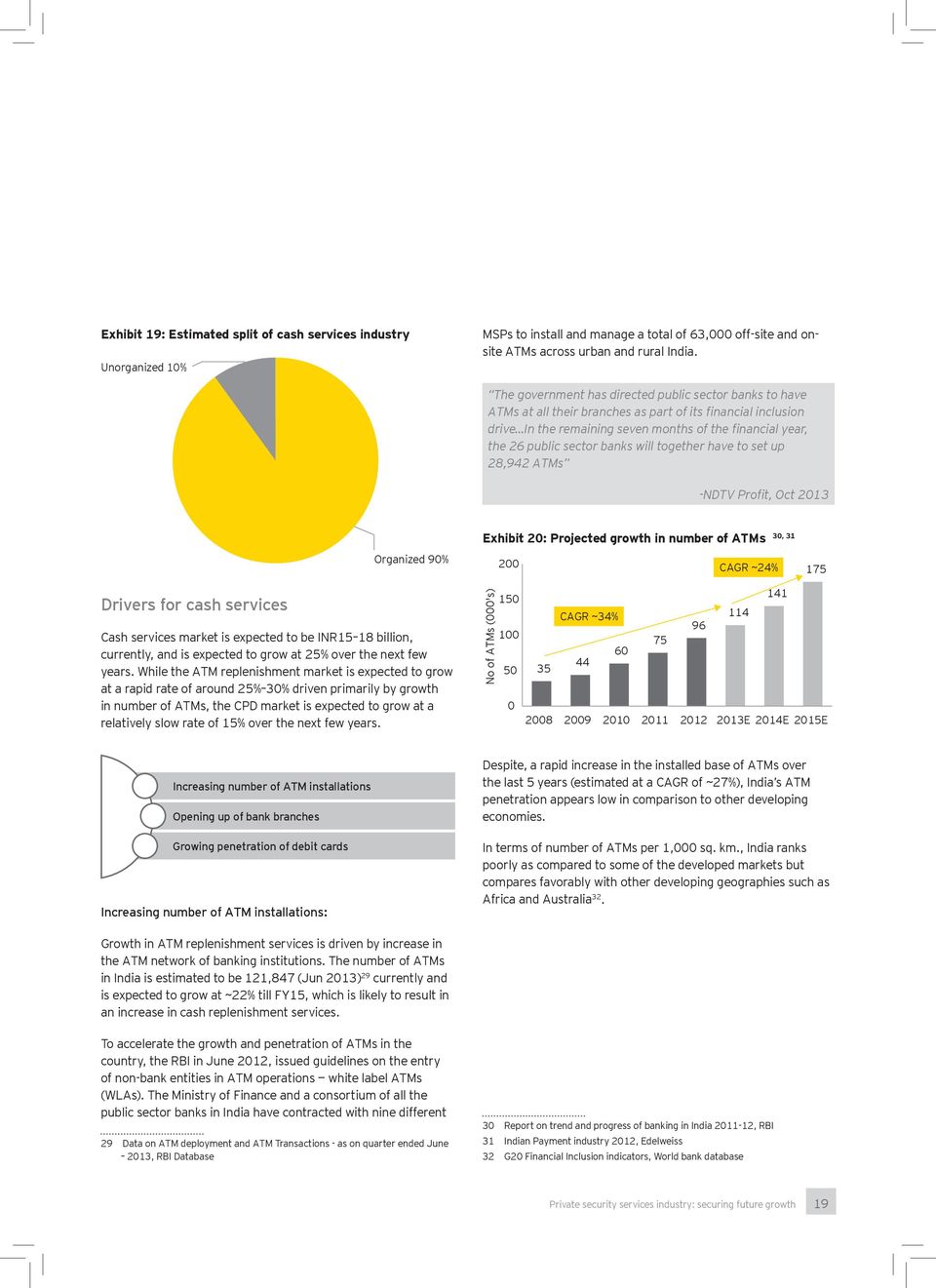
19 Exhibit 19: Estimated split of cash services industry Unorganized 10% MSPs to install and manage a total of 63,000 off-site and onsite ATMs across urban and rural India. The government has directed public sector banks to have ATMs at all their branches as part of its financial inclusion drive In the remaining seven months of the financial year, the 26 public sector banks will together have to set up 28,942 ATMs -NDTV Profit, Oct 2013 Exhibit 20: Projected growth in number of ATMs 30, 31 Organized 90% 200 CAGR ~24% 175 Drivers for cash services Cash services market is expected to be INR15 18 billion, currently, and is expected to grow at 25% over the next few years. While the ATM replenishment market is expected to grow at a rapid rate of around 25% 30% driven primarily by growth in number of ATMs, the CPD market is expected to grow at a relatively slow rate of 15% over the next few years. No of ATMs (000's) CAGR ~34% E 2014E 2015E Increasing number of ATM installations Opening up of bank branches Growing penetration of debit cards Increasing number of ATM installations: Despite, a rapid increase in the installed base of ATMs over the last 5 years (estimated at a CAGR of ~27%), India s ATM penetration appears low in comparison to other developing economies. In terms of number of ATMs per 1,000 sq. km., India ranks poorly as compared to some of the developed markets but compares favorably with other developing geographies such as Africa and Australia 32. Growth in ATM replenishment services is driven by increase in the ATM network of banking institutions. The number of ATMs in India is estimated to be 121,847 (Jun 2013) 29 currently and is expected to grow at ~22% till FY15, which is likely to result in an increase in cash replenishment services. To accelerate the growth and penetration of ATMs in the country, the RBI in June 2012, issued guidelines on the entry of non-bank entities in ATM operations white label ATMs (WLAs). The Ministry of Finance and a consortium of all the public sector banks in India have contracted with nine different 29 Data on ATM deployment and ATM Transactions - as on quarter ended June 2013, RBI Database 30 Report on trend and progress of banking in India , RBI 31 Indian Payment industry 2012, Edelweiss 32 G20 Financial Inclusion indicators, World bank database Private security services industry: securing future growth 19
20 Exhibit 21: Penetration of ATMs (per 1,000 sq. km) ATM per 1000 sq km ~1 ~1 ~1 Algeria Libya Congo ~18 ~18 India Brazil ~5 Australia ~49 US Canada However, on account of its high population base, the country s ATMs per adult ratio appears to be extremely poor in comparison to other countries 33. Exhibit 22: Penetration of ATMs (per 100,000 adults) ATM per 100,000 adults ~3 ~3 ~3 Algeria Libya Congo Opening up of bank branches India ~17 ~5 ~190 ~190 ~190 ~190 Brazil Australia US Canada In order to foster financial inclusion, the RBI has relaxed its branch authorization policy such that banks do not require prior permission to open branches in centers with population of less than 1 lakh (subject to reporting). This is likely to result in a rapid increase in the number of bank branches in India. It is estimated that an additional 70,000 branches are likely to be established across the country, from the existing base of 81,240 branches (Mar 12) G20 Financial Inclusion indicators, World bank database 34 Branches and ATMs of Scheduled Commercial Banks, Trend and Progress of Banking in India 2012 Growing penetration of debit cards Increase in penetration of debit cards is a key growth driver for the ATM replenishment business as an increase in number of debit cards will lead to increase in number of ATMs, to support debit card usage. India s penetration of debit cards per inhabitant is considerably lower than other emerging markets, thereby suggesting significant potential for increase going forward. The number of debit cards in circulation is expected to increase at a CAGR of 15% over the next four years. Exhibit 23: Number of cards per capita across countries 35 Number of cards - with cash function/ inhabitant India Brazil 2.62 China Germany Prevalent operating model Russia Australia United Kingdom In the ATM replenishment business, revenue is generally linked to number of ATMs serviced on a monthly basis. Effective route mapping is of significant importance as an increased number of ATMs covered per day can lead to an increase in profitability for cash management companies. Security is of utmost importance in the cash management business, and hence, besides vans and vehicles, companies have to make significant investments in security to reduce possibility of theft or fraud. For cash in transit business, banks usually hire vehicles on a rental basis, with vehicles being dedicated to a particular bank for particular time slots for cash transit between currency chests and branch network. Banks and Managed Service Providers (MSPs) are primary customers of cash service companies. 20 Private security services industry: securing future growth 35 Statistics on payment, clearing and settlement systems in the CPSS countries - Figures for 2012, Bank for International Settlements

21 Globally, cash management companies do a lot of work, such as common currency chest, lot of optimization work - Leading cash services player Exhibit 24: Operating models in cash services Operating models Description Relationships with banks Cash services companies often have contracts with banks for cash in transit and ATM replenishment activities Banks often have contracts with MSPs for ATM management. However, for ATM replenishment, banks often have direct relationships with cash service companies Relationships with MSPs In this model, banks outsource ATM maintenance and related activities to MSPs (managed service providers). In this case, MSPs appoint cash service players as vendors for ATM replenishment Trends in pricing Pricing in the ATM replenishment market is usually on a realization per ATM basis. Realization per ATM appears to have declined in the last few years. This has been driven by two factors: Increase in competition: Entry of players in the ATM cash services business has led to increase in competition and correspondingly, decline in ATM realizations. Furthermore, banks often outsource ATM management to MSPs, who, in turn, outsource ATM replenishment to cash service players. Pricing is an important criterion for MSPs, which has led to increased emphasis on pricing as the vendor selection criteria in the cash services market. Low marginal cost of servicing an ATM: Increase in plastic money and increase in number of ATM transactions by customers have led to an increase in geographical density of ATMs, particularly in Metros and prominent cities. Private security services industry: securing future growth 21
22 Electronic security services The electronic security services market is estimated to be INR35 40 billion 36 in FY13 and is expected to grow at around 25% over the next few years. Electronic security systems include CCTV, alarm systems, access control systems and other electronic equipment installed for security reasons. Honeywell, Siemens and Schneider are the key manufacturers of these products. Electronic security services provided by large private security companies such as G4S, SIS and TOPSGRUP include product installation and O&M services. The Electronic security services market is driven by a sustained threat perception and investments in both public and private infrastructure. Security threat perception will contribute to increased demand for security and surveillance systems such as access turnstiles and CCTVs. Demand for security systems is also expected to increase with increase in organized play of retail and office infrastructure market. India continues to be an attractive offshoring destination for global players, which is likely to lead to increased investments in commercial real estate such as in IT and ITES, thereby leading to an increase in demand for security systems. Private security services providers bundle electronic security solutions along with the core offering of manned guarding with the aim to provide integrated solutions to its customers. They are primarily involved in installation, operation and monitoring of the electronic security systems and compete with system integrators who specialize in providing integrated security systems to end-users. However, the electronic security solutions space is dominated by major global and Indian OEMs, such as Honeywell, Siemens, UTC, Zicom, etc., since they primarily deal directly with customers. Some of these OEMs have been developing/acquiring system integration capabilities to further augment their offerings in the Indian market. Consequently, while the electronic security services is a lucrative and rapidly growing segment, the current addressable opportunity for private security services players is relatively smaller. Future growth in this segment will be dependent on the ability of the private security services players to develop strong product portfolio and execution capabilities to compete with the larger OEMs operating in this market. Exhibit 25: Value chain in electronic security services Controls OEMs Honeywell Siemens Schneider JCI UTC Firepro System Integrators IT Integrators HCL Wipro Small but evolving channel Large security service companies install electronic security products and provide an integrated solution of manned guarding and monitoring of electronic security systems Emerging channel with the need for remote monitoring & control of IP devices. Large IT companies have entered this space Property developer/ owner/manager Unlike developed countries, OEMs in India deal directly with customers instead of going through system integrators. However, with emergence of system integrators, the channel importance may converge towards developed countries norms Major channel Presence of security services Industry discussions, EY estimate 22 Private security services industry: securing future growth
23 Critical success factors in the industry Critical success factors Competitive pricing and sustenance of margins Strong local/regional presence and influence Trained manpower and background checks Adherence/ compliance to regulations Effective route mapping for cash services Description Pricing plays an important role, since it is an extremely competitive market with little differentiation perceived by customers. Manned guarding, which forms the majority of the security services market, predominantly works on labor cost plus mark-up model. There is strong emphasis on controlling costs since it is a low-margin business. Strong local influence is required for smooth coordination with local authorities and better management of industrial relationships especially in industrial and retail sectors. Furthermore, many clients insist on having high proportion of local manpower with fluency in regional languages. Local presence also helps the companies to meet the incremental demands of clients and enhances their ability to scale up in limited time. High attrition rate and shortage of skilled manpower is a critical issue in the industry. Continuous supply of manpower is critical to meet client requirement and ensure serviceability. The demand supply gap tilts the balance of power in favor of the manpower. Consequently, some agencies reportedly pay more than average minimum wages to ensure high retention rate. A growing push toward better training, background checks, and professionalizing the local industry will help to counterbalance distrust and any mishaps. Training is particularly important since many guards are recruited from rural areas and are unfamiliar with many aspects of working in urban areas, but are quickly expected to know who should be allowed in a facility, spot trouble, and serve as first responders in cases of accidents and fires. It is imperative for companies to meet compliance requirements of clients through strong MIS and IR management, which is critical to sustain the confidence of large corporate customers. Similarly, adherence to key regulations governing the industry is also important to ensure smooth operation and confidence of customers. In the cash services business, effective route mapping is very important to ensure efficient and profitable operations. Private security services industry: securing future growth 23
24 Key challenges in the industry In spite of rapid growth over the last few years, the industry faces a number of challenges, which could impact future potential. These challenges are around the availability and retention of quality manpower, managing costs associated with compliance and regulatory challenges in acquiring firearms. 1. Lack of quality manpower: The private security services industry is manpower intensive, and requires a considerable number of personnel to sustain its growth momentum. However, availability of quality manpower is one of the key issues plaguing the industry. A majority of security guards do not receive significant higher wages than the stipulated minimum wages. This makes it difficult to attract and retain personnel. Furthermore, a large number of manpower comes from rural areas. However, schemes such as Mahatma Gandhi National Rural Employment Guarantee Act (NREGA) have led to creation of employment opportunities in rural India and hence, have resulted in a decline in flow of manpower from rural areas that can be deployed in the security services industry. Furthermore, with upgrading of skills and technical capabilities, security guards explore alternate employment options such as cab driving, electrician, etc., which enables them to enhance their income. A related issue plaguing the industry is availability of quality manpower. Industry discussions suggest that clients often require trained security personnel. However, several players, particularly in the unorganized sector, do not appear to invest significantly in training infrastructure. 2. High attrition rates: Attrition is a major cause for concern in the security services industry. This is due to several factors such a poor benefits and compensation packages, improper understanding of the operating environment, and lack of development opportunities to allow employees to grow. 3. Compliance requirements: Increasing compliance requirements such as training and minimum wages can lead to escalation of costs, which pressurizes margins as well as reduces the attractiveness of certain opportunities for leading players, where the unorganized sector, with low compliance costs, will be more cost competitive. 4. Ability to acquire firearms: Security services firms, especially those operating in cash services, deal with physical movement and storage of currency notes and other valuables. Enhanced security such as an ability to carry firearms is usually a requirement to ensure safe transport of these high value items. However, private security service companies cannot get licensed firearms, and have to rely on guards, who have got the license to carry firearms for their personal use. Illustrative 26: Factors driving migration of labor Rural population pool Lack of employment in rural sector Higher income potential in urban areas Employment generation and income parity being brought about by government schemes Advantage of working on family trade and staying at home base Security services sector Organized segment Higher income Unorganized segment Upgrade of skill and technical expertise primarily through on the job training At same skill level, seek alternate employment opportunities at stores and markets Professions requiring higher skill level such as driving, electrician, plumber, mechanic etc. Provides higher income Professions requiring similar skill level 24 Private security services industry: securing future growth
25 Regulatory framework in the security services industry Growth in requirements of private security services has led to a rapid proliferation in the number of companies operating in this industry. The Government of India (GoI) has enacted The Private Security Agencies (Regulation) Act, 2005 to provide guidelines for regulation of the industry. Several state governments have enacted the PSARA Act where the state government have laid down the guidelines related to the security services industry such as licensing norms and training requirements for guards. All private security agencies in the state have to be licensed under this act. There does not seem to be any regulation pertaining specifically to the cash services industry. The leading cash service companies have made representations to the GoI to devise a regulatory framework for the cash services industry, and have recently formed an association to introduce global standards and best practices for the cash services industry. Exhibit 27: Key regulations and the current state of compliance Compliance Parameters to be provided to guards, the Minimum Wage Act and Employee State Insurance Act are some of the other regulations that have an impact on the industry. Industry discussions suggest that the level of compliance to labor laws is higher in the organized sector, as compared to the unorganized sector. While the organized sector largely appears to adhere to minimum wage regulations, the unorganized sector often pays less than minimum wages. Labor laws also stipulate payment of overtime at wages higher than the standard wage rate for hours exceeding the normal shift hours. Baring a few large players, the compliance to overtime rules may be limited with clients paying overtime wages at standard wage rates. Training imparted to guards is another area where companies, especially in the unorganized sector, may not fully adhere to regulations. The PSARA Act mandates minimum number of hours of training for guards. While some of the leading players provide training, the investment in training infrastructure by the unorganized sector largely remains inadequate. PSARA says that companies need to have training schools in every state, however, that is usually not followed Wages related Minimum wages Overtime rate PF, gratuity, bonus Gratuity, bonus Insurance Working hours and leave related Hours of work Annual and weekly leave Hours of training -Leading international player in security services The security services industry is gradually and increasingly adhering to regulatory norms. Increasing awareness among clients about labor laws is also expected to improve compliance levels for the industry. Another driver for increasing adherence to regulatory norms is the rapid growth of the market. As the companies grow in size and achieve scale, they will have to improve procedures for better people management, which is likely to lead to increased adherence to compliance. Some large customers are shifting to integrated contracts with larger security services players and this provides them with better control, a single point of contact, and a better view on adherence to compliance norms by the agency Leading pan-india security services agency The security services industry is labor intensive, and consequently, is governed by a number of regulations related to wages, working hours and training. Other than the PSARA Act, which has guidelines related to licensing and training that needs While there is an increased awareness about labor guidelines, improved adherence could have significant impact on costs, particularly for the unorganized players. Intense competition in the market implies that some of these smaller companies may Private security services industry: securing future growth 25
26 find it difficult to adhere to regulatory norms, and maintain profitability. Key regulatory reforms proposed Ability to procure and store firearms The private security agencies are involved in a variety of operations that require armed personnel. Cash services is one such service where armed guards are critical for transport and storage of cash and valuables. Use of arms by guards during employment with private security agencies is construed as usage of arms for commercial purpose. There is limited clarity on usage of arms for commercial purposes under the current statutory norms. The general interpretation by state authorities is that private guards can t use arms for commercial purpose. -Large west-based security services player Authorities have taken the stand that arms issued for self defence to individuals cannot be used for providing security services. -Leading English newsportal, October 2013 Another model of employing armed guards is leveraging the licenses procured by commercial establishments. Commercial establishments can seek commercial arms licenses, according to the MHA circular, which can then be provided to employed staff as retainer for the protection of the establishment. Considering the liabilities involved in usage of arms, commercial establishments are often not willing to procure sufficient number of arms required for safe transport of cash and valuables. Arguing against the issue of commercial arms licenses, the GoI in April 2013 told the Supreme Court that that there is absolutely no regulation to govern or restrict use of arms by private security agencies. We had earlier got an arms license in one state. However, after introduction of PSARA, grant of licenses by state authorities has become restricted -Large west-based security services player The security agencies are given licence for the arms...it could lead to (creation of) private army Additional Solicitor General Siddharta Luthra to a Supreme Court bench, Leading English newsportal,, April 2013 Decision to grant arms licences to such private security agencies fulfilling certain criteria, to enable them to carry certain number of weapons of prescribed description in order to carry out their duties for security, will be announced in due course.. -Arms and ammunition policy for individuals, Ministry of Home Affairs Inability to procure arms is one of the most acute problems being faced by security agencies, particularly cash services companies that need armed guards for storage and transport of valuables. This exposes these companies to significant business and operational risks. It is expected to become more challenging as the cash industry grows at a rapid pace. A regulation that allows security agencies to procure arms while ensuring enough checks and balances to prevent unauthorized usage will be beneficial to the industry. Police in many states have objected to the use of armed security guards, saying that private arm licences cannot be used for purposes other than those defined by the law. This has led to the staff crunch at cash services firms, which don t get a formal licence to operate armed services for cash services. Some other countries do allow gun licenses, however any law should be formed keeping the socio-economic and political realities pertaining to India. - Leading cash services player - Leading English newsportal, October Private security services industry: securing future growth
27 Different countries have different laws. In some countries, security agencies have log books for counting of ammunitions - Leading international security services player Lack of standards for cash services Industry reports suggest that cash services companies transport INR150 billion of cash daily. Significant amount of cash is also stored in cash vaults. However, there does not appear to be any regulations governing the cash services industry in particular. This implies that a player, which does not adhere to norms required for safe transit for valuables, can also enter the market. Lack of adequate safety procedures and minimal standards for operations can lead to an increase in theft or fraud in the cash services industry, and is a cause for serious concern. We have asked the government to set guidelines on things like net worth, fleet size. This will increase costs for the banks and for cash services companies, but it is important. If this problem of minimum standards is not solved, it could lead to an increase in crime rate. -Leading cash services player Hence, the industry has requested the GoI to set some minimum guidelines related to norms such as operating standards, stipulation of net worth requirements of cash services company and fleet size. FDI limit in security services Current norms stipulate Foreign Direct Investment (FDI) of up to 49% in the security services industry. Strong growth in the security services industry has attracted foreign investments in some of the large players in the industry, and some players have suggested an increase in FDI limit to fund their growth plans. Media reports indicate that the GoI is considering an increase in FDI limit in the sector; however, industry discussions suggest that there are no imminent changes in the near future. Last month a committee headed by Arvind Mayaram, secretary at the department of economic affairs, recommended that 100% foreign direct investment be allowed in the country s private security sector - Leading business newsportal,, July 2013 Increasing the FDI limit will need political consensus in the Indian Parliament, which may be difficult given the sensitivities around manning of establishments with strategic and national significance such as oil refineries and R&D institutions. We can t understand how the Centre can allow 100 per cent foreign ownership in the private security sector, as they are deployed at highly sensitive sites, where they can access technological equipment that could be misused to compromise national security - Senior political leader, English newsportal, October June 2013 In some countries such as US, UK, foreign companies can own 100% of equity and have complete ownership of the firm. This is possible as critical infrastructure there is not guarded by private companies. Enforcement activities by manned guards - Leading security services player Private security officers in India are not empowered to carry out enforcement activities such as right to detention. Industry discussions suggest that some players are in favor of appropriate changes being made within the specific laws to allow the private security agency to perform certain enforcement activities to maintain security. However, considering that a significant number of guards in the industry are not adequately trained, it may be imperative to devise a framework with adequate checks and balances prior to empowering private security agencies to perform non-critical duties. Adherence to compliance norms is another factor, which may need to be taken into consideration before empowering manned guards. Private security services industry: securing future growth 27
28 Categorization of personnel as skilled workers Private security guards are categorized as unskilled or semiskilled workers. However, guards often perform functions such as managing access control and carrying out safety protocols, which require a certain level of skill. Categorization of guards as skilled labor can lead to increase in wage requirements as minimum wages associated with skilled labor are higher than that for semi-skilled labor and unskilled labor. Increase in wages can lead to lower attrition in the industry, and can also lead to improvement in quality of guards. Some of the leading players in the industry believe that they would largely be able to pass through the increased costs to the customers as a significant number of customers are aware of regulatory norms and would prefer to be compliant. However, the gap between wages paid by small players and revised wages for semi-skilled / skilled category would widen, resulting in some impact on the shift towards organized play. This may not be desirable from an industry perspective. Enactment of proposed regulations such as ability to procure licenses for firearms and minimum operating standards in cash services industry are expected to be positive for the industry, particularly the larger players, since this can aid in scaling up operations and make the industry more mature. 28 Private security services industry: securing future growth
29 Competitive landscape Strategic groupings in the industry The security services industry appears to be highly fragmented, with several small players offering niche services and larger players offering a portfolio of offerings. G4S, SIS, Securitas India, ISS and TOPSGRUP are some of the large players in the industry, who have presence both in India as well as globally. G4S group is the largest security services provider globally with a presence in North and Latin America, Africa, Europe and Asia Pacific, ISS is also one of the largest players globally with presence in America, Europe, Asia and South Pacific. Apart from being the second-largest player in India, SIS is one of the largest manned guarding players in Australia. Topsgrup, after its acquisition of Shield Guarding, has a significant presence in the UK. The Securitas Group has presence in 52 markets globally and is present in India through a partnership with Walsons Services. Checkmate, TRIG Guard force, NISA, Bombay Intelligence Security India AP Securitas and Globe Detective Agency are some of the other large national and regional players in the Key players in India 37 security services industry. A majority of the national/international players in the private security services industry offer a host of services such as manned guarding and cash services. Eagle Security Service, Sentinel Security and Hunter Security and are some of the strong regional players in the industry. Eagle Security has presence in Tamil Nadu, Karnataka & Andhra Pradesh. Sentinel Security Services provides security personnel in North India, while Hunter Security, part of Nikam Group, operate in more than ten cities within six states. In cash services, the industry is highly organized with CMS Info Systems, Writer Safeguard, Brinks Arya, SIS Prosegur and ISS SDB being some of the leading industry players focused on cash management services. At the other end of the spectrum, the private security services industry is highly unorganized with a number of small local players. The industry estimate is that there will be around 15,000 such smaller players, indicating the extent of fragmentation. Small players often focus only on manned guarding business. Company name Revenue (INR Mn) EBITDA (%) Rev Growth (%) No of guards Major markets Presence Manned ESS CIT Others G4S 16,569 4% 1 16% 143,000 Pan India SIS 6,517 21% 29% 45,000 Pan India TOPSGRUP * 3,052 6% 2% 35,000 West Checkmate 3,976 4% 1 13% 40,000 West Peregrine NA NA NA 18, cities ISS SDB^ 3,896 9% 25% 26,000 South Sentinels Security^ Securitas ^ 1,978 5% 1 32% 20,000 North, West and South focus Brinks Arya^ 1,751 18% 22% NA West Writer Safeguard^ 431 9% 11% NA North 1,087 2% 2 20% NA Pan India 37 VCCEdge, Ministry of Corporate Affairs, ICRA, Business press, Company websites ^FY12, Revenue growth is over 2 years, 1) PBT, 2) PAT *FY11 figures, number of guards for TOPSGRUP is based on figures for trained, non-unionized personnel for Tops Security Guards from ICRA report dated Aug 2013; however, discussions suggest that the number could be as high as 85,000 Private security services industry: securing future growth 29
30 Future strategy of key players Manned guarding market and cash services market are growing at a rapid pace, and companies that we spoke to suggested that organic growth is a key part of their growth strategy. Given the relevance for local presence, players in the industry are expanding their geographical reach across the country. They are also exploring opportunities in user segments that they are currently not present in. Technology-enabled services, such as remote site monitoring, installation and operating of electronic security services are also some of the key avenues of growth being evaluated by large companies. Given the pressure on margins in security services space, players are also developing capabilities in relatively high value services such as consultancy, training and investigation services. Companies in the cash services market expect a significant increase in number of ATMs driven by the Ministry of Finance initiative and white label ATMs. The players in this market hope to increase their market share in ATM replenishment from the incremental ATMs. Apart from organic growth, inorganic growth continues to be one of the key elements of future strategy. However, high level of fragmentation and lack of compliance among smaller players will act as a deterrent to execution of inorganic growth strategy of these players. There have been a number of M&A transactions in the industry in the past, and given the growth potential, the industry is expected to be attractive for strategic investments going forward. 30 Private security services industry: securing future growth
31 Outlook The security services industry is expected to witness rapid growth in the next three to four years. Manned guarding market is expected to grow, driven by increase in requirement of guards and rise in wages. Growing awareness around compliance norms among customers is also expected to increase organized play in the industry. The organized penetration in the manned guarding sector is expected to increase due to growth in the industries with more stringent regulations such as education and health care. The cash services are expected to witness rapid growth driven by increase in number of ATMs. Our discussions suggest that the industry has made representations to the GoI for certain amendments/additions to the regulatory framework such as an ability to procure licenses for firearms and minimum operating standards for cash services. The proposed changes, if implemented, are likely to benefit the industry. The industry is also hopeful that, with growing awareness around the need and cost for compliance, customers will be willing to bear incremental costs to improve compliance levels. Regulatory clarity and strong compliance across the industry will also make it more attractive for future investments and entry of other global majors, further enhancing its relevance to the Indian economy as a major source of employment generator. Procurement and retention of quality manpower remains a challenge in the industry, and is likely to remain so in the next three to four years. Apart from this, margin pressure continues to exist in the organized segment and hence, cost optimization and effective manpower management are pivotal for the profitable growth of the industry. Private security services industry: securing future growth 31
32 Key growth enablers In future to sustain growth and address business challenges in the industry, it will be imperative for the companies to fine tune their strategies and operating procedures. Some of the key growth enablers and related considerations are: Key growth enablers Description Roadmap/future growth strategy Operational excellence Strict regulatory compliance Value added services Strong customer focus Given the growth potential and intense competition in the industry, developing a robust strategy roadmap to channelize capital and management bandwidth across various high growth segments such as manned guarding, cash management and related services is important. Companies will need to identify their future focus areas for growth and develop a robust plan to evaluate new initiatives related to existing business verticals and entry into new business segments (such as electronic security services, facility management, etc.) Growth in security service companies will be fuelled by growth in manpower employed by the security services companies. With declining margins and shortage of skilled manpower, companies will need to leverage technology and develop standard operating procedures and develop costeffective measures for manpower management. Similarly, in the cash services segment, with the restriction on procurement of commercial arms licenses, using technology and adopting global safety procedures to prevent theft or fraud is assuming increased significance. Furthermore, cash services players will need to effectively manage route mapping as an increased number of ATMs covered per day can lead to an increase in profitability for them. Increase in adherence to regulatory norms can contribute to growth of the industry. Increased awareness among customers about compliance related norms and increase in organized play in user. Industry segments are expected to emphasize on compliance. A company that scores better on wage-related compliance norms will be able to retain and attract quality manpower. Companies, in order to grow, will need to increase share of customers wallet by leveraging existing credentials and relationships for auxiliary offerings such as facility management and pest control. Considering the margin pressures in the industry, companies are likely to need to develop capabilities to provide value-added services such as consultancy and training, which may offer better margins. Flexibility in service delivery and regular touch points with customers to gauge manpower requirement and plan for them is critical for client retention. Developing robust procedures for manpower management and client interaction can help companies retain and grow key accounts. 32 Private security services industry: securing future growth
33 Ernst & Young offices Ahmedabad 2 nd floor, Shivalik Ishaan Near. C.N Vidhyalaya Ambawadi Ahmedabad Tel: Fax: Bengaluru 12 th & 13 th floor U B City Canberra Block No.24, Vittal Mallya Road Bengaluru Tel: Fax: (12 th floor) Fax: (13 th floor) 1st Floor, Prestige Emerald No.4, Madras Bank Road Lavelle Road Junction Bengaluru India Tel: Fax: Chandigarh 1 st Floor SCO: Sector 9-C, Madhya Marg Chandigarh Tel: Fax: Chennai Tidel Park 6 th & 7 th Floor A Block (Module 601, ) No.4, Rajiv Gandhi Salai Taramani Chennai Tel: Fax: Hyderabad Oval Office 18, ilabs Centre Hitech City, Madhapur Hyderabad Tel: Fax: Kochi 9 th Floor ABAD Nucleus NH-49, Maradu PO Kochi Tel: Fax: Kolkata 22, Camac Street 3 rd Floor, Block C Kolkata Tel: Fax: Mumbai 14 th Floor, The Ruby 29 Senapati Bapat Marg Dadar (west) Mumbai , India Tel: Fax: th Floor Block B-2 Nirlon Knowledge Park Off. Western Express Highway Goregaon (E) Mumbai , India Tel: Fax: NCR Golf View Corporate Tower B Near DLF Golf Course Sector 42 Gurgaon Tel: Fax: th floor, HT House Kasturba Gandhi Marg New Delhi Tel: Fax: th & 5 th Floor, Plot No 2B Tower 2, Sector 126 Noida Gautam Budh Nagar, U.P. India Tel: Fax: Pune C 401, 4 th floor Panchshil Tech Park Yerwada (Near Don Bosco School) Pune Tel: Fax: Contributors Vikrant Rohatgi Ankur Jain Suraj Damani Ankita Pandey EY Contact Amitabh Jhingan Partner Transaction Advisory Services T: M: E: [email protected] FICCI Contact Sumeet Gupta Director FICCI Industry s Voice for Policy Change Federation House, Tansen Marg, New Delhi T: (D), (Extn. 515) E: [email protected] F: Scan this QR Code for more or visit Avaiable on To download your free QR code scanner, visit your smartphone s app-store Private security services industry: securing future growth 33
34 NOTES 34 Private security services industry: securing future growth
35 NOTES Private security services industry: securing future growth 35
36 Ernst & Young LLP EY Assurance Tax Transactions Advisory About EY EY is a global leader in assurance, tax, transaction and advisory services. The insights and quality services we deliver help build trust and confidence in the capital markets and in economies the world over. We develop outstanding leaders who team to deliver on our promises to all of our stakeholders. In so doing, we play a critical role in building a better working world for our people, for our clients and for our communities. EY refers to the global organization and may refer to one or more of the member firms of Ernst & Young Global Limited, each of which is a separate legal entity. Ernst & Young Global Limited, a UK company limited by guarantee, does not provide services to clients. For more information about our organization, please visit ey.com. Ernst & Young LLP is one of the Indian client serving member firms of EYGM Limited. For more information about our organization, please visit Ernst & Young LLP is a Limited Liability Partnership, registered under the Limited Liability Partnership Act, 2008 in India, having its registered office at 22 Camac Street, 3rd Floor, Block C, Kolkata Ernst & Young LLP. Published in India. All Rights Reserved. EYIN Cover photo ED None This publication contains information in summary form and is therefore intended for general guidance only. It is not intended to be a substitute for detailed research or the exercise of professional judgment. Neither Ernst & Young LLP nor any other member of the global Ernst & Young organization can accept any responsibility for loss occasioned to any person acting or refraining from action as a result of any material in this publication. On any specific matter, reference should be made to the appropriate advisor. About FICCI Established in 1927, FICCI is the largest and oldest apex business organisation in India. Its history is closely interwoven with India s struggle for independence, its industrialization, and its emergence as one of the most rapidly growing global economies. FICCI has contributed to this historical process by encouraging debate, articulating the private sector s views and influencing policy. A non-government, not-for-profit organisation, FICCI is the voice of India s business and industry. FICCI draws its membership from the corporate sector, both private and public, including SMEs and MNCs; FICCI enjoys an indirect membership of over 2,50,000 companies from various regional chambers of commerce. FICCI provides a platform for sector specific consensus building and networking and as the first port of call for Indian industry and the international business community. Our Vision To be the thought leader for industry, its voice for policy change and its guardian for effective implementation. Our Mission To carry forward our initiatives in support of rapid, inclusive and sustainable growth that encompass health, education, livelihood, governance and skill development. To enhance efficiency and global competitiveness of Indian industry and to expand business opportunities both in domestic and foreign markets through a range of specialised services and global linkages.
Financial Information
 Financial Information Solid results with in all key financial metrics of 23.6 bn, up 0.4% like-for like Adjusted EBITA margin up 0.3 pt on organic basis Net profit up +4% to 1.9 bn Record Free Cash Flow
Global Exhibition on Services
 Ministry of Commerce & Industry Global Exhibition on Services Concept Note 1 GES Concept Note Global Exhibition on Services (GES) - Concept Note The Government of India, Ministry of Commerce and Industry
How international expansion is a driver of performance for insurers in uncertain times
 How international expansion is a driver of performance for insurers in uncertain times Accenture Global Multi-Country Operating Model Survey May 2009 Copyright 2009 Accenture. All rights reserved. Accenture,
Global Cloud Storage Market. More Info: [email protected]. Contact: 080-61341600/500 Visit: www.researchfox.com. saran@researchfox.
 Global Cloud Storage Market Technology, Education, Training and Infrastructure are key areas which are rapidly developing in emerging Tier II and Tier III cities across the Globe. For IT and ITeS industries,
Higher FDI in Indian Insurance sector a buzz for the industry
 Higher FDI in Indian Insurance sector a buzz for the industry The view from Transactions and Restructuring By Sam Evans, Global Insurance Transactions and Restructuring Lead, KPMG in Switzerland, Shashwat
Global payments trends: Challenges amid rebounding revenues
 34 McKinsey on Payments September 2013 Global payments trends: Challenges amid rebounding revenues Global payments revenue rebounded to $1.34 trillion in 2011, a steep increase from 2009 s $1.1 trillion.
Global Off Shoring and Outsourcing Market Dynamics
 Global Off Shoring and Outsourcing Market Dynamics Tomas Volek, Accenture INSTRUCTIONS FOR USE OF THIS DOCUMENT IMPORTANT This presentation was created for the purpose of the Softcon conference in Bratislava
HONG KONG October December 2004. The Hudson Report EMPLOYMENT & HR TRENDS
 HONG KONG October December 2004 The Hudson Report EMPLOYMENT & HR TRENDS Introduction The Hudson Report has established a reputation as a key socioeconomic indicator in today s marketplace. It has been
This is a licensed product of Ken Research and should not be copied
 1 TABLE OF CONTENTS 1. Asia-Pacific Insurance Industry 1.1. Industry Introduction 1.2. Asia-Pacific Insurance Market Size by Direct Written Premium, 2005-2012P 1.3. Asia-Pacific Insurance Market Segmentation
The Center Cannot Hold:
 The Center Cannot Hold: Singapore to overtake Switzerland as leading Offshore Hub by 2020 April, 2013 Offshore Centers: 2012 Private Banking Handbook The global private banking industry has AuM of $19.3
The Borderless Workforce 2011. Australia and New Zealand Research Results
 The Borderless Workforce 2011 Australia and New Zealand Research Results Introduction Given the fact that neither Australia or New Zealand are facing problems, like high unemployment rates during the labour
Payments in India A Continuing Journey
 Payments in India A Continuing Journey It has been more than three years since we covered Indian Payments in volume 4 of the. Over this period RBI (Reserve Bank of India) and NPCI (National Payments Council
MarketsandMarkets. http://www.marketresearch.com/marketsandmarkets-v3719/ Publisher Sample
 MarketsandMarkets http://www.marketresearch.com/marketsandmarkets-v3719/ Publisher Sample Phone: 800.298.5699 (US) or +1.240.747.3093 or +1.240.747.3093 (Int'l) Hours: Monday - Thursday: 5:30am - 6:30pm
Disaster Recovery and Online Backup as a Service
 Disaster Recovery and Online Backup as a Service Global Overview & Outlook AMI-Partners 546 Fifth Avenue, New York, NY 10036 212-944-5100 www.ami-partners.com Source: AMI-Partners (www.ami-partners.com)
Travelex. Helping customers to send and spend money around the world. March 2014
 Travelex Helping customers to send and spend money around the world March 2014 Notice to Recipient THE INFORMATION CONTAINED IN THIS CONFIDENTIAL DOCUMENT ( PRESENTATION ) HAS BEEN PREPARED BY TRAVELEX
Trading and Strategy update. November 2014
 Trading and Strategy update November 2014 Ashley Almanza Group CEO 1 Legal Disclaimer Certain statements in this document are forward-looking statements. These forward-looking statements speak only as
Global Trends in Non-Life Insurance: Policy Administration
 What you need to know NON-LIFE INSURANCE Global Trends in Non-Life Insurance: Policy Administration Key trends in policy administration and the implications for the non-life insurance industry Contents
The Healthcare market in Brazil
 www.pwc.com.br The Healthcare market in Brazil Brazilian Healthcare market: one of the most promising and attractive in the world Context Fifth largest country in area and population, with 8.51 million
KONE CMD 2014 Developing our business in China on a broad basis
 KONE CMD 2014 Developing our business in China on a broad basis William B. Johnson, Executive Vice President, Greater China Agenda Our performance in China Major current market trends Solid long-term growth
Indian Domestic BPO. Moving Beyond Call Centers. Abstract
 Indian Domestic BPO Moving Beyond Call Centers Partha Pratim Bose, Nikhil Gupta Abstract This white paper aims at providing an overview of the existing dynamics in the Indian domestic BPO sector. The paper
Solving financial challenges
 Solving financial challenges in medical devices & healthcare organizations An action agenda for growth in Medical Devices companies Executive Summary 3 Contents The growth drivers for the Indian medical
Automatic Data Processing, Inc.- Financial and Strategic Analysis Review
 Automatic Data Processing, Inc. - Financial and Strategic Analysis Review Publication Date: Nov-2015 Company Snapshot Key Information Automatic Data Processing, Inc., Key Information Web Address www.adp.com
Talent2 International Limited Analyst Presentation 2011 Full Year Results
 Talent2 International Limited Analyst Presentation 2011 Full Year Results Full Year Results FY 2011 FY 20 Growth Revenue $306.1m $242.6m 26% Gross Profit $194.0m $156.5m 24% Reported EBITDA $30.0m $19.8m
Press Release from Securitas AB. Securitas to list three new specialized security companies on the Stockholm Stock Exchange
 Press Release from Securitas AB The Board of Securitas AB proposes: February 9, 2006 Securitas to list three new specialized security companies on the Stockholm Stock Exchange Securitas AB, a world leader
Executive Summary. Market. Transition Plan. Service Delivery Model. Competition
 ITManaged Services Market India April 2012 Executive Summary Market Transition Plan Service Delivery Model The IT Managed Services (ITMS) market in India was valued at INR xxx bn in 20 and is expected
Insights from McKinsey s Asia-Pacific Payments Map
 3 Insights from McKinsey s Asia-Pacific Payments Map The vast Asia-Pacific region accounts for nearly three-quarters of global payment transactions. It is only recently, however, that payments revenues
Insurance market outlook
 Munich Re Economic Research 2 May 2013 Global economic recovery provides stimulus to the insurance industry long-term perspective positive as well Once a year, MR Economic Research produces long-term forecasts
Asia Pacific (including Japan) Web Application Firewall Market CY2010
 Asia Pacific (including Japan) Web Application Firewall Market CY2010 April 2011 1 Table of Contents Market Definition for Asia Pacific Web Application Firewall Market 10 Executive Summary Asia Pacific
AMI-Partners. SMB Managed Services Assessment Opportunities & Actionable GTM Insights
 SMB Managed Services Assessment Opportunities & Actionable GTM Insights AMI-Partners 546 Fifth Avenue, New York, NY 10036 212-944-5100 www.ami-partners.com This study delivers an in-depth look at managed
To Our Shareholders A Message from the CEO
 To Our Shareholders A Message from the CEO Overview of Fiscal 2007 Performance Looking at consolidated performance during fiscal 2007, or the year ended March 31, 2007, ORIX achieved an 18% rise in net
This is a licensed product of Ken Research and should not be copied
 1 TABLE OF CONTENTS 1. India Electronic Security Market Introduction 2. India Electronic Security Market Value Chain 3. India Electronic Security Market Size by Value, FY 2008 FY 2013 4. India Electronic
India s Services Exports
 Markus Hyvonen and Hao Wang* Exports of services are an important source of demand for the Indian economy and account for a larger share of output than in most major economies. The importance of India
Software-as-a-service Delivery: The Build vs. Buy Decision
 white paper Software-as-a-service Delivery: The Build vs. Buy Decision Introduction In order to deliver software on-demand, companies must either build and manage an infrastructure capable of supporting
Hadoop Market - Global Industry Analysis, Size, Share, Growth, Trends, And Forecast, 2012-2018
 Brochure More information from http://www.researchandmarkets.com/reports/2622818/ Hadoop Market - Global Industry Analysis, Size, Share, Growth, Trends, And Forecast, 2012-2018 Description: An exponential
EXPORT-IMPORT BANK OF INDIA: Catalysing India s Trade and Investment. July 01, 2015
 EXPORT-IMPORT BANK OF INDIA: Catalysing India s Trade and Investment July 01, 2015 INDIAN ECONOMY SNAPSHOT PARAMETER FY 2010 FY 2013 FY 2014 FY 2015 GDP (current prices, US$ bn) 1365.4 1835.8 1875.9 2050.6
MarketsandMarkets. http://www.marketresearch.com/marketsandmarkets-v3719/ Publisher Sample
 MarketsandMarkets http://www.marketresearch.com/marketsandmarkets-v3719/ Publisher Sample Phone: 800.298.5699 (US) or +1.240.747.3093 or +1.240.747.3093 (Int'l) Hours: Monday - Thursday: 5:30am - 6:30pm
STATS WINDOW. Retail industry
 Volume 8, Issue 4, October 2015 STATS WINDOW The Pacific Business Review International has taken an initiative to start a section which will provide a snapshot of major Global & Indian economic indicators
Global Deployment of IT Solutions that Contribute to Social Progress
 Hitachi Review Vol. 63 (2014), No. 6 315 Overview Global Deployment of IT Solutions that Contribute to Social Progress Sunao Ehara Wakana Kasai Isamu Nishikawa Shinichi Matsuoka SOLUTIONS THAT TIE TOGETHER
Asia-Pacific Datacenter Services Market 2010 New Contenders Emerging on the Horizon
 Asia-Pacific Datacenter Services Market 2010 New Contenders Emerging on the Horizon June 2012 Contents Section Slide Numbers Executive Summary 4 Market Overview 10 Australian Datacenter Services Market
MarketsandMarkets. http://www.marketresearch.com/marketsandmarkets-v3719/ Publisher Sample
 MarketsandMarkets http://www.marketresearch.com/marketsandmarkets-v3719/ Publisher Sample Phone: 800.298.5699 (US) or +1.240.747.3093 or +1.240.747.3093 (Int'l) Hours: Monday - Thursday: 5:30am - 6:30pm
Topic 1 Wealth Management
 Topic 1 Wealth Management 1. Background Moderator: Hansjörg Germann, As Head of Strategy Development at Zurich, Mr. Germann is responsible for all aspects of the strategic asset allocation for the group
Second Quarter and First Half 2015 Trading Update
 Second Quarter and First Half 2015 Trading Update Trading Performance Year-on-Year Gross Profit Reported ( m) Constant 2015 2014 % % Q2 145.3 137.1 +6.0% +10.6% H1 281.0 263.7 +6.6% +10.8% Q2 Gross Profit
INDIA CONSTRUCTION INTRODUCTION IMPORTANCE OF INFRASTRUCTURE CONSTRUCTION IN INDIA
 IMPORTANCE OF INFRASTRUCTURE CONSTRUCTION IN INDIA INTRODUCTION 1 5 M A R C H 2 0 0 9 Infrastructure development and maintenance is a major input to economic development and sustained growth in an economy.
Rating Criteria for Finance Companies
 The broad analytical framework used by CRISIL to rate finance companies is the same as that used for banks and financial institutions. In addition, CRISIL also addresses certain issues that are specific
Sustained leadership in life insurance. September 2011
 Sustained leadership in life insurance September 2011 Agenda Industry overview and outlook Recent market developments ICICI Prudential: Strategic elements Performance snapshot 2 Agenda Industry overview
Global Insurance CONTENTS. Report Synopsis. Industry Surveys. March 2006. 1. Executive Summary 10. 2. Highlights 12
 Industry Surveys Global Insurance www.reportsure.com March 2006 Report Synopsis In 2004 insurance premiums accounted for nearly 8% of global GDP, with a value of USD 3,244 billion. The industry grew by
Strategic Roadmap Development for international education in the PTE sector
 Strategic Roadmap Development for international education in the PTE sector What are Strategic Roadmaps? Strategic Roadmaps are planning tools that identify strategic goals and pathways for growth in international
Personal Accident and Health Insurance in Malaysia, Key Trends and Opportunities to 2016
 Personal Accident and Health Insurance in Malaysia, Key Trends and Opportunities to 2016 Market Intelligence Report Reference code: IS0055MR Published: September 2012 www.timetric.com Timetric John Carpenter
GLOBAL OPPORTUNITIES FOR BUSINESS PROCESS OUTSOURCING SECTOR
 GLOBAL OPPORTUNITIES FOR BUSINESS PROCESS OUTSOURCING SECTOR * Dr. K. NIRMALA PRASAD, M.Com.M.Phil.,Ph.D. **Ms. H.S.PRIYADARSHINI, M.Com., M.Phil., Over the last few years, the worldwide Business Process
H1 2014 Earning Results JULY 30 TH, 2014
 H1 2014 Earning Results JULY 30 TH, 2014 Disclaimer This document includes forward looking statements relating to Ingenico Group s future prospects, development and business strategies. By their nature,
2013 Frost & Sullivan Asia Pacific ICT Awards Network Security Vendor of the Year
 2013 Frost & Sullivan Asia Pacific ICT Awards Network Security Vendor of the Year 2013 Frost & Sullivan Asia Pacific Network Security Vendor of the Year Frost & Sullivan s Global Research Platform Frost
Stephen Worn Global CTO & Board Director DatacenterDynamics
 Infrastructure, Technology & Investment Trends: Which Global Gateways are best placed to lead into the Digital World? HKEx Eco-System Conference March 20 2014 Stephen Worn Global CTO & Board Director DatacenterDynamics
MarketsandMarkets. http://www.marketresearch.com/marketsandmarkets-v3719/ Publisher Sample
 MarketsandMarkets http://www.marketresearch.com/marketsandmarkets-v3719/ Publisher Sample Phone: 800.298.5699 (US) or +1.240.747.3093 or +1.240.747.3093 (Int'l) Hours: Monday - Thursday: 5:30am - 6:30pm
BANK FOR INTERNATIONAL SETTLEMENTS P.O. BOX, 4002 BASLE, SWITZERLAND
 BANK FOR INTERNATIONAL SETTLEMENTS P.O. BOX, 4002 BASLE, SWITZERLAND PRESS RELEASE CENTRAL BANK SURVEY OF FOREIGN EXCHANGE AND DERIVATIVES MARKET ACTIVITY IN APRIL 1998: PRELIMINARY GLOBAL DATA The BIS
Hadoop Market - Global Industry Analysis, Size, Share, Growth, Trends, and Forecast, 2012 2018
 Transparency Market Research Hadoop Market - Global Industry Analysis, Size, Share, Growth, Trends, and Forecast, 2012 2018 Buy Now Request Sample Published Date: July 2013 Single User License: US $ 4595
MarketsandMarkets. http://www.marketresearch.com/marketsandmarkets-v3719/ Publisher Sample
 MarketsandMarkets http://www.marketresearch.com/marketsandmarkets-v3719/ Publisher Sample Phone: 800.298.5699 (US) or +1.240.747.3093 or +1.240.747.3093 (Int'l) Hours: Monday - Thursday: 5:30am - 6:30pm
Opportunities and Challenges of Insurance Industry in India
 Opportunities and Challenges of Insurance Industry in India G. Chandrayya, Lecturer in Commerce, Govt.Degree College (A).Rajahmundry I. Introduction The insurance industry in our country is on the threshold
Bridging the rural urban banking divide: what s been done and what needs to be.
 Bridging the rural urban banking divide: what s been done and what needs to be. Thought Paper www.infosys.com/finacle Universal Banking Solution Systems Integration Consulting Business Process Outsourcing
Software Testing Market India
 Software Testing Market India July 2014 Executive Summary Market Software Testing market in India was valued at ~ INR xx bn in 20-- and is projected to grow at a CAGR of ~ x1% between 20--- and 20-- Over
The Power of 32/X 1 4300.250. 30 levels 287.1 287.1 5.0 3420.330 36.14 23.55. x21. 24hr security 32/X 1. Potential. x21. 30 storey x21. 36 sq ft.
 The Power of Technology IN CRE Data and Analytics 7800 42 0.2 3420.330 175lbs 32/X 1 4300.250 x21 36.14 3420.330 32/X 1 Potential 21.56 25x100 growth is an organization s future ability to generate larger
Innovate or Evaporate : Redefining Channels of Distribution in Insurance Sector
 ISSN: 2348-7666 Vol.2, Issue -2(3), April-June, 2015 Innovate or Evaporate : Redefining Channels of Distribution in Insurance Sector G.A.Narasimham, Lecturer in Commerce, Govt College(A), Rajahmundry Introduction
Data Center Security Market by Solution, by Services, by Data Center Types and by Region - Global Forecast to 2020
 Brochure More information from http://www.researchandmarkets.com/reports/3150393/ Data Center Security Market by Solution, by Services, by Data Center Types and by Region - Global Forecast to 2020 Description:
Consumer Credit Worldwide at year end 2012
 Consumer Credit Worldwide at year end 2012 Introduction For the fifth consecutive year, Crédit Agricole Consumer Finance has published the Consumer Credit Overview, its yearly report on the international
GLOBAL TRENDS IN OFFSHORING AND OUTSOURCING
 International Journal of Business and Social Science Vol. 2 No. 16; September 11 ABSTRACT GLOBAL TRENDS IN OFFSHORING AND OUTSOURCING Nora Palugod, Ph. D. Assistant Professor of Business The Richard Stockton
Operation of Payment Service Business Based in India
 Hitachi Review Vol. 64 (215), No. 5 259 Featured Articles Operation of Payment Business Based in India Osamu Okuzawa Akemi Komura Jayant D Mello Tiju Easow OVERVIEW: As part of its global deployment of
MANAGED SERVICES IMPACT ON THE TELECOM INDUSTRY
 284 23-3115 Uen MANAGED SERVICES IMPACT ON THE TELECOM INDUSTRY March 2007 White Paper By adopting the Managed Services concept, operators can reduce their costs and increase their competitiveness. Contents
MarketsandMarkets. http://www.marketresearch.com/marketsandmarkets-v3719/ Publisher Sample
 MarketsandMarkets http://www.marketresearch.com/marketsandmarkets-v3719/ Publisher Sample Phone: 800.298.5699 (US) or +1.240.747.3093 or +1.240.747.3093 (Int'l) Hours: Monday - Thursday: 5:30am - 6:30pm
LSEG Information Services Division. Investor and Analyst presentation. Mark Makepeace Group Director of Information Services, CEO of FTSE
 LSEG Information Services Division Investor and Analyst presentation Mark Makepeace Group Director of Information Services, CEO of FTSE 1 Table of Contents SECTION 1) Introduction by Xavier Rolet (CEO,
Global Investing 2013 Morningstar. All Rights Reserved. 3/1/2013
 Global Investing 2013 Morningstar. All Rights Reserved. 3/1/2013 World Stock Market Capitalization Year-end 2012 18.5% 9.6% United States International: Other Europe United Kingdom Japan Other Pacific
COMPUTER SOFTWARE/SERVICES AND ITeS EXPORTS
 COMPUTER SOFTWARE/SERVICES AND ITeS EXPORTS OVERVIEW In recent times, Software development and information technology enabled services (ITeS) including business process outsourcing (BPO)/ knowledge process
Full year results. March 2012
 2 0 1 1 Full year results March 2012 1 DISCLAIMER Safe Harbour Statement This presentation contains forward-looking statements (made pursuant to the safe harbour provisions of the Private Securities Litigation
Staying Agile Surging Ahead
 SAP ENTERPRISE SUPPORT Staying Agile Surging Ahead for the quarter ending 31 st December, 2010 February 3, 2011 Omnitech DR BCP Consulting Services Agenda Company Overview Financial Management s View Key
Second Generation of Reform in Indian Insurance Industry: Prospects and Challenges
 Second Generation of Reform in Indian Insurance Industry: Prospects and Challenges By Dr. R. Kannan Member (Actuary) Insurance Regulatory and Development Authority, India June 24, ICRIER, India 1 Historical
Brazil Economic Overview
 Brazil Economic Overview New York Alexandre Tombini Governor February 2013 1 Macroeconomic Policy and Social Development Macroeconomic fundamentals, combined with adequate prudential policies and strong
INDIA DIGEST. A Newsletter from Embassy of India, Paramaribo
 Issue no. 11 February, 2015 INDIA DIGEST A Newsletter from Embassy of India, Paramaribo Must give importance to mobile governance: Modi To successfully implement e-governance, the country must think about
2012-2016. Philippine Information Technology and Business Process Management (IT-BPM) Road Map
 2012-2016 Philippine Information Technology and Business Process Management (IT-BPM) Road Map Executive Summary Investor Brief The information technology and business process management (IT-BPM) and global
McKinsey Global Institute. June 2010. Growth and competitiveness in the United States: The role of its multinational companies
 June 2010 Growth and competitiveness in the United States: The role of its multinational companies US multinational companies as a percentage of all US companies
World Manufacturing Production
 Quarterly Report World Manufacturing Production Statistics for Quarter IV, 2013 Statistics Unit www.unido.org/statistics Report on world manufacturing production, Quarter IV, 2013 UNIDO Statistics presents
It s all about markets MEDICAL DOCUMENT MANAGEMENT SYSTEMS MARKET -GLOBAL FORECASTS TO 2019 MARKETSANDMARKETS
 MEDICAL DOCUMENT MANAGEMENT SYSTEMS MARKET BY SOLUTION (DOCUMENT SCANNING SOFTWARE, DOCUMENT MANAGEMENT SOFTWARE), BY APPLICATION (MEDICAL RECORDS MANAGEMENT), BY MODE OF DELIVERY (WEB-BASED, CLOUD-BASED),
Long-term macroeconomic forecasts Key trends to 2050
 A special report from The Economist Intelligence Unit www.eiu.com Contents Overview 2 Top ten economies in 5 at market exchange rates 3 The rise of Asia continues 4 Global dominance of the top three economies
1. TOURIST ARRIVALS AND EARNINGS. Higher arrivals and tourism earnings in June 2013.
 This report is a monthly release of the latest available indicators on the tourism sector and private remittances, with information sourced from the Central Bank, Samoa Bureau of Statistics and the Ministry
Weiqiao Textile Announces its 2015 Interim Results
 Weiqiao Textile Announces its 2015 Interim Results Seize new opportunities in new normal development phase Continued leadership against the backdrop of industry changes Financial Summary Revenue was approximately
2012 GLOBAL PREPAID SIZING STUDY, COMMISSIONED BY MASTERCARD: A LOOK AT THE POTENTIAL FOR GLOBAL PREPAID GROWTH BY 2017
 2012 GLOBAL PREPAID SIZING STUDY, COMMISSIONED BY MASTERCARD: A LOOK AT THE POTENTIAL FOR GLOBAL PREPAID GROWTH BY 2017 Significant prepaid growth is expected at an annual rate of 22% through 2017 Meeting
Investors Presentation JANUARY 2015
 Investors Presentation JANUARY 2015 GLOBAL LEADER IN SEAMLESS PAYMENT 2 Ingenico Group / Global Investors leader Presentation in seamless payment - January July 2015 2014 We provide smart, trusted and
Chasing growth in a constrained environment
 Chasing growth in a constrained environment Bernard Fontana CEO June 14, 2012 Agenda 1 Drivers of demand growth 2 Allocating the asset footprint according to demand 3 Growth from customer excellence &
Payment Systems Roadmap 2012-2016
 November 2011 Table of Contents Executive Summary... 3 Background... 4 Summary of Thailand s payment systems assessment... 5 1) Needs of Key Stakeholders... 6 2) Assessment of payment systems environment...
ROBUST GROWTH FOR ENGINEERING SERVICES OUTSOURCING
 ROBUST GROWTH FOR ENGINEERING SERVICES OUTSOURCING Spend Shifts to Emerging Markets; Captives Reassessed By Jim Routzong, Director, Manufacturing Vertical www.isg-one.com INTRODUCTION The Engineering Services
The rise of the cross-border transaction. Grant Thornton International Business Report 2013
 The rise of the cross-border transaction Grant Thornton International Business Report 2013 Foreword MIKE HUGHES GLOBAL SERVICE LINE LEADER MERGERS & ACQUISITIONS GRANT THORNTON INTERNATIONAL LTD When reflecting