
Best Management. Guidance Manual. Practices (BMP) for Developing
|
|
|
- Clinton Booker
- 10 years ago
- Views:
Transcription
1 United States Office of water EPA 833-B Environmenta Protection (EN-336) October 1993 Agency Guidance Manua for Deveoping Best Management Practices (BMP)

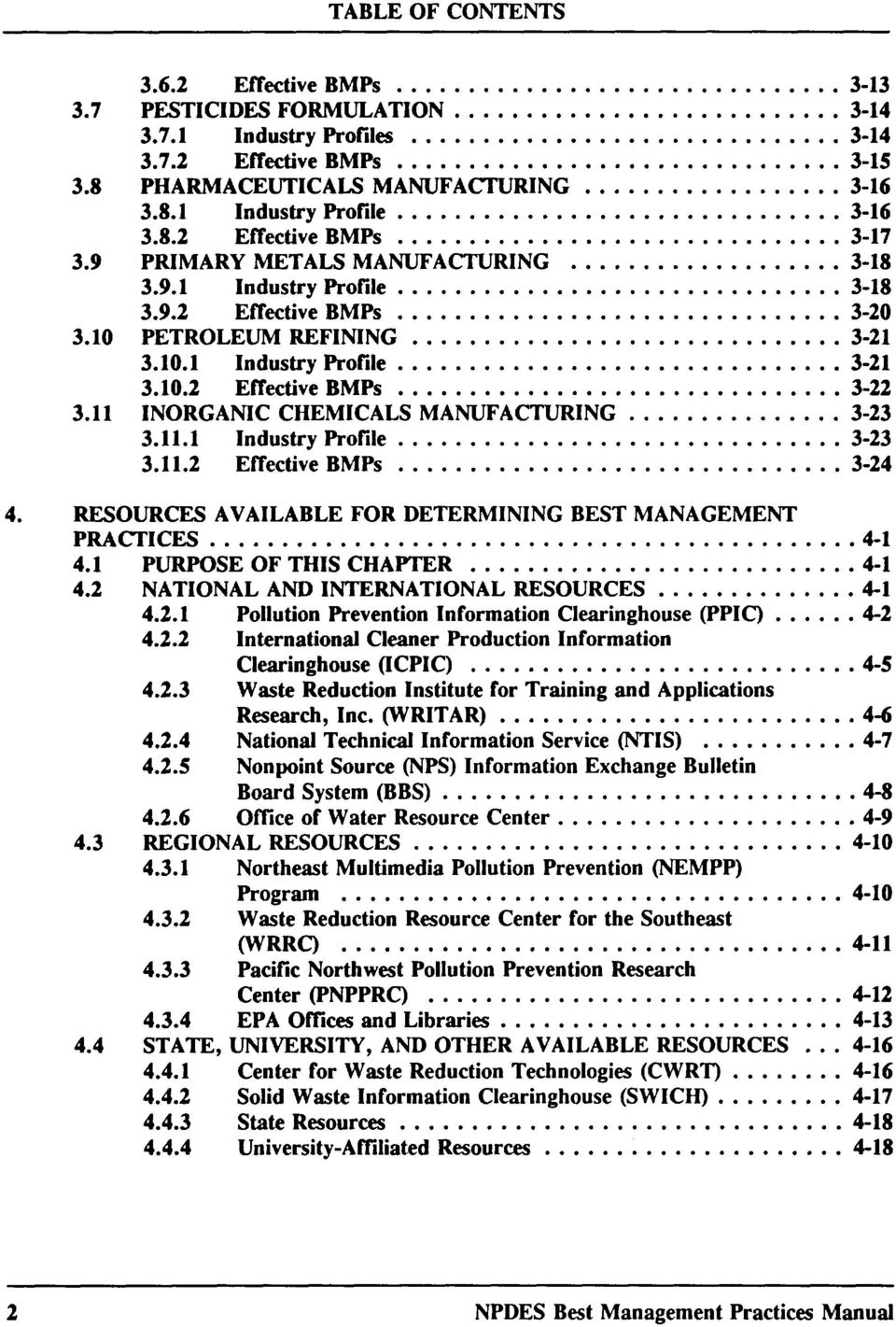
2 TABLE OF CONTENTS 1. INTRODUCTION TO BEST MANAGEMENT PRACTICES PURPOSE OF THIS MANUAL BACKGROUND OF NPDES PERMITTING BMP Reguatory History BEST MANAGEMENT PRACTICES AND POLLUTION PREVENTION BEST MANAGEMENT PRACTICES PLAN DEVELOPMENT PURPOSE OF THIS CHAPTER BMP APPLICABILITY What Activities and Materias at an Industria Faciity Are Best Addressed by BMP? How Do BMPS Work? What Are the Types of BMPS? COMPONENTS OF BMP PLANS BMP Pan Panning Phase BMP Committee BMP Poicy Statement Reease Identification and Assessment BMP Pan Deveopment Phase Good Housekeeping Preventive Maintenance Inspections Security Empoyee Training Recordkeeping and Reporting BMP Pan Evauation and Reevauation Phase Pan Evauation Pan Reevauation INDUSTRY-SPECIFIC BEST MANAGEMENT PRACTICES PURPOSE OF THIS CHAPTER INDUSTRY CATEGORY SELECTION METAL FINISHING Industry Profie Effective BMPs ORGANIC CHEMICALS, PLASTICS, AND SYNTHETIC FIBERS (OCPSF) MANUFACTURING Industry Profie Effective BMPs TEXTILES MANUFACTURING Industry Profie Effective BMPs PULP AND PAPER MANUFACTURING Industry Profie NPDES Best Management Practices Manua 1

3 TABLE OF CONTENTS Effective BMPs PESTICIDES FORMULATION Industry Profies Effective BMPs PHARMACEUTICALS MANUFACTURING Industry Profie Effective BMPs PRIMARY METALS MANUFACTURING Industry Profie Effective BMPs PETROLEUM REFINING Industry Profie Effective BMPs INORGANIC CHEMICALS MANUFACTURING Industry Profie Effective BMPs RESOURCES AVAILABLE FOR DETERMINING BEST MANAGEMENT PRACTICES PURPOSE OF THIS CHAPTER NATIONAL AND INTERNATIONAL RESOURCES Poution Prevention Information Cearinghouse (PPIC) Internationa Ceaner Production Information Cearinghouse (ICPIC) Waste Reduction Institute for Training and Appications Research, Inc. (WRITAR) Nationa Technica Information Service (NTIS) Nonpoint Source (NPS) Information Exchange Buetin Board System (BBS) Office of Water Resource Center REGIONAL RESOURCES Northeast Mutimedia Poution Prevention (NEMPP) Program Waste Reduction Resource Center for the Southeast (WRRC) Pacific Northwest Poution Prevention Research Center (PNPPRC) EPA Offices and Libraries STATE, UNIVERSITY, AND OTHER AVAILABLE RESOURCES Center for Waste Reduction Technoogies (CWRT) Soid Waste Information Cearinghouse (SWICH) State Resources University-Affiiated Resources NPDES Best Management Practices Manua
4 TABLE OF CONTENTS APPENDIX A - BEST MANAGEMENT PRACTICES PLAN DEVELOPMENT CHECKLIST APPENDIX B - EXAMPLE FORMS AND CHECKLISTS APPENDIX C - THEORETICAL DECISION-MAKING PROCESS FOR BMP PLAN DEVELOPMENT APPENDIX D - BIBLIOGRAPHY NPDES Best Management Practices Manua 3

5 LIST OF EXHIBITS FACTORS AFFECTING SPECIFIC BMP SELECTION SUGGESTED ELEMENTS OF A BASELINE BMP PLAN BMP COMMITTEE ACTIVITIES AND RESPONSIBILITIES EXAMPLE OF COMMITTEE FORMATION TO EFFECTIVELY MANAGE AN ENVIRONMENTAL PROGRAM EXAMPLE OF THE USE OF A POLICY AN EXAMPLE OF THE EFFECTIVENESS OF USING A RELEASE IDENTIFICATION AND ASSESSMENT APPROACH AN EXAMPLE OF THE SUCCESSFUL IMPLEMENTATION OF A GOOD HOUSEKEEPING PROGRAM CONSIDERATIONS FOR SELECTION OF MITIGATIVE PRACTICES DEMONSTRATION OF THE NEED FOR AN EFFECTIVE PM PROGRAM EXAMPLES OF POOR COORDINATION BETWEEN OPERATIONS AND MAINTENANCE STAFF RELEASES WHICH COULD HAVE BEEN PREVENTED BY EFFECTIVE INSPECTION PROGRAMS POSSIBLE COMPONENTS OF A SECURITY PLAN EXAMPLE OF THE IMPLEMENTATION OF EMPLOYEE TRAINING TO ENSURE THE SUCCESS OF ENVIRONMENTAL CONTROLS EXAMPLE OF AN EFFECTIVE REPORTING PROGRAM DESIGNED TO PREVENT ENVIRONMENTAL RELEASES BMP SELECTION PROCESS SUMMARY OF BMPs UTILIZED IN THE METAL FINISHING INDUSTRY SUMMARY OF BMPs UTILIZED IN THE OCPSF MANUFACTURING INDUSTRY SUMMARY OF BMPs UTILIZED IN THE TEXTILES MANUFACTURING INDUSTRY SUMMARY OF BMPs UTILIZED IN THE PULP AND PAPER MANUFACTURING INDUSTRY SUMMARY OF BMPs UTILIZED IN THE PESTICIDES FORMULATION INDUSTRY SUMMARY OF BMPs UTILIZED IN THE PHARMACEUTICAL MANUFACTURING INDUSTRY SUMMARY OF BMPs UTILIZED IN THE PRIMARY METALS MANUFACTURING INDUSTRY SUMMARY OF BMPs UTILIZED IN THE PETROLEUM REFINING INDUSTRY TYPES OF INORGANIC CHEMICALS SUMMARY OF BMPs UTILIZED IN THE INORGANIC CHEMICALS MANUFACTURING INDUSTRY PPIC CONTACT INFORMATION INSTRUCTIONS FOR PIES USE ICPIC CONTACT INFORMATION WRITAR CONTACT INFORMATION NPDES Best Management Practices Manua
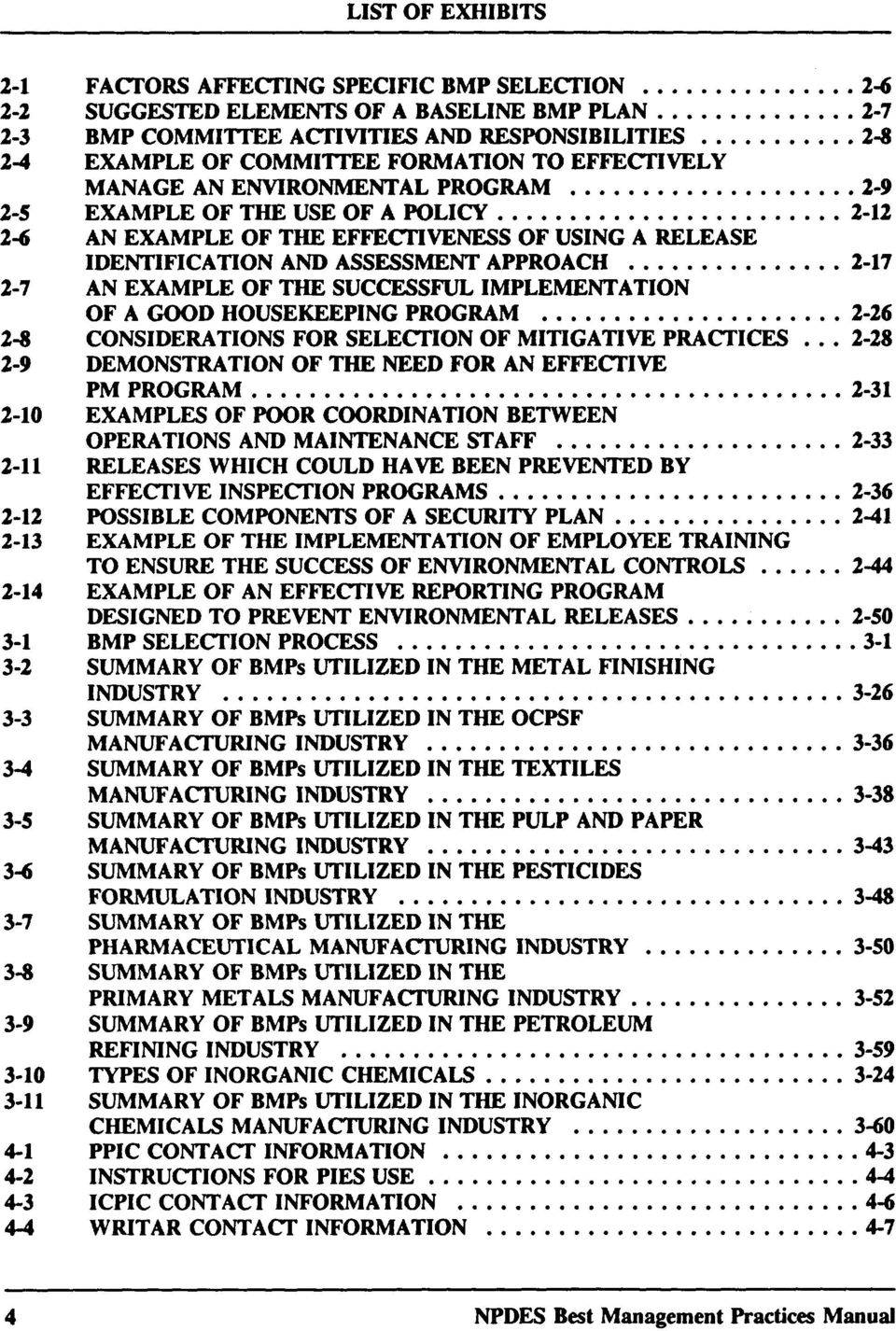
6 LIST OF EXHIBITS 4-5 NTIS CONTACT INFORMATION NPS BBS CONTACT INFORMATION OFFICE OF WATER RESOURCE CENTER CONTACT INFORMATION NEMPP CONTACT INFORMATION WRRC CONTACT INFORMATION PNPPRC CONTACT INFORMATION EPA REGIONAL POLLUTION PREVENTION CONTACTS EPA LIBRARY CONTACT INFORMATION CWRT CONTACT INFORMATION SWICH CONTACT INFORMATION STATE PROGRAM INFORMATION UNIVERSITY AFFILIATED RESOURCES NPDES Best Management Practices Manua 5

7 INTRODUCTION TO BEST MANAGEMENT PRACTICES CHAPTER 1 1. INTRODUCTION TO BEST MANAGEMENT PRACTICES Best management practices (BMPs) are recognized as an important part of the Nationa Poutant Discharge Eimination System (NPDES) permitting process to prevent the reease of toxic and hazardous chemicas. Over the years, as BMPs for many different types of faciities have been deveoped, case studies have demonstrated not ony the success but the fexibiity of the BMP approach in controing reeases of poutants to receiving waters. More recenty, poution prevention practices have become part of the NPDES program, working in conjunction with BMPs to reduce potentia poutant reeases. Poution prevention methods have been shown to reduce costs as we as poution risks through source reduction and recycing/reuse techniques. The Federa Water Poution Contro Act of 1972 estabished the objectives of restoring and maintaining the chemica, physica, and bioogica integrity of the Nation s waters. These objectives remained unchanged in the 1977, 1982, and 1987 amendments, commony referred to as the Cean Water Act (CWA). To achieve these objectives, the CWA sets forth a series of goas, incuding attaining fishabe and swimmabe designations by 1983 and eiminating the discharge of poutants into navigabe waters by As part of the CWA strategy to eiminate discharges of poutants to receiving waters, NPDES permit imitations have become more stringent. The Environmenta Protection Agency (EPA) recognizes that industria and municipa faciities subject to the NPDES program may need to undertake additiona measures to meet these permit imitations, as we as the goas of the CWA. EPA beieves that such measures can be technoogicay and economicay achievabe through the deveopment of formaized pans that contain BMPs and poution prevention practices. 1.1 PURPOSE OF THIS MANUAL The purpose of this manua is to provide guidance to NPDES permittees in the deveopment of BMPs for their faciities. The manua may aso be usefu to NPDES permit writers and inspectors charged with evauating the adequacy of BMP pans. In particuar, the manua promotes the integration of poution prevention concepts and practices in BMP pans. This manua has four major goas: (1) to provide a genera understanding of the requirements of the CWA pertaining to BMPs and show the reationship between BMPs and poution prevention practices; (2) to provide a starting NPDES Best Management Practices Manua -

8 CHAPTER 1 INTRODUCTION TO BEST MANAGEMENT PRACTICES point for deveoping and impementing an effective BMP pan that integrates faciity-specific and genera BMPs and poution prevention practices; (3) to provide specific exampes of effective BMPs and poution prevention practices to aid faciities endeavoring to deveop their own BMPs; and finay (4) to identify sources which a faciity may consut when deveoping BMPs and poution prevention practices. This manua incudes four chapters intended to achieve the above goas. Chapter 1 provides an introduction to the NPDES program and the reguatory context for BMPs. The reationship between BMPs and other poution prevention requirements such as the Poutant Prevention Act is aso discussed. Chapter 2 discusses the suggested components of a BMP pan, incuding committee formation, poicy derivation, reease identification and assessment, good housekeeping, preventive maintenance, inspections, security, empoyee training, and recordkeeping and reporting. Each component is defined and described in terms of what the component is, how the component functions, methods to create the component, and what to do/what not to do. Additionay, the usefuness of each component is iustrated by an exampe, thereby promoting the deveopment of an effective BMP pan. Chapter 3 sets forth process-specific BMPs for the meta pating and finishing, pesticides, texties, pup and paper, organic chemicas, pharmaceuticas, primary metas manufacturing and forming, inorganic chemicas, and petroeum refining industries. Successfu and demonstrated BMPs are discussed in this chapter in terms of benefits to water, benefits to other media, and other incentives. Data sources are aso cited to enabe readers to consut the referenced document. Finay, a discussion of avaiabe resources at the internationa, nationa, regiona, and State eves is presented in Chapter 4. Programs are summarized in terms of the genera resources avaiabe and imitations in the scope of assistance. Specific information is provided to enabe readers to contact programs directy and obtain necessary information. 1.2 BACKGROUND OF NPDES PERMITTING The principa mechanism for reducing the discharge of poutants from point sources is through impementation of the NPDES program, estabished by Section 402 of the CWA. A faciities with point source discharges must appy for and obtain a NPDES permit. NPDESauthorized States are tasked with issuing permits. Where State NPDES authorization has not yet occurred, EPA Regions issue NPDES permits. 1-2 NPDES Best Management Practices Manua

9 INTRODUCTION TO BEST MANAGEMENT PRACTICES CHAPTER 1 Four minimum eements are typicay incuded in each permit issued: (1) effuent discharge imitations; (2) monitoring and reporting requirements; (3) standard conditions; and (4) specia conditions. The numeric effuent discharge imits contained in a NPDES permit are based on the most stringent vaue among technoogy-based effuent guideines imitations, water quaity-based imitations, and imitations derived on a case-by-case basis. Permits aso contain standard conditions that prescribe primariy administrative and ega requirements to which a faciities are subject. Finay, permits may contain any suppementa contros, referred to as specia conditions, that may be needed in order to ensure that the reguations driving the NPDES program and, utimatey, the goas of the CWA are met. Best management practices are one such type of suppementa contro BMP Reguatory History Section 304(e) of the CWA authorized the EPA Administrator to pubish reguations to contro discharges of significant amounts of toxic poutants isted under Section 307 or hazardous substances isted under Section 311 from industria activities that the Administrator determines are associated with or anciary to industria manufacturing or treatment processes. As defined by the CWA, the discharges to be controed by BMPs are pant site runoff, spiage or eaks, sudge or waste disposa, and drainage-from raw materia storage. On September 1, 1978, EPA proposed reguations (43 FR 39282) addressing the use of procedures and practices to contro discharges from activities associated with or anciary to industria manufacturing or treatment processes. The proposed rue indicated how BMPs woud be imposed in NPDES permits to prevent the reease of toxic and hazardous poutants to surface waters. The reguations (40 CFR Part 125, Subpart K, Criteria and Standards for Best Management Practices Authorized Under Section 304(e) of the CWA) were proposed on August 21, 1978, in the NPDES reguations (43 FR 37078). Whie this Subpart never became effective, it remains in the Code of Federa Reguations and can be used as guidance by permit writers. Athough 40 CFR Part 125, Subpart K was not finaized, EPA and States continue to incorporate BMPs into permits based on the authority contained in Section 304(e) of the CWA and the reguations set forth in 40 CFR (k). Whie Section 304(e) of the CWA restricts the NPDES Best Management Practices Manua 1-3
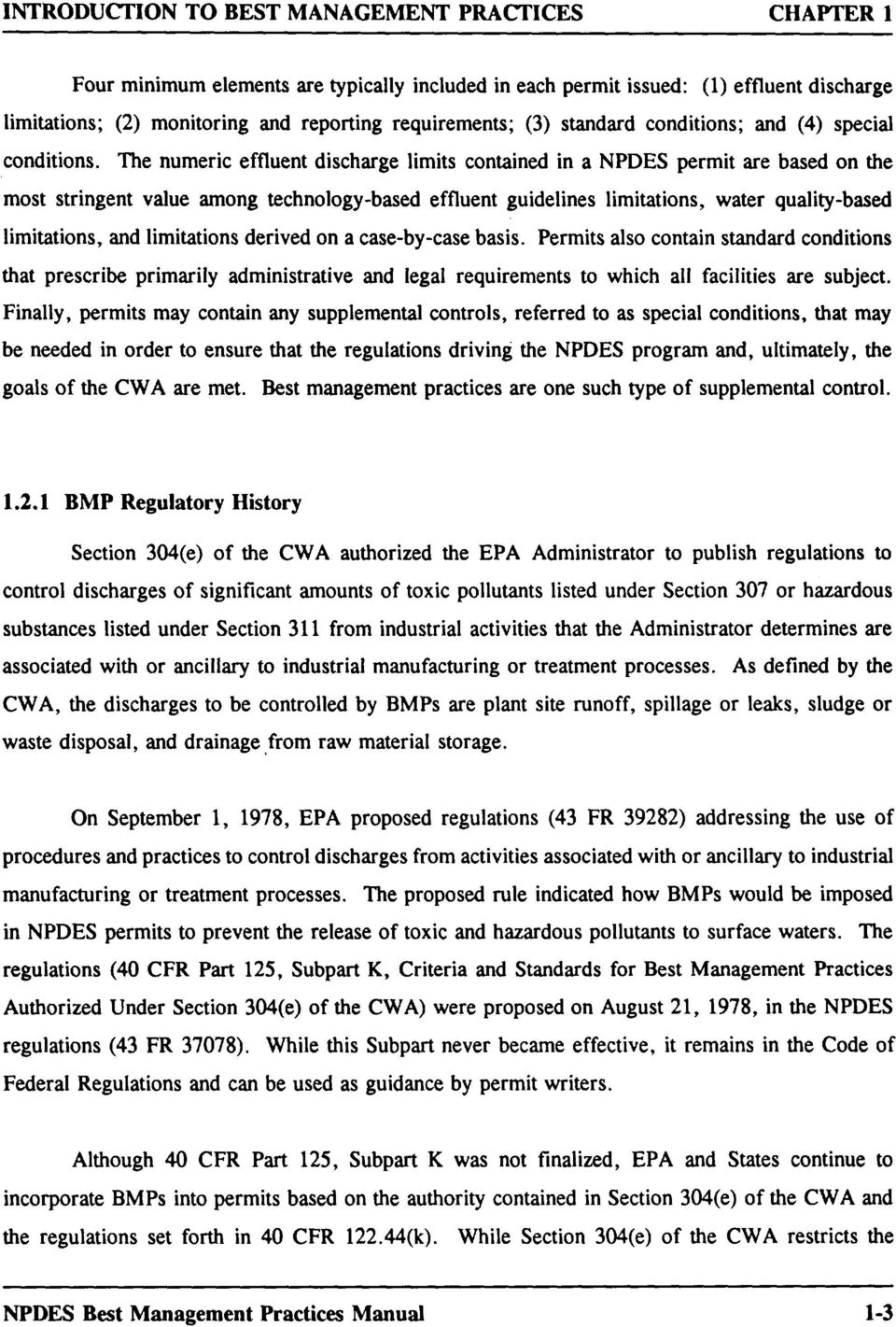
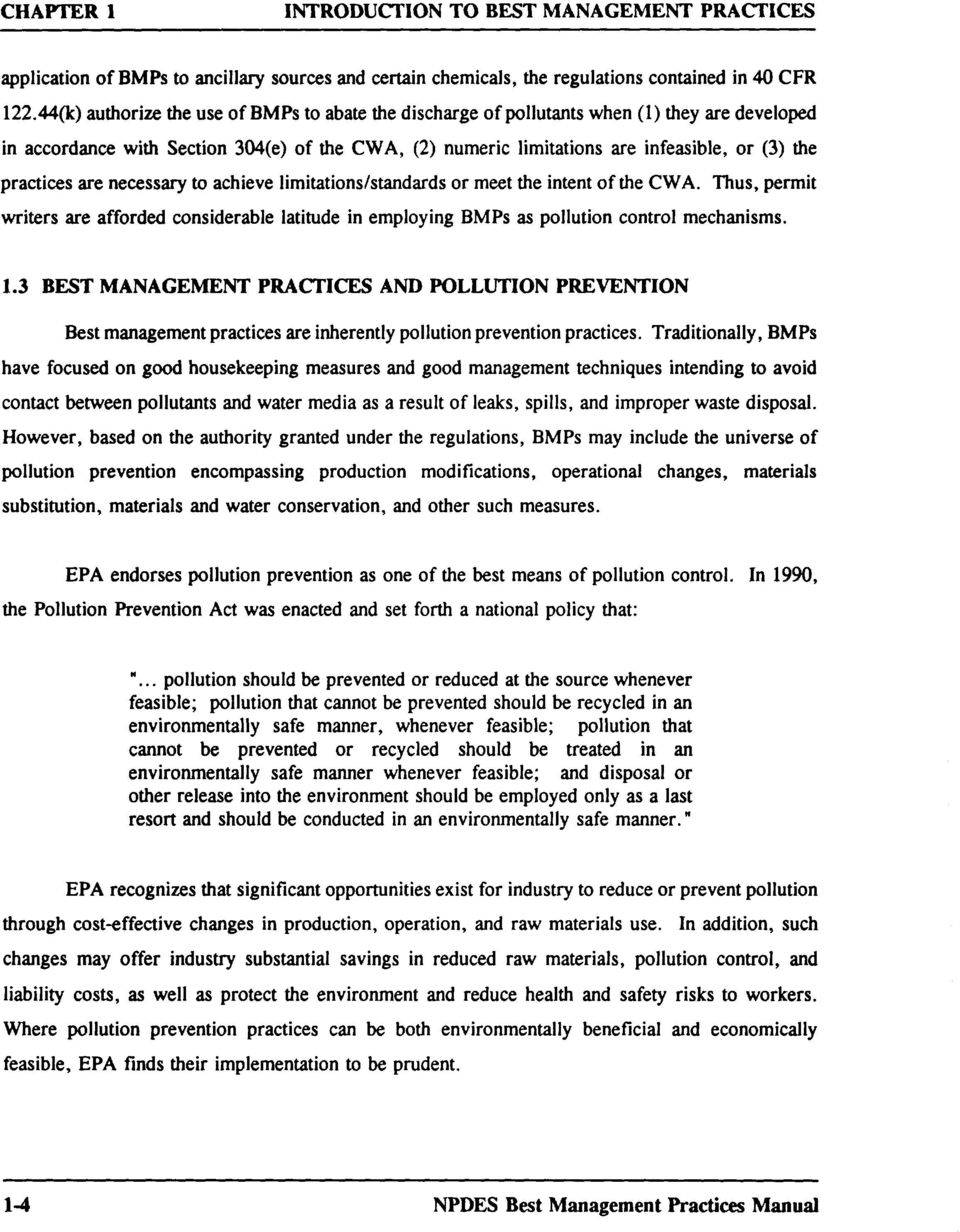
10 CHAPTER 1 INTRODUCTION TO BEST MANAGEMENT PRACTICES appication of BMPs to anciary sources and certain chemicas, the reguations contained in 40 CFR (k) authorize the use of BMPs to abate the discharge of poutants when (1) they are deveoped in accordance with Section 304(e) of the CWA, (2) numeric imitations are infeasibe, or (3) the practices are necessary to achieve imitations/standards or meet the intent of the CWA. Thus, permit writers are afforded considerabe atitude in empoying BMPs as poution contro mechanisms. 1.3 BEST MANAGEMENT PRACTICES AND POLLUTION PREVENTION Best management practices are inherenty poution prevention practices. Traditionay, BMPs have focused on good housekeeping measures and good managementechniques intending to avoid contact between poutants and water media as a resut of eaks, spis, and improper waste disposa. However, based on the authority granted under the reguations, BMPs may incude the universe of poution prevention encompassing production modifications, operationa changes, materias substitution, materias and water conservation, and other such measures. EPA endorses poution prevention as one of the best means of poution contro. In 1990, the Poution Prevention Act was enacted and set forth a nationa poicy that: I... poution shoud be prevented or reduced at the source whenever feasibe; poution that cannot be prevented shoud be recyced in an environmentay safe manner, whenever feasibe; poution that cannot be prevented or recyced shoud be treated in an environmentay safe manner whenever feasibe; and disposa or other reease into the environment shoud be empoyed ony as a ast resort and shoud be conducted in an environmentay safe manner. EPA recognizes that significant opportunities exist for industry to reduce or prevent poution through cost-effective changes in production, operation, and raw materias use. In addition, such changes may offer industry substantia savings in reduced raw materias, poution contro, and iabiity costs, as we as protect the environment and reduce heath and safety risks to workers. Where poution prevention practices can be both environmentay beneficia and economicay feasibe, EPA finds their impementation to be prudent. -4 NPDES Best Management Practices Manua
11 INTRODUCTION TO BEST MANAGEMENT PRACTICES CHAPTER 1 EPA beieves that the intent of poution prevention practices and BMPs are simiar and that they can be concurrenty deveoped in a technoogicay sound and cost-effective manner. Thus, athough this manua primariy focuses on best management practices, which pertain to the NPDES program, the reader may be compeed to aso consider poution prevention for a media in order to maximize the benefits achieved. NPDES Best Management Practices Manua -5
12 BEST MANAGEMENT PRACTICES PLAN DEVELOPMENT CHAPTER 2 2. BEST MANAGEMENT PRACTICES PLAN DEVELOPMENT Many faciities currenty impement successfu measures to reduce and contro environmenta reeases of a types of poutants. These measures have been successfuy impemented both formay as part of best management practice (BMP) pans and informay as part of unwritten standard operating procedures. In the context of the NPDES permit program, permittees are required to deveop BMP pans to address specific areas of concern. The BMP pan deveoped by the permittee becomes an enforceabe condition of the permit. The Environmenta Protection Agency (EPA) beieves that to ensure the continuing and greater successes of these programs, poution prevention measures shoud be incorporated into a written company-wide pan. 2.1 PURPOSE OF THIS CHAPTER This chapter provides the reader with the information needed to deveop and impement a BMP pan. The chapter begins with a discussion of appicabiity of BMP pans to industria faciities. The remainder of the chapter provides a detaied discussion of each of the recommended components of a BMP pan, set forth in the foowing format: What is the component? A description is given incuding definitions, appicabiity, and genera imitations. How does the component function? The text discusses how the component interacts with other components, considerations when deveoping the component, and an outine of the steps invoved in the deveopment process. How is the component created/deveoped.? An expanation of the detaied steps to take in deveoping a program around the eement is provided. What to do/what not to do. Guidance has been offered in terms of hepfu hints as we as potentia probems to avoid. To increase the usefuness of the information, exampes of actua BMPs accompany the text. Additionay, three appendices suppement this Chapter. Considerations when panning and deveoping the BMP pan are set forth in a checkist format in Appendix A. Exampe forms and checkists that may be usefu to faciities in the deveopment and impementation of BMP pan NPDES Best Management Practices Manua 2-1

13 CHAPTER 2 BEST MANAGEMENT PRACTICES PLAN DEVELOPMENT activities are provided in Appendix B. Appendix C contains an exampe BMP pan and the decision- making process used during its deveopment. 2.2 BMP APPLICABILITY BMPs are deveoped as part of the Nationa Poutant Discharge Eimination System (NPDES) permitting requirements to contro reeases of harmfu substances. BMPs may appy to an entire site or be appropriate for discrete areas of an industria faciity. Many of the same environmenta contros promoted as part of a BMP pan may currenty be used by industry in storm water poution prevention pans, spi prevention contro and countermeasure (SPCC) pans, Occupationa Safety and Heath Administration (OSHA) safety programs, fire protection programs, insurance poicy requirements, or standard operating procedures. Additionay, where faciities have deveoped poution prevention programs, contros such as source reduction and recycing/reuse may be simiar to those promoted as part of a BMP pan. The foowing basic questions can be used to estabish the scope of BMP pans: (1) What activities and materias at an industria faciity are best addressed by BMPs? (2) How do BMPs work? and (3) What are the types of BMPs? What Activities and Materias at an Industria Faciity Are Best Addressed by BMPs? Traditionay, BMP activities have focussed on activities associated with or anciary to industria manufacturing or treatment processes. These have been identified in Section 304(e) of the Cean Water Act as pant site runoff, spiage or eaks, sudge or waste disposa, and drainage from raw materia storage which the Administrator determines are associated with or anciary to the industria manufacturing or treatment process." These activities have historicay been found to be amenabe to contro by BMPs. Some exampes incude the foowing: Materia storage areas for toxic, hazardous, and other chemicas incuding raw materias, intermediates, fina products, or byproducts. Storage areas may be pies of materias or containerized substances. Typica storage containers coud incude iquid storage vesses ranging in size from arge tanks to 55-gaon drums; dry storage in bags, bins, sios and boxes; and gas storage in tanks and vesses. The storage areas can be open to the environment, partiay encosed, or fuy contained. Loading and unoading operations invoving the transfer of materias to and from trucks or rai cars, incuding in-pant transfers. These operations incude pumping of iquids or gases from truck or rai car to a storage faciity or vice versa, pneumatic transfer of dry 2-2 NPDES Best Management Practices Manua

14 BEST MANAGEMENT PRACTICES PLAN DEVELOPMENT CHAPTER 2 chemicas during vehice oading or unoading, transfer by mechanica conveyor systems, and transfer of bags, boxes, drums, or other containers from vehices by fork-ift, hand, or other materias handing methods. Faciity runofgenerated principay from rainfa on a pant site. Runoff can become contaminated with harmfu substances when it comes in contact with materia storage areas, oading and unoading areas, in-pant transfers areas, and sudge and other waste storage/disposa sites. Faout, resuting from pant air emissions that sette on the pant site, may aso contribute to contaminated runoff. In addition to BMPs, faciity runoff from industria sites may aso be directy reguated under the NPDES storm water permitting program. Sudge and waste stomge and disposa areas incuding andfis, pits, ponds, agoons, and deep-we injection sites. Depending on the construction and operation of these sites, there may be a potentia for eaching of toxic poutants or hazardous substances to groundwater, which can eventuay reach surface waters. In addition, iquids may overfow to surface waters from these disposa operations. With the increasing in awareness of poution prevention opportunities as we as the increase in egisation and reguatory poicies directing efforts towards poution prevention, much of the traditiona focus of BMP activities is being redirected from anciary activities to industria manufacturing processes. This redirection is resuting in the integrated appication of traditiona BMPs and poution prevention practices into cohesive and encompassing pans that cover a aspects of industria faciities How Do BMPs Work? BMPs arepmctices orprocedures. They incude methods to prevent toxic and hazardous substances from reaching receiving waters. They are most effective when organized into a comprehensive faciity BMP pan. * BMPs are quaitative. They are designed to address the quaity of a faciity s practices, and- may utimatey affect the abiity of the faciity to meet environmenta contro standards.. BMPs are fexibe. Many different practices can be used to achieve simiar environmentay protective resuts. With faciity-specific considerations as the major consideration in seecting appropriate BMPs, this fexibiity aows a faciity to taior a BMP pan to meet its needs using the capabiities and resources avaiabe. NPDES Best Management Practices Manua 2-3

15 CHAPTER 2 BEST MANAGEMENT PRACTICES PLAN DEVELOPMENT What Are the Types of BMPs? BMPs may be divided into genera BMPs, appicabe to a wide range of industria operations, and faciity-specific (or process-specific) BMPs, taiored to the requirements of an individua site. Genera BMPs are widey practiced measures that are independent of chemica compound, source of poutant, or industria category. Genera BMPs are aso referred to as baseine practices, and are typicay ow in cost and easiy impemented. Genera BMPs are practiced to some extent at amost a faciities. Common genera BMPs incude good housekeeping, preventive maintenance, inspections, security, empoyee training, and recordkeeping and reporting. Faciity-specific BMPs are measures used to contro reeases associated with individuay identified toxic and hazardous substances and/or one or more particuar anciary source. Faciity- specific BMPs are often deveoped when a faciity notes a history of probem reeases of toxic or hazardous chemicas, or when faciity personne beieve that actua or potentia poutant discharge probems shoud be addressed. Faciity-specific BMPs may incude many different practices such as source reduction and on-site recyce/reuse. Faciity-specific BMPs wi vary from site to site depending upon site characteristics, industria processes, and poutants. For exampe, a site-specific BMP in the form of area dikes may be adopted due to the ocation of the faciity: faciities in fat areas or on sopes are ikey to utiize dikes to contro spis whereas there may be no need for dikes for faciities ocated in basins. Additionay, pants handing and storing arge amounts of iquid chemicas woud be more ikey to utiize dikes than faciities storing and using dry chemicas. Faciities experiencing erosion and sediment contro probems may consider estabishing vegetative buffer strips or indigenous ground cover for purposes of soi stabiization and infitration of runoff. Faciity sites ocated adjacent to other industria areas may consider runon contros to prevent extraneous spis and contaminated runon from entering the faciity site. Other site-specific considerations, such as endangered species, may motivate faciities to store materias in an aternate ocation so as to prevent exposure. Processes aso drive the determination of appropriate specific BMPs. Materias handing procedures that expose empoyees to toxic chemicas (e.g., hand drawing) may prompt the 2-4 NPDES Best Management Practices Manua
16 BEST MANAGEMENT PRAmICES PLAN DEVELOPMENT CHAPTER 2 consideration of procedures that reduce the potentia for exposure (e.g., automated pneumatic pumping in encosed conduits). Some exampes of process-specific BMPs incude the foowing: Using spash pates designed to prevent spis at a meta finishing faciity Instaing sovent recovery equipment to contro benzene reeases at a petroeum refinery Purchasing sovents in reusabe containers rather than %-gaon drums to ease storage concerns and reduce wastewater resuting from requirements to tripe rinse drums. Poutant characteristics such as voatiity and toxicity aso affect BMP seection. More and more, harmfu chemicas are being considered for repacement with ess toxic aternatives, or for eimination from the process. Ozone ayer-depeting sovents which are used for ceaning at many faciities are being repaced with detergent-based ceaning agents. Additionay, faciities using materias with toxic properties have been inspired to take more proactive contro measures (e.g., doube waed containment). The choice of faciity-specitic BMPs can be affected by a number of factors such as those discussed in Exhibit COMPONENTS OF BMP PLANS Suggested components of BMP pans are defined and described in this section. The suggested eements of a good BMP pan can be separated into three phases: panning, deveopment and impementation, and evauation/reevauation. Generay, the panning phase, discussed in Section 2.3.1, incudes demonstrating management support for the BMP pan and identifying and evauating areas of the faciity to be addressed by BMPs. The goa of pan deveopment shoud be to ensure that its impementation wi prevent or minimize the generation and the potentia for reease of poutants from the faciity to the waters of the U.S. The deveopment phase consists of determining, deveoping, and impementing genera and faciity-specific BMPs and is described in Section The evauation/reevauation phase described in Section consists of an assessment of the components of a BMP pan and reevauation of pan components periodicay, or as a resut of factors such as environmenta reeases and/or changes at the faciity. Suggested eements of a BMP pan are provided in Exhibit 2-2. NPDES Best Management Practices Manua 2-5

17 CHAPTER 2 BEST MANAGEMENT PRACI ICES PLAN DEVELOPMENT EXHIBIT 2-: FACTORS AFFECTING SPECIFIC BMP SELECTION Chemica nature: The need to contro materias based on toxicity and fate and tgusp0-t. Praximity to waterbodies: The need to contro iquid spis prior to their reease to media such as water from which materias may not ater be separated. Receiving waters: Ihe need to protect sensitive receiving waters which are more severey impacted by rekases of toxic or hazardous materias. The need to protect the water uses incuding recreationa waters, drinking water suppies, and fragie aquatic and biota communities. Proximity to popuace: The need to contro hazardous materias with potentia to be reeased near popuated areas. Cimate: The need to prevent voatiization and ignitabiity in warmer cimates. The need to reduce wear on moving parts in freezing cimates. The need to avoid spis in cimates and under circumstances where mitigation cannot occur. Age of the faciity/equipment: The need to prevent reeases caused by oder equipment with greater capacity for faiure. The need to address obsoete and outdated instruments and processes which are not environmentay protective. Process compexity: The need to address probems of materias incompatibiity. Engineering design: The need to address design faws and deficiencies. Empoyee safety: The need to prevent unnecessary exposure between empoyee and chemicas. Environmenta reease record: The need to contro reeases from specific areas demonstrating previous probems BMP Pan Panning Phase In the panning phase, a faciity must decide who wi take the responsibiity for estabishing and carrying out the BMP pan. The pan shoud be initiated with cear support and input from faciity management and empoyees. The faciity must aso identify and evauate areas of the faciity that, because of the substances invoved and their management, wi be addressed in the BMP pan. Each of these eements is discussed in detai on the foowing pages BMP Committee What is a BMP Committee? A BMP committee is comprised of interested staff within the faciity s organization. The committee wi represent the company s interests in a phases of BMP pan deveopment, 24 NPDES Best Management Practices Manua

18 BEST MANAGEMENT PRACTICES PLAN DEVELOPMENT CHAPTER 2 impementation; oversight, and pan evauation. EXHIBIT 2-2: SUGGESTED ELEMENTS OF A BASELINE BMP PLAN It shoud be noted that a BMP committee may function simiary to other committees that might exist at an industria faciity (e.g., poution prevention committee) and may incude the same empoyees. How Does the BMP Committee Function? The BMP committee is deveoped to assist a faciity in managing a aspects of the BMP pan. The committee functions to conduct activities and shouder the responsibiities of a eements discussed in Exhibit 2-3. Panning Phase Considerations 1. BMP committee 2. BMP poicy statement 3. Reease identification and assessment Deveopment Phase Considerations 4. Good housekeeping 5. Preventive maintenance 6. Inspections 7. Security 8. Empoyee training 9. Recordkeeping and reporting Evauation and Reevauation Phase Considerations 10. Evauate pan impementation benefits 11. Periodicay or as needed, repeat steps -9 To be most effective, the committee must perform tasks efficienty and smoothy. In arge part, the personne seected to act as committee members wi determine the committee s success. Some of the considerations for personne seection incude the foowing: A ead committee member must be determined Committee members must incude persons knowedgeabe of the pant areas invoved (e.g., process areas, tank farms) and utiization of chemicas and generation of poutants (e.g., sovents, products, chemica reactants) at the faciity Committee members shoud have the authority to make decisions effecting BMP pan deveopment and impementation The size of the committee must be appropriate to the faciity. The committee must represent affected areas of the pant and empoyees. An exampe of the effectiveness of the formation of a committee is provided in Exhibit 2-4. NPDES Best Management Practices Manua 2-7
19 CHAF TER 2 BEST MANAGEMENT PRACTICES PLAN DEVELOPMENT EXHIBI f 2-3: BMP COMMITTEE ACTIVITIES & RESPONSIBILITIES Deveop the scope of the BMP pan Make recommendations to management in support of company BMP poicy Review any existing accidenta spi contro pans to evauate existing BMPs Identify toxic and hazardous substances Identify areas with potentia for reease to the environment Conduct assessments to prioritize substances and areas of concern Determine and seect appropriate BMPs Set forth standard operating procedures for impementation of BMPs Oversee the impementation of the BMPs Estabish procedures for recordkeeping and reporting Coordinate faciity environmenta reease response, ceanup, and reguatory agency notification procedures Estabish BMP training for pant and contractor personne Evauate the effectiveness of the BMP pan in preventing and mitigating reeases of poutants Periodicay review the BMP pan to evauate the need to update and/or modify the BMP pan. How Is a BMP Committee Deveoped? The BMP committee is responsibe for deveoping the BMP pan and assisting the faciity management in its impementation, periodic evauation, and updating. Whie the BMP committee is responsibe for deveoping the pan and overseeing its impementation, a activities need not be imited to committee members. Rather, appropriate company personne who are knowedgeabe in the areas of concern can carry out certain activities associated with BMP pan deveopment. With this in mind, the seection of the committee members can be imited to a seect set of individuas, whie the resources of interested and knowedgeabe empoyees can sti be utiized. In order to ensure a propery run organization, one person shoud be designated as the ead committee member. Thus, the first step in deveoping a BMP committee is to determine the appropriate committee chairperson. The determination of a singe eader wi assist in the smooth conduct of meetings and the designation of tasks, and wi aid in the decision-making process. Generay, the chairperson shoud be highy motivated to deveop and impement the BMP pan, famiiar with a committee members and their areas of expertise, and experienced in managing tasks 2-8 NPDES Best Management Practices Manua

20 BEST MANAGEMENT PRACTICES PLAN DEVELOPMENT CHAPTER 2 EXHIBIT 2-4: EXAMPLE OF COMMITTEE FORMATION TO EFFECTIVELY MANAGE AN ENVIRONMENTAL PROGRAM The 3M company, a manufacturer of diverse products such as coated abrasives, pressure sensitive tape, photographic fim, eectrica insuation materias, and reposition notes, has deveoped a corporate phiosophy that Poution Prevention Pays (referred to as the 3P program). As part of the 3P program, 3M has created a 3P Coordinating Committee which incudes empoyee representatives from the engineering manufacturing, aboratory, and corporate environmenta sectors. The 3P Coordinating Committee provides support and coordination for nationwide teams estabishing 3P programs. These 3P Teams are organized by empoyees that have identified poution probems and recognize potentia soutions. The 3P Coordinating Committee and the 3P Teams have been instrumenta in source reduction of hydrocarbons, odor, water, dissoved soids, sufur, zinc, acoho, and incinerated scrap. In the first year of the 3P programs, air poutants have been reduced by 123,000 tons, water poutants by 16,400 tons, wastewater by 1,600 miion gaons, and soid wastes poutants by 409,000 tons. This has resuted in savings of more than $500 miion. Adapted from: T. Zea, Case Study: How 3M Makes Poution Prevention Pay Big Dividends, Poution Prevention Review, Winter of this magnitude. The chairperson wi be responsibe for ensuring that a tasks are assigned to appropriate personne, keeping faciity management and empoyees informed, and cohesivey deveoping the BMP pan. Potentia candidates for this roe are pant managers, environmenta coordinators, or other distincty knowedgeabe technica and management personne. The next step is to seect the appropriate personne to comprise the committee. Personne seected shoud represent a affected faciity areas. Members might aso be seected based on their areas of expertise (e.g., industria processes). Personne might be seected who have a fu understanding of the manufacture processes from raw materias to fina products, as we as of the recycing, treatment, and disposa of wastes. Possibe candidates incude foremen in manufacturing, production, or waste treatment and disposa; maintenance engineers; environmenta and safety coordinators; and materias storage and transfer managers. Not ony must committee members understand the activities conducted throughout the entire faciity, members of the BMP committee NPDES Best Management Practices Manua 2-9
21 CHAPTER 2 BEST MANAGEMENT PRACTICES PLAN DEVELOPMENT must aso incude individuas who are in the decision-making positions within the company structure. Some committee members must represent company management and have the authority to impement measures adopted by the committee. Whie the BMP committee shoud refect the ines of authority within the company, it shoud aso be sensitive to genera empoyee interests. It is crucia to ensure that empoyees are aware of and in support of the BMP pan and the responsibe committee, as it is primariy the empoyees who wi impement the changes resuting from committee decisions. Forming a committee comprised soey of upper eve management and administrative personne woud excude genera personne whose input is critica for the deveopment and impementation of the pan. Seecting empoyeechosen representatives, such as union stewards, may be an appropriate means to ensure empoyee invovement. The size of a BMP committee shoud refect the size and compexity of the faciity, as we as the quantity and toxicity of the materias at the faciity. The committee must be sma enough to communicate in a open and interactive manner, yet arge enough to aow for input from a necessary parties. Where needed, committee members shoud ca upon the expertise of others through the estabishment of project-specific task forces. For exampe, personne invoved in research and deveopment may be asked to research the effectiveness of product substitution and process changes that are being considered as part of BMP pan deveopment. This method of caing upon speciaists, when the need arises, shoud aow the committee to remain a manageabe size. Generay, the size seection process outined beow presents a good rue of thumb: For sma faciities, a singe committee member is acceptabe as ong as that person has the requisite expertise and authority For arger faciities, seection of six to eight peope as permanent members of the committee shoud be idea NPDES Best Management Practices Manua
22 BEST MANAGEMENT PRACTICES PLAN DEVELOPMENT CHAPTER 2 BMP Committee - What to Do Deveop a roster of BMP committee members which incudes area of speciaization and projected responsibiities. This ist heps identify any hoes in the panned BMP deveopment activities and any missing expertise. Incude a ist of aternate BMP committee members where transfers are expected to occur during the ife of the BMP pan. Post BMP committee member names and incuding them in the pan to aow any interested parties the opportunity to contact BMP committee members. Whie deveoping and updating the BMP pan, incude input from interested empoyees not on the committee. Empoyee input sessions and suggestions boxes can be used to meet this goa. Extend technica reviews to personne not on the BMP committee, where speciaized expertise is necessary or where interest is expressed. Foow up with a responsibe parties on a periodic basis to ensure they are aware of their BMP-reated responsibiities. Encourage BMP committee members to spend time on-the-ine in order to communicate with other potentiay interested parties. Set schedues with miestone dates for the performance of important activities. This avoids possibe procrastination and aows the BMP pan deveopment to remain on schedue. BMP Committee - What Not to Do The committee shoud enabe, not impede, the decision-making process for preventing or mitigating spis or otherwise responding to events addressed by the BMP pan. Remember that personne contributing to the design of a BMP need not be member of the BMP committee. This is of particuar importance where a technica speciaist or manager simpy woud not have the time to contribute on a reguar basis BMP Poicy Statement What Is a BMP Poicy Statement? A BMP poicy statement describes the objectives of the BMP program in cear, concise anguage and estabishes the company poicies reated to BMPs. Exhibit 2-5 provides exampes of the successfu use of a poicy. NPDES Best Management Practices Manua 2-11
23 CHAPTER 2 BEST MANAGEMENT PRACTICES PLAN DEVELOPMENT EXHIBIT 2-5: EXAMPLE OF THE USE OF A POLICY Dow Chemica has observed a significant impact as a resut of their company s environmenta poicy. As part of their Environmenta Poicy and Guideines, Dow has set forth a hierarchy simiar to that deveoped as part of the Poution Prevention Act of Dow s poicy sets forth preferences to hande materias by reducing poutants at the source, foowed by recyce and use of materias whenever possibe. Where disposa is necessary, Dow has specified that incineration be considered first, foowed by and disposa on Dow-owned property, and finay and disposa on property not owned by Dow. Dow s decision to foow its disposa hierarchy was based in arge part on the iabiity of disposa. Dow reasoned that incineration was the most appropriate disposa method since it resuted in the poutants in the ash materias being in eementa form. In many cases, the company has identified opportunities for recyce of materias found in the incinerator ash. Dow aso imposed a $215 per drum surcharge for hazardous wastes going to a andfi to provide incentives for finding aternatives to andfiing. Dow aso beieves that they can better exercise contro of onsite disposa, thus infuencing the preferences for onsite rather than offsite disposa. Dow s poicy has resuted in an impact on the environmenta reeases. For exampe, at the Dow Pit&burg, Caifornia faciity, wastewater discharges have been reduced by 95 percent over the past 10 years. Additionay, the approximatey 10.2 miion pounds of chorinated organics wastes which are generated are either incinerated or recyced. Adapted from: D. Sarokin, W. Muir, C. Mier, S. Sperber, Cutting chemica Wastes: What 29 organic chemica Pants are Doing to Reduce Hazardous Wastes, INFORM, Inc., New York, New York, How Does a BMP Poicy Statement Function? The poicy statement provides two major functions: (1) it demonstrates and reinforces management s support of the BMP pan; and (2) it describes the intent and goas of the BMP pan. It is very important that the BMP poicy represent both the company s goas and genera empoyee concerns. Severa steps to take in deveoping an effective BMP poicy statement incude the foowing: 2-12 NPDES Best Management Practices Manua
24 BEST MANAGEMENT PRACTICES PLAN DEVELOPMENT CHAF TER 2 Determine the appropriate author Deveop tone and content that are positive, but that estabish reaistic and achievabe goas Distribute the poicy statement effectivey. How Is a BMP Poicy Statement Created? The first step in creating a BMP poicy statement is determining the appropriate author. To indicate management s commitment, the poicy statement shoud be signed by a responsibe corporate officer. A responsibe corporate officer can be the president, vice president, or the principa manager of manufacturing, production, or operations. Generay, the poicy statement author shoud be a person who performs poicy- or decision-making functions for the corporation/faciity. The next step in deveoping the BMP poicy statement is to craft the specific anguage. The poicy statement may incude references to the company s commitment to being a good environmenta citizen, expected improvements in pant safety, and potentia cost savings. Regardess of persona stye, in a cases the poicy shoud: (1) indicate the company s support of BMPs to improve overa faciity management and (2) introduce the intent of the BMP pan. The ength and eve of detai of the poicy statement wi vary depending on the writer s persona stye. The foowing variations may be incuded in a BMP poicy statement: An outine of steps that wi be taken A discussion of the time frames for deveopment and impementation An indication of the areas and poutants of focus A projection of the end resut of the BMP pan Create enthusiasm and support for the BMP pan by a empoyees. The tone of the BMP poicy statement is aso important. The projected positive impacts of BMP impementation shoud be discussed in genera terms. If specific goas are outined, the eve of information and the expectations presented shoud be reasonabe, to avoid overwheming the reader. Utimatey, the poicy shoud provide an upbeat message of the improved working environment that wi resut from BMP impementation. Since gaining empoyee support is so NPDES Best Management Practices Manua 2-13
25 CHAPTER 2 BEST MANAGEMENT PRACTICES PLAN DEVELOPMENT important, it may be appropriate to soicit empoyee concerns prior to the deveopment of the BMP poicy. These concerns can be highighted as areas which wi be evauated during BMP pan deveopment. Finay, to ensure that a empoyees are aware of the impending BMP pan, the poicy statement shoud be printed on company etterhead (for an officia appearance) and distributed to ah empoyees. Compete distribution can be best ensured if the statement is both deivered to each empoyee and posted in common areas. BMP Poicy Statement - What to Do Utiize meetings and open sessions to soicit empoyee participation in the deveopment of the BMP poicy. Demonstrate that empoyee ideas are wecome by immediate foow-up on suggestions. Discuss possibe impementation opportunities or reasons that impementation is feasibe. Keep the statement cear and concise. Post the BMP poicy statement in key ocations where empoyees congregate so that empoyees wi discuss it. Use the poicy statemento promote an embem/motto that represents the BMP pan and its benefits. Emboss the objectives of the BMP poicy on a paque. BMP Poicy Statement - What Not to Do Do not incude detais of the BMP pan in the poicy statement. The BMP poicy statement shoud not be issued soey by the BMP committee. It shoud be issued by the company NPDES Best Management Practices Manua
26 BEST MANAGEMENT PRACTICES PLAN DEVELOPMENT CHAPTER Reease Identification and Assessment What Is Reease Identification and Assessment? Reease identification is the systematic cataoging of areas at a faciity with ongoing or potentia reeases to the environment. A reease assessment is used to determine the impacts on human heath and the environment of any on-going or potentia reeases identified. The identification and assessment process invoves the evauation of both current discharges and potentia discharges. The reease identification and assessment process can provide a focus for the range of BMPs being considered on those activities and areas of a faciity where the risks (considering the potentia for reease and the hazard posed) are the greatest. In some cases, the assessment may be performed based on experience and knowedge of the substances and circumstances invoved. In other cases, more detaied anayses may be necessary to provide the correct focus, and reease assessments may then rey on some of the techniques of risk assessment (e.g., pathway anaysis, toxicity, reative risk). Understanding the dangers of reeases invoves both an understanding of the hazards each potentia poutant poses to human heath and the environment, as we as the probabiity of reease due to the faciity s methods of storage, handing, and/or transportation. Some faciities may identify a number of situations or circumstances representing actua or potentia hazards that shoud a be addressed in some detai through the BMP pan. However, in some instances prioritizing potentia hazards is the most sensibe and cost effective approach. The foowing exampe iustrates the need for BMP prioritization: ACME Concrete is a concrete and suppy faciity with a designated area used to house maintenance vehices and materias as we as to stockpie construction materias and equipment. Among other things, this faciity contains a arge stockpie of buiding sand used to prepare concrete, a vehice maintenance area where oi is drained from company vehices, and a shed where drums of sovents used in ceaning operations are stored. Athough each of the three materias mentioned at the site (sand, used oi, and sovents) can cause environmenta or heath damage uness they are controed, it woud not be feasibe or reasonabe to contro osses of sma amounts of cean buiding sand with the same carefu attention given to the reease of toxic sovents. As this simpistic exampe shows, priorities for BMPs shoud refect a basic understanding of the oss potentia and hazards posed by these potentia osses. A prudent NPDES Best Management Practices Manua 2-15
27 CHAPTER 2 BEST MANAGEMENT PRACTICES PLAN DEVELOPMENT manager of the ACME Concrete maintenance yard coud first imit the potentia for escape of sovents through carefu training and periodic preventative maintenance and inspection of drums and storage faciities, then prevent runoff of used oi to surface waters or groundwater by coecting and recycing used oi, and finay contro major osses of sand through constructions of fiter fences or sediment ponds. How Does Reease Potentia Identification and Assessment Function? Identifying and assessing the risk of poutant reeases for purposes of a BMP pan can best be accompished in accordance with a five-step procedure: Reviewing existing materias and pans, as a source of information, to ensure consistency, and to eiminate dupication Characterizing actua and potentia poutant sources that might be subject to reease Evauating potentia poutants based on the hazards they present to human heath and the environment Identifying pathways through which poutants identified at the site might reach environmenta and human receptors Prioritizing potentia reeases. Once estabished, these priorities may be used in deveoping a BMP pan that paces the greatest emphasis on the sources with the greatest overa risk to human heath and the environment, considering the ikeihood of reease and the potentia hazards if a reease shoud occur, whie sti impementing ow cost BMPs that might contribute to safety or other worker driven needs. An exampe of the effectiveness of this type of assessment is provided in Exhibit 2-6. An exampe of a reease identification and assessment worksheet is provided in Appendix B. A competed version is aso provided to demonstrate how this worksheet can assist faciities in data compiation NPDES Best Management Practices Manua
28 BEST MANAGEMENT PRACTICES PLAN DEVELOPMENT CHAPTER 2 EXHIBIT 2-6: AN EXAMPLE OF THE EFFECTIVENESS OF USING A RELEASE IDENTIFICATION AND ASSESSMENT APPROACH Borden Chemica company conducted an evauation of their Fremont, Caifornia, faciity consistent with the approach for a reease potentia identification and assessment. Initiay, Borden conducted extensive monitoring to determine the sources of organic oadings. Then, knowedgeabe pant personne conducted a pant inspection to identify and assess sources of organic oadings. The comprehensive inspection invoved the evauation of the entire site from initia materias arriva, through production, to fina product shipment. The Borden staff were considerate of both actua and potentia sources. Based on the information from the monitoring program and the inspection, the pant management prioritized three areas in which modifications were needed: fiter rinse operations, reactor vesse rinses, and empoyee practices. Based on this assessment, Borden impemented a system which invoves process changes, empoyee training, and a continuing monitoring program. Utimatey, the amount of organic materias discharged was reduced by 93 percent. Adapted from: D. Sarokin,W. Muir,C. Mier,S. Sperber,Cuning Chemica Wastes: What 29 Organic C%em ca Pants are Doing to Reduce Hazardous Waste, Inform, Inc., New York, New York, How Is a Reease Potentia Identification and Assessment Performed? The first step in the conduct of a reease identification and assessment invoves the review of existing materias and pans to gather needed information. Many industria faciities are aready subject to reguatory requirements to coect and provide information that may be usefu in the identification and assessment of reeases. In some cases, these pans may have been deveoped by persons in pant safety or process engineering who do not normay consider themseves part of the environmenta staff. In particuar, the foowing pans shoud be identified and reviewed: Preparedness, prevention, and contingency pbns (see 40 CFR Parts 264 and 265) require the identification of hazardous wastes handed at a faciity. Spi contro and countermeasures (SPCC) pans (see 40 CFR Part 112) require the prediction of direction, rate of fow, and tota quantity of oi that coud be discharged. NPDES Best Management Practices Manua 2-17
29 CHAPTER 2 BEST MANAGEMENT PRACTICES PLAN DEVELOPMENT Storm water poktin prevention phts (see 40 CFR ) require the identification of potentia poutant sources which may reasonaby be expected to affect the quaity of storm water discharges. Toxic organic management pans (see 40 CFR Parts 413, 433, and 469) may require the identification of toxic organic compounds. Occupationa Sqfety and Heath Administration (OSHA) emergency action pans (see 29 CFR Part 1910) requires the deveopment of a ist of major workpace tire and emergency hazards. Other sources of information that might be pertinent to the reease identification and assessment process incude the faciity s NPDES permit appication and, where appicabe, information coected for SARA Tite III, Section 313 Form R. SARA requires faciities with certain chemicas to annuay submit toxic reease data annuay as part of community right-to-know requirements. The second step of conducting a reease identification and assessment is to characterize current and potentia poutant sources. This step may be conducted through assembing a description of faciity operations and chemica usage and then verifying information through inspections. This process aows faciity personne to confirm the accuracy of information on hand (e.g., the amount of chemicas used in a specific ocation) whie aso tracking changes that might have evoved over time (e.g., changing the staging of ubricants in a particuar part of the pant). Generay, the preparation of a site map or maps covering the entire faciity is very usefu in this evauation. Maps shoud cover the entire property and iustrate pant features incuding materia storage areas for raw materias, by-products, and products; oading and unoading areas; manufacturing areas; and waste/wastewater management areas. The map shoud aso indicate site topography incuding faciity drainage patterns. Any existing structura contro measures aready used to reduce poutant reeases shoud be highighted, and conveyance mechanisms or pathways to surface water bodies shoud be noted. The faciity site map shoud aso indicate property boundaries, buidings, and operation or process areas. Any neighboring properties that have potentia sources of contaminants that might migrate onto the faciity (because of drainage patterns) shoud aso be noted on the map NPDES Best Management Practices Manua
30 BEST MANAGEMENT PRACIICES PLAN DEVELOPMENT CHAPTER 2 Foowing preparation of a site map, a materias inventory shoud be prepared. Generay, purchasing records shoud be hepfu in determining the raw materias which are part of the inventory. However, the products manufactured and the byproducts resuting during the manufacturing process shoud aso be considered. The materias inventory shoud incude descriptions of the amounts of poutants reeased or with the potentia to be reeased based on methods of storage or onsite disposa, oading and access methods, and management and contro practices (incuding structura measures or treatment). The inventory shoud refer to the ocation of the materia keyed to the site map. Materias inventories wi vary with the size and the compexity of the faciity. It may be hepfu to conduct separate inventories for different areas (e.g., manufacturing areas 1, 2, and 3; water drainage areas 1 and 2). The site map and materias inventory deveoped to this point have reied soey on pant records. The next part of this process requires a fied evauation/inspection that verifies the facts compied to this point, and determines the reasons for any discrepancies. Determining the cause of discrepancies is an important step as it may resut in the identification of new ocations of concern (e.g., storage areas or process ines have been moved to a different part of the pant). This process may aso add/deete chemicas or other materias to/from the ist being evauated (e.g., where a chemica is no onger in use, or where a chemica substitution has been made). The fied evauation aso provides an opportunity to ook for evidence of past reeases or situations that represent potentia reeases to the environment. Notes shoud be assembed indicating the substances that might be reeased and the migration pathway that woud be foowed by any such reease. This information shoud be correated with the faciity map. Where evidence of past eaks is found, further study shoud be undertaken to determine if the evidence correates with the reease information aready obtained. The third step in the reease identification and assessment process invoves evauating potentia poutants based on the hazards they present to human heath and the environment. No singe measure of toxicity or hazardous exists because chemicas may have a variety of effects (both direct and indirect) that are characterized by a range of physica/chemica properties and associated NPDES Best Management Practices Manua 2-19
31 CHAFTER 2 BEST MANAGEMENT PRACTICES PLAN DEVELOPMENT effects. Some chemicas, for exampe, may be hazardous because of fammabiity and therefore represent fire hazards. Other products may be toxic and represent a threat to waterways and their associated fora and fauna, contaminate groundwaters, and/or threaten workers ceaning-up spis who are not provided with the proper protective equipment (e.g., respirators). Potentia reeases of poutants to the environment might be subject to reguation under environmenta permits, and represent threats to the faciity in the form of noncompiance. Detaied information on materia properties shoud be avaiabe from pant safety personne. When evauating the threats posed by chemicas, faciity personne shoud consut avaiabe technica iterature, manufacturer s representatives, and technica experts such as safety coordinators within the pant. A variety of technica resources can provide information of chemica properties incuding the foowing: Materia safety data sheets American Counci of Government and Industria Hygienist pubications on fume toxicity N. Sax, Dangerous Properties of Industria Materia, Seventh Edition, Voume -3, Van Nostrand Reinhod Company, Inc., New York, New York, Nationa Institute of Occupationa Safety and Heath (AJIOSH) Pocket Guide to Chemica Hazards, U.S. Department of Heath and Human Services, EPA guidance documents. (Ca EPA Pubic Information Center (202) ) These references can provide information on specific physica/chemica properties that shoud be considered in evauating hazards, incuding toxicity, ignitabiity, exposivity, reactivity and corrosivity. Carefu evauation of these data wi provide a basis for determining the intrinsic threat posed by materias at the faciity. Armed with such understanding and subsequent identification of exposure pathways and potentia receptors (the next step in the process), the need for deveoping BMPs comes into focus. The fourth step in the reease identification and assessment process invoves identifying pathways by which poutants identified at the site might reach environmenta and human receptors. Identifying the pathways of current reeases can easiy be accompished based on visua observations NPDES Best Management Practices Manua
32 BEST MANAGEMENT PRACTICES PLAN DEVELOPMENT CHAPTER 2 However, identifying the pathways of potentia reeases requires the use of sound engineering judgement in determining the point of reease, estimating the direction and rate of fow of potentia reeases toward receptors of concern, and identification and technica evauation of any existing means of controing chemica reeases or discharges (such as dikes or diversion ditches). Information from the site map and observations made during the visua inspection (e.g., ocation of materias, potentia reease points, drainage patterns) shoud prove usefu in this anaysis. Of primary concern wi frequenty be exposures to workers in the immediate area of a reease where concentrations wi be highest. Migration pathways for other exposures wi often be of secondary concern. When identifying pathways and receptors, a ogica aternative pathways shoud be considered. Contaminations may be reeased through a number of methods (e.g., voatiization, eaching, runoff) to a number of media (e.g., air, groundwater, soi), a which may resut in reease to water. The anayst shoud consider a pathways carefuy in combination with the materias inventory to identify possibe reease mechanisms and receptor media. During the site-assessment, each area shoud be evauated for potentia probems. These probems might incude equipment faiure, evidence of wear or corrosion, improper operation (e.g., a tank overfow or eakage or exposure of raw materia to runoff), probems caused by natura conditions (e.g., cracks or joint separation due to extremes in temperature), and materias incompatibiity. The adequacy of contro and panned remedia measures shoud aso be examined. For exampe, the voume of oi in a storage tank hoding iquid petroeum fue oi might exceed the amount that coud be controed by a dike or a berm in the case of a tank faiure. Increasing the size of containment can remedy such a probem. The avaiabiity and ocation of absorbent materias and/or booms woud be of interest in case of spi or tank faiure and shoud be evauated to determine sufficiency. The fifth and fina step in the reease identification and assessment process requires the appication of best professiona judgment in prioritizing potentia reeases. Priorities shoud be estabished for both known and potentia reeases. A combination of information identified in the NPDES Best Management Practices Manua 2-21
33 CHAPTER 2 BEST MANAGEMENT PRACTICES PLAN DEVELOPMENT previous steps about reeases (the probabiity of reease, the toxicity or hazards associated with each poutant, and descriptions of the potentia pathways for reeases) shoud be evauated. Using this information, a faciity can rank actua and potentia sources as high, medium, or ow priority. These priorities can then be used in deveoping a BMP pan that paces the greatest emphasis on BMPs for the sources that present the greatest risk to human heath and environment. Reease Potentia Identification and Assessment - What to Do Consider using other resources when conducting the reease identification and assessment. Corporate or brother/sister company personne may be avaiabe for consutation and assistance. Aso, non-reguatory onsite assistance may be avaiabe (see Chapter 4 of this manua for detais). Utiize worksheets and boierpate formats to ensure that information is organized, easiy evauated, and easiy understood. Utiize videotapes and photos to capture a visua picture of the faciity site for use in ater assessment evauations. These representations may aso be usefu in BMP pan evauation/reevauation. Consider conducting monitoring to identify poutants, poutant oadings, and sources. Conduct brainstorming sessions to gather creative soutions for prioritized probems, foowed by screening to eiminate impractica resoution. Evauate technica merits and economic benefits of aternatives in an organized fashion. Consider ranking aternatives based on effects to product quaity, costs, environmenta benefits, ease of impementation, and success in other appications. Reease Potentia Identification and Assessment - What Not to Do Do not make the site map so busy that information cannot be discerned. Enarge the site map, or separate information on transparencies to ater superimpose on the base map. At arge faciities, be cognizant of not overoading BMP committee members with reease identification and assessment responsibiities. Consider the estabishment of severa evauation teams, each assigned to assess a specific area. Do not make changes in processes prior to aowing for an update in the reease identification and assessment. Aow for the determination as to whether aternate methodoogies or materias can be identified which are more environmentay protective or cost effective NPDES Best Management Practices Manua
34 BEST MANAGEMENT PRACTICES PLAN DEVELOPMENT CHAPTER 2 Do not proverbiay bite off more than the company can chew. Consider impementing changes in stages. Simpe, procedura changes can be impemented immediatey, whie evauations may need to be performed prior to the adoption of other measures BMP Pan Deveopment Phase After the BMP poicy statement and committee have been estabished and the reease potentia identification and assessment has defined those areas of the faciity that wi be targeted for BMPs, the committee can begin determining the most appropriate BMPs to contro environmenta reeases. The BMP pan shoud consist of both faciity-specific BMPs and genera BMPs. To provide a possibe starting point in deveoping BMPs, Chapters 3 and 4 of this manua present industry-specific BMPs and resources avaiabe for determining BMPs, respectivey. These chapters can be used as a convenient reference to determine one or more faciity-specific BMPs that might serve to reduce, contro, or eiminate site-, process-, or poutant-specific reeases of harmfu substances. Faciities shoud seect the most appropriate specific BMPs based on effectiveness in reducing, controing, or eiminating poutants and feasibiity. Genera BMPs are reativey simpe to evauate and adopt. As previousy indicated, genera BMPs are practiced to some extent at a faciities. It is EPA s beief that a BMP pans shoud consist of six basic components: Good Preventive Inspections: Security: Empoyee Recordkeeping housekeeping: A program by which the faciity is kept in a cean and ordery fashion maintenance: A program focused on preventing reeases caused by equipment probems, rather than repair of equipment after probems occur A program estabished to oversee faciity operations and identify actua or potentia probems A program designed to avoid reeases due to accidenta or intentiona entry training: A program deveoped to insti in empoyees an understanding of the BMP pan and reporting: A program designed to maintain reevant information and foster communication. A discussion of each of these basic components foows. NPDES Best Management Practices Manua 2-23
35 CHAPTER 2 BEST MANAGEMENT PRACTICES PLAN DEVELOPMENT Good Housekeeping What Is Good Housekeeping? Good housekeeping is essentiay the maintenance of a cean, ordery work environment. Maintaining an ordery faciity means that materias and equipment are neat and we-kept to prevent reeases to the environment. Maintaining a cean faciity invoves the expeditious remediation of reeases to the environment. Together, these terms, cean and ordery, define a good housekeeping program. Maintaining good housekeeping is the heart of a faciity s overa poution contro effort. Good housekeeping cutivates a positive empoyee attitude and contributes to the appearance of sound management principes at a faciity. Some of the benefits that may resut from a good housekeeping program incude ease in ocating materias and equipment; improved empoyee morae; improved manufacturing and production efficiency; essened raw, intermediate, and fina product osses due to spis, waste or reeases; fewer heath and safety probems arising from poor materias and equipment management; environmenta benefits resuting from reduced reeases of poution; and overa cost savings. How Does a Good Housekeeping Program Function? Good housekeeping measures can be easiy and simpy impemented. Some exampes of commony impemented good housekeeping measures incude the ordery storage of bags, drums, and pies of chemicas; prompt ceanup of spied iquids to prevent significant runoff to receiving waters; expeditious sweeping, vacuuming, or other ceanup of accumuations of dry chemicas to prevent them from reaching receiving waters; and proper disposa of toxic and hazardous wastes to prevent contact with and contamination of storm water runoff. The primary impediment to a good housekeeping program is a ack of thorough organization. To overcome this obstace, a three-step process can be used, as foows: Determine and designate an appropriate storage area for every materia and every piece of equipment 2-24 NPDES Best Management Practices Manua
36 BEST MANAGEMENT PRACTICES PLAN DEVELOPMENT CHAPTER 2 Estabish procedures requiring that materias and equipment be paced in or returned to their designated areas Estabish a schedue to check areas to detect reeases and ensure that any reeases are being mitigated. The first two steps act to prevent reeases that woud & caused by poor housekeeping. The third step acts to detect reeases that & occurred as a resut of poor housekeeping. Exhibit 2-7 provides an exampe of a good housekeeping program that has functioned to prevent reeases. How Is a Good Housekeeping Program Created? As with any new or modified program, the initia stages wi be the argest hurde; utimatey, though, good housekeeping shoud resut in savings that far outweigh the efforts associated with initiation and impementation. Generay, a good housekeeping pan shoud be deveoped in a manner that creates empoyee enthusiasm and thus ensures its continuing impementation. The first step in creating a good housekeeping pan is to evauate the faciity site organization. In most cases, a thorough reease identification and assessment has aready generated the needed inventory of materias and equipment and has determined their current storage, handing, and use ocations. This information together with that from further assessments can then be used to determine if the existing ocation of materias and equipment are adequate in terms of space and arrangement. Cramped spaces and those with poory paced materias increase the potentia for accidenta reeases due to constricted and awkward movement in these areas. A determination shoud be made as to whether materias can be stored in a more organized and safer manner (e.g., stacked, stored in buk as opposed to individua containers, etc). The proximity of materias to their pace of use shoud aso be evauated. Equipment and materias used in a particuar area shoud be stored nearby for convenience, but shoud not hinder the movement of workers or equipment. This is especiay important for waste products. Where waste conveyance is not automatic (e.g., through chutes or pipes) waste receptaces shoud be ocated as cose as possibe to the waste generation areas, thereby preventing inappropriate disposa eading to environmenta reeases. NPDES Best Management Practices Manua 2-25
37 CHAPTER 2 BEST MANAGEMENT PRACTICES PLAN DEVELOPMENT EXHIBIT 2-7: AN EXAMPLE OF THE SUCCESSFUL IMPLEMENTATION OF A GOOD HOUSEKEEPING PROGRAM Emerson Eectric Company s Murphy, North Caroina ocation deveoped a good housekeeping program which resuted in better waste management. Emerson noted that a number of activities contributed unwanted poutants to their treatment pant and storm water discharges. These incuded oi spis from the scrap oading site (20 gaons per week), spis from the auminum die-casting operations (45 gaons per week), and dumping of misceaneous chemicas incuding monthy dumping of akaine ceaner. Additionay, the company noted that unabeed hazardous chemicas were ocated in random ocations, some in outside storage areas. These chemicas and other nonhazardous substances were identified as having the potentia to resut in spis of up to 20,000 pounds. As a resut, the faciity estabiished good housekeeping procedures and measures which incuded: Instaation of sump and pump in the die-casting and scrap oading areas which recovered 65 gaons of oi per week. Requirements for the discontinuance of dumping activities. Impementation of abeing and manifesting procedures for a hazardous wastes and the storage of these wastes in inside controed areas. The program invoved informing personne of their responsibiities under the program and the maintenance of daiy og sheets which demonstrate proper activities. The ongoing good housekeeping program is monitored cosey by the in-pant process engineer. Any vioations of good housekeeping procedures are reported to and addresses by the pant manager. Adapted from: D. Huisingh, L. Higer, N. Sedman, Proven Profits from Poution Prevention: Case Studies in Resource Conservation and Waste Reduction, Institute for Loca Sef-Reiance, Washington, D.C., Appropriatey designated areas (e.g., equipment corridors, worker passageways, dry chemica storage areas) shoud be estabished throughout the faciity. The effective use of abeing is an integra part of this step. Signs and adhesive abes are the primary methods used to assign areas. Many faciities have deveoped innovative abeing approaches, such as coor coding the equipment and materias used in each particuar process. Other faciities have stencied outines to assist in the proper positioning of equipment and materias NPDES Best Management Practices Manua
38 BEST MANAGEMENT PRACTICES PLAN DEVELOPMENT CHAPTER 2 Once a faciity site has been organized in this manner, the next step is to ensure that empoyees maintain this organization. This can be accompished through expaining organizationa procedures to empoyees during training sessions (see for information on training programs), distributing written instructions, and most importanty, demonstrating by exampe. Support of the program must be demonstrated, particuary by responsibe faciity personne. Shift supervisors and others in positions of authority shoud act quicky to initiate activities to rectify poor housekeeping. Generay, empoyees wi note this dedication to the good housekeeping program and wi typicay begin to initiate good housekeeping activities without prompting. Athough initia impementation of good housekeeping procedures may be chaenging, these instructions wi soon be foowed by empoyees as standard operating procedures. Despite good housekeeping measures, the potentia for environmenta reeases remains. Thus, the fina step in deveoping a good housekeeping program invoves the prompt identification and mitigation of actua or potentia reeases. Where potentia reeases are noted, measures designed to prevent reease can be impemented. Where actua reeases are occurring, mitigation measures such as those described beow may be required. Mitigative practices are simpe in theory: the immediate ceanup of an environmenta reease essens chances of spreading contamination and essens impacts due to contamination. When considering choices for mitigation methods, a faciity must consider the physica state of the materia reeased and the media to which the reease occurs. Some considerations are provided in Exhibit 2-8. Generay, the ease of impementing mitigative actions shoud aso be considered. For exampe, diet, crushed stone, asphat, concrete, or other covering may top a particuar area. Consideration as to which substance woud be easier to cean in the event of a reease shoud be evauated. Conducting periodic inspections is an exceent method to verify the impementation of good housekeeping measures. Inspections may be especiay important in the areas identified in the reease identification and assessment step where reeases have previousy occurred. Inspections and reated concerns are discussed in Section NPDES Best Management Practices Manua 2-27
39 CHAPTER 2 BEST MANAGEMENT PRACTICES PLAN DEVELOPMENT EXHIBIT 243: CONSIDERATIONS FOR SELECTION OF MITIGATIVE PRACTICES Manua ceanup methods, such as sweeping and shoveing, are generay most appropriate for materias reeased in the soid phase to soid media and sma reeases of iquids which have saturated the soi. Mechanica ceanup methods such as excavation practices (e.g., powing, backhoeing), are most appropriatey used for arge reeases of soid phase materias to soid media and for arger areas contaminated by iquid materia reeases to the soi. Vacuum systems, a ess common mechanica ceanup method, can be used for arge reeases of soid phase materias to soid media and for removing iquids reeased to water media when mixing has not occurred. Other ceanup methods may be the ony option for mitigating the reease of certain materias to the environment. These incude the foowing: - Sorbents such as straw, sawdust, cay, activated carbon and misceaneous compex organics may be used to cean up sma gaseous or iquid reeases to water and soid media. Sorbents must ater be remediated by manua or mechanica ceanup methods. - Geing agents incuding poyeectroytes, poyacryamide, butystyrene copoymers, poyacryonitrie, poyethyene oxide, and the universa geing agent interacts with a iquid or gaseous reeases to form a more viscous mass which can then be remediated by manua or mechanica ceanup methods. Geing agents can effectivey mitigate iquid reeases prior to discharge to a water media or infitration into the soi. It may not aways be possibe to immediatey correct poor housekeeping. However, deviations shoud occur ony in emergencies. The routines and procedures estabished as a part of the program shoud aow for adequate time to conduct good housekeeping activities. Good Housekeeping - What to Do Integrate a recycing/reuse and conservation program in conjunction with good housekeeping. Incude recyce/reuse opportunites for common industry wastes such as paper, pastic, gass, auminum, and motor oi, as we as faciity-specific substancesuch as chemicas, used oi, diapidated equipment, etc. into the good housekeeping program. Provide reminders of the need for conservation measures incuding turning off ights and equipment when not in use, moderating heating/cooing, and conserving water. When reorganizing, keep pathways and wakways cear with no protruding containers. Create environmenta awareness by ceebrating Earth Day (Apri 22) and/or deveoping a reguar (e.g., monthy) good housekeeping day NPDES Best Management Practices Manua
40 BEST MANAGEMENT PRACTICES PLAN DEVELOPMENT CHAPTER 2 Deveop sogans and posters for pubicity. Invove empoyees and their famiies by inviting suggestions for sogans and aowing chidren to deveop the faciity s good housekeeping posters. Provide suggestion boxes for good housekeeping measures. Deveop a competitive program that may incude company-wide competition or faciitywide competition. Impement an incentive program to spark empoyee interest (i.e., % day off for the shift which best foows the good housekeeping program). Conduct inspections to determine the impementation of good housekeeping. These may need to be conducted more frequenty in areas of most concern. Pursue an ongoing information exchange throughout the faciity, the company, and other companies to identify beneficia good housekeeping measures. Maintain necessary ceanup suppies (i.e., goves, mops, brooms, etc.). Set job performance standards which incude aspects of good housekeeping. Good Housekeeping - What Not to Do Do not aow rubbish or other waste to accumuate. Propery dispose of waste, or arrange to have it removed in a timey fashion. Do not imit good housekeeping measures to industria ocations. Office areas shoud aso be invoved in the good housekeeping program Preventive Maintenance What Is Preventive Maintenance? Preventive maintenance (PM) is a method of periodicay inspecting, maintaining, and testing pant equipment and systems to uncover conditions which coud cause breakdowns or faiures. As part of a BMP pan, PM focusses on preventing environmenta reeases. Most faciities have existing PM programs. It is not the intent of the BMP pan to require deveopment of a redundant PM program. Instead, the objective is to have personne evauate their existing PM program and recommend changes, if needed, to address concerns raised as part of the reease potentia identification and assessment (See Section ). Utimatey, this wi resut in the focus of preventive maintenance on the areas and poutants determined to be of most concern. Where no re- NPDES Best Management Practices Manua 2-29
41 CHAPTER 2 BEST MANAGEMENT PRACTICES PLAN DEVELOPMENT focussing is necessary, the PM program suggested as part of the BMP pan and the existing PM program can be identica. A PM program accompishes its goas by shifting the emphasis from a reoair maintenance system to a preventive maintenance system. It shoud be noted that in some cases, existing PM programs are imited to machinery and other moving equipment. The PM program prescribed to meet the goas of the BMP pan incudes a other items (man-made and natura) used to contain and prevent reeases of toxic and hazardous materias. Utimatey, the we operated PM program devised to support the BMP pan shoud produce environmenta benefits of decreased reeases to the environment, as we as reducing tota maintenance costs and increasing the efficiency and ongevity of equipment, systems, and structures. How Does a Preventive Maintenance Program Function? In terms of BMP pans, the PM program shoud prevent breakdowns and faiures of equipment, containers, systems, structures, or other devices used to hande the toxic or hazardous chemicas or wastes. To meet this goa, a PM program shoud incude a suitabe system for evauating equipment, systems, and structures; recording resuts; and faciitating corrective actions. A PM program shoud, at a minimum, incude the foowing activities: Identification of equipment, systems, and structures to which the PM program shoud appy Determination of appropriate PM activities and the schedue for such maintenance Performance of PM activities in accordance with the estabished schedue Maintenance of compete PM records on the appicabe equipment and systems, and structures. Generay, the PM program is designed to prevent and/or anticipate probems resuting from equipment and structura faiures. However, it is unreaistic to expect that the PM program wi avert the need for repair maintenance as a resut of unanticipated probems. Adjustments and repair of equipment wi sti be necessary where probems occur, and repacement of equipment wi be necessary when adjustment and repair are not sufficient NPDES Best Management Practices Manua
42 BEST MANAGEMENT PRACTICES PLAN DEVELOPMENT CHAPTER 2 Generay, a good PM programs wi consist of the four components noted above. However, it is of particuar importance that the PM program address those areas and poutants identified during the reease identification and assessment step. Exhibit 2-9 provides a summary of reeases which are attributed in part to inadequate PM programs. These reeases demonstrate the need for an effective PM program. EXHIBIT 2-9: DEMONSTRATION OF THE NEED FOR AN EFFECTIVE PM PROGRAM From a period beginning Juy 1983 to Juy 1988, EPA recorded the foowing catastrophic spis: 126,000 gaons crude oi; 8 tons anhydrous ammonia; 10,000 gaons hydrochoric acid; 100,000 gaons touene, xyene and methy-ethy ketone; 1,000 bb of pheno; 60,000 gaons of sodium hydroxide; 3,000 gaons or aromatic hydrocarbons; 50,000 pounds of pheno and cycohexane; 3,000 gaons of misceaneous sovent; 60,700 gaons of sodium bisutite; 100,ooO gaons of a combination of cadmium, pheno, and methyene choride; 700,000 gaons of ammonium nitrate; 25,000 gaons of jet fue; 8 tons of anhydrous ammonia; and 1,500 gaons of hexano isobutyrate. Adapted from: Best Management Practices.(BMPs) in NPDES Permits-Information Memorandum, EPA Office of Water, dated Apri 15, 1983, March 23, 1984, June 3, 1985, August 29, 1986, August 11, 1987, and August 19, How Is a Preventive Maintenance Program Created? Athough creating and impementing PM programs sounds easy, it is often impeded by ack of funding and of organization. Lack of funding must be overcome by a faciity s commitment to its PM program based on the simpe truth that PM is ess costy than repacement. Lack of organization can be overcome by better panning, which can be achieved by foowing the steps to deveoping an effective PM pan discussed beow. At the outset of a PM program, an inventory shoud be devised. This inventory shoud provide a centra record of a equipment and structures incuding: ocation; identifying information such as seria numbers and faciity equipment numbers/names; size, type, and mode; age; eectrica and mechanica data; the condition of the equipment/structure; and the manufacturer s address, phone NPDES Best Management Practices Manua 2-31
43 CHAPTER 2 BEST MANAGEMENT PRACTICES PLAN DEVELOPMENT number, and person to contact. In addition to the equipment inventory, an inventory of the structures and other non-moving parts to which the PM program is to appy shoud aso be determined. Inventories can be deveoped through inspections and/or reviews of faciity specifications and operations and maintenance manuas. In some cases, it is effective to abe equipment and structure with assigned numbers/names and some of the identifying information. This information may be usefu to maintenance personne in the event of emergency situation or unschedued maintenance where maintenance information is not readiy avaiabe. Severa different methods are effective for recording inventory information incuding the use of index cards, prepared forms and checkists, or a computer database. Since the PM program invoves the use of maintenance materias (i.e., spare parts, ubricants, etc.), some additiona considerations may appy. First, good housekeeping measures, as discussed in Section , are particuary important for organizing maintenance materias and keeping areas cean. A tracking system may aso be necessary for organizing maintenance materias. The inventory shoud incude information such as materias/parts description, number, item specifications, ordering information, vendor addresses and phone numbers, storage ocations, order quantities, order schedues and costs. A arge faciity may require a parts cataog to coordinate such information. Large faciities may aso find it necessary to deveop a purchase order system which maintains the stock in adequate number and in the proper order by keeping track of the minimum and maximum number of items required to make timey repairs, parts that are vunerabe to breakage, and parts that have a ong deivery time or are difficut to obtain. Once the inventory is competed, the faciity shoud determine the PM requirements incuding schedues and specifications for ubrication, parts repacement, equipment and structura testing, maintenance of spare parts, and genera observations. The seected PM activities shoud be based on the faciity-specific conditions but shoud be at east as stringent as the manufacturer s recommendations. Manufacturer s specifications can generay be found in brochures and pamphets accompanying equipment. An operations and maintenance manua aso may contain this information. If these sources are not avaiabe, the suggested manufacturer s recommendation can be obtained 2-32 NPDES Best Management Practices Manua
44 BEST MANAGEMENT PRACTICES PLAN DEVELOPMENT CHAPTER 2 directy from the manufacturer. In cases of structures or non-moving parts, the faciity wi need to determine an appropriate maintenance activities (e.g., integrity testing). information, PM information shoud be recorded in an easiy accessibe format. As with inventory After estabishment of the materias inventory and the deveopment of PM requirements, a faciity shoud schedue and carry out PM on a reguar basis. Personne with expertise in maintenance shoud be avaiabe to conduct maintenance activities. In a sma faciity where one person may conduct reguar maintenance activities, speciaized contractors may suppement the maintenance program for more compex activities. An up-to-date ist of outside firms avaiabe for contract work beyond the capabiity of the faciity staff shoud be readiy avaiabe. Additionay, procedures expaining how to obtain such support shoud be provided in the BMP pan. Larger faciities shoud have sufficient PM expertise within the staff incuding a PM manager, an eectrica supervisor, a mechanica supervisor, eectricians, technicians, speciaists, and cerks to order and acquire parts and maintain records. Ongoing training and continuing education programs may be used to estabish expertise in deficient areas. Training is discussed in more detai in Section Maintenance activities shoud be coordinated with norma pant operations so that any shut- downs do not interfere with production schedues or environmenta protection. Exampes showing the resuts of poor coordination between operations and maintenance staff are given in Exhibit EXHIBIT 2-10: EXAMPLES OF POOR COORDINATION BETWEEN OPERATIONS AND MAINTENANCE STAFF Operator-caused Maintenance-caused Inattention to unusua noises or conditions; too many motor stops and starts in one day; tampering with imit switches; faiure to report suspected probems. Not repacing trip switches; bypassing fai safe systems or instrumentation; imprecise equipment aignment; faiure to report other noticed equipment deficiencies Adapted from: Pant iuaintenance Program Manua of Practice OM-3, Water Poution Contro Federation, Aexandria, VA, NPDES Best Management Practices Manua 2-33
45 CHAPTER 2 BEST MANAGEMENT PRACTICES PLAN DEVELOPMENT The maintenance supervisory staff shoud aso consider other timing constraints such as the avaiabiity of the PM staff for both reguary schedued PM and unanticipated corrective repairs. The fina step in the deveopment of a PM program invoves the organization and maintenance of compete records. A PM tracking system which incudes detaied upkeep, cost, and staffing information shoud be utiized. A PM tracking system assists faciities in: identifying potentia equipment or structura probems resuting from defects, genera od age, inappropriate maintenance, or poor engineering design; preparation of a maintenance department budget; and deciding whether a piece of equipment or a structure shoud continue to be repaired or repaced. There are many commercia software systems that enabe faciities to track maintenance. Computer systems aow for input of inventory and PM information and generate daiy, weeky, monthy, and/or yeary maintenance sheets which incude the required the item to be maintained, the maintenance duties, and materias to be used (e.g., oi, spare parts, etc.). continuay updated to add information gathered during maintenance activities. The system can be Some of the maintenance information that proves usefu incudes the work hours spent, materias used, frequency of downtime for repairs, and costs invoved with maintenance activities. This information in turn can generate budgets and determinations of the cost effectiveness of repair versus repacement, etc. Computerized systems for maintenance tracking are usuay most effective at arger faciities. Usefu manua systems may invove index cards, maintenance ogs, and a maintenance schedue. Initiay, inventory and PM information can be recorded on index cards. This information can be consuted during maintenance activities. Maintenance ogs shoud aso be deveoped for each piece of equipment and each structure, and shoud contain information such as the maintenance specifications, and data associated with the competion of maintenance activities. Maintenance personne shoud compete reevant information incuding the date maintenance was conducted, hours spent on duties, materias used, worker identification, and the nature of the probem. Appendix B provides some exampes of formats to use in organizing and recording inventory, PM requirements, and PM duty information NPDES Best Management Practices Manua
46 BEST MANAGEMENT PRACTICES PLAN DEVELOPMENT CHAPTER 2 Preventive Maintenance - What to Do When attaching information to equipment and structures, use bod and bright coors consistent with the approaches described for good housekeeping. Consider and discuss additiona PM procedures beyond those normay recommended by the manufacturer. Conduct extensive safety training for PM personne. Coordinate scheduing of PM activities with faciity or unit downtime. Keep track of how ong materias have been stored. This wi support an evauation of the integrity of storage containers. Deveop a PM staff team approach incuding team names (i.e., the A-team) to create enthusiasm. Utiize backboards and charts to assist in organizing and conveying an annua PM schedue. Preventive Maintenance - What Not to Do Do not forget to stock important repacement parts and any speciaized toos required to repair equipment. Do not create a paperwork nightmare. Deveop the minimum number of we-organized ogs necessary to maintain information. Do not et untrained, unskied personne conduct PM activities. Empoyees taking part in the PM program must be famiiar with equipment and maintenance procedures. Do not forget to determine the avaiabiity and time needed to obtain vita parts or contractor assistance Inspections What Are Inspections? Inspections provide an ongoing method to detect and identify sources of actua or potentia environmenta reeases. For exampe, Exhibit 2-6 in Section described the use of an inspection during reease identification and assessment. Inspections aso act as oversight mechanisms to ensure that seected BMPs are being impemented. Inspections are particuary effective in NPDES Best Management Practices Manua 2-35
47 CHAPTER 2 BEST MANAGEMENT PRACTICES PLAN DEVELOPMENT evauating the good housekeeping and PM programs previousy discussed. Many of the reeases highighted in Exhibit 2-9 in Section aso can be party attributed to faiures in inspection programs. In addition, Exhibit 2-11 describes a number of additiona reeases which resuted primariy from ineffective inspection programs. EXHIBIT 2-11: RELEASES WHICH COULD HAVE BEEN PREVENTED BY EFFECTIVE INSPECTION PROGRAMS From Juy 1983 to Juy 1988, EPA recorded the foowing reeases: 100,000 gaons of touene, xyene, and methy ethy ketone; 300 gaons of phosphorous trichoride; 1,100 gaons of trichoroethane; 3,000 gaons of heavy poymer distiate; more than 8,CKXI gaons of methy isobuty ketone; and 100,000 gaons of a combination of cadmium, pheno, and methyene choride. Adapted from: Best management Practices (BMPs) in NPDES Permits - Information Memorandum, EPA Office of Water, dated Apri 15, 1983, March 23, 1984, June 3, 1985, August 29, 1986, August 11, 1987, and August 19, Many faciities may be currenty conducting inspections, but in a ess formaized manner. Security scans, site reviews, and faciity wak throughs conducted by pant managers and other such personne quaify as inspections. These types of reviews, however, are often imited in scope and detai. To ensure the objectives of the BMP pan are met, these types of reviews shoud be conducted concurrenty with periodic, in-depth inspections as part of a comprehensive inspection program. How Does an Inspection Progrm Function? Inspections impemented as part of the BMP pan shoud cover those equipment and faciity areas identified during the reease identification and assessment as having the highest potentia for environmenta reeases. Since inspections may vary in scope and detai, an inspection program shoud be deveoped to prevent redundancy whie sti ensuring adequate oversight and evauation. A BMP inspection program shoud set out guideines for: (1) the scope of each inspection; (2) the personne assigned to conduct each inspection; (3) the inspection frequency; (4) the format 2-36 NPDES Best Management Practices Manua
48 BEST MANAGEMENT PRACTICES PLAN DEVELOPMENT CHAPTER 2 for reporting inspection findings; and (5) remedia actions to be taken as a resut of inspection findings. Despite the different requirements of each type of inspection, the focus of inspections conducted as part of the BMP pan shoud not vary. As discussed in Section 2.2, some of the areas within the faciity that may be the focus of the BMP pan incude soid and iquid materias storage areas, in-pant transfer and materias handing areas, activities with potentia to contaminate storm water runoff, and sudge and hazardous waste disposa sites. How Is an Inspection Program Created? An inspection program s goa wi be to ensure thoroughness, whie preventing redundancy. Utimatey, this wi ensure that the use of resources is optimized. In addition, it shoud be cear that the inspection team s efforts are directed to support the operating groups in carrying out their responsibiities for equipment and personne safety, and work quaity, and to ensure that a standards are met. In achieving these goas, written procedures discussing the scope, frequency and scheduing, personne, format, and remediation procedures shoud be provided. These are discussed in the foowing paragraphs. The scope of each inspection type shoud be discussed in the written procedures. different types of inspections are conducted as part of the inspection program. scope of these inspections incude: Many Guideines for the Security stun: Search for eaks and spis which may be occurring. Specificay examine probems areas which have been identified by the pant manager or equivaent persons. W& through: Conduct oversight of the duties associated with a security scan. In addition, ensure that equipment and materias are ocated in their appropriate positions. Sire review: Conduct oversight of duties associated with a wak through. Additionay, evauate the effectiveness of the PM, good housekeeping, and security programs by visua oversight of their impementation. BMP pan oversight inspection: Conduct oversight of duties associated with a site review. Evauate the impementation of a aspects of the written BMP pan incuding the review of the records generated as part of these programs (e.g., inspection reports, PM activity ogs). NPDES Best Management Practices Manua 2-37
49 CHAPTER 2 BEST MANAGEMENT PRACTICES PLAN DEVELOPMENT BMPpian evaiuation/reevauadon hspectkm: Conduct an evauation/reevauation of the faciity and determine the most appropriate BMPs to contro environmenta reeases. An appropriate mix of these types of inspections shoud be deveoped based on faciityspecific considerations. The proper frequency for conducting inspections wi vary based on the type of the inspection and other faciity-specific factors. Some genera guideines for estabishing frequency foow: Security scans can be conducted various times daiy Wak through inspections can be conducted once per shift to once per week Site reviews can be conducted once per week to once per six months BMP pan oversight inspections can be conducted once per month to once per year BMP pan reevauation inspections can be conducted once per year to once every five years. There are no hard and fast rues for conducting inspections as part of the BMP pan. Inspection frequencies shoud be based on a faciity s needs. Two points shoud be considered when estabishing an inspection program: (1) As woud be expected, more frequent inspections shoud be conducted in the areas of highest concern; and (2) inspections must be conducted more frequenty during the initia BMP impementation unti the BMP pan procedures become part of standard operating procedures. It may be usefu to set up a schedue to ensure a comprehensive inspection program. Varying the dates and times of inspection conduct is aso good practice in that it ensures a stages of production and a situations are reviewed. Individuas quaified to assess the potentia for environmenta reeases shoud be assigned to conduct forma inspections. Members of the BMP committee can generay fufi this requirement, but they may not be avaiabe to conduct a inspections. Thus, it may be appropriate to identify and train personne to conduct specific types of inspections. For exampe, shift foremen and other equivaent supervisory personne may appropriatey conduct wak throughs and site reviews as a 2-38 NPDES Best Management Practices Manua
50 BEST MANAGEMENT PRACTICES PLAN DEVELOPMENT CHAPTER 2 resut of their position of authority and abiity to require prompt correction if probems are observed. Personne with immediate responsibiity for an area shoud not be asked to conduct inspections of that area as they may be tempted to overook probems. Additionay, pant security and other personne who routiney conduct wak throughs shoud not be assigned to conduct BMP pan inspections since their famiiarity with the faciity may resut in their not being suited to best identify opportunities for improvement. Different perspectives are usefu when conducting inspections. By deveoping a team inspection approach or by aternating inspectors, faciities can receive a more thorough review. One inspector may observe something that another wi overook, and an inspector tends to focus on the areas with which he/she is most famiiar. An inspection checkist of areas to inspect with space for a narrative report is a hepfu too when conducting inspections. A standard form heps ensure inspection consistency and comprehensiveness. Sampe inspection forms and checkists are provided in Appendix B. Checkists may not be necessary for each inspection performed. This may be particuary true for faciities conducting frequent inspections (once per hour, once per shift, etc.); procedures for using inspection checkists shoud be reasonabe to prevent paperwork nightmares. The findings of inspections wi be useess uness they are brought to the attention of appropriate personne and subsequenty acted upon. To ensure that reports are acted upon in an expeditious and appropriate manner, procedures for routing and review of reports shoud be deveoped and foowed. Recordkeeping and reporting is discussed in Section Despite the usefuness of written reports, in no way shoud a written report repace verba communication. Where a probem is noted, particuary environmenta reeases currenty occurring or about to occur, it shoud be verbay communicated by the inspector to the responsibe personne as soon as possibe. NPDES Best Management Practices Manua 2-39
51 CHAPTER 2 BEST MANAGEMENT PRACTICES PLAN DEVELOPMENT Inspections - What to Do Encourage workers to conduct visua inspections and report any actua or potentia probems to the appropriate personne. Deveop inspection checkists for each type of inspection. Vary them where necessary for each part of the faciity subject to BMPs. Consider utiizing non-reguatory support from EPA, States, or university supported resources when conducting site assessments. Inspections - What Not to Do Do not rey soey on the use of a checkist for inspections. Narrative descriptions shoud be incuded in the reports to ensure that probems are identified and discussed. Do not conduct inspections and then fai to provide feedback of findings of concern to the person responsibe for the area inspected Security What Is a Security Pan? A security pan describes the system instaed to prevent accidenta or intentiona entry to a faciity that might resut in vandaism, theft, sabotage, or other improper or iega use of the faciity. In reation to a BMP pan, a security system shoud prevent environmenta reeases caused by any of these improper or iega acts. Most faciities aready have a program for security in pace; this security program can be integrated into the BMP pan with minor modifications. Faciities deveoping a program for security as part of the BMP pan may be hesitant to describe their security measures in detai due to concerns of compromising the faciity. The intent of incuding a security program as part of the BMP pan is not to divuge faciity or company secrets; the specific security practices for the faciity may be kept as part of a separate confidentia system. The security program as part of the BMP pan shoud cover security in a genera fashion, and discuss in detai ony the practices which focus on preventing environmenta reeases NPDES Best Management Practices Manua
52 BEST MANAGEMENT PRACTICES PLAN DEVELOPMENT CHAPTER 2 How Does a Security Pan Function? The security program as part of the BMP pan shoud be designed to meet two goas. First, the security pan shoud prevent security breaches that resut in the reease of hazardous or toxic chemicas to the environment. The second goa is to effectivey utiize the observation capabiities of the security pan to identify actua or potentia reeases to the environment. Some of the components that are typicay incuded in a security scan are provided in Exhibit EXHIBIT 2-12: POSSIBLE COMPONENTS OF A SECURITY PLAN Routine patro of the faciity property by security guards in vehices or on foot Fencing to prevent intruders from entering the faciity site Good ighting to faciitate visua inspections at night, and of confined spaces Vehicuar traffic contro (i.e., signs) Access contro using guardhouse or main entrance gate, where a visitors and vehices are required to sign in and obtain a visitor s pass Secure or ocked entrances to the faciity Locks on certain vaves or pump starters Camera surveiance of appropriate sites, such as faciity entrance, and oading and unoading areas Eectronic sensing devices suppemented with audibe or covert aarms Teephone or other forms of communication. How Is a Security System Created? Typicay, security systems focus on the areas with the greatest potentia for damage as a resut of security breaches. As part of the BMP pan, the security program wi focus on the areas that resut in environmenta reeases. Typicay, these areas have been identified in the reease identification and assessment step. In many cases, the findings of this step may indicate a need to change the focus or broaden the scope of the security program to incude areas of the faciity addressed by the BMP pan. Since the security program may not be common knowedge, genera BMP committee members may not be abe to recommend changes. As a resut, security personne shoud be invoved in the decisions made by the committee, with one person possiby serving as a member. NPDES Best Management Practices Manua 2-41
53 CHAPTER 2 BEST MANAGEMENT PRACTICES PLAN DEVELOPMENT Whie performing their duties, security personne can activey participate in the BMP pan by checking the faciity site for indications of reeases to the environment. This may be accompished by checking that equipment is operating propery; ensuring no eaks or spis are occurring at materias storage areas; and checking on probem areas (i.e., eaky vaves, etc). The advantages of integrating security measures into the BMP pan are considerabe. Security personne are in positions that enabe them to conduct periodic wak throughs and scans of the faciity, as we as coverty view faciity operations. They are in an exceent position to identify and prevent actua or potentia reeases to the environment. Where security personne are utiized as part of the oversight program, two obstaces generay must be overcome: (1) support must be gained from the security staff; and (2) security personne must be knowedgeabe about what may and may not be a probem, and to whom to report when there is a probem. Invoving the security staff in the BMP pan deveopment at an eary stage shoud assist in gaining their support. Integration of the security staff into the training, and rewrdkeeping and reporting programs discussed in Section and , respectivey, can aso be used to overwme these barriers. Security - What to Do Fie detaied documentation of the security system separatey from the BMP pan to prevent unauthorized individuas from gaining access to confidentia information. Make certain that a security personne are aware of their assigned responsibiities under the BMP pan. Post security and informationa signs and distribute security and direction information to visitors. This may be particuary usefu for frequenty visited buidings. Security - What Not to Do Do not assume that isoation is adequate security. Do not ocate aarms or indicator ights where they cannot be readiy seen or heard NPDES Best Management Practices Manua
54 BEST MANAGEMENT PRACTICES PLAN DEVELOPMENT CHAPTER Empoyee Training What Is Empoyee Training? Empoyee training conducted as part of the BMP pan is a method used to insti in personne, at a eves of responsibiity, a compete understanding of the BMP pan, incuding the reasons for deveoping the pan, the positive impacts of the pan, and empoyee and manageria responsibiities under the BMP pan. The empoyee training program shoud aso educate empoyees about the genera importance of preventing the reease of poutants to water, air, and and. Training programs are a routine part of faciity ife. Most faciities conduct reguar empoyee training in areas incuding fire dris, safety, and misceaneous technica subject areas. Thus, the training program deveoped as a resut of the BMP pan shoud be easiy integrated into the existing training program. Empoyee training conducted as part of the BMP pan shoud focus on those empoyees with direct impact on pan impementation. This may incude personne invoved with manufacturing, production, waste treatment and disposa, shipping/receiving, or materias storage; areas where processes and materias have been identified as being of concern; and PM, security, and inspection programs. Training programs, which incude a appropriate personne, shoud incude instruction on spi response, containment, and ceanup. Generay, the empoyee training program shoud serve to improve and update technica, manageria, or administrative skis; increase motivation; and introduce incentives for BMP pan impementation. How do Empoyee BMP Training Programs Function? Empoyee training programs function through: (1) anayzing training needs; (2) deveoping appropriate training materias; (3) conducting training; and (4) repeating training at appropriate intervas in accordance with steps 1 through 3. This four step process shoud be utiized during a empoyee training. An exampe of an empoyee training program is provided in Exhibit NPDES Best Management Practices Manua 2-43
55 CHAPTER 2 BEST MANAGEMENT PRACTICES PLAN DEVELOPMENT EXHIBIT 2-13: EXAMPLE OF THE IMPLEMENTATION OF EMPLOYEE TRAINING TO ENSURE THE SUCCESS OF ENVIRONMENTAL CONTROLS The argest meta finishing shop in New Engand began a series of experiments with water reuse and conservation measures to reduce water usage from their high eve of 140,000 gaons per day. Their studies resuted in the instaation of fow nozzes which initiay reduced their water use to 60,000 gaons per day. After reaching this eve, experiments were discontinued. Immediatey, water use rebounded to 100,000 gaons per day due to empoyee backsiding to previous ess conservation-oriented practices. Reaizing that additiona measures were necessary, the company instaed dead rinse tanks and a series of countercurrent rinse tanks. These measures, suppemented by a program of recyce and reuse, reduced poutant discharge concentration such that treatment was unnecessary to compy with effuent imitation. Additionay, the fow rate was reduced 40,000 gaons per day. However, due to their earier experience with empoyee backsiding after impementation, the faciity deveoped an empoyee training program that ensured a proper understanding of equipment operation and emphasized the benefits of water conservation. This maintained the impetus of the source reduction and recycing measures. Adapted from: Cutting the Cost of Compying with Eectroputing Water Reguations?vough Conservtuion, EPA, How is an Empoyee Training Program Created? The first stage in deveoping a training program is anayzing training needs..generay, training needs to be conducted during the panning and deveopment phases of the BMP pan, and as foow-up to BMP impementation for seected areas of concern. In a three cases, it is important to anayze training needs and deveop appropriate training toos to use during conduct of the training. The initia BMP deveopment session educates empoyees of the need for, objectives of, and projected impact of the BMP pan. As woud be expected, this initia training shoud be conducted at the onset of the BMP deveopment. The message portrayed at this session shoud be the positive impacts of the BMP pan incuding ease in ocating materias and equipment; improved empoyee morae; improved manufacturing and production efficiency; essened raw, intermediate and fina product osses due to reeases; fewer heath and safety probems arising from unmitigated reeases and/or poor pacement of materias and equipment; environmenta benefits resuting from reduced 244 NPDES Best Management Practices Manua
56 BEST MANAGEMENT PRACTICES PLAN DEVELOPMENT CHAPTER 2 reeases of poution; and overa cost savings. When providing this message, it is essentia that the benefits for empoyees as we as the company itsef be stressed. Whie it is important.to point out the reasons that ead to the decision to impement a BMP pan, it is aso important to provide a reaistic picture of the changes and impacts which wi resut. These modifications shoud be discussed in terms of their positive impact to hep maintain a high eve of enthusiasm. After the BMP pan is deveoped, the BMP impementation training sessions shoud be deveoped. The training sessions shoud review the BMP pan and associated procedures, such as the foowing: Any of the industry-specific BMPs seected from exampes in Chapter 3 or deveoped based on faciity-specific considerations The good housekeeping program incuding the use of abeing (signs, coor coding, stenciing, etc.) to assign areas and procedures to return materias to assigned areas The PM program, incuding new PM schedues and procedures Integration of the security pan with the BMP pan Inspection programs Responsibiities under the recordkeeping and reporting system. In some cases, it may be appropriate to provide a genera session expaining BMP pan impementation foowed by speciaized training for each area. For exampe, since a empoyees shoud be aware of the good housekeeping program, this program shoud be discussed at the genera session. Training for the seected faciity-specific BMPs may be necessary ony for empoyees in the production and manufacturing areas. PM information coud be presented ony to the personne conducting maintenance, whie security personne need ony be briefed of security-reated responsibiities under the BMP pan. Targeting the audience and determining training needs dictate many of the remaining aspects of empoyee training, incuding the foowing eements: NPDES Best Management Practices Manua 2-45
57 CHAPTER 2 BEST MANAGEMENT PRACTICES PLAN DEVELOPMENT Determination of meeting room sizes which wi seat the audience comfortaby. Seection of speakers quaified to discuss the topics to be presented. Determination of seating arrangement to best accompish the goa of the training. Cassroom stye seating is best for ecture type sessions, whie round tabes wi stimuate interactive type sessions. Seection of audiovisua aids such as podium mikes, avaiere mikes, backboards, standing overhead and/or side projectors, video cassette recorders, and teevision monitors. Deveopment of materias that convey training session information in a highy readabe, yet creative format. Deveopment of agendas that require consideration of a topics to ensure that the chosen topics can be discussed in the time aotted. Determination of training materias which must be prepared. Training sessions are ony as effective as the eve of preparation. It is vita that workshop materias are technicay accurate, easiy read, and we organized. More importanty, training materias must eave a strong impression such that their message is remembered and any distributed training materias are consuted in the future. The use of audiovisua aids suppemented with informationa handouts is one of the best methods of conveying information. Incuding copies of any side or overhead heps avoid distractions during presentation caused by empoyees copying contents of overheads. Other techniques which assist in effectivey conveying information incude the foowing: Providing aestheticay peasing covers and professiona ooking handouts Deveoping detaied tabes of contents with we numbered pages Frequenty assimiating graphics into presentations Integrating break-out sections and exercises Incorporating team pay during exercises Aowing for ibera question/answer sessions and discussions during or after presentations 2-46 NPDES Best Management Practices Manua
58 BEST MANAGEMENT PRACTICES PLAN DEVELOPMENT CHAPTER 2 Providing frequent breaks Integrating fied activities with cass room training. The use of quaified personne to conduct training presentations aso supports the faciity s commitment to BMP pan impementation. Speakers shoud be identified in the initia training preparation stages based on their expertise in the topics to be presented. However, expertise is not the ony consideration. Expertise must be suppemented with a we executed, interesting, enthusiastic presentation. Preparation prior to the training event wi aow speakers to organize presentations, estabish timing, and deveop tone and content. Speakers shoud consider undergoing a dry run during which the speaker provides the fu presentation incuding use of audio/visua aids. Proper panning shoud ensure the execution of an effective training event. Once the training event has been conducted, some foow-up activities shoud be conducted. For exampe, evauation forms requesting feedback on the training shoud be distributed to empoyees. These evauation forms can be used to identify presentation areas needing improvement, ideas needing carification, and future training activities. Utimatey, information gathered from these forms can hep direct the empoyee training program in the future. Once BMP pan impementation is underway, training shoud be conducted both routiney and on an as need basis. Specia training sessions may aso be prompted when new empoyees are hired, environmenta reease incidents occur, recurring probems are noted during inspections, or changes in the BMP pan are necessary. Empoyee Training - What to Do Show strong commitment and periodic input from top management to the empoyee training program to create the necessary interest for a successfu program. Ensure that announcements of training events are posted we in advance and incude the times and dates of the sessions, the names and positions of the instructors, the esson pans, and the subject materia covered. Make the training sessions interesting. Use fim and side presentations. Bring in speakers to demonstrate the use of ceanup materias or equipment. Contact the State NPDES Best Management Practices Manua 247
59 CHAPTER 2 BEST MANAGEMENT PRACTICES PLAN DEVELOPMENT heath and environmenta agencies or the regiona EPA office for fims, vounteer speakers, or other training aids. Use empoyee incentive programs or environmenta exceence awards to reinforce training programs. Conduct demonstrative hands-on fied training to show the effectiveness of good housekeeping, PM, or inspection programs. Give frequent refresher courses and consider pop quizzes to keep empoyees sharp. Empoyee Training - What Not to Do Do not provide training to permanent faciity empoyees ony. Overooking temporary and contractor personne can increase the possibiity of environmenta reeases. Do not aow training session attendance to be optiona. Empoyees in the positions that incur the most stress in terms of meeting schedues shoud be reminded to avoid taking shortcuts when handing toxic or hazardous chemicas. Do not become too standardized. Reusing an annua empoyee training session wi be tedious to empoyees. Integrate new information and improve on od information Recordkeeping and Reporting What Is Recordkeeping and Reporting? As part of a BMP pan, recordkeeping focusses on maintaining records that are pertinent to actua or potentia environmenta reeases. These records may incude the background information gathered as part of the BMP pan, the BMP pan itsef, inspection reports, PM records, empoyee training materias, and other pertinent information. Maintenance of records is ineffective uness a program for the review of records is set forth. In particuar, a system of reporting actua or potentia probems to appropriate personne must be incuded. Reporting, as it reates to the BMP pan, is a method by which appropriate personne are kept informed of BMP pan impementation such that appropriate actions may be determined and expeditiousy taken. Reporting may be verba or foow a more forma notification procedure. Some exampes of reporting incude the foowing: 2-48 NPDES Best Management Practices Manua
60 BEST MANAGEMENT PRACTICES PLAN DEVELOPMENT CHAPTER 2 Informationa memos distributed to upper management or empoyees to keep them updated on the BMP pan Verba notification by BMP inspectors to supervisors concerning areas of concern noted during inspections Corrective action reports from the BMP committee to the pant manager which cite deficiencies with BMP pan impementation Verba and written notification to reguatory agencies of reeases to the environment. How Does a Recordkeeping and Reporting Program Function? procedure: A recordkeeping and reporting program effectivey functions through the foowing three step Deveoping records in a usefu format Routing records to appropriate personne for review and determination of actions to address deficiencies Maintaining records for use in future decision making processes. Recordkeeping and reporting pay an overapping roe with the programs previousy discussed. In genera, these programs wi invove the deveopment, review, maintenance, and reporting of information to some degree. For exampe, an inspection program may incude the deveopment and use of an inspection checkist, submitta of the competed checkist to reevant personne, evauation of the inspection information, and determination of appropriate corrective actions. This may, in some cases, invove the deveopment of a corrective action report to submit to appropriate persons (which may incude reguatory agencies where necessary/required). The checkist and the corrective action reports shoud be maintained in organized fies. As part of the BMP pan, a recordkeeping and reporting program wi primariy be deveoped for the PM (Section ) and inspection (Section ) programs. However, effective communication methods can aso be usefu in the deveopment of the reease identification and assessment portion of the BMP pan as discussed in Exhibit A discussion of the step-by-step procedure for the deveopment of an effective recordkeeping and reporting program foows. NPDES Best Management Practices Manua 2-49
61 CHAPTER 2 BEST MANAGEMENT PRACTICES PLAN DEVELOPMENT EXHIBIT 2-14: EXAMPLE OF AN EFFECTIVE REPORTING PROGRAM DESIGNED TO PREVENT ENVIRONMENTAL RELEASES West Point Peppere, a textie manufacturing organization, estabished a Toxic Chemicas Committee consisting of a medica doctor, an industria hygienist, three research chemists, an engineer, an attorney, a safety officer, a production representative, and an information speciaist. The committee is designed to review chemica use at 40 manufacturing faciities across the country. Their reviews evauate the chemica use danger to human heath and the environment, and the avaiabiity of aternative chemicas. The committee set forth notification procedures aimed at controing new chemicas prior to the advent of use. These procedures required faciites to report potentia chemica use to the committee for prior review and approva Through these interna reporting procedures, the committee has been kept abreast of potentiay discharged poutants. Recommendations from the committee have resuted in the rejection of requests to use materias with potentia to form benzidenes and bis(choromethy)ether. Additionay, the company attributes ow eves of hazardous waste production to the work of the committee. Adapted from: D. Huisingh, L. Martin, N. Higer, N. Sedman, Proven Profits from Poution Prevention: Case Studies in Resource Conservation and Waste Reduction, Institute for Loca Sef-Reiance, Washington, D.C., How Is a Recordkeeping and Reporting Program Created? A recordkeeping and reporting program must be deveoped in an organized manner. This ensures both the efficient use of resources and the compiance with reguatory requirements. Thus, a three step procedure invoving deveopment, review and reporting, and maintenance of records is suggested. The first step to ensuring an effective recordkeeping and reporting program is the deveopment of records in a usefu format. Ihe use of standard formats (i.e., checkists) can hep to ensure the competion of necessary information, thoroughness in reviews, and understanding of the suppied data. For exampe, a standard inspection format may specify a summary of findings, recommendations, and requirements on the first page; then, detaied information by geographica area (e.g., materias storage area A, materias storage area B, the north oading and unoading zone) may 2-50 NPDES Best Management Practices Manua
62 BEST MANAGEMENT PRACTICES PLAN DEVELOPMENT CHAPTER 2 be discussed. With a standard format, an inspection report reviewer may quicky review the findings summary to determine where probems exist, then refer to the detaied discussion of areas of concern. Utimatey, the use of a standard format minimizes the review time, expedites decisionmaking concerning corrective actions, and simpifies reporting. Despite the recommended use of standard formats, inspectors shoud not fee constrained by the format. Sufficient detai must be provided in order for the report to be usefu. Narratives shoud accompany checkists where necessary to provide detaied information on materias that have been reeased or have the potentia to be reeased; nature of the materias invoved; duration of the reease or potentia reease; potentia or actua voume; cause; environmenta resuts of potentia or actua reeases; recommended countermeasures; peope and agencies notified; and possibe modifications to the BMP pan, operating procedures, and/or equipment. The second step to ensuring an effective rewrdkeeping and reporting system invoves routing information to appropriate personne for review and determination of actions to address deficiencies. Regardess of whether the system for rewrdkeeping and reporting is structured or informa, the BMP pan shoud ceary indicate: (1) How information is to be transferred (i.e., by checkist, report, or simpy by verba notification); and (2) to whom the information is to be transferred (i.e., the pant manager, the supervisor in charge, or the BMP committee eader). Customariy, forma means to transfer information woud be more appropriate in arger more structured companies. For exampe, reviews of findings and concusions as part of inspection reports may be conducted by supervisory personne and the information may be routed through the chain of command to the responsibe personne such as shift supervisors or foremen. Less forma communication methods such as verba notification may be appropriate for smaer faciities. The key to ensuring a usefu communication system is identifying one person (or, at arger faciities, severa persons) to receive and dispense records and information. This person wi be responsibe for ensuring that designated individuas review records where appropriate, that corrective actions are identified, and that appropriate personne are notified of the need to make corrections. NPDES Best Management Practices Manua 2-51
63 CHAPTER 2 BEST MANAGEMENT PRACTICES PLAN DEVELOPMENT Additionay, this person wi ensure that information is maintained on fie for use in ater evauations of the BMP pan effectiveness. It shoud be noted that the rewrdkeeping and reporting system is designed to hep, not hinder, the communications process. Verba communications of impending or actua reeases shoud be made regardess of whether a forma communications process has been set forth. A communications system for notification of potentia or actua reease shoud be designated. Such a system coud incude teephone or radio contact between transfer operations, and aarm systems that woud signa the ocation of a chemica reease. Provisions to maintain communication in the event of a power faiure shoud be addressed. Reiabe communications are essentia to expedite immediate action and countermeasures to prevent incidents or to contain and mitigate chemicas reeased. A reporting system shoud incude procedures for notifying reguatory agencies. A number of agencies may require reporting of environmenta reeases incuding, Department of Transportation, Department of Energy, misceaneous Department of Interior agencies, and the EPA. It is outside the scope of this manua to provide a summary of a necessary reporting requirements. However, reporting requirements specified under the NPDES permitting program incude, at a minimum, the foowing: Reeases in excess of reportabe quantities which are not authorized by an NPDES permit Panned changes which - subject the faciity to new source requirements - significanty change the nature or quantity of poutants discharged - change a faciity s sudge use or disposa practices - may resut in noncompiance Notification within 24 hours of any unanticipated discharges (incuding bypasses and upsets) which may endanger human heath or the environment, and the submission of a written report within five days The discharge of any toxic or hazardous poutant above notification eves, Any other specia notification procedure or reporting requirement specified in the NPDES permit NPDES Best Management Practices Manua
64 BEST MANAGEMENT PRACTICES PLAN DEVELOPMENT CHAPTER 2 Reports maintained in the recordkeeping system can be used in evauating the effectiveness of the BMP pans, as we as when revising the BMP pan. Additionay, these records provide an oversight mechanism which aows the BMP committee to ensure that any detected probem has been adequatey resoved. As such, the fina step in deveoping a recordkeeping and reporting program invoves the deveopment and maintenance of an organized rewrdkeeping system. In genera, an organized fiing system invoves seecting an area for maintaining fies, abeing fies appropriatey, and tiing information in an organized manner. A singe ocation shoud be designated for receiving the data generated for and reated to the BMP pan. At arger faciities, severa ocations may be appropriate (e.g., maintenance records in one ocation, other BMP reated documentation in another). A centraized ocation wi hep to consoidate materias for ater review and consideration. Without a designated ocation, materias may become dispersed throughout a faciity and subsequenty ost. Fiing information by subject and date is a practice foowed by most faciities. The most effective fiing system usuay incudes hard copies of the information on a fie. Additionay, keeping inventory ists of documents maintained in fie foders assists in quick reviews of fie contents. Sma faciities may be abe to fie a BMP-reated information in the same foder in chronoogica order; arger faciities may have to fie information by subject. For exampe, PM information may be fied by equipment type in separate foders, whie good housekeeping information and reated oversight and evauation information may be fied based on faciity area. In some cases, arger faciities may find it convenient to deveop an automated tracking system (e.g., a database system) for efficienty maintaining records. Recordkeeping and Reporting - What to Do Ceary designate review and fiing responsibiities for BMP reated materias. Designate a fie copy of any BMP correspondence. Set up procedures for materias reease notification that incude those pant personne to be immediatey notified, in order of priority, incuding backups, and then the appropriate governmenta reguating agencies (Federa, State, and oca). Incude the fire department, NPDES Best Management Practices Manua 2-53
65 CHAPTER 2 BEST MANAGEMENT PRACTICES PLAN DEVELOPMENT poice, pubic water suppy agency, fish and widife commission, and municipa sewage treatment pant, where appropriate. Deveop a standard form for submitting a report for and the interna review of a reease or near reease. Share knowedge gained through BMP impementation with others. Report successes of BMP pan impementation in the Poution Prevention Information Cearinghouse (see Chapter 4), magazines, or corporate newsetters. Recordkeeping and Reporting - What Not to Do Do not keep the detais of a materias reease a secret known ony to the faciity management. Share the information earned from incidents so that a empoyees may benefit from the experience. Do not forget to keep empoyees informed. Continuay provide updates (e.g., quartery memo, newsetter) of BMP committee initiatives and progress. Lack of communication with empoyees may be interpreted as ack of continuing interest in the BMP pan s impementation BMP Pan Evauation and Reevauation Pan Evauation Panning, deveopment, and impementation of the BMP pan require the dedication of important resources by company management. The benefits derived, however, serve to justify the costs and commitments made to the BMP pan. To iustrate the pan s benefits, it may be appropriate and even necessary in some cases to measure the pan s effectiveness. An evauation can be performed by considering a number of variabes, incuding: (1) benefits to the empoyees; (2) benefits to the environment; and (3) reduced expenditures. Methods of measuring these areas are discussed beow. Benefits to the empoyees can be assessed in terms of heath and safety, productivity, and other factors such as morae. Comparisons before and after pan impementation can be made to determine trends that show BMP pan effectiveness. The foowing information can be utiized in this determination: 2-54 NPDES Best Management Practices Manua
66 BEST MANAGEMENT PRACIICES PLAN DEVELOPMENT CHAPTER 2 Time off due to on-the-job injury or iness resuting from exposure to chemicas Production records which track worker productivity. Benefits to the environment can be measured by severa factors. First, poutant monitoring prior to the inception of the BMP pan may show significant quantities of poutants and or wastes that are minimized or eiminated after pan impementation. Discharge monitoring report records may show reductions in the quantity or variabiity of poutants in the discharges. In addition, the reductions in voumes of and/or hazards posed by soid waste generation and air emissions may demonstrate the success of the BMP pan. Other derived environmenta benefits may incude reduced reeases to the environment resuting from spis, voatiization, and osses to storm water runoff. These benefits may be measured through reductions in the number and severity of reeases and of essened osses of materias. Reduced expenditures are the bottom ine in substantiating the need for the BMP pan, Cost considerations can be easiy tracked through expense records incuding chemicas usage, energy usage, water usage, and empoyee records. The deveopment of production records on product per unit cost before and after BMP pan impementation may show a significant drop, thereby demonstrating the effectiveness of the pan Pan Reevauation The operations at an industria faciity are expected to be dynamic and therefore subject to periodic change. As such, the BMP pan can not remain effective without modifications to refect faciity changes. At a minimum, the BMP pan shoud be revisited annuay to ensure that it fufis its stated objectives and remains appicabe. This time-dated approach aows for the consideration of new perspectives gained through the impementation of the BMP pan, as we as the refection of new directives, emerging technoogies, and other such factors. However, pan revisions shoud not be imited to periodic aterations. In some cases, it may be appropriate to evauate the pan due to changed conditions such as the foowing: NPDES Best Management Practices Manua 2-55
67 CHAPTER 2 BEST MANAGEMENT PRACI ICES PLAN DEVELOPMENI Restructuring of faciity management Substantia growth Significant changes in the nature or quantity of poutants discharged Process or treatment modifications New permit requirements New egisation reated to BMPs Reeases to the environment. Many changes at a faciity may warrant modifications to the BMP pan. Growth may require more frequent empoyee training or a redesign of the good housekeeping program to ensure the site is maintained in a cean and ordery fashion. An evauation of or modifications to existing process, treatment, and chemica handing methods may substantiate the need for additiona faciity-specific BMPs. Where new permit requirements or egisation focus on a specific poutant, process, or industria technoogy, it may be appropriate to consider estabishing additiona contros. These permit requirements or egisative changes do not necessariy have to be directy reated to environmenta issues. For exampe, new OSHA standards may resut in modification of the BMP pan to incude procedures that address the protection of worker heath and safety. If there has been a spi or other unexpected chemica reease, the reasons for the reease and corrective actions taken shoud be investigated. This investigation shoud incude evauation of a contro programs incuding good housekeeping, PM, inspections, security, empoyee training, and rewrdkeeping and reporting. Additionay, faciity-specific BMPs shoud be evauated at that time to determine their effectiveness. Utimatey, the BMP pan reevauation may pinpoint areas of the faciity not addressed by the pan, or activities that woud benefit from further deveopment of faciity-specific BMPs or revision of the genera programs contained in the BMP pan. It is usefu to bear in mind that as the 2-56 NPDES Best Management Practices Manua
68 BEST MANAGEMENT PRACTICES PLAN DEVELOPMENT CHAPTER 2 BMP pan improves, costs can continue to be minimized as a resut of reduced waste generation, ess hazardous or toxic materias use, and prevented environmenta reeases. NPDES Best Management Practices Manua 2-57
69 INDUSTRY-SPECIFIC BEST MANAGEMENT PRACTICES CHAPTER 3 3. INDUSTRY-SPECIFIC BEST MANAGEMENT PRACTICES 3.1 PURPOSE OF THIS CHAPTER Chapter 2 discussed the panning, deveopment, and impementation of a best management practice (BMP) pan, incuding the scope of the BMP appicabiity and the components of an effective pan. The intent of this chapter is to iustrate through exampes how pan components are impemented in various industries. Exampes of BMPs are provided on an industry-specific basis. Exhibit 3-1 presents three basic steps to foow in seecting from among the BMPs provided as exampes. EXHIBIT 3-1. BMP SELECTION PROCESS Review the industry profies to determine the industria processes that appy. Associated with each process are exampes of BMP appications. These exampes are based on commony impemented poution prevention practices, actua case studies, and demonstrations. Whie this chapter identifies BMPs for a specific industry category, some of the information may aso be transferabe to other types of industries. Evauate whether the BMP woud hep to achieve the environmenta objectives of the industry. Objectives may incude reducing discharges of a particuar chemica, reducing osses of raw materia to the environment, reusing/reprocessing a process soution or materia, or minimizing empoyees exposure to poution. Consut the references of the document from which the exampe was obtained. Tabes summarizing BMPs refer to the source of the information, Generay, the documents cited were obtained either through the Poution Prevention Information Cearinghouse (PPIC) or the Nationa Technica Information System (NTIS). A suppementary appendix containing a bibiography describes sources further. This chapter gives the reader specific exampes of effective best management and poution prevention practices, as we as instances where faciities have successfuy impemented such practices. The resuts, incuding poution reductions and cost savings, are highighted for severa NPDES Best Management Practices Manua 3-1
70 CHAPTER 3 INDUSTRY-SPECIFIC BEST MANAGEMENT PRACTICES industries. Most of the information on effective best management and poution prevention practices is provided in tabe form. Each isting in the tabe contains the foowing: The BMP: The approach taken by the industry to eiminate or reduce a targeted waste. Targetedprocesses: The industria activities that generate a targeted waste or reeases the waste into the environment. Targeted wastes: Product(s) or byproduct(s) of industria activity that pose a threat to human heath and/or the environment. The targeted waste(s) wi be described in the most specific terms possibe (i.e., chemica name, eementa components). Benefits to water: Quaitative and quaitative descriptions showing reductions in the water usage or poutants sent to water media. Benefits to other media: Quantitative and quaitative descriptions showing reductions in poutants sent to other media. Incentives: Other positive resuts of the BMP such as financia savings and improvements in safety. Data sources and page numbers: Citations to the bibiography contained in Appendix D that ist the document tite, the organization that created the document, and the date. 3.2 INDUSTRY CATEGORY SELECTION Opportunities for poution prevention through the impementation of BMPs are avaiabe for a mutitude of industries. Since a industries cannot be addressed in this chapter, the scope has been narrowed to address industries that discharge the greatest quantities of the 17 priority poutants targeted by EPA s Poution Prevention Strategy of 1991 based on data contained in the Toxics Reease Inventory data base. EPA acknowedges that other methods are avaiabe for targeting industries. However, this method was chosen as the best approach after carefu evauation of the information that various methods woud provide. EPA beieves that this targeting method identifies opportunities where BMPs may be most effective in preventing the greatest quantity of water poution by the poutants of greatest concern. Athough this chapter is imited to BMP identification for nine industry categories, the processes identified may be appicabe for contro of simiar processes or poutants by industries not 3-2 NPDES Best Management Practices Manua
71 INDUSTRY-SPECIFIC BEST MANAGEMENT PRACTICES CHAPTER 3 discussed in this manua. Users of this manua are encouraged to examine a industry categories information presented in ight of other industries possiby having simiar processes or poutants. 3.3 METAL FINISHING Industry Profie The category of meta finishing incudes manufacturers that take raw meta stock and subject it to various treatments to produce a product at, or coser to, its finished stage. Manufacturers cassified as meta finishers perform simiar operations that fa under a variety of standard industria cassification (SIC) codes, incuding industries in major groups 34 (fabricated meta products), 35 (machinery, except eectrica), 36 (eectrica and eectronic machinery, equipment, and suppies), 37 (transportation equipment), 38 (measuring, anayzing, and controing instruments: photographic, medica, and optica goods; watches and cocks), and 39 (misceaneous manufacturing industries). The processes used to treat raw meta stock and, correspondingy, the wastes produced are the common ink among the meta finishing category members. Some of these processes are especiay amenabe to BMPs; that is, impementation of BMPs is reativey easy and resuts in a significant reduction in the discharge of poutants. Listed beow are processes common among meta finishers and the targeted poutants that enter wastewater streams: Eectropating: Typica wastes produced incude spent process soutions containing copper, nicke, chromium, brass, bronze, zinc, tin, ead, cadmium, iron, auminum, and compounds formed from these metas. Eectroess pating: The most common wastes produced are spent process soutions containing copper and nicke. Coating: Depending on the coating materia that is being appied, wastes of concern incude spent process soutions containing hexavaent chromium, and active organic and inorganic soutions. Etching and chemica miing: Typica soutions used in etching and miing that utimatey enter the wastestream and are of concern incude chromic acid and cupric choride. Ceaning: Various organic and inorganic compounds enter the wastewater stream from ceaning operations. NPDES Best Management Practices Manua 3-3
72 CHAPTER 3 INDUSTRY-SPECIFIC BEST MANAGEMENT PRACI ICES The source of the targeted poutants are process soutions and raw materias that enter the wastewater stream primariy through rinsing or ceaning processes. A work piece that is removed from a process or ceaning soution is typicay subjected to rinsing directy afterwards and carrying excess process contaminants, referred to as dragout, into the rinse tank. The dragout concentrates poutants in the rinse tank, which is typicay discharged into the sewer system. Another pathway by which targeted poutants enter the wastewater stream is through the disposa of spent batch process soutions into the sewer system. Spent soutions consist of aqueous wastes and may contain accumuated soids as we. Spent soutions are typicay bed at a controed rate into the wastewater stream. Other sources of poutants in wastewater streams incude cean-up of spis and washdown of fugitive aerosos from spray operations Effective BMPs Numerous practices have been deveoped to eiminate or minimize discharges of poutants from the meta finishing industry. Successfu source reduction measures have been impemented to eiminate cyanide pating baths, as we as substitute more toxic sovents with ess toxic ceaners. In many cases, ceaning with sovents has been eiminated atogether through the use of water-based ceaning suppemented with detergents, heating, and/or agitation. Other source reduction measures have been impemented to minimize the discharges of toxic materias. For exampe, drain boards and spash pates have been commony instaed to prevent drips and spis. Additionay, the design of immersion racks or baskets and the positioning of parts on these racks or baskets have aso been optimized to prevent trapping of sovents, acids/caustics, or pating baths. The utiization of recyce and reuse measures have aso been commony used. Many faciities have been abe to minimize water use and conserve rinsewaters and pating baths by measures incuding the foowing: Utiizing a dead rinse resuting in the concentration of pating bath poutants. This soution may be reused directy or further purified for reuse. Conserving waters through countercurrent rinsing techniques. 3-4 NPDES Best Management Practices Manua
73 INDUSTRY-SPECIFIC BEST MANAGEMENT PRAmICES CHAPTER 3 Utiizing eectroytic recovery, customized resins, seective membranes, and adsorbents to separate meta impurities from pating baths, acid/caustic dips, and sovent ceaning operations. These operations and measures not ony extend the usefu ife of soutions, but aso prevent or reduce the discharge of poutants from these operations. Two industries highighted in this section have impemented best management practices that resuted in substantia cost savings and poutant reductions. For exampe, Emerson Eectric impemented a program that resuted in savings of more than $700,000 per year and reductions in sovents, oxygen-demanding poutants, and metas. Best management practices impemented by a furniture manufacturer in the Netherands resuted in a reduction in metas discharged from 945 to 37 kiograms per year and a decrease in water use from 330,000 to 20,000 cubic meters per year. A detaied discussion of these programs is provided in the foowing paragraphs. Exhibit 3-2 provides a summary of other exampes of demonstrated BMPs. Emerson Eectric, a manufacturer of power toos, impemented a Waste and Energy Management Program to identify opportunities for poution prevention. An audit resuted in the foowing actions: Deveopment of an automated eectropating system that reduced process chemica usage by 25 percent, process batch dumps by 20 percent, and wastewater treatment cost by 25 percent. Instaation of a water-based eectrostatic immersion painting system to repace a soventbased painting system. The water-based system resuted in a waste sovent reduction of more than 95 percent. Instaation of an utrafitration system that recovers 65 bs per day of waste oi and purifies 2,500 bs per day of akaine ceaning soution for reuse, which resuted in a reduction of 5-day biochemica oxygen demand oadings to the treatment system of 370 bs per month. This avoided the need for instaation of additiona treatment. Instaation of an akaine and detergent and steam degreasing system, which resuted in a reduction in waste sovents by 80 percent. NPDES Best Management Practices Manua 3-s
74 CHAPTER 3 INDUSTRY-SPECIFIC BEST MANAGEMENT PRACTICES In addition to the reduction of poutants, Emerson reaized annua costs savings of $642,000 in reduced raw materia use, $2,200 in reduced water use, and $52,700 in reduced waste disposa. A furniture manufacturer in the Netherands reduced metas in its effuent by switching to cyanide-free baths, aowing for onger drip times, using spray rinsing, reusing water, and impementing a cosed cooing system. These best management practices, compemented by the instaation of treatment technoogy, reduced metas in the effuent from 945 to 37 kiograms per year. Water use aso decreased from 330,000 to 20,000 cubic meters per year. 3.4 ORGANIC CHEMICALS, PLASTICS, AND SYNTHETIC FIBERS (OCPSF) Industry Profie The OCPSF industry manufactures more than 25,000 different organic chemica, pastic, and synthetic fiber products. It incudes both those faciities whose primary products are organic chemicas, pastics, and synthetic fibers and the faciities that use or produce these chemicas anciary to their primary production. OCPSF manufacturers have two types of faciities - those with chemica synthesis as their primary function and those that recover organics, pastics, and synthetic fibers as byproducts of other unreated manufacturers. OCPSF manufacturers incude SIC code 2821 (pastic materias, synthetic resins, and nonvucanizabe eastomers), SIC code 2822 (ceuosic manmade fibers), SIC 2823 (synthetic organic fibers except ceuosic), SIC code 2824 (cycic crudes and intermediates, dyes, and organic pigments), and SIC code 2869 (industria organic chemicas not esewhere cassified). A OCPSF products are derived from the same raw materias (methane, ethane, propene, butane, higher aiphatic compounds, benzene, touene, and xyene). As a resut of the variety and compexity of the processes used and of products manufactured, there is an exceptionay wide variety of poutants found in the wastewaters of this industry incuding conventiona poutants, metas, and misceaneous organics resuting from product and byproduct formation. Contaminated wastewater generation occurs at a number of points, mainy as direct and indirect contact processes, equipment cooing, equipment ceaning, air poution contro systems, and 3-4 NPDES Best Management Practices Manua
75 INDUSTRY-SPECIFIC BEST MANAGEMENT PRAmICES CHAPTER 3 storm water. Direct contact during manufacturing or processing is found in the use of aqueous reaction media. When water is used as a medium for OCPSF chemica processes, a high-strength process wastewater is produced, After the primary reaction has been competed and the fina product has been separated from the water media, some residua product and unwanted byproducts remain. Indirect contact process wastewaters incude the recovery of sovents and voatie organics from the chemica reaction kette. Vacuum jets utiize streams of water used to create a vacuum which draws off voatiized sovents and organics from the reaction kette into soution. Later, recoverabe sovents are typicay separated and reused whie unwanted voatie organics remain in soution in the vacuum water. This tiastewater is discharged as process wastewater. Steam ejector systems are simiar to vacuum jets, but steam is used instead of water, The steam is then drawn off and condensed, forming a source of process wastewater. Batch processing may require repeated and extensive equipment cean-up between batches, which is usuay accompished with water. Additionay, water scrubbers on emission contro devices, and eaks and spis through the pant which contaminate storm water are two other contributors of potentiay high concentration of poutants to discharges Effective BMPs Due to the individuaity of many organic manufacturing operations, poutant and processspecific source reduction and recyce/reuse measures may ony be usefu in reation to one faciity. However, OCPSF manufacturing faciities are simiar in that their organic chemicas comprise their raw materias and fina products, and the generation and discharge of significant quantities of poutants resut during ceaning processes. Thus, much of the source reduction and recyce/reuse measures have focussed on reducing poutants ost to wastewater during cean-up. Dedicated equipment has been purchased by many batch processors to avoid the oss of vauabe materias and to prevent the generation of wastewater during cean-up activities. Additionay, many batch processors have provided for the capture of washdown waters for ater recyce/reuse. Aternate ceaning methods such as manua wipe down with squeegees aso have been shown to hep recover organics products which woud otherwise be ost during equipment cean-up. NPDES Best Management Practices Manua 3-7
76 CHAPTER 3 INDUSTRY-SPECIFIC BEST MANAGEMENT PRACTICES Many OCPSF faciities have impemented programs that use a variety of techniques to minimize poutant discharges from their pants, save money, and reduce heath risks. For exampe, a paint manufacturer underwent a waste assessment to identify opportunities for impementing poution prevention practices. Lab experiments that were conducted to test the feasibiity of eiminating cean-up steps determined that each 10 percent decrease of waste voume saved $6,000 per year in disposa costs. In response to this finding, the pant reschedued production to disperse pigments ony before batch formuation, which eiminated the need for intermediate storage, reduced the need for sovents such as methy ethy ketone, and aowed for ceaning with a sma amount of compatibe sovent. A process redesign incuded the deveopment of a production pan that produces paint from ight to dark batches, eiminating intermediate cean-up steps which generate wastewater. Utimatey, savings were reaized due to reductions in raw materias use, water use, and waste disposa. Atantic Industries Nutey, New Jersey faciity reduced water use from 750,000 to 300,000-44)0,000 gaons per day and aso have essened discharges of organics and other poutants. One measure that assisted the faciity in achieving these reductions invoved the simutaneous increase in process chemica concentration, owering of reaction temperatures, and adoption of new methods for combining dye components. Utimatey, these and other improvements have reduced the amount of organics and inorganics in the wastewater by 50,000 and 250,000 gaons per year, respectivey. Other demonstrated BMPs are summarized in Exhibit TEXTILE MILLS 3.51 Industry Profie Textie mis are manufacturing faciities that transform fiber into yarn, fabric, or other finished textie products. Those mis that fa under SIC major group 23 (appare and other textie mi products) use dry processes that normay do not resut in wastewater discharges. Some of the mis that fa under SIC major group 22 (textie mi products), however, use wet processing. Characteristics of the major wet manufacturing processes and poutants in the wastewater discharges that may be targeted for BMPs are isted beow: 3-8 NPDES Best Management Practices Manua
77 INDUSTRY-SPECIFIC BEST MANAGEMENT PRACTICES CHAPTER 3 Ruw woo2 scouring is the first treatment performed on woo, in which the woo is washed to remove the impurities pecuiar to woo fibers. These impurities are present in great quantities, and incude grease, sweat, dirt, feces, vegetabe matter, disinfectants, and insecticides. It has been estimated that for every pound of fibers obtained, 1% pounds of waste impurities are produced, mosty dirt, grit, and grease. Scouring is empoyed to remove natura and acquired impurities from fibers and fabric. The nature of the scouring operation is highy dependent on the fiber type. For exampe, cotton fabric is sometimes oaded into a pressure vesse containing a soution of sodium hydroxide, soap, and sodium siicate, after which it is competey rinsed to cean the fibers and remove residua akai. Synthetics, on the other hand, require ony ight scouring. Carbonizing removes burrs and other vegetabe matter from oose woo or woven woo goods to prevent unequa absorption of dyes. The overa water requirements for the carbonization of woo may be substantia. For exampe, woo is carbonized using sufuric acid, then rinsed to remove the acid. The woo is then neutraized using a sodium carbonate soution. A fina rinse removes the akainity. Fuing gives woven wooen coth a thick, compact, and substantia fee, finish, and appearance. To accompish this, the coth is mechanicay worked in fuing machines in the presence of heat, moisture, and sometimes pressure. This aows the fibers to fet together, which causes shrinkage, increases the weight, and obscures the threads of the coth. Fuing is performed by either akai or acid methods. Fuing is foowed by extensive washing to remove process chemicas and prevent rancidity and woo spoiage. Desizing removes the sizing compounds appied to the yarns and is usuay the first wet finishing operation performed on woven fabric. It consists of soaking the fabric in a soution of minera acid or enzymes and thoroughy washing the fabric. Mercerizing increases the tensie strength, uster, sheen, dye affinity, and abrasion resistance of cotton goods. It is accompished by impregnating fabric with cod sodium hydroxide soution, an akai soution that causes sweing of cotton fibers. In many mis, the sodium hydroxide is recaimed in caustic recovery units and concentrated for reuse. Beaching is a finishing process used to whiten cotton, woo, and synthetic fibers. In addition, beaching dissoves sizing, natura pectins and waxes, and sma partices of foreign matter. It is primariy accompished with hydrogen peroxide, athough hypochorite, peracetic acid, chorine dioxide, sodium perforate, or reducing agents may be used. Dyeing andprinting are the most compex of the wet processing operations in textie mis. Many mechanisms and many types of dyes are used in cooring textie fibers. Acid dyes are sodium sats, usuay of sufonic acids or carboxyic acids. Azoic dyes are insoube pigments anchored within the fiber by padding with a soube couping compound, usuay naphtho. In addition, common sat and surface active compounds are usuay necessary to speed the reaction. Basic dyes are usuay hydrochorides of sats or organic bases and NPDES Best Management Practices Manua 3-9
78 CHAPTER 3 INDUSTRY-SPECIFIC BEST MANAGEMENT PRACTICES are most effective with acryic fibers. Direct dyes resembe acid dyes in that they are sodium sats of sufonic acids and are amost invariaby azo compounds. Disperse dyes use severa carriers such as acetic acid to coor ceuose acetate. Mordant dyes have no natura affinity for textie fibers, but dye we when appied to ceuosic or protein fibers that have been mordanted with a metaic oxide such as chromium. Reactive dyes incude many methods and chemicas such as sodium choride, urea, sodium carbonate, sodium hydroxide, and t&sodium phosphate. Sufur dyes are compex organic compounds that are insoube in water but dissove in a soution of sodium sufide to which sodium carbonate has been added. Vat dyes, among the odest natura cooring matters used, are insoube in water, but become soube when treated with reducing agents and used with chemicas such as sodium hydroxide. Fina washing of the fabric to remove excess dyes and print paste, aong with the ceanup of mixing tanks, appicator equipment, and bets, contributes wastewater associated with the dyeing and printing processes. This ceaning process often invoves the use of sovents. In the production of textie products, poutants generay enter the wastestream during rinsing or ceaning operations. These poutants may incude acids and akais such as those used in scouring, carbonizing, fuing, and mercerizing processes. Sovents used for ceanup are predominant at times. Zinc may present a wastewater probem in yarn spinning and manufacturing Effective BMPs BMPs have been successfuy appied in the textie industry and range from wastewater recycing and reuse and chemica substitution to process modification and computerization of contros. American Enka, a yarn and thread mi, and United Piece Dye Works, a textie dye and finishing company, have achieved substantia cost savings, reduced poutant eves in the wastewater effuent, and met permit effuent imits by the successfu impementation of best management and poution prevention practices. A discussion of their successes is presented beow. A summary of other proven BMPs in the textie industry is provided in Exhibit 3-4. For its rayon yarn manufacturing process, American Enka redesigned and impemented a precipitation system to remove and recyce zinc. The redesigned precipitation system invoves a twostage process where, in the second stage, zinc precipitates onto an existing surry of zinc hydroxide crystas. Sufuric acid is then used to convert the zinc hydroxide to zinc sufate. Zinc sufate is recyced back to the yarn spinning bath. This two-stage process has achieved an estimated savings of $383,000 per year, and removes zinc from the wastewater and soid wastestreams NPDES Best Management Practices Manua
79 INDUSTRY-SPECIFIC BEST MANAGEMENT PRACTICES CHAPTER 3 United Piece Dye Works was abe to meet its effuent imits for phosphorus by materias substitution in the production process, without any capita expenditure. A detaied evauation of the production processes, process chemistry, and the chemicas used identified the sources of phosphorus. Process modifications to reduce the use of phosphate chemicas, such as hexametaphosphate, and substitution of chemicas not containing phosphate were made. The use of phosphoric acid was eiminated. The eve of phosphorus in the wastewater effuent was reduced from 7.7 to ess than 1 mg/ through this poution prevention practice of source reduction. 3.6 PULP AND PAPER PRODUCTS Industry Profie Paper and aied products (SIC major group 26) incudes manufacturers of pup, paper and paperboard, and paper products. The six primary subcategories incude pup mis (SIC group number 261), which manufacture pup from wood (hardwoods or softwoods) or from other materias such as rags, inters, waste paper, and straw; paper mis (SIC group number 262), which manufacture paper and paper products; paperboard mis (SIC group number 263), which manufacture paperboard and paperboard-reated products; companies covered under SIC group number 264, which produce converted paper and paperboard products, such as enveopes, non-textie bags, die-cut paper, pressed and moded pup goods, sanitary paper products, stationary and tabets; manufacturers of paperboard containers and boxes (SIC group number 265), which produce foding paperboard boxes, corrugated and soid fiber boxes, sanitary food containers, fiber cans, tubes, drums and simiar products; and companies covered by SIC group number 266, which incudes manufacturers of buiding paper and board from wood pup and other fibrous materias. The production of pup, paper, and paperboard invoves four major processes: raw materia preparation, puping and recovery, beaching, and papermaking. A discussion of each process and its associated wastes is provided beow. Raw materiapreparation incudes og washing, bark remova, and chipping and screening processes. These processes can require arge voumes of water, but the use of dry bark remova techniques or the recyce of washwater or water used in wet barking operations reduces water consumption. NPDES Best Management Practices Mauua 3-11
80 CHAPTER 3 INDUSTRY-SPECIFIC BEST MANAGEMENT PRACTICES Pubping and recovery reduces raw materia into pup suitabe for further processing. Pup production resuts in reativey arge quantities of wastewater and wastewater poutants. The wood entering the puping process consists of ceuose fibers, ignin, semi-ceuose, and other compounds. Lignin, a compex poymer that binds and strengthens wood fibers, is beieved to contain dioxin precursors. Puping processes vary from basic mechanica action, such as groundwood puping, to compex chemica digesting sequences, such as in the akaine (soda or kraft), sufite, or semi-chemica processes. Mechanica puping does not invove use of chemicas; itte or none of the wood materia is dissoved. Thus, softwoods, which are easier to tear and grind, are typicay used in this puping process. The resutant pups are generay used in manufacturing newsprint, cataogues, and toweing. Chemica puping removes ignin to enhance fiber fexibiity, resuting in a stronger paper product but ower fiber yieds (40 to 50 percent). Sufite pup may be bended with mechanica pups as a strengthener and is commony used in production of viscose rayon, acetate fibers and fims, pastic fiers, and ceophanes. Semi-chemica puping is otten used for newsprint, containers, and computer cards. Kraft puping accounts for approximatey 75 percent of the pup produced for paper and paperboard due to the number of wood types that can be processed. Aso, extracts reeased during the process such as turpentine, ta oi, and resin can be sod separatey as commodity chemicas. Puping process wastes incude pup rejects, ceuosic fines, white water, and chemica recovery wastes. Bfeaching resuts in the remova of coor caused by ignins and resins, or by spent cooking iquor from the pup eft by inefficient washing. Therefore, muti-stage beaching processes are performed to produce ight coored or white products. Conventiona beaching invoves five stages wherein chorine is used as the dominant chemica in a series of aternating acid and akaine beaching and washing phases. Dioxins, furans, hexachorobenzene, and hundreds of organochorine byproducts (acidic, phenoic, and neutra compounds) resut from the beaching process. Popemaking foows pup preparation processes and encompasses further mixing and bending with non-ceuosic materias occur to create the furnish for paper making. Further preparation steps may incude dyeing, sizing, and starching to increase water resistance. The furnish invoves a diute water suspension of pup, from which a ayer of fiber is deposited on a fine screen. Finay, this ayer is removed, pressed, dried, and, if desired, coated to form fina products. Chemicas used may incude titanium, zinc sufate, ithophone pigments, waxes, starches, sodium siicate, gues, resins, rubber atex, and hydrocarbons. Coating operations typicay invove use of chemicas such as poyviny choride, poypropyene, saran acquer, rubber, acryic atex, styrene-butadiene atex, poyviny acetate, poyviny acoho, and carboxymethy ceuose NPDES Best Management Practices Manua
81 INDUSTRY-SPECIFIC BEST MANAGEMENT PRACTICES CHAPTER Effective BMPs Due to their toxicity and persistence in the environment, chorinated organics such as dioxins and furans produced by the paper industry are often targeted for poution prevention. Common practices have incuded: Discontinuing the use of pitch dispersants and defoamers which may contain chorinated dioxin and chorinated furan precursor compounds Maximizing deignification in the puping process Maximizing brownstock pup-washing efficiency Optimizing beaching processes through process contro monitoring and automation which introduces imited amounts of beach at specific times Utiizing chorine dioxide or hydrogen peroxide as aternatives to beach, or in some cases eiminating beaching atogether. Athough much of the focus has been on source reduction measures targeted at dioxin and dioxin precursor formation, recyce and reuse opportunities are aso being utiized. More and more faciities are finding the benefits of recapturing pup by in-process and fina discharge treatment techniques. Faciities are aso finding it more economica to utiize dirty water and treatment pant effuent for washing and other misceaneous processes. In some cases, cosed-oop systems can be achieved. Wood sivers and chips screened out during raw materia preparation processes can be dewatered in a press and burned in a bark boier. This process eiminates soid waste whie generating power. Source reduction and recyce methods used by the pup and paper manufacturing industry have resuted in essened wastewater and poutant discharges, which in turn minimizes costs associated with treatment and water usage. Two specific exampes of how industry impemented BMPs in the pup and paper industry are highighted beow. Exhibit 3-5 summarizes BMPs that have been successfuy demonstrated in the U.S. and abroad. One paper mi in Engand modified the beaching stage of pup manufacturing to reduce water usage and reduce the cooration of wastes. This was accompished by preceding the chorine, caustic NPDES Best Management Practices Manua 3-13
82 CHAPTER 3 INDUSTRY-SPECIFIC BEST MANAGEMENT PRACIICES soda, and chorine dioxide beaching with oxygen beaching, which reduced the quantities of reagents and water used in the conventiona beaching process. Rinsewater from the oxygen beaching can be used to wash cooked pup, thus reducing the cooration of wastes. The mi reduced water usage by 50 cubic meters per ton of manufactured pup. Use of caustic soda, chorine and, chorine dioxide was aso reduced. A cosed-cyce, effuent-free beached kraft mi in Canada reduced the amount of fresh water needed in the system by 50 percent. Technoogy innovations incude modifications to the beaching sequence; countercurrent washing to reduce the amount of fresh water needed; reuse of a beachpant effuents in the pup mi; remova of sodium choride from the white iquor; use of an effuentfree process for generating chorine dioxide; and instaation of spi tanks and other minor changes to faciitate coection and reuse of water throughout the system. The estimated cost to insta the system woud be $4.5 miion (in 1975 doars) for a 725~ton-per-day mi, where annua savings were reported to be $2.2 miion. 3.7 PESTICIDES Industry Profie The formuation of pesticides and agricutura chemicas fas into SIC code 2879, and incudes companies that formuate and prepare agricutura pest contro chemicas or pesticides. In pesticide formuation, highy concentrated organics manufactured esewhere are converted into pesticide products such as insecticides, herbicides, and fungicides that are ready for use by farmers and gardeners. There are three types of pesticide formuations: sovent-based, water-based, and soid-based. Sovent-based formuations use a sovent or a sovent-water emusion as the carrier soution for the active pesticide ingredient. Typica sovents are ight aromatics such as xyene, chorinated organics such as 1,,I-trichoroethane, and minera spirits. With water-based formuations, water serves as the carrier for the active pesticide ingredient. Both sovent- and water-based formuations are appied directy in iquid form or propeed as an aeroso. Soid-based pesticide formuations are prepared by bending soid active ingredients with inert soids such as cay or sand. Some dry formuations are prepared by absorbing iquid active ingredients into soid carrier materias. Exampes of common 3-14 NPDES Best Management Practices Manua
83 INDUSTRY-SPECIFIC BEST MANAGEMENT PRACTICES CHAPTER 3 soid-based formuations are dusts, wettabe powders, granues, treated seed, and bait peets and cubes. Pesticide formuating faciities generate wastes during such operations as ceaning of mixing and storage equipment, housekeeping, and aboratory testing for quaity assurance. Commony generated wastewaters incude those from equipment cean-up gathered as a resut of raw materias eft over in containers; pesticide dust and scrubber water from air poution contro equipment; offspecification products; aboratory wastes; spis; waste sands or cays; aundry wastewater; and contaminated storm water runoff. The significant poutant parameters in the pesticide industry incude organic poutants, suspended soids, ph, nutrients, the pesticides specific to the product manufactured, metas, pheno, and cyanide, The active ingredients in insecticides incude inorganic compounds, organic compounds, chorinated hydrocarbons, carbamates, and organophosphates. Herbicide formuations incude phenoxy, meta organic compounds, triazine, urea, amide, benzoic, and other organic and inorganic compounds. Fungicides utiize organic and inorganic compounds Effective BMPs Many of the circumstances surrounding the individuaity of OCPSF manufactured products is shared by pesticide formuators. As such, much of the focus of pesticides formuation source reduction and recyce/reuse measures have been on poutants reeased to water during equipment cean-up. Some of the commony used practices have incuded: Use of dedicated equipment for batch processing to avoid osses of raw materias and products, thereby preventing the generation of wastewater during cean-up activities Capturing of washdown waters in tanks for ater reuse Adoption of ceaning methods such as squeegee wipe down which heps recover pesticide products which woud otherwise be ost during equipment washdown. Other effective source reduction measures have aso been practiced in the pesticides formuation industry incuding the use of dry air poution contro devices and more controed, efficient batch sequencing. NPDES Best Management Practices Manua 3-15
84 CHAPTER 3 INDUSTRY-SPECIFIC BEST MANAGEMENT PRACTICES Dow Chemica reduced chorinated hydrocarbons in the wastewater effuent by 98 percent and hydrocarbon emissions by 92 percent. They aso reduced the voume of packaging wastes by impementing practices such as materia substitution, equipment modification, process modification, housekeeping improvements, and periodic assessments of empoyee performance. Some of the measures impemented by Dow incude the foowing: Packaging the pesticide Dursban in 4-ounce water-soube packages instead of the 2-pound meta cans previousy used. This reduces packing waste voume, and eiminates the disposa probem associated with the empty meta cans. Shipping the active pesticide ingredient in tank cars instead of 55-gaon drums. This reduces packing wastes and aows tank cars to be rinsed using a sovent present in the ingredient s formuation. Adding the drying agent utiizing computers and instream anayzers instead of manua feed and ab anaysis. This reduces the wastewater discharged by 37 percent, the chorinated hydrocarbon in wastewater by 98 percent, and the hydrocarbon emissions to air by 92 percent. Impementing other waste minimization measures such as process changes, recycing and reuse programs, and statistica anayses performed on data representing empoyee performance to pinpoint probem areas and minimize waste. Other exampes of demonstrated BMPs in the pesticides industry are provided in Exhibit PHARMACEUTICALS Industry Profie The pharmaceutica manufacturing industry encompasses the manufacture, extraction, processing, purification, and packaging of chemica materias to be used as medication for humans and animas. Industry products incude natura substances extracted from pants and animas, chemicay modified natura substances, synthetic organic chemicas, meta-organics, and inorganic materias. The pharmaceutica industry s SIC codes incude 2833 (medicina chemicas and botanica products), 2834 (pharmaceutica preparations), 2841 (soaps and other detergents, except speciaty ceaners), and 2844 (perfumes cosmetics and other toiet preparations). Pharmaceuticas may be manufactured by batch, continuous, and semi-continuous manufacturing operations, but batch 3-16 NPDES Best Management Practices Manua
85 INDUSTRY-SPECIFIC BEST MANAGEMENT PRACTICES CHAPTER 3 production is the most common of these manufacturing techniques. Fermentation, extraction, chemica synthesis, and mixing/compounding/formuating are the processes used in these operations. The poutants resuting from the manufacturing of pharmaceuticas are described beow: Fermentation: Sovents such as methyene choride, benzene, choroform, acetone, ethy acetate, and methano are most often used in this process. Copper and zinc aso are used in fermentation recovery processes. Chemica disinfectants such as compounds containing phenos are used for equipment steriization. Bioogica and nutum extraction: Most waste from this subcategory is soid waste. Detergents and disinfectants are aso normay found in wastewater, as are sovents such as pheno, benzene, choroform, 1,2-dichoroethane, acetone, and 1,4-dioxane. Ammonia is used to contro ph. Chemica synthesis: Benzene and touene are found in the majority of the process wastestream. Other sovents used incude xyene, cycohexane, pyridine, choroform, and methyene choride. Chemica synthesis aso generates acids, bases, cyanides, metas, and other poutants. Mixing/compounding/formuUing: Various wastes are generated by these operations and incude those poutants found in the previous operations. The wastestreams generated during these various processes resut from ceaning and steriizing equipment, chemica spis, rejected products, and the processes themseves. The primary wastewater source is equipment waterwash. Another source is sma amounts of non-recycabe waste dust that may be generated during mixing or tabeting operations Effective BMPs The pharmaceutica point source category is characterized by a ow ratio of finished products to raw materias, especiay among drugs produced by fermentation and natura extraction. Disposa and management of the arge voumes of raw materia waste present both a ogistica and a financia burden. Therefore, BMPs that minimize waste generation are important in reducing the reease of poutants into water, air, and soi. By impementing BMPs, many pharmaceutica companies have taken advantage of the dua benefits of reduced waste generation and more cost efficient operations. NPDES Best Management Practices Manua 3-17
86 CHAPTER 3 INDUSTRY-SPECIFIC BEST MANAGEMENT PRACTICES As with the OCPSF manufacturing and pesticide formuation industries, pharmaceutica manufacturing is characterized by significant quantities of poutants and wastewater resuting from equipment cean-up. Many of the source reduction and recyce/reuse discussed in Sections and are aso appicabe to these faciities. Two successfuy impemented BMPs are described beow; others are presented in Exhibit 3-7. A pharmaceutica factory producing sophisticated biochemicas, buk pharmaceutica compounds, and immunochemicas by batch production has considered waste minimization and management a high priority. This pant has enjoyed the benefits of carefuy panned BMPs that have improved wastewater discharges and, working conditions and have saved money. BMPs successfuy estabished at this pant incude the foowing: Wherever possibe, the pant recovers and recyces used sovents. This process saves $292 per batch. Buty acetate vapors are recovered through the dedication of a separate source of vacuum for drying product crystas. Savings from this recovery amount to $26 per batch. The Merck Rahway, New Jersey, faciity has impemented measures which have resuted in the recovery of 229,600 pounds of acetone per year which woud normay be discharged. Outside of savings which can be attributed to essened raw materia expenditures, this reuse practice resuted in a reduction in sewer fees of $47,750 per year. 3.9 PRIMARY METALS Industry Profie SIC major group 33, primary meta industries, incudes faciities invoved in smeting and refining of metas from ore, pig, or scrap; roing, drawing, extruding, and aoying metas; manufacturing castings, nais, spikes, insuated wire, and cabe; and production of coke. Major subcategories incude bast furnaces, stee works, roing and finishing mis (SIC group number 331); iron and stee foundries (SIC group number 332); primary and secondary smeters and refiners of nonferrous metas such as copper, ead, zinc, auminum, tin, and nicke (SIC group numbers 333 and 334); estabishments engaged in roing, drawing, and extruding nonferrous metas (SIC group number 335); and faciities invoved in nonferrous castings (SIC group number 336) and reated 3-18 NPDES Best Management Practices Manua
87 INDUSTRY-SPECIFIC BEST MANAGEMENT PRACTICES CHAPTER 3 fabricating operations. The main processes common to meta forming operations and the wastes that are typicay generated are discussed beow: Sintering: This process aggomerates iron bearing materias (generay fines) with iron ore, imestone, and finey divided fue such as coke breeze. The fine partices consist of mi scae from hot roing operations and dust generated from basic oxygen furnaces, open hearth furnaces, eectric arc furnaces, and bast furnaces. These raw materias are paced on a traveing grate of a sinter machine. The surface of the raw materias is ignited by a gas and burned. As the bed burns, carbon dioxide, cyanides, sufur compounds, chorides, fuorides, and oi and grease are reeased as gas. Sinter may be cooed by air or a water spray at the discharge end of the machine, where it is then crushed, screened, and coected for feeding into bast furnaces. Wastewater resuts from sinter cooing operations and air scrubbing devices which utiize water. Iron mukingi Moten iron is produced for stee making in bast furnaces using coke, iron ore, and imestone. Bast furnace operations use water for noncontact cooing of the furnace, stoves, and anciary faciities and to cean and coo the furnace top gases. Other water, such as foor drains and drip egs, contribute a esser portion of the process wastewaters. Stee making: Stee is an iron aoy containing ess than 1 percent carbon. Raw materias needed to produce stee incude hot meta, pig iron, stee scrap, imestone, burned ime, doomite fuorspar, and iron ores. In stee making operations, the furnace charge is meted and refined by oxidizing certain constituents, particuary carbon in the moten bath, to specified eves. Processes incude the open hearth furnace, the eectric hearth furnace, the eectric arc furnace, and the basic oxygen furnace, a of which generate fumes, smoke, and waste gases. Wastewaters are generated when semi-wet or wet gas coection systems are used to ceanse the furnace off gases. Particuates and toxic metas in the gases constitute the main source of poutants in process wastewaters. Casting operations: This subcategory incudes both ingot casting and continuous casting processes. Casting refers to the procedure of moten meta into a specified shape. Moten meta is distributed into an osciating, water-cooed mod, where soidification takes pace. As the meta soidifies into the mod, the cast product is typicay cooed using water, which is subsequenty discharged. Forming operations: Forming is achieved by passing meta through cyindrica roers which appy pressure and reduce the thickness of the meta. Roing reduces ingots to sabs or booms. Secondary operations reduce sabs or booms to biets, pates, shapes, strips, and other forms. Cooing and ubricating compounds are used to protect the ros, prevent adhesion, and aid in maintaining the desired temperature. Hot roing generates wastewaters aden with toxic organic compounds, suspended soids, metas, and oi and grease. Cod roing operations, occurring at temperatures beow the recrystaization point of the meta, require more ubrication. The ubricants used in cod roing incude more concentrated oi-water mixtures, minera oi, kerosene-based ubricants (neat ois), or graphite-based ubricants, which are typicay recyced to reduce oi use and poutant NPDES Best Management Practices Manua 3-19
88 CHAPTER 3 INDUSTRY-SPECIFIC BEST MANAGEMENT PRACTICES discharges. Subsequent operations may incude drawing or extrusion to manufacture tube, wire, or die casting operations. In these operations, simiar poutants are discharged. Contaminated wet scrubber wastewaters may aso be generated from extrusion processes but to a esser degree than in iron and stee making and sintering operations. Acid picking: Stee products are immersed in heated acid soutions to remove surface scae during picking operations. This generates wastewater from three sources: (1) rinsewater used to cean the product after immersion in picking soution; (2) spent picking soution or iquor; and (3) wastewater from wet fume scrubbers. The first source accounts for the argest voume of wastewater but the second source is very acidic and contains high concentrations of iron and heavy metas. Aikdine ceaning: This process is used when vegetabe, minera, and anima fats and ois must be removed from the meta surface prior to further processing. Large-scae production or situations where a ceaner product is required may use eectroytic ceaning. The akaine ceaning bath typicay contains a soution of water, carbonates, akaine siicates, phosphates, and sometimes wetting agents to aid ceaning. Akaine ceaning resuts in the discharge of wastewaters from the ceaning soution tank, and subsequent rinsing steps. Potentia contaminants incude dissoved metas, soids, and ois Effective BMPs Primary metas manufacturing operations have experienced source reduction and recyce/reuse benefits simiar to those avaiabe to meta finishing operations incuding conserving waters through countercurrent rinsing techniques, and utiizing eectroytic recovery, customized resins, seective membranes, and adsorbents to separate meta impurities from acid/caustic dips and rinsewaters to thereby aow for recyce and reuse. Some very unique opportunities are aso excusivey avaiabe to the primary metas industry. For exampe, the use of dry air contro devices and dry cast quench operations have been adopted at some faciities to avoid the generation of contaminated wastewater. Additionay, many faciities are finding markets for byproducts (e.g., sufides resuting from nonferrous smeting operations can be converted to sufuric acid and subsequenty sod) which avoids the need to discharge these contaminants. Caifornia Stee Industries, Inc., ocated in Fontana, Caifornia recaimed wastes to increase profits and address water use issues. The faciity, a stee mi, is situated in an area that does not have a ready suppy of process water. Aso, the offsite recycing faciity used to dispose of spent 3-20 NPDES Best Management Practices Manua
89 INDUSTRY-SPECIFIC BEST MANAGEMENT PRACTICES CHAPTER 3 process picke iquor was soon to become unavaiabe. As a resut of these concerns, the company constructed an onsite recycing faciity designed to recover ferrous choride for resae and to reuse water and hydrogen choride for use in stee processing operations. Environmenta benefits incude the recovery and resae of 20 to 25 tons per day of ferrous choride, 3,550 gaons per day of hydrogen choride, and 13,000 gaons per day of water. In addition, corporate iabiity was minimized because spent iquor was no onger sent to a disposa faciity. Exhibit 3-8 provides a summary of other effective BMPs for the primary metas industry PETROLEUM REFINING Industry Profie The petroeum refining industry uses chemica reactions and physica separation processes to create gasoine, residua fue oi, jet fue, heating ois and gases, petrochemicas, and a wide variety of other products from crude petroeum. Businesses cassified as petroeum refining faciities are represented by SIC group number A petroeum refinery is a compex combination of interdependent operations engaged in separating crude moecuar constituents, moecuar cracking, moecuar rebuiding, and sovent bending and finishing to produce petroeum-derived products. More than 150 separate processes have been identified for the refining of crude petroeum and its products. Each unit of operation may be associated with quite different water usages. The types and quantities of contact wastewater produced are directy reated to the nature of the various processes. Some major petroeum refining processes and associated wastewater poutants are described beow. Cmde oi ad product stomge: Crude oi, intermediate, and finished products are stored in tanks of varying sizes to provide adequate suppies for various refining processes. Operating schedues usuay permit sufficient detention time for setting of water and suspended soids. Poutants are mainy in the form of emusified oi and suspended soids. Wastes are aso a resut of spis, eaks, and tank ceaning. Bahst water stomge: Tankers which are used to ship intermediate and fina products generay discharge baast. Baast waters are contaminated with product materias that are the crude feedstock in use at the refinery, ranging from water soube acoho to residua fues, and brackish water. NPDES Best Management Practices Manua 3-21
90 CHAPTER 3 INDUSTRY-SPECIFIC BEST MANAGEMENT PRACTICES Cnuic desating: Sats are separated from oi using emusifiers and setting tanks. The wastewater stream from a desater contains emusified oi, ammonia, pheno, sufides, suspended soids, and chorides. Therma poution is aso a probem in that the wastewater often exceeds 95 Cesius. Crude oi fmctionadon: Fractionation serves as the basic refining process for the separation of crude petroeum into intermediate fractions of specified boiing point ranges. Wastes incude sour water drawn off from overhead accumuators prior to recircuation, which contains sufides, ammonia, oi, chorides, mercaptans, and phenos. Discharge from oi samping ines aso may contribute poutants to wastewaters. Cakbytic cmcking: Cataytic cracking breaks heavy fractions such as ois into ower moecuar weight fractions. This process produces arge voumes of high-octane gasoine stocks, furnace ois, and other midde moecuar weight distiates. Poutants generay come from steam strippers and overhead accumuators on fractioners. Major poutants resuting from cataytic cracking are oi, phenos, sufides, cyanides, ammonia, and carbon monoxide. Sovent refining: Sovents are used to extract contaminants from stock. The major poutants from sovent refining are the sovents themseves. Under idea conditions the sovents are continuay recircuating with no osses to the sewer. Unfortunatey, some sovent is aways ost through pump seas, fange eaks, and esewhere. Sovents are mosty ost from the bottom of fractionation towers and incude pheno, gyco, and amines Effective BMPs The petroeum refining industry is unique in that its raw materias, wastes, and products are the same. Thus, source reduction measures such as materias substitution for crude oi are not reaistic. Some faciities have, however, begun ony accepting crude oi which meets certain quaity specifications. Other faciities have impemented source reduction measures invoving the use of ess toxic cataysts and additives. Recyce and reuse opportunities for the petroeum refining operations are pentifu. Tank bottoms, sop oi, dissoved air fotation foat, and American Petroeum Institute separator sudge are commony recyced to the crude unit and, in some cases, the coker for further onsite processing to recover hydrocarbons. Many other by-products aso can be recovered and reused onsite. For exampe, recovered acids and caustics can be used for wastewater neutraization. Other recovered materias (i.e., spent catayst) are often shipped offsite for reuse in the paper industry or for further 3-22 NPDES Best Management Practices Manua
91 INDUSTRY-SPECIF IC BEST MANAGEMENT PRACTICES CHAPTER 3 recamation of precious metas such as vanadium. The proven use of BMPs by one industry is highighted beow. Exhibit 3-9 provides a summary of other effective BMPs. A arge petroeum refining operation instaed a Stretford Chemica Recovery Process (SCRP) unit to recover active sufurs in wastewaters. By recovering these sufurs, the frequency of soution dumping decreased from every 2 % months to once per year, with a reduced disposa voume of 225,000 to 25,000 gaons per year. Thus, reeases of sufur to the wastewater and the need for dumping and offsite disposa of sufur were aso reduced. This heped minimize risks of soi contamination at disposa sites. Utimatey, the savings incuding $60,000 per year in disposa costs and $120,000 per year in raw materias resuted INORGANIC CHEMICALS Industry Profie The inorganic chemicas industry is very arge and diversified. Thirty-five major categories of inorganic chemicas known to generate pouted wastewater are isted in Exhibited The major industries incuded manufacturers of akaies and chorine (SIC group number 2812), industria gases (SIC group number 2813), inorganic pigments (SIC group number 2816), and industria inorganic chemicas not esewhere cassified (SIC group number 2819). Inorganic chemicas are manufactured for captive or merchant use in four or more steps moving from raw materia to fina product. Two or more different products may use the same process, but the raw materias used, process sequence, contro, recyce potentia, handing, and quaity contro varies among products, as does the quaity of wastes. Pant process wastewaters from the inorganic chemicas industry often contain toxic metas such as mercury, zinc, chromium, ead, arsenic, cadmium, nicke, siver, copper, and cyanide. Very few organic toxic poutants are found in process wastestreams, and those found tend to be present in ow-eve concentrations. A of the processes tend to have discharges of acids such as sufuric, hydrofuoric and hydrochoric. Other substances often present in the wastewater are sats, asbestos, tota residua chorine, and iron. NPDES Best Management Practices Manua 3-23
92 CHAPTER 3 INDUSTRYSPECIFIC BEST MANAGEMENT PRACTICES EXHIBIT TYPES OF INORGANIC CHEMICALS Chor-Akai Hydrofuotic Acid Titanium Dioxide Auminum Fuoride Chrome Pigments Hydrogen Cyanide Sodium Dichromate Copper Sufate Nicke Sufate Sodium Bisufte Sodium Thiosufate Sufur Dioxide Hydrochoric Acid Nitric Acid Sodium Carbonate Sodium Meta Sodium Siicate Sufuric Acid Carbon Dioxide Carbon Monoxide Siver Nitrate Ammonium Choride Sodium Hydrosufite Hydrogen Peroxide Boric Acid Cacium Carbonate Cuprous Oxide Manganese Sufate Strong Nitric Acid Oxygen and Nitrogen Potassium Iodide Sodium Hydrosufide Sodium Siicofuoride Ammonium Hydroxide Barium Carbonate Effective BMPs BMPs directed at reducing wastewater consumption have greaty reduced costs in the inorganic chemica manufacturing industry. Whie treatment technoogies have been most often used to reduce the eves of toxic metas and other poutants in the wastewater, source reduction and recovery/reuse practices have aso been empoyed. Many of the most effective poution prevention mechanisms in the inorganic chemicas manufacturing industry have empoyed the recamation of byproducts, which had previousy been considered wastes, and the deveopment of saeabe products. Additionay, as with the OCPSF manufacturing industry, the inorganics manufacturing industry has found success in substituting ess toxic cataysts and in exhibiting better reaction contros, thus minimizing or eiminating excess toxic and hazardous wastes. One industry s success in impementing BMP programs is discussed beow. Other effective BMPs in the inorganic chemicas industry are summarized in Exhibit NPDES Best Management Practices Manua
93 INDUSTRY-SPECIFIC BEST MANAGEMENT PRACTICES CHAPTER 3 A European manufacturer of industria inorganic chemicas instituted recycing for desaination water produced during the production of hydrazine. This resuted in a reduction in wastewater effuent generation by more than 90 percent. In addition, chemicas such as hydrogen peroxide and ammonia are recovered and recyced and minera residues are recovered and sod to a cement works. After the introduction of the BMPs, process water usage was reduced by 90 percent, energy used was reduced by 60 percent. Utimatey, this contributed to operating costs being 40 percent ower. NPDES Best Management Practices Manua 3-25
94 CHAWER 3 INDUSTRY-SPECIFIC BEST MANAGEMENT PRACTICES EXHIBIT 3-2. SUMMARY OF BMPs UTILIZED IN THE METAL FINISHING INDUSTRY BMP Targeted Targeted Benefits to Water Benefits tu Other Media Other Incentives Data Prucess(es) Waste(s) Source Source Reductior: Pating ine Fermcyanid Maintenance of tank inings F1 Frequent inspection of prevents the formation of pating rack and tank iners fctrocyanidcs, which are difficut for oose insuation to treat in wastewater Source Reduction: Separation of cyanide wastes from nicke or iron wastes Pating ine Cyanide, cyanide compounds, nicke, nicke compounds Rcventa the formation of cyanide compexes, which are difficut to treat F Recyce/Reuw: Instaation Pating ine of an ion exchange recovery rystem to mcover nicke Nicke Reduces nicke concentrations in the wastewater by recovering nicke sufate soution and returning it to nicke pating tanks Reduces need for new pating chemicas. Wastewater treatment and disposa costs were reduced by S2,600 per year. F2 Source Reduction: Modification to incude an automated eectropating system Pating ine Typica process soution poutants Reduces process chemicas in wastewater Reduces raw materia coats by 38,000. Reduces wastewater treatment costs by 23 pctcent. P2 Recyce/Reuse: Instaation Wastewater of an uhratitration system treatment for recovery of akaine degreaaer and oi for ater CCUSC Waste oi and akaine ceaning soution The utrafitration removes akaine degmaser and oi, thereby reducing the ROD oading to the wastewater treatment system by 370 Ibs Per month Aows for the recovery of oi at a aavingr of S&o00 per year and of akaine. degmaser at a saving8 of 53,000 per y- F2 NPDES Best Management Practices Manua
95 INDUSTRY-SPECIFIC BEST MANAGEMENT PRACTICES CHAPTER 3 EXHIBIT 3-2. SUMMARY OF BMPs UTILIZED IN THE METAL FINISHING INDUSTRY (Continued) BMP Targeted Process(es) Targeted Waste(s) Benefits to Water BeneT& to Other Media Other Incentives Data Source Soum Reduction and Recyce/Reuse: ROCCSS modification to add nicke dead rinse, increase drain time, insta spray rinses, impement copper and chromium rinse recycing, and ower pating bath concentration whie increasing pating bath temperature Pating int Recyce/Reuse: Instaation Pating ine of a cosed oop rystcm with fitration, ion exchange resins, and eectroytic recovety Source Reduction: Repacement of hexavaent chromium baths with trivaent chromium baths Pating ine Copper, chromium, and nicke Nicke dead rinse heps concentrate nicke for easy recovery, as we an removing it from the wastewater. Other measures reduce the introduction of poutants to the wastewater. Recycing copper and chromium rinseu eiminatea pating sudge and soid waste disposa Reduces waste disposa costs Typica process The fitration. ion exchange resins, The fiters, rcains, and cathodea The capita cost of the rystem F4 soution and eectroytic recovery purify arc sent to rtfmers for was 3220,ooO. The faciity poutants and the wastewater. enabing the water recamation. No wastes are ost annuay mave8 S45,COO from precious metas to be recyced. The quantity of from the process. Thirty-six tons feedstock reduction and wastcwatcr produced is reduced. per year of meta hydroxide $23,000 from reduction in sudge are eiminated. sudge production. Chromium Genemtes trivaent chromium, Wastewater treatment costs are F5 much ess toxic and easier to treat rcduccd than hcxavaent chromium. The toxicity of the wastewater in reduced. F3 NPDES Best Management Practices Manua 3-27
96 CHAPTER 3 INDUSTRY-SPECIFIC BEST MANAGEMENT PRACTICES EXHIBIT 3-2. SUMMARY OF BMPs UTILIZED IN THE METAL FINISHING INDUSTRY (Continued) evapomtor umt Some Reduction: Repacement of degrensing sove& by instaing an akaine detergent and steam degreasing system Some Reduction : Lnstaation of a drain board between the pating bath and rinse bath or another process bath Rinsing Pating ine evaporator where it is concentmted before taming to the pating bath for ruse with chromium. Upon mtum to the pating bath, the rinsewater ia chemicay treated to remove impuritier. Waatewater dirharger are reduced and potentiay eiminated. Soventa Reduces toxic organic chemica Reducer quantity of roventa F7 oadings to the waatewater ud by 80 percent. New treatment system system ceana six timer more effectivey, thereby reducing air CmbSiON. Nicke. The drain board routes viage By routing the dmined pating R chromium, and back to the rinse ine, thereby soution back to the pating other typica requiring ess rinse-water and aso bath, pmccu soution ir process.9ohtion reducing the poutant oad conmved at minima cost poutanta entering wastewater by spis during dminmge. In one case, the pating bath constituents entering the wastewater stream were reduced from 7 to I Ibs per day. NPDES Best Management Practices Manua
97 INDUSTRY-SPECIFIC BEST MANAGEMENT PRACTICES CHAPTER 3 EXHIBIT 3-2. SUMMARY OF BMPs UTILIZED IN THE METAL FINISHING INDUSTRY (Continued) BMP Targeted Process(es) Targeted Waste(s) Benefits to Water Benefits tu Other Media Other Incentives Data Source Sow-cc Reduction: Pating ine Typica process By propery positioning the work F7 Positioning of the work and rinsing eouion p&e, the amount of dragout from piece IY) that (1) the uufacc poutants de system is decreaacd. This in is a* cose to vertica as turn resuts in requirements for possibe; (2) the onger ess rinsewater and a reduced dimension of the work poutant ord going in the piece is horizonta; and (3) wastestream. the ower edge of the work piece is sighty tited no that drips occur from a comer rather than an edge Sorvcr ReducUon: Rinsing Typica process Reduces the amount of rimewater Reducea the costa of water F7 Changing ocation of soution dischargcd U=W incoming water to the end poumts of Ihe tank furthest from where work is introduced; instaation of fow contro vave; and imitaation of air agitation ine diagonay across the tank Source Reduction: Instaation of a three-tank counter-cumnt dnning system which exposeerr the work piece to the most contaminated rirwwater tank first; fresh water fows from Ihe east contaminated rdnk to the most contaminacd ank Rinsing Typica process Reduces rimewater dirharger Reduces the costa of water FI roution dramaticay. The et&cm from u=ge pouuus the most contaminated ank can be routed to the pating bath, reducing the wastewater effuent. NPDES Best Management Practices Manua
98 CHAPTER 3 INDUSTRY-SPECIFIC BEST MANAGEMENT PRACTICES EXHIBIT 3-2. SUMMARY OF BMPs UTILIZED IN THE METAL FINISHING INDUSTRY (Continued) Soume Redndh: Remova of the work piece fromthebathardowy ad a1 smoothy aa pouiik, aowing ampe tima for the piece to drain over the pating bath The amood of dragout from the rystem is decmatd. Requires eu rimewater. Reduces poutati oad to the wai(cwm. reduce expenditure8 soufce Rducth: Pating ine PIiIUiy May reduce the oading of Reaized annua savings of F8 tnaitutioo of changer andinaing chromium chromium in the wan&water by up $7,000 from tha recovery of incuding (1) convenion of to 85 percent chromium for raue UKI from countercumd rimea into kwor coaa of treatme& oncutkrinaaandonc krga continou1 rhea; (2) irwaatioa of Ipray rinse ad drip pans to aow onger drip tima; (3) adjurtmsnt of ozze aizc and duration of rinse time; and (4) instaation of ekctropuritication unit in the chromium pating tank Recyce/Reuse: Instaation Pating ine of ion exchange aystcm to treat wastewater, ekctmyiic recovery unit to recaim metas, and chemica precipitation system to generate meta hydroxide Chromium, Reduces rinscwater voume and Eiminate8 sudge production Recoven metas for teue and Fs copper, cyanide, mctar concentmtions such that eiminates cost of sudge mod nicke wastewater meets rcguatiom diapoaa NPDES Best Management Practices Manua
99 INDUSTRY-SPECIFIC BEST MANAGEMENT PRACTICES CHAPTER 3 EXHIBIT 3-2. SUMMARY OF BMPs UTILIZED IN THE METAL FINISHING INDUSTRY (Continued) BMP Targeted Process(es) Targeted Waste(s) Benefits to Water Benefits to Other Media Other Incentives Data Source RecycWReuse: Instaation Pating ine of a cosed oop system with an eectroytic recovery ce Copper The eectroytic ce recovers copper from the rinsewater, enabing the water to be reused. The quantity of wastewater produced is reduced. The voume of sudge is reduced The copper is periodicay F9 by 2,860 Ibs per year removed from the ce and resod as scrap, resuting in a cost benefit of $2,000 per year. Sudge disposa costs arc reduced by $4,000 per year. Recyce/Reuse: Switch Pating ine Typica process The recycing of the rinsewater Reduces voume of sudge Capita costs of $ were F9 from singe pass to cosed soution reduces the voume of water used produced and the amount of recovered in 36 months due to oop system aowing for poutants and reduces wastewater generated chemicas required for treatment decreased disposa costs. competion of oxidation per by 40 percent Reaized tota savings of reduction treatment prior to S58,460 per year. centritirgation Source Reduction and Pating ine Chromic acid The eectroytic ce recovers The evaporator eiminates Recovers 92 percent of the F9 Recyce/Reuse: Instaation and copper dissoved copper in the dragout. atmospheric discharges. Reduces copper and 95 percent of the of an atmospheric The atmospheric evaporator the amount of sudge generated. chromium, thereby reducing evaporator combined with recovers the chromic acid dragout. expenditures on new raw an eectroytic ce This reduces the copper and materias chromium poutant eves in the wastestream. Source Reduction and Pating ine Nicke choride, The evaporation of excess The production of wastes Capita costs for the system FIO Recyce/Reuse: Instaation nicke sufate, rinsewater aows a of the requiring disposa in a andfi instaation were recovered in of an evaporation system and boric acid wastewater to be returned to the has decreased by 50 percent 7 months on an eectropating bath pating bath as make-up water and eiminates the wastewater discharge from the pating ine NPDES Best Management Practices Manua 3-31
100 CHAPTER 3 INDUSTRY-SPECIFIC BEST MANAGEMENT PRACTICES EXHIBIT 3-2. SUMMARY OF BMPs UTILIZED IN THE METAL FINISHING INDUSTRY (Continued) BMP Targeted Process(es) Targeted Waste(s) Benefits to Water Benefits to Other Media Other Incentives Data Source Sawrc Reduction and Pating ine Chromium The spray rinse requires ess Reaized financia benefits FO Recyck/Rewr: compounds and rinaewater and the evaporation of from reduced water usage, Instaation of air per water cadmium the excess rinsewater aows the reduced wastewater treatment spmys for rinsing parts; compounds rinsewater to be recyced, costs. repacement of overfow eiminating a11 wastewater rinse tanks with static rinse discharge tanks; pumping rinsewater to heated tanks for cvapomtion Sawce Reduction and Recyck/Reuse: htaation of spray rinse and spay rinse tank, mnd drip bar in sti rinse tank; conversion of countercurrent rinses to one sti rinse tank and one arge continuous rinse; instaation of eectropurification unit in pating tank Sauce Reduction and Recyce/Reuse : Instaation of activated carbon titration system Pating ine Chromium compounds Initia spray rinse of the work The reduction of dragout tcsuts The system reduces the need F piece over the pating tank reduces in a reduction in sudge for mw materias and dngout in the wastestream production treatment chemicas. The because the rinsewater returns to initia capita cost of the the tank. The eectropurification system was $ unit enabes the dragout to be Chromium and treatment reused by removing chemica expenditures were contaminants. The new rinse reduced by $7,ooO. system reduces water fow from 1.2 gaons per to 1.O gpm. Pating ine Typica process Removes the impurities in spent Deereaaed voume of pating F12 soution pating baths using activated baths disposed and reduced poutants catbon fitmtion. This enabes the raw materia requirements. baths to be reused, eiminating Capita costs of $9.192 were their disposa, and reducing the remvered in 3 months. voume of pating ine wastewater by 10,800 gaons per year. Source Reduction atui Pating ine Trichorwthane Reduces wastewater production by Decreases the amount of Reduces virgin sovent F13 Recyce/Reuse: and other 95 percent trichoroethane use by SO percent requirements and recovers Instaation of a cosed oop process soution metas, thereby teducing pating system with poutants expenditures fitration of pating waters 3-32 NPDES Best Management Practices Manua
101 INDUSTRY-SPECIFIC BEST MANAGEMENT PRACTICES CHAPTER 3 EXHIBIT 3-2. SUMMARY OF BMPs UTILIZED IN THE METAL FINISHING INDUSTRY (Continued) condenses vapora in another container for recycing. Soube utants arc concentrated wastewater. wastewater discharge and reduce water consumption by 17,600 aoutmn makeup. Provides a methano with terpenebased ceaner removed contaminants and no reridua was detected on the NPDES Best Management Practices Manua 3-33
102 CHAPTER 3 INDUSTRY-SPECIFIC BEST MANAGEMENT PRACI-ICES EXHIBIT 3-2. SUMMARY OF BMPs UTILIZED IN THE METAL FINISHING INDUSTRY (Continued) ImnateS atsenc wastewater discharge Resuts in c01 savings from reduced expenditures for process baths, rrrction mixtuns, and &water NPDES Best Management Practices Manua
103 INDUSTRY-SPECIFIC BEST MANAGEMENT PRACTICES CHAPTER 3 EXHIBIT 3-2. SUMMARY OF BMPs UTILIZED IN THE METAL FINISHING INDUSTRY (Continued) BMP Targeted Prucess(es) Targeted Waste(s) Benefits to Water Benefits tu Other Media Other Incentives Source Recyck/Reuse: Improvement of the recoverabiity and reuse capabiity of cyanidecontaining pating baths Cyanide reeovcy Cyanide Aows for the recovery and reuse of cyanide and minimizes discharges of cyanide Rtovidcs for an extension of the bath ife and a reduction in the frequency that baths must be discarded Source Reduction: Use of Paint remova A wastewater Eiminates the generation of Air emissions contain ony Reduces operating costs since F20 carbon dioxide basting in discharges since carbon dioxide carbon dioxide, no organic marking ir not required. ieu of water- or sovcnt- basting is a dry process sovents Reduces aircrafi down times based ceaners to tcmove since many bast nozzes arc paint used at one time. Source Reductkn: Degreasing Freon By eiminating freon from the By eiminating the use of freon, Improved worker safety and F20 Repacement of freon and drying degreasing and drying processes, the risk of ozone depetion was cost savings resut from the degreasing and drying freon was removed from the minimized use of the biodegradabe sovents with biodegradabe wastewater discharge detergent soution detergent soution F19 NPDES Best Management Practices Manua 3-35
104 CHAPTER 3 INDUSTRY-SPECIFIC BEST MANAGEMENT PRACTICES EXHIBIT 3-3. SUMMARY OF BMPs UTILIZED IN THE OCPSF MANUFACTURING INDUSTRY Reduces wastewater generated during mixing of paints eiminates poutants from discharge waters eiminates the aqueous wastestream. RecyckReuse: Equipment Typica process Sequencing washwater conserves Dccruses the Costa to c3 Sequencing of washwaters CI?SUig conetituents the amount of water uacd and wastewater treatment and from sma vesses to arge, reusing washwater reduce8 water usage then to a fiter press. wastewater discharges Concentrated wastewater from the fiter press is then reused in the production batch. Source Reduction: Frequenty changing fiter presr aignment and fiter coth for eaks Recyckr Reuse: Reuse of fiter waahwaters for ceaning quipment and noom Production Equipment ceaning Typica process constituents Water Preventing eaka wi keep dye from entering the wastestream, thus reducing the poutant oads to the discharge Reusing fiter washwaters essens the amount of wastewater generated Less fina product ir ost Decrease costs associated with water usage Some Reduction: Equipment Water High pressure sprays expedite the Decrease. costs associated with C3 Instaation of high pressme ceaning remova of fiter cake from the water usage spmys for fiter press and fiter equipment. Garden hose centrifuge &an-up type spay nozzes use times the amount of water a: high pressure spays. c3 C NPDES Best Management Practices Manua
105 INDUSTRY-SPECIFIC BEST MANAGEMENT PRACTICES CHAPTER 3 EXHIBIT 3-3. SUMMARY OF BMPs UTILIZED IN THE OCPSF MANUFACTURING INDUSTRY (Continued) BMP Targeted Targeted Benefits to Benefits to Data Other Incentives Process(es) Waste(s) Water Other Media Source Some Reducior: Use of Cooing Chromium and Eiminated chromium and zinc c4 phosphates as corrosion zinc from the cooing water inhibitor instead of wastestrum. resuting in chromates reguatory compiance Source Reduction: Sovent and Typica process Estabishes samping stations to C5 Impementation of a chemica constituents monitor concentrations of organic stewardship program to additives chemicas. Fuctuations were reduce fuctuations of manufacturing quicky identified and remedied. organic contaminants in This program ed to 8 75 percent wastewater reduction of organic wastes entering the wastestream. Recyck/Reuse: Use of a fiher rinse to recover phenoic resins Recyce/Re~e: Use of a rinse process modification reduces the voume of phenoic waste Urea and Large phenoic Phenoic resins ate rinsed into CS phenoic resins resin partices arge tanks and nxyced into the manufacturing process as raw materic. These resins were previousy rinsed into the wastewater treatment system. Urea and Phenoic resin New rinse procedure utiizing CS phenoic resins waste. phenoic resin reactor vesses manufacturing reduces voume of rinsewater by 95 percent, resuting in a more concentrated soution that is recyced into the process ine 8s raw materia. Source Reduction: Use of Aminoanthn- Mercury A nove chemica pathway was This process eiminates the Cd process modification to quinone deveoped to circumvent the discharge of IO pounds of eiminate the use of manufacturing sufonation step in producing mercury emissions to the air per mercury aminoanthraquinone, thus year and 325 pounds of mercury eiminating the need for mercury to soid waste per year as 8 catayst. This eiminates the discharge of 58 pounds per year of mercury to wastewater. Source Reduction: Change Dye Chromium New process uses chromium far Reduces ong term iabiity C6 of a production process manufacturing more effkienty, resuting in 25 associated with chromium percent ess chromium entering the W8StM wastewater stream NPDES Best Management Practices Manua 3-37
106 CHAPTER 3 INDUSTRY-SPECIFIC BEST MANAGEMENT PRACTICES EXHIBIT 3-3. SUMMARY OF BMPs UTILIZED IN THE OCPSF MANUFACTURING INDUSTRY (Continued) Otber Incentives Modification process of production experimentation identified minimum amounts of acid needed to ensure competion of its major sufonation reactions, thereby tiuic acid waste wastewater by 10 to Eimination of the use of toxic cataysts in manufacturing dyes and pigments manufactuing from the wastewater discharge Source Reduction: Precise Dye measurement of chemicas manufacturing based on the stoichiometric formukion of process batches Dyes and chemicas Himinates excess chemicas which resuts in the introduction of fewer toxins to the wastewater discharge Provides savings in the costs of handing, storage, ad transport of dyes and chemicas C8 338 NPDES Best Management Practices Manua
107 INDUSTRY-SPECIFIC BEST MANAGEMENT PRACIICES CHAPTER 3 EXHIBIT 3-4. SUMMARY OF BMPs UTILIZED IN THE TEXTILES MANUFACTURING INDUSTRY to treat hnewater waatewater discharge s pmcessmg cotr contiuuousrinae Some R&&a: PigmentMy white apbit, Better pmeeu co&o1 resuts in an A 70 petcent duction was T-3 ndktion of 8 contro printing of whita spirit 87 percen reduction in white spirit observed in white spirit fbmes system for the dress& of COth fumcr,d in the washing water effuent pmatad during the dryii age pasteusedtoprinttextikr reusabk tank wdimeu i&c Recoveq und Rayon zii Reduces zinc Redueedeoaaaaaucktedwith T3 Reqchg: Useofa production purehaahgzinc soution of D.E.H.P.A. (10 percent) ui aoveaao (90 pe=nc) Reqck/Reuse: the dye bath Reuse of Dye and other speeia1ty chemicas Reduces waste in effuent Conaetves dye and other T4 apeeiaty chemicak. Conurves energy by avoiding the reheating of the dye bath. Soutre Reduction and Synthetic Typica process Eiminates wastewater discharge Reduces consumption of fresh T5 Recyck/Reuse: 100 percent textie poutants water (which must be wastewater reuse manufacture purchased) NPDES Best Management Practices Manua
108 CHAPTER 3 INDUSTRY-SPECIFIC BEST MANAGEMENT PRACTICES EXHIBIT 34. SUMMARY OF BMPs UTILIZED IN THE TEXTILES MANUFACTURING INDUSTRY (Continued) RecyckMeuse: Use of activ8ted carbon to decoorize wastewater and uent reuse for raw w8stewater, it may be more readiy reused as raw water feed. This resuts in 8 reduction of the Reqck/Reuse: Wastewater reuse and Chemica substitution for sodium sufide to meet etucnt imit Recyck/Reuse: Instaation Introduction of a fourth washing stage using a pressure washer orgamc compou washwaters that 14 percent, and coor by 40 percent in effuent discharged 3-40 NPDES Best Management Practices Manua
109 INDUSTRY-SPECIFIC BEST MANAGEMENT PRACI-ICES CHAPTER 3 EXHIBIT 3-4. SUMMARY OF BMPs UTILIZED IN THE TEXTILES MANUFACTURING INDUSTRY (Continued) BMP Recyck/Reuse: Use of automated contro to reuse water Targeted Targeted BeneT& to Water Bewfds to Other Media Other Incentives Data Fhcess(es) Waste(s) Source Water cooing Water Pmssure vaver aow water to be Reduces water costs, and T reused from onsite tanks when automatic contros of tank avaiabe. This bypasses the city eves reduce abor costs water ine and tcduces the need for fresh water. Soume Reduction: Use of Dyeing Dyes and water Process modifications teduce Efftcient use of raw materias T computer progmms to excess dyes that significanty reduces expenditures for dyes accuratey contro dye eiminate the need for rinsing after 8nd water absorption dyeing Recyck/Reuse: Use of Washing Water, aqueous By reducing the amount of water T12 mutistage countercurrent wastes in the waste&earn, the w&water wash system to produce a wastestream may be easiy n-ion concentrated effuent concentrated and both poutants stream for recycing and wrter m2yckd Recyce/Reuse: Redesign Washing Water By designing washers to use ony T12 of washers the amount of water necessary for a particuar step or operation, water use decreases. Up to 85 percent ess wrter may be used with new washcn. &urce Reduction: Use of Cooing Chemicr Use of utravioet disinfection T13 an utravioet ight biocidcs avoids the need to introduce disinfection unit instead of chemica b&ides which woud biocidcs to contro enter the wastewater microbia growth in cooing water Source Reduction: Prtwetting of fabric to reduce the demand for urea Sow-cc Reduction: Repacement of aky pheno ethoxyates with inear acoho cthoxyate compounds Dyeing and washing Hosiery mi manufacturing Ammonia nitrogen Aky pheno ethoxyktes Since ess urea was needed, the formation and discharge of ammonia nitrogen was essened Eiminated the more toxic aky pheno ethoxyates from the wastewater discharge Mowed the faciity to meet state effuent reguations for ammonia nitrogen Saves qpnximatey $2,000- S5,ooO per month in chemica co8u T13 T13 NPDES Best Management Practices Manua
110 CHAPTER 3 INDUSTRY-SPECIFIC BEST MANAGEMENT PRACTICES EXHIBIT 34. SUMMARY OF BMPs UTILIZED IN THE TEXTILES MANUFACTURING INDUSTRY (Continued) automated chemica handing system a~~~ratc amounts of chemicas or dye to machines, thereby fewer error and batch dumps. tamperature contds to eveers, and defoamen used, thus resuts in savings to the faciity reduce need for retarders, reducing the amount of toxics in eveeta, and defoamen the wastewater discharge Some Reduction: Use of Woo scouring caustics Aows for the recovery 8nd reuse T14 hyper-fitration to recover of caustics, thereby minimizing caustic from spent soutions such discharges Recyck/Reuse: Reuse of Finishing Heavy metas Reduces water use and recovers T15 fina rinse as makeup for heavy metas the next bath Source Reduction: Use of A processes Typica process Heps to quicky identify spis and T15 automatic shut off vrves, pou~fts respond to probems which cause fow indicators, and fow water oss meters Suture Reduction: Use of Dyeing Toxics in dyes Improves dyeing by reducing TS dyes with ess toxic and water water content in dyes and by poutants 8nd ess water substituting ess hazardous dyes content and dye carriers. This reduces the discharge of poutants and teduces water discharge Source Reduction: Use of Dyeing Dyes and water Increases the efficiency of dyeing T15 jet dyeing and ow iquor and reduces water consumption dyeing NPDES Best Management Practices Manua
111 INDUSTRY-SPECIFIC BEST MANAGEMENT PRACTICES CHAPTER 3 EXHIBIT 3-5. SUMMARY OF BMPs UTILIZED IN THE PULP AND PAPER MANUFACTURING INDUSTRY BMP Targeted Process(es) Targeted Waste(s) Benefits to Water Benefits to Other Media Other Incentives Source Reqck/Reuse: Instaation A processes of a cosed system A poutants in A cosed system bends in fresh The amount of soids generated is P the wastewater water ony as makeup water or as raducad from 6 percent to 1 diution for some component that percent of waste production might othenvise restrict recycing. This resuts in the wastewater discharge being eiminated. Some Reduction: Use of Beaching Dioxin and Reduces the quantities of reagents Other feedstock Savings of 9.1 FF per ton in P chorine, caustic soda, and dioxin and water used in the conventiona reductions incude an 18 percent raw materi8s and water chorine dioxide beaching precursom beaching process, resuting in a reduction in chorine, a 29 consumption preceded by oxygen decrease in the amount of water percent reduction in soda, and a beaching needed by 50 percent 33 percent reduction in chorine dioxide. Aso reduces the cooration of wastes by 50 percent. Source Red&ox Instaation of dry barkstripping technoogy Bark stripping Soids, Virtuay eiminates wastewater - Soid wastes that are generated The capita investment of the P3 biochemica the conventiona process uses 9 can be used as a fue source dry barking process is 25 oxygen demand cubic meters per ton of pup without further treatment percent ess than that of the produced whie the dry barking conventiona technoogy (wet process uses 0.25 cubic meters per bark-stripping); operation and ton of pup produced maintenance costs arc 33 percent ess. Reduction in waste requiring disposa corresponds to a reduction in disposa costs. The conventiona process uses 117 MJ of eectricity per ton of pup produced whie the cean technoogy uses 74.6 MJ per ton of pup produced. Recyce/Reuse: Instaation Papermaking A poutants Aows for reuse of process water P2 of spi pits to catch process water and route for IWISe NPDES Best Management Practices Manua
112 CHAPTER 3 INDUSTRY-SPECIFIC BEST MANAGEMENT PRACTICES EXHIBIT 3-5. SUMMARY OF BMPs UTILIZED IN THE PULP AND PAPER MANUFACTURING INDUSTRY (Continued) Souse Reduction: hprovcmmt in the washing of brownstock Targeted Prucess(es) Targeted w-(s) Be&ii to Water Be-f& to Other Media Other Incentives Washing Dioxin, dioxin By improving the brownstock P2 precursors, and washing process, the precursors biochemica that form dioxin are minimized. oxygen demand This heps to teducc the toxicity of wastewater and aows for the achievement of reguatory compiance. Soume Reducti Use of Beaching and DiOXi Additives such as defoamen P2 additives, uch as eapemk.h minimize the potentia to form defoanxn dioxin when the additives are exposed to chkwinc. This heps to reduce the toxicity of waatewater and aows for the achiivemem of qpatoty compiance. Recyce/Reuse: Rpedng Reduces water usage. and the Reducer tiw conaunpciond EC! Empoymant of used heated amount of watar that tntm be associated coda, m we aa water for a mt~itips pass treatad water usage and treatment system itmead of 8 singe coaa pass system Source Reduction: Beaching Dioxin and Use of chorine minimizes the P3 Substitution of chotins dioxin formation and subsequent dioxide for chorine in the precursors discharge of chorinated organica fint stage of beaching Some Red&a: Puping Dioxin, dioxin Use of defoamer and pitch P4 Substitution of preeurson, and disperaenta minimizes the uncontaminated defoamers dibenzofunns fomtation and subsequent and pitch dispetunta which discharge of chorinated organics contain no dibenzofttrans and dioxin precursors Sowre Red&ion: Extended deignitcation using the krafi cooking or poyaufide cooking processes Puping Dioxin and dioxin precuraon Reducing the need for eaching chemicas heps minimize the amount of chorinated organics formed and discharged Reaized a return on investment in eas than I.5 Yam P NPDES Best Management Practices Manua
113 INDUSTRY-SPECIFIC BEST MANAGEMENT PRACTICES CHAPTER 3 EXHIBIT 3-5. SUMMARY OF BMPs UTILIZED IN THE PULP AND PAPER MANUFACTURING INDUSTRY (Continued) Sowre Reduction: Improvement in brownstock washing using ressure washers the amaunt of chorine required for baaching, thereby minimizing rvings; requires minima coats to optimize exkting stems maizes coat ssvi RecyckReuse: Use of spi containment techniquea Overfow compartmenta, coection sumps, coection pumps and Recovered materias reduce costs of mw materias ad reduce wastewater treatment residua mids ion of condensate treatmant system, staam stripping, and wastestrum segregation of evaporator condensates, digester vent, and bow condensates. This eiminates the necessity to discharge condensatas. raw materia costs NPDES Best Management Practices Manua
114 CHAPTER 3 INDUSTRY-SPECIFIC BEST MANAGEMENT PRACTICES EXHIBIT 3-5. SUMMARY OF BMPs UTILIZED IN THE PULP AND PAPER MANUFACI URING INDUSTRY (Continued) RecyckReuse: Reuse of rich white water for stock station and diution Eiminates the need for fresh water service water cean save-a fitrate in the white water water system can be repaced by sarvice water or save-a vacuum boxes and ros save-a and can water aea water quipped to faciitate waste can be reeovemd and coected for segregation reuse as shower water Soume Rednc~&n: Bark remova Soids, Eiminates the need for pressing P5 Instaation of a dry bioogica and bark thawing. These barking system oxygen demand modifications eiminate bark remova process discharges. mxess Mod&7Muor: Separation of chorine beaching activities from refming and cuning Unbeached kraiting semening extracta and caner rejects Aows extract from screening and ceaner mjects from beachabe grade pup mis to be retumcd to the process rather than discharged to the sewer system Saume Reduction: Use of Cooking Carbonate. Disposabe soids can be washed P5 acreen fitering and iquor caustic materia, over a sma fiter to mcover and rewashing techniques manuf8cturing and grits reuse fitrates and reusabe chemicas. FJiminates a source of biochemica oxygen demand in the wastewater. Sowre Reduction: Use of Paper making W8ter Reduces wash water requirement Provides fue and chemica P5 diffusion washing and beaching eftuent fow by savings entering pup into the washer at higher densities Saume Reduction: Use. of Beaching Water Use of gaseous beaching reagents Reduces tots1 reaction time P5 gas phase beaching on pups at high densities reduces tinm 10 to 2 hours. This effuent fow process aso reduces chemica and heat costs. P5 NPDES Best Management Practices Manua
115 INDUSTRY-SPECIFIC BEST MANAGEMENT PRAtXICES CHAIWR 3 EXHIBIT 3-5. SUMMARY OF BMPs UTILIZED IN THE PULP AND PAPER MANUFACTURING INDUSTRY (Continued) BMP Targeted Rocess(es) Targeted Waste(s) Benefits to water Benefits to Other Media Other Incentives Source Sowrc Reduction: USC of COOking Chorine, Aows for the extension of the Resuts in a 10 percent P6 rapid dispacement heating chorinated krafi cooking process and increase in pup strength, a IO to reduce the amount of organic8 produces ow ignin pup. This o I5 percent reduction iu chorine mcded in pre- resuta in the need for ess chorine puping cyce tim, a 65 beaching and reduces the chorine avaiabe percent reduction in tdeam for chorinated organic fonnation demand,anda2to3 which woud enter the was&water gigajoue/admt energy discharge. savings.%ww Reducfior: Uw of Beaching chorine, Reduces the amount of chorine Oxygen deignifkation pups 3% oxygen deignitkation to chorinated conventionay rquimd by 50 arercportedtobequaor reduce amount of chorine organica, percent. Decreasea the amount of supetior to comeutionay needed in beaching biochemica chorinsted organics, biochemica beached pups with respect to oxygen demand, oxygen demmd, chemica oxygen tear strength, brightness chemica demand, and coor contained in stabiity, pitch muova, aad oxygen demand, the effuent discharge. cuniuess and coor Source Reduction: Repacement of chorine gar with chorine dioxide to reduce formation of chorinated organics, dioxins, and timns First beaching ChOiMtd Reduces the amount of choriuated Chorine dioxide substitution P6 stage organics, organics, dioxins, and furans resuted in ower beach pant dioxins, and formed, thus reducing the eves of chemica consumption, aud funns these contaminants in the ower beach pant costs wastewater discharge NPDES Best Management Practices Manua
116 CHAPTER 3 INDUSTRY-SPECIFIC BEST MANAGEMENT PRACIICES EXHIBIT 34. SUMMARY OF BMPs UTILIZED IN THE PESTICIDES MANUFACTURING INDUSTRY BMP Targeted Process(es) Targeted Waste(s) Benefti of Water Benefits to Other Media Other Incentives Data sources Source Reducth and Recyce/Reuse: Use. of dedicated baghours on each formuation mi and encosing uni operations and process quipmcnt Source Reduction od Recyc&/Rewe: Use of steam-ceaning mixing tanks instead of batch-boi techniques, instaation of ow-voume water spray nozzea on rinsing and ceaning equipment. and instaation of rneycing equipment ceaning water for process f4 water Some Reduction and RecycWRenee: EXmination of pesticide rinse thmugh IWIIC of spent rinse after diution Sowee Reduction and Recyce/Reuse: Use of wipers and equcegcer to remove residua on mix tank was atier tanks are drained Formuation Equipmant ceaning Rinsing Equipment ceanup, rinsing Sowee Reduction and Equipment RecycWReuse: Instaation ceanup of high pressure sprays for equipment ceanup using nozzea on a hms Commercia pesticides Commercia pesticides Commercia pesticidu Commercia pesticides Commercia pesticides Reduces wastewater use in that Soid waste voume is reduced by SI drums are no onger washed. neary 80 percent NOWI for capturing of baghousc dust which may be recyced, reusing raw diuent containers, and recycing of empty drums. Minimizes and recyces equipment rinsewater as a fommation diuent to thereby reduce the amount of pesticides entering the wanewater as we as the moun of wastewatar ganarated Eiminstes the discharge of rinaewatar comaminated with pesticides Removing tang residues with Waste rags are no onger needed Reduces water usage, s3 wipers and squeegees reduces the and do not pose a disposa was&water treatment, and amount of rinsewater needed for probem disposa nsuting in ower ceanup and reduces the amount of CO&S poutants that come into contact with rinsewaters. This decreases the quantity of wastewater discharged and Ieuens the poutant oad. High pressure sprays use ess rinsewater than conventiona spmys. Water consumption is cut by 80 to 90 percent. Reduces water usage, resuting in ower costs S s2 S3 NPDES Best Management Practices Manua
117 INDUSTRY-SPECIFIC BEST MANAGEMENT PRACTICES CHAPTER 3 EXHIBIT 34. SUMMARY OF BMPs UTILIZED IN THE PESTICIDES MANUFACTURING INDUSTRY (Continued) BMP Targeted Process(es) Targeted Waste(s) Benefits of Water BeneT& to Other Media Other Incentives Source Red&ion and RecyctWRense: For spi ceanup, the use of dedicated vacuums for dry spis and dedicated mops and squeegees for iquid spis; use of recyced water where water is needed for ceanup Source Reductior: Extension of production NM of the same product for as ong as possibe Recyce/Reuse: Storage and reuse of rinsewater; use of reused rinsewater as the initia rinse when more than one rinse is required Source Reduction and RecyceReuse: Segregation of hazardous from nonhazardous waste, and of spent chorinated from nonchorinated sovents for offsite recovery; return of unused agricutura research chemicas for reuse. or reformuation Equiprncnt ceaning Chemica bending Equipment ceanup Laboratory research Commercia pesticides Co-rcia pesticides Commercia pesticides Commercia pesticides Using dedicated ceanup Dry ceanup creates ess soid s3 equipment aows for earier waste disposa recovery of materiaa. These methods of ceanup aso reduce wastcwatcr voume associated with ceanup, and essen contamination of wastewatcr. Longer manufacturing sequences of the same product or famiy of products reduces the amount of ccanout required and thus mini-s wastcwatcr discharge quantities Reusing rinsewater reduces the quantity of wastewater discharged Reduces pesticides in wastcwater by preparing chorinated and nonchorinated sovents for offsite recovery and returning unused agricutura research chemicas for reuse or reformuation Hazardous waste generation is reduced by 70 percent Decreases costs associated with water usage and wastewatcr treatment Decrcascs costs associated with water usage and wastewater treatment Recyce/Reuse: Reuse of Equipmen Commercia Reduces the amount of water used S5 rinsewater as make-up ceaning pesticides and and pesticides discharged water, diuent, or carrier water during the next formuation of the same product Sourrr Reduction: Equipment Water Reduces amount of pesticide s5 Rinsing of drums using ceaning contaminated rinscwater high pressure spray system s3 s3 s4 NPDES Best Management Practices Manua 3-49
118 CHAPTER 3 INDUSTRY-SPECIFIC BEST MANAGEMENT PRACTICES EXHIBIT 3-7. SUMMARY OF BMPs UTILIZED IN THE PHARMACEUTICAL MANUFACTURING INDUSTRY RecycWReuse: Use of waste fiter cakes as a soi additive Ur of fiter cakes as a soi additive eiminates the disposa disposa costs of fiter cakes at of on-site recovery quipment of spent sovent soutions operations reusa of more than 99 percent of sovents processed, which minimizes disposa needs gaon of raw snvent, saves $3,520 to $5,290 in raw materia coats per harvest some vaue as a soi additive, efficient coection of fiter cake may ba financiay Source Reduction and Ceaning Typica process Vacuum coection devices reduce H4 Recyce/Reuse: Use of poutants the amount of cean-up water vacuum systems for routine needed and essens the poutant cean-up of dry chemica oad and the voume of water spis mther than water entering the wastestream Source Reduction and Ceaning Typica process Vacuum coection devices and H4 Recyce/Reuse: Use. of poutants squeegees when ceaning up squeegees and vacuum reduce the amount of cean-up coection devices rather water nudcd. This essens the than watar to cean up poutant oad and the voume of spis water entering the wastestream. NPDES Best Management Practices Manua
119 INDUSTRY-SPECIFIC BEST MANAGEMENT PRACTICES CHAPTER 3 EXHIBIT 3-7. SUMMARY OF BMPs UTILIZED IN THE PHARMACEUTICAL MANUFACTURING INDUSTRY (Continued) BMP Targeted Process(es) Targeted Waste(s) Benefh to Water Benefb to Other Media Other Incentives Swrce Recyce/Reuse: Manufacturing Arsenic Segregation and concentration of Reduces expenditures for H4 Segregation of amenic- arsenic-aden wastestreams enabes wastewater trutmnt and mw aden wastestreams, the arsanic to be reused rather materias concentration of these than discharged wastastnams, and recovery of arsenic Recyce/Reuse: Reuse of Manufacturing Typica process Reuse of cooing waters and Reduces costs associated with H4 once through non-contact chemicas rinsewaers reduces the voume of water usage cooing water as waste wastewater discharge and reduces combustion scrubber water, water usage reuse of deionized rinsewater as cooing tower makeup, and coection of effuent cooing water in a pond and use as fire protection Recyce/Reuse: Impementation of a recovery project Phosphate ester nxictions Phenos Recovers pheno from wastcwatcr for reuse in succeeding batches Reduces pheno purchasing costs and sudge disposa coats H5 NPDES Best Management Practices Manua
120 CHAPTER 3 INDUSTRY-SPECIFIC BEST MANAGEMENT PRACIICES EXHIBIT 3-8. SUMMARY OF BMPs UTILIZED IN THE PRIMARY METALS MANUFACTURING INDUSTRY BMP Targeted Process(es) Targeted Waste(s) Benefti to Water BeneT& to Other Media Other Incentives Data Source &wee Reductior and A pmcesacr Typica process Conserves water. Ony 25 percent Conserves wastewater treamen Added $18,744 per year in M Recyc&/Reuse: Instaation poutdnts of tbe tota process water has to be chemicas, reduces pumping operation and maintenance of cosed-oop system at an treated. Aso reduces capita costs costs, and decreases heath risks costs. Saves S3,ooO per year iron casting foundry for the pretreatment faciity by 50 due to ess exposure to treatment in feedstock reduction, to 75 percent. chemicas $21,ooO par year due to waste reduction, and S.25 per ton produced incuding water and energy costs. Recyce/Reuse: Use of chemica precipitation in a carbon stee wire nasnufacturing pant Recyce/Reuse: rinscwater Use of Recyce/Reuse: USC of spent process picke iquor Carbon stee wire manufacturing Iron, ead, and zinc Comprehensive wastewatcr system produces finished water suitabe for recyce and reuse in the manufacturing process, thereby conserving water Rinsewater Copper, nicke Aows for 90 percent recovery and reuse of the rinsewater Reduced water and sewer rates by S5,400 per month Copper and nicke, botb subject to oca discharge imits (2.07 miigrams per iter for copper and 2.38 miigrams per iter for nicke) were increasingy costy to discharge. Using the new system, the nxnaining discharge is within oca imits. Process water Ferrous choride Reuses 13,500 gaons per day of Diutes 20 to 25 tons of ferrous Minimizes corporate iabiity M4 and hydrogen recaimed water in stee operations choride to 30 percent soution through ess waste disposa choride and ships to market. Returns and provides continua revenue 3,550 gaons per day of (not quantified) from sae of hydrogen choride to the stee ferrous choride to oca operation. industries M2 M NPDES Best Management Practices Manua
121 INDUSTRY-SPECIFIC BEST MANAGEMENT PRACTICES CHAPTER 3 EXHIBIT 3-8. SUMMARY OF BMPs UTILIZED IN THE PRIMARY METALS MANUFACI URING INDUSTRY (Continued) BMP Targeted Process(es) Targeted W=ws) BemeT& to Water Benefb to Other Media Other Incentives Sowre Reductb~~: Use of Picking Typica process Eiminates rinsewater discharge. Process can be appied to M5 acoho instead of acid in OpCWiOS, pouutmus Former technoogy required 750 continuana dng and copper pi&iii operation rinsing, acid iters of rinsewater and 0.75 drawing tuti& ony feasibe dumps kiograms of eff~nt-neutmiing when surface oxidation is ight products. and when the copper is at a tcmperatu~ high enough for chemica reaction to occur Capita coats 300,000 francs; opemion8nd maintenance costs are 8.55 thncs per ton of picked wire Souse Reduction and Paing and Cyanide, acid, Metas in effuent reduced from Conpay fuii tax savings M6 Recyce/Reuse: Use of rinsing chrome, iron, 945 kiograms per year to 37 as 1. esut of reduced heavy cyanide-t& process baths, and zinc kiograms per year. Water use metdpouiion waer reuse, fitration and reduced from 330,000 cubic monitoring, onger drip meters per year to 20,ooO cubic times, spray rinsing, cosed metem per year (incuding 3,500 cooing, and wastewater cubic meters per year of trutmant noncontaminatad caring waer used to prevent foaming in the end contro pit). Source Redudos: Use of Rinsing Chrome, nicke, Eatimated dragout reduction of 95 Investmea coma were Dt M6 drip pates, changes in and zinc percent. Generated 50 percent 70,ooO; capita coats were Dt rinsing procedures, and ess wastewater (reduced from per year. Annua instaation of a 16,000 to 8,ooO cubic meters per operations and maintenance sedimentation tank year). Metas reduced from 33- costs (in Dt): abor O,ooO, 200 to I6 kiograms per year chemicas & energy 2,ooO, (report states 33 kiograms per sudge remova 1,500, in year but individuas at the pant process measures 10,000. estimated the origina figure to be kiograms per year). Recyce/Reuse: Instaation Picking of an eectroytic ce to operations, recover zinc in ow pating, concentration imn- rinsewatem containing rinsewatcn Zinc and iron Reduced mta zinc dngout by 86 percent (from 980 to I40 grams per hour) with an extra energy requirement of 6.4 kiowatts Avoided andfiing $19,440 per year costs, saving Investment costs were S 180,000 for equipment and instaation with an expected ife of IO years; operation and maintenance costs are $23,040 per y-r Source M7 NPDES Best Management Practices Manua 3-53
122 CHAPTER 3 INDUSTRY-SPECIFIC BEST MANAGEMENT PRACTICES EXHIBIT 3-8. SUMMARY OF BMPs UTILIZED IN THE PRIMARY METALS MANUFACTURING INDUSTRY (Continued) Sawre Reductor: Substitution of degrearing and painting operations with iron phosphating and powder coating processes Trichomethane Reduced chemica consumption knmcr, opewionud nuintenance m were 45,500 to reduce generation of iron dry air poution devices no wastewater stream Saurce Reductios: Maintensnce of quipment such as pumps, piping and presses ceaning waters, and washdown water Proper quipment maintenance reduces wastewater oads by minimizing eaks, spis and other probems reated to quipment faiure RecycefReuse: Use of rtemative rinsing techniques such as countercurrent cascade rinsing and spray rinsing Rinsing Poutants co-ny found in auminum forming rinsewaters Reduces the amount of water necessary to achieve required ceaniness of the work piece. Aso improves wastewater treatment efhciency. Eficient rinsing reduces the need Efficient use of water M0 for chemica treatment decreases water costa NPDES Best Management Practices Manua
123 INDUSTRY-SPECIFIC BEST MANAGEMENT PRACTICES CHAPTER 3 EXHIBIT 3-8. SUMMARY OF BMPs UTILIZED IN THE PRIMARY METALS MANUFACI URING INDUSTRY (Continued) BMP Targeted Process(es) Targeted Waste(s) Benefa tu Water Benefits tu Other Media Other Incentives Data Source Recyce/Reuse: Metas Various Removes contaminants to aow Increases efficiency of M0 Regeneration using forming chemica for recovery and reuse of bath ceaning and etching temperature changes, etching and chemicas, thereby reducing the operations ad reduces cods chemica addition, and ceaning baths voume of bath water discharge for abor and chemica untitration purchases Recyce/Reuse: Roing and Emusions Breaks down stabe oi in water M1 Recamation of oiy wastes drawing emusions to aow for the avaiabe as a resut of recamation of oiy wastes from chemica emusion breaking wastewater Recyce/Reuse: Use of Ahuninum Emusions Therma emusion breaking uses Separates foating oi from sudge The automation in the MI1 heat to destabiize oi forming heat to break down spent soids thereby reducing amount operation resuts in reduced dropets in spent emusions emusions. One product of this of sudge to be disposed abor coats to separate oi, distied process is distied water that can water. sudge and other bc reused. At east 99 percent oi foating materias from the wastcwater is removed. Recyce/Reuse: Use of Wastewater Organics and Aows for the practica recovery Appicabe to a wide range of M1 carbon adsorption to twtment ois of adsorbed materias and removes organics. The system is remove dissoved organics 65 percent of toxic organics from compact, and toerates a wide from wastewatcr wastewater range of rates and concentrations. Recyce/Reuse: Use of Wastewater Oiy wastes Removes ois from wastewatcr that Reduces residence timr for u coaescence to remove treatment an too finey dispersed for gravity achieving scpamtioo of oi finey dispersed oi dropets separation, thereby aowing reuse from wastcwater to e reused Recyce/Reuse: Use of evaporation for concentrating and recovering process soutions Wastewater treatment Process Recovers process and distied M1 soutions and water for rinsing phosphate meta ceaning soution poutants NPDES Best Management Practices Manua 3-55
124 CHAPTER 3 INDUSTRY-SPECIFIC BEST MANAGEMENT PRACTICES EXHIBIT 3-8. SUMMARY OF BMPs UTILIZED IN THE PRIMARY METALS MANUFACTURING INDUSTRY (Continued) BeneMs to Water Benefits to Other Media Other hcentives exchange system on of water from one process into a different precipitating out waste IEtaS. at a constant stre Reduces bath maintenance abor costs. Reduces chemica costa by recovering chemicas and &-casing bath ife. Recyce/Reuse: Use of a pressure fiter to recover wastcwater Continuous casting Oi, soids, metas Can rctum 96 percent of the fitered effuen to Ihe process M2 Recyce/Reuse: Use of a vacuum fiter to recover wastcwatcr Stee making Suspended soids Resuts in opportunities to recyce of a major portion of the emucnt to the process M NPDES Best Management Practices Manua
125 INDUSTRY-SPECIFIC BEST MANAGEMENT PRACTICES CHAPTER 3 EXHIBIT 3-8. SUMMARY OF BMPs UTILIZED IN THE PRIMARY METALS MANUFACTURING INDUSTRY (Continued) Aows for reeyck of 90 percent of bast furnace watewater Aows for recovery of &watered soids for use in riatering andruizessavinga and raw weia eoctmdiiyris unit RecycMReuse: Use of air ncruaas rinsing effectivenass and RechMswaterpuchaaea raducas water needs of a cosed-oop, chikdwater system using recircuated water to coo utravioet oven and etch tanks Reduced wastewater discharged by RecycWReuse: Fitration Rinsing Etch resist ink Aows for the remova of etch M4 of bath water containing partices resist ink partices caustic soda beads and etch resist ink partices Recyce/Reuse: Reuse of Rinsing Water By reusing water from the M4 water from waste treatment treatment syskm as high pressure system as high pressure spray rinse, water usage dcceases spmy rinse Recyce/Reuse: Remova of meta contaminants fmm rinsewater Rinsing Water Makes rinuwatar avaiabe for rcuic M4 NPDES Best Management Practices Manua
126 CHAPTER 3 INDUSTRY-SPECIFIC BEST MANAGEMENT PRACTICES EXHIBIT 3-8. SUMMARY OF BMPs UTILIZED IN THE PRIMARY METALS MANUFACTURING INDUSTRY (Continued) BMP Targeted Process(es) Targeted Waste(s) Benefti to Water Benefits to Other Media Other Incentives Data Source RecycWReuse: Reuse of cascade rinsewater overtow to repace tap water make up Source Reduction: Instaation of fow reducers and fow meters on the meta ceaning ine Recyce/Reuse: Instaation Anodizing of reverse osmosis soution process ine recovery system, eectmdiaysis unit, in-tank air agitation units, and owering of the fow ne of water through the rinse tanks!hme Reduction: Substitution of a water soube synthetic with I, I, I -trichoroethane Rinsing Water Saves 650,ooO gaons of tap water Savings resut since 650,000 M4 gaons of water does not have to be purchased and discharged to the sewer. Provides a payback period of 0.4 years. Ceaning Water Decreases water use by 124,800 gaons per year Wastewater Aows for the recovery and recyce of the raw materias ost in the rinsing operations. Reduced water purchases by 85 percent. Provides a payback period of 0.6 years Provides a payback period of 4 Degreasing Trichoroethane Eiminates the discharge of Saves approximatey S2.000 M5 trichomethane per year and reduces waste dispoaa costs by over S3,OOO annuay. Aso, pant personne now experience improved heath and safety COdtiOM at the pant. y** M4 M4 NPDES Best Management Practices Manua
127 INDUSTRY-SPECIFIC BEST MANAGEMENT PRACTICES CHAPTER 3 EXHIBIT 3-9. SUMMARY OF BMPs UTILIZED IN THE PETROLEUM REFINING INDUSTRY BMP Targeted Rocess(es) Targeted Waste(s) Benefits to Water Benefits to Other Media Other Incentives Data Source Soarce Reduction: Use of Petroeum Cooing water Increased use of air cooing RI air cooing system instead retining poutants systems reduces the quantity of of water cooing systems cooing cooing tower bowdown discharges that require treatment Sowre Reductbn: Petroeum Cooing water Reduces quantity of wastewater Eimination of water can RI Eimination of cooing refining poutants increase machinery reiabiity, water from genera purpose Pumping reduce ezpenser for piping and pumps water treatment, and save operating costs RecyceReuse: Use of treated wastewater as makeup to the cooing tower and tire water SptCI Recyce/Reuse: skimming Use of Sourer Reduction: Instaation of new tanks to segregate oi, water and soids RecyceRewe: Washing of entrapped jet fue from spent treater cay to recover jet fue Cooing Phenos Cooing tower acts as a bioogica treatment unit that removes 99 percent of phenos from the water. The refinery reuses 4.5 miion gaons of water per day in the cooing tower. Wastewater treatment Wastewater treatment Fitration though cay towers Gi Removes oi from the wastewater Recovered oi can be treated R2 for recyce and made ready to se Gi, water, and Provides mechanism for separation Faciitates treatment of sudge R2 soids of oi, water and soids. Segregated wastes faciitate recovery and reuse. Jet fue Minimizes jet fues contained in Greaty decreased disposa It3 discharges costs. Aows for the nxovery and recyce of appmximatey 2,000 barres per year of jet fue. RI NPDES Best Management Practices Manua 3-59
128 CHAPTER 3 INDUSTRY-SPECIFIC BEST MANAGEMENT PRACTICES EXHIBIT SUMMARY OF BMPs UTILIZED IN THE INORGANIC CHEMICAL MANUFACTURING INDUSTRY Otber Incentives reactor wastewater treatment faciity. This resuts in a reduction of fuoride in the effhrcnt. Neutraiition of wastewater with soda ash and recycing of wastewater to scrubbers Some Reductbr and Recyce/Reuse: Recycing of rinsewaters and minimizing product changes Chromium pigmcnta production A poutants ash enabes recycing of wastewaer in scrubbers bccausc scaing in the equipment is reduced. This in turn reduces the poutants in and voume of discharges. Reusing rinacwatcr reduces the quantity of wastewater produced. Minimizing product changes requires ess equipment cean-up, reduces the amount of rinscwater needed, and reduces the amount of wastewater produced. Sowrr Rrdrrcorr: Use of Diaphragm Lead and toxic Metas anodes reduce the increases ce power effkiency N rncta anodes instead of ce process organic8 poutants oads of ead and toxic graphic anodes organics in pant wastcwaters N Source Reduction: Use of Diaphragm Caustic soda Use of non-contact cooing N non-contact cooing instead ce process and sat methods reduces the quantity of of contact cooing of cooing water used and avoids vapors generated during the contamination of cooing water concentration of caustic with caustic soda and sat soda Recyce/Reuse: Use of ion Chrome A poutants Use of reverse osmosis or ion Reduces the quantity of sudge Recovers products previousy NI exchange or reverse pigments exchange removes poutants from produced ost in sudges osmosis on isoated production the wastewater, aowing the reuse wastewatcn of the wastewatcr. This reduces the quantity of wastewater discharged. NPDES Best Management Practices Manua
129 INDUSTRY-SPECIFIC BEST MANAGEMENT PRACTCES CHAPTER 3 EXHIBIT SUMMARY OF BMPs UTILIZED IN THE INORGANIC CHEMICAL MANUFACTURING INDUSTRY (Continued) BMP I Targeted Process(es) Targeted Waste(s) Benefits to Water I Benefits to Other Media I Other Incentives Data Sources Sourec Reduction: Instaation of mechanica scraper3 on fiters Copper sufate and nicke sufate manufacturing Copper and nicke Scrapers on fiters eiminate the need for backwashing, which wi reduce the quantity of poutants and the voume of wastewater in the tina discharge N Source Reductor: Use of Synthesis of high purity ore in the titanium manufacture of titanium dioxide dioxide, an inorganic pigment dye h-on choride Reduced ore impurities in the wastewater discharge by using a high quaity ore N2 Recyce/Reuse: Oxidation of ferric choride used in the manufacture of inorganic pigment dye to recover chorine Chorine recovery Chorine Aowa for recovery of chorine through oxidation, thereby minimizing chorine. discharges N2 NPDES Best Management Practices Manua
130 RESOURCES AVAILABLE FOR DETERMINING BEST MANAGEMENT PRACTICES CHAPTER 4 4. RESOURCES AVAILABLE FOR DETERMINING BEST MANAGEMENT PRACTICES A wide variety of resources can hep industry to identify BMPs. Often these resources are the same as those supporting poution prevention efforts. This chapter contains information about pubicy and privatey sponsored programs that provide support ranging from onsite assistance to dissemination of information about BMPs. This chapter is based in arge part on information contained in an Environmenta Protection Agency manua entited Poution Prevention Resources and Training Opportunities in Some of the major programs discussed therein are examined in greater detai as part of this manua. 4.1 PURPOSE OF THIS CHAPTER This chapter provides brief overviews of some of the major sources of information on best management and poution prevention practices. Most of the resources presented are avaiabe through pubic programs. The organizations that administer these programs may be contacted directy by the user in order to gain access to the program s resources. To assist in this process, this chapter ists each program s address and contact persons as exhibits in each of the subsections on nationa and internationa, regiona, State, and other programs. The resources avaiabe through these programs vary, with dissemination of fact sheets and case study materias being the predominant form of assistance. The reader shoud be aware that the assistance provided by some of the programs may be imited. Limitations can incude restrictions or the geographica area served, imitations on the subject area, and restrictions on the types of assistance provided. The summary of each program indicates and describes any such restrictions or any costs. 4.2 NATIONAL AND INTERNATIONAL RESOURCES Nationa and internationa programs supporting both poution prevention and the determination of BMPs are accessibe to potentia users across the United States. The programs discussed in this section incude the Poution Prevention Information Cearinghouse, the Internationa NPDES Best Management Practices Manua 4-1
131 CHAPTER 4 RESOURCES AVAILABLE FOR DETERMINING BEST MANAGEMENT PRACTICES Ceaner Production Information Cearinghouse, the Waste Reduction Institute for Training and Appications Research, Inc., and the Nationa Technica Information Service. These programs cover a wide variety of topics and provide genera information and assistance. Other programs that are imited to a specific region/area of assistance are discussed in Section Poution Prevention Information Cearinghouse (PPIC) PPIC is a component of EPA s Poution Prevention Office program to faciitate poution prevention information transfer. PPIC is dedicated to reducing or eiminating industria poutants through technoogy transfer, education, and pubic awareness. PPIC contains technica, financia, programmatic, egisative, and poicy information concerning source reduction and recycing efforts in the United States and abroad. PPIC is a free, non-reguatory service of the EPA and is accessibe by persona computer, teephone, fax, or mai. The primary components of PPIC are the PPIC repository, the Poution Prevention Information Exchange System (PIES), and an information hotine. Exhibit 4-1 provides contact information for PPIC. The PPIC repository is a reference ibrary that incudes the most current poution prevention information in the form of case studies, fact sheets, programmatic and egisative information, and training materias. More than 2,000 documents and reference materias are avaiabe through the repository. Information on materias in the repository as we as access to materias in the repository can be obtained by contacting PPIC through the PIES network or the PPIC hotine, both of which are described beow. Additionay, interested parties can request information on the contents of the repository by fax or by mai. PIES is a 24-hour eectronic network consisting of a message center, a buetin board incuding issue-specific mini-exchanges, a caendar of events, an onine bibiography of materias distributed by PPIC, poicy and technica data bases, and a document ordering service. The message center enabes users to interact with individua users, EPA, and system operators, or the entire network. Communications can incude asking questions, responding to questions, and sharing information and ideas. Some exampes of the message center s usefuness incude requesting soutions to specific poution probems, requesting participants in studies, and adding notifications 4-2 NPDES Best Management Practices Manua
132 RESOURCES AVAILABLE FOR DETERMINING BEST MANAGEMENT PRACTICES CHAPTER 4 of upcoming events not isted on the caendar of events. EPA aso uses the PIES message center to interact with users as part of information exchange efforts. The PIES buetin board provides information on specific topics. Current buetins avaiabe in the PIES system incude PPIC news and announcements, Federa poicy statements, Federa grant announcements, feature artices, newsetter updates from nationa and regiona poution prevention newsetters, and a keyword directory. In addition, severa of the regiona and State programs (e.g., Northeast Mutimedia Poution Prevention Program, discussed in Section 4.3.1) operate miniexchanges from the buetin board system. The caendar of events contained in PIES ists upcoming training events conducted at the internationa, nationa, regiona, and State eves. The information contained in the caendar incudes topics, dates and times, costs, and contact information for each event. PIES does not provide a registration service; to register for these training events, users must contact training event representatives directy. The onine bibiography contains a ist of the materias avaiabe in PIES. Generay, the bibiography provides tite, author, reference citation, an annotated description, a contact or pubication source, and document ordering information. Users can review this materia and order the documents through PIES or the hotine automated ordering system. NPDES Best Management Practices Manua 4-3
133 CHAPTER 4 RESOURCES AVAILABLE FOR DETERMINING BEST MANAGEMENT PRACTICES Poicy and technica data bases contained in PIES aow users to obtain onine summaries of information by using a keyword search. These data bases incude summaries of Federa and State poution prevention program descriptions, as we as poution prevention case studies. The Federa and State summaries contain discussions of program objectives and activities, appicabe egisation, grants and research projects, and contact information. The case study summaries provide industry profie information foowed by a description of poution prevention program impementation. These descriptions may incude materias, chemicas, and feedstocks; initia and fina technoogy descriptions; affected wastes and wastestreams; environmenta media invoved; costs incurred and costs recovered; and reference information incuding- avaiabe faciity contact information. Where users wish to gather more detaied information, onine summaries can be downoaded directy or ordered using document ordering information provided at the concusion of each PIES case study summary. PIES enabes the user to access the repository and the document ordering service, and to contact the PPIC technica staff. Instructions for using PIES appear in Exhibit 4-2. A user who experiences any difficuties entering the PIES system shoud consut the PIES technica support service, which is part of the information hotine discussed beow. The PPIC hotine is a userfriendy automated voice mai teephone system. Through the automated system, the user can direct any PIES access probems to 4-4 NPDES Best Management Practices Manua
134 RESOURCES AVAILABLE FOR DETERMINING BEST MANAGEMENT PRACI ICES CHAPTER 4 onsite user support personne. Additionay, the hotine system can provide PIES access to users who do not have access to a computer. In response to hotine requests, technica support personne wi access messages or buetins and conduct data searches. Finay, the hotine provides a user-friendy automated system to order documents. Three restrictions are associated with the use of Cearinghouse services: Users of the PIES services are imited to 1 hour daiy of onine access. This ensures that a users of PIES wi be granted access. Not a case studies summarized in PIES are avaiabe through the PPIC document ordering service. Often, the compexity of a document or distribution/copyright restrictions set out by the author or pubishing company prevent materias from being avaiabe through PPIC. In a cases, however, PPIC users can be referred to the respective author, pubishing company, or document distribution center. Orders are imited to 10 documents Internationa Ceaner Production Information Cearinghouse (ICPIC) ICPIC is PPIC s sister cearinghouse operated by the United Nations Environment Programme (UNEP). ICPIC provides information to the internationa community on ow- and nonwaste producing technoogies. ICPIC was deveoped to coordinate the internationa exchange of information with an emphasis towards technoogy transfer to deveoping countries. ICPIC has functions and components simiar to PPIC, incuding an eectronic information exchange system that is directy accessibe to PPIC PIES users. ICPIC contains a message center, buetins, a caendar of events, case studies, program summaries, an onine bibiography, and a directory of contacts. See Exhibit 4-3 for ICPIC access information. In addition to these components, ICPIC offers a unique resource in that it sponsors working groups that act as forums for exchanging poution prevention information. Recognized poution prevention speciaists comprise these working groups, which meet reguary to share and gather information on the atest technoogies. Working groups have been formed in such industries as NPDES Best Management Practices Manua 4-5
135 CHAPTER 4 RESOURCES AVAILABLE FOR DETERMINING BEST MANAGEMENT PRACTICES texties, haogenated sovents, eather tanning, biotechnoogy, and eectropating, and a pup and paper working group is being formed. A fina unique component of ICPIC is the OzonAction program. OzonAction was estabished by the United Nations Environment Programme under the Interim Mutiatera Ozone Fund (IMOF) of the Montrea Protoco Agreements. OzonAction reays technica and programmatic information on aternatives to a ozone-depeting substances identified by the IMOF. OzonAction provides poution prevention information to five industry sectors that generate or utiize sovents, coatings and adhesives; haons; aerosos and steriants; refrigerants; and foams. As part of its technica support, OzonAction provides data bases on sovent substitutes for ozone-depeting substances as compied by the Industry Cooperative for Ozone Layer Protection. Information contained in OzonAction can be accessed via ICPIC Waste Reduction Institute for Training and Appications Research, Inc. (WRITAR) WRITAR is a private, nonprofit organization designed to identify waste reduction probems, hep find their soutions, and faciitate the dissemination of this information to a variety of pubic and private organizations. WRITAR strives for continua innovation, seeking to provide initiative and direction to other organizations in the fied of poution prevention. The assistance provided by WRITAR are imited in some instances 44 NPDES Best Management Practices Manua
136 RESOURCES AVAILABLE FOR DETERMINING BEST MANAGEMENT PRACTICES CHAPTER 4 to sponsors. Ihe extent of these imitations can be determined by contacting WRITAR as described in Exhibit 4-4. WRITAR primariy provides poution prevention assistance for training reated activities and poicy anayses. Since WRITAR has both pubic and private roots, it can borrow from an extensive network of knowedgeabe individuas who work in private firms, pubic agencies, and nonprofit organizations to support poution prevention projects. WRITAR utiizes this expertise and its capabiities to conduct in-depth research to design and deiver poution prevention training to Federa, State, and oca reguators, inspectors, and administrative staff as we as corporate and pubic audiences. Generay, WRITAR emphasizes the importance of management s approach to successfuy impement poution prevention. WRITAR aso conducts industry-specific poution prevention training for more narrowy defined audiences. Additionay, WRITAR tracks and pubishes State egisation that reates to poution prevention, and anayzes draft egisation and poicies for States and ocaities that are starting their own poution prevention programs Nationa Technica Information Service (NTIS) NTIS, an agency of the U.S. Department of Commerce, is the centra source for the pubic sae of research, deveopment, engineering, and business reports. The NTIS coection of more than 2 miion works covers current industries, business and management studies, foreign and domestic trade, environment and energy, heath and the socia sciences, transations of foreign reports, genera statistics, and many other areas. Approximatey 70,000 new technica reports from 200 agencies are added to the NTIS data base annuay with neary one-third of the new additions coming from foreign sources. NPDES Best Management Practices Manua 4-7
137 CHAPTER 4 RESOURCES AVAILABLE FOR DETERMINING BEST MANAGEMENT PRACTICES The NTIS document service generay is imited to documents created or sponsored by government agencies, incuding EPA. When government agencies forward reports to NTIS, these items are entered into the NTIS computerized bibiographic database and become part of the archives. Since an average of 1,300 tites are added to the NTIS coection weeky, NTIS produces a number of printed and eectronic awareness services for interested parties. In the environmenta fied, the NTIS Aert on Environmenta Poution and Contro is a twice-monthy buetin which summarizes recenty pubished environmenta-reated manuas, reports, and studies. NTIS is a vauabe document ordering organization, but does not act as a technica information hotine. Document ordering may be done by mai, phone, or fax. There is a cost associated with each document distributed by NTIS. For the most rapid service, NTIS recommends having the NTIS document number avaiabe when ordering documents. Exhibit 4-5 contains NTIS contact information Nonpoint Source (NP!3) Information Exchange Buetin Board System (BBS) The Nonpoint Source (NPS) Information Exchange Buetin Board System (BBS) provides federa, state and oca agencies, private organizations and businesses, and concerned individuas with timey, reevant NPS information, a forum for open discussion, and the abiity to exchange computer text and fies. can be used to: The NPS BBS read, print, or save to computer disk, current NPS-reated artices, reviews and factsheets; exchange computer data incuding data ries, spreadsheets, word processing fies and software; post artices and comments on-ine for 4-8 NPDES Best Management Practices Manua
138 RESOURCES AVAILABLE FOR DETERMINING BEST MANAGEMENT PRACTICES CHAPTER 4 others; ask questions and conduct discussions directy with NPS experts; and, exchange private etters and fie with others. To access the NPS BBS, the user wi need: A PC or termina Teecommunications software (such as Cross Tak or Pro Comm) A modem (1200,2400, or 9600 baud) A phone ine that can accommodate modem teecommunication To assist in accessing and using the NPS BBS system, a comprehensive user s guide is avaiabe. This guide aso describes the various BBS features, and can be obtained by writing to the address shown in Exhibit Office of Water Resource Center an information The Office of Water Resource Center is cearinghouse for pubications and resources avaiabe through the U.S. EPA Office of Water. The Resource Center offers: Compete Database of Pubications Document Reference Fie Pubication Distribution Management NTIS and ERIC Submission Services On-Line Ordering for Warehouse Data Searches Pubication Ca Referras One Location for Pubication Shopping This service is avaiabe to anyone seeking information regarding U.S. EPA Office of Water pubications. information.) (See Exhibit 4-7 for contact NPDES Best Management Practices Manua 4-9
139 CHAPTER 4 RESOURCES AVAILABLE FOR DETERMINING BEST MANAGEMENT PRACTICES 4.3 REGIONAL RESOURCES Regiona resources are aso avaiabe for consutation when determining avaiabe BMPs and poution prevention practices. As noted in the foowing text, many of these resources support imited geographic regions. The regiona resources discussed in this section incude the Northeast Mutimedia Poution Prevention Program, the Waste Reduction Resource Center for the Southeast, the Pacific Northwest Poution Prevention Research Center, and EPA s network of poution prevention contacts and ibraries at the regiona and headquarters eves Northeast Mutimedia Poution Prevention Program (NEMPP) NEMPP was estabished in 1989 to hep State environmenta officias in New Engand (Connecticut, Maine, Massachusetts, New Hampshire, Rhode Isand, and Vermont), New Jersey, and New York impement effective source reduction programs. Technica staff and reguatory officias concerned with air, water, and waste programs participate in the working groups that comprise NEMPP program. The NEMPP program was designed as a resource ony to State officias and thus obtaining NEMPP program resources shoud be coordinated through State officias. (See Exhibit 4-15 in Section for information on State contacts.) NEMPP s program provides two components: (1) a cearinghouse of information on poution prevention/best management practices incuding technica data, case studies, and a ist of poution prevention experts; and (2) the conduct of training sessions for State officias and industry representatives on source reduction strategies, poicies, and technoogies. Additiona information on the NEMPP program can be obtained from the NEMPP quartery newspaper and the NEMPP program mini-exchange estabished on PIES (see Section for a 4-10 NPDES Best Management Practices Manua
140 RESOURCES AVAILABLE FOR DETERMINING BEST MANAGEMENT PRACTICES CHAPTER 4 description of PIES). To be added to the quartery newspaper maiing ist, the NEMPP program may be contacted as described in Exhibit 4-8. The mini-exchange provides a ist of materias in the NEMPP program cearinghouse, a ist of experts on poution prevention in the Northeast, and region-specific artices and newsetters. It aso identifies upcoming meetings, conferences, and genera source reduction training opportunities Waste Reduction Resource Center for the Southeast (WRRC) WRRC was estabished in 1988 by the Tennessee Vaey Authority and EPA Region 4 to provide mutimedia waste reduction support for the States in EPA Region 4: Aabama, Forida, Georgia, Kentucky, Mississippi, South Caroina, North Caroina, and Tennessee. The Center has a coection of technica waste reduction information from Federa Government agencies, a fifty States, and private sources. WRRC consists of severa different components incuding technica assistance by phone and by conducting onsite waste reduction assessments, a repository, an information network, and training. WRRC provides technica support in deveoping poution prevention evauations, preparing industry-specific reports on waste reduction, and conducting free, onsite non-reguatory site assessments. In these assessments, WRRC personne draw on their technica experience and knowedge of industria poution prevention options. NPDES Best Management Practices Manua 4-11
141 CHAPTER 4 RESOURCES AVAILABLE FOR DETERMINING BEST MANAGEMENT PRACTICES More than 3,000 poution prevention documents in the form of journa artices, case studies, technica reports, and books are maintained in the hard copy repository. This incudes more than 500 case summaries that describe the appication of poution prevention techniques to many industria categories and processes. These documents specificay cover economic and technica data, process descriptions, poution prevention techniques, and impementation strategies, and are often consuted when competing poution prevention reports. WRRC aso maintains ists of important waste reduction program contacts incuding persons at EPA Headquarters, EPA Regions, industry trade organizations, universities, other experts, and equipment vendors in the fied of poution prevention for referra and consutation. Whie WRRC focuses on supporting groups in EPA Region 4, it offers its assistance to any interested parties. These services are a provided free of charge. WRRC can be contacted as described in Exhibit Pacific Northwest Poution Prevention Research Center (PNPPRC) PNPPRC is a nonprofit pubic- private partnership dedicated to furthering the goa of muti-media poution prevention, and to reducing significant waste streams in the Pacific Northwest. PNPPRC is supported through technica assistance grants by industry, environmenta and civic organizations, Federa and State governments, and academia. PNPPRC s program is buit around the identification of poution prevention research gaps, the conduct of research, and the communication of research resuts. its poution prevention grants program. PNPPRC activities generay revove around 4-12 NPDES Best Management Practices Manua
142 RESOURCES AVAILABLE FOR DETERMINING BEST MANAGEMENT PRACTICES CHAPTER 4 PNPPRC primariy anayzes technoogies and disseminates information based on grantsponsored research. An information network, another PNPPRC component, connects PNPPRC to associations, industries, sma businesses, government, and information sources in the Northwest and to State, regiona, and Federa resources. The PNPPRC network educates the pubic on poution prevention by providing a poution prevention research database, a ibrary, in-house pubications, and technica and financia referra services. PNPPRC aso generates pubications and hosts seminars deaing with poution prevention. PNPPRC performs its services free of charge. However, PNPPRC is imited to providing assistance to faciities ocated in the States of Aaska, Idaho, Oregon, and Washington, and to the Province of British Coumbia. PNPPRC can be accessed using the information provided in Exhibit EPA Off&s and Libraries Each EPA Regiona office has identified a contact for poution prevention. The names and addresses of these contacts are given in Exhibit These poution prevention contacts can provide guidance on programs and associated resources incuding upcoming regiona activities, work group deveopment, industry associations, and a weath of other references. Such information can be usefu to industries seeking assistance in deveoping a best management or poution prevention practice pan. EPA s ibrary system is another resource for those seeking information on poution prevention and BMPs. Many EPA ibraries have specific coections devoted to these areas. These ibraries are open to visitors for the conduct of onsite research and frequenty aow visitors to generate their own copies for a sma copying charge. However, these ibraries do not function as photocopying and information dissemination centers. The information contained in Exhibit 4-12 may be used to contact EPA ibrary representatives. NPDES Best Management Practices Manua 4-13
143 CHAPTER 4 RESOURCES AVAILABLE FOR DETERMINING BEST MANAGEMENT PRACTICES EXHIBIT EPA REGIONAL POLLUTION PREVENTION CONTACI S Addrcr: U.S. EPA Region I Addreu: U.S. EPA Region II John F. Kennedy Federa Buiding 26 Fedcm Paza Bouon.MA New York. NY Addreu: U.S. EPA Region III Addresa: U.S. EPA Region IV 841 c!udnu &&iii (3ES43) 345 Coutd Street, NE Phiadcphii, PA AUanh, QA PhOOC: (215, (404) Addnu: U.S. EPA Region V Addrtu: U.S. EPA Region VI 77 We* Jrckaon Boucvrni 1445 Row Avenue chiiago, IL Dahr. TX Phone: (312) Addreu: U.S. EPA Region VII Addma: U.S. EPA Region VIII 726 Miiatr Avcnuc th Stred, Suite 500 Kmur City. KS Denver, CO Address: U.S. EPA Region IX Addnu: U.S. EPA Region X 75 Havthome street 1200 Sixth Avenue San Fmnciro, CA Sutte, WA Phone: (415) L2189 phone: (206) /4072 NPDES Best Management Practices Manua
144 RESOURCES AVAILABLE FOR DETERMINING BEST MANAGEMENT PRACTICES CHAPTER 4 EXHIBIT EPA LIBRARY CONTACT INFORMATION John F. Kennedy Federa Buiding Boston MA th Foor, 77 West Jackson Bouevard U.S. EPA Region VI 1445 Ross Avenue, Suite Hawthorne Street, 13th Foor 1200 Sixth Avenue NPDES Best Management Practices Manua 4-15
145 CHAPTER 4 RESOURCES AVAILABLE FOR DETERMINING BEST MANAGEMENT PRACTICES 4.4 STATE, UNIVERSITY, AND OTHER AVAILABLE RESOURCES Severa other avaiabe resources can be used to identify appicabe poution prevention and best management practices. These incude environmenta organization programs, trade association programs, industry-specific programs, and State and university-affiiated programs. This section discusses some of these other resources, incuding the Center for Waste Reduction Technoogies, the Soid Waste Information Cearinghouse, and State and university-affiiated poution prevention training and information programs Center for Waste Reduction Technoogies (CWRT) CWRT was estabished in 1989 by the American Institute of Chemica Engineers to support industry efforts in meeting the chaenge of waste reduction through a partnership between industry, academia, and government. CWRT provides research, education, and information exchange through funding provided by sponsors. CWRT is deveoping an integrated research program based on the identification of target processes and waste streams and the deveopment of a hierarchy of technoogies to address poutant reease reductions or poutant reease eimination. CWRT is committed to transferring technoogy and reated information to the user community through CWRT-deveoped how-to pubications, training events and conferences, continuing education courses, and inks with organizations having reated interests. In many cases, a sma fee is required for attending training events sponsored by CWRT or for obtaining materias deveoped and disseminated by CWRT. CWRT s technoogy transfer committee works to identify and prioritize waste reduction projects, incuding BMPs in severa technoogy areas. CWRT s research and deveopment committee targets research to create ess pouting technoogies such as substitution and process design innovations. CWRT is aso deveoping course materias for graduate and undergraduate engineering curricua and student internship programs as we as continuing education courses for practicing engineers. Contact information for CWRT is provided in Exhibit NPDES B&t Management Practices Manua
146 RESOURCES AVAILABLE FOR DETERMINING BEST MANAGEMENT PRACTICES CHAPTER Soid Waste Information Cearinghouse (SWICH) SWICH is an information cearinghouse operated by the Soid Waste Association of North America (SWANA) and Gmded by EPA s Office of Soid Waste, and the Association of Soid Waste Management Professionas. SWICH was deveoped to hep increase the avaiabiity of information in the fied of soid waste management. SWICH components incude an eectronic buetin board (EBB), a ibrary, and a hotine. Contact information for these components is described in Exhibit EBB functions simiar to PIES (see Section for information on PIES). EBB aows the user to search and order documents from a wide range of soid waste topics incuding source reduction, recycing, panning, education, pubic participation, egisation and reguation, waste combustion, composting, coection, waste disposa, and specia wastes. EBB aso provides updated information on soid waste issues incuding meeting and conference information, message inquiries, case studies, new technoogies, new pubications, contact information, and reguatory changes. Onsite ibrary access is aso provided as part of SWICH services, but prior appointments are mandatory. The ibrary contains journas, reports, periodicas, case studies, fims, and video tapes, a focusing on soid waste issues. The ibrary aso incudes a computer work station for access to the EBB. Information in the SWICH ibrary is avaiabe for viewing free of charge. There is a per- page charge for photocopying of ordered documents. Many of the resources avaiabe from these programs are free of charge, but not a; the existence of charges shoud be determined by the user when consuting the program. NPDES Best Management Practices Manua 4-17
147 CHAPTER 4 RESOURCES AVAILABLE FOR DETERMINING BEST MANAGEMENT PRACTICES State Resources State programs are another vauabe source of information on poution prevention and best management practices. In addition to grants, technica information, information transfer, and many other integra components of State programs, many States offer training courses and onsite technica assistance to industry either directy or through extension services and academic centers. The number of State programs prohibits a detaied discussion of each program. Therefore, Exhibit 4-15 presents the forma name of each program and reated contact information. Generay, services are imited to faciities ocated within the State University-Affiiated Resources University-affiiated resources are primariy centers for research and training in poution prevention and BMPs that are supported by the particuar university and/or industry and State and Federa funds. Since there are too many programs to describe individuay, a isting of these programs by State incuding the contact person is provided in Exhibit Many of the resources avaiabe from these programs are free of charge, but not a; the existence of charges shoud be determined by the user when consuting the program NPDES Best Management Practices ManuaI
148 RESOURCES AVAILABLE FOR DETERMINING BEST MANAGEMENT PRACTICES CHAPTER 4 EXHIBIT 4-15: STATE PROGRAM INFORMATION =ATE PROGRAM NAME AND SPONSORING AGENCY CONTACT INFORMATION Aabama Aabama Waste Reduction and Technoogy Transfer (WRATQ Program Aabama Department of Environmenta Management Aaska Aaska Department of Environmenta Conservation Waste Reduction AssisIance Program (WRAP) and Sma Business Hazardous Materia Management Project (HMMP) Arizona Department of Environmenta Quaiy Arkansas Arcansas Poution Prevention Program Phone: (602) S/6995 I Arkansas Depafment of Poution Contro Addrrss: P.O. Box 8913 and Ecoogy Liuc Rock, AR I Biomass ResouEe Recovery Program Arkansas Energy Office Address: One State Capita Ma Litte Rock, AR Caifornia Department of Toxic Substances Contro Phone: (501) I.I,::j::,,: ::,,zj,: j: : :.j j j j :. :.;.j,.:j j:;j ::::::j:::.:::.: :..:.:.:.::.:j.::.:::.; ;::::.:.::;.;.j:::.::::: j I. :,,:,.:,, :: j:::::: :..: ::..:.:.:: ; ::.: ;......:.:.j:,.,. :,,,,.,:.:: :.:.,..(.:.,. :.:cgtpfi :i i.mi: :fi& WiffiQfiii j.: j i:i::: : -:i:iiiiiii5i::8:ii:i :i-::..~...j j.i:; ; [:~ ~:~ i:jji ; Address: 400 P Street P.O. Box 806 Sacramento, CA Department of Toxic Substances Contro Loca Government Commission Address: th Street, Suite 205 Coorado Poution Prevention and Waste Reduction Program Coorado Depafment of Heath I Phone: (911 Phone: (303) NPDES Best Management Practices Manua 4-19
149 CHAPTER 4 RESOURCES AVAILABLE FOR DETERMINING BEST MANAGEMENT PRACI-ICES EXHIBIT 4-15: STATE PROGRAM INFORMATION PROGRAM NAME AND SPONSORING AGENCY CONTACT INFQRMATION Coorado (Continued) Poution Prevention and Waste Reduction Pm=m Coomdo Pubic Interest Research Group (COPIRG) Connecticut Technica Assistance Program (CONNTAP) Connecticut Hazardous Waste Management Service Address: 1724 Gipin Street Denver, CO Phone: (303) Addreas: 900 Asyum Avenue, Suite 360 Hartford. ff Phone: (202) Connecicu Protection Depatiment Of Envimnmenta Address: 165 Capito Avenue Hartford, CT Deaware Distric1 Of Coumbia phone: (203) ,.,.,.,. :.::>: :>::.,::&,,:: :. i.... : i.. ::...::..:y. :....>...:...:.:..:,:.:, :..::.:....: I.....\..,.,:...., ;:.:s :.:i ::::::::.: ::.:.:.:.:.:.:.:.:...:.:.:.:.:.:.:.:.:.~:.::~::~...: :.:.,.:.: :.:.:.:.,., i..,,, :::::,. ::.. :.:...>, (, :x.:.x::::::::::::::::::::::::::::..,.. (, _. _. Deaware Poution Prevention Program ~:,iic~~~~~:~.~~~~~~~~~~~~~~~~~~~.a).:.: ::;y.:.y:. j :...: M&j K: :F&f& <,~: ii:~:~.:;::~:;..~ r :: : d:!:i:iiiii:,iiiiiiii is:::ii:siiiij~ Deaware Department of Natura Resources and Envimnmenta Contro Address: P.O. Box 1401 Kings Highway Dover, DE Ofice Of Recycing D.C. Department of Pubic Works Address: 65 K Street, Lower Leve Washington, DC Phone : (302) /3822 : y<,: :,.:.y:::: : :.. :...::. : :... :.:..:.: :.,,,. :.:. ::,.:.:.:..: :::::,: +:.:::.I::::::..(:.,.. :.... >. j,,, ) :::.:.:/,.:.:..:,...:,.,.,. :.:...:.:...:.:...::.,...,... :.,.::...::..:: :. :..,. ::..j..,//...,...,.. -:~i#itd&, HiHHHHHHHHHHHHHHHHHHHHHHHHHHHHHHHHHHHHHHH &jgcr(jg:.; ; :(; i i,.i,ii:iifi~~~:~~.~~~.~~:~~~:~~ jj rj j:hsi::i:ii::iiiii~~~~~ :..:.j.:.)..:.:.:.:.):.:.):.:.:.:.:.: Phone: (202) I I6 FOti& Georgia Waste Reduction Assistance Program Forida Deparunent of Environmenta Reguation Georgia Mutimedia Recycing Program Source Reduction and Georgia Department of Natura Resources Address: 2600 Bair Stone Road Taahassee, FL Phone: (904) ,:.:, ::,::.:, :, :,: ::.I ;::.j?! : : : :..:.::,,, ::,..:.::..::.I;.:; : : : : ::::,y:,::.:::::..:::.,:.::.:: :...:..;:.:.:.:.:.:.:.:.:.:.:.:.::.: 5 i&g& i :; 3;mR:gY#& :i; :; j;.j:;, :;) ;$:y$<.:~.j.-:, ;j :; j; :;.;: ;:;:j j ~~~~ Address: Foyd Tower East, Suite Buter Street, S.E. Aama, GA Hawaii Hazardous Waste Minimization Program Smte of Hawaii Department of Heath Phone: (404) ,.,.:.:....)..:.,.,......,:. :.. : ;.:: :::..j. :::....\... :.:: ~,.,.,.,.,.,., :.,.),.,,:,,,:,:,,::.:.:..... : : :.:.:.:..:.,.:.....i :::::.:.... j::.. : :.:.::.:::.:.: i,.., : -:.:..::.::::.:::::::::::::: :;::&&& Ja& *M: i i) c;,:;; ;.ii; i :: ji ;;.::~: i.;;$q..; ::, j, ::iii :I( j ; j: ;. j ; ;, i.;:i:i::~i::~iiii:ii::i:ii::i.... Address: Five Waterfront Paza, Suite Aa Moana Bouevard Honouu, HI Phone: (808) , NPDES Best Management Practices Manua
150 RESOURCES AVAILABLE FOR DETERMINING BEST MANAGEMENT PRACTICES CHAPTER 4 EXHIBIT 4-15: STATE PROGRAM INFORMATION STATE PROGRAM NAME AND SPONSORING AGENCY CONTACT INFORMATON Idaho Division Of Environmenta Quaity Idaho Department of Heath and Wefare Addreas: 1410 North Hiton Street Boise, ID Iinoir Indiana Of&e of Poution Prevention Iinois Environmenta Pmtcction Agency Offtce of Pouion Prevention and Technica Assistance Phone: (208) :.:...: j::::j:,.~:~::::::~:~~:.,.~ :...:.:.:.:.:...:.:.:...: :;,.,..,., :,.,.,., /. :..:.:..:.i.:.: ::..-:.):: :...:-:..I. :. : : :~i~.::.:i:::::::::,:w::~::~::~:~.~~:~:~~:~ (i :cm c.. : i:i:i i:::~ii:i:.::i.i:.j:...:.:.:.:...::.;:.:...::,:.:.:,,,,,..,. ~.:.:.:.:.:,:.:.I:,:.: >:_,,i_.,_/,.j(..,,.,.i_..., _,,,..,_,,:,,.,,.,,,,,,,,,) & g&i;ei j&j& ; ii:i!mi:iiiiijji:iii:i:.i:irji:riiij :.i-: :...:.:... ~:.:.:.:.:.:.:,:. ::.:.: :.\..:..:-:. imicfi~~ N~~~~* i.i:iiii :iif:j:i~~~,~~~~~~~~~~~~~:~~~~~ Address: 2200 Churchi Road P.O. Box Springtied. IL Phone: (217) /8604 I Indiana Depattment of Environmenta Management I Address: 105 South Meridian Street P.O. Box 6015 Indisnsnois. 1N II Phone: (317) I Iowa Waste Management Authority Division Iowa Depatment of Natura Resources Address: Waace State Oftice Buiding Des Moines, IA State Technica Action Pan (STAP) Kansas Department of Heath and Environment 1 Phone: (515) Address: Forbes Fied, Buiding 740 Topeka, KS Phone: (913) I Kentucky Partners-State Waste Reduction Center (See Kentucky University Programs) Louisiana Maine Maryand Louisiana Department of Envimnmenta Quaity Bureau of Oi and Hazardous Materias Contm Maine Deparrment of Environmenta Pmtection Office of Waste Minimization Recvcine Maryand and Department of the Environment Address: P.O. Box Baton Rouge, LA Phone: (504) I Address: State House Station WI7 Augusta, ME Phone: (207) Address: 2500 Bmening Highway, Buiding 40 Batimore, MD NPDES Best Management Practices Manua 4-21
151 CHAPTER 4 RESOURCES AVAILABLE FOR DETERMINING BEST MANAGEMENT PRACTICES EXHIBIT 4-15: STATE PROGRAM INFORMATION STATE PROGRAM NAME AND SPONSORING AGENCY CONTACT INFORMATION Maryand (Continued) Mmymd Environmenta Servicer Address: 2020 Industria Drive Massachuutts Michigan Minnesota Mississippi Offke of Technica Assistance for Toxicr Use Reduction Massachusetts Deputment of Enviromnenta Management Office of Waste Reduction Services Michigan Department of Commerce and Natura Resources Minnesota Poution Contro Agency MPCAJ Mississippi Technica Assistance Program (MISSTAP) and Mississippi Soid Waste Reduction Assistance Prognm (M=wRAp) Addreu: 100 Cambridge Stru.t Boston, MA I 1 Phone: (6 17) I Address: ;I; W&,, AIn Street Lb&g, M Phone: (517) Address: Environmenta Asaeasment Office 520 Lafavette Road II St. Pau,-MN I 1 Phone: (612) ::.:::.:.j::~::.:,:,:..,..:. Address: P.O. Drawer CN Missouri Waste Reduction/Waste Minimization Program Mississippi Department of Environmenta Quaity Waste Management Program (WMP) Address: P.O. Box Jackson, MS Phone : (601) Missouri Department of Natum Resources Address: 205 Jefferson Street P.O. Box 176 Jefferson City, MO k Environmenta Improvement and Energy Resources Authority (EIERA) Address: 225 Madison Street P.O. Box 744 Jefferson City, MO Phone: (314) NPDES Best Management Practices Manua
152 RESOURCES AVAILABLE FOR DETERMINING BEST MANAGEMENT PRACTICES CHAPTER 4 EXHIBIT 4-15: STATE PROGRAM INFORMATION!WATE PROGRAM NAME AND SPONSORING AGENCY I CONTACT INFORMATION Montana Soid and Hazardous Waste Bureau Montana Depattment of He&b and Address: Cogswe Buiding Environmenta Sciences Heena, MT Nebraska Nebraska Depattment of Environmenta Contro Address: 301 Centennia Ma South P.O. Box Lincon, NE I II I Nevada Energy Conservation Program Office of Community Services Address: Capito Compex 201 South Fa Street New Hampshire New Hampshire Poution Prevention Program New Hampshire Department of Environmenta Servicer Address: 6 Hazen Street II Concord, NH New Jersey New Jersey Offtce of Poution Prevention New Jersey Depattment of Environmenta Protection Address: 401 East State Street Trenton, NJ New Mexico New York New Jersey Technica Assistance Program (NJTAP) Center for Environmenta Sciencer Municipa Prontam and Engineering Water Poution Prevention New Mexico Environment Department Bureau of Poution Prevention Address: 323 Mattin Luther Ring Bouevard 1 Phone: (201) I Address: I I I90 St. Francis Drive P.O. Box 261 IO Santa Fe NM Phone: (505) I New York State Department of Environmenta Conservation Address: 50 Wof Road Abany, NY New York State Environmenta Corporation New York State Department of Environmenta Conservation Faciitier Address: 50 Wof Road NPDES Best Management Practices Manua
153 CHAPTER 4 RESOURCES AVAILABLE FOR DETERMINING BEST MANAGEMENT PRACTICES EXHIBIT 4-15: STATE PROGRAM INFORMATION PROGRAM NAME AND SPONSORING AGENCY CONTACT INFORMATION II New York (Continued) Brie County Office oof Poution Prevention (ECOPP) Erie County Of&cc Buiding Address: 95 Frankin Stteet Buffao, NY Phone: (716) I Notth Caroina Poution Prevention Ptogram No& Caroins Depattment of Bnvironment, Heath, and Natura Reaourcer Addreu: P.O. Box Raeigh, NC North Dakota Ohio Ohio Technoogy Tmnsfer Organization mm Address: P.O. Boa Missouri Avenue. Room 302 II I Bismarck, ND II Phone: (703) ,..,. I Ohio Department of Deveopment Address: 77 South High Street, 26th Foor Coumbus, OH I( I Address: 77 South High Street, 26th Foor Coomhus. OH II Address: P.O. Box 1049 Coumbus, OH Ohio Depattment of Natura Resources Phone: (6 14) ,,.,... j : :,:..,:,.:./. :.:.. :,...:...:.:..:.,.:..>:.+,:... :.::,:,.:; :,::...:.::::):,..:...:.,...I... :. :.:...:.j:.., >y.:::.:::2::;::.: ;?&&$,:;. ;:ti&...: ~~, :$$g& jj 3;. :: a.i:i:;iii:\j~~:~:~~~:~~~~~:~::~ :;i,<sr$\2:i,.,.,.,.,..,,.,. Division of Litter Prevention and Recycing Address: Fountain Square Court, Buiding F2 Coumbus, OH Phone: (6 14) I Okahoma Environmenta Heath Servicer Okahoma State Department of Heath t Phone: f405) II NPDES Best Management Practices Manua
154 RESOURCES AVAILABLE FOR DETERMINING BEST MANAGEMENT PRACTICES CHAYI ER 4 EXHIBIT 4-15: STATE PROGRAM INFORMATION I PROGRAM NAME AND SPONSORING AGENCY CONTACT INPORMATION II okahoma (Continued) Poution Prevention Technica Auidance Roonm Okahom State Department of Heath Addreu: 1000 Northea* 10th Street phone: (405) 27 I-7047 I Oregon Waste Reduction Arriatance Program Oregon Deprttment of E4wifonmenta Quaity Addreu: 811 S.W. Sixth Avenue Pennsyvania Department of Envifomnent Reaoutcca Phone: (503) Address: P.O. Box 2063 Harrisburg, PA I Rhode Inand Hurdour Waste Reduction Program South Caroina south Caroina Department of Heath and Environmenta Contro South Dakota South Dakota Deprttment and Natura Reaoumes of Environment South Dakota Department of Environment and Natura Resources Tennessee Depattment of Heath and Environment NPDES Best Management Practices Manua 4-25
155 CHAPTER 4 RESOURCES AVAILABLE FOR DETERMINING BEST MANAGEMENT PRACTICES EXHIBIT 4-15: STATE PROGRAM INFORMATION PROGRAM NAME AND SPONSORING AGENCY CONTACT NPORMATION Waste Reduction Aaaessment and Technoogy Transfer Training Program m-m Address: HB 2G-C 3 I I Broad Street Chattanooga, TN Texas Tenneaaee Vaey Authority Office of Poution Prevention and Conaewation Texas Water Commission Utah Depatiment of Environmenta Quaity Phone: (615) I../.....A....a... :.:.:.:.,..:.:.:.:::::::::::::::::::: ~~~~~~~~~~~~~~~:~.~~~~~:~~~~~ Addreu: Mai Code GCH ZB-K 602 West Summit Hi Drive I Knnxvic. TN Phone: (615) I Address: P.O. Box Capito Station Austin, TX 7871 I-3087 Phone: (5 12) I f Vermont Poution Prevention Division and Soid WaItc Division Addresa: 288 No& 1460 West Street Sat Lake City, UT Phone: (801) I Vermont Agency of Natura Rescwcer Address: 103 Sot& Main Street Waterbury, VT Phone: 244~8702/783 I Virginia Waste Reduction Aasiatance Program Virginia Department of Waste Management Waahittgton Oympia; WA I Weat Viinia Poution Prevention and Gpen Dump Pm-m PpOD) West Virginia Remurcer Depattment of Natura Phone: (206) :?,>.,:,w:&:.:...:.:.....:.:...i......: Y.. : Mici&.:.:,.j:.i: drse.,.:::,.:.: : \., ; : ;,: : : : : :. ::. :; ;.j,,;; ; ; $; 5 :: j~~,:~.:i~ ii:~.~~~~~.:~:~~:~~:.~~...:,: :.: : :.;::;::j: ;::>;i.$,;, j-i:+,; Address: 1356 Hansford Street Chareston, WV Phone: (304) NPDES Best Management Practices Manua
156 RESOURCES AVAILABLE FOR DETERMINING BEST MANAGEMENT PRACIXES CHAPTER 4 EXHIBIT 4-15: STATE PROGRAM INFORMATION Generator Auistance Program Wyoming Dcpwtmeti of Environmenta NPDES Best Management Practices Manua 4-27
157 CHAPTER 4 RESOURCES AVAILABLE FOR DETERMIMNG BEST MANAGEMENT PRACTICES EXHIBIT UNIVERSITY AFFILIATED RESOURCES PROGRAM NAME AND AFFILIATED UNIVERSITY CONTACT INFORMATION Aabama Hazardous Materias Management and University of Aabama Address: 22; ytin;j Industries Buiding Tuscaoosa, AL Phone: (205) Caifornia Environmenta Hazards Management Program University of Caifornia Center for Waste Reduction Technoogies Addreu: Univenity of Caifornia Extension Riverside, CA Phone: (714) :.::?:.. j.:.,: y>: :,..,::: :,...:,.:... >:.:.,..,.>..:.:....,...::..:,..,., :...:.::,:,.:;::::.j,.),,,., :,.;:.:.:.:...:.:.:.: ~~~~,~.~. ~.,~.~~~~~~~ :: University of Caifornia - Los Angees Coorado Waste Minimization Assessment Center WAC) Phone: (213) :::. 7 ::.. :.:-:.-::.:,::: :. ::.>.:y: : :.: :~:-:.:::::::~:::.:~~~::~..~,~.:~.~:~..~ / -.:.... ;:. A.; ,::;,-,,:::.:.:.:. ~ ):.:.)..~.):.,.:.:.i:,~,,.,.,: ~.~.y.:......,.,.,.i ,.(,.,_,._,,......,,,,,, :..,,,,,,,..,....,.,..,._,.,._.,....._..,.,.,.,,_ >,.~.~.~.~~~.,.~.~.,.,.~.~.~,_,,,,,,,,,,., : q&&i ::.j &ii- Hi* &j#$?&&::::: >;i:i- i: ir ~:i:::r:~ii:~~i~~~:~:~~~:~~:~:~:~~:~~:~~~~:~~~~~~~~~~~ Addtess: Mechanica Engineering Department Coomdo State University Fork Coins, CO Connecticut Industha fivi mnm a Mamge ment OEM) Program Waterbury State Technica Coege Phone: (303) : :.; g : j j.:,. j j : j i.::,::i.j:.,..... :..\:..,.:....:.:>:. ::::,:; j.; j :::,.: ~::,.i::i;:i-i,j::i::.~ 1. &#&; :: c &g ~~~~~~~~~::~~~~~~~~~~~~~~~~~~~~~~:~~~::~~ :: ::::::,::.::~:::i::4::.:.:::::::: ~~~~.i-:i:i:::iii:iii:i::~:~:~~:~:~:~.:,:,:,:: ::j::; j::j:::::::::::::::::::: Deaware Deaware Poution Prevention Program University of Deaware Address: Department of Civi Engineering Newark, DE Phone : (302) 45 I District Of Coumbia Forida The Grea Lakes and Mid-Atantic Hazardous Substance Research Center (GLMA-HSRC) Howard University Research Center for Waste Utiization Forida Institute of Technoogy Address: Department of Civi Engineering Washington, DC Phone: (202) ,..A:::;,:,:::,,..... : : :,..:.:,..,.:...:.:.,... j...~,::a.:,i:i::ii i&&& ;: && ggg,jr:;< i. ;:;:<;;q; ~.:i~~~~~~~~~~~~~~~~~~~~ Address: I50 West University Bouevard Mebourne, FL Phone: (305) Guf Coast Hazardous Substance Research Center (GCHSRC) See Lamar University, Texas University of Centra Forida NPDES Best Management Practices Manua
158 RESOURCES AVAILABLE FOR DETERMINING BEST MANAGEMENT PRACTICES CHAPTER 4 STATE EXHIBIT UNIVERSITY AFFILIATED RESOURCES I PROGRAM NAME AND AFFILIATED UNIVERSITY I CONTACT INFORMATION FOib (Continued) Center for Tnining, Research, and Education for Envuonmenta Gccuoatiotu Univenity of Forida Addteu: 3900 S.W. 63rd Bouevard Gainesvie, FL Phone: (904) I Georgia Bnvitonmenta Ihontory Science KI Technoogy Georgia Institute of Technoogy (Georgia Tech) Addresr: Georgia Tech Research Institute Iinois Indiatut [owa Industry Waste Eimination (IWERC) Iinois Institute of Technoogy Research Center Hazardous Waste Research & Information Center (HWRIC) Univenity of Uinoir Poution Prevention Program Purdue University Iowa Waste Reduction Center Address: Pritzker Department of Environmenta Engineering BT Center Chicago, IL Phone: (3 12) i,::;:;::::,;.,.: ( j::.::::.:....::,:::::.:::.:;:;,;,.j >:j,:. j:.::,:.::.+::.:x..:.:......:./... :.z.:-:-:.:-:-.::. :-.:::::::.j::::j:::::::::::.~,::.::.::.:~:~:,:. :;.....:::.:::::::::::::.: ~~&~. ~~~~,&i;b ~~~)-.iii-:i:iii:jijiij:~~ i:ci.i.i;:iii:;~~~~~~~~~:~~~ Address: One East Hazewood Drive Champaign, IL Phone: (217) ,..,. :.....,. -::..,.,.....:..a......\...:..i..:...:.:.:..,...._...i.../.....,.. /::. :..:.:.:... ::_:,): ::...:....A... ii:i~~~i~~~~~..~~~..,......,_,..,.,...,.,.,.,....\... i.....i../...\.....,...,...,..,,....,.,...,.,.,.,.i,.:.:.:.:.:.:.:.:.:.: ~~~~~~~ii:iiiiiiiiii~~~~~~~~:~~~~~ Addteas: 2129 Civi Engineering Buiding West Lafayette, IN Phone: (3 17) University Of Northern Iowa Address: Cedar Fas, IA Phone: (3 19) I Hazardous Substance Research Center WW Kanttar State University Addtess: Durand Ha, Room 105 Manhattan, KS Center for Environmenta Training Univenity of Kanaarr Education and Phone: (913) i......::...:.....::...:..,.,. ::.:.j:..:.:.,...,\.,.,.,.,.jj,.,,.,..,::,.,.:,.:,:..a :...,.:.../,.,.,..,.,.(,,.(..:.?i.i.:,,.: i:i~~~~~~~~~~~~~~~~~~~~~~~~~~~ Address: 6330 Coege Bouevard Overand Park, KS 6621 I Phone: (913) Kentucky Kentucky Pattnen - State Waste Reduction Center University of Louisvie Address: Ernst Ha, Room 312 Louisvie, KY NPDES Best Management Practices Manua 4-29
159 CHAPTER 4 RESOURCES AVAILABLE FOR DETERMINING BEST MANAGEMENT PRACTICES EXHIBIT UNIVERSITY AFFILIATED RESOURCES PROGRAM NAME AND AFFILIATED UNIVERSITY CONTACT INFORMATION Centucky,Continued) Wute Minimization Amesament Center Univemity of Louisvie Addreu: Department of Chemicr Engineering Louisvie, KY Phone: (502) I bisiana Hurrdoua Waste Research Center (HWRC) Louisiana State University Addreu: 3418 CEBA Buiding Baton Rouge, LA Guf Coast Hazardous Substance Research Center (GCHSRC) I I phone: (504) See anar University, Texas II Technica Extension Service University of Maryand Address: Engineering Research Center Maruchurtts : ::...:::::..:.-:.::..:.::.:,,:<:, Center for Technoogy, poicy,d Lndustri~ \ i! #.J$&~;~I:-I- :$ ; DCVCopnUt Addresr: E~O-IL~I Maruchusctta wtute of Technoogy Cambridge, MA Tufta Environmenta Literacy Institute O-ELI) Addreu: OfIke of Environmenta Progmma Tuti Univenity 474 Boaton Avenue, Curtis Ha TU~II University Address: 474 Boston Avenue, Curtis Ha Toxics Use Reduction Institute University of Lowe Address: 1 University Avenue Lowe, MA Michigan Waste Reduction and M8nagetncnt Program WP) Grand Vaey State Univenity Schoo of Engineering Phone: (508) ,,,,,,,,,,,,,,,,,_,. 2.A...A :::..:.:.:::.I~:.:..:..:.: :.: :.: : :::......):.:.).:.,... :...:.:,..:.::..:.;.::.::::::::::::::jj:::::::::::::::::::::::;:~::::~~:~ ~~~iiii, :~~~:~~~ ~~~~:giii~~~~~~~~~~~:~~ Address: 301 W. Futon. Room 617 Grand Rapids, MI Phone: (616) NPDES Best Management Practices Manua
160 RESOURCES AVAILABLE FOR DETERMINING BEST MANAGEMENT PRACTICES CHAPTER 4 EXHIBIT UNIVERSITY AFFILIATED RESOURCES SrATE PROGRAM NAME AND AFFILIATED UNIVERSITY CONTACT INFORMATION Michigan (Continued) Environmenta Engineering Center For wsste And wsste Msnsgemen Michigan Technoogica Univemity Addreu: Environmenta Engineering Center I400 Towrwnd Drive Houghton, MI 4993 I University of Michigan Addreu: Schoo of Natun Resources Dana Buiding. 430 E. Univenity AM Arbor, MI IS Minnesota The Great Laker And Mid-Atantic Hazardous Substrnce Rewrch Center (GLMA-HSRC) University of Michigan Minne* Tcchnic~ Aui*nce Prosnm Phone: (313) :-,:.:-:~.::::::~::~:~::~:,:,:,:,:,:,:,:,:,:,:,,,:,,,,,,, ~,,,,,,.,,,.,,.,,,,~.,,~,,.~,~,.,~,,,~,.,,,,,,,,,. ~......;......~.~.~...,..~.~.::,::-. ~.,~,~....,.,.,.*i.,..i, :.:.:,:, ~I :.:::::,_, :::::: ~~~~~:~~~:~~~~~~~~~~~~~~~~~~~~~ _, Address: SAui;ri~ong~et&~~, Phone: (3 13) University of Minnesota Address: I315 5th Street, S.E.. Suite 207 Minneapois, MN phone: (6 12) Mirsiuippi Mississippi Technica Aanistance Progrem And Misrireippi Soid Waste Reduction Assistance program Miuirrippi State University Addrerr: P.O. Drawer CN Mississippi State, MS Phone: (601) Guf Coast Hazardour Subrftrnce Research Center (GCHSRC) See Lamar University, Texar Nevada Nevrds Sma Burineu Deveopment Center Univemity of Nevada - Reno Address: Reno, NV phone: (702) New Jersey Institute of Technoogy Addreu; Advanced Technoogy Center Buiding 323 Mattin Luther Ring Bouevard University Heighta New& NJ New Mexico Phone: (201) i ::...y ,..:.:..:.:.:i::.::+:.;,:.:.:.:.:...._., _..._..,... ~)...(. ~,.~.,.,.,...,.,.,.,.,.,..,,.,.,.,,,,,,..,~...~...~...~:.:.:.~.:.:.:.:.:.:.:.:.:.:.,.,.,, A )) i~~~~~~~~~~~~~~~~~~~~~~~ Warte-Management Education And Research,.,,,,.,,...,,- Consortium (WERC) Addrem: Box 30001, Department 3805 New Mexico State Univemity Las CNCCS, NM phone: (505) NPDES Best Management Practices Manua
161 CHAPTER 4 RESOURCES AVAILABLE FOR DETERMINING BEST MANAGEMENT PRACTICES EXHIBIT UNIVERSITY AFFILIATED RESOURCES PROGRAM NAME AND APPILIATRD unwersity CONTACT INFORMATION New York Hazardour Waste and Toxic Sub-e Research and Management Cemer Carkaon University Address: Rowey Labontorier Potadam, NY Nod Caroina Wade Management htitute Corne University EPA Research Center for Waate Minimization and Management Notth Caroina State Univeraitv EPA Research Center for Waste Miimiution ad Muugemecr University of North Caroina - Chape Hi phone: (315)268-s542,..._.._..._.._......_.._.._._....,.,.,.,.,.,.,.,.,.,..,.,._.,.,...i,...i,._.ii,.i,.,.,...,.,...,.,...,.,...,.,.,.,.,._.,.,, ,.(....(.,...,::$.K$&&...:.:. :....A..._.../...i. ;y :...: :: -:::~:.~~.~~::~~: :.:,: I ::::.. : i~~ii~~~~~~:~~~~~~~~~~ C~ Address: 313 Hoister Ha tbaca. NY 14SS3 I hone: (607) I :.:.:.:.:.:,:,:,:.:,:,:,:,:,:,:~:(;~ : : : : : : : : : : ;:.:...:.~.:.:.:.._.....,_,._.,.,.,.,.i,.,.,.,.,.,..((.(....(.....,..,....(..,..,,..:...:.. i...:...::.:....,.:..... i l...i/.a. i..i..:.:..:.:.::.:..:.::::::.:.:::.:.:.:.::::::::::.::.:.:.:.:.a...a....>. >..i....,.,..,.,...(.i.,.,. i...,:.:.:,..:.):,:.:.:.:.~.:.: :.:.,:.:.:.:.:.,:.:.:.:.:.:.:.:.:.:.:.:.:.:.:.:.:.:.:.:.:.:.:.:.:.:.:.:.:.:.:.:.:.:.:.:,:.~.I...._... :iig.. ~(jibiii:~~~~~~~~~~~~~:~~~~~~~~~~.~~~~~~~~~~~~~~~~~~~~~~~~~~~~~~~~~~~ I3ti~~C.Kii f~~:~:~~:~~~~~:~~~~~~~~:~~~~~~:~~~~:~~~..,...~...i.....\.....l...l.,...,..,....,... ii $iie$zj...,.,... yf.a.. :y:. i.:. i ::::i:i::.i.. L...a...,::::..//.../.. ~i:i:::iiiiiii::iiii:iii:iiisiiii 1 Addresa: Box 7905 Raeigh, NC I II 1 phone: (919) _ y:::::::..i _., i:.:;.:.i.:.:.:.: i.....: :.?~ ,./.,_,...,..,..,..,...,...,...,...,.,...,...,....~.,./.~.(.~.,.,.(,.(.,.,.,.,,~.,.,.,.,.,.~.,.,.~.~.~ ii;~~~~~i:~~~~~~~~~~~~~~~~~~~~~~~~~ Addreaa: Deprttment of Environmenta Science & Fngineering Chape Hi, NC phone: (919) I American Institute For Poution Prevention C-P) University Of Cincinnati Address: Offke of the University Cincinnati, OH Dean for Research RCRA Genentor Training Program Phone: (513) Univemiy Of Finday Addreaa: P.O. Box 538 St. Cairsvie, OH Oregon Waste Reduction Asaistancc Program Phone: (614) :~i~j::::j::::j::::::::::::.:::j::.::::.~::~:..:::::::::::~:~~~~:::.::.::.~~:,:...,..:. :.:...:.. :.:.:.:... :..:.:..:...:.:.:.>:..:,..,,,:j::.:.:.:.:.:.:.::.:.:.:.:.:.~.:.:.:.,.:.:.:.:.:.:.:.:.:.:.:.:.:.:.,.:.:.:.:.:.:.:.:.:.:.:.:...:.:.:.:.:..:. :..,...,.I,_(, :,.:.:,.:.:,..:..:..,:.,.,.:.,.,. :.,.:.,.,. :.:.,.,.,. :...::.,.:.,...:.,.,. :.:., :i.,(s~ayeg;: ~vvi~i~~~~~~~~~~ ~ Oregon State University Address: Civi Engineering Depafment Apperson 206 Cowais. OR 9733 I-2302 Pennsyvania Technica Aaaiatance Program (PENNTAp) Pennsyvania State University Nationa Technoogy Appicationa corpontion Univemity of Pittsburgh (NEpAC) Phone: (503) /.i..z: /. :./.... i....a......i :,.:.::..:::; j :,::::: :,:.:, ~ :.,,....,,,,..,,.,.,..,,.:.,.., ::::., :...:,.:....,::: ::.,:::,:.:::;.;,.:: :,:::::.....:.:....:...ZL..... /..,_,.,._.,,...,,.,., ;:I gg;h I ;: i~~~~~.:i:i~.~~~~:~~~ ~~~~:~~~~~~:~~~~:~~:~~ Addreaa: 248 Cader Way, Suite 306 University Park, PA phone: (814) ,,:..,.,...:...:.:7 :,. ::.../..A..A..A..... ~iiiiiiaiii~~~~~~~~~~~~~~~~~~~~~~~~~~~~~:~..::...:.:...:. :..::..:::..::..i:.:..i)..:..,.a.>.:..:....._:...::...:.:i.:.:.:.:... Address: Ap ied Research Center 6P Wiiam Pitt Way Pittsburgh, PA Phone: (412) I NPDES Best Management Practices Manua
162 RESOURCES AVAILABLE FOR DETERMINING BEST MANAGEMENT PRACTICES CHAPTER 4 EXHIBIT UNIVERSITY AFFILIATED RESOURCES STATE PROGRAM NAME AND AFFILIATED UNIVERSTY I CONTACT INFORMATION PeMsyvania (Continued) Center For Hazardous Materias Research (CmR) University oof Pittsburgh I Address: 320 Wiiam Pitt Way Pittrhuroh. PA phone: (412) or (800) 334CHMR Rhode Isand University of Rhode Isand Address: Crawford Ha Kingston, RI Phone: (40 I) South Caroina Hazardous Waste Management Research Fund Cemson University Address: Continuing Engineering Education P.O. Drawer 1607 Cemson, SC Hazardous Waste Management Research Fund University of South Caroina Phone: (803) ::,: :.:.:, :::::::,:,::..:>><, (&...\I.....,...,,:.~ j : j : :.,j:.:;j,:::: ):..:.::. j : j,:::i j:.: I:.:.;:.:.::..,.j.j:)j,:.:.:. :.: ;. &I$&~~ I,$ i j.j&& ;, ij; ji ; ; ; ;:::... y;.. 11 ;;.A... ;: iri.. i: : >:jj:j< [zi,;: ji:$j:j,. j.:.,(.,$ >:.:. *.::..r:,:,::. :,:.: Address: Institute of Pubic Affairs Gambre1 Ha, 4th Foor Coumbia, SC I Phone: (803) Tennessee Waste Reduction Assessment and Technoogy Transfer Training Program University of Tennessee Waste Minimization Assessment Center Address: Center for Industria Services Capito _-_._ Bouevard Buiding, Suite 606 Nashvie, I TN Phone: (6 15) ::::+:::.::::: :...: :.:.:::;..: :,-:,.,:::::.: :::::::::~:>::.:,......: :..::.:.:; i:: i ~I:I..i:::..i:i.-ii.i-.: :~:.:.:j!~:.j.j,..,,::,.::.,.::. :. : :::: :.:.y:::::::,.:.::,,: : I,;;;: ~~~~~~~,:~~~;f::fen~e~~: : :i i -. :i.i.,i,i-i;i:::,i:~;, ~i:ic...;:,.,.: University of Tennessee Address: Department of Engineering, Science and Mechanics 3 IO Perkins Ha Knoxvie, TN Texas EPA Research Center for Waste Minimizction and Management Texas A & M University Guf Coast Hazardous Substance Research Center (GCHSRC) bmar University 1 Phone: (615) ,:, :. I, ; : Ii.~~~iii!: i ~i:kir~ikown.,i-..,1:.: :::::1::1 : 1: 1.:;. : j,.:,:./:.:.:: ::::..: :,.:.I.: { j.:::.:;~;:i::i~i.::..i.:~.i~ Address: Department of Soi and Crop Science Coege Station, TX Phone: (409) :.:.:.::...:..::.,.,., :, :,.:..:..,....:.::.:. ;. :y..: :,.,.: A::,/., :::+ :..,: :,::,: :..:,: :,. :.: :,, : i : :,;,:;,.:: :...:...,: :. :.@&ip.+y; wi,#ti && :..:.j i. :. : : : :.: : s:.:. ::.:. : : : ::.:: j:.:: : :.:;: j,: I j : : :...y j,.; :.;,. : :,.,:.P..: jj j :,.... :. :.:,I Address: P.O. Box Beaumont, TX 777 IO Phone: (409) Guf Coast Hazardous Substance Research Center (GCHSRC) See Lamar University, Texas University of Houston NPDES Best Management Practices Manua
163 CHAPTER 4 RESOURCES AVAILABLE FOR DETERMINING BEST MANAGEMENT PRACTICES EXHIBIT UNIVERSITY AFFILIATED RESOURCES ETATE PROGRAM NAME AND AFFILIATED UNIVERSITY CONTACTINIWWATION Texas (Continued) Guf Coast Hamdous Center (GCHSRC) Substance Research See hnnr University. Texas Univemity of Texas - Austin Center For Buvinmmenta Technoogies Texas Tech University i:i:i:i:::::::i:::i:i:::~:~:~~:~:~~:~:~:::.~::~:~~~~ : :.~i:.:.:.:::::::::::::::::::::::.::::::::.:.,::~~.~:::::::::::::::,::::::::::,::,~,.: : zp::.;:::.:;:.:..:.:.:.: ,. ~:, :: ::::::::::, : : :::::,:,:,.; :,:,:,:.:,:,:,:~:,:,:~:,:::,:,:.::::.:~.,.,.:.:.:,..:.:..;,.,..,,,~, :: ~...~.~~..~,~~~~+~~~~+~,~ i~i,_,i,_,,,,,, :~~~~~r~:~~~~~~~~~:~~~~~~~~~~~~ bb Address: P.O. Box Lubbock, TX Bnvinxunenta Institute for Technoogy Transfer (IHIT) University Of Texas - Arington Address: Box Arington, TX phone: (806) ,::.: ;:.:,.....-::.:.::....,.,.,.,.,.,.,.,.,.,.,.,.,.,...,.,....:...c a ,...,.a..,.....,.....,.,...:,... ::::.:.:.:.:.:.:.:.:,:: :.::::::::P::,:.:.:.~:.~ ;_... i,.:,$@g#g;; ~~~~~~~~~~~~~~~~~~~~~~~~~~~ i::iiiiii::ii:iiiii:iiiii:jei:js::i :ai;;vti&gjy&g&g : ii:jiiii<;ij:y$ ii ii i :j:~-i.~~~~~~~~~~~~~~~~~~~~~ -- Utah Depattment of Chemica Bngineering Phone: (817) ::::::::::..:,:::. :.;.:..:,..; 1: j :: j;:.:,:,:,., :.j:;:i.:.:, :.;::::.::.:::.:. :.:: >,:>: : ::: :..:..:...:.:.:...-:-:.:.:.:.:.:.:.:.:.:.:.:.:.~~~~~:~~::::~:::~:?&&&i; i : $&$j ; iyyg :y: /<,{::i~::~~:~~~~~~~~~~!si! :jr:ibi ~~~~~~~~~~~ University of Utah Address: 3290 MEB Sat Lake City, UT 841 I2 Wisconsin Safety OWce Utab State University Engineering Frofessiona Deveopment I+wm University Soid aand Hrzrrdous Center University ogf Wtsconsin - Msdison of Wisconsin Waste Bducstion phone: (801) ,.i,i:,.i.,;;i.;~:i i:::i::i::i j:::j:::j,j :,::, f -,:.,. yi::.::,:..::::: :... i :. :;y:i:,.,. :.,.::.:..: :::.:.>>: :..::, ::.:.:.:::::.:-:...:m i y$&&&i: :: :&Jaw.pg+z$$$,..,.,.,.,. ;;:;j$ :;1;::;1;;::.1;;1;:~~,~~~~~~~~~~~.....:. 1. Address: UMC 83 I8 Logan, UT I5 phone: (801) :::::;:,.,:..,: j :. :..,,:,.:,,.:: :.::..: ::... :. :.:.::..i : ::: i-::i::.i:i::.i.::.i:.:.:~:::: :::::.....:..A.: :.,.>;...A... >>:.>,.,.,,...,.,,,.,.,.,.,...,...,...,..... >:.:.:.:.:.:.:.:.:.::.:...:.:.;...:.:.._...,.,..:. >,_,,,,,.,.,.,.,.,.,,. _.. >,.;.. _. j?$&&&t : i)~~~ :ie~~~~:~ 2,;. j :$;:; i:ist :.:i, :,~:ii::i:iij: I::i:r rir:)ijqi ~~~ i::i: i$i:ji3iii)ii~~~: Address: Coege of Engineering 432 North Lake Street Madison, WI phone: (608) ::.:...:...:*..:...::. :.,:/:,:...:...:,:..:( I :, j:;.::;.:.. :.:.:.:.:.:..,:;.j ::.j::.:...:.:.:.:.:..: :.~~~~~~~i-~ii;iii:i::-j :i~,~~~~~~~~~~~.:.:+:.i,:-:.... i :. < : :.,.::.: $#&& pf&&&gi$..~:.i,:i:~~~~~~:~~~~~~~~~~~~~.. Address: 529 Lowe Ha 6 IO bngdon Street Madison, WI Phone: (608) NPDES Best Management Practices Manua
164 BEST MANAGEMENT PRACTICES PLAN DEVELOPMENT CHECKLIST APPENDIX A APPENDIX A - BEST MANAGEMENT PRACTICES PLAN DEVELOPMENT CHECKLIST THE BMP COMMITTEE I. Has a best management practices (BMP) committee been yes no n/a created to deveop the BMP pan? II. Is a discussion of the BMP committee provided in the yes no n/a BMP pan? A. Is there a compete ist of persons chosen to serve on the BMP committee in the BMP pan? B. Are backup peope isted with phone numbers? C. Are other individuas, non-committee members, avaiabe for technica input when necessary? yes no n/a yes no n/a yes no n/a III. Has deveopment of the BMP committee as part of an yes no n/a existing committee performing simiar functions been considered to reduce dupicity of efforts? IV. Have personne seections and responsibiity designations been determined to ensure the committee s effective function? A. Has a ead committee member been chosen to chair the BMP committee? 1. Do quaifications of the ead committee member incude managing arge projects? 2. Is the ead committee member highy motivated to deveop and impement the BMP pan? 3. Is the ead committee member famiiar with a committee members and their area of expertise? B. Is the BMP committee made up of company personne that are knowedgeabe in the BMP areas of concern? 1. Do empoyees of sufficient expertise comprise the BMP committee? 2. Are the BMP committee members famiiar with a pertinent Federa, state and oca reguations? C. Do committee members incude individuas from the company structure that are in decision-making positions so that the committee wi be abe to make decisions without spending time waiting for approvas? yes no n/a yes no n/a yes no n/a yes no n/a yes no n/a yes no n/a yes no n/a yes no n/a yes no n/a NPDES Best Management Practices Manua A-1
165 APPENDIX A BEST MANAGEMENT PRACTICES PLAN DEVELOPMENT CHECKLIST THE BMP COMMITTEE D. Are empoyee interests represented by the BMP committee representatives (e.g., have union stewards, equa opportunity representatives, operations or maintenance directors, technica speciaists, and knowedgeabe empoyees been considered as potentia committee members)? E. Does the size of the committee refect the size and compexity of the faciity? 1. Is the committee sma enough so that communication is open and interactive, yet arge enough to aow reevant input from a sectors of the faciity? 2. Has the committee been organized such that consensus on BMP issues can be easiy reached? 3. Have personaity and interaction considerations been taken into account when seecting the BMP committee? F. Are the roes and responsibiities of each BMP committee member ceary defined? yes no n/a yes no n/a yes no n/a yes no n/a yes no n/a yes no n/a V. Do BMP committee personne have time avaiabe to meet yes no n/a their responsibiities? VI. Are coordination procedures set forth for the effective function of the BMP committee? A. Are weeky memos considered to keep personne informed? B. Are meetings panned that BMP personne from a shifts can attend? yes no n/a yes no n/a yes no n/a I. Is there a BMP poicy statement incuded in the BMP yes no n/a pan? II. Does the BMP poicy statement ceary and coherenty yes no n/a state the objectives for contro of toxic and hazardous substances and indicate management s support? A. Is it signed by the faciity management or corporate officers? yes no n/a A-2 NPDES Best Management Practices Manua
166 BEST MANAGEMENT PRACTICES PLAN DEVELOPMENT CHECKLIST APPENDIX A B. Is the poicy statement written in a positive tone that emphasizes the advantages of the BMP pan with respect to poution prevention at the faciity? 1. Are the savings in raw materias, poution contro and iabiity costs mentioned? 2. Is enhanced safety of the work environment emphasized? C yes C no E n/a C yes C no C n/a C yes C no C n/a 3. Is increased production efficiency mentioned? C yes 0 no C n/a III. Is there a method to address empoyee suggestions or concerns pertaining to the BMP poicy? A. Have training sessions or seminars been deveoped to expain the BMP poicy statement? B. Is there a point of contact isted on the BMP poicy statement for emnovee auestions and comments? IV. Have provisions been made to keep empoyees aware of the BMP poicy? A. Was a memo distributed to a empoyees affected by the poicy statement describing the new procedures that wi be instituted? 0 yes C no C n/a C yes C no C n/a C yes E no C n/a C yes C no C n/a E yes C no 0 n/a B. Is the BMP poicy statement posted in key ocations C yes 0 no C n/a where many empoyees wi read it? :,,...::.,: ::;:,:...s.y: ::,:::.::.:..::..,..:.,:,..-:..:.: :!j:. :::::.::...,. :..:... :.:.:,.,., :.:I.: :.:.:.:.:.. :.,. i... :j:.:j +,,:::..:.,: : :,.,:,:,,.:.+: :y::::.::,.:::.,:,,\,).,,:. I.: :yj,:: ::.::j j::::::::::::.::,: j:::.:: :.::.: ~ :(,:,:,).,: :..: ).,:,)-( :::~::::::::::),::: :.:.:.:..~... :.:.:.:.:.:.:...x.: ,... :..::,j ;:. :j:y: :;.s::.:::r :.v :.j.,, :.: j :..:..,, 2... :. ::. :, :.j ::..I..,.(.. :.;.::.:.::i..: :y :;. j:::,j.::.:.,.,: _..: :,:,:,: ii:-- : :,.. :,,. S Ei ::,., :j I~~IFx;cA;~o;r;J: ~~~~~~~~~~~~~~~~~~~~~.:..:.I.:,:,:..::. :..:....: :....,.:..:.:,:.:..:.:.:,.,.,.:.:..:. :..:.,::..i.:.:..:.,.. :>..:.:...: ::, I. Has a reease identification and assessment been performed to determine the need for specific BMPs and to ascertain areas to which the BMP pan shoud focus? C yes C no 0 n/a II. Are detais of the reease identification and assessment C yes C no C n/a summarized in the BMP pan? A. Has existing information been reviewed for reevance to reease identification and assessment (e.g., spi prevention contro and countermeasure pans; preparedness, prevention, and contingency pans; storm water poution prevention pans; and the NPDES permit appication)? C yes 0 no C n/a B. Have poutant sources been adequatey identified? 0 yes C no C n/a NPDES Best Management Practices Manua A-3
167 APPENDIX A BEST MANAGEMENT PLAN DEVELOPMENT PRACTICES CHECKLIST 1. Has a standard form been deveoped for recording currenty and potentiay reeased substances on the site? a. Are areas noted in which the chemicas are present or may be present? C yes C no C n/a C yes C no C n/a i. Are currenty reeased amounts noted? C yes 0 no C n/a ii. Are amounts of materias which may be E yes C no 0 n/a potentiay reeased aso noted? b. Where potentia for reease exists, are methods of contro for materias aso noted (i.e., dikes, pumps)? C yes C no C n/a i. Are contros for potentia reeases adequate C yes C no C n/a to discount consideration? ii. Have factors been assigned based on the C yes 0 no 0 n/a confidence of those measures in controing reeases? 2. Have maps and drawings been used to describe the faciity? a. Are outfa ocations and drainage patterns shown on these maps? C yes C no C n/a 0 yes C no C n/a i. Is the contour of the and considered in C yes C no C n/a predicting the direction of fow? ii. Is the receiving water in the area ceary C yes C no C n/a shown and named on the mans? b. Are the pant features (i.e., ocations of materias and poutant contros) ceary marked on the site map? 3. Are the ocations of outfas, chemicas and pant features ceary marked on the site map and referenced? 4. Has an inspection been conducted to verity information gathered through data review? C. Have currenty and potentiay discharged poutants been prioritized based on the amount of discharge and their hazards to human heath and the environment? C yes C no C n/a C yes C no C n/a 0 yes C no C n/a C yes C no C n/a NPDES Best Management Practices Manua
168 BEST MANAGEMENT PRACTICES PLAN DEVELOPMENT CHECKLIST APPENDIX A 1. Has the Materia Safety Data Sheet for the potentia poutants been reviewed? 2. Have sources of avaiabe exposure imits to protect human heath been reviewed (e.g., NIOSH Handbook, and the handbook of industria standards from ACGIH)? 3. Have heath and safety personne been consuted for an accurate assessment of potentia heath risks? D. Have pathways been identified through which poutants found at an area/site might reach environmenta and human receptors? 1. Has the materias inventory been examined in combination with areas of actua or potentia reease to identify reease mechanisms and receptor media? 2. Has a description of reeases and pathways for each poutant source been prepared? 3. Have a ogica aternative pathways been considered? E. Have both actua and potentia reeases been prioritized? 1. Has information about the reease been combined with information about the toxicity or hazards associated with each poutant found at the faciity? 2. Have actua and potentia reeases been ranked as to high, medium, or ow probabiity for both current and potentia reeases? III. Has the use of non-company representatives with expertise in conducting a reease identification and assessment been considered? IV. Is a reease identification and assessment conducted prior to the impementation of a new process or the use of a new materia? C yes E no C n/a 0 yes C no C n/a C yes C no C n/a C yes 0 no C n/a q yes C no C n/a 0 yes C no C n/a C yes q no C n/a C yes C no C n/a C yes C no C n/a C yes C no C n/a C yes C no C n/a C yes C no C n/a V. Has materias compatibiity been considered in this 0 yes q,no C n/a evauation? NPDES Best Management Practices Manua A-S
169 APPENDIX A BEST MANAGEMENT PLAN DEVELOPMENT PRAC ICES CHECKLIST A. Have assessments been made of materias which may be potentiay reeased at the same outfa/drainage point? B. Have assessments been made as to the compatibiity between containers and materias when determining confidence ratings of contros? C yes C no C n/a C yes q no C n/a I. Is good housekeeping addressed in the BMP pan? C yes C no C n/a II. Is the good housekeeping program focused on the areas C yes C no C n/a identified during the reease identification and assessment stage as having the highest potentia for environmenta reeases? III. Can the good housekeeping program as part of the BMP pan be incorporated into the existing programs or standard operating procedures? IV. Wi the good housekeeping program adequatey address reeases resuting from poor housekeeping? A. Is the faciity we organized? 1. Are a packaged and bagged chemicas propery stored in appropriate storage areas? a. Are containers, drums, and bags stored away from direct traffic routes to prevent accidenta spis? b. Has storing containers on paets or simiar devices to prevent corrosion of containers been considered? c. Are containers stacked according to manufacturers instructions to avoid damaging them from improper weight distribution? 2. Have a containers been abeed to show the name and type of substance, stock number, expiration date, heath hazards, suggestions for handing, and first aid information? 3. Has aeviation of space constraints been considered to hep impement good housekeeping? C yes 0 no C n/a C yes C no C n/a C yes C no C n/a C yes C no C n/a C yes C no C n/a E yes C no E n/a C yes C no C n/a C yes 0 no C n/a C yes C no C n/a A-6 NPDES Best Management Practices Manua
170 BEST MANAGEMENT PRACTICES PLAN DEVELOPMENT CHECKLIST APPENDIX A ~...::.:.::..::...:: :.:j:.:.:.:.:.:.:.:.:.:.,:.:.:.:.:.:.,:.:.:.:.:.:::::::::::::::::::::::::::::::::::::::::::::::::::::::::::::::::::~:::::::::::::::::::::::::::::::::::::::::::::::::::::::::::::.:.:.:.:...:.:.:.:.:.:.:.:.:.:.:.:.: :: : :~:~:::f::~:~:oj::~:::j::::jjjj:::::::::::~:~:~:~:~:~:~:~:~:~:~:~:~:~:~:~:~:~:~:~:~:~:~:~:~:~:~:~:~:~:~:~:~:~:::~:~:~:~:~:~:... :...:... j..: ;:j;;..::.:.:.:..:: :.:...;:.: :.:::j..:::.:...a :~:::::::.,: :,:.: :.:.::... i- ;.y :... :..:.i : :.: ;:: : : : ::;::;:y:.:: :.::.:::.:..:.:..:.:::.:..:::. :.:.,:.:.::::::::i:j::::::j:::::::::::::::::::::::::::::::::::::::::::::::::::::::::::::::::::::::::::::::::::::::::::::::::::::: :::::::::::,j::::j::::::j,i:j,i:::j::::::::::::::::::::::::::::::::::::::::::::::::::::::::::::::::::::::::::::::::::::::::::., ~~~~~~~~~~ ~~~~~~~~~~~. ;i:jiii 1: ~~;{:~~:~~i~ i$.; ~~~:ii:i~~~~~~~ :ii:~:~~:::::::::::::::::::::::::::::::::::::::::::::::~:::::::::::::::::::::::::::~:::::.::::::::::::::::::::::::::::::::::::: :::.:.:.:.:.: :.:.:.:.:.:.:.:.:.:.:.:.:.:.:.::.....:.: ,.::. : ).::..,:.A: a. Are wakways and passageways easiy accessibe, safe, and free of protruding objects and equipment? q yes E no i n/a B. Is the faciity maintained in a cean fashion? C yes E no C n/a 1. Is there any evidence of drippings from equipment or machinery? 2. Is there evidence of dust in the air or on the foor? C. Are reeased materias reguary and easiy mitigated? 1. Are recyce and waste disposa areas ocated cose to waste generation areas to prevent inappropriate disposa of waste? a. Where disposa is the current option, have recyce measures been considered? b. Is the materia invoved in sma incidents recovered, rather than ceaned/fushed with water? 2. Are physica and mechanica ceanup equipment readiy avaiabe and propery stored away in appropriate ocations? 3. Are foors and ground surfaces kept dry and cean by using brooms, shoves, vacuum ceaners, or ceaning machines? D. Have procedures been deveoped to maintain good housekeeping measures and ensure that a materias and equipment be returned or repaced in their designated areas? 1. Are a empoyees aware of the importance of good housekeeping through training? 2. Are pubicity posters, buetin boards, and empoyee pubications used for good housekeeping programs? 3. Are written instructions distributed detaiing good housekeeping procedures? C yes C no C n/a C yes q no 0 n/a C yes C no C n/a C yes C no C n/a q yes C no C n/a C yes C no C n/a C yes C no C n/a C yes C no C n/a E yes C no C n/a C yes C no C n/a C yes C no 0 n/a C yes C no C n/a NPDES Best Management Practice-s Manua A-7
171 APPENDIX A BEST MANAGEMENT PLAN DEVELOPMENT PRACTICES CHECKLIST 4. Do shift supervisors and other personne in positions of authority uphod the good housekeeping procedures to demonstrate by exampe to their empoyees? E. Are there reguar housekeeping inspections to check for good housekeeping probems? IV. Have materias compatibiity issues been considered in the storage, cean-up, recyce/reuse, and disposa aspects of the good housekeeping program? q yes E no C n/a C yes C no C n/a C yes C no C n/a... :...y :..: :.: :... :( :,::, i,j :: j,,:,,:,,:,,:,::,,:,) :, :,;,:.. : :, ~.~:~.;:,:: :, :.::.::~:.:.:: :: :: : :, 1: :, >;:,:.:, ;:j::,j: ::-j:::::...:.:.:....::.: :...:.:.....: :: :: :,:!.I :.. : : 1, : : ::; :.. :.: j : ;:: : j i :. j j : : ; j : j :.. j : : :... :. : :.... :.:..: : : )....:. :i...:::::::::::.::.::..:: :.:/.: :..::.:.....,:.::.: :... :.:j j::.,: j;::.j:::j:j:::::i 2 F: :.....: : ) ( :...::.::..::.... : ::: : : :.:.,.: :......: :...::.:.:. ~: arevnvtrveimarntenance: : I~~~~.~~.:.i,iii:iiii~:~I.,Ij_:::i,:.::i:i %. i.....j:.jj:.j::.:.:.: :: :.. j j, 3 j ::: j: :: : j.: j : :......:.::.:.:..:::.j:.::::::~:::.:.~..:..:...:..::.:.:::::.:.:.....:...>.>:.:.>.:.:... :.... :.:.:. : :.:..::.:::::::::::::... I. Are preventive maintenance (PM) procedures covered in the BMP pan? C yes C no 0 n/a II. Is the PM program focused on the areas identified during C yes C no C n/a the reease identification and assessment stage as having the highest potentia for environmenta reeases? III. Can the PM program as part of the BMP pan be incorporated into the existing PM program? IV. Is the PM pan adequate to prevent environmenta reeases resuting form poor maintenance activities? A. Has an equipment inventory system been set up? 1. Does it provide the equipment ocation and identification information? 2. Has equipment been abeed with assigned names or numbers and identification information? 3. Are index cards, prepared forms or checkists, or computer programs used to record inventory information? 4. Is an inventory kept of a maintenance materias needed? a. Does this incude the materias/parts description, number, item specifications, ordering information, vendor addresses and phone numbers, storage ocations, maximum order quantities, and costs? C yes C no 0 n/a C yes 0 no C n/a 0 yes C no q n/a C yes C no C n/a C yes C no C n/a 0 yes C no C n/a C yes C no C n/a C yes q no C n/a... A-8 NPDES Best Management Practices Manua
172 BEST MANAGEMENT PRACTICES PLAN DEVELOPMENT CHECKLIST APPENDIX A b. Has a system been considered to track the items needed to make simpe repairs, parts that are vunerabe to breakage, and parts with ong deivery times or that are difficut to obtain? C yes q no E n/a c. Is the stockpie of spare parts adequate? C yes C no C n/a i. Does it incude parts that are hard to obtain? C yes C no C n/a ii. Does it incude speciaized toos? B. Have preventive maintenance requirements been determined (e.g., recommended schedues and specifications for ubrication, parts repacement, equipment testing, and/or maintenance of spare parts)? 1. Have manufacturer s references, pamphets, and guidebooks been consuted? 2. Have maintenance schedues and specifications for a equipment been summarized for easy.review and understanding (i.e., in tabuar form or on index cards for each piece of equipment)? 3. Are maintenance personne aware of the schedues and specifications (i.e., by pacing on a backboard)? C. Are PM activities conducted at frequencies and specifications at east as stringent as the manufacturer s recommendations? 1. Are methods set forth to ensure that maintenance activities have been conducted? a. Are there records of preventive maintenance schedues, tests, inspections, repairs, ubrications. etc.? b. Are periodic inspections conducted to determine if schedues are being met or work is being competed? 2. Do PM activities incude the periodic testing for structura soundness (e.g., making sure that storage tanks are soid and strong enough to hod materias)? C yes C no C n/a C yes C no C n/a 0 yes C no C n/a C yes C no 0 n/a C yes C no C n/a C yes C no C n/a 0 yes C no C n/a C yes 17 no 0 n/a C yes C no C n/a q yes C no 0 n/a NPDES Best Management Practices Manua A-9
173 APPENDIX A BEST MANAGEMENT PLAN DEVELOPMENT PRACTICES CHECKLIST 3. Has specia attention been given to equipment that frequenty breaks down (i.e., more frequent PM, making sure that spare parts are aways in suppy)? D. Has a system been deveoped for keeping records of PM activities? 1. Has a tracking system been deveoped to monitor upkeep PM activities and cost? a. Can the preventive maintenance records be used in determining whether equipment shoud be repaired or repaced? b. Has a repacement program been considered for equipment, incuding vesses and tanks, based on age and shape of equipment? 2. Is the tracking system we organized and easy to use? a. Can specifications and schedues for PM be easiy recognized? b. Can PM activities be easiy verified based on records? C yes C no C n/a C yes C no C n/a C yes C no C n/a C yes C no C n/a C yes q no C n/a C yes C no C n/a C yes C no C n/a C yes C no C n/a V. Is there down-time associated with conducting PM? C yes C no C n/a A. Are PM activities requiring down-time schedued to prevent disruptions to pant operations? B. Are individuas affected by the down-time notified in advance? C yes q no 0 n/a C yes III no C n/a y :.:.::.:: j :.,. :.: :,:.; j : j ;:: :.,., : :, j.>$ :... ::: j.. :.. j I., g :::,.::,: : : : :.:.: :.; ; ;);.i..;,i,j:,:,,:.i.: :; : ; ;.; :.::,-.,: ::,: :,,::j:.::.::: :.:.:.:jjj j:j.,: ::,,;,., : : :,:.,:,:,:....:...y:iy.: :::..:.:+..?:.::::,, :,,:,: j,j::.i.j:::: y -: : : :.,. :.:... :. j: ::..:::.j.:.:. : :::,\,:.::::,:..: :.:c::-: ::: j.:.: j.: :,.j j;; :j..):i,.i, j,.j :j;;;:,:.:... :.:..: j.j j!: :..:::~)jj(: j::j j::: :...:,:.j,,j: j;: :....:..:.,:.:.... :,;::::, j;:;j j rns~e~~~~~::~:~~~~~:~~:i ~~~:a ;; :::::.::;i~~i;ii::.;i::i.ii:.:i; i.;; r~i.ii:i.ii;~~~ ; ; :: i ;,.:,:,::.,:::.,,:.: ::..:..~::: ~ :...:.:.:..::~ :...:...:....:. : :., : :..,:.,.,::, : : j :.+: : ;.I.~j.j::.I:.I:?:):i:):j.::.... :...,:...,:... :..:... : :... :..,:...:..,::,..: :..:.. / I. Is an inspection program addressed in the BMP pan? C yes C no C n/a II. Can the inspection program, as part of the BMP pan, be C yes C no C n/a incorporated into current standard operation procedures? III. Is the inspection program focused on the areas identified during the reease identification and assessment stage as having the highest potentia for environmenta reeases? IV. Is the inspection program adequate such that current and potentia reeases are controed? 0 yes C no C n/a C yes 0 no C n/a NPDES Best Management Practices Manua
174 BEST MANAGEMENT PRACTICES PLAN DEVELOPMENT CHECKLIST APPENDIX A :.,: ::, :....,._: I :,.:: : :\.:..:.....,.: ~:.:.:.:.:.:...:.:.:.:.:.:.:.:...,,,,,,, ::..:...,,,,,,,... ::,:.:..: :.:.::...:.:.:.:.:.:.:.:.:.:.:.:.:.:.:...:.:.... ::.:.: : : 1:: ;: : ::: :;.:.,: ::.i:..:... :.:.:.:.:.:.:.:.:.:.:.:.: :..: :., y::.> :.:.:.:.:.:.::.:..i: :.:. $ :.: -:-::~::::::.:- :~::-:-::::-:....,.::..:. :,:.,,.:... ~,~~~o,n~:~~~~:~~~~~:~~ $2 r:,...:i:~~~~~~~~~:~~..)::::::::::: :::.:: : ,.:..::..:.: )(.:...:.:...:.:....( ,.:.::::.:....:::.::::::.:: :.:.:.,: :..... : : : : A. Does the inspection program incude the identification of different inspections with various scopes (e.g., security scan, wak-through, site review, BMP pan oversight inspection, and BMP pan re-evauation inspection)? B. Is a schedue deveoped for conducting inspections? 1. Is a comprehensive inspection performed at east once per year? 2. Are inspection designed to overap to provide oversight mechanisms? 3. Are inspection conducted more frequenty in areas of highest concern? 4. Are inspectors aternated and/or is a team approach used during inspections to conduct a more thorough review? C. Are inspections conducted by quaified personne (e.g., security, technica personne, supervisors)? 1. Are areas reviewed for evidence of poutants reeases (i.e., spis, discoorations, odor)? 2. Are areas of concern inspected with greater intensity? 3. Are site maps used to ensure that potentiay reeased materias and drainage patterns are evauated? 4. Is a ist of personne responsibe for inspections indicated in the BMP pan (i.e, foreman, area supervisor, department manager, safety coordinator, environmenta contro coordinator) provided? D. Has an inspection form been deveoped incuding a space for a narrative report and/or checkist of areas to inspect? 1. Are checkists avaiabe for each type of inspection, as necessary? 2. Are narrative discussions provided with each checkist. as necessarv? C yes C no C n/a C yes E no C n/a C yes 0 no C n/a 0 yes C no C n/a C yes C no C n/a C yes C no C n/a 0 yes C no C n/a C yes C no C n/a C yes E no C n/a C yes C no 0 n/a C yes C no C n/a q yes C no 0 n/a C yes C no 0 n/a C yes 0 no C n/a NPDES Best Management Practices Manua A-11
175 APPENDIX A BEST MANAGEMENT PLAN DEVELOPMENT PRACIKES CHECKLIST E. Are reports prepared summarizing inspection resuts and detaiing foow-up actions? 1. Is some method of reporting each inspection provided (i.e., verba notification, written report)? 2. Are reports reviewed by designated personne for the necessity for quick response or remedia action? V. Are empoyees encouraged to periodicay conduct informa visua inspections? E yes C no C n/a C yes C no E n/a 0 yes C no C n/a C yes C no C n/a VII Has the use of non-reguatory support from EPA, States, C yes 0 no C n/a or universities when conducting inspections, particuary the BMP pan oversight and evauationre-evauation inspections, been considered? :..F..,. j : :. :. :::j :z::.y:j:: :.:...:..,.:.:,::..:Y.::::j:.:: :..,,... j++: :.... i..::..:. /....:.,,.,.,.,.,.,..:.::..:. ::: I, :,.i, :.::,.:,:,.:.jy:...+: ::::. :.:: :,:,:,: :,. :., :..::: ::..: :::::::::.::.:: ::~:: :::::::::::.:.:.:.:....I..,j:,ii..:, ::,..::j::.. :...:. :.:..:*.:.:::j..::;:.,,.. ::...~:~:.::~:.:..::,::.::,::::;.~;,.:1~:;:(i~::. :::,:jj:j.:::. ~:,:~~~~~.~~~,~:.~.:~.,:S~~~:ii,iii~~i~~~~~~.,.,..,.,.,. ::: :j :.:..:.\. :...:.. ::j::..:..:....j :...: ;:,.,.,,..,.,.,.:.:... )., :., :,. ::, :.:.:.c:.:/:: ::: ::,.,.. >,.,:.:.:.:... :... ::...:...:.::(.~~:.:.):.::.:.:.;.:...:.:. :.:.:.:...:..:.):...:.:.; _..., 1.:,.,...: I. Is a security pan incuded in the BMP pan? E yes C no C n/a II. Can the inspection program as part of the BMP pan be C yes C no C n/a incorporated into current standard operation procedures? III. Does the security program, as part of the BMP pan, focus on areas identified during the reease identification and assessment stage as having the highest potentia for harmfu environmenta reeases? IV. Is the security program adequate such that current and potentia reeases are controed? A. Have the security personne been considered for use in the conduct of visua inspections to identify actua or potentia reeases of concern? B. Are security personne incuded in the decisions of the BMP committee? C yes C no C n/a C yes C no C n/a 0 yes C no C n/a C yes C no C n/a V. Is documentation of the security system fied separatey 0 yes C no 0 n/a from the BMP pan to prevent unauthorized individuas from obtaining confidentia information? I. Is there an empoyee training program reative to the BMP C yes C no C n/a program? A-12 NPDES Best Management Practices Manua
176 BEST MANAGEMENT PRACTICES PLAN DEVELOPMENT CHECKLIST APPENDIX A II. Can the empoyee training program, as part of the BMP C yes 0 no C n/a pan, be incorporated into existing training programs? III. Does the empoyee training program deveoped as part of the BMP pan focus on areas identified during the reease identification and assessment stage as having the highest potentia for harmfu environmenta reeases? IV. Wi the empoyee training program adequatey address changes resuting from the impementation of the BMP Pan? A. Have the audience and topics for the training been seected? 1. Have genera sessions been panned to introduce the concept of poution prevention, discuss the changes resuting from the BMP pan, and provide training in the new procedures? 2. Have separate training sessions been considered for speciaized audiences (i.e., inspector, PM, and process specific training)? 3. Has appropriate speaker seection been taken into account to ensure effective training? a. Has the expertise of persons outside the faciity been utiized? b. Are knowedgeabe and enthusiastic speakers chosen? B. Have materias been prepared to ensure the conduct of effective training? 1. Are technicay accurate materias prepared for distribution at the training session? a. Have references used in the deveopment of this manua been consuted and utiized in deveoping training materias? b. Are quaified personne utiized in the deveopment of materias? 2. Are eye-catching handouts and training toos (i.e., overheads, sides, videos) prepared? E yes C no C n/a C yes 0 no 0 n/a -0 yes 0 no 0 n/a q yes C no C n/a C yes C no C n/a E yes C no C n/a C yes C no C n/a q yes C no C n/a C yes C no C n/a C yes C no C n/a q yes C no C n/a q yes 0 no C n/a 0 yes 0 no C n/a :::.: :.:.,. ::::....I. i.. 1 NPDES Best Management Practices Manua A-13
177 APPENDIX A BEST MANAGEMENT PLAN DEVELOPMENT PRACTICE!3 CHECKLIST 3. Is ampe time provided to deveop training materias? a. Are research time considerations taken into account? b. Are speakers given ampe time to prepare for the presentation, estabish timing, and perform a practice presentation? C. Are training events conducted to ensure that attendance is high and information is transferred in the most effective manner possibe? 1. Are training events conducted in a positive manner with enthusiastic and knowedgeabe presentations? 2. Was hands-on fied training and empoyee participation incorporated where possibe? 3. Are the schedues for the training sessions announced we in advance of the panned date? 4. Is training mandatory for a empoyees? a. Does training incude temporary or contractor personne as we as permanent faciity personne? b. Are new hires immediatey instructed in BMPs? 5. Has outside assistance for the conduct of speciaized presentations been considered? D. Is training repeated when necessary? 1. Are meetings or training sessions hed on a reguar basis? 2. Is training repeated after faciity changes are impemented which impact the BMP pan? 3. Are evauation forms distributed at the end of each training session to determine both the effectiveness of sessions and the need for additiona training? q yes q no C n/a q yes q no q n/a q yes q no 0 n/a q yes q no 0 n/a q yes q no C n/a C yes q no C n/a C yes q no 0 n/a q yes q no C n/a q yes q no q n/a q yes q no C n/a q yes q no C n/a q yes C no C n/a q yes q no C n/a q yes q no C n/a q yes 0 no 0 n/a A-14 NPDES Best Management Practices Manua
178 BEST MANAGEMENT PRACTICES PLAN DEVELOPMENT CHECKLIST APPENDIX A I. Is there a recordkeeping and reporting program reative to 0 yes C no C n/a the BMP program? II. Can the recordkeeping and reporting program, as part of C yes C no C n/a the BMP pan, be incorporated into estabished recordkeeping and reporting procedures? III. Wi the recordkeeping and reporting program ensure that records are appropriatey kept and reporting is adequatey conducted? A. Are records deveoped in a standardized format? 1. Is there a standard format for submitting a report for interna review on accidenta chemica reeases or near-reeases? a. Does this report incude adequate information such that educated decision can be mad (i.e., the area of reease, voume of reease, duration, and contro measures and countermeasures used)? 2. Is there a standard format for reporting to the appropriate governmenta reguating agency spis that reach the receiving water? B. Does the BMP pan specify how information is to be transferred? C yes q no C n/a C yes C no C n/a 0 yes C no C n/a 0 yes C no C n/a C yes C no C n/a C yes C no C n/a C. Is the identified method of communication effective? C yes C no C n/a 1. Has verba notification been considered to avoid a paperwork nightmare? 2. Are procedures adequate such that notification for accidenta reeases wi be immediate? a. Has a communication fow chart or other mechanism dispaying the committee member s name, phone number, and responsibiity been deveoped so that personne wi know precisey who needs to be notified in the event of a reease? b. Is a communication system (radio, teephone, pubic address system, or an aarm system) estabished for accidenta chemica reeases? C yes C no 0 n/a C yes C no E n/a C yes III no C n/a C yes C no E n/a NPDES Best Management Practices Manua A-15
179 APPENDIX A BEST MANAGEMENT PLAN DEVELOPMENT PRACI-ICES CHECKLIST i. Is the communication system affected by C yes C no C n/a power outages? ii. Is there a pan warning system that utiizes C yes C no C n/a aarms to aert personne of an unexpected reease of materia? c. Do aarm systems, such as high-iquid-eve aarms, for notification of impending spis adequatey aert pant personne? d. Is the aarm system code posted and/or is it famiiar to a pant personne? e. Are these aarms or signas dispayed on a centra contro pane so that immediate communication to the supervisor or operator is achieved? 3. Have procedures been deveoped for notifying reguatory agencies of environmenta reeases? a. Are personne knowedgeabe of responsibiities for reporting accidenta chemica reeases to reguatory agencies? b. Are teephone numbers posted for the appropriate governmenta reguating agencies (Federa, state, and oca) which are to be notified in the event of a reease of toxic and hazardous materia to the receiving water? c. Have designated personne been identified to coordinate reguatory notification, thereby ensuring notification does occur? 4. Are personne who wi be receiving records and other notification aware of their responsibiities in reviewing and responding, if necessary, to the information? a. Have review guideines and response procedures been set forth? b. Are the reviewing personne in positions to require the prompt resoution of deficiencies found during the inspection? C yes C no C n/a C yes C no C n/a E yes C no C n/a C yes 0 no C n/a C yes C no C n/a E yes C no C n/a C yes C no C n/a 0 yes C no C n/a C yes C no 0 n/a C yes C no C n/a A-16 NPDES Best Management Practices Manua
180 BEST MANAGEMENT PRACTICES PLAN DEVELOPMENT CHECKLIST APPENDIX A 5. Are procedures adequate to ensure that the BMP committee is aware of the success of the BMP pan and any changes to or at the faciity which warrant modification of the man? D. Has a fiing system been deveoped to maintain the reports and records? 1. Have procedures been set forth to maintain records in an organized easiy retrievabe manner? a. Are materias prompty fied? b. Are materia fied in an organized manner? 2. Are records made, when appropriate, of verba communication concerning the BMP pan? C yes 0 no C n/a C yes C no 0 n/a C yes C no C n/a 0 yes C no C n/a C yes C no C n/a 3. Has one empoyee been chosen as the centra q yes C no 0 n/a recordkeeper to ensure that designated individuas review records where appropriate, and corrective action are identified and pursued? :j::j::::::::::::::::::j:i:j,:::::::::::j:::::...,.,.,.,.,.,.,.,.i,.,.,.,.,.,.,.,.,.,.,., :;: v:::.::,:::$,,: :., ::.:. : ;..,., pj:::;:::..; ~.: :~.:..;:;:y:;.::.,., ::,,::.;,.,.,::.j,:.,:::.;...,.. (6: ::.:..:::.,::.U::,:.::..: ) (,. :, :::.::.:...(,.:.:...,:,..:,:,:, :. :..i. : : j :, :.:.: ::.::.: ::.!,:.,.,..,, i::.,.::.,... :.:, ;!;..::I ;:.:. :,..,I :... :.:..: i..: :::,,,, :.:: :,;. :.,.. :..:..:.:.I.\..A. :.:.::::::::.:.:.:...:.~,...- :::::~.::::::::.:::...-:.:.:...:.:.:.:.i.../....:...:..,...,...../... ::...>,.:.,...:.>../....,.,.,.,.,.,.i.,......~mp~~~~~~~~~~~~~n~.~~..i :.:-:.:I.:.:.:.:.:.:.:.:.:.:.:.:.:.:.:: :{., y:$ i: ;; :;..:.,:, :, :::.,:., :::::: RE~~~~t LfATIO~-i~:~~~~..i.....A....I.....i...,, :::::.,, : :,, : : :,.,.(.:.:..i ::...:... :..:..,.., I. Does the faciity have a BMP pan in a narrative form? q yes C no C n/a II. Does the overa program appear to be comprehensive, q yes C no 0 n/a understandabe, and we organized? A. Is the BMP pan readiy avaiabe for review? B. Does the BMP pan appear to address past, current,. and potentia environmenta reeases? III. Is there a recognition of the need to periodicay review and update the risk assessment and the faciity s BMP pan as manufacturing conditions and appicabe federa and state reguations change? A. Is the BMP pan to be comprehensivey reviewed at east once a year? B. Is there a mechanism to keep the BMP committee apprised of changes at the faciity? 0 yes 0 no C n/a C yes C no C n/a C yes C no E n/a C yes E no C n/a q yes C no E n/a NPDES Best Management Practices Manua A-17
181 APPENDIX A BEST MANAGEMENT PLAN DEVELOPMENT PRACTICES CHECKLIST IV. Has a means of measuring the effectiveness of the BMP committee been considered (e.g., empoyee surveys, cost savings, anaytica monitoring, reduced waste generation, etc.)? C yes 0 no q n/a V. Are faciity-specific BMPs incuded in the pan? E yes C no C n/a A. Are the faciity-specific BMPs in the program C yes C no C n/a satisfactorv? VI. Has a system been devised to continue to evauate pan components and incorporate modifications into the pan? C yes C no C n/a NPDES Best Management Practices Manua
182 EXAMPLE FORMS AND CHECKLISTS APPENDIX B BMP COMMITTEE ROSTER Instructions: To hep ensure that needed expertise is avaiabe and a responsibiities are considered, identify members of the BMP committee in the foowing tabe. ist other needed speciaists on the back. Leader: Tite: Affiiation: Phone: Expertise: Duties: Member #1: Expertise: Duties: Tite: Affiiation: Phone: Member #2: Tite: Affiiation: Phone: Expertise: Duties: Member #3: Expertise: Duties: Tite: Affiiation: Phone: NPDES Best Management Practices Manua B-1
183 APPENDIX B EXAMPLE FORMS AND CHECKLISTS BMP PLAN SUGGESTIONS Instructions: Identify any probems/concerns and provide suggested improvements to pant operations which encompass faciityspecific measures, and good housekeeping, preventive maintenance, inspections, security empoyee training, and recordkeeping and reporting programs. Be as specific as possibe. Suggestion #1: Suggestion #2: Suggestion #3: Suggestion #4: B-2 NPDES Best Management Practices Manua
184 EXAMPLE FORMS AND CHECKLISTS APPENDIX B NPDES Best Management Practices Manua
185 APPENDIX B EXAMPLE FORMS AND CHECKLISTS Record Description Received 1 AUOUW 1 Routed I Recipient Date Returned I Rcquira Remedii Adons NPDES Best Management Practices Manua
186 THEORETICAL DECISION-MAKING PROCESS FOR BMP PLAN DEVELOPMENT APPENDIX C APPENDIX C - THEORETICAL DECISION-MAKING PROCESS FOR BMP PLAN DEVELOPMENT 1.0 BACKGROUND A sma manufacturing company produces decorative hardware by forging, poishing, coating, and pating hardware sod for use in homes and businesses. This company operates two shifts per day, five days per week, and empoys 65 persons. The company has been in operation since the eary 1950s, and has updated the process equipment and the treatment systems twice, to increase cost effectiveness. This pant has experienced a history of Nationa Poutant discharge Eimination System (NPDES) permit imits exceedances of chromium and cyanide. Through contacts within their trade association, other faciities, suppiers, and State and Environmenta Protection Agency (EPA) inspectors, the owner and pant manager earned of other simiar faciities that dramaticay increased profitabiity through the impementation of best management practice (BMP) programs. The pant owner and manager beieved that such increased profitabiity was beyond their capabiities since they beieved it woud encompass an expensive, overa pant modernization. Despite being increduous, they investigated the possibiities of deveoping and impementing a simiar pan. The owner and pant manager worked together to gather information. They contacted State and EPA representatives to obtain pamphets, case studies, and other documents which iustrated the benefits of poution prevention. Additionay, they visited faciities simiar to theirs which had impemented comprehensive environmenta programs. Based on their review of the avaiabe information, they decided that the deveopment of a BMP program woud hep to sove many of their environmenta probems whie proving to be profitabe. 2.0 PLANNING PHASE Much of the information reviewed by the owner and pant manager pointed to the need for a comprehensive environmenta and management approach. A consistent theme was the importance of evauating pant operations from the origination of poution to the fina disposition. Severa manuas set forth steps to foow to reach this end. Generay, both agreed that the steps seemed NPDES Best Management Practices Manua C-
187 APPENDIX C THEORETICAL DECISION-MAKING PROCESS FOR BMP PLAN DEVELOPMENT reasonabe and ogica. As such, they formed a BMP committee, deveoped a poicy statement, and performed a study to evauate and prioritize current and potentia discharges of poutants. 2.1 FORMATION OF A BMP COMMITTEE The owner and pant manager appointed themseves to be members of the committee because they were interested in making things happen; and since they were in charge, things woud happen. They woud certainy pay attention to the financia impacts of any potentia changes. Since the pant processes were quite simpe, they thought that at the most two more persons woud be enough to form the committee. Severa persons were approached about vounteering and few expressed interest incuding both shift foreman, and empoyee from the forging section who had voiced concerns about pant safety, a company receptionist, and a recenty hired worker. In evauating these candidates the owner immediatey accepted the empoyee who was concerned about safety issues. This decision was based on the need to both diversify input beyond management, and to gain a hands-on perspective for evauating any changes they might consider. Past experience had shown that this empoyee was eager to express her opinions, and was very good at doing her job. These quaities seemed idea. The company receptionist and the new empoyee were considered but their ack of technica experience made them ess ikey candidates for committee members. However, the pant manager assured both persons that they woud take and active roe in the BMP pan impementation. There was some hesitation about adding both shift foremen as this might be oading the committee with too many chiefs and not enough indians. The owner and pant manager discussed the quaifications of both foremen and decided that the foreman with seniority was better quaified to act as the BMP committee member since he had been around when they tried to fine tune processes and waste handing in the past. The owner and pant manager fet that incuding this foreman, in ieu of the other, woud make sure that past mistakes weren t repeated. C-2 NPDES Best Management Practices Manua
188 THEORETICAL DECISION-MAKING PROCESS FOR BMP PLAN DEVELOPMENT APPENDIX C Having made this decision, the membership of the committee was set. The owner assigned the pant manager as the committee eader since he seemed the most pausibe candidate. He then gave the pant manager the fu reign is assigning activities and in moderating the committee. The pant manager roughed out a schedue of activities and a ist of responsibiities, and hed a committee meeting to discuss BMP pan deveopment. Generay, it was difficut to keep the committee focussed since a committee members seemed to have different agendas. Safety concerns, ogistica probems, and financia considerations were a voiced. The pant manager assured everyone that evauation of these probems woud be addressed in the BMP pan and proceeded to introduce roes and responsibiities:. The owner.was assigned the task of deveoping the poicy statement and informing empoyees of this initiative. The pant manager fet that the owner woud be the most credibe of the BMP committee members in formuating company poicy.. A four committee members were responsibe with performing the reease identification and assessment since this woud invove a significant effort.. The foreman was deegated primary responsibiity of deveoping the good housekeeping program, with assistance from the pant manager. The pant manager beieved that the foreman was in the primary position to assure that the good housekeeping program was impemented. Additionay, the pant manager fet that together, he and the foreman woud be more incined to make ogisticay sound decisions which woud better assist them in meeting production schedues.. The empoyee with safety concerns was assigned with deveoping the preventive maintenance and recordkeeping and reporting portions of the BMP pan. The pant manager fet that these programs invoved and eye for detai and good organization skis, which had been demonstrated by this empoyee in the past.. The owner fet obigated to address a security reated issues since she had been responsibe for addressing this area in the past and since security was somewhat outside the scope of any of the committee members job descriptions.. The pant manager assigned himsef with the deveopment of the inspection and empoyee training program. He fet that oversight of operations was primariy his responsibiity and that he woud best be abe to evauate their current inspection program. He aso was famiiar with a empoyees at the pant, and was currenty in charge of the empoyee training program, thus making him the best candidate for integrating BMP pan training into the existing program. NPDES Best Management Practices Manua c-3
189 APPENDIX C THEORETICAL DECISION-MAKING PROCESS FOR BMP PLAN DEVELOPMENT The pant manager estabished a schedue for conducting weeky meetings to discuss pan deveopment progress. He aso provided the foreman and the empoyee with the information that had ed to BMP pan deveopment and deveopment and suggested that they read the information prior to the next meeting. At the cose of the meeting, the pant manager fet satisfied with the progress, but wished that he had provided the BMP pan-reated documents to the committee members sooner, thus avoiding many of the questions that they had. 2.2 The BMP Poicy Statement The committee members decided to introduce the BMP program and the poution prevention objectives by hoding two meetings-one during each shift-which were open to a empoyees. The committee reasoned that this woud hep gain support from empoyees, and woud make sure that empoyees were aware of the forthcoming changes and had a chance to take an active roe in the company s success. They had deveoped a poicy statement with some basic objectives, but fet that is was important to incude empoyees in the deveopment of the poicy objectives. As this was a sma faciity, they decided to hod a ground meeting during each of the two shift s unch hours. They offered free refreshments to increase vountary attendance. The owner created draft poicy statement which was introduced in the group meetings. This statement read: The objectives of the Best Management Practices Program at Sanchez Hardware are to reduce or eiminate poutants in the wastewater discharges and increase profit. The meeting was faciitated by the owner. She spoke on what poution prevention was a about and how poution prevention activities coud increase the profitabiity of the company such that everyone in the company woud benefit with increased saaries, as we as company stabiity and growth. She described how some of the poution prevention activities woud change the way everyone ordinariy does their jobs. She then opened the meeting up for comments and questions. The committee members were taken aback by the outpouring of concerns and ideas offered by the empoyees. The meetings had to be cut off due to tome imitations, but it was agreed that these meetings woud be hed again in the very near future. During these initia two meetings, empoyees expressed a number of concerns incuding: C-4 NPDES Best Management Practices Manua
190 THEORETICAL DECISION-MAKING PROCESS FOR BMP PLAN DEVELOPMENT APPENDIX C. Two empoyees compained that working conditions were unsafe due to spis on the foors not being ceaned up immediatey, as we as safety of some of the sovents and chemicas used in the pant. One person was concerned that the ozone ayer may be depeted as a resut of their sovent use.. Some empoyees thought that time and money coud be saved by reocating raw materias storage. It was considered to be too far away from the process area, and not set up in an organized fashion.. Other empoyees were concerned that the so-caed poution prevention initiatives woud make it hard for them to meet their quotas, and shipment dates, and that they weren t interested in changing operations. The owner promised that the members of the BMP committee woud address each of the issues raised at the open meetings. She requested that everyone fee free to provide information to the members of the committee regarding areas of the pant that shoud be cosey evauated for the need for poution prevention activities. For this purpose, the owner discussed estabishing a suggestion box in the empoyees ounges. After these meetings, the members of the BMP committee added to the poicy statement to refect the concerns of the empoyees. It became: The objectives of the Poution Prevention Program at Sanchez Hardware are to reduce or eiminate poutants reeased to the environment, to increase profits, and to protect the worker s heath and safety. NPDES Best Management Practkes Manua C-5
191 BIBLIOGRAPHY APPENDIX D APPENDIX D - BIBLIOGRAPHY CHAPTER 2 REFERENCES J. Ceary, J. Kehrberger, and C. Stuewe, A Review of the Criteria for Evauating a BMP Program, Contro of Hazardous Materia Spis, Proceedings of the 1980 Nationa Conference on Contro of Hazardous Materia Spis, NPDES Best Management Practices Guidance Document, EPA Industria Environmenta Research Laboratory, December NPDES Best Management Practices Guidance Document, EPA Office of Water Enforcement and Permits, June Waste Minimization Opportunity Assessment Manua (EPA ), EPA Hazardous Waste Engineering Research Laboratory, Juy C. Stuewe, J. Ceary, H. Thron, Best Management Practices for Contro of Toxic and Hazardous Materias, Undated. H. Thron, P. Rogoshewski, Best Management Practices: Usefu Toos for Ceaning Up, 1982 Hazardous Materias Spis Conference, Undated. Pant Maintenance Program Manua of Practice OM-3, Water Poution Contro Federation, Aexandria, VA, Handbook for Using a Waste-Reduction Approach to Meet Aquatic Toxicity Limits, North Caroina Department of Environment, Heath, and Natura Resources, Poution Prevention Program, May Storm Water Poution Prevention for Industria Activities, EPA Office of Wastewater Enforcement and Compiance, Apri Faciity Poution Prevention Guide, EPA Office of Soid Waste and Risk Reduction Engineering Laboratory, Undated. CHAPTER 3 REFERENCES METAL FINISHING TEST REFERENCES Industria Poution Prevention Opportunities for the 1990s (EPA ), EPA Office of Research and Deveopment, August NPDES Best Management Practices Manua D-
192 APPENDIX D BIBLIOGRAPHY Deveopment Document for Effuent Guideines New Sources Performance Standards for the Meta Finishing category, EPA Office of Water Reguation and Standards, June METAL FINISHING TABLE REFERENCES F1 F2 F3 F4 F5 F6 F7 F8 F9 F10 F11 F12 Deveopment Document for Effuent Guideines New Sources Performance Standards for the Meta Finishing Category, EPA Office of Water Reguation and Standards, June G. Hunt, et a., Accompishments of North Caroina Industries-Case Summaries, North Caroina Department of Resources and Community Deveopment, January Waste Reduction Assistance Program (WRAP) On-Site Consutation Audit Report: Eectropating Shop, Aaska Heath Project, Apri The Robbins Company: Wastewater Treatment and Recovery System, A Case Study, Office of Safe Waste Management, Massachusetts Department of Environmenta Management, Undated. A Study of Hazardous Waste Source Reduction and Recycing in Four Industry Groups in New Jersey, Case Study 06, Jersey Hazardous Waste Faciities Siting Commission, Apri Compendium on Low and Non-Waste Technoogy, United Nations Economic and Socia Counse, Guides to Poution Prevention, The Fabricated Meta Industry (EPA 625/7-90/006), EPA Office of Research and Deveopment, Juy Meta Recovery: Dragout Reduction, Case History, Minnesota Technica Assistance Program, University of Minnesota, September D. Huisingh, L. Martin, H. Higer, N. Sedman, Proven Profits from Poution Prevention: Case Studies in Resource Conservation and Waste Reduction, Institute for Loca Sef-Reiance, Washington, D.C., R. Schecter, G. Hunt, Case Summaries of Waste Reduction by Industries in the Southeast, North Caroina Department of Natura Resources and Community Deveopment, Juy [To be ocated] Case Studies of Existing Treatment Appied to Hazardous Waste Banned from Landfi Phase II, Summary of Waste Minimization Case Study Resuts, EPA Hazardous Waste Engineering Research Laboratory, October D-2 NPDES Best Management Practices Manua
193 BIBLIOGRAPHY APPENDIX D F13 F14 F15 Preiminary Report: Phase I Source Reduction Activities, Southeast Paters Project, Massachusetts Department of Environmenta Management Office of Safe Waste Management, Juy CALFRAN Internationa, Inc., Waste Reduction and Minimization by Cod Vaporization, Process Technoogy 88, The Key to Waste Minimization, Voume 2, August 15-18, 1988, hed in Sacramento, Caifornia. Wastestream Segregation, Recycing, and Treatment from an Eectropating Operation, Keysoton Pating, Hazardous Waste Minimization, A Resource Book for Industry, San Diego County Department of Heath Services, Undated. F16 Poution Prevention Case Studies Compendium (EPA/6oo/R-92/044), Research and Deveopment, Apri EPA Office of F17 F18 F19 F20 Waste Minimization Issues and Options Voume II (EPA/530-SW-86-04), EPA Office of Soid Wasted and Emergency Response, October Handbook for Using a Waste-Reduction Approach to Meet Aquatic Toxicity Limits, North Caroina Department of Environment, Heath, and Natura Resources Poution Prevention Program, Industria Poution Prevention Opportunities for the 1990s (EPA ), EPA Office of Research and Deveopment, August Addendum to Speakers Notes, The University of Tennessee Center for Industria Services, March 13, OCPSF MANUFACTURING TEXT REFERENCES Induw-ia Poution Prevention Opportunities for the 19% (EPA ), EPA Office of Research and Deveopment, August Deveopment Document for Efuent Limitations Guideines and Standards for the OCPSF Point Source Category (EPA 440/-87/009), EPA Office of Water Reguations and Standards, October Guides to Poution Prevention, The Paint Manufacturing Industry (EPA 625/7-90/005/, EPA Office of Research and Deveopment, June OCPSF MANUFACTURING TABLE REFERENCES C G. Hunt, R. Schecter, Accompishments of North Caroina Industries-C&se Studies, North Caroina Department of Resources and Community Deveopment, January NPDES Best Management Practices Manua D-3
194 APPENDIX D BIBLIOGRAPHY c2 c3 c4 c5 C6 c7 C8 Process Technoogy and Fowsheets, Qemica Engineering, McGraw Hi Pubishing Company, New York, New York, Poution Prevention Guidance Manua for the Dye Manufacturing Industry, EPA Office of Poution Prevention, Undated. Achievements in Source Reduction and Recycing for Ten Industries in the United States, EPA Office of Research and Deveopment, September D. Huisingh, L. Martin, H. Higer, N. Sedman, Proven Profits from Poution Prevention: Case Studies in Resource Conservation and Waste Reduction, Institute for Loca Sef-Reiance, Washington, D.C., D. Sarokin, W. Muir, C. Mier, S. Sperber, Cutting Chemica Wastes: What 29 Organic Chemica Pants are Doing to Reduce Hazardous Wastes, Inform, Inc., New York, New York, Waste Minimization Issues and Options Voume II (EPA530-SW-86-04), EPA Office of Soid Waste and Emergency Response, October Handbook for Using a Waste-Reduction Approach to Meet Aquatic Toxicity Limits, North Caroina Department of Environment, Heath, and Natura Resources Poution Prevention Program, TEXTILE MANUFACI URING TEXT REFERENCES G. Hunt, R. Schecter, Accompishments of North Caroina Industries-Case Studies, North Caroina Department of Resources and Community Deveopment, January Recycing Zinc in Viscose Rayon Pants by Two-Stage Precipitation, EPA, Undated. Industria Poution Prevention Opportunities for the 19m.r (EPA 6cK) ), EPA Office of Research and Deveopment, August TEXTILE MANUFACTURING TABLE REFERENCES T T2 T3 D. Huisingh, L. Martin, H. Higer, N. Sedman, Proven Profits from Poution Prevention: Case Studies in Resource Conservation and Waste Reduction, Institute for Loca Sef-Reiance, Washington, D.C., Textie Oi Recamation and Water Re-Use, Osmonics, Inc., Undated. Compendium on Low and Non-waste Technoogy, United Nations Economic and Socia Counse, T4 B. Smith, Poution Source Reduction (Part-II) American DyestufReporter, D-4 NPDES Best Management Practices Manua
195 BIBLIOGRAPHY APPENDIX D T5 T6 T7 T8 T9 TO T T12 T13 T14 T15 B. Handa, Wastewater Management in a Synthetic Textie Industry, A India Workshop on Environmenta Management of Sma Scae Industries, Juy 22-23, H. Hiajue et a., A Study of Reuse of Water in a Wooen Mi, Purdue University Conference on Industria Waste Treatment, Undated. L. Paneersevam, Director (PC), Nationa Productivity Counci, Lodhi Road, New Dehi M. Sharma, Chief Chemist, Century Texties and Industries Limited, Wori, Bombay , India. H. Asnes, Reduction in Water Consumption in the Textie Industry, IFATCC Conference, London, S. Haribar, Senior Executive President, GRASIM, India, UNEP Workgroup, Paris. Achievements in Source Reduction and Recycing for Ten Industries in the United States, EPA Office of Research and Deveopment, September Waste Minimization Issues and Options Voume II (EP.4/530-SW-86-04), EPA Office of Soid Waste and Emergency Response, October Handbook for Using a Waste-Reduction Approach to Meet Aquatic Toxicity Limits, Poution Prevention Program of the North Caroina Department of Environment, Heath, and Natura Resources, Industria Poution Prevention Opportunities for the 194V.r (EPA , EPA Office of Research and Deveopment, August, Waste Identification and Minimization: A Reference Guide, PULP AND PAPER MANUFACTURING TEXT REFERENCES Estimates of Waste Generation by the Pup and Paper Industry, Draft Repon, of Soid Waste, August 12, EPA Oftice The Product is the Poison: The Case for a Chorine Phase-Out, Greenpeace, Washington, D.C., USEPA/Paper Industry Cooperative Dioxin Study, The 104 Mi Study Summary Report, EPA Office of Water Reguations and Standards, Juy NPDES Best Management Practices Manua D-5
196 APPENDIX D BIBLIOGRAPHY Background Document to the Integrated Risk Assessment for Dioxins and Furans from Chorine Beaching in Pup and Paper Mis (EPA 560/S-m14), EPA Office of Toxic Substances, Juy PULP AND PAPER MANUFACTURING TABLE REFERENCES P Compendium on Low- and Non-Waste Technoogy, United Nations Economic and Socia Counse, Poution Prevention: Strategies for Paper Manufacturing, University of Pittsburgh, Center for Hazardous Materias Research, Undated. P3 P4 P5 P6 Memorandum: Strategy for the Reguation of Discharges of PHDDs and PHDFs from Pup and Paper Mis to Waters of the United States, EPA Office of Water, May 21, Summury of Technoogies for the Contro and Reduction of Chorinated Organics from the Beached Chemica Puping Subcategories of the Pup and Paper Industry, EPA Office of Water Reguations and Standards and Office of Water Enforcement and Permits, Apri M. Sittig, Pup and Paper Manufacture, Energy Conservation and Poution Prevention, Noyes Data Corporation, Park Ridge, NJ, Summary of Technoogies for the Contro and Reduction of chorinated Organics from the Beached Chemica Puping Subcategories of the Pup and Paper Industry, EPA Office of Water Reguations and Standards and Office of Water Enforcement and Permits, Apri 27, PESTICIDES FORMULATION TEXT REFERENCES Case Studies in Waste Minimization, Government Institutes, Inc., Rockvie, MD, October Industria Poution Prevention Opportunities for the 19pO.r (EPA ), EPA Office of Research and Deveopment, August D. Sarokin, W. Muir, C. Mier, S. Sperber, Cutting Chemica Wastes: What 29 Organic Chemica Pants are Doing to Reduce Hazardous Wastes, Inform, Inc., New York, New York, PESTICIDES FORMULATION TABLE REFERENCES S Case Studies in Waste Minimization, Government Institutes, Inc., Rockvie, MD, October NPDES Best Management Practices Manua
197 BIBLIOGRAPHY APPENDIX D s2 Fort Biss Hazardous Waste Minimization Pan, Department of Defense Report on the Status of DOD Hazardous Waste Minimization, March 3 1, s3 Guides to Powion Prevention, The Pesticide Formuating Industry (EPA 626/7- PO/m), EPA Risk Reduction Engineering Laboratory and Center for Environmenta Research Information, February s4 s5 R. Schecter, G. Hunt, Case Summuries of Waste Reduction by Industries in the Southeast, North Caroina Department of Natura Resources and Community Deveopment, Juy Hazardous Waste Minimization Manua for Sma Quantity Generators, Center for Hazardous Materias Research, October PHARMACEUTICAL MANUFACTURING TEXT REFERENCES D. Sarokin, W. Muir, C. Mier, S. Sperber, Cutting Chemica Wastes: What 29 Organic Chemica Pants are Doing to Reduce Hazardous Wastes, Inform, Inc., New York, New York, Industria Poution Prevention Opporrunities for the 195Qs (EPA , EPA Office of Research and Deveopment, August Guides to Poution Prevention: the Pharmaceutica Industry (EPA 625/7-91/017), EPA Office of Research and Deveopment, October Preimbtary Data Summary for the Pharmaceutica Manufacturing Point Source Category (&W/-89/084), EPA Waster Reguations and Standards, September PHARMACEUTICAL MANUFACI UBING TABLE REFERENCES H Guides to Poution Prevention: the Pharmaceutica Industry (EPA 625/7-91/017), EPA Office of Research and Deveopment, October H2 D. Huisingh, L. Martin, H. Higer, N. Sedman, Proven Profits from Poution Prevention: Case Studies in Resource Conservation and Waste Reduction, Institute for Loca Sef-Reiance, Washington, D.C., H3 A Study of Hazardous Waste Reduction in Four Industria Groups in New Jersey, New Jersey Hazardous Waste Faciities Siting Commission, Apri H4 [To be ocated] H5 M. Meody, Reducing the Waste in Wastewater, Huzmut Word, August NPDES Best Management Practices Manua D-7
198 APPENDIX D BIBLIOGRAPHY PRIMARY METALS MANUFACTURING TEXT REFERENCES Indusm*a Poution Prevention Opportunities for the 19% of Research and Deveopment, August (EPA ), EPA Office Guidance Manua for Iron and Stee Manufacturing Pretreatment Standards, EPA Office of Water, September PRIMARY METALS MANUFACI URING TABLE REFERENCES M M2 D. Huisingh, L. Martin, H. Higer, N. Sedman, Proven Profits from Poution Prevention: C&e Studies in Resource Conservation and Waste Reduction, Institute for Loca Sef-Reiance, Washington, D.C., H. Nash, Pretreatment and Recyce at Wire Rope Manufacture, Sixteenth Mid- Atantic Industria Waste Conference, Undated. M3 Cataogue of Success@ Hazardous Waste Reduction/Recycing Projects, Energy Pathways, Inc. and Poution Probe Foundation, prepared for Industria Programs Branch, Conservation and Protection Environment Canada, March M4 M5 M6 M7 Recycing at Caifornia Stee Industries, Inc., Acid Wastes Become Profits. Case Studies in Waste Minimization, Government Institutes, Inc., Rockvie, MD, October Compendium on Low- and Non-Waste Technoogy, United Nations Economic and Socia Counse, I. Rukens, Wastewater Probems in the Meta Industry: Resuts of Interviews in 48 Companies, TNO, Maatschappeijke Technoogie, Postbus 342, 7300 AH, Apedoorn, Netherands. M. Stein, Evauation of the Chemeec Meta Recovery System as Appied to the Recovery of Zinc from Rinse Waters Foowing an Acid Picke on a Barre Zinc Pating Line, RJVM, Dept. LAE, Anthonie Van Leeuwenhoekaan 1, Postbus 1, Bithoven, Netherands. M8 M. Rachitz, Vandig affedtning af st inden maebehanding, Miig - styresen, M9 M0 [Source to be ocated] Auminum, Copper, and Nonferrous Metas Forming and Meta Powders Pretreatment Standards, A Guidance Manua, EPA Office of Water, December NPDES Best Management Practices Manua
199 BIBLIOGRAPHY APPENDIX D M 1 M2 Deveopment Document for Efiuent Limitations Guideines and Standards for the Auminum Forming Point Source Category (EPA 440/I-82/073-b), EPA Office of Water and Waste Management, November Guidance Manua for Iron and Stee Manufacturing Pretreatment Standards, EPA Office of Water, September M3 Environmenta Research Brief, Waste Minimization Assessment for an Auminum Ejrtrusions Manufacturer (EPA 6#/S-92/018), EPA Risk Reduction Engineering Laboratory, Apri M4 Poution Prevention Case Studies Compendium (EPA/6oo/R-92/046), EPA Office of Research and Deveopment, Apri M5 New York State Waste Reduction Guidance Manua, New York State Department of Environmenta Conservation, March PETROLEUM REFINING TEXT REFERENCES The Generation and Management of Wastes and Secondary Materias: Petroeum Institute, Washington, D.C., June I 988, American Industria Poution Prevention Opportunities for the 19% (EPA ), EPA Office of Research and Deveopment, August Deveopment Document for Efuent Limitations Guideines and Standards for the Petroeum Refining Point Source Category (EPA 440/-82/014), EPA Office of Water and Waste Management, October Waste Minimization in the Petroeum Industry: A Compendium of Practices, American Petroeum Institute, Washington, D.C., November PETROLEUM REFINING TABLE REFERENCES R R2 Deveopment Document for Efuent Limitations Guideines and Standards for the Petroeum Refining Point Source Category (EPA 440/ -82/014), EPA Office of Water and Waste Management, October Generation and Management of Wastes and Secondary Materias: Petroeum ReJining Petformance 1989 Survey, American Petroeum Institute, Washington, D.C., June R3 Waste Minimiiation in the Petroeum Industry: A Gxnpendium of Practices, American Petroeum Institute, Washington, D.C., November NPDES Best Management Practices Manua D-9
200 APPENDIX D BIBLIOGRAPHY INORGANIC MANUFACTURING TEXT REFERENCES Induwia Poution Prevention Opportunities for the 19pOs (EPA ), EPA Office of Research and Deveopment, August Deveopment Document for Efuent Limitations Guideines and Standards for the Inorganics ChemicaI Mant&acttuing Point Source Category (EPA /~7-b), EPA Office of Water and Waste Management, June INORGANIC MANUFACTURING TABLE REFERENCES N N2 Deveopment Document for Efeunt Limitations Guideines and Standards for the Inorganice Chemica Manufacturing Point Source Category (EPA-&O/ -8o/oo7-b), EPA Office of Water and Waste Management, June Waste Minimization Issues and Options Voume II (EPA/530-SW-86-04), EPA Office of Soid Waste and Emergency Response, October NTIS 1992 Cataog 6f Products and Services, U.S. Department of Commerce, Springfied, VA, October Access EPAIIMSD , EPA Office of Administration and Resources Management, M. Meody, R. McNuty, Tap into Resources: Technica Assistance Programs Further Industry s Efforts, Hazmat Word, The Magazine for Environmenta Management, May Poiution Prevention Resources and Training Opportunities in 1992 EPA/560/8924XJ2, EPA Office of Poution Prevention and Toxics and Office of Environmenta Engineering and Technoogy Demonstration, January ICPIC, Internationa Ceaner Production Infkmation Programme in cooperation with EPA, Undated. Cearinghouse, United Nations Environment PPIC, Poution Prevention Information Cearinghouse, EPA Office of Poution Prevention and Office of Environmenta Engineering and Technoogy Demonstration, Apri CWRT WasteNotes, Center for Waste Reduction Technoogy, Summer SWICH Memo, Soid Waste Information Cearinghouse, Undated. Waste Reduction Institute for Training and Appications Research, WRITAR, Undated. D-10 NPDES Best Management Practices Manua * U.S. GOVERNMENT PRINTING OFFICE: W-7132
201 United States Environmenta Protection Agency (4203) Washington, DC Officia Business Penaty for Private Use $300
Australian Bureau of Statistics Management of Business Providers
 Purpose Austraian Bureau of Statistics Management of Business Providers 1 The principa objective of the Austraian Bureau of Statistics (ABS) in respect of business providers is to impose the owest oad
Internal Control. Guidance for Directors on the Combined Code
 Interna Contro Guidance for Directors on the Combined Code ISBN 1 84152 010 1 Pubished by The Institute of Chartered Accountants in Engand & Waes Chartered Accountants Ha PO Box 433 Moorgate Pace London
INDUSTRIAL PROCESSING SITES COMPLIANCE WITH THE NEW REGULATORY REFORM (FIRE SAFETY) ORDER 2005
 INDUSTRIAL PROCESSING SITES COMPLIANCE WITH THE NEW REGULATORY REFORM (FIRE SAFETY) ORDER 2005 Steven J Manchester BRE Fire and Security E-mai: [email protected] The aim of this paper is to inform
LADDER SAFETY Table of Contents
 Tabe of Contents SECTION 1. TRAINING PROGRAM INTRODUCTION..................3 Training Objectives...........................................3 Rationae for Training.........................................3
CERTIFICATE COURSE ON CLIMATE CHANGE AND SUSTAINABILITY. Course Offered By: Indian Environmental Society
 CERTIFICATE COURSE ON CLIMATE CHANGE AND SUSTAINABILITY Course Offered By: Indian Environmenta Society INTRODUCTION The Indian Environmenta Society (IES) a dynamic and fexibe organization with a goba vision
Human Capital & Human Resources Certificate Programs
 MANAGEMENT CONCEPTS Human Capita & Human Resources Certificate Programs Programs to deveop functiona and strategic skis in: Human Capita // Human Resources ENROLL TODAY! Contract Hoder Contract GS-02F-0010J
ASSET MANAGEMENT OUR APPROACH
 ASSET MANAGEMENT OUR APPROACH CONTENTS FOREWORD 3 INTRODUCTION 4 ASSET MANAGEMENT? 6 THE NEED FOR CHANGE 6 KEY PRINCIPLES 7 APPENDIX 1 19 GLOSSARY 20 2 FOREWORD Few things affect our customers ives as
Teamwork. Abstract. 2.1 Overview
 2 Teamwork Abstract This chapter presents one of the basic eements of software projects teamwork. It addresses how to buid teams in a way that promotes team members accountabiity and responsibiity, and
Overview of Health and Safety in China
 Overview of Heath and Safety in China Hongyuan Wei 1, Leping Dang 1, and Mark Hoye 2 1 Schoo of Chemica Engineering, Tianjin University, Tianjin 300072, P R China, E-mai: [email protected] 2 AstraZeneca
Integrating Risk into your Plant Lifecycle A next generation software architecture for risk based
 Integrating Risk into your Pant Lifecyce A next generation software architecture for risk based operations Dr Nic Cavanagh 1, Dr Jeremy Linn 2 and Coin Hickey 3 1 Head of Safeti Product Management, DNV
Business Banking. A guide for franchises
 Business Banking A guide for franchises Hep with your franchise business, right on your doorstep A true understanding of the needs of your business: that s what makes RBS the right choice for financia
Medical Waste Management Practices in Thailand
 Life Science ourna, 3 (2),2006, Panyzping, et a, Medica Waste Management Practices in Thaiand f.,, Medica Waste Management Practices in Thaiand / Kinpratoom Panyaping, Benedict Okwumabua2. Department of
Leadership & Management Certificate Programs
 MANAGEMENT CONCEPTS Leadership & Management Certificate Programs Programs to deveop expertise in: Anaytics // Leadership // Professiona Skis // Supervision ENROLL TODAY! Contract oder Contract GS-02F-0010J
Accreditation: Supporting the Delivery of Health and Social Care
 Accreditation: Supporting the Deivery of Heath and Socia Care PHARMACY E F P T O L P E D P E C M F D T G L E F R Accreditation: Supporting the Deivery of Heath and Socia Care June 9, 2015 marks Word Accreditation
Introduction the pressure for efficiency the Estates opportunity
 Heathy Savings? A study of the proportion of NHS Trusts with an in-house Buidings Repair and Maintenance workforce, and a discussion of eary experiences of Suppies efficiency initiatives Management Summary
3.3 SOFTWARE RISK MANAGEMENT (SRM)
 93 3.3 SOFTWARE RISK MANAGEMENT (SRM) Fig. 3.2 SRM is a process buit in five steps. The steps are: Identify Anayse Pan Track Resove The process is continuous in nature and handed dynamicay throughout ifecyce
A Description of the California Partnership for Long-Term Care Prepared by the California Department of Health Care Services
 2012 Before You Buy A Description of the Caifornia Partnership for Long-Term Care Prepared by the Caifornia Department of Heath Care Services Page 1 of 13 Ony ong-term care insurance poicies bearing any
Fixed income managers: evolution or revolution
 Fixed income managers: evoution or revoution Traditiona approaches to managing fixed interest funds rey on benchmarks that may not represent optima risk and return outcomes. New techniques based on separate
Qualifications, professional development and probation
 UCU Continuing Professiona Deveopment Quaifications, professiona deveopment and probation Initia training and further education teaching quaifications Since September 2007 a newy appointed FE ecturers,
Incident management system for the oil and gas industry. Good practice guidelines for incident management and emergency response personnel
 Incident management system for the oi and gas industry Good practice guideines for incident management and emergency response personne The goba oi and gas industry association for environmenta and socia
Niagara Catholic. District School Board. High Performance. Support Program. Academic
 Niagara Cathoic District Schoo Board High Performance Academic Support Program The Niagara Cathoic District Schoo Board, through the charisms of faith, socia justice, support and eadership, nurtures an
Bite-Size Steps to ITIL Success
 7 Bite-Size Steps to ITIL Success Pus making a Business Case for ITIL! Do you want to impement ITIL but don t know where to start? 7 Bite-Size Steps to ITIL Success can hep you to decide whether ITIL can
Let s get usable! Usability studies for indexes. Susan C. Olason. Study plan
 Let s get usabe! Usabiity studies for indexes Susan C. Oason The artice discusses a series of usabiity studies on indexes from a systems engineering and human factors perspective. The purpose of these
DECEMBER 2008. Good practice contract management framework
 DECEMBER 2008 Good practice contract management framework The Nationa Audit Office scrutinises pubic spending on behaf of Pariament. The Comptroer and Auditor Genera, Tim Burr, is an Officer of the House
l l ll l l Exploding the Myths about DETC Accreditation A Primer for Students
 Expoding the Myths about DETC Accreditation A Primer for Students Distance Education and Training Counci Expoding the Myths about DETC Accreditation: A Primer for Students Prospective distance education
Industry guidance document Checkout workstations in retail - safe design and work practices
 Industry guidance document Checkout workstations in retai - safe design and work practices Industry guidance document Checkout workstations in retai - safe design and work practices WorkSafe Contents Foreword...
The BBC s management of its Digital Media Initiative
 The BBC s management of its Digita Media Initiative Report by the Comptroer and Auditor Genera presented to the BBC Trust s Finance and Compiance Committee, 13 January 2011 Department for Cuture, Media
Degree Programs in Environmental Science/Studies
 State University Memorandum of New York to Presidents Date: June 30, 2000 Vo. 00 No. I From: Office of the Provost and Vice Chanceor for Academic Affairs SLbject: Guideines for the Consideration o New
Nordic Ecolabelling of Copy and printing paper - supplementary module
 rdic Ecoabeing of Copy and printing paper - suppementary modue Version 4.1 22 June 2011 30 June 2016 rdic Ecoabeing Content What is rdic Ecoabeed copy and printing paper? 3 Why choose the rdic Ecoabe?
Business schools are the academic setting where. The current crisis has highlighted the need to redefine the role of senior managers in organizations.
 c r o s os r oi a d s REDISCOVERING THE ROLE OF BUSINESS SCHOOLS The current crisis has highighted the need to redefine the roe of senior managers in organizations. JORDI CANALS Professor and Dean, IESE
ICAP CREDIT RISK SERVICES. Your Business Partner
 ICAP CREDIT RISK SERVICES Your Business Partner ABOUT ICAP GROUP ICAP Group with 56 miion revenues for 2008 and 1,000 empoyees- is the argest Business Services Group in Greece. In addition to its Greek
Older people s assets: using housing equity to pay for health and aged care
 Key words: aged care; retirement savings; reverse mortgage; financia innovation; financia panning Oder peope s assets: using housing equity to pay for heath and aged care The research agenda on the ageing
CUSTOM. Putting Your Benefits to Work. COMMUNICATIONS. Employee Communications Benefits Administration Benefits Outsourcing
 CUSTOM COMMUNICATIONS Putting Your Benefits to Work. Empoyee Communications Benefits Administration Benefits Outsourcing Recruiting and retaining top taent is a major chaenge facing HR departments today.
COASTLINE GROUP HUMAN RESOURCES STRATEGY 2015 2017. Great homes, great services, great people.
 COASTLINE GROUP HUMAN RESOURCES STRATEGY 2015 2017 Great homes, great services, great peope. Contents Foreword 2 Executive summary 1. Achievements 5 2. Context 7 3. Our peope 9.Objectives 11 5. What we
Vital Steps. A cooperative feasibility study guide. U.S. Department of Agriculture Rural Business-Cooperative Service Service Report 58
 Vita Steps A cooperative feasibiity study guide U.S. Department of Agricuture Rura Business-Cooperative Service Service Report 58 Abstract This guide provides rura residents with information about cooperative
Frequently Asked Questions
 Community Heathcare Organisations Report & Recommendations of the Integrated Service Area Review Group Frequenty Asked Questions 1. What are Community Heathcare Services? Community Heathcare Services are
DOING BUSINESS WITH THE REGION OF PEEL A GUIDE FOR NEW AND CURRENT VENDORS
 DOING BUSINESS WITH THE REGION OF PEEL A GUIDE FOR NEW AND CURRENT VENDORS TABLE OF CONTENTS INTRODUCTION... 1 GOVERNANCE... 1 COMMONLY PURCHASED GOODS AND SERVICES... 1 HOW TO REGISTER YOUR COMPANY...
Learning from evaluations Processes and instruments used by GIZ as a learning organisation and their contribution to interorganisational learning
 Monitoring and Evauation Unit Learning from evauations Processes and instruments used by GIZ as a earning organisation and their contribution to interorganisationa earning Contents 1.3Learning from evauations
Distribution of Income Sources of Recent Retirees: Findings From the New Beneficiary Survey
 Distribution of Income Sources of Recent Retirees: Findings From the New Beneficiary Survey by Linda Drazga Maxfied and Virginia P. Rena* Using data from the New Beneficiary Survey, this artice examines
Estimation of Liabilities Due to Inactive Hazardous Waste Sites. by Raja Bhagavatula, Brian Brown, and Kevin Murphy
 Estimation of Liabiities Due to Inactive Hazardous Waste Sites by Raja Bhagavatua, Brian Brown, and Kevin Murphy ESTIMATION OF LIABILITIES DUE TO INACTIVE HAZARDOUS WASTE SITJZS Abstract: The potentia
Chapter 3: e-business Integration Patterns
 Chapter 3: e-business Integration Patterns Page 1 of 9 Chapter 3: e-business Integration Patterns "Consistency is the ast refuge of the unimaginative." Oscar Wide In This Chapter What Are Integration Patterns?
Design Considerations
 Chapter 2: Basic Virtua Private Network Depoyment Page 1 of 12 Chapter 2: Basic Virtua Private Network Depoyment Before discussing the features of Windows 2000 tunneing technoogy, it is important to estabish
Oracle Project Financial Planning. User's Guide Release 11.1.2.2
 Orace Project Financia Panning User's Guide Reease 11.1.2.2 Project Financia Panning User's Guide, 11.1.2.2 Copyright 2012, Orace and/or its affiiates. A rights reserved. Authors: EPM Information Deveopment
All Aspects. of a...business...industry...company. Planning. Management. Finance. An Information. Technical Skills. Technology.
 A Aspects Panning of a...business...industry...company Management Finance Technica Skis Technoogy Labor Issues An Information Sourcebook Community Issues Heath & Safety Persona Work Habits Acknowedgement
Consumer Directed Community Supports. Lead Agency Operations Manual
 Consumer Directed Community Supports Lead Agency Operations Manua Tabe of Contents Introduction to Consumer Directed Community Supports (CDCS) 1 Impementation of CDCS Statewide 2 1.1 HCBS Program Eigibiity
CI/SfB Ro8. (Aq) September 2012. The new advanced toughened glass. Pilkington Pyroclear Fire-resistant Glass
 CI/SfB Ro8 (Aq) September 2012 The new advanced toughened gass Pikington Pyrocear Fire-resistant Gass Pikington Pyrocear, fire-resistant screens in the façade: a typica containment appication for integrity
Oracle. L. Ladoga Rybinsk Res. Volga. Finland. Volga. Dnieper. Dnestr. Danube. Lesbos. Auditing Oracle Applications Peloponnesus
 N o r w e g i a n S e a White 60ûN ATLANTIC OCEAN UNITED KINGDOM Rio Douro Hebrid Bay of Biscay Garonne Faroe Isands Shetand Isands Orkney Isands North Loire ine Rhone Rhine Po Ebe Adriatic Batic Guf of
Setting up the Forensic Laboratory
 Chapter 3 Setting up the Forensic Laboratory Tabe of Contents 3.1 Setting Up the Forensic Laboratory 25 3.1.1 Forensic Laboratory Terms of Reference 26 3.1.2 The Status of the Forensic Laboratory 26 3.1.3
A Guide to Environmental Auditing of Hydropower Projects
 Reguating and Monitoring Capacity Buiding for Environmenta Impact Assessment (EIA) of Hydropower Project in Nepa A Guide to Environmenta Auditing of Hydropower Projects Government of Nepa Ministry of Environment,
Pay-on-delivery investing
 Pay-on-deivery investing EVOLVE INVESTment range 1 EVOLVE INVESTMENT RANGE EVOLVE INVESTMENT RANGE 2 Picture a word where you ony pay a company once they have deivered Imagine striking oi first, before
Advanced ColdFusion 4.0 Application Development - 3 - Server Clustering Using Bright Tiger
 Advanced CodFusion 4.0 Appication Deveopment - CH 3 - Server Custering Using Bri.. Page 1 of 7 [Figures are not incuded in this sampe chapter] Advanced CodFusion 4.0 Appication Deveopment - 3 - Server
FINANCIAL ACCOUNTING
 FINANCIAL ACCOUNTING Part 1 A conceptua framework: setting the scene 1 Who needs accounting? 2 A systematic approach to financia reporting: the accounting equation 3 Financia statements from the accounting
professional indemnity insurance proposal form
 professiona indemnity insurance proposa form Important Facts Reating To This Proposa Form You shoud read the foowing advice before proceeding to compete this proposa form. Duty of Discosure Before you
The definition of insanity is doing the same thing over and over again and expecting different results
 insurance services Sma Business Insurance a market opportunity being missed Einstein may not have known much about insurance, but if you appy his definition to the way existing brands are deveoping their
Ricoh Healthcare. Process Optimized. Healthcare Simplified.
 Ricoh Heathcare Process Optimized. Heathcare Simpified. Rather than a destination that concudes with the eimination of a paper, the Paperess Maturity Roadmap is a continuous journey to strategicay remove
SELECTING THE SUITABLE ERP SYSTEM: A FUZZY AHP APPROACH. Ufuk Cebeci
 SELECTING THE SUITABLE ERP SYSTEM: A FUZZY AHP APPROACH Ufuk Cebeci Department of Industria Engineering, Istanbu Technica University, Macka, Istanbu, Turkey - [email protected] Abstract An Enterprise
Management Accounting
 Management Accounting Course Text Professiona, Practica, Proven www.accountingtechniciansireand.ie Tabe of Contents FOREWORD...v SYLLABUS: MANAGEMENT ACCOUNTING...vii PART 1 INTRODUCTION Chapter 1: Introduction
We are XMA and Viglen.
 alearn with Microsoft 16pp 21.07_Layout 1 22/12/2014 10:49 Page 1 FRONT COVER alearn with Microsoft We are XMA and Vigen. Ca us now on 0115 846 4900 Visit www.xma.co.uk/aearn Emai [email protected] Foow
Key Questions to Ask About
 everychid. onevoice. Every time i have to go to the bathroom at schoo, there s a ine. And sometimes they reay need to be ceaned. Maybe the schoo can get some more hep to open up a of the restrooms again.
APIS Software Training /Consulting
 APIS Software Training /Consuting IQ-Software Services APIS Informationstechnoogien GmbH The information contained in this document is subject to change without prior notice. It does not represent any
SABRe B2.1: Design & Development. Supplier Briefing Pack.
 SABRe B2.1: Design & Deveopment. Suppier Briefing Pack. 2013 Ros-Royce pc The information in this document is the property of Ros-Royce pc and may not be copied or communicated to a third party, or used
Message. The Trade and Industry Bureau is committed to providing maximum support for Hong Kong s manufacturing and services industries.
 Message The Trade and Industry Bureau is committed to providing maximum support for Hong Kong s manufacturing and services industries. With the weight of our economy shifting towards knowedge-based and
GRADUATE RECORD EXAMINATIONS PROGRAM
 VALIDITY and the GRADUATE RECORD EXAMINATIONS PROGRAM BY WARREN W. WILLINGHAM EDUCATIONAL TESTING SERVICE, PRINCETON, NEW JERSEY Vaidity and the Graduate Record Examinations Program Vaidity and the Graduate
Immunisation of healthcare and laboratory staff
 12 of heathcare and aboratory staff Heath and safety at work Under the Heath and Safety at Work Act (HSWA) 1974, empoyers, empoyees and the sef-empoyed have specific duties to protect, so far as reasonaby
How To Deiver Resuts
 Message We sha make every effort to strengthen the community buiding programme which serves to foster among the peope of Hong Kong a sense of beonging and mutua care. We wi continue to impement the District
Addressing the Leadership Gap in Healthcare
 A White Paper Addressing the Leadership Gap in Heathcare What s needed when it comes to eader taent? Issued June 2010 / Revised June 2011 CONTENTS 3 6 10 13 15 18 19 19 19 Introduction Prioritizing Competencies
Fatigue Risk Management System Resource Pack Published by the Queensland Government. The State of Queensland 2009. ISBN 978-1-921447-57-0 Copyright
 fatigue risk management system Resource Pack Pubished by the Queensand Government. The State of Queensand 2009. ISBN 978-1-921447-57-0 Copyright protects this pubication. However the Queensand Government
Preschool Services Under IDEA
 Preschoo Services Under IDEA W e don t usuay think of Specific Learning Disabiities in connection with chidren beow schoo age. When we think about chidren age birth to six, we think first of their earning
1. Executive Summary: The Need for Supply-Chain Risk Management
 1 1. Executive Summary: The Need for Suppy-Chain Risk Management Modern enterprises increasingy find themseves reying on others for their success. Historicay, enterprises have spent ess than a third of
Filling the Revenue Gap
 Fiing the Revenue Gap How Brokers Can Leverage Vountary Benefits to Buid Business Benefits at Work Series A Coonia Life White Paper May 2011 Tabe of Contents Executive Summary 1 Vountary Benefits Create
ELECTRONIC FUND TRANSFERS YOUR RIGHTS AND RESPONSIBILITIES
 About ELECTRONIC FUND TRANSFERS YOUR RIGHTS AND RESPONSIBILITIES The Eectronic Fund Transfers we are capabe of handing for consumers are indicated beow, some of which may not appy your account. Some of
TMI ING Guide to Financial Supply Chain Optimisation 29. Creating Opportunities for Competitive Advantage. Section Four: Supply Chain Finance
 TMI171 ING info pat :Info pat.qxt 19/12/2008 17:02 Page 29 ING Guide to Financia Suppy Chain Optimisation Creating Opportunities for Competitive Advantage Section Four: Suppy Chain Finance Introduction
Corporate Governance f o r M a i n M a r k e t a n d a i M C o M p a n i e s
 Corporate Governance f o r M a i n M a r k e t a n d a i M C o M p a n i e s 23. Corporate governance towards best-practice corporate reporting John Patterson, PricewaterhouseCoopers LLP Reporting is
Early access to FAS payments for members in poor health
 Financia Assistance Scheme Eary access to FAS payments for members in poor heath Pension Protection Fund Protecting Peope s Futures The Financia Assistance Scheme is administered by the Pension Protection
World Accreditation Day
 Word Accreditation Day 9 June 2016 www.pubicsectorassurance.org Accreditation: A goba too to support Pubic Poicy Accreditation: A goba too to support Pubic Poicy Standards, accreditation and conformity
Order-to-Cash Processes
 TMI170 ING info pat 2:Info pat.qxt 01/12/2008 09:25 Page 1 Section Two: Order-to-Cash Processes Gregory Cronie, Head Saes, Payments and Cash Management, ING O rder-to-cash and purchase-topay processes
Precise assessment of partial discharge in underground MV/HV power cables and terminations
 QCM-C-PD-Survey Service Partia discharge monitoring for underground power cabes Precise assessment of partia discharge in underground MV/HV power cabes and terminations Highy accurate periodic PD survey
 eg Enterprise vs. a Big 4 Monitoring Soution: Comparing Tota Cost of Ownership Restricted Rights Legend The information contained in this document is confidentia and subject to change without notice. No
Gas turbine air intake media
 Gas turbine air intake media Gas turbine air intake fiter media soutions High energy cost and demand wordwide have increased the focus on energy efficiency in many industries and market sectors. Specificay,
CONTRIBUTION OF INTERNAL AUDITING IN THE VALUE OF A NURSING UNIT WITHIN THREE YEARS
 Dehi Business Review X Vo. 4, No. 2, Juy - December 2003 CONTRIBUTION OF INTERNAL AUDITING IN THE VALUE OF A NURSING UNIT WITHIN THREE YEARS John N.. Var arvatsouakis atsouakis DURING the present time,
Subject: Corns of En gineers and Bureau of Reclamation: Information on Potential Budgetarv Reductions for Fiscal Year 1998
 GAO United States Genera Accounting Office Washington, D.C. 20548 Resources, Community, and Economic Deveopment Division B-276660 Apri 25, 1997 The Honorabe Pete V. Domenici Chairman The Honorabe Harry
The Productive Therapist and The Productive Clinic Peter R. Kovacek, MSA, PT
 The Productive Therapist and The Productive Cinic Peter R. Kovacek, MSA, PT Format Interactive Discussions among equa peers Constructive argument Reaity Oriented Mutua Accountabiity Expectation Panning
BULLETIN NO. 21A EVALUATION OF WASTEWATER TREATMENT OPTIONS USED IN RAPID INFILTRATION BASIN SYSTEMS (RIBS)
 State of Deaware DELAWARE GEOLOGICAL SURVEY David R. Wunsch, State Geoogist BULLETIN NO. 21A EVALUATION OF WASTEWATER TREATMENT OPTIONS USED IN RAPID INFILTRATION BASIN SYSTEMS (RIBS) By Müserref Türkmen
Using School Leadership Teams to Meet the Needs of English Language Learners
 Nationa Center on Response to Intervention Information Brief: Using Schoo Leadership Teams to Meet the Needs of Engish Language Learners M. Movit, I. Petrykowska, and D. Woodruff May 2010 Leadership teams
A Guide to Understanding the Implications of the Ionising Radiation (Medical Exposure) Regulations in Radiotherapy
 IPEM A Guide to Understanding the Impications of the Ionising Radiation (Medica Exposure) Reguations in Radiotherapy The Society and Coege of Radiographers The Roya Coege of Radioogists Institute of Physics
ELECTRONIC FUND TRANSFERS YOUR RIGHTS AND RESPONSIBILITIES. l l
 ELECTRONIC FUND TRANSFERS YOUR RIGHTS AND RESPONSIBILITIES The Eectronic Fund Transfers we are capabe of handing for consumers are indicated beow some of which may not appy your account Some of these may
Vendor Performance Measurement Using Fuzzy Logic Controller
 The Journa of Mathematics and Computer Science Avaiabe onine at http://www.tjmcs.com The Journa of Mathematics and Computer Science Vo.2 No.2 (2011) 311-318 Performance Measurement Using Fuzzy Logic Controer
Uncovered Report: Cash Plan and Private Health Insurance Explained
 Uncovered Report: Cash Pan and Private Heath Insurance Expained Contents 3 Introduction 4 Cash pan products 6 Private heath insurance products 9 How the two pans match up? 10 Concusion 33256_ONEGI_GEN3480_BRO.indd
Federal Financial Management Certificate Program
 MANAGEMENT CONCEPTS Federa Financia Management Certificate Program Training to hep you achieve the highest eve performance in: Accounting // Auditing // Budgeting // Financia Management ENROLL TODAY! Contract
Strengthening Human Resources Information Systems: Experiences from Bihar and Jharkhand, India
 Strengthening Human Resources Information Systems: Experiences from Bihar and Jharkhand, India Technica Brief October 2012 Context India faces critica human resources (HR) chaenges in the heath sector,