
1. Introduction: SIT-PGDMS & RC
|
|
|
- Ursula Allison Skinner
- 10 years ago
- Views:
Transcription
1 1. Introduction: SIT-PGDMS & RC Post Graduate Department of Management Studies and Research Centre was started (1997) with an objective of imparting quality management education and conducting research in the new frontiers of management. In 1997, SIT was one among the very few engineering colleges in Karnataka to offer MBA programme. Initially the programme was affiliated to Bangalore University and later when Visvesvaraya Technological University (VTU) was formed in 1998, the programme got affiliated to VTU. SIT has played a major role in formulating policy, curriculum etc. of the MBA programme of VTU right from the beginning. Starting with an intake of 40 students, the intake was gradually increased over the years: 60 ( ), 90 ( ) and 120 ( ). Initially, the Department was housed in the Architecture Department of SIT. The Department was shifted to new independent state-of-the art building in With the emphasis on application of management principles in the rural development, the Department started Sree Sivakumara Swamiji Centre for Management of Rural Development in the year The Department was recognized as a Research Centre to offer Ph.D. programmes by the Visvesvaraya Technological University in VTU granted autonomous status to the MBA Programme in the year Vision, Mission & Objectives Vision of the Institute To develop young minds in a learning environment of high ambience by synergizing spiritual values and technological competence. 1
2 Vision of the Department To be in the forefront of management education and research by imparting knowledge with spiritual and ethical values. Mission of the Department To develop professionally competent managers with social concern and high ethical values; offer inputs to the corporate world in enhancing productivity through research and consulting; and act as a nodal centre for development of rural and social entrepreneurship. Objectives of the Department 1. To impart in-depth knowledge in the field of management by adopting state-of-the art technology and modern teaching methods. 2. To expose students to the challenges of business administration and equip them with management skills and capabilities with ample scope for individual growth. 3. To inculcate in the students, intellectual skills, courage, integrity, awareness and sensitivity which meet the needs of the society. 4. To develop socially relevant entrepreneurial skills among students. 5. To attract and retain high quality and competent faculty members and provide them opportunities for professional development. 3. Programe Educational Objectives & Program Outcomes Programe Educational Objectives (PEOs) After 4-5 years of completing the MBA programe from Siddaganga Institute of Technology, Tumkur, our students should be able to: 1. Occupy important positions in the corporate world such as key members of strategic team, team leaders, Zonal Heads, in their chosen areas 2
3 2. Be successful entrepreneurs in their areas of interest 3. Be good teachers and researchers in management education By years of completing the MBA programe, our students should be able to occupy important positions in the corporate world such as Zonal heads, Vice-presidents, Presidents of National and International organisation. It is our commitment to inculcate in our students a drive for life-long learning with ethical and moral values and societal commitments. Program Outcomes (POs) Students in the MBA Programme at the time of their graduation should be able to: Demonstrate and apply knowledge of management to solve business problems and address organizational issues. Demonstrate managerial competencies through planning and organizing businesses, business processes and systems. Recognize the need and engage in life-long learning. Function productively in multi-disciplinary teams, appropriately using various tools available for collaboration. Understanding professional and ethical responsibilities and volunteering in social services. Communicate effectively by participating in symposia, public speaking, professional society activities etc. Participate and succeed in competitive examinations. Demonstrate core competencies in management and organizational sciences which include managing technology, developing new products and services, developing a product life cycle, maintaining productivity even under adverse circumstances. Demonstrate proficiency in planning, organizing, coordinating and controlling financial, marketing and human resources in organization. Evaluate and monitor projects, programs and processes. Anticipate change in the environment, manage and develop people accordingly. Lead teams, solve problems and increase productivity and profitability of the organizations. Develop entrepreneurial skills, innovate, create and run businesses successfully. 3

4 4. Course Structure Our MBA Programme is designed to equip our students with the skills and capabilities that will enable them to reach responsible positions in the corporate world. The curriculum is oriented towards current and emerging issues in management and is updated every year to keep it abreast with the current business environment. The curriculum consists of thirty three courses and a project work spread over four semesters. The first year (I & II Semester) students are exposed to basic concepts in the broader areas of management which lay foundation for all the functional areas of management. The scheme of study and examinations of MBA First semester and MBA Second semester are presented in the following pages. 4

5 Scheme of Study & Examination MBA I Semester ( BATCH) Contact Hours Examination Subject Code 1MBA01 1MBA02 1MBA03 1MBA04 1MBA05 1MBA06 MCMBA01 PGCE1 Name of the Subject Principles of Management Economic Analysis for Managerial Decisions Statistics for Management Accounting for Managers Organizational Behavior Marketing Management Business & Information Technology Communicative English I Credits Lecture / lab hours per week Tutorial classes / week Self Learning Component Total lecture hours Duration (hours) CIE Marks SEE Marks Total Marks # * Total # Four contact hours (one contact hour by faculty supervision and three hours self study) *Evaluation is based on Computer Lab Examination and Viva-Voce 5

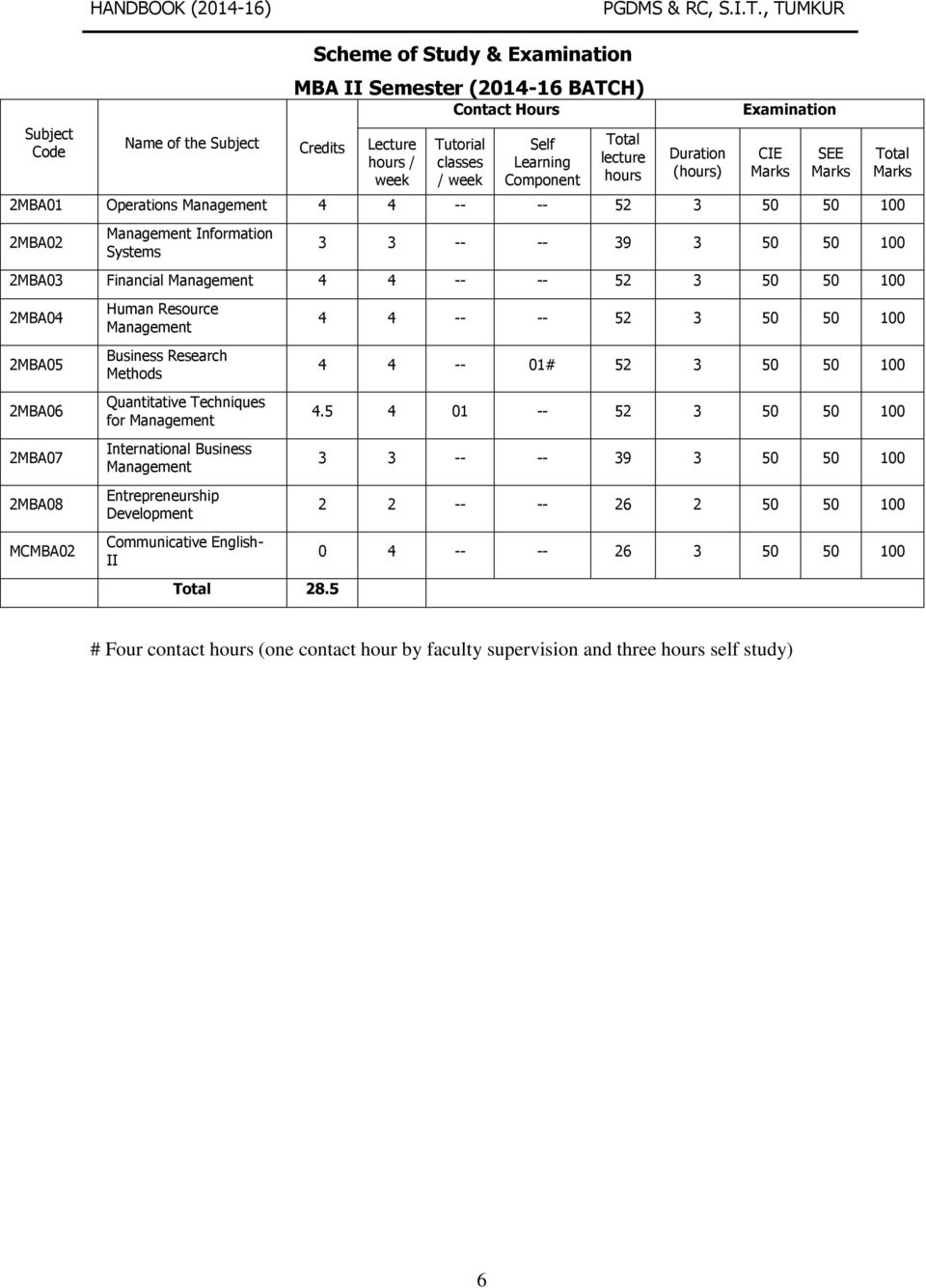
6 Subject Code Name of the Subject Scheme of Study & Examination MBA II Semester ( BATCH) Credits Lecture hours / week Contact Hours Tutorial classes / week Self Learning Component Total lecture hours Duration (hours) Examination CIE Marks SEE Marks 2MBA01 Operations Management MBA02 Management Information Systems Total Marks MBA03 Financial Management MBA04 2MBA05 2MBA06 2MBA07 2MBA08 MCMBA02 Human Resource Management Business Research Methods Quantitative Techniques for Management International Business Management Entrepreneurship Development Communicative English- II Total # # Four contact hours (one contact hour by faculty supervision and three hours self study) 6
7 Subject Code HANDBOOK ( ) III SEMESTER ELECTIVES (BATCH ) A student can specialize in Finance / Marketing / Human Resource Management / Hospital Management. The breadth and depth of elective courses allow students to focus on specific areas of study while receiving the broad perspective and skills in business that they require for leadership positions. In each area of specialization there are two components viz., Core electives and Soft electives. Each student has to compulsorily study two core electives. In case of soft electives, three papers are offered. Of which, a student has to choose any two among them. Thus a student has to study four papers in specialization track. The information relating to core and soft electives in the areas of Finance, Marketing, H.R. and Hospital Management are given below. The scheme of study and examinations of MBA Third Semester and MBA Fourth Semester as well as the courses offered in each Area of Specialization are presented in the following pages. Scheme of Study & Examination MBA III Semester ( BATCH) Contact Hours Examination Name of the Subject Credits Lecture hours / week Tutorial classes / week Total lecture hours Duration (hours) CIE Marks SEE Marks Total Marks 3MBA01 Cost & Management Accounting MBA02 Legal Environment of Business MBA03 Strategic Management MBA04 Supply Chain Management MBA05 Comprehensive Area Seminar * * * MCMBA03 Aptitude Skills MBA01 FM/MM/HR/HM 3MBA02 FM/MM/HR/HM 3MBA03 FM/MM/HR/HM 3MBA04 FM/MM/HR/HM Specialization Paper I (Core) Specialization Paper II (Core) Specialization Paper III (Soft) Specialization Paper IV (Soft) Total 28.5 * Each student has to present a seminar on a contemporary topic relating to his/her area of specialization. The topic of the seminar shall be decided in consultation with the Faculty guide concerned. The guidelines relating to evaluation of Comprehensive Area Seminar are explained in this Hand Book. 7

8 Subject Code III SEMESTER ELECTIVES: CORE AND SOFT Title of the subject FINANCE AREA Core (Compulsory Electives) 3 MBA FM 01 Investment Analysis & Management 3 MBA FM 02 Financial Institutions & Markets Soft (Optional Electives Any two) 3 MBA FM 03 Mergers, Acquisitions & Corporate Restructuring 3 MBA FM 04 Advanced Corporate Finance 3 MBA FM 05 Risk Management & Insurance MARKETING AREA Core (Compulsory Electives) 3 MBA MM 01 Services Marketing 3 MBA MM 02 Consumer Behaviour Soft (Optional Electives Any two) 3 MBA MM 03 Business Marketing 3 MBA MM 04 Sales Management 3 MBA MM 05 Rural Marketing HUMAN RESOURCE AREA Core (Compulsory Electives) 3 MBA HR 01 Advanced Organizational Behaviour 3 MBA HR 02 Employment Relation Laws Soft (Optional Electives Any two) 3 MBA HR 03 Industrial Relations in India 3 MBA HR 04 Personnel Management 3 MBA HR 05 Organizations-Structure, Process & Design HOSPITAL MANAGEMENT AREA Core (Compulsory Electives) 3 MBA HM 01 Planning and Organization of Clinical Services 3 MBA HM 02 Planning and Organization of Non-Clinical Services Soft (Optional Electives Any two) 3 MBA HM 03 Operations Management in Hospitals 3 MBA HM 04 Systems Development and Information Resource Management in Hospitals 3 MBA HM 05 Health Policy & Health Systems 8

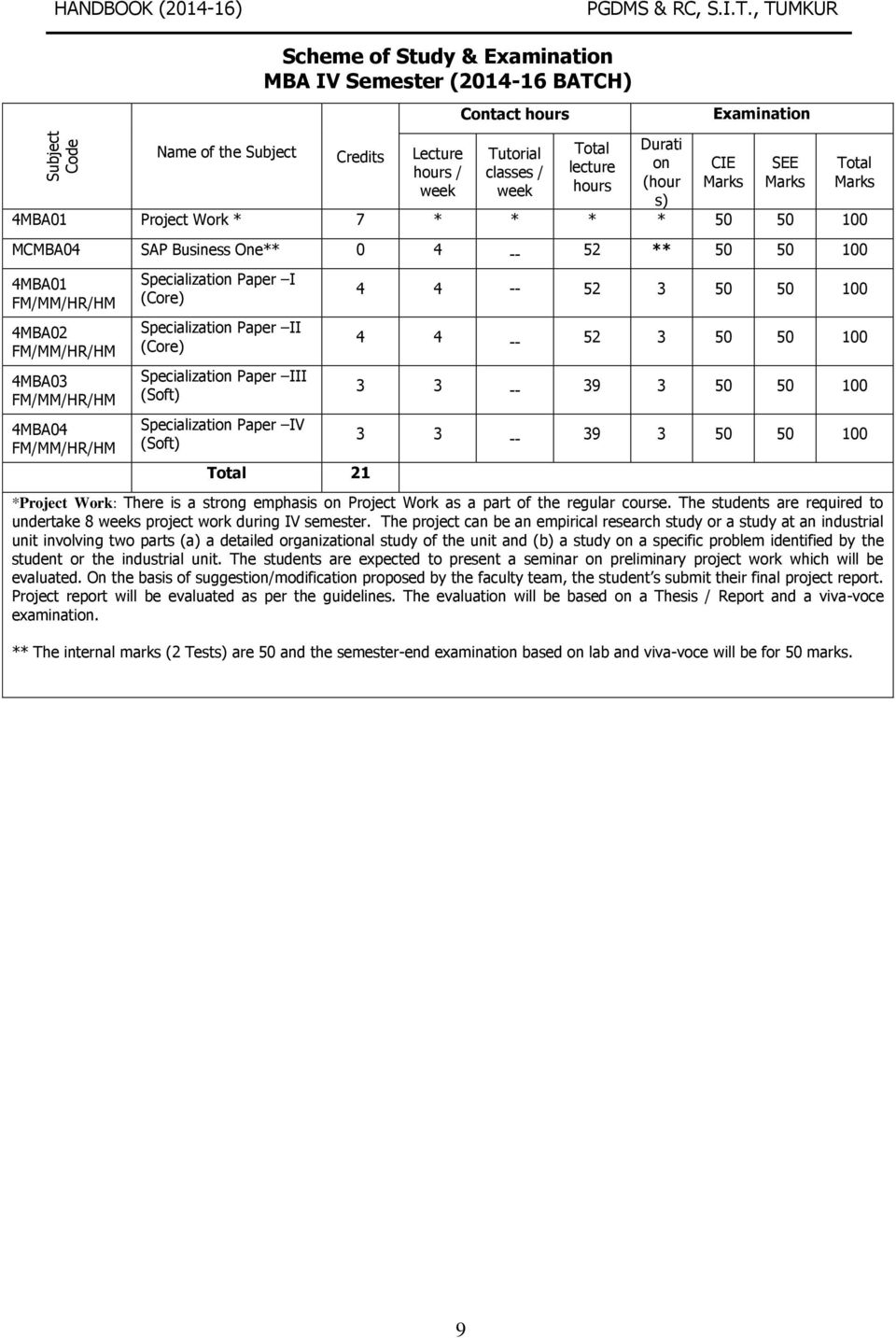
9 Subject Code HANDBOOK ( ) Scheme of Study & Examination MBA IV Semester ( BATCH) Contact hours Examination Name of the Subject Credits Lecture hours / week Tutorial classes / week Total lecture hours Durati on (hour s) CIE Marks SEE Marks 4MBA01 Project Work * 7 * * * * MCMBA04 SAP Business One** ** MBA01 FM/MM/HR/HM 4MBA02 FM/MM/HR/HM 4MBA03 FM/MM/HR/HM 4MBA04 FM/MM/HR/HM Specialization Paper I (Core) Specialization Paper II (Core) Specialization Paper III (Soft) Specialization Paper IV (Soft) Total 21 Total Marks *Project Work: There is a strong emphasis on Project Work as a part of the regular course. The students are required to undertake 8 weeks project work during IV semester. The project can be an empirical research study or a study at an industrial unit involving two parts (a) a detailed organizational study of the unit and (b) a study on a specific problem identified by the student or the industrial unit. The students are expected to present a seminar on preliminary project work which will be evaluated. On the basis of suggestion/modification proposed by the faculty team, the student s submit their final project report. Project report will be evaluated as per the guidelines. The evaluation will be based on a Thesis / Report and a viva-voce examination. ** The internal marks (2 Tests) are 50 and the semester-end examination based on lab and viva-voce will be for 50 marks. ** 9
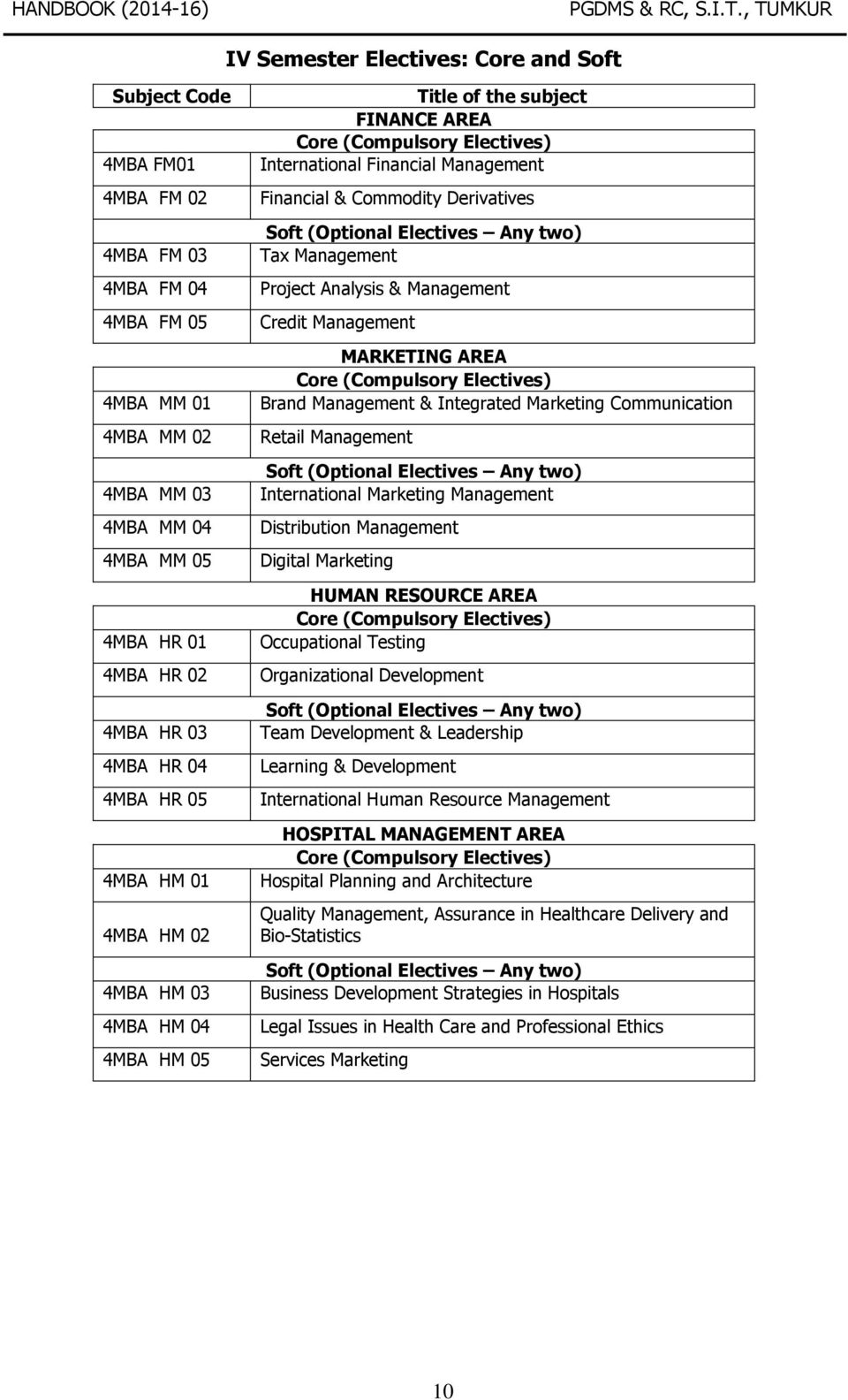
10 IV Semester Electives: Core and Soft Subject Code 4MBA FM01 4MBA FM 02 4MBA FM 03 4MBA FM 04 4MBA FM 05 4MBA MM 01 4MBA MM 02 4MBA MM 03 4MBA MM 04 4MBA MM 05 4MBA HR 01 4MBA HR 02 4MBA HR 03 4MBA HR 04 4MBA HR 05 4MBA HM 01 4MBA HM 02 4MBA HM 03 4MBA HM 04 4MBA HM 05 Title of the subject FINANCE AREA Core (Compulsory Electives) International Financial Management Financial & Commodity Derivatives Soft (Optional Electives Any two) Tax Management Project Analysis & Management Credit Management MARKETING AREA Core (Compulsory Electives) Brand Management & Integrated Marketing Communication Retail Management Soft (Optional Electives Any two) International Marketing Management Distribution Management Digital Marketing HUMAN RESOURCE AREA Core (Compulsory Electives) Occupational Testing Organizational Development Soft (Optional Electives Any two) Team Development & Leadership Learning & Development International Human Resource Management HOSPITAL MANAGEMENT AREA Core (Compulsory Electives) Hospital Planning and Architecture Quality Management, Assurance in Healthcare Delivery and Bio-Statistics Soft (Optional Electives Any two) Business Development Strategies in Hospitals Legal Issues in Health Care and Professional Ethics Services Marketing 10
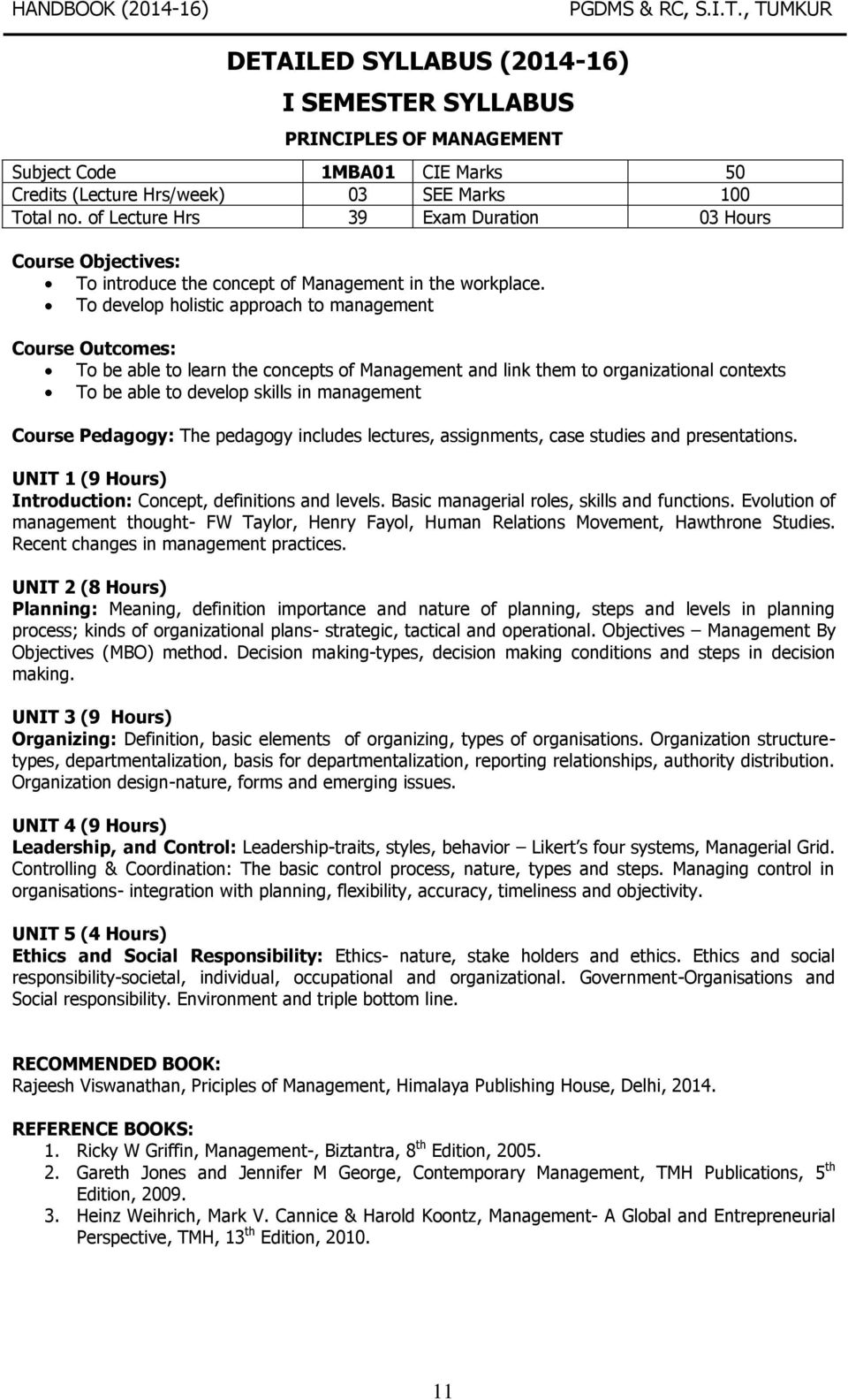
11 DETAILED SYLLABUS ( ) I SEMESTER SYLLABUS PRINCIPLES OF MANAGEMENT Subject Code 1MBA01 CIE Marks 50 Credits (Lecture Hrs/week) 03 SEE Marks 100 Total no. of Lecture Hrs 39 Exam Duration 03 Hours Course Objectives: To introduce the concept of Management in the workplace. To develop holistic approach to management Course Outcomes: To be able to learn the concepts of Management and link them to organizational contexts To be able to develop skills in management Course Pedagogy: The pedagogy includes lectures, assignments, case studies and presentations. UNIT 1 (9 Hours) Introduction: Concept, definitions and levels. Basic managerial roles, skills and functions. Evolution of management thought- FW Taylor, Henry Fayol, Human Relations Movement, Hawthrone Studies. Recent changes in management practices. UNIT 2 (8 Hours) Planning: Meaning, definition importance and nature of planning, steps and levels in planning process; kinds of organizational plans- strategic, tactical and operational. Objectives Management By Objectives (MBO) method. Decision making-types, decision making conditions and steps in decision making. UNIT 3 (9 Hours) Organizing: Definition, basic elements of organizing, types of organisations. Organization structuretypes, departmentalization, basis for departmentalization, reporting relationships, authority distribution. Organization design-nature, forms and emerging issues. UNIT 4 (9 Hours) Leadership, and Control: Leadership-traits, styles, behavior Likert s four systems, Managerial Grid. Controlling & Coordination: The basic control process, nature, types and steps. Managing control in organisations- integration with planning, flexibility, accuracy, timeliness and objectivity. UNIT 5 (4 Hours) Ethics and Social Responsibility: Ethics- nature, stake holders and ethics. Ethics and social responsibility-societal, individual, occupational and organizational. Government-Organisations and Social responsibility. Environment and triple bottom line. RECOMMENDED BOOK: Rajeesh Viswanathan, Priciples of Management, Himalaya Publishing House, Delhi, REFERENCE BOOKS: 1. Ricky W Griffin, Management-, Biztantra, 8 th Edition, Gareth Jones and Jennifer M George, Contemporary Management, TMH Publications, 5 th Edition, Heinz Weihrich, Mark V. Cannice & Harold Koontz, Management- A Global and Entrepreneurial Perspective, TMH, 13 th Edition,
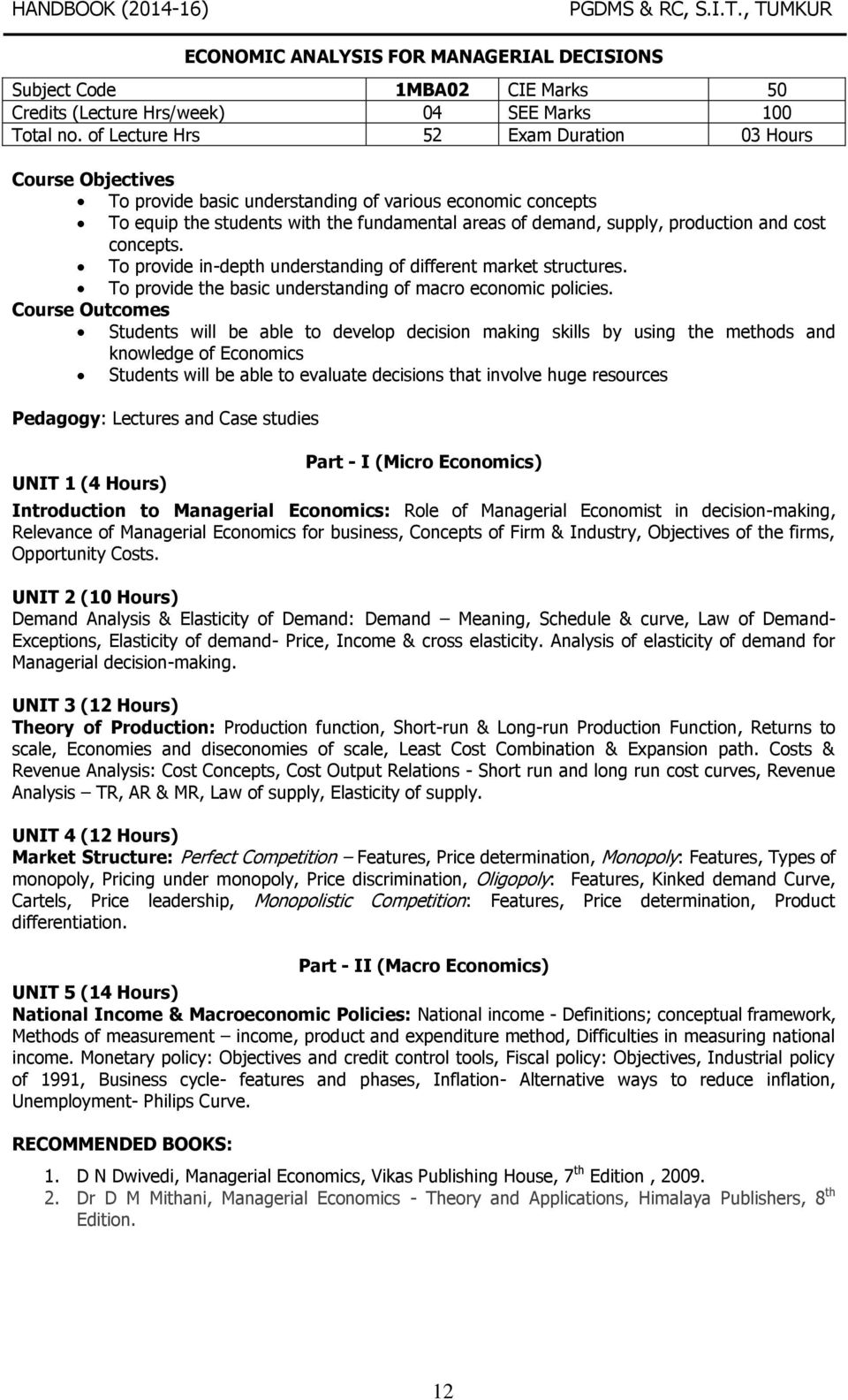
12 ECONOMIC ANALYSIS FOR MANAGERIAL DECISIONS Subject Code 1MBA02 CIE Marks 50 Credits (Lecture Hrs/week) 04 SEE Marks 100 Total no. of Lecture Hrs 52 Exam Duration 03 Hours Course Objectives To provide basic understanding of various economic concepts To equip the students with the fundamental areas of demand, supply, production and cost concepts. To provide in-depth understanding of different market structures. To provide the basic understanding of macro economic policies. Course Outcomes Students will be able to develop decision making skills by using the methods and knowledge of Economics Students will be able to evaluate decisions that involve huge resources Pedagogy: Lectures and Case studies UNIT 1 (4 Hours) Part - I (Micro Economics) Introduction to Managerial Economics: Role of Managerial Economist in decision-making, Relevance of Managerial Economics for business, Concepts of Firm & Industry, Objectives of the firms, Opportunity Costs. UNIT 2 (10 Hours) Demand Analysis & Elasticity of Demand: Demand Meaning, Schedule & curve, Law of Demand- Exceptions, Elasticity of demand- Price, Income & cross elasticity. Analysis of elasticity of demand for Managerial decision-making. UNIT 3 (12 Hours) Theory of Production: Production function, Short-run & Long-run Production Function, Returns to scale, Economies and diseconomies of scale, Least Cost Combination & Expansion path. Costs & Revenue Analysis: Cost Concepts, Cost Output Relations - Short run and long run cost curves, Revenue Analysis TR, AR & MR, Law of supply, Elasticity of supply. UNIT 4 (12 Hours) Market Structure: Perfect Competition Features, Price determination, Monopoly: Features, Types of monopoly, Pricing under monopoly, Price discrimination, Oligopoly: Features, Kinked demand Curve, Cartels, Price leadership, Monopolistic Competition: Features, Price determination, Product differentiation. Part - II (Macro Economics) UNIT 5 (14 Hours) National Income & Macroeconomic Policies: National income - Definitions; conceptual framework, Methods of measurement income, product and expenditure method, Difficulties in measuring national income. Monetary policy: Objectives and credit control tools, Fiscal policy: Objectives, Industrial policy of 1991, Business cycle- features and phases, Inflation- Alternative ways to reduce inflation, Unemployment- Philips Curve. RECOMMENDED BOOKS: 1. D N Dwivedi, Managerial Economics, Vikas Publishing House, 7 th Edition, Dr D M Mithani, Managerial Economics - Theory and Applications, Himalaya Publishers, 8 th Edition. 12
13 REFERENCE BOOKS: 1. Samuelson, P.A. & William D. Nordhous, Economics, Tata McGraw Hill, New Delhi., 19 th Edition, Christopher R Thomas and S. Charles Maurice, Managerial Economics, Tata McGraw Hill, Indian Adapted Edition, 10 th Edition, Dominick Salvatore, Managerial Economics in Global economy, Thomson Publication, 4 th Edition, Craig Peterson & Cris Lewis, Managerial Economics, PHI, Pearson Education, 4 th Edition, Varshney & Maheshwari, Managerial Economics, Sultan & Chand, 22 nd Edition, Mankiw, N. Gregory, Principles of Economics, Thomson, 7 th Edition, Yogesh Maheswari, Managerial Economics, Prentice Hall, 3 rd Edition, H.L. Ahuja, Advanced Economic Theory, S. Chand & Co.,

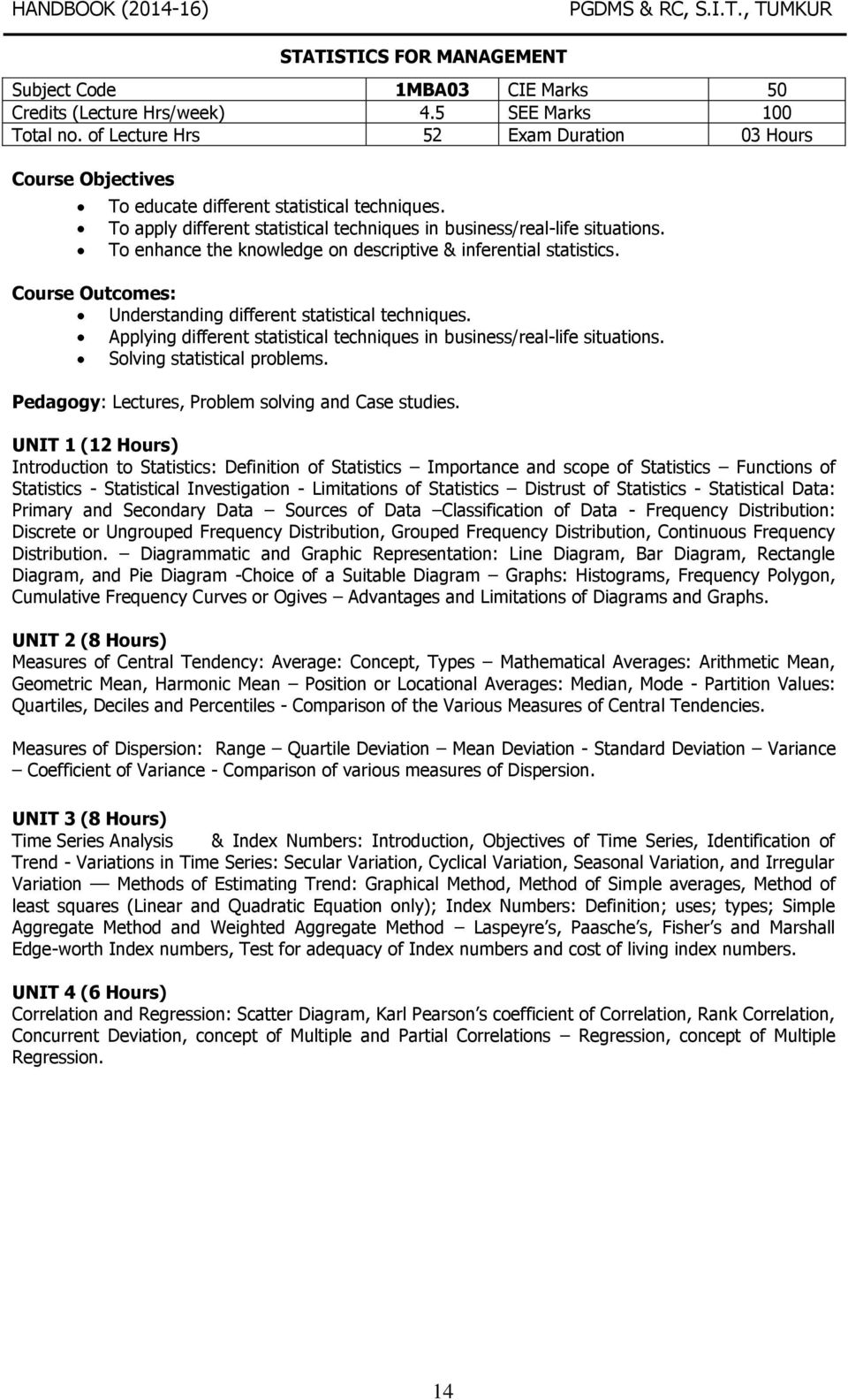
14 STATISTICS FOR MANAGEMENT Subject Code 1MBA03 CIE Marks 50 Credits (Lecture Hrs/week) 4.5 SEE Marks 100 Total no. of Lecture Hrs 52 Exam Duration 03 Hours Course Objectives To educate different statistical techniques. To apply different statistical techniques in business/real-life situations. To enhance the knowledge on descriptive & inferential statistics. Course Outcomes: Understanding different statistical techniques. Applying different statistical techniques in business/real-life situations. Solving statistical problems. Pedagogy: Lectures, Problem solving and Case studies. UNIT 1 (12 Hours) Introduction to Statistics: Definition of Statistics Importance and scope of Statistics Functions of Statistics - Statistical Investigation - Limitations of Statistics Distrust of Statistics - Statistical Data: Primary and Secondary Data Sources of Data Classification of Data - Frequency Distribution: Discrete or Ungrouped Frequency Distribution, Grouped Frequency Distribution, Continuous Frequency Distribution. Diagrammatic and Graphic Representation: Line Diagram, Bar Diagram, Rectangle Diagram, and Pie Diagram -Choice of a Suitable Diagram Graphs: Histograms, Frequency Polygon, Cumulative Frequency Curves or Ogives Advantages and Limitations of Diagrams and Graphs. UNIT 2 (8 Hours) Measures of Central Tendency: Average: Concept, Types Mathematical Averages: Arithmetic Mean, Geometric Mean, Harmonic Mean Position or Locational Averages: Median, Mode - Partition Values: Quartiles, Deciles and Percentiles - Comparison of the Various Measures of Central Tendencies. Measures of Dispersion: Range Quartile Deviation Mean Deviation - Standard Deviation Variance Coefficient of Variance - Comparison of various measures of Dispersion. UNIT 3 (8 Hours) Time Series Analysis & Index Numbers: Introduction, Objectives of Time Series, Identification of Trend - Variations in Time Series: Secular Variation, Cyclical Variation, Seasonal Variation, and Irregular Variation Methods of Estimating Trend: Graphical Method, Method of Simple averages, Method of least squares (Linear and Quadratic Equation only); Index Numbers: Definition; uses; types; Simple Aggregate Method and Weighted Aggregate Method Laspeyre s, Paasche s, Fisher s and Marshall Edge-worth Index numbers, Test for adequacy of Index numbers and cost of living index numbers. UNIT 4 (6 Hours) Correlation and Regression: Scatter Diagram, Karl Pearson s coefficient of Correlation, Rank Correlation, Concurrent Deviation, concept of Multiple and Partial Correlations Regression, concept of Multiple Regression. 14
15 UNIT 5 (18 Hours) A. Probability and Distribution (10 Hours): Concept and Definition - Relevance to Management Decisions - Sample Space and Events - Relevance of Permutations and Combinations to Probability - Rules of Probability, Random Variables, Mean and SD of Random variables and Concept of Probability Distribution. Theoretical Probability Distributions: Binomial, Poisson and Normal Distributions and examples. Baye s Theorem (Definition only) and examples. B. Testing of Hypothesis (8 Hours): Introduction to hypothesis testing, Procedure of testing hypothesis, Type I and Type II errors, Z-Test and T-Test. RECOMMENDED BOOK: S. C. Gupta, Fundamentals of Statistics, Himalaya Publishing House, 6 th Edition, REFERENCE BOOKS: 1. G C Beri, Business Statistics, Tata-McGraw Hill, 3 rd Edition, Richard I Levin, Statistics for Management, Pearson Education/PHI, 17 th Edition, Aczel and Sounderpandian, Complete Business Statistics, Tata-McGraw Hill, 6 th Edition, Lawrence S. Meyers, Applied Multivariate Research: Design and Interpretation, SAGE Publications Inc, 2 nd Edition, Glenn C. Gamst, A. (Anthony) J. Guarino, Sage Publication, Glyn Davis & Branko Pecar, Business Statistics using Excel, Oxford University Press. 7. Anderson, Sweeney, William, Statistics for Business and Economics, Thomson Publishing, 8 th Edition, S. P. Gupta, Statistical Methods, Sultan Chand & Sons, G C Beri, Business Statistics, Tata-McGraw Hill, 3 rd Edition, Ken Black, Business Statistics for Contemporary decision-making, John Wiley, 4 th Edition, JIT S Chandan, Statistics for Business and Economics, Vikas Publishing House. 12. Ajai S. Gaur & Sanjaya S Gaur, Statistical Methods For Practice And Research, Response Books, 2 nd Edition,
16 ACCOUNTING FOR MANAGERS Subject Code 1MBA04 CIE Marks 50 Credits (Lecture Hrs/week) 3.5 SEE Marks 100 Total no. of Lecture Hrs 39 Exam Duration 03 Hours Course Objectives: The course helps the students to understand and apply basic accounting principles. The course is intended to understand, analyse and interpret financial statements and related reports. Course Outcomes: Student would be able to know the accounting systems carried out in an organization and its utilization for the betterment of an organization through analysis of financial statements and cash flow analysis. Student would benefit by being able to study, understand and analyse financial statements. Course pedagogy: The pedagogy consists of lectures, problems solving, case studies, presentations and usage of Tally for accounting. UNIT 1 (5 Hours) Introduction to Accounting: Meaning of Accounting. Users of accounting information. Assumptions underlying accounting measurement. Generally Accepted Accounting Principles (GAAP). Indian Accounting Standards -International Financial Reporting Standards (IFRS). Forms of business organizations. The Accounting Equation. Ethical issues in accounting. Window dressing. UNIT 2 (8 Hours) Accounting Cycle: Recording business transactions. Classification of accounts. Double-entry system of accounting. Journal, Ledgers and trial balance (conceptual introduction and illustration only. No problems). Measuring business income - Incomes, expenses, gains and losses and net profit. Accrual accounting. Accounting Principles. Adjusting entries for deferrals and accruals. Completing Accounting Cycle: the final steps. Closing entries. Post-closing trial balance. Reversing entries. (Mandatory Training on Usage of Tally for accounting) UNIT 3 (5 Hours) Inventory Valuation: Meaning of inventory. Effects of inventory errors. Pricing the inventory. Inventory costing methods Specific identification, FIFO, LIFO and Weighted Average methods. Comparison of alternative inventory valuation methods. Perpetual inventory system. UNIT 4 (8 Hours) Fixed Assets, Liabilities and Shareholder s Equity. Fixed assets-determining cost of acquisition. Capitalisation of borrowing costs, basket purchases, donated assets and self-constructed assets. Accounting for Depreciation. Establishing the depreciable base and estimating the useful service life. Methods of depreciation Straight-line and Written Down Value methods. Capital expenditure and revenue expenditure. Accounting for intangible assets. Definition of liabilities. Classification of liabilities current liabilities, contingent liabilities and long-term liabilities. Deferred tax liability. Off-Balance sheet financing. Share Capital. Accounting for Share Capital. Preference share capital. Reserves. Accounting treatment of buy-back of shares and bonus shares. Earnings Per Share (EPS) and Diluted EPS. UNIT 5 (13 Hours) Financial Statements-Preparation & Analysis. Preparation of Financial Statements. (Sole trader and companies with basic adjustments). Understanding Annual Report of a company. Objectives of Financial Statement Analysis. Techniques of Financial statement analysis Horizontal, Vertical, Trend and Ratio Analysis. Statement of cash flows. Structure of cash flow statement. Preparation of cash flow statements - direct and indirect (problems only on indirect method). Interpretation of cash flow statements. 16

17 RECOMMENDED BOOK: R. Narayanaswamy, Financial Accounting - A Managerial Perspective, Prentice Hall India, 4 th Edition. REFERENCE BOOKS: 1. S.P. Jain, K.L. Narang & Simmi Agrawal, Accounting for Managers, Kalyani Publishers, P. C. Tulsian, Financial Accounting, Pearson Education India, 1 st Edition. 3. Maheswari & Maheswari, Accounting For Managers, Vikas Publishing house (P) Ltd. 4. B.S. Raman, Accountancy Vol I & Vol II, Universal Publishers, N. Ramachandran & Ram Kumar Kakani, Financial Accounting for Management, TMH Publications, 1 st Edition. 6. Ashish K Bhattacharya, Introduction to Financial Statement Analysis, Elsevier India (P) Ltd. 17
18 ORGANISATIONAL BEHAVIOUR Subject Code 1MBA05 CIE Marks 50 Credits (Lecture Hrs/week) 03 SEE Marks 100 Total no. of Lecture Hrs 39 Exam Duration 03 Hours Course Objectives: To develop organizational skills To make students understand organizational dynamics To focus on the behaviour of individuals and groups in organisations Course Outcomes: Students will develop organizational skills Students understand realities of organizational life Students will become effective organisers Course pedagogy: Lectures, Case studies. UNIT 1: Introduction (5 hours) Organizational Behaviour: Introduction, definition, historical development, fundamental principles of OB, contributing disciplines, challenges and opportunities. UNIT 2: Foundations of Individual Behaviour (14 Hours) Individual behaviour: Foundations of individual behavior. Ability: Intellectual abilities, Physical ability, the role of disabilities. Personality: Meaning, formation, determinants, traits of personality, Big five and MBTI, personality attributes influencing OB. Attitude: Formation, components of attitudes, relation between attitude and behaviour. Perception: Process of perception, factors influencing perception, link between perception and individual decision making. Emotions: Affect, mood and emotion and their significance, basic emotions, emotional intelligence, self awareness, self management, social awareness, relationship management. UNIT 3: Motivation and Leadership (10 Hours) Motivation: Meaning, theories of motivation-needs theory, two factor theory, Theory X and Y, application of motivational theories. Leadership: Meaning, styles of leadership. Theories-trait theory, managerial grid, Fiedler s model. UNIT 4: Group Behaviour (6 Hours) Definition, types, formation of groups, building effective teams. Conflict: Meaning, nature, types, process of conflict, conflict resolution. UNIT 5: Organizational culture (4 Hours) Importance, managing culture. Work stress and its management. RECOMMENDED BOOK: Stephen P Robbins, Timothy A. Judge, Neharika Vohra, Organizational Behaviour, Pearson, 14 th Edition,
19 REFERENCE BOOKS: 1. Fred Luthans, Organizational Behaviour, Mc-Graw Hill International, 12 th Edition, Michael Butler, Introduction to Organisational Behaviour, Jaico Publishing House 3. Ashwathappa, Organization Behaviour, Himalaya Publication House, Khanelwal, Nelson, Quick, ORGB, Cengage Learning, 2 nd Edition, Anada Das Gupta, Organizational Behaviour, Biztantra, Arun Kumar and Meenakshi, Organizational Behaviour: A modern approach, Vikas Publishing House, Rao V. S. P, Organizational Behaviour, Excel Books, Laurie J Mullins, Management and Organizational Behaviour, Pearson education. 9. Slocum/Hillriegel, Fundamentals of Organizational Behaviour, Cengage Learning, Aquinas P. G, Organizational Behaviour, Excel Books,

20 MARKETING MANAGEMENT Subject Code 1MBA06 CIE Marks 50 Credits (Lecture Hrs/week) 04 SEE Marks 100 Total no. of Lecture Hrs 52 Exam Duration 03 Hours Course Objectives: To put the students on the cutting edge of knowledge in making strong and actionable recommendations to managements in the field of marketing. Course Outcomes: This course will enable the student to: Appreciate the challenges required for effective Marketing Management Understand and apply the tools and techniques used in Marketing management Anticipate Marketing and Sales problems and issues common in the modern workplace Increase overall knowledge of marketing management concepts and practices. Pedagogy: Lecture and Case study, Students presentations, Self Study, etc. UNIT I: (12 hrs) Define marketing. Needs, wants and demands. The market offering products, services and experiences. Value, satisfaction and quality. Exchange, transactions and relationships. Marketing management. Demand management. Building profitable customer relationships. Marketing management practice. Marketing management philosophies: The production concept, The product concept, The selling concept, The marketing concept, The societal marketing concept. The marketing process, Strategy, marketing and planning, Strategic marketing, The marketing mix, The marketing plan, Marketing organization, Marketing control. Marketing audit: Meaning, Features of marketing audit, various components of marketing audit. The New Environment with Internet and advancements in Telecom sector. The way Business and Marketing are Changing, The major forces driving the New Economy. Business and marketing practices changing as a result of the New Economy. Marketers use of Internet, customer databases, and customer relationship management in the New Economy. Adapting Marketing to the New Economy, Major Drivers of the New Economy, Marketing in the Internet age, Major forces shaping the Internet age, Marketing strategy in the new digital age, E-commerce domains, Conducting e- commerce. The marketing environment: The company s microenvironment, The company s macro environment, Rural marketing environment in India and rural marketing. UNIT 2: (10 hrs) Consumer Markets: Models of consumer behaviour, Characteristics affecting consumer behaviour, Consumer decision process, Types of buying decision behaviour, The buyer decision process, The buyer decision process for new products. Business Markets: Characteristics of business markets. A model of business buyer behaviour, Business buyer behaviour. Business buying on the Internet. Institutional and government markets. Marketing and Society: social responsibility and marketing ethics: Consumerism, Marketing ethics. Consumer Protection Act, 1986-An introduction. Market segmentation: Levels of market segmentation, Segmenting consumer markets, Segmenting business markets, Developing market segments, Requirements for effective segmentation, Market targeting, Segment strategy, Differentiation, Differentiating markets, Product positioning, Positioning strategies, Selecting the right competitive advantages, Communicating and delivering the chosen position. UNIT 3: (10 hrs) Product and branding: Define product. Levels of product, Product classifications. Packaging / Labeling: Packaging as a marketing tool, requirement of good packaging, Role of labeling in packaging, Product decisions, Branding strategy, Brand equity, Managing brands New-product development and product life-cycle strategies: Innovation and new-product development strategy, New-product development process. Organising for new-product development. Product life-cycle strategies. 20
21 Marketing services: Nature and characteristics of a service. Defining services and the service mix, Service characteristics, Marketing strategies for service firms. The service profit chain, Managing differentiation. Managing productivity. UNIT 4: (10 hrs) Define price. Factors to consider when setting prices, Internal factors affecting pricing decisions, External factors affecting pricing decisions, General pricing approaches, Cost-based pricing, Valuebased pricing, Competition-based pricing, New-product pricing strategies, Market-skimming pricing, Market-penetration pricing, Product-mix pricing strategies, Price-adjustment strategies, Psychological pricing, Promotional pricing, Geographical pricing, Price changes. Managing marketing channels: Supply chains and the value delivery network, The nature and importance of marketing channels, How channel members add value, Selecting channel members, Managing and motivating channel members, Evaluating channel members. UNIT 5: (10 hrs) Promotion: Integrated marketing communication strategy, The changing communications environment, The need for integrated marketing communications. A view of the communication process, Steps in developing effective communication. Setting the total promotion budget and mix. Socially responsible marketing communication. Advertising: Important decisions in advertising, Setting advertising objectives, Setting the advertising budget, Developing advertising strategy, Evaluating advertising Sales promotion: Rapid growth of sales promotion, Setting sales promotion objectives Major sales promotion tools, Developing the sales promotion programme. Public relations: The role and impact of public relations, Major public relations tools Personal selling: The nature of personal selling, The personal selling process, Steps in the selling process, Direct marketing :Case studies in Indian context only. RECOMMENDED BOOK: Philip Kotler, Kevin Lane Keller, Abraham Koshy and Mithileswar Jha, Marketing Management, Pearson, 14 th Edition, REFERENCE BOOKS: 1. Lamb, Hair, Mc Danniel, Marketing, Thomson, 7 th Edition, Evans & Berman, Marketing, Biztantra, 2 nd Edition, William M Pride, O C Fewell, Marketing Concepts, strategies, Biztantra, 12 th Edition, Ramaswamy & Namakumari, Marketing Management, Macmillan, Arun Kumar & Meenakshi, Marketing Management, Vikas, Philip Kotler, Armstrong, Principles of Marketing, Pearson Education, 12 th Edition. 7. Tapan Panda, Marketing Management, Excel Publication, 2 nd Edition. 8. Dr. K. Karunakaran, Marketing Management (Text & Cases in Indian Context), HPH, M J Etzel, B J Walker, William J Stanton, Fundamentals of Marketing Management, TMH, 13 th Edition, Rajan Saxena, Marketing Management, TMH Publication, 3 rd Edition. 11. R Srinivasan, Case studies in Marketing The Indian context, 5 th Edition, PHI, Marketing Management I Semester Self study in Marketing Management course Objective: To instill in student s mind the sense of inquisitiveness and motivate them to look for deeper insights into various aspects of the course, i.e. Marketing Management. Concepts that are taught in classes have wider aspects which can be explored and better appreciated only if a student is self motivated and oriented towards looking for deeper insights from various sources like Internet, library, experienced individuals. The students will be guided to take up topics to make study on their own and make presentations. 21
22 Action plan for introducing Self study in Marketing Management. 1. Selection of topics for the same: The topics selected should be easy for the student to understand. There should be enough scope for the student to make an analysis, study and present something which is not covered at class teaching level. If topics are to be selected for group then topics should be such that sufficient scope for 5-6 students to present various aspects. 2. Student is expected to make a presentation about the topic for about minutes and give a report for about 3 pages (A4 size).for groups, depending on the size of the group the faculty to decide about the presentation time for all group members and number of pages for report. 3. This can replace one quiz.(only three quizzes to be done for MM) 4. The topic to be declared at the beginning of the semester itself and students have to work on it immediately. The presentation to take place as per the schedule. 5. Evaluation can be made on the basis of report (5 marks) and presentation (10 marks) for individual projects and for groups. The report will carry same grade for the entire group whereas different grading for presentation will be made for each member on merit. 22
23 BUSINESS & INFORMATION TECHNOLOGY Subject Code MCMBA01 CIE Marks 50 Credits 0 SEE Marks 100 (LAB : 50; Viva-Voce : 50) Total no. of Lecture and Lab Hrs Lecture and Lab Hrs/Wk 52 4 Exam Duration 03 Hours Course Objectives To familiarize the students with basic concepts of information technology and their applications to business processes. To introduce to the students the components of Microsoft Office and their features. To provide the students hands on experience with MS Office 2010 applications: Word 2010, Excel 2010, and PowerPoint 2010 and Access Course Outcomes The students would have learned the information and telecommunication technologies and its impact on organisations. The students would have enriched themselves with features of MS Office tools. The students would have learned to apply the MS Office features in accounting and finance, statistics, operations, project and other business applications. Pedagogy: Lectures, Case studies, Computer Lab using MS office. UNIT 1 (8 Hours) Telecommunications, the Internet, and Wireless Technology: Computer networks digital networking technologies client/server TCP/IP communications networks the Internet wireless networks Bluetooth, Wi-Fi, Wi-Max and RFID. UNIT 2 (8 Hours) Microsoft Word: Word Processing: Introduction Features of Word Formatting Tables: Creating and customising Working with graphics Mail merge and printing. UNIT 3 (16 Hours) Microsoft Excel: Spread sheets: Introduction Special Features Exploring Excel Formatting and Customising Data Formulas and Functions Creating and Formatting Charts Working with more than one worksheet Data Analysis Tool Kit - printing. UNIT 4 (9 Hours) Microsoft PowerPoint: Presentation: Introduction Features Slide Layout, Backgrounds and Themes Slide Master, Header and Footer Formatting Text and Text Boxes Creating and Formatting Tables Adding Audios and Videos Setting Up and Running a Slide Show Printing. UNIT 5 (11 Hours) Microsoft Access: Fundamentals - Database Basics - Creating and Working with a Database - Finding, Filtering, and Formatting Data - Working with Reports - Formatting Forms and Reports. PRACTICAL ASSIGNMENTS In MS Word, practicals include creating a document, navigating and working with a document, using different ribbons and its commands, creating and managing tables, using the symbols & equations and drawing tools. In MS Excel, the exercises include creating a sheet, using different functions, creating and managing charts, linking worksheets, using different ribbons and its commands. Linking Word documents and Excel spreadsheets The MS PowerPoint presentation exercises include creating a presentation, using different features audio, video, different commands and slide show. 23
24 MS Access exercises include creating, modifying a database and its components, using forms and reports. REFERENCE BOOKS: 1. Laudon and Laudon, Management Information System, Pearson, 12 th Edition, Microsoft Office 2010 Bible, Walkenbach, Tyson, Groh, Wempen, Bucki, Wiley India, Microsoft Office Professional 2013 Plain & Simple, Katherine Murray, PHI Learning, 1 st Edition, Gary B Shelly et al, Microsoft Office 2007, Cengage Learning, First look 2007 Microsoft Office system, Katherine Murray, PHI, Microsoft Office System Plain & Simple, Joyce & Moon, PHI,
25 COMMUNICATIVE ENGLISH -1 Subject Code PGCE1 CIE Marks 50 Credits 0 SEE Marks 50 Total no. of Lecture Hrs 52 Lecture Hrs/week 04 Course Objectives To gain working knowledge of written and spoken English To develop communication skill in English and to become an effective Manager Course Outcomes The students will be able to communicate in English effectively The student will be able to manage communication in the organization and develop interpersonal relationships Pedagogy: Lectures, Exercises, Games, Activities. UNIT 1 (8 Hours) Introduction & remedial English: Diagnostic pre-assessment in English grammar, speaking skills, listening skills, reading skills and writing skills - remedial coaching on English grammar concepts parts of speech, tense usage - vocabulary UNIT 2 (6 Hours) Speaking skills: Face to face conversation with emphasis - Practice face to face with modulation and intonation - Responding to questions, commenting and expressing personal views on information received - using appropriate phrases while responding to telephone conversation - interacting with people belonging to different professions - Interactive communication - to be able to carry on longer discussions - waiting for turn to speak - expressing negation politely UNIT 3 (6 Hours) Reading skills: Identifying or interpreting meaning of a wide variety of text types likely to be encountered in international business like , advertisements, internet news flashes - Reading for detailed comprehension - vocabulary and meaning, skimming and scanning skills -Interpreting visual information- graphs and charts - Locate detailed factual information - pick out salient points and infer meaning where words in the text are unfamiliar - Process factual info in text, guess meaning of unknown word from the context - Reading for gist and specific information - scan the text for specific information, analyze structure and coherence of language, understand the purpose of the writer and the audience for which the text is intended. - Grammatical accuracy and understanding of text structure- transfer information - extracting relevant information and completing a form accurately. UNIT 4 (16 Hours) Writing skills: How and why of different correspondence are used in business - Internal company communication: words, using written prompts - Note, message, memo, . correspondence with someone outside the company like a customer, supplier : words on business related matter - Letter, fax, , Content organization and cohesion, format, appropriateness and accuracy of content - Grammatical structures, range and accuracy of vocabulary - spelling and punctuation Listening skills: Understanding short conversations or monologues (15 30 secs) used in a range of situations, extract factual information, identify trend in a graph, establish the speakers reason for calling, identify feeling - Listen for gist and factual information in short conversations (60-90 secs) - Listening to a variety of business context, voices, styles of delivery and accents. 25
26 UNIT 5 (16 Hours) Application of skills: Application of the language skills (LSRW) to the following professional situations products, equipment and procedures, job recruitment, advertising and marketing, financial facts and figures, presenting new ideas, use of internet and new trends, describing company information REFERENCE BOOKS: 1. Mark Ibbotson, Professional English in Use - Technical English for Professionals, Cambridge: UK, Cambridge University Press, 1 st Edition, Leo Jones and Richard Alexander, New International Business English Workbook, Cambridge: UK, Cambridge University Press, 2 nd Edition (revised), Simon Sweeny, English For Business Communication, Cambridge: UK, Cambridge University Press, 2 nd Edition, Bhatia H S, Comprehensive High School Grammar And Composition, India, Book Palace, 1 st Edition, Murphy, Intermediate English Grammar - With Answers, Asia, Cambridge University Press, 2 nd Edition,
27 II SEMESTER SYLLABUS OPERATIONS MANAGEMENT Subject Code 2MBA01 CIE Marks 50 Credits (Lecture Hrs/week) 04 SEE Marks 100 Total no. of Lecture Hrs 52 Exam Duration 03 Hours Course Objectives: To introduce the concepts, tools and applications of production and operations management. To understand the decision role and responsibilities of operations in relation to other functions. To learn about the status of operations in e-business and emerging era. To study operations through a blend of theory and numerical problems. Course Outcomes: The students would have learned about various concepts related to the production and operations management. The students would have understood the decision role and responsibilities of operations function vis-à-vis other functions in an organization. Learned about the status of operations in e-business and emerging era. Problem solving exercises and illustrations would have enabled the students to understand and appreciate the importance of operations management in an organization. UNIT 1 (9 Hours) The Operation Function: A brief history. Operations Management (OM) in an E-business environment. Globalization. Competitiveness. Primary Concepts in OM. Operations Strategy formulation. Competitive Priorities. Operations role in corporate strategy. Strategy and the internet. Strategic decisions in Operations. Strategy Deployment. Issues and Trends in Operations. Defining Service: The Service-Product Bundle. Service Guarantees. Cycle of Service. Customer Contact. Service Matrix. Employees and Service. UNIT 2 (9 Hours) Facilities, Location and Layouts: Type of Facilities. Site Selection. Location Analysis Techniques. Types of Production Process. Process Planning and Analysis. Process Reengineering. Technology decisions. Basic Layouts. Designing Process Layouts. Designing Product Layouts. Hybrid Layouts. UNIT 3 (9 Hours) Inventory Management: Purpose of Inventories. Inventory Cost Structures. Independent versus Dependent Demand. ABC Inventory Management, Economic Order Quantity (EOQ). Continuous Review (Q) System. Periodic Review System (P). Using P and Q Systems in Practice. UNIT 4 (13 Hours) Materials Requirement Planning (MRP) and Just In Time (JIT): Definition of MRP Systems. MRP versus Order-Point Systems. MRP Elements. Operating an MRP System. The successful MRP System. Philosophy of Just in Time (JIT). Elements of a JIT System. Stabilizing the Master Schedule. The Kanban System. Reducing Setup time and Lot sizes. Layout and equipment. Effect on Workers. Suppliers. Implementation of JIT. Comparison of MRP and JIT. Beyond JIT to time based competition. Scheduling: Objectives in Scheduling. Sequencing. Monitoring. Advanced Planning and Scheduling Systems. Theory of Constraints. Infinite Capacity Loading. 27
28 UNIT 5 (12 Hours) Managing Quality: Evolution of Quality Management, the Quality Gurus, Quality Definitions, Service Quality, Quality Awards, Quality Certifications and Standards. Quality Control and Improvement: Design of Quality Control Systems, Process Quality Control, Attribute Control, Variables Control, Using Control Charts, Continuous Improvement, Sig Sigma. RECOMMENDED BOOKS: 1. Roger G Schroeder, Operations Management, Mc Graw Hill, 3 rd Edition, William J Stevenson, Operations Management, McGraw Hill Irwin, 9 th Edition, B. Mahadevan, Operations Management Theory and Practice, Pearson, 2 nd Edition, REFERENCE BOOKS: 1. Norman Gaither, Greg Frazier, Operations Management, Thomson South-Western, 9 th Edition, Roberta S Russel, Bernard W Taylor III, Operations Management, Pearson Education, 5 th Edition, Lee J Krajewski, Larry P Ritzman, Operations Management, Strategy and Analysis, PHI, 8 th Edition, Chase, Jacobs, Aquilano, Operations Management for Competitive Advantage, Tata McGraw Hill, 11 th Edition, Martin K Starr, Production and Operations Management, Biztantra, Aswathappa K, Sridhara Bhat K, Production and Operations Management, Himalaya Publishing House,
29 MANAGEMENT INFORMATION SYSTEM Subject Code 2MBA02 CIE Marks 50 Credits (Lecture Hrs/week) 03 SEE Marks 100 Total no. of Lecture Hrs 39 Exam Duration 03 Hours Course Learning Objectives (CLOs): To educate the students on the role of information systems in business. To explore the new avenues of e-commerce and its impact on organizations. To enhance the students knowledge in understanding the social and ethical issues in handling the information systems. To emancipate the students thinking in the context of global businesses and the role of information systems. Course Learning Outcomes/Intended Learning Outcomes (ILOs): The students would have learnt about different business processes in an organization and how different information systems help in managing these processes. The students would understand and appreciate the essentials of information systems The students would have learnt, and distinguish the impact of information systems on organizations and decision making. The students comprehend the ethical and social issues and challenges in employment of information systems. The students are expected to apply the knowledge acquired in the context of global business and role of information technology/systems. UNIT 1 (9 Hours) Role of information management in Business: Information Systems and transformation of business Recent Developments in Management Information System (MIS) A flattened world Digital firm Information System and its strategic business objectives Dimensions of information systems. Business Processes and Information Systems: Business Processes Types of information Systems Systems for linking the enterprise E-business, E-Commerce, and E-Government Systems for collaboration and teamwork. UNIT 2 (9 Hours) Enterprise Applications: Enterprise Systems Supply Chain Management Systems Customer Relationship Management Systems Opportunities and Challenges of enterprise applications. Managing Knowledge: Dimensions of knowledge Knowledge Management (KM) value chain enterprise wide KM systems knowledge work systems intelligent techniques. UNIT 3 (9 Hours) E-Commerce: Introduction key concepts types business models revenue models e- commerce marketing B2B m-commerce services and applications building an e-commerce web site. UNIT 4 (7 Hours) Managing Global Systems: The growth of international information systems Organising international information systems Managing global systems Technological issues, opportunities for global value chain. UNIT 5 (5 Hours) Security, Ethical and Social Issues: System Vulnerability and abuse: Internet Vulnerabilities wireless security challenges viruses, worms, Trojan horses and spyware hackers and computer crime. Software vulnerability. Five moral dimensions of the information age technology trends that raise ethical issues responsibility, accountability and liability ethical analysis ethical principles professional code of conduct. 29
30 RECOMMENDED BOOKS: 1. Kenneth C Laudon and Jane P Laudon, Management Information Systems, Pearson Education, 12 th Edition, James A. O Brien, Management Information Systems, Tata McGraw Hill, 9 th Edition, REFERENCE BOOKS: 1. Ralph M. Stair, George Reynolds, Information Systems, Cengage Learning, 10 th Edition, Effy Oz, Management Information Systems, Cengage Learning, 6 th Edition, Lynda M AppleGate and Robert D Austin, Corporate Information Strategy and Management, Tata McGraw Hill, 7 th Edition, Jawadekar W. S, Management Information Systems, Tata McGraw Hill, 4 th Edition,
31 FINANCIAL MANAGEMENT Subject Code 2MBA03 CIE Marks 50 Credits (Lecture Hrs/week) 04 SEE Marks 100 Total no. of Lecture Hrs 52 Exam Duration 03 Hours Course Description This course seeks to build understanding of the central ideas and theories of modern finance. Students would be able to develop familiarity with the analytical techniques which are helpful in financial decision making. In the wake of development in Indian business and financial sector, this course aims at central themes and evolving concerns of corporate financial management. The course comprehensively covers a wide spectrum of topics such as understanding Indian financial systems and also seeks to show how a wide range of financial decision situations should be analysed, dwell on the quantitative and qualitative considerations relevant for such decisions. Course Learning Objectives Familiarizing the students with the financial environment of business, especially the Indian financial systems. Developing the analytical skills to value investments projects and companies. Analysis of capital allocation (the capital budgeting decision). Evaluate how a firm finances its investments (the capital structure decision) and how it manages its short term operations (the working capital budgeting decision). Decision making on dividend payout and measurement of earnings. Course Learning Outcomes/Intended Learning Outcomes Recall and understand Indian financial systems. Evaluate the investments projects and companies. Prepare capital budget and appropriations. Decide upon the capital structure and working capital budgeting decisions. Take decision on higher dividend payout or lower dividend payout. UNIT 1 (12 Hours) Introduction to Financial Management & Indian Financial System: Functions of financial management. Finance function in an organization. Role of finance manager, treasurer, controller. Objectives of financial management Profit maximization Vs. Wealth maximization. Basic concepts of corporate financial planning. Basic concepts of Indian Financial System: Financial markets. Primary and secondary market-its significance. Various methods of raising funds in the primary market. Steps involved in primary issue. Intermediaries to issue. Costs of primary issue. Rights issue of shares. Raising long term and short term funds various sources-equity, preference shares, debt - its characteristics. Institutional finance. UNIT 2 (8 Hours) Time Value of Money: Concepts of future value & present value of single amounts, annuities and perpetuity. Computation of EMI, effective interest rate etc. Loan amortization. UNIT 3 (10 Hours) Capital Budgeting Decisions: Significance, Techniques of project evaluation Payback, ARR, NPV, IRR and Benefit Cost Ratio. Its applications. Conflicts in ranking the projects using NPV & IRR. Estimation of cash flows for capital budgeting principles of cash flow estimation. Cash flows of expansion, replacement projects etc. UNIT 4 (12 Hours) Cost of Capital & Capital Structure Decisions: Basic concepts. Cost of equity, cost of preference capital and cost of debt. Weighted average cost of capital. Floatation costs and cost of capital. Marginal cost of capital schedule. Cost of capital and capital budgeting linkages. Capital Structure Decisions: Basic concepts, capital structure & market value of a firm Practical considerations. Leverage--operating, financial and combined. EBIT-EPS analysis. Theories of capital 31
32 structure NI approach, NOI approach, Modigliani Miller approach, traditional approach. Arbitrage process in capital structure. UNIT 5 (10 Hours) Dividend Decisions & Working Capital Management: Types of dividends. Bonus issue, stock splits etc. Factors considered for dividend payments. Dividend Theories Gordon Model, Walter Model & MM Hypothesis. Working Capital Management: Factors influencing working capital. Working capital policy. Operating cycle and cash cycle. Estimation of working capital requirements (Does not include Cash, Inventory &Receivables Management). RECOMMENDED BOOK: Prasanna Chandra, Financial Management Theory & Practice, Tata McGraw-Hill (TMH) Publishing Company Limited, New Delhi, 8 th Edition, REFERENCE BOOKS: 1. Khan M.Y & Jain P.K, Financial Management Text & Problems, Tata McGraw-Hill (TMH) Publishing Company Limited, New Delhi, 6 th Edition, Pandey I M, Financial Management, Vikas Publishing House Pvt. Limited, New Delhi, 10 th Edition, Damodaran Aswath, Corporate Finance Theory & Practice, Wiley India Pvt Ltd, New Delhi, 2 nd Edition,
33 HUMAN RESOURCE MANAGEMENT Subject Code 2MBA 04 CIE Marks 50 Credits (Lecture Hrs/week) 04 SEE Marks 100 Total no. of Lecture Hrs 52 Exam Duration 03 Hours Course Objectives To understand the importance of Human Resource Management To introduce the concepts and practices of Human Resource Management To familiarize students with the concepts and practice of Human Resource Management To provide real life experiences in Human Resource Management through case studies. Course Outcomes Understanding of importance of Human Resource Management Understanding of concepts and practices of Human Resource Management Designing strategies in Human Resource Management Ability to take up activities in Human Resource Management Pedagogy : Lectures, presentations and case study UNIT 1 (12 Hours) Nature and Scope of Human Resource Management (HRM) and Human Resource Development (HRD): Introduction definition human resource management personal v/s HR meaning of HRM features of HRM role of HRM managerial functions and operative functions objectives of HRM policies procedures and programmes organization of HRM line and staff and personnel management role of personnel manager and HR manager qualities of HR / personnel manager. UNIT 2 (10 Hours) HR planning & Recruitment: Introduction objectives of Human Resource Planning (HRP) linkage of HRP to other plans definition and need for HRP benefits of HRP factors affecting HRP process, problems and limitations of HRP job analysis job evaluation job description. Definition, objectives subsystems factors affecting recruitment policy centralized and decentralized recruitment recruitment techniques recruitment process UNIT 3 (6 Hours) Selection, Placement and Induction: Meaning definition of selection essentials of selection procedure significance of selection process and organizational relationship selection procedure recruitment application form written exams preliminary interview various types of tests (aptitude, achievement, situational, interest, personality) different types of interviews and interview process means to make interview effective medical exams reference checks final decision employment placement and induction UNIT 4 (12 Hours) Human Resource Training and Development: Meaning of Training & Development (T&D) importance of training benefits of training need and objectives assessment of training needs areas of training training methods on-the-job and off-the-job training advantages of training training procedures final evaluation Performance Appraisal System (PAS) introduction meaning need purpose objectives contents of PAS appraisers and different methods of appraisal uses of performance appraisal limitations and problems of performance appraisal 360 Appraisal UNIT 5 (12 Hours) Career Planning, Compensation and HR Records: Career planning meaning need, career development actions promotion meaning purpose bases of merit seniority merit cum seniority benefits problems promotion policy transfer meaning purpose types reasons benefits demotion meaning need for demotion policy. Wages and Salary Administration Introduction definition need for sound salary administration objectives factors affecting wages / salary levels wage salary survey wage incentives merits and 33
34 types of incentive plans profit sharing bonus concepts Employee Stock Options (ESOPs) pay for performance. HR accounting HR audit Human Resource Information System (HRIS) RECOMMENDED BOOK: P Subba Rao, Personal and Human Resource Management, Himalaya Publication, REFERENCE BOOKS: 1. Biswajeet Patnayak, Human Resource Management, PHI, 3 rd Edition, Bohlander, Snell, Sherman Managing Human Resources, Thomson Learning, 13 th Edition, K Ashwatappa, Human Resource And Personnel Management, Text And Cases, TMH, 4 th Edition. 4. Cynthia Fisher, Shaw Human Resource Management, Biztantra, 5 th Edition, Gary Desler, Human Resource Management, Pearson Education, 10 th Edition, Pearson Education, John M Ivancevich, Human Resource Management, TMH, 9 th Edition, Michael Armstrong, A Hand Book Of Human Resource Management, Kogan Page India Ltd. 8. Ian Beardwell, Len Holden, Human Resource Management, Mcmillan India Ltd. 9. Robbins, D Cenzo, Human Resource Management, John Wiley & Co. 10. Gomes Mejia, Bakin Candy, Managing Human Resources, Pearson Education, PHI, 4 th Edition,
35 BUSINESS RESEARCH METHODS Subject Code 2MBA05 CIE Marks 50 Credits (Lecture Hrs/week) 4 SEE Marks 100 Total no. of Lecture Hrs 52 Exam Duration 03 Hours Course Objectives: To introduce the importance of Research Methodology. To introduce the basic concepts of Research Methodology. To familiarize students with research process, conducting of research and research design. To familiarize the students with preparing the report and evaluation of research report. Course Outcomes: Better understanding of importance of Research Methodology. Better understanding of concepts of Quantitative Techniques. Preparing the students to application of Quantitative Techniques. Better decision making by using Quantitative Techniques. Pedagogy: The Pedagogy consists of lectures, presentations and case analysis. UNIT 1 (12 Hours) Introduction to Business Research: Research and research methodology. Language of Research Meaning, types of business research, criteria of good research approaches to business research; scientific and non-(un)-scientific; difference between research methods and methodology; significance of business research, Literature Review. Business Research Process & Proposal: meaning and components; steps involved in preparing business research plan/proposal. UNIT 2 (12 Hours) Research problems designing the study steps in research design process types of research design. Sources and collection of data - Secondary data sources advantages and limitations methods of collection of data, Primary data sources advantages questionnaire design scales of measurement used in research. UNIT 3 (4 Hours) Sampling Methods: types probability and non probability samples types of sample design random, stratified, area, systematic non probability convenience, judgment, quota advantages sampling, snowball sampling limitations determination of sample size and estimating proportions application of sampling in marketing. UNIT 4 (15 Hours) Data Analysis using SPSS: Data editing, coding and cross tabulation and Descriptive data analysis, testing of hypothesis using z & t test (two samples). UNIT 5 (9 Hours) Multivariate Analysis: chi square test, one way ANOVA, linear regression and correlation, discriminant analysis factor analysis conjoint analysis multi dimensional scaling. Report Writing: Methods of report writing oral, written, advantages and disadvantages of oral and written reports components of written research reports presentation of reports audio-video presentation. RECOMMENDED BOOKS: 1. Cooper, Schindler and Sharma, Business Research Methods, TMH, 11 th Edition, Naresh Malhotra and Satyabhushan Dash, Marketing Research, Pearson Education, 6 th Edition,
36 REFERENCE BOOKS: 1. Zikmund, Babin, Carr, Adhikari and Griffin, Business Research Methods, Cengage, 7 th Edition, Deepak Chawla and Neena Sondhi, Research Methodology, Concepts and Cases, Vikas, C R Kothari, Research Methodology, Vishwa Prakashan, Rajendra Nargundkar, Marketing Research: Text and Cases, TMH, 2 nd Edition, William M C, Trochim, Research Methods, Biztantra, 2 nd Edition, 2003/ David Luck, Ronald Rubin, Marketing Research, PHI, G A Churchill, Iacobucci, Marketing Research, Thomson, 8 th Edition, A Parasuraman, Dhruv Grewal, Marketing Research, Biztantra, O R Krishnaswamy, Methodology Of Research In Social Sciences, Himalaya Publishers. 10. Paneerselvam R, Research Methods, PHI, Ajai S. Gaur and Sanjaya S.Gaur, Statistical Methods For Practice and Research A guide to data Analysis using SPSS, Response Books. 12. Carver, Nash, Doing Data Analysis with SPSS, Cengage Publication. Business Research Methods II Semester Self-Study Component Research Project Objective: Students are given an opportunity to take up a research project of their own interest and apply the research methodology that they have studied in planning and execution of the project. Roadmap: Students form a team of 5 members each. The time-line for the research project is as follows. Choosing a Research Project Problem Formulation Research Design Framing Questionnaire Pre-test Data Collection Analysis and Interpretation Presentation Total 1 Week 1 Week 1 Week 1 Weeks 1 Week 2 Weeks 2 Weeks 1 Week 10 Weeks Continuous Evaluation and Assessment: Each team is required to show continuous progress in planning and executing the project. At the end of the project, each team has to submit a report and make presentation. The grade will be awarded on the basis of each student contribution to the project, the presentation and the project report. This enables students to contribute to the project. If a student is not able to live up to the requirements, he/she may get lesser grade than that of team s grade. 36
37 QUANTITATIVE TECHNIQUES FOR MANAGEMENT Subject Code 2MBA06 CIE Marks 50 Credits (Lecture Hrs/week) 4.5 SEE Marks 100 Total no. of Lecture Hrs 52 Exam Duration 03 Hours Course Objectives: To provide basic understanding of quantitative techniques To equip the students with the various Operations Research Models To facilitate the students to find out optimal solution for transportation and assignment problems To empower with the knowledge of network analysis To demonstrate the queuing models and simulation technique To equip with the skills of decision making using quantitative techniques Course Outcomes : Describe the nature, models, benefits and limitations of quantitative techniques Develop mathematical models using linear programming technique Draw up the transportation and assignment problem Illustrate the use of network techniques for successful project implementation Demonstrate the queuing and simulation models Develop the skills of decision making using quantitative techniques Pedagogy: Lecture, Problem solving and Case study UNIT 1 (8 hours) Introduction to Operations Research: Historical Development of Operations Research, Nature and characteristic features of Operations Research, Meaning and definition of Operations Research, Methodology of Operations Research, Models in Operations Research, benefits and limitations. Linear Programming: Formulation, solution by graphical method, special cases alternative, infeasible and unbounded solutions, Advantages and limitations, duality (formulation only) UNIT 2 (8 hours) Transportation and assignment models: General structure, finding initial solution using North West Corner (NWC), LCM (Least Cost Method) and Vogel s approximation method; optimal solution using Modified Distribution (MODI) method, unbalanced, degeneracy, restricted and maximal problems. Assignment Model initial and optimal solution, unbalanced, maximal and restricted problems. UNIT 3 (6 hours) Network Analysis: Characteristics of Project Evaluation and Review Techniques and Critical Path Method, Activity-on-Node (AoN), Activity-on-Arrow (A-o-A) Diagrams, Determination of critical path, timings and slacks, Network cost system Crashing. UNIT 4 (9 hours) Queuing Model and Simulation: Introduction to queuing, queue characteristics, queue discipline, queuing model notations and applications of queuing models. Single channel queuing model with Poisson arrival and Exponential Service rate (unlimited queue). Simulation and its importance, process, advantages and disadvantages, Monte-Carlo method, Random number generation. Simulation of inventory, queuing, investment, risk analysis and network problems. UNIT 5 (8 hours) Decision Theory: Decision making under risk Expected Mandatory Value (EMV), Expected value for perfect information and Expected Opportunity Loss (EOL). Decision making under uncertainty Maximax, Maxmin, criterion of realism, equally likely and Minimax regret. Marginal Analysis with discrete and continuous (normal) distribution. Decision Tree Analysis. 37
38 RECOMMENDED BOOK: N D Vohra, Quantitative Techniques in Management, Tata McGraw Hill Publishing Co. Ltd, 4 th Edition, REFERENCE BOOKS: 1. Wayne L Winston, Operations Research Applications and Algorithms, Thomson Books, J K Sharma, Operations Research Theory and Applications, Macmillan India, 5 th Edition, Anderson, et al, Quantitative Methods for Business, Thomson Publishing, 12 th Edition, Richard I. Levin, et al, Quantitative Approaches to Management, McGraw Hill International Edition, Barry Render et al, Quantitative Analysis for Management, Pearson Education Inc, 8 th Edition,
39 INTERNATIONAL BUSINESS MANAGEMENT Subject Code 2MBA07 CIE Marks 50 Credits (Lecture Hrs/week) 03 SEE Marks 100 Total no. of Lecture Hrs 39 Exam Duration 03 Hours Course Objectives: To understand the importance of International Business Management (IBM) To introduce to the concepts of International Business Management To familiarize with international business strategies. Course Outcomes: Better understanding of importance of International Business Management Better understanding of concepts of International Business Management Designing strategy in business Better understanding international business environment Pedagogy: Lecture and Case study. UNIT 1 (8 hours) Globalization: Drivers of Globalization, Changing demographics of global economy. National differences in political economy: political system, economic systems, legal systems, determinants of economic development. Differences in culture: culture, social structure. UNIT 2 (8 hours) Global Trade & Investment Environment: International Trade theory- Mercantilism, absolute advantage, comparative advantage, heckscher-ohlin theory, product life cycle theory, new trade theory, national competitive advantage: Porter s Diamond. UNIT 3 (8 hours) Foreign Direct Investment: FDI in the world economy, Horizontal FDI, Vertical FDI. Regional Economic Integration: Levels of economic integration, Regional economic integration in Europe, Regional economic integration in Americas, Regional economic integration in elsewhere. UNIT 4 (7 hours) The International Monetary System: Introduction, The gold standard, the Bretton woods system, fixed vs. floating exchange rates, exchange rate regimes in practice. UNIT 5 (8 hours) The Organization of International Business: Organizational structure, Organizational culture, Synthesis: Strategy and Architecture, Organizational change. Entry Strategy and strategic alliances: Introduction, entry modes, selecting an entry mode, establishing a wholly owned subsidiary, strategic alliances. RECOMMENDED BOOKS: 1. Charles W Hill, International Business: Competing in the Global Market Place, McGraw-Hill, 6 th Edition, P.Subba Rao, International Business-Himalaya Publishing House, 2 nd Edition, REFERENCE BOOKS: 1. R Srinivasan, International Marketing, PHI, 3 rd Edition, Charles W L, Hill Global Business Today, Tata McGraw Hill, 4 th Edition, John D Daniels Lee H Radebaugh, International Business: Environments and operations, Addison Wesley. 4. Michael R Czinkota, Iikka A Ronkainen, Michael H Mofett: International Business, Thomson South Western, 6 th Edition, Anant K Sundaram /J. Stewart Black, The International Business Environment, Prentice Hall. 6. Janet Morrison, International Business Environment, Macmillan. 39
40 ENTREPRENEURSHIP DEVELOPMENT Subject Code 2MBA08 CIE Marks 50 Credits (Lecture Hrs/week) 02 SEE Marks 100 Total no. of Lecture Hrs 26 Exam Duration 03 Hours Course Objectives: To familiarize the students about entrepreneurship and its importance. To expose and coach them on entrepreneurial competencies. To help them to know various stages and the problems associated to entrepreneurship. To ignite and motivate them to become an entrepreneur. Course Outcomes: Better understanding of entrepreneurship and its importance. Knowing and understanding of required competencies to run the successful enterprise. Prepared to become an entrepreneur. Pedagogy : Lectures, presentations and case study UNIT 1 (10 Hours) Entrepreneur & Entrepreneurship: Meaning, Evolution of the Concept; Development of Entrepreneurship, Functions of an Entrepreneur. Types of Entrepreneurs Stages in Entrepreneurial Process.. Barriers to Entrepreneurship, Entrepreneurship and Innovation. Intrapreneur, Difference between Manager and Entrepreneur, Role of entrepreneurs in Economic Development. Entrepreneurial competencies: Meaning, major entrepreneurial competencies. UNIT 2 (4 Hours) Rural Entrepreneurship: Meaning, Need for rural entrepreneurship. Problems of rural entrepreneurship, Institutional support and programmes for promoting entrepreneurship: Small Scale Industry Institute (SSI), District Industries Centre (DIC), Technical Consultancy Organizations (TCOs), Entrepreneurship Development Programmes (EDP), Meaning, Need for EDP, Objectives, Course content and phases of EDP s UNIT 3 (4 Hours) Women Entrepreneurship: Concept, functions of women entrepreneurs, Growth of women entrepreneurship, problems of women entrepreneurs. Entrepreneurial Motivation : Meaning, McClelland s acquired needs theory, Motivating factors, Achievement motivation UNIT 4 (6 Hours) Identification of Business: Opportunities, Meaning of a Project, Project Identification, Project Selection. Project Report; Need and Significance of Report, Contents of project report. Project Appraisal: Market Feasibility Study, Technical Feasibility Study. Financial Feasibility Study, Business Plan. UNIT 5 (2 Hours) Social Entrepreneurship; meaning, importance, traits of a social entrepreneur, role of social entrepreneurship in nation building. Franchising: Meaning, advantages, disadvantages, franchising in India. RECOMMENDED BOOK: S S Khanka, Entrepreneurship Development, S Chand & Co., 4 th Edition, REFERENCE BOOKS: 1. Dr. C V Gupta & Dr. N P Srinivasan, Entrepreneurship Development in India, Sultan Chand & Sons, 5 th Edition, Michael Edwards & Alan Fowler, The Earthscan Reader on NGO Management (Chapters 3, 4, 5, 8 & 17), Earthscan, 1 st Edition,
41 3. Entrepreneurship-Robert D Hisrich, Tata McGrawHill, 6 th Edition, David H Holt, Entrepreneurship-New Venture Creation, PHI, 1 st Edition,
42 COMMUNICATIVE ENGLISH -II Subject Code MCMBA02 CIE Marks 50 Credits 0 SEE Marks 50 Total no. of Lecture Hrs 52 Lecture Hrs/week 04 Course Objectives: To improve communication skills in English To improve all forms of communication, written, spoken and facial expressions and body language Course Outcomes: To be able to communicate effectively as an individual and manager To be able to handle interpersonal relationships and manage communication in organizations Pedagogy: Lectures, Exercises, Games, Activities. UNIT 1 (12 Hours) Personal Effectiveness- Personal Effectiveness Definition, personality/ behavioral attributes of personal effectiveness exploratory orientation, self-disclosure, receptivity to feedback, sensitivity to others, action planning for personal effectiveness Handling Feedback - Importance of feedback in professional develop, techniques to give and receive feedback, dealing with negative feedback, roles plays for practice Ethics Values and Ethics definitions, Importance of ethics for professionals, personal most common unethical behaviors at work, rationalization, and professional conduct requirements, methods to resolve ethical dilemmas, case studies for discussion on ethical choices UNIT 2 (12 Hours) Basics of Communication Communication model, barriers to communication, factors that contribute to effectiveness of communication, media selection, 3Vs of communication, improving listening skills, improving conversational skills, practice and role play exercises Articulation skills Characteristics of effective communicators, improving your articulation skills, articulation exercise for various business contexts sharing information, asking for feedback, questioning skills, responding to issues Assertive communication types of behavioral responses, importance of assertive communication, assertive communication techniques fogging, broken record, diffusion, practice and role play exercises in assertive communication UNIT 3 (12 Hours) Written Communication Clear and concise writing concepts and practice, writing effective letters/ s/memos concept and practice, composing and editing persuasive messages, in-tray exercises for practice in various contextual scenarios, writing effective reports and minutes of meetings UNIT 4 (12 Hours) Presentation skills 4 Pillars of preparing and delivering effective presentations, techniques of preparing and structuring presentation, use of data and visual aids, delivery techniques for opening, main body and closing, effective use of body language for impact, responding to questions, handling various kinds of audience, effective use of audio/visual aids for delivery UNIT 5 (8 Hours) Goal Setting & Time Management Importance of goals setting, techniques for setting goals, case study on goal setting, action planning, importance of time management for achieving goals, 4 quadrant approach for prioritization, practice exercises for planning and organizing REFERENCE BOOK: Asha Kaul, Business Communication, Prentice-Hall of India Pvt Ltd,
43 III SEMESTER SYLLABUS COST AND MANAGEMENT ACCOUNTING Subject Code 3MBA01 CIE Marks 50 Credits (Lecture Hrs/week) 4.5 SEE Marks 100 Total no. of Lecture Hrs 52 Exam Duration 03 Hours Course Learning Objectives (CLOs) To define the concepts, nature purpose of management control system To describe the concepts, classification and behaviour of cost To ascertain the cost of a product. To analyse the managerial situations and enable to take appropriate decisions. Course outcomes List and describe major concepts of management control system and cost accounting. Describe classification and behaviour of cost Estimate the cost of a product using different costing methods Apply marginal costing and absorption costing techniques. Evaluate the managerial decisions. Pedagogy: Pedagogy includes classroom discussions, problem solving, case studies, student assignments and presentations. UNIT 1 (10 Hours) Management Control & Cost Concepts: Meaning, nature and purpose. Profit, growth and control. Goal congruence. Conflict among stakeholders. Hierarchy of controls and corporate governance. Cost terms, cost drivers, cost pools & cost objects. Classification of costs. Direct & indirect costs. Product costs & period costs. Computation of total costs & unit costs for manufacturing, merchandising and service firms. Cost behavior with respect to volumes- variable/ fixed and semi variable. UNIT 2 (12 Hours) Costing systems: Absorption costing treatment of direct and indirect costs overhead allocation and absorption. Job costing manufacturing & service sector Process costing: preparation of process accounts treatment of normal loss, abnormal loss and abnormal gain. Activity based costing (ABC) cost pools- cost drivers and product costing using ABC. UNIT 3 (12 Hours) Cost-volume-Profit (CVP) Analysis: CVP relationship with output. Break even analysis. Sensitivity analysis, Cost planning & CVP. Cost analysis for decision making. Determining cost behavior. Decisions on Make or buy; closing down unprofitable divisions/products/product line; alternative sourcing. One time special orders, Product mix decisions under certain capacity constraints. Sell or process further, operate or shut down. UNIT 4 (6 Hours) Pricing Decisions (theory only): Major influences on pricing. Short and long run pricing, various methods of pricing. Cost plus pricing. Target costing for target pricing. Transfer Pricing Meaning & methods. UNIT 5 (12 Hours) Budgeting & Budgetary Control: Types of budgets- Preparation of sales budget, production budget and cash budget, Preparation of flexible budget. Standard costing-variance analysis (material variances). 43
44 RECOMMENDED BOOKS: 1. Jawaharlal, Cost Accounting, Tata McGraw Hill Publishing Company Limited, 5 th Edition, Robert N Anthony & Vijay Govindarajan, Management Control Systems, Tata McGraw Hill Publishing Company Limited, 12 th Edition, REFERENCE BOOKS: 1. Charles T Horngren, Srikant M Datar & George Foster, Cost Accounting A Managerial Emphasis, Pearson Education, 13 th Edition, Lynch & Williamson, Accounting for Management Planning & Control, Tata McGraw Hill Publishing Company, M Y Khan & P K Jain, Cost Accounting, Tata McGraw Hill Publishing Company, 6 th Edition,
45 LEGAL ENVIRONMENT OF BUSINESS Subject Code 3MBA 02 CIE Marks 50 Credits (Lecture Hrs/week) 03 SEE Marks 100 Total no. of Lecture Hrs 39 Exam Duration 03 Hours Course Objectives: To provide basic understanding on Indian Contract Act To brief the importance of Law of Agency. To enable the students with usage of negotiable instruments. To elaborate the provisions relating to formation of a company, powers and responsibilities of the directors and managers, holding company meetings and winding up of a company. To explain the nature and formation of partnership, the rights, duties and liabilities of partners and the procedure for dissolution of partnerships. Course Outcomes: Gain practical knowledge on the Indian Contract Act Better understanding on the law of agency, bailment and pledge. Understand and comprehend the legal aspects of company formation. Analyze the importance of law of partnership among the firms. Pedagogy: Pedagogy includes classroom discussions, student assignments and presentations. UNIT 1 (9 Hours) Law of Contract: Definition, essentials, offer definition and essentials, acceptance definition and essentials, consideration definition and essentials, exceptions to the rule, no consideration - no contract, capacity of parties, free consent, termination of contract, remedies for breach of contract. UNIT 2 (7 Hours) Law of Agency: Kinds of agents, rights and duties of agent and principal, creation of agency, termination of agency. Bailment and Pledge Bailment, definition, essential elements, rights and duties of bailor and bailee. Pledge Essentials, rights and duties of pledger and pledgee. UNIT 3 (8 Hours) Negotiable Instruments Act 1881: Kinds of negotiable instruments promissory notes, bills of exchange and cheques. Parties to negotiable instruments, presentment, discharge and dishonour of negotiable instruments. Law of insurance General principles of insurance, life, fire and marine. Sale of Goods Act: Sale v/s Agreement to Sell, Arbitration, objectives and scope, Arbitral Tribunal, Appointment, and termination of arbitrator. UNIT 4 (8 Hours) Companies Amendment Act 2002: Definition, characteristics and kinds of companies, steps in formation of company. Memorandum of Association, Articles of Association, Prospectus. Directors: Powers & duties. Meeting: Types of meetings. Auditor: Rights and liabilities. UNIT 5 (7 Hours) Law of Partnership: Essentials, rights & liabilities of partners, registration and dissolution of partnership firm. Foreign Exchange Management Act (FEMA): Objectives. Consumer Protection Act: Objectives, Consumer Protection Council. 45
46 RECOMMENDED BOOKS: 1. Saravanavel & Sumathi, Business Law for Management, HPH, S.S.Gulshan & G.K.Kapoor, Business Law including Company Law, New Age International (P) Ltd, 16 th Edition, REFERENCE BOOKS: 1. N D Kapoor, Elements of Marcantile Law, Sultan Chand Publishing house, 34 th Edition, Manmohan Prasad, Principles of business law and management HPH, M C Kuchhal, Business Law, Vikas publication, 6 th Edition, Gulshan, Business Law, Excel Books, 4 th Edition, Rohini Aggrawal, Students Guide to Mercantile & Commercial Law, Taxmann,
47 STRATEGIC MANAGEMENT Subject Code 3 MBA 03 CIE Marks 50 Credits (Lecture Hrs/week) 3 SEE Marks 100 Total no. of Lecture Hrs 39 Exam Duration 03 Hours Course Objectives: To understand the importance of Strategic Management in Business To introduce the concepts of Strategic Management To familiarize students with creative strategy in business To familiarize the students with crafting, execution and control of strategy Course Outcomes: Better understanding of importance of Strategic Management Better understanding of concepts Strategic Management Crafting of creative strategy in business Better understanding strategy crafting, executing and control of strategy. Pedagogy: The Pedagogy consists of lectures, presentations and case analysis. UNIT 1 (8 Hours) Meaning and Nature of Strategic Management: Its importance and relevance, Characteristics of Strategic Management, The Strategic Management Process Relationship between a Company s Strategy and its Business Model, Significance of crafting and execution of Strategy. Strategy Formulation: Developing Strategic Vision and Mission for a company Setting Objectives Strategic Objectives and Financial Objectives Balanced score card, Company Goals and Company Philosophy. The hierarchy of Strategic Intent Merging the Strategic Vision, Objectives and Strategy into a Strategic Plan. UNIT 2 (8 Hours) Analysing a Company s External Environment: The Strategically relevant components of a Company s external environment Industry Analysis Industry s dominant economic features - Competitive Environment Analysis Porter s five force model Industry driving forces key success factors concept and implementation Analyzing a company s resources and competitive position Analysis of the company s present strategies - SWOT Analysis Value chain Analysis Bench marking and ethical conduct. UNIT 3 (8 Hours) Generic Competitive Strategies: Low cost provider Strategy Differentiation Strategy Best cost provider Strategy Focused Strategy Strategic alliances and Collaborative partnerships Mergers and acquisition Strategies Outsourcing Strategies First Mover advantages and disadvantages Strategies for using Internet in the Global scenario. International Business level strategies strategic alliances and joint ventures with foreign partners. UNIT 4 (8 Hours) Formulating Long Term and Grand Strategies Competing in the foreign markets Entry strategies Quest for competitive advantage in foreign markets Strategic alliances, Joint Ventures and its relevance Tailoring Strategy to fit specific Industry and company situation Setting and Qualifying long term objectives for Grand Strategies Innovation, Integration and diversification Conglomerate Diversification, Retrenchment, Restructuring and turnaround for a better tomorrow GE nine cell planning grid and grand strategy selection at business level Contingency approach to strategic choice by looking back to the past strategies. UNIT 5 (7 Hours) Strategy Implementation: Operationalizing strategy, Annual Objectives, Developing Functional Strategies, Developing and communicating concise policies. 47
48 Institutionalizing the strategy. Organizational Structure and Controls - Structure, Leadership and Culture. Managers as an Organizational Resource. Structural Considerations, Relationships between Strategy and structure, Organizational Leadership. Strategic control guiding and evaluating strategies, Establishing Strategic controls, Operational Control Systems, Monitoring performance and evaluating deviations, challenges of Strategy Implementation. RECOMMENDED BOOK: Arthur A. Thomson Jr., A. J. Strickland III, John E. Gamble, Crafting and Executing Strategy, Tata McGraw Hill, 18 th Edition, REFERENCE BOOKS: 1. W.L.Hill, Gareth R. Jones, Strategic Management An Integrated Approach by Charles, Cengage Learning, 10 th Edition, John Parnell, Strategic Management-Theory and Practice, Sage Publication Inc., R Srinivasan, Strategic Management-The Indian Context, PHI, 4 th Edition,
49 SUPPLY CHAIN MANAGEMENT Subject Code 3 MBA 04 CIE Marks 50 Credits (Lecture Hrs/week) 03 SEE Marks 100 Total no. of Lecture Hrs 39 Exam Duration 03 Hours Course Objectives: To introduce various concepts related to the supply chain management. To educate the importance of supply chain decision such as design, planning, and operations of a firm. To give the students an understanding of the analytical tools necessary to solve supply chain problems. To showcase the ways by which the companies use different supply chain drivers to improve their performance. Course Outcomes: The students would have learned about various concepts related to the supply chain management. The students would have got educated about the strategic importance of supply chain design, planning and operational decisions. Understanding and applications of the analytical tools to solve supply chain problems would have taken place. Various case studies and illustrations would have inculcated the importance of supply chain drivers in improving the performance of an organization. Pedagogy: Lectures, Cases, and discussions. UNIT 1 (8 Hours) Introduction to Supply Chain Management: Supply chain historical perspective - objectives importance decision phases process view impellers of supply chain financial measures of performance drivers of supply chain performance framework for structuring drivers facilities inventory transportation information sourcing pricing. UNIT 2 (8 Hours) Designing Distribution Networks and Network Design: Role of distribution factors influencing distribution network design design options for a distribution network online sales and the distribution network Distribution channels in Indian agricultural, FMCG and commodity sectors Role of network design factors influencing network design decisions framework for network design decisions. UNIT 3 (8 Hours) Demand Forecasting: Role characteristics components approach time series methods measures of forecast error role of IT. Managing uncertainty: Safety inventory and its appropriate level impact of supply uncertainty, aggregation and replenishment policies. UNIT 4 (6 Hours) Coordination in a Supply Chain: Lack of supply chain coordination and the Bullwhip effect Effect on performance obstacles to coordination managerial levers continuous replenishment and vendormanaged inventories collaborative planning, forecasting and replenishment Indian experience. UNIT 5 (6 Hours) Transportation and Sourcing: Role of transportation modes and their performance design options and their trade-offs Tailored transportation. Sourcing In-house or Outsource 3rd and 4th PLs Scoring and assessing suppliers. Case studies in SCM (3 Hours) 49
50 RECOMMENDED BOOKS: 1. Sunil Chopra, Peter Meindl and Kalra D V, Supply Chain Management Strategy, Planning and Operation, Pearson, 5 th Edition, Janat Shah, Supply Chain Management : Text and Cases, Pearson, 1 st Edition, REFERENCE BOOKS: 1. Donald J Bowersox, David J Closs, Bixby Cooper M, Supply Chain Logistics Management, Tata McGraw Hill, 2 nd Edition, Sople V V, Supply Chain Management Text and Cases, Pearson Education, Jeremy F Shapiro, Modeling the Supply Chain, Cengage Learning, 2 nd Edition, Coyle, Bardi, Longley, The management of Business Logistics A supply Chain Perspective, Thomson Press, 7 th Edition,
51 COMPREHENSIVE AREA SEMINAR Subject Code 3 MBA 05 Credits (Lecture Hrs/week) 01 Course Objectives: To familiarize the students to latest development in management, business and industry in India and abroad To inculcate knowledge and skills in conducting seminars and workshops Course Outcomes: To be able to conduct seminar and workshops on matters of social and economic importance To be able to express their views and communicate effectively with groups and audience 1. The Comprehensive Area Seminar is part of internal assessment for III semester which carries one credit. 2. Each student of III semester shall have to choose a seminar topic relevant to the area of specialization and give a seminar on the same. The topic can be broadly based on (a) Recent developments in the area, and/or (b) Application of a concept/theory/model in the relevant field, and / or (c) Application of a concept/theory/model in Indian/global context etc. 3. The write-up on Comprehensive Area Seminar shall broadly be organized into following sections / headings: a) Introduction b) Theoretical framework: Definition, explanation and significance/relevance of the concept (The use of text books is restricted only to the theoretical framework). c) Real-life illustrations/examples/case studies, if any d) Data analysis & interpretations, if any e) Regulatory framework, if any f) Advantages/disadvantages/limitations etc. g) Concluding remarks h) Learning Outcome i) Bibliography (list of reference materials along with publications, volumes) (Please Note: The structure proposed above is recommendatory) 4. The information required for developing the Comprehensive Area Seminar report should be drawn from internet, newspapers, magazines and journals etc. Content in the write-up/paper should be original and independent. 5. The students have to submit a brief report (Font: Arial; font size: 12), minimum of 12 pages, not exceeding 15 pages including tables, charts and graphs, if any) along with a soft copy of the complete report to the respective guides. 6. Students attached to their respective Faculty Guides are advised to finalize the topic (The enclosed list of Comprehensive Area Seminar topics of the previous year is just indicative) as well as the presentation in consultation with their faculty guides. However, each faculty has complete discretion to decide the topic. 7. Once the topic is finalized, the students are required to register the same with the Seminar Coordinator in the prescribed format. 8. Two students cannot choose the same topic. 9. Students must meet the respective faculty guide, at least once in a week and report the work done during the week. The faculty guide has to necessarily document the details in the prescribed proforma of weekly review meetings and submit a copy of the same to the Director. 10. For presentations a maximum of 10 to 12 PPT slides be prepared beforehand. 11. Each student will be given 15 minutes to make the presentation followed by 5 minutes for questions/clarifications etc. 12. The presentation as well as the report shall be evaluated by a team consisting of faculty guide and a panel of examiners (Internal Faculty) constituted by the Director, PGDMS & RC. 51
52 13. The marks for Comprehensive Area Seminar are distributed as follows: a) Subject matter, contents & coverage 10 b) Communication/Presentation Skills 20 c) Response to queries/clarifications 10 d) Quality of the Seminar Report 10 Total Marks 50 52
53 APTITUDE SKILLS Subject Code MCMBA03 CIE Marks 50 Credits (Lecture Hrs/week) 0 Total no. of Lecture Hrs 52 Course Objectives: To prepare students to perform well in competitive examinations, interviews and group discussions To give inputs to develop communication skills To encourage healthy competition in academic matters To enhance employability of students Course Outcomes: To be able to come out successfully in competitive examination To be able to come out successfully in group discussions and other competitions To be able to market himself in job market UNIT 1 (12 Hours) - Foundation skills for Job Preparation Basics of communication, communicating effectively in dyadic and group contexts, overcoming barriers of communication, practice exercises in articulation and collaborative discussions with feedback, practice exercises in clear and concise writing, techniques to improve written communication. UNIT 2 (20 Hours) - Preparation for Aptitude Tests Verbal aptitude Knowledge of English vocabulary and grammar, Practice questions in synonyms and antonyms, roots, prefixes and suffixes, common patterns of vocabulary questions in job selection tests, Error identification exercises, commonly asked error identification questions pronoun errors, misplaced modifiers, parallel construction, parallel comparison, tense usage, subject verb agreement, errors in expression, reading comprehension exercises, and verbal reasoning exercises Quantitative aptitude Basic application of quantitative techniques to solve business problems computation of interest, stock price, price-cost-discount problems, percentages, permutation and combination, application problems in arithmetic and algebra, ratios and proportions, sequence and progressions Analytical aptitude Concepts in logical reasoning deductive and inductive reasoning, syllogism problems, rules and fallacies, numeric logic, scenario based reasoning problems, data interpretation problems. UNIT 3 (3 Hours) Resume preparation Techniques to prepare powerful resumes, formats, important information to be highlighted in the resume objectives, academics, project information, training, additional qualifications, how employers look at resume and short list etc. UNIT 4 (7 Hours) Preparing for Group Discussions (GDs) Group Discussion (GD) as an instrument in job selection, skills evaluated in a GD, Structure of a GD, various types of topics normally covered in Job selection GDs abstract, fact based, case study based, social issues. Technology & business etc, Do s and Don ts in a GD, Mock GD Sessions & Feedback. UNIT 5 (10 Hours) Preparation of Interviews Objectives of personal interviews, type of interviews personal, technical, stress, various types of questions, body language and behavioral aspects in facing interviews, mock interviews and individual feedback. 53
54 REFERENCE BOOKS: 1. Chaturvedi and Chaturvedi, Business Communication, Pearson Education, 5 th Edition, 2009, 2. R S Agarwal, Quantitative Aptitude for Competitive Examinations, S Chand Publishing, 17 th Edition, R S Agarwal, A modern approach to verbal and non verbal reasoning, S Chand Publishing, 2 nd Edition,
55 SPECIALIZATION IN FINANCE INVESTMENT ANALYSIS & MANAGEMENT Subject Code 3 MBA FM 01 CIE Marks 50 Credits (Lecture Hrs/week) 04 SEE Marks 100 Total no. of Lecture Hrs 52 Exam Duration 03 Hours Course Objectives: Equip the students with the skills of analyzing various investments Provide in-depth understanding of pricing and valuation of financial assets Provide basic understanding of behaviour and efficiency of security markets Provide the basic understanding of modern portfolio theory. Course Outcomes: In-depth knowledge of various investment avenues and their valuation Working knowledge on Wealth Management Function and Mutual Fund industry. Increased employability with firms involved in personal financial planning. Pedagogy : Lectures, presentations and case study UNIT 1 (6 Hours) Introduction to Investment: Basic concepts. Various investment avenues financial and non-financial. Financial markets. Risk-return trade off. Measurement of historical risk & returns. Expected risk & returns. UNIT 2 (20 Hours) Analysis & Valuation of Debt Securities: Bond pricing theorems. Yield curve. Duration & immunization. Analysis of convertible bonds. Bond portfolio management. Analysis of Equity Investments: Fundamental analysis. Economy-industry-firm analysis Financial & non financial factors to be considered. Technical analysis basic concepts. Various technical tools & charts like Rate of Change Indicator (ROC), Relative Strength Indicator (RSI), Moving Average Convergence & Divergence (MACD), Oscillators, Japanese candle sticks etc. Valuation of equity shares. Balance sheet based valuation. Dividend discount model. Capital Asset Pricing Model. UNIT 3 (4 Hours) Behaviour of Stock Market Prices: Market efficiency various forms of market efficiency. Testing the efficiency. Random walk hypothesis. UNIT 4 (14 Hours) Modern Portfolio Theory: Systematic & unsystematic risk importance. Asset allocation. Markowitz model. Sharpe s single index model. Optimum portfolio selection. Portfolio Management. Steps in portfolio creation. Active & passive portfolio management. Portfolio evaluation. Sharpe s ratio, Treynor & Jenson measure. Portfolio revision various methods. UNIT 5 (8 Hours) Mutual Funds: different types, Exchange Traded Funds (ETF), Fixed Maturity Plans (FMP), Hedge Funds. Pros and cons of investing in Mutual Funds (MF), Evaluation of mutual funds. International investing: benefits and risks. Measuring returns and risks of global investments. Global factors influencing investment in mutual funds. 55
56 RECOMMENDED BOOK: 1. Prasanna Chandra, Investment & Portfolio Management, Tata McGraw Hill Publishing Company, Kevin, Security Analysis and Portfolio Management, Prentice Hall of India Ltd, REFERENCE BOOKS: 1. Bodie, Kane & Marcus, Investments, Tata McGraw Hill Publishing Company, 9 th Edition, William Sharpe, Investments, Prentice Hall of India Pvt. Limited, New Delhi, 6 th Edition,
57 FINANCIAL INSTITUTIONS & MARKETS Subject Code 3 MBA FM 02 CIE Marks 50 Credits (Lecture Hrs/week) 04 SEE Marks 100 Total no. of Lecture Hrs 52 Exam Duration 03 Hours Course Objectives: Comprehend the students with the basic idea about the Indian Financial System. To impart knowledge about various financial markets and services. To expose the students to grasp the working of Reserve Bank of India (RBI), commercial banks, cooperative banks and other financial institutions. Equip the students with various tools available to raise equity at both domestic and international markets. To acquaint the students about evaluation of the performance of banks by using both traditional and modern methods. Course Outcomes: Describe the working of RBI, commercial banks and other financial institutions Describe the structure of the Indian Financial System. Comment regarding the money and capital markets alongside being able to list out the various instruments relating to each of these markets. Address on the linkages between financial markets, institutions and services and their contribution to the smooth working of the economy. List out the various sources for raising funds from international markets. Assess the performance of bank, and also suggest the most suitable technique for assessing the performance. Pedagogy : Lectures, presentations and case study UNIT 1 (12 Hours) Financial System-introduction & functions. Structure of the Indian Financial System. Introduction to Financial Markets, Financial Institutions and Financial Services. Financial Institutions: Banking system in India. Reserve Bank of India - functions of RBI. Commercial banking. Functions of commercial banks. Nationalisation of commercial banks in India. Structure of the Indian banking industry. Changing role of commercial banking in India and the modern services offered by banks. Evaluation of bank s performance. Return on Equity (ROE) model & Capital Adequacy Asset Quality Management Earning Liquidity Sensitivity to market risks (CAMEL S) Rating. Co-operative Banks meaning and structure. Industrial Finance Institutions meaning & role. Non- Banking Financial Corporation (NBFCs)-role and significance. UNIT 2 (10 Hours) Financial Markets: Money market. Structure of the Indian money market. Money market instruments. Government securities market. Capital Market growth and function. Structure of the Indian Capital Market. Capital market instruments. The primary market role and functions. Pricing of issues. Dematerialisation of securities. Underwriting. Methods of floatation of new issues. Intermediaries in the new issue market. Raising of equity from international markets Depository Receipts and External Commercial Borrowing. UNIT 3 (10 Hours) Financial Markets: Capital market- secondary market. Stock markets in India brief history, growth and structure. Listing of securities. Types of players in the market. Types of orders. Over the Counter Exchange of India (OTCEI), Stock Holding Corporation of India Ltd. (SHCIL) and Depositories role and significance. Trading and settlement procedures at National Stock Exchange (NSE) and Bombay Stock Exchange (BSE). Stock market indices meaning & significance. Recent trends in the Indian Capital markets. 57
58 Capital market regulation. Security Exchange Board of India (SEBI) - role and functions. Major regulatory initiatives in primary market and secondary market. UNIT 4 (12 Hours) Financial Services: Meaning and significance. Various financial services an overview. Investment banking meaning. Role and functions of investment bankers. Leasing meaning and significance. Types of lease. Hire purchase. Difference between leasing and hire purchase. Credit Rating rating of debt and equity instruments. Factoring meaning, process of factoring. Types of factoring. Forfeiting. Difference between factoring and forfeiting. UNIT 5 (8 Hours) Financial Services: Venture Capital features. Steps in venture capital financing. Venture capital financing in India. Insurance meaning. Types of insurance. Pension Funds meaning and role. RECOMMENDED BOOK: Clifford Gomez, Financial Markets, Institutions and Financial Services, Prentice Hall India Pvt. Ltd., 1 st Edition, REFERENCE BOOKS: 1. S C Bihari, Indian Financial System, International Book House, 1 st Edition, H R Machiraju, Indian Financial System, Vikas Publishing House, 4 th Edition, L M Bhole, Financial Institutions & Markets, Tata McGraw-Hill, 5 th Edition, George H. Hempel & Donald John, Bank Management, Wiley & Sons. 5. M Y Khan, Financial Services, Tata McGraw-Hill, 4 th Edition, S M Jha, Services Marketing, Himalaya Publishing House, 5 th Edition, IIBF, Principles of Banking, Macmillan India, 2 nd Edition, M Y Khan, Indian Financial System, Tata McGraw-Hill, 4 th Edition,
59 MERGERS, ACQUISITIONS AND CORPORATE RESTRUCTURING Subject Code 3 MBA FM 03 CIE Marks 50 Credits (Lecture Hrs/week) 03 SEE Marks 100 Total no. of Lecture Hrs 39 Exam Duration 03 Hours Course Objectives: To impart the knowledge on theories and rationale of corporate restructuring To identify the forms of restructuring that are appropriate in a given context. To expose the students to nuances of corporate valuation required for Mergers and Acquisitions (M&A) decisions. To use appropriate defensive strategies against hostile takeovers. The legal implications of M&A To address the HR issues in M&A Course Outcomes: List and describe major forms and objectives of corporate restructuring Describe the process of value creation under different forms of M&A Accumulate the costs of M&A, forecast cash flows and examine feasibility of M&A Apply Discounted Cash Flow (DCF) approach to valuation Evaluate the performance of M&A: Operational & financial performance Acquaint with the legal aspects of M&A Address HR issues in achieving post-acquisition integration. Pedagogy : Lectures, case discussions, case presentations by students, and student assignments. UNIT 1 (10 Hours) Corporate Restructuring: Concept & Significance corporate of restructuring, Forms of corporate restructuring: Expansion, Sell-offs, Corporate controls & Change in ownership structure. Motives of M&A, Efficiency Theories of Merger, Process (5 S Model) in M&A - Merger waves. Strategic Approach to Corporate Restructuring: M&A as a strategic choice, Strategic choice framework, Focusing on strategic alternatives, Evaluation of strategic alternatives; Portfolio analysis, Profit impact of market strategies & strategic choice analysis. UNIT 2 (10 Hours) Sources and limits of value creation in mergers Valuation: Concept of valuation, Approaches to valuation, Merger as a capital budgeting decision, Adjusted Present Value approach, Relative valuation, Valuing operating & financial synergies, Value creation in M&A Sources and limits of value creation in horizontal mergers: Revenue enhancement through mergers, cost savings, new growth opportunities as source of value Resource based view of acquisitions and value creation. Sources and limits of value creation in consolidation of fragmented industries: Characteristics of fragmented industries, value creation logic of consolidation, financial versus strategic buyers performance of private equity firms. Leveraged Buy-Out (LBO): Meaning & characteristics of LBO, Categories of LBO, Value creation in LBO. UNIT 3 (6 Hours) Sources and limits of value creation in vertical mergers: Sources and limits of value creation in vertical mergers Vertical integration, Benefits and costs of buying in markets, long term contracts, Vertical mergers and value creation, Down scoping and disintegration. Sources and value creation in conglomerate acquisitions: Conglomerate diversification, Managerial and organizational perspectives of conglomerate diversification. 59
60 UNIT 4 (6 Hours) Bid strategies and defenses against takeovers: Bid strategies, Bid tactics, Developing negotiation strategies, Hostile bid tactics, Bid resistance motives, Bid defense strategies, Impact of defensive strategies, Financial defensive measures, Anti-takeover amendments, Poison pill defense. UNIT 5 (7 Hours) Legal and human framework of M&A: An overview of legal framework of M&A, SEBI Takeover Code, Provisions of the Competition Act. Post-acquisition integration: Organizational and human aspects of post acquisition integration - Change management perspective of post acquisition integration- stages in the integration process. RECOMMENDED BOOK: 1. Sudi Sudarasanam, Creating Value from Mergers and Acquisitions, Pearson Education, 5 th Edition, Rabi Narayan Kar, Mergers, Acquisitions & Corporation Restructuring, International Book House Private Limited, 2 nd Edition, REFERENCE BOOKS: 1. Donald M. Depamphilis, Mergers, Acquisitions & Corporation Restructuring, International Book House Private Limited, 2 nd Edition, Prasad Godbole, Mergers, Acquisitions & Corporate Restrusturing, Vikas, 2 nd Edition, Machi Raju, Mergers and Acquisitions & Takeovers, International, New Age, Reprint Ashwath Damodaran, Investment Valuation, John Wiley & Sons Inc., 3 rd Edition, Fred Weston, Kwang S Sung, Susan E Hoag, Mergers, Restructuring and Corporate Control, PHI,
61 ADVANCED CORPORATE FINANCE Subject Code 3 MBA FM 04 CIE Marks 50 Credits (Lecture Hrs/week) 03 SEE Marks 100 Total no. of Lecture Hrs 39 Exam Duration 03 Hours Course Objectives: To transmit knowledge on working capital financing. To manifest the students to various areas of managing current assets. To correlate between the various sources of long term financing. To familiarize with the mechanism of debt securitization. To use appropriate tools for corporate performance appraisal. To concentrate on the recent trends in corporate finance. Course Outcomes: Trace out the various sources of Working capital financing. Illustrate the management of various current assets: Inventory, receivables and cash. Characterize leasing and hire purchase as long term sources of financing. Outline the process of securitization of debt. Structure the most ideal corporate performance appraisal method. Pedagogy : Lectures, presentations, problem solving and case study UNIT 1 (6 Hours) Working Capital Management: Working capital financing: Sources for financing working capital. Short term, long term financing of working capital and Bank finances for working capital. (No problems on estimation of working capital).working capital leverages UNIT 2 (9 Hours) Cash Management: Forecasting cash flows, long-term cash forecasting, monitoring collections- Real Time Gross Settlement (RTGS), National Electronic Fund Transfer (NEFT) and receivables, optimal cash balances Strategies for managing surplus fund. Cash Management Models- Baumol Model and Miller and Orr Model. Inventory Management: Financial aspects of Inventory Management: Cost of holding Inventory, EOQ Model. Receivables Management: Credit management through credit policy variables, marginal analysis, Financial implications of change in credit policy variables, Credit evaluation: Numerical credit scoring and discriminate analysis. Control of accounts receivables. UNIT 3 (12 Hours) Leasing as long term Source of Financing: Meaning and types, historical perspective, lease & taxes. Lease evaluation form lessor and lessee s point of view (including problems) Hire Purchasing as long term source of financing - concept and characteristics, hire purchase Vs Lease, condition and warranties in leasing and their implications, tax implications of hire purchasing. Evaluation of hire purchasing from hirer & hirer s angle. (including problems) UNIT 4 (6 Hours) Securitization of Debt: Meaning, Features, Special Purpose Vehicle, Pass Through Certificate & mechanism. Bills Discounting, Factoring and Forfeiting. UNIT 5 (6 Hours) Corporate Performance Appraisal: Balanced score card its implementation. Strategic profitability analysis. Evaluating success. Strategic analysis for Operating income. Economic Value Added (EVA) EVA based performance measurement & reward system. 61
62 RECOMMENDED BOOKS : Prasanna Chandra, Financial Management-Theory and Practice, Tata McGraw Hill Publishing, 8 th Edition, REFERENCE BOOKS: 1. I.M.Pandey, Financial Management, Vikas Publications, 10 th Edition, Brigham & Ehrhardt, Financial Management Theory & Practice, Thomson Learning, 12 th Edition, Brearly and Myers, Principle of Corporate Finance, TMH, 10 th Edition, Ashwath Damodaran, Corporate Finance Theory & Practice, John Wiley, 2 nd Edition, M.Y. Khan, Financial Services, TMH, 5 th Edition,
63 RISK MANAGEMENT & INSURANCE Subject Code 3 MBA FM 05 CIE Marks 50 Credits (Lecture Hrs/week) 03 SEE Marks 100 Total no. of Lecture Hrs 39 Exam Duration 03 Hours Course Objective: This course covers basic concepts of risk and how it has to be controlled and financed with the help of insurance. It provides an overview of risk assessment, techniques for risk management, understanding about insurance and its legal backgrounds. Course Outcome: Students would be able to know the risk elements involved in different sectors and how insurance would be a better among other controller of risks. Students can apply basic concepts to their own lives as well or to a group of individuals (an organization). Course pedagogy: The pedagogy consists of lectures, case discussions and presentations. UNIT 1 (9 Hours) Overview of risk. Types of risk. Introduction to risk management. Organisation Risk Management. Insurance & risk management. Risk Identification, Risk Analysis Physical, Financial & Human Assets. Risk Measurement. Risk Management methods-risk Prevention. Risk control, Risk Retention, Risk Financing. UNIT 2 (7 Hours) Insurance-meaning. Types of insurance. Insurance industry in India. Growth of insurance industry. IRDA and its role. Various types of insurance products Life, Health, Fire, Marine etc. Group insurance. Bank assurance. UNIT 3 (6 Hours) Legal aspects relating to insurance contracts. Principles & features of insurance contracts. Insurance Act. Insurance ombudsman. UNIT 4 (12 Hours) Insurance Contract Analysis. Understanding contract structures. Events covered & amounts of recovery. Riders and other optional benefits in life insurance. Standard contract provisions. Claims management in life & non-life insurance. Claim settlements in insurance-general guidelines. Maturity claims & death claims in life insurance. UNIT 5 (5 Hours) Reinsurance. Role of reinsurers. Techniques & nature of reinsurance, Legal aspects of reinsurance. RECOMMENDED BOOK: George E Rejda, Principles of Risk Management & Insurance, Pearson Education, 10 th Edition, REFERENCE BOOKS: 1. Williams, Smith & Young, Risk Management & Insurance, McGraw Hill International Edition. 2. Karam Pal, B S Bodla & M C Garg, Insurance Management, Deep & Deep Publications Limited, 1 st Edition,
64 SPECIALIZATION IN MARKETING SERVICES MARKETING Subject Code 3 MBA MM 01 CIE Marks 50 Credits (Lecture Hrs/week) 04 SEE Marks 100 Total no. of Lecture Hrs 52 Exam Duration 03 Hours Course Objectives: Objective is to expose the students to various aspects in Services Marketing and support in making strong and actionable recommendations to management. Expose the students to various management issues relating to service like service gaps, service operations etc. Students will have assignments and projects to compare their theoretical knowledge to the actual situation. The students also have the opportunity to hear from people who are currently in this area. Course Outcomes: Appreciate the challenges required for effective service marketing. Understand and apply the tools and techniques used in service marketing. Anticipate service problems and issues common in the modern workplace. Increase overall knowledge of service marketing concepts and practices. Pedagogy : Lectures, presentations and case study UNIT 1 (12 Hours) Introduction to Services: What are services, Why service marketing, Difference in goods and service in marketing, Myths about services, Concept of service marketing triangle, Service marketing mix, GAP models of service. Consumer Behavior in Services: Search, Experience and Credence, property, Customer expectation of services, Two levels of expectation, Zone of tolerance, Factors influencing customer expectation of services Customer perception of services- Factors that influence customer perception of service, Service encounters, Customer satisfaction, Service quality, Strategies for influencing customer perception. UNIT 2 (10 Hours) Understanding Customer Expectation through Market Research: Using marketing research to understand customer expectation, Types of service research, Building customer relationship through retention strategies, Market segmentation-process & targeting in services, Retention strategies Monitoring relationship, 3 levels of retention strategies. UNIT 3 (10 Hours) Customer Defined Service Standards: Hard & Soft standards, Process for developing customer defined standards Leader ship & Measurement system for market driven service performance- Key reasons for GAP 2- service leadership- Creation of service vision and implementation, Service quality as profit strategy, Role of service quality in offensive and defensive marketing Service design and Positioning - New service development types, stages. Service blue printing- Using & reading blue prints. Service positioning positioning on the Five dimensions of service quality, Positioning on service evidence. UNIT 4 (10 Hours) Employee Role in Service Designing: Importance of service employee, Boundary spanning roles, Emotional labour, Source of conflict, Quality productivity trade off. Strategies for closing GAP 3 Customers role in service delivery- Importance of customer & customers role in service delivery, Strategies for enhancing- Customer participation, Delivery through intermediaries- Key intermediaries for service delivery, Intermediary control strategies. 64
65 UNIT 5 (10 Hours) Managing Demand and Capacity Lack of inventory capability, Understanding demand patterns, Strategies for matching capacity and services, pricing strategies RECOMMENDED BOOKS: 1. Valarie A Zeithmal & Mary Jo Bitner, Services Marketing, TMH, 6 th Edition, Christopher Lovelock, Services Marketing, Pearson Education, 7 th Edition, REFERENCE BOOKS: 1. Rajendra Nargundkar, Services Marketing, TMH, 2nd Edition, Ravi Shankar, Services Marketing, Excel Books, R Srinivasan, Services Marketing, The Indian Context, 3 rd Edition, Kenneth E Clow & David L Kurtz, Services Marketing, Biztantra, 2 nd Edition, Govind Apte, Services Marketing, Oxford, Swartz & Iacobucci, Handbook of Services Marketing & Management, Sage Publications, Hoffman & Bateson, Services Marketing, Thomson, 4 th Edition, Peter Mudie and Angela Pirrie, Services Marketing, Elsevier, 3 rd Edition, C Bhattacharjee, Services Marketing, Excel books, S M Jha, Services Marketing, HPH, 7 th Edition,
66 CONSUMER BEHAVIOUR Subject Code 3 MBA MM 02 CIE Marks 50 Credits (Lecture Hrs/week) 04 SEE Marks 100 Total no. of Lecture Hrs 52 Exam Duration 03 Hours Course Objectives: To understand what consumer behaviour is and the different types of consumers. To understand consumer behaviour and marketing concept. To understand the relationship between consumer behaviour and customer value, satisfaction, trust. To understand consumer opinions and attitudes, behaviours at different levels and different ages. Course Outcomes: Students should be well versed with different behaviours, attitudes, opinions of consumers and how it affects the marketers at various levels. Pedagogy : Lectures, presentations and case study UNIT 1 (12 Hours) Introduction To The Consumer Behaviour: The diversity of consumer behavior why we study consumer behavior why was the field of consumer behavior developed ethics in marketing the consumer movement ethics and corporate environment. Consumer as an individual: Consumer needs and motivation what is motivation motivation needs goals positive and negative motivation rational versus emotional motives the dynamic nature of motivation needs and goals frustration arousal of motives types and systems of needs diversity of need systems the measurements of motives motivational research development motivational research today. Personality. Consumer modeling the economic model learning model psychoanalytical model sociological model the Howard Sheth model the Engel-Kollat-Blackwell model UNIT 2 (10 Hours) Determinants of consumer behaviour: Consumer imagery and perceived risks consumer innovativeness and personality traits brand personification elements of consumer learning relationship between attitude and consumer behavior UNIT 3 (10 Hours) Consumption and post purchase behaviour: Consumer decision making, choosing and consuming what is a decision levels of consumer decision making extensive problem solving limited problem solving routinized responsive behavior models of consumer four views of consumer decision making an economic view passive view cognitive view emotional view model of consumer decision making Nature of consumption consumption effects on consumer satisfaction purchase associated with cognitive dissonance post purchase behavior. Consumer gifting behavior. Online decision making in consumer purchase process UNIT 4 (10 Hours) Consumers in their social and cultural setting: Consumer relevant reference groups family decisions making and consumption related roles family life cycle social class and consumer behaviour influence of culture on consumer behaviour marketing services across culturesrelationship marketing in cross cultural context. UNIT 5 (10 Hours) Consumer decision making process : Personal influence and the opinion leadership process what is opinion leadership dynamic of the opinion leadership process opinion leaders are persuasive the motivation behind opinion leadership. Diffusion of innovations the diffusion process the innovation the channels of communication the social system time the adoption process stages in the adoption process the innovation decision process the adoption process and information sources Case Studies with Indian Context 66
67 RECOMMENDED BOOKS: 1. Leon Schiffman, Lesslie Lazar Kanuk, Consumer Behavior, Pearson Education, 10 th Edition, Hawkins, Best, Coney, Consumer Behavior, TMH, 12 th Edition, REFERENCE BOOKS: 1. Suja Nair, Consumer Behavior in Indian Perspective, Himalaya Publishers, 2nd Edition, Satish k Batra & S H H Kazmi, Consumer Behavior, Excell Books, 2nd Edition, Peeru Ahamed & Sagadevan, Customer Relationship Management, Vikas Publishing, 1st Edition, Sheth, Mittal, Customer Behavior A Managerial Perspective, Thomson, 2 nd Edition, Alok Kumar, Chhabi Sinha, CRM, John Wiley & Sons, Henry Assael, Consumer Behavior, Cengage Learning, 1 st Edition, Lindquist & Sirgy, Consumer Behavior, Cengage Learning, 1 st Edition, R Srinivasan, Case Studies in Marketing-The Indian Context, PHI, 5 th Edition,
68 BUSINESS MARKETING Subject Code 3 MBA MM 03 CIE Marks 50 Credits (Lecture Hrs/week) 03 SEE Marks 100 Total no. of Lecture Hrs 39 Exam Duration 03 Hours Course Objectives: To introduce the importance of Business Marketing To introduce the basic concepts related to Business to Business Marketing (B2B) To familiarize students with various aspects of B2B Course Outcomes: Students would be upgrading their knowledge regarding B2B Students would be able to appreciate B2B problems & recommended actions to management Pedagogy: The Pedagogy consists of lectures, presentations and case analysis. UNIT 1 (8 Hours) Dimensions of Industrial Marketing: Nature of Industrial Marketing, Industrial marketing Vs. Consumer Marketing, Economics of Industrial Demand The resellers market The industrial Marketing concept, Understanding Industrial markets, Types of Industrial markets, Classifying Industrial Products, Organizational Procurement Characteristics The Industrial Marketing Environment, Environment effect on industrial Market with special reference to government Rule. Organizational Buying and Behaviour: The nature of Industrial buying, Organizational buying activity, Buying models and buying center concept Inter personal Dynamics of Industrial buying behaviour, Influencers and Decision makers influence in Industrial buying process conflict resolution in Decision making UNIT 2 (8 Hours) Strategy Formulation in Industrial Markets: Development of Strategic plans, Strategic planning process Assessing market opportunities, Marketing research for industrial products, Standard industrial classification (sic) of industrial products industrial market, Use of marketing Decision Support systems in Segmentation Target marketing and positioning, Differentiated and undifferentiated Markets, Concentrated market and Niche markets, Positioning Strategies. Customer Relationship Management (CRM) in B2B : Relationship Marketing, Buyer Seller Connector, Managing Buyer Seller Relationships, Customer Relationship Management, Advantages of gaining a Customer Relationship UNIT 3 (8 Hours) Formulating Product Planning: Developing product strategy, analyzing industrial product life cycle, developing strategies for existing and new products. Service Strategy: Standardization v/s non standardization parts, types of technical assistance and organization for technical assistance and difficulties in rendering technical assistance. The Promotional Strategies: Advertising in Industrial markets, uses, message formulation, policies, media, budgetary support, evaluation of advertising Sales Promotion use of sales promotion in industrial markets, trade shows and exhibitions. UNIT 4 (8 Hours) Formulating Channel Strategy: Industrial distributors Definition, Geographical distribution, size characteristics, operating characteristics, role of sales agent and their drawbacks, choice of the right distributors, participation of the other channel members in industrial distribution Channel Logistics relationship of logistics and physical distribution, total cost approach, customer service, assessing the customer service, identifying the cost centers such as transportation and warehousing. E-Commerce strategies for Business Marketing: Defining E-Commerce, Key Elements Supporting E- Commerce, The Strategic Role of E-Commerce, Crafting an E-Commerce Strategy, Internet Strategy Implementation. 68
69 UNIT 5 (7 Hours) Pricing Strategies: Price determinants, factors that influence the pricing strategies, concept of learning curves, pricing strategies, competitive bidding, leasing. RECOMMENDED BOOKS: 1. Robert R Reeder & Reeder, Industrial Marketing, PHI, 2 nd Edition, Michael D Hutt, Thomas W Speh, Business Marketing Management, Cengage Learning, 11 th Edition, REFERENCE BOOKS: 1. Richard Hill, Alexander, James S Cross Industrial Marketing, AITBS. 2. Krishna Havaldar, Industrial Marketing, TMH, 3rd Edition, Vitale Giglierano, Business to Business Marketing, Pearson Education, 1 st Edition, Robert Dwyer, John F Tanner Jr., Business Marketing, TMH, 3 rd Edition, P K Ghosh, Industrial Marketing, Oxford University Press, 1 st Edition,
70 SALES MANAGEMENT Subject Code 3 MBA MM 04 CIE Marks 50 Credits (Lecture Hrs/week) 03 SEE Marks 100 Total no. of Lecture Hrs 39 Exam Duration 03 Hours Course Objectives: Objective is to expose the students to various aspects in sales management and support in making a recommendations to management. Students will also have the opportunity to hear from people who are currently in the field of sales management. Expose the students to various management issues relating to sales like sales planning, budgeting, sales quota etc. Students will have the assignments and projects to compare their theoretical knowledge to the actual situation. Course Outcomes: Appreciate the challenges required for effective sales management Understand and apply the tools and techniques used in sales management Anticipate retailing problems and issues common in the modern workplace Increase overall knowledge of sales management concepts and practices Pedagogy: Consists of Lectures, Case discussions & Presentations. UNIT 1: (7 Hours) Sales Management : Nature and Scope of Sales Management,Definition and meaning, Objectives, Sales Research, Sales Forecasting, sales Forecasting methods, Sales Planning and control :Goal setting, Performance measurement, diagnosis and corrective actions. UNIT 2: (8 Hours) Sales Organization : Need for sales Organizations, their structure, Sales Managers Functions and responsibilities, Planning for major customers and sales Budget, Specific Characteristics of a successful salesman. UNIT 3: (8 Hours) Recruiting, Selection and Training of Sales force : Procedures and criteria extensively used as selection tools for recruiting and testing sales ability. Areas of sales Training : Company Specific Knowledge, product knowledge, Industry and Market trend Knowledge, and Customer education. Unit 4: (8 Hours) Motivating the Sales Team Motivation Programs Sales Meetings, Sales Contests, Sales Compensation, (Monetary), incentive programs as motivators, Non-Monetary compensation fine tuning of compensation package, Supervising, Objective and Types of Quotas, Quota setting procedure, administering the quota system; Designing Sales Territories and Allocating Sales efforts to sales territories; UNIT 5: (8 Hours) Evaluating Sales Force performance and Controlling Sales activities (Sales Records and Reporting Systems), Improving Sales productivity Personal Selling : Basics, Salesmanship, prospecting, resistance in selling Process and skills for effective salesmanship, sales leads, Sales presentations, Types of calls, effective selling techniques, role of relationship marketing in personal selling, tools for personal selling, Value added selling. RECOMMENDED BOOKS: 1. Krishna K. Havaldar and Vasant M.Cavale, Sales And Distribution Management Text And Cases, Tata McGraw-Hill, Still, R R. & Cundiff, Sales Management, Englewood Cliff, New Jersey, Prentice Hall Inc. 70
71 REFERENCE BOOKS: 1. S. L. Gupta, Sales and Distribution Management, Excel books, 2 nd Edition, Chunnwala, Sales & Distribution Management, HPH, 3 rd Edition, Sahu & Raut, Salesmanship & Sales Management, Vikas. 4. Tanner, J; HoneycuttED, Erffmeyer, Robert C, Sales management, Pearson Education, Still R R. & Cundiff, Sales Management, Englewood Cliff, New Jersey, Prentice Hall Inc. 71
72 RURAL MARKETING Subject Code 3 MBA MM 05 CIE Marks 50 Credits (Lecture Hrs/week) 03 SEE Marks 100 Total no. of Lecture Hrs 39 Exam Duration 03 Hours Course Objectives : To understand the importance of Rural Marketing in Business To introduce the concepts and practices of Rural Marketing To familiarize students with creative strategies in Rural Marketing To provide real life experiences in Rural Marketing through case studies. Course Outcomes: Understanding of importance of Rural Marketing Understanding of concepts and practices of Rural Marketing Crafting of creative strategies in Rural Marketing Ability to market in rural areas Course Pedagogy: Pedagogy consists of lectures, case discussions & presentations UNIT 1 (5 Hours) Introduction of Rural Marketing: Definition, scope of rural marketing, Rural vs. urban markets, Distinguishing Agricultural Marketing V/S Consumer Goods Marketing, problems in rural marketing. UNIT 2 (6 Hours) Overview of Rural Markets: Population, Occupation pattern, income Generation, Location of rural population, expenditure pattern- literacy level, Land use patterns-irrigation, infrastructure facilities, media in rural areas- Rural Demand and Rural Market Index. UNIT 3 (12 Hours) Consumable Inputs & Marketing of Agricultural Produce: Durable inputs-fertilizers-productprice-distribution, promotion, Strengths, Weaknesses, Threats and Opportunities (SWOT) analysis of fertilizer market, agro chemicals- seeds-cattle, poultry-tractors-power tillers-irrigation equipments other farm machinery. Marketing of consumables and durables- product-price-distribution strategiesproduct design, modification needs. Marketing of agricultural produce- regulated markets, contract farming- Agricultural export zone (AEZ)-marketing of artisan products. UNIT 4 (10 Hours) Role of Financial & Cooperative Institutions in Rural Marketing: Types of credits- Rural credit institution- National Bank for Agriculture and Rural Development (NABARD), Commercial Banks, State Cooperative Banks (SCB), State Cooperative and Rural Development Banks (SCARDB), Regional Rural Banks (RRB), local area banks, Kissan credit card scheme. Structure of cooperative organizations, importance and share of cooperatives in national economy-impact of co-operatives on rural marketing. UNIT 5 (6 Hours) Rural Marketing Strategies: Rural marketing segmentation, product strategies, pricing strategies, distribution strategies-promotion strategies- social marketing. Case studies with Indian context. RECOMMENDED BOOKS: 1. Balram Dogra and Kasminder Ghuman, Rural Marketing: Concepts and Practices, New Delhi, Tata Mc Graw Hill, T P Gopalaswamy, Rural Marketing, Vikas Publishing House, 3 rd Edition, REFERENCE BOOKS: 1. R V Badi, N V Badi, Rural Marketing, HPH, 3rd Edition, Acharya S S & Agarwal N L, Agricultural Marketing in India, Oxford & Wheeler Publishers, 4th Edition,
73 SPECIALIZATION IN HUMAN RESOURCE MANAGEMENT ADVANCED ORGANIZATIONAL BEHAVIOUR Subject Code 3 MBA HR 01 CIE Marks 50 Credits (Lecture Hrs/week) 4 SEE Marks 100 Total no. of Lecture Hrs 52 Exam Duration 03 Hours Course Objective: To understand the principles, practices and perspectives in applying the Organizational Behaviour concepts. Course Outcome: To accomplish the course objective by understanding the people organization relationship. Pedagogy : Lectures, presentations and case study UNIT 1 (15 Hours) Personality and Motivation: Concept to Applications Personality, definition, concept, theories of Gordon Allport, Raymond Cattell & Hans Eysenck; Motivation definition, concept, X & Y, McClelland, Albert Bandura, Ouchi & Victor Vroom theories. UNIT 2 (8 Hours) The Perception Processes: Nature and importance, definition, Individual Decision Making, Implications in the Organizational Context. UNIT 3 (8 Hours) Foundations of Group Behaviour: Nature, types, stages, Organizational Context and Decision-making. UNIT 4 (10 Hours) Conflict: Levels-individual, interpersonal, intergroup, organizational. Conflict Resolution Approaches at various levels, Functional / Dysfunctional skills, including negotiations. UNIT 5 (11 Hours) Contemporary issues in Organisational Behaviour: Managing Diversity, Multicultural Organizations, Gender sensitisation, Employee engagement, Stress & Stress Management, Work Life Balance and Employee Assistance Programmes. RECOMMENDED BOOKS: 1. Stephen P Robbins, Organizational Behaviour, Pearson Education, 15 th Edition, Fred Luthans, Organizational Behaviour, TMH, 12 th Edition, REFERENCE BOOKS: 1. Duane P. Schultz, Psychology and Work Today, Pearson Education, 10 th Edition, Hellerigel et.al. Organizational Behaviour, Cengage Learning, 13th Edition, Udai Pareek, Understanding Organisational Behaviour, Oxford University Press, 3rd Edition, Shermerhorn Hunt, Osborn, Organizational Behaviour, John Wiley & Co., 12 th Edition, Gregory Moorehead & Ricky W Griffin, Organizational Behaviour Managing People and Organizations, Cengage Learning, 9 th Edition, Negotiation Hand book. PHI, Essentials of Negotiation, HBS, Hersey Paul and Kenneth Blanchard H, Management of Organizational Behaviour Utilizing Human Resources, Prentice Hall, 10 th Edition, Seema Sanghi, The Handbook of Competency Mapping, Response Books,
74 10. Bill Scott, The Skills of Negotiating, Jaico, Patrick J Cleary, The Negotiation Handbook, M E Sharpe, Spencer M Lyle & Spencer M Signe, Competence at work, John Wiley & Co., 1 st Edition, Ganesh Shermon, Competency based HRM, TMH, 1 st Edition, Udai Pareek, Training Instruments in HRD and OD, TMH, 2 nd Edition, Sharma, Organization Behaviour, TMH, Greenberg / Robert A Brown, Behaviour in Organizations, Pearson/PHI/Biztantra, 10 th Edition, Hartman & Harris, Organizational Behaviour, Jaico Publishing, 1 st Edition,
75 EMPLOYMENT RELATION LAWS Subject Code 3 MBA HR 02 CIE Marks 50 Credits (Lecture Hrs/week) 04 SEE Marks 100 Total no. of Lecture Hrs 52 Exam Duration 03 Hours Course Objectives: To give an exposure to employment relations laws in India To explain the objectives and goals behind framing of employment relations laws. To train students in understanding various provisions of employee relations laws. To prepare students to understand the practical utility of various laws and their applicability in individual cases. Course Outcome: Ability to understand and analyze employee relations laws. Ability to understand concepts and judgments in employee relations laws. Skills to find answers to legal problems in employee relations laws. Skills to take up work relating to employee relations laws in organizations. Pedagogy: Pedagogy includes classroom discussions, student assignments and presentations. UNIT 1 (13 Hours) Industrial Employment Standing Orders Act, 1946: Scope and applicability, Employer s obligations, Certification of Standing Orders, Model Standing Orders. Shops and Commercial Establishments Act: Establishment, Commercial establishments, Closing of shops, Provision Relating to Wages and authorized deductions, Factories Act, 1948: Scope and Applicability, Provisions of the Act- Health, Safety, Welfare, Working Hours, Leave privileges, Returns and Reports and Inspection. Contract Labour (Regulation and Abolition) Act, 1970: Employers Obligations, Licensing of contractors. UNIT 2 (10 Hours) Payment of Wages Act, 1936: Rights and Obligations of employer, Inspection, Registers and Returns. Minimum Wages Act, 1948: Definition of Wages, Deductions, Registers and Records. Payment of Bonus Act, 1965: Applicability, Entitlement, Computation. UNIT 3 (11 Hours) Trade Union Act,1926: Registration of Trade Unions, Rights and Liabilities of Registered Trade Unions, Penalties and Procedure. Industrial Disputes Act, 1947: Scope and Applicability, Definitions, Authorities under the Act, Notice of Change, Strikes and Lockouts, Lay-off and Retrenchment, Closure Unfair Labour Practice. UNIT 4 (9 Hours) Employees Provident Fund and Miscellaneous Act, 1952: Application, Contributions, Nomination, Employee Pension Scheme, EDLI, Obligation of Employer, Penalties. Payment of Gratuity Act, 1972: Applicability, Computation of Gratuity, Nomination, Employers Obligations. UNIT 5 (9 Hours) Employee State Insurance Act, 1948: Applicability, Contributions, Employers Obligations. Workmen s Compensation Act, 1923: Objective, Applicability, Disablement, Occupational Diseases, Compensation. Maternity Benefit Act, 1961: Maternity Benefit, Inspectors. RECOMMENDED BOOK: P N Singh & Neeraj Kumar, Employment Relations Management, Delhi, Pearson,
76 REFERENCE BOOKS: 1. P.L.Malik s, Industrial Law (2 volumes), Eastern Book Company, 24 th Edition, P.L.Malik, Handbook of Labour and Industrial Law, 15 th Edition, Taxmann s, Labour Laws- A compendium of 22 Statutes of labour and Industrial Laws, Taxmanns Allied Services (P) Ltd., Padhi, Labour and Industrial Laws, PHI Learning Private Limited, Eastern Economy Editions, 2 nd Edition,
77 INDUSTRIAL RELATIONS IN INDIA Subject Code 3 MBA HR 03 CIE Marks 50 Credits (Lecture Hrs/week) 03 SEE Marks 100 Total no. of Lecture Hrs 39 Exam Duration 03 Hours Course Objectives: To understand the importance of industrial relations in the organisations To understand the process of collective bargaining To understand the role of employer, employee and the state in industrial relations Course Outcome: To be able to handle industrial relations issues in organizations To be able to handle collective bargaining negotiations To be able to handle employee grievances in the organisation Pedagogy : Lectures, presentations and case study UNIT 1 (8 Hours) Indian Industrial Relations: An overview, Importance and Objectives of Industrial Relations (IR), Special features of Indian Industrial Relations, IR in the post independence period, Main approaches with reference to emerging paradigms of IR. UNIT 2 (8 Hours) Labour and Indian Constitutional Provisions and Legal Enactments: Code of Discipline and historical initiatives for harmonious IR, International Labour Organisation (ILO) and its influence on Indian labour enactments, Government policies on labour in Five Year Plans. UNIT 3 (8 Hours) Collective Bargaining: Concept and Nature of Collective Bargaining (CB), Essentials for success of CB, CB Process, Levels of Bargaining and trends, Historical perspectives of Indian trade union movement. Role of trade union & strengthening trade union movement in India. Employer s Federations & their role. UNIT 4 (7 Hours) Industrial Conflicts: Nature of conflicts and its manifestations, Legal Frame work and settlement of disputes, Unfair Labour Practices. UNIT 5 (7 Hours) Management of Discipline: Managing Discipline in industry, Judicial approach to discipline, Discipline Procedures, Domestic Enquiries. Grievance Redressal: Grievance meaning and forms, Constitution of Grievance Machinery, Model grievance procedure, Grievance redressal. RECOMMENDED BOOK: B. D. Singh, Industrial Relations-Emerging Paradigms, Excel Books, REFERENCE BOOKS: 1. C.S.Venkata Ratnam, Industrial Relations, Oxford University Press, 1 st Edition, Mammoria & Mammoria, Dynamics of Industrial Relations, Himalaya Publishing House, 13 th Edition, Arun Monappa, Industrial Relations, TATA McGRAW HILL, 31 st Reprint,
78 PERSONNEL MANAGEMENT Subject Code 3 MBA HR 04 CIE Marks 50 Credits (Lecture Hrs/week) 03 SEE Marks 100 Total no. of Lecture Hrs 39 Exam Duration 03 Hours Course Objectives: To impact knowledge and skills in personnel management To develop experience in personnel management through case studies Course Outcomes: Confidence to students in managing people in organizations. Ability to manage personnel function with legal and technical knowledge Ability to face employees and trade unions with confidence in real life. Pedagogy : Lectures, presentations and case study UNIT 1 (13 Hours) Human Resource Planning: To anticipate and provide for future openings, Anticipating deaths, dismissals, retirements, and resignations, Anticipating future promotions, Anticipating future transfers, arriving at total vacancies. To seek and attract qualified applicants to fill vacancies, Preparing job analysis, Preparing man specifications, Analysing Sources of potential employees, Attracting potential employees. Selection: To analyse applicants' qualification for determining their suitability, Preparing questionnaire, Weeding out undesirable through analysis of questionnaire, Interviewing the applicants, Testing psychologically the applicants, where necessary, Investigating there references. Arranging medical examination, if necessary, Evaluating the applicants and making the Final Selection UNIT 2 (6 Hours) Classification & Induction: To assign officially each employee to an appropriate position clearly defined regarding its responsibilities. Preparing of job description. Assigning of proper title to each job position. Reviewing periodically correctness of job descriptions. To ensure that new recruits are provided with appropriate training and information to enable them to perform their duties effectively. Orienting new recruits in their jobs. Ascertaining training requirements of such employees to make them more competent for the job. Reviewing their performance in the future. Providing facilities for their further education and development UNIT 3 (6 Hours) Transfer & Promotion: To further provide for increasing the utilisation of the employee's capabilities, Continuously analysing the job descriptions. Evaluating employee qualification. Determining further training requirements. Promoting to position for which developed. UNIT 4 (8 Hours) Wage & Salary Administration: Nature & purpose, Compensation & Reward, wage levels and wage structures, wage determination process, factors influencing wage and salary structure and administration, wage differentials. UNIT 5 (6 Hours) Medical & Protection: To prevent diseases and physical ailments as well as care for diseases, ailments, and injuries incurred by employees on the job. Developing and administering prevention programmes. Examining employees and job applicants. Providing medical treatment. Educating in health matters. To provide precautionary measures for safeguarding the company and its properties from theft, fire etc. Developing and administering security regulations. Organizing fire fighting services. Providing watchman or guard services. 78
79 RECOMMENDED BOOK: C.B. Mamoria & S.V.Gankar, Personnel Management Texts and Cases, Himalaya Publishing House, 30 th Edition, REFERENCE BOOKS: 1. Edwin B Flippo, Personnel Management, Tata McGraw-Hill, 6th Edition, R S Davar, Personnel Management & Industrial Relations, Vikas Publications, 10 th Edition, Arun Monappa & Mirza S Saiyadain, Personnel Management, Tata McGraw-Hill, 2 nd Edition,
80 ORGANIZATIONS: STRUCTURE, PROCESS AND DESIGN Subject Code 3 MBA HR 05 CIE Marks 50 Credits (Lecture Hrs/week) 03 SEE Marks 100 Total no. of Lecture Hrs 39 Exam Duration 03 Hours Course Objectives: To enable the students to understand the design process of an Organization in all aspects and dimensions. To make the students to know how to structure an organization To familiarize students on how the organization process works To familiarize the students with organizational strategies in different situations and enterprises. Course Outcomes: Better understanding of importance of Organizational Design process Better understanding of concepts of Organizational structures Crafting and thinking about Strategic management of Organizations Better understanding of Organizational Dynamics Pedagogy : Lectures, presentations and case study UNIT 1 (8 Hours) Organization & Process: Nature and scope definitions overview of various components and structure evolution of organization theory organizational theories images of organization. Organizational work flow processes / business processes process re-engineering work flow as the basis for organizational design UNIT 2 (10 Hours) Organizational Design: Determinants of organizational design components of organizational design complexity formulization centralization types of organizational structures technological determinants of organizational design nature of technological influences technology and organizational structure job design organization environment interface environmental impact on organizations strategies for managing environment. UNIT 3 (6 Hours) Organizational Effectiveness: Definition importance and approaches to organizational effectiveness the goal attainment approach the systems approach the strategic approach constituencies approach the competing values approach relative comparison of approaches UNIT 4 (8 Hours) Organizational Decision Making and Strategy Formulation: Organizational decisions operating decisions strategic decisions administrative decisions influences on organizational decisions approaches to organizational decision making the normative / rational approach the entrepreneurial approach the political approach the consensus building approach. UNIT 5 (7 Hours) Managing Organizational Evolution: Growth and decline of organizations changing environment information / communication technology globalization and competition customer and quality managing growth and decline. RECOMMENDED BOOK: Stephen Robbins, Organization Theory Structure, Design And Applications, Pearson / PHI, 3 rd Edition,
81 REFERENCE BOOKS: 1. Madhukar Shukla, Understanding Organizations, PHI, Richard Daft, Organization Theory And Design, Thomson Learning, 10 th Edition, Mary Jo Hatch, Organization Theory, Oxford Publication, 2 nd Edition, Richard Hall, Organization Theory, Pearson/PHI, 7 th Edition, Philip Sadler, Designing Organizations, Kogan Page India Ltd, 3 rd Edition, Stephen Robbins, Organization Behavior Concepts, Controversies and Applications, Pearson/PHI, 15 th Edition, Richard Hall, Organizations: Structure, Processes and Outcomes, Pearson Learning, 10 th Edition, R A Sharma, Organization Theory and Behavior, TMH, Sumantra Ghoshal, Gita Piramal, Managing Radical Change, Viking Penguin India, Jeffery N Lowenthal, Re-Engineering the Organizations, TMH, Michael Hammer And James Champy, Reengineering the Corporation, Harper Business Publishing, Pradip N K Khandwalla, Fourth Eye Excellence Through Creativity, Wheeler Publishers, 2 nd Edition,
82 SPECIALIZATION IN HOSPITAL MANAGEMENT PLANNING AND ORGANIZATION OF CLINICAL SERVICES Subject Code 3 MBA HM 01 CIE Marks 50 Credits (Lecture Hrs/week) 03 SEE Marks 100 Total no. of Lecture Hrs 39 Exam Duration 03 Hours Course Objectives: To introduce the concept of hospital organisation, healthcare industry and hospital services and their classification To have managerial approach towards these services and their inter-departmental coordination Course Outcomes: To understand the various services of healthcare industry To get a complete understanding on how to set up, organize, operate and improve the hospital services. Pedagogy: The pedagogy includes lectures, assignments, case studies and group projects with audiovisual presentations. UNIT 1 (7 Hours) Introduction to Hospital and Its various classifications, Meaning and Scope of patient care services, Significance of patient care; Role of Administration in Patient Care; Patient Safety, Meaning and Definition of Hospitals; Role of Hospitals in the Society; Classification of Hospitals. UNIT 2 (10 Hours) Hospitals, Health and Diseases: An Interface, Out Patient Department (OPD); Infrastructure and Facilities in OPD, Working of OPD; Assessment of working of OPD; Quality Indicators, Inpatient Department (IPD); Nursing Services in the IPD; Infrastructure and facilities in the IPD; Classification of IPD, Quality indicators, Accident and Emergency Services; Classification of Emergency Department (ED); Infrastructure and Facilities of ED; Records to be maintained at ED; Working of ED. UNIT 3 (7 Hours) Laboratory Services: Scope of Laboratory Services; Infrastructure and facilities in a standard laboratory; Department Working and Manpower requirement, Radiology and Imaging Services: Space Requirements; Infrastructure and Facilities in Radiology Department; AERB and BARC Guidelines for Radiology, Telemedicine; Tele Radiology and other enabling technologies. UNIT 4 (9 Hours) Hospital and Clinical Services: Hospital Administration as a System, Brief Introduction to Nursing Administration - Nursing Department, Laboratory, Pharmacy, Physiotherapy, Radiology, Rehabilitation Services: Definition and scope of rehabilitation services; Specialty areas; Occupational Therapy; and Recreational Therapy, Operation Theatre (OT): Infrastructure and Facilities in OT, Working of OT; Hospital Infection Control and OT. UNIT 5 (6 Hours) Intensive Care Units (ICU): Infrastructure and Facilities in ICU, Working of ICU; Assessment of working of OPD, Hospital Infection Control (HIC): Scope and Classification of HICs; Hospital Acquired Infections (HAI). RECOMMENDED BOOKS: 1. Kunders, G. D, Designing for Total Quality in Healthcare, Prism Books Pvt Ltd, Bangalore, Kunders, G. D, Facilities Planning and Arrangement in Healthcare, Prism Books Pvt Ltd, Bangalore,
83 REFERENCE BOOKS: 1. Sakharkar, B. M,. Principles of Hospital Administration & Planning, Jaypee Publishers, New Delhi, Goel, S.L, Healthcare Systems and Management, Deep & Deep Publications, New Delhi, Srinivasan, A. V, Managing a Modern Hospital, Response Books, New Delhi, Sarma K R, & Sharma Yashpal, A Handbook on Hospital Administration, Durga Printers, Jammu, Sharma, & Madhuri, Essentials for Hospital Supportive Services, Jaypee Brothers, New Delhi,
84 PLANNING AND ORGANIZATION OF NON-CLINICAL SERVICES Subject Code 3 MBA HM 02 CIE Marks 50 Credits (Lecture Hrs/week) 03 SEE Marks 100 Total no. of Lecture Hrs 39 Exam Duration 03 Hours Course Objectives To explain healthcare and hospital non-clinical services and their classification. To develop an administrative approach towards the non-clinical services and their interdepartmental coordination Course Outcomes: To learn about healthcare and the various non-clinical services To get a fair amount of understanding on how to set up, organize, operate and improve the non-clinical services from administrative point of view. Pedagogy: The pedagogy includes lectures, assignments, case studies and group projects with audio visual presentations. UNIT 1 (5 Hours) Hospital Functions, Front Office Departments, Emergency Department UNIT 2 (8 Hours) Support Services for Neonatal Intensive-Care Unit (NICU), Lab Services, Blood Bank, Laundry and Linen Services, Central Sterile Supply Department (CSSD) UNIT 3 (8 Hours) General Safety Rules, Fire Safety, Waste Disposal Management UNIT 4 (10 Hours) Autopsy and Mortuary, Medical Records Department, Nursing Services; Ward Management; Nightingale Ward; Progressive Patient care; Classification of Ward Accommodation; Ward Size and Configuration, Transportation Department & Ambulance Services, Fire Safety & Security Services UNIT 5 (8 Hours) Finance and Accounts, Personnel (including residents and consultants), Staff medical welfare, Engineering departments, General office administration RECOMMENDED BOOK: Kunders, G.D, Hospital and Facilities Planning and Design, Tata-McGraw Hill, REFERENCE BOOKS: 1. Jacob Kline, Hand Book of Bio-Medical Engineering, Academic Press, Webster J.G, and Albert M. Cook, Clinical Engineering Principles and Practices, PHI, Goel, S.L, Hospital Administration & Management, Deep & Deep Publisher,
85 OPERATIONS MANAGEMENT IN HOSPITALS Subject Code 3 MBA HM 03 CIE Marks 50 Credits (Lecture Hrs/week) 03 SEE Marks 100 Total no. of Lecture Hrs 39 Exam Duration 03 Hours Course Objectives: To expose students to key operations in hospitals To acquaint with Operations Research (OR) approach to problem-solving and decision-making in hospital operations Course Outcomes: To be able to understand effective keeping, consumption and utilization of materials To be able to use OR Techniques in key hospital operations in particular Pedagogy: The pedagogy includes lectures, assignments, case studies and group projects with audio visual presentations. UNIT 1 (6 Hours) Concept of operations management, System Concept in operations management, Operation Management in Hospitals: Objectives, Scope, Operation managers, Clinical Operations & Support Services: An Overview UNIT 2 (8 Hours) Planning & Procurement of Materials in Hospitals, Purchase cycle, Tender System, Receipt and Inspection of Stores, Procuring, Coding & Classifying, Storing, Dispensing and Maintenance, Inspection & Control UNIT 3 (7 Hours) Economic order quantity, Safety stock, Lead time, Inventory Control, Condemnation and Disposal, Metrics and Measurements, Role of computers in Stores Management UNIT 4 (8 Hours) Biomedical Waste: Collection, Segregation, Transportation, Technology for handling Biomedical waste, Materials of disinfection & protective devices UNIT 5 (10 Hours) Quantitative Techniques for Operations Management in Hospitals, Sequencing Models, Theory, PERT/CPM (Simple problems relating to hospital organizations) Queuing RECOMMENDED BOOK: Gupta Shakti & Kant Sunil, Hospital Stores Management: An Integrated Approach, JP Brothers, New Delhi, REFERENCE BOOKS: 1. John V. Basmajian & Charles Sloneekar, A Clinical Problem Solving Approach, Williams & Wilkins, Gold Berry A. J, Hospital Department Profile 3. Nair N K, Purchasing and Materials Management 4. Dutta A K, Integrated Materials Management 5. Norma G Reid, Research Methodology & Statistics in Healthcare 6. Mike Luck, Research in Healthcare 85
86 SYSTEMS DEVELOPMENT AND INFORMATION RESOURCE MANAGEMENT IN HOSPITALS Subject Code 3 MBA HM 04 CIE Marks 50 Credits (Lecture Hrs/week) 03 SEE Marks 100 Total no. of Lecture Hrs 39 Exam Duration 03 Hours Course Objectives: To introduce key aspects of information management in hospitals To introduce value of information and information management in Hospital Management Course Outcomes: To empower students in understanding the value of information and information management To empower students in managerial and administrative decision making based on information Pedagogy: The pedagogy includes lectures, assignments, case studies and group projects with audio visual presentations. UNIT 1 (7 Hours) Concepts of Information Management, Management Information Technology (IT), The need for management information and Impact of Information UNIT 2 (6 Hours) Information & Information Systems (ISs) in hospitals, Classification of IS in Hospitals UNIT 3 (10 Hours) Computer based Hospital Information Systems, Information system analysis and integration of different aspects of Management Information Systems (MIS) design in Hospitals, E - Healthcare UNIT 4 (10 Hours) Strategic Planning and IS in hospitals, Preparation of Information System in hospitals, MIS as a tool to managerial control in hospitals UNIT 5 (6 Hours) Information Resource Management in hospitals, Digital maintenance of medical records, Quality and privacy issues in hospitals RECOMMENDED BOOK: James A O'Brien, Management Information System, Tata McGraw-Hill, 9 th Edition. REFERENCES BOOKS: 1. Kathleen M. Young, Information for Healthcare Professionals, FaDevis Company, Health Information Management System, NIHFW Monograph, GoI, New Delhi. 3. Ralph Stair and George Reynolds, Principles of Information Systems, Pearson Education, New Delhi, 10 th Edition. 4. James A. O'Brien and George Marakas, Management Information Systems, McGraw-Hill, New York, 9 th Edition. 5. Laudon and Laudon, Management Information Systems, Pearson Education, 10 th Edition. 86
87 HEALTH POLICY & HEALTH SYSTEMS Subject Code 3 MBA HM 05 CIE Marks 50 Credits (Lecture Hrs/week) 03 SEE Marks 100 Total no. of Lecture Hrs 39 Exam Duration 03 Hours Course Objectives: To orient on National Health Policy and Health Systems in India To introduce international healthcare policies with country specific discussions Course Outcomes: To appreciate the role of various stakeholders involved in policy making and program implementation To be able to understand drafting of the health policies as well as implementing & monitoring them Pedagogy: The pedagogy includes lectures, assignments, case studies and group projects with audio visual presentations. UNIT 1 (6 Hours) National Health Policy in India: Vision & Objectives, Health for All by 2020 AD, Role of Health Education, Population Policy under Five Year Plans, Primary Health Care and achievements UNIT 2 (6 Hours) Health Systems: An Overview, Health Systems in Developed and Developing Countries, Role of hospitals in health system: supportive & referral services UNIT 3 (10 Hours) Demography and Family Planning, Demographic cycle, National Health Mission, National Health Programmes: Objectives, Action plans, Targets, Achievements, and Constraints UNIT 4 (10 Hours) Communication of Government Health policies to grass roots, Health information system, Levels of health information education for promoting positive health, Health Care Reporting & Role of National Informatics Centre (NIC), Health Education: Principles & practice UNIT 5 (7 Hours) International Health, International Health agencies/ngos engaged in international health, International Health Regulations RECOMMENDED BOOK J E Park & K Park, Text Book of Preventive and Social Medicine, Banarisdas Bhanot, Jabalpur, REFERENCE BOOKS 1. J H Helberg, Community Health. 2. David Morley & others, Practicing Health for all. 3. Stephen E Gray, Community Health. 4. Gill Watt, Health Policy. 87
88 IV SEMESTER PROJECT WORK Subject Code 4 MBA 01 Credits (Lecture Hrs/week) 07 Every qualified student has to take up a summer project after 3 rd semester. The duration of project is eight weeks and project work carries 7 credits. Project Work includes Preliminary Project Presentation in the form of the seminar on the project work done including analysis, Project Report Submission, Evaluation and Viva-voce Examination. Project Work: Objectives 1. To develop observational skills and ability to use research tools and techniques 2. To develop research skills and conduct research 3. To develop presentation skills Project Work: Outcomes 1. To be able to conduct surveys on matters of business and industry 2. To be able to conduct business and social research independently in organisations 3. To be able to prepare research proposals Guidelines for MBA Student Projects 1. The project work shall be for a period of 8 weeks immediately after 3 rd semester-end examinations. 2. The Department Project Evaluation Committee in coordination with Alumni Cell/ Placement Cell of the Department shall execute the student projects by: a) Preparing a list of companies to be contacted for student projects b) Contacting the officials of the companies for student projects and allotting students to various companies, and c) Maintaining relationship and contacts with the corporate world and the alumni of the SIT- PGDMS & RC. 3. The Department Project Evaluation Committee shall take necessary actions during the second semester to contact the companies concerned and enlist their cooperation for the purpose of student projects. 4. All M.B.A students who are eligible to take up Summer Project shall undergo an orientation training given by the faculty of the department (PGDMS & RC) before taking up the project work. 5. During the period of project work, each student is expected to be with the selected organization and collect the necessary information related to the topics of the project in consultation with his/her internal guide and external guide. The students are required to identify a problem in the organisation on a specific aspect relevant to the intended area of specialisation; study/investigate/conduct survey; analyse the data and offer suggestions for solving the problem/ improving the phenomenon. 6. Each student must submit the Weekly Reports in the prescribed format to the project guide and the weekly review of the same during the project period shall be done by the project guide. Repeated 88
89 failure in submitting the Weekly Report to the project guide shall be treated seriously and their project work can be put on hold. 7. Each student must maintain the Project Diary as provided by the institute. The Project Diary consists of two parts viz., Part 1: Project Execution Plan (Pg5-Pg19) and Part 2: Report of the Activity Actually Carried out (Pg 21-Pg36). The students are required to fill up both the parts and report the same on weekly basis to their project guides. 8. Each student has to present a Preliminary Seminar on his project. The comments, suggestions offered by the Faculty Guide, Faculty of the department and the peers have to be incorporated in preparing the final project report. 9. The Director, PGDMS, shall receive three copies of the project report two weeks before the commencement of the Project Report Evaluation as per the schedule. 10. On completion of the project work, the student shall have to prepare a report. While preparing the report, each student has to note the following important points: a. The report shall be prepared in two parts, namely Part-A: Organization study. Part-B: Research work. b. The maximum marks for Part-A of the report shall be 40 and for Part-B of the report 60 marks. c. The size of Part-A of the report shall be between pages and the size of Part-B of the report shall be between pages (total number of pages in the project report should not exceed 100). d. The Part-A and Part-B of the report shall be hard bound in one volume in royal blue colour facing sheet indicating the title of the research project, title of institution, i.e., S.I.T-PGDMS & RC, names of the internal and external guides; and month and year of admission to the MBA Department. The soft copy of the project report in CD/ DVD has to be submitted along with the hard bound copies of the report. Spiral binding of the report is not permitted. e. A certificate by the guide, company, and Head of the Institution indicating the bonafide performance of the project by the student is to be enclosed. f. An undertaking by the student to the effect that the work is independent and original has to be given. g. The certificate from the organization where the project is carried out has to be enclosed. h. A note on Acknowledgement containing the name of the Institute/ Institutions which the student wants to thank has to be added. i. The project report shall be prepared using word processor, viz., MS word. Entire Report Font: Arial, Font size: 12, Main Heading: 16, Sub-heading: 14. Header: Title of the project, Footer: SIT, PGDMS & RC and page number. j. The project report shall be typed/ printed on A4 size paper with 1.5 inch margin on left side and one inch margin on all other sides. k. The report shall be written in the following format: 89
90 Executive summary Part - A Industry Profile (In the backdrop of PEST) PEST ANALYSIS This form of business analysis examines the external environment and the global factors that may affect a business. It can provide a quick and visual representation of the external pressures facing a business, and their possible constraints on strategy. It is usually divided into four external influences on a business. They are P Political, E Economic, S Social, T Technological Political: This is concerned with how political developments, regional, national and international might affect a business strategy Economic: This involves the analysis of a wide variety of economic factors and their effects on a business Social - Competitive advantage a business might gain by social changes taking place outside the business Technological The impact of technological advancement on business strategy i. Organization study based on 7S framework/alternative framework as suggested. Part B i. Literature Review ii. General introduction Statement of the problem Objectives of the study Scope of the study Methodology Limitations of the study iii. Analysis /design, interpretation of results, findings, suggestions and observations which may be divided into one or two chapters iv. Conclusion v. Learning outcome vi. Annexure relevant to the project, such as figures, graphs, photographs, Weekly Reports obtained from the company etc. vii. Bibliography The project work shall be on a topic related to the area of specialization opted by the candidate in consultation with the Faculty Guide. Evaluation of Project Work 1. Preliminary project presentation - Each student has to make a preliminary project presentation during the fourth semester. This preliminary project presentation is evaluated on 9 important criteria. These criteria include Brief overview of the organization, Summary of 7S model, SWOT analysis, Literature review, Research design, Data analysis and interpretation, Findings, suggestions and conclusion and Learning outcome. 90
91 2. The total marks for the project work is 100. The evaluation criteria include; A. Overall understanding of the organization/ products/ services B. Clarity on PEST, McKinsey 7S and SWOT C. Clarity on research problem and design D. Clarity on analysis/interpretation/findings and suggestions E. Communication and presentation skills The project report will be evaluated independently by two examiners (a) Internal guide and (b) External examiner Each of them shall value the report for maximum of 50 marks and the average marks shall be reckoned as the marks for the Report. PROJECT VIVA VOCE In addition, each student shall appear for viva-voce examination before a two-member panel comprising of the internal guide and an external examiner. The external examiner for viva-voce examination shall be the one who evaluates the Project Report. The viva -voce examination marks will be jointly decided by both the examiners out of 50 marks. Preliminary Project Presentation Guidelines 1. Each student will be allotted 15 minutes for presentation, which will be followed by 5 minutes of interactions / questions from the panel. 2. The presentation will be evaluated by a panel of faculty members comprising the Project Guide and other subject experts. 3. Students are required to keep the presentations ready well in advance and copy the same to any one laptop of that batch before the commencement of the presentation. 4. Students are required to bring all supportive materials like filled questionnaires, copy of company brochures, financial statements etc. and show the same to the panel on demand. 5. The suggestions / modifications / alterations given by the panel should be incorporated in the final report. 6. If the panel is not satisfied with the quality of any presentation, the student will be asked to make one more presentation on a later date. In such cases, the marks obtained by the student in the second presentation will be final. 7. Preliminary Project Presentation carries 2 credits. The criteria for evaluation of the presentation are as follows: # Marks 1 Brief overview of the organization 5 2 Summary of 7S Model 7 3 SWOT Analysis 5 4 Research Design, Objectives and Methodology 10 5 Data Analysis & Interpretation 10 6 Findings, Suggestions & Conclusions 4 7 Usefulness/Relevance of the study 4 8 Co-curricular Activities 5 Total 50 91
92 Co-curricular Activities Students participation in co-curricular activities plays a significant role in developing their personalities. The co-curricular activities for MBA students, in particular, provide opportunities to expose themselves to different environments and help them demonstrate their competencies and skills. Participation in cocurricular activities is suitably rewarded. The details are as follows: a b c d e f g # Co-curricular Activities Max. Marks Publication of research paper in Management Journals (for first two authors) First prize in paper presentations in Seminars and Conferences (open competitions including faculty/ professionals, maximum two authors) First prize in paper presentation in Seminars & Conferences (student conferences, maximum two authors ) Any prize other than first prize in paper presentation in Seminars & Conferences (maximum two authors) Participation in Paper Presentation in Seminars & Conferences (maximum two authors) For every additional paper presentation or obtaining prizes (subject to a maximum of 5) Co-curricular activities like Case Presentation, Business Plan, Business Quiz, Pick and Speak, Debate, Group Discussion, Role Play and any other competitions organized by management institutes: (i) First prize in the above competitions (ii) Any other prize in the above competitions (iii) Participation in the above competitions (iv) For every additional participation or obtaining prizes in such competition (subject to a maximum of 5) The co-curricular activities mentioned above can be either in I/II/III semester and counted for CIE in project work for a total of 5 marks in IV semester. In case of group activities the same weightage shall be given to each group member. EVALUATION OF PROJECT REPORT The Project Report has to be evaluated independently by the External Examiner and the Internal Guide and marks to be awarded out of 50. The average marks would be awarded to the candidate. The marks for Viva-Voce examination has to be jointly decided by the External Examiner and the Internal Guide. Marks for Project Report Evaluation : 50 (includes 5 marks for co-curricular activities) Marks for Viva-Voce Examination : 50 Total Marks : 100 Number of Credits : 5 92
93 Marks Distribution for Project Report Evaluation # Component Max Marks Part A A Industry Profile 05 B PEST Analysis 02 C Company Profile 08 D McKinsey 7-S Analysis 10 E SWOT Analysis 05 F Overall Presentation Part B G Statement of the Problem & Objectives 05 H Literature Review 04 I Research Design & Methodology 06 J Data Analysis & Interpretation 15 K Findings, Conclusions & Suggestions 10 l Learning 10 M Overall Presentation & Quality of Report Writing 10 * To be converted to 50 (includes 5 marks for co-curricular activities) Total 100* Marks Distribution for Viva-Voce Examination # Component Max Marks A Overall Understanding of the Organisation/Products/Services etc. 10 B Clarity on McKinsey 7-S and SWOT Analysis 10 C Clarity on the Research Problem & Design 10 D Clarity on Data Analysis/Interpretation/Findings & Suggestions 10 E Communication & Presentation Skills 10 Total 50 The minimum marks for obtaining pass grade in report evaluation as well as viva-voce examination is 20 out of
94 SAP BUSINESS ONE Subject Code MCMBA 04 CIE Marks 50 Credits 0 SEE Marks 50 (Lab & Viva) Total no. of Lecture Hrs 52 Lecture Hrs/week 04 Exam Duration (in Hours) 03 Course Objectives: To impart Knowledge on various definitions of ERP, ERP packages To expose the students on administration, installation procedures of SAP business one. To train the students on Master data, purchase, sales, inventory To educate on Production procedures and HR, sales. To expose the students to finance, banking, reports. Course Outcomes: By the end of the course, the students of SAP should be able to: Identify the different forms of ERP packages Should be able to work thoroughly on administration, installation procedures of SAP business one Create master data, purchase orders, inventory transactions Work on production, HR, Sales modules Should be able to work on finance related transactions and create reports independently. Pedagogy: Lectures, Practical Sessions Scope: At the end of this program, students would be able to work on SAP independently and create and get the reports as desired by them from SAP. UNIT 1 (6 Hours): Sales and Purchase UNIT 2 (6 Hours): Logistics Introduction and Course Overview, Fundamentals of SAP B1, Master Data, Business Partners, Items and Warehouses, Document Handling, General Structures and Functions of Documents, Purchasing (A/P), Basic Procurement Process, Additional Documents and Functionalities of Purchasing, CRM, Activities, Calendar, Territories, Sales Opportunities, Sales (A/R), Basic Sales Process, Additional Documents and Functionalities of Sales, Cross Functionality, Pricing, Serial Number Management, Batch Management, Units of Measure, Business Partner Catalog Numbers, Inventory Transactions, Goods Receipts and Goods Issues, Stock Transfers, Physical Inventory, Warehouse Reporting, Production, Maintaining Bills of Materials, Production, Production Process, MRP, Human Resources, Employee Master Record, Reports, Service, Customer Equipment cards, Service Contracts & Service Calls, Queues, Knowledge Base Solutions UNIT 3 (20 Hours): Accounts and Finance Accounting: Overview, Financials, Chart of Accounts, Journal Entries, Posting Tools, Budgeting, Cost Accounting, Banking, Payment Terms, Aging and Dunning, Manual Payments, Payment System, Down Payments, Period-End Closing and Reporting, Working with Posting Periods, Period-End Preparations, Payment Terms. UNIT 4 (10 Hours): Implementation Overview and SAP B1 AIP Methodology, Business Blue Print, Objectives, Milestones, Document, Best Practice Recommendations, Project Realisation, SAP B1 AIP Phase 3, Creating New Company, Paths for files and templates, SAP B1 Services, Data Migration with Data Transfer Workbench, Copy Express, User and Aughorization Management, Final Preparation, SAP AIP Phase 4, Final Preparation, Cutover Checklist, Go-Live Checklist, Change Log, Issue Log, Go-Live and Support. 94
95 Support: SAP AIP Phase 5, SAP Channel Partner Portal, Support Services and Processes, Delta Knowledge Transfer, Custom Configuration and Development, User-defined fields and tables, Queries, Formatted Search, Alerts Management, Approval Procedures, Reporting, Print Layout Designer, XL Reporter, Advanced Layout Designer. Case Study and Project Implementation based on real time business scenario. Reading Material: SAP B1 Training Kit. 95
96 SPECIALIZATION IN FINANCE INTERNATIONAL FINANCIAL MANAGEMENT Subject Code 4 MBA FM 01 CIE Marks 50 Credits (Lecture Hrs/week) 04 SEE Marks 100 Total no. of Lecture Hrs 52 Exam Duration 03 Hours Course Objectives To impart knowledge on international monetary and financial system To identify various international sources of funds and instruments available in the international capital and money markets To assess the relevant international variables that affect the global financial decisions: financing decisions and investment decisions To expose the students to the nuances of exchange rate determination To discuss the international manifestation on Law of One Price in the form of the purchasing power parity principle and the interest parity principle To identify and measure the risk generated by the volatility of exchange rates and use the appropriate hedging technique(s) to reduce the company s exposure to exchange rate risk To expose students to how the MNCs manage their assets and liabilities Course Outcome At the completion of this course, students will be equipped themselves with: Better understanding of the risks and benefits involved in operating globally Improved understanding of the structure and functions of international financial markets Complete understanding of international trade flows and capital flows Superior understanding of the role of foreign exchange market in international financial management and the key determinants of exchange rate Better understanding of the distinct risk exposure of multinational companies as opposed to purely domestic companies Thorough understanding of various financial tools in addressing risk exposures A complete understanding of the management of assets and liabilities by MNCs Course Pedagogy: Lectures, case discussions, case presentations by students, and student assignments. Practical exercises requiring the application of Excel to the selected problems in IFM. UNIT 1 (12 Hours) International Financial Environment: The importance, rewards and risks of international finance- Goals of MNC - International monetary system. International flow of funds-balance of Payments- International trade flows-international capital flows Agencies that facilitate international flows - Equilibrium, disequilibrium & adjustment of balance of payment and trade deficits UNIT 2 (8 Hours) International Financial Markets: Foreign exchange markets-foreign exchange trading Cash and spot exchange markets-foreign exchange rates & quotation Forward markets Exchange rate behavior-cross rates Foreign exchange market participants Arbitrage profit in foreign exchange markets, SWIFT mechanism. UNIT 3 (12 Hours) Forecasting Foreign Exchange Rate: Measuring exchange rate movements Exchange rate equilibrium Factors affecting foreign exchange rate Forecasting exchange rates International parity relationships: Interest rate parity, Purchasing power parity and Fisher Effects. UNIT 4 (12 Hours) Foreign Exchange Exposure: Management of Transaction exposure Management of Translation exposure Management of Economic exposure Management of interest rate exposure. Foreign Exchange Risk Management: Hedging against foreign exchange exposure Forward market Futures 96
97 market Options market. Hedging through currency of invoicing Hedging through mixed currency invoicing Hedging through selection of supplying country. UNIT 5 (8 Hours) Asset & Liability Management: Foreign Direct Investment Multinational Capital Budgeting - The adjusted present value model-country Risk Analysis- Multinational Cost of Capital and Capital Structure- International Portfolio Investment - International Bond & Equity Markets. An overview of International trade finance, Sources of short-term funds, International cash management. RECOMMENDED BOOK: Jeff Madura, International Corporate Finance, Cengage Learning, 10 th Edition, REFERENCE BOOKS: 1. Eun & Resnick, International Financial Management, TMH, 4 th Edition, Alan C Shaprio, Multinational Financial System, PHI, 8 th Edition, P G Apte, International Financial Management, TMH, 6 th Edition, V Sharan, International Financial Management, PHI, 5 th Edition,
98 FINANCIAL & COMMODITY DERIVATIVES Subject Code 4 MBA FM 02 CIE Marks 50 Credits (Lecture Hrs/week) 04 SEE Marks 100 Total no. of Lecture Hrs 52 Exam Duration 03 Hours Course Objectives: Equip the students with the basic concepts of derivative contracts. Equip students with the working knowledge of derivatives markets. Provide in-depth understanding of various risk hedging strategies. Provide in-depth understanding of pricing and valuation of derivatives. Course Outcomes: In-depth knowledge of various derivative instruments and their evaluation Working knowledge on derivatives markets Increased employability with firms involved in risk management and hedging. Pedagogy : Lectures, presentations and case study UNIT 1 (6 Hours) Derivatives: Introduction, Financial and commodity derivatives. Exchange traded & OTC derivatives. Functions of derivatives markets. Players in the derivatives market. Development of Commodity and Financial Derivatives Markets in India: Role of SEBI in regulating financial derivatives market. Forward Markets Commission and its role in regulating commodity markets. Functioning of MCX, NCDEX, NMCE etc. UNIT 2 (15 Hours) Risk Management using Forward & Futures Contracts: Forward vs. futures contracts. Trading in futures contracts. Margins. Divergence of spot & future price. Basis risk. Hedging using futures. Pricing of futures contracts financial & commodity. Futures on stock. Arbitrage opportunities. Futures on stock index. Hedging using index futures. Interest rate futures. Currency futuresvaluation. UNIT 3 (6 Hours) Swaps: Mechanics of swap transaction. Designing Interest rate swap. Designing Currency swap. Commodity & equity swaps. Valuation of swaps. UNIT 4 (15 Hours) Option Contracts: Types of options. Characteristics. Pricing of option contracts. Put-Call party. Binomial model. Black & Scholes Model. Option Greeks. Options on stocks, options on stock indices, currency options & other exotic options. Hedging strategies using options. Trading strategies spreads & combinations. UNIT 5 (10 Hours) Interest Rate Markets: Types of rates. Zero rates. Determining zero rates. Forward rules. FRAs. Interest rate derivatives. Black model. Credit Risk Management. Value at Risk. Historical simulation. Model building approach. Linear approach. Quadratic approach. Monte Carlo simulation. Stress testing & back testing. RECOMMENDED BOOK: John C Hull, Options, Futures & Other Derivatives, Pearson Education, 8 th Edition, REFERENCE BOOKS: 1. Jayanth Rama Varma, Derivatives & Risk Management, Tata McGraw Hill, 1 st Edition, N D Vohra & B R Bagri, Futures & Options, Tata McGraw Hill, 2 nd Edition,
99 TAX MANAGEMENT Subject Code MBA 4 FM 03 CIE Marks 50 Credits (Lecture Hrs/week) 03 SEE Marks 100 Total no. of Lecture Hrs 39 Exam Duration 03 Hours Course Objectives: To provide knowledge of taxation system framework in India. To familiarize students with aspects of tax planning and tax management. To provide knowledge of corporate taxation To provide an overview of International taxation. Course Outcomes: At the end of the course the student must be; Able to analyse the current taxation framework in India. Understand and comprehend the aspects of tax planning and tax management of different assesses. Understand the aspects of corporate taxation. Understand the basic aspects of International taxation. Pedagogy: Pedagogy includes classroom discussions, problem solving, student assignments and presentations. UNIT 1 (7 Hours) Basic Concepts: General Framework of direct taxation in India. Assessment year, previous year, person, Assessee, Income, charges on income, gross total income, capital and revenue receipts, residential status, receipt and accrual of income, connotation of income deemed to accrue or arise in India, incidence of tax, Tax Planning, Tax Evasion, Tax Management. Introduction to Direct Tax Code (DTC). UNIT 2 (10 Hours) Individual Tax Planning and Management: Assessee with more than two sources of income, important applicable Forms, method of filing of returns, due dates, TDS, TCS etc. UNIT 3 (12 Hours) Corporate Tax Planning and Management: Corporate income tax in India: Constitutional provisions, types of companies, tax incidence under Income Tax Act, Rates of income tax for the relevant assessment year, MAT, meaning of book profit. UNIT 4(7 Hours) Indirect Taxation: Central Sales Tax, Central Excise, Goods and Services Tax Definition, Importance, Merits and Demerits, Implementation. UNIT 5 (3 Hours) International Taxation: Basic concepts of international taxation- An overview from Indian perspective, issues concerning residence of tax payers, sources of income, tax heavens, domestic tax reforms, double taxation relief, taxation inbound transactions, taxation outbound transactions. RECOMMENDED BOOKS: Vinod Singhania, Students Guide to Income Tax, Taxman Publications, (latest edition incorporating the relevant assessment year). 99
100 REFERENCE BOOKS: 1. V S Datey, Indirect Taxes, Taxman Publications, (latest edition). 2. E A Srinivas, Corporate Tax Planning, McGraw Hill Education Ltd., Noida, (latest edition). 3. Roy Rohatgi, Basic International Taxation, Kluwer Law International Ltd., New Delhi, (latest edition). 4. Mehrotra, Direct Tax, Sahitya Bhavan, (latest edition). 5. Dr. Sanjeev Kumar, Systematic Approach to Indirect Taxes Bharat Law House, New Delhi, latest edition. 100
101 PROJECT ANALYSIS & MANAGEMENT Subject Code 4 MBA FM 04 CIE Marks 50 Credits (Lecture Hrs/week) 03 SEE Marks 100 Total no. of Lecture Hrs 39 Exam Duration 03 Hours Course Objectives: Comprehend the students with the basic idea about the process of project idea generation and screening. To impart knowledge about various factors for analyzing the projects based on demand, market, technical and financial aspects. To expose the students to grasp the procedures to project the future cash flows and balance sheet. Equip the students with various tools available to finance, monitor and control projects in India. To acquaint the students about steps involved in efficient management of projects. Course Outcomes: Describe the method of generating project ideas and screening them. Outline the procedure for analyzing a project. Address the Rationale for Social cost benefit analysis. Illustrate the use of network techniques for successful project implementation alongside the procedures for overall financial analysis of the project. Trace out the sources and process for financing a project in India. Structure the most ideal method of monitoring, controlling and evaluating a project. Pedagogy : Lectures, presentations and case study UNIT 1 (8 Hours) Generation and Screening of Project Ideas: Generation of ideas preliminary screening project rating index - the Porter s model for estimation of profit potential of industries. Market and Demand Analysis: Situational analysis and specification of objectives collection of secondary information conduct of market survey characterization of the market demand forecasting market planning. Technical Analysis: Study of material inputs and utilities manufacturing process and technology product mixes plant capacity location and site machinery and equipment structures and civil works project charts and layouts work schedule UNIT 2 (8 Hours) Financial Analysis: Estimation of cost of project and means of financing estimates of sales and production cost of production working capital requirement and its financing estimates of working results breakeven point projected cash flow statement projected balance sheet. Appraisal criteria: Net Present Value benefit cost ratio internal rate of returns payback period accounting rate of returns investment appraisal in practice. UNIT 3 (6 Hours) Social Cost Benefit Analysis(SCBA): Rationale for SCBA UNIDO approach to SCBA Little and Mirle approach to SCBA. Environmental appraisal of projects: types and dimensions of a project meaning and scope of environment Environment Environmental resources values environmental impact assessment and environmental impact statement. UNIT 4 (5 Hours) Project financing in India: Means of finance norms and policies of financial institutions SEBI guidelines Sample financing plans structure of financial institutions in India schemes of assistance term loans procedures project appraisal by financial institutions. Assessing the tax burden: Frame work for deriving taxable income determination of tax burden financial feasibility analysis preparation of detailed project report format of application form of all India financial institutions. 101
102 UNIT 5 (12 Hours) Project Management: Forms of project organization project planning project control human aspects of project management prerequisites for successful project implementation. Network techniques for project management development of project network time estimation- project time control What if analysis determination of critical path scheduling when resources are limit PERT and CPM models Network cost system. Monitoring & Controlling the Project The Plan Monitor Control Cycle; Earned value; Project Control, Designing Control Systems. Evaluating and Terminating the Project - Evaluation of Projects, Project Auditing and Project Termination. RECOMMENDED BOOK: Prasanna Chandra, Project Planning: Analysis, Selection, Implementation and Review, TMH, 8 th Edition, REFERENCE BOOKS: 1. K Nagarajan, Project Management, New Age International, 6 th Edition, Samuel J. Mantel, Jr. & others with M R Gopalan, Project Management (Core Textbook), Wiley India 2006, 1 st Indian Edition,(Chapters 7 & 8). 102
103 BANK CREDIT MANAGEMENT Subject Code 4 MBA FM 05 CIE Marks 50 Credits (Lecture Hrs/week) 03 SEE Marks 100 Total no. of Lecture Hrs 39 Exam Duration 03 Hours Course Objectives: Provide basic understanding of various functions and tools of a central bank. Provide an overview of commercial banking structure and functions Provide in-depth knowledge on credit process and financial appraisal of credit decision. Provide basic understanding of various tools used to appraise corporate performance. Course Outcomes: Basic knowledge of various functions & tools of a central bank. Knowledge of commercial banking structure & important legal aspects Ability to evaluate / decision making with respect to credit appraisal Understanding of credit risk and its management. Increased employability with Banks and other financial institutions. Pedagogy : Lectures, presentations and case study UNIT 1 (5 Hours) Central Banking & Interest Rates: Central banking-tools & instruments. Central Banking Changing scenario. Central banking in various countries. Banking sector reforms in India. Bank rates. Prime Lending Rates. Impact of low interest rates. UNIT 2 (8 Hours) Banking Functions & Systems: Basic concepts. Retail banking nature & scope. Customer Relationship Management. Laws in every day banking. Commercial banking systems and structure. Sources of bank funds Bank deposits. Pricing deposit services. Important legal aspects. Capital adequacy and regulations. Risk based capital standards. Reserve requirements. CRR & SLR Components and maintenance. UNIT 3 (10 Hours) Credit Function: Basic concepts. Credit process. Financial appraisal for the credit decision. Types of loan and their features. Loan pricing and customer profitability analysis. Modes of credit delivery. Legal aspects of lending. Types of borrowers and modes of lending. Common securities for bank loans. Bank finance for infrastructure projects. UNIT 4 (8 Hours) Credit Monitoring: Basic concepts. Credit monitoring and rehabilitation process. Warning signs for identifying sickness. SME and corporate debt restructuring in India. Debt Recovery Tribunals (DRT) functions, authority, power. SARFEASI Act. UNIT 5 (8 Hours) Credit Risk: Credit risk-basic concepts. Credit risk transfers. Treatment of credit risk in India. Asset classification and provisioning norms. Securitisation and credit derivatives. Basel Committee principles for the assessment of management of credit risk. RECOMMENDED BOOK: Paul Justin, Suresh Padmalatha, Management of Banking and Financial Services, 2 nd Edition, Pearson Education, REFERENCE BOOKS: 1. Chatterjee Arun, Credit Management-A Practical Approach, Skylark Publications, 1 st Edition, Indian Institute of Banking & Finance, Principles and Practice of Banking, Macmillan India Ltd., 2 nd Edition,
104 SPECIALIZATION IN MARKETING BRAND MANAGEMENT & INTEGRATED MARKETING COMMUNICATION Subject Code 4 MBA MM 01 CIE Marks 50 Credits (Lecture Hrs/week) 04 SEE Marks 100 Total no. of Lecture Hrs 52 Exam Duration 03 Hours Course Objectives: To put the students on the cutting edge of knowledge in making strong and actionable recommendations to managements in the field Brand Management and Integrated Marketing Communications. In this regard, the course will be taught using a variety of learning methods including lectures, class discussions, case studies, tests and quizzes. Students will also have the opportunity to hear from people who are currently on the "frontlines" of Brand Management and Integrated Marketing Communications. Course Outcomes: Appreciate the challenges required for effective Brand Management and Integrated Marketing Communications. Understand and apply the tools and techniques used in Brand Management and Integrated Marketing Communications. Anticipate Brand Management and Integrated Marketing Communications problems and issues common in the modern workplace. Increase overall knowledge of Brand Management and Integrated Marketing Communications concepts and practices. Pedagogy: Consists of lectures, Case discussions & Presentations. UNIT 1 (12 Hours) Brands & Brand Management, Brands vs. Products, Consumers, Firms What can be branded? Physical Goods, Services Retailers & Distributors, On-line Products & Services, People & Organizations, Sports, Art, & Entertainment, Geographical Locations. Ideas & Causes. The most trusted brands in India, Branding challenges and opportunities. The brand equity concept. Strategic brand management process. Identifying and Establishing Brand Positioning and Values, Planning and Implementing Marketing Programs, Measuring and Interpreting Brand Performance, Growing and Sustaining Brand Equity. Customer-Based Brand Equity. Brand Equity as a Bridge, What makes a brand strong? Brand Knowledge, Sources of brand equity, Brand Awareness, Brand Image. How do you build a strong brand? The Four Steps of Brand Building, Brand building implications. UNIT 2 (10 Hours) Brand Positioning & Values, Identifying and establishing brand positioning, Basic Concepts, Target Market, Nature of Competition, Points-of-Parity and Points-of-Difference, Positioning Guidelines, Updating Positioning Over Time. Defining and establishing brand values, Core Brand Values, Brand Mantras, Internal Branding and brand audit, Choosing Brand Elements to Build Brand Equity Brand element choice criteria, Memorability, Meaningfulness, Likeability, Transferable Adaptable, Protectable, Designing Marketing Programs to Build Brand Equity. Personalizing Marketing, Reconciling the New Marketing Approaches. Product, Price, Channel, Private label strategy. UNIT 3 (10 Hours) Integrating Marketing Communications to Build Brand Equity. Introduction to Integrated Marketing Communication: Communication mix, Role of IMC in marketing communication process. Source, Message & Channel Factors, Advertising Purpose, function, type, need & benefits Commercial & non-commercial advertising. Role of advertising agency: Types of agencies, agency compensation, evaluation, services offered by agencies, career in agencies. Advertising planning: Setting goals, objectives, deciding on methods used for advertising budgets, DAGMAR approach 104
105 International advertising: Role, international environment, global v/s local advertising, advantages and problems in global advertising. Measuring Advertising Effectiveness Monitoring, evaluating, control, effectiveness of advertising, methods used for evaluating advertising effects, evaluating print and broadcasting media, other media, test for checking advertising effectiveness, recognition test, recall test. UNIT 4 (10 Hours) Media Planning: Media selection, planning, scheduling, strategy, print media, broadcast media, outdoor media, electronic media, Media in Indian scenario, media evaluation, readership survey, TRP rating. Creative Planning: Creative strategy, meaning, planning, developments, implementation copy writing, for different media, TV, Radio, Newspaper Direct Marketing: Role, development of Direct Marketing, Role of Direct Marketing in IMC, Indian scenario in Direct Marketing Promotion: Importance & type, integration of advertising with Sales Promotion and publicity Public relations: Meaning, Press release, Issuing news and information power of publicity, corporate advertising, Integration of Public Relations into IMC Event management Introduction to events, what are events, why events, key elements of events. Concepts of product pricing and promotions in events UNIT 5 (10 Hours) Leveraging Secondary Brand Knowledge to Build Brand Equity. Creation of New Brand Association Effects on Existing Brand Knowledge Co-branding, Ingredient branding, Advantages and Disadvantages. Licensing, Celebrity endorser, Potential Problems. Sporting, Cultural or Other events, Third-party sources. Developing A Brand Equity Measurement &Management System. The brand value chain, Value Stages, Designing brand tracking studies, Establishing a brand equity management system, Brand-product matrix: Brand hierarchy, New products and brand extensions, Advantages of extensions, Facilitate New Product Acceptance Provide Feedback Benefits to the Parent Brand. Disadvantages of brand extensions, Understanding how consumers evaluate brand extensions, Managerial Assumptions Brand Extensions and Brand Equity Managing Brands Over Time, Reinforcing brands, Revitalizing brands, Adjustments to brand portfolio, Special applications :Industrial & Businessto-Business Products, High-Tech Products. Services,Retailers. Small Businesses,On-Line, Future brand priorities. RECOMMENDED BOOKS: 1. Chunawalla, Foundations of Advertising Theory and Practices Himalaya Publications, 7 th Edition, Sanjaya Singh, Event marketing and management, Vikas Publication, REFERENCE BOOKS: 1. Kenneth E Clow, Integrated Advertising Promotion, & Marketing, Pearson, 6 th Edition, Belch and Belch, Advertising and Promotions IMC Perspectives: Tata Mc Graw Hill, 9 th Edition, Kevin Lane Keller, Strategic Brand Management, Building Measuring & Managing Brand Equity, Pearson Education, 3 nd Edition, Y L R Moorthi, Brand Management-The Indian Context, Vikas Publication, 1 st Edition, Jean, Noel, Kapferer, Strategic Brand Management, Kogan Page India, O Guinn, Allen, Semenik, Advertising and Integrated Brand Promotions, Thomson, 6 th Edition, Richard J Semenik, Promotion & IMC, Thomson, 1 st Edition, Rajeev Batra, Advertising management, Pearson Education, 5 th Edition, Chunnawalla, Compendium of Brand Management, HPH, 5 th Edition, Dr S S Kaptan, Dr S Pandey, Brand Imitations, HPH, 1 st Edition, John Plilip Jones, What Is In A Name? Advertising & The Concept Of Brand, M E Sharpe Inc, 2 nd Edition, S Ramesh Kumar, Managing Indian Brands, Vikas Publication, 2 nd Edition,
106 RETAIL MANAGEMENT Subject Code 4 MBA MM 02 CIE Marks 50 Credits (Lecture Hrs/week) 04 SEE Marks 100 Total no. of Lecture Hrs 52 Exam Duration 03 Hours Course Objectives: Objective is to expose the students to various aspects in retail and support in making strong and actionable recommendations to retailers. Expose the students to various management issues relating to retail like retail planning, merchandising, location etc. Students will have the assignments and projects to compare their theoretical knowledge to the actual situation. The students also have the opportunity to hear from people who are currently in the field of retailing Course Outcome: This course will enable the student to : Appreciate the challenges required for effective retail management Understand and apply the tools and techniques used in retail management. Anticipate retailing problems and issues common in the modern workplace. Increase overall knowledge of retail management concepts and practices. Course Pedagogy: Pedagogy consists of lectures, case discussions & presentations. The cases will be distributed well in advance (or Text book cases) and the students are expected to come prepared for the case discussion. UNIT 1 (12 Hours) Retail Management: Introduction, meaning, characteristics, Retail industry in India, role of retailing, Trends in Retailing, Changing structure of retailing, Careers in Retailing. Strategic Planning in Retail: Situation Analysis, identifying & understanding consumers. UNIT 2 (10 Hours) Trade areas & Retail Site Selection: Trading area analysis, Site selection. UNIT 3 (10 Hours) Retail Organization: Managing human resources, Operations management financial & operational dimensions. UNIT 4 (10 Hours) Merchandise Management & Pricing: Developing & Implementing merchandise plans, store layout, design & visual merchandising, Pricing in retailing. UNIT 5 (10 Hours) Integrating & controlling the retail strategy: Pricing in retailing, Retailers promotional strategy, customer relationship management, Retail audit Case Study to be done in appropriate modules RECOMMENDED BOOKS: 1. Barry Berman, Retail Management, PHI, 12 th Edition, Levy & Weitz, Retail Management, TMH, 8 th Edition, REFERENCE BOOKS: 1. David Gilbert, Retail Marketing Management, Pearson Education, 2 nd Edition. 2. Rosann Spiro, Management of Sales force, TMH, 11 th Edition, James Osden, Integrated Retail Management, Cengage Learning, Andrew J Newman, Retailing Environment and Operations, Thomson, 1 st Edition, Chetan Bajaj, Retail Management, Oxford University Press, 2 nd Edition, Rosemary Varley, & Mohammed Rafiq, Retail Management, Palgrave Macmillan,
107 INTERNATIONAL MARKETING MANAGEMENT Subject Code 4 MBA MM 03 CIE Marks 50 Credits (Lecture Hrs/week) 03 SEE Marks 100 Total no. of Lecture Hrs 39 Exam Duration 03 Hours Course Objectives: To give an exposure about the international marketing strategies to the students. To train with inputs and knowledge about the best practices in marketing. To train with case studies from MNCs. To prepare with inputs to deal with international marketing. Course Outcomes: Appreciate the challenges required for effective international marketing. Understand and apply the tools and methods in marketing. Anticipate problems and take proactive steps. Increase overall knowledge of international marketing concepts and practices. Pedagogy: Lecture and Case study. UNIT 1 (8 Hours) Framework of international marketing: Definition scope and challenges difference between international marketing and domestic marketing the dynamic environment of international trade transition from domestic to international markets orientation of management and companies (2 hours) Introduction to Balance Of Payments (BOP): Definition scope items covered under BOP relevance for international marketing BOP equilibrium instruments of trade policy (2 hours) Recent Trends in India's Foreign Trade (4 hours) Institutional infrastructure for exports promotions in India India's trade policy exports assistance exports documentation and procedures including different stages of documentation UNIT 2 (8 Hours) Developing a Global Vision through Marketing Research: Breadth and scope of international marketing research research process problems in availability and use of secondary data gathering primary data qualitative and quantitative research problems in gathering primary data multicultural research a special problem research on internet a new opportunity estimating market demand problems in analyzing and interpreting research information responsibility for conducting marketing research communicating with decision makers Identifying foreign markets classification based on demand based on the stage of development other bases for division of world markets International Marketing Management: Planning and organization: Global perspective global gateways global marketing management an old debate and a new view planning for global markets alternative market entry strategies organizing for global competition Products for consumers in International markets product development product adaptation product standardization marketing of services green marketing and product development UNIT 3 (7 Hours) Products and Services for Consumers: Quality products and culture analyzing product components for adaptation marketing consumer services globally brands in international markets Products and services for business Demand in global business to business markets quality and global standards business services trade shows' crucial part of business to business marketing relationship markets in business to business context 107
108 UNIT 4 (8 Hours) Market Entry Strategies: Direct exports indirect exports licensing joint ventures wholly owned subsidiaries franchising other methods International marketing channels distribution patterns alternative middlemen choices factors affecting choice of channels surface vs. air transportation advantages and disadvantages marine transportation warehousing International Retailing: (Refer to International Marketing Dana Nicoleta Biztantra chapter 12) International expansion of retailers international retailing defined retail format variations in different markets general merchandise: retailing issues in international retailing UNIT 5 (8 Hours) Pricing Decisions: Pricing policies and decisions price escalations cost of exporting marginal cost pricing its importance price quotation INCO terms preparation of quotations Promotions international advertising sales promotion in international markets international advertising direct mailing personal selling exhibition generic promotions in international marketing RECOMMENDED BOOKS: 1. Cateora, Graham International Marketing, TMH, 12 th Edition, Warren Keegan, Global Marketing Management, Pearson / PHI, 7 th Edition. REFERENCE BOOKS: 1. Rakesh Mohan Joshi, International Marketing, Oxford, Dana, Nicoleta, Lascu, International Marketing, Biztantra, R Srinivasan, International Marketing, PHI, 3rd Edition. 4. Philip R Cateora, Graham and Salwan, International Marketing, New Delhi, McGrawHill Education, Sak Onkvisit, Johnshaw, International Marketing: Analysis And Strategy, Pearson Education/PHI, 3 rd Education, Varshney, and Bhattacharya, International Marketing, S Chand & Co. 7. Francis Cherunillam, International Marketing, HPH, 7 th Edition, Michael Czinkota, & others International Marketing, Thomson, 7 th Edition, J P Jeannet, and A D Hennessey, Global Marketing Strategies, Biztantra, 6 th Edition, Pierre David, International Logistics, Biztantra, 2004/
109 DISTRIBUTION MANAGEMENT Subject Code 4 MBA MM 04 CIE Marks 50 Credits (Lecture Hrs/week) 03 SEE Marks 100 Total no. of Lecture Hrs 39 Exam Duration 03 Hours Course Objectives: Objective is to expose the students to various aspects in Distribution Management and support in making strong and actionable recommendations to management. Students will also have the opportunity to hear from people who are currently in the field of Distribution Management. Expose the students to various management issues relating to Distribution like supply logistics, value chain etc. Students will have the assignments and projects to compare their theoretical knowledge to the actual situation. Course Outcomes: Appreciate the challenges required for effective Distribution Management. Understand and apply the tools and techniques used in Distribution Management. Anticipate problems and take proactive steps. Increase overall knowledge of international marketing concepts and practices. Pedagogy: Lectures, case discussions & presentations. UNIT 1: (7 Hours) : Distribution Management: Introduction, Distribution channels Management, designing customeroriented marketing channels, and participants in the channel system. Physical distribution - Definition, Importance participants in physical distribution process. UNIT 2: (8 Hours): Marketing Channels Definition & Importance - Different forms of channels -Functions of Marketing Channels. Unconventional channels - Channels for Consumer goods, Industrial Goods & Services Integrated Marketing Channels Horizontal, Vertical, Multi channel marketing Systems. UNIT 3: (8 Hours): Supply Chain Management concept significance components Order processing Material Handling Transportation Warehousing Inventory Management Reverse Logistics, Market Logistics Decision, SCM, Emerging Trends. Role of Information System in Distribution Channel Management UNIT 4: (8 Hours) Wholesaling Importance & Types - Functions of Wholesaler Wholesaler Marketing Decisions Trends in Wholesaling Channel Management - Channel Selection Process & criteria - Channel Relationships, control, power, Performance appraisal of Channel Members - Channel Conflicts & Techniques to resolve channel conflicts. Managing the Information system, use of technology. UNIT 5: (8 Hours): Allocation and Analysis of distribution cost, Elements of distribution system, Control system for efficiency, Distribution and customer satisfaction. International Marketing Channels: Managing the International Channels of Distribution: Differences in customer expectations across countries, International orientation of companies, the mode off entry decision, Implications of modes. RECOMMENDED BOOKS: 1. Stern, and El Ansary, Channel Management, PHI, 5 th Edition, S. Eliton, Distribution Management. 109
110 REFERENCE BOOKS: 1. S. L. Gupta, Sales and Distribution Management, Excel books, 2 nd Edition, Meenal Dhotre, Channel Management & Retail Management,Himalaya Publisher, 1 st Edition, Bovee, and Thill, Marketing, McGraw-Hill, Philip Kotler, Marketing Management, Pearson Education, 14 th Edition, K.Havaldar, Vasant M. Cavale and Krishna, Sales And Distribution Management Text And Cases, Tata McGraw-Hill, Lambert, Fundamentals of Logistics, McGraw-Hill Publishing Co., International edition, R Srinivasan, Case Studies in Marketing The Indian Context, PHI, 5 th Edition,
111 DIGITAL MARKETING Subject Code 4 MBA MM 05 CIE Marks 50 Credits (Lecture Hrs/week) 03 SEE Marks 100 Total no. of Lecture Hrs 39 Exam Duration 03 Hours Course Objectives: Objective is to expose the students to various aspects in Internet and support students in making recommendations to management. Students will also have the opportunity to hear from people who are currently in the field of digital marketing. Expose the students to various management issues relating to digital like supply logistics, value chain etc. Students will have the assignments and projects to compare their theoretical knowledge to the actual situation. Course Outcomes: This course will enable the student to: Appreciate the challenges required for effective Digital Marketing Management. Understand and apply the tools and techniques used in Digital marketing. Anticipate digital marketing problems and issues common in the modern workplace. Increase overall knowledge of digital marketing concepts and practices. Pedagogy: Lecture and Case study. UNIT 1: (8 Hours) Define marketing Define digital marketing Marketing in the Internet age, Major forces shaping the Internet age, Marketing strategy in the new digital age, E-commerce domains, Conducting e-commerce. Define digital marketing strategy, Introduction to the Internet How it works. The internet in the traditional marketing mix. Introduction to Digital Marketing Strategy. Crafting a digital marketing strategy. Market Research. Introduction to key terms and concepts, Website Analytics, analytical insights derived from online activities. web analytics and other data sources to for better understanding of site visitor characteristics and behaviour. Crowd sourcing. Introduction to key terms and concepts. UNIT 2: (8 Hours) Web Development and Design, Writing for the Web HTML, types of web, the role of web marketing manager, How to structure a web marketing department, Web marketing in B2B, B2C scenario copy SEO copywriting, best practices for online copywriting. Mobile Development, history, why mobile web development? introduction to engage, Marketing. UNIT 3: (8 Hours) Online Advertising, history the future of online advertising. Pay per click (PPC) advertising campaigns Affiliate Marketing, history, Search Engine Marketing, the importance of search to a marketer, universal search, Search Engine Optimisation: introduction, history, comprehensive understanding of the creation deployment and management of Digital Display Advertising including display, search, affiliate, , mobile & social, to give the broadest view of digital advertising opportunities. Video Search Engine Optimisation: history UNIT 4: (8 Hours) Social Media Channels: history,tracking social media campaigns web analytics, Social Media Strategy, introduction to using social media to solve business challenges, creating a social media strategy, documents and processes. WebPR: history webpr tactics, webpr: do s dont s Online Reputation Management: ten rules to recover from an online brand attack: Mobile Engagement, optimising for mobile search UNIT 5: (7 Hours) CRM, why ecrm? types of CRM in organizations, putting a value on CRM using CRM to inform your digital marketing tactics, technology and CRM, VRM a new way of looking at relationships Web 111
112 analytics, Conversion Optimisation, designing tests, types of tests length of tests and sample size, what can you test? Case studies of successful Digital/web marketing management RECOMMENDED BOOKS: 1. Rob Stokes, emarketing: The essential guide to digital marketing, Quirk emarketing (Pty) Ltd, Latest edition. 2. Godfrey Parkin, Digital Marketing: Strategies for online success,new Holland publishers(uk) Ltd. REFERENCE BOOKS: Dave Chaffey, Fiona Ellis-Chadwick, Digital Marketing: Strategy, implementation and practice, Pearson, 5 th Edition. 112
113 SPECIALIZATION IN HUMAN RESOURCE MANAGEMENT OCCUPATIONAL TESTING Subject Code 4 MBA HR 01 CIE Marks 50 Credits (Lecture Hrs/week) 04 SEE Marks 100 Total no. of Lecture Hrs 52 Exam Duration 03 Hours Course Objectives: To understand psychometry To understand various instruments and questionnaires used for psychometric testing To develop the ability to administer questionnaires and instruments Course Outcomes To be able to have a complete understanding of the psychometric techniques To be able to make inference from psychometric testing Pedagogy: Lecture, Articles and journal references, case studies. UNIT 1 (12 Hours) Testing in industry: importance of tests, characteristics of a good test, types, advantages of testing, and problems of testing. UNIT 2 (11 Hours) Measurement in modern psychological research: basics, errors in measurement, types of measurement scale, attributes of measuring instruments, application of measurement theory to psychological research, problems in psychological measurement. UNIT 3 (10 Hours) Ability Testing: individual, group, issues in testing. UNIT 4 (10 Hours) Personality Testing: nature,and types: self reporting inventories, interests and attitudes, projective techniques, assessment centres. UNIT 5 (9 Hours) Ethical and social considerations in Testing : ethical issues, user qualifications, responsibilities, confidentiality, protection of privacy. RECOMMENDED BOOKS: Anne Anastasi & Susana Urbina, Psychological Testing, Pearson Education, Inc, 4 th Edition. REFERENCE BOOKS: 1. Narendra Kumar Chadha, Applied Psychometry, SAGE Publications India Pvt Ltd, McIntire, S. A. & Miller, L. A, Foundations of Psychological Testing, Boston: SAGE Publications India Pvt Ltd, 4 th Edition, M.L. Blum & J.C. Naylor, Industrial Psychology, CBS Publishers and Distributors, New Delhi, 3 rd Edition, P.K.Ghosh and M.B. Ghorpade, Industrial Psychology, Himalaya Publishing House, 4 th Edition, Web sources: 1. American Psychological Association ( 2. American Educational Research Association (AERA) ( ) 113
114 Journals sources: 1. Psychometrika 2. Journal of Personality Assessment ( 3. Psychological Assessment ( 4. Assessment: 5. Measurement: Interdisciplinary Research and Perspectives ( 6. Applied Psychological Measurement 7. Assessment: 8. Journal of Career Assessment: 114
115 ORGANIZATIONAL DEVELOPMENT Subject Code 4 MBA HR 02 CIE Marks 50 Credits (Lecture Hrs/week) 04 SEE Marks 100 Total no. of Lecture Hrs 52 Exam Duration 03 Hours Course Objectives: To understand the importance of Organizational Development (OD) in management To introduce the concepts and practices of OD To familiarize students with OD strategies To provide experiences through case studies in OD Course Outcomes: Understanding the importance of OD in management Understanding the concepts and practices of OD Crafting of creative strategies in OD Ability to use OD knowledge in organizations UNIT 1 (12 Hours) Conceptual framework of OD: Overview of the field of Organizational Development (OD), Definitions of OD, History of OD, values, assumptions and beliefs in OD, characteristics of OD, Techno structural approach socio technical system, job design, job enrichment and job enlargement, Human Processual approach group & team processes. UNIT 2 (10 Hours) Organizational change and OD: Dynamics of planned change, models and theories of planned charge, force field analysis, Types of organizational change, triggers for change, factors leading to resistance to change, objectives and strategies for implementing organizational change, OD interventions to implement organizational change initiatives. UNIT 3 (10 Hours) An overview of OD interventions: Process of OD, types of OD interventions Classification of OD interventions, Organizational Diagnosis, Weisbord s (Six Box) model for organizational diagnosis, Diagnostic tools and their appropriate usage in the diagnostic process, Beckhard s confrontation meeting. UNIT 4 (12 Hours) Theory and Management of OD: Systems theory, Participation and empowerment, empowerment & commitment, Teams and team work, Broad team building interventions, Parallel learning structures, A Normative re educative strategy of changing, Process of consultation approach to change, Action research, a process and an approach, history. UNIT 5 (8 Hours) Organizational climate: OCTAPACE Model of climate survey- Structural Interventions and the applicability and future of OD, the changing environment, Implications of OD for the client, Ethical standards in OD, OD s future. RECOMMENDED BOOKS: French, Bell and Zawacski, Organization Development and Transformation, New Delhi, Tata Mc Graw Hill, (10 th Reprint), REFERENCE BOOKS: 1. Wendell L French, Cecil H & Bell Jr., Organizational Development Behavioural Science Interventions for Organization improvement, Pearson Education, S Ramnarayan, T V Rao & Kuldeep Singh, Organization Development Interventions & strategies, Response Books,
116 3. Richard Bechard, Organizational Development: Strategies & Models, Addison Wesley Publishing, Cummings & Worley, Organizational Development & Change, Cengage Learning, 9 th Edition, Laxmi Devi (Editor in chief), Organization Development, Anmol Publications, Warren G Bennis, Nature of Organizational Development, Addison Wesley Publishing, Stephen P Robbins, Organizational Behaviour, Pearson Education, 15th Edition, Marguiles N Raina A P, Organizational Development: values, process and technology, McGraw Hill Publishing,
117 TEAM DEVELOPMENT AND LEADERSHIP Subject Code 4 MBA HR 03 CIE Marks 50 Credits (Lecture Hrs/week) 03 SEE Marks 100 Total no. of Lecture Hrs 39 Exam Duration 03 Hours Course Objectives: The Course Learning Objectives of TDL are as follows To provide basic understanding the concepts of team, team work, group dynamics in accomplishing organizational goals. To brief the importance of virtual teams in the context of globalization. Precise the various leadership theories by Stephen Covey, Robin Sharma, Max Landsberg, Warren Bennis and Burt Nanus. Propagate the ideas to Enlightens students with the challenges of leadership in the corporate world. To discover the emerging issues in leadership including strategic leadership, leaders of public well being, leaders in recession and downturn and leaders in social enterprise. Course Outcomes: By the end of the course, the students of TDL should be able to: Gain practical knowledge on the importance of team and group dynamics. Better understanding on the operation of virtual teams and challenges of supervision in virtual teams. An in-depth understanding of various theories of leadership. Critical analysis of the role of leader in 21 st century. Analyzing the emerging issues of leadership in the globalization era. Pedagogy: Lectures, case analysis, and discussions. UNIT 1 (10 Hours) Introduction to Team work: Meaning of team and Group. Difference between the Team and the Group. Classification of teams. Advantages and Disadvantages of Team work. Shared purpose and Common Goals of Teams. Stages of Team Formation and Team Dissolution. Feed back in Teams. Team Performance curves. Group dynamics and group politics. UNIT 2 (10 Hours) Operation of teams and Emotional Intelligence: Self Managed Work Teams (SMWT) meaning, scope, objectives, advantages and disadvantages. Virtual Teams - meaning, scope, objectives, advantages and disadvantages. Challenges of supervision in Virtual Teams. Emotional Intelligence (EI) meaning, emotional problems in Team Building and how to manage Emotional Intelligence. Daniel Goleman s Theory of Emotional Intelligence and its relevance in Team Building. UNIT 3 (5 Hours) Leadership: Meaning, definition, role, significance of leadership in organization. Differences between Leading, Managing and Entrepreneurship. UNIT 4 (10 Hours) Leadership theories: the managerial grid, path goal theory, Leadership Theories propounded by Daniel Goleman, John Adair, Warren Bennis and Burt Nanus, and Stephen Covey. Seven Habits of highly effective people by Stephen Covey. Transactional and Transformational Leadership. 117
118 UNIT 5 (4 Hours) Leadership in the 21st Century: the challenges of leadership in the corporate world Teaching leadership. Differences between leaders and followers. Strategic Leadership and Leadership succession. Change Management and Leadership differences. Leader as a change agent. RECOMMENDED BOOKS: 1. Andrew Dubrin, Leadership, Cengage Learning, 7 th Edition, Dr.B. Ratan Reddy, Team Development & Leadership, Jaico Publishing, Latest Edition. REFERENCE BOOKS: 1. Jon R Katzenbach & Douglas K Smith, The Wisdom of Teams, Harper Business, Hersey Paul & Kenneth Blanchard, Management of Organizational Behaviour, PHI, 10 th Edition, Gary Yukl, Leadership in Organizations, Pearson Education, 8 th Edition. 4. Richard L Daft, The Leadership Experience, Cengage Learning, 5 th Edition, Craig Watson, Dynamics of Leadership, Jaico Publishing, Leadership Through People Skills, TMH. 7. Stephen Robbins, Organizational Behaviour, Pearson Education, 15 th Edition, Fred Luthans, Organizational Behaviour, TMH, 12 th Edition, Mike Wood cock, Team Development Manual, Productivity Press, Chennai. 10. Robert Blake & Jane Mouton, Spectacular Team Work, Suchendra Publications, Mumbai,
119 LEARNING AND DEVELOPMENT Subject Code 4 MBA HR 04 CIE Marks 50 Credits (Lecture Hrs/week) 03 SEE Marks 100 Total no. of Lecture Hrs 39 Exam Duration 03 Hours Course Objectives: The Course Learning Objectives of Training & Development (T&D) are as follows To provide basic understanding of T&D. To equip the students with the basic training process and various benefits from T&D. To provide the detail description of training need analysis framework. To empower with the knowledge to understand different methods and techniques of training. To facilitate the students to design, validate and evaluate the training. Course Outcomes: By the end of the course, the students of T&D should be able to: Describe the importance and objectives of training Differentiate between training and development and recognize the role training plays in the organization. Develop the framework for training need analysis. Structure the training design. Demonstrate the various training methods and techniques. Analyze the evaluation and validation of training. Pedagogy: Lectures, case analysis, and discussions. UNIT 1 (4 Hours) Introduction: Definition, Scope, Difference Concepts, Objectives, Benefits of training, The role of Training in Organizations, Place of Training in organizational structure, A training process Model, Difference between training and development. UNIT 2 (12 Hours) Training Needs Analysis: The framework for conducting a Training Needs Analysis: Organizational Analysis, Operational analysis, Person Analysis, Gathering Training Needs Data, Outcomes of Training Needs Analysis Non training Needs, Training Needs, Approaches to Training Needs Analysis Business. TNA and Design. Training Design: Factors, Training design Process, Organizational constraints, Developing objectives, why use Training objectives, Facilitations of learning-focus on trainee, Facilitation of Learning-focus on training design, facilitation of transfer-focus on training, facilitation of transfer focus on organizational intervention, Design theory, Outcomes of Design. UNIT 3 (10 Hours) Training Methods and Techniques: Approaches to Training, Matching Methods with Outcomes. Lectures and Demonstrations Straight Lectures, Discussion Methods, Demonstrations. Computer Based Training-Programmed Instruction, Intelligent Tutoring Systems, Interactive Multimedia, Virtual Reality. Games and Simulations Equipment Simulators, Business Games, In-Basket Technique, Case studies, Role Play, Behaviour Modelling. On-The-Job Training Job Instruction Technique, Apprenticeship Training, Coaching, Training The Trainer For On-The-Job Training. UNIT 4 (7 Hours) Validation, Evaluation of Training: Validation concepts, Types, Methods. Rationale For Evaluation, Need, Principles, Criteria, Objectives, Approaches, Resistance to Evaluation, Types of Evaluation Instruments, Types of Evaluation Data, Evaluation Designs, KirkPatrick model.training Audit Meaning, Features, Approaches, Functions, Model, and Steps. 119
120 UNIT 5 (6 Hours) Management Development: Why focus on Management Development, Approaches to Management Development, Overview of the Managerial Job, Management Characteristics, Management Development implications, Sources of Knowledge and Skill, Special needs of Technical Manager, Training for Executive Level Management. RECOMMENDED BOOKS: Dr.B.Janakiraman, Training & Development, Biztantra/Wiley Dreamtech, REFERENCE BOOKS: 1. S K Bhatia, Training and Development concepts and practices, Deep and Deep Publications (P) Ltd., R P Singh, Management of Training Programme, Anmol Publications, A H Anderson, Training in Practice, Infinity Books. 4. Training and Development, ISTD Publications, Excel Books. 5. An Introductory Course in Training and Training Methods for Management Development, ILO Publication Sterling Publications (P) Ltd., 7 th Edition, Training and Development, S True Love Sage Publications. 7. Philip, ASTD Hand book of design & development of Training, TMH, 1 st Edition. 8. P Nick and Blanchard, Effective Training, Pearson Education/PHI, 2nd Edition, Rolf Lynton and Udai Pareek, Training for Organizational Transformation, Sage Publications, New Delhi, Dr. B. Ratan Reddy, Effective HR Training Development Strategy, HPH,
121 INTERNATIONAL HUMAN RESOURCE MANAGEMENT Subject Code 4 MBA HR 05 CIE Marks 50 Credits (Lecture Hrs/week) 03 SEE Marks 100 Total no. of Lecture Hrs 39 Exam Duration 03 Hours Course Objectives: To Know the concept of International Human Resource Management and its importance in today s business. To study recruitment, selection, training and development, performance appraisal in the context of international business. To know key issues in international industrial relations. Course Outcome: To learn the concepts of International Human Resource Management and its importance. To correlate the process of recruitment, selection and appraisal method for training needs. To understand the recent trends and issues in international industrial relations. Course Pedagogy: Pedagogy consists of lectures, case discussions & presentations UNIT 1 (9 Hours) Introduction: Definition Approaches to IHRM Difference between IHRM and Domestic HRM Reasons for emergence of IHRM Internationalization of HRM. Socio-cultural context Culture and employee management issues Linking HR to International expansion strategies Culture and specific HRM issues non-cultural influences of HRM. UNIT 2 (6 Hours) International Recruitment and Selection: Different approaches to multinational staffing decisions Advantages and Disadvantages of different selection methods parent country nationals third country nationals host country nationals selection criteria use of selection tests. UNIT 3 (9 Hours) Performance Management & Compensation: Constraints in goal attainment performance and appraisal in IHRM appraisal of expatriate, third and host country employees. International compensation: Approaches to international compensation repatriation process UNIT 4 (6 Hours) Training and Development: Expatriate training training of host country nationals developing international staff and multinational teams knowledge transfer in multinational companies UNIT 5 (9 Hours) International Labour Relations: Key issues response of labour unions to MNCs social dumping. HRM International Joint Ventures, HRM Practices in different countries Japan, USA, UK, Turkey, Middle East, India and China International HRM strategies Differentiation or Integration. RECOMMENDED BOOKS: 1. Peter J Dowling, Denice E Welch, and Randall S Schuler, International Human Resource Management, Cengage Learning, 5 th Edition, Monir H Tayeb, International Human Resource Management, Oxford University Press, REFERENCE BOOKS: 1. Hugh Scullion, Margarel Linehan, International Human Resource Management, Palgrave McMillan, Evans, The Global Challenge: Frame works for International HRM, McGraw Hill, 1 st Edition, Hillary Harris, Christ, Brewster & Paul Spamon, International HRM, VMP Publishers. 4. Terence Jackson, International HRM, Sage Publication, Anne Wil Harzing & Joris Van, Ruysse Veldt, International HRM, Sage Publication, 3 rd Edition,
122 SPECIALIZATION IN HOSPITAL MANAGEMENT HOSPITAL PLANNING AND ARCHITECTURE Subject Code 4 MBA HM 01 CIE Marks 50 Credits (Lecture Hrs/week) 03 SEE Marks 100 Total no. of Lecture Hrs 39 Exam Duration 03 Hours Course Objectives: To signify the importance of hospital planning & architecture in healthcare services delivery Course Outcomes: To be able to explore effective health care service delivery through architecture and hospital planning. Pedagogy: The pedagogy includes lectures, assignments, case studies and group projects with audio visual presentations. UNIT 1 (8 Hours) Meaning and Classification of Hospitals, Functions, Services of Hospitals An Overview of Hospitals in India: Classification, Number, Growth of hospitals, Distribution, & Ownership Hospitals utilization: Issues & Trends Consideration of health aspects in planning, designing and space in hospitals UNIT 2 (8 Hours) Hospital Planning, Planning for a New Hospital, Guiding Principles in Planning Hospital Facilities and Services; Preliminary Surveys; Equipment Planning Permanent Hospital Organization: Planning, Early Considerations; Type and Size of Hospitals; Operational Plans and Functional Plans; Facility Master Plan; Design Team; Design & Development Stage; Hospital Site Construction and Commissioning; Preventing Injuries and Electrical Safety; Major Electrical systems and Components; Effective Electrical Preventative Maintenance Program; Issues and Challenges UNIT 3 (8 Hours) Assessment of the Demand and Need for Hospital Services, Factors influencing Hospital Utilization; Bed Distribution; Types of Bed Accommodation; Services vis-à-vis hospital design Land and Space Requirements; Production Documents; Tender Documents Meaning of Project Report; Formulation of the Project Report; Checklist for Feasibility Report UNIT 4 (7 Hours) Hospital Design: Building Requirements; Categories of Space and Building Requirements; Design and Planning of Hospital Facilities Hospital Standards: List of Hospital Utilities; Communication Facilities; Biomedical Equipment, Voluntary and Mandatory Standards; General Standards; Mechanical Standards; Standards for Centralized Medical Gas System; Standards for Bio Medical Waste UNIT 5 (8 Hours) Site surveys for planning Hospital Buildings: An overview and the functional, needs; External architectural aspects; Internal arrangements; Hospital hygiene, Lighting & Ventilation Clinical Service Areas: Outpatient Department ; Operating Department ; In patient Dept - Ward designing - general & specialized ; Intensive Care Unit-general & specialized ; Nuclear Medicine Department ; Physical Medicine Department; Burns, paraplegic and Malignant Diseases Treatment Centers ; Nephrology services - Renal dialysis unit; Transplantation unit Green Hospital Building: Concept, Forms & Significance 122
123 RECOMMENDED BOOKS: 1. Kunders, G. D, Facilities Planning and Arrangement in Healthcare, Prism Books Pvt Ltd, Bangalore, Kunders, G. D, Designing for Total Quality in Healthcare, Prism Books Pvt Ltd, Bangalore, REFERENCE BOOKS: 1. Davies Llewellyn, R, & Macaulay H. M. C, Hospital Planning and Administration, Jaypee Brothers, New Delhi, Charney William, Handbook of Modern Hospital Safety, Lewis Publishers Pvt Ltd, London, Sakharkar, B. M, Principles of Hospital Admisnitration & Planning, Jaypee Publishers New Delhi,
124 QUALITY MANAGEMENT, ASSURANCE IN HEALTH DELIVERY AND BIO-STATISTICS Subject Code 4 MBA HM 02 CIE Marks 50 Credits (Lecture Hrs/week) 03 SEE Marks 100 Total no. of Lecture Hrs 39 Exam Duration 03 Hours Course Objectives: To introduce quality and epidemiology as an administrative tool To explain the importance of quality and quality controls in hospital administration Course Outcomes: To be able to utilize different tools in providing better service To be able to develop a comprehensive understanding of quality in service as an integral aspect of healthcare industry Pedagogy: The pedagogy includes lectures, assignments, case studies and group projects with audio visual presentations. UNIT 1 (7 Hours) Methods of epidemiological studies: Their applications and use for the community, Monitoring and surveillance of hospitals, Screening and survey, Investigation of an epidemic and role of hospitals in its control UNIT 2 (9 Hours) Quality in Services & its relation to health care scenario, Concept of Quality in Healthcare; Quality Management in day to day activities; Quality control and Assurance Theory and Practice of Quality Assurance: Purpose of Quality Assurance; Quality assurance and Costs; Professional Review for Quality Assurance; Methods; Focus Groups; External and Internal; Quality Manuals in Hospitals; ISO 9000 Standards; Introduction ; Concept of ISO; ISO in detail; Conformity Assessment; ISO and Conformity Assessment Verifiable standards and parameters, Evaluation of quality from patients perspective UNIT 3 (9 Hours) Total Quality Management: Definition and Concept of TQM; Key Elements; Continuous; Improvement and TQM; Continuous Quality Improvement (CQI); Benefits of CQI; Core Steps in Continuous Improvement; Model for Improvement; NABH; JCAHO;NABL; ACHS Accreditation System and TQM: Concept of Accreditation; Principle components; Potential benefits of participation in Accreditation Programs; Potential costs of participation in Accreditation Programs UNIT 4 (9 Hours) Role of statistics in the estimation of burden of diseases, Biostatistics: Introduction, & Definitions, Concepts and the methods, International classification of diseases, Health Reports, Notifiable diseases UNIT 5 (5 Hours) Performance Review Hospital statistics & quality control RECOMMENDED BOOK: Donald Lighter and Douglas C Fair, Quality Management in Health Care: Principles and Methods, Jones and Bartlett Publishers, REFERENCE BOOKS: 1. James R Evans, Total Quality Management, South Western Publishers, 2 nd Edition, Pena, Jesus, Hospital Quality Assurance. 3. Sathe & Sathe, Epidemiology & Management for Healthcare for all, Popular Books, Francis C M, Medical Ethics, Jaypee Brothers, New Delhi. 5. Hugh C H Koch, Total Quality Management in Healthcare. 6. J E Park & K Park, Text Book of Preventive and Social Medicine, Banarisdas Bhanot, Jabalpur,
125 BUSINESS DEVELOPMENT STRATEGIES IN HOSPITALS Subject Code 4 MBA HM 03 CIE Marks 50 Credits (Lecture Hrs/week) 03 SEE Marks 100 Total no. of Lecture Hrs 39 Exam Duration 03 Hours Course Objectives: To develop strategies for successful management of hospitals in competitive environment To develop an interdisciplinary perspective in healthcare business Course Outcomes: To be able to formulate business strategies for hospitals with a multidisciplinary approach Pedagogy: The pedagogy includes lectures, assignments, case studies and group projects with audio visual presentations. UNIT 1 (6 Hours) Functional Areas of Hospital Management: An Overview, Meaning and dimensions of finance, marketing, human resources, production and operational management, Interfacing of key functional areas in hospital management Role of Human Resource Management in Hospitals: Human Resource Planning in Hospitals, Recruitment, Selection, & Training of Manpower in Hospitals Developing inter-personal and team work skills UNIT 2 (10 Hours) Costing in Hospitals: Cost classification, Hospital costing, Cost sheets in hospitals Pricing of Hospital Services: Hospital rate setting, Pricing in competitive environment, Pricing in charitable hospitals Funding of Hospitals: Funding public trust, Donations, Grants, Public Equity, Foreign funding UNIT 3 (8 Hours) Market Demand Analysis & Demand Forecasting in Health Services Marketing in Health care; Relevance & Application, Customer Satisfaction & Delight, CRM in Hospitals UNIT 4 (8 Hours) Strategic Planning Process in Hospitals: Environmental Analysis, Preparation of potential growth for hospital Building Competitive Advantage in Hospitals Implementing strategy & creating long-term value for hospitals UNIT 5 (7 Hours) Performance Appraisal in Hospitals: Definition, Need, Importance, and Methods Cost-Volume-Profit Analysis in Hospitals RECOMMENDED BOOKS 1. S. Srinivasan, Management Process in Health Care, Voluntary Health Association of India, New Delhi, Guy Carrin and Marc Vereecke, Strategies for Healthcare Finance in Developing Countries, Macmillan, London (Case Studies), REFERENCE BOOKS 1. Kulkarni, G. R, Managerial Accounting for Hospitals, Himalaya Publishing, Mumbai, Macgrath E H, Basic Managerial Skills for all, Prentice Hall of India Pvt Ltd, New Delhi. 3. Rao V S P & Krishna Hari V, Management-Text & Cases, Excel Books, New Delhi, Khan & Jain, Cost & Management Accounting, Prentice Hall, New Delhi, D F Buck, Basic Hospital Finance Management. 6. Ashwathappa K, Human Resource & Personnel Management, Tata McGraw Hill Publishing Company Ltd, New Delhi,
126 LEGAL ISSUES IN HEALTH CARE AND PROFESSIONAL ETHICS Subject Code 4 MBA HM 04 CIE Marks 50 Credits (Lecture Hrs/week) 03 SEE Marks 100 Total no. of Lecture Hrs 39 Exam Duration 03 Hours Course Objectives: To orient students on the legal aspects of Medical Practice To develop service offerings in hospitals within the legal and ethical frameworks Course Outcomes: To enable students to be able to work within set standards and legal frameworks in their careers in hospital management To help students appreciate the importance of legal practice and imbibe professionalism at work in hospitals Pedagogy: The pedagogy includes lectures, assignments, case studies and group projects with audio visual presentations. UNIT 1 (6 Hours) Legal framework of health care industry, Overview of laws in healthcare and hospital management, Sources of Law, Divisions of Law UNIT 2 (8 Hours) Laws relating to hospital formation: The Clinics Acts, Law of Partnership, The Companies Act (Relevant provisions) Laws relating to purchases and funding in hospitals: Contract Act, FEMA, Income Tax (Relevant provisions) UNIT 3 (8 Hours) Laws Pertaining to Medical Practices: An Overview Transplantation of Human Organs Act 1994 Pre-natal Diagonstic Techniques Act 1994 and Rules (1996) Drug & Cosmetic Act 1940 (With latest amendments) UNIT 4 (9 Hours) Bio Medical Waste Management Act 1998, Consumer Protection Act 1986, Medical Negligence & Patient Rights, Environment Protection Act 1986, Patient Confidentiality UNIT 5 (8 Hours) Nature, Concept & Significance of Business Ethics, Ethics in Hospital Management, Ethical Dilemma, Ethical Decision Making, Moral Reasoning, Culture based on Fear, Punishment & Exchange, Confidentiality, Medical Negligence RECOMMENDED BOOKS: 1. Stuart Showalter, The Law of Healthcare Administration, Health Administration Press, 6 th Edition, Rituparna Raju, Business Ethics, Himalaya Publishing House, REFERENCE BOOKS: 1. Kuchhal M. C, Business Laws, Vikas Publishing House Pvt Ltd, New Delhi, Goswani V. G, Labour & Industrial Laws, Central Law Agency, Allahabad, Kapur N. D, A Handbook of Industrial Laws, Sultan Chand and Sons, New Delhi, Bhatia S, K, Business Ethics and Managerial Values, Deep & Deep Publications Pvt Ltd, New Delhi. 5. Biswanath Ghosh, Ehtics in Management and the Indian Ethos, Vikas Publishing House Pvt Ltd, New Delhi. 126
127 SERVICES MARKETING Subject Code 4 MBA HM 05 CIE Marks 50 Credits (Lecture Hrs/week) 03 SEE Marks 100 Total no. of Lecture Hrs 39 Exam Duration 03 Hours Course Objectives: To orient on services marketing in the context of changing business environment Course Outcomes: To be able to link inputs on services marketing to develop, create, plan and market healthcare services To be able to promote hospital management services through various marketing tools and strategies Pedagogy: The pedagogy includes lectures, assignments, case studies and group projects with audio visual presentations. UNIT 1 (11 Hours) Introduction to Services: What are services, Why service marketing, Difference in goods and service in marketing, Myths about services, Service marketing mix, GAP models of service. Consumer Behavior in Services: Search, Experience and Credence, property, Customer expectation of services, Two levels of expectation, Zone of tolerance, Factors influencing customer expectation of services Customer perception of services Customer satisfaction, Service quality, Strategies for influencing customer perception UNIT 2 (6 Hours) Understanding Customer Expectation through Market Research: Using marketing research to understand customer expectation, Types of service research Building customer relationship through retention strategies, Retention strategies Monitoring relationship, 3 levels of retention strategies. UNIT 3 (8 Hours) Customer Defined Service Standards: Hard & Soft standards, Process for developing customer defined standards Leadership & Measurement system for market driven service performance Key reasons for GAP 2- service leadership- Creation of service vision and implementation, Service quality as profit strategy, Role of service quality in offensive and defensive marketing Service design and Positioning - New service development types, stages. Service blue printing- Using & reading blue prints. Service positioning positioning on the Five dimensions of service quality, Positioning on service evidence. UNIT 4 (8 Hours) Employee Role in Service Designing: Importance of service employee, Boundary spanning roles, Emotional labour, Source of conflict, Quality productivity trade off. Strategies for closing GAP 3 Customers role in service delivery- Importance of customer & customers role in service delivery, Strategies for enhancing- Customer participation, Delivery through intermediaries- Key intermediaries for service delivery, Intermediary control strategies. UNIT 5 (6 Hours) Managing Demand and Capacity Lack of inventory capability, Understanding demand patterns Strategies for matching capacity and services, pricing strategies RECOMMENDED BOOKS: Valarie A. Zeithamal & Mary Jo Bitner, Services Marketing, Tata McGraw-Hill, New Delhi,
128 REFERENCE BOOKS: 1. Kotler, Phillip & Gary Armstrong, Principles of Marketing Prentice Hall of India Pvt Ltd, New Delhi. 2. Kotler,Phillip & Clarke Roberta, Marketing for Healthcare Organisations, Prentice Hall, New Jersey. 3. Ramaswamy V S & Namkumari S, Marketing Management Planning, Implementation and Control, Macmillan India Ltd New Delhi. 4. Chengis Haksever, Barry Render etc, Service Management and Operations, Pearsons Education Inc, New Delhi. 5. Jha S M, Services Marketing. 6. Sommers & Barnes, Fundamentals of Marketing. 7. Center, Allan H & Jackson Patrick, Public Relations Practices: Managerial case Studies & Problems. 8. Canfield Bertrand & Moore Frazier H, Public Relations, Principles, Cases & Problems. 9. James E Grunig, Managing Public Relations. 128
LIST OF SUBJECTS MBA (EXECUTIVE) SEM.I 2015 1. Fundamental of Management 2. Organizational Behaviour 3. Accounting for Managers 4.
 LIST OF SUBJECTS MBA (EXECUTIVE) SEM.I 2015 1. Fundamental of Management 2. Organizational Behaviour 3. Accounting for Managers 4. Statistics for Management 5. Business Communication 6. Managerial Economics
LIST OF SUBJECTS MBA (EXECUTIVE) SEM.I 2011-13 1. Fundamental of Management 2. Organizational Behaviour 3. Accounting for Managers 4.
 LIST OF SUBJECTS MBA (EXECUTIVE) SEM.I 2011-13 1. Fundamental of Management 2. Organizational Behaviour 3. Accounting for Managers 4. Statistics for Management 5. Business Communication 6. Managerial Economics
MBA (Master of Business Administration) Syllabus 2011 (Term 2)
 MBA (Master of Business Administration) Syllabus 2011 (Term 2) Course Code: D M G T 4 0 4 Course Title: RESEARCH METHODOLOGY 1. An Introduction to Research: Meaning, Process, Defining, Research Problem:
MANAGEMENT STUDIES (MBA) DETAILED SYLLABUS FOR PART A & B PART A GENERAL PAPER ON TEACHING AND RESEARCH APTITUDE
 MANAGEMENT STUDIES (MBA) DETAILED SYLLABUS FOR PART A & B PART A GENERAL PAPER ON TEACHING AND RESEARCH APTITUDE PART-B I - Managerial Economics Nature and scope of Managerial Economics. Importance of
Bachelor's Degree in Business Administration and Master's Degree course description
 Bachelor's Degree in Business Administration and Master's Degree course description Bachelor's Degree in Business Administration Department s Compulsory Requirements Course Description (402102) Principles
BBA 2 nd Year Human Resource Management Paper 2.4
 Human Resource Management Paper 2.4 OBJECTIVES: To understand various facets of HRM and to create an understanding of the various policies and practices of HRM. To comprehend the emerging trends in HRM.
Detailed Syllabus of POST GRADUATE DIPLOMA IN BUSINESS MANAGEMENT (SEMESTER SYSTEM)
 Detailed Syllabus of POST GRADUATE DIPLOMA IN BUSINESS MANAGEMENT (SEMESTER SYSTEM) 1 COURSE TITLE: POST GRADUATE DIPLOMA IN BUSINESS MANAGEMENT DURATION : 1 YEAR (Semester System) TOTAL DIPLOMA MARKS
SRI VIVEKANANDA WOMENS DEGREE COLLEGE Ngo Colony, Opp. Old Sivalayam, Kadapa. (Affiliated to Y.V. University)
 BBM. I YEAR BBM 102: PRINCIPLES OF MANAGEMENT UNIT 1 Management: concepts, Importance, Functions- classical, Neo-classical and Modern-Approaches- Role of Manager, Levels of Management. Planning: Nature,
Business Subject Matter Requirements. Part I: Content Domains for Subject Matter Understanding and Skill in Business
 Business Subject Matter Requirements Part I: Content Domains for Subject Matter Understanding and Skill in Business Domain 1. Business Management Candidates demonstrate an understanding of the purpose
GENERAL MBA/EMBA SYLLABUS - CORE COURSES DESCRIPTIONS PART I
 GENERAL MBA/EMBA SYLLABUS - CORE COURSES DESCRIPTIONS Your LMS is the main source of learning, and will provide more guidance to the content of this syllabus. So you are advised to pay close attention
BSSC-3101 Functional English I BSSC-3103 Islamic Studies/Pak Studies BSSC-3103 Pakistan Studies BSSE-3102 Introduction to Psychology
 Course Description BSSC-3101 Functional English I This course provides the students Language skills for effective communication, organizational communication, the writing process, designing business documents,
The Institute of Cost Accountants of India
 The Institute of Cost ccountants of India ( Statutory Body under an ct of Parliament) www.icmai.in Foundation Course_Syllabus 2016 Structure & Contents Suggestions are invited within 20th July,2015 at
CHITTAGONG INDEPENDENT UNIVERSITY (CIU) MBA Program COURSE CURRICULUM
 CHITTAGONG INDEPENDENT UNIVERSITY (CIU) MBA Program COURSE CURRICULUM Requirements for the MBA Major in Human Resources Management Program a) In the School of Business graduate courses are grouped into
Post Graduate Certificate Program in Business Management IMT Ghaziabad
 Post Graduate Certificate Program in Business Management IMT Ghaziabad Ver 1.0 Contents Broad Contours Who Should Attend Unique Features of Program Program Modules Detailed Program Contents 2 Broad Contours
K. J. SOMAIYA COLLEGE OF ARTS AND COMMERCE, VIDYAVIHAR, MUMBAI- 400077 (Autonomous) Affiliated to University of Mumbai
 K. J. SOMAIYA COLLEGE OF ARTS AND COMMERCE, VIDYAVIHAR, MUMBAI- 400077 (Autonomous) Affiliated to University of Mumbai SYLLABUS AND SCHEME OF EXAMINATION Program: B.COM. (Third Year) Sem. V & Sem. VI Course:
MBA with specialisation in Marketing - LM501
 MBA with specialisation in Marketing - LM501 1. Objectives The objectives of the MBA Programme are as follows: (i) (ii) (iii) (iv) to impart professional education and training in Modern Management Techniques
Accounting Bachelor of Business Administration Degree (B.B.A.)
 Berkeley College Overview Academic Programs Admissions and Finances Administration, Faculty, and Staff Contact Us Accounting Bachelor of Business Administration Degree (B.B.A.) Course Requirements MAJOR
FDU-Vancouver Bachelor of Science in Business Administration International Business Concentration Course Descriptions
 FDU-Vancouver Bachelor of Science in Business Administration International Business Concentration Course Descriptions Business Foundational Courses General Education DSCI 1234 Mathematics for Business
Overview... 2. Accounting for Business (MCD1010)... 3. Introductory Mathematics for Business (MCD1550)... 4. Introductory Economics (MCD1690)...
 Unit Guide Diploma of Business Contents Overview... 2 Accounting for Business (MCD1010)... 3 Introductory Mathematics for Business (MCD1550)... 4 Introductory Economics (MCD1690)... 5 Introduction to Management
Curriculum - Doctor of Philosophy
 Curriculum - Doctor of Philosophy CORE COURSES Pharm 545-546.Pharmacoeconomics, Healthcare Systems Review. (3, 3) Exploration of the cultural foundations of pharmacy. Development of the present state of
BANGLADESH INSTITUTE OF MANAGEMENT 4 Sobhanbag, Mirpur Road, Dhaka-1207 SYLLABUS FOR PART-I
 BANGLADESH INSTITUTE OF MANAGEMENT SYLLABUS FOR PART-I Evaluation Criteria: Class Attendance : 10% Class Test : 20% Final Examination : 70% Name of Subject : 1. Principles of Marketing 2. Consumer Behaviour
Program Planning Guide Business Administration, Associate in Applied Science General Business Administration Track (A25120)
 Program Planning Guide Business Administration, Associate in Applied Science General Business Administration Track (A25120) Program Length: 5 semesters Career Pathway Options: Associate in Applied Science
Accounting. Management. Environment of Business. Business Law for Accountants. Stats Business & Econ I. Management
 Undergraduate Courses: Course # Course Title Course Description BUS201 Financial An introduction to basic accounting principles for measuring and Accounting communicating financial data about a business
VIVEKANANDA GLOBAL UNIVERSITY
 VIVEKANANDA GLOBAL UNIVERSITY III & IV Semesters Scheme & Syllabus For BACHELOR OF BUSINESS ADMINISTRATION (BBA) 2014-2017 The Bachelor of Business Administration (BBA) is a 6 semester program. The following
Master of Business Administration Program in the Faculty of Business Administration and Economics
 Master of Business Administration Program in the Faculty of Business Administration and Economics The Faculty of Business Administration and Economics at Haigazian University offers a degree program leading
OPEN UNIVERSITY OF TANZANIA FACULTY OF BUSINESS MANAGEMENT
 OPEN UNIVERSITY OF TANZANIA FACULTY OF BUSINESS MANAGEMENT OME 211: PRINCIPLES OF MARKETING COURSE OUTLINE INTRODUCTION This course introduces students to the concept and principles of marketing. In doing
Master of Business Administration Program in the Faculty of Business Administration and Economics
 Master of Business Administration Program in the Faculty of Business Administration and Economics The Faculty of Business Administration and Economics at Haigazian University offers a degree program leading
FACULTY OF BUSINESS AND ACCOUNTANCY
 FACULTY OF BUSINESS AND ACCOUNTANCY List of Courses Offered for University of Malaya Student Exchange (UMSEP) for the 2016/2017 Academic Session CORE COURSES No. Course Code Topic Pre Requisite Credit
SolBridge International School of Business
 SolBridge International School of Business MBA Curriculum for Members: Sung Tae Kim* Chia-Hsing Huang YoungHack Song Tahir Hameed 1/15 SolBridge International School of Business Master of Business Administration
Certificate Program in Health Care Management
 An Institution of National Importance Established by The BANARAS HINDU UNIVERSITY ACT XVI of 1915 Course Structure of Certificate Program in Health Care Management Under Career Oriented Courses of UNIVERSITY
Associate in Arts Code 1001. Program Contacts: QC Campus Amy smith, 309-796-5323, [email protected] East Campus East Campus Advising, 309-854-1709
 Accounting Transfer AA 1 / 5 Last updated 6/17/2015 Associate in Arts Code 1001 Program Contacts: QC Campus Amy smith, 309-796-5323, [email protected] East Campus East Campus Advising, 309-854-1709 Students
Executive Master's in Business Administration Program
 Executive Master's in Business Administration Program College of Business Administration 1. Introduction \ Program Mission: The UOS EMBA program has been designed to deliver high quality management education
Higher Diploma Programme in Business and Human Resource Management. Syllabus
 Higher Diploma Programme in Business and Human Resource Management Syllabus English Reading and Writing This module gives students integrated instruction on reading and writing with emphasis on critical
Pharmacoeconomic, Epidemiology, and Pharmaceutical Policy and Outcomes Research (PEPPOR) Graduate Program
 Pharmacoeconomic, Epidemiology, and Pharmaceutical Policy and Outcomes Research (PEPPOR) Graduate Program Front from left: 2010 Graduates Rupali Nail, PhD & Pallavi Jaiswal, MS; Back from left: PEPPOR
Diploma of Business Unit Guide 2015
 Unit Guide 2015 OVERVIEW... 2 ACCOUNTING FOR BUSINESS (MCD1010)... 3 INTRODUCTORY MATHEMATICS FOR BUSINESS (MCD1550)... 4 INTRODUCTORY ECONOMICS (MCD1690)... 5 INTRODUCTION TO MANAGEMENT (MCD1020)... 6
MBA with specialisation in Human Resource Management - LM503
 MBA with specialisation in Human Resource Management - LM503 1. Objectives The objectives of this MBA Programme are as follows: (i) (ii) (iii) (iv) to impart professional education and training in Modern
MARKETING INTERMEDIATE LEVEL
 Syllabus MARKETING INTERMEDIATE LEVEL Proposed for examinations sessions starting May 2017 INTERMEDIATE Level, Marketing, MATSEC 1 Syllabus objectives The syllabus is intended to encourage candidates to:
DEPARTMENT OF MANAGEMENT STUDIES MBA Master of Business Administration
 DEPARTMENT OF MANAGEMENT STUDIES MBA Master of Business Administration Course No Course Title L T E P O TH C MS 5003 Basics of Probability and Statistics 2 0 0 0 4 6 3 MS 5004 Basics of Accounting and
Business Statistics. Successful completion of Introductory and/or Intermediate Algebra courses is recommended before taking Business Statistics.
 Business Course Text Bowerman, Bruce L., Richard T. O'Connell, J. B. Orris, and Dawn C. Porter. Essentials of Business, 2nd edition, McGraw-Hill/Irwin, 2008, ISBN: 978-0-07-331988-9. Required Computing
UNIVERSITY OF MUMBAI
 AC 7/6/2013 Item no. 4.29 UNIVERSITY OF MUMBAI NAAC ACCREDITED SYLLABUS Programme - B.COM Course - Psychology of Human Behaviour at Work Paper I & II (Semester V & VI) (Applied Component) Credit Based
DEM PRINCIPLES OF EVENT MANAGEMENT EM 011 Unit I. EVENT PLANNING & TEAM MANAGEMENT Unit I
 EVENT MANAGEMENT COURSES SYLLABUS > DEM > PGDEM > B.EM. > M.EM. Aims To give formal instructions and training to students to be future managers of the Event Industry. So that, they technical proficiency
E. Program Outcomes Associate of Applied Business Degree in Accounting:
 E. Program Outcomes List program outcomes for each accredited program. Associate of Applied Business Degree in Accounting: G1: Students will demonstrate use of payroll procedures by: O1: Identifying various
OPEN UNIVERSITY OF TANZANIA FACULTY OF BUSINESS MANAGEMENT
 1 OPEN UNIVERSITY OF TANZANIA FACULTY OF BUSINESS MANAGEMENT OME 512: MARKETING MANAGEMENT COURSE OUTLINE INTRODUCTION This course introduces students to the concepts and principles marketing management.
BANGLADESH INSTITUTE OF MANAGEMENT 4 Sobhanbag, Mirpur Road, Dhaka-1207 POST-GRADUATE DIPLOMA IN HUMAN RESOURCE MANAGEMENT SYLLABUS FOR PART-I
 BANGLADESH INSTITUTE OF MANAGEMENT POST-GRADUATE DIPLOMA IN HUMAN RESOURCE MANAGEMENT SYLLABUS FOR PART-I Evaluation Criteria : Class Attendance : 10% Class Test : 20% Final Examination : 70% Name of Subjects
MBA PART-TIME SYLLABUS
 MBA PART-TIME SYLLABUS Semester II Course Code Paper C/E Credits Marks SMP 2201 Organization Effectiveness and Change C 3 100 SMP 2202 Information Technology for Managers C 3 100 SMP 2203 Financial Management
ASSOCIATE DEGREE OF BUSINESS COURSE OUTLINE 2015. Information correct as of August 2014. Provider CRICOS Code 00020G Higher Education Provider
 GOVERNMENT OF WESTERN AUSTRALIA ASSOCIATE DEGREE OF BUSINESS COURSE OUTLINE 2015 Information correct as of August 2014. Provider CRICOS Code 00020G Higher Education Provider The Administrative Information
SCHEME & SYLLABUS FOR PHD ENTRANCE TEST IN MANAGEMENT
 SCHEME & SYLLABUS FOR PHD ENTRANCE TEST IN MANAGEMENT There will be two papers Paper-I Objective type: 50 Marks This paper will consist of 50 objective type questions of 1 mark each related to basics of
Bachelor of Financial & Accounting Science
 Investment & Portfolio Management / ACF 354 This course covers topics related to the theoretical and practical background for the investment process and the tools and methods used in evaluating financial
King Saud University. Deanship of Graduate Studies. College of Business Administration. Council of Graduate Programs in Business Administration
 King Saud University Deanship of Graduate Studies King Saud University Deanship of Graduate Studies College of Business Administration Council of Graduate Programs in Business Administration Master of
IFIM Business School. www.ifimbschool.com. Certificate Programme in Business Management for the Officers of Indian Armed Forces.
 IFIM Business School www.ifimbschool.com Certificate Programme in Business Management for the Officers of Indian Armed Forces Duration 24 weeks Scheduled from October 2009 About the Program: The programme
The MBA has long been the degree of choice
 Master MBA Finance of Business & Accounting Administration Specialisation The MBA has long been the degree of choice for the business professional and senior manager in all fields and industries. Our MBA
The MBA has long been the degree of choice
 Master MBA Marketing of Business Specialisation Administration The MBA has long been the degree of choice for the business professional and senior manager in all fields and industries. Our MBA with a Specialisation
ONE YEAR PG DIPLOMA COURSE IN THE FACULTY OF COMMERCE
 Appendix -A COURSE AND EXAMINATION SCHEME POST GRADUATE DIPLOMA IN MARKETING MANAGEMENT (PGDMM) ONE YEAR PG DIPLOMA COURSE IN THE FACULTY OF COMMERCE Sr. No. Subject Course Scheme No.of Credits Examination
BHARATHIAR UNIVERSITY, COIMBATORE-641 046 M.B.A (CBCS Pattern) (Introduced new elective papers/revised paper with effect from 2014-15 onwards)
 Page 1 of 6 BHARATHIAR UNIVERSITY, COIMBATORE-641 046 M.B.A (CBCS Pattern) (Introduced new elective papers/revised paper with effect from 2014-15 onwards) Note: The syllabi for the following introduced
Course Text. Required Computing Software. Course Description. Course Objectives. StraighterLine. Business Statistics
 Course Text Business Statistics Lind, Douglas A., Marchal, William A. and Samuel A. Wathen. Basic Statistics for Business and Economics, 7th edition, McGraw-Hill/Irwin, 2010, ISBN: 9780077384470 [This
Marketing Communications Bachelor of Science Degree (B.S.)
 Berkeley College Overview Academic Programs Marketing Communications Bachelor of Science Degree (B.S.) Admissions and Finances Administration, Faculty, and Staff Contact Us Course Requirements MAJOR COURSES
03 The full syllabus. 03 The full syllabus continued. For more information visit www.cimaglobal.com PAPER C03 FUNDAMENTALS OF BUSINESS MATHEMATICS
 0 The full syllabus 0 The full syllabus continued PAPER C0 FUNDAMENTALS OF BUSINESS MATHEMATICS Syllabus overview This paper primarily deals with the tools and techniques to understand the mathematics
Business Management and Leadership (MS)
 Business Management and Leadership (MS) ACADEMIC DIRECTOR: B. Loerinc Helft CUNY School of Professional Studies 101 West 31 st Street, 7 th Floor New York, NY 10001 Email Contact: B. Loerinc Helft, [email protected]
FDU-Vancouver Bachelor of Science in Business Administration - International Business concentration Course Descriptions
 FDU-Vancouver Bachelor of Science in Business Administration - International Business concentration Course Descriptions ACCT 2021 Intro Financial Accounting An introduction to the concepts underlying an
1 Define Management. Explain Mintzberg Managerial Roles. 12M
 Question Paper Code :GMB11T01 MANAGEMENT AND ORGANIZATIONAL BEHAVI0R 1 Define Management. Explain Mintzberg Managerial Roles. 2 Define Social Responsibility. Explain the Arguments for and against Social
MADRAS CHRISTIAN COLLEGE (AUTONOMOUS) DEPARTMENT OF SOCIAL WORK (SFS) TAMBARAM CHENNAI 59 PHONE : 22396324
 MADRAS CHRISTIAN COLLEGE (AUTONOMOUS) DEPARTMENT OF SOCIAL WORK (SFS) TAMBARAM CHENNAI 59 PHONE : 22396324 DEPARTMENT OF SOCIAL WORK SELF FINANCED STREAM MADRAS CHRISTIAN COLLEGE (AUTONOMOUS) Course Structure
How To Learn Economics In India
 B.A. PROGRAMME DISCIPLINE COURSE ECONOMICS COURSE CONTENTS (Effective from the Academic Year 2011-2012 onwards) DEPARTMENT OF ECONOMICS UNIVERSITY OF DELHI DELHI 1 Syllabus for B.A. Programme - Economics
MBA students develop, or already possess,
 Master MBA Leadership of Business Specialisation Administration MBA students develop, or already possess, strong management skills; however the practice of effective leadership is essential for dedicated
EXECUTIVE MBA Course Descriptions
 EXECUTIVE MBA Course Descriptions Business & Economic Context, XMBA 4102 This introductory economics course is designed to provide a survey of essential economics concepts and frameworks for executives.
MBA Course Descriptions
 MBA Course Descriptions Foundation Core Courses MBA410 Organizational Behavior 1 (Z) credit Provides a broad overview of the field to develop an understanding of the principles which govern human behavior
Higher Diploma Programme in Financial Services. Syllabus
 Higher Diploma Programme in Financial Services Syllabus English Reading and Writing This module gives students integrated instruction on reading and writing with emphasis on critical reading skills, text
Integrated Dual Degree Programme
 Curriculum Model Integrated Dual Degree Programme (B.Tech + MBA) K L UNIVERSITY Green Fields, Vaddeswaram 522 502, Guntur District, A.P., INDIA. Ph: 08645 246948, Fax: 08645 247249 CONTENTS S. No Page
Economic Statistics (ECON2006), Statistics and Research Design in Psychology (PSYC2010), Survey Design and Analysis (SOCI2007)
 COURSE DESCRIPTION Title Code Level Semester Credits 3 Prerequisites Post requisites Introduction to Statistics ECON1005 (EC160) I I None Economic Statistics (ECON2006), Statistics and Research Design
There are business opportunities in abundance
 Master MBA Business of in Emerging Administration Markets Specialisation There are business opportunities in abundance throughout the emerging markets of the world; however the unique challenges that accompany
IT3404: Business Management
 IT3404: Business Management (Optional) INTRODUCTION This course on Business Management is one of the five courses designed for Semester 3 of Bachelor of Information Technology Degree program. It starts
HAMPTON UNIVERSITY ONLINE Hampton University School of Business PhD in Business Administration
 Program Overview The PhD in Business Leadership and Administration is designed for professionals located nation wide who desire an advanced degree in business to excel in their careers. In addition, the
BMS - 301 : OPERATING SYSTEM & APPLICATION SOFTWARE
 BMS - 301 : OPERATING SYSTEM & APPLICATION SOFTWARE COURSE OBJECTIVES This paper would make students learn about the latest version MS Windows operating system. The application software covered under this
201 Management Information Systems and Decision Support Systems
 MBA Part I (Semester-II) 1 201 Management Information Systems and Decision Support Systems - The objective of this course is to introduce the students to the managerial issues relating to the information
The objective of this course is to obtain a basic understanding of calculus the mathematical technique most frequently used in business and economics.
 Course Descriptions Mathematics The objective of this course is to obtain a basic understanding of calculus the mathematical technique most frequently used in business and economics. Micro/Macro Economics
All available Global Online MBA routes have a set of core modules required to be completed in order to achieve an MBA. Those modules are:
 All available Global Online MBA routes have a set of core modules required to be completed in order to achieve an MBA. Those modules are: Management and Organizational Change (P.4) Leading Strategic Decision
EMBA CURRICULUM - FIRST YEAR
 EMBA CURRICULUM - FIRST YEAR EMBA 0010 Professional Development Activities This required non-credit course is intended to provide opportunities to understand management skills and achieve a greater understanding
Syllabus Scheme. (1 st & 2 nd Semester) For. Post Graduate Diploma in Business Management (PGDBM) Implemented From Aug.
 Punjab Technical University Jalandhar Syllabus Scheme (1 st & 2 nd Semester) For Post Graduate Diploma in Business Management (PGDBM) Implemented From Aug. 2005 and onward PGDBM Syllabus (August 2005)
Department of Accounting and Finance
 Department of Accounting and Finance Modules, other than Introductory modules may have pre-requisites or co-requisites (please, see module descriptions below) and a student must have undertaken and passed
Cotrugli MBA & Executive MBA outline
 Cotrugli MBA & Executive MBA outline COTRUGLI MBA programs are not only an investment in knowledge, information and networks, nor are they just an investment in career advancement. Our MBA programs inspire
Detailed Syllabus \\Iconsserver\projects\MaxValue-Phase2\Purchased_images PGPX IN HUMAN RESOURCE MANAGEMENT
 Detailed Syllabus \\Iconsserver\projects\MaxValue-Phase2\Purchased_images PGPX IN HUMAN RESOURCE MANAGEMENT Smart, Fun & Easy Way to Become A Complete Professional! Index Click on the subject for detailed
Department of Management
 Department of Management Course Student Learning Outcomes (ITM and MGMT) ITM 1270: Fundamentals of Information Systems and Applications Upon successful completion of the course, a student will be able
MARKETING (MKT) University of Miami Academic Bulletin 1
 University of Miami Academic Bulletin 1 MARKETING (MKT) MKT 201. Foundations of Marketing. 3 Credit Hours. Understanding and satisfying consumer need through product planning, pricing, promotion, and distribution.
Department of Finance and Economics
 s in Quantitative Methods (QMST) 2 Business Statistics. (-0) A basic introductory course covering descriptive and inferential statistical techniques for business and economic decision making. Topics include
Please see current textbook prices at www.rcgc.bncollege.com
 BUS 202 INTERMEDIATE ACCOUNTING I SYLLABUS LECTURE HOURS/CREDITS: 3/3 CATALOG DESCRIPTION Prerequisite: BUS 103, CIS 102 and MAT 101 or equivalent This course provides an expanded treatment of theory and
Extent of work (hours)
 MBA Module: Finance Key words: Module number: Target group(s): ECTS credits: 8 Language of instruction: Responsible: Applied Corporate Finance, Corporate Finance, Financial Accounting, Management Accounting,
All available Global Online MBA routes have a set of core modules required to be completed in order to achieve an MBA.
 All available Global Online MBA routes have a set of core modules required to be completed in order to achieve an MBA. Those modules are: Building High Performance Organisations Management and Organisational
Syllabus for Corporate Valuation Cases in Mergers and Acquisitions
 Syllabus for Corporate Valuation Cases in Mergers and Acquisitions Lecturer: Vyacheslav Ivanov Class teacher: Vyacheslav Ivanov Course Description Corporate Valuation Cases is a one-semester course which
GROUP 3 Individuals and Societies
 GROUP 3 Individuals and Societies BUSINESS AND MANAGEMENT Business and Management course is aimed at developing the understanding of business as a theory and developing the skills of applying the business
ASSOCIATE DIPLOMA FOR BUSINESS ECONOMISTS CURRICULUM
 ASSOCIATE DIPLOMA FOR BUSINESS ECONOMISTS CURRICULUM Introduction: This course is designed to equip Business Economists with the knowledge, tools, techniques, strategies and skills necessary to support
Business strategist Decision maker Change manager Multicultural negotiator System designer Collaborator Leader
 Yeditepe University offers Executive Master of Business Administration Program (EMBA) for those who would like to positively differentiate themselves in their career development. Yeditepe Executive MBA
REGULATIONS FOR THE DEGREE OF BACHELOR OF MANAGEMENT STUDIES (BMS)
 1417 REGULATIONS FOR THE DEGREE OF BACHELOR OF MANAGEMENT STUDIES (BMS) (See also General Regulations and Regulations for First Degree Curricula) Definition BMS 1 For the purpose of these regulations and
BUSINESS ADMINISTRATION (Non-EMBA) COURSES Student Learning Outcomes 1
 BUSINESS ADMINISTRATION (Non-EMBA) COURSES Student Learning Outcomes 1 BA 100: Exploration of Business 1. Explain the culture of higher education. 2. Undertake critical examination and self-reflection
business statistics using Excel OXFORD UNIVERSITY PRESS Glyn Davis & Branko Pecar
 business statistics using Excel Glyn Davis & Branko Pecar OXFORD UNIVERSITY PRESS Detailed contents Introduction to Microsoft Excel 2003 Overview Learning Objectives 1.1 Introduction to Microsoft Excel
Diploma in Management (Specialisation: Human Resource Management) - LM211
 Diploma in (Specialisation: Human Resource ) - LM211 1. Objectives This programme is designed to expose the students to the concepts which are important for a managerial career and to equip students with
The entrepreneurial role in the market economy
 MBA Entrepreneurship Specialisation The entrepreneurial role in the market economy is a major influence behind spirited economic activity in all corners of the globe. Our MBA with a Specialisation Track
Accounting & Payroll Administrator with Public Sector Compensation Administration
 PROGRAM OBJECTIVES This program gives the student hands-on training in the key areas of financial accounting and payroll, business application software, and in the implementation and operation of a computerized
NEW BRUNSWICK. Accounting and Payroll Administrator PREREQUISITES PROGRAM OBJECTIVES
 NEW BRUNSWICK *Please scroll to see other provinces. Accounting and Payroll Administrator PROGRAM OBJECTIVES This program gives the student hands-on training in the key areas of financial accounting and
Street Address: 1111 Franklin Street Oakland, CA 94607. Mailing Address: 1111 Franklin Street Oakland, CA 94607
 Contacts University of California Curriculum Integration (UCCI) Institute Sarah Fidelibus, UCCI Program Manager Street Address: 1111 Franklin Street Oakland, CA 94607 1. Program Information Mailing Address: