
WHY AUSTRALIA BENCHMARK REPORT 2015
|
|
|
- Audrey Wade
- 10 years ago
- Views:
Transcription
1 WHY AUSTRALIA BENCHMARK REPORT 2015

2 AUSTRALIA: OPEN FOR BUSINESS Australia offers a powerful combination of solid economic performance, a highly skilled workforce, legal and political stability and close ties to the fast-growing markets of Asia. GROWTH > INNOVATION > TALENT > LOCATION > BUSINESS > With more than 23 years of uninterrupted annual economic growth, a AAA sovereign risk profile and diverse, globally competitive industries, Australia remains well placed to build on an impressive record of prosperity. Australia is renowned for its successful resources sector, which has helped power emerging Asia s urbanisation. The country is also on track to become the world s largest producer of liquefied natural gas by With global food demand booming, Australia is ideally placed to become a premium food supplier and a long-term partner of choice in food security. Australia is also home to one of the region s most sophisticated financial sectors, providing access to capital and financial expertise, particularly in wealth management. As a leading education provider, Australia is attracting students from around the world, while increasing numbers of overseas visitors are driving demand for new tourism infrastructure. Australia also has advanced research and innovation capabilities, particularly in biotechnology, medical science and niche areas of advanced manufacturing. WHY AUSTRALIA With these credentials, there is no better place to do business than Australia.
3 01. GROWTH World s 20 Largest Economies Economic Resilience Real GDP Growth 5 Real GDP Growth by Economic Grouping 6 Asian Economic Growth 7 Productivity of Australian Industry Sectors Compared with Global Competitors 8 Australia s Real Gross Value Added by Industry 9 Growth by Industry in Australia s Real Gross Value Added 10 General Government Net Debt Australia s Globally Significant Industries 12 Australia s Energy and Resources Sector 13 Top 10 Export Destinations for Australian Agrifood 14 Australia s International Visitor Expenditure by Market 15 Distribution of Foreign Students in Tertiary Education By Country of Destination Global Significance of Australia s Investment Fund Assets Pool 17 Engineering Construction Pipeline Activity in Australia 18 GROWTH

4 GROWTH Australia s economic resilience and sustained growth provide an attractive, safe and low-risk environment in which to do business. Over the past 23 years, Australia s economy has achieved a real GDP average growth rate of 3.3 per cent per annum. Its forecast economic growth rate between 2015 and 2019 is the highest among major advanced economies. This growth is underpinned by Australia s location in the booming Asia-Pacific region. Its globally significant industries are known worldwide for the high quality of their goods and services. Mining continues to be a major contributor to Australia s international trade profile, but it is the country s services sector that generates more than 80 per cent of its economic output. This sector is growing faster than any other industry, reflecting the deep pool of professional expertise available in Australia. GDP US$1.5 trillion
5 WORLD S 20 LARGEST ECONOMIES 2015 F Percentage share of total world nominal GDP in US$ Rest of World 19.9% 1. USA 22.5% 20. Switzerland 0.8% 19. Saudi Arabia 1.0% 18. Turkey 1.1% 17. Netherlands 1.1% 16. Indonesia 1.1% 15. Mexico 1.7% 14. Spain 1.7% 8.5% 13. Australia 1.9% 2. China 13.9% 12. South Korea 1.9% 11. Canada 2.3% 10. Russia 2.6% 9. Italy 2.6% 8. India 2.8% 3. Japan 6.0% 7. Brazil 2.9% 4. Germany 4.8% 6. France 3.6% 5. UK 3.7% F = Forecast GDP of the world s 189 economies: US$81,274 billion GDP of Asia-Pacific Economic Cooperation s 21 member economies: US$47,036 billion (57.9% of world s GDP) GDP of 20 largest economies: US$65,067 billion (80.1% of world s GDP) Source: International Monetary Fund, World Economic Outlook Database, October 2014; Austrade Australia: an economy of scale The Australian economy is forecast to be the 13th largest in the world in 2015, despite the fact the country is home to only 0.3 per cent of the world s population. Australia s nominal GDP is estimated at US$1.5 trillion and accounts for two per cent of the global economy. Australia has more than doubled the value of its total production from a decade ago. SECTION 1 GROWTH > 4

6 ECONOMIC RESILIENCE REAL GDP GROWTH Note: Colour circles represent the number of years in recession Source: International Monetary Fund, World Economic Outlook Database, October 2014; Austrade Over two decades of uninterrupted annual economic growth The Australian economy remains resilient; sustained by sound macroeconomic policies, strong institutions and continued demand for hard and soft commodities from Asia. Australia is the only developed economy to have recorded no annual recessions during the past 23 years, placing it alongside high-growth economies such as China and India. SECTION 1 GROWTH > 5

7 REAL GDP GROWTH BY ECONOMIC GROUPING Average annual growth rate: and 2015 F 19 F to F to 2019 F Average annual growth rate (%) Japan World Average ASEAN-5 1 India China Australia USA UK Euro Area 2 F = Forecast 1. ASEAN-5 = Indonesia, Malaysia, Philippines, Thailand and Vietnam 2. Composed of 18 economies in Europe Source: International Monetary Fund, World Economic Outlook Database, October 2014; Austrade Australia s growth outlook is higher than major advanced economies Australia s economy is entering its 24th year of uninterrupted annual economic growth. And the fundamentals are in place for this trend to continue. According to IMF forecasts released in October 2014, Australia is expected to realise average annual real GDP growth of three per cent between 2015 and 2019, up from an average growth rate of 2.7 per cent between 2010 and 2014 the highest among major advanced economies. SECTION 1 GROWTH > 6

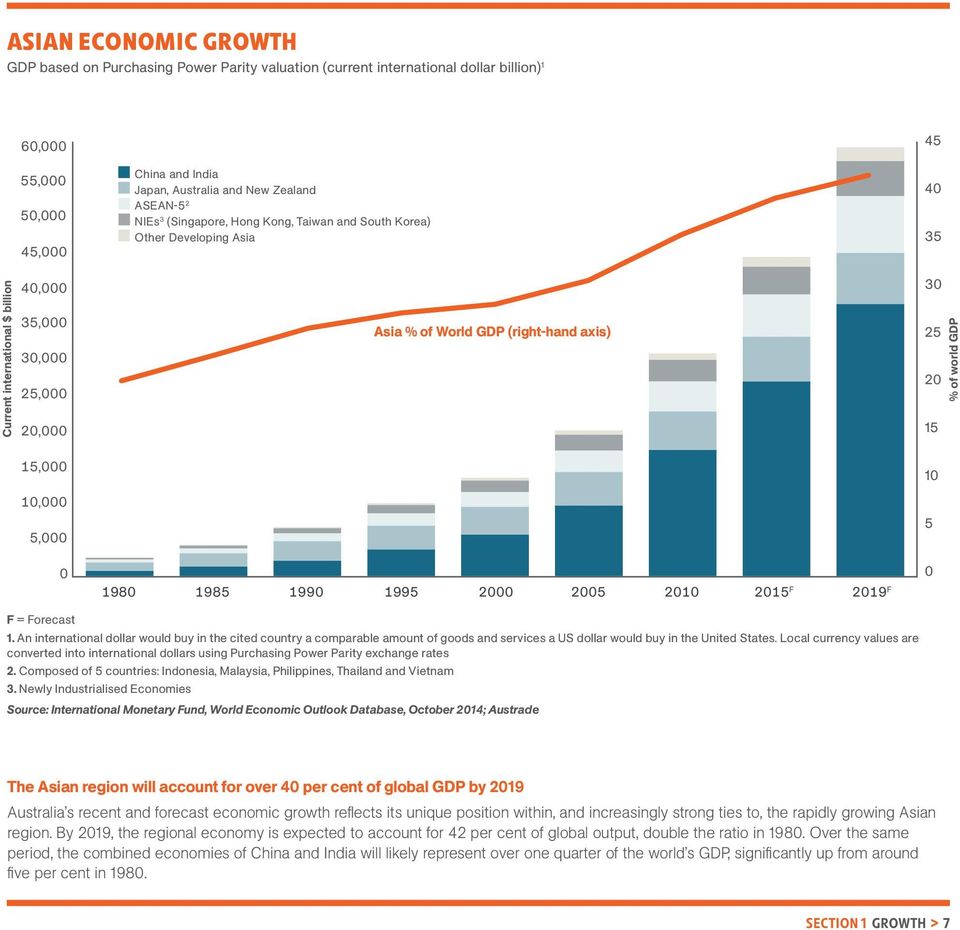
8 ASIAN ECONOMIC GROWTH GDP based on Purchasing Power Parity valuation (current international dollar billion) 1 60, ,000 50,000 45,000 China and India Japan, Australia and New Zealand ASEAN-5 2 NIEs 3 (Singapore, Hong Kong, Taiwan and South Korea) Other Developing Asia Current international $ billion 40,000 35,000 30,000 25,000 20,000 Asia % of World GDP (right-hand axis) % of world GDP 15, ,000 5, F 2019 F F = Forecast 1. An international dollar would buy in the cited country a comparable amount of goods and services a US dollar would buy in the United States. Local currency values are converted into international dollars using Purchasing Power Parity exchange rates 2. Composed of 5 countries: Indonesia, Malaysia, Philippines, Thailand and Vietnam 3. Newly Industrialised Economies Source: International Monetary Fund, World Economic Outlook Database, October 2014; Austrade The Asian region will account for over 40 per cent of global GDP by 2019 Australia s recent and forecast economic growth reflects its unique position within, and increasingly strong ties to, the rapidly growing Asian region. By 2019, the regional economy is expected to account for 42 per cent of global output, double the ratio in Over the same period, the combined economies of China and India will likely represent over one quarter of the world s GDP, significantly up from around five per cent in SECTION 1 GROWTH > 7
9 PRODUCTIVITY OF AUSTRALIAN INDUSTRY SECTORS COMPARED WITH GLOBAL COMPETITORS Productivity index (%) Manufacturing Retail and Wholesale Business and Property Services Transport and Logistics ICT Banking Wealth Management Telecommunication Media Water and Waste Services Public Administration Construction Gas International Education Other Education and Training Health Tourism Agribusiness Oil Mining Note: A score of 110 means Australia is 10% more productive than the average productivity of global competitors in the industry. Source: Deloitte, Positioning for prosperity? Catching the next wave, October Preview 2013, Figure 42, page 88; Deloitte Access Economics based on data provided in The Conference Board, Total Economy Database; Austrade Australian productivity is highly rated in key future growth sectors The productivity levels of 16 out of 20 Australian industries rate above the average productivity of global competitors in the same sector. Australia is performing more than 20 per cent above this global average in five key growth sectors including gas, education, health and tourism, and over 40 per cent in agribusiness, oil and mining. SECTION 1 GROWTH > 8

10 AUSTRALIA S REAL GROSS VALUE ADDED BY INDUSTRY Annual total ending June , as a percentage of total industry Mining 8.8% Financial and Insurance 9.0% Manufacturing 6.8% Construction 8.5% Agriculture, Forestry and Fishing 2.4% Health Care and Social Assistance 6.9% Other Services % Professional, Scientific and Technical 6.9% Accommodation and Food Services 2.5% Electricity, Gas, Water and Waste Services 2.9% Rental, Hiring and Real Estate 2.9% Information Media and Telecommunications 3.0% Administrative and Support Services 3.0% Wholesale Trade 4.2% Public Administration and Safety 5.7% Transport, Postal and Warehousing 5.1% Education and Training 4.9% Retail Trade 4.8% Note: Gross value added measures the contribution to the economy of each individual producer, industry or sector. 1. Including: Ownership of Dwellings (9.0%), Arts and Recreation Services (0.8%) and other (1.9%) Source: Australian Bureau of Statistics Cat. No Australian System of National Accounts, (released 31 October 2014), Table 5. Gross Value Added by Industry; Austrade Australia: a diversified, services-based economy Australia is a services-based economy, with the sector accounting for around 82 per cent of real gross value added (GVA). The country s sophisticated financial services industry is the largest contributor to its economy, generating nine per cent of its total GVA. Professional, scientific and technical services, education and training, and information media and telecommunications make up almost 15 per cent of total output, demonstrating Australia s highly skilled, well-educated and innovative workforce. SECTION 1 GROWTH > 9

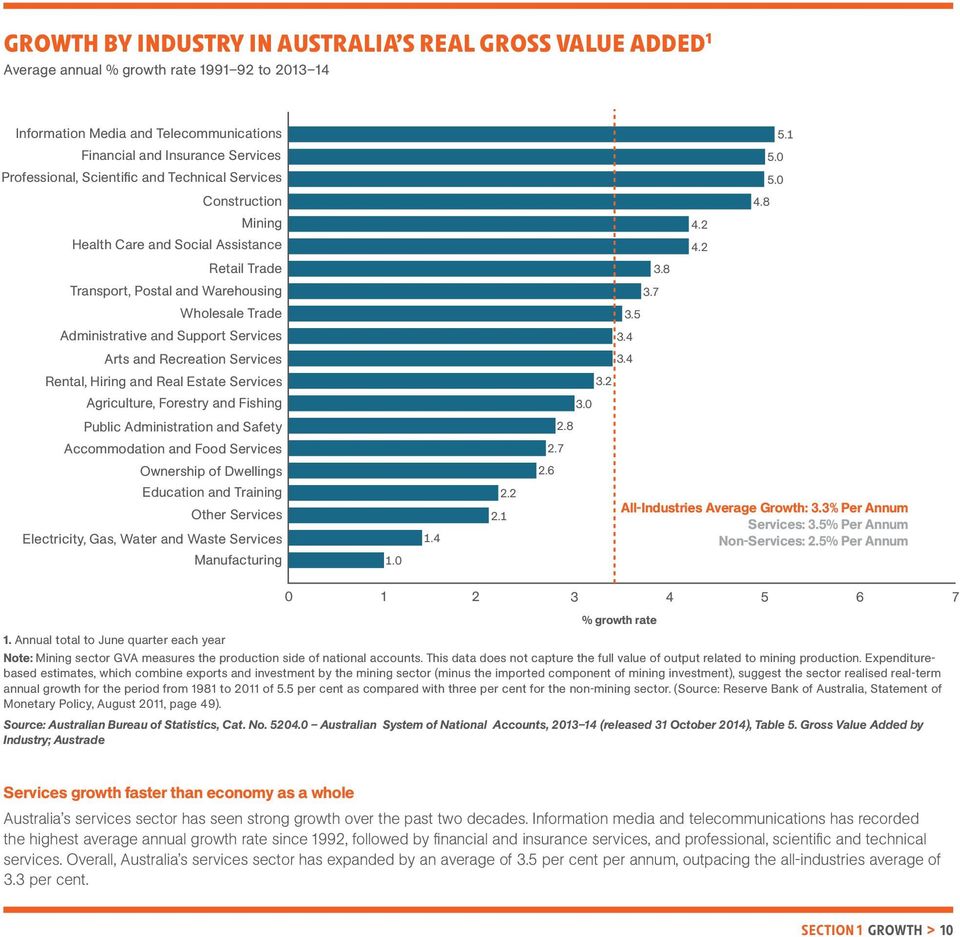
11 GROWTH BY INDUSTRY IN AUSTRALIA S REAL GROSS VALUE ADDED 1 Average annual % growth rate to Information Media and Telecommunications 5.1 Financial and Insurance Services 5.0 Professional, Scientific and Technical Services 5.0 Construction 4.8 Mining 4.2 Health Care and Social Assistance 4.2 Retail Trade 3.8 Transport, Postal and Warehousing 3.7 Wholesale Trade 3.5 Administrative and Support Services 3.4 Arts and Recreation Services 3.4 Rental, Hiring and Real Estate Services 3.2 Agriculture, Forestry and Fishing 3.0 Public Administration and Safety 2.8 Accommodation and Food Services 2.7 Ownership of Dwellings 2.6 Education and Training Other Services Electricity, Gas, Water and Waste Services Manufacturing All-Industries Average Growth: 3.3% Per Annum Services: 3.5% Per Annum Non-Services: 2.5% Per Annum % growth rate 1. Annual total to June quarter each year Note: Mining sector GVA measures the production side of national accounts. This data does not capture the full value of output related to mining production. Expenditurebased estimates, which combine exports and investment by the mining sector (minus the imported component of mining investment), suggest the sector realised real-term annual growth for the period from 1981 to 2011 of 5.5 per cent as compared with three per cent for the non-mining sector. (Source: Reserve Bank of Australia, Statement of Monetary Policy, August 2011, page 49). Source: Australian Bureau of Statistics, Cat. No Australian System of National Accounts, (released 31 October 2014), Table 5. Gross Value Added by Industry; Austrade Services growth faster than economy as a whole Australia s services sector has seen strong growth over the past two decades. Information media and telecommunications has recorded the highest average annual growth rate since 1992, followed by financial and insurance services, and professional, scientific and technical services. Overall, Australia s services sector has expanded by an average of 3.5 per cent per annum, outpacing the all-industries average of 3.3 per cent. SECTION 1 GROWTH > 10
12 GENERAL GOVERNMENT NET DEBT F As a percentage of GDP Advanced Economies Average: 74.1 G20 Advanced 81.8 Euro Area G Emerging Economies Average: Asia Europe 24.5 Latin America Greece Japan Portugal Italy Ireland France Belgium UK USA 3 Spain Germany South Africa Mexico Canada 3 Netherlands South Korea Brazil New Zealand Switzerland Turkey Australia 3 Denmark Peru % of GDP G20 Emerging 23.0 F = Forecast 1. IMF staff estimates and projections. Projections are based on staff assessment of current policies 2. Gross debt as a percentage of GDP 3. For cross-country comparability, gross and net debt levels reported by national statistical agencies for countries that have adopted the 2008 System of National Accounts (Australia, Canada and USA) are adjusted to exclude unfunded pension liabilities of government employees defined benefit pension plans Source: International Monetary Fund, Fiscal Monitor October 2014, Statistical Tables 8 and 16; Austrade Australian government debt is one of the world s lowest In its October 2014 Fiscal Monitor, the International Monetary Fund estimated that the Australian Government s net debt would be 16.6 per cent of GDP in 2015, well below the 74.1 per cent forecast for advanced economies. The low public sector debt reinforces Australia s healthy financial position and sound economic credentials, and underpins its strong ratings. SECTION 1 GROWTH > 11

13 AUSTRALIA S GLOBALLY SIGNIFICANT INDUSTRIES FOREIGN STUDENTS IN TERTIARY EDUCATION (7.1% of the world s total, 2012) FOURTH LARGEST IN THE WORLD Source: UNESCO, Institute for Statistics MERCHANDISE EXPORT AGRICULTURAL PRODUCTS (US$37.6 billion, 2013) TOP 15 IN THE WORLD AGRICULTURAL PRODUCT CATEGORIES Source: World Trade Organization Statistics Database INTERNATIONAL TOURISM EXPENDITURE (US$28.4 billion, 2013) EIGHTH LARGEST IN THE WORLD Source: UNWTO Tourism Highlights 2014 Edition AUSTRALIA S INVESTMENT FUND ASSETS (US$1.8 trillion, June 2014) THIRD LARGEST IN THE WORLD Source: Investment Company Institute, Worldwide Mutual Fund Assets and Flows MERCHANDISE EXPORT FUELS AND MINING (US$161.6 billion, 2013) TOP 4 IN THE WORLD Source: World Trade Organization Statistics Database Australia: an important contributor to the global growth sectors of the future Australia is a global leader in five significant and diverse sectors: agribusiness, education, tourism, mining and wealth management. Ongoing demand across these sectors is expected to drive trade and investment in Australia and globally. SECTION 1 GROWTH > 12

14 AUSTRALIA S ENERGY AND RESOURCES SECTOR 160 A$ billion, fob Commodity Reserves World Ranking Iron ore 44,650 Mt 1 Uranium 1,174 Kt 1 Gold 9,909 t 1 Zinc 64.1 Mt 1 Nickel 17.7 Mt 1 Copper 91.1 Mt 2 Bauxite 6,281 Mt 2 Coal (black) 61,082 Mt 5 Shale oil 1 18 bn barrels 6 Shale gas 1 437tn cubic ft 7 Energy Resources F = BREE forecast Z = BREE projection F Z Z Z Z 1. US Energy Information Administration, data is 2013, other data is 2012 from Geoscience Australia, Australia s Mineral Resource Assessment 2013 Source: Bureau of Resources and Energy Economics (BREE), Resources and Energy Quarterly, September Quarter 2014, Table 1.3; Data Files and Previous Data Files, Tables 15a and 15b; Austrade A global leader in resources and energy Australia s abundant resources and proximity to Asia underpin its position as a major global exporter of minerals and energy resources and products. In , the country s total resources and energy exports exceeded A$170 billion, with around 85 per cent of these exports (A$145 billion) going to Asian countries, including China, Japan and South Korea. Australia has the world s largest share of iron ore, uranium, gold, zinc and nickel reserves. SECTION 1 GROWTH > 13

15 TOP 10 EXPORT DESTINATIONS FOR AUSTRALIAN AGRIFOOD 1. CHINA $7.3b 19.0% 4. KOREA $2.4b 10.2% 10. TAIWAN $0.7b 2.6% EXPORTS (A$ billion) $21.8b $17.2b TOTAL: $38.5b TURNOVER (A$ billion) $63.0b $95.2b TOTAL: $163.4b 1 2. JAPAN $4.1b 5. US $2.3b -0.2% -1.8% unprocessed processed 8. SINGAPORE $1.0b 7.4% 9. HONG KONG $0.9b 1.3% 3. INDONESIA $2.6b 13.4% 6. NEW ZEALAND $1.4b 2.3% 7. MALAYSIA $1.0b 7.1% Compound Annual Growth Rate from to Including agriculture, forestry and fishing support services (A$5.2 billion) Sources: Exports based on DFAT publication Trade in Primary and Manufactured Products ; Turnover based on ABS Catalogue 8155 Australian Industry (released 28 May 2014); Austrade Clean, green and safe source of agricultural and food exports Australian agrifood exports for reached A$39 billion, with nine of the top 10 destination markets (more than 50 per cent of exports) in Asia. Global food consumption is expected to grow 75 per cent between 2007 and 2050, with 40 per cent of the increased demand to come from China. Australia s proximity to Asia and reputation as a safe and secure source of quality produce and premium products ensure the country is well placed to capitalise on this growth. SECTION 1 GROWTH > 14

16 AUSTRALIA S INTERNATIONAL VISITOR EXPENDITURE BY MARKET Expenditure (A$ million) 9,000 8,000 7,000 6,000 5,000 4,000 3,000 2,000 1,000 TOTAL FORECAST TOURISM EXPENDITURE FORECAST INTERNATIONAL VISITOR EXPENDITURE A$110.8 billion 1.8% ( to ) A$36.9 billion 4.6% ( to ) (actual, Left-hand axis) (forecast, Left-hand axis) 1 Compound annual growth rate ( to F, Right-hand axis) China UK USA New Zealand Japan Singapore South Korea Germany Malaysia India Hong Kong Canada Indonesia France Thailand CAGR (%) 0 F = Forecast 1. Real term, base = Q Source: Tourism Research Australia; Austrade International tourism expenditure surged Australia experienced record tourism expenditure in , driven by strong growth from Asian markets such as China, Hong Kong, Malaysia and Singapore. Traditional markets such as the UK and the USA also performed well, up 12.9 per cent and 7 per cent respectively. The forecast to remains robust, with international visitor spending expected to rise by 4.6 per cent to reach A$37 billion (in real terms). China, India and other Asian nations are anticipated to account for the majority of this growth. Total visitor spending (including domestic overnight and day trips) is projected to increase to A$111 billion by SECTION 1 GROWTH > 15

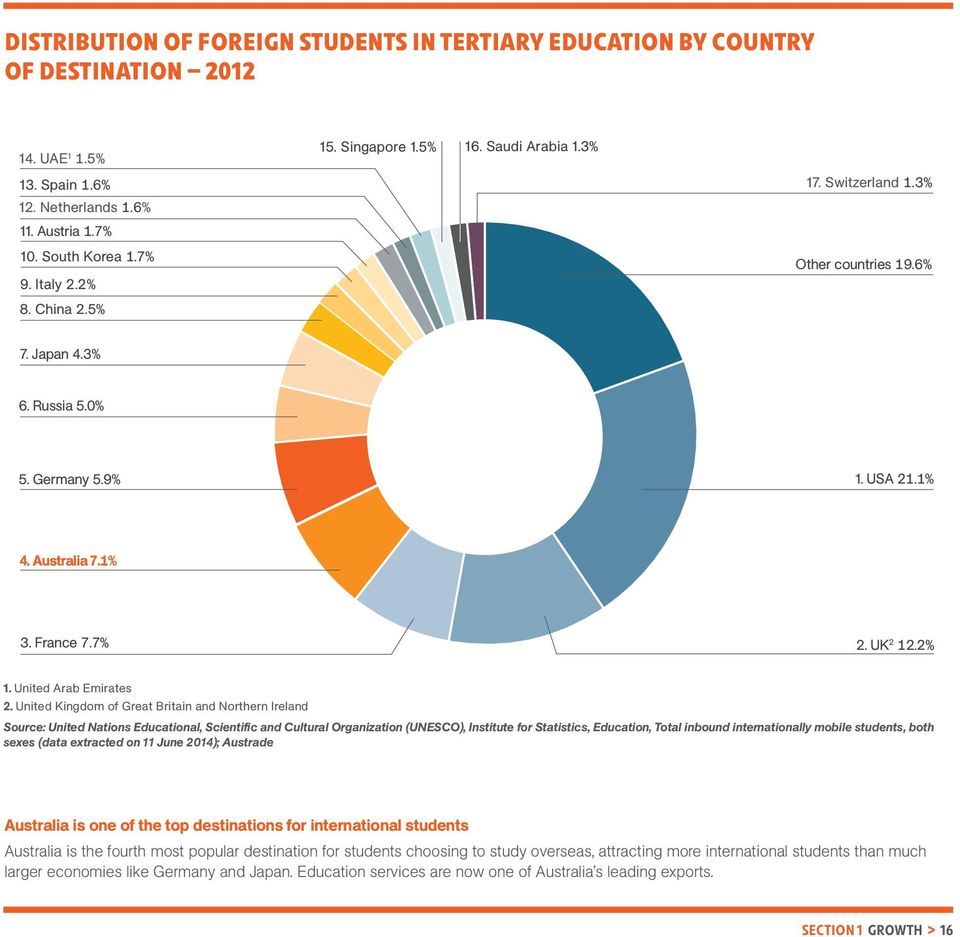
17 DISTRIBUTION OF FOREIGN STUDENTS IN TERTIARY EDUCATION BY COUNTRY OF DESTINATION UAE 1 1.5% 13. Spain 1.6% 12. Netherlands 1.6% 11. Austria 1.7% 10. South Korea 1.7% 9. Italy 2.2% 8. China 2.5% 15. Singapore 1.5% 16. Saudi Arabia 1.3% 17. Switzerland 1.3% Other countries 19.6% 7. Japan 4.3% 6. Russia 5.0% 5. Germany 5.9% 1. USA 21.1% 4. Australia 7.1% 3. France 7.7% 2. UK % 1. United Arab Emirates 2. United Kingdom of Great Britain and Northern Ireland Source: United Nations Educational, Scientific and Cultural Organization (UNESCO), Institute for Statistics, Education, Total inbound internationally mobile students, both sexes (data extracted on 11 June 2014); Austrade Australia is one of the top destinations for international students Australia is the fourth most popular destination for students choosing to study overseas, attracting more international students than much larger economies like Germany and Japan. Education services are now one of Australia s leading exports. SECTION 1 GROWTH > 16
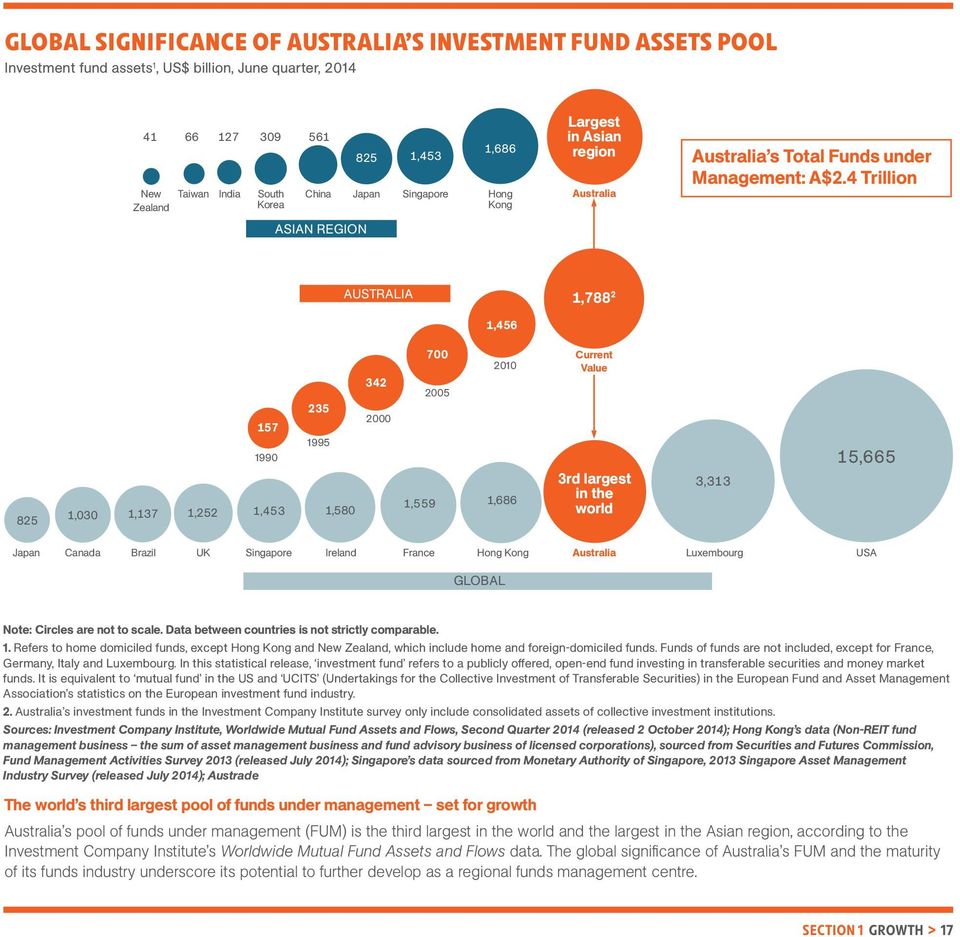
18 GLOBAL SIGNIFICANCE OF AUSTRALIA S INVESTMENT FUND ASSETS POOL Investment fund assets 1, US$ billion, June quarter, New Zealand 66 Taiwan 127 India 309 South Korea 561 China 825 Japan 1,453 Singapore 1,686 $1,473bn Hong Kong Largest in Asian region Australia Australia s Total Funds under Management: A$2.4 Trillion ASIAN REGION AUSTRALIA 1, , ,030 1,137 1, ,453 $967bn , , ,686 Current Value 3rd largest in the world 3,313 15,665 Japan Canada Brazil UK Singapore Ireland France Hong Kong Australia Luxembourg USA GLOBAL Note: Circles are not to scale. Data between countries is not strictly comparable. 1. Refers to home domiciled funds, except Hong Kong and New Zealand, which include home and foreign-domiciled funds. Funds of funds are not included, except for France, Germany, Italy and Luxembourg. In this statistical release, investment fund refers to a publicly offered, open-end fund investing in transferable securities and money market funds. It is equivalent to mutual fund in the US and UCITS (Undertakings for the Collective Investment of Transferable Securities) in the European Fund and Asset Management Association s statistics on the European investment fund industry. 2. Australia s investment funds in the Investment Company Institute survey only include consolidated assets of collective investment institutions. Sources: Investment Company Institute, Worldwide Mutual Fund Assets and Flows, Second Quarter 2014 (released 2 October 2014); Hong Kong s data (Non-REIT fund management business the sum of asset management business and fund advisory business of licensed corporations), sourced from Securities and Futures Commission, Fund Management Activities Survey 2013 (released July 2014); Singapore s data sourced from Monetary Authority of Singapore, 2013 Singapore Asset Management Industry Survey (released July 2014); Austrade The world s third largest pool of funds under management set for growth Australia s pool of funds under management (FUM) is the third largest in the world and the largest in the Asian region, according to the Investment Company Institute s Worldwide Mutual Fund Assets and Flows data. The global significance of Australia s FUM and the maturity of its funds industry underscore its potential to further develop as a regional funds management centre. SECTION 1 GROWTH > 17
19 ENGINEERING CONSTRUCTION PIPELINE ACTIVITY IN AUSTRALIA Forward forecast activity as at June each year Construction % Share in June Oil, Gas, Coal and Other Minerals (70.7%) Bridges, Railways and Harbours (6.8%) Road, Highways and Subdivisions (6.2%) Electricity Generation, Transmission and Distribution (4.5%) Other 2 (11.8%) A$ billion Jun 2004 Jun 2005 Jun 2006 Jun 2007 Jun 2008 Jun 2009 Jun 2010 Jun 2011 Jun 2012 Jun 2013 Jun Value of work yet to be done by private sector. Rise and fall and other cost variations can lead to increases or decreases in the value of work yet to be done 2. Includes water storage supply, sewerage and drainage, pipelines, recreation, telecom, and other heavy industry Source: Australian Bureau of Statistics, Cat. No , Engineering Construction Activity, Australia, June 2014, Table 09 (released 01 October 2014); Austrade A strong infrastructure pipeline The total value of engineering construction projects outstanding is estimated at almost A$104 billion in the June 2014 quarter. Though falling by 23 per cent in , the latest value is still eight times the size of the value a decade earlier. The engineering construction sector recorded a compound annual growth rate of about 36 per cent over the decade to SECTION 1 GROWTH > 18

20 02. INNOVATION How Australia Compares with Leading OECD Countries: Key Innovation Indicators 21 Australia s Gross Expenditure on Research and Development 22 World of Research and Development 23 Gross Domestic Expenditure on Research and Development Relative Impacts of Australian Scientific Publications by Research Field 25 Australian Universities World Rankings INNOVATION

21 INNOVATION Australia is renowned globally as an innovative country, with world-class scientific and academic institutions, high levels of investment in research and development (R&D), modern ICT infrastructure and strong intellectual property protection. Australia is home to 20 of the world s top 400 universities. Australian researchers are also driving or collaborating on cutting-edge research and regularly publish their findings in many of the world s most cited publications. There is strong support for R&D in Australia, with significant funding from public and private sector organisations and a generous R&D tax incentive. International partners will find many opportunities to participate in research projects with Australia s leading universities and science organisations. Australia s CSIRO ranks in the Top 1% of the world s scientific institutions in 14 of 22 research fields
22 HOW AUSTRALIA COMPARES WITH LEADING OECD COUNTRIES: KEY INNOVATION INDICATORS South Australia Canada France UK Germany Japan Korea Sweden USA High levels of innovation investment (% of GDP) (a) Gross Domestic Expenditure on R&D (GERD) (a) Higher Education Expenditure on R&D (HERD) (a) Business Expenditure on R&D (BERD) Skilled workforce (d) Proportion of population aged attaining tertiary education (e) Employment in knowledge-intensive services (% of workforce) (i) S&T occupations as a % of total employment World-class research (b) Publications in top-quartile journals per 1000 inhabitants (f) Share of world s top 1% highly cited publications, natural sciences and engineering (c) Quality of scientific institutions scores (h) Number of universities in Top Entrepreneurship (g) Administrative burden on start-ups (0 = best) (i) Ease of entrepreneurship index World-class ICT infrastructure (b) Business access to broadband n/a (b) ICT investment Note: Countries ranked are selected as having the best reputation for innovation according to the GE 2012 Global Innovation Barometer. 1. As a percentage of GDP. 2. Published in the most influential 25% of the world s scholarly journals as ranked by SCImago Journal (2009). 3. Percentage of businesses with ten or more employees; 2011 or latest available year. 4. Percentage of non-residential gross fixed capital formation, total economy. Sources: (a) OECD, Main Science and Technology Indicators (data extracted 4 June 2014), except Australia which is found in ABS Cat.8111 and 8104; (b) OECD, Science, Technology and Industry Scoreboard 2011; (c) WEF, Global Competitiveness Report ; (d) OECD, Education at a Glance 2012; (e) Global Innovation Index 2014; (f) InCites, Thomson Reuters (2014), Benchmarking Report generated August 2014; (g) The Global Innovation Policy Index (2012); (h) Academic Ranking of World Universities (Shanghai Index 2014); (i) OECD Science, Technology and Industry Outlook 2012; (j) OECD Science Technology and Industry Scoreboard 2013 A strong record of innovation Australia s research institutions have a solid reputation for quality and rank favourably with other leading innovative countries. Australian researchers produce 6.2 per cent of the world s most cited publications and the country ranks as one of the top in terms of the number of publications in highly influential journals as a percentage of population. Australia has a higher percentage of employed persons in knowledge-intensive services than the USA, Japan and South Korea. Australia also offers quality-enabling ICT infrastructure, high levels of government and private sector research and development (R&D) investment, and a generous R&D tax incentive. SECTION 2 INNOVATION > 21
23 AUSTRALIA S GROSS EXPENDITURE ON RESEARCH AND DEVELOPMENT A$ billion by category BERD GOVERD HERD Private non-profit Gross resources devoted to R&D (A$ billion) BERD = Business Expenditure on Research & Development GOVERD = Government Expenditure on Research & Development HERD = Higher Education Expenditure on Research & Development Sources: Australian Bureau of Statistics (ABS), 81040DO001_ Research and Experimental Development, Businesses, Australia, (released 6 Sep 2013); ABS Cat No. Research and Experimental Development, Australia, Government and Private Non-Profit Organisations (released 14 June 2013); ABS Cat. N Research and Experimental Development, Higher Education Organisations, Australia, 2012 (released 20 May 2014); Austrade Australian industry: a rapidly growing source of R&D expenditure Australia s annual gross R&D expenditure rose by 11 per cent per annum between and to reach A$32 billion. Business Expenditure on R&D (BERD) makes up the largest portion of this figure, rapidly expanding from A$5 billion in to A$18.3 billion in This represents a compound annual growth rate of 12.6 per cent, well above Australia s nominal GDP growth rate of 6.4 per cent. SECTION 2 INNOVATION > 22
24 WORLD OF RESEARCH AND DEVELOPMENT Size of circle reflects the relative amount of annual R&D spending (in 2005 US$ in constant prices and Purchasing Power Parity terms) BRICS North America EU Finland 14 Other OECD Denmark Researchers per thousand people employed Norway Belgium Canada France New Zealand AUSTRALIA UK Russia Spain Netherlands USA Germany Japan Sweden South Korea 4 Italy Turkey 2 Mexico South Africa Brazil China Indonesia India Gross domestic expenditure on R&D as a percentage of GDP Sources: OECD, Main Science and Technology Indicators Database, Brazil s Ministry of Science, Technology and Innovation and UNESCO Institute for Statistics, June 2013; Austrade Australia is well placed among leading innovative economies With strong R&D expenditure as a percentage of GDP in Purchasing Power Parity terms and a high proportion of researchers, Australia is placed among the leading innovative countries in the world, including the USA, Japan, France and Germany. SECTION 2 INNOVATION > 23
25 GROSS DOMESTIC EXPENDITURE ON RESEARCH AND DEVELOPMENT % Compound annual growth rate: China 18.1 Turkey 9.9 South Korea Taiwan 7.2 Australia 6.8 Ireland 6.8 Singapore 6.5 Spain Russia 5.6 Austria Mexico 3.3 Finland OECD Average 2.6 EU (28) Italy 2.2 Germany 2.1 USA 2.1 Belgium 1.6 Canada 1.6 Luxembourg 1.6 Japan 1.6 France 1.5 UK 0.9 Netherlands 1. Based on gross domestic expenditure on R&D (GERD) at 2005 prices and Purchasing Power Parity terms Source: OECD, Main Science and Technology Indicators Volume 2014 Issue 1, OECD Publishing, Table 3; Austrade Australia is one of the fastest-growing R&D spending economies Gross R&D expenditure in Australia has increased on average by seven per cent a year in real terms between 2000 and 2010, almost three times the OECD average of 2.6 per cent. Australia s expenditure on R&D is one of the fastest growing in the world, reflecting the country s ongoing commitment to innovation. SECTION 2 INNOVATION > 24
26 RELATIVE IMPACTS OF AUSTRALIAN SCIENTIFIC PUBLICATIONS BY RESEARCH FIELD Global Average: 1.0 Plant & Animal Science 1.43 Materials Science Multidisciplinary Physics Agricultural Sciences Space Science Microbiology Clinical Medicine Geosciences Engineering Environment/Ecology Chemistry Immunology Molecular Biology and Genetics Pharmacology and Toxicology Biology and Biochemistry Mathematics Computer Science Neuroscience and Behaviour Psychiatry/Psychology Social Sciences, General Source: InCites TM, Thomson Reuters, data as at 31 March 2014; Austrade Australian scientific research has a major impact Across 21 scientific research fields, more than 70 per cent of Australia s major scientific research publications have a relative impact of at least 20 per cent above the global average. Among Australia s strongest categories of published research are plant and animal science; materials science; physics; agricultural sciences; and space science. SECTION 2 INNOVATION > 25
27 AUSTRALIAN UNIVERSITIES WORLD RANKINGS 2014 The Academic Ranking of World Universities Institution World Rank Times Higher Education World University Rankings Institution World Rank University of Melbourne 44 Australian National University 74 University of Queensland 85 University of Western Australia 88 Monash University University of New South Wales University of Sydney University of Adelaide Macquarie University Curtin University Flinders University Griffith University James Cook University Swinburne University of Technology University of Newcastle University of Tasmania University of Technology, Sydney University of Wollongong Deakin University University of Melbourne 33 Australian National University 45 University of Sydney 60 University of Queensland 65 Monash University 83 University of New South Wales 109 University of Western Australia 157 University of Adelaide 164 University of Technology, Sydney University of Newcastle Queensland University of Technology University of South Australia University of Wollongong Charles Darwin University Deakin University Macquarie University Curtin University Murdoch University Swinburne University of Technology University of Western Sydney The Academic Ranking of World Universities (ARWU) uses six indicators to rank world universities, including the number of alumni and staff winning Nobel Prizes and Fields Medals, number of highly cited researchers selected by Thomson Scientific, number of articles published in journals of Nature and Science, number of articles indexed in Science Citation Index Expanded and Social Sciences Citation Index, and per capita performance with respect to the size of an institution. More than 1000 universities are ranked by ARWU every year. 2. The Times Higher Education World University Rankings , judge world-class universities across teaching, research, knowledge transfer and international outlook. The rankings employ 13 performance indicators. Sources: The Academic Ranking of World Universities (Shanghai Index 2014); Times Higher Education World University Rankings ; Austrade Australia s academic and research institutions are among the best in the world Australia ranks fourth behind the USA, UK and Germany for the number of universities in the Times Higher Education World University Rankings Australia is home to 20 of the top 400 universities according to the Times. More than half of the country s universities are listed in the 2014 Academic Ranking of World Universities top 500, with four in the top 100. SECTION 2 INNOVATION > 26
28 03. TALENT Workforce Skill Base Comparisons Percentage Employed Persons with Tertiary Education by Industry Australia s Employed Persons by Industry Labour Productivity Growth (GDP per Person Employed, % Increase) 32 Australia s Labour Productivity and Costs Entry Rates into Tertiary (Theory-Based) Education International Student Enrolments in Australia by Sector All Overseas Students by Regional Grouping 36 Australia s Labour Force by Birthplace Foreign-Born Population 38 Major Languages Spoken in Australian Homes TALENT
29 TALENT The Australian labour force is one of the most educated, multicultural and multilingual in the world. Australia offers a workforce that is equally at home in both Western and Asian cultures. Almost 30 per cent of Australia s workers were born overseas. Around 2.1 million Australians speak an Asian language and 1.3 million speak a European language in addition to English. Australia s higher education enrolment rate ranks in the world s top 10. The nation s high-quality education system also makes it the fourth most popular destination for international students. Almost 75 per cent of these students are enrolled in business and technology-related courses. With a ready supply of smart, skilled and culturally aware workers, companies can build an Australian labour force with ease. 40% Almost 40 per cent of Australia s workforce holds a tertiary qualification
30 WORKFORCE SKILL BASE COMPARISONS 2014 South Hong Australia USA UK China Japan Korea India Kong Singapore Global Competitiveness Report Ranking (a) in: Secondary Education Enrolment Rate Tertiary Education Enrolment Rate Quality of Scientific Research Institutions Higher Education and Training Reliance on Professional Management World Competitiveness Yearbook 2014 Ranking (b) in: Education System Foreign High-skilled People Ethical Practices Nobel Prizes per Capita = =27 UNDP s Human Development Report 2014 Ranking (c) in: Human Development Index Awarded in physics, physiology and medicine or economics per million people (updated May 2014) Sources: (a) World Economic Forum, Switzerland and Harvard University, Global Competitiveness Report (updated September 2014, 144 economies); (b) International Institute for Management Development (IMD), Switzerland, IMD World Competitiveness Online (updated May 2014, 60 economies); (c) The United Nations Development Programme (UNDP), Human Development Report 2014 (published 24 July 2014, 187 economies), Table 1; Austrade World s highest secondary education enrolment rate International studies recognise the high levels of skill and education that make up Australia s workforce. According to the World Economic Forum s Global Competitiveness Report , Australia s secondary education enrolment rate is the world s highest. Australia also ranks second in the United Nations Development Programme s Human Development Report 2014, which measures a country s investment in its people. SECTION 3 TALENT > 29
31 PERCENTAGE EMPLOYED PERSONS WITH TERTIARY EDUCATION BY INDUSTRY Education and Training Professional, Scientific and Technical Services Financial and Insurance Services Health Care and Social Assistance Public Administration and Safety Information Media and Telecommunications Electricity, Gas, Water and Waste Services Rental, Hiring and Real Estate Services Arts and Recreation Services Administrative and Support Services Mining Wholesale Trade Manufacturing Other Services Transport, Postal and Warehousing Retail Trade Agriculture, Forestry and Fishing Accommodation and Food Services Construction All-Industries Average: 39% In this statistical release, tertiary education refers to Advanced Diploma/Diploma or higher Source: Australian Bureau of Statistics, Cat. No DO , Education and Work, Australia, May 2013, Table 11 (released 29 November 2013); Austrade Australia offers smart, skilled workers Australia has one of the most highly educated workforces in the world, with almost 40 per cent of workers on average holding a tertiary qualification or advanced diploma. In five major sectors, including education and training; professional, scientific and technical services; financial and insurance services; healthcare; and public administration, over half the workforce has a tertiary qualification or higher. SECTION 3 TALENT > 30
32 AUSTRALIA S EMPLOYED PERSONS BY INDUSTRY 2014 Total employed persons (11,634,500, August 2014, trend terms) Manufacturing 7.9% Agriculture, Forestry and Fishing 2.8% Health Care and Social Assistance 12.2% Mining 2.1% Other Services % Retail Trade 10.7% Information Media and Telecommunications 1.8% Construction 9.0% Wholesale Trade 3.4% Financial and Insurance Services 3.6% Transport, Postal and Warehousing 5.2% Professional, Scientific and Technical 8.1% Public Administration and Safety 6.2% Accommodation and Food Services 6.6% Education and Training 8.0% 1. Including Administrative and Support Services (3.3%); Rental, Hiring and Real Estate Services (1.9%), Arts and Recreation Services (1.7%), Electricity, Gas, Water and Waste Services (1.2%) and Other (4.3%) Source: Australian Bureau of Statistics, Cat. No Labour Force, Australia, Detailed, Quarterly, Table 04. Employed persons by Industry Trend, Seasonally Adjusted, Original, Time Series Workbook (released 18 Sep 2014); Austrade A highly diverse workforce More than 85 per cent of Australians are employed in the services sector. Almost 40 per cent of people work in sectors with a higher than industry average tertiary education, such as education and training; professional, scientific and technical services; financial and insurance services; healthcare; and public administration. SECTION 3 TALENT > 31
33 LABOUR PRODUCTIVITY GROWTH (GDP PER PERSON EMPLOYED, % INCREASE) Average annual growth rate % South Korea Poland Australia Netherlands Sweden Canada Germany New Zealand UK Italy Total OECD Japan Denmark Norway Euro Area Turkey Belgium USA Spain Mexico Iceland France Austria Finland Luxembourg Greece Switzerland Portugal Ireland Ten-Year Average 2004 to F F = Forecast Source: OECD Economic Outlook, Volume 2014 Issue 1, Annex Table 12. Labour productivity in the total economy, version 1 (last updated: 28 April 2014); Austrade A strong platform for increased productivity levels Australia s labour productivity growth in terms of GDP per person employed is expected to outperform many other developed economies in 2014, according to the latest OECD Economic Outlook. Australia s labour productivity is supported by a highly skilled, innovative, multilingual workforce and long-term investment in education and training. SECTION 3 TALENT > 32
34 AUSTRALIA S LABOUR PRODUCTIVITY AND COSTS As at 30 June each year, trend terms Index, June 1991 = Labour Productivity GDP per Hour Worked Real Unit Labour Costs Source: Australian Bureau of Statistics, Cat. No Australian National Accounts: National Income, Expenditure and Product, Table 1. Key National Accounts Aggregates, Time Series Workbook (released 3 September 2014); Austrade Growth in productivity outpacing labour costs Australia has enjoyed a sustained period of labour productivity growth exceeding growth in real wages. Over Australia s 23 years of consecutive economic growth, labour productivity has recorded a compound annual growth rate of 1.8 per cent per annum, while real unit labour costs have fallen by 0.5 per cent each year. Australia has experienced particularly strong labour productivity growth over the past two years, with growth of 1.9 per cent in and 2.6 per cent in During this same period, real unit labour costs have broadly remained stable, indicating that effective cost of labour has remained in line with productivity improvements. SECTION 3 TALENT > 33
35 ENTRY RATES INTO TERTIARY (THEORY-BASED) EDUCATION 2012 Tertiary education in largely theory-based programs Domestic Students International Students Expected % of population Australia New Zealand Norway Denmark USA 1,2 Russia 1,3 South Korea 1 UK Finland 1 Netherlands Portugal Sweden Note: Entry rates represent the percentage of an age cohort that is expected to enter a tertiary program over a lifetime. 1. New entrants data for international students is not specified 2. The entry rates for tertiary type-a programs include the entry rates for tertiary type-b programs. Type-A refers to largely theory-based programs designed to provide qualifications for entry to advanced research programs and professions with high skill requirements, such as medicine, dentistry or architecture. Duration >3 years full-time and not exclusively offered at universities. Type-B refers to shorter programs focused on practical, technical or occupational skills for direct entry into the labour market, although some theoretical foundations may be covered. Minimum 2 years full-time equivalent at the tertiary level 3. New entrants data by age is not specified Source: OECD, Education at a Glance 2014, Table C3.1, (last updated 4 September 2014); Austrade Global leader for tertiary education entry rates Australia has one of the highest entry rates into tertiary type-a education in the world at 102 per cent, including international students. This is well above the OECD average (58 per cent), the USA (71 per cent) and the UK (68 per cent). Australia s tertiary education entry rate is also much higher than Asian countries such as South Korea (69 per cent), Japan (52 per cent) and China (18 per cent). OECD average Ireland Germany Austria Spain Japan 1,3 Italy 1 Switzerland France 1 Belgium 1 Luxembourg 1 Indonesia 1 China 1,3 SECTION 3 TALENT > 34
36 INTERNATIONAL STUDENT ENROLMENTS IN AUSTRALIA BY SECTOR In the year to July 600, , ,000 Compound Annual Growth Rate Since 2004 = 5.5% Non-award ELICOS 1 Schools VET 2 Higher Education 300, , , English Language Intensive Courses for Overseas Students 2. Vocational Education and Training Source: Department of Education, International Student Data ( Austrade A broad and growing international education sector Australia s international education sector experienced strong increases in student enrolments across all sub-sectors, including higher education. The total number of enrolled students in Australia reached almost half a million in the year to July 2014, a 5.5 per cent annual growth rate since About half of all foreign students attended universities and other higher education institutions in SECTION 3 TALENT > 35
37 ALL OVERSEAS STUDENTS BY REGIONAL GROUPING 1 Enrolled in Australian Higher Education Courses 2 Onshore and Offshore, Full-Year , , , , ,494 Total Overseas Students: 328,402 Onshore students 243,617 Offshore students 84,785 % change of all students % % share of top 20 sources 85.5% % share of Asian students in top % % of students from China 28.6% Number of enrolments 80,000 60,000 Top Five Enrolled Courses: 272,665 Management & Commerce 164,425 Engineering & Related Technology 31,680 Society & Culture 26,879 Information Technology 24,843 Health 24,838 40,000 39,167 20,000 17,282 16,819 10,906 10,304 0 North-East Asia South-East Asia Southern and Central Asia Americas North Africa and Middle East Sub-Saharan Africa North-West Europe 2,998 2,973 2,451 Other Southern and Eastern Europe Oceania and Antarctica 1. All Overseas Students by Country of Permanent Home Residence are all students not classified as Domestic. 2. This series Students: Selected Higher Education Statistics contains statistics relating to students enrolled in higher education courses in each Australian Higher Education Provider. Source: Department of Industry, Student 2013 Full Year: Selected Higher Education Statistics Publication, Tables 7.2, 7.4 and 7.5; Austrade A first choice higher education destination Australia is a first choice education destination across the Asian region. With around three-quarters of the 328,000 international students in Australia studying management, commerce, engineering or information technology, the country is a hub for business and technology-related education in the region. SECTION 3 TALENT > 36
38 AUSTRALIA S LABOUR FORCE BY BIRTHPLACE 2014 Total labour force as at August 2014: 12,352,700 North-West Europe 1 1.2% North Africa & The Middle East 1.3% Americas 1.4% Sub-Saharan Africa 1.8% Southern & Eastern Europe 2.2% North-East Asia 2.9% Australian Born 71.2% Overseas Born 28.8% Oceania & The Antarctic 3.8% Southern & Central Asia 4.0% South-East Asia 4.1% UK & Ireland 6.2% 1. Excluding UK and Ireland Source: Australian Bureau of Statistics, Cat. No Labour Force, Australia, Detailed Electronic Delivery, September 2014, data cubes LM6 (released 16 October 2014); Austrade A culturally diverse labour force More than a quarter of Australia s labour force of 12.4 million people was born overseas. Many foreign-born workers are from Asia or Europe, enriching Australia s reputation for multilingual, multicultural workplaces. SECTION 3 TALENT > 37
39 FOREIGN-BORN POPULATION As a percentage of total population 2011 or latest available year Luxembourg Switzerland Australia Israel New Zealand Canada Ireland Austria Sweden Belgium Spain Germany USA Norway UK France Netherlands Italy Portugal Denmark Russia Greece Finland Hungary Chile Poland Mexico Source: The Organisation for Economic Co-operation and Development (OECD), Key statistics on migration in OECD countries, Stocks and flows of immigrants, , Table A.4. Stocks of foreign-born population in OECD countries and the Russian Federation; Austrade Most culturally diverse country in the OECD Australia is one of the most culturally diverse countries in the OECD. The availability of multilingual, culturally diverse and highly skilled personnel means Australia offers access to a workforce well equipped with the cultural understanding and language capabilities to service international businesses in their own languages. SECTION 3 TALENT > 38
40 MAJOR LANGUAGES SPOKEN IN AUSTRALIAN HOMES Major Asian Languages 2 2,164,235 Chinese 651,328 Indo-Aryan 382,844 Arabic 287,178 Vietnamese 233,388 Tagalog and Filipino 136,860 Dravidian (including Tamil) 100,375 Korean 79,786 Iranic languages 71,933 Indonesian 55,869 Japanese 43,692 Thai 36,680 Assyrian 31,323 Major European Languages 2 1,273,420 Italian 299,833 Greek 252,217 Spanish 117,497 German 80,370 Macedonian 68,846 Croatian 61,548 Turkish 59,624 French 57,740 Serbian 55,116 Polish 50,692 Russian 44,059 Dutch 37, This list of languages consists of the Most common languages spoken at home responses reported in the 2006 Census. The count is based on place of usual residence 2. Excluding languages not identified individually, Inadequately described and Non-verbal, so described. Total includes other languages not in the table Source: Australian Bureau of Statistics, Cat. No. 2001, Census of Population and Housing, Basic Community Profiles (released 21 June 2012); Austrade One in 10 Australians speak an Asian language at home Australia s linguistic diversity is nationwide, ensuring a ready supply of personnel with foreign language skills in all major centres. More than 2.1 million Australians speak an Asian language at home almost 10 per cent of the total population and more than 650,000 Australians speak a Chinese language. Almost 1.3 million Australians speak a European language in addition to English at home, with Italian, Greek and Spanish the most common languages spoken. SECTION 3 TALENT > 39
41 04. LOCATION Australia s Trade by Broad Sector and Top Five Commodities 42 Australia s Exports and Imports of Goods and Services 43 Australia: A Partner for Growth in Asia 44 Total Foreign Investment Stock in Australia Australia s Share of Global Foreign Direct Investment Stock Main Sources of Foreign Direct Investment Stock in Australia Australia s International Visitors and Total Trip Expenditure by Country of Residence LOCATION
42 LOCATION Australia has developed strong commercial ties with its Asian neighbours. Ten of Australia s top 12 export markets are within the region. Australian businesses understand these markets, offering the benefits of experience and established connections. At the same time, Australia maintains well-established links with traditional trading partner nations in Europe and North America. Existing and new bilateral trade agreements are also set to support the flow of goods, services and investments between Australia and its major Asian trading partners, particularly Japan, South Korea and China. Australia remains a leading destination for international investment and tourism, with Asia now a fast-growing source of foreign direct investment and overseas visitors. Top trading partners China, Japan, USA, South Korea, Singapore Australia s location also bridges the world s major time zones, offering 24-hour access for global organisations with round-the-clock operations.
43 AUSTRALIA S TRADE BY BROAD SECTOR AND TOP FIVE COMMODITIES Australia s Trade by Broad Sector Change A$ billion A$ billion % Exports Rural Unprocessed food Processed food Resources Minerals Top 5 Commodities (Goods and Services) 1 Exports Change A$ billion A$ billion % 1 Iron ore and concentrates Coal Natural gas Education services Personal travel (excl edu) Fuels Other primary products Manufactures Other goods (incl gold) Services Imports Two-way trade Imports 1 Personal travel (excl edu) Crude petroleum Refined petroleum Passenger motor vehicles Freight services Balance of trade Goods on a recorded trade basis, Services on balance of payment basis, original data. 2. The discrepancy between total exports value and the sum of its components is due to balance of payment adjustment (A$1.9bn in and A$890mn in ). 3. Education-related travel services. 4. Mainly recreational travel services. Sources: Department of Foreign Affairs and Trade (DFAT), Trade and economic statistics, Monthly Trade Data September 2014, Table 1 (last updated 6 November 2014); ABS statistical release Regional international trade in services data for , ANNEX 1 (released 20 November 2014); Austrade Australia s exports are in demand Commodities play a vital role in Australia s export market, with iron ore and coal the key products. Exports of liquefied natural gas are becoming increasingly important, and are set to expand further as new investments come on-stream from Australia s services sector is also a major contributor to export earnings, thanks to the country s world-class international education and tourism sectors. SECTION 4 LOCATION > 42
44 AUSTRALIA S EXPORTS AND IMPORTS OF GOODS AND SERVICES 1, 2 Cumulative % Change CAGR % 3 Selected A$ billion % Share Share % Rank Economies to to China Japan USA South Korea Singapore New Zealand UK Malaysia Thailand Germany Indonesia India Taiwan Vietnam UAE Other All Economies (BOP Basis) APEC G East Asia OECD ASEAN EU28 5, Trade in goods is on a recorded trade basis. 2. Excludes selected confidential export (June 2013 onwards) and import commodities (September 2008 onwards) from partner country totals. Therefore movements in the confidential country totals may not reflect the true pattern of trade. 3. CAGR = Compound annual growth rate. 4. UAE = United Arab Emirates. 5. Country group totals include actual partner country export totals for 2013 and imports from September 2008 onwards for selected countries only. 6. Services data EU15 from to , EU25 from to , EU27 from to Aug 2013, EU28 from Sep 2013 onwards. Source: Australian Bureau of Statistics (ABS) trade data on DFAT STARS database, ABS catalogue and unpublished ABS data (released 20 November 2014); Austrade Australia: an open trading economy Australia s two-way trade in goods and services in totalled A$669 billion, making up about 42 per cent of GDP this is more than double the figure recorded a decade earlier at A$316 billion. Australia s trade with Asia-Pacific Economic Cooperation countries remained strong, with a total value of more than A$486 billion, or 73 per cent of Australia s total trade. SECTION 4 LOCATION > 43
45 AUSTRALIA: A PARTNER FOR GROWTH IN ASIA Ten of Australia s top 12 goods and services export markets were in the Asian region in Europe A$26.0Bn (Incl. UK: A$7.9Bn) China A$107.6Bn Taiwan A$8.2Bn South Korea A$22.5Bn Japan A$51.0Bn America A$22.7Bn (Incl. USA: A$17.0Bn) India A$10.5Bn Malaysia A$7.2Bn A$5.6Bn Singapore A$10.9Bn Indonesia A$6.9Bn Australia NZ A$11.5Bn Aaa Aa (Aa1, Aa2, Aa3) A (A1, A2) Baa (Baa2) Source: Country ceiling for foreign currency bonds (Moody s, 14 November 2014) Note: Country ceiling for Europe and North America only reflect the UK and the USA. Sources: Australian Bureau of Statistics (ABS) trade data on DFAT STARS database, ABS Cat. No and ABS unpublished data (released 20 November 2014); Austrade Asian demand driving trade growth Australia s integration with the dynamic Asian region is driving wealth creation and overall growth. Australia s goods and services exports totalled A$331 billion in Of the top 12 export markets in 2013, 10 were in the Asian region and all were rated above investment-grade. Their combined value was around A$242 billion, making up over 73 per cent of Australia s total export earnings in SECTION 4 LOCATION > 44
46 TOTAL FOREIGN INVESTMENT STOCK IN AUSTRALIA , , , , Other Investment 1 (left-hand axis) A$ billion 1,500 1,200 Direct Investment (left-hand axis) Total Investment % of GDP (right-hand axis) % of GDP Jun 1994 Jun 1995 Jun 1996 Jun 1997 Jun 1998 Jun 1999 Jun 2000 Jun 2001 Jun 2002 Jun 2003 Jun 2004 Jun 2005 Jun 2006 Jun 2007 Jun 2008 Jun 2009 Jun 2010 Jun 2011 Jun 2012 Jun 2013 Jun Other investment includes portfolio investment and financial derivatives. Source: Australian Bureau of Statistics, Cat. No Balance of Payments and International Investment Position, Australia, Table 79. International Investment: Levels of Foreign Liabilities Financial Year (latest issue released 2 September 2014); Austrade A high-growth destination for foreign investment Australia presently hosts about A$2.6 trillion of foreign investment stock. Both foreign direct investment and portfolio investment have recorded strong growth, up 7.4 per cent and 9.0 per cent each year respectively since As a percentage of GDP, Australia s total value of foreign investment stock reached 165 per cent in June 2014, an impressive rise from less than 90 per cent two decades ago. SECTION 4 LOCATION > 45
47 AUSTRALIA S SHARE OF GLOBAL FOREIGN DIRECT INVESTMENT STOCK CAGR = Compound Annual Growth Rate FDI Stock (US$ billion) FDI as % of GDP FDI Stock % Market Share % Change % CAGR 1 Economy Source: United Nations Conference Trade and Development (UNCTAD), UNCTAD Statistics ( Austrade An attractive destination for FDI 2008 to to 13 World 9,563 15,680 25, Developed economies 7,332 10,857 16, Developing economies 2,085 4,424 8, Transition economies USA 2,455 2,486 4, UK , Hong Kong , France , China Belgium Germany Singapore Switzerland Brazil Spain Netherlands Canada Australia Russia Italy Indonesia India Thailand Japan South Korea Malaysia UAE New Zealand Vietnam Taiwan Philippines Australia s global share of foreign direct investment (FDI), measured in US$, was 2.3 per cent in FDI into Australia was US$592 billion in 2013, up from US$237 billion in As a percentage of GDP, FDI in Australia remained strong at 39 per cent in 2013 on the back of continued economic expansion and integration with trading partners, particularly the Asian region. Australia s 74 per cent growth in FDI over the five years to 2013 is well above the 48 per cent growth achieved by other developed economies. SECTION 4 LOCATION > 46
48 MAIN SOURCES OF FOREIGN DIRECT INVESTMENT STOCK IN AUSTRALIA A$ billion % Change % CAGR Economy % Share USA UK Japan Netherlands Singapore China Switzerland Canada Germany Bermuda Malaysia NP NP NA 12 Hong Kong France Belgium New Zealand Thailand NP NP NP NP NP NA NA 17 Luxembourg 2 NP NA 18 South Korea NP Sweden India 0.1 NP NP NP Total (all countries) Total FDI for British Virgin Islands (BVI) is confidential in ABS statistics for However, the ABS has published data for 2012 (levels at A$19.2bn) and net inflows of A$393 million in DFAT estimates that the BVI direct investment levels for 2013 would be valued at around A$19.5bn and would rank 7th. 2. For rankings after No. 16, the impact of confidential items may change the ordering. CAGR = Compound Annual Growth Rate from 2008 to NP = not available for publication but included in totals where applicable, unless otherwise indicated. NA = not applicable. Source: Australian Bureau of Statistics Cat. No International Investment Position, Australia: Supplementary Statistics, 2013 (released 1 May 2014); Table 2. Foreign Investment in Australia: Level of Investment by Country and Country Groups by type of investment and year; Austrade Traditional markets still strongest, but investment from Asia is increasing Australia s inward FDI stock reached A$630 billion in 2013, up 40 per cent from 2008 figures. The European Union (including the UK) and the USA remain dominant sources of FDI, with totals of A$156 billion and A$150 billion respectively. Major Asian nations are fast-growing sources of FDI, with China FDI stock recording a compound annual growth rate over the past five years of 42 per cent, followed by Singapore (19 per cent), South Korea (16 per cent) and Japan (12 per cent). SECTION 4 LOCATION > 47
49 AUSTRALIA S INTERNATIONAL VISITORS AND TOTAL TRIP EXPENDITURE BY COUNTRY OF RESIDENCE Country of Residence Total New Zealand China UK USA Singapore Japan Malaysia South Korea Hong Kong India Germany Indonesia Canada Taiwan France Scandinavia Thailand Italy Switzerland Netherlands Other Europe Other Asia Other countries Year ending Change Year June 2014 % ending Visitors ( 000) % of Visitors 2 June 2013 June , , Year ending Change Year June 2014 Total % of % ending Trip Expenditure (A$m) Expenditure 2 June 2013 June , , , , , , , , , , , , Estimates are for international visitors aged 15 years and over. 2. Individual percentages may not add to 100 due to rounding. Source: Tourism Research Australia: International Visitors Survey; Austrade Record number of visitors provides greater opportunity for investment Over 6.1 million visitors arrived in Australia in , representing an annual growth rate of 7.6 per cent. Of Australia s top 10 inbound tourist markets, eight are in the Asian region. Visitors from this region account for more than 70 per cent of Australia s total number of tourists. China is Australia s second largest inbound tourist market, with over 700,000 visitors in Other Asian markets that recorded doubledigit percentage growth in included Singapore, Malaysia, Hong Kong and India. Australia s traditional tourist markets the UK and the USA also performed well, up six per cent and nine per cent to 624,000 and 500,000 arrivals respectively. SECTION 4 LOCATION > 48
50 05. BUSINESS Index of Economic Freedom World Ranking Key Indicators of Ease of Doing Business Business Efficiency and Environment Worldwide Governance Indicators Assets of Australian Financial Institutions 55 Australia s Projected Superannuation Assets, Australian Financial Markets Annual Turnover Size of Key Stock Markets in Asia International and Domestic Debt Securities in Asia Pacific BUSINESS
51 BUSINESS Doing business in Australia is easy. The country s efficient and transparent regulatory system provides a safe environment. Its political stability and sound legal and governance frameworks offer a stable and secure setting for business. For six years in a row, Australia has ranked third on the Index of Economic Freedom. Australia has a sophisticated financial sector that offers access to one of the Asia-Pacific region s largest pools of bank assets, as well as the world s fourth largest pension assets pool. These credentials attract some of the world s largest organisations to Australia. Eighteen of the Top 20 FT Global 500 companies and eight of the Top 10 Fortune 100 have operations in Australia. One in five businesses in Australia with more than 200 employees is at least 50 per cent foreign-owned. 18,000 foreign companies registered in Australia
52 INDEX OF ECONOMIC FREEDOM WORLD RANKING Hong Kong (1) Singapore (2) Australia (3) Switzerland (4) New Zealand (5) Canada (6) Chile (7) Mauritius (8) Ireland (9) Denmark (10) USA (12) UK (14) Netherlands (15) Taiwan (17) Germany (18) Japan (25) UAE (28) South Korea (31) Malaysia (37) Spain (49) France (70) Thailand (72) Italy (86) Philippines (89) Indonesia (100) Brazil (114) India (120) China (137) Russia (140) Vietnam (147) Economic Freedom Score 80 to 100 Free 70 to 79.9 Mostly Free 60 to 69.9 Moderately Free 50 to 59.9 Mostly Unfree 0 to 49.9 Repressed The 2014 Index of Economic Freedom covers 186 economies and measures 10 components of economic freedom (Business Freedom, Trade Freedom, Fiscal Freedom, Government Spending, Monetary Freedom, Investment Freedom, Financial Freedom, Property Rights, Freedom from Corruption and Labour Freedom). The 10 component scores are equally weighted and averaged to get an overall economic freedom score for each economy. The number in brackets in the chart indicates the country s world ranking. Sources: The Wall Street Journal and The Heritage Foundation, 2014 Index of Economic Freedom; Austrade Australia s policies create an environment of economic freedom Australia ranks third in the 2014 Index of Economic Freedom, a position held for the past six years. The survey states that openness to global trade and investment is firmly institutionalised, supported by a relatively efficient entrepreneurial framework and a well-functioning independent judiciary. Australia has a strong tradition of reliable property rights protection, and the legal system is transparent and evenly applied. It also states that Australia continues to benefit significantly from its transparent and efficient business environment, and open-market policies. SECTION 5 BUSINESS > 51
53 KEY INDICATORS OF EASE OF DOING BUSINESS 2015 Ease of Doing Business Starting a Business Getting Credit Trading Across Borders Enforcing Contracts Resolving Insolvency Strength of Depth of Credit Legal Rights Information Time to Time to Recovery Out of 189 Procedures Time Index Index Export Import Time Procedures Time Rate (cents Economy Economies 1 (number) (days) (0 12) (0 8) (days) (days) (days) (number) (years) on the dollar) Singapore New Zealand Hong Kong South Korea USA UK Australia Malaysia Taiwan Thailand Japan Vietnam China Philippines Indonesia India , East Asia and Pacific NA South Asia NA , OECD High Income NA NA = Not Applicable 1. Economies are ranked on their ease of doing business, from A high ease of doing business ranking means the regulatory environment is more conducive to the starting and operation of a local firm. The rankings are determined by sorting the aggregate distance to frontier scores on 10 topics, each consisting of several indicators, giving equal weight to each topic. The rankings for all economies are benchmarked to June Source: World Bank, Doing Business 2015: Going Beyond Effi ciency. Washington, DC: World Bank Group (released 29 October 2014); Austrade Doing business in Australia doesn t get much easier Australia is one of the easiest places in the world to do business. Overall, Australia ranks 10th in the world for ease of doing business, and fourth when compared with economies with a similar or larger population. Australia ranks particularly well in the ease of getting credit (4th out of 189 economies) and starting a business (7th out of 189 economies). SECTION 5 BUSINESS > 52
54 BUSINESS EFFICIENCY AND ENVIRONMENT 2014 South Hong Australia USA UK China Japan Korea India Kong Singapore Global Competitiveness Report Ranking (a) in: Legal Rights Index =1 11 = =29 =29 =1 =1 Inflation, Annual % Change =1 =1 =1 =1 62 = =1 Soundness of Banks Time Required to Start a Business =5 =5 Efficacy of Corporate Boards Intensity of Local Competition No. of Procedures to Start a Business =10 =57 = =10 =10 Regulation of Securities Exchanges Prevalence of Foreign Ownership World Competitiveness Yearbook 2014 Ranking (b) in: Finance Finance and Banking Regulation Finance Financial Risk Factor Business Legislation Protectionism Management Practice Auditing and Accounting Practices Management Practice Corporate Boards Business Legislation Competition Legislation Finance Corporate Debt Finance Shareholders Rights =43 56 = Sources: (a) World Economic Forum, Switzerland and Harvard University, Global Competitiveness Report (updated September 2014, 144 economies); (b) Institute for Management Development (IMD), Switzerland, World Competitiveness Online ( ) (updated May 2014, 60 economies); Austrade A stable, friendly and efficient environment for doing business Australia has one of the world s strongest and most efficient regulatory environments and is rated among the most business-friendly economies. The country ranks highly in terms of legal rights, ease of setting up a business and the soundness of its banks. Australia also has one of the lowest financial risk factors in the world and the fourth highest-ranked finance and banking regulatory system. SECTION 5 BUSINESS > 53
55 WORLDWIDE GOVERNANCE INDICATORS Political Stability 2013 Rank Regulatory Rule of Government Voice and Control of & Absence of by Economy Quality Law Effectiveness Accountability Corruption Violence/Terrorism Finland New Zealand Norway Sweden Switzerland Luxembourg Denmark Netherlands Canada Australia Germany Singapore Ireland UK Japan Hong Kong USA France Taiwan Spain South Korea UAE Italy Malaysia Brazil Thailand Philippines India Indonesia Vietnam China Country scores are reported as percentile ranks, with higher values indicating better governance ratings. Percentile ranks indicate the percentage of countries worldwide that score below that country. There are 215 economies surveyed in the report. The six aggregate indicators are based on 31 underlying data sources reporting the governance perceptions of survey respondents and expert assessments worldwide. Source: The World Bank, Worldwide Governance Indicators, 2014 Update (released 26 September 2014); Austrade Strong governance is attractive for operating regional headquarters The quality of governance in Australia ranks among the best in the world. Strong governance is key to economic growth and security, providing a drawcard for multinationals expanding their businesses or considering Australia as a base in the Asian region. SECTION 5 BUSINESS > 54
56 ASSETS OF AUSTRALIAN FINANCIAL INSTITUTIONS A$ billion Authorised Deposit-taking Managed Fund Sources Consolidated Reserve Bank Institutions 2 and Total Total Life Other Domestic Other All Financial of Australia Registered Financial Managed Offices and Managed Financial Year ending June Systems (AFS) 1 (RBA) Corporations Funds Industry Superannuation Funds 3 Institutions 4 Jun Jun , Jun , , Jun , ,873 1, Jun , ,537 2,405 1, % of AFS assets % of nominal GDP % CAGR since CAGR = Compound Annual Growth Rate Note: The US$/A$ exchange rate was US$0.942 as at 30 June 2014 (sourced from RBA statistics, Table F11); the nominal value of Australia s GDP in the year to June quarter 2014 was A$1,586 billion.. 1. The sum may not be accurate due to rounding errors 2. The combined assets of banks, building societies and credit unions 3. The combined assets of public unit trusts, cash management trusts, common funds, friendly societies and funds managed by Australian investment managers on behalf of Australian entities other than collective investment institutions, and overseas investors 4. The combined assets of general insurance offices and securitisation vehicles Sources: Reserve Bank of Australia Statistics, B1 Assets of Financial Institutions (updated 1 October 2014); RBA Statistics, B18 Managed Funds (updated 29 August 2014); Australian Bureau of Statistics Cat. No Australian National Accounts: National Income, Expenditure and Product, June 2014 (released 3 September 2014), Table 30; Austrade A sophisticated and substantial finance sector provides access to capital Australia s sophisticated financial services sector has significant depth with assets of around A$6.4 trillion over four times the country s nominal GDP. The sector has grown 10 per cent a year over the past two decades, making it Australia s largest contributor to Gross Value Added and one of its highest growth sectors. SECTION 5 BUSINESS > 55
57 AUSTRALIA S PROJECTED SUPERANNUATION ASSETS, ,000 Pre-Retirement Assets Post-Retirement Assets 7,000 6,000 A$ billion 5,000 4,000 3,000 2,000 1, Source: Deloitte Actuaries & Consultants, September 2013, Dynamics of the Australian Superannuation System: The next 20 years: , Figure 5, Page 12; Austrade Long-term pension pool growth supports future investment opportunities Australia s A$1.6 trillion superannuation system is the fourth largest in the world and is a major driver behind Australia s globally significant funds management industry. This pool of assets is expected to grow to A$7.6 trillion or 180 per cent of GDP over the next two decades. SECTION 5 BUSINESS > 56
58 AUSTRALIAN FINANCIAL MARKETS ANNUAL TURNOVER OTC Markets Foreign Exchange OTC Markets Other Exchange-Traded Markets A$ trillion Source: Australian Financial Markets Association, 2014 Australian Financial Markets Report; Austrade Australia s financial markets are among the most sophisticated in the Asian region Over the five years to June 2014, Australia s financial markets have expanded, with total annual turnover (over-the-counter and exchangetraded) rising 27 per cent to A$125 trillion. The latest figure is 79 times the size of Australia s nominal GDP, reflecting the depth of the country s financial markets. SECTION 5 BUSINESS > 57
59 SIZE OF KEY STOCK MARKETS IN ASIA 2014 Market capitalisation of free-floating stocks (US$ billion, 30 September 2014) 1,400 US$ billion 1,200 1, ,123 1, USA (1) 21,717 Japan (2) 3,655 UK (3) 3,179 Canada (4) 1,675 France (5) 1,408 Germany (6) 1,305 Switzerland (7) 1,247 Australia (8) 1,123 Global 44, Australia (8) China (9) South Korea (10) Taiwan (11) Hong Kong (13) India (16) Singapore (20) Malaysia (25) Thailand (28) Indonesia (29) Philippines New Zealand (34) (40) Note: The number in brackets is the world ranking of each country or economy (out of 48). Standard & Poor s capitalisation-weighted indices are float adjusted. Under float adjustment, the share counts used in calculating the indices reflect only those shares available to investors rather than all of a company s outstanding shares. Float adjustment excludes shares that are closely held by control groups, other publicly traded companies or government agencies. Source: Standard & Poor s, S&P Dow Jones Indices World-By-Numbers: September 2014; Austrade Australia has the second largest stock market in the Asian region Australia is home to the largest liquid stock market in the Asian region outside Japan. It is the eighth largest in the world with total capital exceeding US$1.12 trillion in September Australia s market capitalisation of free-floating shares is greater than China s US$1.06 trillion, double Hong Kong s US$528 billion and around four times the market capital of Singapore s at US$261 billion. SECTION 5 BUSINESS > 58
60 INTERNATIONAL AND DOMESTIC DEBT SECURITIES IN ASIA PACIFIC 2014 Amount outstanding residence of issuer, US$ billion 4, ,128 3,600 Domestic Debt Securities (Mar 2014) International Debt Securities (Jun 2014) 3,000 Japan 12, US$ billion 2,400 1,800 1, , , China Australia South Korea India Malaysia Taiwan Thailand Singapore Indonesia Philippines New Zealand 1 1. Latest data for New Zealand s domestic debt securities is September 2013 Source: Bank for International Settlements, Quarterly Review September 2014, Table 11A and Table 16A (Released 14 September 2014); Austrade Regional leader in the issuance of international and domestic debt securities Australia s debt securities market remains the third largest in the Asian region with total amounts outstanding of almost US$2 trillion, behind Japan s US$13 trillion and China s US$4 trillion. Australia is a regional leader in the issuance of both international and domestic debt securities. The country has more international debt securities outstanding than any other Asian nation and ranks fourth in the region in terms of domestic securities. SECTION 5 BUSINESS > 59
61 AUSTRALIAN TRADE COMMISSION LOCATIONS AUSTRALIA EAST ASIAN GROWTH MARKETS ESTABLISHED MARKETS GROWTH AND EMERGING MARKETS Adelaide Brisbane Canberra Darwin Hobart Melbourne Newcastle Perth Sydney Townsville Wollongong *Opening in 2015 ABN Date: January 2015 ISBN: Bandar Seri Begawan Bangkok Beijing Chengdu Guangzhou Hangzhou Hanoi Ho Chi Minh City Hong Kong Jakarta Kaohsiung Kuala Lumpur Kunming Manila Nanjing Qingdao Seoul Shanghai Shenyang Shenzhen Singapore Taipei Wuhan Yangon Auckland Chicago Frankfurt Fukuoka Houston* Istanbul London Madrid Milan New York Osaka Paris Port Moresby Prague San Francisco Sapporo Stockholm Suva Tel Aviv Tokyo Toronto Vancouver Warsaw Washington DC Abu Dhabi Accra Ahmedabad Bangalore Bogota Buenos Aires Chandigarh Chennai Colombo Dhaka Dubai Hyderabad Islamabad Jaipur Jeddah Johannesburg Karachi Kochi Kolkata Kuwait Lahore Lima Mexico City Moscow Mumbai Nairobi New Delhi Port Louis Pune Rabat Riyadh Santiago Sao Paulo Tripoli Ulaanbaatar Vladivostok DISCLAIMER This report has been prepared as a general overview. It is not intended to provide an exhaustive coverage of the topic. The information is made available on the understanding that the Australian Trade Commission (Austrade) is not providing professional advice. Therefore, while all care has been taken in the preparation of this report, Austrade does not accept responsibility for any losses suffered by persons relying on the information contained in this report or arising from any error or omission in the report. Any person relying on this information does so entirely at their own discretion and Austrade strongly recommends the reader obtain independent professional advice prior to acting on this information. Austrade assumes no responsibility for any company, product or service mentioned in this document, for any materials provided in relation to such products, nor for any act or omission of any business connected with such products. Investors should always consider whether an investment is appropriate for their needs and seek out independent advice as appropriate.
62 The Australian Trade Commission Austrade contributes to Australia s economic prosperity by helping Australian businesses, education institutions, tourism operators, governments and citizens as they: develop international markets win productive foreign direct investment promote international education strengthen Australia s tourism industry seek consular and passport services. Austrade helps companies around the world to identify and take up investment opportunities in Australia as well as to source Australian goods and services. Our assistance includes: providing insight on Australian capabilities identifying potential investment projects and strategic alliance partners helping you to identify and contact Australian suppliers.
U.S. Trade Overview, 2013
 U.S. Trade Overview, 213 Stephanie Han & Natalie Soroka Trade and Economic Analysis Industry and Analysis Department of Commerce International Trade Administration October 214 Trade: A Vital Part of the
How many students study abroad and where do they go?
 From: Education at a Glance 2012 Highlights Access the complete publication at: http://dx.doi.org/10.1787/eag_highlights-2012-en How many students study abroad and where do they go? Please cite this chapter
How To Calculate Tertiary Type A Graduation Rate
 Indicator How Many Students Finish Tertiary Education? Based on current patterns of graduation, it is estimated that an average of 46% of today s women and 31% of today s men in OECD countries will complete
International Higher Education in Facts and Figures. Autumn 2013
 International Higher Education in Facts and Figures Autumn 2013 UK Higher Education International Unit International higher education in facts and figures covers the majority of the UK higher education
Consumer Credit Worldwide at year end 2012
 Consumer Credit Worldwide at year end 2012 Introduction For the fifth consecutive year, Crédit Agricole Consumer Finance has published the Consumer Credit Overview, its yearly report on the international
2015 Country RepTrak The World s Most Reputable Countries
 2015 Country RepTrak The World s Most Reputable Countries July 2015 The World s View on Countries: An Online Study of the Reputation of 55 Countries RepTrak is a registered trademark of Reputation Institute.
Foreign Taxes Paid and Foreign Source Income INTECH Global Income Managed Volatility Fund
 Income INTECH Global Income Managed Volatility Fund Australia 0.0066 0.0375 Austria 0.0045 0.0014 Belgium 0.0461 0.0138 Bermuda 0.0000 0.0059 Canada 0.0919 0.0275 Cayman Islands 0.0000 0.0044 China 0.0000
Chart 1: Zambia's Major Trading Partners (Exports + Imports) Q4 2008 - Q4 2009. Switzernd RSA Congo DR China UAE Kuwait UK Zimbabwe India Egypt Other
 Bank of Zambia us $ Million 1. INTRODUCTION This report shows Zambia s direction of merchandise trade for the fourth quarter of 2009 compared with the corresponding quarter in 2008. Revised 1 statistics,
Health and welfare Humanities and arts Social sciences, bussiness and law. Ireland. Portugal. Denmark. Spain. New Zealand. Argentina 1.
 Indicator to Which fields of education are students attracted? Women represent the majority of students and graduates in almost all OECD countries and largely dominate in the fields of education, health
AUSTRALIA S EXPORTS OF EDUCATION SERVICES 1
 AUSTRALIA S EXPORTS OF EDUCATION SERVICES 1 Introduction Australia s education services exports have continued to grow in importance this decade. Since 1982, education services exports have grown at an
Australia s position in global and bilateral foreign direct investment
 Australia s position in global and bilateral foreign direct investment At the end of 213, Australia was the destination for US$592 billion of global inwards foreign direct investment (FDI), representing
Country note China. More than 255 million people in OECD and G20 countries have now attained tertiary education (Table A1.3a).
 Education at a Glance 2011 OECD Indicators DOI: http://dx.doi.org/10.1787/eag-2011-en OECD 2011 Under embargo until 13 September, at 11:00 Paris time Education at a Glance 2011 Country note China Questions
The Role of Banks in Global Mergers and Acquisitions by James R. Barth, Triphon Phumiwasana, and Keven Yost *
 The Role of Banks in Global Mergers and Acquisitions by James R. Barth, Triphon Phumiwasana, and Keven Yost * There has been substantial consolidation among firms in many industries in countries around
Belgium (Fr.) Australia. Austria. England. Belgium (Fl.) United States 2. Finland 2. Norway 2. Belgium (Fr.) Australia. Austria Norway 2, 4.
 How Much Are Teachers Paid? Indicator The statutory salaries of teachers with at least 15 years of experience average USD 38 914 at the primary level, USD 41 701 at the lower level and USD 43 711 at the
Chinese students and the higher education market in Australia and New Zealand.
 Chinese students and the higher education market in Australia and New Zealand. by Ma Xiaoying English Department North China Electric University, Beijing, China and Malcolm Abbott Centre for Research in
U.S. News Best Global Universities Rankings: An inside look at the latest results and methodology
 U.S. News Best Global Universities Rankings: An inside look at the latest results and methodology Robert J. Morse, Chief Data Strategist U.S. News & World Report 6th International Conference on World-Class
Trends in Australia s Exports 1
 April 2 Trends in Australia s Exports 1 The reduction of trade barriers, and cheaper transportation and communication costs have contributed to Australia becoming more open and more closely integrated
What Proportion of National Wealth Is Spent on Education?
 Indicator What Proportion of National Wealth Is Spent on Education? In 2008, OECD countries spent 6.1% of their collective GDP on al institutions and this proportion exceeds 7.0% in Chile, Denmark, Iceland,
Global Sector. How does Travel & Tourism compare to other sectors? GDP. Global Direct GDP. Global GDP Impact by Industry
 Global Sector Agriculture Automotive Banking Chemicals Communications Education Financial Mining Other Service Manufacturing Manufacturing Services Exports Retail (without wholesale) Total Economy Travel
41 T Korea, Rep. 52.3. 42 T Netherlands 51.4. 43 T Japan 51.1. 44 E Bulgaria 51.1. 45 T Argentina 50.8. 46 T Czech Republic 50.4. 47 T Greece 50.
 Overall Results Climate Change Performance Index 2012 Table 1 Rank Country Score** Partial Score Tendency Trend Level Policy 1* Rank Country Score** Partial Score Tendency Trend Level Policy 21 - Egypt***
Trends in Digitally-Enabled Trade in Services. by Maria Borga and Jennifer Koncz-Bruner
 Trends in Digitally-Enabled Trade in Services by Maria Borga and Jennifer Koncz-Bruner Digitally-enabled are those for which digital information and communications technologies (ICT) play an important
Reporting practices for domestic and total debt securities
 Last updated: 4 September 2015 Reporting practices for domestic and total debt securities While the BIS debt securities statistics are in principle harmonised with the recommendations in the Handbook on
Brochure More information from http://www.researchandmarkets.com/reports/1339929/
 Brochure More information from http://www.researchandmarkets.com/reports/1339929/ The 2011 World Forecasts of Machine Tools That Remove Material by Laser or Light, Photon, Ultrasonic, Electro-Discharge,
Benchmarking Travel & Tourism Global Summary
 Benchmarking Travel & Tourism Global Summary How does Travel & Tourism compare to other sectors? Sponsored by: Summary of Findings, November 2013 Outline Introduction... 3 Summary of research structure..
EXTERNAL DEBT AND LIABILITIES OF INDUSTRIAL COUNTRIES. Mark Rider. Research Discussion Paper 9405. November 1994. Economic Research Department
 EXTERNAL DEBT AND LIABILITIES OF INDUSTRIAL COUNTRIES Mark Rider Research Discussion Paper 9405 November 1994 Economic Research Department Reserve Bank of Australia I would like to thank Sally Banguis
Global growth rates Macroeconomic indicators CEDIGAZ Reference Scenario
 Medium and Long Term Natural Gas Outlook CEDIGAZ February 215 Global growth rates Macroeconomic indicators CEDIGAZ Reference Scenario 4 3 %/year 199-213 213-235 6 Main consuming markets - %/year (213-235)
Global Effective Tax Rates
 www.pwc.com/us/nes Global s Global s April 14, 2011 This document has been prepared pursuant to an engagement between PwC and its Client. As to all other parties, it is for general information purposes
THE LOW INTEREST RATE ENVIRONMENT AND ITS IMPACT ON INSURANCE MARKETS. Mamiko Yokoi-Arai
 THE LOW INTEREST RATE ENVIRONMENT AND ITS IMPACT ON INSURANCE MARKETS Mamiko Yokoi-Arai Current macro economic environment is of Low interest rate Low inflation and nominal wage growth Slow growth Demographic
www.pwc.co.uk/economics Global wage projections to 2030 September 2013
 www.pwc.co.uk/economics Global wage projections to 2030 Summary: Wage gap between emerging and advanced economies will shrink significantly by 2030 By 2030, our projections in this report suggest that
IOOF QuantPlus. International Equities Portfolio NZD. Quarterly update
 IOOF QuantPlus NZD Quarterly update For the period ended 31 March 2016 Contents Overview 2 Portfolio at glance 3 Performance 4 Asset allocation 6 Overview At IOOF, we have been helping Australians secure
BANK FOR INTERNATIONAL SETTLEMENTS P.O. BOX, 4002 BASLE, SWITZERLAND
 BANK FOR INTERNATIONAL SETTLEMENTS P.O. BOX, 4002 BASLE, SWITZERLAND PRESS RELEASE CENTRAL BANK SURVEY OF FOREIGN EXCHANGE AND DERIVATIVES MARKET ACTIVITY IN APRIL 1998: PRELIMINARY GLOBAL DATA The BIS
Global Exhibition on Services
 Ministry of Commerce & Industry Global Exhibition on Services Concept Note 1 GES Concept Note Global Exhibition on Services (GES) - Concept Note The Government of India, Ministry of Commerce and Industry
What Is the Total Public Spending on Education?
 What Is the Total Public Spending on Education? Indicator On average, OECD countries devote 12.9% of total public expenditure to, but values for individual countries range from less than 10% in the Czech
List of tables. I. World Trade Developments
 List of tables I. World Trade Developments 1. Overview Table I.1 Growth in the volume of world merchandise exports and production, 2010-2014 39 Table I.2 Growth in the volume of world merchandise trade
Factors affecting the inbound tourism sector. - the impact and implications of the Australian dollar
 Factors affecting the inbound tourism sector - the impact and implications of the Australian dollar 1 Factors affecting the inbound tourism sector - the impact and implications of the Australian dollar
Russia. How does Travel & Tourism compare to other sectors? GDP. Size. Share. Russia GDP Impact by Industry. Russia GDP Impact by Industry
 Russia Izmaylovo Kremlin in Moscow Agriculture Automotive Manufacturing Banking Chemicals Manufacturing Communications Education Financial Services Mining Other Service Exports Retail (without wholesale)
Employment Outlook for. Electricity, Gas, Water and Waste Services
 Employment Outlook for Electricity, Gas, Water and Waste Contents INTRODUCTION... 3 EMPLOYMENT GROWTH... 4 EMPLOYMENT PROSPECTS... 6 VACANCY TRENDS... 8 WORKFORCE AGEING... 10 EMPLOYMENT BY GENDER AND
- 2 - Chart 2. Annual percent change in hourly compensation costs in manufacturing and exchange rates, 2010-2011
 For release 10:00 a.m. (EST) Wednesday, December 19, 2012 USDL-12-2460 Technical Information: (202) 691-5654 [email protected] www.bls.gov/ilc Media Contact: (202) 691-5902 [email protected] INTERNATIONAL
Brazil. How does Travel & Tourism compare to other sectors? GDP. Size. Share. Brazil GDP Impact by Industry. Brazil GDP Impact by Industry
 Brazil The Sugarloaf Mountain in Rio de Janeiro Agriculture Automotive Manufacturing Banking Chemicals Manufacturing Communications ducation Financial Services Higher ducation Mining Other Service xports
The big pay turnaround: Eurozone recovering, emerging markets falter in 2015
 The big pay turnaround: Eurozone recovering, emerging markets falter in 2015 Global salary rises up compared to last year But workers in key emerging markets will experience real wage cuts Increase in
Australia Educating Globally. Advice from the International Education Advisory Council February 2013
 Australia Educating Globally Advice from the International Education Advisory Council February 2013 Commonwealth of Australia 2013 ISBN 978-1-922218-40-7 This work is copyright. Apart from any use as permitted
IMD World Talent Report. By the IMD World Competitiveness Center
 2015 IMD World Talent Report By the IMD World Competitiveness Center November 2015 IMD World Talent Report 2015 Copyright 2015 by IMD Institute for Management Ch. de Bellerive 23 P.O. Box 915 CH-1001 Lausanne
EXPORT-IMPORT BANK OF INDIA: Catalysing India s Trade and Investment. July 01, 2015
 EXPORT-IMPORT BANK OF INDIA: Catalysing India s Trade and Investment July 01, 2015 INDIAN ECONOMY SNAPSHOT PARAMETER FY 2010 FY 2013 FY 2014 FY 2015 GDP (current prices, US$ bn) 1365.4 1835.8 1875.9 2050.6
IMD World Talent Report. By the IMD World Competitiveness Center
 2014 IMD World Talent Report By the IMD World Competitiveness Center November 2014 IMD World Talent Report 2014 Copyright 2014 by IMD: Institute for Management Development, Lausanne, Switzerland For further
Insights into the Future: Business Intelligence in International Education
 Insights into the Future: Business Intelligence in International Education NEAS Conference 2010 Melissa Banks Australia s International Student Program (AEI) 250,000 200,000 150,000 100,000 50,000 Higher
BIS CEMLA Roundtable on Fiscal Policy, public debt management and government bond markets: issues for central banks
 BIS CEMLA Roundtable on Fiscal Policy, public debt management and government bond markets: issues for central banks Is monetary policy constrained by fiscal policy? by Carlos Montoro 26-27 November 212
BUSINESS STATISTICS SNAPSHOT UPDATE April 2015
 BUSINESS STATISTICS SNAPSHOT UPDATE April 2015 Australian Overview 1 Australian Businesses 1 The number of actively trading businesses in Australia was 2 100 162 at June 2014, increased by 1 per cent (20
Dow Jones Titans Indices Methodology
 Dow Jones Titans Indices Methodology March 2014 S&P Dow Jones Indices: Index Methodology Table of Contents Introduction 4 Highlights and Index Family 4 Eligibility Criteria and Index Construction 7 Dow
360 o View of. Global Immigration
 360 o View of Global Immigration In a fast moving global economy, remaining compliant with immigration laws, being informed and in control is more challenging than ever before. We are a globally linked
A Bird s Eye View of Global Real Estate Markets: 2012 Update
 A Bird s Eye View of Global Real Estate Markets: 2012 Update FEBRUARY 2012 US Research Paul Fiorilla Vice President [email protected] Manidipa Kapas, CFA Director [email protected]
World Consumer Income and Expenditure Patterns
 World Consumer Income and Expenditure Patterns 2014 14th edi tion Euromonitor International Ltd. 60-61 Britton Street, EC1M 5UX TableTypeID: 30010; ITtableID: 22914 Income Algeria Income Algeria Income
Backgrounder. Australian businesses as investors in research and development. December 2014. page 1
 Backgrounder Australian businesses as investors in research and development December 2014 page 1 Backgrounder Australian businesses as investors in research and development Executive summary Australia
Market Briefing: S&P 500 Revenues & the Economy
 Market Briefing: S&P Revenues & the Economy December 14, 2 Dr. Edward Yardeni 16-972-7683 eyardeni@ Joe Abbott 732-497-36 jabbott@ Mali Quintana 48-664-1333 aquintana@ Please visit our sites at www. blog.
Foreign Direct Investment in the United States 2013 Report
 Foreign Direct Investment in the United States 2013 Report ORGANIZATION FOR INTERNATIONAL INVESTMENT 1225 NINETEENTH STREET, NW, SUITE 501 WASHINGTON, DC 20036 WWW.OFII.ORG 202.659.1903 Overview Foreign
AN AUGMENTED TRADE-WEIGHTED INDEX OF THE AUSTRALIAN DOLLAR 1
 AN AUGMENTED TRADE-WEIGHTED INDEX OF THE AUSTRALIAN DOLLAR 1 Introduction Trade-weighted exchange rate indices provide a guide to a country s exchange rate against the currencies of its trading partners,
Strategic Roadmap Development for international education in the PTE sector
 Strategic Roadmap Development for international education in the PTE sector What are Strategic Roadmaps? Strategic Roadmaps are planning tools that identify strategic goals and pathways for growth in international
BT Premium Event Call and Web Rate Card
 BT Managed Event and BT Self-Managed Event (also referred to as Express, Plus and Premium) Conference Bridge and Call for Booked Audio Conferencing Services will comprise the following for each phone-conference:
Turkish Arab Economic Forum June 29, 2012. Mehmet Şimşek. Minister of Finance
 Turkish Arab Economic Forum June 29, 2012 Mehmet Şimşek Minister of Finance 1 Outline Turkey: Short Term Outlook Managing a Soft Landing Fallout from the Euro Crisis Turkey & MENA REBALANCING Growing ON
The rise of the cross-border transaction. Grant Thornton International Business Report 2013
 The rise of the cross-border transaction Grant Thornton International Business Report 2013 Foreword MIKE HUGHES GLOBAL SERVICE LINE LEADER MERGERS & ACQUISITIONS GRANT THORNTON INTERNATIONAL LTD When reflecting
Euler Hermes the world leader in credit insurance RISK ASSESSMENT CREDIT INSURANCE DEBT COLLECTION
 Euler Hermes the world leader in credit insurance RISK ASSESSMENT CREDIT INSURANCE DEBT COLLECTION Agenda 1 The Euler Hermes group 2 Our business 3 Our products and solutions 4 Our added value 2 The Euler
Appendix 1: Full Country Rankings
 Appendix 1: Full Country Rankings Below please find the complete rankings of all 75 markets considered in the analysis. Rankings are broken into overall rankings and subsector rankings. Overall Renewable
2015 Growth in data center employment continues but the workforce is changing
 Published in Conjunction with MARKET BRIEFING GLOBAL DATA CENTER EMPLOYMENT 2015 2015 Growth in data center employment continues but the workforce is changing Globally, the number of people working in
Information Communication and Technology (ICT) Market Insights
 Information Communication and Technology (ICT) Market Insights A Manpower Market Insights Paper April 2009 Australia The Australia economy is facing its biggest challenge in the current economic environment
Tourism Western Australia. Fast Facts Year Ending September 2014
 Tourism Western Australia Fast Facts Year Ending September 2014 Prepared by the Research Team December 2014 PLEASE NOTE Changes to National Visitor Survey Methodology Tourism Research Australia s (TRA)
International Labor Comparisons
 Charting International Labor Comparisons 2010 Edition U.S. Department of Labor Material contained in this document is in the public domain and may be reproduced, fully or partially, without permission
International Institute of Business Analysis. Salary Survey Report
 International Institute of Business Analysis Salary Survey Report December 15, 2013 Introduction International Institute of Business Analysis (IIBA) is the independent, nonprofit, professional association
OCTOBER 2010. Russell-Parametric Cross-Sectional Volatility (CrossVol ) Indexes Construction and Methodology
 OCTOBER 2010 Russell-Parametric Cross-Sectional Volatility (CrossVol ) Indexes Construction and Methodology SEPTEMBER 2010 Russell-Parametric Cross-Sectional Volatility (CrossVol) Indexes Construction
International Education in the Comox Valley: Current and Potential Economic Impacts
 International Education in the Comox Valley: Current and Potential Economic Impacts FINAL REPORT March 2012 Prepared by: Vann Struth Consulting Group Inc. Vancouver, BC www.vannstruth.com Prepared for:
Verdict Financial: Wealth Management. Data Collection and Forecasting Methodologies
 Verdict Financial: Wealth Management Data Collection and Forecasting Methodologies April 2014 Contents Global Wealth Markets Methodology Methodology Methodology 2 Global Wealth Markets Section 1: Global
GLOBAL HRMONITOR NEW DIMENSIONS IN ONLINE HR INFORMATION TALENT HEALTH RETIREMENT INVESTMENTS
 GLOBAL HRMONITOR NEW DIMENSIONS IN ONLINE HR INFORMATION TALENT HEALTH RETIREMENT INVESTMENTS DISCOVER MERCER S GLOBAL HRMONITOR ABOUT GLOBAL HRMONITOR Mercer s Global HRMonitor is a single-source, web-based
International Investment. Australia. Economic Diplomacy, Trade Advocacy and Statistics Section Department of Foreign Affairs and Trade September 2015
 International Investment Australia 214 International Investment Australia 214 Economic Diplomacy, Trade Advocacy and Statistics Section Department of Foreign Affairs and Trade September 215 ISSN 223-6571
2012 Country RepTrak Topline Report
 2012 Country RepTrak Topline Report The World s View on Countries: An Online Study of the Reputation of 50 Countries RepTrak is a registered trademark of Reputation Institute. Global Reputation Knowledge
HAS BRAZIL REALLY TAKEN OFF? BRAZIL LONG-RUN ECONOMIC GROWTH AND CONVERGENCE
 HAS BRAZIL REALLY TAKEN OFF? BRAZIL LONG-RUN ECONOMIC GROWTH AND CONVERGENCE COUNTRY PROFILE: A COUNTRY IN TRANSFORMATION POLICY RECOMENDATIONS COUNTRY PROFILE Brazilian Equivalent Population in The World
How To Understand The Economic Benefits Of Foreign Direct Investment In The United States
 EXECUTIVE OFFICE OF THE PRESIDENT COUNCIL OF ECONOMIC ADVISERS U.S. INBOUND FOREIGN DIRECT INVESTMENT JUNE 211 EXECUTIVE SUMMARY The United States welcomes the investment and the jobs supported by the
Global Media Report. Global Industry Overview
 Global Media Report 203 Global Industry Overview McKinsey & Company Global Media Report 203 McKinsey & Company s Global Media and Entertainment Practice Never before has an integrated view across the media
WORLDWIDE RETAIL ECOMMERCE SALES: EMARKETER S UPDATED ESTIMATES AND FORECAST THROUGH 2019
 WORLDWIDE RETAIL ECOMMERCE SALES: EMARKETER S UPDATED ESTIMATES AND FORECAST THROUGH 2019 Worldwide retail sales including in-store and internet purchases will surpass $22 trillion in 2015, up 5.6% from
Review of R&D Tax Credit. Invitation for Submissions
 Review of R&D Credit invitation for submissions Review of R&D Credit Invitation for Submissions February 2013 Economic and Fiscal Divisions Department of Finance Government Buildings, Upper Merrion Street,
G20 EMPLOYMENT WORKING GROUP COUNTRY SELF-REPORTING TEMPLATE ON IMPLEMENTATION OF G20 EMPLOYMENT PLANS
 G20 EMPLOYMENT WORKING GROUP COUNTRY SELF-REPORTING TEMPLATE ON IMPLEMENTATION OF G20 EMPLOYMENT PLANS Contents 1. Key economic and labour market indicators 2. Key policy indicators 3. Checklist of commitments
India s Services Exports
 Markus Hyvonen and Hao Wang* Exports of services are an important source of demand for the Indian economy and account for a larger share of output than in most major economies. The importance of India
Trends in International Education
 Trends in International Education 1 Presentation Objectives 1. International landscape the competitive environment for recruitment of international students 2. Key statistics 3. Key trends 4. Observations/Conclusions
MACQUARIE GLOBAL INVESTMENTS INVESTING IN THEIR FUTURE: EMERGING MARKETS INFRASTRUCTURE
 MACQUARIE GLOBAL INVESTMENTS INVESTING IN THEIR FUTURE: EMERGING MARKETS INFRASTRUCTURE Emerging opportunities The Sao Paolo Metro serves the 11 million residents of Brazil s largest city. The transit
SUPPLEMENTAL EXECUTIVE RETIREMENT PLANS IN CANADA
 HEALTH WEALTH CAREER SUPPLEMENTAL EXECUTIVE RETIREMENT PLANS IN CANADA KEY FINDINGS FROM THE MERCER SERP DATABASE (2014 UPDATE) APRIL 2015 b CONTENTS 1. Introduction...2 2. Highlights of the Mercer SERP
B Financial and Human Resources
 Chapter B Financial and Human Resources Invested In Education Education at a Glance OECD 2011 203 chapter B Classification of al expenditure Educational expenditure in this chapter is classified through
GLOBAL DATA CENTER SPACE 2013
 2013 CENSUS REPORT: Global Data Center Space 2013 GLOBAL DATA CENTER SPACE 2013 Top 3 data center markets account for almost half of all global data center space. In spite of a slowdown in the amount of
The investment fund statistics
 The investment fund statistics Narodowy Bank Polski (NBP) publishes data reported by investment funds which have been defined in Art. 3 section 1 of the Act of 27 May 2004 on investment funds (Journal
Employee Mobility Survey
 Employee Mobility Survey Employees in 24 Countries Assess Employee Mobility for a Total Global Perspective January 2013 Canadian Employee Relocation Council Executive Summary Executive Summary Thank you
DSV Air & Sea, Inc. Aerospace Sector. DSV Air & Sea, Inc. Aerospace
 DSV Air & Sea, Inc. Aerospace Sector DSV Air & Sea, Inc. Aerospace Introduction to DSV DSV is a global supplier of transport and logistics services. We have offices in more than 70 countries and an international
Student visa and temporary graduate visa programme trends
 Student visa and temporary graduate visa programme trends 2008-09 to 2014-15 This page is left blank intentionally. Table of Contents Page About this report 1 Enquiries 1 Definition of terms 2 Background
Comparative tables. CPSS Red Book statistical update 427
 CPSS Red Book statistical update 427 January 2013 Table 1 Basic statistical data GDP (USD billions) 1 Population (millions, yearly average) Australia 952 1,050 999 1,246 1,500 21.1 21.4 21.8 22.1 22.4
In 2012, GNP in constant prices increased by 1.8% compared with 2011.
 8 Economy In 2012, GNP in constant prices increased by 1.8% compared with 2011. The building and construction sector fell by 7.7% in value added terms in 2012 compared to 2011. Manufacturing industry decreased
The Determinants of Global Factoring By Leora Klapper
 The Determinants of Global Factoring By Leora Klapper Factoring services can be traced historically to Roman times. Closer to our own era, factors arose in England as early as the thirteenth century, as
I. World trade developments
 I. World trade developments The value of world merchandise exports increased by 20 per cent in 2011 while exports of commercial services grew by 11 per cent. Key developments in 2011: a snapshot Trade