
SKINTOP SILVYN FLEXIMARK
|
|
|
- Georgiana Hamilton
- 10 years ago
- Views:
Transcription
1 Lapp Cable Guide

2 U.I. Lapp GmbH Schulze-Delitzsch-Straße Stuttgart, Germany Tel. +49(0)711/ Fax +49(0)711/
3 Contents The Lapp Group: At Your Service 2 Brand quality from Stuttgart 4 The Lapp Group The System Supplier 8 An overview of our fields of application 10 Cable finding made easy 12 Bespoke cable systems 13 We put quality through a tough test 14 Product information ÖLFLEX Power- and control cables 15 UNITRONIC Data communication systems 19 ETHERLINE Data communication systems for ETHERNET-Technology 27 HITRONIC Optical transmission systems 31 EPIC Industrial connectors 39 SKINTOP Cable glands 51 SILVYN Protective cable conduit- and cable carrier systems 57 FLEXIMARK Cable marking products 65 Cable Accessories 68 Introduction to Cable Engineering 72 The Fundamentals of Cable Engineering 73 Technical Tables Key words 303 Safety instructions 316 Current information 1
4 Foreword The Lapp Group: At Your Service We have developed the Lapp Cable Guide to help make your work easier when it comes to the day-to-day handling of our products. It is a comprehensive reference work for using Lapp cables, connectors and accessories. In 1957, the company s founder Oskar Lapp developed ÖLFLEX, the world s first industrially produced control cable. Today, 2,800 employees contribute their dedication, knowledge and ideas to the Lapp Group every day. Our range includes cables, accessories, cable handling systems and pre-assembled cables. Based on our coordinated systems, our range of products and services has been continuously expanded over the years. In order to offer you optimum quality, our products are constantly being tested in Lapp s own test centres. The Lapp Group offers a unique range of products, services and manufacturing expertise worldwide. The product information provides detailed descriptions of the relevant applications, construction data and special features. The Technical Tables include information about markings, load carrying capacity, chemical resistance and protection systems. Finally, you will find an extensive technical glossary containing all the most important terms used in electrical engineering. The Lapp Cable Guide is a clearly laid out source of information for industry specialists, students, trainees and anyone else with an interest in this area. Andreas Lapp 2 Current information Current information 3

5 Brand quality from Stuttgart ÖLFLEX Power- and control cables The world s first brand cable is available in the most varied of versions to match maximum requirements. Key features: Oil-resistant, flexible and available to match almost any requirement or environmental condition also free of halogens. Fields of application: Universal application. Special versions also available for the renewable energy sector. ETHERLINE Data communication systems for ETHERNET-Technology The brands for network solutions, safety systems and firewalls in the industrial networking sector. Key features: Integral system consisting of hardware (switches, routers, cables, plugs etc.), software, consulting, network design and support. Fields of application: Factory automation. UNITRONIC Data communication systems The ideal brand for fast, trend-setting and reliable data transfer. Key features: UNITRONIC are not only data lines, but also bus lines, which together with active sensor/ actuator modules or gateways provide a perfect system for automation. Fields of application: Measurement, control, regulation, bus or LAN networks. HITRONIC Optical transmission systems The brand for split-second, faultfree, intercept-free data transport. Key features: The HITRONIC product range includes fibre optic cables in the most varied of versions, along with suitable accessories such as splice boxes, wall distributors or couplings. Fields of application: Office and industrial sector. 4 Current information Current information 5

6 Brand quality from Stuttgart EPIC Industrial connectors The brand for strong and reliable connections. Key features: Robust square and circular connectors. Flexible system consisting of housings, inserts, contacts and accessories for every requirement, the tailormade solution. Similarly, EPIC SOLAR plugs for photovoltaics are also part of the extensive product range. Fields of application: Mechanical and systems engineering, drive technology and energy production. SILVYN Protective cable conduitand cable carrier systems The brand for all-round cable protection. Key features: The product range includes SILVYN cable protection hoses for perfect protection against mechanical and chemical loads, along with SILVYN CHAIN energy supply chains for highly-dynamic applications. Fields of application: Everywhere that cables have to be additionally protected or routed. SKINTOP Cable glands The brand for multipurpose cable entries in line with the following: quickly fastened, centred and hermetically sealed. Key features: Large clamping areas, optimum strain reliefs, the most diverse of versions such as SKINTOP CLICK, COLD or CUBE. Fields of application: Everywhere, where cables must be fastened reliably and quickly. FLEXIMARK Cable marking products The brand for permanent, clearlyarranged cable markings. Key features: Comprehensive range from manual labelling solutions onto digital identification. Withstands high chemical, thermal and mechanical loads. Fields of application: All cable, single cores, control cabinets. 6 Current information Current information 7

7 The Lapp Group The System Supplier 4 EPIC Our brands are adjusted exactly to your workflow. We have got the appropriate product for every application. 5 Cable systems and cable harnessing 6 Power chain systems 1 EPIC CIRCON LS1 2 FLEXILABEL LFL 3 ÖLFLEX SERVO FD ÖLFLEX FD Woven cables SERVO harnessings for drives LCK Wrapping Label + FLEXIMARK Stainless steel marking Frontplug SIMATIC S7-300 with UL/CSA ÖLFLEX ROBOT UNITRONIC BUS L2/FIP + M 12-PROFIBUS cable HITRONIC program for optical fibres HOT-MELT 13 ETHERLINE Fieldbus Systems SKINTOP SILVYN RILL/ SILVYN FPAS ÖLFLEX Spiral cables 8 Current information Current information 9

8 An overview of our fields of application Mechanical and systems engineering As suppliers, this is where we are traditionally at home. Ever since we started out, our competence has concentrated on providing solutions for machines and systems. There can hardly be an industrial application anywhere that we have not already equipped in some way: Automation and network engineering Measurement and control technology Electrical installation technology Chemical and pharma - ceutical industries Oil and gas industry Maritime and aeronautics Food & beverage Lifts & handling Commercial vehicles Robotics Lighting and stage technology Power generation Wherever power is generated, cables are required to take it to the users. The efficient distribution of electrical energy is a field known only too well to us. This is why Lapp has been a highly sought after partner for decades to the energy sector. Renewable energies We recognised at an early stage the significance of green energies. Bearing this in mind, we have built up a special proficiency in this area and developed product ranges for our customers. This is why we are accepted as a supplier on equal footing. Be it a wind turbine installation, solar farm or photovoltaic installation for domestic usage, we are involved. e-mobility Tomorrow s cars will fill up with electricity. And we are already in the pole position for this future market. We supply special system solutions for hybrid vehicles from both German and American manufacturers. 10 Current information Current information 11

9 Cable finding made easy Bespoke cable systems In our online-catalogue you can choose from more than 40,000 products. This poses the query: what can we offer you in addition to that, to ensure that you don t get your wires crossed when looking for cables or plugs? Cable Finder Make short work of searching for cables. You can configure a product online to suit your own requirements, by searching through all the cables, lines and optical fibres available in the online-catalogue as material sold by the metre. NEW filter presents you with an overview of all the innovations from the past twelve months. Connector Finder Configure your EPIC square, circular or solar plugs online, with only a few clicks of the mouse. Enter the technical parameters and then select the suitable plug socket the ideal housing package is then automatically suggested. Choose it, look for the matching counterpart, done! CAD Product Catalogue Design time costs money. Our CAD Product Catalogue enables developers and planners to save both. You can import all the relevant CAD data (e.g. cover sizes, clamping areas, article numbers, etc.) for SKINTOP cable glands, EPIC industrial connectors and SILVYN protective cable conduit systems in your CAD system. We can provide you with all the customary output formats. The more complex the application, the more customised cables and lines have to be. When it comes to customerspecific cable systems and spiral cables, Lapp Systems is your specialist. We offer a complete one-stop automation solution for everything to do with cables and cords, from development through logistics to production. In Germany for instance, you will find us at four major regional locations: Cologne, Dresden, and Stuttgart. System solutions for: Mechanical and plant engineering and construction Telecommunications Medical electronics Transport Elevators and platforms Our product offering: Customised cable systems ÖLFLEX Spiral cables made to order Pre-assembled cable carrier systems Woven cables Pre-assembled servo line systems Spiralised conduits with single cores and/or wires Spiral cable for commercial vehicles Pre-assembled HITRONIC fibre optic cables 12 Current information Current information 13

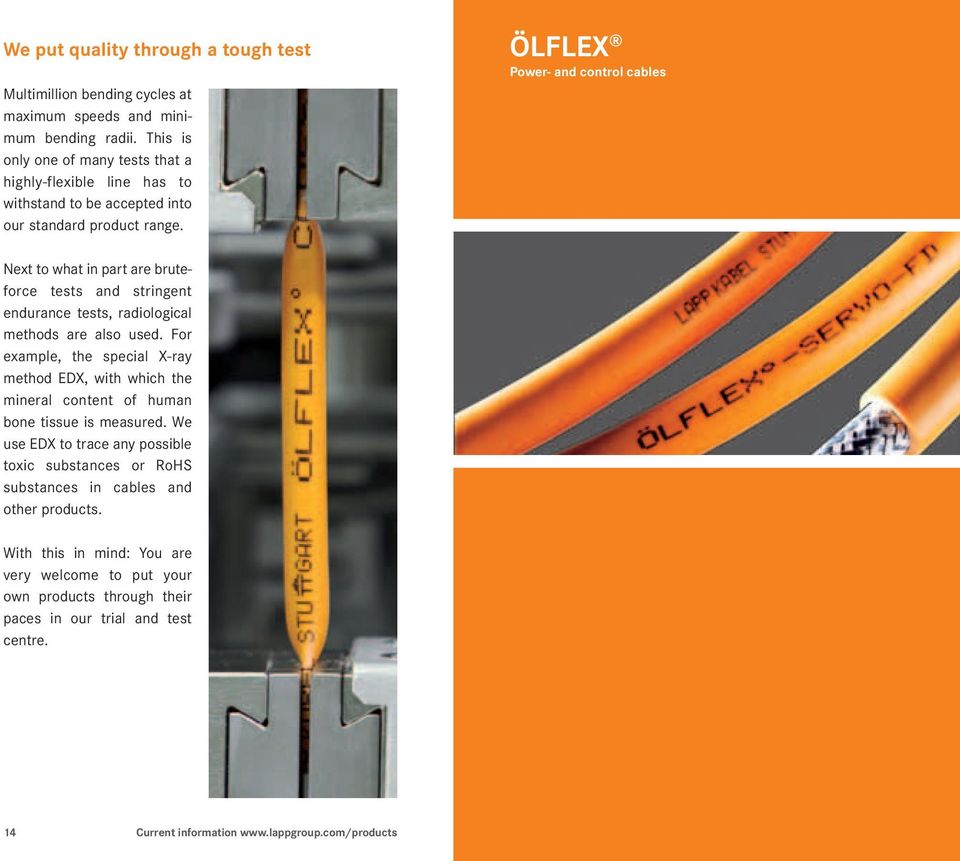
10 We put quality through a tough test Multimillion bending cycles at maximum speeds and minimum bending radii. This is only one of many tests that a highly-flexible line has to withstand to be accepted into our standard product range. ÖLFLEX Power- and control cables Next to what in part are bruteforce tests and stringent endurance tests, radiological methods are also used. For example, the special X-ray method EDX, with which the mineral content of human bone tissue is measured. We use EDX to trace any possible toxic substances or RoHS substances in cables and other products. With this in mind: You are very welcome to put your own products through their paces in our trial and test centre. 14 Current information
11 ÖLFLEX CLASSIC 100/110 ÖLFLEX CLASSIC H halogen-free ÖLFLEX The Power and Control Cable with coloured cores Special Lapp PVC Compound P8/1 ÖLFLEX The Power and Control Cable with numbered cores Special Lapp PVC Compound P8/1 Application range Plant engineering and construction Industrial machinery Air conditioning installations Power station Fixed installation as well as occasional flexing at free, non-continuously recurring movement without tensile load Dry or damp interiors under medium mechanical load conditions Product features Flame retardant according to IEC Good chemical resistance see Appendix T1 Application range Public buildings Airport, railway station Plant engineering and construction Industrial machinery Air conditioning installations Particularly where human and animal life as well as valuable property are exposed to high risk of fire hazards Shielded versions: In EMI critical environment (electromagnetic interference) Product features Flame retardant according to IEC or IEC Halogen-free according to IEC (amount of halogen acid gas) Corrosiveness of combustion gases according to IEC (degree of acidity) Flexible up to -30 C Shielded versions: High coverage degree of the screen low transfer impedance (max. 250 Ω/ km at 30 MHz) Photographs are not to scale and do not represent detailed images of the respective products. Photographs are not to scale and do not represent detailed images of the respective products. 16 Current information Current information 17

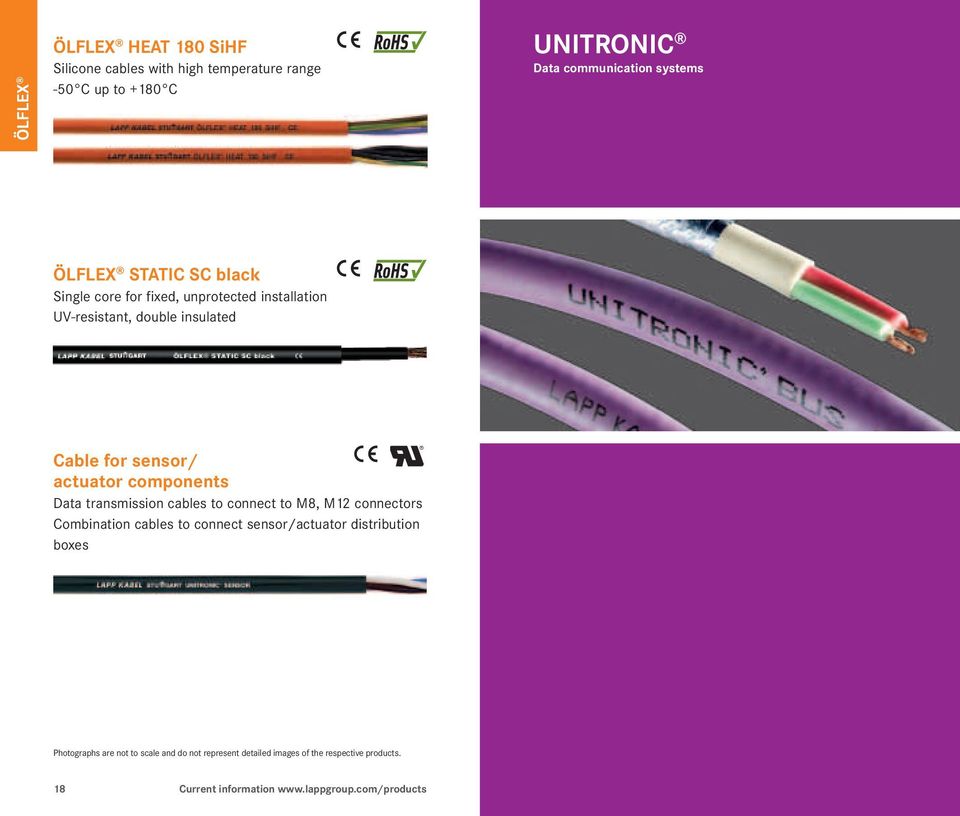
12 ÖLFLEX ÖLFLEX HEAT 180 SiHF Silicone cables with high temperature range -50 C up to +180 C UNITRONIC Data communication systems ÖLFLEX STATIC SC black Single core for fixed, unprotected installation UV-resistant, double insulated Cable for sensor/ actuator components Data transmission cables to connect to M8, M12 connectors Combination cables to connect sensor/actuator distribution boxes Photographs are not to scale and do not represent detailed images of the respective products. 18 Current information
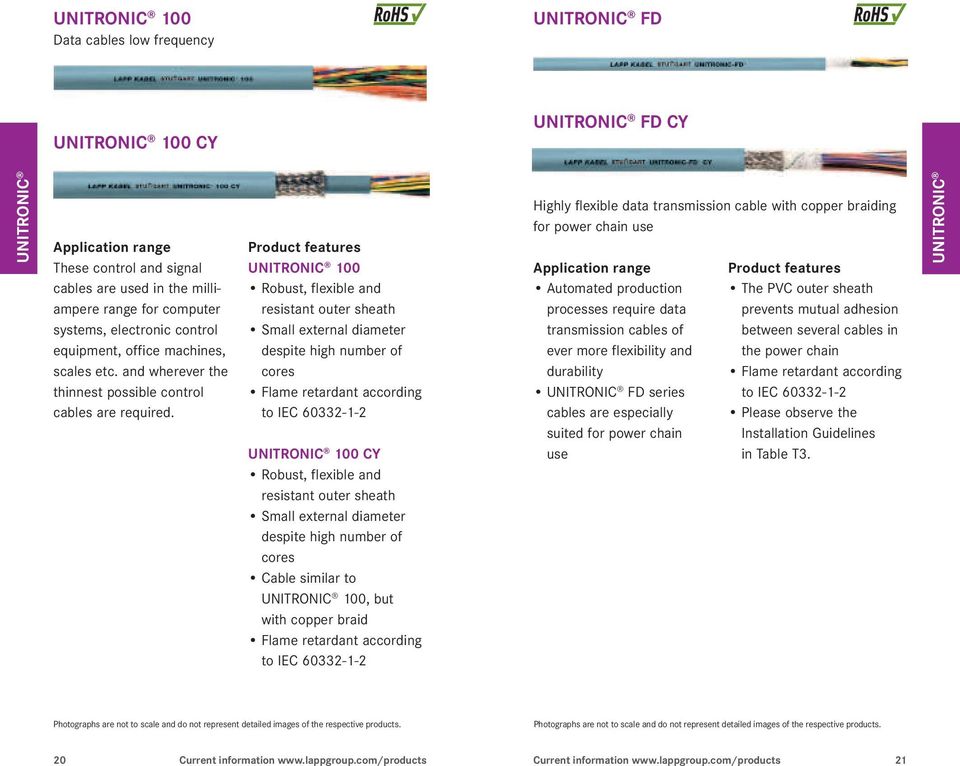
13 UNITRONIC 100 Data cables low frequency UNITRONIC FD UNITRONIC 100 CY UNITRONIC FD CY UNITRONIC Application range These control and signal cables are used in the milliampere range for computer systems, electronic control equipment, office machines, scales etc. and wherever the thinnest possible control cables are required. Product features UNITRONIC 100 Robust, flexible and resistant outer sheath Small external diameter despite high number of cores Flame retardant according to IEC UNITRONIC 100 CY Robust, flexible and resistant outer sheath Small external diameter despite high number of cores Cable similar to UNITRONIC 100, but with copper braid Flame retardant according to IEC Highly flexible data transmission cable with copper braiding for power chain use Application range Automated production processes require data transmission cables of ever more flexibility and durability UNITRONIC FD series cables are especially suited for power chain use Product features The PVC outer sheath prevents mutual adhesion between several cables in the power chain Flame retardant according to IEC Please observe the Installation Guidelines in Table T3. UNITRONIC Photographs are not to scale and do not represent detailed images of the respective products. Photographs are not to scale and do not represent detailed images of the respective products. 20 Current information Current information 21
14 UNITRONIC DeviceNet Highly flexible and UL/CSA approved UNITRONIC BUS ASI UNITRONIC Application range DeviceNet connects industrial devices e. g. limit switches, photoelectric switches, variable frequency drives, valve islands, motor starters, PLCs, etc. UNITRONIC BUS CAN UNITRONIC BUS CAN FD P Application range UNITRONIC BUS CAN Stationary application UNITRONIC BUS CAN FD P For highly flexible applications Product features Based on proven CAN (Controller Area Network) technology. Permissible cable lengths vary with the data rate and the cable thickness Further details: see Data Sheet Product features Maximum bit rate: 1 Mbit/s for 40 m segment length Larger conductor crosssection necessary with increasing length Flame retardant according to IEC Photographs are not to scale and do not represent detailed images of the respective products. Application range Communication at Sensor/Actuator level UNITRONIC Fieldbus sensor-/actuator wiring requirements Fixed installation as well as occasional flexing at free, non-continuously recurring movement without tensile load PUR version has an oil resistant outer sheath for use in industrial environments (e. g. wet areas in automotive industry, processing centres, also in connection with coolants/ lubricants) which are mixed with water. Product features Data and energy are transmitted both via an un-screened, geometrically coded two-core flat cable (protection against polarity reversal). The conductor is contacted by piercing technology within the ASI-modules. Connection of sensors to the ASI module (coupling module) is carried out using round cables (connection cables). Photographs are not to scale and do not represent detailed images of the respective products. UNITRONIC 22 Current information Current information 23
15 Fieldbus Systems UNITRONIC UNITRONIC Photographs are not to scale and do not represent detailed images of the respective products. 24 Current information Photographs are not to scale and do not represent detailed images of the respective products. Current information 25

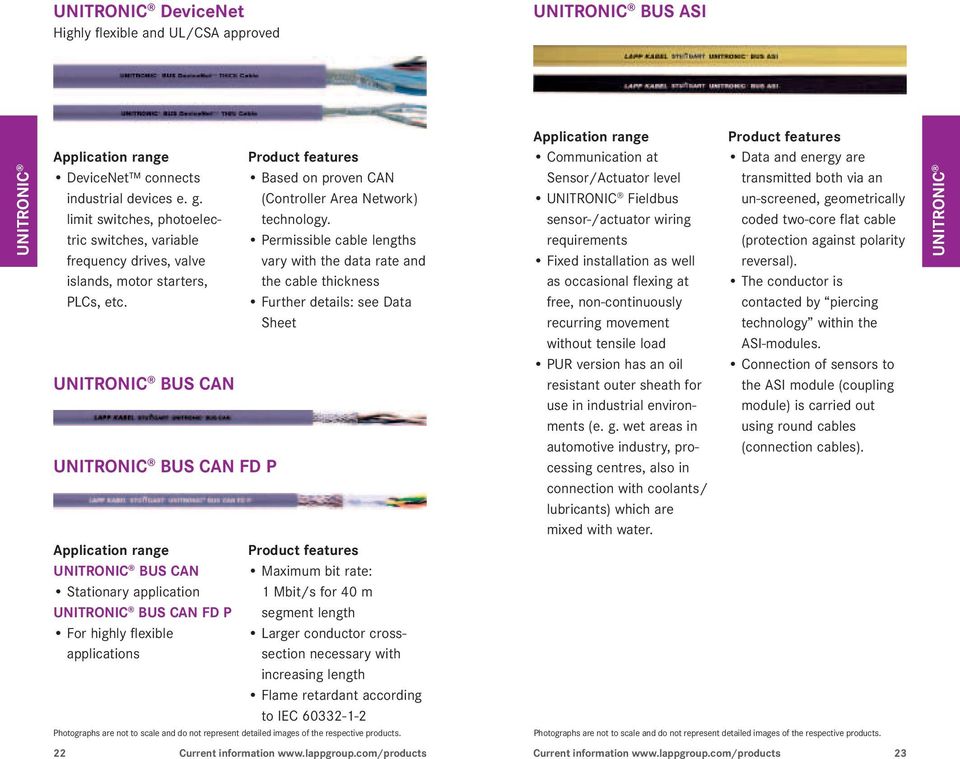
16 UNITRONIC BUS PB ETHERLINE Data communication systems for ETHERNET-Technology UNITRONIC Application range For stationary installation of Bus Systems Maximal electromagnetic screening Dry and damp indoors Product features These bus cables can be used for PROFIBUS-DP as well as for PROFIBUS-FMS and FIP The stated bit rates allow the following cable lengths (maximum) according of PROFIBUS User Organisation of one bus segment (Type A cable, PROFIBIS-DP): kbit/s = 1200 m kbit/s = 1000 m 500 kbit/s = 400 m 1.5 Mbit/s = 200 m 12.0 Mbit/s = 100 m Photographs are not to scale and do not represent detailed images of the respective products. 26 Current information
17 ETHERLINE 2-pairs CAT.5/5e Structured cabling ETHERLINE Benefits ETHERNET with the globally accepted TCP/IP protocol will most probably either provide a connection to the established Fieldbus World or the Sensor- Actuator level. Either via a gateway to the Fieldbus World or straight through down wards to the lowest com munication level. The transmission rates are presently either 10 Mbit/s (ETHERNET) or at least 100 Mbit/s = LAN CAT.5 requirements (Fast Ethernet = Industrial Ethernet) respectively CAT.6a or CAT.7 requirements. With regard to transmission rates, the ETHERNET world is cut into: ETHERNET = 10 Mbit/s FAST ETHERNET = 100 Mbit/s GIGABIT ETHERNET = 1000 Mbit/s Product features In order to reach 100 m link length (like in the office area acc. to ISO 11801) for flexible and highly flexible cable types a cross section of AWG22 is necessary. All ETHERLINE cables with a cross section of AWG22 are PROFINET compliant. If a channel is continuously installed with CAT.5e com ponents, the cabling is according to class E. So far only one component (e.g. patch cable) does not fulfill CAT.5e, the whole system is not conform to class E anymore! Application classes for copper cabling (100 Ohms) Application class Category Frequency Service Class A up to 100 khz Telephone, ISDN Class B up to 1 MHz Telephone, ISDN Class C CAT.3 up to 16 MHz Telephone, ISDN, Token Ring, Ethernet Class D CAT.5 up to 100 MHz 10/100 Base-T Class E CAT.5e up to 125 MHz 10/100/1000 Base-T CAT.6 up to 250 MHz 10/100/1000 Base-T Class Ea CAT.6a up to 500 MHz 10/100/1000/10G Base-T Class F CAT.7 up to 600 MHz 10/100/1000/10G Base-T Class F A CAT.7 A up to 1 GHz 10/100/1000/10G Base-T up to 1.2 GHz 10/100/1000/10G Base-T ETHERLINE Photographs are not to scale and do not represent detailed images of the respective products. Photographs are not to scale and do not represent detailed images of the respective products. 28 Current information Current information 29

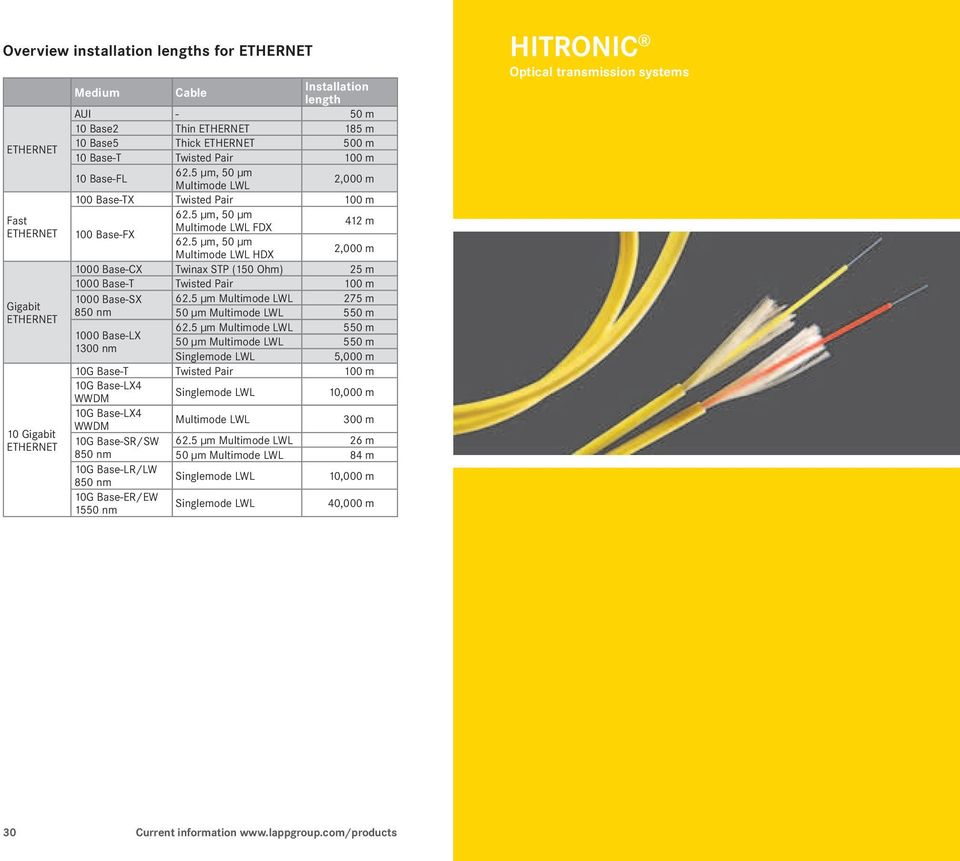
18 Overview installation lengths for ETHERNET Medium Cable Installation length AUI - 50 m 10 Base2 Thin ETHERNET 185 m ETHERNET 10 Base5 Thick ETHERNET 500 m 10 Base-T Twisted Pair 100 m 10 Base-FL 62.5 µm, 50 µm Multimode LWL 2,000 m 100 Base-TX Twisted Pair 100 m 62.5 µm, 50 µm Fast 412 m Multimode LWL FDX ETHERNET 100 Base-FX 62.5 µm, 50 µm 2,000 m Multimode LWL HDX 1000 Base-CX Twinax STP (150 Ohm) 25 m 1000 Base-T Twisted Pair 100 m 1000 Base-SX 62.5 µm Multimode LWL 275 m Gigabit 850 nm 50 µm Multimode LWL 550 m ETHERNET 62.5 µm Multimode LWL 550 m 1000 Base-LX 50 µm Multimode LWL 550 m 1300 nm Singlemode LWL 5,000 m 10G Base-T Twisted Pair 100 m 10G Base-LX4 WWDM Singlemode LWL 10,000 m 10G Base-LX4 Multimode LWL 300 m WWDM 10 Gigabit ETHERNET 10G Base-SR/SW 62.5 µm Multimode LWL 26 m 850 nm 50 µm Multimode LWL 84 m 10G Base-LR/LW 850 nm Singlemode LWL 10,000 m 10G Base-ER/EW 1550 nm Singlemode LWL 40,000 m HITRONIC Optical transmission systems 30 Current information
19 HITRONIC The optical transmission of messages in FOC operates according to the principle of total internal reflection. The reflection is created by the fact that an optically thinner cladding is placed around the light conducting core on whose interface the light totally reflects and is thereby conducted through the FOC. Although the principle of optical message transmission has been known for a long time, not until recent years was one able to develop, produce and commercially use low loss FOCs. In a time when the need for rapid and secure communications networks is continually growing we can neither imagine a world without the transmission medium FOC nor can it be replaced. Advantages of fibre optics over copper-based transmission Protection against electromagnetic interferences, i.e. cable routing can carried out without consideration of possibly occurring sources of ectromagnetic interference rapid made-to measure preparation of plastic FOC, simple on-site plug-in connector installation Potential separation, that is potential delays are not possible No crosstalk and high security against listening in Small dimensions and minimal weight (up to 2.2 mm outside diameter and/or 4g/m for plastic FOC in Simplex model) A portion of these cables is constructively laid for heavy deployment in the energy supply chain. The overall concept of your data transmission line determines whether glass or plastic fibre optic cables are used. We offer you suitable plug-in connectors, tools and pre-fabricated FOC patch cables that match the cables being used. Typical deployment areas for POF and PCF FOCs: Bus systems in automatisation Machine construction and plant engineering Because of their special characteristics POF-FOC are used High demands at data security For conditions where space is limited For short data transmission distances (up to around 70 m) Typical application areas for GOF FOCs: Everywhere where large amounts of data must be transmitted at high speed over distances of approx. 60 m to several kilometres. For example in Local Area Networks (LAN) Metropolitan Area Networks (MAN) Wide Area Networks (WAN) HITRONIC Among fibre optic cables there is a difference based on the material used between plastic fibres (POF), fibres made of silica glass with optical plastic cladding (PCF) and fibres made of pure silica glass (glass fibre or GOF). Mainly for use in the industrial area, Lapp Kabel offers FOCs made of glass or plastic and/or hybrid cables. 32 Current information Current information 33
20 UNITRONIC DeviceNet Optical transmission systems HITRONIC HYBRID FD P DESINA HITRONIC BUS PCF DUPLEX indoor + outdoor HITRONIC HITRONIC HQN Outdoor Cable Two different connection types are used with fibre optic cables: Detachable connections realised with plug connectors. In this case it is necessary to attach a plug to a glass fibre. This calls for trained personnel and expensive special tools. Non-detachable connections created by directly splicing two glass fibres together. To do this requires highly trained personnel and very expensive equipment. If the necessary resources are used only occasionally, the investment is very unlikely to pay for itself. HITRONIC Photographs are not to scale and do not represent detailed images of the respective products. Photographs are not to scale and do not represent detailed images of the respective products. 34 Current information Current information 35

21 Fibre Optical cables F.O. Advantages of Fibre Optical Cables high resistance to tapping little space required no EMC interference low cable weight no EMC testing required can be installed in a long range potentially explosive no potential transfer environment no cross-talk GOF Glass Optical Fibre A distinction is drawn between GOF: Singlemode Fibre SM 9 µm Multimode Fibre MM 50 µm or 62.5 µm Core 9, 50 or 62.5 µm Cladding 125 µm HITRONIC Advantages Using a trunk system offers you the following advantages: No costs of special equipment No need for highly trained personnel Uniform quality thanks to manufacture under laboratory conditions Installation is quick, thereby saving costs No need to carry out measurements on the cable run, comes with OTDR test certificate Fan-out elements also available in IP67 Coating 250 µm POF Polymer Optical Fibre Core 980 µm Cladding 1000 µm Insulation 2200 µm PCF Plastic Cladded Fibre A distinction is drawn between GOF: SIMPLEX (one Fibre) DUPLEX (two Fibres) HITRONIC Core 200 µm Cladding 230 µm Photographs are not to scale and do not represent detailed images of the respective products. Coating (Tefzelbuffer) 500 µm 36 Current information Current information 37
22 Fibre type max. attenuation [db/km] Numerical aperture 660 nm 850 nm 1300 nm 1550 nm POF PCF GOF MM 50 µm OM GOF MM 50 µm OM GOF MM 62.5 µm OM GOF SM EPIC Industrial connectors Fibre type POF PCF GOF MM 50 µm OM2 GOF MM 50 µm OM3 GOF MM 62.5 µm OM1 GOF SM max. transfer size [m] 660 nm 850 nm 1300 nm 1550 nm 100 Mbit/s: Mbit/s: Mbit/s: 100 Mbit/s: Gbit/s: 1 Gbit/s: Gbit/s: 10 Gbit/s: Mbit/s: Gbit/s: Mbit/s: Gbit/s: Gbit/s: Gbit/s: Gbit/s: HITRONIC OM3-Fibre, 10 Gbit/s Ethernet Systems In these systems the data rates are so high that a length of just 84 m is achieved with conventional multi-mode fibres. This performance is just sufficient for the reliable operation of 1GB/s lines. The differences in running time for the multimode fibres was minimized for the OM3 fibre with special processes in the core area. This enables transmission distances of up to 300 m. With the OM3 fibre, costs are considerably re - duced by using the simpler, less expensive Mulrimid terminal devices and installation-friendlier termination. 38 Current information
23 EPIC Rectangular Connectors Industrial Connectors Quality, functionality and safety. Three attributes, one brand name: EPIC rectangular industrial connectors are renowed for their innovative electrical design and physical characteristics. Solutions for many applications: Number of poles from 2 up to 216 Currents up to 82A Voltages up to 1000V protection class IP 65 modular for current supply, signal and data housings variations for cable connection and for the assembly at devices Termination technologies: solder, screw, crimp, cage clamp For inserts with screw termination please use the processing tool (Chapter Accessories) H-A 3: Zinc die-casting, thermoplastic H-A 10-48; H-B 6-48: Aluminium die-casting 1. Cable gland For hoods, coupler hoods and surface mount bases for sealing, strain relief and to provide the cable with EMC protection. A selection of glands are available depending on the application. 2. Hood The hood can be combined at will with either a panel or surface mount base, or a cable coupler hood for cable to cable connection. EPIC 1. Cable gland 2. Hood 3. Pin and sleeve insert 4. Base 3. Pin and sleeve insert The pin and sleeve insert accommodates the individual contact elements and provides insulation at the same time. Available connector variations include screw, crimp and spring cage clamp terminated connectors. Photographs are not to scale and do not represent detailed images of the respective products. EPIC 40 Current information Current information 41
24 Industrial Connectors 4. Base housing There is a choice of three different base housing depending on the application: Surface mount base: For wall mounting Panel mount base: For panel lead-throughs Cable coupler hood: For cable to cable connections There are two housing series with different housing sizes (width). Series EPIC H-A is the narrower series. The increased housing width of the EPIC H-B usually allows the use of inserts with higher voltages for the same number of contacts. Technical Data Series Rated Rated Termination voltage current type EPIC H-A VDE: 250 V VDE: 16 A Screw EPIC H-A 3/4 VDE: 400 V VDE: 10 A Compact design UL: 600 V UL: 10/14 A CSA: 600 V CSA: 10/16 A EPIC H-Q5 5+PE VDE: 230 V/400 V VDE: 16 A Crimp The small format UL: 600 V UL: 16 A CSA: 600 V CSA: 16 A EPIC STA 6 40 VDE: 60 V VDE: 10 A Screw Low voltage UL: 48 V UL: 10 A Solder connector CSA: 48 V EPIC H-BE 6 48 VDE: 500 V VDE: 16 A Screw Standard inserts UL: 600 V UL: 16 A Crimp CSA: 600 V CSA: 16 A VDE: 500 V VDE: 16 A Spring cage UL: 600 V UL: 16 A CSA: 600 V CSA: 16 A EPIC H-EE PE VDE: 500 V VDE: 16 A Crimp Inserts for high UL: 600 V UL 16 A crimp contact density CSA: 600 V CSA: 16 A EPIC H-BS 6 12 VDE: 690 V VDE: 35 A Screw Inserts UL: 600 V UL: 35 A for high currents CSA: 600 V CSA: 35 A EPIC Photographs are not to scale and do not represent detailed images of the respective products. EPIC H-BVE 3-10 VDE: 630 V VDE: 16 A Screw High voltage UL: 600 V UL: 16 A (spring cage inserts CSA: 600 V CSA: 16 A HBVE) EPIC 42 Current information Current information 43
25 Technical Data EPIC Circular connectors Series Rated Rated Termination voltage current type EPIC H-D VDE: 42/250 V VDE: 10 A Crimp For high UL: 250 V UL: 10 A contact density EPIC H-DD VDE: 250 V VDE: 10 A Crimp For higher UL: 600 V UL: 8.5 A contact density CSA: 600 V CSA: 10 A EPIC MC VDE: V VDE: 1-82 A Crimp Modular system UL: V UL: 4-40 A Screw CSA: V CSA: 4-25 A Spring cage EPIC TB-H-BE 6-24 VDE: 500 V VDE: 16 A Screw Term. adapter UL: 600 V UL: 16 A CSA: 600 V CSA: 16 A Cable gland An integral EMC cable gland in the hood, panel mount or cable coupler housing gives built-in protection from electromagnetic radiation. 2. Insert The inserts can accommodate contacts with crimp or solder terminations. 3. Hood The top housing (cable plug) can be freely combined with a panel mount, coupler or surface mount base. 4. Identification ring The unique marking system uses coloured identification clips to provide clear marking. Alternatively connectors can be marked with in dividually writable labels that are simple, abrasion resistant and will not get lost. 5. Housing base Three different types of housing are available: Panel mount base: For panel feed-throughs Feed-through housing: For wall feed-throughs with wall fixing Coupler connector: For cable to cable connections EPIC 44 Current information EPIC CIRCON LS 1 Power connector featuring: IP 68 (10h/1m) Unique marking system a) using coloured identification clips b) or alternatively with individually writable labels Clearly visible and tactilematching when connecting Contact connector to DIN EN Photographs are not to scale and do not represent detailed images of the respective products. Current information 45 EPIC
26 Electrical data 5 + PE Rated current 2 mm contacts: 22 A at 2.5 mm 2 Rated voltage 2 mm contact: 630 V Rated surge voltage 2 mm contact: 6 kv Pollution severity 3 ( IP54) Overvoltage category 3 Termination sizes Power mm 2 crimp AWG crimp Electrical data 3 + PE + 4 Rated current 1 mm contacts: 7 A at 1.0 mm 2 Rated current 2 mm contacts: 22 A at 2.5 mm 2 Rated voltage 2 mm contacts: 630 V Rated surge voltage 1 mm contacts: 4 kv Rated surge voltage 2 mm contacts: 6 kv Pollution severity 3 ( IP54) Overvoltage category 3 Termination size/type 1 mm contact: mm 2 crimp AWG crimp Termination size/type 2 mm contact: mm 2 crimp AWG crimp EPIC POWERLOCK A1 C Benefits Resistant to mechanical influences in harsh environ mental conditions Connectors in harmonized colours according to European standards Every colour different coded to prevent incorrect plugging US colours on request Application range For Renewable Energy Plants e.g. Wind power For mobile and stationary power distribution For the connection of motors, transformers and generators Light & Sound technology EPIC Electrical data 5 + PE/3 + PE + 4 Protection class IP 68 (10h/1m) Temperature range -25 C to +125 C Mating cycles 500 Cable diameter mm Resistance Corrosion resistant Mechanically resistant Photographs are not to scale and do not represent detailed images of the respective products. EPIC 46 Current information Current information 47
27 EPIC POWERLOCK D6 C EPIC SOLAR 4 THIN M pre-assembled Benefits Resistant to mechanical influences in harsh environmental conditions Connectors in harmonized colours according to European standards Every colour different coded to prevent incorrect plugging US colours on request Application range For Renewable Energy Plants e.g. Wind power For mobile and stationary power distribution For the connection of motors, transformers and generators Light & Sound technology Benefits Unresistant cable connection for efficient power transmission Innovative, patented pending contact system, current leaves the connection cool High reliability and longevity by welded bonding Extra Thin 12 mm for high density packing Product features 4 mm connector system with double hook Pre-assembled with 100% automatic control Wide range of wire sizes from 1.5 mm² up to 6 mm² TÜV Rheinland certified UL in preparation Application range Pre-assembled connector cables for weather proof cabling of Photovoltaic systems EPIC Photographs are not to scale and do not represent detailed images of the respective products. Photographs are not to scale and do not represent detailed images of the respective products. EPIC 48 Current information Current information 49
28 EPIC SOLAR 4 THIN F pre-assembled SKINTOP Cable glands Technical data Rated voltage in V 1000 V AC/DC Rated impulse Voltage 8 kv Contact resistance < 0.2 m Ohm Degree of protection IP68 (10 h/1 m) Protection class II Cycle of mechanical operation 100 Range of temperature -40 C C EPIC Photographs are not to scale and do not represent detailed images of the respective products. 50 Current information
29 SKINTOP SKINTOP CLICK/SKINTOP CLICK BS SKINTOP cable glands polyamide metric SKINTOP K-M ATEX plus/ SKINTOP KR-M ATEX plus SKINTOP cable glands polyamide metric SKINTOP SKINTOP CLICK SKINTOP CLICK BS SKINTOP K-M ATEX plus SKINTOP KR-M ATEX plus Benefits SKINTOP CLICK Fewer parts, counter nut no longer needed Up to 70% time saving due to innovative CLICK system Vibration protection No thread required SKINTOP CLICK BS Reliable bending protection for cable conservation and functional reliability Up to 70% time saving due to innovative CLICK system No thread required To protect flexible cables Fewer parts, counter nut no longer needed Application range SKINTOP CLICK Automation technology Solar applications Switch cabinet building Measurement, control and electrical applications Air conditioning technology SKINTOP CLICK BS Cables for electrical appliances and machinery, which are moved under normal use, must be protected against excessive bending, as required in accordance with VDE Robotics industry Flexing machine parts Apparatus construction Light and sound applications Photographs are not to scale and do not represent detailed images of the respective products. 52 Current information Benefits SKINTOP K-M ATEX plus SKINTOP KR-M ATEX plus High degree of protection Dynamic strain stability High strain relief Large, variable clamping ranges Permanent vibration protection Application range SKINTOP K-M ATEX plus Devices, machines of type of protection enhanced safety e Equipment group II/ Category 2G+1D Mobile offshore and marine applications Chemical and petrochemical industry SKINTOP KR-M ATEX plus With reducing seal insert, to seal cables with smaller outer diameters. Photographs are not to scale and do not represent detailed images of the respective products. Current information 53
30 SKINTOP SKINTOP MS-M ATEX/ SKINTOP MSR-M ATEX SKINTOP cable glands nickel plated brass metric SKINTOP MS-M BRUSH SKINTOP cable glands nickel plated brass metric SKINTOP SKINTOP MS-M ATEX SKINTOP MSR-M ATEX Benefits SKINTOP MS-M ATEX SKINTOP MSR-M ATEX Dynamic strain stability High strain relief Large, variable clamping ranges Anti Static Maximum reliability Application range SKINTOP MS-M ATEX Devices, machines of type of protection enhanced safety e Equipment group II/ Category 2G+1D Mobile offshore and marine applications Chemical and petrochemical industry Benefits Faster, easier screen contact Optimal low-resistance 360 screen contact Faster than any other comparable system Uncomplicated and reliable Maximum assembly and adjustment possibility Application range For EMC compliant earthing of the copper braiding and copper shaft sheath Automotive systems Conveyor technology High power drives Frequency converters SKINTOP MSR-M ATEX With reducing seal insert, to seal cables with smaller outer diameters. Photographs are not to scale and do not represent detailed images of the respective products. Photographs are not to scale and do not represent detailed images of the respective products. 54 Current information Current information 55
31 SKINTOP SKINTOP CUBE SKINTOP Cable Bushing System SILVYN Protective cable conduitand cable carrier systems SKINTOP CUBE MODULE SKINTOP CUBE SKINTOP CUBE FRAME Benefits Various clamping range Vibration safe fixed modules Strain relief Oil resistance Simplified service due to easy assembling and disassembling Application range For installation of harnessed cables Everywhere where cables must be safely inserted into housings. Apparatus and switch cabinet construction Electronic installations Automation technology Photographs are not to scale and do not represent detailed images of the respective products. 56 Current information
32 Extraction of the SILVYN range Plastic cable conduits Extraction of the SILVYN range Polyamide cable conduits, corrugated SILVYN SILVYN SI PVC cable conduit protection against dust + humidity. Cable conduits with PVC spiral SILVYN SP PVC conduit with a reinforced PVC spiral. SILVYN RILL PA 6 A polyamide cable conduit for the toughest demands. SILVYN FPAS Polyamide conduit for the toughest demands. Protective cable conduits for subsequent installation SILVYN SILVYN EL A flexible PVC conduit with a reinforced PVC spiral, UL approved. SILVYN ELÖ Oil resistant PVC conduit with a reinforced PVC spiral. SILVYN RILL PA 6 SINUS Polyamide 6 protective conduit, resistant against oil, gasoline and chemicals, with sinusodial cut. SILVYN SPLIT Polyamide 6 protective conduit, resistant against oil, gasoline and chemicals, divisible. Highly flexible cable conduits Metal cable conduits for heavy mechanical stresses SILVYN FPS A highly flexible PUR conduit with an insulated steel spiral. SILVYN FD-PU Highly flexible PUR conduit for the toughest demands, with insulated steel spiral. Photographs are not to scale and do not represent detailed images of the respective products. SILVYN AS Steel conduit for high mechanical stresses. SILVYN AS-P Steel conduit, fluid-tight, with a PVC outer sheath. Photographs are not to scale and do not represent detailed images of the respective products. 58 Current information Current information 59
33 Extraction of the SILVYN range Steel cable conduits, highly flexible with a plastic sheath SILVYN CHAIN Series Medium SILVYN SILVYN LCC-2 A highly flexible steel conduit with a plastic sheath. SILVYN LCCH-2 A highly flexible steel conduit with a plastic sheath, halogen-free. SILVYN SILVYN SSUE A highly flexible stainless steel conduit. SILVYN UI511 Anaconda cable conduit, stainless steel. Anaconda cable conduits in steel and plastic All purpose, due to its single pin, also for higher mechanical requirements. Specially for small and medium-size chains. Available closed or with foldable lid. Characteristics Standard applications Tongue/groove system with yellow pin Inner hight mm 12 types, many widths Application areas Automation Handling equipment CNC machines Medium sliding applications SILVYN CNP Anaconda conduit, non-metallic, watertight, UL approved. SILVYN HTDL Steel protective conduit with PVC outer sheet, liquid-tight, UL approved. Photographs are not to scale and do not represent detailed images of the respective products. Photographs are not to scale and do not represent detailed images of the respective products. 60 Current information Current information 61
34 SILVYN CHAIN Series Sliding SILVYN CHAIN Series Steel SILVYN SILVYN Specialist for operation on very long travelling distances up to 400 meters. Chain links with shoes made of lowfriction, low-wear plastics. System-completing channel constructions available for supporting and guiding the chain. Characteristics Long sliding distances Tongue/groove system with yellow tripple pin Inner hight mm 12 types, many frame versions: Nylon, Aluminium, Inox Application areas Sliding with high speed and high charge weight Long life-cycle applications (very long lifetime) The hardliner. For all applications not allowing the use of a plastic chain, for example in steel works, foundries, on machine tools and oil-rigs. Made of galvanized steel with drilled aluminium frames or steel separators (adjustable separators). Available in stainless steel AISI 316 if required. Characteristics Highest load capacity Highest chemical resistance Tongue/groove system in metal Inner hight mm 5 standard types Customised versions Application areas Steel mills/steel works Off-Shore Long-travel machining centers Heavy duty environment Photographs are not to scale and do not represent detailed images of the respective products. Photographs are not to scale and do not represent detailed images of the respective products. 62 Current information Current information 63
35 SILVYN CHAIN Installation types FLEXIMARK Horizontal Cable marking products SILVYN Vertical Photographs are not to scale and do not represent detailed images of the respective products. 64 Current information
36 How? What? BASIC SYSTEM Ready made to deliver for each environment CUSTOMIZED SYSTEM Your demand we deliver How? Laser office printer DATA MARKING Flexisoft with eplan and WS-CAD interface Thermal transfer printers What? CABLE Outdoor & Indoor MINI & MAXI & HOLDERS PTE COLLARS TS & HF & MARKING TAGS SHRINK TUBES STAINLESS STEEL COLLARS FOR CABLE TIES & MARKING TAGS STAINLESS STEEL COLLARS FOR CABLE TIES & MARKING TAGS CABLE MARKING TEXT COLLARS PTET CABLE Outdoor & Indoor Indoor COLLARS FOR CABLE TIES LFL 4.2 LCK/LCFK LABELS FLEXILABEL LFL & HOLDERS PTET/LAB CABLE LABEL LFL & TIES FLEXILABEL TFL & HOLDERS PTEF/LAB CABLELABEL LTFL & TIES COLLARS FOR CABLE TIES & MARKING TAGS TMB TCK LABELS FLEXIMARK Indoor WIRE before mounting the wire after mounting the wire LABEL CARDS AND BLOCKS FLEXIPART SNAP-ON COLLARS & MARKING TAGS DYMO printer PA MARKING RINGS PC MARKING RINGS SHRINK TUBE MARKING SHRINK TUBE MARKING CABLE TIE MARKING FKBB FLEXIPART MARKING RINGS SNAP-ON COLLARS & MARKING TAGS WIRE before mounting the wire after mounting the wire TAG TIES & LA/LB LABELS FLEXIPRINT LF LCFK/LCK LABELS COLLARS TS/HF & FLEXILABEL LFL 4.2 BRADY FLAG LABELS B-425 FLEXIMARK flat shrink tube FLEXIPRINT TF TCK LABELS FLAG LABELS TAG TIES & TA LABELS SHRINKING TUBES SHRINK MARK SM SNAP-ON COLLARS & MARKING TAGS FLEXIMARK COMPONENT Device marking Terminal Sensor MLM MOUNTING PROFILES & MINI TERMINAL BLOCK PGS CHARACTER HOLDERS DYMO printer ENGRAVED MARKING TERMINAL BLOCK Photographs are not to scale and do not represent detailed images of the respective products. 66 Current information COMPONENT Device marking Terminal Sensor LA LABELS LA LABELS LFL LEXEL/ THORSMAN CLIP-ON COLLARS & LFL TA LABELS BRADY DURASLEEVE BRADY EPREP TERMINAL BLOCK MLM MOUNTING PROFILES & TFL 9.5 CLIP-ON COLLARS & MARKING TAGS Photographs are not to scale and do not represent detailed images of the respective products. Current information 67
37 Cable Accessories PEW 8.87 Front crimp pliers with a large range of diameters from 0.08 to 10 mm 2 EASY STRIP 2 Self-adjusting cutting and stripping tool with an increased stripping range and for different materials X cassette: mm 2 XL cassette: mm 2 Please see our Main Catalogue for further details. ACCESSORIES Photographs are not to scale and do not represent detailed images of the respective products. Current information 69
38 Twist Tail cable tie TY-GUN ERG 120 cable tie pliers/ TY-GUN ERG 50 TY-GUN ERG 120 cable tie pliers/ty-gun ERG 50 Twist Tail cable tie Industry cable ties for quick and secure assembly. General purpose applications, indoor and outdoor Benefits Cable tie tool TY-GUN allows quick and economical binding, fixing and mounting of cable ties. Application range For plastic cable ties Installation pistol LS steel cable ties ACCESSORIES LS steel cable ties LS one piece steel cable ties can be used outdoors and under extreme conditions, e.g. high corrosion risk. ACCESSORIES Photographs are not to scale and do not represent detailed images of the respective products. Photographs are not to scale and do not represent detailed images of the respective products. 70 Current information Current information 71
39 Introduction to Cable Engineering The Fundamentals of Cable Engineering Continuous supply of electric power, or faultless data transfer respectively, provided mostly through wiring, are a primary requirement affecting virtually all areas of our life. This results in tough requirements for production, installation and operation of cables. To be able to design the cables suitably and to install them correctly, it is necessary to have good knowledge in various fields, e.g. physics, electrical engineering, mechanic and other applied engineering sciences. Cable failure can be caused, for example, by mechanical action or electrically by over- voltage, by insulation ageing, corrosion, sneak currents, as well as by unqualified installation or by incorrectly or badly dimensioned design. What is also important is technically correct elaboration of a wiring project and proper crosscheck of all installation work. Then, in operation, it is necessary to observe relevant operating conditions, a cable was designed for. Employees of the Lapp Group are prepared anytime to help you professionally in preventing any and all consequences, which may be caused by a wiring failure. 1. What cables and conductors are required for Electric power transmission for power supply Transmission of data, signals or impulses for data communication Generally, the term of electric cable means a route for transmission of el. power, data or signals betweeen a source and an appliance (for data cables transmitter and receiver). 2. Explanation of general terms 2.1 Conductor Conductor (conductive core) represents a conductive route of electric power and together with insulation it forms a wire. Several wires form a core. A sheath protects a cable from external actions. Metals are conductors of the 1st class. Conductance of metals is related to the number of electrons in their outer layer. The most often used conductor materials are as follows: Copper (Cu) (in more than 99 % of all applications) Aluminium (Al) Silver (Ag) Conductors can be bare or treated (tinned, silver-coated, gold-coated). Photographs are not to scale and do not represent detailed images of the respective products. 72 Current information Current information 73
40 Outside sheath Classification according to design: Compact core: of a single wire (up to 16 mm²) or of multiple wires Stranded core: made of 7 to several hundreds of thin single wires (VDE 0295/ IEC ). Classes of stranded cores are specified in VDE 0295, or from 0.5 mm² in compliance with IEC respectively. Max. diameter of a single wire and max. conductor resistance are critical for the core design. The larger crosssectional area, the lower resistance; the larger length, the higher resistance (similarly as for water supply piping). Braiding/screening Nonwoven textile wrapping Inside sheath Conductor Twisted wires Stranded core classes Class 1: compact Class 2: made of multiple wires Class 5: made of fine wires Class 6: made of extra-fine wires Example of a conductor with nominal cross-sectional area of 16 mm² A = π r² or A= π d²/4 A = geometric cross-sectional area r = radius d = diameter 1: solid wire (1 x 4.5 mm) 2: multiple wires (7 x 1.7 mm) 3: fine wires (122 x 0.41 mm) 4,5 mm 1,7 mm 4,1 mm Photographs are not to scale and do not represent detailed images of the respective products. Minimum bending radius It is a characteristic value, which gives you a degree of possible cable bending without its damaging. It is absolutely necessary to respect this value, when using a cable in tow chains ( FD cables in the Lapp Group programme). Only maximum outside diameters are shown for highly flexible cables; tolerance is possible only downwards. LAPP KABEL ÖLFLEX FD 90 D = Cable outside diameter 74 Current information Current information 75 r 3xD 2.2 Insulation Insulation is electrically nonconducting protective layer around the conductor. Insulating materials are applied on conductors by extrusion. The mostly used insulating materials are compounds of organic elements. D C, H2, O2, N2, S, e.g.: Thermoplastics: PVC, PE, PP, PTFE Elastomers (rubber): CR, SR Thermoplastic elastomers: PUR, TPE-E An insulated conductor is call ed a wire. 2.3 Twisting While producing a multiwire cable the wires are twisted together. A cable of wires, a bundle of wires or a twisted bundle (cable core) is created. Reasons for twisting are: Lower need for space smaller outer diameters Circular form Flexibility Torsion length Axis of rotation Photographs are not to scale and do not represent detailed images of the respective products.
41 2.4 Identification of wires (wire identification code) To be able to connect the wires correctly, they must be uniquely identified. Numbering All wires are identified by numbers in ascending order from 1 to Mostly by white digits on black background (insulation) The only exception is a protective conductor, which is always green-yellow Numbered wires Protective green-yellow wire Colour ratio 70: Colour code All wires are differentiated by different colours of in - sulation Individual colours are specified in the Wire Identification Code e.g. according to DIN VDE /HD 308 S2 Coloured wires Protective green-yellow wire Colour ratio 70: Protection, screening, armouring It has 2 main functions: Mechanical protection by braiding made of steel wires protected from S oxidation, e.g. ÖLFLEX CLASSIC 100 SY Electromagnetic protection (EMC) by braiding made of tinned copper C wires, e.g. ÖLFLEX CLASSIC 110 CY black 0.6/1 kv Photographs are not to scale and do not represent detailed images of the respective products. or by braiding made of copper D wires, e.g. ÖLFLEX ROBOT 900 DP or by braiding made of metallized foil (e.g. aluminium bonded (steamed) polyester sheet), e.g. UNITRONIC BUS EIB 2.6 Sheath The sheath is a closed cover protecting elements laying under the sheath from external actions (mechanical, thermal, chemical or physical damages). Correct selection of sheath material is decisive. Protection from immissions Protection from emmissions Mechanical actions: abrasion, impact, bending, tension, twisting (torsional swinging) Examples of protections: braiding of steel wires, bearing members, supporting braiding, protective hoses Chemical actions: acids, caustics, oils, solvents, water (from 50 C) Examples of protections: sheath materials, such as TEFLON, ROBUST, PUR; protective hoses Thermal actions: cold, heat Examples of protections: mixture with thermal stabilisers, teflon, silicone Physical actions: UV radiation, radioactive radiation Examples of protections: mixture with UV stabilisers The mostly used sheath materials are as follows: PVC, PUR, SR, CR. Photographs are not to scale and do not represent detailed images of the respective products. 76 Current information Current information 77
42 3. Labelling products of the Lapp Group programme ÖLFLEX CLASSIC G 1.5 mm² Brand, identification 2. Number of wires 3. G with a protective conductor or X without a protective conductor (green-yellow) Control cables ÖLFLEX CLASSIC 110 ÖLFLEX CLASSIC 130 H ÖLFLEX 191 ÖLFLEX CONTROL TM Cable groups and types Servo cables ÖLFLEX SERVO FD 755 P ÖLFLEX SERVO FD 795 CP ÖLFLEX FD 90 CY 4. Cross-sectional area or diameter (J-Y(St)Y 4 x 2 x 0.6 mm) and relevant quantity Power cables NYCY; NYCWY; NAYY; H07RN-F; H01N2-D; ÖLFLEX CLASSIC 100 NF Data cables VF Coaxial cables RG UNITRONIC LAN HITRONIC HUN HITRONIC POF SIMPLEX PE ETHERLINE TORSION UL (AWM) CAT.5 UNITRONIC LiYCY UNITRONIC FD CP (TP) plus UL/CSA J-Y(ST)Y UNITRONIC BUS L2/FIP 3. Where the cable will be used? Environment Indoor or outdoor Thermal resistance UV radiation resistance Weather resistance 4. How the cable will be laid? Way of laying Fixed or movable, in a tow chain, positively guided (pulleys ) minimum bending radius, reversed bending cycles, tensile forces In open or closed cable systems (troughs, pipes ) Current-carrying capacity, reduction factors In the vicinity of interference fields (EMC) Screening by copper braid 6. Other requirements Behaviour in case of fire/ Non-halogenity Chemical actions: free of compounds harming varnish wettability, free of lead, resistance to oils, acids, water Mechanical actions: resistance to torsional strain, to abrasion, to ex - tension strain 5. Standards, approbations, norms Approbation is a defined special standard for cables issued by an authorised body including description of design (compositions, materials, diameters, etc.) and the use. (see Table T6 and T18). 4. Selection criteria Which criteria are important? 1. What is the purpose of use? Description of application 2. What nominal voltage is required? U o /U 300 V, 500 V, 600/1000 V What requirements for norms should be fulfilled? National norms, e.g. VDE, HAR, UL, CSA, NOM Current information Current information 79
43 A1 Extracts from Selection Tables Selection Tables A1: Power and control cables Extracts from Selection Tables Selection Tables A1 A1: Power and control cables Application Criteria Cable and Lead Designation Application Criteria Cable and Lead Designation For static and occasional flexing use Application Excepted circuits remain ener - gized acc. IEE For intrinsically safe circuits in ha zardous locations to/vde 0165 Hand tools and lamps on worksites Oil resistant to UL + CSA specification Oil resistant to VDE Bio oil resistant Cables resistant to chemicals Cables resistant to ultra-violet light Cold-flexible cables Servomotors/ Motive pow. engineering Standards Based on VDE/HAR/DIN As per Standard with VDE certification with VDE registration with HAR certification (HAR) with UL certification with CSA certification Temperature range +105 C +90 C +80 C +70 C +60 C -5 C -10 C -15 C -25 C -30 C -40 C -50 C -55 C ÖLFLEX CLASSIC 100 ÖLFLEX CLASSIC 100 Yellow ÖLFLEX CLASSIC 100 CY ÖLFLEX CLASSIC 100 SY ÖLFLEX CLASSIC 100 BK POWER 0.6/1 KV ÖLFLEX CLASSIC 110 ÖLFLEX CLASSIC 110 Cold ÖLFLEX CLASSIC 110 Orange ÖLFLEX CLASSIC 110 CY ÖLFLEX CLASSIC 110 SY ÖLFLEX CLASSIC 110 Black ÖLFLEX CLASSIC 110 CY Black ÖLFLEX CLASSIC 115 CY see EB-cables see separate selection Table T1 and T2 80 Current information For static and occasional flexing use Laying Outdoor, only indirectly in the ground (conduit) UV-protected, static Indoor, on surface, in conduit, in ducting, in partition walls, static Outdoor, protected against UV light, static laying Outdoor, unprotected in the open, low flexing Indoor, static & low flexing application Bending radius, low flexing 5 x D 10 x D 12.5 x D 15 x D 20 x D Nominal voltage 250 V 300/300 V 300/500 V 600 V acc. to UL/CSA 450/750 V 600/1000 V ÖLFLEX CLASSIC 100 ÖLFLEX CLASSIC 100 Yellow ÖLFLEX CLASSIC 100 CY ÖLFLEX CLASSIC 100 SY ÖLFLEX CLASSIC 100 BK POWER 0.6/1 KV ÖLFLEX CLASSIC 110 ÖLFLEX CLASSIC 110 Cold ÖLFLEX CLASSIC 110 Orange ÖLFLEX CLASSIC 110 CY ÖLFLEX CLASSIC 110 SY ÖLFLEX CLASSIC 110 Black ÖLFLEX CLASSIC 110 CY Black ÖLFLEX CLASSIC 115 CY Current information 81
44 A1 Extracts from Selection Tables Selection Tables A1: Power and control cables Extracts from Selection Tables Selection Tables A1 A1: Power and control cables Application Criteria Cable and Lead Designation Application Criteria Cable and Lead Designation For static and occasional flexing use Make-up Fine-wire VDE class 5, copper stranded conductors Superfine wire VDE class 6, copper stranded conductors Ultra fine wire VDE class 6, copper stranded conductors Polyurethane core insulation Rubber core insulation PVC/special PVC PE/PP core insulation Halogen free core insulation Number printing Colour code to VDE 0293 ÖLFLEX colour code Screening on the forn of copper braiding Common inner sheath under overall protection/braiding Steel wire braiding PVC sheath PUR sheath, wear resistant, cutting resistant Halogen free outer sheath Bio oil resistant outer sheath P4/11 Outer sheath of synthetic rubber Outer sheath of Neoprene rubber Outer sheath of rubber compound acc. to standard ÖLFLEX CLASSIC 100 ÖLFLEX CLASSIC 100 Yellow ÖLFLEX CLASSIC 100 CY ÖLFLEX CLASSIC 100 SY ÖLFLEX CLASSIC 100 BK POWER 0.6/1 KV ÖLFLEX CLASSIC 110 ÖLFLEX CLASSIC 110 Cold ÖLFLEX CLASSIC 110 Orange ÖLFLEX CLASSIC 110 CY ÖLFLEX CLASSIC 110 SY ÖLFLEX CLASSIC 110 Black ÖLFLEX CLASSIC 110 CY Black ÖLFLEX CLASSIC 115 CY Neoprene is a registered trademark of DuPont de Nemour = Principal application = Application not customary, but possible, or alternative design available in the range = Temperature range for flexible laying = Temperature range for static and flexible laying = Temperature range for static laying For static and occasional flexing use Application Excepted circuits remain ener - gized acc. IEE For intrinsically safe circuits in ha zardous locations to/vde 0165 Hand tools and lamps on worksites Oil resistant to UL + CSA specification Oil resistant to VDE Bio oil resistant Cables resistant to chemicals Cables resistant to ultra-violet light Cold-flexible cables Servomotors/ Motive pow. engineering Standards Based on VDE/HAR/DIN As per Standard with VDE certification with VDE registration with HAR certification (HAR) with UL certification with CSA certification Temperature range +105 C +90 C +80 C +70 C +60 C -5 C -10 C -15 C -25 C -30 C -40 C -50 C -55 C ÖLFLEX EB ÖLFLEX EB CY ÖLFLEX 140 ÖLFLEX 140 CY ÖLFLEX 150 ÖLFLEX 150 CY ÖLFLEX 191 ÖLFLEX 191 CY ÖLFLEX CONTROL TM ÖLFLEX CONTROL TM CY ÖLFLEX Tray II ÖLFLEX Tray II CY ÖLFLEX SF see EB-cables see separate selection Table T1 and T2 82 Current information Current information 83
45 A1 Extracts from Selection Tables Selection Tables A1: Power and control cables Extracts from Selection Tables Selection Tables A1: Power and control cables A1 Application Criteria Cable and Lead Designation Application Criteria Cable and Lead Designation For static and occasional flexing use Laying Outdoor, only indirectly in the ground (conduit) UV-protected, static Indoor, on surface, in conduit, in ducting, in partition walls, static Outdoor, protected against UV light, static laying Outdoor, unprotected in the open, low flexing Indoor, static & low flexing application Bending radius, low flexing 5 x D 10 x D 12.5 x D 15 x D 20 x D Nominal voltage 250 V 300/300 V 300/500 V 600 V acc. to UL/CSA 450/750 V 600/1000 V ÖLFLEX EB ÖLFLEX EB CY ÖLFLEX 140 ÖLFLEX 140 CY ÖLFLEX 150 ÖLFLEX 150 CY ÖLFLEX 191 ÖLFLEX 191 CY ÖLFLEX CONTROL TM ÖLFLEX CONTROL TM CY ÖLFLEX Tray II ÖLFLEX Tray II CY ÖLFLEX SF For static and occasional flexing use Make-up Fine-wire VDE class 5, copper stranded conductors Superfine wire VDE class 6, copper stranded conductors Ultra fine wire VDE class 6, copper stranded conductors Polyurethane core insulation Rubber core insulation PVC/special PVC PE/PP core insulation Halogen free core insulation Number printing Colour code to VDE 0293 ÖLFLEX colour code Screening on the forn of copper braiding Common inner sheath under overall protection/braiding Steel wire braiding PVC sheath PUR sheath, wear resistant, cutting resistant Halogen free outer sheath Bio oil resistant outer sheath P4/11 Outer sheath of synthetic rubber Outer sheath of Neoprene rubber Outer sheath of rubber compound acc. to standard Neoprene is a registered trademark of DuPont de Nemour = Principal application = Application not customary, but possible, or alternative design available in the range = Temperature range for flexible laying = Temperature range for static and flexible laying = Temperature range for static laying ÖLFLEX EB ÖLFLEX EB CY ÖLFLEX 140 ÖLFLEX 140 CY ÖLFLEX 150 ÖLFLEX 150 CY ÖLFLEX 191 ÖLFLEX 191 CY ÖLFLEX CONTROL TM ÖLFLEX CONTROL TM CY ÖLFLEX Tray II ÖLFLEX Tray II CY ÖLFLEX SF 84 Current information Current information 85
46 Extracts from Selection Tables A2 Selection Tables A2: Highly Flexible FD Cables for use in power chains or robot applications Extracts from Selection Tables Selection Tables A2 A2: Highly Flexible FD Cables for use in power chains or robot applications Application Criteria Cable and Lead Designation Application Criteria Cable and Lead Designation Use in power chains or robot applications Application For industrial machinery to EN part 1/VDE 0113 For frequency-converter driven servo drives For servo motor, low capacitance For encoders, feedback systems, sensors For free arm robots/torsion load Restricted guidance over rollers, motor drums For indoor application For outdoor application For field bus systems For video transmission, RGB signal transmission For North America with UL + CSA approvals For use in oily environments, enhanced oil resistance For use in areas with bio oils Temperature range +105 C +90 C +80 C +70 C +60 C +5 C -5 C -10 C -20 C -30 C -40 C -50 C ÖLFLEX SERVO FD 750 P ÖLFLEX SERVO FD 755 P ÖLFLEX SERVO FD 755 CP ÖLFLEX SERVO FD 760 CP ÖLFLEX SERVO FD 770 CP ÖLFLEX SERVO FD 781 CY ÖLFLEX SERVO FD 781 P ÖLFLEX SERVO FD 781 CP ÖLFLEX SERVO FD 785 P ÖLFLEX SERVO FD 785 CP ÖLFLEX SERVO FD 790 CP ÖLFLEX SERVO FD 795 P Use in power chains or robot applications ÖLFLEX SERVO FD 750 P ÖLFLEX SERVO FD 755 P ÖLFLEX SERVO FD 755 CP ÖLFLEX SERVO FD 760 CP ÖLFLEX SERVO FD 770 CP ÖLFLEX SERVO FD 781 CY ÖLFLEX SERVO FD 781 P ÖLFLEX SERVO FD 781 CP ÖLFLEX SERVO FD 785 P ÖLFLEX SERVO FD 785 CP ÖLFLEX SERVO FD 790 CP ÖLFLEX SERVO FD 795 P Minimum bending radius factor for continuous flexing 5 x D 6.5 x D 7.5 x D 10 x D 12.5 x D 15 x D 20 x D Laying For chains with small radii For chains with restricted space For low cable weight in the chain For 24-hour operation at high numbers of cycles For high acceleration values > 10 m/s 2 For very high acceleration up to 50 m/s 2 For travel speeds up to 5 m/s, up to 10 m travel length For travel speeds up to 10 m/s, up to 10 m travel length For travel speeds up to 5 m/s, up to 100 m travel length Nominal voltage 350 Vss 30/300 V AC 300/500 V AC 600/1000 V AC 600 V acc. to UL/CSA 86 Current information Current information 87
47 A2 Extracts from Selection Tables Extracts from Selection Tables Selection Tables Selection Tables A2: Highly Flexible FD Cables for use in power chains or robot applications A2: Highly Flexible FD Cables for use in power chains or robot applications A2 Application Criteria Cable and Lead Designation Application Criteria Cable and Lead Designation Use in power chains or robot applications Make-up Fine wire VDE class 5, copper stranded conductor Superfine wire VDE class 6, copper stranded conductor Ultra fine wire VDE class 6, copper stranded conductor PVC/special PVC, core insulation Elastomer core insulation PE/cellular PE/cellular PE foam skin Polyethylene/Polypropylene TPE core insulation Special TPE (P4/11) core insulation Halogen free compound Number printing VDE colour code DIN colour code/ special colour code Pair screening PiCY/PiMF/STP Total screening Special PVC sheath PUR sheath, wear resistant, cutting resistant Rubber sheath TPE (P4/11) sheath bio oil resistant Halogen free compound = Principal application = Application not customary, but possible, or alternative design available in the range = Temperature range for flexible laying = Temperature range for static and flexible laying = Temperature range for static laying ÖLFLEX SERVO FD 750 P ÖLFLEX SERVO FD 755 P ÖLFLEX SERVO FD 755 CP ÖLFLEX SERVO FD 760 CP ÖLFLEX SERVO FD 770 CP ÖLFLEX SERVO FD 781 CY ÖLFLEX SERVO FD 781 P ÖLFLEX SERVO FD 781 CP ÖLFLEX SERVO FD 785 P ÖLFLEX SERVO FD 785 CP ÖLFLEX SERVO FD 790 CP ÖLFLEX SERVO FD 795 P Use in power chains or robot applications Application For industrial machinery to EN 60204, part 1/VDE 0113 For frequency-converter driven servo drives For servo motor, low capacitance For encoders, feedback systems, sensors For free arm robots/torsion load Restricted guidance over rollers, motor drums For indoor application For outdoor application For field bus systems For video transmission, RGB signal transmission For North America with UL + CSA approvals For use in oily environments, enhanced oil resistance For use in areas with bio oils Temperature range +105 C +90 C +80 C +70 C +60 C +5 C -5 C -10 C -20 C -30 C -40 C -50 C ÖLFLEX SERVO FD 795 CP SERVO-cable. acc. Indramat Standard INK ÖLFLEX FD CLASSIC 810 ÖLFLEX FD CLASSIC 810 CY ÖLFLEX FD CLASSIC 810 P ÖLFLEX FD CLASSIC 810 CP ÖLFLEX FD 820 H ÖLFLEX FD 820 CH ÖLFLEX FD ROBUST ÖLFLEX FD ROBUST C 88 Current information Current information 89
48 A2 Extracts from Selection Tables Extracts from Selection Tables Selection Tables Selection Tables A2: Highly Flexible FD Cables for use in power chains or robot applications A2: Highly Flexible FD Cables for use in power chains or robot applications A2 Application Criteria Cable and Lead Designation Application Criteria Cable and Lead Designation Use in power chains or robot applications ÖLFLEX SERVO FD 795 CP SERVO-cable. acc. Indramat Standard INK Minimum bending radius factor for continuous flexing 5 x D 6.5 x D 7.5 x D 10 x D 12.5 x D 15 x D 20 x D Laying For chains with small radii For chains with restricted space For low cable weight in the chain For 24-hour operation at high numbers of cycles For high acceleration values > 10 m/s 2 For very high acceleration up to 50 m/s 2 For travel speeds up to 5 m/s, up to 10 m travel length For travel speeds up to 10 m/s, up to 10 m travel length For travel speeds up to 5 m/s, up to 100 m travel length Nominal voltage 350 Vss 30/300 V AC 300/500 V AC 600/1000 V AC 600 V acc. to UL/CSA ÖLFLEX FD CLASSIC 810 ÖLFLEX FD CLASSIC 810 CY ÖLFLEX FD CLASSIC 810 P ÖLFLEX FD CLASSIC 810 CP ÖLFLEX FD 820 H ÖLFLEX FD 820 CH ÖLFLEX FD ROBUST ÖLFLEX FD ROBUST C Use in power chains or robot applications Make-up Fine wire VDE class 5, copper stranded conductor Superfine wire VDE class 6, copper stranded conductor Ultra fine wire VDE class 6, copper stranded conductor PVC/special PVC, core insulation Elastomer core insulation PE/cellular PE/cellular PE foam skin Polyethylene/Polypropylene TPE core insulation Special TPE (P4/11) core insulation Halogen free compound Number printing VDE colour code DIN colour code/special colour code Pair screening PiCY/PiMF/STP Total screening Special PVC sheath PUR sheath, wear resistant, cutting resistant Rubber sheath TPE (P4/11) sheath bio oil resistant Halogen free compound ÖLFLEX SERVO FD 795 CP SERVO-cable. acc. Indramat Standard INK = Principal application = Application not customary, but possible, or alternative design available in the range = Temperature range for flexible laying = Temperature range for static and flexible laying = Temperature range for static laying ÖLFLEX FD CLASSIC 810 ÖLFLEX FD CLASSIC 810 CY ÖLFLEX FD CLASSIC 810 P ÖLFLEX FD CLASSIC 810 CP ÖLFLEX FD 820 H ÖLFLEX FD 820 CH ÖLFLEX FD ROBUST ÖLFLEX FD ROBUST C 90 Current information Current information 91
49 A2 Extracts from Selection Tables Extracts from Selection Tables Selection Tables Selection Tables A2: Highly Flexible FD Cables for use in power chains or robot applications A2: Highly Flexible FD Cables for use in power chains or robot applications A2 Application Criteria Cable and Lead Designation Application Criteria Cable and Lead Designation Use in power chains or robot applications Application For industrial machinery to EN 60204, part 1/VDE 0113 For frequency-converter driven servo drives For servo motor, low capacitance For encoders, feedback systems, sensors For free arm robots/torsion load Restricted guidance over rollers, motor drums For indoor application For outdoor application For field bus systems For video transmission, RGB signal transmission For North America with UL + CSA approvals For use in oily environments, enhanced oil resistance For use in areas with bio oils Temperature range +105 C +90 C +80 C +70 C +60 C +5 C -5 C -10 C -20 C -30 C -40 C -50 C ÖLFLEX FD 855 P ÖLFLEX FD 855 CP ÖLFLEX FD 90 ÖLFLEX FD 90 CY UNITRONIC FD UNITRONIC FD CY UNITRONIC FD P plus UNITRONIC FD CP plus UNITRONIC FD CP (TP) plus UNITRONIC FD CP (TP) plus UNITRONIC BUS PB FD P Use in power chains or robot applications ÖLFLEX FD 855 P ÖLFLEX FD 855 CP ÖLFLEX FD 90 ÖLFLEX FD 90 CY UNITRONIC FD UNITRONIC FD CY UNITRONIC FD P plus UNITRONIC FD CP plus UNITRONIC FD CP (TP) plus UNITRONIC FD CP (TP) plus UNITRONIC BUS PB FD P Minimum bending radius factor for continuous flexing 5 x D 6.5 x D 7.5 x D 10 x D 12.5 x D 15 x D 20 x D Laying For chains with small radii For chains with restricted space For low cable weight in the chain For 24-hour operation at high numbers of cycles For high acceleration values > 10 m/s 2 For very high acceleration up to 50 m/s 2 For travel speeds up to 5 m/s, up to 10 m travel length For travel speeds up to 10 m/s, up to 10 m travel length For travel speeds up to 5 m/s, up to 100 m travel length Nominal voltage 350 Vss 30/300 V AC 300/500 V AC 600/1000 V AC 600 V acc. to UL/CSA 92 Current information Current information 93
50 A2 Extracts from Selection Tables Selection Tables A2: Highly Flexible FD Cables for use in power chains or robot applications Extracts from Selection Tables Selection Tables A3 A3: Conveyor Cables Application Criteria Cable and Lead Designation Application Criteria Cable and Lead Designation Use in power chains or robot applications Make-up Fine wire VDE class 5, copper stranded conductor Superfine wire VDE class 6, copper stranded conductor Ultra fine wire VDE class 6, copper stranded conductor PVC/special PVC, core insulation Elastomer core insulation PE/cellular PE/cellular PE foam skin Polyethylene/Polypropylene TPE core insulation Special TPE (P4/11) core insulation Halogen free compound Number printing VDE colour code DIN colour code/ special colour code Pair screening PiCY/PiMF/STP Total screening Special PVC sheath PUR sheath, wear resistant, cutting resistant Rubber sheath TPE (P4/11) sheath bio oil resistant Halogen free compound = Principal application = Application not customary, but possible, or alternative design available in the range = Temperature range for flexible laying = Temperature range for static and flexible laying = Temperature range for static laying ÖLFLEX FD 855 P ÖLFLEX FD 855 CP ÖLFLEX FD 90 ÖLFLEX FD 90 CY UNITRONIC FD UNITRONIC FD CY UNITRONIC FD P plus UNITRONIC FD CP plus UNITRONIC FD CP (TP) plus UNITRONIC FD CP (TP) plus UNITRONIC BUS PB FD P Temperature range +90 C +80 C +70 C +60 C +5 C 0 C -5 C -10 C -15 C -20 C -25 C -30 C -40 C Standards Based on VDE/HAR/DIN With VDE approbation With VDE-Registrierung With HAR-Approbation Flame retardant acc. to IEC Application For cable trolley guide systems Positive guidance over rollers, motor drums Reeling re-routing under tension For freely suspended application in lift/conveying system For freely suspended application with additional load For indoor application For short travel distances indoors For short travel distances outdoors For use in power chains ÖLFLEX CRANE ÖLFLEX LIFT F ÖLFLEX CRANE F ÖLFLEX CRANE CF ÖLFLEX LIFT ÖLFLEX LIFT T ÖLFLEX LIFT S ÖLFLEX CRANE 2S ÖLFLEX CRANE NSHTÖU ÖLFLEX CRANE VS (N)SHTÖU ÖLFLEX CRANE PUR 94 Current information Current information 95
51 A3 Extracts from Selection Tables Selection Tables A3: Conveyor Cables Extracts from Selection Tables Selection Tables A3 A3: Conveyor Cables ÖLFLEX CRANE applications Application Criteria Cable and Lead Designation Application Criteria Cable and Lead Designation Bending radius 5 x D 6.5 x D 7.5 x D 10 x D 12.5 x D 15 x D 20 x D Nominal voltage 300/500 V 450/750 V 600/1000 V Make-up PVC Rubber Support core: hemp rope/ textile rope Support core: steel rope, internal Support core: steel rope, external Support core: Kevlar rope Outer sheath supporting braid PVC sheath PVC sheath cold fl exible Rubber sheath ÖLFLEX CRANE ÖLFLEX LIFT F ÖLFLEX CRANE F ÖLFLEX CRANE CF = Principal application = Application not customary, but possible, or alternative design available in the range = Temperature range for flexible laying = Temperature range for static and flexible laying = Temperature range for static laying ÖLFLEX LIFT ÖLFLEX LIFT T ÖLFLEX LIFT S ÖLFLEX CRANE 2S ÖLFLEX CRANE NSHTÖU ÖLFLEX CRANE VS (N)SHTÖU ÖLFLEX CRANE PUR = Main application = Suitable application Festoons Cable winding reels light stress level (Monospiral installation stacked) Cable winding reels medium stress level (Multispiral installation single-layer) Cable winding reels high stress level (Multispiral installation multi-layer) Cable winding reels vertical laying Cable tender systems (horizontal) Cable tender systems (vertical) Guide pulley systems Push buttons Power chains Elevator/Lift ÖLFLEX CRANE NSHTÖU ÖLFLEX CRANE VS (N)SHTÖU ÖLFLEX CRANE PUR ÖLFLEX CRANE ÖLFLEX CRANE CF ÖLFLEX CRANE 2S ÖLFLEX LIFT ÖLFLEX LIFT T ÖLFLEX LIFT S ÖLFLEX CRANE F ÖLFLEX LIFT F 96 Current information Current information 97
52 A5 Extracts from Selection Tables Selection Tables A5: Data transmission cables for low-frequency analog/digital transmissions Extracts from Selection Tables Selection Tables A5 A5: Data transmission cables for low-frequency analog/digital transmissions Application Criteria Cable and Lead Designation Application Criteria Cable and Lead Designation Application Additional control/time recording systems (ZK/ZE) Operating data acquisition (BDE) Clock systems Forced entry alarm systems (EMA) Fire alarm systems (BMA) Telephone extension systems Interphone/Duplex systems Electroacoustic systems (ELA/PA) Sound studio cable/ microphone cable Printer/Plotter Direct current stepping motors Encoder Industrial sensors, U < 50 Veff Industrial actuators, U < 50 Veff Measurement and control system, analog (MSR) MSR, digital In electronic instruments For cutting/clipping tech - nology (0.34 mm 2 /AWG 22) Temperature range +80 C +70 C +60 C -5 C -20 C -30 C -40 C UNITRONIC LiYY UNITRONIC LiYCY UNITRONIC LiYY (TP) UNITRONIC LiYCY (TP) UNITRONIC PUR CP UNITRONIC PUR CP (TP) UNITRONIC LiHH UNITRONIC LiHCH UNITRONIC LiHCH (TP) UNITRONIC 100 UNITRONIC 100 CY UNITRONIC LiYCY-CY UNITRONIC LiFYCY (TP) UNITRONIC CY PiDY (TP) UNITRONIC LiYD11Y = Temperature range for flexible laying = Temperature range for static and flexible laying = Temperature range for static laying = Principal application = Application not customary, but possible, or alternative design available in the range Further halogen free cables and leads on request. Laying For static laying outdoors For direct laying underground For static installation (indoors) For flexible laying (indoors) occasionally For continuous flexible laying (indoors/outdoors) Make-up Halogen free Flame retardant, self extinguishing For electr. symmetrical signal transmission (TP), twisted pair For high end coupling of the pairs, screened For electrical screening effect, total screening For low attenuation trans - mission, low capacitance With individually screened cores With combined core pairs/ individual conductors With colour code DIN With UNITRONIC colour code With industrial electronics colour code VDE 0815 With star-quad colour code BD to VDE 0815/0816 With pair colour code LG to VDE 0815 With special colour code With numbered cores With PVC/special PVC outer sheath With PUR sheath, wear resistant, cutting resistant With PE outer sheath (not flame-retardant) UNITRONIC LiYY UNITRONIC LiYCY UNITRONIC LiYY (TP) UNITRONIC LiYCY (TP) UNITRONIC PUR CP UNITRONIC PUR CP (TP) UNITRONIC LiHH UNITRONIC LiHCH UNITRONIC LiHCH (TP) UNITRONIC 100 UNITRONIC 100 CY UNITRONIC LiYCY-CY UNITRONIC LiFYCY (TP) UNITRONIC CY PiDY (TP) UNITRONIC LiYD11Y 98 Current information Current information 99
53 A5 Extracts from Selection Tables Extracts from Selection Tables Selection Tables Selection Tables A5: Data transmission cables for low-frequency analog/digital transmissions A5: Data transmission cables for low-frequency analog/digital transmissions A5 Application Criteria Cable and Lead Designation Application Criteria Cable and Lead Designation Application Additional control/time recording systems (ZK/ZE) Operating data acquisition (BDE) Clock systems Forced entry alarm systems (EMA) Fire alarm systems (BMA) Telephone extension systems Interphone/Duplex systems Electroacoustic systems (ELA/PA) Sound studio cable/ microphone cable Printer/Plotter Direct current stepping motors Encoder Industrial sensors, U < 50 Veff Industrial actuators, U < 50 Veff Measurement and control system, analog (MSR) MSR, digital In electronic instruments For cutting/clipping tech - nology (0.34 mm 2 /AWG 22) Temperature range +80 C +70 C +60 C -5 C -20 C -30 C -40 C UNITRONIC ST UNITRONIC FD UNITRONIC FD CY UNITRONIC FD P plus UNITRONIC FD CP plus UNITRONIC FD CP (TP) plus UNITRONIC Li2YCY(TP)-Li2YCYv (TP) UNITRONIC Li2YCY PiMF JE-Y(ST)Y JE-LiYCY (TP) Telephone indoor cable J-Y(ST)Y Fire alarm cable J-Y(ST)Y red UNITRONIC J-2Y(ST)Y Telephone outdoor cable = Temperature range for flexible laying = Temperature range for static and flexible laying = Temperature range for static laying = Principal application = Application not customary, but possible, or alternative design available in the range Further halogen free cables and leads on request. Laying For static laying outdoors For direct laying underground For static installation (indoors) For flexible laying (indoors) occasionally For continuous flexible laying (indoors/outdoors) Make-up Halogen free Flame retardant, self extinguishing For electr. symmetrical signal transmission (TP), twisted pair For high end coupling of the pairs, screened For electrical screening effect, total screening For low attenuation trans - mission, low capacitance With individually screened cores With combined core pairs/ individual conductors With colour code DIN With UNITRONIC colour code With industrial electronics colour code VDE 0815 With star-quad colour code BD to VDE 0815/0816 With pair colour code LG to VDE 0815 With special colour code With numbered cores With PVC/special PVC outer sheath With PUR sheath, wear resistant, cutting resistant With PE outer sheath (not flame-retardant) UNITRONIC ST UNITRONIC FD UNITRONIC FD CY UNITRONIC FD P plus UNITRONIC FD CP plus UNITRONIC FD CP (TP) plus UNITRONIC Li2YCY(TP)-Li2YCYv (TP) UNITRONIC Li2YCY PiMF JE-Y(ST)Y JE-LiYCY (TP) Telephone indoor cable J-Y(ST)Y Fire alarm cable J-Y(ST)Y red UNITRONIC J-2Y(ST)Y Telephone outdoor cable 100 Current information Current information 101
54 A6 Extracts from Selection Tables Selection Tables A6: UNITRONIC -COAX-/BUS-/LAN-Cables Interfaces COAX-/BUS-/LAN-Cables Extracts from Selection Tables Selection Tables A6 A6: UNITRONIC -COAX-/BUS-/LAN-Cables Interfaces COAX-/BUS-/LAN-Cables Application Criteria Cable and Lead Designation Application Criteria Cable and Lead Designation Application suitable for network type to: IEEE (Ethernet) IEEE (MAP) IEEE (IBM) ISDN 64 K Bit IBM 3270, 3600, 4300 IBM AS 400, 36, 38 IBM PC Network 10 base 5 Ethernet 10 base 2 Cheapernet 10 base T (UTP) 100 Ohm Token Ring (STP) 150 Ohm Token Bus Radio/TV Video BAS/FBAS Video RGB Monitors EIA RS 232/V.24 EIA RS 422/V.11 EIA RS 485 EIA RS 232/20 ma (TTY) Standards PROFIBUS INTERBUS (Phoenix Contact) BITBUS (Intel) For LAN installations (IBM, Ethernet etc.) With IBM reference approval Acc. to DEC specification Temperature range +205 C +90 C +80 C +70 C +60 C -5 C -20 C UNITRONIC BUS IBS UNITRONIC BUS IBS FD P UNITRONIC BUS IBS Yv UNITRONIC BUS IBS P COMBI UNITRONIC BUS IBS FD P COMBI UNITRONIC BUS IBS Yv COMBI UNITRONIC BUS LD UNITRONIC BUS LD FD P UNITRONIC BUS PB UNITRONIC BUS PB FD P UNITRONIC BUS PB Yv UNITRONIC BUS PB 7-W UNITRONIC BUS PB COMBI 7-W Temperature range -30 C -40 C -50 C -190 C Characteristic impedance 150 Ohm 120 Ohm 100 Ohm 93 Ohm 75 Ohm 60 Ohm 50 Ohm Capacity category CAT MHz CAT MHz CAT MHz Make-up PVC sheath Halogen free sheath PE sheath PUR sheath, wear resistant; cutting resistant Flourpolymer outer sheath Laying Outdoor laying in air indirectly in the ground Indoor use laid directly directly in the ground UNITRONIC BUS IBS UNITRONIC BUS IBS FD P UNITRONIC BUS IBS Yv UNITRONIC BUS IBS P COMBI UNITRONIC BUS IBS FD P COMBI UNITRONIC BUS IBS Yv COMBI UNITRONIC BUS LD UNITRONIC BUS LD FD P UNITRONIC BUS PB UNITRONIC BUS PB FD P UNITRONIC BUS PB Yv UNITRONIC BUS PB 7-W UNITRONIC BUS PB COMBI 7-W Halogen free types see Selection Table A4 in the Main Catalogue. = Principal application = Application not customary, but possible, or alternative design available in the range = Temperature range for flexible laying = Temperature range for static and flexible laying = Temperature range for static laying 102 Current information Current information 103
55 A7 Extracts from Selection Tables Selection Tables A7: UNITRONIC BUS and ETHERLINE Legend 7-W = 7-wire strand AS-I = AS-INTERFACE COMBI IBS = Installation remote bus cable for INTERBUS DN = Device Net EIB = European Installation Bus FD = suitable for power chains FRNC = Flame Retardant Non Corrosive G = rubber outer sheath (EPDM H = Halogen free material IBS = Remote bus cable for INTERBUS L2 = Abbreviation for SINEC L2-DP LD = Long distance P = Polyurethane outer sheath PB = Profi Bus PE = Polyethylene outer sheath PROFIBUS-DP = Decentralized Periphery PROFIBUS-FMS = Fieldbus Message Specification PROFIBUS-PA = Process Automation TPE = thermoplastic Elastomer Yv = Wire for outdoor use/direct burial with reinforced PVC outer sheath YY = double PVC outer sheath For detailed product information, please consult our current Main Catalogue or our homepage Extracts from Selection Tables Selection Tables A8 A8: Screw Type Cable Glands At a glance Protection class IP/NEMA Cable glands SKINTOP ST-M/STR-M/ST(R) M ISO 68/69K SKINTOP CLICK/CLICK-R 68 SKINTOP CLICK BS 68 SKINTOP COLD/COLD-R 68 SKINTOP CUBE 64 SKINTOP ST and STR 68 SKINTOP ST (NPT) and STR (NPT) 68 SKINTOP ST-HF-M 68 SKINTOP BS-M/BS M ISO 68 SKINTOP BS 68 SKINTOP BS (NPT) 68 SKINTOP BT and BT-M 68 SKINTOP MS-M and MSR-M/ MS-M-XL and MSR-M-XL 68/69K NEMA 4/ NEMA 6x SKINTOP MS and MSR 68 SKINTOP MS (NPT) and MSR (NPT) 68 SKINTOP MS-IS-M 68 SKINTOP MS-SC-M 68 SKINTOP MS-M BRUSH/ BRUSH plus 68/69K SKINTOP MS-SC 68 SKINTOP K-M ATEX plus/plus blue 68 SKINTOP KR-M ATEX plus/plus blue 68 SKINTOP MS-M ATEX/ MS-M-XL ATEX 68 SKINTOP MSR-M ATEX 68 SKINTOP MS-M BRUSH ATEX/ SKINDICHT SHVE-M ATEX 68 VITON is a registered trademark of DuPont de Nemour Characteristics Connection thread metric Connection thread PG Connection thread NPT for round cables for fl at cables Metal Plastic Angle Strain relief 104 Current information Current information 105
56 A8 Extracts from Selection Tables Selection Tables A8: Screw Type Cable Glands At a glance Extracts from Selection Tables Selection Tables A8 A8: Screw Type Cable Glands At a glance Characteristics Cable glands SKINTOP ST-M/STR-M/ST(R) M ISO SKINTOP CLICK/CLICK-R SKINTOP CLICK BS SKINTOP COLD/COLD-R SKINTOP CUBE SKINTOP ST and STR SKINTOP ST (NPT) and STR (NPT) SKINTOP ST-HF-M SKINTOP BS-M/BS M ISO SKINTOP BS SKINTOP BS (NPT) SKINTOP BT and BT-M SKINTOP MS-M and MSR-M/ MS-M-XL and MSR-M-XL SKINTOP MS and MSR SKINTOP MS (NPT) and MSR (NPT) SKINTOP MS-IS-M SKINTOP MS-SC-M SKINTOP MS-M BRUSH/ BRUSH plus SKINTOP MS-SC SKINTOP K-M ATEX plus/plus blue SKINTOP KR-M ATEX plus/plus blue SKINTOP MS-M ATEX/ MS-M-XL ATEX SKINTOP MSR-M ATEX SKINTOP MS-M BRUSH ATEX/ SKINDICHT SHVE-M ATEX Vibration protection Antikink protection Screen connection Use for hazardous areas Halogen free VITON is a registered trademark of DuPont de Nemour Approvals culus, curus, TÜV, VDE, DNV VDE, culus, curus, DNV VDE, culus, curus, DNV VDE UL, UR, CSA, TÜV UL, UR, CSA VDE culus, curus, VDE, DNV UL, UR, CSA culus, curus, VDE, DNV UL, UR, CSA culus, curus, DNV VDE, culus, DNV DNV, ATEX DNV, ATEX culus, curus, DNV, ATEX culus, curus, DNV, ATEX ATEX, DNV Table of clamping ranges PG/metric SKINTOP ST and SKINTOP ST-M 106 Current information Current information 107
57 A8 Extracts from Selection Tables Selection Tables A8: Screw Type Cable Glands At a glance Extracts from Selection Tables Selection Tables A8 A8: Screw Type Cable Glands At a glance Clamping ranges SKINTOP metric SKINTOP ST-M and SKINTOP STR-M SKINTOP ST/SKINTOP ST-M Comparison and classification of cable glands spanner size PG/metric PG-thread PG7 PG9 PG11 PG13.5 PG16 PG21 PG29 PG36 PG42 PG48 Wrench size hexagonal in mm Wrench size hexagonal in mm Metric thread M12x1.5 M16x1.5 M20x1.5 M25x1.5 M32x1.5 M40x1.5 M50x1.5 M63x Current information Current information 109
58 A11 Extracts from Selection Tables Selection Tables A11: Applications of HITRONIC fibre optic components At a glance Extracts from Selection Tables Selection Tables A11 A11: Applications of HITRONIC fibre optic components At a glance Cable Designation Application Cable Designation Application UL approved Highly flexible Heat resistant Limited UV resistant Heavy duty Halogen free Energy and data transmission INTERBUS PROFIBUS Bidirectional data transmission systems Unidirectional data transmission systems SERCOS interface Lapp Kabel HITRONIC fibre optic (POF) program fibre type, part number HITRONIC POF SIMPLEX PE-PUR POF 980/1000, Part No HITRONIC POF SIMPLEX PVC POF 980/1000, Part No HITRONIC POF SIMPLEX S PE-PUR POF 980/1000, Part No HITRONIC POF SIMPLEX S PA-PUR POF 980/1000, Part No HITRONIC POF SIMPLEX PE POF 980/1000, Part No HITRONIC POF SIMPLEX FD PE-PUR POF 980/1000, Part No HITRONIC POF DUPLEX FD PE-PUR POF 980/1000, Part No HITRONIC POF SIMPLEX 105 C XPE POF 980/1000, Part No HITRONIC POF DUPLEX PE POF 980/1000, Part No HITRONIC POF DUPLEX HEAVY PE-PUR POF 980/1000, Part No HITRONIC POF DUPLEX PE-PVC POF 980/1000, Part No HITRONIC POF DUPLEX PVC-PVC POF 980/1000, Part No HITRONIC POF DUPLEX PE-PUR POF 980/1000, Part No HITRONIC POF MULTI FIBRE PE-PVC, Part No HITRONIC FD P DESINA 4x xPOF 980/1000, Part No UL approved Highly flexible Heat resistant Limited UV resistant Heavy duty Halogen free Energy and data transmission INTERBUS PROFIBUS Bidirectional data transmission systems Unidirectional data transmission systems SERCOS interface Lapp Kabel HITRONIC fibre optic (PCF) program HITRONIC BUS PCF DUPLEX indoor, Part No HITRONIC BUS PCF DUPLEX outdoor, Part No Lapp Kabel HITRONIC fibre optic (GOF) program HITRONIC HQN Outdoor Cable (A-DQ(ZN)B2Y) HITRONIC HIH Indoor Cable (J-D(ZN)H) HITRONIC HUN Universal Cable (J/A-DQ(ZN)BH) HITRONIC HRH Breakout Cable (AT-V(ZN)HH) HITRONIC HDH Mini-Breakout Cable (J-V(ZN)H) HITRONIC FD Mobile Cable (AT-VQ(ZN)11Y) 110 Current information Current information 111
59 A12 Extracts from Selection Tables Selection Tables A12: Applicability of Servo Cables in Power Drive Systems (PDS) Extracts from Selection Tables Selection Tables A13 A13: Cables for expanded ambient temperatures Application Criteria Cable and Lead Designation Cable type ÖLFLEX SERVO 700 ÖLFLEX SERVO 700 CY ÖLFLEX SERVO 709 CY ÖLFLEX SERVO 720 CY ÖLFLEX SERVO 730 ÖLFLEX SERVO 730 CY ÖLFLEX SERVO 2YSLCY low Capacitance ÖLFLEX SERVO 9YSLCY low Capacitance Servo-Ltg. acc. to SEW Standard static SERVO-cable acc. to Siemens FX5 Serie Type of service static run or flexing Power Drive Systemes = Principal application = Application not customary, but possible, or alternative design available in the range SEW SIEMENS INDRAMAT LENZE Heidenhain Line Motor Power Signal Power Signal Power Signal Power Signal Power Signal Siemens part designations (6FX5002/5008, 6FX7002/7008, 6FX8002/8008) are registered trademarks of Siemens AG and for comparing purpose only. Indramat part designations (IKG, IKS, INK, INS, RKL und RKG) are registered trademarks of Bosch Rexroth AG and for comparing purpose only. Lenze part designations (EWLM_, EWLR_, EWLE_, EWLL_, EYL und EYP) are registered trademarks of Lenze AG used for comparing purposes only. SEW and SEW Eurodrive are registered trademark of SEW Eurodrive GmbH & Co KG, Ernst-Blickle Str. 42, D Bruchsal. Heidenhain, Elau, KEB, Controles Techniques, Berger Lahr, B & R, Fanuc and others are registered trademarks of its Owner, printed for comparing purpose only. For more assemblies, refer to Main Catalogue. For detailed product information, please consult our current Main Catalogue or our homepage Application External and internal cabling of machinery Internal wiring in cabinets In dry rooms In dry and damp rooms For outdoor use, fixed installed and mech. protected Highest chemical resistance In EMI critical areas Suitable for the use in paint shop lines Temperature range C +400 C +350 C +300 C +260 C +200 C +180 C +145 C +125 C +105 C +90 C -20 C -35 C -50 C -80 C -100 C -140 C -190 C ÖLFLEX HEAT 105 MC ÖLFLEX HEAT 145 MC ÖLFLEX HEAT 145 C MC ÖLFLEX HEAT 180 SiHF ÖLFLEX HEAT 180 H05SS-F EWKF ÖLFLEX HEAT 180 MS ÖLFLEX HEAT 180 C MS ÖLFLEX HEAT 180 EWKF ÖLFLEX HEAT 180 EWKF C ÖLFLEX HEAT 180 GLS ÖLFLEX HEAT 205 MC ÖLFLEX HEAT 260 MC ÖLFLEX HEAT 260 C MC ÖLFLEX HEAT 260 GLS ÖLFLEX HEAT 350 MC ÖLFLEX HEAT 1565 MC 112 Current information Current information 113
60 A13 Extracts from Selection Tables Selection Tables A13: Cables for expanded ambient temperatures Extracts from Selection Tables Selection Tables A13 A13: Cables for expanded ambient temperatures Application Criteria Cable and Lead Designation Application Criteria Cable and Lead Designation Nominal voltage 300/500 V 450/750 V 600/1000 V 10 kv 600 V according UL/CSA Standards Halogen free according IEC Low smoke density according IEC Low smoke toxicity according NES Flame retardant according IEC Low flame propagation according IEC Based on VDE/HAR/DIN With HAR certification With UL/CSA certifi cation With GL resp. DNV certification ÖLFLEX HEAT 105 MC ÖLFLEX HEAT 145 MC ÖLFLEX HEAT 145 C MC ÖLFLEX HEAT 180 SiHF ÖLFLEX HEAT 180 H05SS-F EWKF ÖLFLEX HEAT 180 MS ÖLFLEX HEAT 180 C MS ÖLFLEX HEAT 180 EWKF ÖLFLEX HEAT 180 EWKF C ÖLFLEX HEAT 180 GLS ÖLFLEX HEAT 205 MC ÖLFLEX HEAT 260 MC ÖLFLEX HEAT 260 C MC ÖLFLEX HEAT 260 GLS ÖLFLEX HEAT 350 MC ÖLFLEX HEAT 1565 MC Make-up Solid conductor according VDE 0295 Class 1 Fine wired according VDE 0295 Class 5 PVC core insulation/ sheath, heat resistant Halogen free special core insulation/sheath Silicone core insulation/sheath Silicone, notch resistant (EWKF) sheath Fluoropolymer core insulation/sheath (FEP/PTFE) Glass fibre insulation/sheath Core number printing according VDE 0293 Core colour code according VDE Individual colours Common copper screening Steel wire armouring ÖLFLEX HEAT 105 MC ÖLFLEX HEAT 145 MC ÖLFLEX HEAT 145 C MC ÖLFLEX HEAT 180 SiHF ÖLFLEX HEAT 180 H05SS-F EWKF ÖLFLEX HEAT 180 MS ÖLFLEX HEAT 180 C MS ÖLFLEX HEAT 180 EWKF ÖLFLEX HEAT 180 EWKF C ÖLFLEX HEAT 180 GLS ÖLFLEX HEAT 205 MC ÖLFLEX HEAT 260 MC ÖLFLEX HEAT 260 C MC ÖLFLEX HEAT 260 GLS ÖLFLEX HEAT 350 MC ÖLFLEX HEAT 1565 MC = Principal application = Application not customary, but possible, or alternative design available in the range = Temperature range for flexible laying = Temperature range for static and flexible laying = Temperature range for static laying = Temperature range for static laying (short-term) 114 Current information Current information 115
61 Extracts from Technical Tables T1 Technical Tables T1: Chemical resistance of cable sheaths The information is given to the best of our knowledge and experience, but must be regarded as being for the guidance only. A definite judgement depends in most cases on tests under actual working conditions. All values are for +20 C Inorganic chemicals Conc. Alums cs. Aluminium salts a.c. Ammonia, aqu. 10 % Ammonium acetate, aqu. a.c. Ammonium carbonate, aqu. a.c. Ammonium chloride, aqu. a.c. Barium salts a.c. Boric acid, aqu. Calcium chloride, aqu. cs. Calcium nitrate, aqu. cs. Chromium salts, aqu. cs. Potassium carbonate, aqu. (potash) Potassium chlorate, aqu. cs. Potassium chloride, aqu. cs. Potassium dichromate, aqu. Potassium jodide, aqu. Potassium nitrate, aqu. cs. Potassium permanganate, aqu. Potassium sulfate, aqu. Copper salts, aqu. cs. Magnesium salts, aqu. cs. Sodium bicarbonate, aqu. (soda) Sodium bisulphite, aqu. Sodium chloride, aqu. (cooking salt) Sodium thiosulphate, aqu. (fixing salt) Nickel salts, aqu. cs. Phorsphoric acid 50 % Mercury 100 % Cable and Lead Designation ÖLFLEX CLASSIC 100, -110, -115 CY, ÖLFLEX SERVO 700, -700 CY, -2YSLCY, -720, -730, -730 CY, UNITRONIC 100, -EB, -9YSLCY ÖLFLEX FD 90, FD 90 CY, ÖLFLEX 140, 140 CY, ÖLFLEX 140, 140 CY, 150, 150 QUATTRO, -191, -191 CY, ÖLFLEX FD 891/891 CY, Tray II, ÖLFLEX SERVO 709 CY, ÖLFLEX SERVO FD 781 CY, ÖLFLEX CONTROL TM/TM CY, SERVO cables acc. SEW, SIEMENS FX 5008 Standard ÖLFLEX CLASSIC 110 SY, ÖLFLEX CLASSIC 100 CY, ÖLFLEX CLASSIC 110 SY, -110 CY ÖLFLEX CLASSIC 400 P, -400 CP, -415 CP, -440 P, -440 CP, -450 P, -500 P, -540 CP, -540 P, -550 P, ÖLFLEX SERVO FD 750, -755, -755 CP, 760, -770, -785, -790 CP, 795 P/CP aqu. = in aqueous solution a.c. = any concentration cs. = cold saturated = no to slight reaction = good resistant = slight to average reaction = moderate resistant = average to strong reaction = less/not resistant The information is given to the best of our knowledge and experience, but must be regarded as being for the guidance only. A definite judgement depends in most cases on tests under actual working conditions. All values are for +20 C Inorganic chemicals Conc. Mercury salts, aqu. cs. Nitric acid 30 % Hydrochloric acid conc. Sulphur 100 % Sulphur dioxide, gaseous Carbon disulphide Hydrogen sulphide Sea water Silver salts, aqu. Hydrogene peroxide 3 % Zinc salts, aqu. Stannous chloride Organic chemicals Ethyl alcohol 100 % Formic acid 30 % Gasoline Succinic acid, aqu. cs. Acetic acid 20 % Hydraulic oil Isopropyl alcohol 100 % Machine oil Methyl alcohol 100 % Oxalic acid, aqu. cs. Cutting oil Vegetable oil and fats Tartaric acid, aqu. Citric acid Extracts from Technical Tables Technical Tables T1: Chemical resistance of cable sheaths Cable and Lead Designation ÖLFLEX CLASSIC 100, -110, -115 CY, ÖLFLEX SERVO 700, -700 CY, -2YSLCY, -720, -730, -730 CY, UNITRONIC 100, -EB, -9YSLCY ÖLFLEX FD 90, FD 90 CY, ÖLFLEX 140, 140 CY, ÖLFLEX 140, 140 CY, 150, 150 QUATTRO, -191, -191 CY, ÖLFLEX FD 891/891 CY, Tray II, ÖLFLEX SERVO 709 CY, ÖLFLEX SERVO FD 781 CY, ÖLFLEX CONTROL TM/TM CY, SERVO Kabel nach SEW, SIEMENS FX 5008 Standard ÖLFLEX CLASSIC 110 SY, ÖLFLEX CLASSIC 100 CY, ÖLFLEX CLASSIC 110 SY, -110 CY ÖLFLEX CLASSIC 400 P, -400 CP, -415 CP, -440 P, -440 CP, -450 P, -500 P, -540 CP, -540 P, -550 P, ÖLFLEX SERVO FD 750, -755, -755 CP, 760, -770, -785, -790 CP, 795 P/CP T1 116 Current information Current information 117
62 Extracts from Technical Tables T1 Technical Tables T1: Chemical resistance of cable sheaths Extracts from Technical Tables Technical Tables T1: Chemical resistance of cable sheaths T1 The information is given to the best of our knowledge and experience, but must be regarded as being for the guidance only. A definite judgement depends in most cases on tests under actual working conditions. All values are for +20 C Inorganic chemicals Conc. Alums cs. Aluminium salts a.c. Ammonia, aqu. 10 % Ammonium acetate, aqu. a.c. Ammonium carbonate, aqu. a.c. Ammonium chloride, aqu. a.c. Barium salts a.c. Boric acid, aqu. Calcium chloride, aqu. cs. Calcium nitrate, aqu. cs. Chromium salts, aqu. cs. Potassium carbonate, aqu. (potash) Potassium chlorate, aqu. cs. Potassium chloride, aqu. cs. Potassium dichromate, aqu. Potassium jodide, aqu. Potassium nitrate, aqu. cs. Potassium permanganate, aqu. Potassium sulfate, aqu. Copper salts, aqu. cs. Magnesium salts, aqu. cs. Sodium bicarbonate, aqu. (soda) Sodium bisulphite, aqu. Sodium chloride, aqu. (cooking salt) Sodium thiosulphate, aqu. (fixing salt) Nickel salts, aqu. cs. Phorsphoric acid 50 % Mercury 100 % Cable and Lead Designation ÖLFLEX FD CLASSIC 810 P, -810 CP, -855 P, -855 CP, ÖLFLEX FD 891 P, -891 CP, ÖLFLEX Robot 900, -F1, UNITRONIC FD P, ÖLFLEX CRANE PUR, UNIRONIC LiYD11Y, UNITRONIC FD CP, UNITRONIC FD CP (TP), HITRONIC POF with PUR-sheath, UNITRONIC FD plus types, UNITRONIC PUR, SERVO cables acc. SIEMENS Standard FX7, Fx8 PLUS Standard 118 Current information ÖLFLEX CRANE round and flat ÖLFLEX LIFT T, LIFT S, ÖLFLEX CRANE 2S, ÖLFLEX LIFT F, ÖLFLEX SF, Single core LiFY Halogen-free cables and leads UNITRONIC H-(ST)H, NHXMH, ÖLFLEX 120 H, 120 CH, 130 H, 135 CH, 130 H BK 0,6/1 KV, 135 CH BK 0,6/1 KV, ÖLFLEX FD 820 H aqu. = in aqueous solution a.c. = any concentration cs. = cold saturated = no to slight reaction = good resistant = slight to average reaction = moderate resistant = average to strong reaction = less/not resistant The information is given to the best of our knowledge and experience, but must be regarded as being for the guidance only. A definite judgement depends in most cases on tests under actual working conditions. All values are for +20 C Inorganic chemicals Conc. Mercury salts, aqu. cs. Nitric acid 30 % Hydrochloric acid conc. Sulphur 100 % Sulphur dioxide, gaseous Carbon disulphide Hydrogen sulphide Sea water Silver salts, aqu. Hydrogene peroxide 3 % Zinc salts, aqu. Stannous chloride Organic chemicals Ethyl alcohol 100 % Formic acid 30 % Gasoline Succinic acid, aqu. cs. Acetic acid 20 % Hydraulic oil Isopropyl alcohol 100 % Machine oil Methyl alcohol 100 % Oxalic acid, aqu. cs. Cutting oil Vegetable oil and fats Tartaric acid, aqu. Citric acid Cable and Lead Designation ÖLFLEX FD CLASSIC 810 P, -810 CP, -855 P, -855 CP, ÖLFLEX FD 891 P, -891 CP, ÖLFLEX Robot 900, -F1, UNITRONIC FD P, ÖLFLEX CRANE PUR, UNIRONIC LiYD11Y, UNITRONIC FD CP, UNITRONIC FD CP (TP), HITRONIC POF with PUR-sheath, UNITRONIC FD plus types, UNITRONIC PUR, SERVO cables acc. SIEMENS Standard FX7, Fx8 PLUS Standard Current information ÖLFLEX CRANE round and flat ÖLFLEX LIFT T, LIFT S, ÖLFLEX CRANE 2S, ÖLFLEX LIFT F, ÖLFLEX SF, Single core LiFY Halogen-free cables and leads UNITRONIC H-(ST)H, NHXMH, ÖLFLEX 120 H, 120 CH, 130 H, 135 CH, 130 H BK 0,6/1 KV, 135 CH BK 0.6/1 KV, ÖLFLEX FD 820 H
63 T3 Extracts from Technical Tables Technical Tables T3: Assembly Guidelines ÖLFLEX FD- and UNITRONIC FD Cables in Power Chain Systems ÖLFLEX FD- and UNITRONIC FD Cables in Power Chain Systems Extracts from Technical Tables Technical Tables T3 T3: Assembly Guidelines 1. The choice of the power chain system (also cable track system) must be made in accordance with the needs of the required cables. Note: It is very recommendable not to make use of cables with multi-layer construction if possible, e.g. > 25 cores, but to assign the necessary cores to a higher number of cables. 2. The minimum permissible bending radii of the cables must be strictly adhered to (please, find further appropriate information in the Technical Data of our Catalogue under bending radius for flexible use). 3. The cables must be laid out without twisting into the power chain system. Therefore, please, never pull off one cable end overhead from drums and coils which rest on their sides, but unroll the cables from the drum or the coil and lay them out or suspend them, if necessary. For the use in power chain systems, we recommend only to withdraw cables directly from drums standing or hanging vertically. Warning: Along the cables, the imprints run gently spirally around their surfaces, conditionally of manufacturing. Therefore, the printing cannot be used as an indicator of the twist-free straightening of the cables. When the cables are drawn in, the chains should be laid out longitudinally. Afterwards, the power chains loaded with cables can be brought into operating position. 4. The cables must lie loosely next to each other in the chain stays. As far as possible they should be arranged individually, disjoined via separators and placed within individual holders in the neutral zone of the chain. The free space for the cables in the chain stay should be at least 10 per cent of the cable diameter. Arranging cables one above the other without using separators should be avoided. Note: In case of a vertically suspended chain arrangement more free space must be provided regarding the height of the chain stay, because the cables are extended during operation. After a short period of operation, the length adjustment of the cables must be checked and, if necessary, corrected. 5. The cables must not be fixed or tied together in the chain. 6. The cables should be connected at both ends of the chain. In the case of long power chains with top trunks lying on and rubbing against bottom trunks, the cables may only be connected at the driven. The bending of the cables must not include their connection points. The distance between the end point of the bending movement and the connection point should be as large as possible (in the case of ÖLFLEX SERVO FD 750 P, -760 CP and UNITRONIC FD minimum 20 times the cable diameter. In the case of ÖLFLEX FD CLASSIC, ÖLFLEX FD, ÖLFLEX SERVO FD 755 P -795 P and ÖLFLEX FD ROBUST minimum 10 times the cable diameter). 7. Please, make sure, that the cables can move absolutely freely in the bending section of the power chain. Compulsory guide of the cables via the power chain must be excluded, so that relative movement of the cables with respect to each other and to the guide is possible. It is recommendable to check the position of the cable after a brief period of operation. This inspection must take place after thrust and tension movement. 8. If a power chain breaks, the cables must also be replaced, because damage due to excessive stretching cannot be ruled out. 9. In case your horizontally installed power chain will be long enough to have the top trunk gliding on top of the bottom trunk it is very important to allocate the cables within the chain in a way that horizontally symmetric distribution of the total weight of the cables is guaranteed. Only by respecting this rule, it is assured, that the top trunk will not cant in the bottom trunk through torsion of the top trunk as a consequence of one-sided weight distribution inside of it. Disregarding of this advice dramatically reduces cycle life of the power chain system. SKINTOP cable glands to be tightened by hand only (without using a tool). Avoid bruising of the cables. September Current information Current information 121
64 T4 Extracts from Technical Tables Technical Tables T4: Assembly Guidelines ÖLFLEX CRANE NSHTÖU, ÖLFLEX CRANE VS (N)SHTÖU and ÖLFLEX CRANE PUR Extracts from Technical Tables Technical Tables T4 T4: Assembly Guidelines ÖLFLEX CRANE NSHTÖU, ÖLFLEX CRANE VS (N)SHTÖU and ÖLFLEX CRANE PUR 1. The delivery drum should be transported as close as possible to the installation site. It should be also avoided to roll the drum needlessly over longer distances. If the drum can t be mounted closely enough on the plant or equipment it is necessary to unreel the cable with the aid of idler pulleys by using a drag rope and a cable holding sleeve. 2. During unreeling process the cable may only pulled off straight from the top of pivot-mounted revolving drums. High tensile forces must be avoided and also the cable may not deflected or dragged over sharp edges. The c able temperature may not be below +5 C during this procedure (normative reference to VDE 0298). 3. Before cable assembling the whole cable installation length must be completely laid-out and stretched. It is very important not to rewind the cable directly from the shipping drum on the equipment drum. (see also chapter 4). When the cable is in laid position S-bends or other deflections must beavoided. incorrect incorrect 4. The cable must be reeled on the reeling drum without any twists. It is also very important to avoid torsion during connection and fastening to the infeed. The core layer design of reelable ÖLFLEX CRANE cables is manufactured with a S-stranding direction of the cores. Depending on the position of the cable infeed resp. junction at the winding reel body it is highly recommended to observe the correct cable winding direction on the reeling drum as displayed on the illustration below: 5. If the infeed point is passed over dur ing operation it will be necessary to use a compensating pulley of appropriate diameter carrying 1 2 cable windings. If the infeed is underground below the surface it will be necessary to provide a diverting funnel above the compensating pulley. 6. It is essential to use sufficiently pro portioned clamps or cable holding sleeves (length 4 x D) for fastening the cable at the end of the travel length in order to prevent crushing. The length of cable left unreeled before the fastening point must be at least 40 x D but it is advisable to use also here a compensating pulley. 7. At least 2 cable windings must remain on the equipment drum when the cable has been completely run out by reaching the maximum travel distance. 8. For ÖLFLEX CRANE NSHTÖU cables with an outside diameter of up to 21.5 mm the inner bending diameter should not be less then 10 times and above that figure 12.5 times the cable diameter. With ÖLFLEX CRANE VS (N)SHTÖU the inner bending diameter must generally be at least 15 times the cable diameter. With ÖLFLEX CRANE PUR the inner bending diameter should not be less than 15 times the cable diameter. The minimum bending radius is specified on the corresponding Catalogue page resp. in the product data sheet. 9. S-bends in the cable must be avoided. However if this proves impossible in the case of cables with an outside diameter of up to 21.5 mm the center spacing of the two idlers must be at least 20 times and for those above 21.5 mm at least 25 times the cable diameter. 10. The permissible reeling speed may be up to v = 2 m/sec at an acceleration of up to a = 0.4 m/sec The static continuous tension load should not exceed 15 N/mm 2 of the total copper cross-section and the dynamic peak tensile force may not exceed 25 N/mm 2. For cables with very thick outer diameters it is recommended to use guide rollers to reduce high friction of the cable jacket during directional change. Using sheaves the inner contact face may not have a concave shape to avoid cable twisting which can be caused due to permantent extensive jacket contact with the inner sheave surface. To ensure correct cable running the inner width of the guiding groove must be % larger than the outer diameter of the cable. Sheave correct Sheave incorrect 12. The actual current rating (I) in continuous operation depends on - the conductor cross-section (l max ) - the ambient temperature (f 1 ) - the amount of cable reeled on the drum (f 2 ) The maximum permissible strain imposed on the installed cable is obtained from the following formula: l = l max x f 1 x f The cables fulfil the requirements of VDE Further stress will limit the service life of the cable. 122 Current information Current information 123
65 T5 Extracts from Technical Tables Technical Tables T5: Assembly Guidelines Lift Control Cables Type ÖLFLEX LIFT, ÖLFLEX LIFT T, ÖLFLEX LIFT S Extracts from Technical Tables Technical Tables T5 T5: Assembly Guidelines Lift Control Cables Type ÖLFLEX LIFT, ÖLFLEX LIFT T, ÖLFLEX LIFT S A General Notes 1. Cables installation should be done twist-free and at temperatures not below +5 C. Power ampacity: see VDE / Lapp Table T12-1 column C. 2. The inner bending radius of the cable must not be less than 40 times cable diameter. 3. Maximum suspension height depends on the carrying core (see specifications). The maximum load must not be exceeded by more then 10 per cent. 4. The transporting drum should be driven to the application place. If possible, avoid rolling the drum. Otherwise the drum must be rolled on the floor only in the direction given in Figure 1. B Suspending the Cables 1. When suspending the cables in the shaft, unreel them tangentially. Unreeling axially leads to cable torsion and interferences with the core twisting. This results in disturbances during operation (see Figure 2). 2. In order to guarantee torsion-free suspension, the cable must be loosely suspended in the shaft before final installation. This can be done best by installing the cable from the shaft bottom. 3. The free space between lift cabin and shaft bottom must be sufficiently large. It has to be used for the cable loop (see Figure 3). C Installing the Cables 1. It is indispensable to use large clamps for cable installation (for example Lapp wedged clamps type EKK or DKK). With suspen - sion heights of 50 m and more the carrying core has to be damped separately. 2. The cable must be mounted to the shaft wall at least 2 m above half the driving length. Fig. 3 Carrying core Mounting at shaftwall 3. In case of unsteady movement, i.e. leaving the drop line during operation, the control cable must be twisted slightly at one of the mounting points until proper cable movement has been achieved. 4. If several control cables have to be installed in the lift device, it is recommended for technical reasons to install the cables in a way that the loops have height distances about 15 cm (stepwise suspension). Fig. 1 direction of movement Fig. 2 direction of cable reeling RIGHT: tangentia unreeling ÖLFLEX Lift Mounting point at the cabin Cabin WRONG: axial unreeling 124 Current information Current information 125
66 T6 Extracts from Technical Tables Technical Tables T6: Type Abbreviations Control Cables x Extracts from Technical Tables Technical Tables T6 T6: Type Abbreviations Harmonised Cables Basic type N VDE standard (N) or X as per VDE 2. Insulation material Y Thermoplastic resins X Crosslinked thermoplastic resins G Elastomers HX Halogen-free materials 3. Cable designation A Cored cable D solid wire AF Fine wire cored cable F Socket core L Fluorescent tube cable LH Connecting cable light mechanical load MH Connecting cable medium mechanical load SH Connecting cable heavy mechanical load SSH Connecting cable special load SL Control cable/welding cable S Control cable LS Light control cable FL Flat cable Si Silicone cable Z Twin calbe GL Glass filament Li Stranded core to VDE 0812 LiF Stranded core to VDE 0812, superfine wire 4. Special features T Support wire Ö Enhanced oil resistance U Flame-retardant w Heat resistant, weather resistant FE Insulation retained for a limited time C Screen braiding D Screening as envelope with copper wire S Steel wire braid as mechanical protection 5. Sheaths as point 2. Insulating material P/PUR polyurethane 6. Protective conductor -O without protective conductor -J with protective conductor 7. Number of cores No. of cores 8. Conductor cross-section in mm 2 1. Basic type H harmonised type A national type 2. Rated voltage /100Volt /300Volt /500Volt /750Volt 3. Insulation material V PVC V2 PVC +90 C V3 PVC cold-flexible B Ethylenpropylen rubber E PE Polyethylene X XPE, crosslinked PE R Rubber S Silicone rubber 4. Outer/inner sheath material V PVC V2 PVC +90 C V3 PVC cold-flexible V5 PVC with enhanced oil resistance R Rubber N Chloroprene rubber Q Polyurethane J Glass fibre braid T Textile braid 5. Special features C4 Copper screen braiding H Flat cable, separable H2 Flat cable, not separable H6 Flat cable, not separable, for lifts H8 Helical/spiral cable 6. Conductor type U Single wire R Multi-wire K Fine wire (static) F Fine wire (flexible) H Superfine wire Y Tinsel wire D Fine wire core for welding cable E Superfine core for welding cable 7. Number of cores No. of cores 8. Protective conductor X without protective conductor G with protective conductor 9. Conductor cross section in mm 2 Example: NSHTÖU 24G 1.5 ÖLFLEX CRANE NSHTÖU VDE approved, 24-core with protective conductor, cross-section 1.5mm 2 Example: H05 VV-F 3G 1.5 medium PVC sheathed cable 3-core with protective conductor, cross-section 1.5 mm Current information Current information 127
67 T6 Extracts from Technical Tables Extracts from Technical Tables Technical Tables Technical Tables T6: Type Abbreviations T6: Type Abbreviations T6 Telephone Cables and Leads x x Fibre optic cables complying with VDE 0888 x x Basic type A Outside cable G Mine cable J Installation cable Li Rubber sheathed cable S Jumper cable 2. Additional information B Lightning protection make-up J Induction protection E Electronics 3. Insulation material Y PVC 2Y Polyethylene O2Y Cellular-PE 5Y PTFE 6Y FEP 7Y ETFE P Paper 4. Make-up features F Petroleum jelly filling L Aluminium sheath LD Corrugated AI sheath (L) Aluminium strip (ST) Metal foil screen (K) Copper strip screen (C) Copper braid screen (Z) Steel wire braid W Corrugated steel sheath M Lead sheath Mz Special lead sheath b Armouring c Jute sheath + ground E Ground layer + strip 5. Sheath material (see 3. insulation) 6. Number of elements number of stranding elements 7. Stranding elements 1 Single core 2 Pair 8. Conductor diameter in mm 9. Stranding element F star-quad (railway) St star-quad (phantom) StI star-quad (trunk cable) StIII star-quad (local cable) TF star-quad for TF S signal cable (railway) PiMF screened pair 10. Type of stranding Lg twisted in layers Bd twisted in bundles 1. Basic type A Outdoor cable AT Outdoor cable, divisible I Indoor cable 2. Fibres D V H W B Bundled cores, filled Full core Loose tube, unfilled Loose tube, filled Bundled cores, unfilled 3. Other structural elements F Petroleum jelly filling Q Swelling tape S Metal element in cable core 4. Sheath 2Y PE sheath (L)2Y Layered sheath (D)2Y PE sheath with plastic barrier layer (ZN)2Y PE sheath with nonmetallic strain relief elements (L)(ZN)2Y Layered sheath with non-metallic strain relief elements (D)(ZN)2Y PE sheath with plastic barrier layer and nonmetallic strain relief elements B Armouring BY Armouring with PVC casing B2Y Armouring with PE casing 5. Number of fibres 6. Fibre type G Gradient fibre glass/glass E Monomode fibre glass/glass S Stepped fibre glass/glass K Stepped fibre glass/plastic 7. Fibre core diameter 8. Fibre sheath diameter 9. Attenuation coefficient in db/km 10. Optical window A 650 nm B 850 nm F 1300 nm H 1550 nm 11. Bandwidth in MHz and dispersion in ps/nm/km Example: A2Y(L)2Y 6 x 2 x 0.8 Bd Telephone cable for local network with PE insulation and composite layer sheath 128 Current information Current information 129
68 T7 Extracts from Technical Tables Technical Tables T7: Core Ident Code for ÖLFLEX cables Colour code for ÖLFLEX cables Extracts from Technical Tables Technical Tables T7 T7: Core Ident Code for UNITRONIC cables Colour code for UNITRONIC 100 cables Applicable for the following cables with 6 or more cores: ÖLFLEX CLASSIC 100, ÖLFLEX CLASSIC 100 CY, ÖLFLEX CLASSIC 100 SY and ÖLFLEX CLASSIC 100 BK Power 0.6/1 KV. It contains colours and colour combinations of up to 102 cores Basic colours 0 green-yellow 1 white 2 black 3 blue 4 brown 5 grey 6 red 7 violet 8 pink 9 orange 10 transparent 11 beige Basic colours with white spiral 12 black-white 13 blue-white 14 brown-white 15 grey-white 16 red-white 17 violet-white 18 pink-white 19 orange-white 20 transparent-white 21 beige-white Basic colours with black spiral 22 blue-black 23 brown-black 24 grey-black 25 red-black 26 violet-black 27 pink-black 28 orange-black 29 transparent/black 30 beige-black and consists of 11 basic colours. The variations in the basic colours are made by one or two 2 mm wide colour spirals.in this way each core can be distinguished easily from the others. For cables with up to 5 cores see T9. Basic colours with blue spiral 31 brown-blue 32 grey-blue 33 red-blue 34 pink-blue 35 orange-blue 36 transparent-blue 37 beige-blue Basic colours with brown spiral 38 grey-brown 39 red-brown 40 violet-brown 41 pink-brown 42 orange-brown 43 transparent-brown 44 beige-brown Basic colours with grey spiral 45 red-grey 46 violet-grey 47 pink-grey 48 orange-grey 49 transparent-grey 50 beige-grey Basic colours with red spiral 51 orange-red 52 transparent-red 53 beige-red Basic colours with violet spiral 54 pink-violet 55 orange-violet 56 transparent-violet This contains colours and colour combinations up to 102 cores and consists of 10 basic colours. The variation in the basic colours is Basic colours 0 green-yellow 1 black 2 blue 3 brown 4 beige 5 yellow 6 green 7 violet 8 pink 9 orange 10 transparent Basic colours with white spiral 11 red-white 12 blue-white 13 yellow-white 14 green-white 15 violet-white 16 orange-white 17 brown-white Basic colours with red spiral 18 blue-red 19 yellow-red 20 green-red 21 white-red 22 orange-red 23 brown-red Basic colours with black spiral 24 red-black 25 blue-black 26 yellow-black 27 green-black 28 violet-black 29 white-black 30 orange-black 31 brown-black achieved by one or two 2 mm wide colour spirals or by ringmarking. In this way each core is easily distinguishable from the others. Basic colours with green spiral 32 red-green 33 grey-green 34 violet-green 35 white-green 36 orange-green 37 brown-green Basic colours with yellow spiral 38 red-yellow 39 blue-yellow 40 violet-yellow 41 white-yellow 42 brown-yellow Basic colours with blue spiral 43 red-blue 44 white-blue 45 orange-blue 46 brown-blue Basic colours with violet spiral 47 yellow-violet 48 green-violet 49 white-violet 50 orange-violet 51 brown-violet Basic colours black, variegated spiral 52 black-white 53 black-yellow 54 black-red 55 black-green 56 black-blue 57 black-violet 130 Current information Current information 131
69 T8 Extracts from Technical Tables Technical Tables T8: International Colour Codes for Extension and Compensating Cables Thermocouple DIN IEC 584 DIN Material Identification Identification + EXT COM THL COM T Cu CuNi TX U Cu CuNi UX J Fe CuNi JX L Fe CuNi LX Extracts from Technical Tables Technical Tables T9 T9: Core Ident Code according to VDE Colour Code VDE /HD 308 S2 Conductor ident code for colour coded low voltage multiconductor cables and cords Marking of the conductors of lowvoltage multiconductor cables and cords of portable equipment as well 1 Number of conductors 2 Cables and cords having protective conductor (Abbreviations: J or G) as for electrical installation and distribution systems. 3a und 4a: for special applications only. 3 Cables and cords without protective conductor (Abbreviations: O or X) 4 Cables having concentric conductor design 2 BU/BN BU/BN 3 GNYE/BN/BU BN/BK/GY BN/BK/GY 3a BU/BN/BK BU/BN/BK 4 GNYE/BN/BK/GY BU/BN/BK/GY BU/BN/BK/GY 4a GNYE/BU/BN/BK 5 GNYE/BU/BN/BK/GY BU/BN/BK/GY/BK BU/BN/BK/GY/BK 6 and more GNYE/BK having printed numbers BK having printed numbers BK having printed numbers E NiCr CuNi EX NiCr Ni KX VDE0293 former Colour Code for Power Cables (colour abbreviations are listed in IEC 60757) K NiCr Ni KCA KCA NiCr Ni KCB N NiCrSi NiSi NX NC R S B PtRh13 Pt PtRh10 Pt PtRh30 PtRh6 EXT = Extension Cables COM = Compensating Cables RCB SCB RCB SCB Marking of the cores in multi-core and multi-wire cables for connecting 1 Number of conductors 2 Cables with green-yellow identified core (harmonized) 3 Cables without green-yellow identified core (not yet harmonized) 4 Cables with concentric conductors 2 BN/BU 3 GNYE/BN/BU BN/BU/BK 3 BN/BK/GY 4 GNYE/BK/BU/BN BK/BN/BU/BK 4 GNYE/BN/BK/GY BU/BN/BK/GY 5 GNYE/BK/BU/BN/BK BK/BN/BU/BK/BK 5 GNYE/BU/BN/BK/GY BU/BN/BK/GY/BK 6 and more GNYE/other cores black with numbering from inside beginning with 1, GNYE in the outer layer mobile and portable equipment. Black cores with numbering, from inside beginning with Current information Current information 133
70 T9 Extracts from Technical Tables Technical Tables T9: Core Ident Code according to VDE Colour Code VDE0293 former Colour Code for Power Cables (colour abbreviations are listed in IEC 60757) Marking of the cores in multi-core and multi-wire cables for static installation 1 Number of conductors 2 Cables with green-yellow identified core (Abbreviations: J) 3 Cables without green-yellow identified core (Abbreviations: O) 4 Cables with concentric conductors 2 BK/BU BK/BU 3 GNYE/BK/BU BN/BU/BK BK/BU/BN 3 BN/BK/GY 4 GNYE/BK/BU/BN BK/BN/BU/BK BK/BU/BN/BK 4 GNYE/BN/BK/GY BU/BN/BK/GY 5 GNYE/BK/BU/BN/BK BK/BN/BU/BK/BK 5 GNYE/BU/BN/BK/GY BU/BN/BK/GY/BK 6 and more GNYE/other cores black with numbering from inside beginning with 1, GNYE in the outer layer Black cores with numbering, from inside beginning with 1. Black cores with numbering, from inside beginning with 1. Extracts from Technical Tables Technical Tables T9 T9: Core Ident Code according to DIN Colour Code DIN 47100/January 1988 Colour code for UNITRONIC twisted pairs Each pair comprises one a-core and one b-core. From 23 pairs upwards the marking repeats for the first time and from 45 pairs upwards for the second time. The first colour is always the basic colour of the core and the second colour is printed in rings. Pair No. Colour a-core Colour b-core 1 white brown 2 green yellow 3 grey pink 4 blue red 5 black violet 6 grey/pink red/blue 7 white/green brown/green 8 white/yellow yellow/brown 9 white/grey grey/brown 10 white/pink pink/brown 11 white/blue brown/blue 12 white/red brown/red 13 white/black brown/black 14 grey/green yellow/grey 15 pink/green yellow/pink 16 green/blue yellow/blue 17 green/red yellow/red 18 green/black yellow/black 19 grey/blue pink/blue 20 grey/red pink/red 21 grey/black pink/black 22 blue/black red/black see 1 22 see see 1 22 see Current information Current information 135
71 T9 Extracts from Technical Tables Extracts from Technical Tables Technical Tables Technical Tables T9: Core Ident Code according to VDE Colour Code T9: Core Ident Code according to DIN Colour Code T9 DIN Colour Code (but in contrast to DIN: without colour repetition after the 44th core) Exception: 4-core cord: white, yellow, brown, green. Core No. Colour Core No. Colour 1 white 32 yellow/blue 2 brown 33 green/red 3 green 34 yellow/red 4 yellow 35 green/black 5 grey 36 yellow/black 6 pink 37 grey/blue 7 blue 38 pink/blue 8 red 39 grey/red 9 black 40 pink/red 10 violet 41 grey/black 11 grey/pink 42 pink/black 12 red/blue 43 blue/black 13 white/green 44 red/black 14 brown/green 45 white/brown/black 15 white/yellow 46 yellow/green/black 16 yellow/brown 47 grey/pink/black 17 white/grey 48 red/blue/black 18 grey/brown 49 white/green/black 19 white/pink 50 brown/green/black 20 pink/brown 51 white/yellow/black 21 white/blue 52 yellow/brown/black 22 brown/blue 53 white/grey/black 23 white/red 54 grey/brown/black 24 brown/red 55 white/pink/black 25 white/black 56 pink/brown/black 26 brown/black 57 white/blue/black 27 grey/green 58 brown/blue/black 28 yellow/grey 59 white/red/black 29 pink/green 60 brown/red/black 30 yellow/pink 61 black/white 31 green/blue Colour Code UNITRONIC 300 & 300 CY (20 16 AWG) Core No. Colour Core No. Colour 1 black 26 white/black/green 2 red 27 white/black/yellow 3 white 28 white/black/blue 4 green 29 white/black/brown 5 orange 30 white/black/orange 6 blue 31 white/black/gray 7 brown 32 white/black/violet 8 yellow 33 white/black/black 9 violet 34 white/red/black 10 gray 35 white/red/red 11 pink 36 white/red/green 12 tan 37 white/red/blue 13 red/green 38 white/red/brown 14 red/yellow 39 white/red/violet 15 red/black 40 white/green/black 16 white/black 41 white/green/red 17 white/red 42 white/green/green 18 white/green 43 white/green/blue 19 white/yellow 44 white/green/brown 20 white/blue 45 white/green/violet 21 white/brown 46 white/blue/black 22 white/orange 47 white/blue/red 23 white/gray 48 white/blue/green 24 white/violet 49 white/blue/blue 25 white/black/red 50 white/blue/brown The first colour indicates the basic colour of the core insulation, the second colour indicates the colour of the printed ring. Where three colours are indicated, the second and third colours are printed on the basic colour. 136 Current information Current information 137
72 T9 Extracts from Technical Tables Technical Tables T9: Core Ident Code according to VDE Colour Code Extracts from Technical Tables Technical Tables T10 T10: Core Ident Code: VDE Colour Code for Telephone Cables Colour Code UNITRONIC 300 & 300 CY (24 22 AWG) Core No. Colour Core No. Colour 1 black 26 white/black/violet 2 brown 27 white/black/gray 3 red 28 white/brown/red 4 orange 29 white/brown/orange 5 yellow 30 white/brown/yellow 6 green 31 white/brown/green 7 blue 32 white/brown/blue 8 violet 33 white/brown/violet 9 gray 34 white/brown/gray 10 white 35 white/red/orange 11 white/black 36 white/red/yellow 12 white/brown 37 white/red/green 13 white/red 38 white/red/blue 14 white/orange 39 white/red/violet 15 white/yellow 40 white/red/gray 16 white/green 41 white/orange/yellow 17 white/blue 42 white/orange/green 18 white/violet 43 white/orange/blue 19 white/gray 44 white/orange/violet 20 white/black/brown 45 white/orange/gray 21 white/black/red 46 white/yellow/green 22 white/black/orange 47 white/yellow/blue 23 white/black/yellow 48 white/yellow/violet 24 white/black/green 49 white/yellow/gray 25 white/black/blue 50 white/green/blue VDE 0815 and 0816 Unit Twisted Colour Code for Cable Types J-2Y(ST)Y, A-2YF(L)2Y, A-2Y(L)2Y Star-quad bundles The marking of the cores is by means of rings quad of a unit. Side 1 a-core without ring b-core Side 2 a-core b-core Basic colours of the core insulation for the 5 quads Quad 1 red Quad 2 green Quad 3 grey Quad 4 yellow Quad 5 white The number units are marked with red spirals. VDE 0815 Colour Code for Indoor Telephone Cables J-Y(ST)Y LG (Pairs in layers, counting from outside to inside). a-core: pairs in each layer red, by all other pairs white. b-core: blue, yellow, green, brown, black in continual repetition. Supposition: The two paired installation cable is star quad stranded. Side 1 (pair 1): a-core red b-core black Side 2 (pair 2): a-core white b-core yellow VDE 0815 Colour Code for Industrial Electronic Cables JE- Marking: The cores of these pairs are marked by the basic colours of the insulating sheath, which are repeated in the same sequence in each unit: Basic colours of the pairs: Pair a-core blue grey green white b-core red yellow brown black The units are marked in groups with the colour of the rings on the core insulation sheaths and the arrangement of the coloured rings. The ring groups are spaced approximately 60 mm apart. In cables with more than 12 units the 13th and the subsequent units have coloured spirals. 138 Current information Current information 139
73 T10 Extracts from Technical Tables Technical Tables T10: Core Ident Code: VDE Colour Code for Telephone Cables Unit Ring Ring Unit colour group spiral 1 pink 2 pink 3 pink 4 pink 5 orange 6 orange 7 orange 8 orange 9 violet 10 violet 11 violet 12 violet 13 pink blue 14 pink blue 15 pink blue 16 pink blue 17 orange red 18 orange red 19 orange red 20 orange red Extracts from Technical Tables Technical Tables T11: Conductor Resistances and Conductor Make-up (metric) Conductor Resistances and Conductor Make-up (metric) Conductor Resistances: for annealedcopper-conductors in single- and multicore cables 0.5 mm 2 acc. to DIN EN (VDE 0295). Conductor resistance for 20 C for 1 km in Ω Nominal (maximum value) crosssection of metal coated of bare copper wire in mm copper wire 2 Class 2 Class Class 2 Class T Current information Current information 141
74 T11 Extracts from Technical Tables Technical Tables T11: Conductor Resistances and Conductor Make-up (metric) Examples of Conductor Make-up (metric) Cross section in mm 2 Multi-Wire Strands Multi-Wire Strands Fine-Wire Strands ~ 14 x x 0.25 ~ 19 x x 0.27 ~ 12 x x x 0.30 ~ 16 x x x 0.37 ~ 24 x x x 0.43 ~ 32 x x x 0.52 ~ 30 x x 0.67 ~ 19 x 0.41 ~ 50 x x 0.85 ~ 19 x 0.52 ~ 56 x x 1.05 ~ 19 x 0.64 ~ 84 x x 1.35 ~ 49 x 0.51 ~ 80 x x 1.70 ~ 49 x 0.65 ~ 128 x x 2.13 ~ 84 x 0.62 ~ 200 x x 2.52 ~ 133 x 0.58 ~ 280 x ~ 19 x 1.83 ~ 133 x 0.69 ~ 400 x ~ 19 x 2.17 ~ 189 x 0.69 ~ 356 x ~ 19 x 2.52 ~ 259 x 0.69 ~ 485 x ~ 37 x 2.03 ~ 336 x 0.67 ~ 614 x ~ 37 x 2.27 ~ 392 x 0.69 ~ 765 x ~ 37 x 2.52 ~ 494 x 0.69 ~ 944 x ~ 37 x 2.87 ~ 627 x 0.70 ~ 1225 x ~ 61 x 2.50 ~ 790 x 0.70 ~ 1530 x ~ 61 x 2.89 ~ 2035 x ~ 61 x 3.23 ~ 1768 x ~ 91 x 2.97 ~ 2286 x 0.60 Single-Wire Strand Multi-Wire Strands Fine-Wire Strands Cross section in mm 2 Extracts from Technical Tables Technical Tables T11: Conductor Resistances and Conductor Make-up (metric) Examples of Conductor Make-up (metric) Super-Fine-Wire Strands 0.14 ~ 18 x 0.10 ~ 18 x 0.1 ~ 36 x 0.07 ~ 72 x ~ 32 x 0.10 ~ 32 x 0.1 ~ 65 x 0.07 ~ 128 x ~ 42 x 0.10 ~ 42 x 0.1 ~ 88 x 0.07 ~ 174 x ~ 21 x 0.15 ~ 48 x 0.1 ~ 100 x 0.07 ~ 194 x ~ 28 x 0.15 ~ 64 x 0.1 ~ 131 x 0.07 ~ 256 x ~ 42 x 0.15 ~ 96 x 0.1 ~ 195 x 0.07 ~ 384 x ~ 56 x 0.15 ~ 128 x 0.1 ~ 260 x 0.07 ~ 512 x ~ 84 x 0.15 ~ 192 x 0.1 ~ 392 x 0.07 ~ 768 x ~ 140 x 0.15 ~ 320 x 0.1 ~ 651 x 0.07 ~ 1280 x ~ 224 x 0.15 ~ 512 x 0.1 ~ 1040 x ~ 192 x 0.20 ~ 768 x 0.1 ~ 1560 x ~ 320 x 0.20 ~ 1280 x 0.1 ~ 2600 x ~ 512 x 0.20 ~ 2048 x ~ 800 x 0.20 ~ 3200 x ~ 1120 x ~ 705 x ~ 990 x ~ 1340 x ~ 1690 x ~ 2123 x ~ 1470 x ~ 1905 x ~ 2385 x Single-Wire Strand Super-Fine-Wire Strands T11 Normative references: Single-Wire Conductor... (Class 1), see DIN EN (VDE 0295), Table 1 Multi-Wire Conductor... (Class 2), see DIN EN (VDE 0295), Table 2 Fine-Wire Conductor... (Class 5), see DIN EN (VDE 0295), Table 3 Normative references: Single-Wire Conductor... (Class 1), see DIN EN (VDE 0295), Table 1 Super-Fine-Wire Conductor... (Class 6), see DIN EN (VDE 0295), Table Current information Current information 143
75 T12 Extracts from Technical Tables Technical Tables T12: Power Rating Basic Table Extracts from Technical Tables Technical Tables T12 T12: Power Rating Basic Table Table 12-1: Power rating Of wires & cables having nominal voltage up to 1000 V and heat resistant wire & cables, ambient temperature +30 C Cable or lead category A Single core cable rubber insulated PVC insulated TPE insulated heat resistant B Multi core cables and cords for home- and portable apparatus rubber insulated PVC insulated TPE insulated Table 12-1: Power rating Of wires & cables having nominal voltage up to 1000 V and heat resistant wire & cables, ambient temperature +30 C Cable or lead category C Multicore cables + cords, excl. home- + portable apparatus rubber insulated PVC insulated TPE- insulated heat resistant D Multicore heavy duty rubber cables 0.6/1kV Single core special rubber cables 0.6/1kV or 1.8/3kV Method of installation Method of installation Number of current carrying conductors 1 3) 2 3 Nominal cross section in mm 2 Current rating in A Current rating in A ) ) ) ) ) Sources of current DIN VDE , DIN VDE , ratings of Table 12-1: Table 11 Column 2 Table 11 Column Current information Number of current carrying conductors 2 or ) Nominal cross section in mm 2 Current rating in A Current rating in A ) ) ) ) ) Sources of current ratings of Table 12-1: DIN VDE , Table 11 Column 5 DIN VDE , Table 15 Column Current information 145
76 T12 Extracts from Technical Tables Technical Tables T12: Power Rating Basic Table Extracts from Technical Tables Technical Tables T12 T12: Power Rating Basic Table Note: Design of Tables 12 to 13 deviates from VDE design. In case of doubt, appliance of the current issue of the DIN VDE is obligatory. Table 12-1 values have to be taken into consideration of further applicable converting/derating factors: Other ambient temperatures: Table 12-2 more then 3 current carrying cores of multiconductor cables up to 10 mm 2 : Table 12-3 Ambient temperatures > 50 C of heat resistant wire & cables: Table 12-4 for winded, spooled cables: Table 12-5 Grouping of singe core & multi core cables in conduits, raceways, wire ways, floor & ceiling: Table 12-6 Grouping of multi core cables in cable trays: Table 12-7 Grouping of single core cables in cable trays: Table 12-8 Table 12-1 Column A D, Cable Categories: A: Singe cores: LiY, LiYCY-EA, H05V-K, H07V-K, H07V2-K, H07Z-K, Multistandard wiring cable, ÖLFLEX HEAT 105, -145, ÖLFLEX HEAT 180 and ÖLFLEX HEAT 205/260 wires/single core cables. B: Multicore cables & service cords for home- and portable apparatus: ÖLFLEX CLASSIC 100, H05VV-F, 450 P, 500 P 540 P, H05RR-F, H05RN-F, H05BQ-F, H07BQ-F C: Multi core power and control cables excluding home and portable apparatus: All ÖLFLEX -, ÖLFLEX CRANE-, ÖLFLEX HEAT-, ÖLFLEX HEAT 180-, ÖLFLEX HEAT 205/260- cables, D: Multi core heavy duty rubber cables U0/U 0.6/1kV: ÖLFLEX CRANE NSHTÖU, ÖLFLEX CRANE VS, NSHTÖU, NSSHÖU, ÖLFLEX HEAT-Multicore cables. Single core special rubber cable U0/: 0.6/1kV or 1.8/3 kv: NSGA FÖU, NSHXAFÖU; ÖLFLEX HEAT 145 single core cables. Current (power) ampacity of other cables: Copper earthing cable ESUY see VDE 0105 part 1 H07RN-F/A 07RN-F/H07BQ-F for industrial use: see Catalogue Table T12-9. Welding cable H01N2-D see Catalogue Table T Cables for building wiring: NYM, NHX- MH, NYY, NYCY, NYCWY, NHXHX see VDE , , Table 3 & 4. Cables & wires in machines: see DIN EN /VDE Cabels & wires in machines for USA: see National Electrical Code & NFPA 79, Table 13 1) VDE borrowed current ratings for conductor sizes < 0.5mm 2 ( mm 2 ) 2) In terms of VDE , , Table 11 column 2 extended range for size 0.5 mm 2. 3) Clustering of single core cables in touch to each other or bundled cables: on surfaces: Current rating values of Table 12-1 column A or D, - for 1 ~ A.C. or or D.C.-circuits a derating factor of for 3 ~ A.C. circuits a derating factor of 0.67 have to be applied before applying conversion factor of Table 12-6 free in air or on cable trays: Current rating values of Table 12-1 column A or D, - for 1 ~ A.C. or D.C. circuits a derating factor of for 3 ~ A.C. circuits a derating factor of 0.7 have to applied be fore applying conversion factor of Table 12-8 Attention: Single cores (wires) installed in conduits or pipes in or attached to walls (Installation Methode A1 or B1) in buildings see VDE 0298, Tables 3 or 5, column 2, 3, 6, or 7 & Table Current information Current information 147
77 T12 Extracts from Technical Tables Technical Tables T12: Power Rating Reduction Tables Table 12-2: Correction Factors For ambient temperatures different to 30 C. For heat resistant cables and for multiconductor cables and cords, having condcutor size up to 10 mm 2 wires see Table T12-4 (in accordance to DIN VDE , , Table 17). Rated temperature of the conductor of wire or cable (See product page of the Catalogue, Technical Data, Temperature range: upper value for static and/or flexing) 60 C 70 C 80 C 85 C 90 C Ambient temperature in C Correction factor, applicable to current value of T Table 12-3: Correction Factors Number of current carrying conductors (DIN VDE , Table 26). Correction factors for cables in free air Correction factors for cables in earth (burial) 148 Current information Table 12-4: Correction factors of heat resistant cables and wires Table 12-5: Correction factors of spooled/winded cables (DIN VDE , Table 27) Extracts from Technical Tables Technical Tables T12 T12: Power Rating Reduction Tables Cables and wires classified according to its rated temperature of the conductor (See product page of the Catalogue Technical Data, Temperature Range, for upper value for static and/or flexing use ). Ambient temperature in C ÖLFLEX HEAT 105 H07V2-K ÖLFLEX -FD ROBUST H07Z-K 90 C Halogen free single core H07Z-K 110 C ÖLFLEX HEAT 145 ÖLFLEX HEAT 180 Silicone rubber Correction factors, applying to current value of Table 12-1, column A, C or D for heat resistant wires and cables (Source: DIN VDE , , Table 18) up to Number of layers on spool, reel or drum Correction factor For helix-type coiled/winded cables (spiral in one layer) the correction factor is 0.8. Current information 149
78 T12 Extracts from Technical Tables Technical Tables T12: Power Rating Reduction Tables Table 12-6: Correction factors Number of current-carrying multicore cables or number of groups of 2- or 3-phase A.C. circuits single core cables Type of installation Correction factor, applicable (method) to the current value of Table 12-1 On floors or walls with contact between each other bunched directely as well as in conduits or in wireways In touch between each other, directely attached to walls or floors in one layer. With clearance of d between each other, directely attached to walls or floors in one layer. Grouping on the wall, floor, ceiling in conduits or closed wire ways (in accordance to DIN VDE , , Table 21) Extracts from Technical Tables Technical Tables T12 T12: Power Rating Reduction Tables Number of current-carrying multicore cables or number of groups of 2- or 3-phase A.C. circuits single core cables Type of installation (method) Correction factor, applicable to the current value of Table 12-1 On floors or walls with contact between each other bunched directely as well as in conduits or in wireways In touch between each other, directely attached to walls or floors in one layer. With clearance of d between each other, directely attached to walls or floors in one layer In touch between each other, directely attached to cealings In touch between each other, directely attached to cealings With clearance of d between each other, directely attached to cealings in one layer With clearance of d between each other, directely attached to cealings in one layer = Symbol of one single core or one multicore cable. Notice: Correction factors can be applied only to similar loaded cables of a similar type of installation (wiring methode) and nominal cross sections differ one step only. 150 Current information Current information 151
79 T12 Extracts from Technical Tables Technical Tables T12: Power Rating Reduction Tables Extracts from Technical Tables Technical Tables T12 T12: Power Rating Reduction Tables Table 12-7: Correction factors Cable tray, non punched Cable tray, punched (ventilated) Cable tray, ladder type Cable arrangement Number of cable trays in touch in touch with space in touch with space in touch with space for grouping/clustering of multi conductor cables in cable trays (in accordance to DIN VDE , , Table 22). Number of multi conductor cables Correction factors Note: Correction factors are applicable to similar loaded cables of a similar type of installation (wiring methode) of groups of cables, lying in one-layer only, as shown at this page. Correction factors are not applicable to cables lying on top to each other as well as if minimum distance required according that Table is not guaranteed. In such cases correction factors of this Table have to be additional corrected too. I.e according Table Table 12-8: Correction factors for grouping/clustering of single core cables in cable trays. Applicable to current values of Table 12-1 (Origin of Cable tray, punched (ventilated) Cable tray, ladder type Cable tray, punched (ventilated) Cable tray, ladder type Cable arrangement in touch in touch in touch Number of cable trays T12-8 = DIN VDE , Table 23). Number of 3-phase circuits comprising single core cables Applicable as a Correction factor multiplier of the rated values of: three cables, horizontal array, one-layer configuration Note: Correction factors are applicable to similar loaded cables of a similar type of installation (wiring methode) of groups of single core cables, lying in one-layer or delta configuration only, as shown at this page. Conversion factors are not applicable to cables lying on top to each other as well as if minimum distance required according that Table is not guaranteed. In such cases correction factors of this Table have to be additional corrected too. I.e according Table In cases where a splitting into certain numbers of parallel groups of cables is needed, each group of 3 current carrying cables is considered as being one entire circuit three cables, vertical array, one-layer configuration three cables, horizontal array, one-layer configuration three cables, horizontal array, delta-configuration three cables, vertical array, delta-configuration three cables, horizontal array, delta-configuration 152 Current information Current information 153
80 T12 Extracts from Technical Tables Technical Tables T12: Power Rating Reduction Tables Table 12-9: Power rating of rubber cables Extracts from Technical Tables Technical Tables T12 T12: Power Rating Reduction Tables Table 12-9: Power rating of rubber cables H07RN-F and A07RN-F in industrial application usage (in accordance with DIN VDE , Aug Table 13). H07RN-F and A07RN-F in industrial application usage (in accordance with DIN VDE , Aug Table 13). Rated temperature at the conductor Ambienttemperature 60 C 30 C Rated temperature at the conductor Ambienttemperature 60 C 30 C Installationmethode Installationmethode Free in air Free in air Number of current carrying conductors Conductors nominal cross- section in mm 2 Current rating in A Correction factors for: Other ambient temperatures see Table T 12-2 Grouping/Clustering T12-8 Spooled/ winded cables Multi conductor cables Number of current carrying conductors Conductors nominal cross- section in mm 2 Current rating in A Correction factors for: Other ambient temperatures see Table T 12-2 Grouping/Clustering T12-7 Spooled/ winded cables T12-5 Multi conductor cables T Current information Current information 155
81 T12 Extracts from Technical Tables Technical Tables T12: Power Rating Reduction Tables Table 12-10: Power ratings & conditions of arc-welding cables Extracts from Technical Tables Technical Tables T13 T13: Power Rating according to the National Electrical Code of the USA Table 13-1: Power ampacity to single core and multi core cables acc. to NEC (USA) H01N2-D and H01N2-E (in accordance to DINVDE , , Table 16) Rated temperature at the conductor 85 C Ambient temperature 30 C Applying condition in free air of the cable Abstract of NEC Tabelle Allowable ampacity (in Ampere) of insulated conductors, rated Volts, 60 C to 90 C, (140 to 194 F). NOT MORE THAN THREE CONDUCTORS in raceway or cable ore Earth (direct burial), based on ambient temperature of 30 C (86 F). Abstract of NEC Tabelle Allowable Ampacity ( in Ampere) of SINGLE INSULATED CONDUCTORS, rated Volts, in free air, based on ambient temperature of 30 C. 156 Current information AWG or kcmil (MCM) Temperature Rating of Conductor 60 C (140 F) 75 C (167 F) 90 C (194 F) Number of current carrying conductors 1 Mode of operation Continuous Interrupt Operating periode 5 min Operating factor OF 100 % 85 % 80 % 60 % 35 % 20 % 8 % Nom. cross section copper conductor mm 2 Rating in A Mode of operation Continuous Interrupt Operating periode 10 min Operating factor OF 100 % 85 % 80 % 60 % 35 % 20 % 8 % Nom. cross section copper conductor mm 2 Rating in A Other ambient temperatures Table T12-2 Conductor size Conductor size AWG or kcmil (MCM) Temperature Rating of Conductor 60 C (140 F) 75 C (167 F) 90 C (194 F) * 20* 25* 14 25* 30* 35* 12 25* 25* 30* 12 30* 35* 40* * 40* 10 40* 50* 55* / / / / / / / / * Note: Unless otherwise specifically permitted elsewhere in the NEC, the over current protection for conductor types market with an * shall not exceed 15 amperes for AWG 14, 20 amperes for AWG 12 and 30 amperes for AWG 10, after any correction factors for ambient temperature and numbers of con duc tros have been applied. Current information 157
82 T13 Extracts from Technical Tables Technical Tables T13: Power Rating according to the National Electrical Code of the USA Extracts from Technical Tables Technical Tables T15 T15: Properties of insulating and sheathing materials Table 13-1: Power ampacity to single core and multi core cables acc. to NEC (USA) Only for the basic materials. Variations are possible depending on application/ design. See the relevant Catalogue page. Correction factors for ambient temperatures other than 30 C Ambient temperature in C 60 C 75 C 90 C Correction factors for more than three currentcarrying conductors in a raceway or cable Number of current-carrying conductors Correction factor up to up to up to up to up to and more Note: Power ampacity of cables & wires in industrial machinery, see chapter 12 of the NFPA 79 Edition Material Bio-oil resistant material Abbreviation Lapp type: P4/11 VDE symbol Polyvinylchloride PVC Y Polyvinylchloride heat resistant PVC Y High pressure Polyethylene LDPE 2Y Low Pressure Polyethylene HDPE 2Y Polyurethane PUR 11Y Polyamide PA 4Y Polybutylene terephtalate PBTP Polytetrafluorethylene PTFE 5Y Tetrafluorethylene Hexafluorpropylene FEP 6Y Copolymere Ethylenetetrafluorethylene ETFE 7Y Perfluoralkoxy-polymer PFA Chloropren rubber CR 5G Silicone rubber SI 2G Ethylene vinyl acetate EVA 4G Ethylene propylen EPM/ rubber EPDM 3G Thermoplastic polyolefin elastomer TPE-O Thermoplastic polyester elastomer TPE-E 12Y Styrene triple block copolymer TPE-S Parameter working temperature / /140 dielectric constant (10 3 ) Current information Current information 159
83 T15 Extracts from Technical Tables Technical Tables T15: Properties of insulating and sheathing materials Extracts from Technical Tables Technical Tables T15 T15: Properties of insulating and sheathing materials Material Parameter Material Abbreviation volume resistivity (Ω x cm) tensile strength N/mm 2 MPa Elongation % Water absorption (20 C) % Weather resistance Fuel resistance Oil resistance Flammability Bio-oil resistant Lapptype: material P4/ Polyvinylchloride PVC Polyvinylchloride heat resistant PVC High pressure Polyethylene LDPE Low Pressure Polyethylene HDPE Polyurethane PUR Polyamide PA Polybutylene terephtalate PBTP Polytetrafluorethylene PTFE Tetrafluorethylene Hexafluorpropylene FEP Copolymere Ethylenetetrafluorethylene ETFE Perfluoralkoxy-polymer PFA Chloropren rubber CR Silicone rubber SI Ethylene vinyl acetate EVA Ethylene propylen EPM/ rubber EPDM Thermoplastic polyolefin elastomer TPE-O 5 x Thermoplastic polyester elastomer TPE-E Styrene triple block copolymer TPE-S Bio-oil resistant material very good good Bio-oil resistant very good flammable Polyvinylchloride moderate moderate good selfextinguishing Polyvinylchloride selfmoderate moderate good heat resistant extinguishing High pressure Polyethylene good poor moderate flammable Low Pressure Polyethylene moderate poor moderate flammable Polyurethane very good good good selfextinguishing* Polyamide good moderate good flammable Polybutylene terephtalate good good good flammable Polytetrafluorethylene very good very good very good nonflammable Tetrafluorethylene non- Hexafluorpropylene very good very good very good flammable Copolymere Ethylene- nonvery good very good very good tetrafluorethylene flammable Perfluoralkoxy-polymer very good very good good nonflammable Chloropren rubber very good poor good selfextinguishing Silicone rubber very good poor moderate less flammable Ethylene vinyl acetate good poor poor flammable Ethylene propylen rubber good poor poor flammable Thermoplastic polyolefin elastomer very good moderate moderate flammable Thermoplastic polyester elastomer very good good very good flammable Styrene triple block copolymer moderate good poor flammable * only with additional flame retardener 160 Current information Current information 161
84 T16 Extracts from Technical Tables Technical Tables T16: Anglo-american Dimensions US dimensions for cables comparison with metric dimensions In North America the cross section of cables are mostly stated in AWG sizes (American Wire Gauge) or for bigger cross sections (higher than AWG 4/0) in the dimension kcmil. The respective standards for rating the cable according the ampacity also refer to these dimensions. Hence multi standard cables have to fulfil the requirements of the metric system, stating the cross section in mm² as well as the requirements of the AWG system, in the following these systems are compared on the basis of their nominal sizes. Please consider that there are no de finite equivalents, because the requirements of both systems regarding cross section and conductor resistance differ to each other. The following Table should help to find the right nominal cross section. The respective standards for the project planning, e.g. UL1581 or IEC (VDE 0295) have to be applied accordingly. For choosing the appropriate matching parts, e.g. conductor end sleeves, always the effective size or cross section has to be regarded. This dimension is stated on the respective Catalogue page of the product itself. column column 1a 1b a 5b Required Northamerican dimension Geometrical conversion Metrical nominal cross section, which fulfils the electrical Required metrical cross section Northamerican dimension, which fulfils the electrical requirements requirements AWG kcmil mm 2 mm 2 mm 2 AWG kcmil / / /0 2/ /0 1/ / / Schematic diagram of the cross section dimensions AWG 18 AWG 20 Extracts from Technical Tables Technical Tables T16 T16: Anglo-american Dimensions column column 1a 1b a 5b Required Northamerican dimension Geometrical conversion Metrical nominal cross section, which fulfils the electrical Required metrical cross section Northamerican dimension, which fulfils the electrical requirements requirements AWG kcmil mm 2 mm 2 mm 2 AWG kcmil mm mm Current information Current information 163
85 T17 Extracts from Technical Tables Technical Tables T17: Calculation of metal surcharges Table 17-1: Example Copper The copper price In Germany and some other countries, copper cables, -leads and piece-goods containing copper may sold at daily copper prices (DEL). The DEL is the Stock Exchange Quotation for German electrolytic copper conducting purpose, i.e. 99.5% pure copper. The DEL is expressed in Euro per 100 kg. It appears in the commercial section of the daily papers under the heading Commodity Markets. Example: DEL means: 100 kg copper (Cu) cost Euro. Currently a 1 % procurement surcharge is added to the daily quotation for cables, leads and piece-goods. The copper price basis In the list price of many cables, almost all leads and piece-goods, a proportion of the copper price is already included. It is also expressed in Euro per kg. Euro 150,-/100 kg for almost every flexible cable and leads (e.g. ÖLFLEX CLASSIC 100) and piecegoods (e.g. ÖLFLEX SPIRAL 540 P) Euro 100,-/100 kg for telephone cables and -cords (e.g. J -Y(St)Y) Euro 0.00/100 kg for cables (e.g. NYY, NYCY, NYCWY), an exclusive copper cost pricing. Copper basis is indicated at each relevant page of this Catalogue, below the article Table. The copper index The copper index (copper number) is the calculated copper weight (kg) of a cable per lengts (km) of a cable or lead, for piece-goods per (1000) piece(s) and is indicated for each Catalogue article. Example for how to calculate the copper price supplement for cables: Flexible cable ÖLFLEX CLASSIC 100, 3G1.5 mm 2, Copper index per Catalogue: 43 kg/km. Therefore the calucated copper weight is 43 kg per 1 km. Copper index (kg/km) x (DEL +1 % procurement surcharge) copper price basis 1000 ÖLFLEX CLASSIC 110, 3G1.5 mm 2. DEL: Euro/100 kg. Cu base Euro/100 kg. Cu index: 43 kg/km 43 kg/km x ( ) Current information = = copper supple ment cost in Euro/100 m 4.31 Euro/ 100 m In the case of a DEL-quotation of Euro/100 kg, this is the additional copper price supplement for 100 m ÖLFLEX CLASSIC 110 3G1.5 mm 2. Other Metals This proceeding is applied for other metals sameway, e.g. Aluminium. The term Copper is then to be replaced by Aluminium. General: Metal. Price including copper: Copper price supplement is accounted separately at the invoice. Your net price (without tax) is calculated as follows: Catalogue/(gross-) price minus your discount (%) + copper supplement. Extracts from Technical Tables Technical Tables T18 T18: Approvals and trademarks Because of their outstanding characteristics, many of our products have been tested and authorized by the following approval organisations. Please find the certification marks on the individual product pages if appliable. UNDERWRITERS LABORATORIES INC. LLOYD S REGISTER OF SHIPPING ZERTIFIKAT GERMANISCHER LLOYD SCHWEIZERISCHER ELEKTROTECHNISCHER VEREIN LISTED COMPONENT MARK FOR CANADA AND UNITED STATES CANADIAN STANDARDS ASSOCIATION VERBAND DEUTSCHER ELEKTROTECHNIKER GGVS Gefahr-Gut- Verordnung-Straße EN ff. INSTITUTO ITALIANO DEL MARCHIO DI UALITÁ PHYSIKALISCH- TECHNISCHE BUNDESANSTALT eingetragen im Musterregister beim Amtsgericht Stuttgart Gost R Certification for Russia Current information 165
86 T19 Extracts from Technical Tables Technical Tables T19: Cable laying guidelines for cables and leads Extracts from Technical Tables Technical Tables T19 T19: Cable laying guidelines for cables and leads wrong right wrong right Unreeling and dereeling of cables Cables must be selected according to the laying and operating conditions involved. They must be protected against mech anical, thermal, or chemical effects, and against penetration of moisture from the cable ends. Insulated power cables must not be laid underground. Temporary covering of tough rubber sheathed cable NSS- HÖU or cable runs with earth, sand or similar, for example on construction sites, is not deemed to constitute underground laying. Cables ties or supports must not cause any damage to fixed wiring and cables. If cables or wires running horizontally along walls or ceilings are fastened with clips the following reference figures apply for the clip spacing: For non-reinforced cables and wiring, 20 x cable diameter. These spacings also apply for mounting positions where installation is on cable trays and staging. For vertical installation the clip spacings can be widened, depending on the type of cable or clip involved. Flexible cables (e.g. ÖLFLEX cables, UNITRONIC cables) must be installed with stack when connected to mobile equipment and must be protected against twisting and buckling. The outer sheat hing of cables must not be damaged at the feed points, or by the strain relief devices. Flexible PVC cables in the standard versions are not designed for open air use. Flexible rubber-sheathed cables (e.g. ÖLFLEX CRANE cables) are only suitable for permanent use in the open air if the outer sheathing is based generally on a compound of polychloroprene (NEOPRENE ). Special cables must be used for permanent underwater use. Thermal stresses The temperature limits for the respective types of cables are listed in the relevant Technical Data. The upper temperature limits must not be exceeded as a result of heat built-up in the cables or the am bient thermal conditions. The lower limits denote the lowest permissible ambient temperature. Tensile stresses The tensile stress imposed on the conductor should be as low as possible. The following tensile stresses for the conductor must not be exceeded in the case of cables: Flexible cables 15 N/mm 2 during installation of cables, subjected for flexible use only. Screening, concentric conductors and divided protective conductors not being included in the above figures. In the case of cables subjected to dynamic stresses in operation, e.g. in crane installations involving high rates of acceleration of power chain systems subject to frequent movement, suitable measures must be taken, e.g. increased bending radi in the individual case. Due account must be taken of the possibility of service life being reduced. Cables for static usage. When laying permanent cables 50 N per mm 2 of conductor cross-section. Fibre optical, BUS, LAN and Industrial Ethernet cables Please take into consideration its individual tensile strengths limitations. These values are given at products datasheet, or on demand. Neoprene is a registered trademark of DuPont de Nemour 166 Current information Current information 167
87 T22 Extracts from Technical Tables Technical Tables T22: Protection classes to EN Definition of the protection category acc. to EN (DIN 0470) and DIN The protection category is mentioned as a short mark which consists of two Protection Classes for protection against foreign bodies unvarying letters IP and ratios for the protection level, for example IP 54. First figure Designation Scope of protection explanation 0 No protection 1 Protection against large foreign bodies > 50 mm Protection against accidental, largesurface contact with active or internal moving parts, e.g. with the hand, but no protection against deliberate access to these parts. Protection against pene - tration of solid foreign bodies with a diameter larger than 50 mm Protection against medium-sized foreign bodies > 12.5 mm Protection against small foreign bodies > 2.5 mm Protection against granula foreign bodies > 1.0 mm Protection against accumulation of dust Protection against ingress of dust Protection against contact by the fingers with active or internal moving parts. Protection against penetration of solid foreign bodies with a diameter larger than 12 mm. Protection against contact with active or internal moving parts with tools, wires, etc. of a thickness greater than 2.5 mm. Protection against penetration of solid foreign bodies with a diameter larger than 2.5 mm. Protection against contact with active or internal moving parts with tools, wires, etc. of a thickness greater than 1 mm. Complete protection against contact with live or internal moving parts, protection against harmful dust accumulations. The penetration of dust is not completely prevented, but the dust may not penetrate in such quantities that the mode of operation is restricted. Complete protection against contact with live or internal moving parts. Protection against the ingress of dust. Protection Classes for water protection Extracts from Technical Tables Technical Tables T22 T22: Protection classes to EN Second figure Designation Scope of protection explanation 0 No protection Protection against dripping Water drops which fall vertically must not 1 water falling vertically have any harmful effect. Water drops which fall at any angle from Protection against dripping 2 15 to the vertical, may not have any water falling at an angle harmful effect K Protection against sprayed water Protection against splashed water Protection against water jet Protection against flooding Protection against immersion Protection against submersion Protection against high pressure/cleaning with high pressure cleaner Example: Identifying letters IP 65 Water which falls at any angle up to 60 to the vertical, must not have any harmful effect Water which splashes from all directions onto the equipment must not have any harmful effect. A water jet from a nozzle, which is directed from any direction against the equipment, must not have any harmful effect. In the event of temporary flooding, e.g. in heavy seas, water may not penetrate into the equipment in harmful quantities. Water may not penetrate in harmful quantities when the equipment is immersed in water under the pre - scribed pressure and time conditions. Water may not penetrate in harmful quantities if the equipment is submerged under water. Water under high pressure and from any direction may not cause damage to the housing. Second figure: Protection against liquids. First figure: Protection against contact penetration of foreign bodies. 168 Current information Current information 169
88 T24 Extracts from Technical Tables Technical Tables T24: Chemical resistance of plastic materials The information is given to the best of our knowledge and experience, but must be regarded as being for the guidance only. A definite judgement depends in most cases on tests under actual working conditions. Cable and lead designation at temp + C Polyamide PA 6 Polyamide PA 6.6 Polyamide PA 12 Thermoplastic Polyurethane PU h. = hydrous The information is given to the best of our knowledge and experience, but must be regarded as being for the guidance only. A definite judgement depends in most cases on tests under actual working conditions. Extracts from Technical Tables Technical Tables T24 T24: Chemical resistance of plastic materials Cable and lead designation Reagens concentration Exhaust gases, containing carbon dioxide any 60 Waste gas, containing SO 2 low 60 Acetaldehyde 40% 20 Acetone 100% 20 Acrylic acid 100% > 30 Alums, hydrous dilute 40 Allyl alcohol 96% 20 Aluminum chloride, hydrous dilute 40 Aluminum sulphate, h. dilute 40 Formic acid, hydrous 10% 20 Ammonia solution, h. saturated % 20 % 20 % Ammonium chloride, h. saturated 60 3 % Ammonium nitrate, h. dilute 40 Ammonium sulphate, h. dilute 40 Aniline, pure 100% 20 Anilin hydrochloride, h. saturated Benzaldehyde, hydrous saturated 20 pure pure pure Benzine 100% 20 Benzoic acid, hydrous any % 20 % Benzole 100% 20 Bleaching liquor 12.5 Cl 20 3 % Drilling oil any 20 Chrome alum, hydrous dilute 40 Cyclohexanol 20 Diesel fuel C Potassium chloride, hydrous 10% 20 Acetic acid 100% 20 Ethanoic acid 10% 20 3 % Ehtyl alcohol, hydrous 10% Vol% 40 Vol% 40 Vol% Ethyl dichloride 100% 20 Ethylenoxid 100% 20 Ehtyl ether 100% 20 Ferric cyanide, hydrous saturated 60 Reagens concentration Fluorine 50% 40 pure pure pure Formaldehyde, hydrous dilute 40 pure pure pure Glucose, hydrous any 50 Urea, hydrous to 10% % 20 % 20 % Hydraulic fluid hardly inflammable 80% 80 Hydraulic oil H and HL (DIN 51524) 100% 100 Hydroxylamine sulphate, hydrous to 12% 30 Caustic soda lye, hydrous 50% 20 Potassium bromide, hydrous any % 10 % 10 % Potassium chloride, hydrous 10% 20 Potassium dichromate, hydrous 40% 20 5 % 5 % 5 % Potassium nitrate, hydrous any % 10 % 10 % Kaliumpermanganat, hydrous saturated 20 Hydrosilicofluoric acid, h. to 30% 20 Carbon dioxide, dry 100% 60 Carbon dioxide 100% 60 Cresol, hydrous to 90% 20 pure pure Cooling liquids DIN Copper monochloride, h. saturated 20 Copper sulphate, hydrous saturated 60 Magnesium carbonate, h. saturated 100 Magnesium chloride, h. saturated % 10 % 10 % Methyl alcohol 100% 20 Methylene chloride 100% 20 Lactic acid, hydrous to 90% % 10 % 10 % 3 % Mineral oil Sodium chlorate, hydrous saturated % 10 % 10 % Caustic soda, hydrous 10% 20 3 % Nickel chloride, hydrous saturated % 10 % 10 % Nickel sulphate, hydrous saturated % 10 % 10 % at temp + C Polyamide PA 6 Polyamide PA 6.6 Polyamide PA 12 Thermoplastic Polyurethane PU 170 Current information Current information 171
89 T24 Extracts from Technical Tables Technical Tables T24: Chemical resistance of plastic materials Cable and lead designation Extracts from Technical Tables Technical Tables T24 T24: Chemical resistance of plastic materials Cable and lead designation The information is given to the best of our knowledge and experience, but must be regarded as being for the guidance only. A definite judgement depends in most cases on tests under actual working conditions. at temp + C Polyamide PA 6 Polyamide PA 6.6 Polyamide PA 12 Thermoplastic Polyurethane PU h. = hydrous The information is given to the best of our knowledge and experience, but must be regarded as being for the guidance only. A definite judgement depends in most cases on tests under actual working conditions. Reagens concentration Nitro glycerin dilute 20 Oil and grease 20 Oleic acid 20 Oxalic acid any % 10 % 10 % 3 % Ozone pure Kerosine 100% 80 Phosgene, gaseous 100% 20 Phosphoric acid, hydrous dilute % 10 % 10 % 3 % Phosphorus pentoxide 100% 20 Mercury pure 20 Nitric acid, hydrous 50% 20 3 % Hydrochlorid acid, hydrous 30% % 20 % 20 % 3 % Lubricating grease, base diester oil 110 Lubricating grease, base polyphenyl ester 110 Lubricating grease, base silicon oil 110 Carbon bisulphide 100% 20 Sulphuric sodium, liquid dilute 40 Sulphuric acid, hydrous 10% 20 3 % Sea water C Soap solution, hydrous any 20 dilute dilute dilute Carbon tetrachloride 100% 20 Toluene 100% 20 Trichloroethylene 100% 20 Vinyl acetate 100% 20 Hydrogen 100% C 20 C 20 C Xylene 100% 20 Zinc chloride, hydrous dilute % 10 % Zinc sulfate, hydrous dilute 60 Zinc chloride, hydrous dilute 40 Citric acid to 10% C 20 C 20 C 3 % Reagens concentration Exhaust gases, containing carbon dioxide any Waste gas, containing SO 2 low Acetaldehyde 40% Acetone 100% Acrylic acid 100% Alums, hydrous dilute Allyl alcohol 96% 20 % Aluminum chloride, hydrous dilute Aluminum sulphate, hydrous dilute Formic acid, hydrous 10% Ammonia solution, hydrous saturated 25 % Ammonium chloride, hydrous saturated Ammonium nitrate, hydrous dilute Ammonium sulphate, hydrous dilute Aniline, pure 100% Anilin hydrochloride, h. saturated Benzaldehyde, hydrous saturated Benzine 100% Benzoic acid, hydrous any Benzole 100% Bleaching liquor 12.5 Cl Drilling oil any Chrome alum, hydrous dilute Cyclohexanol Diesel fuel 20 C 20 C 20 C Potassium chloride, h. 10% Acetic acid 100% Polypropylene PP Polyethylene HD-PE Polyethylene LD-PE Polystyrole PS Nitrile Butadiene rubber NBR 20 C 20 C 20 C 20 C 20 C 20 C 20 C 172 Current information Current information 173
90 T24 Extracts from Technical Tables Technical Tables T24: Chemical resistance of plastic materials Cable and lead designation Extracts from Technical Tables Technical Tables T24 T24: Chemical resistance of plastic materials Cable and lead designation The information is given to the best of our knowledge and experience, but must be regarded as being for the guidance only. A definite judgement depends in most cases on tests under actual working conditions. Formaldehyde, hydrous dilute 40 % 40 % 40 % 30 % Glucose, hydrous any Urea, hydrous to 10% Hydraulic fluid hardly inflammable 80% Hydraulic oil H and HL (DIN 51524) 100% Hydroxylamine sulphate, hydrous to 12% Caustic soda lye, hydrous 50% Potassium bromide, hydrous any Potassium chloride, hydrous 10% Potassium dichromate, hydrous 40% Potassium nitrate, hydrous any Kaliumpermanganat, hydrous saturated Hydrosilicofluoric acid, hydrous to 30% Carbon dioxide, dry 100% Carbon dioxide 100% Cresol, hydrous to 90% Cooling liquids DIN Copper monochloride, h. saturated Copper sulphate, hydrous saturated Polypropylene PP Polyethylene HD-PE Polyethylene LD-PE Polystyrole PS Nitrile Butadiene rubber NBR 20 C 50 C 20 C 20 C 20 C h. = hydrous The information is given to the best of our knowledge and experience, but must be regarded as being for the guidance only. A definite judgement depends in most cases on tests under actual working conditions. Reagens concentration Ethanoic acid 10% Ehtyl alcohol, hydrous 10% Ethyl dichloride 100% Ethylenoxid 100% Ehtyl ether 100% Ferric cyanide, hydrous saturated Fluorine 50% Reagens concentration Magnesium carbonate, 50 C saturated hydrous Magnesium chloride, hydrous saturated Methyl alcohol 100% 40 C Methylene chloride 100% Lactic acid, hydrous to 90% 80 % Mineral oil 20 C 20 C 20 C Sodium chlorate, hydrous saturated Caustic soda, hydrous 10% Nickel chloride, hydrous saturated Nickel sulphate, hydrous saturated Nitro glycerin dilute Oil and grease Oleic acid Oxalic acid any Ozone pure Kerosine 100% 20 C 20 C 20 C Phosgene, gaseous 100% Phosphoric acid, hydrous dilute 86 % Phosphorus pentoxide 100% Mercury pure Nitric acid, hydrous 50% 30 % Hydrochlorid acid, hydrous 30% 15 % Lubricating grease, base diester oil Lubricating grease, base polyphenyl ester Lubricating grease, base silicon oil Carbon bisulphide 100% Sulphuric sodium, liquid dilute Sulphuric acid, hydrous 10% 50 % 50 % 50 % Sea water Polypropylene PP Polyethylene HD-PE Polyethylene LD-PE Polystyrole PS Nitrile Butadiene rubber NBR 20 C 174 Current information Current information 175
91 T24 Extracts from Technical Tables Technical Tables T24: Chemical resistance of plastic materials Cable and lead designation The information is given to the best of our knowledge and experience, but must be regarded as being for the guidance only. A definite judgement depends in most cases on tests under actual working conditions. Reagens concentration Soap solution, hydrous any Carbon tetrachloride 100% Toluene 100% Trichloroethylene 100% Vinyl acetate 100% Hydrogen 100% Polypropylene PP Polyethylene HD-PE Polyethylene LD-PE Polystyrole PS Nitrile Butadiene rubber NBR 20 C Xylene 100% Zinc chloride, hydrous dilute 50 C 20 C Zinc sulfate, hydrous dilute 20 C Zinc chloride, hydrous dilute 20 C Citric acid to 10% 20 C = not consistent = provisory consistent = consistent 176 Current information
92 Absorption Cause for attenuation of a fibre optic cable. A ACR Address bus Adhesion Aging Abbreviation for Attenuation to Crosstalk Ratio. The ACR value indicates the relationship between the near-end crosstalk and the attenuation at a certain frequency. System of associated cables, to which address bits can be transferred. Adhesive, cohesive and density property of the outer sheath of a cable. Low adhesion property important e. g. for drag chain use in order to avoid the cables from sticking to each other. The change in the properties (predominantly tensile strength and expansion) of a material over time under specific conditions such as tem - per ature, UV radiation, ozone influence, chemical and thermal loads, etc. Current information 177
93 A A Aging resistance Alternating current Aluminium sheath American wire gauge As cables are often subject to environmental influences over decades (life cycle), i. e. chemical, electrical and climatic exposure, it is these properties that are to be tested. Here, all the materials found in cables are briefly tested under extreme conditions. All materials should have a very high aging resistance. The alternating current is produced by linking three alternating currents with identical oscillation values and frequencies. Also known as multi-phase alternating current. The aluminium sheath is lighter than the lead sheath, has better conductivity and greater resistance, however must include a plastic sheath to protect against corrosion. Cables or cores according to American cross-sections/ dimensions. High AWG number small cross-section, low AWG number large crosssection (see Table T16). Ampacity Ampere Analog signal transmission Angle of beam spread ANSI Antenna cable Maximum permitted current that can be transmitted under defined conditions. VDE0298, Part 4. The strength of an electric current that flows through a conductor. Unit of measurement for the electric current (A). Transmission of continuously variable signals with which the light output is modulated. Half the vertical angle of the cone within which the in jected power in a light waveguide with uniform illumination is equal to a specified fraction of the total injected power. Abbreviation for the American National Standards Institute. An American committee which, similar to the German DIN, develops and publishes standards. Antenna cables are coaxial high-frequency cables for receiver connections, domestic distribution grids and single antenna installations. They are mainly 178 Current information Current information 179
94 A A Anti-kink cable glands Antioxidant, Oxidation inhibitor Approved cables Armouring used in receiving and distribution stations for sound and television broadcasting. They must guarantee a low-reflection signal transmission. Mechanism that is part of a cable gland and provides additional protection if a flexible cable is frequently subjected to bending (e. g. SKINDICHT SR-SV-M at Lapp). As antioxidants may colour rubber compounds, they are generally only ever used for dark compounds. They prevent the compounds from becoming brittle too early. Approved control and data network cables with certification, standards such as VDE, UL/ CSA. Also known as reinforcement. Armouring is a mechanical protection for cables. It is produced in a variety of ways and using a wide range of materials, depending on the expected loads on the cable. Armouring types Armouring, armour AS ASI (Actor-Sensor-Interface) It can be made of steel wire braiding, circular or flat steel wires, strip iron or combinations of these materials. Commonly used are the flat steel wire, steel band, profile steel wire and round steel wire armouring with outer protective cover. There are also steel wire armourings with an anti-twist tape (steel band), however without an outer protective cover (for interior spaces). A special electromechanical or mechanical protection against external stresses, for the im - provement of the reduction factor and for the absorption of tensile forces. Plastic fibres are used instead of metallic armouring for fibre optic cables. Abbreviation for Australian Standard Bus system for the lowest level of automation. Facilitates the simple connection of sensors, actuators and integrated systems to the first 180 Current information Current information 181
95 A A ASME Assembly ASTM ATEX approval control level. See Master- Slave principle. Up to 248 binary inputs and outputs per grid, one cable for information and energy, reversepolarity protected connection technology, 100 m cable length or up to 300 m with repeaters, open tree structure of grid, protection class up to IP 67, cycle time <5 ms, high immunity to interference and fault tolerance. Abbreviation for the American Society of Mechanical Engineers (USA). A ready-to-install cable. It is cut to the appropriate length and fitted with connecting elements (plugs, cable lugs, etc.) at the ends. Abbreviation for the American Society of Testing and Materials. This approval is required for the intended use of devices and protection systems in areas at risk to explosions. Attenuation Attenuation a Attenuation coefficient a Automotive cable AWG Attenuation is the reduction of the signal amplitude during transmission to a medium. It increases with the rising frequency and cable length. The signal level is impaired in the process. The reduction of the optical signal power between two crosssectional surfaces of a fibre optic cable due to losses. The unit of measurement is decibels (db). The attenuation relative to the length of a fibre optic cable. The standard unit of measurement is decibel/kilometre (db/ km). Vehicle cables are cores and cables used in passenger cars and trucks (e. g. ÖLFLEX TRUCK at Lapp). Abbreviation for American Wire Gauge. Standard expression for the wire diameter. The smaller the AWG value, the bigger the wire diameter. The actual values (mm) depend on 182 Current information Current information 183
96 B B AWM Backbone the core resolution, regardless of whether a fixed conductor or a strand is used. UL marking for Appliance Wiring Material. Backbone or secondary wiring is the connection between the building distributor and the in - dividual floor distributors in a structured wiring system. BALUN Banding elements to be processed into a strand without torsion. Balun is a term combining balanced and unbalanced. Baluns are used for adjusting impedance and symmetry in the various transmission media in copper grids. Wrapping a bundle of wires with relatively narrow paper, textile, plastic or metal strips. Backscatter Backtwist A small fraction of the light that is deflected from its course due to dispersion travels in a reverse direction, i. e. in the light waveguide back to the transmitter. By observing the chronological progression of the backscattered light using a beam splitter on the transmitter, it is possible to measure not only the length and damping of an installed light waveguide from one end but also local irregularities, e. g. light losses in splices. The term relates to the stranding process. The technical design of the stranding machine twists the Bandwidth Bandwidth product Bandwidth-length product Frequency range of a fibre optic cable within which data can be transmitted within a particular time frame. The greater the bandwidth, the more data that can be transmitted. The transmission speed depends on the bandwidth of the entire network. The bandwidth product is what results when the bandwidth of a glass fibre cable is multiplied with the length of the measured section. Measurement for the frequency range that can be transmitted by a fibre optic cable one kilometre in length. It is a constant value. 184 Current information Current information 185
97 B B BASEC Basic raw materials Batteries Act Battery cables Baud Bel Abbreviation for the British Approvals Service for Cables. Certification body Great Britain and Northern Ireland. In addition to the basic raw material, synthetic materials contain a range of other components such as stabilisers, softeners, filler and colour. The Battery Act came into force in 2009 and also covers the registration and return of batteries. Link between battery and generator in the engine. They are developed, manufactured and delivered in accordance with customer requirements/product specifications. Unit for a modulation rate in the transmission of communications. One step per second. 1 bit/s = baud, 1Mbit/s = 1 Mbaud see Bit 1 Bel = 10 decibels. In highfrequency technology, the common unit of measurement for Bending capacity Bending cycle Bending radii attenuation and, like decibel, a dimensionless ratio. The bending capacity indicates how far a product can bend without forfeiting function. Number of bends repeated in the drag chain (How often was a cable actively stressed during testing or during application?) Permissible radius for occasional or constant bending of cables. The bending radius is defined as a multiple of the cable diameter. The construction of the cables determines the minimum permissible bending radius, which allows it to be increased or reduced. The permissible bending radii must be adhered to when laying power lines and cables. The standard values are between 15 x D and 30 x D, depending on construction type and regulation. D is the outer diameter of the cable. (At Lapp: ÖLFLEX FD with 5 x D or 7.5 x D). 186 Current information Current information 187
98 B B Bending test at low temperature Binary Bit Bit error rate, BER Blue cable Cold flexibility test for cables. A cold cable is wrapped around a pin and no cracks may occur in the insulation. Property restricted to just two values. The smallest unit for representing binary data, significance either 0 or 1. It is the basic unit for transmission information in digital systems. A byte is a group of 8 bits. Ratio of error bits to the overall number of bits received during a specific period. Cable for intrinsically safe systems in hazardous locations. The compulsory colour code here is blue, RAL (For Lapp, ÖLFLEX EB. These cable types are also available with shielding, e. g. ÖLFLEX EB CY, UNITRONIC EB CY). Braiding Breakdown Breaking load, ultimate load Arrangement of interlaced wires or threads forming part of the structure of a cable. Copper wire braiding is used for screening, while braiding made of textile, plastic thread or steel wire performs supporting or carrying, i. e. mechanical, functions. Braiding can be close or wide meshed (coverage density in percent) with different angles of twist. This refers to electrical breakdown between two conductors or a conductor in water during the testing process, when the insulation can no longer withstand the constantly increasing voltage (breakdown voltage) or if a fault in the insulation results in a breakdown within a specified time at a constant voltage. The product of nominal crosssection and tensile strength is the breaking load. Braid angle Variation in degrees between the longitudinal axis and the wire routing within the braid. British Standard Wire Gauge Also known as NBS (New British Standard), SWG (Standard Wire Gauge), Legal Standard and 188 Current information Current information 189
99 C C Broadband BS BSI Imperial Wire Gauge. A modified version of the Birmingham Wire Gauge, a standard from Great Britain valid for all wires. Transmissions in which the signals are transmitted by a high number of oscillations per second (glass fibre technology). Abbreviation for British Standard. Standards body for Great Britain, similar to VDE in Germany. Abbreviation for British Standard Institution Great Britain. influences. Cables are used to transport electric current (power cables), transmit information using an electric current (data cables) or to transfer information using light waves (light waveguide cables). The term line is also commonly used, depending on the application. It is not possible to exactly delineate the two terms. In general, the term cable is used for installations outside buildings. In practice, however, the terms are used interchangeably. Combina tion of any number of cores under a sheath. Bundle Several cores or pairs that are stranded into a group and in turn make up one element of a strand assembly. Cable carrier An assembly of linked, hinged support elements for directional, dynamic routing of all types of flexible bending power cables. Bus system Cable The bus system is a system of cables that transmits information and data. Combination of several cores with protective layers (sheath) or sheathing of a single core. The sheathing protects the cores against all kinds of harmful Cable data The cable type file is part of the CAE software from eplan. The cable type file defines the number of cores, their colour code, the PE core and the screening for all cables. In the Lapp item master data for eplan, the cable type is assigned to the relevant item. This means that 190 Current information Current information 191
100 C C Cable gland Cable gland size Cable print when a Lapp item is selected, each core is automatically assigned the appropriate colour code in the eplan circuit diagram. The brand name is SKINTOP at Lapp. A cable gland is a device that is designed to guide a cable or an insulated conductor into a sheath and provides a seal and a restraint mechanism. It can also have other functions, e. g. kink prevention, strain re lief, potential equalisation, earthing, insulation or a combination of these. The following sizes are currently defined in EN 60562: M 12 x 1.5; M 16 x 1.5; M 20 x 1.5; M 25 x 1,5; M 32 x 1.5; M 40 x 1.5; M 50 x 1.5; M 63 x 1.5; M 75 x 1.5; M 90 x 2; M 110 x 2. M stands for metric. Coloured marking on the outer sheath of individual elements or cables using symbols, names and other markings. Cable set-up Cable tree Cable type letter code Describes (from inside to out) the materials used for cables, their design and properties and the position of the individual elements. Combination of individual cores or cables tied together with nylon ties, spirals or hose sheathing. The form of the harness is created when joining the wires, as the various consumers in the device and system circuits are physically separated and the connection with the individual cables makes constant branches ne - cessary. Identification of cables according to their design, nominal cross-section and number of cores, nominal voltage and conductor shape, which results in specific combinations of predetermined letters and numbers. For rules and standards, each of the letters and numbers has a specific meaning. 192 Current information Current information 193
101 C C Cables for hand-held machinery Caloric load values Campus Handheld device cables are connecting and extension cables for power tools used in the open air or in enclosed spaces (e. g. ÖLFLEX 540 P/CP, ÖLFLEX 550 P, ÖLFLEX 400, ÖLFLEX 500 P, ÖLFLEX SF... at Lapp). Caloric load is the energy that is released when cables and other building materials are burned. The campus or primary wiring establishes the connection between the various buildings within a structured wiring system. Carrier frequency Carrier frequency, hook-up wire CCC The frequency of the oscillation whose amplitude, phase or frequency is influenced by a signal. In carrier frequency systems, they are used to transmit signals. Up to 120 carrier frequency channels can be simultaneously transmitted in a cable. Abbreviation for China Compulsory Certificate. Products requiring certification can only be imported to China, sold in China or used in Chinese business activities after the relevant CCC certification has been requested and granted. CAN Canadian Electrical Code Capacity Controller Area Network. Resultcontrolled communication system. As a generator of information, this reports to all connected nodes. See CEC Electrical unit of measure, measured in Farad, or electrical unit of measure V x A = Watts. CE CE marking Abbreviation for Communauté Européenne (European Community). Comprises the CE symbol and indicates a product s compliance with all applicable EU directives. CE indicates that the natural or legal entity which carries out or initiates the connection is satisfied that the product meets the requirements of all 194 Current information Current information 195
102 C C CEBEC CEC CEE relevant harmonised standards and has been subjected to all mandatory conformity assessment procedures. Abbreviation for Comité Electronique Belge Belgian certification body. Abbreviation for the Canadian version of the US National Electrical Code (NEC). Mark for the European standards institution: International Commission on Rules of Electrical Equipment. Characteristic impedance Apparent impedance of an electronic quadrupole; it is made up of the Ohmic resistance and the frequency-dependent resistances of inductances and capacitances. The impedance of a cable represents the ratio of the voltage waves advancing in a direction to the current wave moving in the same direction. Common values are 100, 120 and 150 Ohm. It is important that the impedance of the cable corresponds to the input/output im - pedance of the connected equipment. CEI CENELEC Central element Abbreviation for Commission Electrotechnique Internationale International. Abbreviation for Comité Européen de Normalisation Electrotechniques (Europe). See Core. Chromatic dispersion Circular Mil (CM) Grouping of wavelength-dependent effects which lead to a bandwidth limitation, such as waveguide dispersion and sheath dispersion. Measurement for conductor cross-sections in 1/1000 inch (0.001") from circuit diameter. Central filler The core is a design element onto which the other design elements are attached. Cladding Cladding is the glass layer which surrounds the core of the fibre optic cable. 196 Current information Current information 197
103 C C Clamping range CNOMO Coating Coaxial cable Cable diameter range for which the assured properties of a cable gland apply. Abbreviation for Comité de Normalisation des Moyens de Production. Commission for the standardisation of machine tools and tools used in the French automotive industry. With fibre optic cables, the plastic layer on the surface of the sheath for preserving the original surface condition. Coating is a form of mechanical surface protection. It is a primary plastic layer which is applied directly to the sheath glass for fibre optic cables. Concentric pair of conductors consisting of an inner conductor and an outer conductor, which completely surrounds the inner conductor. Coaxial cables are suitable for low-attenuation and distortion free transmission of high bandwidth signals. Because of their self-screening construc- Colour code Colour print tion, they are much less sen - si tive to external interference (e. g. RG coaxial cable at Lapp). Coaxial cables are used in high frequency telecommunications systems (cable TV, Ethernet applications) for transmission of high frequency signals. For uniform marking of metallic cables and waveguides, various institutions including the EIA, DIN and IEC, have developed a standardised colour coding system. The colour codes for metallic cores assign totally different colours to the insulation of the pairs of cores for the individual standards. In addition to these standards, which are not consistently applied by manufacturers, colour codes specific to the manufacturer are often used. Sheaths and insulation covers are usually printed with colour, using a metallic disc whose lettering is engraved inversely on its periphery. Using a scraper, 198 Current information Current information 199
104 C C Communication Compensating cable the excess colour can be scraped away. Interaction between two independent systems. Used for oneway or two-way exchange of messages in the form of voice, text, images or data. Compensating cables are used together with a thermal element for temperature measurements. (Thermal elements such as Fe/CuNi iron-constantan (blue); NiCr/Ni nickel-chromium-nickel (green); PtRh/Pt platinum-rhodium-platinum (white). A thermal element consists of two conductors made from different materials, between which there is an electric potential depending on temperature. A compensating cable transmits this potential from the thermal element to a cold junction. There, based on the value of the potential, the temperature can be assigned at the point of measurement. Composite layer, composite sheath Compound Concentric conductor Conditioning The combination of an aluminium foil with the plastic/polyethylene sheath of a cable. The foil covers the core of the cable lengthways and overlapping, while the plastic part is placed on the outside. The outer sheath extruded onto it forms a homogeneous connection with the foil due to the effect of temperature, resulting in an interconnected laminated aluminium foil sheath. Used in outdoor telecommunications cables. A material compound of polymer plastics with filler. Polymers are often compounded with colours, processing aids, fibres and other fillers. The concentric conductor (e. g. NYCWY) may be used as a PE or PEN wire and can also act as the screening. Division of production length of cables into storage or delivery lengths. Standard forms include coils with lengths of 50, Current information Current information 201
105 C C Conductance Conductor and 250 m and drums with 250, 500 and 1,000 m, depending on weight. The electrical conductivity is the inverse of the electrical resistance. Single-conductor cables are single- or multi-wire cables, used mainly for fixed laying with rubber or plastic insulation (ground wire). A non-insulated wire of a material whose high number of free electrons makes it suitable for carrying electric current (particularly copper and aluminium). Component allowing a connection that is easy to break and reestablish between two light waveguides. The insertion loss from a connector is normally higher than that from a splice. In signal and power engineering, connectors are used for connecting cables with different numbers of poles and in a variety of different designs. Because of the associated ease of service compared to fixed cable connections, connectors are being used Contact voltage Control cable in an increasing number of applications. (e. g. EPIC at Lapp). Plugs are components that enable electrical conductors to be connected and are designed to create detachable electrical connections with an appropriate counterpart. Plugs may not be inserted or removed during proper use (under electrical voltage). A distinction is made between free and fixed plugs according to the mounting. The plug is made up of the plug housing and the contact elements. (e. g. EPIC brand from Contact at Lapp). Central component for starshaped passive light waveguide networks. It connects numerous transmitters and receivers and distributes the signal light output supplied by a connected transmitter evenly to all connected receivers. Part of an error voltage which may be contacted by members of the general public. The Lapp ÖLFLEX brand is synonymous with connecting and control cables. The key features 202 Current information Current information 203
106 C of control cables are: Bare or tin plated fine copper wire conductors, PVC insulation, stranding of cores with back twist, special PVC compound outer sheath. Different ÖLFLEX designs include: a) Different coloured cores, b) Numbered cables. ÖLFLEX cables have the following properties: Flexible, largely resistant to all kinds of oils, alkalis and acids. ÖLFLEX are used in the following areas: As control cables in machine tool manufacture and general engineering, plant construction, in all kinds of industrial plants, in measurement and control engineering, process engineering, data processing etc. ÖLFLEX control cables are highly recommended for these applications due to their excellent flexibility, the good general chemical resistance, the clear core coding and the problemfree compatibility with multipole machine connectors. Copolymere Copper Copper base Copper weight Copper-clad aluminium wire Core Core check, response at increased temperature Mixture which polymerises from two or three monomers to form a chain. The best material for producing electrical conductors. Excellent conductivity of heat and electricity. In addition, copper (Cu) has very good ductility and good strength properties. The monetary value used to value the copper contained in cables in the price. It expresses the mass of the copper contained in the cables. This wire is made up of an aluminium core and a copper sheath. The optical core in glass fibre cable technology. In order to determine the influence of heat on the mechanical properties of, for example, insulating covers, a test item is placed in a device for heat pressure testing which has already reached the testing tempera- C 204 Current information Current information 205
107 C C Core check, response with thermal shock Core diameter Core group ture. The wall thickness of the test item determines the test load. After a specific storage period in the heating cabinet and subsequent cooling, the impression depth is measured with the reading microscope. The core insulating cover is checked for thermal shock by wrapping the cores or strips from the insulating cover around a defined mandrel and storing them in a heating cabinet for approx. 1 hour at 150 C. After removing the cores/strips and cooling them to room temperature, these test items should not display any visible cracks. The core diameter is the diameter of the central light-carrying section of a light waveguide. For the transmission of signals or energy, two or more stranded cores are required. Using two cores, it is possible to form a circuit that can transmit energy or signals. Core Ident Code Core identification Core joint VDE-DIN-colour code for colourcoded low-voltage cables according to VDE /HD 308 S2. Coloured or numbered identification of single cores. A Lapp development: The internationally proven ÖLFLEX colour code is based on the colour-coded identification of the single cores. Ten basic colours are combined with 2 mm wide colour spirals. This results in 102 colour variations. This colour marking is particularly advantageous compared to cores printed with numbers, as it means the cores can be assigned much more quickly in a device (saving time). Core joints combine synthetically insulated signal cable and telecommunication cores in a conductor diameter range of mm. The cores are pressed together using a special core-joining pliers and thus placed solderless into the connection sleeve. 206 Current information Current information 207
108 C C Core print Core stranding Core stranding with more than four cores In the manufacture of cables, cores are principally identified by four methods: 1. Cores can be manufactured in one primary colour. 2. Marked with various colour codes. 3. Printed. 4. A combination of the different colour codes with printing. It must be noted that only earth conductors are to be greenyellow in colour and that these colours may not be used if there is any risk of confusion with other cables. Without stranding, wires positioned parallel to one another would deform when bent. The outer wires would be overstretched and the inner wires compressed. The individual wires are twisted together in a spiral to maintain the flexibility and mobility of the conductor. The result is known as core stranding. When constructing a cable, the best layer structure of the stranding elements is always selected, to obtain cables that are as Core wrapping Core, conductor, insulated wire Corrosion Coupler circular as possible. Gaps in the layer structure are filled with insulated fillers or central cores (filling elements). In flat cables, the structural elements (groups or cores) are parallel to one another and can be stranded. Core wrappings are used to protect the insulating covers of rubber-insulated cables. They are mainly made from foil or fabric tape. Individually insulated conductor, e. g. made of single- or multiwire copper or aluminium. Core = conductive component of cables with insulation coloured or marked numerically. Degradation of minerals and materials due to mechanical and chemical environmental influences. Passive optical components for transmission of light between a light source and a light waveguide or between several light waveguides. Couplers that allow light waveguide networks for 208 Current information Current information 209
109 C C Crane cables Crimp connection Cross-linked connecting multiple transmitters and receivers to be set up are of particular importance (see T coupler). Crane cables are supply cables for cranes in the open air or indoors (e. g. ÖLFLEX CRANE at Lapp). Mechanical joining technology. When joining, for example, coaxial connectors with a coaxial cable using a crimping tool, a metal sleeve is pulled over the shielding and pressed together. The term refers to a manufacturing process for elastomers, thermoplastics and duroplastics. It describes the fact that particular chemicals are used to change the original linear alignment of the macromolecules from planar to solid structures. The materials used include sulphur compounds for rubber and peroxides for thermoplastics and duroplastics. Cross linking is carried out under the influence of heat and pressure, and high energy rays for thermoplastics. Cross linking Cross-linked polyethylene XLPE Cross-linking agent Cross-section is a permanent and irreversible process and plays a critical role in determining the actual material properties (it gives rubber its permanent elasticity and improves the thermal, mechanical and electrical properties of polyethylene). Cross-linked polyethylene. Cross-linking agents or vulcanising materials in rubber compounds are either sulphur (for natural or synthetic rubber) or peroxide (for silicone, EPDM). Sulphur cross linking begins at room temperature and intensifies as the temperature is increased. With peroxide cross linking, oxygen is released for cross linking at a specific temperature. Cross-sectional area of the conductor. A distinction is made between the geometrically defined nominal cross-section and the conductive cross-section, which is derived from the electrical resistance. A certain maxi- 210 Current information Current information 211
110 D D CSA Current D.C. Dark current Data bus mum resistance is assigned to the nominal cross-section, within which the conductor structure is specified. The crosssection is normally specified in mm 2. However, for certain types of cables, which are always made up of single-core conductors (telecommunications cables), the conductor diameter is used for marking or description. Abbreviation for Canadian Standards Association. Canadian standards and testing body. Similar to VDE in Germany. Electrical unit, measured in Amperes. Current = Voltage/ Resistance. Abbreviation for direct current. Current at the output of an optical receiver if no radiation is present. A system of associated cables, to which data bits are transferred. Data transmission cable Data transmission rate Data transmission, data transfer Cables whose structure make them suitable for transmitting electric data processing pulses with minimum errors. Simple (pair) or more complex (screening) constructions are required depending on the susceptibility of the data pulses to faults (brand: UNITRONIC at Lapp). Computer cables (Li2YCY-PIMF) or other, at least twisted in pairs, normally screened and often individually screened cables, e. g. UNITRONIC LIYCY (TP), UNITRONIC BUS; UNITRONIC LAN, telephone cable, also light waveguide cables. TP = Twisted pair. Unit of measure for the transmission speed of a data transmission. It is measured in bit/s or byte/s. Optical data transmission is always serial. Before data transmission, pending parallel data is always prepared for serial transfer and is post-processed to a parallel form after the transmission. We also refer to bit serial data transmission, as all of 212 Current information Current information 213
111 D D Decibel Degrees of protection this data is always transferred as digital signals. A decibel is the logarithmic ratio of two levels (e. g. input level to output level). The unit of measure has no dimension and is specified in db. Protection of electrical equipment by housing, covers etc. Protection of equipment against the ingress of foreign bodies and water. Density unit Designation label Result of the density of a body relative to the density of water (= 1). Corresponds to the specific weight. Fixing elements with which single wires, bundles, cables and cables on machine parts or walls can be permanently fixed in place. They are transparent or coloured, usually made from nylon and can display indelible information about their content. DEL DEMKO Density Abbreviation for Deutsches Elektrolytkupfer für Leitzwecke (German electrolyte copper for conduction) DEL is the stock market code for 99.5% pure copper in Euro/100 kg (see T17). Abbreviation for Danmarks Elektriska Materialkontroll Danish standards and testing body, testing and certification body, tasks similar to VDE/UL. Ratio of the mass to the volume of a body. If the mass is M and the volume is V, the radio is the density d = M : V. DESINA The Verein Deutscher Werkzeugmaschinenfabriken e. V. (VDW) [German Machine Tool Manufacturing Federation] developed DESINA (DEcentralised and Standardised INstAllation technology), a comprehensive overall concept for standardisation of electrical installation of equipment and machinery. Colour codes of cables: Servo cable, screened: Sheath colour orange RAL 2003 Cable for measuring systems, screened: Sheath colour green RAL Current information Current information 215
112 D D DeviceNet TM Power cable, unscreened: Sheath colour black RAL Volt control cable, unscreened: Sheath colour grey RAL 7040 (similar to 7001) Field bus hybrid cable, Cu and light waveguide: Sheath co lour violet RAL 4001 Sensor/actuator cable, un - screened: Sheath colour yellow RAL 1021 Simple CAN-based communication system for networking of industrial automation equipment (limit transmitters, photo sensors, motor starters, frequency controlled drives, control terminals and similar) with master control equipment. Two screened twisted pairs of conductors within a cable are used as the transmission medium. One is used for communication (with transmission rates of 125, 250 or 500 kbit/s for cable lengths of 500 m, 250 m or 100 m) and the other to supply power to the connected equipment (max. 8 A for 24 V DC voltage). Dielectric Dielectric constant (DC) Diffusion Dielectric refers to the characteristic of certain substances to be electrically non-conductive therefore insulating. Any electrically insulating material in which an external electrical field (e. g. between the plates in a capacitor) builds up an opposing field is referred to as dielectric. A dielectric causes a static electrical field to be retained even without a continuous supply of electric charge. A material constant for a dielectric. The dielectric constant specifies how many times greater the capacitance of the capacitor will be if the insulating material is used as the dielectric instead of air. Multiplying the DC of the empty space by the dielectric constant gives the DC of the dielectric. The primary cause of attenuation in a light waveguide. It is the result of microscopic fluctuations in the density of the glass, which deflect part of the 216 Current information Current information 217
113 D D Digital signal transmission Dimension guided light sufficiently from its course that it actually leaves the light waveguide. With light wavelengths above 1600 nm, this effect is very weak, however it increases at short wavelengths by the wavelength to the power of four (Rayleigh dispersion). Transmission of a signal using binary light pulses in a period time pattern. A term for the geometric size of a wire or strand, expressed as a diameter or cross-section. Often used in conjunction with the number of cores, e. g. 18 x 1.5 mm 2. Dispersion device. The device is portable. The coupling connector contains earthed contacts and is thermoplastically moulded to the cable. Connecting cables are, for example, used to connect portable telephones. Dispersion of the signal running time in a light waveguide. It is made up of various components: mode dispersion, material dispersion and waveguide dispersion. As a result of its dispersion, a light waveguide acts as a low-pass filter for the signals to be transmitted (see Transmission function). DIN DIN EN Direct line, connecting cable Abbreviation for Deutsches Institute für Normung [German Standardisation Institution]. It is based in Berlin, Germany. European standard added to the German body of standards. A connecting cable is a cable that has a coupling connector through which the network connection is established. The fixed connection is found inside the DKE Abbreviation for Deutsche Kommission Elektrotechnik und Elektronik Informationstechnik [German Electrical Engineering, Electronics and Information Technology] in DIN und VDE. It is a branch of the DIN and its agency the VDE (Electrical Engineering, Electronics and Information Technology Federation). As a national organisation for formulating standards in electrical engineering and information 218 Current information Current information 219
114 D D technology, the DKE deals with important interdisciplinary issues such as safety, EMC, components and performance of conventional electric circuits, mobile wireless communication, software and Internet protocols. DKE is the German member of the European and global standardisation organisations. The DKE implements and publishes the results of standardisation work by the IEC, CELENEC and ETSI in national standards. ous bending radii. There may be no visible damage to the cables, sheaths, inner or outer protective covers after testing. All stranded elements, braidings and wrappings must also remain correctly in place. In addition to the diameter of the strand assembly and the number of elements to be stranded, the length of lay plays a significant role in the flexibility of a cable. Based on the following principle: The shorter the length of lay, the more flexible the strand assembly. Drag chain cables Drain wire Ductility, flexibility Drag chain cables are cables used in power chains (e. g. ÖLFLEX FD, ÖLFLEX SERVO FD, UNITRONIC FD plus at Lapp). Single- or multi-wire non-insulated conductor that is run in close metallic contact under a screening. As all cables and cores are liable to mechanical stress, they are also checked for flexibility, i. e. bent several times around vari- Dummy Duplex operation If there are openings detected in the cable, dummy elements or dummy cores are inserted and stranded together with the cable assembly. Dummy elements are generally made from cheap, inferior materials such as polyethylene twine, spun rayon and cotton. They are usually the same size as the real stranding elements. Transmission of two independent signals over a particular distance. 220 Current information Current information 221
115 E E Duroplastic Earth connection Earth electrocode, ground system Earthing ECAD In contrast to thermoplastics, after heating duroplastics cannot be deformed by heating them again. Duroplastics are required in the cable industry, e. g. as cable fittings or connectors. Earthing of a point of the circuit, such as the neutral point, neutral conductor, midpoint or outer conductor. Conductor that provides a conductive connection to earth. For example, it can be embedded in the ground or have a large area in contact with the ground. Earthing guarantees a clear reference potential for screening the active and passive components of a network. The ECAD component standard is a manufacturer-independent standard for describing item and engineering data in electrical engineering, specifically for machine and equipment manufacture. EIA Elastomere Electric circuits Electric diameter of conductors Electric Field Abbreviation for Electronic In dustries Associations. Elastomers are widely used for sheathing and insulating cables because of their excellent electrical and mechanical properties. Elastomers are high-molecular materials, whose elasticity depends on the degree of crosslinking. The biggest difference between elastic and plastic materials lies in loading and re - lief. After relief, an elastic material reverts to its original shape. In a cable, circuits with different voltages can be operated if they are insulated for the maximum voltage that occurs VDE 0113 Part 1 and VDE 0100 Part 520. Determined on cables by electrical resistance measurements. When voltages are applied to cables, electrical fields are formed, which can take on different shapes depending on the cable construction. In the low voltage 222 Current information Current information 223
116 E E Electric resistance range, up to approx. 1 kv, electrical fields have only a negligible influence on the dimensions of the insulating walls. To guarantee operational safety, there are high demands on the materials and dimensions in the high voltage range. An electrical field is represented by field lines. The density of these field lines indicates the force that exists between the two points on a field line (voltage). Resistance with which an electric circuit opposes the passage of the current. Resistance is specified and measured in Ohms. Element Elongation at break, ultimate elongation Elongation, extension, stretch e. g. cables over edges; stepping on; pulling of cables; chemical: e. g. oils; thermal: heat, cold. Individual component of cables, a collective term for cores, pairs, bundles and carrier organs. Elongation at break is the ratio of the elongation to the initial length when a break occurs. Extension of a body by mechanical forces. In the cable industry, it is tested using a mechanical testing method to determine the tensile strength of all components. Electricity Form of energy based on the flow of free electrons. Electricity is produced in generators. ELOT Hellenic Organization for Standardization. Certification body for Greece. Electromagnetic protection Protection against faults that could affect the cable from outside (immisions). Protection against faults caused by the cable (emissions). Braid, e. g. copper (tin plated) flexible coverage. Protection against external influences: mechanical, EMC Abbreviation for Electromagnetic Compatibility. The ability of a system, machine or item of equipment to work satisfactorily in the electromagnetic environment without itself causing any electromagnetic interference 224 Current information Current information 225
117 E E EMK EMS that would be unacceptable for all systems, machines or equipment in that environment. Abbreviation for electromotive force. Abbreviation for Electromagnetic Susceptibility. This is the functional resistance of a specific object to electromagnetic interference factors. eplan eplan is the leading CAE software for planning electrical designs and documentation in machine and plant construction. The Lapp item data and the cable type file enable the individual cores in the eplan circuit diagram to be assigned automatically. eplan is produced by eplan Software & Service GmbH & Co.KG. See EN Abbreviation for European Standards. EPR Abbreviation for Ethylene Propylene Rubber. EPDM EPIC Abbreviation for Ethylene Propylene Dien Monomer rubber. Chemically cross-linked elastomer with good electrical insulating properties and outstanding flexibility at low and high temperatures. Abbreviation for Environmental Protected Industrial Connector. Registered trademark, a robust industrial connector from Contact. Ethylene-Propylene- Rubber ETSI Explosive atmospheres See EPDM Abbreviation for European Telecommunication Standards Institute. Its duties include developing harmonised standards for an integrated European communication system. See VDE 0165 Part 1. Cables with a thermoplastic, duroplastic or mineral insulated metal sheath can be used for fixed rou- 226 Current information Current information 227
118 E F ting. There may not be any cavities in the core bundle (not hose cable). The extruded embedding material and the fillers, if used (press extruded), must be nonhygroscopic. Flame retardant in compliance with IEC Cables for mobile and transportable equipment must have connecting cables with an outer sheath made of heavyduty polychloroprene or an equivalent synthetic elastomer or a heavy-duty rubber insulated cable or connecting cables with a comparably robust construction. Farad FDDI grains of equal size, are the delivery form of various plastics for cable manufacture; in other words, an extruder is a system in which a continuous supply of granules is heated, compressed, mixed and homogenised. Unit of measurement for electrical capacitance. Abbreviation for Fibre Distributed Data Interface. Network type made up of a double ring with a 100 Mbit/s transmission rate and using waveguides as the transmission medium. Extension cord Extrusion line A mobile cable assembled with a coupling connector and socket. The couplings are integrally moulded onto the cable using thermoplastics and contain protective contacts. It is powered by a motor and coils through a cylinder in a spiral. The filler is made up of thermoplastic prepared in the form of granules. Granules, i. e. a free-flowing mixture of Fibre cover Fieldbus technology Made up of one or more materials and is used to mechanically insulate the fibres and to protect them against damage. Sensors and actuators are conventionally connected to a controller or evaluation unit using an analogue 4 20 ma signal. With this technology, a 2-core cable is necessary for each connection between the sensor or actuator and the controller. In 228 Current information Current information 229
119 F addition, an input/output circuit (I/O) must be provided for each sensor and actuator in the controller (normally a PLC or PC). The picture looks very different when using a field bus system. In this case, all devices are connected to a bus cable (2, 4 or 5 cores depending on the field bus system). An interface card is used instead of the input/output circuits. This saves on I/O cards, reduces the space required in the control cabinet and permanently cuts the wiring costs. In conventional systems, information (e. g. measured values or a fault signal) can only be transmitted in one direction and in very limited amounts. This can be from the sensor to the controller or from the controller to the actuator. By contrast, in a field bus system information can be exchanged bidirectionally via the digital bus. As well as the actual process data such as measured values (e. g. temperature) and control variables (e. g. speed), parameters such as the measuring range, measuring Filler Filler wire point codes (TAG), filter properties, maintenance or fault signals etc. can be transmitted. The advantages that this brings are obvious. Commissioning and maintenance are simplified and the flexibility of the system (e. g. with central measuring range selection) is improved. This normally also enables cost benefits to be achieved compared to conventional solutions. Used as a component of insulating and sheathing compounds. The fillers in rubber compounds, for example, mesh directly into the rubber molecules and give them good mechanical abrasion resistance. Important fillers include siliceous chalk, soot and aluminium oxide. Usually a tin-coated copper wire which should have contact with the aluminium layer of the screen along the entire cable length. In order to ensure the filler wire doesn t break when the cable bends, it must lie very loosely (undulating) on the cable F 230 Current information Current information 231
120 F F Filler, valley sealer Fire behavior Fire resistant Flame retardant Flat cable core. The filler wire should be able to pass over any possible breaks in the screen. Filler or support element in individual stranding layers in cables. Property which describes the behaviour of the cable when on fire (in particular, fire propagation). Property of materials used for insulation and sheathing that are slow to catch fire when exposed to heat and are selfextinguishing when the heat source is removed ( hard to inflame). Thermoplastic and elastomer compounds for insulation and sheathing are influenced by additives so that they are slow to catch fire when heat acts on them. Ribbon cable in which the individual strands are welded together to form a ribbon (often Flat type cable Flexibility Fluorethylenpropylen (FEP) with multiple colours) and normally with small cross-sections (0.08, 0.14 or 0.25). The individual cores can normally be separated. Application: In electronics, for connecting circuit boards. Several individually insulated conductors in parallel with a sheath for mechanical protection, produced in such a way as to give a rectangular cable cross-section. Used in crane systems (ÖLFLEX Crane F). A product (relating to cables in this case) is flexible if it can be moved around without impairing its functionality (e. g. lift cable or robot cable). Product from the TEFLON series. A plastic for high temperatures, with excellent chemical resistance and excellent electrical properties but not economical. TEFLON is a registered trademark of the company Du Pont de Nemours. 232 Current information Current information 233
121 G G Foil Plastic foil, metal foil and metal clad plastic foil are used for different purposes. Plastic foil provides mechanical protection, e. g. as padding under a screening braid or around the cores below when stripping to protect against incisions. Metal foil is used for electrical screening. which engineering and planning offices create specifications and tenders for industry, infrastructure and building services projects. Lapp tender texts in the common formats GAEB 90 (*.d81) and GAEB 2000 (*.p81) are available for download from Frequency FTP Full duplex Number of changes of polarity in an alternating current per second; the unit of measure is Hertz (Hz). Abbreviation for Foil Shielded Twisted Pairs; in these cables the twisted pairs of cores are screened by a common plastic clad aluminium foil. Full duplex transmission allows simultaneous transmission and reception of signals. General cable tie Glass fibre cable General cable ties are coloured or transparent fixing elements (normally made of nylon) that can be used to secure individual wires or cables in a bundle. The teeth on the inside provide a permanent connection. Used to transmit data. They use light as the transmission medium rather than electric current. Dielectric waveguide, used to transmit signals using light waves. Also known as a fibre. GAEB Abbreviation for Gemeinsamer Ausschuss Elektronik im Bauwesen [Joint Committee for Electronics in Construction] and describes the data format in GOST Standards institute in Russia (comparable with the VDE in Germany, British Standards in the UK, IMQ in Italy and UTE in France) 234 Current information Current information 235
122 H H Gradient fibre Light waveguide with a gradient profile, i. e. with a refraction index profile that constantly changes across the cross-sectional area of the light waveguide. The profile of standard gradient fibres can be approximated as 1 < g < 3 by an exponent profile. Hardness Harmonizing key HD See Shore See Table T6. Abbreviation for harmonisation document. In the EU, HDs have the status of a harmonised European standard (like ENs). Grid Gusset Halogen free HAR The exact spacing between the conductors in a ribbon cable. Cavities that inevitably occur between the cores twisted into a strand due to their circular cross-section. When using sector-shaped conductors, practically no gussets occur. Refers to materials that do not contain any halogens such as chlorine (Cl), bromine (Br), iodine (I) or fluorine (F). Quality mark for a harmonised cable complying with CENELEC HD standards, issued only by HAR testing bodies, e. g. VDE, USE, BASEC, USE, SEV. Heat of combustion Hertz Hood Hood termination The temperature or heat released when a cable is burned (see Thermal load). Unit of measure for the frequency of an alternating current (in Germany 50 Hz for mains cables). The upper section of the housing can have a straight or lateral cable outlet. The hood can be freely combined with an externally mounted, surface mounted or coupling housing. The insides of the end plates are coated with a thermoplastic adhesive. The end plates are used for sealing pressure 236 Current information Current information 237
123 I I Hybrid cable ICEA IEC Imprinting monitored, moisture-resistant cables and tubes with a diameter of 5 to 10 mm. Cable with different transmission media, such as light waveguide, copper conductor, HF conductor. Abbreviation for Insulated Cable Engineers Association. A subcommittee of NEMA USA. Abbreviation for International Electrotechnical Commission. Standards committee for international standardisation of electrical materials and international commission for standardisation in the electrical engineering and electronics sector. Marking of cables using a relief imprint (no colour). This technique is only possible when the sheath is warm as the marking is impressed into the material positively or negatively. Industrial machinery for USA Insertion loss, insertion attenuation The following general rules apply to construction and operation of machinery in the USA: The machinery must comply with federal safety laws issued by the Occupational Safety and Health Administration (O.S.H.A.: and the applicable national codes (statutory regulations) at the installation location. Machinery is only classed as safe if it has been designed and manufactured in compliance with applicable standards (NFPA 70, NFPA 79.) and its safety has been tested and declared safe by a Nationally Recognized Testing Laboratory (N.R.T.L., dts/otpca/nrtl/). Attenuation caused by inserting an optical component into an optical transmission system. The attenuation that is caused in an optical transmission system by inserting an optical component, e. g. a plug or a coupler. 238 Current information Current information 239
124 I I Insulation Insulation resistance Intensity Interactive Preventing the passage of electrical currents using non-conductive materials. Materials are non-conductive (suitable for use as insulators) if they do not contain conduction electrons or only isolated electrons. These materials include various plastics, rubber, ceramic, porcelain, glass, paper, resin. (Insulation in capacitors and radio frequency cables is referred to as dielectric). The electrical resistance of a non-metallic material between two electrodes, measured using a DC voltage. Power density at a surface through which radiation penetrates, e. g. at the radiating surface of a light source or at the crosssectional area of a light waveguide (standard unit W/cm 2 ). Property of two systems to influence one another in order to exchange messages. Interbus Interface At the lowest level of the automation hierarchy model, there are particular requirements for a communication system. Connection costs, real time capability and short cycle times are of crucial importance. The data to be transmitted, normally measured and control values, are typically only a few bits in length. INTERBUS-S, standardised in DIN E 19258, has a summation frame protocol and is designed specifically to meet these requirements. With a clock speed of 500 Kbit/s and a net data rate of approx. 50%, even time-critical controllers can be implemented using a bus system. With around 1,000,000 INTERBUS-S nodes in use worldwide, the system is one of the leading field bus systems. In some areas, e. g. networking of frequency converters and drive technology, it is actually the market leader. Connecting point in a technical system that has particular properties enabling connection to another technical system. 240 Current information Current information 241
125 I J Internet Intrinsically safe IP Code ISDN Worldwide virtual data network. Electrical installation that is, in its own right, safe from the point of view of risk of explosion, i. e. no ignitable sparks can occur in the installation. All parts, including the cables, should be blue (RAL 5015) e. g. at Lapp ÖLFLEX EB, ÖLFLEX EB CY, UNITRONIC EB CY). A system of designations used to indicate the degree of protection provided by a housing against access to hazardous components, ingress of solid foreign bodies and/or water and to provide additional information relating to this protection (e. g. EN ). Abbreviation for Integrated Services Digital Network. Integrated service digital telecommunications network. Suitable for transmission of voice, text, images and data. ISO Joint Kink kv LAN Laser-printer, ink-jet printer Abbreviation for International Organisation for Standardisation. Committee that develops internationally recognised standards. Interconnection point between (data) transmission paths. The cable has been forcefully bend over a sharp edge, causing plastic deformation of the individual strands and wires. This results in grooves that promote breakages on the individual wires. Abbreviation for Kilovolts. 1 kilovolt equals 1,000 Volts. Abbreviation for Local Area Network. Physically limited network used for communication within a building or company. With this method, small production batches can be printed at low cost as there is no need for a print wheel to be made. 242 Current information Current information 243
126 L L Laying temperature Leading protective ground Leakage current The downside, however, is that it produces a print result of lesser quality. When installed, the cable temperature should not be below +3 C. Cables with sheathing and insulation are sensitive to bending and impacts when exposed to cold. The PE contact in a plug establishes the first contact and is the last to disconnect, and is marked as the protective earth symbol. Leakage current is the current that flows via the functional insulation of a consumable to earth or an external conductive part. It can appear as a pure active current or as an active current with a capacitive value. In VDE Household and Similar Electrical Appliances Safety, the following leakage currents are specified: For devices of protection class 0 and 0I 0.5 ma For portable devices of pro tec - tion class I 0.75 ma Length of lay, length of twist For non-portable motorised equipment of protection class I 3.5 ma For non-portable heating equip - ment of protection class I 0.75 ma or 0.75 ma/kw, max. 5 ma For devices of protection class II 0.25 ma For devices of protection class III 0.5 ma When taking leakage currents for an entire system (also important for residual current protective equipment) into consideration, both the leakage current (residual current) of the cables and the leakage current of the consumable must be accounted for. The twist length is the distance (measured in the direction of the longitudinal axis) covered by the elements of a layer after being twisted by 360, e. g. 40 mm. It is usual to specify the number of twists per metre, e. g. 40 mm = 25 twists. 244 Current information Current information 245
127 L M Lever series To lock the EPIC rectangular connector, there are single or central levers available for the one-handed locking of upper and lower housing sections, the double levers are used for the twohand locking. LiY LiYCY Individual cores (strand) predominantly 0.14 and 0.25 mm 2 LiYv: Tin plated individual cores (strand). Individual cores with copper screening (C stands for copper). Li2YCY Polyethylene screened individual cores. LiYY Multi-core stranded cable (ÖLFLEX, UNITRONIC ). Li5YCY TEFLON PTFE screened individual cores. TEFLON is a brand name of the company DuPont de Nemours. Longitudinal water tightness Achieved by filling the gaps between the core arrangements with various kinds of filler (e. g. petroleum jelly filling). Lift cable Lift cables are control cables with strain relief used for lifts, gantry cranes, teach pads, etc. (e. g. ÖLFLEX LIFT, ÖLFLEX CRANE at Lapp). Loss factor The loss factor depends on frequency, temperature and capacitance. This factor is the ratio of effective power to idle power with a sinusoid voltage. Link A link represents a complete section of cabling from the floor distribution board to the data terminal input. It includes all connecting sockets and plugs, installation cables and patch cables. The quality of a link is defined using classes, the quality of the individual components using categories. Machine set-up for core insulation Extrusion The following single units have mainly conventional extrusion lines for core and insulating covers: Overend take-off, wire straightener, wire pre-heater, capacitance bridge, extruder, embossing or marking device, cooling section, eccentr- 246 Current information Current information 247
128 M M Master Master-Slave principle icity measuring device, diameter scanner, high-voltage testing device, double roller haul-off machine, accumulator and double bobbin winder. Central bus subscriber that controls bus access. All other subscribers operate as slaves (see ASI). The master element issues instructions and the slave elements follow them. With decentralised bus control, for example, an automation device acts as the master element and issues access rights for the other components (slave elements see ASI). Mica powder Microbending Mode Natural mineral product that is pulverised and used as a separating agent and lubricant either on its own or mixed with talcum. In the form of foils and strips, mica is also used for insulating conductors exposed to high thermal loads. Bending of fibres that have local axial deviations of a few micrometers and physical wavelengths of a few millimetres, for example. Microbending causes light losses and thus increases the attenuation of the fibres. Discrete light wave forms that can propagate in a light waveguide. Material dispersion With a non-monochromatic light source, the dispersion that results from the dependency of a material s refraction index n on the wavelength and from the light velocity in that material. Mode dispersion Modem The signal distortion in a light waveguide caused by overlapping modes with different running times. Device for adapting digitally operating data stations for analogue telecommunications channels. 248 Current information Current information 249
129 M N Modulation Monomode fibre Motor cable Multimode fibre A network signal to be transmitted is modified by a carrier signal. Light waveguide with small core diameter in which only one mode, the basic mode, can be propagated. This fibre type is particularly suitable for broadband transmission over long distances as its transmission bandwidth is only limited by chromatic dispersion. Motor cables are supply cables for electric motors (e. g. ÖLFLEX SERVO FD at Lapp). Light waveguide whose core diameter is large compared to the light wavelength and in which a large number of modes can therefore be propagated. A gradient profile ( gradient fibre) allows the mode dispersion to be kept low, allowing large transmission bandwidths to be achieved, although these can be exceeded using monomode fibres. Mutual capacity, operating capacity Nanosecond Near-end crosstalk, far end crosstalk NEC For four, pair or phantom cable circuits: the capacity between the cores a and b of these cable circuits. With one core: the capacity between a conductor and all remaining interconnected conductors of a cable. Billionth of a second. Time unit for the internal switching speed of computers. In multi-pair data cables, the field effect of the signal transmission for one pair induces an interference signal in adjacent pairs. Crosstalk does not depend on the length and is greater as the frequency increases. The difference between the effective signal and the interference signal measurable at the adjacent pair is referred to as crosstalk attenuation and is specified in db. We differentiate between: NEXT (Near End Crosstalk) and FEXT (Far End Crosstalk). Abbreviation for National Electrical Code. Group of standards for the safety of electrical equip- 250 Current information Current information 251
130 N N NEMA NEMCO Neoprene Network ment, e. g. electrical equipment installations in the low voltage range up to 600 V USA. Abbreviation for National Electrical Manufacturers Association. The NEMA works in conjunction with the IECA to produce and promote standards for cables Washington D.C., USA. Norwegian testing body, similar to the VDE in Germany. Trade name of the company DuPont de Nemours for synthetic chloroprene rubber. Cable network used to create connections between data stations. NFPA 79 NFPA 79 is the section of the National Electric Code (NEC ) which includes the requirements for electrical wiring of industrial machinery. NFPA 79 generally applies to electrical components used in individual machines and machine configurations operating together (machine groups). The National Fire Protection Association ( is the issuer of this important standard. NFPA 79 applies to all electrical and electronic components in machinery with a maximum nominal voltage of 600 V. NFPA 79 was revised in The aim of this revision was to harmonise NFPA 79 with its European counterpart IEC/EN Neutral conductor NFPA Neutral conductors, where used, may not have a smaller crosssection than the outer conductor, see VDE 0100 Part 520, Section Abbreviation for National Fire Protection Association. Issuer of NFPA standards and NEC USA. Nominal voltage The nominal voltage is the voltage to which the structure of the cable relates in terms of its electrical properties. The nominal voltage is expressed by specifying two AC voltages U0/U in V : U0 = Effective value between an outer conductor and earth (noninsulating environment). U = 252 Current information Current information 253
131 N O Norms Numeral identification Numerical aperture NYM Effective value between two outer conductors in a multi-core cable or a system of single-core cables. The German Federal Supreme Court gave the following statement on engineering rules on : Recognised engineering rules are those that are recognised as correct by the theory and have demonstrated their effectiveness in practice. By contrast, according to the BGH DIN standards are only private engineering regulations with the nature of recommendations, which do reflect the recognised engineering rules but lag behind them or could actually be incorrect. See Colour codes/nume rical identification Sine of the maximum possible launch angle of a light waveguide. These cables (standard cable for fixed installation) are designed for installation above, on and Ohmic resistance ÖNORM-Format Operating supplies Operating temperature range below ground, in dry, damp and wet areas and within walls and concrete, except for direct embedding in shaken, vibrated or compressed concrete. The resistance per unit length records the losses in the metallic conductors. The conductor dimensions, material and the temperature determine the DC resistance Ro. Because of skin effect, the conductor resistance increases as the frequency rises. It also shows a linear increase as the cable length increases. Austrian format for invitations to tender. All objects needed when using electrical energy, e. g. switch, motors and cables. The range between the lower (lowest permissible temperature) and upper (highest permissible temperature) limit temperature that may be utilised by the operator. 254 Current information Current information 255
132 O O Operating voltage Opposite direction of lay Order length The actual voltage in a grid. This can fluctuate by up to 5%, caused by the alternating use of consumers. See Stranding The length of cable ordered by the customer. Outer diameter a three-phase system but not conductors come from the midpoint or neutral point. The conductor is arranged concentrically around the inner conductor of a coaxial pair. Diameter of the smallest circle that will enclose the surface of the sheath. OTDR Outdoor cable Outer conductor Measuring method for testing glass fibres for faults or transmission quality. OTDR stands for Optical Time Domain Reflectometer. Cables suitable for outdoor laying in the ground, in pipes, in the air, in rivers and lakes, in mines, on ships, for interior spaces or the most varied of industrial plants, etc. The design of the cable depends on the electrical, thermal, mechanical and chemical laying and operating conditions. Conductors that connect current sources with consumables. For example, C1, C2 or C3 in Outer sheath Outer sheath Overcurrent Overcurrent protection devices Enclosed cover for protection of the elements underneath. On the one hand, refers to the outer covering of a cable. On the other hand, it is the entire optically transparent material in a light waveguide, excluding the core. If the permitted ampacity is exceeded, this is referred to as overcurrent. Overcurrent protection devices break the current supply in case of overcurrent. They include overcurrent protective switches and safety fuses. 256 Current information Current information 257
133 P P Oxygen index Pad Pair Panel mount base Percentage oxygen content in the ambient air that is necessary to maintain combustion after removal of a flame. As the natural oxygen content in the air is approx. 23%, materials with an oxygen index of greater than 24 are generally self-extinguishing when the flame is removed. This term comes up primarily in connection with halogen free cables. Non-conductive element made of insulating material (PVC) or textile, used to fill up gaps in a strand group. Also known as a dummy core. Two stranded cores within a larger strand group (see Element). The inductive coupling of two parallel conductors is reduced by twisting the two cores together as tightly as possible ( twist length). Panel mount bases are designed for the feeding through of cables from below. The panel mount base is mounted to control cabinet walls for connecting control or power cables. Patch cable Patch field PE Photodiode Photovoltaic Patch cable complying with EN 50173/ISO IEC is used to provide a flexible connection between ports in patch fields and the connection to telecommunication sockets. A patch field is the switching device that is used to set up, establish and route connections. Abbreviation for polyethylene. Semiconductor diode that absorbs light and feeds the charged particles released to an external circuit as a photoelectric current. A distinction is made between PIN photodiodes and avalanche photodiodes. Photovoltaics refers to the direct conversion of solar energy into electrical energy using solar cells. Photovoltaics is a branch of solar technology, which includes other technical uses of solar energy. 258 Current information Current information 259
134 P P Pigtail Short part of a fibre optic cable on a laser diode or connector. The pigtail is the coupling link between a component and transmission fibre and is permanently fixed to the component. Polychloroprene-rubber Synthetic rubber is resistant to solvents, has very good strength properties and is flame resistant, however very expensive (high-quality rubber cables, Pattex glue). PiMF Pollution level Polyamide Polycarbonate Abbreviation for pairs in metal foil. Numerical value specifying the anticipated pollution of the micro-environment. Pollution levels 1, 2 and 3 are used. The pollution level is used to assign air gaps and creep distances. In industrial environments, the pollution level is typically 3. Polyamide is a polymer. Polyamide is cold resistant with impact loads, impact resistant and abrasion resistant. The prerequisite for resistance is that no aggressive components such as emollients (PVC) or solvents attach the polycarbonate. The material swells up, which can lead to stress cracks. Polyethylene Polyuretane Polyvinylchloride Polyethylene is a halogen-free plastic, but is highly flammable. By adding additional materials, PE can be made flame retardant and smokeless. Extremely impact resistant, difficult to strip, strong reset forces. (PUR, 11Y, Q ). Polyvinylchloride is a halogenated plastic. The halogens are chlorine, bromine, fluorine, iodine and astatine. Chlorine and fluorine are used to make plastics flame retardant and more resistant to external influences. Cables with PVC sheathing are flame retardant. Halogenated plastics produce highly toxic gases when they burn, which form aggressive acids when they mix with extinguishing water and can, in turn, cause extremely severe corrosion damage. 260 Current information Current information 261
135 P Q Power dissipation factor Preform Power that is converted into heat or other energy losses. Glass rod from which the glass fibres for light waveguides are drawn. When drawing the glass fibres, the ratio of core glass to shell glass is maintained. Protective conductor (Symbol PE) A conductor that is necessary for certain protective measures against shock currents to create the electrical connection to subsequent parts. The protective conductor is marked in green/yellow (GNYE) in cables. Print wheel This procedure is generally only a cost-effective option for average or large batches as a new print wheel is required for every change made to the print. Print wheels can, however, be used for geometrical logos and inverse printing. Print wheel results are also relatively easy to remove and wipe away. PTFE PUR Abbreviation for polytetrafluoroethylene, TEFLON plastic (PTFE); a trade name of the company Du Pont de Nemours. Abbreviation for polyurethane; a ductile, abrasion resistant thermoplastic alternative to rubber, e. g. in ÖLFLEX 400P, ÖLFLEX 540P. Profibus The Profibus network is based on the principle of master-slave communication. A central controller the field bus master cyclically reads the information from the field devices the field bus slaves and writes their output values. In a Profibus DP network, a high-speed transmission rate of up to 12 Mbit/s is possible. It is based on the European standard EN PVC PVC-powder additive Quad Abbreviation for polyvinylchloride. Additives are added to PVC mixtures as matting agents, lubricants, colour pigments, wax for smooth surfaces. Stranding type in which the four individual cores are twisted into a quad (telecommunications cables). 262 Current information Current information 263
136 R R RAL The RAL colours with four-digit numbers have been a yardstick in colouring for more than 70 years. The collection of colours currently includes more than 200 colours. The basic collection for mat shades is the RAL 840-HR register. The collection for gloss shades is the RAL 841- GL register. The basic collections are continuously updated in line with the requirements of industry. These collections cover a wide range of applications. The registers provide a colour template for designs, but also include safety and signal colours and comply with the colour specifications in DIN standards. Rated voltage REACH Value of a voltage, measured according to the connector assembly and referring to specific operating conditions. REACH directive (EC) No, 1907/2006 on registration, evaluation, authorisation and restriction of chemical substances With the REACH directive, the EU created a harmonised system for the registration, evaluation, authorisation and restriction of chemicals referred to as REACH for short. The purpose of the directive is to ensure a high level of protection for human health and the environment. Rated current Current determined by the manufacturer, primarily at an ambient temperature of 40 C, which the connector can carry on a permanent basis and which simultaneously flows though all contacts which are connected to the largest possible conductor. In the process, not exceeding the upper limit temperature. Receiver sensitivity The light output required by the receiver for low interference signal transmission. For digital signal transmission, the average light output (in W or dbm) required to achieve a bit error rate of 10 9 is normally specified. 264 Current information Current information 265
137 R R Receiver, optical Reel Assembly for converting optical signals into electrical signals. It consists of a photodiode with a connecting fibre and plug and a low-noise amplifier and electronic signal processing circuits. Where possible, the main components of the receiver are normally combined into a compact sub-unit known as the reception module. To keep setup times and transport costs down, the cable industry tries to supply large cables and long cable lengths on reels. In addition, this saves on connecting points and the associated fittings with longer cable lengths. The length supplied is limited by various factors, including the tensile strength and flexibility of the cable and the mass or cable volume. There are a large number of different reel sizes in the cable industry. Reel size choice Reel structure Most winding systems in the cable industry now have tables showing the capacity and the product lengths and bending radii that can be wound, ensuring that the correct choice of reel can be made. Reels consist of a circular core, which is bounded on both sides by flanges of larger diameter. The flange diameter is also the nominal size of the reel. Steel sockets are fitted in the centre of the reel flanges to hold the drive axes or barrels. These prevent damage to the reel flanges when winding and unwinding. On one reel flange (up to 1800 mm nominal size) there is a through hole for inserting one end of the cable; on larger reels, an inlet spiral is fitted to hold the end of the cable. This means that both ends of the wound length of cable are accessible and final inspection of the cable length can be carried out. Shipping reels are normally made of pine or spruce wood. 266 Current information Current information 267
138 R R Reeling Reference earth Reflexion This refers to the ability of cables to withstand constant winding and unwinding over a long period of time without sustaining damage. For mobile consumers (e. g. a crane), the cable length required for the different working positions is carried on a reel. Constant winding and unwinding makes high demands on the cable construction, which means that only special cables are suitable. Part of earth considered as conductive that lies outside the zone of influence of any earthing arrangement. Signal reflections occur at coupling points between components such as plugs and cables and, in copper networks, can be attributed to different characteristic impedances: In cases of extreme differences in characteristic impedance, this leads to signal distortion. Refractive index Refractive index distribution, index profile Resistance Resistant Retention of cable glands The factor n, by which the light velocity in an optically dense medium (e. g. glass) is smaller than in free space. More accurate term: Phase refraction index. Progression of the refractive index n across the cross-sectional area of a fibre optic cable. Resistance = Voltage/Current: Obstruction of the current flow, expressed in Ohm. The lower the cross-section, the greater the resistance. The more Ohms, the weaker the current flow. See also Corrosion resistance, ozone resistance, radiationresistant cables. The cable has a resistance to certain substances, i. e. they do not destroy it. The ability of a cable gland to limit the movement of a secured cable under static load. 268 Current information Current information 269
139 R S RFID RJ45 RoHS Route warning tape RFID stands for Radio Frequency Identification and means that data can be transmitted with no contact or line of sight. An RJ45 connection is an eightpin miniature connector system, e. g. for patch cables. The connector is standardised to comply with the ISO/IEC cabling standard. The EC directive 2002/95/EC for limiting the use of certain hazardous substances in electrical and electronic equipment governs the use of hazardous substances in equipment and components. Along with the applicable implementation in national law are referred to by the abbreviation RoHS (Restriction of (the use of certain) hazardous substances ). In excavations, the greatest damage occurs on cables already laid in the ground. For this reason, route warning tapes are laid around 40 cm above the laid cables, which draws the atten- Rubber insulated cable S-FTP Same direction of lay Sample test, screening Screened cable tion of excavator drivers to the cable route when excavating. Cable with rubber sheathing. For example, H05 RR/RN, H07 RR/ RN at Lapp (previously: NMHöu/ NSHöu). The structure of shielded foil and braid twisted pair (S-FTP) cables is made up of a foil screen over all pairs, over which an additional screen of tin plated copper braiding is placed. See Stranding Testing of production lengths or production parts in relation to production quantity. Cables with screen in outer layer, over the cores or in double sheath. The screen can be made from braiding, foil or solid metal. With the foil version, a drain wire from the filler strand is used. Identified with a C, and with CY for additional PVC sheathing if copper braiding used. 270 Current information Current information 271
140 S S Self-extinguishing SEMCO Semi-conductor Semiconductor bandgap Separating layer Separator Property of a (synthetic) material to extinguish itself when a flame is removed from the material. Swedish testing body, similar to the VDE. Materials whose electrical conductivity depends on various influences, e. g. current direction, temperature, incidence of light. By mixing with conductive materials (carbon, graphite), insulating materials (PVC) can be modified to give semiconductor properties. Energetic distance between the valence band and the conduction band of a semiconductor. Foils positioned between the individual layers on the cable core to prevent harmful influences. Polyethylene terephthalate foils are used in the cable industry as insulating foils. They have excellent dielectric and mechanical properties. They are used as SEV Sheath print Sheathed cable Shielding separating foils in PVC insulated cables. Abbreviation for Schweizerischer Elektrotechnischer Verein [Swiss Electrical Engineering Association], testing body similar to the VDE. The customer receives information about the printing of cable sheaths regarding design, testing- and operation-related markings, colour codes, customerspecific markings and manufacturer markings. The prints are created using laser and ink-jet printers or print wheels. They are, however, of inferior quality to the embossed letters as they wear away relatively quickly or can be rubbed off. Designation for NYM and other sheathed cables. A cover made of conductive material that is placed over an individual core, a group of cores or all cores in a cable. Screening is used to protect the cable against penetration by electrical 272 Current information Current information 273
141 S S Shipping reels and/or magnetic fields and to prevent electrical interference from escaping from a cable. Screening takes various forms: a copper wire braid or covering, copper or aluminium foil wrapping or enclosed tubular copper or aluminium bodies. For the screening, the covering density is defined in percent, relative to the area located below the braiding. The correct choice of shipping reel is a crucial factor in the quality of a cable from winding to installation. The reel size and thus the winding volume is determined by the diameter and length of the material to be wound and the mass of the cable. The delivery agreement between the manufacturer and the customer is determined by the diameter and mass from the production design and the product length. It is critical that the bending radius of the cable, which determines the size of the reel core, is maintained. Shore SIA Signal cable Single conductor Single wire Single-mode fibre Hardness of the cable sheath. The definition is: The resistance to penetration by another body, which is measured without exception before the occurrence of damage. Shore A test is used for soft plastics, Shore D test for harder plastics. Swiss format for invitations to tender. Signal cables are used to control the accuracy and precision of electric motors. (For example, ÖLFLEX connecting and control cables, ÖLFLEX SERVO, UNITRONIC data cables at Lapp). Conductor which, unlike a strand, consists of just a single wire. A rigid wire is suitable for fixed installation. See Cable, single-wire. Waveguide in which only a single mode can be propagated at the operating wavelength. 274 Current information Current information 275
142 S S Single wired conductor Skin effect Slave SNA Specific volume resistance A single-wire conductor consists of just one wire. The higher the frequency of the effective or interference signal, the more the high frequency current is pushed towards the surface. The skin effect is the property of an alternating or high frequency current in a conductor to move towards the surface due to field line induction processes. This limits the penetration depth of an external electromagnetic field into the object and thus its effectiveness inside. Subscriber in a network that can only communicate in data exchange when addressed by the master (see ASI). Abbreviation for System Network Architecture. Network architecture concept that enables data to be transmitted between different types of computer. The specific volume resistance [Ohm m] results from the measured volume resistance [Ohm] Speed of signal propagation Spiral cable Splice multiplied by the measuring area [m²] divided by the sample length [m]. VDE 0207, Part 4 and VDE 0303, Part 30. Signals propagate in all cables at a speed that is always lower than the speed of light. The NVP value specifies the ratio of this speed to the propagation speed of light. Flexible cables that are formed into a spiral spring. The cable is wound onto a mandrel. The addition of heat (tempering) reduces the tensions in the plastic caused by the winding process, which means that the cable retains the spiral shape in a stress free condition after cooling. When expanded, the spiral extends and, when the force is no longer acting upon it, returns to its original condition. Connection of two light waveguides created by melting their ends. Fixed connection between two light waveguides. A distinction is made between bonded and wel- 276 Current information Current information 277
143 S S Stabiliser Step index fibre STP ded splices ( Welded light waveguide connection). a) A component used in some plastics to obtain certain physical and chemical properties during processing and the usage time. b) Additives (e. g. lead, tin or cadmium salts) for plastics. They delay or counteract the decomposition and aging process that occurs when exposed to thermal loads. Light waveguide with a stepped profile, i. e. with a refraction index profile that is characterised by a constant refraction index within the core and a sharp decline in the refraction index at the boundary of the core and the sheath. In twisted pair cables with foil screening of the individual pairs and an overall braided screening (STP = Individually Screened Foil Strain relief of cable glands Strand Stranding and Braid Twisted Pair), the cores are twisted in pairs and individually screened with a metallic foil, to achieve exceptionally low near end crosstalk. An additional overall screen is then added. The ability of a cable gland to limit the movement of a secured cable under a dynamic and torsional load. The individual wires in a conductor combined into a bundle; the number and individual wire thickness varies according to the desired cross-section. The individual wires are either bundled by stranding or by twisting. Individual cores, e. g. LiY, H05V-K, H07V-K The individual elements of cables are wound parallel around a central element. The elements can be the individual wires in a conductor or the cores or groups 278 Current information Current information 279
144 S S Stranding machine, twister of cores themselves. Depending on requirements, the elements are twisted or stranded with different twist lengths. This is done in concentric layers, one on top of another, according to the number of elements. If the subsequent layer of the element is stranded in the same direction as the preceding layer, this is known as parallel lay stranding, as opposed to cross lay (reversed lay) stranding, where each subsequent layer is stranded in the opposite direction to the previous one. The stranding has an S lay if the stranding direction runs to the left as an observer looks at it, or a Z lay if the stranding runs to the right: A distinction is also made between stranding techniques with and without back twist. Stranding machines are used to strand the components of a cable. Different types of stranding machines include single twist, double twist, multiple twist, high-speed, basket, SZ and universal stranding machines. Strip line Styrol Super conduction Strip lines are used as fixed signal transmission cables in control and steering technology, measurement and data processing technology. They can contain up to 40 cores which lie parallel to each as a result of the welded insulating cover. Single cores can be separated from the strip line, without causing any damage to the insulating cover. Their flat arrangement means they can be guided through narrow slots or openings. They are fixed in place using brackets or adhesive. Is used as an insulating material for telecommunication cables ( Dielectric). It has a good strength value, however is not resistant to solvents. The property of metals and oxides to lose their electrical resistance due to cooling when a socalled transition temperature is reached. 280 Current information Current information 281
145 S T Supporting cable Supporting core Surface mount base Synthetic india rubber Because of their small dimensions, they are used for installation in small and miniature equipment. Strands of hemp, steel or plastic are incorporated into the construction as supporting elements or to absorb tensile forces. In most cases, the carrier organ is positioned next to the core, i. e. in the middle of cables. However, there are also constructions in which one or two steel strands are positioned outside the bunch of cores but below a shared outer sheath. Lower housing sections with an enclosed base are referred to as surface-mounted. Surface mounted bases are available with a cable outlet on the right-hand side or on both sides of the housing. Butyl synthetic rubber has a high resistance to ageing and lower gas permeability. It is highly resistant to chemicals. T-Coupler Take-up system Talcum Optical component for combining the light from two light waveguides (see also Coupler). Conversely, it can also be used to split the light output in one light waveguide into two outgoing light waveguides. Sheathed cables are generally wrapped around wooden or process drums. The most common types of winding devices are bottom roller winders, axial winders and barrel winders. Depending on their flexural loading, tensile strain, torsional strain, design, storage, mechanical load and transport, cables are individually wrapped and delivered on drums, bobbins, in coils or barrels. Talcum is a mineral, slightly fatty natural product. It is used in powder form as a separating agent or lubricant. It is also used when mixed with mica. When sheathing a strand of cores, to prevent the sheathing material 282 Current information Current information 283
146 T T that is applied when hot from sticking to the core insulation, the strand is dusted with talcum first. As well as the separating effect, this greatly reduces the friction between the individual elements of the cable and thus promotes flexibility and stripping. TDR The Time Domain Reflectometry measuring method is used to locate faults in copper cables. The running time and shape of a reflected pulse enables the possible location of the fault to be determined relatively accurately. For PVC insulated cores, this value is approx Tape Tape wrapping The stranded assembly, comprising several cores, is surrounded by the tape. Generally, the tape is made from one or several synthetic or paper band layers. Cables can be wrapped in a variety of different insulating materials. The tape is always helically wrapped around the cable as the taping machine operates in a rotary motion and the pull-off movement is always in a longitudinal direction. Several layers of paper or plastic tape are wrapped around the cable stranding or the cable core. Telephone cord Temperature range Cables to or in telecommunication devices which have a high flexural loading or flexibility. If the specified minimum temperature range is not reached, no mechanical forces may act on the cable as otherwise the insulation will break (rigidity of polymer chains). If the maximum temperature is exceeded, the insulation begins to melt (decomposition of polymer chains). Important! With every change of temperature, the resistance of the conductor also changes. 284 Current information Current information 285
147 T T Tensile load Test voltage Tex Thermal splice Thermoplastics, thermoplastic materials The maximum force with which a cable can be loaded under defined conditions. The voltage applied to a test specimen to demonstrate a particular electrical strength. The fineness of fibres is determined using the fineness in Tex system. This is a physical variable. 1 Tex = a fibre that has a mass of 1g at a length of 1000 m. Example: Polyester silk has a rating of 7 Tex = 1000 m of silk weighs 7 g. A thermal splice is a connection between light waveguides created by fusing the ends of the conductors. Thermoplastics are non-cross linked macromolecular compounds. By heating, it is possible to transfer them repeatedly to a plastic condition. They are primarily used for sheathing and insulation of cables. Thomson measuring bridge for resistance measurement Tight buffer tube Tin Torsion Primarily used to measure very low resistances. The measuring range is between 10-6 and one Ohm. It is independent of voltage changes. The measured result is not falsified by the resistance of the measuring lead and other transition resistances (see also Electrical resistance). Fibre type used in light waveguides, with a solid plastic layer attached directly to the outer glass. Tin is used for tin plating copper wires. Twisting of the cable about the longitudinal axis. VDE0298, Part 300, Section 5.4.4: Flexible cables are not generally intended for torsional loads. In cases where this kind of torsional load cannot be avoided, the construction of the cable and the type of installation must be agreed between the user and the cable manufacturer. 286 Current information Current information 287
148 T T Tracer thread Train signal cable Transceiver A thread whose structure, colour or colour combination is registered and protected as a trademark by a cable manufacturer. It provides information about the manufacturer of the relevant cables (at Lapp, the colour is ochre yellow). Designed for voltages up to 600 V. Depending on their purpose, the cores are twisted in fours or layers. They are PE insulated. Because of the strong electromagnetic fields on railways, an effective copper screen and steel tape armouring must be fitted under the outer sheath. This is the active component of an Ethernet LAN for connection of terminals to the electrical bus cable with collision detection and signal adaptation functions. Transceiver is a combination of the words transmitter and receiver. The transceiver performs transmitting, monitoring, reception and interference functions. Transfer impedance Transfer rate Measure for the quality of the screening, defined as the ratio of the voltage along the screening in the system subject to interference to the current of the system causing the interference. The transfer impedance (coupling resistance) is the key variable for the quality of the screen and depends on the frequency. It is the ratio of the voltage drop along a screen on the side with interference (outside) to the interference current on the other side (inside) of the screen. The coupling resistance is determined by the construction of the screen, the skin effect and the capacitive coupling. The frequency at which the level of the transmission function of a light waveguide has reduced to half of its value at a frequency of zero, i. e. at which the signal attenuation has increased by 3 db. As the transmission bandwidth of a light waveguide is approximately the reciprocal of its length (mode mixing), the 288 Current information Current information 289
149 T T Transmission function Transmitter, optical bandwidth/length product is often specified as a quality feature. A light waveguide acts as a lowpass filter for the signals to be transmitted. While only continuous wave attenuation is important for low signal frequencies (see also Attenuation), higher signal frequencies are also attenuated as a result of the dispersion in the light waveguide. The transmission function of a light waveguide makes this a complex issue; however the phase distortion is normally so low that it is sufficient to specify the figure for the function. Assembly for converting electrical signals into optical signals. It consists of a transmission diode with connecting fibre, plug and driver amplifier and other electronic circuits. Particularly in laser diodes, a photodiode with control amplifier is required for monitoring and stabilising the radiated power. In many cases, a Triaxial cable Trimming temperature sensor and a Peltier cooler are also required to stabilise the operating temperature. Where possible, the main components of the transmitter are normally combined into a compact sub-unit known as the transmission module. Three-conductor cable that is made up of three connected axes. It consists of one conductor in the centre, the second conductor concentric around the first and the third conductor is isolated from the first two, normally by insulation, a braid and an outer sheath. Cables are reeled at standard lengths of, for example, 50 m, 100 m and 500 m on cable drums or coils (single cores) and placed in storage. Should a customer require a length shorter than the standard length, the cable is cut to size. The customer is then charged for this adjustment. 290 Current information Current information 291
150 T U TTP Tube cable Twist protection Type test Time Triggered Protocol systems in data technology communicate continuously at predefined time intervals. The bandwidth is 5 Mbit/s asynchronous and 25 Mbit/s synchronous (see also CAN bus system). Coaxial carrier frequency cable with copper inner conductor, PE discs as spacers, a tube-shaped bend copper tape as the outer conductor and a lead or aluminium sheath. They are used as long-distance cables for transmission of TV signals and communications. Protection of light waveguide connectors against twisting. Without this protection, the end faces of the light waveguide would be next to one another and become scratched, significantly increasing attenuation. Test to be performed periodically that includes all parameters that can influence the result. This test must be performed again if advancements or new developments have been UL UL Approbation for cable glands UL listing mark for listed cables & wires made or the material, technology or design has been changed. The frequency of type tests is set out in legislation, contracts or operationally. Abbreviation for Underwriters Laboratories. American testing body, similar to the VDE in Germany. Approval is particularly required if the machinery or system in which the cable gland has been used is to be exported to the USA. Approval is granted after a test complying with UL 514B and is confirmed by a certificate. The number of this certificate is known as the file number (e. g. E 79903). Cables intended for use as fixed wiring in buildings used for residential, commercial or industrial purposes. Listed cables not only have to meet individual UL product standards, but must also comply with the relevant articles of the National Electrical Code (NEC). Listed cables and wires can be used both for factory 292 Current information Current information 293
151 U U UL recognition mark for AWM cables and wires wiring of electrical equipment, devices, appliances and machines as well as for field wiring of industrial machinery and systems in accordance with NFPA 79. Approval marking on the product: (UL) = UL Listing mark. Appliance wiring material or AWM comprises cables intended solely for use in factorywired electrical equipment, devices, appliances, control cabinets and industrial machinery as part of a listed assembly. AWM is not intended for field wiring purposes. Cables with UL AWM style labelling must be used for the applications stipulated by the individual style designation. Underground cable Unit conductor of power cables Unit cores of fiberoptic cables Cables are often designated according to their usage conditions. Underground telecommunication cables include outdoor cables designed to be routed underground. Unit conductors are solely used as large conductors, from approx. 400 square millimetres. In order to reduce the large amount of heat required during welding, the bundles are separated into subconductors during assembly and rejoined again in a new stranding procedure. Several coated fibre optic cables lightly undulating and loose in small plastic pipes which are filled with Vaseline or swelling powder. Ultraviolet radiation This invisible radiation is the section of the electromagnetic spectrum that is next to the visible range (UV radiation). Unit of wires Bare wire bundles are the initial product for copper strands. They are also used as copper strands in wire screens (non-insulated product). 294 Current information Current information 295
152 V V UTE Vagrancy currents VDE VDE Approbation for cable glands VDEW Velocity of propagation Abbreviation for Union Technique de l Electricité (France). Currents that do not flow through the electrical mains (L1, L2, L3, N) are referred to as vagrancy currents. Abbreviation for Verband Deutscher Elektrotechniker e.v., [German Electrical Engineering Federation], VDE testing and certification institute VDE testing body. Approval is granted after a test complying with DIN/EN and is confirmed by an approval certificate, Abbreviation for Vereinigung Deutscher Elektrizitätswerke [Association of German Electricity Plants]. Transmission speed of the electrical energy in a length of the cable compared to the light speed in free space. Usually expressed as a percentage. Vibrator, chopper Volt Volt meter Voltage-level classes Voltage, tension A pole reversal of medium power for generation of an AC voltage from a DC voltage. Electrical unit of measure for voltage. 1 Volt is the voltage produced by a current of 1 A with a resistance of 1 Ohm. Voltage = Resistance x Current Instrument for measuring voltage. We refer to four voltage levels. Everything that is < 1000 Volt (< 1 kv) belongs to the low voltage class. Voltages > 1 kv are classed as high voltage. In practice (no statutory specification), the high voltage class is divided into: Medium voltage 1 kv 30 kv, high voltage 50 kv 150 kv, extremely high voltage 150 kv 400 kv. There are several different voltage levels within these classes. Electrical unit of measure, measured in Volts, i. e. Voltage = Resistance x Current. 296 Current information Current information 297
153 W W VSWR (Voltage Standing Wave Ratio) Vulcanising Wall thickness WAN Ratio of the transmitted signal voltage to the reflecting signal voltage measured along the transmission path. Technological process in which temperature, pressure and the use of sulphur compounds, for example, cause the molecules in rubber to form cross linkages. It is this process that gives rubber its permanent elasticity and makes it suitable for industrial use (see Cross linking). The thickness of the insulation or sheath. WAN is the abbreviation for Wide Area Network. This is a large network, which can extend worldwide. WANs normally connect LANs (Local Area Networks) via telephone cables. Routers and gateways connect the LANs using different technologies. WAN is a wide area transmission network for connecting distance users to a central network using public cables. Watt Wave lengths Waveguide dispersion Wear resistance WEEE directive Electrical unit of measure for power V x A = Watts (VA). Length of a full wave oscillation (period). In optical signal technology, three wavelength ranges are normally used 850 nm, 1300 nm and 1550 nm. The dispersion that occurs with non-monochromatic light sources because the a/l relationship and, as a result, field distribution and group speeds of the modes in a light waveguide are wave dependent (a is the core radius, l is the light wavelength). In practice, waveguide dispersion always acts in conjunction with material dispersion; its overall effect is referred to as chromatic dispersion. The characteristic of a cable, wire or material to withstand surface wear. Under electrical and electronic equipment legislation (ElektroG in Germany), the WEEE directive governs the withdrawal of electrical and electronic products. 298 Current information Current information 299
154 W Z Wire drawing Wire termination technique Wire wrap connection Cold forming process, in which a sequence of increasingly small drawing dies (carbide cores or diamonds) gradually reduce the cross-section of pressed wire or wire rod. Depending on the application, different wire termination methods can be chosen. Where ease of service and maintenance is required, a screw fitting is used. If large numbers of plug connectors with a reliable connection method are required, crimping is the best choice. A cage clamp combines ease of service with reliable wire termination, although the space required per contact for the wire termination is the highest of all the methods described here. This is an electrical connection made without soldering. The contact is made by wrapping a bare copper wire around a square rod made of bronze, brass or silver under high tension (also known as cold welding). Wiring cable Wiring system Working current, service current Woven cable Zinc Cable for wiring equipment, control cabinets etc. Wiring systems are made up of a variety of individual elements, such as cable sheathing, contact plugs, connector shells, seals, fixing elements, etc. In a car, the wiring system connects the electromechanical and electrical components and guarantees the transmission of information from and between the control units, as well as for the supply of energy to the consumers (engine, relay, lighting, etc.). The maximum permissible current that may be transmitted. Several conductors running parallel which are held together using a thin sheath. See also Flat cable. In the cable industry, galvanised steel tape or steel wire are used as the armouring material ( Armouring) to protect against corrosion. 300 Current information Current information 301
155 Z ZVEH ZVEI Abbreviation for Zentralverband der Deutschen Elektrohandwerke e.v. [Central Association of German Electrical Trades] (Germany). Abbreviation for Zentralverband der Elektrotechnik- und Elektronik Industrie e.v. [Central Electrical Engineering and Electronics Industry Association] (Germany). Absorption ACR Actor Sensor Interface Address bus Adhesion Aging Aging resistance Alternating current Aluminium sheath American wire gauge Ampacity Ampere Analog signal transmission Angle of beam spread ANSI Antenna cable Anti-kink cable glands Antioxidant Approved cables Armour Armouring Armouring types AS ASME Assembly ASTM ATEX approval Attenuation Attenuation a Attenuation coefficient a Automative cable AWM Backbone Key words See See ASI Adressbus Adhäsion Alterung Alterungsbeständigkeit Drehstrom Aluminiummantel AWG, AWG-Leitungen, AWG-Adern Strombelastbarkeit See Analogsignalübertragung Öffnungswinkel See Antennenkabel Knickschutz von Kabelverschraubungen Alterungsschutzmittel Approbierte Leitungen Bewehrung Armierung, Panzerung, Bewehrung Bewehrungsarten AS See Konfektionierte Leitung See ATEX-Zulassung Dämpfung Dämpfung A Dämpfungskoeffizient a Fahrzeugleitungen See See 302 Current information Current information 303
156 Key words Backscatter Rückstreuung Backtwist Rückdrehung BALUN See Banding Bandierung Bandwidth Bandbreite Bandwidth product Bandbreitprodukt Bandwidth-length product Bandbreiten-Längenprodukt BASEC See Basic raw materials Basisrohstoffe Batteries Act Batteriegesetz BattG Battery cables Batterieleitungen Baud See Bel See Bending capacity Biegefähigkeit Bending cycle Biegezyklen Bending radii Biegeradien Bending test at low temperature Kältewickelprüfung Binary Binär Bit See Bit error rate, BER Bitfehlerrate Blue cable Blaue Leitung Braid angle Flechtwinkel Braiding Geflecht Breakdown Durchschlag Breaking load Bruchlast British Standard Wire Gauge See Broadband Breitband BS See BSI See Bundle Bündel Bus-system Bus-System Cable Kabel, Leitung Cable carrier Energieführungskette Cable data Kabeltypendatei Cable gland Kabelverschraubung Cable gland sizes Cable print Cable set-up Cable tree Cable type letter code Cables for hand-held machinery Caloric load values Campus CAN Canadian Electrical Code Capacity Carrier frequency CCC CE CE marking CEBEC CEC CEE CEI CENELEC Central element Central filler Characteristic Impedance Chopper Chromatic dispersion Circular Mil (CM) Cladding Clamping range CNOMO Coating Coaxial cable Colour code Colour print Key words Kabelverschraubungsgrößen Aufdruck Kabelaufbau Kabelbaum Leitungs kurzbezeichnung Handgeräteleitungen Brandlast See See See Kapazität, Leistung Trägerfrequenz, Trägerfrequenzschaltung See See CE-Kennzeichnung See See See See See Seele Kern Impedanz, Wellenwiderstand Zerhacker Chromatische Dispersion See See Klemmbereich der Kabelverschraubung See Beschichtung Koaxial-Kabel Farbcode Bedrucken mit Farbe 304 Current information Current information 305
157 Key words Communication Kommunikation Compensating cable Ausgleichsleitung, Kompensationsleitung Composite layer Schichtenmantel Composite sheath Schichtenmantel Compound See Concentric conductor Konzentrischer Leiter Conditioning Aufmachung Conductance Konduktanz Conductor Aderleitung, Leiter, Ader Connecting cable Anschlussleitung Connector Stecker, Steckverbinder, Sternkoppler Contact voltage Berührungsspannung Control cables Steuerleitungen Copolymere Copolymer Copper Kupfer Copper base Kupferbasis Copper weight Kupferzahl Copper-clad aluminium wire Verbunddraht Aluminium/Kupfer Core Ader, Blindader Core check, response at Aderprüfung, Verhalten increased temperature bei erhöhter Temperatur Core check, response with Aderprüfung, Verhalten thermal shock bei Wärmeschock Core diameter Kerndurchmesser Core group Adergruppe Core Ident Code Ader-Ident-Code Core identification Aderidentifizierung Core joint Aderverbinder Core print Bedruckung Adern Core stranding Verseilverband, Verseilverbund Core stranding with more Verseilverband than four cores aus mehr als vier Adern Core wrapping Aderumhüllungen Corrosion Coupler Crane cables Crimp connection Cross-linked Cross-linked polyethylene XLPE Cross-linking agent Cross-section CSA Current D.C. Dark current Data bus Data transfer Data transmission Data transmission cable Data transmission rate Decibel Degrees of protection DEL DEMKO Density Density unit Designation label DESINA DeviceNet TM Dielectric Dielectric constant (DC) Diffusion Digital signal transmission Dimension DIN DIN EN Direct line Key words Korrosion Koppler Kranleitungen Crimpen Vernetzung VPE Vernetzer Querschnitt See Stromstärke See Dunkelstrom Datenbus Datenübertragung Datenübertragung Datenübertragungskabel, Datenkabel Datenübertragungsrate Dezibel Schutzarten See See Dichte Dichtezahl Beschriftungsbinder See See Dielektrikum Dielektrizitätskonstante (DK) Streuung Digitalsignalübertragung Abmessung See See Anschlussleitung 306 Current information Current information 307
158 Key words Key words Dispersion DKE Drag chain cables Drain wire Ductility Dummy Duplex operation Duroplastic Earth connection Earth electrocode Earthing ECAD-Bauteilenorm EIA Elastomere Electric circuits Electric diameter of conductors Electric Field Electric resistance Electricity Electromagnetic protection Element Elongation Elongation at break ELOT EMC EMK EMS EN EPDM EPIC eplan Ethylene-Propylene-Rubber Explosive atmospheres Extension Extension cord See See Schleppkettenleitungen Beidraht Biegbarkeit Blindelement Duplexbetrieb Duroplaste Betriebserdung Erder Erdung See See Elastomer Stromkreise Elektrischer Leiterquerschnitt Elektrisches Feld Elektrischer Widerstand Elektrizität Elektromagnetischer Schutz See Dehnung Bruchdehnung See EMV See See See See See See Ethylen-Propylen-Kautschuk Explosionsfähige Atmosphäre Dehnung Verlängerungsleitung Extrusion line Fibre cover Fieldbus technology Filler Filler wire Fire behavior Fire resistant Flame retardant Flat cable Flat type cable Flexibility Foil Frequency Full duplex General cable tie Glass fibre cable Gradient fibre Grid Ground system Gusset Halogen free Hardness Harmonizing key Heat of combustion Hood Hood termination Hook-up wire Hybrid cable Imprinting Index profile Industrial machinery for USA Ink-jet printer Extruder Faserhülle Feldbustechnik Füllstoff, Blindader, Beilauf Beilaufdraht Brennverhalten Flammwidrigkeit Schwer entflammbar Flachbandleitung Flachkabel Flexibilität, Biegbarkeit Folie Frequenz Vollduplex Universalkabelbinder Lichtwellenleiter (LWL), Lichtleiter-Kabel Gradientenfaser Raster Erder Zwickel Halogenfrei Härte Harmonisierungsschlüssel Verbrennungswärme Tüllengehäuse Endkappen Trägerfrequenzschaltung Hybridkabel Prägung Brechzahlprofil Industrielle Maschinen in den USA Bedruckung Kabelmäntel und Leitungen Laser- und Tintenstrahldrucker 308 Current information Current information 309
159 Key words Insertion attenuation Einfügungsdämpfung Insertion loss Einfügungsdämpfung Insulated wire Ader Insulation Isolation Insulation resistance Isolationswiderstand Intensity Intensität Interactive Interaktiv Interface Schnittstelle Intrinsically safe Eigensicher Joint Knoten Kink Knick Bedruckung Kabelmäntel Laser-printer und Leitungen Laser- und Tintenstrahldrucker Laying temperature Verlegetemperaturen Leading protective ground Schutzkontakt, voreilend Leakage current Ableitstrom Length of lay Schlaglänge Length of twist Schlaglänge Lever series Bügelarten Lift cable Hängekabel Longitudinal water tightness Längswasserdichtigkeit Loss factor Verlustfaktor Machine set-up for Anlagenaufbau für Isolierhüllen conductor insulation Extrusion Extrusion Master-Slave principle Master-Slave-Prinzip Material dispersion Materialdispersion Mica powder Glimmer Microbending Mikrokrümmungen Mode Moden Mode dispersion Modendispersion Monomode fibre Monomodefaser Motor cable Motorenkabel Multimode fibre Multimodefaser Mutual capacity Betriebskapazität Nanosecond Nanosekunde Near-end crosstalk, far end crosstalk Next, Fext (Nebensprechdämpfung) Neoprene Neopren Network Netzwerk Neutral conductor Erdleiter, Neutralleiter Nominal voltage Nennspannung Norms Normen Numeral identification Ziffernbedruckung Numerical aperture Numerische Apertur Ohmic resistance Leiterwiderstand Operating capacity Betriebskapazität Operating supplies Betriebsmittel Operating temperature range Betriebstemperatur Operating voltage Betriebsspannung Opposite direction of lay Gegenschlag Order length Bestelllänge Outdoor cable Außenkabel Outer conductor Außenleiter Outer diameter Manteldurchmesser Outer sheath Außenmantel, Mantel Overcurrent Überstrom Overcurrent protection devices Überstromschutzorgane Oxidation inhibitor Alterungsschutzmittel Oxygen index Sauerstoffindex Pad Füller Pair Paar Panel mount base Anbaugehäuse Patch cable Patchkabel Patch field Patchfeld Photovoltaic Photovoltaik Pigtail Anschlussfaser Pollution level Verschmutzungsgrad Polyamide Polyamid Key words 310 Current information Current information 311
160 Key words Polycarbonate Polycarbonat Polychloroprene-rubber Chloropren-Polymerisate, Kunstkautschuk Polyethylene Polyethylen (PE) Polyuretane Polyurethan Polyvinylchloride Polyvinylchlorid Power dissipation factor Verlustleistung Preform Vorform Print wheel Bedruckung Kabelmäntel und Leitungen Druckrad Protective conductor Schutzleiter PVC-powder additive PVC-Pulver-Additive Quad Vierer Rated current Bemessungsstrom Rated voltage Bemessungsspannung Receiver sensitivity Empfänger empfindlichkeit Receiver, optical Empfänger, optischer Reel Trommel Reel size choice Trommelauswahl Reel structure Trommelaufbau Reeling Trommelbar Reference earth Bezugserde Refraction index Brechungsindex, Brechzahl Refractive index distribution Brechzahlprofil Resistance Beständigkeit, Widerstand Resistant Resistent Retention of cable glands Rückhaltevermögen von Kabelverschraubungen Route warning tape Trassenwarnband Rubber insulated cable Gummischlauchleitung Same direction of lay Gleichschlag Sample test Auswahlprüfung Screened cable Abgeschirmte Leitungen Screening Auswahlprüfung Self-extinguishing Selbstverlöschend Semiconductor Halbleiter Semiconductor bandgap Separating layer Separator Service current Sheath print Sheathed cable Shielding Shipping reels Signal cable Single conductor Single wire Single-mode fibre Single wired conductor Skin effect Specific volume resistance Speed of signal propagation Spiral cable Splice Stabiliser Step index fibre Strain relief of cable glands Strand Stranding Stranding machine Stretch Strip line Styrol Super conduction Supporting cable Supporting core Surface mount base Synthetic india rubber Key words Bandabstand Trennschicht Trennfolien, PETP-Folien Betriebsstrom Bedruckung Kabelmäntel und Leitungen Mantelleitung Abschirmung Versandtrommeln Geberleitungen Massivleiter Eindrähtig Einmodenfaser Leiter, eindrähtig Skin-Effekt Spezifischer Durchgangswiderstand Signalausbreitungsgeschwindigkeit (NVP) Spiralkabel LWL-Schweißverbindung, Spleiß Stabilisator Stufenfaser Zugentlastung von Kabelverschraubungen Litze Verseilung Verseilmaschine Dehnung Bandleitung Butadien-Styrol-Kunstkautschuk Supraleitung Tragarmleitung Tragorgan Sockelgehäuse Butyl Kunstkautschuk 312 Current information Current information 313
161 Key words T-Coupler T-Koppler Take-up system Aufwickelanlagen, allgemein Talcum Talkum Tape Bebänderung Tape wrapping Bewickeln mit Bändern Taped wrapping Bewicklung, Lapping, Taping Telephone cord Apparateleitung Temperature range Temperaturbereich Tensile load Zugbelastung Tension Spannung Test voltage Prüfspannung Thermal splice Thermospleiß Thermoplastic materials Thermoplaste Thermoplastics Thermoplaste Thomson measuring bridge Thomson-Messbrücke for resistance measurement zur Widerstandsmessung Tight buffer tube Vollader Tin Zinn Tracer thread Kennfaden Train signal cable Eisenbahn-Signalkabel Transfer impedance Transferimpedanz, Kopplungswiderstand Transfer rate Übertragungsbandbreite Transmission function Übertragungsfunktion Transmitter, optical Sender, optischer Triaxial cable Triaxial Kabel Trimming Ablängen Tube cable Tubenkabel Twist protection Verdrehschutz Twister Verseilmaschine Type test Typprüfung UL listing mark for listed cables & wires UL Listing Mark für listed cables & wires UL recognition mark for AWM cables and wires UL Recognition Mark für AWM cables and wires Key words UL-Approbation UL-Zulassung for cable glands für Kabelverschraubungen Ultimate elongation Bruchdehnung Ultimate load Bruchlast Ultraviolet radiation Ultraviolette Strahlung Underground cable Erdkabel Unit conductor Bündelleiter of power cables von Starkstromkabeln Unit cores Bündeladern of fiberoptic cables von Lichtwellenleitern Unit of wires Drahtbündel Vagrancy currents Vagabundierende Ströme Valley sealer Beilauf VDE Approbation VDE-Zulassung for cable glands für Kabelverschraubungen Velocity of propagation Ausbreitungsgeschwindigkeit Vibrator Zerhacker Volt meter Voltmeter Voltage Spannung Voltage Standing Wave Ratio VSWR Voltage-level classes Spannungsebenen Vulcanising Vulkanisation Wall thickness Wanddicke Wave lengths Wellenlänge Waveguide dispersion Wellenleiterdispersion Wear resistance Abriebbeständigkeit WEEE directive WEEE-Richtlinie Wide Area Network WAN Wire drawing Drahtziehen Wire termination technique Leiteranschlusstechnik Wire wrap connection Wickelverbindung Wiring cable Verdrahtungsleitung Wiring system Bordnetze Working current Betriebsstrom Woven cable Bandkabel Zinc Zink 314 Current information Current information 315
162 Safety instructions The safe use of our products Cables and cords The use of cables and cords is particularly diverse and is regulated accordingly in the various standards organizations (IEC, EN, NEC etc.) by a large number of application standards. Here the international standard IEC :1997, (Electrical Equipment of Ma - chines Part 1: General Re - quirements) with reference to cables and cords and their conditions for use serves as an example. The fulfillment of these general requirements makes it absolutely necessary that a professional check is conducted by the user to determine whether a specific product standard with other/expanded requirements exists, which has precedence. The product pages in the Catalogue with product and application standards provides assistance. For example: oil-resistant according to VDE0472, Part 803 or railway applications: EN For the area of harmonized low-voltage power cables (e.g. H05VV5-F/ÖLFLEX 140), DIN VDE provides a list of requirements and criteria under Pt In most cases, these can also be applied to other low-voltage cables and provide in - formation on recommended uses. In the following, a selection of important aspects for using cables and lines is summarized. General information Conductors, cables and cords must be selected so that they are suitable for the operating conditions which occur (e.g. voltage, current, protection against electric shock, accumulation of cables and cords) and for external influences (e.g. ambient temperature, presence of water or corrosive substances, mechanical loads, including loading during installation, fire ha zards). Electrical voltage The control and connection cables listed in the Catalogue are subject to 73/23/EEC Low-Voltage Directive for electrical operating equipment with a nominal voltage between 50 and 1,000 volts (alternating voltage) and between 75 and 1,500 volts (direct voltage). The nominal voltage is the reference voltage for which the cables and cords are designed and tested. The nominal voltage of cables and cords for use in alternating-current power supplies must be greater than or equal to the nominal supply voltage. With a direct-current power supply, the nominal supply voltage must not be higher than 1.5 times the nominal voltage of the cable. The continuous operating voltage of alternating-current and direct-current power supplies may exceed their nominal voltage by 10%. The nominal voltage of cables and lines is expressed in volts by the ratio U/U 0 ; here: U 0 is the effective value of the voltage between an external conductor and ground (metallic casing/(shielding) off the line or surrounding medium) U is the effective value of the voltage between two external conductors of a multi-core line or of a system of singlecore cables. The dielectric strength of the insulation of conductors, cables and cords must be sufficient for the required test voltage. For cables and cords operated with voltages above 50 VAC or above 120 VDC, the test voltage is at least 2,000 VAC for a period of 5 min. For alternating voltages with a maximum of 50 V and direct voltages with a maximum of 120 V (typically SELV or PELV systems), the test voltage must be at least 500 VAC for a period of 5 min. 316 Current information Current information 317
163 The test alternating voltages are listed on the individual product pages in the Catalogue under Technical Data, and also enables a selection of cables for which U/U 0 cannot practically be named. Tensile strains Up to a maximum value of 1,000 Newtons for the tensile strain of all conductors, the following applies: Max. 15N per mm 2 conductor cross-section (without calculating in shields, concentric conductors and divided-up protective conductors) with static tensile strain in the operation of moving/flexible cables and cables for/in fixed installation. Max. 50 N per mm 2 conductor cross-section (without calculating in shields, concentric conductors and divided-up protective conductors) with static tensile strain for the installation of cables for/in fixed installation. Cables for applications in power chains (see Selection Table A2) These cables are marked with the addition FD in the product name. In addition to the generally applicable information on installation and configuration in the Technical Table T3, especially those specifications must be observed which refer to individual cables and are listed on the related product pages in the Catalogue. In particular, these are: Restrictions of the travel length (e.g.: up to 10 me ters ) Restriction of the minimum bending radius for flexible applications. The radius designed with the power chain must not be below the minimum bending radius of the cable! The inner radius to the surface of the curved cables is defined as the minimum bending radius. Transport and storage Cables and cords that are not intended for outdoor use must be stored in dry indoor rooms and must also be protected from exposure to direct sunlight there. With outdoor storage, the ends of cables and cords must be closed off to prevent the entry of moisture. The ambient temperature during transport and storage is to be in the range from -25 C to +55 C (max. +70 C for not longer than 24 hours). Especially in the range of low temperatures, mechanical loading through vibration, shock, bending and twisting is to be avoided. This especially applies to PVC-insulated cables and lines. 318 Current information Current information 319
164 Notices
165 Imprint U.I. Lapp GmbH Schulze-Delitzsch-Straße Stuttgart, Germany Tel. +49(0)711/ Fax +49(0)711/ by U.I. Lapp GmbH, Stuttgart, Germany Reprinting and reproduction even in part is subject to the express consent of U.I. Lapp GmbH. We reserve the right to change our products, particularly in the interests of technical improvements and advances. We therefore offer no guarantee for illustrations, figures and quality details.
166 UNITRONIC ÖLFLEX AVS Stuttgart HITRONIC ETHERLINE EPIC SKINTOP SILVYN FLEXIMARK 04/
Festoon 715 P PUR cable for flexible application in festoon systems
 CABLES FOR CRANE AND CONVEYOR APPLICATIONS Festoon 715 P PUR cable for flexible application in festoon systems S AB BRÖCKSKES D-VIERSEN Festoon 715 P 1 x 16.0 mm 2 C Marking for Festoon 715 P 07150162:
ETHERLINE Ethernet Cable, Connectors & Tools
 Ethernet Cable, ors & Tools 2 Pair 242 4 Pair 249 Industrial Ethernet ors & Tools 256 Ethernet Cable, ors & Tools ETHERNET CABLE, CONNECTORS & TOOLS Quick Select Chart 240 2 Pair 2 Pair: CAT.5/5e; Stationary
with coloured cores and overall copper screen UL/CSA... 17
 CONTENT Cable Track Cables y SD 200 extremely flexible TPE/PUR data cable with coloured cores for continuous movement..... 6 y S 200 extremely flexible TPE/PUR control cable with numbered cores for continuous
PROFIBUS cable. for PROFIBUS-PA and -DP 10/63-6.46 EN
 for PROFIBUS-PA and -DP 10/63-6.46 EN CPN 080/CPE 080-Ex PROFIBUS-PA basis cable AWG 18, 0.88 mm 2 Use For fixed installation indoor and outdoor, on racks and in conduits. Application Fieldbus cable for
HARTING Ethernet Cabling 8-poles Overview
 Ethernet Cabling 8-poles Overview RJ45 Connectors [on page 8] System cables [on page 12] Distribution modules and Outlets [on page 17] Connectors [on page 20] System cables [on page 26] Panel feed-throughs
BETAtrans. Cables and Systems for Rolling Stock. Edition 2006
 BETAtrans Cables and Systems for Rolling Stock. Edition 2006 Info Consulting and Sales By Phone To ask for Information or to place an order please use the following number: +49 (0)9172-6844-11 By Fax For
01. HARTING RJ INDUSTRIAL RJ45 ETHERNET CONNECTORS
 . HARTING RJ INDUSTRIAL ETHERNET CONNECTORS Ethernet is is coming up to standard industrial interface. Therefore, automation devices such as controllers, sensors and actuators feature possess on one or
Flexible Control Cables
 Works photo: KUKA Flexible Control Cables A Flexible Control Cables Since generations people try to build machines and plants which shall take on different functions. To raise, sink, slide, drill, transport
14 PHOENIX CONTACT Courtesy of Power/mation. 1310 Energy Lane, Saint Paul, MN 55108. [email protected] - 800-843-9859 - www.powermation.
 14 PHOENIX CONTACT PLUSCON circular is a circular connector for use in industrial automation. The range of design sizes available is varied, starting with the design sizes M5 to M8 and M1, for sensor/actuator
Mini USB and USB 2.0-IP67 Connector System
 Mini USB and USB 2.0-IP67 Connector System Section 12 Mini USB and USB 2.0-IP67 Connector System CONEC has added the Mini-USB connector. This Mini-USB IP67 receptacle and plug family, feature a bayonet
HARTING Ethernet Cabling 4-poles Overview
 Ethernet Cabling 4-poles Overview RJ45 Connectors [on page 8] System cables [on page 10] Distribution modules and Outlets [on page 20] Connectors [on page 22] System cables [on page 24] Panel feed-throughs
EPIC CIRCON M23 Series Circular Signal Connectors
 Circular Signal Connectors CIRCON M2 circular signal connectors are designed to DIN specification N698 and have a standard M2 threaded connection housing. They are offered in coupler, connector, and panel
Sealed Industrial Ethernet Circular IP67 Cat. 5e RJ45 Connector System
 Revised Sept--22-2009 Sealed Industrial Ethernet Circular IP67 Cat. 5e RJ45 Connector System Description The sealed circular RJ45 connector system is designed for use in harsh environments. The connector
< SD 200 C TP Continuously flexible TPE/PUR paired data cable with coloured cores and overall copper screen... 10
 CONTENT General < The Company..................................................................................... 3 Customized cables for different applications < Data / POF Cables POF-LWL and hybrid
LIFE-LINE Safety Cables Continuous Bending Hi-Flex Electrical Cables to Guarantee Safe Cable & Hose Carrier Systems
 LIFE-LINE Safety Cables Continuous Bending Hi-Flex Electrical Cables to Guarantee Safe Cable & Hose Carrier Systems Cost-Effective Safe Reliable: LIFE-LINE Cable Carrier Systems Designed by the Experts
HARTING Ethernet Cabling 4-poles Overview
 Overview RJ45 Connectors [on page 8] System cables [on page 10] Distribution modules and Outlets [on page 20] HARTING PushPull Connectors [on page 22] System cables [on page 24] Panel feed-throughs [on
COAX Cables Radio Frequency Cables
 COAX Cables Radio Frequency Cables Contents Page Table of contents Pictographs General information Introduction Types and abbreviations Temparature range Construction Characteristics Special constructions
Structured Cabling, Earthing & Equipotential Bonding
 White Paper Information and Communication Technology Structured Cabling, Earthing & Equipotential Bonding English Rev. 1.0.1 / 2012-06-01 1 Abstract All Dallmeier network products (PoE cameras, recorders,
BRÖCKSKES D-VIERSEN PV1-F 4,0 mm BRÖCKSKES D-VIERSEN PV1-F 4,0 mm d d 2 2 C VDE-REG.-Nr. 8292 10/2009
 d BRÖCKSKES BRÖCKSKES D-VIERSEN D-VIERSEN PV1-F PV1-F 4,0 mm 4,0 2 mm VDE-REG.-Nr. 2 C 8292 10/2009 s - THE COMPANY DIN EN ISO 9001 More than 60 years of experience in temperature measurement and control
EXCELLENCE. LAPP SYSTEMS CAPABILITIES DESIGN AND FABRICATION OF POPULATED CABLE TRACK FULL ENGINEERING DESIGN AND DOCUMENTATION INCLUDING CAD DRAWINGS
 EXPECT EXCELLENCE. With a heritage dating back to 1996, Lapp Systems USA was established with the merger of OLFLEX & Contact Electronics Systems groups. Today, with over 15 years of combined experience,
e-mobility Special cables for electric vehicles Coroplast Fritz Müller GmbH & Co. KG Tapes Cables Cable Assemblies
 www.echtzeit.com e-mobility Coroplast Fritz Müller GmbH & Co. KG Tapes Cables Cable Assemblies Special cables for electric vehicles Wittener Straße 271 D-42279 Wuppertal Phone +49(0)202.2681.228 Fax +49(0)202.2681.360
Flygt flexible cables
 Flygt flexible cables Contents Standards General SUBCAB 4 Screened SUBCAB 6 Rubber cable type: NSSHÖU-J 7 Screened rubber cable type: NSSHÖU../E + ST 8 FGB screened rubber cable 9 PUR control cable 0 HCR
Simpler all over. Simpler all round. fully Ether. PoE+ shielded. MHz. Data Voice. MFP8 Cat.6 A Field assembly RJ45 plug
 Simpler all over. Simpler all round. fully 10 GB 500
Standard Buccaneer - Ethernet
 IP6 rated compliant PUR jacket on cable Shielded system shielded coupler Shroud on RJ45 Screw coupling Rewireable flex connector PCB mounted panel connector IDC termination panel connector Earth lead version
Industrial circular connectors
 Industrial circular connectors M 16 M 58 010 CONINVERS - M16 to M58 circular connectors for industrial applications CONINVERS GmbH, an independent company, is the specialist for M16 to M58 circular connectors
6000 Series Buccaneer
 Robust, instant connections for harsh environments 6000 Series Buccaneer - circular connectors that combine the ease of use of a push/pull coupling mechanism with proven environmental sealing. Available
Flexible cables for submersible products
 Flexible cables for submersible products Standards SUBCAB cables complies with the following general standards: IEC 6045 (general) IEC 608 class 5 (conductor) IEC 608-- CLAUSE 9 (oil resistant) IEC 608--
Global cable expertise for rolling stock
 Global cable expertise for rolling stock Global cable expertise for rolling stock Single and multicore Low voltage control cables Jumper cables HV roof cables (25 kv) rubber cables for power needs of locomotives
Cable Solutions for Servo and Variable Frequency Drives (VFD)
 Cable Solutions for Servo and Variable Frequency Drives (VFD) Electric drive systems with continuous torque and speed control are widespread today. They allow an optimal adjustment of the drive with respect
Outdoor Use Waterproof I/O Connectors (Optical / Modular / Electrical) FO-BH, FO-BC, NT5, JN2 / W Series
 COMPONENTS PRODUCT INFORMATION RoHS Compliant NEW Outdoor Use Waterproof I/O Connectors (Optical / Modular / Electrical) FO-BH, FO-BC, NT5, JN2 / W Series Optical FO-BH Series (Compact Type) CONNECTOR
Pressure monitoring equipment for oil-sf 6. bushings, type GOEK
 Pressure monitoring equipment for oil-sf 6 bushings, type GOEK Installation and maintenance guide 5693 827-6 en, Rev. 3, 2002-01-30 This document must not be copied without our written permission, and
The Quality Connection. BETAflam Fire Resistant Safety Cables
 The Quality Connection BETAflam Fire Resistant Safety Cables 2 Contact Consulting and sales Switzerland Phone +41 (0)62 288 82 82 Fax +41 (0)62 288 83 83 [email protected] www.leoni-infrastructure-datacom.com
The best connection in plant engineering Industrial Projects
 The best connection in plant engineering Industrial Projects The Quality Connection 2 The optimum solution for any plant. LEONI Business Unit Industrial Projects your expert for a market that requires
Servo Motor & Drive Cables
 Servo Motor & Drive Cables Servo-Motor & Drive Cable Contents Servo-SM (Servo-Motor & Feedback Cables to Siemens Specifications) 970 SERVO-SM5-6FX5008-1BD.. UL/CSA/CE SHLD PVC Feedback Cable- Green 971
High Speed Cables for Enterprise Data Solutions Business Unit Telecommunication Systems
 High Speed Cables for Enterprise Data Solutions Business Unit Telecommunication Systems 2 The LEONI Group Cable competence for different industrial markets LEONI is a leading supplier of cable systems
Simpler all over. Simpler all round. 500 MHz. 10 GB ether. fully shielded. Poe+ Cat.6 A. Data Voice. MFP8 Cat.6 A Field assembly RJ45 plug
 Simpler all over. Simpler all round. No special tools required for field ASSEMBLY Cat.6 A 10 GB ether. 500 MHz fully shielded Poe+ Data Voice MFP8 Cat.6 A Field assembly RJ45 plug Less fuss. More flexibility.
International Electrotechnical Commission Standards
 International Electrotechnical Commission Standards Standard IEC 60028 IEC 60038 IEC 60050-461 IEC 60055-1 IEC 60055-2 IEC 60092-101 IEC 60092-350 IEC 60092-351 IEC 60092-352 IEC 60092-353 IEC 60092-354
IP 20 B.1 8 IP 65 / IP 67 B.1 22. Cables B.1 96. Tools B.1 104 IP 20 B.2 8 IP 65 / IP 67 B.2 22. Cables B.2 90. Tools B.2 100 IP 20 B.
 Ethernet cabling Contents Page B Ethernet cabling Ethernet cabling overview B 2 Profil-specific Cabling 4-wires B.1 8 B.1 22 Cables B.1 96 Tools B.1 104 Structured Cabling 8-wires B.2 8 B.2 22 Cables B.2
Product Information. HMC 6 Hybrid Motor Cable
 Product Information HMC 6 Hybrid Motor Cable November 2014 HMC 6 Single-cable solution for servo drives Motors normally need two separate cables: One cable for the motor encoder One cable for the motor
Cables and Accessories Selection Guide
 Cables and Accessories Selection Guide From data centers to robotics to patient monitoring equipment, we re committed to enabling the next generation of faster, smaller and smarter design. 3M offers an
HARTING mcon 1000 Introduction and features
 Introduction and features HARTING mcon 1000 es, managed, for mounting onto top-hat mounting rail in control cabinets General Description Features Supporting Ethernet (10 Mbit/s), Fast Ethernet (100 Mbit/s)
Optical Fibers Fiber Optic Cables Indoor/Outdoor
 presents Optical Fibers Fiber Optic Cables Indoor/Outdoor Content Optical fiber function, types optical effects applications production of optical fibre Cable - general types Indoor Indoor / outdoor Outdoor
www.jj-lappcable.com A joint venture between Jebsen & Jessen (SEA) and Lapp Holding Asia (Company No. 200101142E) Printed on June 2014
 www.jj-lappcable.com A joint venture between Jebsen & Jessen (SEA) and Lapp Holding Asia (Company No. 200101142E) Printed on June 2014 GERMAN TECHNOLOGY MADE FOR ASEAN Quality is paramount. We pride ourselves
DSD 70 Dual Channel Hall Effect Speed Sensor for Railway Applications, compliant with EN 50155
 DSD 70 Dual Channel Hall Effect Speed Sensor for Railway Applications, compliant with EN 50155 Technical information Version: 07.14 General Function The speed sensors family DSD.70 are suitable for generating
Digital inductive conductivity transmitter
 Digital inductive conductivity transmitter Optimal solution for conductivity measurements in difficult fluids (polluted, dirty,...) PEEK/PPA version for CIP applications Large range of process connections
Cables. Accessories. For Force, Torque and Strain Sensors
 Accessories Cables For Force, Torque and Strain Sensors Charge mode, high impedance piezoelectric measurement demands highly insulated coaxial cables and connectors to ensure an insulation resistance greater
DATA SHEET SERVO LK SMS FX8PLUS SIGNAL
 Application LAPP servo cables according to Siemens * (see footnote) Standard FX8008 PLUS SIGNAL are a new generation of very highly flexible screened signal (encoder and resolver)- cables (P/Ns 00277101
UNITRONIC Data Communication Systems
 Data Communication Systems 156 DeviceNet 162 PROFIBUS 168 CAN Bus 184 RS485/RS422 190 AS-Interface 191 Data Highway 194 Interbus 195 Genius 197 CC-Link 198 FOUNDATION Fieldbus 200 Sensor & Actuator Wiring
6000 Series Buccaneer. 30 twist locking Tamperproof lock prevents accidental un-mating. Cat 5e shielded coupler Maintains shielding
 circular connectors that combine the ease of use of a push/pull coupling mechanism with proven environmental sealing. Available with metal or plastic bodies, the range supports both data (USB and Ethernet),
Specifying an IT Cabling System
 Specifying an IT Cabling System This guide will help you produce a specification for an IT cabling system that meets your organisation s needs and gives you value for money. You will be able to give your
Presenters Brett Weiss, Gabe Martinez, Brian Kroeger.
 1 Presenters Brett Weiss, Gabe Martinez, Brian Kroeger. Topics to be covered: Cable identification Purpose of the various cable types Installation techniques Building Infrastructure Overview of networking
Glenair Military and Industrial Power and Signal Connectors
 Glenair Military and Industrial Power and Signal Connectors Series ITS (And FRITS) 5015 Type Reverse Bayonet Connectors Derived from MIL-DTL-5015 and VG95234 Mating mechanism (3 reverse bayonets at 120
SEISMIC VELOCITY TRANSDUCER T1-40
 SEISMIC VELOCITY TRANSDUCER T1-40 Measurement of Omnidirectional Absolute Vibrations Certified according to ATEX 94/9/CE directive OPERATION Transducer T1-40 serves for seismic measurement of the absolute
Directory chapter 04
 M Directory chapter 04 D-Sub Mixed subminiature D connectors New Page D-Sub mixed connector system general information................... 04.02 Contact arrangements............................................
7000 Series Buccaneer
 The all plastic and metal construction of the - circular that combine the ease of use of a quick coupling mechanism with proven environmental sealing for signal and mains power. Designed and independently
VDE-approved PVC-Control Cables
 Works photo: HELUKAEL VDE-approved PVC-Control Cables VDE-approved PVC-Control Cables This certification/licency is issued according to the rules of the HAR Agreement, wherein the certification/ licency
Flexible and safe solutions, for decades. Cables for alarmand safety systems
 Flexible and safe solutions, for decades. Cables for alarmand safety systems 2 We offer the widest range of cables on the market for every kind of installation. It s all about reliability. It is always
The color scheme for the fibers in the cable complies with the Telcordia (formerly Bellcore) specification.
 10 Cables The cables referred to below are provided with standard single- and multimode fibers. Other commercially available fibers can be provided on request. The bare fibers are colored in all cases
HARTING econ 3000 Introduction and features
 HARTING Introduction and features HARTING es, unmanaged, for installation in control cabinets General Description Features The Fast es of the product family HARTING are suitable for industrial applications
Overview - Circular size 16
 Overview - Circular size 16 UTP UTG UTO Full plastic circular connector with rugged plastic bayonet coupling system Contact arrangements: 10 (3 to 48) Intermateable with UTO / UTG IP65 (waterprotected
ELEVATOR TRAVELING CABLE - DESIGN EVOLUTION
 ELEVATOR TRAVELING CABLE - DESIGN EVOLUTION by Richard Laney Introduction Elevator traveling cable is a vital link between the elevator car and controller. In conventional elevators, all power and signal
Table of Contents. Fiber Trunking 2. Copper Trunking 5. H-Series Enclosures 6. H-Series Mods/Adapter Panels 7. RSD Enclosures 8
 Data Center Guide 1 Our Philosophy As a leader in the enterprise cable industry since our inception over three decades ago, we can help you implement the solution that will work best for your cabling infrastructure,
RADOX railway cables acc. to EN 50264 and EN 50306. Edition 2009
 RADO railway cables acc. to EN 50264 and EN 50306 Edition 2009 Bridging our know how Interdisciplinary knowledge The HUBER+SUHNER Group is a leading international manufacturer of electrical and optical
Terminal Boxes Series 8146
 Series > Enclosures in shock-resistant glass fibre reinforced polyester resin > basic enclosure sizes various heights > Fitted according to the customer's requirements > For terminals up to max. 00 mm
Table 29-1: UL-Marking at Cables & Wires and its intended use
 ÖLFLEX Table 29-1: UL-Marking at Cables & Wires and its intended use SILVYN SKINTOP EPIC or (UL) UL Listing Mark for listed cables & wires UL Listed Cables and Wires covered by this category are intended
WORLDWIDE AUSTRIAN CABLE SYSTEMS
 WORLDWIDE AUSTRIAN POWER WWW.EGSTON.COM WORLDWIDE AUSTRIAN CABLE SYSTEMS ENGLISH WORLDWIDE AUSTRIAN POWER ONLY THE BEST EXPERIENCES EGSTON CABLE SYSTEMS YOU HAVE AN IDEA, WE WRAP IT AND FILL IT, SO THAT
EMC Engineering Guidelines For Automation Systems PS 4 PS 416 04/97 AWB 27-1287-GB
 EMC Engineering Guidelines For Automation Systems PS 4 PS 416 1st edition 04/97 Moeller GmbH, Bonn Author: Werner Albrecht Editors: Klaus Krüger, Thomas Kracht Translator: Chris Baker, Terence Osborn Contents
Accelerating Light. Copper Cabling Solutions. Category 6A
 Accelerating Light Copper Cabling Solutions Category 6A Category 6A Copper Cabling Solutions Fibernet designs and manufactures premium, high performance copper communication infrastructure and connectivity
Product and functional description
 Product and functional description The KNX / DALI gateway N 141/02 is a 4 MU wide, DINrail mounted KNX device with one DALI interface to which up to 64 DALI actuators (e.g. DALI ballasts) can be connected
Networks. The two main network types are: Peer networks
 Networks Networking is all about sharing information and resources. Computers connected to a network can avail of many facilities not available to standalone computers: Share a printer or a plotter among
CABLE SPECIFICATION CAN CAB RJ45-SUBD9
 CABLE SPECIFICATION All technical information contained in this document is the exclusive property of STI and may neither be used nor disclosed without its prior written consent. AAV 33801 1/8 Connector
Session 2; Cabling Technology in the Data Centre Media Choices; Copper Twisted Pair
 Presentation; Session 2; Cabling Technology in the Data Centre Media Choices; Copper Twisted Pair 5 th April 2010 Paul Mathews MInstSMM, CCNA, MIEEE Global Channel Manager Media Types Physical Layer Cabling;
FLEXIBLE INDUSTRIAL CABLES H07RN-F TENAFLEX SR
 FLEXIBLE INDUSTRIAL CABLES H07RN-F TENAFLEX SR Standards : CENELEC HD 22.4 NF C 32-102-4 DIN VDE 0282-1 and VDE 0282-4 BS 6007 and BS 6500 IEC 60245-4 Rated voltage Rated voltage: 450/750 V (Use up to
USB 3.0 Cables. Color. Black Black Black Black Black 3021003-03 3021009-06 3021015-10 3021021-16 3021027-16. Black Black Black Black Black
 USB.0 CableS USB.0 and backwards compatible for USB.0 and. Supports high speed, 480Mbps Twisted-pair construction reduces cross talk to ensure error free transfer USB A male to USB B male 00-0 007-0 0-09-
Technical Data. Dimensions
 0102 Model Number Features 15 mm quasi flush Usable up to SIL2 acc. to IEC 61508 Accessories BF 30 Mounting flange, 30 mm V1-G-N-2M-PUR Female cordset, M12, 2-pin, NAMUR, PUR cable V1-W-N-2M-PUR Female
Universal MATE-N-LOK Connectors
 Product Facts Pins and sockets can be intermixed in the same housing Positive polarization Rear cavity identification completely enclosed in housings Positive locking housings Insulation capability to.00
HARAX circular connector
 Show navigation HARAX circular connector Technical characteristics Specifications IEC 60 352-4 IEC 60 9475-2 Approvals HARAX M8-S/M12-S Rated voltage Rated current Diameter of individual strands Conductor
VIPERFLEX ELECTRIC CABLE
 VIPERFLEX Flexible Low Voltage Electric Cable - 0.6/1kV (Rubber insulated) H07 RN-F & H07 BN-F Single Core 2-Core 2-Core and Earth 3-Core and Earth 4-Core and Earth Multi-Core and Earth H07 RCN-F & H07
HARTING. Electronic Connectors
 HARTING Electronic Connectors HARTING Electronic Connectors Global Innovative Technology The HARTING Technology Group has established a reputation for excellence and innovation with decades of experience
Features. Picture. Specifications
 Type: for level measurement Order No.: see Table 1 / Page 4 Features Picture Two wire system Piezoresistive measuring element Output signal 4-20 ma Conformity error ±0.5 % FS or Standard DIN measuring
ConneXium Ethernet Switches TCSESU0 F N0 Quick Reference Guide
 31007950 7/2009 ConneXium Ethernet Switches TCSESU0 F N0 Quick Reference Guide 7/2009 31007950.02 www.schneider-electric.com NOTICE Read these instructions carefully, and look at the equipment to become
Copper Pre-terminated Assemblies
 Copper Pre-terminated Assemblies Copper Pre-Terminated Trunk Assemblies Overview Copper Pre-Terminated trunk assemblies are the perfect solution for Enterprise / Premise & Data Centre applications where
400 Series Buccaneer BUCCANEER POWER. bulgin
 bulgin BUCCANEER FOR POWER Contact Retainer Sealing Gasket O Ring Contacts Locking Ring Retaining Nut Panel Body Contacts Contact Carrier O Ring Main Body Cable Gland Collet Gland Nut Sealed to IP68 when
picomax The Pluggable Connection System
 picomax The Pluggable Connection System TECHNOLOGY THIS SPECIALIZED CAN T MEET ALL REQUIREMENTS. YES IT CAN. CONTENTS picomax Pin spacing: 3. mm/0.138 in;.0 mm/0.197 in; 7. mm/0.29 in Versatile Pluggable
Precision Miniature Load Cell. Models 8431, 8432 with Overload Protection
 w Technical Product Information Precision Miniature Load Cell with Overload Protection 1. Introduction The load cells in the model 8431 and 8432 series are primarily designed for the measurement of force
Cable Guide. Cables, Connectors & Tools for installation of quality networks. TRIAX - your ultimate connection
 Cable Guide Cables, Connectors & Tools for installation of quality networks TRIAX - your ultimate connection A Selection of the best Triax TX Cable range optimised for digital reception Simplification
08. SEK IDC CONNECTORS
 . IDC CONNECTORS connectors for flat cables enable simple and, cost-optimized device configuration. connectors are preferably used for connection within the device. HARTING offers a broad range of these
Amphenol C 091 A/B/D. Circular Connectors. Amphenol-Tuchel Electronics GmbH
 Amphenol C 091 A/B/D Circular Connectors Amphenol-Tuchel Electronics GmbH C 091 A Main Features Metal threaded coupling acc. to IEC. Number of contacts are 2 to 8, 12 and 14. Internal metal strain relief
Unarmored Variable Frequency Drive (VFD) Cable Termination Guide
 Authorized Distributor Unarmored Variable Frequency Drive (VFD) Cable Termination Guide Be Certain with Belden A Step-by-Step Look at the Connection/Termination of Unarmored VFD Cables Terminating Unarmored
400 Series - Mini USB Buccaneer
 IP68 Sealed IP68 rated USB V2.0 performance Plug and play capability Shielded system Overmoulded cables Screw coupling PCB versions Dust and waterproof to EN60529 Data rates up to 480Mbs Hot pluggable,
Rutenbeck Network Connection Box Cat. 5, shielded. Cable installation. UAE Connection Box Cat. 5 Operating Instructions.
 Rutenbeck Network Connection Box Cat. 5, shielded 1-gang, 1 x 8-pole Order No.: 0180 00 2-gang, 2 x 8-pole Order No.: 0178 00 1-gang, (especially for channel construction) Order No.: 0802 00 2-gang, (especially
How To Connect A Powerline To A Network With A Power Cable With A Fiber Cable (I386) To A Power Line (Ipro) (Iio) (Ipo) (Io) And Power Cable (Ipom) (Power
 Industrial cabling technology for Industrial Ethernet/PROFINET and PROFIBUS Brochure November 2008 SIMATIC NET Introduction 1 Introduction networks the backbone of industrial communication Powerful, open
Subminiature Load Cell Model 8417
 w Technical Product Information Subminiature Load Cell 1. Introduction... 2 2. Preparing for use... 2 2.1 Unpacking... 2 2.2 Using the instrument for the first time... 2 2.3 Grounding and potential connection...
CUSTOMER UNIQUE CABLE INNOVATIONS WE PROVIDE THE FISH FARM MARKET WITH. Bremnes Seashore. 450 kv. 400 kv. 350 kv. 300 kv. 250 kv. 200 kv.
 450 kv 400 kv 350 kv 300 kv 250 kv 200 kv 150 kv 100 kv 50 kv 40 kv Bremnes Seashore 30 kv 20 kv 10 kv 1 kv WE PROVIDE THE FISH FARM MARKET WITH CUSTOMER UNIQUE CABLE INNOVATIONS WE ARE A LEADING MANUFACTURER
What ensures easy and fast wiring?
 What ensures easy and fast wiring? SIMATIC TOP connect: the system cabling for connecting sensors and actuators to SIMATIC S7. Answers for industry. More efficient cabling made easy: SIMATIC TOP connect
Directory chapter 02 - DIN Power (to 6 A) Types D, E, F, FM, 2F, F9, interface connectors I/U 02. 01. Technical characteristics types D and E... 02.
 Directory chapter 02 - () Types D, E, F, FM, 2F, F9, interface connectors I/U Page Technical characteristics types D and E.............................. 02.10 Type D connectors.................... 02.11
Operating Instructions
 Operating Instructions Cable Glands Ex d and Ex e with Compound > Contents 1 Contents 1 Contents...2 2 General Information...2 3 General Safety Information...3 4 Designated Use...4 5 Technical Data...4
Amphenol. High Speed Solutions CABLE ASSEMBLIES
 Amphenol High Speed Solutions CABLE ASSEMBLIES amphenol aerospace located in sidney, ny 1 One of the largest manufacturers of interconnect products in the world. WE design manufacture market INTERCONNECT
Coaxial Cables for Medium-Frequency Applications
 Coaxial Cables for Medium-Frequency Applications Coaxial Cables for Medium-Frequency Applications Introduction Telecommunications technology is moving forward rapidly and the need for fast and reliable