
SEVERE STORMS IN THE MIDWEST
|
|
|
- Clemence Joseph
- 10 years ago
- Views:
Transcription
1 Informational/Education Material Illinois State Water Survey SEVERE STORMS IN THE MIDWEST Stanley A. Changnon Kenneth E. Kunkel

2

3 SEVERE STORMS IN THE MIDWEST By Stanley A. Changnon and Kenneth E. Kunkel Midwestern Regional Climate Center Illinois State Water Survey Champaign, IL Illinois State Water Survey Report I/EM i

4 This report was printed on recycled and recyclable papers ii

5 TABLE OF CONTENTS Abstract... v Chapter 1. Introduction... 1 Chapter. Thunderstorms and Lightning... 7 Introduction... 7 Causes... 8 Temporal and Spatial Distributions... 1 Impacts... 1 Lightning References Chapter. Hail Introduction Causes Temporal and Spatial Distributions Impacts... References... 4 Chapter 4. Tornadoes and High Wind... 6 Introduction... 6 Causes... 7 Temporal and Spatial Distributions... 8 Impacts... 1 References... Chapter 5. Heavy Rainfall... Introduction... Causes... Temporal and Spatial Distributions... 4 Impacts References... 4 Chapter 6. Snowstorms Introduction Causes Temporal and Spatial Distributions Impacts References iii

6 Chapter 7. Freezing Rain and Sleet Introduction Causes Temporal and Spatial Distributions... 5 Impacts References Chapter 8. Major Midwestern Storms Tornadoes Hailstorms Rainstorms... 6 Winter Storms Windstorms Thunderstorms References... 7 Chapter 9. Summary... 7 Acknowledgments iv
7 ABSTRACT The Midwest experiences a wide variety of severe storms in all seasons, a result of frequent passages of different air masses and unstable atmospheric conditions. Warmer months have thunderstorms, lightning, hail, heavy rains, tornadoes, and high winds, all deadly and often quite damaging to the environment, crops, and property. The cold season has snowstorms, ice storms, high winds, and sleet storms, also deadly and damaging to the environment, property, and transportation. The goal of this report is to present information on all important storm types. For each form of severe weather, this includes: 1) descriptions of the atmospheric conditions that cause the storms; ) information about time and space distributions in the Midwest; and ) impacts data. Thunderstorms are most frequent in the southern Midwest, occurring on average, on 55 days a year as compared to only 5 days in the extreme northern parts of Minnesota and Michigan. The annual average loss of life due to lightning in the Midwest is 81 persons, with flash floods causing 45 fatalities, and tornadoes averaging 1 deaths per year. Thunderstorms and their products (hail, tornadoes, heavy rains, lightning) cause an average loss in the Midwest of $.807 billion per year, but thunderstorms also help the Midwest by providing between 40 percent (northern Midwest) to 60 percent (southern sections) of the total annual precipitation. Severe snowstorms occur most often, 4 to 8 per year, in the Michigan-Minnesota area, with less than one storm per year in the southern Midwest each year. Ice storms are most frequent, averaging 4 to 5 days per year, in the central and northwestern Midwest with less than ice storm days in the southern areas. The annual average deaths caused by winter storms is 4, and winter storms produce an average of $18 million in losses each year. The frequency of Midwestern severe storms since 1950 exhibits different distributions. The number of damaging thunderstorms, heavy rain events, and snowstorms show temporal increases with a peak in activity since In contrast, hailstorms, tornadoes, and ice storm frequencies have decreased over time. The Great Lakes and the Midwest s large cities (Chicago, St. Louis, and Cleveland) affect the incidence of severe weather. The Great Lakes lead to more thunderstorms, more snowstorms, and record high hail incidences in the fall. The effect of the region s large cities on the atmosphere has led to increases in thunderstorms and hail in and immediately downwind of the cities, but has also led to fewer snowstorms and ice storms within the cities. The Midwest has experienced extremely damaging storms, each causing more than a billion dollars in losses and often many lives. The nation s most deadly tornado in March 195 occurred in the Midwest with 695 lives lost. The nation s most damaging hailstorm, causing losses of $1.5 billion, occurred in the Midwest in April 001, and the region had the nation s worst floods in 199 causing $5 billion in losses. v

8 vi

9 Chapter 1. Introduction The Midwest, defined here as a 9-state region (IL, IN, IA, KY, MI, MN, MO, OH, and WI), has a continental location far from any oceans, and hence, wide extremes of both temperature and precipitation occur over days, weeks, months, and years. Summers are traditionally hot and humid, and winters are cold and often snowy. Many people consider the more moderate temperatures of the transition seasons, spring and fall, to be the most pleasant. Some potentially dangerous storms occur in every season, and severe storms are an integral part of the climate of the Midwest. Winter can bring huge snowstorms, damaging ice storms, or both. Warmer months, typically March-October, have convective storms, including thunderstorms and lightning, floodproducing rainstorms, hail, and deadly tornadoes. All seasons experience damaging high winds. This report focuses on various forms of severe storms that occur in the Midwest. Severe storms are defined here as precipitation-producing systems that cause human death or injury and damage to property, crops, and the environment. Severe storms are critically important because they affect the region s economy, environment, and human health. Climate data collected across Midwest since late in the 19 th Century provide sufficient information to describe many aspects of the storm climate of the past years, its variability over time and space, and its extremes. Photo 1-1. A young farm girl in Iowa examines wheat destroyed by a hailstorm. 1

10 Photo 1-. Heavy rains produced this flooding that destroyed a rural bridge, and a tornado did major damages to the nearby farm and its trees. Major business activities in the Midwest are highly climate sensitive. Agricultural yields, whether good or poor, are determined almost totally by climate conditions. Hail, heavy rains, and high winds can decide the fate of the Midwest s crops. The Midwest also serves as the nation s center for air and surface transportation, and weather extremes influence each form of transportation commercial airlines, barges, trains, and trucks. Severe weather causes shipment delays, a major problem for manufacturers, and storms can bring large changes in profits of many businesses. Severe storms have impacts on human health and safety, including 190 deaths due to tornadoes, lightning, winter storms, and floods, on average each year. Property losses caused by severe storms in the Midwest average $.46 billion per year. All dollar loss values presented herein are dollar values adjusted to 000 unless noted otherwise. The National Weather Service has several brochures available about how to be safe during different types of severe weather and storms ( The climate also shapes key environmental conditions. Record floods in 199 breached many levees and renewed the growth of natural plants in floodplains. Various storm conditions such as freezing rain and hail are detrimental to growth of all plants in natural, residential, and commercial landscapes. The region s unique mix of societal and economic conditions makes the Midwest very vulnerable to severe weather with the potential to produce extremely large losses. For example, because Illinois is the core of the nation s transportation systems, severe weather, including floods and winter storms, can stop or slow various forms of transportation for days or weeks. Flood losses in the Midwest, the highest in the nation, have averaged $1.477 billion annually since 198, and have been increasing at a greater rate than elsewhere in the nation. Flooding is the single, most damaging weather hazard, but losses due to hail, tornadoes, and winter storms

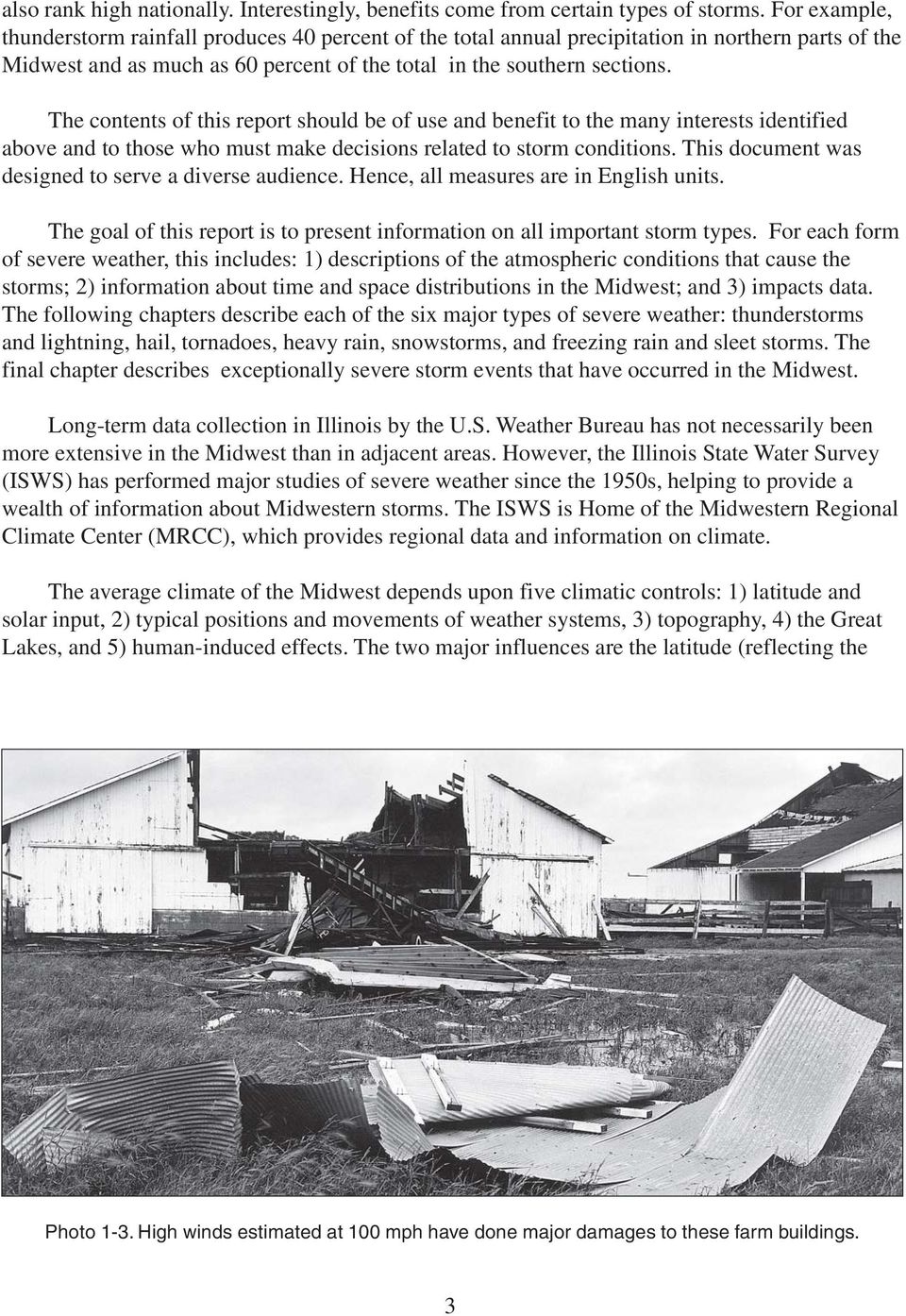
11 also rank high nationally. Interestingly, benefits come from certain types of storms. For example, thunderstorm rainfall produces 40 percent of the total annual precipitation in northern parts of the Midwest and as much as 60 percent of the total in the southern sections. The contents of this report should be of use and benefit to the many interests identified above and to those who must make decisions related to storm conditions. This document was designed to serve a diverse audience. Hence, all measures are in English units. The goal of this report is to present information on all important storm types. For each form of severe weather, this includes: 1) descriptions of the atmospheric conditions that cause the storms; ) information about time and space distributions in the Midwest; and ) impacts data. The following chapters describe each of the six major types of severe weather: thunderstorms and lightning, hail, tornadoes, heavy rain, snowstorms, and freezing rain and sleet storms. The final chapter describes exceptionally severe storm events that have occurred in the Midwest. Long-term data collection in Illinois by the U.S. Weather Bureau has not necessarily been more extensive in the Midwest than in adjacent areas. However, the Illinois State Water Survey (ISWS) has performed major studies of severe weather since the 1950s, helping to provide a wealth of information about Midwestern storms. The ISWS is Home of the Midwestern Regional Climate Center (MRCC), which provides regional data and information on climate. The average climate of the Midwest depends upon five climatic controls: 1) latitude and solar input, ) typical positions and movements of weather systems, ) topography, 4) the Great Lakes, and 5) human-induced effects. The two major influences are the latitude (reflecting the Photo 1-. High winds estimated at 100 mph have done major damages to these farm buildings.
12 Photo 1-4. A series of cumulus congestus clouds grows into a line of thunderstorms. amount of solar input) and weather systems (air masses and cyclonic storms). Topography, the Great Lakes, and cultural effects are of lesser significance because they influence local climate, not that of the entire region. The sun, the primary source of energy for virtually all weather phenomena, in large part determines temperatures and seasonal variations. At the region s mid-latitude location, solar energy input is three or four times greater in early summer than in early winter, which results in warm summers and cold winters when combined with the region s inland location. The position of the earth in relation to the sun basically determines the duration and amount of solar heating, although cloud cover is an important factor affecting the energy received. The 1-degree difference in latitude between the northern and southern boundaries of the Midwest is reflected in the great range of temperatures. Latitudinal temperature differences in summer when the sun is more directly overhead in the Northern Hemisphere are much less than those in winter. Latitudinal temperature differences across the Midwest are realized in numerous important ways, such as the longer summer storm season in the southern section and more winter storms further north. Land masses respond much more quickly to changes in solar input than do large water bodies, such as oceans. Therefore, seasonal air temperature changes tend to be larger in the interiors of continents than at coastal locations. Thus, the region s location in the interior of the North American continent contributes to large seasonal air temperature changes. 4

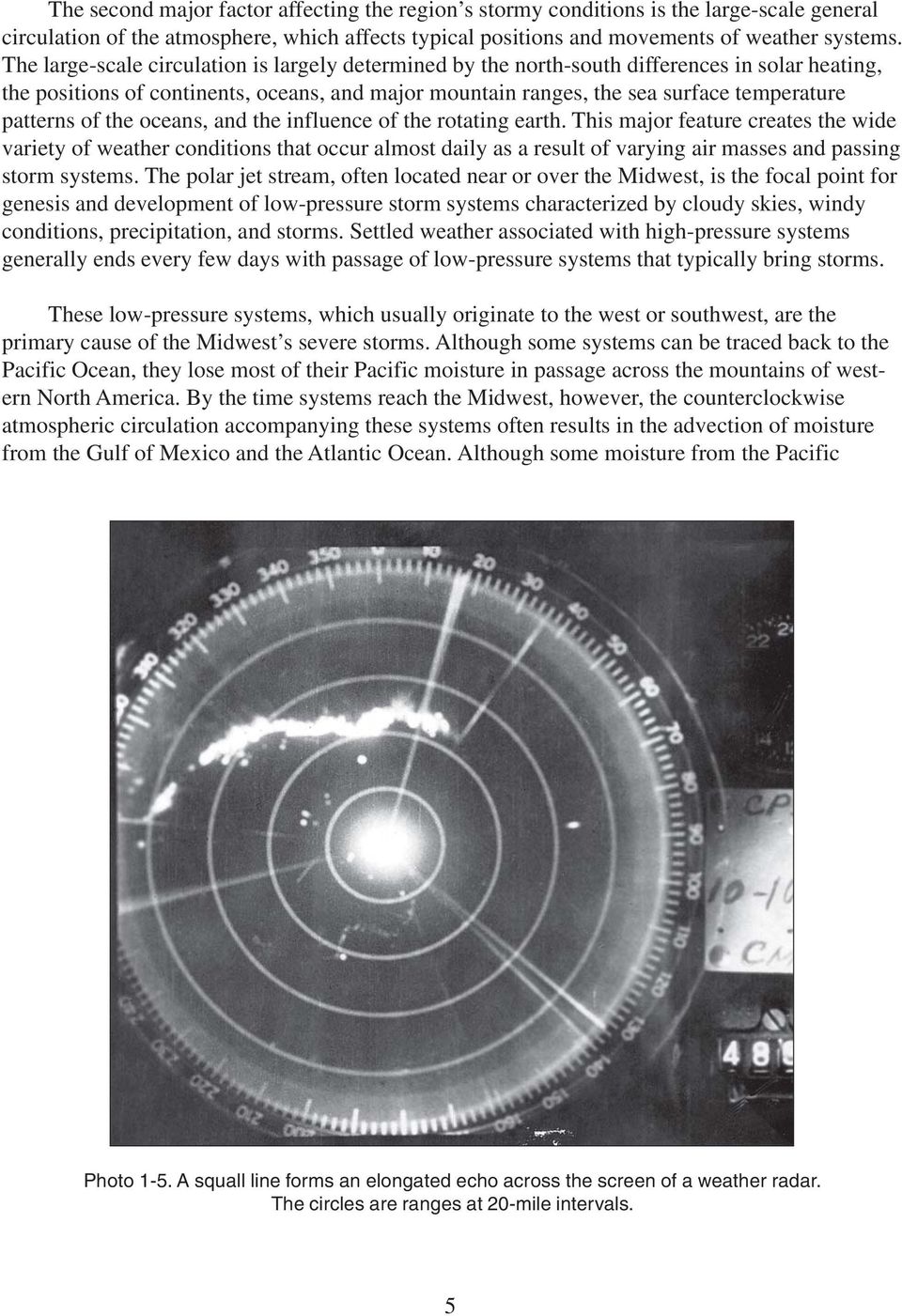
13 The second major factor affecting the region s stormy conditions is the large-scale general circulation of the atmosphere, which affects typical positions and movements of weather systems. The large-scale circulation is largely determined by the north-south differences in solar heating, the positions of continents, oceans, and major mountain ranges, the sea surface temperature patterns of the oceans, and the influence of the rotating earth. This major feature creates the wide variety of weather conditions that occur almost daily as a result of varying air masses and passing storm systems. The polar jet stream, often located near or over the Midwest, is the focal point for genesis and development of low-pressure storm systems characterized by cloudy skies, windy conditions, precipitation, and storms. Settled weather associated with high-pressure systems generally ends every few days with passage of low-pressure systems that typically bring storms. These low-pressure systems, which usually originate to the west or southwest, are the primary cause of the Midwest s severe storms. Although some systems can be traced back to the Pacific Ocean, they lose most of their Pacific moisture in passage across the mountains of western North America. By the time systems reach the Midwest, however, the counterclockwise atmospheric circulation accompanying these systems often results in the advection of moisture from the Gulf of Mexico and the Atlantic Ocean. Although some moisture from the Pacific Photo 1-5. A squall line forms an elongated echo across the screen of a weather radar. The circles are ranges at 0-mile intervals. 5
14 reaches the region, the Gulf of Mexico and the Atlantic Ocean are the primary sources of moisture for storm-producing systems. Rapid and marked changes in the weather are common during all four seasons. These highly varying air masses and the cyclonic storms between them reflect the location of the Midwest between major sources of warm, moist air to the south and cold, dry air to the north and west. Another important feature of the general atmospheric circulation is a semipermanent highpressure system in the sub-tropical Atlantic, which is most intense during summertime and is known as the Bermuda High. The clockwise circulation of air associated with this high-pressure system affects the climate of much of the eastern United States and southern Canada because it transports large amounts of moisture to the Midwest from the Gulf of Mexico and the Atlantic Ocean. This causes a relatively high frequency of warm humid days during summer, particularly over southern portions of the United States. These conditions help generate convective storms. In winter, air masses originating in the Pacific Ocean dominate the winter weather more than 65 percent of the time. These air masses lose much of their moisture over the Rocky Mountains and often produce cool, cloudy weather over the Midwest during the winter. In summer, hot, humid air masses from the Gulf of Mexico affect the Midwest about 40 percent of the time. Exceptionally high temperatures, often in excess of 90 F, and very high humidities, often leading to thunderstorms, are common with this type of air mass. Spring and fall are periods of climatic transition. These typically have complex weather patterns, with contrasting air masses that induce highly variable conditions and numerous convective storms. Their frontal systems move rapidly and often produce extensive cloud cover, thunderstorms, and sometimes snowstorms. Low-pressure systems that originate in western North America cross the continent along various storm tracks. As these storms move, they often swing to the northeast, crossing the Midwest. Most cyclonic storms come either from the Alberta region or the central Rocky Mountains, but in summer, roughly 5 percent of the region s storms develop over the Midwest. Winter storms often intensify as they move over the Midwest. Three other climatic controls all have localized effects in parts of the Midwest. These include the Great Lakes, topographic effects of the hill regions in various Midwestern areas, and cultural effects resulting from human influences on the atmosphere and, in turn, on storm activity. Each chapter that follows defines how these localized effects alter storm activity and intensities. 6

15 Chapter. Thunderstorms and Lightning Introduction No other atmospheric event carries with it the beauty, fear, and importance of thunderstorms. These complex natural systems convert moisture and thermal energy into rainfall, lightning, wind, and other severe weather phenomena. This chapter first answers a key question about thunderstorms: what are they? Most simply, thunderstorms are very large clouds that produce lightning: an electrical discharge between the cloud and the ground, in the cloud, or between clouds. These discharges heat adjacent gases in the air rapidly to 10,000 o F, which creates a shock wave we label as thunder. As long as a cloud produces lightning and thunder, it is defined as a thunderstorm. These storms have life cycles that can vary from 0 minutes up to 6 hours. Sometimes a thunderstorm is called an electrical storm. The visible form of a thunderstorm is a cumulonimbus, the tallest of all clouds. A thunderstorm results from instability in the atmosphere when the surface air is very warm compared to the air aloft. The buoyant surface air accelerates rapidly upward. This strong convective updraft is a major feature of the storm in its formative and mature stages. Moisture in the form of ice crystals rising from the top of a storm forms a distinctive anvil, often called a thunderhead. The storm s descending precipitation shaft brings down a strong downdraft of cool air from aloft, often marking the storm s dissipation stage. These downdrafts spread along the earth s surface, bringing a wind shift before the storm Photo -1. A tall thunderstorm cloud with a major anvil extending outwards from its top moves east across the Midwest. 7

16 arrives. In some cases, the rapidly spreading air produces strong surface winds called a gust front. Storms typically grow tall with tops 8-10 miles above the earth s surface. Even taller storms, becoming 10-1 miles tall, typically create severe weather, including hail, high winds, and tornadoes (Changnon, 001c). A developing thunderstorm ultimately generates lightning as a result of internal charge separation, a complex electrification process within the cloud that creates strong electrical fields within the storm. In-cloud particles of water and ice crystals rapidly develop opposing electrical charges as a result of collisions. Larger particles, often negatively charged, tend to fall, whereas smaller ones, often positively charged ice crystals, are carried aloft in the storm s updraft. This creates an up-and-down vertical electric field that results in lightning. Thus, the storm s electrification has occurred (Byers and Braham, 1950). Lighting is more fully described later in this chapter. Causes Individual thunderstorms can form and remain alone for their entire life cycle. Many thunderstorms, however, are part of a group of storms moving across the landscape. These can be in a long line, commonly known as squall lines, that may extend from 50 up to 400 miles. Or, they can be in mesoscale convective complexes (MCCs). These are large, semi-circular groups of many storms that can be up to 500 miles across and move together in coherent fashion (Cotton, 1999). Thunderstorms are key elements of the world s climate. Thunderstorms begin as rising air resulting from atmospheric conditions characterized by convective instability. Strong convective air motions, the key feature of Midwestern storm development, result from a variety of atmospheric conditions. These include: Various types of fronts (cold, warm, and stationary) that separate air masses Gust fronts from existing storms as their downdraft hits the surface, spreads, and lifts the air in front of them Upper air disturbances Heating of the surface by solar radiation creating an unstable vertical temperature profile Convergence of air near the surface, divergence of air aloft, or both, often help generate vertical motions sufficient to cause the formation of cumulus congestus clouds. These clouds are often precursors to development of a cumulonimbus, and in turn, a thunderstorm (Battan, 1964). In some circumstances, changes in thunderstorm activity occur across short distances of 10 to 100 miles. These changes are due to localized sources that heat or cool the atmosphere or add moisture, and to mechanical obstructions to low-level air flow. Causes of these atmospheric influences include relatively large surface elevation changes, large water bodies such as the Great Lakes, and large urban areas. Air near the surface and over elevated upland areas is heated during the day by contact with the solar-heated ground surface. This air becomes warmer than (buoyant with respect to) the 8
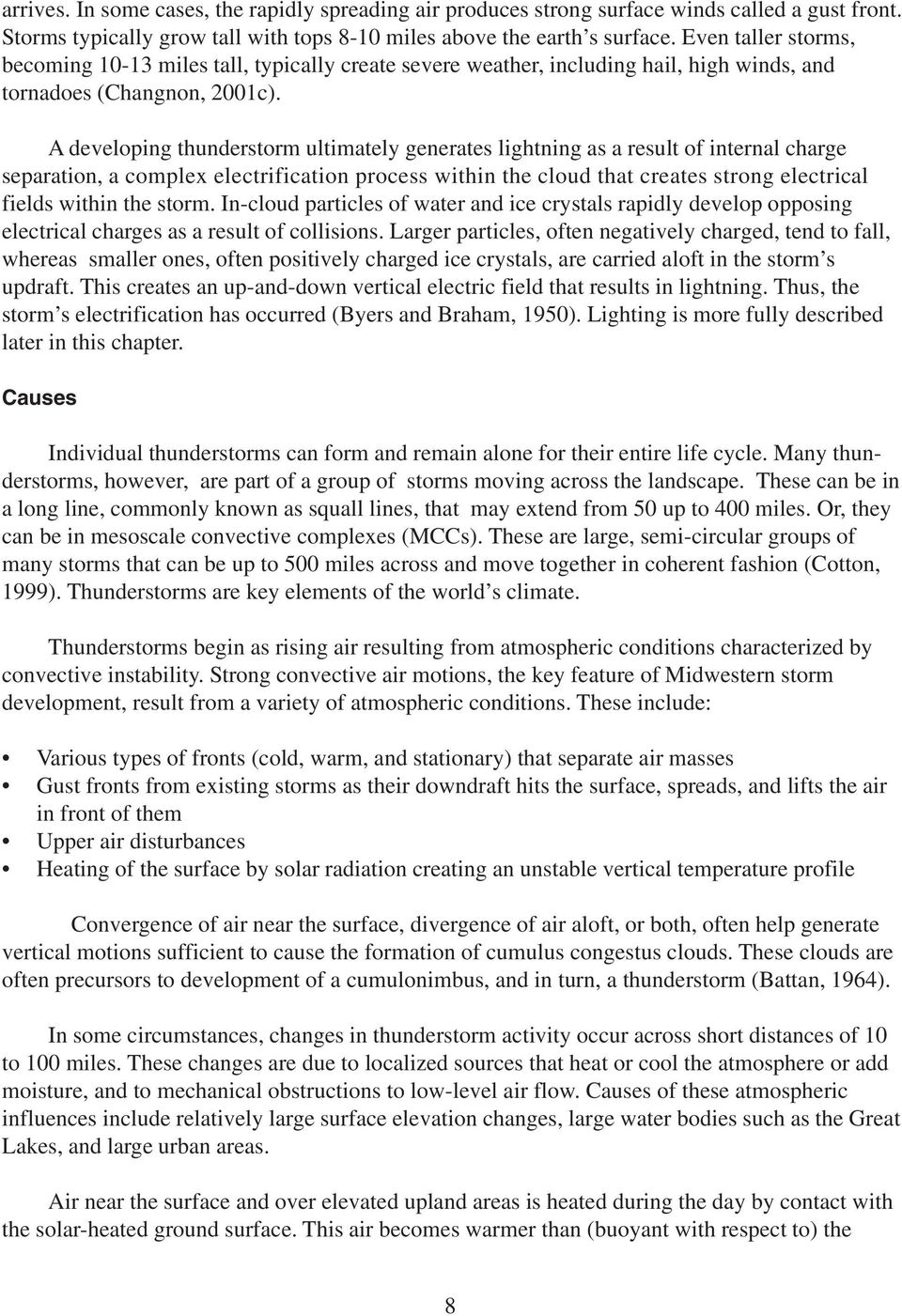
17 L H Figure -1. Annual average number of days with thunderstorms, (Changnon, 001c). 9
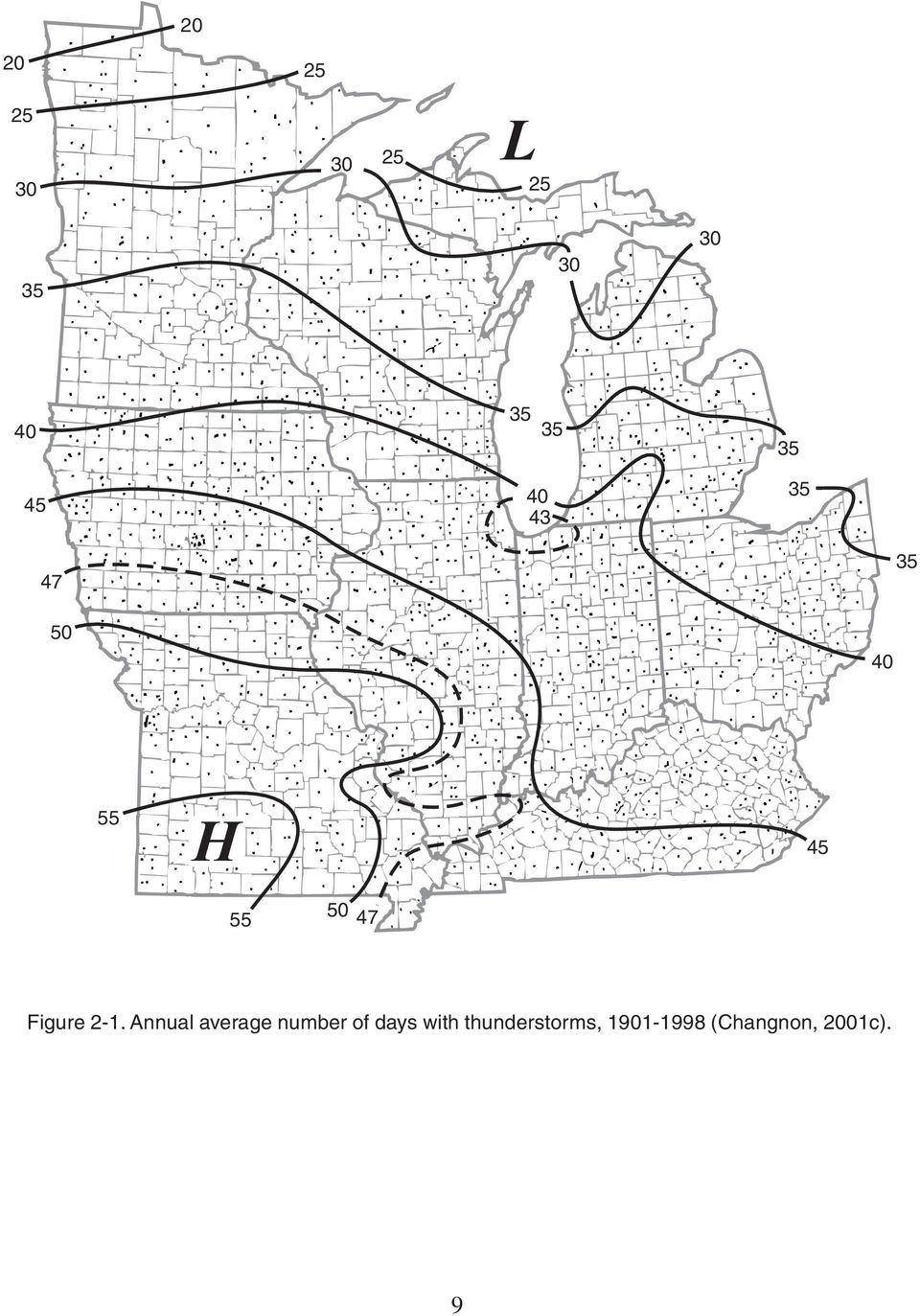
18 surrounding free atmosphere at the same altitude over nearby lowland areas where the heating occurs lower in the atmosphere, creating local instability. Heating is enhanced at higher altitudes on sun-facing hillsides, and the additional heating causes an upslope flow of air. When the prevailing flow has a similar horizontal directional component, it can combine with the upslope circulation (Court and Griffiths, 1981). This advects moisture into higher elevations where it is triggered by the terrain to form convection and launch cumulus clouds, often over the hills. For example, the Ozark Hills of southern Missouri and Illinois enhance thunderstorm activity (Huff et al., 1975). As shown in Figure -1, 55 or more days with storms occur annually in southwestern Missouri and 47 or more days with storms in the hills of southern Illinois, reflecting local topographic effects. The Great Lakes influence thunderstorms over them and downwind, particularly in summer and fall. In the fall, these large water bodies serve as a moisture source for many passing air masses, adding to the moisture available to support cloud and storm development. However, in the summer, lake water temperatures are often much lower than those of passing air masses. This acts to stabilize the lower atmosphere and reduce thunderstorm development or to minimize storm activity in passing storm systems and downwind of the lakes. Figure -1 shows effects of the lakes on thunderstorm frequencies. The lower peninsula of Michigan has shifts in the locations of the 0- and 40-isolines, both reflecting lake effects on storms. Major urban areas produce sizable effects on the atmosphere. Under certain circumstances, these effects are sufficient to create thunderstorms and increase their associated rainfall (Changnon, 1978). Large urban areas, primarily by influencing the low-level air flow over them, create convergence zones that either initiate or enhance existing convective storms. The urban heat island, plus structural barriers and urban surface roughness that alters frictional drag, collectively create both thermal instability and mechanical turbulence. Thunderstorm activity at several Midwestern cities has been assessed and, in most cases, reveals enhanced storm activity at cities with populations greater than one million. For example, climatological studies of the historical weather records in and around the Chicago metropolitan area discerned 10-0 percent increases in thunderstorm frequencies in and just east of the city. Storm isolines of average storm frequencies are shifted eastward at Chicago and St. Louis. Increased lightning occurs downwind of Midwestern urban areas (Westcott, 1995), and increased hail and rain occur at major Midwestern urban areas (Huff and Changnon, 197). Factors causing thunderstorms lead to different types of storms classified in a variety of ways including by their structure, their causes, and the degree of their organization within the atmosphere (Barnes and Newton, 1981). There are three storm types, based on the internal structure of a storm. A simple single cell storm reflects a single updraft and downdraft. Such isolated storms usually result from local heating and often last less than an hour. A multi-cell storm consists of several updrafts and downdrafts during the storm s mature stage and has more than one precipitation shaft, or cells. The new cells tend to develop on the storm s right flank where warm moist air is most often available. These more vigorous storms typically last 1- hours. A supercell thunderstorm, a long-lasting and quite large storm, evolves from a special set of conditions that include very unstable conditions, continual flow of moisture at low levels, a strong jet stream aloft, and a change in wind direction from low to upper levels (typically southerly 10
19 flow at low levels changing to westerly flow at upper levels). Strong updrafts that develop in the very unstable atmosphere lift and bring the southerly flow into contact with the strong westerly flow aloft. Interactions of these air streams create one of the signature characteristics of the supercell: rotation. The supercell has a single, quasi-steady rotating updraft. Conditions conducive to supercell development invariably are associated with a strong cold front. Supercell storms can last from 4-6 hours, and typically produce damaging winds, severe hail, and/or tornadoes. Significant convective thunderstorms occur as a result of certain favorable thermal and dynamic influences related to local mesoscale and larger scale synoptic circulation patterns. Hence, other storm classifications have centered around the synoptic weather conditions associated with thunderstorms and their development. One such class is caused by large-scale weather disturbances that include fronts and low pressure centers. One version of this class is elevated thunderstorms, and occur northeast of a surface low-pressure center and north of a warm front. These differ from most storms rooted in near surface atmospheric conditions. The initial uplift to trigger these thunderstorms occurs along a sloped, elevated boundary between cold air below and warm air above that is forced up the slope. If the storms are generated repeatedly in about the same location, and then move away and follow the same track as previous storms, they can create heavy rains of 10-0 inches in 1-4 hours, causing massive regional flooding. These systems often develop along a stationary front. Another class of storms, air mass thunderstorms, results from localized surface heating of moist, potentially unstable air masses. These thermodynamic processes affect the atmosphere s stability sufficiently to create storms that develop randomly, can occur anywhere, tend to be isolated, and are most common during the summer. Such storms usually tend to be self-limiting and relatively weak, but occasionally they become severe storms. A third class of storms is a result of convection organized at the mesoscale, on the order of 50 to a few hundred miles. A mesoscale convective system (MCS) is a self-organizing area of convection that lasts for many hours and typically occurs during the warm season in the Great Plains. It occurs when there is a dynamic mechanism to maintain convection, and an MCS is capable of causing a wide variety of severe weather (Fritsch et al., 1986; Anderson and Arritt, 1998). Many of these form in the afternoon east of the Rocky Mountains and High Plains and move into the Midwest. A low-level southerly nocturnal jet is a common MCS feature, providing low-level convergence, an abundant supply of moisture from the Gulf of Mexico, and maintaining convection through the nighttime hours. Several special MCS forms are worthy of note. The mesoscale convective complex (MCC), a particular type of large and long-lived MCS, has a lifetime of at least 16 hours (Maddox, 198). Squall lines are linearly organized mesoscale areas of very strong convection, often creating severe weather. Bow echoes are bow-shaped areas of convection noted for producing long swaths of damaging winds. Derechoes are bow echoes or sequences of bow echoes that produce winds in excess of 58 mph and damage over areas in excess of 50 miles in length (Johns and Hirt, 1987; Ashley and Mote, 005). A fourth class of storms is related to convergence zones caused by various conditions, including dynamic processes such as lake breezes. Other zones are created mechanically by airflow deflected around large urban areas. Mountain-flatland air mass differences create storm- 11
20 forming convergence zones. Differences between conditions over large lakes and those of passing air masses, in both temperature and moisture content, can create or diminish thunderstorms. Temporal and Spatial Distributions Thunderstorms occur in all parts of the Midwest. Storm frequencies are higher to the south where warmer temperatures, a longer warm season, and closer proximity to the Gulf of Mexico moisture source lead to more frequent conditions of atmospheric instability. Storm frequencies are also higher in regions where cyclonic activity is more frequent, and where topography, such as that of Missouri, southern Illinois, and Kentucky, accentuates uplift (Figure -1). The number of thunderstorms varies across the region and peaks along the southern border of Missouri. The annual maximum, 55 days with storms, occurs in the hills of southwestern Missouri. Storm activity is least, less than 0 days annually, along the northern region s border. The Great Lakes and the region s largest cities also affect thunderstorm frequencies. Studies have shown that the effects of Chicago, Cleveland, and St. Louis on the atmosphere lead to more summer thunderstorms. The St. Louis summer average pattern (Figure -) shows 16-0 storm days in surrounding rural areas, whereas 5 days or more of thunderstorms occur over and downwind of the city. The Great Lakes also influence thunderstorm activity (Changnon, 1966). Relatively cool lake waters in the summer lead to 10-0 percent decreases in thunderstorms over and downwind of the lakes. When lake waters are warmer than passing air masses in the fall, L Airport H L L Kilometers Miles Figure -. Summer average number of thunderstorms in the St. Louis area, (Changnon, 1978). Diagonal lines represent the older urban areas and dash-dot lines outline the boundary of the built-up metropolitan area as of

21 however, the lakes act to increase storm activity. For example, the fall average pattern reveals an increase of 5 percent in storms just east of Lake Michigan. The net effect is a slight increase in storm activity revealed by the positions of the 0- and 40-isolines on Figure -1. A typical thunderstorm has a path 5-10 miles wide, 0-50 miles long, and lasts 1- hours. Average point durations of thunderstorms vary from 15 minutes to more than 10 minutes. Durations of thunderstorm events reveal major night and day differences. Daytime storms are on average shorter in duration than night storms in all parts of the region, due to the occurrence of long-lived mesoscale convective systems at night. Although thunderstorms in the Midwest can occur in all months, they are most frequent in summer. Figure - shows the temporal distribution of major damaging thunderstorm events and their associated losses in the Midwest during Both distributions exhibit relatively low values during the early period ( ), followed by an upward trend over time to peaks in The graph illustrates that losses grew as the number of damaging events increased over time. Impacts Thunderstorms both help and harm society and the environment, and also are one of the most damaging of all weather phenomena. Since 1950, U.S. thunderstorms have created enormous damages: $87 billion in property losses, $19 billion in crop losses, and more than 1,000 fatalities (Changnon, 001a). Lightning-induced forest fires are common. Lightning kills on average 144 persons yearly, one of the major weather-related killers in the nation, and second only to heat waves. Lightning is very damaging to power systems. Thunderstorms also produce Losses in Billions of Dollars Thunderstorms Number of Events Losses in Billions of Dollars Number of Events Year Figure -. Temporal distribution of thunderstorm events in the Midwest creating more than $1 million in property losses, The dashed line represents the number of events per 5-year period, and the solid line represents the amount of losses in billions of dollars (Changnon, 001a). 0 1
22 hail, heavy rains, and high winds. Hail damages both crops and property, and hail damages in the Midwest exceed those in any other region of the nation. Storm-generated heavy rains can produce devastating flash floods. For example, a series of thunderstorms on the night of July 17-18, 1996, combined to produce more than 17 inches of rain in the Chicago suburbs, and flood losses of $0.8 billion (Changnon, 1999). The high rainfall rates produced by thunderstorms are a major cause of soil erosion. The high winds generated by thunderstorm downdrafts cause extensive property and crop damages over hundreds of square miles. Some thunderstorms also spawn tornadoes that result in human deaths and property destruction. In many areas, recent large increases in storm losses have produced major impacts on the insurance industry, government, and the public. Studies have found the primary cause to be the ever-increasing vulnerability of society to major storms. This is a result of growth in population and wealth, plus demographic shifts to more storm-prone areas. Thunderstorm catastrophes, events causing $1 million or more in losses in the U.S., are common in the Midwest with 9 catastrophes since From 1949 to 1998 the Midwest had $5.4 billion in catastrophe losses, an annual average of $508 million (Changnon, 001a). The Midwest total is $5.6 million per year. Society and the environment also benefit from thunderstorms which provide substantial precipitation and various other environmental benefits. Thunderstorms are the prime producer of precipitation in many parts of the Midwest (Changnon, 001b). Rainfall from thunderstorms is critical for crop production and water supplies throughout the Midwest, and thunderstorm precipitation contributes percent of the area s streamflow. Assessment of conditions during drought years reveals that a major cause for a deficiency in precipitation is the lack of thunderstorm rainfall. Thunderstorms produce 60 percent of the average annual precipitation in the southern Midwest, diminishing to 40 percent of the total in northern Minnesota. Lightning has positive and negative impacts, as described in the next section. Thunderstorms also act to mix the atmosphere due to their enormous size and strong internal vertical movement of air. These motions greatly affect the chemistry of the atmosphere. Air near the surface that is swept into the huge updrafts helping to create thunderstorms carries atmospheric pollutants up to the stratosphere. In turn, thunderstorm precipitation and downdrafts generated by rain shafts scavenge pollutants and bring them to earth. Thunderstorm precipitation serves as a major scavenger of pollutants in the atmosphere. Lightning Lightning is one of nature s most spectacular and beautiful phenomena, and one of the most deadly and damaging weather conditions. Yet, lightning is also an essential feature in maintaining the electrical balance between the earth and atmosphere. Most lightning results from major differences in the electrical charge of the atmosphere and that of the earth. The earth generally has a positive electrical charge, and the atmosphere has a negative charge. These differences constantly must be relieved by an exchange of charges, which creates cloud-to-ground lightning, the electrical discharge between these two opposites. These forces are so great that the earth daily experiences one million lightning discharges from 50,000 14
23 thunderstorms. An important effect of the worldwide lightning activity is the net transfer of negative charge from the atmosphere to the earth (Battan, 1964). Each lightning bolt carries an electrical charge of about 0 million volts. The lightning charge seeks the path of least resistance for its channel to earth, resulting in a path that is often quite crooked with several forks. This pathway to the surface often is to a local high point, and often produces strikes on tall buildings, rural barns, and trees. Essential components of a cloudto-ground lightning stroke are its positive and negative leaders. When the cloud-generated leader reaches the ground, a return stroke comes from the earth. About 0 percent of all lightning strokes are between clouds, and the rest are cloud-to-ground strokes. Figure -4 shows the annual average number of lightning flashes over a square mile in the Midwest. Flashes (strokes) vary from 15 per square mile in southern Missouri to less than one flash per year in northern Minnesota and Upper Michigan. Lightning is dangerous, injuring and killing humans and farm animals. It annually kills an average of 81 people in the Midwest, more deaths than from any other form of severe storms, including tornadoes and floods. Lightning also injures an average of 158 persons each year and kills many farm animals in the Midwest. Lightning causes a variety of damages, including forest fires and fires in buildings. It also causes local and large-scale outages in a power grid, damages communication systems, and damages electrical systems inside structures, including computers. Photo -. Multiple cloud-to-ground lightning strokes account for 80 percent of all lightning strokes. 15
24 1 L H 15 Figure -4. Annual average number of cloud-to-ground lightning flashes per square mile, (Changnon, 001c). 16
25 Photo -. A crooked lightning stroke with many branches going to the ground and to other clouds. Lightning also produces benefits. As noted above, it is an essential element in maintaining the earth-atmosphere electrical balance. Lightning also converts gaseous nitrogen in the atmosphere into nitrogen compounds that, in turn, rainfall absorbs and deposits on the ground. This nitrogen serves as a fertilizer for Midwestern soils. Lightning also played a positive role in the history of the Midwest and is the reason that outstanding soils developed from a tall grass prairie for 10,000 years. Lightning-ignited fires in the region often caused huge fires that destroyed trees but enhanced the growth of prairie grasses that once existed over most of the Midwest (Changnon et al., 00). Only three percent of all thunderstorms in the Midwest produce damaging lightning, most commonly in June-August when 80 percent of all such events occur. Damaging lightning occurs most often between 1 and 4 p.m. and is least prevalent between 10 p.m. and 9 a.m. Most damages in rural areas occur to farm buildings, 8 percent of all lightning damages, and rural schools and churches, 9 percent. In cities with a 100,000 population or more, 40 percent of all damages occur to residences, percent to commercial structures, and percent to industrial buildings/ facilities. The distribution of damaging lightning events is uneven across the Midwest. Areas around major urban centers have the most damages, partly a result of high population density and added storms generated by the effect of urban areas on the atmosphere. Financial losses resulting from lightning are enormous. Fires to Midwestern forests and uninsured property account for up to $0 million in losses annually. Costs to repair power and communication system damages amount to up to $65 million annually. Damage to in-house electrical fixtures such as computers totals about $0 million a year. Insurance payments for damages to property from lightning total another $65 million a year in the Midwest. 17
26 References Anderson, C.J., and R.W. Arritt Mesoscale convective complexes and persistent elongated convective systems over the United States during 199 and 199. Monthly Weather Review, 16: Ashley, W.S., and T.L. Mote Derecho hazards in the U.S. Bulletin American Meteorological Society, 86, Barnes, S.L. and C. W. Newton Thunderstorms in the Synoptic Setting. Environmental Research Laboratory, Washington, DC, pp Battan, L.J The Thunderstorm. Signal Science Library, New York, pp.1-8. Byers, H.R., and R.R. Braham The Thunderstorm. U.S. Weather Bureau, Washington, DC. Changnon, S.A Effect of Lake Michigan on Severe Weather. Great Lakes Research Division Publication 15, University of Michigan, Ann Arbor, pp Changnon, S.A Urban effects on severe local storms. Journal Applied Meteorology, 17: Changnon, S.A Record flood-producing rainstorms of July 1996 in the Chicago metropolitan area. Part III: Impacts and responses to the flash flooding. Journal Applied Meteorology, 8: Changnon, S.A. 001a. Damaging thunderstorm activity in the United States. Bulletin American Meteorological Society, 8: Changnon, S.A. 001b. Thunderstorm rainfall in the contiguous United States. Bulletin American Meteorological Society, 8: Changnon, S.A. 001c. Thunderstorms across the Nation. Changnon Climatologist, Mahomet, IL. Changnon, S.A., Kunkel, K.E., and D. Winstanley. 00. Climate factors that caused the unique tall grass prairie in the central U.S. Physical Geography, : Cotton, W.R An Overview of Mesoscale Convective Systems. Routledge Press, London, pp.-5. Court, A., and J. F. Griffiths Thunderstorm Climatology. Oklahoma, Norman, OK, pp9-9. Fritsch, J.M., Kane, R.J., and C.R. Chelius The contribution of mesoscale convective weather systems to warm-season precipitation in the U.S. Journal Applied Meteorology, 5: Huff, F.A., and S.A. Changnon Precipitation modification by major urban areas. Bulletin American Meteorological Society, 54: Huff, F.A., Changnon, S.A., and D.M.A. Jones Precipitation increases in the low hills of southern Illinois. Part 1: Climate and network studies. Monthly Weather Review, 10: Johns, R.H., and W.D. Hirt Derechoes: Widespread convectively induced windstorms. Weather and Forecasting, : -49. Maddox, R.A Large-scale meteorological conditions associated with mid-latitude, mesoscale convective complexes. Monthly Weather Review, 11: Westcott, N.E Summertime cloud-to-ground lightning activity around major Midwestern urban areas, Journal Applied Meteorology, 4:
27 Chapter. Hail Introduction Hailstones are pellets of ice created inside thunderstorms. When large enough, they descend, and many reach the ground, damaging plants, crops, and property. Not all thunderstorms generate hail that reaches the ground, but hail is a serious hazard across the Midwest. Causes Hailstones typically develop -4 miles above the earth s surface in upper portions of a thunderstorm where air temperatures are between 1 o F and -10 o F. There, the moist vapor in the updraft, the air moving upward inside the storm, condenses. The particles freeze, forming ice crystals that become the heart of hailstones. Approximately 60 percent of all thunderstorms generate hailstones aloft. The growth of hailstones sufficiently large to reach the ground requires very strong updrafts, forces creating taller than usual thunderstorms. Strong updrafts support hailstones aloft and allow hailstones to grow, often to diameters of an inch or larger before the stones descend. If falling hailstones enter another strong updraft, they again are carried aloft in the new moist air and grow ever larger, before falling as a volume of large hail. This repetitive growth process is reflected in the structure of hailstones that often show layers of ice around their embryo (Changnon, 00). The volume of hail reaching the ground falls 10 feet per second and usually represents less than 10 percent of the volume of rain produced by a thunderstorm. Hail produced by many thunderstorms never reaches the ground because it melts as it descends into the warmer air near the ground, forming raindrops. That is why thunderstorms in warmer climate zones seldom produce hail at the ground. Severe hailstorms that produce a large quantity of large hailstones, typically more than an inch in diameter, are a result of four atmospheric factors: Strong convective instability, creating strong updrafts Abundant moisture at low levels, feeding into the updrafts Strong wind shear aloft, usually shifting from southerly to more westerly as height increases, enhancing updrafts and storm lifetime Some dynamic mechanisms that help release instability (for example, flow over hills and ridges) Temporal and Spatial Distributions When a volume of hailstones descending from a storm reaches the earth s surface, the stones often cover an area a mile in diameter. As the hailstorm moves over time, falling hailstones produce an elongated area of hail called a hailstreak. Its size and shape depend on storm speed and updraft strength inside the storm. A typical hailstreak is a mile wide and 5 miles in length (Changnon, 1977). 19
28 Most thunderstorms that produce hail generate up to two hailstreaks during their lifetime. Some organized lines of thunderstorms produce many hailstreaks with hail covering hundreds of square miles as the storms move across the terrain. Figure -1 shows two hailstreaks produced by two storm cells in the Midwest. Infrequently a thunderstorm becomes a well-organized giant that lasts for -6 hours, and these supercell storms generate very large hailstreaks. A supercell thunderstorm in April 00 produced a record hailstreak extending from eastern Kansas, across Missouri, and into southern Illinois (Changnon and Burroughs, 00). Hailstorms occur in many parts of the world, including most of North America. The Midwest has a high frequency of hailstorms, and the nation s hail frequency is highest downwind of the western mountain ranges (Gokhale, 1975). High mountain ranges organize air flows conducive to the formation and development of large hail. Hail frequency decreases west to the east across the Midwest (Figure -). Even in areas of high hail frequency, the number of hailfalls at a given location during a year often varies greatly because hail falls typically over only a few square miles, as shown in Figure -1. In any given year, a farm in western Iowa may experience 5-6 hailstreaks, whereas an E X P L A N A T I O N = Report of no hail with each rain cell = Hail report, and where known, the time difference (minutes) between start of rain and start of hail = Isohyet for total rainfall (inches) from rain cell = Hailstreak boundary = Isochrones of rain start time, CDT C E L L Farmer City C E L L 010 MILES Figure -1. Two hailstreaks and their rainfall areas (Changnon, 1977). 0
29 L H 4 4 H L H H Figure -. Annual average number of days with hail, (Changnon, 00). 1
30 Photo -1. A corn crop destroyed by a hailstorm (left) and hailstones damaged the side of this home (right). adjacent farm may experience only 1- hailstreaks. These differences occur because the small size of hailstreaks results in a spotty distribution of hail. Hailstone sizes vary widely, with most between 0. and.0 inches in diameter. Most hailstones are small, and 85 percent of all hailstones have diameters of 0.5 inch or less. Hail diameters of an inch or larger occur in only 5 percent of all U.S. hailstorms (Flora, 1956). The largest hailstone ever recorded in North America, 6.5 inches in diameter, fell in Nebraska in June 00. Assessment of North American hailstones reveals three different classes of hailstones: small ( inch), moderate ( inch), and large (>1 inch). Small hailstones are the most frequent in most of North America. Moderate hailstones occur in up to 15 percent of all hailfalls in the Midwest. Hailstones larger than an inch occur in less than two percent of all Midwestern hailfalls. Most hail falls in the afternoon, although it can occur at any time of the day. The average duration of hail at a point is 5-6 minutes, but durations vary from a few seconds up to 15 minutes. Hail occurs in the warm season when convective activity peaks. The hail season typically
31 begins in early spring, peaks during summer, with infrequent hail in the fall, and no hail in the winter. However, the effect of the relatively warm water in the Great Lakes during fall leads to hailstorms downwind of the lakes. For example, October is the peak month of hail activity in parts of western Michigan (Figure -), whereas April is the peak month elsewhere in the Midwest (Changnon, 1966). Figure -4 depicts the temporal distributions of hail-caused losses to property and to crops in the Midwest during Property losses from hail were highest in and lowest during (Changnon, 004). Crop-hail losses in the Midwest had a somewhat similar distribution over time. Losses were highest during with a secondary peak in Crop-hail losses, like the property losses, were low during Inadvertent urban modification of hail also occurs. Studies of hail activity at Chicago and St. Louis found that these cities influenced the atmosphere sufficiently to lead to local increases of 10-0 percent in the number of hailfalls (Changnon, 1978). Impacts Major losses occur when a series of thunderstorms produce large areas of damaging hail (Decker, 195). Large hail occasionally kills a human, and the U.S. has had 16 hail-related deaths since 190. Hail also damages and kills cattle. Ninety percent of all crop-hail losses occur on only 10 percent of the days with hail. Figure -5 shows the average number of days per state with crop damage with the highest values (70 days) in Iowa and the lowest ( days) in Michigan (Changnon, 00). Crop damage from hail is a function of the hailstone sizes, number of hail- Figure -. Average frequency of hail days in September and October at weather stations around Lake Michigan with rank 1 representing highest monthly average of all 1 months (Changnon, 1966).
32 Property Losses in Millions of Dollars Hail Property Losses Crop Losses Crop Losses in Millions of Dollars Year 0 Figure -4. Temporal distribution of hail losses to crops and to property over 5-year periods, (Changnon, 00). stones per unit area (volume of ice), and wind speeds when hail falls. Annual hail losses incorporate these factors and the number of times hail falls. When high winds occur with hail, they blow the hailstones at angles, thus damaging the sides of structures and the stems of crops. In the United States, property losses from hail average $174 million per year and crop losses average $70 million. The average annual losses from hail in the Midwest totals $148 million, a third the nation s total hail losses (Changnon, 004). References Changnon, S.A Effect of Lake Michigan on Severe Weather. Great Lakes Research Division Publication 15, University of Michigan, Ann Arbor, pp Changnon, S.A Scales of hail. Journal of Applied Meteorology, 16: Changnon, S.A Urban effects on severe local storms at St. Louis. Journal of Applied Meteorology, 17: Changnon, S.A. 00. Climatology of Hail Risk in the U.S. Changnon Climatologist, Mahomet, IL Changnon, S.A., and J. Burroughs. 00. Tri-state hailstorm; The most costly on record, Monthly Weather Review, 11: Changnon, S.A Present and future economic impacts of climate extremes in the U.S. Environmental Hazards, 5: Decker, W.L Hail damage frequency, Transactions American Geophysical Union, : Flora, S.D Hailstorms of the United States. University of Oklahoma Press, Norman, OK. Gokhale, N.R Hailstorms and Hailstone Growth. State University of New York Press, Albany, NY. 4
33 Top Number = Corn Lower Number = Soybeans Figure -5. Average annual number of hail days causing corn and soybean damages in each state, (Changnon, 00). 5
34 Chapter 4. Tornadoes and High Winds Introduction A tornado is a violently rotating column of air, a vortex spawned by a thunderstorm that reaches the ground. It has a funnel-like appearance. The funnel rotates at high wind speeds that can vary from mph or more (Lewellen, 199), and moves over the land along a narrow path. Fortunately, this extremely dangerous storm is not common. Less than one percent of all thunderstorms ever generate a tornado. Tornadoes are an enigma that hides, shifts, retreats, reforms, multiplies, and changes shape, size, and intensity, often by the minute. High winds from downdrafts of storms producing a tornado can hamper interpretation of where a tornado actually occurred. Identifying and counting tornadoes is further complicated because some occur in pairs, others produce multiple vortices, and others form and dissipate several times in a few miles. Most tornadoes are small, short-lived phenomenon, but 5 percent become large, long lasting, and very dangerous (Grazulis, 1991). A downburst is a strong downdraft from a thunderstorm that causes an outburst of damaging winds at the surface (Fujita, 1981). The winds travel outward from where they reach the ground, being between 100 yards and 10 miles wide. These high winds can be quite damaging and often are confused as being the result of a tornado. Squall lines and mesoscale groups of storms occasionally initiate a large-scale wave of high winds at the surface and these sweep over hundreds of square miles. Photo 4-1. A large tornado funnel moves across the prairies of the Midwest. 6
35 Causes Typical atmospheric conditions leading to tornado formation include exceptional instability, an advancing cold front and low pressure system, and wind shear. Many Midwestern tornadoes come from thunderstorms in a squall line that forms ahead of a surface cold front, along the surface or upper-air cold front, or in a low-pressure trough. The oft-irregular distribution of thunderstorms along a squall line can lead to a complex variety of convergence situations, shear zones, and updrafts that may give rise to tornadoes. Squall line tornadoes often occur in families and move at speeds of 5 mph or higher. Tornadoes from such storms are typically larger and longer lasting than tornadoes created by other synoptic weather conditions. Tornadoes also are created by supercell thunderstorms (see Chapter ), the most intense, well organized, and longest-lasting type of thunderstorm. Supercells often create families of tornadoes along their track as shown in Figure 4-1. A tornado outbreak is a family of six or more tornadoes spawned by the same weather system in close time sequence, an hour or less between funnels, as illustrated by the times shown on the tornado tracks depicted in Figure 4-1. Some thunderstorms that form in unstable warm air masses also cause tornadoes, but these are usually small, short-lived events. Another special form of tornadoes comes from storms in derechoes, a large area of severe thunderstorms that move from the northwest or west, create clusters of downbursts, and generate extensive damage from straight-line winds but also can spawn tornadoes. These tornadoes are related either to a cluster or line of thunderstorms. Derechoes are most frequent in the Midwest (Bentley and Mote, 1998). Towns with damages All times in P.M. Scale of Miles SCOTT Winchester 7:0 # Barrow MORGAN 7: CASS Jacksonville #1 7:58 # Waverly MENARD Springfield 8:11 8:5 8:6 SANGAMON Lincoln LOGAN Mt. Latham Pulaski 8:59 9:0 Mechanicsburg CHRISTIAN DEWITT Maroa 9:15 #9 #6 8:57 9:16 #8 Decatur 8:0 8:55 #7 9:09 9:00 #4 #5 8: 9:5 MACON 7:06 GREENE MACOUPIN MONTGOMERY Figure 4-1. Tracks of a series of damaging tornadoes on March 1,
36 Temporal and Spatial Distributions Tornadoes in the Midwest occur most frequently in the spring season, peaking in April and May. The peak is April in the southern parts of the Midwest, and is May-June in the northern sections of the Midwest. However, tornadoes have occurred in all months of the year and in all parts of the Midwest. Their average duration is minutes, although a few long-track storms have lasted for - hours. Tornadoes are most frequent during afternoon and early evening, but can occur at anytime. The average size of a tornado track in the Midwest is 11.8 miles long and 585 feet wide. A few record-setting tornadoes have had tracks covering 00 miles and widths of a mile, but 45 percent of all Midwestern tornadoes only have tracks half a mile long (Grazulis, 1991). Forward speeds average 5-40 mph. The preferred direction of tornado movement is from southwest to northeast, followed by west-southwest to east-northeast oriented tracks. The average annual number of tornadoes during , expressed as the number per 10,000 square miles (Figure 4-), shows the peak of activity is in Indiana, Illinois, western Iowa, and Missouri. The fewest tornadoes occurred in the extreme northern Midwest and in the southeast. Figure 4- shows the state frequencies of tornadoes during Iowa had 1,105 tornadoes, the most in the Midwest and also ranked sixth nationally. Missouri had 996 tornadoes and ranked seventh nationally. Illinois had 960 and ranked eighth nationally. Photo 4-. A farm house and trees destroyed by a tornado. 8
37 1 0.5 L 0.5 L H H H L 5 1 Figure 4-. Average annual number of tornado occurrences per 10,000 square miles, (Fujita, 1981). 9
38 Top Number = Number of Tornadoes (Lower Number) = National Rank 65 (19) 1105 (6) 714 (17) 65 (19) 960 (8) 744 (14) 514 (1) 996 (7) 04 (7) Figure 4-. Number of tornadoes in each state, , and the national rank of each state s value (Grazulis, 1991). 0
39 The temporal distribution of tornadoes that caused deaths, killer tornadoes, in the Midwest is shown in Figure 4-4. With an ever-increasing population during the 0 th Century, one would expect the annual number of tornado deaths to increase over time, but tornado forecasting and detection capabilities developed rapidly after 1950, decreasing deaths. The 100-year distribution shows an early peak of 76 killer tornadoes in and then 54 others in Another peak of 58 killer storms occurred during Years with large numbers include 1974 ( storms), 1917 ( storms), and 1965 (9 storms). Values in more recent years, , have been relatively low, likely reflecting increased use of storm warnings. Low storm values occurred in and , both periods of extreme droughts, fewer thunderstorms, and thus fewer strong tornadoes. Three years had no killer tornadoes: 1910, 1970, and The greatest tornado outbreak in the United States and Midwest occurred on April -4, 1974: 148 tornadoes in 1 states, including 88 tornadoes in Illinois, Indiana, Michigan, Kentucky, and Ohio (see Chapter 8). The famed Palm Sunday outbreak occurred on April 11-1, 1965, and produced 1 severe tornadoes in the Midwest (Fujita, 1974). Major outbreaks of tornadoes in the Midwest have also occurred in off-season months. For example, these outbreaks occurred on January 4, 1967 (18 tornadoes), September 9, 197 (10 tornadoes), and December 18,1957 (18 tornadoes). Impacts A few large, long-lasting storms have been responsible for most tornado damages and deaths. In addition, non-tornadic high winds also remove roofs and produce straight line damage to trees and structures. Intense tornadoes lift houses and trailers, moving them hundreds of feet. Annual average property losses from U.S. tornadoes total $458 million, with $141 million in losses in the Midwest. High wind losses average $5 million per year. Number of Tornadoes Year Figure 4-4. Temporal distribution of tornadoes that caused deaths in the Midwest,
40 Flying debris is the primary cause of human deaths and injuries. The number of deaths per state in the Midwest from tornadoes since 195 shows Michigan leads (6 deaths), followed by Indiana (06 deaths), Ohio (170 deaths), and Illinois (147 deaths). The number of tornado deaths adjusted for frequency per 10,000 square miles, shows Indiana leads (57 deaths), followed by Michigan (4 deaths), Ohio (41), Illinois (7), and Kentucky (6 deaths). The average annual number of deaths due to tornadoes in the Midwest is 1. References Bentley, M.L., and T.L. Mote A climatology of derecho-producing mesoscale convective systems in the central and eastern U.S., Part 1: Temporal and spatial distribution. Bulletin American Meteorological Society, 79: Fujita, T.T Jumbo tornado outbreak of April Weatherwise, 7: Fujita, T.T Tornadoes and downbursts in the context of generalized planetary scales. Journal of Atmospheric Sciences, 8: Grazulis, T.P Significant Tornadoes Environmental Films, St. Johnsbury, VT. Lewellen, W.S Tornado vortex theory. In The Tornado: Its Structure, Dynamics, Prediction, and Hazards, Geophysical Monograph 79, American Geophysical Union, Washington, DC., pp
41 Chapter 5. Heavy Rainfall Introduction Heavy rainfall can be classified in different ways. Numerous studies have assessed the point amounts of heavy rainfall using historic frequencies; other studies have classified Midwestern storms that led to heavy rainfall. This report defines heavy point rains as point rainfall amounts that equate to once in 5-year levels for durations of 1-4 hours. Rainstorms that produce 1 or more inches of rain over an area of 600 square miles in 4 hours or less are classified as heavy rainstorms, criteria defined after study of 79 Midwestern rainstorms (Huff, 1979). Such events cause flash floods in small basins and have led to numerous deaths. A 1996 rainstorm across Wisconsin, northern Illinois, and Indiana led to 7 deaths and $80 million in losses (Changnon, 1999). Causes Most Midwestern heavy rainstorms occur at night, typically from mesoscale convective systems (see Chapter ). Storm rainfall typically begins in the late afternoon or evening and ends 10 to 14 hours later. Convection induced by local heating is not the primary cause of these storms, although the heating creates a favorable environment for them to occur. Rather massive rainfall amounts require large-scale organized weather systems to provide the local convergence and uplift, plus moisture supply. Most such storms occur in and just south of an east-west oriented stationary front that previously was a warm front. Analysis shows that stationary fronts in May-September (the prime storm period) are most frequent along a west-east axis from northern Missouri eastward across Illinois, Indiana, and Ohio (Morgan et al., 1975). Air and dew point temperatures are quite high south of these fronts. When storms occur, the atmosphere contains exceptionally large amounts of precipitable water ( inches or more, 00 Photo 5-1. Flooding from heavy spring rains and melting snow submerged this Midwestern community.
42 percent of average) in the storm area. Frequently, a strong, low-level jet is just south of the front, which when coupled with the stationary front, creates the strong convergence that causes numerous thunderstorms to develop repeatedly in the same area. The low-level jet typically exhibits a nocturnal maximum in strength, the main reason that heavy rainstorms occur most frequently at night. These storms often are organized into mesoscale storm complexes, guided by the strong westerly flow, and move repeatedly along the same path. Thus, multiple storms pass over the same area during several hours, leading to very heavy total rainfall (Changnon and Kunkel, 1999; Changnon and Changnon, 004). Temporal and Spatial Distributions Figures 5-1 through 5-4 present selected patterns portraying the heavy rainfall frequencies for points throughout the Midwest (Huff and Angel, 199). The 1-hour values show a regional peak of.4 inches occurs in southern Missouri for the 5-year return period (Figure 5-1). The 100-year, 1-hour return value (Figure 5-) has its highest values of 4 inches in southern Missouri and northern Illinois. The lowest rainfall values occur in northern and eastern Michigan. The heavy rainfall values for the 4-hour, 5-year return period (Figure 5-) range from a low of.5 inches in Michigan to 5 inches in Missouri. The 4-hour, 100-year return period (Figure 5-4) has a similar distribution of high and low values across the Midwest. The area of highest rainfall values in the four patterns is oriented west-east from southwestern Missouri eastward across Illinois and Indiana. This area is where warm season stationary fronts are most common (Morgan et al., 1975), and thus where heavy rainstorms are most frequent and intense. Studies of Midwestern heavy rainstorms during identified two sizes of rainstorms (Huff, 1979). The larger mesoscale storms extended over contiguous areas of 5,000 square miles or more. Small-scale rainstorms were confined to areas of 400-,000 square miles, with most heavy rain over less than 1,000 square miles. The larger storms produced rainfall in about 1 hours, with >1 inch over 5,000 square miles. An area-depth model of these storms (Figure 5-5) shows the ratio of heaviest rainfall to mean rainfall over the entire storm area. Figure 5-6 shows the area-depth curve for small-scale storms, those with durations of -8 hours and sizes of,000 square miles or less. Thus, for a small-scale 1-hour storm with a mean rainfall of.5 inches over the entire storm, the area mean rainfall over the most intense 5 square miles is about 5 inches (a ratio of.0). Studies of rainstorm shapes revealed that the centers of heavy rain intensity in both large and small scale rainstorms most frequently had an elliptical shape. The ratio of the long axis to the short axis of the large storms is.8, revealing considerable elongation. The ratio in smaller storms is.9, revealing they are more oblate shaped. The orientation of the major axis of both storm sizes reflects the storm motion. Most storms, 71 percent, have orientations ranging between 6 degrees (southwest) and 95 degrees (west-northwest). Heavy rainstorms usually are produced by one or more squall lines or squall areas. Each system consists of thunderstorms that move with the wind field in which they are embedded. 4
43 Figure 5-1. Point rainfall amounts in one hour expected at least once every five years (Huff and Angel, 199). 5
44 Figure 5-. Point rainfall amounts in one hour expected at least once every 100 years (Huff and Angel, 199). 6
45 Figure 5-. Point rainfall amounts in 4 hours expected at least once every five years (Huff and Angel, 199). 7
46 Figure 5-4. Point rainfall amounts in 4 hours expected at least once every 100 years (Huff and Angel, 199). 8
47 .0 Large-Area Model.5 Area-Depth in Ratio hour 1-hour 4-hour Area (square mile) Figure 5-5. Area-depth model values for large mesoscale storms in the Midwest (Huff, 1979) Small-Area Model.00 Area-Depth in Ratio Area (square mile) Figure 5-6 Area-depth model for small mesoscale storms in the Midwest (Huff, 1979). 9
48 Motions of storm cell movements show that 75 percent move from 10 degrees (south-southwest) to 00 degrees (west-northwest), and all had a westerly component. The preferred starting time of rainfall from larger storm types is 1900 LST (local standard time), as compared to 1600 LST for smaller storms. Duration of heaviest rainfalls is 6 hours for the larger storms and hours for the smaller storms. Average storm duration is 1 hours for the larger storms and 4 hours for the smaller storms. Severe rainstorms mainly occur in the warm season: 51 percent in summer, 0 percent in spring, percent in fall, and 7 percent in winter. The peak month is July, followed by August, June, and September. The historical time distribution of heavy rainstorms in the Midwest shows that a few years have had numerous storms such as 1956 (six storms) and 1957 (eight storms), whereas most years only had one or two rainstorms and a few years had none. Heavy precipitation events often are identified based on precipitation amounts accumulating during a particular interval of time and by the average frequency of occurrence of that amount. For example, the Chicago area has a daily rainfall amount of.5 inches or more about once a year, on average, a daily amount of 4.5 inches or more about once every 10 years, and a weekly amount of 4 inches or more about once a year. These amounts vary across the Midwest, with generally higher amounts in the south for a given frequency of occurrence. For example, the daily amount exceeded about once every 10 years varies from inches in northern Michigan to 6 inches in southwest Missouri. There has been substantial temporal variability in the frequency of heavy rain events. Figures 5-7 and 5-8 show frequencies for daily and weekly intervals, and for average frequencies of once per year and once per 10 years, based on data from 60 long-term Midwestern stations. The most prominent feature for all combinations is the generally above average frequency since All curves show maximum values either during or The lowest values occur during with frequencies nearly as low as those in Another interesting feature is the moderately high frequencies early in the record, particularly at the 1-year return period (Figure 5-7), which had values for nearly as high as those for the post 1976 periods. The elevated frequency of heavy precipitation events during the more recent decades is one of the more prominent trends in severe storm occurrences in the Midwest. This has led to increased flooding of streams (Changnon and Kunkel, 1995) and severe losses from some flood events (Changnon, 1996; Changnon and Kunkel, 1999). While the recent frequencies were the highest of the instrumental record since 1896, frequencies during were, in some cases, almost as high as those in recent decades, illustrating large variations possible in the Midwest over multi-decadal periods. This is similar to national behavior found by Kunkel et al. (00). Impacts Heavy rains cause soil erosion and account for 68 percent of all erosion in the Midwest. The eroded soils pollute streams and cause loss of capacity in lakes and reservoirs. However, the biggest negative impact from heavy rains and storms is flooding. Flash flooding is particularly damaging and causes most deaths attributed to floods (Changnon, 1999). 40
49 Frequency Anomaly (percent) Year Heavy Precipitation 7-day, 1-year 1-day, 1-year Year Figure 5-7. Temporal distributions of the number of 1-day and 7-day, 1-year return period heavy precipitation events in the Midwest, Values in each decade are expressed as a percent of long-term averages. The 7-day curve is an update of results presented in Kunkel et al. (1999) Year Heavy Precipitation Frequency Anomaly (percent) day, 10-year 1-day, 10-year Year Figure 5-8. Temporal distributions of 1-day and 7-day heavy precipitation events for return interval of 10 years across the Midwest. Values in each decade are expressed as a percent of long-term averages. 41
50 Photo 5-. A summer storm with several inches of rain in a few hours flooded these farm fields. Flood losses to property and crops in the Midwest are the nation s highest losses, averaging $1.477 billion annually (Changnon and Kunkel, 001). Iowa s losses, the nation s highest state value, average $54 million annually. Missouri s losses average $94 million per year, and Illinois losses are $57 million per year, the nation s fourth and sixth highest state values, respectively. Other Midwestern states for which flood losses rank high include Minnesota with losses of $15 million per year (ranked 9 th ), and Wisconsin, $104 million per year (ranked 1 th ). Indiana losses rank 0 th and Kentucky nd. Flooding kills an average of 45 persons each year in the Midwest, third highest value after deaths due to heat waves and lightning. References Changnon, S.A Defining the flood: A chronology of key events. In The Great Flood of 199. Westview Press, Boulder, CO, pp.-8. Changnon, S.A Record flood-producing rainstorms of July, 1996 in the Chicago metropolitan area. Part III: Impacts and responses to the flash flooding. Journal Applied Meteorology, 8: Changnon, S.A., and D. Changnon Unusual rainstorms produce unusual impacts. Transactions Illinois Academy of Science, 7: Changnon, S.A., and K.E. Kunkel Climate-related fluctuations in Midwestern floods during Journal Water Resources Planning and Management, ASCE, 11,
51 Changnon, S.A., and K.E. Kunkel Record flood-producing rainstorms of July, 1996 in the Chicago metropolitan area. Part I: Synoptic and mesoscale features. Journal Applied Meteorology, 8: Changnon, S.A., and K.E. Kunkel. 001, Causes for record high flood losses in the central United States. Water International, 6: -0. Huff, F.A Hydrometeorological Characteristics of Severe Rainstorms in Illinois. Illinois State Water Survey, Report of Investigation 90, Champaign, IL. Huff, F.A., and J.R. Angel Rainfall Frequency Atlas of the Midwest. Illinois State Water Survey, Bulletin 71, Champaign, IL. Kunkel, K.E., K. Andsager, and D.R. Easterling Long-term trends in heavy precipitation events over North America. J. Climate, 1: Kunkel, K. E., D.R. Easterling, K. Redmond, and K. Hubbard. 00. Temporal variations of extreme precipitation events in the United States: , Geophys. Res. Lett., 0: 1900, /00GL Morgan, G., Brunkow, D., and R. Beebe Climatology of Surface Fronts. Illinois State Water Survey, Circular 1, Champaign, IL. 4
52 Chapter 6. Snowstorms Introduction Most types of storms have certain characteristics that define them as severe storms. In most cases, a storm refers to an entity that kills or injures humans, and that damages property, crops, and the environment. Certain types of severe storms, such as hailstorms and tornadoes, have very identifiable characteristics, including their visual appearance. Snowstorms are not as easily classified. A snowstorm can be defined as a period of time hours to days with heavy snow that causes damages. In the Midwest, the NWS issues a stormrelated heavy snow warning when 6 inches or more is expected to fall over an area in 1 hours. The correct definition of a snowstorm for a given area depends on impacts created by the event. Impacts vary spatially across the region. For example, Minnesota has many more heavy snows than those in Kentucky, and their impacts differ. Thus, it becomes important to define and understand human and economic impacts to define snowstorms. Research on snowstorm impacts in Illinois and surrounding states found that 6 or more inches of snow in a day or less was the threshold for major damages and high recovery costs (Changnon, 1969). Snowstorm deaths varied significantly between events, and event severity (amount of snow and/or areal extent) was not related to the number of deaths or injuries. Causes Most Midwestern snowstorms are related to the passage of a deep low-pressure center, or cyclone, in or near the region. Studies have shown that the winter season in North America has two prime cyclonic tracks across the Midwest: one across Minnesota, northern Wisconsin, and upper Michigan, and the other across Missouri and central sections of Illinois, Indiana, and Ohio. These cyclonic storms and their attendant cold fronts often produce heavy snowfalls that qualify as storms. Heavy snowfall rates can occur north of the warm front where warm air advection and frontal overrunning force moist air upward, or north and northwest of a low-pressure center where both divergence at upper levels and convergence at lower levels force vertical motions. Typically, heavy snow occurs in elongated bands parallel to and north of the path of the lowpressure center. Low-pressure systems generated in Alberta (Clippers) move southeastward across the Midwest, and the warmer Great Lakes modify the attendant, very cold air mass, and it becomes warmer and more moist. This also results in lake-effect snowstorms downwind of Lakes Superior, Michigan, and Erie. Temporal and Spatial Distributions When snowfall amounts reach or exceed 6 inches in 4 hours or less in the Midwest, a snowstorm has occurred. The average point frequency of storms meeting this criterion is shown in Figure 6-1. This reveals a considerable north-south gradient from less than storm per year at points in the southern extremes of the Midwest, to more than eight storms annually in Upper Michigan where lake effects help create numerous snowstorms (Changnon et al., 006). Lake 44
53 L H H H L Figure 6-1. Average annual number of snowstorms, defined as events producing 6 inches of snow or more in 4 hours or less, (Changnon et al., 006). A value of 0.5 indicates an average of 5 storms in 10 years. 45
54 effects on storm activity are also obvious by the increased storm frequency downwind of the Great Lakes. A frequency analysis was based on daily snowstorm data at weather stations across the region (Changnon, 006). This analysis was used to calculate for all stations across the Midwest storm snowfall amounts expected at least once in 10 years (Figure 6-). Values range from 10 inches for storms in southern sections, to 0 inches or more once every 10 years in the northern Midwest. Once in -year storm values for selected locations aligned north-south across the Midwest reveal the regional variations in heavy snowfall amounts. For example, totals vary from 1. inches (Minneapolis), 10.0 inches (Madison, Wisconsin), 8.5 inches (Chicago), 6.7 inches (St. Louis), to 6.1 inches (Evansville, Indiana). An important aspect in defining snowstorm severity is the areal extent of snows exceeding a threshold level. A study of damaging snowstorms across the nation (Changnon and Changnon, 006) found a correlation coefficient for storm size and amount of loss. All snowstorms with several adjacent weather stations experiencing 6 inches or more of snow in 4 hours were identified, and maps constructed were based on all snowfall amounts reported at storm time. The study identified 856 Midwestern snowstorms during , an average of 17 storms per year. The average storm size was 41,00 square miles, with a minimum of,145 square miles and a maximum of 56,800 square miles. Most storms were elongated, and 74 percent of all snowstorms were oriented from the west-southwest, west, or west-northwest. Two other weather conditions also often occur with snowstorms and add to the level of impacts. A key one, freezing rain, occurs with many Midwestern snowstorms (Changnon, 1969). Twelve of the 18 storms in the record storm winter in the Illinois area had freezing Photo 6-1. A severe snowstorm produced deep snow on the deck of this home. 46
55 H H L Figure 6-. Snowfall amounts (inches) from snowstorms expected at least once every 10 years (Changnon, 006). 47
56 rain in and adjacent to the snow region. Study of the highly damaging snowstorms in the nation during (Changnon and Changnon, 006) found 155 storms each causing losses >$5 million, and 90 storms (58 percent) also had damaging freezing rain. A study of all major damaging winter storms during provided data allowing comparison of snowstorm losses with and without freezing rain. The difference revealed an increase in losses of 8 percent due to freezing rain. High winds often associated with snowstorms add to the damages. Ninety percent of the major snowstorms in the Midwest have high winds (>0 mph) across large areas of the storm. A study of major damaging snowstorms in the nation during found that 9 percent also had damaging high winds. High winds (>0 mph) increase damages that heavy snow alone would create by 5 percent. Figure 6- shows the temporal distribution of damaging Midwestern snowstorm events during The fewest damaging events occurred in the first eight years, The events had three peaks. The 5-year trend of events is slightly upward over time. Distribution of storm-produced losses is similar to that based on the number of damaging events: a time distribution that is upward with a major peak of losses in Increased losses reflect increased storm intensity and a greater vulnerability of society to storm damage. Impacts The critical damage-producing dimensions of a snowstorm have three components. These include the amount of snow falling at a point in a given period of time, amount and duration. Losses in Billions of Dollars Snowstorms Number of Events Year Losses in Billions of Dollars Figure 6-. Temporal distributions of snowstorms causing property losses of $1 million or more and the amount of losses in the Midwest, (Changnon and Changnon, 006) Number of Events 48
57 Photo 6-. Ruts of vehicles on this country road are evidence of a snowstorm that deposited 6 inches. Second, is the areal extent of the damaging snowfall conditions, and third are the allied weather conditions, high winds and/or freezing rain, that add to the damages. The late 1970s and early 1980s had winters with numerous snowstorms in the Midwest. Storms in Illinois and adjacent states were studied in great detail, and their impacts were documented (Changnon and Changnon, 1978; Changnon et al., 1980; Changnon et al., 198). These studies revealed that when snowstorms produced 6 inches or more snowfall in 4 hours or less, serious impacts occurred to life and property. Extensive study of a recent major snowstorm further illustrated critical impacts conditions, as described in Chapter 8 (Changnon and Changnon, 005). The storm s heavy snow area extended from Arkansas to eastern Ohio during December 004. Impacts were extensive along the path of snow totaling 6 inches or more, an area of 17,600 square miles. A parallel zone of freezing rain along the southern edge of the heavy snow area created additional damages. This 0-hour storm (10-18 hours at most points) caused damages and costs totaling $0.9 billion. Assessment of property losses produced by catastrophic snowstorms, events causing losses of >$1 million during , revealed the Midwest averaged losses of $95 million per year. On average, 17 deaths occur annually in the Midwest due to snowstorms. and average losses are $15 million per year. 49
58 References Changnon, S.A Climatology of Severe Winter Storms in Illinois. Illinois State Water Survey, Bulletin 5, Champaign, IL. Changnon, S.A Frequency distributions of heavy snowfall from snowstorms in the U.S. Journal of Hydrologic Engineering, ASCE, 11: Changnon, S.A., and D. Changnon Winter Storms and the record-breaking winter in Illinois. Weatherwise, 1: Changnon, S.A., and D. Changnon The Pre-Christmas 004 Snowstorm Disaster in the Ohio River Valley. Illinois State Water Survey, Contract Report 005-0, Champaign, IL. Changnon, S.A., and D. Changnon A spatial and temporal analysis of damaging snowstorms in the U.S. Natural Hazards, 7: Changnon, S.A., D. Changnon, and T.R. Karl Temporal and spatial characteristics of snowstorms in the U.S. Journal of Applied Meteorology and Climatology, 45: Changnon, S.A., D. Changnon, and P. Stone Illinois Third Consecutive Severe Winter: Illinois State Water Survey, Report of Investigation 94, Champaign, IL. Changnon, S.A., Hilberg, S., and P. Vinzani The Severe Winter of in Illinois. Illinois State Water Survey, Report of Investigation 104, Champaign, IL. 50
59 Chapter 7. Freezing Rain and Sleet Introduction Freezing rain and sleet long have been conditions of concern because icing and ice storms are very damaging to property and the environment. For example, property losses from U.S. ice storms average $6 million annually (Changnon, 00). Major damages also occur to natural and planted environments. The tree damages from a January 1998 ice storm in Canada and New England were estimated at $ billion. Ice and sleet storms also cause deaths and injuries, often a result of vehicular accidents. Causes There are two principal mechanisms for formation of freezing rain. The first is known as the melting process and is involved in forming freezing rain and sleet. This occurs when different layers of air with alternating temperatures exist above a region. The creation of freezing rain requires that the layer of air at the surface is at or below freezing. A second layer of air located a few hundred feet above the surface air has above freezing temperatures. Then, a freezing layer always exists somewhere above the warm layer, in which snow is formed. When snow falls into the warm lower layer, it melts into raindrops. Then, the liquid raindrops become supercooled when they fall through the freezing layer near the surface and freeze upon contact with surface Photo 7-1. A major ice storm has created massive damages in this rural scene. 51
60 objects that are also below freezing. The precipitation coats leaves, branches, and surfaces of buildings, vehicles, and other structures. The type of ice formed depends on several factors. Factors favoring formation of freezing rain include a slow rate of freezing, large drop sizes, a rapid rate of impingement on surface objects, and slight supercooling. Changes in factor dimensions can lead to rime ice or hoar frost instead of freezing rain. If the cold layer at the surface is sufficiently thick, the supercooled raindrops will freeze before reaching the surface, thus forming ice pellets, referred to as sleet. Although the melting process is more well known, the supercooled warm rain process involving the collision and coalescence of droplets may be more common (Rauber et al., 000). In the supercooled warm rain process drops remain supercooled in liquid form within an atmosphere at temperatures below freezing. This process can produce freezing rain but usually forms freezing drizzle that often collects on aircraft aloft and near the top of tall structures and mountains. Various different synoptic weather conditions cause freezing rain and sleet. A weather pattern often associated with freezing rain and sleet is an Arctic front (Rauber et al., 001). These fronts move southward across North America in winter. When warm moist air from the Gulf of Mexico or Atlantic Ocean rises over the advancing cold air, it creates clouds that result in freezing rain and sleet, commonly in parallel east-west bands. Arctic frontal storms cause a third of all freezing rain events in the Midwest. Major ice and sleet storms occur when these weather systems move slowly with nearly stationary frontal zones. As a result, the area of freezing rain can persist for many hours or even several days. A second weather pattern that produces many freezing rain events in the Midwest occurs north of a warm or stationary front associated with a winter cyclone. The freezing rain is generated in a narrow band just north of the front, and sleet occurs close to the frontal zone. Temporal and Spatial Distributions The pattern of the average annual number of days with freezing rain in the Midwest (Figure 7-1) reveals that the highest frequencies, 5 days a year, occur in western Iowa and Minnesota, and along an west-east zone from Missouri eastward to Ohio. Incidences are least in southern Kentucky and extreme northern Minnesota. Sleet, which is most frequent in the south-central section of the Midwest, averaging 6-7 days a year, occurs on fewer than 4 days a year in northern Minnesota (Figure 7-). The first freezing rain and sleet events occur over most of North America in the fall. The Midwest and much of the eastern half of the continent experience their earliest freezing rains during November. The months of last occurrences of freezing rains and sleet have a latitudinal distribution. March is the last month for southern Kentucky, but April is the month with the last freezing rain and sleet occurrences over much of the Midwest. Freezing rains occasionally occur in May in northern Minnesota. The season for ice-producing storms is November-April over most of the Midwest. The duration of freezing rain events at a point ranges from less than an hour up to 49 hours. Most events are short-lived: 8 percent last an hour or less, 51 percent last hours or less, and 64 percent last hours or less. Only 7 percent of the events exceed 10 hours. Sleet, on average, 5
61 L L 4 L 4 5 H 5 H L 4 Figure 7-1. Annual average number of days with freezing rain, (Changnon, 00). 5
62 L H Figure 7-. Average annual number of days with sleet, (Changnon, 004). 54
63 occurs over to hours at a point. Freezing rain and sleet are most frequent in nocturnal hours when daily temperatures are usually lowest. The greatest number of occurrences of freezing rain and sleet are from 1 a.m. until 10 a.m. Freezing rain and sleet are least frequent in the afternoon when the daily maximum temperature normally occurs, with lowest hourly values from noon until 6 p.m. Figure 7- shows the temporal distribution of days with freezing rain in the Midwest during Shown for each 4-year period is its percentage of the total days of freezing rain for the 5-year period. That is, had 14 percent of the total. The lowest frequency (11 percent) occurred in The distribution suggests a decrease over time with recent days less than in the early peak in Sizes of ice storm and sleet areas in the Midwest vary widely. The smallest ice storm during covered only 80 square miles, whereas the largest storm produced damage over 147,050 square miles. Half of the ice storms covered 8,400 square miles or less. Most storm areas are elongated with length three times longer than width. The major axis of the elongated storm areas typically assumes one of three orientations: southwest-northeast, south-southwestnorth-northeast, or west southwest-east-northeast. Impacts Freezing rain most frequently damages wires, including those for transmission of electrical power, telephones, and cable signals (Changnon, 004). Ice loads and related conditions frequently break wires. Closely related are damages to wooden poles and metal towers that support wires. These supports are pulled down, collapse, and break either due to the breakage of the Percent of Total Days Year Figure 7-. Temporal distribution of days with freezing rain in the Midwest. Values in each 4-year period are expressed as a percent of the total, (Changnon, 004). 55
64 Photo 7-. Freezing rain bent and severely damaged trees along a rural road. wires (causing a shift of weight loads) or from extreme weight of ice on poles or towers. Also damaged are tall communication towers (radio, TV, and transmission) that collapse from heavy ice loads. Prolonged power outages can result because power line repairs are difficult in icy conditions, particularly if below freezing temperatures persist for days after the storm and the glaze does not melt. Sheer volume of repairs is daunting: thousands of individual repairs to power and communication lines over hundreds of square miles. Frequent tree damage also occurs. Branches are bent and broken. Sometimes entire trees are broken or split by the weight of ice, which can weigh several tons. The amount of damage varies by tree species and age. For example, conifers are less susceptible to ice damage than are deciduous trees. Broken branches and trunks frequently damage wires, structures, underbrush, and shrubbery. Studies have found that 69 percent of all glaze storms produce extensive damages to trees (Changnon, 004). Sleet collects on roads and makes them slippery. The amount of ice varies according to type of road surface. More ice accumulates on concrete than on asphalt surfaces. Ice on highways often breaks up 6-4 hours after a storm ends due to traffic and/or salt applications. Slick roads lead to vehicle accidents, human injuries, deaths, and slow travel. Slick surfaces also injure people and farm animals. Some field crops, such as winter wheat and fruit orchards, can be seriously damaged by ice from glaze or sleet storms. Sometimes sleet and freezing rain occur with heavy snow, resulting in layers of ice and snow, creating a very dangerous environment. 56
65 Ice collects on aircraft aloft and at the surface, making flying difficult. A few aircraft accidents have been attributed to freezing rain gathered aloft. Ice storms also can halt airport operations. Railroad operations are slowed by broken power lines, signal outages, and slick rails. In sum, all forms of transportation are hurt by ice-producing storms that either halt or greatly delay surface movement. Ice collections on buildings can be sufficient to cause roof damage and the collapse of roofs and gutters. Property insurance payouts for ice storm damages rank high on the list of weather-caused losses. The greatest loss from an ice storm in Canada was $5.1 billion during January 1998, a storm that also caused $1.1 billion in losses in the U.S. (Changnon and Changnon, 004). This recent study of U.S. storm damages provided exacting and useful loss formation for the Midwest. Fifty catastrophic ice storms (>$1 million in losses) occurred in the Midwest during Illinois and Indiana led, each with 16 storms in this 5-year period, followed by Ohio with 14, Missouri with 1, and Michigan with 10. Only two such damaging ice storms occurred in Minnesota. Total damages from these 50 storms in the Midwest were $4. billion. Property losses due to freezing rainstorms are sizable, representing 6 percent of all storm-produced losses in the U.S. (Changnon and Hewings, 001). An average of 6 deaths occur in the Midwest annually from freezing rain and sleet, and damages average $19 million. Weather associated with storms is an important factor affecting freezing rain damage. For example, wire breakage results from three conditions. One is direct breakage due to ice weight (weight is a function of many factors including temperature, amount of rain, duration and rain rate, and associated winds). Direct breakage can be enhanced if the ice load is unevenly distributed along the wire (an act usually a result of wind speeds and directions during the freezing precipitation). Wire dancing and breaking can result from uneven loading. Another weather factor affecting damage is the wind speed and direction. This is important particularly with wires and the angle of the wind relative to the orientation of the wire. The most frequent average hourly wind speeds with freezing rain are 1-14 mph, occurring with percent of all freezing-rain hours. Only.5 percent of all freezing rain hours have speeds of 4 mph or higher. Precipitation with freezing rain is very important in influencing the ice thickness. The amount of ice accretion on wires can be percent of the amount of rain that falls. Most rain amounts are less than 0.1 inch per hour, and 5 percent of all freezing rains have amounts of only 0.01 inch per hour. Nearly 70 percent of the freezing rain hours have 0.04 inch or less precipitation. References Changnon, S.A. 00. Characteristics of ice storms in the U.S., Journal of Applied Meteorology, 4: Changnon, S.A Climate Atlas: Freezing Rain and Ice Storms, Changnon Climatologist, Mahomet, IL. Changnon, S.A., and J. Changnon Major ice storms in the United States. Environmental Hazards, 4: Changnon, S.A., and G. Hewings Losses from weather extremes in the U.S. Natural Hazards Review, :
66 Rauber, R.M., Olthoff, L., Ramamurthy, M., and K.E. Kunkel The relative importance of warm rain and melting processes in freezing precipitation events. Journal of Applied Meteorology, 9: Rauber, R.M., Olthoff, L., Ramamurthy, M., Miller, D., and K.E. Kunkel A synoptic weather pattern and sounding-based climatology of freezing precipitation in the U.S. east of the Rocky Mountains. Journal of Applied Meteorology, 40:
67 Chapter 8. Major Midwestern Storms Extreme severe storms in the Midwest illustrate the spatial sizes and intensities that few storms attain. Storms chosen for presentation were those for which information from past studies or assessments was available, not necessarily the worst storms ever to occur in the Midwest. Tornadoes The Tri-State Tornado (Changnon and Semonin, 1966), the nation s most damaging and most famous tornado, occurred on March 18, 195. Its enormous track spanned three Midwestern states (Figure 8-1), beginning in southeastern Missouri, passing across southern Illinois, and ending in Indiana. The 0-mile long track varied from ½ to 1 ½ miles wide over 100 miles. The tornado killed 695 people and destroyed significant parts of numerous communities (Akin, 00). Damages amounted to $16.5 million (195 dollars). The nation s greatest tornado outbreak occurred on April -4, 1974 (Fujita, 1974), and 60 percent of all the tornadoes occurred in the Midwest. This super-outbreak produced 148 tornadoes in 1 states, including 88 tornadoes in Illinois, Indiana, Michigan, Kentucky and Ohio (Figure 8-). Most tornadoes in this famous event had paths less than 0 miles long, but three Iowa Wisconsin Michigan Illinois Indiana Ohio Redford Ellington 115 Missouri Arkansas Annapolis - 90% Destroyed 541 Killed and14 seriously injured in 40 minutes 1400 Kentucky Tennessee Desoto - 0% Destroyed Murphysboro - 40% Destroyed Gorham - 100% Destroyed Biehle - Double funnel track for.5 Miles Mt. Vernon Veered 9' left and funnels observed for 6 miles Rural Area Parrish 90% Destroyed West Frankfort - 0% Destroyed 7 mph 67 mph 60 mph 56 mph 60 mph Olney mph Griffin 100% Destroyed Princeton 5% Destroyed Owensville 85 Farms totally destroyed Scale of Miles Cairo Note: Percentage destroyed refers to total number of building and homes in the community Figure 8-1. Path of the Tri-State tornado on March 18, 195, the most deadly tornado on record (Changnon and Semonin, 1966). 59
68 ILLINOIS South Bend Angola Lima Marion Champaign Lafayette Muncie OHIO Indianapolis Dayton INDIANA Hamburg Cinncinnati Vincennes Aberdeen Louisville Harrodsburg Owensborg Richmond Figure 8-. One of the nation s major storm outbreaks of tornado families, April, 1974 (Grazulis, 1991). had paths of 85 miles or more. The first occurred at p.m. on April in Illinois, and the last at 8 a.m. on April 4 in Kentucky. Most of the tornadoes were created by three major squall lines, and as shown by the envelopes on Figure 8-, most occurred in groups, labeled as families of tornadoes. A supercell storm that began in central Illinois traveled northeast for 4 miles into Michigan, producing 9 tornadoes, with one tornado 1 miles long. The 148 tornadoes killed 5 people, injured 5,567 people, and caused $600 million in damages (1974 dollars). One of the most damaging tornadoes occurred in Ohio and nearly destroyed Xenia, killing 4 residents and injuring 1,150 others. Thus, the Midwest holds the nation s records for the longest tornado, the most damaging and deadly tornado, and the most tornadoes in one outbreak (4 hours or less). 60
69 Photo 8-1. The Tri-state tornado destroyed this small Midwestern town. Hailstorms The nation s most damaging hailstorm occurred in the Midwest on April 10, 001 (Changnon and Burroughs, 00). The storm began 60 miles southwest of Kansas City, and moved across Missouri and most of southern Illinois. It lasted 8 hours and covered 66 miles (Figure 8-), continuously producing hailstones ranging from ½ to inches in diameter along its Places where hailstone diameters >.5 cm SCALE OF KILOMETERS KANSAS Kansas City Metropolitan Area MISSOURI Columbia ILLINOIS St. Louis Metropolitan Area 00 Effingham 00 Figure 8-. The track of the nation s most damaging hailstorm on April 10, 001 (Changnon and Burroughs, 00). 61
70 Photo 8-. Large hailstones collected after the record damaging hailstorm in April 001, revealing different structures and sizes of hailstones. path. The storm created massive property damages, particularly in the St. Louis metropolitan area. Total losses were $1.5 billion (001 dollars), the greatest ever for a hailstorm. Hailstorms are also quite damaging to crops, and such a major Midwestern crop-damaging storm occurred in 196 (Changnon et al., 1977). A complex storm system producing numerous hailstorms over a -day period moved from Minnesota and Iowa across the Midwest on July 1-, 196 (Figure 8-4). The total crop losses were $18 million (196 dollars). The pattern of crop losses based on counties with losses, shows the enormity of the loss area that included many parts of Minnesota, Iowa, Missouri, Illinois, Wisconsin, Indiana, Ohio, and Kentucky. Michigan had only one county with hail damage. Rainstorms Major rainstorms in the Midwest are events lasting 4 hours or less and producing 1 inches or more rainover an area of 600 square miles. Their size typically leads to heavy rain across two or three states. Rainfall amounts for 1-4 hours typically are events expected to occur at least once every years. A recent rainstorm on July 17-18, 1996, produced record high rainfall in Illinois, Wisconsin, and Indiana (Changnon and Kunkel, 1999). Amounts in one area near Aurora, Illinois, totaled 17 inches, a new regional record for a 4-hour period (Figure 8-5). Seven people died and the resulting flash flood caused $80 million in losses (1996 dollars) (Changnon, 1999). Another example of a major Midwestern rainstorm (Figure 8-6) occurred during the night of June 14-15, 1957 (Huff et al., 1958). Rainfall amounts exceeded 16 inches along a narrow westeast path. Heavy rains fell from central Illinois eastward across central Indiana and Ohio. Six people died and storm losses were $65 million (1957 dollars). 6
71 Figure 8-4. Areas with crop losses from numerous hailstorms during July 1-, 196 (Changnon et al., 1977). 6
72 Madison Milwaukee WISCONSIN 1 ILLINOIS 41 Freeport O'Hare Airport 4 Lake Michigan LaSalle/Peru Aurora Joliet Park Forest 4 Kankakee South Bend Fort Wayne Lafayette 4 Kokomo ILLINOIS INDIANA N Scale of Miles Figure 8-5. Rainfall pattern (inches) for a record rainstorm on July 17-18, 1996 (Changnon and Kunkel, 1999) Moline 1 Joliet 1 1 Goshen 4 Rock Island Kankakee Ft. Wayne 41 Galesburg Streator Quincy 1 Beardstown lllinois RIVER Peoria Springfield Bloomington Decatur 1 Champaign-Urbana 6 8 Rensselaer Lafayette Danville Crawfordsville WABASH RIVER Logansport Indianapolis Marion New Castle Richmond N Carlinville 5 Edwardsville Vandalia Greenup Terre Haute Bloomington Bedford 1 Columbus 9 Olney Vincennes Scale of Miles Figure 8-6. Rainfall pattern (inches) for a typical major Midwestern rainstorm that occurred on June 14-15, 1957 (Huff et al., 1958). 64
73 Photo 8-. A major rainstorm in July 1996 created a sizable flood that sent this Midwestern river well out of its banks. Winter Storms A recent major winter storm in the Midwest occurred on December -, 004 (Changnon and Changnon, 005). This extensive snowstorm produced record high one-day snowfall amounts across southern Illinois, Indiana, northern Kentucky, and western Ohio (Figure 8-7). Southern portions of the large snowstorm had freezing rain that created ice layers 1- inches thick in parts of Kentucky and Ohio. This pre-christmas event caused 1 deaths, major traffic problems, and extensive damages amounted to $70 million (004 dollars). One of the Midwest s worst ice storms occurred on April 11-1, 198 (Figure 8-8). Freezing rain occurred in eight of the nine states in the Midwest. Ice layers on telephone and power lines in southern Iowa and central Illinois were an inch thick, creating excessive wire damages. This huge ice storm resulted in property and environmental losses of $1.1 billion (198 dollars) and deaths (Changnon and Changnon, 00). 65
74 Figure 8-7. Snowfall pattern (inches) for a record-setting Midwestern snowstorm with an ice storm, on December -, 004 (Changnon and Changnon, 005). 66
75 Figure 8-8. The area of a major ice storm, April 11-1, 198 (Changnon and Changnon, 00). 67
76 Photo 8-4. Heavy snowfall from a major snowstorm in December 004 along the Ohio River Valley. Windstorms Weather station reports of high winds are based on speeds of 4-45 mph or higher. Such reports for weather stations across the Midwest were the basis for mapping large-scale outbreaks of high winds. Very extensive damaging winds in five states occurred on March 19, 1918 (Figure 8-9). Extensive high winds in six states occurred on May 10, 194 (Figure 8-10). Both wind storms caused numerous property damages. Thunderstorms Maps of thunderstorm tracks are usually difficult to find to illustrate severe thunderstorms in the Midwest. Figure 8-11, however, shows a major supercell storm that occurred on March 1, 006. It had a 40-mile track. The storm began around noon near Tulsa, Oklahoma, and moved northeast, reaching central Illinois around 8 p.m. It ended at 9:40 p.m. in northern Indiana. This storm is considered one of the longest tracked thunderstorms on record. Tracks of tornadoes it produced in Illinois are shown (Figure 4-1). The long track thunderstorm that produced hail across three states (Figure 8-) is another example of a sizable supercell thunderstorm in the Midwest. 68
77 Figure 8-9. A large area of high-speed damaging winds on March 19,
78 Figure Areas with high-speed damaging winds on May 10,
79 Figure The track of a long-lived supercell thunderstorm on March 1,
80 References Akin, W. 00. The Forgotten Storm. Lyons Press, Guilford, CT. Changnon, D., and S.A. Changnon A very white Christmas. Weatherwise, 58: Changnon, S.A Record flood-producing rainstorms on July 1996 in the Chicago metropolitan area. Part III. Impacts and responses to the flash flooding. Journal of Applied Meteorology, 8: Changnon, S.A., and J. Burroughs. 00. The tri-state hailstorm: the most costly on record. Monthly Weather Review, 11: Changnon, S.A., and J. Changnon. 00. Major ice storms in the U.S., Natural Hazards, 4: Changnon, S.A., Farhar, B., Swanson, R.J., and J. Haas Hail Suppression and Society. Illinois State Water Survey, Champaign, IL. Changnon, S.A., and K.E. Kunkel Record flood-producing rainstorms on July 1996 in the Chicago metropolitan area. Part I: Synoptic and mesoscale features Journal of Applied Meteorology, 8: Changnon, S.A., and R. G. Semonin A great tornado disaster in retrospect. Weatherwise, 19: Fujita, T.T Jumbo tornado outbreak of April Weatherwise, 7: Grazulis, T.P Significant Tornadoes Environmental Films, St. Johnsbury, VT. Huff, F.A., Semonin, R.G., Changnon, S.A., and D. Jones Hydrometeorological Analysis of Severe Rainstorms in Illinois, Illinois State Water Survey Report of Investigation 5, Champaign, IL. 7
81 Chapter 9. Summary The Midwest experiences a wide variety of severe storms in all seasons, a result of frequent passages of different air masses and unstable atmospheric conditions. The period from March through November experiences thunderstorms, lightning, hail, heavy rains, tornadoes, and high winds, all deadly and often quite damaging to the environment, crops, and property. The cold season, November-April, has snowstorms, ice storms, high winds, and sleet storms, also deadly and damaging to the environment, property, and transportation. Thunderstorms are most frequent in the southern Midwest, occurring on average, on 55 days a year as compared to only 5 days oe less in the extreme northern parts of Minnesota and Michigan. Thunderstorms result from various types of fronts (cold, warm, and stationary), gust fronts from existing storms as their downdraft hits the surface, spreads, and lifts the air in front of them, upper air disturbances, and from heating of the surface by solar radiation creating an unstable vertical temperature profile. Thunderstorms and their products (hail, tornadoes, heavy rains, lightning, and high winds) cause an average loss to crops and property in the Midwest totalling $.807 billion per year. However, thunderstorms also help the Midwest by providing between 40 percent (northern Midwest) to 60 percent (southern sections) of the total annual precipitation. The annual average loss of life due to lightning in the Midwest is 81 persons, with flash floods causing 45 fatalities, and tornadoes averaging 1 deaths per year. Severe snowstorms occur most frequently in the Michigan-Minnesota area with averages of 4 to 8 storms each year. In contrast, less than one snowstorm per year occurs in the southern Midwest. Ice storms are most frequent, averaging 4 to 5 days per year, in the central and northwestern Midwest with less than ice storm days occurring in the southern areas. The annual average deaths caused by winter storms is 4, and winter storms produce an average of $18 million in losses each year. The frequency of Midwestern severe storms exhibits different distributions. The number of damaging thunderstorms, heavy rain events, and snowstorms show statistically significant temporal increases with peaks in activity since In contrast, hailstorms, killer tornadoes, and freezing rain frequencies have decreased over time, but only by 10 to 0 percent. The Great Lakes and the Midwest s large cities (Chicago, St. Louis, and Cleveland) affect the incidence of severe weather. The Great Lakes lead to more thunderstorms, more snowstorms, and record high hail incidences in the fall. The effect of the region s large cities on the atmosphere has led to increases in thunderstorms and hail in and immediately downwind of the cities, but also has led to fewer snowstorms and ice storms within the cities. The Midwest has experienced extremely damaging storms, each causing more than a billion dollars in losses and often many lives. The nation s most deadly tornado in March 195 occurred in the Midwest with 695 lives lost. The nation s most damaging hailstorm, causing losses of $1.5 billion, occurred in the Midwest in April 001, and the region had the nation s worst floods in 199 causing $5 billion in losses. 7
82 Acknowledgments This report was produced under the general supervision of Derek Winstanley, Chief of the Illinois State Water Survey. Funding for printing and document preparation was provided by the Midwestern Regional Climate Center under National Oceanic and Atmospheric Administration contract EA1E-0-CN-007. Funding for staff was provided by the Illinois General Assembly to the Illinois Department of Natural Resources and the Illinois State Water Survey. Nancy Westcott and James Angel provided highly useful scientific reviews of the manuscript. Eva Kingston performed the editorial review leading to numerous improvements, and Linda Hascall drafted the illustrations and did the excellent layout of the report. We thank them all for their valuable help. 74
83
84 Illinois State Survey (1895) ILLINOIS DEPARTMENT OF NATURAL RESOURCES Equal opportunity to participate in programs of the Illinois Department of Natural Resources (IDNR) and those funded by the U.S. Fish and Wildlife Service and other agencies is available to all individuals regardless of race, sex, national origin, disability, age, religion, or other non-merit factors. If you believe you have been discriminated against, contact the funding source s civil rights office and/or the Equal Employment Opportunity Officer, IDNR, One Natural Resources Way, Springfield, IL ; 17/ ; TTY 17/
Climate of Illinois Narrative Jim Angel, state climatologist. Introduction. Climatic controls
 Climate of Illinois Narrative Jim Angel, state climatologist Introduction Illinois lies midway between the Continental Divide and the Atlantic Ocean, and the state's southern tip is 500 miles north of
Storms Short Study Guide
 Name: Class: Date: Storms Short Study Guide Multiple Choice Identify the letter of the choice that best completes the statement or answers the question. 1. A(n) thunderstorm forms because of unequal heating
Chapter Overview. Seasons. Earth s Seasons. Distribution of Solar Energy. Solar Energy on Earth. CHAPTER 6 Air-Sea Interaction
 Chapter Overview CHAPTER 6 Air-Sea Interaction The atmosphere and the ocean are one independent system. Earth has seasons because of the tilt on its axis. There are three major wind belts in each hemisphere.
2. The map below shows high-pressure and low-pressure weather systems in the United States.
 1. Which weather instrument has most improved the accuracy of weather forecasts over the past 40 years? 1) thermometer 3) weather satellite 2) sling psychrometer 4) weather balloon 6. Wind velocity is
Geography affects climate.
 KEY CONCEPT Climate is a long-term weather pattern. BEFORE, you learned The Sun s energy heats Earth s surface unevenly The atmosphere s temperature changes with altitude Oceans affect wind flow NOW, you
Chapter 7 Stability and Cloud Development. Atmospheric Stability
 Chapter 7 Stability and Cloud Development Atmospheric Stability 1 Cloud Development - stable environment Stable air (parcel) - vertical motion is inhibited if clouds form, they will be shallow, layered
Seasonal & Daily Temperatures. Seasons & Sun's Distance. Solstice & Equinox. Seasons & Solar Intensity
 Seasonal & Daily Temperatures Seasons & Sun's Distance The role of Earth's tilt, revolution, & rotation in causing spatial, seasonal, & daily temperature variations Please read Chapter 3 in Ahrens Figure
Air Masses and Fronts
 Air Masses and Fronts Air Masses The weather of the United States east of the Rocky Mountains is dominated by large masses of air that travel south from the wide expanses of land in Canada, and north from
WeatherBug Vocabulary Bingo
 Type of Activity: Game: Interactive activity that is competitive, and allows students to learn at the same time. Activity Overview: WeatherBug Bingo is a fun and engaging game for you to play with students!
WEATHER THEORY Temperature, Pressure And Moisture
 WEATHER THEORY Temperature, Pressure And Moisture Air Masses And Fronts Weather Theory- Page 77 Every physical process of weather is a result of a heat exchange. The standard sea level temperature is 59
Analyze Weather in Cold Regions and Mountainous Terrain
 Analyze Weather in Cold Regions and Mountainous Terrain Terminal Learning Objective Action: Analyze weather of cold regions and mountainous terrain Condition: Given a training mission that involves a specified
Name Period 4 th Six Weeks Notes 2015 Weather
 Name Period 4 th Six Weeks Notes 2015 Weather Radiation Convection Currents Winds Jet Streams Energy from the Sun reaches Earth as electromagnetic waves This energy fuels all life on Earth including the
Convective Clouds. Convective clouds 1
 Convective clouds 1 Convective Clouds Introduction Convective clouds are formed in vertical motions that result from the instability of the atmosphere. This instability can be caused by: a. heating at
SIXTH GRADE WEATHER 1 WEEK LESSON PLANS AND ACTIVITIES
 SIXTH GRADE WEATHER 1 WEEK LESSON PLANS AND ACTIVITIES WATER CYCLE OVERVIEW OF SIXTH GRADE WATER WEEK 1. PRE: Evaluating components of the water cycle. LAB: Experimenting with porosity and permeability.
WEATHER AND CLIMATE practice test
 WEATHER AND CLIMATE practice test Multiple Choice Identify the choice that best completes the statement or answers the question. 1. What role does runoff play in the water cycle? a. It is the process in
7613-1 - Page 1. Weather Unit Exam Pre-Test Questions
 Weather Unit Exam Pre-Test Questions 7613-1 - Page 1 Name: 1) Equal quantities of water are placed in four uncovered containers with different shapes and left on a table at room temperature. From which
8.5 Comparing Canadian Climates (Lab)
 These 3 climate graphs and tables of data show average temperatures and precipitation for each month in Victoria, Winnipeg and Whitehorse: Figure 1.1 Month J F M A M J J A S O N D Year Precipitation 139
Basics of weather interpretation
 Basics of weather interpretation Safety at Sea Seminar, April 2 nd 2016 Dr. Gina Henderson Oceanography Dept., USNA [email protected] Image source: http://earthobservatory.nasa.gov/naturalhazards/view.php?id=80399,
Climate Extremes Research: Recent Findings and New Direc8ons
 Climate Extremes Research: Recent Findings and New Direc8ons Kenneth Kunkel NOAA Cooperative Institute for Climate and Satellites North Carolina State University and National Climatic Data Center h#p://assessment.globalchange.gov
In a majority of ice-crystal icing engine events, convective weather occurs in a very warm, moist, tropical-like environment. aero quarterly qtr_01 10
 In a majority of ice-crystal icing engine events, convective weather occurs in a very warm, moist, tropical-like environment. 22 avoiding convective Weather linked to Ice-crystal Icing engine events understanding
Anyone Else Notice That Its Been Windy Lately?
 National Weather Service Aberdeen, South Dakota January 2014 Inside this issue: Has it Been Windy Lately or What? 2013 Year in Review 2013 Year in Review (cont.) 1 2 3 Has it Been Windy Lately or What?
Precipitation forms from water droplets or ice crystals.
 KEY CONCEPT Water falls to Earth s surface as precipitation. BEFORE, you learned Water moves between Earth's surface and the atmosphere Water vapor condenses into clouds NOW, you will learn How precipitation
This chapter discusses: 1. Definitions and causes of stable and unstable atmospheric air. 2. Processes that cause instability and cloud development
 Stability & Cloud Development This chapter discusses: 1. Definitions and causes of stable and unstable atmospheric air 2. Processes that cause instability and cloud development Stability & Movement A rock,
Exploring Florida: Teaching Resources for Science 1 of 6
 Exploring Florida: Teaching Resources for Science 1 of 6 Tropical Cyclones This document describes tropical cyclones and the dangers they pose to coastal populations. It is intended to help teachers improve
Hurricanes. Characteristics of a Hurricane
 Hurricanes Readings: A&B Ch. 12 Topics 1. Characteristics 2. Location 3. Structure 4. Development a. Tropical Disturbance b. Tropical Depression c. Tropical Storm d. Hurricane e. Influences f. Path g.
Thunderstorm Basics. Updraft Characteristics (Rising Air) Downdraft Characteristics (Air Descends to the Ground)
 Thunderstorm Basics Updraft Characteristics (Rising Air) Cumulus Tower Upward Cloud Motion Updraft Dominant Downdraft/Updraft Downdraft Dominant Rain-Free Base Downdraft Characteristics (Air Descends to
Stability and Cloud Development. Stability in the atmosphere AT350. Why did this cloud form, whereas the sky was clear 4 hours ago?
 Stability and Cloud Development AT350 Why did this cloud form, whereas the sky was clear 4 hours ago? Stability in the atmosphere An Initial Perturbation Stable Unstable Neutral If an air parcel is displaced
A SEVERE WEATHER CLIMATOLOGY FOR THE WILMINGTON, NC WFO COUNTY WARNING AREA
 A SEVERE WEATHER CLIMATOLOGY FOR THE WILMINGTON, NC WFO COUNTY WARNING AREA Carl R. Morgan National Weather Service Wilmington, NC 1. INTRODUCTION The National Weather Service (NWS) Warning Forecast Office
FOR SUBSCRIBERS ONLY! - TRIAL PASSWORD USERS MAY NOT REPRODUCE AND DISTRIBUTE PRINTABLE MATERIALS OFF THE SOLPASS WEBSITE!
 FOR SUBSCRIBERS ONLY! - TRIAL PASSWORD USERS MAY NOT REPRODUCE AND DISTRIBUTE PRINTABLE MATERIALS OFF THE SOLPASS WEBSITE! 1 NAME DATE GRADE 5 SCIENCE SOL REVIEW WEATHER LABEL the 3 stages of the water
What Causes Climate? Use Target Reading Skills
 Climate and Climate Change Name Date Class Climate and Climate Change Guided Reading and Study What Causes Climate? This section describes factors that determine climate, or the average weather conditions
Flash Flood Science. Chapter 2. What Is in This Chapter? Flash Flood Processes
 Chapter 2 Flash Flood Science A flash flood is generally defined as a rapid onset flood of short duration with a relatively high peak discharge (World Meteorological Organization). The American Meteorological
Chapter 6: Cloud Development and Forms
 Chapter 6: Cloud Development and Forms (from The Blue Planet ) Why Clouds Form Static Stability Cloud Types Why Clouds Form? Clouds form when air rises and becomes saturated in response to adiabatic cooling.
Chapter 6 - Cloud Development and Forms. Interesting Cloud
 Chapter 6 - Cloud Development and Forms Understanding Weather and Climate Aguado and Burt Interesting Cloud 1 Mechanisms that Lift Air Orographic lifting Frontal Lifting Convergence Localized convective
Southern AER Atmospheric Education Resource
 Southern AER Atmospheric Education Resource Vol. 9 No. 5 Spring 2003 Editor: Lauren Bell In this issue: g Climate Creations exploring mother nature s remote control for weather and Climate. g Crazy Climate
ENVIRONMENTAL STRUCTURE AND FUNCTION: CLIMATE SYSTEM Vol. II - Low-Latitude Climate Zones and Climate Types - E.I. Khlebnikova
 LOW-LATITUDE CLIMATE ZONES AND CLIMATE TYPES E.I. Khlebnikova Main Geophysical Observatory, St. Petersburg, Russia Keywords: equatorial continental climate, ITCZ, subequatorial continental (equatorial
Temperature affects water in the air.
 KEY CONCEPT Most clouds form as air rises and cools. BEFORE, you learned Water vapor circulates from Earth to the atmosphere Warm air is less dense than cool air and tends to rise NOW, you will learn How
Multi-Jurisdictional Hazard Mitigation Plan
 Flooding General Flooding is the leading cause of death among all types of natural disasters throughout the United States, with its ability to roll boulders the size of cars, tear out trees, and destroy
How to analyze synoptic-scale weather patterns Table of Contents
 How to analyze synoptic-scale weather patterns Table of Contents Before You Begin... 2 1. Identify H and L pressure systems... 3 2. Locate fronts and determine frontal activity... 5 3. Determine surface
The Pennsylvania Observer
 The Pennsylvania Observer August 3, 2009 July 2009 - Pennsylvania Weather Recap Written by: Dan DePodwin After a cool month of June, some hoped July would bring usual summertime warmth to the state of
Georgia Performance Standards Framework for Natural Disasters 6 th Grade
 The following instructional plan is part of a GaDOE collection of Unit Frameworks, Performance Tasks, examples of Student Work, and Teacher Commentary. Many more GaDOE approved instructional plans are
Tornadoes Answer Sheet
 LEVEL 1 None LEVEL 2 Definitions for A Tornado Is Born anvil cloud: the upper portion of a cumulonimbus cloud that flattens spreads out, sometimes for hundreds of miles atmosphere: the mass of air surrounding
Lecture 7a: Cloud Development and Forms
 Lecture 7a: Cloud Development and Forms Why Clouds Form Cloud Types (from The Blue Planet ) Why Clouds Form? Clouds form when air rises and becomes saturated in response to adiabatic cooling. Four Ways
Climate Change on the Prairie:
 Climate Change on the Prairie: A Basic Guide to Climate Change in the High Plains Region - UPDATE Global Climate Change Why does the climate change? The Earth s climate has changed throughout history and
How Do Oceans Affect Weather and Climate?
 How Do Oceans Affect Weather and Climate? In Learning Set 2, you explored how water heats up more slowly than land and also cools off more slowly than land. Weather is caused by events in the atmosphere.
Texas Department of Public Safety Texas Division of Emergency Management. Texas State Operations Center
 Texas Department of Public Safety Texas Division of Emergency Management Texas State Operations Center Situation Awareness Brief Saturday, July 20 th 2013 As of 0900 CDT Tropical Weather Outlook For the
The IPCC Special Report on Managing the Risks of Extreme Events and Disasters to Advance Climate Change Adaptation
 The IPCC Special Report on Managing the Risks of Extreme Events and Disasters to Advance Climate Change Adaptation A changing climate leads to changes in extreme weather and climate events 2 How do changes
[7] SD3.1 The student demonstrates an understanding of cycles influenced by energy from the
![[7] SD3.1 The student demonstrates an understanding of cycles influenced by energy from the](/thumbs/27/12373649.jpg "[7] SD3.1 The student demonstrates an understanding of cycles influenced by energy from the") Cloud Types Levels Overview: During this project, students learn about different types of clouds and determine which type of cloud is most commonly overhead in their area over a period of four weeks. Objectives:
Cloud Types Levels Overview: During this project, students learn about different types of clouds and determine which type of cloud is most commonly overhead in their area over a period of four weeks. Objectives:
6. Base your answer to the following question on the graph below, which shows the average monthly temperature of two cities A and B.
 1. Which single factor generally has the greatest effect on the climate of an area on the Earth's surface? 1) the distance from the Equator 2) the extent of vegetative cover 3) the degrees of longitude
CGC1D1: Interactions in the Physical Environment Factors that Affect Climate
 Name: Date: Day/Period: CGC1D1: Interactions in the Physical Environment Factors that Affect Climate Chapter 12 in the Making Connections textbook deals with Climate Connections. Use pages 127-144 to fill
How To Assess Natural Hazards In Houston County, Minn.
 Natural Hazards Assessment Houston County, MN Prepared by: NOAA / National Weather Service La Crosse, WI Natural Hazards Assessment for Houston County, MN Prepared by NOAA / National Weather Service La
Lecture 4: Pressure and Wind
 Lecture 4: Pressure and Wind Pressure, Measurement, Distribution Forces Affect Wind Geostrophic Balance Winds in Upper Atmosphere Near-Surface Winds Hydrostatic Balance (why the sky isn t falling!) Thermal
Clouds for pilots. Ed Williams. http://williams.best.vwh.net/
 Clouds for pilots Ed Williams http://williams.best.vwh.net/ Clouds are important to pilots! Many of our weather problems are associated with clouds: Fog Thunderstorms Cloud In flight icing Cloud physics
Satellite Weather And Climate (SWAC) Satellite and cloud interpretation
 Satellite Weather And Climate (SWAC) Satellite and cloud interpretation Vermont State Climatologist s Office University of Vermont Dr. Lesley-Ann Dupigny-Giroux Vermont State Climatologist [email protected]
Stage 4. Geography. Blackline Masters. By Karen Devine
 1 Devine Educational Consultancy Services Stage 4 Geography Blackline Masters By Karen Devine Updated January 2010 2 This book is intended for the exclusive use in NSW Secondary Schools. It is meant to
Hazardous Weather Primer. CERT Basic Training Unit 0
 Hazardous Weather Primer Unit 0 Topic Overview: CERT Activation Basic Weather Weather Hazards: Flooding, Winter Weather, Extreme temperatures, severe thunderstorms, tornados Weather Safety Personal Preparedness
Description: This competition will test the student's knowledge of meteorological terms, techniques, and events.
 Weather or Not Description: This competition will test the student's knowledge of meteorological terms, techniques, and events. Number of Participants: 2 Approximate Time: 45 minutes The Competition: 1.
UNIT VII--ATMOSPHERIC STABILITY AND INSTABILITY
 UNIT VII--ATMOSPHERIC STABILITY AND INSTABILITY The stability or instability of the atmosphere is a concern to firefighters. This unit discusses how changes in the atmosphere affect fire behavior, and
Severe Weather. www.readinga-z.com. Visit www.readinga-z.com for thousands of books and materials.
 Severe Weather A Reading A Z Level T Leveled Reader Word Count: 1,801 LEVELED READER T Written by Bruce D. Cooper Illustrations by Cende Hill Visit www.readinga-z.com for thousands of books and materials.
Mid latitude Cyclonic Storm System. 08 _15 ab. jpg
 Mid latitude Cyclonic Storm System 08 _15 ab. jpg Mid Latitude Cyclone Storm System (MLCSS) It has several names. Cyclone, Cyclonic Storm, Cyclonic System, Depression. Cyclonic Storms are the weather maker
California Standards Grades 9 12 Boardworks 2009 Science Contents Standards Mapping
 California Standards Grades 912 Boardworks 2009 Science Contents Standards Mapping Earth Sciences Earth s Place in the Universe 1. Astronomy and planetary exploration reveal the solar system s structure,
6 th Grade Science Assessment: Weather & Water Select the best answer on the answer sheet. Please do not make any marks on this test.
 Select the be answer on the answer sheet. Please do not make any marks on this te. 1. Weather is be defined as the A. changes that occur in cloud formations from day to day. B. amount of rain or snow that
Chapter 3: Weather Map. Weather Maps. The Station Model. Weather Map on 7/7/2005 4/29/2011
 Chapter 3: Weather Map Weather Maps Many variables are needed to described weather conditions. Local weathers are affected by weather pattern. We need to see all the numbers describing weathers at many
The Atmosphere and Winds
 Oceanography 10, T. James Noyes, El Camino College 8A-1 The Atmosphere and Winds We need to learn about the atmosphere, because the ocean and atmosphere are tightly interconnected with one another: you
CLIMATE, WATER & LIVING PATTERNS THINGS
 CLIMATE, WATER & LIVING PATTERNS NAME THE SIX MAJOR CLIMATE REGIONS DESCRIBE EACH CLIMATE REGION TELL THE FIVE FACTORS THAT AFFECT CLIMATE EXPLAIN HOW THOSE FACTORS AFFECT CLIMATE DESCRIBE HOW CLIMATES
ATMS 310 Jet Streams
 ATMS 310 Jet Streams Jet Streams A jet stream is an intense (30+ m/s in upper troposphere, 15+ m/s lower troposphere), narrow (width at least ½ order magnitude less than the length) horizontal current
Severe Weather A Reading A Z Level T Leveled Book Word Count: 1,775
 Severe Weather A Reading A Z Level T Leveled Book Word Count: 1,775 LEVELED BOOK T SEVERE WEATHER Written by Bruce D. Cooper Illustrated by Cende Hill Visit www.readinga-z.com for thousands of books and
UNIT IV--TEMPERATURE-MOISTURE RELATIONSHIP
 UNIT IV--TEMPERATURE-MOISTURE RELATIONSHIP Weather is the most variable and often the most critical determinant of fire behavior. This is the first of several units that will deal with weather and its
Hailstorms Across the Nation
 Hailstorms Across the Nation An Atlas about Hail and Its Damages Stanley A. Changnon David Changnon Steven D. Hilberg Illinois State Water Survey Contract Report 09-12 Hailstorms Across the Nation An Atlas
If wispy, no significant icing or turbulence. If dense or in bands turbulence is likely. Nil icing risk. Cirrocumulus (CC)
 Cirrus (CI) Detached clouds in the form of delicate white filaments or white patches or narrow bands. These clouds have a fibrous or hair like appearance, or a silky sheen or both. with frontal lifting
FOURTH GRADE WEATHER
 FOURTH GRADE WEATHER 1 WEEK LESSON PLANS AND ACTIVITIES WATER CYCLE OVERVIEW OF FOURTH GRADE WATER WEEK 1. PRE: Comparing different reservoirs of water. LAB: Experimenting with surface tension and capillary
Anticyclones, depressions, hot & drought, cold & snow
 AS/A2-Level Geography Anticyclones, depressions, hot & drought, cold & snow Learning Objectives: To describe and explain the weather associated with high and low pressure systems and their links to extreme
Seasonal Temperature Variations
 Seasonal and Daily Temperatures Fig. 3-CO, p. 54 Seasonal Temperature Variations What causes the seasons What governs the seasons is the amount of solar radiation reaching the ground What two primary factors
The Importance of Understanding Clouds
 NASA Facts National Aeronautics and Space Administration www.nasa.gov The Importance of Understanding Clouds One of the most interesting features of Earth, as seen from space, is the ever-changing distribution
INTRODUCTION STORM CHRONOLOGY AND OBSERVATIONS
 THE MESOCYCLONE EVOLUTION OF THE WARREN, OKLAHOMA TORNADOES By Timothy P. Marshall and Erik N. Rasmussen (Reprinted from the 12th Conference on Severe Local Storms, American Meteorological Society, San
MICROPHYSICS COMPLEXITY EFFECTS ON STORM EVOLUTION AND ELECTRIFICATION
 MICROPHYSICS COMPLEXITY EFFECTS ON STORM EVOLUTION AND ELECTRIFICATION Blake J. Allen National Weather Center Research Experience For Undergraduates, Norman, Oklahoma and Pittsburg State University, Pittsburg,
Climate Change in North Carolina
 Climate Change in North Carolina Dr. Chip Konrad Director of the The Southeast Regional Climate Center Associate Professor Department of Geography University of North Carolina at Chapel Hill The Southeast
Weather Radar Basics
 Weather Radar Basics RADAR: Radio Detection And Ranging Developed during World War II as a method to detect the presence of ships and aircraft (the military considered weather targets as noise) Since WW
8B.6 A DETAILED ANALYSIS OF SPC HIGH RISK OUTLOOKS, 2003-2009
 8B.6 A DETAILED ANALYSIS OF SPC HIGH RISK OUTLOOKS, 2003-2009 Jason M. Davis*, Andrew R. Dean 2, and Jared L. Guyer 2 Valparaiso University, Valparaiso, IN 2 NOAA/NWS Storm Prediction Center, Norman, OK.
Read and study the following information. After reading complete the review questions. Clouds
 Name: Pd: Read and study the following information. After reading complete the review questions. Clouds What are clouds? A cloud is a large collection of very tiny droplets of water or ice crystals. The
Fog and Cloud Development. Bows and Flows of Angel Hair
 Fog and Cloud Development Bows and Flows of Angel Hair 1 Ch. 5: Condensation Achieving Saturation Evaporation Cooling of Air Adiabatic and Diabatic Processes Lapse Rates Condensation Condensation Nuclei
CHAPTER 3. The sun and the seasons. Locating the position of the sun
 zenith 90 summer solstice 75 equinox 52 winter solstice 29 altitude angles observer Figure 3.1: Solar noon altitude angles for Melbourne SOUTH winter midday shadow WEST summer midday shadow summer EAST
CHAPTER 5 Lectures 10 & 11 Air Temperature and Air Temperature Cycles
 CHAPTER 5 Lectures 10 & 11 Air Temperature and Air Temperature Cycles I. Air Temperature: Five important factors influence air temperature: A. Insolation B. Latitude C. Surface types D. Coastal vs. interior
Chapter 3: Weather Map. Station Model and Weather Maps Pressure as a Vertical Coordinate Constant Pressure Maps Cross Sections
 Chapter 3: Weather Map Station Model and Weather Maps Pressure as a Vertical Coordinate Constant Pressure Maps Cross Sections Weather Maps Many variables are needed to described dweather conditions. Local
IBM Big Green Innovations Environmental R&D and Services
 IBM Big Green Innovations Environmental R&D and Services Smart Weather Modelling Local Area Precision Forecasting for Weather-Sensitive Business Operations (e.g. Smart Grids) Lloyd A. Treinish Project
WEATHER AND CLIMATE WHY DOES IT MATTER?
 WEATHER AND CLIMATE Rising global average temperature is associated with widespread changes in weather patterns. Scientific studies indicate that extreme weather events such as heat waves and large storms
Name: OBJECTIVES Correctly define: WEATHER BASICS: STATION MODELS: MOISTURE: PRESSURE AND WIND: Weather
 Name: OBJECTIVES Correctly define: air mass, air pressure, anemometer, barometer, cyclone, dew point, front, isobar, isotherm, meteorology, precipitation, psychrometer, relative humidity, saturated, transpiration
Atmospheric Stability & Cloud Development
 Atmospheric Stability & Cloud Development Stable situations a small change is resisted and the system returns to its previous state Neutral situations a small change is neither resisted nor enlarged Unstable
Partnerships Implementing Engineering Education Worcester Polytechnic Institute Worcester Public Schools
 Partnerships Implementing Engineering Education Worcester Polytechnic Institute Worcester Public Schools Supported by: National Science Foundation Weather: 4.H.3 Weather and Classical Instruments Grade
Climate Change Long Term Trends and their Implications for Emergency Management August 2011
 Climate Change Long Term Trends and their Implications for Emergency Management August 2011 Overview A significant amount of existing research indicates that the world s climate is changing. Emergency
Hazard Description... 1 Location... 1 Extent... 1 Historical Occurrences... 3 Probability of Future Events... 13 Impact and Vulnerability...
 HAIL Hazard Description... 1 Location... 1 Extent... 1 Historical Occurrences... 3 Probability of Future Events... 13 Impact and Vulnerability... 13 Hazard Description Hailstorms are a potentially damaging
Frank and Charles Cohen Department of Meteorology The Pennsylvania State University University Park, PA, 16801 -U.S.A.
 376 THE SIMULATION OF TROPICAL CONVECTIVE SYSTEMS William M. Frank and Charles Cohen Department of Meteorology The Pennsylvania State University University Park, PA, 16801 -U.S.A. ABSTRACT IN NUMERICAL
THIRD GRADE WEATHER 1 WEEK LESSON PLANS AND ACTIVITIES
 THIRD GRADE WEATHER 1 WEEK LESSON PLANS AND ACTIVITIES WATER CYCLE OVERVIEW OF THIRD GRADE WATER WEEK 1. PRE: Comparing the different components of the water cycle. LAB: Contrasting water with hydrogen
5 th Grade Science Vocabulary Words
 5 th Grade Science Vocabulary Words abiotic factor A nonliving part of an ecosystem. acceleration Change in velocity with respect to time. action The force one object applies to a second, as in Newton
Generating Current Electricity: Complete the following summary table for each way that electrical energy is generated. Pros:
 P a g e 1 Generating Current Electricity: Complete the following summary table for each way that electrical energy is generated. Generating Electrical Energy Using Moving Water: Hydro-Electric Generation
DIURNAL CYCLE OF CLOUD SYSTEM MIGRATION OVER SUMATERA ISLAND
 DIURNAL CYCLE OF CLOUD SYSTEM MIGRATION OVER SUMATERA ISLAND NAMIKO SAKURAI 1, FUMIE MURATA 2, MANABU D. YAMANAKA 1,3, SHUICHI MORI 3, JUN-ICHI HAMADA 3, HIROYUKI HASHIGUCHI 4, YUDI IMAN TAUHID 5, TIEN
sample The IPCC Special Report on Managing the Risks of Extreme Events and Disasters to Advance Climate Change Adaptation
 sample The IPCC Special Report on Managing the Risks of Extreme Events and Disasters to Advance Climate Change Adaptation A changing climate leads to changes in extreme weather and climate events 2 Impacts
CLIMATE OF RWANDA. Overview. Linked to other lessons
 Geography S6 GENERAL PHYSICAL GEOGRAPHY OF RWANDA Lesson 75 Developed by (Niwagaba Innocent) Subtopic Climate and factors influencing it in Rwanda Specific Objectives The learners must be able to: Describe
The Earth System. The geosphere is the solid Earth that includes the continental and oceanic crust as well as the various layers of Earth s interior.
 The Earth System The atmosphere is the gaseous envelope that surrounds Earth. It consists of a mixture of gases composed primarily of nitrogen, oxygen, carbon dioxide, and water vapor. The atmosphere and