
8866 H1 Physics J2/ Quantum Physics
|
|
|
- Adela Bruce
- 9 years ago
- Views:
Transcription

1 Quantum Physics ontent 1. nergy of a photon 2. The Photoelectric effect 3. Wave-particle duality 4. nergy levels in atoms 5. Line spectra (a) Show appreciation of the particulate nature of electromagnetic radiation. (b) Recall and use = hf. (c) Show an understanding that the photoelectric effect provides evidence for a particulate nature of electromagnetic radiation while phenomena such as interference and diffraction provide evidence for a wave nature. (d) Recall the significance of threshold frequency. 1 2 (e) Recall and use the equation mv = ev 2 max s, where V s is the stopping potential. (f) xplain photoelectric phenomena in terms of photon energy and work function energy. (g) xplain why the maximum photoelectric energy is independent of intensity whereas the photoelectric current is proportional to intensity. 1 2 (h) Recall, use and explain the significance of hf = φ + mv. 2 max (i) escribe and interpret qualitatively the evidence provided by electron diffraction for the wave nature of particles. (j) Recall and use the relation for the de roglie wavelength λ = h p. (k) Show an understanding of the existence of discrete electron energy levels in isolated atoms (e.g. atomic hydrogen) and deduce how this leads to spectral lines. (l) istinguish between emission and absorption line spectra. (m) Recall and solve problems using the relation hf = 1 2. jj_sph2011 Page 1 of 19 Sections marked * are extras
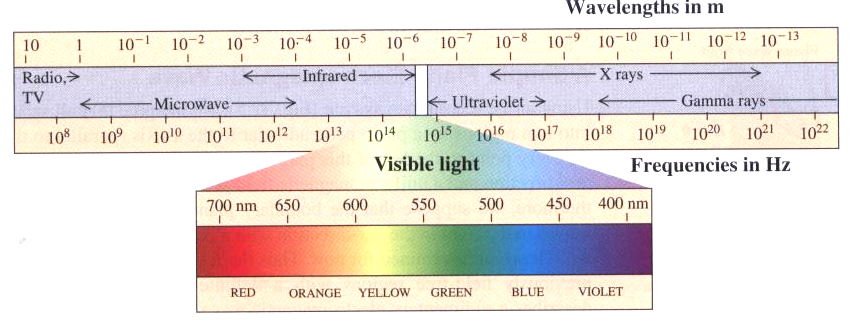
2 (a) Show an appreciation of the particulate nature of electromagnetic radiation lectromagnetic energy is emitted, transmitted and absorbed in discrete packets or quanta. quantum of electromagnetic radiation is known as a photon. g.1: (ns: ) Photon is the name given to an electron emitted from a metal surface by the action of light. a unit of energy. a positively charged atomic particle. an electron emitted from a metal surface by the action of heat. a quantum of electromagnetic radiation. (b) Recall and use = hf The energy of a photon,, is proportional to its frequency f, and is expressed as = hf = h c λ where h is the Planck constant (= Js). g.2: Find the energy of a photon of electromagnetic radiation of wavelength 0.15 nm. In which region of the electromagnetic spectrum is this radiation? Recall: nswer: 8-1 c = hf = h = ( (3 10 ms ) Js) λ 9 ( m) = J. X-ray. jj_sph2011 Page 2 of 19 Sections marked * are extras
3 g.3: (ns: ) The wavelength of a 5 MeV γ-ray is m m m m m nswer: ata: 1 MeV = ( ) x ( ) = J = 5 MeV = 5 ( J) = J = hf = h λ c λ = hc = ( Js)(3 10 ms ) 13 ( J) = m. g.4: (ns: ) photon of light enters a block of glass after traveling through a vacuum. The energy of the photon on entering the glass block increases because its associated wavelength decreases. decreases because the speed of the radiation decreases. stays the same because the speed of the radiation and the associated wavelength do not change. stays the same because the frequency of the radiation does not change. stays the same because the speed of the radiation and its wavelength increase by the same order. nswer: Only speed and wavelength change, frequency is unchanged. (d) (f) (g) Recall the significance of threshold frequency xplain photoelectric phenomena in terms of photon energy and work function energy. xplain why the maximum photoelectric energy is independent of intensity whereas the photoelectric current is proportional to intensity Photoelectric phenomena: Generally, electrons may be emitted from a metal surface by 3 methods: (1) by friction, e.g. by rubbing a metal surface vigorously with a piece of cloth, (2) by thermionic emission, i.e. by heating a metal such that the electrons in it would gain enough kinetic energy to overcome the attraction of the metal surface and escape from the surface (almost as though they are boiled off the surface). jj_sph2011 Page 3 of 19 Sections marked * are extras
4 (3) by photoelectric effect, i.e. to incident a beam of light (em radiation) on a metal surface such that the electrons in it would gain enough kinetic energy from the incident light to overcome the attraction of the metal surface and escape from the surface. Photoelectric effect is the emission of electrons from the metal surface when an electromagnetic radiation of high enough frequency is incident on the metal. xperimental Setup: incident radiation m V Procedure: In the above setup, radiation (or light) of known frequency f and intensity I is incident onto an emitting electrode (cathode ) placed within an evacuated glass envelope, together with the collecting electrode (anode ). lectrons may be emitted by and collected by. The electric potential of may be varied and made positive or negative (higher or lower) with respect to. Refer to nnex for results and explanation. (c) Show an understanding that the photoelectric effect provides evidence for a particulate nature of electromagnetic radiation while phenomena such as interference and diffraction provide evidence for a wave nature It is well-known that only waves are able to exhibit phenomena such as interference and diffraction. Light as an example of an em radiation does exhibit such phenomena, and hence may be considered as a wave. On the other hand, the results of the photoelectric effect showed the inadequacy of the wave nature of light. y considering light as a wave, only the first result can be explained (i.e. photoelectric current intensity). ll the experimental results can be explained adequately by considering light as a stream of photons. photon is a quantum of em radiation, which may be considered as a particle without mass, just a packet of energy. * [The explanation for the experimental results of the photoelectric effect was proposed by none other than lbert instein. He was most famous for his Theory of Relativity, but he won his Nobel Prize for Physics due to this theory (photoelectric effect) which assumed that light may be considered as a stream of photons. The equation that summarises the photoelectric effect was named instein s equation. ] jj_sph2011 Page 4 of 19 Sections marked * are extras
5 g.5: (ns: ) Which one of the following statements, referring to photoelectric emission, is always true? No emission of electrons occurs for very low intensity. Not true. s long as there are photons with enough energy, there will be electrons emitted. It is independent of intensity. For a given metal there is a minimum frequency of radiation below which no emission occurs. True. This is the threshold frequency for that metal. The velocity of the emitted electrons is proportional to the intensity of the incident radiation. Not true. It is the photoelectric current that is proportional to intensity. The number of electrons emitted per second is independent of the intensity of the incident radiation. Not true. Number of electrons emitted per second is a measure of the photoelectric current, which is proportional to intensity. The number of electrons emitted per second is proportional to the frequency of the incident radiation. Not true. Number of electrons emitted per second is a measure of the photoelectric current, which is proportional to intensity, not frequency. g.6: (ns: ) source emits monochromatic light of wavelength λ at power P. Given that h is the Planck constant and c the speed of light, the rate of emission of photons is Pc hλ λc Ph hc Pλ Ph cλ Pλ hc nswer: ach photon has energy, = hf. If N is the number of photons emitted in time t, the total energy emitted in time t can be expressed as N = Nhf = Nh λ c The source emits light at a power, So, the rate of emission of photons, total energy emitted P = time taken N = Pλ t hc = Nhf t Nhc = t λ g.7: (ns: ) beam of monochromatic radiation falls on to a metal X and photoelectrons are emitted. The rate of emission of photoelectrons will be double if a beam of double the intensity is used. radiation of double the frequency is used. radiation of double the wavelength is used. the thermodynamic temperature of the metal is doubled. a metal with a work function half that of X is substituted for X. nswer: ouble the rate of emission of photoelectrons means double the photoelectric current. Since photoelectric current intensity, the intensity must also be doubled. jj_sph2011 Page 5 of 19 Sections marked * are extras
6 1 (h) Recall, use and explain the significance of hf = φ + mv 2 The above equation is known as the instein s photoelectric equation. When an electron absorbs energy hf from an incident photon, spends a minimum energy φ to be emitted from the metal surface, it will have a maximum kinetic energy, 2 max 1 2 mv = hf φ 2 max Note: (i) (ii) 1 2 mv belongs to an electron, measured by the stopping potential, 2 max V s, of the electrode, which is made negative (lower potential) with respect to. This represents the minimum negative potential required to stop even the most energetic electron from reaching the electrode (indicated by the zero current in the milliammeter), therefore, 1 mv 2 = ev 2 max s. φ is a characteristic of the electrode, (= hf o, where f o is the threshold frequency). and hf is the energy of a photon. (e) Recall and use the equation 1 mv 2 = ev 2 max s, where ev s is the stopping potential This just means, for the photoelectron: loss of kinetic energy = gain in electric potential energy instein s equation can hence be written as: ev s = hf φ or ev s = hf hf o h h or V s = ( ) f ( ) f o e e h φ or V s = ( ) f e e V s slope = h e f o f φ e Note: (i) The graph of V s versus f has a gradient of h e constant. which is always (ii) ifferent material of will give a different value of φ, and hence the graph will have different y-intercept. jj_sph2011 Page 6 of 19 Sections marked * are extras
7 g.8: (ns: ) The result of an experiment to investigate the energy of photoelectrons emitted from a metallic surface is represented by the figure below. stopping potential 0 frequency The gradient of the graph depends on the intensity of the incident radiation. wavelength of the incident radiation. work function of the irradiated surface. pressure of residual gas in contact with the surface. ratio of the Planck constant to the electronic charge. g.9: (ns: ) Light quanta each of energy J fall on the cathode of a photocell. The current through the cell is just reduced to zero by applying a reverse voltage to make the cathode 0.25 V positive with respect to the anode. The minimum energy required to remove an electron from the cathode is J J J J J nswer: ata: hf = J, V s = 0.25 V. Question asks for minimum energy required to remove an electron from the cathode, i.e. the work function energy of the cathode, φ. Using ev s = hf φ φ = hf ev s = ( J) ( )(0.25 V) = J g.10: (ns: ) In a photoelectric experiment, electrons are ejected from metals X and Y by light of frequency f. The potential difference V required to stop the electrons is measured for various frequencies. If Y has a greater work function than X, which graph illustrates the expected results? V V V V V X X Y X Y Y X Y Y X 0 f 0 f 0 f 0 f 0 f nswer: First, the gradient of the graph cannot change (always = h ), so answers are or. e If Y has a greater work function than X, then the graph for Y should have a more negative y-intercept. jj_sph2011 Page 7 of 19 Sections marked * are extras

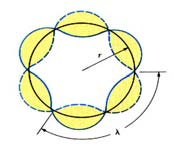
8 (i) escribe and interpret qualitatively the evidence provided by electron diffraction for the wave nature of particles When a beam of electron is passed through a thin film of crystal (e.g. graphite ), the dispersion pattern of the emergent electrons produced on a screen ( coated with fluorescent, (c) ) is observed to be similar to the diffraction pattern produced by a beam X-ray (a well-known electromagnetic wave, (b) ). This is known as the electron diffraction phenomenon. (j) This phenomenon provides evidence for the wave nature of particles like electrons. h Recall and use the relation for the de roglie wavelength λ = p de roglie suggested that: for a particle of momentum p (= mv), which exhibits wave behaviour, it will have an associated wavelength λ, given by λ = p h Similarly, for electromagnetic radiation of wavelength λ, which exhibits particle behaviour, it will have an associated momentum p, given by p = λ h This is known as the de roglie principle. g.11: (ns: ) Light of frequency Hz consists of photons of momentum kg m s kg m s kg m s kg m s kg m s -1 nswer: 34 h hf ( Js)(5 10 p = = = λ c ms 14 Hz) = kg m s -1. jj_sph2011 Page 8 of 19 Sections marked * are extras
9 g.12: (ns: ) beam of light of wavelength λ is totally reflected at normal incidence by a plane mirror. The intensity of the light is such that photons hit the mirror at a rate n. Given that the Planck constant is h, the force exerted on the mirror by this beam is nhλ nh λ 2 nhλ 2nλ h 2nh λ nswer: ach photon has a momentum p = λ h When totally reflected at normal incidence by a plane mirror, the change in momentum = 2 λ h Since there are n photons hitting the mirror per unit time, Δ p h the rate of change of momentum, = 2n t λ y Newton s 2 nd Δ p h law of motion, force, F = = 2n t λ (k) Show an understanding of the existence of discrete energy levels in isolated atoms (e.g. atomic hydrogen) and deduce how this leads to spectral lines The electrons orbiting an atom can only occupy certain allowed orbits. In these allowed orbits, the total kinetic and potential energies of all the electrons in the atom will give rise to the specific energy state of the atom e.g. 1, 2 and so on. In the normal state or ground state of an atom, its electrons will occupy the lowest allowed orbit so that the energy of the atom is at its lowest. ny change usually involves the movement of the electrons to higher allowed orbits. For the different allowed orbits occupied, the atom will have different but specific energy states, or excited states. In this transition to a higher orbit, the energy absorbed by the atom in excitation, the excitation energy, is equal to the difference between the energy levels of the two states. The highest excited state is when the electron is at infinity (i.e. the atom is ionised), so the highest excitation energy is the ionisation energy nergy level diagram of an atom having various allowed states. The lowest energy state 1 is the ground state. ll others are excited states. Note the bigger gaps between energy levels in the lower region (say, between 2 and 1 ) than those in the higher region (say, between 4 and 3 ). jj_sph2011 Page 9 of 19 Sections marked * are extras
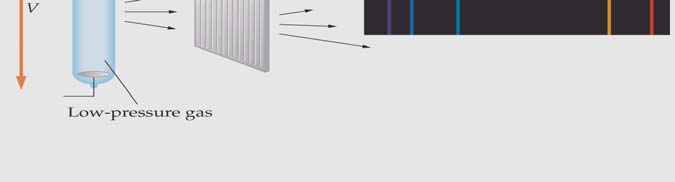
10 On the other hand, if an electron makes a transition down from a higher excited state to a lower energy level, the excess energy will be emitted as a photon, whose energy corresponds to the difference between the initial and final energy levels (hf = 2 1 ). Photons emitted from such transitions, when allowed to pass through a narrow slit and a diffraction grating, will give rise to a set of line spectrum, unique to the element. High Potential ifference iffraction Grating Line spectrum Low Pressure Gas g.13: (ns: ) The minimum energy to ionise an atom is the energy required to add one electron to the atom. excite the atom from its ground state to its first excited state. remove one outermost electron from the atom. remove one innermost electron from the atom. remove all the electrons from the atom. Remark: This is the ionisation energy of the atom. jj_sph2011 Page 10 of 19 Sections marked * are extras

11 (l) istinguish between emission and absorption line spectra mission Line Spectra for Hydrogen spectrum is produced by using a prism or diffraction grating to separate the various wavelengths in a beam of light. It is the set of wavelengths that are observed. line spectrum contains a discrete set of wavelengths, like the ones shown here. It is a characteristic feature of an element. xamples of emission line spectra are as seen above. mission 2 hf = hc λ = n excited electron transits to a lower energy level by emitting a photon. mission refers to the emission of a specific amount of energy from an isolated atom (e.g. an atom of an element in vapour or gaseous state, at low pressure) when its electrons jump from higher to lower allowed orbits, releasing the specific excess energy. Such specific energy released can only take the form of a photon, with the corresponding frequency f related by hc = hf = = 2 1 λ n emission line spectrum of an element consists of a series of separate bright lines of definite frequencies (or wavelengths) on a dark background. It is produced when a stream of photons of different frequencies is passed through a narrow slit and normally through a diffraction grating. These photons are emitted randomly from transitions (from higher to lower excited states or the ground state) in the excited atoms of the element in a vapour or gas at low pressure. jj_sph2011 Page 11 of 19 Sections marked * are extras
12 Since each element has a unique set of orbital electrons, the emission line spectrum of an element is also unique, enabling it to be used as a means of identification of the element. toms in solid state (e.g. a tungsten filament) are very close to one another, no longer isolated. The energy levels of each atom are no longer identical to one another. mission from these atoms will result in a continuous spectrum (i.e. the numerous lines diffracted on the screen are so close to each other that separation between these lines are negligible and the spectrum appears to be continuous). g.14: (ns: ) Which of the following provides experimental evidence for discrete electron energy levels in atoms? the spectrum of a tungsten filament lamp. the spectrum of a sodium discharge lamp. the photoelectric effect. the emission of β-particles by radioactive atoms. the emission of γ-rays by radioactive atoms. Remark: Sodium in a discharge lamp is in gaseous state. Tungsten filament is a solid. g.15: (ns: ) The existence of energy levels within atoms can be demonstrated directly by observing that atoms can emit spectra. photoelectrons are only emitted for wavelength greater than a critical wavelength. some α-particles are reflected back through very large angles by atoms in a solid. X-rays with frequencies up to a certain maximum are emitted by a target. atoms in a solid diffract electrons in the same way as crystals diffract X-rays. bsorption bsorption refers to the absorption of energy by an atom from external sources. bsorption can occur only if it results in the atom being excited to a higher allowed energy state, i.e. only a specific amount of energy Δ can be absorbed. No absorption will occur if too little or too much energy is given to the atom. Δ = n electron transits to a higher energy level after absorption. jj_sph2011 Page 12 of 19 Sections marked * are extras
13 There are 3 ways in which an atom can absorb energy: (1) from thermal energy (e.g. when an element is heated by a bunsen flame); or (2) from kinetic energy of a colliding particle (e.g. when an atom in a vapour in a tube at low pressure is collided by an electron moving across the tube, say, in an electric fluorescent lamp.); or (3) from an incident photon (e.g. when a beam of bright light is incident on a vapour or gas.) Note: For (1) and (2), an atom will absorb the exact amount of energy required for a particular transition, which may be any fraction of the energy supplied by the source. For (3), only photons with the exact amount of energy required for the transition will be absorbed. Photons with energies lower or higher than this exact amount will not be absorbed. In the diagram below, the bright light beam originates from the filament lamp. The sodium lamp does not give out light on its own, consisting of only sodium vapour. The resulting light beams would pass through the collimator which makes the beams parallel and incident normally onto the diffraction grating. The spectrum formed is observed using the telescope. n absorption line spectrum of an element consists of a series of separate dark lines of definite frequencies (or wavelengths) on a coloured background. The coloured background is produced when a stream of photons of different frequencies from a white light source (e.g. tungsten filament lamp) is passed through a narrow slit and a diffraction grating. The cool vapour of the element concerned is placed between the white light source and the narrow slit, such that its atoms may absorb excitation energy from photons incident from the white light source. The unabsorbed photons from the white light source will be incident on the screen with the original intensity. fter the absorption, the excited atoms will eventually go back to the ground state by emitting the same photons absorbed earlier. jj_sph2011 Page 13 of 19 Sections marked * are extras
14 Summary: The re-emitted photons from the excited atoms in the cool vapour of the element will be in all directions. Only a small fraction of the re-emitted photons will be incident onto the screen, hence they will form lines with a much lower intensity. This accounts for the dark lines in the spectrum, which appear on the exact positions as the corresponding emission line spectrum of the element. Note that these dark lines are not totally dark. In fact, they are of the same colour as their neighbouring background. They only appear dark against the coloured background because they are too dim, by comparison. istinguishing between In terms of Initial state of gas atoms Spectrum Pattern mission Line Spectra produced by hot (gas atoms are initially at excited state) vapour or gas. a series of separate bright lines of definite wavelength on a dark background bsorption Line Spectra produced when white light passes through cool (gas atoms are initially at ground state) vapour or gas. a series of separate dark lines of definite wavelength on a coloured background xplanation xcited atoms emit photons with the characteristic wavelengths corresponding to the transitions from higher to lower energy levels. Wavelengths corresponding to bright lines on the spectrum are characteristics of the element emitting the light. ool gas absorbs photons with the characteristic wavelengths corresponding to the transitions from lower to higher energy levels. Subsequently, the excited atoms transit back to the lower energy levels by emitting the same photons in all directions Small fraction of emitted photons incident on screen lines of lower intensity formed (appear as dark lines on the spectrum) Wavelengths corresponding to dark lines on the spectrum are characteristics of the element emitting the light. jj_sph2011 Page 14 of 19 Sections marked * are extras

15 g.16: (ns: ) When a parallel beam of white light passes through a metal vapour, dark lines appear in the spectrum of the emergent light. This is principally because energy is absorbed and is not re-emitted at all. is re-radiated as infra-red. is re-radiated as ultra-violet. is re-radiated gradually over a long period of time. is re-radiated uniformly in all directions. g.17: (ns: ) White light from a tungsten filament lamp is passed through sodium vapour and viewed through a diffraction grating. Which of the following best describes the spectrum which would be seen? coloured lines on a black background coloured lines on a white background dark lines on a coloured background dark lines on a white background Remark: The coloured background is due to the white light from tungsten lamp forming a continuous spectrum. (m) Recall and solve problems using the relation hf = 1 2. In a transition from an initial level of energy 1 to a final level of energy 2 ( 1 > 2 ), a photon of frequency f is emitted, with its energy given by = hf = h λ c = 1 2 jj_sph2011 Page 15 of 19 Sections marked * are extras
16 g.18: (ns: ) n atom emits a spectral line of wavelength λ when an electron makes a transition between the levels 1 and 2. Which expression correctly relates λ, 1 and 2? λ = c h ( 1 2 ) λ = ch ( 1 2 ) c λ = h( 1 2 ) ch λ = 1 2 nswer: hf = 1 2 c h = 1 2 λ hc λ = 1 2 g.19: (ns: ) In the figure below, 1 to 6 represent some of the energy levels of an electron in the hydrogen atom ev 0.54 ev 0.85 ev 1.5 ev ev ev Which one of the following transitions produces a photon of wavelength in the ultraviolet region of the electro-magnetic spectrum? [ 1 ev = J. ] nswer: ssume a transition from 2 to 1, the resulting photon emitted would have an energy, = ( 3.4 ev) ( 13.6 ev) = 10.2 ev = 10.2( J) = J. The frequency and wavelength of the photon are related by the equation = hf = h λ c c λ = h = ( ms Js) J 8-1 = m This corresponds to the wavelength of ultra-violet radiation. jj_sph2011 Page 16 of 19 Sections marked * are extras
17 g.20: (ns: ) The diagram below represents, drawn to scale, the energy levels for an electron in a certain atom. energy The transition from 3 to 1 produces a green line. What transition could give rise to a red line? 4 to 3 4 to 2 4 to 1 3 to 2 2 to 1 Remark: Frequency of red light is lower than frequency of green light, so energy of a photon from a red light is lower than that from a green light. ut gaps between energy levels are bigger for lower levels than for higher levels. The transition from 3 to 1 gives a green light (in the visible light region of the em spectrum), then to give a red light, the transition must also be to 1. Transition to other levels would give a photon of much lower energy, regardless of where the transition is originated from. jj_sph2011 Page 17 of 19 Sections marked * are extras
18 Result nnex : Results and explanations for the photoelectric effect xperimental xplanation Observation onsidering light as a wave onsidering light as a particle 1 The rate of emission of photoelectrons ( measured as photoelectric current ) is proportional to the incident radiation intensity. Intensity is the rate of incidence of energy per unit area. photoelectric current Intensity beam of light carries a continuous flow of energy when it is incident onto the metal surface. The intensity of the beam is proportional to the square of the wave amplitude. Intensity is a measure of the rate at which energy would be imparted onto the electrons per unit surface area of the emitting electrode. The higher the intensity of the light beam, the higher the energy imparted onto the electrons. This resulted in a higher number of photoelectrons emitted per unit time which means a higher current. an explain observation. Since each photon has a specific amount of energy (= hf), then the intensity of a beam of light is a measure of the rate of incidence of photons, i.e. the number of photons incident per unit time. The higher the intensity, the more photons per unit time is incident onto the emitting electrode. It is assumed each photon gives all its energy (= hf) to a single electron in the metal. Hence the more photons incident onto the metal surface, the more photoelectrons emitted. an explain observation. 2 For every material of irradiated, there is a minimum frequency ( threshold frequency f o ) required to liberate an electron from the surface. This f o is independent of the light intensity. mission of photoelectrons from the metal surface should occur at any frequency. It is independent of frequency. annot explain observation. There is a certain minimum energy called the work function energy, φ necessary to liberate an electron from its surface. Since the energy of a photon is expressed as hf, hence the minimum photon energy required to liberate an electron from its surface must be hf o (= φ) where f o is the threshold frequency. f o andφ are characteristic of the material. an explain observation. jj_sph2011 Page 18 of 19 Sections marked * are extras
19 Result xperimental xplanation Observation onsidering light as a wave onsidering light as a particle The higher the intensity, the higher the energy The emitted photoelectrons would have absorbed energy imparted onto the electrons on the metal surface. from the incident photons. 3 The maximum kinetic ( photoelectric ) energy of emitted electrons depends only on the frequency of the incident radiation, and not its intensity. The electrons should then be emitted with higher kinetic energies, which contradict the experimental result. Since each electron absorbs energy only from one photon, what matters is the energy of each photon (which depends only on its frequency). current Frequency fixed, Intensity I 2 > I 1 I 2 annot explain observation. High intensity means there is a large number of photons incident onto the electrode per unit time, but this does not affect the energy absorbed by a single electron. I 1 an explain observation. V s V current Intensity fixed, Frequency f 2 > f 1 f 2 V S2 V S1 f 1 4 The emission of photoelectrons starts with no observable time lag, even for very low intensity of incident radiation. V For very low intensity radiation, an electron would require some time to absorb enough energy to be emitted from the metal surface. Then there would be a certain time lag in its emission. annot explain observation. For the incident photon, its energy will be instantaneously transferred to the absorbing electron, in a one-to-one interaction. This accounts for the instantaneous emission of the photoelectron. an explain observation. jj_sph2011 Page 19 of 19 Sections marked * are extras
The Phenomenon of Photoelectric Emission:
 The Photoelectric Effect. The Wave particle duality of light Light, like any other E.M.R (electromagnetic radiation) has got a dual nature. That is there are experiments that prove that it is made up of
How To Understand Light And Color
 PRACTICE EXAM IV P202 SPRING 2004 1. In two separate double slit experiments, an interference pattern is observed on a screen. In the first experiment, violet light (λ = 754 nm) is used and a second-order
PHOTOELECTRIC EFFECT AND DUAL NATURE OF MATTER AND RADIATIONS
 PHOTOELECTRIC EFFECT AND DUAL NATURE OF MATTER AND RADIATIONS 1. Photons 2. Photoelectric Effect 3. Experimental Set-up to study Photoelectric Effect 4. Effect of Intensity, Frequency, Potential on P.E.
Photons. ConcepTest 27.1. 1) red light 2) yellow light 3) green light 4) blue light 5) all have the same energy. Which has more energy, a photon of:
 ConcepTest 27.1 Photons Which has more energy, a photon of: 1) red light 2) yellow light 3) green light 4) blue light 5) all have the same energy 400 nm 500 nm 600 nm 700 nm ConcepTest 27.1 Photons Which
Physics 30 Worksheet # 14: Michelson Experiment
 Physics 30 Worksheet # 14: Michelson Experiment 1. The speed of light found by a Michelson experiment was found to be 2.90 x 10 8 m/s. If the two hills were 20.0 km apart, what was the frequency of the
Name Date Class ELECTRONS IN ATOMS. Standard Curriculum Core content Extension topics
 13 ELECTRONS IN ATOMS Conceptual Curriculum Concrete concepts More abstract concepts or math/problem-solving Standard Curriculum Core content Extension topics Honors Curriculum Core honors content Options
TIME OF COMPLETION NAME SOLUTION DEPARTMENT OF NATURAL SCIENCES. PHYS 3650, Exam 2 Section 1 Version 1 October 31, 2005 Total Weight: 100 points
 TIME OF COMPLETION NAME SOLUTION DEPARTMENT OF NATURAL SCIENCES PHYS 3650, Exam 2 Section 1 Version 1 October 31, 2005 Total Weight: 100 points 1. Check your examination for completeness prior to starting.
Experiment #5: Qualitative Absorption Spectroscopy
 Experiment #5: Qualitative Absorption Spectroscopy One of the most important areas in the field of analytical chemistry is that of spectroscopy. In general terms, spectroscopy deals with the interactions
ATOMIC SPECTRA. Apparatus: Optical spectrometer, spectral tubes, power supply, incandescent lamp, bottles of dyed water, elevating jack or block.
 1 ATOMIC SPECTRA Objective: To measure the wavelengths of visible light emitted by atomic hydrogen and verify the measured wavelengths against those predicted by quantum theory. To identify an unknown
Chemistry 102 Summary June 24 th. Properties of Light
 Chemistry 102 Summary June 24 th Properties of Light - Energy travels through space in the form of electromagnetic radiation (EMR). - Examples of types of EMR: radio waves, x-rays, microwaves, visible
Blackbody Radiation References INTRODUCTION
 Blackbody Radiation References 1) R.A. Serway, R.J. Beichner: Physics for Scientists and Engineers with Modern Physics, 5 th Edition, Vol. 2, Ch.40, Saunders College Publishing (A Division of Harcourt
Chapter 18: The Structure of the Atom
 Chapter 18: The Structure of the Atom 1. For most elements, an atom has A. no neutrons in the nucleus. B. more protons than electrons. C. less neutrons than electrons. D. just as many electrons as protons.
Wave Function, ψ. Chapter 28 Atomic Physics. The Heisenberg Uncertainty Principle. Line Spectrum
 Wave Function, ψ Chapter 28 Atomic Physics The Hydrogen Atom The Bohr Model Electron Waves in the Atom The value of Ψ 2 for a particular object at a certain place and time is proportional to the probability
From lowest energy to highest energy, which of the following correctly orders the different categories of electromagnetic radiation?
 From lowest energy to highest energy, which of the following correctly orders the different categories of electromagnetic radiation? From lowest energy to highest energy, which of the following correctly
Experiment #12: The Bohr Atom. Equipment: Spectroscope Hydrogen and Helium Gas Discharge Tubes, Holder, and Variac Flashlight
 Experiment #12: The Bohr Atom Purpose: To observe the visible spectrum of hydrogen and helium and verify the Bohr model of the hydrogen atom. Equipment: Spectroscope Hydrogen and Helium Gas Discharge Tubes,
G482 Electrons, Waves and Photons; Revision Notes Module 1: Electric Current
 G482 Electrons, Waves and Photons; Revision Notes Module 1: Electric Current Electric Current A net flow of charged particles. Electrons in a metal Ions in an electrolyte Conventional Current A model used
PHYSICS PAPER 1 (THEORY)
 PHYSICS PAPER 1 (THEORY) (Three hours) (Candidates are allowed additional 15 minutes for only reading the paper. They must NOT start writing during this time.) ---------------------------------------------------------------------------------------------------------------------
Physical Science Study Guide Unit 7 Wave properties and behaviors, electromagnetic spectrum, Doppler Effect
 Objectives: PS-7.1 Physical Science Study Guide Unit 7 Wave properties and behaviors, electromagnetic spectrum, Doppler Effect Illustrate ways that the energy of waves is transferred by interaction with
Calculating particle properties of a wave
 Calculating particle properties of a wave A light wave consists of particles (photons): The energy E of the particle is calculated from the frequency f of the wave via Planck: E = h f (1) A particle can
AP Physics B Ch. 23 and Ch. 24 Geometric Optics and Wave Nature of Light
 AP Physics B Ch. 23 and Ch. 24 Geometric Optics and Wave Nature of Light Name: Period: Date: MULTIPLE CHOICE. Choose the one alternative that best completes the statement or answers the question. 1) Reflection,
Does Quantum Mechanics Make Sense? Size
 Does Quantum Mechanics Make Sense? Some relatively simple concepts show why the answer is yes. Size Classical Mechanics Quantum Mechanics Relative Absolute What does relative vs. absolute size mean? Why
GRID AND PRISM SPECTROMETERS
 FYSA230/2 GRID AND PRISM SPECTROMETERS 1. Introduction Electromagnetic radiation (e.g. visible light) experiences reflection, refraction, interference and diffraction phenomena when entering and passing
Measurement of Charge-to-Mass (e/m) Ratio for the Electron
 Measurement of Charge-to-Mass (e/m) Ratio for the Electron Experiment objectives: measure the ratio of the electron charge-to-mass ratio e/m by studying the electron trajectories in a uniform magnetic
5. The Nature of Light. Does Light Travel Infinitely Fast? EMR Travels At Finite Speed. EMR: Electric & Magnetic Waves
 5. The Nature of Light Light travels in vacuum at 3.0. 10 8 m/s Light is one form of electromagnetic radiation Continuous radiation: Based on temperature Wien s Law & the Stefan-Boltzmann Law Light has
Atoms Absorb & Emit Light
 Atoms Absorb & Emit Light Spectra The wavelength of the light that an element emits or absorbs is its fingerprint. Atoms emit and absorb light First Test is Thurs, Feb 1 st About 30 multiple choice questions
Vacuum Evaporation Recap
 Sputtering Vacuum Evaporation Recap Use high temperatures at high vacuum to evaporate (eject) atoms or molecules off a material surface. Use ballistic flow to transport them to a substrate and deposit.
Preview of Period 3: Electromagnetic Waves Radiant Energy II
 Preview of Period 3: Electromagnetic Waves Radiant Energy II 3.1 Radiant Energy from the Sun How is light reflected and transmitted? What is polarized light? 3.2 Energy Transfer with Radiant Energy How
Production of X-rays. Radiation Safety Training for Analytical X-Ray Devices Module 9
 Module 9 This module presents information on what X-rays are and how they are produced. Introduction Module 9, Page 2 X-rays are a type of electromagnetic radiation. Other types of electromagnetic radiation
Arrangement of Electrons in Atoms
 CHAPTER 4 PRE-TEST Arrangement of Electrons in Atoms In the space provided, write the letter of the term that best completes each sentence or best answers each question. 1. Which of the following orbital
Quantum Mechanics and Atomic Structure 1
 Quantum Mechanics and Atomic Structure 1 INTRODUCTION The word atom is derived from the Greek word, atomos, which means uncut or indivisible. It was Dalton (1808) who established that elementary constituents
Atomic Structure Ron Robertson
 Atomic Structure Ron Robertson r2 n:\files\courses\1110-20\2010 possible slides for web\atomicstructuretrans.doc I. What is Light? Debate in 1600's: Since waves or particles can transfer energy, what is
Light as a Wave. The Nature of Light. EM Radiation Spectrum. EM Radiation Spectrum. Electromagnetic Radiation
 The Nature of Light Light and other forms of radiation carry information to us from distance astronomical objects Visible light is a subset of a huge spectrum of electromagnetic radiation Maxwell pioneered
Lesson 33: Photoelectric Effect
 Lesson 33: Photoelectric Effect Hertz Experiment Heinrich Hertz was doing experiments in 1887 to test some of Maxwell's theories of EMR. One of the experiments involved using a coil of wire as a receiver
WAVES AND ELECTROMAGNETIC RADIATION
 WAVES AND ELECTROMAGNETIC RADIATION All waves are characterized by their wavelength, frequency and speed. Wavelength (lambda, ): the distance between any 2 successive crests or troughs. Frequency (nu,):
After a wave passes through a medium, how does the position of that medium compare to its original position?
 Light Waves Test Question Bank Standard/Advanced Name: Question 1 (1 point) The electromagnetic waves with the highest frequencies are called A. radio waves. B. gamma rays. C. X-rays. D. visible light.
Curriculum for Excellence. Higher Physics. Success Guide
 Curriculum for Excellence Higher Physics Success Guide Electricity Our Dynamic Universe Particles and Waves Electricity Key Area Monitoring and Measuring A.C. Monitoring alternating current signals with
Spectrophotometry and the Beer-Lambert Law: An Important Analytical Technique in Chemistry
 Spectrophotometry and the Beer-Lambert Law: An Important Analytical Technique in Chemistry Jon H. Hardesty, PhD and Bassam Attili, PhD Collin College Department of Chemistry Introduction: In the last lab
Cathode Ray Tube. Introduction. Functional principle
 Introduction The Cathode Ray Tube or Braun s Tube was invented by the German physicist Karl Ferdinand Braun in 897 and is today used in computer monitors, TV sets and oscilloscope tubes. The path of the
Chem 1A Exam 2 Review Problems
 Chem 1A Exam 2 Review Problems 1. At 0.967 atm, the height of mercury in a barometer is 0.735 m. If the mercury were replaced with water, what height of water (in meters) would be supported at this pressure?
MAKING SENSE OF ENERGY Electromagnetic Waves
 Adapted from State of Delaware TOE Unit MAKING SENSE OF ENERGY Electromagnetic Waves GOALS: In this Part of the unit you will Learn about electromagnetic waves, how they are grouped, and how each group
Copyright 1999 2010 by Mark Brandt, Ph.D. 12
 Introduction to Absorbance Spectroscopy A single beam spectrophotometer is comprised of a light source, a monochromator, a sample holder, and a detector. An ideal instrument has a light source that emits
Flame Tests & Electron Configuration
 Flame Tests & Electron Configuration INTRODUCTION Many elements produce colors in the flame when heated. The origin of this phenomenon lies in the arrangement, or configuration of the electrons in the
Interference. Physics 102 Workshop #3. General Instructions
 Interference Physics 102 Workshop #3 Name: Lab Partner(s): Instructor: Time of Workshop: General Instructions Workshop exercises are to be carried out in groups of three. One report per group is due by
PHYS 222 Spring 2012 Final Exam. Closed books, notes, etc. No electronic device except a calculator.
 PHYS 222 Spring 2012 Final Exam Closed books, notes, etc. No electronic device except a calculator. NAME: (all questions with equal weight) 1. If the distance between two point charges is tripled, the
6) How wide must a narrow slit be if the first diffraction minimum occurs at ±12 with laser light of 633 nm?
 Test IV Name 1) In a single slit diffraction experiment, the width of the slit is 3.1 10-5 m and the distance from the slit to the screen is 2.2 m. If the beam of light of wavelength 600 nm passes through
Homework #10 (749508)
 Homework #10 (749508) Current Score: 0 out of 100 Description Homework on quantum physics and radioactivity Instructions Answer all the questions as best you can. 1. Hewitt10 32.E.001. [481697] 0/5 points
Solar Energy. Outline. Solar radiation. What is light?-- Electromagnetic Radiation. Light - Electromagnetic wave spectrum. Electromagnetic Radiation
 Outline MAE 493R/593V- Renewable Energy Devices Solar Energy Electromagnetic wave Solar spectrum Solar global radiation Solar thermal energy Solar thermal collectors Solar thermal power plants Photovoltaics
Review of the isotope effect in the hydrogen spectrum
 Review of the isotope effect in the hydrogen spectrum 1 Balmer and Rydberg Formulas By the middle of the 19th century it was well established that atoms emitted light at discrete wavelengths. This is in
ILLUSTRATIVE EXAMPLE: Given: A = 3 and B = 4 if we now want the value of C=? C = 3 + 4 = 9 + 16 = 25 or 2
 Forensic Spectral Anaylysis: Warm up! The study of triangles has been done since ancient times. Many of the early discoveries about triangles are still used today. We will only be concerned with the "right
Energy. Mechanical Energy
 Principles of Imaging Science I (RAD119) Electromagnetic Radiation Energy Definition of energy Ability to do work Physicist s definition of work Work = force x distance Force acting upon object over distance
A-level PHYSICS (7408/1)
 SPECIMEN MATERIAL A-level PHYSICS (7408/1) Paper 1 Specimen 2014 Morning Time allowed: 2 hours Materials For this paper you must have: a pencil a ruler a calculator a data and formulae booklet. Instructions
THE CURRENT-VOLTAGE CHARACTERISTICS OF AN LED AND A MEASUREMENT OF PLANCK S CONSTANT Physics 258/259
 DSH 2004 THE CURRENT-VOLTAGE CHARACTERISTICS OF AN LED AND A MEASUREMENT OF PLANCK S CONSTANT Physics 258/259 I. INTRODUCTION Max Planck (1858-1947) was an early pioneer in the field of quantum physics.
DO PHYSICS ONLINE FROM QUANTA TO QUARKS QUANTUM (WAVE) MECHANICS
 DO PHYSICS ONLINE FROM QUANTA TO QUARKS QUANTUM (WAVE) MECHANICS Quantum Mechanics or wave mechanics is the best mathematical theory used today to describe and predict the behaviour of particles and waves.
Sample Exercise 6.1 Concepts of Wavelength and Frequency
 Sample Exercise 6.1 Concepts of Wavelength and Frequency Two electromagnetic waves are represented in the margin. (a) Which wave has the higher frequency? (b) If one wave represents visible light and the
Main properties of atoms and nucleus
 Main properties of atoms and nucleus. Atom Structure.... Structure of Nuclei... 3. Definition of Isotopes... 4. Energy Characteristics of Nuclei... 5. Laws of Radioactive Nuclei Transformation... 3. Atom
Electron Orbits. Binding Energy. centrifugal force: electrostatic force: stability criterion: kinetic energy of the electron on its orbit:
 Electron Orbits In an atom model in which negatively charged electrons move around a small positively charged nucleus stable orbits are possible. Consider the simple example of an atom with a nucleus of
Atomic Structure: Chapter Problems
 Atomic Structure: Chapter Problems Bohr Model Class Work 1. Describe the nuclear model of the atom. 2. Explain the problems with the nuclear model of the atom. 3. According to Niels Bohr, what does n stand
E/M Experiment: Electrons in a Magnetic Field.
 E/M Experiment: Electrons in a Magnetic Field. PRE-LAB You will be doing this experiment before we cover the relevant material in class. But there are only two fundamental concepts that you need to understand.
THE BOHR QUANTUM MODEL
 THE BOHR QUANTUM MODEL INTRODUCTION When light from a low-pressure gas is subject to an electric discharge, a discrete line spectrum is emitted. When light from such a low-pressure gas is examined with
Chemistry 111 Lab: Intro to Spectrophotometry Page E-1
 Chemistry 111 Lab: Intro to Spectrophotometry Page E-1 SPECTROPHOTOMETRY Absorption Measurements & their Application to Quantitative Analysis study of the interaction of light (or other electromagnetic
Astronomy 110 Homework #04 Assigned: 02/06/2007 Due: 02/13/2007. Name:
 Astronomy 110 Homework #04 Assigned: 02/06/2007 Due: 02/13/2007 Name: Directions: Listed below are twenty (20) multiple-choice questions based on the material covered by the lectures this past week. Choose
Laboratory #3 Guide: Optical and Electrical Properties of Transparent Conductors -- September 23, 2014
 Laboratory #3 Guide: Optical and Electrical Properties of Transparent Conductors -- September 23, 2014 Introduction Following our previous lab exercises, you now have the skills and understanding to control
Austin Peay State University Department of Chemistry Chem 1111. The Use of the Spectrophotometer and Beer's Law
 Purpose To become familiar with using a spectrophotometer and gain an understanding of Beer s law and it s relationship to solution concentration. Introduction Scientists use many methods to determine
Review for Test 3. Polarized light. Action of a Polarizer. Polarized light. Light Intensity after a Polarizer. Review for Test 3.
 Review for Test 3 Polarized light No equation provided! Polarized light In linearly polarized light, the electric field vectors all lie in one single direction. Action of a Polarizer Transmission axis
Problem Set 6 UV-Vis Absorption Spectroscopy. 13-1. Express the following absorbances in terms of percent transmittance:
 Problem Set 6 UV-Vis Absorption Spectroscopy 13-1. Express the following absorbances in terms of percent transmittance: a 0.051 b 0.918 c 0.379 d 0.261 e 0.485 f 0.072 A = log P o /P = log1/t = - log T
Radiation Transfer in Environmental Science
 Radiation Transfer in Environmental Science with emphasis on aquatic and vegetation canopy media Autumn 2008 Prof. Emmanuel Boss, Dr. Eyal Rotenberg Introduction Radiation in Environmental sciences Most
Spectroscopy. Biogeochemical Methods OCN 633. Rebecca Briggs
 Spectroscopy Biogeochemical Methods OCN 633 Rebecca Briggs Definitions of Spectrometry Defined by the method used to prepare the sample 1. Optical spectrometry Elements are converted to gaseous atoms or
Nanoelectronics. Chapter 2 Classical Particles, Classical Waves, and Quantum Particles. [email protected]@2015.3
 Nanoelectronics Chapter 2 Classical Particles, Classical Waves, and Quantum Particles [email protected]@2015.3 1 Electron Double-Slit Experiment [email protected]@2015.3 2 2.1 Comparison of Classical and
- particle with kinetic energy E strikes a barrier with height U 0 > E and width L. - classically the particle cannot overcome the barrier
 Tunnel Effect: - particle with kinetic energy E strikes a barrier with height U 0 > E and width L - classically the particle cannot overcome the barrier - quantum mechanically the particle can penetrated
X-ray Production. Target Interactions. Principles of Imaging Science I (RAD119) X-ray Production & Emission
 Principles of Imaging Science I (RAD119) X-ray Production & Emission X-ray Production X-rays are produced inside the x-ray tube when high energy projectile electrons from the filament interact with the
Boardworks AS Physics
 Boardworks AS Physics Vectors 24 slides 11 Flash activities Prefixes, scalars and vectors Guide to the SI unit prefixes of orders of magnitude Matching powers of ten to their SI unit prefixes Guide to
Code number given on the right hand side of the question paper should be written on the title page of the answerbook by the candidate.
 Series ONS SET-1 Roll No. Candiates must write code on the title page of the answer book Please check that this question paper contains 16 printed pages. Code number given on the right hand side of the
Name: Class: Date: 10. Some substances, when exposed to visible light, absorb more energy as heat than other substances absorb.
 Name: Class: Date: ID: A PS Chapter 13 Review Modified True/False Indicate whether the statement is true or false. If false, change the identified word or phrase to make the statement true. 1. In all cooling
Electron Charge to Mass Ratio Matthew Norton, Chris Bush, Brian Atinaja, Becker Steven. Norton 0
 Electron Charge to Mass Ratio Matthew Norton, Chris Bush, Brian Atinaja, Becker Steven Norton 0 Norton 1 Abstract The electron charge to mass ratio was an experiment that was used to calculate the ratio
O6: The Diffraction Grating Spectrometer
 2B30: PRACTICAL ASTROPHYSICS FORMAL REPORT: O6: The Diffraction Grating Spectrometer Adam Hill Lab partner: G. Evans Tutor: Dr. Peter Storey 1 Abstract The calibration of a diffraction grating spectrometer
Current Staff Course Unit/ Length. Basic Outline/ Structure. Unit Objectives/ Big Ideas. Properties of Waves A simple wave has a PH: Sound and Light
 Current Staff Course Unit/ Length August August September September October Unit Objectives/ Big Ideas Basic Outline/ Structure PS4- Types of Waves Because light can travel through space, it cannot be
Indiana's Academic Standards 2010 ICP Indiana's Academic Standards 2016 ICP. map) that describe the relationship acceleration, velocity and distance.
 .1.1 Measure the motion of objects to understand.1.1 Develop graphical, the relationships among distance, velocity and mathematical, and pictorial acceleration. Develop deeper understanding through representations
2. Molecular stucture/basic
 2. Molecular stucture/basic spectroscopy The electromagnetic spectrum Spectral region for atomic and molecular spectroscopy E. Hecht (2nd Ed.) Optics, Addison-Wesley Publishing Company,1987 Spectral regions
The University of the State of New York REGENTS HIGH SCHOOL EXAMINATION PHYSICAL SETTING PHYSICS. Friday, June 20, 2014 1:15 to 4:15 p.m.
 P.S./PHYSICS The University of the State of New York REGENTS HIGH SCHOOL EXAMINATION PHYSICAL SETTING PHYSICS Friday, June 20, 2014 1:15 to 4:15 p.m., only The possession or use of any communications device
Chapters 21-29. Magnetic Force. for a moving charge. F=BQvsinΘ. F=BIlsinΘ. for a current
 Chapters 21-29 Chapter 21:45,63 Chapter 22:25,49 Chapter 23:35,38,53,55,58,59 Chapter 24:17,18,20,42,43,44,50,52,53.59,63 Chapter 26:27,33,34,39,54 Chapter 27:17,18,34,43,50,51,53,56 Chapter 28: 10,11,28,47,52
The Electromagnetic Spectrum
 INTRODUCTION The Electromagnetic Spectrum I. What is electromagnetic radiation and the electromagnetic spectrum? What do light, X-rays, heat radiation, microwaves, radio waves, and gamma radiation have
13- What is the maximum number of electrons that can occupy the subshell 3d? a) 1 b) 3 c) 5 d) 2
 Assignment 06 A 1- What is the energy in joules of an electron undergoing a transition from n = 3 to n = 5 in a Bohr hydrogen atom? a) -3.48 x 10⁻¹⁷ J b) 2.18 x 10⁻¹⁹ J c) 1.55 x 10⁻¹⁹ J d) -2.56 x 10⁻¹⁹
3 - Atomic Absorption Spectroscopy
 3 - Atomic Absorption Spectroscopy Introduction Atomic-absorption (AA) spectroscopy uses the absorption of light to measure the concentration of gas-phase atoms. Since samples are usually liquids or solids,
The photoionization detector (PID) utilizes ultraviolet
 Chapter 6 Photoionization Detectors The photoionization detector (PID) utilizes ultraviolet light to ionize gas molecules, and is commonly employed in the detection of volatile organic compounds (VOCs).
Spectroscopy and Regions of the Spectrum
 Basics 9 Spectroscopy and Regions of the Spectrum Different regions of the spectrum probe different types of energy levels of an atomic or molecular system. It is not uncommon to refer to a spectroscopic
Atomic Calculations. 2.1 Composition of the Atom. number of protons + number of neutrons = mass number
 2.1 Composition of the Atom Atomic Calculations number of protons + number of neutrons = mass number number of neutrons = mass number - number of protons number of protons = number of electrons IF positive
where h = 6.62 10-34 J s
 Electromagnetic Spectrum: Refer to Figure 12.1 Molecular Spectroscopy: Absorption of electromagnetic radiation: The absorptions and emissions of electromagnetic radiation are related molecular-level phenomena
Physics 111 Homework Solutions Week #9 - Tuesday
 Physics 111 Homework Solutions Week #9 - Tuesday Friday, February 25, 2011 Chapter 22 Questions - None Multiple-Choice 223 A 224 C 225 B 226 B 227 B 229 D Problems 227 In this double slit experiment we
MCQ - ENERGY and CLIMATE
 1 MCQ - ENERGY and CLIMATE 1. The volume of a given mass of water at a temperature of T 1 is V 1. The volume increases to V 2 at temperature T 2. The coefficient of volume expansion of water may be calculated
Use the following image to answer the next question. 1. Which of the following rows identifies the electrical charge on A and B shown above?
 Old Science 30 Physics Practice Test A on Fields and EMR Test Solutions on the Portal Site Use the following image to answer the next question 1. Which of the following rows identifies the electrical charge
PS-6.2 Explain the factors that determine potential and kinetic energy and the transformation of one to the other.
 PS-6.1 Explain how the law of conservation of energy applies to the transformation of various forms of energy (including mechanical energy, electrical energy, chemical energy, light energy, sound energy,
The University of the State of New York REGENTS HIGH SCHOOL EXAMINATION PHYSICAL SETTING PHYSICS. Wednesday, June 17, 2015 1:15 to 4:15 p.m.
 P.S./PHYSICS The University of the State of New York REGENTS HIGH SCHOOL EXAMINATION PHYSICAL SETTING PHYSICS Wednesday, June 17, 2015 1:15 to 4:15 p.m., only The possession or use of any communications
Waves Sound and Light
 Waves Sound and Light r2 c:\files\courses\1710\spr12\wavetrans.doc Ron Robertson The Nature of Waves Waves are a type of energy transmission that results from a periodic disturbance (vibration). They are
The rate of change of velocity with respect to time. The average rate of change of distance/displacement with respect to time.
 H2 PHYSICS DEFINITIONS LIST Scalar Vector Term Displacement, s Speed Velocity, v Acceleration, a Average speed/velocity Instantaneous Velocity Newton s First Law Newton s Second Law Newton s Third Law
"in recognition of the services he rendered to the advancement of Physics by his discovery of energy quanta". h is the Planck constant he called it
 1 2 "in recognition of the services he rendered to the advancement of Physics by his discovery of energy quanta". h is the Planck constant he called it the quantum of action 3 Newton believed in the corpuscular
Cambridge International Examinations Cambridge International General Certificate of Secondary Education
 Cambridge International Examinations Cambridge International General Certificate of Secondary Education *0123456789* PHYSICS 0625/04 Paper 4 Theory (Extended) For Examination from 2016 SPECIMEN PAPER 1
6/2016 E&M forces-1/8 ELECTRIC AND MAGNETIC FORCES. PURPOSE: To study the deflection of a beam of electrons by electric and magnetic fields.
 6/016 E&M forces-1/8 ELECTRIC AND MAGNETIC FORCES PURPOSE: To study the deflection of a beam of electrons by electric and magnetic fields. APPARATUS: Electron beam tube, stand with coils, power supply,
Science Standard 3 Energy and Its Effects Grade Level Expectations
 Science Standard 3 Energy and Its Effects Grade Level Expectations Science Standard 3 Energy and Its Effects The flow of energy drives processes of change in all biological, chemical, physical, and geological
Energy and Energy Transformations Test Review
 Energy and Energy Transformations Test Review Completion: 1. Mass 13. Kinetic 2. Four 14. thermal 3. Kinetic 15. Thermal energy (heat) 4. Electromagnetic/Radiant 16. Thermal energy (heat) 5. Thermal 17.